Gustave Flaubert and Maxime du Camp
By Field and Shore: Brittany (‘Par Les Champs et Par Les Grèves : Bretagne’, 1847)
Published with lithographs by Adolphe Bayot (French, 1810–1871), Félix Benoist (French, 1818–1896), Eugène Cicéri (French, 1813–1890), Léon Gaucherel (French, 1816–1886) and Auguste Mayer (French, 1805–1890), generously made available by the Musée de Bretagne
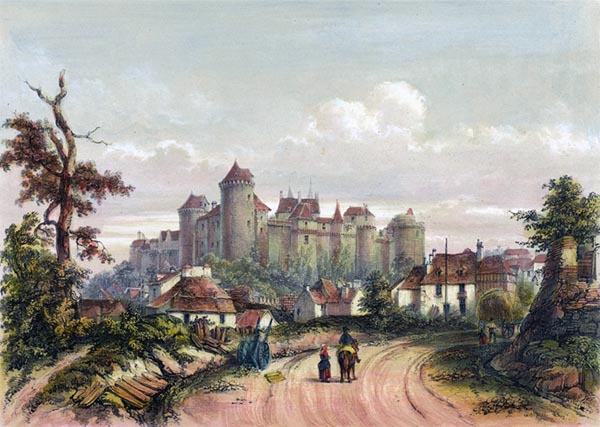
‘The Château de Vitré from the Road to Rennes’ - Félix Benoist (French, 1818–1896)
Translated by A. S. Kline © Copyright 2026 All Rights Reserved
This work may be freely reproduced, stored and transmitted, electronically or otherwise, for any non-commercial purpose.
Conditions and Exceptions apply.
Editor’s Introduction
When the Atlantic Britons abandoned the south-west coast of Britain for Armorica amid the chaotic collapse of Roman rule, they arrived as much in homecoming as in flight.
What is now north-west France had long formed part of the ancient Celtic world. The broken granite coastline, with its pungent aroma of rock samphire, and windswept fields dotted with the dolmens of a departed people, would have seemed as familiar to them as their own Dumnonia, the kingdom once encompassing Devon and Cornwall.
With them they brought the nascent seeds of Arthurian legend, formed in the turbulent world of post-Roman Britain and its conflicts with the Anglo-Saxons. To this day you can visit Tintagel, legendary birthplace of Arthur, on the Cornish coastline, but may still find Merlin’s enchanted forest of Brocéliande enfolding the Abbey of Paimpont near Rennes.
Brittany, with ancient Armorica still echoed in the name of its northern Côtes-d’Armor, remains a favourite destination for British exiles joining the continent, this editor included. It is hence with great pleasure that we present A. S. Kline’s translation of Flaubert’s and Du Camp’s 1847 tour of mid-nineteenth-century Brittany, Par Les Champs et Par Les Grèves, 1847.
Whilst almost 180 years have now passed, many of the places visited remain remarkably unchanged. Roads are paved with tarmac, and a high-speed rail line bisects the fields travelled by the two authors, but present-day vistas would remain instantly familiar to them.
The Museum of Brittany at Les Champs Libres in Rennes has generously made available mid-nineteenth-century lithographs by the French artists Adolphe Bayot, Félix Benoist, Eugène Cicéri, Léon Gaucherel and Auguste Mayer. These have been used liberally to illustrate the work, so that Brittany may be seen much as it was through the eyes of Flaubert and Du Camp.
It will be evident to anyone familiar with Brittany that the intervening years have evolved the means of travel far more than they have the landscape travelled.
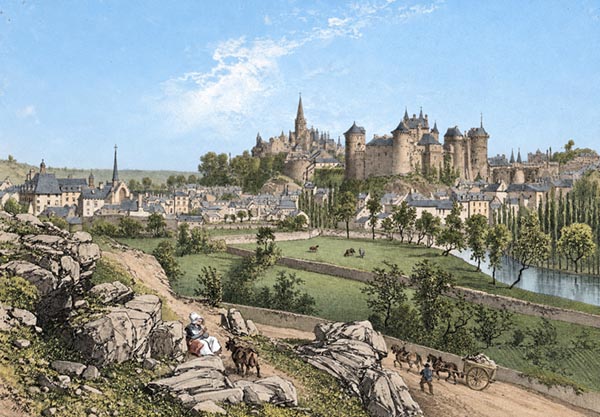
‘Vitré: General View’ - Eugène Cicéri (French, 1813–1890) - Recoloured
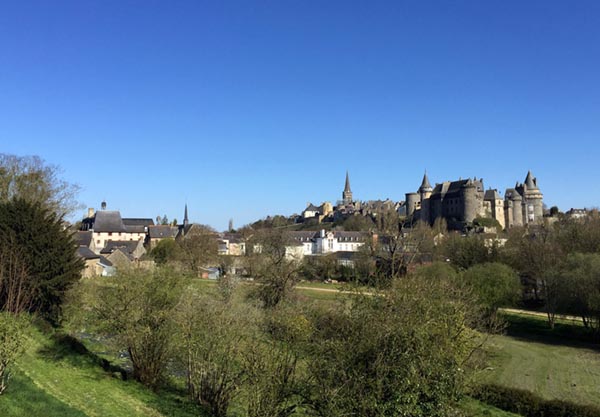
‘Vitré: General View’ - Photograph by A. D. Kline
Last Modified 20 September 2026