Gustave Flaubert and Maxime du Camp
By Field and Shore: Brittany (‘Par Les Champs et Par Les Grèves : Bretagne’, 1847)
Part III: Chapters VII-IX
Translated by A. S. Kline © Copyright 2026 All Rights Reserved
This work may be freely reproduced, stored and transmitted, electronically or otherwise, for any non-commercial purpose.
Conditions and Exceptions apply.
Contents
- Chapter VII: (Flaubert: The West Coast, Baud to Pont l’Abbé)
- Chapter VIII: (Du Camp: The West Coast, Penmarch to Crozon)
- Chapter IX: (Flaubert: The North-West Coast, Crozon to Saint-Pol-de-Léon)
Chapter VII: (Flaubert: The West Coast, Baud to Pont l’Abbé)
Half a league from the small village of Baud, hidden deep in a beech wood, stands the Venus of Quinipily. It is a six-foot-high granite statue of a nude woman with her hands on her breast; a kind of stole hangs around her neck. The stole extends down to her stomach, where it ends in a triangle like a Samoyed’s loincloth; two bands holding her wavy hair are tucked under the stole, and cross at the rear, at the small of her back. Viewed in profile, with her fleshy thighs, her rounded buttocks, her bent knees, and her large head sunk deep into her shoulders, she possesses a sensuality that is both barbaric and refined. Her face is flat, her nose snub, her eyes set close to her head, and her mouth, as well as her fingers and toes, are indicated only by a simple line; the breasts have been deliberately outlined on her chest. At the base of her pedestal is a large vat, carved from the same granite, and shaped in a square elongated at one end into a semicircle; it can hold, it is said, sixteen barrels of water.
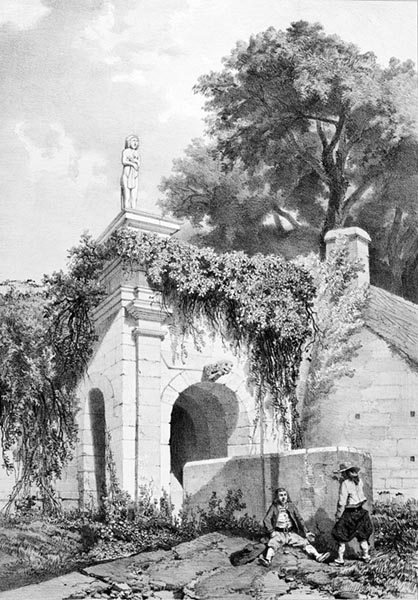
‘The Fountain of the Vénus de Quinipily, with its Granite Basin’ - Léon Gaucherel (French, 1816–1886)
She has been mistaken for an Egyptian Isis because of her bandages, or for a Roman Venus because of the inscriptions on the pedestal. But what if these inscriptions, as is claimed, were only added in the seventeenth century by Count Pierre de Lannion (Governor of Vannes)? Must we then return to the hypothesis that this is a statue of Isis? Or is it merely the enduring rage for things Egyptian, that sees, as Monsieur de Penhoet does, in this clumsy, overabundant, and languid work, the elevated, slender, rhythmic style of its sculptors? And is it not, on the other hand, too gross an act of irreverence to suppose that the Romans, who loved beautiful women, were ever capable of creating one so ugly?
All that is known is that, until the seventeenth century, this statue stood on the hill of Castannec (in Bieuzy), where Breton peasants worshipped it as an idol and brought it offerings. It was believed to heal the sick; women recovering from childbirth bathed in its vat, and young men eager for marriage flocked to plunge therein, thereafter, beneath the goddess’s gaze, indulging in the solitary pastime of amorous melancholy. In 1661, the Bishop of Vannes, Charles de Rosmadec, apparently with predilections of a different nature, was scandalised by the statue and urged the Count of Lannion (Claude), then Governor of Vannes, to eradicate the idolatry by destroying the statue. The Count merely toppled it, rolling it from the top of the mountain into the river (the Blavet) that flows at its foot. A flood occurred, and the peasants attributed it to the goddess’s wrath. They pulled the statue from the water, set it back in place, and resumed their worship, pursuing the same rituals that had outraged the respectable folk, as they were termed. So much so that Charles de Rosmadec begged the Count of Lannion (Pierre, the son of the previous governor) to finally destroy the wretched thing. The Count did nothing of the sort, but transported everything, vat and idol, to the courtyard of his castle at Quinipily (in 1695). This removal was not accomplished without difficulty; the governor’s soldiers had to defend themselves against the peasants who wanted to keep it near them.
They felt the need. Was it not, this fertile and gentle idol, a fortifying, invigorating, healing embodiment of health and the flesh, for them, and the very symbol of desire, amidst a harsh and rugged countryside?
Whether it was the first attempt at an artistic awakening, or the rotten fruit of a lost civilisation, whatever cult it belongs to, whatever Olympus it descends from, is it not, in legend and in its very form, simply one of the thousand manifestations of that eternal religion concerning the sexual essence of humanity? I mean that which reconstitutes itself everywhere, beneath all other forms, revealed yesterday, hidden today, but which no more than humankind itself can perish; for this more permanent dream is but the individual dream of the heart, this cult the cult of being: the adoration of life itself, through the means that grants life.
The castle that housed the statue is ruined, razed, vanished; the Venus stands amidst the undergrowth beneath a dome of green leaves. No more sacred enclosure, no more ceremonies, no more adoration; all that remains is herself alone, that is to say, a deity without faith, which is little or nothing at all. Here, then, is the corpse of what was once perhaps a religion, and the last remains of the beliefs of several centuries! The idol, however, did not die without uttering a death rattle that can still be heard. Her name re-surfaces, almost as an affront to a memory from which one cannot free oneself, in that of the Christian chapel erected on the site where her temple once stood, this chapel is called the Priory of La Couarde (Breton, for ‘the good woman’).
There were once two other statues at Quinipily, which were later moved to Locminé. They are of stocky, bearded, long-haired men, each wearing a truncated pyramid-shaped cap on the back of their head. A belt of foliage encircles the body, and each holds a club in his left hand. I refuse to believe that these two caryatids, carved by some village labourer, ever had much value or meaning; moreover, they have a certain shabby air about them that makes me suspect they are not very old. Let others see in them what they will — a pair of Gallic Hercules or Egyptian priests— ‘as for the beard and hair,’ says Monsieur de Penhoet, ‘they are for me indications that the figures are priests of the Sun cult, or of Serapis’ — they are nonetheless ugly, utterly ugly, and, what’s worse, mediocre.
An hour after leaving the dreadful pair, we arrived at Quimperlé which, although it offers nothing Celtic, Roman, or Phoenician, represents nonetheless one of the most pleasant places that fate allowed us to encounter on our journey.
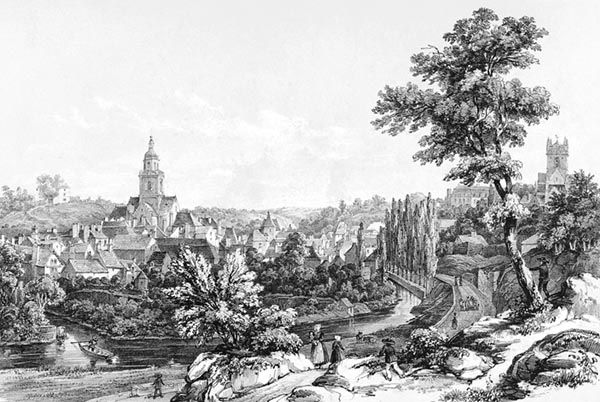
‘Quimperlé’ - Félix Benoist (French, 1818–1896)
Here, there are no alignments, no pavements, no courthouse of any kind, as far as I know at least; no stock- exchange housed in a Greek temple, no barracks, not even a town hall displaying its dull facade, adorned with a tricolored rag. But there are little streets that wind like paths, between old walls from which bouquets of foliage and bunches of clematis cascade. The wooden houses have pointed roofs, and black balconies, and as you pass, you hear a spinning wheel whirring inside, or the sounds of a bird in a white wicker cage hanging from a window. Two rivers (the Isole and the Ellé, which merge to form the Laïta), at the foot of the mountains, encircle the town like a silver bracelet; they meet, intertwine, divide, disappear, and reappear without you being able to tell which way they flow, whether there are several or just one; They flow on between the houses and the streets, lapping at the last steps of the garden staircases, and gurgling over the green pebbles of their beds where tall, slender grasses lean together. The stone quays, of a sort, that enclose them, are pierced by ivy roots, and crumbling away; the stones remain in the depths like boulders, and part the smooth surface of the current, as it strikes against them. Here and there, on that pale blue surface, the traces they leave on the water seem like the white tears of a wide, outspread veil that the wind seeks to raise. From one bank to the other, a single-arched bridge casts its flattened curve, whose reflection trembles in the water along with that of the grasses hanging from its vaulting; they cascade in flowing tresses, stretching to the very depths, their tips brushing the stream that flows through this arch of airy greenery. The bends of the combined river appear in the distance, in the meadows through which it meanders, interspersed with rows of poplars in the grass, clumps of other trees framing pools of water, and here and there, along the banks, two or three ramshackle cottages, their yellowed beams and blackened plaster daringly poised at an angle. Then, far, far away, in an ever-shrinking perspective, one gains vague glimpses of hills and woods fading into the mist.
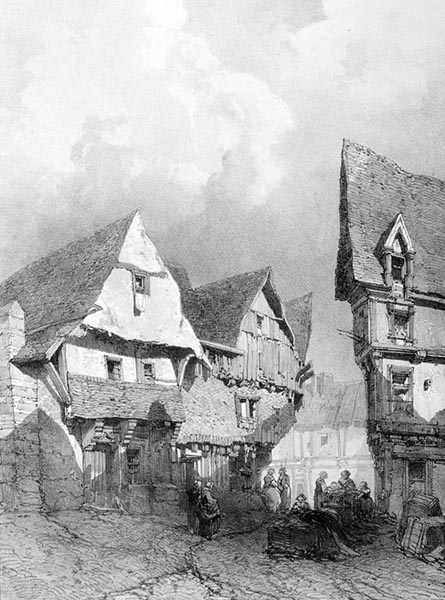
‘A Street in Quimperlé’ - Eugène Cicéri (French, 1813–1890)
The town, rises in gradual tiers, on the slopes of a hill above the river. With its water and trees, the beams of its painted or worm-eaten houses, its lead gables, and its tiled roofs packed together, or separated, in regular lines, by the undulating lines of mossy walls, it seems that Quimperlé came into the world only to provide the subject for a watercolour.
The Church of Saint-Michel, above the town unfolding at its feet, reveals a tower with four pinnacles and an arcaded gallery, but one is quite surprised, upon approaching, to find only a rather ordinary church, the sole entrance being a side portal divided by twin doors whose form would be attractive were it not for the overly-heavy ornamentation. Two neighbouring houses have been built against the buttresses of the apse, their first floors creating, as one ascends from the town towards the church, the impression of a bridge spanning the street. The facade of one of them, black, gloomy, and riddled with woodworm, bears on its exterior beams some rather amusing sculpted figures with serious expressions; they wear round caps, and long robes gathered at the waist by belts with wide buckles. They are engaged in various seemingly important tasks. One of them, holding a pestle, is grinding something in a mortar. The house was probably the revered abode of a good apothecary-herbalist of olden times, back in the days of elixirs and juleps, when people came seeking oriental drugs, honeyed medicines, potable gold supposed to prolong life, or some mysterious remedy concocted at night in a rear room, behind the large green alembics and packets of balm: a potion to counter epilepsy, made from the scrapings of human skulls and the blood of a decapitated man, or a syrup for old husbands to foster progeny. The man who built the premises was, I imagine, a wealthy bourgeois of the time, with a stall in the choir, and a farm outside the town, who was doubtless a churchwarden and is surely buried here somewhere.
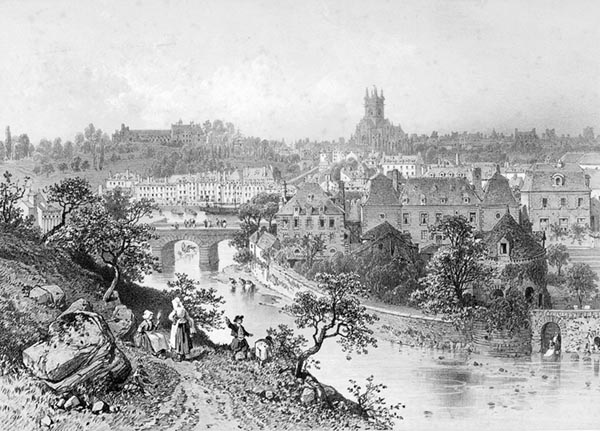
‘Quimperlé: View from the Banks of the Ellé’ - Félix Benoist (French, 1818–1896), Eugène Cicéri (French, 1813–1890) and Adolphe Jean-Baptiste Bayot (French, 1810–1871)
There was nothing to see inside Saint-Michel, and we were about to leave when we discovered a wooden statue and an oil painting. The statue is a Pietà, which I defy anyone to describe; the Virgin, in blue and red, resembles Paul Grassot, the actor; the Christ, yellow and green, the coiffeur at Small’s (Palais-Royal, 7 Galerie de Montpensier).
But what to say of the painting, whose wondrous poetry (an exaggeration, true) recalls the more than sublime frescoes at Nort? A bishop lies in his bed, dying, the poor old fellow, but has nevertheless kept his red skullcap on, so that it is clearly visible that he is a bishop to the very end; his body is outlined beneath the sheets in charmingly gentle contours, and is reminiscent of the shape of a sausage seen through a wet cloth; at his side, a priest in a surplice presents him with the cross to kiss, while his maidservant, nearby, weeps, wiping her eyes on the hem of her apron. At the head of the bed, a winged angel leans over, and whispers righteous advice to His Lordship, who is hesitating somewhat, as at his feet a green devil, with a raven’s beak, and disgustingly limp breasts, tries to mesmerise him with its contortions. The room is filled with rosaries, censers, holy ciboria, sacraments, relics, and Agnus Dei. Near the dying man, kneeling in the foreground and seen from behind, is a choirboy holding a candle; the yellow soles of his sturdy shoes are studded with nails as formidable as the devil’s teeth, and he presents himself to the view with a pleasing naiveté, especially since a well-executed foreshortening of his legs raises them to his mid-back. Meanwhile, Hell rages, the pestilent breath of the green demon spills forth in dark gusts, sinister birds flutter above, snakes coil around the chair-legs, and beneath a table lurks a hideous dragon writhing, drooling, and roaring; fear grips the heart, and one trembles for the bishop’s soul. What a pity if such a man were to descend to Hell! Will he? Won’t he? While maintaining the composure of an altar boy, the spectator cannot help but share the vicar’s anguish and the servant’s grief. Fortunately, the Holy Trinity watches over the bishop’s salvation. Above is the Eternal Father, dressed as the Pope; a little lower, at a respectful distance, Christ with his cross; and lower still, on a third cloud, the Virgin Mary. They send pretty angels to the bishop through the air, angels holding luminous lilies and who, walking worthily on putty-coloured clouds, reveal plump rounded calves to which the pink cords of their indigo buskins are attached.
O holy Catholic religion, if you have inspired masterpieces, how many omelettes, on the other hand, have you not produced!
Contemplating this dreadful canvas, and reflecting that many nonetheless must have looked at it without laughing, and that to others it has undoubtedly seemed beautiful, while still others have knelt before it, perhaps drawing supreme inspiration therefrom, we were seized, despite ourselves, by a sorrowful melancholy. What is it in the human heart that makes it constantly, and ceaselessly, throw itself at something, and cling on with such strength? An ardour as equally attracted to ugliness as to beauty; to the petty as to the sublime? Alas! Let us remember, so as to forgive the fellow who painted this, and even more so those who admire it, our own morbid predilections and foolish ecstasies! Let us recall from our own past all the naive love we once felt for some ugly woman, our candid enthusiasm for a simpleton, our devoted friendship towards a coward…
Having finally left the church, we found ourselves back in the sun, the sky, the air, the open spaces, and like a joyful bird taking flight, something rising from deep within the soul cried: ‘This! This I need; God is here not elsewhere.’
Evening was upon us, and the bells rang from the church towers. We descended towards the town, via a long, narrow, wooden-stepped alleyway, overgrown with grass, and winding between two high walls. The copings of these had vanished beneath the foliage; ivy clung to them everywhere, white nettles concealed their bases, and they seemed built solely to support this delightful vegetation, a torrent of greenery cascading between the houses, from the top of the hill to the foot of the town.
We were walking slowly, step by step, and turned to let a young lad pass by who was skipping along. He was handsome and robust, his brown hair, which was covered by a round black felt hat, half-covered his blue jacket and with each of his leaps flew upwards then fell back onto his shoulders; his narrow but supple waist arched boldly with the movement of his thighs, which swayed freely in his breeches of unbleached canvas; his solid calves, encased in white greaves, jutted out, quivering, while his feet, shod in heavy clogs, were as light as those of a chamois. He halted a few paces from us to retie the buckle of his garter; we saw his pale face in profile, over which, in that pose, his long hair flowed like drapery, and hung down to his elbows. When he had done, he straightened quickly, and we saw him race on, continuing to skip and bound at every step.
We came upon him again in the Abbey of the Holy Cross (Abbaye Sainte-Croix), on his knees, singing the Litany of the Virgin, his forehead raised to the heavens. He recognised us, and turned upon us his dark eyes, in a serious gaze, held for a moment, full of wary curiosity. Then he resumed his composure and continued the prayer. The abbey is a beautiful eleventh- century Romanesque church, whose circular plan, vault divided by arcades, columns set at their base on square pillars, raised semicircular arches, and centrally-placed chancel, which one ascends via several steps, grant it a certain late-Roman, Gallo-Roman air. The light, falling from long, narrow windows above, descends almost perpendicularly, like the daylight in workshops, a downpour of bright and peaceful serenity. This is not the dreamy Christianity of the pointed arch, imbued with the mystical breath of Gothic cathedrals; it is more remote, more Latin in feeling, the product of a more primitive theology, and imbued with a warmer poetry, that recalls the cloister at Arles (Cathédrale Saint-Trophime), and the great Carolingian councils.
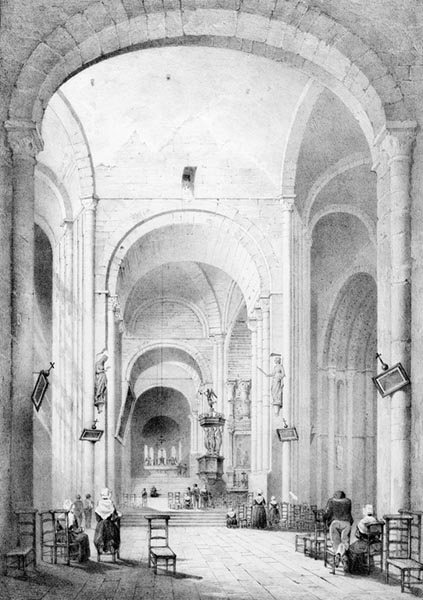
‘The Interior of the Church of Sainte-Croix, Quimperlé’ - Léon Gaucherel (French, 1816–1886)
The abbey was full. All were praying; we alone looked on. The crowd sang with solemn joy, and from the side aisles, from beneath the porch, from every side, powerful voices joined in chorus, after each crescendo produced by thin-voiced priest at the altar. The sound seemed to spring from a single breast, in an immense cry of love. The women, kneeling together, bowed their heads beneath their white bonnets; their faces were hidden; their backs were bent; their hands clasped in prayer.
The men were standing, sitting, or kneeling, everywhere, in every direction, wherever they could or the fancy took them; however, they seemed neither constrained nor distracted, on the contrary, one felt that they existed there as if at home, each isolated in the solitude of contemplation, or warming himself among his brother souls, while the attitudes of their bodies were nonchalant or majestic, in accord no doubt with their weariness or their inner disposition.
These were serious faces beneath long brown hair, with hard eyes tawnier than the moorland, and broad chests that breathed in powerful fashion; pensive faces, with a rustic and solemn air about them; but those bare, tanned, brows, solid, sloping shoulders, hands grey as plough handles resting idle, even the heavy shoes that reverence lightened — all that roughness turned to grace, that strength unwittingly rendered gentle — possessed a singularly sweet grandeur, almost touching in its naiveté. These men were handsome, because they were genuine, both in the simplicity of their tailored suits, fitted to their bodies, shaped by their work, and in the sincerity of their faith, which resonated freely in this church built to receive it; the last descendants of a nation fading without metamorphosis and vanishing without transition, as yew-tree needles fall without turning yellow. With their old-fashioned clothes, their ancient faces, and their ancestral religion, they embodied previous generations, seeming to represent an entire people. Perhaps that is why they appeared so full of life, and why each of them seemed to bear within more than is ordinarily found in human beings.
Beneath the Romanesque church lies a Romanesque crypt. The rectangular underground space, is covered by a flattish ceiling instead of a vault, flagged like the floor, and supported by four rows of colonnettes linked together, and arched at two-thirds of their height; they all have heavy capitals carved with elongated foliage, and the raised arches follow one another continuously.
We groped in the shadows, and by the light of a single window at the far end glimpsed two dark, moist, greenish tombs; venerable tombs. The first bears the recumbent statue of a monk. We recognise him as such by the broad tonsure that lays bare his ancient stony skull; he holds a book in his hand; his face is eroded, as the nose disappears from the faces of the dead, and his thin body is enveloped in long draperies that flow down to his feet in large, straight folds.
Near him, on a slab of stone, is an abbot with his crozier, his arms crossed; two dogs support his plain, embossed shield; his feet, shod in pointed shoes, rest on nothing; a small square canopy shelters his head. The first is considered to be Saint Gurloës, martyred on this very spot, and his sarcophagus is pierced with a hole into which, on certain feast days, the sick plunge their arms for healing. But the second dead man left no name (the tomb is that of Henry de Lespervez, Abbot of Quimperlé from 1409 to 1434, which was listed in 1840). Passing our candle over him, we tried to recognise his face, as if we had known him long ago! Are we not always drawn to such things by a feeling of curious unease, as we are toward a traveller who comes from afar, or a sealed letter?
Thus passes a day on a journey; it takes little more to fill it: a river, bushes, a beautiful child’s head, tombs; one savours the colour of the grasses, listens to the sound of the waters, contemplates faces, strolls among the stones, leans on the tombs, and the next day encounters other men, other meadows, other ruins; one establishes antitheses, and draws parallels. It brings a pleasure worth as much as many another.
At Rosporden, for example, we saw a woman praying in the cemetery who reminded us of another we had seen in Nantes Cathedral. She was kneeling, stiff, motionless, her body straight, her head bowed, looking down at the ground with a searching stare full of rage and sorrow. That stare pierced the pale flagstone, as if it sought to enter, descend, and draw forth what lay beneath; the woman in Nantes, on the contrary, whose complexion was as white as candle-wax, lay sideways on a prie-dieu, her mouth open in ecstasy, her eyes raised to the heavens, or beyond the heavens, and higher still, her soul seeming to have already departed. Both prayed with an immoderate yearning, and certainly, for them, there was nothing left in all this world but their respective objects of despair and hope. The first struggled against nothingness, the second ascended to God; what seemed a regret in the one seemed a desire in the other; the despair of the former so bitter that she indulged in it as in some form of depraved pleasure; the desire of the latter so strong that she suffered from it as from torture. Thus both, tormented by their yearning, were seeking to escape: she who prayed at the tomb, to rejoin what she had lost; she who prayed before the Virgin, to unite herself with what she adored. Pain, longing, prayer, the same dream, yet what an abyss between them! One life revolved around a memory, the other gravitated towards eternity!
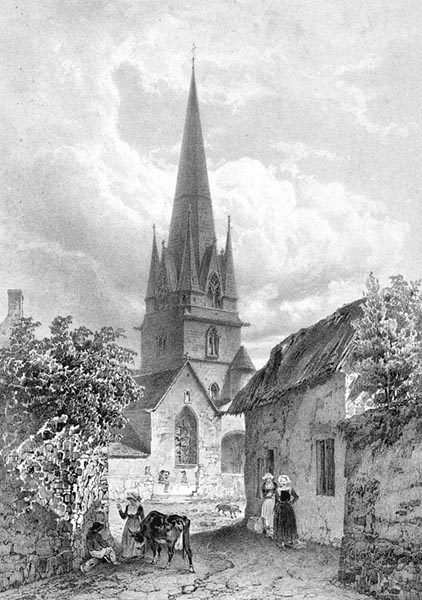
‘Rosporden’ - Adolphe Jean-Baptiste Bayot (French, 1810–1871)
In Rosporden we saw men who resembled those we had just seen in Quimperlé: the same looks; the same clothes, a large hat, an ample vest, a blue or white jacket, a wide leather belt, breeches, and boots; the same facial features, the same body shapes.
It was market day, the square was full of countryfolk, carts, and oxen; the harsh Celtic syllables rang out, mingled with the grunts of the animals, and the clatter of carts, but there was no confusion, no shouting, no laughter in groups, no chatter on the thresholds of the taverns, not a drunken man, no street vendors, no shops selling decorative linen for women, or trinkets for children — nothing joyful, boisterous, or lively. Those who wanted to sell something waited resignedly, motionless, for a customer to approach them. In the square, pairs of oxen lumbered about, a child holding them by the horns, or a scrawny nag trotted through the crowd, which parted without a curse or complaint. Buyer and seller would look at each other for a moment, signify agreement, and then depart without lingering. Indeed, for each, their village is far away, the moorland is vast. In the evening on arriving home, there is no one there; the wife has gone to the tamarisk grove to cut bundles of wood for winter, their child is on the coast gathering seaweed or tending sheep. As for the farmhand, usually there is none, each farmer typically having a small patch of land he cultivates himself as best he can, and of which he is the master — or rather, the slave, since he toils away there in vain. As the man cannot enrich the land, and the land cannot feed the man, why then does he not leave? Why does he not sell his labour like the Swiss? Or go into exile like the men of Alsace? Why does he remain here with such stubborn devotion? Who knows? Does he know himself?
Nowhere, here, does one find, as among ourselves, those fat, well-to-do farmers, pot-bellied, with their wine-stained faces, and satchels stuffed with money, who visit the country fairs, make a great fuss, haggle at length, argue loudly, slap each other’s backs, and bellow in the cafes while playing dominoes, stuffing themselves with meat and brandy, drinking up to thirty half-pints in a day, and only returning home late at night, half-asleep on their nag, which trots slowly along the path until it halts, of its own accord, at the gate of its master’s courtyard, recognising the excellent stable where the straw-bedding rises to its belly. The Breton countryman, instead, leaves on an empty stomach; it being too expensive to eat abroad; he goes home to his buckwheat pancake, and his bowl of corn-porridge simmered for a week, the food he eats all year round, beside the pigs that grunt under the table, and the cow that ruminates over its dung, in a corner of the room.
Why would he be cheerful? What has he brought from the village? If he sold his horse, he now has to carry burdens and pull the plough himself — wonderful! What good is the little pile of money he obtained? Will not some official arrive, sooner or later, even this week, to demand it from him, speaking a language he doesn’t understand, in the name of a law unknown to him? Is it worth the effort? So, he works little, inadequately, in an indifferent manner, without concerning himself as to whether he could do better.
Suspicious, jealous, bewildered by everything he sees and fails to understand, he hastens to leave the town and then the village, and return to his cottage hidden beneath dense trees, behind a thick hedge. There, he retreats to the bosom of his family, his home, close to his parish priest, at the feet of the church’s patron saint, and there he distils his emotions which, condensed upon themselves, are doubly intensified. He knows nothing of what is happening in the wider world, except that at twenty his son will go off to fight, that there is a city called Paris, and that the King of France is Louis-Philippe, about whom he will ask, through an interpreter, whether he is still alive, whether you see him often, and whether you dine at his house.
Whoever he may be, a stranger is always something extraordinary, vague, and insubstantial to these folk, something they would like to comprehend; they admire one, contemplate one, ask the time to see one’s beautiful watch, devour one with their eyes, with a curious, envious, perhaps inimical look, because one is rich, very rich, lives in Paris, the distant city, the enormous, resounding city.
As soon as you arrive at a place, the beggars rush at you, and cling to you with the obstinacy of a famished person. You give them something, they persist; you offer them more, their number increases, and soon you are surrounded by a mob. Empty your pocket to the last penny, but they will remain relentlessly at your side, busy reciting their prayers, which are unfortunately lengthy, though fortunately unintelligible. If you stay put, they fail to move; if you leave, they follow; nothing can remedy this, neither speech nor pantomime. It seems as if they are deliberately trying to enrage you; their tenacity is irritating, implacable. One cannot help but miss the good-natured, facetious humility of the Italian beggar, prancing about in front of your cart while calling you ‘Excellency,’ or the amiable, insolent rogue of a Parisian street urchin, who asks you for your cigar butt, calling you ‘General,’ and then picks it out of the mud, while laughing in your face!
There is nothing sad about the poverty of the South, it presents itself as picturesque, colourful, laughter-filled, carefree, airing its lice in the warm breeze, and sleeping beneath the vines; but that of the North, is cold, it shivers in the fog, and wades barefoot through thick mud, always seemingly damp with tears, numb, sorrowful, and vicious like a sick animal. These people are so poor! Meat is a rare luxury here. One of our guides told us: ‘It’s my greatest joy; how I pounce on it when I can catch a morsel!’ As for bread, they don’t see that every day either. Our postilion from Locminé hadn’t tasted a crust for eight months. Such an existence does not beautify the people; thus, one encounters a great many cripples, people who are one-armed, blind, hunchbacked, people with ringworm, or with rickets; like the oak-trees whose weak saplings wither in the sea wind while the robust ones, hardened against the frosts, thrive, those that have endured their misery, without it leaving its traces, are the healthier, straighter, and stronger. They are the folk you see passing before you, solid, austere, taciturn beneath their long hair, akin to their land beneath its sombre vegetation.
In the towns, though the language persists, the native characteristics fade, the local costume becomes rarer, rendered scarcer, even in the countryside, by the gradual encroachment of the tailor and the dressmaker, whose small ground-floor shops display splendid illustrations of fashionable wear in their windows, to arouse their customers’ envy. The townspeople see the stagecoach stop every evening at the post office; they always obtain the latest news, either from the postilion who spoke with the driver, or the messenger carrying the packages; at nightfall, they converse at their doors with the bailiff, the town-hall clerk, or a sub-prefecture employee, who have read the newspapers and know what is happening in the world. Little by little, in this way, they lose their Breton identity, and distance themselves from the countryfolk whom they increasingly despise and who, in turn, distance themselves further, as the respective groups understand each other less and less.
What remains most Breton in nature, in the towns, are the poorer girls brought in to serve as maids. Confined to their tasks, with whom would they communicate enough to lose their native character? One sees them stop in the street to talk to the fellow who brings them eggs and butter every week from the countryside. What does he speak of? He tells them about their village, their parents; their brother is sending a beautiful pair of silver earrings as a wedding gift — they must wear them; there will soon be a pardon (religious festival), they must go. So, they will, to immerse themselves once again in all that is most distinctive to their homeland, the language and the dress; and when they return to their employment, their hearts will remain behind, and they will talk of home together strolling, as they do, in groups of ten or twenty, about the squares and at the entrance to the main road, on Sunday after Vespers.
Thus, amidst an already hybrid population, this stubborn little nation is preserved, embraced by the other without losing its edge. In Quimper, at a communal table, watching the maid, a broad-shouldered girl with a harsh face and a rigid demeanour, dressed in her white cap, cuffed sleeves, and square bib, serving ‘floating islands’ (oeufs à la neige) to a stout gentleman with gold-rimmed glasses, an inspector of indirect taxes, I thought to myself: ‘So here are the two societies face to face, embodying the ultimate relationship between one century and the next! The ancient portrait humbles itself before the modern caricature. From this I derived an axiom, ‘the Present has its boots polished by the Past, while it fails to even say thank you.’
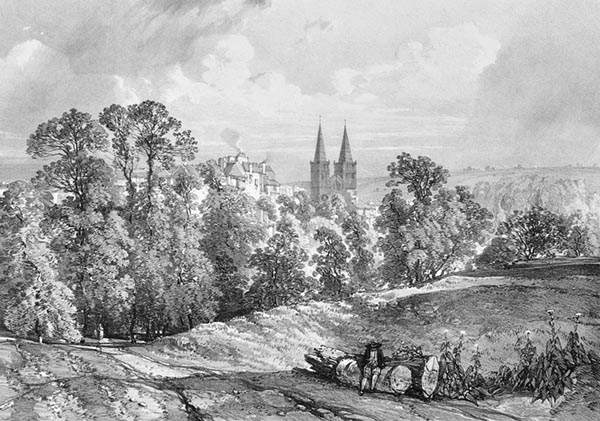
‘View of Quimper’ - Eugène Cicéri (French, 1813–1890)
Quimper, though the heart of true Brittany, is distinct from it. Its lovely elm-lined promenade along the river (Odet) which flows between quays and docks renders it quite charming, and the Grand Prefecture building, which occupies the small western delta, gives it a distinctly French and administrative air. One realises one is in a departmental capital, which immediately brings to mind division into arrondissements, with their major, medium, and minor local roads, primary-education committees, savings banks, general councils, and other modern inventions that always deprive the places endowed with them of some degree of local colour, as far as the naive traveller is concerned, who still dreams of such.
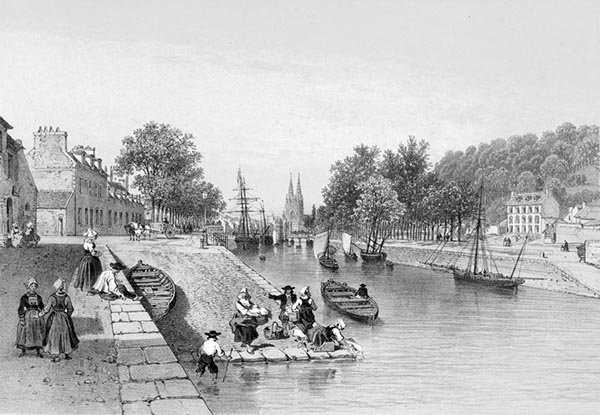
‘Quimper: the Entrance to the Harbour’ - Félix Benoist (French, 1818–1896), Eugène Cicéri (French, 1813–1890) and Adolphe Jean-Baptiste Bayot (French, 1810–1871)
Despite what those might say, who pronounce the name Quimper-Corentin as if it were the very epitome of provincial absurdity and stagnation, it is a charming little place, worth its weight in gold compared to many another more respected. True, it lacks the whimsy of Quimperlé, the lushness of its lawns, the riot of its colours, but I know of few things as pleasing as its beautiful avenue that stretches endlessly along the water’s edge, upon which the almost sheer escarpment of a nearby hill casts a dark shadow of luxuriant greenery.
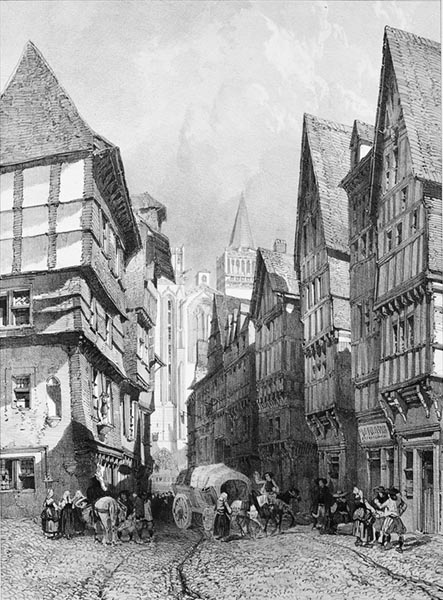
‘The Rue de l’Église, Quimper’ - Eugène Cicéri (French, 1813–1890)
It takes little time to explore such towns and know their most intimate corners, and sometimes one discovers places that stop one in one’s tracks and fill the heart with joy. Small towns, though, are like small apartments; at first, they seem warmer, and more comfortable to live in. But cling not to that illusion. The former experience more draughts than a palace, while the latter are more tedious than the desert.
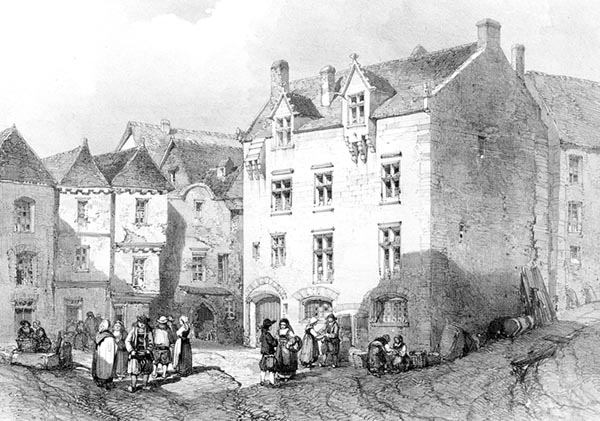
‘A Fortified House, Quimper’ - Léon Gaucherel (French, 1816–1886) and Eugène Cicéri (French, 1813–1890)
Returning to the hotel along one of those charming paths I love, that climb, descend, twist, and turn again, sometimes along a wall, sometimes through a field, then between thickets or over grass, alternately bordered by pebbles, daisies, and nettles — errant paths, made for leisurely thought and rambling conversation; returning, as I say, to the town, I heard plaintive moans and bleats rising from the slate roof of a square building. It was the slaughterhouse.
On the threshold, a large dog lapped at a pool of blood, slowly tugging at a steer’s blue intestines which had just been thrown to it. The door to the stalls was open. The butchers were working inside, arms curved upwards. Suspended head down, its feet slung, by the tendons, through a pole hanging from the ceiling, a carcase, bloated and inflated like a wineskin, revealed its belly, the skin split in two. The layer of fat which lined it could be seen slowly separating from it, and successively appearing within, at the edge of the knife, was a mass of green, red, and black, magnificent in colour. The entrails steamed; life escaped from them in a warm, nauseating puff of air. Nearby, a calf lying on the ground stared with large, round, terrified eyes at the gutter of blood, and trembled convulsively despite the ropes binding its legs. Its flanks heaved, its nostrils flared. The other stalls were filled with prolonged rattles, quavering bleats, and hoarse bellows. One could distinguish the voices of those being killed, those dying, and those about to die. There were singular cries, intonations of profound distress that seemed to utter words one could almost understand. At that moment, my mind filled with images of some terrible city, some dreadful, boundless metropolis, a Babylon or a Babel of cannibals in which there were slaughterhouses for human beings; and I thought to find something of a human agony in these throat-cuttings, whose victims bellowed and sobbed. I thought of herds of slaves led there with ropes around their necks, bound to rings, to feed masters who consumed them at ivory tables, wiping their lips on purple cloths. Could they exhibit more dejected poses, sadder looks, or more heart-rending prayers?
A boy picked up an iron mallet, the poor calf that had just been untied was pushed in front of him, he raised his instrument and struck it sharply on the skull between the eyes. It made a dull thud, the animal fell down dead with foam at its mouth, and its tongue clenched between its teeth; they grasped it, dragged at it, it failed to budge; they hoisted it onto the pulley, ready to butcher it.
At the first stab of the knife, the calf shuddered throughout its body, then seemed dead at last. Was it? Who knows? What do you know, you philosophers and physiologists? Are you quite certain what death means? How do you know that the soul, no longer manifest, is therefore no longer conscious? That it cannot feel, drop by drop, atom by atom, the successive decomposition of the body it once animated? How do you know that the corpse does not suffer with each bite of the worms that gnaw at it, until its integral parts, having passed elsewhere, are allowed to live another life, or continue the same one, so that only one half of its being would engage in its new existence, while the other would remain held in its previous state, a bit like the rabbit I saw devoured alive by a Newfoundland dog, the head in the process of being swallowed while the hind legs were still twitching?
On leaving, we saw the mastiff again, continuing his feast; he had almost finished his plate of raw tripe, he was licking his lips, and was served the peritoneum of a sheep for dessert; he is quite fat and looks fierce.
In Quimper we also viewed the cathedral (Saint-Corentin), a large fifteenth-century church which did not interest us greatly, although its square towers have two immense bays that are really very well constructed, even though its apse is tilted to the right, as is the head of the dying Christ onto his shoulder, and even though there is also a rather nice Virgin by Auguste Ottin (of 1846), a sculpture more graceful than elegant and more limp than tender.
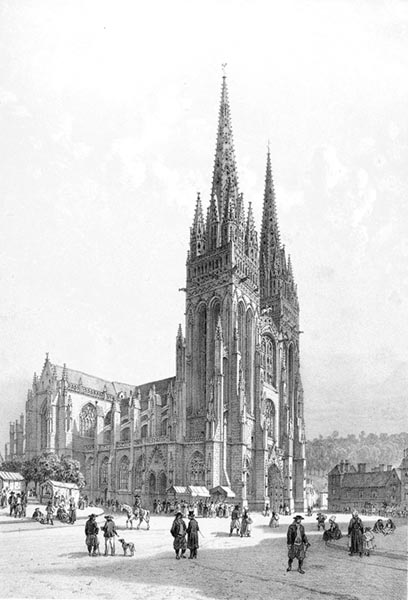
‘Quimper Cathedral’ - Félix Benoist (French, 1818–1896)
We then saw, in the church of Saint-Mathieu, some very beautiful stained glass windows, but lacked the time to examine them at leisure, because we were expelled from the choir by a frenzied beadle who came upon us shouting in an exasperated voice: ‘Leave the sanctuary! Would you please leave the sanctuary! Leave the sanctuary at once!’ To remain there, it would have been necessary to fight or to bribe this ferocious beast, means which were equally repugnant to our character and dignity.
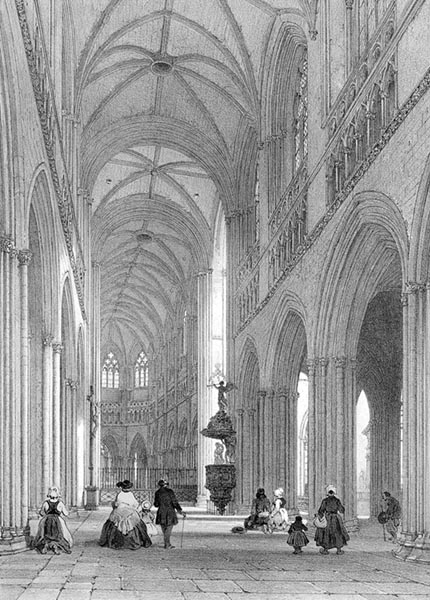
‘Quimper Cathedral: the Interior’ - Félix Benoist (French, 1818–1896) and Adolphe Jean-Baptiste Bayot (French, 1810–1871)
What more do you wish to learn as regards Quimper? What would you like to know? Is it the origin of its name, Quimper? Quimper means ‘confluence’, because of the confluence of the Odet and Steir rivers (note also Quimperlé, at the ‘confluence’ of the Ellé and Isole). Why was the appellation Corentin added? Because of Saint Corentin, its legendary first bishop, ‘a man of great religion and integrity, living in the time of Gradlon (Gradlon Meur or Mawr), King of Brittany (Cornouaille).’ Do we require a few dates? The first stone of the present cathedral was laid on July 26, 1424, by Bishop Bertrand de Rosmadec, and the last in 1501 (On I know not what date, sadly!). The town was captured in 1344 by Charles of Blois, then besieged once in 1345 by the Count of Montfort, and then twice in 1594 before surrendering to Marshal Jean VI d’Aumont. But you have no need, dear reader, of a description of the various sieges (I almost forget, I have no readers), so I will spare myself also an account of the various ridiculous entries to the town of the bishops of Cornouaille, who were obliged to leave their gloves and caps at the priory of Locmaria, and their boots and spurs at the cathedral door; and of the old custom involving a glass of wine, presented on the eve of Saint Cecilia’s Day to the statue of King Gradlon, and which, after its contents had been drunk at a gulp by one of the bell-ringers, was tossed into the crowd, whoever returned it unbroken to the chapter being rewarded with a gold louis. All these facts, being indeed as tedious to recount as they were uninteresting to learn, you may find elsewhere, if you are curious, since we value such texts too little to wish to copy them, though we sometimes read them, and even presume to write them.
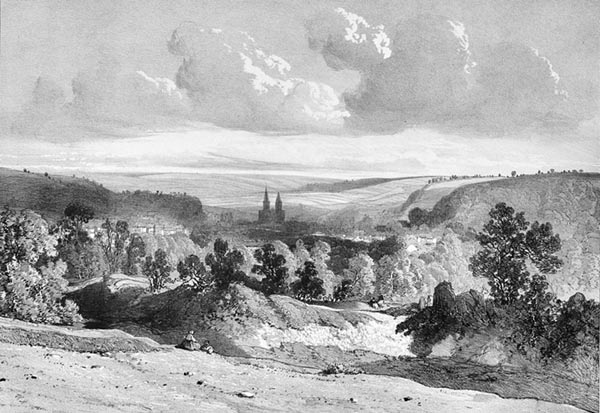
‘General View of Quimper’ - Eugène Cicéri (French, 1813–1890)
While in Quimper, we exited the town one day in one direction, and returned in the other, after walking about the countryside for some eight hours. Beneath the hotel porch, our guide awaited us. He immediately started racing ahead, and we followed. He was a small man with white hair, wearing a canvas cap, shoes with holes in them, and an old, oversized brown frock-coat that hung loosely round his waist. He mumbled when he spoke, bumped his knees as he walked, and swayed about; nonetheless, he moved swiftly with a nervous, almost feverish, tenacity. Only occasionally did he pluck a leaf from a tree, and press it to his lips to cool himself. His job is to run around the area, delivering letters or running errands. He visits Douarnenez, Quimperlé, Brest, and even Rennes, which is a hundred and twenty miles as the crow flies (he once made the trip in four days, including the outward and return legs). ‘My whole ambition in life,’ he said, ‘is to see Rennes once more.’ And this, with no other aim than to return for the sake of returning, to make a long journey and then be able to boast of having done so. He knows all the roads, he knows the villages and their church steeples; he takes back roads, crosses fields, opens courtyard-gates and, passing by houses, greets the owners. From listening to the birds sing, he has learned to imitate their calls, and, while walking under the trees, he whistles as they do to ease his solitude.
We stopped half a mile or so from the town, at Locmaria, the former priory having been given to the Abbey of Fontevraud by Conan III, Duke of Brittany. The priory, unlike that abbey of poor Robert d’Arbriselle (founder of Fontevraud), has not been used in a base manner. It is abandoned, but unspoiled. Its Gothic portal does not resound to the voices of the guards, and if little remains, the mind, at least, feels neither revulsion nor disgust. The only curious detail in this small chapel, built in the austere old Romanesque style, is a large, pillarless holy water font, placed on the floor, its faceted granite almost black. Wide and deep, it represents the true Catholic holy-water font, made for immersing the entire body of a child, not one of those shallow basins as in our churches in which the priest merely dips the tips of his fingers. With its clear water rendered even clearer by a greenish coating within, which has amassed during the religious calm of centuries, and with its worn corners, and heavy bronze-coloured form, it resembles one of those rocks hollowed by the action of the waves.
When we had viewed it from all sides, we returned to the river, which we crossed by boat, and then plunged into the countryside, which was deserted and singularly empty. Trees, broom, gorse, tamarisks lining the ditches, stretches of heathland, but no sign of people anywhere. The sky was pale; a fine rain, dampening the air, cast a uniform veil over the land, enveloping it in a greyish hue. We walked along sunken paths that plunged beneath arbours of greenery, whose branches, drooping over our heads, barely allowed us to pass upright. The light, blocked by the foliage, was greenish and feeble, like that of a winter evening. Deeper inside, however, bright daylight burst through, playing over the edges of the leaves, and illuminating their contours. We would often find ourselves at the top of some barren slope, bare in its descent, without a blade of grass to break the uniformity of its yellow colour. Sometimes, on the contrary, a long avenue of beech trees rose before us, the large gleaming tree trunks mossy at the foot. Traces of ruts ran along these avenues, creating the expectation that they might lead to some unseen castle or other; but the avenue would end abruptly, and only open countryside was visible beyond. In the space between two valleys, lay that green expanse, furrowed with black gashes by the capricious lines of hedges, dotted here and there by a darker mass of woodland, illuminated by clumps of gorse, or whitened by some cultivated field at the edge of the meadows that rose gently toward the hills, and disappeared on the horizon. Above them, far away through the mist, in a break in the sky, a blue meander appeared: it was the sea.
There is an absence of birds, or they are silent; the leaves are dense, the grass muffles the sound of your footsteps, and the mute landscape gazes at you with a melancholy face. It seems created expressly to welcome lives in ruin, lives resigned to their sorrow; there, in solitude, one can nurture one’s bitterness amidst the slow murmur of the trees and broom, beneath a sky that weeps. On winter nights, when foxes slip through the dry leaves, when tiles fall from dovecote roofs, when the rushes of the heath are whipped by the breeze, when the beeches bend, and wolves gallop across the snow in the moonlight, it is there, seated alone by the dying fire in the hearth, listening to the wind howling in the long, echoing corridors, it is there that it must be sweet to draw from the depths of one’s heart one’s most deeply-cherished despair, and most long-lost love.
We saw a ruined mansion, and entered through a Gothic gateway; further on stood an old section of wall pierced by a pointed-arch doorway; a bare arm of bramble swayed in the breeze. In the courtyard, the uneven ground was covered with heather, violets, and pebbles. We could vaguely make out the remains of an old moat; we entered a filled-in underground passage for a few yards; looked about, and departed. The place is called the Temple of the False Gods, and was, it is supposed, a Templar commandery.
Our guide walked ahead of us again, and we continued to follow him. A church steeple emerged from among the trees; we crossed a fallow field, climbed the high bank of a ditch; two or three houses appeared: it was the village of Plomelin. A path runs the length of the street; a few houses, separated by planted courtyards, make up the entire village. What peace! What abandonment, rather! The doorways are empty, the courtyards deserted.
Where are the owners? They are doubtless crouching behind the broom bushes, on the lookout for the Blues (The term dates to the Rebellion in the Vendée when the counter-revolutionary Whites called the troops of the revolutionary government ‘the Blues’ because of their uniforms) who must pass through the ravine.
The church is poor and utterly bare. No painted saints, no hangings on the walls, no lamp swaying at the end of its long, straight cord hanging from the ceiling. In a corner of the chancel, on the floor, a wick burns in a glass filled with oil. Round pillars support the faded blue wooden vault. Shining through the stained-glass windows the bright daylight of the fields is rendered green by the foliage of the surrounding trees that clothes the church roof. The door (a small wooden affair closed with a latch) was open; a flock of birds entered, fluttering, chattering, calling, and bumping against the walls; they swirled beneath the vault, and played around the altar. Two or three landed on the edge of the holy water font, and dipped their beaks therein, and then, all of them left as they had come, as one. It is not uncommon in Brittany to see them in the churches; several live there, their nests suspended from the stones of the nave; they are left in peace there. When it rains, they return to the nest, but as soon as the sun appears through the stained glass, the gutters dripping, they return to the fields. So that during a storm two frail species often enter the sacred dwelling at the same time: human beings to say their prayers, and ease their fears, and the birds, to wait for the rain to pass, and warm the nascent feathers of their numb chicks.
A singular charm emanates from these humble churches. It is not their poverty that moves us, for even when empty, they seem inhabited. Is it not rather their very modesty that delights? For with their low steeples and roofs hidden beneath the trees, they seem to shrink and humble themselves beneath God’s vast sky. Indeed, it was not pride that built them, nor the pious whim of some great worldly figure in their hour of agony. On the contrary, one senses that it is the simple expression of a need, a naive cry of longing, and that, like a shepherd’s bed of dry leaves, simply a place the soul has made for itself to rest comfortably in its weariness. More than those of the towns, these village churches seem to be bound to the character of the land that bears them, and to participate more fully in the life of the families who, generation after generation, come to the same place to kneel on the same flagstones. Every Sunday, every day indeed, entering and leaving, they see the graves of their ancestors, whom they thus have near them in prayer, as in a larger household from which those ancestors are not entirely absent. Their churches therefore possess a meaningful harmony, and therein, situated between the baptistery and the cemetery, the lives of the people are fulfilled. It is not so with us who, relegating eternity to a place beyond the city barriers, thereby exile our dead to the suburbs, to house them in the quarter occupied by knackers-yards and soda-factories, and next to the munition stores.
Around three in the afternoon, we arrived not far from the gates of Quimper, at the chapel in Kerfeunteun (Church of the Trinity). At the far end, there is a beautiful sixteenth century stained-glass window depicting the genealogical ‘Tree of Jesse’. Jacob forms the base, and the cross of Christ the apex, which is itself surmounted by the Eternal Father wearing the papal tiara. The square bell-tower features on each face a quadrilateral pierced, like a lantern, by a long, straight bay. It does not rest directly on the roof, but is supported, rather, by a tapered base whose four sides narrow and almost touch, forming an obtuse angle at the ridge. In Brittany, almost all village churches have bell-towers of this type.
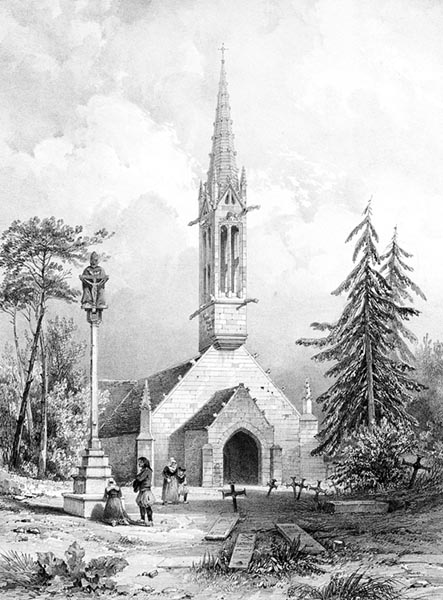
‘The Church of Kerfeunteun’ - Léon Gaucherel (French, 1816–1886)
Before returning to the town, we made a detour to visit the Chapel of Our Lady (Chapel Ti Mamm Doué) As usual, it was closed, so our guide found the caretaker who had the key; he accompanied us, leading his little niece by the hand, who stopped all along the way to gather bouquets. He walked ahead of us on the path. His slender, slightly languid, adolescent figure was encased in a sky-blue woollen jacket, and the three velvet ribbons of his small black hat fluttered at his back. Precisely perched on the back of his head, it held his hair, twisted into a bun.
Deep in a valley, or rather a ravine, the Church of Our Lady is veiled by beech trees. In this place, amidst the silence of the dense greenery, and perhaps because of its small Gothic portal, which one would think was from the thirteenth century but is actually from the sixteenth, it has a certain look reminiscent of those discreet chapels in old novels and romances, where the page is knighted one morning, to the song of the lark, before he departs for the Holy Land; and, passed through the grille, as the stars are fading, the white hand of the chatelaine, on which a parting kiss is deposited, is immediately soaked with a thousand loving tears.
We entered. The young man knelt, and removed his hat, the thick twist of his blond hair escaping and unfurling suddenly, to hang over his back. For an instant, still bearing the creases that had curled it just moments before, it clung to the rough fabric of his jacket, then gradually descended, parted, spread out, and flowed like a woman’s. Parted down the middle, it cascaded in equal waves over both shoulders and covered his bare neck. This entire golden expanse shimmered with light that shifted and receded with every movement of his head as he prayed. Beside him, the little girl, also kneeling, had dropped her bouquet to the ground. Only there, and for the first time, did I understand the beauty of a man’s hair, and the charm it can hold for bared arms immersed there. Strange progress indeed, to shorten Nature’s grandiose superfluity everywhere, so that when we find it in all its pristine fullness, we marvel, as at a revealed wonder. O hairdressers, O curling irons, O vanilla or lemon-scented hair straighteners, wigmakers of all countries, brushes of every kind, ointments of all odours, adorn the hair with your corkscrews and twists, shave it in the manner of a malcontent, roll it in the style of Perrinet Leclerc (who opened the Buci gate of Paris, at night, to the Burgundians, in 1418), shape it into a pear, spread it like a weeping willow, pour on it your fish-glue, your quince-syrup, your pomatums, fixatives, and shiny encaustics; trim, cut, curl, stiffen and grease it; you will never produce a style of such high distinction, of such voluptuous grace as his, which was undoubtedly only combed with a large white comb made of horn, and which only the rain and dew moistened with their pure water.
Next day, at noon, the streets of Quimper were draped with calico, the bells rang, roses and sea-lavender were strewn across the cobblestones, and platforms decorated with columns of greenery, entwined with garlands of coloured paper flowers, were erected, at the crossroads. It was a Sunday and a feast-day, and the procession was about to pass. In front of the doorways, one could see the maids in their country attire, their heads framed by large bonnets, with colourful embroidery on the sleeves of jackets with upturned fronts, and stiff collars that, from behind, resembled ruffs with thick folds; their brown skirts fell in tight, straight pleats like those of bragou-bras culottes, and their open shoes bore large silver buckles on the insteps. At the windows, the upper classes, as if seated in the front row at the theatre, awaited the spectacle to be provided by the procession.
The bells rang out again, singing commenced, drums beat, gunshots rang out, and two lines of children poured out from either side of the street. In the middle, walked a priest in a surplice, directing the procession with a wooden book, which he continually opened and then clapped shut with a sharp thud that sounded like a beater. The little boys wore trousers buttoned over their jackets, held an unlit candle in their right hands, and brayed like donkeys. After them came the little girls, all in white dresses with blue sashes, and among them some clergyman, similarly busying themselves going from line to line, directing them to advance, halt, start again, sing, or be silent. Finally came the choirboys and canons, all with their mouths open, their hats lowered, marching in step, with nonchalant dignity in their fine church vestments. I recall one surcoat made of purple velvet and embroidered with gold; it shone forth, alone, unique, splendid, eclipsing all the others; the fellow it covered was delighted to wear it, he revelled in it, and could scarcely stop smiling as he sang, swaying his shoulders to show off the back panel on which a holy ciborium surmounted by a sun was embroidered. If the chapter, in fact, possesses only the one, and if only sixty people are entitled to wear it, and only seven or eight processions are held a year, perhaps he had been waiting ten years, hoping, longing, yearning for the honour. He would have sighed at being forced to reckon with preferential treatment, the triumphal pettiness of rivals, and unjust favouritism. Thus, he grew older, thin with anxiety at the thought of it. Today, at last, he wears it on his back, in the street, it is seen; he is beneath, the surcoat above. How well it suits him! He breathes its odour, inhales its scent; he swells beneath its lining to fill it utterly, he runs his eyes over the cloth, contemplates its embroidery, feasts on the braid; it is heavy, he sweats, it crushes him, so much the better! He feels a greater joy, he feels it all the more present on his shoulders; and he flexes them on purpose to convince himself that it is there, that it remains, that he has not lost it somehow. Ah! If only it could cling to him so that it could not be taken from him, for soon he will have to return it, and when must he do so? Perhaps never, God willing; two such days come not again in a lifetime. How he loves it! How he adores it, this chasuble whose beauty fills his soul, and also the fine Catholic religion without which the chasuble would not exist, and which it was made to honour! And how he sings! With what heart! With what faith! With what pride!
It is fitting that a man thus clothed should have a resonant voice, but his dominated everything, it thundered with a priestly fullness, it was a continuous bellow above the cries of the children, the trampling of the crowd, and the deep buzzing, organ-like sound of the ‘serpent’ whose breathless musician was blue with fatigue.
Beneath a canopy of crimson velvet, yet another chasuble advanced. A man with a sunken forehead, blond as a Russian-leather cigar-case, with white eyelashes, red eyebrows, and hair curled into mushroom shapes — one of those people whose expression is base rather than stupid, and who seems even more scrofulous inside than out —bore, in the manner of a pilgrim, and with a smug, puffed-up air, the golden Blessed Sacrament, which trembled in his clenched hands encased in their white cotton gloves. Around him, the choirboys swung their censers, the singers squawked; he walked on flowers thrown before his feet, and when, at the various altars, he raised his shining symbol, everyone knelt, including the soldiers, the National Guardsmen, and the gendarmes who were escorting the procession. Four satin ribbons falling from the canopy were held by two toddlers dressed in yellow nankeen, embroidered all over, and by two very small girls in blue dresses strewn with silver stars, their bare arms adorned with bracelets, a crown on their heads and a pair of pink wings on their backs.
Next came various bourgeois of the town who played violins, cornets and bassoons, then a dozen gendarmes with their sabres drawn, then the National Guard in two lines, then a company of soldiers preceded by a drum-major who twirled his mace, his plume nodding.
Having nothing more to see in Quimper or the surrounding area, we prepared for our expedition to Finistère, whose long coastline we were to follow on foot as far as Brest. It was a journey of more than two hundred miles. We had our shoes repaired and set off.
Our first stop was Concarneau, which we barely saw, since the rain was pounding down, yellow streams flowed at the foot of the houses and, rushing through the gaps in the harbour parapets, poured onto the mudbanks where empty boats lay on their sides. The water flowed over them, as they slumbered in the mud like weary travellers, the canvas of their sails soaking wet. At the next tide, however, they would right themselves, and drift about on their anchors, bearing with them the seaweed or small shellfish one sees clinging to the planks of the hulls, and which accompany them everywhere amidst the waves.
The sea was far off; an expanse of sand filled the near view but was soon lost in the dreary hue of the sky, smeared by a thousand streaks of rain.
The town is surrounded by walls whose base the waves cover at high tide; the machicolations are still intact from the days of Anne of Brittany, and the line of serrated stones, standing out against the mist, stretches low and straight along the ramparts.
Between two showers, we passed the gates and over the drawbridge, so as to view the rocking stone of Trégunc. The verdant lane formed successive bends, its uneven surface wide and grassy. Like a free-roaming colt, one’s gaze raced across the countryside, and rolled in the fresh grass. As we walked along, the stones scattered on the ground increased in size and number, their uneven shapes rising from clumps of yellow gorse. In the midst of them, rising eleven feet high, appeared an inverted granite cone, resting on a rocky outcrop almost flush with the ground. This is the famous rocking stone of Trégunc (a 132-tonne granite boulder), which husbands lean on, to test the chastity of their wives. If the stone moves, it means: she is chaste! And if it fails to do so: try again tomorrow! Some writers on the subject claim to have set it in motion, but as for we two single men it remained as unshaken by all our efforts as the Great Pyramid of Egypt would have been.
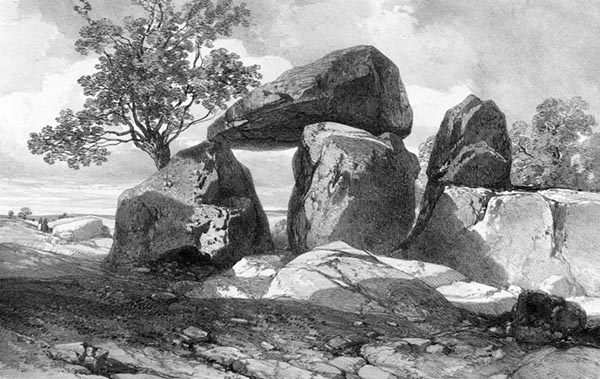
‘The Great Dolmen of Trégunc’ - Eugène Cicéri (French, 1813–1890) and Léon Gaucherel (French, 1816–1886)
Two hours later we were back in Concarneau. The rain had started up again with renewed vigour, and our hostess was making the most amiable pleas for us to stay. It was certainly enough to keep dogs at bay or subdue tigers, but we immediately inquired about any means of transport that could carry us that very evening to Fouesnant, a place of beautiful women. First, we found a carriage, then a man to drive us, then a horse, and finally a harness. After everything had been painstakingly arranged, we clambered into the carriage, already too small for the two of us and with no room for the driver. So, he, on foot, drew the sluggish nag by the halter, dragging it uphill, and hauling it back it downhill. When he was tired, he sat behind on the axle-tree, and the vehicle continued on its way without stopping. It zigzagged, caught on hedges, bumped against stones, fell back into ruts, stopped at drainage ditches, its curved hood always jolting before our eyes and obscuring the landscape. From time to time, leaning forward, we caught a glimpse of something: a clump of trees, a clearing in the woods, a bend in the road, a flowering thorn among the apple-trees, a sliver of sea visible through the branches; but then, because of an uphill slope, the shafts would rise into the air, and we could see nothing but the sky above our heads; or if we were descending we would plunge forward onto the horse’s hocks, and receive no light except whatever shone through the gap between the hood and the mudguard, the pair of which tended to close about us, and clash together as we jostled.
At La Forêt (La Forêt-Fouesnant) we crossed a dike that extended the road above the water, and bisected one of the most charming bays imaginable. It runs inland between two wooded hillsides whose trees, reaching down to the bottom, dip the tips of their leaves into the water, where they hang in loose clumps, in gentle soft curves like willows over a river.
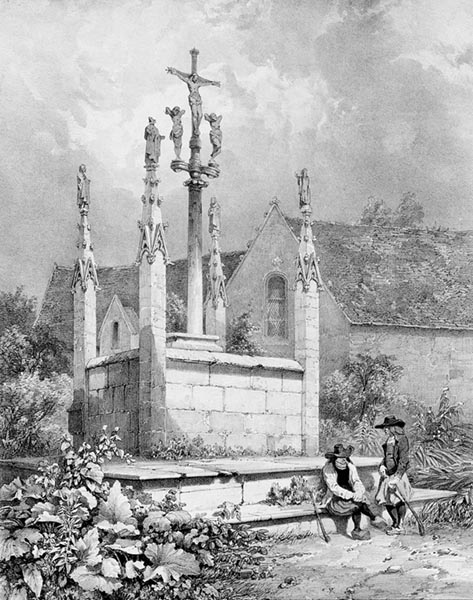
‘La Forêt, near Quimper’ - Auguste Étienne François Mayer (French, 1805–1890)
A church appeared (Notre Dame d’Izel Vor). We stopped the cart, and visited the building. Its bell-tower is carved like that of Kerfeunteun, and above its small portal flanked by pinnacles rises a third from which emerge the heads of a frog and a dog. Opposite, was one of those good old Breton calvaries, chiselled and sculpted, bearing finials and figures, turning green in the rain; one part depicts the Virgin Mary, the other Jesus and the apostles.
As for the interior of the church, I barely recall it, much like the one in Fouesnant. I only recall a low pillar carved as a large holy-water font, and wide slabs laid transversely to close off the entrance to the cemetery, like stiles.
Fouesnant, a place so praised for the delights it possesses, offered us only a detestable omelette, however, which we ate nonetheless, a dreadful bed in which we nevertheless slept, and incessant rain which did not prevent us from leaving again the next day, having turned down the brims of our hats and donned our waterproofs.
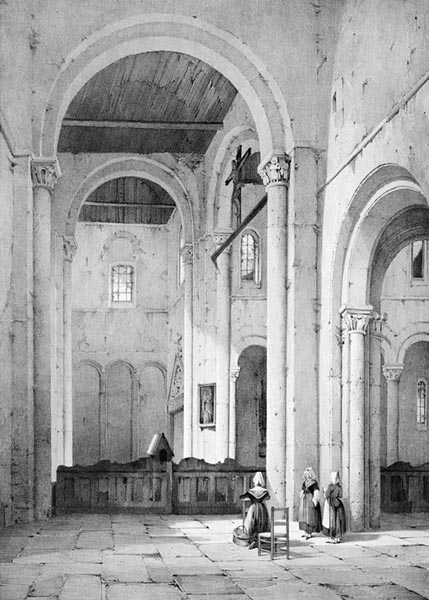
‘Fouesnant: the Interior of the Church’ - Auguste Étienne François Mayer (French, 1805–1890)
That day was the first of our brave days in Finistère. We were refreshed by the wind, warmed by the sun, the rain soaked us through, the sweat drenched our hair; we dined on raw artichokes, and took the wrong road. For a long time, without it seeming especially long, we walked through open countryside, beneath trees in sunken lanes, across moorland, through ploughed furrows, along paths, and even along a main road. When we were tired, we unbuckled our packs, and lay down at the foot of an oak-tree, on the bank of a ditch, smoking and talking; watching the clouds drift past, letting the hours slip by.
At Bénodet we crossed the river (the mouth of the Odet) on a ferry. At Combrit we lost our way, and would have headed back towards Quimper if a road-worker had not warned us.
At five in the evening, we arrived at Pont-l’Abbé; we were covered in a respectable layer of dust and mud, which spread from our clothes onto the floor of our inn-room, with such disastrous prodigality, that we were almost humiliated by the mess we made just by sitting down somewhere.
Pont-l’Abbé is a very peaceful little town, bisected lengthwise by a wide cobbled street. The lean citizens who live there could not have looked more pathetic, humble, or stupid.
For those who like to view something wherever they are, there are the insignificant remains of the castle (Château des Barons du Pont) and the church (Notre-Dame des Carmes); a church that would be passable, moreover, if it weren’t encrusted with the thickest whitewash a church council could ever dream of. The Chapel of the Virgin was full of flowers. Bouquets of daffodils, sea-rocket, pansies, roses, honeysuckle, and jasmine, placed in white porcelain vases or blue glass jars, spread their colours across the altar, and rose between the tall candlesticks as high as the Virgin’s face, even above her silver crown, from which fell a long-pleated muslin veil that clung to the golden star of the plaster baby suspended in her arms. The air was filled with the scent of holy water and flowers. It was a small, fragrant corner, mysterious and peaceful, set apart within the church, a hidden retreat, lovingly adorned, perfectly suited to stirrings of mystical longing, and lengthy outpourings of mournful prayer. Oppressed by the climate, dulled by poverty, humanity transfers all the sensuality of the heart to this place, laying it at the feet of Mary, beneath the gaze of celestial womanhood and, by arousing it, satisfies an unquenchable thirst for comfort and love.
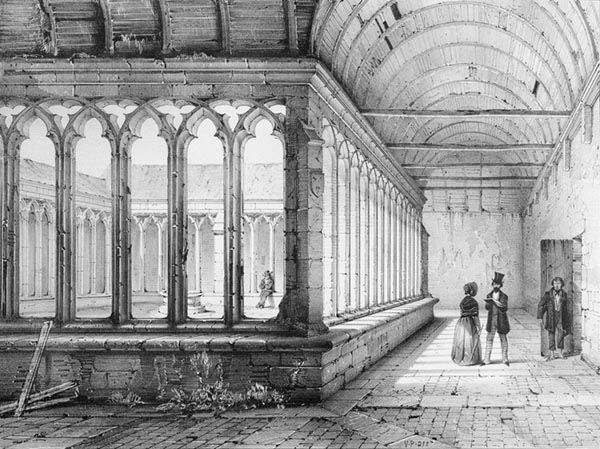
‘The Cloister, Pont-l’Abbé’ - Auguste Étienne François Mayer (French, 1805–1890)
Let the rain fall through the roof, let there be neither pews nor chairs in the nave, yet everywhere you will find a chapel of the Virgin no less gleaming, polished, and charming, with fresh flowers and lit candles. Within, all the religious tenderness of Brittany seems to be concentrated; here are the tenderest depths of the heart, here is its humility, its passion, its treasure. There are no flowers in the countryside, but there are in the church; people are poor, but the Virgin is rich; ever-beautiful, she smiles for all, and aching souls go to warm themselves at her knees, as at a hearth that never grows cold. If one is astonished by a people’s unwavering devotion to their beliefs, does one not comprehend the delight and pleasure they derive from them? Is not asceticism a superior form of epicureanism; fasting a refined form of indulgence? Religion itself contains sensations that are almost carnal; prayer has its excesses, mortification its frenzies, and those who come to kneel before this clothed statue in the evening also experience palpitations and vague intoxications, while, in the streets, children returning from school stop, dreamily and troubled, to gaze at the ardent woman over a window, gazing at them with tender eyes.
One must witness what are termed their festivals to be finally convinced of the sombre character of these people. They don’t dance, they spin around; they don’t sing, they whistle. This very evening, we went to a nearby village to see the inauguration of a threshing-floor. Two bagpipe players, perched on the courtyard wall, relentlessly elicited the shrill sound of their instruments, to the beat of which two long lines of participants trotted along, following each other in a wolf’s tail, looping back on themselves, turning, crossing, and rejoining at unequal intervals. Heavy steps pounded the ground, heedless of rhythm, while the high-pitched notes of the music emerged one after another in yelping monotony. Those who no longer wished to dance dropped out. They left the line without disturbing its progress, and returned once they had caught their breath. For nearly an hour, as we watched this strange exercise, the crowd only stopped once, the musicians pausing to drink a glass of cider; then, the long lines stirred again, and began to turn about. At the entrance to the courtyard, at a table, walnuts were being sold; next to it was a jug of brandy, on the ground a barrel of cider; not far away stood a citizen in a leather cap and green frock coat; near him, a man in a jacket with a sabre suspended from a white baldric: the latter the Police Commissioner of Pont-l’Abbé, the former his rural constable.
Soon, the Commissioner took his watch out of his pocket, and signalled to the gendarme who went to speak to a group of people, and the assembly dispersed.
The four of us returned to town together and we had the opportunity, on the way, to admire yet another harmonious combination of Providence, one which had paired this police commissioner with his rural official, and vice versa. They fitted together perfectly, like interlocking parts. The same event prompted the same reflection from both; they drew parallel conclusions from the same idea. When the Commissioner laughed, the warden smiled; when the former assumed a serious expression, the other looked sombre; if the frock coat said: ‘This must be done,’ the jacket replied: ‘I think so’; if he continued: ‘It is most necessary,’ then the other would add: ‘It is indispensable.’ Yet their relative ranks and authority remained, despite this close connection, quite distinct, and clearly established. Thus, the gendarme raised his voice less loudly than the Commissioner, was slightly shorter, and walked behind him. The Commissioner, polite, important, and eloquent, consulted his thoughts, pondered, talked to himself, and clicked his tongue; the gendarme was gentle, attentive, and solicitous, observing for his part, uttering interjections, and scratching the tip of his nose. Along the way, he asked for news, sought advice, and obeyed orders, while the Commissioner questioned, deliberated, and issued commands.
We were approaching the edge of town when we heard shrill cries coming from one of the houses. The street was full of an agitated crowd, and people ran towards the Commissioner, saying, ‘Come, sir, there’s a fight! Two women have been killed!’ ‘By whom?’ ‘We don’t know.’ ‘How?’ ‘They’re bleeding.’ ‘Yes, but how?’ ‘With a rake.’ ‘Where’s the murderer?’ ‘One has a head wound, the other is wounded in the arm. Come, we’re waiting for you, they’re in here.’ The Commissioner entered, and we followed.
There was a hubbub of sobs, cries, and talk within, a wave of sound rising, and then stifling itself. People were stepping on each other’s toes, jostling each other, swearing, able to see nothing.
The Commissioner began by getting angry. But since he did not speak Breton, the gendarme was angered on his behalf, and chased the public from the house, grasping them by the shoulders and pushing them out of the door.
When only about a dozen people remained in the room, we managed to make out, in a corner, an arm with a piece of flesh hanging from it, and a black mass of hair, dripping with blood. Here were the old woman and the young girl, both injured in the fight. The old woman, who was tall and thin, her brownish skin wrinkled like parchment, stood with her left arm clasped in her right hand, barely moaning, and seemingly unaffected; but the young girl was weeping. Seated with her lips apart, her head bowed, and her hands flat on her knees, she trembled convulsively, and sobbed quietly. To all the questions put to them, they responded only with complaints, and since the witnesses who had seen the blows could not even agree among themselves, it was impossible to know who had beaten the pair or why. Some said it was a husband who had caught his wife in flagrante; others, that the women had been arguing, and the master of the house had wanted to silence them. Nothing was known for sure; the Commissioner was most perplexed, and the gendarme speechless.
Since the local doctor was away, or these good people did not wish to disturb him because it cost too much, we were so bold as to offer ‘the assistance of our meagre talents’ and ran to retrieve our travel kits, containing a piece of adhesive tape, a bandage, and some lint that, in anticipation of an accident, we had buried at the bottom of our knapsacks.
It would have made a fine sight, indeed, for our friends, to see us displaying, in the manner of medical men, our scalpel, forceps, and three pairs of scissors, one with vermeil handles, which we set out on the table. The Commissioner admired our philanthropic urge; the local gossips watched us in silence, the yellow candle dripping in its iron candlestick, and its burnt wick lengthening which the gendarme trimmed with his fingers. The old woman’s wound was dressed first. The blow had been delivered precisely; her bare arm revealed the bone, and a triangle of flesh about four inches long hung down like a cuff. We pushed the flap of skin back in place, adjusting it to the exact edges of the wound, then secured everything with a bandage. It is perfectly possible that the strict compression involved caused gangrene, and that the patient died as a result.
No one knew what was wrong with the girl. Blood was dripping from her hair, its source unknown; it congealed in sticky patches, and trickled down her neck. The gendarme, our interpreter, told her to remove her woollen headband; she untied it with a single movement, and all her hair, a deep, matte black, cascaded down, its bloodstained strands streaked red. Gently parting her beautiful, moist hair, which was soft, thick, and abundant, we indeed saw, on the back of her head, a bump the size of a walnut, pierced by an oval hole. We shaved the skin all around it; and, after washing and sealing the wound, we melted some tallow onto a piece of lint and applied it to the injury with strips of adhesive bandage. A compress placed on top was held in place by the headband, which was itself covered by her cap.
Meanwhile, the Justice of the Peace arrived. The first thing he did was demand to see the rake, and the only thing he concerned himself with was examining the weapon from every angle. He took it by the handle, counted the tines, brandished it, and tested it, making the iron clang and the wood bend.
— ‘Is this the actual instrument employed in the attack?’ he asked. ‘Jerome, are you convinced of it?’
— ‘They say so, sir.’
— You were not there, Commissioner?’
— ‘No, Monsieur.’
— ‘I would like to know if the blows were indeed struck with a rake, or if it was rather with a blunt instrument. Who is the culprit? Does this rake belong to him? Or to someone else? Is it what was used to injure these women? Or was it, as I say, a blunt instrument? Do they intend to file a complaint? What should I say in my report? What do you think, Commissioner?’
The unfortunate women added nothing to the matter, except that they were still suffering; as for their seeking justice by legal means, they were given the night to consider the question. The young girl could barely speak, and the old woman’s thoughts were also very confused, as she was still drunk, according to the neighbours; which explained the insensitivity she displayed while we were tending to her pain.
After scrutinising us as best they could to determine our identities, the authorities of Pont-l’Abbé wished us goodnight, thanking us ‘for the services we had rendered the country.’ We replaced our belongings in our rucksacks, and the Commissioner left with his gendarme, the gendarme with his sabre, and the Justice of the Peace with the rake.
No sooner had we retired to our rooms than we received a visit from another two gendarmes eager to learn our names, surnames, address and occupation from our passports, in order to report to the Police Commissioner and the Justice of the Peace who were undoubtedly waiting in a state of great anxiety for their swift return. But since we enjoy the singular good fortune of having no profession, no title, and no rank, they had to resign themselves to learning only two names as completely unknown in Pont-l’Abbé as elsewhere. They could not, however, believe that we were gentlemen walking for the purpose of personal recreation; that was unheard of, seemingly, and to them absurd. We were draughtsmen or surveyors traveling out of ambition, so as to outdo others, and thereby earn the Legion of Honour. We were paid by the government to inspect roads, or supervise the lighthouse keepers. We had a secret mission, some clandestine scheme that we refused to disclose in order to deceive people, and ensure our success. There was something incomprehensible, contradictory, and shadowy about us, such that we almost frightened them, so strange did we seem.
But no, thank the Lord! No such matters motivate us. We are merely humorous observers, and literary dreamers; we spend our lives observing the scene, and reading the great writers. If that doesn’t fill our pockets in the way making tallow, boots, or laws would, if the police find it hard to comprehend, and the bourgeoisie laugh at us out of pity, then it is for us alone, and a thousand times better so, that the horizon extends, and field and shore weary our feet, and it is for us too, that you appear, magnificent poets, who delight our souls.
So, we retired to bed smiling at the perversity which renders human life an appendage to shops, offices, and banks, in the belief that it was invented by the deity to fill shelves and count the takings.
And we slept soundly despite our tiredness, and left for Penmarch at dawn, without enquiring as to the state of our patients.
Chapter VIII: (Du Camp: The West Coast, Penmarch to Crozon)
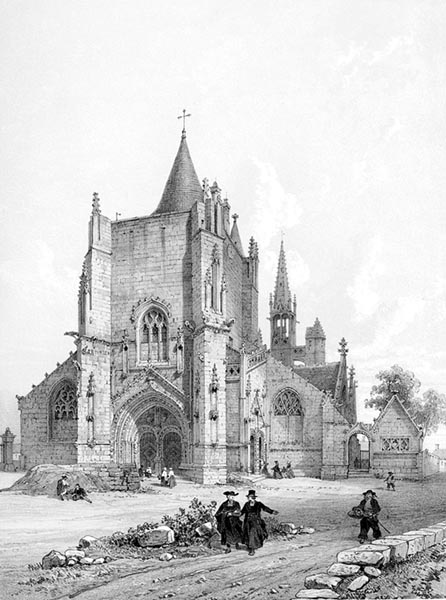
‘The Church and Village of Penmarc’h’ - Félix Benoist (French, 1818–1896) and Adolphe Jean-Baptiste Bayot (French, 1810–1871)
Penmarch. — The church (Église Saint Nonna) from the early sixteenth century; the original porch at the main entrance; two ornate, round-arched twin doorways; a long, elegant niche with a dentil cornice; a horse’s head on the left; a man clinging to something. — A charming side entrance, with a hint of sixteenth -century style combined with local elements; two twin doorways of the same type, but even more graceful; on the left, a medallion depicting a man embracing a woman, who is defending herself. — The interior full of birdsong. On our second visit this morning, a bird flew through the middle of the nave. Pointed arches, medallions with robust sculptures, representing heads or figures. — In the chancel, a saint carved in wood and painted, raising his right arm; a carved mantelpiece, windows divided into flowers in the chapel behind the apse. — The remains of a stone ossuary in the cemetery, with two small sculpted skulls in an exterior corner.
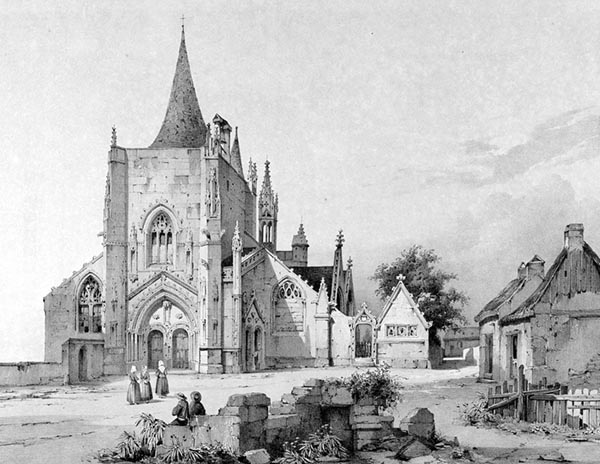
‘Penmarc’h: the Church of Saint-Nonna’ - Auguste Étienne François Mayer (French, 1805–1890)
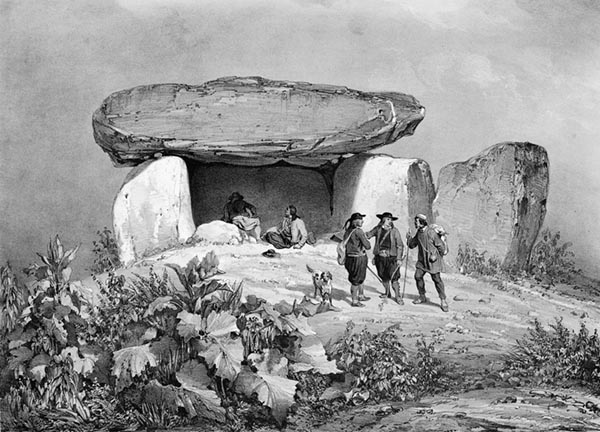
‘Dolmen near Penmarc’h’ - Adolphe Jean-Baptiste Bayot (French, 1810–1871) and Auguste Étienne François Mayer (French, 1805–1890)
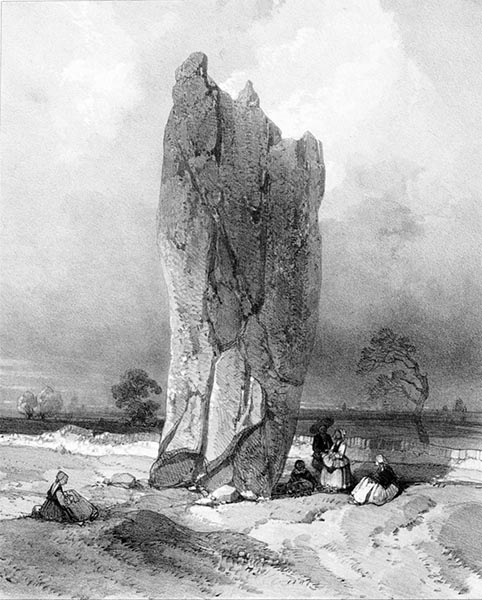
‘Dolmen at Penmarc’h’ - Eugène Cicéri (French, 1813–1890) and Auguste Étienne François Mayer (French, 1805–1890)
Kérity. — Rocks in sight, marshes with creeks that the rising tide fills. — The remains of a beautiful ‘Templar’ church (Saint-Thumette), pure, simple, charming niches in the style of those at Penmarch. The nave has only one side, no transept. The stone altar. At the far end, a pointed arch, the window divided in three. — A tower still remaining on the right side of the portal; we climbed it. Flat countryside, the sea, the windmills turning in the wind. — A conversation with sailors. — An old man told us he had never heard Mass said at sea (another had told us the opposite) over the ruins of Ys, because the local people place Ys here (Ys, or Kêr-Is, was a legendary city supposedly sunk beneath Douarnenez Bay). People claimed that one could still see hewn stones as of a city. — Lobsters. — In the Penmarch cemetery, the shaft of a cross with truncated arms, which is a constant and remarkably characteristic native element.
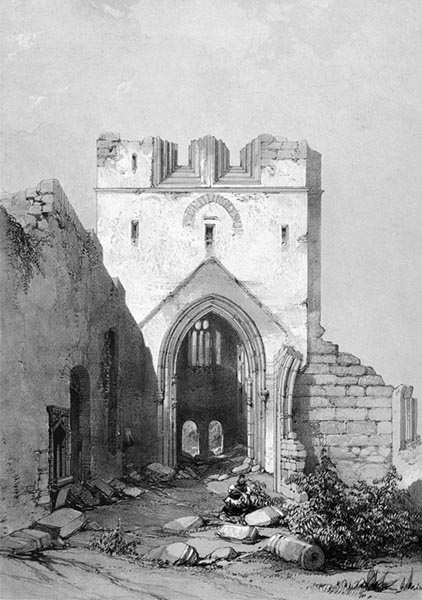
‘Saint-Guénolé, near Kérity, Penmarc’h’ - Auguste Étienne François Mayer (French, 1805–1890) and Eugène Cicéri (French, 1813–1890)
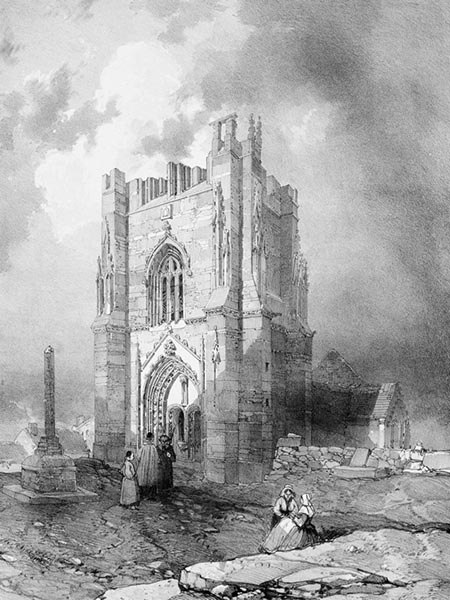
‘The Tower of the Church of Saint-Guénolé’ - Auguste Étienne François Mayer (French, 1805–1890) and Eugène Cicéri (French, 1813–1890)
La Torche. — A crevasse. A large rock like a bulwark, waves falling in cascades; flowing around it.
White Norse. — Wastes on the way to Plovan, an immense plain of pale green sands, undulations in the land. — A hut for wild-duck hunting in which we sat; black birds with white bellies circled and cried as they flew above our heads; complete solitude; the sea to the left. — A flock of black sheep jumping over an enclosure. — We passed through courtyards where dogs were barking. — An inlet. — A marsh. — Monsieur Bataille was at Louviers, in India, and at Waterloo, went to war, was a Customs Officer and is now retired. History: for a quarter livre you get a whole book. The tale of ... despatched by a cannonball; it will easily take someone’s head off. The retreat from Russia; the grenadier, to whom he had refused a place at his fire, who died by the fireside; he took his trousers. The lice were called ‘the Napoleons of Poland’. — The primary school teacher disillusions us as regards the virtue of Breton women; the girls are pooling their money to buy drinks for the boys so they can have a dance partner. — Grog. — We strike up a conversation with a shoemaker. — The hostess suspects my friend of immorality.
From Plovan to Audierne, along the shore, leaving a chapel on the right. — A path that winds along the curves of the coast. — Wasteland, the sea; the sea and the wind. — The doctor on horseback in gaiters. — Countryfolk gathering seaweed; their brown clothes against the green rocks. — To the right, mountains of sand and chalk; whiteness, the blue-green sea; the sky, with rolling clouds, deep blue in places; the path winding ahead of us in the distance following the undulation of the land, a white pattern on a pale green background; sands to cross; a mill.
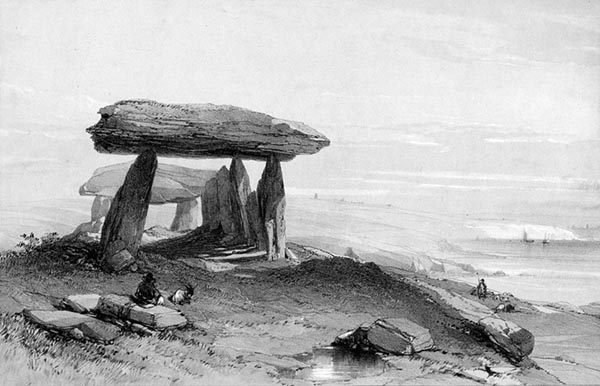
‘Dolmen near Audierne’ - Auguste Étienne François Mayer (French, 1805–1890) and Eugène Cicéri (French, 1813–1890)
Audierne. — We were obliged to walk around the bay. — The church (Église Saint-Raymond): under a side porch, a sea monster, a grotesque figure; a boat carved on the facade, but modern and not sham like at Penmarch. — In the evening, we strolled on the sand, so beautiful that we regretted crossing it, talking about an income of seven million. The sea, dark green from the reflection of the green coast; closer to us, blue; clouds of mother-of-pearl and pale gold. In the more overcast direction, a black cloud, rising and widening over a clump of green trees, was advancing towards us.
From Audierne to Plogoff (Saturday, 19th June). — First, the main road uphill; trees on the right. — A gentleman on horseback, adorned with long hair, whom we stopped to ask for directions, advised us to go to the Pardon (penitential ceremony) of Saint Hugin (Saint Tugen) in Primelin. — A canvas hut. — While waiting for Vespers, we go and sit by the sea. — The church: decapitated statues; the side porch entirely painted. — In the hut, sitting on a plank set on two stones, we chat with some countrymen (the tall one, with grey, curly hair, a good forty-five years older than Gustave; the one next to me, dark-haired; the puffy effect of his bragou-bras culottes, seeing him sitting facing me; they admire our pipes, and our knives) and a sailor who ran the establishment. — We go astray. A deserted village, barking dogs; no one speaks French. — Sun on the manure heap, and on the collapsed, dried-out paths.
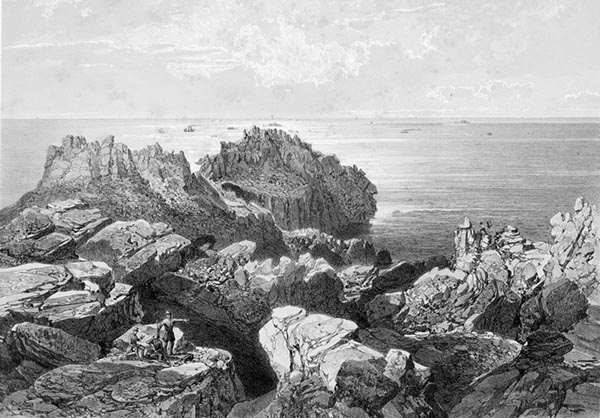
‘Plogoff: the Pointe du Raz and the Île de Sein’ - Félix Benoist (French, 1818–1896)
At the entrance to Plogoff, the doctor, the hotel! — Large, arid undulations, increasing in aridity as we approach the Pointe du Raz. Clumps of very short sea-rushes; the ground is bare in places. We pass through two villages black with filth. — A stone cross. — A mill. — A child born with one arm begs us for alms; he follows us. The customs officer explains to him that he is our guide. Mute, he goes ahead of us. — Blue sky, cormorants. — We clamber along the right hand side. A satanic hole, upheavals, folds, indescribable colour of the rocks underwater. Human beings are not made to live here, to endure such strong doses of Nature. It is not a slab of rock, but an agglomeration of rocks; the earth has crept in between, the grass short and slippery. The rock becomes increasingly dry, the sharp ridge slopes down towards the point. — We return along the left hand side; the slope is less steep, and the harshness of the precipice is somewhat softened by the weathering of the rocks that line it. The child has to raise his arm so I can cross over. — Back at the top, we smoke sitting down. — To the right, at the entrance to the Bay of the Dead (Baie des Tréspassés), a standing rock, covered with gulls; they flutter, cry, soar, and criss-cross in flight; the child throws stones; the boat rocks to and fro. — Our hostess’s religiosity. — Always milk, soup and eggs. — The night spent bivouacking.
From Plogoff inland to Pontcroix. — Country folk going to the Pardon of Saint-Hugin, which heals, and protects against rabies. — Near Pontcroix, we find our fellow from yesterday. — The gendarmes ask for our passports because of our savage appearance. — A barbarous lunch at Pontcroix. — The innkeeper, is the medical officer. — Costumes. — The fierceness of a tailor who takes us to Douarnenez; his horse-drawn carriage and Père Bataille’s chicken are the two hardest things I have encountered so far.
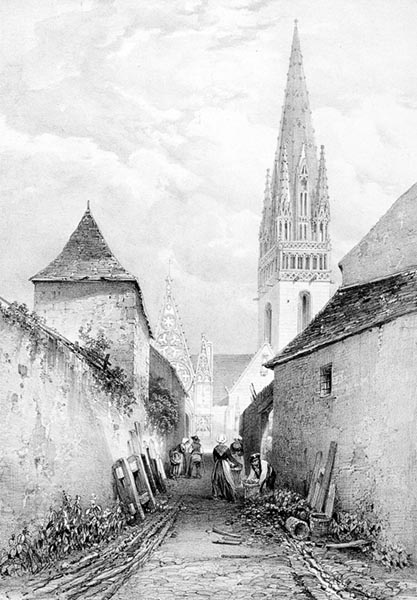
‘Pont-Croix’ - Auguste Étienne François Mayer (French, 1805–1890)
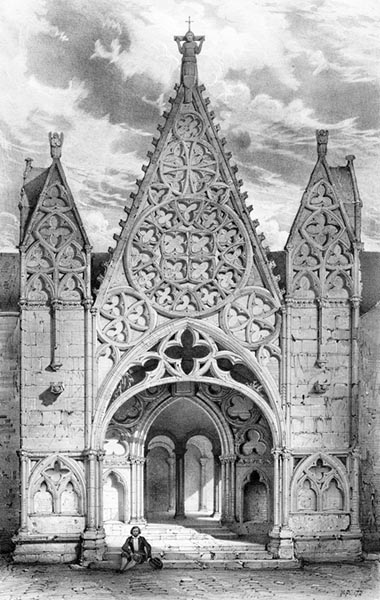
‘The Portal of the Church, Pont-Croix’ - Auguste Étienne François Mayer (French, 1805–1890)
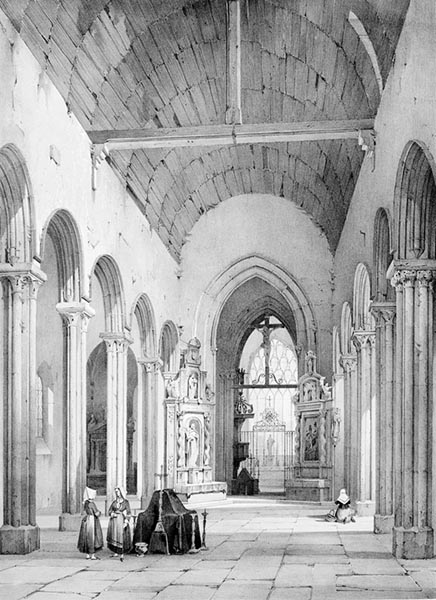
‘The Interior of the Church, Pont-Croix’ - Auguste Étienne François Mayer (French, 1805–1890)
Douarnenez. — Gray, cloudy, foggy weather, low houses, deserted streets, a poor and dreary place; to the right, on the shore, a section of cliff with greenery and hanging grasses. — L’Isle Tristan opposite; a tall white wall. Built by the farmer who lives there; a gloomy air about the whole area, out towards that ancient lair of La Fontenelle (Guy Éder de Beaumanoir de la Haye, nicknamed La Fontenelle, or ‘Ar Bleiz’, the ‘Wolf’ in Breton, seigneur de Le Vieux-Bourg, de Saint-Gildas, et du Leslay, was a warlord active in the late sixteenth century).
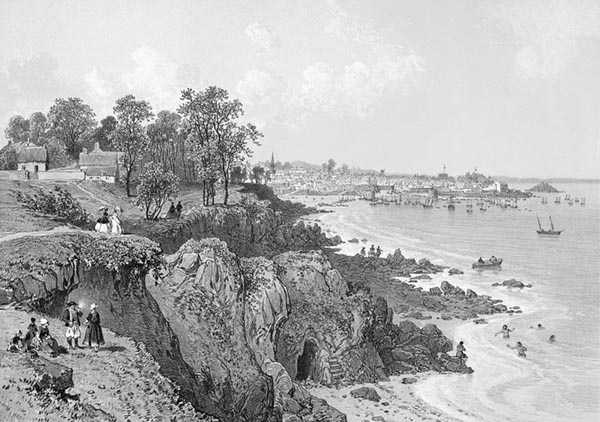
‘Douarnenez’ - Félix Benoist (French, 1818–1896), Adolphe Jean-Baptiste Bayot (French, 1810–1871) and Eugène Cicéri (French, 1813–1890)
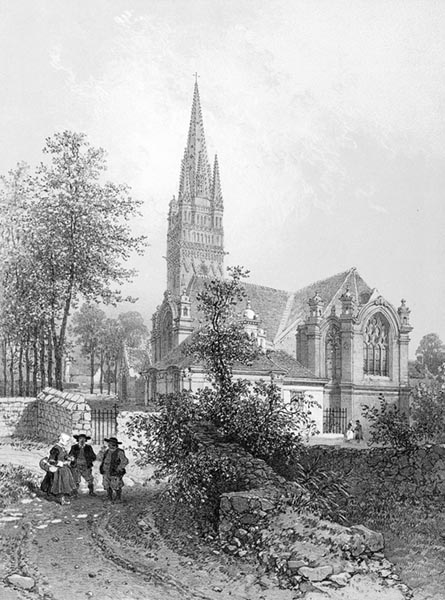
‘The Church of Ploaré, Douarnenez’ - Félix Benoist (French, 1818–1896), Eugène Cicéri (French, 1813–1890) and Adolphe Jean-Baptiste Bayot (French, 1810–1871)
From Douarnenez to Crozon. — An endless journey by horse-drawn carriage, the length of which was lessened by almost continuous sleep.
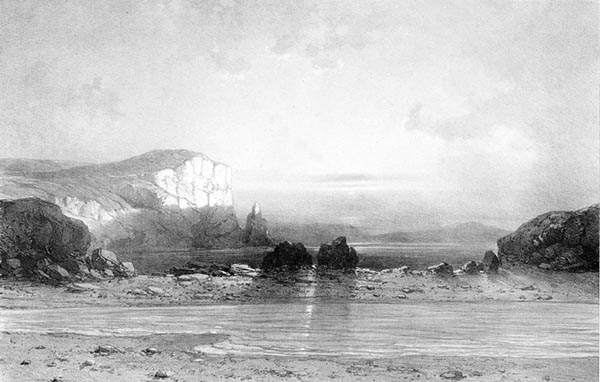
‘Crozon’ - Léon Gaucherel (French, 1816–1886) and Eugène Cicéri (French, 1813–1890)
Crozon. — Monsieur de Saint Amour, his niece. — Monsieur Grand. — The violence of Father Renoult’s attire on his way to the wedding dinner hosted by the notary. — A naked boy getting dressed in a corridor. — In the evening, a visit to the cemetery.
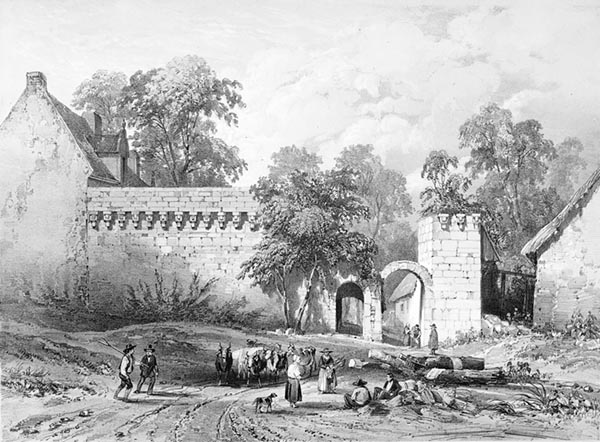
‘The Manoir de Kerioul, near Crozon’ - Auguste Étienne François Mayer (French, 1805–1890)
Morgat. — The village to the right. — Boats pulled up on the pebbles as at Étretat. — Caves: the small ones you can see on foot, three of them, one with two arches, another with a kind of low alcove; the large cave, you reach by boat. At the entrance, water flows from above, the water is transparent, the cave wall (Grotte de l’Autel) isn’t straight, but curves; a small rock in the middle. The rocks are yellow, iron grey, red, etc., all without break, following the layers of the stone. The boat ploughed along, sculling, one felt oneself being drawn into a strange, pearly realm, as if into an enchanted passage; the enchantment being that of Nature. The ceiling variously coloured.
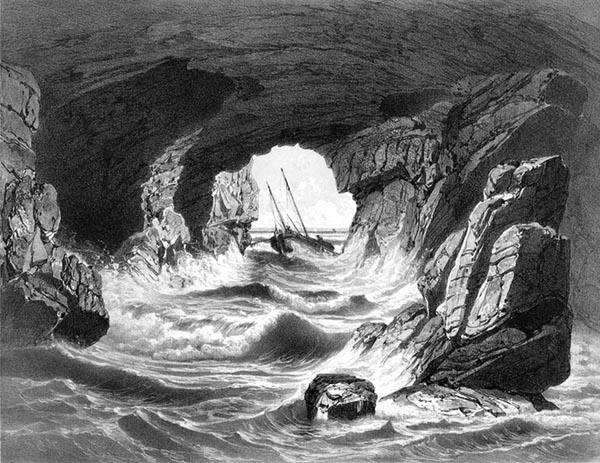
‘The Grotte de l’Autel, Morgat’ - Félix Benoist (French, 1818–1896)
Landaoudec. — Ivy on sections of walls (Fort de Landaoudec). — Our excavations at the dolmen. — Anse de Dinan (Dinan Bay). — Corpses in the sand, bones calcined by the water: they were found with their arms straight along their sides, their faces to the sky, their feet towards the sea. — The sea, dark blue. — The sand, all white and dry under the sun. — Wide and bare countryside, a pale russet colour.
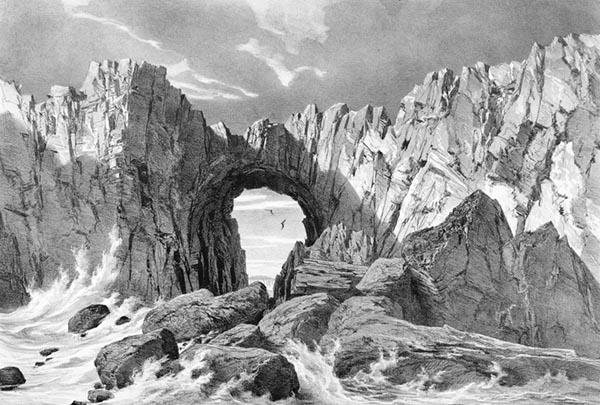
‘The Pierced Rock in the Anse de Dinan, near Camaret’ - Auguste Étienne François Mayer (French, 1805–1890)
Chapter IX: (Flaubert: The North-West Coast, Crozon to Saint-Pol-de-Léon)
From Crozon to Landévennec, the countryside is open, devoid of trees or houses; a russet moss, like worn velvet, stretches as far as the eye can see, clothing the flat ground. Occasionally, fields of ripe wheat rise amidst small, stunted gorse bushes. The gorse is no longer in bloom; it has returned to its pre-spring state.
Deep cart-ruts, bordered on their edges by ridges of dry mud, multiply irregularly near each other, appear before you, continue for a long time, then curve away and disappear from sight. Grass grows in large patches between these collapsing furrows. The wind whistles across the moor; we advance; the joyful breeze stirs the air, its gusts dry the sweat that beads our cheeks and, when we halt for a moment, despite the throb of our arteries, we hear the sound of its flow over the moss.
Every now and then, to point the way, a windmill appears, its large white sails turning rapidly in the air. Their wooden frames creak and groan; they descend, skim the ground, and ascend once more. Standing at the wide-open dormer window, the miller watches us pass.
We marched on. Walking alongside a hedge of elms that must have concealed a village, we glimpsed a man climbing a plum-tree planted in a courtyard; at its foot stood a woman catching the fruit he threw down to her in her blue apron. I remember a mass of black hair cascading over her shoulders, two arms raised in the air, a backward movement of her neck, and a loud burst of laughter that reached me through the branches of the hedge.
The path we follow narrows. Suddenly, the heath disappears and we are on the crest of a promontory overlooking the sea. Stretching out towards Brest, the headland seems endless, while on the other side, carving through the land, it winds its way between steep hillsides covered with coppiced trees. Every bay is squeezed between two hills; every hill is flanked by twin gulfs, and there is nothing as beautiful as those great green slopes rising almost vertically from the blue expanse of sea. The hills swell at their summits, flatten at their bases, and curve towards the horizon in a widening sweep that link their plateaus. With the graceful curve of a Moorish arch, they connect to one another, thus extending, continuously, the colour of the vegetation and the undulation of the terrain, by dint of their repetition on every hill. At their feet, the waves, driven by an onshore wind, press against their folds. The rays of sunlight, striking the water, make the foam sparkle; the waves shimmer like silvery stars, and all the rest is an immense, smooth surface, whose azure one never tires of contemplating.
Sunlight could be seen passing over the valleys. One of them, already darkening, was a vague blurred mass of woodland, while a wide, black bar of shadow advanced upon another.
As we descended the path, and thus drew closer to the shoreline, the hills before us seemed to grow taller, the gulfs deeper; the sea expanded. Letting our gaze wander, we walked on, careless of what was to come, as pebbles flung up by our feet rolled away, and vanished amidst the clumps of brushwood that lined the edges of the path.
Arriving finally at Landévennec, we went into a very plain tavern to leave our knapsacks; there, we sat on barrels instead of benches. After each drinking a shot of cheap brandy, out of one of those large cups of local earthenware striped with pink and blue bands like the breeches worn at a masquerade ball, we went off to see the abbey.
All that remains of the portal are three arches; the middle one, lower than the other two, is the only one pierced. On each side of one of them, after a buttress, a long, small arched window flares outwards like the arrow slits of a fortress; inside the middle arch, short columns supporting mouldings bear capitals covered with complex interlacing patterns.
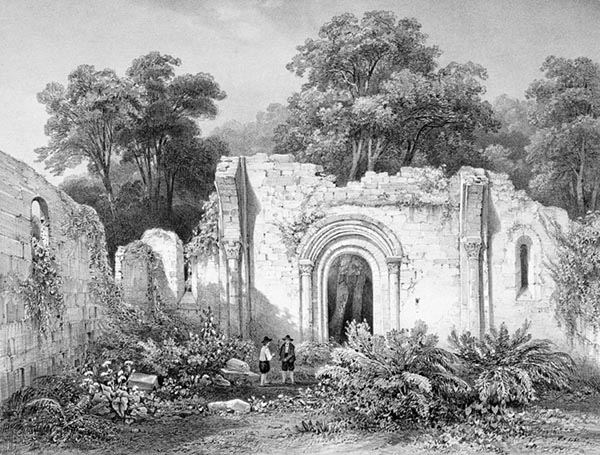
‘Landévennec Abbey’ - Auguste Étienne François Mayer (French, 1805–1890)
Once having crossed this section of the wall, either through the breach opening onto the courtyard or through the gate, whose entrance was blocked by a ladder placed askew, the ruins of the choir and apse appear in the distance, their whitish crenelations silhouetted against the blue sky. They form a circular apse flanked by rounded side chapels, and reinforced with exterior buttresses, the semicircular windows mostly supported by columns whose bases are set into square pillars. The courtyard undulates in bumps and hollows; it is a shifting jumble of uneven planes clothed with brambles and ivy, with their uneven greenery.
In the side chapels, through the window openings, one can glimpse the sea in the distance, beyond a meadow dotted with the green domed crowns of apple trees, each view of it framed like a painting by the eroded semicircular arch of a Romanesque window.
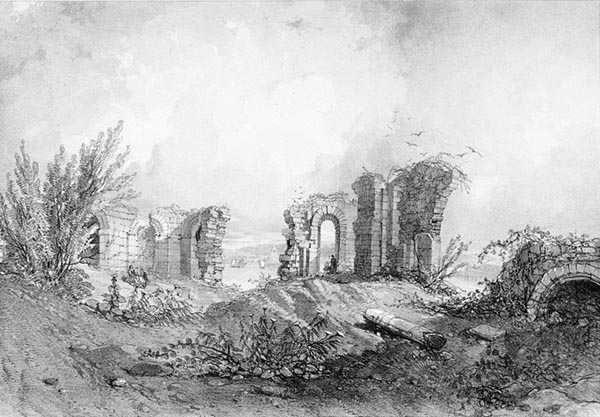
‘Landévennec Abbey’ - Auguste Étienne François Mayer (French, 1805–1890) and Eugène Cicéri (French, 1813–1890)
A statue of an abbot leans against the wall: a large ring on the middle finger of his right hand; he has a long chin, prominent cheekbones, protruding eyes, slightly frizzy hair, a cope with long fringes, and a shield of ermine with three bars, the chief (top of the shield) charged with a triple label surmounted by an abbot’s crozier. Is this, and why should it not be, Saint Guenolé (Winwalow), the monastery’s first abbot, who died in 532, the saint who is said to have advised King Gradlon to leave the city of Ys, before it was drowned, and who, as the king galloped away across the shore with his beautiful daughter Dahut, cried out to him, from the clouds, as the waves were already beating against his horse’s hooves, to rid himself of the demon he was bearing behind him? Gradlon hurled her into the waves; the waves engulfed her, then retreated, and Gradlon continued on his way. To contemplate the statue more comfortably, we seated ourselves on another that was lying flat on the ground.
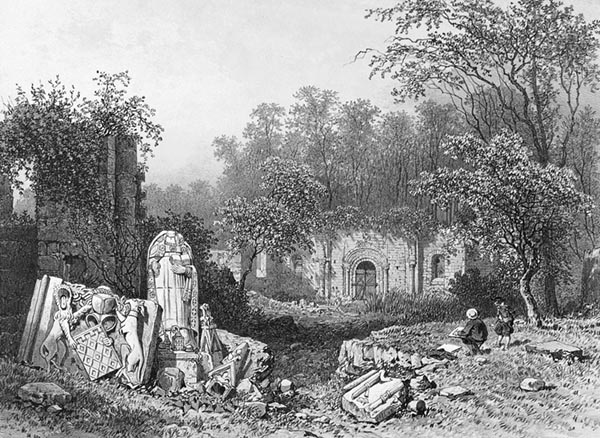
‘The Abbey Church, Landévennec’ - Félix Benoist (French, 1818–1896), Eugène Cicéri (French, 1813–1890) and Adolphe Jean-Baptiste Bayot (French, 1810–1871)
This latter depicts a bishop; he has a crozier, a cope bordered with roses and olives, a thumb-ring and, passing beneath the left arm, a shepherd’s staff. A narrow sleeve, fastened with a large button, itself emerging from a very wide sleeve, encloses his arm; his hands are joined; two angels support the pillow on which he rests; his dog, lying at his feet, surmounts a shield which shows nine mascles (pierced lozenges) placed three by three on a label with three charges set in chief (in a band at the top of the shield), and supported on the right by a lion lampassé (with protruding tongue), and on the left by a greyhound.
While we were busy interpreting this nonsense, a yellow calf, marked with a spot on its head, wandered near to us. It staggered on its long, weak legs, and flies buzzed around its whitened nostrils, still moist with its mother’s milk. Beyond the gate, at the foot of the hill they cover, tall beech trees swayed at the crown, the sun beat down on the old sections of wall, and a warm breeze drifted past; all sorts of plants and shrubs, nettles, daisies, angelica, elder, heather, and balsam mingled their sweet scents; something tender, arousing, and heart-sickening gripped one; one felt oneself overcome by languor, filled with obscure stirrings and languid desire. And as we lay there on the grass, a tall young girl, fair and white of skin, appeared before us, walking barefoot amidst the brambles, and dressed in a red cloth petticoat whose cord was tied tightly around her waist, and a thick, yellow linen shirt; she held a reed, broken at the top, in her hand and stood looking at us without saying a word.
She departed, then returned, laughed when we spoke to her, and vanished immediately. Then, we rose, picked up our walking sticks, and departed ourselves. As we climbed over the wall, we dislodged various stones, and the mortar crumbled beneath our hands. Had we, too, come only to destroy? What neither time, human beings, good taste, nor industry could destroy, naive travellers unwittingly accomplish in the very act of satisfying their curiosity.
In twenty minutes, a boat took us to the other side of the harbour. and deposited us in a crevice in the rocks, on large slabs of stone covered with seaweed, where we slithered about awhile before reaching land. Once in the countryside, our predicament began. We were to spend the night at Daoulas, but had no knowledge of the route. The paths wound between thick hedges, denser than walls. We ascended and descended; moreover, the paths full of shadow, and the countryside around were already falling asleep amidst the lovely silence of a summer night.
In the absence of anyone who could tell us the way, the two or three countryfolk we had approached responding only with unintelligible cries, we pulled out our map, reached for our compass, and, orienting ourselves by the sunset, resolved to head for Daoulas directly as the crow flies. So, we roused ourselves, and launched into the fields, through hedges, over ditches, felling obstacles, by overturning, pushing aside, or breaking everything in our path; without regard for gates left open or crops damaged.
At the top of a slope, we caught sight of the village of Hôpital (Hôpital-Camfrout), nestled in a meadow through which a river flowed. It was spanned by a bridge; on this bridge, was a mill its sail turning; beyond the meadow, a hill rose; while climbing it briskly, on the bank of a tall slope, in the light of a ray of sunlight, shining between the roots of the hedgerow, we saw a beautiful black and yellow salamander advancing on its serrated legs, dragging its long, thin tail in the dust, its speckled body undulating. It was the hour when it set out to forage; it was emerging from its burrow deep inside a large rock buried in moss, and was off to seek insects inside the rotting trunks of old oak trees.
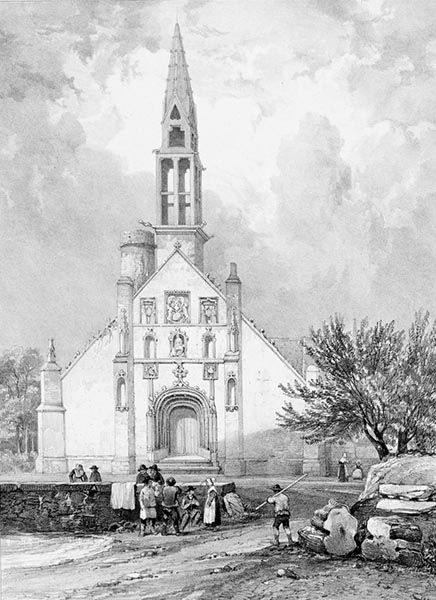
‘The Church at L’Hôpital-Camfrout’ - Auguste Étienne François Mayer (French, 1805–1890)
Sharp and angular cobblestones soon rang out beneath our feet, a street rose before us; we were in Daoulas. It was still light enough to make out a square sign on one of the houses, hanging from an iron bar set into the wall. Even without the sign, we would have easily recognised the inn, all the houses, like the people, bearing the mark of their trades. So, we entered, extremely hungry, demanding above all not to be kept waiting.
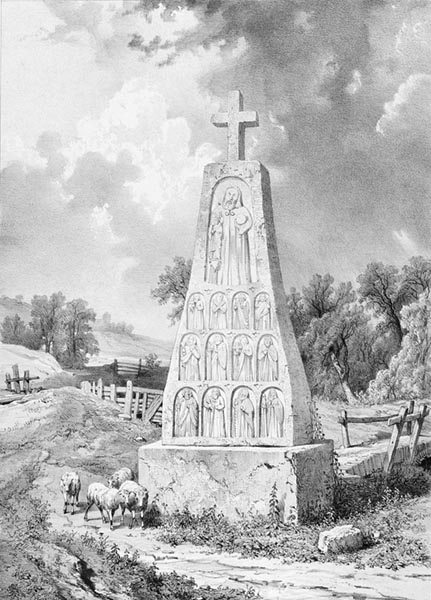
‘A Celtic Monument near the Chapel of Sainte-Marguerite, between Logonna and Daoulas’ - Auguste Étienne François Mayer (French, 1805–1890)
While we sat on the doorstep waiting for our dinner, a little girl in rags entered the inn carrying a basket of strawberries on her head. She soon came out again, holding a large loaf of bread, in place of it, with both hands. She ran off with the quickness of a cat, letting out shrill cries. Her hair, bristling and grey with dust, rose in the wind around her thin face, and her small, bare feet, striking the ground firmly, twinkled, as she ran, beneath the tattered rags that beat against her knees.
After our meal, which, besides the inevitable omelette and the fatal veal, consisted largely of the little girl’s strawberries, we retired to our apartment.
The winding staircase, with its worm-eaten wooden steps, groaned beneath our feet like the soul of a sensitive woman faced with fresh disillusionment. At the top was a room whose door, like that of a barn, was fastened with a hook inserted from outside. That’s where we slept. The plaster on the walls, which had once been painted yellow, was peeling; the ceiling beams sagged under the weight of the roof tiles, and a greyish grime on the panes of the sash window dimmed the light as if it entered through frosted glass. The beds, made of four badly-joined walnut planks, had large, spherical feet, riddled with woodworm, and cracked from the dryness of the air. On each of them was a straw palliasse and a mattress covered with a green blanket riddled with holes where the mice had gnawed it and fringed with fraying threads. A dull piece of mirror, broken in its frame; a game bag hanging from a nail; and, nearby, an old silk cravat with the creases of its knots still recognisable, indicated that the bed was normally in use, doubtless every night.
From beneath one of the red cotton pillows, a hideous object half-revealed itself: a cap of the same colour as the bedclothes, but with a sort of thick glaze obscuring the weave; worn, stretched, sagging, oily, and cold to the touch. I had the feeling its owner cherished it and found it warmer than anything else. A man’s life, the sweat of an entire existence, was embodied in the layer of rancid grease that covered it. How many nights must it have taken to produce one so dense? How many nightmares must have stirred beneath it, how many dreams must have traversed it! Fine ones too, perhaps. Why not?
Exaggerated delicacy prevented us from throwing the thing out of the window, and we contented ourselves with kicking it under the bed. What might have occurred if we’d found slippers there, meant to keep company with a woman’s night-cap? What a fine report to be written for whoever might have had to perform our autopsies!
‘O comforts of civilisation! I said to myself as I timidly slipped into bed, ‘O ideal comforts, the source of modern happiness, how far you are from reaching Daoulas! How little they know your delights here! The folk here are as yet ignorant of your window-blinds, carpets, doors, shelves, and radiators! What contempt for English chic! What careless service! What filthy linen! What sad cutlery! What ugly silverware! One would surely be unable to find a single pumice-stone anywhere in the whole region; they have not a suspicion of how to make tea, and certainly none of these houses has a proper toilet.’
We slept for fourteen hours straight, and were still snoring the next day while visiting the church (the Abbaye de Daoulas). A beautiful legend is told about its foundation, featuring an avenging dragon with its young; two saints (Tadec and Judulus); and a furious pagan lord (the Lord of Faou); but I am tired of legends, and no less so of churches. Besides the fact that I simply lack a well-developed feel for architecture, is it not tedious, one must admit, to have to endure at least once a day a nave, a portal, aisles, capitals, arcades, arches, columns, pillars, and semicircular and pointed arches? The more pleasant things are, the more tedious they become. I shall never lose the hatred the Pyrenees aroused in me as regards waterfalls; I had admired them so much I came to hate them terribly. When I had to turn aside to admire a new one, I felt the onset of stomach-ache; the noise, the foam, the movement revolted me; I longed only for the driest of plains, I would have preferred to live in a marl pit.
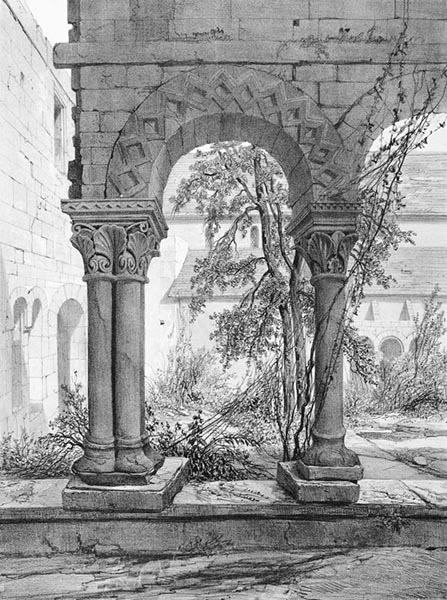
‘Daoulas: the Cloister of Notre-Dame Abbey’ - Auguste Étienne François Mayer (French, 1805–1890)
Beneath the porch are twelve gaunt apostles, with rather naive expressions, while the interior, Romanesque (but more adorned with white, alas, than Pierrot’s face), contains nothing but large ostrich-eggs suspended, as votive offerings, from the statue of the Virgin, reminiscent of those placed by Muslims in mosques. If this makes one halt for a moment, and raise a smile, inwardly, at the poetic comparison, one is soon punished for it by the sight of an ossuary of the most horrifying taste imaginable.
Fearing we might lose our way, and wishing to arrive in Brest early, we enquired about a guide. ‘Here’s a gentleman who’ll conduct you there without fail, he’s returning there himself,’ our hostess told us, pointing to a member of the bourgeoisie who was leaning on the kitchen table, drinking a toast with the blacksmith. When the glasses were empty, the gentleman rose, took a pinch from his tortoiseshell snuffbox, and turned to us:
— ‘Are you bound for Brest, gentlemen?’
— ‘Yes.’
— ‘So am I. If we travel together, we can talk, and pass the time.’
He was short, and beginning to acquire a paunch; his black hair, cut close at the back, curled at his left temple in a ringlet that extended to the corner of his eye, and his hat, slipping down over his right ear, revealed a narrow brow that appeared to recede even more sharply because of his long jaw. Despite his drooping cheeks, his face was thin. He blinked often, and never stopped smiling. A woollen frock-coat, too short at the waist, covered his stooped back, and from the undersized sleeves protruded two large, red hands, lazy hands, plump rather than strong, whose skin seemed moist. Beneath a black satin waistcoat with a Schall collar (after Madame Schall a Regency Parisian dressmaker), embroidered with pale green bouquets, he wore a stiffly starched, extremely white cotton shirt, over which hung two blond cords made of hair, forming a safety-chain for the handsome gold watch stored in his wide waistcoat pocket. His neck, supported by a drooping cravat, turned freely, and his wide-legged trousers, frayed at the buttonholes and bulging at the knees, stopped halfway down the length of a sturdy boot whose hard leather was scarcely creased. He walked quickly, looking at the ground, his head lowered, his right shoulder raised, the arm beneath gripping a formidable club made of tropical hardwood, studded along its entire length with sharp spikes.
And how he could talk! He did so continuously, recounting anecdotes about people unknown to us, reporting entire dialogues, telling us about his political opinions, his culinary tastes, his health, his business, his relationships, the price of goods, his wife, his father-in-law, his little dog, and his stove which smoked. His name was Monsieur Genès, he lived in Brest, and did sixty thousand francs’ worth of business a year. He had been successively a gunsmith, a soldier, an informer, a police-inspector, a caretaker of the dispensary, and was now settled, married, a property owner, and a business agent — that is to say, ‘a mover of men’, as they term such in Brittany.
One might assume that an existence of that kind would leave its mark on the man who lived it, and that it would be amusing to plumb its depths, but no! Nothing is flatter, more worthless, more colourless, more insipid than that of Monsieur Genès. He is as stupid as a judge, and as tedious as the biographies of social benefactors. Completely unaware of the dubiousness of his business dealings, he considers himself a most honest man, since he conducts all his transactions in the presence of a notary. He is chaste in his speech and orderly in his behaviour. His only passion is for money, his only predilection for wine, and no doubt he owes to his drinking habits the drowsy and dishevelled air the superficial affability of which softens the cunning of his little grey eyes, and the harshness of his thin lips.
He has no vices; he sees gambling as dangerous, women as pernicious, ‘not knowing what either will lead to, whereas with a good vintage you can stop whenever you wish.’ He is an orderly, active, clever, and cautious man who is afraid of thieves. He seems flattered by the consideration shown him; he greatly respects the law and venerates legal professionals, notaries, lawyers, and bailiffs; he carries a blade and never removes his hat.
Along the way, he drafts young men, and offer them the chance to sell their souls. The raw recruit is for him the perfect type of soldier because he fears nothing, cares for nothing, gives his life for a few hundred francs, in short because ‘the raw recruit is like a convict,’ a definition that would hardly satisfy the defenders of our military honour.
Monsieur Genès dislikes the theatre; this is one of the reasons, among others, why he left the police force. He found it very tedious to be obliged to attend the theatre every night. Furthermore, people would tell him, ‘Monsieur Genès, you are wrong! A man like yourself should never be attached to the police.’ Neither does he frequent churches; he told us he hadn’t set foot in one three times in his life. He is, in fact, a follower of Voltaire, and a friend of progress, but even more a friend of the government. He desires a war; ‘it would boost business.’
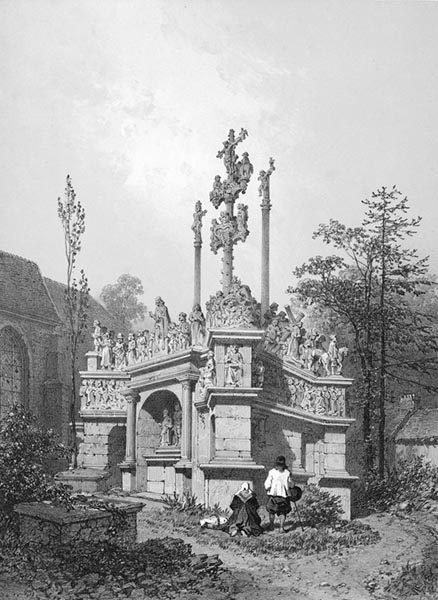
‘The Calvary, Plougastel-Daoulas’ - Félix Benoist (French, 1818–1896), Eugène Cicéri (French, 1813–1890) and Adolphe Jean-Baptiste Bayot (French, 1810–1871)
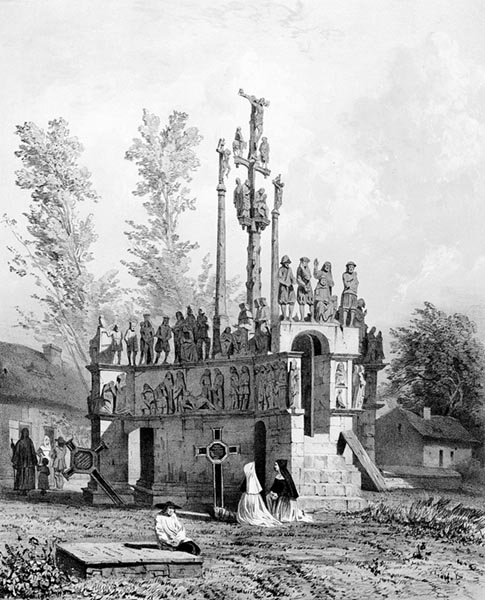
‘The Calvary, Plougastel-Daoulas’ - Léon Gaucherel (French, 1816–1886)
At Plougastel (Plougastel-Daoulas), however, he halted, as we did, so that we could view the Calvary, a small, square granite monument, each face depicting a scene from the life of Jesus Christ, with the four corners occupied by the evangelists in their respective roles. The figures, though somewhat heavy-handed, are nonetheless dynamic, lively, and amusing: the men binding Christ exert all their strength, their muscles clearly aching; the one who grimaces in his face, sticking out his tongue, effects it so convincingly that one smiles; the donkey carrying Our Lord entering Jerusalem has a true donkey-like expression, good-natured and peaceful; the soldiers leading him to Calvary, blowing trumpets and beating drums, are preceded by an officer riding with his head held high, displaying sublime arrogance; while, at the foot of the cross, Mary Magdalene, weeping, lets down her beautiful braided hair. Place all these characters in poses from a David Teniers’ painting, the small rounded hats turned up, the doublets squeezing fat bellies, the large sleeves, the high breeches, the broad faces, the wide eyes, and you have a solid work of the imagination, something naive, noble, and of a wholly medieval poetic nature, though the monument was only carved in 1602 in fulfilment of a vow made four years earlier regarding an epidemic which ravaged Lower Brittany.
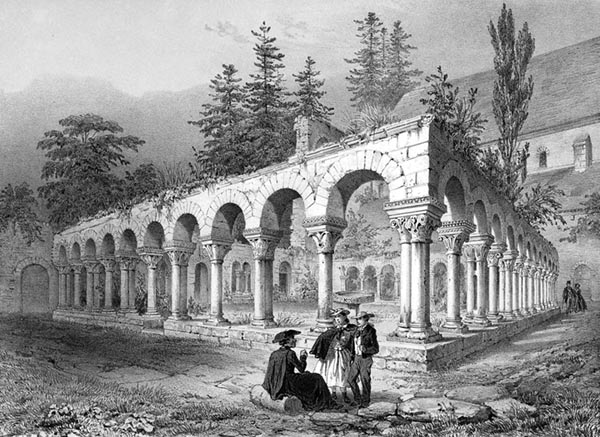
‘Daoulas: the Cloister of Notre-Dame Abbey’ - Félix Benoist (French, 1818–1896)
All of this, however, was completely lost on Monsieur Genès. He possessed not a suspicion of its meaning; looking at the Last Supper, he mistook the plates for cards, the cups for dice, and said, in astonishment: ‘They’re gambling.’ What a farce.
From Plougastel, you reach the coast through the woods, down a steep slope from which you can see part of the harbour, at least the long stretch from Brest to Landerneau, which forms the mouth of the river (the Elorn). Beside you rises a perpendicular cliff of white rock, horizontally striped by layers of flint, and bare on the seaward side, though behind, on the plateau, it is covered with oak and beech trees laden with foliage, a plateau which, as you descend through the valley, cleaving its mass, gradually reveals its striking shape.
Here we embarked, thus avoiding, as in Landévennec, a circuit of the cove, the uneven borders of the roadstead cutting into the land, in a thousand capricious clefts, which it would take a whole day to traverse.
Before setting sail, Monsieur Genès, feeling a thirst coming on, invited us to join him at a tavern he knew. Finding the service slow, he descended to the cellar to fetch the wine himself, and took the glasses from the sideboard. As we greatly feared he would buy us drinks, since reciprocation would have been mandatory, we hastened to pay up, down our drinks, and leave as quickly as possible.
Monsieur Genès, on the contrary, wished to sit at a table for a while, and refresh himself; he asked for strawberries, and enquired if there was any coffee; however, the boatman was waiting, the tide was high, and we were obliged to depart.
The waves leapt onto the cobblestones of the slipway where the boat bounced about, its keel grating; foam splashed onto the passengers who were boarding; a cap fell into the water, and Monsieur Genès’ boots were wetted. The sea was lively; the breeze was strong. Tossed about by the waves and buffeted by a north-westerly wind that pushed us to the far end of the bay, the heavy longboat made little progress. While the men were hauling on the oars, it would rise at the bow and pivot, caught on the crests of the waves. These were numerous, white at their summits, green in their troughs, murmuring, and jostling each other with playful frenzy. A brig ahead of us showed its sails, puffed out by the wind as it tacked, and the curved shape of its hull, then slid away gently, cutting through the water lapping against its keel.
On the horizon, Brest appeared as a grey dot. All around, within a fifty-mile wide amphitheatre of pale cliffs, stretched the sea. At my feet, on the boards of the longboat, was a birdcage containing a blackbird caught that morning being taken to the city; it called out in fear at the sound of the waves.
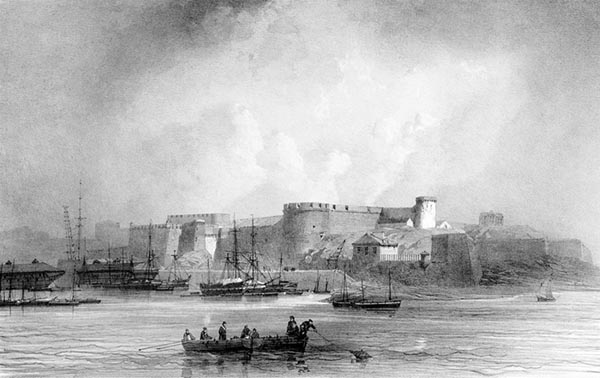
‘The Château de Brest’ - Eugène Cicéri (French, 1813–1890)
Next to the cage, also on the ground, hiding her face with her hands, a young woman sat in a desperate attitude; sobbing, praying, begging everyone to save her, swearing never to return to Plougastel, and crying out that she was going to die. She was a small, dark-haired woman, fat, dirty, unkempt, and poorly dressed, her broad splayed-out feet encased in blue stockings and shoes without laces, with a worn black apron covering her belly, who was at an advanced stage of pregnancy. As we moved further from the shore, her terror grew, and she drew ever closer to me, clinging to someone, grasping at anything. With the rise of a stronger wave, she threw herself at my feet and, embracing me by the hips, buried her face between my thighs, refusing to emerge; her earrings rubbing against my hands, I felt her breasts heaving against my knees, and her whole body, trembling with fear, pressed against mine.
I enjoyed the sensation, and why? Is it because we empathise with others more when we feel stronger than they? Or is male virility, complemented by female weakness, enhanced by vanity and sharpened by appetite? In that simple closeness lay the entire relationship between the sexes and, as it were, the communication of their natures. Whatever the reason, it was not without a tenderness of a kind, and I wished the journey longer. Though her eyes were clogged from crying!
We were waiting for the moment of disembarkation, so we could leap out before everyone else and escape Monsieur Genès, whose company had become utterly intolerable. Rather than spend another quarter of an hour in his company, we would have abandoned Brest, and slept beneath the stars; our intent was thwarted, we were stunned, dazed. He was the first to quit the boat, and as there was a tavern on shore, he wanted to return the favour and immediately offered us a bottle of wine, his eternal desire.
— ‘Thank you, it’s too hot.’
— ‘A little beer, then.’
— ‘It’s too heavy, it makes walking harder.’
— ‘A small glass?
— ‘We never do.’
— ‘A liqueur?
— ‘Thank you very much, but we’re in a hurry.’
— ‘A coffee! Oh! A coffee!’
— ‘No, no, no, definitely not; farewell.’
He stopped, hesitated for a moment, and then, with a sublime gesture, said: ‘Well, I’ll have some anyway; go on! I’ll join you, later.’
How we sped along! Not running, but flying! Lighter than a feather; the fear of God, and the joy of being free of him, propelled us forward, with the speed of a wagon pulled by a pair of powerful locomotives. Every moment we seemed to hear him behind us, and dared not turn our heads for fear of catching a glimpse of his hat.
Brest, however, seemed to elude us. No matter how much we sweated, or how quickly we advanced, the road seemed to stretch on forever, the hill ascending endlessly. We encountered countless walkers, sailors, soldiers, children in the arms of their nannies, bourgeois folk, taking the air or off to dine at their country houses, in little family carriages; everything seemed to indicate the approach of a town, yet the town seemed ever-receding. Finally, unable to bear it any longer, we entered a wheat field and collapsed to the ground, exhausted, panting like nags. A cloudburst overtook us, forcing us to pick up our knapsacks, and a quarter of an hour later, Brest, thank heavens, revealed its rooftops to us. The first person we saw on entering the town was Monsieur Genès. He had passed us by, doubtless when we were in the field, and was in conversation with a policeman, but we were now no longer afraid of him; we had arrived, more or less, since before reaching the gates of Brest one still has to traverse a suburb, via a long street, a continuation of the main road, lined here and there with butchers’ shops and wine merchants, whose patriotic signs shine next to large dilapidated cabaret-restaurants possessing rooms for a hundred people, with garlands painted on all their floors.
People stopped to see us; we were worth the view. Bare-chested, shirts billowing in the breeze, cravats around our waists, bags over our shoulders, white with dust, tanned by the sun, our clothes torn, our shoes worn and patched, we had a handsome, vagabond air about us, insolent and proud; our shoes’ iron studs rang on the cobblestones, our knapsacks kept time as we marched, our sticks rose and fell in harmony, and the smoke from our pipes escaping from beneath the edge of our hats curled upwards in plumes.
The officers, astonished by this attire, looked at us with a stunned expression; children followed us from a distance; and we were stopped and asked for our passports.
Nonetheless, on arriving at the hotel, we were glad to wash in hot water, sleep in a clean bed, and sit in an armchair. We immersed ourselves in the delights of civilisation, bathed, and ate no veal.
If you are neither an engineer, a builder, or a blacksmith, Brest holds little appeal. The port is beautiful, I will grant; magnificent, perhaps; gigantic, if one insists. ‘Very imposing’, as they say, ‘giving one the impression of a great nation’. But all those piles of cannon, cannonballs, and anchors, the endless stretch of quays bordering a motionless, uneventful sea, a subjugated sea that has the air of a galley slave, and those vast, rectangular workshops in which machines groan amidst a constant clanking of chains, like the sound of rows of convicts marching, or work away effortlessly in silence — all that sombre, merciless, constrained power, that mass of organised effort, quickly fills your mind with ennui, and tires your eyes. We wandered endlessly over cobblestones, shells, and the rocks with which the port is bounded, over heaps of iron, hooped beams, and dry basins containing the naked carcasses of ships, forever meeting the grey walls of the prison, where a man leaning out of the windows tests the strength of the embedded bars by striking them with a hammer.
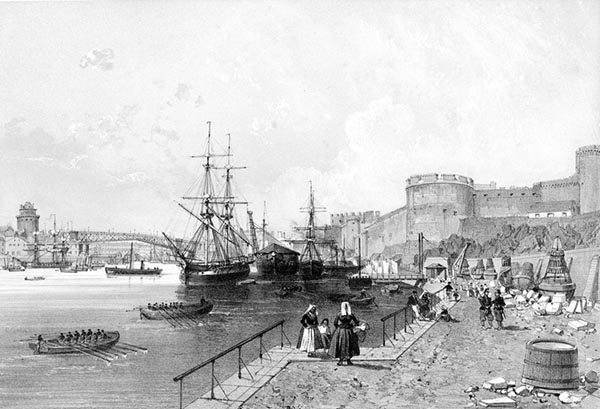
‘Brest: the Château, the Bridge and the Harbour Entrance’ - Félix Benoist (French, 1818–1896) and Adolphe Jean-Baptiste Bayot (French, 1810–1871)
Here Nature is absent, proscribed, as nowhere else on Earth, the place being Nature’s negation, presenting itself as her stubborn enemy, both in the form of the iron levers that break the rock, and in the sword of the prison guard who harasses the galley slaves.
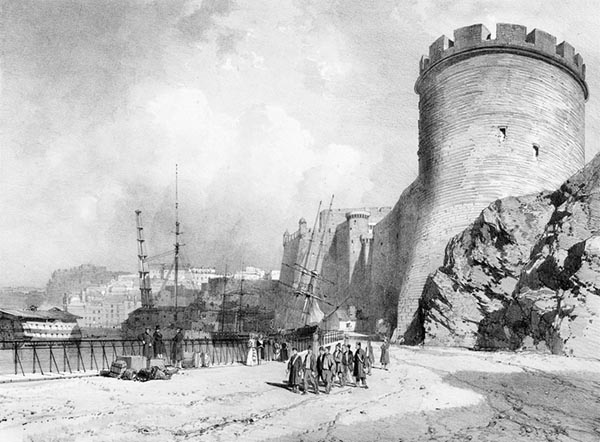
‘The Old Château de Brest’ - Eugène Cicéri (French, 1813–1890)
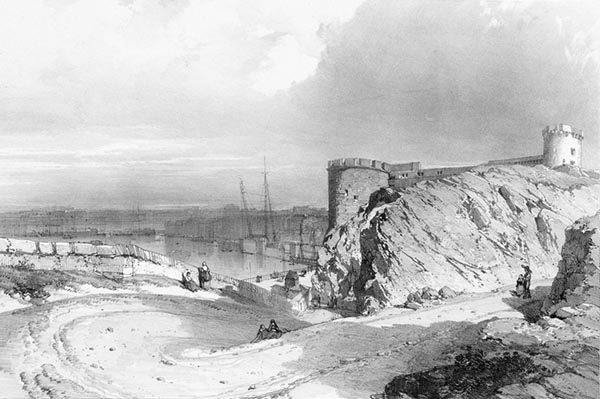
‘The Château de Brest: the Tour César’ - Eugène Cicéri (French, 1813–1890)
Apart from the arsenal and the prison, here are only barracks, guardhouses, fortifications, ditches, uniforms, bayonets, sabre, and drums. From morning till night, military music sounds beneath your windows; soldiers march through the streets, manoeuvring to and fro; the bugle is always sounding, and the troops always march in step. One understands, immediately, that the town is simply the arsenal, the rest exists only because of its presence, and that the arsenal overflows everywhere. In every form, in every place, at every corner, administration, discipline, lined-paper, the military framework, and military rule are evident. One appreciates the artificial symmetry, and the mindless cleanliness. At the naval hospital, for example, the floor of each ward is waxed in such a way that a convalescent trying to walk on a newly-healed leg is bound to break the other in slipping. But it is beautiful, it shines, one admires one’s reflection. Between each room is a courtyard, but one into which the sun never shines and from which the grass is carefully weeded. The kitchens are superb, but so far away that in winter the meals reach the patients frozen solid. They indeed are the folk the place is for, but the pots and pans are gleaming are they not? We saw a man who had fractured his skull falling from a frigate and who, for eighteen hours, had still not received any help; but his sheets were pristine, since the linen room is well maintained.
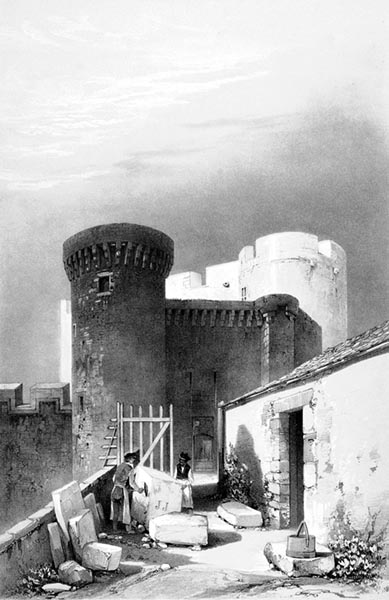
‘The Keep of the Château de Brest’ - Auguste Étienne François Mayer (French, 1805–1890)
At the prison hospital, I was moved to tears, like a child, when I saw a litter of kittens playing on a convict’s lap. He made balls of paper for them, and they chased them across his blanket, holding onto the edges with their sharp claws. Then he turned them onto their backs, stroked them, and kissed them, and tucked them into his shirt. Sent back to his workbench, as he had doubtless been more than once, he will dream, when he is truly sad and weary, of those quiet hours he spent alone with them, feeling the softness of their fur in his rough hands, and their warm little bodies nestling against his heart. I like to believe, however, that the regulations forbade such recreation and that it was, doubtless, an act of charity on the part of the nuns who act as nurses.
However, here as elsewhere, the rules are not without their exceptions, and distinctions of rank are retained, whatever they say (equality being a lie, even in a penal colony). For from the numbered cap a finely perfumed lock of hair sometimes emerges, just as a sleeve often rises from the end of a red shirt to grasp a white hand. There are special privileges reserved, it seems, for certain professions, for certain men. How could they, despite the rules and their comrades’ jealousy, have attained this eccentric state that renders them almost feigned galley-slaves, a position they nevertheless take for granted, none challenging the fact? At the entrance to the boatyard, you will find a dentist’s table equipped with all the tools of the trade. On the wall, in an attractive glass frame, are rows of yawning dentures, beside which the dentist stands, advertising his presence as you pass by. He remains there all day in his little establishment, busily polishing his tools, and assembling his rows of molars. There, far from any guard, he can chat comfortably with passers-by, obtain news of the medical world, and practice his craft like a licensed professional. At this very moment, he is no doubt applying the ether. A little more freedom, and he would acquire students and be teaching others. But the most level-headed man is Father Lacolonge. A mediator between the convicts and the church, he is utilised by the authorities in influencing the prisoners who, for their part, turn to him for favours. He lives apart, in a small, very clean room, has a servant, eats large bowls of Plougastel strawberries, drinks his coffee, and reads the newspapers.
The clergymen, moreover, enjoy special consideration; they meet, hold religious conferences among themselves, perform the Mass, hear confessions, and serve communion gladly; it is like a little seminary, a chaplaincy, only the costumes are missing for the illusion to be complete.
If Lacolonge is the head of the penal colony, Ambrose is its arm. Ambrose is a magnificent Black African, nearly six feet tall, who, in the sixteenth century, would have been a truly admirable front for some gentleman or other. Heliogabalus must have kept some such guardian at home, to amuse himself, at supper-time, watching the latter strangle a Numidian lion with his bare hands, or fell gladiators with his bare fists. He has lustrous, intensely black skin with a steely blue sheen, and a slender, powerfully built figure like a tiger’s, his teeth so white they are almost frightening. King of the prison by right of strength, he is feared and admired; his reputation as a Hercules makes it his duty to test new arrivals, and, so far, these trials have all redounded to his glory. He bends iron bars on his knee, lifts three men on his arm, knocks eight over by merely stretching, and eats triple portions daily, for he has an insatiable appetite, in fact appetites of every kind, and a heroic constitution. His favourite is a young Arab of whom he is furiously jealous, and who remains faithful to him for fear of being slain.
We saw him in the botanical garden, tending the plants. You will find him there, in his heated greenhouse, behind the aloes and dwarf-palms, busily turning the soil in the beds, or cleaning the cold-frames. On a Thursday, the day of public visits, Ambrose receives, behind the orange crates, one of his mistresses, for he has several; more indeed than he wants. He acquires them, either by means of his charm, strength, or cash of which he usually has a plentiful supply, and which he spends lavishly whenever it is a question of pleasure. As a result, he is very popular with a certain class of ladies, and perhaps his superior, who placed him there, has never been so loved.
In the centre of the garden, on the surface of a clear pond, its bank shaded by a weeping willow, rides a swan. It paddles about, gliding over the entire pond with a single motion of its feet, circling it a hundred times, and never thinking of leaving. To pass the time, it amuses itself by consuming the goldfish.
Further along the wall, a few cages had been built to house rare animals brought from overseas, destined for the Paris Zoological Gardens. Most of these were empty when we were there. In front of one of them, in a narrow, gated courtyard, a convict wearing thin boots was instructing a young wildcat, teaching it to obey his commands like a dog. Is his own slavery insufficient, that he must enslave another? The blows from a stick with which he himself is threatened he thus inflicts on the wildcat, which, one fine day, no doubt, will take its revenge by leaping over the fence and biting the swan in the neck.
One evening, when the moon gleamed on the cobblestones, and the respectable male citizens of Brest were asleep in the arms of their wives or maids, we decided to take a stroll through the streets of infamy, so-called. There are plenty of them. The regular army, the navy, and the artillery each have their own, not to mention the prison, which alone occupies an entire quarter of the city. Seven parallel alleyways, running from behind the walls, make up what is called Keravel, inhabited only by the mistresses of the military-men and the convicts. The old wooden houses are huddled together, their doors closed, their windows tightly shut, their awnings raised. No sound can be heard, no one is seen; not a single light shines from the dormer windows; at the end of each alley, only the long yellow beams cast by a lamp, swaying a little in the wind, oscillate on the cobblestones. The rest is rendered all the darker. In the moonlight, these silent houses, with their uneven roofs, are strangely silhouetted.
When do their doors open? At unknown hours, at the quietest moments, on the darkest nights. Then the prison guard slips from his post, and the convict escapes from his cell, often in company, helping and protecting each other; then, when day returns, the convict climbs the wall, the prison guard turns away his gaze, and no one is any the wiser.
In the naval quarter, on the contrary, everything is on display and flaunted. It blazes; it teems with life. Its cheerful houses greet you with their noisy hum and glaring light as you pass. People shout, dance, argue, and revel. In the large, low-ceilinged ground-floor rooms, women in nightgowns sit on benches along the whitewashed wall above which a lamp hangs; others, on the thresholds of doorways, call out to you, their animated faces dark against the backdrop of the illuminated ‘dive’, where the clinking of glasses, and the cries induced by rough caresses echo. One hears the sound of kisses on fleshy shoulders, and the pleasant laughter of some good-natured redhead, whose breasts spill from her chemise, as her hair does from beneath her cap, in the arms of a tanned sailor who holds her on his knee, The men outside peer through the windows or converse quietly with the half-naked flirtatious women who lean close to their faces. Groups linger; they wait. It is all enacted casually, as the mood takes them. As conscientious travellers who wish to study things closely, we entered. Enacted, yet the details are never described! ‘How improper! Oh, what a disgusting book! Visiting prostitutes, and writing about doing so! What on earth is the world coming to? What repulsive literature! Impudence can go no further. It’s all so cynical, and immoral! How can one not blush…?’
We entered one of these establishments that Providence has placed in cities, which like the sewers are unpleasant but necessary as the economists say. It was neither among the worst nor was it the best.
In a drawing room draped with red wallpaper, three or four young ladies were seated around a circular table, while a gentleman in a cap, smoking his pipe on the sofa, greeted us politely as we entered. The women wore modest outfits, Parisian dresses.
The mahogany furniture was covered in red Utrecht fabric, the floor was waxed, and the walls adorned with images of Imperial battles. O virtue, you are beautiful, for vice is truly foolish!
With a woman whose hands would have been enough to abate the most robust satyriasis beside me, and not knowing what else to do, I bought drinks for the company.
I lit a cigar, and reclined in a corner, and there, very sad and heartbroken, while the hoarse voices of the women squealed and the little glasses were emptied, I said to myself: ‘Where is She? Where is She? Is She dead to the world, and will men never see her again?
She was beautiful, long ago, standing at the edge of promontories, or traversing the peristyles of the temples, the golden fringe of her white tunic trailing over her pink feet, or, seated on Persian cushions, conversing with wise men while turning her cameo necklace about in her fingers.
She was beautiful, standing naked on the threshold of her cella in her street in Suburra (a populous and notorious district of ancient Rome), beneath the resin torch crackling in the night, singing her slow Campanian lament, heard sounding on the Tiber above the drifting orgiastic refrains.
She was beautiful in her ancient house in the city, behind leaded glass, between noisy students and debauched monks, where, without fear of the watch, they banged their large tin pots hard on the oak tables, and the worm-eaten beds broke under the weight of their bodies.
She was beautiful, reclining on a green carpet, eyeing the provincials and their purses, with her high heels, her wasp-thin waist, her frosted wig whose fragrant powder fell on her shoulders, a rose at her side, and a beauty mark on her cheek.
She was beautiful still, amidst the goatskins of the Cossacks, and the English uniforms, pushing through the crowds of men, showing her gleaming breast on the steps of gambling houses, beneath the goldsmiths’ canopies, in the light of cafés, torn between hunger and the presence of cash.
What should one mourn? The monarchy? Nobility, faith, the priests? For myself, I mourn the hetaerae, the prostitutes.…On the boulevard again, one evening, I saw her pass by, beneath the gaslights, alert, silent, her eyes darting about, her feet dragging along the pavement. I saw her pale face at street corners, rain falling on the flowers in her hair, as her sweet voice called to the men, and her flesh shivered at the borders of her black satin dress. That was her last evening; she failed to reappear on the next.
None need fear her return, for she is dead, quite dead! Her dress is decent now, her manners good, she shies away from coarse words, and keeps whatever money she earns in the savings bank.
The street, swept of her presence, has lost the only poetry that remained to it; the gutter has been cleansed, the rubbish sifted.’
That’s what I was thinking on that sofa, chewing my unlit cigar. I did no more than that, and as we retreated, we lamented, in our hearts, the lost soul whose empty caricature had chilled us with its tedium.
In ages past, when one went for a walk, one had the chance to meet bears, and street performers, Basque-drummers, and monkeys dressed in red coats dancing on the back of dromedaries, but all of that is done with, chased away, outlawed without hope of reprieve; the guillotine is outside the barrier now, and operates in secret, the convicts travel in closed carriages, and processions are forbidden!
In a little while, the acrobats too will have disappeared, giving way to séances involving magnetism, and Reformist banquets, while the tightrope-walker bounding through the air, in her sequinned dress, clasping her long balancing pole, will be as distant from us as the bayadère of the Ganges.
Of all that beautiful, colourful world, rustling and murmuring like fantasy itself, melancholy and sonorous, bitter and playful, full of intimate pathos and brilliant ironies, where misery was warm, where grace was saddened; of all that last cry of a lost age, of strange folk said to have come from the other end of the earth, recalled, like a vague memory or a dying echo of idolised joys, by the tinkling bells of some gypsy caravan departing on the highway, with rolled-up canvas tied below its roof, and muddy dogs beneath its frame; of it all, only a man in a yellow jacket smearing nutmeg into tin cups, the mediocre puppets of the Champs-Élysées, and the guitar players in the cabarets beyond the city limits, and they alone, remain.
It is true that we have, on the other hand, been treated to many a more sophisticated and comical antic. But is the new grotesquerie as good as the old? Do you prefer Tom Thumb, or the Palace of Versailles? On a wooden platform that served as a balcony to a square grey canvas tent, a man in a smock was playing a drum; behind him stood a large painted sign depicting a sheep, a cow, and various ladies, gentlemen, and soldiers. Here were two young prodigies from Guérande, with one arm and four shoulders. Their same showman or stage manager, shouting loud enough to burst, announced, among other things, various ferocious animal fights that were about to commence. Below the platform, a donkey could be seen; three bears were dozing nearby, and the barking of dogs, rising from inside the booth, mingled with the dull thud of the drum, the staccato shouts of the owner of the two young freaks, and those of another odd fellow, not as stocky, square-jawed, jovial, or robust as the former, but tall and thin, with a sinister face, and dressed in a tattered cloak: he was the other man’s partner; they had met on the road and joined forces. One owned the bears, the donkey, and the dogs; the other had brought the two freaks, and a grey felt hat used in the performances.
The open-air theatre, exposed to the sky, was walled by grey canvas fluttering in the wind, ready to fly off, were it not for the stakes that held it down. A rail bordering and containing the spectators ran along the sides of the arena where in a secluded corner, nibbling at a loose bundle of hay, one could indeed recognise the two young prodigies, still clothed in their magnificent costumes. In the centre, a long pole had been driven into the ground, and here and there dogs, struggling, pulling, and barking, were tethered with rope to other, smaller pieces of wood. The drum continued to beat, shouts rose from the platform, the bears growled, and a crowd gathered.
The show began with them bringing in a poor bear, three-quarters paralyzed, who seemed to be utterly bored. He was muzzled, with a collar round his neck from which an iron chain hung, a cord passed through his nostrils to render him obedient, and a kind of leather hood on his head that protected the ears. He was tethered to the central pole; at which action arose a renewed outpouring of sharp, hoarse, furious barking. The dogs reared, bristled, and scratched the ground, their rumps high, mouths low, and legs spread, while, in two of the corners, facing each other, their masters shouted to further excite them. Three mastiffs were released at first; They rushed at the bear, which began to circle the post, while the dogs chased after it, jostling and yelping, sometimes being knocked down and half-crushed beneath its paws, then rising immediately and leaping up to hang from its head, which it shook in vain, unable to rid itself of that crown of frenzied bodies that writhed and bit. Their eyes fixed on the battle, the two masters waited for the precise moment when the bear was about to be strangled; then they would pounce, and tear the dogs away, dragging them off by the neck, and biting their tails to make them release their grip. The animals whimpered in pain, but refused to give way. The bear struggled beneath the dogs, the dogs bit the bear, the men bit the dogs. A young bulldog, among others, distinguished himself by his ferocity; Clinging by his teeth to the bear’s spine, no matter how much the men chewed at his tail, bent him in two, squeezed his testicles, and tore his ears, he declined to loosen his grip, and they were obliged to fetch a spade to forcibly unclench his teeth. Once the melee was separated, each species rested, the bear lay down, the dogs panted, with their tongues hanging out, while the men, sweating, removed the strands of hair lodged between their teeth, and the dust, raised by the fight, that had scattered in the air and descended on the heads of the public all around.
Two more bears were brought in one after the other, one of which imitated a gardener, went hunting, waltzed, put on a hat, greeted the company, and played dead. After him came the donkey’s turn. He defended himself well; his kicks sent the dogs, that clutched at his tail, flying like balloons; lowering his ears, and extending his muzzle, he sped about, always seeking to trample them beneath his front hooves, as they circled him and leapt at his jaw. He was nonetheless rendered breathless, shivering with fear, and covered in drops of blood, which ran down his legs, made scabby by the scars of his wounds, and moistened the worn surface of his hooves with sweat.
But the most spectacular event was a general dogfight; all participated, large and small, wolfhounds and bulldogs, black, white, spotted, and red. A good fifteen minutes was spent beforehand rousing them against each other. The owners, holding them by the legs, turned their heads to show them their adversaries while jeering violently at the latter. The lean fellow, in particular, laboured away with all his heart; he would expel from his throat, with a brutal jerk, a burst of hoarse, raspy, ferocious sound that inspired anger in the whole irritated gang. As serious as a conductor at his music stand, he absorbed the discordant clamour, directed it, and reinforced it; but once the mastiffs were unleashed, and began tearing each other apart and howling, enthusiasm seized him, he revelled in the contest, scarcely recognisable as he barked, applauded, writhed, stamped his feet, made gestures as of a dog attacking, threw his body forward as they did, and shook his head like them; he would have liked to bite too, to be bitten, to be a dog himself, to possess a muzzle, so as to roll about there, in the midst of the dust, cries, and blood; to feel his fangs in their hairy hides, in their warm flesh, swim at the heart of the whirlpool, and struggle there to his heart’s content.
There was a crucial moment when all the dogs, piled one on top of the other, a teeming mass of paws, loins, tails, and ears, swayed across the arena without breaking apart, charged the railing, broke it, and threatened to injure the two young prodigies in their corner. Their master paled, jumped, and his partner rushed over. That’s when tails were bitten again, punches were thrown, kicks were exchanged, and everyone hastened to separate them. The dogs seized haphazardly, extracted from the group, and tossed over someone’s shoulder, flew through the air like bales of hay being gathered. I caught a glimpse, of the two young prodigies, about to be reduced, in a flash, to the state of lumps of meat, and I trembled for the arm they carried across their backs.
Doubtless stirred by the altercation, they made a show of being seen. The cow backed away, the sheep butted with its horns; finally, their green covers with yellow fringes were removed; their appendage was exhibited, and thus ended the performance.
This kind of ‘literature’ (as literary as many others, after all) is very popular in Brest. The second time we returned there, a citizen had brought his dog to fight, and an artilleryman was preparing to engage the three bears. Unfortunately, a sergeant happened to pass by and ordered him back to barracks; the public were outraged at this, and so were we.
What else is there to see in Brest? Some rather drab houses, a theatre where no plays are performed (imagine if they were!), deplorable churches, a square parade-ground, and a promenade, admittedly quite beautiful, which overlooks the sea and is lined with tall trees, beneath which the local high society gathers in the evenings. On the other side of the harbour lies the old Recouvrance district. We ascended a long, straight street, the middle of which was occupied by a row of stalls belonging to second-hand dealers, and scrap-metal merchants, and finally arrived at the esplanade on the last of the ramparts. That day the sky was cloudless, completely blue, as was the sea; at the entrance to the port, the sea breeze breaking against the reefs formed a long white line of foam stretching across that entire part of the horizon; the ships lay at anchor, motionless; near to us, leaning forward to look out of a loophole, a sailor was gazing through his telescope, a commoner in a shirt was pulling a small child along in a cart, other children were playing in the ditches, dark green nettles were growing at the foot of the walls, and the sun was shining on the sentries’ copper armour.
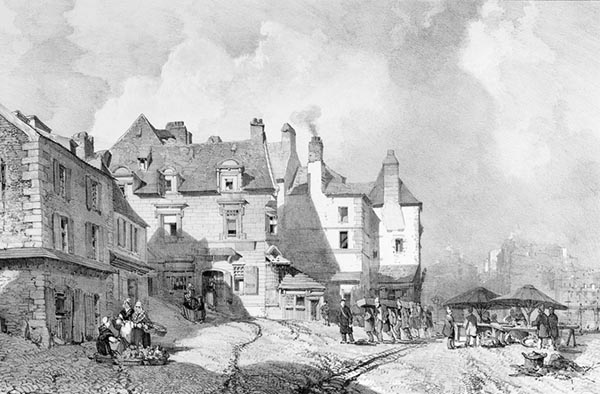
‘Recouvrance, Brest’ - Eugène Cicéri (French, 1813–1890)
The countryside surrounding Brest lacks the silence of the wild areas around Crozon and Landévennec, but the trees are more numerous, and greener, almost black. As far as Le Conquet, the road, swimming in greenery, rises and falls, winding along the hillsides, and cutting through meadows; one drives between tall broom bushes.
Don’t bother to stop in Lochrist, to see the tomb of Michel Le Nobletz (a Counter-Reformation missionary), because the church (Chapelle Saint-Michel) is dreadful, the tomb is ridiculous, and Michel Le Nobletz resembles Saint Vincent de Paul, who was scarcely a handsome man. Le Conquet itself, a large, peaceful town whose inhabitants seem to have departed, would hardly be worth visiting if it were not for the ruined abbey of Saint-Mathieu (de Fine Terre) nearby. Open to the sky, the nave of the abandoned church receives every drop of rain, and in place of flagstones, between the columns where historiated torsos curl around the capitals, thick grass has grown; the bare walls are the colours of soot and bronze, the sharp tones blending into one another, stretching across the stone, capriciously, like uneven tatters of torn drapery. In other places, thin strands of grass hanging from the heights of the abbey seem to flow like great tears.
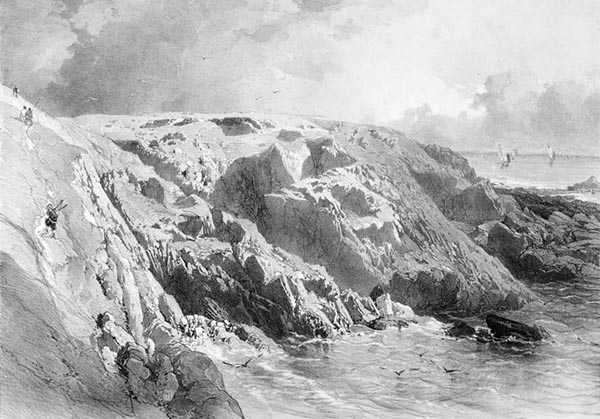
‘The Coast of Finistère: Cap Saint-Mathieu’ - Eugène Cicéri (French, 1813–1890)
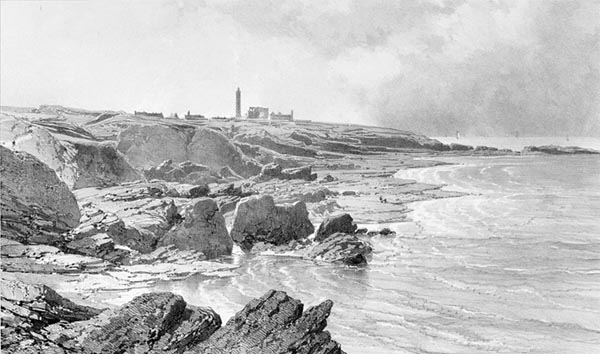
‘Cap Saint-Mathieu’ - Eugène Cicéri (French, 1813–1890)
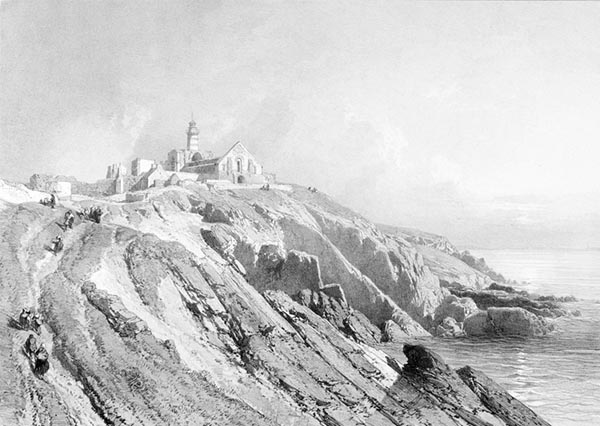
‘Cap Saint-Mathieu’ - Eugène Cicéri (French, 1813–1890)
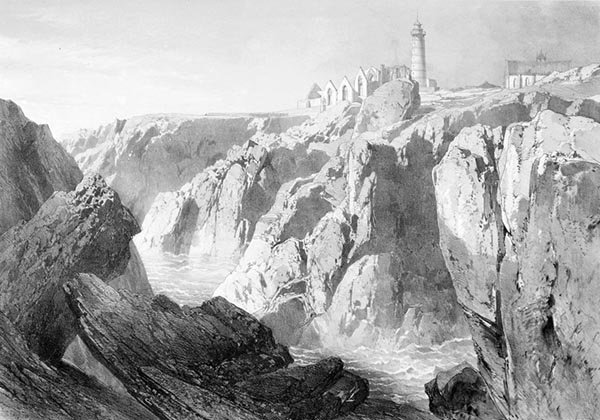
‘Cap Saint-Mathieu’ - Eugène Cicéri (French, 1813–1890)
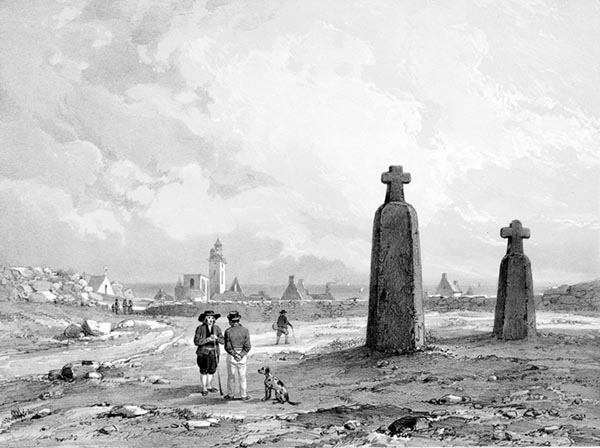
‘Cap Saint-Mathieu’ - Adolphe Jean-Baptiste Bayot (French, 1810–1871) and Auguste Étienne François Mayer (French, 1805–1890)
The wind from the sea, the waves of which beat against the base of the building, enters through the pointed arches of the windows, devoid of stained glass, where curlews perch on the ledges.
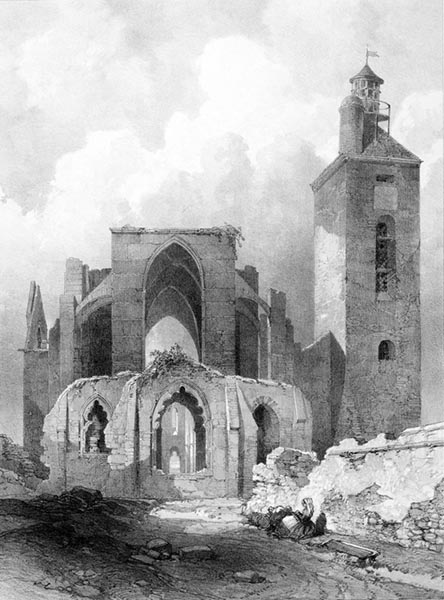
‘Saint-Mathieu Abbey’ - Auguste Étienne François Mayer (French, 1805–1890) and Eugène Cicéri (French, 1813–1890)
The building has only an aisle on the one side and, on the other, two lower counter-aisles; square pillars and round columns alternate, the main vault resting on clusters of colonnettes. Near the lighthouse built there (in 1835), inside a courtyard enclosed by a screen, there are cabbages, hemp, and leeks.
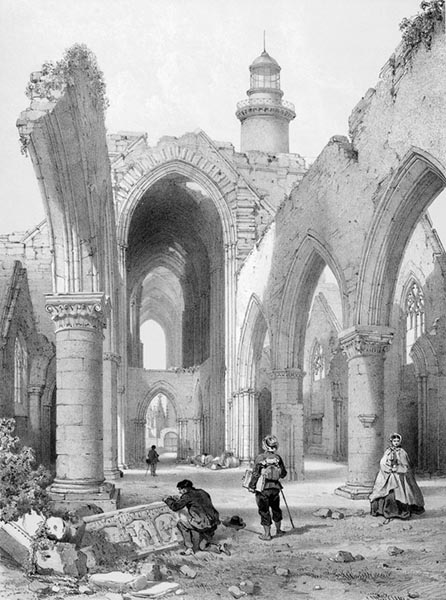
‘Plougonvelin: Saint-Mathieu Abbey’ - Félix Benoist (French, 1818–1896) and Adolphe Jean-Baptiste Bayot (French, 1810–1871)
At the Lighthouse. — Here ends the old world; this is its furthest point, its ‘extreme limit’. Behind you lies all of Europe, all of Asia; before you the sea, a whole ocean. However vast spaces may seem to us, are they not always bounded, as soon as we know their limits? Does one not see, from our beaches, the pavements of Brighton across the Channel, and, from the Provençal country houses, does one not embrace the entire Mediterranean, as if it were an immense azure basin in a rocky cove, its edges sculpted by promontories covered in crumbling marble, yellow sands, drooping palm-trees, bare shores and widening gulfs? But here, nothing limits the imagination. Swift as the wind, thought can run, extending, wandering, losing itself, encountering only the waves as the wind and one’s thoughts do; then, far beyond, profoundly far, there, on the horizon of our dreams, attaining the vague Americas, nameless islands perhaps, the lands of bright-red fruits, humming-birds, and savages; or the mind strays to the mute twilight of the poles, and spouting whales; or great cities lit with coloured glass, Japan with its porcelain roofs, China with its openwork staircases, adorning pagodas with golden bells.
This is how the mind, in order to shrink an infinity which constantly wearies it, populates and animates that same. One cannot think of the desert without strings of camels, the Ocean without ships, the heart of the earth without the treasures one imagines it to hold.
We returned to Le Conquet along the cliff. Waves leapt at its base, racing in from the open sea; they crashed against the rocks, covering the large, motionless slabs with their swirling sheets of foam. Half an hour later, borne along in our carriage by two small, almost wild horses, we reached Brest, from which we departed with great pleasure two days later.
Moving away from the western coast, and towards the English Channel in the north, the region changes in appearance, it becomes less rugged, less Celtic, the dolmens rarer, the heath diminishing as the wheat spreads, and little by little one enters the fertile and flat country of Léon, which is as Monsieur Pitre-Chevalier (Pierre-Michel-François Chevalier, author, historian and editor of Le Figaro) so kindly said, ‘the Attica of Brittany’.
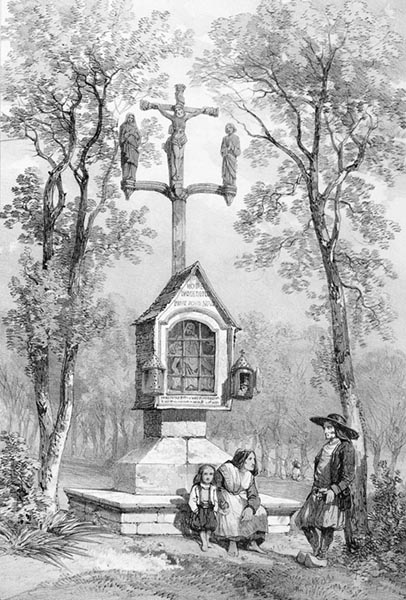
‘A Stone Cross near Landerneau’ - Léon Gaucherel (French, 1816–1886) and Eugène Cicéri (French, 1813–1890)
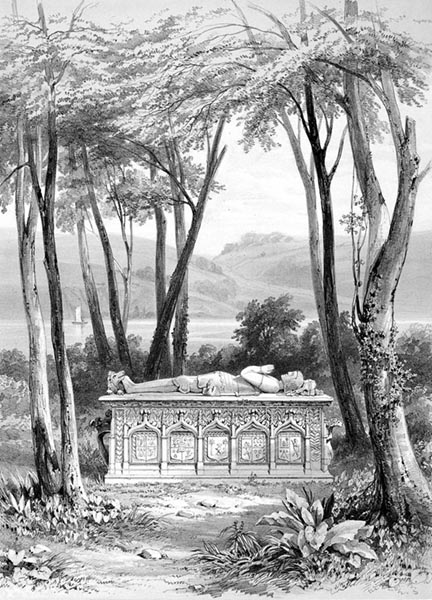
‘The Tomb of Mondragon, Seigneur de la Palue, near Landerneau’ - Léon Gaucherel (French, 1816–1886)
Landerneau is a town where there is a promenade of young elm trees by the river, and where we saw a frightened dog running through the streets with a saucepan attached to its tail.
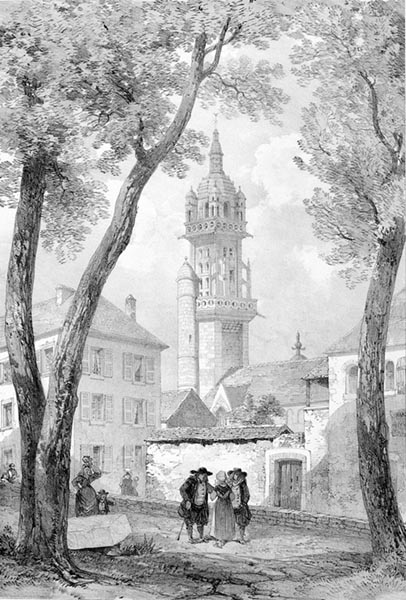
‘The Belfry of Saint-Houardon, Landerneau’ - Léon Gaucherel (French, 1816–1886) and Eugène Cicéri (French, 1813–1890)
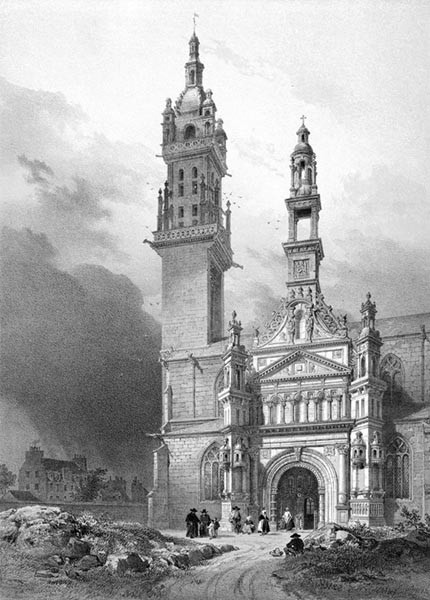
‘The Porch and Belfry of Saint-Houardon, Landerneau’ - Félix Benoist (French, 1818–1896) and Adolphe Jean-Baptiste Bayot (French, 1810–1871)
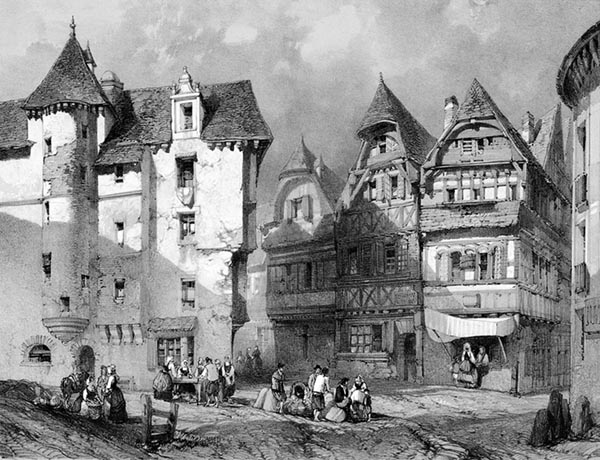
‘The Old Place de la Halle, Landerneau’ - Auguste Étienne François Mayer (French, 1805–1890) and Eugène Cicéri (French, 1813–1890)
To reach Joyeuse-Garde (the ruins of the sixth century château at La Forest-Landerneau, associated with the Arthurian legends), one must first follow the banks of the Elorn, and then walk for a long time through a wood, along a sunken path, which no one ever uses. Sometimes the undergrowth thins out, and then, through the branches, a meadow appears, or perhaps the sail of a ship ascending the river. Our guide walked ahead of us, far off and apart. We two together trod that good woodland soil where purple clusters of heather grew in the soft grass, among the fallen leaves. We could smell strawberries, raspberries, and violets; on the tree trunks, long ferns spread their slender fronds. The air was heavy; the moss was warm. Hidden in the foliage, a cuckoo uttered its drawn-out call; in the clearings, midges buzzed, on invisible wings.
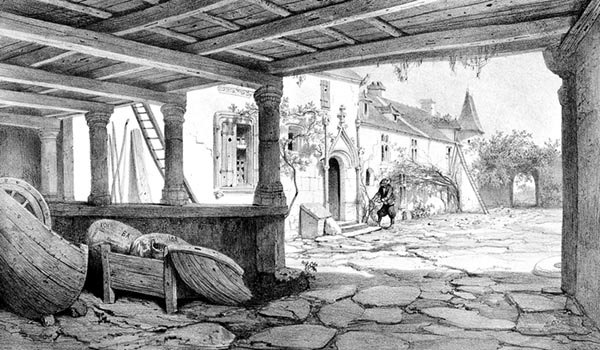
‘La Forest-Landerneau’ - Auguste Étienne François Mayer (French, 1805–1890)
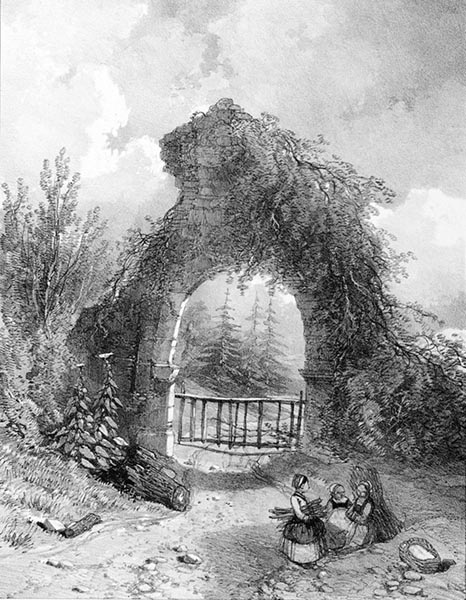
‘The Château de Joyeuse-Garde’ - Auguste Étienne François Mayer (French, 1805–1890) and Eugène Cicéri (French, 1813–1890)
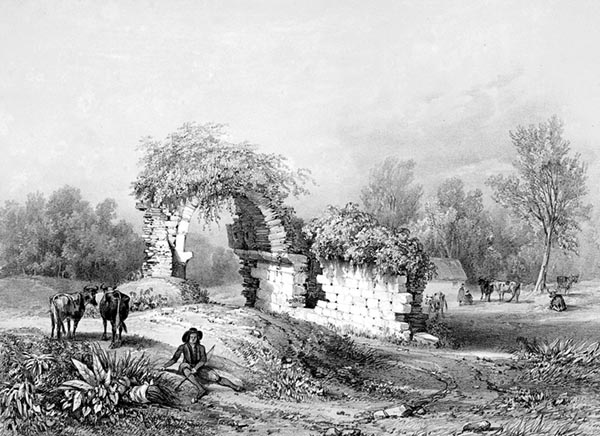
‘La Forest-Landerneau: the Château de Joyeuse-Garde’ - Auguste Étienne François Mayer (French, 1805–1890)
Peaceful in spirit, and swayed by the walk, freely indulging the idle fantasies which flowed from our open mouths, we discussed sounds, words, and colours; we spoke of the masters, their works, and the joy of ideas; we pondered stylistic approaches, the backgrounds to paintings, the angles of heads, techniques of drapery; we recited to each other noble and lengthy verses, their beauty unknown to others, which endlessly delighted us, and we rehearsed their rhythms, delved into the vocabulary, and spoke them aloud so musically that they almost became song. Then, it was as if far-off landscapes unfolded before us, some splendid figure appeared, we were seized by love for an Asian moonlit sky reflected on domes, we were moved by admiration for a word, or we savoured a simple, vivid phrase found in an old book.
And reclining in the courtyard of Joyeuse-Garde, near the blocked underground passage, beneath the full arch of its single remaining portal covered with ivy, we talked about Shakespeare, and wondered if distant planets circling distant stars were inhabited
Then we left, having barely glanced at the ruined dwelling of Sir Lancelot, he whom a fairy snatched from his mother and nurtured at the bottom of a lake in a jewelled palace. The dwarves and their enchantments have vanished, the drawbridge departed, and lizards crawl where the beautiful Guinevere once walked, dreaming of her lover who had sailed to Trebizond (a medieval city, now Trabzon in Turkey, and its empire, on the shores of the Black Sea) to fight the giants.
We returned through the forest by the same paths; the shadows lengthened, bushes and flowers became indistinguishable, and the low mountains opposite showed their bluish peaks against the whitening sky. The river, is contained for a mile or so above the town by artificial banks, higher up it flows as it pleases and inundates the meadows it traverses; its long curve stretched ahead of us into the distance, and the pools of water coloured by the setting sun looked like large golden platters, forgotten on the grass.
As far as La Roche-Maurice, the Elorn meanders alongside the road that skirts the base of the rocky hills whose uneven knolls jut out into the valley. We travelled along it at a gentle trot in a tranquil carriage driven by a child seated on the shaft. His hat, without ties, fluttered in the wind, and during the halts required to descend and retrieve it, we had ample time to admire the scenery.
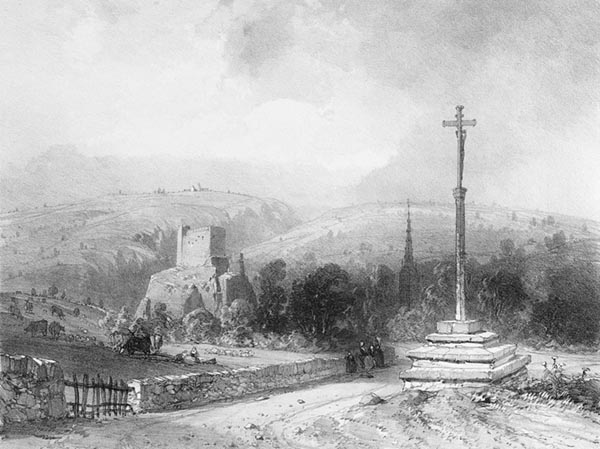
‘From La Martyre to La Roche-Maurice’ - Auguste Étienne François Mayer (French, 1805–1890) and Eugène Cicéri (French, 1813–1890)
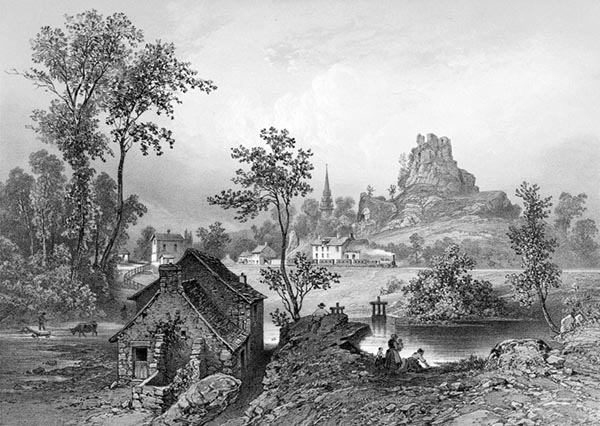
‘La Roche-Maurice, near Landerneau’ - Adolphe Jean-Baptiste Bayot (French, 1810–1871) and Félix Benoist (French, 1818–1896)
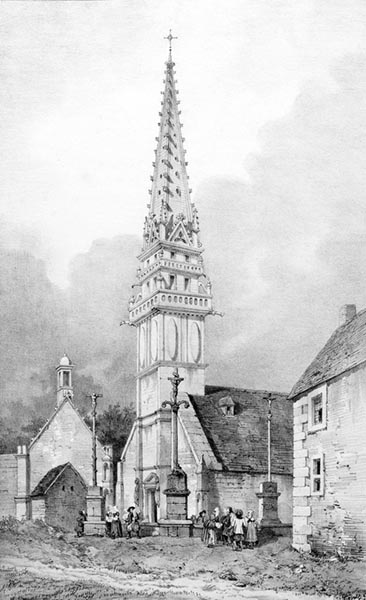
‘The Chapel, La Roche-Maurice’ - Auguste Étienne François Mayer (French, 1805–1890)
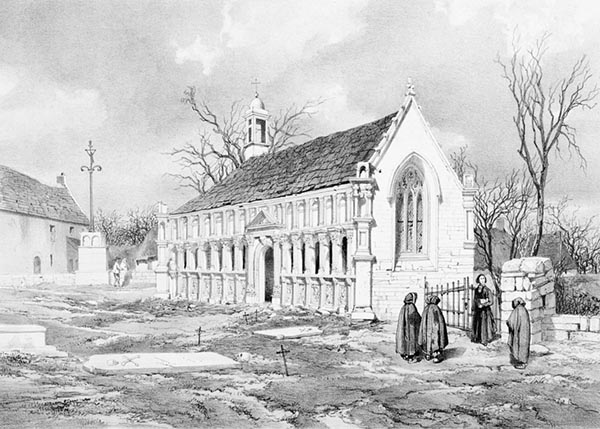
‘The Reliquary, La Roche-Maurice’ - Auguste Étienne François Mayer (French, 1805–1890)
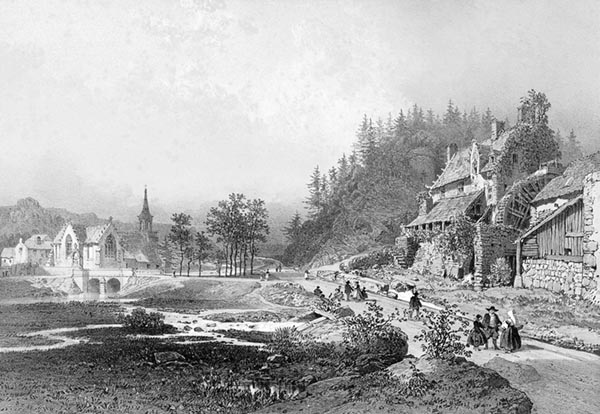
‘La Roche-Maurice, the Mill and Church at Pont-Christ’ - Félix Benoist (French, 1818–1896), Eugène Cicéri (French, 1813–1890) and Adolphe Jean-Baptiste Bayot (French, 1810–1871)
The Château de la Roche-Maurice was a true burgrave’s castle, a vulture’s nest on a hilltop. One ascends an almost sheer slope on which fallen blocks of masonry, here and there, serve as steps. From the very top, through a section of wall made of flat slabs laid one on top of the other, where wide window-arches still rise, one can view the countryside: woods, fields, the river flowing towards the sea, the white ribbon of the road stretching out, the jagged uneven crests of the hills, and the wide plain that separates them occupying the centre ground.
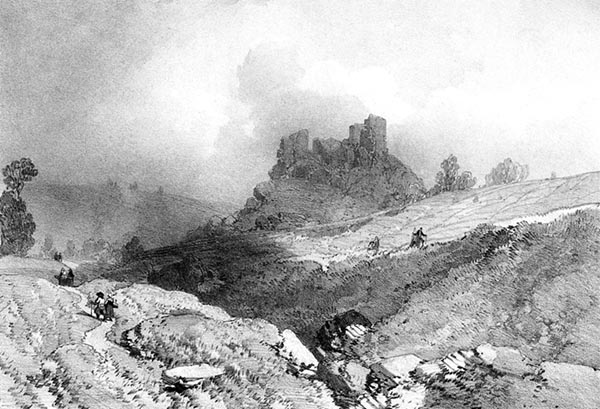
‘The Château de la Roche-Maurice’ - Léon Gaucherel (French, 1816–1886) and Eugène Cicéri (French, 1813–1890)
A fragment of a staircase still leads to a ruined tower. Here and there, cut stones emerge from among the grass, while the natural rock is apparent between the stones. The rock sometimes seemed as if it had taken on artificial forms of its own, while the ruin, on the contrary, seemed as if it had taken on a more natural appearance as it eroded, and returned to Nature.
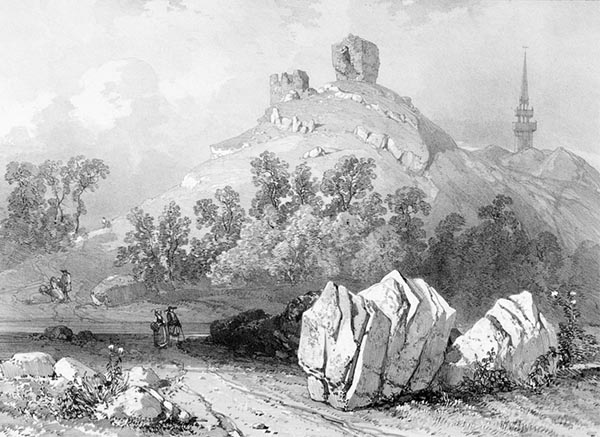
‘La Roche-Maurice’ - Léon Gaucherel (French, 1816–1886) and Eugène Cicéri (French, 1813–1890)
From below, ivy clothes a large section of the wall; thin at its root, the plant widens into an inverted pyramid and, as it rises, its green colour darkens, so that it appears pale at the base and black at the top. Through an opening whose edges were hidden beneath the foliage, the sky shone, a deep blue.
It was in these parts that the famous dragon lived, slain long ago by the knight Derrien on his return from the Holy Land. He attacked the creature as soon indeed as he had pulled the unfortunate Count Elorn from the water. Elorn had successively surrendered his slaves, vassals, and servants to the dragon (only his wife and his son Riok remained), and then thrown himself headfirst from the top of his tower into the river. The monster, mortally wounded, and bound by the scarf of its vanquisher, went, at Derrien’s command, to drown itself in the sea at Poullbeuzaneval (Pontusval); as the dragon of the island of Batz is said to have done, at the command of Saint Pol de Léon, when bound by the stole of that Breton saint; and La Gargouille, the dragon of Rouen, when bound by the stole of Saint Romain (which supposedly led to the tradition of mounting ‘gargoyles’ on cathedrals).
How magnificent those ancient, and terrifying dragons were, the jaws savagely toothed front to back, the mouth spewing flames, the scaly form, consisting of a serpent’s tail, bat’s wings, lion’s claws, a horse’s body, and a rooster’s head, ever rearing to strike like a basilisk! And any knight who fought one must have been a formidable lord! At first, as his horse snorted with fear and pawed the air, his lance would shatter against the beast’s scales, and the smoke from its nostrils would blind him. He would finally dismount, and after a day-long battle, strike the dragon beneath its belly with a blow of his sword, which would remain embedded to the hilt. Black blood would then gush forth in strong jets, and the people would escort the knight home in triumph, who then subsequently would become king of the land, and marry some beautiful lady.
But where did they come from, these dragons? What gave birth to them? Were they a confused memory of the monsters before the Flood? Were they dreams of long ago prompted by the fossilised remains of dinosaurs and pterosaurs, when terrified human beings imagined the sound of wings, or of feet treading the tall reeds, as the wind roared through their caves? Are we not moreover in the very land, here, of the Knights of the Round Table, the realm of faeries, the homeland of Merlin, the mythological cradle of lost epics that doubtless told of ancient kingdoms, that had become the subject of mere fantasy, and revealed details of sunken Breton cities: of Ys (supposedly off Douarnenez) and Herbadilla (supposedly off Nantes), splendid violent places, complete with royal enchantresses and their love affairs, kingdoms doubly erased, forever, by the sea that has passed over them, and the religion that has cursed their memory.
There is much one could write about this. What subject, is there, indeed, that one cannot write about? Except perhaps Landivisiau, for even the most verbose man is forced to be concise when material is lacking. I have noticed that the most admirable of places are generally the least appealing; they are like virtuous women — we praise them, but then move on to others. Here, certainly, is the most fertile corner of Brittany; the peasants seem less poor, the fields better cultivated, the rapeseed magnificent, the roads well-maintained, and yet it bores one to death.
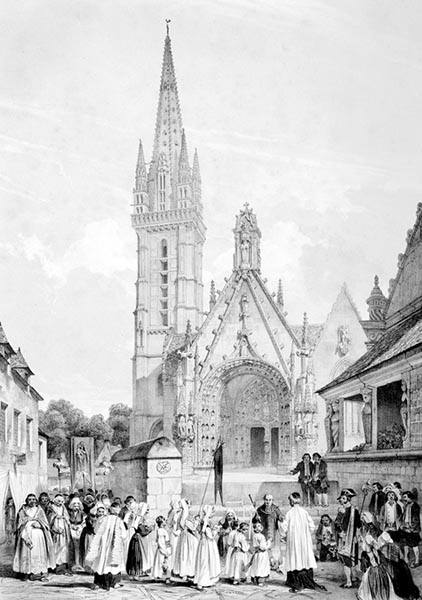
‘The Church and Ossuary, Landivisiau’ - Adolphe Jean-Baptiste Bayot (French, 1810–1871)
Cabbages, turnips, lots of beets, and an enormous quantity of potatoes, all neatly enclosed in ditches, cover the countryside from Saint-Pol-de-Léon to Roscoff. They are shipped to Brest, Rennes, even Le Havre; it’s the region’s main industry; a considerable trade is involved. But what does that matter to me? Does it interest me? At Roscoff you can see the sea, a muddy beach is revealed in front of the houses, which curves into a narrow gulf, speckled offshore with black islets domed like the backs of turtles.
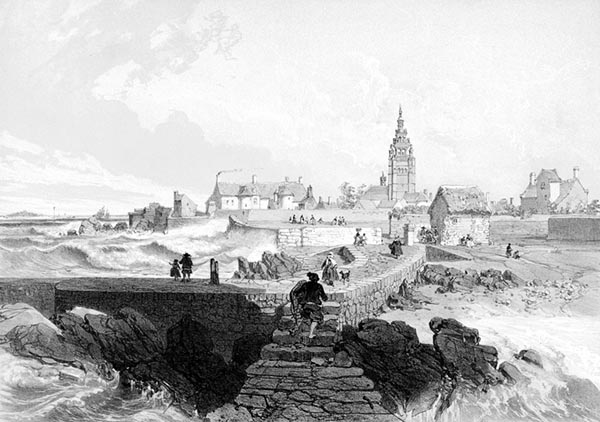
‘Roscoff: View from the Little Jetty’ - Félix Benoist (French, 1818–1896) and Adolphe Jean-Baptiste Bayot (French, 1810–1871)
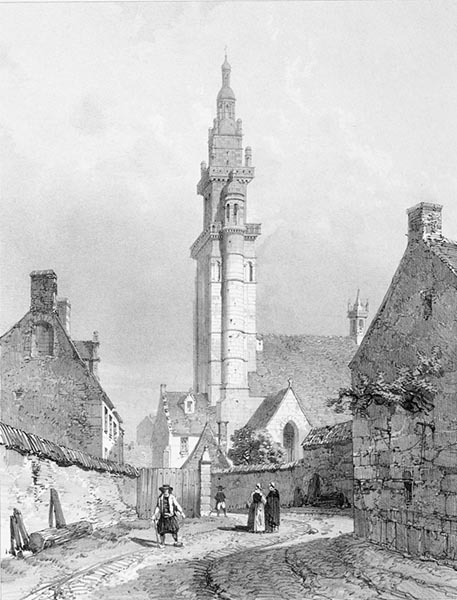
‘Roscoff Church’ - Léon Gaucherel (French, 1816–1886) and Eugène Cicéri (French, 1813–1890)
The countryside around Saint-Pol (Saint-Pol-de-Léon) is cold and bleak. The dreary hue of the gently rolling land blends seamlessly into the pale sky, and the foreshortened vista lacks any sweeping lines as regards its profile and any change of colour at its edges. Here and there, as you walk through the fields, behind a wall of grey stone, you come across a silent farmhouse, an abandoned manor house, where not even martens venture to nest. In the courtyard, some neighbour’s pigs sleep on a manure heap, and hens nibble at the oats between the uneven flagstones below an arched entrance whose carved coat of arms has been eroded by wind and rain. In the empty rooms that serve as attics, the plaster on the ceilings has crumbled, along with remnants of paint dulled by the grey webs of the spiders that can be seen scurrying along the joists.
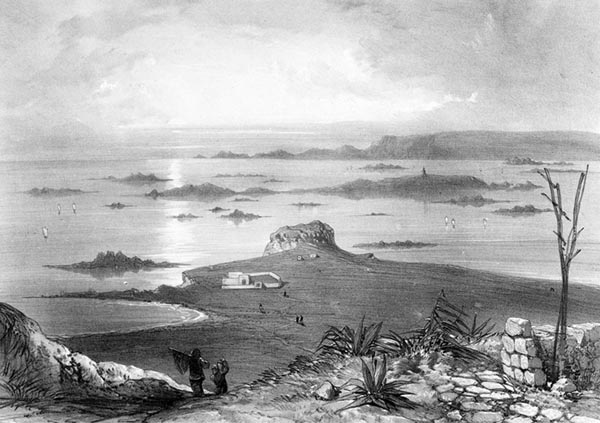
‘The Breton Coast at Saint-Pol-de-Léon’ - Léon Gaucherel (French, 1816–1886) and Eugène Cicéri (French, 1813–1890)
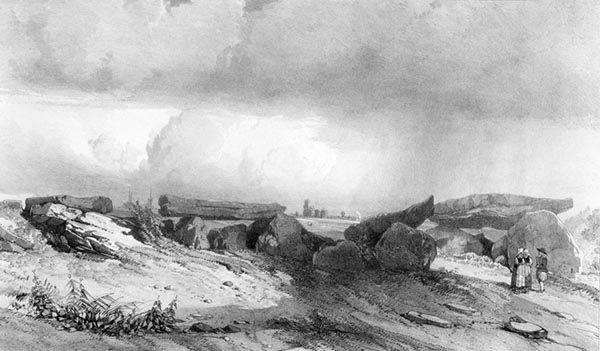
‘Dolmen near Saint-Pol-de-Léon’ - Eugène Cicéri (French, 1813–1890) and Léon Gaucherel (French, 1816–1886)
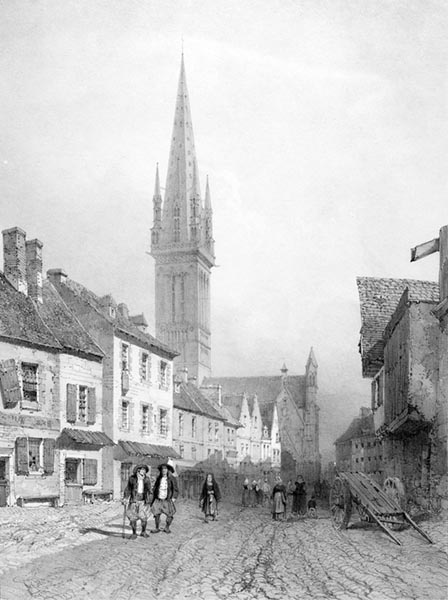
‘The Church of Notre-Dame du Kreisker, Saint-Pol-de-Léon’ - Léon Gaucherel (French, 1816–1886) and Eugène Cicéri (French, 1813–1890)
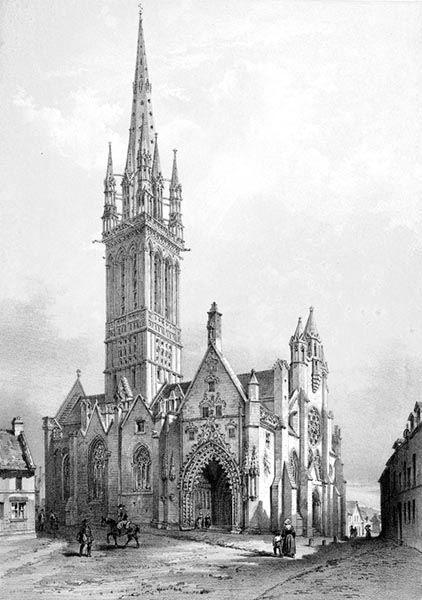
‘Saint-Pol-de-Léon: the Chapel of Notre-Dame du Kreisker’ - Félix Benoist (French, 1818–1896)
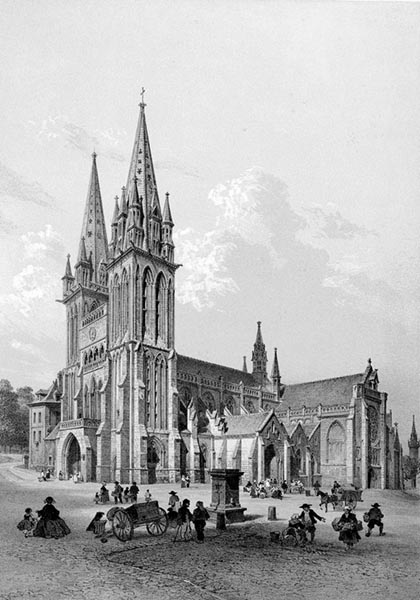
‘The Old Cathedral of Saint-Pol-de-Léon’ - Félix Benoist (French, 1818–1896) and Adolphe Jean-Baptiste Bayot (French, 1810–1871)
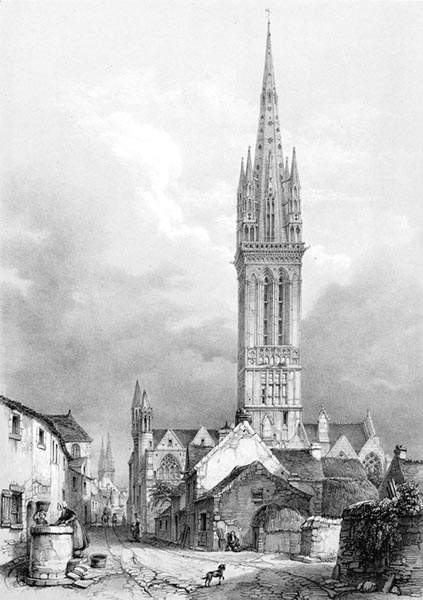
‘The Tower of Saint-Pol-de-Léon’ - Félix Benoist (French, 1818–1896)
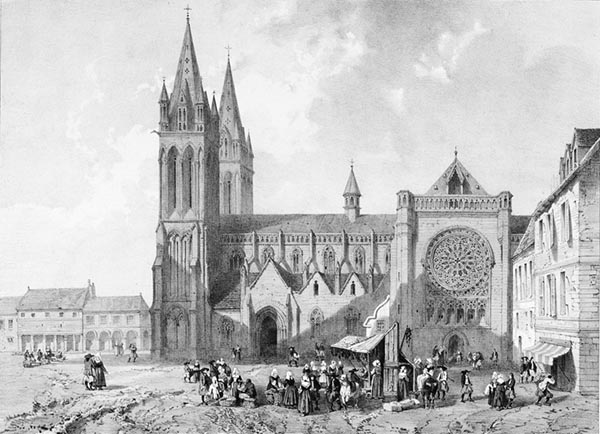
‘Saint-Pol-de-Léon Cathedral’ - Auguste Étienne François Mayer (French, 1805–1890)
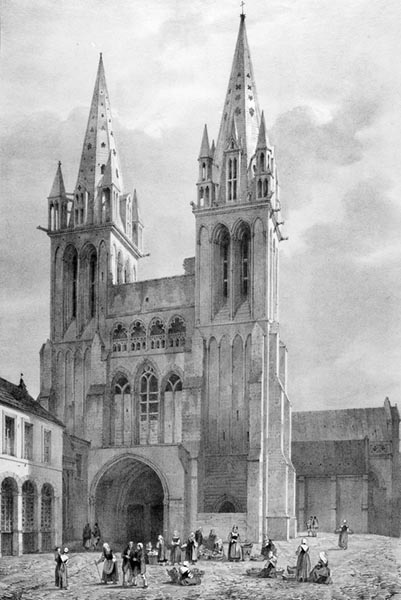
‘Saint-Pol-de-Léon Cathedral’ - Léon Gaucherel (French, 1816–1886)
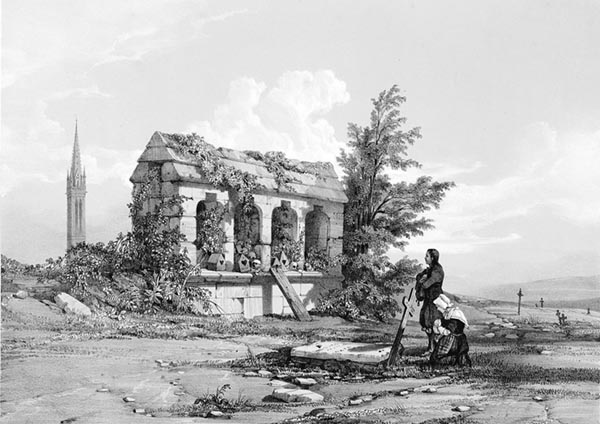
‘The Ossuary in the Cemetery, Saint-Pol-de-Léon’ - Auguste Étienne François Mayer (French, 1805–1890)
Wild mignonette has grown on the gate at Kersaliou (the sixteenth-century Manoir de Kersaliou, at Saint-Pol-de-Léon, not the nineteenth-century château nearby), where, near the turret, a window surmounted by a pinnacle still stands, flanked by a lion and a Hercules emerging from the walls like gargoyles. At Kerjean (near Saint-Vougay, sixteenth-century, fully restored), on the grand spiral staircase of the chateau, I stumbled over a wolf-trap. Ploughshares, rusty spade blades, and gourds full of dried seeds lay scattered about the bedroom floors, and cluttered the large stone seats in the window recesses.
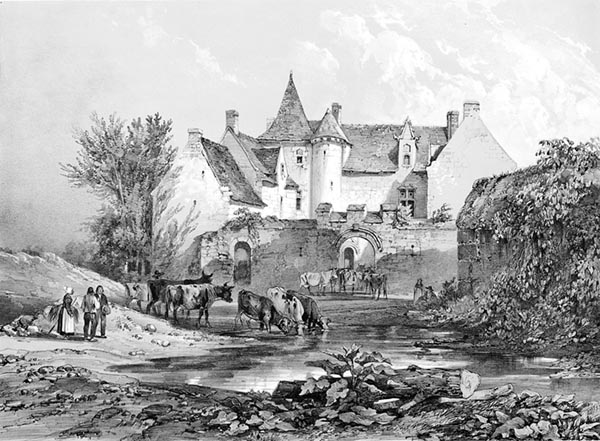
‘The Manoir de Kersaliou’ - Auguste Étienne François Mayer (French, 1805–1890)
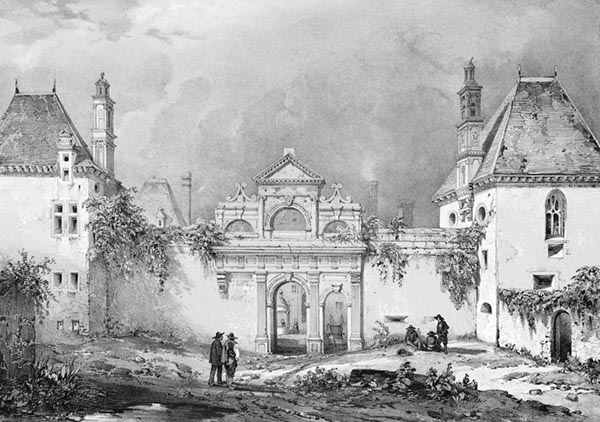
‘The Château de Kerjean’ - Auguste Étienne François Mayer (French, 1805–1890)
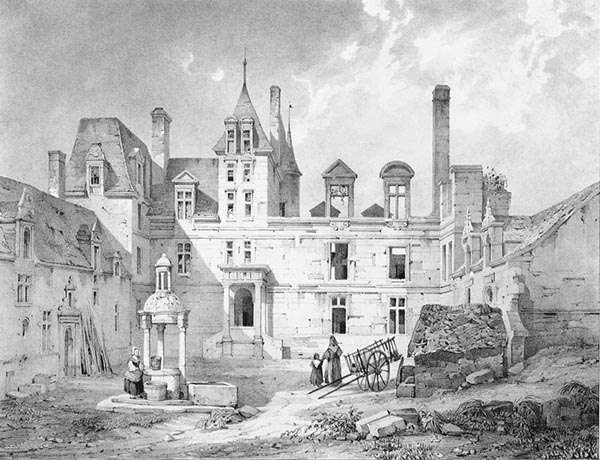
‘The Château de Kerjean-Coatanscours’ - Auguste Étienne François Mayer (French, 1805–1890)
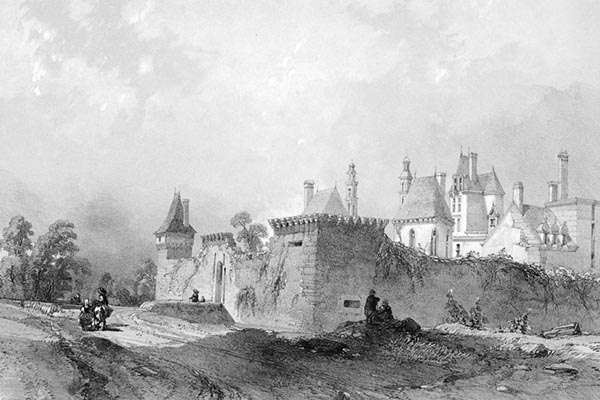
‘The Château de Kerjean-Coatanscours’ - Auguste Étienne François Mayer (French, 1805–1890)
Kérouzéré (at Sibiril, fifteenth-century, partially restored), has retained its three machicolated turrets, and one can still recognize in the courtyard the wide furrow of the moat which, rising gradually, attains the level of its surroundings, like the wake of a boat that fades as it spreads. From the platform of one of the towers (the others have pointed roofs), the sea can be seen at the end of a field, between two low hills covered in woods. The first-floor windows, half-blocked to keep out the rain, overlook a garden enclosed by high walls. Thistles cover the lawn, and wheat has been sown in the flowerbeds, bordered by rose bushes.
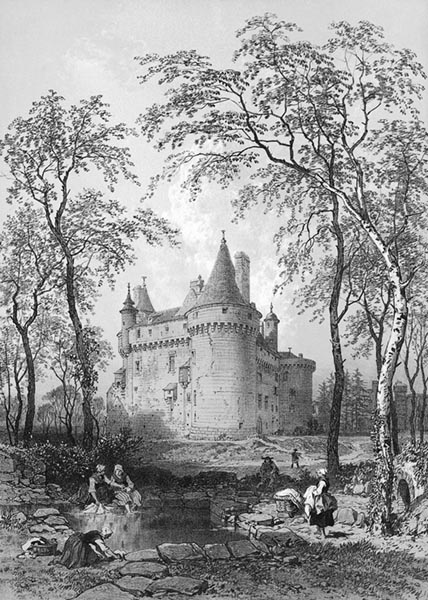
‘Sibiril: the Château de Kérouzéré’ - Félix Benoist (French, 1818–1896), Eugène Cicéri (French, 1813–1890) and Adolphe Jean-Baptiste Bayot (French, 1810–1871)
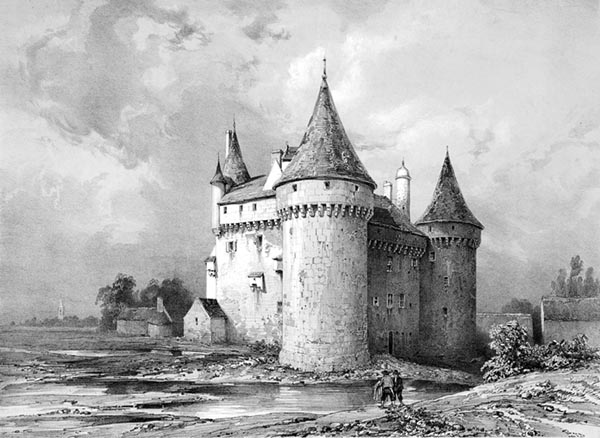
‘The Château de Kérouzéré’ - Auguste Étienne François Mayer (French, 1805–1890)
Between a field, where the ripe heads of the ears of corn bent together, and a curtain of elms rose from the high bank of a ditch, a thin path stretched out amidst the undergrowth. Poppies flowered in the wheat; from the summit of the tall bank, wild-flowers and brambles escaped: nettles, dog-roses, their stems adorned with thorns and large glossy leaves, blackberries, and purple foxgloves, their colours intermingling, their stems and branches intertwining, exhibiting their diverse foliage, sending out arms and twigs of differing lengths, their shadows in the grey dust crisscrossing like the strands of a fishing net.
After traversing a meadow, where the wheel was turning on an old mill entangled in the reeds, the stream crossed by large stones placed in the water to serve as a bridge, we soon found ourselves on the main road to Saint-Pol. At the end of this road rises the spire of Kreisker’s church steeple (Notre-Dame du Kreisker, now within Saint-Pol itself), with its jagged cornice. Slender, elegant, and supporting a tower topped with a balustrade, the church is striking from afar. It makes the finest impression in the world from a distance, but the closer one gets, the smaller and uglier it seems and, in the end, one finds only a church like any other, with an empty porch, from which the statues have departed. The cathedral, too (Saint-Paul-Aurélien), is in a heavy Gothic style, bloated with ornamentation, gaudy with decoration; but there was something even worse in Saint-Pol: our meal at the inn.
It was served, however, by a charming young woman who, with her earrings hanging above a white neck, her bonnet with its curled lapels like Molière’s soubrettes, and especially her bright blue eyes, might have made one wish to ask her for something other than plates. But the guests! And what guests! The regulars! The head of the table was commanded by a fellow dressed in a velvet jacket and a cashmere waistcoat, who liked to run his napkin over the half-empty bottles to identify the vintage. He was the one who served the soup. To his left, a gentleman in a light grey frock-coat, his cuffs and collar trimmed with black wool curled like fur, was eating away. He was a music teacher at the town’s college. But music bored him; he’d had enough. He sought a position, any position, paying between eight hundred and twelve hundred francs no less. He cared little for money, more for the prestige. he simply desired a suitable post. Since he always arrived, it seems, after the meal had already begun, he had the dishes brought back then sent them away, sneezed loudly, spat far, shuffled on his chair, hummed softly, slumped against the table, and snapped his toothpick.
The whole gathering, there, showed him respect. The maid admires his speech and is, I’m sure, in love with him. The high opinion he has of himself is apparent in his smile, his words, his silences, his gestures, his hairstyle, and oozes like sweat from his entire, vile person.
Opposite us, a small, grizzled, curly-haired, plump, and stocky man with red paws, thick, salivating lips, and a yelping voice, looked at us, as he chewed his food, in such a way that we had to restrain ourselves from throwing a carafe at his head. However, he was part of the scene and contributed to the overall effect.
One evening, the conversation turned to a local woman who, having run away from home before, had fled to America with her lover, and who, the previous week, passing through Saint-Pol to reach her village, had stopped at the inn. They were still astonished by her audacity and her name was accompanied by all sorts of epithets. They recounted her entire life, laughed at her with contempt, and insulted her in her absence, their faces flushed. They wished she was there, so ‘they could give her a piece of their mind, and see what she had to say’. Virtuous expressions condemning licence and scandal and exhibiting their hatred of finery, moral maxims, double entendres, vigorous shouts of agreement, and sundry shrugs were employed with equal gusto to pour scorn on the poor woman who, judging by the relentlessness of those boors, must be elegant, of refined character, of a delicate and nervous disposition, and, doubtless, possessed of a pretty face. Despite ourselves, our hearts were full of anger against them, and if we had been exposed to one more dinner at Saint-Pol-de-Léon, something would, unfailingly, have transpired.
The End of ‘By Field and Shore’ Part III