Gustave Flaubert and Maxime du Camp
By Field and Shore: Brittany (‘Par Les Champs et Par Les Grèves : Bretagne’, 1847)
Part II: Chapters IV-VI
Translated by A. S. Kline © Copyright 2026 All Rights Reserved
This work may be freely reproduced, stored and transmitted, electronically or otherwise, for any non-commercial purpose.
Conditions and Exceptions apply.
Contents
- Chapter IV: (Du Camp: The West Coast, from Nantes to Carnac)
- Chapter V: (Flaubert: The West Coast, Carnac, Belle-Isle, and Plouharnel)
- Chapter VI: (Du Camp: Plouharnel to Vannes; a trip to Hennebont; Vannes to Josselin)
Chapter IV: (Du Camp: The West Coast, from Nantes to Carnac)
From Nantes to Saint-Nazaire, the Loire, is wide and flat. From Saint-Nazaire to Pornichet, hawthorns, and gorse. — Paths between the hedgerows from Pornichet to Le Pouliguen. — The deserted bay; at the water’s edge, on the hard sand, pink and white shells; dunes covered with rushes. — The ferry. — Le Pouliguen.
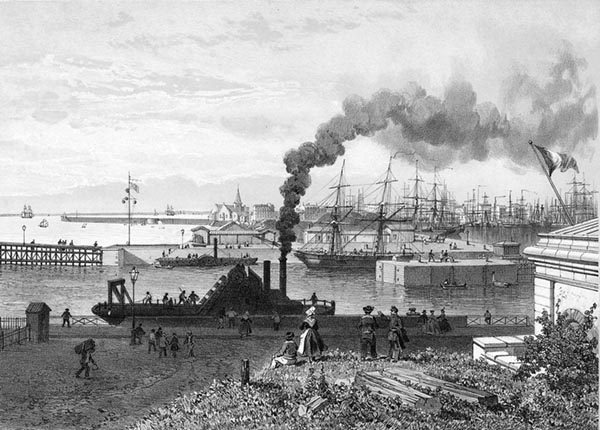
‘Saint-Nazaire: View from the Dock Entrance’ - Félix Benoist (French, 1818–1896) and Adolphe Jean-Baptiste Bayot (French, 1810–1871)
As far as Bourg-de-Batz (Batz-sur-Mer), salt marshes, never a tree; salt-workers. — The inn at Batz, barrels, two tall beds; on the mantelpiece, a Virgin in traditional dress; at a window, the husband, the bride, a man’s red face. — Old chapel (Chapelle du Mûrier), a fine example of Gothic architecture, completely ruined. — Surprise and curiosity shown by the children at our appearance. — A woman plastering cow dung on the walls; it sets the stones and serves as mortar. — As far as Le Croisic, nothing but sandy flats covered with sparse grass; the sky pale blue with broad white streaks; the cows are small, the sheep black.
Le Croisic. — Fine weather. — Dunes; seaweed underwater at the end of the jetty. — Charlotte, her Egyptian bonnet.
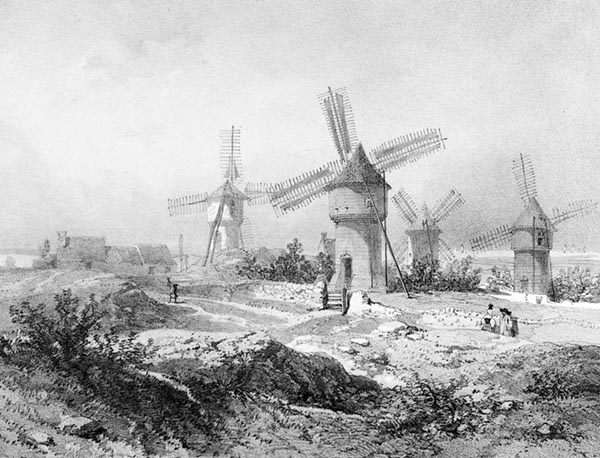
‘Sixteenth-Century Windmills, Guérande’ - Léon Gaucherel (French, 1816–1886) and Eugène Cicéri (French, 1813–1890)
From Le Croisic to Guérande. — Along the seashore, and through the marshes. — Guérande is sited on a hill overlooking the countryside; the fortifications are surrounded by trees, small poplars; to the left of the north gateway, the water laps at the base of the towers; we found again what we saw at Clisson. — The gentle character of these ruins, these fortifications, made me think of Avignon. — A Moorish window (moucharabieh) gutted, ivy; but natural beauty lay at its foot, small green plants made a kind of wide painted layer on the water.
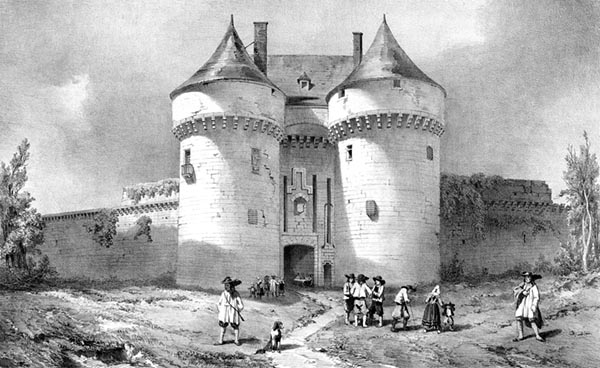
‘The Town Gate, Guérande’ - Léon Gaucherel (French, 1816–1886)
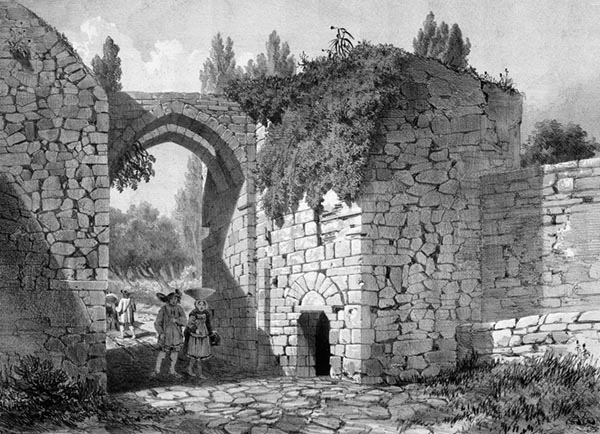
‘The North Gate, Guérande’ - Léon Gaucherel (French, 1816–1886)
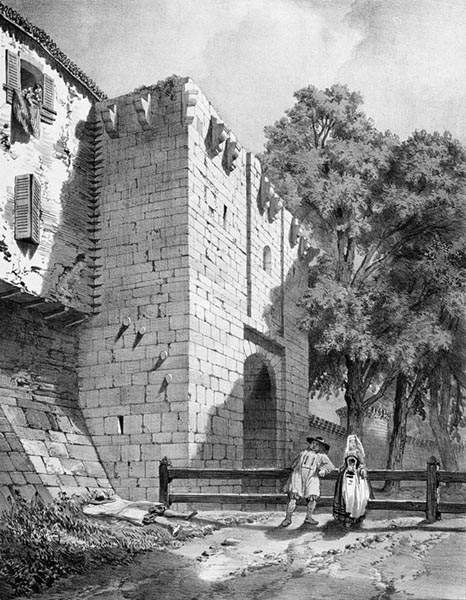
‘The South Gate, Guérande’ - Léon Gaucherel (French, 1816–1886)
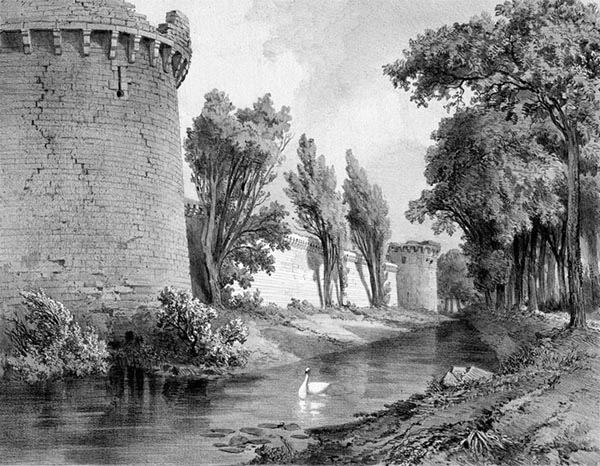
‘The Ramparts of Guérande’ - Léon Gaucherel (French, 1816–1886)
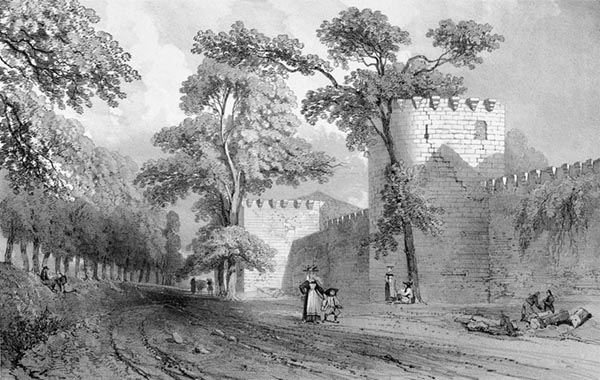
‘The Walls of Guérande’ - Léon Gaucherel (French, 1816–1886) and Eugène Cicéri (French, 1813–1890)
An English-style church; a tall portal with a rather pure and unadorned pointed arch for its period (Saint-Aubin). The organ has been placed where the rose-window used to be. On a cartouche, there is this almost illegible inscription: ‘The French people recognize a supreme God, and the immortality of the soul’ (The text is from the decree of May 1794, instigated by Robespierre). The two side entrances have covered porticoes like the church at Louviers, which this one resembles. To the right of the entrance portal, on the external wall, is a covered stone pulpit. — Inside: a mediocre painting depicting members of Parliament in period costume; and one of various figures adoring Jesus Christ on the cross (their hairstyles indicate the beginning of the seventeenth century); at the foot of the dying Christ, a bishop with a crosier and mitre; in the air, flying angels (the painting is inscribed ‘Jacob Quatroulx, 1642’).
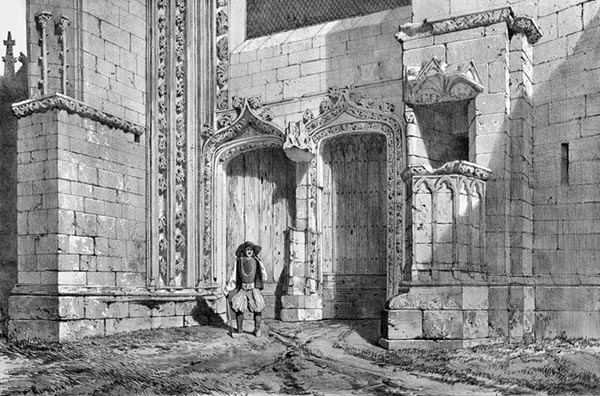
‘The Exterior Pulpit of the Church of Saint-Aubin, Guérande’ - Léon Gaucherel (French, 1816–1886)
Beautiful stained-glass windows. — A showman advertising various curious phenomena; his sign was a large, animated, intelligent figure with white teeth; it lured the children into kneeling; like cows and sheep; we were disinclined to believe the thing real! As the rest would have been if they had recognised the trick, so true it is that one does not like to change one’s preconceived ideas, and embrace the unexpected. — We toured the town a second time. — Its character mild; we found it a place suitable for amorous assignments because of its size, not to mention, that it was evening, at that hour. — The market crowded with peasants, and pairs of oxen yoked together.
We set off on Thursday the 20th of May at 6 a.m., with a glass of Madeira and a crust of bread for our breakfast, and headed briskly towards Piriac (Piriac-sur-Mer). The countryside is bare, the road rises and falls; to the left, a wide view of the sea; in the distance, stretching all the way to the shore, an immense plain dotted here and there with pools of a steely-brown hue. These are the salt marshes.
Piriac. — Deserted; fresh sea air and streets full of sand; not even fishing nets beside the doors; a pretty sandy bay; two or three boats, without masts or sails, beached on the shore. — An impossible inn: veal and eggs; veal and eggs for dinner! Always veal! Forever veal! — The mayor of the said place to whose house we were sent by Monsieur Mérès. He wore a fine dressing gown, plied a fine snuffbox, in a fine study for a solitary man; a collection of copies of the Moniteur, the Roret manuals (a series of reference manuals on various topics produced by Nicolas-Edme Roret), law books, Adolphe Thiers’ history (Thiers, later President of France, produced histories of the Revolution, Consulate, and Empire), and a large book bound with copper nails on which was written ‘Decrees and Deliberations’.
Excursion to the island (Île Dumet), by canoe; the pilot old and white-haired, with a long beard; the sailor, the cabin boy; a young man, the contractor’s son, a singularly brutal figure, was at the helm, he had deserted; the work seems not to be progressing. — Beautiful rocks, almost all black and marbled. — I rejoice in the sea, I think back to Trouville and my holidays at the cottage there; how I used to smoke, in the sun, in a rocky hollow. — Arched rocks here, with small pink and white daisies, there was a pale green on the rocks like to that which affects marble, a velvety green tending towards yellow; beautiful seaweed that we caught up, and handled; frilled, jagged, swaying festoons. — We returned downwind. — An odour of tallow, and a mother singing, lulling her child to sleep, as I packed our bags. — An old paralysed beggar, halfway to Piriac, a crippled vagabond hoping to sleep in some farmhouse, begging for scraps of bread; he was at the Guérande market yesterday. — A nap in the sun, on the cliff, in the grass. — On a shaded path, a cart pulled by two oxen, with a child; they entered a large farmyard where one could see the remains of old buildings; a ruined gate.
From Mesquer to Herbignac, a rather ugly road, rising and falling; pale russet heathland beneath a blue-white sky. — Large masses of fir trees enclosing a park. The Herbignac cart. — A kilometre from Herbignac, the castle of Marshal de Rieux himself (the Château du Ranroët, belonged to Jean IV de Rieux, Marshal of Brittany, and tutor to Anne of Brittany). No ivy or trees on the walls, only dry, red moss; dismantled towers bathed by a pool; we entered through a window. — Inside, a large cabbage plant. The walls appear to have been dismantled over time; sections are still standing. The whole is a ruin. It has something bourgeois about it, like Marshal de Rieux himself. The lad who was driving our cart climbed up to find nests, and with a stick pitched them in the dust at our feet. — Lunch in Herbignac at the grocer’s shop.
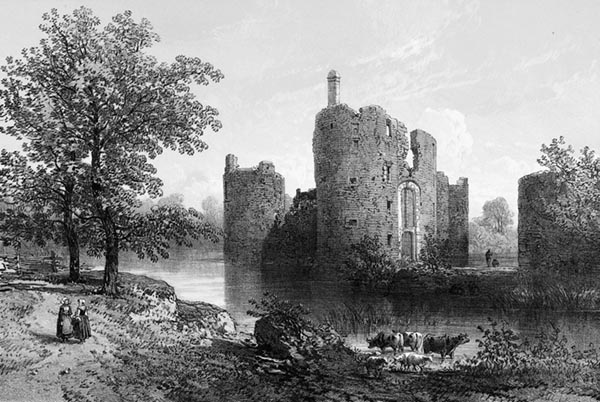
‘The Ruins of the Château de Ranrouët’ - Félix Benoist (French, 1818–1896) and Eugène Cicéri (French, 1813–1890)
La Roche-Bernard. — The Vilaine River, there, treeless on its banks, flows between pale green rocks covered in golden gorse. — The bridge spoils the simplicity of the view. — A dull underground tunnel. — At the entrance, a blind, one-armed beggar was reciting his rosary; a sign, addressing itself to the traveller’s purse, indicated that he was a miner from the port, who had once made a living by working there. — Dinner. — Monsieur Poulman (Balzac), the collector of indirect taxes, a Montmorency!
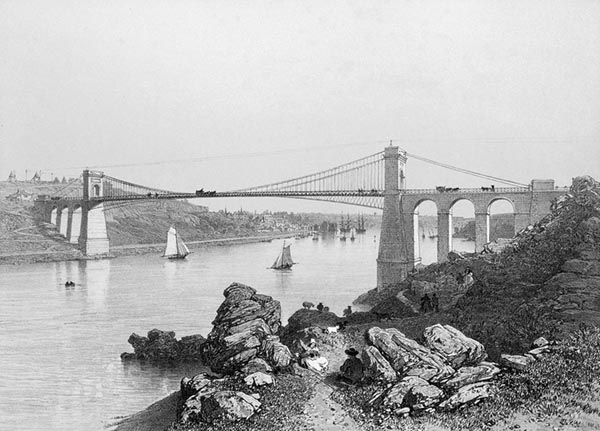
‘The Suspension Bridge, La Roche-Bernard’ - Eugène Cicéri (French, 1813–1890), Félix Benoist (French, 1818–1896) and Adolphe Jean-Baptiste Bayot (French, 1810–1871)
Vannes. — Sarzeau; Lesage’s house (Alain-René Lesage, novelist and playwright, was born in Sarzeau). Suscinio (the Domaine de Suscinio, a late-medieval castle built by the Dukes of Brittany), in the countryside, overlooking the sea, pierced with large windows, seems to have been more of a dwelling than a fortress. — Massive gatehouse towers. — It could easily be rebuilt; the steps of the staircases remain (the castle has been substantially restored). — The interior of the courtyard, with its machicolations, its sections of wall pierced with windows and openings, and the sun and the blue sky, gave it a Moorish air. — On the right-hand tower, looking at the facade (from the outside), a trefoil window in a square frame. — Animals entered while we were on the grass: small oxen, sheep, two goats.
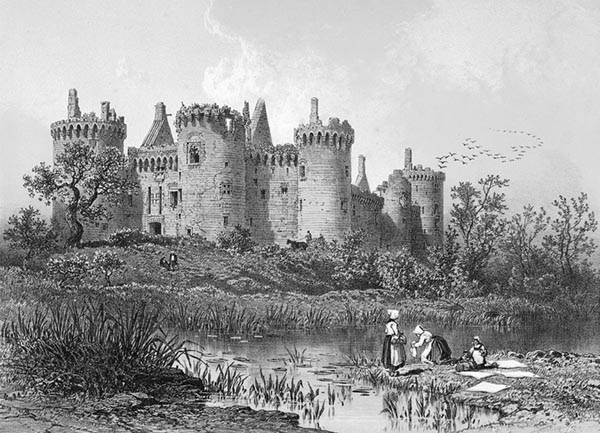
‘The Ruins of the Château de Suscinio’ - Adolphe Jean-Baptiste Bayot (French, 1810–1871), Félix Benoist (French, 1818–1896) and Eugène Cicéri (French, 1813–1890)
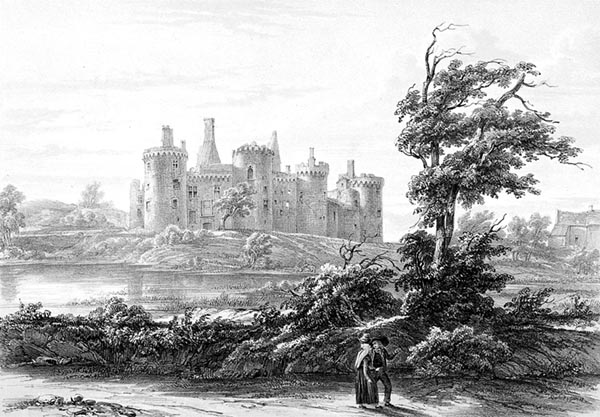
‘The Château de Suscinio’ - Félix Benoist (French, 1818–1896)
Return to Sarzeau. — Walk in the countryside. — Monsieur... a staff captain. From Sarzeau to Logeo. — In the fields, country folk going to Mass, dressed in their black bibs; almost all in black; large aprons sometimes in dove-red silk. Logeo. — Execrable brutes; hatred of medals of honour.
The Île d’Arz. — The church (Église de La Nativité). — The cemetery; the graves with a flowerpot covered by a slate; an ossuary viewed through iron-bars, amidst barrels, and pieces of wood. — The course we pursued at sea. Gavrinis Island covered in long blue bell-shaped flowers on stems. A tumulus, with a covered passageway. The entrance to the underground passage is decorated with two large clumps of broom. The passageway itself is about thirty feet long. All the stones are covered with lines made with a stone tool, regularly spaced, representing countless ribs or branches radiating from a thorax or trunk, and at the base the lines rise upwards. However, one would have to be quite perceptive to see a reproduction of anything specific in them. — The passageway is deeper at the back than at the entrance, and the stones are also wider there; on the left, on one stone, are carved what look like the straps of a shield. As we embarked, once more, we admired, lovingly, some large water-plants which, starting from a single root, radiated out like hair and spread across the surface; in the depths, amidst blue-green light, we could see mosses and grasses.
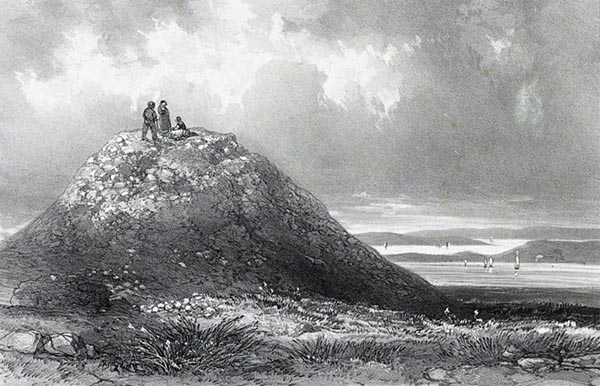
‘The Cairn on the Island of Gavrinis’ - Léon Gaucherel (French, 1816–1886) and Eugène Cicéri (French, 1813–1890)
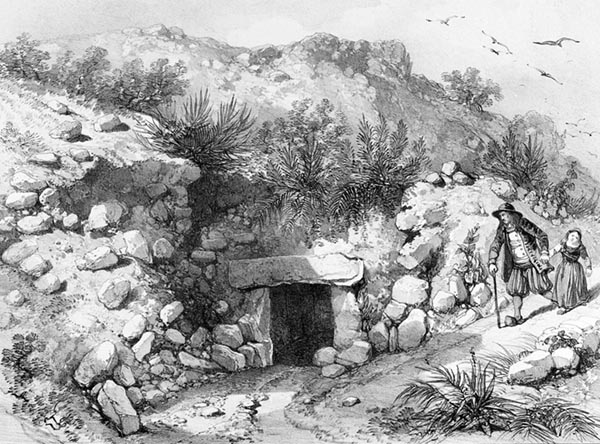
‘The Entrance to the Cairn of Gavrinis’ - Léon Gaucherel (French, 1816–1886) and Eugène Cicéri (French, 1813–1890)
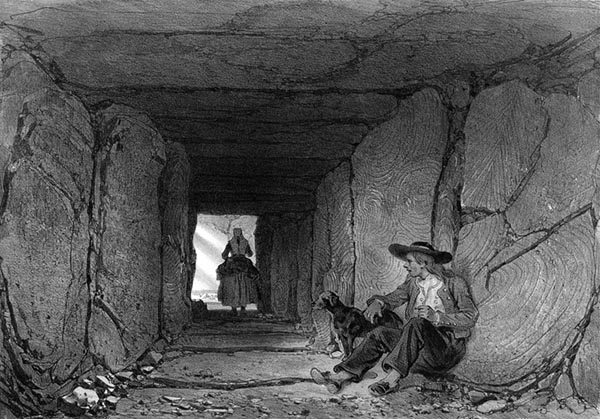
‘The Druidic Grotto on the Island of Gavrinis’ - Félix Benoist (French, 1818–1896) and Adolphe Jean-Baptiste Bayot (French, 1810–1871)
Locmariaquer. — A dolmen fallen, broken across its face (the width about seven feet), seventy-two feet long. — Two covered passages: in one, similar designs to, but more faded than, those of Gavrinis; in the other, a box for alms for the poor.
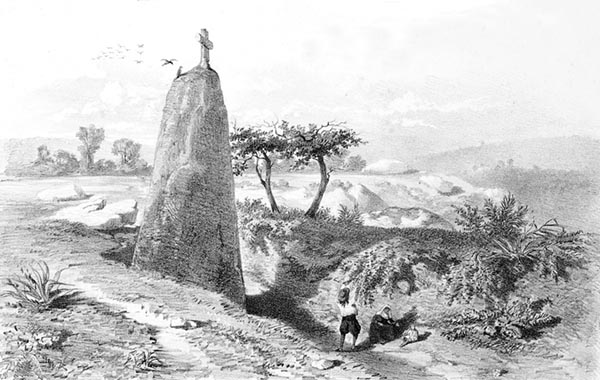
‘Locmariaquer’ - Léon Gaucherel (French, 1816–1886)
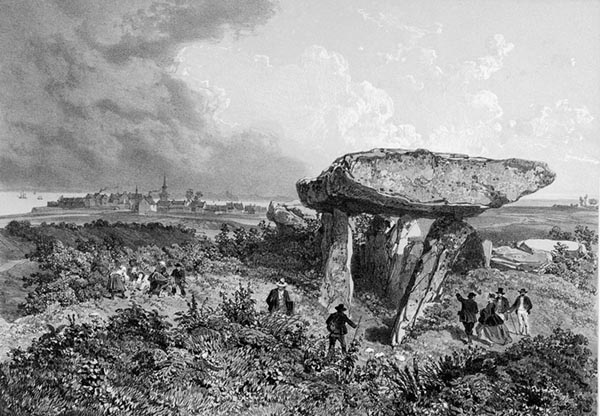
‘The Dolmen known as the Table de César, near Locmariaquer’ - Félix Benoist (French, 1818–1896) and Adolphe Jean-Baptiste Bayot (French, 1810–1871)
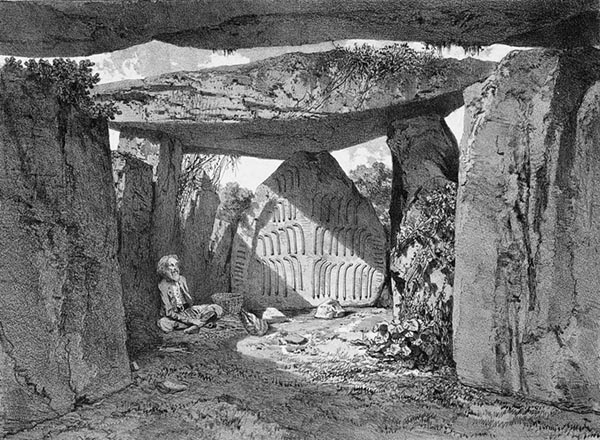
‘The Interior of the Table de César, Locmariaquer’ - Léon Gaucherel (French, 1816–1886)
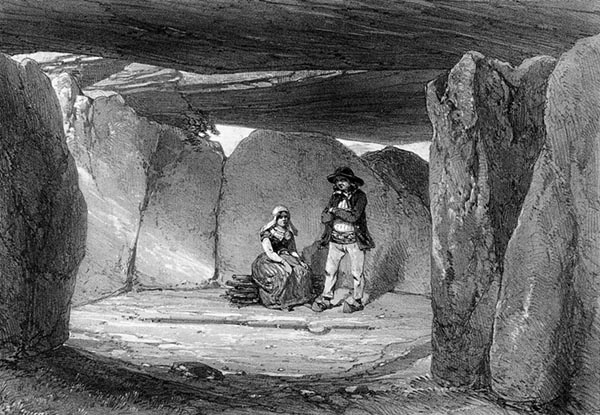
‘The Chamber of the Mont-Helleu Tumulus’ - Léon Gaucherel (French, 1816–1886) and Eugène Cicéri (French, 1813–1890)
From Locmariaquer to Carnac, broom, more broom, gorse-hedges, with hawthorn here and there. — The road is up and down, then vanishes. — French is hardly spoken. We viewed the sea. — The ferry crossing at the tip of a peninsula. — A grave old man, thin faced, with an enormous hat.
The steeple of Carnac church (Saint-Cornély), from afar, seems perched on a hill, even though Carnac is by the shore. — Saint-Michel Chapel is built on a hill; one ascends by a staircase, descends by a slope. — The sea. — The green countryside, divided into brownish or greyish squares by hedges, and dry-stone walls. — A cross with a figure of Christ, so poorly sculpted that it possessed a certain character, and recalled the old Romanesque style, though more ponderous in manner. On our way here, we saw another cross of the same kind, erected on the spot where a certain René le Baron, the parish priest, was killed in 1800.
Chapter V: (Flaubert: The West Coast, Carnac, Belle-Isle, and Plouharnel)
It was hot, a strong May sun was beating down on our necks, and our silk shirts were sticking to our backs. So, our first concern upon arriving in Carnac, at the home of the widow Gildas, our hostess, was to refresh ourselves with a bottle of pale ale which was followed by another, which made our bellies swell, an important point to mention.
Our lodgings were clean and decent. We were shown into a large room furnished with two four-poster beds covered in printed cotton, and a long table like one found in a college refectory. A touch of coquettish refinement had left the end of the beds unhemmed so that a wide red stripe edging the end of the blanket could be seen, and as a precautionary measure to ensure cleanliness a beautiful oilcloth, green as bronze, had been nailed to the table. On the walls, in dark wooden frames, were portrayals of the story of Joseph, including the scene with Potiphar’s wife, a portrait of Saint Stanislaus, and one of Saint Aloysius Gonzaga, who is quite possibly the most foolish saint in the world, as well as First Communion certificates with vignettes depicting the interior of the church, and the communicants and attendants in their respective vestments. Coffee cups, decorated with the words ‘Liberty’ and ‘Public Order’ written in gold letters, were arranged along the mantelpiece in the space left by two decanters. Ah! What decanters! What a pity if one were to break! Where could one find a match? They were not Venetian glass, nor were they cut or engraved, but simply plain glass, like common decanters; they even lacked stoppers, but, inside the first one, six soldiers of different ranks stood majestically, each carrying oblong palm fronds like gherkins, around a figure of Napoleon, half an inch long, stiffly stretched out on his tomb, which was studded with pearls and bristling with feathers, while inside the second was a representation of the Holy Sacrifice of the Mass, with the priest, the chalice, the altar, and four columns made of pearls at the four corners of the sanctuary, plus two choirboys overloaded with enormous red sugar-loaf hats which were supposed to be the skullcaps of the young rascals.
The place was so honest, so benign, and exhaled such a scent of candour, such an innocent and sweet modesty, while the large wardrobe with copper fittings shone so brightly beneath the Russian chamber-pots that adorned its cornice, and the wicker baskets hooked to the bed-frame looked, like everything else, so tranquil and good-natured, that we immediately decreed that we liked Carnac, and would stay there awhile.
Our windows overlooked the church square, where children were playing at marbles in the shade of a linden tree. That was the only sound in the village; no carts passed by, there were no shops, and all the bread eaten there was baked in the kitchen below, half of which was used as a bakery.
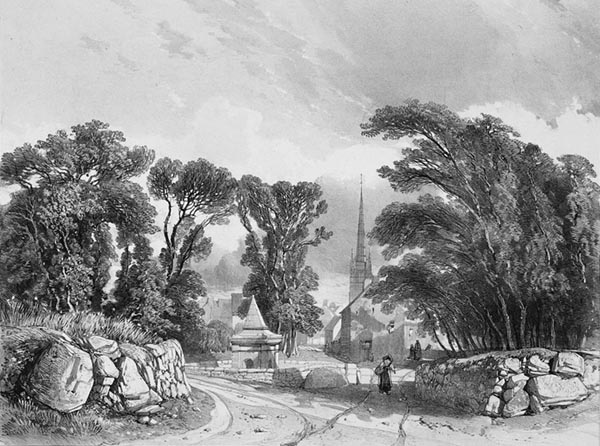
‘The Village of Carnac’ - Eugène Cicéri (French, 1813–1890)
Although the inhabitants speak no French, and decorate their homes in this manner, they still live, sleep, drink make love there, and die, just like us; these beings are human too. But they care little for the Salon, and even the Exhibition of Industry; are only moderately concerned with the Opéra which is about to reopen, and the restaurant Au Rocher de Cancale which has closed (the famous restaurant, which is extant, founded by Alexis Balaine in 1804 at 59 Rue Montorgueil, closed due to bankruptcy in 1846, but was later reopened); and talk little of what is being talked about in Paris: the Jockey-Club, the races at Chantilly, Alexandre Dumas’ debts, Monsieur de Rambuteau’s leathers (Claude-Philibert Barthelot, Comte de Rambuteau, Prefect of the Seine) or Hyacinthe’s nose (Louis Hyacinthe Duflost, known as ‘Hyacinthe; was a comedian and singer), etc.
One always feels a foolish and inescapable astonishment when one considers people who live elsewhere, and spend their time on matters other than our own. Think of passing through some village in the morning, at daybreak and catching sight of a shopkeeper raising the awning of his shop, or sweeping his doorway, stopping, mouth agape, to watch you pass by? He can barely make out your face, nor you his, and yet in a flash, both of you, at the same instant, are filled with immense astonishment; he is thinking, as he watches you go by: ‘Where is he off to, and why’ and you, racing past: ‘What is he about? Does he do that every morning?’
It takes considerable reflection, and mental fortitude, to grasp clearly that not everyone lives in the same city, buys their shoes from the same shoemaker, dresses at your tailor, dines at the same time you do, and shares your ideas. I still find it hard to comprehend how one exists as a notary, how it is possible to be employed in an office, how one can rise before ten in the morning, and go to bed before midnight, and I seriously wonder how human beings can possibly exist doing anything other than stringing sentences together, and searching for adjectives.
It would have been absurd, being in Carnac, not to go and see the famous prehistoric stones; so, we picked up our walking-sticks and headed towards the place where they stand. We were walking through the grass, heads down, conversing about who knows what, when a rustling noise made us raise our eyes, and we saw a woman coming down the path, barefoot, bare-legged, without a headscarf, her large bonnet flapping, her skirt snapping in the wind, one hand on her hip and the other gripping the enormous sheaf of hay she carried on her head; she walked with a sway of her waist, bold and beautiful, in her red bodice. She passed close to us. Her breathing was deep and strong, and sweat trickled down the brown skin of her rounded arms.
At last, we saw rows of black stones, aligned at equal intervals, in eleven parallel lines that decreased in size the further they were from the sea; the tallest were about twenty feet high, while the smallest were simple blocks of stone lying on the ground. Many appear to have been placed point downwards, the base being thinner than the top. The antiquarian Jacques Cambry claims there were four thousand, while Fréminville (Christophe-Paulin de La Poix, Chevalier de Fréminville) counted twelve hundred; what is certain is that there are a lot.
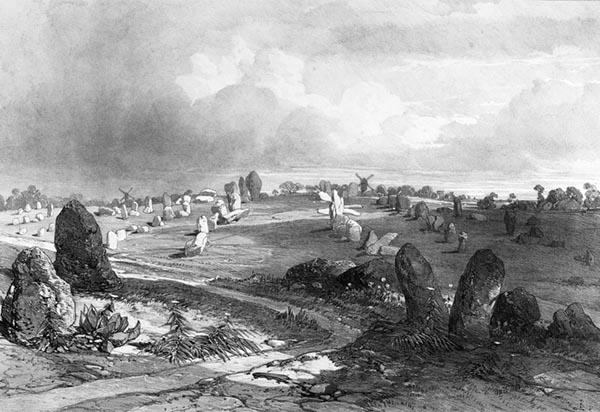
‘General View of the Field of Carnac’ - Eugène Cicéri (French, 1813–1890) and Léon Gaucherel (French, 1816–1886)
So, here was the famous Carnac field, which has inspired more nonsense than it has stones; though it is true that one fails to encounter such rock-filled walks every day. But, despite our natural inclination to admire everything, we consider it to be merely a robust jest, perpetrated by some unknown age to exercise the minds of antiquarians and astonish travellers. Before it, one opens naive eyes and, while finding it unusual, one nevertheless admits that it lacks beauty. We thus perfectly understand the irony inherent in these granite formations which, since the time of the Druids, seem to laugh in their green, lichened beards at all the fools who come to visit them. There are people who have spent their lives trying to decide what they were used for; one must admire, moreover, the eternal preoccupation of the featherless biped with seeking a use for everything? Not content with distilling the ocean to salt our stews, and hunting elephants to carve ivory tusks into napkin rings, our obsession extends even further when some scrap of debris is unearthed, the use of which we cannot guess.
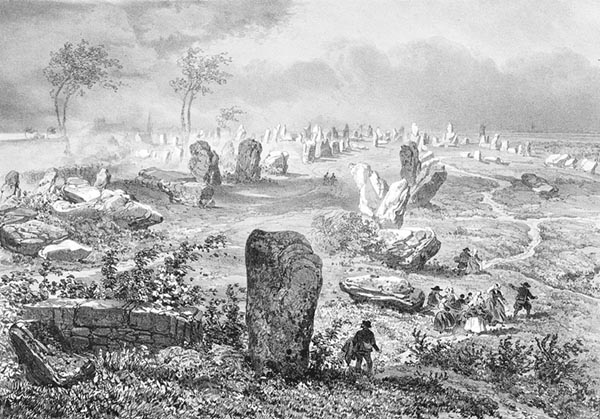
‘The Druidic Monuments of Carnac’ - Félix Benoist (French, 1818–1896) and Adolphe Jean-Baptiste Bayot (French, 1810–1871)
What good was this? Were these tombs? Was this a temple? Saint Cornelius, it seems, pursued, on some occasion, by soldiers who wished to kill him, out of breath and about to plunge into the sea, had the idea, to prevent them from capturing him, of turning them all into stones. Immediately, the soldiers were petrified, which saved the saint from harm. But this explanation has only satisfied simpletons, little children, and poets; others were sought.
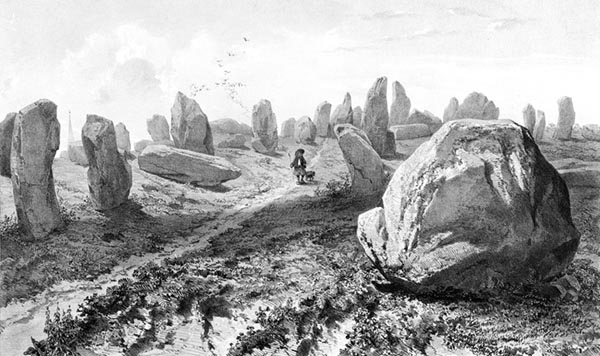
‘The Stones of Carnac’ - Léon Gaucherel (French, 1816–1886)
In the sixteenth century, Olaus Magnus, whose brother was Archbishop of Uppsala, when exiled in Rome, amused himself by writing a book (‘Historia de Gentibus Septentrionalibus’: ‘A Description of the Northern Peoples’, 1555), on the antiquities of his country, a book esteemed everywhere except in Sweden, where no one read it. He proposed that when two stones are placed in a single, extended, straight line, it means that beneath them lie warriors who died fighting a duel; that those arranged in a square are dedicated to those who perished in a melee; that those arranged in a circle are family tombs; and finally, that those placed at an angle or in a corner are the tombs of cavalrymen or even foot soldiers, especially those whose party had triumphed. This is clear, explicit, and satisfactory. But Olaus Magnus fails to tell us what kind of burial was granted to two first cousins, who scored victories in a mounted duel. The duel dictated that the stones be in a straight line, the family tomb required them to be circular, but since they were knights, they had to be arranged somehow in a corner. Though that was not absolutely required, it is true, since the latter only marked those whose party had triumphed. Oh, brave Olaus Magnus, you who were so fond of Montepulciano wine, how many glasses did it take to enable you to invent all these fine things?
A certain Dr. Borlase (William Borlase, antiquarian and Rector of Ludgvan, Cornwall), who commented on similar stones in Cornwall, also offered his thoughts on the matter. According to him, soldiers were buried on the very spot where they had fought. Where, on earth, did he get that idea from? He said their graves were arranged in straight lines, like the front ranks of an army, on plains that were the scene of great battles. The concept is so magnificently poetic that it sweeps me away, and I am somewhat inclined to agree with Dr. Borlase.
Then antiquarians were in search of the Greeks, Egyptians, and Cochin Chinese. ‘There is a Karnak in Egypt,’ they reasoned, ‘there must be one in Lower Brittany.’ I understand neither Coptic nor Breton, but obviously ‘Carnac’ here, descends from ‘Karnak’ there, since, the ancient Egyptians raised lines of sphinxes, though here they are mere blocks! From this it clearly follows that the Egyptians (a people who did not travel) must have come to these shores (whose existence they were unaware of), founded a colony here (though they founded them nowhere else), and left these uncarved stones behind (they, who made such beautiful statues), a positive witness to their visit (which no one has ever mentioned)!
Those who love mythology saw the Pillars of Hercules here; those who love natural history saw a representation of the serpent Python, because, according to Pausanias (see ‘The Description of Greece’, 9.19.2), a similar group of stones placed on the road from Thebes to Glisas was called the Snake’s Head and the alignments of Carnac present snake-like sinuosities. Those who love cosmography saw a zodiac, Jacques Cambry among others, who recognised, in these eleven rows of stones, the twelve signs of the zodiac, ‘therefore it must be asserted,’ he concludes, ‘that the ancient Gauls had only eleven signs of the zodiac.’
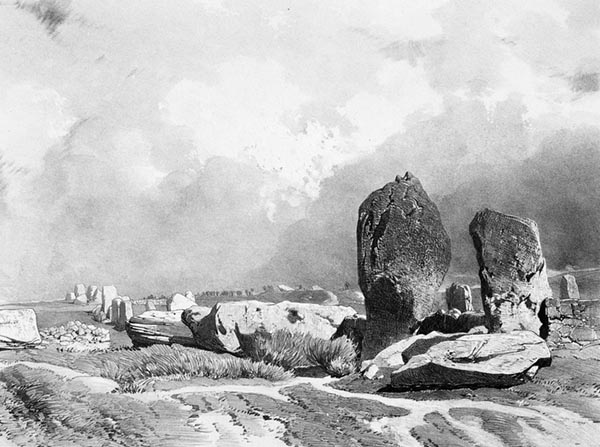
‘Carnac’ - Eugène Cicéri (French, 1813–1890)
A gentleman who was a member of the Institute believed it to be a cemetery of the Veneti, who lived in Vannes, thirty miles away, and who, as everyone knows, founded Venice! Another thought that those good Veneti, having been defeated by Caesar, erected the stones afterwards, solely out of humility, and to honour him. But people had soon had enough of cemeteries, serpents, and the zodiac; they went in search of something else and found this to be a Druidic temple. The few authentic comments that exist from the relevant period, scattered throughout Pliny and Dio Cassius, agree that the Druids chose dark groves for their religious ceremonies, and the depths of the forests, with their ‘vast silence’ (see Tacitus ‘Germania’, and Lucan’s ‘Pharsalia’). Therefore, since Carnac is by the sea, in a barren countryside where naught but the conjectures of these antiquarian gentlemen has ever flourished, the First Grenadier of France (Théophile Malo de La Tour d’Auvergne-Corret, renowned for his bravery, was honoured by Napoleon with that title), who does not seem to me to have been of the first intelligence, followed by Simon Pelloutier (author of ‘Histoire des Celtes’, 1740-50) and Joseph Mahé, canon of Vannes cathedral (author of ‘Essai sur les Antiquités du Département du Morbihan’, 1825), decided that it was a temple of the Druids in which political assemblies should be convened.
Everything had still not been said on the matter, and the facts, according to science, were complete as long as the purpose of the empty spaces in the alignment, those free of stones, remained unestablished. ‘Let us discover the reason for this, a thing no one has yet thought to do,’ Monsieur Mahé says to himself, relying on this phrase from Pomponius Mela: ‘The Druids teach many things to the nobility, whom they instruct secretly in caves and remote forests.’ (‘Chorographia’, III, 14-15). Mahé therefore established that the Druids not only served the sanctuaries, but also made their homes there, and passed on their learning. ‘Since the Carnac Monument is a sanctuary like those of the Gallic forests’ (Oh, the power of induction! Where are you leading us, Père Mahé, canon of Vannes, and Corresponding Member of the Academy of Agriculture of Poitiers?), ‘there is reason to believe that the empty spaces that intersect the lines of stones contained rows of houses in which the Druids lived with their families, and their numerous students, and where the leading figures of the nation resided, who visited the sanctuary on days of great solemnity, and found lodgings already prepared.’ Good Druids! Excellent clergymen! How they have been slandered, those who lived there so honestly with their families and their many students, and who even went so far as to prepare accommodation for the leading figures of the nation!
But then, at last, came one who, imbued with the spirit of antiquity and disdaining conventional wisdom, dared to speak the truth to his own century. He recognised in this place the remains of a Roman camp, and specifically a camp of Caesar, who had erected these stones ‘simply to support the tents of his soldiers and to prevent them from being blown away by the wind.’ What fierce gales must once have been unleashed on the coasts of Armorica! The man who restored to Caesar the glory of this sublime precaution was Félix-François de La Sauvagère (author of ‘Recueil d’Antiquités dans les Gaules’, 1770) who was, by profession, Director of the Military Corps of Engineers.
The accumulation of all these delightful details constitutes what is termed ‘Celtic archaeology’, a science whose delights we cannot resist introducing to the reader. A stone placed upon others is called a dolmen, whether horizontal or vertical; a collection of standing stones covered by consecutive slabs, thus forming a series of dolmens, is a fairy grotto, fairy rock, fairy table, devil’s table, or giant’s palace, for, like those hosts who serve you a fine wine under different labels, the Celtomaniacs, who have almost nothing else to offer us, have decorated such things with various names. When these stones are arranged in an ellipse, without any caps on top, one is obliged to say: ‘This is a cromlech’; when one sees a stone set horizontally on two vertical ones, we are dealing with a lichaven or trilithon, but I prefer lichaven as more scientific, more local, more essentially Celtic. Sometimes two enormous blocks are supported one on top of the other, seeming to touch only at a single point of contact, and one reads ‘that they are balanced in such a way that the wind itself sometimes suffices to impart a marked oscillation to the upper block,’ an assertion that I do not deny (while remaining somewhat wary of this Celtic wind), although these supposedly-wobbly stones never moved under all the kicks that folk have been naive enough to deal them; they are then called rolled or rolling stones, returned or transported stones, stones that dance or dancing stones, stone that spin or spinning stones. It remains for me to explain to you what a fichade, a fiche stone, or ‘fixed’ stone is, and what is meant by a tall boundary stone, a white stone, or a milk stone; how a fonte stone differs from a fiette stone, and what relationship exists between a devil’s chair and a straight stone; after which you will know as much as Simon Pelloutier; Gilles Deric (author of ‘Histoire Ecclesiastique de Bretagne’, 1847); Théophile Malo de La Tour d’Auvergne-Corret; Penhoët (Armand-Louis-Bon Maudet de Penhoët), and others; together with Joseph Mahé and reinforced by Fréminville, ever knew. Understand, then, that all this signifies a peulvan, in other words, a menhir, and represents nothing more than a boundary marker, large or small, set, all alone, in the middle of a field; the hollow columns of the boulevard, seen from the sidewalk, are therefore so many peulvans placed there by the paternal solicitude of the police for the relief of Parisians, who have little idea, on seeing themselves portrayed on posters advertising Franciosi Mothes’ gelatin capsules (patented 1834), that they, poor wretches, are momentarily contained within a small menhir. I almost forgot the ‘tumuli’! These, composed of both pebbles and earth, are styled borrows, and simple heaps of pebbles, galgals.
The excavations carried out beneath these various types of stones have led to no serious conclusions. It has been claimed that dolmens and trilithons were altars, or even tombs; that fairy rocks were meeting places or burial sites; and that the churchwardens of the time held assemblies in cromlechs. Jacques Cambry thought rocking stones symbols of the Earth suspended in space, but it has since been established that these were merely probative stones used to ascertain the guilt of some accused person, who was convicted of the alleged crime if they could not move the potentially movable rock!
The galgals and the borrows were undoubtedly tombs it seems and, as for the menhirs, some scholars have gone so far as to discover that they resemble phalluses! From this, they have inferred a flourishing ithyphallic cult throughout Lower Brittany. Oh, chaste indecency of science, you respect nothing, not even menhirs!
To return to the stones of Carnac, or rather to dispense with them, I, like anyone else, would have asked for nothing more than to have contemplated them when they were paler in hue, and when the lichens had not yet covered them. At night, when the moon swam amidst the clouds and the waves roared on the sand, the druidesses wandering among these stones (if indeed they did wander here) must have been beautiful indeed, carrying their golden sickles, wearing their vervain crowns, their trailing white robes reddened with human blood. As tall as their shadows, they walked without touching the ground, pale, with loosened hair, in the moonlight. Others before me have already suggested that these great, motionless blocks of stone may have witnessed their passage long ago; others, like myself, will come here without comprehending them, and the Father Mahés of generations yet unborn will bruise their noses, and waste their efforts here.
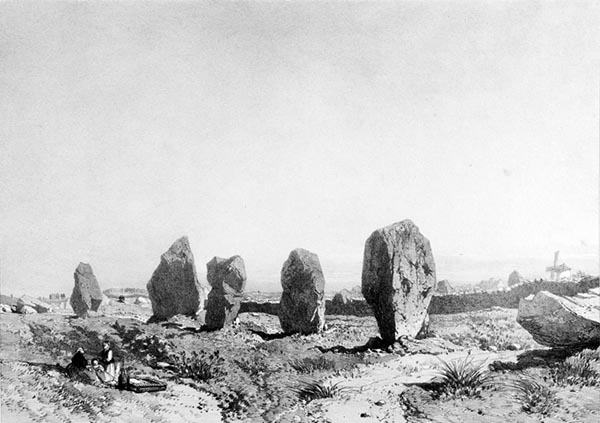
‘Carnac’ - Eugène Cicéri (French, 1813–1890)
Reverie can be fruitful, or at least give rise to a fertile melancholy, if, starting from a fixed point, the imagination, without abandoning that point, flies about within its luminous circle; but when, in clinging to an object devoid of form and history, it tries to extract meaning, and restore an entire lost society, it remains itself poorer and more sterile than the inert matter in which vain chatterers claim to find form, and from which they derive mere tales.
Having set forth the opinions of all the scholars mentioned above, if I am asked, in turn, what my conjecture is regarding the Carnac stones, since everyone has their own, I will give my incontestable, irresistible and irrefutable, opinion, one that would have made Monsieur de la Sauvagère’s tents retreat, and the ‘Egyptian’ Penhoet pale; an opinion that would have eclipsed Cambry’s zodiac, and slashed the Python to pieces, and that opinion is as follows: the Carnac stones are simply large stones.
So, we returned to the inn where, served by our hostess — who possessed large blue eyes, hands of rare delicacy, and a gentle face well-nigh religious in its modesty — we dined with a hearty appetite, whetted by our five-hour walk. It was not dark enough yet to sleep, but too dark to do anything else, so we visited the church (Saint-Cornély). It is small, though it has a nave and aisles, like a large city church. Thick, squat stone pillars support its blue wooden vault, from which hang small ships, votive offerings promised during storms. Spiders scurry across their sails, and dust rots their rigging.
There were no offices being said, the choir lamp burned alone in its cup of yellow oil, and high above, in the solid vault, open windows let in broad beams of white light, accompanied by the sound of the wind bending the trees. A man appeared, who arranged the chairs, set candles in a pair of tin candelabras hanging from a pillar, and dragged a kind of bier with feet, its dark wood flecked with large white marks, to the centre aisle. Other people entered; a priest in a surplice passed before us. We heard the peal of a little bell, pausing and ringing out again at intervals, and the church door swung wide open. No one entered; they were waiting for something. The staccato sound of the little bell was joined by another that answered, and both, sounding closer and rising in volume, redoubled their sharp, brassy tolling.
An ox-drawn cart appeared in the square, and stopped before the church gate. A dead man lay upon it. His pale, matte feet, the hue of clean alabaster, protruded from the edge of the white sheet which enveloped him and granted him that indistinct shape characteristic of all draped corpses. The crowd that had gathered fell silent. The men’s heads were uncovered; the priest shook his aspergillum, muttering prayers, and the oxen’s heavy leather yokes creaked as they gently tossed their heads. The great black shadow of the church, in the depths of which the light shone, parted, penetrated from outside by the greenish light of a rainy evening, and by the light of a candle borne by a child who held his hand in front of it to prevent the wind from extinguishing it, and which illuminated the threshold.
They lowered the dead man from the cart; his head caught the shaft. They brought him into the church and placed him on the bier. A stream of men and women followed. They knelt on the pavement, the men near the corpse, the women further away, nearer the door, and the service began.
It was of brief duration, at least for us, because the soft murmur of chanting soon began, occasionally broken by a faint sob rising from beneath the black cloaks at the foot of the nave. A hand brushed against me, and I stepped back to let a woman with bent back pass. Clenching her fists against her chest, her head bowed, advancing without seeming to move her feet, barely seeing her way, trembling from the effort, she advanced toward the line of lights burning beside the bier. Slowly raising her arm as if to hide behind it, she turned her head towards the corner of her shoulder, and fell onto a chair, slumping there, as lifeless and limp as her clothing. In the candlelight, I saw her eyes set in reddened eyelids, raw as if from intense heat, her mute, contorted mouth, trembling with despair, and her whole wretched face drenched in tears, from a storm of weeping. Her husband, had been lost at sea, and here was his corpse, which had recently been found on the shore, and would be buried shortly.
The cemetery adjoined the church. We traversed the latter. A side door opened, and everyone assumed their places, while in the sacristy they nailed the dead man into his coffin. A fine rain dampened the air; it was cold; the ground was soaked, and the gravediggers, who were completing their excavation, struggled to turn the soft, heavy soil that clung to their spades. In the distance, the women, kneeling on the grass, had released their hoods, and their large white bonnets, whose stiffened panels billowed in the wind, seemed from afar like a vast shroud rising from the earth, and undulating. The coffin appeared, the prayers began again; the sobbing resumed, which could be heard above the sound of the falling rain.
Near us, at regular intervals, a muffled sound arose, resembling laughter. Anywhere else, listening to it, one would have taken it for the repressed explosion of some violent joy, or a contained paroxysm of delirious happiness. It was the sound of the widow’s weeping. Then, she approached the edge of the grave, scattered a handful of earth therein, as did the others, the ground gradually returned to its natural level, and everyone withdrew.
As we were descending the cemetery steps, a young man passing by said in French to another: ‘The fellow stank! He was practically rotten! He’d been in the water for three weeks, so no wonder!’ On our way back to our lodgings, we found our hostess breastfeeding her child, lulling him to sleep, rocking back and forth in a chair. For us, there was nothing of interest left to see in Carnac. We had admired at leisure the hideous canopy above the side portal of the church, the kind of decoration generally produced by pastry chefs — I mean the kind that adorns those odious creations known as ‘montages’ where slices of candied orange form the arches, and bits of chocolate the columns, with a pink sugar obelisk topped by a flower. Within, we had contemplated the statue of Saint Cornély, more entwined with ropes than a Lyon sausage is with string. Ropes that have touched it are said to have the power to cure sick animals, while, above the main door of the church, there is a kind of painted sign depicting two peasants, one presenting his cow and the other his ox to this good veterinarian saint. When the ropes have remained around the statue for a while, and have acquired virtue; they are taken away and stored at home, being lent by neighbour to neighbour, and village to village; a shameful remnant of that superstition of which enlightened France has purged itself, as Le National would say.
Nonetheless, we stayed a further three days in Carnac, doing nothing but walking along the seashore and lying about on the sand, in which we drew, with our sticks, arabesques that were erased by the rising tide, and on which, stretched out in the sun, we slumbered like lizards. Side by side, seated on the ground, we scooped up sand in our hands, watched it slip through our fingers, turned over the dried, hollowed-out carcase of some ancient crab, searched for curved pebbles to make inkwells, and gathered seashells, while time passed. The sun sank over the sea, the colours of which varied, as it continued its ceaseless roar, leaving long festoons of seaweed and foam on the sand. We widened our chests, and breathed in the scent of the waves, a sweet and acrid odour of water, wind, and seaweed, rushing towards us from the ocean deep, while breezy gusts of air reached us, flowing between the hollows in the dunes, whose thin rushes caught on the loops of our gaiters. When evening came, we returned to the cottage, gazing at the sky, great purple streaks stretched across its azure.
One morning, however, on setting out as on other days, and taking the same path, we walked past the elm hedge, and crossed the sloping meadow where the day before, we had seen a little girl driving her cattle towards the watering trough; it was our last day there, and perhaps the last time we would ever pass that way.
A muddy field, where we sank up to our ankles stretched from Carnac to the village of Le Pô. A boat was waiting there for us, we clambered in, an oar pushed us away from land, and the sail was hoisted.
Our pilot, a cheerful old man, seated himself at the stern, tied a fishing line to the gunwale, and let the boat slide peacefully onwards. There was scarcely any wind; the sea, a pure blue, was perfectly still, and our narrow wake stretched out behind. The old man conversed; he told us about the priests he disliked, about meat, which is a good thing to eat, even on lean days, about the hardships he endured while in service, and of the gunshots he received as a customs officer … we progressed slowly, the taut wake following, the end of the boom dipped in the water.
The remaining few miles we were obliged to walk from Saint-Pierre to Quiberon were quickly covered, despite the hilly road through the sands, despite the sun that made the straps of our bags squeak on our shoulders, and notwithstanding the host of menhirs that loomed over the countryside.
In Quiberon, we had lunch at the Hôtel Penthièvre run by Monsieur Rohan Belle-Isle. This gentleman was barefoot in sandals, given the heat, and was drinking toasts with a stonemason, despite being a descendant of one of the oldest families in Europe. A nobleman of ancient lineage! A true nobleman, thanks be to God! He immediately cooked lobsters for us, and started pounding steaks.
My pride was immensely flattered, and even now, when I think of the honour he bestowed on us, I cannot help but give thanks! Providence showered me, in a single stroke, with blessings to last a lifetime. It was as if I had been kissed by princesses of royal blood, had dined with a Montmorency (he even offered me cider), had been served by a Rohan, toasted by Lord Louis Fessard (who gave Flaubert swimming lessons, and saved a number of people from drowning) and had patted cardinals on the belly!
The entire past of Quiberon is summed up in its graveyard. Its finest feature is the cemetery; it is full to overflowing, its walls straining, spilling out into the street. The packed stones crumble at the corners, pile up one on top of another, invade, submerge, and merge, as if the dead, hampered beneath the ground, are raising their shoulders to clamber from their tombs. It resembles a petrified ocean, where the graves form waves, and the crosses are the masts of lost ships.
In the centre a large, open ossuary receives the skeletons exhumed to make room for others. Whose idea was this: that life is an inn, and the coffin only a half-way house? These people have been ousted from their temporary homes; they are mere tenants, to be evicted at the end of their lease. All around this ossuary, where the pile of bones resembles a tangle of brushwood, are arranged a series of small black wooden boxes, at eye level, each six inches square, covered with a roof, surmounted by a cross, the fronts pierced by an openwork heart that reveals a skull within. Above the heart, one reads in painted letters: ‘This is the head of ***, who died on such and such a day, in such and such a year.’ The heads belonged only to people of a certain rank, and one would be considered a poor son or daughter if, after seven years, one did not grant one’s parents’ skull the luxury of this small coffin. As for the rest of the skeleton, it is cast into the ossuary; twenty-five years later, the skull is thrown in also. A few years ago, someone sought to abolish the custom. A riot broke out, and it survives.
It may seem wrong to toy like this with these orbs that once contained thought, with these spheres empty of the brains in which love was once active. All these boxes around the ossuary, on the graves, in the grass, on the wall, jumbled pell-mell, may seem horrible to some, ridiculous to others; but these black wooden boxes which rot as the bones they contain whiten and crumble; these heads staring at one from hollow eye-sockets, their noses gnawed, and their foreheads gleaming in places with the slimy tracks of snails; these femurs piled up like the great charnel houses of the Bible; these fragments of skulls that roll about full of soil, and in which sometimes, as in a porcelain pot, a wildflower has grown, which emerges from an eye-socket; the very coarseness of the inscriptions, all alike, as are the dead they designate; all these human relics, arranged in this way, seemed very beautiful to me, and provided a fine and solid spectacle.
If the mail from Auray had arrived, we would have sailed immediately for Belle-Isle; but we were still awaiting the post. Sitting in the kitchen, in their shirts, bare-armed, the sailors waited patiently, drinking their pints of beer.
— ‘What time does the mail from Auray arrive?’
— ‘It depends; usually at ten,’ replied their leader.
— ‘At noon,’ said Monsieur de Rohan.
— ‘At one’.
— ‘At half past one’.
— ‘It often arrives an hour or two later.’
— ‘That’s not often the case!
It seemed there must be three different couriers.
We were unable to leave until the unfortunate fellow arrived who bears the dispatches from the mainland to Belle-Isle. We were obliged to resign ourselves. We hovered at the front door, gazed at the street, retreated, sallied forth again. ‘Oh! He won’t come today.’ ‘He’s delayed.’ ‘We must go.’ ‘No, let’s wait.’ ‘If the gentlemen are too bored to wait…’ ‘Perhaps there are no letters for us?’ ‘No, wait another fifteen minutes.’ ‘Ah! He’s here!’ It was not him, and the dialogue began again.
At last, the trot of a tired horse, the sound like someone striking a flint, bells jingling, the crack of a whip, a man shouting: ‘Hola! Hola! The Post!’
The horse halted, abruptly, at the gate, then entered...back arched, neck outstretched, muzzle extended while showing its teeth, hind legs spread, and then rose on its hocks.
The nag was tall, hunched, bony, lacking a mane, with worn hooves, and rattling horseshoes; the crupper tore at the base of her tail; a wound in her chest oozed. Lost in a saddle that swallowed him whole, his back against a trunk, and restrained in front by a large wallet full of mail tucked into the saddle-bow, the rider, perched there looked like a shrunken monkey. His small face, with sparse, blond hair, wrinkled and shrivelled like a pippin, almost vanished beneath a felt-lined oilcloth hat; a sort of grey overcoat of ticking reached down to his hips and encircled his belly in a ring of gathered folds, while his breeches without stirrup leathers which were rolled up to his knees revealed his calves, reddened by friction, and his blue stockings fallen over the top of his shoes. String was tied around the beast’s harness; bits of black or red thread had been used in mending the rider’s garment; patches of every colour, stains of every shape, tattered canvas, greasy leather, dried dung, fresh dust, dangling ropes, gleaming rags, dirt soiling the man, mange afflicting the beast, the former puny and sweating, the latter gaunt and panting, the first carrying his whip, the second bearing its bells; all made the one object, with the same hue and the same action, performing nigh-on the same gestures, and serving the one purpose, the whole being termed the Auray mail.
After another hour, when a sufficient number of packets and letters had been distributed, and a few more passengers had arrived, we finally left the inn, and embarked on our boat. At first, all was a jumble of luggage and people, oars in the way, sails falling over one’s nose, everyone tangled with their neighbours, finding nowhere to seat themselves; but all took their place, found their spot, the luggage was loaded at the back, the sailors mounted the benches, while the passengers lodged wherever they found a space.
There was no sign of a breeze, and the sails hung straight down the masts. The heavy longboat barely stirred on the almost motionless sea, the waves rising and falling with the gentle movements of a sleeper’s chest.
Leaning against one of the gunwales, we gazed at the water, which was as blue as the sky and as calm; and listened to the sound of the long oars beating the waves, and clattering in their rowlocks. In the shadow of the sails, the six oarsmen, their oars ranged, raised them slowly, as one, and straightened their arms; the oars fell and rose again, scattering pearls from the ends of their blades.
Lying on their backs in the scattered straw, seated on the benches, legs dangling and chins in their hands, or leaning against the sides of the boat, between the solid jambs of the frame whose tar melted in the heat, the silent passengers bowed their heads, and closed their eyes to the glare of the sun striking the sea, which was flat as a mirror.
A white-haired fellow slept on the boards at my feet; the gendarme sweated beneath his tricorn hat, the two soldiers had taken off their packs, and lay on them. Near the bowsprit, the cabin boy looked at the jib-sail and whistled to call up the wind; standing at the stern, the captain turned the tiller.
The breeze failed to arrive. The sails were lowered, descending gently, making the iron of the pulleys ring, and their heavy canvas sagged over the benches; then each sailor undid his jacket, tucked it beneath the bow, and all began again, heaving with chests and arms, to move the immense oars which bent lengthwise.
The air was bluish and transparent, a harsh light enveloping everything, striking everything, penetrating the very pores of the old grey wooden boat, the thick sail-ropes, and the skin of the men shivering with sweat; they panted in unison, one could hear their breathing, and the oars striking the water, as one.
After each movement of their arms, as they straightened or bent, there was a dull thud. As we slid forward, one could hear the water lapping more noisily around the rudder while, after the jolt, the boat ran on in silence falling back into the wave.
The sandy beach of Quiberon, behind us, gradually receded; to the left, the blackish-green island masses of Houat and Hoëdic bulged on the surface of the pale azure; the sheer sides of Belle-Isle’s grass-crowned rocks rose higher; and the citadel whose walls plunge into the sea, slowly lifted from the waves.
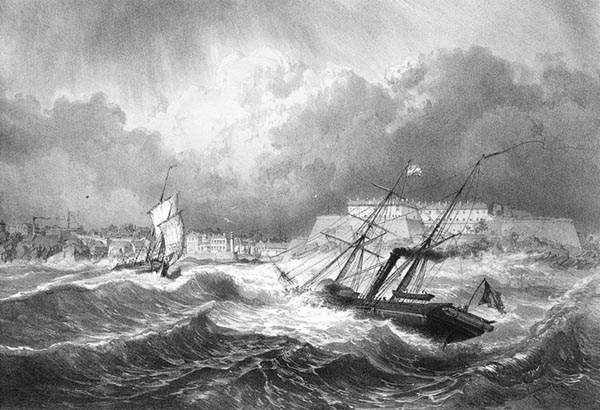
‘Belle-Île-en-Mer: the Citadel and the Harbour Entrance, Le Palais’ - Félix Benoist (French, 1818–1896)
The two soldiers, escorted by the gendarme, were led away to join the disciplinary regiment. A rifleman, summoned as a reinforcement to keep them in check, did his best to keep them in line. That morning, while we were having breakfast, one of them, accompanied by the gendarme, had entered the inn with a cocky air, his moustache curled, hands in his pockets, his kepi tilted to one side, demanding to eat and drink ‘right now’: anything, even arsenic. He called out, swore, and shouted, jingling his coins and damning the poor gendarme. Now, he was still smiling, but only externally, and his delight was fading, as the great white wall rose on the horizon, behind which he would dig the ground and drag a ball-and-chain about. His companion was calmer. He was a large, heavy, ugly brute, one of those people of such profound coarseness that one immediately understood the immense contempt those who lash this animated flesh over a canon barrel have for it, and the low price at which they value it. He had never seen the sea before, and gazed at it wide-eyed, as if saying to himself: ‘It’s a curious sight all the same, it gives one a better idea of what exists,’ an appreciation which I considered profound, he appearing as moved by the feeling the ocean aroused as ever a lady was by the lyrical expressions which I have often heard offered.
He made no secret of his disdain for the other soldier and, though they were friends, he shrugged pityingly as he looked at him. When he had gained his fill of amusement, trying to make the surrounding crowd laugh at the latter, he left him to sleep in his corner, and turned towards us. He spoke then of himself, of the prison he was about to occupy, the regiment, which bored him, the war he longed for, and his life of which he was weary. Little by little, his studied aspect faded, his forced laughter vanished; he became simple, gentle, melancholic, almost tender. Finding an ear at last receptive to all that had long burdened his exasperated heart, the tedium of it all, he spoke at length about the miseries of a soldier’s existence, the disgusting aura of the barracks, the teasing demands of military etiquette, the cruelties of being in uniform, the brutal arrogance of the sergeants, the humiliation of owing a blind obedience, the constant suppression of one’s natural instincts and will, bent beneath the hammer of duty.
He had been sentenced to a year of disciplinary action for selling a pair of trousers. ‘For many,’ he said, ‘it is a matter of indifference, like him for example,’ pointing to his companion, ‘peasants are used to tilling the soil, but as for me, I’ll be soiling my hands.’
O pride! Your taste of wormwood rises in every mouth, and every heart broods upon you! Who was he, this man who complained of his suffering in the company of others? A child of the people, a Parisian worker, a saddler’s apprentice. I pitied the ardent and melancholy fellow, sick with need, consumed by long-established desires, impatient with the yoke, and tired of work. It is not only we, beside our fireplaces, in the stifling air of our homes, who feel tedium at heart, and a vague anger which we try to exorcise from ourselves, noisily, by seeking love, by trying to write; he did the same in his lesser circle, with his glasses of liquor and his women; he, also, longed for riches, freedom, fresh air; he would have liked to change his surroundings, flee elsewhere, anywhere; he felt ennui, he too waited without hope.
Advanced societies exude a stench like a crowd, a sickening miasma, and duchesses are not the only people who faint from the experience. Nor should one think that bare hands can endure more than others; one can be weary of everything without knowing anything, tired of weaving one’s coat without having read ‘Werther’ (Goethe’s tale, ‘The Sufferings of Young Werther’) or ‘René’ (Chateaubriand’s equally potent example of the Romantic novella), and a bachelor’s degree is not a pre-requisite to blowing one’s brains out.
We had been so late in leaving that there was hardly any water in the harbour, and we had great difficulty entering. Our keel scraped over rocks and pebbles on the sea-bed, and in order to disembark we were obliged to walk an oar as if on a tightrope.
Wedged between the citadel and its ramparts, transected in the middle by an almost empty harbour, Le Palais seemed to us a rather foolish little town, exuding the boredom of garrison life, and possessing something of the air of a yawning non-commissioned officer.
Here, you no longer see the black felt hats of Morbihan, low-cut, immense in their span, masking the shoulders. The women no longer wear those large white bonnets that jut out in front of their faces like those of nuns and, at the rear, descend to the middle of their backs, thus covering half the bodies of the little girls. Their dresses lack the wide velvet trim applied to the shoulder, which, outlining the contour of the shoulder blade, disappears beneath the armpits. Nor do their feet bear those open shoes, round at the toe, high-heeled, and adorned with long black ribbons that graze the ground. Here, as everywhere, the figures resemble one another, the costumes are not true costumes, and there are milestones, real houses, cobblestones, even pavements.
Was it worth exposing ourselves to seasickness, which, however, we avoided, though it might have rendered us a little more forgiving, only to be forced to contemplate a citadel which we cared very little for, a lighthouse, which interested us even less, and Vauban’s ramparts, which we already found tedious? But we had been told about the cliffs of Belle-Isle. So, we exited the gate at once and, cutting straight across the fields, turned towards the shore.
We saw only one cave, just one (the daylight was fading), but it seemed so beautiful to us (it was lined with seaweed and shells, and adorned with drops of water falling from above), that we resolved to spend the next day on Belle-Isle, so as to seek out similar ones, if there were any, and to feast at leisure on the delights of all their hues.
Next day, as soon as it was light, having filled a water-bottle, and stuffed some pieces of bread and slices of meat into one of our bags, we took to the open, and, without a guide or any information whatsoever (which is the right way to proceed), started walking, determined to end up anywhere, provided it was far distant, and to return at any hour, provided it was late.
We started on a path through the grass, following the summit of the cliff, climbing its peaks, descending into its troughs, and continued so, following the shores of the island.
If a landslide had caused a collapse, we climbed higher, traversed the countryside and, adjusting our bearings according to the seaward horizon whose blue line touched the sky, we regained the clifftop again, which, appearing unexpectedly, revealed an abyss before us. The sheer height of the summit on which we walked allowed us to view nothing of the cliffs’ rocky flanks, hearing below us only the sound of that great, battering-ram of a sea.
Sometimes the cliffs, pierced and revealed in all their grandeur, would suddenly present two well-nigh perpendicular sides, streaked with layers of flint, and on which small yellow flowering clumps had grown. If one threw a stone, it seemed to hang suspended for a moment, then struck the rock, and tumbled down, ricocheting, shattering to pieces, sending earth and stones rolling, and finally coming to rest buried in gravel, as, above, one heard the cries of the cormorants taking flight.
The rain from thunderstorms, and thawing snow, had washed some of the upper slopes into many of these gorges, gradually eroding the latter and making them easier to descend. We ventured into one of them, and, sliding down on our backsides, scraping our feet, and holding on with our hands, we finally reached the foot, and landed on a stretch of beautiful, wet sand.
The tide was ebbing; to cross, we had to wait for the waves to recede. We watched them arriving. They foamed among the rocks, swirled in the hollows just below the surface, leapt like flying silk, fell back in cascades and pearls, and with a long, swaying motion retrieved their great green sheet. When a wave had retreated over the sand, the currents immediately criss-crossed as they fled to lower levels. Glutinous strips of seaweed stirred; water flowed amongst the pebbles, spilled out through the cracks in the stones, in a thousand splashes, a thousand jets. The soaking-wet sand absorbed water, and, dried in the sun, its yellow hue whitening.
As soon as there was sand to walk on, we jumped over the rocks, and ploughed ahead. The mass of boulders grew larger, forming disorderly heaps; upturned, jostled, piled in all directions, lodged one on top of another, and we clung to their slippery surfaces, our feet scrabbling wildly at their viscous asperities.
The cliff loomed high above; so high that one was awed when one raised one’s head. It overwhelmed in its formidable placidity, and yet it charmed; for one contemplated it in spite of oneself, and one’s eyes never tired of gazing.
A swallow flew by; we watched it pass. It came from seawards, rising gently, its feathers slicing through the fluid, luminous air in which its wings moved freely, revelling seemingly in their beating. It rose higher, traversed the cliff edge, rose ever higher, and vanished.
We however, were left behind to crawl over the rocks, each bend in the coast providing a fresh perspective. There were places free of boulders, where we trod on large, square sections, flat as flagstones, where clefts ran on in pairs, almost symmetrically. Their lines looked like the ruts of some road from another age. Here and there, as motionless as their greenish beds, lay large pools of water which were as clear, still, and unmoving as the purest watercress-filled pool in the depths of the woods, in the willow-trees’ shade.
Then rocks appeared, once more, seemingly closer together, and piled higher. On one side lay the sea, its waves drenching the low-lying reefs; on the other loomed, the steep, arduous, impassable cliffs.
Tired and dazed, we sought an escape. But the cliff ever advanced before us, and the boulders, their dark masses clothed in seaweed extending to infinity, succeeded one another, raising their lumpy heads, growing in size and multiplying, like black phantoms emerging from beneath the sand.
We were ploughing along like this, when, suddenly, we saw, a little gulley, winding in a zigzag through the rocks, which allowed us to ascend, as if by a ladder, and regain the open countryside.
Once there, we found ourselves on a plateau overlooking the island’s entire coastline, and extending, in the same direction as we had been walking, through treeless fields devoid of any greenery. It was nonetheless very pleasant to have nothing more to do but move our feet, and push on. A small grove of slender pine-trees appeared; we entered, and, having unbuckled the bag that had been bouncing around on my shoulders for the past four hours, we began to tear apart, with our fingernails, the slices of cold veal now stuck to the pieces of bread.
Lying on the ground, on the fallen pine-needles, we ate lunch, legs outspread; our socks and shoes, now soaked with seawater, hanging on the ends of branches to dry. Once refreshed, a filled pipe having revived us from our fatigue, we picked up our walking sticks, and set off again.
Wishing to cross the whole width of the island, we followed the sun, and walked ahead; but soon, lost in the countryside, we sought only to find the sea whose shores, if we followed them, should finally bring us back to Le Palais either in the evening, or that night, or the following morning, since we no longer knew where the town was, nor where we were ourselves.
No matter, it is always a pleasure, even when the countryside lacks beauty, to forge a route together, walking amidst the grasses, crossing hedges, jumping ditches, knocking down thistles with one’s stick, tearing off leaves and ears of corn with one’s hand, advancing, randomly, as the whim takes one, or as one’s feet determine, singing, whistling, talking, dreaming, without another listening ear, without the sound of other footsteps behind, as free as one is in the desert!
Oh! Air! Air! More space! Since our tightly-bound souls, are suffocating, dying against the window panes, since the captive mind, like a bear in its den, is forever turned in on itself, constrained by the walls of its cave, at least let our nostrils scent the winds of the earth, let our eyes gaze towards vast horizons!
Not a single steeple, with its gleaming roof of slate, appeared in the distance, not a single hamlet, on the reverse of some fold in the land, its thatched roofs, and square courtyards enclosed by a cluster of trees; we met with no sign of life, not a passing labourer, nor a grazing sheep, nor a prowling dog.
The cultivated fields seemed uninhabited; people worked, rather than living, there. It was if those who owned them profited from what they yielded, but felt no love for them.
We saw a farm; we entered; a woman in ragged clothing served us ice-cold milk in stoneware cups. There was an odd silence. She gazed at us eagerly, and then we left.
We descended a valley, a narrow gorge that seemed to lead to the sea. Long grasses with yellow flowers climbed to our waists. We advanced with long strides. We could hear water flowing nearby, and sank deeper into the marshy ground. The hill-slopes on either side moved further apart, their arid surfaces still covered with short grass, or coated occasionally with large yellow patches of lichen. On the one side, a stream flowed at the foot of the slope among the low branches of stunted shrubs that had grown on its banks, only to lose itself, further on, in a still pool where long-legged insects trod the leaves of the water-lilies. The sun beat down. Dragonflies flickered above the rushes, the tips bending under the weight of their light bodies. We were alone, the two of us, in tranquil solitude.
At this point, the valley rounded, and widened, bending back upon itself. We climbed a hillock to see what lay beyond; but the horizon was obstructed by another hill, or stretched out above, in some fresh plateau. Nonetheless, we took heart and walked on, thinking of those sailors abandoned on desert islands who climb the headlands hoping to glimpse some distant sail approaching.
The ground became drier, the grass shorter, and suddenly the sea appeared before us, confined in a narrow cove, and soon its shore, formed of shells and fragments of coral, clinked beneath our feet. We collapsed to the ground and fell asleep, exhausted. An hour later, wakened by the cold, we set off again, certain this time of not getting lost; we were on the coast facing France, and had Le Palais to our left. It was here that, the day before, we had seen the cave that had so charmed us. We were not long in finding others, taller and deeper.
Their openings were always vast arches, straight-sided or curving, thrusting upwards like bold jets against enormous slabs of rock with regular contours. Black, veined with violet, red as fire, umber and streaked with white, they revealed to the observer, every variety of form and hue, every grace, every grandeur of fantasy. There was one, silver-coloured, traversed by veins of blood; in another, clumps of flowers resembling primroses had bloomed on the reddish granite slopes, and ever-renewed drops of water fell from the ceiling onto the fine sand. In the depths of a third, on an elongated arch, a bed of polished white gravel, which the tide doubtless turned and remade each day, seemed to be there to receive the body of some Naiad emerging from the waves; but her bed was empty, she having vanished forever! All that remained was the floor of damp seaweed where she had once stretched out her beautiful naked limbs, tired from swimming amidst the tide, and on which, until dawn, she had slept in the moonlight.
The sun was setting. The tide was rising over the rocks, which were fading in turn into the blue evening mist, whitened by the foam of the recoiling waves, while on the horizon, the sky, streaked with long orange lines, seemed as if swept by great gusts of wind. The dying light, reflected on the waves, gilded them with a shimmering moiré; extending over the sand, it turned the shoreline brown, with a scattering of points of gleaming steel.
A mile or so to the south, the coast stretched out to the sea in a line of rocks. To reach them, we would have to repeat the same march we had made that morning. We were tired; it was a long way; but temptation drew us onward, towards that horizon. A breeze was rising, pools of water rippled in the hollows of the stones, the seaweed clinging to the bases of the cliffs trembled, and from the direction where the moon was about to rise, a pale light arose, seemingly from beneath the water. It was the hour when shadows are long. The rocks seemed larger, the waves greener. It was as if the sky was expanding and all of nature was altering its expression.
So, we set off into the distance, without worrying about the rising tide, or whether it would leave a path for us along the shore. We wanted to indulge our pleasure to the very end, and savour it, without missing a beat. Lighter than in the morning, we jumped and ran effortlessly, without hindrance; our energy carried us away despite ourselves, and we felt in our muscles a kind of tingling, a robust and singular delight. We shook our heads in the wind, and took delight in touching the grass with our hands. Inhaling the scent of the waves, we breathed in the scene, conjuring up all its colours, its rays of light, its murmurs: the pattern of the seaweed, the softness of the grains of sand, the hardness of the rock that rang beneath our feet, the height of the cliffs, the fringes of the waves, the contours of the shore, the voice of the horizon; and then, there was the passing breeze, like a host of invisible kisses flowing over our faces, there was the sky in which clouds were moving swiftly, scattering a dusting of gold, the rising moon, the ascending stars. We revelled in this profusion of splendours, we feasted our eyes, we opened our nostrils, we listened intently. Something of the life of the elements, prompted by our attentive gazing, reached us, and was assimilated, allowing us to comprehend that life in closer relationship, to feel it more deeply, thanks to a more complex union. By dint of it penetrating us, of our entering into it, we too became a part of Nature; we felt it gaining power over us, and we experienced immeasurable joy; we longed to lose ourselves there, to be seized by its strength, or to bear it away enclosed within us. Just as, in the transports of love, one wishes to be equipped with more hands to touch the beloved, more lips to kiss, more eyes to see, more soul with which to love, we, traversing Nature, in our frolic, full of delirium and joy, regretted that our eyes could not reach the heart of the earth, the depths of the sea, the ends of the sky, to understand how rocks form, how waves arise, how stars begin to shed their light; that our ears could not hear granite cooling in the depths, sap rising in the plants, coral massing in the ocean solitudes, and amidst this contemplative sympathetic effusion, would have wished our souls, radiating everywhere, to plunge living into all this ocean of life, take on all its forms, and endure like them, ever varying, ever revealing their metamorphoses beneath an eternal sun.
But human beings are born to sense only a little each day: of foods, colours, sounds, feelings, ideas; anything measureless tires or intoxicates us; it condemns us to the idiocy of the drunkard, the madness of the ecstatic. Ah! How small our glass is! How great our thirst! How weak our minds!
That evening, our gait was no longer perfectly steady; we returned agitated, moved, troubled, our hearts pounding, our nerves vibrating like the strings of a harp that has been plucked too hard; our bodies were tired, our heads spinning, while, on the contrary, our legs, propelled us forward, jerkily, of their own accord, almost in leaps and bounds. When we entered the town, whose gates were about to be closed, we had been walking for fourteen hours, our toes were sticking out of our shoes, and our shirts were still wringing wet two days later.
To return to Quiberon, we had to rise the next day before seven, which required courage. Still stiff with fatigue and staggering sleepily, we piled into the boat, accompanied by a white horse, two travelling merchants, the same one-eyed gendarme, and the same rifleman who, this time, was not involved in lecturing anyone. Grey as a sheet and rolling about beneath the benches, he was having a hard time keeping his shako in place, which kept bobbing on his head, and defending himself against his rifle, which kept flying between his legs. I know not which was the bigger fool, him or the gendarme. The gendarme was sober, but stupid in the extreme. He complained about the soldier’s bad manners, listed the punishments he was going to receive, was scandalised by his hiccups, and took offense at his behaviour. Seen from a three-quarter angle, from the side of the missing eye, with his tricorn hat, sabre, and yellow gloves, he cut one of the saddest figures a person could see. A gendarme is, moreover, a thing essentially clownish, one that I cannot regard without smiling; which is in itself a grotesque and inexplicable effect such pillars of public safety have upon me, along with king’s prosecutors, magistrates, and literature professors.
Tilted over on its side, the boat cut through the water speeding along the hull and turning to foam as it did so. The trio of sails, filled by the breeze, swelled in gentle curves. The rigging creaked, the wind whistled through the pulleys. Leaning over the bow, his nose in the air, the cabin boy was singing; we were unable to make out the words, but the monotonous tune was slow, and tranquil; repeated endlessly, neither higher nor lower in pitch, the languid modulations were prolonged as they faded. His song floated away gently and sadly over the sea, like a confused, passing memory deep in the soul.
The horse stood on its four feet and nibbled its bale of hay as best it could. The sailors, arms crossed, smiled as they looked up at the sails.
At Quiberon, we saw Monsieur Rohan again, with his tall, ruddy-faced wife, and reacquainted ourselves with the game of ‘trou madame’ (‘troll-my-dames’, or ‘trunkes’, an ancestor of bagatelle), which replaces the obligatory billiards in his establishment, and appears to be one of the local curiosities. Our two travellers were skilled at the game, and when, after having lunch with them, we left for Plouharnel, we left them more determined than ever to wipe the floor with one of their local acquaintances. Both were traders in bed-linen. The first was a rather handsome fellow of about twenty, blond, and ruddy-faced, with a broad chest, his cap pulled down over one ear, high heels, and a waistcoat down to his knees; he represented for us the very embodiment of the Vaudeville’s Achard (Pierre-Frédéric Achard was a renowned, and energetic, actor), he possessed elegance, and style. As for the other, no doubt in his day he had shared his companion’s amiable nonchalance; he too had perhaps once taken maids by the waist, playfully insulted the boys, been brilliant at billiard cannons, and eased the tedium of travel in his cabriolet by singing the songs of Béranger; but with age, the chill the grips the heart had extinguished his flame, and quietened his voice. The experience of a wise man, the moderation of a philosopher, could be read on his brow, wrinkled by worrying about sales volumes, and the endless anxiety of the journeyman. How many business letters must he have written in his life? How many houses had disdained his wares? How many times had he dined at the common table!
As we were on our way to Plouharnel that evening, these gentlemen offered to take our knapsacks in their carriage, which we accepted, and a good thing it was for us, because from Quiberon to Plouharnel the road is very sandy, and twenty-five pounds weight on our backs would scarcely have accelerated our progress.
Until we reached Fort Penthièvre, we saw nothing new, the route being known to us, but we noted again with a degree of boredom some fine menhirs casting their foolish shadows on the grass.
We passed by Fort Penthièvre, which greatly surprised the sentry who, seeing us approaching, granted us the courtesy of shouting from afar that we needed permission to visit, but instead we seated ourselves at the foot of the embankment, on the sloping side of a large grassy mound whose incline descended towards the sands. The sun shone, the sea sparkled, and a dry, harsh wind blew over the reeds embedded in the dunes, which bent simultaneously, as if a sheet of water had passed over them.
With Plouharnel visible on the opposite coast, its church steeple, facing the rise where we sat, certainly seemed within reach; one only had to follow, in a straight line, as countryfolk say. As if it were easy to follow anything in a straight line, with only a weathervane, or even a whole steeple, in front of one’s eyes!
The peninsula, silhouetted against the sea, extended in a pale yellow mass, while the waves traced two long fringes of white foam along its twin shores. The sea was entirely blue, the sky wholly white; struck squarely by the sun, the sands shimmered before us, with great patches of umber light, that seemed to make them ripple, and their extent to increase. The rounded hillocks, formed by the winds, and dotted here and there with a few reeds as thin as needles, rising one after another, seemed endless; we were obliged to climb and descend, trails of dust rising slowly and drifting away, our eyes closed against the dazzling sun that blazed above the waves, and glowed over the sand. The wind reddened our faces, whipping them with great force, as we advanced slowly and sadly over this deserted shore.
Thus, we marched on, in silence, as best we could, without ever seeming any nearer the far point of the bay where Plouharnel was located. However, we reached the end eventually. But then we found ourselves walking towards the ocean again. We had turned right along the shore, when we should have turned left. We had to retreat, and cover part of the distance again.
We heard a muffled sound. A bell rang; a hat appeared. It was the Auray mail. The same postman, horse, and mailbag as before. He was progressing calmly towards Quiberon, from which he would return later, only to retrace the route on the morrow. He is an inhabitant of the shore; he crosses it in the morning, and again in the evening. His life is to traverse it; he alone animates it, he adds to the scene, I was about to say graces that same.
He stops; we talk to him for two minutes; he says his farewell, and departs. What a scene! What a man, what a horse! What a subject for a sketch! Jacques Callot, no doubt, would have etched it; only Cervantes could have evoked it fully with the pen.
After crossing large lines of boulders planted in the sea, so as to shorten the route which cut, thus, across the inner end of the bay, we finally arrived at Plouharnel.
The village was quiet, hens clucked in the streets, and in the gardens, enclosed by dry stone walls, nettles grew in the middle of squares of oats.
As we were sitting outside our host’s house, breathing fresh air, an old ragged beggar passed by. He was hunched over, crawling with vermin, as red as wine, bristling, sweating, with a dishevelled front and a drooling mouth. The sun shone on his rags, and his purple, almost black, skin seemed to exude blood. He bellowed in a dreadful voice, pounding repeatedly on the door of a neighbouring house.
We had the honour of dining with our two business travellers, whose politeness certainly warranted the offer of an inevitable bottle of champagne. They opened their hearts completely to ours, and poured out their most intimate confidences. We learned things of interest, for example that the younger man was travelling for a firm based in Lisieux, and that last year he had possessed a mistress named Josephine, who was quite well-endowed. He was, moreover, a fellow who had experienced the highest and lowest of Cytherean society; he often calmed his senses at little cost to himself, and had slept with women who slept in black satin sheets. ‘Why,’ said his companion, ‘did you not steal some for a vest or two?’
The host, who is the local mayor, came to drink with us, during the dessert course. With elbows resting on the table, and his black silk cap pulled up behind his ears to hear more clearly, he remained gaping and silent throughout, savouring our friends’ speeches, and our own which were no better. The dinner was in no way tedious though; sometimes one gains pleasure by conversing with imbeciles.
The next day was a Sunday, and the kitchen was already full of countryfolk, who came there to drink, when we descended to consume our onion soup before setting off for Auray.
Above the voices, and the clatter of iron-shod clogs echoing amidst the tavern, one heard the cooing of a turtledove enclosed in a cage that hung from the wall. What a sweet sound that was! Do you not love old dovecotes where you can watch the birds walking on the tiled roof, puffing out their necks, spreading their wings, dipping their pink feet in the gutter-water, and all day long uttering their occasional plaintive cries?
We rose and were, about to leave, when we saw someone pass by, but only caught a glimpse from behind. What did he look like from the front? Who was he? His hat! What a hat! A vast, an immense hat that towered above the wearer’s shoulders. And it was made of wicker — and what wicker! More like bronze, a hard, compact planisphere made to withstand hail, impervious to rain, and destined only to harden and strengthen with time. The man it covered was lost beneath it, as if he had entered it up to his midsection, and yet he bore it along (I saw him turn his head). What a temperament! What a constitution! What neck-muscles! What strength in those vertebrae! But also, its breadth! What a huge circle it made, that hat! It cast a shadow all around; its wearer was ever denied the sunlight. Oh! What a hat! Like the lid of a boiler topped by a pillar; it would have served well as an oven if one had but cut a door in it! There are things that are unshakeable: like the Simplon Pass, and the impudence of critics; things that are solid: like the Arc de Triomphe, and the moralist Jean de la Bruyère’s French; things that are heavy: like lead, boiled meat, and the works of that literary historian Désiré Nisard; and things that are great: like my brother’s nose, Shakespeare’s ‘Hamlet’, and the poet Louis Bouilhet’s snuffbox, but I have seen nothing as unshakeable, as solid, as heavy, as great, as that hat from Plouharnel! And it possessed an oilcloth cover!
Chapter VI: (Du Camp: Plouharnel to Vannes; a trip to Hennebont; Vannes to Josselin)
From Plouharnel to Auray, deserted countryside; one encounters few houses, but beautiful features such as gorse and trees.
Auray has the charming allure of a fine little town with its ancient rooftops and houses; the women are prettier than those in the surrounding area. — A splendid view from the top of a stone belvedere in Auray, to the right and inland. — A few boats, high and dry on the bank due to the low tide; an old bridge with triangular piers and projecting sections within the piers.
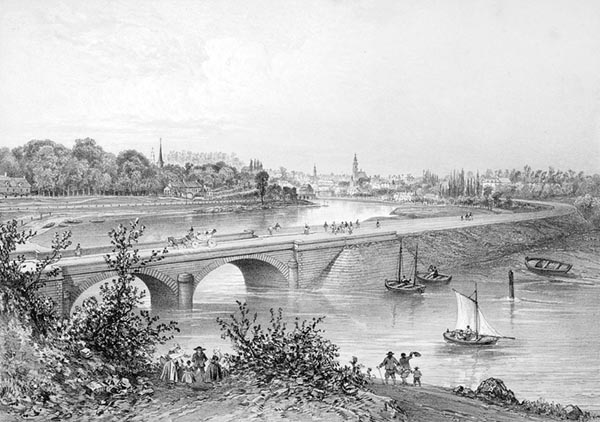
‘Auray’ - Félix Benoist (French, 1818–1896) and Adolphe Jean-Baptiste Bayot (French, 1810–1871)
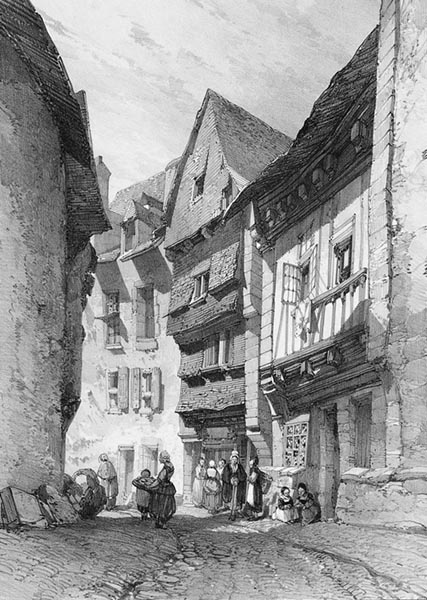
‘A Street in Auray’ - Eugène Cicéri (French, 1813–1890)
The Carthusian Charterhouse (Saint-Michel du Champ, in Brech). — Gallia Marens Posuit (‘Grieving France erected this’), a mausoleum, an ugly monument (to the dead of the Battle of Quiberon Bay, 1759) in the Restoration style; at the back, two bas-reliefs: one of the Duchess of Angoulême (Marie-Thérèse Charlotte, Madame Royale, daughter of Louis XVI) laying the first stone (in 1823); the prefect posing as he presents her with the trowel on a cushion; the other of the Duke of Angoulême (Louis-Antoine d’Artois, son of Charles X) praying; his cloak; what boots! And the gentleman behind, holding a glove to his chest. — We descended by candlelight through a hole, and saw the bones. — A glass-roofed cloister, closed, adorned with copies of the Saint Bruno (founder of the Carthusian Order) cycle by Eustache Le Sueur. — The Grey Nuns. — The abbot strolling. — The Field of Martyrs (a second monument to the dead of the Battle of Quiberon Bay): a sort of utterly insignificant chapel; on one side, a small wood, an avenue of green trees, a long heath that the sea floods at each tide; the place was well chosen.
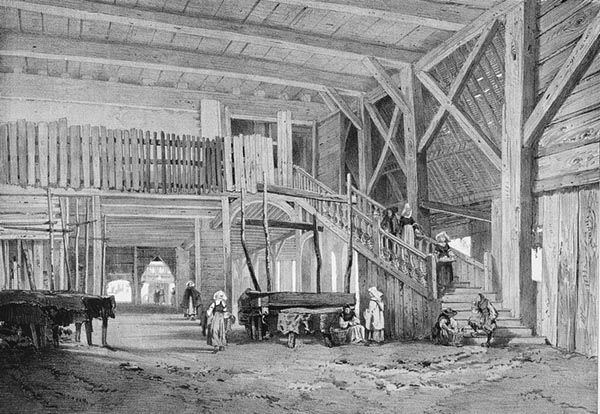
‘The Market Hall, Auray’ - Eugène Cicéri (French, 1813–1890)
To reach Sainte Anne d’Auray, the road climbs. — Charming watering places (the Auray river flowing through), rocks, water lilies on the surface, gorse. — A little dog that ran and bathed everywhere. — The hedges are frightening in their sheer number when one considers their purpose. — Beneath a tree, a pallid old woman, kneeling, praying at the corner of a sunken lane; it was Vespers. We met two others, who were doubtless praying while walking, since one made the sign of the cross.
Sainte Anne d’Auray. — The church adorned with paintings, votive offerings from the mill and the children. — Axe blow. — Shops selling religious items. — Our devout, and Carlist, driver, a big, heavy, useless fellow.
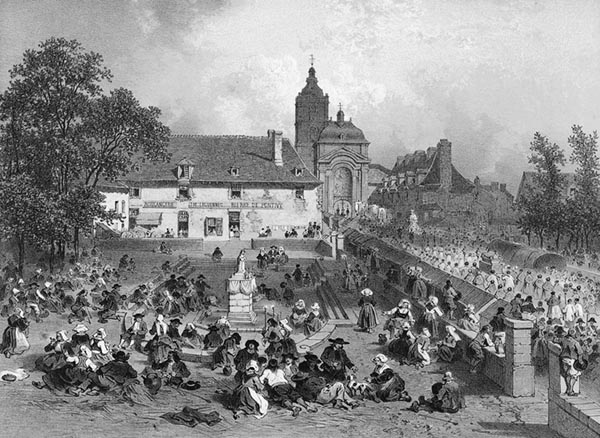
‘Sainte-Anne-d’Auray: a Pardon’ - Félix Benoist (French, 1818–1896), Adolphe Jean-Baptiste Bayot (French, 1810–1871) and Eugène Cicéri (French, 1813–1890)
Vannes. — Gentlemen and ladies dressed in their Sunday best. — Young soldiers in bourgeois attire, moustaches, trousers pulled up; trousers with a pair of boots! — Monsieur Descormiers de Montmorency, set apart from everyone, though in the centre. — The officer, black wicker hat, black velvet frock-coat, white tie, a mouth and nose like those of Marat (Jean-Paul Marat, the Revolutionary politician). He should have been appointed warden of the promenade, with lodgings in the hospital, though he has no need of the position. — ‘Vannes’ and his wife. — The Constable’s Tower (Tour du Connétable), occupied by a carpenter, and some dreadful riff-raff. — Churches without names. — The eastern corner; the way down from the hotel towards a small promenade by the water leads to a field bordered by a line of oak trees beneath which I am writing. — At the hotel, in a room that seems to be the drawing room, two engravings: the return and departure of Louis XVIII from the Tuileries in 1815 (during The Hundred Days, see for example the ‘Departure’ painting of 1817, by Antoine-Jean Gros). The Duc d’Angoulême in Spain, in full costume, and riding boots; his sword rests on a chained monster, which must represent ‘the hydra of anarchy’; he stands beside the decapitated trunk. In the background, on a shield hanging from the wall, is written: veni, vidi, vici.
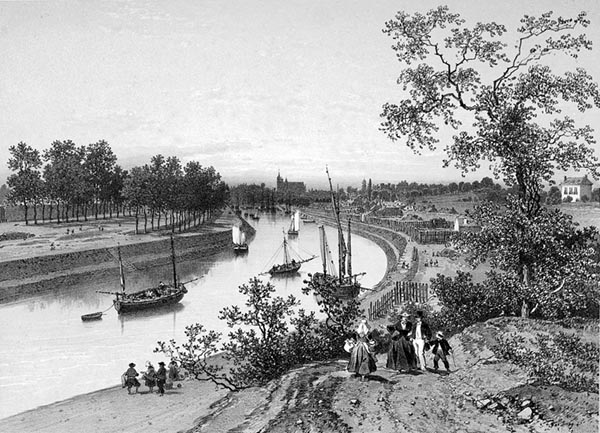
‘Vannes: the Harbour from the Left Bank’ - Félix Benoist (French, 1818–1896), Adolphe Jean-Baptiste Bayot (French, 1810–1871) and Eugène Cicéri (French, 1813–1890)
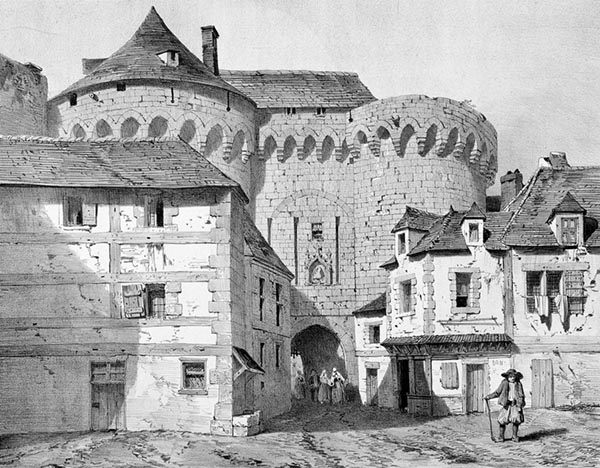
‘The Town Gate, Vannes’ - Léon Gaucherel (French, 1816–1886)
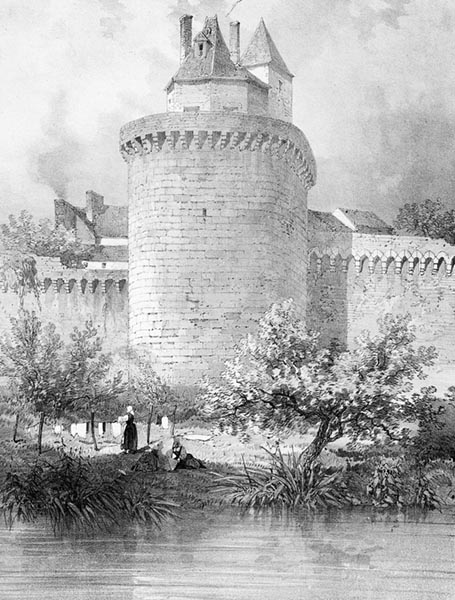
‘The Tower where the Constable de Clisson was Imprisoned’ - Léon Gaucherel (French, 1816–1886) and Eugène Cicéri (French, 1813–1890)
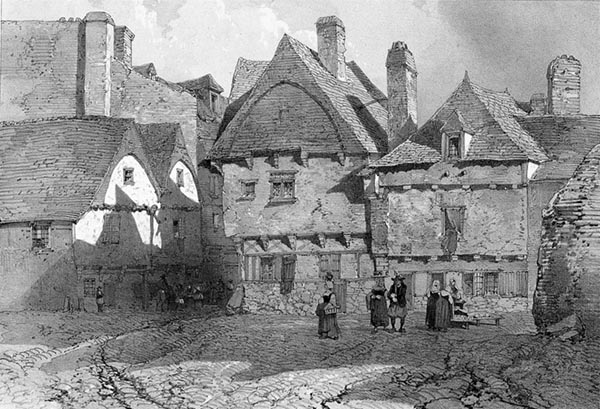
‘Houses in Vannes’ - Léon Gaucherel (French, 1816–1886) and Eugène Cicéri (French, 1813–1890)
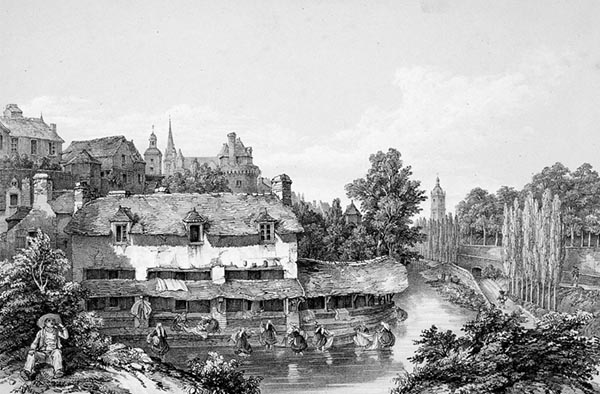
‘Vannes: the Riverside Washhouses’ - Félix Benoist (French, 1818–1896)
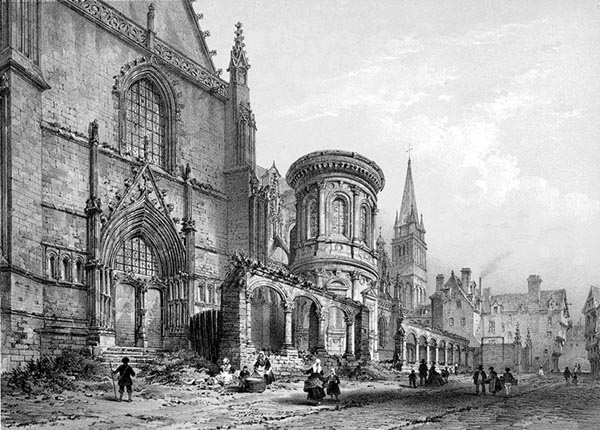
‘Vannes Cathedral’ - Félix Benoist (French, 1818–1896) and Adolphe Jean-Baptiste Bayot (French, 1810–1871)
From Vannes to Hennebont the route is lovely; a fresh wind along the main road. — Woods that the road traverses.
Lorient. — Complete emptiness; low, straight streets. — The Hôtel de France, a tavern, a greenhouse in the garden. — ‘A Musical Evening’ beneath the trees in front of the theatre. — the playwright Eugène Scribe’s slander (Monsieur de Sauvray-Raymond), it left me feeling sick. — The harbour impossible to see. — An evening stroll. — Nothing there. — Hennebont, on the slope of a hill.
From Lorient to Hennebont on foot. — A Florentine singing a Genoese song, selling bags of plaster. — Violets among the ruins; two towers preserved with slate roofs. — Arriving from Lorient: a section of machicolated wall covered with earth. — In the upper part of the town, a promenade, a view of the river; opposite, the Hôtel du Commerce; a long avenue of elm trees. — At the relay station, a fierce idiot, a hard stare, a long green frock coat, canvas trousers too short, clogs, bare feet, straw hat; a woman, covered up....
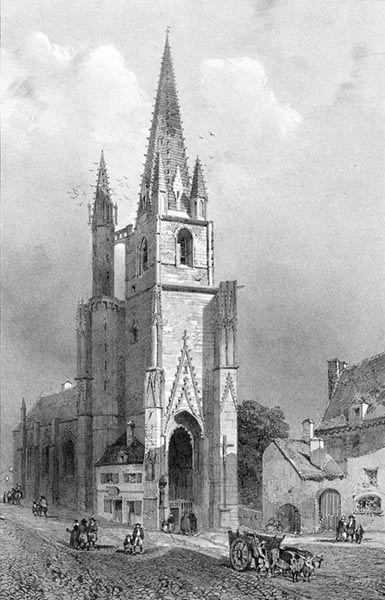
‘Hennebont Church’ - Léon Gaucherel (French, 1816–1886) and Eugène Cicéri (French, 1813–1890)
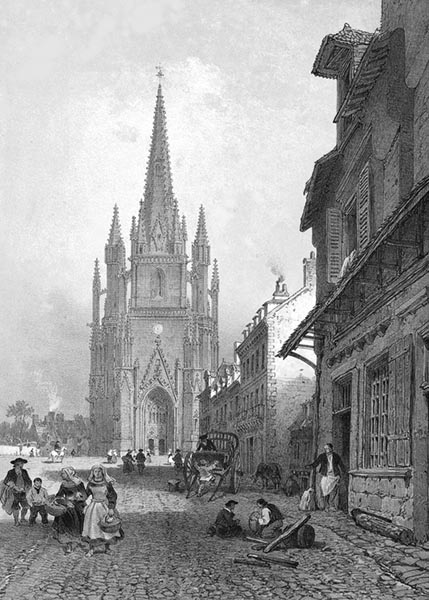
‘Hennebont Church’ - Félix Benoist (French, 1818–1896), Eugène Cicéri (French, 1813–1890) and Adolphe Jean-Baptiste Bayot (French, 1810–1871)
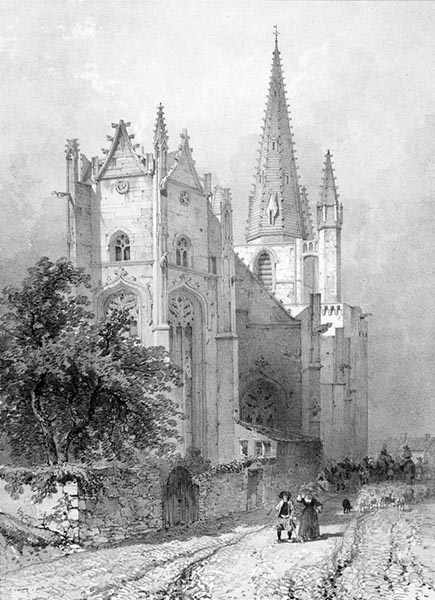
‘Hennebont Church’ - Léon Gaucherel (French, 1816–1886) and Eugène Cicéri (French, 1813–1890)
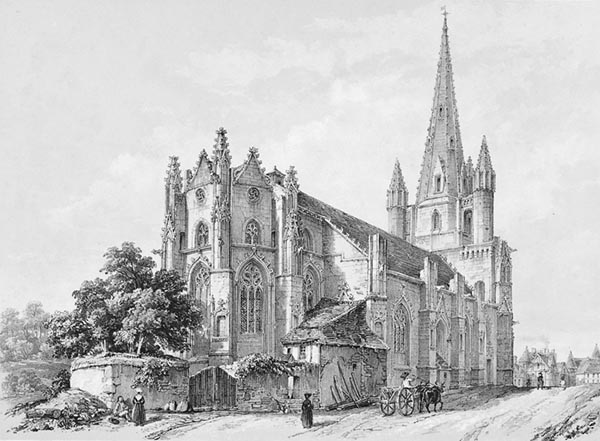
‘Hennebont Church’ - Félix Benoist (French, 1818–1896)
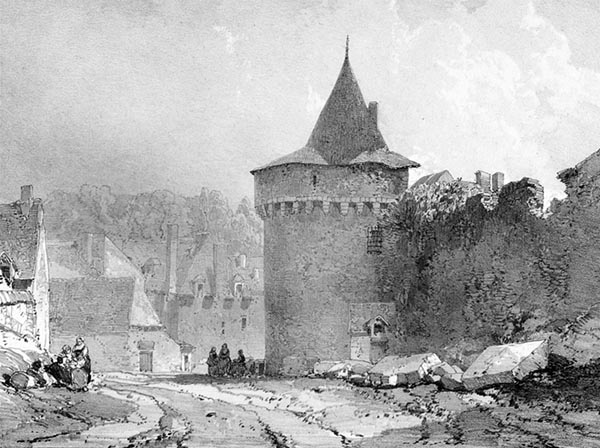
‘The Prison, Hennebont’ - Eugène Cicéri (French, 1813–1890)
From Hennebont to Ploërmel, under a tarpaulin. — The driver some kind of sailor. — Melancholy while gazing at the highway. — In Vannes, the classic democrat, desiring intimacy with us. — A procession, soldiers, young boys dressed in white, having been crowned with roses in Hennebont.
Ploërmel. — A Gothic church (Saint-Armel), from the good old days, with lovely stained-glass windows; the portal from the beginning of the fourteenth century; a sow carved on the left on a buttress, near the side portal. — Set in a long, flat valley; the countryside is dark in colour, and bluish on the horizon. — An idiot. — The father of twenty-six children recites verses about the emperor.
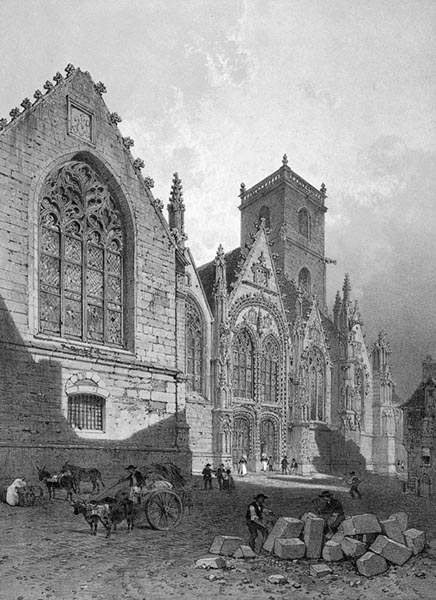
‘Ploërmel Church: the Side Portal’ - Félix Benoist (French, 1818–1896), Adolphe Jean-Baptiste Bayot (French, 1810–1871) and Eugène Cicéri (French, 1813–1890)
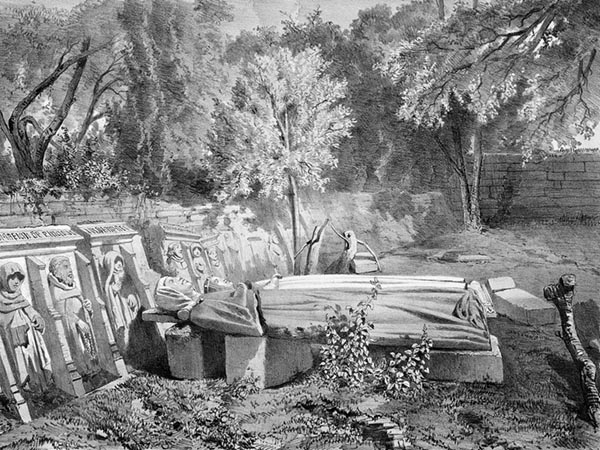
‘Statues of the Princess Jehanne de Léon’ - Léon Gaucherel (French, 1816–1886)
Josselin, the château seen from the angle of the bridge. — Three towers, square windows (from the beginning of the fifteenth century). — Built on a shelf of rock, over the river, a row of machicolations; ten windows facing, in the style of Queen Anne as at Blois, but in more austere taste. — Nothing comparable; the interlacing of the galleries also differs. — Enormous gargoyles: tuskless elephants, a sea-hound, a dragon; from beneath their bellies a stone gutter descends to a height of three feet from the ground; and ends in another gargoyle head of the same character. One, towards the middle, and a second at the corner, carved as crocodiles, the gutter forming the body, covered with bosses, as are the sides of the legs; a little higher, the tail coiled round a column.
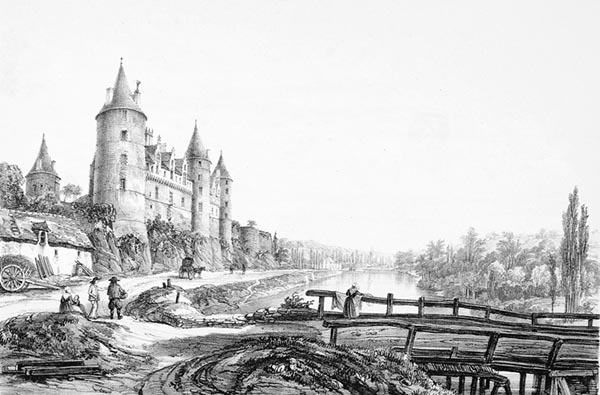
‘The Château de Josselin’ - Félix Benoist (French, 1818–1896)
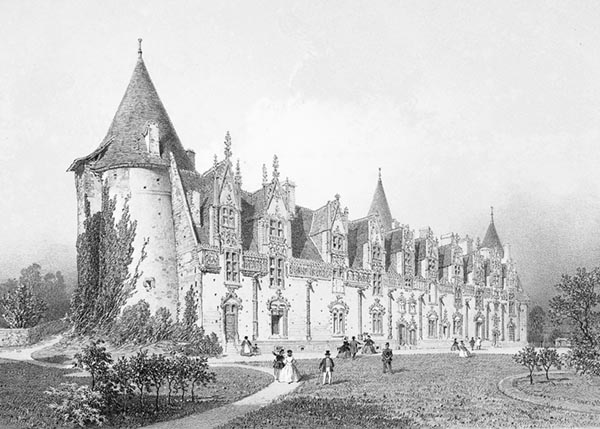
‘The Château de Josselin: the Inner Façade on the Courtyard’ - Eugène Cicéri (French, 1813–1890), Félix Benoist (French, 1818–1896) and Adolphe Jean-Baptiste Bayot (French, 1810–1871)
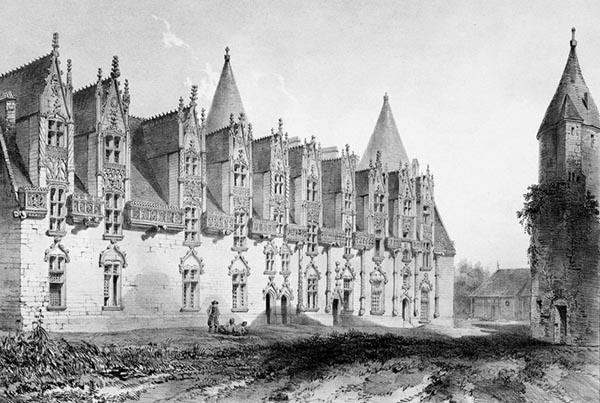
‘The Château de Josselin’ - Léon Gaucherel (French, 1816–1886)
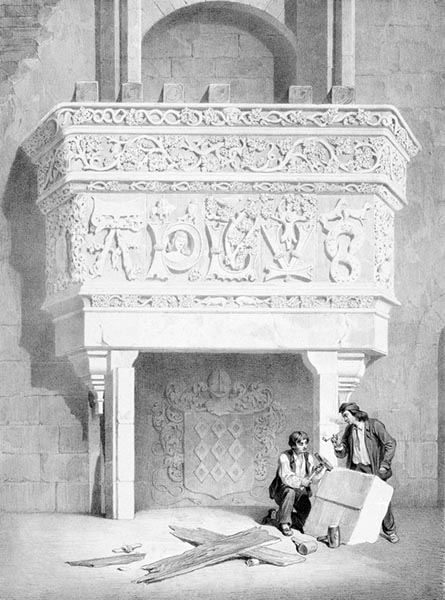
‘A Fireplace in the Château de Josselin’ - Léon Gaucherel (French, 1816–1886) and Adolphe Jean-Baptiste Bayot (French, 1810–1871)
The basilica at Josselin. — Notre Dame de Roncier; her red robe spread in an inverted fan.
The End of ‘By Field and Shore’ Part II