Gustave Flaubert and Maxime du Camp
By Field and Shore: Brittany (‘Par Les Champs et Par Les Grèves : Bretagne’, 1847)
Part I, Chapters I-III
Translated by A. S. Kline © Copyright 2026 All Rights Reserved
This work may be freely reproduced, stored and transmitted, electronically or otherwise, for any non-commercial purpose.
Conditions and Exceptions apply.
Contents
- Translator’s Introduction.
- Chapter I: (Flaubert: The Loire Valley, from Orléans to Tours).
- Chapter II: (Du Camp: The Loire, from Tours to Nantes).
- Chapter III: (Flaubert: Nantes).
Translator’s Introduction
In 1847 Gustave Flaubert undertook a walking trip, accompanied by his friend Maxime du Camp, which was partly a literary pilgrimage motivated by admiration for François-René de Châteaubriand, the father of French Romanticism. They travelled through north-west Brittany from May to July, taking in Saint-Malo, Châteaubriand’s birthplace and the site of his tomb, and co-produced an account of the trip. They produced alternate chapters, with Du Camp ‘developing’ his contributions, from a combination perhaps of his own notes and those of Flaubert. The precise method, and the extent of Du Camp’s personal contribution, is unclear. The result of their efforts is usually included in Flaubert’s collected works.
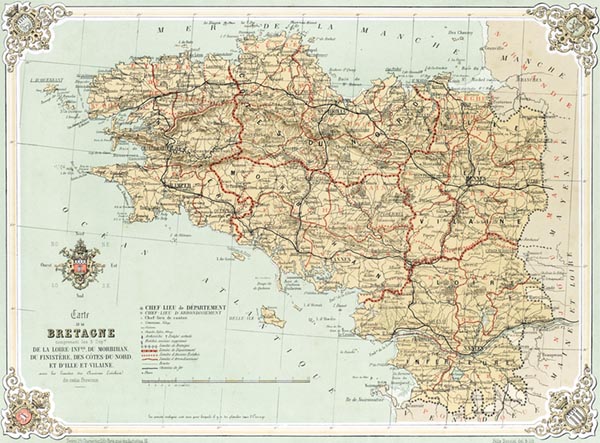
‘Map of Brittany’ - Félix Benoist (French, 1818–1896)
Between 1849 and 1851, Du Camp and Flaubert, who maintained a close and lasting friendship, again travelled together, to North Africa, primarily Egypt. Du Camp returned with the first comprehensive photographic studies of Egyptian and other antiquities, and is regarded as a major pioneer of travel photography. Flaubert’s notes and correspondence from the trip are of literary and historical interest.
This enhanced translation has been designed to offer maximum compatibility with current search engines. Among other modifications, the proper names of people and places, and the titles given to works of art, have been fully researched, modernised, and expanded; comments in parentheses have been added here and there to provide a reference, or clarify meaning; and minor typographic or factual errors, for example incorrect attributions and dates, in the original text, have been eliminated from this new translation.
Since there has been occasional confusion as to the year of their trip, note that the year 1847 is directly mentioned in the text, while each day of the week attributed to a given date in the month always matches the correct day of the week for that date in 1847, and not the preceding or following year.
You may view a map of all locations on Flaubert and Du Camp's route, provided by uMap (open map in new tab).
By Field and Shore: Brittany
Chapter I: (Flaubert: The Loire Valley, from Orléans to Tours
It was on May 1st, 1847, at eight-thirty in the morning, that we two ‘monads’ (‘individuals’: in the philosophy of Leibniz; simple, indivisible entities) who have in combination served, subsequently, to smear ink on paper, left Paris with the aim of breathing more freely amidst the heather and broom, or beside the waves on wide sandy shores.
We had no other ambition than to seek a corner of pure sky, flecked with swirling clouds, or to discover on the far side of some pale stony cliff, sited between river and hill, and hidden by holly and oak trees, one of those impoverished little villages such as one still encounters here and there, with its wooden houses, vines climbing the walls, laundry drying on the hedges, and cows drinking at the watering trough.
Later, perhaps, we might make lengthy journeys to far-off places, on camel-back astride Turkish saddles, or beneath canopies borne by elephants; later, perchance, we might hear the sound of Andalusian mule-bells, or pursue dreamy wanderings in the Marennes (the coastal area opposite the Isle d’Oléron), in melancholy regions rising, amidst the vapours of twilight, on the distant horizon, where those events occur that we read of in old books; but for now, without leaving for too long the corner of our hearth, abandoning our pipes and daydreams to be found later still warm, and without the poignant wrench involved in a major departure, with knapsack on back and iron-shod shoes on our feet, smoke still emerging from our lips, and fantasies in our heads, we were off to traverse the fields, sleep at inns in vast four-poster beds, listen to the birds beneath the trees in the rain, and gaze, on Sundays, at the peasant women in the church porches, issuing from Mass, dressed in large white bonnets and wide red skirts, and… what else?… To bronze our skin, that’s certain, and acquire lice, possibly!
This project is what led two beings endowed with reason (the definition of a human being in all the books) to each spend seven months meditating on the form, design, colour, size, and harmonious arrangement of the following objects, namely: a grey felt hat; a horse dealer’s stick, obtained expressly from Lisieux (in Normandy); a pair of sturdy shoes (in white leather, with crocodile-tooth studs); ditto in patent leather, and varnished (in case of diplomatic visits, if any were to be made, or parading about in Paphos, if by chance the geese of divine Venus bore us there in that goddess’s chariot); a pair of leather gaiters, suitable to accompany heavy shoes; ditto in canvas form, to protect our socks from dust on patent leather shoe days; a canvas jacket (that of a stylish stable boy); canvas trousers, disproportionately wide to be tucked into the gaiters; a canvas vest, whose elegant cut redeemed the vulgarity of the fabric, and a repetition of that same costume in cloth.
In addition, a pocket knife, two gourds, a wooden pipe, three headscarves, and whatever a European needs for his daily ablutions, and you have the accoutrements with which we approached Brittany, and by which we swore for a few weeks, in rain and sunlight. Never was a ball gown created with more tenderness, that is for certain, or worn with more aplomb.
The cannon thundered to celebrate King Louis-Philippe’s name day, the National Guardsmen were preparing to raise their chins above their collars, and the lamplighters on the civil list were preparing their tallow for the evening’s solemnities, when, after saying goodbye to our two friends ‘Fritz’ (Gérard de Nerval) and Louis (Louis Bouilhet), we boarded our railway-carriage; the door was closed, the iron beast snorted like a prancing horse, and we departed.
In past ages, when one travelled from one place to another, whether by carriage or boat, one had time to look about and undergo adventures; a journey from Rouen to Paris would provide enough material for a book. I know of people who, in their youth, took three days to complete the journey: they would spend the first night at Pont-de-l’Arche; the second, at Meulan-en-Yvelines; and considered themselves fortunate if, on the third day, they arrived in Paris in time for supper. One may read in an old itinerary of France published towards the end of Henry IV’s reign: ‘To travel from Rouen to Dieppe, there is a stagecoach which leaves three times a week; the journey takes a day; dinner is eaten at Tôtes, where there is a stay of three hours.’
The men, who are now playing at being policemen, and the women hosting dinner parties in the garden, will only know through the mouths of tradition what stagecoach travel was like, the driver in an astrakhan-trimmed jacket and the postilions, in their smocks, emitting loud cries from their perches; they will hear of the rotunda and the imperial, of post-houses where muddy, steaming horses were hitched, upon arrival, to iron rings in the wall, and feel free to imagine nights spent in old-fashioned inns, confusion as regards the beds, candles blown out in the corridors, the clamour of the maids, the innkeeper’s oaths, and the cries of the hostess. Where are they now those carriages deep in the mud, those grand ladies in frills who tumbled into puddles on their way to their châteaux? Doesn’t that single phrase, ‘the Auxerre coach’, make us think of Monsieur de Pourceaugnac (see Molière’s play of that name, a comedy-ballet, 1699) arriving in Paris in his short breeches, his clothes from a bygone era, speaking in his Limousin accent? Would we have the charming pages of Chapelle and Bachaumont (the17th-century French writers, Claude-Emmanuel Luillier, known as La Chapelle, and François Le Coigneux de Bachaumont. Their 1654 collaboration, the ‘Voyage de Messieurs Bachaumont et La Chapelle’, became a model for literary works of travel) if, instead of travelling from province to province in heavy carriages owned by their friends, the governors and farmers, they had journeyed by rail or in a steamboat?
All we noted, therefore, between Paris and Blois, was that the journey, however brief it may have been, was still far too long, irritated as we were by the arid mode of transport and quite bored, moreover, by the company of two grain merchants, great talkers, loud in their laughter, men who were no doubt wealthy, and seemed very pleased with themselves. One, wearing a medal, who was jovial, stout, fat, with thick lips, a strong neck, and a coarse powerful voice, represented the bold hoarder, the wholesale speculator, the mayor of his town, who will be deputy of his city and later a minister just like any other, while his neighbour, a small, lean fellow with a wrinkled face, sunken mouth, and protruding nose, who tossed samples of wheat up and down in the palm of his hand with an unspeakable smile of satisfaction and malice, looked more like the rapacious, covert sort of merchant, the stubborn tradesman, who sucks the empty bag from which he has poured its coins, the ferocious fellow who loves money for money’s sake and is enamoured of trade for trade’s sake; a common breed today, folk who aspire to own vineyards but never drink the wine! Also, next to us, sat a poor, sick, lame Englishman, who seemed to me to be eaten away by a metal other than silver (undergoing the mercury treatment); his little girl, with an ugly face but already a mature expression like that of a child that lacks its mother, was reading a vaudeville book from the Palais-Royal, or the Gymnase, so as to achieve fluency in the French language, and learn all about French customs and good taste.
At Orléans we had sight of Monsieur Berryer (Pierre Antoine Berryer, a prominent lawyer and politician who defended members of the House of Orléans) who, seated at the refreshment stand, was filling his broad stomach, and who took us to be two pleasant young men belonging to some administration or other: the only difference between us being, in his eyes, that between an idiot and a fool, a null and a void.
The memory of Victor Hugo’s youth, spent in Blois, occupied our thoughts as soon as we entered the town; walking through its silent, winding streets we reflected on the fact that he too had walked there some twenty years ago, gazing like us at the houses, seeking one in which to place his Marion de Lorme (the seventeenth century courtesan, see Hugo’s play of that name, 1828), and we questioned the atmosphere, the trees, the walls, seeking that indefinable something, individual and lasting, which defines a place, and constitutes its colour, and its soul, to explain the secret of that great man’s first literary flowering, in the untitled pieces of his first poetry collections, where the stanzas overflow, like the tendrils of hanging vines, metaphors bloom like suns, and the verse quivers with multiple rhythms, and endless harmonies. How many ideas that became works of art, how many dreams that became marble sculptures, blossomed at the corner of a wall, on the banks of the Loire, beneath a tree, in the morning dew, in the drops of grass, or on summer evenings, those beautiful evenings ardent and sad like first love, when the sky is streaked with long bands of cloud, and swarms of midges whirl in the air like golden wheels!
Is that why Blois charmed me so? For that matter, is there not a wide avenue of elms, near the landing stage, with spreading, bushy foliage, the sturdy branches rising from below, as if designed expressly to hang bagpipes there? True eighteenth-century elms, broad-spreading enough for folk to dance beneath them, to the sound of the fiddle, the player, perched on a barrel, keeping time to the beat of his foot, while tunics fluttered in the wind, powdered curls came undone, and lads clutched at the waists of young girls who laughed in terror, and swooned with pleasure.
The streets of Blois are empty, grass grows between the paving stones; on both sides stretches of long grey wall enclose large gardens, pierced by a few small, discreet gates that seem designed to open only at night to some mysterious visitor. One senses that each day must surely pass in the same way, that the streets must remain forever deserted, amidst this same calm monotony, gentle yet as sweet as the chimes of the church clock, filled with savoury melancholy and moving languor. Those peaceful dwellings tempt one to dream of some profound and intimate story, some morbid passion that lasts till ended by death, the ceaseless love of some devout spinster, or virtuous widow; one involuntarily places there, as if in her proper setting, a pale beauty with long delicate fingers, an aristocratic lady with cold manners, married to a boor, a miser, a jealous fellow dying of some chest ailment.
These reflections, which I recalled later, in Amboise, Chinon and other towns of Touraine, made me wonder if Honoré de Balzac, who is from the area, drew his heroines from there, whether it was here, in fact, that he discovered ‘The Woman of Thirty’ (see Balzac’s novel, of 1842), that immortal creation, unknown to antiquity like the Christianity to which it belongs; a creation which I value more than all the products of modern industry except for chemical matches, and the cold chicken fricassee at Tortoni’s (the Café Tortoni, on Boulevard des Italiens in Paris).
To exhume, from what was discarded as unusable, new literary expressions of plasticity and feeling, to discover a new continent of Love’s planet, and to summon to its exploitation thousands of beings who found themselves previously rejected, is this not a spiritual and sublime achievement? To extend the sphere of one sex, is that not almost to invent another? And what enthusiasm it evoked, akin to the discovery of America: instead of workless waggoners, and bankrupts, hastening there to make their fortune, a host of desperate feelings, and vigorous decadent impulses rushed ardently upon this great find: The Woman of Thirty; there was infatuation with the work initially, then an opposite reaction, but readers will return to it later as to everything that is true and good, as the world did to Galileo’s science, and long vests; they will see what they have only glimpsed, they will probe what they have only touched upon, the mine is still new, the vein runs deep; introduced to a new world by this first work, there are others, which will follow, that only require a great moralist, a great artist to be brought to light, such as that of the lyrical breast, whose full importance and accuracy were so well revealed to me by my illustrious friend, the sculptor, James Pradier.
As for my earlier comment, the influence of places on books, and for that matter of books on places, is somewhat like asking which came first, the chicken or the egg? Did Balzac’s books cause me to think about what happens in the streets of Blois, or did what happens there inspire the books? Who, whether mankind or some god, arranged things as we see them?
Venturing into one of those deserted streets, at the end of which, by an ironic twist of fate, hung a milliner’s sign, painted in red, we stumbled into a narrow alley leading to a kind of dead end containing the apse of the Church of Saint-Nicolas. It was a gloomy, slightly-tainted corner, as if filled with bitumen; everything was black, the stone paving, the very colour of the air; it presented the harsh, austere aspect of a priest’s robe, though beautiful in its nakedness, rawness, brutality. In the square, in front of the portal, in broad sunlight, masons were hewing stones; while the cheerful yellow hues of large wild roses, clinging to the corners of the Romanesque capitals, contrasted with the sombre colour of the old building, as they fluttering playfully in the air. They seemed to exist there simply to show how pretty they were.
The Château de Blois — To the north, the château, with its formidable walls, features a charming double-arched gallery; this was the chamber of Henry III. Next to it is his oratory, a coincidence which is nothing unusual in itself, but is striking here, given his soul in which voluptuousness was sharpened by religion, and cruelty incited by fear. Having passed beneath a curved arch, and traversed a square, we entered the inner courtyard of the castle. All was joyous: the garrison had been granted a bottle of wine per man, and the soldiers bearing jugs full of a bluish liquid were preparing to drink it to the health of the monarch whose name day had caused this treat. The castle courtyard is a regular square. The inner façade beneath which one enters, dating from the reign of Louis XII, has only one story, with a gallery supported by short columns, covered with lozenges, and adorned throughout with the cordelière of Queen Anne and the ermines of Brittany; the left (southern) side, of slightly earlier date, is unfinished; it is more restrained in ornamentation, more austere, more reminiscent of the Middle Ages. Opposite, a foolish building, constructed by Louis XIV, of collegiate classicism and austere taste, that is, poor taste, clashes detestably; but beside it the beautiful architecture of the sixteenth century bursts forth in all its splendour, the architecture of that golden age before the invasion of the Attic pilaster, before the Renaissance lapsed into the debased Greek style espoused by Marie de Medici. Attached to this building is the most exquisite spiral staircase in the world, in open stonework, chiselled with a lively hand, pierced like the high ruffs of the grand ladies who, for three hundred years, ascended its steps. On the ground floor, we saw the hall in which the Estates General of 1588 were held. A certain Gascon gentleman attended the proceedings, sent there to represent the nobility of Bordeaux; I imagine he took little part in the discussions that resounded beneath those wooden vaults. Seated apart, in his elegant black suit, and toying with the cane he always carried, he was no doubt mulling over some passage from Sallust or some verse from Lucan that his present circumstance brought to mind. Passionless amidst all those howling passions, lacking belief amidst a crowd possessed by violent convictions, he was a symbol of what endures alongside all that passes: his name was Michel de Montaigne.
Outside the castle, on a platform which overlooks the entire town, the Loire River lined with poplars, and the surrounding countryside rising towards the skyline in slow, imperceptible stages, I viewed a turret used to store the garrison’s gunpowder: this was where Cosimo Ruggieri, Henry III’s astrologer, lived. Laundry hung above the esplanade, the lines on which the concierge’s shirts were drying zigzagging in all directions; the sentry who was guarding the powder-magazine door had placed his rifle against it, he was balancing the weapon seeking equilibrium, and playing at snapping the spring that held the cover to the flash pan in place, while waiting to be relieved from duty.
Illustrious guests have slept beneath those walls: Valentina Visconti of Milan, Isabeau of Bavaria, Anne of Brittany, Charles VIII, Louis XII, François I, Claude of France, Henri III, Catherine and Marie de Medici, and the De Guise family who shed their blood there; it flowed in this very spot. In vain the eye still searches for it on the floor, among the Damascus plums (damsons) that ‘Le Balafré’ (Henri I, Duc de Guise, nicknamed Le Balafré, or Scarface, assassinated there by the Royal Guards in 1588) had scattered in the guardroom nearby, saying: ‘Who wants some’; the staircase by which he descended to the king’s chamber has been blocked, there is nothing to see, yet one still gazes.
After serving as the setting for the weddings of the Duke of Alençon and Marguerite of Anjou, for those of Henry IV and Marguerite de Valois, and for the bloody tragedies of the Guise family, the Château de Blois received yet other unfortunates: Marie de Medici was imprisoned there and escaped through a window that is still shown to visitors; in 1716, Marie Casimir, Queen of Poland, resided there; in 1814, Marie-Louise (of Austria, Napoleon’s wife) took refuge there after the capture of Paris; today the locals smoke their pipes and sing bawdy songs about her; the blood has been washed away, the sound of sarabands and minuets has vanished along with the laughter of the page-boys and the rustling of long-tailed coats. What remains of what history tells? And of all that it does not? What one desires to know, left unanswered by the ancient wainscoting, the silent old portraits that return one’s gaze, and the empty, yawning tombs, are the secrets they keep to themselves, and whisper to each other in solitude. The beauty of history, like that of the sea, is in the way that it erases all in the flowing tide. The next wave erases from the sand all trace of its predecessor, leaving one with the knowledge that the last existed and another will follow; is that all the poetry, the only moral perhaps, that history can offer?
The next day we visited a château in even greater ruin: I speak of Chambord. After going astray in the dull countryside surrounding it, we finally arrived via a long, sandy path through a meagre stretch of woodland, the property of a penniless landowner who consequently fells his trees prematurely. The château has neither garden nor park, not a single shrub, nor flower to adorn it; its façade faces a large square of sparse grass, at the foot of which flows a little river (the Cosson). When we entered, a young dog began barking; the rain fell, water was running down the roofs and through the broken windows. We were shown into the gatekeeper’s quarters, where, while waiting for his housekeeper who serves as caretaker to return from Mass, we perused the visitors’ book.
It is filled with Legitimist grievances, lamentations over the master and the house, wishes for the return of that august exile, etc. A certain Abbot Sam…, chaplain of the presbytery of X…, has written this magnificent verse:
‘One can be lame without ceasing to be upright’. A bolder, anonymous individual has produced this variant: ‘One can be exiled without ceasing to be king.’ Someone, no doubt full of indignation, has written in the middle of the book: ‘Oh, madness!’ But what struck us most were the names: ‘Louise and Alfred,’ lost among the Marquises, Counts, and Knights of Saint Louis, the sons of the victims of Quiberon (the battle, in 1759), the pilgrims of Belgrave Square (in London, where Henri, Count of Chambord, the legitimist pretender to the throne held court in 1843), and all that rabble of ersatz nobility who feed, like the Romanticism of the lawyer and historian Louis de Marchangy, on the eternal poetry of turrets, damsels, palfreys, the fleurs-de-lis on the oriflamme of Saint Louis, white plumes, divine right, and a host of other equally innocent nonsense. Amidst so many tearful grimaces, and arrogant pretensions, the names of those two unknown people struck us as possessing something about them which was simple, innocent, and in better taste than all the rest of the entries.
The Château de Chambord — We strolled the empty galleries, and through the abandoned rooms where spiders spread their webs over the salamanders, emblems of François I. It is not wholly ruined, despite its heaps of blackened and greenish debris, its adornment of coquettish wildflowers, and its curtains of vegetation undulating in the wind like shreds of damask. On the contrary, it merely exists in shameful poverty, a poverty that brushes its threadbare garments, and makes a decent attempt to repair the damage. The parquet floor is being repaired in this room, while being left to rot in that. Everywhere you sense a sterile effort to preserve what is dying, and recall what has fled. A strange idea! The result of the former is sad, the latter unsatisfactory.
And then, it seems as if everything has conspired to bring shame upon poor Chambord, which was designed by Francesco Primaticcio, and sculpted and chiselled by Germain Pilon and Jean Cousin. Built by François I, upon his return from Spain after the humiliating Treaty of Madrid (1526), it was a monument to Pride, seeking to stupefy itself, and atone for its defeats. Gaston d’Orléans, the vanquished pretender was exiled there (in 1652). Louis XIV increased the number of stories from one to three, thus spoiling the effect of the admirable double staircase that soared in a single sweep, like a spiral, from the ground to the top. And Molière first performed ‘Le Bourgeois Gentilhomme’ there (in 1670), on the second floor of the side facing the façade, beneath the beautiful ceiling covered with salamanders and painted ornaments whose colours are fading. It was then given to Marshal Maurice de Saxe (in 1745); it was handed over to the Polignacs; it was granted to a simple soldier, Louis Berthier (by Napoleon, in 1809); it was bought back by subscription, and given to the Duke of Bordeaux. It was gifted to everyone, as if none wanted it nor could keep it. It seems never to have been fully-utilised, and always to have been too large. It is like an abandoned inn in which travellers have failed even to leave their names on the walls. I saw only one piece of furniture there, a child’s toy: a model artillery park donated by Colonel Langlois (Jean-Charles Langlois, the soldier and artist) to the Duke of Bordeaux, and carefully preserved under linen covers.
Walking along an exterior gallery towards the Orleans staircase to examine the caryatids meant to represent François I, Madame de Châteaubriant (Françoise de Foix, his mistress), and Madame d’Étampes (Anne de Pisseleu d’Heilly, also his mistress), and circling the famous lantern at the top of the grand staircase, we repeatedly peered over the balustrade to look down: in the courtyard, a little donkey was being suckled by its mother, rubbing against her, shaking its ears, stretching its nose, and dancing about on its hooves. This was in what used to be the main courtyard of the Château de Chambord; these are the guests now: a dog rolling in the grass, and a donkey sucking, snorting, braying, defecating, and frolicking on the threshold of kings!
The weather had softened; the rain had stopped, and a gentle evening sun was shining when we arrived in Amboise. Here again, the streets are fine provincial streets, like those of Blois: people chat in their doorways, and work outdoors; the women, almost all dark-haired, with gentle and remarkably pretty features, display delightful feminine airs, full of a voluptuous benignity. One is indeed in the rich and gentle region of Touraine, a land of good white wines, and beautiful old châteaux, watered by the Loire, the most French of all French rivers. The attitudes and gaits of the people retain something of northern calm; while a southern vivacity animates their expressive features, and smiles; and yet, despite the bastardised character which commonly results from the fusion of opposing traits, Touraine seems to me to possess a distinct originality, not particularly forceful it is true, but fine and intimate, which is neither prosaic nor poetic and might be expressed, I believe, in the following phrase, if I did not fear that it would be taken in too exalted a sense: that of poetic prose .
We crossed the Amboise bridge. There are two, the town occupying both banks of the river and an island in the centre, but this was the second one and the more beautiful, one of those venerable bridges, one of those ancient hump-backed, narrow, grey bridges, abraded by sunlight and water, where a procession of horsemen, passing over it for some unknown reason, to the clashing of armour, and the sounding hooves of their horses moving at a walking pace, would make a good effect, and where one equally regrets not hearing, a blind beggar, seated on the parapet, turning his hurdy-gurdy, or a gypsy-girl barefoot in the dust, shaking her tambourine, the brief, abrupt sounds borne away amidst the noise of the water passing beneath the arches. While we were on the bridge, we saw the local National Guard appear, emerging from the promenade at the foot of the castle, returning from a review. Of the thirty or so men, five or six were wearing the uniform worn only by officers; the rest were commoners, but rare commoners indeed, in full dress with tailcoats, yellow waistcoats, and black gloves. The local dandies, it appears, affect disdain for civilian attire. I must confess, to Amboise’s credit, that nowhere in the ranks did I see (though I had anticipated as much) a single child dressed as an artilleryman grasping its father’s hand. Is that monstrous affectation unknown in the town, which would be a blessing? Has the fashion for such simply passed? Or is the level of wealth of its private citizens not great enough to justify the ludicrous expense? In any case, it does Amboise honour, since a child dressed as an artilleryman, and reciting military tales, represents the ultimate degree of human infamy.
The Château d’Amboise. — The château, dominating the town, which is heaped at its foot, like a pile of pebbles at the base of a cliff, has a noble and imposing fortress-like appearance, with its large, massive towers pierced by long, narrow, round-arched windows; its arcaded gallery running from side to side; and the tawny colour of its walls darkened by the plants and flowers hanging from above, like a noble plume over the bronzed brow of an old soldier. We spent a good fifteen minutes admiring and cherishing the superb left-side tower, which is brownish-yellow in places, black in others, with a profusion of wild radishes hanging from its battlements, and is, in sum, one of those ‘speaking’ monuments that seem alive, and detain you, wide-eyed and dreamy, before them, like those portraits whose sitters are unknown to you, yet which you come to love without knowing why. Laugh if you wish, good people; in which case that sentence was not penned for you.
We climbed to the château via a gentle slope leading to a terraced garden, which gave an extensive view of the surrounding countryside, tender green in hue; rows of poplars extended along the riverbanks; meadows ran to the horizon, their grey boundaries blurring to a hazy, bluish line, composed in a vague manner, of hilly contours. The Loire flowed through the middle of the scene, bathing islands, moistening the edges of the meadows, flowing beneath bridges, turning mills, bearing large boats roped together side by side, gliding peacefully between its banks in silvery curves, to the slow creak of the broad rudders that directed their somnolent course, while, in the distance, two tall, broad sails gleamed white in the sunlight.
Birds took flight from the tops of the towers, from the corners of the machicolations, to nest elsewhere, soaring, uttering little cries in the air, and passing onwards. A hundred feet below, we could see the pointed roofs of the city, the deserted courtyards of old mansions, and the dark tops of smoking chimneys. Leaning against the stone, in a crevice of the battlements, we watched, listened, breathed all in, enjoying the warmth of the sun, the gentle breeze, and the pleasant scents of the plants clothing the ruins. And there, without meditating on anything in particular, without reflecting on any specific thing, my reverie was filled with chainmail, supple as a leather glove, buff baldrics soaked with sweat, closed visors beneath which red eyes gleamed; with night assaults, desperate howls and cries, blazing torches lighting the walls, and battle-axes slicing through bodies; with Louis XI, with the ‘War of Lovers’ (the seventh War of Religion, 1579-80 was so-called, due to the frivolity that reigned at the court of Marguerite de Valois), and Agrippa d’Aubigné (poet of the Protestant cause); with the wild radishes, the birds, the beautiful glossy strands of ivy, and the naked brambles, and savouring thus, in my dreamy and nonchalant recollections that which is greatest about human beings: the memory of them. And that which is most beautiful in Nature: her ironic invasion of human affairs, and her eternal smile.
In the garden, amidst the lilacs and clumps of shrubs, is the chapel, a jewel of sixteenth-century stonework, carved even more intricately inside than out, its openwork resembling the handle of a Chinese parasol. Above the door, is a delightful bas-relief depicting the encounter between Saint Hubert and the mystical stag bearing a crucifix between its antlers. The saint is kneeling; above, an angel hovers, about to place a crown on his cap; beside him, his horse makes a fine figure of a creature; his hounds bark, and, on a hill whose slopes and facets resemble crystals, a serpent slowly advances its flat head, at the foot of a clump of trees resembling cauliflowers. They are examples of the ‘king of trees’ seen in old illustrated Bibles, bare of foliage, with thick trunk and branches, yielding timber and fruit, but possessing scant greenery; a symbolic tree, a biblical and devotional tree, almost fantastical in its impossible ugliness. Not far distant, Saint Christopher bears Jesus on his shoulders, and Saint Anthony is seen in his cell, built on a rock; his pig returns to its cave; only its rump and trumpet-shaped tail are visible, while near it a hare pokes its ears out of a cave in the hill.
This bas-relief is admittedly a bit heavy in style, nor is it entirely precise in its execution, but the work, with its animal portraits, is imbued with so much life and movement, so much kindliness and sound faith in the details, that one would give a great deal to take it home with one. It is worth more than those medieval-style statuettes found in barbershops, the equestrian figures by Alfred de Dreux that adorn the apartments of kept women, or Charles de Steuben’s ‘Joseph and Potiphar’, which, thank goodness, is nowhere to be found.
Inside the castle, the insipid furnishings of the Empire period are reproduced in every room, mythological or historical clocks, and velvet armchairs with gilt studs. Almost all are adorned with busts of Louis-Philippe and Madame Adélaïde. The current family in residence has a mania for reproducing its existence in portraiture. It populates every wall with such images, every console table, and fireplace, where such things can stand; the bad taste of the upstart displayed, the mania of a grocer, enriched by trade, who is delighted to see himself portrayed in red, white and yellow, with trinkets adorning his belly, sideburns meeting on his chin, and his children at his side.
A glass rotunda, contrary to all common sense, has been added to one of the towers to serve as a dining room. The view from there is superb. But the building is so jarringly ugly that I think one would prefer to eat in the kitchen and have no view at all.
To return to town, we descended a tower that once served as a ramp for carriages ascending to the square. The gentle, sand-covered slope winds around a stone axis like the steps of a staircase, and the vault is occasionally illuminated by the sparse light filtering through the arrow slits. The corbels supporting the inner end of the vaulting bear grotesque or obscene sculptures. Dogmatic order seems to have guided their composition. One should ‘read’ the work from its base, beginning with the Aristoteles Equitatus (Aristotle being ridden by a woman, a subject already depicted on one of the misericords in the choir of Rouen Cathedral), and, following the levels upwards, arrive at a gentleman amusing himself with a lady in the posture recommended by Lucretius (in ‘De Rerum Natura: Book IV’), and by L’Amour Conjugale (‘Conjugal Love’, see ‘Tableau de l’Amour Conjugale’ by Nicolas Venette, revised by J.R.J. Dubuisson, 1810). Most of the intermediate sculptures however have been removed, to the great despair of the seekers of droll fantasy; removed out of hand, expressly, out of decency, and as His Majesty’s servant told us, in a convincing tone, ‘because there were many that were unsuitable for the ladies.’
None can accuse me of groaning over devastation, whatever ruin or heap of debris it might leave behind; I have never sighed about the ravages of Revolution, or the disasters of the day; I would barely be troubled if Paris were turned upside-down by an earthquake, or I woke one fine morning to find a volcano amidst the houses, like a gigantic incinerator, belching smoke: it might result in a few charming watercolours, or grandiose paintings in the style of John Martin. But I bear a fierce and perpetual hatred for anyone who prunes a tree to ‘beautify’ it, or castrates a horse to weaken it; as I do for all those who dock the ears or tails of dogs, those who clip yew-trees in the shape of peacocks, and spheres and pyramids out of boxwood; those who restore, whitewash, and correct; the editors of expurgata; the chaste folk who veil profane nudity; the compilers of abridgments and summaries; those who will shave anything and set a wig on it, and who, ferocious in their pedantry, merciless in their ineptitude, go around amputating Nature, the beautiful work of the divine; and ruining Art, that other nature that humanity bears within, as the divine bears the other, and which is a younger or elder form of it, who knows? That, at least, is Hegel’s idea, which the Empirical school has always found quite ridiculous — and I? I, for one, feel remorse for having been cowardly enough not to have strangled the man who published that edition of Molière ‘which honest families can safely place in the hands of their children’; I regret not having scatological tortures, and outrageous means of producing agony, at my disposal, to employ on the wretch who sullied ‘Gil Blas’ (the picaresque novel by Alain-René Lesage, published between 1715 and 1735) with a similar gross display of his ‘virtue’; and as for that brave idiot of a Belgian clergyman who ‘purified’ Rabelais, why should I not, in my desire for revenge, awaken the Colossus just to see the fellow breathe-in the Giant’s breath, and hear the Titan’s howl!
How excellent an age, when those poor sculptures, in which such lovely things were portrayed, were yet intact; they would have brought a blush to the brows of travellers, terrified aged Englishwomen in their boas, with chilblains on their fingers, and splayed feet, and scandalised the morals of many an honorary notary, a ‘highly decorated’ gentleman in blue glasses, in truth, a cuckold! One could at least have compared the depictions to what we know of ancient customs, Renaissance ideas, and modern manners, which are supposedly steeped in various traditions, fine traditions that have declined dramatically over the centuries. Is that not so, monsieur? What says madame?
Yet, one’s mood is variable. The excellent dinner of which we partook at Amboise, and which we badly needed (having nourished the Muse more than the ‘creature’ all day), restored calm to our minds, and in the evening, trotting, briskly, along the road to Chenonceaux, we smoked our pipes, and inhaled the scent of the forest in a most satisfactory state of contentment.
Before retiring to bed, there, we indulged in the same pastime of pipe-smoking, beneath the trees surrounding the château. The rain was falling on the green leaves; sheltered beneath them, our backs leaning against the trunks of two large hornbeams, polishing the leather of our shoes with damp moss, we amused ourselves by listening to the sound of the raindrops dripping on our hats.
The Château of Chenonceaux. — An atmosphere of singular sweetness, and aristocratic serenity, emanates from the château. Situated at the end of a grand avenue of trees, some distance from the village, which keeps its distance, respectfully; built over the water, surrounded by woods; in the midst of a vast park with beautiful lawns, its turrets, its square chimneys soar into the air. The river Cher murmurs below its arches, the sharp piers of which break the flow. Its elegance is robust and gentle, its calm melancholic, yet without tedium or bitterness.
One enters via a vaulted room that once served as an armoury, and in which, despite the awkwardness of accommodating them, the few suits of armour displayed fail to look out of place, seeming, in fact, perfectly at home. Elsewhere, moreover, the period tapestries and furnishings have been intelligently preserved throughout. The venerable sixteenth century fireplaces reveal, below their mantelpieces, ignoble but economical Prussian-style ones which seem hidden when beneath lesser mantlepieces.
In the kitchens, housed within an archway of the castle, a maid was peeling vegetables, a kitchen-boy washing dishes, and, standing at the stove, before a reasonable number of gleaming pots, stood the cook, boiling ingredients for lunch. It all seemed fine, and had a pleasant air about it, exuding the honest life of a château, the leisurely and intelligent existence of a well-born gentleman. I like the owners of Chenonceau.
Are there not, moreover, fine old portraits everywhere that occupy one for hours, prompting one to imagine the age their subjects inhabited, and those balletic dances in which the farthingales of beautiful pink-clad ladies twirled, and gentlemen delivered fine sword-strokes with their dress-rapiers? That is one of the temptations of history. One would like to know if these people loved as we do, and the differences between their passions and ours. One would like their lips to open, so as to reveal the stories of their hearts, what they did in that distant past, even the most trivial things, and convey the nature of their anxieties and pleasures. It is an irritating and seductive feeling of curiosity, a dreamy desire ‘to know’, like the desire one has to penetrate the unknown past of one’s mistress, in order to be initiated into the many days she has lived without you, and share in them. But they remain oblivious to one’s questioning gaze; they rest there, mute, motionless in their wooden frames; one passes by. Moths eat at their canvas, they are revarnished, they smile on as we decay and are forgotten. And other folk will come and gaze at them, before they crumble to dust, and dream in the same manner before portraits of ourselves, and will likewise wonder what people did back then, what life was like, and if the weather was not warmer.
There are, for example, two large equestrian portraits of members of the Beauvilliers family, one an admiral, the other a cavalry colonel; they are booted up to their thighs, dressed in large green coats whitened at the shoulders by the powdered corkscrews of their wigs, wear gauntlet gloves and little hats, and are seated upright, perched on their large Mecklenburg horses, which, gathered on their hind legs, rear up to display their spirited natures. Here before you, they present themselves like a memory of the carousels of Louis XIV and the great hunts: yellow greyhounds with white markings, a cloud of liveried huntsmen surrounded by the barking pack, and large hunting-horns, worn around the body, sounding long hallalis in the clearings.
Over a doorway, an easel-mounted canvas portrays the beautiful Gabrielle d’Estrées, naked to the waist, a large pearl necklace of the same blonde tone as her skin clinging to her breast; her blonde hair, tied up and frizzed; and an astonished and naively seductive look on her face. Next to her, her sister, seen from the rear, also naked to the waist, turns her brownish-toned face and glances at you with curiosity, while, in the background, a peasant woman in a red cape and a white cloak presents her breast to the little Duke of Vendôme, charming in his swaddling clothes, tied up and stiff in his linen, who widens his eyes, and stretches out his arms, his little pink mouth wide with laughter at his good nurse’s teasing.
We also noted, in the apartment that serves as a drawing room and in which the mace of François I rests on a table, a fine portrait of Rabelais: here, a swarthy, hilarious, sanguine, robust figure, with small, lively eyes, sparse hair, and a satyr-like beard and chin — clearly the original after which all the other portraits of the great man have been created. The portrait of Isabeau of Bavaria, below and a little to the left, is singularly expressive: she is not wearing the large pointed bonnet, which I have seen her in elsewhere, and is no longer the pale and sorrowful figure of the Versailles gallery; a kind of flat, Italian-style headdress covers the long blonde tresses, half undone, which surround her white face, both sympathetic and ardent, full of irresolution and thwarted impulses; she has protruding lips, a short chin, and large green eyes whose tearful expression is enhanced by the red rims of her lower eyelids.
There are many other paintings on the walls that one would have liked to look at longer, alone and at one’s leisure, without a concierge on one’s heels, gripping a key, and gesturing for one to hurry up and finish. I recall a full-length portrait of Louis XIII as Apollo, with his pointed chin, small, straight moustache, and a large black wig that falls over his shoulders and casts a shadow over his sad face. I have never thought of Louis XIII without a certain sorrow; it seems to me that he was the most bored individual on earth.
We were unable to enter the theatre where ‘The Village Soothsayer’ (‘Le Devin du Village’ a one-act French opera by Jean-Jacques Rousseau, who also wrote the libretto, 1752) was performed, as it was being repaired; but we did see a fine portrait of Madame Dupin (Louise Marie Madeleine Fontaine, the saloniste) by Jean-Marc Nattier. She is dark-haired, her face alert, and coquettish, with a turned-up nose and rosy lips, a dark-eyed and direct gaze, and a frank, friendly, mischievous and good-natured air, and is far more intelligent-looking than the portrait of Mme d’Humières (Françoise, Governess to the Royal children), for example, with her pink heart-shaped mouth so moist and sensual.
I would move on from all these beautiful ladies, were it not for the large standing portrait of Madame Deshoulières (Antoinette du Ligier de la Gard), clad in a long white negligée. The picture offers one her noble face, (which like the much-maligned and neglected talent of that poetess, appears finer on second viewing than at first), which reminded me, due to the unmistakable character of the mouth — wide, prominent, fleshy, and sensual — of the starkness of the François Gérard portrait of Madame de Staël which I saw two years ago at Coppet (Switzerland). The window was open, the sun shining directly on it, and I could not help but be struck by those red, wine-coloured lips, those wide nostrils, sniffling, inhaling the air. George Sand’s face has a similar aspect. In all such mannish women, spirituality begins only at eye level. The rest appeals to the realm of sexual instinct. They are, almost all, plump; and of masculine form: Madame Deshoulières, Madame de Sévigné (Marie de Rabutin-Chantal, Marquise de Sévigné), Madame de Staël, George Sand, and Madame Colet (Louise Revoil de Servannes). The only lean one I know of is Madame Annaïs Ségalas (Anne Caroline Menard).
In Diane de Poitiers’ bedroom we viewed that royal concubine’s large four-poster bed, upholstered entirely in blue and cherry-red damask. If I owned it, I would find it very difficult to resist sleeping in it now and then. To occupy Diane de Poitiers’ bed, even when empty, would be finer than doing so with a multitude of more tangible realities. Has it not been said (by De Sade, in particular) that in these matters it is from imagination that the pleasure derives? Can you then conceive, you who possess a modicum of imagination, the singular, historical, sixteenth-century delight of laying one’s head on the pillow of François I’s mistress, and tossing and turning about on her mattress? (Oh! How gladly I would exchange all the women in the world for the mummified body of Cleopatra!) But I would not dare to touch, for fear of breaking something, Catherine de Medici’s porcelain in the dining-room, nor place my foot in François I’ stirrup, for fear it would stick fast, nor set my lips to the mouthpiece of the enormous trumpet in the armoury, for fear that my chest would burst.
We said farewell to poor Chenonceaux, however, leaving behind its beautiful memories, its fine portraits, its excellent weapons and old furniture, as it slumbered to the sound of the cooing river, in the shade of its tall trees, amidst the green grass; and, full of good humour, and with our flasks filled, we inaugurated our new knapsacks by walking to Bléré, and travelling from there to Tours by carriage.
The route is not at all entertaining; it consists of a long, rather sparse stretch of meadowland with a few pale poplar trees.
At Bléré, while they were feeding the horse with oats, and dragging from the shed a cabriolet which was half eaten away by worms, like an ancient Roquefort cheese forgotten in some cupboard, we visited the church where the remarkable taste for Rococo ornamentation began, with its artificial flowers, ribbons, pompoms, and paper garlands, a few leagues away, in the towns of Anjou, a province which seems to have preserved the Italian predilections of its former masters.
As far as Tours, the road is truly beautiful, the countryside is ample and lush, fertile and healthy in appearance, with neither the sombre exuberance of Normandy nor the subtle light of the South. One passes under fine trees which cover the road like arbours, or amidst wide meadows enlivened here and there by towns and bell-towers, and, from Montlouis, one travels the banks of the Loire, encountering one after another, receding and forever returning, castles on the hilltops, vineyards beside wheat fields, and oblong islands each with a crown of poplars and a fringe of reeds. The wind is warm without voluptuousness, the sun gentle without ardour; The whole landscape, pretty everywhere, varies little in its monotony, being light, graceful, but with that beauty that caresses without captivating, charms without seducing and, in short, possesses a greater degree of commonsense than grandeur, and of intellect than poetry: such is France herself.
Chapter II: (Du Camp: The Loire, from Tours to Nantes)
Tours — The Abbey of Saint-Julien; the plain cover of a superb novel; three charming tall arched windows at the top; a dilapidated interior, used for storage; the left transept, coated in cobwebs, magnificent in tone; at the rear, through the doorway, one could see a Parisian travelling-bazaar.
Plessis-lès-Tours (La Riche); a high street in flat countryside; a large walled enclosure. — The house of Tristan l’ Hermite (provost and executioner, appointed by King Louis XI, who resided at the Château de Plessis) a small, with a pointed open archway. — The late fifteenth century church (Notre Dame de la Riche, substantially rebuilt 1860-66), is ornate, heavy, with a purer interior, and magnificent ironwork in the choir.
Chinon — On the left, descending the hill, the castle towers before one. — The view of the castle, in whose shadow the town is built. — Chinon, with a cramped air, compressed between the Vienne River and the castle, has been forced to spread out lengthwise. — From the river, the old town rises on the slope, a series of winding streets and silent arches, black shells like those of Carcassonne and Provins; donkeys graze in the streets, Gargantua's mounds (‘tertres’, geological formations mentioned in Rabelais’ ‘Gargantua and Pantagruel’) crumble beneath one’s feet. — The castle, on the heights, is in the form of a rectangle with alternating round and square towers; trees grow in the moats and weeds on the walls. — On the side of the Agnes Sorel tower (Agnès Sorel, known as La Dame de Beauté, was mistress to Charles VII), opposite the town, is the cemetery, at the foot of the towers; there are two large walnut trees. — The tower with the iron cage (La Tour de l’Horloge) has three upper stories. — On the lower two (the cage is in the first) there was a fireplace, a ring in the ceiling, prisoners’ inscriptions, rosaries, and holy ciboria. — Everywhere amidst the grassy ruins, there were lilacs in bloom. — In the room where Joan of Arc was received, there were daffodils in bloom and wild roses heaped one on another. — At the tower that serves as the entrance gateway, one can see the winding mechanism of the portcullis. — Everywhere in Chinon I searched for some trace of Rabelais, and found nothing; is Rabelais truly their native genius? (Rabelais was born, between 1483 and 1494, in Seuilly, near Chinon).
From Chinon to Fontevraud, the charming road winds through greenery; these are large trees with broad canopies. Night fell before we reached the town.
Fontevraud nestles, somewhat in the manner of Jumièges (in Normandy), around the abbey, with no sizeable hill in sight. — The most curious thing is the church, whose (exterior) apse is in a beautiful Romanesque style with surrounding rotundas. — The chapter house is in the early Gothic style; the cloister, Gothic in the manner of the Abbey of Saint-Wandrille (Rives-en-Seine, Normandy). — The warden (Fontevraud Abbey was converted to a notorious prison by Napoleon, in 1804) in a blue dressing gown was in his study, a stuttering, sharp-tongued, ignoramus. — Prisoners in the refectory, in the exercise yard, in single file, in enforced silence. — Poor Robert de Arbrissel (founder of the Abbey), soul of love, did you anticipate these shameful goings-on? — Gendarmes, and African troops.
From Fontevraud to Saumur. — Due to the sun that warms the rocks covered with verdure, a countryside notable for its gentleness. — Anjou (Saumur in Maine-et-Loire, was historically part of the province of Anjou), seemed to me like a kind of Normandy.
Saumur. — Cavalry officers in uniform. — The Church of Saint-Pierre. — Small, badly-paved, winding streets, flowers in the windows. — Notre-Dame-des-Ardilliers, a royal chapel with a dome, like the Pantheon of Agrippa in Rome. On the left upon entering, beneath a deep, dark arch of artificial rock, the statue of a woman in a white dress with leg-of-mutton sleeves; with two locks of her black hair, one hanging to the side, the other across her waist, she lies amidst stones, on the rock; the shadow of the arch contrasts with the white of her garment and the pallor of her face. Despite the ugliness of the invention, and the bad taste of it all, there is something striking and memorable about her. — A ‘Saint Simeon’ by Philippe de Champagne; a beautiful head of the saint, blond, luminous, gentle, and moved by emotion; a child walking past on the left. — Saint-Pierre, a charming side entrance, exquisitely Romantic, but what is most beautiful is the colour of the stone, which is green, blue, etc.; the interior chapels are covered in flowers; in one a Passion, with rocks in relief made of painted canvas; everywhere the Gothic medieval element disappears beneath colour-wash and Italianate ornamentation. The emblems of faith are clearly evident in the chapels; they are where people go to pray; the religious engravings are intertwined with garlands of ivy (as at Bléré, on the small side altar). — Anjou has the fragrance of Italy. Is that a memory? A lingering influence? Or the effect of the gentle Loire, the most sensual of French rivers? — Notre-Dame-de-Nantilly (Saumur), is pure Romance, its semicircular portal arch is broad and strong; one ascends it via a slope, an old stone staircase; it is surrounded by tall trees. How beautiful it would be, were it not for its colour, a dreadful white!
The covered alley at Bagneux (Saumur) is about twelve paces wide, roughly thirty long, and eight feet high; monstrous stones; rain dripped through the cracks, creating puddles inside; two holes in the rear wall allowed bright, white light to enter; the leaves of the trees glistened in the streaming rain; the inner sides of the stones were green in places, whiter in others. — The inept driver of our American carriage. — We passed a herd of Vendée oxen. — The art of tree pruning as published by the Roads and Bridges Administration; their ideal of ineptitude and hatred towards Nature has been realised at Saumur, on the road to Poitiers, just outside the town. — Our hosts. — Veal again! — A provincial drawing room: red Utrecht velvet seems to be, like calfskin, one of the cornerstones of provincial life. — Among varieties of butcher’s meat, veal is the chosen meat of universities and academies.
From Saumur to Ancenis along the Loire. — The river gentle, wide, and expansive, but the poplars lend a slender air to the landscape. — Round towers at Angers. — Saint-Florent-le-Viel on the left bank, perched on a hill. — Yet the Seine is more beautiful; I rank the Loire after the Seine and the Rhône; nowhere did I see anything to compare with Dieppedalle (Le Havre), La Mailleraye-sur-Seine, or Caudebec-en-Caux; the Loire is more French, gentler, more bourgeois, more prosaic. — The steamboat: a young girl and her mother; a cold, white face; a cavalry officer, his wife, and child; various gentlemen. The steamboat was, as ever, a steamboat.
Ancenis is what one might call a wretched little town, badly-paved, winding, with poor, grey houses, as in the small towns of Languedoc, but its state of destitution lends it a strange charm; no one in the streets. — The Hôtel de la Marine (near the steamboat landing stage, long since converted to dwellings): a plump, graceful woman of about forty; the grandmother, with two little girls; the gentlemen at the inn, bored to death with the countryside and longing for the delights of the capital. — A lovely view of the Loire, certainly one of the most beautiful stretches of the river. — The church (Saint-Pierre) is strikingly bare and curiously awkward: three pyramids at the foot of a mission cross, covered from top to bottom with hearts pierced by arrows; marble canopies; ornamentation in deplorable taste. — The château now consists only of the outer walls, adorned with crenelations, and the two large circular entrance towers, one of which still bears a stone cannonball. The interior is dilapidated, occupied by a vegetable garden; the caretaker took us for a walk there with her children. Wild radishes, brambles, beautiful perennials, lovely green leaves clinging everywhere, hanging in the corners; the view from the top of the keep is singularly marred by the suspension bridge. — Formidable mass of the Druidic stone (Dolmen de la Pierre Couvretière, known as the Devil’s Stone) on the Druidic plain. — A perfectly apt joke from my honourable friend about the wobbly stone.
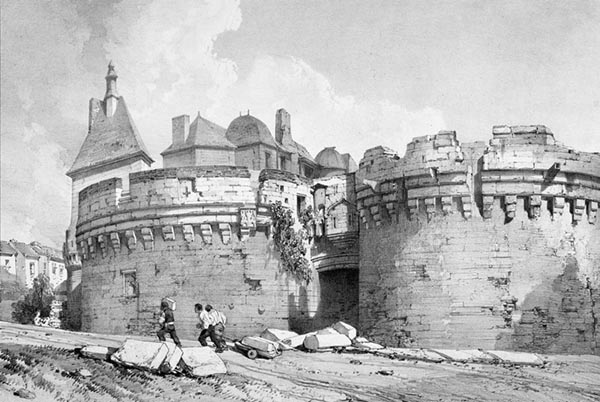
‘The Château d’Ancenis’ - Eugène Cicéri (French, 1813–1890)
From Ancenis to La Meilleraye-en-Bretagne, the landscape is bleak, though green and lush. Enclosures and hedges are everywhere; there is something sombre and mistrustful about the countryside. Few people seen, even though it is Sunday; the little girls wear large bonnets, as do the women, who are all quite plain; young girls sit in pairs or trios beside the ditches, their backs to the main road. The clumps of broom multiply as we travel further, the trees become stouter, smaller, and stockier. At Riaillé, there is a procession with white flags. Our driver, a Norman from Domfront, with almost white hair and dark eyes that remind me of Colonel Langlois. The driver detests the Chouans (royalist insurgents in Brittany and Maine); in 1832 (the last ‘Chouannerie’ uprising), he would not have taken us this way for a hundred thousand francs.
The Trappist monastery of La Meilleraye-en-Bretagne (Melleray Abbey) was exposed to view by the heavy felling of the surrounding woods. — As we emerged from beneath the gate, departing oxen were entering it. — We were ushered into a high-ceilinged reception room on the first floor, furnished with eighteenth century armchairs; the atmosphere was half monastic, half country château. A monk came to ask if we needed anything; then the one in charge of guests asked for our names. We were led to the chapel, then to the parlour. Two white-clad monks came and prostrated themselves at our feet; they escorted us back to the chapel to say an Ave and a Credo, and then returned us to the parlour so as to read a passage to us from the ‘Imitation of Christ’ (by Thomas à Kempis), from the third book, Chapter xx (‘Of confession of our infirmity, and of the miseries of this life’) — Dinner in a large room, fairly clean tablecloth, iron cutlery. An old Breton abbot, with a small, open face, and white hair, served hard-boiled eggs with sorrel, and a kind of gluey porridge, that I mistook for curdled milk, with stewed prunes. — I thought of the grotesque, and biblical, virtues that Henri Estienne (Henricus Stephanus) attributes to monks in his ‘Apology for Herodotus’ (1566, Book I: Chapter XX: ‘To sum up the virtues of a monk, he should be filthy and gluttonous, lazy, lecherous, improper, foolish, fat, drunken, and unlearned: he should stuff himself at the table, drinking and eating like a pig’).
Individuals: to my left, a former soldier, woollen skullcap, upturned nose, empire-style sideburns, the air of a paid-up Carlist, and a great lover of salted butter; on my right, a bankrupt peasant? Opposite, a tall young man, thick-lipped, a mystical air, strong hands; opposite, a priest of about forty, a man of powerful build and excellent manners, probably executing a penance; to my left, beside me, a vicar with white hair, the lower part of his face singularly fleshy and ignoble, a level and rather intelligent brow, knowledgeable as regards chemistry, according to the old Breton abbot who chatted with us in the garden after dinner. — Amidst the boarders, a dreadful little man in a black suit, with a cap over his black silk bonnet.
The chapel. — After the Salve, we descended from the gallery, the monks knelt, and we stood among them to recite litanies to the Virgin. The chapel of the Virgin was draped with a white curtain, open like a bed; the altar had a transparent rose covered with lace; artificial and real flowers surrounded the plaster statue of the Virgin; candles were lit, and their voices began to sound. There was something voluptuous, something conjugal, in the arrangement of it all; these humble men seemed to have prepared the bed of their heavenly bride, in a loving manner. The voices were strong, powerful; life’s energies returned to them, dawned within them. When we entered the church, it was still daylight; the sun, with a touch of Nature’s irony, coloured the chalk-white walls and ceiling pink. — The district-surveyor, a friend of the establishment. — The monks’ novitiate (period of training) is exacting. — The abbot’s wishes are humoured because of the inheritance taxes to be paid after his death, so he sleeps on a comfortable mattress. — A notice announcing the death of the mother of one of the monks, pinned up in the refectory. (Written Sunday, May 9, in the cell of Saint-Théodore, ten in the evening.)
In the parlour, among the items for sale, was an engraving entitled ‘False Pleasures’. In the foreground, one sees an adolescent dressed in a robe, holding a rosary and gazing upwards; in the heavens, angels with their pointed wings play violas; on Earth, on the contrary, one sees two young women with low necklines and leg-of-mutton sleeves, one is playing a guitar and the other dancing (the former is adorned with sabot sleeves, and bracelets), they seek to charm a young troubadour in a jacket and breeches, sporting sideburns, who glances at them sideways; in the background, there is a lake with poplar trees. Below is written:
Voluptuousness, that seeks to tempt,
Abjure, and never yield;
A joy that’s wholly innocent,
He gains who wins the field.
No one came to wake me at two a.m. for Matins; I passed the night rather badly in a bed stained with blood. In the morning, a grey and pale one, I took breakfast with the same intriguing set of boarders. There is great sadness involved in the necessity of rising early just so as to eat. — A tour of the establishment: in the workshops, no singing, only a stupid silence; taking the bull by the horns and greeting the monks in the corridors, in passing; they failed to speak, though they saw we needed directions, but their expressions! Two monks performing their retreat in the chapter house; the pair were truly consumed in prayer; at the rear, the abbot’s seat with the crozier. The refectory, wood-panelled, full of a damp, stale smell. — They stink to high heavens in this holy spot! — The refectory as well as the dormitory are places that are especially respected; not even strangers are permitted to speak there. — The dormitory is all one hue, giving it a handsome, if austere, appearance: a wood-grey; the ceiling and floor are both wooden, the dormitory has square four-poster beds as tall as the ceiling; between each bed there is a small curtain made of ticking (the canvas used to cover mattresses); the mattress is of straw; there’s a chamber pot beneath each bed. — The cemetery: all the graves are identical surmounted by a black cross; the only difference is that the cross is raised at a monk’s feet, and at an abbot’s head. — The brother in charge of the guesthouse did not wear the prim and proper attire of the clergy; he walked over the graves casually. — Such were the most interesting features of La Meilleraye.
We were in such a hurry to leave that we chose not to wait and attend Mass. — Our joy revived in the fields, hoisting our knapsacks, finding freedom and sunlight once more. — In the village, after an omelette that, to us, seemed excellent, and delicious fried kidneys, we went off to a wood to smoke beneath the trees.
Nort-sur-Erdre, indescribable frescoes. Downstream the Erdre suddenly widens, a gentle river with pretty features, trees reminiscent of one of those old seventeenth-century engravings, in which a man is seen fishing in short breeches, wearing a puffed-out shirt that reaches his navel, while beside him a shepherdess arranges flowers in her apron, and a dog lies flat on its stomach in the hay. — We encounter the gentlemen from Meilleraye again on the boat, the portly fellow and the short, bespectacled one, whom we saw earlier on their knees in the church at Nort. — Boaters wearing pince-nez are unusual. — Verrières-en-Anjou — Entry to Nantes; we have been at work here since the morning of the day before yesterday. (May 13th, 10 a.m., Nantes.)
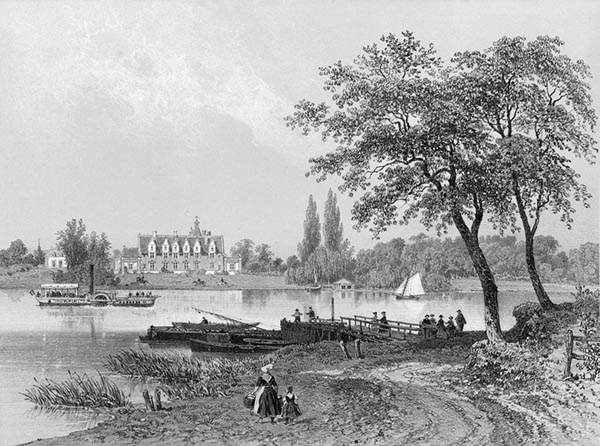
‘The River Erdre and the Château de la Gascherie’ - Félix Benoist (French, 1818–1896), Adolphe Jean-Baptiste Bayot (French, 1810–1871) and Eugène Cicéri (French, 1813–1890)
Chapter III: (Flaubert: Nantes)
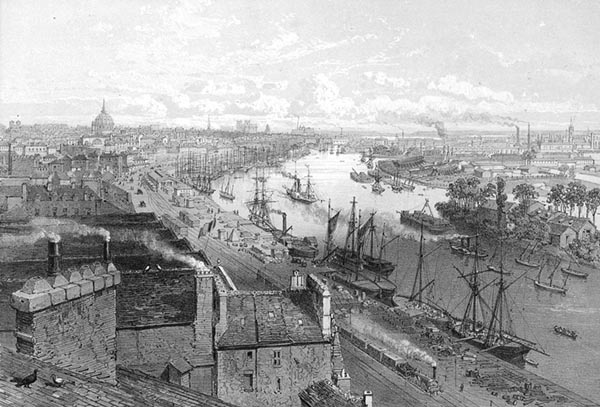
‘Nantes: General View of the Harbour’ - Félix Benoist (French, 1818–1896)
On leaving the Trappist monastery, it was pleasant to see human faces again, and to view steaks with anchovy butter. Delighted still by the frescoes of Nort, though horrified by our memories of La Meilleraye, we possessed, on the evening of our arrival in Nantes, the finest appetite imaginable. Comfortably settled at the Hôtel de France (then on Place Graslin), we led a very pleasant life for eight days. We had at our service one of those lively and graceful rogues who appeal to the well-bred, a clever fellow, who sold excellent cigars and fine perfumes. We wrote in our cool room, we washed ourselves in large basins, we played, in the courtyard, with a little monkey who would tear our old white gloves to shreds with its teeth and nails as though they had been invented for his use, or else we would go to the Passage Pommeraye (constructed in 1843) to buy Chinese blinds, Turkish sandals or Nile baskets, examining at our leisure, while handling, all the trinkets, things from beyond the seas, idols, shoes, parasols and lanterns, splendid colourful trifles that prompt us to dream of other worlds, useless trifles that to us are serious things.
I think Nantes is a somewhat vacuous city, but I ate so many prawns there that I have fond memories of it. The proof that Nantes failed to bore us is that we were about to leave when we decided we ought to tour it anyway.
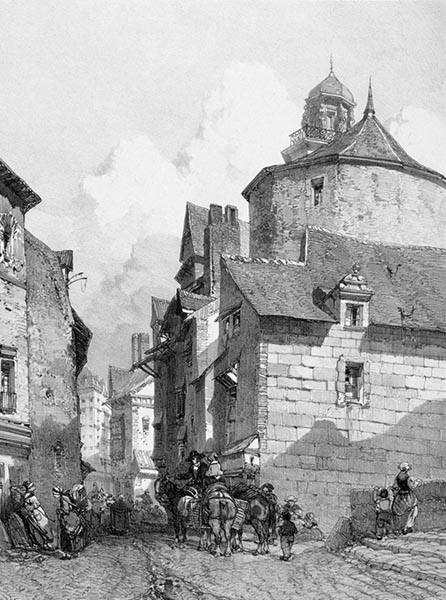
‘The Rue de la Poissonnerie, Nantes’ - Eugène Cicéri (French, 1813–1890)
It lacks the sombre grime of Lyon, the bustle of Le Havre or Marseille, or the straight lines of Bordeaux, a city so beautifully built that it resembles a handsome gentleman in a bow-tie; nor is it the equal of Rouen, which would be beautiful if it were not so embellished, and which I would love if I had not been born there (on December 12, 1821). From the top of the cathedral (Saint-Pierre-et-Saint Paul), however, a view is revealed that rewards the effort of climbing the stairs: far below, the houses huddle together, their roofs crammed together like the pointed hats of a crowd of folk pressed shoulder to shoulder; to the left, a wide meadow dips to the bank of the broad, grey Loire as it divides and curves, while the courses of the Erdre and the Sèvre, with multiplying branches and islands, carve the countryside into broad grey lines. That day, the sky shed a pale light, which gave the whole scene, its hue harmonising with the muddy tints of the water, a tranquil and melancholy aspect. The countryside is vast, expansive, greener and more vibrant if one ascends the Loire on the Touraine side, but monotonous, and almost numb as one descends the river towards the sands on the seaward side. All things considered, the horizon is wide and beautiful, but what horizon is not if it is vast, and are not all horizons vast when you view them from above? Climb, anywhere, provided you climb high enough, and you will discover boundless perspectives in the flattest of landscapes. What idea, too, is not extensive when pursued to its end; what heart does not seem immense when its depths are plumbed?
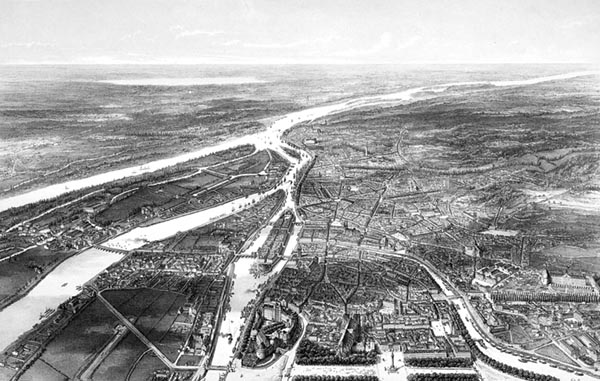
‘A Bird’s-Eye View of Nantes’ - Félix Benoist (French, 1818–1896)
I used to spend many a happy hour on some church steeple; leaning on the parapet, I would watch the clouds roll across the sky and the crows, nesting in the gargoyles, take flight amidst raucous cries and powerful wingbeats. It was quite often, during my studies in rhetoric, my way of keeping up with the class; I missed a great deal, but was I not studying style too?
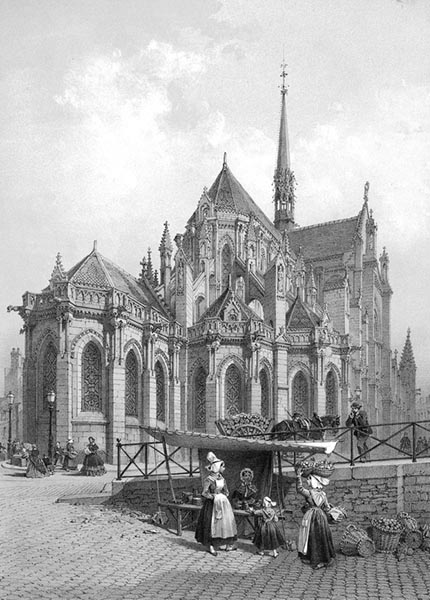
‘The Church of Saint-Nicolas, Nantes’ - Félix Benoist (French, 1818–1896)
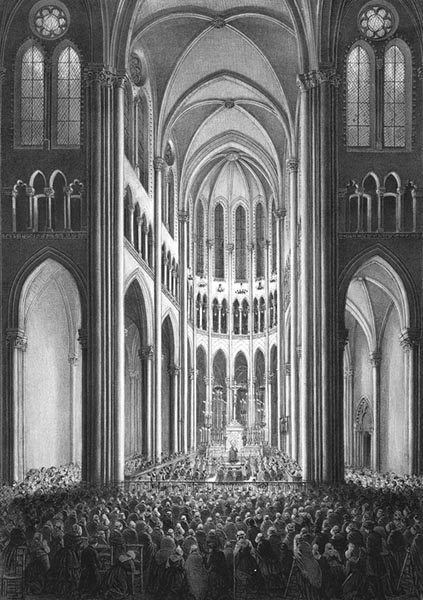
‘The Church of Saint-Nicolas’ - Félix Benoist (French, 1818–1896)
In Nantes, a commonplace thing both shocked and amused me: it was the telegraph station, on a tower opposite, that I suddenly saw, on turning round. The stiff arms of the mechanism were motionless, and on the ladder leading to its base a sparrow was hopping from rung to rung; set above everything around it, above the church and the cross that crowns it, that unsightly instrument seemed to me like a fantastic grimace shaped by the modern world.
What was traversing the air, between the clouds and the birds, in that pure region where the voice of the bells dies, and the perfumes of the earth below evaporate? The news that rents were falling, the price of tallow rising, or that the Queen of England had given birth?
What a strange life it is for the fellow in that little hut, working those two arms by pulling on their ropes, he who is an unintelligent cog in a machine which is mute as far as he is concerned! He may die without being aware of the contents of a single item of news he has transmitted, a single word of all those his station has uttered. The purpose? The meaning? Who knows? Is the sailor concerned to know to what land the sail he hoists is carrying him; or the postman with the contents of the letters he delivers, or the printer with the message intended by the book he prints? Is the soldier concerned with the cause for which he kills, and is killed? A degree more, a degree less; are we not all like this good man, speaking the words we have been taught, which we learn without understanding them? Ranged in a line, gazing at each other across the abysses that separate them, the centuries transmit, thus, from one to another the eternal enigma that comes to them from afar, to be passed on afar; they gesticulate, they wave their arms amidst the fog of history, and those who, posted on summits, cause them to gesticulate know no more than the poor devils below who raise their heads to try and divine the meaning.
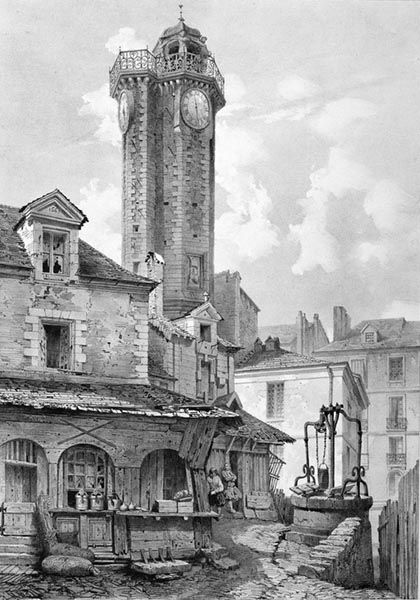
‘Details of the Portal Archivolts, Nantes Cathedral’ - Léon Gaucherel (French, 1816–1886)
Where was I? Nantes, the cathedral. It is in the English style of the fifteenth century. Laden with heavy carvings, weighed down by the sterile embellishments of the Gothic style in its decadent period; ugly externally, too short in extent internally; the nave is well laid out, but the vaulting is rather ugly, the curve flattened. We noticed beneath the main portal, occupying the space between the pointed arches, a kind of stone shaft simulating a cluster of tree trunks, with the beginnings of severed branches, like a pruned holly stick. This feature is found in several churches in Brittany. Speaking of ugliness, and exceptional ugliness, one must mention, in one of the side chapels, a sort of wainscoting plastered on the walls, executed in a deplorable, medieval style and attaining the limits of imitative Rococo. But one truly beautiful thing is the tomb of Duke François II of Brittany and Margaret of Foix, his second wife. They are both in fine period costume, the ducal crowns on their heads, reclining on their marble slab, the duke with a lion at his feet, the duchess with a greyhound; three angels lift the cushion on which their heads rest, eyes closed; large symbolic figures stand at the four corners of the monument. The woman’s face is plump and sad, with a turned-up nose and large eyelids; that of François, somewhat harsh, intelligent, cunning, a mixture of strength and weakness akin to his life itself, reveals Louis XI’s old enemy, a man as adept as himself at concluding dubious treaties and forging clandestine alliances. Which were often wrong-headed. The Reconciliation of Arras, in 1477, stipulated that one might swear an oath of peace upon any relics one wished, except on the body of Jesus Christ and the True Cross, since perjury would infallibly result in death within a year. While François was negotiating with the king, he allied himself with England and imported arms from Italy; the king, for his part, promised Brittany to the Scots, a bribe to the Sire de Lescun (Jean de Lescun d’Armagnac known as ‘the bastard of Armagnac’) his advisor. François made a noble gesture, in refusing the collar of the Order of Saint Michael in 1470; according to the statutes of the order, he would have been forced to serve the king against all odds and renounce any other alliance, but he rightly preferred to ally with the Count of Charolais and the Duke of Berry. He could easily have sworn, and then broken, the oath; one must commend him therefore for his honesty. Louis XI, who fought against him all his life, and hated him even before becoming king, died without having been able to defeat him, and yet four years later, as if to show how mediocre people may triumph over great men, only to then succumb to those weaker than themselves, François was forced to submit to the humiliating Treaty of Verger, in 1488, (after his defeat at the Battle of Saint-Aubin-du-Cormier) and died of grief.
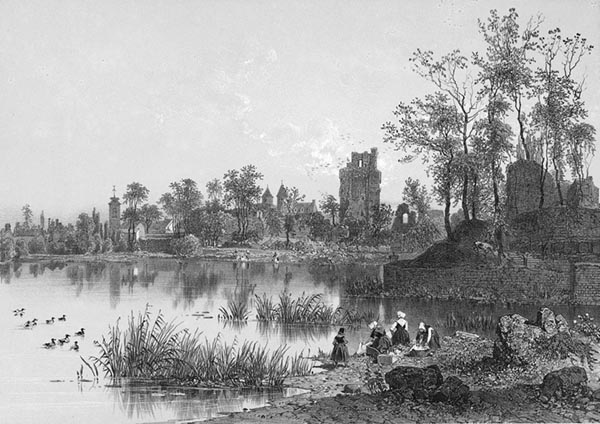
‘Saint-Aubin-du-Cormier’ - Félix Benoist (French, 1818–1896), Adolphe Jean-Baptiste Bayot (French, 1810–1871) and Eugène Cicéri (French, 1813–1890)
Although he established silk manufactories in Vitré, and tapestry workshops in Rennes (a fact carefully noted in books portraying him as the devoted defender of Breton independence), I have always had little sympathy for this dull man, who pitted a lion against donkeys (the one he had been given, sometime before dying, Jean de Montauban) and who in so cowardly a manner abandoned in turn his advisor Guillaume Chauvin to his favourite Pierre Landois, then Landois to Chauvin’s enemies; torn in all directions by a thousand liaisons which he untied, by a thousand influences in succession; he is indeed the ‘father’, in terms of lack of heart and dryness of character, of the cold and hypocritical Anne of Brittany (wife to Charles VIII, then Louis XII), who is to me one of the most unpleasant figures of the sixteenth century.
Since we are on the subject of history, just a hundred paces away, opposite the old castle, stands the house where the Duchess de Berry (Marie-Caroline de Bourbon-Sicile) was captured in 1832 (after the failed Legitimist uprising). One’s heart sinks in that small, bare room, clad in soiled grey wallpaper, and barely lit by yellowed panes of glass. We saw the panel behind which the princess and her companions hid; it is hard to credit their survival. The whole house was silent and cold; not a murmur, no children playing, no dogs barking. Inhabited by two devout spinsters, it had something forlorn, ruined, and shameful about it, with its narrow, dark courtyard, damp alley, and wooden staircase rotting in the rain, as if it felt the bitterness of memories even in its stones.
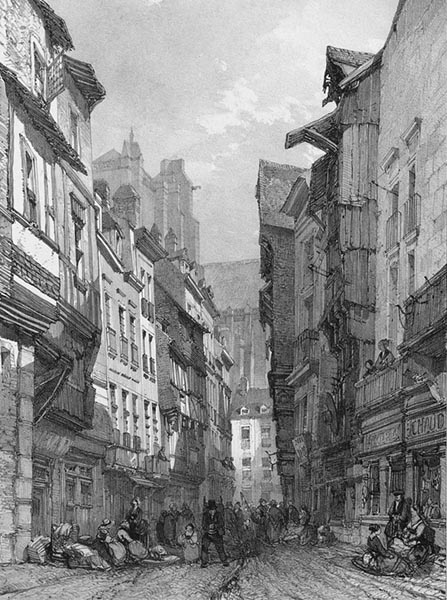
‘The Old High Street, Nantes’ - Eugène Cicéri (French, 1813–1890)
Of the old château (the Château des Ducs de Bretagne, now substantially restored), only the two entrance towers remain: the Pied de Biche (Crowbar) Tower to the left of the drawbridge, and the Boulangerie (Bakery) Tower to the right. Another building, pierced with late fifteen century windows is still almost intact, In the courtyard, is an old and beautiful well, adorned with an elegant iron crown from which pulleys were suspended. Cannons, polished like pairs of boots, are lined up on the grass next to cannonballs arranged neatly, according to their calibre, like heaps of gravel by the roadside; two or three soldiers, lying on their backs, were sleeping peacefully in the sun; what were they dreaming of? Probably not of the Duke of Mercœur (Philippe Emmanuel de Lorraine), who had the now dilapidated Lorraine Cross bastion built (razed in 1853), nor of Cardinal de Retz (Jean François Paul de Gondi, agitator during the Fronde), who escaped from the castle (in 1654), and certainly not of Anne of Brittany, who married Louis XII (in 1499) in the chapel within the Tour du Fer (Horseshoe Tower), now converted into a powder magazine. If they were dreaming, was it not rather of a fine game of boules, played on Sundays after Vespers; or of the day they would again view the weathervane on the church steeple, above the trees of their village; or of the country girl they had left behind? Only people whose occupation it is to think fill their brains with the passions of bygone eras; honest people have enough passion of their own; they make history — while we merely read that same.
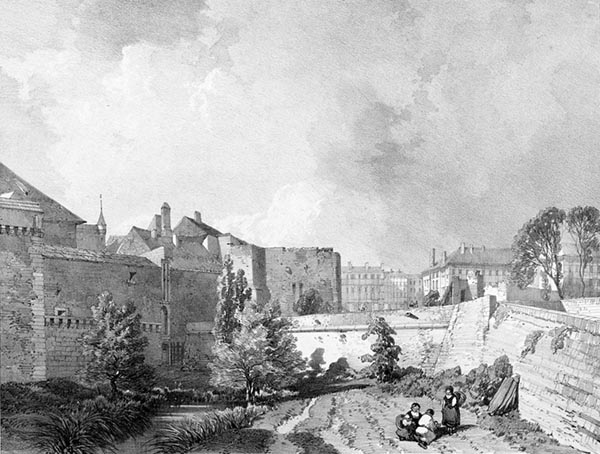
‘The Moat of the Château de Nantes’ - Eugène Cicéri (French, 1813–1890)
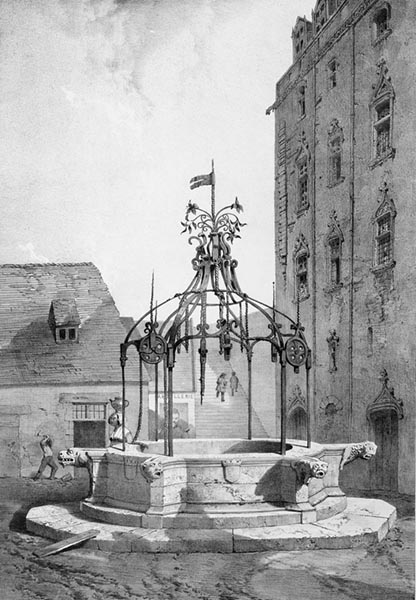
‘The Well in the Château de Nantes’ - Léon Gaucherel (French, 1816–1886)
Two or three men, in shirts, were singing in the barracks, while brushing their clothes and polishing the copper buttons with chalk. On the second floor, on the sill of a fine square window, the legs of a pair of red trousers, spread wide open, hung down along the wall, brazenly displaying its large grey-lined fly.
On leaving the château, we visited the museum. The curator, busy scribbling away in a corner, interrupted his labours, and struck up an unofficial conversation with us about art, but shortly after observing us admiring a Eugène Delacroix, the good man set his cap on his head again, and turned on his heel, which made us suspect him of indulging in Jean-Victor Bertin landscapes, or in the Roman-history genre, complete with billiard-cue spears and chamber-pot helmets.
We stood for a long time before a painting in the old German style, representing an ‘Adoration of the Magi’. The design was almost ironically naive: a magus, dressed in a sort of bishop’s cloak, prostrates himself at Christ’s feet with such a stupid expression, and so low a brow, that one would readily believe it to be malice on the part of the artist; there are peculiar Black Africans, clad in red breeches and adorned with coral necklaces; men and women poke their heads out of a window, with astonished expressions. The whole thing is vibrant and amusing, a clash of reds and greens (somewhat like Pieter Bruegel the Elder’s ‘Temptation of Saint Anthony’), intense in expression, playful in its details, original overall, and with an effect impossible to grasp without having seen it.
We also noticed a carnival scene by Nicolas Lancret (entitled ‘Before the Ball’, currently located in the Musée des Beaux-Arts, Nantes). In a large, wood-panelled room, a beautiful lady, in a yellow bodice with long elbow-length sleeves and a pink petticoat, is portrayed, between a dancer and a clown who invites them to join the minuet. Seated on either side, their friends smile and converse. In the foreground, a small child drags along a toy; this is a fine house where it is warm, a house where people have fun; one feels that outside it is raining and that maskers are running about in the mud; the weather is grey, true carnival weather; they will perform a comedy later, and will eat pastries this evening.
I also greatly admired a portrait of La Camargo (the dancer, Marie-Anne de Cupis de Camargo; the painting dated c. 1730, is also currently in the Musée de Beaux Arts, Nantes), by the same artist. She dances in the open air, on the grass, in a white satin dress with blue ribbons and garlands of roses; to her right, a drummer shakes his sticks and a fifer puffs out his cheeks; to her left, a violinist, a bassoonist, and a woman watching. La Camargo! What a name! Does it not resound with crimson bells? Does it not bring you, like some playful refrain on the gentle breeze raised by a twirling skirt, the scent of powdered iris or Spanish jasmine, and glimpses of tense white kneecaps on yellow silk quilts in a boudoir filled with Saxon porcelain, and entirely covered in pastels?
The antithesis, as painting, portrait, and idea is seen opposite, a portrait of a woman attributed to Bartolomé Murillo (‘Portrait of a Young Woman’, currently in the same gallery). She is dressed in a blue dress whitened by wear; her sooty, unkempt hair hangs lifelessly, on her right, over her pale face, while beneath her low, melancholic brow her upturned brown eyes grant you a placid, but deep, look that displeases yet attracts; in her hand she holds a small book, a prayer book; she spends her life in the side aisle of some church, in the damp shade of the pillars, dazzled by the illuminations of the altar, lost, endlessly, in the throes of mystical love, and in the evening returns to her bare attic where she sees apparitions of the Virgin and hears angelic voices calling her name.
There, also, is a rare and fine portrait, that of Elizabeth I of England, by Pellegrino Tibaldi. If it turned out not to be a good likeness, one would be forced to abandon forever the thought of forming any idea of people one has not seen, which would be sad considering that the people one ordinarily comes across are not at all as interesting. A prodigious ruff with thick, stiffened tubing, embroidered with black thread, frames her long, bony head, with its prominent cheekbones and red lips; her pale forehead is straight, high, and proudly intelligent. Beneath blond eyebrows, sparse at their juncture, her large, prominent blue eyes, open wide, roll and gaze with vivacity and thoughtfulness; Her pointed chin, the rounded tip of her nose, and her protruding mouth, where long teeth are visible, reveal a sensual ferocity, while her reddish-blond hair, styled in a high, flowing wave of successive half-circles and adorned with red carnations on the left side, gives her a stiff and noble air, a strange but imposing air of distinction (the description suggests an ‘Armada’ portrait, of 1588, similar to that by an unknown hand in the National Portrait Gallery, London. Tibaldi is not known to have painted her portrait, nor is one known at Nantes). She was called in her time ‘the emerald of the seas, the pearl of the West,’ and it was she for whom, while acting in Richard III, Shakespeare suddenly stopped speaking, in order to pick up her handkerchief (both comments are inauthentic).
I would gladly give away the book by Abel-François Villemain (Cours de la Littérature Française 1828-9) which I bought in my childhood, a foolish act which failed to lead to it being denied me, which proves my family’s good nature; I would do the same with Monsieur Saint-Marc Girardin’s course (Cours de Littérature Dramatique, 1843) that I keep, as René says (see François-René de Chateaubriand’s 1802 novella of that name), ‘to prevent my taking any joy in the future’. I would even add an old pair of Moroccan slippers that are very convenient to me in the summer, and in addition my rights as a citizen, the esteem of my compatriots, and the rest of a bottle of fine varnish that is beginning to thicken, yes, I would give all that, wholeheartedly and on the spot, to possess the name, age, address, profession, and likeness of the gentleman who invented tin vine-leaves to cover the private parts of the statues in the Nantes museum, which look uncommonly like devices to prohibit masturbation. The Apollo Belvedere, the Discobolus, and a flute-player, are harnessed in these shameful metal contraptions which gleam like saucepans. One can see, moreover, that they were long in the making, and the work has been executed with love; they are scalloped at the edges, and screwed to the limbs of the poor plaster casts, which have flaked from the pain of it all. In this era, when dull idiocy prevails, it is a joy if only as a diversion, to encounter, amidst all the normal stupidities that encumber mankind, at least one mad stupidity, one vast stupidity. Despite all my efforts, I have not succeeded in establishing who created this shameful nonsense. I tend to believe that the entire City Council took part, that the clergy requested it, and the ladies found it appropriate.
We next visited the Natural History museum, a meagre collection which a scholar would find of no great interest, I think, but which contains, nonetheless, an Egyptian mummy, standing upright beside its painted coffin; pieces of pink coral; mother-of-pearl shells; and crocodiles hanging from the ceiling. There are also, in a jar of spirits, two little piglets joined at the belly, which, rearing up on their hind legs, raising their tails and blinking, are, I must say, quite moving. Placed, thus, beside two human foetuses of similar monstrosity, they perhaps speak volumes, more so than many of our works of art. But who is equipped to see, in such irregular manifestations of life, multiple and graduated expressions of that unknown artistry, which in mysterious stillness, works away in the ocean depths, at the core of the planet, in the heart of light, modifying the successive generations, and perpetuating Being? For six thousand years, humankind has been studying life, and perhaps it is beginning to spell the first letter of this alphabet that has no omega. When will it be able to read a phrase or a sentence?
If what we call the monstrosities of Nature possess anatomical relationships with each other, that is to say relationships of plastic form, and are subject to physiological laws, those laws which determine existence, why should they not (commencing with that assertion and so placing ourselves in a world which seems the negation of our own and which, perhaps, is indeed its corollary), why should they not also have their beauty, their ideal realisation? Did not the ancients believe this? And are their mythologies anything other than monstrous and fantastic universes, clothed in forms which we term unnatural, and yet beautiful, so true are they in themselves and harmonious one with another? Do we not adore the long, glaucous hair of the Naiads, and the voice of the Sirens, a melodious abyss that made ships whirl about? Who has not found the Chimera charming, loved its lion’s mask, the flap of its eagle’s wings, and its rump with greenish tints? — Do we not believe in the mocking Satyrs who prick their pointed ears behind the myrtle bushes, and whose goat’s feet drum rhythmically at night on our garden lawns, as if they existed?
These dreams, no less than those of Nature, were not conceived in a single day, nor were they created by a single human being; like metals, rocks, rivers, gold-mines, and pearls, they arose slowly, little by little, forming in successive layers, arising ‘of themselves’ and emerging from nothingness through their own internal forces. We contemplate them in the same way, with a disquieted, retrospective astonishment, seeking perhaps in the depths of memory to recall whether, before our present existence, we existed as they did, our thoughts coexisting in some common matrix with those thoughts that became forms; whether the principles determining our own forms did not long ago exist in regard to the universal chrysalis, determining the origin of the oak-tree, and of the springs that flow to form the ocean.
What a beautiful thing a savage’s head is! I recall two, exhibited there, black and gleaming from being smoked, magnificent in their brown hues, with hints of steel, and old silver. The first (that of an inhabitant of the Amazon region) had teeth driven into its eye sockets. Adorned with ornaments of unparalleled taste, crowned with all sorts of plumage, and with its gums exposed, it grimaced in a way that was both horrible and charming; beside it hung colourful necklaces of bird-feathers that, long ago in the savanna, the man took, when he was alive and vigorous, from vanquished enemies; the necklaces are numerous, which suggests that he was brave, and had sent many souls to his equivalent of Areskoni (an Iroquois war-god), for these little things are the opposite of our medals awarded to rescuers. Nearby, was placed a male head from New Zealand, adorned only with the tattoos that etched it like hieroglyphs, and the solar-emblems still visible on the brown skin of his cheeks, his long, loose, black hair, seeming as moist as willow branches. With green feathers on his temples, long, downward-hanging eyelashes, and half-closed eyelids, the head possessed an exquisite air of ferocity, voluptuousness, and languor. Looking at it, one understands the whole life of the savage: his raw sensuality, his childlike tenderness for his wife, his war-cries, his love for his weapons, his sudden bursts of energy, his equally sudden laziness, and the melancholy that overtakes him on the shore as he gazes at the waves.
All this still exists, and is no fairy tale. There are still men who walk naked, who live among the trees, in a land where wedding nights have an entire forest for a bower, and the whole sky for a ceiling. But you must travel there soon if you wish to see them; they are already acquiring tortoiseshell combs, and English hair brushes, to brush and comb hair still moist with sweat and stained by the clotted blood of wild creatures; bootstraps are being made for the trousers that are being prepared for them; laws are being penned for the cities to be built for them; they are being sent schoolmasters, missionaries, newspapers.
We generally avoid what is pointed out as curious and worthy of being seen, so we failed to visit the Mettray colony near Tours (an open prison for juveniles, at Mettray), and the madhouse in Nantes, and the forges of Indret, and Fort de Penthièvre, and the Belle-Isle lighthouse, and we have not yet entered any of the excellent cafes in the towns we passed through, but we did visit Clisson.
On a hillside, at the foot of which two rivers meet, in a cool landscape enlivened by the pastel colours of the low, Italianate, tiled roofs, grouped together as in Hubert Robert’s sketches, near a long, low waterfall that powers a mill hidden amidst the foliage, the Château de Clisson’s jagged top just rises above the tall trees. All around, the scene is calm and gentle. The cottages seem to smile as if beneath a warm sky; water murmurs, and mossy plants quiver to the flow in which soft tufts of greenery soak. The landscape extends, on the one side, to a vista of meadows, and on the other, rises suddenly, enclosed by a wooded valley whose greenish stream widens as it flows towards the foreground.
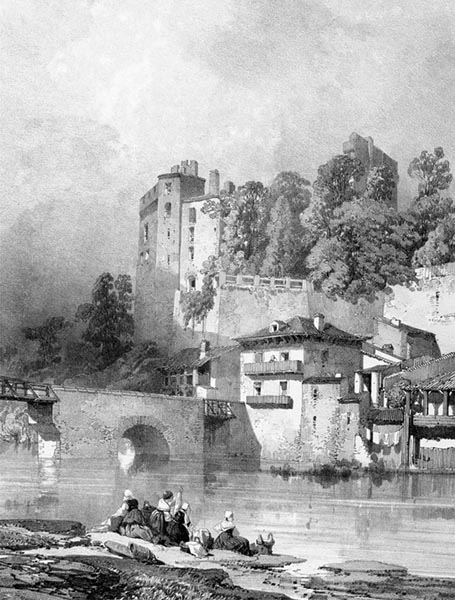
‘The Château de Clisson’ - Eugène Cicéri (French, 1813–1890)
Once over the bridge, at the foot of the steep path leading to the château, one sees, a large section of wall, crowned with breached machicolations, plumed with trees, and carpeted with ivy, standing boldly and sturdily above the moat towards which it leans. The lush and ample mass, etched against the grey stone in branches and spurs, shimmers in the wind along its entire length, and seems like an immense green veil, draped over the shoulders of the reclining giant, which the latter stirs, in dreaming. The grasses are tall and dark, the plants strong and prickly; the gnarled, rough, twisted ivy-trunks lift the walls as if with levers, or hold them fast in their branching web. A green tree has pierced the thickness of the wall and, emerging horizontally, suspended in the air, has extended its branches to the light. The ditches, whose slopes are softened by earth crumbling from the banks, and littered with stones falling from the battlements, have a steep curve, and the gateway, with its vigorous, slightly-pointed arch and its two openings through which the chains that raised the drawbridge passed, looks like a large helmet, whose occupant is peering through the holes in its visor.
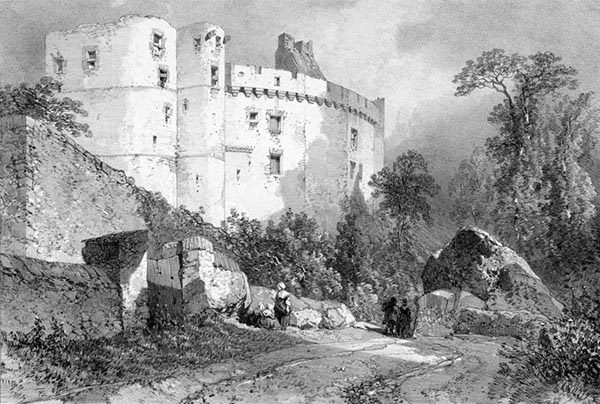
‘The Château de Clisson’ - Eugène Cicéri (French, 1813–1890)
Once inside, you are surprised, amazed by the mass of ruins and trees, the ruins highlighting the trees’ verdant youthfulness, and the greenery rendering the ruins’ sorrowful atmosphere all the more poignant. This is truly the eternal and beautiful laughter, the resounding laughter, of Nature, echoing amidst the skeletons of things; with all the audacity of her abundance, the profound grace of her whims, and her encroaching silence. A profound enthusiasm seizes one’s soul; one feels the sap flowing within the trees, and the grasses growing, even as the stones are crumbling, and the walls collapsing. A sublime artistry has aligned and juxtaposed, in a supreme harmony of secondary chords, the wandering forms of ivy with the sinuous curves of the ruins, the mass of brambles with the jumble of fallen stones, the transparent air with the resistant protrusions of stone, the hue of the sky with the hue of the earth, and you tremble inwardly as if that dual life were operating within you, so brutal and immediate is one’s perception of its harmonies, and one’s awareness of its forms.
At the foot of two large trees whose trunks intertwine, a greenish light passes over the moss, and the dome of leaves reflects a clear light which, broadly illuminating all this debris, deepens the shadows and reveals all its subtleties.
We advance, we progress, wandering along the barbicans, passing beneath the crumbling arches from which long, quivering plants descend. Vaults, filled with the dead, resound beneath your feet; lizards scurry amidst the undergrowth, insects climb the walls, the sky gleams, and the sleeping ruin continues its slumbers.
With its triple enclosure, dungeons, inner courtyards, machicolations, underground passages, ramparts layered one upon another, like layers of bark on bark, or breastplates on breastplates, the old Clisson castle can be re-imagined as it once was. Memories of the harsh lives of yesteryear rise from it, as if of their own accord, along with the scent of nettles, and the coolness of ivy.
Long black streaks still ascend the walls, diagonally, as in the days when logs blazed in the eighteen-foot-wide fireplaces. Symmetrical holes, aligned in the masonry, mark the locations of the floors once reached by these staircases now partially-collapsed; empty doors open on the abyss. Sometimes a bird, emerging from its nest among the brambles in the depths of some dark corner, would soar, wings outstretched, pass through some window-arch, and fly off over the countryside.
At the top of a high, bare, grey, dry stretch of wall, square bays, unequal in size and alignment, allowed the bright blue of the sky to burst through their cross-bars, its alluring colour enticing the eye. Sparrows uttered their shrill, repeated cries among the trees. A cow grazed, as if in a pasture, its split horn striking the grass.
There is a window there which overlooks a meadow called the Meadow of the Knights. It was from its stone benches, hewn into the thickness of the wall, that the noble ladies of the time could watch the knights as the iron breastplates of their horses clashed, the maces descended upon their crests, their lances broke, and men fell to the ground.
On a fine summer’s day, perhaps, when the mill, which sends its clatter echoing through the landscape, did not yet exist, when there were roofs atop these walls, Flemish leather covering the stone seats, grilles of horn in the windows, close-clipped grass, and the voices and whispers of living folk — yes, then, more than one heart, nestled in its sheath of red velvet, beat with anguish and love. Graceful white hands trembled with fear, above this stone now covered with nettles, and the embroidered veils of the tall high-coned head-dresses quivered in a breeze, like to that which now stirs the ends of my tie, which made the knights’ plumes bow.
We descended to an underground chamber where John V, Duke of Brittany, was imprisoned (in 1420). In the men’s prison, we still saw on the ceiling the large double hook used for execution by hanging; and curiosity led me to examine the door of the women’s prison. It is about four inches thick, secured with bolts, reinforced with iron bands, plated, seemingly padded with iron. Through the small grille in the centre, whatever was needed to keep a condemned woman alive was thrown into the cell, for its door, the discreet harbourer of the most terrible secrets, was one that closed upon her, and was never re-opened while she lived. What an age of hatred, in which, when you loathed someone, and abducted them in a surprise assault, or trapped them in some treacherous interview; when you finally had them in your possession, and held them tightly imprisoned; you could, at leisure, feel them dying hour by hour, minute by minute, counting their moments of anguish, drinking their tears. One could descend to their cell, speak to them, bargain over their torture, smile at their torments, debate their ransom; one profited from them, from their death in life, from the gold they represented. One’s entire dwelling, from the summit of the towers to the depths of the moat, weighed heavily on the prisoner, crushed them, buried them; and family revenges were thus executed, within the family, by the château itself which constituted the family’s strength, and symbolised its power.
Sometimes, however, when the poor wretch was a great lord, a rich man, when, on his deathbed, all having had their fill of him, the tears in his eyes had acted like a curative bloodletting for the master’s hatred, they might talk of releasing him. The prisoner would promise all: that he would surrender his strongholds, hand over the keys to his finest cities, give his daughter in marriage, endow churches, walk barefoot to the Holy Sepulchre. And offer money! More and more! So, they would sign a treaty, countersign it, backdate it; bring out the sacred relics, and swear their oaths on them, and the prisoner would see the sun again. He would mount a horse, gallop away, return home, have the portcullis lowered, summon his men, and unhook his sword. His hatred erupted, once freed, in ferocious outbursts. It was an age of dreadful anger, and all-conquering rage. The oath? The Pope would release one from it, and as for the ransom, it would never be paid.
When Olivier V de Clisson was arrested (by Duke John IV of Brittany) in the Château de l’Hermine (Vannes), in 1387, he promised, in exchange for his release, one hundred thousand gold francs, the restitution of the properties possessed by Count John I of Penthièvre, and the cancellation of his daughter Marguerite’s marriage to the said Count. As soon as he was released, he attacked Châtelaudren, Guingamp, Lamballe, and Saint-Malo, which were captured or forced to surrender. The Count of Penthièvre married his daughter, and the hundred thousand gold francs he had handed over were returned to him. But it was the people of Brittany who ultimately paid.
When John V, Duke of Brittany, was abducted at the bridge of Loroux by Count Olivier de Penthièvre, in 1420, he promised a ransom of one million livres; and his eldest daughter in marriage, though she was already betrothed to the King of Sicily (Alfonso V of Aragon). He promised Moncontour, Quessoy, and Jugon, but gave neither his daughter, nor the money, nor the strongholds. He vowed to go on pilgrimage to the Holy Sepulchre. He fulfilled the vow by means of a proxy. He swore never again to levy taxes or subsidies; the Pope released him from the obligation. He vowed to give his weight in gold to Notre-Dame de Nantes; but as he weighed some two hundred pounds, the vow remained unfulfilled. With all the towns he could gather or seize, he quickly formed a league, and forced the Penthièvre family to buy back the peace they had sold.
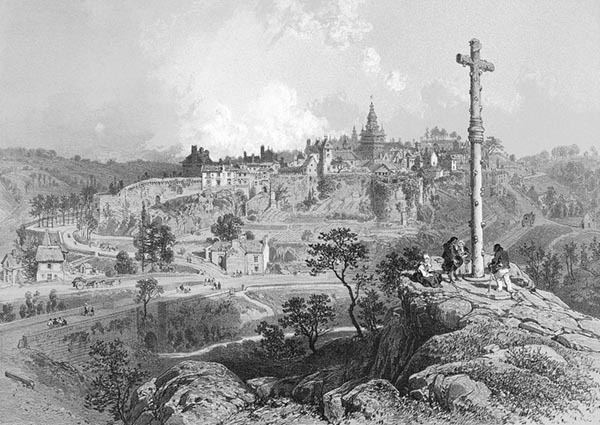
‘Moncontour’ - Félix Benoist (French, 1818–1896), Adolphe Jean-Baptiste Bayot (French, 1810–1871) and Eugène Cicéri (French, 1813–1890)
On the right bank of the Sèvre Nantaise, a little upstream from Clisson, where one can dip one’s toes in the water, stretch the woods of ‘La Garenne’ climbing the hillside, a park (Domaine de la Garenne Lemot) beautiful in itself, despite its artificial adornments. François-Frédéric Lemot (the father of the current owner, Barthélémy Lemot), who was a painter of Empire, and a prize-winning artist, sought to the best of his ability to reproduce, there, the cold Italianate, Republican, Roman style, so fashionable in the days of the sculptor Antonio Canova, and of Madame de Staël. People were pompous, grandiose, and dignified. It was the era of sculptured urns on tombs, a time when one was painted in a coat, hair blowing in the wind, where Corinne sang on her lyre, next to Oswald who wore Russian leather boots, which led to a deal of wayward hair on many a head, and many a ruin dotting every view.
This kind of noble scene is not lacking at La Garenne. There is a Temple of Vesta and, opposite it, a Temple of Friendship, a large tomb containing the remains of two friends (François-Frédéric Lemot, and the diplomat and deputy François Cacault), which tends to make one forgive the ridiculousness of the name they chose for their shared tomb. Indeed, let us not deny pretentious sentiment and declamatory enthusiasm; one can weep in good faith while still bending one’s elbow gracefully to draw forth a handkerchief, or write a poem about some joy or misfortune which conveys it as effectively as those who cannot, and as yet it is not proven, definitively, that it is impossible to love the woman one calls one’s goddess or one’s angel of love.
Inscriptions, arrangements of rocks, and artificial ruins, are displayed here with naiveté and conviction. On a piece of granite, one can read the well-known line by the poet Jacques Delille:
‘Indestructible, its mass has withstood the test of time’.
(‘Les Jardins’, 1782)
Further on, there are twenty lines by the same Delille; elsewhere, on a stone carved in the shape of a tomb: ‘In Arcadia ego’ (‘I too am in Arcadia’: the inscription appears in paintings by Nicolas Poussin, Guercino and others, as a reminder of the presence of death) a nonsense whose intention I could not discover.
But all the poetic riches are gathered in the Grotte d’Héloïse, a kind of natural dolmen on the bank of the Sèvre. ‘What we experience in such places,’ said Édouard Richer, author of a journey to the Lower Loire (‘Voyage Pittoresque dans le Département de la Loire Inférieure’, 1820), ‘Héloïse experienced, she felt, admired, and dreamed as we do.’ Well, I confess, I am not like Monsieur Richer, nor indeed Héloïse; I felt little, and admired only the trees, noting that the grotto they shade would be very suitable for lunch in the summer, in the company of some friends and a few Héloïses, especially since the proximity of the water would allow us to chill the bottles there, and, alas, I failed to dream at all.
But there are happy people, gifted, sensitive, imaginative people, who always rise to the occasion, who never fail to weep during a funeral, laugh during a wedding, and find their memories aroused by viewing some broken tile or hut not built in the fashion of the day. These people will tell you that the sight of the sea inspires them with great thoughts, and that the contemplation of a forest raises their souls to heaven. They feel melancholy when they look at the moon, and cheerful when they look at a crowd of people. ‘That consecrated name,’ Monsieur Richer continues, ‘is the only one this grotto could indeed have offered us. The inscription one reads there is perhaps unnecessary, for feeling is always swifter than words.” Although I readily agree with Monsieur Richer, and think the inscription unneeded, I cannot, however, resist the pleasure of transcribing it.
Héloïse, perchance, wandered by this shore,
when, hiding herself from jealous eyes,
A son, a dear pledge, melancholy prize,
Within Le Pollet’s walls, she bore.
Lost furtive pleasures, tender love, her sighs
Recalled perhaps, beneath wild skies,
When oft she came to sorrow here alone,
To taste the sweetest tears, and freely moan.
And seated on this rock, at ease,
Perhaps she dreamt here of her woe.
I too would dream; within my heart, would know,
Sweet memories of Héloïse.
Thereupon the naive visitor seeks to imagine Héloïse wandering the shore holding the hand of her little son Astrolabe; the visitor is full of pity as regards the result of such furtive pleasures and tender love. Though, if the idea of tender love arouses grief, the image of furtive pleasures yields him a degree of cheer. He seeks this wild and secluded spot — its existence unsuspected a moment ago — and finds it wild indeed. Finally, he imagines her weeping on the rock, dreaming of her misfortune, and seeks to dream too, to fill his heart with the sweet memory of Héloïse. Our visitor does so, or at least does everything he can to fill it. But no, his effort is insufficient, it is not filled to his liking. He would like to fill it completely, to feel it overflow, to stuff it full, to feel it break… whatever! He returns, writes his name in the concierge’s album, hands over his twenty-sou coin, and leaves happily: he has felt emotion, he has evoked memories.
Why has the figure of Héloïse, so noble and lofty, been reduced to something so banal and foolish, the insipid archetype of thwarted love, and the narrow idea of ‘the sentimental young girl’? She deserves better, that poor mistress of the great Abelard, she who loved him with such devoted admiration, despite his harshness, his sombreness, despite his unsparing infliction on her of bitter blows. She feared ‘offending him more than God Himself, and sought to please him more than the latter.’ She did not wish to marry him, finding that ‘it was an unseemly and deplorable thing that a woman should appropriate and take for herself alone...one whom Nature had created for all’, finding, she said, ‘more sweetness in the name of mistress, and concubine, than in that of wife, or of empress’, and, humbling herself before him, hoped to win more of his heart.
O sensitive creatures, O Romantic idiots who, on Sundays, cover her pretty mausoleum with immortelles, you are not required to study the theology, Greek, or Hebrew which she taught, but try to swell your little hearts and broaden your narrow minds, and admire her intellect, and the immense love involved in her sacrifice.
The park is nonetheless a pleasant place. Its paths wind through coppiced woods, the groves of trees dropping to the river. You can hear the water flowing, you can smell the pleasant scent of the leaves. If we were irritated by the bad taste we found there, well, we had just visited Clisson, which is of such solid and simple beauty, and then, the bad taste was not our own. What, after all, is bad taste? Is it not, invariably, the taste of the era that precedes ours? Do not all children find their fathers ridiculous? Bad taste in Pierre de Ronsard’s time was symbolised by Clement Marot; in Nicolas Boileau’s, by Ronsard; in Voltaire’s, by Pierre Corneille; and Voltaire was a symbol of bad taste in the days of Châteaubriand, whom many people are, at this moment, beginning to find rather ‘weak’. O people of taste, in future centuries, I commend to you the ‘people of taste’ of my day. You will no doubt smile at their stomach-aches, their superb disdain, their predilection for veal and dairy products, and the grimaces they make when served rare meat and overly-suggestive poetry.
How ugly what is beautiful will seem, how foolish what is graceful will appear, how poor what is rich will be, our delightful boudoirs, our charming salons, our ravishing costumes, our interesting serial novels, our thrilling dramas, our serious books! Oh, how quickly we will be condemned to the attic, how little they will regard our works! Mere stuff, paper, manure, fertiliser! O posterity! Do not forget above all our Gothic parlours, our Renaissance furnishings, the speeches of Monsieur Pasquier (Étienne-Denis, Duc de Pasquier, Chancellor of France and President of the Chamber of Peers), the shape of our hats, and the aesthetic predilections of the Revue des Deux-Mondes!
It was while indulging in these philosophical musings that the ‘cart’ dragged us to Tiffauges. Placed together in a sort of tin tub, our weight crushed the hapless horse swaying between the shafts: it was like the wriggling of an eel in the body of a Barbary rat. The down-slopes pushed it forward, the ascents pulled it backward, the swerves threw it sideways, and the wind buffeted it, while it suffered a hail of whip blows. Poor beast! I cannot think of it without a certain remorse.
The road, cut into the hillside, descends in a long curve, its sides covered by clumps of gorse, or broad banks of reddish moss. To the right, at the foot of the hill, on a rise in the terrain that ascends from the valley floor, large, uneven sections of wall extend their jagged peaks one above another.
We follow a hedge, take a track, and pass beneath a wide-open archway, two-thirds sunk up to its pointed arch in the ground. Those who once rode through it on horseback would now only be able to do so by stooping. When the Earth tires of bearing a structure for too long, she swells from beneath, climbs over it, overcomes it, and while the sky gnaws at its head, buries its feet. The courtyard is deserted, the enclosure is empty, the portcullises fail to stir, the still water of the ditches remains flat and motionless beneath the rounded water lilies.
The sky was white, without distinct clouds, but sunless. Its pale arc stretched far and wide, covering the countryside, which seemed cold and mournful in its monotony. There was no sound, silence reigned; the birds failed to sing, not a murmur as far as the horizon, and the empty furrows — it was a Sunday — emitted neither the squawks of crows taking flight, nor the soft thud of ploughshares. We descended through brambles to a deep moat, hidden at the foot of a tower bathed by the water, and hidden by patches of reeds. A single window opened, a shadowy square traversed by the grey line of its stone mullion. A playful clump of wild honeysuckle hung over the sill, its green, fragrant breath wafting forth. The large machicolations, when one raised one’s head, revealed from below, through their gaping openings, only the sky or some small unknown flower nestling there, borne to the spot by the wind on a stormy day, the seed of which had flourished, sheltered by a crevice in the wall.
Suddenly there came a breath of wind, soft and long, like an exhaled sigh, and the trees in the ditches, the grass among the stones, the rushes and duckweed in the water, the plants among the ruins, and the gigantic ivy that, covered the tower, from base to summit, with a uniform layer of gleaming green, all trembled and their leaves rippled; long, golden waves rolled over the fields, as the heads of wheat were stirred. Ripples from the pool of water in the moat streamed over the foot of the tower; the ivy leaves shuddered together, and a blossoming apple tree dropped its pink petals.
Nothing else alive, only the passing wind, the burgeoning grass, the open sky. No ragged child, tending a cow grazing moss among the stones; not even, as elsewhere, a solitary goat poking its bearded head from a gap in the ramparts, then fleeing in fright, stirring the undergrowth; not a bird singing, not a cry from a nest, not a sound! This castle is like a ghost, mute, abandoned in a deserted countryside; it feels accursed, full of fierce memories. Yet it was once inhabited, this sad place that even the owls now seem to disdain. In the keep, between four walls as livid as the bottom of old watering troughs, we counted the remains of its five stories. Thirty feet in the air, still with its two rounded pillars and its blackened hearthstone, a chimney hangs suspended. Dust and dirt have fallen into it, and wildflowers have grown there, as if in a planter left behind and neglected.
Beyond the second enclosure, in a ploughed field, we recognised the remains of a chapel, with the broken shafts of a pointed-arch portal. Oats had grown there, and trees had replaced its pillars. The chapel was once filled with ornaments in gold and silk, censers, candlesticks, chalices, crosses, precious stones, silver-gilt dishes, and gold cruets; a choir of thirty singers, chaplains, musicians, and children sang hymns here to the sound of an organ that accompanied them on their travels. They were covered in scarlet robes lined with squirrel-fur and sheepskin. There was an archdeacon, and a bishop, and they had petitioned the Pope for permission to wear the mitre, like canons, because this chapel was the chapel, and this castle was one of the castles, of Gilles de Laval, Baron de Rais, Lord of Roucy, Montmorency, Retz (Rais) and Craon, Lieutenant-General of the Duke of Brittany, and Marshal of France, burned at Nantes, on October 26th, 1440, in the Prée de la Madeleine, as a counterfeiter, murderer, sorcerer, sodomite and atheist.
He possessed more than a hundred thousand gold crowns, receiving thirty thousand pounds of annual income, the profits from his fiefdoms, and the wages from his office as marshal; fifty magnificently dressed men escorted him on horseback. He kept an open table, where the rarest meats and the most exotic wines were served, and mystery-plays were performed at his home, as in cities at the entry of kings. When he lacked for money, he sold his land; when he had sold his land, he searched for gold; and when he had quenched his furnaces, he invoked the Devil. He wrote that he would yield the latter everything, except his soul, and his life. He made sacrifices, burnt offerings of incense, gave alms, and had solemnities conducted in his honour. It was here that this man lived. These vaults reddened at the unceasing breath of enchanted bellows, these walls were illuminated at night by the glow of torches, burning amidst goblets full of wine from the Isles, and among a host of Bohemian jugglers; they invoked Hell, they feasted on death, they slaughtered children, they experienced terrible joys and atrocious pleasures; blood flowed, instruments played, everything resounded with voluptuousness, horror, delirium.
After his execution, a handful of young ladies removed his corpse from the pyre, placed it in a coffin, and had it taken to the Carmelite monastery (Notre-Dame des Carmes) in Nantes, where after an honourable funeral, he was solemnly interred.
On one of the bridges over the Loire, opposite the Hôtel de la Boule-d’Or, an expiatory monument was erected to him; it was a niche containing the statue of the Blessed Virgin of Crée-Lait, who had the power to stimulate the breasts of wet-nurses to produce milk; butter and other local products were offered there. The niche is extant, but the statue is no longer present, just as the reliquary, in the town hall, that once contained Queen Anne of Brittany’s heart is also empty (the reliquary is now in Nantes cathedral). We were not particularly interested in viewing the reliquary. We refused to even consider it. I would have preferred to contemplate the breeches of Marshal de Rais, rather than the heart of Anne of Brittany; there was more passion in the former than grandeur in the latter.
The End of ‘By Field and Shore’ Part I