Alphonse de Lamartine
Travels in the Near East (Voyage en Orient, 1832-33)
Part VIII
Translated by A. S. Kline © Copyright 2026 All Rights Reserved
This work may be freely reproduced, stored, and transmitted, electronically or otherwise, for any non-commercial purpose.
Conditions and Exceptions apply.
Contents
Sights and Reflections in Syria
On March the 18th, 1833, I left Beirut for Baalbek and Damascus; the caravan consisted of twenty-six horses, and eight or ten Arabs on foot as servants and escort (note that Lamartine’s wife Marianne accompanied him on the trip).
Leaving Beirut, one ascends along sunken paths through red sand, the borders festooned with all the flowers of Asia-Minor, all the shapes and scents of spring: prickly-pear cacti, thorny shrubs with clusters of golden-yellow flowers, like the broom of our mountains, vines hanging from tree to tree, and beautiful carob trees; trees with dark green and bronze leaves, with intertwined branches, and trunks with polished, lustrous brown bark, the most beautiful tree in these climes. After about half an hour, one arrives at the summit of the peninsula that forms the Beirut cape; it ends in a rounded promontory in the sea, while its base is formed by a beautiful, wide plain, crossed by the Nahr-Beirut. This plain, irrigated, cultivated, and planted everywhere with beautiful palm trees, green mulberry trees, and pines with broad, bushy crowns, fades away below the first slopes of Mount Lebanon.
At the highest point of the Beirut plain, there is a magnificent view of the promenade at Beirut created by Fakhr-el-Din, or Fakardin; it is there that Turkish, Arab, and European horsemen go to exercise their mounts and run the djerid (javelin); it is there that I myself used to go every day to spend a few hours on horseback, sometimes galloping over the desert sands that dominate the blue and immense horizon of the Syrian sea, sometimes, at a walking pace, dreaming beneath the avenues of young pines that cover part of the promenade. It is the most beautiful place I know in the world: gigantic pines, whose sturdy trunks, slightly bowed by the sea breeze, bearing broad, rounded crowns like parasols, are planted in groups of two or three, or scattered individually, twenty paces apart, on golden sand pierced here and there by a light green down of grass and anemones. They were planted by Fakhr-el-Din, whose marvellous adventures spread his fame throughout Europe; they still bear his name. Every day I watched with sorrow as a more modern hero uprooted these trees that another great man had planted. Ibrahim-Pasha had some of them cut down for his navy; but enough remains to signal the promontory in the distance to the eye of the navigator, and the admiration of anyone enamoured of the most beautiful scenes of Nature.
It is from here that one has, in my opinion, the most splendid view of Mount Lebanon: one is at its feet, but far enough away, however, that its shadow is not upon you, and that the eye can embrace it in all its height, plunge into the darkness of its gorges, discern the foam of its torrents, and play freely around the first conical hills with which it is flanked, and which each bears a Maronite monastery, above a cluster of pines, cedars or black cypresses. The Sannine, the highest and most pyramidal peak of Lebanon, dominates all the lower peaks, and forms, with its almost eternal snow, the majestic, golden, violet, pink background of the mountainous horizon, which rears into the firmament, not as a solid body, but vaporously, as a transparent mist, through which one believes one can distinguish further regions of sky; a delightful phenomenon of the mountains of Asia-Minor, which I have seen nowhere else, and which I enjoy every night without being aware.
To the south-west, Mount Lebanon gradually slopes down to the promontory of Said, formerly Sidon; its peaks now bear snow only here and there, on two or three summits more distant and higher than the rest of the Lebanese range: they follow, like the wall of a ruined city, sometimes rising, sometimes falling, the line of the plain and the sea, and fade into the mist in the south, towards the mountains of Galilee, on the shores of the Sea of Gennesaret, also known as Lake Tiberias. To the north, you can view the stretch of sea extending, like a still lake, into the plain, half-hidden by the lovely green hill of San Dimitrios, the most beautiful hill in Syria. In this lake, whose junction with the rest of the sea is invisible, a few ships were still at anchor, bobbing gracefully on the waves, whose foam wet the mastic trees, oleanders, and prickly-pears. From the harbour, a bridge, first built by the Romans and later restored by Fakhr-el-Din, spans the Beirut River, which flows across the plain, spreading life and greenery, before entering the harbour nearby.
The ride there was the last I ever took with Julia. She was mounted for the first time on the desert horse that I had brought for her from the Dead Sea, and whose bridle was held by an Arab servant. We were alone; the day, though it was November, was full of dazzling light, warmth, and greenery. Never had I seen my lovely child so completely enraptured by Nature, by being in motion, by the joy of being, seeing and feeling: she turned to me every moment with some exclamation or other; and when we had rounded the hill of San Dimitri, crossed the plain, and reached the pine-trees, where we halted: she said: ‘Is this not the longest, most beautiful, most delightful ride I have ever taken in my life?’
Alas, yes! And it was the last! A fortnight later, I was riding alone, my eyes filled with tears, beneath those same trees, with nothing left but the ravishing image, in my heart, of the most celestial creature that heaven had ever granted me to see, to love, and to mourn — I no longer live — Nature is no longer animated for me by all that made me feel it doubly alive in the soul of my child. I still gaze at Nature, it still delights my eyes, but it no longer stirs my heart; or if it does do so, unconsciously, for minutes, for instants, my heart immediately retreats, broken, chilled, to the desolate abyss of sadness and bitterness to which the will of God, through its many irreparable losses, has consigned it.
To the west, the eye is first drawn to gentle hills of red sand, like the embers of a fire, from which rises a pinkish-white vapour, like the glow from a burning furnace; then, following the horizon, the gaze passes over this desert and arrives at the deep blue line of the sea, which marks the end of all, and merges in the distance with the sky in a mist that blurs the boundary between them. All these hills, the plain, the slopes of the mountains, bear countless pretty, isolated cottages, each with its own mulberry orchard, its gigantic pine, and its fig trees; and here and there, in more compact and striking groups, beautiful villages, or clusters of monasteries, set on their rocky pedestals, and reflecting the yellow rays of the rising sun far over the sea. Nigh on three hundred of these monasteries are scattered across all the ridges, promontories, and gorges of Lebanon: it is the most religious country in the world, and perhaps the only country where the existence of the monastic system has not yet led to the abuses that have destroyed it elsewhere. These monks, poor and useful, live by the work of their hands. Strictly speaking, they are merely pious farmers, asking nothing of the government or the people but the plot of land they cultivate, and their contemplative solitude. Their very existence amidst Muslim lands explains, perfectly, the creation of these first havens of nascent suffering, and persecuted Christianity, and the prodigious proliferation of such sanctuaries of religious freedom during times of barbarity and persecution. Therein lies the reason for their existence; therein lies the survival of the Maronite sect: thus, these monks have remained what they must once have been everywhere, and now, except in exceptional circumstances, can be nowhere else.
Though the current state of society and religion still encompasses monastic orders, they are no longer those that arose in past eras, to serve other desires and needs: each age engenders its own social and religious forms; the needs of today are different from the needs of the early Christian centuries. Modern monastic orders perform but two roles more effectively than governments and individuals can: that of educating the people, and that of alleviating their physical suffering. Schools and hospitals are the only two places left for them to occupy amidst the affairs of the present world; but, to occupy the first of these places, one must first participate in the enlightenment one wishes to spread; one must be more educated and more truly moral than the population one wishes to educate and improve.
Let me return to the subject of Lebanon. We began our ascent, then, via rocky paths, of yellowish sandstone slightly tinged with pink, which from afar gives Mount Lebanon that pink and violet colouration that enchants the eye. Nothing remarkable was visible until two-thirds of the way up the mountain, where the summit of a promontory juts out over a deep valley. One of the most beautiful glimpses that one can have of the work of God is the valley of Hammana: it is beneath your feet; it begins with a deep, black gorge, carved almost like a cave in the highest rocks below the snows of the highest summits of Mount Lebanon: at first, it is distinguished only by the torrent of foam that descends from the mountains, carving through darkness, a living luminous furrow: the gorge then widens imperceptibly from level to level, as its torrent falls from cascade to cascade; then, suddenly turning westward, in a graceful and supple arc, like a stream flowing into a river, or becoming a river, the gorge enters a wider valley and becomes a valley itself. It widens to a breadth of a mile or so between two mountain ranges. It plunges gently and regularly toward the sea. It carves out, or throws up, hills, depending on the rocky obstacles it encounters along its course. Amidst these hills, are villages separated by ravines, and immense plateaus surrounded by dark fir trees, on whose cultivated terraces stand beautiful monasteries. Into these ravines, it pours all the waters of its thousand cascades, in sparkling, roaring foam. The flanks of the two walls of Mount Lebanon that enclose it are themselves covered with beautiful groups of fir trees, monasteries, and elevated villages, whose blue smoke drifts over their precipices.
At the hour when we reached this valley the sun was setting over the sea, and its rays, leaving the gorges and ravines in mysterious darkness, only grazed the monastery walls, the roofs of the villages, the tops of the fir trees, and the highest rocks of the mountain peaks; the waters, being great, fell from the ledges of the twin mountain slopes, and gushed forth in foam from every crevice in the rocks, encircling with two broad arms of silvery snow the beautiful platform that supports the villages, monasteries, and fir woods. The sound of their flow, like that of organ pipes in a cathedral, resounded from everywhere, and deafened the ear. I have rarely felt so deeply the particular beauty of mountain views; a sad, solemn, and gentle beauty, of a completely different nature to the beauty of the sea or the plains; a beauty that compresses the heart, instead of expanding it, and that seems to share in the religious sentiment engendered by misfortune, that of melancholy contemplation, instead of the religious feeling born of happiness, that of openness, love, and joy.
At every step, along the slopes of the ledge we were following, waterfalls plunged over the head of the passer-by, or slid into the crevices of the living rock they had carved; gutters of this sublime roof of the mountains, ceaselessly filtering water down its slopes. The weather was misty; the wind roared in the fir-trees, and brought, from time to time, dustings of snow, pierced and coloured by the fleeting rays of the March sun. I remember the novel and picturesque effect of our caravan’s passage over one of the ravines cut by these waterfalls. The solid slope of Mount Lebanon was suddenly seen to be hollowed out everywhere, like a deep cove of the sea between the cliffs. A torrent, restrained by a few granite blocks, filled this gash in the mountain with its rapid, churning and noisy waters; the spray from the waterfall, some yards above, floated in the air over the two promontories of arid, grey earth that surrounded the cove, and which, suddenly sloping sharply down, descended to the bed of the torrent to be crossed: a narrow ledge, cut into the side of one of these promontories, was the only means of descent to its passage.
One could only ride in single file along this ledge. I was one of the last of the caravan. The long line of horses, baggage, and travellers descended in succession into the depths of this chasm, turning and disappearing completely into the darkness of the mist rising from the waters, then reappearing gradually on the other side, on the farther ledge of the passage; first, clothed and veiled in a dim, pale, yellowish vapour like fumes of sulphur; then in a white, airy vapour akin to the silvery foam of the waters; and finally, brightly coloured by the sun’s rays, which began to illuminate the line more fully as horses and travellers ascended the opposite slope: it was as if Dante’s Inferno had been brought to life before our very eyes, in one of the most terrifying circles that even his imagination might have conceived. But what is a poet when set before Nature? Who can claim powers of invention to compare with God’s own?
The village of Hammana, a Druze village in which we were to spend the night, already shone brightly at the upper opening of the valley that bears its name. Perched on a peak of sharp, jagged rocks that touch the eternal snow, it is dominated by the sheikh’s house in the middle of the village, itself perched on a higher peak. Two deep torrents, carving the rocks and obstructed by boulders that break their spray, almost encircle the village on either side; the rider crosses on a bridge formed of a few fir trunks piled high with earth, and without parapets, and then climbs up to the houses. These, like all the houses in Lebanon and Syria, present, from a distance, an appearance of regularity, picturesqueness, and architectural style that at first glance deceives the eye, causing them to resemble groups of Italian villas with their terraced roofs and balconies adorned with balustrades. But the sheikh’s castle in Hammana surpassed in elegance, grace, and nobility whatever of its kind I had seen since the palace of Emir Bashir at Deir el-Qamar. It can only be compared to one of our most marvellous Gothic castles of the Middle Ages, at least as the ruins allow us to imagine them, or as paintings depict them. Pointed windows adorned with balconies, a tall wide doorway surmounted by a pointed arch, which projects like a portico above the threshold; two stone benches carved with arabesques, attached to the two doorposts; fronted by seven or eight circular stone steps descending in a flight to a wide terrace shaded by two or three immense sycamore trees, where water still flows in a marble fountain: such was the scene.
Seven or eight armed Druze, clad in noble and brilliantly coloured costumes, wearing gigantic turbans and adopting a martial pose, seemingly to await the order of their chief; one or two Black African men dressed in blue jackets; some young slaves or pages sitting and playing on the flight of steps; and finally, higher up, beneath the very arch of the great gate, the sheikh himself seated, pipe in hand, dressed in a scarlet fur coat, watching us pass by while striking an attitude of power and repose: such were the characters. Add to these two young and beautiful women, one leaning on the ledge of a high window of the building, the other standing on a balcony above the door.
We slept at Hammana in a room that had been prepared for us a few days earlier. We rose before sunrise and climbed the last peak of Mount Lebanon. The ascent took an hour and a half; we were finally amidst the snow, and so, across an elevated plain, subtly varied by the undulations of the hills, akin to the upper reaches of the Alps, we followed the gorge that leads to the far side of Mount Lebanon. After two hours of arduous riding, through two or three feet of snow, we saw, firstly, the high, snow-covered peaks of the Anti-Lebanon Mountains, then their arid and bare slopes, and finally the beautiful and wide plain of the Beqaa, extending to the Baalbek Valley which lies to the east. This plain begins in the north, in the form of the wastes of Homs and Hama, and only ends in the southwest at the mountains of Galilee near Safed; there it leaves a narrow passage for the Jordan River which flows into the Sea of Galilee. It is one of the most beautiful and fertile plains in the world, but it is sparsely cultivated: since it is constantly infested by wandering Arabs, the inhabitants of Baalbek, and of Zahlé and the other villages in Lebanon, hardly dare to farm it. It is watered by a great number of torrents, and inexhaustible springs, and when we saw it, it presented to the eye more the appearance of a marsh or a poorly drained lake than an area suitable for farmland.
In four hours, we descended to the town of Zahlé, where the Greek bishop, born in Aleppo, received us and offered us some rooms. We set off again on the 19th of March, to cross the Beqaa plain, and then spend the night in Baalbek.
Baalbek
Leaving Zahlé, a pretty little Christian town at the foot of Mount Lebanon, on the edge of the plain, opposite the Anti-Lebanon Mountains in the east, one first follows the banks of the Litani River, heading north. One passes a ruined building, upon whose remains the Turks have erected a Dervish tekke and a mosque of grandiose and picturesque aspect. According to Arab tradition, here is the tomb of Noah, whose ark touched the summit of Mount Sannine, and who dwelt in the beautiful valley of Baalbek, where he died and was buried. The remains of a few arches and ancient structures, from Greek or Roman times, support the tradition since one sees from them that, at least, the place has always been consecrated to some great memory; the stones are a witness to history. We passed by, not without our thoughts turning to those ancient days when the children of the patriarch (Noah), those new men born of a single man, inhabited those primitive places, and founded a civilisation and constructed buildings whose nature remains problematic to us.
We spent seven hours traversing the plain leading to Baalbek in the north-east. At the Litani crossing, the river dividing the plain, our Arab escorts tried to force us to turn south and camp in a Turkish village seven miles or more from Baalbek. My dragoman could not get them to obey, and I was forced to urge my horse into a gallop across the river to compel the two caravan leaders to follow us. I advanced on them, riding crop in hand; they dropped from their horses at the mere threat, and then accompanied us, murmuring.
As we approached the Anti-Lebanon Mountains, the plain became more elevated, drier and stonier. Anemones and snowdrops were as numerous as the pebbles beneath our feet. We glimpsed an immense mass standing out in black against the whitish slopes of the Anti-Lebanon. It was Baalbek; but we could make little of it. Finally, we arrived at the first ruin. It was a small octagonal temple (the Temple of Venus/the Circular Temple) supported by columns of red Egyptian granite, the taller ones clearly rounded, some with a volute on their capital others with no trace of a volute, which, in my opinion, were transported, cut, and erected in very recent times to support the dome of a Turkish mosque or the roof of a santon’s (saint’s or ascetic’s) tomb: it must date from the time of Fakhr-el-Din (the temple itself is a third century AD Roman structure). The materials used are beautiful; there is still, in the work on the cornice and the vault, the trace of some artistic sensibility; but these materials are clearly fragments of ruins, reassembled by a later and weaker hand, and in an already-corrupted taste. This temple is a quarter of an hour’s ride from Baalbek.
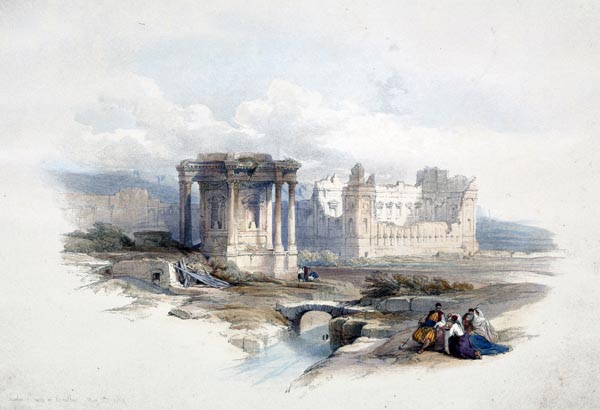
‘Circular Temple at Baalbec’ - David Roberts (British, 1796 – 1864)
Cleveland Museum of Art
Eager to see what remotest antiquity had bequeathed to us of the beautiful, grand, and mysterious, we quickened the pace of our weary horses, whose hooves were beginning to strike here and there against blocks of marble, fragments of columns, and overturned capitals; all the field-walls surrounding Baalbek are built from these remnants: antiquarians would find an enigma in every stone. Some signs of cultivation were beginning to reappear, and large walnut trees, the first I had seen again in Syria, rose between Baalbek and ourselves, even growing among the temple ruins, which their branches still hid from us. The ruins finally appeared: not, strictly speaking, of a temple, a building, a ruined edifice, more a mound of architecture rising suddenly from the plain, some distance from the true hills of the Anti-Lebanon.
Our horses trudged through the rubble, amidst the ruined Arab village called Baalbek. We skirted one side of the mound of ancient ruins, upon which rose a forest of graceful columns, gilded, by the setting sun, to a golden, matte-yellow hue reminiscent of the marble of the Parthenon, or the travertine (limestone) stones of the Colosseum in Rome. Among these columns, some, forming an elegant and extended row, still bore their intact capitals and richly sculpted cornices. They line the marble walls that enclose the sanctuaries; others rested intact against these walls which support them, like trees whose roots have collapsed, but whose trunks are still healthy and vigorous; others still, in greater numbers, are scattered here and there, immense pieces of marble or stone, on the slopes of the hill, in the deep ditches that surround it, and even in the bed of the river that flows at its foot. At the summit of this stone mountain-plateau, six columns of a more gigantic size rise in isolation, not far from a lower building, and still bear their colossal cornices. We shall see later what they signify, isolated in this way from the other buildings. Continuing along the base of the monuments, the columns and their architectural features end, and one sees nothing but gigantic walls, built of enormous stones, and almost all bearing the marks of sculpture; remains from another era, re-used in the distant past when the now ruined temple was erected. (Lamartine is describing the lower level ruins of the Temple of Jupiter.)
We went no further that day; the path veered away from the ruins and led us, amidst more ruins and over arches resounding with the hooves of our horses, to a small house built among the rubble: it was the palace of the Bishop of Baalbek (Athanasius Obeid, the Melkite Greek Catholic bishop), who, clad in his purple fur coat and surrounded by a few Arab peasants, came to meet us and led us to his humble door. The humblest peasant’s cottage in Burgundy or Auvergne owns to greater luxury and elegance than the palace of the Bishop of Baalbek: a hovel without windows or a door, poorly constructed, and whose roof, partially collapsed, allows rain to stream down onto a mud floor, such is his palace. At the rear of the courtyard, however, a clean, new wall, built of travertine blocks, with a door and a pointed window, in Moorish style, its ogives formed of admirably sculpted stones, caught my eye: it was the church of Baalbek (built by Athanasius Obeid in 1830), the ‘cathedral’ of this city, where other gods had splendid sanctuaries; it is the chapel where the few Arab Christians who live on these ruins of so many cults come to worship, in a purer form, this same Divinity the thought of whom has exercised the minds of men of all centuries, and led them to heap so many stones, and engender so many ideas.
We laid our cloaks down below the bishop’s hospitable roof; tied our horses to a stake on the vast lawn that stretches between the priest’s house and the ruins; lit a brushwood fire to dry our clothes, wet from the day’s rain; and ate supper in the bishop’s small courtyard, at a table made of a few temple stones, while, from the neighbouring chapel, the litanies of evening prayer sounded a plaintive chant, and the bishop’s deep, resonant voice murmured pious prayers to his flock, consisting of a few Arab shepherds and a group of women. When these desert folk emerged from the church and gathered round to gaze at us, we saw only friendly faces, and benevolent glances. We heard only obliging and affectionate words, those touching greetings, those prolonged and naive vows of primitive peoples, who have not yet made a vain formula of personal greetings, but rather have concentrated into a small number of words applicable to various encounters, at morning, noon, or night, all that hospitality could wish for its guests, all that one traveller could wish another by day, or night, on departure, or return. We were Christians — that was enough for them: shared religions are the most powerful bond between peoples — a mutually-held idea is more powerful than a common homeland; and the Christians of the East, amidst the Islamic world that surrounds them, threatens them, and often persecutes them, still see in the Christians of the West their present protectors and future liberators! It is time, in my opinion, to bring modern civilisation back to the places from which ancient civilisation sprang. Nothing is easier than to open to the fertile peoples of Lebanon our inexhaustible sources of population, industry, and prosperity; and to accomplish this transformation, all that is needed is to guarantee them security and property rights.
The Turkish population are healthy, sound, and moral; their religion is neither as superstitious nor as exclusive as it is portrayed; but their passive resignation, their abuse of faith in the tangible reign of Providence, stifles the human faculties by entrusting everything to Allah. God does not act for humankind; we are charged with acting in our own cause. He is a spectator and judge of human action. Islam has assumed the divine role; it has constituted itself an inactive spectator of divine action; it folds its arms in the face of humanity, and humanity perishes willingly from this inaction. Apart from this, justice must be done to the cult of Muhammad: it is basically a philosophical cult, which imposes only two great duties on humankind: prayer and charity. These two grand ideas are indeed the two highest truths of any religion. Islamic worship can enter, effortlessly and easily, into a system of religious and civil freedom, and form one of the elements of a large social community in Asia; it is moral, patient, resigned, charitable, and tolerant by nature. All these qualities make it suitable for needful integration in the countries it currently inhabits, where it must be helped to become enlightened, not exterminated; it is accustomed to living in peace and harmony with Christian worship, which it has allowed to exist and operate freely even within its holiest cities, such as Damascus and Jerusalem; empire matters little to it: provided it has prayer, justice, and peace, that is enough. Within European civilisation, worldly, political, and ambitious though we may be, it can readily be granted its place in the mosque, its place in the shade or the sunlight.
Alexander conquered Asia with thirty thousand Greek and Macedonian soldiers; Ibrahim will overthrow the Ottoman empire with thirty or forty thousand Egyptians, who know only how to load a weapon and march in step. A European adventurer, with five or six thousand European soldiers, could easily overthrow Ibrahim and conquer the Near and Middle East, from Smyrna to Basra, and from Cairo to Baghdad, by advancing step by step; by using the Maronites of Lebanon as the linchpins of his operation; by organising things behind him as he advances; and by making the Christians of the East his means of action, administration, and recruitment. Even the desert Arabs will be his, if he can pay them: they have no other worship than money, their divinities will always be gold and the sword. Given their cupidity, they can be restrained long enough for their submission to, eventually, become inevitable; they will yield to it themselves. After that, their tents may be pushed further into the desert, which is their only homeland; they will be drawn little by little to a gentler civilisation, currently lacking a nearby example.
We rose with the sun, whose first rays, striking the temples of Baalbek, granted those mysterious ruins a gleam of that eternal youth which Nature knows how to restore at will, even to what time has seemingly destroyed. After a short lunch, we went to touch with our hands what we had only seen before; we slowly approached the artificial hill, to take in with our eyes the different masses of architecture that compose it; and soon arrived at the northern side, within the very shadow of the gigantic walls which, there, envelop the ruins: a beautiful stream, overflowing its granite bed, ran beneath our horses’ feet, and formed, here and there, small lakes of clear, flowing water that murmured and foamed around the enormous stones fallen from the top of the walls, and the sculptures buried in the streambed. We crossed the Baalbek torrent by means of the bridges that time has created there, and climbed, through a narrow and steep breach, to the terrace that encircled these walls: with every step, with every stone our hands touched, every stone our eyes measured, our admiration and astonishment drew from us exclamations of surprise and wonder. Each of the stones of this enclosure wall is at least nine or ten feet long, and five or six feet wide, and equally as high. These blocks, enormous products of the work of human hands, rest one upon another without mortar, and almost all of them bear traces of sculpture from an Indian or Egyptian period.
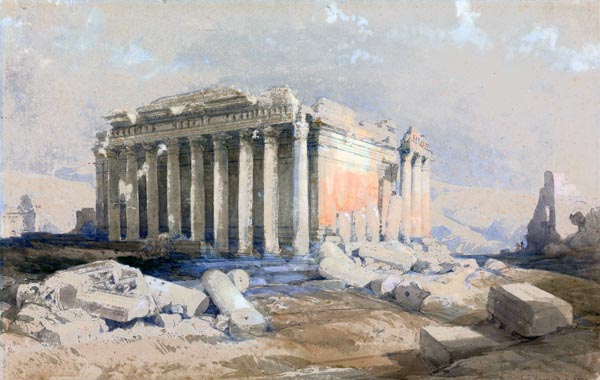
‘The Temple of Baalbec (1839)’ - David Roberts (British, 1796 – 1864)
Artvee
One sees, at first glance, that these fallen or demolished stones originally served a completely different purpose than forming a terrace and enclosure wall, and that they were the precious materials used to form primitive monuments, while being used later to enclose the monuments of Greek and Roman times. It was a common practice, I believe even a religious one, among the ancients, when a sacred building was destroyed by war or by time, or when more advanced arts sought to renew and perfect it, to use the materials of the original monuments for the purposes of restoration and fresh construction, so as to prevent stones touched by the shadow of the gods from being profaned by vulgar use; perhaps out of respect also for their ancestors, and so that the work of different eras would not be buried under the earth, but would still bear witness to the piety of men and their progress in the plastic arts: this is the case as regards the Parthenon, where the walls of the Acropolis, rebuilt by Pericles, contain the worked materials of the Temple of Athene. Many modern travellers have been misled, through their lack of knowledge of this pious custom of the ancients, and have mistaken segments of buildings constructed in this way since earliest antiquity for seemingly barbaric work of the Turks or the Crusaders. Some of the stones in the walls at Baalbek were from twenty to thirty feet long, and seven to eight feet high.
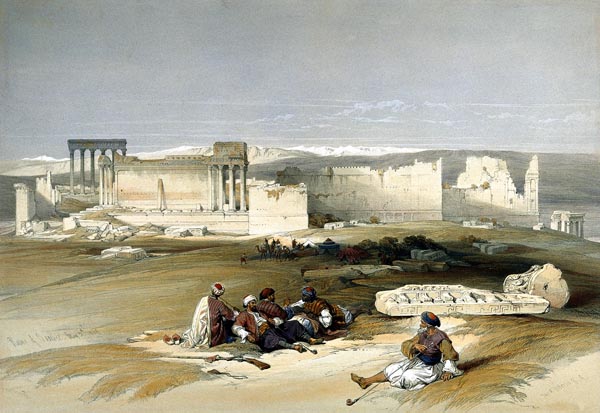
‘Baalbec / Ruins of Baalbec (May 5, 1839)’ - David Roberts (British, 1796 – 1864)
Wellcome Collection
Having reached the crest of the breach, our eyes knew not where to rest: everywhere there were marble doorways of prodigious height and width; windows and niches lined with the most admirable sculptures; arches adorned with exquisite ornamentation; fragments of cornices, entablatures, and capitals, scattered in the dust beneath our feet; coffered vaults above our heads; all was mystery, confusion, and disorder; artistic masterpieces, remnants of past ages, inexplicable marvels were all around us. We had scarcely cast an admiring glance to one side before a fresh wonder drew our attention to the other: each tentative interpretation of the form or religious meaning of the monuments was destroyed by succeeding impressions. We were lost in a labyrinth of conjecture. One cannot reconstruct in one’s mind the sacred buildings of a time or a people whose religion and customs one does not fully understand. Time hides its secrets, leaving human science its enigmas, and toying with and deceiving the latter. We soon abandoned any attempt to construct a system that might explain these ruins; we resigned ourselves to looking and admiring, understanding nothing more than the colossal power of human genius, and the strength of religious thought, which had been able to move such masses, and accomplish so many masterpieces.
We were still separated from the second area of ruins by interior structures that obscured our view of the temples. We were, in all likelihood, only in the priests’ quarters, or on the grounds of some private chapels, dedicated to unknown uses. We traversed these monumental structures, much richer than the enclosure walls. The second section lay before our eyes. An immense, elongated square platform presented itself, much wider, longer, and even more ornate than the first we had just left, its level often interrupted by remnants of higher pavements, which seemingly belonged to roofless or razed temples, where the Sun, once worshipped at Baalbek, shone upon the altar celebrating its presence.
All around this platform ran a series of chapels adorned with admirably sculpted niches, friezes, cornices, and coffers, works of the most accomplished craftsmanship, but of an already corrupted age of the arts: one senses the imprint of the styles, overloaded with ornamentation, of the decadent periods of the Greeks and Romans. But to experience this impression, one must already have an eye trained by the contemplation of the pure monuments of Athens or Rome: any other eye would be captivated by the splendour of the forms and the refinements of ornamentation. The only flaw here was excessive richness: the stone is crushed under its own luxurious decorations, and marble lacework covers the walls. There remain, almost intact, nine or ten such chapels that seem to have always existed thus, open to the rectangular platform they enclose, and where the mysteries of the cult of Baal were doubtless performed in broad daylight. I will not attempt to describe the thousand astonishing and admirable details that each of these temples, each of these stones, offers to the eye of the spectator. I am neither sculptor nor architect; I do not even know the names that stone assumes in this or that place, or in this or that form. I would speak but poorly in an unknown language; but the universal language that beauty speaks even to the ignorant eye, that the ancient and mysterious speaks to the mind and soul of the philosopher, I understand; and I never recognised it as strongly as in the chaos of marble, architectural forms, and mysteries which clutter that marvellous courtyard.
And yet this was nothing compared to what we were about to discover. By multiplying in one’s mind the remains of the Temple of Jupiter Stator in Rome, the Colosseum, and the Parthenon, one might be able to envisage the architecture before us; nothing could be more wondrous than the sight of this vast agglomeration of monuments, the product of great wealth and effort, occupying a single enclosure, in a unique place in the middle of the desert, and amidst the ruins of an almost unknown city.
We slowly tore ourselves away from this spectacle, and rode south-westwards, where the tops of those six gigantic columns (the remains of the upper Temple of Jupiter) rose like a beacon above this horizon of debris. To reach them, we were obliged to navigate among fresh outer walls, elevated forecourts, pedestals, and altar foundations that everywhere obstructed the space between ourselves and these columns. We finally arrived at their base. Silence is our only language when what we experience surpasses the measure of our customary impressions. We remained speechless as we contemplated these six columns, attempting to measure with our eyes their diameter and height, and take in the admirable sculpture of their architraves and cornices. They are seven feet in diameter, and more than seventy feet high; they are composed of only two or three blocks, so perfectly set one upon another that one can scarcely discern the joints; the material is a stone of a slightly golden yellow, somewhere between the brilliance of marble and the matte finish of travertine. The sun struck them on only one side, and we sat for a moment in their shade. Large birds, like eagles, startled by the sound of our footsteps, wheeled above the capitals where they make their nests, and, returning to rest on the stone acanthus leaves of the cornices, pecked at them with their beaks and beat their wings, like animated ornaments attached to these marvellous remains. The line of columns, which some travellers have mistaken for the remains of an avenue, a hundred and four feet long and fifty-six feet wide, once leading to the temple, appear to me clearly to have been the exterior decoration of that same temple. Upon careful examination of the smaller temple that stands entire, nearby, one recognises that it was built according to the same design. What seems probable to me is that after the first temple was destroyed by an earthquake, the second was built on the same model; that some of the materials preserved from the first temple were even used in its construction; that its proportions, too gigantic for a declining era, were simply reduced in size; that the columns, broken by their fall, were replaced; and that those spared by time were left standing as a sacred reminder of the ancient monument. If it were otherwise, other fragments of large columns would remain around the six that survive. Everything indicates, on the contrary, that the area surrounding them was empty and cleared of debris from the earliest times, and that a rich courtyard was still used for the ceremonies of a cult centred on them.
Opposite us, to the south-west, stood another temple (the Temple of Bacchus) situated on the edge of the platform, about forty paces away. It is the most complete and magnificent monument in Baalbek, and I dare say in the whole world. If one were to straighten one or two columns of the peristyle, which have rolled down the side of the platform, their tops still resting on the intact walls of the temple; if one were to replace some of the enormous coffers that have fallen from the roof into the vestibule; if one were to raise one or two sculpted blocks from the inner doorway, and if the altar, reconstructed from the debris scattered across the courtyard, were to be restored to its original form and position, one could well-nigh summon the gods, and resurrect the priests and the people. They would recognise their temple, as complete, as intact, as gleaming with polished stone and brilliant light, as on the day it left its builders’ hands.
This temple is smaller in scale than the one represented by the six colossal columns. It is surrounded by a portico supported by Corinthian columns; each of these columns is about five feet in diameter and forty-five feet in height; each column is composed of three superimposed blocks; they are nine feet apart and equidistant from the inner wall of the temple; above the column capitals extends a rich architrave and an admirably sculpted cornice. The roof of this peristyle is formed of large, concave blocks of stone, hewn with a chisel into coffers, each representing the figure of a god, goddess, or hero: I recognised a Ganymede being carried off by Jupiter’s eagle. Some of these blocks had fallen to the ground at the foot of the columns; we measured them; they are sixteen feet wide and about five feet thick: the roof tiles of the monument! The inner door of the temple, formed of equally enormous blocks, is twenty-two feet wide; we could not measure its height because other blocks have collapsed there and half-filled it. The appearance of the sculpted stones that make up the faces of this door, and its disproportion with the remains of the building, leads me to presume that it is the doorway of the great collapsed temple, subsequently inserted into this later one; the mysterious sculptures that decorate it are, in my opinion, from a completely different period than the Antonine, and of infinitely less pure workmanship: an eagle, holding a caduceus in its talons, spreads its wings over the opening; from its beak escape festoons of ribbons or chains, which are supported at their ends by two representations of Fame.
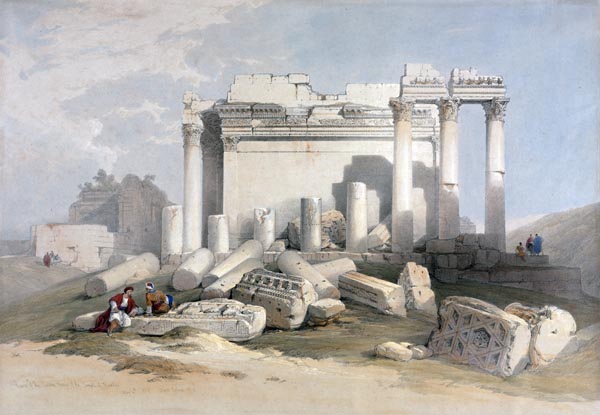
‘Ruins of the Eastern Portico of the Temple of Baalbec’ - David Roberts (British, 1796 – 1864)
Cleveland Museum of Art
The interior of the monument is decorated with pillars and niches of the richest and most elaborate sculpture; We carried away some of the fragments that were scattered around the forecourt. There are niches perfectly intact, seemingly straight from the sculptor’s workshop. Not far from the temple entrance, we found immense openings and underground staircases that led to lower structures whose purpose remains unknown; everything there is equally vast and magnificent: these were undoubtedly the residences of the pontiffs, the colleges of priests, the halls of initiation, perhaps also royal dwellings; they received light from above, or through the sides of the platform to which these chambers open. Fearing to lose our way in these labyrinths, we visited only a small part of them; they seem to extend over the entire extent of this mound. The temple I have just described is located at the southwest end of the monumental hill of Baalbek; it forms the very corner of the platform. Upon leaving the peristyle, we found ourselves on the edge of the precipice; we were able to measure the cyclopean stones that form the pedestal of this group of monuments: the pedestal is about thirty feet above the level of the plain of Baalbek; it is built of stones, the dimensions of which are so prodigious that, if they were not attested to by trustworthy travellers, people today would consider them highly improbable; the Arabs themselves, daily witnesses to these wonders, attribute them not to the power of human beings, but to that of genies or supernatural powers.
When one considers that these hewn granite blocks are, in some cases, up to fifty-six feet long by fifteen or sixteen feet wide, and of unknown thickness, and that these enormous masses are piled one on top of the other twenty or thirty feet from the ground; that they were taken from distant quarries, brought here, and hoisted to that height to form the paving of the temples, one is stunned at such a feat of human strength; modern science cannot explain the means employed to raise them, and one should not be surprised if people resort to a supernatural explanation. These marvellous stones are clearly not from the later age of the temples; they were a mystery to the ancients as they are to us; they are from an unknown period, perhaps antediluvian; they have likely supported many temples dedicated to successive and diverse cults. To the naked eye, one can recognise five or six generations of monuments, belonging to different periods, on the hill supporting the ruins of Baalbek.
Some Arab travellers and writers attribute these primitive constructions to Solomon, three thousand years before our time. He is said to have built Tadmor (see 2 Chronicles 8:4, identified with Palmyra), and Baalbek in the desert. The story of Solomon delights the imagination of Orientals; but this supposition, at least concerning the gigantic constructions of Heliopolis (Baalbek), is by no means plausible. How could a king of Israel, who even lacked a seaport less than twenty-five miles from his mountains, who was obliged to borrow the navy of Hiram, king of Tyre, to bring him cedars from Lebanon, have extended his dominion beyond Damascus and as far as Baalbek? How could a prince who, wishing to erect the Temple of Temples, the house of the one God, in his capital, used only fragile materials, which could not withstand time nor leave any lasting trace, have erected, a hundred and sixty miles or more from his realm, in the unknown wastes, monuments built of imperishable materials? Would he not rather have employed his wealth and power in Jerusalem? And what remains in Jerusalem to indicate monuments similar to those of Baalbek? Nothing: it cannot therefore be Solomon who built the earlier Baalbek. I believe rather that these gigantic stones were moved either by those first men whom all primitive histories call giants, or by antediluvian men.
It is said that, not far from here, in a valley of the Anti-Lebanon Mountains, human bones of immense size have been discovered: this rumour has such credence among the neighbouring Arabs that the British Consul-General in Syria, John Farren, a man of great learning, intends to visit these mysterious burial sites without delay. Eastern tradition, and even the monument erected over the so-called tomb of Noah, a short distance from Baalbek, assign this abode to the patriarch. The first men to emerge from him may well have long retained the stature and strength that humanity possessed before the total or partial submersion of land during the Flood; these monuments may be their work. Even supposing that the human species has never exceeded its present proportions, the power of human intellect may have altered: who is to say that earlier minds had not invented more perfect mechanical processes for moving, like grains of dust, these masses that an army of a hundred thousand men could not shake today? In any case, some of these stones from Baalbek, which are up to sixty-two feet long and twenty feet wide by fifteen feet deep, are the most prodigious masses that humanity has ever moved. The largest stones of the Egyptian pyramids do not exceed eighteen feet, and are merely exceptional blocks placed, for the purpose of achieving solidity, amidst certain parts of those edifices.
Turning the northern corner of the platform, the walls supporting it are equally well preserved; but the sheer mass of the materials composing them is less astonishing. The stones, however, are generally twenty to thirty feet long by eight to ten feet wide. These walls, much more ancient than the upper temples, are of a grey hue and pierced here and there with holes at their corners. These openings are lined with swallows’ nests, and from them hang tufts of shrubs and wallflowers. The sombre, grave colouration of the basal-stones contrasts with the splendid, golden hue of the temple walls and the rows of columns at the summit. At sunset, when the sun’s rays play among the pillars and cascade in waves of fire over the volutes and acanthus leaves of the capitals, the temples gleam like pure gold on a bronze pedestal. We descended through a breach formed at the southern corner of the platform. There, some columns of the smaller temple had rolled, along with their architraves, into the torrent that flows along the Cyclopean walls. These enormous column fragments, scattered haphazardly in the streambed and on the steep slope of the ditch, have remained and will doubtless remain forever where time has shaken them; a few walnut trees and other trees have sprouted among these blocks, covering them with their branches and embracing them with their broad roots. The most gigantic trees look like reeds that sprouted yesterday beside these column trunks, twenty feet in circumference, and these pieces of acanthus ornamentation, a single one of which covers half the streambed.
Not far from there, to the north, an immense opening in the side of the platform lay before us. We descended into it. The daylight that entered from both ends illuminated it sufficiently: we followed its entire length of five hundred feet; it extends beneath the whole expanse of the temples; it is about thirty feet high, and the walls of the vault are formed of blocks whose mass astonished us, even after those we had just contemplated. These blocks of travertine stone, hewn with chisels, vary in size; but most are between ten and twenty feet long; the vault is semicircular, the stones joined without mortar. We were unable to divine its purpose. At the western end, this vault has an even higher and wider opening, extending onto the platform of the small temples we had visited first. There we found ourselves back in broad daylight, the stream flowing among countless fragments of architecture rolled from the platforms, and beautiful walnut trees growing in the stony dust. The other ancient buildings of Baalbek, scattered before us across the plain, attracted our gaze; but nothing there had the power to interest us after what we had just seen. In passing, we cast a cursory glance at four temples that would still be marvels in Rome, and which here resemble the works of dwarfs. These temples, some octagonal in shape and very elegantly ornamented, others square with peristyles of Egyptian granite columns, and even columns of porphyry, seem to me to be from the Roman period. One of them served as a church in the early days of Christianity; Christian symbols can still be seen; it is now uncovered and ruined; the Arabs raid it whenever they need a stone to support their roof, or a trough to water their camels.
A messenger from the Emir of the Arabs of Baalbek was seeking us, and found us there. He came, on behalf of that prince, to wish us a safe arrival and to ask us to attend the djerid races, at a tournament he would be holding in our honour the following morning on the plain below the temples. We thanked him and gave our acceptance, and I sent my dragoman, accompanied by some of my Janissaries, to pay a visit to the Emir on my behalf. We returned to the bishop’s house supposedly to rest after our day’s sightseeing; but no sooner had we eaten a piece of flatbread and the mutton with rice prepared by our guides than we were off wandering, at random, without a guide, around the hill and its ruins or among the temples, whose layout we had established that morning. Each of us became attached to some ruin or viewpoint they discovered, and called from afar to their travel companions to come and enjoy it with them; but one could scarcely tear oneself away from one object to attach oneself to another, and we ended up abandoning ourselves, each individually, to our chance discoveries.
The evening shadows, descending slowly from the mountains of Baalbek, and burying the columns and ruins one by one in their darkness, added a further layer of mystery, and even more picturesque effects, to this magical and mysterious work of mankind and time. There, one felt what one was oneself when compared to the mass and eternity of the monuments: a swallow nesting for a season in the crevices of the stones, without knowing for whom or by whom they were assembled. The ideas that moved these masses, that accumulated these blocks, are unknown to us; the stony dust we tread upon knows as much as we do, and can tell us nothing; and, in a few centuries, the generations who come to visit the remains of our own monuments of today, will likewise ask themselves, in their turn, without being able to answer, why they were built and adorned. The works of man endure longer than his thoughts; motion is the law of the human mind; permanence is a dream born of pride or ignorance. God is a goal that constantly moves further away, the nearer humanity approaches; we forever advance, yet never arrive. The great divine figure, which Humankind has sought, since its infancy, to fix definitively in imagination and imprison in temples, expands, grows ever larger, surpasses our narrow thoughts and our edifices limited in scope, and leaves the empty temples and crumbling altars, summoning us to seek it, and find it, where it manifests itself more profoundly, in thought, intellect, virtue, Nature, and the infinite!
March 20th, in the evening.
Happy are they who have wings to soar over past centuries, to land without experiencing vertigo on these marvellous monuments of mankind, to plumb from those summits the depths of thought, of human destiny, to measure with their eye the path of the human spirit, ascending step by step amidst the twilight of philosophies, religions, and successive forms of rule; gaining height, like navigators on a sea without visible shores, and so divining at what point in time they themselves live, and to what manifestation of truth and divinity God calls the generation to which they belong!
Baalbek, March 21st, 1833.
Last night I went alone to the temple hill, by moonlight, to think, grieve, and pray. God knows how I wept, and will weep as long as a memory, a tear, remains! After praying for myself and for those who have departed from me, I prayed for all humankind. The great overturned temple of humanity, upon whose ruins I sat, inspired such strong and ardent feelings that they expressed themselves, almost of their own accord, in verse, the natural language of my thoughts whenever they overwhelm me. I wrote a poem this morning, in the very place and among the stones where I experienced those feelings last night.
The temples had made us forget the djerid tournament that the Prince of Baalbek wished to give; we spent the entire morning exploring them again. At four o’clock, some Arabs came to warn us that the horsemen were on the plain above the temples, but that, impatient with our delay, they were about to withdraw; that the prince thought this spectacle unpleasing to us, since we delayed our attendance, and asked us to visit his seraglio when we had satisfied our here; and that he was preparing another entertainment for us at his home. This display of tolerance from the chief of a fierce tribe of the most feared Arabs in this desert astonished us. In general, the Arabs and the Turks themselves do not allow foreigners to visit the ruins of ancient monuments alone; they believe that these ruins contain immense treasures guarded by genies or demons, and that Europeans know the magic words that reveal them. As they do not want these treasures removed, they are extremely vigilant as regards the presence of Franks in these regions: here, on the contrary, we were completely left to our own devices. We even lacked an Arab guide, and the children of the tribe had kept their distance out of respect. I know not the reason for this respectful deference from the Emir of Baalbek; perhaps he took us for emissaries of Ibrahim Pasha. The fact is that we are too few in number to inspire fear in an entire tribe of five or six hundred men accustomed to combat and living by plunder; and yet they dare neither approach us, nor question us, nor oppose any of our actions; we could stay a month in the temples, excavate them, and carry off the most precious fragments of their sculptures, without anyone objecting. I deeply regret here, as at the Dead Sea, not having known beforehand the disposition of these tribes towards us: I would have brought workers and pack camels, and enriched science and our museums.
Leaving the temples, we visited the Emir’s palace. A stretch of deserted, but less significant, ruins separate the hill of the great temples, or the acropolis of Baalbek, from the new Baalbek, inhabited by Arabs. The latter is nothing but a heap of hovels, damaged a hundred times by ceaseless war; the population huddles as best it can in the hollows between mounds of debris; a few tree branches and pieces of thatch cover these dwellings, whose doors and windows are often fashioned from the most notable fragments acquired from the ancient ruins.
The area occupied by the ruins of the modern city is immense; it stretches as far as the eye can see, whitening the pair of low hills that undulate above the great plain: the effect is bleak and harsh. These modern ruins are reminiscent of those of Athens, which I had seen a year before. The stark matte-white of fallen walls and scattered stones displays none of the majesty or golden hue of truly ancient ruins; it resembles a vast beach covered with sea foam. The emir’s palace is a rather large courtyard, surrounded by huts of various shapes; the whole thing is quite similar to the courtyard of a wretched farm in one of our poorest provinces. The gate was guarded by a number of armed Arabs; the crowd pressed forward to enter; the guards made way for us and ushered us in. The courtyard was already filled with tribal chiefs and a great multitude of others. The emir and his family, along with the principal sheikhs, dressed in magnificent but tattered caftans and fur coats, were seated on a raised platform above the crowd, against the main building. Behind them were a number of servants, armed men, and Black African slaves. The emir and his entourage rose as we approached; we were helped in ascending some enormous steps, made of irregular blocks that served as stairs to the platform, and, after the customary compliments, the emir had us sit on the divan beside him; the pipe was brought to me, and the entertainment began.
A musical accompaniment of drums, tambourines, high-pitched fifes, and triangles struck with an iron rod signalled the start of the performance: four or five actors, dressed in the most grotesque manner, some as men, others as women, advanced to the centre of the courtyard and performed the most bizarre and lascivious dances that these barbarians could conceive. These monotonous dances lasted for more than an hour, interspersed from time to time with a few words, gestures, and changes of costume, which seemed to indicate a dramatic intention; but only one thing was intelligible: the horrible and disgusting depravity of public morals, indicated by the dancers’ movements. I averted my eyes; the Emir himself seemed to blush at the scandalous lasciviousness of his people and, like me, made gestures of contempt. but the cries and transports of the rest of the spectators always arose at the moment when the filthiest obscenities were revealed in the figures of the dance, thus rewarding the actors.
They danced like this until, overcome with fatigue and drenched in sweat, they could no longer bear the ever-increasing rhythmic speed; they collapsed to the ground, and were borne away. The women did not attend this spectacle; but the Emir’s women, whose harem overlooked the courtyard, enjoyed it from their chambers, and we saw them, behind the wooden grilles, crowding at the windows to watch the dancers. The Emir’s slaves brought us sorbets and preserves of every kind, as well as exquisite drinks made of iced pomegranate juice and orange blossom, served in crystal cups; other slaves presented us with muslin napkins embroidered with gold thread to wipe our lips. Coffee was also served several times, and the pipes were constantly replenished.
I conversed with the Emir for half an hour; He struck me as a man of good sense and wit, and far above the coarse pleasures of his people which might have given a false impression of his own morals: a man of about fifty years of age, handsome, with the most dignified and noble manners, and of the most solemn politeness; all things that the humblest of Arabs possess as a gift of the climate, or as the legacy of an ancient civilisation. His clothing and weapons were of the greatest magnificence. His horses, of admirable quality, were scattered in the courtyards and along the road; he offered me one of the finest; he questioned me with the most delicate discretion about Europe, about Ibrahim, and about the purpose of my journey through the desert. I replied with an affected reserve, which led him to believe that I had indeed a completely different aim than simply to view columns and ruins. He offered me his entire tribe to accompany me to Damascus, across the unfamiliar range of the Anti-Lebanon Mountains, which I intended to cross. I accepted only a few horsemen to serve as guides and for protection, and I withdrew, accompanied by all the sheikhs, who followed us on horseback to the gate of the Greek bishop. I gave the order to depart the following day, and we spent the evening conversing with the venerable host whose company we were about to leave. A few hundred piastres, which I left him as alms for his flock, compensated for the hospitality we had received. He kindly agreed to send to Beirut a camel laden with some fragments of sculpture that I wished to take to Europe; he faithfully carried out this task, and upon my return to Syria, I found these precious fragments had arrived there before me.
March 22nd, 1833.
We left Baalbek at four in the morning; the caravan consisted of our usual number of mukaris, Arabs, servants, escorts, and eight horsemen from Baalbek who rode a few hundred paces ahead of the caravan. Day was just beginning to break as we crossed the first hill rising towards the Anti-Lebanon range. The entire hill is riddled with vast and deep quarries, from which had emerged the prodigious monuments we had recently beheld. The sun was beginning to gild the summits of the latter, which shone behind us on the plain like blocks of gold; we could scarcely tear our gaze from them; and stopped twenty times before they were completely out of sight; they disappeared, finally and forever, below the hills, and beyond the desert we saw only the black and snowy peaks of the mountains of Tripoli and Latakia, melting into the sky.
The low hills we first crossed were entirely bare and almost deserted. The soil was generally poor and barren; where cultivated, the earth was red. There were pretty valleys with gentle, undulating slopes, where a plough could move freely. We encountered neither travellers, villages, nor inhabitants until about midday. We rested in our tents at the entrance to a deep gorge where a stream, now dry, had flowed. We discovered a spring beneath a rock: the water was plentiful and delicious; and we filled the jars hanging from our saddles. After two hours of rest, we set off again.
We followed a steep, winding path along the side of a high, bare mountain for about two hours. The valley, which deepened further to our right, was criss-crossed by a wide, dry riverbed. A mountain of grey rock, completely barren, rose on the other side like a perpendicular wall. We began our descent again toward the other end of this gorge. Two of our horses, laden with baggage, tumbled into the depths. The mattresses and rugs, the load they carried, cushioned their fall; and we managed to extract them. We camped at the end of the gorge, near an excellent spring. The night was spent in the midst of this untouched labyrinth of the Anti-Lebanon Mountains. The snowfields were only fifty paces above our heads. Our Arabs lit a brush fire beneath a cavern-roof, ten paces from the mound where our tent was pitched. The firelight pierced the canvas and illuminated the inside of the tent, where we sheltered from the cold. The horses, though covered with their felt blankets, whinnied with discomfort. All night long we heard the horsemen from Baalbek and the Egyptian soldiers groaning under their cloaks. I myself, though covered with a cloak and a thick woollen blanket, could scarcely bear the bite of the icy Alpine air.
We mounted our horses at seven in the morning, beneath a blazing sun that made us successively shed our coats and caftans. At eight, we traversed a high plateau, passing by a large Arab village, the houses of which were spacious and the courtyards filled with cattle and poultry, as in Europe. We did not halt. The people are enemies of those of Baalbek, and the Arabs of Syria. They are well-nigh independent tribes, more closely related to the populations of Damascus and Mesopotamia. They appear wealthier and hard-working. All the plains around this village were cultivated. We saw men, women, and children in the fields. They were ploughing with oxen. We encountered sheiks, richly mounted and equipped, on their way to Damascus, or returning from there: their countenances were harsh and fierce; they gave us dark looks and passed by without a greeting. The children shouted insults at us. In a second village, two hours from the first, we manage to buy some chickens and a little rice for the caravan’s dinner. We camped at six in the evening in a field high above a mountain gorge that sloped down to a river we could see glistening in the distance. A small stream rushed down the gorge, at which we watered our horses. The landscape was still harsh. Before us, at the mouth of the gorge, rose rocky peaks grouped in pyramids, towering into the sky. There was no vegetation on these peaks. The grey or black colour of the rock contrasted with the dazzling clarity of the firmament into which they rose.
March 23rd 1833.
We mounted again at six in the morning. A superb day was spent journeying without a halt, between steep mountains separated only by narrow gorges, down which torrents of melting snow rushed. Not a tree, not a blade of moss could be seen on the flanks of these mountains. Their bizarre, jagged, and shattered shapes resembled human monuments. One of them rose immense and sheer on all sides, like a pyramid: it might have been be two miles and more in extent. It was impossible to see how it could ever have been climbed. No trace of paths or steps was visible: and yet all its sides were hollowed out with caverns of all sizes, and by human hands. There were a multitude of cells, large and small, whose doors were carved into various shapes. Some of these caves, whose openings rose above our heads, revealed small terraces of bare rock in front of their entrances. One saw the remains of chapels or temples, and columns still standing on the rock: it looked like an abandoned human beehive. The Arabs say that it was the Christians of Damascus who carved these caverns. I do indeed think that this is one of those Thebaids where the first Christians took refuge in times of cenobitic monasticism or persecution. Saint Paul had founded a large church in Damascus; and this church, long flourishing, suffered the phases and persecutions of all the other churches of the East.
The mountainside (Lamartine appears to be describing a site similar to that of Maaloula), which we passed by on our left, was soon behind us. We descended rapidly, over almost impassable precipices, toward a more open and wider valley. A charming river fills it. Vegetation is seen once more, on its banks: willows, poplars, immense trees with bizarrely bent branches and dark foliage, grow in the rocky crevices that line the river. We followed the enchanting river-bank for an hour, always descending, but imperceptibly. The river accompanied us, murmuring and foaming beneath our horses’ hooves. The high mountains, which form the gorge from which the river descends, receded, its course curving past broad, wooded hillocks, bathed in the rays of the setting sun. This is my first glimpse of Mesopotamia: we saw more and more of the succession of wide valleys that will open onto the great desert plain stretching from Damascus to Baghdad.
The valley we were in meandered gently and widened further. To the right and left of the river, we begin to see signs of cultivation, and hear the distant lowing of herds. Apricot orchards, the trees as large as walnut trees, lined the road. Soon, to our great surprise, we saw hedges, as in Europe, separating the orchards and the gardens planted with vegetables and flowering fruit trees. Wooden gates or fences opened here and there onto these beautiful orchards. The road there is wide, level, and well-maintained, like those near a large French city. None of us were aware of the existence of this delightful oasis, nestled in the inaccessible mountains of the Anti-Lebanon. We were clearly approaching a town or village, its name unknown to us. An Arab horseman we met said we were near a large village called Al Zabadani. We could already see smoke rising above the tops of the tall trees that dotted the valley. We entered the village streets; they were wide and straight, with stone pavements on either side. The houses lining them were large, surrounded by courtyards full of livestock, and perfectly watered and cultivated gardens. Women and children came to the doorways to see us pass, and greeted us with open, smiling faces. We inquired whether there was a caravanserai where we could find shelter for the night. We were told no: because Zabadani is not on any established road, caravans never pass through.
After wandering for a long time through the village streets, we arrived at a large square by the river. There, a house larger than the others, preceded by a terrace and surrounded by trees, marked the sheikh’s residence. I introduced myself, with my dragoman’s aid, and sought lodgings for the night. The slaves went to inform the sheikh; he himself rushed over: he was a venerable old man with a white beard and an open, gracious countenance. He offered me his entire house with an eager and gracious hospitality that I have scarcely encountered elsewhere. Immediately, his numerous slaves and the leading inhabitants of the village took our horses, led them to a large barn, unsaddled them, and brought heaps of barley and straw. The sheikh asked his women to leave their quarters and first ushered us into his divan, where we were served coffee and sherbet, and then gave us access to all the rooms in his house. He asked if I wished his slaves to prepare a meal for us. I begged him to allow my cook to spare them that trouble, and to procure only a calf and a few sheep to replenish our supplies, which had been depleted since Baalbek. In a few minutes, the calf and sheep were brought and slaughtered by the village butcher; and while our servants prepared supper, the sheikh introduced us to the leading inhabitants of the country, his relatives and friends.
He even asked my permission to have his wives presented to Madame de Lamartine (this is the first mention of the fact that Marianne was accompanying him on the Damascus trip). They were very eager, he said, to see a woman from Europe, and to admire her clothes and jewellery. Indeed, the sheikh’s wives, passed veiled across the room where we were sitting and entered my wife’s apartment. There were three of them: one, already elderly, who seemed to be the mother of the other two. The two younger women were remarkably beautiful and appeared full of respect, deference, and affection for the eldest. My wife offered them a few small gifts, and they gave her some in return. During this interview, the venerable sheikh of Zabadani had led us onto a terrace he had built near his house, and on the riverbank. Pillars, planted in the riverbed itself, support a carpeted floor; a divan surrounded it, and an immense tree, like those I had already seen by the roadside, shaded the terrace and the entire width of the river. It is here that the sheikh, as all Turks like to do, spends his leisure time, enjoying the murmur and coolness of the river’s foaming waters beneath him, in the tree’s shade, and to the song of the thousand birds inhabiting its branches. A wooden bridge led from the house to this suspended terrace. It is one of the most beautiful sites I have beheld in my travels. The view includes the last dark, rounded ridges of the Anti-Lebanon Mountains, which tower above in pyramids of black rock, or snow-capped peaks; and the river with its foaming waves, flowing between the uneven treetops of the varied belts of forest that border its course, to be lost amidst the sloping plains of Mesopotamia, which enter, like gulfs of greenery, the sinuous mountain range.
Supper being ready, I asked the sheikh if he would be so kind as to share it with us. He readily agreed, and appeared quite amused by the European manner of dining. He had never seen any of the utensils on our tables. He drank no wine, and we did not urge him to try. A Muslim’s conscience is as strict as ours. To make a Turk sin against the law imposed upon him by his religion has always seemed to me as reprehensible, as absurd, as tempting a Christian to do the like. We spoke at length about Europe, and about our customs, of which he seemed a great admirer. He told us about his method of administering his village. His family had governed this privileged district of the Anti-Lebanon Mountains for centuries, and the improvements in property, agriculture, policing, and cleanliness that we had admired while crossing the territory of Zabadani were due to this excellent line of sheikhs. It is the same throughout the Orient. Everything is an exception and an anomaly. Good, like evil, is perpetuated endlessly there. We were able to judge, by this enchanting village, what these provinces would be like if restored to their natural fertility.
The sheikh greatly admired my weapons, especially a pair of percussion pistols, and poorly disguised the pleasure he would have in possessing them. But I could not give them to him: they were my fighting pistols, which I wished to keep until my return to Europe. I presented him with a gold watch for his wife. He received this gift with all the polite resistance we in Europe would show to accepting a similar one, and even affected to be completely satisfied, although I could not doubt his preference for the pair of pistols. A quantity of cushions and rugs were brought to us for sleeping; we spread them out on the divan where he himself usually slept, and we fell asleep to the sound of the river murmuring beneath our bed.
The next day (March 24th), we set off at daybreak and traversed the other half of the village of Zabadani, which was even more beautiful than the half we had viewed the day before. The sheikh arranged for us to be escorted to Damascus by some mounted men from his tribe. We dismissed the horsemen of the Emir of Baalbek there, as they would not be safe in the territory of Damascus. We rode for an hour along tracks bordered by hedgerows, as wide as those in France, and perfectly maintained. A canopy of apricot and pear trees covered the road; to the right and left stretched endless orchards, then cultivated fields filled with people and livestock. All these orchards were watered by streams that flowed down from the mountains to our left. The mountains were covered with snow on their peaks. The plain was immense, and nothing limited it in our eyes but the forests of blossoming trees. After riding for three hours through a landscape akin to the most delightful parts of England or Lombardy, with nothing to remind us of the desert and its barbarity, we entered a barren, harsher land. Vegetation and cultivation had almost entirely disappeared. Rocky hills, barely covered with yellowish moss, stretched out before us, bordered by higher, equally barren, grey mountains. We rested in our tents at the foot of these mountains, far from any habitation. We spent the night there beside a deep, and narrow torrent that roared like endless thunder in its rocky gorge, a spate of muddy water and snowmelt.
We were mounted by six o’clock. It was the last day of our outward journey. I dressed in complete Turkish costume so as not to be recognised as a Frank in the vicinity of Damascus, my wife dressing in the clothing of Arab women, with a long white linen veil encircling her from head to toe. Our Arab companions also dressed more scrupulously, pointed out the mountains we still had to cross, and shouted: ‘Scham! Scham!’ which is the Arabic name for Damascus (Dimashq, or ash-Sham which means the Levant or historical Syria, also Madinat al-Yasmīn, the City of Jasmine).
The fanatical nature of the population of Damascus, and the surrounding area, demands these precautions from any Franks who venture to visit the city. Alone among the Eastern peoples, the Damascenes increasingly harbour religious hatred, and display a horror of European names and dress. They alone have refused to admit the consuls or even the consular agents of the Christian powers to the city. Damascus is a holy, fanatical, and free city: nothing must defile it.
Despite threats from the Sublime Porte, despite the even more dreaded intervention of Ibrahim Pasha, and a garrison of twelve thousand Egyptian and foreign soldiers, the population of Damascus has stubbornly refused the British Consul General in Syria access to its walls. Two terrible uprisings broke out in the city at the mere rumour of the consul’s approach. Had he not turned back, he would have been torn to pieces. The situation remains unchanged; the arrival of a European in Frankish dress would signal a new uprising, and we were not without concern that news of our march might have reached Damascus and thereby expose us to serious danger. We had taken every possible precaution. We are all dressed in full, and most strict costume. Only one European, who has himself adopted Arab customs and dress, and who is considered an Armenian merchant, has, for years now, risked living in the city, in order to be of service to trade along the Syrian coast and to the travellers whose destiny drives them to these inhospitable lands. He is Jean-Baptiste Beaudin, consular agent for France and all of Europe. Formerly an agent for Lady Stanhope, whom he accompanied on her first journeys to Baalbek and Palmyra; later employed by the French government for the acquisition of horses in the desert, Monsieur Baudin speaks Arabic like an Arab and has forged friendly and commercial relationships with all the nomadic tribes of the deserts surrounding Damascus. He is married to an Arab woman of European descent. He has lived in Damascus for ten years, and, despite the numerous relationships he has formed, his life has been threatened several times by the fanaticism of the city’s inhabitants. Twice he was forced to flee to escape certain death. He has built himself a house in Zahlé, the little Christian town on the slopes of Mount Lebanon, and it is there that he takes refuge during times of popular unrest.
Monsieur Baudin, whose life is constantly in peril in Damascus, and who is, in that great capital, the only means of communication, the sole link in European politics and commerce, receives from the French government, as his sole reward for his immense services, a paltry salary of 1,500 francs; while consuls, surrounded by all the security and luxuries of life in other Levantine trading posts, receive honourable and generous remuneration. I cannot understand why the European governments, in displaying both indifference and injustice, and the French government in particular, neglect and so disinherit a young, intelligent, honest, helpful, courageous, and active man who renders and would render the greatest service to his country. They will lose his service!
I had met Jean-Baptiste Baudin in Syria the previous year, and I had discussed my trip to Damascus with him. Having been informed of my departure and my imminent arrival, I sent an Arab this morning to inform him of the time at which I would be in the vicinity of the city, and to ask him to send me a guide to direct my steps and my movements.
At nine in the morning (of March 25th), we skirted a mountain adorned with country houses and gardens belonging to the inhabitants of Damascus. A beautiful bridge crossed a torrent at the foot of the mountain. We saw numerous lines of camels carrying stones for new buildings; everything indicated the approach to a great capital. An hour later, we glimpsed, atop a rise, a small, isolated mosque, the dwelling of a solitary Muslim. A fountain flowed beside the mosque, and copper cups, chained to the fountain’s base, allowed travellers to quench their thirst. We paused for a moment in this spot, in the shade of a sycamore tree; already the road was crowded with travellers, peasants, and Arab soldiers. We remounted our horses and, after climbing a few hundred paces, entered a deep defile, hemmed in on the left by a perpendicular wall of schist above our heads; on the right, by a rocky ledge thirty to forty feet high. The descent was rapid, and the hooves of our horses slid on the loose stones.
I was walking at the head of the caravan, a few steps behind the Arabs of Zabadani; suddenly they stopped, and shouted with joy, showing me an opening at the edge of the road; I approached, and saw, via the cleft in the rock, the most magnificent and strangest view that ever astonished the human eye: Damascus and the boundless desert were visible a few hundred feet below. My gaze fell first upon the city, which, surrounded by ramparts of yellow and black marble, flanked by countless square towers at intervals, crowned with sculpted crenellations, dominated by its forest of minarets of all shapes, and criss-crossed by the seven branches of its river (the Barada, historically named the Abana) and countless streams, extended as far as the eye could see amidst a labyrinth of flowering gardens. Throwing out immense arms here and there into the vast plain, everywhere shaded, everywhere pressed upon by groves, to an extent of twenty-five miles in circumference, of apricot trees, sycamores, and other trees of every shape and verdancy, it seemed lost from time to time beneath this canopy, then reappeared further on in wide stretches of housing, suburbs, and villages; a labyrinth of gardens, orchards, palaces, streams, where one’s sight grew dazed, and relinquished one enchantment only to find another.
We no longer advanced; pressed together at the narrow opening of the rock, pierced like a window, we contemplated, sometimes with exclamations, sometimes in silence, the magical spectacle that unfolded immediately and in its entirety before our eyes, at this end of a trail, destined to run through many a stony place and arid solitude, which merely formed the commencement of another desert, bounded only by Baghdad and Basra, and taking forty days to cross. Finally, we set off again; the rocky parapet that had hidden the plain and the city from us gradually lowered in height, and soon allowed us to enjoy the entire horizon fully; we were now only five hundred paces from the walls defending the suburbs. These walls, surrounded by charming kiosks and country houses displaying the most Oriental of architectural forms, shine like a golden enclosure around Damascus; the square towers that flank and surmount them are inlaid with arabesques pierced by pointed arches with columns as slender as paired reeds, and embroidered with turban-shaped crenellations; the walls are faced with yellow and black stone or marble, the segments alternating with elegant symmetry; the tops of the cypresses and other large trees that rise from the gardens and the interior of the city soar above the walls and towers, and crown them with dark greenery; the countless domes of the mosques and palaces of a city of eighty thousand souls reflected the rays of the setting sun, and the bright blue waters of the seven river-branches glittered and vanished, in turn, among the streets and gardens. The horizon, behind the city, was boundless like the sea; it merged with the purple edges of a fiery sky, still ablaze with the glow of the sands of the great desert; On the right, the broad, high ridges of the Anti-Lebanon Mountains receded like immense waves of shadow, one after the other, sometimes jutting out like promontories into the plain, sometimes opening like deep gulfs into which the plain stretched, along with its forests and large villages, some of which have as many as a thousand inhabitants. The branches of rivers, and two large lakes shone there, against the darkness of the overall green hue in which Damascus seemed almost engulfed; to our left, the plain was more expansive, and it was only at a distance of thirty to forty miles away that one’s eye rediscovered mountain peaks, white with snow, which shone amidst the blue of the sky, like clouds over the ocean.
The city is entirely surrounded by a forest of fruit orchards, in which the vines intertwine as in Naples, and are garlanded among the fig, apricot, pear, and cherry trees; below these trees, the rich, fertile, and continuously irrigated soil is carpeted with barley, wheat, corn, and all the legumes that this area produces; small white houses, here and there, pierce the greenery of these orchards, and serve as dwellings for the gardener, or as places of recreation for the owner’s family. The gardens are populated by horses, sheep, camels, turtledoves, everything that animates the natural scene; they are, generally, one or two acres in size, and separated from each other by walls of sun-dried earth, or by beautiful living hedges; a multitude of paths, shaded and bordered by streams of running water, traverse these gardens, cross from one suburb to another, or lead to a city gate; they extend to a radius of seventy to seventy-five miles around Damascus.
We had been riding in silence for some time through the initial labyrinth of orchards, anxious on not seeing the guide we had been promised; we halted: finally, he appeared; he was a poor Armenian, badly-dressed and wearing a black turban, like those the Christians of Damascus are obliged to wear; he approached the caravan without affectation, spoke a word or two, gave a signal; and, instead of entering the city suburb by the gate before us, we followed him along the walls, which we almost circumnavigated, through the maze of gardens and kiosks, and entered, instead, by an almost deserted gate, near the Armenian quarter.
Monsieur Baudin’s house, in which he had kindly prepared lodgings for us, is located in that district. We encountered no refusal at the city gate; after passing through, we rode for a long time along high walls with barred windows; the other side of the street was occupied by a deep canal, its flowing water powering the wheels of several mills. At the end of this street, we were stopped, and an argument arose between our Arabs and the soldiers guarding a second, inner gate, for every district has a separate one. I wished to remain unknown, and our caravan to be taken for that of Syrian merchants; but as the argument dragged on and grew increasingly noisy, and a crowd began to gather, I spurred my horse and advanced to the head of the caravan. Here was the guardhouse of the Egyptian troops, who, having noticed two hunting rifles that my Arab servants had concealed, ineffectually, beneath my horses’ blankets, were refusing to allow us through; an order from Sharif-Bey, the current governor of Damascus, forbade the introduction of weapons into the city, in which an insurrection and massacre of the Egyptian troops, some night, was feared. Fortunately, I had a recently penned letter from Ibrahim Pasha in my possession; I retrieved it and handed it to the officer commanding the post; he read it, brought it to his forehead and lips, and ushered us in with profuse apologies and flattering compliments.
We wandered for some time through a dark labyrinth of dirty, narrow alleyways; small, low houses, whose mud walls seemed ready to collapse on us, lined the streets; through the latticework windows, we saw charming Armenian girls who, at the sound of our long line of horses, ran to watch us pass, and offered us words of greeting and friendship. We finally stopped at a small, low, narrow doorway in a street where a horse could barely pass; we dismounted, crossed a dark, sunken corridor, and found ourselves, as if by magic, in a marble-paved courtyard, shaded by sycamore trees, refreshed by two Moorish fountains, and surrounded by marble porticoes and richly decorated salons: we had arrived at Monsieur Baudin’s house, which like all the Christian houses of Damascus, is a hovel on the outside, a delightful palace within. The tyranny of the fanatical mob forces these unfortunate people to hide their wealth and well-being behind a facade indicating misery and deprivation. Our luggage was unloaded at the gate, the courtyard was filled with our belongings, tents, and saddles, and our horses were led to the bazaar’s stalls.
Monsieur Baudin showed each of us to a lovely apartment furnished in the Oriental style, and we recovered on his sofas, and at his welcoming table, from the fatigues of such a long journey. A man known and loved, whom one meets amidst an alien crowd in a foreign country, represent an entire homeland; we experienced this fact at Monsieur Baudin’s; and the sweet hours spent talking about Europe and Asia in the evening by the light of his lamp, to the sound of the fountain in his courtyard, have remained in my memory and in my heart as one of the most delightful moments of my travels.
Monsieur Baudin is one of those rare men whom Nature has created with qualities to suit every role: a clear, quick intellect, an upright and steadfast heart, and tireless energy. Whether in Europe or Asia, Paris or Damascus, on land or at sea, he adapts to all, and displays happiness and serenity everywhere, since his soul is resigned, like that of an Arab, to the great rule that forms the basis of Christianity and Islam, namely submission to the will of God; and also because he has within him that ingenious activity of mind which is the second soul of the European. His language, his face, his manners take on all the forms that occasion demands. Viewing him during the day, discussing France and our shifting politics, one would have taken him for someone arrived from Paris yesterday and about to return there tomorrow; seeing him in the evening, reclining on his divan between a merchant from Basra and a Turkish pilgrim from Baghdad, smoking a pipe or a hookah, lazily running the amber beads of his Islamic rosary (misbaha) through his fingers, a turban on his forehead, slippers on his feet, uttering a word every fifteen minutes or so regarding the price of coffee or furs, one might mistake him for a slave trader or a pilgrim returning from Mecca. Only a person who has travelled extensively, and adapted their thoughts and manner of living twenty times, is truly complete.
The narrow and uniform habits that a person acquires in their regular life, amidst the monotony of their homeland are moulds that constrain and diminish all: thought, philosophy, religion, and character — everything is greater, truer, and more just, in one who has seen Nature and society from multiple angles. Travel provides a proper perspective on the material and intellectual world. To journey in search of wisdom was a major design among the ancients; the concept is not well-understood by us: they did not travel merely to seek unfamiliar dogmas and the teachings of the philosophers, but to see and judge everything. For my part, I am constantly struck by the narrow and petty way in which we view things, institutions, and peoples; and if my mind has expanded, if my vision has broadened, if I have learned to tolerate all by empathising with all, I owe it solely to the fact that I have frequently changed the scenes around me, and my own point of view has altered. To study the centuries through their history, human beings through travel, and God through Nature — that is truly to learn. We study everything through our wretched books, and compare everything to our petty local customs: and who made our customs and our books? Men as petty as ourselves. Let us open the book of books: let us live, see, travel: the world is a book, each step of which represents the turning of a page; he who has read only a single page, what does he know?
Damascus
March 24th, 1833.
Dressed in the most austere Arab attire, I toured the main districts of Damascus this morning, accompanied only by Monsieur Baudin for fear that a large gathering of unfamiliar faces might draw attention. We spent some time, at first, walking through the dark, dirty, and winding streets of the Armenian quarter. It resembles one of the most wretched villages in our provinces. The houses are built of mud; they have a few small, sparse, barred windows facing the street, their shutters painted red. They are low, and their low doorways are like stable doors. A pile of rubbish, and a muddy pool of water, front almost every doorway. We did, however, enter some of the houses of the principal Armenian merchants, and I was struck by the richness and elegance of these dwellings inside.
After passing the door and crossing a dark corridor, one finds oneself in a courtyard adorned with superb marble fountains and shaded by one or two sycamore trees or Persian willows (salix aegyptiaca). The courtyard is paved with large slabs of polished stone or marble, and vines cover the walls. The walls, in turn, are faced with white and black marble. Half a dozen doors, their jambs also of marble and carved with arabesques, lead to as many rooms or salons, where the men and women of the family gather. These salons are vast and vaulted. They are pierced by a large number of small, very high windows, to allow the outside air to circulate freely throughout. Almost all rooms consist of two levels: a lower one where the servants and slaves sit; and a second, raised level, a few steps above, separated from the first by a balustrade of marble or exquisitely carved cedarwood. Generally, one or sometimes two fountains emitting jets of water murmur in the centre or corners of the room. The edges are adorned with vases of flowers; swallows or doves freely come to perch on the basins and drink. The walls of the room are marble up to a certain height. Above, they are covered with stucco and painted with arabesques in a thousand colours, often with extremely ornate gilded mouldings. The furnishings consist of magnificent Persian or Baghdad carpets that cover the marble or cedarwood floor everywhere, and a large quantity of cushions or silk mattresses, scattered throughout the apartment, serving as seats or backrests for family members. A divan covered in precious fabrics and infinitely finer carpets dominates the rear and sides of the room. Women and children are usually found squatting or reclining there, occupied with various household tasks. The cradles of infants are on the floor, amidst the carpets and cushions. The master of the house always has one of these rooms to himself; it is here that he receives visitors. He is usually found seated on his divan, his long-handled writing desk placed on the floor beside him, a sheet of paper resting on his knee or left hand, writing or calculating all day long, for commerce is the sole occupation and talent of the inhabitants of Damascus.
Everywhere we went, in order to return the visits that we had received the day before, the owner of the house received us with grace and cordiality; he had pipes, coffee, and sherbet brought to us, and led us into the drawing room where the women were gathered. Whatever idea I may have had of the beauty of Syrian women, whatever image the beauty of the women of Rome and Athens may have left in my mind, the sight of the Armenian women and girls of Damascus surpassed everything. Almost everywhere we found faces that no European brush has ever traced, eyes where the serene light of the soul takes on a dark azure hue, and casts rays of moist velvet that I had never before seen shine in a woman’s eyes; features of such exquisite delicacy and purity that the lightest and most delicate hand could not imitate them, the skin so translucent and, at the same time, so vividly tinted that the most delicate shades of rose petals cannot match their pale freshness; their teeth, their smiles, the natural grace of their forms and movements, the clear, resonant, silvery timbre of their voices — all is in harmony as regards these admirable apparitions. They converse graciously, with a modest restraint, yet without embarrassment, and as if accustomed to the admiration they inspire. They seem also to retain their beauty for a long while amidst this preserving climate, and life of quiet domesticity and leisure, in which the artificial passions of society abrade neither soul nor body.
In almost every house I have visited, I have found the mother as beautiful as her daughters, though the girls appeared to be already fifteen or sixteen years old. Girls often marry at the age of twelve or thirteen. The costumes of these women are the most elegant and noble I have yet seen in the Orient: their heads are uncovered, their braided hair, adorned with flowers, circling their foreheads several times, and falling in long plaits on either side of their necks and over their bare shoulders; festoons of gold coins and rows of pearls mingle in their hair; a small cap of chased gold sits atop the head; and their breasts are almost bare. They wear a short jacket with wide, open sleeves, made of silk brocaded with silver or gold, and wide white trousers falling in pleats to the ankles. Their bare feet are shod in yellow morocco leather slippers. A long silk gown of a brilliant colour, falling from their shoulders, open at the breasts and in front of the trousers, is held only around the hips by a belt whose ends reach the ground.
I could scarcely tear my eyes away from these ravishing women. Our visits and conversations have extended everywhere, and I always found them as charming as they were beautiful. The customs of Europe, the costumes and habits of Western women, were generally the subject of conversation; they seem to envy nothing in the lives of our women; and when one converses with these charming creatures, when one finds in their conversations and manners the grace, perfect naturalness, kindness, serenity, and that peace of mind and heart which are so well preserved in family life, one wonders what they could possibly envy in our society women, who know everything except what brings happiness within a family, and who squander in a few years, in the turmoil of our societies, their souls, their beauty, and their lives. These women sometimes visit each other; they are not even entirely separated from the company of men; but this society is limited to a few young relatives or friends of the house, from among whom, by consulting their inclinations and family relationships, a fiancé is chosen for them very early on. The fiancé then visits from time to time to enjoy, like a son, the delights of the house.
I met, there, a leader of the Armenians of Damascus, a very distinguished and learned man; Ibrahim has placed him, as the head of his nation, on the municipal council that currently governs the city. Although he has never left Damascus, he possesses the most accurate and well-reasoned notions about the political state of Europe, about France in particular, about the general direction of human thought in our time, about the transformation of modern governments, and about the probable future of civilisation. I have not met in Europe a man whose observations on these matters were more accurate or insightful: it is all the more astonishing given that he knows only Latin and Greek, and has never been able to read those Western works or newspapers where such questions are explained in a way accessible even to those who repeat them without understanding them. Nor has he ever had the opportunity to converse with distinguished men from our part of the world. Damascus is a place with no connection to Europe. He has grasped everything through geographical maps and a few major historical and political events that have resonated even there, and which his natural and thoughtful genius has interpreted with marvellous sagacity.
I was charmed by the man; I spent part of the morning talking with him: he will come this evening and every day. He foresees, as I do, what Providence seems to be preparing for the East and the West, through the inevitable convergence of these two parts of the world, mutually providing each other with space, movement, life, and light. He has a fourteen-year-old daughter who is the most beautiful person I have ever seen; her mother, still young, is charming as well. He introduced me to his twelve-year-old son, whose education occupies him greatly. ‘You should send him to Europe,’ I said, ‘and let him receive the education that you regret not having receiving yourself. I could oversee it.’ ‘Alas!’ he replied, ‘I think about it constantly, yet have often thought that if the state of the East fails to change, what service will I have rendered my son by elevating him, as regards knowledge, too far above his contemporaries, and the country in which he must live? What will he do in Damascus, on his return, with the enlightenment, customs, and taste for liberty enjoyed in Europe? If one must be a slave, it is better never to have been anything but a slave.’
After these various visits, we left the Armenian quarter, separated from the next by a gate that closes every evening. I found myself in a wider and more beautiful street; it is lined with the palaces of the principal Agas of Damascus; they are the nobility of the country. The facades of these palaces, facing onto the street, resemble long prison or alms-house walls, of grey mud. There are few or no windows; occasionally a large door opens onto a courtyard; and a great number of squires, servants, and Black African slaves are seen reclining in the shade of the door. I visited two of these Agas, friends of Monsieur Baudin; the interiors of their palaces were magnificent. They contained a vast courtyard, adorned with superb fountains, and planted with trees that provide shade; the salons are even more beautiful and more richly decorated than those of the Armenians. Several of these salons have cost up to one hundred thousand piastres to adorn; Europe has nothing more magnificent; everything is in the Arab style. Some of these palaces have eight or ten salons of this kind. The Agas of Damascus are generally descendants or sons of pashas who have used the treasures acquired by their fathers to enrich their residences. It is Roman nepotism in another form. These Agas are numerous, and they occupy the principal positions in the city, under the Pashas sent by the Grand Seigneur. They have vast land-holdings in the villages surrounding Damascus. Their luxuries consist of palaces, gardens, horses, and women. At a sign from the Pasha, their heads roll, and their wealth, palaces, gardens, women, and horses pass to some new favourite of fortune. Such a form of rule naturally encourages indulgence coupled with resignation: both voluptuousness and fatalism are the inevitable results of Oriental despotism.
The two Agas I visited received me with the utmost courtesy. The brutal fanaticism of the common people of Damascus does not extend so far. The Agas know I am a European traveller; they believe me to be a secret ambassador, come to gather information for the kings of Europe about the quarrel between the Turks and Ibrahim. I expressed to one of them my desire to see his finest horses and to buy one, if he would agree to sell. He immediately had his son and his squire lead me to a vast stable, where he keeps thirty or forty of the most magnificent creatures from the desert around Palmyra. I had seen none so beautiful displayed before me: these creatures were generally very tall in height, with dark grey or grey-white coats, manes like black silk, prominent, dark brown eyes of admirable steadiness and acuteness, broad, flat shoulders, and swan-like necks. As soon as the horses saw me enter and heard a foreign language spoken, they turned their heads toward me, quivered, neighed, and expressed astonishment and fear with sidelong, startled glances of their eyes, and a wrinkling of their nostrils, which gave their beautiful heads the most intelligent and extraordinary expression. I have already had occasion to observe how much quicker and more developed the minds of animals are in Syria than in Europe. An assembly of believers, surprised in the mosque by a Christian, could not have better expressed indignation and terror in their postures and expressions than these horses did on seeing a stranger’s face, and hearing an unknown tongue. I stroked some of them, and studied them all. I then led them out into the courtyard. I knew not which to choose, as they were almost all remarkable for their perfection: finally, I decided on a young, three-year-old white stallion, which seemed to me the jewel of all the desert horses. The price was negotiated between Monsieur Baudin and the Aga, and fixed at six thousand piastres, which I paid to him. The horse had arrived from Palmyra not long ago, and the Arab who had sold it to the Aga had received five thousand piastres and a magnificent cloak of silk and gold. The animal, like all Arabian horses, wore a record of its genealogy around its neck, enclosed in a fur pouch, and several amulets to protect it from the evil eye.
I wandered through the bazaars of Damascus. The Grand Bazaar is about a mile or so long. These bazaars are long streets, the houses of which are topped by very tall roofs, lined with shops, stalls, stores, and cafés; the shops are narrow and shallow; the merchants sit on their heels in front of the shops, pipe in mouth, or a hookah beside them. The stores are filled with all kinds of merchandise, and especially with fabrics from India, which flow into Damascus via the caravans from Baghdad. Barbers invite the passers-by to have their hair trimmed; their stalls are always full of customers. A crowd, as large as that in the galleries of the Palais-Royal, circulates all day long in the bazaar. But the sight of this crowd is infinitely more picturesque.
The Agas dress in long crimson silk coats lined with marten-fur, sabres and daggers adorned with diamonds hanging from their belts. They are followed by half a dozen courtiers, servants or slaves, who walk, silently, behind them, carrying their pipes and their hookahs: they sit, for part of the day, on the outdoor sofas of cafés built along the banks of the streams that traverse the city; beautiful plane trees shade the sofas: here, they smoke and chat with their friends, and this is the only place of communication, apart from the mosque, for the inhabitants of Damascus. Here, almost in silence, the frequent revolutions that bloody this capital are prepared. The silent ferment simmers for a long time, then erupts at an unexpected moment. The people rush to arms under the leadership of some faction, commanded by one of the Agas, and the government passes, for a time, into the hands of the victor. The vanquished are put to death, or flee to the deserts of Baalbek and Palmyra, where independent tribes give them refuge.
The officers and soldiers of the Pasha of Egypt, dressed almost in European style, drag their sabres along the pavements of the bazaar. I encountered several who approached us speaking Italian; they are on their guard in Damascus; the people view them with horror; a riot could break out any night. Sharif-Bey (Muhammad Sharif Pasha al-Kabir), one of the most capable men in Muhammad Ali’s army, commands them and is temporarily governing the city. He has formed a camp of ten thousand men outside the walls, on the banks of the river, and has garrisoned the castle; he himself resides in the seraglio. News of the slightest setback for Ibrahim in Syria would be the signal for a general uprising and fierce conflict in Damascus. The thirty thousand Armenian Christians who live in the city are terrified and would be massacred if the Turks prevailed. The Muslims are angered by the equality that Ibrahim Pasha has established between them and the Christians. Some of the latter are abusing this moment of tolerance and insulting their enemies by violating their customs, which augments and embitters their fanaticism. Monsieur Baudin is ready, at the first notice, to take refuge in Zahlé.
The Arabs of the great desert and those of Palmyra throng the city and wander the bazaars. Their only clothing is a large white woollen blanket, which they drape around themselves, appearing like ancient statues. Their complexions are tanned, their beards black, and their eyes fierce. They form groups in front of the tobacconists’ shops, and in front of the saddlers and armourers. Their horses, always saddled and bridled, are hobbled in the streets and squares. They despise the Egyptians and the Turks, but, in the event of an uprising, would march against Ibrahim’s troops. He has only been able to keep them a day’s march from Damascus; he himself advanced with artillery against them as he passed through the city. They are now his enemies. I will speak at greater length about these unfamiliar peoples of the great Euphrates desert.
Each type of trade and industry has its own separate quarter in the bazaars. There are the armourers, whose shops are far from offering the magnificent and renowned weapons that Damascus once supplied to the Levantine trade. These admirable sword manufactories, if they ever existed in Damascus, have completely fallen into oblivion: only swords of a common type are made there, and one only finds antique, now almost priceless, weapons in the armourers’ shops. I searched in vain for a sword and a dagger of ancient type. These swords now come only from Khorasan, a province of Persia, and are no longer being made even there; a certain number still in existence change hands like precious relics, and are of inestimable value. The blade of the one I was given cost the Pasha five thousand piastres. The Turks and the Arabs, who value these blades more than diamonds, would sacrifice anything in the world for such a weapon; their eyes sparkle with enthusiasm and veneration when they see mine, and they hold it to their foreheads, as if they were worshipping so perfect an instrument of death.
The jewellers have no skill or taste in setting their precious stones or pearls, in my opinion; yet they possess immense collections of this kind. All the wealth of the Orientals is movable, and meant to be buried or carried. There are a great many of these goldsmiths; they display little: everything is kept in small caskets which they open when asked for a piece of jewellery.
Saddlers are the most numerous and ingenious craftsmen in these bazaars: nothing in Europe equals the taste, grace, and opulence of the luxury harnesses they make for the horses of the Arab chieftains or the agas of the country. The saddles are covered in velvet and silk brocaded with gold and pearls. The red morocco-leather collars, which fall in fringes over the horse’s chest, are also adorned with silver and gold tassels and clusters of pearls. The bridles, infinitely more elegant than ours, are also all made of morocco-leather in various colours and decorated with silk and gold tassels. All these items are, compared to those in Europe, very inexpensive. I bought two of the most magnificent bridles for one hundred and twenty piastres for the pair (about fifty francs).
The food vendors are the ones whose shops offer the most orderliness, elegance, cleanliness, and visual appeal. The fronts of their shops are adorned with a multitude of baskets filled with vegetables, dried fruits, and legumes whose names I know not, but which have admirable shapes and glossy colours, and which gleam like small pebbles emerging from water. Loaves of bread, of every size and quality, are displayed in front of the shops; there is an innumerable variety of these made for different times of day and different meals: they are warmed, like flatbreads, and of perfect flavour. Nowhere have I seen such perfect bread as in Damascus: it costs almost nothing. Some restaurateurs also offer food to the merchants or strollers in the bazaar. They provide neither tables nor cutlery and sell small skewers holding mutton-pieces, the size of a walnut and roasted in the oven. The buyers carry them away on one of the golden flatbreads I mentioned, and eat them as they walk. The numerous fountains in the bazaar offer the only drink available to the Arabs. One can eat perfectly well in Damascus for two piastres, or about ten sous a day. The common people spend less than half that on food. One can rent a nice house for two or three hundred piastres a year. With three or four hundred francs of income, one would be comfortable here: it is the same everywhere in Syria.
While wandering through the bazaar, I arrived at the quarter of the chest and box makers: theirs is a major industry, since the only furnishings an Arab family possesses usually consist of one or two chests where clothes and jewellery are stored. Most of these chests are made of cedar and painted red, with decorative work formed of gold studs. Some are admirably carved, in relief, and covered with very elegant arabesques. I bought three and sent them back by the Tripoli caravan. The scent of cedarwood perfumes the entire bazaar; and this atmosphere, composed of the thousand different perfumes emanating from the carpenters’ shops, the grocery and druggist stores, the chests of amber or perfumed gums, the cafés, and the pipes constantly smoked in the bazaar, reminds me of the impression I had the first time I passed through Florence, where the carving of cypress-wood frames fills the streets with a similar scent (Florence was noted at that time for its production of picture and other frames, hand-carved, ornate and gilded, using native cypress-wood.)
Sharif-Bey, the governor of Syria under Muhammad Ali, left Damascus today. News of Ibrahim’s victory over the Grand Vizier at Konya (in Turkey, on December 21st 1832) arrived last night. Sharif-Bey is taking advantage of the climate of terror that has gripped Damascus to visit Aleppo. He is leaving the city’s government to an Egyptian general, assisted by a municipal council composed of leading merchants from all the different groupings. An encampment containing six thousand Egyptians and three thousand Arabs remains at the city gates. The sight of this camp is extremely picturesque; tents of all shapes and colours are pitched in the shade of the large fruit trees along the riverbank. The horses, generally magnificent, are tethered in long lines to ropes stretched from one end of the camp to the other. The undisciplined Arabs are there in all the bizarre diversity of their tribes, armour, and costumes: some resembling assemblies of kings or patriarchs, others of desert brigands. The bivouac fires emit blue smoke, which the wind carries over the river or across the gardens of Damascus.
I witnessed the departure of Sharif-Bey. All the principal Agas of Damascus, and the officers of the corps remaining there, had gathered at the seraglio. The vast courtyards enclosed by the dilapidated walls of the castle and the seraglio were filled with slaves leading the finest horses in the city, richly caparisoned; Sharif-Bey was taking lunch in the inner apartments. I did not enter; I remained, with some Egyptian and Italian officers, in the main paved courtyard. From there, we watched the crowd outside, the Agas arriving in groups, and the Black African slaves passing by, carrying on their heads immense tin platters containing the various courses of the meal. Some of Sharif-Bey’s horses were there; they are the finest animals I have yet seen in Damascus; they are of the Turkoman breed and infinitely larger and stronger than Arabian horses. They resemble large Norman horses, with finer, more muscular limbs, heads that weigh less heavily, and the wide, ardent, proud, and gentle eyes of the Oriental horse. They are all brown bays with long manes: truly Homeric horses. At noon, Sharif-bey set off, accompanied by a vast cavalcade till he was five miles from the city.
In the middle of the Damascus bazaar, I found the most beautiful khan in the Orient, the Khan of As’ad Pasha al-Azm. It is an immense dome whose bold vault recalls that of St. Peter’s in Rome; it too is supported by granite pillars. Behind these pillars are shops and staircases. leading to the upper floors, where the merchants’ rooms are located. Each prominent merchant rents one of these rooms and keeps his valuable merchandise and books there. Guards watch over the security of the khan night and day; large stables stand nearby for the horses of travellers and caravans; beautiful, flowing fountains refresh the place: it is a kind of exchange for Damascus’s commerce. The gate of As’ad Pasha’s Khan, which opens onto the bazaar, is one of the richest in detail and most grandiose examples of Moorish architecture to be seen anywhere. The entirety of Arab architecture is found there. Yet this khan was only built eighty years ago. The arts of a people whose architects are capable of designing, and whose workers are capable of executing, a monument like As’ad Pasha’s Khan have not yet died. These khans are generally built by wealthy pashas, who leave them to their family or to the city they wish to enrich. They generate substantial income.
A little further on, from a gate opening onto the bazaar, I saw the large courtyard or forecourt of the main mosque of Damascus (the Umayyad Mosque, early 8th century). It was once a basilica dedicated to Saint John the Baptist. The monument seems to date from the time of the Holy Sepulchre in Jerusalem: heavy, vast, and of that Byzantine architecture which is a degraded imitation of Greek architecture, and appears to have been built from previous ruins. The mosque’s large doors were closed by heavy curtains, so that I could not see the interior. A Christian who would seek to desecrate a mosque by entering, risks death. We stopped for only a moment in the forecourt, while feigning to quench our thirst at the fountain.
The same date. March 24th, 1833.
The Baghdad caravan arrived today; it consisted of three thousand camels, and is encamped at the city gates. I bought sacks of Mocha coffee, which can no longer be obtained elsewhere, and shawls from India.
The caravan to Mecca was suspended due to the war. The Pasha of Damascus was tasked with leading it. The Wahhabis (strict reformists within Sunni Islam) dispersed it several times. Muhammad Ali drove them back to Medina. The members of the last caravan, stricken with cholera in Mecca, exhausted and lacking water, perished almost entirely. The bodies of forty thousand pilgrims were left in the desert. The dust in the desert leading to Mecca is the dust of human beings. It is hoped that this year the caravan will be able to depart under the auspices of Muhammad Ali; but, before long, the advance of the Wahhabis will forever prohibit the pious pilgrimage.
The Wahhabis represent the first major armed reform movement within Islam. A sage from the vicinity of Mecca, named Muhammad ibn Abd al-Wahhab, undertook to restore Islam’s original purity of dogma, to eradicate, first through words and then by force, among the Arabs converting to his sect, those popular superstitions whose lack of credibility, or origin in deliberate deceit, corrupts all religions, and to restore the religion of the East as a practical and rational deism. Little was needed to achieve this, since the Prophet had not presented himself as a god, but as a man imbued with the spirit of Allah, and preached only the unity of Allah, and charity towards humankind. Abd al-Wahhab did not present himself as a prophet either, but rather as a man enlightened by reason alone. Reason, this time, fuelled Arab fanaticism, as falsehood and superstition had done previously. The sect took up arms in its name, they conquered Mecca and Medina, stripped the veneration of the Prophet of all the instruments of adoration that had replaced it, and these one hundred thousand armed missionaries threatened to change the face of the East. Muhammad Ali erected a temporary barrier against their incursions; but Wahhabism persists, and has spread throughout the three Arabias (the Roman regions of Arabia Felix, Arabia Deserta, and Arabia Petraea), and, at the first opportunity, these purifiers of Islam will spread as far as Jerusalem, Damascus, even as far as Egypt. Thus, human ideas perish by the very weapons that propagated them. Nothing is impenetrable to the progressive dawn of reason, the gradual and ceaseless revelation experienced by mankind. Muhammad, the Prophet, set out from the same deserts as the Wahhabis to overthrow idols and establish the worship, without sacrifices, of the one and immaterial God, Allah. Abd al-Wahhab, in his turn, appears and, shattering popular credulity, returns Islam to its roots in pure reason. Each century lifts a corner of the veil that conceals the image of the god of gods, eternal, evident in Nature, and delivering his oracles to the human mind.
Damascus, March 25th, 1833
We spent the day wandering through the city and its bazaars. Memories of Saint Paul are ever-present to the Christians of Damascus. There are the ruins of the house from which he escaped at night suspended in a basket. Damascus was one of the first places where he sowed the word that changed the world. The word bore fruit swiftly there. The East is the land of cults, of wonders, even of superstitions. The great idea that stirs imaginations here, at all times, is the religious idea. All these peoples, customs and laws, are founded on religion. The West has never been the same. Why? Are we less noble, we children of barbarians who still sense our origins?
Matters are reversed in the West. That earliest of human ideas is ranked below all the others. The Western lands are lands of wealth and steel, movement and noise. The Eastern lands are lands of profound meditation, intuition, and adoration! But the West is advancing by leaps and bounds, and when religion and those powers of reason obscured by the Middle Ages, have embraced each other in truth, light, and love, the religious spirit, the divine breath, will once again become the soul of the world, and will give birth to wonders of virtue, civilisation, and genius. May to be so!
Damascus, March 26th.
There are perhaps ten thousand Christians in Damascus and fourteen thousand in Baghdad. The Christians of Damascus are Armenians or Greeks. A few Catholic priests serve those of their own faith. The inhabitants of Damascus tolerate the Catholic monks. They are used to their attire, and consider them Orientals. I have seen, on several occasions recently, two French Lazarist priests who have a small monastery tucked away in the Armenian poor quarter. One of them, Father Poussous, comes to spend the evenings with us. He is an excellent man, pious, learned, and kind. He took me to his monastery, where he educates poor Arab Christian children. Only the desire to do good keeps him in this desert of humanity, where he constantly fears for his own safety. He is nevertheless cheerful, serene, and resigned. From time to time, he receives news and aid from his superiors in France via caravans from Syria, as well as a few Catholic newspapers. He lent me some, and nothing seems stranger to me than reading of the pious or political squabbles of the Saint-Sulpice district, at the edge of the Baghdad desert, beyond Lebanon and the Anti-Lebanon Mountains and near Baalbek, in the centre of a vast anthill of other human beings preoccupied with entirely different ideas, and where the noise we make and the names of our great men of the day never resound. Vanity of vanities, unless in the service of God, and men on God’s behalf! Never is one more imbued with this truth than when travelling, and seeing how puny are those actions that a sea denies, how weak the noise that a mountain intercepts, how unimportant the famous name a foreign tongue cannot even pronounce. Our immortality lies elsewhere than in the false and fleeting sound of our titles here below!
We dined today with an elderly Christian from Damascus, over ninety years old, and in full possession of his physical and moral faculties. An excellent and admirable old man, his features reflecting the serene aspect of kindness and virtue that derives from a pure and pious life nearing its end! He showered us with services of every kind. He was constantly busying himself on our behalf like a youngster. Father Poussous, a companion of his, a merchant from Baghdad, and a high-ranking Persian nobleman on his way to Mecca, completed the peaceful evening gathering which occupied Monsieur Baudin’s divans amidst the fumes of tobacco and tombac, which both darkened and perfumed the air. With the help of Monsieur Baudin and Joseph-Antoine Mazoillier, my dragoman, we conversed quite easily. The most perfect cordiality and simplicity reigned in this evening gathering of men from the four corners of the world. The customs of India and Persia, the recent events in Baghdad, and the Pasha’s revolt against the Sublime Porte were the subjects of our conversation. The inhabitant of Baghdad had been forced to flee across the desert for forty days by camel, with his treasures and two young Franks. He was anxiously awaiting news of his brother, whose death he feared. A letter from his brother was brought to him while he was conversing with us. The brother was safe, and would arrive with the rearguard of the caravan, which was as yet still awaited. The merchant shed tears of joy. We ourselves were moved, by both his situation, and our sad reflections on our own misfortunes. Those tears, shed mutually by those destined never to meet again, in the shared home of a friend, in the midst of a city to which we were all only visitors; those tears united our hearts, and we loved as friends these men whose very names have lapsed from our memories.
Same date. March 26th, 1833
A terrible storm raged during the night. The tall pavilion in which we slept, pierced with numerous windows lacking glass, trembled like a ship in a gale. The rain melted, in a few moments, the mud roof covering the pavilion’s terrace and flooded the floor. Fortunately, our mattresses were on planks supported by crates from Damascus; the blankets protected us; but in the morning, our clothes were floating about the room. Such storms are frequent in Damascus and often sweep away any houses whose foundations are not of stone. The climate is cold and damp during the winter months. Abundant snow falls from the mountains. Last winter, half of the bazaars were sunk deep in snow, and the roads were blocked for two months. The summer heat is said to be unbearable. So far, we have not felt it. We light braziers, termed mangals throughout the region, almost every night.
I bought a second Arabian stallion from a Bedouin I met at the city gate. I had the rider follow me, so that we could enter into a calm and just negotiation. The animal, smaller than the one I bought from the Aga, was stronger and had a finer, peach-blossom-coloured coat. It was of a breed termed ‘king of hocks.’ I purchased it for four thousand piastres. I rode it to try the creature out. It was less gentle than other Arabian horses. It had a wild and untamed character, but seemed tireless. I had Tedmor (the Arabic name, for Palmyra, which I had given to the Aga’s horse) led by one of my Sais on foot. I rode Scham during the journey. Scham is the Arabic name for Damascus.
A tribal chief summoned by Monsieur Baudin, who dwells along the Palmyra route, has arrived here; he has agreed to escort me to Palmyra, and lead me back safe and sound, but on the condition that I go alone and dressed as a desert Bedouin; he will leave his son as a hostage in Damascus until my return. We deliberated; I greatly desired to see the ruins of Tedmor: however, as they are less impressive than those of Baalbek, and as it takes at least ten days to go and return, as my wife cannot accompany me, and as the time has come to return to the coast, where our vessel is waiting for us, I regretfully abandoned the idea of a trip across the desert, and we are preparing to leave again the day after tomorrow.
March 28th, 1833.
We left Damascus at eight in the morning, and traversed the city and the bazaars, crowded with people, to the sound of a few murmurs and insulting remarks on the way: we being mistaken for Ibrahim’s reinforcements. We left the city by a different gate than the one we had entered; rode alongside delightful gardens on a track beside a stream, shaded by magnificent trees; and ascended the mountain from which we had obtained such a beautiful vision of Damascus. We paused to contemplate it once more, and so carry away a lasting image.
I understand why Arab tradition places the site of the lost paradise in Damascus: no place on earth better evokes Eden. The vast and fertile plain, the seven branches of the blue river that water it, the majestic setting of the mountains, the dazzling lakes that reflect the light of the sky across the landscape, the geographical location between the two seas (the Mediterranean and the Persian Gulf), the perfect climate — all these indicate that Damascus was one of the first cities built by humankind, one of the natural resting places for wandering humanity in the early days; it is one of those cities written by the finger of God on the earth, a capital as predestined to exist as Constantinople. These two are the only two cities not arbitrarily placed on an imperial map, but determined by the configuration of the land. As long as the earth bears empires, Damascus will be a great city, and Istanbul a world capital; the caravans from India needed an enchanting place to rest at the edge of the desert, at the mouth of the plains of Coele-Syria (the Roman Province) and the valleys of Galilee, Idumea, and the coast of the Syrian Sea; that place was Damascus.
Commerce has attracted industry: Damascus is like Lyon, a vast factory; the population is a hundred thousand according to some, two hundred thousand according to others. I know not which is more correct; it is impossible to know, one can only conjecture: in the East, no accurate census is taken; one must take account based on sight alone. Judging by the movement of the crowds flooding the streets and bazaars, by the number of armed men rushing from their houses at the signal of revolutions or riots, by the vast expanse of land occupied by the houses, I would be inclined to believe that what lies within its walls might number between three and four hundred thousand souls. But if one does not arbitrarily define the city’s boundaries, if one counts among its inhabitants all those who populate the immense suburbs and villages that blend seamlessly with the houses and gardens of this great agglomeration of people, I could believe that the territory of Damascus sustains a million people. I cast a final glance at it, with heartfelt wishes for Monsieur Baudin and the excellent men who had protected and charmed our stay; and a few paces of our mounts bore us away forever from the sight of its treetops and minarets.
The Arab walking beside my horse points out, on the horizon, a large lake gleaming at the foot of the mountains, and tells me a story of which I understand a few words, and which my dragoman interprets for me:
There was a shepherd who tended the camels of a village on the shores of this lake, in a deserted and uninhabited region of these high mountains. One day, while watering his flock, he noticed that the lake-water was leaking out through an underground outlet, and so he sealed it with a large boulder; however, he lost his shepherd’s staff in the depths. A while later, a river dried up in one of the provinces of Persia. The Sultan, seeing his country threatened with famine due to the lack of water for irrigation, consulted the wise men of his empire, and, on their advice, sent emissaries to all the surrounding kingdoms to discover if the source of his river had been diverted or dried up. These ambassadors bore the shepherd’s staff, which the water had carried to Persia along with it. The shepherd was in Damascus when these envoys appeared; he remembered his staff had fallen into the lake; he approached, and recognised it as the one in their hands. He understood then that his lake was the source of the river, and that the wealth and lives of a people were in his hands. ‘What will the Sultan do for the one who restores the flow?’ he asked the envoys. ‘The Sultan will grant him,’ they replied, ‘his daughter in marriage, and half his kingdom.’ ‘Go then,’ he retorted, ‘and before you return, the lost river will again water Persia and gladden the Sultan’s heart.’ The shepherd retreated to the mountains, removed the boulder, and the waters, resuming their course through this underground channel, once again filled the riverbed. The Sultan sent fresh ambassadors to convey his daughter to the fortunate shepherd, and gave him half his provinces.
Such wonderful tales are preserved with complete faith among the Arabs; none of them doubts, because the imagination never does so.
March 29th.
We camped that evening on the slope of a high mountain, after an eight hour ride through a barren, cold, and mountainous landscape. We were overtaken by a caravan smaller than our own: it was the Cadi of Damascus, sent there every year from Constantinople, now returning to Alexandretta to embark for home. His wives and children travelled in a double pannier set on the back of a mule; there was a woman and several small children in each half of the pannier; all was veiled. The Cadi rode a quarter of an hour behind his wives, accompanied by a few slaves on horseback. This caravan passed us and camped further on.
A day of ten hours’ rough riding followed, in bitter cold and through completely deserted valleys; then an hour’s ride in a stream bed where large, rounded boulders from the mountain slopes constantly blocked the horses’ path; I rode my beautiful mount Tedmor for an hour or two to give Scham a rest. Despite two days of wearisome travel, this magnificent animal flies like a gazelle over the rocky desert terrain; in an instant, he outpaces the best runners of the caravan; he is as gentle and intelligent as a swan, possessing a neck of similar whiteness and grace. I intend to bring him back to Europe with Scham and Saide. As soon as I dismount, he escapes me and bounds to join the Arab named Mansours who cares for and leads him; he rests his head on the former’s shoulders like a dog being petted; there is a complete bond between the Arab and the horse, as between myself and my dog. Mansours and Daher, my two principal Arab Sais (grooms), whom I acquired near Beirut and who have been in my service for almost a year, are the most loyal and gentle of men: sober, tireless, intelligent, devoted to their master and their horses, always ready to fight alongside us should danger arise. What could a skilled leader not do with such a breed of men? If I had a quarter of the wealth of some of the richer bankers in Paris or London, I would alter the face of Syria within ten years: all the elements of regeneration are there; all that is missing is a hand to bring them together, an eye aimed at laying a foundation, a will to lead people there.
Lodging in a kind of isolated inn on a high plain, in extreme cold, we find a little wood to light a fire in the lower room where we spread our carpets; our provisions from Damascus are exhausted; some barley-flour intended for our horses is kneaded into dough, and we eat the bitter and blackish cakes when baked.
We left at daybreak; rode for twelve hours, through a barren and depopulated countryside, and arrived at a little village in which we found shelter, chickens and rice. The rain flooded down all day; we are now only eight hours’ ride from the Beqaa valley; but we are approaching it from its eastern end, and much further south than Baalbek.
The same date. March 30th, 1833.
We arrived at three o’clock in the afternoon within sight of the Beqaa desert. The caravan halted and hesitated. The plain, from our position to the foot of Lebanon, which rises like a wall on the other side, resembled an immense lake, from the middle of which emerged a few dark islands, submerged treetops, and vast ancient ruins on a hill seven miles or so from us. How could we venture forth without guides, at random, into this flooded plain? We were obliged to do so, however, or risk not crossing it the next day; for the rain continued, and torrents poured their waters into the plain from all sides. We rode for two hours over the higher levels of the plain, which brought us closer to the hill, where those vast ruins of a temple came into view. We passed on our left the remains of some unknown city, nameless today, contemporary with Baalbek. Sections of its gigantic columns had rolled down the hillside and lay in the mud at our feet. Day was waning, the rain was increasing, and we had no time to climb to the temple. Once past this hill, we were riding in water up to our horses’ knees. Every moment, one of our mules slipped and rolled with our baggage into a ditch, from which our porters struggled to extract it. We sent an Arab twenty paces ahead of the caravan to test the ground; but when we reached the middle of the plain, where the Baalbek stream (the Litani) had carved its bed, the ground gave way beneath us, and we had to swim across a gap of thirty to forty feet. My Arabs, plunging into the water and supporting the horses’ heads, managed to lead my wife and the English maid who was with her across; we ourselves swam, and all reached the opposite bank.
Zahlé
Night had almost fallen: we raced across the rest of the valley, while the twilight was still sufficient to show the way. We passed near one or two huts inhabited by a fierce tribe of Baalbek Arabs. If they had attacked us, we would have been at their mercy: all our weapons were out of action. The Arabs watched us from their terraces but chose not to descend to the marsh. Finally, as night fell the plain began to rise again, and we found ourselves on the dry land bordering Lebanon. We headed towards the distant light that twinkled eight miles away within a mountain gorge: it was the town of Zahlé. Overwhelmed with fatigue, numb with cold, and soaked to the bone, we finally reached the lower hills where it is sited. There, as we called out to each other and took a headcount, we realised that one of our friends, Ferdinand de Capmas, was missing. We halted, called out, and fired a few shots: there was no answer. We detached two horsemen to go in search of him and entered Zahlé. It took us an hour to follow the river that runs through the town and reach the single bridge that connects one segment to the other. Our exhausted horses could barely stay upright on the slippery cobblestones of that steep bridge, which lacks a parapet. The house of the Greek bishop was, at last, a welcoming sight. Brush fires were lit in the huts surrounding the courtyard. The bishop lent us some mats and rugs. We dried ourselves.
The two Arabs sent to search for our friend returned with him. He was carried, almost unconscious, to the hearth, and there regained his senses. At the bottom of our waterlogged crates, we found a bottle of rum; the bishop provided us with sugar; we revived our exhausted companion with a few glasses of punch, while our Arabs prepared a pilau. The poor bishop had absolutely nothing to offer us but shelter: even then, the curiosity of the women and children of Zahlé was such that they constantly crowded the courtyard and broke open the doors of our rooms so as to see the two Frankish women. I was forced to post two armed Arabs at the courtyard gate to prevent anyone from entering.
The next day, we rested in Zahlé to dry our clothes and replenish our travel supplies, which had been spoiled by the previous day’s flood. Zahlé is an entirely Christian town. Founded only a hundred and twenty years ago (in 1711) in a gorge on the last foothills of Mount Lebanon, it owes its rapid and prodigious growth to the persecuted families of Armenian and Greek Christians from Damascus and Homs. It has about five thousand inhabitants, conducts a thriving silk trade, and is growing daily. Protected by Emir Bashir, ruler of Lebanon, it is no longer troubled by raids from the tribes of Baalbek and the Anti-Lebanon Mountains. The active and industrious inhabitants farm the hillsides that slope down from the city to the plain, and even venture to cultivate the nearest parts of the desert. The town’s appearance is quite extraordinary: a haphazard collection of black houses, built of earth, without symmetry or regularity, on the steep slopes of two hills separated by a river (the Berdawni). The gorge, from which the river descends before flowing into the town and the plain, is a wide and deep entrenchment of perpendicular cliffs that part to allow the torrent to pass; it flows from level to level, forming three or four broad cascades that occupy the entire width of these plateaus, on successive tiers. The torrent’s foam completely covers the rocks, and the sounds of its falls fill the streets of Zahlé with a deep, continuous murmur. A few rather elegant buildings gleam among the greenery of the poplars and tall vines, above the falls. One is the refuge of our friend Monsieur Baudin; another is a Maronite monastery. The river, after passing between the town’s houses, which are clustered on, and suspended in the most bizarre manner above its high banks and overhang its bed, irrigates narrow fields and meadows, where the industrious inhabitants have canalised its waters into a thousand streams. Curtains of tall Persian poplars stretch as far as the eye can see along its course, directing the gaze, like a verdant avenue, as far as the Baalbek desert and the snow-capped peaks of the Anti-Lebanon Mountains. Almost all the inhabitants are Syriac Greeks, or Greeks from Damascus. The houses resemble the wretched huts of the peasants of Savoy or Bresse; but in each house one sees a shop, a workshop, in which saddlers, armourers, even watchmakers, labour with crude tools about their trades.
The people seemed kind and hospitable. The sight of foreigners like ourselves, far from frightening or disturbing them, seemed to please them. They offered us all the small services our situation required and appeared proud of their town’s growing prosperity. Zahlé seems to be the first throes of becoming a great commercial city, destined to rival Damascus in its trade between the Christian and Muslim peoples. If the death of Emir Bashir does not destroy the unified rule that constitutes Lebanon’s strength, Zahlé, within twenty years, will be the leading city of Syria. All others are withering away: it alone is growing; all others are dormant: it alone is active. The Greek spirit carries everywhere the vitality that is in the arteries of that European people, though the activity of the Asian Greeks is currently useful and fruitful, while that of the Greeks of the Morea and the islands is merely a barren agitation. The Asian air tempers the fieriness of the Greeks: here, they are an admirably gentle people, while elsewhere, they are often barbaric. The same is true of the physical beauty of the race. The Greek women of Asia are masterpieces of Nature, ideal in grace and voluptuousness as regards the eyes. The Greek women of the Morea, however, have hard, though pure features, and eyes whose fire, harsh and dark, is not sufficiently tempered by the former’s sweet softness of soul and sensitivity of heart: the eyes of these latter are burning coals; the eyes of the women of Asia are like flames veiled by moist vapour.
The same date. March 29th, 1833.
The poor Greek bishop of Zahlé comes from a family dwelling in Aleppo, where he has passed his life amidst the elegance and refinement of that city, the Athens of Asia. He finds himself, as it were, an exile in Zahlé, without society or moral support. His manner has retained the exquisite dignity of the residents of Aleppo; but, in his extreme destitution, he can offer us only a humble lodging. We speak with him in Italian. As I leave, I give him alms of five hundred piastres for the poor or for himself, as he seems to be in a state bordering on poverty. A few Arabic and Greek books, scattered haphazardly about his room, and an old chest containing his magnificent fur coats and episcopal vestments, were all his wealth.
I hired guides in Zahlé to cross Lebanon, by unfamiliar paths. The usual route was blocked by the prodigious amount of snow that had fallen during the past winter. At first, we climbed fairly gentle slopes, through hills cultivated with vines and mulberry trees. Soon we arrived at the region of rocks and wayward streams; we crossed at least thirty of these in the space of six hours. They rush randomly down such steep slopes that they fail to carve a bed: each is a sheet of foaming water, gliding over bare rock and flowing as swiftly as a bird’s flight.
The sky was soon covered with pale clouds that already blocked the light, though the day was still young; we were completely enveloped in these rolling waves of cloud, and often the head of the caravan, lost in the shadowy narrows was invisible to us. Snow, too, began to fall in large flakes, covering the tracks our guides searched for in vain; we struggled to support our weary horses, whose hooves slipped on the steep ledges we were forced to follow.
The magnificent lower horizon of the Baalbek Valley and the peaks of the Anti-Lebanon Mountains, with the great ruins of the temples of the Beqaa, bathed in light, appeared to us only occasionally, through breaks in the cloud; it seemed as if we were sailing amidst the sky, and that the pedestal from which we saw the land no longer belonged to it. However, the sonorous winds that had been sleeping in the deep, high gorges of the mountains began to utter mournful, subterranean sounds, like the roars of a heavy sea after a storm; they passed at lightning speed. Masses of snow and volleys of stones, even quite large boulders, as if hurled from a cannon, flew sometimes over our heads, sometimes over the lower levels beneath our feet, like dead leaves; two of our horses were struck and tumbled with our baggage into the precipice. None of us were harmed; my young Arabian stallions, which we were leading, seemed petrified with terror; they stopped short, raised their heads, and uttered not neighs, but guttural cries like human groans; we walked close together, to watch and aid one another in case of an accident. The night was growing ever darker, and the snow beating on our faces robbed us of what little light could still guide us. The wind filled the entire gorge where we were with swirling snow that rose in columns to the sky and fell back in immense sheets like the foam of great waves on the reefs; there were moments when it was impossible to breathe.
Our guides stopped at every instant, hesitating, and fired shots to direct us; but the furious wind smothered the sound, and the detonation of their weapons resembled faint cracks of a whip. Moreover, as we descended deeper into this deep gorge of the last foothills of Lebanon, we heard with dread a low, continuous, muffled roar that grew louder from moment to moment and formed, as it were, the bass of that horrible concert of unleashed elements; we knew not what it was; it seemed as if part of the mountain was collapsing and pouring down torrents of rock. The thick clouds, skimming the ground, hid everything from us; We had no idea where we were, but suddenly we saw. riderless horses and unladen mules pass by, along with several camels fleeing down the snowy slopes of the mountain.
Soon a group of Arabs followed, shouting; they warned us to halt, pointing out, forty or fifty paces below us, a hut built against a rock, which the clouds had hidden till then: a column of smoke and the glow of a hearth rose from the door of this hut, whose roof, formed of enormous cedar branches, had been half torn away by the hurricane and hung over the wall; it was the only shelter to be had in this part of Lebanon: the Khan of Murat-Bey. A poor Arab lives there during the summer, offering barley and shelter to the caravans from Damascus that travel this route to Syria. We descended, with difficulty, by steps of rock hidden beneath a foot of snow. The torrent that flows a hundred paces below the khan, and which must be crossed to climb the last stretch of mountains, had suddenly become an immense river, carrying within its waters blocks of stone and debris from the storm. Surprised on its banks by the whirlwind, and half-buried under the snow, the Arabs we had met had relieved the camels and mules of their burdens, leaving them in the open to flee to the Khan of Murat-Bey. We found it filled with these men and their mounts; there was no room for ourselves or our horses. However, sheltered by a boulder larger than a house, the wind was less intense, and the clouds of snow, swept from the peaks of Mount Lebanon, which passed over our heads to settle in the plain, were thinning, and allowed us, at intervals, to glimpse a patch of sky in which stars were already shining. The wind soon died completely; we dismounted; we sought to make a shelter for ourselves, not only for the night, but perhaps for several days, if the torrent, which we could hear but not see, continued to block the passage. Under the walls of the collapsed khan, protected by some of the cedar branches that had just formed the roof, was a space ten square feet in extent, filled with snow and mud: we swept away the snow; a foot of soft mud remained on which we could not lay our mats; we tore some tree branches from the roof, which we spread like a hurdle on the muddy ground; these prevented our mats from getting wet; our mattresses, our rugs, our coats, formed a second floor. We lit a fire in a corner of this shelter, and thus we spent the long night of March 29th to the 30th, 1833.
From time to time the slumbering hurricane awoke; it seemed as if the mountain were collapsing in on itself; the enormous rock against which the khan leaned trembled like a tree trunk shaken by a gust of wind, and the roaring of the torrent filled the sea and the sky with mournful howls. We eventually fell asleep, however, and awoke late, to find the brilliant rays of a serene sun lighting the snow.
The Arabs, our companions, had departed; they had been fortunate in their attempt to cross the torrent; we saw them from afar, climbing the hills where we were to join them. We too set out; we rode for four hours along a high valley where, as if we were navigating the summit ridge of Mont Blanc, we saw nothing but snow beneath our feet and the sky above us. The dazzling light, the sombre silence, the peril of each step over the desert of fresh snow, without any marked path, made the crossing of these high pillars of the earth, the backbone of a continent, a solemn and religious moment.
One involuntarily observed every point of the horizon and the sky, every phenomenon of Nature. I saw one such which struck me like a beautiful image, a thing which I had never before seen. At the very summit of Mount Lebanon, on the slopes of a hill half-sheltered from the morning sun, I saw a magnificent rainbow, not arcing like an aerial bridge linking the heavens to the mountain peak but, seen against the snow and curved in concentric semi-circles, like a brilliantly-coloured serpent. It seemed a rainbow’s nest, perched on the most inaccessible peak of Lebanon. As the sun rose and its bright rays grazed the hill, the arch of the rainbow with its bands of shimmering colour seemed to stir and rise; the ends of the luminous arch did indeed rise from the earth, and ascend towards the sky a few tens of yards as if it had tried to leap towards the sun, melting into whitish vapour and liquid pearls that fell back around us.
Hammana
We dismounted, beyond the snow-covered region to dry our wet shoes in the sun. We soon began to catch glimpses of the deep, dark valleys of the Maronites; in two hours we had descended to the village of Hammana, perched atop the magnificent valley of that name, and in which had already lodged on the way to Damascus. The sheikh had three houses in the village given over to us. The evening sun shone under the broad leaves of the mulberry and fig trees; men were returning with their ploughs from the fields; women and children, walking along the paths between the houses, greeted us with hospitable smiles; the belled cattle were returning to their pens; pigeons and hens covered the roofs of the terraces, and the bells of the two Maronite churches rang slowly through the cypress treetops, to announce some pious ceremony the following day; here was the appearance, sound and peace of a beautiful village in France or Italy, suddenly discovered upon our emerging from our journey among the precipices of Mount Lebanon, the deserts of Baalbek, and the inhospitable streets of Damascus: never perhaps was a transition so rapid, yet so gentle. We resolved to spend the next day, a Saturday, among these beautiful and excellent people, and rest from our long and fatiguing travels.
We, indeed, passed the following day in Hammana: the sheikh and the village market supplied us with abundant provisions; the women of Hammana visited us all day; they are infinitely less beautiful than the Syrian women of the coast; they are of the pure Maronite race; they all have the appearance of strength and health, but with overly-pronounced features, somewhat harsh eyes, and overly-ruddy complexions; their costume consists of white trousers, and over these a long blue cloth dress, open at the front and leaving the breast bare; countless necklaces of piastres hang around their necks, throats, and behind their shoulders. Married women complete this costume with a silver horn, about a foot or sometimes a foot and a half long, which they fasten to their braided hair; it rises slightly, obliquely, above their foreheads. This sculpted and carved horn is covered at the end by a muslin veil which they suspend from it, and with which they sometimes cover their faces; they never remove this horn, not even to sleep. This bizarre custom, the origin of which can only be sought amidst the vagaries of the human mind, disfigures them and hinders all movement of the head and neck.
April 1st, 1833
We left Hammana at five on a foggy morning. We rode for two hours along the steep, bare slopes of the high ridges of Lebanon descending towards the plains of Syria. The valley, which we left to our right, deepened and widened below our feet. It may have been about five miles wide and a mile or more deep. The transparent waves of morning mist drifted gently like a sea swell across the horizon, allowing only the summits of tall hills, the crowns of cypress trees, and a few towers of villages and Maronite monasteries to rise above them; but the sea breeze, which rises and climbs imperceptibly with the sun, slowly unfurled all these waves of vapour, and folded them into white veils that clung to and blended with the snow-capped peaks, forming faint grey patches. The entire valley was visible.
Why does our language lack the means to capture in a single word the scene the eye sees at a single glance? I would have liked to retain forever in my memory the incomparable view, and my impressions, of the Hammana Valley. I picture myself above one of the thousand torrents that furrow its slopes with their leaping foam, and which, through the boulders, the hanging meadows, the cypress trunks, the poplar branches, the wild vines, and the black carob trees, glide down to the valley floor and join the central river, which runs its entire length. The valley is so deep that I cannot see its floor; I only hear rising at intervals the thousand murmurs of its waters and the rustling of foliage, the lowing of herds, the distant, silvery peals of monastery bells. The morning shadow still lingers in the depths of the gorge where the main torrent leaps. Here and there, around the bends of some hills, I glimpse the white line of foam it traces amidst this dark shadow. On this side of the valley, I see rising, half a mile or so apart, a quartet of broad plateaus like natural pedestals; their sides appear sheer and are of greyish granite. These plateaus, a mile and more in circumference, are entirely covered with stretches of cedars, firs, and broad-crowned umbrella pines; one can distinguish the tall, slender trunks of the trees, between which the morning light filters and plays. Their dark, motionless foliage is broken from time to time by the light columns of blue smoke rising from the Maronite farmers’ huts, and the small stone arches from which the village bells hang are visible. Two vast monasteries, their walls gleaming like coppered bronze, stretch across a pair of these pine-covered plateaus. They resemble medieval fortresses. At the foot of the monasteries, Maronite monks, wearing their black hoods, can be seen ploughing, between their vineyards and the large chestnut trees.
A trio of villages, clustered around rocky knolls, form a lower pyramid, like beehives around the trunks of old trees. Beside each cottage rise a few tufts of paler greenery: they are pomegranate, fig, or olive trees, beginning to bear fruit at this level of the valley; the eye plunges beyond, into the impenetrable shadow hiding the depths of the gorge. If the eye crosses this shadow and climbs the opposite slope of the mountains, it finds, in some places, perpendicular walls of granite rock that soar to the clouds. Above these walls, which seem crenellated by Nature, it glimpses plateaus of the most splendid vegetation, fir-tree tops hanging over the edges of the abysses, and immense sycamore crowns that form broad patches against the sky; and behind these crenellations of vegetation, more village and monastery bell-towers, in places the access to which is via unseen paths. In other directions the granite flanks of the mountains are broken into wide notches where the gaze is lost in the darkness of the forests, and distinguishes here and there only luminous and moving points, which are the beds of the torrents and the small lakes formed by springs. Elsewhere, the rocks abruptly cease; immense, rounded bastions flank them like eternal fortifications, their corners ending in towers and turrets.
High valleys, barely perceptible to the eye, plunge between ramparts of snow and forest; from there descends the main torrent of Hammana’s river, which one sees first cascading like a gutter from the vast snow-covered roof, then disappearing into the resounding basin of the falls, where it divides into seven or eight sparkling branches, now vanishing behind blackish blocks and hillocks, now reappearing in a single ribbon of foam, which folds and unfolds with the contours, over the steep or gentle slopes of the hills. Finally, it plunges into the main valley, falling in a sheet a hundred paces wide and two hundred feet high. Its foam, rising, blown here and there by the wind, covers the tops of the broad pines that line the cascade with floating rainbows. To my left, the valley, descending towards the sea, widens, revealing the slopes of hills, more intensely wooded and cultivated; its river meanders between knolls crowned with monasteries and villages. Further on, the palm trees of the plain raise their yellow-green plumes behind low hills of olive groves, punctuating the long line of golden sands that borders the sea. Finally, the gaze is lost in the distant, indistinct expanse, between the sky and the waves.
The details of this magical ensemble are no less captivating than the overall view. At every turn of the rocks, at every hilltop to which the path leads, one discovers a fresh view, where the waters, trees, rocks, the ruins of bridges or aqueducts, the snow, sea, or the fiery sands of the desert, framed in an unexpected way, elicit a gasp of surprise and awe. I have seen Naples and its islands, the valleys of the Apennines and those of the Alps of Savoy and Switzerland; but the Hammana Valley and several other valleys in Lebanon eclipse all these memories. The immense rock formations, the countless waterfalls, the purity and depth of the sky, the vast views of the sea that terminate them everywhere, the picturesqueness of the lines of the villages and Maronite monasteries clinging, like human nests, to heights that the eye hesitates to contemplate; and finally, the novelty, the strangeness, the tints sometimes dark, sometimes pale, of the vegetation; and the majesty of the treetops, some of whose trunks resemble granite columns; all of this shapes, colours, and solemnises the landscape, transporting the soul possessed by emotions deeper and of a more religious nature than the Alps themselves invoke. Any landscape without the sea is incomplete. Here, sea, desert, and sky together form a majestic frame for the scene; and the enraptured eye constantly shifts from the depths of ancient forests, from the banks of shaded springs, from the summits of soaring peaks, from the peaceful scenes of rural or monastic life, to the blue expanse criss-crossed by vessels, to the snow-capped peaks piercing the azure reaches beyond which lie the stars, or to the yellow and gold waves of the desert, where camel caravans trace serpentine lines in the distance. It is due to these ceaseless contrasts that vibrant thoughts arise, and those solemn impressions are gained that render the stony mountains of Lebanon, objects of poetry, and rapture.
The same date. April 1st, 1833.
At midday, camped in our tents, halfway up the slopes of Mount Lebanon, to wait out the heat of the day, an Arab courier arrived. He had been on his way to find me in Damascus. He handed me a packet of letters from Europe, announcing my appointment to the Chamber of Deputies.
A new affliction was now added to so many others! Unfortunately, I sought that position at an earlier time, and myself solicited a trust that I cannot now, without ingratitude, decline. I will accept; but how I wish that this cup would pass far from me! I no longer have any personal stake in the drama of the political and social world, whose main act is upon us. I have none of the passion for glory, ambition, and fortune that is the driving force of politicians. The only interest I can take in these impassioned deliberations will be in the interest of the nation and of humanity. The nation and humanity are abstract concepts to those who wish to own the present moment and see the interests of family, caste, or party, triumph at any cost. Where is the calm and impartial voice of philosophy amidst this tumult of facts and events that mingle and clash? Who is capable of seeing the future and its boundless horizon beyond the dust of the present struggle? It matters not: a man chooses neither his path nor his labours; God assigns him his task through circumstance, and according to his convictions. It must be so! But I foresee for myself only moral martyrdom, given the painful task he imposes upon me today. I was born for action. Poetry has been nothing more than repressed action within me; I have felt, I have expressed ideas and feelings, when powerless to act. But today action no longer summons me. I have delved too deeply into human affairs not to understand their course; I have lost too many of those beings to whom my life could actively respond, not to be thoroughly disgusted with the very thought of action. A place set aside for contemplation, the study of philosophy, and the practice of poetry, in solitude, is the only place of rest in which my heart could now find solace, before the latter breaks and ceases to beat.
The End of Part VIII of Lamartine’s ‘Voyage en Orient’