Alphonse de Lamartine
Travels in the Near East (Voyage en Orient, 1832-33)
Part VII
Translated by A. S. Kline © Copyright 2026 All Rights Reserved
This work may be freely reproduced, stored, and transmitted, electronically or otherwise, for any non-commercial purpose.
Conditions and Exceptions apply.
Contents
- Solomon’s Pools.
- The People of Lebanon.
- The Maronites.
- The Druze.
- The Metualis.
- The Ansaries (Alawites).
- The Aintoura Monastery.
- Translator’s Note: The Death of Julia.
Solomon’s Pools
November 2, 1832, camped near Solomon’s Pools, below the walls of Jerusalem.
We wished to dedicate a day to prayer in this place, toward which all Christians turn just as Muslims turn toward Mecca. We asked the priest who served alone as parish priest in Jerusalem to commemorate, for our living and dead relatives, for our friends of all times and places, and finally for ourselves, the great and sorrowful sacrifice whereby this land was watered with the blood of the Righteous One, so that hope and charity might flourish here. We all attended, each with our own feelings, memories, sorrows, losses, desires, and various measures of piety and belief.
We chose as our temple and altar the cave of Gethsemane, in the hollow of the Valley of Jehoshaphat; it is in this cave at the foot of the Mount of Olives that Christ, according to tradition, sometimes withdrew to escape the persecution of his enemies, and the importunity of his disciples. It was there that he communed with his heavenly thoughts, and asked his Father that the bitter cup he himself had filled, as we all fill our own, might pass from his lips; it was there that he told his three friends, on the eve of his death, to rest apart and not fall asleep, and was obliged to wake them three times, so quick is the zeal of human charity to slumber; it was there, finally, that he spent those terrible hours of agony, an ineffable struggle between life and death, between divine will and human instinct, between soul and matter! It was there that he sweated blood and water, and, weary of fighting within himself, intellect failing to conquer and bring peace to his thoughts, he uttered those final words, that sum up all of humanity and all of God, those words that have become the wisdom of the wise, and that should be the epitaph of every life, and the unique inscription on the grave of all created things: ‘My Father, thy will be done, and not mine!’ (Lamartine’s amalgamation of Matthew 26.39 and 26.42.)
The site of this cave, carved into the rock of the Kidron Valley, is, given the appearance of the place, probably one of the most authentic of the holy sites, among those that pious popular credulity has assigned to each of the scenes of the Gospel drama: this is indeed the valley of the shadow of death, the abyss hidden below the city walls, the deepest and most likely hollow in which Christ, then the most shunned of men, having all men as enemies since he came to attack their lies, must sometimes have sought shelter and communed with himself, meditating, praying, and suffering! The impure Kidron Valley stream flowed a few paces away. At that time, it was merely a sewer for Jerusalem. The Mount of Olives folds upon itself here to unite with the hills that bears the Tomb of the Kings, forming a kind of deep bend where masses of olive, terebinth, and fig trees — fruit trees that the poor still cultivate amidst the stony dust, around the great city — must have hidden the entrance to the cave. Moreover, this site was not disturbed and rendered unrecognisable by the ruins that buried the site of Jerusalem. Disciples who had watched and prayed with Christ were able to return and say, noting the details of the rockface and the trees: ‘It was there!’ A valley does not disappear as a street may, while the smallest stone may last longer than the most magnificent of temples.
The cave of Gethsemane, and the rock above it, are now enclosed by the walls of a small, locked chapel, the key to which remains in the hands of the Latin friars of Jerusalem. The cave, and the seven olive trees in the neighbouring field, belong to them; the entrance, hewn from the rock, opens onto the courtyard of another pious sanctuary called the Tomb of the Virgin; this one belongs to the Greeks; the cave is tall and deep, and divided into two chambers connected by a kind of underground portico. There are several altars also hewn from the living rock; this sanctuary, provided by Nature, has not been disfigured by as many artificial ornaments as all the other sanctuaries of the Holy Sepulchre; the vault, the floor, and the walls are carved out of the rock itself, from which still oozes, like to the shedding of tears, the cavernous dampness of the earth that envelops it. Above each altar, only a single poor representation, life-size, and composed of flesh-coloured painted copper plate, depicting the scene of Christ’s agony, with the angels presenting the chalice of death to him, has been affixed. If these poor images, which erase those that the pious imagination loves to create in the shadow of this empty grotto, were done away with; if tear-filled eyes were allowed to gaze freely, without sensory perception, on the inward images that fill the darkness, this grotto would be the most pristine and religious relic amidst the hills of Zion; but human beings must always spoil, to some degree, everything they touch.
Alas! If only they had merely altered and marred the visible stones and remnants of these sites! But what have they not done with the doctrines, the demonstrations of this religion of reason, simplicity, love, and humility, which the Son of Man once taught at the price of his blood? When God allows truth to descend upon earth, mankind begins by cursing and stoning the bringer of it, then they seize upon this truth which they were unable to kill, as they did him, because it is immortal; it is his bequest, it is their inheritance: but instead, like a precious stone stolen by evil-doers from a celestial pilgrim, they embed it among so many errors that it becomes unrecognisable, until daylight shines upon it, once more, and, separating the gem from its surroundings, after many centuries, the wise declare: ‘Here is the true, and there the false: this is truth, that is error!’ That is why all religions possess twin aspects whose association astonishes us; one is its popular aspect: legend, superstition, a coating of alloy into which centuries of ignorance and darkness have been mixed, marring the divine ideal; the other is its true aspect, a philosophical aspect, which is discovered by removing that tarnished coating applied by mankind, so that the jewel, revealed in the light of that eternal day which is the light of consciousness, reflects that light in all its purity, illuminating all minds and things with the light of truth and love, in the depths of which one sees and loves God, the Evident Being!
The same date. November the 2nd, 1832.
Not far from the cave of Gethsemane, a small patch of land is shaded still by seven olive trees, which popular tradition identifies as the very trees under which Jesus lay down and wept. These olive trees, in fact, do seem to bear on their trunks, and their immense roots, the marks of the eighteen centuries that have passed since that night (almost exactly, at the time of Lamartine’s visit, if the traditional year of AD33 for the Crucifixion, and associated events, is accepted). Their trunks are enormous and, like those of all old olive trees, are formed of a great number of boles that have become part of the one tree, sharing the same bark, and forming a kind of cluster of intertwined columns. Their branches are almost withered, yet still bear a few olives. We gathered those that lay scattered on the ground beneath the trees; we, piously and discreetly, knocked some down, and filled our pockets with them to bring back as relics of this land to our friends.
I know how comforting it is for Christian souls to pray, rolling in their fingers an olive pit from those trees whose roots Jesus perhaps watered and fertilised with his tears when he himself prayed for the last time on Earth. If they are not the same trunks, they are probably offshoots of those sacred trees. But I have seen no proof that they are not indeed identical. I have travelled to all parts of the world where olive trees grow; they live for centuries, and nowhere have I found any to be larger, even though growing in rocky, arid soil. I have also seen, on the summit of Mount Lebanon, cedars that Arab tradition traces back to the time of Solomon. There is nothing impossible about this: Nature has granted certain plants greater longevity than empires; some oaks have witnessed the passing of many dynasties, and the acorn we trample underfoot, the olive pit I roll between my fingers, the cedar cone swept by the wind, will reproduce, and the resultant trees still cover the earth with their shade, when hundreds of human generations that will follow us have returned to the Earth the handful of dust they borrow therefrom. This is not a sign of divine contempt for what has been created. The relative importance of beings is not measured by their duration, but by the intensity of their existence. There is more life in an hour of thought, contemplation, prayer, and love than in an entire, purely physical, human existence. There is more life in an idea that traverses the world, and ascends to the heavens, in an immeasurable space of time, in a millionth of a second, than in the eighteen centuries of growth embodied in the olive trees I touch, or in the two thousand five hundred years’ old roots of Solomon’s cedars.
The same date. November the 2nd, 1832.
I lunched, seated on the steps of the Pool of Siloam. I wrote a few verses, tore the paper to pieces, and threw the scraps into the water. Words are a blunted blade. The most beautiful thoughts are those that cannot be penned. Every language proves insufficient, and every day the human heart finds in nuances of feeling, and the imagination finds in the impressions produced by visible Nature, things that the mouth cannot express, for lack of the right terms. The combination of the human heart and mind is a musician forced to play the music of the infinite on a keyboard with only a handful of keys. It is better to stay silent. Silence is beautiful poetry at certain times. The mind hears it, and God understands it: that is enough.
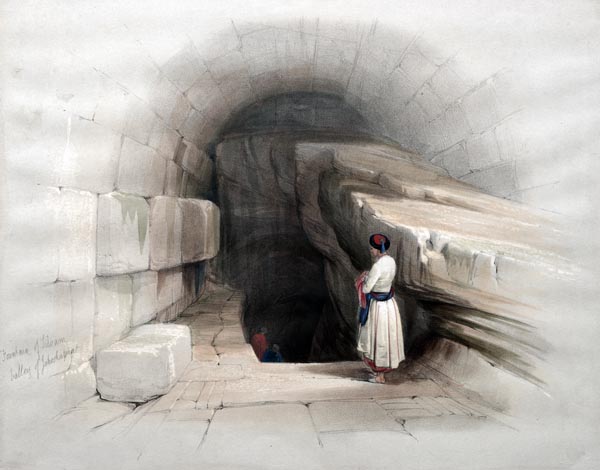
‘Fountain of Siloam, Valley of Jehoshaphat’ - David Roberts (British, 1796 – 1864)
Cleveland Museum of Art
The same date. November the 2nd, 1832.
Ascending the Valley of Jehoshaphat, I passed by the tomb of Absalom. It is a block of rock hewn from the very rock of Mount Siloam, un-detached from the natural rock that serves as its base. It is about thirty feet high and twenty feet wide on each side. I say this at random, for I measured nothing: measurement is the architect’s job. Its form is that of a cube with a Greek doorway in the middle, and a Corinthian cornice, supporting a pyramid at the top. There are no Roman or Greek decorations, lending it a strange, solemn, monumental, and novel appearance, like the Egyptian monuments.
The ancient Jewish people had no architecture of their own. They borrowed from Egypt, from Greece, but, I believe, above all from India: the key to everything lies in India; the generation of thought and the arts seems to me to originate there. India gave birth to Assyria, Chaldea, Mesopotamia, Syria, and the great desert cities, like Baalbek; then Egypt, then the islands, like Crete and Cyprus; then Etruria, then Rome; then night fell, and Christianity, nurtured first by Platonic philosophy, then amidst the barbaric ignorance of the Dark Ages, gave birth to our civilisation and our modern arts. Our civilisation is young, and we are barely past the age of adulthood. A new world in thought, social forms, and the arts will emerge, probably within a few centuries, from the vast ruin of the Middle Ages that we are witnessing. One senses that the moral world is bearing fruit, the emergence of which will take place amidst convulsions and pain; the written word, multiplied by the press, by extended discussion, criticism, and examination on every topic, by summoning the power of all minds to reflect on every fact or point of dispute in the world, must irresistibly bring about an age of reason for all humanity. Revelation to all, by all; a reverberation of the divine light, which is reason and religion, reaching every part of humanity.
One could write a stimulating treatise on the history of the divine spirit during the different phases of humanity; on the history of Divinity in mankind; wherein one could show this religious principle acting first, during the earliest known ages of humanity, through instinct and blind impulse; then through the songs of the poets, mens divinior; then manifesting itself in the tablets of legislators, and the mysterious initiation ceremonies of the Indian, Egyptian, and Hebrew theocracies. When those mythological forms vanished from the human mind, having been abraded by time, and exhausted by human incredulity, one could show that same religious principle, disseminated and scattered throughout the great philosophical schools of Greece and Asia Minor, and the Pythagorean sects, searching in vain for universal symbols, until Christianity summarised all speculative and contested morality in these two great practical and indisputable precepts: worship of the one God; charity and friendship among all human beings.
The same date. November the 2nd, 1832.
A little above the commencement of the Kidron Valley, north of Jerusalem, we crossed some fields of reddish, more fertile soil, clothed with an olive grove. About five hundred paces from the city, we found ourselves at the edge of a deep quarry; we descended. To the left, a richly carved block of stone stretched across the entire width of the quarry, revealing, below, a narrow opening half-blocked by earth and fallen rocks. A man could scarcely squeeze through by crawling. We entered; but as we had neither lanterns nor torches, we left immediately without visiting the inner chambers: here were the tombs of the kings. The magnificently carved frieze, of the finest Greek craftsmanship, which adorns the outer rock, can be assigned by the nature of its decoration to the most flourishing period of the arts in Greece; However, it may date back to Solomon, for who can know what that great prince borrowed from the genius of India or Egypt?
November 3, 1832.
The plague, which is increasingly ravaging Jerusalem and the surrounding area, prevented us from entering Bethlehem, whose convent and sanctuary were closed. Nevertheless, we mounted our horses in the evening, and after crossing a plateau about three miles long that lies to the east of Jerusalem, we arrived at a hill a short distance from Bethlehem, from which the small town is clearly visible. We had scarcely dismounted when a large cavalcade of Bethlehem Arabs arrived and asked to be presented to me. After the customary greetings, they told me that they have been sent by the people of Bethlehem to ask me to reduce the tax that Ibrahim Pasha had imposed on their town; knowing, by repute and via the Arabs of Abu Gosh, their leader, that Ibrahim Pasha was my friend, and that he would certainly not refuse me if I requested leniency on their behalf.
Since the Bethlehem Arabs are the most detested people in these lands, always at war with their neighbours, always demanding ransom of the Latin monastery of Bethlehem, I replied gravely, while severely reproaching them for their acts of plunder, that I would consider their request and present it to the Pasha, but on the condition that they respected Europeans, pilgrims, and especially the monasteries of Bethlehem and the Wilderness of Saint John; and that, if they indulged in the slightest violation of the homes of these poor religious men, Ibrahim’s resolution would be to exterminate them to the last man, or drive them into the deserts of Arabia Petraea. I added (and this seemed to make a strong impression on them) that if Ibrahim Pasha’s forces proved insufficient, the pashas of Europe were determined to visit themselves and bring them to heel. In the meantime, I urged them to pay the tribute. From that day until the day of my departure, despite all my attempts to dismiss them, I was constantly followed by a number of Bedouin sheikhs from Bethlehem, Hebron, and the Desert of Saint John, who continually begged for a reduction in the tribute. Back at the camp in the Valley of Solomon, beneath the walls of Zion, I received a visit from Abu Gosh, who arrived with his uncle and brother to inquire after our well-being. I give him coffee and a pipe, and we talked for an hour at the door of my tent, each seated beneath an olive tree.
The same date. November the 3rd, 1832.
A courier from Jaffa brought me letters from Europe and Beirut, and delivered them to me beneath the walls of Jerusalem. These letters reassured me about my daughter’s health; but since she had added at the foot of her mother’s letter that she absolutely did not wish me to go to Egypt at this time, I changed my route; I countermanded my arrangements for a camel caravan from El-Arish, and resolved to return to Beirut by way of the Syrian coast. We pitched our tents; I sent a present of five hundred piastres to the monastery, in addition to the fifteen hundred piastres I had paid for rosaries, relics, crucifixes, etc., and we took the road again to the wilderness of Saint John.
The general appearance of the area around Jerusalem can be described in a few words: mountains without shadows, valleys without water, land without greenery, rocks without sublimity or grandeur; a few blocks of grey stone piercing the cracked and crumbling earth; a fig tree, now and then, nearby; a gazelle or a jackal slipping furtively between the broken rocks; a few vines creeping over the grey or reddish ash of the soil; here and there, a cluster of pale olive trees casting a small patch of shadow on the steep slopes of a hill; on the horizon, a terebinth or a black carob tree standing, sad and alone, against the blue of the sky; and the grey walls and towers of the city’s fortifications appearing in the distance on the crest of Zion; such is the land. A high sky, pure, clear, deep, where not a single cloud ever floats, nor is tinged with the purple of evening and morning. On the Arabian side, a wide chasm descends between the black mountains, leading the eye to the dazzling waters of the Dead Sea and the violet horizon of the peaks of the mountains of Moab. Not a breath of wind murmurs amidst the fortifications or between the dry branches of the olive trees; not a bird sings, not a cricket chirps, in the grassless furrows: a complete and eternal silence reigns in the city, on the roads, in the countryside.
Such was Jerusalem during all the days we spent beneath its walls. I heard nothing but the neighing of my horses, impatient in the sun around our camp, their hooves digging into the dusty ground; and from hour to hour the melancholy call of the muezzins from the minarets, or the rhythmic lamentations of the Turkish mourners, accompanying the plague victims in long lines to the various cemeteries surrounding the walls. Jerusalem, where one seeks to visit a tomb, is indeed itself the tomb of a people, but a tomb without cypress trees, without inscriptions, without monuments, whose stones have been shattered, and whose ashes seem to cloak the surrounding barren earth in silent mourning. We cast our gaze upon it several times, as we left, from the top of every hill from which we could still glimpse the city; and finally we saw, for the last time, the crown of olive trees, which dominates the mount of that name and which hovers for a long time on the horizon after one has lost sight of the city, sink in the sky, and disappear like those crowns of pale flowers which are thrown into a sepulchre.
(Lamartine was to return there once more after his daughter’s death, though, as he said ‘No longer alas, with the same sentiments; no longer to weep over the miseries of others, but to groan over my own miseries, and see its earth which had drunk so many, and absorbed so many, tears drink my own.’)
Yesterday, I had pitched my tent in a rocky field, where a few gnarled or stunted olive tree trunks grew, below the walls of Jerusalem, a few hundred metres from the Tower of David, a little above the Pool of Siloam, where the waters still flow over the worn flagstones of its tunnel, not far from the tomb of the poet-king who so often sang its praise. The high, dark terraces that once supported Solomon’s temple rose to my left, crowned by the three blue domes and the light, airy columns of the Al-Aqsa Mosque compound (Al-Haram al-Sharif), which today hover over the ruins of the House of Jehovah.
The city of Jerusalem, ravaged by the plague, was flooded with the rays of a dazzling sun reflected from its thousand domes, its white marble, its yellow stone towers, its walls polished by centuries, and by the salty winds from the Dead Sea; no sound rose from its enclosure, mute like the bed of a dying person; its wide gates were open, and from time to time one could see the white turban and red cloak of an Arab soldier, the useless guardian of those abandoned gates: nothing entered, nothing emerged; only the morning air stirred the shimmering dust of the roads, and for a moment created the illusion of a passing caravan; but when the gust of wind died, whistling against the battlements of the Tower of David or the three palm trees of Caiaphas’s house (the Church of Saint Peter in Gallicantu), the dust settled, and the wasteland reasserted itself, and neither camel nor mule’s hooves resounded on the cobblestones of the road: only, every quarter of an hour, the two iron-shod doors of the gates of Jerusalem opened, and we saw the dead whom the plague had finally slain, each borne on a stretcher, by a pair of naked slaves, to the graveyards scattered all around us. Sometimes a long procession of Turks, Arabs, Armenians, and Jews marching and singing between the olive trees, accompanied the deceased, then returned slowly and silently to the city. More often, the dead were alone; and when the two slaves had dug a few palm fronds into the sand or earth of the hill and laid the plague victim in the final resting place, they would seat themselves on the very mound they had just created, divide the dead person’s clothes between them, light their long pipes and, in silence, watch the smoke from their chibouks rise in light blue columns and dissipate gracefully in the clear, crisp, and transparent air of these autumn days.
At my feet, the Valley of Jehoshaphat stretched out like a vast sepulchre; furrowed by the dried-up Kidron Valley, a whitish gash, strewn with large pebbles, while the sides of the two hills that surround it were white with tombs and carved turbans, a common grave-adornment of the Ottomans: a little to the right, the Hill of Olives sloped down, and the view extended between the scattered chains of volcanic cones forming the bare mountains of Jericho and Saint Saba, like a luminous avenue, between uneven cypress peaks: the gaze was drawn there of its own accord, attracted by the azure and leaden gleam of the Dead Sea, which shone at the foot of those stepped mountains; while, behind, the blue chain of the mountains of Arabia Petraea bounded the horizon. Though ‘bounded’ is not quite the word, for the mountains seemed transparent as crystal, and one saw, or thought one saw, beyond them a vague and indefinite horizon still extending onwards, swimming amidst the ambient vapours of the atmosphere tinged with purple and azure.
It was noon, the hour when the muezzin watches the sun from the highest gallery of the minaret, and chants the hour, and the prayer for all hours; a living, animated voice, aware of what it says and what it sings, superior, in my opinion, to the mindless voice of the bells of our cathedrals, if only it were audible as far away. My Arab servants had brought barley, in a goat-hair sack, to the horses tied here and there around my tent, their feet chained to iron rings: these beautiful, gentle animals were motionless, their heads bowed and shaded by long, flowing manes, their grey coats gleaming and steaming under the rays of a blazing sun. All our men had gathered in the shade of the largest olive tree.
They had spread their Damascus mats on the ground, and they smoked, telling each other stories of the desert, or singing verses by Antar (Antarah ibn Shaddad al-Absi, the pre-Islamic poet. The medieval ‘Romance of Antar’, ‘Sirat Antar ibn Shaddad’, was originally a work of oral tradition, subsequently and continually enhanced); Antar, the type of the wandering Arab, at once shepherd, warrior, and poet, encapsulated the whole desert in lines epic in form like Homer’s, plaintive like Job’s, amorous like that of Theocritus, philosophical like that of Solomon. His tale, which lulls or elevates the Arab imagination as much as the smoke of tombac (unwashed tobacco leaf) in a hookah, resounded in guttural tones amidst the lively group of my sais; and whenever the author’s words struck, more exactly or more forcefully, the taut strings of these wild, but impressionable men’s hearts, one heard a slight murmur from their lips; they joined their hands, raised them above their heads, and bowing cried out: ‘Allah! Allah! Allah!’
Later, the memory of those hours spent listening to those verses, which I could not understand, made me seek out fragments of popular Arabic poetry, and especially the heroic ‘Romance of Antar’. I managed to obtain a number of such pieces, and had them translated by my dragoman (probably Joseph-Antoine Mazoillier) during the winter evenings I spent in Lebanon. I myself was beginning to understand a little Arabic, but not enough to read it; my interpreter translated sections of the poem into colloquial Italian, and I then translated them word for word into French. I have preserved these poetic essays, unknown to Europe. Poetry belongs to all places, all times, and all civilisations.
The Romance of Antar is the national poetry of the wandering Arab; here are the sacred words of their imaginings. Many another time I have seen groups of my Arab servants, squatting in the evening around the fire of our bivouac, craning their necks, listening intently, directing their fiery gaze towards one of their companions who was reciting passages from this admirable poem, while a cloud of smoke, rising from their pipes, formed above their heads like the fantastic atmosphere of dreams, and our horses, their heads bowed above them, seemed themselves attentive to the monotonous voice of their masters! I would sit not far from the circle, and listen too, though I did not understand; but I understood the sound, the interplay of faces, the tremors of the listeners; I knew it was poetry, and I imagined touching, dramatic, wonderful stories, which I recited to myself.
Listening to that melodious music, I became so engrossed that I thought I could comprehend the words, and that the poetry of the sung language had revealed to me, in utterance, the poetry of the written language. What can I say? I have never read poetry comparable to the poetry I discovered in the language of these Arabs, unintelligible to me. Imagination, as always, surpassing the reality, I thought I now understood the primitive, patriarchal poetry of the desert; I saw anew the camel, the horse, the gazelle; I saw the oasis raising its yellow-green palm heads above the immense red sand dunes, the battles of the warriors, and the young Arab beauties abducted and recaptured amidst the fray, recognising their lovers in their liberators. Which reminds me that I have always found more pleasure in reading a foreign poet in translation, even a dead and flat prose translation, than the original itself: the most beautiful original always leaves something to be desired, while even a poor prose translation, indicating the thought, and the poetic motif, allows the imagination, embroidering the motif with words it assumes as readily as the idea, provides one with a complete pleasure, by re-creating the work of itself. Since infinity resides in thought, it assumes it in expression: the pleasure is thus infinite. To experience this pleasure, one must be, to a certain extent, a musician or a poet; but who is not?
Antar, both the hero and the poet of the wandering Arabs, is little known to us; we know less of his story; we do not even know the precise date of his existence. Some scholars claim that he lived in the sixth century AD (current scholarship has settled on 525-608). Local tradition places his life much earlier. Antar, according to this tradition borrowed in part from the Romance, was a black slave who won his freedom through his exploits and virtues, and won his mistress Abla through love and heroism.
The epic, unlike Homer’s, is not written entirely in verse; it is in poetic prose of the purest and most classical Arabic, interspersed with verse. What is singular about this poem is that the prose portion of the narrative is infinitely superior to the lyrical fragments inserted within it. The poetic section smacks of affectation, pretension, and the style of a decadent literature; on the contrary, nothing is simpler, more natural, or more genuinely passionate than the recitative. Everything I have read of Arabic poetry, ancient or modern, participates more or less in this unfortunate pursuit of poetry by Antar: it consists, if not of wordplay, then at least of plays on ideas and images, designed more to amuse the mind than to touch the heart. It takes centuries for art to arrive at the simple and sublime expression of Nature. For the Arabs, verse is still merely an ingenious way of toying with their minds or feelings. I make an exception for a few religious poems written some thirty years ago by a Maronite bishop of Mount Lebanon (perhaps Joseph VI Estefan, also Yusuf Istifan, Bishop of Antioch): I will bring back a few fragments worthy of the places that inspired them, and of the sacred subjects to which this pious cenobite exclusively devoted his masculine genius. These religious poems are more solemn and more intimate than any I know of in Europe; something of Job’s voice, Solomon’s grandeur, and David’s melancholy remain in them.
I regret that a skilled orientalist has not translated Antar in its entirety for us; it would be far better than the notes of a journey, for nothing reflects customs and manners so well as a poem; it would also rejuvenate our own powers of inspiration with the fresh colours that Antar drew from his solitude; it would, moreover, be as amusing as Ariosto, and as moving as Tasso. I cannot doubt that the Italian poetry of Ariosto and Tasso is akin to Arabic poetry: the same alliance of ideas that produced the Alhambra, Seville, Granada, and some of our cathedrals, produced Tasso’s ‘Gerusalemme’ and the charming dramas of Ariosto, as well as his ‘Orlando Furioso’. ‘The Romance of Antar’ is more interesting than the ‘Arabian Nights’ because it is less fantastical. All the interest lies in the human heart and in the true or plausible adventures of the hero and his lover. The English have an almost complete translation of this delightful poem (‘Antar, a Bedoueen Romance’, translated by Terrick Hamilton, published 1819-20); We possess only a few beautiful fragments of it, scattered throughout our literary journals. The reader would barely be able to glimpse, through the imperfections of the fragments I have retrieved here, the admirable beauties of the original.
A few steps away, a young Turkish woman, seated on one of those small white stone monuments that dot all the hills around Jerusalem, was weeping for her husband. She looked barely nineteen or twenty, and I never saw such a ravishing image of grief. Her profile, which the veil that she had thrown back allowed me to glimpse, had the purity of line of the most beautiful heads in the Parthenon; but at the same time, the softness, the sweetness, and the graceful languor of Asian women — a beauty far more feminine, far more loving, far more captivating to the heart than the severe and masculine beauty of Greek statues; her hair, a bronzed and golden blonde like the copper of ancient figures, a colour highly prized in this sun-drenched land, of which she seemed a lasting reflection; her hair, loose from her head, fell around her and literally swept the ground; her breasts were entirely bare, according to the custom of the women of this part of Arabia; and when she bent down to kiss the stone turban, or press her ear to the tomb, her breasts touched the earth and left their imprint in the dust, like the imprint of the beautiful breasts of the corpse of ‘Atala,’ which the sand of the sepulchre still traced, as described in that admirable work by Monsieur de Chateaubriand.
She had strewn the tomb and the surrounding earth with all kinds of flowers; a beautiful damask carpet was spread beneath her knees; on the carpet were several vases of flowers, and a basket full of figs and barley cakes; for the woman must have spent the entire day weeping like this. A hole, dug in the earth, supposed to correspond to the ear of the dead man, served as her megaphone to that other world where the one she had come to visit slept. From time to time, she leaned toward this opening; she sang things interspersed with sobs, then she pressed her ear to it, as if waiting for a reply; then she would begin to sing again, still weeping. I tried to understand the words she murmured, which reached me; but my Arab dragoman could neither grasp them nor convey them. How I longed to know them! What secrets of love or sorrow! What sighs, animated by the whole life of two souls torn from one another, those confused words, drowned in tears, must have contained! Oh! If anything could ever waken a dead man, it was surely the words whispered by such a mouth!
A few steps away from this woman, under a piece of black cloth, supported by two reeds stuck in the ground, serving as a parasol, her two small children were playing midst three slaves from Abyssinia, squatting, like their mistress, on the sand which had been covered by a rug. These three women, all young and beautiful, with the slender figures and aquiline profiles Abyssinian women possess, were grouped in various poses, like three statues carved from a single block. One had her knee on the ground, and held on the other knee one of the children who stretched out his arms toward the side where his mother was weeping; a second had both legs folded beneath her and her two hands clasped, like Canova’s ‘Penitent Magdalen’ (the painting, now in private hands, of 1798-99, not the sculpture,), on her blue linen apron; the third woman, leaning slightly over her two companions, and, swaying from side to side, cradled the smallest child against her barely-formed breasts, trying in vain to lull him to sleep. When the young widow’s sobs reached the children, they began to weep; and the three Abyssinian slaves, after answering their mistress’s sob with a cry, would begin to sing soothing melodies and children’s songs from their own country to calm the pair.
It was a Sunday: two hundred paces from me, behind the tall and solid walls of Jerusalem, I could hear, in bursts, from the dark dome of the Greek monastery, the distant, faint echoes of the Vespers service. The hymns and psalms of David rose after three thousand years, chanted by foreign voices and in another language, on the same hills that had inspired them; and I saw on the terraces of the monastery the figures of elderly monks of the Holy Land moving to and fro, breviary in hand, murmuring those prayers already murmured for so many centuries in different languages and to different rhythms.
And I was here too, to sing of all these things; to study the centuries at the site of their cradle; to trace back to its source the future course of a civilisation, of a religion; to draw inspiration from the spirit of place and the hidden meaning of the stories and monuments, on these shores which were the starting point for the modern world, and to nourish, with greater knowledge and truer philosophy, the serious and thoughtful poetry of the era in which I myself live!
This scene, which chanced to unfold before my eyes, retained among my many travel memories, displayed to me the development of poetry in almost all its phases: the three Black African slaves lulling the children with the naive and carefree songs of their homeland, which formed the pastoral and instructive poetry of early nations; the young Turkish widow weeping for her husband, sighing her pain to the earth, expressed the elegiac and passionate phase of poetry, the poetry of the heart; the Arab soldiers and muezzins reciting warlike, amorous, and wonderful fragments from Antar, revealed the epic, warlike poetry of the nomadic peoples and invaders; the Greek monks chanting psalms on their solitary terraces, gave voice to the sacred and lyrical poetry of the ages of enthusiasm and religious renewal; and I myself, meditating in my tent musing on historical truths and ideas from all over the earth, embodied the poetry of philosophy and meditation, daughter of an era in which humanity studies and summarises its history and nature, even in the songs with entertain its leisure hours. All this, the poetry of the past and present; what then will the poetry of the future offer?
November 4, 1832.
We spent the evening and night in the wilderness of Saint John, taking leave of the excellent monks, the memory of whom will always be with us: the memory of their humble and perfect virtues remains in the soul, like the fragrance of a temple one has visited. We gave these good fathers alms barely sufficient to compensate them for the expense we had caused them; they considered the peril we had put them in as nothing; they begged me to commend them to the protection of the dreaded Abu Gosh, whom I was to see again at ‘Jeremiah’ (Abu Gosh, the town, was traditionally the birthplace of the prophet Jeremiah).
We left before daybreak, to avoid the nuisance of being pursued by the Bedouins, of Bethlehem and the wilderness of Saint John, who never tired of following me, and even began to threaten. At eight in the morning, we had crossed the high mountains crowned by the tomb of the Maccabees, and were seated under Jeremiah’s fig trees, smoking pipes and drinking coffee with Abu Gosh, his uncle, and his brothers. Abu Gosh showered me with further marks of respect and kindness; he offered me a horse, which I refused, not wishing to offer him anything myself, since such a gift would have seemed an acknowledgment of the tribute he usually imposes on pilgrims, a tribute from which Ibrahim has freed them; I charged him with protecting the monks of Saint John, Bethlehem, and Jerusalem. (Lamartine later learned that Abu Gosh had indeed gone to deliver the monks from the obsessive attentions of the desert Bedouins; as he said ‘Abu Gosh probably had no idea, when I asked for his protection for the poor Frankish religious exiles in his mountains, that eight months later he would send someone to implore mine, for the release of his own brother taken prisoner to Damascus, and that I would be happy enough to be of use to him in turn.’)
After drinking coffee and refreshing our horses, we set off again, escorted by the immense population of ‘Jeremiah’ (Abu Gosh, the town), and camped beyond Ramla in a magnificent olive grove surrounding the town. Overcome with fatigue, and lacking provisions, we sought hospitality from the monks of the Holy Land at their monastery (the Armenian Monastery of Saint George); they refused us as if we were plague carriers, which we might easily have been in their view. So, we went without supper and fell asleep to the sound of the breeze playing in the tops of the olive trees. It was here that the Virgin, Saint Joseph, and the Child spent the night, in the countryside, while fleeing to Egypt. The thought made my bed more seem comfortable.
We left Ramla at six in the morning; and lunched in Jaffa at Monsieur François Damiani’s. The day was spent resting, and gathering provisions before returning to Beirut along the coast.
Nothing is more delightful than these caravan trips when the countryside is beautiful; when the well-rested horses pace lightly, at daybreak, over smooth, sandy ground; when sights follow one another without monotony; when, above all, the sea, bringing to one’s face the fresh undulations of the air produced by its supple and regular waves, unfolds in green or blue at the feet of one’s mount, and flings at one, now and then, powdery drops of foam: such is the pleasure we experienced while travelling along the charming coast that separates Haifa from Saint-Jean d’Acre.
The desert stretches of the plain of Zebulun are hidden, to the east, by tall clumps of reeds and the tops of palm trees that separate the shore from the land: one walks on a bed of fine, white sand, continually watered by the unfolding waves, spreading their white, ridged sheets of water; the gulf, enclosed to the south-west by the high point of Cape Carmel surmounted by its monastery, and to the north-east by the ragged white walls of Acre, resembles a vast lake, on which the smallest of boats can rock, with impunity, with the waves: but such is not the case. The Syrian coast, everywhere dangerous, is even more so in the Gulf of Haifa: ships that take refuge there, to avoid a storm, and drop anchor on the sea-bed formed of soft sand, are frequently driven ashore. Sad and picturesque wrecks attest to this all too evidently; the entire beach is lined with the carcasses of shipwrecked vessels half-buried in the sand; some still show their tall, shattered prows, in which seabirds make their nests; many show only their masts above the sand: these motionless, leafless trees resemble the crosses we plant above the ashes of those who are no more; some exhibit yards and rigging, marred by the sea’s salt vapour, still hanging from the masts. The Arabs never touch the ruins of shipwrecked vessels; time and winter storms alone are left to accomplish the destruction of some, others the sand buries day by day.
There, as on almost all the rest of the Syrian coast, we could observe how the Arabs go about fishing. A man, holding a small, folded net above his head, ready to make his cast, walks a few paces into the sea, choosing an hour and place whereby the sun is behind him, illuminating the waves without blinding his eyes. He waits for the waves to arrive, as they pile high, rising, and crashing at his feet onto a reef or the sand. He casts a sharp, practised eye on each swelling wave, and if he sees that it is carrying fish along, he casts his net, at the very moment it breaks, and is about to carry away what it brought, in its ebb: the net falls, the wave recedes, and the fish remain. A roughish sea is needed for this type of fishing to take place along the coast: when the sea is calm, the fisherman can locate nothing; the wave only becomes transparent when it rises high in the sunlight.
The foul stench of the battlefield announced that we were approaching Acre; we were now only a quarter of an hour from its walls. Acre is a heap of ruins; the domes of the mosques are riddled with holes, the crenellated walls show immense breaches, the towers have collapsed into the port. The city has just endured a year-long siege and was taken by storm by Ibrahim’s forty thousand heroes.
In Europe, the politics of the East are poorly understood: they are assumed to possess some overall design, but are seen as driven by whims; by plans, but also by passion; by thoughts of the future, but also by today and tomorrow. Muhammad Ali’s aggression has been seen as the result of a long, ambitious pre-meditated and gradually executed course of action; it was simply the power of fate, which, driving him onwards, step by step, led him almost involuntarily to shake his master’s throne, and conquer half the empire: fresh opportunities may lead him even further.
This is how the quarrel arose: Abdullah, Pasha of Acre, an impetuous young man who had risen to the governorship of Acre through a favourable twist of fate, had rebelled against the Grand Seigneur; defeated, he had implored the protection of the Pasha of Egypt, who had bought his pardon from the Divan (the Ottoman Imperial Council). Abdullah, soon forgetting the gratitude he owed to the Pasha of Egypt, Muhammad, refused to honour certain conditions he had sworn to during his time of misfortune. Ibrahim advanced on him, in force; at Acre, he encountered unexpected resistance; his anger grew: he asked his master, Muhammad, for fresh troops; they arrived, only to be repelled once more. Muhammad Ali grew weary and summoned his son back with all his heart; Ibrahim’s pride resisted: he wished to die beneath the walls of Acre, or subdue it for his father. Finally, sacrificing countless men, he breached the city gates. Abdullah ibn Ali, a prisoner, expected death; Ibrahim summoned him to his tent, hurled a few bitter insults at him, and sent him to Alexandria. Instead of the sword or the rope, Muhammad Ali sent him his horse, led him in triumph, seated him beside him on his divan, praised his bravery and loyalty to the Sultan, and bestowed upon him a palace, slaves, and immense revenues.
Abdullah deserved this treatment for his bravery: besieged in Acre with three thousand Ottomans, he had resisted for a year all the forces of Egypt, by land and sea; Ibrahim’s fortune, like Napoleon’s, had wavered before this obstacle; if the Grand Seigneur, whom Abdullah had pleaded with in vain, had sent the latter a few thousand men at the opportune moment, or had merely launched two or three of those fine frigates that lie uselessly at anchor off the caiques of the Bosphorus, it would have been the end of Ibrahim: he would have returned to Egypt convinced of the impotence of his wrath. But the Porte remained true to its system of fatalism; it allowed the ruin of its Pasha to unfold: the Syrian bulwark was overthrown, and the Divan awoke only too late. Meanwhile, Muhammad Ali wrote to his general to return; But Ibrahim, courageous and adventurous, wished to test the weakness of the Sultan, and his own destiny: he advanced.
(The following note Lamartine added later) Resounding and hard-fought victories, at Homs (July 1832) in Syria, and Konya (December 1832) in Asia Minor, made him absolute master of Arabia, Syria, and all those kingdoms of Pontus, Bithynia, and Cappadocia which are now Caramania. The Sublime Porte could still cut off his retreat and, landing troops to his rear, retake the cities and provinces in which he was unable to leave sufficiently large garrisons; a corps of six thousand men, thrown by the Porte into the passes of the Taurus Mountains and Syria, rendering Ibrahim and his army their prey, trapped him, despite his victories.
The Turkish fleet was infinitely larger than Ibrahim’s; or rather, the Porte had an immense and magnificent fleet, while Ibrahim had only two or three frigates. But from the very beginning of the campaign, Halil Rifat Pasha, a young man of refined manners, a favourite of the Grand Seigneur, and appointed by him Grand Admiral (Kapudan-Pasha), had yielded the waves in the face of Ibrahim’s weaker force. I saw him with my own eyes leave the harbour of Rhodes and take refuge in that of Marmoris on the coast of Caramania, at the head of the Gulf of Macri (Gulf of Fethiye). Once he and his ships were in this port, whose channel is prodigiously narrow, Ibrahim, with a couple of vessels, could have prevented him from leaving, though, indeed, the latter never chose to do so, and all winter, while the military operations on the Syrian coast were at their most critical, Ibrahim’s ships were the only ones to appear at sea, transporting reinforcements and munitions to him without hindrance. And yet Halil Pasha was neither a traitor nor without valour: but such is the fate of a people who remain inert when all around them is in motion. The fortune of nations lies in their spirit; the spirit of the Ottomans is wavering before that of the last of its Pashas.
We now know the rest of this campaign, which is reminiscent of Alexander’s; Ibrahim is undoubtedly a hero, and Muhammad Ali a great man; but the entire fate of their empire rests on their two heads; without them, there will no longer be an Egypt, no longer an Arab empire; there will be no more ‘Maccabees’ for Islam, and the East will return to the West by that invincible law which transfers power to wherever there is light. (The end of Lamartine’s later note.)
The same date. November the 4th, 1832.
The sands bordering the Gulf of Acre were becoming increasingly fetid. We now came across the bones of men, horses, and camels, washed on shore, cleansed by the sea foam, and whitening in the sun. With every step, these heaped remains multiplied before our eyes. Soon the entire coastal strip, between the sea and the cliffs, seemed covered with them, and the sound of our horses’ hooves constantly roused packs of wild dogs, hideous jackals, and birds of prey, which had been busy, for two months past, gnawing at the remains of the horrible feast Ibrahim and Abdullah’s cannons had provided them. Some dragged along, as they fled, the limbs of unburied corpses, others horses’ legs to which the skin still clung; eagles, perched on the bony heads of camels, rose at our approach with angry cries, returning to hover, despite our gunfire, over their gruesome prey. The tall grasses, the rushes, the shrubs along the shore were likewise strewn with the remains of men and animals. Yet these was not all the result of war. Typhus, which had been ravaging Acre for several months, was killing those whom the siege had spared; fifteen hundred men or less remained of a city of perhaps fifteen thousand souls, and every day new corpses were hurled from the walls or into the sea, corpses that the waves cast up at the end of the gulf, or that jackals dug from the ground.
We reached the eastern gate of that wretched city. The air was no longer breathable; we did not enter, but turning right, along the crumbling walls where a few slaves were working, we crossed the battlefield in its entirety, from the city walls to the country house of the former pashas of Acre, built in the middle of the plain and an hour or two from the sea. Approaching this magnificent house, flanked by elegant kiosks, in Indian architectural style, we saw long lines of raised earth, somewhat taller than those of furrows ploughed in our fertile soil at home. These lines were each a mile or so long and about as wide; their crests rose a foot or two above the ground: this was the site of Ibrahim’s camp, and the grave of the fifteen thousand men of his buried in these sepulchral trenches. We rode for a long time with difficulty over this ground, which barely covered the many victims of the ambition and caprice shown by those we term heroes.
We urged our horses forward, their hooves constantly striking against the remains, and shattering the bones that the jackals had unearthed; and rode on to make camp about an hour from that dreadful place, in a charming spot on the plain, well-served by running water, shaded by orange and lemon trees, and sheltered from the air of Acre, the fumes having pursued us. These gardens, an oasis amidst the bare plain of Acre, had been planted by the penultimate pasha (Sulayman Pasha al-Adil), successor to the famous Djezzar Pasha. A few poor Arabs, sheltering in huts of earth and mud, provided us with oranges, eggs, and chickens; we slept there.
The next day, Jean-Vaast de Laroyère could barely rise from his mat and mount his horse; all his limbs, numb with pain, failed to achieve the slightest movement. He felt the first symptoms of typhus, which his medical knowledge had taught him to distinguish better than we could. But the place offered us neither shelter nor resources to care for a sick man, so we hastened to leave before the illness worsened, and we went to sleep twenty-five miles away, on the plain of Tyre, on the banks of a river shaded by immense reeds, and not far from an isolated ruin that seemed to have belonged to the time of the Crusaders. The movement and the warmth revived Monsieur de Laroyère. We put him to bed in the tent, and went to hunt ducks and wild geese, which rose like clouds from the reeds on the riverbank. These birds fed our entire caravan that day.
The following day, we met a Turkish aga on the seashore, in a delightful spot shaded by maritime cedars and magnificent plane trees. He was returning from Mecca with a large retinue of men and horses. We settled down under a tree near the spring, not far from another tree where the aga was having lunch. His slaves were walking his horses. I was struck by the perfect form and the lightness of one young, purebred Arabian stallion. I instructed my dragoman to enter into negotiations with the aga. We sent him some of our travel provisions and a pair of percussion pistols as gifts; in turn, he presented us with a Persian yataghan. I had my horses led past him, so as to steer the conversation naturally toward the subject. I succeeded, but the difficulty lay in proposing that he sell me his. My dragoman told him that one of our travelling companions was so ill that he couldn’t find a horse with a gentle enough gait to carry him. The aga then said he possessed one whom one could ride at the gallop while drinking coffee without a drop falling from the cup. This was precisely the beautiful animal I had admired, and so ardently desired to possess for my wife. After a convoluted discussion, we finally reached agreement, and I took the horse, which I named El Kantara, in memory of the place and the fount where I had purchased him. I mounted immediately to complete the day’s ride: I had never ridden such a light-footed mount. One felt neither the elastic movement of his shoulders, nor the tread of his hooves on the stones, nor the slightest pressure of his mouth on the bit. With his short, slender neck, his feet lifting like a gazelle’s, one felt as if one were riding a bird whose wings supported its imperceptible gait. He also ran better than any Arabian horse I had ever tried. His coat was pearly grey. I gave him to my wife, who refused to ride any other horse for the rest of our stay in the Orient. I will always miss that accomplished horse. He was born in Khorasan and was only five years old.
In the evening, we arrived at Solomon’s Pools (at Ras el-Aïn near Tyre, not those near Bethlehem); the next day, early, we entered Said, the ancient Sidon, escorted by the local Franks and by the sons of Grégoire Giraudin, our excellent vice-consul in Said. We also found Antoine Catafago in Said, whom we had known in Nazareth, along with his family. He had just built a house at Said, and was busy with the preparations for the wedding of one of his daughters. Ancient Sidon no longer offering any vestige of its former grandeur, we devoted ourselves entirely to the kind attentions of Monsieur Giraudin and to the pleasure of discussing Europe and the Orient with that interesting, elderly man. Having become a patriarch in the land of patriarchs, he presented, in himself and amidst his family, the image of all the patriarchal virtues, whose customs and manners he recalled in his own life.
Typhus, with all its symptoms, was evident in the worsening illness of Monsieur de Laroyère. No longer able to rise to mount his horse, we chartered a boat at Said to transport him by sea to Beirut; I set off again with the rest of the caravan. I sent a letter to Lady Stanhope, to thank her for the kind steps she has taken on my behalf with Abu Gosh, and to ask her to seize any opportunity that might arise to announce my imminent arrival to the Arabs of the Beqaa Valley, Baalbek and the deserts of Palmyra.
November 3, 1832.
I slept in an abandoned and dilapidated ancient ruin, by the sea; I wrote a few verses during the night on the pages of my Bible. I rejoiced at nearing Beirut after a successful journey. I met an Arab horseman on the road carrying a letter from my wife.
All is well, Julia is in excellent health; I am expected to spend a few days at the monastery of Aintoura in Lebanon, with the Catholic patriarch, who came to offer his invitation.
At four in the afternoon, a dreadful storm; a layer of cloud descends suddenly on the mountains to our right; the sound of the storm, which causes the heavy cloud to ebb and flow against the peaks of Lebanon which in turn tear it apart, mingles with the sound of the sea, which itself resembles in appearance a plain of snow stirred by a furious wind. The rain does not fall, as in the West, in more or less rapid drops, but in continuous, heavy streams that strike and weigh down on man and steed like the hand of a tempest. Daylight has vanished; our horses walk through torrents over loose stones and are at any moment on the verge of being swept into the sea. When the sky clears and reappears, we find ourselves on the edge of the Fakhr al-Din pine plateau, a mile or so from the city.
Home means something to animals as much as to human beings; those of my horses who recognise this place, having often borne us here, though weary from seven hundred miles and more of travel, neigh, prick up their ears, and rear in delight, on the sand. I let the caravan pass slowly beneath the pines; I urge Liban into a gallop, and I arrive, my heart trembling with worry and joy, in my wife’s arms. Julia is playing in a neighbouring house with the daughters of the mountain prince who has become governor of Beirut during my absence: she sees me run down from the terrace; I hear her running herself, saying: ‘Where is he? Is it really him?’ She enters, she throws herself into my arms, she covers me with caresses, then she races around the room, her beautiful eyes shining with tears of joy, raising her arms and repeating: ‘Oh! How happy I am! How happy I am!’ and returns to sit on my lap and kiss me again. Two young Jesuit priests from Lebanon, visiting my wife, are in the room; I cannot speak a polite word to them for a long while: they themselves are speechless before this naive and passionate expression of tenderness of soul from a child to its father. Before the celestial radiance that happiness adds to the beauty of that radiant face, they stand rooted to the spot, struck silent with admiration. Our friends and our entourage arrive, and fill the mulberry fields with our horses and tents.
Several days of rest and happiness are spent receiving visits from our friends in Beirut. The sons of Emir Bashir, who have descended from the mountains, by order of Ibrahim, to occupy the country which threatens to rise up in favour of the Turks, are camped in the valley of Nahr-el-Kalb, about an hour from my home.
November 7, 1832.
The Sardinian consul, Giovanni Bianco, who has been acquainted with these princes for many years, invited us to a dinner he was giving for them. They arrived dressed in magnificent kaftans, woven entirely of gold thread; their turbans were also made of the richest cashmere fabrics. The eldest prince, who commands his father’s army, carried a dagger whose hilt was entirely encrusted with priceless diamonds. Their entourage was large and unusual: amidst a great number of Muslims and Black African slaves, there was a poet whose role was quite similar to that of a Medieval bard; his duties consist of singing the virtues and exploits of his master, composing stories for him when summoned to amuse, and standing behind him during meals to improvise verses — political toasts in his honour, or in honour of those guests the prince wishes to distinguish. There was also a Maronite Catholic chaplain or confessor who never leaves his side, even at the table, and to whom alone entrance to the harem is permitted: he is a monk with a jovial and warlike countenance, performing a role similar to that of a regimental chaplain in our army. The chaplain, because of his ecclesiastical role, sits at the table; the poet remains standing.
These princes, and especially the eldest, seemed in no way embarrassed by our customs, nor by the presence of European women. They conversed with us in turn, with the same grace of manner, the same aptness, the same freedom of spirit, as if they had been raised in the most elegant court in Europe. Eastern civilisation is always on a par with our own, because it is older, and originally purer and more perfect. To an unprejudiced eye, there is no comparison between the nobility, decorum, and austere grace of Arab, Turkish, Indian, and Persian manners, and our own. One senses in our countries that the young have barely emerged from a harsh, crude, and incomplete age: while one senses in theirs that they are the children of good families, people who are heirs to ancient wisdom and virtue. Their nobility, which is simply the result of a lineage founded in primitive virtue, is written on their foreheads and imprinted in all their customs; moreover, there is no such thing as the common folk among them. Moral civilisation, the only one I consider of importance, is everywhere at the same level. The pastor and the emir are from the same family, speak the same language, adhere to the same customs, and participate in the same wisdom, the same grandeur of tradition, which is the atmosphere of a noble people.
At dessert, wines from Cyprus and Lebanon flowed freely; the Christian Arabs and the family of Emir Bashir, who are Christian or believe themselves to be so, drank wine without demur, on this occasion. Toasts were made to the victory of Ibrahim, to the liberation of Lebanon, and to the friendship between the Franks and the Arabs; then, finally, the prince offered a toast to the ladies present at the celebration. His bard then began to improvise, at the prince’s command, and sang, in recitative and at full volume, Arabic verses, the approximate meaning of which is as follows:
‘Let us drink the juice of Eden, which intoxicates and gladdens the heart of both slave and prince. It is the fruit of those vines that Noah himself planted when the dove, instead of an olive branch, brought him a vine shoot from heaven. By the power of this wine, the poet becomes for a moment a prince, and the prince becomes a poet.
Let us drink in honour of these young and beautiful Frankish women who come from the land where every woman is a queen. The eyes of a Syrian woman are gentle, but they are veiled. In the eyes of Western girls there is more intoxication than in the translucent cup I drink from.
For a Muslim, drinking wine and gazing at women’s faces is a double sin; for an Arab, it is a double pleasure, and a double blessing of God.’
The chaplain himself seemed delighted by these verses, and sang the bard’s refrains, laughing and emptying his glass; the prince offered us an invitation to a falcon hunt, a customary spectacle and pastime of all the princes and sheikhs of Syria. It was from there that the Crusaders carried the custom to Europe.
November 9, 1832.
The weather, apart from a few gusts of wind at sea and some mid-day thunderstorms, is as fine as the month of May in France. As soon as the rains begin, a springlike freshness arrives; the walls of the terraces supporting the cultivated slopes of Lebanon and the fertile hills around Beirut have become so covered in vegetation in just a few days that the earth is entirely hidden beneath moss, grass, vines, and flowers. Green barley carpets all the fields, which were nothing but dust when we arrived. The mulberry trees, their second leaves emerging, form impenetrable forests around the houses; and here and there, one glimpses the roofs of more distant houses scattered across the plain, emerging from this sea of green, and Greek and Syrian women in their rich and vibrant dress, taking the air like queens, on the roofs of their garden pavilions. Small paths sunken in the sand lead from house to house, from one hill to another, through these gardens that stretch without break from the sea to the foot of mount Lebanon.
Following them, one suddenly finds, on the threshold of these little houses, the most delightful scenes of patriarchal life: women and girls squatting under the mulberry or fig tree at their door, embroidering rich woollen carpets in striking, vibrant colours; others, attaching the ends of silk thread to distant boughs, unwinding them as they walk slowly, singing, from tree to tree; the men, on the contrary, walking backward from tree to tree, are busily weaving silk fabrics, throwing the shuttle that a comrade returns to them. Children lie in rush cradles or on mats in the shade; some clamber amidst the branches of orange trees. The large Syrian sheep, with immense, trailing tails too heavy to move, are lying in holes dug expressly in the fresh earth in front of the door; one or two beautiful goats with long, drooping ears like those of our hunting dogs, and sometimes a cow, complete the rural scene. The master’s horse is always there too, decked in its magnificent harness, ready to be ridden; it is part of the family, and seems to take an interest in everything that is done around it, and everything that is said, its face alive like that of a human face. When a stranger appears and speaks to it, the horse pricks its ears, raises its lips, wrinkles its nostrils, stretches its head to the wind, and sniffs the stranger caressing it; those gentle, but deep and thoughtful, eyes shine, like two coals, beneath the beautiful, long mane covering its brow.
The Greek, Syrian, and Arab farming families who live in these houses at the foot of Mount Lebanon are neither savage nor barbaric; more educated than the countryfolk of our provinces, all know how to read, and all understand both Arabic and Greek; they are gentle, peaceful, hard-working, and sober; occupied all week with their work on the land or silk-weaving, they relax on Sunday by attending, with their families, the long and spectacular services of the Greek or Syriac cult; they then return home to eat a somewhat more elaborate meal than on ordinary days. The women and girls, adorned in their richest clothes, their hair braided and dressed with orange blossoms, wallflowers, and carnations, remain seated on mats at the door of the house with their neighbours and friends. It is impossible for me to describe with the pen the groups, admirable in their picturesqueness, richness of costume, and stunning beauty that these women form in the countryside. Every day I see faces of young women and girls of an artistic beauty that Raphael himself could not have imagined, even in his dreams. Theirs is far more than an Italian or Greek beauty; they possess a purity of form, a delicacy of contour — in short, everything that Greek and Roman art bequeathed to us that is most accomplished. But their appearance is rendered even more intoxicating by a primitive and simple naivety of expression, a serene and voluptuous languor, a celestial light that the gaze from their blue eyes, framed by dark lashes, casts upon their features, and by a subtlety in the smile, a harmony of proportion, a vibrant whiteness of skin, an indescribable transparency of complexion, a metallic sheen to the hair, a grace of movement, an exoticism of attitude, and a pearly and vibrant sound to the voice, which makes these young Syrian women like houris of paradise to the sight.
These admirable and variedly beautiful women are frequently encountered; I can scarcely walk an hour in the countryside without meeting several going to the fountains, or returning with their ‘Etruscan’ urns on their shoulders, their bare legs circled by silver bracelets. The men and young boys, on Sundays, sit, relaxed and at ease, on mats spread out at the foot of some large sycamore tree, not far from a fount; they remain there motionless all day, telling fantastic stories, drinking, from time to time, a cup of coffee or of fresh water; others climb the hillsides, and one sees them there gathered peacefully beneath the vines or olive trees, seemingly enjoying with delight the view of the sea overlooked by these hills, the limpidity of the sky, the song of the birds, and all those instinctive pleasures of pure and simple human beings, which our populace has lost to the noisy intoxication of the tavern or the fumes of the orgy. Never were more beautiful scenes of Nature populated and animated by purer and more beautiful impressions. Nature here is truly a perpetual hymn to the goodness of the Creator, and no false note, no spectacle of misery or vice, disturbs, for the outsider, the ravishing harmony of this hymn: men, women, birds, animals, trees, mountains, sea, sky, climate, all is beautiful, all is pure, all is splendid and sacred.
November 10, 1832.
This morning, I went for an early ride, accompanied by Julia, on the hill the Greeks call Hagios Dimitrios, a couple of miles from Beirut, towards Mount Lebanon, following the curve of the sea north-east. Two of my Arabs accompanied us, one to guide us, the other to hold onto Julia’s horse, and restrain it, if it became too spirited. When the paths became too steep, we left our mounts for a while, and explored on foot the natural and man-made terraces that form verdant tiers across the entire hill of Hagios Dimitrios.
In my childhood, I often pictured the earthly paradise, the Eden, that all nations cherish in their collective memory, either as a beautiful dream, or as a tradition regarding a more perfect time and place. I followed Milton’s delightful descriptions of the enchanted abode of our first parents; but here, as in all things, Nature infinitely surpasses the imagination. God did not grant mankind dreams as beautiful as his creations. I had dreamed of Eden; I could now say that I had seen it.
After we had ridden for half an hour, beneath the arches of prickly-pear cacti that line all the paths of the plain, we began to ascend along narrower, steeper paths, all leading to successive plateaus, from which views of the countryside, the sea, and Mount Lebanon continually unfold. These plateaus, of moderate width, are surrounded by forest trees unknown to our climate, and whose nomenclature I unfortunately do not know; but their trunks, the shape of their branches, the novel and alien forms of their conical, dishevelled, pyramidal, or wing-like crowns, give these borders of vegetation a grace and a novelty of appearance strongly identified with Asia. Their foliage, too, is of every shape and colour, from the dark green of the cypress to the grey-green of the olive, and the yellows of lemon and orange trees; from the broad leaves of the Chinese mulberry, each enough to shield a child’s brow from the sun, to the delicate fronds of the tea-tree, the pomegranate, and countless other shrubs whose leaves resemble parsley, casting light draperies of vegetal lace between the horizon and oneself. Along these wooded borders runs a fringe of greenery, covered in flowers, which they shade. The interiors of these plateaus are sown with barley, and at some corner or other, two or three palm-tree crowns, or the dark, rounded dome of a colossal carob tree mark the spot where an Arab farmer has built his hut, surrounded by a few grapevines, a ditch, defended by green palisades of fig trees laden with their spiky fruit, and a small orange grove sown with carnations and wallflowers to adorn his daughters’ hair.
When by chance the path led us to the door of these houses sunken, like human nests, amidst these seas of greenery, we saw neither surprise, nor moodiness, nor anger on the faces of its happy and good inhabitants. They greeted us, smiling at Julia’s beauty, with the pious greeting of the Orient: ‘Saba el Kaïr, may the day be blessed for you.’ Some asked us to stop beneath their palm trees; they brought, according to their means, either a mat or a rug, and offered us fruit, milk, or flowers from their gardens. We sometimes accepted, and promised to visit again and bring them something from Europe, in turn. But their politeness and hospitality were in no way self-serving. They love the Franks, who know how to cure all illnesses, who understand the virtues of all plants, and who worship the same God as they do.
We climbed from one plateau to another: the same scenes, the same enclosures of trees, the same mosaic of vegetation over the surrounding land; only, from plateau to plateau, the magnificent view widened, the lower plateaus stretching out like a chequerboard in every colour, where hedges of shrubs, close together, and grouped by optical illusion, formed woods and dark patches beneath our feet. We followed these plateaus from hill to hill, descending from time to time into the valleys that separated them: valleys a thousand times more shaded, and even more delightful than the hills; all veiled by the curtains of trees on the terraces that overlook them, all enveloped in these waves of fragrant vegetation, yet all yielding, at their mouths, a narrow glimpse of the plain and the sea. As the plains disappeared due to the elevation of these valleys, they seemed to open immediately onto the beaches; their trees were silhouetted in black against the blue of the waves, and we sometimes amused ourselves, sitting at the foot of a palm tree, watching the sails of the ships, which were in reality ten to twelve miles from us, glide slowly behind a row of trees as if they sailed a lake, of which these valleys were the immediate shore. We finally arrived, by sheer chance, at the most complete and enchanting of these landscapes. I intend to return there often.
It is an upper valley, open from east to west, nestled in the folds of the last chain of hills that juts out over the deep valley through which the Nahr-Beirut flows. Indescribably prodigious vegetation carpets its floor and sides: although on both sides the walls are solid rock, they are so covered with lichens of every kind, so oozing with the moisture that seeps into them, drop by drop, so covered with clusters of heather, ferns, fragrant herbs, vines, ivy, and shrubs rooted in imperceptible crevices, that it is impossible to suspect that it is bare rock alone that allows such growth. It forms a thick carpet a foot or two thick; a dense velvet of vegetation, nuanced with hues and colours, strewn everywhere with bouquets of flowers unknown to me, of a thousand shapes, a thousand scents, which sometimes rest motionless like the flowers painted on a fabric screen in our dining rooms; sometimes, when the sea breeze happens to glide over them, they move with the shrubs, and the grasses, from which they rise like the silken tufts of hair of an animal’s coat stroked against its natural lie, and their leaves shimmer with undulating hues, resembling a river of greenery cascading in fragrant waves. From them rise bursts of intoxicating scents, multitudes of insects with colourful wings, and countless birds flying to perch in the neighbouring trees; the air is filled with the birds’ calls as they answer one another, with the buzzing of swarms of wasps and bees, and that muffled murmur of the earth in spring, which one might, perhaps rightly, mistake for a palpable noise produced by the thousands of plants clothing its surface. The nocturnal dew hangs from every leaf, glistens on every blade of grass, and refreshes the floor of this little valley as the sun rises, and casts its rays over the tops of the tall trees, and over the rocks, that envelop it.
We lunched there, on a shelf of stone, beside a cave in which two gazelles had taken refuge at the sound of our footsteps. We were careful not to disturb the sanctuary of these charming animals, which are to these deserts what the lamb is to our meadows, or what tame doves are to the roofs or courtyards of our houses.
The entire valley was draped in the same shifting curtain of foliage, moss, and vegetation; we could scarcely help exclaiming at every step: I cannot remember ever seeing so much life in Nature, crammed into and overflowing so small a space. We followed the valley’s entire length, sitting down from time to time where the shade was coolest, and rustling the grasses here and there with our hands to make the dewdrops, misted fragrances, and clouds of insects, which rose from its depths shower forth, like spurts of golden dust.
How great God is! How deep and infinite must be the source from which all this life, beauty, and bounty flows! If there is so much to see, to admire, to marvel at, to be immersed in within a single small corner of Nature’s realm, what will it be like when the veil of worlds is lifted for us, and we contemplate the entirety of His endless work? It is impossible to see, and think on, without being flooded with an inner truth in which the idea of God is mirrored. All of Nature is strewn with sparkling fragments of this glass in which God is reflected!
As we approached the western mouth of the valley, our view of the sky widened; the walls lowered in height, the slope inclined gently beneath our feet; the snow-capped peaks of Lebanon rose against the sky shimmering with warm vapours. The gaze descended from those eternal snows to dark patches of pine, cypress, or cedar, then to deep ravines where the shade still slumbered; and finally, to gilded stony summits at whose foot lay the upland villages of the Maronites and the Druze. The view ended in a border of olive groves withering away at the edge of the plain. The plain itself, stretching between the hills where we stood and the foothills of Upper Lebanon, appeared to be a few miles wide. It was winding, and we could only take in four or five miles of its length; the rest was hidden from us by hills covered in dark pine forests.
The Nahr-Beirut, or Beirut River, which springs forth a few miles from one of the deepest and rockiest gorges in Lebanon, divides the plain in two. It flows gracefully between its banks, sometimes confined within rush-lined shores resembling sugar fields, sometimes overflowing onto verdant meadows or beneath mastic trees, and forming, here and there, what look like small, sparkling lakes scattered across the plain. Its banks are covered everywhere with vegetation, and we could make out donkeys, horses, goats, black buffalo, and white cows, scattered in herds along the river, their Arab shepherds fording the river on the backs of their camels. Further on, above the first cliffs of the mountain, one could see Maronite monks, dressed in their black hooded robes, silently driving the plough beneath the olive trees in their fields. The monastery bell could be heard, calling them, from time to time, to prayer. Then they would halt their oxen, lean the pole against the plough handle, and, kneeling for a few minutes, let their team rest, while they themselves took breath, and prayed for a moment.
Advancing further, and commencing our descent towards the river, we caught a sudden glimpse of the sea, which the valley walls had hidden from us until then, and of the wide estuary where the Nahr-Beirut joined it. Not far from this mouth, an all but ruined Roman bridge (since demolished), with tall arches but lacking parapets, spans the river; a long caravan from Damascus, heading for Aleppo, was passing over it at that very moment; we watched as, one by one, men on dromedaries, and others on horses, emerged from the reeds that shaded the bridge abutments, slowly climbed to the summit of the arches, and were silhouetted for a moment against the blue of the sea, along with their mounts and their striking, and bizarre costumes. Then they descended from the summit of the ruins and disappeared, along with a long line of donkeys and camels, beneath the clumps of reeds, oleanders, and plane trees that shaded the other bank of the river. A little further on, the caravan reappeared on the sandy shore where the high waves sent their fringes of foam almost to the hooves of the mounts. Immense, sheer rocks on a promontory finally hid them and, extending into the sea, delineated the horizon on that side. At the mouth of the river, the sea was dual-toned; blue and green offshore, sparkling with shimmering diamonds; yellow and dull, where the river waters battled the waves, staining them with golden sand, which they ceaselessly carry into this harbour. Seventeen vessels, anchored in the gulf, rolled and pitched heavily on the great waves that constantly furrow it, their masts rising and falling like long reeds in the wind. Some of these masts were bare like winter trees; others, the spread sails drying in the sun, resembled the great white birds of these seas, which glide past without a single tremor of their wings. The gulf, brighter than the sky that covered it, partially reflected the snows of Mount Lebanon, where crenellated monasteries adorned the projecting peaks. A few fishing boats, under full sail, passed shoreward seeking shelter in the river.
The valley beneath our feet, the slopes leading down to the plain, the river beneath the pyramidal arches, the sea-coves in the rocks, the immense block of Mount Lebanon with the countless details of its structure; its snowy peaks ascending, like silver cones, into the airy heights, where the eye sought them as it does the stars; the imperceptible sounds of insects around us, the songs of a thousand birds in the trees, the bellowing of buffaloes, the well-nigh human complaints of the camels in their caravans; the dull and periodic thrumming of the wide waves breaking on the sand at the mouth of the river; the endless horizon of the Mediterranean; the meandering, green line of the bed of the Nahr-Beirut to our right; the gigantic crenellated wall of Mount Lebanon opposite; the radiant and serene dome of the sky notched only by the peaks of the mountains, or by the conical heads of the great trees; the warmth, the fragrance of the air, in which everything seemed to float, as if reflected in the clear water of a Swiss lake: all these aspects, sounds, shadows, all this light, all these impressions formed, of this scene, the most sublime and graceful landscape with which my eyes had ever been intoxicated. And what was it not for Julia! She was completely moved, radiant, trembling with awe and inner delight; while I loved to etch such sights in the child’s imagination. God is depicted there better than in the lines of a catechism: he is depicted there in features worthy of him; the sovereign beauty, the immense goodness of Nature perfected, reveal him, as he truly is, to the soul of the child; this physical and material beauty translates there to a feeling of moral beauty. The artist is shown statues of Greece to inspire in him an instinct for beauty: the young soul must be shown great and beautiful scenes from Nature, so that the image it forms of its Creator may be worthy of it and of him.
We remounted our horses at the foot of the hill, on the plain, by the river; we crossed the bridge, and climbed a few of the wooded hills of Lebanon, until we reached the first monastery, which stood like a fortress on a granite pedestal. The monks knew me from Arab report and received me there. I toured the cells, the refectory, and the chapels. The monks, returning from work, were busy in the vast courtyard unharnessing oxen and buffaloes: this courtyard resembled that of a large farm; it was cluttered with livestock, manure, poultry, ploughs and all the implements of rustic life. The work was done quietly, without loud cries, but without any affectation of silence, as if by men guided by a natural decency, but not bound by a strict and inflexible rule. The faces of these men were gentle, serene, exuding peace and contentment: the appearance of a community of farmers.
When the bell rang for their meal, they entered the refectory, not all together, but one by one, or two by two, depending on whether they had finished their work earlier or later. This meal consisted, as every day, of two or three flatbreads, the flour kneaded and dried, rather than baked, on a shelf of heated stone; water; and half a dozen olives preserved in oil. Sometimes a little cheese or soured milk was added. This was all the food these cenobites ate: which they did standing or sitting on the ground. The furniture of our lands is unknown there. After joining them for dinner, eating a piece of flatbread ourselves and drinking a glass of excellent Lebanese wine that the superior had brought, we visited a few of the cells: they were all alike: a small room of five or six square feet, with a rush mat and a rug all the furniture, and images of saints nailed to the wall, an Arabic Bible, and a few Syriac manuscripts the only adornments. A long interior thatched gallery served as a corridor to all these rooms.
The view from the monastery windows, and from almost all of these monasteries, is magnificent: the first slopes of Mount Lebanon before us, the plain and the Beirut River, the airy domes of the pine forests outlined against the red horizon of the sandy desert; then the sea framed everywhere by headlands, gulfs, coves, and rocks, white sails crossing it in every direction: this is the view constantly before the eyes of these monks. They presented us with several baskets of dried fruit and some wineskins, which were loaded onto donkeys, and we departed, to return to Beirut by another route. I will speak of them later.
We descended steep steps, hewn from the detached blocks of the soft, yellow sandstone that covers all the foreground of Lebanon. The path wound through these blocks; in the stony crevices, a few shrubs and grasses had taken root. There were magnificent flowers, like the tulips in our gardens, but infinitely larger. We flushed out several gazelles and a few jackals, which take shelter in the hollows formed by these rocks. A large number of partridges, quails and woodcocks flew away at the sound of our horses’ hooves.
Having reached the plain, we found ourselves once again surrounded by vineyards, barley fields, and date palms. We crossed around half of the plain amidst this lush vegetation and soon came to the foot of a broad hill covered with a forest of Italian pines, with wide clearings in the distance, where we could see herds of camels and goats. This hill concealed the Nahr-Beirut River from us, the southern stretch of which we intended to cross. We descended beneath the tall canopies of the beautiful umbrella pines, and after riding for about fifteen minutes in their shade, we suddenly heard loud shouts, the noise of a multitude of men, women, and children rushing toward us, the roll of drums, and the sounds of the bagpipes and fife. In an instant, we were surrounded by five or six hundred Arabs of a strange appearance. The chiefs, dressed in magnificent but filthy and tattered costumes, advanced toward us at the head of their band; they bowed and offered us compliments, seemingly very respectful ones, which we however were unable to understand. Their gestures and shouts, accompanied by the gestures and shouts of the entire tribe, helped us to interpret their words. They were urging us, almost forcing us, to follow them into the heart of the forest, where their camp was pitched: they were members of one of the Kurdish tribes, who arrive from the provinces neighbouring Persia to spend the winter, sometimes in the plains of Mesopotamia, near Damascus, sometimes in those of Syria, bringing their families and flocks with them. They seize on a deserted wood, plain, or hill, and settle there for five or six months. Far more barbarous than the Arabs, their invasions and proximity are generally feared: these are the armed Bohemians of the East.
Surrounded by this crowd of men, women, and children, we walked for a few minutes to the sounds of that wild music and the shouts of the multitude, who watched us with a curiosity that was half amused, half ferocious. We soon found ourselves in the midst of their camp, before the tent-opening of one of the tribe’s sheikhs. They had us dismount, entrusted our horses, which they greatly admired, to the care of some young Kurds, and brought us Caramanian carpets, on which we sat, at the foot of a tree. The sheikh’s slaves offered us pipes and coffee; the women of the tent brought camel milk for Julia. The sight of this camp of nomadic barbarians, in the middle of a dark pine forest, deserves to be described.
The forest in this area was sparse and interspersed with large clearings. At the foot of each tree, a family had pitched its tent: these were, for the most part, nothing more than a piece of black canvas, made of goat hair, tied to the tree trunk by a rope, and, on the other side, supported by two stakes driven into the ground; the canvas often failed to enclose the space occupied by the family completely; but only a small flap hung down on the side facing the wind or the sun, sheltering the tent floor and the hearth. There was an absence of furnishings, only a few dark earthenware jars lying on their sides, from which the women drew water; also, a few goatskin water carriers; sabres and long rifles hanging in bundles from the tree branches; mats, rugs, and some men’s and women’s clothing scattered here and there on the ground. Some of these Arabs possessed a few square chests of red-painted wood, decorated with designs formed of gilt-headed nails, to hold their belongings. I saw only a trio of horses in the entire tribe. Most families possessed only a camel, lying down near their tent, chewing the cud, its tall, intelligent head raised and stretched toward the tent opening; a few fine-looking goats with long black hair and drooping ears; some sheep and buffaloes; almost all had one or two magnificent greyhounds also, large and white-coated These dogs, contrary to the usual custom of the Muslims, were sleek and well cared for: they seemed to recognise their owners, from which I presume that these tribes use them for hunting.
The sheikhs seemed to wield absolute authority, and the slightest sign from them restored the order and silence that the tumult of our arrival had disturbed. A few children, out of curiosity, committed some slight indiscretions regarding us, and were immediately seized by the men nearby and chased away to another part of the camp. The men were generally tall, strong, handsome, and well-built; their clothes suggested not poverty, but neglect. Several wore jackets of silk embroidered with gold or silver threads, and blue silk coats lined with rich fur. Their weapons were also remarkable for the silver engravings and inlays with which they were adorned.
The women were neither secluded nor veiled; they were half-naked even, especially the girls between ten and fifteen years old. Their entire lower garment consisted of trousers with wide pleats, which left their legs and feet bare; they all wore silver bracelets above their ankles. Their upper bodies were covered with a shirt of cotton or silk cloth, cinched with a belt, leaving the breast and neck uncovered. Their hair, generally very dark, was braided into long plaits that hung down to their heels which were adorned with coins strung there. Their loins and throats were armoured also with a network of strung piastres, which jingled with every step they took, like the scales of a snake. These women were neither tall, fair-skinned, modest, nor graceful, like the Syrian Arabs, nor did they have the fierce and fearful look of the Bedouin women; they were generally small, thin, with sun-tanned complexions, but were cheerful, active, playful, and agile, dancing and singing to the sounds of their music, which never ceased its lively and animated tunes. They showed no embarrassment at our gaze, no modesty regarding their scanty clothing before the men of the tribe: the men themselves seemed to exercise scant authority over them; the women simply laughed at our indiscreet curiosity, and gently and jokingly brushed us aside. Some of the young girls were extremely pretty and striking; their dark eyes were dyed with henna at the edges of their eyelids, which rendered their gaze far more vibrant. Their legs and hands were also mahogany in hue; their ivory-white teeth, accentuated by their blue-tattooed lips and sun-kissed skin, gave their faces and laughter a wild, but not ferocious, character; they resembled the young women of Provence or Naples, but with higher foreheads, a freer bearing, more open smiles, and more natural manners. Their image remains deeply etched in my memory, for one rarely sees faces possessing such character twice.
There was a circle of perhaps two hundred people from the tribe around us. When we had sufficiently observed their camp, their visages, and their activities, we signalled that we wished to remount. Our horses were immediately brought for us. As they were frightened by the strange sights, the shouts of the crowd, and the sounds of the drums, the sheikh had Julia taken up by two of his wives, who carried her to the edge of the forest. The entire tribe accompanied us there. We mounted, and they offered us a goat and a young camel as gifts. We refused, and instead gave them a handful of Turkish piastres, which the young women divided among themselves to add to their necklaces, and two gold ‘El-Ghazi’ coins (Ottoman gold coins, bearing the title ‘El-Ghazi’, ‘the conqueror’) for the sheikh’s wives.
A short distance from the forest, we reached the river again; which we forded. Under the oleanders that line its banks, we met another hundred or so young girls from the Kurdish tribe, who were returning from Beirut, where they had gone to buy earthenware jars, and some pieces of cloth, for a bride from their tribe: they had halted there and a group were dancing in the shade, each of them holding in her hand one of the household items or an adornment for their companion; they followed us for a long time, making wild cries, and clinging to Julia’s dress and the manes of our horses, to obtain a few coins; we threw some to them; they fled, and all rushed into the river to return to the camp.
After crossing the Nahr-Beirut and the other half of the cultivated plain, shaded by young palm and pine trees, we entered the red sandhills that stretch east of Beirut, between the sea and the river valley. It is a piece of the Egyptian desert at the foot of Mount Lebanon and surrounded by magnificent oases. The sand is reddish like ochre and as fine as impalpable dust. The Arabs say that this red sand is not borne on the wind nor accumulated by the waves, but spewed forth by an underground torrent that connects with the deserts of Gaza and El-Arish. They claim that there are springs of sand, just as there are springs of water. To confirm their opinion, they point to the colour and form of the sand on the seashore, which indeed bears no resemblance to that of this desert. The colour is as distinct as that of a granite or marble quarry.
At all events, this sand, whether vomited up by underground rivers or scattered there by the fierce winds of winter, unfolds in sheets up to forty miles in circumference, and raises mountains or carves valleys that change shape with every storm; one has barely walked for a while in these undulating labyrinths, before one no longer knows where one is; the sandhills hide the horizon on all sides; no path remains on the surface of these waves; horses and camels pass over them leaving no more trace than a boat leaves on the water; while the slightest breeze erases everything; some of these dunes were so unstable that our horses could scarcely climb them, and we advanced only cautiously, for fear of being swallowed up by the mudflats, frequent amidst that sea of sand; one finds no trace of vegetation there, except for a few large bulbs of plants that roll about from time to time under the horses’ hooves. The impression one has of these shifting solitudes is sad and bleak: it is like a stormy sky, soundless but with a deathly countenance. When the simoom, the desert wind, rises, these hills undulate like the waves of an ocean, and, folding silently back upon their deep valleys, swallow the camels belonging to the caravans. The dunes advance a few paces each year onto the cultivated land surrounding them, and you see on their crests the heads of withered palm or fig trees above the surface, like ship’s masts swallowed by the waves: we heard no sound but the distant dull and heavy fall of the sea’s waves breaking against the reefs, a few miles away. The setting sun tinged the crest of these mountains with red dust of a colour like that of molten iron emerging from a furnace; while its rays, gliding into these valleys, flooded them with fire, like the corridors of a burning building.
From time to time, finding ourselves at the top of a hill, we would discover the white peaks of Lebanon before us, or the sea with its edge of foam bordering the long, winding coasts of the Gulf of Sidon; then we would plunge deep into the sandy ravines, where all we could see was the sky above us. I was following Julia, who often turned back to me, her beautiful face flushed with emotion and weariness, and I read in her eyes, whose gaze seemed to question me, her mingled impressions of terror, enthusiasm, and pleasure. The sound of the sea grew louder, announcing the shore; we suddenly found ourselves on the heights above, sheer before our horses’ hooves, and towering at least two hundred feet above the Mediterranean. The ground, solid and resonant under our feet, though still covered with a thin layer of white sand, indicated the underlying rock rising above the waves of sand: indeed, similar stony cliffs border all the shores of Syria. We had arrived by chance at one of the points on this coast where the struggle between land and water presents the strangest spectacle to the eye: the repeated shock of the waves or earthquakes in this place have detached immense hills of living rock from the continuous block of coast, which, launched into the sea have settled there, worn, polished, and licked by the waves for centuries, and have affected the most bizarre shapes.
Before us, at a distance of about a hundred feet, was one of those standing rocks, rising from the sea, its crest above the level of the shore; the waves, striking it ceaselessly, had finally forced an opening, forming a gigantic arch, like the opening of a triumphal monument. The inner walls of this arch were as polished and gleaming as Carrara marble; the receding waves revealed these stony walls, glistening with foam that fell back with the departing water; then, as the waves returned, they would plunge, with a thunderous roar, into the arch, filling it to the vault; and, compressed by the impact, would burst forth in torrents of fresh foam that rose like furious tongues to the top of the rock, from whence they fell back in watery and sandy veils. Our horses shuddered with horror at each of these returns of the wave, and we could not tear our eyes away from this war of the two elements.
For half an hour of our ride, the coast was flooded with these magnificent natural displays: there were crenellated towers covered with tern’s nests, and rough bridges joining the reefs to the shore, beneath which, as we passed, we could hear the roar of the subterranean waves. In certain places, the crashing breakers pierced the rocks, from which jets of sea foam gushed beneath our feet; the water rose a few feet from the stone in immense columns, then murmured back into the depths as the waves receded. The sea was rough at this time; it reached the shore in broad, tall blue hills, that rose in transparent crests as they approached the rocks, and struck against them with such a roar that the shore trembled in the distance, and we thought we saw the marine arch before us waver.
After the silent and terrible solitudes we had just crossed, the boundless aspect of that immense sea, devoid of vessels, at the evening hour when the first shadows begin to darken its depths; those vast breaks in the coastline, with the tumultuous sound of waves rolling over enormous rocks, like the feet of a gigantic bird stirring grains of sand; the blows of the sea breeze on our foreheads, and over the manes of our horses; the deep subterranean echoes that multiplied the muffled roar of the storm: all this struck our two souls with such diverse, solemn, and strong impressions that we could no longer speak, while tears of emotion shone in Julia’s eyes.
We returned silently to the red sandy waste; we crossed its narrowest part, approaching the hills of Beirut, and found ourselves, at sunset, beneath the great pine forest planted by Emir Fakhr-el-Din. There, Julia, regaining her voice, turned to me and said, with rapture: ‘Have I not just had the most beautiful ride imaginable? Oh! How great God is! And how good He is to me,’ she added, ‘in choosing me to behold such beautiful scenes so young!’
It was night when we dismounted at the door of our house; we planned other excursions for the remaining days before my trip to Damascus.
The People of Lebanon
The Maronites
The origins of the Maronites, of whom I have spoken, are plunged in darkness. History, so incomplete and fanciful as regards the first centuries of our era, casts doubt on the various sources of their institutions. They possess a few books, unchecked and therefore lacking critical assessment; however, since one should always rely on what a people knows of itself rather than on the idle speculations of the traveller, here is what emerges from their own histories. A hermit saint, named Maron, lived around the year 400AD. Theodoric and Saint Chrysostom mention the sect. Maron lived in the desert, and his followers, having spread throughout the various regions of Syria, built several monasteries there; the principal one was near Apamea (modern Qala’at al-Mudiq, south of Antioch), on the fertile banks of the Orontes River. All the Syriac Christians, who were not as yet infected with the Monothelite heresy, took refuge around these monasteries, and from this circumstance received the name Maronites. Volney (Constantin-François Chassebœuf de La Giraudais, Comte de Volney), who lived among them for a few months, gathered the most complete information about their origin; it is similar to that which I myself gathered from local tradition.
In any case, the Maronites today form a people governed by the purest theocracy that has withstood the test of time; a theocracy which, constantly threatened by Muslim tyranny, has been forced to remain moderate and protective, and has allowed the principle of civil liberty to germinate and flourish among the people. The Maronite sect, which, according to Volney, numbered one hundred and twenty thousand in 1784, now numbers more than two hundred thousand and is growing daily. Its territory covers a thousand square miles; but has only arbitrary borders; it extends along the slopes of Mount Lebanon, into the valleys and plains that surround it, as the Maronites establish new villages. The town of Zahlé, at the mouth of the Beqaa valley, opposite Baalbek, the population of which had barely twelve hundred souls or less twenty years ago, now has between ten and twelve thousand, a number which increases every day.
The Maronites are subject to Emir Bashir, and form, with the Druze and the Metuali, a kind of despotic confederation under the rule of that emir. Although the members of these three sects differ in origin, religion, and customs, and almost never inhabit the same villages, a shared interest in defending their common liberty and the strong political hand of Emir Bashir bind them together. Their numerous settlements cover the area between Latakia and Acre on the one side, and Damascus and Beirut on the other. I will speak further of the Druze and the Metuali.
The Maronites occupy the central valleys and highest ranges of the main part of Mount Lebanon, from the vicinity of Beirut to Tripoli in the north. The slopes of these mountains, which descend towards the sea, are fertile, watered by numerous rivers and inexhaustible waterfalls; they harvest silk, oil, barley and wheat there; the heights are almost inaccessible, and the bare rock pierces the flanks of these mountains everywhere; but the tireless activity of this people, who had no safe haven for their religion except behind these peaks and precipices, has rendered the stony slopes themselves fertile: they have formed, level by level, up to the summit ridges, and their eternal snow, terraces walled with blocks of free stone; to these terraces they brought topsoil that the waters send, in small amounts, into the ravines, and they crushed the stone itself rendering it fertile by mixing it with this soil, thereby making all of Mount Lebanon a garden covered with mulberry trees, fig trees, olive trees and cereal crops.
Travellers can scarcely believe their eyes when, after climbing for days on end over the sheer faces of the mountains, which are nothing but solid blocks of rock, they suddenly find, nestled in the depths of a high gorge or on a high mountain plateau, some beautiful village built of white stone, populated by a large and wealthy community, with a Moorish castle at its centre, a monastery in the distance, a torrent foaming at the foot, and all around a landscape of vegetation and greenery in which pines, chestnut trees, and mulberry trees shade vineyards or fields of wheat or oats. These villages are sometimes perched one on top of the other, almost perpendicularly; one can throw a stone from one to another; calls from one reach the next; and yet the steepness of the mountain requires so many twists and turns to trace the paths that it takes an hour or two to travel from one hamlet to another nearby.
In each of these villages one finds a sheikh, a kind of feudal lord who administers and executes justice. But this administration of justice, dispensed summarily and within the sheikhs’ limited police powers, is neither absolute nor final. The higher administration belongs to the Emir and his council. Justice falls partly under the Emir’s jurisdiction and partly under that of the bishops. There is thus a conflict of jurisdiction between the Emir and the ecclesiastical authorities. The Maronite patriarch alone retains the final say in all cases where civil law conflicts with religious law, such as those involving marriage, dispensation, or divorce.
The prince is obliged to maintain the utmost discretion in his dealings with the patriarch and the bishops, for the clergy’s authority over minds is immense and undisputed. This clergy consists of the patriarch, elected by the bishops and confirmed by the pope, and a papal legate sent from Rome and residing at the monastery of Aintoura or that of Qannoubine, as well as the bishops, the superiors of the monasteries, and the parish priests. Although the Roman Catholic Church has strictly maintained the law of priestly celibacy in Europe, and several of its writers affect to see a dogma in this regulation of its discipline, it has been forced to yield on this point in the East; and, although they remain fervent and devoted Catholics, parish priests among the Maronites may marry. This right to marry does not extend to monks living in community, nor to the bishops. Only the secular clergy and parish priests exercise this privilege. The seclusion in which Arab women live, the simplicity of this people’s patriarchal customs, and custom, offset any prejudice towards this practice of the Maronite clergy; and, far from having harmed, as some claim, the purity of priestly morals, the respect of the people for the minister of religion, or the precept of confession, it can truly be said that in no country in Europe is the clergy purer, more exclusively confined to its pious ministries, more venerated, or more powerful in its sway over the people than here. If one wishes to have before one’s eyes all that the imagination conceives of the age of pure and nascent Christianity; if one wishes to witness the simplicity and fervour of the early faith, purity of morals, selflessness in the administration of charity, priestly influence without abuse, authority without domination, poverty without beggary, dignity without pride, prayer, vigils, sobriety, chastity, and the benefits of manual labour, one must visit the Maronite communities. The most rigid philosopher will not find a single reform necessary as regards the public and private lives of these priests, who have remained models of the faith, advisors, and servants to the people.
There are approximately two hundred Maronite monasteries of various orders scattered throughout Lebanon. These monasteries are home to between twenty and twenty-five thousand monks. These monks are neither rich, nor beggars, nor oppressors, nor leeches on the people: they are communities of simple, hard-working men who, wishing to dedicate themselves to a life of prayer and freedom of spirit, renounce the cares of raising a family and devote themselves to God and the land, in one of these retreats. Their life, as I described earlier, is that of hard-working countrymen. They tend to the livestock or silkworms, they quarry rock, they build the retaining walls of their fields with their own hands, they dig, they plough, they harvest. The monasteries own little land and only take in as many monks as they can support.
I lived for a while among these people, I frequented several of the monasteries, and never heard of any scandal whatsoever caused by these monks. There is not a murmur against them; each monastery is but a humble farm whose servants are volunteers and receive, as their only wages, shelter, a hermit’s diet, and the prayers of their church. Useful work is so much the law of man, so much the condition of happiness and virtue here below, that I have not seen a single one of these hermits who did not bear on his features the marks of peace of soul, contentment, and health. The bishops have absolute authority over the monasteries located within their jurisdictions. These jurisdictions are very restricted: each large village has its own bishop.
The Maronite people, whether descended from the Arabs or the Syrians, share in all the virtues of their clergy and form a distinct people in the entire East; one might almost say a ‘European’ colony cast by chance into the midst of the desert tribes. They have an Arab appearance however: the men are tall and handsome, with open and proud gazes, gentle, intelligent smiles, blue eyes, aquiline noses, blond beards, a noble bearing, deep and guttural voices, refined manners without vulgarity, splendid attire, and gleaming weapons.
When you traverse a village and see the sheikh sitting at the gate of his crenellated manor, his fine horses hobbled in his courtyard, and the village leaders dressed in their rich fur coats, with red silk belts adorned with yataghans and kandjars with silver sheaths, and wearing immense turbans made of various coloured fabrics, a wide panel of purple silk falling over their shoulders, you would think them a nation of kings. They love Europeans as brothers; they are bound to us by the bond of shared religion, the strongest of all; they believe that we protect them, through our consuls and ambassadors, against the Turks; they welcome our travellers, missionaries, and the young interpreters who come to learn Arabic, into their villages, as one welcomes distant relatives of the family; the traveller, the missionary, the young interpreter, become the beloved guest of the whole country. They are lodged in the monastery or the sheikh’s house, and provided, abundantly, with everything that the country produces; the men are invited to hunt with falcons, and confidently introduced into the society of women; they are spoken to with respect; bonds of friendship are formed that never break, and of which the heads of the family preserve the memory for their children.
I have no doubt that if this people were better known, if the magnificent country they inhabit were more often visited, many Europeans would go and settle among the Maronites: the beauty of location, the admirable perfection of climate, the modest prices of all things, the similarity of religion, the customary hospitality, degree of safety and guarantee of individual tranquillity, all contribute to a desire to live among these people: as for myself, if a man could uproot himself completely; if he did not have to live where Providence has assigned his cradle and his grave, so as to serve and love his compatriots; if involuntary exile were ever to open before me, I could find nowhere sweeter to live out that exile than in one of these peaceful Maronite villages, at the foot or on the slopes of Mount Lebanon, in the midst of the simple, religious, and benevolent population, with their view of the sea and the high snows, and beneath the palm and orange trees of one of the gardens of these monasteries. The most admirable of police forces, a product of religion and custom far more than any legislation, keeps order throughout the entire Maronite country; you can travel there alone and without a guide, day or night, without fear of theft or violence; crime is almost unknown; the foreigner is sacred to the Muslim Arab, but even more so to the Christian Arab; the door is open to travellers at all hours; they kill a goat or a kid to honour them, and abandon their rush mats to make room for them.
In every village there is a church or chapel where Catholic worship is conducted in the Syriac form and language. At the Gospel reading, the priest turns to face the congregation and reads the day’s Gospel passage in Arabic. Religions, which outlast nations, preserve their sacred language when the people have lost theirs.
The Maronites are brave and naturally warlike, like all mountain peoples; they arm, to the number of thirty to forty thousand men, at the call of Emir Bashir, either to defend the inaccessible mountain passes or to descend into the plains and see Damascus or the cities of Syria tremble. The Turks never dare to penetrate Lebanon when these peoples are at peace with one another; the Pashas of Acre and Damascus have only ever visited when internal disputes summoned them to the aid of one side or the other. I may be mistaken, but I believe that a great destiny is reserved for this Maronite people, untouched and primitive in their customs, religion, and courage; a people who possess the traditional virtues of the patriarchs, guaranteed property rights, a degree of liberty, and a vibrant patriotism, who, through similarity of religion and the ties of trade and worship, are becoming increasingly imbued with Western civilisation. While everything around perishes from impotence or age, these people alone seem to grow younger and regain strength. As Syria becomes depopulated, they will descend from the mountains, found trading cities on the seashore, cultivate the fertile plains that today belong only to the gazelles and the jackals, and establish a new dominion in those lands where old dominions are expiring.
If a leader of vision were to rise, today, among them, either from the ranks of the all-powerful clergy or from one of those families of emirs or sheikhs whom they venerate; if that leader were to understand the future and form an alliance with one of the powers of Europe, they would easily repeat the wonders of Muhammad Ali, Pasha of Egypt, and leave behind the true seed of an Arabian empire. Europe has a vested interest in seeing this wish fulfilled: it would establish a ready-made colony on these beautiful shores; and Syria, by repopulating itself with an industrious Christian nation, would enrich the Mediterranean with its languishing trade, open the route to India, drive back the nomadic and barbarian tribes of the desert, and revive the East: there is more future here than in Egypt. Egypt has only one man; Lebanon has a people.
The Druze
The Druze, who, along with the Metaulis and the Maronites, form the main population of Lebanon, were long considered a European colony left behind in the East by the Crusaders. Nothing could be further from the truth. What is most enduring among peoples is religion and language: the Druze have their own and speak Arabic; they are therefore not descended from a Frankish and Christian people. What is most likely is that they are, like the Maronites, an Arab desert tribe who, having refused to adopt the religion of the Prophet and persecuted by the new believers, took refuge in the inaccessible solitudes of Upper Lebanon to defend their gods and their freedom. They prospered; often having the upper hand over the tribes who inhabit Syria with them, while the history of their principal leader, Emir Fakhr-al-Din II, whom we French call Fakardin, made them famous, even in Europe.
It was at the beginning of the seventeenth century that this prince appeared in history. Appointed governor of the Druze, he gained the confidence of the Sublime Porte; he repelled the fierce tribes of Baalbek, liberated Tyre and Acre from the incursions of the Bedouin Arabs, drove the Aga from Beirut, and established his capital in that city. In vain did the Pashas of Aleppo and Damascus threaten him or denounce him to the Divan; he bribed his judges and triumphed, by cunning or force, over all his enemies. However, the Porte, repeatedly warned of the Druze advances, resolved to fight them and prepared a formidable expedition. Emir Fakhr al-Din wished to delay. He had formed alliances and concluded trade treaties with the princes of Italy: he himself went to solicit the aid that these princes had promised him. He left the government to his son Ali, embarked at Beirut, and took refuge at the Medici court in Florence (in 1613).
The arrival of a Muslim prince in Europe aroused interest. Rumours spread that Emir Fakhr-al-Din was a descendant of the princes of the House of Lorraine; that the Druze traced their origins to the companions of a Count of Dreux who remained in Lebanon after the Crusades. The historian Benjamin of Tudela mentions the Druze as existing before the Crusades: however, the shrewd adventurer himself propagated this opinion to interest the sovereigns of Europe in his plight. After five years in Florence, Emir Fakhr-al-Din returned to Syria. His son Ali had repelled the Turks and preserved intact the provinces conquered by his father, to whom he relinquished command. The Emir, corrupted by the arts and pleasures of Florence, forgot that his rule depended on inspiring respect and terror in his enemies. In Beirut, he built magnificent palaces, adorned, like the palaces of Italy, with statues and paintings that offended the prejudices of the Orientals. His subjects grew embittered; Sultan Murad IV became irritated and again sent the Pasha of Damascus with a powerful army against Fakhr al-Din. While the Pasha sailed down from Lebanon, a Turkish fleet blockaded the port of Beirut. Ali, the emir’s eldest son and governor of Safed, was killed fighting the Pasha of Damascus’s army. Fakhr al-Din sent his second son (Husayn) aboard the flagship, to plead for peace. The admiral held the son prisoner and refused all negotiations. The dismayed Emir fled and, with a small number of devoted friends, took refuge in the inaccessible fortress of Niha. The Turks, after a fruitless siege of the mountain caves for a whole year, withdrew. Fakhr al-Din was free and returned to his mountain; but, betrayed by some of his companions, he was handed over to the Turks and taken to Constantinople. Prostrate at Murad’s feet, the prince initially showed him generosity and kindness, granting him a palace and slaves. But shortly afterward, due to Murad’s suspicions, the brave and unfortunate Fakhr-al-Din was strangled (in 1635).
The Turks, who in their policy are content to sideline an enemy who overshadows them, but otherwise respect the customs of the people and the traditional legitimacy of their noble families, allowed the descendants of Fakhr-al-Din to reign. It is only about a hundred years since the last descendant of that famous emir left the sceptre of Lebanon to another family, the Shihab, originally from Mecca, and whose current leader, the old emir Bashir Shihab II, governs these lands today.
The Druze religion is a mystery no traveller has ever been able to unravel. I have known several Europeans who have lived for many years among this people, and who have confessed their ignorance in that regard. Lady Stanhope herself, who is an exception because of her habitual residence among the Arabs of this tribe, and because of the devotion she inspires in these men whose language she speaks and whose customs she follows, told me that, for her too, the religion of the Druze was still a mystery. Most travellers who have written about them claim that this faith is merely a schism within Islam. I am convinced that these travellers are mistaken. One certain fact is that the Druze religion allows them to adopt all the mores of the peoples with whom they interact; from this arose the opinion that they are schismatic Muslims. This I do not believe to be the case, while they are also said to worship the calf, idolatrously; though this is not an established fact. They have institutions like the peoples of antiquity. They are divided into two castes, the Akkals, or ‘those who know’, and the Djahels, or ‘those who do not’; and, depending on which of these two castes a Druze belongs to, they practise a specific form of worship. Moses, Muhammad, and Jesus are names they venerate. They assemble once a week, each in the place consecrated to the degree of initiation they have attained, and perform their rites. Guards ensure, during the ceremonies, that no outsider approaches the initiates. Death instantly punishes the reckless.
Women are admitted to these mysteries. The priests, or akkals, are married; they have a priestly hierarchy. The head of the akkals, or the high priest of the Druze, resides in the village of Mtein. After the death of a Druze, people gather around the tomb and receive testimonies about the deceased’s life. If these testimonies are favourable, the akkal cries out: ‘May the Almighty have mercy on you!’ If the testimonies are unfavourable, the priest and those present remain silent. The people, in general, believe in the transmigration of souls: if a male Druze’s life was pure, he will live again as one favoured by fortune, brave, and loved by his compatriots; if he was vile or cowardly, he will return in the form of a camel or a dog.
There are many schools for children; the akkals run them. The pupils learn to read from the Koran. Sometimes, when the Druze are few in number in a village and schools are lacking, they allow their children to be educated alongside those of the Christians; when they later initiate them into their own mysterious rites, they erase all traces of Christianity from their minds. Women are admitted to the priesthood like men; divorce is frequent; adultery can be redeemed; hospitality is sacred, and no threat or promise would ever force a Druze to hand over, even to the prince, a guest who had placed his trust in him. At the time of the naval Battle of Navarino (in 1827), Europeans living in Syrian cities, fearing Turkish vengeance, withdrew for several months to the Druze villages, where they lived in perfect safety. ‘All men are brothers’ is their moral precept, like that of the Gospels; and they observe that precept better than we do ourselves. Our words are evangelical, but our laws are pagan.
In my opinion, the origins of the Druze as a people are lost in the mists of time; they trace their roots back to the most remote antiquity. Physically, they bear a strong resemblance in their physiognomy to the Jewish people, and their claimed worship of the calf leads me to believe that they either descend from those peoples of Arabia Petraea who incited the Jews to that manner of idolatry, or that they are of Samaritan origin. Now accustomed to a kind of fraternity with the Maronite Christians, and detesting the yoke of the Muslims, and being numerous, wealthy, disciplined, and fond of agriculture and commerce, they will readily integrate with the Maronite people and advance in civilisation at the same pace, provided their religious rites are respected.
The Metualis
The Metualis, who make up about a third of the population of Lower Lebanon, are Muslims of the Shia sect of Ali (Ali ibn Abi Talib), the dominant sect in Persia; the Turks, on the other hand, are of the sect of Omar (Umar ibn al-Khattab): this schism occurred within Islam in the tenth year of the Hijra (632AD); the followers of Ali curse Omar as the usurper of the Caliphate; Imam Hussain (Muhammad’s grandson) and Ali are their saints; like the Persians, they neither eat nor drink with followers of a religion other than their own, and break any glass or dish that has been used by a foreigner; they consider themselves defiled if their clothes touch ours: however, as they are generally weak and despised in Syria, they adapt to the times, and I had several in my service who did not strictly observe these intolerant rules. Their origin is known; they were masters of Baalbek around the sixteenth century; their tribe, expanding in size, first spread over the slopes of the Anti-Lebanon Mountains, around the Beqaa desert; they later crossed it and mingled with the Druze in that area of the mountains that lies between Tyre and Sidon. Emir Yusuf, worried by their proximity, armed the Druze against them and drove them back towards Safed and the mountains of Galilee; Daher el-Umar, Pasha of Acre, welcomed them and made an alliance with them in 1760; they were already numerous enough to provide him with ten thousand horsemen. At that time, they seized the ruins of Tyre, by then a mere village by the sea, now called Sur; They fought valiantly against the Druze, and completely defeated the army of Emir Yusuf, which numbered twenty-five thousand men; they themselves were only five hundred, but rage and vengeance made them heroes, and the internal quarrels which divided the Druze between Emir Mansur Shihab and Emir Yusuf contributed to the successes of the Metualis; they abandoned Daher, Pasha of Acre, and their abandonment caused his downfall and death: Djezzar-Pasha, his successor, took cruel revenge on them.
Since 1777, Djezzar-Pasha (Ahmad Pasha al-Jazzar), ruler of Said (Sidon) and Acre, had worked tirelessly to destroy the Metualis: persecution forced them to reconcile with the Druze; they rejoined the party of Emir Yusuf, and, although reduced to seven or eight hundred fighting-men, they accomplished more in this campaign, for the common cause, than the twenty thousand Druze and Maronites gathered at Deir El Qamar; alone, they seized the fortress of Smar Jebeil, and eight hundred Arnauts (Albanians) were put to the sword; driven from Baalbek (Heliopolis) the following year after a desperate resistance, and numbering five to six hundred families, they took refuge among the Druze and Maronites; they later returned to that valley, and still occupy the magnificent ruins of Heliopolis today; but the greater part of their nation remained on the slopes and in the valleys of Lebanon, near Tyre. The principality of Baalbek was not long ago the subject of a bitter struggle between two brothers of the Shiite Harfush family, Jahjah and Cassem; they successively dispossessed each other of that heap of ruins, and lost more than eighty members of their own family in that war. Emir Jahjah reigned over Baalbek till his death in 1812, leaving its rule to his brother Amin.
The Ansaries (Alawites)
Volney provided the most insightful information on the Alawite sect, which occupies the western part of the Lebanon mountain range and the plains of Latakia. I have little to add. Idolaters like the Druze (neither sect are in fact idolaters, Alawism being an offshoot of Shia Islam), they, like them, shroud their religious rites in the darkness of initiation, but are more barbaric. I will only concern myself with that part of their history which dates back to the year 1807.
At that time, a group of Alawites, having feigned a quarrel with their chief, left their territory in the mountains and sought asylum and protection from the emir of Masyaf. The emir, eagerly taking advantage of such a favourable opportunity to weaken his enemies by dividing them, welcomed the Alawites, along with their Sheikh Mahmoud, within the walls of Masyaf, and extended his hospitality by displacing some of the inhabitants to make room for the fugitives. For several months, all was peaceful; but one day, when most of the Ismailis of Masyaf had left their city to work in the fields, the Alawites, at a given signal, attacked the emir and his son, stabbed them, seized the castle, massacred all the Ismailis in the city, and set it on fire. The next day, a large number of Alawites joined the perpetrators of this abominable plot, a plot whose secret had been kept by the entire group in Masyaf for four or five months. Approximately three hundred Ismailis perished. The rest took refuge in Hama, Homs, or Tripoli.
The pious practices and customs of the Alawites led Johann Ludwig Burckhardt (the Swiss traveller and Orientalist) to believe they were a tribe displaced from Hindustan. What is certain is that they were established in Syria long before the Ottoman conquest; some of them are still said to be idolaters. The dog cult, which appears to have been popular among the ancient Syrians and to have given its name to the Dog River, Nahr El Kalb, near ancient Berytus (Beirut), is said to have been preserved among some Alawite families. The sect is in decline and could easily be driven out or enslaved by the Druze and the Maronites.
The Aintoura Monastery
November 18, 1832.
I have just returned from an excursion to the Aintoura Monastery, one of the most beautiful and famous in Lebanon. Leaving Beirut, one rides for an hour along the shore, beneath a canopy of trees of every kind and shape. Most are fruit trees: fig trees, pomegranate trees, orange trees, aloes, and sycamore fig trees (Ficus sycomorus), a gigantic tree whose countless fruits, like small figs, grow not at the tips of the branches but attached to the trunk and limbs like moss. After crossing the Beirut River, on the Roman bridge I described earlier, one follows the sandy coastline, formed by an arm of Lebanon jutting into the sea, which leads towards Cape Batroun; this arm is simply a rocky promontory into which, in ancient times, a coastal road was carved, offering a magnificent view. The sides of the rock are covered in several places with Greek, Latin, and Syriac inscriptions, and with figures carved into the rock itself, whose symbols and meanings are lost. It is likely that they relate to the cult of Adonis, practised long ago in these parts; according to tradition, there were temples, and funerary ceremonies were performed dedicated to Adonis, near the place where he perished. It is believed that this was on the banks of the river at the point where we had crossed.
Descending from this high and picturesque ledge, the landscape suddenly changes character. The eye is drawn to a narrow, deep gorge, entirely filled by another river, the Nahr El Kalb, the Dog River. It flows silently between two perpendicular rock faces, two or three hundred feet high. In some places, it fills the entire valley; in others, it leaves only a narrow margin between its waters and the cliffs. This margin is covered with trees, sugarcane, reeds, and vines, which form a thick, green canopy over the banks and sometimes over the entire riverbed. A ruined khan is sited on the rock at the water’s edge, opposite a bridge with a slender arch, which one crosses with trepidation. In the sides of the rocks that form this valley, the patient Arabs have carved paths, formed of stone steps, which hang almost vertically above the river, and which must nevertheless be ascended and descended on horseback. We abandoned ourselves to instinct, and the hooves of our horses; but it was impossible not to close one’s eyes in certain sections, so as not to observe with trepidation the height of the steps, the smoothness of the stones, the incline of the path, and the depth of the precipice. It was here that the last papal legate to the Maronites, was thrown over the edge to his death, a few years ago, due to his horse stumbling.
At the end of this path, one finds oneself on a series of high plateaus covered with crops, vineyards, and small Maronite villages. On a little hill, one can see a pretty new house ahead, built in the Italian style, with a portico, terraces, and balustrades. This is the residence that Monsignor Giovanni Pietro Losanna, Bishop of Abydos and current legate of the Holy See in Syria, has had built for himself as a winter residence. In the summer, he lives at the Qannoubine Monastery, the patriarch’s residence and the ecclesiastical capital of the Maronites. This monastery, much higher on the mountain, is almost inaccessible, and buried in snow during the winter.
Monsignor Losanna, a man of elegant manners, Roman sophistication, refined intellect, and profound erudition, possessing a firm and quick mind, was happily chosen by the Roman Curia to represent Catholic policy and cultivate Catholic influence among the high Maronite clergy. He would be perfectly suited to represent them in Vienna or Paris, being the epitome of one of those Roman prelates, heirs to the great and noble diplomatic tradition of that city, where mere force is nothing, and personal skill and dignity everything. Monsignor Losanna is from Piedmont; he will not remain long in this remote place, as Rome will doubtless employ him more usefully in a more turbulent arena. He is one of those men whose good fortune is well-earned, and written in advance on his active and intelligent brow. He rightly affects, among these peoples, an Oriental luxury and a solemnity of dress and manner without which the people of Asia recognise neither sanctity nor power.
He had donned Arab attire; his immense, meticulously-combed beard cascaded in golden waves over his purple robe, and his pure-bred Arabian mare, gleaming and docile, rivalled the finest mares of the desert sheikhs. We soon saw him approaching, followed by a large retinue, prancing along the precipitous stony path over which we advanced only with caution. After the customary initial compliments, he led us to his charming villa, where refreshments awaited us, and soon after accompanied us to the monastery of Aintoura, in which he was temporarily residing. Two young Lazarist priests, having arrived from France after the July Revolution of 1830, now occupy this vast and beautiful monastery, originally built by the Jesuits, alone. The Jesuits have tried several times to establish their mission and influence among the Arabs; they have never succeeded, and appear destined for no greater success today.
The reason is simple: at present, the religion of the people of the East does not determine its politics; completely separate from the civil powers that be, it neither possesses influence nor prompts action within the State; the State is nominally Muslim; Catholicism is freely tolerated, but has no human means of dominating discourse; yet it is primarily through human means that the Jesuit system has sought to act and does act religiously. This country is not suited to them. Lebanese religion is divided into orthodox or schismatic denominations, whose beliefs are part of the hereditary tradition within families. Irreconcilable repulsion and hatred exist between the various Christian denominations, far more so than between Turks and Christians. Conversions are impossible where changing denominations would be a disgrace, a stigma that would brand the individual, and would often be punished by a tribe, a village, a family, with death.
As for the Muslims, conversion is unheard of. Their religion is a practical deism, whose morality is in principle the same as that of Christianity, minus the dogma of Divinity embodied in a man. The dogma of Islam is simply the belief in divine inspiration, manifested in a prophet wiser, and more favoured by celestial revelation, than the rest of his fellows. Later, some miraculous events were added to the story of Muhammad’s mission, but these legendary miracles are not the core of Islamic religion and are not accepted by enlightened Turks. All religions have their legends, their absurd traditions, their popular aspect; the philosophical side of Islam is free of these crude admixtures: it consists of nothing but resignation to the will of Allah, and charity towards humankind. I have seen a great number of deeply religious Turks and Arabs who accepted of their religion only what is reasonable and humane. It is a practical and contemplative theism. Such men are rarely converted: it is easier to descend from the dogma of miracles to their simpler dogma than the reverse.
The Jesuits’ intervention encountered another drawback among the Maronites. By the very nature of their institutions, factions had been easily created, pious groupings within the clergy and the general population; they inspired, by the zealous fervour they displayed, either enthusiasm or hatred. The air around them was never lukewarm: the Maronite high clergy, though simple and good-natured, scarcely looked favourably upon the establishment among them of yet another religious body that might wrest a portion of the Catholic population from their spiritual dominion.
The Jesuits are no longer present in Syria, except that, in recent years, two young priests have arrived, one French, the other German, whom a Maronite bishop has brought to Lebanon to teach at the Maronite school he has founded (the Collège Saint Joseph, at Aintoura). I met these two excellent young men, both full of faith and consumed by selfless zeal. They spared no effort to spread Christian ideas among the Druze, their neighbours; but the effect of their efforts was limited to secretly baptising, without the parents’ knowledge, little children among the families they had infiltrated on the pretext of offering medical advice. They seemed quite unwilling to submit to the fairly unenlightened educational practices of the Maronite bishops, and I believe they will return to Europe without having succeeded in instilling in the Maronites a taste for higher learning. The French priest was quite worthy of teaching in Rome and Paris.
The Aintoura monastery passed to the Lazarists after the Jesuit order was dissolved. The two young priests, who lodged there, often came to visit us in Beirut. We found their company as pleasant as it was unexpected: they were kind, simple, modest, solely occupied with rigorous and lofty studies, well-versed in all things European, and participants in the intellectual current that sweeps us along. Their universal and learned conversation charmed us all the more because opportunities for such conversation are rare in these remote places. When we spent an evening with them, discussing the political events in our country, the intellectual groups that were dissolving and reforming in France, the writers vying for the press, the orators who were seizing their opportunity to conquer the podium, and the various doctrines regarding the future, or those of the Saint-Simonians, we might have imagined ourselves only a few miles from the Rue du Bac, conversing with men who would leave Paris in the morning and return that evening. These two Lazarists were at once models of holiness and simple, pious fervour. One of them was very ill: the harsh Lebanese mountain air had affected his chest and was shortening his life. He had only to send word to his superiors to be recalled to France; but did not wish to bear the burden of writing to them himself. He consulted Monsieur de Laroyère, our companion, and asked him if, in his capacity as a physician, he could offer a formal and professional opinion that the air of Syria was deadly to his constitution. Monsieur de Laroyère, whose conscience is as severely scrupulous as is that of the young priest, did not dare to express his thoughts so explicitly, and so the good cleric has remained silent.
These clergymen, living in this vast monastery where they have only one Arab to serve them, received us with the cordiality that the names of their homelands inspire in those who meet far from them. We spent two days with them. Each of us had a fairly large cell with a bed and chairs, furniture unusual in these mountains. The monastery is situated in the hollow of a valley, at the foot of a pine forest; but this valley itself, halfway up Mount Lebanon, offers, through a gorge, an unobstructed view of the coasts and the Syrian Sea; the rest of the horizon is composed of peaks and spires of grey rock, crowned with villages or large Maronite monasteries. A few fir trees, orange trees, and fig trees grow, here and there, in rocky shelters, and near streams and springs: it is a site worthy of Naples or the Gulf of Genoa.
The Aintoura monastery is next to a Maronite women’s convent (the Visitation Convent, ‘Deir el Zyara’), whose nuns belong to the leading families of Lebanon. From the windows of our cells, we could see those of these young Syrian women, who seemed deeply concerned by the arrival of a group of foreigners in their neighbourhood. These women’s convents have no social purpose here. Volney, in his ‘Travels in Syria’, speaks of this convent at Aintoura, where a woman named Hindia, it is said, committed horrific atrocities against her novices. The name and story of this Hindia are still widely known in the mountains. Imprisoned for many years by order of the Maronite patriarch, her repentance and good conduct obtained her freedom. She died recently, renowned for her holiness among some Christians of her sect. She was a woman driven by fanaticism, originating in pure wilfulness or the power of her imagination, who succeeded in imposing her fanaticism on a number of simple and credulous minds. This Arab land is a land of wonders; everything germinates here, and any credulous or fanatical person can become a prophet in turn: Lady Stanhope’s status provides further proof of this. The predisposition to credit miracles stems from two causes: a highly developed religious sentiment, and an imbalance between imagination and reason. Phantoms only appear at night; all ignorant people believe in the miraculous.
The terrace of the Aintoura monastery, where we strolled for part of the day, is shaded by magnificent orange trees, previously mentioned by Volney as the most beautiful and the oldest in Syria: they have not withered; like the fifty-year-old walnut trees in our countries, they clothe the garden and the roof of the convent in their dense and fragrant shade, and bear etched on their trunks the names of Volney and of various English travellers who, like ourselves, spent some moments at their feet.
The mountain group in which Aintoura is located is known as the Keserwan, or Castravan range: this region extends from the Nahr Ibrahim to the Nahr El Kalb. It is, properly speaking, the land of the Maronites: this area belongs to them; it is only here that their privileges extend, although, day by day, they are spreading into the land of the Druze, bringing their laws and customs with them. The principal product of these mountains is silk. The miri, or land tax, is fixed according to the number of mulberry trees each person owns. The Turks demand one or two miris a year from Emir Bashir as tribute, and the Emir often collects several more for himself: nevertheless, despite the Maronites’ complaints about the excessive taxes, these are not comparable to the amounts levied in France or England. It is not the rate but the arbitrary and irregular nature of a tax that oppresses a nation. If taxation in the Ottoman areas were legal and fixed, it would not be felt; but where taxation is not determined by law, there is no security in ownership, or else ownership is uncertain and languishes: the wealth of a people lies in a sound regime of property ownership.
Each village sheikh distributes the tax and allocates a portion to himself. In essence, though, the people are happy. The rulers fear the people, and dare not establish themselves within the province; their religion is free and honoured; their monasteries and churches cover the summits of the hills and their bells, which are cherished as the voice of liberty and independence, ring out prayers night and day in the valleys; the province is governed by its own leaders, appointed, through custom or inheritance, from among its principal families; a rigorous but just police force maintains order and security in the villages; ownership of property is secure, and transmissible from father to son. Trade is active, their morals perfectly simple and pure. I have seen no population in the world bearing in their features a greater appearance of health, nobility, and civilisation than these folk of Lebanon. The education of the people, though limited to reading, writing, arithmetic, and catechism, is universal, and gives the Maronites a legitimate ascendancy over the other Syrian populations. I can only compare them to the folk of Saxony or Scotland.
We returned to Beirut along the coast. The mountains bordering the shore are covered with monasteries built in the style of medieval Florentine villas. A village is perched on every hill, crowned with a forest of umbrella pines, and traversed by a stream plunging, in a brilliant cascade, into the ravine below. Small fishing harbours dot this jagged coastline, filled with little boats tethered to the breakwaters or the rocks. Beautiful fields of vines, barley, and mulberry trees slope down from the villages to the sea. The steeples of monasteries and churches rise above the dark green of fig trees or cypresses; a white sandy beach separates the foot of the mountains from the waves, which are clear and blue like river-water. Here are five miles of land that would deceive the traveller’s eye, if one forgets one is eighteen hundred miles from the heart of Europe: one might think oneself on the shores of Lake Geneva, between Lausanne and Vevey, or on the enchanting banks of the Saône, between Mâcon and Lyon; only the setting of Aintoura is more majestic, and when one raises one’s eyes, one sees the snow-capped peaks of Sannine, cleaving the sky like tongues of flame…
Translator’s Note: The Death of Julia
Lamartine’s journal pauses at this point, and was not resumed until the end of March 1833. Julia, his only daughter, succumbed, suddenly, to the tuberculosis which afflicted her, and died in Beirut, on the 7th of December 1832, aged ten, after a final bout of illness, even though her health, which had deteriorated in France, seemed to have been restored by the Lebanese climate. Her body was repatriated to France, and she was buried at Saint Point, the family home. Lamartine wrote a poem some fourteen months after her death, in tribute to her, mourning her loss, and expressing his profound grief, entitled ‘Gethsemane’.
The End of Part VII of Lamartine’s ‘Voyage en Orient’