Alphonse de Lamartine
Travels in the Near East (Voyage en Orient, 1832-33)
Part VI
Translated by A. S. Kline © Copyright 2026 All Rights Reserved
This work may be freely reproduced, stored, and transmitted, electronically or otherwise, for any non-commercial purpose.
Conditions and Exceptions apply.
Contents
- Jerusalem.
- The Mount of Olives.
- Mount Zion.
- The Church of the Holy Sepulchre.
- The Via Dolorosa.
- The Banks of the Jordan.
- Jericho.
- The Dead Sea.
Jerusalem
On October 28th, 1832, we set off at five in the morning from the desert of Saint John the Baptist. We waited on horseback for dawn in the monastery courtyard, enclosed by its high walls, so as not to communicate in the darkness with the plague-ridden Arabs and Turks from the village and from Bethlehem. At half past five, we were on our way; we climbed a mountainside strewn with enormous grey rocks, clustered together in blocks, as if a hammer had broken them. A few creeping vines, their leaves yellowed by autumn, trailed amidst small cleared plots of ground in the spaces between the rocks, and enormous stone towers, similar to those the Song of Songs (4.4) speaks of, rose above these vineyards, while fig trees, their tops are already stripped of leaves, hung from ledges above the vines, and dropped their black figs onto the stone. To our right, the desert of Saint John the Baptist, where his voice resounded, Vox clamavit in deserto (John 1.23), opened, like an immense abyss, between a handful of tall black mountains; and, in the space outlined by their stony summits, the horizon of the Egyptian sea, covered with a dark mist, opened before our eyes: to our left, and very close to us, was the ruin of an ancient tower or castle, on the tip of a very high hill which is in the process of being stripped bare, like everything around it: we could distinguish some other ruins, like the arches of an aqueduct, descending from this castle: on the slope of the mountain, some vines grew at their feet, and cast over their collapsed arches vaults of pale yellow greenery: one or two isolated terebinth trees grew in these ruins; this was Modi’in, the castle and the tomb of the last heroic men of sacred history, the Maccabees.
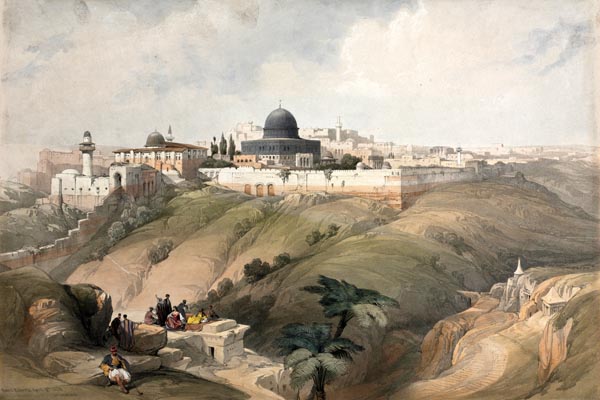
‘Jerusalem’ - David Roberts (British, 1796 – 1864)
Cleveland Museum of Art
We left these ruins, sparkling with the highest rays of the morning, behind. The sun’s rays here are not blended, as in Europe, into a vague, confused light, a brilliant and universal radiance; rather they leapt from the top of the mountains that hid Jerusalem from us, like arrows of fire of various hues, merged at the centre, but diverging as they crossed the sky: some are a slightly silvery blue, others a matte white; some a tender pink, paling at their edges, others the colour of ardent fire, and as hot as the rays of a conflagration. Divided, and yet in harmonious accord, through their successive, graduated tints, they resemble a brilliant rainbow, whose arc had been broken in the firmament and was scattered through the air. This was the third time that the beautiful phenomenon of dawn or sunset had appeared to us in this form since we had entered the mountainous region of Galilee and Judea; it is dawn or dusk as the old masters depicted it, an image that would seem false to one who has not witnessed the reality.
As the day progressed, the distinct brilliance and the azure or fiery colour of each of these luminous bars diminished and blended into the general glow of the atmosphere; and the moon, which hung above our heads, still a fiery pink, faded, took on a pearly hue, and sank in the depths of the sky, like a silver disc sinking through deep water whose colour grows paler.
After climbing a second mountain, even higher and more barren than the first, the horizon suddenly opened to the right, revealing a vast expanse stretching between the last peaks of Judea, where we were, and the high mountain ranges of Arabia. This expanse was already bathed in the shimmering, vaporous light of morning. Beyond the lower hills beneath our feet, collapsed and broken into blocks of grey, crushed rock, the eye could see nothing but that dazzling expanse, so like a vast sea that the illusion was complete, and we thought we could discern those stretches of dull silver, interspersed with dark shadow, that the dawn light spreads on calm waters. On the shores of this illusory ocean, a few miles away and slightly to the left of view, the sun shone on a square tower, a tall minaret, and the broad yellow walls of several buildings crowning the summit of a low hill, the base of which was hidden from our view. But from the tips of other minarets, the crenellations of the higher walls, and the black and blue peaks of a few domes that pyramided behind the tower and the great minaret, we recognised a city descending the hillside, a city of which we could only see the highest part, and which could only be Jerusalem.
We had thought ourselves further from it, and each of us, without daring to ask the guide anything for fear of having the illusion shattered, silently enjoyed this first furtive glimpse of the city, where everything suggested the name Jerusalem. It was she! The city appeared a deep, matte yellow against the blue of the sky and the black of the Mount of Olives. We halted our horses to contemplate this mysterious and dazzling apparition. Every step we took, descending into the deep, dark valleys beneath our feet, would again conceal it from our sight: behind the high walls and lowered domes of Jerusalem, a high, broad hill rose in a second line, darker than the one that bore and hid the city: this second hill bordered and marked the horizon for us. The sun left the western flank in shadow, but its vertical rays skimming the summit, like a broad dome, seemed to make the translucent peak swim in the light, such that the indistinct boundary between earth and sky was discernible only by a few broad, black trees, planted on the highest raised point, through which the sun’s rays passed.
It was the Mount of Olives; here were the very same olive trees (according to tradition: olive trees are long-lived, those in the Garden of Gethsemane some dating to the twelfth century were themselves derived from ancient rootstock), ancient witnesses of so many days writ on Earth and in Heaven, watered with divine tears, blood and sweat, and with so many other sweated tears since that night that rendered them sacred. Other olive trees could be vaguely distinguished, forming dark patches on its slopes; then the walls of Jerusalem intercepted the horizon and hid the foot of the sacred mount.
Closer to us, and immediately before our eyes, lay nothing but a stony desert, serving as the avenue to this city of stone: an enormous, once-molten platform, a uniform shade of ash-grey, stretched without interruption from where we stood to the gates of Jerusalem. The hills rose and fell; narrow valleys wound and meandered among their roots. A few small valleys extended here and there, as if to deceive the human eye and even promise vegetation and life; but everything was stone, hills, valleys, and plain: a single layer of rock ten or twelve feet thick, with only enough space between the stones for a reptile to crawl through, or to break the leg of a camel that sank into them. If one imagines enormous walls of colossal stones like those of the Colosseum or the great Roman theatres, collapsed all at once and covering the earth on which they rest with their immense slabs, one will have an exact idea of this layer and of the nature of the rocks that everywhere cover the outermost ramparts of the desert city.
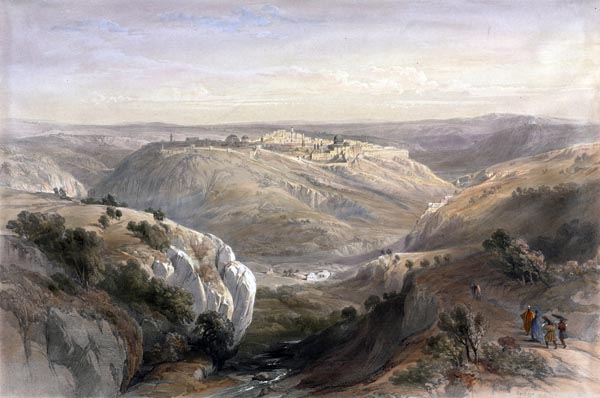
‘Jerusalem from the South’ - David Roberts (British, 1796 – 1864)
Cleveland Museum of Art
The closer one gets, the more the stones rise and loom above, like eternal avalanches ready to engulf the passer-by. One’s last steps before entering Jerusalem are taken amidst a motionless and funereal avenue of rocks which rise ten feet above the head of the traveller, and allow only a part of the sky above to be seen: we were in this last and gloomy avenue, we had been riding there for a quarter of an hour, when the rocks, suddenly parting to right and left, we found ourselves face to face with the walls of the city, which we had reached without suspecting it. Only an empty space of a few hundred paces stretched between the Bethlehem Gate (the Al-Zararah Arch, or Star Street) and ourselves: this space, arid and undulating like those glacis which surround the fortresses of Europe from afar, and as desolate, opened to the right, and was hollowed out into a narrow valley, which descended gently. To the left it bore five old olive tree-trunks, half-collapsed on the ground under the weight of time, and scorched by the sun; trees as if petrified, like the barren fields from which they so painfully emerged.
The Bethlehem Gate, dominated by two towers crowned with Gothic battlements, but deserted and silent like the ancient gates of abandoned castles, stood open before us. We remained motionless for a few minutes, gazing. We burned with the desire to pass through, but the plague was at its height in the city: we had only been received at the Monastery of St. John the Baptist in the Wilderness on the most formal of promises not to enter the city. We refrained; and, turning left, descended slowly along the high walls, built on the side of a deep ravine or ditch, where we occasionally recognised the foundation stones of Herod’s old city wall. At every turn we encountered Turkish cemeteries, whitewashed with funerary monuments surmounted by stone turbans: these cemeteries, whose solitudes were populated nightly by the plague-filled air, were here and there dotted with groups of Turkish and Arab women who came to mourn their husbands or fathers. A few tents were pitched among the graves, and seven or eight women, seated or kneeling, holding beautiful infants they were nursing in their arms, uttered, at intervals, rhythmic lamentations, songs, or funeral prayers whose religious melancholy blended wonderfully with the desolate scene before our eyes.
These women were not veiled; some were young and beautiful; They had beside them baskets full of artificial flowers, painted in bright colours, which they planted all around some particular tomb, watering them with tears. From time to time, they bent down toward the freshly-turned earth and sang a few verses of their lament to the dead man, seeming to speak to him in hushed tones; then, remaining silent, their ears pressed to the monument, they appeared to wait and listen for a reply. These groups of women and children, seated there and weeping all day long, were the only sign of life and human habitation that appeared to us during our circuit around the walls: otherwise, no noise sounded, no smoke rose; while a few doves, flying from the fig trees to the battlements, and from the battlements to the edges of the holy pools, displayed the only movement, and raised the only murmur, in this mute and empty enclosure.
Halfway down the descent that led us to the Kidron Valley, at the foot of the Mount of Olives, we saw a deep, open cave, not far from the city’s moats, below a mound of yellowish rock. I did not seek to stop there; I wanted to see Jerusalem first, and nothing but Jerusalem, all of it, taken in at a single glance with its valleys and hills, Jehoshaphat and the Kidron Valley, its temple and its tomb, its ruins and its contours!
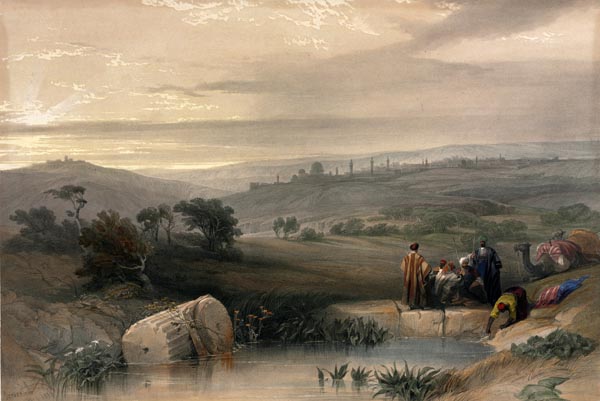
‘Jerusalem from the North’ - David Roberts (British, 1796 – 1864)
Cleveland Museum of Art
We then passed the Damascus Gate (the Nablus Gate, or Gate of the Pillar), a charming monument in Arab style, flanked by two towers; its opening was a wide, tall, and elegant pointed arch, and it was crenellated with arabesque battlements in the shape of stone turbans. Then we turned right along the angle of the city walls, which form a regular square on the north side; and having on our left the deep and dark valley of Gethsemane, whose bottom is occupied and filled by the dry Kidron Valley, we followed, as far as the Gate of Saint Stephen (the Lion’s Gate or Bab al-Asbat), a narrow path adjoining the walls, interrupted by two beautiful pools, in one of which Christ healed the paralytic (John 5.2-17). This path is suspended on a narrow ledge overlooking the precipice of Gethsemane and the Valley of Jehoshaphat: at the Gate of Saint Stephen, it is interrupted in its progress along the steep terraces that once supported the Temple of Solomon, and now support the Mosque of Omar; and a steep, wide slope suddenly descends to the left, towards the bridge that crosses the Kidron Valley and leads to Gethsemane and the Garden of Olives.
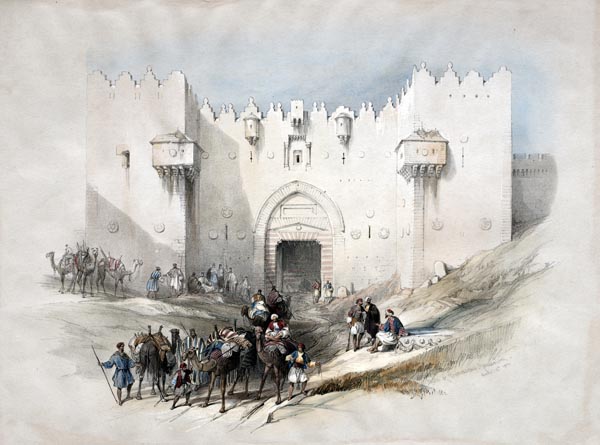
‘Gate of Damascus, Jerusalem’ - David Roberts (British, 1796 – 1864)
Cleveland Museum of Art
We crossed this bridge and dismounted opposite a charming building of composite architecture, but of a severe and ancient character, which is as if buried deep within the valley of Gethsemane and occupies its entire width. This is the tomb supposedly dedicated to the Virgin, the mother of Christ; it belongs to the Armenians, whose monasteries were among the most ravaged by the plague. We therefore did not enter the sanctuary of the tomb itself; I simply knelt on the marble step of the courtyard preceding this lovely temple and invoked her, whose pious and tender devotion every mother teaches her child from an early age.
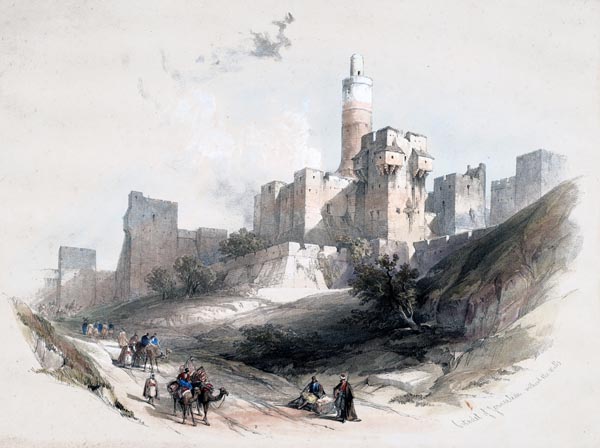
‘Citadel of Jerusalem, without the Walls, Tower of David’ - David Roberts (British, 1796 – 1864)
Cleveland Museum of Art
As I rose, I saw behind me an acre of land, bordering on one side the high bank of the Kidron Valley, and on the other rising gently against the base of Mount Olives. A low, un-mortared stone wall surrounds this field, and eight olive trees, spaced thirty to forty paces apart, cover almost the entire area with their shade. These olive trees are among the largest of their kind that I have ever encountered: tradition traces their age back to the memorable date of the agony of Jesus, who chose them to conceal his divine anguish. Their appearance would, if need be, confirm the tradition that venerates them; their immense roots, the product of centuries, have lifted the earth and the stones that covered them, and, rising several feet above ground level, offer the pilgrim a natural seat where he can kneel or sit to gather the holy thoughts that descend from their silent crowns. A gnarled, fluted trunk, hollowed by age as if by deep wrinkles, rises in a broad column above each of these clusters of roots, and, as if weighed down and bowed by the burden of days, leans to the right or left, letting its vast, intertwined branches hang down, branches that the axe has pruned a hundred times to rejuvenate them. These old, heavy branches, which bend over the trunk, bear younger ones that rise a little towards the sky, from which spring a few one or two-year-old shoots, crowned with tufts of leaves and blackened with small blue olives that fall, like celestial relicts, upon the feet of the Christian traveller.
I moved away from the caravan, which had remained by the Virgin’s tomb, and sat for a moment upon the roots of the oldest and most solitary of these olive trees; its shade hid the walls of Jerusalem from me; its broad trunk concealed me from the gaze of the shepherds, who were grazing black sheep on the slope of the Mount of Olives. Before me lay only the deep, jagged ravine of the Kidron Valley, and the crowns of a few other olive trees that in this place cover the entire width of the Valley of Jehoshaphat. No sound rose from the dry streambed, no leaf stirred on the tree. I closed my eyes for a moment, and in my mind envisioned that night, the eve of the redemption of mankind, when the divine Messenger had drunk to the dregs the cup of agony, before receiving death at the hands of men, as the reward for his heavenly message.
I asked for a share of the salvation he had brought to the world at so high a price; I pictured the ocean of anguish that must have flooded the heart of the Son of Man when he beheld with a single glance all the miseries, the darkness, the bitterness, the vanities, the iniquities of human fate; when alone he wished to lift the burden of sin and misfortune under which all humanity bows, as it passes, groaning, through this narrow valley of tears; when he understood that one could only bring a new truth and consolation to humankind at the price of one’s own life; when, recoiling, in terror, faced with the shadow of death that he already felt upon him, he said to his father, ‘Let this cup pass from me!’ (Matthew 26.39). Might not I, a wretched, ignorant, and weak man, also cry out, at the foot of the tree of human weakness: ‘Lord, let all these cupsful of bitterness depart from me, to be poured by you into that cup already emptied for us all! He had the strength to drink it to the dregs. He knew you, he had seen you; he knew why he was about to drink that same; He knew what immortal life awaited him in the depths of his three-day tomb; but I, Lord, what do I know, except the suffering that breaks my heart, and the hope that he taught me?’
I rose and marvelled at how divinely predestined and chosen this place had been for the most sorrowful scene of the Divine Passion. It was a narrow, steep-sided, deep valley; closed to the north by dark, bare heights bearing the tombs of kings; shaded to the west by the shadow of the dark, gigantic walls of a city of iniquity; covered to the east by the peak of the Mount of Olives, and crossed by a torrent that rolled its bitter, yellowish waters over the broken rocks of the Valley of Jehoshaphat. A few steps away, a black, bare rock juts out like a promontory from the foot of the mountain, and, suspended above the Kidron Valley and the valley below, bears several ancient tombs of kings and patriarchs, hewn in a gigantic and bizarre architectural style, and rises, like the Bridge of Death, over the Valley of Lamentations.
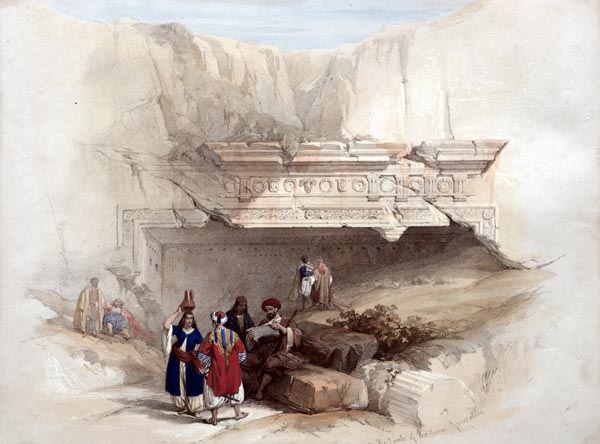
‘Entrance to the Tombs of the Kings, Jerusalem’ - David Roberts (British, 1796 – 1864)
Cleveland Museum of Art
At that time, no doubt, the flanks, today half-naked, of the Mount of Olives, were watered by the pools and the still-flowing streams of the Kidron Valley. Gardens of pomegranates, orange trees, and olive trees covered the narrow valley of Gethsemane with a thicker shade, a valley hollowed out, like a nest of sorrow, from the narrowest and darkest depths of the Valley of Jehoshaphat. The man of shame, the man of sorrows, could hide there like a criminal, among the roots of trees, among the rocks of the stream, beneath the triple shadows of the city, the mountain, and the night. From there he could hear the footsteps of his mother and his disciples, who were passing in secret along the road, searching for their son and their master; the confused noises, the foolish acclamations of the city, rising above his head, rejoicing at having conquered truth and expelled justice; and the groaning of the Kidron Valley, which rolled its waters beneath his feet, and which would soon see his city overthrown and its springs shattered by the ruin of a nation later accused of being guilty and blind. Could Christ have chosen a better place for his tears? Could he have watered with sweat and blood a land more drenched in misery, more steeped in sorrow, more saturated with lamentation?
The Mount of Olives
I remounted my horse, and, turning my head constantly to catch a wider glimpse of the valley and the city, climbed the Mount of Olives in a quarter of an hour: each step my horse took on the path leading upwards revealed to me another district, another of the buildings of Jerusalem. I reached the summit, crowned by a ruined mosque (the Mosque of the Ascension, a Crusader chapel converted to a mosque by Saladin in 1198) that covers the place where Christ ascended into heaven after the Resurrection; I descended slightly to the right of this mosque and came upon two broken columns, lying on the ground at the foot of some olive trees, on a plateau overlooking Jerusalem, Zion, the valleys of Saint Saba leading to the Dead Sea, and the Dead Sea itself, shining between the mountain peaks and the immense horizon, furrowed with diverse summits, ending at the mountains of Arabia: there I sat. This was the scene before me:
The Mount of Olives, on whose summit I sit, descends steeply and rapidly into the deep abyss that separates it from Jerusalem and is called the Valley of Jehoshaphat. From the bottom of this dark and narrow valley, whose bare sides are speckled with black and white stones, funereal stones, with which they are almost everywhere paved, rises an immense and broad hill whose rapid incline resembles that of a tall, collapsed rampart; no tree can plant its roots there, not even filaments of moss cling to its slopes, so steep that the earth and stones constantly crumble away, and it presents to the eye only a surface of arid and dried dust, as if heaps of ashes have been cast down from the heights of the city. Toward the middle of this hill or natural rampart, stand high and strong walls of broad, unhewn stones, concealing their Roman and Hebrew foundations beneath the very ash that covers their base, and rising here fifty to a hundred, and there, further on, two to three hundred feet, above this earthen base. The walls are punctuated by three city gates, two of which are walled up, and the single opening before me seems as empty and deserted as if it were to grant access only to an uninhabited city.
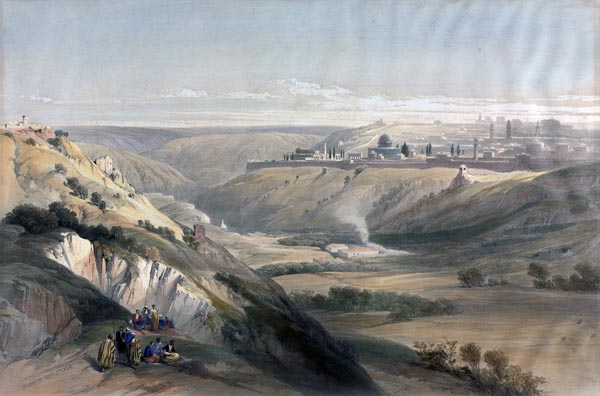
‘Jerusalem from the Mount of Olives’ - David Roberts (British, 1796 – 1864)
Cleveland Museum of Art
The walls still rise above these gates, supporting a broad and expansive terrace that extends along two-thirds of Jerusalem’s eastern side. This terrace is roughly a thousand feet long and five to six hundred feet wide; it is almost perfectly level, except at its centre where it dips gently, as if to remind the eye of the shallow valley that once separated Mount Zion from the city of Jerusalem. This magnificent platform, undoubtedly prepared by Nature but evidently finished by human hands, was the sublime pedestal upon which Solomon’s Temple stood; today it bears two Arab mosques: one, Qubbat as-Sahra (the Dome of the Rock), in the centre of the platform, on the very spot where the Temple must have stood; the other (Al-Aqsa, or Quibli), at the southeastern end of the terrace, abutting the city walls. Qubbat as-Sahra, an admirable example of Arab architecture, is an immense block of stone and marble, with eight sides, each adorned with seven pointed arches. Above this first architectural level is a flat roof, from which springs another, narrower arcade, culminating in a graceful copper-covered dome, once gilded. The mosque walls are covered in blue enamel; to the right and left extend wide walls ending in slender Moorish colonnades, corresponding to the mosque’s eight gates. Beyond these arches, free of any other structure, the platforms continue and terminate, one at the northern edge of the city, the other at the southern walls. Tall cypress trees, scattered seemingly at random, a few olive trees, and graceful green shrubs, grow here and there between the mosques. The latter’s elegant architecture, and the vibrant colour of their walls, are enhanced by their pyramidal shape and the sombre greenery that stand out against the facades of the city’s temples and domes.
Beyond the two mosques and the site of the Temple, stretches all of Jerusalem, bursting forth, as it were, before us, the eye missing not a single roof or stone, like to the plan of a city in relief that an artist might lay out on a table. The city is not, as it was previously depicted to us, a formless and confused heap of ruins and ashes upon which a few Arab huts are thrown, or a few Bedouin tents pitched; nor, like Athens, a chaos of dust and crumbling walls, in which the traveller searches in vain for the shadows of buildings, the traces of streets, the vision of a city: but a living city shining with light and colour. It presents, nobly, to the eyes, its intact and crenellated wall; its blue mosque with white colonnades; its thousands of resplendent domes, on which the light of an autumn sun falls and rebounds amidst dazzling vapour; its house facades tinted, by time and by sunlight, with the yellow and gold colour of the buildings of Paestum or Rome; its old towers, guardians of its walls, which lack not a stone, nor a loophole, nor a battlement; and finally, in the midst of this ocean of houses and the cloud of small domes that cover them, a low black dome, broader than the others, dominated by another white dome: these are the Church of the Holy Sepulchre and that of Calvary; they are confused together, and as if drowned, from here, by the immense maze of domes, buildings, and streets that surround them; and it is difficult to thus realise the location of Calvary and that of the Sepulchre, which, according to the Gospels should be located on a remote hill outside the walls, not in the centre of Jerusalem. The city, narrowed on the side of Zion, will undoubtedly have expanded on the north side to encompass, within its walls, the two sites that are both its shame and its glory: the site of the righteous man’s Crucifixion, and the site of the Resurrection of the Divine Man.
Behold the city from atop the Mount of Olives! Nothing can be seen of the horizon behind it, neither to the west nor to the north. The line of its walls and towers, the spires of its many minarets, the arches of its gleaming domes, stand out starkly and harshly against the blue of an Eastern sky; and the city, thus borne and presented upon its broad and elevated plateau, seems still to shine with all the ancient splendour of the prophecies, or to await only a word to emerge, dazzling, from its seventeen successive ruins, and become ‘the New Jerusalem rising from the heart of the desert, shining with light!’ (see Racine ‘Athalie’ Act III, Scene 7, and the Book of Revelation/Apocalypse 21.2).
Here is the most dazzling vision the eye can obtain of the city that no longer exists; for it seems still, here, as radiant as a city full of youth and life; yet, if one looks at it more closely, one feels that it is in fact nothing more than a beautiful phantom of the city of David and Solomon. No sound rises from its squares and streets; roads no longer lead to its gates from east or west, from south or north; there are only a few paths winding haphazardly among the rocks, where one encounters a few half-naked Arabs, mounted on their donkeys, a few camel drivers from Damascus, or a few women from Bethlehem or Jericho, carrying on their heads baskets of grapes from Engaddi (Ein Gedi, on the western shore of the Dead Sea), or baskets of doves, which they offer for sale in the morning, beneath the terebinth trees, outside the city gates.
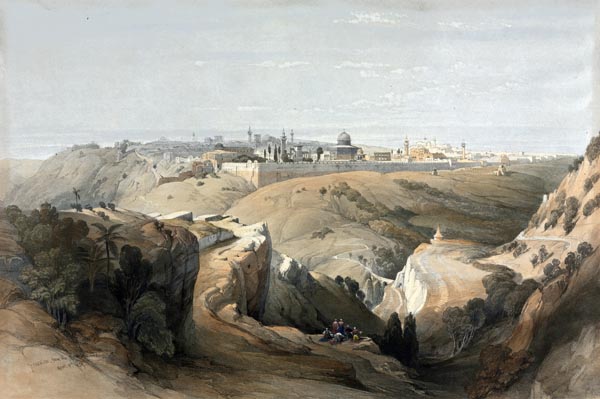
‘Jerusalem from the Mount of Olives’ - David Roberts (British, 1796 – 1864)
Cleveland Museum of Art
We sat in front of the main gates of Jerusalem all day; we walked around the walls, passing by all the other gates of the city. No one entered, no one left; not even a beggar sat at a gatepost, not a sentry appeared on the threshold; we saw nothing, we heard nothing; there was only, for twelve hours of the day, the same emptiness, the same silence, at the entrance to a city of thirty thousand souls, as if we had passed the gates of ruined Pompeii or Herculaneum! We saw only a quartet of funeral processions leave the Damascus Gate, silently making their way beside the walls toward the Turkish cemeteries; and, emerging from the Zion Gate when we passed, a poor Christian who had died of the plague that morning, being carried by four gravediggers to the Greek cemetery. They came close to us, laid the plague victim’s body on the ground, wrapped in its grave-cloth, and silently began digging his final resting place almost beneath our horses’ hooves. The earth around the city was freshly turned by similar burials, which the plague multiplied daily, and the only perceptible sound outside the walls of Jerusalem was the monotonous lament of Turkish women mourning their dead. Was the plague the sole cause of the bare roads and the profound silence around and within Jerusalem? I suspect not since the Turks and Arabs do not seek to avoid God’s scourges, convinced that they can reach them everywhere, and that no road escapes them. Sublime as is their reasoning it leads to disastrous consequences!
To the left of the Temple platform, and the walls of Jerusalem, the hill, on which the city rests, suddenly falls away, widens, and unfolds before the eye in gentle slopes, supported here and there by terraces of loose stones. This hill bears at its summit, a few hundred paces from Jerusalem, a mosque and a group of Turkish buildings rather like a European hamlet, crowned by its church and bell tower. This is Zion! Here are the palace and tomb of David! Here is the scene of his inspiration and delight, of his life, and his final resting place! A place doubly sacred to me, whose heart that divine bard has so often touched, and whose thoughts he has so often captivated. He is the foremost of the poets of feeling! He is the king of lyric poets! Never has the human soul resonated with such intimate, penetrating, and profound harmonies; Never has poetic thought risen on high so, or cried out with such truth; never has the soul of mankind poured forth, before mankind and God, such tender, sympathetic, and heart-rending expressions and sentiments. All the most secret lamentations of the human heart found their voice and music on the lips and harp of this man; and if one considers the distant era when such songs resounded on the earth; if one considers that the lyric poetry of the most cultivated nations sang then only of wine, love, blood, and the victories of the muses and steeds in the Games at Elis (the Olympic Games), one is seized with profound astonishment at the mystical words of the royal prophet, who speaks to the Creator as friend to friend, who understands and praises His wonders, who admires His justice, who implores His mercy, and seems an echo, in anticipation, of the poetry of the Gospels, repeating the gentle words of Christ before they were spoken. Prophet or not, neither the philosopher nor the Christian can deny the poet-king an inspiration that was given to no other man. Read Horace or Pindar after repeating a psalm! Speaking for myself, I can no longer bear to do so.
Mount Zion
Had I lived in Jerusalem, I, a humble poet of an age of decadence and silence, would have chosen the place for my dwelling and my final rest precisely where David chose his, on Mount Zion. It offers the most beautiful view of Judea, Palestine, and Galilee. Jerusalem is to the left with the Temple Mount and its buildings, upon which the gaze of the king or the poet could rest without his being seen. Before him, fertile gardens, descending in gentle slopes, led to the level of the stream whose foam and voice he loved. Below, the valley opens and extends; fig trees, pomegranate trees, and olive trees shade it. On these rocks suspended over the flowing water; in these echoing caves, refreshed by the breath and the murmur of the waters; at the foot of these terebinth-trees, ancestors of the terebinth that shelters me, the sacred poet would doubtless walk awaiting the breath that inspired his supreme melodies. Would that he was to be found here again, to sing of the sorrows of my heart and those of the hearts of all people in this troubled age, as he sang of his own hopes in an age of youth and faith! But there is no longer any song in the hearts of human beings, the lyre remains mute, and we pass in silence between twin abysses of doubt, having neither loved, nor prayed, nor sung!
Let me return, though, to the subject of David’s palace. I gaze into the ravine, verdant and watered by Jehoshaphat in his day. A wide opening in the eastern hills leads from slope to slope, from peak to peak, from undulation to undulation, down to the basin of the Dead Sea, reflecting the evening rays in its heavy, dense waters, like a solid Venetian mirror granting a dull, leaden tint to what it reflects. It is not, as the mind imagined, a petrified lake on a sad, colourless horizon. From here, it is as if one of the most beautiful lakes of Switzerland or Italy is to be seen, its tranquil waters lying between the shadows of the high Arabian mountains, which stretch, like the Alps, as far as the eye can see beyond its waters, and the slender, pyramidal, conical, light, jagged, and sparkling peaks of the last mountains of Judea. Such is the view from Zion! — Let me move on.
There is another aspect of the contours of Jerusalem that I would wish to imprint on my memory; but lack both artist’s brush and paint: the Valley of Jehoshaphat! A valley known to the traditions of three religions, the place in which Jews, Christians, and Muslims alike have agreed to place the terrible scene of the Last Judgment! A valley that has already witnessed on its banks the greatest scene of the Gospel drama: the tears, groans, and death of Christ! A valley through which all the prophets passed in turn, uttering a cry of sorrow and horror that seems to still echo there! A valley that must one day hear the great roar of the torrent of souls flowing before God, presenting themselves of their own accord to the fatal judgment!
The same date. October 28th, 1832.
We returned, having avoided violating the conditions of the pact concluded with the monks of the Monastery of Saint John in the Desert. We were received with a trust and charity that move us deeply; for if we had not been men of honour, if even one of our Arabs had escaped our supervision and mingled with those who were carrying the plague victims right in our midst, we would perhaps have brought death to the entire monastery.
October 29, 1832.
We left the desert of Saint John at five in the morning, with all our horses, escorts, the Arabs from Abu Gosh, and four horsemen sent by the governor of Jerusalem. We established our camp two rifle-shot lengths from the walls, next to the Turkish cemetery, which was entirely covered with small tents where women came to mourn. These tents are occupied by women, children and slaves, who bring baskets full of flowers which they plant each day around the tombs.
Our Nablus cavalrymen entered the city alone and went to inform the governor of our arrival. While they carried our message, we removed our shoes, boots, and cloth insoles, which might carry the plague, and put on morocco leather slippers. We rubbed ourselves with oil and garlic, a preservative I devised based on the well-known theory that the merchants and oil-bearers of Constantinople are less prone to contagion. After half an hour, we saw the governor’s kahya (steward), the interpreter from the Latin monastery, five or six horsemen in splendid costumes carrying canes with gold and silver pommels, our own Nablus cavalrymen, and some young pages also on horseback emerging from the Bethlehem Gate. We went to meet them; they formed a guard of honour around us, and we entered via the gate. Three plague victims, who had died during the night, emerged at the same moment and the corpse-bearers briefly disputed our passage beneath that dark archway at the city entrance. Immediately after passing through the archway, we found ourselves at a crossroads lined with small, wretched houses and a few overgrown gardens, their walls crumbling around them.
We followed the widest path from this crossroads for a while; it led us through a few little streets, equally dark, narrow, and filthy. There, we saw only processions of men bearing the dead, who passed by hurriedly, or lined up against the walls, at the command and beneath the raised batons of the Governor’s Janissaries. Here and there, a few bread and fruit vendors, covered in rags, sat on the thresholds of small shops, baskets on their knees, calling out their wares, as in our large-city market halls. From time to time, a veiled woman appeared at the barred wooden window of one of these houses; a child opened a low, dark door and ran to buy the family’s daily provisions. These streets were everywhere obstructed with rubble, and heaped with filth, especially piles of cloth or blue-dyed cotton rags, which the wind swept about like dead leaves, and whose contact we could not avoid. It is mostly due to the filth and scraps of fabric with which the pavements of Eastern cities are covered, that the plague spreads so widely.
So far, in the streets of Jerusalem, we saw nothing that suggested the presence of a thriving nation; no sign of wealth, activity, or life. Outward appearances had deceived us, as they so often did in other cities of Greece or Syria. The most wretched village in the Alps or the Pyrenees, the most neglected alleyways of our suburbs, abandoned to the poorest of our working class, possess more cleanliness, luxury, and elegance than did the deserted streets of the Queen of Cities. We encountered only a few Bedouin horsemen, mounted on Arabian mares whose hooves slipped on, or sank into, the holes in the furrowed pavement. These men lack the noble and chivalrous air of the Arab sheikhs of Syria and Lebanon. They have ferocious countenances, the eyes of vultures, and the garb of brigands.
We wandered for some time through similar-looking streets, stopping from time to time when the interpreter from the Latin monastery pointed out a ruined Turkish house, an old, worm-eaten wooden door, or the remains of a Moorish window, to tell us: ‘This was the house of Veronica; here, the gate of the Wandering Jew; there, the window of the Praetorium’; names that made only a distressing impression on us, contradicted as they were by the obviously modern appearance of the sites, and the glaring improbability of their arbitrary designations; pious frauds for which no one is particularly guilty, since they date back to who knows when, and have been repeated for centuries perhaps to pilgrims, whose ignorant credulity itself caused their invention. Finally, we were shown the roofs of the Latin Monastery, but could not enter. The monks were in quarantine; the monastery was closed due to the plague. Only a small house belonging to the monastery remained open to foreigners, under the direction of the priest, the curate of Jerusalem; it had only one or two rooms; they were occupied, so we avoided them. We were shown into a small square courtyard, enclosed on all sides by tall arches supporting raised terraces; it was the courtyard of the monastery.
The monks emerged onto the terraces and conversed with us for a few moments in Spanish and Italian. None of them spoke French; those we saw were almost all elderly men with gentle, venerable, faces and happy expressions. They welcomed us with cheerfulness and cordiality and seemed to regret, deeply, that the prevailing calamity prevented them from contact with guests as exposed as we were to catching and spreading the plague. We passed on news of Europe; they offered us the assistance that their country provides. A butcher slaughtered sheep for us in the courtyard. Fresh loaves of bread were lowered to us by rope from the terraces. We received from them, by the same means, a supply of crosses, rosaries, and other pious items, with which their storerooms are always abundantly stocked; in return, we gave them alms and letters that their friends in Cyprus and Syria had entrusted to us.
Every object that passed from our hands to theirs was first subjected to rigorous fumigation, then plunged into a vessel of cold water, and finally hoisted to the top of the terrace in a copper basin suspended by a rope. These poor monks seem more terrified than we are of the danger that surrounds them. They have so often experienced how a slight lapse in observing the rules of good sanitation can wipe out an entire monastery in a few moments, that they observe them with rigorous fidelity. They cannot understand why we, willingly and cheerfully, threw ourselves into this ocean of contagion, a single drop of which made them pale. The priest of Jerusalem, on the contrary, forced by his position to risk the lives of his parishioners, sought to persuade us that there was no plague.
After half an hour of conversation with these monks, the bell called them to Mass. We thanked them; they wished us a safe journey; we sent back to our camp the provisions and food we had brought, and left the courtyard.
The Church of the Holy Sepulchre
After riding along a few more streets similar to the ones I have just described, we found ourselves in a small square, opening to the north onto a glimpse of sky and the Mount of Olives; to our left, a few steps led us down into an open courtyard. The facade of the Church of the Holy Sepulchre overlooks this courtyard. The church has been described so thoroughly and so well that I will not describe it again. It is, especially on the outside, a vast and beautiful monument of the Byzantine era; its architecture is dignified, solemn, grandiose, and rich for the time in which it was built; it is a worthy pavilion erected, due to the piety of mankind, over the tomb of the Son of Man. Comparing this church with all else that its era produced, one finds it superior. Hagia Sophia (in Constantinople), though far more colossal is far more barbaric in form: on the outside, it is nothing but a mountain of stone flanked by hills of stone; the Holy Sepulchre, on the contrary, is an airy and sculpted dome, of which the skilful and graceful carving of the doors, windows, capitals, and cornices adds to its mass the inestimable value of expert craftsmanship; in which stone has become lace so as to be worthy of adorning this monument erected to the greatest of human ideas; and where the very thought that erected it is inscribed in the details as in the whole of the edifice.
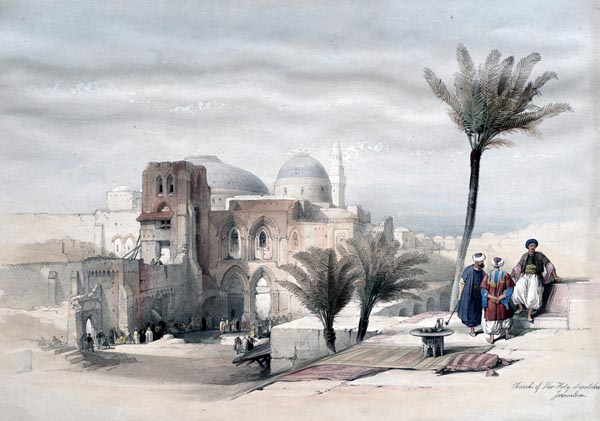
‘Church of the Holy Sepulchre, Jerusalem’ - David Roberts (British, 1796 – 1864)
Cleveland Museum of Art
It is true that the Church of the Holy Sepulchre is not as it was today when Saint Helena, mother of Constantine, had it built (in the fourth century AD); the kings of Jerusalem altered it and embellished it with the ornamentation of that semi-Western, semi-Moorish architecture, whose taste and models they had found in the East. But in its external features, its current state, with its Byzantine mass and Greek, Gothic and Arab decoration, even with the tears, the stigmata, of time and barbarians, that remain imprinted on its facade, does not conflict with the ideas one had of it, with the thought it expresses; one does not experience, at sight of it, the painful impression of a great idea poorly rendered, of a great memory profaned by human hands: on the contrary, one says to oneself, involuntarily: ‘This is what I expected. Mankind has done its best. The monument is not worthy of the tomb, but it is worthy of the human race that wished to honour this great sepulchre’, and one enters the vaulted and sombre vestibule of the nave, under the impact of that first and profound view.
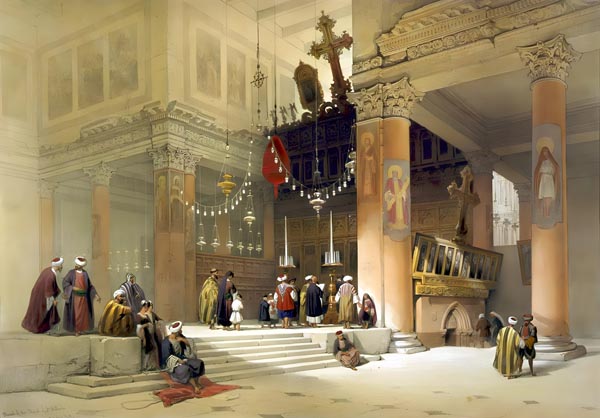
‘Chancel of the Church of St. Helena (Holy Sepulchre)’ - David Roberts (British, 1796 – 1864)
Library of Congress
To the left, upon entering the vestibule that opens onto the nave’s forecourt, in the recess of a wide, deep niche that once held statues, the Turks have set up their divan; they are the guardians of the Holy Sepulchre, which they alone have the right to open or keep closed. When I passed by, five or six venerable Turks, with long white beards, were squatting on this divan, which was covered with rich Aleppo carpets; coffee cups and pipes lay around them on these carpets; they greeted us with dignity and grace, and ordered one of the attendants to escort us to all areas of the church. I saw nothing in their faces, words, or gestures, to suggest the irreverence of which they are accused. They do not enter the church; they are seated at the door; they speak to Christians with the gravity and respect that the place and purpose of the visit demand. Having seized the sacred monument of the Christians through war, they did not destroy it, they did not scatter its ashes to the wind; they preserved it. They maintain order, a police force, full of silent reverence, that the Christian communities, which vie for its possession, are far from providing themselves. They ensure that this relic, sacred to all who bear the name of Christian, is preserved for all, so that each community may, in turn, enjoy the veneration it wishes to render to the holy tomb.
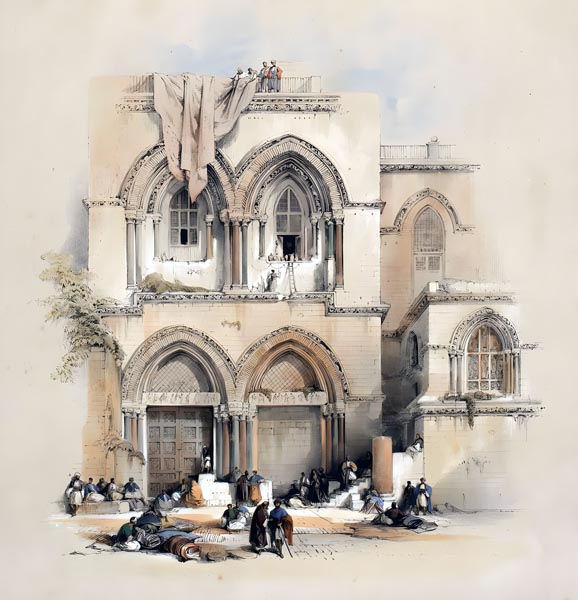
‘Entrance to the Holy Sepulchre, Jerusalem’ - David Roberts (British, 1796 – 1864)
Princeton University Art Museum
Without the Turks, this tomb, contested by Greeks and Catholics, and the countless offshoots of the Christian ideal, would already, a hundred times over, have been an object of conflict between those mutually hated, rival communities, and would have passed exclusively from one to the other in turn, access undoubtedly being denied to the enemies of whichever communion had triumphed. I see no basis for accusing and insulting the Turks as regards this. The supposed brutal intolerance of which the ignorant accuse them is refuted by the tolerance and respect they show for what other religions venerate and worship. Wherever Muslims see the idea of God in the thoughts of their brothers and sisters, they bow and show respect. They believe that the idea sanctifies the form. Theirs is the only tolerant sect. Let Christians reflect, and ask themselves in good faith, what they would have done if the fortunes of war had delivered Mecca and the Kaaba over to them. Would Muslims have felt safe then in journeying from all parts of Europe and Asia, to venerate, in peace, the preserved monuments of Islam?
At the end of the vestibule, we found ourselves beneath the church’s broad dome. The centre of this dome, which local tradition considers to be the centre of the earth, is occupied by a small monument (the Aedicule) enclosed within the larger one, like a precious stone set within another. This inner monument is a rectangular edifice, adorned with a few pilasters, a cornice, and a marble cupola, all in poor taste and of a bizarre baroque design; it was constructed in 1810 (following the fire of 1808) by a Greek architect (Kalfa Komnenos, from Mytilene) at the expense of the Greek Church, which now owns it. Around this inner pavilion of the sepulchre the emptiness of the great outer dome reigns; one is able to move freely within the building, finding, from pillar to pillar, vast and deep chapels, each dedicated to one of the mysteries of Christ’s Passion; they all contain some real or supposed depictions of the scenes of the Redemption; the part of the Church of the Holy Sepulchre not beneath the dome is reserved exclusively for the schismatic Greeks; a painted wooden partition, covered with paintings of the Greek school, divides this nave from the other.
Despite the bizarre profusion of bad paintings and ornaments of all kinds with which the walls and altar are burdened, its overall effect is solemn and religious; one senses that prayer, in all its forms, has pervaded this sanctuary, accumulating all that superstitious but fervent generations believed to be precious before God. A staircase carved into the rock leads from there to the summit of Calvary, where the three crosses were planted. Calvary, the tomb, and several other sites of the drama of redemption are thus gathered under the roof of a single, rather modest building. This seems hardly consistent with the Gospel accounts. One scarcely expects to find the tomb of Joseph of Arimathea, carved into the rock outside the walls of Zion, fifty paces from Calvary, the site of the executions, and enclosed within the modern city walls. But such is the tradition, and it has prevailed. The mind hardly quibbles about a few paces difference between the historical likelihood and such a tradition: whether it was here or there, the fact remains that it was not far from the sites that are pointed out to one.
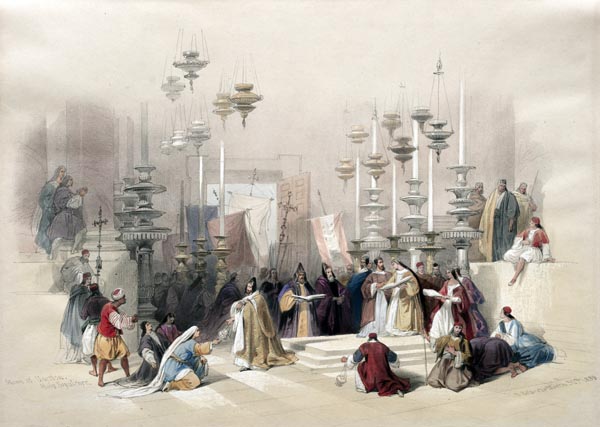
‘Stone of Unction, Holy Sepulchre’ - David Roberts (British, 1796 – 1864)
Cleveland Museum of Art
After a moment of deep and silent meditation in each of these sacred places, reflecting on the events it evoked, we descended back into the church grounds and entered the inner sanctuary that serves as a stone curtain or enclosure for the tomb itself. It is divided into two smaller sanctuaries. In the first is the stone on which the angel sat when he answered the holy women, ‘He is not here, for he is risen,’(Matthew 28.6) The second and final sanctuary contains the sepulchre, still covered by a kind of white marble sarcophagus that completely surrounds and conceals from view the very substance of the original rock in which the sepulchre was hewn. Gold and silver lamps, perpetually fuelled, illuminate this chapel, and perfumes burn there night and day; the air is warm and fragrant. We entered one by one separately, without allowing any of the temple attendants to enter with us, and separated from the first sanctuary by a crimson silk curtain. We did not want any gaze to disturb the solemnity of the place, nor the intimacy of the impressions it might inspire in each of us, according to our own thoughts and the measure and nature of our faith in the great event that this tomb commemorates; each of us remained there for about fifteen minutes, and none of us left with dry eyes.
Whatever form inner meditation, the reading of history, the passing years, and the vicissitudes of the human heart and mind may have given to the religious feeling in a person’s soul; whether they have kept to the letter of Christianity, and the dogmas of their parents, or whether they pursue only a philosophical Christianity according to the spirit; whether Christ for them is a crucified God, or whether they see in him only the holiest of men deified by virtue, inspired by the supreme truth, and dying in order to bear witness to his Father; whether Jesus is in their eyes the Son of God or the Son of Man, the Divinity made human or humanity divinised, the fact remains that Christianity is the religion of their memories, their heart and imagination; that it has not been so weakened, amidst the storms of the century and of life, that the soul into which it was poured fails to retain the first feeling of it, or that the appearance of the places and visible monuments of their first worship fails to rejuvenate in them those first impressions, and shake that person with a solemn tremor. For the Christian or the philosopher, for the moralist or the historian, this tomb is the boundary that separates two worlds, the old world and the new world; it is the starting point of an idea that renewed the universe, of a form of civilisation that transformed everything, of a word that resounded throughout the globe: this tomb is the sepulchre of the old world and the cradle of the new world; no other stone on earth has been the foundation of so vast an edifice; no tomb has been so fruitful; no doctrine buried for three days, or three centuries, has so victoriously shattered the rock with which Mankind had sealed its sepulchre, or refuted death by so shining and perpetual a Resurrection!
I, in turn, being the last, entered the holy sepulchre, my mind filled with these immense ideas, my heart moved by more intimate impressions, which remain a secret between a man and his soul, between the thinking insect and the Creator. Those impressions are not written; they are exhaled amidst the smoke of pious lamps, the perfumes of censers, the vague and confused murmur of sighs; they fall like the tears that come to the eyes at the memory of the first names that we stammered in our childhood, of the father and mother who taught them to us, of the brothers, sisters, friends with whom we whispered them; all the pious impressions that have stirred our soul at all times of life, all the prayers that have risen from our heart and our lips in the name of him who taught us to pray to his Father and ours; all the joys and sorrows of thought, of which these prayers formed the language, awaken in the depths of the soul and, through their resounding turmoil, produce that dazzlement of the intellect, that tenderness of the heart, which seeks no words, but resolves itself in tearful eyes, a heavy heart, a bowed head, and a mouth that silently presses itself against the stone of a sepulchre.
I remained thus for a long time, praying to heaven, to the Father, there, in the very place where the most beautiful of prayers first ascended to heaven; praying for my own father here below, for my mother now in another world, for all those who are, or are no more, but with whom the invisible bond is never broken: since the communion of love exists always; the names of all the beings I have known, loved, and been loved by, passed from my lips to that stone of the holy sepulchre. Only afterwards did I pray on my own behalf; my prayer was ardent and fulsome; I asked for truth and courage, before the tomb of him who bore the greatest of truths to our world, and died in the greatest act of devotion to that truth, a truth of which he was the embodiment. I shall forever remember the words I murmured in that hour of moral crisis. Perhaps my prayer was answered: a great light of reason and conviction spread through my mind, separating, more clearly, light from darkness, error from truth. There are moments in life when a person’s thoughts, long vague and uncertain, adrift like waves without a shore, finally reach that shore, break upon themselves, and return in new forms. This was one of those moments for me. He who searches thoughts and hearts knows this, and perhaps I myself will understand it one day. It has proved a mystery in my life, one that will be revealed to me later.
The same date. October 29th, 1832.
The Via Dolorosa
Leaving the Church of the Holy Sepulchre, we followed the Via Dolorosa, the itinerary of which Chateaubriand described in so poetic a way (in his ‘Itinéraire’). Nothing of it was striking, nothing verifiable, nothing plausible; just modern-built edifices, presented everywhere, by everyone from monks to pilgrims, as undeniable vestiges of the various Stations of the Cross. The eye doubts all, and any confidence in these local traditions is destroyed in advance by our knowledge of the history of the early years of Christianity, when Jerusalem was altered stone by stone, and Christians were banished from the city for many years. Jerusalem, with the exception of its pools and the tombs of the kings, retains no monuments from any of those great eras: only a few sites are recognisable, such as the Temple mount, defined by its terraces, and now home to the immense and beautiful Qubbat al-Sakhrah, and Mount Zion, occupied by the Armenian Monastery and the Tomb of David; and even then, only with a historical treatise in hand and with a sharply critical eye can the date of most of these sites be assigned with any precision. Apart from the terrace walls overlooking the Valley of Jehoshaphat, no stone betrays its date by its form and colour; the dust everywhere may be ancient or modern. The mind wanders uncertainly across the city’s horizon, unsure where to settle; but the whole city, defined by the circumscribed hill on which it stands, by the various valleys that surround it, and especially by the deep valley of the Kidron, is a monument that does not deceive the eye: it is indeed here that Zion was situated; a strange and unfortunate site for the capital of a great people: it is rather the natural fortress of a small tribe, driven from the land and taking refuge with their God, around their temple, on ground that none had an interest in contesting, on rocks that no roads could make accessible, amidst valleys without water, in a harsh and sterile climate, having for horizon only mountains calcined by the internal fire of volcanoes, the mountains of Arabia and Jericho, and a saline sea, without shore or navigable access, the Dead Sea!
Here is Judea, here is the site of a sect whose destiny it was to be proscribed in every era of their subsequent history, with whom even the possession of their capital, itself proscribed to them, was to become a matter of dispute; a site built, like an eagle’s nest, on the summit of this cluster of hills: and yet the members of that sect carried with them the majestic idea of the Trinity, of one God in three persons (see Matthew 28.19, and John 10.30), and the truth of this elementary idea was enough to separate them from other sects, and to make them proud of their proscription, and confident in their providential doctrine.
The same date. October 29th, 1832.
After wandering through the various quarters of the city, all as bare, wretched, and dilapidated as those we had previously entered, we dismounted beside the famous mosque (the Dome of the Rock, Qubbat al-Sakhrah) which stands on the site of Solomon’s Temple. The governor of Jerusalem has his seraglio in a building adjoining the mosque’s gardens and walls. We went to offer him our thanks. The seraglio courtyard was surrounded by barred dungeons, in which the figures of bandits from Jericho and Samaria could be glimpsed, awaiting their release or the Pasha’s sword. Horsemen lying at their horses’ feet, desert sheikhs, and Arabs from Nablus, were grouped here and there on the staircases or in the sheds, waiting to enter the diwan. The governor, learning of our arrival, sent his son to invite us to meet him. This young man, about thirty years old, was the most handsome of Arabs, perhaps of any group of men, I have ever seen. Strength, grace, intelligence, and gentleness were blended with such harmony in his features, and shone together in his blue eyes with such captivating clarity, that we were all struck by his appearance.
He is a Samaritan. The governor of Jerusalem, his father (Qasim Pasha al-Ahmad), is the most powerful of the Arabs of Nablus. Persecuted by Abdullah, Pasha of Acre, and often at war with him during Turkish rule, he had been forced to take refuge, with his family, in the mountains beyond the Dead Sea; Ibrahim Pasha’s victory over Abdullah had allowed him to return to his homeland. There he had regained his wealth and influence; He had driven his enemies from the country, and the Pasha of Egypt (Ibrahim), to compensate for the inadequacy of his Egyptian troops in Judea, had entrusted him with the government of Samaria and Jerusalem. He had no other troops than a few hundred horsemen from his tribe, with whom he maintained order, and Ibrahim’s dominion over all the surrounding population.
We entered the diwan (council chamber), a large hall with no ornamentation other than a few carpets or mats, pipes, and coffee cups, on the floor. The governor, surrounded by a large number of slaves, armed Arabs, and a few secretaries kneeling and writing on their hands, was busy administering justice and issuing orders. He rose as we approached and came to meet us. He had the carpets, liable to spread the plague, removed from the diwan, and replaced them with Egyptian mats, which do not transmit the disease. We seated ourselves, and were presented with pipes and coffee. My dragoman offered the customary compliments on my behalf, and I myself thanked him for all the steps he had taken so that foreigners like us could visit, without danger, the places consecrated by their religion. He replied with an obliging smile that he was only doing his duty; that Ibrahim’s friends were his friends; that he was responsible for our lives; that he was ready not only to do for me what he had done, but also to travel himself, if I so commanded, with his troops, and to accompany me wherever my curiosity or my religion inspired me to go, within the limits of his jurisdiction; for such was the Pasha’s order. Then he inquired about us, and sought news of the war, and of the role the European powers were playing in Ibrahim’s fortunes.
I replied in a way that satisfied his private thoughts: that Europe admired Ibrahim Pasha as a civilising agent; that, in this respect, it had a vested interest in his victories; that it was time for the East to share the benefits of better governance; that the Pasha of Egypt was the armed missionary of European civilisation in Arabia; that his bravery and the tactics he had borrowed from us rendered the Grand Vizier’s defeat certain, the latter advancing to meet him in Caramania; that, in all likelihood, he would win a great victory there and march on Constantinople; that he would not enter it, because the Europeans would not yet allow him to, but that he would make peace through their mediation and retain permanent sovereignty over Arabia and Syria.
This touched the heart of the old rebel of Nablus: his eyes hung on every word from my lips, and his son and friends leaned their heads over mine so as not to miss a word of this conversation, which for them was the omen of a long and peaceful reign in Samaria. Finding the governor so well-disposed towards me, I expressed my desire, not to enter the Dome of the Rock since I knew that such a step would be contrary to the customs of the country, but to contemplate its exterior. ‘If you insist,’ he replied, ‘all will be open to you; but I would risk deeply angering the Muslims of the city: they are still ignorant; they believe that the presence of a Christian within the mosque would put them in great danger, since a prophecy claims that whatever a Christian asks of God within the walls of Qubbat as-Sakhra, he will obtain; and they have no doubt that a Christian would seek the ruin of the Prophet’s religion and the extermination of all Muslims. For my part,’ he added, ‘I believe none of this: all men are brothers, although they worship, each in their own language, the common Father; He gives nothing to some at the expense of others; He makes His sun shine upon the worshippers of all the prophets; men know nothing, but God knows everything; Allah Kerim! God is beneficent!’ And he inclined his head, smiling. ‘God forbid,’ I said to him, ‘that I should abuse your hospitality and expose you to criticism, merely to satisfy a traveller’s idle curiosity! If I were in the mosque of Qubbat as-Sakhra, I would not pray for the extermination of any group of people, but for the light and happiness of all the children of Allah.’ At these words, we rose; he led us through a corridor to a window of his harem, which overlooked the outer courtyards of the mosque. It was not possible to view the whole area as well there as one may from the summit of the Mount of Olives: we saw only the walls of the dome, some Moorish porticoes in the most elegant architectural style, and the tops of the cypresses that grow in the inner gardens.
I took leave of the governor, informing him that my plan was to spend eight or ten days encamped near the city, and to depart the next day for the Dead Sea, the Jordan River, Jericho, and as far as the foothills of the mountains of Arabia Petraea; that I would return several times, as today, to the interior of Jerusalem, and that I only requested enough horsemen to guarantee our safety during the various excursions we intended to make in Judea. We left Jerusalem through the same Bethlehem Gate near which our tents had been pitched that day; and in the evening we completed our visit to all the notable or sacred sites around the city walls.
The same date. October 29th, 1832.
The evening was spent exploring the slopes that stretch south of Jerusalem, between David’s Tomb and the Valley of Jehoshaphat. These slopes are the only side of the city that offers even a hint of vegetation. At sunset, I sat facing the Mount of Olives, four or five hundred paces above the Pool of Siloam, roughly where David’s gardens once extended: Jehoshaphat lay at my feet; the high walls of the temple terraces were a little above me, to my left. I could see the tops of the beautiful cypress trees raising their pyramidal heads above the porticoes of the Al-Aqsa Mosque, and the canopies of the orange trees that cover the temple’s beautiful fountain called the Fountain of the Orange Tree. This fountain reminds me of one of the most delightful Eastern traditions invented, passed down, and preserved by the Arabs. This is how they tell the story of Solomon choosing the Temple platform which lies beneath the mosque:
Jerusalem was ploughed land. Two brothers owned the area where the Temple was to stand; one of these brothers was married and had several children, the other lived alone; they farmed the site together, which they had inherited from their mother; when harvest-time came, the two brothers bound their sheaves and formed two equal heaps, which they left in the field. During the night, the unmarried brother had an idea; he said to himself: ‘My brother has a wife and children to feed; it is not right that my share should be as large as his. Come, let me take some sheaves from my heap and secretly add them to his; he will not notice, and thus will not be able to refuse.’ He then executed his idea. That same night, the other brother woke and said to his wife: ‘My brother is young, he lives alone and without a wife, he has no one to help him with his work or to comfort him in his fatigue. It is not right that we should take as many sheaves from the common field as he does. Let us go, secretly, and transfer a number of sheaves to his heap. He will not notice, and so won’t be able to refuse them.’ And they did as he had suggested. The next day, each of the brothers went to the field, and was surprised to see that the two heaps still contained the same number of sheaves: neither could understand this prodigy; they acted in this manner for several nights in a row; but as each of them brought the same number of sheaves to his brother’s heap, the two piles always remained equal in number, until one night, both having set themselves up as sentinels to investigate the cause of this miracle, they met, each carrying the sheaves they had intended for the other. Now, the place where so generous a thought had come to the two men simultaneously and repeatedly was considered thereby a location pleasing to God; and the people blessed it and chose to build the house of God there.
A tradition full of charm, that exudes the naive kindness of patriarchal customs! How simple, ancient, and natural is the inspiration that comes to men to consecrate to God a place where virtue has borne fruit on earth! I have heard hundreds of legends of this kind recounted among the Arabs. One breathes the air of the Bible in every part of the Orient.
The appearance of the Valley of Jehoshaphat (the Kidron Valley) conforms to the role assigned it in Christian tradition. It resembles a vast sepulchre, too small, however, for the throngs of humankind that were to accumulate there. Dominated on all sides by funerary monuments; nestled at its southern end in the rock of Siloam, riddled with sepulchral caverns like a funereal beehive; containing the tombs of Jehoshaphat and Absalom (in fact they date to the first century AD), pyramids hewn in the living rock, and shaded on one side by the dark hills of the Mons Offensionis (the southern summit of the Mount of Olives, designated the ‘Mount of Corruption’, see 2 Kings 23.13), on the other by the ramparts of the second Temple; it was a place naturally inspiring sacred awe, destined from an early time to become the gloomy theatre of a great city, in which the imagination of the prophets must have effortlessly placed their scenes of death, resurrection, and judgment. The Valley of Jehoshaphat might be imagined to be a mountainous cleft where the Kidron, a wide and black torrent with mournful waters, flows with lamentable murmurs; where broad gorges, open to the four winds, widen so as to allow the passage of four great rivers of the dead flowing from east and west, north and south; the immense terraces of the hills extending in an amphitheatre to provide room for the countless children of Adam, arriving to witness, each in their own way, the final denouement of the great drama of humanity.
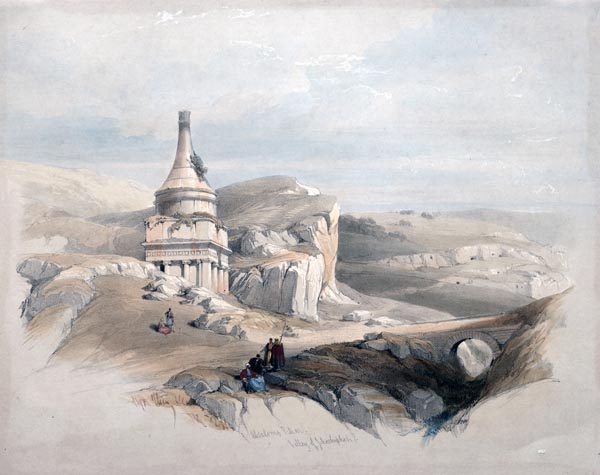
‘Absalom's Pillar, Valley of Jehoshaphat’ - David Roberts (British, 1796 – 1864)
Cleveland Museum of Art
Not at all. The Valley of Jehoshaphat is merely a natural ditch carved between two hills a few hundred feet high, on one of which Jerusalem stands, the other being the Mount of Olives. The walls of Jerusalem, if they were to collapse, would fill most of the vale; no gorge has its mouth there; the Kidron, which springs from the ground a few paces above the valley, is merely a torrent formed in winter by the runoff of rainwater dripping from the olive groves below the tombs of the kings, and is crossed by a bridge in the middle of the valley, opposite one of the gates of Jerusalem. The stream is only a few paces wide, and the valley, at that point, no wider than the stream. The stream’s course, when the bed is dry of water, can be traced by a layer of white pebbles at the bottom of the gorge. The Valley of Jehoshaphat, in short, is exactly like one of those ditches dug at the foot of the high fortifications of a great city, into which the city’s sewers pour their filth in winter, and in which a few poor inhabitants of the suburbs vie for a patch of land by the ramparts to grow a few vegetables, while abandoned goats and donkeys on the steep slopes, graze clumps of withered grass coated with filth and dust. Scatter the ground with tombstones belonging to all the world’s sects, and you will have before your eyes the Valley of Judgment.
The same date. October 29th, 1832.
Here is the Pool of Siloam (or Siloa), fed by the valley’s sole spring, the Gihon, the source that inspired kings and prophets; I don’t know why so many travellers have found difficulty in identifying it, and still argue about its location. Here it lies, entirely filled with clear, sweet water, adding a breath of freshness to the fiery, dusty air of the valley, with its twenty steps carved into the rock on whose summit stood the palace of David, and with its vault of stone blocks polished by centuries, their joints coated with damp mosses and everlasting ivy. The steps of its staircase, worn smooth by the feet of women who come from the village of Silhoa (Silwan) to fill their jugs, gleam like marble. I descended; I sat for a moment on those cool flagstones; I listened, so as to remember the place, to the gentle trickle of the spring; I washed my hands and my forehead in its waters; I recalled Milton’s lines (‘Paradise Lost’ Book I, 10-12: ‘or if Sion Hill/ delight thee more, and Siloa’s brook that flowed/ fast by the oracle of God’ ), to invoke, in my turn, his powers of inspiration, so long silent.
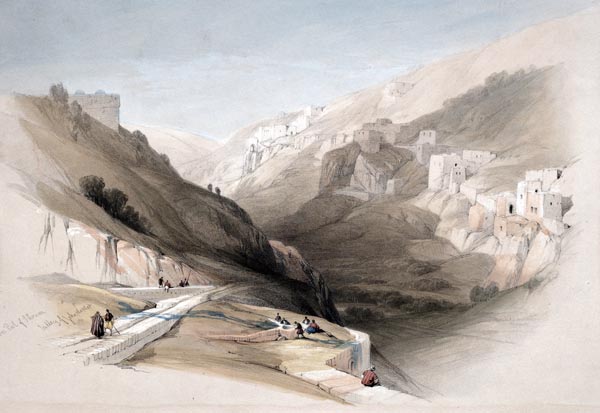
‘Lower Pool of Siloam, Valley of Jehoshaphat’ - David Roberts (British, 1796 – 1864)
Cleveland Museum of Art
This is the only place near the city of Jerusalem where the traveller can find a place to wet their fingers, quench their thirst, and rest their head in the cool shade provided by the rocks, and a few clumps of greenery. A handful of little gardens, planted with pomegranate trees and other shrubs by the Arabs of Silhoa, have created a cluster of pale greenery around the spring. The spring waters these gardens with its overflow. Here the Valley of Jehoshaphat ends. Below, a gently sloping plain leads the eye to the wide, deep gorges of the volcanic mountains of Jericho and Saint Sabbas (founder of the Mar Saba monastery), while the Dead Sea marks the horizon.
The Banks of the Jordan
Beyond the plain of Jericho, a few leagues from the river’s entry into the Dead Sea.
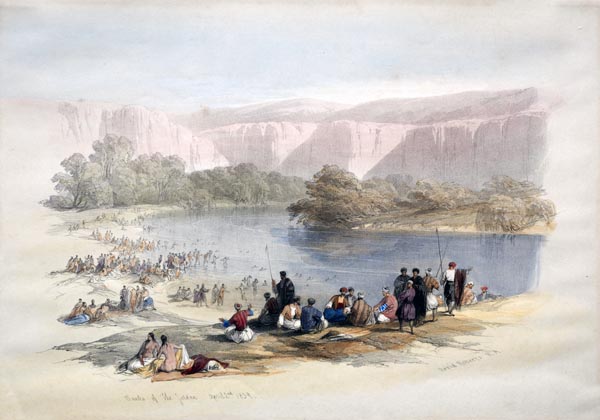
‘Banks of the Jordan’ - David Roberts (British, 1796 – 1864)
Cleveland Museum of Art
I left Jerusalem yesterday, October 30th, at seven in the morning, with my entire caravan: six soldiers of Ibrahim Pasha, Abu Gosh’s nephew, and four of his cavalrymen; and eight Arab horsemen from Nablus, sent by the governor of Jerusalem. We circled the city, descended to the bottom of the Valley of Jehoshaphat; ascended the Mount of Olives, left its southern summit to our right, and crossed, at its southern end, the mountain range that extends from the Mount of Olives. Having arrived at the village of Bethulia (?), still inhabited by a few Arab families, we recognised the remains of a Christian monument. There was a good spring. An Arab drew water for an hour to water our horses and fill the jars hanging from our mule saddles. No more water was available until Jericho, a ten-or twelve-hour ride.
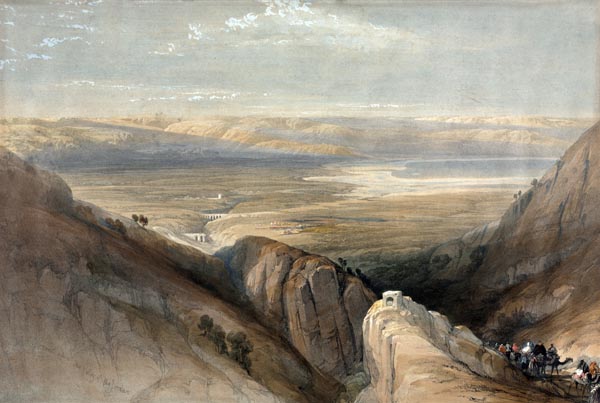
‘Descent from the Valley of the Jordan’ - David Roberts (British, 1796 – 1864)
Cleveland Museum of Art
We left Bethulia at four o’clock in the afternoon. A two-hour descent followed along a wide, artificially sloped road, carved into the sheer mountainsides that stretched on without interruption. It was the only trace of a road I had seen in the East. It was the road to Jericho and the fertile plains watered by the Jordan River. It led to the possessions of the tribes of Israel, who had been allotted the entire course of that river, and the Tiberias plain as far as the vicinity of Tyre and the foothills of Lebanon. It led to Arabia, Mesopotamia, and from there to Persia and India, countries with which Solomon had established his extensive trade relations. It was undoubtedly he who created this route. It was also through these valleys that the Jewish people first passed, when they descended from Arabia Petraea, crossed the Jordan and came to seize their inheritance. (Lamartine appears to be describing the ancient road from the heights of Jerusalem to Jericho, via the Ascent of Adummim Wadi Alqualt/Wadi al Quelt. The locations of the Biblical Bethulia, see the ‘Book of Judith’, and Lamartine’s Bethulia are uncertain.)
Beyond Bethulia, one encounters neither house nor cultivated land; the mountains are completely devoid of vegetation; all is rock or dust that the wind ploughs at will; a blackish ash-like hue covers all this land like a funeral shroud. From time to time, the mountains split apart from one another, into narrow, deep gorges: abysses where no path can be found, and where the eye sees only an eternal repetition of the scenes that immediately surround it. Almost all these mountains have a volcanic appearance; the stones carried down their slopes or onto the road by winter torrents resemble blocks of lava hardened and cracked by centuries. Here and there in the distance, on some hilltops, one even sees that slight yellowish and sulphurous tint perceived on Vesuvius or Etna; it is impossible to resist for long the impression of sadness and dread that this landscape inspires. It is an oppression of the heart and an affliction of the eyes. When one is on the summit of one of these hills, and the horizon opens for a moment to the gaze, one sees, as far as the eye can see, only blackish mountain chains, conical or truncated peaks, piled one upon another and standing out against the raw blue of the firmament; it is a boundless labyrinth of mountainous avenues of every shape, torn, broken, split into gigantic pieces, linked together by chains of similar hills, with bottomless ravines where one hopes to hear at least the sound of a torrent, but where nothing stirs, where one discovers not a tree, not a blade of grass, not a flower, not even a patch of moss; only the ruins of a scorched world, the relics of Earth’s seething, burning depths, of which the petrified bubbles have formed these waves of dust and stone.
At six o’clock, at the bottom of a ravine, we come across the walls of a ruined caravanserai, and a spring protected by a low wall adorned with verses from the Koran. The spring issues its water drop by drop into the stone basin; our Arabs press their lips to it in vain; we rest our horses for a moment in the shade of the caravanserai: we have been descending for so long we believe we are at the level of the plain of Jericho and the Dead Sea.
We set off again, already overwhelmed by the heat and fatigue of the day; our Arab horsemen flattered us with the hope of reaching Jericho in a few hours. However, daylight was fading by the minute, and twilight added its gloom to that of the gorges in which we found ourselves. After an hour’s ride along the floor of this valley, we were again on the steep slopes of a new mountain range, which seemed to be the last before the descent to the plain of Jericho. Night completely obscured the horizon; we had enough light only to make out the bottomless precipices at our feet, into which the slightest misstep by our horses would send us tumbling. Our water jars were empty, and thirst was consuming us. One of the Samaritans told our dragoman that he knew of a spring nearby. We decided to halt where we were, if he could indeed find us some water. After waiting for half an hour, the Samaritan returned and said he had been unable to find the spring. We had to ride on; we still had four hours’ journey ahead of us.
We place the Arabs of Nablus at the head of the caravan; each rider is ordered to follow step by step the one in front of him, without losing track; the deepest silence reigns throughout the entire group; the night has become so dark that it is impossible to see before one’s horse; one follows one’s companion by the sound of his mount’s hooves. At every moment the entire caravan halts as the riders at the front probe the path, for fear of plunging into the abyss; we all dismount and proceed with greater caution; twenty times we are forced to stop as cries reach us from the head or tail of the caravan; a horse has tumbled, a man has fallen; we are often on the verge of stopping altogether and waiting, motionless, in our places, for the long, dark night to pass; but the head of the caravan moves forward, and we must walk on too.
After three hours of like anxiety, we heard loud cries and gunshots from the head of the caravan: we thought the Arabs of Jericho were attacking us; each of us prepared to fire indiscriminately; but, we soon realised, that it was the Neapolitans shouting with joy and firing their weapons because we had left the mountains; we did indeed feel the road level out a little beneath our feet. I remounted; My young Arabian stallion, sensing water nearby, resisted, and in the struggle plunged with me into a ravine; no one noticed, so dark was the night; I held on to the reins and, remounting, abandoned the animal to its instincts, unsure whether I was on a ledge or at the bottom of a ravine carved into the plain; it galloped off, neighing, and only stopped at the banks of a wide, shallow stream surrounded by thorny bushes; there, it drank. To my left, I heard the shouts and pistol shots of the Arabs who had just noticed my disappearance and were searching for me over the plain; I saw a fire glowing through the leaves of the bushes, I urged my horse in that direction, and in a few minutes found myself at the door of my tent, pitched by the same stream; it was midnight. I ate a piece of bread soaked in water, and fell asleep without knowing where we were, or understanding by what miracle we had suddenly passed from this solitude without shade or water, to the banks of a stream which, by the light of our torches and the Arabs’ fire, appeared like a stream in the Alps, with a curtain of willows and clumps of rushes and watercress.
If Tasso had, as Monsieur de Chateaubriand claims, been inspired by real places when writing his Jerusalem Delivered (and I confess that, as much as I admire Tasso, this is not what I would praise him for, since it is impossible to have understood the places less, or lied more about the local customs than he did; yet what do place and custom matter? Poetry lies not there but in the heart); if, I say, he had been so inspired, it would undoubtedly have been on the banks of this stream that he would have had Erminia arrive, fleeing on her steed, abandoned to its flight, and here that she would have met the Arcadian, not Arab, shepherd of whom Tasso gives us such a ravishing description (see Canto VII of Tasso’s ‘Gerusalemme Liberata’) .
We awoke, like her, to the chirping of a thousand birds flitting through the branches of the trees, and to the murmur of the water on its bed of pebbles. We left our tents to reconnoitre the site where night had overtaken us. The Judean mountains, which we had traversed the day before, lay to our east, a few miles from our camp; their chain, still barren and jagged, stretched as far as the eye could see to the south and north, and here and there we glimpsed vast gorges that opened onto the plain, and from which streams of nocturnal vapour flowed forth like broad rivers, spreading as sheets of fog over the undulating sands of the shores of Lake Asphaltites (the hypersaline Dead Sea, with its free-floating bitumen). To the west, a wide sandy desert separated us from the banks of the Jordan, which we could not distinguish from the Dead Sea, and the blue mountains of Arabia Petraea. These latter mountains, seen at that time and from that distance, seemed to me, from the play of shadows on their ridges and in their valleys, to be dotted with cultivated fields and shaded by immense forests; the whitish ravines that criss-crossed them mimicked, unmistakably, the fall and dazzling spray of a waterfall. However, this was not the case: when I approached them, I recognised that they presented, on a grander scale, only the same barren and desolate aspect as the mountains of Judea. Around us, everything was cheerful and fresh, though uncultivated; water animates everything, even the desert; and the light shrubs which were scattered, like artificial hedgerows, in groups of two or three along its edges, reminded me of the sweetest places in my homeland.
We mounted our horses; we were only an hour from Jericho, but saw neither walls nor smoke on the plain, and knew not quite which direction to take, when about thirty Bedouin horsemen, mounted on magnificent horses, appeared between two sand dunes and pranced towards us. It was the Sheikh and the leading citizens of Jericho who, informed of our approach by an Arab belonging to the governor of Jerusalem, were searching for us in the desert. We knew the Arabs of the Jericho desert only by their reputation for ferocity and brigandage throughout Syria, and at first knew not whether they approached as friends or enemies; but nothing in their conduct, during the several days they remained with us, betrayed any ill intent on their part. Subdued by terror at the name of Ibrahim, whose emissaries they believed us to be, they gave us all that their country could offer: the open desert, water from their springs, and a little barley and doura (sorghum bicolor, Egyptian corn) to feed our horses. I thanked the Sheikh and his friends for the escort they offered; they joined our troop, and, racing here and there, over the sand-dunes, along our flanks, they appeared and disappeared with the swiftness of the wind. I noted one horse, admirable for its form and speed, ridden by the Sheikh’s brother, and instructed my dragoman to obtain it for me at any price. But since such offers cannot be made directly without a kind of affront to the delicate feelings of the horse’s owner, it took several days of negotiation before I found myself the possessor of that beautiful animal, which I intended for my daughter and which I did indeed give to her.
Jericho
After an hour’s ride, we found ourselves, without realising it, at the foot of the walls of Jericho: these walls were those of a veritable fortress, being twenty feet high and fifteen to twenty feet wide, made of bundles of thorns piled one on top of the other and arranged with admirable ingenuity to prevent the passage of people and livestock: fortifications that would not have crumbled at the sound of the trumpet (see Joshua 6.1-21), but might well have been set ablaze by the spark of a shepherd’s fire, or Samson’s foxes (see Judges 15.3-5). This fortress of dry thorns had two or three wide gates that were always open, beside which Arab sentinels doubtless kept watch during the night. As we passed the gates, we saw, on the broad roofs of various mud huts, all the women and children of the desert city, clustered in the most picturesque poses, pressing together and supporting one another to see us pass. These women, whose shoulders and legs were bare, wore only a shift of blue cotton cloth, held in place by a leather belt around their midriff, their arms and legs adorned with numerous gold and silver bracelets, their hair frizzed and flowing down their necks; some had braided and plaited it with piastres and sequins, in immense profusion, which fell like a breastplate over the chest and shoulders. Some were remarkably beautiful: they lacked the air of gentleness, timid modesty, and voluptuous languor of the Arab women of Syria; they were no longer women, but barbarous females, and revealed in their eyes and in their bearing the same fire, the same audacity, the same ferocity as the Bedouin men. Several Black African women were among them, who did not appear to be slaves: Bedouins wed Black-African or white women regardless of their skin-colour which does not affect their status. These women uttered wild cries and laughter as we passed; the men, on the contrary, seemed to disapprove of their indiscreet curiosity and showed us only gravity and respect.
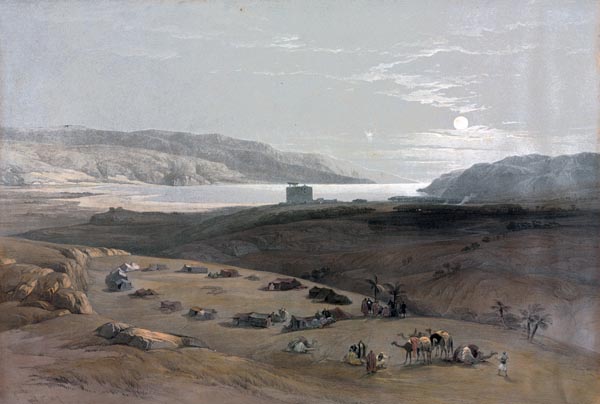
‘Jericho’ - David Roberts (British, 1796 – 1864)
Cleveland Museum of Art
Not far from the thorny walls, we passed near two or three sheikhs’ houses, built of sun-dried mud; they were only a few feet high; the terrace covered with mats and carpets is the main apartment; the family remain there almost all the day and night. In front of the door is a wide bench of dried mud, where a rug is spread for the chief. He sits there first thing in the morning, surrounded by his principal slaves, and visited by his friends. The vapour from coffee cups and pipes rises constantly. A large courtyard, filled with horses, camels, goats, and cows, surrounds the house. There are always two or three fine mares, saddled and bridled, for the master’s races.
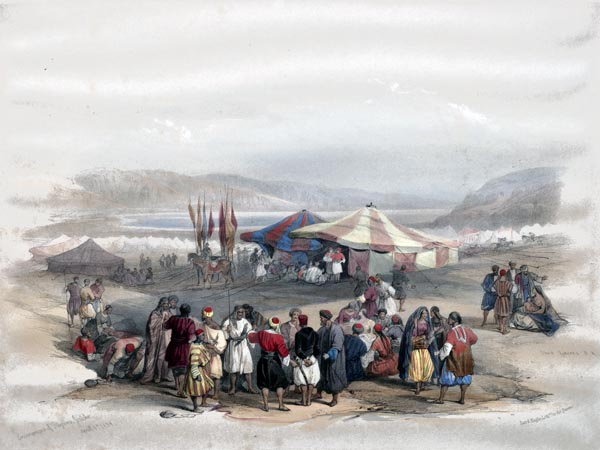
‘Encampment of Pilgrims, Jericho’ - David Roberts (British, 1796 – 1864)
Cleveland Museum of Art
We halted for only a short while near the Sheikh’s mud palace, where he offered us water, coffee, and pipes, and had a calf and several sheep slaughtered for our caravan. We also received roasted doura (durra) beans, chickens, and watermelons as gifts. We set off again, preceded by the Sheikh and some twenty of the city’s leading Arabs. We found some well-cultivated fields of corn and doura in the vicinity of Jericho. A few orange and pomegranate groves, and some beautiful palm trees also surround the scattered houses outside the city. Then everything becomes desert and sand again. This desert is an immense plain with several terraces that descend successively to the Jordan River, in regular steps, like the treads of a natural staircase. The eye sees only a flat plain; but after riding for an hour, one suddenly finds oneself at the edge of one of these terraces. One descends a steep slope; one progresses for another hour, then there is another descent, and so on. The ground is solid, white sand covered with a concrete, saline layer, undoubtedly produced by the mists of the Dead Sea, which, as they evaporate, leave this salt crust; there are neither stones nor soil, except near the riverbanks or the mountains; everywhere one views a vast horizon, and can distinguish from a great distance an Arab galloping across the plain. As this desert is the scene of their brigandage, their plundering and massacre of caravans travelling from Jerusalem to Damascus, or from Mesopotamia to Egypt, the Arabs have taken advantage of some hillocks formed by the shifting sands, and have also created artificial ones of their own to escape the caravans’ gaze, and so observe them from a closer distance; they dig a hole in the sand at the top of these hillocks, and conceal themselves and their horses there. As soon as they spot their prey, they swoop down with the speed of falcons; they send men to warn their tribe, and all return together to the attack: this is their sole industry, their sole glory; their culture is one of murder and plunder, and they attach as much esteem to their successes in these exploits as our conquerors attach to the conquest of a province. Their poets, for they have them, celebrate these barbarous scenes in verse, and pass down from generation to generation the honoured memory of their courage, and their crimes. The horses, in particular, have their share of glory in these tales; here is one story that the Sheikh’s son told us along the way:
An Arab and his tribe had attacked the Damascus caravan in the desert; the victory was complete, and the Arabs were busy loading their rich spoils, when the horsemen of the Pasha of Acre, who were coming to meet the caravan, suddenly fell upon the victorious Arabs, killed a great number of them, took the others prisoner, and, having tied them with ropes, brought them to Acre to present to the Pasha. Abu-el-Marsh (that is the name of the Arab he was speaking of) had been shot in the arm during the battle; as his wound was not fatal, the Turks had tied him to a camel, and, having seized his horse, were taking both horse and rider along with them. On the evening on which they were to enter Acre, they camped with their prisoners in the mountains of Saphadt (Safed/Tzfat/Zefat); the wounded Arabs legs had been bound together with a leather strap, and he was lying near the tent where the Turks were sleeping. During the night, kept awake by the pain of his wound, he heard his horse neighing, among the other horses hobbled around the tents according to the custom of the Orientals; he recognised the sound, and, unable to resist the desire to speak once more to his life companion, he dragged himself painfully along the ground on his hands and knees, and reached his steed. ‘My poor friend,’ he said, ‘what will you do among the Turks?’ You will be imprisoned beneath the vaulting of a khan with the horses of an aga or a pasha; women and children will no longer give you camel-milk, and feed you barley or doura from the palm of the hand; you will no longer run, free as the winds of Egypt, in the desert, you will no longer cleave the waters of the Jordan with your chest, those waters that wet your mane as white as your foam: if I am a slave, may you at least remain free! Go, return to the tent you know; tell my wife that Abu-el-Marsh will not return, and thrust your head between the tent curtains to lick the hands of my little children.’ As he spoke, Abu-el-Marsh gnawed through the goat-hair rope that serves as a hobble for Arabian horses, and the animal was free; but seeing his master wounded and roped at his feet, the faithful and intelligent steed understood by instinct what language could not convey: he lowered his head, sniffed his master, and, seizing him with his teeth by the leather belt he wore around his body, he galloped away, and bore him to his tent. Upon arriving, and depositing his master on the sand at the feet of his wife and children, the horse died of exhaustion; the whole tribe mourned him, the poets sang of him, and his name is constantly on the lips of the Arabs of Jericho.
We have scant idea of the degree of intelligence and attachment to which the habit of living with a family, being petted by the children, fed by the women, and reprimanded or encouraged by its master’s voice, can raise the instincts of an Arabian horse. The type has been bred to be more intelligent and more domesticated than the breeds of our climate; the same is true of all the animals in Arabia. Nature or Heaven has given them more instinct, more kinship with mankind than among ourselves. They remember more clearly the time of Eden, when they were willingly subject to the dominion of the lords of Nature. I myself frequently saw, in Syria, birds taken in the morning by children rendered perfectly tame by evening, no longer needing a cage or a string on their legs to keep them with the family that adopts them, but flying freely among the orange and mulberry trees of the garden, and returning at the sound of a voice to perch of their own accord on the fingers of children, or on the heads of young girls.
The horse belonging to the Sheikh of Jericho, which I bought and rode, recognised me as its master within a few days: it refused to be ridden by anyone else, and would cross the entire caravan to come to me at the sound of my voice, though my language was a foreign tongue to him. Gentle and affectionate towards me, and accustomed to the care of my Arabs, he walked peacefully and wisely in his place in the caravan, as long as we only encountered Turks, Arabs dressed in Turkish style, or Syrians; but if he happened, even a year later, to see a Bedouin mounted on a desert horse, he suddenly became another animal: his eyes lit, his neck swelled, and his tail rose and beat his flanks like a whip; he reared up on his hocks, and walked like that for a long while bearing the weight of saddle and rider: he did not neigh, but uttered a warlike cry like that of a brazen trumpet, a cry such that all the horses were frightened by it, and stopped, pricking up their ears, to listen.
October 31st, 1832.
After a five hour ride, during which the river seemed to recede further and further from us, we reached the last plateau, at the foot of which it was supposed to flow; but though we were only two or three hundred paces away, we saw nothing but the plain and the desert before us, and not a trace of a valley or river. I think it was the illusion of there being only desert here, that led some travellers to say, and believe, that the Jordan River flowed in a muddy stream over a bed of pebbles, between sandy banks in the desert beyond Jericho. Those travellers could not have reached the river and, seeing from afar a vast sea of sand, could never have imagined that a cool, deep, shady, and delightful oasis lay nestled between the plateaus of this monotonous waste, adorning the Jordan’s overflowing waters and murmuring bed with curtains of greenery that even the Thames might envy: yet such is the truth.
We were astonished and charmed when, having reached the edge of the last plateau, which suddenly fell away beneath our feet, and plunging into a steep gorge, we found before our eyes one of the most graceful valleys on which our gaze had ever rested. We raced there at the gallop, attracted by the novelty of the spectacle and by the allure of the freshness, moisture and shade, with which this valley was filled: everywhere there were lawns of the most beautiful green, where here and there grew clumps of flowering rushes, and bulbous plants whose large and brilliant corollas scattered stars of all colours across the lawns and beneath the bases of the trees; groves of shrubs with long flexible stems, falling like plumes all around their multiplied trunks; large Persian poplars with light foliage, not rising in pyramids like our clipped trees, but freely throwing out sinewy limbs in all directions as oak-trees do, and whose bark, smooth and white, shone in the tremulous rays of the morning sun; and groves of willows of every kind, among them large osiers (salix viminalis) so dense that it was impossible to penetrate them, so tightly did the trees, and many of the vines that snaked about their feet, and twined from one branch to another, form an inextricable network.
These groves stretched as far as the eye could see, on both sides and along both banks of the river. We were obliged to dismount, set up camp in one of the forest clearings, and reach on foot the Jordan River which we could hear but not see. We advanced with difficulty, sometimes through the thickets, sometimes through long grass, sometimes through the tall stalks of rushes; finally, we found a place where only grass bordered the water, and we dipped our feet and hands in the flow. It may be a hundred to a hundred and twenty feet wide there; its depth seemed considerable; its current is as swift as that of the Rhône at Geneva; its waters are a pale blue, slightly dulled by the mix of grey earth it crosses and carves through. We heard enormous slopes collapsing into its course, from time to time. Its banks are sheer, yet it fills them to the base of the reeds and trees that conceal them. The trees, constantly undermined by the water, display roots that hang and trail; often falling of their own accord, these trees lack support from the crumbling earth beneath; their branches and leaves lean over the water and are steeped in it, stretching in arches of greenery from one bank to the other. From time to time, a tree is borne away, along with the portion of soil that supported it, and floats, in full leaf, downriver, torn vines clinging to its branches, the birds’ nests submerged, the birds themselves still perching on its boughs: we watched several of them pass by, in fact, during the few hours we rested at this charming oasis. The groves follow every curve of the Jordan, weaving a perpetual garland of branches and leaves that dipping below the water, raise a gentle murmur from its flow. Countless birds inhabit these impenetrable groves.
The Arabs warned us not to walk without our weapons, and to advance with caution, because these thickets are the lair of Arabian lions (panthera leo persica), Arabian leopards (panthera pardus nimr), and caracals. We saw none; but we often heard, in the shadows of the thicket, roars and noises like those of large animals as they penetrated the depths of the woods.
For an hour or two, we explored the accessible parts of the banks of this beautiful river. In some places, the Arabs from the wild tribes of the mountains of Petra, at whose foot we were, had set fire to the woods, either to gain entry or to extract timber. A host of tree-trunks remained, charred only by the bark; but new shoots had sprung up around the scorched boles, and the climbing plants of this fertile soil had already so thoroughly entwined themselves around the dead trees and saplings that the woodland appeared more varied, without being any less extensive or luxuriant. We gathered a large supply of branches from the willows, poplars, and various long-stemmed trees with beautiful bark whose names I know not, to give as gifts to our friends in Europe; then we returned to the camp, which our Arabs had relocated during our excursion along the riverbank.
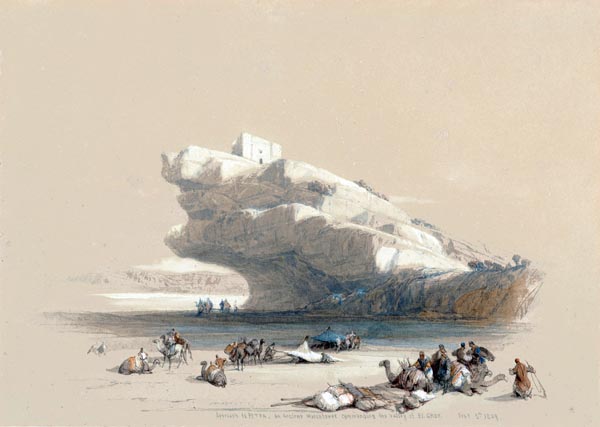
‘The approach to Petra, looking up to an ancient watchtower (1839)’ - David Roberts (British, 1796 – 1864)
Artvee
They had discovered a site even more gracious and suitable for pitching our tents than any of those we had just traversed: a meadow of grass as fine and dense as if grazed by a flock of sheep. Here and there, scattered across this meadow, a few broad-leaved shrubs, and clumps of plane and sycamore saplings cast patches of shade over the grass, sheltering us, and keeping the horses cool. The Jordan, whose course was only twenty paces away, had carved a small, shallow gulf in the middle of the clearing, and its waters swirled there at the foot of two or three large poplars. An accessible slope led down to the river, allowing us to bring our thirsty horses to drink, one by one, and to bathe ourselves. We pitched our two tents, and rested there for a day.
The following day, November 2nd, we continued our journey, heading towards the highest mountains of Arabia Petraea, leaving and rejoining the Jordan River, following its meandering course, while drawing closer to the Dead Sea. Not far from the river, in a place in the desert I cannot describe, lie the still imposing remains of a Crusader castle, apparently built to guard this route. This ruin is uninhabited, and might, on the contrary, serve as a refuge for Arabs lying in wait to plunder caravans. Amidst the waves of sand, it gives the impression of a ship’s carcass abandoned on the ocean.
The Dead Sea
As we approached the Dead Sea, the undulations of the terrain lessened; the slope gradually inclined towards the shore; the sand became spongy, and the horses, sinking with every step, advanced with difficulty. When we finally saw the reflection of the waves, we could not contain our impatience: we galloped onwards to plunge into the waves, which lay before us, shining like molten lead over the sand. The Sheikh of Jericho and his Arabs, who were still following us, thinking that we wanted to run the djerid with them, set off simultaneously in all directions across the plain; and, returning to us with shouts, brandished their long reed spears, as if they wanted to pierce us; then, halting their horses and rearing them on their haunches, they let us pass, and set off again only to return once more. I arrived first, thanks to the speed of my Turkoman horse; but, thirty or forty paces from the water, the bed of sand mixed with earth was so damp and so marshy that my horse sank up to its belly, and I feared I would be swallowed up. I retraced my steps and, dismounting, approached the shore on foot.
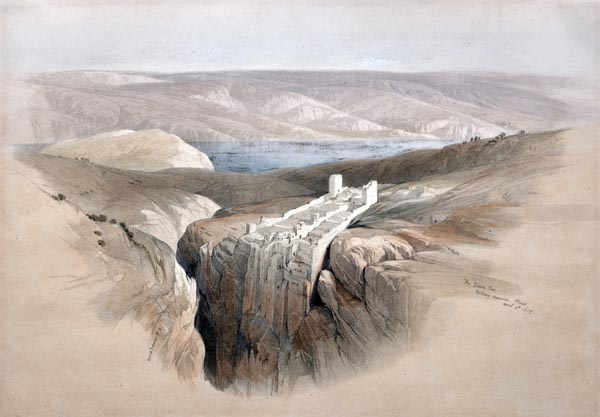
‘The Dead Sea Looking Towards Moab’ - David Roberts (British, 1796 – 1864)
Cleveland Museum of Art
The Dead Sea has been described by several travellers. I noted neither its specific gravity nor the relative quantity of salt its waters contain (see, for example, Chateaubriand’s ‘Itinéraire’). It was not scholarship, or scientific analysis, that brought me there. It was simply on my route, and lay in the middle of a famous desert, while being famous itself due to the engulfment of the cities (Sodom and Gomorrah, see Genesis 19.24-25) that once stood where its motionless waters now stretch. Its shores are level on the eastern and western sides; to the north and south, the high mountains of Judea and Arabia frame it, descending almost to its waters. Those of Arabia, however, recede somewhat further, especially near the inflow of the Jordan, where we were situated at that moment. These shores are entirely deserted; the air is foul and unhealthy. We ourselves felt its influence during the several days we spent in that desert. A great heaviness in the head and a feverish feeling seized us all, and departed only upon our leaving its atmosphere. No islands are visible. However, at sunset, from the top of a sand dune, I thought I could make out two at the far end of the horizon, in the direction of Idumea (likely areas of solidified sea-salt, near Ein Bokek). The Arabs here know nothing of them. The sea is, in this part, at least thirty miles long, and they never venture to follow its shore so far. No traveller has ever attempted a circumnavigation of the Dead Sea nor has it even been viewed from its southern end, nor its shores in Judea and Arabia. We are, I believe, the first who have been able to explore it freely on three sides; and if we had but had a little more time to spare, nothing would have prevented us from transporting fir planks from Lebanon, Jerusalem or Jaffa, building a longboat on the spot, and peacefully visiting all the coasts of this wonderful ‘Mediterranean’.
The Arabs, who usually bar travellers from approaching its shores, and whose prejudices oppose anyone attempting to sail there, were so devoted to our every wish that they would have placed no obstacle in our way. I would certainly have taken to its waters, had I been able to foresee the welcome these Arabs gave us. But it was too late; we would have had to send word to Jerusalem, and bring carpenters to build such a boat: all this, including the voyage, would have taken us at least three weeks, and our time was limited. I therefore relinquished the idea, though with a degree of reluctance. Some traveller, in the same circumstances as myself, will easily be able to accomplish it, and shed light on this natural phenomenon, and on the geographical issues, the answers to which authors and scientists have been seeking for so long.
The Dead Sea is neither sad nor funereal, except in name. To the eye, it is a dazzling lake, its immense, silvery surface reflecting the light and sky like a Venetian mirror; mountains with beautiful contours cast their shadows upon its shores. It is said that there are neither fish in its depths nor birds on its banks. I know nothing of this; I saw neither petrels nor gulls, nor those beautiful white birds like sea doves (shearwaters), that float all day long on the waves of the Syrian Sea and accompany the caiques on the Bosphorus; but, a few hundred paces from the Dead Sea, I shot and killed birds resembling wild ducks, which rose from the marshy banks of the Jordan. If the sea’s air were deadly to them, they would not come so close to brave its noxious vapours. Nor did I see those ruins of submerged cities that are said to be visible at a shallow depth beneath the waves. The Arabs who accompanied me claim that these are sometimes exposed to view.
I followed the shores of this sea for a long time, now on the Arabian side, where the Jordan River flows into the sea (there, the river is truly, as travellers describe it, a pool of dirty water in a bed of mud), sometimes on the Judean mountains side, where the shores rise and sometimes take the form of the gentle dunes of the ocean. The sheet of water presented the same appearance everywhere: brilliant, azure and immobile.
Humans have exercised well the faculty that God gave them in Genesis: to apply names to things. This sea is beautiful; it sparkles, it floods, with the reflection from its waters, the air above the immense stretch of desert it covers; it attracts the eye, it stirs the mind; but it is indeed dead; movement and sound are absent: its waters, too heavy for the wind to move, never unfurl in a sonorous swell, nor does a white belt of foam play upon the pebbles of its shores: it is a petrified sea. How did it form? Apparently, as the Bible says and probability suggests, a crater must have opened at the centre of the vast volcanic chains that extend from Jerusalem to Mesopotamia, and from Lebanon to Idumea, at a time when seven cities populated the plain. The cities must have been shaken by the earthquake: the Jordan, which, in all likelihood, already flowed across this plain to join the Red Sea, was suddenly halted in its course by volcanic extrusions erupting from the earth, and was plunged into the craters left by Sodom and Gomorrah, forming this sea containing salt, sulphur, and bitumen, the usual by-products of volcanic activity: such are the likely facts of the matter, which neither add to nor detract from the action of that sovereign and eternal will which some call a miracle, and others call Nature: are not Nature and miracle one and the same? And is the universe anything other than an eternal and ever-present miracle?
Same date. November 2nd 1832.
We returned along the northern end of the Dead Sea, near the Valley of Saint Saba. The desert is much more pronounced in this area: it is furrowed by enormous waves of earth and sand, which one must constantly navigate around or cross. The line of our caravan undulated along the crests of these waves, like a fleet of ships in line, on a vast sea, its various vessels appearing and disappearing in the folds of a sandy ocean.
After three hours’ journey, sometimes over small, level plains where we galloped, sometimes along the edge of deep sandy ravines where some of our horses took a tumble, we saw the smoke rising from the houses of Jericho. The Arabs broke away and sped towards the smoke. Only two remained to show us the way. As we approached Jericho, the leaders of the Arabs returned to meet us. We camped in the middle of a field shaded by a few palm trees, where a small river flowed. Our tents were soon pitched, and we found supper prepared, thanks to the gifts of all kinds that the Arabs had brought to our camp. The Arab who had been riding the fine horse I had wanted to take with me seemed to have admired the Turkoman horse I had ridden the day before. Our mutual conversation readily leading to the subject of our horses, he praised several of mine. I offered to exchange the Turkoman for his own; we debated all evening the additional payment I would make: nothing was decided. Every time I offered a fair price, he showed such great distress at parting with his horse that we retired to rest without reaching an agreement. The next day, at the time of departure, with all the horses already bridled and mounted, I made a few more overtures. He finally decided to ride my Turkoman himself, galloping across the plain: captivated by the animal’s outstanding qualities, he sent his own horse to me via his son. I gave him nine hundred piastres, mounted the horse, and set off. The entire tribe seemed to watch with regret as the creature departed: the children cried out to him, the women pointed at him, the Sheikh kept returning to look at him, while making certain cabalistic signs that Arabs always take care to make over horses they buy or sell. The steed itself seemed to understand the separation, sadly lowering its head, shaded by a magnificent mane, gazing to right and left at the desert with a sorrowful and anxious eye. The eye of an Arabian horse is a language unto itself. Their beautiful eyes, the fiery pupils of which stand out against the broad, blood-marbled white of the eye-sockets, seem to express and comprehend everything.
I had stopped riding my favourite horse a few days before. According to Arab superstition, there are seventy good or bad signs in a horse’s horoscope, a knowledge of which signs is possessed by almost all desert dwellers. The horse I speak of, whom I had called Liban (Lebanon), having bought him in those mountains, was a young and magnificent stallion, tall, strong, courageous, tireless, and intelligent, in whom I never detected the slightest flaw during the fifteen months I rode him; but he happened to have on his chest, one of those tufts of hair adorning his beautiful ash-grey coat that the Arabs consider an ominous sign. I had been warned about this when I bought him; but I had acquired him based on the simple reasoning, easily understood by them, that a bad omen for a Muslim was a good omen for a Christian. They offered no reply to that, and I rode Liban whenever I had to undertake longer or more difficult days of travel than usual. When we approached a city or a tribe, the Arabs or Turks, who came to meet the caravan, struck by Liban’s beauty and vigour, would initially compliment me and admire him with envious eyes. But after a few moments of admiration, the fatal sign, somewhat concealed by the silk collar and amulet that every horse always wears, would become apparent to them. The Arabs, approaching me, would change their expressions, assume a grave and sorrowful air, and signal me not to ride the horse. This was of little importance in Syria; but in Judea and among the desert tribes, I feared it would damage my standing and destroy the respect and prestige of obedience that surrounded us. So, I would avoid riding him, and he would be led behind me. I have no doubt that we owed a large part of the deference and awe that surrounded us to the beauty of the twelve or fifteen Arabian horses we rode or that followed us. A horse, in Arabia, is a man’s fortune; it presupposes everything, it takes the place of all else: they formed a high opinion of a Frank who owned so many horses, as beautiful as those of their Sheikh and of the Pasha.
We returned to Jerusalem via the same valley we had crossed at night upon arrival. Before entering the first mountain gorge, on a beautiful, wide plateau overlooking the plain, we saw clear traces of ancient structures, and surmised that this was the true site of ancient Jericho. To build cities on the plains was a major advance in civilisation. One can never go wrong by searching for ancient cities on the heights.
It is in this gorge (Wadi al Quilt) that the scene of the assault and subsequent act of charity described in the moving parable of the Good Samaritan (see Luke 10.30-37) was set. It seems that, even in the time of the Gospels, these valleys had a bad reputation.
We had a tiring day, due to the monotony of our fourteen hours’ ride, and the excessive heat of the sun reflected from the steep sides of the valleys; we failed to encounter anyone at all during those fourteen hours, except for an Arab shepherd grazing an innumerable flock of black goats on the ridge of a hill.
The End of Part VI of Lamartine’s ‘Voyage en Orient’