Alphonse de Lamartine
Travels in the Near East (Voyage en Orient, 1832-33)
Part V
Translated by A. S. Kline © Copyright 2026 All Rights Reserved
This work may be freely reproduced, stored, and transmitted, electronically or otherwise, for any non-commercial purpose.
Conditions and Exceptions apply.
Contents
- From Beirut, through Syria and Palestine, to Jerusalem.
- Sidon.
- Tyre.
- Solomon’s Pools.
- Ras-El-Abiad (Cap Blanc).
- Acre.
- The Zvulun Valley (Plain of Zebulun).
- Nazareth.
- The Sea of Galilee.
- Tiberias.
- Mount Carmel.
- Haifa (Khaifa).
- Mount Carmel Monastery (Stella Maris).
- Caesarea Maritima.
- Jaffa.
- Ramla.
- Abu Gosh (Qaryat al-’Inab).
- Ein Kerem (Ain Karim).
From Beirut, through Syria and Palestine, to Jerusalem
Sidon
October 8, 1832, at 3 o’clock in the afternoon.
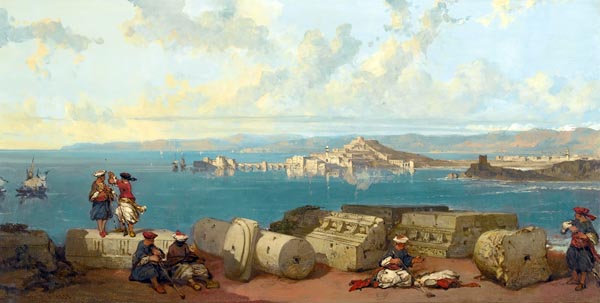
‘Sidon Looking Towards the Range of Lebanon (1858)’ - David Roberts (British, 1796 – 1864)
Artvee
Mounted, with eighteen horses carrying baggage or simply following, we formed our caravan. We slept at a khan, three hours from Beirut, taking the same route as I described when visiting Lady Stanhope. The next day, we left at three in the morning, crossing the River Damour (Nahr al Damour), the ancient Tamyris, at five, oleanders in bloom along its banks. We followed the shoreline, foaming waves washing the horses’ hooves, as far as Said, the ancient Sidon, still beautiful, though a shadow of the ruined city whose very name has been erased; it lacks all traces of its former grandeur. A circular jetty, formed of enormous rocks, encloses a harbour filled with sand, where a few fishermen and their children, their legs in the water, pushed a boat, without mast or sails, out to sea, the only maritime image I retain of that second queen of the seas. In Said, we dismounted at the French khan, an immense palace that supported our former trade with Syria, in which our consuls used to gather all those of French nationality to the French flag. The trade is lost, there are no French left; all that remains in Said, in that immense deserted khan, is the former, and most respectable, consular agent of France, Grégoire Giraudin, who has lived there for fifty years among his entirely Eastern family, and who receives us as one receives a fellow countryman, in a land where ancient hospitality has been wholly preserved.
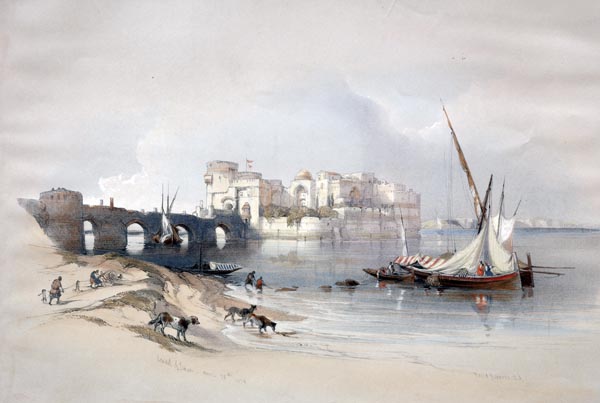
‘Citadel of Sidon’ - David Roberts (British, 1796 – 1864)
Cleveland Museum of Art
We ate dinner, and snatched a few hours’ sleep, amidst this excellent family; the sweetness of the hospitality thus received, being unexpected and lavish; water for washing our hands, was offered us by the sons of the house; the mother and wives of the two sons, standing, attended to the table. At four o’clock, mounted on horseback, we were escorted onwards by the sons and friends of the Giraudin family. Djerid (javelin) exercises, were performed by one of them, mounted on an Arabian steed. At two hours distance from Said, we offered our farewells and thanks. We rode for two more hours, and slept in our tents beside a charming spring by the sea, called El Kantara, where a gigantic tree shaded the entire caravan. A delightful garden sloped down to the sea. An immense caravan of camels was spread around us in the same field. Night in the tent; the neighing of horses, the cries of camels, smoke from the evening fires, and the transparent glow of the lamp through the striped canvas of the pavilion. My thoughts were of the quiet life at home, of family, of distant friends; thoughts that weighed on my brow, my head at rest, though heavy and burning, on the saddle that served as a pillow. In the morning, while the muezzins and slaves bridled the horses, a few Arabs pulled up the tent pegs; they shook the pole that served as a central column; it fell, and the wide stretch of canvas that had covered a whole nest of travellers slipped and tumbled to the ground, forming a little heap of cloth that the camel driver tucked under his arm, and then hung from the saddle of his mule; all that remained, in the empty place where we had recently slept, as if in a permanent dwelling, was a small abandoned fire that still smoked but soon died away in the sunlight: a true, striking, and vivid image of life, often employed in the Bible but one which struck me strongly every time it presented itself to my eyes.
Tyre
We left El Kantara before daybreak. We climbed several arid, rock-strewn hills jutting out to sea like promontories. Then, from the summit of the last and highest of these, we gained a view of Tyre, on the end of its vast and barren hill. Between the sea and the last heights of Lebanon, which slope rapidly here, stretches a plain about twenty miles long and four or five miles wide: the plain was bare, yellow, and covered with thorny shrubs, grazed by the camels as the caravan passed. The land juts out like a peninsula, separated from the mainland by a causeway and covered with golden sand brought by the winds from Egypt. Tyre, now called Sur (or Sour) by the Arabs, is supported by the sharpest point of this promontory, and seems to rise from the very waves; from afar one might have thought it a fine, new, city, white walled and alive, mirrored in the sea: but it was no more than a beautiful shadow, which vanished as we drew near. A few hundred crumbling and almost deserted houses, around which the Arabs gather, at evening, the large flocks of sheep and black goats, with long drooping ears, which had paraded before us in the plain: that is Tyre today! It no longer has a port on the sea, and no longer maintains roads on land; the prophecies have long since been fulfilled concerning it (see Isaiah, 23.1, and Jeremiah 25.11).
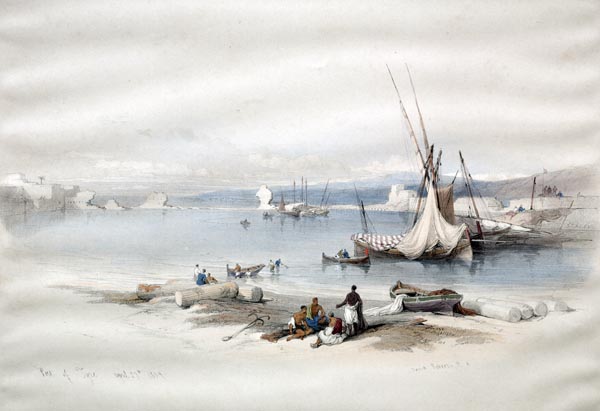
‘Port of Tyre’ - David Roberts (British, 1796 – 1864)
Cleveland Museum of Art
We walked in silence, absorbed in contemplating the sad imperial dust we trod upon. We followed a path through the countryside near Tyre, between the city and the bare, grey hills of Lebanon encroaching on the plain. We reached the very edge of the city, and neared a mound of sand that now seems to provide its only rampart, until even that is swallowed whole. I thought of the prophecies and searched my memory for those eloquent threats the breath of the Divinity had inspired in Ezekiel (for example, Ezekiel 28.21-24). I could not recall his words, but found his sentiment evoked by the deplorable reality before my eyes. A few of those lines of mine, jotted down at random when leaving France to visit the East, were the only ones that rose in my mind:
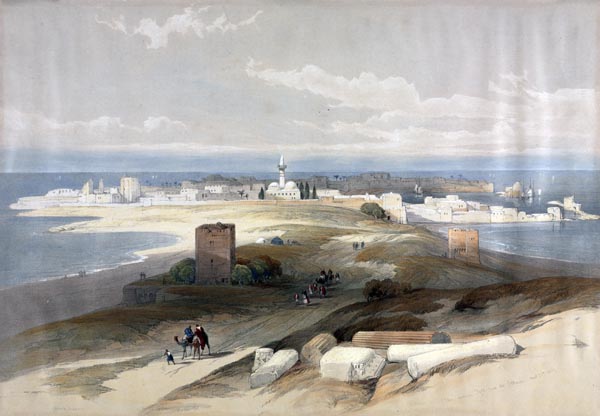
‘Sur or Tsor, Ancient Tyre from the Isthmus’ - David Roberts (British, 1796 – 1864)
Cleveland Museum of Art
‘Je n’ai pas entendu sous les cèdres antiques
Les cris des nations monter et retentir,
Ni vu du noir Liban les aigles prophétiques
Descendre, au doigt de Dieu, sur les palais de Tyr.’
‘I have not yet heard, beneath the ancient cedars,
The cries of the Nations sounding, rising higher,
Nor seen the prophetic eagles of dark Lebanon
Descend, from God’s hand, upon the roofs of Tyre.’
I had before me dark Lebanon; but imagination had deceived me, I told myself: since I saw neither the eagles nor vultures that, in fulfilment of the prophecy, were supposed to descend ceaselessly from the mountains to devour this corpse of a city, rejected by God and inimical to His people. As I was reflecting on this, there appeared, on our left, a group of large, strange, motionless figures atop a sheer rock that jutted out into the plain at that point, above the caravan route. They looked like five black stone statues, placed on the rock as if on a pedestal; but, as we approached, seeing the colossal figures exhibit a few almost imperceptible movements, we thought them five Bedouin Arabs, wearing their black goat-hair robes, watching us pass from the top of this mound. Finally, when we were only about fifty paces from the hillock, we saw one of the five figures spread its broad wings and beat them against its flanks with a sound like a sail unfurling in the wind, and recognised five eagles of the largest breed I had ever seen in the Alps, or chained in the menageries of our cities. They chose not to fly off, unmoved by our approach: perched, like kings of the desert, on the edge of the rock, they seemed to regard Tyre as a prize that belonged to them alone, and to which they were about to return. They seemingly possessed it by divine right; instruments of a command they were executing, of a prophetic vengeance they were commissioned to accomplish against mankind, and in spite of mankind. I continued to contemplate this prophecy in action, this marvellous fulfilment of the divine threat, of which chance rendered us witnesses. Never had anything more supernatural or more vivid struck my eyes and mind; and it took a concerted effort of reason not to see, behind these five gigantic eagles, the great and terrible figure of the poet of vengeance, Ezekiel, rising above them, gazing and pointing his finger at the city that God had given them to devour, while the wind of divine wrath stirred the waves of his white beard, and the fire of heavenly anger shone in his prophetic eyes. We halted forty paces away: the eagles merely turned their heads disdainfully to consider us in turn; finally, two of us broke from the caravan and galloped, rifles in hand, to the very foot of the rock; they still chose not to flee. A few rifle shots sent them flapping away, heavily; but they returned of their own accord, and hovered for a long time over our heads without being hit by the bullets, as if saying to us: ‘You can do us no harm, we are the eagles of God.’
I realised then that my poetic imagination had revealed to me the eagles of Tyre, though less grand, beautiful, and supernatural than they once were, and that there is in the mens divinior (‘divine soul’ see Horace ‘Satires: Book I, IV, line 43) of poets, even the most obscure, something of that divinatory and prophetic instinct which speaks the truth unaware.
Solomon’s Pools
We arrived at noon, after a seven-hour march, at a place called Solomon’s Pools, amidst the plain of Tyre (at Ras el-Aïn, not those near Bethlehem); many travellers have described them. They are three reservoirs of clear, flowing water that spring, as if by magic, from the low-lying, dry, and arid land, two miles from Tyre; each of these reservoirs, artificially raised some twenty feet above the level of the plain, is filled to the brim and constantly overflows; the water powers mill-wheels, and flows to Tyre through aqueducts, part ancient, part modern, producing a fine sight on the horizon. It is said that Solomon had these three pools built to reward Tyre and its king Hiram for the services he had received from its navy and its artists in the construction of the temple.
Hiram had gifted him marble and cedarwood from Lebanon. These immense cisterns are each at least sixty to eighty feet in circumference; their full depth is unknown, and one of them appears bottomless; no one has ever been able to discover by what mysterious conduit the mountain water reaches them. Upon examination, there is every reason to believe that they are vast artesian wells, invented long before their reinvention in modern times.
Ras-El-Abiad (Cap Blanc)
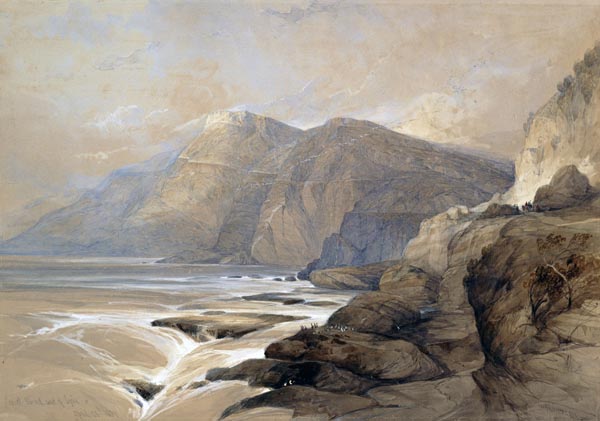
‘Ras-El-Abiad, Coast of Syria (1839)’ - David Roberts (British, 1796 – 1864)
Artvee
We left Solomon’s Pools at five o’clock; rode for two hours over the plain of Tyre; and arrived at nightfall at the foot of a high mountain plunging into the sea, forming Cap Blanc or Ras-El-Abiad; the moon was rising above the dark peaks of Lebanon, to our left, but not yet high enough to illuminate its slopes; its rays fell, leaving us in shadow, upon immense blocks of white rock from which the moonlight gleamed like flame on marble; sparkling foam broke on these blocks, set in the midst of the waves which leaped high enough to almost reach us. The dull, rhythmic sound of these waves beating against the cape rose on high, and with each blow the narrow ledge, suspended above the precipice, along which we rode, shook: in the distance, the sea shone like an immense sheet of silver and, here and there, a dark headland jutted out into the deep, or a vast cavern penetrated the jagged flanks of the mountain.
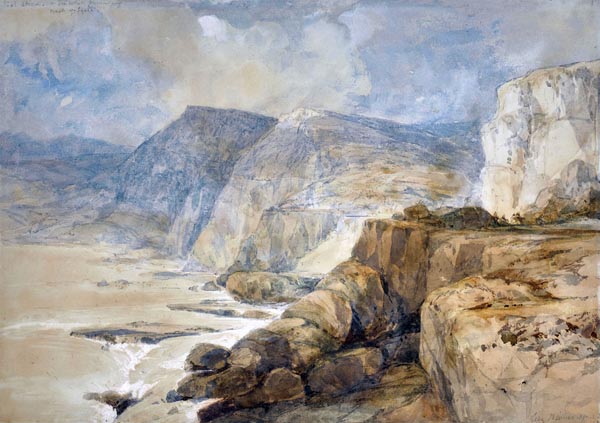
‘Cape Blanco, Lebanon (1839)’ - David Roberts (British, 1796 – 1864)
Artvee
The plain of Tyre stretched behind us; it could still be made out, indistinctly, due to the fringes of golden yellow sand that traced the contours between sea and land. The shadow of Tyre appeared at the end of its promontory; chance alone had kindled a light upon its ruins, which, from afar, one might have taken for a lighthouse; but it was a lighthouse of solitude and abandonment, guiding no vessel, reaching our eyes alone, and summoning only a pitying glance at the city’s ruin.
This road along the precipice, with all the varied, sublime, solemn aspects of night, moonlight, waves and abysses, took us about an hour to navigate, one of the hours most vividly etched in memory that I have contemplated on God’s Earth! It seemed a sublime gateway to our next day’s entry to the land of miracles, the land of witness, still imprinted with the traces of the ancient and new communion between God and Mankind!
Descending from the summit of this cape, we were greeted by the same sight that had struck us on the ascent: precipices as deep, as echoing, as before, as white with foam, and as strewn with vast shards of raw, white rock, opened beneath our feet, and before our eyes; the sea broke there with the same resounding roar that had accompanied us all along the ‘stormy coast of Syria’, as the ancient Hebrew poems call it; the moon, higher in the sky, illuminated this scene, at once tumultuous and solitary, and the vast plain of Ptolemais (Acre) opened before us.
It was nine in the evening, in October; our horses, exhausted by a thirteen-hour journey, placed their shod hooves slowly and carefully among the sharp and shining rocks that form the only roads in Syria, irregular stone steps on which one would not dare risk any European mount: we ourselves, overwhelmed with weariness, and struck above all by the grandeur of the spectacle and the hurried memories of the day, walked silently on foot, holding our horses by the bridle; and casting sometimes a glance at this sea which we would have to cross to see our own rivers and mountains once more, and sometimes at the long, black undulating peak of Mount Carmel, which was beginning to take shape on the farthest limits of the horizon.
We arrived at a kind of khan, that is to say, a half-ruined hovel, where a poor Arab cultivated a few fig trees and some gourds between the crevices of the rocks, near to a spring: the hovel had been occupied by camel drivers from Nablus, bringing wheat to Syria for Ibrahim’s army; the spring had dried in the autumn heat. Nevertheless, we pitched our tents, on ground covered with loose, round stones; we tethered our horses to stakes, and drank, sparingly, a few drops of the fresh water that remained in our jars from Solomon’s Pools. Beyond the plain of Tyre and the foothills of the mountain ranges, the sources of water are sparse; the wells are five or six hours apart, and often when one arrives, one finds nothing left in the bed of the spring but dried, burning-hot mud that still bears the imprint of the feet of the camels and goats that last drank there.
Acre
On the 11th of October, we struck camp by the light of a thousand stars reflected in the waves spread at our feet; we descended, in about an hour, the last hills which form Cape Blanc or Ras-El-Abiad, and entered the plain of Acre, the ancient Ptolemais.
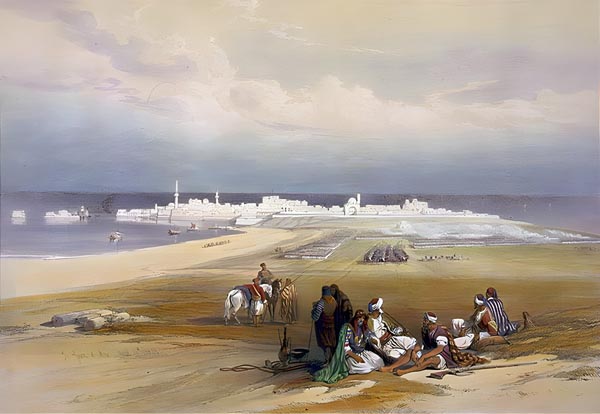
‘St. Jean d'Acre (land view)’ - David Roberts (British, 1796 – 1864)
Library of Congress
The siege of Acre by Ibrahim Pasha had recently reduced the city to a heap of ruins, beneath which ten to twelve thousand dead lay buried, along with thousands of camels. Ibrahim, victorious, and eager to secure his important conquest against some reversal of fortune, was busy rebuilding the walls and houses of the city. Every day, hundreds of half-burned corpses were unearthed from the rubble; the putrid stench from the piles of bodies had corrupted the air of the entire plain. We passed by, as far as possible from the walls, and halted at noon at the Arab village of Eaux d’Acre, in an orchard of pomegranate, fig, and mulberry trees, near the Pasha’s mills. At five o’clock, we set off again to camp beneath an olive grove at the foot of the first hills of Galilee.
On the 12th, we set off again at daybreak; we crossed a hill planted with olive trees and a few kerm-oaks, scattered in groups or growing in thickets and prey to the gnawing teeth of goats and camels. When we reached the other side of this hill, the Holy Land, the land of Canaan, lay before us. The impression it produced was grand, pleasing, and profound; this was not that bare, rocky, barren land, carpeted with low hills, that gaunt landscape offered up as the Promised Land, based on the word of a few biased writers or travellers, in their eagerness to write and arrive somewhere, who saw nothing of the immense and varied domains of the Twelve Tribes but the stony path that leads, between two sunrises, from Jaffa to Jerusalem. Deceived by their narratives, I had expected only what they described, that is to say, a land without expansiveness, without views, valleys, plains, or trees, and without water: a land dotted with a few white or grey mounds, amidst which thieving Arabs hid, in the shade of the ravines to plunder the passer-by; such, perhaps, is the road from Jerusalem to Jaffa. But here was Judea, as we saw it on the first day, from the hills bordering the plain of Acre; such as we found it to be on the far side of the hills of Zebulun, those of Nazareth, and at the foot of Mount Hermon or of Mount Carmel; such as we traversed it, in all its breadth and variety, from the heights overlooking Tyre and Sidon to the Sea of Galilee, and from Mount Tabor to the mountains of Samaria and Nablus, and from there to the walls of Zion (Jerusalem).
Here the plain of Zebulun first lies before us: we are situated between two slight undulations of land, scarcely worthy of the name of hills; the channel they leave between them, hollowed out before us, forms the path on which we ride; this path is marked by the hooves of camels, grinding its dust for four thousand years, or by the wide, deep holes that their feet, always placed in the same spot, have carved in the white, crumbly rock, ever the same from the Cape of Tyre to the first sands of the Libyan Desert. To the right and left, the rounded slopes of twin hills are shaded here and there, every twenty paces, by clumps of various evergreen shrubs; at a slightly greater distance, rise trees with gnarled trunks, sinewy and intertwined branches, and motionless, dark foliage; most are oaks of a particular species (Palestine oaks, quercus calliprinos, the kerm-oak) whose trunk is lighter and more slender than that of European oaks, and whose velvety, rounded leaves lack the serrations of the common oak leaf: carob trees, terebinths, and more rarely plane and sycamore trees, complete the cover of these hills. I was unable to name the other trees: some have the foliage of firs and cedars; others (and these are the most beautiful) resemble immense willows as regards the colour of their bark, the grace of their foliage, and the latter’s tender, yellowish hue; but they surpass willows in extent, and height. The largest caravans can gather around their colossal trunks, and camp together, baggage and camels included, beneath their shade; in the wide and frequent spaces that these various trees leave bare on the hill slopes, banks of whitish rock, more often of a bluish grey, pierce the earth, and reveal themselves to the sunlight, like the vigorous muscles of a strong human frame, which are more prominently articulated in old age, and seem ready to pierce the skin that clothes them; but between these benches or blocks of rock, a dark, loose, deep soil is present, which could produce repeated crops of wheat and barley if it were only cultivated, or clumps of thorny scrub, wild pomegranates, Jericho roses (Anastatica hierochuntica), and enormous thistles whose stems rise to the height of a camel’s head. Once one of these hills has been described, one can imagine them all, down to their shape; and can picture their effect as mentioned in descriptions of the landscape of the Holy Land. We were passing between two of these hills, and beginning to descend slightly, leaving the sea and the plain of Acre behind us, when we glimpsed the first plain in the land of Canaan: it was the plain of Zebulun (the Zvulun Valley), the garden of the tribe of that name.
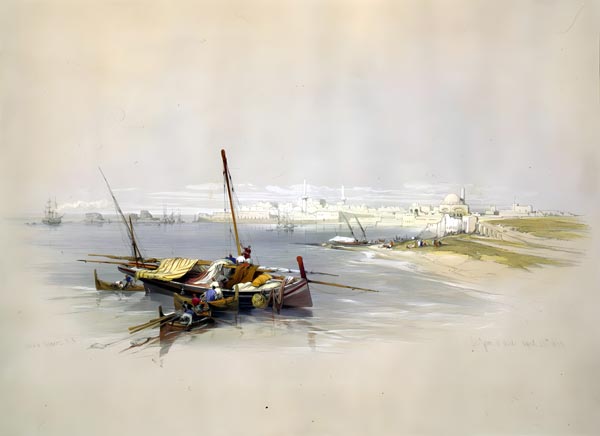
‘St. Jean d'Acre (sea view)’ - David Roberts (British, 1796 – 1864)
Library of Congress
The Zvulun Valley (Plain of Zebulun)
To our right and left, the two hills we had just traversed parted gracefully and in a similar manner, like two fading waves gently merging, then parting harmoniously before the prow of a ship. The space between them, widening gradually, was like a shallow cove in the plain, between the mounts. This cove or gulf of flat, fertile land soon formed a wider valley. And where the two hills that still surrounded it finally subsided, this valley merged with and was absorbed into a slightly oval plain, whose two ends were shaded by two other rows of hills. This valley might be, judged by sight alone, about six miles wide and nine or so miles long.
From our vantage point at the foot of the hills of Acre, our gaze naturally descended, following the supple curves involuntarily, and penetrating with them into the narrowest coves they formed between the roots of the hills terminating them. To the left, the tall, golden, sculpted peaks of Lebanon projected their pyramids boldly into the dark blue of the morning sky: to the right, the hill we rode along rose imperceptibly as we moved away, as if to join the other hills forming groups at various elevations, some arid, others clothed with olive and fig trees and bearing at the summit a Turkish village, whose white minaret contrasted with the dark colonnade of cypresses which almost everywhere envelop the mosques. But opposite, the view, in which the plain of Zebulun extending before us terminated on the horizon, revealed a perspective of hills, mountains, valleys, sky, vapour, light and shadows, ordered with such harmony of colour and line, blended with such felicitous composition, linked together with such graceful symmetry, and varied by such diverse effects, that my eye could not detach itself from it, and, finding nothing in my memories of the Alps, Italy or Greece, to which I could compare the magical ensemble, I exclaimed: ‘It’s a Poussin, or a Claude Lorrain!’
Nothing, indeed, can equal the grandiose sweetness of this view of Canaan, except the brush of those two painters to whom the divine genius of Nature revealed her beauty. This harmony of the grand and the gentle, the strong and the graceful, the picturesque and the fertile, can only be found in the imaginative landscapes of those two great masters, or in the inimitable nature of the beautiful country that lay before us, which the hand of the supreme artist himself had designed and coloured for the habitation of a people still pastoral and innocent. First, at the foot of the mountains, and a mile or so into the plain, a hillock, entirely detached from all the surrounding hills, rose as if from the earth, like a natural pedestal destined by Nature to support a fortified city. Its sides rose almost perpendicularly from the level of the plain to the top of this kind of earthen altar; they looked exactly like the ramparts of a fortress drawn and erected by human hands.
The summit itself, instead of being uneven and rounded, like most hilltops or mountaintops, was level and flat, as if ready to bear whatever would crown it when the people for whom it was intended arrived. Throughout the charming plains of the land of Canaan, I have since seen these same mounds in the form of quadrangular or oblong altars, evidently intended to protect the first enclosures of a weak and cautious nation; their purpose is so clearly indicated by their isolated and bizarre form that their sheer size alone prevents one thinking they were constructed by the people who covered them with their cities. But could such a small nation ever have erected so many enormous citadels that all Xerxes’ armies would not have needed to add a single one? Whatever one’s faith, one would have to be blind not to recognise a special, providential, or natural purpose in these fortresses erected at the entrances and exits to almost all the plains of Galilee and Judea.
Behind this hillock, on which the imagination easily reconstructs an ancient city with its walls, bastions, and towers, the first hills rose gradually from the plain, bearing, as grey and black patches on their slopes, groves of olive or oak trees. Between these hills and the higher, darker mountains they served as bases for, and which dominated them majestically, torrents doubtless foamed, or deep lakes evaporated in the first heat of the morning sun; for a white and bluish vapour spread through this empty space, and slightly concealed, as if to hide it better, a second range of mountains beneath its translucent curtain, pierced here and there by the beams of the dawn rays. Further and higher still, a third chain of mountains, entirely dark, rose in rounded and uneven crests, and gave to the whole sweet landscape that tint of majesty, strength, and gravity, which is to be found in every beautiful landscape as an element of it, or as a contrast to it. This third chain was broken at intervals, allowing the view and one’s gaze to escape into a vast expanse of pale silver sky, strewn with a few slightly pink clouds; finally, behind this magnificent amphitheatre, two or three peaks of distant Lebanon rose like promontories jutting into the sky, receiving the first luminous rain of the sun’s first rays suspended above them, and seeming so transparent that one thought one could see the light of the sky they concealed trembling through them. Add to this spectacle the serene and warm vault of the firmament, the limpid colour of the light, and the firmness of the shadows that characterises an Asian atmosphere; scatter across the plain a ruined khan and immense lines of red cows, white camels, and black goats, slow moving in their search for water, that is rarely present, but limpid and delicious when it is; picture a few Arab horsemen, mounted on their light steeds, criss-crossing the plain, their silver weapons gleaming, their scarlet robes glowing; a few women from the neighbouring villages, dressed in their long sky-blue tunics, with a wide white belt whose ends trail on the ground, and a blue turban adorned with embroidered strips of Venetian sequins: add here and there, on the hillsides, a few Turkish and Arab hamlets, whose stone-coloured walls, and roofless houses, blend with the rocks of the hills themselves; allow a few clouds of azure smoke to rise from time to time between the olive trees and cypresses that surround these villages; and a few hollowed out stone troughs, the tombs of the patriarchs, granite column shafts, and sculpted capitals, to be found, here and there, around the founts, or in the way of your horse, and you will possess a most exact and faithful picture of the delightful plains of Zebulun, Nazareth, Sepphoris (Tzipori, Saffuriya) and Tabor. Such a country, repopulated with a new Jewish nation, cultivated and watered by intelligent hands, warmed by a nigh-on tropical sun, producing of itself all the plants necessary or attractive to human beings, from sugar canes and bananas to the vines and corn of temperate climates, the cedars and firs of the Alps; such a country, I say, would still be the Land of Promise today, if Providence were to return to it a people, with a policy of repose and liberty.
From the plain of Zebulun, climbing slight hillocks drier than the first, we reached the village of Sepphoris the ancient Saphora of Scripture, the ancient Diocesarea of the Romans, the largest city, in the time of Herod Agrippa, of Palestine after Jerusalem.
A large number of stone blocks, hollowed out for tombs, marked our path to the summit of the hillock where Sepphoris sat. Reaching the highest point, we saw a solitary granite column, still standing, marking the site of a temple. Beautiful carved capitals lay on the ground at the foot of the column, and immense fragments of hewn stone, taken from some grand Roman monument, were scattered everywhere, serving as boundaries for the Arab fields, up to about a mile from Sepphoris, where we stopped for our midday rest. An inexhaustible spring of water flows there for the inhabitants of two or three valleys; it is surrounded by orchards of fig and pomegranate trees. We sat in their shade and waited for more than an hour before we could water our caravan, so numerous were the herds of cows and camels that the Arab herders were driving from every side of the valley. Countless lines of black goats and cows criss-crossed the plain and the slopes of the hills that rise towards Nazareth.
I lay down, wrapped in my cloak, in the shade of a fig tree, a short distance from the fountain, and contemplated, for a good while, this scene from days gone by. Our horses, Turkish saddles on their backs, were scattered around us, their feet hobbled, their heads bowed, seeking the shade of their own manes that hung loose; our weapons, sabres, rifles, pistols, hung above our heads from the branches of the pomegranate and fig trees. Bedouin Arabs, covered in a single piece of black and white striped goatskin, were seated in a circle not far from us, and gazed at us with the eyes of vultures. The women of Sepphoris, dressed exactly as one imagined the wives of Abraham and Isaac to dress, in a blue tunic, tied about the waist, the billowing folds of a second, white tunic falling gracefully over the blue one, bore, on their heads adorned with blue turbans, empty urns laid on their sides, — or carried them away, upright and filled, on their heads, supporting them with both hands like the caryatids of the Acropolis; other girls, in identical costume, washed at the fountain, and laughed among themselves while glancing at us; still others, dressed in richer robes, their heads adorned with bands of piastres or gold sequins, danced beneath a large pomegranate tree, some distance from the fountain and ourselves. Their dance, languid and slow, was simply a monotonous circling, occasionally punctuated by a few inartistic, but not ungraceful, steps. Woman was created graceful; custom and costume cannot alter the charm, of beauty, of love, in her nature, which envelops her and betrays her everywhere. These Arab women were not veiled like all those we had seen so far in the Orient, and their features, though with light tattoos, possessed a refinement and regularity that distinguished them from Turkish women. They continued to dance and sing throughout our stay, and seemed unoffended by the attention we paid to their dance, song, and attire. We were told they were gathered there awaiting the wedding gifts that an Arab youth had gone to Nazareth to buy for one of Zipporah’s daughters, his fiancée. Indeed, we encountered him with the gifts on the road that same day: they consisted of a sieve to sift flour and separate it from the bran; a piece of cotton cloth; and a piece of richer fabric from which a dress for the bride would be made.
On that day, new impressions began to stir within me, entirely different from those that my journey had thus far inspired. I had travelled with my eyes, thoughts, and mind; I had not travelled with my soul and heart, as I now did, in journeying through a land of wonders, the land of Jehovah and Christ, the land whose names my childish lips had stammered a thousand times, whose images had first coloured my young and tender imagination; the land from which, later in life, the lessons and delights of my religion, the second soul out of our soul, had flowed for me! I felt within me as if something dead and cold was reviving, and warming me; I felt as one might feel when recognising, among a thousand unknown and foreign figures, that of one’s mother, sister, or beloved; as one might feel when leaving the street to enter a temple: something contemplative, gentle, intimate, tender and comforting, which one experiences nowhere else.
The temple, for me, was this land of the Bible, of the Gospel, in which I had just taken my first steps! I prayed to God in silence, in my secret thoughts; I thanked Him for having allowed me to live long enough to lay my eyes on this sanctuary of the Holy Land: and from that day on, throughout the rest of my journey in Judea, Galilee, and Palestine, the poetic and tangible impressions I received from the sight and names of the places, were mingled for me with a more vivid feeling of respect, tenderness, and remembrance; my journey often became a prayer, and the two enthusiasms most natural to my soul, the enthusiasm for Nature and for its author, were found within me almost every morning as fresh and as vivid as if the many withering and desiccating years had not trampled and repressed them within my breast! I felt that I was a man still, appearing before the shade of the God of my youth!
Nazareth
When visiting places consecrated by one of those mysterious events that has changed the face of the world, one experiences something similar to that experienced by the traveller who laboriously ascends the course of a vast river like the Nile or the Ganges, to discover and contemplate its hidden and unknown source: it seemed to me too, climbing the last hills that separated me from Nazareth, that I was going to contemplate, at its own mysterious source, the vast and fruitful religion which, for two thousand years, has forged a path through the world from the summits of the mountains of Galilee, and has quenched the thirst of so many generations with its pure and life-giving stream! Here was the source, in a hollow of this rock that I trod under my feet; this hill, whose final steps I was climbing, had given birth from beneath its slopes to the waters of salvation, life, light, and the hopes of the world: it was here, a few steps from me, that the ideal human being had been born among mankind, to draw them, by his word and example, from the ocean of error and corruption in which all were about to be submerged. Considered philosophically, it was the starting point for the greatest series of events ever to shake the moral and political sphere, an event whose aftershock alone still generates movement and life in the sphere of the intellect! It was here that the greatest, the most just, the wisest, the most virtuous of all men emerged, from an obscure place full of misery, and ignorance; here was his cradle, here the theatre of his actions and touching sermons; from here he emerged, still young, with a few companions, themselves obscure and ignorant, in whom he instilled confidence through his genius, and the courage of his mission, and went knowingly to confront an order of ideas and institutions not strong enough to resist him, but strong enough to bring about his death! From this place, I say, he emerged to conquer death, and the universal empire represented by posterity! From here Christianity flowed, from an obscure source, an unnoticed puddle in a hollow of the hills of Nazareth, at which two sparrows could not have drunk, which a ray of sunlight could have dried, yet which today, like a vast spiritual ocean, has filled all the abysses of human wisdom to the brink, and bathed the past, present, and future in its inexhaustible waves!
Even had I not believed, at this moment, in the divinity of that event, my soul would still have been greatly shaken upon approaching the scene of its inception, and I would have uncovered my head and bowed my brow before the hidden and fateful will that had caused so many things to spring forth from such a weak and imperceptible beginning. But, if I consider the mystery of Christianity as a Christian, it was here, under a patch of blue sky, in the depths of a dark and narrow valley, in the shadow of a small hill whose ancient rocks still seemed cleft by the shudder of joy they experienced in bearing and giving birth to the Word in the form of a child, or by the shudder of pain they felt when the corpse of that Word was interred; this was the fatal and sacred point of the globe which God had chosen, amidst all eternity, to witness the descent to Earth of his truth, his justice and his love, incarnate in an Infant-God; this was where the divine breath blew at that hour upon a poor cottage, a dwelling representing humble labour, simplicity of spirit, and worldly misfortune; this was where it animated, in the womb of an innocent and pure virgin, a being sweet, tender and merciful as herself, a suffering, patient being, crying aloud like all Mankind, yet as powerful, supernatural, wise and strong as a god; this was where the God-Man walked amidst our ignorance, our weakness, our labour and our miseries, during the obscure years of his early life, and where he in some manner experienced life and practised his existence on Earth before teaching Mankind by his word, healing it by his wonders, and regenerating it by his death. It was here that Heaven opened, and launched upon the Earth that incarnate spirit, that fulminating Word, to consume iniquity and error until the end of time, to test, as in the fire of the crucible our virtues and our vices, and to light before the one and holy God that incense which must never be extinguished, the incense of the altar renewed, the fragrance of universal charity and truth.
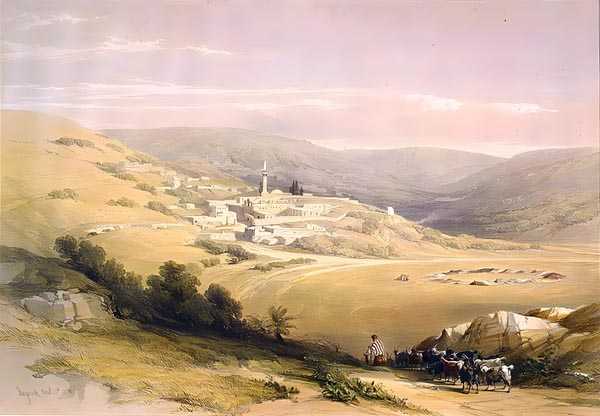
‘Nazareth (general view)’ - David Roberts (British, 1796 – 1864)
Pitts Theology Library, Emory University
As I reflected, my head bowed and my brow burdened with a thousand other, even heavier thoughts, I glimpsed at my feet, at the bottom of a valley carved into the shape of an earthen basin or lake, the white houses of Nazareth gracefully clustered on both the sides and floor of this basin. The Greek church, the tall minaret of the Turkish mosque, and the long, wide walls of the Franciscan monastery was first visible; a few streets lined with smaller houses, but in an elegant, Oriental style, were scattered around these larger buildings, bustling with the sounds and activity of life. All around the valley or basin of Nazareth, clumps of tall, thorny prickly-pear cacti, fig trees stripped of their autumn foliage, and pomegranate trees with delicate, tender green and yellow leaves were scattered here and there, lending freshness and grace to the landscape, like wildflowers around a village altar. God alone knows what passed through my heart then; but, with a spontaneous and almost involuntary impulse, I found myself at my horse’s feet, kneeling in the dust on the blue, powdery rock of the precipitous path we were descending.
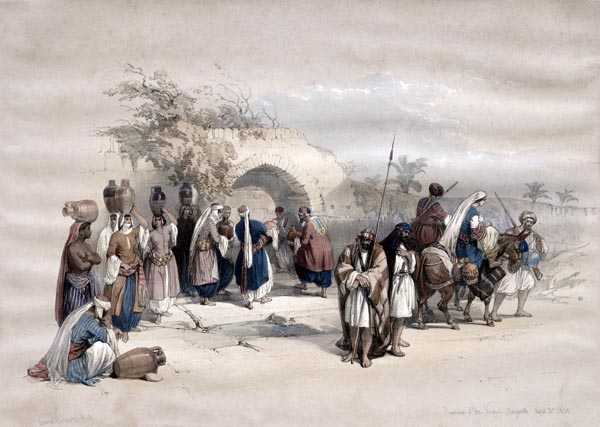
‘Fountain of the Virgin, Nazareth’ - David Roberts (British, 1796 – 1864)
Cleveland Museum of Art
I remained there for a few minutes of silent contemplation, in which the thoughts of my life as a sceptic and a Christian crowded my mind so intensely that it was impossible for me to discern a single one. These words alone escaped my lips: ‘Et Verbum caro factum est, et habitavit in nobis’ (‘And the Word became flesh and dwelt among us’, see John: 1.14). I pronounced them with the same sublime, profound, and grateful feeling that they contain; and the place inspired them so naturally that I was struck, upon arriving that evening at the sanctuary of the Latin church (the Basilica of the Annunciation), to find them engraved in letters of gold on the marble table of the underground altar, in the house of Mary and Joseph. Then, bowing my head, reverently, toward the dust of the place that had given birth to Christ (following a more modern theory, and not the tradition of the Gospels, Lamartine treats Nazareth rather than Bethlehem as the birthplace of Jesus), I kissed it in silence; and moistened with a few tears of repentance, love, and hope this dust that has seen so many tears fall, this dust in which so many tears have dried, shed by so many seekers after truth and love.
We arrived at the Franciscan Monastery in Nazareth as the last rays of evening still gilded the high yellow walls of the church and monastery. A wide iron gate opened before us; our horses glided in, their hooves clattering on the gleaming flagstones of the monastery’s outer courtyard. The gate closed behind us, and we dismounted before the very door of the church, where once stood the humble home of that mother who offered her breast to an immortal guest, who gave her milk to nurture a god. Both the superior and the guardian of the monastery were absent. A few Neapolitan and Spanish friars, busy winnowing the monastery’s wheat below the gateway, received us rather coldly and led us into a wide corridor from which the friars’ cells, and the rooms for visitors, opened. We waited a long while for the arrival of the parish priest of Nazareth, who showered us with courtesies, and had a room and bed prepared for each of us. Weary from the day’s journey, and our emotions, we threw ourselves onto our beds, postponing until morning our visit to the consecrated places, not wishing to spoil our overall impression with a hasty first glance at the holy sites, within whose walls we already dwelt.
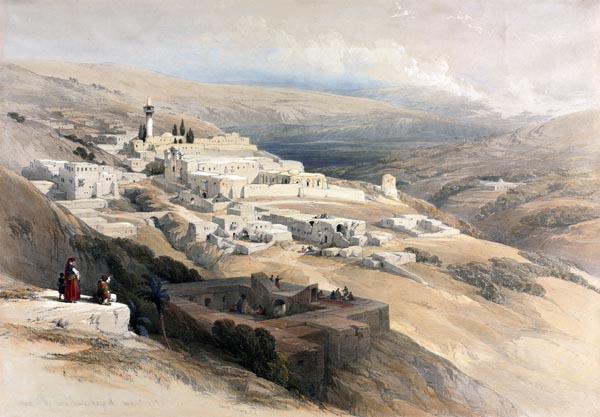
‘Convent of the Terra-Santa, Nazareth’ - David Roberts (British, 1796 – 1864)
Cleveland Museum of Art
I rose several times during the night, to raise my soul and voice to God, who had chosen in this place the one who was to carry his Word to the world.
The next day, an Italian priest arrived to lead us to the church, and the underground sanctuary that was once the home of the Blessed Virgin and Saint Joseph. The church (demolished in 1954, and rebuilt) is large, and has a high, three-storey nave. The upper storey houses the choir of the Fathers of the Holy Land, which connects to the monastery through a rear door. The lower storey is for the congregation; it connects to the choir and the high altar via a beautiful double staircase with gilded balustrades. From this part of the church, beneath the high altar, a short flight of steps leads to a small chapel with a marble altar illuminated by silver lamps, placed on the very spot where tradition holds that the Annunciation took place. This altar is erected beneath the vault, part natural and part man-made, of the rock against which the Holy House was undoubtedly built. Behind this first vault, two darker, subterranean chapels with altars, are said to have once served as a kitchen and a cellar for the Holy Family.
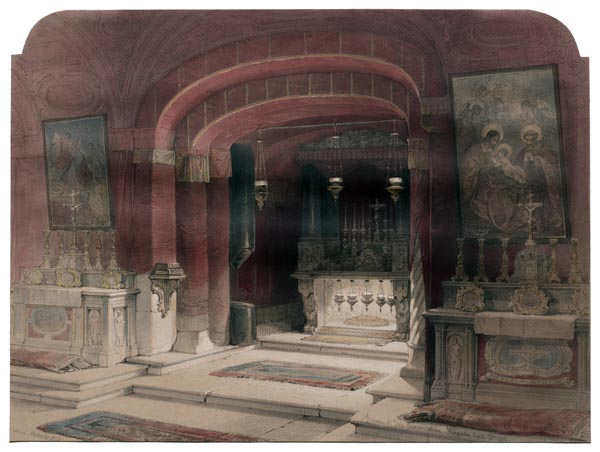
‘Shrine of the Annunciation, Nazareth’ - David Roberts (British, 1796 – 1864)
Cleveland Museum of Art
Tradition, more or less accurate, more or less altered to suit the pious needs of popular belief, or by the natural desire of the monks, possessing such a precious site, to generate interest by means of supplementary details, may have added a degree of gratuitous invention to the powerful history of the place; but there is little doubt that the monastery, and especially the first church here, were originally built on the very spot occupied by the house of the divine heir of heaven and earth. His name spread like the light of a new dawn, shortly after his death and, while his mother and disciples were still alive, they devoted themselves to the religion of love and sorrow that remained to them in the absence of the divine Master, and must often have visited, and led Christian converts, to the places where they had seen the one whom they now worshipped live, speak, act, and die. Human piety could not have better preserved the tradition of a place dear to his memory than did the piety of the faithful and the martyrs. The authenticity of the major sites associated with the Redeemer may be attributed to the fervour of a nascent cult and the vigilance of an immortal one.
We fell to our knees upon these stones, beneath this vault, witness to the most incomprehensible mystery of divine charity towards humankind, and we prayed. The fervour of prayer is also a mystery, a bond between humankind and the Divinity: like modesty, it veils thought and conceals what belongs only to Heaven. We also visited the vast and comfortable monastery, a building like any other in France or Italy, where the Latin Fathers practise the ceremonies of their worship as freely, openly, and safely, as they could in Rome, the capital of Christianity. In this respect, Muslims have been much slandered. Religious tolerance, or rather, religious respect, is deeply ingrained in their creed. They are so religious themselves, and regard the freedom of their religious practices with such jealousy, that the religion of other men is the last thing they would seek to infringe upon. They do sometimes feel a kind of horror for a religion whose symbol often offends their own, but only contempt and hatred for those who fail to pray to the Almighty in any language: such people they fail to understand, so ever-present is the thought of Allah in their minds, which is also the constant preoccupation of their souls. A score or so of Spanish and Italian Fathers occupy this monastery, absorbed in singing the praises of the Christ Child and the glories of his mother, on the very spot where the latter lived poor and unknown. One of them, who is called the priest of Nazareth, is specifically charged with the care of the town’s Christian community, which numbers seven to eight hundred Catholic Christians, two thousand Greek schismatics, a few Maronites, and only about a thousand Muslims.
During the day, the Fathers led us to the Maronite churches, the ancient synagogue where the child Jesus went to learn the law, which he would one day purify, and the site of the workshop where Saint Joseph practised his humble trade as a carpenter. We noted with surprise and pleasure the marks of deference and respect that the inhabitants of Nazareth, even the Turks, everywhere show to the Fathers of the Holy Land. A bishop in the streets of a Catholic city would be neither more honoured nor more affectionately regarded than these religious men are here. A priest is rendered safer from persecution by the customs of the East than those of Europe; should he seek martyrdom, this is not the place to find that same.
The Sea of Galilee
October 14, 1832.
I left at four in the morning for Mount Tabor, designated as the site of the Transfiguration, an unlikely location since at that time the summit of Tabor was occupied by a Roman fortress. The isolated position and elevation of this charming mountain, with its lush vegetation, rising from the Esdraelon plain (the Jezreel Valley, or Marj ibn Amir), led to its nomination, in the time of Saint Jerome, as the site for that sacred scene. A chapel was built on the summit, where pilgrims go to hear the Holy Sacrifice; no priest resides there: they visit from Nazareth (the site is now occupied by the twentieth-century Church of the Transfiguration). Arriving at the foot of Mount Tabor — a superb dome, perfectly rounded, and covered everywhere with vegetation and kerm-oaks — the guide wandered off. I sat alone under a beautiful oak-tree, roughly where Raphael places the disciples in his painting of the Transfiguration (in the Pinacoteca Vaticana), dazzled by the light from above, and waited for the father to celebrate Mass. We were announced from above by a pistol shot, so that we might kneel on the natural steps of this gigantic altar, before Him who erected it and spread the sparkling vault of heaven above.
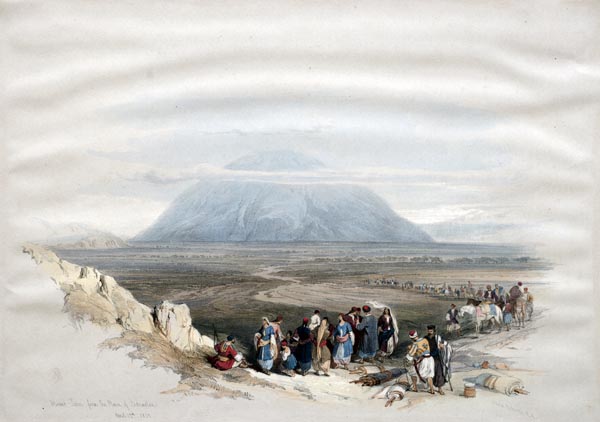
‘Mount Tabor from the Plain of Esdraelon’ - David Roberts (British, 1796 – 1864)
Cleveland Museum of Art
At noon, we set off for the Jordan and the Sea of Galilee. Having crossed, by one o’clock, the low, rather shadowy hills that sit at the foot of Mount Tabor, we entered a vast plain twenty miles long and at least as wide. We passed a ruined khan amidst medieval architecture, and through several villages of poorer Arabs who cultivate the plain; each village has a well located some distance away, and a few fig and pomegranate trees planted not far from the well. These are the only traces of prosperity. The houses can only be distinguished on close approach. They are huts six to eight feet high, each a kind of mud cube kneaded with chopped straw, and with a flat roof. These roof terraces serve as courtyards: on it are all their furnishings, a blanket, and a mat. The women and children almost always remain there; the women are not veiled; their lips are dyed with blue, the rims of their eyelids the same colour, and a faint tattoo is described around their lips and on their cheeks. They dress in a single blue garment, tied with a white belt above their hips; all reveal the effects of misery and suffering. The men are covered in seamless cloaks of heavy fabric, woven with wavering black and white stripes; their legs, arms, and chests are bare.
After travelling across this yellowish, stony, but fertile plain for six hours, the ground suddenly fell away before our feet, and we gazed on the immense Jordan Valley, and the first azure glimmers of the beautiful Sea of Galilee, or Lake Gennesaret, as the ancients and the Gospel call it. Soon its whole extent unfolded before our eyes, surrounded as it is on all sides, except to the south, by an amphitheatre of tall black and grey mountains. At its southern end, immediately beneath our feet, it narrowed where a river emerged, that of the prophets, the river Jordan of the Gospels!
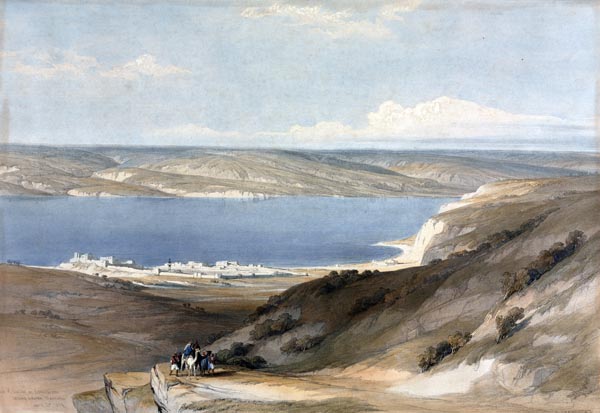
‘Sea of Galilee at Genezareth looking Towards Bashan’ - David Roberts (British, 1796 – 1864)
Cleveland Museum of Art
The Jordan meanders from the lake, and slides into the low, marshy plain of Esdraelon, about fifty paces from its shore; then flows south, bubbling slightly, raising its first murmur, till it passes the ruined arches of a Roman bridge (at Gesher, Jisr el-Majami, restored 2016). It is there that we made our way, up a steep, stony slope, wishing to pay homage to its waters, held as sacred by two religions. After a few minutes, we were on its bank: we dismounted, and bathed our heads, feet, and hands in its gentle, warm, blue waters, much like the waters of the Rhône flowing from Lake Geneva. The Jordan, at this point, which must be roughly the middle of its north to south course (flowing into and out of the Sea of Galilee), would not be worthy of the name of river in a larger country; but it nevertheless far surpasses the Eurotas and the Cephissus, and all those rivers whose fabulous or historical names resound in our memory from youth onwards, presenting us with images of strength, rapidity, and abundance, which their reality dispels. The Jordan here was broader than a torrent: at the end of a rainless autumn flowing gently, in a bed about a hundred feet wide. The sheet of water, two or three feet deep, was clear, limpid, transparent, allowing me to count the pebbles in its bed, while its colour was one of those beautiful hues that renders all the deep shades of an Asian firmament — bluer even than the sky, like an image more beautiful than the object, like a mirror that tints what it reflects.
Twenty or thirty paces from its waters, the sandy beach, which is currently dry, is strewn with loose stones, rushes, and a few clumps of oleander still in bloom. This beach is at a depth of five to six feet below the level of the plain and testifies to the river’s flow during a normal season of high water, at which time, in my opinion, the river must be eight to ten feet deep, and a hundred to a hundred and twenty feet wide. The beach is narrower, and lower in the plain; but there the river is more entrenched and deeper, and the place where we contemplated it is one of only four fords along its entire course. I drank the Jordan’s water from the hollow of my hand; as so many divine poets had drunk before me, like to the water that flowed over the innocent head of the Divine Victim! I found it perfectly sweet, pleasantly flavoured, and of great clarity. The habit one acquires on journeys to the East of drinking only water, and drinking often, makes the palate an excellent judge of the qualities of a new source. The water of the Jordan lacked only one quality: coolness. It was lukewarm; and though my lips and hands were hot from an eleven-hour ride, without shade, under a scorching sun, my hands, lips, and forehead felt a sensation of warmth on touching the river’s water.
Like all travellers who, after much hardship, distance, and peril, visit this once-regal river in its desolate state, I filled a few bottles with its water to take to friends less fortunate than myself, and filled the holsters of my pistols with pebbles I gathered from its banks. If only I could also bear away a little of that holy and prophetic inspiration with which it once nourished the bards of its sacred shores, and above all, a little of that holiness, and purity of mind and heart, which it doubtless acquired by bathing the purest and holiest of the children of men! Then I remounted my horse. I circled some of the ruined pillars that supported the bridge or former aqueduct I mentioned earlier: I saw nothing but the decayed masonry common to all Roman constructions of that era; no marble, carving, or inscription, no arch remained, but ten pillars were still standing, and the foundations of four or five others could be distinguished; each arch would have been about ten feet wide, which agrees fairly well with the breadth of one hundred and twenty feet that I thought, by sight, to attribute to the Jordan at full flow.
However, what I have written here with regard to the width and depth of the Jordan is intended only to satisfy the curiosity of those who like to obtain just and accurate measurements of the image they carry in their minds, not to lend weapons to the enemies or defenders of the Christian faith — pitiful weapons on both sides. What does it matter whether the Jordan is a torrent or a river? Whether Judea is a heap of barren rocks or a delightful garden? Whether such a mountain is merely a hill, or such and such a kingdom was merely a province? People who argue and fight over such questions are as foolish as those who believe they have overturned a two-thousand-year-old belief after laboriously seeking to refute the Bible, and ridicule the prophecies. Would not one think, witnessing these mighty battles over a single word, misunderstood or misinterpreted by both sides, that religions are no more than exercises in geometry to be proven by rote or destroyed by argument; and that generations of believers and unbelievers have merely awaited the conclusion of the debate, to side, at once, with the superior logician or the most learned and ingenious antiquarian? These are sterile disputes that neither seduce nor convert anyone! Religions are not proven, demonstrated, established, or destroyed by logic: of all the mysteries of Nature and the human mind, they are the most mysterious and inexplicable; their bases are instinctual, not rational. Like the winds that blow from the east or the west, but whose cause and origin no one knows, they blow, God alone knows from where, God alone knows why, and God alone knows for how many centuries, over the countries of the Earth! They exist because they exist; one does not adopt them or discard them at will, on the word of this or that writer; they are part of the very heart, even more than of the mind. Who declares themselves a Christian or not because they have found such and such a peremptory answer in some book, or an undeniable objection in another? Every sensible person who is asked to account for their faith will answer: ‘I am a Christian because the fibres of my heart are Christian, because my mother suckled me with Christian milk, because the sympathies of my soul and my mind support this doctrine, because I live by the spirit of my own day, regardless of what the future may bring.’
We could see two villages clinging to the steep banks of the Sea of Galilee — one a quarter of an hour’s walk away, opposite us, on the other side of the Jordan; the other a thousand yards to our left, on the same bank of the river. We were ignorant as to which Arab tribes inhabited these villages, and had been warned to be on our guard for fear of surprise attack from the Jordanian Arabs, who rarely allow anyone to cross their plains and river with impunity. We were well-mounted and well-armed; and the rapid and unexpected conquest of Syria by Muhammad Ali had so struck all the Arabs, and imbued them with a dazed sense of fear and astonishment, that the moment was well chosen to attempt a bold foray into their territory: they knew not who we were, or why we marched with such confidence among them; and they might naturally assume that we were being closely followed by forces superior to those they could deploy against us. Their fear of reprisal, of swift revenge, thus ensured our safety on the road.
With this in mind, we boldly set up camp in the very heart of the last Arab village I mentioned; I know not its name: it is built (if one can call shapeless blocks of stone and mud buildings) on the very edge of the high shore overlooking the Sea of Galilee. While our Arabs pitched our tents, I descended the steep slope that leads to the lake; its water lapped at the shore in a murmur, and its edge was fringed with a light foam that vanished and reformed with each return of the swiftly moving waves, like those of a calm, deep sea, that come to rest on the sand at the end of a narrow gulf. I barely had time to bathe in its waters, the scene of so many events in that great still-modern moral poem of the Gospels, and to gather a few handfuls of shells for my friends in Europe. The sun had already set behind the high, black volcanic peaks of the Tiberias plateau, and some Arabs who had seen me descend alone and were wandering on the shore might have been tempted, potentially, by the opportunity. My rifle in hand, I ascended straight towards them. They looked at me and saluted, placing their hands on their hearts. I returned to the tents. We lay down on our mats, overcome with weariness, but with our hands on our weapons, ready to take a stand at the first alarm. Nothing, however, disturbed the silence, and peace of that lovely night, where we were lulled only by the soft, caressing sound of the waves of the sea of Jesus Christ lapping against the shore; by the wind that blew in harmonious gusts between the taut ropes of our tents; and by the pious thoughts and sacred memories that each of those sounds awakened within us.
Next day, at dawn, when we emerged from our tents, ready to visit and bathe again in the lake, we saw only the Arab women, combing their long black hair on the terraces of their cottages, a few shepherds busy milking cows and goats on our behalf, and the naked children of the village who played familiarly with our horses and dogs: a rooster crowed, a child cried whom its mother cradled in her arms, or breastfed, as in some peaceful hamlet in France or Switzerland. We congratulated ourselves on having risked a journey into such a feared and little-known part of Galilee, and had no doubt that the same peaceful welcome would have awaited us further on, if we wished to venture into Arabia: we had every means of safely crossing Samaria, and the land of Nablus, the ancient Shechem, through Monsieur Antoine Catafago (the French consular agent), who is all-powerful in this region, and who offered to have the journey endorsed by his many Arab friends, and our caravan accompanied by his own brother. Personal concerns obliged me to abandon this route, however, and return to the original one via Nazareth and Mount Carmel, where I hoped to find express messages and letters from Beirut.
We, therefore, remounted our horses, preparing to ride along the sacred shore of the beautiful Sea of Galilee, all the way to its northern end. The caravan departed silently from the village in which we had slept and moved off along the western shore of the lake, a few steps from the water, over a beach of sand and pebbles, dotted here and there with clumps of oleander, and shrubs with light, serrated leaves bearing a flower similar to a lilac (Vitus agnus-castus, the Arabian lilac). To our left, a chain of steep, black, barren hills, furrowed with deep ravines and dotted here and there with immense, scattered volcanic stones, stretched along the entire shoreline we were about to traverse and, jutting out like a dark, bare promontory almost in the middle, concealed from us the city of Tiberias, and the end of the lake on the Lebanese side.
None of us raised a voice; all our thoughts were intimate, hurried, and profound, so loudly did sacred memories speak in the soul of each of us. As for myself, never has any place on earth spoken to my heart more strongly and exquisitely. I have always loved to explore the physical landscape of places inhabited by people I know or know of, whom I admire, love, or revere, among the living as well as the dead. The country a great person inhabited and cherished during their time on Earth has always seemed to me the surest and most eloquent testament to themself; a sort of material manifestation of their genius, a silent revelation of a part of their soul, a living and sensitive commentary on their life, actions, and thoughts. As a young man, I spent solitary and contemplative hours lying beneath the olive trees that shade Horace’s gardens, overlooking the dazzling cascades of Tibur (Tivoli; the estate and ruined villa near Licenza, partly incorporated in the former monastery of Sant’ Antonio, has been attributed to Horace); I often lay there in the evening, listening to the sound of the beautiful sea of Naples, beneath the drooping branches of the vines, near the place where Virgil wished his ashes to rest, because it was the most beautiful and serene spot on which his gaze had fallen. How many mornings and evenings did I later spend sitting at the foot of some beautiful chestnut tree, in that little valley of Les Charmettes (near Chambéry) to which the memory of Jean-Jacques Rousseau drew me, holding me there through my sympathy with his impressions, reveries, misfortunes, and genius! So, it has been with several other great writers or individuals whose name or writings resonated deeply within me. I wished to study them, to know them in the places that had given birth to, or inspired, them; for almost always an intelligent gaze reveals the secret and profound analogy between the homeland and the person, between the stage and the actor, between Nature and the genius that was formed and inspired by her. But it was no longer a great person or a great poet whose favourite abode I was visiting here; it was that of the one among many, the divine man, Nature and genius and virtue made flesh, divinity incarnate, whose traces I sought to adore on the very shore where he left the greatest imprint, on the very waves that carried him, on the hills where he sat, on the stones where he rested his head. He saw, with mortal eyes, this sea, these waves, these hills, these stones; or rather this sea, these waves, hills and stones witnessed his presence; he had trodden a hundred times this path over which I passed respectfully; his feet had raised the dust which flew from beneath mine: during the three years of his divine mission, he went back and forth constantly from Nazareth to Tiberias, from Jerusalem to Tiberias; he voyaged in the boats of the local fishermen over the Sea of Galilee, he calmed its storms; he rode the waves giving his hand to the apostle of little faith like me, a heavenly hand which I, more than that apostle, need amidst storms of opinion and thoughts more terrible!
Grand and mysterious scenes of the Gospel were enacted on and around this lake, and on the mountains that surround and overlook it. Here is Capernaum, where he chose his disciples from among the lowliest of men, to bear witness that the power of his doctrine lies in the doctrine itself, and not in its powerless organs. Here is Tiberias, where he appeared to Saint Peter and established in a few words the eternal hierarchy of his Church; here is the mountain (the Mount of Beatitudes, near Capernaum) on whose slopes he delivered the beautiful Sermon on the Mount, pronouncing the new Beatitudes according to God; here is the place where he cried out: ‘Misereor super turbam’! (‘I feel compassion for the people!’) and multiplied the number of loaves and fishes, just as his word gives birth to and amplifies the life of the soul; here is the gulf in which the miraculous catch of fish was made; here is, finally, the whole of the Gospels, with their touching parables, and their tender and delightful images which appear before one as they appeared to the listeners of the divine Master, when he pointed to the lamb, the sheepfold, the good shepherd, and the lilies of the valley. Here, finally, is the place that Christ preferred on this earth, the one he chose as the background to his mysterious drama; where, during his obscure early life of thirty years, he acknowledged his parents, and his friends according to the flesh; the place where Nature, to which he possessed the key, appeared to him in its most charming aspect; these were the mountains where he watched, as I have, the rising and setting of that sun which measured out his mortal days so swiftly; it was here that he came to rest, meditate, pray, and display his love of human beings, and of God.
October 15, 1832.
The Sea of Galilee, about three miles wide at the southern end, where we approached its shore, first widened, imperceptibly, up to the promontory which hid the town of Tiberias from us; there the mountains, which had confined it until then, opened out, suddenly, on either side of its wide northern expanse, a vast, almost circular basin, of about twenty miles or so in circumference.
This basin is not regular in its shape; the mountains do not extend to its waters everywhere: occasionally they recede some distance from the shore, leaving between themselves and the shore a small, low-lying plain, fertile and green like the plain of Gennesaret (Kinneret, Tel Kinrot or Tell el-’Oreimeh); sometimes they are cleft. and open to allow the blue waters to flow into gulfs carved at their feet, and darkened by their shadows. The hand of the most graceful painter could not draw more rounded, softer, and varied contours than those that the Creator’s hand has given to these waters and mountains; seemingly preparing, long ago, the landscape of the Gospels for the work of grace, peace, reconciliation, and love that was to be accomplished there!
To the east, the mountains seem to form, from the peak of Mount Gilboa, glimpsed to the south, to the peaks of Mount Lebanon, visible to the north, a close-knit but undulating and flexible chain, whose dark links seem from time to time ready to loosen, and even break, here and there, to admit a stretch of sky. These mountains do not terminate at their summits in those sharp teeth, those storm-honed rocks that present blunt points to the lightning-strokes and winds, and always grant the aspect of lofty ranges an ancient, dreadful, and ruined air, which saddens the heart while elevating the mind. Instead, they gradually diminish to hillocks, more or less broad, more or less steep, some covered with a few scattered oaks; others with verdant scrub growing in a bare but fertile soil still showing the marks of varied cultivation; and still others coloured, by the evening or morning light that glides over their surface, a pale yellow, or a blue and violet hue richer than the artist’s brush can capture.
Their flanks, though lacking true valleys, nevertheless do not present themselves as continuous ramparts; they are hollowed out, at intervals, by deep and wide ravines, as if the mountainside had collapsed under its own weight; while the natural interplay of light and shadow renders these ravines as luminous, or more often dark, patches that attract the eye and break the uniformity of contour and colour. Lower down, they slump upon themselves, and project here and there, in the form of rounded hillocks or mounds, into the lake: a gentle and graceful transition between the summits and the waters that reflect them. Almost nowhere, on the eastern side, does the underlying rock pierce the layer of vegetation with which it is richly covered; and this Arcadia of Judea thus always combines, with the majesty and gravity of mountainous regions, an aspect of the varied fertility and abundance of the earth. If only ‘the dew of Hermon’ were still falling upon its breast (see Psalm 133). At the northern end of the lake, the mountain range slopes downward as it diminishes; one can make out from afar a plain that fades amidst the waters, and, at the edge of this plain, a white mass of foam that seems to roll from on high into the sea. It is the Jordan River, rushing from there into the lake, which it crosses without mingling with the latter’s waters, to emerge calm, silent, and pure, at the place which I have described.
This entire northernmost stretch of the Sea of Galilee is bordered by a fringe of fields that appear cultivated; one can make out the yellowing stubble of the last harvest, and vast fields of rushes that the Arabs cultivate wherever there is a spring to water the roots. On the western side are the chains of volcanic mounds we had been following since daybreak. They stretch uniformly all the way to Tiberias. Avalanches of black stones, spewed forth from the still-visible mouths of a hundred extinct volcanic cones, constantly cascade down the steep slopes of this sombre and funereal shore. The only variations seen along our route lay in the bizarre shapes and strange colours of the high masses of hardened lava scattered around us, and from the debris of walls, ruined gateways, and fallen columns that our horses encountered at every step. The shores of the Sea of Galilee on this side of Judea were once, so to speak, a single city. The numerous ruins before us, and the multitude of towns, and the magnificence of the buildings that their mutilated fragments attest to, reminded me of the road that runs at the foot of Mount Vesuvius, from Castellammare to Portici. Just as there, the shores of the Sea of Galilee seemed to bear towns instead of crops and trees.
Tiberias
After a two-hour ride, we reached the end of a promontory jutting out into the lake; and the city of Tiberias suddenly appeared before us, a living, shining apparition of the city of two thousand years ago. It covers the slope of a bare, black hill that drops steeply toward the lake, and is surrounded by a high, square wall, flanked by a score of crenellated towers. Only the tips of two white minarets rose above the walls and towers, while the rest of the city seems to hide from Arab eyes, behind those high walls, presenting to the view only its low vault of uniform grey roofs, and resembling the indented shell of a tortoise.
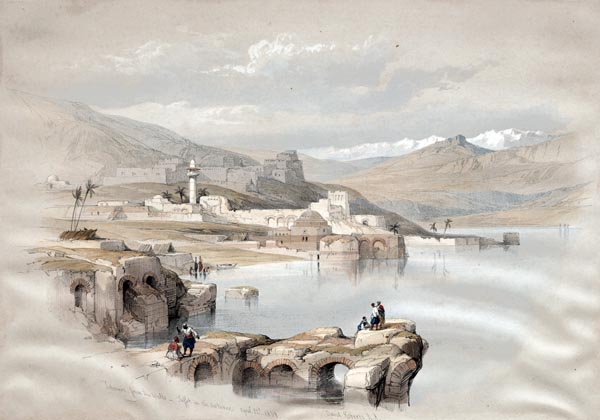
‘Tiberias, from the Walls, Safet in the Distance’ - David Roberts (British, 1796 – 1864)
Cleveland Museum of Art
We halted at the Turkish mineral baths of Hammath Tiberias. There is an isolated dome, surrounded by the superb ruins of the previous Roman or Hebrew baths. We settled ourselves in the bathhouse itself, a basin filled with running water, at a temperature of a hundred degrees Fahrenheit. I took a bath, then slept for an hour. I remounted. There was a storm on the lake, something which I had longed to see. The water was as green as the leaves of the rushes that surround it. The foam was livid and dazzling, the waves quite high and racing swiftly. They made a loud noise as they flowed across the volcanic pebbles, but there were no boats in distress, or in sight. There was not a single one on the lake. We entered Tiberias during a midday storm and rain, and I took refuge in the Latin church. It seems I had brought lightning to illuminate the deserted church, the first church of Christianity.
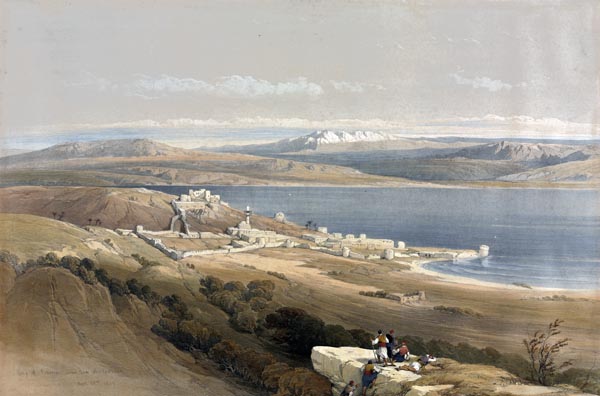
‘City of Tiberias on the Sea of Galilee, Looking towards Hebron’ - David Roberts (British, 1796 – 1864)
Cleveland Museum of Art
Tiberias is not worth even a quick glance, even in its interior; a confused and muddy jumble of a few hundred houses, resembling Arab huts of mud and straw. We were greeted, in Italian and German, by several Polish or German Jews who, at the end of their lives, when they have nothing left to await but the uncertain hour of their death, come to spend their last moments in Tiberias, on the shores of this sea, at the very heart of the beloved land, to die beneath the light of its sun, and be buried in its soil, like Abraham and Jacob. The wish to sleep beside the graves of one’s ancestors is ever a testament to the inextinguishable love of homeland. It is futile to deny it; there is a sympathy, an affinity between a person and the earth from which he or she was formed, and from which he or she sprang. It is good, it is sweet to return to its place the little heap of dust that was borrowed from it for a few brief years. Grant that I too may sleep, O Lord, in the earth, and amidst the dust, of my fathers!
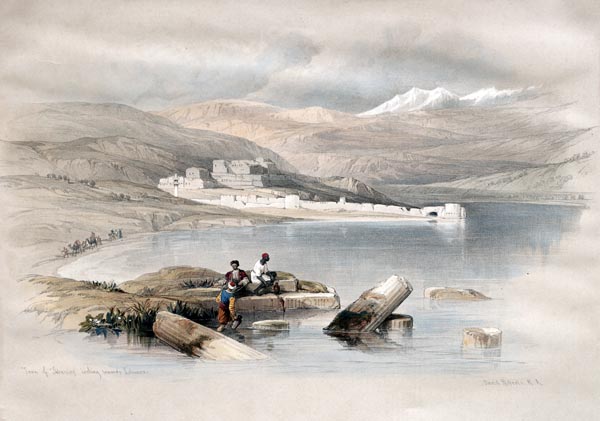
‘Town of Tiberias Looking Towards Lebanon’ - David Roberts (British, 1796 – 1864)
Cleveland Museum of Art
Nine hours of riding, without rest, brought us back to Nazareth via Cana (Kafr Kanna), the site of the Saviour’s first miracle. The pretty Turkish village rests, gracefully, on the slopes on either side of a basin of fertile soil, surrounded by hills covered with prickly-pear cacti, oaks, and olive trees. Pomegranate trees, three palm trees, and fig trees stood around it. Women and flocks surrounded the troughs of the fountain. The house of Saint Bartholomew, the Apostle, is in the village. Next to it, is the house where the miracle of the water turned into wine took place (see John 2.1-11): it is in ruins and roofless. The monks still show the jars that contained the wine of the miracle, a piece of monastic embroidery like those that mar, everywhere, the simple and rich fabric of religious tradition.
After resting and refreshing ourselves for a while by the fountain of Cana, we set off again, in clear moonlight, towards Nazareth. We traversed some fairly well-cultivated plains, then a series of wooded hills that rose as they approached Nazareth. After a three and a half hours’ ride, we arrived at the gates of the Latin monastery, where we were once again welcomed.
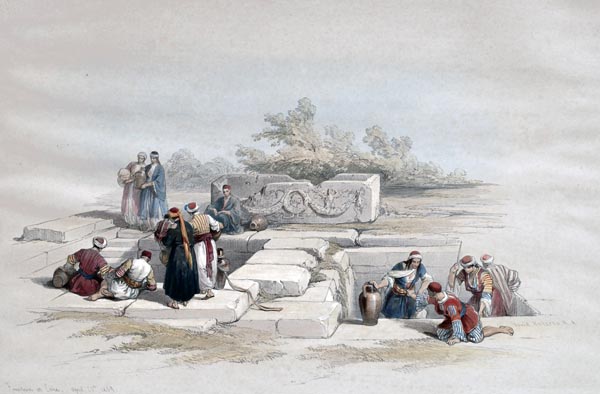
‘Fountain at Cana’ - David Roberts (British, 1796 – 1864)
Cleveland Museum of Art
When I woke, I was surprised to hear a voice greeting me in Italian: it was that of the former French Vice-Consul at Acre, Antoine Catafago, a well-known and influential figure throughout Syria, where his role as an agent for the Europeans, his friendship with Abdullah, the Pasha of Acre, his trading network, and his wealth had made him famous and powerful. He was still the Austrian consul in Acre. His attire reflected his dual nature as both Arab and European. He was dressed in a red pelisse lined with ermine and wore an enormous three-cornered hat, a distinctive mark of French agents in the East. This hat dated back to the time of the Egyptian War; it was the religiously preserved garb of some brigadier-general of Bonaparte’s army. It was only worn on official occasions, in audiences with the Pasha, or when a European passed through the country. It was as if one were showing his household gods to him. Monsieur Catafago was small and elderly, with the strong, piercing, and spirited features of the Arabs; his eyes, full of fire tempered by kindness and politeness, illuminated his face with a ray of superior intelligence. One could understand, at first glance, the influence such a man must have had over Arabs and Turks, who generally lack the principle of activity which sparkled in his eyes and was betrayed in Monsieur Catafago’s movements and gestures.
He held a packet of letters for me in his hand, which he had just received from the coast of Syria by a courier in the service of Ibrahim Pasha, and a series of French newspapers which he receives directly. He had rightly thought that a French traveller would be surprised and delighted to find, in the middle of the desert, two thousand miles and more from his homeland, fresh news from Europe. I read the letters, which were full of concern for Julia’s health. Monsieur Catafago departed, after inviting me to lunch in a pavilion he had built in Nazareth, where he spent the sweltering summer days alone; and I opened the newspapers. My own name was the first thing to catch my eye: it was a serialised article in the Journal des Débats, quoting verses I had sent to Sir Walter Scott upon leaving France (Scott had died the previous month). I re-read the stanzas, whose sad and anxious tenor suited the scene to which chance had sent them; a scene of the greatest revolution of the human spirit, a scene where the spirit of God had so powerfully stirred men, and from which the idea of Christian renewal had taken flight, over the world, just as an idea, still a daughter of Christianity, had stirred the other shore of that sea from which my words had returned to me.
‘Spectateur fatigué du grand spectacle humain,
Tu nous laisses pourtant dans un rude chemin;’ etc.
‘Weary spectator of the great human spectacle,
You leave us, still, on a harsh and rugged path;’ etc.
I reread the verses as if they were by someone else, so completely had I erased them from memory. I was struck anew by the feeling that had inspired them elsewhere; a sense of the general instability of things, of vertigo, the universal dazedness of the human mind, which runs on too fast even to realise its own progress, but which ever possesses an instinct for some new, unknown goal, to which God leads it by the harsh, precipitous path of social upheaval. I also admired the marvellous power of those carriers of human ideas, journalism and the press, by which a thought that had come to me six months earlier, in a wood near Saint-Point, had returned to me like a daughter seeking her father, and mingled the sounds of a young, and already universal, language with ancient echoes from the stones of Nazareth.
October 20, 1832.
I lunched at Monsieur Catafago’s pavilion, along with one of his brothers and a few Arabs. I then explored the area around Nazareth once more; and visited the rock in the mountain where, according to tradition, Jesus used to take meals with his first disciples. Monsieur Catafago entrusted me with letters for Acre, and for the mültazim (the Ottoman tax-collector) in Jerusalem.
October 21, 1832.
At six in the morning, we left Nazareth. All the Spanish and Italian friars of the monastery, gathered in the courtyard, crowding around our horses; some, offering good wishes and prayers for our journey, others, fresh provisions, excellent bread baked overnight, olives, and chocolate from Spain. I gave five hundred piastres to the superior to reward his hospitality. This did not prevent some of the young Spanish friars from whispering their requests in my ear, and furtively receiving a few handfuls of piastres to buy tobacco and other small monastic treats to distract them in their solitude. Travellers have painted a false and romanticised picture of these monasteries of the Holy Land. Nothing is less poetic or less religious, seen close-to. The underlying thought is grand and beautiful. Men tear themselves from the delights of Western civilisation to risk their very existence, or at least lead a life of deprivation and martyrdom, among the persecutors of their faith, in the very places where the mysteries of that religion have consecrated the land. They fast, they keep vigil, they pray, amidst the blasphemous Turks and Arabs, so that a little Christian incense may still burn on every site where Christianity was born. They are the guardians of the sacred cradle and tomb; the Angel of Judgment will discover them alone there, like those holy women who kept watch and wept near the empty sepulchre. All this is, as I say, beautiful and grand in concept; but in reality, almost all of its grandeur must be tempered.
There is no persecution now, no martyrdom; all around these hospices, a Christian population is at the service and command of the monks in these monasteries. The Turks do not trouble them in the slightest; on the contrary, they protect them. They are a people who understand worship and prayer, in whatever language or form it is presented to them. They hate only atheism, and rightly so in my opinion, which they consider a degradation of human intelligence, a far greater insult to humanity itself than to God. These monasteries are, moreover, under the dreaded and inviolable protection of the Christian powers, represented by their consuls. Given a complaint from a superior, the Consul writes to the Pasha, and justice is served at once.
The monks I saw in the Holy Land, far from presenting the image of the endless martyrdom they are often portrayed as undergoing, seemed to me the happiest, most respected, and most feared inhabitants of those regions. They occupy fortified castles, similar to our old medieval fortresses; these dwellings are inviolable, surrounded by walls and closed by iron gates. The gates are opened only for the Catholic population of the surrounding area who attend services, receive a little pious instruction, and pay, out of respect for and devotion to, the monks, the communities’ expenses. I have never walked, accompanied by one of the Fathers, through the streets of any Syrian city, without children and women coming to bow before the priest, while kissing his hand or the hem of his robe. Even the Turks, far from insulting them, seemed to share the respect they inspired in passing.
Who then are these monks? Generally, they are commoners from Spain and Italy, who entered a monastery in their homeland at a young age and, growing weary of monastic life, wished to vary it, by experiencing a new country at least, and so asked to be sent to the Holy Land. Their residence in the houses of their Order in the East usually lasts two or three years only. A vessel is sent to collect them, and returns with others. Those who learn Arabic and dedicate themselves to serving the Catholic population of the towns stay longer, often spending their entire lives here. Their occupation and life are that of our country priests; but they are shown greater veneration and devotion. Others remain confined within the monastery walls or, by way of pilgrimage, move from one house to another, sometimes spending time in Nazareth, or Bethlehem, or in Rome, or Jaffa, or the Monastery of Saint John in the Desert (referring to John the Baptist; the monastery is near Ein Karem). Their only occupations are church services, and walks in the gardens or on the monastery terraces. No books, no studies, no useful function. They are consumed by ennui; intrigues form within the monastery; the Spaniards speak ill of the Italians, the Italians of the Spaniards. We were little edified by the remarks made about one another by the monks of Nazareth. We found not one who could even hold a reasonable conversation on subjects that their vocation should have made most familiar to them. They had no knowledge of sacred antiquity, of the Fathers of the Church, or of the history of the places they inhabited. Everything has been reduced to various popular and ridiculous traditions that they pass on without examination, and which they repeat to travellers just as they have received them from the ignorant and credulous Christianised Arabs local to them. They all long for the moment of their liberation and their return to Italy or Spain, and their sojourn here is of little benefit to themselves or the religion.
However, the monastery granaries are well-stocked; their cellars contain the finest wines this land produces, which they alone have the knowledge to create. Every two years, a ship arrives from Spain, bringing to the abbot the funds sent them by the Catholic powers — Spain, Portugal, and Italy. This sum, augmented by the pious alms of Christians in Egypt, Greece, Constantinople, and Syria, reportedly provides them with an annual income of three to four hundred thousand francs. This is divided among the various monasteries, according to the number of monks and the needs of each community. The buildings are well-maintained, and everything indicates comfort and even relative wealth in the houses I visited. I heard nothing scandalous concerning these monks housed in the Holy Land. Ignorance, idleness, boredom — these are the three plagues afflicting them that need to be, and could be, cured.
These men struck me as simple, and sincere, but fanatical and credulous. Some, even, in Nazareth, seemed to me like true saints, animated by the most ardent faith and the most active charity; humble, gentle, patient, willing servants of their brothers and strangers alike. I carry their faces full of peace and candour in my memory, and their hospitable deeds in my heart. I could name them; but what matters it to them whether or not their names travel the earth, provided that heaven knows them, even though their virtues remain buried in the shadows of the cloister where they take pleasure in hiding them?
Same date, October 21st.
Mount Carmel
After leaving Nazareth, we skirted a mountain covered in fig trees and prickly-pear cactus. To the left a green, shady valley opened; a pretty country house, reminiscent of our European homes, sat alone on one of its slopes. It belongs to an Arab merchant from Acre. Europeans are in no danger in the vicinity of Nazareth; the population is almost entirely Christian, and at their service. After a two-hour ride, we reached a series of small valleys winding gracefully between hillocks covered in beautiful kerm-oak forests. These forests separate the plain from Haifa, and from Nazareth and the desert of Mount Tabor. Mount Carmel, a high mountain range that rises from the Jordan River and plunges steeply to the sea, began to take shape on our left. Its dark green line was highlighted against a deep blue sky, shimmering with hot vapour, like steam rising from a furnace. Its rugged slopes are covered with lush, robust vegetation. Everywhere there is a thicket of shrubs, here and there crowned by the slender crowns of oaks; grey rocks, sculpted by Nature into bizarre and colossal shapes, occasionally pierce this greenery and reflect the brilliant rays of the sun.
This was the view that stretched as far as the eye could see to our left; at our feet, the valleys we were following descended in gentle slopes and began to open onto the beautiful plain of Haifa. We climbed the last hillocks that separated us from it, and lost sight of it only for a moment before it was again visible. These hillocks, between Palestine and coastal Syria, provide one of the most serene and solemn landscapes I have ever beheld. Here and there, oak forests, left to their own devices, form vast clearings, covered with grass as velvety as in our western meadows; behind us, the summit of Mount Tabor rose like a majestic altar crowned with green garlands against a fiery sky; further on, the blue peaks of the Gilboa Mountains and the hills of Samaria trembled on the vague horizon.
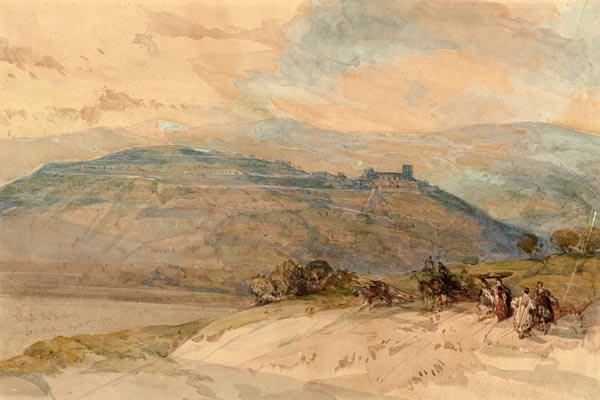
‘Distant view of Sebaste, Ancient Samaria (1839)’ - David Roberts (British, 1796 – 1864)
Artvee
The Carmelite monastery cast its dark, heavily pleated curtain across one side of the stage, and the gaze, following its lines, reached the sea, which terminated everything, like the sky in beautiful landscape paintings. How many sites have I not chosen in my mind, on which, to build a house there, an agricultural fortress, and to found a colony with some friends from Europe, and a few hundred of those young people disinherited from any future in our overcrowded lands! The beauty of the place, the beauty of the sky, the prodigious fertility of the soil, the variety of produce that can be won from the land; the ease of obtaining workers at low cost; the proximity of two immense, fertile, irrigated and uncultivated plains, and of the sea for the export of goods; with defences that could easily be constructed against the Arabs of the Jordan valley, by erecting light fortifications at the exit of the gorges of these hills: all this made me choose this part of Syria for the agricultural and civilising enterprise that I intend to undertake (Lamartine purchased land in 1849 but, unable to raise sufficient further capital for the venture rented it back to the Porte in 1852).
Same date, October 21st, in the evening.
At midday we were caught in a storm. I have rarely seen one so dreadful. The clouds rose vertically, like towers, above Mount Carmel; soon they covered the entire long ridge of that mountain range. Mount Carmel, moments before so serene and radiant, was gradually plunged into rolling waves of darkness, split here and there by streaks of fiery light. The entire horizon seemed to draw nearer and narrow around us, in a moment. The thunder was unbroken despite the lightning; it sounded as a single, majestic, continuous, and deafening roll, like the sound of waves crashing on the seashore during a fierce tempest. The lightning cascaded, in torrents of fire from the sky, upon the dark slopes of Mount Carmel; the oaks on its flanks and on the hills below, on one of which we had halted, bent like reeds; the wind, rushing from the gorges and clefts, would have knocked us over, had we not dismounted and taken shelter behind a rock, amidst the dry bed of a stream. Dry leaves, lifted by the storm, rolled over our heads in clouds, and branches from the trees rained down around us. I remembered the Bible and the wonders of Elijah, that prophet of extermination on his mountain: his cave was not far away (see 1 Kings 18–19; the best-known Cave of Elijah, el-Khader, is on Mount Carmel, on Haifa’s Allenby Road).
The storm lasted a mere half-hour. We drank the rainwater that had collected in our horses’ felt blankets. We rested for a few moments, at a point roughly halfway from Nazareth to Haifa, and then resumed our journey along the foot of Mount Carmel; the mountain on our left, a vast plain with a river on our right. Carmel, which we followed in this way for about four hours, presented the same austere and solemn aspect everywhere. It is a gigantic, almost sheer wall, covered everywhere with a layer of shrubs and fragrant herbs. Nowhere is the rock bare; some fragments, detached from the mountain, have slid down onto the plain. They are like citadels. Naturally formed hills provide a base and shelter for villages of Arab farmers. We encountered only one of these villages, about two hours before catching sight of the town of Haifa. The houses were low, windowless, and protected by earthworks from the rain. Above, the Arabs raise a second, verdant tier, of foliage supported by tree trunks, which they inhabit during the summer. These terraces were covered with men and women who watched us pass and shouted insults at us. The appearance of these people is fierce; yet none of them dared descend from the hill to insult us more directly.
Haifa (Khaifa)
At seven o’clock, we were approaching Haifa, whose domes, minarets, and white walls, as in all the cities of the Orient, form a bright and cheerful aspect from a distance. Haifa rises at the foot of Mount Carmel, from a white sandy beach, by the sea. This city forms the end of an arc, of which Acre marks the other end. A gulf nine miles wide or so separates them: this gulf presents one of the most delightful shorelines on which the eyes of sailors can rest. Acre, its fortifications damaged by the cannons of Ibrahim Pasha and Napoleon, displaying the openwork dome of its beautiful ruined mosque, and with sailing vessels entering and leaving its port, drew the eye to one of the most important and illustrious fields of war: at the rear of the gulf, lay a vast cultivated plain; Mount Carmel casting its great shadow over this plain; then Haifa, like a sister city to Acre, embracing the other side of the gulf, and advancing its small pier into the sea, where a few Arab brigs bobbed in the breeze; and above Haifa, a forest of large olive trees; finally, higher still, a path carved into the rock, leading to the summit of Cape Carmel. There, two vast buildings crowned the mountain: one, the pleasure house of Abdullah, Pasha of Acre; the other, the Carmelite monastery, recently built with Christian alms and surmounted by a large tricolour flag, announcing to us its sanctuary and the protection of the French; a little below the monastery, immense caverns are carved into the granite of the mountain: these are the famous caves of the prophet Elijah. This was the landscape that struck us as we entered the narrow, dusty streets of Haifa. The astonished inhabitants watched our long caravan pass by with dread. We knew no one; we had no lodging, no offer of hospitality to accept.
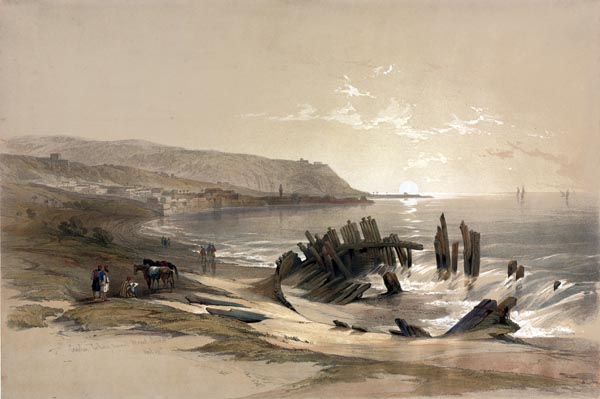
‘Caiaphas Looking Towards Mount Carmel’ - David Roberts (British, 1796 – 1864)
Cleveland Museum of Art
By chance, we met a young Piedmontese man who had been serving as vice-consul in Haifa since the capture and fall of Acre. Giovanni Bianco, the Sardinian consul in Syria, had written to him without our knowledge, asking him to take us in should we happen to pass through Haifa. He approached us, inquired about our names, and led us to the door of the small, dilapidated house where he lived with his mother and two younger sisters. We left our Arabs to camp on the seashore, with the horses, near the town and entered the home of Paolo Malagamba: that was the name of the young and amiable vice-consul, the only European remaining amidst this desolate battlefield since the complete destruction of Acre by Ibrahim’s Egyptians.
A small courtyard and a wooden staircase led to a small terrace covered with palm leaves; behind this terrace, were two bare rooms surrounded only by a divan, the only indispensable piece of furniture for rich and poor alike in all the Orient; a few flower pots, on the terrace; an aviary populated with pretty grey doves, fed by Monsieur Malagamba’s sisters; shelves around the walls, on which were arranged, in order, cups, pipes, liqueur glasses, silver cassolettes for perfumes, and wooden crucifixes inlaid with mother-of-pearl and made in Bethlehem: this was all the furniture in this poor house, where a neglected family represents, for a salary of a thousand piastres (about three hundred francs), one of the powers that be of Europe.
Madame Malagamba, the mother, received us with the customary ceremonies of the country. She presented us with perfumes, and scented waters; and we had scarcely sat down on the divan, wiping the sweat from our brows, when her daughters, two celestial apparitions, emerged from the next room and presented us with orange-blossom water and preserves, on trays of Chinese porcelain. Such is the power of beauty over the soul that, though parched with thirst, and weary from a twelve-hour ride, we would have remained in silent contemplation before these two young girls without raising a glass to our lips, had not the mother urged us with her insistence to accept what her daughters offered. The whole Orient was there, just as I had dreamed of it in my youth, my mind filled with the enchanting images created by its storytellers and poets. One of the young girls was but a child; she was merely the graceful accompaniment to her sister, like those images that are simply reflections of another form. After offering us, with all the care imaginable, the simplest and most poetic services hospitality can provide, they also came to take their place, next to their mother, on the divan opposite us.
Such is the image I wished to capture in words, to preserve it in these notes as I see it in my mind; but though we possess within us the capacity to perceive beauty in all its nuances, all its delicacy, all its mysteries, yet we have only that vague and abstract word to describe the reality. Here is where painting triumphs: it can render with a few strokes, and preserve for centuries the ravishing impression of a woman’s face, of which the poet can only say: ‘She was beautiful’. We must accept the poet’s words; but they fail to capture the form.
The elder sister was seated on a rug, her legs folded beneath her, her elbow resting on her mother’s knee, her face slightly tilted backwards. Sometimes she raised her blue eyes to express to her mother her naive astonishment at our appearance and our words, sometimes she looked back at us with graceful curiosity, then involuntarily lowered her eyes and hid them beneath her long, dark lashes, while a new blush coloured her cheeks, or a faint, barely suppressed smile touched her lips. Our unusual attire was new to her, and the strangeness of our customs caused her ever-renewed astonishment. Her mother gestured in vain for her to stifle her surprise, for fear of offending us: the simplicity and naiveté of her impressions shone, despite herself, on that sixteen-year-old face, and her soul was reflected in every expression of her features, rendered with such grace, with such transparency, that one could see the thought behind her expression before she herself was conscious of it. The play of sunlight, gliding through the shadows on limpid water, is less fluid and less transparent than that face. We could not tear our eyes away from it, and we were already soothed by the mere sight of it, which none of us will ever forget.
Mademoiselle Malagamba possesses the sort of beauty which can scarcely be found except in the Orient, when a perfect form, as in a Greek statue, the soul revealed in the gaze, as in the peoples of the South, and a simplicity of expression, as it exists only among primitive peoples; those three conditions of beauty are fulfilled by a single female figure, and harmonise in the face of a girl in the first flower of adolescence; when dreamy and wandering thought in the gaze gently illuminates, with moist rays, eyes that allow themselves to be read to the very soul’s depths, because innocence suspects nothing from which it need veil itself; when the delicacy of the contours, the virginal purity of the lines, the elegance and suppleness of the form, reveal to the eye the voluptuous sensitivity of a being born to love, and so enchant the soul and the senses together that, while looking, one cannot tell whether one is feeling or admiring: then beauty is complete, and one experiences, in viewing it, that complete satisfaction of the senses and the heart, that harmony of enjoyment which is not what we usually term love, but which is what the intellect knows, and artistic genius captures, the love felt for a perfect work. One says to oneself: ‘It is good.’ and cannot tear oneself away from the place where one has just seated oneself with indifference, so much is beauty the light of the mind, and an invincible attraction for the heart.
Her Oriental costume added even more to her charms: her long, deep-blonde, slightly-golden hair was braided into a thousand plaits that fell over her bare shoulders; a chaotic mix of pearls, strung gold sequins, white flowers, and red blossoms was scattered over that hair, as if a hand, laden with treasures from a casket, had opened at random above her head and indiscriminately let fall a shower of flowers and jewels. Everything suited her perfectly: nothing could mar that sixteen-year-old face. Her neck was bare, according to the custom of Arabian women; a muslin tunic embroidered with silver flowers was tied with a shawl around her waist; her arms were tucked into the flowing, open-to-the-elbow sleeves of a green cloth jacket, the two tails of which hung freely over her hips; while wide, pleated trousers completed her outfit. And her bare legs were embraced above the ankles by two bracelets of chased silver. One of these bracelets was adorned with small silver bells, whose jingling accompanied the movement of her feet. No poet has ever depicted such a ravishing apparition. Lord Byron’s Haidée, in his poem Don Juan, possesses something of Mademoiselle Malagamba about her; but she is still far from that perfection of grace, innocence, sweet confusion, voluptuous languor, and radiant serenity, which were all blended in those still-childlike features. I have engraved her in my memory so that I may present her later, as the type of pure beauty and love, in a poem in which I wish to enshrine my impressions.
It would have made a fine subject for a painter, if there had been one among us, this travel scene: our rich and picturesque Turkish costumes; our weapons of every kind, scattered on the floor around us; our greyhounds lying at our feet; those three female figures seated opposite us on an Aleppo rug; their attitudes full of simplicity, exoticism, and abandon; the expressions on their faces as I told them about my travels, or as we compared our European customs with the forms of hospitality they offered us; the perfume censers burning in a corner, scenting the evening air; the antique shapes of the cups in which we were offered sherbet or flavoured drinks: all this at the heart of a dilapidated room, open to the sea, into which the branches of a palm tree, growing in the courtyard, entered through its wide, windowless openings. I regret not being able to convey the memory of this scene to my friends, as I retain it in my mind.
Madame Malagamba, the mother, was Greek, having been born on the island of Cyprus. There, at the age of fourteen, she married Pasquale Malagamba, a wealthy Frankish merchant who was also the consul in Larnaca. Misfortune and revolution overturned Monsieur Malagamba’s fortunes; he then sought a minor position as a consular agent in Acre, where he died, leaving his wife and four children in abject and absolute poverty. His son, Paolo, a young man remarkable for his honesty and intelligence, was employed by several consuls and currently holds the position of consular agent for Sardinia in Haifa. It is on the meagre salary provided by this precarious job that he supports his mother and sisters.
Mademoiselle Malagamba’s elder sister, whom we did not meet, as beautiful as she whom we so admired, had, we are told, inspired such passion in one of the young monks of the Haifa monastery, who had viewed her, opportunely, from the monastery terrace, that he had fled to an English ship, had embraced the Protestant faith so that he might ask for her hand in marriage, and had tried every means to abduct her by various means. He was still believed at that time to be hiding in some city on the Syrian coast ready to execute his plan; but the Turkish authorities were watching over the safety of this family; and if the monks, who exercise the most arbitrary and inflexible justice over the members of their order, succeed in discovering the fugitive, he will atone, in eternal captivity, for the foolish love that this fatal beauty had kindled in his heart.
Night was falling; we finally had to tear ourselves away from the enchantment of our reception and seek refuge at the monastery of Mount Carmel. Monsieur Malagamba had gone ahead to inform the holy Fathers of the numerous guests arriving. We rose, and were obliged to allow Madame and Mademoiselle Malagamba to kiss our hands, so as to conform with the custom of the country, and we remounted our horses.
Mount Carmel Monastery (Stella Maris)
Mount Carmel rises into view, a few minutes’ walk from Haifa. We climbed it by a rather beautiful path, carved into the rock at the very tip of the cape. Each step we took revealed a new sight: the sea, the hills of Palestine, and the shores of Idumea. Halfway in our ascent, we met one of the Carmelite Fathers, who for forty years has lived in a small house that serves as a hospice for the poor in the town of Haifa. He ascends and descends the mountain twice a day to pray with his brothers. The gentle expression of serenity of soul, and joy of heart, that shone in all his features struck us. Such expressions of peaceful and unalterable happiness are never found except in those who lead simple, harsh lives and are possessed of a generous amount of resolve. The ladder of happiness is a descending one; one finds far more happiness in the humblest situations of life than in lofty positions. God gives some in inner happiness what He gives to others in splendour, renown, and fortune. I have experienced this many a time. Enter any drawing room, look for the guest whose face radiates the most inner contentment, and ask their name: they will invariably prove to be a stranger, poor and neglected by the world. Providence reveals itself everywhere.
At the gate of the beautiful monastery which now stands, entirely new (it was finally completed in 1836, the previous building, damaged in 1799, having been razed in 1821), and dazzlingly white, on the highest point of Cape Carmel, two of the Fathers were awaiting us. They were the only inhabitants of this vast and magnificent cenobitic retreat. We were welcomed by them as fellow countrymen and friends. They provided us with three cells, each furnished with a bed. Each contained a chair and a table also, rare in the East. Our Arabs settled, with the horses, in the vast inner courtyards of the monastery. We were served a supper of fresh fish, with vegetables grown among the mountain rocks. After our hardships, we spent a delightful evening sitting on the wide balconies overlooking the sea and the caves of the prophet Elijah. A serene moon floated on the waves, whose murmur and coolness reached us. We promised ourselves we would spend the following day in this sanctuary to rest our horses and replenish our supplies. We were about to enter a new land, where we would find neither towns nor villages, and rarely any springs of fresh water: we envisaged a five days’ stretch of desert travel before us.
October 22, 1832.
A day of rest, spent at the monastery of Mount Carmel, and exploring the mountain sites and the caves of Elijah. The principal of these caves, evidently hewn by human hands from the hardest rock, is a chamber of prodigious height; it has no other view than the boundless sea, and the only sound heard is that of the waves continually breaking against the ridge of the cape. Tradition says that this was the school where Elijah taught the mysteries and high poetry. The site was admirably chosen, and the voice of the old prophet, forerunner of countless generations of prophets, must have resounded majestically in the hollowed-out heart of the mountain he traversed, amidst so many wonders, and to which he gave his name (Mount Carmel is known in Arabic as Jabal Mar Elyas, Mount Saint Elias/Elijah).
The story of Elijah is one of the most marvellous tales of sacred antiquity: he is the giant of sacred bards. Reading of his life and his terrible acts of vengeance, it seems that this man had a divine lightning-bolt for a soul, and that the element through which he was raised to Heaven was his native element. He is a fine lyrical or epic figure set amidst the ancient mysteries of Jewish civilisation. All in all, the age of the prophets, considered historically, is one of the least intelligible periods in the life of that wandering people. One can, however, glimpse, especially in the time of Elijah, the key to the singular organisation of the line of prophets. They evidently constituted a holy and learned class, always in opposition to the kings; sacred tribunes of the people, rousing or calming them with songs, parables, or threats; forming factions in Israel, as free speech and the press form them among us; fighting one another, first with the blades of their words, then with stoning or the sword; exterminating one another from the face of the earth, as we see Elijah exterminate hundreds; then succumbing themselves in turn, and giving way to other leaders of the people. Never has poetry, properly speaking, played such a great role in the political drama, in the destiny of civilisation. Reason or passion, depending on whether they were false or true prophets, spoke through their mouths, always in an energetic and harmonious language of images. These were not public speakers like those in Athens or Rome; the orator is too human! Here, only hymns and lamentations poured forth: the poet is divine.
What ardent, colourful, delirious flights of the imagination would a similar dominion over the sung word not produce in a like people? Is it any surprise that, apart from the profound religious meaning their poems contain, they provide so accomplished and inimitable a monument full of genius and grace? The poets’ prize, then, was society itself. Their inspiration subjugated the people; they led the masses, at will, to crime or heroism; they made guilty kings tremble; they hurled ashes upon their royal brows, or, by awakening patriotism in the hearts of their fellow citizens, allowed them to triumph over their enemies; they reminded those citizens, reduced to exile and slavery, of the hills of Zion and the freedom of the children of God. I am astonished that, among all the great dramas that modern poetry has derived from Jewish history, it has not yet taken as its theme the marvellous drama of the prophets. It is a beautiful song in the history of the world.
The same date. October 22nd, 1832
I have just returned from a solitary walk on the fragrant slopes of Mount Carmel. I was seated beneath a strawberry tree, a little above the steep path that climbs towards the summit of the mountain, and ends at the monastery, gazing at the sea that separates me from so many things and so many beings I have known and loved, but which does not separate me from the memory of them. I reviewed my past life, I recalled similar hours spent on so many different shores and with such different thoughts; I wondered if it was truly I myself who was seated there on the isolated summit of Mount Carmel, a few leagues from Arabia and the desert, and, if so, why was I there, where was I going, when would I return, what hand was guiding me, and what was I knowingly, or unknowingly, seeking in my repeated journeys across the world? I struggled to piece together a self from the contrasting and unforeseen phases of my brief existence; but the impressions, only too vivid, lucid, and present, of all the beings I have loved and lost, resounded as one, and with profound anguish, in my heart, proving to me all too clearly that the unity I could not find in my life, was to be found entirely within; and I felt my eyes moisten as I looked back on the past, where I could see already a half a dozen tombs, in which my happiness had already been buried half a dozen times.
At such times, according to my instinct, when my impressions grew too strong and were about to overwhelm my thoughts, I would raise them with religious fervour toward God, toward the infinite being who receives all, who accepts all, who gives all; and I would pray to Him, I would submit to His ever-beneficent will; I would say to Him: ‘All is well, since you have willed it. Here am I one more; continue to guide me in your way and not mine; lead me wherever you wish, and as you wish, provided I may be allowed to feel myself guided by you; provided that you reveal yourself from time to time, in the depths of my night, by one of those rays out of the soul that reveal to us, like a flash of lightning, a fleeting, distant horizon beyond our profound darkness; provided I feel sustained by that immortal hope you left on earth, like a voice from those no longer here; provided I find them again, in you, and they recognise me, and we love each other in the ineffable unity we would form, you, and they, and I! That is enough for me to advance, to walk, to the end, this path that seems endless. But let not the path be too harsh, for feet already wounded!’
I rose, feeling lighter, and began to gather handfuls of fragrant herbs with which all Mount Carmel is perfumed. The Fathers of the monastery produce a kind of tea from them, more fragrant than the mint and sage in our gardens. I was distracted from my thoughts, and my herb-gathering, by the clatter from the hooves of two horses sounding from the polished rocks of the path. Two women, each wrapped from head to toe in a long white sheet, were seated on the creatures; a young man held the bridle of the first animal, and two Arabs walked behind, their heads laden with large baskets of reeds, covered with embroidered muslin napkins. Monsieur Malagamba, his mother, and his sister, were ascending to the monastery to offer me provisions that they had prepared for us during the night, as gifts for the journey. One of the baskets was filled with small loaves of bread, yellow as gold, and of exquisite flavour; a precious commodity in a land where bread is unknown. The other was filled with fruits of all kinds, several bottles of excellent wines from Cyprus and Lebanon, and those countless preserves, which are a delicacy of the Orient. I received the gift gratefully from those charming women, sent the Arabs to take the baskets to the monastery, and sat down to converse for a while on the subject of Madame Malagamba’s misfortunes. The place was delightful: we were beneath a trio of large olive trees that shade one of the pools which the spring, that of the prophet Elijah, has carved out, in cascading from rock to rock down a small ravine on Mount Carmel. The Arabs had spread their donkeys’ cloths on the grass surrounding the spring; and the two women, who had drawn their long veils over their shoulders, sat on this traveller’s couch by the water’s edge, in their richest and most splendid attire, forming a group worthy of a painter’s eye. I myself was seated opposite them on a ledge of the rock from which the spring fell. Many tears welled in Madame Malagamba’s eyes as she recounted to me the days of her prosperity, her descent into misfortune, her present miseries, her flight from Acre, and her maternal concerns about the future of her son and her charming daughters.
Mademoiselle Malagamba sat listening to this story with the quiet insouciance of early youth; she amused herself by arranging the flowers, amidst which she sat, into bouquets. Only, when her mother’s voice faltered and tears fell from her eyes, her daughter would put her arm around her mother’s neck and wipe away her tears with the silver-embroidered muslin handkerchief she held in her hand. Then, when her mother’s smile returned, she would resume her childlike distraction and begin once again to arrange the flowers of her bouquet. I promised these poor women that I would remember them and their hospitality, so greatly unexpected, upon my return to Europe, and would ask my friends in Turin to seek promotion for Haifa’s young consular agent. Hope, though distant and uncertain, returned to Madame Malagamba’s heart, and the conversation took a different turn.
We spoke of the customs of the country and the monotony of the lives of Arab women, whose habits, I commented, European women living in Arabia are also obliged to adopt. Yet Mademoiselle Malagamba and her mother had never known any other way of life, and were, on the contrary, astonished by what I told them about Europe. To live for one man, and with a single thought, within the confines of their apartments; to spend the day seated on a divan braiding their hair, gracefully arranging the many jewels with which they adorn themselves; to breathe the fresh mountain or sea air from a terrace, or through the latticework of a barred window; to stroll beneath the orange and pomegranate trees of a small garden; to dream by the edge of a pond enlivened by its murmuring fountain; to attend to the household; to make bread dough, sorbet, and jams with one’s own hands; to spend the day, once a week, at the public baths in the company of all the young women of the town; and to sing a few verses of the Arab poets, while accompanying oneself on the guitar: such is the whole of life for women in the Orient. Society does not exist for them; thus, they have none of those artificial self-interested passions that society produces; they are entirely devoted to love when they are young and beautiful, and, later, entirely to domestic care and their children. Which form of civilisation is worth more?
As we were conversing, on random subjects, my dragoman, a young man born in Arabia and well-versed in Arabic literature, was seeking me near the monastery, and found me by the spring. He brought me another young Arab who had learned of my arrival in Haifa and had come from Acre to meet the Western poet. This young man, born in Lebanon and raised in Aleppo, was already famous for his poetic talent. I had often heard of him myself and had several of his poems translated for me. He brought me a few of them, the translations of which I will publish later. He sat with us by the fountain, and we talked for quite some time, with the help of the dragoman. However, the day was drawing to a close, and we had to part. ‘Since we are both poets,’ I said to him, ‘and chance has brought us together from such opposite corners of the world in such a charming place, at such a beautiful hour, and in the presence of such perfect beauty, we should each dedicate, in our own language, a few verses to our meeting and the impressions this moment inspires in us.’ He smiled; he drew from his belt his writing case and reed pen, which are no more absent from an Arab writer’s possession than a sword from an armoured knight. We both stepped aside a few paces, so as to meditate awhile on our verses. He finished long before myself. Here are a few lines, from his poem and mine. The character of our two efforts will be recognisable; but I hardly need to point out how much all languages lose when translated into another.
‘There is a flower, in the gardens of Haifa, the sun’s rays seek amidst palm leaves.
The flower’s eyes are soft as a gazelle’s; like drops of seawater, bright, in a shell…
… It is found at the edge of a spring that flows, without a murmur, beside it.
Girl, tell me your father’s name, and I’ll tell you the name of that flower.’
Here are a few of those that I myself composed, which I immediately had my dragoman translate into Arabic:
‘Fountain of mirrored blue light, when, on your green shore,
Lillah, while dreaming, seats herself midst the shadows…
… All is daylight and joy whenever her eyes shine there;
All is night, alas when her eyes are veiled!’
However, the young girl for whom we had just written our poems, in French, and literary Arabic, understood neither French nor Arabic, only a little Italian.
October 23, 1832.
At sunrise, refreshed and ready, we left the monastery of Mount Carmel, and its two excellent monks, and made our way along the steep path that descends from the cape to the sea. Beyond, we entered the wasteland; it lies between the Syrian Sea, whose shores here are generally flat, sandy, and indented with small gulfs, and the mountains that extend from Mount Carmel, which mountains slope away imperceptibly towards Galilee; they are black and bare; the rocks often piercing the remaining covering of earth and shrubs, and their aspect is sombre and bleak; they are clothed only in their garment of dazzling light and the majestic ideality of the past that surrounds them; here and there, the mountain chain, which continues for about twenty-five miles, is broken, and a shallow valley opens to the eye; on the floor or slope of one of these valleys, we clearly saw the remains of a fortified castle and a large Arab village extending beneath its walls. Smoke from the houses rose in the breeze along the flanks of Mount Carmel, and long lines of camels, black goats, and red cows stretched from the village into the plain we were crossing. A few Arabs on horseback, armed with lances and dressed only in their white woollen blankets, their legs and arms bare, marched at the head and flanks of these lines. Caravans of shepherds were leading their flocks to the only spring we have encountered in the last four hours. These springs were discovered and dug long ago by the inhabitants of the towns situated along the coast. The present-day Arabs abandoned the towns centuries ago; only the springs remain, and they make this journey of more than an hour, each day, to fetch water for their flocks. We rode all day amidst the remains of walls, and over mosaics on the sandy surface; the road is lined with ruins that attest to the splendour, and the density of population, of these shores in bygone times.
At daybreak, on the horizon before us, by the edge of the sea, an immense mound had been visible from which the sun’s rays were reflected, and which seemed to grow, and rise from the waves, as we advanced. Approaching it, we saw that this mound was a jumbled mass of magnificent ruins belonging to different periods; we first distinguished an immense wall, remarkably similar, in its shape, colour, and the size of its stones, to a section of the Colosseum in Rome. This wall, of prodigious height, stood, crenellated and alone, atop a heap of other ruins, seemingly of Greek and Roman buildings. Soon, beyond this section of wall, we discovered the elegant, openwork remains, like stone lacework, of a Moorish construction, a church or a mosque, or perhaps each in turn; then a series of other standing fragments, beautifully preserved, of several other ancient structures. The sandy path our mukaris (muleteers) were following led us quite close to these curious ruins from the past, whose existence, name and date we were completely unaware of (Lamartine appears to be describing Tel Shikmona, Tell es-Samak, close to Haifa).
About half a mile from this group of monuments, the seashore rises and the sand gives way to rock; this rock has been hewn everywhere by human hands over an area of about a mile in circumference: it looks like a primitive city carved out of stone before humans learned the art of quarrying and building dwellings on the surface. It is indeed one of the subterranean cities mentioned in the earliest histories, or at least one of those vast necropolises, cities of the dead, carved in the earth or rock in every direction around the great cities of the living; but the shape of the rocks and the countless caverns hewn into their sides suggests, in my opinion, dwelling places. These caverns are vast, the entrances are high and numerous, and wide staircases lead to them; windows are also cut into the living rock to let light into these dwellings, and these doors and windows open onto streets hewn deep into the heart of the hill. We followed several of these deep, wide streets, where ruts marked the tracks of chariot wheels. A multitude of eagles and vultures, and countless flocks of starlings rose from the shadows of the hollowed-out rocks as we approached; climbing-shrubs, pellitory-of-the-wall flowers, and clumps of myrtle and fig have taken root in the dust of these stone streets and carpet these long avenues. In some places, the ancient inhabitants split the hillside completely, and pierced channels that allow water to flow through, and the eye to take in part of the gulf beyond the city. It is a landscape of an entirely new character, at once harsh and severe, like the rock, yet laughing and luminous as these aerial windows on the blue of the sea, and these forests of plants that have rooted themselves in cracks in the granite.
We rode for some time through these marvellous labyrinths, and finally arrived at the foot of the great wall and the Moorish monuments before us; there we paused for a moment to deliberate. The ruins have a bad reputation; they are often the hiding place of bands of thieving Arabs who plunder and massacre caravans. We had been warned at Haifa to avoid them, or to pass through them in close formation, without allowing any of our men to stray from the main body of the caravan. Curiosity won; we could not resist the desire to visit monuments of which ancient and modern history apparently knows nothing: we knew not if they were deserted or inhabited. Arriving at the foot of the walls that still surround them, we saw a breach through which we might enter. At the same moment, a group of Arabs on horseback appeared, lances in hand, on the sand that still separated us from the entrance, and charged us. We were surprised, but ready; we had our double-barrelled rifles loaded and cocked, and pistols at our belts. We advanced on the Arabs, they stopped short; I detached myself from the caravan, ordering our people to remain under arms; I advanced with my two companions and my dragoman; we negotiated; and the sheikh, with his principal horsemen, escorted us personally to the breach, ordering the Arabs inside to respect us and allow us to examine the monuments. I deemed it prudent, however, to allow only a portion of my men to enter with us; the rest remained encamped within musket range of the mound, ready to come to our aid should we fall into an ambush. This precaution proved useful, for we found within the walls a population of two to three hundred Bedouin Arabs, including women and children. There was only one exit from these ruins, and we would have easily been captured or slaughtered, if these barbarians had not been kept in check by the force that remained outside, and which they might have supposed to be more considerable than it actually was: we had taken care not to show all of our men, while some of our mukaris had deliberately remained behind, encamped on a knoll where they could be seen.
As soon as we had traversed the breach, we found ourselves in a maze of paths winding around the collapsed remains of the great wall and other ancient buildings which revealed themselves one after another. These paths or streets had no regular layout: the hooves of Arabs, camels, and goats had traced them haphazardly among the rubble. The families of the tribe had built nothing themselves; they had simply taken advantage of all the hollows that the fall of the gigantic stones had created, here and there, to shelter themselves, some in the very shade of column shafts or capitals stopped in their fall by other debris; others, beneath pieces of black goat-hair cloth, stretched from one pillar to the other, thus forming a roof.
The sheikh himself, his wives, and his children, who presumably occupied the ‘palace’ of the village, had taken up lodgings at the entrance to the town, in the ruins of a Roman temple, on a very tall mound above the path we were traversing. Their house was formed by an immense block of carved stone that hung almost vertically, supported at one corner by other blocks tumbled haphazardly, as if frozen in their fall. This chaos of stones seemed truly to be on the verge of collapse, ready to crush the sheikh’s wives and children, who poked out their heads above us from this artificial cavern. The women were not veiled; their only garment was a blue cotton shift, which left the breast bare and the legs exposed; this shift was cinched around their bodies with a leather belt. These women seemed beautiful to me, despite the rings piercing their nostrils and the bizarre tattoos furrowing their cheeks and throats. The children were naked, seated upon or straddling the hewn stone blocks that formed the terraces of these perilous dwellings; and a few black goats with long, drooping ears had climbed beside the children to the entrances of these caves, watching us pass or leaping over our heads as we crossed the deep path from one block to the next.
We saw a few camels lying here and there in the cool hollows formed by the gaps in the debris, raising their pensive, calm heads above the fallen sections of columns and capitals. With every step, the scene was new, drawing our attention more keenly. A painter would find a thousand unfamiliar and picturesque subjects in the ever-changing and unexpected scenes, wherein the tribe’s dwellings are mingled and indistinguishable from the remains of theatres, baths, churches, and mosques that litter this corner of the shore. The less they had worked at creating a refuge in this chaos of an overturned city, and the more their dwellings were merely improvised by the bizarre chance of some building’s collapse, the more poetic and striking the scene became. Women milked their goats on the amphitheatre’s tiers; flocks of sheep leaped one by one from the pointed-arch window of an emir’s palace or a Gothic church from the Crusader era. Squatting sheikhs smoked their pipes beneath the chiselled curve of a Romanesque arch, and camels were tethered to the Moorish columns of a harem gate. We dismounted to visit the main ruins in detail.
The Arabs gave us great difficulty when we expressed our desire to enter the grounds of the great temple, which stands at the edge of the ancient town, on a rock by the sea. We had to argue anew at every courtyard, and every wall that we had to cross to gain entry; we were even forced to resort to threats to compel them to give way. The women and children withdrew, hurling curses at us; the sheikh withdrew for a moment, and the other Arabs displayed every sign of displeasure in their faces and gestures; but the ill-disguised air of indecision and timidity that we also perceived in their manner encouraged us to insist, and we entered, half willingly, half by force, into the very interior of this last and most astonishing of monuments.
I cannot say what it once was; there is something of everything in its construction, its form, and its ornamentation; I am inclined to believe that it is an ancient temple which the Crusaders converted into a church when they possessed Caesarea and the surrounding shores, and which the Arabs later converted into a mosque. Time, which toys with the works and thoughts of men, is now reducing it to dust, and the camel’s knee bends on flagstones where the knees of three or four religions have bowed in turn before different gods. The foundations of the building are evidently of Greek architecture from a decadent period; in the arches of the vaults, the architecture takes on the Moorish style; windows, originally Corinthian, have been converted, with great artistry and taste, into Moorish windows with pointed arches and slender paired columns; what remains of the vaulting is embroidered with arabesques of exquisite finish and delicacy. The building has eight sides, and each of the recesses created by this octagonal shape undoubtedly contained an altar, judging by the niches that decorate the section of the walls where these altars would have been placed. The central part of the monument was also occupied by a principal altar; this is easily discernible from the height of the ground in this area of the temple. Its elevation was doubtless created by the steps that surrounded the altar. The walls of this church are half-collapsed, offering glimpses of the sea and the reefs that border it; climbing plants hung, in clumps of foliage and flowers, from the tops of the jagged vaults, and birds with red collars, and flocks of little blue swallows, chirped in these airy thickets, or flitted along the ledges. Nature resumes her hymn wherever and whenever human beings have ended theirs.
Leaving this unknown temple, we rode through the village’s narrow streets finding, at every turn, curious remnants and unexpected scenes, displaying a mixture of savage customs and the beautiful vestiges of bygone civilisations. We saw a great number of Arab women and girls engaged in various tasks of pastoral life in the small courtyards of their huts: some were weaving goat-hair cloth; others were grinding barley or cooking rice. They were generally very beautiful, tall, and strong, their complexions tanned by the sun, yet with an appearance of health and vigour. Their black hair was adorned with strings of silver coins; they wore earrings and necklaces decorated with the same ornamentation. They cried out in surprise as we passed by, and followed us to other houses. None of the Arabs offered us the slightest gift; nor did we feel it our duty to offer any ourselves. Cautiously we left the enclosure; no one from the tribe followed us, and we pitched our tents half a mile from the great wall, at the end of a small gulf also surrounded by ancient walls, which was once the port of this unknown city. The temperature was thirty-two degrees; we bathed in the sea, in the shade of an old pier that the waves have not yet completely washed away, while our sais (grooms, servants) pitched our tents, fed the horses some barley, and lit a fire against an archway that probably served as a gateway to the port.
The Arabs call this place by a name meaning ‘cut stone.’ The crusaders, in their chronicles, called it Castel Peregrino (Château Pèlerin, near Atlit, Castrum Perigrinorum, Castle of the Pilgrims); but I could not discover the name of the intermediate town — Greek, Jewish, or Roman — to which the large remains that had attracted us belonged. The next day, we continued along the seashore to Caesarea, where we arrived around midday; that morning we had crossed a river that the Arabs call Zirka (Wadi az-Zarka ‘the Blue Stream’, or Nahal Taninim, near Jisr az-Zarqa), which is said to be Pliny’s ‘River of Crocodiles’ (‘Taninim’, the plural of ‘tannin’ is, in this context, Hebrew for crocodiles).
Caesarea Maritima
Caesarea (Caesarea Maritima), Herod the Great’s ancient and splendid capital, no longer possesses a single inhabitant; its walls, rebuilt by Saint Louis (Louis IX) when on crusade (the Seventh Crusade, in 1251), are nevertheless intact and would still serve today as excellent fortifications for a modern city. We crossed the deep moat that surrounds them, by means of a stone bridge roughly in the centre of the enclosure, and entered the maze of stones, half-open arches, remains of buildings, and fragments of marble and porphyry, with which the site of the ancient city is strewn. We flushed three jackals from the rubble that rattled beneath our horses’ hooves; we searched for a spring that had been indicated to us, and with difficulty found it at the eastern end of these ruins, and camped there.
Towards evening, a young Arab shepherd arrived with an innumerable herd of black cows, sheep, and goats; he spent about two hours drawing water, without pause, from the fount, for these animals, each patiently awaiting its turn and then withdrawing in an orderly fashion after drinking, as if it were being led. The child, completely naked, had a donkey for a mount; he was the last to emerge from the ruins of Caesarea and told us that he came this way every day, travelling about five miles, to lead the flocks of his tribe, settled in the mountains, to the watering place. This was the only encounter we had in Caesarea, in that city in which Herod the Great, according to Josephus, amassed all the marvels of Greek and Roman art, and where he excavated an artificial harbour that served as a shelter for his entire navy. Caesarea is the city where Saint Paul was imprisoned, and where, in defending himself and nascent Christianity, he delivered that beautiful speech preserved in the twenty-sixth chapter of the Acts of the Apostles. Cornelius the centurion and Philip the Evangelist were from Caesarea, and it was also from the port of Caesarea that the apostles embarked to spread the Gospel to Greece and Italy.
We spent the evening wandering through the town’s ruins, collecting fragments of sculpture, which we were then forced to leave in the square lacking the means to transport them. We spent a pleasant night sheltered by the Caesarea aqueduct.
The road continued through a sandy waste, covered in places with shrubs and even kerm-oak forests which served as hideouts for the Arabs. Amédée de Parseval fell asleep on horseback; the caravan was ahead of him; we realised he was lagging behind; two gunshots rang out in the distance: we galloped to his aid, firing our pistols ourselves to frighten the Arabs. Fortunately, he had not been attacked; he had merely fired two shots at gazelles crossing the plain. We arrived in the evening, without having found a single drop of water, near the Arab village of El-Mukhalid (Umm Khalid, on the coast of what is now Netanya). An immense sycamore tree, sprawling like a natural tent on the side of a bare, dusty hill, attracted us and provided shelter. Our Arabs went to the village to ask for directions to the spring; they were shown it; we all raced there. We drank, and bathed our heads and arms; we returned to camp, where our cook had lit a fire at the foot of the tree. Its trunk was already charred by the successive fires of the thousands of caravans that have successively enjoyed its shade. All our tents and our horses were sheltered by its immense branches. The sheikh of El-Mukhalid came to bring me melons; he sat beneath my tent and asked for news of Ibrahim Pasha, and medicine for himself and his wives. I give him a few drops of cologne-water, and invited him to supper with us. He accepted. I found the greatest difficulty in dismissing him.
The night is scorching hot. I cannot bear the tent; I rise and go to sit by the spring, under an olive tree. The moon illuminates the entire chain of mountains of Galilee, which undulate gracefully on the horizon, about five miles from where we are camped. It is the most beautiful view that has ever met my eyes. Branches of Persian lilac, hanging in clusters in early spring, possess no fresher, or more nuanced a violet hue than these mountains as I gaze upon them. As the moon rises higher, their shade deepens and becomes more purple; their forms appear as fluid as great waves seen out at sea during a beautiful sunset. Moreover, all these mountains have a name and a story in the first tales our children read on their mother’s lap. I know that Judea lies there, with its wonders and ruins; that Jerusalem sits behind one of these hills; that I am now separated from it by only a few hours’ ride; that I am thus approaching one of the most desired objects of my long journey. I revel in this thought, as a human being will always rejoice whenever they reach one of the goals, however insignificant, which some passion or other has assigned them; I spend an hour or two engraving these lines, these colours, this transparent and pink sky, this solitude, this silence, in my memory. The nocturnal damp wets my coat; I return the tent and fall asleep.
I had barely been asleep an hour when I was awakened by a slight noise; I propped myself on my elbow and looked around. One corner of the tent curtain was drawn back to let in the night breeze; the moon shone brightly illuminating the interior; an enormous jackal was entering cautiously and gazing in my direction with fiery eyes; I seized my rifle, the movement startled it, and it galloped away. I fell asleep again. Awakened a second time, I saw the jackal at my feet, probing the folds of my coat with its muzzle and ready to bite my beautiful greyhound, who was sleeping on the same mat as me; a charming animal, who had not left my side for a day for eight years, and whom I would have wished to defend, being a part of my life, at peril of my own well-being. I had covered him with a fold of my cloak, and he slept so soundly that he heard nothing, felt nothing, and had no idea of the danger he was in: a second later, the jackal carried him off, and doubtless tore his throat out in its den. I cried out, my companions awoke; I was already outside the tent, and fired a shot; but the jackal was far away, and next day not a trace of its blood indicated my having achieved anything useful by way of vengeance.
We set off again as the first rays of sunlight whitened the Judean hills; we followed undulating slopes beyond sight of the sea; the heat tired us greatly, and the deepest silence reigned throughout our journey; at eleven o’clock we arrived, overcome with thirst and weariness, at the steep banks of a river whose dark waters flowed slowly between cliffs bordered by long reeds: one had to be close to the flow to see them. Herds of wild buffalo lay amidst the reeds and in the river, showing their heads above the water; motionless, they thus pass the burning hours of the day. They watched us without moving; we forded the river and reach an abandoned khan. This river is called today by the Arabs Nahr-El-Arsouf. Ancient Apollonia-Arsuf must have been located roughly here, unless its location was determined by a second river which we crossed an hour later, and which is now called Nahr-El-Petras.
We lay down on our mats in the cool, dark cellars that were the only remaining vestiges of the old khan. We had barely seated ourselves around the plate of cold rice that the cook had served for lunch when an enormous snake, eight feet long and as thick as an arm, emerged from one of the holes in the old wall that sheltered us and slid between our legs. We rushed in flight toward the entrance of the underground passage; it was there before us and slowly disappeared, its tail vibrating like a bowstring, among the reeds that lined the riverbank. Its skin was a most beautiful dark blue. We were reluctant to return to our shelter, but the heat was so intense that we had no choice but to yield to it, and we fell asleep on our saddles, heedless of any similar visitors that might disturb our slumber.
At four in the afternoon, we remounted our horses. I spotted, on a small hill a short distance from the river, an Arab horseman, a rifle in his hand, accompanied by a young slave on foot. The Arab horseman seemed to be hunting: he stopped his horse frequently and watched us pass by with an air of uncertainty and concern. Suddenly, he spurred his mare into a gallop, approached me, and, addressing me in Italian, asked if I was the traveller currently touring Arabia, whose imminent arrival in Jaffa had been announced by the European consuls. I gave my name; he jumped down from his horse and tried to kiss my hand. ‘I am the son of Monsieur François Damiani, the French vice-consul in Jaffa,’ he told me. ‘Having been informed of your arrival by letters brought from Sidon by an English ship, I have been here for several days hunting gazelles along the coast, so as to meet you and lead you to my father’s house. Our name is Italian, our family is originally from Europe; since time immemorial, we have been established in Arabia: we are Arabs, but we have French hearts, and we would consider it a shame and an insult to our feelings if you were to accept the hospitality of any house other than ours. Remember that we were the first to reach you, and in the East, whoever first welcomes a stranger has the right to be his host. I warn you of this fact,’ he added, ‘because many other houses in Jaffa have been informed of your arrival by letters delivered to the same building, and will rush to greet you as soon as my slave informs the city of your approach.’
He had scarcely finished his speech before uttering a few words in Arabic to the young slave, who then mounted his master’s mare and vanished, in the blink of an eye, behind the sand dunes that marked the horizon. I had one of my workhorses, which had been accompanying me unmounted, given to Monsieur Damiani, and we slowly set off for Jaffa, which was not yet in sight. After a two hours’ ride, we saw, on the other side of a river we still had to cross, about thirty horsemen dressed in the richest costumes and bearing gleaming weapons, mounted on magnificent Arabian steeds, prancing along the riverbank. They urged their horses into the water, shouting and firing pistols to greet us: they were the sons, relatives, and friends of the leading citizens of Jaffa, on their way to meet us. Each of them approached me, paid me a compliment, to which I replied through my dragoman, or in Italian for those who could understand.
They gathered around us and, racing here and there over the sand, provided us with the spectacle of a djerid exhibition, in which the Arab horsemen display the vigour of their horses, and their skill with the javelin. We were approaching Jaffa (now part of Tel Aviv-Jafo), and the city was beginning to rise before us on a hill that juts out into the sea. The sight is magical when one approaches it from the northern side. The feet of the city are bathed at sunset by the sea, which unfurls immense foaming waves against the reefs that form the enclosure of its port; on this northern side, the one by which we arrived, it is surrounded by delightful gardens, which seem to have emerged by enchantment from the desert, to crown and shade its ramparts: one walks under the high and fragrant canopy of a forest of palm trees, pomegranate trees laden with their red orbs, maritime cedars with lace-like foliage, orange trees, fig trees, and lemon trees, as large as European walnut trees, bending under the weight of their fruit and flowers; the air is akin to a perfume lifted and spread by the sea breeze; the ground is white with orange blossoms, and the wind sweeps them away like the dead leaves in autumn at home; at intervals, Turkish fountains, of mosaic-style in various colours of marble, with copper cups attached by chains, offer their clear water to passers-by, and are always surrounded by groups of women washing their feet, and drawing water in urns of antique shapes. The city’s white minarets, crenellated terraces, and Moorish-style arched balconies, rise from the heart of the ocean of fragrant shrubs, silhouetted, towards the east, against the white sandy background provided by the immense desert that separates it from Egypt.
It was near one of these fountains that we suddenly came upon a third cavalcade, at the head of which, riding a white mare, was François Damiani the Elder, consular agent for several European nations and one of the most important figures in Jaffa. His grotesque attire made us smile: he was dressed in an old sky-blue caftan, lined with ermine and cinched with a crimson silk belt; his bare legs peeked out from wide, dirty muslin trousers, and he wore an immense three-cornered hat, smoothed by years of wear and soaked with sweat and dust, attesting to his many years of service during the Egyptian campaign. But the excellent welcome and patriarchal cordiality of the elderly vice-consul quenched the smiles on our lips and left room in our hearts only for the gratitude we felt. He was accompanied by several of his sons-in-law, children, and grandchildren, all on horseback like him. One of his grandsons, a child of twelve to fourteen, prancing around his grandfather on an Arabian mare without a bridle, was by far the most handsome child I have ever seen. Monsieur Damiani walked ahead of us, and led us, amidst a huge crowd pressed around our horses, to the door of his house, where our new friends greeted us and left us in the care of our host.
Monsieur Damiani’s house is small, but admirably situated atop the city, and with a triple view, that directly overlooking the sea, a second view of the coast of Gaza and Ascalon towards Egypt, and a third of the Syrian shore towards the north. The rooms are surrounded and surmounted by open terraces where the sea breeze plays, and from which one can see, twenty five miles out to sea, the smallest sail crossing the Gulf of Damietta. These rooms have no windows; the climate renders them superfluous: the air always has the warmth of our finest spring days; a poorly fitted, flimsy screen is the only barrier one places between oneself and the sun. One shares these dwellings, created by human beings, with the birds of the sky: and in Monsieur Damiani’s drawing room, on the wooden shelves that lined the room, hundreds of small swallows with red collars were perched amidst the Chinese porcelain, silver cups, and pipe stems that decorated the cornices. They fluttered all day above our heads, and during supper, they would suspend themselves from the copper branches of the lamp that lit the meal.
The family consisted of Monsieur Damiani, the father, a figure somewhere between patriarch and Italian merchant, but with the patriarch predominating; Madame Damiani, the mother, a beautiful Arab woman, the mother of twelve children, yet still retaining in her figure and complexion the radiance and freshness of Turkish beauty; several young girls, almost all remarkably beautiful; and three sons, the eldest of whom we had already met. The other two were equally attentive and helpful to us. The women did not go to their apartments. They appeared only once, dressed in their finest attire and covered in their richest jewellery, and sat down to eat with us for the one meal; the rest of the time they were busy preparing our food in a small inner courtyard. We would catch glimpses of them as we entered and left the house. The young men, raised to demonstrate the respect that Eastern customs dictate sons show their fathers, never sat with us during the meals either. They stood behind their father, making sure that his guests lacked nothing.
No sooner had we entered the house than we received a visit from a large number of the locals, who came to congratulate us and offer their services. We drank coffee, pipes were brought, and the evening was spent in conversation on subjects interesting to us, provoked by our curiosity. The governor of Jaffa, to whom I had sent my interpreter to pay him my respects, soon came to visit us himself. He was a handsome young Arab, dressed in the richest attire, and whose manner and speech attested to a noble heart and exquisite elegance of character. I have rarely seen a more handsome face. His well-groomed black beard fell in lustrous waves and fanned out over his chest; his hand, whose fingers sparkled with enormous diamonds, constantly played in the flow of his beard, passing and repassing over it to soften and comb it. His gaze was proud, gentle, and open, like the gaze of all Turks in general. One senses that these men have nothing to hide; they are frank because they are strong: they are strong because they never rely merely on themselves or on vain cunning, but always on the idea of a God who guides all things, and on the Providence that they call Fate. Place a Turk among ten Europeans, and you will always recognise him by the elevation of his gaze, the gravity of thought imprinted on his features by habit, and the noble simplicity of his expression. The governor had received letters from Muhammad Ali and Ibrahim Pasha strongly recommending me to him. I have those letters. I handed him another from Ibrahim, which I was carrying with me. Here are its contents:
‘I am informed that our friend (here my name appeared) has arrived from France with his family and several travelling companions, to visit the countries under my control and learn our laws and customs. My intention is that you, and all my governors of cities and provinces, the commanders of my fleets, and the generals and officers commanding my armies, show him every mark of friendship and render him all the services that my affection for him and his nation commands. You will provide him, if he so requests, with the lodgings, horses, and provisions he and his entourage may need; you will procure for him the means to visit all parts of our state that he wishes to see; you will grant him escorts as numerous as his safety, which you will personally guarantee, requires; and if he should encounter difficulties entering certain provinces under our rule due to the Arabs there, you will send troops to ensure his safe passage, etc.’
The governor held the letter to his forehead after reading it, and returned it to me. He asked me what he could do to obey his master’s orders fully, and inquired about the places to which I wished to go. I mentioned Jerusalem and Judea. At these words, he, his officers, the Messieurs Damiani, and the Fathers of the Monastery of the Holy Land at Jaffa, who were present, cried out, and told me that it was impossible; that plague had recently broken out, with the most alarming intensity, in Jerusalem, in Bethlehem, and all along the route; that it was even in Ramla (not to be confused with Ramallah) the first town one had to pass through on the route to Jerusalem; that the Pasha had just quarantined everyone returning from Palestine; that even supposing I were reckless enough to enter, and fortunate enough to escape the plague, I might not be able to return to Syria for several months; that, finally, the monasteries, where foreigners receive hospitality in the Holy Land, were all closed; that we would not be received in any, and that it was absolutely necessary to postpone to another time and a more favourable season this journey I was planning to the interior of Judea.
This news grieved me deeply, but did not shake my resolve. I replied to the governor that, although I was born into a different religion than his, I worshipped the sovereign will of Allah no less than he did; that his worship was called Fate, and mine Providence; but that these two different words expressed only the same thought: God is great! God is the lord of all! Allahu Akbar! That I had come such a distance, over so many seas, so many mountains, and so many plains, to visit the source from which Christianity had flowed into the world, to see the holy city of the Christians, and to compare the places with the history, that I had advanced too far to turn back, and leave to the uncertainty of times and events a project almost accomplished; that a man’s life was but a drop of water in the sea, a grain of sand in the desert, and not worth counting; that besides, what was written was written, and that if Allah wanted to keep me from the plague in the midst of the plague-stricken of Judea, it was as easy for Him as keeping me from the wave in the midst of the storm, or from the bullets of the Arabs on the banks of the Jordan: that consequently I persisted in my desire to penetrate the interior, and even enter Jerusalem, whatever the peril; but that what I could decide for myself, I could not and would not decide for others, and that I left all my friends, all my servants, all the Arabs who accompanied me, free to follow me or to remain in Jaffa, according to their own thoughts on the matter.
The governor then protested against my simply submitting to the will of Allah, telling me that he would not allow me to expose myself alone to the dangers of the journey and the plague, and that he would select some courageous and disciplined soldiers from the troops garrisoned at Jaffa, and place them entirely under my command. These soldiers would guard my caravan during the march and my tents at night, protecting us from contact with the plague-stricken. He also immediately dispatched a messenger to the governor of Jerusalem, his friend, to inform him of my journey and commend me to him, and then he withdrew. My friends and I deliberated; even our servants were summoned to this council to discuss what each of us wished to do. After some hesitation, we all unanimously resolved to risk our fortunes and face the plague rather than renounce seeing Jerusalem. The departure was set for two days later. We lay down on the mats and sofas in Monsieur Damiani’s room, and awoke to the chirping of countless swallows flitting about our heads throughout the apartment.
The day was spent paying visits to the governor and the superior of the Monastery of Terre-Sainte in Jaffa, a venerable Spanish monk who had lived in Jaffa since the time when the French arrived, and who confirmed to us the truth of the poisoning of the plague victims (Bonaparte was accused of the crime after the siege of Acre in 1799, a crime which was denied).
Jaffa
Jaffa, or Yaffa, the ancient Joppa of Scripture, is one of the oldest and best known ports in the world. Pliny describes it as an antediluvian city (see his Natural History V.20). According to tradition, it was there that Andromeda was chained to the rock and exposed to the sea monster; it was there that Noah built the ark; it was to that city that the cedars of Mount Lebanon were brought by order of Solomon to be used in the construction of the Temple (see 2 Chronicles 2:16). Jonah, the prophet, embarked there 862 years before Christ (see Jonah 1-3). Saint Peter resurrected Tabitha there (Acts of the Apostles 9.36-41). The city was fortified by Saint Louis during the Crusades. In 1799, Bonaparte stormed it and massacred the Turkish prisoners. It has a wretched harbour, suitable only for small boats, and a very dangerous roadstead, as we ourselves discovered on our second sea voyage. Jaffa has five to six thousand inhabitants: Turks, Arabs, Armenians, Greeks, Catholics, and Maronites. Each of these faiths has a church there. The Latin monastery is magnificent. They were still embellishing it when we passed through; but we received no hospitality from the monks: their vast apartments were not opened to us or to any of the foreigners whom we met in Jaffa. The rooms remained deserted, while pilgrims searched with difficulty for shelter in some miserable Turkish khan, or hospitality beneath the roof of some poor Jewish or Armenian inhabitant of Jaffa, and proved burdensome to their hosts.
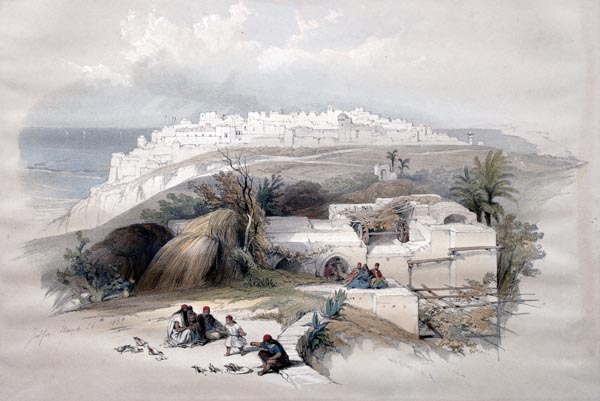
‘Jaffa’ - David Roberts (British, 1796 – 1864)
Cleveland Museum of Art
As soon as we left Jaffa’s walls, we entered the great Egyptian desert. Having decided to travel to Cairo by this route, I sent a messenger to El-Arish (in the Sinai) to hire camels to cross the desert. The journey from Jaffa to Cairo can be made in twelve to fifteen days, but involves great hardship and difficulty. The orders of the governor of Jaffa, and the kindness of the city’s leading citizens in their dealings with those of Gaza and El-Arish, had largely smoothed these difficulties for me.
The governor provided us with some cavalry and eight infantrymen, chosen from among the bravest and most civilised of the remaining soldiers in his Egyptian troop depot. They camped that very night at our gate. At daybreak, we mounted. At the city gate, on the Ramla side, we found a crowd of horsemen from all the nations inhabiting Jaffa. They rode around us and accompanied us to a magnificent fountain, shaded by sycamores and palm trees, about an hour’s walk away. There, they discharged their pistols in our honour and then returned to the city.
It is impossible to describe the novelty and magnificence of the vegetation that unfolds on both sides of the road on leaving Jaffa. To the right and left, there is a diverse forest of all kinds of fruit trees, and all the flowering shrubs of the Orient. This forest, divided into sections by hedges of myrtle, jasmine, and pomegranate trees, is watered by streams of water flowing from the beautiful Turkish fountains I mentioned earlier. In each of these enclosures, there is an open pavilion or tent, beneath which the family that owns them spends a few weeks in the spring or autumn. Three stakes and a piece of canvas form a country house for these fortunate families. The women sleep on mats and cushions inside the tent; the men sleep in the open air under the canopy of lemon and pomegranate trees. Melons, watermelons, and figs of thirty-two varieties, which shade these enchanted places, provide for their meals; only occasionally is a lamb, raised by the children, added to the feast, and it is sacrificed, as in biblical times, on solemn occasions. Jaffa is the place in all the Orient that a lover of nature and solitude should choose to spend the winter. The climate is the most delicate transition between the scorching deserts of Egypt and the autumn rains of the Syrian coast. If I were free to choose my abode, I would dwell at the foot of Lebanon — Sidon, Beirut, or Latakia — during the spring and autumn; on the heights of Lebanon during the summer heat, refreshed by the wind from the sea, the breezes that rise from the Valley of the Cedars, and the proximity of the snowfields; and in winter, in the gardens of Jaffa.
Jaffa has something about its land and sky that is more grandiose, more solemn, more colourful than any of the sites I have visited. The eye rests on a boundless sea, as blue as the sky; on the immense stretches of the Egyptian desert, where the horizon is broken, only occasionally, by the profile of a camel advancing with the undulations of a wave; and on the green and yellow tree-tops of the countless orange groves that crowd around the city. All the costumes of the inhabitants or travellers who enliven these roads are picturesque and strange. There are Bedouins from Jericho or Tiberias, clad in immense white woollen plaids; Armenians in long robes striped blue and white; Jews from all parts of the globe and in every kind of clothing imaginable, distinguished only by their long beards and by the nobility and majesty of their features: a sovereign people, ill-accustomed to their servitude, and in whose eyes one discovers the memory and certainty of a great destiny, behind the look of humiliation in their faces and the humility of their present fate; and Egyptian soldiers dressed in red jackets, quite like our French conscripts in their lively eyes and quick pace. One senses that the genius and energy of a great man has passed through them, animating them toward some unknown purpose. Then there are Turkish agas (chiefs, leaders), proudly riding desert horses, followed by Arabs and black slaves; poor families of Greek pilgrims sitting on street corners, eating boiled rice or barley from wooden bowls, saving their provisions to reach the holy city; and poor Jewish women, lightly-dressed and weighed down by the burden of enormous rag sacks, driving donkeys whose twin baskets contain children of all ages. But let me return to the journey.
We rode cheerfully, testing, from time to time, the pace of our horses which contrasted sharply with that of the Arabians ridden by the Messieurs Damiani, and the sons of the Vice-Consul of Sardinia. These latter two young men, sons of a wealthy Arab merchant from Ramla now living in Jaffa, had expressed the desire to accompany us to Ramla. That morning, they had sent their slaves to prepare their father’s house and a supper for us. We were also followed by another person who had voluntarily joined our caravan and who surprised us with the bizarre magnificence of his European attire. He was a young man of twenty to twenty-five, with a jovial and grotesque, yet refined and witty, face. He wore an immense yellow muslin turban, a green coat in the style of our court attire, with a high collar and wide tails, embroidered with broad gold braid along all the seams; tight-fitting white velvet trousers, and boots with turned-down cuffs, adorned with a pair of spurs with silver chains. He used a khanjar as a hunting knife, and a pair of pistols, inlaid with silver engravings, protruded from his belt and rapped against his chest.
Having left Italy in his childhood, he had been swept to Egypt by some twist of fate, and for some years now had been living in Jaffa or Ramla, practising his medical and other arts in the Judean mountains at the expense of the sheikhs and Bedouins, who had scarcely made his fortune. His conversation greatly amused us, and I would have liked to take him with me to Jerusalem and the Dead Sea mountains, which he seemed to know perfectly; but having lived in the East for several years, he had contracted the invincible terror that the Franks have there of the plague, and none of my offers succeeded in enticing him. ‘In times of plague,’ he told me, ‘I am no longer a doctor; I know only one remedy: leave quickly enough, travel far enough, and stay there long enough that the disease fails to reach you.’ He seemed to look upon us with pity, as if we were victims predestined to seek our deaths in Jerusalem; and of our large company, he expected to see very few upon his return. ‘A few days ago,’ he said, ‘in Acre, a traveller returning from Bethlehem knocked on the door of the Franciscan friary. They opened it; there were seven friars there. Two days later, all the doors were walled up by order of the governor; the pilgrim and the seven friars had died within a space of twenty-four hours.’
Ramla
Nonetheless, we soon saw the tower and minarets of Ramla, rising before us, from the middle of an olive grove whose trunks were as thick as those of our oldest oak trees. Ramla, has been claimed as the ancient Arimathea (location uncertain) of the New Testament; it contains approximately two thousand families. Philip the Good, Duke of Burgundy, founded a Latin monastery there (c1420), which still exists. The Armenians and Greeks also have monasteries there to assist pilgrims from their nations travelling to the Holy Land. The old churches have been converted into mosques; in one of these mosques is the white marble tomb of the Mamluk Ayoud-Bey, who fled Egypt upon the arrival of the French and died in Ramla.
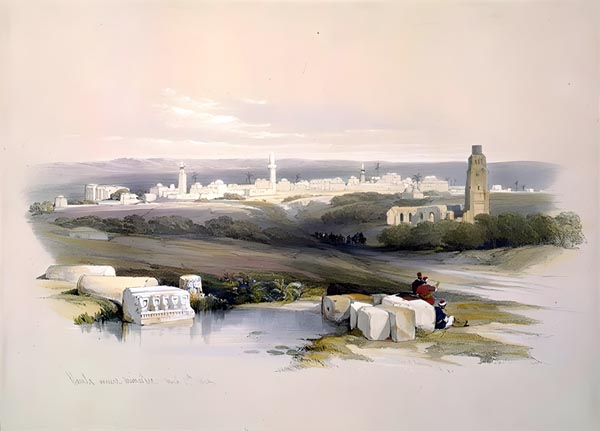
‘Ramla, ancient Arimathea’ - David Roberts (British, 1796 – 1864)
Library of Congress
Upon entering the city, we inquired whether the plague had already taken its toll: two monks, recently arrived from Jerusalem, had died there that very day; the monastery was under quarantine. Our new friends from Jaffa led us to their house, located in the heart of the town. An Arab, a former coppersmith, it was said, but a kind and excellent man, lived in half of this house and served as a consular agent for some European nation; this entitled him to fly a European flag on his roof: the surest protection against the indignities exercised on strangers by the Turks and Arabs. An excellent supper awaited us: we had the pleasure of finding chairs, beds, tables, all the utensils of Europe, and we even received a supply of fresh bread, thanks to the kindness of our hosts. The next morning, we took leave of all our friends from Jaffa and Ramla, who chose not to accompany us further, and departed, escorted only by our Egyptian cavalry and infantry.
I established the order of march thus: two horsemen in front, about fifty paces ahead of the caravan, to keep away any Arab or Jewish pilgrims we might encounter (who might be plague-carriers), and to keep them at a distance from our men and horses; to the right and left, on our flanks, the foot soldiers: then ourselves riding in single file, maintaining order, with the baggage in the middle. A small squad of our best horsemen formed the rearguard, having been instructed not to leave any man or mule behind. At the sight of a suspicious group of Arabs, the caravan was to halt and adopt battle formation, while the horsemen, interpreters, and ourselves would reconnoitre. In this way, we had little to fear from the Bedouins or the plague; and I must say that this marching order was observed by our Egyptian soldiers, our Turkish cavalry, and our own Arabs with a scrupulous obedience and attentiveness that would do credit to the most disciplined corps in Europe. We maintained it for more than twenty-five days, and in the most precarious positions. I never had a single reprimand to give to anyone: it was to these measures that we owed our survival.
After sunset, we arrived at the edge of the plain of Ramla, near a spring carved into the rock, which watered a small field of squash plants. We were at the foot of the Judean mountains; a small valley, a hundred paces wide, opened to our right, into which we descended: this is where the dominion of the Arab brigands of these mountains begins. As night approached, we judged it prudent to establish our camp in this valley: we pitched our tents about two hundred paces from the spring. We set up an advance guard on a knoll overlooking the road to Jerusalem; and while supper was being prepared for us hunted partridges on the hills within sight of our tents; we killed some, and flushed out, from among the rocks, a multitude of small eagles that dwell there. They rose up, spinning and screaming above our heads, and returned towards us even after we had fired at them. All creatures are usually afraid of fire, and the explosion of weapons; only the eagles seem to disdain them and toy with danger, either ignoring or defying it.
From the summit of one of these hills, I admired the picturesque sight of our camp, with our Arab cavalry pickets on the knoll, our horses tethered here and there around our tents, our mujahideen (fighting men) sitting on the ground, busy cleaning our harnesses and weapons, and the smoke of our fire, rising from one of our canvas tents, its light blue column spreading and twisting in the breeze. How I would love this nomadic life under such a sky, if only one could have with one all those that one loves and misses! The whole earth belongs to pastoral and wandering people like the Arabs of Mesopotamia. There is more poetry in one of their days than in entire years of our city lives. By demanding too much from civilised life, human beings nail themselves to a single place; they cannot detach themselves therefrom without losing those countless superfluities the habitual use of which has rendered them needs. Our homes are our voluntary prisons. I wish life were an endless journey, like this one; and if I were not bound to Europe by my affections, I would continue it as long as strength and fortune allowed.
We were on the border between the tribes of Ephraim and Benjamin. The well near which our tents were pitched is still called Job’s Well. We set off before daybreak; for two hours we followed a narrow, barren, and rocky valley, notorious for the depredations of the Arabs. It is the most exposed place in the area to their raids: they can reach it through a multitude of small, winding valleys, hidden from view by the uninhabited hills; and lie in ambush behind rocks and bushes, pouncing unexpectedly on caravans. The notorious Abu Gosh, chief of the Arab tribes of these mountains, holds the key to the passes which lead to Jerusalem: he opens or closes them at will, and extorts money from travellers. His headquarters were some miles ahead, in the village of Qaryat al-’Inab (modern Abu Gosh). We expected at any moment to see his horsemen appear: we encountered no one, except a young aga, a relative of the governor of Jerusalem, mounted on a magnificent mare, and accompanied by seven or eight horsemen. He greeted us politely, and stepped aside, with his retinue, to let us pass, taking care not to touch our horses or our clothes.
Abu Gosh (Qaryat al-’Inab)
About an hour before reaching Qaryat al-’Inab, the valley narrows further, and trees extend their branches over the trail. There is an old fountain there, and the remains of a ruined kiosk. For an hour, one climbs a steep and uneven path, carved into the rock, through the woods, and suddenly one sees the village and the church of Qaryat al-’Inab at its foot, on the slope of the hill. The magnificent crusader church (Church of the Resurrection), currently used as a mosque, appears to have been built during the time of the Kingdom of Jerusalem, under the Lusignans (in the twelfth century). The village consists of forty to fifty rather large houses, clinging to the slope of two hills that embrace the valley. A few scattered fig trees and some vineyards suggested some form of cultivation: we saw flocks of sheep scattered around the houses; Arabs, wearing magnificent caftans, were smoking their pipes on the terrace of the main house, a hundred paces from the path by which we descended. A score or less of horses, saddled and bridled, were tethered in the courtyard of the house. As soon as the Arabs saw us, they came down from the terrace, mounted their horses, and advanced slowly towards us. We met in a large, uncultivated open space facing the village, which was shaded by five or six beautiful fig trees.
Here was the famous Abu Gosh and his family. He and his brother advanced alone to meet me; his entourage remained behind. I immediately halted mine as well, and approached with my interpreter. After the customary greetings and endless compliments that precede any conversation with Arabs, Abu Gosh asked me if I was not the Frankish emir whom his friend Lady Stanhope, the Queen of Palmyra, had placed under her protection, and had sent him, in my name, the magnificent jacket of cloth-of-gold which he was wearing, and which he showed me with pride and gratitude. I was unaware of this gift from Lady Stanhope, so obligingly given on my behalf, but I replied that I was indeed the foreigner whom this illustrious woman had entrusted to the generosity of her friends in Qaryat al-’Inab; that I was going to visit all of Palestine where Abu Gosh’s rule was recognised, and that I begged him to give the necessary orders so that Lady Stanhope would have no reproach to make against him. At these words, he dismounted, as did his brother; he called some horsemen from his retinue, and ordered them to bring mats, carpets, and cushions, which were spread under the shade of a large fig tree in the very field where we were, and begged us with such earnest entreaties to dismount and seat ourselves on this rustic couch that it was impossible for us to refuse.
As the plague was raging in Qaryat al-’Inab, Abu Gosh, knowing that the Europeans were in quarantine, took care not to touch our clothes, and set up his couch and that of his brothers opposite us, at a certain distance. As for ourselves, we accepted only mats of straw and rushes, because they are believed not to transmit the contagion. Coffee and sherbet were brought. We had a rather long general conversation; then Abu Gosh asked me to command my entourage to move away a little, commanding his own to do likewise, so as to confide some secret information that I refrain from recording here. After talking like this for a few minutes, he summoned his brothers closer, while I summoned my friends likewise. ‘Is my name known in Europe?’ he asked me. ‘Indeed.’ I said, ‘Some say you are a brigand, pillaging and massacring caravans, taking Franks into slavery, and are a fierce enemy of Christians; others assure us that you are a valiant and generous prince, suppressing the brigandage of the mountain Arabs, securing the roads, protecting the caravans, and a friend to all Franks worthy of your friendship.’ ‘And you,’ he said, laughing, ‘what will you say of me?’ ‘I will say what I have seen,’ I replied, ‘that you are as powerful and as hospitable as a Frankish prince, that you have been slandered, and that you deserve to have as friends all Europeans who, like me, have experienced your kindness and the protection of your sword.’ Abu Gosh seemed delighted. He and his brother asked me many more questions about European customs, our clothes, and our weapons, which they greatly admired; and then we parted. As we were leaving, he ordered one of his nephews, and some of the horsemen to lead our caravan, and not to leave me for the entire time I stayed, whether in Jerusalem or in the surrounding area. I thanked him, and we departed.
In effect, Abu Gosh rules over approximately forty thousand Arabs in the Judean mountains, from Ramla to Jerusalem, and from Hebron to the mountains of Jericho. This dominion, perpetuated in his family for several generations, has no other basis than sheer power. In Arabia, the origin or legitimacy of power is not questioned; it is recognised, and people submit to it as long as it exists. One family was older, more numerous, richer, and braver than the others: the head of this family naturally became more influential over the tribe; the tribe itself, better governed, and more skilfully or more valiantly led in war, became dominant without serious challenge.
Such is the origin of all those supremacies of chief and tribe that one finds everywhere in Asia. Power is assumed and maintained as a natural thing; everything stems from the family, and, once the fact of this ascendancy is recognised and established by custom and habit, none dispute it; obedience becomes something filial and religious. It takes great events and immense misfortunes to overthrow a family; and this nobility is preserved for centuries, voluntarily, so to speak. One cannot truly understand the feudal system until one has visited these regions; one sees how, in the Middle Ages, all those families, those local powers that reigned over castles, villages, and provinces formed: it is the first stage of civilisation. As society progresses, minor powers are absorbed by major ones; municipalities arise to protect the rights of towns against the declining influence of the feudal houses. Great kingdoms emerge, which in turn revoke obsolete municipal privileges; then come further social phases, whose phenomena are countless and not yet fully understood.
We were now far from Abu Gosh and his band of organised brigands. His nephew was riding ahead of us on the road to Jerusalem. About a mile from Qaryat al-’Inab, he turned off the road and plunged to the right, onto a series of rocky paths that wound over mountains covered in myrtle and terebinth trees. We followed him. The news from Jerusalem that Abu Gosh had given us was such that there was currently no possibility of entering the city. The plague was worsening there every moment; sixty to eighty people were succumbing every day; all the hospices and convents were closed. We resolved to go first to the desert of Saint John the Baptist, about five miles from Jerusalem, in the most rugged mountains of Judea; to ask for a few days’ shelter at the convent of the Latin monks who reside there, and then to act according to the circumstances. It was this solitary road that Abu Gosh’s nephew had us follow.
After riding for about two hours along dreadful paths under a blazing sun, we found, on the mountainside, a small spring and the shade of a few olive trees: we halted there. The site was sublime: we overlooked the deep, dark Vale of Terebinth (the Valley of Elah), where David, with his sling, killed the Philistine giant, Goliath. The position of the two armies is so clearly obvious, as regards the contours of the valley, and the slope and layout of the land, that it is impossible for the eye to doubt. The dry streambed (Nahal El Elah is a seasonal stream, a wadi) from whose banks David selected the fatal stone, traced a whitish line down the centre of the narrow valley, marking, as in the biblical account, the separation of the two camps. I had neither Bible nor travel guide in hand, and no one to give me the key to the place or the ancient names of the valleys and mountains; but my childish imagination had so vividly and accurately conjured up the shape of the various places, the physical appearance of the various scenes in the Old and New Testaments, based on the accounts and engravings in the holy books, that I immediately recognised the Valley of Terebinth and the battlefield of Saul. When we arrived at the monastery, I had only to ask the Latin Fathers to confirm the accuracy of my predictions. My travelling companions could scarcely believe it.
The same thing had happened to me in Sepphoris, in the hills of Galilee. I had pointed to and named a hill surmounted by a ruined castle, as the probable birthplace of the Virgin. The next day, the same thing happened again at the Maccabean dwelling in Modi’in (in the vicinity of modern Modi’in-Maccabim-Re’ut): passing by the foot of a barren mountain topped with the remains of an aqueduct, I recognised the tomb of those last great citizens of the Jewish people, and I spoke the truth without knowing it. Human imagination is truer than we think; it does not always build with the stuff of dreams, but proceeds by an instinctive assimilation of objects and images that produces results more immediate and evident than does science and logic. Except for the valleys of Lebanon, the ruins of Baalbek, the shores of the Bosphorus at Constantinople, and the first glimpse of Damascus from the Anti-Lebanon Mountains, I have almost never encountered a place or a thing whose first sight was not like a memory. Have we lived twice, or perhaps a thousand times? Is our memory merely a tarnished mirror that the breath of God revives? Or do we have, in our imagination, the power to sense and see before we meet with the corresponding reality? Insoluble questions!
Ein Kerem (Ain Karim)
At two in the afternoon, we descended the steep slopes of the Vale of Terebinth, we crossed the bed of the dry torrent, and climbed, via stairs carved into the rock, to the Arab village of Saint John the Baptist (Ein Kerem/Ain Karim, now within Jerusalem), which we saw in front of us. Arabs with fierce expressions stared at us from the terraces of their houses; women and children crowded around us in the narrow streets of the village; the monks, terrified by the commotion they could see from their rooftops, by the number of our horses and men, and of the plague we might be bringing them, refused to open the iron gates of the monastery. We retraced our steps and camped on a hill near the village; we cursed the hard-heartedness of the monks. I sent my dragoman to parley with them again, and address the reproaches to them that they deserved. Meanwhile, the entire population descended from the rooftops; the sheikhs surrounded us, mingling their savage cries with the neighing of our terrified horses; a horrible confusion reigned throughout our caravan; and we primed our rifles.
Abu Gosh’s nephew, perched on the roof of a house near the monastery, addressed the monks and the people in turn. Finally, on the monks’ yielding, we obtained entrance to the monastery: a small iron gate opened for us to pass through, stooping, one by one; we unloaded our horses, which we led through after us. Abu Gosh’s nephew and his Arab horsemen remained outside, intending to encamp by the gate. The monks, pale and distraught, trembled at the thought of contact with us; we reassured them, giving them our word that we had not communicated with anyone since Jaffa, and that we would not enter Jerusalem as long as we remained lodged in their refuge. At this assurance, their faces regained their composure; we were ushered through the vast corridors of the monastery; each of us was led to a small cell furnished with a bed and a table, and decorated with a few Spanish engravings of pious subjects. Our soldiers, Arabs, and horses made camp in an uncultivated garden of the monastery; barley and straw were thrown over the walls; sheep and a calf, sent as gifts by Abu Gosh, were slaughtered for us in the street outside; and while my Arab cook, along with the serving brothers, prepared our meal in the monastery kitchen, each of us went to rest for a moment in the cell allocated, to be cooled by the mountain breeze, or contemplate the unfamiliar view surrounding the monastery.
The Monastery of Saint John in the Desert is a branch of the Latin Monastery of the Holy Land in Jerusalem. Those monks whose age, infirmities, or inclination towards a deeper retreat, make them more willing cenobites are sent to this house, which is large and beautiful, surrounded by gardens carved into the rock, courtyards, and wine presses used in producing the excellent wine of Jerusalem. There were about twenty monks there when we arrived; most were elderly Spaniards who had spent the greater part of their lives serving as parish priests, either in Jerusalem, Bethlehem, or other cities of Palestine. A few were novices who had arrived fairly recently from their monasteries in Spain. The ten or so days we spent with them left us with the finest impression of their character, their charity, and the purity of their lives. The superior, above all, is the most accomplished model of the Christian virtues: displaying simplicity, gentleness, humility, unwavering patience, ever-gracious obligingness, ever-timely zeal, tireless care for brothers and strangers alike, without regard for rank or wealth, a natural faith, both active and contemplative, and a serenity of temper, speech, and countenance that no adversity could ever disturb. He is one of those rare examples of what the perfection of the religious principle can produce in a human soul: the man exists only in visible form; the soul is already transformed into something superhuman, angelic, deified, something that shuns admiration, yet commands that same.
We were all equally struck, masters and servants, Christians and Arabs alike, by the contagious holiness of this excellent monk; his spirit seemed to have influenced all the Fathers and brethren of the monastery; for, to varying degrees, we admired a little of the superior’s qualities in all, and that house of charity and peace has left me with an indelible memory. I have always found monastic life, in our age, to be profoundly repugnant to intellect and reason; but the life of the Monastery of Saint John the Baptist might have proven spiritual enough as to dispel even my aversion were it not an exception and, were it not for it being contrary to human nature, the family, and society, to seek to justify the existence of such institutions. Moreover, monasteries in the Holy Land serve a purpose; they are useful to society through the refuge they offer to pilgrims from the West, through the example of Christian virtues they can provide to peoples who are ignorant of those virtues; and finally, through the relationships they alone maintain between certain parts of the East and the Western nations.
The Fathers woke us towards evening to lead us to the refectory, where their servants and ours had prepared our meal. This meal, like every other in the monastery, consisted of omelettes, pieces of mutton on an iron skewer roasted over the fire, and rice pilaf. We were given, for the first time, excellent white wine from the surrounding vineyards: it is the only wine known in Judea. The Desert Fathers of Saint John the Baptist are the only ones who know how to produce it, and they supply it to all the monasteries in Palestine. I bought a small barrel, which I sent to Europe. During the meal, all the monks walked about the refectory, chatting with us in turn; the superior made sure that we lacked nothing, and often served us with his own hands, fetching liqueurs, chocolate, and all the sweets left over from the last shipment that had arrived from Spain, from the monastery cupboards. After supper, we ascended with them to the monastery terraces: this is where the monks’ usually walk during times of plague, and they often remain secluded in this manner for several months of the year. ‘Besides,’ they said, ‘this seclusion is less painful for us than you think; for it gives us the right to close our iron gates to the local Arabs, who constantly bother us with their visits and demands. When the quarantine is lifted, the monastery is always full of these insatiable men: we prefer the constraints induced by the plague to the necessity of seeing them.’ I understood this after experiencing their attentions myself.
The Monastery of Saint John of the Desert sits atop a little hill surrounded on all sides by deep, dark valleys whose depths are hidden. The flanks of these valleys, facing the monastery windows on every side, are hewn almost vertically from the grey rock that forms their base. The cliffs are riddled with deep caverns, carved out by Nature and deepened by the hermits of early centuries, providing shelter for eagles and doves. Here and there, on slightly shallower slopes, one sees a few cultivated vines climbing the trunks of small fig trees, and cascading down the rocks. Such is the appearance of all such solitary sites here. A grey hue, speckled with yellow-green, covers the entire landscape; from the monastery roof, one plunges in every direction into bottomless abysses; a few poor houses of Muslim Arabs and Christians huddle on the rocks in the shadow of its buildings. The local Arabs were viewed as the fiercest and most treacherous of people. They recognised Abu Gosh’s authority. The very name Abu Gosh made the monks pale. They could not understand what power of seduction or title to authority had induced that leader to welcome us thus, and grant us his own nephew as a guide; they suspected some superior diplomatic skill in this, and constantly sought my protection with that tyrant of tyrants.
We returned when night fell and spent the evening in the monastery corridor, in pleasant conversation with the excellent superior and the kind Spanish Fathers. They were strangers to recent events; no news from Europe had crossed these inaccessible mountains. It seemed impossible for them to grasp the latest situation in France (the July Revolution of 1830 had led to the overthrow of Charles X, the French Bourbon monarch, and the ascent of his cousin Louis Philippe, Duke of Orléans). ‘Well,’ they would say in conclusion to all our stories, ‘as long as the King of France is still a Catholic, and France continues to protect the monasteries in the Holy Land, all is well.’ They showed us their church, a charming little nave built on the spot where the forerunner of Christ was born, which was embellished with an organ, as well as several mediocre paintings of the Spanish school.
The next day, we could not resist the desire to cast a distant glance at Jerusalem. We settled terms with the monks; it was agreed that we would leave some of our people, horses, and baggage at the monastery; that we would only take with us the horsemen from Abu Gosh, the Egyptian soldiers, and those Arab servants who were indispensable for the care of our saddle-horses; that we would refrain from entering the city; that we would confine ourselves to circling it, avoiding contact with the inhabitants; and that in the event that, by accident or otherwise, such contact was to occur, we would no longer request to return to the monastery, but would withdraw our belongings and our entourage, and set up camp in the vicinity of Jerusalem. These conditions we accepted, and with no other guarantee given than our word, our truthfulness being taken on trust, we departed.
The End of Part V of Lamartine’s ‘Voyage en Orient’