Alphonse de Lamartine
Travels in the Near East (Voyage en Orient, 1832-33)
Part IV
Translated by A. S. Kline © Copyright 2026 All Rights Reserved
This work may be freely reproduced, stored, and transmitted, electronically or otherwise, for any non-commercial purpose.
Conditions and Exceptions apply.
Contents
Notes on the Emir Bashir
Upon the death of the last descendant (Ahmad ibn Mulhim ibn Yunus Ma’n, who died in 1697) of Emir Fakardin (Fakr al-Din II), command of the mountain passed into the hands of the Shihab (Chehab) family. This family has only been established in Lebanon for about a hundred and forty years. Here is what the old Arab chroniclers of the Damascus desert recounted:
Around the beginning of the first century of the Hijra (or Hegira, Muhammad’s migration from Mecca to Medina, which took place in 622AD), at the time when Abu Bakr’s armies invaded Syria, a man of great bravery named Abdalla, a resident of the small village of Bet-Shihabi in the desert near Damascus, distinguished himself at the siege of that city and was killed beneath its walls. The Muslim general showered his family with blessings, who then left Bet-Shihabi to settle in Hasbaya (at the foot of Mount Hermon), in the Anti-Lebanon. The original line of this family can still be found there, from which came the branch that reigns today over Lebanon.
Emir Bashir, one of Abdalla’s descendants, was orphaned at a young age. His father, Quasim (Qasim ibn Umar ibn Haydar ibn Husayn Shihab), had received the hakem cloak and ring of command, when his uncle Emir Mulhim left office to spend his final days in retirement; but Quasim, who then ran the administration, was inept and lacking in energy, and Mulhim, forced to take command again, had to repair his nephew’s mistakes and quell the unrest that his incompetence had caused.
As Volney (the Orientalist, Constantin-François Chassebœuf de La Giraudais, Comte de Volney) reported, power then passed successively from Mansur to Yusuf, the former the brother, the latter the son, of Mulhim. When Yusuf first assumed command (in 1770), Bashir was only three years old. His father, Quasim, having died in 1767, Yusuf took Bashir under his wing and had him educated carefully. Later, recognising in him a quick and courageous mind, he brought him into the affairs of his government.
At that time, Djezzar (Ahmed Pasha al-Jazza) the Pasha of Acre, who had succeeded Daher (Daher al-Umar al-Zaydani), had long been harassing Emir Yusuf, attacking him, and demanding exorbitant taxes. War broke out; but Bashir could not accompany Yusuf on this expedition: it was only in 1784 that he participated in the second expedition against Djezzar Pasha. The young Bashir, then seventeen years old, ran into great danger in the town of Ryde, which the Druze had seized. Pursued by troops the Pasha, forced to evacuate the town, found himself surrounded by the enemy during his retreat. The situation was critical: Bashir urged his horse swiftly towards a wall, from the top of which he plunged beneath a hail of bullets; fortunately, he was not hit, but his horse was killed in the fall.
Upon returning to Lebanon, Bashir devoted himself entirely to affairs of state and sought to restore order to Emir Yusuf’s administration. Soon, ambition stirred within him; he remembered his lineage and, despite his poverty, coveted supreme power. His manners and courage had already earned him the friendship of several powerful families; he worked to win over others disgusted by Emir Yusuf’s misrule, and succeeded in securing the allegiance of a considerable and highly influential family, the Jumblatt, whose head, the most capable man then in Lebanon, was immensely wealthy and bore the title of Sheikh Beschir, meaning great and illustrious. Bashir needed only one more opportunity: and it presented itself.
Since 1785, when Djezzar Pasha had restored to Yusuf the command he had withheld for over a year, hostilities between the two princes had completely ceased. Every year, Emir Yusuf sent officers to Acre with the customary compliments, to renew his cloak of authority; however, he always feared a misunderstanding between himself and the Pasha, which soon materialised.
In 1789, a violent quarrel erupted between these two princes; and Emir Yusuf, unable to resist the pressure, resolved to abdicate. Bashir had influence; Yusuf liked him: he summoned him and advised him to go to Acre to request the ring of command. Bashir initially refused, explaining to Yusuf that he would then be forced to remove him from his domain, since the Pasha would demand it, and that his presence in Lebanon would be a constant source of conflict. Yusuf, in proposing the course of action to his relative, had two objectives: to prevent power leaving his family; and to retain command once Bashir had resolved the difficulties, either through conciliation or by force of arms.
He therefore persisted; and, on the promise Yusuf gave to leave the country as soon as Bashir received command, the young prince departed for Acre. Djezzar Pasha welcomed him kindly, entrusted him with the command of Lebanon, and gave him eight thousand men to consolidate his power and capture Emir Yusuf. Upon arriving at the bridge of Jisr El Qadi, Bashir secretly wrote to Yusuf, informing him of the instructions he had received from the Pasha, and urged him to withdraw. Emir Yusuf retreated to Jbeil (Byblos, also Gibel), in Keserwan, where he gathered his supporters. Bashir added to his own soldiers those he had brought from Acre and marched against Yusuf, whom he met in Keserwan. He engaged him in battle and inflicted heavy losses; however, several months passed without any decisive result.
To settle the dispute, Yusuf sent a messenger to Acre promising the Pasha a tribute higher than that paid by Bashir, if he were reappointed; Djezzar agreed, summoned him to Acre, granted him command, and provided him with the same eight thousand men who had fought against Bashir to drive the latter out. Emir Bashir withdrew to the district of Mar-Méri (Beit Meri), where he worked to overthrow his rival, offering even more than Emir Yusuf had promised. The Pasha accepted, and Yusuf was once again forced to relinquish power. He returned to Acre to attempt further intrigues; but Bashir offered the pasha four thousand purses (containing five hundred coins worth forty centimes each) if he would have Yusuf killed, hoping to put an end to the unrest in the mountains.
Djezzar was in Damascus at the time. His customs officer (a Greek in whom he had complete confidence and who, in his absence, was considered the Pasha of Acre) negotiated on his behalf and informed his master of the deal he had concluded. Djezzar was initially pleased with the proposal, ratified the agreement, and ordered the execution by hanging of Emir Yusuf and his minister Gandour.
No sooner had Djezzar issued this order than he regretted it. It seemed to him that the enmity between the two princes was to his advantage, and he sent a second order revoking the first; but whether it arrived too late, or the minister had been won over, Emir Yusuf was hanged (in 1790). This execution angered the Pasha; he went to Acre, demanded an account of the affair, claimed he had been deceived, and had his customs officer drowned, along with his entire family, as well as several other people accused of involvement in the affair.
Djezzar confiscated the immense treasures of his favourite, and wrote a letter of reproach to Bashir. The tone of the dispatch showed the young prince that he was compromised. He tried to justify himself to the Pasha, who concealed the matter until the time of the governor’s re-election: then Djezzar invited the prince to Acre to receive the investiture.
He arrived unsuspectingly with his minister, Sheikh Beschir (Jumblatt); but no sooner had they arrived than they were thrown into a dungeon, where they had to endure all kinds of hardships during eighteen to twenty months of captivity. Djezzar’s aim in treating them in this manner was to force them to pay a large ransom; but the prince had insufficient resources; he had held command for too short a time to amass great wealth. His minister took matters into his own hands: he secretly sent to the Pasha a Druze prince’s widow named Sitt Abbous, with whom he had had an intimate relationship; he instructed her to offer the Pasha the required sum, and pretend to pawn her own jewels to make up the ransom. She departed. She was a shrewd, bold, and most cunning woman. She found the Pasha in Acre and won him over so completely by her personal charm and intellect that Djezzar considerably reduced the sum he had initially demanded. The investiture was returned to Emir Bashir, who was thus restored to the Pasha’s favour (in 1797).
During this captivity, Emir Yusuf’s brother, Emir Haydar of Baabda, had seized power and taken the necessary measures to prevent Emir Bashir from returning to his states should Djezzar grant him his freedom. As soon as he was released from prison, the prince, not deeming it prudent to reappear among his people, sent his minister, Sheikh Beschir, to gauge public opinion, and withdrew to the village of Homs to await the outcome of his negotiations. He also worked to win over Emir Abbets, the Druze prince of Salima, who until then had maintained neutrality and who enjoyed the highest esteem among the Druze and Christians, especially those of the district of Marcaeutre.
Emir Abbets, judging Emir Bashir’s cause just, took his side and urged him to join him. As communication was extremely difficult, he sent his dispatch via an Italian, a lay brother from a monastery in Salima. Bashir gathered his supporters, whose numbers Sheikh Beschir had increased through his generosity and skill, and impetuously attacked his rivals’ army, scattered it, and captured the two princes then in power.
Emir Baschir, now a peaceful possessor of power, had married the widow (Shams al-Madid) of a Turkish prince (Bashir ibn Najm), like himself from the Chehab family, whom he had killed ten years earlier. This union had made him master of an immense fortune. Before marrying, this princess, who was of great beauty, was baptised. The marriage was most happy. At the age of sixty-eight, the princess was afflicted with infirmities and paralysis that deprived her of the use of her legs. The Emir and his wife offered an example of the most ardent affection and the most perfect union.
Upon his death, Emir Yusuf had left behind three young children. Giorgios, the Bey of Hydra, and his brother Abdallah had raised them carefully, hoping that they would one day revive the party of Yusuf, and overthrow Emir Bashir; but the latter triumphed over all these obstacles, and enjoyed a peaceful exercise of power until 1804.
Events of the utmost importance were taking place in Egypt: Bonaparte, having entered Syria with an army corps, arrived before Acre, which was to open the gates of the East to him. The French general urged the Prince of Lebanon (Bashir), through pressing letters and emissaries, to take his interests into account and help him seize the city. Emir Bashir replied that he was willing to join him, but that he would only do so after the capture of Acre. A Frenchman once reproached the Emir for not having enthusiastically embraced the cause of the French army, and perhaps hindering thereby the regeneration of the East; he replied:
‘Despite my fervent desire to join General Bonaparte, and the profound hatred I harboured for the Pasha, I could not embrace the cause of the French army. The fifteen or twenty thousand men I could have sent from the mountains would have done nothing to ensure the success of the siege. If Bonaparte had succeeded in taking the fortress without my assistance, he would then have invaded the mountains without a fight, for the Druze and the Christians ardently desired it; and I would therefore have lost my command. Conversely, if I had aided General Bonaparte and we had not taken the fortress (which would likely have been the case), the Pasha of Acre would have had me hanged, or thrown into a dungeon. Who would have come to my aid? Whose protection could I have sought? That of France which was so far away, which had England and all Europe on its hands, and which was itself torn apart by civil war and factions?’ Bonaparte understood Prince Bashir’s situation; and, as proof of his friendship, presented him with a superb rifle, which Bashir kept in memory of the great man.
Before recounting the story of the events that followed the downfall of Emir Yusuf, it would be appropriate to relate an adventure that perhaps prompted Pasha Djezzar’s fierceness and cruelty as an individual.
In the early years of his command, he would, according to custom, meet the caravan returning from the pilgrimage to Mecca. (Later, the Pasha of Damascus was entrusted with this ceremony, while the Pasha of Acre was only required to cover the caravan’s expenses, and pay tribute to the desert Arabs.) The Mamluks (a non-Arab warrior class in the Muslim world, derived from slave-soldiers), to whom Djezzar had entrusted the guard of his seraglio in his absence, forced the gates and gave free rein to the full brutality of their passions.
The Pasha returned; far from fleeing at his approach, the Mamluks seized the treasury, and closed the city gates, determined to respond to force with force. With the small escort that accompanied him, Djezzar could not prevail: however, the Mamluks informed him that if he would allow them to withdraw with their weapons and horses, the city gates would be opened to him; otherwise, they would fight, and would rather die weapon in hand than surrender.
Djezzar-Pasha needed little time to reflect: he knew he was hated by the Turks as well as the Christians, because of his exactions; he also knew that if Emir Yusuf were to learn of his position, he would ally himself with the Mamluks, and wage a war against him that could prove fatal.
He granted the Mamluks’ demands, and they quickly departed, Pasha then entering the city. No sooner had Djezzar reached his palace than he dispatched his cavalry in pursuit of the fugitives; though in vain: the Mamluks arrived safely in Egypt. Djezzar then took his revenge on his wives; he had them all flogged, then thrown into a large pit, and finally covered with quicklime. This atrocious method of execution was not the fate of his favourite; instead, she was dressed in her finest clothes and adorned with jewels, then placed in a chest and thrown into the sea.
This event further darkened Djezzar’s character. He was already miserly and a swindler; he became fierce and cruel: he spoke only of slicing off noses, chopping off ears, and gouging out eyes. At the hour of his death, no longer able to speak or order executions, he gestured to those around him, pointing to the head of his bed. Fortunately, he was not understood. After his death, a long list of people condemned to die once he regained his health was found. His ferocity followed him even to the grave.
Let us return to Prince Bashir. As soon as Emir Yusuf’s sons were old enough to vie for power, Giorgios Bey and Abdallah resolved to put their plans into action. They took advantage of a moment of tension between Djezzar and Prince Bashir and roused their protégés. The Emir, caught off guard, was forced to retreat to the Hauran region and sought the Pasha’s mediation, appealing to his avarice and greed. Djezzar intervened and imposed a treaty that reconciled the two parties but greatly favoured Bashir, granting him the Druze territory, while Yusuf’s sons retained Jbeil and Keserwan.
This treaty was observed for only a few years. The sons of Yusuf sought every possible means to overthrow their enemy. As they were the stronger, they succeeded; and Djezzar, refusing to heed Bashir’s representations, sanctioned the usurpation. The Emir then had no other recourse than to throw himself into the arms of the Viceroy of Egypt.
At that time (1801), the English admiral Sydney Smith was in the vicinity of Syria with several ships. Bashir begged him to take him on board and transport him to Egypt. After spending several months at sea, stopping at Cyprus, Smyrna, Crete, and Malta, he landed at Alexandria, where he went to see the Viceroy, accompanied by a few friends who had remained loyal to him.
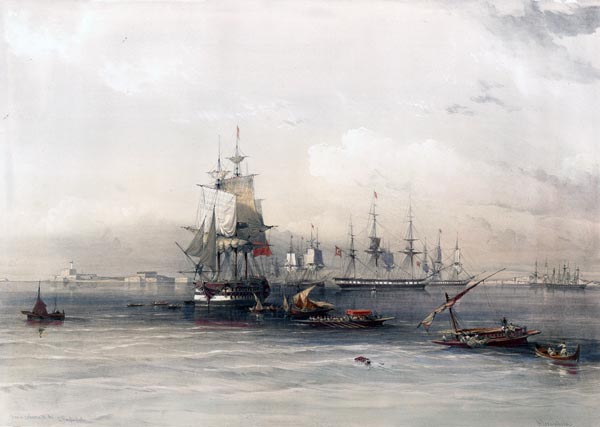
‘Alexandria (1846-1849)’ - David Roberts (British, 1796 – 1864)
Artvee
The Viceroy gave him a most flattering welcome, treated him with all the respect due to his position, showered him with gifts, and sent him back to Syria on one of Admiral Sydney Smith’s ships, with a letter for Djezzar full of reproaches and threats, in which he ordered him to reinstate Emir Bashir in his command. The Viceroy was powerful: Djezzar Pasha hastened to obey, for the tone of the dispatch made him realise that he should neglect nothing to satisfy Bashir. He therefore ordered the sons of Yusuf, who dared offer little resistance, to conform in all things to the treaty; and, until his death, the deepest peace reigned between the two parties.
Emir Bashir, however, did not rely entirely on the protection of Muhammad Ali alone; he saw the party of the three princes growing stronger every day and feared falling victim to some plot, for he knew the burning thirst for revenge that led them to oppose him. The skill of their ministers, Giorgios-Bey and Abdallah, further increased his anxieties. He therefore resolved to strike a decisive blow, capable of instilling terror in the hearts of his enemies. He took advantage of the investiture of Sulayman Pasha (al-Adil), who had succeeded Djezzar (in 1805), to carry out his plan. At that time, all seemed calm in Lebanon: the three princes governed their provinces peacefully and appeared to submit, without reservation, to the supremacy that the treaty granted to their enemy, while their ministers secretly prepared everything for a new attack.
Emir Bashir took the initiative. Informed of the opportune moment by his confidants, he summoned Giorgios Bey to Deir El Quamar under the pretext of business. At the same time, his brother, Emir Hassem, attacked Jbeil, seized the princes, and hanged Abdallah. The three brothers were taken to Zouk Mikael, where their eyes were gouged out. Their property was confiscated to the benefit of Emir Bashir. Upon hearing of these events, Giorgios Bey threw himself from a prison window, and died; this did not prevent the Emir from having his corpse hung as an example to his enemies. Five chiefs of Deir El Quamar, and a brother of Sheikh Beschir, all from the house of Jumblatt, accused of having helped the defeated princes, were put to death, and their property confiscated.
After these executions, Prince Bashir assumed supreme authority over all of Lebanon, giving his brother Jihan the command of Keserwan, whose capital was then Ghazir; but as he died shortly afterward, Emir Bashir was accused of having poisoned him, because he suspected him of secretly scheming against him, being driven by ambition. This accusation was unfounded, and public opinion refuted it.
Around 1819, the regions of Jbeil (Byblos), Gibes, and Keserwan rose up in revolt over a tax that sparked widespread discontent. On the advice of the Catholic Patriarch Yusuf Istafan, the rebels resolved to attack Emir Bashir in the Druze region, where he then resided. Without giving the insurgents time to assemble, the prince himself set out to meet them at the head of a small army corps, after ordering his lieutenant general, Sheikh Beschir, to follow him with a force of three thousand men hastily assembled. The Emir entered the region of Gibes and camped in a valley in the district of Aachqout, between Djani and the territory of Ghazir. The following night and the next morning, he came under heavy fire from several enemy detachments holding the high ground. His tent was riddled with bullets, and despite the entreaties of his son Khalil, he refused to change position. As day drew on and the enemy fire intensified, Bashir believed the rebels had increased their forces and intended to block his path. He then rose from the carpet on which he had remained during the skirmish, mounted his horse, and rode straight toward the enemy, accompanied by his small escort. At his approach, the insurgents dispersed without resistance, and he arrived at Gibes, where he took decisive action to prevent their forces from increasing.
His lieutenant general, Sheikh Beschir, who had been following him closely, crossed the Dog River (Nahr el- Kalb) and, with his three thousand men, seized two key villages of Keserwan, Zouk-Mikael and Zouk-Mosbeh, which lay along his route. On the very day of this occupation, a priest was arrested at one of the outposts, carrying dispatches to Bishop Yusuf; Sheikh Beschir, having read these letters, presented his khanjar (traditional curved dagger) to the man who had brought them to him, and ordered him to kill the priest, and bury him where he had been arrested. A few hours later, another secret messenger met the same fate.
The following day, Sheikh Beschir set off again. He occupied Keserwan without hindrance and had all those whom Emir Bashir had listed on a note he had sent him strangled. He thus reached Jbeil, where he joined the prince, who had arrived from Gibes. Emir Bashir remained nine days in this province, during which he completely crushed the revolt by having all the prominent rebels from the three districts of Gibes, Keserwan, and Jbeil hanged or strangled; several others were flogged and, in addition, ruinous ransoms were demanded of them.
Among them was a poor old man of seventy-five, condemned to pay seventy purses; he could not pay them. His son wrote to him, saying that he was going to obtain a loan, and begging his permission. The old man replied that he would pay nothing, adding some rather unkind remarks about the prince. The letter was intercepted, and the old man was condemned to torture. The unfortunate man, already burdened by age, could not withstand the pain, and when, on the orders of Sheikh Beschir, he was returned home, he died after twenty days of suffering. His son inherited the sentence laid down for his father’s crime; his property was confiscated for the benefit of the Emir, who left him only a thousand piastres.
Emir Bashir ascended the mountains to Ehden, traversed the Cedars of Lebanon (Arz Lebnane), and descended to Baalbek on the other side of the mountain, while Sheikh Beschir occupied the rebellious province. On arrival at Baalbek, the Prince (Bashir) ordered his lieutenant-general to return by the same route he had taken, and to raise, on the way, a contribution of four hundred purses (of five hundred piastres each) from the three provinces.
It might seem miraculous that the Prince of Lebanon, with three thousand men, suppressed sedition in three such difficult provinces, if it were not remembered that the insurrections were partial, and that Bashir’s supporters, in these provinces, greatly helped to triumph over them.
In the meantime, the Pasha of Damascus had sent an Aga to Bekaa to collect, according to custom, the harvests from the lands under his Pashalik’s jurisdiction. This officer entered the village of Aammiq, which belonged to the Principality of Lebanon, and levied taxes in livestock and money. The inhabitants, unwilling to submit, informed Prince Bashir, who wrote to the Aga, expressing his displeasure. However, the Aga paid no heed to his remonstrances, committed the most heinous acts, and returned home. Prince Bashir, angered, informed the Pasha of Acre (Abdullah ibn Ali), forcefully expressing his resentment. Abdullah, whether out of consideration for Bashir or because he had a personal vendetta against the Aga, ordered the Pasha of Damascus (Dervish Pasha) to punish him severely. The Pasha replied evasively, expressing surprise at the Pasha of Acre’s involvement in a matter concerning Christians. Abdallah relayed this response to Bashir, urging him to take revenge on the Pasha of Damascus himself. The Prince of Lebanon hastily assembled ten thousand men and marched on Damascus. The Pasha marched out to meet him, and the two armies clashed several times, but Prince Bashir always prevailed.
Meanwhile (in 1821), Abdullah issued a fake firman in which the Pasha of Damascus was declared deposed from his pashalik, which had been merged with that of Acre. However, the Pasha of Damascus appealed to the neighbouring pashas and the court of Constantinople, which condemned the Pasha of Acre to death and deposed Prince Bashir from his governorship. The Emir was already at the gates of Damascus when the firman arrived. He assumed that Abdullah’s firman was genuine, and deemed it prudent to withdraw to the province of Deir El Qamar. From there, gathering that the fate of Giorgios Bey’s brother Abdallah awaited himself, he sought refuge near Beirut, requesting the governor to receive him and his escort. The governor refused, claiming that the Emir’s presence in the city would incite sedition. The prince then informed his relative, Emir Abbas, to whom he had left the command of the mountains, that he wanted to return to his realm and take up arms against the Pashas sent by the Sublime Porte. Abbas replied that the mountain people lacked food and money, and strongly advised him not to attempt such a perilous project.
In these dire circumstances, the prince once again turned his attention to Egypt and approached a Frenchman, asking him to facilitate his departure from Syria. This Monsieur Aubin arranged for him to embark (in August 1821), between Beirut and Sidon, on a French vessel sailing for Alexandria. After his departure, Sheikh Beschir and his relative, Emir Abbas, allied themselves with the coalition of Pashas and vied for command of the mountains; this was the source of the division that tore Lebanon apart in 1823.
Combined troops had laid siege to Saint Jean’d Acre (the city of Acre) in July 1822, and continued unsuccessfully until April 1823, when it was finally lifted. Then the young Pasha of Acre, extremely miserly, devised a way to avoid paying the tribute he owed to the Sublime Porte. To this end, he had the officers who paid the tribute assassinated near Latakia and obtained the money from the assassins. He then complained to the Porte about the murder of his agents and the theft of a fee belonging to the Grand Seigneur. The Pasha of Acre (Abdullah ibn Ali), through this odious conduct, hoped first to exempt himself from the tribute and then to compromise the Pasha of Latakia, whom he assumed the Grand Seigneur would execute, thereafter uniting the former’s pashalik with that of Acre. But Abdullah Pasha was mistaken.
The Grand Seigneur, informed of the Pasha of Acre’s treachery, demanded his head for the second time. But what could the Pashas of Damascus, Aleppo, and Adana do against Acre, even with an army of twelve thousand foot soldiers, since the latter were poorly disciplined, lacked artillery capable of breaching the walls, possessed only a few large-calibre cannon the ammunition for which was inadequate; and three to four thousand cavalrymen without baggage; while the infantry spent their time, day and night, smoking in their tents? Meanwhile, Abdullah Pasha, master of the foremost stronghold in the Levant, prepared, fearlessly, to mount a vigorous defence.
An English corvette, anchored in the harbour, offered one of its officers to take command of the besiegers’ artillery. The Pashas accepted and placed the guns under his command. But after three days, he realised he would never take the town from the Turks who refused to surrender, unless he approached the walls with his cannons, which would be the only way to breach them.
Despite the Pashas’ army, Abdullah remained at ease. He had nothing to fear on the landward side, from such poorly organised troops, and he answered their cannon fire with rifle fire, to show how much he despised their attacks. He had loyal, well-paid soldiers, and provisions and munitions arriving in abundance by ship, both from Europe and Asia; he was even suspected of having dealings with the Greeks of the Morea.
Emir Bashir, who at that time was under the protection of the Viceroy of Egypt (Muhammad Ali), maintained regular correspondence with Abdullah, who, through the Viceroy, sought peace and the Sublime Porte’s pardon. While the Pasha had nothing to fear on land, he had reason to fear that the Divan of Constantinople, blockading the city by sea, might intercept his communications with foreign countries and limit his re-supply, which would have reduced his people to famine, incited his soldiers to revolt, and forced him to submit himself to the Sublime Porte. The Divan pardoned him, knowing that Abdullah could have surrendered the city to the insurgents of the Morea; but fined him three thousand purses and ordered him to pay the costs of the war.
The Viceroy, having obtained Abdullah Pasha’s pardon, also requested and obtained that of Emir Bashir, who resumed his command. Muhammad Ali took advantage of this situation to gain credit with the Divan, and increase his immediate influence over the Prince of Lebanon, whose political interests were now linked with his own.
At the end of 1823, Emir Bashir landed in Saint-Jean d’Acre to agree the cost of the siege with Abdullah, and fix the sum representing his share of the debt.
Upon his return to Lebanon, he levied a tax of a thousand purses, as he was in a precarious financial situation due to his exile and the expenses incurred during his stay in Egypt. His people were also poor; and, not wanting to alienate them by imposing so heavy a tax, he resolved to make his former lieutenant-general, Sheikh Beschir, pay the whole, thereby taking revenge for the intrigues the latter had carried out with his relative, Abbas, to wrest command of the mountains from him. Sheikh Beschir refused to pay and withdrew to Karan, a province of Lebanon. He then returned to his palace at Moukhtara, where he conspired with Prince Abbas to overthrow Bashir. He even managed to draw three of that prince’s younger brothers, who until then had remained in their provinces, into the conspiracy. This conspiracy could have been fatal to Emir Bashir, were it not for the help of Abdullah Pasha.
Sheikh Beschir was pursued and arrested on the plains of Damascus, with an escort of two hundred people. He could easily have escaped, but on the assurance given to him by a Turkish officer, acting on behalf of the Pasha of Damascus, that the Prince of Lebanon would pardon him, he surrendered himself and was taken to Damascus. There, he was stripped of his clothes, his hands were bound, one across his chest and the other his back, and he was thrown into prison, where he remained for several months. His trial was held in Constantinople, and he was condemned to death. When the noose was shown him, his face did not pale; he asked only to speak to the Pasha and the Prince. He was told it was useless; that neither could intervene, as the sentence had been handed down from Constantinople. Then Sheikh Beschir submitted to his fate. He was strangled, his corpse beheaded, and the body cut to pieces, and thrown to the dogs.
This execution took place in June of 1825. The prince’s three brothers were then arrested; their tongues were cut out, their eyes gouged out, and they were exiled with their families, each to a village far from the others. From then on, peace reigned in Lebanon, and the Shihabs (Chehabs) enjoyed power in peace, thanks to the active police force that the Emir established in his realm, and to the friendship of Abdullah Pasha, who was nevertheless aware of the close ties that bound the Grand Prince to the Viceroy of Egypt, Muhammad Ali.
Such is the policy that Emir Bashir has pursued to this day, and everything indicates that he will continue to pursue it successfully amidst the new and critical situation in which Muhammad Ali’s struggle against the Ottoman Empire has placed him. The Emir took no part in the war until Ibrahim Pasha, the victor of Acre, sent Abdullah Pasha, defeated and imprisoned, to his father in Egypt, and entered Syria. The Prince of Lebanon was then obliged to declare himself; and, according to the custom of Orientals, he saw the hand of God in the victory and sided with the victor. Nevertheless, he did so somewhat reluctantly, and seemingly using the pretext of coercion on the part of the Sublime Porte. It is likely that, if Ibrahim Pasha were to suffer setbacks, Emir Bashir would again turn to the Turks and help them crush the Arabs. Ibrahim, suspecting this two-faced strategy, is seeking to compromise the prince as much as he can; he has forced the latter to provide one of his sons and some of his best horsemen to accompany him to Homs; while his other sons, having descended from the mountains, are governing the principal cities of Syria militarily in the name of the Egyptians.
Emir Bashir’s life hinges on Ibrahim’s success or failure at Homs (the Ottoman army was routed by Bashir’s army, fighting on behalf of Ibrahim, at Homs, in July 1832, after these notes were written); if Ibrahim is defeated, the Turks’ reaction against the Christians of Lebanon and against the prince himself will be implacable. On the other hand, if Ibrahim remains master of Syria, he will not long tolerate an independent power and will try either to destroy it through political manoeuvring or to overthrow it forever by destroying the Shihab family. If Emir Bashir were younger and more active, he could resist these two aggressors and establish, for a long time, perhaps forever, his own rule and that of his sons over the most inaccessible, most populated, and richest part of Syria. The mountain people whom the Emir commands are brave, intelligent, and disciplined; the roads to central Lebanon are impassable; and the Maronites, who are becoming very numerous in Lebanon, would be devoted to the Emir out of a common adherence to Christianity, and through their hatred and fear of Turkish domination.
The only obstacle to the creation of a new power in these lands are religious difference between the Maronites, the Druze, and the Metualis, who populate the mountains under the Emir's authority in roughly equal numbers; the strongest bond of nationality is the community of religious thought, or rather, it has been so until now. Civilisation, as it advances, reduces religious thought to pure individualism, instead other common interests underpin nationality: since these interests are less vital than the interest of religion, nationality is gradually weakening; for what is stronger in human beings than their religious sentiment, their dogma, their innermost faith? It is the voice of the soul, the aspect of thought which forms the sum of all others: customs, laws, homeland — everything for a people is rooted in its religion. That, I believe, is why Lebanon will struggle to unite under a single, powerful form of government; that is why the Turkish empire is collapsing. One can find no sign of a shared existence, no symptom of potential nationality, except in those parts of the empire where tribes of the same faith are clustered together, among the Greeks, the Asiatics, the Armenians, the Bulgarians, and the Serbs; everywhere else, you see men, but no nation.
The Druze
October 3, 1832.
Today I descended those lower slopes of Lebanon which incline from Deir El Qamar towards the Mediterranean, and am lodging in an isolated khan in the mountains. At five o’clock in the morning, we had mounted our horses in the courtyard of the Emir’s palace. On leaving the palace gate, one first descends a path carved into the rock, which winds around the hillock of Beiteddine. To the right and left of these paths, the patches of land that support artificial terraces are planted with mulberry trees, admirably cultivated. The shade from these trees and rows of vines covers the ground everywhere, while numerous streams, directed by the Arab farmers, flow from the mountaintops, dividing into rivulets to water the bases of the trees, and the gardens. The gigantic shadow of the palace and terraces of Beiteddine looms over this entire scene, and pursues you to the foot of that hillock, whereupon you begin climbing another mountain that bears the city of Deir El Qamar on its summit. In a quarter of an hour’s walk, we arrived.
Deir El Qamar
Deir El Qamar is the capital of Emir Bashir and of the Druze; the city has a population of ten to twelve thousand. But, apart from an old building adorned with Moorish sculptures and high balconies quite similar to the remains of one of our medieval castles, Deir El Qamar is nothing like a city, much less a capital; it looks exactly like a small town in Savoy or Auvergne; like a large village, that is, in some remote province of France. Day was just breaking when we passed through; herds of mares and camels were departing the courtyards of the houses and spreading out into the squares and unpaved streets of the town.
In one square, a little larger than the others, a few black tents of the Zingari (Romani) people were pitched; men, women, and children, half-naked or wrapped in the immense white wool blanket that is their only clothing, were squatting around a fire, combing their hair or searching it for the insects that were lodged there. A few Arabs in the service of the Emir rode by in their magnificent attire, with superb weapons at their belts, and a lance twelve to fifteen feet long in their hand. Some were bringing news of Ibrahim’s army to the Emir, while others were off to the coast to transmit the prince’s orders to the detachments commanded by his sons, who were encamped on the plain.
Nothing is more imposing and richer than the costume and armour of these Druze warriors. Their immense turbans, over which brightly coloured shawls are wound in graceful rolls, cast a shadow on their tanned faces and dark eyes that adds even more to the majesty and wild energy of their features; long moustaches cover their lips and droop on either side of their mouths; a kind of short, red tunic is a uniform garment for all Druze and mountain dwellers: this tunic is, according to the importance and wealth of the wearer, woven of cotton and gold-thread, or simply of cotton and silk; elegant designs, in which the diversity of colours contrasts with the gold or silver of the fabric, gleam on the chest or back. Immense trousers with a thousand pleats cover the legs; the feet are shod with red morocco-leather boots, with yellow morocco-leather slippers over the boots; fur-lined jackets with hanging sleeves are draped over the shoulders. A silk or morocco-leather belt, similar to those of the Albanians, encircles the body with its numerous folds, and serves to hold the rider’s weapons. The hilts of two or three khanjars or yataghans, which are the daggers and short sabres of the Orientals, are seen to emerge from this belt and gleam against the chest; and, usually, the butts of two or three pistols inlaid with silver or gold complete the portable arsenal. The Arabs all also carry a spear with a shaft of thin, supple, hard wood, like a long reed. This spear is their main weapon. The staff is decorated with flowing tassels and silk cords; they usually hold it in their right hand, the metal end pointing skyward, with the shaft almost touching the ground; but when they urge their horses into a gallop, they brandish it horizontally above their heads; and in their military games, they throw it an enormous distance and retrieve it, bending low to the ground. Before throwing it, they impart an oscillating motion to its shaft, which greatly increases the force of the throw and launches it towards the target they designate. We encountered quite a large number of these horsemen during the day. Emir Bashir himself had allocated us a few as guides, and as a show of respect; all greeted us with extreme politeness, and stopped their horses to let us pass.
About two miles from Deir El Qamar, one encounters one of the most beautiful views of Lebanon imaginable. On one side deep gorges, into which one will shortly descend, suddenly open beneath one’s feet. On the other, stands the pyramidal castle of Deir El Qamar atop its hill, draped in greenery, and traversed by torrential streams; while before one, the mountains, gradually descending to the sea, some dark, others bathed in light, unfold in a cascade of lower hills, their bases concealed either in the verdant edges of the olive groves of the plains of Sidon, or in cliffs of brick-coloured sand along the coast near Beirut. Here and there, the colour of these mountains, and the varied lines of their vast, descending slopes are punctuated and broken by the crowns of cedar, fir, or pine trees, while numerous villages gleam at their bases or on their summits.
The sea marks the boundary of this perspective; one can follow with the eye, as on an immense map or relief plan, the contours, indentations, and undulations of the coasts, capes, promontories, and gulfs of its shoreline, from Mount Carmel to Cape Batroun, a stretch of seventy-five miles or so. The air is so pure that one imagines reaching, in a few hours’ descent, places one would not arrive at in three to four days’ march. At this distance, the sea, at first glance, merges so completely with the sky that touches it at the horizon that one cannot initially distinguish the two elements, and the land seems to swim in a vast, double ocean. It is only by fixing one’s gaze more attentively on the sea, and discovering the small white sails gleaming on its blue surface, that one can truly understand what one is seeing.
A light, more or less golden, mist floated at the edge of the waves, separating the sky from the water. At times, light mists, lifted from the mountain slopes by the morning breezes, detached themselves like white feathers some bird had released to the wind, and were carried out to sea, or evaporated in the rays of the sun that was beginning to burn us. We left this magnificent viewpoint, reluctantly, and began to descend by a path more perilous than any of those in the Alps. The slope was sheer, the path not two feet wide; unplumbed precipices bordered it on one side, walls of rock on the other; The bed of the path was paved with loose rocks, or stones so polished by the waters, by horseshoes and the hooves of camels that the creatures are forced to search, with care, for a place to plant their feet. Repeated passage over the same spots has eventually carved cavities in the stone, a few inches deep, into which their hooves fit; and it is only thanks to these cavities, which offer a point of resistance, that the animals can stand.
From time to time, one finds steps, two feet high, hewn into the rock, or rounded granite blocks that would be impassable, and which must be navigated via gaps barely as wide as one’s horse’s legs: such is the state of almost all the trails in this part of Lebanon. Occasionally, the mountain slopes widen or flatten out, and one rides more easily, over layers of yellow dust, sandstone, or topsoil. The country is populated by an inconceivable number of fine horses, and their use is commonplace. No Arab, however inaccessible his village or house may be, leaves it except on horseback; and one sees the inhabitants descending or ascending, carefree, pipe in mouth, over steep slopes that the deer of our mountains would have difficulty climbing.
After an hour and a half’s descent, we glimpsed the bottom of the gorge we had to cross and follow. A river roared in its depths, still veiled by the mist above its waters and by the crowns of walnut, carob, plane, and Persian poplar trees that grew on the lower slopes of the ravine. Beautiful founts sprang forth, to the right of the road, from rocky caves carpeted with a thousand unknown climbing plants, or from the heart of grassy meadows sown with autumn flowers. Soon we saw a house among the trees on the riverbank, and we forded the river, or rather torrent. There we stopped to rest our horses, and to enjoy for a moment one of the most extraordinary sights we had encountered so far on our journey.
The gorge into which we had descended was entirely filled by the river’s waters, which churned about several masses of rock that had tumbled into its bed. Here and there, islands of topsoil supported gigantic poplars that rose to a prodigious height and cast their pyramidal shadows over the mountainside where we had halted. On the left, the river’s waters were confined between two granite walls which they seemed to have cleft apart in order to create a passage; these walls rose to four or five hundred feet and, drawing closer at their upper end, resembled an immense arch that time had caused to collapse upon itself. There, the tops of Italian pines were scattered like bouquets of wallflowers over the ruins of old walls, standing out in dark green against the vivid, raw blue of the sky. On the right, the gorge meandered for about a quarter of a mile between banks that were less steep and narrow. The river waters extending freely, embraced a multitude of small islands and verdant promontories; all these islands, all these tongues of land, were covered with the richest and most graceful vegetation. It was the first time I had seen poplars since the banks of the Rhône and the Saône. They cast a pale, shimmering canopy over the entire river valley; but as they are neither pruned nor planted by human hands, they grow there in clusters, their branches spreading freely with far more majesty, diversity of form, and grace than in our own country. Between these groves of trees and the clumps of rushes and tall reeds that also covered the islands, we could see the broken arches of an old bridge, built by some former emir of Lebanon, that had fallen centuries ago.
Beyond the arches of this ruined bridge, the gorge opened fully onto a vast internal landscape of valleys, plains, and hills dotted with villages inhabited by the Druze, all enveloped, like an amphitheatre, by a circular chain of high mountains: these hills were almost all green, and all clothed in pine forest. The villages, perched one above the other, seemed close enough to touch; but once we had traversed a few of them, we realised that the travelling distance between them was considerable, due to the difficulty of the paths and the necessity of descending and ascending the deep ravines that separate them. In some of these villages one can easily hear the voice of someone speaking in another, and yet it takes an hour to pass from the first to the second.
What added to the effect of this beautiful landscape were two vast monasteries planted, like fortresses, on the summit of two hills beyond the river (Nahr El Kalb), and which themselves resembled two blocks of granite blackened by time: one is inhabited by Maronites who dedicate themselves to the education of young Arabs destined for the priesthood. The other (Couvent Saint-Joseph, Antoura) was deserted, but had once belonged to the Lazarist congregation of Lebanon; it now served as a sanctuary and refuge for two young Jesuits sent there by their order, at the request of the Maronite bishop, to provide rules and models for the Arab teachers; they live there in complete solitude, in poverty, and in exemplary holiness. (I met them later.) One is learning Arabic and trying in vain to convert the Druze from the neighbouring villages: he is a man of great intelligence and wisdom; the other is practising medicine and travels the country distributing free remedies: both are loved and respected by the Druze and even by the Metualis. But they should anticipate scant benefit from their stay in Syria: the Maronite clergy are strongly attached to the Roman Catholic Church; moreover, they have their own traditions, independence, and discipline, which will not allow their community to be invaded by the Jesuits; they are the true spiritual authority, the governors of minds throughout Lebanon; they would soon have rivals in the form of active and restless European missions, a rivalry that would rightly concern them.
After resting for half an hour in this enchanting spot, we remounted our horses and began to climb the steep slope that rose before us. The path became increasingly rugged as it ascended the last mountain range of Lebanon that separated us from the Syrian coast. But as we climbed higher, the vast expanse of the immense basin we were leaving to our right became more imposing and expansive.
The river, which we had departed from after our halt, meandered through the middle of this gently undulating plain dotted with hills, and sometimes spread out into pools of bright blue water like the lakes of Switzerland. The dark hills, crowned by clumps of pines on their summits, constantly interrupted its course, dividing it before our eyes into a thousand luminous sections. From one level to the next, hills rising from the plain were heaped together, leaning en masse against one another, all covered in flowering heather, and bearing here and there, at wide intervals, broad-crowned trees that cast dark patches on their flanks. Great woods of cedar and fir descended from the lofty peaks, ending in clumps at the clearings around numerous Druze villages whose terraces, balconies, and pointed-arch windows we saw emerging from the heart of the woodland. The inhabitants, draped in beautiful scarlet cloaks their brows encircled by broad-pleated red turbans, climbed their terraces to watch us pass, adding, to the grandiose, strange, and picturesque effect of the landscape, the brilliance of their costumes and the majesty of their bearing. Everywhere, beautiful Turkish fountains flowed at the entrances and exits of these villages. The women and girls, fetching water in long, narrow vessels, gathered around the basins, lifting a corner of their veils to catch a glimpse of us. The population struck us as magnificent. The men, women, and children all radiated strength and health. The women were particularly beautiful. Their features generally bore the mark of pride and nobility, with not the slightest trace of anything uncivilised to be found therein.
We were greeted everywhere with politeness and grace. Hospitality was offered to us in all these hamlets. We accepted it nowhere, however, and continued climbing, steep slopes through fir woods for about three hours. We finally reached the last bare, white mountain ridge, and an immense view of the Syrian coast unfolded before us in a single glance. It was completely different from the one we had seen for the past few days, and akin to the view of Naples as seen from the summit of Vesuvius, or the heights of Castellammare. The vast sea lay at our feet, boundless, with only a few clouds gathered above the distant waves. Beneath these clouds, one almost thought one could glimpse land, the island of Cyprus, which is one hundred and fifty miles out to sea; Mount Carmel was to the left, while, as far as the eye could see to the right, lay the endless coastline from Beirut to Tripoli, Syria, Latakia, and Alexandretta; finally, indistinctly against the golden evening mists, a few gleaming peaks of the Taurus Mountains: but this may have been an illusion, for the distance is enormous.
Immediately beneath our feet the descent began; and the view, after one’s gaze had glided over the rocks and dry heather of the summit where we had halted, was softened somewhat, unfolding from summit to summit, first above the grey heads of rocky hills, then over the dark green crowns of pines, cedars, carob trees, and holm oaks, then, over gentler slopes, over the paler, yellower green of plane trees and sycamores. Finally, came the last grey hills, all velvety with the leaves of the olive groves. All faded and dimmed in the narrow plain that separates Lebanon from the sea. There, on the headlands, one could see old Moorish towers guarding the shore; and at the bottom of the gulfs, towns or large villages with their walls shining in the sun, coves carved between the stretches of sand, and boats beached on the shore, or under sail, leaving or returning to harbour. Sidon (Saida) and Beirut, particularly, surrounded by rich plains of olive, lemon, and mulberry trees, and adorned with their minarets, mosque domes, castles, and crenellated walls, emerged from this sea of lines and colours, drawing the eye to their two points jutting out into the waves. Beyond the plain of Beirut, Greater Lebanon, pierced by the course of the river, began to rise again, first yellow and gold like the columns of Paestum; then grey, dark, and dull; then green and black in the forested region; finally, raising snow-capped peaks, which seemed to melt into the transparency of the sky, where rays of light shone, amidst eternal serenity, upon layers of eternal whiteness. Naples, Sorrento, Rome, or Albano offer no comparable views.
After descending for about two hours, we found an isolated khan beneath magnificent plane trees, beside a spring. It is necessary to describe once and for all what is called a khan in Syria, and generally throughout the East: it is a hut whose walls are made of poorly joined stones, without mortar, allowing wind and rain to pass through. These stones are usually blackened by the smoke, from the hearth, which constantly filters through their gaps. The walls are about seven or eight feet high; they are covered with a few pieces of rough wood, and with the bark and main branches of a tree; the whole is shaded by dried bundles of leafy sticks that serve as a roof; the interior is unpaved, and, depending on the season, is a bed of dust or mud. One or two poles support the roof, and travellers hang their cloak or weapons from them. In one corner is a small hearth raised on rough stones; on this hearth a coal fire burns, constantly, and one or two copper coffee pots, always full of thick and mealy coffee, the usual refreshment and sole requirement of the Turks and Arabs.
There are usually two rooms similar to the one I described. One or two Arabs are allowed, for a fee paid to the Pasha, to provide this hospitality and to sell coffee and barley-flour cakes to the caravans. When one arrives at the door of one of these khans, one dismounts from one’s camel or horse, and has the straw mats and Damascus carpets that are to serve as a bed untied: they are spread out in a corner of the smoke-filled house; one sits down, orders coffee, has a pipe or hookah lit, and waits while the slaves gather some dry wood to prepare a meal. This usually consists of two or three cakes lightly cooked on a heated stone, and a few pieces of minced mutton with rice cooked in a copper pot. More often than not, one finds neither rice nor mutton for sale in the khan, and one must rest content with flat bread and the excellent, fresh water that is never lacking in the vicinity of the khans.
The servants, slaves, mukaris (camel drivers), and horses remain outside the khan. There is usually in the vicinity some renowned and ancient tree that serves as a landmark for the caravan from afar; it is most often an immense sycamore-fig tree (ficus sycomorus), a tree I have never seen in Europe. It is the size of the largest oaks and is longer-lived; its trunk is sometimes up to thirty or forty feet in circumference, often much more; its lower branches, which begin to open at fifteen to twenty feet above the ground, spread horizontally, over an immense span, while the upper branches group into less broad clumps, and from a distance present the shape of our beech trees. The shade from these trees, which Providence seems to have scattered here and there like welcoming clouds above the burning desert floor, extends a great distance from the trunk, and it is not uncommon to see some sixty camels, horses, and as many Arabs, camped during the heat of the day in the shelter of a single tree. But here, as everywhere, one witnesses the sad negligence of Orientals and their government. These trees, which should be carefully preserved, like natural inns, to supply shade for the caravans, are abandoned to the foolish imprudence of those they shelter; the Arabs light their fires at the foot, and the trunks of most of these beautiful trees are completely blackened and hollowed out by the flames from their hearths.
Our small caravan settled under one of those majestic sycamore fig trees, and we spent the night wrapped in our cloaks and lying on a straw mat in a corner of the khan.
October 4, 1832.
We left the khan this morning and, after a ride of several hours over the steep escarpments of Lebanon, arrived amidst the beautiful villages halfway up the slope. There, all the ruggedness of the mountains disappears, and we rode for two hours amidst the most delightful and well-tended hillside fields imaginable. The region resembles Tuscany. Retaining walls support earthen terraces everywhere, on which vines and trees intertwine, shading, without hindering, the blossoming of all kinds of crops. Villages, where everything suggests order, peace, work, and prosperity, are scattered across these hills; the houses, or rather the castles of the sheikhs, overlook them as our Gothic castles once overlooked our towns. Immense Maronite monasteries occupy the hilltops like fortresses. One sees the monks going to and fro, driving ploughs in the fields, or gathering mulberry leaves. The Arabs, without distinction of sex, were working peacefully in the enclosures, and watched us pass by, smiling at our European dress. The sheikh and his chief servants are usually seated on rugs at the gate of his castle, or under a large sycamore tree in the centre of the road. He smokes, and greets one by placing his hand on his heart, and saying: ‘Saba al khair! May the day be blessed for you, travellers!’
We finally reached the plain, which we crossed beneath a canopy of greenery formed by long reeds, palm trees, fig trees, vines, and mulberry trees. From time to time, an isolated house belonging to an Arab or Greek-Syrian farmer emerged from this leafy forest; children played amongst broad-tailed Syrian sheep in the doorway; beautiful young girls, their faces uncovered, carried jugs of water on their heads, and the father and mother worked away, at the foot of the mulberry trees, on beautiful silk fabrics in a thousand colours, hanging the threads from one tree to another and weaving them as they walked beneath their shade. Neither Scotland, Saxony, Savoy, nor Switzerland, present the traveller with more scenes of life, happiness, and peace, than the foot of these mountains of Lebanon where one might have expected to encounter only barbarians.
Return to Beirut
October 5, 1832.
I found my wife and child in good health, busily beautifying and decorating our winter residence. I shall spend a few days with them before leaving for Palestine and Egypt. Ibrahim Pasha, having won that decisive victory at Homs (in the previous July), is now advancing towards Caramania, and will cross the Taurus Mountains, driving back the Turks. There is no longer any concern about the peace and security of this country. I will travel with my mind at rest as regards what I hold most dear in life. Our new-found friends of the Beirut consulates, Joseph Hélouis-Jorelle, Giovanni Bianco, Pierre Laurella, John Farren and Peter Abbott, will provide, in my absence, for any eventualities that may arise.
I will finalise my caravan arrangements, and leave as soon as the first downpour has lowered the temperature of thirty degrees that as yet still rules the shores of Syria.
The End of Part IV of Lamartine’s ‘Voyage en Orient’