Alphonse de Lamartine
Travels in the Near East (Voyage en Orient, 1832-33)
Part IX
Translated by A. S. Kline © Copyright 2026 All Rights Reserved
This work may be freely reproduced, stored, and transmitted, electronically or otherwise, for any non-commercial purpose.
Conditions and Exceptions apply.
Contents
- Return to Beirut, and Departure for the Cedars of Solomon.
- Tripoli in Syria.
- Ehden.
- Bsharri – The Cedars of Lebanon.
- The Qannoubine Monastery.
- Departure from Beirut.
- Jaffa (Tel Aviv-Yafo).
- Jerusalem and Bethlehem: Notes by Marianne de Lamartine.
- Departure from Jaffa.
- Cyprus.
- Rhodes.
- Cesme.
- Smyrna (Izmir).
- Phocaea (Foca).
- Lesbos.
- Constantinople (Istanbul).
Return to Beirut, and Departure for the Cedars of Solomon
April 2, 1833.
We arrived here yesterday evening. I spent two hours at the Franciscan convent, beside the tomb in which my entire lost future is presently interred. The brig Alceste, which is to carry my child’s cherished remains back to France, is not yet in sight. I chartered another brig today to carry us home ourselves. We are sailing together; but at least the mother will not occupy the cabin where her child’s body lies! While the necessary accommodations are being made for transporting such a large number of passengers aboard Captain Coulonne’s brig, we will go and visit the Keserwan, Tripoli in Syria, Latakia, Antioch, and the cedars of Lebanon on the last mountain peaks behind Tripoli.
This morning we received visits from all our numerous friends in Beirut: the governor, a Maronite prince; Habib Barbara, our neighbour, who has shown us, since our arrival in the country and especially since our misfortunes, the heart of a true friend; Giovanni Bianco, the Sardinian Consul, and Monsieur Borda, a young and amiable Piedmontese attached to the consulate, relegated, by a bizarre twist of fate, to the deserts of the Orient, while his education, tastes, and character, would render him a distinguished diplomat in a civilised European court; Pierre Laurella, the Austrian Consul; John Farren, the Consul-General, and Peter Abbott, the Special Consul of England in Syria; a young French merchant, Monsieur Humann, whose company has been as useful as it has been pleasant since our arrival here; Camille Callier, a French traveller; Monsieur Jorel, first dragoman of the consulate, a young man raised in France but relocating early in life to the Orient, who commands the languages of Turkey and Arabia as if they were his mother tongues; honest, active, intelligent, obliging by instinct, and by whom a service to be rendered is granted with pleasure; finally Henri Guys, the French consul in Syria, a respectable representative of national probity in these lands where his character is revered by the Arabs, who arrived here only a short time ago, and whom we have seen much less of than we have of his colleagues.
We will carry away with us the names of all these men who have showered us with kindness and compassion during our year-long stay among them, and so preserve, to varying degrees, our memory of them, our interest in them, and our gratitude to them, forever. Were it not for that letter that I received yesterday (announcing his appointment to the Chamber of Deputies), and the thoughts of my aged father whose memory constantly summons me back to France, had I to choose a place of exile in this world, to end my weary days in the bosom of solitude and enchanted Nature, I would remain where we are.
April 5, 1833.
We left this morning at four o’clock amidst the same caravan I had assembled for Damascus; we followed the coastline to Cape Batroun — via places already described elsewhere — and spent the night at Jbeil (Byblos, the Phoenician Gebal, and Gibelet of the Crusaders) in a khan outside the city, on a rise overlooking the sea. The place is remarkable only for a mosque of Christian architecture, which was once a church (the Church of Saint John the Baptist), likely built by the Counts of Tripoli. It is believed that Jbeil is the ancient territory of the Giblites, who supplied King Hiram with blocks of stone for Solomon’s construction of the Temple in Jerusalem. Adonis’s father, King Cinyras, had his palace there, in myth, and the cult of his son was once that of all neighbouring Syria. To the west of the city is a Crusader castle, remarkable for the elegance and height of its various fortifications. We descended into the city to view the small harbour, where a few Arab boats bobbed gently in the water. The city is inhabited almost exclusively by Maronites.
A very beautiful Arab woman, exquisitely adorned, came to visit my wife at the caravanserai; we gave her a few small gifts.
April 6.
We continued along the coast, at the foot of the Keserwan mountains which are bathed by the sea everywhere; we camped in our tents in an admirable spot at the entrance to the territory of Tripoli (Tripoli in Lebanon, not to be confused with Tripoli in Libya). The road leaves the coast and turns sharply to the east; it plunges into a narrow valley, watered by a stream; a valley which narrows considerably about a mile or so from the sea, and entirely encloses a hundred foot high rock, five to six hundred feet in circumference: this rock, either natural or hewn from the mountainside that adjoins it, bears on its summit a perfectly preserved Gothic castle (Lamartine appears to be describing Mseilha Fort), a dwelling place for jackals and eagles. Staircases carved into the living rock ascend to successive terraces, covered with towers and crenellated walls, as far as the upper platform, from which a keep pierced with pointed arch windows rises. Vegetation has taken over the entire castle, the walls, and the battlements; immense sycamores have taken root in the halls and extend their broad crowns above the collapsed roofs. Vines cascading in enormous clumps, ivy clinging to the windows and doors, lichens revealing the stone everywhere, grant this beautiful medieval monument (Mseilha is seventeenth century, possibly on Crusader era foundations) the appearance of a castle of moss and ivy. A beautiful fountain flows at the foot of the rock, shaded by three of the most magnificent trees one could see; they are a type of elm. The shade offered by just one of them cloaked our tents, our thirty horses, and our scattered groups of Arabs.
Tripoli in Syria
April 7, 1833
Today I climbed a steep field on a pale and slippery slope, where the horses could barely stand: from the summit, there is an unobstructed view of the entire western coast of Syria as far as the Gulf of Alexandretta (Iskenderun) and the Taurus Mountains, and a little to the right, the plains of Aleppo and the hills of Antioch, with the course of the Orontes River (Nahr al-Asi). Three hours’ ride brought us to the gates of Tripoli; we were expected there, and two miles or so from the city we met a cavalcade of young Frankish merchants of various nations, and various officers of Ibrahim’s army, coming to meet us.
The son of Monsieur Lombart, a French merchant established in Tripoli, offered us hospitality in his father’s name; we feared being a burden to him, and tried the Franciscan friary; only one friar lived in that immense house, and he received us there.
8th-9th April, 1833.
We spent two days in Tripoli, and dined at Monsieur Lombart’s — experiencing the joy of meeting a French family where every compatriot meets with a warm familial reception — in the evenings, we spent an hour or so at the home of the Messrs. Katchiflisse, Greek merchants and Russian consuls, a family established since time immemorial in Tripoli, where they own a magnificent palace. Madame and the Mademoiselles Katchiflisse are the three women most celebrated in Syria for their beauty and charming manners, a piquant blend of Asian reserve with the graceful abandon of Greek women, and the consummate politeness of the most elegant women in Europe. They received us in a vast vaulted salon, lit by a dome and cooled by a fount of running water. They were seated on a semicircular divan at the far end of the room. Everything was covered with rich carpets, and the carpets themselves were covered with hookahs, pipes, vases of flowers and sorbets. The trio, dressed in Oriental costume, offered, given the character of their individual beauty, the most admirable ensemble that the eye could contemplate; we spent a delightful evening in conversation with them, and promised to visit again on our return.
The Sheikh of Ehden, the last inhabited village near the summit of Mount Lebanon, was the uncle, on his mother’s side, of Joseph-Antoine Mazolier, my interpreter. Having been informed by his nephew of our arrival in Tripoli, the venerable sheikh descended from the mountains with his eldest son and some of his servants; he came to visit me at the Franciscan monastery and offered me hospitality at his home in Ehden. From Ehden to the Cedars of Solomon was only a three-hour ride, and if the snows that still covered the mountain permitted, we could go from there to visit these ancient trees that have spread their glory throughout Lebanon and were contemporaries of that great king. We accepted, and our departure was set for the following day.
April 10, 1833.
At five in the morning, we were on horseback. The caravan, even larger than usual, was preceded by the Sheikh of Ehden, an admirable old man whose elegant manners, noble and easy politeness, and magnificent costume were far from reminiscent of an Arab chieftain; he looked like a patriarch walking at the head of his tribe: he rode a desert mare, whose golden bay coat and flowing mane would have made the worthy mount of a hero of Tasso’s Gerusalemme; his son and his principal servants pranced on magnificent stallions, a few steps ahead of him; next came ourselves, then the long line of our mukaris and sais.
The exit from Tripoli offers admirable views; one follows the banks of a river confined between two hills; the most beautiful trees, including groves of large orange trees, shade the banks of the water; a public kiosk, built under these trees, offers its fragrant terrace to walkers; people visit to smoke and drink coffee, and to breathe in the freshness of the riverine air; from there, through a gap, one can catch a sight of the sea, which is a mile or so from the city, the beautiful square towers, built by the Arabs, on both sides of the port, and the numerous ships in the harbour.
We crossed a wide plain, cultivated and planted with olive trees; on the first hill rising from this plain towards Lebanon, amidst a forest of olive trees and fruit trees of every kind, we encountered an immense crowd of men, women, and children lining the road; they were the inhabitants of a large village spread out beneath these trees, belonging to the Sheikh of Ehden; he spends the summers in Ehden and the winters in this village on the plain. The Arabs greeted their prince respectfully, and offered us refreshments, then a number of them set out to gather calves and sheep for us, and help us cross the precipitous trails in the mountains: we rode for four hours, sometimes through deep valleys, sometimes along the crest of almost barren mountains; We stopped by a torrent that descends from the slopes of Ehden, carrying mounds of half-melted snow. Sheltered by a rock, the sheikh had a large fire lit for us; we ate lunch and rested our horses. The ascent then becomes so steep over bare rocks, slippery as polished marble, that it is impossible to comprehend how the Arabian horses managed to climb them, and especially to descend; four Arabs on foot surrounded each of our horses, supporting them with their hands and shoulders: despite this assistance, several tumbled against the rocks, but without serious injury.
Ehden
This dreadful road, or rather this almost perpendicular wall, brought us, after two wearisome hours, to a rocky plateau from which the gaze plunged to a broad inner valley and the village of Ehden, which is built at the highest point, and above the snowline; beyond Ehden there is only an immense pyramid of bare rock: it is the last spur of this part of Mount Lebanon; a small ruined chapel crowns its summit. The winter winds gnaw relentlessly at this rock, detaching enormous blocks that roll right into the village; all the surrounding fields are strewn with them, and even the sheikh’s castle is hemmed in on all sides. This castle, which we were approaching, is of entirely Arab architecture; the windows are paired pointed arches, separated by elegant columns; the terraces, which serve as roofs and salons, are crowned with crenellations; the arched doorway is flanked by two high seats of carved stone, and the door jambs themselves are adorned with arabesques. The sheikh had descended first, and was waiting for us at the head of his household. His youngest son, a silver censer in hand, burnt incense before our horses, and his brothers threw perfumed essences on our hair and clothes. A magnificent meal awaited us in the hall, where entire tree trunks blazed in the wide hearth; the most exquisite wines of Lebanon and Cyprus and an immense quantity of game made up this feast; our Arabs were no less well treated in the courtyard.
In the evening, we explored the area around the village; snow still covered parts of the fields; everywhere we saw traces of rich cultivation; every patch of topsoil between the rocks had its vine or walnut tree; countless springs flowed everywhere beneath our feet, and artificial canals spread their waters across the land. These sloping fields were supported by terraces built of immense blocks; we could see a monastery below the rocky outcrop to our left, and numerous villages, very close together, on both sides of the valley.
April 11, 1833.
The sheikh sent three Arabs to investigate the road to the Cedars and discover whether the depth of snow would allow us to reach the trees; the Arabs returned, and said that the route was impassable: fourteen feet of snow lay in a narrow valley that had to be crossed to attain the place. In order to get as close as possible, I begged the sheikh to assign me his son and a few horsemen; I left my wife and the caravan in Ehden; I mounted the strongest of my horses, Scham, and we were on our way by sunrise.
We had a three-hour ride along mountain ridges or through fields soaked with melting snow; and arrived at the edge of the Valley of the Saints, a deep gorge into which the eye gazes from the summit of the cliffs, a valley more narrowly enclosed, darker, and more solemn even than that of Hammana; at the head of this valley, at the point where, still rising, it meets the snow, a superb sheet of water falls from a height of a hundred feet, and is perhaps six hundred yards wide; the whole valley resounds with this fall and the lively torrents it feeds; on both sides, the rock on the mountain’s flanks streamed with foam; we saw, as far away as the eye could see, on the floor of the valley, two large villages whose houses were scarcely distinguishable from the rocks brought down by the torrent; the tops of the poplars and mulberry trees appeared, from there, like clumps of rushes or grass.
Bsharri – The Cedars of Lebanon
We descended to the village of Bsharri by paths carved into the rock, so steep that it was hard to believe that folk would venture there; indeed, many perish: a stone thrown from the ridge where we were would strike the rooftops of these villages, which we reached in an hour’s descent. Above the waterfall and the snows, stretch immense fields of ice undulating like clouds of vapour, their hues shifting between a greenish colour and blue. About a quarter of an hour’s ride to the east, in a kind of semi-circular valley formed by the last hills of Lebanon, we saw a large black patch on the snow: these are the famous group of cedars; they crown, like a diadem, the mountain’s brow, and overlook the many deep branching valleys that descend from there, the sea and the sky forming their horizons. We set our horses to the gallop through the snow, to approach the trees as closely as possible; but five or six hundred paces from them, the horses sank up to their shoulders; we saw that the report of the Arab scouts had been accurate, and that we were forced to refrain from placing our hands on these relics of the ages, preserved by Nature; we dismounted, and seated ourselves on a rock to contemplate them.
These are the most celebrated trees in the world. Religion, poetry, and history have consecrated them. Holy Scripture celebrates them, in several of its texts. They are one of the emblems that the prophets favoured. Solomon wished to employ them to adorn the Temple that he was the first to erect to the one God, undoubtedly because of the renown for magnificence and holiness those marvels of Nature already possessed at the time. They are indeed the same ones; for Ezekiel (27:23-24) speaks of the Cedars of Ehden as the most beautiful in Lebanon. Arabs of all sects have a tradition of venerating these very trees: they attribute to them not only a vegetative force that seemingly makes them live forever, but also a spirit within, that enables them to anticipate coming events, in a similar manner to animal instinct, or human foresight. They sense the nature of the weather in advance, they move their vast branches like limbs, extend or constrain their elbows, and raise their arms towards the sky or incline them towards the ground, according as the snow is preparing to fall or melt. They are divine beings in the form of trees. They grow in this single site of the Lebanon range; and are rooted well above the region where all such vegetation normally fails.
All this astonishes the imaginative peoples of the East, and I wonder that science itself is not astonished. Alas, the oaks of Bashan languish, Mount Carmel and the cedars of Lebanon wither (see Isaiah 2:12-13). The number of trees diminishes with every century. Travellers once counted thirty or forty, later seventeen; still later, a dozen. Now there are only seven whose age suggests they were contemporary with biblical times. Around these ancient witnesses of bygone ages, who know the history of the earth better than history itself, and who could tell us, if they could speak, of so many vanished empires, religions, and races of humankind, there remains a small forest of younger cedars, which form a group, according to my guess, of four or five hundred trees or saplings. Every year in June, the people of Bsharri, Ehden, Qannoubine, and all the villages of the neighbouring valleys, climb to the cedars and celebrate Mass at their base. How many prayers have echoed beneath these branches! And what more beautiful temple, what altar closer to heaven, what canopy more majestic and holy than this highest plateau of Lebanon, these cedar trunks and domes of sacred branches, which have shaded, and still shade, the many generations of humankind, pronouncing the name of God variously, but recognising Him everywhere in His works, and worshipping Him in such natural manifestations! And I, too, prayed in the presence of those trees. The harmonious breeze that resounded in their sonorous branches played through my hair, and chilled my eyelids with tears of pain and adoration.
We re-mounted, and rode for three hours across the plateaus overlooking the Khadisha Valley; then descended to Qannoubine, the most famous Maronite monastery of all, in the Valley of the Saints. Before doing so, we had sight, also, of the Mar-Sarkis monastery, now abandoned to one or two hermits. Johann Ludwig Burckhardt, in 1810, met with an old Tuscan hermit who was ending his days there, after having been a missionary in India, Egypt, and Persia.
The Qannoubine Monastery
I viewed the Qannoubine monastery from the top of a peak that juts out over the valley like a promontory. I handed my horse to the Arabs, and lay down in the sun on a rocky point from which the eye plunged straight down into the abyssal Valley of the Saints. The Kadisha River flows at the foot of this cliff, its course but a line of foam, but I was so high up that the sound failed to reach me. Qannoubine was founded, say the Maronite monks, by Theodosius the Great (in 375AD). The entire Valley of the Saints resembles a vast natural nave, with the sky as its dome, the peaks of Lebanon as its pillars, and the countless hermits’ cells carved into the rock-face as its chapels.
These hermitages are suspended over precipices that seem unapproachable. They are scattered like swallows’ nests at every height along the valley walls. Some are merely caves carved into the rock, others are small cottages built among the roots of a few trees, on the projecting ledges of the mountains. The large monastery is sited below, on the bank of the stream. There were forty or fifty Maronite monks busy at work there, some ploughing, others printing elementary books for the instruction of the people; excellent monks, who are the sons and fathers of the people, who do not merely live by their sweat, but who work night and day for the advancement of their brothers; simple men, with no aspirations to wealth, or renown in this world. To work, to pray, to live in peace, to die in grace, unknown to others: such is the entire ambition of the Maronite monks.
I descended to Tripoli from the heights with the sheikh and his tribe. I gave his son a piece of silk cloth to cover a divan.
April 19, 1833.
I spent a day exploring the delightful surroundings of Tripoli, and then set off again for Beirut along the sea coast. I have spent the last five days loading our luggage onto the brig I chartered, the Bonne-Sophie, in preparation for a tour of Egypt. I have said my farewells to our Frankish and Arab friends, and have given away several of my horses; I have also sent six of the finest ones off in the care of an Arab squire and three of my best sais so that they might, by traversing Syria and Caramania, await my arrival, by July 1st, in Asia Minor, on the shore of the Gulf of Macri, opposite the island of Rhodes.
Departure from Beirut
April 20, 1833.
At daybreak, we left the house where Julia kissed me for the last time, before she departed for Heaven! The floor of her room kissed a thousand times, and soaked through by many a tear, seemed like a shrine consecrated to her; I still saw her everywhere: the birds, especially the doves, her horse, the garden, the two beautiful Syrian girls who used to play with her and who lodge beneath our windows amidst the garden. The pair rose before dawn, dressed in their richest attire: they wept; they raised their hands to us, and plucked the flowers from their hair; I gave each of them, as a memento of the foreign friends they would never see again, except in memory, a necklace of gold coins for their wedding; one of them, Anastasia, is the most beautiful woman I have seen in the East.
The sea is like a mirror; longboats, laden with our friends, who came to escort us aboard, followed ours; we set sail in a light easterly breeze; the Syrian coast, fringed with its sand, disappeared with all its palm fronds; the white peaks of Lebanon over the sea seemed to follow us for a long time; we rounded Cape Carmel during the night; at daybreak, we were off the coast of Acre, opposite the Gulf of Haifa; the sea is beautiful, and the waves are furrowed by a multitude of dolphins leaping around the ship; everything has an appearance of celebration, and delight in Nature, amidst the waves all around this ship that bears two hearts dead to all joy and serenity. I spent the night on deck, with what thoughts? My heart alone knows!
April 21.
We sailed along the low-lying coasts of Galilee; Jaffa gleamed on the horizon, like a hill of chalk above a shore of white sand; we headed there; I intend to stay there for a few days; my wife, and those of my friends who could not accompany me on my journey to Jerusalem, do not wish to pass so close to the sacred tomb without offering further lament there. In the evening, the wind freshened, and we dropped anchor at seven in the stormy harbour of Jaffa; the sea was too rough to launch a boat.
Jaffa (Tel Aviv-Yafo)
April 22nd to the 26th, 1833.
Next day, we disembarked. A caravan had been prepared by the Messieurs Damiani, my old friends the French agents in Jaffa; my wife and companions set off at eleven so as to reach Ramla by nightfall: I remained alone at Monsieur Damiani’s.
I have spent five days wandering alone in the surrounding area: the Arab friends I had met in Jaffa during my first two visits led me to the gardens they owned near the city; I have already described these gardens: they are dense groves of orange, lemon, pomegranate, and fig trees, trees as large as walnut trees in France; the Gaza desert surrounds these gardens on all sides; a family of Arab peasants lives in an adjoining hut; there is a cistern or a well, a few camels, goats, sheep, doves, and chickens. The ground is covered with oranges and lemons that have fallen from the trees; a tent is pitched on the bank of one of the irrigation canals that water the land, which is sown with melons and cucumbers; carpets were spread there; the tent was open on the seaward side to receive the breeze that blows from ten in the morning until evening. It is perfumed as it passes beneath the orange trees, and bears clouds of orange blossom. From there one can see the tops of the minarets of Jaffa, and the ships that pass between Asia Minor and Egypt.
I spent my days thus, and wrote a few verses on the subject of the only thought that occupies me. I would like to remain here: Jaffa, isolated from the whole world, on the edge of the great Egyptian desert, whose sand forms white dunes around these orange groves, under a sky that is always pure and warm, would be a perfect place for a man tired of life, who desires only a place in the sun. The caravan has returned.
I asked Madame de Lamartine for some details about Bethlehem and the surrounding sites, which the plague prevented me from visiting on my first trip. She has handed them to me, and I am including them here.
Jerusalem and Bethlehem: Notes by Marianne de Lamartine
‘Leaving the gardens of Jaffa, we spurred our horses into a gallop across a vast plain, covered at this season with yellow and purple thistles. From time to time, a large herd, driven before him by an Arab horseman armed with a long lance, as in the Pontine Marshes, searched for scarce sustenance among the grasses that the sun had not yet completely scorched. Further on, to our right, at the entrance to the El-Arish (Sinai) desert, a few mounds of mud, covered with dry grass, emerged from the earth like haystacks yellowed by the storm before they could be harvested: they indicated the presence of a village.
As we approached naked children emerged, like Laplanders, from the small inverted cones that formed their dwellings; some women, with hair hanging down, and barely covered by a dark blue shirt, left the fire they were lighting on two stones so as to prepare their meal, and clambered to the top of their hut, in order to see us pass by.
After a four-hour ride, we arrived at Ramla, where we were met by the agent of the Sardinian consulate, who kindly offered us lodging at his house, as women could not be accommodated at the Latin monastery. In the evening, we visited an ancient tower, a half a mile or so from the town, called the Tower of the Forty Martyrs (the fourteenth century minaret of the White Mosque in Ramla), now occupied by whirling Dervishes. It was a Friday, a day of ceremony for their worship; we attended. About twenty Dervishes, dressed in long robes and pointed white felt caps, were squatting in a circle within an enclosure surrounded by a small balustrade; the one who appeared to be the leader, a venerable figure with a long white beard, was, by way of distinction, seated on a cushion and towered above the others. An orchestra composed of a ney or reed-pipe, a shababa, like a flute, and two small drums joined together, called naqqaras (the medieval ‘naker’ of the Crusaders), played the most discordant tunes to our European ears. The Dervishes rose solemnly one by one, passed before the superior, bowed to him, and began to spin in a circle, arms outstretched and eyes raised to the heavens. Their movement, at first slow, gradually became more animated, reaching extreme speed, and finally forming a kind of whirlwind, in which everything was mere dazzling confusion, as far as the gaze could make them out. As they followed each other, their eyes seemed to express great exaltation, but soon nothing could be distinguished. I cannot say how long this strange dance lasted, but it seemed incredibly long. Little by little, however, the number of whirlers diminished; exhausted, they collapsed one after another and retired to their initial positions. The last of them seemed to put great effort into spinning as long as possible, and it was painful to see this one old Dervish, panting and staggering at the end of his arduous ordeal, and only yielding after all the others.
Meanwhile, our Arabs were telling us about their superstitions; they claimed that a Christian, continually reciting the Creed could force a Muslim to spin endlessly, by an irresistible impulse, until he died; and that there were many examples of this; and, further, that once the Dervishes had discovered whoever who had cast the spell, they forced them to recite the Creed backwards, and thus destroyed the charm just as the whirler was about to expire. We, for our part, reflected, sadly, on the weakness of human reason, which gropes its way to heaven like a blind person, and so often takes the wrong path. These bizarre extravagances, which in a way degrade the human spirit, nevertheless have a respectable aim and pursue a noble principle. Here is mankind seeking to honour God; the human mind seeking exaltation through physical movement, and to arrive, as through the use of opium, at that divine stupor, that complete annihilation of feeling and self, which allows it to believe that it has been plunged into the infinite oneness, and is communicating with God. Perhaps it is a pious imitation of the celestial bodies dancing before the Creator. Perhaps it was an effect of this same enthusiastic and passionate inspiration that once made David dance before the ark of the Lord (Second Samuel 6:20-22).
Some of our company, were tempted to mock the Dervishes as did the wife of the poet-king. They seemed to them to be acting foolishly, just as certain monastic observances, the mendicancy of our monks, or the mortifications of certain ascetic orders might appear foolish to those ignorant of the essence of our worship; but however absurd a religious practice may seem to reason at first glance, a deeper and higher reason always finds something in it to respect: the motive that inspires it. Nothing that touches on the idea of God is ridiculous; it is sometimes atrocious, often foolish, but always serious.
The Dervish’s conscience is at peace when he has completed his pious dance, and he believes that his pirouettes have honoured the Divine. While we may not consider him ridiculous, we are sometimes tempted to pity him, and I know not if we have any more right to the former than the latter. Where would we ourselves be without the teachings of Christianity, which have enlightened our reason? Would it be any brighter than his? History provides an answer. Only a single Plato for every thousand idolaters.
Leaving the tower, we entered the galleries of a ruined cloister, which led to an underground church; we descended several steps beneath a low vault, supported by a beautiful colonnade. The sight of an underground church has always struck me as imposing and both touching and poignant. The mysterious darkness, the solitude of these silent vaults, transport the imagination back to the earliest days of worship, when Christians withdrew to deep caves to conceal their mysteries from profane eyes and escape persecution. In the East, most of these churches seem built to embellish primitive sanctuaries and adorn, with all the luxury of architecture, those humble retreats where faith had long been hidden, as if to avenge, through a dazzling act of reparation, the humiliations and insults of pagan domination; but the days of persecution were destined to return for the unfortunate Christians, and the name of this monument, the Forty Martyrs, would suggest that it served as a refuge for the faithful, without being able to protect them. Now, everything is in ruins: the naves and colonnades built by the emperors commanded no more respect from the victors than the humble caves of the first disciples of the cross. The vaults serve as stables, and the cloisters as barracks.
One can still see a few tombs from the time of the Crusaders, but nightfall prevented us from lingering further: we were obliged to return to our lodgings and prepare our caravan for the next day. The Aga of Ramla gave us an escort and instructed the chief cavas not to quit me for a moment in the mountain passes we were about to enter, and to obey my orders in everything. The respect Muslims show for European women contrasts sharply with the manner in which they treat their own. Indeed, we had much to praise for the extreme attentiveness of this Janissary and his refined politeness. Constantly occupied with the Arabian mare I was riding, he seemed frightened that I might dare to forge ahead, and did not understand that I could keep my balance on the steep paths we were climbing. He was very useful to us later, when we met, in precisely these same gorges, countless pilgrims returning from Jerusalem, blocking our passage: he forced them to yield to us the least impassable path among the granite blocks and the roots of the shrubs that bordered the ravine and prevented us from tumbling over the precipice; without his authority, the long procession still moving towards us would, indeed, if the rear had chanced to drive the head of the column forward, have infallibly knocked us over.
Leaving Ramla, the road continues across the plain for five miles; we stopped at Jacob’s Well (see John 4:6-7); but having no jug with which to draw water, and the level being very low, we continued on our way. This whole country preserves such vivid traces of biblical times that one feels no surprise, no difficulty in accepting the traditions that give the name of Jacob to a well that is still in existence; and one expects to see the patriarch watering Rachel’s flocks there, rather than doubting its identity. It is only through reflection that one arrives at astonishment or doubt, the past four thousand years, and the various phases that humanity has undergone, presenting themselves to the imagination and shaking one’s faith: however, in a plain where water is found only every three or four hours, a well, a spring, was as important in past centuries as it is today, and its name could have been preserved as reverently as that of the Towers of David or the Cisterns of Solomon. We soon entered the mountains of Judea; the path became difficult; sometimes the edge of a precipice left the horses scant room for their feet; sometimes blocks of stone, rolled and piled up across the path, formed a rough staircase that only Arabian horses are able to cross; yet, however difficult this path was, it presented no dangers comparable to those offered by the road to Hammana.
At the summit of the first peak, we turned for a moment to enjoy a magnificent view of the entire country we had just traversed, stretching to the coast beyond Jaffa. Although everything was calm around us, red, heavy cloud above the sea signalled an approaching storm to the experienced eye. Already, menacing waves were tossing the ships about in the harbour. We tried to make out our own vessel; and thought of those who had remained on board. My grim predictions were not unfounded: the next day, several ships were driven onto that dangerous coast, and ours, after dragging its anchor for a long time, broke its cable in the midst of a terrifying squall.
After this brief respite, we descended the mountainside only to climb yet more slopes further on, sometimes with avalanches of stones rolling beneath our horses’ hooves, sometimes along narrow ledges. The hillsides, to the right and left, were occasionally heavily wooded; the bright green of the beautiful strawberry trees (arbutus unedo) and laurustinus bushes (viburnum tinus) contrasted with the sparse foliage of the mastic and olive trees. Often, all that was lacking was water to complete the landscape; but a spectacle of a different nature awaited us.
A procession of countless pilgrims from all nations, returning from Jerusalem, was passing before us, winding its way, from the summit of a bare and arid mountain, down into the gorge where we found ourselves. Nothing can convey the picturesque effect of this scene, the diversity of colours, costumes, and bearing: from the wealthy Armenian to the poorest kaloyer (Greek monk of the Order of Saint Basil), everything contributed to its beauty. After admiring the overall effect, we had ample leisure to examine the details during the two hours we spent crossing paths with one another: sometimes a Greek patriarch in his fine attire, majestically seated on a red and gold saddle, his horse’s bridle held by two sais, and followed by a crowd on foot, a procession resembling the triumphal march of a papal legate in the Middle Ages; sometimes a poor family whose father, with a pilgrim’s staff, led a mule laden with small children; the eldest, seated on the animal’s neck, holding a rope for a bridle and a candle for a standard. Other children, piled into baskets placed at either side, nibbled at scraps of holy bread; the mother, pale and exhausted, followed with difficulty, nursing the youngest, tied to her breast by a wide belt; then came a long line of neophytes, each holding an enormous Paschal candle, according to the Greek rite, and chanting in a nasal, monotonous tone; further on, Jews with red turbans, long black beards, and penetrating eyes. Why were they among this crowd of Christians? Some had taken advantage of the caravan to visit David’s tomb (the site on Mount Zion, Jerusalem, near the Church of the Dormition) or the Valley of Tiberias; others perhaps were there to supply essentials to the multitude. From time to time, the crowd on foot was interrupted by a few camels loaded with immense bundles, and accompanied by their attendants in Arab dress: a jacket and wide brown trousers embroidered with blue, a yellow kaffiyeh on their heads. Then came Armenian families; the women, hidden under the large white veil, travelled in a tactrewan, a kind of cage carried by a pair of mules; the men in long dark-coloured robes, their heads covered with the large square kalpac of the inhabitants of Smyrna, led their sons by the hand, whose serious, thoughtful, calculating appearance revealed nothing of the carefreeness of childhood. Greek sailors and privateer captains, from the ports of Asia Minor and the Archipelago, burdened with pilgrims like a slave ship full of slaves, swore in their forceful language and pressed forward to disembark their cargo of men as quickly as possible. A sick child was carried on a litter, surrounded by his parents who wept over their dashed hopes for the miracle of sudden healing they had hoped for from their pious pilgrimage. Alas! I too wept! I had hoped and prayed like them; but, even more wretched, I could no longer doubt the extent of my own misfortune!
Finally, a crowd of ragged, unfortunate Copts — men, women, and children — passed by, dragging themselves along with difficulty as if they were leaving hospital. This entire group, scorched by the sun and panting with thirst, marched on and on, endlessly seeking to reach the caravan and not be left behind in the mountain passes; I blushed to feel myself on horseback, escorted by Janissaries, accompanied by devoted friends, who spared me all danger, all hardship, while fervent faith had led thousands of individuals to brave fatigue, illness, and privations of every kind. They were true pilgrims: I was merely a tourist.
Between this first mountain range and the last heights overlooking Jerusalem lies a pretty valley and the village of Jeremiah (Abu Gosh). We had just passed the old Greek church, which, like so many others, is now a stable, when we saw about fifty Arabs arranged in an amphitheatre on the hillside, squatting under beautiful olive trees. In the middle of the circle, on a small rise overlooking the others, was the leader, the famous Abu Gosh himself; standing beside him were his brother and son, covered in their weapons and holding their pipes; their horses, tied to the trees behind them, completed the scene. Upon the arrival of our caravan, Abu Gosh sent his son to parley with our dragoman, who was marching at the head of the group. Having learned that the escort was bringing to Jerusalem the wife of the Frankish emir whom he had met six months earlier, he asked us to stop and drink coffee. We were careful not to refuse; and, having distributed provisions to our attendants and servants for their comfort, we allowed ourselves to be led a short distance from the group of Arabs. There, our dignity demanded that we halt until they, in turn, advanced to meet us. Abu Gosh rose to his feet and approached Monsieur de Parseval. After exchanging many pleasantries and offering us coffee again, he requested a private audience. I had my men withdraw four paces away, and, through my interpreter, I learned that one of his brothers was a prisoner of the Egyptians, and that, believing Monsieur de Lamartine to wield immense influence in Ibrahim Pasha’s councils, he begged me to intercede on his behalf to secure his brother’s release. We were certainly far from having the influence he assumed we possessed; but as chance would have it, I was able to do him a service by pleading his case with the commander of the Egyptian army.
Upon approaching Jerusalem, our view of the walls was blocked by a large encampment of Ibrahim Pasha’s troops. The sentries advanced, examined us, spoke to our dragoman, and opened a way for us through the camp. We soon found ourselves facing that general’s tent. The drawn curtains revealed the man himself, reclining on a cashmere divan, surrounded by his officers, some standing, others seated on Persian carpets; their brightly coloured garments, trimmed with fine furs and embroidered with gold, their gleaming weapons, the Black African slaves who served coffee in silver finjans (small handleless cups), formed for us a brilliant and novel scene. Around the tents, their sais walked the finest of Arabian stallions, led by a rope, allowing the foam to dry on their gleaming coats; other horses, restrained by shackles, whinnied impatiently, stamped their feet, and glared fiercely at a cavalry platoon ready to depart. The Egyptian troops, made up of young conscripts dressed in meagre, tight-fitting red garments, half European, half Oriental, contrasted sharply with the Arabs, draped in flowing robes. And yet it was these short, ugly, poorly built Egyptians who had marched from conquest to conquest, making the Sultan tremble even at the gates of Constantinople.
We enter the holy city through the Bethlehem Gate (the Al-Zararah Arch), turning immediately left to reach the Latin monastery district. As women cannot be received there, we took possession of a house that is usually uninhabited, but which is occupied by foreigners when the monastery of the Fathers of the Holy Land is full. We spread mattresses on benches arranged for this purpose, hoping to rest from the emotions of the day, and regain strength to experience new and even more thrilling ones; but, assailed by thousands of insects — mosquitoes, fleas, bedbugs — which had no doubt long lacked sustenance in these deserted rooms, or, even more troubling from the point of view of disease, had been left there by some of the ragged pilgrims we had encountered, all sleep became impossible, and the night was spent trying to defend ourselves by constantly changing position. Consequently, one of our travelling companions, despite our exhortations to patience, ended up seeking refuge in the monastery itself. The Procurador (Bursar, of the Franciscans) came to see us and told us that, had he been informed, he would have arranged better lodgings for us, and promised to arrange everything for the next day. I offered my sincerest apologies, assuring him that we lacked nothing, and I still have cause to be ashamed of my caution as regards this humble apostle of poverty and self-denial.
The Procurador, a Spaniard of superior intellect, was endowed with a profound understanding of people and affairs. During our stay in Jerusalem, I had particular occasion to appreciate his indulgent kindness, his merit, and the usefulness of his influence as regards the monastery of the Holy Land; but, barely fifty years old, his arduous career was soon to end here below in martyrdom — at the very moment when he perhaps hoped to enjoy some rest in his native land. Having embarked shortly after our departure to return to Spain, he was massacred, along with fifteen other monks, by Greek sailors, not far from the coast of Cyprus. A Muslim child, the only one to escape the carnage, pursued and denounced the murderers, who were arrested in Caramania.
The next day, at daybreak, we began to visit the holy sites. But I must stop here and remain silent about the intimate emotions these places inspired in me, because they are all personal. Nor will I speak of the appearance of the streets of Jerusalem, already described by my travelling companions. I kept all the impressions of my soul to myself; I had no need to write them down, they are too profound to ever be erased from my memory: if there are places in the world that have the power to awaken all the sadness and grief in the human heart, and to respond to mental pain with a pain that is, so to speak, physical, they are those I viewed. Every step one takes there resounds to the very depths of the soul like a voice of lamentation, and every glance falls upon a monument of sacred grief which absorbs our individual sorrows into the ineffable miseries of humanity which were suffered, expiated and consecrated here!
We left Jerusalem at five in the morning, so as to arrive in Bethlehem at the hour when Mass is said in the Grotto of the Nativity. An old Spanish monk, with a long beard, wearing a mishlah (cloak-like robe) striped with broad black and white bands, his feet touching the ground, mounted as he was on a very small donkey, walked ahead and served as our guide. Although it was April, a glacial wind was blowing violently and threatened to knock both myself and my horse over; these were the last gusts of the storm over the Jaffa Sea, reaching us. The swirling dust blinded me; I relinquished the reins of my mare to my Arabian sais and, gathering my mishlah around me, I concentrated on the reflections inspired by the road I was travelling and the sites consecrated by tradition. But these sites are only too well known, I will not stop to describe them: the olive tree of the prophet Elijah, the well where the star appeared once more to the Magi, the site of Ramah (see Jeremiah 31:15), from which came the heart-rending voice that resounded in my own breast, all excited in me sensations too intimate to be rendered.
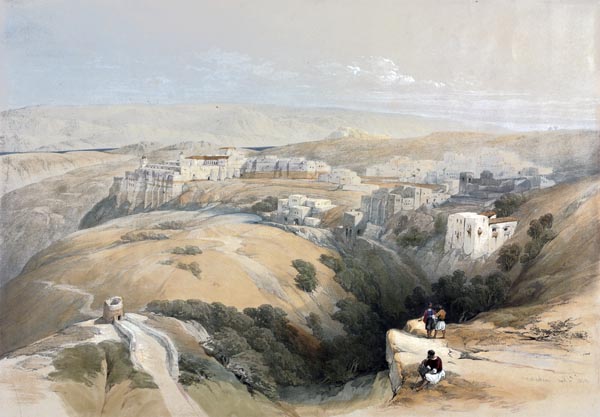
‘Bethlehem’ - David Roberts (British, 1796 – 1864)
Cleveland Museum of Art
The Latin monastery in Bethlehem had been closed for eleven months due to the plague; but for some time now there had been no new victims, and when we presented ourselves at the small, low door that serves as the entrance to the monastery, it was opened for us. After passing through, one by one, stooping beneath the narrow opening, our first reaction was one of surprise at finding ourselves in a majestic church (the Church of the Nativity): forty-four marble columns, each carved from a single block, arranged in two rows on each side, formed five naves, crowned by a massive cedarwood frame; but one searched in vain for the altar or the pulpit; everything was broken, dilapidated, stripped bare, and a crudely cemented wall divided this beautiful building at the base of the cross, thus concealing the part reserved for worship, possession of which the various Christian denominations still dispute. The nave belongs to the Latins, but serves only as a vestibule to the monastery; The main gate was walled up, and the low postern through which we had entered was built to protect these revered remains from the desecration of hordes of Arab brigands, who rode on horseback even to the foot of the altar to extort money from the monks. The abbot received us cordially: his gentle, calm, and cheerful face was as far removed from the austerity of the anchorite as from the jovial insouciance of which monks are often accused; he asked us about the country we had just travelled through, and about the Egyptian troops encamped so close to them. Eleven months of seclusion had made him eager for news, and he was completely reassured to learn that Ibrahim Pasha was granting protection to the Christian population of Syria.
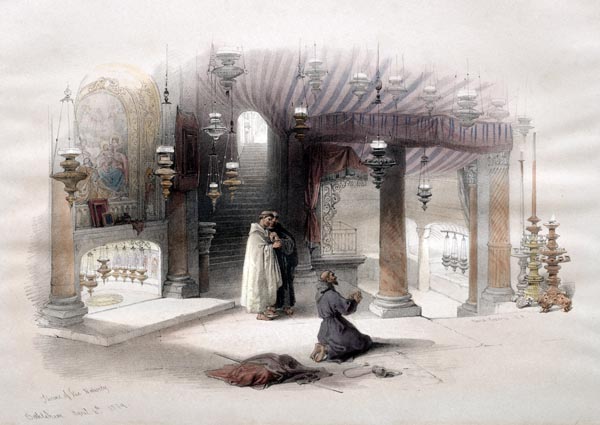
‘Shrine of the Nativity, Bethlehem’ - David Roberts (British, 1796 – 1864)
Cleveland Museum of Art
After a few moments of rest, we prepared to attend Mass at the Nativity Chapel; a feeble lantern was lit, and we descended, preceded by the fathers, to a long labyrinth of underground corridors that must be traversed to reach the sacred grotto. These underground passages are filled with tombs and relics: here is the tomb of Saint Jerome, there that of Saint Paula, of Saint Eustochium (the daughter of Paula), and the Well of the Innocents; but nothing held our attention at that moment. The dazzling light of thirty to forty lamps, below a small vault at the end of the passage, revealed to us the altar built on the site of the Nativity, and, two steps lower, to the right, that of the Manger: these natural grottoes are partly lined with marble to protect them from the indiscreet piety of pilgrims, who tear at the walls to carry off fragments; but one can still touch the bare rock, behind the marble slabs with which it has been covered, and the underground passage in general has retained the irregularity of its original form. The ornamentation here, unlike in some holy places, has not altered the natural scene to the point of raising doubts about the identity of the site; here it serves only to preserve the original enclosure. Thus, passing under these vaults and recesses in the rock, one easily understands that they must have served as stables for the flocks that shepherds kept in the plain, still covered today with green meadows, stretching far, below the rocky platform crowned by the church and the monastery, as below a citadel. The external exit of the underground passages that connected to the meadows has been sealed, but a few steps further on, one can visit another cavern of the same type, which must have served the same purpose. We attended Mass.
Due to the state of mind I was in, I am, sadly, unable to express what that place and the associated ceremony should inspire; everything for me was summed up in a profound and painful feeling of tenderness. An Arab woman, who approached, so as to have her newborn baptised on the altar of the Nativity, added further to my emotion. After Mass, we returned to the monastery, no longer via the underground passage, but by a wide and convenient staircase that led to the transept, behind the dividing wall I mentioned earlier. This staircase formerly belonged to both the Greek and Latin communions; now only the Greeks enjoy its use, and we listened to the fathers of Bethlehem’s vehement complaints about this usurpation. They wanted to entrust us with asserting their claims in Europe, and we had difficulty persuading them that, though French, we had no authority to obtain justice for them.
The two side aisles that formed the transept of the old church are now divided into separate chapels; one belongs to the Armenians, the other to the Latins. In the centre, is the high altar, placed immediately above the grotto; the choir is separated from it by a grille and a section of gilded woodwork that hides the sanctuary of the Greeks.
The Greek church in the East is much richer than the Roman church: among the latter everything is humble and modest, among the former everything is brilliant and sumptuous; but the rivalry which arises from their respective positions produces an extremely painful impression; one sighs on noting the quarrel and discord in places which should inspire only charity and love.
The original construction of the church is attributed to Saint Helena (the mother of Constantine I), as are most of the Christian buildings in Palestine. It is true that some people raise objections, saying that, having reached an advanced age when she visited Syria, she could not have commissioned so many projects in her lifetime; but ideas require no space and little time. It seems to me that her creative will and pious zeal could well have presided over monuments begun at her command yet completed after her death. We returned to the monastery; an excellent meal was offered to us in the refectory by the kind Father Superior, whom we left with regret, wishing to use the remaining hours to explore the surrounding area. As we descended towards the plain, we were shown a grotto where tradition holds that the Virgin Mary withdrew at the time of her departure for Egypt. On some heights overlooking Bethlehem, one can see the remains of towers that mark different positions of the Crusader encampment, and bear the names of those heroes. We descended to the left along rough and arduous paths.
After an hour’s ride, we arrived at a small, narrow, enclosed valley, watered by a clear stream. This is Solomon’s Garden, the hortus conclusus, sung of in the Song of Songs (4:12): indeed, enclosed by the rocky peaks of the mountains that surround it on all sides, this unique place offers the means of cultivation, and the valley is at all times a delightful garden, cultivated with the greatest care, and presenting, with its beautiful, moist greenery, the most striking contrast to the stony aridity of all that surrounds it. It may be a mile or more long. We followed the meandering course of the stream, shaded by willows, sometimes following the grassy bank, sometimes our horses’ hooves bathing in its waters flowing clear and bright over the smooth pebbles of its bed, occasionally crossing from one bank to the other on a cedar plank; and arrived beneath rocks that naturally close off the valley. A farmer offered to guide us on the ascent; but on the condition that we dismounted, and gave our mounts over to his boys, who, via a long detour, would lead them to the summit.
We turned to the right and climbed, laboriously, for an hour; reaching the summit, we found the most beautiful ancient remains we had ever seen: three immense cisterns (Solomon’s Pools) hewn from the bedrock and following the mountain’s slope, one above the other, in terraces; the walls as clean, the edges as sharp as if they had just been finished; their edges, covered with flagstones like a quay, resounded beneath the horses’ hooves. These beautiful basins, filled with crystal-clear water, on the summit of an arid mountain, are astonishing and inspire a lofty idea of the power that conceived and executed such a vast project; thus, they are attributed to Solomon. While I contemplated them, my travelling companions measured them and found each to be about four hundred feet by one hundred and seventy-five; the lowest is the longest, the highest the broadest: it has a width of at least two hundred feet; they grow larger and larger all the way to the top; above the highest of these gigantic cisterns, a small spring, hidden under a few clumps of greenery, is the fons signatus (‘a fountain sealed’, see the Song of Solomon 4:12) of the Bible, and is the sole source of water for these reservoirs, which formerly emptied into the aqueducts conducting water to the Temple in Jerusalem; we encountered the remains of these aqueducts constantly along our route.
Not far from there, ancient crenellated walls, probably dating from the time of the Crusades, surround an enclosure where tradition locates a palace inhabited by Solomon’s wives. Little remains of it, and the site, covered in manure and refuse, now serves as a courtyard where shepherds and their livestock retire at night, when they come to graze the mountains during the grazing season, much as in the Swiss Alps. We returned to Jerusalem by an ancient, wide, paved road called Solomon’s Road, which is much shorter and more direct than the one we had taken that morning; it does not pass through Bethlehem. Night was well advanced when we entered Jerusalem beneath the arch of the Pilgrims’ Gate (the Zion Gate, King David’s Gate, or Bab Harat al-Yahud).
On April 25th, after our final visit to the Holy Sepulchre, we asked the clergyman who was accompanying us to lead us around the exterior of the church, so that we could better appreciate the uneven terrain that explains the combination of the Sepulchre and Calvary within the same monument. This route is difficult because the church is surrounded by buildings that obstruct access; but by crossing a few courtyards and passing through some houses, we managed to view the parts that interested us.
We then mounted our horses to follow the city walls, and visit the Tomb of the Kings. North of Jerusalem, after leaving through the Damascus Gate, there is an excavation in the rock, about a mile or so away, forming a courtyard approximately twenty feet deep, enclosed on three sides by walls of rock hewn with a chisel, yielding sight of walls adorned with sculptures carved directly into the stone, and representing doorways, pilasters, and friezes of exquisite workmanship; one presumes that the gradual elevation of the soil-level has sunk the whole by several feet, for the opening on the left leading into the sanctuary is so low that one can only enter by crawling. We managed with extreme difficulty to gain entry, and light torches within. Swarms of bats, awakened by our invasion, assailed us and fought, as it were, to defend their territory; and if our retreat had been easy, I believe we would have given way before them. Gradually, calm was restored, and we were able to examine the burial chambers.
They are excavated and hewn from the living rock. The angles are as sharp and the walls as smooth as if the craftsmen had polished them while quarrying. We visited five of them, connected by openings to which, without a doubt, some stone blocks hewn to form doorways had been attached. These blocks lay on the ground, suggesting that each chamber had been closed and sealed when the niches in the walls, intended to hold sarcophagi or cinerary urns, were filled. Who were, or were assigned to be, the inhabitants of these dwellings, prepared at such great expense? That remains doubtful. Their origin has been hotly contested: the interior, simple yet magnificent, could date back to the most ancient times, but nothing indicates a precise date. The exterior sculpture appears to be of a high degree of craftsmanship and a taste too pure to be from the distant times of the Kings of Judah. But, since I saw Baalbek, my ideas have changed considerably regarding the level of perfection to which art had reached before the known eras.
We continued our ride through some olive groves, and, descending again into the Valley of Jehoshaphat, we returned south along the walls of Zion. The Tomb of King David, the Holy Cenacle (the Upper Room, above the Tomb of David, traditionally the site of the Last Supper), and the Armenian church which possesses the stone which sealed the entrance to the Holy Sepulchre, tempted us to return through the same gate, Bab an-Nabi Dawud (King David’s Gate, the Zion Gate); but when we sought to visit the underground chamber in which tradition asserts the bones of the prophet-king were interred, the Turks opposed us, and told us that entry was strictly forbidden; they suppose that immense riches have been buried in this royal vault, that foreigners possess the secret, and come there only to locate and steal them.
The Holy Cenacle is a large vaulted hall, supported by columns and blackened by time: if age is accepted as proof, it bears the marks of remote antiquity. Located on Mount Zion, outside the walls of the city in those days, it is quite possible that the disciples could have withdrawn there after the Resurrection, and that they were gathered there at the time of Pentecost, as popular tradition affirms. The sack of Jerusalem (70AD) under Titus left little standing except the towers and part of the walls; however, the locations remained sufficiently well-known; and the first Christians must have placed great importance on perpetuating the memory of them by means of successive edifices on the same sites, often employing the remains of the ancient monuments. But to detail the various places in Jerusalem would be merely to repeat the words of others, and I regretfully leave a subject to which my memories constantly draw me back. I will say only a word, entirely independent of religious associations, about the appearance of the village of tombs, Siloa, which has remained with me like a picture before my eyes.
The entire native population of Arabs dwelling there, in the cellars and sepulchral caves, would offer a painter a most original scene. Imagine, in the deep valley of Siloa, caverns with openings like oven mouths stacked one on top of the other, scattered across the face of the cliff, like irregular sections of a broken beehive; and, from these sepulchral caves, living beings, women, children, emerging like phantoms from the abode of the dead. I do not know if this subject has been treated before, but it seems to me that it offers the painter’s brush, at once, every contrast and every harmony.
On April 26th, we cast our last glances at Jerusalem, and sadly resumed our journey to Jaffa. As we entered the Valley of Jeremiah (Abu Gosh), the sounds of wild music caught our attention: in the distance, we saw an entire Arab tribe marching down the hillside; I sent the dragoman ahead; he returned to tell us that everyone was gathered for the funeral of a chieftain, and that we could proceed without fear. He then told us that this chieftain had died suddenly the previous day while hunting, from inhaling the fumes of a poisonous plant; though the well-known character of the Arabs of Nablus, whose costume they wore, led us to believe that he had rather fallen victim to the jealousy of some rival chieftain. Despite their warlike habits and imposing appearance, the credulity of these naive people resembles that of children; any wondrous tale charms them, and arouses no distrust in their minds. An Arab friend of ours, a man of great intelligence and knowledge, often assured us, with a tone of conviction, that a sheikh of Lebanon possessed the secret of the magic words that had been used in primitive times to move the gigantic blocks of Baalbek, but that he was too good a Christian ever to use them or to divulge them.
We quickened the pace of our horses and soon joined the procession: in the centre was the bier carried on a stretcher, hidden beneath rich draperies, and surmounted by the turban of the Ottomans. Arab women, naked to the waist, their long black hair flowing over their shoulders, their breasts bruised, their arms waving in the air, preceded the body, uttering cries, singing mournful songs, wringing their hands and tearing at their hair; musicians playing the rebab (a string instrument) and the daff (a frame drum) accompanied the voices with a continuous and monotonous thrumming and drumming. At the head of the procession walked the deceased’s brother; his horse, covered in fine angora skins and adorned with red and gold tassels that swung from its head and chest, sometimes reared at the sound of this discordant music; priests in full regalia awaited the procession before the door of a tomb surmounted by a dome supported by an openwork colonnade; opposite stood the ruined church, whose flat roof was covered with women draped in long white veils, like the priestesses at the ancient sacrifices, or the mourners at the monuments of Memphis. When the chieftain approached the tomb, he dismounted and threw himself into the arms of the high priest with vivid displays of grief; the latter exhorted him to submit to Allah’s will and to prove himself worthy to succeed his brother in the leadership of the tribe. Meanwhile, the procession having arrived, the body was laid to rest, the members of the group arranged themselves around the small temple, and the funeral chants resounded even more poignantly: these mournful pantomimes, this funeral pomp, these hymns of despair expressed in another language, with other rites, seemed to us a living memory of those lamentations with which Jeremiah had filled this same valley, and of which the biblical world retains an echo.’
Departure from Jaffa
The evening of April 26th, 1833.
We embarked on an already rough sea, enormous waves crashing like mountains of foam against the rocky sides of the passage; we held back a moment behind these rocks for a group of these waves to pass, and then, with all our oarsmen’s might, were launched into the open sea; the waves returned, each one lifting us like a cork on its back; we then plunged back down as into an abyss, neither the ship nor the shore now visible; then rose again, to pitch and toss once more, foam covering us with a veil of rain. We finally reached the ship’s side, but its movements were so violent we dared not approach, for fear of being struck by the yards which were dipping into the waves; we waited for a break in the swell; a rope was thrown; the ladder was placed: we were on deck.
The wind’s direction was contrary; we remained doubly-anchored, exposed at any moment to shipwreck, should the enormous movement of the waves break the anchor chains. Hours of physical and mental anguish due to the dreadful pitching and tossing ensued. During the evening and night, the wind whistled through the rigging, its tones like those of the high-pitched pipes of an organ; the ship leapt like a ram striking the earth with its horns; the bow plunged into the sea, and seemed ready to sink each time a wave arrived and lifted the stern; we heard the cries of the Arab sailors aboard other ships bringing poor Greek pilgrims to Jerusalem. These small ships, some carrying two or three hundred women and children, tried to set sail to flee the coast; some passed close to us; the women cried out, holding out their hands to us; great waves engulfed the vessels and carried them backwards a great distance; some managed to claw themselves away from the coast; two were driven onto the breakwaters of the harbour near Gaza; our anchors gave way, and we were dragged towards the rocks of the inner harbour; the captain ordered another one dropped. The wind eased, and shifted a little in our favour; we fled, in grey and misty weather, towards the Gulf of Damietta, and lost sight of land.
During the day, we made good progress; the sea was calm, but early signs of a storm worried the captain and the first mate; it broke at nightfall; the wind freshened by the hour, the waves became increasingly high; the ship creaked and strained; the ropes whistled and vibrated in the gusts of wind like strands of metal; their high-pitched and plaintive sounds resembled the lamentations of Greek women, amidst the processions of their dead; we no longer carried sail; the ship rolled from one abyss to another, and each time it fell on its side, the masts seemed to collapse into the sea like uprooted trees, as the water, beneath their weight, crashed back and covered the deck. All except the crew and myself descended between decks; we could hear the groans of the sick, and the crashing of crates and pieces of furniture as they struck the sides of the brig. The brig itself, despite its strong frame and the enormous beams that spanned it from side to side, creaked and groaned as if the vessel were about to split wide open. The waves crashing against the stern resounded from moment to moment like cannon fire. At two in the morning, the storm intensified further. I tied myself to the mainmast with rope to avoid being swept away by the wave, and sliding into the sea, the deck listing almost perpendicularly. Wrapped in my coat, I contemplated this sublime spectacle. I occasionally went below deck to reassure my wife, who was lying in her hammock. Amidst this dreadful storm, the first mate only left the helm to go from cabin to cabin, offering each person the assistance their condition required: a man of iron in the face of peril, with a woman’s tenderness in the face of affliction.
The whole night passed in this way. The sunrise, which was only noticeable by a pale light spreading across the waves, and between the mingled clouds, far from diminishing the force of the wind, seemed to augment it even more; as far as the eye could see, hills of foaming water rose behind other hills. As they passed, the brig driven in every direction, crushed by one, lifted by another, launched in one direction by a wave, stopped in flight by an opposing wave which forcibly imposed a fresh direction on it, fell now on one side, now on the other. The prow plunged forward as if it were about to be swallowed up; the sea which flowed over the vessel fled from its stern, or crossed it from one side to the other. From time to time, the vessel rose; the sea, flattened by the wind, seemed unable to produce more waves and became a mere field of swirling foam, as if we had reached a plain, between those enormous hills of water, allowing the brig a moment’s respite: but she soon returned to a region amidst tall waves, rolling again from precipice to precipice.
With equally dreadful choices before us, the day slipped away; the captain consulted me: the shores of Egypt are low-lying and we could be cast aground before even seeing them; the shores of Syria have neither roadstead nor harbour; so, we were obliged either to heave to, amidst the waves, or run before the wind driving us towards Cyprus. There, we could enter a roadstead and find safe haven; but we were at least a hundred and fifty miles away. I ordered the helm set for the island; the wind propelled us forward at a speed of seven to eight knots, its strength not subsiding. A few drops of cold broth sustained the strength of my wife and my companions, still lying in their hammocks. I myself ate a few pieces of biscuit, and smoked with the captain and the first mate, always in the same position on deck near the cabin, my arms tucked into the ropes that protected me from the waves. Night fell, an even more dreadful one; the clouds weighed heavily on the sea, the entire horizon was torn apart by lightning, all around us seemed on fire; the lightning seemed to leap from the crests of the waves, indistinguishable from the clouds, and crashed down around us three times. Once, as the brig was thrown onto its side by a colossal wave, the yards plunged, the masts struck the surface, and the foam hurled up by the blow shot forth like a torn cloak of flame its shreds scattered by the wind, like fiery serpents; the entire crew shouted aloud; we seemed to be plunged into a volcanic crater.
It was the most terrifying and magnificent of storms that I witnessed during that long night. For nine hours straight, thunder enveloped us; every minute we thought to see our flaming masts fall upon us and set the ship ablaze. In the morning, the sky was less overcast, but the sea resembled boiling lava; the wind, which had dropped somewhat and no longer supported the ship, made the rolling heavier: we must have been eighty miles from the island of Cyprus. At eleven we began to glimpse land; hour by hour it grew clearer: we had sight of Limassol, one of the ports of that island; we set all sails to tack downwind as soon as possible: as we approached, the sea calmed a little; we sailed along the coast at a distance of five or six miles, to reach the roadstead of Larnaca, in which we could already see the masts of a large number of ships that, like ourselves, had sought refuge: the furious wind picked up again, and drove us there in a short while; the ship’s momentum was so strong that we feared breaking our cables when dropping anchor: finally the anchor touched bottom; dragged a few fathoms and bit into the sea-bed. The sea was still choppy, but the waves rocked us gently. I saw again the flags of the European consuls of Cyprus saluting us from the summits of the flagpoles, and the terrace of the French consulate, from which our friend Alphonse Bottu sent us welcoming signals; everyone remained on board; my wife could not without heartbreak view the excellent and happy family of Monsieur Bottu, amidst which she, as happy as they, had met with such hospitality fifteen months ago.
Cyprus
I went ashore with the captain; I received from Monsieur and Madame Bottu, and from Monsieur Perthier and Alexiano Guillois, a young Frenchman attached to the consulate, the touching marks of kindness and friendship I had hoped for from them. I visited Monsieur Mathéi, the Greek banker to whom I had been previously recommended. We sent provisions of all kinds to the brig, and Monsieur Mathéi added gifts of Cypriot wine and Syrian sheep. While I was touring the outskirts of the city with Monsieur Bottu, the storm, which had subsided, renewed itself; communication with the ships in the harbour was now impossible; the waves covered the quays and hurled foam as high as the windows of the houses; I spent a dreadful evening and night on the terrace or at the window of my room, at the French consulate, watching the brig, where my wife was, tossed about in the harbour by immense waves, trembling at every moment lest the anchors lifted and the ship was thrown onto the reefs, with all that remains of my happiness in this world.
The following evening, the sea finally calmed; we returned to the brig, and spent three hours in the roadstead, waiting for better winds, and constantly visited by Monsieur Mathéi and Monsieur Bottu. The latter, our young and amiable consul, was the French agent in the East who welcomed his compatriots most cordially, and honoured them, in his nation’s name. I carry a weight of gratitude and true friendship, recalling his twice receiving us on the island. He was happy, surrounded by a wife after his own heart, and his children who were his greatest joy. I learned that death struck him down not long after our visit (he died suddenly, on August 24th, 1833); his position was his family’s only fortune; this fortune he devoted entirely to his duties as consul; his poor wife and beautiful children are now at the mercy of France, which he served and honoured with all his might: may France think of them in remembering him!
April 31, 1833.
We set sail, the winds variable. We spent three days rounding the western tip of the island by running back and forth along the shore, sighting Mount Olympus (Olimbos), Paphos, and Amathus (the ancient city, its ruins are near Limassol), with ravishing view of the coasts and mountains of Cyprus from the south. This island might be the most beautiful colony in Asia Minor; it has only thirty thousand inhabitants; it could feed and enrich millions of men; it is everywhere cultivable, everywhere fertile, wooded, irrigated, with natural harbours and ports on all its coasts. Situated between Syria, Caramania, the Greek archipelago, Egypt, and the coasts of Europe, it could become the garden of the world.
May 1, 1833.
In the morning, we sighted the first peaks of Caramania in the distance; the Taurus mountains, jagged peaks covered with snow much like the Alps when viewed from Lyon. We met with gentle, variable winds. Splendid starry nights followed. We entered the Gulf of Satalia (Antalya) by night; the appearance of this gulf, is like an inland sea. The wind dropped, the ship slumbered as if on a lake. Wherever one’s gaze turned, it fell upon the mountainous surrounds of the bays; mountain ranges of all shapes and heights fled one behind the other, sometimes leaving, between their uneven peaks, high valleys where the silvery light of the moon swam. White patches of vapour trailed along their flanks, and their crests were drowned in waves of pale purple; behind rose the angular peaks of Taurus like snow-white teeth. A few low, wooded headlands extended here and there into the sea, and small islands appeared, like ships at anchor, detached here and there from the shore; a profound silence reigned over the sea and land; one heard only the splashing of dolphins, leaping from time to time from the depths of the waves, bounding as little goats do over a lawn. The waves, smooth and marbled with silver and gold, seemed like fluted Ionian columns laid on their sides. The brig experienced not the slightest oscillation. At midnight a land breeze arose. We slowly exited the Gulf of Satalia, and skimmed the coast as far as the island of Castelrozzo (Kastelorizzo); we entered all the gulfs, and almost touched land. The ruined edifices, now empty and solitary, of Asia Minor, which once comprised several kingdoms, Pontus, Cappadocia, and Bithynia, were highlighted on the promontories; the valleys and plains were covered with forests; the Turkomans arrive and pitch their tents here during the winter; in the summer, everything is deserted, except for a few points on the coast, such as Tarsus (north-east of Mersin), Satalia (Antalya), Castelrozzo (Kastelorizzo), and Marmaris, in the Gulf of Macri (Fethiye).
May 1833.
The current along the Caramania coast is pushing us towards the tip of the continent and the mouth of the Gulf of Macri; during the night we tacked to approach the island of Rhodes; the captain, fearing the proximity of the Asian coast due to the rising westerly wind, steered us back out to sea; we woke, barely in sight of Rhodes. We found our support brig, the Alceste, not far from us. The calm prevented us from approaching it all day, and in the evening, a fresh wind pushed us to the far end of the Gulf of Marmaris. At midnight, the land breeze returned. We entered the port of Rhodes at daybreak.
Rhodes
May 1833.
We spent three days exploring the coast of Rhodes, full of delightful sites, on the mountain slopes overlooking the archipelago. After a two-hour walk along the shore, I entered a valley shaded by beautiful trees and watered by a small stream. Following the stream’s banks, lined with oleanders, I reached a small plateau that forms the valley’s final tier. There stood a small house inhabited by a poor Greek family. The house, almost entirely covered by the branches of fig and orange trees, possesses, in its garden, the ruins of a small temple of the Nymphs, a grotto, and a few scattered columns and capitals, half-hidden by ivy and the roots of shrubs. Above it lay a lawn a few hundred paces wide, with a spring. There, two or three sycamore trees grew. One of the sycamore trees alone shaded the entire lawn: it is the sacred tree of the island; the Turks respect it, and when the unfortunate Greek living there once tried to cut off a branch, the Pasha of Rhodes had him flogged. It is not true that the Turks destroy Nature or works of art: they leave everything as it is; their sole method of ruining everything lies in improving nothing.
Above the lawn and the sycamore trees, the steep hills are covered with fir woods, and little streams cascade down, carving ravines from the flanks; higher still the island’s mountains rise, and shade the hills, the meadow, and the spring. From the edge of the fountain where I lay, I viewed, through the branches of pines and sycamores, the sea of the Asian archipelago, which resembles a lake dotted with islands, and the deep gulfs that plunge between the high, dark mountains of Macri, all crowned with battlements of snow. I heard nothing but the sound of the spring, the wind in the leaves, the flight of a bulbul (nightingale) startled by my presence, and the plaintive song of a Greek woman cradling her child on the roof of her house. How beautiful this place would have seemed to me six months ago!
On a path in the high mountains of Rhodes, I met a Cypriot chieftain, dressed in European style but wearing a Greek cap and sporting a long white beard. I recognised him: his name was Theseus; he was the nephew of the Patriarch of Cyprus (Archbishop Panaretos II); he had distinguished himself in the war of independence. Having returned to Cyprus after the pacification of the Morea, his name, his spirit, and his energy had won him the affection of the Greek population of Cyprus. At the time of the recent uprising on the island, the mountain peasants rallied to his command; he used his influence to calm them; and after having, in concert with Monsieur Bottu the French consul, obtained redress for various grievances, he dispersed his troops and took refuge in the French consulate to escape the vengeance of the Turks. A Greek ship had set him ashore on Rhodes, where he is not safe. I offered him a place on one of my brigs, and he has taken refuge there. I will transport him to Constantinople, to Greece or to Europe, according to his wish. He is a man who has constantly gambled with his life and fortune: a man sparkling with wit and audacity, speaking every language, knowing every country, with an interesting and inexhaustible conversation, as quick to act as to think; one of those men whose very nature is movement, who rise like birds in the storm, with the whirlwind of revolution, only to fall with them. Nature casts few souls in this mould; men thus made are usually unhappy: they are feared, and persecuted; they would be admirable instruments if one knew how to use them for their purpose. I am sending a boat to Marmaris, carrying a young Greek who will wait there for my horses and order my sais to join me in Constantinople. We have decided to go by sea, visiting the islands off the coast of Asia Minor and the shores of the mainland.
We set sail at midnight in a light breeze, rounding Cape Krio (Deveboynu Burnu) on the evening of the first day, followed by a beautiful and gentle stretch of water between the islands of Piscopia (Telos, modern Tilos), Nisyros, and the enchanted island of Kos, sacred to Aesculapius. After Rhodes, Kos seemed to me the most cheerful and graceful island in this archipelago; charming villages, shaded by beautiful plane trees, line its shores; the town of Kos is cheerful and elegantly built. In the evening, we found ourselves, with our two brigs, as if lost, amidst a maze of small, uninhabited islands; they were covered, down to the water’s edge, with a carpet of tall grass; there are charming channels between them, and almost all have small coves where ships could drop anchor. What enchanting havens for those who complain of a lack of space in Europe! Here one has the climate and fertility of Rhodes and Kos, with a vast continent two leagues away. We sailed endlessly between the continent and the islands; seeing the sun shining brightly on the great ruins of the Greek and Roman cities of Asia Minor.
Next day, we returned to the narrow boghaz (passage) of Samos, between that island and Icaria; the high mountain that almost single-handedly forms the island of Samos towered above us, covered with rocks and pine forests; we could see groups of women and children among these rocks. The population of Samos, currently in revolt against the Turks, have taken refuge on the mountain; armed men reside in the city and on the shores. Samos is like one of the mountains above Lake Lucerne, only illuminated by an Asian sky; its base almost touches the mainland; we noted only a narrow channel separating the two.
Cesme
A storm caught us in the Gulf of Scala Nova (the Bay of Kusadasi), not far from the ruins of Ephesus; we entered the Channel of Chios in the morning and sought refuge in the harbour of Cesme, famous for the destruction of the Ottoman fleet by Admiral Alexis Orlov (7th of July, 1770). The enchanting island of Chios stretches like a green hill on the far side of a great river; its white houses, its towns, its villages, clustered on the shaded slopes of the hills, gleam among the orange trees and vines; what remains suggests immense recent prosperity and a large population. The Turkish regime, apart from enforcing servitude was unable to stifle the active, industrious, commercial, and agricultural spirit of the Greek people of these beautiful islands. I know of nothing in Europe that presents the appearance of greater wealth than Chios; it is a garden a hundred and thirty miles or so in circumference.
We indulged in a day trip to the ruins and mineral-water springs of Chesme (on the Turkish mainland).
May 26, 1833.
The sea was calm; we set sail for Smyrna (Izmir), on a day of variable winds, spent gently following the coast of Chios. The woods extend down to the sea; the gulfs all have fortified towns, their harbours filled with small vessels. The smallest cove has its village, and countless little sailboats skim the shores, carrying Greek women and girls on their way to church. On every hilltop, in every gorge, one sees a church or a whitewashed village. We rounded the tip of the island, and met with a counter-wind pushing us into the Gulf of Smyrna. Till nightfall we enjoyed the sight of the beautiful forests and large alpine villages that border the western coast of the gulf; at night, we were in calm waters not far from the Urla Islands, where we saw the lights of the French fleet (the Levant fleet, commanded by Admiral Gaud Amable Hugon, 1st Baron Hugon), anchored there for six months, shining brightly. In the morning, we glimpsed Smyrna nestled against an immense cypress-covered hill at the head of the gulf. High crenellated walls crowned the upper part of the city; beautiful wooded countryside stretched to the left as far as the mountains. Here flows the Meles River; the memory of Homer (who was said to have been born near the river) hovered about me always near Smyrna. I searched for that tree on the bank of that river, obscure at the time, where the poor slave girl placed her offspring among the reeds: a child destined one day to bring eternal glory to the river and its name, the continent, and the islands. The poet heaven bestowed upon the earth here was destined to portray all of divine and human antiquity for us. He was born and abandoned on the banks of a river, like Moses in the Biblical text; he lived, blind and in poverty, like those divine incarnations in India, who traversed the world disguised as beggars, and were only recognised as gods after their passing. Modern scholarship pretends not to see a man, but a composite literary school, in Homer; one of the hundred thousand learned paradoxes with which men try to combat the evidence of their innermost instincts. As far as I am concerned, Homer was a single individual, a man with ever the same accents in his voice, the same tears in his heart, the same tones in his speech; accepting a whole band of ‘Homeric’ poets seems to me more difficult than accepting the existence of a race of giants. Nature does not display such wonders in parallel; it creates a Homer, and then defies the ages to produce again such a perfect combination of reason, philosophy, sensitivity, and genius.
Smyrna (Izmir)
May 29, 1833
I visited Smyrna, and explored the city and its surroundings with Monsieur Salzani, a banker and merchant of the city, a man as kind as he was amiable and learned; for three days I have taken advantage of his generosity; we return each day to sleep aboard the brig. Smyrna failed to correspond to my ideas of an Eastern city; it is like a Marseille on the coast of Asia Minor; a vast and elegant trading post where European consuls and merchants live the life of Paris and London. The view of the gulf and the city is beautiful when seen from above the cypress trees on the mountain. On our way down, we found a charming spot on the banks of the Meles, which I enjoyed the thought of being beside, not far from one of the city gates; it was near the Caravan Bridge (Kervan Koprusu, constructed c850BC): the river there was a limpid stream, sleeping peacefully beneath a canopy of sycamores and cypresses; We sat on its banks, and the Turks brought us pipes and coffee. I loved to hear the water murmuring, softly, among the roots of the plane trees along this river which perhaps heard Homer’s first cries. I raised it to my lips; I bathed my burning brow with it. May some person destined to create the poem of their time, embodying their dream, and their ideal, be born once more to the Western world! Such a poem becomes the sepulchre of a bygone age, which future generations may visit, in order to venerate a lost tradition, and which eternalises, through the perusing of its glories, the great deeds and great thoughts of humanity. One who creates such a work engraves their name at the foot of the statue they raise to mankind, and lives on, via all the images with which they fill the world of ideas.
This evening, I was invited to the home of an old man who lives alone with two Greek servants in a small house on the quayside, in Smyrna. The staircase, the vestibule, and the rooms are full of fragments of sculpture, relief maps of Athens, and pieces of marble and porphyry. He is Monsieur Fauvel (Louis-François-Sébastien Fauvel, known in France as the father of Archaeology in Greece. He was seventy-nine at the time, dying in 1838) our former consul in Greece. Driven from Athens, which had become his home, and whose dust he sifted all his life, like a native son, in order to restore its statues to the world, Fauvel now lives poor and unknown in Smyrna. He has brought his household gods with him and worships them constantly. Monsieur de Chateaubriand saw him in his younger days (in Athens in 1806, when Fauvel was fifty-three), happy amidst the magnificent ruins of the Parthenon. I saw him old and exiled, and wounded by the ingratitude of men, but firm and cheerful in his misfortune, and full of that natural philosophy which makes those who hold their fortune in their heart bear misfortune patiently. I spent a delightful hour of oblivion listening to this charming old man.
I encountered again in Smyrna a talented young man I had known in Italy, Monsieur Bousquet-Deschamps, editor of the Journal de Smyrne (Jacques Lucien Bousquet-Deschamps, exiled from France for his political views and editorship of L’Aristarque, on taking over the editorship of the ‘Courrier de Smyrne’ from Alexandre Helvetius Georges Blacque had renamed it the ‘Journal de Smyrne’. He was thirty-four years old when Lamartine met him in Smyrna). He expressed his fondness and affection for me. The human remnants of Saint-Simonianism had been driven to Smyrna by the tempest, reduced to their last extremities, but bearing their setbacks with the resignation and constancy of strong conviction. I received, on board ship, two remarkable letters from these people. New ideas should not be judged by the disdain they inspire in their own time; all great thoughts are received as strangers in this world. Saint-Simonianism contains something true, great, and fruitful: the application of Christianity to politics, legislation based on human fraternity; in those regards, I am a Saint-Simonian. It was not ideas that this eclipsed, but not yet vanished, sect lacked; nor did its disciples fail it. What it lacked, in my opinion, was a leader, a master: a regulator. I have no doubt that if a man of genius and virtue, a man both religious and political, encompassing both spheres in a just vision of far-reaching scope, had been placed at the helm of this nascent movement, he might have transformed it, and made of it a powerful reality. Times of intellectual anarchy are favourable seasons for the germination of vital, new thoughts. Society, to the philosopher’s eyes, is now in a time of disarray; it has neither direction, nor purpose, nor leader; it has been reduced to an instinct for self-preservation. A religious, moral, social, and political sect, possessing a symbol, a motto, a purpose, a leader, a spirit, and marching in unison, straight ahead amidst these disordered ranks, would inevitably gain the victory. But what is needed is to offer society salvation, not destruction, by attacking in it only what harms it, and not what serves it, by recalling religion to reason and love, politics to Christian brotherhood, property to charity and universal utility, society’s sole title and its sole foundation.
A legislator was lacking to lead these young men ardent with zeal, consumed by a need for faith, but at whom senseless dogma was hurled. The organisers of Saint-Simonianism sounded, as their first clarion call: ‘War to the death between ourselves and family, ownership, and organised religion! They were destined to perish. One does not conquer the world with the power of a single cry, one must convert the world, stir it, work upon it, and change it. As long as an idea cannot be put into practice, it is unacceptable to society. Humanity proceeds from the known to the unknown, not from the known to the absurd. The present state of affairs is present as a prologue to all great revolutions; one sees signs on earth and in the heavens. The Saint-Simonians are one such sign; they will dissolve as a body, but later, as individuals, may become leaders and soldiers of a fresh army. (Lamartine anticipates the Revolution of 1848 in France, and his significant part in founding the Second Republic, though his idea of basing it on Social Catholicism was quickly rejected by the electorate).
Phocaea (Foca)
May 30th, 1833.
Having sailed out of the Gulf of Smyrna under full sail, and reached the latitude of Urla, and while tacking at the mouth of the gulf, the brig struck a sandbank, due to the clumsiness of the Greek pilot. The ship received a jolt that shook the masts, and remained motionless seven miles or so from land; the growing waves broke against its sides; we all ascended on deck: it was a moment of calm and solemn anxiety, with so many lives at stake, and the uncertain likelihood of success of the manoeuvre then attempted. Complete silence reigned, though it was not a sign of fear; human beings prove robust in dire circumstances! After a few minutes of vain effort, the wind came to our aid and turned us on our keel; the brig freed itself, and no leaks appeared; we entered the open sea, the island of Mytilene to starboard.
A beautiful day; we were approaching the channel that separates that island from the mainland; but the wind weakened, clouds gathered over the open sea, and at nightfall, the wind escaped the clouds accompanied by lightning. There was a furious storm, the darkness total. The two brigs signalled each other, searching for the roadstead of Foca, ancient Phocaea, between the rocks that form the northern tip of the Gulf of Smyrna. In the space of two hours the force of the wind drove us twenty-five miles along the coast; at every moment lightning struck, and the wind whistled through the waves. The sky, the sea, and resounding rocks of the coast were illuminated by these bright lightning flashes, occasionally showing us our course; the two brigs were almost touching, and we trembled as if they might break apart. Finally, a daring manoeuvre in the dead of night brought us to the narrow mouth of the Phocaean roadstead. We heard the waves roaring on the rocks to the right and left; a false turn of the rudder would send us flying against them. All were silent on deck, awaiting their fate. We were unable to see our own masts, so dark was the night. Suddenly we felt the brig gliding over a still surface; a few lights shone around us at the rim of the basin into which we had happily entered, and we dropped anchor at random. The wind roared all night around our masts and yards, as if about to tear them away; but the sea was still.
The delightful basin of ancient Phocaea, a mile and more in circumference, is carved out like a semi-circular fortification between graceful hills covered with red-painted houses, thatched cottages beneath olive trees, gardens, climbing vines, and above all, magnificent cypress groves, at the feet of which the white tombs of the Turkish cemeteries are brightly highlighted. We went ashore, and visited the ruins of the city that gave birth to Marseille (Massalia, founded by the Ionian Greeks of Phocaea, c600BC). We were received with hospitality and grace in two Turkish houses, and spent the day in their orange groves. The sea calmed on the third day, and we left the natural harbour of Phocaea at midnight.
Lesbos
June 4, 1833.
We followed the Mytilene Channel (the Mytilini Strait) all day, between Lesbos and the mainland. It was a poetic reminder of the only woman of antiquity whose voice possessed the power to resonate through the centuries. A few verses by Sappho remain, but these suffice to demonstrate genius of the first order. A fragment of the arm or torso of a statue by Phidias reveals the statue in its entirety. The heart that poured forth Sappho’s verses revealed immense depths of passion and imaginative force.
The island of Lesbos is even more beautiful in my eyes than the island of Chios. The clusters of high, green, crenellated, and fir-covered mountains are taller, and more picturesquely grouped. The sea penetrates its broad inner gulf more deeply; the ranges of hills, which hang above the sea, so close to Asia Minor opposite, are more solitary, more inaccessible. Instead of the numerous villages scattered throughout the gardens of Chios, one sees here only the smoke from a few Greek huts drifting between the chestnut and cypress trees, and now and then a shepherd on the tip of a rock, tending a large flock of white goats. In the evening, with the wind still favourable, we rounded the northern tip of Lesbos, and glimpsed on the horizon ahead, amidst the pink haze above the sea, two dark patches, the islands of Lemnos and Tenedos.
Midnight of the same day. June 4th, 1833
It is midnight: the sea is as calm as ice; the brig glides like a motionless shadow on its resplendent surface. Tenedos rises from the waves to port, obscuring the open sea; to starboard, and very close to us, stretches the low, jagged shore of the Trojan plain like a blackish bar. The full moon, rising over the snow-blotched summit of Mount Ida, casts a serene, vague light on the mountain peaks, the hills, and the plain; it strikes the sea, making it shine even in the shadow of our brig, like a splendid road upon which shadows dare not tread. We can make out the tumuli, or small conical mounds, which tradition identifies as the tombs of Patroclus and Hector. The broad, red moon, skimming the undulations of the hills, resembles the bloodied shield of Achilles. Not a light on this entire coast, save for a distant fire lit by shepherds on a ridge of Mount Ida; no sound but the beating of the mainsail, the wind having dropped, and the occasional clanging of the main yard against the mast: everything seems dead, and past, in this dull and silent scene. Leaning over the ship’s shrouds, I view the land, its mountains, ruins, and tombs emerging like the shadows of a bounded world, evoked and risen from the bosom of the sea in vaporous forms with indistinct contours, amidst the dormant rays of moonlight, silent as the moon, and vanishing, as that orb of night sinks behind the peaks of further mountains; it seems another beautiful page from Homer’s poem; a summation of all history and all poetry: a landscape of unknown tombs, ruins without a name; a bare and sombre planet, dimly lit by the immortal stars; and we, its latest spectators, passing indifferently before its shores, repeating for the thousandth time the epitaph of all things: ‘Here lies an empire, a city, a people, and its heroes.’ God alone is great! And the thought that seeks and worships Him is the only imperishable one.
I have no desire to visit, more closely and by day, the uncertain remains of the ruins of Troy. I prefer this nocturnal apparition which allows thought to repopulate the waste, lit only by the pale torch of the moon and the poetry of Homer: besides, what do I care as regards Troy itself, its gods and heroes? That heroic page of the world is turned forever.
The land breeze is starting to rise; we take advantage of it to sail closer to the Dardanelles. Already several large ships, seeking the difficult entrance like us, are approaching; their great sails, grey like the wings of night birds, glide silently between our brig and Tenedos. I descend between-decks, and fall asleep.
June 5th, 1833.
Awakened by daylight, I can hear the swift wake of the ship, and the sound of the low morning waves, echoing like birdsong around the brig’s sides. I open the porthole and see, on a chain of low, rounded hills, the castles of the Dardanelles with their white walls, towers, and immense gun ports. The strait is roughly a mile and a quarter wide at this point; it meanders, like a beautiful river, between the coasts of Asia and Europe, which are perfectly alike. The castles (Cimenlik and Kilitbahir, respectively) close off this sea, like the two leaves of a gate; but, in the present state of Turkey and Europe, it would be easy to force the passage by sea, or land, and take the fortresses from the rear. The Dardanelles are impregnable only if guarded by the Russians.
Constantinople (Istanbul)
June 7th, 1833
The swift current carried us, like an arrow, past Gallipoli and the villages lining the strait; we saw the islands of the Sea of Marmara rise before us. We followed the coast of Europe for two days and two nights, hampered by northerly winds. In the morning, we glimpsed the Princes’ Islands at the far end of the Sea of Marmara, in the Gulf of Nicaea, and to our left the Castle of the Seven Towers (Yedikule) and the soaring peaks of Istanbul’s countless minarets, which rise above the seven hills of Constantinople. Each tack as we approached revealed new sights. At this first glimpse of Constantinople, I felt only a painful emotion of surprise and disenchantment. ‘What! Is this,’ I said to myself, ‘the bay, the shore, the marvellous city, for which the masters of the world abandoned Rome and the coasts of Naples? Is this the ‘Capital of the Universe’, bridging Europe and Asia, which all conquering nations vied for in turn as the symbol of world royalty? Is this the city that painters and poets imagine as the queen of cities, soaring above its hills and its twin seas, enclosed by its gulfs, towers, and mountains, and containing all the treasures of Nature and the luxury of the Orient? Is this the view they compare to the Gulf of Naples, which like a vast amphitheatre bears a whitening city in its hollowed-out bosom, Vesuvius’s golden rump losing itself in clouds of purple smoke, the black foliage of the forests of Castellammare plunging to a blue sea, and the islands of Procida and Ischia, with their volcanic peaks and flanks yellowed with vines and whitened with villas, closing the immense bay like gigantic piers set by God himself at the mouth of the port?’
I see nothing here to compare with that spectacle imprinted on my memory. We sail, it is true, over a beautiful and gracious sea, but the shores are flat, or rise in monotonous and rounded hills. The snows of the Thracian Mount Olympus (Mount Uludag in Bursa province, Turkey), which do indeed whiten on the horizon, are but a pale cloud in the sky and lend insufficient solemnity to the landscape. At the end of the gulf, I see only the same rounded hills, all at the same level, without rocks, without coves, without inlets; and Constantinople, which the pilot points to, is nothing more than a pale city, confined to a large promontory on the coast of Europe. Was it really worth coming so far to meet with such disillusionment? I wished to gaze upon it no longer.
However, the ship, tacking repeatedly, brought us considerably closer. We skimmed past the Castle of the Seven Towers, an immense, austere, grey block of medieval construction (fifteenth century) that flanks the angle of the Greek walls of ancient Byzantium along the coast, and came to anchor beneath the houses of Istanbul in the Sea of Marmara, amidst a multitude of ships and boats delayed outside the port, like ourselves, by the violence of the northerly winds.
It was five in the evening; the sky was serene and the sun bright. I was beginning to recover from my initial disdain for Constantinople: the walls of this part of the city, picturesquely built from the remains of ancient fortifications, and surmounted by gardens, kiosks, and little wooden houses painted red, formed the foreground of the scene. Above, countless terraced houses pyramiding like a staircase from one level to the next, were interspersed with orange trees and sharp, black cypress spires; higher still, seven or eight great mosques crowned the hill, and, flanked by their openwork sculpted minarets and Moorish colonnades, their golden domes ablaze with the sun’s reflection, reached towards the sky. The mosques’ walls, painted a soft azure, and the lead roofs of the cupolas surrounding them, gave them the appearance and transparent sheen of porcelain ornaments. The dark, motionless crowns of ancient cypresses accompanied these domes, and the various hues of the city’s houses made the vast hill gleam with all the colours of a flower-garden. No sound arose from the streets; none of the countless window grilles opened; no movement betrayed the presence of so great a multitude of people: everything seemed asleep under the burning sun; only the gulf, criss-crossed in every direction by sails of all shapes and sizes, gave any sign of life. At every moment, we saw ships under full sail emerging from the Golden Horn at the opening to the Bosphorus, the true port of Constantinople, and passing by us as they fled towards the Dardanelles; but I could not glimpse the entrance to the Bosphorus, nor even understand its position.
We dined on deck, facing that magical spectacle. Turkish caiques came to interrogate us, and to bring us provisions. The boatmen told us that the plague was almost extinguished in the city. I sent my letters ashore. At seven o’clock, Gaetano Truqui, the Sardinian Consul General, accompanied by officers of his legation, visited us and offered us hospitality in his house at Pera (Beyoğlu), there being no possibility of finding lodging in the city, which had recently been afflicted by fire. His obliging cordiality, and the warm respect that Monsieur Truqui inspired in me from the very first moment, encouraged me to accept. A contrary wind still prevailing, the brigs cannot weigh anchor this evening: we sleep on board.
The End of Part IX of Lamartine’s ‘Voyage en Orient’