Alphonse de Lamartine
Travels in the Near East (Voyage en Orient, 1832-33)
Part X
Translated by A. S. Kline © Copyright 2026 All Rights Reserved
This work may be freely reproduced, stored, and transmitted, electronically or otherwise, for any non-commercial purpose.
Conditions and Exceptions apply.
Contents
Constantinople
June 7, 1833.
At five o’clock I was standing on deck; the captain had a boat launched; I descended with him, and we sailed towards the mouth of the Bosphorus, along the walls of Constantinople, which the sea washes clean. After half an hour of sailing, amidst a multitude of anchored ships, we reached the walls of the Seraglio, which extend from those of the city, and form, at the end of the hill on which Istanbul stands, the angle that separates the Sea of Marmara from the Bosphorus Canal and the Golden Horn, or great inner harbour of Constantinople; it is there that God and Mankind, Nature and Art, have assembled, or rather created, in concert, the most marvellous view that eyes could behold. I let out an involuntary cry, and utterly forgot the Gulf of Naples and all its enchantments. To compare anything to the magnificent and graceful scene would have been to insult Creation itself.
The walls that support the circular terraces of the immense gardens of the great Seraglio were a few steps from us, to our left, separated from the sea by a narrow walkway of stone slabs that the tide constantly washes, and where the perpetual current of the Bosphorus forms small murmuring waves, blue like the waters of the Rhône at Geneva. These terraces, which rise in imperceptible slopes to the Sultan’s Palace (Topkapi), whose golden domes can be seen through the gigantic tops of the plane trees and cypresses, are themselves planted with enormous cypresses and plane trees, whose trunks tower over the walls, and whose branches, overflowing from the gardens, hang over the sea, in sheets of foliage, and shade the caiques; their oarsmen stopping from time to time in their shade. At intervals, the rows of trees are broken by palaces, pavilions, kiosks, and carved and gilded gates opening onto the sea, or batteries of copper and bronze cannons of bizarre and antique shape. The barred windows of these maritime palaces, which are part of the Seraglio, overlook the waves and, through the shutters, one can see the chandeliers and gilded ceilings of the apartments gleaming; at every step, too, water from elegant Moorish fountains, embedded in the walls of the Seraglio, cascades down from the gardens and murmurs in marble basins, from which the thirst of passers-by is quenched. A few Turkish soldiers lie about near these springs, and stray dogs wander along the quay; some rest in the mouths of cannons of enormous calibre.
As the boat advanced along these walls, the horizon before us widened, the coast of Asia drew nearer, and the mouth of the Bosphorus began to take shape before our eyes, between slopes of dark greenery and opposing hills, which seem painted with all the shades of the rainbow. There we rested again. The welcoming coast of Asia-Minor, about a mile from us, was taking shape to our right, adorned with broad, high hills whose summits were deep black forests with spiky crowns; with fields whose edges were surrounded by fringes of trees; scatterings of red colour-washed houses; and steep ravines bordered and carpeted with green vegetation and sycamore trees whose branches dipped into the water.
Further on, these hills rose higher, then sloped down to green shores, forming a broad promontory that resembled a large city: this was Scutari (Uskudar)with its large white barracks, like a royal castle; its mosques surrounded by their resplendent minarets; its quays and coves lined with houses, bazaars, and caiques (skiffs), shaded by trellises or plane trees, and the deep, dark cypress forest that cloaked the city. Through the branches, shone, as if with a mournful glow, the countless white monuments of the Turkish cemeteries. Beyond the tip of Scutari, ending in an islet bearing a Turkish chapel, and called the Maiden’s Tower, the Bosphorus, like a river in a narrow channel, parted and seemed to flow between dark mountains, whose rocky flanks, external and internal angles, ravines, and forests echoed each other on both sides, and at the feet of which one could distinguish, as far as the eye could see, an uninterrupted succession of villages, fleets at anchor or under sail, small harbours shaded by trees, scattered houses, and vast palaces with rose gardens beside the water.
A few strokes of the oars carried us forward to the point of the Golden Horn itself, where one enjoys a combined view of the Bosphorus, the Sea of Marmara, and the entire port, or rather inland sea, of Constantinople. Once there, we turned our eyes from Marmara, the coast of Asia-Minor, and the Bosphorus, to contemplate in a single glance the basin of the Golden Horn, and the city covering the seven hills of Constantinople, converging on this arm of the sea and forming a unique and incomparable whole, at once urban and rural, with its port, riverbanks, gardens, wooded mountains, and deep valleys, its anthill of streets, ocean of houses and ships, tranquil lakes and enchanted solitudes, forming a scene which no painting could capture except in odd details, and where each stroke of the oar carries the eyes and the mind to a fresh aspect, a contrasting impression.
We set sail for the hills of Galata and Pera (Beyoğlu); the Seraglio receded from us, expanding in extent, as the eye took in more of the vast contours of its walls and the multitude of its slopes, trees, kiosks, and palaces. It alone could have formed the foundation of a large city. The harbour extended before us, winding like a canal between the flanks of curving mountains, deepening and expanding in scope the further we advanced. The port bore scant resemblance to one; it was more like a wide river, such as the Thames, enclosed on both sides by hills laden with houses, and covered with endless rows of vessels grouped at anchor alongside the quays. We passed through this countless multitude, some at anchor, others already under sail and making for the Bosphorus, the Black Sea, or the Sea of Marmara; vessels of every shape and size, displaying flags of every country, from the Arab boats, whose prows soared and rose like the beaks of ancient galleys, to the triple-deckers, their sides gleaming with bronze. Flocks of Turkish caiques, rowed by one or two oarsmen in silk sleeves — small boats serving as carriages between the waterfront streets of this amphibious city — circulated among those great masses, crossing paths, bumping against each other without capsizing, jostling like the crowd in a public square; while flocks of albatrosses, like beautiful white doves, rose from the sea at their approach to settle further out, rocked there by the waves.
I made no attempt to count the ships, brigs, boats, vessels of every kind, anchored or sailing the waters of the port of Constantinople, from the mouth of the Bosphorus and the tip of the Seraglio, to the suburb of Eyup and the delightful valleys of the freshwater streams (‘Les Eaux-Douces de Europe’, ‘The Sweet Waters of Europe’, the historic name for the area around the Kagithane creek, which flows into the Golden Horn). The Thames in London offers nothing comparable to this port. Suffice it to say that, in addition to the Turkish fleet and the European warships anchored in the middle of the channel, both banks of the Golden Horn are covered with ships two or three vessels deep, and for a length of two miles and more on each side. One’s eyes could barely follow the long lines of prows as one gazed at the sea; and, in the opposite direction, one’s gaze was lost at the end of the gulf, as it narrowed inland, among a veritable forest of masts.
We landed at the foot of the town of Pera, not far from a magnificent artillery barracks, whose covered terraces were cluttered with gun carriages and cannons. An admirable Moorish fountain, built in the form of an Indian pagoda, its carved and brightly coloured marble highlighted like lace against a silken background, poured its waters into a basin in the small square. This square was cluttered with bales, merchandise, horses, stray dogs, and Turks squatting and smoking in the shade; the boatmen from the caiques sat, in great number, on the quay’s edge, waiting for their masters or soliciting passers-by. They are a fine breed of men, whose attire further enhances their beauty. They wear white breeches, with pleats as wide as those of a petticoat, held in place at the waist by a crimson silk belt; and small red Greek woollen caps, topped with a long silk tassel that hangs behind their heads. Their necks and chests are bare, a wide, unbleached silk shirt with long, hanging sleeves covering their shoulders and arms. Their caiques are narrow-boats, twenty to thirty feet long and two or three feet wide, made of varnished walnut-wood that gleams like mahogany.
The prows of these boats are as sharp as a spearhead and they cut through the sea like knives. The narrow shape of the caiques makes them perilous and awkward for the Franks, who are unaccustomed to them; they capsize at the slightest rocking motion imparted by a clumsy foot. One must lie down like the Turks, and care must be taken to ensure that the weight of the body is equally distributed between the two sides of the boat. They come in various sizes, accommodating from one to four, or eight passengers; but all have the same shape. There are thousands of them in the port of Constantinople; and, apart from those which, like the cabs, are in public service at all hours, every wealthy individual in the city has one for their own use, whose oarsmen are their servants. Everyone who travels in the city on business is obliged to cross the sea several times a day.
Leaving this small square, we entered the dirty, crowded streets of the Pera bazaar. Apart from the clothing the people wore, these streets presented much the same appearance as in the street-markets of our own cities: wooden stalls where pastries or meats were fried for the customer; barbers’ shops, tobacconists, vegetable and fruit vendors; a bustling, crowded throng; all the costumes and languages of the Orient clashing before the eyes and filling the ears; above all, the barking of the numerous dogs that filled the squares and bazaars, fighting over the scraps thrown from the doors.
From there, we entered a long, narrow, solitary street that climbed steeply up the hill of Pera. The barred windows revealed nothing of the interiors of the Turkish houses, which appeared poor and desolate. From time to time, the green spire of a cypress tree emerged from within a wall of grey, ruined ramparts, rising motionless into a clear sky. White and blue doves were scattered on the window-ledges and rooftops, filling the silence with their melancholy cooing. At the top of this street lay the beautiful district of Pera, inhabited by Europeans, ambassadors, and consuls: it is a district somewhat like an impoverished little town in our provinces. There were once fine ambassadorial palaces on the sloping terraces of Galata; now only fallen columns, blackened sections of wall, and the ruined gardens remain: the flames devoured everything. Pera has neither character, nor originality, nor beauty; from its streets, one cannot see the sea, nor the hills, nor the gardens of Constantinople; one must climb to the top of its rooftops to enjoy the magnificent view with which Nature and Mankind have surrounded it.
Monsieur Truqui received us like members of his own family; his house is vast, elegant, and admirably situated; he has placed it entirely at our disposal. The richest furnishings, the exquisite cuisine of Europe, the most affectionate and friendly attentions, the gentlest and most amiable company, found in and around him, have replaced for us the desert carpet or mat, the Arab pilau, and the harshness and ruggedness of maritime life. Hardly had I settled in with him when I received a letter from Admiral Albin Roussin, the French ambassador to Constantinople, who was kind enough to offer us hospitality in Therapia (Tarabya). These touching marks of interest and kindness, received from unknown compatriots, twelve hundred miles and more from home, when one has experienced isolation and hardship, leave a deep impression on the traveller’s memory.
June the 8th to the 10th, 1833.
The days have been spent in the disembarkation of the two brigs; and in rest, and visits received from the principal merchants of Pera; days also spent in the charm and intimacy of Monsieur Truqui’s company. We have been shopping in Constantinople, and generally viewing the city. We also visited the ambassador in Therapia.
The same date, June 10, 1833.
When one suddenly leaves behind the ever-changing, stormy scene of the sea, the dark, moving cabin of a brig, the wearisome rolling of the waves; when one feels one’s feet firmly planted on friendly ground, and is surrounded by people, books, and all the comforts of life; when one has before one fields and woods to explore, the whole of terrestrial existence to rediscover after a long period of disorientation, one feels an instinctive and purely physical pleasure that never grows old; any land, even the wildest, even the most remote, is like a homeland rediscovered. I have experienced this twenty times upon disembarking, even for just a few hours, on an unknown and deserted foreign shore. Many a little thing: a rock that shelters you from the wind; a sapling that protects you with its trunk or its shade; a ray of sunshine that warms the sand where you sit; a few lizards that scurry among the stones; the insects that fly around you; a restless bird that approaches and gives a cry of alarm, already provided to the man who dwells on land, form a whole world apart for the weary sailor landing from the sea. But the brig is still there, pitching and rolling in the gulf on a choppy sea, before shortly sailing upriver. The sailors are on the yards, busy drying or mending the torn mainsails; the ship’s boat, rising and vanishing in the foaming ravines formed by the waves, plies back and forth repeatedly between the ship and the shore; it brings provisions, or fresh water to the vessel; its cabin boys wash the multi-coloured linen shirts and hang them on the mastic trees; the captain studies the sky, waiting for the wind to shift, ready to recall the passengers, at a cannon shot, to their life of misery, darkness, and constant movement.
Though one is eager to arrive at one’s destination, one secretly prays that the contrary wind will not drop too soon, that necessity will allow time to savour this intimate pleasure that binds man to the earth. One becomes friends with the coast, with the small strip of grass or shrubs that stretches between the sea and the rocks; with the freshwater spring hidden beneath the roots of an old holm oak; with the lichens, with the small wildflowers that the wind ceaselessly ruffles between the crevices of the reefs, which one will never see again. When the recall-cannon fires from the ship; when the signal-flag is raised on the mast, and the longboat pulls away to bring the voyager back on board, one weeps at leaving a nameless corner of the world, where one has only stretched one’s weary limbs for a few hours. I have often felt this innate love of human beings for any shelter, solitary and unknown, on a deserted shore.
But here in Pera I experienced two opposing things: one sweet, the other painful. First, the pleasure I have just described, of planting my feet firmly on the ground, a bed that no longer rocks from side to side, a floor that no longer constantly throws one from one wall to the other, the freedom to walk about, large windows that can be closed or opened at will, without fear of sea-spray rushing in, and the delight of hearing the wind playing among the curtains without making the house tilt, the sails resound, the masts tremble, and the sailors race on deck to the deafening sound of their footsteps. Moreover, there is friendly communication with Europe, with travellers and merchants; there are newspapers, books — everything that connects and reconnects people in mind and experience; that participation in the general movement of things and of thought, from which we had been deprived for so long. And, more than anything else, the warm, attentive, and joyful hospitality — I would even say, the friendship — of our excellent host, Gaetano Truqui, who seems as happy to surround us with his care, his thoughtfulness, and all the comforts he can provide, as we are happy ourselves to receive them. An excellent man, a rare man, the like of whom I have not encountered twice in my long life of travel! His memory will be sweet to me for as long as I remember these years of pilgrimage, and my thoughts will always follow him to the shores of Asia or Africa, to wherever fate condemns him to end his days.
The same date, June 10, 1833.
But often, once one has unwittingly savoured those first pleasures of returning to land, one is tempted to long for the perpetual uncertainty and turmoil of life at sea. At least, there, thought lacks the leisure to turn inward and plumb the depths of sorrow that an untimely death creates within us! The pain is always there still, but it is constantly eased by some thought that prevents its weight from utterly crushing the heart: the noise and movement around one; the ever-changing aspects of the ship’s decks and the sea; the waves swelling or flattening; the wind shifting, rising, or falling; the sails that must be trimmed twenty times a day; the spectacle of the manoeuvres, that one is sometimes involved in one’s self in rough weather; the thousand accidents of a stormy day or night; the pitching, rolling and yawing of the ship, torn sails, broken furniture sliding below the tween deck; the dull, irregular blows of the sea against the fragile sides of the cabin where one is attempting to sleep; the hurried footsteps of the watchmen, running from one side to the other above one’s head; the plaintive cries of the chickens, flooded by foam in their cages tied to the foot of the mast; the crowing of the roosters, the first to announce the dawn at the end of a night of darkness and squalls; the whistling of the log line, cast to measure the course; the strange, unfamiliar, bizarre aspect, wild or tame, of a coastline unsuspected the day before, which one skirts at daybreak, measuring the heights of its mountains, or pointing out its towns and villages gleaming like mounds of snow among clusters of fir trees; all this more or less deflects one’s thoughts, eases the heart a little, allows some of one’s pain to evaporate, and soothes grief while the journey lasts; yet the pain presses once more, with all its weight, on the soul, as soon as one reaches the shore, and sleep, in a peaceful bed, has restored the intensity of one’s impressions. The heart, no longer distracted by anything external, finds itself face to face with its mutilated feelings, its despairing thoughts, its shattered future: one knows not how one will be able to bear the old life, the monotonous life, the empty life of cities and society. This is how I feel, to the point of now desiring an eternal voyage, an endless journey, with all its opportunities, and even the most painful distractions. Alas! This is what I read in my wife’s eyes, even more than in my own heart. A man’s suffering is nothing compared to that of a woman, a mother; the woman lives and dies by a single thought, a single feeling: life, for the woman, represents something possessed; death, something lost! A man lives for everything, whether good or bad. God does not kill him with a single blow.
June 11, 1833.
I surround myself with newspapers and pamphlets recently arrived from Europe, generously provided by the French and Austrian ambassadors. After reading all day, I have reconfirmed in myself the ideas I brought with me from Europe. I see that political events are proceeding entirely in line with the predictions that historical and philosophical analogy allows us to assign to their course in this glorious century. France, initially shaken, is calmer; Europe, anxious but timid, watches with jealousy and hatred, yet dares not intervene; it senses instinctively, and the instinct is prophetic, that it might disturb the balance of power by making a move. I have never believed war to be an inevitable consequence of the July Revolution; France would have had to be guided by insane counsel to attack others. And since France mounts no attack, Europe will not willingly throw itself into the revolutionary flames, where one burns oneself, even while trying to stifle them. The July Monarchy deserves much credit in France and Europe for this very fact: for having contained the impatient and blind fervour of the bellicose spirit alive in France after those three days of revolution. Europe and France were equally at a loss. We had no army, no feeling of public spirit, for there can be none without unanimity; a foreign war would have immediately led to civil war in the south and west of France, and to persecution and plunder everywhere. No government could have survived in Paris.
Despite the revolutionary fervour of the centre, while ragtag armies, hastily assembled by a patriotism devoid of guidance or restraint, would have been devoured on our eastern borders, the south, as far north as Lyon, would have raised the Royalist flag; the west, as far as the Loire, would have reconstituted the counter-revolutionary guerrilla bands of the Vendée; the manufacturing populations of Lyon, Rouen, and Paris, exasperated by the misery into which the resulting stoppage of work would have plunged them, would have exploded forth centrally, their undisciplined masses overflowing Paris and the borders, choosing leaders for a day, and expressing their whims in unplanned campaigns. Property, commerce, industry, credit — everything would have perished at once; violence would have been required to collect loans and taxes. Hidden wealth, the unavailability of credit, and despair would have driven opposition and resistance to the plunder, murder, and torment of the populace. Once embarked on the path of bloodshed, there would have been no other outcome than anarchy, dictatorship, or dismemberment. But all this would have been further complicated by unexpected and spontaneous uprisings in other parts of Europe: Spain, Italy, Poland, the Rhine frontier, Belgium — all would have caught ablaze together or successively; all of Europe would have been swept by fluctuating insurrections and uprisings changing the face of events at every instant. We would have entered, ill-prepared, into another Thirty-Years’ war (1618-1648). The spirit of civilisation did not will it so; what was meant to be, came about. We will only fight after preparing for battle, recognising each other, counting our numbers, reviewing our preparedness, and lining up in battle formation; the struggle will be orderly, and we will have a predictable and certain outcome: it will no longer be a battle by night.
Things are clearer from a distance, because details no longer obstruct the view, and objects appear as large, dominant masses. That is why prophets and oracular priestesses lived alone and apart from the world; they were purveyors of wisdom, studying things as a whole, whose judgment was not clouded by the petty passions of the day. Politicians must often distance themselves from the stage on which the drama of their time is unfolding if they wish to judge that drama and foresee its results. Predicting the outcome is impossible: prevision belongs only to God; but foresight is possible: foresight belongs to Mankind.
I often wonder where this great movement of minds and events will lead, this movement which, originating in France, is stirring the world and drawing everything, willingly or unwillingly, into its maelstrom. I am not one of those who see there only the raw movement itself, that is to say, the tumultuous disorder of ideas; who believe the moral and political world is in those final convulsions that precede death and decay. It is clearly a twofold movement of both decomposition and re-organisation; the creative spirit works while the destructive spirit destroys; one faith in what is replaces another; one form is substituted for another; as the past crumbles, the future, fully formed, appears from amidst the ruins. The transition is slow and arduous, as is any transition where the passions and interests of human beings must contend as they advance, where social classes and diverse nations march at an uneven pace; where some stubbornly try to retreat while the mass advances. There is confusion, dust, ruin, darkness at times; but, from time to time also, the wind stirs this cloud of dust that obscures the path and the destination, until those on the heights can discern the march of columns, recognise the terrain of the future, and see the barely risen sun, illuminating vast horizons. I constantly hear people around me, even here, declare that: ‘People no longer believe; all is left to individual reason; there is no longer shared faith in anything, neither in religion, nor in politics, nor in society.’ Belief, a shared faith, is the lifeblood of nations; when that lifeblood fails everything falls apart; there is only one way to save a people: that is, to restore their belief.
But is it really true that there is no longer any light of human intelligence, no shared belief in the minds of nations, no intimate and insignificant faith in the conscience of humankind? The statement is given credence without having been examined; it lacks meaning. If the world no longer possessed shared ideas, faith, belief, the world would not be in such turmoil: nothing begets nothing, mens agitat molem (‘mind moves matter’, Virgil’s ‘Aeneid’ Book VI:727). On the contrary, there is immense conviction, fanatical faith, confused but undefined hope, ardent love, a common ideal, though not yet fully revealed, which drives, compresses, stirs, attracts, condenses, and sees gravitate together all the intellect, all the conscience, all the moral force of this era. The revolutions and upheavals, the fall of empires, the repeated and gigantic movements in all the members of old Europe, the repercussions in America and Asia-Minor, the unreflective and irresistible impulse which, despite individual wills, imprints so much agitation and unity on these collective forces; all this is not an effect without a cause; all this possesses meaning, a profound and hidden meaning, but a meaning evident to the philosophe’s eye. This meaning is precisely what people complain of having lost, what they deny in today’s world; yet it is a common ideal; a conviction; a social law; a truth which, having involuntarily entered all minds, and even, without their knowledge, the minds of the masses, works to manifest itself in reality with the force of a divine truth, that is to say, an invincible force. Faith lies in the power of reason; speech is its organ, the press its apostle: it wishes to remake in its image civilisations, societies, and laws rendered imperfect or obsolete through the errors and ignorance of the dark ages they have passed through; it seeks to found itself on religion — the one and perfect God as dogma, eternal morality as its symbol, adoration and charity as it forms of worship — in politics, as humanity above nationality; in legislation, as every individual equal to every other individual; in society as a fraternal exchange of reciprocal services and duties, regulated and guaranteed by law; in a word, a legislated form of Christianity.
People desire it, and will achieve it. Tell me again that there is no belief, no shared faith among those of our day! Since Christianity appeared, never has so great a work been accomplished in the world with such meagre means. A cross and a printing press — these are the instruments of the world’s two greatest civilising forces.
June 12, 1833.
This evening, in splendid moonlight that reverberated across the Sea of Marmara and even the violet stretches of eternal snow on Mount Uludag, I sat alone beneath the cypresses of the Stairway of the Dead (in Tepebasi, at the foot of the ‘Little Field of the Dead’ cemetery), cypresses that shade the countless tombs of the Muslims and descend from the heights of Pera to the seashore; they are interspersed with several paths, some steeper than others, that climb from the port of Constantinople to the Mosque of the Whirling Dervishes (now the Galata Mevlevihanesi Museum). No one was passing by at this hour; one would have thought oneself two hundred miles and more from any large city, if a thousand sounds of evening rising from there and borne on the wind, were not fading amidst the trembling branches of the cypresses. All these sounds, already weakening at that late hour: sailors’ songs from the ships, the strokes of oars from the caiques on the water, the noise of the Bulgarians’ wild instruments, the drums from the barracks and arsenals, the voices of women singing to their children at their barred windows, the deep murmur of the crowded streets and bazaars of Galata; the calls from time to time of the muezzins from the minarets, cannon shot, the retreat, fired from the fleet anchored at the entrance to the Bosphorus, echoing from the resonant mosques and the hills, filling the Golden Horn basin, and resounding beneath the peaceful willows of the Fresh Waters of Europe; all these sounds, I say, blending at times into a single, muffled, indistinct hum formed a kind of harmonious music where human sounds, the stifled breathing of a great city falling asleep, mingled indistinguishably with the sounds of Nature: namely the distant crash of waves, and the gusts of wind bending the pointed cypress tops. It was one of the most boundless and weighty impressions that a poetic soul can bear. Everything is intertwined: Mankind and God, Nature and society, inner turmoil and the melancholy repose of thought. One cannot tell whether one participates more in the great movement of living beings, rejoicing or suffering amidst the tumult of rising voices, or in the nocturnal peace of the elements that also murmur, lifting the soul above cities and empires, to seek the harmony of Nature and God.
The Seraglio, a vast peninsula, darkened by its plane trees and cypresses, jutted out like a forested cape between the two seas, before my eyes. The moon whitened the numerous kiosks, and the ancient walls of Murad IV’s palace (Topkapi) rose like a cliff wall from the dark green of the plane trees. Before my eyes, and in my mind, the entire scene was displayed in which so many dramas, both sinister and glorious, had unfolded over the centuries. All these appeared before me, along with their characters, bearing traces of blood or glory.
I envisaged a horde, emerging from the Caucasus, driven by the instinct for migration that God granted to conquering peoples, as he granted to the bees the instinct to leave their tree trunk and raise a new swarm; and the great patriarchal figure of Osman I, amidst his tents and his flocks, as he spread his people throughout Asia Minor, advancing, step by step, as far as Bursa, dying in the arms of his sons who had become his lieutenants, and saying to his eldest son Orhan: ‘I die without regret, since I leave a successor such as yourself! Go, spread the divine law, the thoughts of Allah, which arose from Mecca to the Caucasus to seek us; be charitable and merciful as it demands: this is how princes draw down Allah’s blessing upon their nations! Do not leave my body in this land, which is for us merely a path onward; but lay my mortal remains in Constantinople, in the place I have chosen for myself in dying.’
A few years later, Orhan, son of Osman, was encamped at Scutari (Uskudar), on these same hills darkened by cypress woods. The Greek emperor John VI Cantacuzene (Kantakouzenos), driven by necessity, gave Orhan Gazi his beautiful daughter, Theodora, as the fifth wife of the latter’s harem (in 1346). The young princess crossed, to the sound of instruments, that arm of the sea where I see the Russian fleet today, and went, a sacrificial victim, to immure herself in vain, prolonging the life of the empire by only a few days. Soon Orhan’s sons reached shore, followed by a band of valiant soldiers; in one night, they built three rafts supported by ox bladders inflated with air; they crossed the strait under cover of darkness; the Greek sentinels were asleep. A young peasant, emerging at daybreak to work, met the lost Ottomans and showed them the entrance to an underground passage that led to the interior of the castle and the Turks gained a foothold and a fortress in Europe.
Five reigns later, Mehmed II replied to the Byzantine Greek ambassadors: ‘I plan no attack on you; the empire of Constantinople is confined within its walls.’ But Constantinople itself, so confined, nevertheless kept the Sultan awake; he sent for his vizier and said to him: ‘I demand Constantinople of you; I can no longer sleep; Allah wishes me to overthrow the Romans.’ With savage impatience, he spurred his horse into the waves, which threatened to engulf him. ‘Come,’ he said to his soldiers, ‘on the day of the final assault, I reserve only the city for myself; the gold and the women are yours. The government of my largest province goes to whoever reaches the ramparts first!’ All night long, the land and waters were ablaze with countless fires that replaced the day, so slow seemed that dawn to arrive which was to deliver the Ottomans their prey.
Meanwhile, under the dark dome of Hagia Sophia, the brave and unfortunate Constantine (Constantine XI Dragases Palaiologos) came, on his last night, to pray to the God of the empire and to receive communion, with tears in his eyes; at the break of dawn, he emerged on horseback, accompanied by the cries and groans of his family, and went to die a hero, during the breaching of his capital: the date was May 29, 1453.
A few hours later, axes broke down the doors of Hagia Sophia; the old men and women, young girls, monks, and nuns, had crowded into this vast basilica, whose courtyards, chapels, galleries, underground passages, immense tribunes, domes, and platforms could hold the population of an entire city; a final cry rose to heaven, as if Christianity itself were dying; in a short while, sixty thousand elderly people, women, and children, without distinction of rank, age, or sex, were bound in pairs, the men with ropes, the women with their veils or belts. These pairs of slaves were thrown onto ships, taken to the Ottoman camp, insulted, exchanged, sold, and bartered like mere cattle. Never were such lamentations heard on the twin shores of Europe and Asia; women were separated forever from their husbands, children from their mothers; and the Turks drove this living plunder from Constantinople into the interior of Asia by different routes. Constantinople was sacked for eight hours; then Mehmed II entered through the Saint Romanus Gate (Cannon Gate), surrounded by his viziers, pashas, and guards. He dismounted before the portal of Hagia Sophia and struck a soldier who was smashing the altars with his yataghan. He refused to destroy anything. He converted the church into a mosque, and a muezzin ascended, for the first time, this same tower from which I can hear one now calling the Muslims to prayer. From there, Mehmed II went to the deserted palace of the Greek emperors and, upon entering, recited this Persian couplet: ‘Now the spider is chamberlain in Caesar’s palace, and the owl hoots the watch on the towers of Afrasiab!’ (Afrasiab, a mythical Turanian king, is the main antagonist of the Iranians in Ferdowsi’s Persian epic the ‘Shahnameh’.)
Constantine’s body was found that day beneath a heap of dead; the Janissaries had heard the magnificently dressed Greek, struggling in his death throes, cry out: ‘Is no Christian to be found to take my life?’ They severed his head from his body. Eagles embroidered in gold on his boots, and the tears of a few faithful Greeks, left no doubt that this previously unrecognised soldier was the brave and unfortunate Constantine. His head was displayed, so that the vanquished would entertain neither doubt he was dead, nor hope that he would reappear; he was then buried with the honour due to royalty, heroism, and death.
Mehmed did not abuse his victory. Religious tolerance was evident in his first acts. He allowed Christians to retain their churches and their freedom of public worship. He maintained the Greek patriarch in his position. He himself, seated on his throne, presented the crozier and pastoral staff to the monk Gennadius and gave him a richly caparisoned horse. The fleeing Greeks escaped to Italy, taking with them a taste for theological debate, philosophy, and literature. The flame extinguished in Constantinople cast its sparks beyond the Mediterranean and was rekindled in Florence and Rome. During thirty years of a reign that was nothing but conquest after conquest, Mehmed II added two hundred cities and twelve kingdoms to the empire. He died (in 1481) amidst his triumphs, and is remembered as ‘Mehmed the Conqueror’. The tale of his reign still haunts the final years of rule of a people he brought to Europe, now destined to bear his remains back to Asia. That prince had the complexion of a Tartar, a smooth face, deep-set eyes, and a profound, piercing gaze. He possessed all the virtues, and all the vices, that politics ever dictates.
Bayezid II, the Louis XI of the Ottomans, had his sons thrown into the sea; and he himself, driven from the throne by Selim I, fled with his wives and his treasure, and died from the poison prepared by his son. This Selim, in response to the vizier who asked him where he should pitch his tents, had the vizier strangled; the vizier’s successor asked the same question and met the same fate; a third had the tents pitched, without asking anything, facing the four points of the compass; and when Selim asked where his camp was: ‘Everywhere,’ replied the vizier. ‘Your soldiers will follow you, whichever way you turn your weapons.’ ‘That,’ said the dread Sultan, ‘is how I should be served.’ It was he who conquered Egypt, and who, mounted on a magnificent throne erected on the banks of the Nile, had the entire race of oppressors of that beautiful land brought to him, and had twenty thousand Mamluks massacred before his very eyes: their bodies were thrown into the river. All this not because he was cruel, but through that sense of fatalism which believes in its mission, and which, to accomplish the will of Allah, whose instrument it considers itself to be, regards the world as its own to conquer, and Humankind as the dust beneath its feet. That same hand, stained with the blood of so many thousands of men, wrote verses full of resignation, gentleness, and philosophy. The piece of white marble on which he wrote these sentences still remains: ‘Everything comes from Allah; he gives as he pleases or withholds what we ask. Any on earth who could act solely of their own will, would be equal to God.’ Further down, one reads: ‘Selim, the servant of the poor, composed and wrote these verses.’ Conqueror of Persia, he died having instructed his vizier to make pious restitution to Persian families ruined by war. His tomb is not far from that of Mehmed II, and bears this proud epitaph: ‘On this day, Sultan Selim passed to the eternal kingdom, leaving the empire of the world to Suleiman.’ (Mehmed’s tomb is in the Fatih Mosque, Selim’s is in the garden of the Yavuz Selim Mosque, half a mile or so away.)
From here, I can see, shining between the domes of the mosques, the resplendent cupola of the Mosque of Suleiman (the Suleymaniye), one of the most magnificent in Constantinople. He had just lost his first son Sehzade Mehmed whom the famous Roxelana (Hurrem Sultan) bore him. The mosque stands as a touching testament to the grief of this prince. To honour the memory of his child, he freed a multitude of slaves of both sexes, wishing them to share in his sorrow.
Soon, alas, the area around this same mosque was the scene of a terrible tragedy. Suleiman, enraged with Mustafa, his son by another woman (Mahidevran Hatun), summoned the mufti and asked him: ‘What punishment does Zair, the slave of a merchant in this city, deserve, who entrusted his wife, children, and treasure to him during a journey. Zair disrupted his master’s affairs, attempted to seduce his wife, and set traps for the children. What punishment does the slave Zair deserve?’ ‘The slave Zair deserves death,’ replied the mufti, ‘Allah be praised!’
Armed with this answer, Suleiman the Magnificent summoned Mustafa to his camp. Mustafa arrived, accompanied by Cihangir, a son of Roxelana, who, far from sharing his mother’s hatred, felt the tenderest affection for Mustafa, his brother. Mustafa, unarmed, appeared before Suleiman’s tent. He advanced alone into the first enclosure, where complete solitude and a gloomy silence reigned. Four mutes rushed at him and tried to strangle him; he overpowered them and was about to escape and call to his guards, who worshipped him, when Suleiman himself, who had been watching the mutes struggle with his son, lifted a corner of the tent curtain and glared at them with fury. At this sight, the mutes rose again, and managed to strangle the young prince (October 1553). His body was displayed on a carpet before the Sultan’s tent. Cihangir died not long afterwards (November 1553) in despair, it is said, at his brother’s execution, which the soldiers had witnessed in terror, as the woman, love of whom had subjugated the unfortunate Suleiman, carried out her implacable vengeance. Mustafa had a ten-year-old son, Mehmed; Roxelana overhead the order for his death being issued by the Sultan. A secret messenger was sent to deceive the child’s mother. A pretext was devised to lead her to a pleasure house not far from Bursa. The young prince was on horseback, preceding the princess’s litter. The litter broke; the prince rode ahead, followed by the eunuch carrying the secret order for his death. No sooner had he entered the house than the eunuch stopped him at the door and presented him with the noose: ‘The Sultan orders you to die immediately,’ he said. ‘This order is as sacred to me as if it had been issued by Allah himself,’ replied the child; and he offered his head to the executioner. The mother arrived, and found her son’s still-quivering body on the doorsill. Suleiman’s insane passion for Roxelana filled the Seraglio with more crimes than the palace of Argos ever saw.
The Seven Towers Castle reminded me of the death of the first Sultan immolated by the Janissaries. Osman II, dragged by them into that fortress, fell two days later under the blows of Davud (Kara Davud Pasha, known as Hain Davud, Davud the Traitor), the vizier (in 1622). This vizier, some months later, was himself taken to the Seven Towers. His turban was torn off, he was made to drink from the same fountain from which the unfortunate Osman had quenched his thirst, and was strangled in the same room where he had strangled his master. The Agha of the Janissaries, one of whose soldiers had laid hands on Osman, was executed; and, until the abolition of that corps, whenever an officer named the sixty-fifth corps, another would respond: ‘May the voice of that Agha perish! May the voice of that Agha be silenced forever!’
The Janissaries, repentant after the murder of Osman, deposed Mustafa I his successor (in 1623) and went on their knees to the Seraglio to beg for an eleven-year-old boy to be given command of the empire. Dressed in a cloth of silver robe, the imperial turban on his head, and seated on a portable throne, four Janissary officers lifted the prince onto their shoulders and paraded the young emperor among his people. He was Murad IV, worthy of the throne to which rebellion and repentance had appointed him before due time.
There, ended the days of glory of the Ottoman Empire. Suleiman’s law, which decreed that the Sultans’ children be imprisoned in the Seraglio among the eunuchs and women, had weakened Osman’s spirit and thus condemned the empire to the intrigues of eunuchs and the rebellions of the Janissaries. Occasionally, a few fine characters shone forth; but proved powerless having been accustomed from an early age to subjecting their will to that of others.
The Seraglio, abandoned long ago by Mehmed II, is now nothing more than a glittering tomb. But how dramatic and moving its secret history would prove, if the walls could speak!
One of the saddest and most poignant figures, in these shadowy dramas is that of the unfortunate Selim, who, deposed and imprisoned in the Seraglio for refusing to shed the blood of his nephews, became the tutor there of the future Sultan Mahmud II. Selim III was a philosopher and a poet. The tutor had reigned; the pupil was destined to do so. During the two princes’ long captivity, Mahmud, angered by the negligence of a slave, flew into a rage and struck him in the face: ‘Ah! Mahmud,’ said Selim, ‘when you have passed through the furnace of this world, you will not fly into such a rage. When you have suffered as I have, you will know how to sympathise with suffering, even that of a slave.’
Selim’s fate was tragic to the end. Bayraktar (Bayraktar Mustafa Pasha), one of his loyal pashas, armed for his cause, arrived in Constantinople and presented himself at the gates of the Seraglio. Sultan Mustafa was asleep in comfort at that very moment in one of his kiosks on the Bosphorus. The bostangis (palace guards) defended the gate. Mustafa returned to the Seraglio; and while Bayraktar was forcing the gates open with artillery, demanding the return of his master Selim, that unfortunate prince fell beneath the dagger of the Kislar Agasi (Head of the Imperial Harem) and his eunuchs. Sultan Mustafa ordered Selim’s body to be thrown to Bayraktar from the wall; the latter rushed to Selim’s corpse, and covered it with kisses and tears. They searched for Mahmud, hidden in the Seraglio, fearing lest in Mustafa the last drop of Osman’s blood had been shed. He was finally found, hidden beneath rolls of carpet in a dark corner of the Seraglio. He believed they were searching for him to assassinate him.
He was placed on the throne (1808). Bayraktar prostrated himself before him. The heads of Mustafa’s supporters were displayed on the walls; his wives were sewn into leather bags and thrown into the sea. But, a few days later, Constantinople became a battlefield. The Janissaries revolted against Bayraktar and demanded Mustafa again as Sultan, whom Mahmud II ’s clemency had spared. The Seraglio was besieged; fire consumed half of Istanbul. Mahmud’s friends begged him to order the death of his father Mustafa, which alone could save the Sultan’s life and their own: the sentence expired on his lips; he covered his head with a shawl and rolled himself on a sofa. They took advantage of his silence, and Mustafa was strangled. Mahmud, the last and only descendant of Osman, was now an inviolable and sacred figure to all parties. Bayraktar had perished in the flames during the fighting around the Seraglio, and Mahmud began his reign.
The Atmeydani (Sultanahmet Square), which looms darkly behind the white walls of the Seraglio, from where I view it, bears witness to the greatest act of this prince’s reign: the extinction of the Janissary line. This measure, which alone might have rejuvenated and revitalised the empire, produced nothing but one of the bloodiest and most dismal scenes in the annals of any. Traces of it still scar all the ruined monuments of the Atmeydani; still visible are the marks of cannonballs and shot. Mahmud prepared for it with profound political acumen, and executed it heroically. An accident triggered the final revolt (sparking the ‘Auspicious Incident’ of June 1826).
An Egyptian officer struck a Turkish soldier; the Janissaries overturned their cooking pots (an act traditionally symbolic of their rebellion). The Sultan, learning of this and ready for anything, was with his principal advisors in one of his gardens at Besiktas, on the Bosphorus. He rushed to the Seraglio and seized the sacred banner of Muhammad (The ‘Sancak-i Serif’ or Holy Standard, of the Prophet). The Mufti (Islamic jurist) and the ulema (the body of Muslim scholars), gathering around the sacred banner, proclaimed the abolition of the Janissaries. The regular troops, and the Muslim faithful, armed themselves and assembled at the Sultan’s command; he himself rode forward at the head of the Seraglio troops. The Janissaries, assembled on the Atmeydani, respected his presence; he rode through the mutinous crowd several times, alone and risking death a thousand times, but animated by the supernatural courage that is inspired by decisive resolve. That day would be the last of his life, or the first of his liberation and power. The Janissaries, deaf to his voice, refused to follow their Agha; numbering forty thousand men, they gathered from all parts of the capital. The Sultan’s loyal troops, the gunners and the bostangis, occupied the exits of the streets near the Hippodrome (Constantine I’s arena, now the open-air Sultanahmet Square).
The Sultan ordered his troops to fire on the mutineers: the gunners hesitated; a determined officer, Kara-Djehennem, ran to one of the cannons, fired his pistol at the priming wad, and the cannon felled the first groups of Janissaries beneath a hail of grapeshot: the Janissaries retreated; the cannons ploughed across the square; fire devoured the barracks; thousands of men, prisoners in that narrow space, perished beneath the collapsed walls, under the grapeshot and in the flames: the executions began, and ended only with the death of the last of the Janissaries. One hundred and twenty thousand men, in the capital alone, enlisted in that corps, were prey to the fury of the people and the Sultan. The waters of the Bosphorus bore their corpses to the Sea of Marmara. The rest of the mutineers were relegated to Asia Minor, and perished en route. The empire was liberated; the Sultan, a monarch more absolute than any prince has ever been, now rules only obedient slaves; he is able to regenerate the empire at will.
The finest view of Constantinople is from above our apartment, at the top of a belvedere built by Monsieur Truqui on the roof terrace of his house. This belvedere overlooks the entire group of hills of Pera and Galata, and the slopes surrounding the port on the freshwater side. It grants an eagle-eye view of Constantinople and the sea. Europe, Asia-Minor, the entrance to the Bosphorus, and the Sea of Marmara are visible simultaneously. The city is at one’s feet. If one were only able to cast a single glance upon the world, it is from here that one should contemplate it. I cannot understand, whenever I spend time there — and I do so several times a day, entire evenings also — I cannot understand how, of the many travellers who have visited Constantinople, so few have spoken of the dazzling effect this scene has on the eyes and mind. Why have none of them described it? Perhaps words lack the means to capture the feeling of space, the wide view, and its colours, and only the language of the eyes, of the artist, can attempt the task? But painting itself has rendered none of this. Only lifeless lines, truncated scenes, and flat colours, while the countless gradations and variety of hues according to the weather and the time of day; the harmonious whole, the colossal grandeur of these lines; the movement, mistiness, intertwining of its diverse aspects; the gleam of sails on its trio of seas; the murmur of people between its shores; the cannon shots that rise thunderously from the ships; the flags rising to, or lowered from, the mast-heads; the crowd of caiques, the vaporous reflections of domes, mosques, spires, and minarets in its waters: where is all that? Let me try again.
The hills of Galata, Pera, and three or four others slope down from my feet to the sea, covered with towns and villages in varying colours; some have houses painted blood red, others black, with a multitude of blue domes punctuating their sombre hues. Between the domes, rise clusters of greenery formed by plane trees, fig trees, and cypresses in the small gardens adjoining the houses. Large open spaces between the houses are cultivated fields and gardens where one can see Turkish women, covered in their black veils, accompanied by their slaves, playing with their children in the shade of the trees. Flocks of white turtledoves and pigeons swim in the blue air above these gardens and rooftops, like white flowers swaying in the wind against the blue of the sea, which forms the horizon.
One can distinguish the streets that wind down towards the sea like ravines, and, lower still, the movement of the people in the bazaars, enveloped by a veil of light, transparent smoke. These separate townships or city districts are separated from one another by verdant promontories crowned with wooden palaces and kiosks painted in every hue, or by deep gorges where the eye is lost among the foothills, and from which one sees only the cypress tops and the sharp, shining spires of minarets rising. Reaching the sea, the gaze wanders over its blue surface amidst a maze of vessels sailing or at anchor. The caiques, like water-birds, skimming the waves, sometimes in groups, sometimes alone on the sea, criss-cross in every direction, plying a course from Europe to Asia, or from Pera to the tip of the Seraglio. Several large warships emerge from the Bosphorus, move by under full sail, salute the Seraglio with their broadsides, the clouds of smoke from which envelop them for a moment like grey wings, then depart, their white canvas resplendent, passing, while seeming to touch them, the tall cypresses and broad plane trees of the Grand Seigneur’s garden, to enter the Sea of Marmara. Other warships, the Sultan’s entire fleet, are anchored, thirty to forty in number, at the entrance to the Bosphorus; their immense masses cast a shadow on the waters on the landward side; only five or six can be seen in their entirety. The hillslopes and the trees conceal parts of the others, whose elevated sides, masts, and yards seemingly intertwined with the cypresses, form a semi-circular avenue winding its way to the far end of the Bosphorus. There, the mountains of the opposite coast, the Asian shore, form the backdrop. They are higher and greener than those of the European shore; thick forests crown them and cascade into the gorges that pierce them; their slopes, cultivated as gardens, bear solitary kiosks, galleries, villages, and small mosques, all enclosed by curtains of tall trees; their coves are filled with moored vessels, oared caiques, and small sailing boats. The great city of Scutari (Uskudar) stretches out at their feet along a wide shore, dominated by shaded peaks and enclosed by dark cypress forest. An unbroken line of caiques and boats loaded with Asian soldiers, horses, or Greek farmers carrying loads of vegetables to Constantinople, move between Scutari and Galata, and open continually to give passage to some other line of ships emerging from the Sea of Marmara.
Returning to the European coast, but on the farther side of the Golden Horn, the first thing the eye encounters after crossing the channel’s blue basin is the Seraglio Point. It is the most majestic, varied, magnificent, and wild site a painter’s eye could seek. The Seraglio Point juts forth like a promontory or a flattened cape between these three bodies of water, facing Asia. The promontory, from the Seraglio Gate on the Sea of Marmara to the Sultan’s Great Kiosk opposite the Pera Steps, may be two miles in circumference; it is a triangle whose base is the Palace or Seraglio itself, whose headland plunges into the sea, and whose longest side overlooks the inner harbour or channel of Constantinople.
From where I stand, I have a commanding view of it: a forest of gigantic trees, with trunks like columns, rises like the walls, and terraces from the enclosure, extending their branches over the kiosks, batteries, and ships at sea. These trees, a dark, glossy green, are interspersed with verdant lawns, flowerbeds, balustrades, marble steps, domes of gold or lead, minarets as slender as ships’ masts, and the broad domes of the palaces, mosques, and kiosks that surround the gardens: a view much like that offered by the terraces, slopes, and palace of Saint-Cloud when viewed from the shore opposite the Seine or from the hills of Meudon; but these rural sites are surrounded on three sides by the sea, and dominated on the fourth by the domes of numerous mosques, and by an ocean of houses and streets that form the true Constantinople or the city of Istanbul. The Hagia Sophia mosque, once the Saint Peter’s Basilica of this Rome in the East, raises its massive and gigantic dome above, and close to, the walls of the Seraglio. Hagia Sophia is a shapeless hill of heaped stones surmounted by a dome, which gleams in the sun like a sea of lead.
Further on, the later mosques of Ahmed I (the Blue Mosque), Bayezid II (Bayezid Camii), Suleiman (the Suleymaniye Mosque), and Selim I (Yavuz Selim), rise into the sky, their minarets interspersed with Moorish arcades. Cypress trees as thick as the shafts of the minarets accompany them, their dark foliage contrasting everywhere with the resplendent brilliance of the buildings. At the summit of the flattened hill of Stamboul, one can glimpse, among the walls of the houses and the stumps of the minarets, a few ancient mounds, blackened by fire and bronzed by time: they are remnants of ancient Byzantium, in the Hippodrome, now Atmeydani Square. There too extend the vast lines of several palaces of the Sultan or his viziers: the Divan (Hall of Audience), with its gate which gave a name to the empire, is in this group of buildings. Higher up, and standing out starkly against the azure horizon of the sky, a splendid mosque crowns the hill and looks out over the two seas: its golden dome, struck by the rays of the sun, seems to reflect its fire, and the translucency of the dome and its walls, surmounted by aerial galleries, gives it the appearance of a monument formed of silver or bluish porcelain. The broad view ends there, and the eye descends again traversing two other large hills, covered with a mass of mosques, palaces, and colourful houses, to the far end of the harbour, where the sea gradually narrows and disappears beneath the trees in the Arcadian valley of the ‘Fresh Waters of Europe’. If one’s gaze travels up the channel, it floats over masts clustered at the edge of the arsenal, and the Staircase of the Dead in Kasimpasa, and below the cypress forests that cover the slopes of Constantinople, to find the Galata Tower, built by the Genoese, rising, like a ship’s mast, from an ocean of rooftops, between Galata and Pera, like a colossal milestone between two cities; and returns to rest, at last, on the tranquil basin of the Bosphorus, vaguely outlined between Europe and Asia.
Such is the essence of the picture. But when one adds to these principal features the immense frame that envelops them and highlights them against the sky and the sea, the dark lines of the Asian mountains, the low, hazy horizon of the Gulf of Nicomedia (the Gulf of Izmit), the ridges of the Bursa mountains that appear behind the Seraglio, beyond the Sea of Marmara, their vast snows spread like white clouds in the firmament; when one adds to this majestic whole the grace and infinite colour of its countless details; and the varied effects of the sky, the wind, and the hours of the day on the sea and the city; when one adds further the fleets of merchant ships detaching themselves, like flocks of seabirds, from the dark trees of the Seraglio headland, attaining the middle of the channel, and slowly dwindling away into the Bosphorus, forming ever-new groupings; when the sun’s rays skimming the tops of trees and minarets, set ablaze, like the reflections of some vast fire, the red walls of Scutari and Stamboul; when the freshening or fading breeze flattens the Sea of Marmara to a lake of molten lead, or, rippling the waters of the Bosphorus lightly, seems to spread across them the resplendent mesh of a vast silver net; when the smoke from the steamboats rises and swirls amid the great shimmering sails of the Sultan’s ships or frigates; when the cannon marking the moment for prayer resounds, with its prolonged echoes, from the decks of one of the fleet’s vessels as far as the cypresses of the Fields of the Dead; when the countless sounds from the seven hills and the thousands of ships rise in gusts from the city and the sea, and reach one, carried by the breeze, on the height from which one gazes; when one reflects that the skies here are almost always as deep and pure, that these waters and their natural harbours, always as calm and safe, where every house-front along their extensive quays is a mooring where a ship can anchor at any time beneath the windows, are also ports in which triple-decker vessels are built and launched into the sea beneath the very shade of the plane trees on the shore; when one remembers that one is in Constantinople, in the city that is the Queen of Europe and Asia, at the precise point where the armies of the two continents have assembled, from time to time, either to embrace or to fight one another; when night surprises one in this contemplation of which the eye never tires; when the lighthouses of Galata and the seraglio of Scutari, and the lights on the high sterns of ships, are illuminated; when the stars gradually detach themselves, one by one or in groups, from the blue firmament, and starlight envelops the black peaks of the Asian coast, the snow-capped peaks of Uludag which is the Mount Olympus of Bursa, the Princes’ Islands in the Sea of Marmara, the dark plateau of the Topkapi Palace, the hills of Istanbul, and the three seas, like a blue net strewn with pearls in which all of Nature seems caught; when the quiet glow of the firmament, in which the rising moon leaves sufficient light to distinguish the vast masses that fill the scene, erases or softens the details; then one has before one, to be sampled at every hour of the day and night, the most magnificent and delightful spectacle that the human eye can grasp; an intoxication of sight that is communicated to the mind, dazzling one’s gaze and one’s soul. This is the spectacle I have enjoyed every day and every night for the past month.
The French ambassador having invited me to accompany him on the visit to Hagia Sophia that all newly arrived ambassadors are entitled to make, I found myself this morning at eight o’clock at a gate in Istanbul that opens onto the sea, behind the walls of the Seraglio. One of His Highness’s principal officers was waiting for us on the shore and led us first to his house, where he had arranged for refreshments. The apartments were numerous and elegantly decorated, but furnished only with divans and pipes. The divans were placed against the windows overlooking the Sea of Marmara. Lunch was served in the European style; only the dishes were local: they were numerous and refined, but all new to us. After lunch, the ladies went to visit the wives of this Turkish colonel, who were confined for the day to a lower apartment. The harem, or women’s apartment, was the very one where we had been received. We were all equipped with yellow morocco-leather slippers to wear in the mosque; otherwise, we would have had to take off our boots and walk barefoot. We entered the courtyard of the Hagia Sophia mosque, amidst a number of guards who parted the crowd gathered to see us. The faces of the Ottomans looked worried and displeased. Zealous Muslims view the entry of Christians as a desecration of their sanctuaries. After we arrived, the mosque gate was closed.
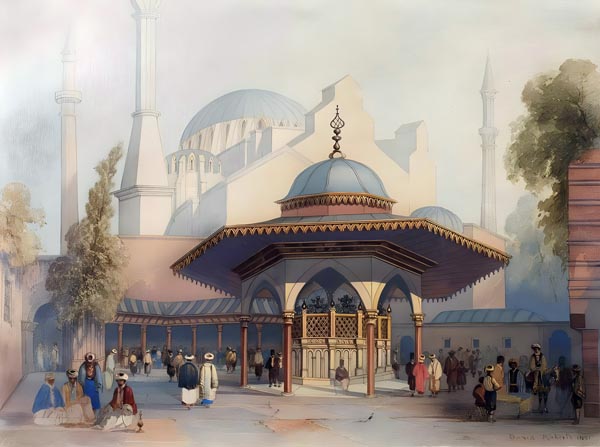
‘Shadirvan in front of Hagia Sophia, Constantinople (1851)’ - attributed to David Roberts (British, 1796 – 1864)
PICRYL
The great basilica of Hagia Sophia, built by Justinian I (in 532-537 AD; the original church on the site is said to have been built by Constantius II, c 360AD, or earlier by his father Constantine I), is one of the largest edifices that the genius of the Christian religion has brought forth; but one senses, from the barbarity of the art that produced this mass of stone, that it was the work of a time of corruption and decadence. It is a confused and crude memory of a taste that is no more; the formless sketch of an art still in its infancy. The temple is preceded by a long, wide peristyle, covered and enclosed like that of Saint Peter’s in Rome. Granite columns of prodigious height, but set within the walls and forming a solid mass with them, separate this vestibule from the forecourt. A large door opens onto the interior. The church’s enclosure is decorated on its sides with superb columns of porphyry, Egyptian granite, and precious marbles; but these columns, of varying sizes, proportions, and orders, are clearly fragments borrowed from other temples and placed there without symmetry or taste, as barbarians will re-use the mutilated fragments of a palace to support a hovel. Gigantic pillars of common masonry support an airy dome like that of Saint Peter’s, and whose effect is at least as majestic. This dome, once covered with mosaics that formed pictures on the vault, was whitewashed over when Mehmed II seized Hagia Sophia (in 1453, on his capture of the city) and converted it into a mosque. Some of the plaster has fallen away, revealing the former Christian decoration. Circular galleries, backed by vast tribunes, run around the basilica, at the level of the vault’s springs. The building’s appearance is beautiful from this vantage point: vast, sombre, unadorned, with its vaults stripped bare and bronzed columns, it resembles the interior of a colossal tomb whose relics have been scattered. It inspires awe, silence, and meditation on the instability of the works of human beings, who build, with book or a sword in hand, inspired by ideas they believe to be eternal, but in whom successive ideas conspire in turn to re-create or ruin their monuments. In its present state, Hagia Sophia resembles a vast divine caravanserai. Here, the columns of the temple of Ephesus, the images of the apostles with golden halos on the vault, look down on the hanging lamps of the imams.
Leaving Hagia Sophia, we visited the seven principal mosques of Constantinople; they are smaller, but infinitely more beautiful. One senses that Islam possessed its own artistic tradition, its own ready-made art, in keeping with the simplicity of its ideas, when it erected these splendid temples, simple and regular in form, without the concept of sacrificial altars. These mosques all resemble each other, differing only in size and colouration; they are fronted by large courtyards surrounded by cloisters, where the schools and the imams’ residences are located. Magnificent trees shade these courtyards, and numerous fountains spread the sound and the voluptuous coolness of their waters. Minarets of admirable craftsmanship rise, often as aerial landmarks at the four corners of each mosque, and soar above their domes; small circular galleries, with a parapet of stone carved with openwork like lace, surround at various heights the slender shafts of the minarets: there, at different hours of the day, stands the muezzin who calls the hour, summoning the city to the constant thought pre-occupying all Muslims, that of Allah. An openwork portico overlooking the gardens and courtyards, raised a few steps, leads to the temple gate. The temple is a square or round forecourt, surmounted by a dome supported by elegant pillars or beautiful fluted columns. A pulpit is placed against one of the pillars. The frieze is formed by verses from the Quran (Koran), written in ornate characters on the walls. The walls are painted with arabesques. Iron wires run across the mosque from one pillar to the next, supporting a multitude of lamps, hanging ostrich-eggs, and bouquets of wheat or flowers. Rush mats and rich carpets cover the flagstones of the courtyard. The effect is simple and magnificent. This is not a temple inhabited by one of a number of gods; it is a house of prayer and contemplation, where people gather to worship the one and universal God. What we ourselves call worship does not exist in this religion. The rite is simple: an annual festival, ablutions, prayer at the five daily intervals, belief in a creator and rewarder, Allah — that is all. The priestly body was formed only later. Every time I have entered mosques, whether on that day or any other, I have found a small number of Turks squatting or lying on the carpets, praying with all the outward signs of fervour and complete absorption of mind.
In the courtyard of the Bajazet mosque, I saw Constantine’s beautiful empty tomb. It is a porphyry sarcophagus of prodigious size; it could hold twenty heroes. The block of porphyry is evidently from the Greek period. It is likely some fragment torn from the Temple of Diana at Ephesus. Centuries lend their temples as they do their tombs, which are returned empty. Where are Constantine’s bones? The Turks have enclosed his sepulchre in a kiosk, to prevent it being desecrated. The tombs of the Sultans and their families are in the gardens of the mosques they built, beside marble kiosks shaded by trees and fragrant with flowers; fountains murmur outside, sometimes even within, the kiosk itself; and the cult of remembrance is so profound among Muslims that I have never passed by one of these tombs without finding bouquets of freshly picked flowers placed on the doors or window-sills of the numerous monuments.
June 13, 1833,
I have just finished a trip up and down the Bosphorus channel from Constantinople to the mouth of the Black Sea. I will sketch a few features of this enchanting landscape, so as to recall them later. I had never imagined that sea, sky, land and humankind together could create such ravishing scenes. Only the translucent mirror of the sky or the sea can see and reflect them in their entirety: my imagination sees them and preserves them here, though my memory can only retain and depict them in a few successive details. Let me then describe those scenes, view by view, cape by cape, cove by cove, and stroke by stroke of the pen. It would take a painter years to render a single one of the Bosphorus’s shores. The landscape changes with every glance, and yet it is always renewed, just as beautiful in its ever-changing appearance. What can be said in a few words?
Driven along by four Armenian oarsmen in one of those long caiques that cut through the sea like a fish, I embarked alone at seven in the morning, beneath a clear sky, under a brilliant sun. An interpreter, reclining in the boat between the rowers and me, provided me with the names of the various locations, and pointed out the details. We first sailed along the quays of Tophane, with its artillery barracks. The town of Tophane, rising in tiers of colour-washed houses like bouquets of flowers clustered around the marble mosque, faded away beneath the tall cypresses of the Great Field of the Dead at Pera. Its dark curtain of trees marks the end of the hills on that side. We glided through a multitude of ships at anchor and countless caiques carrying officers of the Seraglio, the ministers and their attendants, and the families of Armenians whom the working day recalled to their trading posts, to Constantinople.
These Armenians are a magnificent group of men, each dressed simply and nobly in a black turban and long blue robe, tied around the waist with a white cashmere shawl; they have athletic physiques; their faces are intelligent, yet commonplace; their complexions are ruddy, their eyes blue, their beards blond; they are the Swiss of the Orient: industrious, peaceful, and orderly like them, but similarly calculating and greedy. They place their mercantile genius at the service of the Sultan or the Turks. There is nothing heroic or warlike in this race of men: commerce is their genius; and they will conduct it under any master. They are the group of Christians who sympathise most closely with the Turks. They prosper and accumulate wealth that the Turks neglect to garner, and that escapes the Greeks and the Jews: everything is in their hands here; they are the dragomans of all the pashas and viziers. The women, whose features, as pure but more delicate, are reminiscent of the serene beauty of Englishwomen, or that of countrywomen from the Swiss mountains, are admirable; the children likewise. The caiques were full of them. They bring baskets of flowers from their country houses, displayed on the prow.
We rounded Tophane Point, and glided through the shadows of the great warships of the Ottoman fleet, anchored off the coast of Europe. Those enormous masses lay there as if on a lake. The sailors, dressed like Turkish soldiers in red or blue jackets, were leaning nonchalantly on the shrouds, or bathing in the sea around the keels. Large troop-laden longboats shuttled back and forth between the shore and the ships; and the elegant barges of the Kapudan-Pasha, rowed by twenty oarsmen, passed us like arrows. Admiral Tahir Pasha and his officers were dressed in brown frock coats and wore the fez, a large red woollen cap which they pull down over their foreheads and eyes, as if ashamed of having discarded the noble and graceful turban. These men looked melancholy and resigned; they smoked their long amber-tipped pipes.
There are about thirty beautifully constructed warships present, seemingly ready to set sail; but they lack sufficient officers and sailors, and this magnificent fleet is currently merely a decorative feature of the Bosphorus. While the Sultan (Mahmud II) contemplates it from his kiosk at Beylerbeyi, located opposite on the Asian coast, Ibrahim Pasha’s two or three frigates peacefully control the Mediterranean, while the boats of Samos dominate the Archipelago. A few oars’ lengths from these vessels, near the European shore, we glided beneath the windows of a long and magnificent palace of the Sultan, Uninhabited now, it resembles an amphibious palace; the Bosphorus’s waves, rising only slightly in the wind, skirt the windows and cast their foam into the ground-floor apartments; the steps of the porches are soaked by the water; grilled gates open onto the sea, even in the courtyards and gardens. There are sheds for the caiques and baths for the Sultanas, who swim in the sea sheltered by the shutters of their salons. Behind these seaside courtyards, gardens of shrubs, lilacs, and roses rise in successive tiers, supporting terraces, and gilded kiosks with grilles. These flowery lawns yield to vast groves of oak, laurel, and plane trees that cover the slopes, and rise amidst the rocks to the hilltop.
The Sultan’s apartments are open, and through the windows one can see richly-gilded ceiling mouldings, crystal chandeliers, divans, and silk curtains. Those of the harem are shuttered by thick, elegantly carved wooden grilles. Immediately beyond this palace, begins an unbroken series of palaces, houses, and gardens belonging to the Grand Seigneur’s principal favourites, ministers, and pashas. All of them sleep by the sea, as if to inhale its coolness. Their windows are open; the masters sit on divans in vast rooms gleaming with gold and silk; they smoke, converse, and drink sherbet while watching the boats pass by. Their apartments also open onto tiered terraces laden with trellises, shrubs, and flowers. Numerous slaves, in rich costumes, are generally seated on the steps of staircases bathed by the sea; and the caiques, manned by oarsmen, are moored at the edge of these stairs, ready to receive and bear away the masters of these dwellings. Everywhere the harems form a wing, somewhat separated by gardens or courtyards from the men’s apartments. They are barred. I only saw, occasionally, the head of some pretty child pressing against the openings of the trellis entwined with climbing flowers, to glance at the sea, and the white arm of a woman half-opening or closing a shutter. These palaces and houses are all made of wood, very richly crafted, with eaves, galleries, and countless balustrades, all nestled in the shade of tall trees, amidst climbing plants, groves of jasmine and rose-beds. All are bathed by the current of the Bosphorus, and possess inner courtyards into which sea water flows and re-flows, where the caiques find shelter.
The Bosphorus is so deep everywhere that we passed close enough to the shore to breathe the fragrance of the flowers, and allow our oarsmen to rest a moment in the shade of the trees. The largest vessels also passed close to us; and often a yardarm of a brig or ship became entangled in the branches of a tree, the trellises of a vine, or even the shutters of a window, and ran on, carrying with it shreds of foliage or fragments of the shutters. The houses are separated from one another only by groups of trees on a few small promontories, or by angular rocks covered with ivy and moss, which run from the crests of the hills and extend a few feet into the water. Only occasionally does a deeper, hollower inlet appear between two separate hills, formed by the carved-out bed of a torrent or stream. A village spreads there along the flattened borders of these gulfs, adorned by beautiful Moorish fountains, a mosque with a dome in gold or azure, and a slender minaret whose summit blends with that of the tall plane trees. Colour-washed cottages rise in an amphitheatre, on both sides and at the back of these small gulfs, their facades and kiosks in a thousand hues; on the hilltops, large villas extend, flanked by hanging gardens, and groups of broad-crowned fir trees, complete the horizon. At the foot of these villages are granite beaches or quays only a few feet wide; the beaches are planted with sycamores, vines, and jasmine, and form moorings, in which the caiques find refuge, lining the coves as far as the wider sea. There, at anchor, lie multitudes of boats and merchant brigs from all nations. They anchor opposite the shipowners’ houses or shops, and often a gangplank thrown from the brig’s deck to a villa’s window serves to transport the goods.
A crowd of children, vegetable vendors, and date and fruit sellers bustle about these quays; they form the bazaars of the villages, and the Bosphorus. Sailors of every kind and speaking every language are gathered there amidst the Ottomans, who smoke, squatting on their rugs, by the fountains, around the trunks of the plane trees.
No view of the villages of Lucerne or Interlaken can convey the exquisite grace and picturesque charm of these little inlets of the Bosphorus. It is impossible not to pause for a moment, and allow the boat to rest on the oars, so as to contemplate them. One finds such towns, ports, or villages roughly every five minutes along the first half of the European coast that is to say, for six or seven miles. They then become a little less frequent, and the landscape takes on a more rustic character with the increasing elevation of the hills and greater depth of the forests. I am speaking here only of the European coast, because I will describe the Asian coast, which is even more beautiful and along which I returned, later; but it must not be forgotten, in order to form an accurate picture, that the Asian coast was still only a few strokes of the oars from me; that often one is as close to one shore as the other, holding the middle of the current in the places where the channel narrows and bends, and that the same scenes that I describe on the European side delight the eye every time it falls upon the Asian coast.
But let me return to the shore I was now approaching more closely. There is a place, beyond the last of these natural harbours, where the Bosphorus narrows, like a wide and swift river, between two rocky headlands that plunge steeply from the top of twin mountains; to the naked eye, the winding channel appears to be entirely confined there; it is only as one advances that one sees it unfold, in turning behind Cape Europa, then widen and deepen into a lake, bordered, on the European shore, by the two townships of Therapia (Tarabya) and Buyukdere. From the base to the summit of these two rocky headlands, covered with trees and thick clumps of vegetation, rise half-ruined fortifications, and enormous white, crenellated towers, with drawbridges and keeps; fine constructions of the Middle Ages. These are the famous castles of Europe and Asia (Rumeli Hisari and Anadolu Hisari, respectively) from which Mehmed II long besieged and threatened Constantinople, before entering it. They rise, like two white phantoms, from the dark bosom of the pines and cypresses, as if to bar access to the two seas. Their towers and turrets rising above ships under full sail; the long ivy branches hanging like warriors’ cloaks from their half-ruined walls; the grey rocks that support them, their corner-towers emerging from the surrounding forest; the broad shadows they cast on the water, render this one of the most distinctive scenes on the Bosphorus. It is here that it loses its exclusively graceful aspect, taking on one that is graceful or sublime by turns. Turkish cemeteries stretch out at their feet, and funereal turbans carved in white marble emerge here and there, from clumps of foliage bathed by the waves. Happy are the Turks! They rest forever in their favourite places, in the shade of the shrubs they loved, by the streams whose murmurs charmed them, visited by the doves they fed in their lives, embalmed by the flowers they planted: if they do not possess the earth during their lives, they surely possess it after death. The remains of those that one has loved are not relegated to those fields full of bones that human beings create, from which one’s prayers and pious memories recoil in horror.
Beyond the castles, the Bosphorus widens; the mountains of Europe and Asia rise more rugged and desolate. Only the shores of the sea are still dotted here and there with white cottages and small, rustic mosques perched on a knoll beside a fountain, and beneath the canopy of a plane tree. The village of Therapia (Tarabya), residence of the French and English ambassadors, lies a little further along the shore; the high forests that overlook it cast their shadows on the terraces and lawns of the two palaces; small valleys meander, nestled between the rocks, and form the limits of the two powers. Two frigates, English and French, anchored in the canal opposite the respective palaces, were there to await the signal from the ambassadors, and to carry messages of war or peace to the fleets of the Mediterranean.
Buyukdere, a charming town at the end of the gulf formed by the Bosphorus as it bends to flow into the Black Sea, stretches like a curtain of palaces and villas across the slopes of two dark mountains. A beautiful quay separates the gardens and houses from the sea. The Russian fleet, composed of five ships of the line, three frigates, and two steamships, was anchored before the terraces of the Russian palaces, forming a city on the water, opposite the town and its delightful shade. The boats carrying orders from one ship to another; the vessels fetching water from the fountains or taking the sick to the shore; the yachts of the young officers, struggling like racehorses, their sails, leaning to the wind, sloshing in the waves; the cannon fire that echoed through the depths of the valleys of Asia, announcing new ships emerging from the Black Sea; a Russian camp perched on the scorched slopes of the Giant’s Mountain (Joshua’s Hill, Hazreti Yusa Tepesi), opposite the fleet; the beautiful meadow of Buyukdere on the left, with its grove of magnificent plane trees, a single one of which can shade an entire regiment; the magnificent forests of the palaces of Russia and Austria, which adorn the hilltops; a multitude of elegant houses with balconies lining the quays, roses and lilacs hanging in festoons from the edges of the terraces; Armenians with their children, constantly arriving or departing in their small boats laden with branches and flowers; the darker, narrower arm of the Bosphorus, appearing, stretching towards the misty horizon of the Black Sea; other mountain ranges, entirely devoid of villages and houses, rising into the clouds cloaked in dark forests, like formidable boundaries between the stormy sea and the magnificent serenity of the waters of Constantinople; two fortresses (Garipce Kalesi and Poyraskoy Kalesi), facing each other on either shore, crowning the advanced heights of two sombre capes with their batteries, towers, and battlements; and finally, a double line of forested rocks, fading into the blue waters of the Black Sea: that is the view from Buyukdere. Add to this the perpetual passage of a line of ships arriving or departing Constantinople, depending on whether the wind blows from the north or the south. These ships are sometimes so numerous that one day, returning to my caïque, I counted nearly two hundred in less than an hour. They sail in groups, like migrating birds changing climates; if the wind shifts, they tack from shore to shore, changing course beneath the windows and trees of Asia and Europe; if the breeze freshens, they anchor in one of the countless coves or at the tips of the small capes of the Bosphorus, and set sail again a short while later. Every minute, the view, enlivened and transformed by these groups of vessels under sail or at anchor, and by the various positions they assume along the shore, alters in appearance rendering the Bosphorus a marvellous kaleidoscope.
Having arrived in Buyukdere, I took possession of the charming house on the quay, which Monsieur Truqui kindly displaying his hospitality once more, has offered us; we will spend the summer here.
The same date, June 13, 1833.
It might seem, after the description of the European coast of the Bosphorus, that Nature is unsurpassed there, and that no landscape can outshine the one that filled my eyes. However, I travelled along the Asian coast on my way back to Constantinople this evening, and found it a thousand times more beautiful than the European coast. The Asian coast owes almost nothing to man; Nature is everything there. It lacks a Büyükdere, a Therapia, the ambassadorial palaces, the towns of Armenians or Franks; there are only mountains, gorges that separate them, small valleys carpeted with meadows hollowed out between the roots of rocks, streams that meander through them, torrents that whiten them with their foam, forests that cling to their slopes, slide into their ravines, and descend to the shores of the numerous gulfs along the coast; a variety of shapes, hues, foliage, and vegetation that the landscape painter’s brush could scarcely invent; a few isolated houses belonging to Turkish sailors or cultivators, scattered here and there along the shore, or over the plateau of a wooded hill, or grouped on the rocky point to which the current carries one, breaking in waves as deep blue as the night sky; a few white sails, like dry sheets washerwomen fold, sails of fishing boats, penetrating the deep coves, which you see gliding in front of one plane tree after another; countless flocks of white birds preening themselves at the edges of the meadows, eagles soaring from the top of the mountains out over the sea; mysterious coves, entirely enclosed by rocks and gigantic trees, whose branches, laden with clouds of leaves, bend over the waves, and form cradles on the sea into which the caiques sink; with one or two villages hidden in the shadow of these coves, their gardens rising behind them on green slopes, their clusters of trees at the foot of the cliffs, their boats rocked by the gentle waves at their doors, flocks of doves on the rooftops, women and children at the windows, old men seated under the plane tree at the foot of the minaret; farmers returning from the fields in their caiques; and others filling their boats with green bundles of myrtle or flowering heather to dry and burn in the winter.
Hidden behind these mounds of overhanging greenery, which overspill and touch the water, neither the boat nor the oarsman is visible, and one seems to see a piece of the shore, detached from the land by the current, floating haphazardly on the sea, with its green foliage and still-fragrant flowers. The coastline presents this aspect as far as the fortress (Rumeli Hisari) of Mehmed II, which seems, for its part, to close off the Bosphorus like a Swiss lake. There, its character changes: the hills, less rugged, slope gently, their backs sagging, and their narrow valleys hollowing out more softly; Asiatic villages spread there, richer and more crowded; the’ Sweet Waters of Asia’ (Göksu Deresi), a charming little plain shaded by trees, dotted with kiosks and Moorish fountains, comes in sight; a great number of Constantinople carriages, gilded wooden cages on four wheels, drawn by a pair of oxen, are scattered across the lawns; veiled Turkish women emerge from them and gather, seating themselves at the foot of a tree or on the shore, with their children and their Black African slaves; groups of men sit further away, drinking coffee or smoking pipes. The varied colours of the men’s and children’s clothing, the monotonous brown of the women’s veils, form beneath the trees a strange mosaic of hues that delights the eye. Oxen and tame buffaloes ruminate in the meadows; Arabian horses, with velvet, silk, and gold trappings, paw the ground beside the caiques that arrive in droves, filled with Armenian or Jewish women who sit unveiled on the grass by the stream, forming a line, women and girls, in various costumes and poses. Some are breathtakingly beautiful, their beauty further enhanced by the exotic variety of hairstyles and costumes. I saw a large number of Turkish women from the harems, unveiled; almost all of them small, very pale, with sad eyes. and a thin, sickly appearance. In general, the climate of Constantinople, despite all its apparent benefits as regards one’s health, seems unhealthy to me; the women in general, at least, are far from deserving the reputation for beauty they enjoy; only the Armenian and Jewish women struck me as beautiful. But how great the difference from the beauty of the Jewish and Armenian women of Arabia, and especially from the indescribable charm of the Greek women of Syria and Asia Minor! A little further, to the south, on the very shore of the Bosphorus, rises the magnificent new palace now inhabited by the Grand Seigneur (Mahmud II).
Beylerbeyi is a palace in the Italian style, displaying also Indian and Moorish influences; displaying an immense, multi-storied main section with wings and interior gardens. Large flowerbeds planted with roses and watered by fountains extend behind the buildings, between the mountain and the palace; a narrow granite quay separates the windowed facade from the sea. I passed slowly beneath this palace, where, surrounded by marble and gold, so many worries and so many fears lurk. I glimpsed the Grand Seigneur, seated on a divan in one of the kiosks overlooking the sea; Ahmed Fethi Pasha, one of his young favourites, was standing beside him. The Sultan, struck by our European attire, pointed us out to Ahmed Pasha, as if to ask who we were. I greeted the master of Asia in the Oriental manner; he graciously returned my greeting. All the shutters of the palace were open, and the rich decorations of this magnificent and delightful dwelling could be seen gleaming. The wing inhabited by the women, the harem, was closed; it is immense, but the number of women who actually live there is unknown. Two caiques, entirely gilded, manned by twenty-four oarsmen each, were at the palace gate, on the water. These caiques are in the most exquisite taste, being of European design, and Oriental magnificence: the prow of one of them, which extended at least twenty-five feet, was formed by aa golden swan, with outstretched wings, which seemed to bear the golden boat over the waves; a silk pavilion mounted on gold columns formed the stern, and rich cashmere shawls served as a seat for the Sultan; the prow of the second caique was a feathered golden arrow which seemed to fly, detached from the bow, over the sea.
I lingered, for a long time, out of the Sultan’s sight, admiring the palace and its gardens: everything there seemed arranged with perfect taste. I know of nothing in Europe that presents to the eye greater magnificence and enchantment as regards royal residences: everything, seemingly sprung from the hands of an artist, is pure, radiant with brilliance and colour. The palace roofs are concealed by gilded balustrades, and even the chimneys, which in Europe disfigure the lines of our public buildings, are gilded and fluted columns, whose elegant capitals add to the decoration of this dwelling. I admire this prince, who spent his childhood in the shadows of the Seraglio’s dungeons; threatened daily with death; instructed in misfortune by the wise and unfortunate Selim; thrust onto the throne by the death of his brother; nurturing for fifteen years, in silent thought, the liberation of the empire and the restoration of Islam through the destruction of the Janissaries; executing his plan with the heroism and calmness of the fatalist; constantly defying his people so as to regenerate them; bold and impassive in peril; gentle and merciful when he could consult his heart, yet lacking support around him, instruments to carry out the good he contemplated; his worth unrecognised by his people; betrayed by his pashas; ruined by his neighbours; abandoned by fortune, without which one can do nothing; standing by, and witnessing the ruin of his throne and his empire; finally, abandoning his true self, hastening to squander his remaining existence, a shadow of sovereignty, on the pleasant shore of the Bosphorus. A man of noble desires, and upright will, yet ultimately a man of insufficient genius and a weakened will: like the last of the Greek emperors (Constantine XI Palaiologos) whose city he occupies, worthy of another people, and a better time, and capable of dying at least a hero. He was once a great man.
History has no tale comparable to that of the destruction of the Janissaries; it was the most meticulously planned and heroically accomplished event I know of. Mahmud has that to his name; but why is it the only notable achievement of his reign to date? The hardest part was done; the tyrants of the empire were overthrown, all that was needed was will and perseverance to revitalise that empire by civilising it. Mahmud has stopped short. Could it be that genius is even rarer than heroism? (Mahmud continued to modernise until his death in 1838, his Reform Movement being continued by his son Abdulmecid I.)
After the Beylerbey Palace, the Asian coast becomes wooded and solitary again as far as Scutari (Uskudar), which shines like a rose garden at the tip of its cape, at the entrance to the Sea of Marmara. Opposite Scutari, the verdant tip of the Seraglio comes into view; while between the European coast, crowned by its three cities, and the coast of Istanbul, resplendent with its domes and minarets, lies the immense port of Constantinople, where ships, anchored on both shores, leave only a wide channel for the caiques. We glided through this maze of vessels, like a Venetian gondola beneath the shadows of the palaces, and disembarked at the Staircase of the Dead, below an avenue of cypresses.
June 16.
This morning, I visited the slave market guided by a young man from Constantinople. After traversing the long streets of Istanbul that run alongside the walls of the old Seraglio, and passing through several magnificent bazaars teeming with countless merchants and buyers, we climbed, via narrow alleyways, to a muddy square where the gate of another bazaar opened. Thanks to the Turkish attire we were wearing, and to my guide’s perfect command of the language, we were allowed into this marketplace commanded by men. How many years and successive revelations it has taken for human reason to cease seeing force as right, and for slavery to become a crime and a blasphemy in the eyes of intelligent human beings! Such progress though! And how much greater it promises! How many things there are that do not shock us, but which will be incomprehensible crimes in the eyes of our descendants! These were my thoughts as I entered the slave-bazaar, where they sell the lives, the souls, the bodies, the freedom of others, as we sell an ox or a horse, and where they believe themselves the rightful owner of what they have thus purchased. How many legitimacies so assumed we are unaware of! Yet they are real, for we cannot ask more of such men than they know. Their convictions are truths to them; they possess no others. God alone commands truth and conviction, and distributes them to us in proportion and according to our respective intellects. (Lamartine was destined to sign the French governmental decree abolishing slavery, on 27th April 1848.)
The slave market was a vast open courtyard, surrounded by a portico surmounted by a roof. Beneath this portico, enclosed on the courtyard side by a waist-high wall, were doors leading to the rooms where the merchants held the slaves. These doors remained open so that the buyers, as they strolled by, could see these latter. The male and female slaves were kept in separate rooms; the women were unveiled. Besides the slaves confined in these lower rooms, there were a large number grouped together in the arcade, under the portico, and in the courtyard. We began by walking amidst these different groups. The most remarkable was one of twelve or fifteen Abyssinian girls. Leaning back to back, like the ancient caryatids that support a vase on their heads, they formed a circle, all their faces turned toward the onlookers. These faces were generally of great beauty: almond-shaped eyes, aquiline noses, thin lips, delicate oval cheeks, and long black hair that shone like ravens’ wings. The pensive, sad, and languid expression of their faces renders the Abyssinian women, with their coppery complexions, a most admirable race; they are tall, slender, and graceful like the palm fronds of their beautiful land. Their arms are held in ravishing poses. These young women wore only a long shirt of coarse yellowish linen. They wore bracelets of blue glass beads on their legs. Seated on their heels, and motionless, their chins resting on the back of their hands or on their knees, they looked at us with eyes as gentle and sad as the eyes of the goat or lamb that the peasant woman holds by the rope and haggles over at the fair in our villages; sometimes one would say a word to another, and they would smile. There was one who held a small child in her arms and was crying because the merchant wanted to sell it without her to a child trafficker. Not far from this group were seven or eight little Black African lads, aged between eight and twelve, quite well-dressed, with an appearance of health and well-being. They were playing together an Oriental game whose instruments are small pebbles which are combined in different ways in small holes made in the sand: during this time, merchants and resellers circulated around them, taking now one, now the other, by the arm, examining him carefully from head to toe, feeling him, and making him show his teeth, to judge his age and his health; then the child, distracted a moment from his games, eagerly returned to them.
I then passed under the covered porticoes, filled with a crowd of slaves and buyers. The Turks who conducted this trade strolled among the various groups; they were superbly dressed in fur-lined coats, a long pipe in hand, their faces anxious and preoccupied, jealously watching every glance cast into their shops full of men and women; but, taking us for Arabs or Egyptians, dared not deny us access to any of the rooms. Street vendors of small cakes and dried fruit roamed the gallery, selling food to the slaves. I slipped several piastres into the hand of one of them so that he could distribute his basket to a group of small Black African children, who devoured the pastries.
There I noticed a poor Black African woman of nineteen or twenty, remarkably beautiful, but of a harsh and sorrowful beauty. She was sitting on a bench in the gallery, richly dressed, her face uncovered, amidst a dozen other Black African women in rags displayed for sale at very low prices; she held on her lap a superb little boy of three or four, magnificently dressed as well. This child, who was a mulatto, had the noblest features, the most graceful mouth, and the most intelligent and proud eyes imaginable. I played with him and gave him cakes and sugared almonds that I bought from a nearby stall; but his mother snatched what I had given him from his hands and threw them angrily and proudly onto the pavement. She bowed her face and wept. I believe it was out of fear of being sold separately from her son, and, moved by her misfortune, I asked Monsieur Morlach, my obliging driver, to buy her and the child for me. I would have taken them together and raised the beautiful child, so keeping him with his mother. We approached a broker acquaintance of Monsieur Morlach, who entered into negotiations with the owner of the beautiful slave and the child. The owner at first pretended to genuinely want to sell her, and the poor woman began to sob even louder, and the little boy also started to cry, putting his arms around his mother’s neck. But this was merely a game on the part of the merchant; and when he found that I would immediately pay the high price he had set, he bemoaned his misfortune as regards the pair, for he took the broker aside and confessed that the slave girl was not for sale; that she belonged to a wealthy Turk, whose son this child was; that she was too proud and un-tameable as regards the harem, and that, to correct and humiliate her, her master had sent her to the bazaar as if to get rid of her, but with the secret command not to sell her. This kind of punishment often occurs; and when a Turk is displeased, his most common threat is to send someone to the bazaar. So, we passed on.
We traversed a great many rooms, each containing four or five women, almost all of them dark-skinned and plain, but with an appearance of health. Most seemed indifferent to their situation, and even solicited the buyers; they chatted, laughed among themselves, and made critical observations about the faces of those haggling over them. One or two wept and hid at the rear of the room, returning reluctantly to stand prominently on the platform where they seated themselves once more. We saw several being led away cheerfully by a Turk who had just bought them, taking their small bundles folded in handkerchiefs, and covering their faces with their white veils. We witnessed two or three acts of mercy, that Christian charity might envy, performed by good Muslims. Turks came to buy old female slaves, rejected from their masters’ houses because of their age and infirmities, and led them away. We asked what use these poor women could be to them? ‘Allah wishes it,’ the broker replied. And Monsieur Morlach informed me that several Muslims sent people to the markets to buy poor slave, infirm men and women, to be fed, out of charity, in their homes. The spirit of God never completely abandons Mankind.
The last rooms we visited were half-shuttered, and our entry was disputed for some time; there was only one slave in each, under the guard of a woman. They were young and beautiful Circassian women, newly arrived from their country. They were dressed in white, with remarkable elegance and coquettishness. Their beautiful features showed neither sorrow nor astonishment, but a disdainful indifference. These beautiful white slaves from Georgia or Circassia have become extremely rare since Greek women no longer populate the seraglios, and since Russia has prohibited the sale of women.
However, Georgian families still raise their daughters for this shameful trade, and smugglers manage to bring in shipments from time to time. The price of these beautiful creatures reaches between twelve and twenty thousand piastres, between three and five thousand francs, while Black African slaves of ordinary looks sell for only five or six hundred francs, and the more attractive of them for between a thousand and twelve hundred. In Arabia and Syria, they would fetch five or six hundred piastres, a hundred and fifty to two hundred francs. One of these Georgian women was exquisitely beautiful: with delicate and sensitive features, a gentle and pensive eye, and skin of admirable whiteness and radiance. But the physiognomy of the women of that country is far from the charm and purity of that of the Arabs: one senses the North in their faces. She was sold before our very eyes for the harem of the young Pasha of Constantinople. We left with withered hearts and moist eyes from this scene, which is repeated every day and at every hour in the cities of the Orient, and returned pensively to the bazaar of Istanbul.
This is what stagnant government does! It enshrines age-old barbarities, and by maintaining rights established in antiquity gives legitimacy to crime. The fanatics for the past have proved as guilty, and as disastrous for humanity, as the fanatics for the future will. The former sacrifice humanity to their ignorance and memories; the latter to their hopes and impulsiveness. If humanity did and believed what its ancestors did and believed, the entire human species would remain mired in fetishism and slavery. Reason is the sun of humanity: it is the infallible and perpetual revelation of divine law applicable to societies. We must strive to follow it, lest we remain mired in evil and darkness; but we must not outpace it, lest we fall from the precipice. To understand the past while regretting our failings; to tolerate the present by improving it; to hope for the future by preparing for it: that is the law of the wise, and of all benevolent institutions. The opposition among some to the improvement of things is a sin against the Holy Spirit; it is a selfish and stupid effort to drag the moral and social world backwards, a world which God and Nature are always propelling forward: the past is the sepulchre of fallen humanity; it must be respected, but one need not be confined to it, or wish to live there.
The large bazaars of various goods, grocery stalls in particular, are long, wide vaulted galleries, bordered by pavements and lined with shops full of all kinds of goods. Armour, horse-harnesses, jewellery, foodstuffs, leather goods, shawls from India and Persia; fabrics from Europe, carpets from Damascus and Caramania, essences and perfumes from Constantinople, hookahs and pipes of all shapes and sizes; amber and coral mouthpieces cut for use by Orientals for the smoking of tombeki; displays of chopped or folded tobacco like reams of yellow paper; pastry shops, their products enticing in their shape and variety; fine confectionery shops, with countless varieties of sugared almonds, candied fruits, and sweets of every kind; drugstores from which emanate fragrances that perfume all the bazaar; Arab cloaks woven with gold thread and goat hair; women’s veils embroidered with silver and gold sequins: and amidst all this, an immense and constantly renewed crowd of Turks on foot, pipes in their mouths or hands, followed by slaves; veiled women accompanied by Black African women carrying beautiful children; pashas on horseback, riding slowly through the dense and silent throng; and Turkish carriages, enclosed in gilded latticework, driven at a walking pace by coachmen with long white beards, and filled with women who stop from time to time to haggle at the jewellers’ doors: such are the sights in all the bazaars. The line would stretch for several miles if they were all crammed into a single gallery. These bazaars, where one is forced to constantly rub shoulders, and where the poorer Jews display and sell the clothes of plague victims, are the most active vehicles for contagion. The plague has broken out in Pera these past few days with five or six fatalities, and it was with concern that we traversed this crowd that it could decimate tomorrow.
June 18, 1833.
Our days are spent in solitude at Buyukdere; the Bosphorus and the Black Sea before us; studying, and reading. In the evenings, we take trips by caique to Constantinople, to Belgrad Ormani and its incomparable forests; to the Asian coast, the mouth of the Black Sea, and the Valley of Roses (Lamartine is probably speaking of the Sariyer valley), nestled behind the hills of Buyukdere. I go there often. This delightful valley is watered by a spring (probably he refers to the Circir Suyu spring overlooking the Sariyer stream-bed, one among many fine springs in the area) which the Turks visit, so as to revel in the flow of water, the coolness, the scent of roses, and the songs of the bulbul or nightingale; five immense trees stand by the spring; a leafy café is sited beneath their shade: beyond, the narrowing valley leads to a mountainside where two small artificial lakes, fed by the water that falls from a spring, lie dormant under the vast canopies of the plane trees. Armenian women visit in the evening with their families to sit on the banks and enjoy their supper. Delightful groups surround the tree trunks; young girls dancing together; the quiet, decent pleasures of the Orientals. One sees that inner thought finds joy in itself. They feel Nature more readily than we do. Nowhere do the trees and the springs attract more sincere worshippers. There is a profound sympathy between their souls and the beauties of the earth, sea, and sky.
When I return in the evening from Constantinople by caique, and sail along the coast of Europe by moonlight, there is a row, two miles and more in length, of women, girls, and children, sitting silently in groups on the granite quaysides or on the parapets of the garden terraces: they spend delightful hours there contemplating the sea, the woods, the moon, breathing in the stillness of the night. Our own people no longer seem to feel any of these natural pleasures: they have exhausted their senses; they need artificial pleasure, and only vice can stir them. Those in whom Nature still speaks loudly enough to be understood and adored are deemed dreamers and poets: wretches for whom the voice of God in his works, Nature, love, and silent contemplation suffice.
I met several acquaintances again in Buyukdere and Therapia (Tarabya); among the Russian diplomats, Count Alexis Orloff, and Apollinariy Petrovich Bouteniev, the Russian ambassador to Constantinople, a charming and moral man, a philosopher and a statesman. Baron von Sturmer (Bartholomaus Freiherr von Sturmer), the Austrian ambassador, showered me with kindness. The new European politics. That is the important area now under discussion. Will the Russians, encamped in Asia and anchored beneath our windows, withdraw? For my part, I have no doubt. There is no hurry to seize the prey that cannot escape. Yesterday, Count Orloff had me read an admirable letter that Emperor Nicholas wrote to him. Here is its gist: ‘My dear Orloff, when Providence places a man at the head of forty million men, it is so that he may grant the world, from the highest throne, an example of probity and faithfulness to his word. I am that man. I seek to be worthy of the mission I have received from God. As soon as the difficulties between Ibrahim and the Grand Seigneur are resolved, do not linger for a day; bring home my fleet and my army.’
This is noble language, an excellent understanding of the situation, a potentially fruitful generosity. Constantinople will not vanish, and necessity will draw the Russians back to it, even if political probity keeps them distant for a while.
The End of Part X of Lamartine’s ‘Voyage en Orient’