Heinrich Heine
The Harz Journey (Die Harzreise, 1824): Part III
Contents
Die Harzreise
VIII: The Brocken
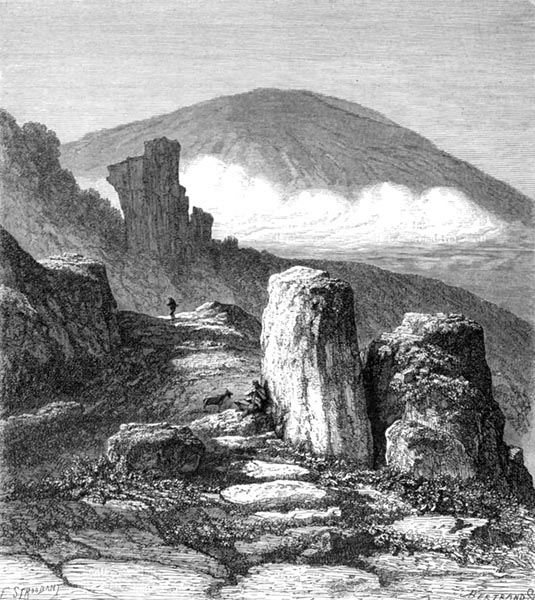
‘The Brocken’ 1879
Wikimedia Commons
The sun rose. The mists fled like ghosts, at the third cockcrow. I climbed, and descended again, and before me hovered the lovely sun, lighting scenes of ever greater beauty. The Spirit of the Mountains clearly favoured me; it knew well that poets know how to speak of beautiful things, and this morning it let me view its Harz Mountains, as they are certainly not viewed by everyone. But the Harz Mountains also viewed me, as few have seen me; on my eyelashes shimmered pearls as precious as those on the valley grasses. The morning dew of love moistened my cheeks, the rustling firs understood me, their branches parted, swaying up and down, like people silently expressing their joy by means of hand gestures, and far off there came a wonderfully mysterious sound, like the ringing of bells from a hidden woodland church; the sound, they say, of the herd-bells, which chime, in the Harz Mountains, in that lovely, clear, pure way.
According to the sun’s elevation, it was midday when I met with one such herd, and the herdsman, a friendly, blond young fellow, told me that the large mountain at the foot of which I was standing was the ancient, and famous Brocken. There were no houses for many a mile around, and I was pleased that the young man invited me to dine with him. We sat down to a déjeuner dinatoire (a buffet lunch) which consisted of cheese and bread; the sheep browsed the crumbs, while the pretty cows with gleaming hides jostled about us, tinkling their bells, archly, and mocking us with wide, contented eyes. We dined truly royally; in fact, my host seemed to me the true king, and since he is the only king who has, as yet, shared his bread with me, I will sing his praises royally too.
The shepherd boy is king,
A green hill his throne of old,
Above his head, the sun
Is his heavy, crown of gold.
The sheep lie at his feet,
Gentle flatterers, marked with red!
The knights are the calves;
With cloven feet they tread.
The court-players are the goats;
While every bird and cow
With its twittering, or its bell,
Is a king’s musician now.
They pipe and chime so sweetly,
So sweet their music deep,
Round the falls, and the fir-trees,
That the king falls asleep.
All the while, his sheepdog
As minister, must reign,
Its growling and barking
Echoing o’er the plain.
The young king babbles, sleepily:
‘To rule is hard, I ween,
Oh, I wish I were at home
In the arms of my queen!
In the arms of my queen,
My royal head, so softly, lies,
And there is all my kingdom,
Deep within her lovely eyes.’
We said our friendly farewells, and I climbed the mountain, cheerfully. Soon I was greeted by a grove of tall firs that reached the sky above, and for whom I felt every respect. These trees have not had an easy time of it, and have suffered hardships in their youth. The mountain hereabout is littered with numerous large granite boulders, and most of the trees have had to twine around the stones, or shatter them with their roots, laboriously searching for pockets of soil from which they might draw sustenance. Here and there, the stones sit on top of one another, forming a gateway, as it were, and on their summit stand the trees, their bare roots extending over that stony gate, and only at the foot of the pile grasping the ground, such that they seem to be growing in mid-air. And yet they have soared to a mighty height, and, clutching the stones as if nurtured together, they stand more firmly than their easy-going colleagues in the tame woodland soil of the plain. So too do great men stand who have strengthened and established themselves in life, by overcoming the constraints and obstacles of youth. Squirrels climbed the fir-branches, and roe deer ambled beneath them. When I see such gentle and noble creatures as the latter, I cannot understand how cultured people find pleasure in hunting and destroying them. It was a deer, more merciful than any human being, that according to legend nursed the languishing and sorrowful child of Saint Genevieve of Brabant.
The golden sunlight, piercing the dense fir-trees, is a thing of beauty. The tree-roots form a natural staircase. Everywhere are swollen banks of moss; the stones are covered, a foot deep, as if with light-green velvet cushions, amidst a cool freshness and the dreamy murmur of streams. Here and there, one sees silvery water trickling beneath the stones, lapping at the bare, fibrous tree-roots. If one bends down to observe more closely, one can eavesdrop, as it were, on the hidden evolutionary history of plants, and the quiet throb of the mountain’s heart. In some places the water bubbles more forcefully among the stones and roots, forming small cascades. It is pleasant to sit there. The murmuring water races downwards at an amazing speed; the birds give out broken cries of longing; the trees whisper as if with a thousand young girls’ tongues; mountain flowers with unknown names gaze as if from a thousand young girls’ eyes, and stretch out their wonderfully broad, oddly jagged leaves; sunbeams shimmer playfully; bright little herbs tell each other green-hued fairy-tales; everything is as if enchanted, its secrecy deepens, and an ancient dream comes to life; the beloved appears – oh, that she vanishes again so swiftly!
The higher you climb on the mountain, the shorter are the dwarf firs, seeming to shrink more and more, until one sees only bilberries, heathland shrubs, and alpine plants. It also becomes noticeably colder. Strange groups of granite boulders become clearly visible here, and are often of astonishing size. They may well be the playthings that evil spirits throw to one another on Walpurgis Night, when the witches fly there, on broomsticks and pitchforks, and their wild, wicked revelry begins, as one’s credulous nurse claimed, and as can be seen in Moritz Retzsch’s beautiful illustrations for Goethe’s ‘Faust’. Indeed, one young poet who passed the Brocken, on a journey from Berlin to Göttingen, on the first night of May (Heine himself, in 1824), even noticed some literary ladies there, who were holding an aesthetic tea party in an angle of the mountain, leisurely reading the Dresden ‘Abendzeitung’ (‘Evening Paper’) aloud to one another, praising the poetic billy-goats, who bleated and hopped around their tea-table, as universal geniuses, and passing final judgment on all the phenomena of German literature; but when they seized upon ‘William Ratcliff’ and ‘Almansor’ (plays by Heine, of 1821/22) and denied the author any trace of piety or Christianity, the young man’s hair stood on end, and horror seized him – ‘I’ spurred my horse, and galloped onwards!
In fact, when, on climbing the Brocken, one ascends beyond halfway, one cannot help but be reminded of the many delightful Blocksberg (an alternative name for the Brocken) legends, and especially of the great, mystical, German national tragedy of Doctor Faust. It seemed to me as if cloven hooves were scrabbling behind me, and someone in a mocking mood was catching their breath. I truly believe even Mephistopheles would struggle to do so while ascending his favourite mountain; the climb is extremely exhausting, and I was glad when I finally saw the long-awaited Brocken-House.
This building, which, as is known from numerous illustrations, consists only of a single floor and is located at the summit of the mountain, was constructed in 1800 by Count Christian Stolberg-Wernigerode, on whose behalf it is also managed as an inn. The walls were designed to be surprisingly thick, to resist the wind and the cold in winter; the roof is low, with a tower-like lookout in the middle (the tower was demolished in 1834). There are two small outbuildings next to the house, one of which once served as shelter for visitors to the Brocken in earlier times.
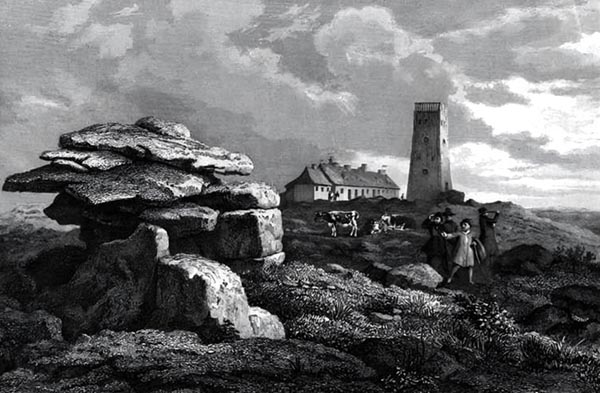
‘The Brocken-House’ Ludwig Richter, 1836
Picryl
Entering the Brocken-House produced in me a somewhat strange sensation, as if I were in legendary times. After a long, solitary ascent, amid rocks and fir-trees, one is suddenly transported to a house in the clouds; far below are townships, mountains, forests, while above one encounters an odd assortment of folk, half-curious and half-indifferent who, as is natural in such locations, welcome one almost as if one were expected. I found the house full of guests and, as befits a knowledgeable fellow, I already anticipated the discomfort of a bed of straw and an unpleasant night ahead. In a voice like that of a dying man, I immediately begged for tea, and the landlord was intelligent enough to understand that I, a sick person, needed a proper bed for the night. He provided this in the form of a cramped little room in which a young merchant, a tall ‘emetic’ in a brown overcoat, had established himself.
The public room I found to be an animated hive of activity. There were students there from various universities. Some had arrived shortly before, and were taking a rest, others were preparing to leave, packing their rucksacks, writing their names in the visitors’ book, and receiving Brocken bouquets (of flowering heather, moss, etc) from the housemaids. There was a deal of cheek-pinching, singing, leaping about, cheering, and the asking and answering of questions: ‘good luck’, ‘fine weather’, ‘good health’, ‘goodbye’. Some of those leaving were a little intoxicated, and were enjoying the beautiful view in duplicate, a drunk seeing everything double.
After I had recovered somewhat, I climbed the look-out tower, and there encountered a gentleman of modest height accompanying two ladies, one young, one elderly. The young lady was very beautiful. A superb figure, with a black satin hat like a helmet on her curly hair, the hat’s white feathers fluttering in the wind. Her slender limbs were so tightly wrapped in her black silk cloak that her noble form was outlined, while, with a free expression, she directed her wide eyes, serenely, upon the free world spread below.
When I was a boy, I thought of nothing but tales of enchantment and wonders, and every beautiful lady who wore ostrich feathers on her head I considered a faery-queen or, if I noticed that the train of her dress was damp, a water-nymph. Now I think otherwise, since I know from natural history that those symbolic feathers come from the most stupid of birds, and that the train of a woman’s dress can become damp in a perfectly natural manner. If, with the eyes of boyhood, I had seen the aforementioned young beauty in the aforementioned location on the Brocken, I would certainly have thought: ‘That must be the faery of the mountain, and it is she who has cast the spell that makes everything down there seem so miraculous.’ Indeed, everything does appear miraculous in the extreme when one first looks down from the Brocken’s summit. The mind receives new impressions at every moment, varied and even contradictory ones, which combine in one’s soul into one deep, as yet obscure and incomprehensible, feeling. If one succeeds in grasping this feeling in essence, one grasps the mountain’s innate character. This character is entirely German, both in its faults and its virtues. The Brocken is German. With German thoroughness, it reveals, clearly and distinctly, in a giant panorama, the many hundreds of cities, towns, and villages, located mostly to the north, and the mountains, forests, rivers, and expanses, all around it, to an infinite distance. But precisely because of this thoroughness, everything appears like a crisply-drawn, clearly-illuminated map; and nowhere is the eye delighted by truly beautiful effects of landscape. As always happens, we German compilers, because of our honest desire for precision in everything we present, never think of displaying individual features in a beautiful manner. The mountain has something calmly Germanic, sensible, and tolerant about it, precisely because it sees so far and so clearly. And when such a mountain opens its giant eyes, it may indeed see a little more than we dwarves who clamber about on its slopes, gazing from foolish little eyes. Many seek to claim that the Brocken is essentially philistine, and indeed Matthias Claudius wrote: ‘The Blocksberg is a tall gentlemanly Philistine!’ (See his ‘Rheinweinlied’)
But that is mere error. Displaying a bald head, sometimes hidden beneath a white cap of mist, it may give the appearance of philistinism; but, as with some other great Germans, it does so purely out of a sense of irony. It is a notorious fact that the Brocken has its youthful moments of fantasy, such as May Eve. Then it jubilantly throws it cap of mist into the air, and, like the rest of us, runs riot, in the spirit of true German Romanticism.
I immediately tried to engage the beautiful lady in conversation; for one only truly enjoys natural beauty when one is able to address it on the spot. She was not exactly witty, but was thoughtfully attentive. Her manner was truly noble, by which I mean not that commonplace, rigidly negative show of nobility that knows precisely what is to be avoided; but that rarer, freer, positive nobility that tells one exactly how far one may venture, and despite its impartiality, inspires in one the highest degree of social confidence. To my own astonishment, I suddenly developed a deep understanding of geographical detail, informing the interested beauty of the names of all the cities that lay far beneath us, searching for them and pointing them out to her on my map, which I spread on the stone slab of a table at the centre of the tower-room with the air of a knowledgeable man. I failed to find many a town, perhaps because I seemed to be searching for them more with my fingers than my eyes, which, meanwhile, had directed themselves towards the face of the lovely lady, finding therein locations more beautiful than ‘Schierke’ and ‘Elend.’ Her face was one of those that never charm, rarely delight, yet always please. I love such faces because their smiles calm my troubled heart. The lady was as yet unmarried, though already showing a maturity that sufficiently justified one’s speculation about her state. Yet this is a common occurrence; it is precisely the most beautiful girls who experience the most difficulty in finding a husband. Such was the case in ancient times, and, as is well known, all three Graces remained single.
I was unable to divine what relationship the gentleman possessed to the ladies he accompanied. His was a lean, oddish figure. A small head, sparsely covered with grey hairs and covering his low forehead, as far as his eyes of a dragonfly-green; a round prominently-protruding nose; and a mouth and chin drawn back precipitately toward the ears. His smallish face appeared as if made of delicate, yellowish clay, the kind sculptors employ when moulding their initial models; and when he pursed his thin lips, a thousand fine, semicircular wrinkles appeared on his cheeks. The little man spoke never a word, and only now and then, when the elderly lady whispered something amiable to him, did he smile like a chilly lapdog.
The older lady was the younger lady’s mother, and she, too, owned to the most refined features. Her eyes betrayed a morbidly dreamy profundity, her mouth had the set of strict piety, yet it seemed to me as if it had once been very beautiful, and had smiled a great deal, received many kisses, and returned many. Her face resembled a palimpsest, where, beneath the fresh blackness of some monk’s script, a text perhaps of some Father of the Church, lay half-obliterated lines inscribed by an ancient Greek love-poet. Both ladies had toured Italy that year with their companion, and told me all sorts of interesting things regarding Rome, Florence, and Venice. The mother spoke a great deal about the Raphael paintings in St. Peter’s (they were, and are, in fact, in the Vatican); the daughter spoke more about the opera at the Teatro La Fenice in Venice. Both were enchanted by the art of improvisation. Nuremberg was these ladies’ home town; but of its ancient splendour, they had little to say. Of the gracious art of the Meistersingers, of which the good Johann Christoph Wagenseil has informed us (see his ‘De Civitate Noribergensi Commentatio’, 1697), the last surviving notes have died, and the citizens of Nuremberg edify themselves with nonsensical Italian impromptus and castrato voices. O Saint Sebald, what a poor patron saint of Nuremberg you have proved to be!
As we spoke, dusk began to fall; the air grew even colder, the sun sank lower, and the tower’s platform filled with students, travelling tradesmen, and a few honest citizens with their wives and daughters, all of whom wished to view the sunset. It being a sublime sight that inspires the soul to prayer. For a full quarter of an hour, we all stood there in solemn silence, watching that beautiful fiery orb sink, gradually, in the west. Our faces were illuminated; hands were involuntarily clasped. It was as if we, a silent congregation, were standing in the nave of a gigantic cathedral, and the priest was now raising the ‘Body of Christ’, while Palestrina’s immortal chorale (his ‘Missa Papae Marcelli’ of 1562) was poured forth from the organ.
As I stood lost in contemplation, I heard someone next to me exclaim: ‘How beautiful nature often is!’ These words issued from the soulful heart of my roommate, the young merchant. They reinstated my everyday mood, and I was now able to utter a host of pleasant comments to the ladies regarding the sunset, and escort them calmly to their rooms as if nothing had occurred. They even allowed me to entertain them for a further hour. Like the Earth itself, our conversation revolved around the sun. The mother remarked that the sun sinking into the banks of mist looked like a glowing red rose flung, with celestial gallantry, into the wide, white bridal veil of its beloved Earth. The daughter remarked, with a smile, that frequent viewing of such natural phenomena weakens the impression they make. The mother corrected this false opinion with a quotation from Goethe’s travel letters (see, Goethe’s ‘Letters from Switzerland’; his letter of October 3, 1779), and asked me if I had read ‘Werther’? I believe we also spoke of Angora cats, Etruscan vases, Turkish shawls, macaroni, and Lord Byron, from whose poems the older lady recited some passages regarding sunsets, with a rather charming lisp, while sighing. To the younger lady, who knew no English and wished to read his poetry, I recommended the translations of Byron executed by my beautiful, and witty compatriot, Baroness Elise von Hohenhausen. On this occasion too, I did not neglect to rant about Byron’s godlessness, lovelessness, desolation, and heaven knows what else, which I customarily do when conversing with young ladies,
After this business, I went for a walk on the Brocken; since it is never completely dark there. The mist was not too dense, and I could see the outlines of the two hills known as the Witches’ Altar (Hexenaltar) and the Devil’s Pulpit (Teufelskanzel). I fired my pistol, but there was no trace of an echo. Suddenly, however, I heard familiar voices and found myself being embraced and kissed. Here were fellow-students of mine, who had left Göttingen four days later, and were most surprised to encounter me all alone on the Blocksberg. There was a great deal of talking and wonderment, of arranging to meet, of laughter and recollection, and it seemed as if, in spirit at least, we were back in our academic Siberia, where the refinement of manners is so great that ‘bears’ are bound (‘debts’ are contracted) in taverns, and the ‘sables’ (‘serving girls’) bid their pursuers good evening.
End of Part III of Heinrich Heine’s ‘Die Harzreise’