Heinrich Heine
The Harz Journey (Die Harzreise, 1824): Part II
Contents
Die Harzreise
VI: The Dorothea and Karolina Mines
In the silver-refinery, as often in life, I missed seeing the silver. I did somewhat better at the Mint, where I could observe how money is made. I confess, I’ve never progressed any further. I have had the opportunity to observe the like on a number of occasions, but believe that if thalers rained from the sky, I would only collect holes in my head, while the Children of Israel would cheerfully gather the silver manna. With a feeling that was an amusing mixture of awe and emotion, I looked at the new-born, shiny thalers, set one fresh from the mint in my hand, and said to it: ‘Young Thaler! What a fate awaits you! What good and evil you’ll arouse! What vice you’ll hide, and virtue you’ll foster! What love you’ll receive, and curses you’ll suffer! What decadence, pandering, deceit, and murder you’ll assist in! What restless wandering you’ll endure, passing through clean hands and soiled hands for centuries, till at last, burdened with guilt and weary of sin, you’ll be gathered to your own people, in the bosom of Abraham, who will melt you down, purify you, and transform you into a new and finer thing, perhaps even an innocent teaspoon, with which my own great-grandchild will one day mash his beloved porridge!’
I found the exploration of the two most excellent Clausthal mines, the ‘Dorothea’ and the ‘Karolina,’ very interesting, and I must tell you all about it, in detail.
Half an hour’s walk from the town, you reach two large, blackish buildings. There, you are immediately greeted by the miners. They wear broad, dark and usually steel-blue, jackets that hang over the stomach, trousers of a similar colour, a leather apron tied at the back, and small green felt hats, completely brimless, like decapitated cones. The visitor is made to don similar clothing, but without the leather apron. A foreman, his guide, after lighting his miner’s lamp, leads him to a dark opening that looks like a chimney-hole, descends as far as his chest, gives the visitor instructions on how to manage the ladders, and asks him to follow without fear. The whole thing feels dangerous, yet is anything but; however, that you won’t believe, at first, if you know nothing about mining. There's a certain trepidation aroused in donning the dark delinquent’s garb. And then you have to clamber down, using hands and feet, and the dark hole is so very dark, and God knows how long the ladder is. You soon realise that there is not just a single ladder leading down into the blackness of eternity, but several ladders, each with fifteen to twenty rungs, and each leading to a small wooden platform on which you stand, and from which a new hole leads downwards equipped with another ladder. I first entered the Karolina; the dirtiest and most unpleasant Karolina I have ever met with. The rungs of the ladder were wet and muddy. From one ladder to the next one descends, with the foreman, as guide, going first, who constantly assures you there’s no danger at all, one just has to hold on tightly to the rungs with your hands, not look down at your feet, while avoiding vertigo or stepping on the side planking through which the whirring barrel-rope is now ascending, and from which a fortnight ago a careless person fell and sadly broke his neck. Below ground there is always a vague rushing and humming sound, you constantly bump into beams, and winding ropes hauling up barrels full of crushed ore and sinter. Sometimes, you come to a hewn-out passage, a gallery, where you can see the veins of ore, and where a solitary miner sits all day, laboriously knocking pieces out of the wall with his hammer. I failed to reach the lowest depths where, it is claimed, you can hear the folk in America shouting, ‘Hurrah, for Lafayette!’ Between ourselves, the level I had reached already seemed deep enough: with its constant rushing and roaring, eerie mechanical movement, the rippling of subterranean springs, water trickling from all sides, dusty vapour rising from the earth, and the miner’s lamp flickering on, ever dimmer, into the solitary night. It was truly deafening; breathing was difficult, and I could barely keep my grip on the slippery rungs of the ladders. I felt not a trace of what one terms ‘fear’, but, strangely enough, down there, in the depths, I recalled that the previous year, about this time, I had experienced a storm in the North Sea, which now seemed quite pleasant and cosy by comparison, the ship rocking back and forth, the wind trumpeting its tune, the cheerful shouts of the sailors ringing out in our midst, and everything bathed in the freshness of the Lord’s blessed, free air. Yes, air! Gasping for air, I ascended several dozen more ladders, till my guide led me through an extremely long and narrow passage hewn through the mountain, and into the Dorothea mine. There, it was airier and fresher, and the ladders were cleaner, but also longer and steeper than in the Karolina. There, I felt better too, especially on seeing traces of living people once more. In the depths, shifting glimmers of light appeared; miners with their lamps rose gradually to the surface, who, greeting me with cries of ‘Good luck, to you!’ and receiving the like from me, passed on by; and like a calm, friendly, yet at the same time tormentingly enigmatic memory, I was struck by the profoundly clear gaze of the solemn, pious, somewhat pale, faces of those men, young and old, mysteriously illuminated by the mining lamps, who had worked their dark, lonely mine shafts all day, and were now longing for the clear daylight and the faces of their wives and children.
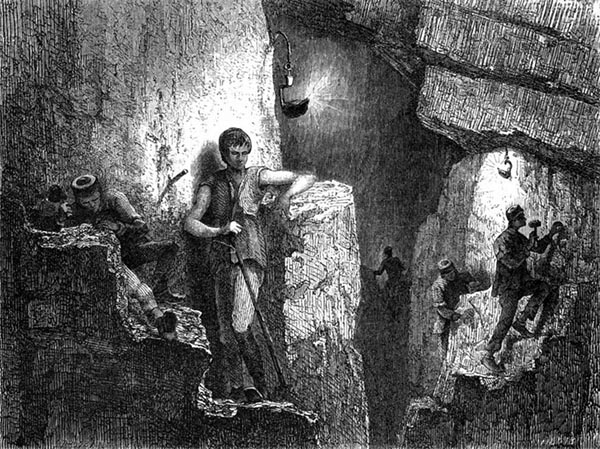
‘The Harz Miners’ 1863
Picryl
My guide himself was a thoroughly honest, biddable German. With a glow of joy, he showed me the spot where the Duke of Cambridge (Adolphus Frederick, youngest son of George III of England, Viceroy of Hanover in 1831) had dined with his entire entourage, while working the mine, and where the long wooden dining-table still stands, as well as the large bronze chair the duke occupied. ‘It will remain as a lasting memorial’, said the loyal miner, and he enthusiastically recounted the festivities that had taken place then, and spoke of how the entire tunnel had been decorated with lights, flowers, and foliage; how one miner had played the zither and sung; how the dear, fat Duke had cheerfully drunk many a toast; and how many miners, he himself in particular, would gladly allow themselves to be killed for the dear, fat Duke, and indeed the entire House of Hanover. I am deeply moved every time I witness such shows of allegiance being expressed in simple and natural words. It is a beautiful feeling! And a truly German one! The people of other nations may be more skilful, wittier, or more entertaining, but none are as loyal as the loyal German. If I was unaware that loyalty is as old as the world, I could easily believe a German heart invented it. German loyalty! It is not a modern cliché? At your courts, you German princes, that song should be sung and sung again, that of faithful Eckhart and the wicked Duke of Burgundy, who caused his sons to be slain and yet still found him true (see ‘Der Getreue Eckart’, by Ludwig Tieck, 1799). You rule the most loyal of peoples, and you are in error if you think that old, cautious, faithful hound has suddenly gone mad, and is snapping at your sacred calves.
Like German loyalty, the little minor’s lamp had now guided us quietly and safely, and with scarcely a flicker, through the labyrinth of shafts and tunnels; we emerged from the muffled darkness within the mountain, to the sun’s light shining its ‘Good luck to you!’
Most of the miners live in Clausthal, and the adjacent mining town of Zellerfeld. I visited several of these worthy people, observed their cosy homes, heard some of their songs, which they accompanied beautifully on the zither, their favourite instrument, and had them recite old mining tales and the prayers they usually say together before descending the dark mine-shaft, and I prayed many a good prayer along with them. One old foreman even suggested I should stay with them and become a miner; and when I, nonetheless, took my leave, he sent with me a message for his brother, who lived near Goslar, and many kisses for his dear niece.
However calm and uneventful the lives of these people may appear, they are nevertheless real. The ancient, quavering woman who sits behind the stove, opposite the large cupboard, may have been there for a quarter of a century, and her thoughts and feelings are doubtless intimately intertwined with every corner of the stove and every carving on the cupboard. And the cupboard and the stove are alive, for a person has infused them with a part of their soul.
Only through such a profound ‘immediacy,’ of perception, could the German fairy-tales emerge, the peculiarity of which lies in the fact that not only animals and plants, but also seemingly lifeless objects speak and act within them. To a thoughtful, gentle people in the quiet, enclosed privacy of their humble mountain or forest huts, the inner life of such objects had acquired an essential and consistent character, a sweet mixture of fantastic whimsy and purely human sentiment; and so in the fairy-tales, wondrously and yet, as it were, self-evidently: a needle and pin emerge from the tailor’s house and find themselves lost in the darkness; a piece of straw and a piece of coal wish to cross the stream, and meet with an accident; a shovel and a broom quarrel on the stairs, and wrestle each other; the mirror, on being consulted, reveals an image of the most beautiful woman; even drops of blood begin to speak, anxiously, their dark words of pity. That is why our life in childhood is so infinitely significant; during that time, everything is equally important to us; we hear all, we see all; there is a uniformity to all our impressions, whereas later we become more deliberate in our ways, deal more exclusively with individual tasks, exchange, laboriously, the bright gold of perception for the paper-money of literary description, and gain in breadth what we lose in depth. Once we are grown-up, distinguished people, we move to a new apartment; the maid tidies it daily, and rearranges the furniture as she sees fit, furniture which interests us little, for it is either new or belonged to Hans one day, and Isaac the next; even our clothes remain foreign to us; we scarcely know how many buttons there are on the coat we are currently wearing; we change our clothes as often as possible, none of which remain connected with our inner and outer history; we can hardly remember what the brown waistcoat looked like that once caused us so much laughter, and yet on whose broad stripes the dear hand of our beloved rested so sweetly!
The old woman, opposite the large cupboard behind the stove, was wearing a flowered skirt of ancient fabric, her late mother’s wedding dress. Her great-grandson, a blond, bright-eyed boy dressed as a miner, sat at her feet, counting the flowers on her skirt, and she may have already told him many little stories about that skirt, many serious, charming stories that the boy will certainly not soon forget, stories that he will often recall when, a mature adult, he is working alone in the midnight tunnels of the Karolina, and which he will perhaps recite in turn when his dear grandmother is long dead and he himself, a silver-haired, obsolete old fellow, sits amidst a circle of his grandchildren, opposite the large cupboard behind the stove.
I stayed the night at the ‘Krone’. Councillor B*** from Göttingen (Friedrich Bouterwek who had been Professor of Philosophy and Aesthetics, there) had also arrived. I had the pleasure of paying my respects to the old gentleman. When I signed the guest book and leafed through the month of July, I also found the much-loved name of Adalbert von Chamisso, the poet, and biographer of the immortal ‘Schlemihl’ (see his tale, ‘Peter Schlemihl, The Man Who Sold His Shadow’, 1813). The innkeeper told me that this gentleman had arrived in indescribably poor weather, and departed again in equally poor weather.
VII: Goslar
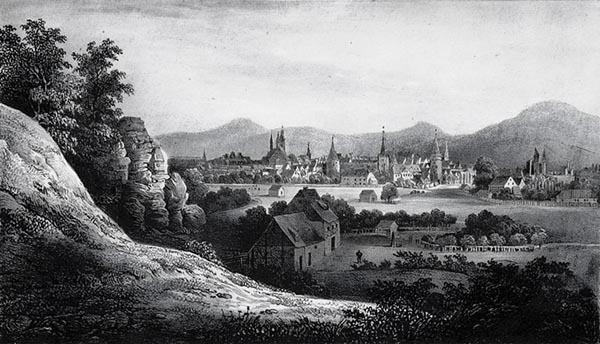
‘View of Goslar from the Klusfelsen rock’ 1842
Picryl
The following morning, I needed to lighten my pack again. I threw a pair of boots overboard, rose to my feet, and headed for Goslar. I arrived there without knowing how. This is all I can remember: I strolled uphill and downhill, gazing down into many a pretty meadow in the valley; silver waters roared, sweet woodland birds chirped, herd- bells rang, the varied green of the trees was bathed in golden sunlight, and above was the blue silk canopy of sky, so transparent that one could see deep into the Holy of Holies, where the angels sit at God’s feet and study the basso continuo visible in the features of his face. But I was still living the dream of the previous night, which I could not banish from my soul. It was of the old fairy tale about a knight descending into a deep well, where the most beautiful princess lies, frozen in enchanted sleep. I myself was the knight, and the well the dark Clausthal pit. Suddenly a host of lights appeared. From all the side-galleries rushed watchful little dwarves, making angry faces, slashing at me with their short swords, and blowing shrilly on their horns. More and more raced towards me, their large heads shaking horribly from side to side. As I struck at them, and the blood flowed I noticed, instantly, that they were in fact those red-flowered, long-bearded thistle-heads I had decapitated with my stick the day before along the way. They all immediately fled, and I entered a bright and magnificent hall. At its centre, veiled in white, rigid and motionless as a statue, stood my beloved. I kissed her mouth, and, by the living God, I felt the blissful warmth of her spirit, and the sweet trembling of her lovely lips. It seemed to me as if I heard God say, ‘Let there be light!’ An eternal dazzling ray shot down, but, in the same instant, night fell once more, and all was blended chaotically together, to form a wild, and desolate ocean. A wild, and desolate ocean, over whose churning waters, the ghosts of the deceased were anxiously racing, their white shrouds fluttering in the wind, while fast behind them, cracking his whip, ran a motley-coloured harlequin, who was myself – suddenly, from the dark waves, sea-monsters raised their misshapen heads, reaching for me, with outstretched claws, as I awoke in horror.
How often the most beautiful fairy tales are ruined! According to the tale, when the knight has found the sleeping princess, he has to snip a piece from her precious veil; and when, due to his boldness, her enchanted sleep is broken, and she is seated once more, in her palace, on her golden chair, the knight must approach her and say: ‘My most beautiful princess, do you know me?’ And then she will answer: ‘My bravest knight of all, I know you not.’ Then, he shows her the piece he has cut from her veil, which fits exactly, and they both embrace tenderly, and the trumpets sound, and their marriage is celebrated. It is my misfortune that my own dreams of love rarely have such a beautiful ending.
The name Goslar sounds so pleasing, and so many ancient Imperial memories are linked to it, that I expected to find an imposing, stately city. But it’s always the same, when one sees what is famous close to! I found it to be a nest of mostly narrow, labyrinthine, crooked streets, with a little river, probably the Gose, flat and gloomy, flowing through its centre, the paving of which was as bumpy as Berlin hexameters. Only the antiquities of the surrounding area, namely the remains of walls, towers, and battlements, grant the city a certain piquancy. One of these towers, called the Zwinger, has walls so thick that entire rooms have been carved into them. The square in front of the city, where the world-famous ‘Schützenfest’ (a rifle-shooting competition) is held, is a large and beautiful meadow, surrounded by high mountains. The market is small, with a fountain in the middle (still extant). The water flows into a large metal basin. When fires break out, it is struck several times; this produces a loud noise. Nothing is known about the origin of the metal basin. Some say the devil once set it down in the marketplace at night. Back then, the people were foolish, and the Devil was also foolish, and they exchanged gifts with one another.
The town hall in Goslar is a whitewashed police station. The adjacent guild hall has a finer appearance. At approximately the same distance from the ground as from the roof, stand statues of German emperors, smoke-black but partially gilded, each holding a sceptre in one hand and a globe in the other; they look like half-roasted university beadles. One of the emperors holds a sword instead of a sceptre. I have no idea what that signifies; and yet it certainly has some meaning, since we Germans possess the remarkable habit of reflecting on everything we do.
In Gottschalk’s ‘Handbook,’ I had read a lot about the ancient cathedral, and the famous Kaiserstuhl (Imperial throne) in Goslar. But on asking about both, I was told that the cathedral had been torn down, and the Kaiserstuhl had been taken to Berlin. We live in a momentous time: thousand-year-old cathedrals are being torn down, and Kaiserstuhls are being consigned to storage. (It is now back in the vaults of the Imperial Palace of Goslar. The sandstone plinth and enclosure with a replica of the bronze seat surrounds, are in the northern porch of St. Simon and Jude.)
Some memorials of the late cathedral, are now on display in St. Stephen’s Church. Beautiful stained-glass windows; some indifferent paintings, including one by Lucas Cranach; a wooden Christ on the Cross; and a pagan sacrificial altar of unknown metallic composition, which has the shape of an elongated, rectangular chest, and is supported by four caryatids, in a crouching position, who hold their hands above their heads, while grimacing in an unpleasant manner. Even more unpleasant, however, is the aforementioned large wooden crucifix which stands nearby. This head of Christ, with real hair and thorns, and a blood-stained face, certainly masterfully depicts the death of a human being, but not of a divinely born Saviour. Only material suffering is carved into that face, not the poetry of sacrifice. Such an image belongs more to an anatomy class than a church. The knowledgeable sexton who showed me around pointed out, as being especially rare, a black, polygonal, closely-planed, piece of wood covered with white numbers, hanging like a sign-board in the middle of the church. Oh, how brilliantly the inventive spirit of the Protestant Church is displayed here! For who would have thought it! The numbers on the piece of wood in question are the numbers of the day’s psalms, usually written in chalk on a blackboard and appearing somewhat austere to the aesthetic sense, but now, thanks to the above invention, serving as an ornament to the church and adequately replacing the Raphael paintings so often lacking. Such advances please me immensely, for I, a Protestant, and indeed a Lutheran, have always been deeply saddened when Catholic opponents choose to mock the empty, godforsaken appearance of Protestant churches.
I stayed in an inn near the market, where the lunch would have tasted even better had the innkeeper not sat down opposite, adding to the meal his long, superfluous face, and his tedious questions; fortunately, I was soon relieved of his presence by the arrival of another traveller, who had to endure the same questions in the self-same order: quis? quid? ubi? quibus auxiliis? cur? quomodo? quando? (Latin for Who? What? Where? By what means? Why? How? When?)
The stranger was an old, tired, worn-out fellow who, as was evident from his speech, had travelled the world, had lived a particularly long time in Batavia (then the capital of the Dutch East Indies), had acquired substantial wealth, and then lost it all again, and now, after a thirty-year absence, was returning to Quedlinburg, his hometown – ‘because,’ he added, ‘the family’s hereditary burial plot is there.’ The innkeeper made a most enlightened remark: that it was of no consequence to the soul where our body is buried. ‘Do you have that in writing?’ answered the stranger, and as he did so, uncannily-sly wrinkles formed around his puny lips and faded little eyes. ‘Though,’ he added nervously, and in a conciliatory tone, ‘I wouldn’t wish to suggest there is anything wrong with burial in a foreign land; the Turks bury their dead even more beautifully than we do; their churchyards are proper gardens, and they sit beside the white, turban-shaped gravestones, in the shade of a cypress, stroking their beards solemnly, and smoking their Turkish tobacco in their long Turkish pipes, quietly. And as for the Chinese, it’s a real pleasure to watch them hover respectfully about the resting places of their dead, praying, drinking tea, playing the lute, and decorating their dear ones’ graves very charmingly, with all kinds of gilded latticework, porcelain figurines, scraps of dyed silk, artificial flowers, and colourful lanterns — all very delightful. But, how far is Quedlinburg from here’
The churchyard in Goslar held little appeal for me. But I was more intrigued by the beautiful curly-haired girl who, on my arrival in the town, smiled at me from a high window overlooking a garden. After dinner, I sought that charming window again; but now only a vase of water with white bellflowers (campanula) stood there. I climbed up and took the pretty flowers from the glass, calmly setting them in my cap, and paying scant attention to the gaping mouths, petrified noses, and goggle eyes with which the people in the street, especially the old women, watched my blatant theft. An hour later, as I passed the house once more, the lovely girl was standing at the window, and when she saw the bellflowers on my cap, she blushed crimson, and drew back hurriedly. I had been able to observe her beautiful face more closely; it was a sweet, translucent embodiment of summer evening breezes, moonlight, the sound of nightingales, and the scent of roses. Later, when it had grown quite dark, she stepped out of the door. I arrived — I approached — she retreated, slowly, into the dark hallway. I took her by the hand and said: ‘I am a lover of beautiful flowers, and kisses, and what is not given me willingly, I steal.’ I snatched a kiss. And as she was about to flee, I whispered soothingly: ‘Tomorrow I’m leaving, and will probably never return.’ I felt the secret pressure of her lovely lips, and little hands. And smiling, I hurried away. Yes, I had to smile, on realising that I had unconsciously uttered the magic formula by means of which our red-coats and blue-coats, more often than by means of their mustachioed charm, conquer women’s hearts: ‘Tomorrow I’m leaving, and will probably never return!’
My lodgings offered a magnificent view of the Rammelsberg. It was a fine evening. Night galloped by on her black horse, its long mane fluttering in the wind. I stood at the window, and gazed at the moon. Is there really a man in the moon? The Slavs say his name is Kotar, and he causes the waxing moon to grow by pouring water on it. When I was very small, I was told that the moon was a fruit that, when ripe, was picked by God, and placed with the other full moons in a great cupboard at the end of the world, which is then boarded up with planks and nailed shut. As I grew older, I found that the world was not confined so narrowly, and that the human spirit had penetrated those planks and, with a giant key akin to Saint Peter’s, in other words the idea of immortality, had unlocked all the seven heavens. Immortality! A beautiful thought! Who first conceived you? Was it a member of the Nuremberg bourgeoisie, seated before his front door on a warm summer evening, his white nightcap on his head, and a white clay pipe in his mouth, thinking, in a comfortably sort of way, how nice it would be if he could vegetate forever like that, his pipe and his little flame of life never failing! Or was it a young lover, who, in the arms of his beloved, conjured up the thought of immortality, conceiving it because he felt it, and could feel and think no other way? – Love! Immortality! My chest suddenly became so heated that I imagined the geographers had moved the equator and that it now ran right through my heart. And from that heart poured feelings of love, longingly poured into the vast night. The scent of the flowers in the garden below my window grew stronger. Fragrances are the feelings that flowers express, and just as the human heart feels itself stronger at night, when it believes it is alone and unobserved, so too the flowers, ashamed of the sensation, seem to wait for the darkness to envelop them before surrendering completely to those feelings, and breathing them out as sweet perfumes. Pour forth, perfumes of my heart, and seek, beyond the mountains, the beloved of my dreams! She is already asleep; angels kneel at her feet, and when she smiles, as she sleeps, it is a prayer the angels repeat; in her heart lies heaven with all its bliss, and when she breathes, my heart trembles, afar; the sun has set behind the silken eyelashes of her eyes, and when she opens her eyes again, it will be day, and the birds will be singing, and the herd-bells ringing, and the mountains shimmering in their emerald garments, and I will pack my knapsack and set forth.
Amidst these philosophical reflections and intimate feelings, I was surprised by a visit from Councillor B*** (Friedrich Bouterwek), who had also reached Goslar shortly before. At no other moment, could I have appreciated more deeply the benevolent friendliness of the man. I admired him for his acumen, and his success, but even more for his modesty. I found him uncommonly cheerful, refreshed, and vigorous. That he is certainly the latter, he recently demonstrated, with the publication of his new work: ‘The Religion of Reason’ (The Religion of Reason: Ideas for Accelerating the Progress of a Sustainable Philosophy of Religion, 1824), a book that has so delighted the rationalists, annoyed the mystics, and roused the general public. I myself am, at this moment, a mystic, for the sake of my health, since, according to my doctor’s instructions, I am to avoid all stimuli that provoke rational thought. Yet I do not underestimate the inestimable value of the rationalistic efforts of Heinrich Paulus, Johannes Gurlitt, Wilhelm Krug, Johann Eichhorn, Friedrich Bouterwek, Julius Wegscheider, etc. Incidentally, I myself find it very beneficial that these folk are sweeping away so many outdated evils, especially the old established church rubble, which harbours so many snakes and evil vapours. The atmosphere in Germany is becoming too close and hot, and I often fear being suffocated or smothered by my dear fellow mystics due to the warmth of their love. However, I will be more than angry with this fine school of rationalists if they cool the air a little too much. Essentially, Nature itself has set limits to rationalism; man cannot endure life in a vacuum chamber, or at the North Pole.
During the night I spent in Goslar, something very strange happened. I still cannot recall it without a pang of fear. I am not timid by nature and, God knows, I never felt any particular anxiety when a sharp blade, for example, attempted to make acquaintance with my nose, or when lost at night in a doubtful forest, or when a lieutenant’s wide yawn threatened to consume me during a concert — but I am almost as afraid of turbulent spirits as the ‘Austrian Observer’ (a reactionary daily paper, published in Vienna). What is fear? Does it derive from the intellect or the heart? I often debated this question with Doctor Saul Ascher (the Kantian idealistic philosopher, translator, and bookseller, who died in 1822. He was awarded a doctorate by the Friedrichs University of Halle) whenever we met, by chance, in Berlin at the Café Royal, where I lunched may a time. He always maintained that we fear something because we recognise through use of our Reason that it is something to be dreaded. Reason is the driving force, not the heart. While I ate and drank, he would continually demonstrate to me the virtues of Reason. Towards the end of his dissertation, he would consult his watch and conclude with the words: ‘Reason is the first principle!’ – Reason! When I hear that word now, I still see Doctor Saul Ascher with his ‘abstract’ legs, his tightly-fitting ‘transcendentally-grey’ coat, and his ‘angular’ craggy face, which could have served as a copperplate for a geometry textbook. A man in his mid-fifties, he was the personification of the straight line. In his pursuit of the positive, the poor man had philosophised away all the glorious things in life — sunlight, faith, the flowers — and nothing remained for him but a positively cold grave. He held a particular antipathy towards both the Apollo Belvedere and Christianity. He even wrote a pamphlet regarding the latter, proving it both unreasonable and untenable. He wrote a whole series of books in which Reason forever extolled its own excellence and, in all of them, the poor fellow doubtless meant to be taken seriously, and so deserves every respect, in that regard. But the ridiculousness of it all was precisely in his adopting such a serious, yet wholly foolish, face while being unable to grasp what every child does, precisely through being a child. I visited this proponent of Reason in his own home, several times, where I always found him in the company of some beautiful girl; since Reason did not forbid sensuality. On the last occasion, when I appeared, his servant told me: ‘The doctor has just died.’ I felt no more than if he had said: ‘The doctor has gone for a walk.’
But back to Goslar. ‘The first principle is Reason!’ I said soothingly to myself as I climbed into bed. However, it was of no help. I had just read, in Karl Varnhagen von Ense’s ‘German Tales’ (Deutsche Erzählungen, 1815), which I had brought with me from Clausthal, that horrific story of the son, who was about to murder his own father, but received a warning in the night, conveyed by the ghost of his dead mother. The whole atmosphere of this story caused a chill to traverse my veins as I read it. Ghost stories always produce an even more troubling effect when one reads them while travelling, especially at night, in a city, a house, a room one has never occupied before. One thinks, involuntarily: ‘How many dreadful things might once have happened on the very spot where I now lie?’ And then, the moon was illuminating my room in such an ambiguous manner, casting all kinds of unwelcome shadows on the wall, and, when I sat up in bed to glance about me, I saw —
Well, there’s nothing more eerie than the sight of one’s own face in the mirror, lit by moonlight. At that very moment, like a great yawn, a church clock struck, so heavily, lengthily, and ponderously slowly that after the twelfth stroke, I was certain a full twelve hours had passed by, and it would start striking twelve over all again. Between the penultimate and the last strokes, another clock struck, swiftly, almost naggingly, and perhaps annoyed at its godmother’s slowness. When both iron tongues had fallen silent, and a profound, deathly stillness reigned throughout the house, I thought I heard a shuffling sound, suddenly, in the corridor outside my room, like the footsteps of an old man of unsteady gait. Then, my door opened and, moving slowly, in walked the late Doctor Saul Ascher. A cold fever ran through my bones, I shivered like a leaf, and hardly dared to look at his ghost. He seemed the same as always: the same transcendentally-grey tunic, the same abstract legs, and the same angular mathematical face; only its colour was a bit yellower than before. His mouth, which had previously formed two angles of twenty-two and a half degrees, was also somewhat pinched, and his eyes had a larger radius. Swaying and leaning on his Malacca cane, he approached me, and spoke in his usual clipped but kindly manner: ‘Fear not, and refrain from thinking of me as a ghost. Your imagination deceives you, if you fancy you see a ghost. What is a ghost? Define a ghost? Deduce the conditions under which a ghost is possible? In what rational manner could such an appearance reasonably exist? Reason, I say reason.’ – And the ghost now proceeded to an analysis using pure Reason, quoting Kant’s ‘Critique’, part two, first section, third chapter, on the distinction between phenomena and noumena, then systemised the problem of a belief in ghosts, assembling one syllogism after another, and concluded with the logical proof that there can be no ghosts at all. Meanwhile, cold sweat ran down my back, my teeth chattered like castanets, and I nodded, agonisingly, in unconditional agreement with every sentence the ghostly doctor employed to prove the absurdity of my fear of ghosts. He demonstrated this so fervently that, on one occasion, in his distraction, he pulled a handful of graveyard worms from his vest pocket instead of his gold watch, and, realising his mistake, returned them to his pocket, in anxious and comical haste. ‘Reason is the highest…’ At that moment, the clock struck one, and the apparition vanished.
Leaving Goslar the next morning, I journeyed half at random, half intending to visit the Clausthal miner’s brother. Once again it was fine, the loveliest Sunday weather. I climbed hills and mountain-slopes, watched the sun chasing away the mists, and wandered joyfully through the breezy forest, while about my dreamy head bells were tinkling, the bellflowers of Goslar. The mountains were still in their white nightgowns; the fir-trees were shaking the sleep from their limbs while the fresh morning wind combed their green, drooping hair; the birds were at their prayers; the meadows glittered in the valley, like golden coverlets studded with diamonds; and the shepherd strode across them with his bell-ringing flock. I might well have gone astray. One always takes side-tracks and footpaths, believing they will bring one closer to one’s destination. As in life in general, so in the Harz Mountains. But there are always kindly souls who guide us back to the right path; they do it gladly, and on top of that, they take particular pleasure in telling us, with a self-satisfied expression, and a loudly benevolent voice, how great the detours are that we have made, and through what abysses and swamps we have passed, and how fortunate we are that we have met such knowledgeable people as themselves in the nick of time. I found such a guide not far from Harzburg. He was a well-fed citizen of Goslar, with a shiny, flabby, foolishly clever face; he looked as if he had invented the cattle plague. We walked a while together, and he told me all kinds of ghost stories, which might have sounded well if they hadn’t all boiled down to the fact, or its equivalent, that the ghost wasn’t really a ghost after all, that the pale figure was a poacher, and that the whimpering voices came from the newly born offspring of a wild sow, and the noise on the roof from the local cats. It is only when a person is ill, he added, that he thinks he sees ghosts; but as for himself, he was rarely ill, only occasionally suffered from skin ailments, and then always cured himself with common saliva. He also drew my attention to the practicality and usefulness of everything in Nature. Trees are green because green is soothing to the sight. I agreed with him and added that God created cattle because beef broth strengthens human-beings, that he created donkeys so that human beings could use them as analogies, and human beings themselves so that they would eat beef broth, and not act like donkeys. My companion was delighted to have found someone of like mind; his face shone with still greater joy, and he was greatly moved as we said our farewells.
As long as he was walking beside me, all of Nature seemed to lack enchantment; but as soon as he was gone, the trees found their voices again, the sun’s rays glittered, the meadow-flowers danced, and the azure sky embraced the green earth. Yes, I knew better: God created human beings to admire the world’s glories. Every author, no matter how great, desires that his work be praised. And in the Bible, God’s memoirs, it is explicitly stated that he created man for his glory and praise.
After a deal of wandering back and forth, I arrived at the home of my Clausthal friend’s brother, spent the night there, and was inspired to write the following fine poem:
I.
On the mountain, stands the cabin,
Where the aged miner dwells;
There the green fir-tree rustles,
The golden moon casts her spells.
In the cabin, stands an armchair,
Carved whimsically, and richly,
Whoever sits thereon is happy,
And that lucky man is me!
On her stool, sits a little girl,
Her arms against my knee;
Her eyes are like blue stars,
A rosebud mouth has she.
And those two bright blue stars
Gaze at me on high,
And a lily-white finger
Seals her lips, with a sigh.
No, the mother does not see us,
Busily spinning, on and on,
And her father plays his zither,
And he sings an old song.
And the little one whispers,
Quietly, in my ear;
Many an important secret
That she wishes me to hear.
‘Since my dear aunt is dead,
We can’t go and see the fair,
At the shooting-ground, in Goslar,
And it’s so lovely there.
Here, it’s always lonely,
So much colder than below,
And in winter we’re completely
Buried, deep in snow.
And I’m a timid creature
A child who fears the sight
Of those evil mountain spirits,
Who work bad things at night.’
Suddenly, she falls silent,
At her own words taking fright,
And her little hands cover
Those eyes that shine so bright.
Outside the fir-trees sound,
The spinning-wheel clicks and hums,
As the zither sounds between,
While its tune her father hums:
‘Don’t be afraid, dear child,
Of the power of evil sprights;
Angels will watch over you,
On dark and lonely nights.’
II.
A fir-tree’s long green fingers
Knock on the window glass,
And the yellow moon, listening,
Sheds her rays; within they pass.
Father, mother, sleep on quietly;
In their room they lie,
But we two, chatting happily,
Are wakeful still, nearby.
‘It’s hard to believe,’ she says,
‘That you often pray;
That twitching of your lips
Is not from prayer, I’d say.
That horrible, cold twitching –
Every time, it scares me so,
But your eyes’ gentle rays
Calm my fears. That you know
What true faith is, I doubt,
Nor belief in God the Father.
And the Son, and Holy Spirit;
Do you believe in either?’
‘Oh, my child, when yet a boy,
I believed, as one should,
In God the eternal Father,
The Lord, who’s great and good;
Who made all this lovely Earth,
And the lovely people here.
The sun, and moon, and planets
Their courses he made clear.
As I grew up, my child,
I understood far more,
Understood, and grew wiser,
And so, of the Son, I’m sure;
That dear Son, who lovingly
Revealed his Love to all,
And, as ever, his reward
Was crucifixion’s bitter gall.
Now that I’m an adult,
Well-travelled, and well-read,
I believe in the Holy Spirit,
My heart swells, by mystery fed.
It worked the miracles,
And does much greater things;
Shatters the tyrants’ castles,
And, to slaves, true freedom brings.
It heals our mortal wounds,
And renews the ancient law:
That all are born equal,
One true family, as before.
It drives away the evil mists
Dispels dark fantasies,
That mar our love and pleasure,
Day and night, and bring unease.
A thousand knights, well-armed,
The Holy Spirit’s chosen
To fulfil its every wish,
And with courage it inspires them.
Their precious swords are shining,
Their banners seem alight!
Oh, would you wish, my child,
To see so proud a knight?
Well, gaze at me, my child,
Kiss me, and believe it;
For I myself am such a knight
Of the Holy Spirit.’
III.
The moon now is hidden
Behind the green fir-tree,
And in the room our lamp,
Scarce aglow, shines fitfully.
But my azure stars
Shine with a brighter light,
That rosebud mouth glows,
As she tells me, in the night:
‘The little people, goblins,
Eat our bacon, steal our bread;
In the evening, it’s still here,
At dawn, with it they’ve fled.
The little people drink our milk,
Of our cream they take the best;
They leave the bowl uncovered,
So our cat drinks all the rest.
And our cat, she’s a witch,
She flies, at the midnight hour,
To the Mountain of Ghosts,
Where stands a ruined tower.
There a castle stood on high.
Full of life, in armour bright,
With his ladies, and his squires,
There danced many a knight.
The torch-dance they danced,
But an evil sorceress,
Cast a spell, and turned it all
To a ruin, where owls nest.
But my aunt, who’s dead, told me,
If I uttered the right word,
At the right hour of night,
In the right place, I’d be heard,
And those ruins will be turned
To a castle, once again.
Knights and ladies, and their squires,
Will dance yet, she’d maintain.
And whoever speaks that word,
The castle they will own,
Drum and trumpet will sound
The glory of their throne.’
From the little rosebud mouth,
Fairytale pictures rise,
And o’er the gloom is shed
The blue starlight of her eyes.
Her golden hair she wraps,
The child, about my hands,
Gives the fingers pretty names,
Dreaming of enchanted lands.
And all, in this quiet room,
Looks on, familiarly;
This table, cupboard too, I feel
Of old were known to me.
Gravely, but kindly, the clock ticks on,
And the zither, it would seem,
Sounds softly, by itself,
While I sit, as if in dream.
This moment is the time,
And this place is the place;
You’d be startled, dear child,
If I spoke the word of grace.
If I speak that word, it’s dawn,
And night trembles, on her way;
The streams and firs roar louder,
The old mountain wakes to day.
Zithers play; the dwarves’ song
Sounds where the mountain towers;
All blooms as if in Spring,
And the forest fills with flowers;
Flowers, bold and wondrous flowers;
Leaves upwards, outwards strive,
Fragrant, multi-coloured;
In an instant, all’s alive.
As if driven by some passion,
Roses, wild and red as fire,
Arise from out the tumult;
Lilies’ crystal hands aspire
To shoot heavenwards; huge stars,
Gaze downwards, from on high;
And in the lilies’ calyxes
Gleams starlight from the sky.
And we ourselves, my child,
Are transformed, even more;
Torchlight on gold and silk
Shimmers brightly, as before.
You’ve become a princess, now,
This hut a castle too,
And singing there, and dancing,
Knights and ladies fill the view.
And I? Why, I have won –
Yourself; all that’s here I own;
And drum and trumpet sound
The glory of my throne.’
End of Part II of Heinrich Heine’s ‘Die Harzreise’