Heinrich Heine
The Harz Journey (Die Harzreise, 1824): Part I
Contents
- Translator’s Introduction.
- Die Harzreise.
- I: Göttingen.
- II. The Weender Gate, Near Rauschenwasser, Nörten.
- III. Northeim.
- IV: Osterode am Harz.
- V: Lerbach, and Clausthal (Clausthal-Zellerfeld).
Translator’s Introduction
Christian Johann Heinrich Heine; born Harry Heine (1797 –1856) was a leading poet, author, and literary critic, of the German Romantic Movement. Known for his early lyric poems, frequently set to music in the form of Lieder by composers such as Schumann and Schubert, his later verse and prose (for example ‘Die Wintermärchen’ based on his brief visit to Germany in 1843) were notable for their satirical wit and irony. Heine emigrated to France, in 1831, due to the political conditions in Germany during the post-Napoleonic German Restoration period. In 1835, his works were banned with those of the other poets of ‘Young Germany’, and he spent the last twenty-five years of his life in Paris.
Heine, when a student in Göttingen, hiked through the Harz Mountains, in the autumn of 1824. ‘Die Harzreise’ his description of the journey, a mixture of lyricism and satire, was published in 1826, as part of a four-volume edition entitled Reisebilder, by Hoffmann & Campe, in Hamburg. It was Heine’s first major success with the public, and remains one of his most popular works.
Heine's route ran from Göttingen, through the Weender Gate, and across the Harz foreland to the Brocken. He then descended the Ilse valley to Ilsenburg. He visited Nörten, Northeim, Osterode (an overnight stay), Osterode castle ruins, Lerbach, Clausthal (a visit to the Dorothea and Karolina mines), Zellerfeld (an overnight stay in the Krone inn. Note that Clausthal and Zellerfeld are now combined as Clausthal-Zellerfeld), Goslar (an overnight stay), followed by a view of the Rammelsberg near the Harzburg, an overnight stay with the brother of the Clausthal miner near Goslar (a three-part poem), the Brocken (with an overnight stay in the Brockenhaus), and the Ilsestein during his descent of the Ilse valley to Ilsenburg.
There is now an established hiking trail, the Heinrich Heine Trail (Heinrich-Heine-Weg), which follows a section of the route of his 1824 journey, the descent from the Brocken towards Ilsenburg.
Alternatively, you may view a map of all locations detailed in the text, provided by uMap (open map in new tab).
This enhanced edition has been designed to offer maximum compatibility with current search engines. Among other modifications, the proper names of people and places, and the titles given to works of art, have been fully researched, modernised, and expanded; comments in parentheses have been added here and there to provide a reference, or clarify meaning; and minor typographic or factual errors, for example incorrect attributions and dates, in the original text, have been eliminated from this new translation.
Die Harzreise
I: Göttingen
Black dresses, silk stockings,
Decorous white sleeves,
Soft lips, and embraces –
Are what the eye perceives.
Oh, if only they had hearts!
And those hearts were loving too –
Oh, I’ll die of their singing
Songs of love, and yet untrue.
I’ll climb the mountain heights,
Where honest cabins stand,
Where the lungs breathe freely,
Free, the air on either hand.
I’ll climb the mountain heights,
Where the dark fir-trees rise;
Streams flowing, birds calling,
High clouds sailing through the skies.
Farewell, you glittering halls, and men,
And women so beguiling!
I’ll climb the mountain heights,
Gazing down on you, and smiling.
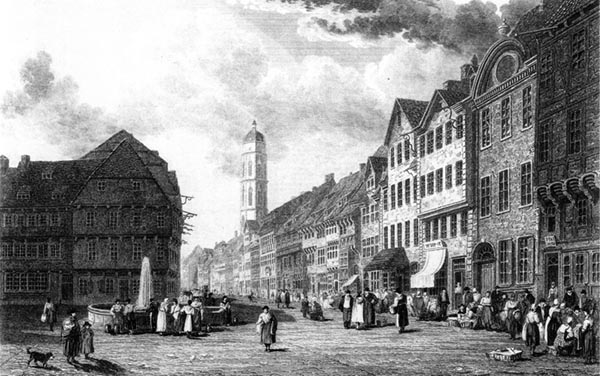
‘Goettingen Market, towards Weender Straße’ Captain Robert Batty, 1828
Artvee
The city of Göttingen, famous for its sausages, and its university, belongs to the King of Hanover, and contains nine hundred and ninety-nine hearths, sundry churches, a maternity hospital, an observatory, a prison, a library, and a Ratskeller where the beer is excellent. The river flowing by is called the Leine, and people bathe there in the summer; the water is very cold, and in some places so wide that Wilhelm Lüder (a student noted for his physical strength and agility) actually had to run at it in order to leap across. The city itself is beautiful, and is best viewed with one’s back to it. It must have been there for many a year, because I remember that when I matriculated there five years ago and, not long after, was advised to leave, it already had the same grey, aged appearance and was already completely furnished with college guards, beadles, dissertations, thé dansants (tea rooms with dance floors), washerwomen, compendiums, roast pigeons, Guelph Order medals, promotional carriages (used by doctoral students to make official visits to professors after matriculation), pipe-bowls, court-councillors, judicial councillors, disciplinary councillors, professors and confessors. Some even claim that the city was built during the Barbarian Invasions, and that every German tribe had left behind a raw proof of their existence, and thence came all the Vandals, Frisians, Swabians, Teutons, Saxons, Thuringians, etc., who even today, in Göttingen, march in hordes, each distinguished by the colour of their caps and the tassels on their pipes, along Weender Strasse; are forever fighting each other on the blood-stained duelling-grounds of Rasenmühle, Ritschenkrug, and Bovden; and, as regards customs and manners, still live as they did during the Migration Period, governed partly by their Duces (leaders) who are called ‘Chief Cocks’, and partly by their ancient code of law, which is called the ‘Comment’ and deserves a place in the leges barbarorum.
In general, the inhabitants of Göttingen are divided into students, professors, philistines, and cattle, these four classes being by no means wholly distinct. The class of cattle is the most significant. To list the names of all the students and all the regular and irregular professors here, would be too lengthy; moreover, I cannot recall all the students’ names at this moment, and among the professors there are some who as yet have no name at all. The number of Göttingen’s philistines must be as large as that of the particles of sand, or rather mud, in the sea. Truly, when I saw them of a morning, with their dirty faces and white ‘reckonings’, lined up before the gates of the Academic Court, I could barely comprehend how God could have created so many rascals.
More detailed information about the city of Göttingen can be easily found in Karl Friedrich Heinrich Marx’s topography (‘Göttingen from a medical, physical, and historical perspective’, 1824). Although I feel the most sacred obligation towards the author, who was my physician and showed me much affection, I cannot recommend his work unconditionally, and must criticise him for not contradicting, most vigorously, the false opinion he held that the women of Göttingen have excessively large feet. Indeed, I have occupied myself for years with a serious refutation of that opinion. I have, with that aim, studied comparative anatomy, extracted information from the rarest works in the library, and studied the feet of passing ladies for hours on Weender Strasse. In the fundamentally scholarly treatise that will contain the results of these studies, I speak firstly, of feet in general; secondly, about the feet of the ancients; thirdly, about elephants’ feet; fourthly, about the feet of the women of Göttingen; fifthly, I compile everything that has already been spoken with regard to these feet in Ulrich’s Beer-Garden (frequented by the students of Göttingen, and sited opposite the Albaner Tor, or Alban Gate, not extant), sixthly, I examine the feet, in context, and on this occasion also discuss calves, knees, etc., and finally, if I can find sheets of paper large enough, I will add some copperplate facsimiles of the feet of the women of Göttingen.
II. The Weender Gate, Near Rauschenwasser, Nörten
It was very early as yet when I left Göttingen, and the learned *** was certainly still in bed, dreaming as usual that he was wandering in a lovely garden, in whose flower-beds grew nothing but pieces of white paper covered with citations, which shone sweetly in the sunlight, and of which he plucked several here and there, laboriously transplanting them into fresh beds, while the nightingales, in their sweetest tones gladdened his old heart.
In front of the Weender Gate, I met two little local schoolboys, one of whom said to the other: ‘I prefer not to associate with Theodore anymore. He’s a scoundrel. Yesterday he couldn’t even recall the genitive form of mensa.’ As insignificant as the words sound, I am obliged to repeat them; indeed, I would like to have them inscribed above that gate as the town motto; for the young pipe as the old sing, and those words perfectly express the narrow-minded, dry, pedantic pride of the highly-learned Georgia Augusta (the Georg-August University).
Once on the road, in the fresh morning air, with the birds singing joyfully, I, too, gradually felt refreshed and joyous again. It was much needed. I had not had a break from my law-books recently; Roman casuists had wrapped my soul in grey cobwebs, my heart felt trapped amidst the iron clauses of individual legal systems; the constant echoes of ‘Tribonian, Justinian, Hermogenian, and Dumbedian’ still rang in my ears, and I even mistook a tender pair of lovers seated beneath a tree, their hands clasped, for an edition of ‘Corpus Juris Civilis’ (the Justinian Code of Laws). On the road to the country, things were already coming to life. Milkmaids passed by; also, donkey-drivers with their tawny charges. Beyond Weende, I met ‘the Shepherd’ (P.H Schäfer the head beadle) and ‘Doris’ (C.C. Dohrs, his junior). Not the idyllic couple of whom the poet Salomon Gessner sings, but a pair of rather well-paid university beadles whose vigilance ensures that students refrain from fighting duels in Bovden, and that new ideas, which must remain in quarantine for several decades before being admitted to Göttingen, are not smuggled in by some speculative itinerant lecturer. ‘The Shepherd’ greeted me in a very collegiate manner; for he, too, is a penman and has often mentioned me in his six-monthly reports; just as he has often summoned me before the University Court, and, not finding me at home, has always been so kind as to write the citation in chalk on my door. Now and then, a horse-drawn carriage rolled by, packed with students departing for the holidays, or forever. In a university town like Göttingen, there is constant to-ing and fro-ing; every three years, sees a new generation of students. It is a perpetual flow of people, where each semester, like an ocean-wave, sweeps away its predecessor, and only the old professors remain upright amidst the universal tide, unshakably firm, like the pyramids of Egypt — except that no legendary wisdom is buried in those pyramids of the university.
I saw two hopeful young men ride forth from a ‘myrtle grove’ near Rauschenwasser. A woman who plied her trade in the horizontal position, escorted them to the road, tapped the horses’ stringy legs with a practiced hand, and laughed aloud when one of the riders, with a spontaneous show of gallantry, delivered a few flicks of his whip to her behind. She then made her way toward Bovden. The young men, however, raced toward Nörten, hooting at their own wit, and singing à la Rossini: ‘Drink beer, dear Lise, dear!’ I heard their distant cries for a long time; but soon lost sight of the charming singers themselves, as they spurred and whipped on their horses, which seemed to possess the basic sober Germanic temperament, with dreadful force. Nowhere is the abuse of horses more prevalent than in Göttingen, and more than once, on seeing a lame, sweating beast tormented, by such folk as my knights of Rauschenwasser, merely to earn a little fodder, even having to pull an entire wagonload of students, I thought, ‘Ah, poor creature, your ancestors must surely have sinned, by eating forbidden oats in paradise!’
I met the two young men again, at the inn in Nörten. One was eating herring, with salad, and the other was chatting to the leathery, yellow-skinned maid, Fusia Canina (the ‘Lex Fufia Caninia’ regulated the freeing of slaves in testamentary wills), also known as the’ Kicking Bird’. He paid her a few polite compliments, and eventually they were hand in glove. To lighten my pack, I removed a pair of blue trousers, most interesting from a purely historical perspective, and gave them to the little waiter, whom they call the ‘Hummingbird’. Meanwhile, Bussenia, the old landlady, brought me a sandwich, and lamented over how rarely I visited these days, as she was very fond of me.
III. Northeim
Beyond Nörten, the sun was high in the sky. It was an honest sun, and warmed my brain, such that all the immature thoughts therein ripened fully. The beloved ‘Sun Inn’, at Northeim, is not to be despised; I stopped there and found lunch already prepared. All the dishes seemed appetising, and were more appealing to me than the tasteless university food, the saltless leathery cod, and tired cabbage, served in Göttingen. After I had eased my hunger somewhat, I noticed, in the same room of the inn, a gentleman and two ladies who were about to depart. The gentleman was dressed entirely in green, he even wore green spectacles that cast a verdigris-like gleam on his coopery-red nose, and possessed the appearance King Nebuchadnezzar may have owned to in his later years, when, according to legend, he ate nothing but grass, like a wild creature. The man in green asked me to recommend a hotel in Göttingen, and I advised him to seek directions to Brühbach’s Hotel (the beadle Brühbach ran the students’ gaol) from the first student he came across about. One of the two ladies was his wife, a very tall, expansive lady, with a red face a square mile in extent, with dimples in her cheeks that looked like spittoons for cupids, a long, drooping chin that seemed an imperfect continuation of her face, and a bosom piled high, surrounded by stiff lace and multi-pronged scalloped collars, as if by turrets and bastions, and resembling a fortress that would certainly be just as unable to withstand a donkey laden with gold as those other fortresses of which Philip of Macedon spoke (‘No fortress is impregnable so long as a donkey laden with gold can reach its gate’, cited by Cicero). The other lady, her sister, was her complete opposite. While the former descended from Pharaoh’s fat cows, the latter derived from the lean. Her face was nothing but a mouth between two ears, her chest as hopelessly desolate as the Lüneburg Heath; her whole dried-up figure resembling a charity table for impoverished theology students. Both ladies asked me simultaneously whether respectable people stayed at Brühbach’s Hotel. I answered in the affirmative, with a clear conscience, and as the charming trio drove away, I waved farewell repeatedly from the window. The innkeeper smiled slyly, no doubt knowing that the Göttingen students had so-named the students’ gaol.
IV: Osterode am Harz
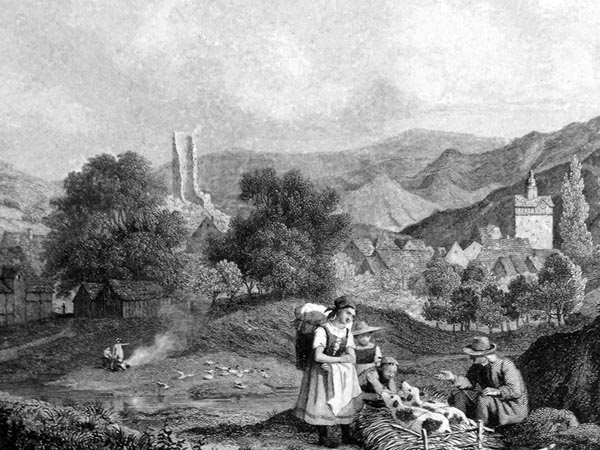
‘Osterode on the Harz’ Ludwig Richter (1838)
Picryl
Beyond Nordheim, the terrain becomes mountainous, with beautiful hilltops emerging here and there. Along the way, I mostly met shopkeepers heading for the Brunswick Fair, also a group of women, each carrying on her back a large, container almost the size of a house, and covered with white linen. Within them, there perched various species of captive songbirds, twittering and chirping incessantly, while the women hopped about and chattered merrily. A foolish thought came to me that one set of birds was carrying another to market.
I arrived in Osterode in pitch-darkness. I had no appetite for dinner, and went straight to bed. I was dog-tired and slept like a god. In dream, I returned to Göttingen, specifically to the library there. I stood in a corner of the Hall of Jurisprudence, rummaging through old dissertations, engrossed in my reading, and when I stopped, I noticed to my amazement that it was night, and crystal chandeliers lit the hall. The bell of the nearby church had just struck twelve, the hall door slowly opened, and in stepped a gigantic and superb female, escorted reverently by the members and adherents of the law faculty. The giantess, though already elderly, nevertheless bore a face whose features displayed a severe kind of beauty; every glance she gave betrayed the Titaness, the mighty Themis, whose sword and scales she held carelessly in one hand, while grasping, in the other, a roll of parchment; two young Doctores Juris carried the train of her faded grey robe; on her right, the lean Court Counsellor ‘Rusticus’ (the professor of criminal law Anton Bauer), the Lycurgus of Hanover, swayed windily back and forth, declaiming from his latest legal draft; on her left side her Cavaliere Servente, the Privy Counsellor ‘Cujacius’ (the jurist Gustav Hugo), hobbled along, gallantly and cheerfully, constantly cracking legal jokes, and laughing so heartily about them that even the severe goddess bent down to him several times, smiling, patted him on the shoulder with her large roll of parchment, and whispered in a friendly voice: ‘Careless little rascal, pruning the tree from the top down!’ (The reference is to a passage in the Corpus Juris Civilis, the subject of controversy at the time)
Each of the other gentlemen now also approached, each offering something to remark and smile about, some newly-concocted little system, or hypothesis, or a like aberration of their own petty minds. Through the open hall door, several other strange gentlemen entered, proclaiming themselves to be the rest of the great members of the illustrious order, mostly angular, furtive fellows, who immediately started on their definitions and distinctions, with extreme self-satisfaction, disputing every little tittle of some pandect or other. And new figures kept appearing, old scholars of the law, in outdated costumes, with long white wigs, their faces long-forgotten, who expressed great astonishment that they, the famous names of the past century, were not especially feted. They now joined, in their own way, in the general chatter, the trilling and screeching, which, like the ocean’s surf, roared about the high goddess ever more confusedly and ever louder, till she lost patience and, in a tone expressing the most vast and dreadful anguish, cried out, suddenly: ‘Silence! Silence! I hear the voice of my beloved, innocent Prometheus, whom the power of mockery and inarticulate violence, has chained to the rock of torment, while all your disputatious chatter cannot ease his wounds or break his bonds!’ So, cried the goddess, and streams of tears poured from her eyes; the entire assembly howled as if seized by mortal fear; the ceiling of the hall creaked; the books tumbled from their shelves; in vain, did old Münchhausen (Gerlach Adolf, Baron von Münchhausen the first curator of the University, whose picture hung in the hall) step from his frame to command silence, the rage and shrieking grew ever wilder, as, fleeing from the oppressive noise of that madhouse, I escaped into the Hall of History, that place of grace where the sacred images of the Belvedere Apollo and the Venus de Medici stand side by side, and fell at the feet of the goddess of Beauty, in sight of whom I forgot all those wild goings-on from which I had escaped, while my eyes absorbed, in rapture, the symmetry, and eternal loveliness, of her most blessed body. A Hellenic peace passed through my soul, as above my head, like a heavenly blessing, Phoebus Apollo poured out the sweetest melodies of his lyre.
When I awoke, I could still hear a friendly ringing sound. The herds were going forth to pasture, and it was the tinkling of their bells I heard. A lovely, golden sun shone through the window, lighting the paintings on the walls of my room. There were pictures from the Wars of Liberation (against Napoleon, 1813-1815), faithfully depicting us as heroes, as well as scenes from the French Revolution showing Louis XVI on the guillotine, and other like beheadings that one never gazes on without thanking God that one is lying peacefully in bed, drinking excellent coffee, with one’s head still sitting comfortably on one’s shoulders. Also hanging on the wall were Abelard and Héloise, and various examples of French youth, namely some vacant girls’ faces, beneath which were calligraphically inscribed: la prudence, la timidité, la pitié etc. and finally a Madonna so beautiful, so charming, so devotedly pious, that I wished to seek out the original model, wo had sat for the painter, so as to make her my wife. Of course, as soon as I had married that Madonna, I would have asked her to give up all further communication with the Holy Spirit, as I would not wish to have my head adorned with a halo, or any other decoration through my wife's intervention.
After drinking coffee, getting dressed, reading the inscriptions on the window panes, and setting things straight at the inn, I left Osterode.
The town has a specific number of houses, and a quantity of diverse inhabitants, among whom are several worthy souls, as can be read in more detail in Kaspar Friedrich Gottschalck’s ‘Handbook for Travelers in the Harz Mountains’ (‘Taschenbuch für Reisende in den Harz’, 1806). Before I took to the road, I climbed the ruins of ancient Osterode Castle. These consist of half of a large, solidly-walled tower, seemingly eaten away by disease. The path to Clausthal led me uphill again, and from one of the lower hills, I looked down once more into the valley, where Osterode, with its red roofs, peeks out from the green fir forests like a moss-rose. The sun cast a very sweet, innocently childlike light. From the intact half of the tower, one can see the ruins of the impressive rear.
V: Lerbach, and Clausthal (Clausthal-Zellerfeld)
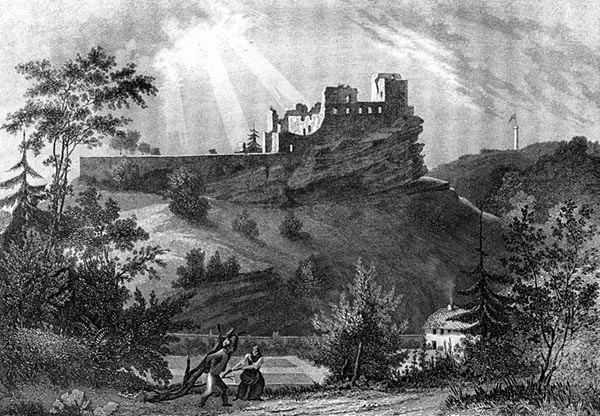
‘Hardenberg ruins near Nörten’ Friedrich Adolf Hornemann (1813–1890)
Artvee
There are many other ruined castles in the area. The Hardenberg near Nörten is the most beautiful. Even if one’s heart, as befits it, is on the left-hand side, the liberal side, of one’s body, one cannot resist all feelings of elegiac sentiment at the sight of the rock-bound nests of those privileged birds of prey, who pass to their feeble offspring only their violent appetites. And so, it was with me that morning. The greater my distance from Göttingen, the more my spirits gradually rose; as ever, I felt the Romantic impulse, and, as I wandered, I composed the following song:
Rise, my dreams, as of old!
Open wide, gates of the heart!
Joyous song, melancholy tears,
Flow forth, in wondrous art!
I shall wander midst the fir-trees,
Where the lively torrent springs,
Where the proud deer amble,
And the lovely song-thrush sings.
I will climb the mountain heights,
On some rugged peak alight,
Where the grey castle ruins
Stand, pale in the morning light.
There I shall seat myself,
Recalling olden days,
The generations flowering.
The lost glory of their ways.
Grass hides the field of tourney,
Where many a proud man fought,
Who overcame the best,
And won the prize at court.
Ivy climbs the balcony,
Where the noble lady stood,
Who overcame the conqueror,
With her eyes alone, for good.
Oh, the victor, the defeated
Death slew both, with his hand –
The lean knight’s gleaming scythe,
Stretches all upon the sand.
After walking for a while, I met a travelling tradesman, who had journeyed from Braunschweig and told me of a rumour there, that the young duke (Charles II of Brunswick and Lüneburg, who travelled to England, Switzerland, and Vienna in 1823) had been captured by the Turks on his way to the ‘Promised Land’, and could only be released in exchange for a mighty ransom. The duke’s extensive journey may have given rise to this legend. The people still preserve that traditional fable-loving mode of thought so sweetly expressed in their epic poem ‘Duke Ernst.’ (Ernst II of Swabia provided the material for this well-known Middle High German epic, and for many associated legends and dramatic pieces). The bearer of this news was a tailor’s apprentice, a neat little youth, so thin that the stars could have shone through him, as they did through Ossian’s misty spirits. Altogether, he was a folksy, if baroque, mixture of whimsy and melancholy, which was evidenced, in particular, by the droll and touching manner in which he sang that delightful folk song: ‘A beetle sat on the fence, buzz, buzz!’ That’s the thing about us Germans: none of us is so crazy that they can’t find someone even crazier who comprehends them. Only a German can empathise with that song, and laugh and cry themselves to death in the process. Here, too, I noticed how deeply Goethe’s poetry has penetrated the lives of the people. My lean companion also trilled to himself, occasionally: ‘Sorrowful or joyful, thoughts are free!’ (‘Leidvoll und freudvoll, gedanken sind frei!’ a corrupt version of Klärchen’s song from the third act of Goethe’s ‘Egmont’ beginning ‘Freudvoll und leidvoll, gedankenvoll sein’) Such mutilation of a text is common among the people. He also sang a song in which ‘Lotte mourns by the grave of her Werther.’ (Referencing Goethe’s ‘The Sorrows of Young Werther’) The tailor melted with sentimentality at the words: ‘I’m lonely by the rose-covered dell, where late the moon oft overheard us! Mourning, I wander by the silver spring that sped towards us and brought sweet bliss.’ (A slightly altered extract from the poem ‘Lotte at Werther’s Grave’, by Carl Ernst von Reitzenstein, 1775) But shortly afterward, he said, mischievously: ‘There’s a Prussian in the inn at Kassel who writes just such songs himself; he can’t sew a single stitch; if there’s a groschen in his pocket, he’s chasing two groschen, and when he’s drunk, he thinks the sky’s a blue camisole, weeps like the gutter on the roof, and sings a song with double-poetry!’ I desired an explanation of this last expression, but my little tailor, his legs thin as walking-sticks, hopped back and forth, constantly crying: ‘Double poetry is double poetry!’ Finally, I grasped that he had alternately rhymed poems, especially quatrains, in mind. Meanwhile, due to his excitement, and the adverse wind, this ‘knight of the needle’ had become extremely tired. He certainly made mighty preparations to advance, boasting: ‘Now I’m going to get the road beneath me!’ But soon he complained that he had blisters on his foot-soles and that the world was too spacious by far; and finally, he sank down, gently, near a tree trunk, moving his delicately-wrought little head like a sad lamb’s tail, and with a wistful smile, he cried: ‘Here I am, a poor little rascal, broken in two again!’
The slopes became even steeper here, the pine forests undulated below like a sea of green, while white clouds sailed through the blue sky above. The wildness of the region was, as it were, tamed by its unified nature, and its simplicity. Like a true poet, nature dislikes abrupt transitions. Clouds, however bizarrely-formed they sometimes appear, still possess a white, or at least muted, hue, corresponding harmoniously with the blue sky, and the green earth below, such that all the colours visible in a landscape melt into one another like tender music, and every natural view has a calming and soothing effect – the late Hoffmann would have ‘painted’ these clouds in variegated colours (referring to the landscape depictions of E. T. A. Hoffmann, who died in 1822). Like a great poet, Nature knows how to produce the greatest effects with the fewest means; with no more, in this case, than sun, trees, flowers, water, and her love. Of course, if love is lacking in the heart of the beholder, the whole may well appear an indifferent sight, in which the sun will merely be an object so many miles in diameter, the trees good for firewood, the flowers there to be classified according to their stamens, and the water decidedly wet.
A little lad, who was looking for brushwood in the forest on behalf of his uncle who was ill, showed me the village of Lerbach, whose little cabins with grey roofs stretched more than half an hour’s walking distance along the valley. ‘There,’ he said, ‘live idiots with goitre, and white Moors’— the latter being the name which the people endow upon albinos. The little fellow was in complete harmony with the trees; he greeted them like old acquaintances, and they seemed to return his greeting with a rustling sound. He whistled like a siskin, the other birds chirped a reply all around us and, before I knew it, he had bounded off, bare-footed, into the nearest thicket with his bundle of brushwood. Children, I thought, being younger than us, can still remember having been birds or trees, and are therefore still capable of understanding them; but we are too old, with too many worries and jumbled bits of jurisprudence, and far too many bad verses, in our heads. I recalled, quite vividly, the time when things were otherwise, on arriving in Clausthal. I reached this beautiful little mountain town, which you scarcely notice till you’re standing before it, just as the bell struck twelve and the children emerged, jubilantly, from school. Those delightful lads, almost all of them rosy-cheeked, blue-eyed, and flaxen-haired, leaping about and shouting, awakened in me the wistfully but happy memory of how, as a little boy in a dull-headed Catholic convent school in Düsseldorf, I was on one occasion not allowed to rise from my wooden bench all morning, and had to endure a great deal of Latin, blows from a cane, and much geography, and how I too, shouted and rejoiced, immoderately, when the old Franciscan bell finally rang twelve times. The children saw, on noticing my knapsack, that I was a stranger and greeted me very hospitably. One of the boys told me they had just received religious instruction, and showed me the Royal Hanoverian Catechism, from which text they were questioned about Christianity. This little book was very poorly printed, and I fear that the doctrines of the faith must have, instantly, made an unpleasant, blotting-paper impression on the children’s minds. I also found it terribly displeasing that the multiplication table, which seriously conflicts with the doctrine of the Holy Trinity, is printed in the Catechism itself, on the very last page, and that children can thus be led to sinful doubts at an early age. We in Prussia are much wiser in this regard, and in our zeal to convert those who are competent in arithmetic, we are careful not to have the multiplication table printed after the catechism.
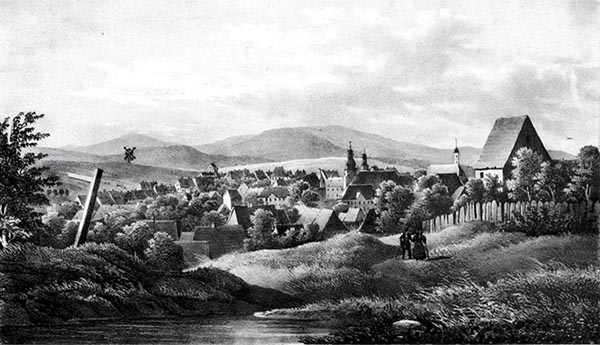
‘Clausthal’ 1841
Picryl
I had lunch at the ‘Krone’ (the ‘Golden Crown’, still extant at Kronenplatz 3) in Clausthal. I was served spring greens, parsley soup, violet-blue cabbage, a mound of roast veal as big as a miniature Chimborazo (the mountain in Ecuador), as well as a type of smoked herring called ‘buckling’, after its originator, Wilhelm Bückling, who died in 1447 and was so revered by the Emperor Charles V for his discovery that in 1556 he travelled from Middelburg to Biervliet, in Zeeland, simply to view the great man’s grave. How delicious such a dish tastes when you are aware of its history, and eating it yourself. However, my after-dinner coffee was spoiled when a young man sat down beside me, and chattered away so vigorously that the milk on the table turned sour. He was a young salesman wearing twenty-five colourful waistcoats, with just as many gold seals, rings, pins, etc. He looked like a monkey who had donned a red jacket, and was endlessly repeating to himself: ‘Clothes make the man’. He knew by heart a whole host of charades and anecdotes, which he constantly repeated whenever they were least appropriate. He asked me the news in Göttingen, and I told him that before my departure, a decree from the Academic Senate had been issued, forbidding the docking of dogs’ tails, the penalty being three thalers, since, during the dog days in summer, mad dogs run about with their tails between their legs, which distinguishes them from those dogs which are not mad, evidence which could not be observed if they had no tails at all. After dinner, I set out to visit the mines, the silver refinery, and the mint.
End of Part I of Heinrich Heine’s ‘Die Harzreise’