Heinrich Heine
The Harz Journey (Die Harzreise, 1824): Part IV
Contents
Die Harzreise
IX: The Brocken-House
The evening meal was being consumed in the large room, containing a long table and two rows of hungry students. At the beginning, the conversation was commonplace university chatter: talk of duels, duels, and yet more duels. The company consisted mostly of residents of Halle, and Halle therefore became the main topic of conversation. Professor Christian Gottfried Schütz’s windows were exegetically illuminated. Next it was claimed that the last levee of the ‘King of Cyprus’ had been very splendid, that he had recognised a natural son of his, that he had married a Lichtenstein princess of inferior status, that his official mistress had abdicated her position, and that the entire ministry, deeply moved, had wept as required. I need hardly mention that this refers to one of Halle’s ‘beer’ kingdoms (established by the students in the taverns of local villages). The next subject of conversation was a pair of Chinese gentlemen who had appeared in Berlin two years ago, and who were now being trained in Halle to lecture privately on Chinese aesthetics. A great joke was made of this. A scenario was envisaged whereby a German was to be exhibited in China for financial gain, and to this end a notice was drawn up in which the mandarins Tsching-Tschang-Tschong and Hee-Ha-Ho declared that he was a true German, and listed the tricks he would perform which mainly consisted of philosophising, smoking tobacco, and exhibiting patience. It was noted finally that at noon, which was feeding time, no dogs were permitted entry, as they were in the habit of snatching the finest scraps from the poor German.
A young fraternity member, who had recently been to Berlin for purification (to be cleansed of his political views, and fraternity membership) spoke about that a great deal, but very one-sidedly. He had visited Wisotzki’s (the innkeeper of that name also ran a politically-outspoken puppet theatre at Stallschreibergasse 43), and the theatres; his judgement of both was erroneous. ‘Young people soon dispense with words,’ etc. and he even spoke of wardrobe expenses, and scandals involving actors and actresses etc. The youth was clearly ignorant of the fact that since, in Berlin, appearances are everything, as the common saying: ‘Man so duhn’ (‘One makes more of oneself, so’) sufficiently indicates, then illusion must of necessity flourish on the stage, and thus the management bears a major responsibility, as per the ‘colour of the beard, which also plays a role’, for the accuracy of the costumes, which are designed by historians who are on oath, and sewn by scientifically-trained tailors. And this is all quite necessary. For if Mary Stuart were to wear an apron belonging to the age of Queen Anne, the banker Christian Gumpel would certainly rightly complain that the illusion would be lost; and if Lord Burleigh accidentally donned Henry IV’s trousers, the Councillor of War von Steinzopf, née Lilientau, would certainly be irritated by the anachronism all evening. Such care for accuracy on the part of the management extends not only to aprons and trousers, but also to the people wearing them. Thus, in future, Othello is to be played by a real Moor, whom Professor Martin Lichtenstein (the professor who established the Berlin Zoo) has already brought from Africa for this purpose; in ‘Misanthropy and Repentance’ (or ‘The Stranger’, by August von Kotzebue), Eulalia is to be played by a real ‘lost woman’, Peter by a real idiot of a boy, and the Stranger by a real nameless cuckold, none of whom would need be brought from Africa. In ‘The Power of Circumstances,’ (by Ludwig Robert) a real writer, who has already received a few slaps in the face, is to play the role of the hero; in ‘The Ancestress,’ (by Franz Grillparzer) the artist who plays Jaromir is to have actually perpetrated a robbery, or at least stolen something; Lady Macbeth is to be played by a lady who, though most loving by nature, as Tieck demands, is nevertheless familiar to some extent with the blood-stained blade of assassination; and finally, a particularly shallow, mindless, vulgar fellow is to be engaged to play the great Wurm (the comic actor, Albert Wurm, who was involved with the banned anti-Semitic farce , ‘The Jewish School’ , written by Alexander Sessa, in 1813, and with its successor Carl von Brühl’s ‘Unser Verkehr’ ) on stage, the great Wurm who delights his fellow spirits every time he aspires to the height of greatness, higher, higher, yet ‘every inch a scoundrel!’ – If the above mentioned young man showed little grasp of the requirements of Berlin theatre, even less had he noticed that Gaspare Spontini’s Janissary Opera with its kettledrums, elephants, trumpets, and gongs, was a heroic means of strengthening our weakened people for war, a means which Plato and Cicero already slyly recommended. Least of all did this young man understand the diplomatic significance of ballet. With difficulty I demonstrated to him that there is more of politics in Michel-François Hoguet’s feet (Hoguet was the principal dancer of the Berlin State Opera) than in Paul Buchholz’s head (Bucholz was a writer on politics considered a fool by liberal thinkers), how all his dance moves signify diplomatic negotiations, how each of his gestures has a political interpretation, for example that he means our Cabinet when, leaning forward graspingly, he reaches out with both hands; that he means the Bundestag when he pirouettes a hundred times on one foot without moving from the spot; that he has the little princes in mind when he staggers around as if with his legs tied; that he signifies the balance of power in Europe when he sways back and forth like a drunk; that he indicates a Congress when he twines his bent arms together in a skein; and finally, that he represents our altogether too great friend in the East (Tsar Alexander I) when, gradually unfolding his limbs, he elevates himself, maintains position for a long while, and then suddenly launches into the most terrifying leaps. The scales fell from the young man's eyes, and he began to realise why dancers are better paid than great poets, why ballet is an inexhaustible topic of conversation among the diplomatic corps, and why a beautiful danseuse is often still supported privately by a minister, who surely toils day and night to render her receptive to his little ‘system’. By Apis! How large is the number of exoteric, and how small the number of esoteric, theatregoers! There stand the foolish people, gaping, admiring the leaps and turns, studying anatomy as revealed in the poses of Lemière (Marie Jeanne Desargus Lemière, prima ballerina of the Berlin Opera), applauding the entrechats of Röhnisch (C.F.W. Röhnisch, who danced in Spontini’s ‘Olympie’), and babbling about grace, harmony, and supple loins — and none of them notices that the fate of the German fatherland is before their eyes, in cipher-form, as a series of choreographed dance-steps.
While such conversations flew back and forth, more mundane things were not lost sight of, and the large bowls, filled with honest meat, potatoes, etc., were diligently devoured. However, the quality was poor. I mentioned this, casually, to my neighbour, who, with an accent that instantly betrayed him as Swiss, replied, quite rudely, that we Germans were ignorant not only of true freedom but also of true contentment. I shrugged my shoulders, and remarked that the servants to princes and the makers of delicacies are universally Swiss, and often termed so, and that in general, the contemporary Swiss heroes of freedom, who babble in so politically audacious a manner to the public, forever seem to me like hares that trigger the firing of pistols at public fairs, astonishing all the children and peasants with their bold action, and yet are still hares.
The son of the Alps assuredly meant no harm. ‘He was a fat man, therefore a good man,’ says Cervantes (‘Hombre que por ser muy gordo era muy pacifico: a man who, being very fat, was very peaceable’: Don Quixote, I. 2, referring to an innkeeper). But my neighbour on the other side, a man from Greifswald, was most offended by the remark; he insisted that German vigour and straightforwardness were not yet extinguished, beat his chest loudly, and emptied an enormous pint of wheat-beer. The Swiss placated him with a ‘Now! Now!’ But the more soothingly he said this, the more eagerly the man from Greifswald went to work. He was a fellow from the days when lice had their heyday, and barbers feared starvation. He had long, drooping locks, and wore a knightly sort of beret, a black old German coat, a dirty shirt that also served as a waistcoat, and beneath it a medallion with a tuft of hair from Field-Marshal Von Blücher’s grey horse. He seemed a full-grown fool. I like to get some exercise at dinner so I allowed him to engage me in patriotic argument. He was of the opinion that Germany should be divided into thirty-eight districts. I, on the other hand, maintained that it should be forty-eight, because then one could write a more systematic handbook about Germany, and it was necessary to mix feeling with science. My friend from Greifswald was also a German bard and, so he confided in me, he was working on a national epic poem glorifying Hermann (Arminius) and the Battle of the Teutoburg Forest. I gave him many useful hints for the creation of this epic tour de force. I pointed out to him that he could allude, onomatopoeically, to the swamps and rutted paths of the Teutoburg Forest in cloying and uneven verse, and that it would be a patriotic subtlety to have General Varus and the other Romans speak nonsense. I hope he will succeed in this, as successfully as the poets of Berlin, to the point of creating the most dubious of conjurations.
At our table, the conversation became increasingly louder and more intimate, wine replaced beer, punch bowls steamed, and people drank, swore brotherhood, and sang. The old ‘Father of the Nation’ (‘Landesvater’, 1782, written by the jurist August Niemann), and fine songs by Wilhelm Müller, Friedrich Rückert, Ludwig Uhland, and others rang out. And beautiful melodies composed by Albert Methfessel. Best of all, our own Arndt’s German verses sounded: ‘The God who created iron, never wished for slaves!’ (‘Der Gott, der Eisen wachsen liess’, 1813, from ‘Vaterlandslieds’ by Ernst Arndt) Meanwhile, outside the house, the wind roared as if the old mountain were singing along, and some friends even claimed, unsteadily, that it was shaking its bald head joyfully, and was rocking the room back and forth. The bottles grew emptier and the heads fuller. One fellow roared, another piped, a third declaimed from ‘Die Schuld’, (‘Guilt’, Adolf Müllner’s play of 1816) a fourth spoke Latin, a fifth preached about temperance, while a sixth stood on a chair and lectured us: ‘Gentlemen! The earth is a rounded cylinder, people are individual pins on its surface, seemingly scattered at random; but the cylinder turns, the pins strike here and there and sounds are produced, some frequently, others rarely, creating a wonderfully complex music, and this is called world-history. So, we speak first of music, then of the world, and finally of history; the latter, however, we divide into Positive and Spanish flies.’ — And so, he ran on, in a mixture of sense and nonsense.
A jovial Mecklenburger, who had his nose in a punch glass, and was smiling blissfully as he inhaled the steam, remarked that he felt as if he were standing in front of the theatre-buffet (famous for its punch) in Schwerin again. Another held his wine glass up to his eye like a lorgnette and seemed to be observing us attentively, while the red wine ran down his cheeks into his projecting mouth. The man from Greifswald, suddenly elated, threw himself on my chest and exulted: ‘Oh, if only you understood me, I am a lover, I am a happy man, I am loved in return, and, God damn me, she is an educated girl, for she has a full bosom, wears a white dress, and plays the piano!’ – But the Swiss merely wept, and tenderly kissed my hand, whimpering endlessly: ‘Oh, Bäbeli! Bäbeli!’ (A diminutive, often of the name Barbara, here used for comic effect)
Amidst this mayhem, where even the plates were learning how to dance, and the glasses how to fly, two young men sat opposite me, who were beautiful and pale as marble statues, one like Adonis, the other more like Apollo. The faint touch of redness the wine had brought to their cheeks was scarcely noticeable. They gazed at each other with infinite love, as if each could read the other’s soul in their eyes, and those eyes shone as if drops of light had fallen from a bowl full of burning love a pious angel above bore from star to star. They spoke softly, their voices trembling with longing, and the stories they told were sad ones, in which tones of wondrous pain resounded. ‘Lore too is dead, now!’ said the one, sighing. After a pause, he told the story of this girl from Halle who was in love with a student, and when the student left Halle, she refused to speak, ate little, wept day and night, and constantly gazed at the pet canary her lover had once given her. ‘The bird died and, not long after, Lore died as well!’ so ended the story, and the young man fell silent again, while both sighed as if their hearts would burst. Finally, the other spoke: ‘My soul is sad! Come forth with me into the darkness! I wish to breathe air from the clouded sky and the moonlight. Friend of my melancholy! I love you. Your words are like whispering reeds, like rippling streams, they echo in my breast, but my soul is sad!’
Then the young men rose, one wrapped his arm about the other’s neck, and they left the turbulent room. I followed, and saw them enter a dark chamber. One opened a large wardrobe, not the window, and they stood before it, arms outstretched longingly, and spoke alternately. ‘You, O twilight breezes!’ cried the first, ‘how refreshingly you cool my cheeks! How sweetly you toy with my fluttering curls! I stand on the mountain’s cloudy peak; below me the cities of men lie sleeping, and the blue waters glitter. Listen! Down there in the valley the fir-trees rustle! There over the hills, in misty shapes, the spirits of our fathers sweep by. Oh, if I could but race with you on a cloud-steed through the stormy night, over the rolling sea, and out to the stars! But alas, I am burdened with sorrow, and my soul is sad!’ The other youth, who had also stretched his arms longingly towards the wardrobe, tears streaming from his eyes, and towards the rear of a pair of yellow-leather trousers he mistook for the moon, now added, in a melancholy voice: ‘You are beautiful, O daughter of heaven! Blessed is the calm repose of your countenance! You tread sweetly! The stars in the east follow your blue path. At the sight of you, the clouds rejoice, and their gloomy forms rise on high. Who resembles you in the sky, one born of the night? The stars are ashamed in your presence and turn away their sparkling green eyes. When your face pales in the dawn light, where do you flee? Do you hold to your chamber like me? Do you dwell in the shadow of melancholy? Have your sisters fallen from heaven? Are they no more, those who joyfully travelled with you in the night? Yes, they fell, O lovely light, and you often hide yourself, so as to mourn them. But in time a night will come, when you, too, will pass away, leaving your blue path above. Then the stars, once ashamed of your presence, will raise their green heads, and rejoice. But now you are clothed in radiant splendour, gazing down from the gates of heaven. Tear the clouds apart, O wind, so that the offspring of night may shine forth, and the shaggy mountains may shine, and the sea’s foaming waves roll on in the light!’
A familiar, not so thin friend, who had drunk more than he ate, although this evening, as usual, he had devoured a portion of beef that would have fed six guards lieutenants and an innocent child, now came racing by, and in an excess of good humour, that is, like a complete pig, pushed the two elegiac friends somewhat roughly into the wardrobe, banged on the door, and made a murderous noise outside. The noise in the hall became increasingly confused and muffled. The two youths in the cupboard moaned and whimpered thinking that they were lying brokenly at the foot of the mountain; red wine flowed from their mouths, they drenched each other, and the one said to his companion: ‘Farewell! I feel I'm bleeding to death. Why do you wake me, Spring air? You choose to do so and say: ‘I will bathe you with drops of heavenly dew. But the time of my passing is near, the storm is near that will wither and scatter my leaves! Tomorrow the wanderer will come, who saw me in my beauty, his eye will seek for me in the meadow and will not find me.’ – But all this was drowned out by that familiar bass voice outside the wardrobe door, cursing and shouting, blasphemously, and complaining that there wasn’t a single lamp the whole dark length of Weenderstrasse, and one couldn’t even see whose windows had been smashed.
I can hold my drink — modesty won’t allow me to mention how many bottles — and I reached my bedroom in reasonably good condition. The young merchant was already in bed, wearing a chalk-white nightcap and a saffron-yellow jacket made of medically-approved flannel. He was not asleep as yet, and attempted to start a conversation with me. He was from Frankfurt-am-Main, and consequently he immediately spoke of the Jews who had lost, he said, all sense of nobility and beauty, and were selling English goods at twenty-five percent below German factory prices. I felt like teasing him a little; so, I told him I was a somnambulist, and must apologise in advance in case I disturbed him in his sleep. The poor fellow confessed to me next day, that he hadn’t slept a wink all night so worried was he that I might cause some mishap in my somnambulistic state, by firing my pistol, which was lying beside my bed. In truth, I had fared little better; I had slept badly indeed. A desolate and frightening fantasy had filled my dreams. A pianoforte score of Dante’s ‘Inferno’. In the end, I had even dreamed I was watching a performance of an opera on a legal theme, called ‘Falcidia’; its libretto, concerning the laws of inheritance, penned by Eduard Gans (the jurist), with music by Gaspare Spontini. A wild dream. The Roman forum shone in all its magnificence; Servius Asinius Göschenus (Johann Friedrich Ludwig Göschen, a legal scholar in Göttingen) as praetor, on his chair, his toga flung about him in proud folds, poured forth tumultuous recitatives; Marcus Tullius Elversus (Christian Friedrich Elvers an associate professor of jurisprudence in Göttingen) as prima Donna legataria, revealing all his delightful femininity, sang the love-meltingly bravura aria ‘Quicunque civis Romanus...’ (‘Whoever is a Roman citizen…’ a quotation from the Lex Falcidia). Probationers painted brick-red roared away in their role as a chorus composed of minors; private lecturers, dressed as genii in flesh-coloured leotards, danced a pre-Justinian ballet, and garlanded the Twelve Tables (which consolidated earlier unwritten codes into a written set of laws, stating the rights and duties of Roman citizens) with flowers, while amid thunder and lightning, the much-abused shade of ‘Roman Legislation’ rose from the earth; accompanied by trumpets, gongs, fiery rain, cum omni causa (and all the rest).
The Brocken innkeeper dragged me from the din, by waking me to watch the sunrise. I found a few people, already waiting, on the tower’s platform, rubbing their freezing hands; others, still sleepy-eyed, were staggering there, until, finally, the silent congregation of the previous night had assembled once more, and we watched as the small crimson globe rose on the horizon, spreading a wintry twilight, in which the mountains floated as if on a white, rolling sea, only their summits showing, so that one felt as if one was standing on a small hill in the midst of a flooded plain, from which only an occasional dry mound of earth protruded. In order to capture what I saw and felt, I composed the following poem:
It brightens now in the east.
Lit by the new sun’s glimmer,
Far and wide, each mountain peak
Is a mist-wrapped swimmer.
Had I my seven-league boots,
I’d race, by the wind beguiled,
Over those mountain peaks,
To the home of that dear child.
From the bed where she slumbers,
If I drew the curtains, now,
I could kiss her ruby mouth,
And her childlike brow.
I could whisper more quietly still,
Into her lily-like ear:
‘Dream that we love each other,
And ne’er lost each other here!’
However, my longing for breakfast was equally great, and after exchanging a few pleasantries with my two ladies, I hurried downstairs to drink coffee in the cosy parlour. It was needed; my stomach felt as empty as St. Stephen’s Church in Goslar. But a taste of that Arabian beverage, and the warmth of the East trickled through me; I was surrounded by the scent of Oriental roses, the bulbul’s (Persian nightingale’s) sweet song sounded, the students metamorphosed into camels, the Brocken-House serving girls with their fiery looks into houris, the noses of the philistines into minarets, and so on.
The book that lay beside me, however, was not the Koran. It certainly contained plenty of nonsense. It was the so-called Brocken-Book, in which all travellers who ascend the mountain write their names, while most also pen a few thoughts or, in the absence of any, their feelings. Many even express themselves in verse. In this book, one sees the horrors that arise when the vast host of Philistines, on familiar occasions such as here on the Brocken, decide to wax poetic. The Palace of the Prince of Palagonia (a villa with bizarre statues and furniture, constructed in Bagheria near Palermo, in the eighteenth century, by Ferdinando Francesco II Gravina Prince of Palagonia, and mentioned by Goethe in his ‘Italian Journey’) contains less absurdities than this book, where the gentlemen of the Excise Office, in particular, shine, with their mildewed elation, as do the young clerks with their pathetic outpourings of soulfulness, the old German revolutionary dilettantes with their platitudes born of the craze for gymnastics, the Berlin schoolteachers with their unfortunate attempts at rapture, and so on. All had wished to display themselves as authors on that occasion. Here, the majestic splendour of the sunrise is described; there, are written complaints about the poor weather, disappointed expectations, the mist that obscures the view. ‘Ascended in a fog, and descended in a fog!’ is a common joke, repeated a hundred times. A certain Karolina writes that she acquired wet feet while climbing the mountain. A naive Hannchen bore this complaint in mind, when writing laconically: ‘I, too, got wet during this saga.’ The whole book smells of cheese, beer, and tobacco; one feels one is reading a novel by Heinrich Clauren (the pseudonym of Carl Heun, H. Clauren being an anagram of his real name).
While I was drinking coffee and leafing through the Brocken-Book, the Swiss entered with bright red cheeks and, full of enthusiasm, recounted the sublime view he had enjoyed from the tower, when the pure, calm light of the sun, the symbol of truth, had fought with the night’s fog. It looked, it seems, like a battle between ghosts, where enraged giants wielded their longswords, armoured knights raced past on rearing steeds, and chariots, fluttering banners, and curious animalistic figures emerged from the wildest of melees, until finally everything, entwined and madly distorted, melted and became fainter and fainter, eventually vanishing without trace. I had neglected to view this natural phenomenon signifying the struggle for freedom and, on investigation, can swear that I have no remembrance of anything to do with it, except the taste of good dark coffee. Ah, it was his fault that I had forgotten my lovely lady, and there she was in the doorway, with her mother and companion, about to clamber into their carriage. I barely had time to hasten there, and warn her that it was a cold day. She seemed annoyed that I hadn't attended on her earlier; but I soon smoothed the sullen wrinkles from her beautiful brow by giving her an unusual flower I had plucked the day before, at great personal risk, from a steep cliff-face. The mother demanded to know the name of the flower, as if she found it improper that her daughter should pin an unusual and unknown flower to her breast — for the flower had indeed been granted that enviable location, something it had assuredly not dreamed of yesterday on its lonely height. The silent companion suddenly opened his mouth, having counted the flower’s stamens to establish to which floral class it should be assigned, and said quite dryly: ‘It belongs in the eighth class.’
It annoys me every time I see that the Lord’s beloved flowers have, like ourselves, been divided into castes, based on similar external characteristics, namely, the difference in the number of their stamens. If a classification is ever to be made, then let us follow Theophrastus’ suggestion, who wished to classify flowers more according to their souls, namely, their scents. As for me, I have my own system of natural science, and I divide all things, accordingly, into those which are edible and those which are not.
Yet the mysterious nature of flowers was anything but hidden from the elderly lady, and she remarked, involuntarily, that she was very pleased by flowers when they were growing in the garden or in a pot, but that a feeling of slight pain filled her chest, in a dreamlike and frightening manner, when she observed a flower broken from its stalk — since such a flower was in reality a corpse, and the delicate withered head of such a corpse droops sadly, like that of a dead child. The lady almost frightened herself with this gloomy reflection, and it became my duty to dispel it with a few lines from Voltaire. How a few words of French can instantly invoke a suitably complacent mood! We all laughed, hands were kissed, gracious smiles were exchanged, the horses neighed, and the carriage rattled its way slowly, and laboriously, down the hill.
X: The Ilse Valley
The students were also making preparations to leave. Their knapsacks were packed, their accounts, which turned out to be more reasonable than all expectations, were settled; the over-receptive serving girls, on whose faces traces of affection were visible, brought their Brocken bouquets, according to custom, and helped to fasten them on the students’ caps, to be rewarded with a few kisses or pence; and then we travellers descended the mountain, some, including the Swiss and my friend from Greifswald, taking the road to Schierke, while about twenty others, including my compatriots and I, led by a guide, descended via the so-called ‘snow holes’ to Ilsenburg. (The snow-holes path has been closed since 1960)
The idea was a complete disaster. Halle students march more quickly than the Austrian militia. Before I knew it, the bare slopes of the mountain with their scattered groups of stones were already behind us, and we were traversing a fir forest like the one I had seen the day before. The sun was already pouring forth its festive rays and shining on those merry colourfully-dressed lads as they pushed cheerfully through the thickets, disappearing here, to reappear there; ran along the tree trunks laid over swampy patches; climbed steep hollows by mean of intertwining roots; and trilled aloud in delightful tones, while receiving equally joyous responses from the twittering forest birds, the rustling fir-trees, secretive, bubbling springs, and in the form of a resounding echo. When joyous youth and lovely Nature meet together, they rejoice in one another.
The further we descended, the more sweetly the subterranean waters murmured. Only here and there, did they gleam, beneath rocks and undergrowth, seemingly listening, in hiding, for permission to emerge, until at last, a small rill issued resolutely forth. A familiar phenomenon followed: the boldest having made a move, a group of more timid ones were suddenly, much to their own astonishment, filled with courage, and hastened to join the first. A multitude of other springs now leapt hastily from their places of concealment, joining those which had first emerged, and together they quickly formed a considerable stream, rushing down the mountain valley over countless waterfalls, on oddly winding courses. This stream is the Ilse, the sweet and lovely Ilse. It runs through the charming Ilse Valley, which gradually deepens as it threads the mountains on either side. These heights, down to their feet, are mostly covered with beech, oak, and common deciduous shrubs, rather than evergreen fir-trees or spruce. The former, the deciduous, species, grow predominantly on the ‘Lower Harz,’ as the eastern side of the Brocken is called, in contrast to the western side, which is called the ‘Upper Harz,’ the latter being far higher, in fact, and therefore far more suitable for evergreen trees.
It is with indescribable joy, naivety, and grace that the Ilse plunges down over the bold rock formations encountered in her course; here the water hisses wildly or overflows in foam, and there it pours in pure arcs from a myriad of cracks in the rocks as if from full watering-cans, while down below it dances over the stones like a lively young girl. Yes, the legend is true, Ilse is indeed a princess who races down the mountain-side laughing and dancing. How her white foamy robe glitters in the sunshine! How the silvery ribbons at her breast flutter in the wind! How her diamantine drops sparkle and glitter! The tall beeches stand there like grave father figures, smiling furtively at the mischievous antics of this lovely child; the white birches sway with delight like an indulgent aunt, yet at the same time are anxious witnesses of her daring leaps. The proud oak-tree is like a morose uncle who has had to pay for all this fine weather; the birds of the air sing their approval, the flowers along the banks whisper tenderly: ‘Oh, take us with you, take us with you, dear sister! But the happy child leaps onward, inexorably, suddenly seizing the dreaming poet, while flowers rain down on me, in a shower of sounding rays, and radiant sounds, and my senses are dazed by the sheer splendour, till I hear only the one sweet, flute-like voice:
‘I am Princess Ilse,
I dwell in Ilsenstein;
Come, find within my castle,
Our happiness, yours and mine.
There, with my clear waters,
I’ll gently bathe your brow,
And you’ll forget your troubles,
My care-worn friend, I vow!
Clasped in my white arms,
In slumber, you’ll not fail,
Upon my white breast lying,
To dream Love’s fairy-tale.
I’d kiss you and caress you,
As I once kissed, of old,
My dear Emperor Henry,
Who now lies dead and cold.
And dead the dead remain,
Only the living – are alive;
My heart joys and trembles:
I am lovely, and I thrive,
And while my heart yet beats,
My crystal castle sounds,
The squires rejoice, the knights,
The ladies, dance their rounds.
Those silken trains rustle,
Those spurs clink night and morn,
While dwarves beat on the drum,
Play the fiddle, blow the horn.
As my arms clasped the emperor,
Tenderly, they’ll clasp you;
I closed his ears, gently,
When the note of warning blew.
We feel infinitely blissful when the world of appearances merges with our emotional world, when green trees, intimate thoughts, birdsong, melancholy, the blue sky, memories, and the scent of herbs intertwine in sweet arabesques. Women know that feeling best, and that is why a sweet, incredulous smile tends to hover on their lips when we boast, with a schoolboy’s pride, of our wholly logical actions, and of how we apportion what we experience neatly between the objective and the subjective ‘realms’, how we furnish our heads, much like a pharmacy, with a thousand little drawers; one contains reason, another understanding, a third wit, a fourth idle wit, and a fifth nothing at all — namely, the Idea.
XI: The Ilsenstein
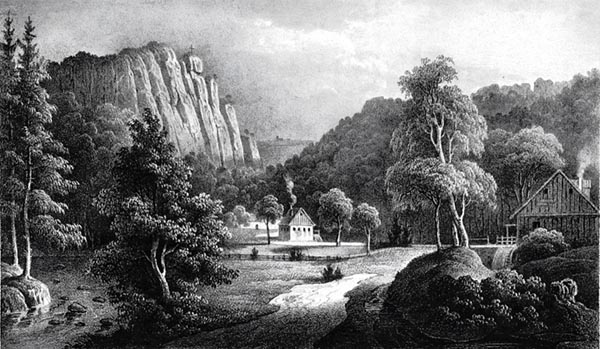
‘The Ilsenstein with the entrance to the Ilse Valley.’ 19th century
Wikimedia Commons
As if wandering in a dream, I almost failed to note that we were leaving the depths of the Ilse Valley, and climbing upwards once more. The ascent was steep and arduous, and many were out of breath. But like my late cousin (Till Eulenspiegel, the medieval ‘fool’) who is buried in Mölln, I anticipated the corresponding descent and was all the more pleased by it. Finally, we reached the Ilsestein.
This enormous granite rock rises boldly, and loftily, from the depths. It is surrounded on three sides by high, forest-clad mountains, but the fourth, the northern side, opens on a view of Ilsenburg and the Ilse River, far down below in the lowlands. On the tower-like summit of the rock stands a large iron cross, though there is still room for four human feet if needs be.
Just as Nature has endowed the Ilsenstein with great charm due to its location and form, legend too has cast a rosy glow over it. Gottschalk reports: ‘It is said that an enchanted castle once stood here, in which the rich and beautiful Princess Ilse lived, who still bathes in the Ilse every morning; and whoever is lucky enough to encounter her at the right moment will be led into the rock where her castle yet lies, and royally rewarded.’ Others tell a lovely story about the love of Ilse and the Knight of Westerberg, a variant of which one of our most famous poets (Karl Gottfried Theodor Winkler who wrote under the name ‘Theodor Hell’, i.e. ‘Theodor Bright’) romantically sang about in the Dresden ‘Abendzeitung’ (in September 1824). Others tell a different tale: it is the old Saxon Emperor Henry (Henry IV) who is said to have whiled away his imperial hours with Ilse, the beautiful water-faery, in her enchanted castle in the rock. More recently, a certain Ludwig Ferdinand Niemann, who has published a travel guide to the Harz Mountains (‘Handbuch für Harzreisende’, 1824) in which he has recorded the heights of mountains, the magnetic needle’s deviations, the debts of the various towns, and the like, with commendable diligence and arithmetic precision, claimed: ‘What is related concerning the beautiful Princess Ilse belongs to the realm of fable.’ So, say all those people, to whom a princess has never appeared, but I, who am especially favoured by beautiful ladies, know better. As did Emperor Henry. It was not for nothing that the old Saxon emperors were so attached to their native Harz. Just leaf through the pretty ‘Lüneburg Chronicle’, where those fine old gentlemen are portrayed in wonderfully faithful woodcuts, fully-armed, high on their armoured warhorses, the sacred imperial crown on each precious head, and sceptre and sword in hand; and one can clearly see on their charming, goatee-bearded faces how they often longed for the sweet affection of their Harz princesses and the cozy rustling of the Harz forest, when they were abroad, perhaps even when campaigning in the citrus-bearing, poison-rich Italy, to which they and their successors were so often drawn by the desire to be named as Roman emperors, a truly German addiction to titles which led to the downfall of emperor and empire.
But I advise anyone standing on the summit of the Ilsenstein to think neither of the emperor nor the empire, nor even of the beautiful Ilse, but only of their feet. For as I stood there, lost in thought, I suddenly seemed to hear subterranean music from that enchanted castle, and saw the mountains all around turn upside-down, the red-tiled roofs of Ilsenburg begin to dance, and the green trees fly about in the blue air, until everything before my eyes was blue and green, and I would surely have fallen, seized by vertigo, into the abyss, if I had not clung to the iron cross in spiritual distress. Surely no one will blame me for doing the latter, when in such a precarious position!
XII: Postscript
This ‘Harz Journey’ is, and will remain, a fragment, the colourful threads, woven so beautifully and harmoniously within the whole, have now been cut, as if by the scissors of a relentless Fate (Atropos, who cuts the thread of a life). Perhaps I will weave them together further in future songs, and what is now concealed in miserly manner will then be uttered fully. In the end, where and when one has expressed something is of little account, given that one has actually succeeded in expressing it. Let the individual pieces remain fragments, as long as when brought together they form a kind of whole. Through such a union, their imperfections may here and there be outweighed, harsh words counter-balanced, and the overly-harsh tempered. That would perhaps already be the case with the first pages of the ‘Harz Journey’, and they might well make less of a sour impression, if it had been revealed elsewhere that the displeasure I feel regarding Göttingen in general, though even greater than I have expressed, is by no means as great as the respect I feel for certain individuals there. And why should I be silent about them? I mean, in particular, that much-loved person who, as I have said earlier, took such a friendly interest in me; who, even then, instilled in me a deep love for the study of history; and who later strengthened my zeal for the subject, and so led my mind into calmer paths, directed my spirit in more wholesome directions, and generally provided those historical consolations without which I would never be able to endure the painful events of the day. I am speaking of Georg Friedrich Sartorius, that great historian and human being, whose eye is a bright star in our dark times, and whose hospitable heart is open to all the sorrows and joys of others, to all that concerns beggars or kings, and to the last sighs of vanishing nations and their gods.
I cannot help but note here that the Upper Harz, the section I have described as far as the beginning of the Ilse Valley, is by no means as pleasing a sight as the romantically picturesque Lower Harz and, in its wild, rugged, pine-clad beauty, contrasts sharply with it. Likewise, the three valleys of the Lower Harz, formed by the Ilse, the Bode, and the Selke, contrast gracefully with one another, if one knows how to personify the character of each valley. They are three female figures, of whom it is not easy to distinguish which is the most beautiful.
Of dear Ilse, and how sweetly and lovingly she welcomed me, I have already spoken and sung. The gloomier beauty, Bode, failed to receive me as graciously, and when I first saw her in the village of forge-darkened Rübeland, she seemed quite sullen, and wrapped herself in a silver-grey veil of rain. But as a hastily-contrived sign of love, she cast her veil away as I reached the granite summit of the Rosstrappe. Her face shone upon me in sunniest splendour, a vast tenderness breathed from her every feature, and from that rocky breast, now conquered, emerged what seemed like sighs of longing, and melting tones of melancholy. Less tender, but more cheerful, appeared to me the beautiful Selke, a lovely, amiable lady, whose noble simplicity, and calm serenity keep sentimental familiarity at bay, but who nevertheless betrays her mocking spirit by a half-hidden smile. I would like to attribute to that spirit, the fact that many small mishaps befell me in the Selke Valley: that, as I tried to leap the stream, I plunged straight into its midst; that later, after I had exchanged my wet shoes for slippers, one of them came off, or rather, fell off; that a gust of wind stole my cap; that thorns sadly tore at my legs, and so on. But I gladly forgive the beautiful lady for all my misfortunes, for she is beautiful. And even now she stands before the gates of my imagination with all her quiet charm, seeming to say: ‘Even though I laugh, I mean well by you; so, I beg of you, sing my praises!’ The cordial Bode also emerges from memory, and her dark eyes say: ‘You resemble me in your pride and pain, and I wish you to love me.’ The beautiful Ilse too comes leaping by, dainty and enchanting in countenance, form, and movement. She is exactly like the lovely creature who fills my dreams and, exactly as she does, looks at me with unconquerable indifference, yet at the same time is so intimately, eternally, transparently true. – Well, I am lord Paris; the three goddesses stand before me; and I hand the apple to the lovely Ilse.
Today is the first of May, Spring, like an ocean, floods the earth with life; white foaming blossom clings to the trees; a wide, warm, misty glow spreads everywhere, and in the city the window-panes of the houses are sparkling joyfully; the sparrows are building their nests in the eaves once more; people are walking in the streets and are surprised that their feeling of joy is so strong, and that they themselves feel so strange; the colourful Vierländer girls (Vierlände is an area in the Hamburg region) appear with bouquets of violets; the illegitimate, orphaned lads in their blue jackets with their sweet faces walk down the Jungfernstieg (a promenade in Hamburg) and are as happy as if they were about to meet their fathers this very day; the beggar on the bridge looks as pleased as if he had won the lottery, and even the grimy, still as yet unhanged, pedlar who wanders about there with his mischievous ‘manufactured-goods’ face on, is illuminated by the sun with its most tolerant of rays – I wish to take a stroll beyond the town gate.
It is the first of May, and I think of you, lovely Ilse – or should I call you ‘Amalie,’ since that is the name I like most of all? (The name being that of his cousin, Amalie Heine, for whom he felt a lifelong unrequited love) – I think of you, and would like to see you once more, gleaming as you race down the mountain. But most of all, I would like to stand below in the valley so as to catch you in my arms. It’s a fine day! Everywhere I see the colour green, the colour of hope. Everywhere, like lovely miracles, the flowers bloom, and my heart longs to bloom again. This heart of mine is a flower too, though a very strange one. It is no humble violet, no smiling rose, neither a pure lily nor any other flower that charms a girl’s senses with its delightful, graceful sweetness, and can be set prettily against a pretty bosom, but one that wilts today and blooms again tomorrow. This heart of mine is more like that curious, weighty flower from the forests of Brazil, which, according to legend, blooms only once every hundred years. I remember seeing such a flower as a boy. We heard a sound like a pistol-shot in the night, and the following morning the neighbours’ children told me that it was their ‘aloe’ that had blossomed suddenly and produced that loud bang. They led me into their garden, and there, to my amazement, I saw that the tough little plant with foolishly-broad, sharply-serrated leaves, which could easily injure one, had now raised itself in the air and, like a golden crown, bore the most magnificent blossom at the top. We children were not tall enough to see, and old, grinning Christian, who loved us, built a wooden staircase round the flower, and we clambered up like cats, to peer, full of curiosity, into that open calyx, from which yellow threads like rays of sunlight, and utterly strange fragrances, issued forth in incredible splendour.
Yes, Amalie, this heart of mine, does not bloom readily or often; as far as I can remember, it has bloomed only once, and that must have been a long time ago, certainly a hundred years at least. I believe that, however magnificently its blossom unfolded then, it must have withered, sadly, from lack of sunshine and warmth, if it has not been violently ruined by a dark winter storm. But now it stirs again and presses against my breast, and if you suddenly hear that pistol-shot — lovely girl, fear not! I have not killed myself, but my love has burst its bud, and shoots upwards in radiant song, in eternal dithyrambs, in joyous poetic abundance
But if this elevated form of love is too much for you, dear girl, then, at your ease, climb those wooden steps, and look down from there into my blossoming heart.
It is still early in the day, the sun has barely completed half its journey, and my heart already breathes its perfume so powerfully that it rises to my head, and I no longer know where irony ends and heaven begins; so powerfully, that I populate the air with my sighs, while I myself long to dissolve into sweet atoms, into the uncreated Divinity – how will things be when night falls, and the stars appear in the sky, ‘the ill-omened stars that possess the power to tell you…’
It’s May Day, the most pathetic little shop-boy has the right to be sentimental today, and would you deny a poet the same?
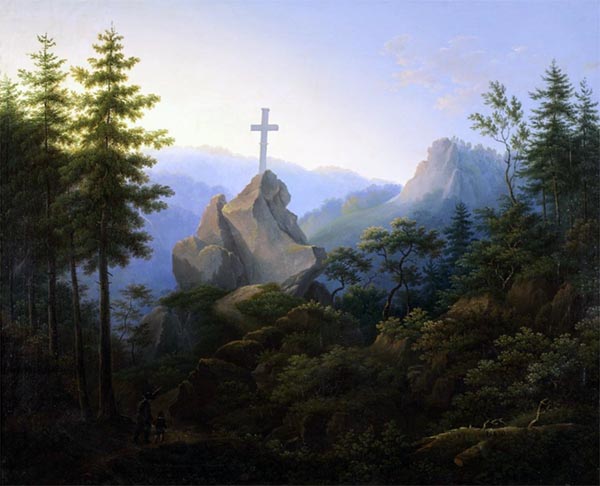
‘Ilsenstein at the foot of the Brocken in the Harz Mountains (1830)’ Hermann Joseph Neefe (1790–1854)
Wikimedia Commons
End of Part IV and of Heinrich Heine’s ‘Die Harzreise’