Johann Wolfgang von Goethe
Italian Journey (1786-88)
Part VIII: Sicily
Translated by A. S. Kline © Copyright 2026 All Rights Reserved
This work may be freely reproduced, stored and transmitted, electronically or otherwise, for any non-commercial purpose. Conditions and Exceptions apply.
Contents
- Sicily.
- Palermo.
- Alcamo.
- Segesta.
- Castelvetrano.
- Sciacca.
- Agrigento (Girgenti).
- Caltanissetta.
- Castrogiovanni (Enna).
- San Paolo Valley, then via the coast, to Catania.
- Catania.
- Monte Rosso.
- Taormina.
- The Idea of Writing a ‘Nausicaa’ – Later Note.
- Messina.
- At Naples Once More.
Sicily
At sea, Thursday, March 29.
Unlike the last occasion on which the packet-boat departed, the favourable, fresh north-easterly wind failed. Sadly, a mild south-westerly, the most detrimental of all, blew from the opposite direction; and so, we learned how dependent sailors are on the capriciousness of wind and weather. We spent the morning, in a state of impatience, sometimes on the quay, sometimes in a café. Finally, at noon, we boarded the ship and enjoyed the most magnificent of views in most beautiful weather. The corvette lay at anchor not far from the pier. The bright sun shone through a hazy atmosphere, hence the cliffs of Sorrento, in shadow, were a beautiful shade of blue. Naples, illumined, and vibrant, glowed with every colour imaginable. Only at sunset did the corvette sail and, even then, only slowly, as the headwind sought to drive us towards Posillipo and the headland. The vessel sailed peacefully all night. It was built in America, a swift sailor, its interior furnished with pleasant cabins, and individual berths. The company was a well-behaved, but lively one: opera singers and dancers consigned to Palermo.
Friday, March 30.
At daybreak we found ourselves between Ischia and Capri, about a mile from the latter. The sun rose magnificently behind the mountains of Capri and Cape Minerva. Kniep diligently sketched the outlines of the coasts and islands and their various views; our slow speed suited his efforts. We continued our journey against a light wind. Vesuvius disappeared from sight around four, with Cape Minerva and Ischia still visible. They too vanished towards evening. The sun set in the sea, accompanied by clouds and a band of light, miles-long, of shimmering purple. Kniep sketched this phenomenon also. Now we were out of sight of land, the horizon a watery plain encircling us, the night bright, the moonlight beautiful.
I was only able to enjoy the magnificent view for a few moments; seasickness soon overcame me. I went to my cabin, lay down, abstained from all food and drink except white bread and red wine, and felt quite comfortable. Divorced from the outside world, I let my inner one take over, and since a slow voyage was to be expected, I immediately set myself a substantial task offering considerable entertainment. Of all my papers, I had only brought the first two acts of ‘Tasso,’ penned in poetic prose, on board with me. These two acts, roughly the same in concept and flow as the present ones, but written ten years earlier, had something soft and nebulous about them, which soon dissipated when I allowed the form to take hold, and the rhythm to emerge according to my more recent ideas.
Saturday, March 31st.
The sun rose brightly from the sea. At seven o’clock we encountered a French ship that had set sail two days before us; our rate of progress improved all the more, yet we still saw no end to the voyage. The isle of Ustica offered some consolation, but unfortunately it was to port, while we had intended to keep it and Capri, to our starboard side. Around noon the wind became completely unfavourable, and we made no headway. To top it all, the waves began to rise, and almost everyone on board was seasick.
I remained in my adopted position, contemplating the whole of my play from every angle, beginning to end. The hours sped by, without my noticing them passing, except when the mischievous Kniep, on whose appetite the waves had no effect, brought me wine and bread from time to time, while praising the excellent midday meal, the cheerfulness and grace of the capable young captain and, with malicious glee, his regret that I was not sharing his pleasure. Likewise, the transition from a state of joy and merriment to one of discomfort and feeling unwell, and how these manifested themselves in various individual members of the party, provided him with further and ample material for mischievous description.
At four in the afternoon, the captain changed tack. The main sails were hoisted again, and we set our course directly for the island of Ustica, behind which, to our great delight, we caught sight of the mountains of Sicily. The wind improved, we progressed more swiftly towards Sicily, and also caught sight of several more islands. The sunset was a hazy one, the sky clothed in mist. The wind remained quite favourable all evening. Around midnight, the sea became very choppy.
Sunday, April 1st.
At three in the morning, a violent storm arose. In my sleep, and half-dreamily, I continued to plan out my drama, whilst listening to a deal of activity on deck. The sails were required to be furled; the ship was tossing about amidst high waves. Towards daybreak, the storm subsided, and the atmosphere cleared. Now the whole island of Ustica lay to port. A large turtle was pointed out to us, swimming in the distance, and clearly visible through our spyglass, though only as a living dot. Around noon, we could clearly distinguish the coast of Sicily, with its promontories and bays, but had come quite close to the wind and were tacking back and forth. Towards afternoon, we were nearer the shore. We saw the whole north-western coast from the promontory of Lilybaeum (Marsala) to Capo Gallo (Palermo) quite clearly, the weather now fair, and the sunshine bright.
A school of dolphins accompanied the ship on both sides of the bow, forever darting ahead. It was amusing to watch them sometimes swimming along, obscured by the clear, translucent waves, sometimes leaping above the water, their dorsal spines and fins, and their green and gold sides, showing.
Since we were sailing well downwind, the vessel was heading straight for a bay just beyond Capo Gallo. Kniep seized this wonderful opportunity for sketching the various views in considerable detail. At sunset, the captain steered the ship back towards the open sea, and sailed northeast to reach the latitude of Palermo. I sometimes ventured on deck, but never lost sight of my poetic intent, and had now pretty much mastered the whole thing. Bright moonlight shone, from beneath a bank of cloud, its rays, reflected from the waves, infinitely beautiful. Painters, for the sake of effect, often lead us to believe that the reflections of celestial bodies in the water appear broadest to the observer where they exhibit the greatest brilliancy. Here, however, the reflection was broadest on the horizon, culminating, like the point of a pyramid, in a shimmer of light on the waves beside the vessel. The captain altered the ship’s course several times during the night.
Monday, April 2nd, 8 a.m.
We found ourselves opposite Palermo. The morning’s delay was most welcome to me. The plan for my drama had progressed well, in the belly of the whale, these past few days. I felt well, and could now observe the coast of Sicily attentively, from the deck. Kniep continued sketching diligently, and through his skill and precision, several sheets of paper became precious mementos of our tardy landing.
Palermo
Monday, April 2, 1787
Finally, with difficulty and some effort, we reached the port at three in the afternoon, where a most delightful sight greeted us. Completely restored, I took great pleasure in the view. The city faces north-east, nestled at the foot of high mountains; above, as was fitting for the time of day, the sun shone down. The clear, shaded sides of all the buildings gazed back at us, illuminated only by reflected light. Monte Pellegrino was to our right, its graceful contours bathed in perfect light; to our left, facing the sea, lay the expansive coastline with its bays, headlands, and promontories. What produced a further, and most charming effect was the fresh green of delicate trees, whose crowns, lit from behind, their vegetation shimmering like great masses of glow-worms, swayed to and fro in front of the dark buildings. A bright haze bathed all the shadows in blue.
Instead of rushing, impatiently, to the shore, we remained on deck until we were swept along; where could we hope to regain a like vantage point, or as happy a moment, for the while!
Through the monumental sea-gate (Porta Felice), consisting of two enormous pillars, with a free space between them on high, so that the towering chariot of Santa Rosalia (the patroness saint of Palermo) can pass through during the famous festival, we entered the town, under guidance, and turned left immediately to reach a large inn. The innkeeper, a comfortable old man, wholly accustomed to receiving strangers of every nationality, led us into a large room the balcony of which overlooked the sea and the roadstead, Rosalia Hill, and the shore, so that we could see our vessel, and establish where we were, from the start. Delighted with the location of our room, we scarcely noticed that in its depths, hidden behind curtains, was a raised alcove in which stood the most spacious bed, adorned with a silk canopy, and matching, perfectly, the other antiquated, but stately furnishings. Such a sumptuous chamber somewhat embarrassed us; we demanded, as was customary, to negotiate terms. The old innkeeper, however, replied that there was no need for a special arrangement; he simply wished us to enjoy our stay. He also suggested we make use of the anteroom, which, cool and airy, with its several balconies, adjoined our room.
We delighted in the infinitely varied view and each sought to record it, drawing and painting the scene, for here one surveyed what would make for a boundless harvest for the artist.
The bright moonlight out to sea that evening was alluring, and kept us lingering on the balcony for a long time after our return. The quality of the light was unusual, the peace and grace profound.
Palermo, Tuesday, April 3, 1787.
Our first task was to take a closer look at the city, which is easy to survey but difficult to know; easy because a road a mile long (Via Vittorio Emanuele) cuts through it, running from the lower gate (Porta Felice) to the upper gate (Porta Nuova), that is, from the sea in the direction of the mountains, and this road is cut through again, roughly in the middle, by another (Via Roma): what lies along these streets is easy to find; the interior of the city, however, is confusing for a stranger, and one can only orient oneself in this labyrinth with the help of a guide.
Towards evening, we turned our attention to the line of carriages carrying distinguished people who were heading out to the roadstead, to take some fresh air, converse, and perhaps court one another.
Two hours before nightfall, the full moon appeared, glorifying the evening indescribably. Palermo’s location, overlooked, in every direction but the east, by mountains, means that the city and its shores often appear wondrously illuminated by the moon and stars, while the sun is only visible for part of the day. That is why, even today, on the brightest of days, we found the harbour’s waters of a dark blue hue, sombre, and oppressive, instead of the ever-brighter, more cheerful, far-reaching brilliance of the sea, that one observes at Naples from noon onward.
Kniep had previously left me to find my way about, and make my observations alone, today, in order that he might capture the exact outline of Monte Pellegrino, the most beautiful of all the promontories in the world.
Palermo, April 3, 1787.
Here is a revised summary, of our journey and arrival, considered retrospectively, and quietly:
We set sail from Naples at sunset on Thursday, March 29th, and only landed in the port of Palermo four days later at three in the afternoon. A little diary, which I enclose, recounts our experiences. I have never embarked on a journey as calmly as this one, and never had a more peaceful time than on the voyage, which was greatly prolonged by constant headwinds, even in bed in the cramped cabin inn which I was obliged to stay for the first few days, being severely seasick. Now I think of you all with a sense of peace; for if anything is decisive for me, it will be this journey.
If you have never found yourself surrounded by sea, you can have no true concept of the world and your relationship to it. As a landscape artist, the wide, simple horizon line has roused entirely new ideas in me.
As the diary shows, we experienced many diversions on this short voyage, the trials and tribulations sailors experience, but in miniature, as it were. Incidentally, the safety and comfort of the packet-boat cannot be praised enough. The captain is a very good and amiable man. The company provided a whole theatre-cast, well-mannered, tolerable, and pleasant. The artist, whom I have with me, is a cheerful, loyal, and decent man who draws with the greatest accuracy; he has sketched all the islands and coastlines as they appeared; it will give you great pleasure when I return home with it all. Furthermore, to shorten the long hours of the crossing, he has noted for me the various techniques of watercolour painting, which is now a highly developed art in Italy. It involves the use of certain colours to produce certain tones, which one would otherwise try to mix endlessly without learning the secret. I had studied some of this in Rome, but never in a coherent manner. Artists can attempt the like, in a country like Italy, directly. For words cannot express the hazy light that hovered around the coast, as we sailed towards Palermo on the most beautiful afternoon, nor the purity of the contours, the softness of the whole, the blending of tones, the harmony of sky, sea, and land. Whoever has viewed these scenes, carries them with them for life. Now I truly understand the art of Claude Lorrain and have hopes that one day, even in the North, I too will be able to conjure from my soul some shadow of this blissful abode. If only all pettiness were washed away as completely as the littleness of our thatched roofs from my conceptual understanding. Let me see what this queen of islands can do.
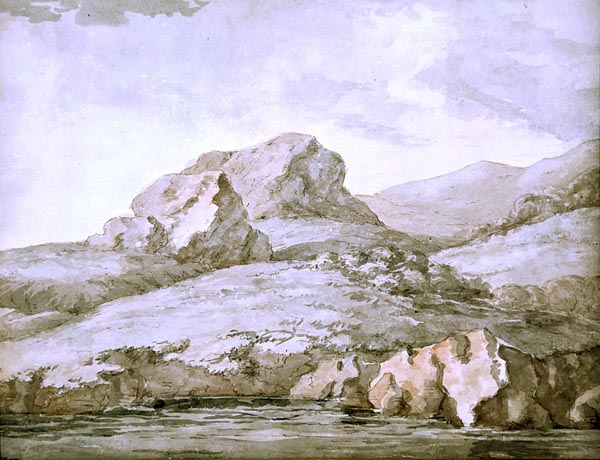
‘A rocky Sicilian coastline in Goethe’s drawing Memories of Sicily’ - Johann Wolfgang von Goethe (German, 1749–1832)
Wikimedia Commons
Words cannot express how Sicily welcomed us: with the fresh green of mulberry trees, evergreen oleander, hedges of lemon-trees, and so on. In the public garden were wide beds of ranunculi and anemones. The air was mild, warm, and fragrant, the wind gentle. The moon rose full behind a promontory, and lit the sea; such a delight, after floating on the waves for four days and nights! Forgive me if I scribble this with a blunt quill, the ink-well a shell from which my companion also traces his sketches. This will reach you like a murmur, while I prepare another kind of memorial celebrating these happy hours of mine, for all who love me. What it will be, I shall not say, nor can I say when you will receive it.
Palermo, Tuesday, April 3, 1787.
This page, my dear friends, should now grant you, insofar as is possible, the greatest pleasure; it is intended to convey the description of this incomparable bay encompassing a vast expanse of water. From the east, where a flatter promontory extends far into the sea (at Capo Zafferano), past a stretch of rugged, well-formed, wooded cliffs to the fishermen’s dwellings in the suburbs, then along the frontage of the city itself, whose outer houses all face the harbour, as does our dwelling, to the gate through which we entered (Porta Felice), the shore continues westward to the usual landing place where smaller ships dock, until reaching the actual harbour at the pier, the station for larger ships. Beyond to the west, protecting all the vessels, Monte Pellegrino rises, in beautiful contours, leaving a lovely, fertile valley, stretching to the sea beyond, between itself and the city.
Kniep drew, and I mapped our surroundings, both deriving great pleasure, and now, as we happily return home, neither of us feels the strength nor the courage to repeat our efforts, and complete them. Our designs must therefore remain unfinished, to be used for future reference, and this sheet merely bears witness to our inability to grasp these scenes adequately, or rather, to our presumption in wanting to conquer and master them in so short a time.
Palermo, Wednesday, April 4, 1787.
This afternoon we visited the fertile and pleasant valley that winds its way down to the southern mountains, past Palermo, and over which the Oreto River meanders. Here, too, an eye for the picturesque and a skilful hand are required to find and capture a suitable viewpoint, and yet Kniep managed to find a spot where the water flows down from a half-destroyed weir, shaded by a cheerful group of trees and with an open view, and some farm buildings beyond, stretching along the valley.
The most beautiful spring weather, and a surge of growth, spread an enlivening feeling of peacefulness throughout the entire valley, a feeling which the over-eager guide, with his erudition, diminished for me, by recounting at length how Hannibal had once fought a battle here (the Carthaginian general Hannibal Mago, Hannibal Barca’s grandson, destroyed the city of Himera, nearby, in 409BC) and what monstrous acts of war had taken place on this very spot. I rebuked him sternly for conjuring up such dismal ghosts. It was bad enough, I remarked, that from time to time the crops had to be trampled, if not always by elephants, then at least by horses and people. One should not, at the very least, startle the imagination from its peaceful reverie, with such things.
He was most surprised that I disdained his recounting a piece of classical history in such a place, and I certainly failed to make him understand how I felt about confusing the past and the present in that manner.
I appeared even odder to the fellow, as I searched for pebbles in all the shallow places, many of which the river leaves dry, and then carried the various samples away with me. Once again, I failed to explain that one cannot gain a swifter understanding of a mountainous region than by examining the types of rock carried down by the streams, and that the task here also was to gain an idea of those eternal and classic witnesses to the Earth’s past by examining such stony fragments.
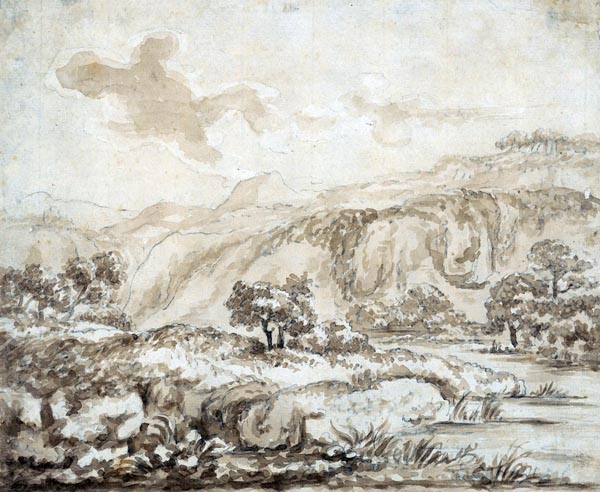
‘River in a mountainous Sicilian landscape’ - Johann Wolfgang von Goethe (German, 1749–1832)
Klassik Stiftung Weimar, Museen (Inv. GGz/1332)
Digital reproduction · See Art. L. 111-1 CPI and § 68 UrhG
My yield from this river was quite rich; I collected almost forty pieces, which, admittedly, could be classified as belonging to only a few categories. Most were of a type of rock that could be identified sometimes as jasper or chert, sometimes as clay-slate. I noted them as partly rounded, partly misshapen boulders, partly rhomboid in shape, and of many different colours. Furthermore, there were many variants of older limestone, and as many breccias, whose binding agent was limestone, but whose bonded stones were sometimes jasper, sometimes limestone. There was also no shortage of boulders of shell-bearing limestone.
They feed their horses here on barley, cut-straw, and bran; in spring, they give them bolted green barley to refresh them, a practice they call ‘rinfrescare’. Since they have no meadows, hay is scarce. There is some pasture on the mountains, and also in the fields, as a third of the land is left fallow. They keep a few sheep, the breed (Barbaresca Siciliana) originating from Tunisia, and generally more mules than horses, because the hot, dry grass suits the former better than the latter.
The plain on which Palermo lies, as well as areas bordering on its immediate vicinity, such as Ai Colli, and parts of Bagheria, consists primarily of shell-bearing limestone, from which the city is built. Consequently, large quarries are found in these areas. Near Monte Pellegrino, the rock layers have been excavated to a depth of fifty feet deep in one location. The lower ones are whiter in colour. They contain many fossilised corals and shellfish, especially large scallops. The upper layer is mixed with red clay and contains few or no shells. Red clay lies on top, but the layer is not very thick. Monte Pellegrino is different from all of these; it is formed of an older limestone containing many holes and fissures which, upon closer inspection, although very irregular, nevertheless follow the order of the layers. The rock is solid and resonant.
Palermo, Thursday, April 5, 1787.
We explored the city in detail, today. The architecture is mostly similar to that of Naples, but the public monuments, such as fountains, are even further removed from good taste. Here, unlike Rome, there is no artistic spirit regulating the work; the structures receive their form and existence solely by accident. One fountain, which is admired by the entire population of the island, would hardly have existed if Sicily did not have beautiful, colourful marble, and if a sculptor skilled in animal forms had not been in favour at that time. The fount (Fontana Pretoria) is difficult to describe. In the moderately sized square, stands a circular architectural structure, not very tall, with a base, walls, and cornice of coloured marble; Several niches are set into the wall in a row, from which, all kinds of animal heads, formed of white marble, gaze forth, set on outstretched necks: horses, lions, camels, and elephants alternate with one another, and one hardly expects behind this circular menagerie a fountain, which marble steps lead up to on all four sides, in order to draw the abundantly-provided water.
Something similar applies to the churches, where even the Jesuits’ love of splendour is surpassed, though not by principle or intent, but merely by chance, just as contemporary craftsmen, sculptors, carvers of foliage, gilders, lacquerers and marble-workers choose to do, without exercising taste or receiving direction, in various places.
One recognises an ability to imitate natural things, as evidenced, for example, by the skillfully-crafted animal heads. This, of course, arouses the admiration of the masses, whose entire enjoyment of art consists in the degree to which the imitation is comparable to the original.
Towards evening, I made a rather amusing acquaintance when I entered a small shop on the long street (the Cassaro) to buy various odds and ends. As I stood in front of the shop, looking at the wares, a slight gust of wind arose, which, swirling along the street, immediately distributed an endless cloud of agitated dust into all the stalls and windows. ‘By all the saints! Tell me,’ I exclaimed, ‘where does all the dust come from, and can it not be remedied?’ This street rivals the Corso in Rome in length and beauty. On both sides are cobblestones, which all the shopkeepers and workshop-owners clean by incessantly sweeping and pushing everything to the middle of the street, which becomes ever-dirtier as a result, and returns, with every breath of wind, the very refuse assigned to it. ‘In Naples, donkeys are kept busy carrying the sweepings to the gardens and fields each day; should not some similar arrangement be decreed, and implemented here?’
‘It’s just the way things are here,’ the owner replied, ‘whatever is thrown out of the house rots right there in a pile in front of the door. One sees here layers of straw and reeds, the contents of kitchen drains, and all sorts of other rubbish, which all dry together, and return to us as dust. We fight against it all day long. And look, our beautiful, neat, active brooms, worn-down in the end by brushing, only increase the filth before our houses.’
And, funnily enough, it really is true. They have charming little tufts of dwarf-palm that, with a little modification, could be used for fans; they wear down quickly, and the stumps lie by the thousand in the street. To my repeated question of whether measures could be taken against all this, he replied that it was common knowledge that those who were supposed to be responsible for public sanitation, because of their power and influence, could scarcely be compelled to use the funds properly. Furthermore, there was the curious fact that the people feared if the filth was cleared away it would become apparent how bad the paving was underneath, which would once again expose the dishonest management of the city’s wealth. But all this, he added, with a comical expression, was merely the view of ill-intentioned people, while he himself rather agreed with those who claimed the nobility maintained this soft layer of dust for their carriages, so they could complete their customary, evening pleasure-drive in comfort, over a resilient surface. As the fellow was now fired up, he went on to recount several instances of police misconduct, as comforting proof to me that humankind still possesses enough of a sense of humour to make fun of the inescapable.
Palermo, April 6, 1787.
Santa Rosalia, patroness and saint of Palermo, has become so widely known through the description of her festival given by Patrick Brydone (in ‘A Tour Through Sicily and Malta’, 1773) that it must surely be pleasing to her friends to read something with regard to the place and site where she is especially venerated.
Monte Pellegrino, a large mass of rock, wider than it is tall, lies at the north-western end of the Gulf of Palermo. Its beautiful shape defies description; an imperfect illustration can be found in the ‘Voyage Pittoresque des Isles Sicile’ (by Jean-Pierre Louis Laurent Houël, published 1782-87). The mountain consists of a grey limestone from an early period. The rocks are completely bare; no tree or shrub grows there, the flatter parts being sparsely covered by grass and moss.
At the beginning of the last century, the saint’s remains were discovered in a cave on this mountain and brought to Palermo. Her presence freed the city from the plague, and Rosalia became the patroness saint of the people from that moment on; chapels were built in her honour, and magnificent celebrations were held.
Devout pilgrims made their way, diligently, to the mountain, and a path (L’Acchianata) was built, at great expense, which, rather like an aqueduct, rests on a series of pillars and arches, and ascends in a zigzag pattern between the cliffs.
The place of devotion itself is more suited to the humility of the saint, who sought refuge there, than the magnificent festivals held in honour of her total renunciation of the world. And perhaps all of Christendom, which for eighteen hundred years has based its possessions, its splendour, its solemn festivities on the pains of its first founders and most ardent confessors, has no holy place to boast of that is adorned, and venerated in a more innocent or heartfelt way.
Once one has climbed the mountain, one rounds a rocky corner, where one stands pressed close to the steep rock face, against which the sanctuary and the monastery are, to all intents, built.
The exterior of the sanctuary is neither inviting nor promising; one opens the door without expectation of anything much, yet one is most wonderfully surprised upon entering further. One finds oneself in a hall that runs the width of the church, and opens onto the nave. In it, one sees the usual vessels of holy water and a few confessional boxes. The nave of the church is an open courtyard, bordered on the right by natural rock and on the left by a continuation of the hall. It is paved with stone slabs, slightly sloping to allow rainwater to run off; a small fountain stands approximately in the centre.
The cave itself has been transformed into the chancel without altering its primitive, rugged character. A few steps lead up to it: a large lectern with a choir book stands immediately before you, flanked by choir stalls. Everything is illuminated by daylight streaming in from the courtyard and nave. Deep in the darkness of the cave, stands the high altar in the centre.
As already mentioned, nothing of the cave has been altered; however, since water drips from the stone walls constantly, it is necessary to keep the place dry. This is achieved by lead troughs, which have been laid along the bordering rocks, and connected to each other at various points. Because they are wide at the top, and taper to a point at the bottom, and are also painted a dull green colour, it almost looks as if the cave’s interior is overgrown with large cacti. The water is channelled partly to the side, partly to the rear, into a clear tank, from which the faithful draw it, using it to treat various ailments.
As I was examining these features closely, a priest approached and asked if I was perhaps Genoese, and wished to have a number of masses said. I replied that I had come to Palermo with a Genoese who would be ascending tomorrow for the feast day. Since one of us always had to remain in the city, I had visited today to survey the site. He replied that I must feel free to examine everything carefully, and perform my devotions. He specifically pointed me to an altar on the left side of the cave, which he considered a special shrine, and then left me.
Through the openings of a large, rebated gate of brass, I saw lamps shimmering beneath the altar. I knelt very close to the gate, and peered through the openings. Within, there was a latticework of finely woven brass wire, so that one could only distinguish the object behind it as if through a veil.
I glimpsed a beautiful woman by the dull light of various lamps. She lay as if in a state of rapture, her eyes half-closed, her head resting, idly, on her right hand, which was adorned with many rings. I could not gaze at her enough; the image seemed to possess a very special charm. Her garment is made of gilded sheet metal, which imitates a richly-woven gold fabric most effectively. Her head and hands, of white marble are, not, I dare say, crafted in a high style, but nonetheless are so natural and pleasing that one almost expects her to breathe and move. A small angel stands beside her, seemingly wafting a cooling breeze towards her with a lily stem.
Meanwhile, the priests had entered the cave, seated themselves in their chairs, and were chanting Vespers. I sat down on a bench opposite the altar, and listened to them for a while; then I returned to the altar, and knelt down, and tried to comprehend the beautiful image of the saint even more clearly. I surrendered myself, completely, to the charming illusion created by the sculpture and the place.
The priests’ singing now faded, the water trickled into the basin beside the altar; the overhanging rocks of the forecourt, the actual nave of the church, rounding the scene further. There was a great stillness in this seemingly deserted space, profound order in a wild cave; the ostentatious trappings of Catholic, especially Sicilian, worship, still in their simple and natural state; the illusion created by the figure of the beautiful sleeping woman, charming even to a practised eye — enough, I could only tear myself away from the place with difficulty and did not reach Palermo again until late that night.
Palermo, Saturday, April 7, 1787.
In the public garden (Villa Giulia, Palermo’s seafront public garden) near to the harbour, I spent the most delightful hours in quiet contemplation. It is the most wonderful place in the world. Regularly laid out, it nevertheless seems fairy-tale like; planted not so long ago, it transports one to antiquity. Green borders enclosed exotic plants, trellises of lemon branches arched to form charming pergolas, and tall walls of oleander, adorned with a thousand red, carnation-like blossoms, enticed the eye. Entirely unfamiliar trees, still leafless, probably from warmer climes, spread forth their branches and blooms strange to me. A raised bench behind the lower area, allows one to overlook the wondrously-intertwined growth, and directs the gaze afar, to large basins in which gold and silver fish swim about most pleasantly, sometimes hiding under moss-covered reeds, sometimes gathering in droves, lured by a morsel of bread. The plants are in shades of green quite unlike ours, sometimes more yellowish, sometimes more bluish. But what lent the whole scene its wondrous charm was an intense haze that spread uniformly over everything, to such noticeable effect that various objects, just a few paces from others, stood out as being of a more distinctive pale-blue in tone, such that their characteristic natural colour was lost, or at least appeared excessively blue to the eye.
The wondrous effect of such a haze on one’s view of distant objects, ships, and promontories is remarkable enough for anyone with an eye for the picturesque, as their distances from the observer can then be distinguished clearly, indeed measured optically; therefore, a walk along the heights was most delightful. One no longer saw Nature, but rather images of objects as the most skilful of painters might differentiate them, through the use of translucent layers of glaze. However, the impression of that wondrous garden had remained too deeply etched in my memory; the dark waves on the northern horizon, their movement towards the curving bay, even the very ‘perfume’ of the misted sea — all this evoked the blessed island of the Phaeacians in my mind, and stirred my senses. I immediately hurried to purchase a copy of Homer’s ‘Odyssey’, to read that epic poem to my great edification (see Books 5-13), and to recite an impromptu translation to Kniep, who certainly deserved to rest comfortably with a good glass of wine after his rigorous efforts today.
Palermo, April 8, 1787. Easter Sunday.
Today, at daybreak, the boisterous joy over the Lord’s Resurrection began. Firecrackers, rockets, serpents and the like, were launched from in front of the church portals, by the crateload, as the faithful thronged towards the opened double doors. The sound of bells and organ music, the choral singing in procession, and the responses of the religious choirs was truly fit to bewilder the ears of those unaccustomed to such noisy worship of the Christian God.
The early mass had scarcely ended when two well-dressed couriers of the Viceroy visited our inn, with the dual intention of, firstly, offering his congratulations to these newcomers to their festival celebrations and collecting a donation, and, secondly, of inviting me to dine, which meant my gift had to be increased somewhat.
After spending the morning visiting the various churches, and observing the features and forms of the people, I set out for the Viceroy’s Palace, which is located at the upper end of the city. Because I arrived somewhat early, I found the great halls still empty; except for a small, lively man who approached me, and whom I immediately recognised as a Maltese.
When he learned that I was German, he asked if I knew anything about Erfurt, as he had spent some very pleasant time there. I was able to provide him with sufficient information regarding his inquiries about the Von Dacheröden family, and the coadjutor Karl von Dalberg, whereupon he was pleased to ask about others in Thuringia. With considerable interest, he inquired about Weimar. ‘What of that young man,’ he said, ‘who, was a lively fellow when I lived there, and who dictated the very nature of the weather, rain or sun, for a while? I’ve forgotten his name, but suffice it to say he was the author of The Sorrows of Young Werther.’
After a short pause, as if reflecting on his comment, I replied: ‘The person you so kindly inquired about is myself!’ —With the most visible signs of astonishment, he stepped back, exclaiming: ‘A great deal has changed, then!’ — ‘Indeed, yes,’ I replied, ‘between Weimar and Palermo I’ve experienced many a change!’
At that moment, the Viceroy (Francesco d’Aquino, Prince of Caramanico) entered with his retinue, and behaved with the proper degree of freedom befitting such a gentleman. He did not, however, refrain from smiling at the Maltese, who continued to express his surprise at encountering me there. At dinner, the Viceroy, beside whom I sat, asked about the purpose of my journey and assured me that he would issue orders permitting me to see everything in Palermo, and providing me with every assistance on my travels throughout Sicily.
Palermo, Monday, April 9, 1787.
All day today we were preoccupied with Prince Palagonia’s nonsense (Francesco Ferdinando Gravina II, known for his eccentric creation, the Villa Palagonia in Bagheria, the ‘Villa of the Monsters’), his folly being quite different from what one had imagined, through reading and hearing of it. For, whoever, possessing a love of truth, sets out to give an account of some absurdity or other, always finds themself in something of a dilemma: they wish to convey the concept, yet by doing so turn it into something worth speaking of, though it is actually a mere nothingness that seeks to be taken as something. And so, I must preface my description with another generalisation: that neither the most tasteless, nor the most excellent, springs directly from a single person or time, but rather, if one is attentive, one can trace the lineage of both the tasteless and the excellent back to their origin.
The fountain in Palermo, which I commented on, belongs to the ancestors of a similar frenzy to that of the prince, except that his folly, having been created on his own estate, shows the greater freedom and breadth. I will attempt to communicate its gradual revelation.
When a pleasure-palace is built in these regions, it lies more or less at the centre of the entire estate, and one therefore has to travel through cultivated fields, kitchen-gardens, and other agricultural features to reach the princely residence, the Sicilians proving themselves more economical than we northerners, who often devote a great deal of fertile ground to a park only to flatter the eye with barren shrubs. These southerners, on the other hand, erect a pair of walls between which one reaches the palace, without being aware of what lies to left or right. This entrance path usually begins with a large portal, perhaps with an arched vault too, and ends in the palace courtyard. In order that one has something to gaze at between these walls, they are curved at the top, and decorated with scrolls and pedestals, upon which perhaps a vase stands, here and there. The surfaces are whitewashed, divided into sections, and painted. The palace courtyard forms a circle of single-story buildings where the servants and labourers live; the square castle towers above everything else.
This is the traditional layout, as it may well have existed before the prince’s father built the place, not in the best taste, admittedly, but still a tolerably good one. The current owner, however, without departing from the general principle, has given free rein to his desire, nay passion for, various misshapen, and tasteless creations, and to attribute to him even a spark of imagination grants him far too much credit.
One enters a large building, at the boundary of the property itself, taking the form of an octagon, extremely tall relative to its width. Four enormous giants, wearing modern leggings with buttons, support the cornice, on which, directly opposite the entrance, the Holy Trinity is represented, hovering.
The passage to the castle is wider than usual, the wall transformed into a continuous, high plinth upon which excellent bases support strange groups of figures, while several vases are placed in the spaces between them. The repulsiveness of these monstrosities, botched by the most common stonemasons, is further increased by the fact that they are carved from the loosest shell-bearing tuff; yet a better material would only highlight the worthlessness of their forms all the more. I said ‘groups’ earlier, using an erroneous and inappropriate term; for these arrangements arose from no kind of reflection, or even pure arbitrariness, but are rather jumbled together. Three figures at a time adorn such a square pedestal, their bases arranged so that together, in various positions, they fill the square space. The most distinguished of these usually consists of two figures, and their base occupies the largest front-part of the pedestal; these are mostly monstrous creatures of animal and human form. To fill the rear space of the pedestal, two more pieces are needed; the medium-sized one usually depicts a shepherd or shepherdess, a cavalier or lady, a dancing ape or dog. Now there remains a gap on the pedestal: this is usually filled by a dwarf, as his figure plays a significant role in mindless jokes everywhere.
To ensure that I fully transmit the elements of Prince Palagonia’s madness, I hereby provide the following list. Humans: beggars (male and female), Spaniards (male and female), Moors, Turks, hunchbacks, figures with all kinds of deformities, dwarves, musicians, Pulcinellos, soldiers in antique costumes, gods, goddesses, people dressed in old French clothing, soldiers with cartridge pouches and gaiters. Mythological figures with grotesque elements: for example, Achilles and Chiron with Pulcinello. Creatures: only parts of them, a horse with human hands, a horse’s head on a human body, deformed monkeys, many dragons and snakes, all kinds of paws on figures of all kinds, duplication and confusion of heads. Vases: all kinds of monsters, and flourishes, that terminate at the bottom in vase bellies and bases.
If one imagines such figures manufactured in a monstrous fashion, produced without rhyme or reason, and assembled without choice or intention, and then imagines these bases, pedestals and misshapen forms arranged in an endless series, then one will feel the unpleasant sensation that must overcome anyone when they are obliged to run the gauntlet of these mad fancies.
One approaches the castle and is greeted by the wings of a semicircular forecourt; the main wall opposite, through which the entrance passes, is built in a fortress-like style. Here one finds an Egyptian figure set in the wall, a fountain without water, a monument, vases scattered about, and statues deliberately laid on their faces. One enters the main castle courtyard and finds it to be a conventional circular shape, surrounded by small buildings, extended into smaller semicircles, to give variety.
The ground is mostly covered with grass. Here, as if in a derelict churchyard, strangely ornate marble vases inherited from the father, dwarfs, and other misshapen objects from more recent times, stand haphazardly jumbled together, for which a place has not yet been found; one even comes upon an arbour crammed full of old vases and other ornate stonework.
The absurdity of such a tasteless way of proceeding is most clearly demonstrated by the fact that the cornices of the smaller houses lean precariously to one side or the other, so that one’s sense of the level and the perpendicular, which is what truly makes us human and is the basis of all harmony, is baffled and ruined. Moreover, the rows of roofs are adorned with dragons and small busts, with monkey choirs and similar madness. Dragons alternate with gods; Atlas carries a wine barrel instead of the celestial globe.
If one seeks to escape all this, by entering the castle, built by the father, which has a fairly reasonable outward appearance, one will find, not far from the gate, the laurel-wreathed head of a Roman emperor, set on a dwarf’s body, the latter seated on a dolphin.
Inside the castle itself, whose exterior might suggest a tolerable interior, the prince’s fever has already operated at full blast again. The chair legs are unevenly sawn off, so that no one can sit, and the castellan warns against seating oneself on those chairs which can be sat on, because they conceal thorns beneath their velvet upholstery. Candelabras, of Chinese porcelain, stand in the corners, which, on closer inspection, have been gathered together from individual bowls, saucers, and the like. There is not a corner in which some arbitrary detail does not lurk. Even the priceless view across the headlands to the sea is marred by coloured panes, which, with their false tones, either chill or inflame the landscape. I must also mention a cabinet, the panels of which have been assembled from old, gilded, cut-up frames. The hundreds of carved patterns, the different gradations of older or newer, the more or less dusty and damaged gilding covering all the walls here, set tightly together, give the impression of a junk shop full of individual fragments.
To describe the chapel alone would require a whole volume. Here one finds an explanation for these manifestations of utter madness which could only flourish to this degree in an obsessed mind. I can only surmise the number of grotesque forms of misguided devotion that may be found there, but I will not withhold the most startling. Flat against the ceiling, is a rather large carved life-size crucifix, painted and varnished, with gilding added. A hook is screwed into the navel of the crucified figure, and a chain hanging from it is fastened to the head of a kneeling man, suspended in the air, in prayer. This latter figure, painted and varnished like all the other items in the chapel, is presumably meant to signify the owner’s unceasing devotion.
Incidentally, the palace is not complete: a large hall, colourfully and richly designed by the father, but not decorated in a disgusting fashion like the rest, remains unfinished; clearly, the boundless madness of the owner was unable to cope with a further display of his follies.
Kniep, who, with his artistic feeling, was driven to despair by this madhouse, appeared impatient for the very first time; he urged me on as I tried to visualise individually, and draw schematically, the elements of this ‘un-creation’. Finally, being kind, he sketched one of the figure-combinations, the only one that still yielded at least some sort of an idea. It depicted a horse-headed woman sitting on an armchair, playing cards with a cavalier, dressed in old-fashioned clothing from the waist down but adorned with a griffin’s head, a crown, and a large wig. It recalls the coat of arms of the House of Palagonia, still highly peculiar even without all this madness: namely, a satyr holding a mirror up to a woman with a horse’s head.
Palermo, Tuesday, April 10, 1787
Today we drove uphill to Monreale. A magnificent road, which the abbot of the monastery built, during a time of prodigious wealth; wide, with a comfortable incline, trees here and there, but especially extensive fountains and pipes, ornate and decorated almost in the manner of Palagonia, yet refreshing for animals and people alike.
The monastery of San Martino della Scale, situated on the hilltop above, is a respectable structure. A single confirmed bachelor, as seen in the case of Prince Pallagonia, rarely produces anything worthwhile; several together, however, have created the greatest of works, as churches and monasteries demonstrate. These religious societies were probably so influential precisely because they were more certain than any father of a family of an unlimited number of successors.
The monks showed us the many beautiful antiquities and natural objects they had collected. We were particularly struck by a medal with the image of a youthful goddess, which was bound to inspire our delight. Those good fellows would gladly have allowed us to make a cast, but there was nothing on hand that would have been suitable for any kind of mould.
After showing us everything, not without a sombre comparison of past and present conditions, they led us to a pleasant little hall, from whose balcony one enjoyed a fine view; a table was set for us both, and there was no shortage of dishes from which to make a very good lunch. After dessert, the abbot entered, accompanied by his senior monks, sat down with us, and stayed for about half an hour, during which time we were asked several questions. We parted most amicably. The younger monks accompanied us once more to the rooms in which the collection was housed, and finally to our carriage.
We went home feeling completely different to how we had felt yesterday. Today, we lamented a large institution currently in decline, while the previous day’s experience was of a tasteless enterprise still developing fresh growth.
The road to San Martino climbs older limestone layers. The rocks are broken up, and burned to produce lime, which is very white in colour. For fuel, they use a strong, long type of grass, dried in bundles. This is how ‘calcara’ (white micro-marble) is formed. Red clay, which forms the topsoil here, layers even the steepest heights; the higher the altitude, the redder it becomes, with little blackening from vegetation. In the distance, I saw a pit almost the colour of cinnabar.
The monastery stands in the midst of limestone mountains, which are very rich supplied with springs.
The surrounding mountains are prominent.
Palermo, Wednesday, April 11, 1787.
Having now examined these two main sites outside the city, we visited the Royal Palace (the Palazzo dei Normanni), where the guide busily showed us the rooms and their contents. To our great dismay, the hall where the antiquities are usually displayed was in utter disarray, as it was being re-decorated. The statues had been removed from their places, and draped with cloths, and we were obstructed by scaffolding, so that despite the good intentions of our guide and the efforts of the workmen, we could only gain a very incomplete impression of them. I was most interested in two bronze rams, which, even seen under these circumstances, aroused our artistic sensibilities to a high degree. They are depicted lying down, one leg forward, their heads turned in opposite directions as counterparts; powerful figures from that mythological breed worthy of bearing Phrixus and Helle. The wool is not short and curly, but long and cascading in waves, sculpted with great truth and elegance, and from the finest Greek period. They are said to have stood in the port of Syracuse (one was destroyed in 1848, the other is extant, having been restored, and is in the National Museum of Palermo).
The guide then led us outside the city gate, to the catacombs (Catacombe dei Cappuccini), which, laid out with architectural ingenuity, are by no means simply quarries used as burial sites. In the hardened tuff of the vertically-hewn walls, vaulted openings have been carved, and within these, several sarcophagi have in turn been hewn, one above the other, carved wholly from the same mass, without the addition of masonry. The upper ones are smaller, and in the chambers above the pillars, there are burial places for children.
Palermo, Thursday, April 12, 1787.
Today we were shown the medal collection assembled by Prince Torremuzza (Gabriele Lancillotto Castello). I was somewhat reluctant to perform the visit. I know too little about the subject, and a traveller who is merely curious is detested by true connoisseurs and enthusiasts. But since one must begin somewhere, I resigned myself to it and derived much pleasure and benefit. It is helpful to reflect on the fact, even if only for a moment, that the ancient world was dotted with cities, the smallest of which left us, if not an entire series of art works, at least several epochs of it, recorded in exquisite coins. From these drawers, an endless Spring, full of the blossom and fruits of art, that of a craft practised in the higher sense, and of so much more, smiles forth. The splendour of the Sicilian cities, now dimmed, shines forth anew from these sculpted metals.
Unfortunately, in our past we other nations only possessed local coinage, which conveys nothing, and imperial coins, which repeat the same profile ad nauseam: images of rulers who were hardly exemplary human beings. How sad that our antiquities were confined to formless Palestine, and confusing Rome! Sicily and modern Greece now give us hope of some fresh renewal.
The fact that I make general observations about these subjects is proof that I have not yet achieved much understanding of them; but that will gradually improve along with other things.
Palermo, Thursday, April 12, 1787
This evening, another wish of mine was granted, and in a rather unusual way. I was loitering on the cobblestones in the main street, joking with the shopkeeper I mentioned before; suddenly, a tall, well-dressed courier approached me, swiftly, and held out a silver plate on which lay several copper pennies, and a few silver coins. Not knowing what it meant, I shrugged, my head bowed, the usual sign of refusal, whether one understands, or simply denies the request or question. Just as quickly as he had come, he was gone, and now I noticed his companion on the opposite side of the street engaged in the same activity.
What did it signify, I asked the merchant, who, with a thoughtful, almost furtive, gesture pointed to a tall, gaunt gentleman who, dressed in courtly attire, was walking respectfully and calmly over the dung heaped in the middle of the street. His hair neatly-styled and powdered, his hat under his arm, he wore a silk robe, a sword at his side, and fine footwear adorned with stone buckles: the elderly fellow strode along solemnly and quietly; all eyes were upon him.
‘That is Prince Palagonia,’ said the shopkeeper, ‘who walks about the city, from time to time, collecting ransom money to free Sicilians held captive as slaves on the Barbary coast. While these collections never amount to much, the issue remains in one’s memory, and often those who refused during their lifetime bequeath handsome sums for the purpose. For many years now, the prince has been the head of this institution, and has done immeasurable good.’
‘Instead of wasting money on the follies of his country estate,’ I exclaimed, ‘he should have spent those vast sums thus. No prince in the world would have accomplished more.’
The shopkeeper, dissenting, replied: ‘Are we not all like him! We happily pay for our own follies, but expect others to fund our acts of virtue.’
Palermo, Friday, April 13, 1787
Count Borch (Michał Jan Borch, Polish-Livonian nobleman, mineralogist, and author) has diligently prepared the ground for us, as regards the stony landscape of Sicily, and anyone who visits the island with the same aim will doubtless be happy to express their gratitude. I find it pleasant, as well as obligatory, to celebrate the memory of a predecessor. After all, one is only a forerunner of others to come, in life as in travel!
The Count’s activity, however, seems to me somewhat greater than his knowledge; he proceeds with a certain self-indulgence that is contrary to the modest seriousness with which one should treat important matters. However, his quarto book (‘Lythologie Sicilienne’, Naples 1777), entirely devoted to the Sicilian kingdom’s lithology, is of great benefit to me, and, thus prepared, I was able to profitably visit the gem cutters, who, busier formerly, in the days when the churches and altars were yet to be adorned with marble and agates, still practise their craft. I ordered samples of soft and hard stone from them; they distinguish marble and agates in that way, primarily because the price difference is based on the distinction. Besides these two categories, they are also most knowledgeable as regards another material, a byproduct of the lime-kilns. After firing, a kind of vitreous flux is found in them, which ranges from the lightest blue to the darkest, indeed to the blackest. These lumps are cut into thin slabs like other stone, valued according to the quality of their colour and purity, and successfully used instead of lapis lazuli in the veneering of altars, tombs, and in other ecclesiastical decorations.
The complete collection I desire is not yet ready; it will be sent to me in Naples. The agates are of the greatest beauty, especially those in which irregular patches of yellow or red jasper alternate with white, almost-frozen quartz, creating the most beautiful effect.
An exact imitation of such agates, achieved on the back of thin glass discs using lacquer paints, is the only sensible thing I gleaned from the Palagonian nonsense the other day. Such panels appear more attractive when used decoratively than genuine agate, since the latter must be assembled from many small pieces, whereas with these, the size of the panels is at the discretion of the architect. This skill certainly deserves to be imitated elsewhere.
Palermo, April 13, 1787
Italy without Sicily would leave an incomplete picture in the mind: here, lies the key to everything.
The weather is wonderfully variable; it is the rainy season now, the rain always intermittent; today we have thunder and lightning, and everything is turning a vibrant green. Some of the flax has already formed bolls (the seed capsules), while the rest is still in bloom. The flax fields below the hills look so beautifully blue-green that one imagines one is viewing a series of small ponds in the valleys. There are countless charming subjects for art! And my companion is an excellent man, a true friend, just as I honestly continue to play the role of loyal companion. He has already made some very fine sketches and will take the best home with him. What a prospect, to one day return, happily, with all my treasures!
I have not yet mentioned the food and drink here, and yet it is no small matter. The garden-produce is wonderful, especially the lettuce, so tender and with a flavour like milk; one understands why the ancients called it ‘Lactuca’. The various sorts of oil and wine are all very good, and they could be even better if more care were taken in their production. The fish are of the best, and most tender. We have also eaten excellent beef during our stay, even though it is not usually praised here.
Now, from lunch to the window! To the street! A wrongdoer has received a pardon, which is always traditionally done in honour of Easter week. Members of one of the brotherhoods lead him to a mock-gallows, where he is required to perform a prayer before the ladder, and kiss it, before being led away. He is a handsome man, middle class, well-groomed, wearing a white frock coat and white hat, everything white. He carries the hat in his hand, and if only colourful ribbons were attached, here and there, he could attend a ball dressed as a shepherd.
Palermo, April 13th and 14th, 1787.
And so, shortly before my departure, I have experienced a strange adventure, of which I will immediately give you a detailed account.
Throughout my stay, I had heard much talk at our communal dinner table of Alessandro Cagliostro (the occultist and alchemist), his origins, and his fate. The Palermitani (residents of Palermo) were in agreement that a certain Joseph (Guiseppe) Balsamo, born in their city, was a notorious fellow, exiled for various acts of mischief. However, opinions differed as to whether this man was the same person as Count Cagliostro. Some, who had seen him on occasion, claimed to recognise his likeness in that French copper engraving, which is quite well-known in our country, and has also found its way to Palermo (see the line engraving by Christophe Guérin, 1781).
During such conversations, one of the guests referred to the efforts undertaken by a Palermitano, a legal scholar, to clarify the matter. He had been prompted by the French ministry to investigate the background of a man who, before the eyes of France, indeed one might say the whole world, had been so audacious as to utter the most ludicrous lies in an important and dangerous trial (the 1785 ‘Affair of the Diamond Necklace’).
It was said that this legal scholar had compiled the family tree of Joseph Balsamo, and sent an explanatory memoir, with certified appendices, to France, where it would probably be made public.
I expressed my wish to meet this legal scholar, about whom much good was also spoken, and the narrator offered to register my name with him, and take me to meet him.
After a few days, we visited, and found him occupied with his clients. Once he had seen them out, and we had eaten breakfast, he produced his manuscript containing Cagliostro’s family tree, copies of the documents necessary to establish its validity, and a draft of the memoir that had been sent to France.
He presented me with the family tree and provided the necessary explanation, of which I quote here as much as is necessary for easy understanding.
Joseph Balsamo’s maternal great-grandfather was Matthaus Martello. His great-grandmother’s maiden name is unknown. From this marriage came two daughters: one named Maria, who married Joseph Bracconeri and became Joseph Balsamo’s grandmother; the other, named Vincenza, who married Joseph Cagliostro, who came from the small town of La Novara, eight miles from Messina. I note here that two bell-founders with that name still live in Messina. This great-aunt subsequently became Joseph Balsamo’s godfather; he received her husband’s given name and eventually also adopted the surname Cagliostro from his great-uncle.
The Bracconeri couple had three children: Felicita, Matthaus and Antonin. Felicita married Peter Balsamo, the son of a ribbon merchant in Palermo, Antonin Balsamo, who was presumably of Jewish descent. Peter Balsamo, the father of the infamous Joseph, went bankrupt and died at the age of forty-five. His widow, who is still alive, bore him, besides the aforementioned Joseph, a daughter, Johanna Joseph-Maria, who married Johann Baptista Capitummino, with whom she had three children, and who later died.
The memoir, which the author graciously read to us and entrusted to me for a few days, at my request, was based on baptismal certificates, marriage contracts, and other documents that had been carefully gathered. It contained nearly all the facts (as I can see from an extract I made at the time) that have now come to knowledge from the Roman court records: that Joseph Balsamo was born in Palermo at the beginning of June 1743, and baptised by Vincenza Martello, née Cagliostro; that in his youth he joined the Brothers Hospitallers of Saint John of God, an order that particularly cares for the sick; that he soon showed great intelligence and skill in medicine, but was sent away because of his misbehaviour; and that he later became a magician and treasure-hunter in Palermo.
His great gift for imitating handwriting was not left unused (so the memoir continues). Rather, he falsified or fabricated an old document, which caused a dispute over the ownership of a piece of property. He was investigated, imprisoned, escaped, and summoned by edict. He travelled through Calabria to Rome, where he married the daughter of a belt-maker. From Rome, he returned to Naples under the name Marchese Pellegrini. He ventured again to Palermo, was recognised, arrested, and escaped in a manner that is worth recounting at length.
The son of one of the first Sicilian princes and large landowners, a man who held prominent positions at the Neapolitan court, combined a strong body and an unbridled temperament coupled with all the arrogance to which the rich and powerful, devoid of education, believe themselves entitled.
Donna Lorenza (Lorenza Seraphina Feliciani, known as Serafina, whom Cagliostro married in 1768) knew how to win the prince over, and the disingenuous Marchese Pellegrini trusted the pair completely. The prince showed, publicly, that the newly-arrived couple were under his protection, and flew into a rage when, at the urging of the party that had suffered losses due to the deception, Joseph Balsamo was once again imprisoned! The prince tried various means to free him, and when these failed, he threatened, in the President’s antechamber, to mistreat the opposing party’s lawyer most severely if he did not immediately quash Balsamo’s arrest. When the opposing counsel refused, he seized him, struck him, threw him to the ground, trampled him underfoot, and was being forcibly restrained from inflicting further abuse when the President himself rushed out to investigate the commotion, and insisted on peace. Weak and dependent on the prince, the latter dared not punish the offender; the opposing party and their representative backed down, and Balsamo was set free without his release being recorded in the files, nor any note being kept of who had ordered it, or how it had occurred. Soon afterwards, Joseph left Palermo and engaged in various travels, of which the author could only give an incomplete account.
The memoir ended by asserting, forcefully, that Cagliostro and Balsamo were one and the same, a thesis that was harder to propose then than now, when we are fully informed of his later history.
Had I not suspected at the time that this essay would be made public in France, and that I would likely find it already in print on my return, I would no doubt have been permitted to take a copy, and inform my friends and the public, far earlier, of some interesting aspects.
Meanwhile, we have learned the majority of the information, indeed more than that memoir could address, from a source that otherwise has tended to spout only errors. Who would have believed that Rome would one day contribute so much to the enlightenment of the world, to the complete exposure of a swindler, as it did through the publication of an excerpt from the record of that trial! For although this document could, and should, have aroused greater interest, it nonetheless remains a valuable record in the hands of any reasonable person who was obliged to watch with dismay as the deceived, the partially-deceived, and the deceivers in the case, venerated the man and accepted his charades for years, feeling themselves elevated above other folk through their association with him, and, from the heights of their studied arrogance, pitying, if not belittling, the common sense shown by others.
Who would not have chosen to remain silent at the time? Indeed, only now, after the whole matter is done with, and settled beyond dispute, can I bring myself to share what I know, in order to complete the record.
When I discovered that several people noted in the family tree, especially the mother and sister, were listed as still living, I expressed, to the author of the memoir, my desire to see them, and so become acquainted with the relatives of so remarkable a person. He replied that it would be difficult to achieve, as those involved, poor but honourable people, lived very secluded lives, were unaccustomed to seeing strangers, and given the natural inclination of Sicilians to be suspicious might interpret the situation and my interest wrongly; however, he would send his clerk to me, who had access to the family and through whom he obtained the information and documents from which the family tree had been compiled.
The following day the clerk appeared, and expressed some concerns about the matter. ‘I have always avoided, visiting these people again,’ he said, ‘for in order to get my hands on the marriage contracts, baptismal certificates, and other documents, and to make legal copies of them, I had to resort to a trick of my own. I took the opportunity to mention a family scholarship that was vacant somewhere, convinced them that the young Capitummino qualified for it, and that it was essential a family tree was drawn up, to identify to what extent the boy could lay claim to this scholarship; of course, everything would then depend on negotiation, which I would undertake if they promised me a fair share of the sum obtained, for my efforts. The good people gladly agreed to everything; I received the necessary documents, the copies were made, the family tree was drawn up, and since then I have been careful not to appear before them. Just a few weeks ago, old Capitummino met me, and I could only excuse myself by saying that such things progress very slowly here,’
So spoke the clerk. But, since I showed no signs of wavering, after some deliberation on his side we agreed that I should pretend to be an Englishman, bringing the family news of Cagliostro, who had just been released (in June 1786) from captivity in the Bastille, and had returned to London.
At the appointed hour, it might have been around three in the afternoon, we set off. The house was situated at the corner of a narrow lane, not far from the main road, Il Cassaro (now Corso Vittorio Emanuele). We climbed a wretched set of stairs and immediately found ourselves in the kitchen. A woman of medium height, strong and broad, but not corpulent, was busy washing kitchenware. She was neatly dressed and, as we entered, folded up one end of her apron to hide the soiled side from us. She looked at my guide cheerfully and said, ‘Signor Giovanni, do you bring us good news? Have you any information?’
He replied: ‘I have not yet been successful in our matter; however, here is a stranger who brings greetings from your brother, and can tell you how he is currently faring.’
The greeting I was now bound to deliver was not part of our agreement; however, the introduction had already been made. — ‘You know my brother?’ she asked. — ‘All of Europe knows him,’ I replied, ‘and I believe it will be pleasing to you to hear that he is safe and well, since you must certainly have been worried about his fate until now.’ — ‘Come in,’ she said, ‘I will follow at once’; and I entered the main room, with the clerk.
It was so large and high that it would be considered a hall in our country; it also seemed to be the family’s entire living quarters. A single window illuminated its large walls, which had once been painted and on which hung various religious images in black, framed in gold. Two large un-curtained beds stood against one wall, and a small brown cabinet shaped like a writing desk against another. Old cane chairs, their backs once gilded, stood beside them, while the brick floor was worn down in many a place. Otherwise, everything was clean and tidy. We approached the family, who were gathered at the far end of the room by the single window.
While my guide was explaining the reason for our visit to old Balsamo, who was seated in the corner, several times repeating his words aloud because of the good old woman’s deafness, I had time to observe the room and its other occupants. A girl of about sixteen, with an attractive figure, whose features however had been blurred by smallpox, stood by the window; next to her was a young man whose unpleasant appearance, also disfigured by smallpox, caught my eye. In an armchair, or rather reclining against the window, was a sick, very misshapen person who seemed to be suffering from some kind of torpor.
Once my guide had completed his explanation, we were asked to seat ourselves. The old woman asked me some questions, which had to be translated for me, before I could answer, as I was barely able to understand the Sicilian dialect.
I gazed at the old woman with pleasure. She was of medium height but well-made; over her regular features, hung that unmistakable air of tranquillity usually enjoyed by those deprived of their hearing; the tone of her voice was gentle and pleasant. I answered her questions, and my replies had to be translated for her benefit as well.
The slow pace of conversation gave me an opportunity to choose my words carefully. I told her that her son had received a pardon, in France, and was currently in England, where he had been well received. Her joy at this news was accompanied by expressions of heartfelt piety, and as she now spoke somewhat more loudly and slowly, I could understand her a little better.
Meanwhile, her daughter had entered, and sat down next to my guide, who faithfully repeated to her what I had told her. She had on a neat apron and had arranged her hair in a net. The more I looked at her and compared her to her mother, the more striking became the difference between their persons. The daughter’s entire being glowed with a lively, healthy sensuality; she might have been forty years old. She looked around intelligently, out of bright blue eyes, and I could not detect any suspicion in her gaze. As she sat, her figure promised more height than it displayed when she was standing; her posture was a forthright one; she sat with her body bent forward and her hands resting on her knees. Incidentally, her features, more dull than sharp, reminded me of her brother whose features I knew of from that copperplate engraving. She asked me various things about my journey, and about my desire to view Sicily, and was determined that I should return and celebrate the feast of Saint Rosalia with them.
While the grandmother was asking me further questions, and I was busy answering them, the daughter spoke in a low voice to my companion, but in such a way that I had an opportunity to ask what they were talking about. He then said that Donna Capitummino told him that her brother still owed her fourteen oncias (the oncia was a gold coin minted in the Kingdoms of Sicily and Naples); she had redeemed various goods pawned by him, after he had left Palermo hastily; but since then she had heard nothing from him, and received neither money nor support of any kind from him, even though, as she heard, he possessed great wealth and had a princely lifestyle. She asked if I would consider reminding him of the debt, in a proper manner, upon my return, and securing some assistance for her, or even taking a letter with me, or perhaps sending one in the post. I offered to do so. She asked where I lived, so she might bring the letter. I avoided giving her my address, offering to collect the letter myself the following evening.
She then told me about the difficulties of her situation; she was a widow with three children, one of whom, a girl, was being raised in a convent; the other was present, and her son had just left to begin his apprenticeship. Besides these three children, she had her mother with her, for whom she had to provide support, and moreover, out of Christian love, she had taken in the unfortunate invalid, which further increased her burden; all her hard work was barely enough to provide for herself and her family. She knew, of course, that God would not leave such good works unrewarded, but she still groaned under the burden she had borne for so long.
The young people joined in the conversation, and the talk became livelier. As I spoke with the others, I overheard the old woman asking her daughter if I too was a devotee of her holy religion. I could see that the daughter was cleverly trying to evade the answer by indicating to her mother, as far as I understood, that the stranger seemed to be well-disposed towards her, and that it was probably improper to question me, directly, about the matter.
When they heard that I was about to leave Palermo, they became more insistent and begged me to return; they especially praised the paradisiacal days of the Rosalia festival, claiming that nothing like it was to be seen or enjoyed anywhere else in the world.
My companion, who had long wished to leave, finally brought the conversation to an end with a gesture or two, and I promised to return the next day, towards evening, to collect the letter. My companion was pleased that everything had worked out so well, and we parted happily.
One can imagine the impression this poor, pious, well-meaning family made on me. My curiosity was satisfied, but their natural and honest behaviour had aroused something within me that only grew stronger on reflection.
However, I immediately began to worry about the following day. It was only natural that my visit, which had surprised them at first, must have left them a great deal to think about, after my departure. I knew from the family tree that several other members were still alive; and it was only natural that they would gather their friends to hear, in their presence, what they had been astonished to hear me say that day. I had achieved my goal, and all that remained was to bring the affair to a proper end. Therefore, the next day, after dinner, I went alone to their apartment. They were surprised when I entered. The letter was not complete yet, they said, and some of their relatives also wished to meet me; they would be arriving that evening. I replied that I had to leave early the next morning, that I still had visits to make and things to pack, and that I had therefore preferred to come sooner rather than not at all.
Meanwhile, the son, whom I had not met the day before, entered. He resembled his sister in stature, and level of education. He brought the letter for me, which, as is customary in those regions, had been penned elsewhere by one of the public notaries. The young man was quiet, melancholy, and unassuming. He inquired about his uncle, asked about the nature of his wealth and mode of life, and wondered, sadly, why his uncle had so completely forgotten the family. ‘It would be our greatest happiness,’ he continued, ‘if he might come here someday and take care of us; but,’ he added, ‘how is it that he revealed to you that he still has relatives in Palermo? It is said that he denies us everywhere, and pretends to be a man of noble birth.’ I answered this question, which had been prompted by my guide’s imprudence on our first visit, in a manner that suggested that their uncle, though he might have reason to conceal his origins from the public, made no secret of it when with friends and acquaintances.
The sister, who had joined us during this conversation and was encouraged by her brother’s presence, and probably also by the absence of my friend of yesterday, began, likewise, to speak very politely and animatedly. They both earnestly begged me to commend them to their uncle, if I should write to him; and equally they begged me to return after my journey through the kingdom, and celebrate the Feast of Santa Rosalia with them.
The mother seconded the children. ‘My lord,’ she said, ‘although it is not really proper, since I have a grown daughter, to receive strange men in my house, for there is reason to be wary of both deceit and gossip, you will always be welcome when you return to this city.’
‘Yes, indeed,’ added the children, ‘we long to show the noble lord around, during the festival, we wish to show him everything, and find seats on the scaffolding from which we can best see the festivities. How delighted he will be by the giant float, and especially the magnificent illuminations!’
Meanwhile, the grandmother had read, and reread the letter. Hearing that I sought to take my leave, she rose, and handed me the folded paper. ‘Inform my son,’ she began, with proud vivacity, indeed with an air of enthusiasm, ‘tell my son how happy the news of him, that you brought me, has made me! Tell him that I hold him so dear, with all the strength of my heart’ — and here she stretched out her arms, then pressed them to her chest — ‘that I pray for him, every day, to God and Our Blessed Virgin, and that I give him, and his wife, my blessing, and that my dearest wish is to look upon him once more, with these eyes that have shed so many tears for him, before I die.’
The inherent elegance of the Italian language favoured her choice of words, and their noble arrangement, these being accompanied, moreover, by lively gestures, with which that nation accompanies the incredible charm of its utterances, which it spreads far and wide.
I said my farewells with a heavy heart. They all reached out their hands to me, the children escorted my exit, and as I descended the stairs, they ran to the balcony before the kitchen window, which overlooked the street, called after me, waved their goodbyes, and repeated once more that I must not neglect to return. I could still see them standing there on the balcony, as I turned the corner.
Needless to say, my involvement with the family aroused in me a lively desire to be of service to them, and to address their needs in some manner. I had now deceived them twice, and their hopes of aid, previously unanticipated, were, due to my northern European curiosity, on the verge of being dashed a second time.
My first intention was to send them, before my departure, the fourteen oncias that the fugitive owed, and to cover my gift by pretending that I expected to receive this sum from him on my return; but when I did my calculations in my room, and counted out my coins and paper, I realised that in a country where the lack of communication makes distances seem infinite, I would put myself in an awkward position if I presumed to rectify, in heartfelt kindness, the injustice perpetrated by that insolent person.
Towards evening, I asked my shopkeeper what the weather was likely to do, since the festival tomorrow would involve a large procession, which was set to wind its way through the city, while the Viceroy himself was to accompany the Blessed Sacrament on foot. The slightest breeze would shroud both God and man in the thickest cloud of dust.
The cheerful fellow replied that in Palermo, people liked to rely on miracles. Several times in similar situations, a violent downpour had fallen, cleansing the dirt and dust from the streets at least partially, and clearing a path for the procession. This time, too, they harboured the same hope, and not without reason, for the sky was clouding over, and promised to deliver a rainstorm overnight.
Palermo, Sunday, April 15, 1787.
And so, it did! The most violent downpour fell from the sky. First thing this morning, I hurried out into the street to witness the miracle. And, truly, it did seem miraculous enough. The streams of rain, confined between the paving stones on either side, had carried the lightest debris down the side streets, partly towards the sea, partly into the drains, insofar as they were unblocked. It had, at least, pushed the coarser debris from one place to another, thereby tracing wondrously clear meanders on the pavement. Now, hundreds upon hundreds of people with shovels, brooms, and pitchforks were busy trying to widen, and connect these cleansed patches, heaping the remaining filth first on one side, then on the other. Thus, when the procession began, a perfectly clear path had indeed been forged through the mire, and both the clergy in their long robes, and the elegant nobility, with the Viceroy at their head, were able to pass through unhindered, and unstained. I imagined them as the children of Israel, for whom a dry path, through the swamp and mire, was prepared by angelic hands, and with this thought raised to a nobler level the unbearable sight of so many devout and respectable people praying, and parading ostentatiously, through an avenue of moist dung-heaps.
On the stepping stones one had clear passage, but in the interior of the city, to which our intention to see various things we had previously neglected led us today, it was almost impossible to pass, though here too the sweeping-away and heaping-up had not been neglected.
The celebration gave us the opportunity to visit the cathedral, and admire its curiosities, and also, since we were already out and about, to look around at other buildings; whereupon a Moorish house, thus far well preserved, greatly delighted us — not large, but with beautiful, spacious, and well-proportioned, harmonious rooms; nor exactly habitable if it were subject to a northern climate, but a most welcome dwelling in a southern one. Those knowledgeable about architecture may well be able to provide us with a sight of its ground plan and elevation.
We also saw various remnants of ancient marble statues in an unfriendly restaurant, but lacked the patience to identify them.
Palermo, Monday, April 16, 1787.
Since we now face the prospect of imminent departure from this paradise, I hoped to find perfect solace today in the public garden, to complete my reading of the Odyssey, and, while taking a walk to the valley at the foot of Monte Pellegrino, further consider the plan for a work entitled ‘Nausicaa’ and explore whether a drama could be gleaned from that subject. All this was accomplished, if not to great effect, then with considerable pleasure. I sketched out a plot and could not resist attempting, and even executing fully, the passages that particularly appealed to me.
Palermo, Tuesday, April 17, 1787.
It is a true misfortune to be haunted, and tempted by, so many spirits of creation! This morning, with the firm and calm intention of continuing my poetic dreams, I visited the public garden, but before I knew it, another spectre, one that had been stalking me for the past few days, seized me. The many plants that I am otherwise only accustomed to seeing in tubs and pots, indeed, for most of the year only behind glass, stand here cheerful, and fresh, under the open sky, and in fulfilling their development perfectly, their structure becomes clearer. In the face of so many new and renewed forms, my old whim returned: could I discover the structure of the primal plant among this multitude? Surely such a thing must exist! How else would one recognise that this or that form was a plant, if they were not all formed according to some pattern?
I endeavoured to investigate the features that distinguished the many divergent forms from one another. And I found, more and more, that the plants were similar rather than different, yet, though I tried to apply my botanical terminology, which seemed perfectly possible, my investigation proved fruitless; it unsettled me, without aiding me at all. My fine poetic intentions were disrupted; Alcinous’s garden had vanished, while the earthly garden had opened before me. Why are we moderns so variable in our thinking, why so prone to pursue disparate aims we cannot approach let alone fulfil!
Alcamo, Wednesday, April 18, 1787.
We exited Palermo in good time. Kniep, and the vetturino (driver of a carriage or vettura), had proven themselves excellent at packing the carriage inside and out. We drove slowly along the magnificent road, which we already knew from our visit to San Martino, and once again admired a splendid fountain along the way, while we were about to witness one of the more moderate customs of the country. Our vetturino had a small wine-flask slung over his shoulder, as is the custom of our camp-followers, and it seemed to contain enough wine for several days. We were therefore surprised when he rode up to one of the many fountains, opened the stopper, and let a trickle of water flow into the flask. We asked, in true German astonishment, what he intended to do, and whether there was enough space in the flask which we had thought full of wine, to which he replied with great composure that he had left a third of it empty, and since no one drinks unmixed wine, it was better to mix it all at once, as the liquids blended better that way, and one could not be sure of finding water everywhere. Meanwhile, he filled the flask, while we awaited the completion of this ancient oriental ‘marriage’ custom.
As we reached the heights beyond Monreale, we viewed a series of beautiful landscapes, in character more traditionally tilled than efficiently so. To our right, we gazed down to the sea, where, between two most wondrous promontories (Punta Raisi, and San Vito la Capo), stretched a perfectly straight shoreline, partly wooded and partly treeless, contrasting in a wonderfully serene manner with the rugged limestone cliffs. Kniep took the opportunity to sketch several of these in miniature.
Now we are in Alcamo, a quiet, clean little town, whose well-furnished inn is to be praised as a fine establishment, since from here one can easily visit the remote and isolated Temple of Segesta.
Alcamo
Thursday, April 19, 1787.
Our charming apartment, in a quiet mountain town, appeals to us, and we have decided to spend the whole day here. Let me, first of all, speak of yesterday’s events. I now deny Prince Palagonia any claim to originality; it seems he had predecessors, and found examples to work from. On the road to Monreale, two monsters stand by a fountain, and on the rim are several vases, exactly as if the prince himself had commissioned them.
Beyond Monreale, where one leaves the decent roadway, and enters a rugged mountain track, there are stones lying along the ridge, which, judging by their weight and weathering, I took to be iron ore. All the land is cultivated, with varying degrees of success. The limestone was reddish in hue, as the weathered soil is in that place. This red, clayey, calcareous soil is widespread; the ground is heavy, with no sand beneath it, but it produces excellent wheat. We came across ancient, strong but stunted olive trees.
Beneath the shelter of an airy lean-to, built on the side of the impoverished inn, we refreshed ourselves with a meagre snack. A pack of dogs eagerly devoured the discarded casings of our sausages; a beggar lad chased them away, and devoured the peelings from the apples we ate with relish, but he too was driven off by an older beggar. Professional rivalry is everywhere. The older beggar, clad in a tattered toga, wandered about in the role of a servant or waiter. I had noticed previously that when someone asked an innkeeper for something he lacked, he would send a beggar to obtain it from the grocer. However, we are usually spared the need for such questionable service, as our vetturino is excellent — he acts as stable-boy, guide, guard, runner, cook, everything.
On the higher mountains, olive-trees, carob-trees and ash-trees can still be found. They rotate the crops, employing a three year cycle: beans, then grain, then a fallow year, claiming that: ‘Manure works more miracles than the saints do.’ The grapevines are kept to a very low height.
Alcamo’s location is magnificent, perched on a hilltop some distance from the bay; the extent of the views captivated us. High cliffs and deep valleys abound, yet the landscape is expansive and varied. Beyond Monreale, one enters a beautiful valley, dual-pronged due to a rocky ridge running down its centre. The fertile fields are green and peaceful while, beside the broad track, wild thickets, and clumps of perennials, gleam with an almost absurd profusion of blossom: also lentil bushes, entirely covered in yellow butterfly-shaped flowers, with not a green leaf in sight; cluster upon cluster of hawthorns; aloes reaching upwards, ready to blossom; rich carpets of amaranth-red clover; insect-covered orchids; alpine roses; hyacinths with unopened bells; borage; alliums; and asphodels.
The water flowing down from Segesta carries along not only limestone but also numerous chert boulders; these are very hard, in various shades of dark-blue, red, yellow, brown, and other hues. I also found chert or flintstone exposed as veins in the limestone cliffs, within bands of limestone. Entire hillocks of such boulders can be found before reaching Alcamo.
Segesta
April 20, 1787.
The Temple at Segesta (of Doric order) was never completed, and the area around it never properly surveyed; the perimeter upon which the columns were to be founded was simply levelled. Even now, the steps are nine to ten feet deep in the ground in places, yet there is no hill nearby from which stones and earth could have slid. Furthermore, the stones lie mostly in their natural position, and no debris is found beneath them.
All the columns are standing; two that had fallen over have recently been re-erected. Whether the columns were intended to have bases is difficult to determine, and the situation cannot be clearly shown without a sketch. Sometimes it appears as if the columns stood on the fourth step, but then one would have had to descend another step into the interior of the temple; sometimes the uppermost step is cut through, then it looks as if the columns had bases; sometimes these gaps were filled in again, and so one returns to the first scenario again. An architect might determine the facts more precisely.
The sides are composed of twelve columns, between the corners, while the front and back are composed of six, including the corner columns. The bosses in the blocks of the platform, used to lift the stones into place and normally removed thereafter, are still in evidence, proving that the building was never completed. The floor, however, provides the strongest evidence: in some places, there is a paved area of slabs along the sides, but in the centre the reddish limestone bedrock still rises above the level of the finished area; it could therefore never have itself been paved. There is also no trace of an inner hall. Even less has the temple been covered with stucco, though it can be inferred that this was the intention: the capitals have projections where the stucco might have been meant to be attached. The entire structure is built of a travertine-like limestone, now heavily eroded. The restoration of 1781 did the building a great service. The stonework that joins the sections is simple, yet beautiful. I could not find the ‘two great round pieces like millstones’ that Riedesel (Johann Hermann von Riedesel, see his ‘Travels through Sicily’, 1773, page 12) mentioned; perhaps they were used for the restoration of the columns.
The temple’s location is singular: at the highest point of a wide, long valley, on an isolated hill (Monte Barbaro), yet still surrounded by cliffs, it overlooks a large valley stretching into the distance, but only a sliver of sea. The area reposes in a melancholy fertility, everywhere cultivated yet scarcely a dwelling. Countless butterflies fluttered among the flowering thistles. Wild fennel, eight to nine feet high, from the previous year and withered, stood so abundantly, and in such apparent order, that one could have mistaken the spot for a plant nursery. The wind howled among the columns, as if through a forest, and birds of prey hovered, screeching, above the pediments.
The arduous task of clambering around in the fairly unremarkable ruins of the ancient theatre deprived us of any desire to visit the ruins of the city. At the foot of the temple, large pieces of chert can be found, and the road to Alcamo is mixed with endless boulders of it. This introduces a proportion of silica into the soil, making it looser. On some fresh fennel, I noted the difference between the lower and upper leaves, yet it is always simply the same organism, developed from simplicity to diversity. Here, people are raking the soil very diligently; the men scour the entire field as if on a hunting expedition. Various insects can also be found. In Palermo, I had only noticed worms, lizards, leeches, and snails, no more beautifully coloured than ours, indeed, universally grey.
Castelvetrano
Saturday, April 21, 1787
From Alcamo to Castelvetrano, the route leads along the limestone mountains, over gravel hills. Between the steep, barren limestone peaks lie wide, hilly valleys, all cultivated, but almost devoid of trees. The gravel hills are full of large boulders, indicating ancient marine currents; the soil is beautifully mixed, lighter than before, due to the presence of sand. Salemi was on our right for an hour or so; then we crossed gypsum cliffs, overlain by limestone, the soil becoming increasingly well-compounded. In the distance, we could glimpse the sea to the west. In the foreground, the terrain was quite hilly. We encountered fig-trees sprouting new growth, but what truly delighted and aroused our admiration were the countless masses of flowers that had established themselves beside the broad track, scattered and repeated in large, colourful, adjoining patches. The most beautiful bindweed, hibiscus, and mallow, along with many varieties of clover, alternated among them, interspersed with alliums and goat’s rue bushes. Through this colourful carpet we wound on horseback, following the countless intersecting narrow paths. In between grazed beautiful reddish-brown cattle, quite small and neatly built, with particularly delicate little horns.
The mountains to the northeast all stand in a row, with a single peak, above Corleone (Cuniglione), rising from the centre. The gravelly hills reveal little water, and it seems that scant rainfall occurs here, as there are no water-scoured fissures or deposits of other sediment.
During the night, I had a unique experience. We had fallen, wearily, onto the beds in a rather unpretentious establishment. At midnight, I awoke to find the most delightful sight above me — a star, more beautiful than I had ever imagined. I revelled in the lovely, auspicious spectacle, but soon the star’s gentle light vanished, leaving me alone in the darkness. Only at daybreak did I realise the cause of this miracle: there was a gap in the roof, and one of the most beautiful stars in the sky had passed through my meridian at that very moment. Travellers forever take natural phenomenon to be favourable omens.
Sciacca
April 22, 1787.
The track here, mineralogically uninteresting, leads over a line of limestone cliffs, jutting skywards here and there. All the level areas are incredibly fertile, producing barley and oats of the finest quality; Salsola (‘Salsola soda’, locally known as ‘barilla’, for the production of soda ash) is cultivated; the aloes have already produced taller fruit stalks than those we saw yesterday and the day before. The many varieties of clover we had seen were still evident. Finally, we came to a small bushy grove, with a scattering of taller trees; at last, cork-wood too!
Agrigento (Girgenti)
April 23rd. Evening.
From Sciacca, it was a long day’s journey here. Just before reaching the former place, we visited the mineral bath (on Monte Kronio). A hot spring gushes from the rock with a very strong sulphurous odour, the water tastes extremely salty, but not putrid. Perhaps the sulphurous vapour is produced as it emerges? A little higher up is a well, cool, and without odour. At the very top lies a sanctuary (Santuario di San Calogero), where the mineral bath is located; a strong vapour rose from it into the clear air.
The tide here rolls over limestone scree; quartz and chert are absent. I noted that the little rivers around Caltabellota, and the Macassoli (Isburus) also carry only limestone scree, while the Platani bears yellow marble and flint, the eternal companions of this noble limestone. A few pieces of lava caught my attention, but I suspect nothing volcanic in this area; rather, I think they are fragments of millstones, or pieces brought from afar for some purpose or other. At Montallegro, everything is gypsum: selenite and glacial erratics, entire rocks occurring among the limestone. I noted the remarkable rocky setting of Caltabellota!
Agrigento, Tuesday, April 24, 1787
Such a magnificent springtime view as was today’s, at sunrise, was something we had never experienced in our entire lives. Modern Agrigento stands atop the ancient elevated fortifications, an area large enough to accommodate its present inhabitants. From our windows, we can view the wide, gentle slope of the former city, entirely covered with gardens and vineyards, beneath whose greenery one would scarcely suspect the ruins of a once densely-populated place. Only towards the southern end of this verdant and blossoming expanse is the Temple of Concordia visible, and to the east, the remains of the Temple of Juno; the ruins of other sacred buildings, aligned with these escape the eye’s notice from above, instead it takes in the view southward to the shore, a mile or more away. We were denied the opportunity of rambling amidst those wonderfully verdant, blooming, soon to be fruitful regions, amidst branches and tendrils, as our guide, a good-natured little diocesan priest, asked us to devote our first day here to the town
Initially, he left us to admire the beautifully constructed streets, then he led us to various high points from which the view was even more magnificent due to its greater breadth and extent, and finally, for our artistic enjoyment, to the main church (Cattedrale di San Gerlando). This church contains a well-preserved sarcophagus (‘The Sarcophagus of Hippolytus and Phaedra’), employed as the altar: Hippolytus, with his hunting companions and horses, is being detained by Phaedra’s nurse, who is about to deliver a message to him. The main intention here, clearly, was to depict handsome youths, hence the inclusion of the old woman, quite small and dwarfish, was a secondary idea, to create contrast. It seems to me that I have never before seen anything more magnificent and in a semi-sublime style, yet so perfectly preserved. For the time being, let it serve me as an example of the most graceful period of Greek art.
We were transported back to earlier eras by the sight of a magnificent krater (Greek drinking vessel) of considerable size in a perfect state of preservation. In addition, it seemed that some remnants of ancient architecture had been incorporated, here and there, into the new church.
Since there are no inns here, a family kindly made room for us, providing us with a raised alcove in a large room. A green curtain separated us, and our luggage, from the family, who were engaged in making pasta — of the finest, broadest, and thinnest kind — in the large room. The pasta that commands the highest price, after being shaped into arm-length strands, is coiled, at the tips of the young girls’ fingers, taking on a snail-shell-like form. We sat down with these pretty girls, had the process explained to us, and learned that the pasta was made from the best and heaviest wheat, called grano forte. Hands are used rather more than machinery and moulds. And so, they prepared a most excellent pasta dish for us, though regretting that they lacked enough of the most perfect kind even for a single serving, a pasta which, they claimed, was unavailable outside of Agrigento, indeed, outside of their own house. What they did serve us seemed unequalled in its whiteness and delicacy.
In the evening, our guide managed to quell the impatience that urged us on, by once again leading us to the heights, and many a magnificent viewpoint overlooking the nearby area of remarkable edifices we were to visit next day.
Agrigento, Wednesday, April 25, 1787
At sunrise, we took a descending path, the surroundings at every step becoming more and more picturesque. Confident that it was to our benefit, the little guide led us relentlessly through lush vegetation, past a thousand vistas, each of which showed the local area to be scenically idyllic. The uneven terrain contributes greatly, undulating over hidden ruins, which had been covered by fertile deposits all the more easily as the former buildings were of a light shell-bearing tuff. Thus, we reached the eastern edge of the ancient city, where the ruins of the Temple of Juno continue to deteriorate further each year, the loose stone being constantly eroded by the elements. Today we only intended to undertake a cursory survey, but Kniep was already choosing sites for his sketching tomorrow.
The temples stand on weathered rock; from here the ancient city walls extended directly eastward along a limestone deposit, which was elevated vertically above the flat beach left behind by the sea, both before and after it had formed these rocks, and lapped their base. Partly hewn from the rock, partly built of it, were the walls behind and above which the row of temples projected. The lower, middle, and upper levels of Agrigento must together have presented a magnificent sight from the sea.
The Temple of Concord has withstood so many centuries, its slender architecture realising in advance our own standards of the beautiful and the pleasing, that it relates to that of Paestum as a godlike figure to a colossal statue. I will stifle my complaint that the more recent, though laudable, intention to preserve these monuments has been executed in a tasteless manner, by filling gaps with dazzlingly-white plaster; as a result, the monument appears somewhat cracked and fissured to the eye; how easy it would have been to have used plaster the colour of the weathered stone! Indeed, when one notes the friable shell-bearing limestone of the columns and walls, one is amazed it has lasted so long. But the builders, hoping to leave a legacy for like generations, took precautions: thin traces of whitewash can still be found on the columns, intended both to please the eye and to ensure their longevity.
Our next stop was at the ruins of the Temple of Jupiter (Tempio di Giove Olimpico, Temple of Olympian Zeus, or the Olympeion). It sprawls, like the bony remains of a giant skeleton, within, and beneath, several small pieces of land, crisscrossed by fences, and overgrown with plants both short and tall. Everything of significance has vanished beneath heaps of rubble except for an enormous triglyph and a mere fragment of a fluted half-column of similar proportions. I attempted to measure the latter with outstretched arms, but could not encircle it; however, I can give some idea of what the intact column may have looked like, since I could stand within a single flute, as if it were a small niche, the sides of the flute touching my shoulders. Two and twenty men, standing side by side in a circle, would roughly span the circumference of such a column when entire. We were left with the disappointing feeling that there was absolutely nothing to tempt the draughtsman there.
The Temple of Hercules, however, still reveals traces of its former symmetry. The two rows of columns that flanked the temple on either side lay parallel, north to south, as if fallen simultaneously; one row pointing uphill, the other down. The hill may have resulted from the collapse of the shrine. The columns, probably held together momentarily by the entablature, toppled all at once, perhaps felled by a storm, and still lie in perfect order, broken into the pieces from which they were once assembled. Kniep was already mentally sharpening his pencils to sketch the result of this remarkable occurrence.
The Temple of Asclepius, shaded by the most beautiful carob tree and closely adjoined by a small farmhouse, presented a pleasant picture.
We next descended to Theron’s tomb and rejoiced at being in the presence of this often-reproduced monument, especially as it serves as the backdrop to a marvellous view; one gazes west to east along the rocky outcrop on which the ruined city walls, and beyond and above them, the remains of the temples, can be seen. Under Philipp Hackert’s skilful hand, this view has become a delightful image (see his ‘View of the Temples at Agrigento’, 1778, in the Hermitage Museum, St. Petersburg); Kniep, also, will surely not omit to attempt a sketch here.
Agrigento, Thursday, April 26, 1787.
When I awoke, Kniep was already set to embark on his sketching trip, with a boy who was to show him the way and carry the portfolio. I enjoyed the most glorious morning by the window, my secret, hushed, yet not silent friend at my side. Out of pious reverence, I have not yet mentioned the name of the mentor whom I look and listen to from time to time; it is the excellent Von Riedesel, whose little book I carry like a breviary or a talisman clasped at my side. I have always, and gladly, found myself reflected more clearly in those who possess what I lack, and so it is here: his calm resolve, certainty of purpose, honest and proper means, thorough preparation and knowledge, and an intimate relationship with a masterly teacher, in his case Winckelmann; all this I lack, and everything else that springs from it. And yet I cannot be angry with myself for seeking to steal, seize, or cunningly obtain what has been denied me, in the ordinary course of my life to date. May that excellent man, at this moment, amidst the world’s tumult, sense a grateful follower celebrating his merits, alone in this solitary place, which held so much charm for him that he longed to spend his days here, forgotten by his own, and forgetting them in turn.
I have now traversed yesterday’s paths, with him as my spiritual guide, examining the objects to be seen from several sides, while referring now and then to my authoritative and diligent friend.
My guide drew my attention to an interesting feature of the ancient and mighty city. Amidst the rocks and masses of stone that served as Agrigento’s bulwark, are various tombs, probably intended as the final resting place of the brave and the good. Where better could they have been laid to rest, for their own glory, and to prompt endless emulation!
In the vast area between the city walls and the sea, the remains of a small temple, preserved as a Christian chapel, can still be found (Santa Maria dei Greci). Here, too, half-columns are beautifully combined with the ashlar blocks of the wall, and both together, are most pleasing to the eye. One senses the precise point at which the Doric order achieved perfection in its proportions.
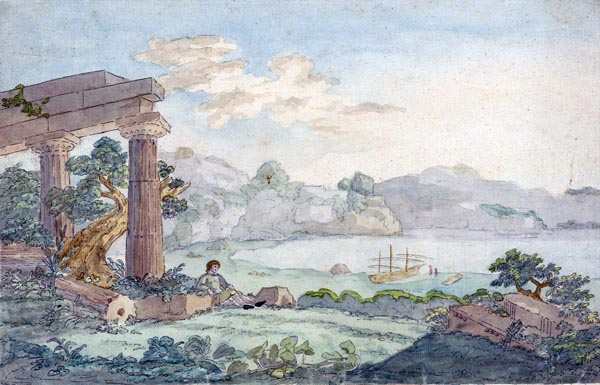
‘Temple ruins overlooking a bay’ - Johann Wolfgang von Goethe (German, 1749–1832)
Klassik Stiftung Weimar, Museen (Inv. GGz/1327)
Digital reproduction · See Art. L. 111-1 CPI and § 68 UrhG
We glanced, superficially, at various unassuming ancient remains, then, with greater attention, at the present method of storing wheat underground, in large, brick-lined vaults. The good old man told me quite a bit about the state of the town and the church. I heard of nothing that was even remotely progressive. The conversation was quite fitting standing as we were amidst ruins subject to the relentless forces of decay.
The layers of shell-bearing limestone all slope towards the sea. Wondrously eroded, below and behind, the rock faces are partially preserved, their upper and front portions resembling drooping fringes.
Hatred, it appears, is directed towards the French for making peace with the people of the Barbary coast; they are accused of thereby betraying the Christians to the infidels.
An ancient gate was hewn into the rocks on the seaward side. The extant walls were built, in stages, on the rocks themselves. Our guide here was Don Michael Vella, an antiquarian, who lodges with Master Gerio near Santa Maria.
To plant broad beans, they proceed as follows: They make holes in the ground at a suitable distance from each other, place a handful of manure in each hole, wait for rain, and then plant the beans. They burn the bean-straw, and use the resulting ash to wash linen. No soap is employed. They also burn the outer shells of almonds and use them instead of soda. First, they wash the laundry with water, and then with this lye solution.
The crops they cultivate in rotation are beans, wheat, and tumminia (an ancient variety of durum wheat), primarily cultivated in Sicily; in the fourth year, they leave the ground to lie fallow. Here, ‘beans’ refers to broad beans. Their wheat is exceptionally beautiful. Tumminia, whose name is said to derive from ‘bimenia’ or ‘trimenia,’ is a magnificent gift from Ceres (the Roman goddess of agriculture): it is a type of summer crop that ripens in three months. They sow it from the first of January until June, when it ripens, reliably, at the appointed time. It needs little rain, but does require heat; initially, its leaves are very delicate, but it grows alongside the wheat, and eventually becomes quite robust. The wheat they sow in October and November, to ripen in June. Barley sown in November is ripe by the first of June, earlier on the coast, later in the mountains.
The flax is already ripe. The acanthus has unfolded its magnificent leaves. Salsola soda (agretti, saltwort) grows lushly.
Sainfoin grows abundantly on uncultivated hills. Some of it is cultivated on leased land, and brought to the city in bundles. They also sell oats, which they sow amidst the wheat fields, in bundles.
They make neat furrows with rims in the soil where they desire to plant cabbage, for the purpose of irrigation.
The fig-trees had lost all their leaves, and the fruit had begun to set. They will ripen around St. John’s Day (June 24th), and then the tree will produce another crop. The almond-trees were laden with fruit; a pruned carob-tree bore a vast supply of pods. Grapes for eating are trained on arbours, supported by tall pillars. Melons are planted in March and ripen in June. They thrive in the ruins of the Temple of Olympian Zeus without a trace of moisture.
The vetturino ate raw artichokes and kohlrabi (turnip cabbage) with great relish; admittedly, much juicier and tenderer than ours. The farmers let people eat as many young broad beans as they like, when crossing fields, for instance.
When I remarked on various solid, black stones that resembled pieces of lava, the antiquarian told me they were from Mount Etna, and that there were similar ones at the harbour, or rather the landing place.
There are not many birds in this country: quails are the most common. Nightingales, larks, and swallows are migratory visitors. Rinnine, small black birds that come from the Levant, breed in Sicily and then continue their journey or return (probably swifts). Ridene, which come from Africa in December and January, land on Mount Akragas, and then migrate to the mountains (probably raptors).
A word more about the cathedral calyx-krater (attributed to the ‘Berlin Painter’ or his circle, and now in the Pietro Griffo Regional Archaeological Museum in Agrigento, which probably depicts a scene from the Trojan War). On it stands a hero in full armour, as if arriving before a seated old man, identified as a king by his wreath and sceptre. Behind him stands a woman, her head bowed, her left hand under her chin; her posture attentive and thoughtful. Opposite, behind the hero, is another old man, also wreathed, speaking to a pike-bearer, who may be a member of the royal guard. The old man seems to have introduced the hero, and to be saying, to the guard: ‘Let him address the king; he is a good man.’
The red appears to be the base colour of the krater, with the black overlaid. Only on the woman’s garment does the red seem to overlay the black.
Agrigento, Friday, April 27, 1787.
If Kniep is to carry out all his plans, he must draw and sketch incessantly, while I wander about with the little old guide. We therefore took a stroll towards the sea, from which Agrigento, as the ancients assure us, appeared well-sited. My gaze was drawn to the height of the waves, and my guide drew my attention to a long bank of cloud that, seemed like a mountain ridge, on the horizon to the south: this, he said, indicated the African coast. I myself noted another interesting phenomenon; it was a narrow rainbow, formed amidst light clouds, and arched high against the blue, otherwise perfectly clear, sky; one foot rested on Sicily, the other end seeming to rest on the sea to the south. Beautifully coloured, created by light from the setting sun, it was a sight to the eye as strange as it was pleasing. I was assured that this motionless arc of light was pointing directly towards Malta, and its other foot may well have rested above that island; such a phenomenon frequently occurs it seems. It would be most peculiar if the force of attraction between the two islands were to manifest itself in the atmosphere in this way.
This conversation rekindled the question of whether I was correct to abandon my intention of visiting Malta. However, the difficulties and dangers of the trip, which I had previously considered, remained the same, and we resolved instead to hire our vetturino to drive us as far as Messina.
But here, too, a certain stubbornness of mine, and proneness to whims, came into play. I had seen few grain-rich areas so far on my journey in Sicily, and the horizon was everywhere limited by mountains near and distant, so that the island seemed to lack any true cultivation at all, and I failed to understand how Ceres could have favoured this land so exceptionally. When I inquired about the matter, I was told that to gain an understanding, instead of travelling on via Syracuse, I should cross the island, where I would then encounter plenty of wheat-fields. I succumbed to the temptation to abandon Syracuse, knowing full well that little more than its magnificent name remained of that once glorious city. At any rate, it was easily accessible from Catania.
Caltanissetta
Saturday, April 28, 1787
Today, I can say that I have finally gained a clear and vivid understanding of how Sicily earned the honorary title of Italy’s bread-basket. A short distance after leaving Agrigento, an intensely cultivated region began. It is not a vast expanse, but a series of gently undulating ridges of mountains and hills, planted throughout with wheat and barley, offering an uninterruptedly-fertile landscape. The soil, well-suited to the crops, is so carefully tended and maintained that one sees not a single tree; indeed, even the little villages and dwellings are situated on the crests of the hills, where the continuous line of limestone cliffs renders the soil unusable. The women live there year-round, occupied with spinning and weaving, while the men, during the season of fieldwork, only join them on Saturdays and Sundays, spending the rest of the days at a lower level, and sleeping in thatched huts at night. Thus, my desire to comprehend was fulfilled to the point of utter weariness; I would have employed Triptolemus’ winged chariot, gladly, to escape the monotonous view.
We drove through the desolate, yet fertile, landscape in hot sunshine, and were pleased to arrive, at last, at the well-sited, and well-built town of Caltanissetta, where, however, we once again searched in vain for decent lodgings. The mules occupy magnificent vaulted stables, the farmhands sleep on the clover intended for the animals, but the stranger has to establish his household anew. Any room available must first be cleaned. There are no chairs or benches; one sits on low but sturdy, wooden trestles, while tables are nowhere to be found.
If you wish to turn the trestles into bed-supports, you go to the carpenter and borrow as many boards as needed for a certain rental fee. The large leather bag Hackert lent us came in handy at this time, and was temporarily filled with straw.
Above all, arrangements had to be made regarding food. We had bought a hen on the way, and the vetturino had procured rice, salt, and spices, but since he has not been here before, it took a long while before we could find somewhere to do the cooking, as there was no opportunity for this in the inn itself. Finally, an elderly citizen deigned to lend us a stove, and kitchen and table utensils, and sell us some wood, for a small fee. While our dinner cooked, he showed us around the town, ending at the market, where the most respected inhabitants sat about in the ancient manner, conversing and hoping to be entertained by us.
I had to relate the history of Frederick the Second, and their interest in this great king was so lively that I concealed the news of his death, lest we become hated by delivering the sad tidings to our hosts.
Caltanissetta, Saturday, April 28, 1787.
Various geological observations, penned in retrospect. From Agrigento, descending the limestone cliffs, a whitish soil is revealed, the explanation of which became clear later: one finds the more ancient limestone again, with gypsum immediately adjacent. The valleys are wide and flat, with arable farming extending to the summits, and often across them; the older limestone mixed with weathered gypsum. Now looser, yellowish, weathered, and less ancient limestone appears: in the ploughed fields, its colour is clearly visible, often tending towards a darker, even violet, hue. A little over halfway down, the gypsum reappears. On it, a beautiful violet, almost rose-red sedum frequently grows, and on the limestone cliffs, an attractive yellow moss.
The weathered limestone appears more frequently, and most strongly, towards Caltanissetta, where it lies in deposits containing individual shells; then it appears reddish, almost like red-lead, with a little violet, as noted above at San Martino.
The only quartz boulders I found, were about halfway along a small valley which, closed on three sides, was open towards the east, and thus the sea.
To the left in the distance, the tall mountain ridge near Cammarata was salient, while a second mountain looked like a truncated cone. For a good half of the journey, not a single tree was visible. The crops were splendid, though not as tall as at Agrigento, or by the shore, but as unmarred as could be; in the endless wheat fields, there was scarcely a weed. At first, we saw nothing but green fields, then ploughed ones, and in damp places, patches of meadow. Poplars also grow here. Just beyond Agrigento, we found apple and pear trees, and, occasionally, some fig-trees, on the heights and near the few villages.
For thirty miles, along with everything I could discern to the right and left, the stone consisted of older and newer limestone, with gypsum in between. The soil owes its fertility to the weathering, and mixing, of these three. It must contain a little sand; it grinds under the teeth. My conjecture concerning the ‘Achates’ River (the Dirillo) will be confirmed or not tomorrow.
The valleys have a beautiful shape, and though their floors are not entirely level, one sees few traces of heavy rainfall; only small, barely perceptible streams, trickling along, all flowing directly seawards. Red clover is scarce, and the dwarf palm is less apparent, as are all the flowers and shrubs of the southwestern side of the isle. Thistles are only allowed to command the tracks; everything else belongs to Ceres. Incidentally, the area bears a strong resemblance to the hilly and fertile regions of Germany, for example, the area between Erfurt and Gotha, especially when one looks towards Gleichen. Many things came together to make Sicily one of the most fertile countries in the world.
Horses have rarely been encountered on the entire tour; the farmers plough with oxen, and there is a prohibition against slaughtering cows and calves. We encountered many goats, donkeys, and mules. The few horses are mostly dapple greys with black lower legs, manes, and tails, and one finds the most magnificent stables with brick-paved and vaulted stalls. The land is fertilised with beans and lentils; the other crops are sown after the summer harvest. Bunches of sprouting, as yet still green, barley, and red clover, are offered for sale to passers-by.
On the hill above Caltanissetta, we encountered solid limestone containing fossils: the larger ones lowermost, the smaller on top. In the town’s pavement, we found the limestone embedded with pectinites (fossilised scallop shells).
The same date, April 28, 1787.
Beyond Caltanissetta, the hills drop steeply to numerous valleys, which drain their waters into the River Salso (the Imera Meridionale). The soil is reddish, and loamy; much of it lies fallow, while the cultivated areas yield fairly good harvests, though still lagging behind those of the earlier regions.
Castrogiovanni (Enna)
Sunday, April 29, 1787.
Today we observed even greater fertility, and a greater scarcity of people. Rainy weather had set in, making travel most unpleasant, since we had to cross several swollen bodies of water. At the Fiume Salso, where one searches in vain for a bridge, we were surprised at the curious arrangement for fording the stream. A team of powerful fellows stood at the ready; they grasped the mule, rider, baggage and all, two on each side, and thus lead it through the deep section of the river to a large bank of gravel at the centre of the flow. Once the entire party had gathered there, they proceeded to cross the second branch of the river in the same manner, the men keeping the animal on course amidst the current, through pushing and straining. There were bushes along the water, but these disappeared immediately inland. The Fiume Salso contains granite, a transition to gneiss; breccia; and monochromatic marble.
We now saw before us the solitary ridge on which Castrogiovanni (called Enna, since 1926) is sited, lending the area a strange and sombre character. As we rode up the long path that wound its way up the slope, we found the mountain composed of shell-bearing limestone; large, calcined shells were piled in heaps. Castrogiovanni is not visible until one reaches the very top of the ridge, since it lies on a rocky slope facing north. The curious little town itself, with its tower (Torre di Federico II), and, some distance to the north, the village of Calascibetta stand starkly opposite one another. In the plain between, the beans were in full bloom, but who could take pleasure in such a sight! The roads were dreadful, even more so in that they had once been paved, and it rained incessantly. Ancient Enna gave us a very unfriendly welcome: an attic room with shutters and no windows, so that we either had to sit in the dark, or endure the drizzle we had just escaped. We consumed some of the remaining provisions for our journey, and spent a miserable night. We made a solemn vow never again to choose our destination based on a mythological name.
Monday, April 30, 1787.
From Castrogiovanni, a rough, and unpleasant track descended; we were obliged to lead the horses. The sky before us was shrouded in low cloud, revealing a wondrous phenomenon in the zenith. It was striped white and grey and appeared to be something corporeal; but how could something corporeal reach the heights! Our guide explained that our astonishment was due to it being a side-view of Mount Etna visible through the broken cloud: alternating stripes of snowfields and mountain ridges formed the pattern, and what we could see was not even the highest peak.
The steep cliffs of ancient Enna lay behind us now, and we travelled through long, empty valleys; uncultivated and uninhabited they were left to the grazing cattle, which were not very large, with short horns, and were quite charming, slender, lively as fawns, and coloured a fine shade of brown, These excellent creatures had enough pasture, certainly, but it was nonetheless interspersed and overarched by enormous masses of thistles. They had found there the perfect opportunity to reproduce, and spread their numbers wide; they occupied a vast area, enough to graze the herds from several large estates. Since thistles are not perennials, they would be quite easy to eradicate if mowed down, now, before they flower.
While we were seriously considering these plans for an agricultural war against the thistles, we had to note, to our shame, that the plants were not entirely useless after all. At a solitary inn, a couple of Sicilian noblemen arrived, as we were feeding our animals. They were travelling across country to Palermo to attend a legal case. We watched in astonishment as these two grave individuals stood before a clump of thistles and, wielding sharp pocketknives, cut off the tops of those upright plants. They then grasped their prickly prizes with their fingertips, peeled the stems, and ate the pith with relish. They occupied themselves in this manner for a long time, while we refreshed ourselves with wine, this time unmixed, and excellent bread. The vetturino prepared some thistle pith for us, and assured us it was a healthy, cooling food, but we disliked it as much as we disliked the raw kohlrabi at Segesta.
San Paolo Valley, then via the coast, to Catania
April 30th.
Upon reaching the valley through which the San Paolo River meanders, we found the soil to be composed of reddish-black, weathered limestone. The valley itself was beautiful, the atmosphere pleasant thanks to the river; there was much fallow land, and wide fields. The well-mixed, loamy soil layer is sometimes twenty feet deep, and mostly uniform throughout. The aloes had sprouted vigorously. The crops looked well, though sometimes marred, and, on the south side, as yet undeveloped. Here and there, were small dwellings; but no trees except immediately below Castrogiovanni. Along the riverbanks, there was plentiful pasture, constrained only by the enormous masses of thistles. In the riverbed, quartz rock appeared once more, partly simple, partly breccia-like.
Molimenti is a new village, cleverly laid out amidst beautiful fields, on the banks of the river. The wheat nearby was incomparably ripe, and will be ready for harvest as early as the twentieth of May. The entire area shows no trace of volcanic activity; the river itself is free of glacial deposits. The soil, well-mixed, rather heavy than light, is generally a coffee-brown to violet colour. All the mountains to the east, enclosing the river, are of limestone and sandstone, the alternation of which I could not observe, but which, through weathering, have created the deep, consistently fertile soil of the lower valley.
Tuesday, May 1st, 1787.
We rode down through an unevenly cultivated valley, though one destined by Nature to fertile soil throughout, gripped by a certain degree of weary irritation, in that after the hardship we had endured, nothing at all suited our wish for the picturesque. Kniep had sketched a rather substantial background, but because the centre and foreground were quite dreadful, he added, in whimsical mood, a version of the latter, á la Poussin, which required no creative effort, and turned the sheet into a rather pretty little picture. How many picturesque travel illustrations contain such half-truths?
To dispel our irritable mood, our courier promised us excellent lodgings for the night. He did indeed lead us to an inn built only a few years ago, which, being situated at a reasonable distance from Catania, was obliged to provide a decent welcome for travellers. There, we settled into a tolerably decent room and, after twelve days hard travel, felt reasonably comfortable once again. However, we found an intriguing inscription on the wall, written in pencil in elegant English script, which read: ‘Traveller, whoever you are, beware the Golden Lion in Catania; tis worse than falling into the clutches of the Cyclopes, Sirens, and Scylla together.’ Although we suspected the well-meaning warning might be exaggerating the danger with its mythological threat, we nevertheless firmly resolved to avoid the Golden Lion, described, thus, as a fierce creature indeed. So, when the muleteer asked us where we intended to stay in Catania, we replied: ‘Anywhere but the Golden Lion!’ He then suggested we stay at the inn where he stabled his mules, provided we ate there also, as we had done before. We were all happy: escaping the lion’s jaws was our only wish.
Near Ibla Major, lava boulders appear, carried down from the north by the water. Above the ferry-landing, one finds limestone, embedded in which are various types of boulders, made of chert, lava, and the limestone itself, and then hardened volcanic ash covered with tufa. The mixed gravel hills continue all the way to Catania; lava flows from Mount Etna can be found at, and above there. A probable crater appeared to the east. (Just below Molimenti, farmers were pulling flax.) How Nature loves colour is evident here, where the valley delights in blackish blue-grey lava; bright yellow moss covers it, a beautiful red sedum grows lushly, and other lovely violet flowers. Careful cultivation is evident in the plantings of cacti and grapevines. Now immense lava flows hemmed us in. Motta is a beautiful, and striking, rock formation. Here, the beans grow as high as very tall shrubs. The soil is variable, sometimes very gravelly, sometimes a finer mix.
The vetturino, who apparently had not seen the Spring vegetation of the southeast coast for a long time, burst into loud exclamations regarding the beauty of the crops and asked us, with an air of smug patriotism, whether there were any such crops in our country. Everything here has been sacrificed to them; one sees few, if any trees. A lovely girl with a fine, slender figure, an older acquaintance of the vetturino, walked along beside his mule, chattering away while spinning thread as gracefully as possible. Now yellow flowers began to reign supreme. Towards Misterbianco, the cacti were growing in the hedges once more; these hedges, moreover, composed entirely of these wondrously- shaped plants, become ever more frequent, and more beautiful as we neared Catania.
Catania
Wednesday, May 2, 1787.
Our lodgings were truly wretched. The food, the way the muleteer was able to prepare it, was far from the best. Chicken with boiled rice would not have been too bad, had the rice not been so yellow with excess saffron that it was inedible. The most uncomfortable of beds had almost forced us to bring out Hackert’s leather sack again, so we spoke early the next morning to the friendly innkeeper. He regretted that he could not provide anything better: ‘But, over there, is a house where strangers are well looked after, and find every reason to be content.’ He pointed to a large corner-house, the side facing us promising much. We hastened there at once, and found an energetic fellow who introduced himself as the innkeeper’s servant, in whose absence, he showed us to a pleasant room next to a hallway, assuring us that we would be served at the lowest possible price. We promptly inquired, as was customary, what the charge was for lodgings, table-service, wine, breakfast, and other foreseeable costs. Everything was inexpensive, and we hastily brought over our belongings and arranged them in the spacious, gilded chests of drawers available. Kniep had his first opportunity to spread out his portfolio. He arranged his drawings, and I, my notes. Then, delighted by the excellent rooms, we stepped out onto the balcony of the hall to enjoy the view. After we had contemplated and praised it sufficiently, we turned to recommence our tasks, and lo and behold! There, high above our heads, was a large golden lion. We looked at each other thoughtfully, smiled, and then laughed. From then on, however, we kept a lookout, wondering if one of Homer’s terrifying mythological figures might be lurking somewhere.
Nothing of the sort was to be seen; however, we found a pretty young woman in the hall, playing with a child of about two years old, though she was immediately reprimanded, and harshly, by the roving deputy innkeeper: she should leave, he said, she had no business being there. — ‘It is hard that you’re chasing me away,’ she said, ‘the child can’t be quietened when you’re gone, and I’m sure the gentlemen will allow me to soothe the little one in your presence.’ The husband refused to let it pass, and tried to get rid of her; the child cried, pitifully, in the doorway, and we finally had to demand, earnestly, that the pretty young lady stay.
Having been warned by the Englishman’s note, it was easy to see through the charade; we played the newcomers, the innocents, while the deputy played the loving father to the best of his ability. The child was actually at its quietest with him; the supposed mother had probably given it a pinch behind the door.
And so, looking completely innocent, when the man left to deliver our letter of recommendation to the domestic chaplain of Prince Biscari (Vincenzo Paternò-Castello Morso, VI Prince of Biscari), she lingered until he returned. He indicated that the abbé himself would appear to discuss the details.
Catania, Thursday, May 3, 1787
The Abbé, who greeted us last night, re-appeared early this morning, and led us to the palace, which is built on a high, single-story base. We viewed the museum, first, where marble and bronze statues, vases, and every kind of antiquity are housed together. Here was another opportunity to expand my knowledge, and I was particularly captivated by a torso of Jupiter (now in the Museo Civico Castello Ursino, in Catania), a cast of which I already knew from Tischbein’s workshop, and which possessed greater merit than I was capable of judging. A member of the household provided the necessary historical information, and then we entered a large, high-ceilinged hall. The many chairs along the walls indicated that large gatherings sometimes took place there. We sat down, anticipating a favourable reception. A pair of women entered, and paced the length of the hall. They were talking animatedly to each other. When they noticed us, the Abbé stood up, and I did the same; we bowed. I asked who they were and learned that the younger woman was the princess (Francesca Paternò Castello, V Baronessa della Sigona), the older a noblewoman from Catania. We seated ourselves again, while they paced back and forth as if in the marketplace.
We were introduced to the prince, who, as I had already been told, would show us his coin collection as a particular favour indicating his trust in us, since apparently his father (Ignazio Paternò-Castello, V Prince of Biscari, archaeologist and patron of the arts), and he himself, had lost many items during such showings, somewhat diminishing his usual willingness to share them. As regards these objects, I was now able to appear somewhat more knowledgeable, having learned a great deal from examining the collection of Prince Torremuzza (Gabriele Lancillotto Castello, Prince of Torremuzza and Marquis of Motta d’Affermo, antiquarian, and numismatist). I was acquiring further knowledge and, guided by that enduring thread with which Winckelmann leads me through the various labyrinthine epochs of art, was able to proceed quite well. The prince, fully informed about these matters, seeing before him not experts but attentive enthusiasts, was happy to instruct us as regards everything we inquired about.
After devoting some time, but still too little, to these matters, we were about to take our leave, when he led us to meet his mother (Anna Maria Morso), and to show us various other smaller works of art.
We were introduced to a handsome, innately noble woman who greeted us with the words: ‘Look around me, gentlemen, you will find everything here just as my late husband collected and arranged it. This I owe to the piety of my son, who not only allows me to live in his best rooms, but also does not permit me to move or remove the least thing that his late father acquired and displayed; thus I have the twofold advantage of both being able to live in the way I have been accustomed to for so many years, and also being able to see and get to know, as always, the distinguished visitors who come from far and wide to admire our treasures.’
She then unlocked the glass cabinet, herself, in which pieces of amber were kept. Sicilian amber differs from northern amber in that it ranges from the transparent and opaque wax and honey colours through all shades of saturated yellow to the most beautiful hyacinthine red. There were carved urns, cups, and other objects sometimes composed of large, admirable pieces of the material. The lady took particular delight in these objects, as well as in carved shells like those cut in Trapani, and also select ivory carvings, and she had many an intriguing story to tell about them. The prince drew our attention to the more serious objects, and so several hours passed pleasantly and informatively.
Meanwhile, the Princess, learning that we were German, inquired about Von Riedesel (Johann Herman von Riedesel, see his ‘Travels through Sicily’, 1773, mentioned earlier), Bartels (Johann Heinrich Bartels, see his ‘Letters Regarding Calabria and Sicily’, 1787), and Münter (Friedrich Münter, scholar and theologian, see his informative books on Sicily, published 1790), all of whom she knew and, having discerned their various characters and conduct, was able to appreciate severally. We were reluctant to part from her, and she seemed reluctant to let us go. The isolated life always conveys a certain loneliness, refreshed and sustained as it is only by transient company.
The priest then led us to the Benedictine monastery, to the cell of a brother whose melancholy and withdrawn appearance, despite his moderate age, hardly promised joyful company. He was, however, a skilled individual who alone knew how to tame the church’s immense organ. Surmising rather than waiting to hear, our wishes, he fulfilled them silently; we entered the spacious church, whereupon, tackling that magnificent instrument, he filled the vault to its furthest corners with the softest of whispers as well as the most powerful of sounds.
Anyone who had not seen him before would have thought he was a giant wielding such force; but since we were already aware of his character, we simply marvelled that he had not been destroyed, already, in the contest.
Catania, Friday, May 4, 1787.
Shortly after dinner, the Abbé arrived in a carriage, as he was to show us the more distant parts of the city. As we were settling therein, a curious dispute over rank arose. I had mounted first, and was about to seat myself to his left, when he, as he mounted in turn, expressly demanded that I shift around, and have him on my left. I begged him to refrain from such formalities. ‘Forgive me,’ he said, ‘for seating us thus, but if I take my place to your right, everyone will think that I am riding with you; but if I sit to your left, it is implied that you are riding with me — that is, the person who is showing you the city in the name of the prince.’ I had, of course, no objection to this, and so it was done.
We drove along streets where the lava, which destroyed a large part of this city in 1669, remains visible to this day. The solid, fiery flow was utilised like any other rock formation; roads had even been marked out thereon, and partially built. I chipped off an indisputable piece of the molten rock, mindful that before my departure from Germany, the debate about the volcanic nature of basalt had already begun. And I did the same in several places, in order to take samples of the variations in form.
If, however, the locals were not themselves the friends of their region, if they had not themselves striven, either for scientific purposes or for personal gain, to gather information on what was remarkable in their territory, we foreigners would have had to spend a fair amount of time in doing so. Already in Naples, the trader in lava specimens had greatly assisted me; here, to a far greater degree, Count Giuseppe Gioeni (Chair of Natural History at the University of Catania) did so. In his rich, most elegantly-arranged collection, I found specimens from Mount Etna, from the basalts at its foot, more or less recognisable as metamorphosed rocks; everything was shown to me in a most generous manner. Most of all, I admired the zeolites from the rugged, sea-bound cliffs below Acireale.
When we asked the count about the ways and means of climbing Mount Etna, he refused to countenance anything as risky as our attempting to reach the summit, especially at the present time of year. ‘In general,’ he said, apologetically, ‘foreigners arriving here take things far too lightly; we who are neighbours of the mountain are content to seize the perfect opportunity once or twice in our lives to attain the summit. Patrick Brydone, who first kindled the desire to climb the fiery peak, with his descriptions of the volcano (see ‘A Tour through Sicily and Malta’, 1773), never made the ascent; Michal Jan Borch (see his ‘Lettres sur la Sicile et sur L’île de Malthe’, 1785) leaves the reader in suspense, as he too only reached a certain altitude, and I could say the same for several others. At the moment, the snow still extends quite far down the slopes, and presents an insurmountable obstacle. If you seek my advice, ride tomorrow, weather permitting, to the foot of Monte Rosso (named for the red coloration of the soil, the volcanic cone was formed during Etna’s eruptions of 1329) and climb to its summit; from there you will enjoy the most magnificent of views, and at the same time be able to observe the lava from the eruption of 1669, which unfortunately flowed towards the city. The view is clear and splendid; it is best if I leave others to tell you more.’
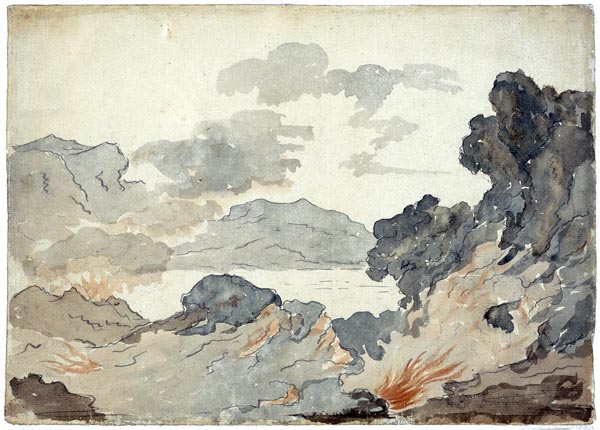
‘View from Mount Etna towards the Bay of Taormina’ - Johann Wolfgang von Goethe (German, 1749–1832)
Klassik Stiftung Weimar, Museen (Inv. GGz/0574)
Digital reproduction · See Art. L. 111-1 CPI and § 68 UrhG
Monte Rosso
Saturday, May 5, 1787.
Following good advice, we set off early on our mules, and, forever gazing behind us, reached the region of the lava flows, still uneroded by time. Jagged lumps and slabs stared back at us, through which the animals forged a path haphazardly. We halted at the first significant rise. Kniep sketched what lay ahead, with great precision: the masses of lava in the foreground, the twin peaks of Monte Rosso to the left, and directly above us the forests of Nicolosi, from which the snow-covered, barely smoking summit emerged. We drew nearer to the red mountain, and I climbed the slope: it is entirely composed of red volcanic scree, ash, and stones. It would have been easy to circumnavigate the mouth of the lava flow had a violently-stormy, morning wind not made every step uncertain. In order to make any progress at all, I had to remove my coat, but now my hat was in danger of being blown into the crater at any moment, and I along with it. So, I sat down to compose myself, and survey the area; but even this position was of no use: the gale was blowing directly from the east over the magnificent landscape that stretched below me, near and far, all the way to the sea. Before my eyes lay the whole shore from Messina to Syracuse, with its curves and bays, either completely exposed or only partially covered by rocks. When I descended, quite dazed, I saw that Kniep had used his time well, and sheltered from the wind, had captured, in delicate lines on paper, what the raging storm had barely allowed me to see, much less record.
Having returned to the jaws of the Golden Lion, we sought out the servant whom we had, with some difficulty, persuaded to stay with us. He praised us for abandoning the summit, but earnestly suggested a sea voyage to the cliffs of Aci for the next day: it was, he said, the most delightful excursion one could undertake from Catania! We should take food and drink, and perhaps even some cooking utensils. His wife offered to accompany us if needed. Furthermore, he recalled the jubilation of some English travellers, who had apparently even hired a boat with musicians for accompaniment — a delight beyond all imagination.
The cliffs of Aci exerted a powerful pull on me; I had a great desire to extract some fine examples of zeolites for myself after seeing the like at Count Gioeni’s. I was tempted to decide in favour, merely declining the offer of his wife accompanying us. But the cautionary spirit of that Englishman’s note, which I mentioned previously, prevailed; we renounced the zeolites and felt quite proud of ourselves for our abstinence.
Catania, Sunday, May 6, 1787
Our clerical companion arrived promptly. He led us on a visit to various remnants of ancient architecture, which require a considerable talent for imaginative recreation on the visitor’s part. We were shown the remains of water reservoirs, which had hosted naumachias (mock naval battles), and other such ruins, which, however, were so thoroughly buried and submerged during the city’s repeated destruction through lava flows, earthquakes, and war that only the most knowledgeable expert on ancient architecture could derive any enjoyment or insight from them.
The priest declined to pay his respects to the prince again, and we parted with both sides expressing heartfelt gratitude and goodwill.
Taormina
Monday, May 7, 1787
Thank heavens, everything we saw today has already been sufficiently described, more so in that Kniep has resolved to spend the entire day tomorrow sketching, from above. Having climbed to the summit of the cliffs that rise steeply near the seashore, one finds two rocks connected by a semicircle. Whatever natural form the area may have had, art has intervened and transformed it into an amphitheatre-like semicircle, in which to accommodate spectators; adjoining walls and other brick structures once providing the necessary passageways and halls. At the foot of the stepped semicircle, the stage was built transversely, connecting the two rocks and completing this most tremendous natural and artistic spectacle.
If one now sits where the uppermost spectators once sat, one must admit that no theatre audience has ever had such objects before them. To the right, castles rise on higher rocks; further down lies the city, and although these structures are more recent, similar ones likely stood on the same spot in ancient times. Now one can see the entire long ridge of Mount Etna, and to the south the coast as far as Catania, even Syracuse; the immense, steaming volcano closes the wide, broad panorama, but not terrifyingly, as the softening effect of the atmosphere makes it appear more distant and gentler in nature than it actually is.
Turning from this view to the passage at the rear of the viewing platform, one sees all the rock faces to the north-east, the road to Messina winding its way between them and the sea. Rock formations and ridges dot the sea itself, and the coast of Calabria stretches into the far distance, distinguishable only by gentle rising clouds.
We descended towards the theatre, lingered among its ruins, among which a skilled architect should at least attempt to demonstrate his skill at imaginative restoration on paper, and then tried to forge a path through the gardens towards the city. But here we learned what an impenetrable bulwark a fence of agave plants, planted side by side, truly is: one can see through the interlocking leaves and even believe one can penetrate them, but the strong spines along the leaf-edges are tricky obstacles; if one steps onto such a colossal leaf, hoping it will support one, it collapses, and instead of reaching open ground, one falls into the arms of a neighbouring plant. Finally, we managed to navigate this labyrinth, and found little to enjoy in the town, but were unable to leave before sunset. It was infinitely beautiful to watch how this land and seascape, fascinating in every respect, gradually sank into darkness.
Below Taormina, by the sea, Tuesday, May 8, 1787.
Kniep, whom I was fortunate enough as to encounter on my travels, I cannot praise highly enough, for he has relieved me of a burden that would have proved unbearable, and restored to me my own true nature. He departed so as to draw, in detail, what we saw yesterday. He will have to sharpen his pencils a few times, and I know not when he will finish, but his sketches will provide the means to view it all again! At first, I wished to go with him, but then was tempted to stay here; I sought privacy like a bird that wants to build its nest. In a poor, neglected cottage garden, I seated myself on orange-tree branches, and absorbed myself in reverie. Orange-tree branches, as seats, sounds rather strange, but becomes quite natural when one knows that the tree, left to its own devices, soon divides above the root into branches that, in time, become distinct limbs.
And so, I sat, and further developed the plot of my ‘Nausicaa,’ a dramatic condensation of the Odyssey. I regard it as an achievable project, but one has to consider, in depth, the fundamental difference between drama and the epic.
Kniep descended, and has brought back two enormous sheets of paper, containing meticulous sketches, and is satisfied and cheerful. He will colour both of them for me, as an eternal memento of this glorious day.
Then we shall not forget that we once gazed down upon this beautiful shore, under the clearest sky, from a small balcony, and saw roses, and heard nightingales. The latter, we were assured, sing here for six months of the year.
The Idea of Writing a ‘Nausicaa’ – Later Note
Having been assured, through the presence and activity of a skilled artist and through my own, albeit limited and lesser, efforts, that I would be left with firm, well-chosen images of the most interesting regions and their parts, sketched out and, if I wished, executed in detail, I all the more readily yielded to the gradually awakening urge: to enliven the magnificent surroundings — the sea, the islands, the harbours —with poetically worthy figures and create a composition for myself, set here, and in a manner, and with a tone, such as I have not yet produced. The clarity of the sky, the breeze off the sea, the mists that merge mountain slopes, sky, and sea to create a single element — all this nourished my intent. And as I wandered the beautiful public gardens among flowering hedges of oleander, through arbours of fruit-bearing orange and lemon trees, and lingered among other trees and shrubs unknown to me, I felt their foreign influence in the most pleasant way.
Having convinced myself that there could be no better ‘commentary’ on the Odyssey than the precise and vivid environment here, I had obtained a copy, and had read it, in my own manner, with incredible interest. But I was soon inspired to create something of my own, which, however strange an idea it may have seemed at first, grew ever dearer to me, and finally occupied my mind completely. I adopted the idea of treating the subject of Nausicaa as a tragedy.
I could not foresee myself what might come of it, but soon settled on a plan of work. The main idea was this: to portray Nausicaa as a fair maiden, courted by many, who, lacking any inclination, had thus far rejected all suitors, but, attracted by a stranger, emerged from her passive state, and compromised herself through a rash expression of affection, which rendered the situation utterly tragic. This simple story was to be made enjoyable by a richness of subordinate motifs, and especially by the setting of sea and island as a component of the actual execution and an influence on the individual tone of the piece.
The first act began with the ball game. The unanticipated meeting occurs, and her hesitancy regarding her leading the stranger to the city personally, already foreshadows a budding attraction.
The second act revealed the house of Alcinous, the characters of the suitors, and ended with the entrance of Ulysses.
The third was entirely devoted to the significance of that adventurer, and I hoped to achieve something artful and enjoyable in the monologue narrating his adventures, which would be received quite differently by the various listeners. During the narration, Nausicaa’s passion intensifies, and her lively interest in the stranger is finally brought to light through action and reaction.
In the fourth act, Ulysses displays his bravery offstage, while the women remain behind, giving free rein to their desires, hopes, and tender feelings. Given the great advantage the stranger now enjoys, Nausicaa becomes even less composed and compromises herself irrevocably among her compatriots. Ulysses, who, part-guilty, part-innocent, instigates all this, is ultimately forced to announce his departure, leaving the poor girl no choice but to seek death in the fifth act.
There was nothing in this composition that I could not paint from Nature based on my own experiences. Even though travelling, and on the journey finding myself at risk of arousing feelings that, while not ending tragically, could nevertheless be painful, dangerous, and harmful enough; even though in depicting distant objects, adventures and the events of my life for the entertainment of society, at this great distance from home, I might be considered a demigod by the young, and a braggart by more established people; even experiencing both undeserved favours and unexpected obstacles as a result — I still felt such an attachment to the plan, and my intent, that I spent my time in Palermo, indeed most of our Sicilian journey so far, daydreaming about it. Which is why I felt little discomfort in tackling the subject, since I felt myself on classical ground, and in a poetic mood, in which I could grasp everything I experienced, viewed, noticed, and encountered, and preserve it all in a delightful form.
Following my commendable, or perhaps uncommendable, habit, I wrote little or nothing down, but worked through most of it in my mind to the last detail, where it was then pushed to the background by subsequent distractions, and neglected, until I now recall only a fleeting memory of it.
May 8th. On the way to Messina.
To the left are high limestone cliffs. They become more colourful, forming beautiful bays; then comes a type of rock that one might call clay-slate or greywacke. Granite boulders can already be found in the streams. The yellow apples of the solanum and the red blossoms of the oleander add cheer to the landscape. The Nisi River (Fiumedinisi) carries mica schist, as do the streams thereafter.
Wednesday, May 9, 1787.
Assailed by an easterly wind, we rode along between the surging sea on our right, and the cliffs from which we had looked down the day before yesterday, constantly encountering flows of water. We crossed countless streams, among which a larger one, the Nisi, bears the honorary title of a river. But these waters, as well as the gravel they carry, were easier to cross than the pools of seawater, the waves rising fiercely, and in many places breaking over the path, topping the cliffs, and splashing back onto the track. It was a magnificent sight and the experience, though strange, justified our suffering the discomfort.
At the same time, our mineralogical observations were not neglected. The enormous limestone cliffs collapse on weathering, their softer sections worn away by the motion of the waves, leaving behind the admixture of harder rock, and thus the entire beach is covered with colourful, chert-like flint, several samples of which I collected.
Messina
Thursday, May 10, 1787.
And so, we arrived in Messina, and, since we knew of no other opportunity, decided to spend the first night in our vetturino’s lodgings, intending to look for better accommodation the following morning. This decided, upon entering the city we immediately received the most dreadful impression, since we rode for a quarter of an hour past ruin after ruin before we came to the inn, which alone amidst the entire district had been rebuilt and offered as our view from the windows of the upper floor only an irregular wasteland of such ruins. Beyond the perimeter of the building, one sensed neither people nor animals; at night, there was simply a dreadful silence. The doors could neither be closed nor locked; it was as ill-equipped for human guests as the various post-houses, and yet we slept peacefully on a mattress that the obliging vetturino had persuaded the innkeeper to grant us.
Friday, May 11, 1787.
Today we parted ways with that stalwart guide; a generous tip rewarded him for his diligent services. We said our farewells amicably, after he had first arranged for a servant to take us on to the best inn, and show us all the remarkable sights of Messina. The innkeeper, eager to see that wish fulfilled as quickly as possible, helped us move our boxes and all our luggage to a comfortable apartment closer to the busier part of the city, that is to say, outside the city itself. The situation is as follows: after the immense disaster that befell Messina (in 1783), twelve thousand inhabitants having perished, there was no accommodation left for the thirty thousand who had survived: since most of the buildings had collapsed, and the shattered walls of those that remained offered no shelter. Therefore, a makeshift township was hastily erected on a large meadow north of Messina. Anyone who has strolled through Frankfurt’s Römerberg (the town-hall square) during the fair, or Leipzig’s Marketplatz, will quickly grasp its character, as all the shops and workshops open onto the street, and much of the activity takes place outdoors. Consequently, there are few larger buildings, and none are particularly closed off from the public, allowing the inhabitants to spend much of their time in the open air. They have lived like this for four years now, and their makeshift, hut-like, even tent-like existence has had a decisive influence on the character of the inhabitants. The horrors of that tremendous event, and their dread of a similar one, leads them to enjoy the pleasures of the moment with good-natured cheerfulness. The fear of a new calamity was renewed on April 21st, twenty days ago, when a noticeable tremor shook the ground once more. We were shown a small church where a crowd of people, gathered at that very moment, felt the tremor. Some of the people who had been inside seemed not to have recovered from their shock.
While searching for and examining these objects, we were guided by a friendly consul who, without being asked, took considerable care of us — to be gratefully acknowledged in this wasteland of ruins more than anywhere else. At the same time, learning that we wished to depart as soon as possible, he introduced us to the captain of a French merchant ship about to sail to Naples; which was doubly welcome, since a white flag (the primary naval flag of France at that time, under the Ancien Régime) offers protection against pirates.
We had just expressed to our kindly guide our wish to see inside one of the larger, albeit only single-story, huts, and view its furnishings, and temporary household arrangements, when an amicable fellow joined us, who promptly identified himself as a French language teacher. After completing our walk, the consul informed him of our wish to see such a home, requesting that he allow us to visit his own, and introduce us to his family.
We entered the hut made of boards, and thatched. The impression gained was exactly like that of a fairground booth where wild animals or other curiosities are exhibited for money: the timber framing of the walls and roof was plainly visible; a green curtain partitioned the front room, which, lacking flooring, seemed like a beaten threshing ground. There were chairs and tables, but no other furniture. The space was illuminated from above through chance openings in the boards. We conversed for a while, and I found myself gazing at the green curtain and the roof beams visible above it, when suddenly two charming little girls’ faces peeked out from behind the curtain, black-eyed beneath black curls, and full of curiosity. But as soon as they realised they had been seen, they vanished like lightning. At the consul’s request, however, after enough time had passed to adorn themselves, they reappeared, looking neat, sweetly dressed and, in their colourful clothes, appearing quite dainty against the green backcloth. From their questions, it seemed they took us for fabulous beings from another world, a charming misconception that our answers only reinforced. The consul delivered a humorous account of our sudden appearance as if in a fairy-tale; the conversation was delightful, and it was hard to tear ourselves away. Only when we reached the door did we realise that we had failed to view the interior rooms, and had neglected to ask about the house’s structure and its inhabitants.
Messina, Saturday, May 12, 1787.
The consul advised us, among other matters, that though not absolutely necessary it was advisable to pay homage to the governor (Giovanni O’Dea, a Field-Marshal of Ireland), who, being a peculiar old man, could do us as much harm as good, depending on his whims and prejudices; it was to the consul’s advantage if he were to present any important foreigners to him, and a newcomer never knew whether he would need aid from the governor, in some way or another. To please my friend, I accompanied him on a visit.
Entering the antechamber, we heard a truly dreadful commotion. A courier, making Pulcinello-like gestures, whispered in the consul’s ear: ‘A bad day! A dangerous time!’ But we entered and found the ancient governor, his back to us, seated at a table near the window. Large piles of old yellowed letters lay before him, from which he was calmly cutting out the blank portions, thus revealing his thrifty nature. During this peaceful activity, he cursed and swore terribly at a respectable man who, judging by his clothing, might have been something to do with Malta and who was defending himself with great composure and exactness, though he was given scant opportunity to do so. Scolded and railed-at he tried to dismiss, in a calm manner, a suspicion that the governor held, it seemed, that he had repeatedly gone to and fro without authorisation. The man referred to his passport and known connections in Naples, but all to no avail; the governor continued cutting up his old letters, carefully removing the blank parts, while raging continuously.
Besides the two of us, a dozen, or so, other people were standing in a wide circle, witnessing this savage duel, probably envying our spot by the door, seeing it as providing a good opportunity for escape should the enraged man decide to raise his walking stick, and lay about him. The consul’s features had noticeably lengthened during this scene; I was comforted, whenever I occasionally glanced behind me, by the comical expressions of the courier, who was making all sorts of faces, positioned as he was beyond the threshold, as if none of it amounted to much.
The dreadful affair was resolved quite mildly; the governor concluded by saying that while nothing prevented him having the offender taken into custody, and keeping him in jail, on this occasion his behaviour would be ignored. He could remain in Messina for a few days, the number of which he would decide, then he must pack his bags and never return. Quite calmly, without altering his expression, the gentleman excused himself, and greeted the assembly politely, ourselves in particular, whom he had to pass among to reach the door. When the governor turned away angrily, intending to reprimand him further, he saw us, immediately composed himself, beckoned to the consul, and we approached.
A man of very advanced age, head bowed, casting deep, dark glances from beneath grey, bristling eyebrows; he was now quite a different person than he had been but a moment before. He invited me to sit next to him, and, continuing without further interruption in his task, asked me about various things, to which I replied. Finally, he added that as long as I remained, I was invited to dine at his table. The consul, as pleased as I was, indeed even more so because he possessed a better understanding of the danger we had escaped, flew down the stairs, while I lost all desire to ever set foot in that lion’s den again.
Messina, Sunday, May 13, 1787
Although we awoke to bright sunshine in a pleasant apartment, we still found ourselves in ruined Messina. Our view, a most unpleasant sight, is of the so-called Palazzata (the Palazzata di Simone Gulli, partially destroyed in the earthquake of 1783), a crescent-shaped row of veritable palaces, that encircles and defines the harbour for a distance of about half a mile or so. All are four-storey stone buildings, several of which still are completely intact up to the main cornice, while others are shattered as far down as the third, second, and even first floor, so that this former splendid row now appears most sadly fissured, and riddled with gaps, the blue of the sky apparent through almost every window. The actual apartments inside have all collapsed.
The reason for this strange phenomenon is that the architectural magnificence initiated by the wealthy tempted less affluent neighbours, to vie with them, in appearance at least, hiding their old houses — cobbled together from larger and smaller rubble, and copious amounts of limestone — behind new ashlar facades. These already-insubstantial structures were bound to collapse when impacted and destroyed by the immense shock of the quake. Among the tales of various miraculous rescues that occurred, the following is told: the inhabitant of one of these buildings, at the moment of disaster, stepped into a window-recess, the house behind him collapsing completely. Stranded high above, he calmly awaited the moment of his liberation from his aerial prison. That poor construction of this kind, resulting from the lack of readily available quarry-stone, was primarily responsible for the utter ruin of the city is demonstrated by the resilience of more solid buildings. The Jesuit College and adjacent Church (San Giovanni Battista, destroyed with the college in the 1908 earthquake), built of sturdy stone blocks, still stand intact in their original strength. Be that as it may, however, Messina’s present appearance is extremely disheartening, and reminiscent of ancient times when the indigenous Sicani and Sicels left this troubled area to settle in and cultivate the west coast of Sicily.
After spending our morning thus, we went off to the inn to partake of a simple meal. We were still seated together, quite merrily, when the consul’s servant burst in and announced, breathlessly, that the governor was seeking me throughout the city; he had invited me to dinner, and I had failed to appear. The consul respectfully requested that I attend immediately, regardless of whether I had missed the appointment through forgetfulness or by design, and whether I had eaten or not. Only then did I grasp the degree of recklessness with which I had dismissed the Cyclops’ invitation, glad at having escaped him previously. The servant granted me no quarter; his entreaties were urgent and compelling, the consul fearing that the despot, in his rage, would turn him on him, and the entire population.
While tidying my hair and clothes, I took courage, and followed my guide, composedly, summoning the aid of Ulysses as my patron saint, and requesting his intercession with Pallas Athena.
Arriving at the lion’s den, I was led by the courier into a large dining hall, where some forty people were seated at an oblong table, in total silence. The seat to the governor’s right was free, and the courier escorted me there.
After greeting the host and guests with a bow, I sat down beside him, apologising for my absence by citing the sprawling nature of the city, and the errors into which the local way of telling the time had already led me on several occasions. He replied, with a fiery look, that one should inquire about, and adapt to, the local customs in foreign lands. I responded that it was ever my aim, but had found that, despite one’s best intentions, one commonly makes certain errors during one’s first few days, when a place is still new to one, and the circumstances unfamiliar. These errors would indeed be unforgivable, were it not for the valid excuses of travel fatigue, and the distraction provided by other matters, for example one’s concern to find suitable accommodation, or arrange onward travel.
He asked how long I intended to stay. I replied that I wished to stay for a good while, so that I might show my gratitude for the favour granted me by strictly obeying his commands and instructions. After a pause, he then asked what I had seen of Messina. I recounted my morning, commenting briefly, and adding that I was most impressed by the cleanliness and order in the streets of the ruined city. And indeed, it was admirable how all the streets had been cleared of rubble, the debris having been tossed into the ruined buildings, the fallen stones piled against the houses, and the centres of the streets reopened to trade and commerce. Here I was able to flatter the governor with the truth, assuring him that all the grateful Messinesi recognised their debt to him for this act of generosity. — ‘They acknowledge it, do they?’ he grumbled. ‘They complained enough about being coerced to labour for their own benefit.’ I spoke of the government’s wise intentions, of higher purposes that might only be understood and appreciated later, and the like. He asked if I had seen the Jesuit church, which I said I had not; whereupon he promised to have it, and all its appurtenances, shown to me.
During this conversation, interrupted only by a pause or two, I noted that the rest of the party sat in profound silence, moving no more than was necessary to carry their food to their mouths. When the table was cleared and coffee served, they stood all around the walls like wax figures. I approached the chaplain, who was to show me the church, to thank him in advance for his efforts; he moved away from the wall, humbly assuring me that he had nothing in mind now but His Excellency’s orders. I then addressed a young stranger standing nearby, who, though French, also seemed uneasy; he too had fallen silent and stood petrified, like the rest of the party, among whom I recognised several who had chanced to witness my scene of yesterday with our Knight of Malta.
The governor departed, and after some time the priest told me it was time to leave. I followed him; the rest of the party having silently dispersed. He led me to the portal of the Jesuit church, which, in the renowned architectural style of those fathers, rises magnificently, and imposingly into the sky. A porter was already approaching, ready to invite us within, but the priest restrained me, saying we must first await the governor. The latter soon arrived, halted in the square near the church, and beckoned us, whereupon the three of us attended upon his carriage. He ordered the porter not only to show me around the church, in every aspect, but also to recount in detail the history of the altars and other endowments; furthermore, he was to unlock the sacristies and draw my attention to everything noteworthy contained therein. I was a person he wished to honour, a man who should be granted every reason to speak laudably of Messina in his homeland. ‘Do not fail,’ he said, turning to me with a smile, insofar as his features were capable of one, ‘do not fail, while you are here, to attend the table at the proper hour; you will always be well received.’ I had scarcely had time to utter a respectful reply, when the carriage moved on.
From that moment, the chaplain appeared more cheerful, and we entered the church. The castellan, as he might well be called in this damaged, but magical palace, was preparing to fulfil the duty strongly-recommended to him, when Kniep together with the consul rushed into the sanctuary, embraced me, and expressed their passionate joy at seeing me again, whom they had already believed to be in custody. They had waited in utter terror until the nimble courier, doubtless well-paid by the consul, appeared and recounted the happy ending to my adventure in a series of anecdotes, whereupon a joyful mood had overtaken the pair, who sought me out immediately when they learned of the governor’s instructions regarding the church.
Meanwhile, we stood before the high altar, listening to the history of the church’s ancient treasures: columns of lapis lazuli, fluted with bronzed or gilded rods; pilasters and panels inlaid in the Florentine style; magnificent Sicilian agates in abundance, the bronzing and gilding repeated and uniting all.
Then, a wonderful contrapuntal fugue ensued, as Kniep and the consul narrating the details of my embarrassing adventure, intertwined with the chaplain’s presentation of the treasures in their still well-preserved splendour, both parties being deeply immersed in their respective subjects; whereupon I had the dual pleasure of feeling the full worth of my fortunate escape and at the same time viewing the products of the Sicilian mountains, which I had already gone to much trouble to collect and label, used architecturally.
A precise knowledge of the individual components of which this splendour was composed, led me to discover that the so-called lapis lazuli of those columns was actually only calcara, but of a beautiful colour I had never seen before, and magnificently composed. Even so, the columns were praiseworthy in themselves; since they had required an immense quantity of material to be produced, in order to allow the selection of pieces of so fine and uniform a colour, and then the effort involved in cutting, grinding, and polishing was equally substantial. But what was ever insurmountable for those Jesuit fathers?
The consul, meanwhile, continued to advise me of my perilous situation. The governor, displeased with himself in that I had witnessed his violent treatment of the quasi-Maltese upon my very first audience, had resolved to bestow a special honour on me, and had devised a plan to that end, a plan which had been thwarted at the outset by my absence. Having finally seated himself at the dinner table after a long wait, the despot had been unable to conceal his impatience and displeasure, and the company had stood in fear of witnessing a scene either upon my arrival, or when the meal had ended.
Meanwhile, the sacristan tried, repeatedly, to add his comments, while opening various private rooms, built according to decent proportions, well, even splendidly, decorated, and containing movable church furnishings, carved and polished to match the overall style. I saw nothing in the way of precious metals, nor of any genuine works of art, old or new.
Our Italian-German fugue, for the chaplain and sacristan sounded in the former language, Kniep and the consul in the latter, was drawing to a close when an officer joined us whom I had seen at the banquet. He belonged to the governor’s retinue. This again caused some concern, especially since he offered to lead me to the harbour, where he intended to show me round various places otherwise inaccessible to strangers. My friends exchanged glances, but I was undeterred from accompanying him. After a trivial conversation, I began to address him familiarly and confessed that I had noted, quite clearly, at the banquet that several otherwise silent companions had indicated to me, by friendly gestures, that I was not alone among strangers, but among friends, indeed brothers, and therefore had nothing to fear. I considered it my duty to thank him, and to request that he extend the same thanks to the other friends. He replied that they had tried all the more to reassure me because, knowing their superior’s temperament, they had actually held no fear for myself; an outburst like the one against the Maltese was rare, and it was because of his occasional outbursts that the worthy old man would, after reproaching himself, restrain himself for a long time, then live for a while in a calm execution of his duty, until, surprised by some unexpected incident, he would again be swept away by a new tide of vehemence. The stalwart friend added that nothing would be more desirable to him and his companions than to establish a closer connection with me, and asked if I would be so kind as to introduce myself at dinner, as a better opportunity for doing so would arise that evening. I politely evaded his request by asking him to forgive me my whim: namely, that I wished to be regarded simply as an anonymous traveller; if I could arouse trust and gain their sympathy as such, it would be agreeable and desirable to me; various reasons forbade me from entering into any other kind of relationship.
I had no wish to press the matter, since I had declined to reveal the reason. But it seemed remarkably fine to me how these well-meaning men, under a despotic regime, had forged an alliance, in all innocence, for their own protection and that of strangers. I did not conceal the fact that I was quite familiar with their friendship towards other German travellers, and I elaborated on the laudable nature of the aim achieved by doing so, while my insistence on remaining unknown increasingly astonished him. He tried everything possible to pierce my incognito, but failed, partly because, having escaped one danger, I refused to enter pointlessly into another, and partly because I had observed that the views of these steadfast islanders were clearly so different from my own that closer association would bring them neither joy nor comfort.
By way of contrast, I spent several hours that evening with the active and interested consul, who then clarified the incident with the Maltese. He explained that the latter was not exactly an adventurer, but rather a restless wanderer. The governor, from a large family, revered for his seriousness and competence, and valued for his significant service, nevertheless had a reputation for boundless self-will, unbridled vehemence, and an iron stubbornness. Suspicious, being an old man and a despot, and concerned, though not convinced, that he had enemies at court, he hated such vagrant figures, whom he considered spies. This time, the redcoat had crossed his path once again, when, after a considerable pause, he felt the need to vent his anger, to clear his liverishness.
Messina, and at sea, Monday, May 13, 1787.
We both awoke with a like feeling of annoyance, in that, spurred by impatience after our first desolate view of Messina, we had decided to complete our return journey on board the French merchant vessel. Since the adventure with the governor had been, and following my visit to my banker, who lived in a most pleasant country area, a most agreeable time might have been anticipated, during a longer stay in Messina. Kniep, well entertained by a few pretty girls, desired nothing more than that the otherwise detested headwind prolonged its efforts. However, the situation was awkward; everything had to stay packed, and we were obliged to be ready to depart at any moment.
Around noon, the summons came; we hurried on board, our good consul being among the crowd gathered on the quay, from whom we gratefully took our leave. The sallow courier also pressed forward to collect his tip. He was rewarded, and instructed to inform his master of our departure, and excuse our absence at dinner. ‘He who sets sail is thereby excused!’ he exclaimed; then, turning around with an odd little leap, he vanished.
Aboard the ship, the view seemed different than from the Neapolitan corvette; and, as we gradually moved away from shore, we were captivated by the magnificent sight of the semi-circular Palazzata, the citadel, and the mountains rising behind the city. Calabria lay on the far side of them. Now, an unobstructed view stretched north and south into the strait, its expansive width revealing a beautiful shoreline on both sides. As we gazed at the scene, we were shown a circular motion of the water, some way away to port, and to starboard, somewhat closer, a rock standing out from the shore — the former being Charybdis, the latter Scylla (see the ‘Odyssey’, Charybdis being a whirlpool, Scylla a multi-headed sea-monster). Observing these two remarkable sights, so far apart in Nature yet brought closer together by the poet, people have complained about Homer’s over-inventiveness, failing to consider that the imagination of all peoples, in conceiving such objects of significance, tends to see them as taller and less far apart, thereby lending the images more character, seriousness, and dignity. A thousand times I have heard the complaint that the description of an object known through some work of literature no longer satisfies people these days; the cause is always the same: imagination and the present-day are like poetry and prose, the former conceiving of objects as powerful and angular, the latter always spreading them flat. Landscape painters of the sixteenth century, compared to our own, provide the most striking example. A drawing by Joos de Momper next to one by Kniep serves to make the entire contrast visible.
We occupied ourselves with these and similar topics, since, even for Kniep, the coastlines, which he had been preparing to sketch were not charming enough.
However, I was once again overcome by seasickness, and the uncomfortable sensation was not alleviated by isolated comfort as it had been during the crossing; the cabin was large enough to accommodate several people, and there appeared no shortage of good mattresses. I resumed the horizontal position, Kniep thoughtfully providing me with red wine and good bread. In this state, our entire Sicilian journey seemed to appear to me in a decidedly unfavourable light. We had, in fact, seen nothing but the efforts of humankind to preserve itself, in vain, against the violence of Nature, the vile treachery of time, and the rancour of humankind’s own hostilities. The Carthaginians, Greeks, and Romans, and many subsequent peoples, have built and seen their efforts destroyed here. Selinunte was systematically razed; two millennia have proved insufficient to demolish the temples of Agrigento, yet Catania and Messina were devastated in a matter of hours, if not mere moments. I refused to allow the reflections of a seasick individual, tossed to and fro on the sea of life, to gain control.
At sea, Tuesday, May 13, 1787.
My hopes of reaching Naples more swiftly this time, or of being freed from seasickness sooner, were not fulfilled. Several times, encouraged by Kniep, I made a few sallies on deck, but enjoyment of the view’s manifold beauty was denied me; only a few passing incidents enabled me to forget my vertigo. The entire sky was covered with a whitish haze of clouds, through which the sun, without its image being discernible, lit the sea, which was of the most beautiful blue imaginable. A school of dolphins accompanied the ship, swimming past and leaping, always keeping pace with us. It seemed to me that they had mistaken the vessel, which appeared to them amidst the waves, and from a distance, as merely a black dot, some sort of prey, and a welcome source of food. By the ship’s crew, at least, they were not treated as escorts, but enemies: one was struck by a harpoon, but not brought aboard.
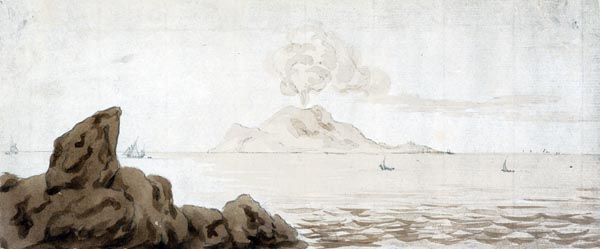
‘Stromboli smoking beyond a rocky shore’ - Johann Wolfgang von Goethe (German, 1749–1832)
Klassik Stiftung Weimar, Museen (Inv. GGz/0321)
Digital reproduction · See Art. L. 111-1 CPI and § 68 UrhG
The wind remained unfavourable, and our ship, blown in various directions, could only tack to and fro. Several experienced travellers asserted, impatiently, that neither the captain nor helmsman understood their calling; the former might be considered a mere merchant, the latter alone a sailor, but neither was fit to be in charge of so many people and such valuable goods.
I begged these otherwise decent folk to keep their concerns to themselves. The number of passengers was large, including women and children of various ages, for everyone had crowded onto the French vessel, without further consideration, considering only the security offered by the French flag against pirates. I suggested that mistrust and anxiety would place everyone in the most embarrassing situation, since until now everyone had seen their salvation in that colourless, unemblazoned pennant.
And indeed, between sky and sea, that white flag is a remarkable talisman. Just as those leaving and those left behind signal to each other by waving white handkerchiefs, thereby confirming a mutual feeling of friendship and affection on being divided for some time, so too the custom is sanctified by this simple flag; as if someone were to attach their handkerchief to a pole, in order to announce to the whole world that a friend was arriving from overseas.
Refreshed, from time to time, by Knief’s supply of wine and bread, much to the chagrin of the captain, who demanded that I eat what I had paid for, I was able, eventually, to sit on deck and participate in conversation. Kniep knew how to cheer me up, not by gloating, triumphantly, over the excellent food as he had on the corvette, but rather by praising my fortunate lack of appetite.
Monday, May 14, 1787.
So, the afternoon passed without us having entered the Gulf of Naples as we had hoped. Instead, we were driven westward, and the ship, approaching the island of Capri, sailed further and further from Cape Minerva (Punta Campanella). Everyone was irked, and filled with impatience, but we two, who viewed the world with an eye for the picturesque, were quite content; for, at sunset, we enjoyed the most magnificent sight afforded us during the entire voyage. Cape Minerva, with the mountains adjoining it, lay before our eyes decked in the most brilliant array of colours, while the cliffs stretching southward had already taken on a bluish hue. From the cape, the entire coastline, illuminated by the dying rays, extended as far as Sorrento. Vesuvius was visible to us, an immense cloud of vapour hanging above it, from which a long streak stretched far to the east, leading us to surmise that a powerful eruption had occurred. To the left lay Capri, rising steeply; we could distinguish the outlines of its cliffs, perfectly, despite the transparent bluish haze. Beneath a perfectly clear, cloudless sky, the tranquil, almost motionless sea shimmered like a clear pond, with the complete absence of wind. We were delighted by the sight; Kniep lamented that all the artistry ever deployed in the use of colour would not suffice to reproduce this harmonious view, just as the finest English pencil would not allow even the most skilled hand to trace its lines. I, on the other hand, convinced that a far lesser memento than that which an infinitely-skilled artist would have been able achieve would be most desirable to refer to in future, encouraged him to exert his hand and eye one last time. He allowed himself to be persuaded and produced one of his most accurate drawings, which he later coloured, proving that the well-nigh impossible can be achieved through pictorial representation. We followed the transition from evening to night with equally attentive eyes. Capri now lay before us, in complete darkness, when, to our astonishment, the cloud over Vesuvius as well as the strip of cloud emerging from it turned more and more fiery, until finally we saw a considerable extent of sky in the background illuminated, yes, and complete with lightning flashes.
Observing the scene, which we found welcome to our eyes, we were unaware that great misfortune threatened us; but a commotion among the passengers failed to leave us in uncertainty for long. They, more knowledgeable about maritime matters than ourselves, bitterly reproached the ship’s captain and his first mate, claiming that their ineptitude had caused them to miss the entry to the bay, and that the people, goods, and all, entrusted to them were in danger of perishing. We asked about the cause of this unrest, failing to understand how calamity could be feared amidst a complete calm. But it was precisely the calm that filled them with despair. ‘We are already caught in the current that swirls around the island,’ they said, ‘and, driven by a dangerous swell, are being pulled slowly yet surely toward the rocky cliffs, where not a foot’s breadth of ledge or cove offers refuge.’
Attentive to their words, we now contemplated our fate with horror; for although the night obscured the growing danger, we nevertheless noticed that the ship, pitching and tossing, was approaching the rocks, which rose ever darker before us, though a faint evening glow still lingered over the sea. Not the slightest movement could be observed in the air: everyone held handkerchiefs and light ribbons aloft, but not a hint of the desired breeze appeared. The crowd of passengers grew ever louder and angrier. The women and their children did not kneel on deck in prayer, because the space was too cramped to move about, but lay huddled together. They, even more than the men, who as yet anticipated a favourable outcome, cursed and raged against the captain. Now he was accused of everything that had been silently reflected on throughout the entire voyage: a poor cabin at a high price, meagre provisions, and a demeanour that, while not unfriendly, was nonetheless taciturn. He had given no account of his actions to anyone; indeed, even last evening, he had maintained a stubborn silence about his manoeuvring of the vessel. Now he and the first mate were called mere adventurers who, lacking any knowledge of seamanship, had managed to acquire a vessel out of pure self-interest and were now, through their incompetence and clumsiness, guaranteeing the ruin of all those entrusted to their care.
The captain remained silent, and still seemed to be contemplating our survival; but as for myself, for whom anarchy has ever seemed, since my youth, more vexatious than death itself, it was impossible to remain silent any longer. I stood before them, and spoke to them with as much composure as I had the rogues in Malcesine. I explained to them that at this very moment their noise and shouting were dulling the ears and minds of those from whom, alone, salvation could still be hoped for, such that they could neither think nor understand one another. ‘As for yourselves,’ I exclaimed, ‘collect yourselves, and address fervent prayers to the Mother of God, whom we depend upon to intercede with her Son, that he may do for you what he did for his apostles when, on the stormy Sea of Tiberias, the waves were already beating against their vessel, while the Lord slept. When the helpless and comfortless awakened him, he immediately commanded the wind to be still, just as he can now command the air to stir if it is his will to do so.’
My speech produced the greatest of effects. One of the women, with whom I had previously discussed moral and spiritual matters, exclaimed: ‘Ah! Il Barlume! Benedetto il Barlume!’ (‘Ah! The Light, Blessed be the Light!’) and indeed, since they were already on their knees, they began to pray with more fervour than usual. They were able to do so with all the more reassurance because the sailors were attempting a visible and active manoeuvre: they lowered the boat, which admittedly could only hold six to eight men, and secured it with a long cable to the ship, which the sailors now sought to haul along, vigorously plying their oars. For a moment, it even seemed as if they were moving it against the current, and one hoped to soon see the manoeuvre take effect. Whether these efforts actually added to the force of the current, or no, the boat and its crew were flung backward, suddenly, in an arc toward the ship, held by the long rope, much in the manner of the crack of a whip when the coachman gives it a flick.
Even this hope was abandoned! Prayer and lamentation alternated, and the situation grew all the more dreadful when, high on the rocks, some goatherds, whose fires had long been seen, cried out that a ship below was in danger of stranding! They shouted aloud many unintelligible words to one another, in which some, familiar with the language, thought they could hear them rejoicing at the prospect of plunder the next morning. Even a moment of doubt as to whether the ship was truly approaching the menacing reefs was, sadly, all too soon dispelled, and the crew were obliged to seize long poles, to force the vessel from the rocks, should the situation so demand, so long as their poles remained intact, and all was not lost. The ship rocked ever more violently, the foam seemed to increase, and my recurring seasickness, brought on by all this, compelled me to descend to the cabin. I lay down on my mattress, dimly aware of events, and with a strangely pleasant sensation that seemed to emanate from those thoughts of Lake Tiberias; for the image from Matthaus Merian’s illustrated Bible floated quite clearly before my eyes. And thus, one finds that the power of sensory and moral impressions proves strongest whenever a person is left entirely to their own thoughts. How long I lay there in this half-conscious state, I cannot say, but I was awakened by a violent roar above me; I could clearly hear large cables being dragged back and forth across the deck; this gave me hope that the sails were being deployed. After a short while, Kniep appeared, and announced to me that we were safe, that the slightest of breezes had arisen; that, at that very moment, the crew had completed raising sail, and that he himself had not failed to lend a hand. We were already, visibly, moving away from the rocks, and though not yet completely out of the current, the captain expected to overcome it. All was quiet above; then several of the passengers entered, announced the happy outcome, and lay down to rest.
When I awoke early on the fourth day of our voyage, I felt refreshed and healthy, just as I had been during the crossing at the same stage; so that on a longer sea voyage I would probably have paid my dues with only a like three-day long indisposition.
From the deck, I saw with pleasure that the island of Capri lay at a considerable distance, and our ship was heading in such a direction that we could hope to enter the gulf, a hope which was soon fulfilled. Now, after a harsh night, we had the pleasure of admiring the same sights that had delighted us the previous evening, but in a different light.
We quickly left that dangerous rocky island behind us. Having admired the east side of the gulf from afar yesterday, the castles and the town now appeared directly before us, while to the west lay the Posillipo peninsula and the promontories stretching towards Procida and Ischia. Everyone was on deck, led by a Greek priest, deeply enamoured of the Orient, who, when asked by the locals — who greeted their glorious homeland with rapture — how Naples compared to Constantinople, replied with great pathos: ‘Anche questa è una città!’— ‘That too is a city!’
We arrived at the port at the appointed time, and were surrounded by people; it was the liveliest moment of the day. No sooner had our trunks, and other belongings been unloaded, and set down on shore, than two porters seized them, and scarcely had we announced that we would be lodging with Moriconi than they ran off with the load as if it were booty, such that we lost sight of them as they vanished amidst the crowded streets, and over the bustling square. Kniep held his portfolio under his arm, and we would at least have saved his sketches if those porters, less honest than the poor Neapolitan devils, had robbed us of what the surf had spared.
At Naples Once More
To Herder.
Naples, May 17, 1787.
Here I am again, dear friend, refreshed and sound. The journey through Sicily was swift and easy; when I return, you shall judge how well I have carried out my observations. The fact that I am now used to looking closely at everything, and filling my memory with the details, has given me an incredible ability to decipher them without notes, and I think myself most fortunate, now, to hold a great, beautiful, and incomparable image of Sicily so clearly, completely, and purely in my mind. There remains no object of longing, since I am also returned from a visit to Paestum yesterday. The sea and the islands have given me both pleasure and pain, and I return satisfied. Let me save every detail until I am home. There is to be no lingering here in Naples; I will now sit down and describe this place to you in fuller detail than in my first letters. On the first of June, I will travel to Rome, unless some higher power prevents me, and at the beginning of July, I intend to depart again. I must see you all again as soon as possible; I hope it will prove a good sojourn. I am completely overwhelmed and need peace and quiet to process it all.
For all the kind and good things that you do, as regards my writings, I thank you a thousand times. I forever desire to create something even finer for your enjoyment. Whatever word I have from you, wherever it arrives from, it will be welcome. We are as close in our ways of thinking as is possible without being one and the same person, and closest of all in the main points. If you have produced much yourself during this time, then I have won much here, and we can hope for a profitable exchange.
As you say, my understanding is very much tied to the present, for the more I see of the world, the less I expect that humanity will ever become wise, intelligent, and happy, en masse. Perhaps among the billions of worlds there is some species that can boast that distinction; but given the nature of our society, I have as little hope for it, as I have for Sicily, given its nature.
In an accompanying sheet I will say something about the road to Salerno, and about Paestum itself; it has granted me the last and, I would almost say most splendid, image, that I will carry with me, in its entirety, on my northward journey. In my opinion, the central temple is to be preferred to everything else one sees in Sicily.
As for Homer, it is as if a veil has been lifted from my eyes. The descriptions, the similes, and so on, seem poetic to us, yet are unremittingly natural, and certainly drawn with a purity and intimacy that is startling. Even the strangest most fabricated of events possess this naturalness. I have never felt them as much as when close to the things they describe. Let me briefly express my thoughts, thus: the ancients depicted the existent, we commonly depict its effects; they described the dreadful, we describe dread; they depict the pleasant, we describe pleasantness, and so on. From this come all kinds of exaggeration, mannerism, artifice, and bombast. For if one strives for and works toward effect, one finds one cannot render it sufficiently palpable. If what I am saying is not new, I have nevertheless felt it vividly on recent occasions. Now that I have all these coasts and promontories, gulfs and bays, islands and headlands, rocks and sandbars, bushy hills, gentle pastures, fertile fields, decorated gardens, well-tended trees, hanging vines, mountains of clouds and ever-serious plains, cliffs and shores, and the all-encompassing sea, with their many variations and diversity present in my mind, only now is the Odyssey a living reality to me.
Furthermore, I must confide to you that I am very close to the secret of plant generation, and organisation, and it is the simplest thing imaginable. Under this sky, one can make the finest observations. I have found the main point wherein the germ of all lies, quite clearly, and without doubt; I already see the rest in its entirety, and only a few things need to be clarified. The primal plant (Urpflanze) will be the most wondrous creature in the world, for which Nature herself should envy me. With this model, and the key to it, one can then invent plants ad infinitum, plants that would be consistent, that is, plants that, even if they do not exist, could exist, not merely picturesque or poetic shadows and illusions, but possessing an inner truth and necessity. The same kinds of laws must apply to all other living things.
Naples, May 18, 1787.
Tischbein, who has returned to Rome, has, as we have seen, worked so diligently on our behalf here, in the meantime, that we are hardly aware of his absence. He seems to have instilled so much confidence in all his friends here, regarding ourselves, that they are all open, friendly, and proactive towards us, which I especially need in my current situation, since not a day goes by when I am not obliged to call on someone for some kind of favour or assistance. I am currently in the process of drawing up a summary list of what I still wish to see, since the brevity of my time here will impose a limit, and also indicate what can in fact be executed later.
Naples, May 22, 1787.
Today I encountered a pleasant adventure that has given me much to think about and is worth relating. A lady who had already shown me much favour during my first stay asked me to visit her at five in the evening: an Englishman wished to speak to me who had something to say to me about ‘Werther’.
Six months ago, even if it had been twice as worthwhile, her request would certainly have been met with a negative response; but the fact that I agreed meant that my Sicilian journey has had a positive effect on me, and I promised to attend at five sharp.
Unfortunately, the city is so large and there are so many things to do that I climbed the stairs a quarter of an hour late and was just standing on the rush mat before the closed door, ready to ring the bell, when the door opened and a handsome, middle-aged man stepped out, whom I immediately recognised as an Englishman. He had scarcely looked at me when he said: ‘You are the author of Werther!’ I confessed and apologised for not having arrived sooner.
‘I am unable to wait a moment longer;’ he replied, ‘what I have to say to you is very brief and could just as easily be said here. I have no wish to repeat what you’ve heard from thousands of others before, nor did the work affect me as strongly as it has others; but whenever I think about what it took to write it, I am always amazed anew.’
I was about to give him my thanks, when he forestalled me, exclaiming: ‘I cannot delay a moment longer; my wish to tell you myself is fulfilled. Farewell, and all happiness!’ And with that, he descended the steps. I stood for some time pondering his honourable gesture, and finally rang the bell. The lady was delighted to hear of our meeting and recounted many favourable things about this rare, and unusual fellow.
Naples, Friday, May 25, 1787
I imagine I shall never see my carefree little princess again; she has actually gone to Sorrento and, before her departure, did me the honour of scolding me for preferring stony and desolate Sicily to herself. Several friends gave me information about this peculiar person. Born into a good, but impoverished, family and raised in a convent, she agreed to marry an old but wealthy prince, and it was all the easier to persuade her because Nature had made her a good person, but utterly incapable of love. In this situation, of wealth, though a highly-restricted one due to family circumstances, she sought to avail herself of her intellect and, since she was hindered in her actions and commissions, at least to give free rein to her tongue. I was assured that her actual conduct was quite irreproachable, but that she seemed firmly resolved to flout all circumstances with her displays of unrestrained speech. It was jokingly remarked that no censorship could have allowed her discourses to pass, if they had been written down, because they contained absolutely nothing except whatever offended religion, the state, or morality.
The most wonderful and charming stories were told about her, one of which may be included here, although it is not the most decent of tales.
Shortly before the earthquake that struck Calabria, she had removed to her husband’s estate there. Near the castle, a small house had been built — a wooden, single-storey structure erected on bare ground; though it was, incidentally, wallpapered, furnished, and charmingly decorated. At the first warning signs of the earthquake, she fled there. She was sitting on the sofa, sewing, her small sewing table before her and an abbé, an elderly chaplain, seated opposite. Suddenly, the ground trembled, and the building collapsed on her side of the room, while the opposite side rose, lifting the abbé, and the table with him. ‘Ah!’ she cried, leaning her head back against the sloping wall, ‘is this befitting such a venerable man as yourself? You look as if you’re about to leap upon me, which is completely against all custom and propriety.’
Meanwhile, the house had settled again, and she could barely cease laughing at the foolish, lecherous figure the good old man was supposed to have presented, and seemed not to feel the slightest unhappiness at the event, not even about the great loss that had affected her family, and so many thousands of others. She is a miraculously happy character, who even managed to mount a farce, thus, when the earth threatened to swallow her up.
Naples, Saturday, May 26, 1787
On closer consideration, one must surely approve of the existence of so many saints; now, every believer can choose their own and turn with complete confidence to the one who truly appeals. Today is dedicated to the Saint I have selected, a day which I have therefore celebrated, devoutly and cheerfully in his honour, according to his custom and teachings.
Saint Philip Neri is held in high esteem, and remembered with joy; one is edified and delighted to hear of him and his profound piety, yet one also hears much about his good humour. From his earliest youth, he felt the most fervent religious impulses, and in the course of his life, the highest gifts of religious enthusiasm developed within him: the gift of involuntary prayer, of deep, wordless adoration, the gift of tears, of ecstasy, and finally even of rising from the ground and hovering above it, which is considered above all to be the most elevated gift.
To so many mysterious and singular inner qualities he added the clearest common sense, the purest appreciation, or rather, the most profound devaluation, of earthly things, and the most active devotion to his fellow human beings as regards their physical and spiritual needs. He rigorously observed all the duties required of a devout, churchgoing man, including those at festivals, church services, prayer, fasting, and so on. He also devoted himself to the education of youth, to their musical and rhetorical training, presenting not only spiritual but also intellectually- stimulating topics and initiating lively discussions and debates. Perhaps the most remarkable aspect of all this is that he performed and accomplished it of his own volition on his own authority, pursuing his path steadily for many years without belonging to any order or congregation, indeed, without having received ordination.
It is especially noteworthy that this occurred in Luther’s day, and that, in the heart of Rome, a capable, God-fearing, energetic, and active man likewise conceived the idea of uniting the spiritual, indeed the sacred, with the secular, of introducing the heavenly to his age, and thereby also preparing the ground for reformation. For here alone lies the key that can unlock the prison of the Papacy and restore God to the free world.
The Papal Court, however, having so influential a man at hand, in the diocese of Rome and under its purview, did not relent until he, who was already leading a religious life, frequenting the monasteries, teaching there, and encouraging others, was finally persuaded, just he was about to found not an order, but a free assembly, to take ordination, and receive all the benefits that he had so far lacked on his path through life.
Even if one were to doubt his physical, and wondrous, ability to levitate, as is rational, he was nevertheless in spirit far above this world, and therefore nothing was so repugnant to him as vanity, pretence, and arrogance, which he always worked vigorously against, they being the greatest obstacles to a truly godly life, and, as many stories tell us, behaving always with good humour.
He was, for example, at the Pope’s side when the latter was informed of a nun in the neighbourhood of Rome who was exhibiting signs of possessing remarkable spiritual gifts. Neri was tasked with investigating the veracity of these tales. He immediately mounted his mule and, despite the very bad weather and road conditions, soon arrived at the convent. Once there, he conversed with the abbess, who, in a spirit of complete openness, gave him a thorough account of all these marks of grace. The nun entered at his request, and he, without further greeting, handed her his muddy boots, requesting that she clean them. The holy virgin, in her pristine garb, stepped back in alarm, and expressed her outrage at this imposition with vehement words. Neri rose, calmly, mounted his mule, and found himself before the Pope before the latter anticipated his return, as significant precautions are prescribed for Catholic confessors, requiring of them the utmost thoroughness when examining claims concerning spiritual gifts, for, while the Church acknowledges the possibility of such heavenly favours, it does not accept their reality without the most exacting examination. Neri revealed the result to a startled Pope: ‘She is no saint,’ he exclaimed, ‘she performs no miracles! For she lacks the essential quality for doing so: humility.’
This maxim can be considered the guiding principle of his entire life; for, to recount a further story: after he had founded the Congregation of the Padri dell’Oratorio, which soon garnered great prestige and inspired many to wish to become members, a young Roman prince came seeking admission, to whom the novitiate and the garb assigned to it were granted. However, when he requested actual admission after some time, it was said that he first had to pass various tests; to which he agreed. Neri produced a long fox’s tail and demanded that the prince attach it to the back of his long robe, and walk about, in a solemn manner, through the streets of Rome. The young man was horrified, much like the nun mentioned earlier, and declared that he had come forward not to seek shame, but honour. Father Neri then remarked that this was not the aim among their circle, where the highest renunciation remained the first law. Whereupon the young man took his leave.
In a short motto, Neri expressed his main doctrine (also associated with Saint Bernard): ‘Spernere mundum, spernere te ipsum, spernere te sperni: to disdain the world, to disdain yourself, to disdain your own disdain.’ And certainly, in saying that, all is said. A hypochondriac might think to fulfil the first two points, but to even consider the third, one would need to be on one’s way to becoming a saint.
Naples, May 27, 1787.
I received all your delightful letters from the end of last month, yesterday, all at once, sent on from Rome via Count Fries (Joseph Johann von Fries a wealthy Austrian banker, and art collector, who was in Rome from 1785 to 1787 on his Grand Tour), and thoroughly enjoyed reading and rereading them. The eagerly awaited little box was also included, and I thank you a thousand times for everything.
But now it is almost time for me to flee from here; for as much as I wish to contemplate Naples and its surroundings, fully, and to renew my impressions and come to terms with certain things, the daily current sweeps me away, and distinguished people have joined me, both old and new acquaintances, whom I cannot readily dismiss. I encountered a charming lady with whom I had spent a few most pleasant days last summer in Carlsbad (Karlovy Vary). How many hours we have robbed the present days of, lost in the happiest of reminiscences! All our dear and cherished ones came to mind again, above all the cheerful humour of our dear Prince. She still possessed the poem with which the girls from Engelhaus (Andelska Hora village near Karlovy Vary; the ruined castle of Engelsburg is sited on a rocky summit nearby) surprised him as he rode away. We recalled amusing scenes, witty bouts of teasing and mystification, and our ingenious attempts at exercising our right to retaliate against one another. We felt as if transported swiftly to that German-speaking locale, amidst the best of German company, hemmed in by walls of rock, united by being in a strange place, but even more so by respect, friendship, and affection. However, as soon as we stepped to the window, the Neapolitan current raced on again, with such force that those peaceful memories were wrenched from our grasp.
No more could I avoid the acquaintance of the Duke and Duchess of Ursel (Wolfgang-William, 3rd Duke d’Ursel a Belgian nobleman, and his wife Princess Flore d’Arenberg). They were excellent people of high moral character, pure in their natures and humanity, with a decided love of art, and goodwill towards all they met. Our continued and repeated conversations were most enticing.
Sir William Hamilton and his fair friend continued their kindness towards me. I dined with them, and towards evening Miss Hart again displayed her musical and melodic talents.
At the urging of my friend Philipp Hackert, who was growing fond of me and wished to share everything remarkable with me, Sir William led us to his secret vault, containing artistic odds and ends. There was quite a jumble; the work of all eras was haphazardly heaped together: busts, torsos, vases, bronzes, all sorts of household ornaments made from Sicilian agates, even a small chapel, carved and painted, and whatever else he had happened to acquire. In a long chest on the floor, whose broken lid I curiously pushed aside, lay two truly magnificent bronze candelabras. With a nod, I drew Hackert’s attention to them, and whispered to him the question of whether these were not quite similar to those at Portici. He, however, signalled me to silence; they might indeed have found their way there from Pompei. Because of such happy acquisitions, and others like them, the knight has good reason to allow only his closest friends to view these hidden treasures.
What struck me most was an upright box, open at the front and painted black inside, framed in the most magnificent gold. The space was large enough to accommodate a standing human figure, and accordingly, we learned its purpose. The art lover — and enthusiast for young ladies — not content with the beautiful form of each mobile statue he ‘acquired’, also wished to delight in her when seen as a colourful, and inimitable painting, and so, sometimes within this gold frame, he would have her imitate a figure from the ancient wall-paintings of Pompeii, and even more recent masterpieces, while dressed in a multitude of hues against the black background. That era now seemed to be over, and besides, the apparatus was difficult to transport and illuminate properly; thus, we were unable to witness such a spectacle.
Here is the place to mention yet another decided passion of the Neapolitans in general: the Nativity scenes (presepi), which can be seen in all the churches at Christmas. These scenes, more or less complete, depict the Adoration of the Shepherds, Angels, and Magi, richly and lavishly grouped together. In cheerful Naples, such displays even appear on the flat rooftops of houses, where, a light, hut-like framework is erected and adorned with evergreen trees and shrubs. The Virgin Mary, the Christ Child, and all the figures standing or hovering around are lavishly decorated, representing a substantial household expenditure. But what truly glorifies the whole scene is the backdrop, encompassing Mount Vesuvius and its surroundings.
Sometimes, living figures are mixed in among the plaster ones, and gradually, the performance of worldly scenes, whether from history or poetry, in the palazzos, as an evening attraction has become one of the most important forms of entertainment for noble and wealthy families.
If I may venture a remark, that a guest so well-treated should perhaps refrain from? I must confess that our beautiful entertainer (Emma Hart) strikes me as a rather soulless creature, who may reward her audience with her looks, but is unable to assert her personality through her soulful expressions of voice and language. Even her singing lacks a certain fullness.
And so, perhaps, is ultimately the case with all such frigid forms. Beautiful people are everywhere, but deeply sensitive people who also possess a gift for language are much rarer, and those who, in addition to these qualities, also have a captivating personality are the rarest of all.
I am very much looking forward to Herder’s third volume (of his ‘Ideen zur Philosophie der Geschichte der Menschheit’: ‘Ideas on the Philosophy of the History of Mankind’, the third volume published 1787). Keep it for me, until I can say where I am able to receive it. He will surely have justified, in fine style, Humanity’s beautiful wish that better things will come to pass one day. And, I too, in fact, believe that Humanity will finally prevail; only I fear that at the same time the world will be one great hospital, in which each will be another’s tender nurse.
Naples, May 28, 1787
Johann Jacob Volkmann’s fine, and extremely useful work nonetheless obliges me to depart from his opinion, from time to time. He says, for example, that thirty to forty thousand idlers can be found in Naples, and who does not repeat it after him! I suspected, however, soon after gaining a little knowledge of conditions in the south, that this was merely a northerner’s view, whereby anyone who fails to toil anxiously all day is considered an idler. I therefore paid particular attention to the people, whether they were in motion or resting, and while I did notice a great many poorly- dressed folk, I failed to note any who were unemployed.
Therefore, I asked some friends about these countless idlers, whom I desired to encounter too; however, no one could show me any such, and so, since the investigation was directly related to my observations of the city, I went hunting for them myself.
I began to familiarise myself with the various figures amidst the vast crowd, judging and classifying them according to their appearance, clothing, behaviour, and occupation. I found the task easier here than elsewhere because the people here are more independent, and display external signs of their social standing. I began my observation early in the day, and all the people I found standing still, or resting here and there, were people whose profession demanded it at that moment: porters, who command privileged sites in various places, and simply wait until someone wishes to employ them; chauffeurs, their servants, and their lads, who stand by their one-horse carriages (calesi or calashes) in the large squares, tending to their horses, and at the service of anyone who requests them; boatmen smoking their pipes on the pier; and fishermen, lying in the sun, perhaps because an unfavourable wind is blowing that prevents them from setting out to sea. I also saw many another walking about, here and there, but each usually revealed some sign of their occupation. None of the beggars I saw were aged, incapacitated, or crippled people. The more I looked about me, the more closely I observed the passers-by, the fewer true idlers I could find of any age or gender, whether of the lower or middle classes, either in the morning or, indeed, during the rest of the day.
Let me add further details to render my assertion more vivid and credible. The youngest children are occupied in various ways. A large number of them carry fish from Borgo Santa Lucia to sell in the city; others are often seen in the vicinity of the arsenal, or wherever else carpentry work is being done, which produces wood shavings, or even on the shore where brushwood and smaller pieces are cast up, gathering even the tiniest pieces in their baskets. Children of a few years old, who simply crawl about on the ground, accompanied by older boys of five or six, engage in this little trade. Afterwards, they enter deeper into the city, carrying their baskets, and set up a kind of market with their little piles of wood. The craftsmen, and the lesser citizens, buy from them, burning what they buy on tripods to warm themselves, or using it in their frugal kitchens.
Other children bear water from the sulphur-springs to sell, which is drunk particularly in Springtime. Others gain a small profit by buying fruit, whipped-honey, cakes, and sweets, and then, as childish traders, offering and selling their purchases to other children, thus perhaps obtaining their own share for free. It is truly charming to watch such a lad, whose only possessions are a board and a knife, bringing a watermelon or half a roasted pumpkin, a group of children gathering around him, setting down his board, and slicing the fruit into small pieces. The buyers wait with serious expressions, wondering how much they will receive for their small copper coin, and the little trader handles the affair with equal care facing the eager buyers, lest he be cheated out of a single piece. I am convinced that with a longer stay, one could gather many more examples of such occupations involving children.
A large number of people, some middle-aged, some lads, most of them very poorly dressed, are employed to carry refuse out of the city on donkeys. The surrounding countryside is nothing but a kitchen garden, and it is a joy to see the indescribable amounts of produce that arrives each market-day, and how the industrious people immediately return the surplus fragments, discarded by the cooks, to the fields, to accelerate the growth of their vegetables. Given the incredible consumption of such vegetables, the stalks and leaves of cauliflowers, broccoli, artichokes, cabbage, lettuce, and garlic make up a large part of the Neapolitan refuse piles, and are particularly sought after. Two large, flexible baskets are strapped to a donkey’s back, and not only filled to the brim but also, with a particular display of skill, others are piled on top. No market-garden can exist without such a donkey. A servant, a lad, sometimes even the owner himself, hasten to and from the town as often as possible during the day, since it provides a rich treasure trove for them at all hours. One can imagine how eagerly these collectors attend to the dung from horses and mules. They are reluctant to leave the road even at nightfall, and the wealthy driving home from the opera after midnight probably never suspect that, even before daybreak, some busy worker will be carefully searching for whatever their horses have left behind. I have been assured that a few such men, joining forces, buying a donkey, and leasing a small plot of farmland from some larger landowner, are soon able to expand their business considerably, through persistence and diligence in this happy clime where the growth of crops is barely interrupted.
I would be straying too far from my topic if I were to speak here of the many street-vendors that one observes with pleasure in Naples, as in every other large city; yet I must speak here of the peripatetic traders, because they especially belong to that class of people. Some go about with small barrels of ice-water, glasses, and lemons, so that they can make lemonade anywhere, a drink that even the poorest cannot do without; others with boards on which bottles of various liqueurs and conical glasses are secured from falling by use of wooden rings; others carry baskets full of all kinds of pastries, sweets, lemons, and other fruit, for it seems that everyone wishes to participate in, and add to, the great feast that is celebrated every day in Naples.
Just as active as these peddlers, are the many small-time vendors who likewise wander around, offering their wares plainly, on a board, in a box lid, or even directly on the ground in the public squares. One is not speaking of individual items that one could also find in the larger shops; it is actual junk. Not a single piece of iron, leather, cloth, linen, felt, and so on, exists here that does not reappear on the market as second-hand goods, to be repurchased by one person or another. Many people of the lower classes are also employed by merchants and craftsmen as assistants and labourers.
It is true that one can hardly take a step without encountering some poorly-dressed, even ragged, person, but that scarcely renders them idlers or loafers! Indeed, I would almost venture to suggest a paradox: that in Naples, perhaps the greatest industry is found among the lowest classes. Of course, one should not compare it with northern industry, which has to allow not only for the passing day and hour, but also on fine and sunny days for the poor and gloomy ones, and in summer for the advent of winter. Because northerners are compelled by nature to provide for their needs and organise their lives — because the housewife must salt and smoke food to supply the kitchen year-round, and because her husband must not neglect to store fruit and firewood, and fodder for his livestock, and so on — the finest days and hours are lost to enjoyment and devoted to work. For several months at a time, people gladly retreat from the open air and shelter in their houses from storm, rain, snow, and cold. The seasons follow one another inexorably, and anyone who prefers not to perish must become a steward of their resources. For the question here is not whether one can choose to do without; one must seek not to go without, since doing without is not an option; Nature compels one to produce, to look ahead. Without a doubt, these natural forces, unchanged for millennia, have shaped the character of the Nordic nations, and in many respects in admirable ways. By contrast, we judge the southern peoples, upon whom heaven looks so mildly, too harshly. What Cornelius de Pauw dares to express in his ‘Recherches sur les Grecs,’ (1787) when speaking of the Cynic philosophers, fits perfectly here. One cannot, he believes, gain a truly accurate understanding of the condition of such people from our perspective; their principle of doing without everything was greatly favoured by a climate that provides everything. A poor person, who is wretched among us, could not only satisfy the most basic and immediate needs in these southern regions, but also enjoy the world in the most pleasant manner; likewise, a beggar, so-called, in Naples would readily disdain the position of Viceroy of Norway, and refuse the honour if the Empress of Russia were to entrust him with the governorship of Siberia.
Certainly, a Cynic philosopher would not fare well in our regions, whereas in southern countries Nature practically invites such a life. Here, the ragged person is nonetheless still clothed; someone who neither owns a house nor rents a room, but spends the night in summer under the eaves, or on the steps of palaces, churches, or public halls, or finds shelter somewhere for a small fee in bad weather, is not therefore a miserable outcast; a person is not poor simply because they have not provided for the following day. If one considers the abundance of food offered by the sea, rich in fish, on which these people must, by law, sustain themselves for several days a week; and that all kinds of fruit and garden produce are available in abundance at any time of year, the fact being that the area around Naples has earned the name Terra di Lavoro (meaning not ‘the land of work’, but ‘the land of agriculture’) and the entire province has borne the honorary title of the happy region (Campagna Felice) for centuries, it is easy to understand how easy the life here can be.
The paradox I have ventured to set forth above would, in general, give rise to a wealth of other similar observations if someone were to undertake a comprehensive study of Naples; for which, of course, no small amount of skill and many years of investigation would be required. One would then perhaps notice that, on the whole, the so-called ‘lazzarone’ (lowest class of person) is no less inactive than any other class of individual, but at the same time perceive that all, in their own way, do not work merely to live, but also to enjoy life, and that they even seek to find joy in their work. It explains a great deal: why their craftsmen, almost always, lag far behind those in northern countries; why factories fail to materialise; why, apart from lawyers and doctors, little learning is apparent in relation to the vast majority of people, however dedicated various individuals may be; why no painter of the Neapolitan school has ever been thoroughly great, or achieved great success; why the clergy here are comfortable in their idleness, and why the upper classes direct their wealth only towards sensual pleasure, pomp and splendour, and various distractions.
I am well aware that this is a broad generalisation, and that the characteristics of each class can only be fully understood after closer acquaintance and observation; however, I believe that overall, one would arrive at these conclusions.
I return once more to the ordinary inhabitants of Naples. One notices in them, as in cheerful children given a task, that while they carry it out, they also make a jest of it. They are very lively, in general, and possess a free and clear perspective on life. Their language is often described as figurative, their wit sharp and biting. Ancient Atella (the source of Atellan Farce) was not far from Naples, and just as their beloved Pulcinello still embodies the spirit of those Oscan games, so the ordinary folk here still participate in that form of wit.
In the third book, fifth chapter (see paragraphs 39-42) of his ‘Natural History,’ Pliny deems Campania alone worthy of extensive description. ‘So happy, graceful, and blessed are those regions,’ he says, ‘that one recognises that Nature has rejoiced in her work there. Such life-giving air, such an ever-salutary mildness of the skies, such fertile fields, such sunny hills, such gentle woodlands, such shady groves, such useful forests, such breezy mountains, such expansive fields, such an abundance of vines and olive-trees, such fine fleeces, such thick-necked bullocks, so many lakes, such a wealth of flowing rivers and springs, so many bays, so many harbours! The land itself, which everywhere opens itself to trade and, as if eager to assist humankind, stretches out its arms to the sea.’
I have not even mentioned the people’s abilities, their customs, their strengths, nor the many peoples they have conquered through their military efforts and their language.
The Greeks, accustomed to excessive self-praise, passed the most honourable judgement on this land by calling it, in part, Magna Graecia (Greater Greece).
Naples, May 29, 1787
Everywhere one finds a wonderful cheerfulness, accompanied by a fullness of shared pleasures. The multi-coloured flowers and fruits with which Nature adorns herself seem to invite the people to decorate themselves and all their belongings with the most vibrant colours possible. Silk scarves and bandanas, and flowery hats decorate everyone who is even remotely able to procure them. Chairs, and chests of drawers, in the humblest houses are painted with colourful flowers on gilded backgrounds; even the calashes are painted bright red, the carvings gilded, the horses pulling them adorned with artificial flowers, bright-red tassels, and tinsel, some bearing plumes, others even small flags, on their heads that flutter with every movement. We tend to call a fondness for bright colours barbaric and tasteless; it can be so, and is so, to a degree, but beneath a clear, blue sky, nothing is too colourful, since nothing can outshine the brilliance of the sun rays, and their reflections in the sea. The most vibrant colours are muted by the intense light, and because all colours — every shade of green in the trees and plants, and the yellows, browns, and reds of the earth — strike the eye with their full force, even the most colourful flowers and garments achieve a harmony. The scarlet waistcoats and skirts worn by the women of Nettuno, adorned with broad gold and silver, the other colourful national costumes, the painted ships — everything seems to strive to stand out, beneath the brilliance of sky and sea.
And as they live, so they bury their dead; no slow, dark funeral procession disturbs the harmony of this happy world. I saw a child being carried to its grave. A large, red velvet carpet, embroidered with gold, covered a wide bier. On it stood a carved, heavily-gilded and silvered casket, in which the white-clad deceased lay, completely covered with rose-coloured ribbons. At the four corners of the casket were four angels, each about two feet tall, holding large bunches of flowers over the dead child. Because they were only attached at the foot by wires, they swayed as the bier moved, releasing a mildly invigorating floral fragrance, and swayed all the more violently as the procession sped along the streets, the priests and candle-bearers running rather than walking.
There is no time of year when one is not surrounded by food everywhere, and the Neapolitans not only enjoy eating, but also wish their produce to be well-presented for sale.
At Santa Lucia, the fish are usually arranged, according to their kind, in clean and attractive baskets; crabs, oysters, shellfish, and small mussels are presented individually, on green leaves. The shops selling dried fruit and legumes are decorated in the most elaborate ways. The oranges and lemons of all varieties, heaped amidst striking green foliage, are a delight to the eye. But nothing is more elaborately decorated than the meat products, to which passing eyes are particularly drawn, since the people’s appetites are further stimulated by periodic abstinence.
On the meat-stalls, the cuts of beef, veal, and mutton are never displayed without a plump side, or leg, being heavily gilded. Several days of the year, especially during Christmas, are renowned as feasts; then a universal Cuccagna (Cockaigne, ‘Land of Plenty’), is created, half a million people pledging their support. At that time, the Via Toledo and several adjacent streets and squares are decorated in the most appetising manner. The shops selling groceries, in which raisins, melons, and figs are displayed, are a most delightful sight. Foodstuff hangs in garlands over the streets, including huge paternosters of gilded sausages tied with red ribbons, and Italian poultry, each bird with a red flag tucked under its tail. It is said that thirty thousand such birds have been eaten, on occasion, not counting those folk had fattened at home. Besides this, a great many donkeys, laden with vegetables, capons, and young lambs, are driven through the city, to market, and the heaps of eggs, seen here and there, are vast beyond imagining. And not only is all this consumed, but every year a police officer rides through the city with a trumpeter, and announces, in all the squares and at the crossroads how many thousands of oxen, calves, lambs, pigs, etc., the Neapolitans have devoured. The people listen attentively, rejoice immoderately at the vast numbers, and fondly remember their own share of the feast.
As to the wheat and dairy products that our cooks are so adept at preparing, those who prefer a simple approach to such matters, or lack well-equipped kitchens, are doubly provided for. Macaroni, a delicate, thoroughly-worked, cooked dough, of fine durum flour, pressed into certain shapes, is readily available everywhere in all varieties for a small price. It is usually simply boiled in water, while grated cheese melts over, and seasons, the dish. Almost on every main street corner, bakers with pans full of boiling oil are busy, especially on fast days, preparing fish and pastries for anyone who desires them. They do extremely well, and many thousands carry away their lunch and dinner in a piece of paper.
Naples, May 30, 1787.
Strolling through the city, at night, I reached the pier (the Molo). There, I looked upwards, to observe the moon, its glow lighting the edges of the clouds, the path created by its reflected rays swaying gently on the water, more brightly and more vividly at the crest of each oncoming wave. And I gazed at the stars in the sky, the lighthouse-beacon, Vesuvius’ flames, its reflection in the water, and the countless individual lights scattered among the ships. I would have liked to see how Van der Neer (Aert van der Neer, the Dutch painter, noted for his moonlit scenes) would have tackled such a multifaceted artistic challenge.
Naples, Thursday, May 31, 1787.
I had focused my thoughts so firmly on the Corpus Christi festival in Rome, and especially the tapestries, woven after Raphael, displayed at that time, that I refused to allow myself to be distracted by such natural phenomena, however magnificent, even though they are unparalleled elsewhere, but rather continued, stubbornly, with my preparations for the journey. A passport had been ordered, and the vetturino had handed over his retainer, since here, for the security of travellers, things are the reverse of what is done at home. Kniep, meanwhile, was busy moving into his new quarters, which were much more spacious, and in a better location, than formerly.
Even before the move was underway, my friend had repeatedly pointed out to me that it was rather unpleasant and, in a way, unfitting to take up occupancy of a place without introducing anything of one’s own; even a bed-frame commands a certain amount of respect from one’s hosts. As we walked through the endless clutter of the Castle’s outer-bailey today, I noticed a few iron bed-frames, painted to look like bronze, which I immediately haggled over, and then presented to my friend as forming the future foundation for a peaceful and solid bed. One of the ever-available porters carried them, along with the necessary boards, into the new quarters. This arrangement pleased Kniep so greatly that he immediately decided to leave me and move in, readily acquiring the large drawing boards, paper, and other materials that he needed. As agreed, I gave him a number of the sketches drawn in both Sicilies.
Naples, June 1, 1787.
The arrival of the Marquis Lucchesini (Girolamo Lucchesini, a Prussian diplomat) has delayed my departure by a few days; I have greatly enjoyed getting to know him. He seems to me to be one of those people who possess a good moral constitution, enabling them to always partake at the great worldly table, instead of the likes of us, who, like ruminants, sometimes overeat, and then cannot absorb anything more until we have completed a repeated chewing of the cud, and further digestion. I also like his wife (Charlotte von Tarrach) quite well; she is a truly Germanic character.
I am now glad to leave Naples; indeed, I must go. These last few days, I have indulged the pleasure of seeing people; the individuals I have met have proved mostly interesting, and I am content with the hours I have devoted to them, but another two weeks of such would lead me further and further from my purpose. And then one becomes ever more inactive here. Since my return from Paestum, I have seen little apart from the treasures of Portici, and much still remains to be seen, which I don’t feel like lifting a foot for. Nonetheless, the museum is the be-all and end-all of collections of antiquities; there one can see how far ahead the ancient world was in its joyous appreciation of art, even if it lagged far behind us in rigorous craftsmanship.
The same date, June 1, 1787.
The clerk who delivered my certified passport, while expressing his regret at my departure, told me that a large lava flow, erupting from Vesuvius, was making its way to the sea; it had almost descended the steeper slopes of the mountain, and would likely reach the shore in a few days. I found myself, now, in a sad situation. Today was devoted to farewell visits, which I owed to the many kind and supportive people, here; I already know how tomorrow must go. One cannot completely escape people on one’s journey, yet whatever they offer us ultimately distracts from our serious goals, without our advancing theirs in any way. I am extremely disgruntled.
The same day, at evening.
However, my visits of thanks were not without pleasure and enlightenment too; I was kindly shown many things that had previously been deferred or neglected. Cavaliere Venuti (Marquis Domenico Venuti, Director of Excavations) even allowed me to see various hidden treasures. I once again contemplated with great reverence his priceless, though mutilated, Ulysses. As a farewell gesture, he took me to the porcelain factory, where I tried my best to memorise the form of the Hercules, and once again feasted my eyes on the collection of Campanian vessels.
Truly moved by the occasion, while taking his leave in a friendly manner, he confided to me one last time what it was that was really affecting him, and said that he wished for nothing more than that I could stay there a while longer. My banker, at whose house I arrived around lunchtime, would not let me go; all of which would have been fine, had the lava not captured my imagination. Amidst various tasks, the payment of debts, and packing, night fell, and I hastened to the pier.
There I gazed at all the lights, the fires, and their reflections, shimmering in a livelier manner on the choppy sea; now at the full moon in all its glory not far from the volcano’s plume, and now at the lava flow, which had been absent the other day, moving solemnly on its glowing way. I could have voyaged further, but the preparations would have proved too lengthy; I would not have arrived until morning, nor did I wish my impatience to prevent me enjoying the present view, so I seated myself on the jetty until, despite the ebb and flow of the crowd, and their loud interpretations, pronouncements, comparisons, and arguments about which direction the lava flow would take, and other such nonsense, my eyes began to close.
Naples, Saturday, June 2, 1787.
And so, I have spent this beautiful, enjoyable and productive day, with excellent people, but entirely against my wishes, and with a heavy heart. I gazed longingly at the cloud of vapour, which, drifting slowly down the mountain towards the sea, marked the path the lava was taking hour by hour. My evening, too, was fated not to be free. I had promised to visit the Duchess of Giovane (Juliane Giovane, a German writer, and lady-in-waiting to Queen Maria Caroline), who resided in the Castle, where I was made to ascend many steps through various corridors, the uppermost of which proved narrow due to the presence of various chests, cupboards, and all the other unpleasant trappings of a court wardrobe. In a large, high-ceilinged room with no particular view, I found a young lady, with an attractive figure, with a very delicate and refined mode of conversation. As a native German, she was well aware of how our literature had progressed towards a freer, more expansive expression of humanism; she greatly admired Herder’s work and that of others which resembled it, also the clear intellect of Christian Garve (the Enlightenment philosopher) had also deeply appealed to her. She sought to keep pace with other female German writers, and it was quite notable that she wished to wield a practised and lauded pen. Her conversations revolved around this topic and simultaneously revealed her desire to influence the daughters of the upper classes; such conversation knows no bounds. Dusk had already fallen, and no candles had yet been brought in. We paced the room, and she, approaching a wall of windows closed by shutters, pushed one open, and I beheld something one sees only once in a lifetime. If she did so intentionally, to surprise me, she achieved her purpose perfectly. We stood at a window on the upper floor, Vesuvius directly before us; the flowing lava, its flames already glowing brightly, the sun having set some time ago, beginning to gild its accompanying vapour; the mountain raging violently, with, above it, an immense, stationary cloud, its various masses illuminated with each flash of light, distinct and corporeal. From there to the sea, a strip of heat and glowing vapour; meanwhile, sea and earth, rock and vegetation were clearly visible in the twilight, bright yet peaceful, in the magical stillness. To take all this in at a glance, and see the full moon emerging from behind the mountain ridge as the fulfilment of that most wondrous scene could no other than cause astonishment (the moon was completely full on May 31st, but still ninety-eight per cent illuminated on June 2nd)
From our vantage point, the eye could encompass everything at once, and even if unable to examine the individual objects in detail, never lost sight of the grand scheme of things. Though our conversation was interrupted by this spectacle, it took an even happier turn. We now had before us a ‘text’ that it would take a thousand years to comment on fully. The deeper the darkness, the more the landscape seemed to gain in clarity; the moon shone like a second sun; the columns of vapour, their streaks and masses were illuminated minutely; indeed, one could almost discern, with eyesight alone, the glowing clumps of rock ejected into the night from the cone. My hostess — which is what I will call her, since she had gone to the trouble of providing a delicious supper for me — saw that the candles were placed on the opposite side of the room, and the lovely woman, illuminated by the moon, in the foreground to this incredible scene, seemed to me to grow ever more beautiful; indeed, her beauty was especially enhanced by listening to her pleasant German dialect in this southern paradise.
I forgot the lateness of the hour, such that she had to remind me, finally, that it was necessary for her to dismiss me, albeit reluctantly, as the hour was approaching when her galleries would be closed like convent cloisters. And so, I departed, hesitantly, from both the near and the distant view, blessing my fate, which had rewarded me this evening in repayment for the day’s reluctant courtesies. Once in the open air, I told myself that, in the vicinity of this larger lava flow, I would only have experienced a repetition of the smaller one, and that such a view, such a farewell to Naples, could not have been experienced in any other way. Instead of going home, I set my steps towards the Molo, to see the grand spectacle, only with a far different foreground; yet I know not whether it was my fatigue after such a full day, or a feeling that I should not blur that last, beautiful image, that drew me back to Moriconi, where I found Kniep, who had decided to pay me an evening visit, after settling in to his newly acquired lodgings. Over a bottle of wine, we discussed our future arrangements; I was able to assure him that as soon as I could present some of his work in Germany, he would be recommended to the excellent Ernst II, Duke of Saxe-Gotha-Altenburg, and would certainly receive commissions from him. And so, we parted with heartfelt joy and the confident prospect of a mutually beneficial collaboration in future.
Naples, Sunday, June 3, 1787. Trinity Sunday.
I drove, half-dazed, through the bustling life of this incomparable city, which I am probably destined never to see again; but glad that I had left no trace of either regret or pain behind me. I thought of the good Kniep, and promised him, even from afar, my best care.
At the outermost suburban police checkpoint, I was momentarily troubled by a marshal who looked at me in a kindly manner, and quickly moved away. The customs officers had not yet finished with the vetturino when Kniep emerged from the coffee-shop door, carrying the largest of china cups, full of black coffee, on a serving tray. He approached the carriage door slowly with a serious expression that, arising from the heart, suited him very well. I was astonished and touched; I felt such appreciative attention to be unparalleled. ‘You have, shown me,’ he said ‘so much affection and kindness, such as to adorn my whole life, that I wished to offer you a simple token of how much I owe you.’
Since I am always at a loss for words on such occasions, I simply stated, laconically, that through his actions he had already rendered me indebted, and that through the employment and perfecting of our shared gains he would bind me even more closely.
We parted as people, briefly connected by chance, rarely do. Perhaps we would win far more gratitude and benefit in life if we were to speak frankly to one another about our expectations. Once that is accomplished, both parties are satisfied, and the feeling of friendship, which is ultimately the most important thing, appears as a bonus.
On the road, June 4th, 5th and 6th.
Since I am travelling alone this time, I have had ample time to recall the impressions of the past months; which I have done, and with great pleasure. And yet, the incompleteness of my observations is quite apparent, and while a journey seems to flow by in a continuous stream to the one who undertakes it, appearing in the memory as a regular sequence, one nevertheless feels that true communication of it is impossible. The narrator must present everything piece by piece: how can a whole be formed from this in the mind of some third party?
Therefore, nothing more comforting and gratifying could have come my way than the assurances in your last letters that you are studying the subjects of Italy and Sicily with diligence, reading travelogues, and examining engravings; the evidence that my letters benefit from your doing so is my greatest consolation. Had you explained what you were doing, or simply mentioned it earlier, I would have been even more zealous than I was. The fact that excellent men like Bartels, Münter, and other architects of various nations preceded me, who certainly pursued their objective goals more diligently than I, who have only had the most subjective ones in mind, has often reassured me when I felt my own efforts as insufficient.
In sum, if every person may be considered merely a supplement to all others, and so appears most useful and endearing when he or she presents themselves as such, then this must be especially true of travellers and their travelogues. Personality, purpose, circumstance, the favourable or unfavourable nature of chance events — everything manifests itself differently in each individual. If I know my predecessors, I may also know how to appreciate them, utilise them, and await their successors, who, should I have been fortunate enough to visit the region myself in the meantime, I shall treat, equally, as friends.
The End of Goethe’s ‘Italian Journey’ Part VIII