Johann Wolfgang von Goethe
Italian Journey (1786-88)
Part IX: Second Stay in Rome – 1787, June to December
Translated by A. S. Kline © Copyright 2026 All Rights Reserved
This work may be freely reproduced, stored and transmitted, electronically or otherwise, for any non-commercial purpose. Conditions and Exceptions apply.
Contents
Second Stay in Rome – 1787, June to December
‘Longa sit huic aetas dominaeque potentia terrae,
Sitque sub hac oriens occiduusque dies.’
‘May she last long, and rule a conquered world;
All subject, from the rising to the setting sun.’
(Ovid’s ‘Fasti’: Book IV, lines 823-824)
Rome, June 8, 1787
The day before yesterday, I arrived back here happily, and yesterday the solemn Feast of Corpus Christi immediately reinstated me as a Roman. I will confess, gladly, that my departure from Naples caused me some distress; not so much at the loss of that magnificent landscape as leaving behind the tremendous lava flow that, from the summit of Vesuvius, was making its way towards the sea, an event which I had wished to observe closely, and of whose nature, about which so much has been read and told, I had hoped to gain experience.
Today, however, my longing for the splendid local scene here has been fulfilled; not by the pious festive clamour, which, despite the imposing whole, occasionally offends the inner sense with its tasteless details, but rather the display of tapestries, based on Raphael’s cartoons, which has returned me to a more elevated contemplation. The finest of them, those most certainly inherited from him, are shown together; others, probably created by his pupils, contemporaries, and fellow artists, adjoin them, not unworthily, and cover the endless spaces.
Rome, June 16.
Let me address you again, my dear friends. I am very well; I find myself learning, more and more, how to distinguish between what is my own, and what is foreign to me. I am working diligently, absorbing experiences from all sides, growing and developing from within. These past few days I have visited Tivoli and witnessed one of the finest of natural spectacles. The waterfalls there, the ruins, and the entire landscape, are among those things acquaintance with which enriches us to the very core.
On the last day of my trip, I forgot to write. I wearied myself at Tivoli, from walking and drawing in the heat. I was out with Philipp Hackert, who shows incredible skill in capturing Nature, and giving immediate form to a sketch. I learnt a great deal from him during those few days; more I cannot say. Here is yet another summit to be climbed on this earth. The very complexity of the neighbouring scenery, delivers the most wonderful effects.
Hackert praised me, and criticised me, and helped me further. Half-jokingly, half-seriously, he suggested I stay in Italy for eighteen months and practise working in accord with the best principles; after that time, he promised, I would find joy in my work. I also understand well what, and how, one must study in order to overcome certain difficulties beneath whose burden one otherwise crawls during one’s entire life.
One more remark. Only now are the trees, the rocks, indeed Rome itself, beginning to grow dear to me; until now I have always perceived them as foreign; by way of contrast, I was delighted by insignificant objects that resembled those I saw in my youth. Now I must, first of all, become at home here, and yet I shall never feel as intimately at home as I did with those first objects of life. I have various thoughts concerning art and imitation at the moment.
During my absence, Tischbein discovered a painting by Daniele da Volterra in the monastery (of Santa Maria del Popolo) at the Porta del Popolo. The clergy were willing to part with it for a thousand scudi, a sum which Tischbein, being a poor artist, could not raise. He therefore made a proposal to Angelika Kaufmann via Meyer (Johann Heinrich Meyer, the Swiss art historian, scholar, painter and engraver), which she agreed to. She paid the clergy, took possession of the painting, and Tischbein later purchased her contractually-agreed half-share, for a consideration. It was an excellent painting, depicting the Entombment, with many figures. A drawing after it, carefully done by Meyer, still exists.
Rome, June 20th.
I have viewed various excellent works of art here, again, and my mind is being gradually cleansed and clarified. But I need at least another year alone in Rome, so as to employ the time in my own way, for as you know I am unable to employ it in any other manner. If I leave now, I will only have experienced what has not yet fully dawned on me, but that must suffice for now.
The Farnese Hercules has gone; I saw him standing on his original legs, which had been restored to him after many a long year. Now one cannot understand how the first ones, fashioned by Guglielmo della Porta, could have been thought fine for so long. The Hercules is now one of the most perfect works of art from ancient times. In Naples, the king is having a museum built where everything he owns in the way of art — the Herculaneum Museum, the paintings from Pompeii, the paintings from Capo di Monte, the entire Farnese legacy — will be displayed together. It is a grand and wonderful undertaking. Our countryman Hackert is the driving force behind this project. Even the Farnese Bull is to be moved to Naples and erected on the promenade there. If they could take the Carracci Gallery from the palace with them, they would.
Rome, June 27.
I was with Hackert at the Galleria Colonna, where works by Poussin, Claude, and Salvator Rosa are displayed alongside each other. He spoke to me in an insightful and well-argued manner about these paintings; copied some of them and studied others thoroughly. I was pleased to find that, by and large, they impressed me in the same way, during my first visits to the gallery. What he said to me, rather than altering my understanding only broadened and refined it. If one were to look again at Nature, rediscover it, and read there what those artists found, and more or less imitated, surely doing so would expand and purify the soul, ultimately granting it a most elevated, yet most intuitive understanding of Nature and Art. I will strive till nothing remains within me but living concepts. From my youth, this has been my desire and my torment; now that maturity is here, I wish, at least, to achieve what is achievable, and do what is doable, having so long endured, both deservedly and undeservedly, a fate combining those of Sisyphus and Tantalus.
Love, and have faith in, me still. Now, amongst these people, I live in a tolerably good and open manner; I am well, and I enjoy the passing day.
Tischbein is very organised, but I fear he will never achieve a state of mind whereby he can work in joy and freedom. More about this wonderful man when we speak. My portrait is turning out well; the likeness is good, and all are pleased by the composition. Angelika is painting my portrait, too, but nothing will come of it. It greatly annoys her that it does not resemble me, or capture my look. The fellow is certainly handsome, yet there is not a trace of myself in him.
Rome, June 30.
The great Feast of Saint Peter and Saint Paul finally arrived; yesterday we saw the dome illuminated and fireworks launched from the castle. Lit in that manner, the scene was like one from a fairy-tale; one could hardly believe one’s eyes. Since I now only see things that are, and not, as I did before, things that are not, such dramatic spectacles are needed for me to feel joy. I have witnessed half a dozen extraordinary scenes on my travels, and this certainly ranked among the very best. To view the beautiful form of the colonnade, the church, and especially the dome, first in fiery outline and then, at the end of an hour, glowing en masse, was a unique and magnificent experience. When one considers that the enormous building serves, at that time, only as a scaffolding for the night’s display, one comprehends why nothing quite like this event can be matched elsewhere in the world. The sky was clear and bright, the moon shone, and softened the glow from the lights, but finally, when all was ablaze after the second part of the display, the moonlight itself was dimmed. The fireworks were splendid because of the location, but not nearly as impressive as the illumination of the scene. We shall be able to view both again, tonight…
…that event too is over. The sky was beautifully clear, and the moon full, which once more softened the effects of the illumination, and the scene looked, once more, like something out of a fairy-tale. To see the beautiful form of the church and its dome outlined in flame, is a magnificent and enchanting sight.
Rome, the end of June.
I have entered too great a college to be allowed to abandon the course too early. My artistic skills, my meagre talent, must be fully developed and matured in this place, otherwise I will be bringing back to you but half a friend, and the yearning, striving, stumbling, and crawling will begin anew. This letter would never be finished, if I were to tell you in detail how well everything has gone this month, indeed, how all I could have wished for has been presented to me on a platter. I have excellent quarters, and fine hosts. Tischbein is off to Naples, and I am taking up residence in his study, which is a large, pleasantly cool room. When you think of me, think of me as a fortunate fellow; I intend to write often, so that we are, and will remain, joined in friendship.
I have plenty of fresh thoughts and ideas; left to my own devices, I am recovering my early youth, down to the smallest detail, and then the heightened nobility of all that is around me, bears me again as high and far as the limits of my existence allow. My eye for things is developing incredibly, nor will my hand lag entirely behind. There is only one Rome in all the world, and I find myself here like a fish in water. I float like a bullet in a bath of mercury, which would sink in any other fluid. Nothing clouds the atmosphere of my thoughts except my inability to share my happiness with those dear to me. The sky is now gloriously clear; Rome sees mist only in the mornings and evenings, while in the hills — around Albano, Castel Gandolfo, Frascati — where I spent three days last week, the air is always clear and pure. There, Nature can indeed be studied.
A Later Note Regarding My Use of Others’ Letters.
Though structuring my account according to the conditions, impressions, and feelings of the day, extracting, to that purpose, the passages of wider interest from my own letters — which, indeed, captured the essence of the moment more truly than a narrative penned later — I realise that letters from my friends may serve this purpose even better. So, I have decided to include extracts from such letters, here and there, and will begin, at once, by introducing Tischbein’s vivid account of his departure from Rome, and his arrival in Naples. It offers the advantage of transporting the reader to that region, immediately, and revealing the immediate circumstances of the people, while illuminating, in particular, the character of our artist, who has worked so extensively, for so long, and who, though he may sometimes appear somewhat eccentric, ever deserves grateful remembrance for both his endeavours and his achievements
Tischbein to Goethe.
Naples, July 10, 1787.
‘Our journey from Rome to Capua was a very happy and pleasant one. At Albano, Hackert joined us; in Velletri, we dined at Cardinal Stefano Borgia’s and visited his museum (the Museo Borgiano featured Egyptian statuary, Etruscan antiquities, Coptic manuscripts, and, unique Chinese items), much to my delight, as I noticed many things I had overlooked the first time. At three in the afternoon, we departed again, traversing the Pontine Marshes, which I found much more agreeable this time than in winter, as the green trees and hedgerows lend these vast plains a graceful variety. We found ourselves shortly before dusk in the midst of the region, where the posts exchange mail. While the postilions were employing all their eloquence in hopes of extorting money from us, a courageous white stallion found an opportunity to break free and race away; this made for a spectacle that gave us great pleasure. He was a beautiful, snow-white horse of magnificent build; he broke the reins that tied him, lashed out with his front hooves at anyone who tried to curb him, kicked out behind, and made such a racket with his neighing that everyone stood aside in fear. Then he leapt the ditch and galloped over the field, constantly snorting and neighing. His tail and mane fluttered high in the air, and his form in free motion was so fine that we all exclaimed: ‘Oh! What beauty! What beauty!’ Then he ran back and forth beside another ditch, searching for a narrow place to jump across so as to reach the foals and mares, hundreds of which were grazing on the other side. Finally, he managed to do so and set down among the mares, who were grazing peacefully. They were frightened by his wild cries, and ran, in a long line, fleeing from him over the level field ahead; he followed behind, always seeking to rear.
Finally, he drove a mare aside; she then fled to another field to join another large gathering of mares. These too, seized by terror, bolted towards the first group. Now the field was black with horses, all in wild terror, the white stallion constantly leaping among them. The herd ran back and forth across the field in long lines, the air and earth roared and thundered as the heavy and powerful creatures swept by. We watched for a long time with pleasure as the troop, numbering many hundreds, galloped around, sometimes in a tight group, sometimes divided, now scattering individually, now running in long lines over the ground.
Finally, the darkness of approaching night robbed us of the unique spectacle, and by the time the brightest moon rose behind the mountains, the light of our coach lanterns had guttered. But since I had long enjoyed their gentle glow, I could no longer resist sleep, and, though fearing the unhealthy air, I slept for more than an hour, not waking till we arrived at Terracina, where the horses were changed.
There the postilions were very well-behaved, because of the fear instilled in them by the Marchese Lucchesini; they gave us the best horses and guides, because the path between the high cliffs and the sea is dangerous. Many accidents have occurred here, especially at night when the horses easily become skittish. While they were being harnessed and while our passport was being shown to the last official of Rome, I walked between the high cliffs and the sea and beheld the greatest of effects: the dark rocks brilliantly illuminated by the moon, which cast a vivid, shimmering trail across the blue sea, the path of light flickering even over the waves lapping at the shore.
High on a craggy pinnacle, to the east, stood the ruins of Genseric’s crumbling castle, in the blue twilight (Castello Frangipane, twelfth century, and not attributable to Genseric or Gaiseric, King of the Vandals in the fifth century); it made me think of times past, evoking the unfortunate Conradin’s longing to save himself (Conradin, Duke of Swabia, and nominal King of Jerusalem and Sicily, failed to reclaim the Kingdom of Sicily for the Hohenstaufen dynasty and was beheaded, in 1268), which was akin to that of Cicero (who owned a villa at Formiae, modern Formia, on the same coast, where he was assassinated in 43BC) and Marius, (Gaius Marius the Roman general was detained in the marshes at Minturnae, modern Minturno, a little further along the shore, in 88BC), who all encountered adversity on this coast.
It was beautiful to continue along the mountain track, driving in the moonlight between the large, tumbled boulders at the sea’s edge. The groups of olive trees, palms, and pines near Fondi were clearly illuminated; but the lemon groves lacked beauty, since they only display their full splendour when the sun shines on their yellow fruit. We then crossed the mountain, where many olive and carob trees grow, and it was already daybreak when we arrived at the ruins of the ancient city, where the remains of many tombs are located. The largest of these is said to have been erected for Cicero, on the very spot where he was murdered. We had already experienced several hours of daylight when we reached the delightful bay of Mola di Gaeta. The fishermen were already returning with their catch, rendering the scene on the beach very lively. Some carried away the fish and seafood in baskets, while others prepared their lines for the next catch. From there we drove to the River Garigliano, where Marquis Domenico Venuti (the Director of Excavations at Naples) was supervising the work. Hackert left us there, and hastened on to Caserta, while we walked down from the road to the sea, where a breakfast had been prepared for us, which might readily have been considered a lunch. Various excavated antiquities were stored there, though they were pitifully broken. Among other beautiful objects was a leg, from a statue that rivals that of the Apollo Belvedere. It would be wonderful if the rest of it could be found.
We lay down for a while due to tiredness, and when we awoke found ourselves in the company of a pleasant family who live in this area who had come there to prepare our lunch; a courtesy we felt we certainly owed to Philipp Hackert, who had already departed however. So, once again, a meal was set out; but I could neither eat nor remain seated, however pleasant the company, and instead went for a walk by the sea among the rocks, some of which were quite peculiar, and many riddled with holes made by marine creatures, some of which looked like sponges.
Here too I encountered something quite delightful: a goatherd had driven his goats to the shore; the goats stepped out into the water to cool off. Then a swineherd joined them, and while the two herds refreshed themselves in the waves, both herdsmen sat down in the shade, and made music; the swineherd on the flute, the goatherd on the zampogna (Italian bagpipes). Finally, a grown boy rode up, naked, and waded so deep into the water that the horse swam with him aboard. It was a beautiful sight when the handsome lad came so close to shore that his whole body was visible, and then returned to the deep sea, where one could see nothing more than the head of the swimming horse, and the lad visible to below the shoulders.
At three in the afternoon, we continued on our way, but three miles beyond Capua, an hour after nightfall, the back wheel of our carriage broke. This delayed us for several hours while it was replaced. After this was done, and we had covered a few more miles, the axle broke. This was a great annoyance; we were so close to Naples and yet could not reach our friends. Finally, we arrived, several hours after midnight, where we found as many people in the streets as one would scarcely find in any other city at noon.
Here I found all our friends safe and sound, and they were all delighted to hear the same of you. I am staying at Hackert’s house; the day before yesterday I was with Sir William Hamilton at the Posillipo pleasure pavilion. There is truly nothing more splendid to behold on God’s earth. After dinner, a dozen boys swam in the sea; it was a beautiful sight. The many groupings and poses they adopted! He pays them to enjoy this pleasure every afternoon. I like Hamilton immensely; I spoke with him a great deal, both here at the house, and when we were at the coast. I was extremely pleased to learn so much about him, and hope for more good things from this man. Please write and tell me the names of your other friends here, so that I may meet and know them also. You will soon hear more from here. Give my regards to all my friends, especially Angelika and Reiffenstein.
P.S. I find it much hotter in Naples than in Rome, with the only difference being that the air is healthier and
there is a constant, somewhat fresh, breeze, though the sun is much stronger; for the first few days I found it almost unbearable. I lived solely on ice and melted snow.’
Later, no date.
‘Yesterday I wished you were here in Naples: I have never experienced such noise, such a crowd, all there simply to buy food; and you have never seen so much food gathered together. The main street, Via Toledo, was almost covered with every kind of goods. Here you get a real sense of a people inhabiting a fortunate region, where the seasons bring forth fruit daily. Imagine half a million people feasting, in the Neapolitan style, today. Yesterday and today, I was at a table where people ate so much that I was astonished; there was a sinful abundance. Kniep was there too, and he overdid things, eating so much of all the delicious dishes that I was afraid he would burst; but he was unmoved, and was ever talking of the appetite he had enjoyed on the ship and in Sicily, while you, for all you had paid for your meals, fasted, and were as good as starving, partly out of ill-temper, he says, partly as a cure.
Today everything bought yesterday has already been eaten, and they say tomorrow the street will be just as crowded as it was. Via Toledo is like a theatre-stage where abundance is on full display. The shops are all decorated with foodstuffs, some even hanging in garlands across the street, the sausages partly-gilded and tied with red ribbons; the Italian poultry birds, thirty thousand of which were sold yesterday without mentioning those that people fatten up at home, all have a red flag stuck in their rear ends. The number of donkeys laden with capons, and others burdened with small oranges, is astounding; the large piles of such golden fruits heaped on the pavement are startling. But the most beautiful shops are surely those selling greenery, and those displaying raisins, figs, and melons: all arranged so elegantly that it delights the eye and the spirit. Naples is a place where God frequently bestows his blessing on all the senses (note Goethe’s use of this passage earlier).
Later, no date.
Here you have a drawing of a number of Turks being held captive here. It was not the Hercules as it was initially rumoured, which captured them, but rather a ship that was escorting the coral-fishers. The Turks spotted a Christian vessel and set about taking it, but they were deceived; for the Christians were stronger, and so they were overwhelmed and brought here as prisoners. There were thirty men on the Christian ship, twenty-four on the Turkish vessel; six Turks died in the fighting, one was wounded. Not a single Christian survived; the Madonna protected them.
The captain made a great haul; he found a deal of money and goods, silk and coffee, also a rich set of jewellery which belonged to a young Moorish woman.
It was strange to see the many thousands of people sailing about in boats to gaze at the prisoners, especially at the Moorish woman. Several suitors wanted to buy her, and offered a high price, but the captain refused to let her go.
I went there every day, and on one occasion met Sir William Hamilton and Miss Hart, who was very moved and weeping. When the Moorish woman saw this, she too began to weep; Miss Hart wanted to buy her, but the captain stubbornly refused to give her up. Now they are no longer here; my sketch tells you the rest.’
The Papal Tapestries
The great sacrifice I decided to make, leaving behind the lava flowing from Vesuvius almost to the sea, was richly rewarded by achieving my goal, a sight of the tapestries which, hung aloft on Corpus Christi, remind us, brilliantly, of Raphael, his pupils, and his times.
In the Netherlands, carpet weaving with a standing warp, called hautelisse (high-warp, using a vertical loom), had already reached its highest level. I know a little of how carpet production gradually developed and was improved. In the twelfth century, individual pieces showing figures may still have been finished by embroidery or some other method, and then assembled using specially-crafted linking pieces. One still finds similar examples above the choir stalls of old cathedrals, bearing some resemblance to stained-glass windows, where the images were also initially composed from very small pieces, in their case of coloured glass. In tapestry, needle and thread replaced strips of lead or tin. All early beginnings in the arts and crafts are of a similar kind; I have seen valuable Chinese carpets that had been made in the same way.
Probably inspired by Oriental patterns, the intricate techniques had already been perfected in the trade-rich and opulent Netherlands by the beginning of the sixteenth century; such work was already being exported again to the Orient, and was certainly known in Rome as well, probably based on imperfect patterns and drawings designed in the Byzantine style. The great and, in many ways, aesthetically free-spirited Pope Leo X wished what he could see depicted on the walls to be rendered in tapestry, equally freely and on a grand scale, in his various surroundings; at his instigation, Raphael produced the required cartoons, choosing a fortunate subject, that of depicting Christ’s relationship to his Apostles and the impact of those gifted men after their Master’s death.
On Corpus Christi, the true purpose of the tapestries is finally revealed; here they transform colonnades and open spaces into magnificent halls and walkways, demonstrating, in a decisive manner, the skill of that most gifted artist, and granting us sight of a most happy example of art and craft meeting in mutual perfection, and at their highest level of development.
The Raphael cartoons, still preserved in England (in the Victoria and Albert Museum, London, on loan from the Royal Collection since 1865), remain the object of the world’s admiration; some certainly originate from the master alone, others may be based on his drawings or instructions, and still others perhaps were made after his death. All testify to a great, and unified artistic vision, and artists of all nations flocked here to elevate their minds and enhance their skills.
This prompts me to note the tendency of German artists to show high regard and affection for Raphael’s early works, of which even then faint traces could be observed.
One feels closely related, whatever one’s artistic field, to a talented, sensitive young man, drawn to the gentle, graceful, and natural in life; even if one dares not compare oneself with him, one silently competes, hoping to achieve for oneself the perfection he attained.
One cannot however, with a like ease, feel the same towards a mature artist, who has perfected his or her work; for we sense the severe constraints which even the most determined nature must overcome to attain the ultimate success possible, and if we do not want to despair of ourselves, we must retreat, and compare ourselves humbly with artists who are yet striving and developing.
That is the reason why German artists were inclined to show their veneration for, and trust in, the past, and in imperfect works, since they too could consider themselves destined to achieve what was special, and flatter themselves with the hope of achieving, in their own persons, what requires nonetheless the work of successive centuries.
Let us return to Raphael’s cartoons and state that they are all manly conceptions; moral seriousness and a sense of foreboding prevail everywhere, and although obscure here and there, they become perfectly clear to those who are sufficiently instructed from Holy Scripture concerning the departure of the Redeemer, and the wondrous gifts he left to his disciples.
Let us first consider the humiliation and punishment of Ananias (‘The Death of Ananias’), since the small copperplate engraving, not unreasonably attributed to ‘Marcantonio’ (Marcantonio Raimondi), based on a detailed drawing by Raphael, the reproduction of the cartoons by Sir Nicolas Dorigny, and a comparison of both, will be of sufficient service to us.
Few compositions can be compared to this; here is a superb concept, action of the utmost significance as regards its details, presented perfectly clearly in all its diversity: the Apostles, expecting everyone’s property to be presented in common as a pious offering; the faithful bringing it forward on the one side, the needy receiving it on the other, and in the middle the one who withheld his property, horribly punished: an arrangement the symmetry of which arises from the act of donation, and which is not so much subordinated as enlivened, by the requirements of what was required to be depicted; just as the indispensable symmetrical proportion of the human body only gains compelling interest through manifold living gestures and movements.
Though, on viewing this work of art, once could make no end of observations, I will highlight one more important merit of the composition here. Two men, approaching carrying sacks of goods, necessarily belonging to Ananias; but it is impossible to discern from this alone that some were withheld, and the commons robbed of it. However, our attention is drawn to a young, and attractive woman, who, with a keen expression, is counting with her left hand the coins in her right; and immediately we recall the generous saying: ‘The left hand should be unaware of what the right hand gives,’ and can have no doubt that this refers to Sapphira (the wife of Ananias), who is counting out the money to be presented to the Apostles, yet intending to keep some for herself, as her quietly cunning expression seems to suggest. The idea is astounding, and terrifying, when one considers it carefully. Before us, the husband, already punished, dying, writhes on the ground, his convulsions horrific; to his right, his wife, heedless of his fate, plotting maliciously to defraud the divine power, and oblivious to the punishment that awaits her. Indeed, this image stands before us like some eternal problem, which we admire the more as its difficulties becomes possible of solution, and clearer to us. A comparison between the Marcantonio engraving, after a drawing of a similar size by Raphael, and the larger engraving by Nicolas Dorigny, after the cartoon itself, leads us once more to contemplate the subject deeply, and appreciate the wisdom and skill with which Raphael, in a second treatment of the same composition, implemented various alterations and enhancements. Let me gladly acknowledge that a considered study of the work has served as among my greatest joys in life.
Rome, July 5, 1787.
This current life perfectly resembles my youthful dream; let us see whether I am destined to enjoy it, or to learn that, like so much else, it is mere vanity. Tischbein is gone, his apartment tidied, dusted, and cleaned, so that I am now happy to occupy it. How necessary it is to have a comfortable home at this season. The heat is intense. In the morning, at sunrise, I rise and visit the Fonte del Acqua Acetosa, a mineral spring, a good half hour’s walk from where I am living (Via del Corso, 18), and drink the water, which tastes like a weaker version of the spring-water at Bad Schwalbach, but is very effective in this climate. Around eight, I am back home and industrious in whatever way my mood allows. I am quite well. The heat drains everything fluid, and drives whatever is acrid in the body to the surface of the skin, and it is always better to itch than have something poison one’s innards.
I continue to draw and sketch, cultivating my taste and educating my hand. I have begun to pursue architecture more seriously, and it has all begun to seem astonishingly easy for me (the concept, that is, since its practice requires a lifetime). The best thing is: I have dispensed with arrogance or pretensions. I demanded nothing when I arrived, and now insist on ignoring only the names, and the texts. What is considered beautiful, grand, worthy of note, I wish to see and ‘recognise’ with my own eyes. Without imitation, this is not possible. Now I must sit down to the plaster heads; the correct method is being shown to me by various artists. I concentrate my efforts as best I can. At the beginning of the week, I simply could not refuse to dine here and there. Now they want me at this and that place; I ignore it all, and keep my silence. Karl Moritz, some fellow countrymen living in the same house, and a stalwart Swiss are my usual companions. I also visit Angelika Kaufmann and Councillor Reiffenstein; everywhere I go I display a contemplative expression, and there is no one to whom I am committed. Jerome Lucchesini is here again, he who receives the whole world and is received by everyone. A man effective in his role, if I am not very much mistaken. Soon I shall write to you about some people I hope to soon become acquainted with.
‘Egmont’ (his play, influenced by Shakespearian tragedy) is in progress, and I have hopes it will turn out well; at least, I always feel while writing it that I am not deceiving myself. It is quite strange that I have so often been prevented from finishing the thing, and that it will now be completed in Rome. The first act is polished and ready for publication; there are entire scenes in the play that require nothing further.
I have so extensive an opportunity to think about all sorts of things that my ‘Wilhelm Meister’ (‘Wilhelm Meisters Lehrjahre’: ‘Wilhelm Meister’s Apprenticeship’, his second novel, published in 1821) is really growing. But now I must lay what it is old aside; I am quite old enough myself, and if I wish to achieve something more, I must not delay. As you can easily imagine, I have a hundred new things in my head, but life must be about doing, not thinking; it’s a cursed business, arranging things so that they end up exactly as they should be. I would like to talk a great deal about various works of art, but without the relevant pieces here, what can one say? I hope to move beyond trifles, so allow me the time I am spending here, so wonderfully and strangely; and grant me the benefit of your love.
I must close now, against my will, and leave the rest of the page blank. The heat of the day has been intense, and I fell asleep towards evening.
Rome, July 9.
I intend to write a little each week so that neither the heat of the day, nor some other distraction prevents me from reaching the post-office and sending you a sensible word or two. Yesterday I viewed and reviewed many things; I must have been in a dozen churches, all with the most beautiful altarpieces.
Then I went with Angelika Kauffman to see the Scottish artist Jacob More, a landscape painter whose works are brilliantly conceived. Among others, he has painted a deluge scene which is quite unique. Instead of other artists who depict an open flooded area, suggesting a vast but not elevated body of water, he has depicted a deeply enclosed mountain valley into which the rising waters plunge. You can see from the contours of the rocks that the water is approaching the valley’s upper reaches, and because it is blocked in the foreground, the cliffs being steep, the effect created is terrifying. It is painted, as it were, only in shades of grey; the dark, churning water, and the dripping spray are intimately intertwined. The water plunges and drips from the rocks as if the immense masses wished to dissolve into the universal element, while the sun, like a dimmed moon, peeks through the sea of water without illuminating it, and yet it is not night. In the centre of the foreground is a flat, isolated rock slab, on which some helpless people are taking refuge, as the level rises and the deluge threatens to engulf them. The whole thing is extremely well conceived. The picture is large. It must be seven to eight feet long, and five to six feet tall (see ‘The Deluge’, 1787, Tate Britain, London). On two other pictures of his, a wonderfully beautiful ‘Morning’, and a splendid ‘Evening’ (1785, both in the Kelvingrove Gallery, Glasgow), I shall not comment.
For three full days, a festival was held at the Basilica of Santa Maria in Aracoeli celebrating the beatification of two saints from the Order of Saint Francis. The church’s decoration, music, illuminations, and nocturnal fireworks drew large crowds. The nearby Capitoline Hill was also illuminated, and fireworks were set off in Capitoline Square (Piazza del Campidoglio). The whole event was very beautiful, even though it was only a postlude to St. Peter’s. On such an occasion, the ladies of Rome, accompanied by their husbands or friends, appear at night, dressed all in white with a black belt, looking beautiful and behaving decorously. More folk are seen walking about, or driving along, the promenade at night, at the moment, people choosing not to leave their homes during the day, and the heat is quite bearable then, since a cool breeze has been blowing these past few days. I remain in my equally cool room, quiet and content.
I am working hard, on ‘Egmont’, which is progressing well. It is odd that they are now staging the play in Brussels exactly as I wrote it twelve years ago; much of it will now be mistaken for a pasquinade (harsh satire; in 1787, Brussels was the focal point of intense resistance against Austrian rule, serving as a prelude to the Brabant Revolution).
Rome, July 16.
It is already late at night, though you would scarcely know it, because the street is full of people walking up and down, singing, and playing zithers and violins, change and change about. The nights are cool and refreshing, the days not unbearably hot.
Yesterday I was with Angelika Kauffman at the Villa Farnesina, where the fable of Psyche is frescoed (in the Loggia, by the School of Raphael). How often, in how many different circumstances, have I looked at the coloured copies of those paintings with you in my rooms! I was quite struck by them, since I know their details almost by heart, precisely because of those copies. The Loggia, or rather gallery, is decorated most beautifully, and indeed is the most beautiful I have ever seen, even though much of it has been damaged and restored.
Today there was an animal hunt inside the Mausoleum of Augustus (on the Campus Martius). This large, empty, roofless, completely circular building is now deployed as an arena, a kind of amphitheatre for bull-baiting. It can hold four to five thousand people. The spectacle itself was of no particular interest to me.
On Tuesday evening, July 17th, I visited Carlo Albacini, the restorer of ancient statues, to view a torso, found among the Farnese possessions being sold to Naples. It is a torso of a seated Apollo, and its beauty is perhaps unparalleled; at the very least, it can be ranked among the earliest artefacts to survive from antiquity.
I dined with Count Josef von Fries. Abbé Giovanni Battista Casti (the satirist, and writer of comic operas), who travels with him, recited one of his works, ‘The Archbishop of Prague,’ which is not very kind, but extraordinarily beautiful, written in ottavo rime. I already knew him to be the author of my beloved ‘Il Re Teodoro in Venezia’ (the opera, music by Giovanni Paisiello, 1784) He has now written an ‘Il Re Teodoro in Corsica,’ of which I have read the first act — also a most delightful work.
Count Fries purchases many works of art, among others, for six hundred zecchini (gold pieces), a ‘Madonna’ by Andrea del Sarto (‘The Fries Madonna’, National Trust, Collection, Ascott Estate, Buckinghamshire, England). Last March, Angelika had already bid four hundred and fifty zecchini and would have given the whole sum if her cautious husband had not objected. Now they both regret the fact. It is an extremely beautiful painting; one cannot really appreciate it until one has seen it.
And so, every day something new appears, which, combined with what is old and enduring, provides great pleasure. My eye for art objects is developing apace; in time, I might become a connoisseur.
Tischbein complains in a letter about the terrible heat in Naples. It is indeed intense here. On Tuesday, it was said to be hotter than anything foreigners have been experiencing in Spain and Portugal.
‘Egmont’ has already progressed as far as the fourth act; I hope you will enjoy it. I expect to be finished in three weeks or so, and shall send it straight to Herder.
I have also a deal of sketching and colouring underway. One cannot leave the house, not even take the shortest stroll, without encountering the worthiest objects. My imagination, my memory, are filled with infinitely beautiful things.
Rome, July 20, 1787.
I have recently become aware of two cardinal sins of mine, which have haunted and tormented me all my life. One is that I have never sought to learn the technique of anything I wished to pursue, or ought to pursue. That is why, despite no lack of natural talent, I have accomplished so little. I either succeeded by sheer will-power, as luck and chance would have it, or, in trying to execute something well, and thoughtfully, found myself too timid and failed to complete the task. The other, closely-related sin is of never being prepared to devote as much time to the task or undertaking as it required. Since I enjoy the good fortune of being able to consider and combine a great deal of material in a short time, a step-by-step approach seems tedious to me and I find it unbearable. Now, I think, it is time, since I have the opportunity, to correct myself. I am in the realm of the arts; let me work my way through its various branches so that I can enjoy peace and happiness for the rest of my life, and equally move on to other things.
Rome is a wonderful place for doing so. Not only are there all kinds of interesting objects here, but also all manner of serious people, who walk the true path, and with whom one can easily and quickly make progress in conversation. Thank God, I am beginning to learn from, and accept things from, others.
So, I feel happier in body and soul than ever! Would you could but see it in what I produce, and could praise my absence, and my sojourn here. In all I do and think, I unite with you; incidentally, I am quite alone and have to urge myself to indulge in conversation. But that is easier here than anywhere else, because there is always something interesting to talk about with everyone I encounter.
Anton Mengs (the artist) said somewhere, of the Apollo Belvedere, that a statue which combined high style with the greatest physical truth would be the greatest thing one could imagine. In that torso of Apollo or Bacchus which I have already mentioned, his wish, his prophecy, seems fulfilled. My eye is not well-enough trained to judge of so complex a question; but I myself am inclined to consider this sculptural remnant the most beautiful thing I have ever seen. Unfortunately, it is not even a complete torso, the surface, the epidermis, has been eroded in many places; it must have stood beneath a gutter.
Sunday, July 22.
I dined at Angelika’s; it has become a custom for me to be a guest of hers on Sundays. Beforehand, we went to the Palazzo Barberini to see the excellent Leonardo (perhaps the painting of ‘Leda and the Swan’ created by a follower of Leonardo, often attributed to Cesare da Sesto, and now in the Galleria Borghese), and Raphael’s portrait of his lover (Margherita Luti, the subject of ‘La Fornarina: Portrait of a Young Woman,’ 1518/19). It is very pleasant to look at paintings with Angelika, as her eye is well-trained and her knowledge of artistic technique extensive. At the same time, she is very sensitive to all that is beautiful, true, and delicate, and extremely modest withal.
In the afternoon I visited the Chevalier d’Agincourt (Jean Baptiste Louis d’Agincourt), a wealthy Frenchman who devotes his time and money to writing a history of art (‘Histoire de l’Art par les Monumens, Depuis sa Décadence au IVe Siècle jusqu’à son Renouvellement au XVIe’, published 1811-23) from its decline to its revival. The collections he has assembled are extremely interesting. They show how the human mind was ever active even during those dark and gloomy times. When the whole work is complete, it will be quite remarkable.
Now I have something to do that is teaching me a great deal; I have invented and sketched a landscape, which a skilled artist, Albert Christoph Dies, is colouring in my presence; this helps my eye and mind to become increasingly familiar with colour and harmony. All in all, it is going well. Anyway, I am, as always, working hard. My greatest joy is that my eye is familiarising itself with shapes and contours, and readily developing a sense of form and proportion, and that my old feeling for composition and wholeness is returning quite vividly. Everything now depends on practice.
Monday, July 23.
In the evening, I climbed Trajan’s Column to enjoy the inestimable view. From the summit, with the sun setting, the Coliseum looks magnificent, with the Capitoline Hill close by, the Palatine Hill beyond, and the city stretching out before one. I walked back through the streets, late in the evening, slowly. The Piazza del Monte Cavallo with its obelisk is a curious sight.
Tuesday, July 24.
Written after visiting Villa Patrizzi, to watch the sunset, to enjoy the fresh air, to truly fill my mind with the image of the great city, to broaden and simplify my understanding of perspective through the city’s extended lines, and to enrich it with the many, beautiful and varied objects. This evening I visited the square containing the Antonine Column (Piazza Colonna, with its second-century Column of Marcus Aurelius, previously named the Antonine Column), and the Palazzo Chigi, which was illumined by the moon; the column itself, blackened by age, rose against the bright night sky, its pedestal gleaming white. How many other countless, beautiful individual objects one encounters on such a walk! And how much it takes to appreciate even a small part of it all! It takes a lifetime, indeed, the lifetimes of many people, forever learning from one another, step by step.
Wednesday, July 25.
I went with Count Fries to view a collection of gems belonging to the Prince of Piombino (Antonio II Boncompagni Ludovisi).
Friday, the 27th.
By the way, all the artists, old and young, are helping me to hone and expand my talent. I have made progress in my study of perspective and architecture, and also in landscape composition. I have not moved forward as regards living creatures; there is a gap in my knowledge there, but with seriousness and practice, I could make further progress.
I forget whether I mentioned the concert I organised at the end of last week. I invited all those who have given me so much pleasure here, and asked the singers from the comic opera (opera buffa) to perform the best of the recent intermezzi (interludes). The audience were pleased and satisfied.
My room is now beautifully tidy, and adorned; it is most pleasant to inhabit in the warm weather. We have had a gloomy day, a rainy day, a thunderstorm, and now several bright, not too hot days.
Sunday, July 29, 1787.
I visited the Rondanini Palace with Angelika. You will remember from my first Roman letters the ‘Medusa’, which made such a strong impression me then, and now gives me the greatest joy. Simply to know that something like this exists in the world, that it was possible to create something so fine, makes one feel doubly human. How gladly I would say something about the work, if everything that can be said about such a thing was not merely empty rhetoric. Art is there so that it may be seen not talked about, except perhaps in its presence. How ashamed I am of all the artistic chatter I once took part in. If it is possible to have a good plaster cast made of this Medusa, I will bring it home with me, but it needs to be recast, as the ones for sale here I dislike; they mar the idea rather than retaining and conveying the concept. The mouth, in particular, is ineffably and inimitably great.
Monday the 30th, a full moon.
I stayed in all day, and was busy. ‘Egmont’ is nearing completion; the fourth act is practically done. As soon as it has been copied, I shall send it by post. What a joy it would be to hear from you that you applaud the work! I felt, and feel, quite young again, writing it. I want it to make a fresh impression on the reader, too. In the evening, there was a small gathering in the garden behind the house, a ball to which I was also invited. Although it is not the season for dancing, everyone was quite merry. The Italian ‘mice’ (young girls) are not without their charms; ten years ago, a few might have attracted me, but now that vein is dry, and the little celebration hardly inspired enough interest in me to endure it to the end. The moonlit nights are incredibly beautiful; the rising orb, before it has worked its way through the mist, is yellow and warm, like an English sun; the rest of the night is clear and pleasant. A cool wind blows, and everything comes alive. Until morning, there are always groups in the street singing and playing music; you hear all sorts of duets, so beautiful, even more so than at an opera or concert.
Tuesday, July 31.
Some moonlit sketches were committed to paper, today, and then all sorts of other fine artistic subjects were pursued. In the evening, I went for a walk with a fellow countryman, and we argued about the merits of Michelangelo versus Raphael; I championed the former, he the latter, and we finally concluded in mutual praise of Leonardo da Vinci. How happy I am now that all these names have ceased to be mere names, and my vital appreciation of the worth of those excellent men has gradually become complete.
At night, I attended the opera buffa. A new intermezzo, ‘L’Impresario in Angustie’ (‘The Impresario in Distress’, Domenico Cimarosa’s farsa per musica, with Italian libretto by Giuseppe Maria Diodati, of 1786, which was performed in a translation by Goethe, at Weimar, in 1791) is quite excellent and will entertain us many a night, despite the heat of the theatre. The quintet, in which the poet reads his play, while the impresario and the prima donna applaud him on one side, and the composer and the seconda donna criticise him on the other, ultimately leading to a universal dispute, is truly delightful. The castrati, disguised as women, are doing better and better in their roles and becoming increasingly popular. For a small summer troupe that have only just joined together, they are quite well-organised. They perform with great naturalness and good humour. The poor devils are suffering miserably, however, from the heat.
A Scientific Report
In order to introduce the subject that I wish to discuss, properly, I deem it necessary to repeat here some passages of earlier date which, may, in the course of events, have escaped attention, and by doing so, once more recommend the matter, so important to me, to the friends of Natural Science:
Palermo, Tuesday, April 17, 1787.
‘It is a true misfortune to be haunted, and tempted by, so many spirits of creation! This morning, with the firm and calm intention of continuing my poetic dreams, I visited the public garden, but before I knew it, another spectre, one that had been stalking me for the past few days, seized me. The many plants that I am otherwise only accustomed to seeing in tubs and pots, indeed, for most of the year only behind glass, stand here cheerful, and fresh, under the open sky, and in fulfilling their development perfectly, their structure becomes clearer. In the face of so many new and renewed forms, my old whim returned: could I discover the structure of the primal plant among this multitude? Surely such a thing must exist! How else would one recognise that this or that form was a plant, if they were not all formed according to some pattern?
I endeavoured to investigate the features that distinguished the many divergent forms from one another. And I found, more and more, that the plants were similar rather than different, yet, though I tried to apply my botanical terminology, which seemed perfectly possible, my investigation proved fruitless; it unsettled me, without aiding me at all. My fine poetic intentions were disrupted; Alcinous’s garden had vanished, while the earthly garden had opened before me. Why are we moderns so variable in our thinking, why so prone to pursue disparate aims we cannot approach let alone fulfil!’
Naples, May 17, 1787.
‘Furthermore, I must confide to you that I am very close to the secret of plant generation, and organisation, and it is the simplest thing imaginable. Under this sky, one can make the finest observations. I have found the main point wherein the germ of all lies, quite clearly, and without doubt; I already see the rest in its entirety, and only a few things need to be clarified. The primal plant (Urpflanze) will be the most wondrous creature in the world, for which Nature herself should envy me. With this model, and the key to it, one can then invent plants ad infinitum, plants that would be consistent, that is, plants that, even if they do not exist, could exist, not merely picturesque or poetic shadows and illusions, but possessing an inner truth and necessity. The same kinds of laws must apply to all other living things.’
Now, let me state this, to prepare the ground for a deeper understanding: it has dawned on me that in that organ of the plant which we commonly call a leaf, a true Proteus (the shape-shifting Greek Sea-God) lies hidden, capable of concealment or revelation in every possible form. In every aspect, the plant is always only a leaf, so inextricably united with the germ of development that one cannot conceive of one without the other. To grasp the concept, to support the idea, to locate it in Nature, is a task that places me in a painfully joyous state.
Intriguing Observations of Nature
Anyone who has experienced what an idea rich in consequences may mean, whether it originates from within themself or is communicated to, and instilled in, them by others, will confess what a passionate state of mind it induces, and how inspired one feels as one anticipates, in its entirety, all that may subsequently develop from it, all, that is, to which the developed state may lead. Considering this, I concede I was seized, and have been driven by, just such an idea as if by a passion, and, throughout my life, I have felt obliged to concern myself with its implications, even if unable to spend my time exclusively on the matter.
However much the passion has gripped me inwardly, there could be no question of regular study in that field after my return to Rome; poetry, art, and antiquity — each has demanded my full attention, and I have rarely, if ever, spent busier, more laboriously occupied, days in all my life. Experts may find it rather naive of me, if I recount how, day after day, amidst every garden, on every walk, on every brief pleasure trip, I have taken samples of the plants I noticed beside me. I thought it particularly important at what point the seeds began to ripen, and to observe how the shoots emerged to the light of day. Thus, I turned my attention to the germination of Cactus opuntia (prickly-pear cactus), which is ungainly during its growth, and have watched with pleasure as it reveals itself quite innocently, in the form of two delicate dicotyledons, but then, after further growth, develops its future misshapen form.
I also encountered something remarkable regarding several seed pods of Acanthus mollis (Bear’s breeches) which I had brought back, and placed in an open box; one night I heard a crackling sound and, soon afterward, a pattering sound, as of tiny bodies striking the ceiling and walls. I failed to understand for a moment what had occurred, but then found the pods had burst, and the seeds lay scattered about. The dryness of the room had brought them to that elastic state in only a few days.
Among the many seeds I observed behaving in this manner, over a shorter or longer period of time, I must mention some, which, as I recall, they germinated in ancient Rome. Pine nuts sprout in a most peculiar way; they rise as if enclosed in an egg-shape, but soon shed this cap and, with a sheaf of green needles, already show the beginnings of their future form.
While the previous digression is focused on propagation by seed, I was no less made aware of propagation by cuttings, specifically by Johann Reiffenstein, who, on his walks, would break off a branch here and there, insisting, pedantically, that if planted in the ground, each one would immediately begin to grow. As decisive proof, he displayed such cuttings, which he had established, quite successfully, in his garden. How significant such widespread propagation may subsequently become for horticulture, is something I hope to see.
What struck me most, however, was a shrub-like, upright carnation. The tremendous vitality and propagating power of this plant are well known; its shoots are packed with buds, knot on knot; this vitality is further intensified hereabouts by their being long-lasting, so that the buds are driven from a narrow compass to the greatest possible height, until the fully mature flower finds four more, fully mature, flowers rising from the stem beneath.
Seeing no other way to capture this wondrous structure, I undertook to draw it precisely, thereby gaining ever greater insight into the fundamental concept of metamorphosis. However, the distractions presented by my many other obligations becomes ever more intrusive, and so my stay in Rome, which I foresaw drawing to an end, becomes ever more painful and burdensome.
July – Later Notes
Having kept quietly to myself for some time, absenting myself from the various social gatherings, I made a mistake that drew the attention of the entire neighbourhood, and no less so of those who always look for new and strange occurrences. The case was as follows: Angelika never attended the theatre, we knew not why; but since, as passionate theatre-goers, we could never praise the grace and skill of the singers enough, as well as the effectiveness of Cimarosa’s scores, and desired nothing more than to share such delights with her, one thing led to another: our young people, especially Freidrich Bury (the artist), who was on excellent terms with the singers and musicians, managed to persuade them, in a happy moment, to offer to play and sing in my salon, on occasion, before an audience of ourselves, who were their warm friends and enthusiastic supporters. This plan, often discussed, proposed, and delayed, finally came to fruition at the behest of the younger participants. Concertmaster Kranz (August Friedrich Ernst von Kranz, musician and composer), an accomplished violinist in the service of the Duke of Weimar, who was on leave studying in Italy, finally initiated a swift decision through his unexpected arrival. His talents tipped the scales for the music lovers among us, and we found ourselves in the position of being able to invite Angelika, her husband Antonio Zucchi, Court Councillor Johann Reiffenstein, along with Thomas Jenkins (the English art dealer, banker, and antiquarian), Giovanni Volpato (the Italian engraver, and art dealer), and all the others to whom we owed a courtesy, to an actual performance. Various Jewish decorators and upholsterers had adorned the salon, the local coffee-house owner had taken care of the refreshments, and so a splendid concert was given, on the most beautiful of summer nights, a large crowd gathering beneath the windows and, applauding the singing heartily, as if they were at the opera.
What was most striking was a large carriage, filled with an orchestra of musical amateurs, then making its nocturnal rounds of the city for pleasure, which stopped beneath our windows. After granting lively applause to our efforts on high, a fine bass voice could be heard, singing one of the most popular arias from the very opera excerpts which we were performing, and accompanied by all their instruments. We returned the enthusiastic applause, the people clapped along, and everyone assured us that they had participated in many a night-time revelry but never one so perfectly, and serendipitously, successful.
Suddenly, my respectable but quiet apartment opposite the Rondanini Palace attracted the attention of all the Corso. A wealthy gentleman, it was said, must have taken up residence, but no one could locate or identify him among the well-known visitors. It is true, of course, that had such a celebration been financed by some other, what was actually organised by artists for the sake of artists, and could therefore be carried out with only a modest expenditure, would have incurred a significant cost. I continued my previous quiet life, but could no longer shake the popular prejudice that I was wealthy and of noble birth.
The arrival of Count Fries, however, gave new cause for more lively socialising. He was accompanied by L’Abbate Casti who aroused great enthusiasm by reading aloud his then-unpublished amatory tales (‘Novelle Galanti’, published 1802); his cheerful, free-flowing recitation brought those witty, exceptionally-ingenious stories to life, perfectly. We only regretted that such a well-intentioned, wealthy art-lover was not always served by the most reliable of people. His purchase of a forged intaglio gave rise to much argument and vexation. He was, however, quite pleased at acquiring a beautiful statue which depicts Trojan Paris, or, according to others, the god Mithras (now in the British Museum, acquired from Rome in 1825). Its counterpart is in the Museo Pio-Clementino; both were excavated together from the same sandpit. But it was not only art dealers who lay in wait for him; he survived many an adventure. And since he knew no way to spare himself during the hot season, it was inevitable that he would be afflicted by various ailments, which embittered the last days of his stay. It was all the more painful for me, as I owed him many favours; having had the opportunity to view the excellent gem collection belonging to the Prince of Piombino with him.
Besides art dealers, Count Fries’ establishment was frequented by literary figures of the kind who wander about here in aristocratic garb. Conversation with them was always awkward. No sooner had one begun to discuss the country’s poetry, and seek to learn something, than one was immediately, and unhesitatingly, confronted with the question of whether one thought Ariosto or Tasso the greater poet. If one answered — ‘Let us give thanks that God and Nature granted a single country two such brilliant men, each of whom, according to his time and circumstances, situation and sentiment, has given us the most glorious moments, calmed and delighted us.’ — this perfectly reasonable statement would be met with indifference. The one they had chosen was then praised more highly, while the other was further denigrated in equal measure. At first, I attempted to defend the latter poet and emphasise his merits; but all to no avail. One’s addressee had taken sides, and remained steadfast in his opinion. Since the same question was forever repeated, and I thought it too serious a subject for a dialectical debate about the matter, I avoided such conversations, especially since I knew the words were uttered and the claim asserted without any real interest in the subject.
But things were far worse whenever Dante was mentioned. A young man of rank and intellect, and with genuine interest in that extraordinary poet, did not rate my applause and approval, quite openly asserting that every foreigner was obliged to forgo understanding so extraordinary a mind, one that even Italians could not comprehend in all its aspects. After some to-ing and fro-ing, I finally wearied, and confessed that I was inclined to agree with his remarks, for I had never been able to comprehend how one could possibly engage with the Commedia, and that I found the ‘Inferno’ utterly repulsive, the ‘Purgatory’ ambiguous, and the ‘Paradiso’ tedious; at which he was pleased, using it as evidence for the correctness of his assertion: this very fact demonstrating that I could not grasp the depth and loftiness of the poem. We parted the best of friends. He even promised to share and explain various difficult passages which he had mulled over for many a day and whose meaning he had finally decided on.
Sadly, my conversations with artists and art-lovers were no more edifying. However, one eventually forgave others the fault one had to admit to in oneself. Sometimes it was Raphael, sometimes Michelangelo, who was given preference, from which, in the end, the only conclusion emerging was that human beings are so limited that, even if their minds are open to greatness, they will never attain the ability to appreciate and acknowledge the various manifestations of it equally.
Though I miss Tischbein’s presence and influence, he compensates for it as much as possible with his lively letters. Besides some wittily conceived tales of curious incidents and ingenious insights, I have learned more about a painting he is working on, through his various drawings and sketches (‘Orestes and Iphigenia’, 1788, at Bad Arolsen, Foundation of the Princely House of Waldeck and Pyrmont). A half-length representation, it depicts Orestes, recognised by Iphigenia at the sacrificial altar, with the Furies who have been pursuing him about to turn away. Iphigenia is a remarkably accurate likeness of Emma Hart, who is at the height of her beauty and prestige. One of the Furies, too, is enhanced by her resemblance, as she is considered the archetype for all heroines, muses, and demi-goddesses. The artist capable of such work is most welcome in the distinguished social circle of her knight, Sir William Hamilton.
August 1, 1787.
I have been quietly busy all day, because of the temperature. My greatest joy in this great heat is the conviction that you will also be having a fine summer in Germany. Watching the hay being harvested here is the greatest of pleasures, since there is no rain at all at the moment, thus the fields can be mown at will, where there are fields.
In the evenings, people bathe in the Tiber, in secure, well-designed bathing huts; then they stroll to Trinità dei Monti and enjoy the fresh air, in the moonlight. The moonlight here is just as I imagined or fancied it to be.
The fourth act of ‘Egmont’ is complete; in my next letter I hope to announce the conclusion of the play.
August 11th.
I will remain in Italy until next Easter. I cannot quit my apprenticeship now. If I persevere, I will surely reach the point where I can bring pleasure to my friends. You shall continue to receive letters from me; my works will emerge gradually, so you will be able to think of me as someone alive but absent, since you have so often pitied me as someone present but seemingly dead. ‘Egmont’ is done, and will be ready for publication at the end of this month. I shall eagerly await your verdict.
Not a day goes by that I do not grow in my knowledge and practice of art. Just as a bottle without a cap easily fills when you plunge it water, so too one can easily fill one’s mind here, if one is receptive and prepared; the artistic element presses in from all sides.
I predicted the wonderful summer you are experiencing. We have the same clear skies, here, and, at mid-day, terrible heat, which I mostly escape, in the coolness of my room. I intend to spend September and October in the country, drawing from Nature. Perhaps I shall return to Naples and benefit again from Hackert’s lessons. In the two weeks I spent with him in the countryside there, he helped me progress further than I would have in years on my own. I am not sending you anything yet, but am holding back a dozen small sketches to send you nicely packaged and all at once.
This week has passed quietly and diligently. I have learned a great deal, especially about perspective. Maximilian von Verschaffelt the artist son of the Mannheim Academy director (Peter Anton von Verschaffelt), has thoroughly considered the subject and shares his technical knowledge with me. Several moonlight sketches were created and inked, along with some other works that are almost too fantastic to share.
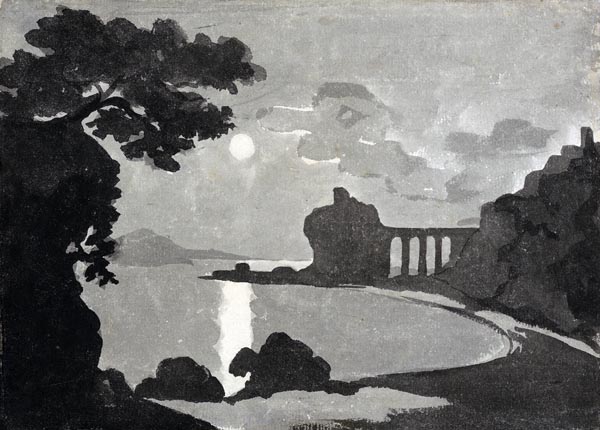
‘Italian coast by full moon’ - Johann Wolfgang von Goethe (German, 1749–1832)
Klassik Stiftung Weimar, Museen (Inv. GGz/1951)
Digital reproduction · See Art. L. 111-1 CPI and § 68 UrhG
Rome, August 11, 1787.
I have written to the Duchess (Anna Amalia of Brunswick-Wolfenbüttel, Dowager Duchess of Saxe-Weimar-Eisenach). a long letter advising her to postpone her trip to Italy for another year. If she visits in October, she will arrive in this beautiful country just as the weather is about to deteriorate, and will have an unpleasant time. Should she follow my advice in this, and other matters, she will enjoy herself, if fortune is also on her side. I sincerely wish her well on the trip.
My needs and those of others are met, and I await the future calmly. No one can change their nature, or escape their fate. Attached to this very letter, you will receive my plan of work and, hopefully, approve. I will add nothing here.
I will write often and be with you, in spirit, throughout the winter. Tasso will be with you after the New Year. Faust, as courier, will announce the arrival with a sweep of his cloak. I will then have completed a major phase, brought it to a tidy end, and can begin anew, and keep a watching eye where necessary. I feel lighter, and am almost another person than I was a year ago.
I live amidst a richness and abundance of all that is dear and precious to me, and have only truly enjoyed these past few months here. For now, things are unfolding, and art is becoming second nature to me, born, like Athene from the head of Zeus, or rather from the heads of the greatest of humankind. It will provide you all with entertainment for days, perhaps years, to come.
I wish you all a fine September. At the end of August, when all our birthdays coincide (Goethe was born on the 28th of August 1749), I will remember you, diligently. As the day’s heat subsides, I go out into the Campagna to sketch, meanwhile I often pause for a break and perform whatever tasks need to be done around the house. In the evenings, one must be especially careful to avoid catching a chill.
Rome, August 18, 1787.
This week I have had to scale back my Northern desire for exertion somewhat; the first few days were simply too hot. So, I failed to achieve as much as I had hoped. For the last two days, though, the most beautiful Tramontane winds have brought us wonderfully clear air. September and October are bound to be delightful months.
Yesterday I drove to Acqua Acetosa before sunrise; it is truly inspiring to see the clarity, the diversity, the misted transparency, and heavenly colour of the landscape, especially in the distance.
Karl Moritz is now studying antiquities too, and will humanise them for the use of young people, indeed every thinking person, purging them of all traces of bookish decay, and scholarly dust. He has a truly happy, and correct, way of looking at things; I hope he will take the time to be thorough as well. We go out for a stroll in the evenings, and he tells me what he has pondered over during the day, and what he has read of the various authors, and so a gap is filled, which I myself am obliged to leave unfilled, due to my other pursuits, and could otherwise only make up for by keeping late hours, and with some difficulty. Meanwhile, I gaze at the buildings, streets, the surrounding area, and the various monuments, and when I arrive home in the evening, some image that has particularly caught my eye is lightly sketched on paper amidst all our chatter. I am enclosing an effort from last night. It is an approximate idea of what the Capitol looks like when approached from the rear.
On Sundays, I went with dear Angelika to see the paintings of Prince Aldobrandini (Giovanni Battista Borghese Aldobrandini) especially a splendid Leonardo da Vinci (‘Christ Among the Doctors’, now attributed to Bernardino Luini, but possibly from a Leonardo design, National Gallery, London, England). She is not as happy as she deserves to be, given her immense talent and her wealth that accumulates daily. She is tired of painting for money, and yet her elderly husband finds it all too wonderful that so much profit arises from often easy work. She would like to work for her own enjoyment now, with more leisure time for proper study, and indeed she could. They have no children, live well within their income, and she can earn enough each day through only a moderate amount of work. But that is not how it is, and it seems will not be. She speaks very frankly to me; I have told her my opinion, given her my advice, and raise her spirits when I am with her. People may well point to others’ want and misery when even those who have more than enough wealth cannot employ and enjoy it! She has an incredible talent, a truly outstanding one amongst the men. One must see and appreciate what she creates, not what she fails in. How many artists’ works survive a calculation of what is lacking!
And so, my dear friends, Rome, the spirit of Rome, and the world of art, and artists, are becoming ever more familiar to me, and I understand my surroundings; they have become close and natural to me through living amidst them, and wandering to and fro. Every social visit, however brief, confuses my mind. They wish to lure me from my peaceful and orderly style of living, and draw me into their world, yet I protect myself as best I can. I promise, then delay and evade, and promise again, and play at being an Italian with these Italians. The Cardinal Secretary of State, Buoncompagni (Ignazio Boncompagni Ludovisi), has even suggested it to me over-strongly, but I will evade them yet, until I move to the countryside in mid-September. I shy away from these gentlemen and ladies as from an unpleasant illness; it even pains me watching them depart.
Rome, August 23, 1787
I received your delightful letter, numbered twenty-four, the day before yesterday, just as I was leaving for the Vatican, and read it on the way, and in the Sistine Chapel — and again and again, whenever I rested from seeing and contemplating the place. I cannot express how much I longed for you to all be with me, so that you might have some idea of what a single, talented person can do and accomplish; without having seen the Sistine Chapel, one cannot form a concrete understanding of what humans being are capable of. One hears and reads of many great and worthy artists, but here the work is still vividly before one’s eyes, directly above one’s head. I thought of you all a great deal, and wished it were all written in letter form. You want to know about myself! How much I might tell you! For I am truly reborn, renewed, and fulfilled. I feel that the sum of my powers is well-nigh available to me, and I hope to accomplish something yet. I have been thinking, seriously, about landscape and architecture during this period, and have attempted a few things, and I see now where it all leads and how far it could be developed.
Now, finally, the very essence of all forms known to us, the human figure, has touched my mind, and I it, and I say: ‘Lord, I will not let thee go, except thou bless me, even if I be lamed’ (see Genesis 32:25). Sketching the human form is completely impossible for me, and so I have decided to take up modelling in clay, which seems workable. At least I have come up with an approach that renders many aspects easier for me. It would require too lengthy a letter to address the details, and it is better to work at it than talk. Suffice it to say, it boils down to the fact that my persistent observation of Nature, and the care with which I have studied comparative anatomy, now enables me to see in Nature, and in antiquity, many things as a whole that artists find difficulty in realising in detail, things which, when they finally attain them, they possess only for themselves, and are unable to share with others.
I have retrieved all my physiognomic bits and pieces, which I had thrown down in a corner, as one does a trump card tossed on the table, and they are coming in handy. I have started a head of Hercules; if it turns out well, I shall continue.
I am now so far removed from the world, and all worldly things, that it seems quite wonderful to me when I read a newspaper. The fashion of this world is passing away; I wish to concern myself only with what constitutes lasting relationship, and thus, according to the teachings of *** (Johann Gottlieb Fichte, the philosopher), attain eternity for the spirit.
Yesterday I saw many drawings at the home of Sir Richard Worsley (7th Baronet of Appuldurcombe), who has travelled in Greece (in 1785), Egypt (in the Spring of 1787), and elsewhere. What interested me most were various drawings after bas-reliefs from the frieze of the Temple of Minerva in Athens (the Parthenon), the work of Phidias. One can imagine nothing more beautiful than these few simple figures. Incidentally, there was little charm in the sketches of many of the sites depicted; the landscapes were less than ideal, and the architecture could have been captured better. Farewell for today. I am having my portrait bust done, and that has cost me three mornings this week.
August 28, 1787.
I have encountered many good things these past few days, and today, on this festive occasion (Goethe’s birthday), Herder’s little book (‘Gott: Einige Gespräche über Spinoza’s System’, 1787), full of worthy thoughts about God, has arrived. It was comforting and refreshing to read them, pure and beautiful as they are, amidst this Babel, the mother of so much deceit and error, and to think that now is indeed the time when such sentiments, such ways of thinking, can and should be spread. I will read and reflect on his little book often in solitude, and also make notes on it that may lead to future discussion.
These last days I have been increasingly absorbed in art, and now can see almost the entire course of study I still have to complete; though even when it is completed, nothing will have been done. Perhaps there will be other occasions to do, better and more easily, that for which my talent and skill were destined.
The French Academy in Rome (housed in the Palazzo Mancini from 1737 to 1793) has mounted an exhibition of its works; there are some interesting pieces among them. Pindar, pleading with the gods for a happy end, falls into the arms of a boy he loves dearly, and so dies. There is much merit in the painting. An architect has executed a very clever idea: he has drawn a view of present-day Rome, from a direction, that shows all its districts clearly. Then, on another sheet, he has depicted ancient Rome, as if viewed from the same vantage point. The locations where the ancient monuments stood are known, as are most of their forms; ruins of many still remain. He has excluded everything that is new and imagined the old, as it might have appeared in the time of Diocletian, showing as much taste as technique, and most charmingly coloured. What I can do, I do, and I am accumulating as many ideas and skills as possible, retaining what is most real.
Have I told you already that Alexander Trippel is creating my portrait bust? The Prince of Waldeck (Christian August) has commissioned it. It is almost finished, is progressing nicely, and is in a very solid style. Once the model is complete, he’ll make a plaster cast of it, and then begin at once to carve it in marble (the marble bust, of 1789, is now located in the Residenz, Bad Arolsen), intending to finish sculpting it from life; for what can be achieved in that medium cannot be achieved in any other.
Angelika is now painting a picture that will be very successful: ‘Cornelia, Mother of the Gracchi, Pointing to Her Children as Her Treasures’ (the painting, of 1788, is now in the Virginia Museum of Fine Arts, Richmond, United States). The composition is natural, and very effective.
How wonderful it is to sow so that you may reap! I completely forgot to mention that today is my birthday, and when I rose, wondered if I might receive a gift from home to celebrate the event. And, lo and behold, your package has been delivered, which fills me with unspeakable joy. I immediately sat down to read your letters, and now I have finished and am sending my most heartfelt thanks.
Now I would like to be with you all, so we might have a conversation, and discuss some of the points I have mentioned. Enough, it will happen, and I thank you sincerely that we have set down a marker by which I can now measure the distance. I will gladly join you from the realms of Nature and Art, through which I am striding briskly.
I have reconsidered the situation today, after receiving your letter, and still insist: my art studies, my writing — everything demands that I spend the proper amount of time here. In art, I must reach the point where everything becomes intuitive knowledge, and nothing is derived merely from tradition or some past name, and I will do so in these next six months; indeed, it can only be done in Rome. I must at least complete my little projects (for they seem diminutively small to me) in an atmosphere of composure and joy.
Then everything will draw me back to my homeland. And even if I were to lead an isolated, private life, I have so much to catch up on, and reconcile, that I see no chance of rest for ten years or more.
As regards Natural History, I shall be bringing you things you cannot anticipate. I believe I am getting very close to understanding how the organism works. You should contemplate these manifestations (not fulgurations) of God with joy, and then tell me who, in ancient or modern times, has discovered or conceived the same idea, and has viewed it from the same or a slightly different perspective.
August – Later Notes
At the start of this month, an intention matured in my mind, of remaining in Rome for the winter; the feeling, rather the insight, that it would be premature to depart in my current state of knowledge, and that I would find nowhere such peace and freedom for the completion of my work, finally decided me; and once I had informed those back at home of my decision, I embraced my new period of occupancy.
The intense heat which, increasing gradually, set limits to any overly-intense activity, made places where one could spend one’s time productively, in coolness and peace, pleasant and desirable. The Sistine Chapel provided the finest opportunity for this. It is precisely at this time that Michelangelo had once again won the veneration of artists; in addition to his other great qualities, he was deemed to be unsurpassed in his use of colour, and it has become fashionable to dispute whether he or Raphael possessed greater genius. The latter’s ‘Transfiguration’ (now in the Pinacoteca Vaticana in Vatican City) has been criticised harshly, and the ‘Disputation of the Holy Sacrament’ (in the Stanze di Raffaello, Apostolic Palace, the Vatican) called his best work; thus, a predilection for works of the older artist was already foreshadowed, a view which the detached observer must regard as a symptom of superficial and limited knowledge, and cannot embrace.
It is so difficult to comprehend a single great talent, let alone two at once. The task is made easier for us through natural bias; hence, the appreciation of specific artists and writers always fluctuates and, generally, of any two, one or the other always dominates. Such disputes fail to unsettle me, as I ignore them and occupy myself in direct contemplation of everything worthy and worthwhile. My predilection for the great Florentine was soon shared by artists and art-lovers, since at that very time Friedrich Bury and Johann Lips were commissioned by Count Fries to make watercolour copies of the Sistine Chapel frescoes. The custodian was well paid; he let us enter through the rear door next to the altar, and we made ourselves at home there as we pleased. There was no shortage of food, and, weary from the intense heat of the day, I recall yielding to a midday nap on the papal throne.
Careful sketches of the lower heads and figures of the altarpiece, which could be reached with a ladder, were made, first with white chalk on black woven frames, then with red chalk on large sheets of paper.
As the focus shifted to the older masters, Leonardo da Vinci became equally famous, and I viewed, with Angelika, his highly esteemed painting, ‘Christ Among the Doctors’, in the Aldobrandini Gallery (now attributed to Bernardo Luini, see earlier). It became customary for her to arrive at my house on Sundays at noon, with her husband Antonio Zucchi, and Johann Reiffenstein, and for us to proceed, with as much composure as possible, through the sweltering heat to some art collection or other, spend a few hours there, and then return to her home for a well-attended luncheon. It was exceptionally instructive, in the presence of such major works of art, to discuss matters with these three individuals, each of whom was knowledgeable in their own way — theoretically, practically, aesthetically, and technically.
Sir Richard Worsley, who had visited Greece, kindly allowed us to view his sketches, among which the reproductions of Phidias’s works from the fronton (pediment) of the Acropolis left a strong and indelible impression on me, all the stronger because, prompted by Michelangelo’s powerful figures, I had devoted more attention and study to the human body than before.
A significant era in the vibrant art scene, however, was inaugurated by the French Academy in Rome’s exhibition at the end of the month. Jacques-Louis David’s ‘Oath of the Horatii’ (1784, Louvre, Paris) shifted the balance of opinion in favour of the French. This painting had prompted Tischbein to begin his life-size painting ‘Hector Admonishes Paris for His Idleness and Exhorts Him to Go to War’ (1786, Augusteum, Oldenburg) Through François-Hubert Drouais, Bénigne Gagneraux, Jean-Baptiste Desmarais, Louis Gauffier, and Jean-Pierre Saint-Ours (Swiss by origin), the French reputation for excellence was maintained, while Pierre-Jean Boquet, gained a name for himself as a landscape painter in the tradition of Poussin.
Meanwhile, Karl Moritz was studying ancient mythology; he had come to Rome to finance his travels, in the manner of earlier times, by writing a travelogue. A bookseller had agreed an advance; but during his stay in Rome, Moritz soon realised that a light, loosely-written diary could not be published without risk. Through daily conversation, and the contemplation of the many significant works of art around him, he had the idea of writing a treatise on the ancient deities, from a purely human point of view, and to publish such works in the future, with instructive descriptions based on lithographs. He worked diligently on this, and our society did not fail to engage in meaningful discussion with him about it.
I had a most pleasant and instructive conversation with the sculptor Alexander Trippel in his workshop, as he was modelling my bust, which he was to sculpt in marble for the Prince of Waldeck. There could hardly be a better opportunity to study the human form, and to learn about its proportions, both as standard and in its variations. The opportunity was doubly interesting because Trippel had learned of a head of Apollo (a Roman copy, in marble, now in the British Museum, London, which is modelled on the Apollo Belvedere,) that had previously remained unnoticed in the collection of the Palazzo Giustiniani. He considered it one of the finest works of art, and hoped to purchase it, but was unsuccessful. This antique has since become famous and later was purchased for the art-collection, at Neuchâtel, of James-Alexandre de Pourtalès (Comte de Pourtalès-Gorgier, a Swiss-French banker, diplomat and art collector).
But just as someone who ventures to sea finds their course is determined by wind and weather, taking one now this direction, now that, so it was with me. Verschaffelt (Peter Anton von Verschaffelt, the Flemish sculptor and architect) started a course on perspective, to which we gathered in the evenings, where a large group listened to his teachings and put them immediately into practice. The best thing about it was that one learned precisely what was needed, and no more.
I was like to have been torn from this contemplative, yet engrossed repose. Our unfortunate concert had been widely discussed in Rome, where, as in smaller towns, the to and fro of daily gossip is a customary pursuit; attention had fallen on me, and my literary work; I had read ‘Iphigenie’ and other works to my friends, which were further discussed. Cardinal Buoncompagni demanded to see me, but I remained firmly in my well-known seclusion, and I was able to do so all the more readily because Johann Reiffenstein maintained, stubbornly and firmly that since I had not allowed him to present me to the cardinal, no one else could. This worked very much to my advantage, and I took advantage of his attitude to maintain my chosen, express, seclusion.
September 1, 1787
Today, I can say, ‘Egmont’ is complete; I have been working on it, now and then, all this time. I am sending it via Zurich, because I hope Christoph Kayser will compose interludes for it, and whatever else is needed musically. Then I wish you enjoyment of it.
My art studies are progressing well; my approach is universally applicable and opens up everything to me. All that artists have to painstakingly piece together individually now lies openly and freely before me. I now see how little I know as yet, but the path is open to grasping and understanding the whole.
Moritz is very much taken with Herder’s doctrine of God; it is certainly delineating an epoch in his life. His mind was inclined towards it, having profited from association with myself; like well-dried wood his mind immediately burst into bright flame.
Rome, September 3rd.
Today marks the anniversary of my departure from Carlsbad. What a year! And what a strange moment this day betokens for me, being the Duke of Saxe-Weimar’s birthday (Karl August was born on that date in 1757) and marking the birth of a new life for me. How well I have used this year, for myself or for others, I cannot as yet determine; I hope the time will come, the fortunate hour, when together we can determine the sum.
My studies are only just beginning here, and I would not truly have seen Rome at all if I had left earlier. One cannot imagine all that there is to see and learn here; one cannot possibly grasp the totality from afar.
I have returned to matters Egyptian. These past few days I have visited, on several occasions, that huge obelisk, which lies broken among the rubble and dung of a courtyard. It is the obelisk of Psamtik II, erected in Rome in honour of Augustus, and stood as the pointer of the great sundial marked on the ground of the Campus Martius. This oldest and most magnificent of many monuments is now in pieces, some of its sides disfigured (probably by fire). And yet it is there still, and the undamaged sides are still as fresh as if carved yesterday, and of the finest workmanship (of its kind). I am now having moulds taken of a sphinx near its summit, and the faces of sphinxes, human beings, and birds, so as to produce plaster casts. Priceless things must be preserved, especially since it is said that the Pope wants to have it erected (it was re-erected, in 1792, in the Piazza di Montecitorio), as the hieroglyphs will no longer be accessible. I intend to do the same with the finest Etruscan artefacts, and others. I am currently modelling the impressions in clay, so as to render everything truly my own.
September 5th.
I must write on a morning that will be a festive one for me. For today, ‘Egmont’ is almost completely ready for publication. The title page and character list are written, and some gaps I had left have been filled; now I am already looking forward to the hour when you will receive and read it. Some drawings will also be enclosed.
Thursday, September 6th, 1787.
I had intended to write a great deal, and tell you all sorts of things in my last letter, but was interrupted, and tomorrow I am off to Frascati. This letter must go on Saturday, and I will say only a few words of farewell for now. You probably have the same beautiful weather we are enjoying under this clearer sky. I am constantly full of new ideas, and since there are a thousand things around me, they have awakened me to this thought: from many directions, all seems to have converged on a single point; indeed, I can say that I now see the light as regards the path on which I and my abilities are heading. One has to have reached a certain age to have gained even a passable idea of one’s situation. So, it’s not just the Swabians who need forty years to become wise (‘Mit vierzig Jahren werden die Schwaben gescheit’, a Swabian proverb).
I hear that Herder is ill, and am concerned; I hope to hear better news soon. I myself remain well, both physically and mentally, and can almost hope for a radical cure; everything comes easily to me, and sometimes a breath of youth wafts over me. ‘Egmont’ is following this letter, but will arrive later, as I am sending it via the postal service. I am quite curious and eager to hear what you will think of it.
Perhaps it would be as well to print it soon. I would be delighted if the work could reach the audience fresh from the pen. See if you can manage it so; I shall not be far behind with the rest of the book.
Herder’s book on God and Spinoza provides me with the best company. Moritz has been truly edified by it; all that was missing for him, as it were, was this work, which now serves as the capstone to his thoughts, which had always threatened to fall apart. Things are turning out quite well. He has encouraged me to delve further into Nature, where, especially in botany, I have come across a principle that astounds me; how far it can be extended, I cannot as yet see.
My practice of engaging with artworks, and absorbing, in one go, the issues and solutions artists and connoisseurs have been grappling with, and studying, since the renaissance of art, I find more valid with every application. It is somewhat like the tale of Christopher Columbus standing an egg on end by tapping it and breaking the tip (that is, a result which seems simple after the fact). Without claiming to possess the master key, I now discuss various works with the artists from a practical viewpoint, to see how far they have progressed, what they have achieved, and where they have encountered obstacles. The door, then, is open. I stand on the threshold, but sadly, from here I will only be able to look around the temple, and then depart.
This much is certain: the ancient artists possessed just as profound a knowledge of Nature, and just as sure a grasp of what can be imagined, and how it ought to be developed, as Homer. Unfortunately, there are far too few first-class works of art. Yet when one views them, few though they are, one desires only to ‘recognise’ them fully and then depart in peace. These great works of art, like the highest works of Nature, though produced by humans were created according to true and natural laws. Everything arbitrary and fanciful has been banished; all is necessity, all is God.
In a few days I will be permitted to see the work of a talented architect (Louis-François Cassas) who has himself visited Palmyra (in 1785) and drawn the objects there, with great intelligence and taste. I will let you know my impressions, immediately and will eagerly await your thoughts on those important ruins.
Rejoice with me that I am happy; indeed, I can truly say I have never been so happy: to be able to satisfy an innate passion in the greatest peace, free of distraction, and to anticipate a lasting benefit from such sustained pleasure, is surely no small thing. If only I could share some of my enjoyment and these feelings with my beloved friends.
I hope the dark clouds on the political horizon will dissipate (the Prussian invasion of Holland to suppress the ‘Patriot’ uprising and restore the Stadtholder William V). Our modern wars make many unhappy while they last, and none happy when they are over.
September 17, 1787.
It seems, my dear friends, that I am a person destined to live by toil. These past few days I have again been labouring more than enjoying myself. Now the week is near its end, and you shall have a letter.
It is a pity that the aloes on the Belvedere (del Gianicolo, the Janiculum Hill) chose the year when I was absent to bloom. In Sicily, it was too early. Only one is blooming here this year, not a large one, and is so high up that it is impossible to reach. It is probably a plant of India, not really native to these regions.
The Englishman’s observations give me little pleasure. Clergymen in England must be very guarded, lest they drive away the public, even free Englishmen are obliged to exercise considerable restraint in their moral writings.
The ‘men with tails’ don’t surprise me; based on the description, it must be a natural phenomenon. Far more wonderful things are immediately before our eyes every day, which we fail to notice because they are not so closely related to ourselves.
That B… like many people who have never had a feeling for the genuine worship of God during their lives, but become pious in their old age, is fine, as they say, as long as one is not expected to be edified by the fact.
I spent a few days at Frascati, with Johann Reiffenstein; Angelika came to collect me on Sunday. It is a paradise.
‘Erwin and Elmire’ (an opera in two acts by Duchess Anna Amalia of Brunswick-Wolfenbüttel, libretto by Goethe, after Oliver Goldsmith’s ballad of Edwin and Angelina, ‘The Hermit’, in ‘The Vicar of Wakefield’) is already half re-written. I tried to breathe more interest and life into the little piece, and did away with the extremely flat dialogue completely. It is student work, or rather scribble. The pretty songs, on which everything revolves, all remain, of course.
The arts are also being pursued with gusto, such that my studies roar along.
My bust has turned out very well; everyone is pleased with it. It is certainly carved in a fine and elegant style, and I have no objection to the idea persisting that I might well have looked like that. It will now be translated to marble and finished from life. Transporting such an item is troublesome; otherwise, I would send you a cast right away. Doubtless it will be shipped someday, since I will eventually have to pack several crates with my possessions.
Has Kranz (Johann Friedrich Kranz, the composer) not arrived yet, to whom I gave a box for the children?
There is now a truly graceful operetta being performed at the Teatro Valle, after two disastrous ones. The singers are performing with great enthusiasm, and the whole thing is most harmonious. Soon we will be heading to the countryside. It has rained a few times, the weather is cooler, and the landscape turning green again.
The newspapers will have told you, or will tell you, about the great eruption of Mount Etna (early June to August, 1787).
September 15th.
Now, I too have read Trenck’s life (Friedrich Freiherr von der Trenck, the Prussian officer, adventurer, and author, see his autobiography, published 1787, ‘Friedrichs Freyherrn von der Trenck merkwürdige Lebensgeschichte’). It is interesting enough, and there is plenty there to reflect on.
My next letter will tell of my meeting with a notable traveller, which is arranged for tomorrow.
Rejoice, with me, in my stay here! Rome now feels completely familiar, and there is almost nothing now which overwhelms me. My surroundings have gradually elevated my mind. I enjoy things in a purer way, and with ever-increasing knowledge; may good fortune continue to guide me.
Enclosed is a copy I made of a drawing, to share with my friends. Another reason why my stay in Rome is so interesting is because Rome is the central point around which so much revolves. Louis-François Cassas, the traveller I mentioned, has brought back with him some exceptionally beautiful sketches. So, I have mentally stolen some of them from him, wishing to return with them, for you to see.
I am always busy. I have drawn a little head, from a plaster cast, to see if my principle holds. I think it works perfectly and makes the process surprisingly easy. People did not believe I created it, and yet it is nothing. Now I shall see how far it could be taken with a little more application.
On Monday I am returning to Frascati. I will make sure to post you a letter, this day week. Then I shall probably go to Albano. I shall be drawing, diligently, from Nature. I don’t seek to learn anything more now, only to produce something, and exercise my mind fully. I have suffered from this illness since my youth, and God grant that it will one day be cured.
September 22.
Yesterday there was a procession in which they bore a phial containing the blood of Saint Francis; I gazed at heads and faces as the lines of priests passed by
I have acquired a collection of two hundred of the finest antique-gem impressions. They are most beautiful examples of ancient craftsmanship, in part chosen for their exquisite qualities. One cannot carry away anything more precious from Rome, especially since the impressions are so exceptionally clear and sharp.
I shall return with many good things when I dock my little boat with you, but above all a joyful heart, one more capable of enjoying the happiness that love and friendship have in store for me. I simply must not undertake anything again that lies beyond the scope of my abilities, where I would merely toil away without achieving anything.
September 22.
One more page, my dear friends, I must urgently send you with this post. Today was a remarkable day for me. Letters from my many friends, one from the Dowager-Duchess, news of the celebration of my birthday, and finally my collected works.
It feels truly strange to me that these four relatively slim little volumes (published by Georg Joachim Göschen, in Leipzig, 1787) the output of half a lifetime, have found me in Rome. I can honestly say that there isn’t a single word in them that has not been lived, felt, enjoyed, suffered, and thought about, and now they speak to me all the more vividly. My only concern, and hope, is that the four that are destined to follow, will not fall short of these. I thank you for everything you have done in this connection, and I hope they bring joy to you as well. Please take the same care for the volumes that will follow, and with the same loyal hearts!
You are annoyed with regard to my using the term ‘provincial’, and I confess, the expression is most inaccurate. You see, from it, how people in Rome have become accustomed to thinking of everything in grandiose terms. It really does seem that I am becoming naturalised, because the Romans are blamed for only seeking to know of, and talk about, grand matters (cose grosse).
I am always diligent, and now am focussed on the human figure. Oh, how vast and expansive art is, and how infinite the world becomes when one grasps the finite rightly.
On Tuesday the 25th, I am off to Frascati, and will toil and labour there too. Things are finally starting to go better. If only they would go right for once.
I have noticed that in a large city, amidst a wide circle, even the poorest, the lowliest feel something, while in a small place even the best, the richest among us can barely feel at all, cannot even catch their breath.
Frascati, September 28, 1787.
I am very happy here; all day long, and into the night, we sketch, paint, ink, and collage, practising our crafts and art with true professional skill. Johann Reiffenstein, our host, keeps me company, and we are lively and cheerful. In the evenings, we visit the villas by moonlight, and even sketch the most striking motifs in the half-light. I have already conceived some projects, that I only seek an opportunity to execute. I hope that the time for that will come. One’s aims only seem unachievable if one looks too far ahead.
Yesterday we drove to Albano and back; many a winged idea was downed along the way. Here, where one is truly surrounded by abundance, one can indulge one’s flights of fancy, and I am burning, with true passion, to appropriate everything, and feel that my taste is becoming more refined as my mind absorbs more. If only, instead of all this talk, I could send you something excellent for once! A few small items are being sent by a fellow countryman.
I will probably have the pleasure of seeing Kayser (Philipp Christoph Kayser, the composer and poet) in Rome, and so music will complete the circle the arts have drawn around me, as though they want to prevent me from seeing my friends. And yet I can scarcely touch upon the subject of how alone I often feel, and the longing that grips me to be with you all again. I am, in essence, living in a daze, unable and unwilling to think further.
I spend some truly pleasant hours with Karl Moritz, and have started explaining my theory of plants to him, noting, in his presence, each time, how far we have advanced. In this way, I have been able to put some of my thoughts down on paper. How comprehensible even the most abstract aspects of my system become when presented in the right way to a receptive mind, I see from my new student’s response. He takes great pleasure in it all, and advances his own conclusions. However, it is difficult to present in writing, and impossible to grasp from merely reading the result, no matter how accurately and precisely everything is penned.
Thus, I live happily, inasmuch as I am a part of what belongs to the Creator. Greet all who wish me well, and aid, support, and sustain me, directly or indirectly!
September – Later Notes
The third of September was many times worthy of celebration. It was the birthday of my prince (Karl August, Duke of Saxe-Weimar), who has repaid my loyal affection in many kind ways, and it was also the anniversary of my Hegira from Carlsbad, though I was not allowed to appreciate fully what experiencing a completely new state of being has worked in me, delivered to me, and gifted me with; having little time that day for reflection
Rome has the distinct advantage of being a centre of artistic activity. Educated travellers agree on owing a great deal to their sojourns here, whether short or long; they travel on, labouring, and collecting, and when they return home enriched, they consider it an honour and a joy to display what they have acquired, and offer a token of gratitude to their teachers, near and far.
The French architect Louis-François Cassas has returned from his journey to the Orient (see his ‘Voyage Pittoresque de la Syrie, de la Phénicie, de la Palestine et de la Basse-Égypte’, 1799); he has surveyed the most important ancient monuments, especially those of which details have not yet been published, and has also sketched the places as they should be viewed, pictorially displayed the no less ancient, but decayed and destroyed, conditions of life, and outlined half a score of his drawings with the pen, showing great precision and taste, and enlivened them with watercolours, before presenting the following to his audience.
1. The Seraglio of Constantinople from the shore, showing part of the city and the Hagia Sophia Mosque. On the most charming tip of Europe, the residence of the Sultan is constructed in a manner that is as whimsical as one could imagine. Tall, inviolate trees stand in large, mostly-interconnected groups, while beneath them one sees not great walls and palaces, but small buildings, trellis-work, passages, kiosks, and carpets spread out and mingled together, in so domestic, detailed, and friendly a manner, that it is all a delight. Since the drawing is executed in colour, it creates a most pleasant effect. A fine stretch of sea washes against the thus-burdened coastline. Opposite lies Asia Minor, and one can follow the strait that leads to the Dardanelles. The drawing is about seven feet long and three to four feet high.
2. A general view of the ruins of Palmyra, to the same scale. He showed us a plan of the city beforehand, which he had traced amidst the rubble. A colonnade, an Italian mile (a little shorter than an English mile) long, ran through the city, from the gate to the Temple of the Sun (the Temple of Bel), not in a perfectly straight line, but making a gentle bend in the middle. The colonnade had four rows of columns, each column ten diameters high. It does not appear that the top was permanently covered; he believes this was achieved with stretches of tapestry. In the drawing, part of a colonnade appears still standing upright in the foreground. A caravan crossing the scene is happily placed. In the background stands the Temple of the Sun, and on the right a large stretch of ground across which several Janissaries are advancing. The most interesting phenomenon depicted is a blue line, like to the horizon at sea, that borders the background. He explained to us that the desert horizon, which appears blue in the distance, bounds the scene completely, just as the sea does, deceiving the eye immersed in Nature just as it initially deceived me in viewing the picture, and intrigued me, knowing that Palmyra was far from the sea.
3. The Tombs of Palmyra.
4. A Restored View of the Sun Temple at Baalbek, also a landscape with the ruins as they currently exist.
5. The Great Mosque (the Al-Aqsa Mosque) in Jerusalem, built on the foundations of Solomon’s Temple.
6. The ruins of a small temple in Phoenicia.
7. A region at the foot of Mount Lebanon, as charming as one imagines, showing a pine-grove, a body of water, weeping willows, with graves beneath them, and the mountain in the distance.
8. Turkish graves. Each gravestone bears the deceased’s main adornment, and since Turks are distinguished by their head-gear, the dignity of the deceased is immediately apparent. Flowers are cultivated with great care over the graves of virgins.
9. The Egyptian Pyramids with the Great Sphinx. According to Cassas, it was carved from a limestone rock, and since the rock was cracked and uneven, the colossus was covered with stucco and painted, as can still be seen in the folds of the head-dress. One section of the face is about ten feet high. He could have easily walked, he said, on its lower lip.
10. A pyramid, restored according to documents, observations, and conjectures. It has halls projecting on four sides, with obelisks standing beside them; leading from the halls are passageways adorned with sphinxes, such as those still found in Upper Egypt. This drawing is the most prodigious architectural idea I have ever seen, and I believe it cannot be surpassed.
In the evening, after we had contemplated, at leisure, all these beautiful things, we visited the gardens on the Palatine Hill, which render the spaces between the ruins of the imperial palaces a delightful green. There, in a communal space where, beneath magnificent trees, fragments of decorated capitals, smooth or fluted columns, broken bas-reliefs, and other such things have been laid out in a wide circle, as one sets up tables, chairs, and benches for a cheerful outdoor gathering, we enjoyed a delightful time, to our hearts’ content. And as we surveyed the many and varied views at sunset, with newly-clarified vision and freshly-educated minds, we confessed that the scene was quite comparable to all the other Oriental views revealed to us that day. Drawn and coloured in an identical style to that of Cassas, it would rouse delight anywhere. And so, through artistic works, our eyes are gradually attuned to, and become ever more receptive to, the presence of Nature, and ever more open to the beauties it offers.
Yet the next day, we found an opportunity for light-hearted comments, since precisely what we had seen depicted by the traveller and artist — all that was great and boundless — was now about to lead us into an unworthy space less than great, and closely confined Those magnificent Egyptian monuments reminded us of the mighty obelisk which had been erected by Augustus on the Campus Martius, had served as a giant gnomon, but now lay broken in pieces, enclosed in a wooden shed, awaiting, in a wretched corner, the bold architect who might be summoned to resurrect it (which was achieved in 1792, see above). It was hewn from the finest Egyptian granite, and covered everywhere with delicate figures and hieroglyphs, in the familiar style. It was remarkable to see, on standing beside its erstwhile summit pinnacle, the most delightful depictions of sphinx after sphinx on the surfaces of the tapering column, which had previously been invisible to close inspection, being open then only to the sun’s rays. Here we encountered a case of art in its religious aspect, designed for other than its effect on the human eye. We made arrangements to have casts taken of these sacred images so that we could examine more closely what had once been directed towards the sky.
In that awkward and unpleasant space in which we found ourselves, beside a noble work of art, we could not help but view Rome as a quodlibet (a medley), but a unique one of its kind: for even viewed in that manner, the immense city possesses the greatest of merits. Here, nothing was created by chance, only the accidents of time have destroyed; everything that still stands upright is magnificent, everything that is shattered is venerable, the formlessness of the ruins still points to an ancient regularity of form that re-emerged in the grand new architecture of the churches and palaces.
The casts, quickly taken, reminded me that in the large Dehn collection of plaster casts (that of Christian Dehn, the German artisan and agent), from which impressions are available for purchase in whole or in part, there were also some Egyptian pieces to be seen; and, one thing having led to another, I selected the finest casts from the said collection and purchased fresh copies from the owners. Such impressions are the greatest of treasures that amateurs, of limited means, can acquire for the foundation of their collections, providing a great and manifold resource for future study.
The first four volumes of my writings having been received from Georg Göschen, the magnificent set was immediately given into the hands of Angelika, who trusted she would find a new reason to praise her mother tongue therein.
But I will not dwell on the reflections that vividly presented themselves to me in looking back on my earlier work. I saw not then how far my chosen path would lead me; nor could I know to what extent that earlier endeavour would succeed, or how the fulfilment of my longing, and the success of this journey of mine would reward the effort expended.
I had neither the time nor the space, at that moment, to look back for long, or think. The ideas about organic Nature, of formation and transformation, which had been instilled in me, as it were, allowed no pause, and as one thought after another unfolded within me, I needed some kind of communication with another, daily and hourly, to aid my education. I attempted it with Moritz, explaining my theory regarding the metamorphosis of plants to him as best I could; and he, a foreign vessel, always empty and in need of content, yearning for whatever he could appropriate, joined in honestly, at least as long as I retained the courage to continue my lectures.
Then, however, a curious book came to my attention — I am unable to say whether it helped the theory, but it certainly provided significant inspiration for myself — namely Herder’s text, which, under a laconic title, endeavoured to present his various views on God and divine matters in dialogue form. The work transported me back to those times when I often sought to converse about such subjects in person with my excellent friend. Meanwhile, his volume, involving the nature of the highest contemplative piety, contrasted notably with the feast of one particular saint which took place at that time.
On September 21st, the memory of Saint Francis was venerated, and a phial of his blood was carried through the city amidst a long procession of religious persons, and the faithful. I was struck by the passing of so many monks, whose simple robes drew the eye to their heads and faces. It struck me to what degree hair and a beard are often involved in forming one’s first impression of a man. First with attention, then with a degree of astonishment, I studied the line passing before me, and was delighted to find that a face framed by hair and beard looked quite different from these beardless people. And I could see that such faces, depicted in paintings, are bound to exert an ineffable charm on the viewer.
Johann Reiffenstein, who is thorough in exercising his duty of guiding and entertaining foreigners, soon realised in doing so that those who visited Rome for no more purpose than sightseeing and amusing themselves often suffered from the most grievous boredom, since, in a foreign country, they lacked entirely their usual resources for filling their leisure time. Being a practical judge of character, he is also well aware of how tiring mere observation can be, and how necessary it is to entertain and soothe his friends through some other form of activity. He therefore identified two pursuits to which he usually directs their efforts: wax-painting and plaster cast-production. The art of using a wax-based medium as a binder for paint had only recently been revived, and since the main concern in the art world is to keep artists employed in some way, a fresh way of performing something familiar always gains attention, and provides a lively reason to attempt something in a new manner that one would not be inclined to attempt in the old.
An audacious undertaking, that of creating a copy of Raphael’s Vatican loggias, for Empress Catherine II of Russia, while replicating the architecture with its abundance of ornamentation, entire, in St. Petersburg, was facilitated by this new technique; indeed, it may not have been possible without it. Identical panels, wall-sections, plinths, pilasters, capitals, and cornices, crafted from the strongest lengths and blocks of durable chestnut wood, covered with canvas which was then primed, served as a secure base for the encaustic. This work, on which Christoph Unterberger (born in the Italian Tyrol, and trained in Vienna), in particular, had been working for several years under Johann Reiffenstein’s guidance, and had executed with great conscientiousness, had already been completed when I arrived, and I could only observe and study what remained of that great undertaking.
Now, through such efforts, encaustic has risen to great prominence; foreigners of some talent became acquainted with its practise; ready-made pigments were available at a low price; one could even produce one’s own wax medium; in short, there was always something to do and spend time on, whenever a spare moment presented itself. Even merely-aspiring artists were employed as teachers and assistants, and I have indeed seen several foreign visitors who happily packaged up the former’s Roman encaustic works, as if they were of their own creation, on returning to their homeland.
The other occupation, manufacturing plaster casts, was more often indulged in by men. A large, old vaulted kitchen in the Reiffenstein quarter of the city, provided the perfect environment. Here, there was more than enough space for such a task. The refractory and infusible mass, is pulverised and sifted to the finest powder; the dough kneaded from it is pressed into moulds, carefully dried, and then, placed in an iron ring, set in the embers. Plaster of Paris is then poured into the moulds, and eventually a small work of art, delighting whoever owes it to the work of their own hands, is revealed.
Johann Reiffenstein, who willingly and diligently introduced me to these activities, soon realised that such employment did not suit, and that my true inclination was to develop my manual skill and employ my eyesight, as far as possible, by copying things from Nature, and art objects. The intense summer heat had scarcely subsided when he led me, in the company of several artists, to Frascati, where we found lodging and immediate necessities in a well-furnished private house. Having spent the entire day outdoors, we enjoyed gathering in the evenings around a large maple-wood table. Johann Georg Schütz, a Frankfurt native, a skilful artist but without eminent talent, and devoted more to a secure and comfortable existence than sustained artistic activity — which is why the Romans called him ‘Il Barone’ (the Baron) — accompanied me on my wanderings, and proved invaluable to me in many ways. When one considers that centuries have been spent here in the noblest architectural pursuits, and that the mighty structures that remain highlight and present to the eye the artistic ideas of outstanding minds, one will understand how both mind and eye find delight, in any light, in observing their manifold, thousandfold, horizontal and vertical lines, intercepting and adorning them, in silent harmony, and how everything that is small and limited within one is stirred and expelled, though not without pain. The abundance of moonlit views is particularly notable, in which the individually-entertaining, perhaps even disturbing, details wholly recede, and only the vast masses of light and shadow present to the eye immensely graceful, symmetrically-harmonious, and colossal forms. By way of contrast, there was no shortage of instructive, often playful, entertainment in the evenings.
It cannot be concealed that the younger artists, knowing and noting the peculiarities of our stalwart Reiffenstein, commonly called weaknesses, often discussed these traits quietly, jokingly, and mockingly. Now, one evening, the subject of the Apollo Belvedere, that inexhaustible source of artistic conversation, arose again, and upon the remark that the ears on that excellent head were not particularly well-carved, the discussion naturally turned to the question of the dignity and beauty of those organs, and the difficulty of finding an attractive one in Nature and of reproducing it artistically, with perfect symmetry. Since Georg Schütz was known for his handsome ears, I asked him to sit by the lamp, opposite me, while I sketched, with care, an exceptionally well-formed one of his — it was doubtless the more perfect one. He found himself seated, in a rigid pose, directly opposite Johann Reiffenstein, from whom he was not to, and must not, divert his gaze. Johann began to present his oft-commended maxim: one should not turn directly to the finest works of art, but should start with those by Annibale Carraci, specifically those in the Farnese Gallery, then move on to Raphael’s works, and end by sketching the Apollo Belvedere so often that one comes to know it by heart. Thereafter there would be little more to wish or hope for.
The good Schütz was seized by an inner fit of laughter, which he could scarcely contain, and the effort of doing so increased the longer I sought to have him sit still. Thus, the teacher, and benefactor, should forever expect but mocking ingratitude and unjust treatment, on account of their individual, and habitual quirks of mind.
A magnificent, though not unexpected, view greeted us from the windows of Prince Aldobrandini’s villa at Frascati. He, being at this time in the countryside, kindly invited us, and entertained us festively, at his well-laden table, in the company of his clerical and secular household. As one can imagine, the house was designed in such a way as to allow one to survey the splendour of the hills, and the surrounding countryside, at a glance. There is much talk of pleasure-palaces; but one has only to gaze from there, to be convinced that a villa could hardly be situated more delightfully.
Here, however, I find myself compelled to add a remark whose seriousness and significance I feel able to recommend. It sheds light on what has been said and will illuminate what follows; moreover, many a fine, but as yet still developing mind, may find cause for self-examination therein.
Individuals with a lively, inquisitive mind are not content with mere pleasure; they demand knowledge. This drives them to independent activity; while however successful one is, one ultimately feels that one can only truly judge what one is able to produce oneself. Yet this is not readily understood, and from the fact arise certain misguided endeavours, which become all the more troublesome the more honest and the purer the intention. During this period, doubts and suspicions began to arise within me, unsettling me even amidst my pleasant situation; for I was soon obliged to acknowledge that the true desire and purpose of my being here would hardly be fulfilled.
After several enjoyable days, we returned to Rome, where we were compensated for the freedom of the open air we now lacked by a new, and most charming opera performed in a bright, packed hall. The German artists’ row of seats, one of the front ones in the stalls, was as usual densely occupied, and once again there was no shortage of applause and acclaim, for both present and past delights. Indeed, we managed to silence the entire, loudly- chattering, audience by means of a concerted, first soft, then louder, finally commanding, murmur of ‘Zitti!’ (‘Quiet!’) uttered at the ritornello of an approaching popular aria, or some other pleasing passage. For this reason, our friends on stage were kind enough to direct the most interesting aspects of their performance towards us.
Frascati, October 2nd.
I must start my little letter soon, if you are to receive it on time. In fact, I have both too much and too little to say. I draw and sketch constantly, and think of my friends, silently, while doing so. These days I have again felt a great longing for home, precisely perhaps because I am so comfortable here, and yet feel that I miss what is dearest to me.
I am in a rather peculiar state, but just need to gather myself together, make the most of each day, do what needs to be done, and work my way through the winter.
You would not believe how useful, but also how difficult, it has been for me to live entirely among strangers this whole year, especially since Tischbein — I tell you this between ourselves — has not made the impression on me I had hoped for. He is a genuinely decent fellow, but not as straightforward, natural, or open as his letters suggest. I can only describe his character verbally to you, so as not to do him an injustice, and what good is a description rendered in that manner! A person’s life reveals their character. Now I hope to have Christoph Kayser for company; he will prove a great joy to me. May heaven grant that nothing comes between us!
My primary concern is, and always will be, to achieve a certain level of skill at drawing, with which one can create with ease, without having to relearn anything, nor remain stranded for as long as I have unfortunately done, and so missed out on the best years of life. But I must excuse myself. To draw for the sake of drawing would have been like speaking for the sake of speaking. If I had nothing to express, if nothing inspired me, if I first had to seek, laboriously for worthwhile subjects, indeed, if even after all my searching I could scarcely find any, where was the urge to draw supposed to come from? In these realms, however, one must become an artist; everything forces itself upon one, and one becomes more and more filled with the desire, nay, compelled, to create. Based on my aptitude, and my knowledge of the path, I am convinced that I could make great strides here, given a few years residency.
You demand, my dear friends, that I write about myself, and behold, I do so; when we meet again, you shall hear much. I have had ample opportunity to reflect on myself and others, on the world and on history, and I will share much of what I find excellent, if not new, in my own good time. Finally, everything will be gathered together, and embodied in ‘Wilhelm Meister.’
Karl Moritz remains my favoured companion so far, though I feared, and still do fear, that he only wants to become wiser from my company, not more correct, nor better, nor happier, which is the concern that always holds me back from being completely open with him.
In general, living amidst several people suits me quite well. I observe each person’s temperament and way of behaving. One plays his part, another not; one will advance himself, another hardly at all. One gathers in, another scatters. One is satisfied with everything, another with nothing. One has talent and fails to employ it, another has none and yet is diligent, and so on. I see all this, and remain at the centre; it amuses me and, since I have no real role in these people’s lives, nothing to answer for as regards them, it fails to leave me in an ill humour. Only, my dear friends, when everyone acts according to their own wish, yet pretends that a whole will ultimately evolve, establish itself, and remain in existence, while taking its raison d’être from oneself alone, there is no recourse but to part, lest one is driven mad.
Albano, October 5, 1787.
I wish to be sure of sending this letter to Rome by the morning post, so can only say a thousandth of what I have to say, on this sheet.
I received your package yesterday, at the same time as the ‘Scattered’ (or rather ‘Collected’) papers, and the ‘Ideas,’ (Herder’s ‘Zerstreute Blätter’: Scattered Leaves’ and ‘Ideen zur Philosophie der Geschichte der Menschheit’: ‘Ideas for the Philosophy of History of Mankind’) and the four Moroccan-leather bound volumes, just as I was about to leave Frascati. They are now a treasure to me, a testament to the entire villeggiatura (trip).
I read ‘Persepolis’ (Herder’s ‘Persepolis: Eine Muthmaassung’: ‘Persepolis: A Conjecture’) last night. It delights me immensely, and I can add nothing, for such style and artistry are lacking here. I now wait to see the aforementioned books in some library and thank you again. Continue, I beg you, continue because you must. Illuminate everything with your light!
The ‘Ideas,’ the poems, are still untouched. My writing may now continue; I will advance, loyally. The four copperplate engravings for the completed volumes shall be done here.
With those persons mentioned earlier, the relationship was merely a good-natured truce on both sides; I knew that, but only what can happen, will happen. There will be ever-increasing sense of distance and finally, if things go extremely well, a quiet, easy separation. The one is a fool, brimming with pretentious simplicity. ‘My mother has geese’ (‘Meine Mutter hat Gänse’, a folk lullaby) is certainly sung with a more comforting naiveté than ‘To God alone on high be glory.’ (‘Allein Gott in der Höh’ sei Ehr’, a sixteenth-century Lutheran hymn). He is, once and for all — the singer of: ‘They’ll let not the hay and the straw, the hay and the straw, go astray,’ (‘Sie lassen sich das Heu und Stroh, das Heu und Stroh nicht irren’, a folk song) and the like. Away with these people! Their first ingratitude is preferable to their last. The other, behaves as if he has come from a foreign country to that which is truly his own, and has come to a people who are searching for themselves without being prepared to admit it. He will find himself a stranger here, and perhaps fail to know why. If I am not very much mistaken, the magnanimity attributed to Alcibiades is a sleight of hand by ‘the Zurich prophet’ (Johann Kaspar Lavater, the Swiss poet, writer, philosopher, physiognomist and theologian, who in his ‘Essays on Physiognomy,’1797, attributed Alcibiades’ facial features to a combination of magnanimity, terror, and volatility), who is clever and agile enough to juggle large and small spheres with incredible dexterity, and mingle them together, in order to make truth and falsehood stand or disappear according to his theologically poetic mind. May the Devil take him, or preserve him, who always was a friend of lies, demonology, premonitions, longings, and so on from the very beginning!
Now, I must take a new sheet and ask you to read in the same way I write, with your mind more than your eyes, as I do with my soul more than my hands.
Continue, dear brother, to find, to unite, to compose, to write, without concerning yourself with others. Each must write as he lives: first for his own sake, and then for kindred spirits.
Plato said ‘Let none ignorant of geometry enter here’ (Ageōmétrētos mēdeìs eisítō). If I were capable of leading a school, I would deny entry to anyone who had not, seriously and genuinely, studied some kind of Natural Science. Recently, I came across the nonsensical words, written in a tiresomely-apostolic, Capuchin-style declamatory manner by the Zurich prophet: ‘Everything that has life lives through something outside itself.’ Or something in that vein. Now, every pagan convert will repeat it, and not a benevolent spirit in sight to nip their effort in the bud whenever they so revisit it. They have failed to grasp the most basic, fundamental truths of Nature, and yet would love nothing more than to sit around the ‘throne’ on chairs on which others should be seated, or no one at all. Leave all that alone, as I do, though I certainly have an easier task at the moment!
I prefer not to describe my life; it would appear far too pleasant. I am mainly occupied with landscape drawing, for the benefit of which this land and sky make exceptionally inviting subjects. I have even found a few idyllic corners. What am I not able to create here! I see it all clearly; one just needs to surround oneself with fresh scenes to feel content.
Farewell and be happy, and if things should offend you, just feel that you are together and rightly so, and feel what you are to each other, while I, exiled of my own volition, deliberately erring, unwise as a matter of expediency, everywhere a stranger, yet everywhere at home, allow my life to drift rather than direct it, not knowing in any event where it is headed.
Farewell, and commend me to the Duchess. I have planned, with Johann Reiffenstein, her entire stay in Frascati. If everything goes well, we will have created a masterpiece. We are currently negotiating for a villa, which has, after a fashion, been sequestrated, and must therefore be rented out, instead of for some other either occupied or ceded by a noble family simply as a favour, which would lead to arrangements and obligations having to be entered into. I will write as soon as I have anything more certain to report. In Rome, fine, secluded quarters, with a garden, are also ready prepared for her. I wish her to feel at home everywhere, for otherwise she will enjoy nothing; time passes, money is spent, and one gazes around, sadly, as if seeking a bird that has escaped one’s hand. If I can arrange everything for her so that her foot never stumbles over a pebble, I will do so.
I must cease writing now, even though there is still room on the page. Farewell, and forgive these hasty lines.
Castel Gandolfo, October 8th.
Though it is now the 12th, this week having passed without my finding an opportunity to write. Thus, this little letter is hurrying to Rome so that it may still reach you.
We live here as one would live in a spa town, except that I take time off in the morning to draw, which means, in other words, that I have to mingle with others all day, a thing that suits me quite well for this brief while; it means also that I have contact with others, many at once, without losing too much time on each.
Angelika is here too, living nearby; then there are some lively girls, some women, and Anton von Maron (the Austrian portrait painter), who is Anton Mengs’ brother-in-law, with his wife (Meng’s sister Therese), some from the house, some from the neighbourhood; the company is a merry one, and there is always something to laugh about. In the evenings, we attend a comedy, where Pulcinello is the main character, and then spend the whole day reminiscing about the previous evening’s witticisms. Just like at home — only under a bright and pleasant sky. Today a wind has risen that keeps me at home. If one were able to draw me out of myself, these days would serve to do so, but I always retreat into myself, my whole inclination being directed toward art. Every day a new light dawns for me, and it seems as if I am at least learning to see.
‘Erwin and Elmire’ is almost done; it only needs a few mornings’ effort; everything has been thought through.
Herder has asked me to provide questions and suggestions for Georg Forster’s ‘A Voyage Round the World’ (‘A Voyage Round the World in H.M.S Resolution, 1772-1775’, published in English 1777, translated into German as ‘Reise um die Welt’, 1778-1780). I don’t know where I shall find the time and composure, even though I would like to. We shall see.
You are probably already suffering from cold, dreary days; we are hoping for another whole month of walks. I cannot express how much Herder’s ‘Ideas’ delights me. Since I am not expecting the Messiah, it is the dearest of gospels to me. Give my regards to everyone; I am always thinking of you; and love me.
I failed to send a letter in the last mail, my dear friends; the activity in Castel Gandolfo has been far too intense lately, and I wished to do some drawing too. It was like being at the spa back home, and since I was staying in a house always full of people, I had to play my part. On this occasion, I met more Italians than I have to date this year, and was quite pleased by the experience.
I was particularly interested in a Milanese lady during her week’s stay; she was distinguishable from the Roman women on account of her naturalness, common-sense, and good-naturedness. Angelika was, as she always is, understanding, kind, obliging, and courteous. One cannot be aught but her friend; and one can learn a great deal from her, especially in terms of diligence; it is incredible what she accomplishes.
The weather has been cool these last few days, and I am more than happy to be back in Rome. Last night, as I went to bed, I truly felt the pleasure of being here. It was as if I were about to lie down on a stretch of solid ground.
I would like to discuss his book ‘God: some Conversations’ with Herder. One major point I must note: his little volume, like many others, is taken for soup, when it is actually simply the bowl. Those who put nothing in will find it empty. Let me continue allegorising a little further, and Herder will best explain the allegory. With rollers and levers, one can move considerable loads; to move the sections of that obelisk, one will need windlasses, pulleys, and so on. The greater the load, or the more delicate the action (as in a clock, for example), the more complex, or intricate, the mechanism has to be, and yet it will possess the greatest internal unity. Just such are all hypotheses, or rather, all principles — those who have a light load to move reach for the lever and disdain the pulleys; what use is a worm-gear to a stonemason? When Johann Lavater (the theologian and poet) exerts all his energy trying to realise a myth, when Jacobi (Friedrich Jacobi, the philosopher) toiling away, idolises a meaningless, infantile sensation, when Clodius (Christian August Clodius, poet and philosopher, a critic of Goethe’s work) being no more than a messenger aspires to be an evangelist, it is evident that they abhor everything that unlocks the depths of Nature. Would the first, otherwise, dare to say, with impunity: ‘Everything that has life lives through something outside itself.’ Would the second not be ashamed of his conceptual confusion, his conflation of knowledge and faith, of tradition and experience? Would the third not be obliged to descend several levels lower, if he ceased striving with all his might to arrange the chairs around the throne of the Lamb; all three being more than careful not to set foot on firm ground and embrace the natural world, where each one of us is simply what we are, and where all have equal rights?
If, on the other hand, one considers the third part of Herder’s ‘Ideas,’ and first observes what is there, and then asks whether the author could have written it without a concept of God, the answer is ‘Never’; for precisely what is genuine, great, and intrinsic, which it possesses, it possesses in, from, and through, his concept of God and the world.
So, if something is lacking, it is not in the product, but the purchaser; not in the machinery, but in those who seek to use it. I always look on with a quiet smile when others refuse to take me seriously during metaphysical discussions; since I am an artist, it matters not to me. In fact, I prefer that the principle by which, and through which, I work, remains hidden. I leave everyone to their own levers, having long made use of the worm-gear, and now with even more pleasure and ease.
Castel Gandolfo, October 12, 1787.
To Herder
Just a fleeting word, and first and foremost, my warmest thanks for the ‘Ideas’! They are to me like the most delightful of gospels, within which all the most interesting studies of my life converge. What one has toiled over for so long is now presented fully. How much joy, that joy in all good things, you have granted and renewed in me through your writings! I am still but halfway through. I beg you, have the passage from Petrus Camper (the Dutch physician, anatomist, and anthropologist) that you quote on page 159 (which discusses the facial angle in human beings, and other creatures) written out in full for me as soon as possible, so that I may see which rules of the Greek artistic ideal he has discovered. I recall only his demonstration of human profiles from copperplate engravings. Write to me about it, and quote anything else you think useful, so that I may know the ultimate extent of such speculation; for I am always like a newborn child. Does Lavater’s ‘Physiognomy’ (‘Physiognomische Fragmente zur Beförderung der Menschenkenntnis und Menschenliebe’, 1775-1778) offer anything insightful on the subject? I will gladly obey your request regarding Georg Forster, even though I do not quite see yet how it will be possible; since I am unable to ask specific questions, but must first fully elaborate and present my hypothesis. You know how tedious I find the writing of it. Just tell me the final deadline, when this must be submitted, and where it should be sent. I am currently swamped with reeds for a reed-pipe, but can’t make music yet, as I am still cutting them. When I do attempt what you seek, I must have recourse to dictation; for I actually see it as a sign telling me to put my affairs in order, and close my books.
What will be hardest for me is that I have to derive absolutely everything from memory; I have not a single sheet of my collection, not a drawing, with me, and all the latest books are completely lacking here.
I shall probably stay another two weeks in Castel Gandolfo and enjoy the lakeside life. In the mornings I draw, then it is all people. I enjoy seeing them together; individually it would be a huge bore. Angelika is here and helps with everything.
The Pope (Pius VI) is said to have received word that Amsterdam has been captured by the Prussians (which had occurred on October 10th). The next newspapers will bring confirmation. It would be the first expedition in which our century reveals itself in all its enlightened greatness. Now that’s what I call a feat! Without a sword stroke, with a little shelling, and nothing further! Farewell. I am a child of peace, and will keep peace forever with the world, once having achieved peace with myself.
Rome, October 27, 1787.
I have returned to the enchanted circle, and find myself under its spell once more, and am contentedly, and quietly working away, forgetting everything beyond myself, except my friends’ visits to me shedding peace and kindness. I have spent these first few days writing letters, and reviewing the sketches I made in the countryside; next week I will begin fresh work. It is too flattering to relay what hopes Angelika has for my landscape-drawings, given certain conditions. I want to continue, and at least approach what I will likely never achieve.
I eagerly await the news that ‘Egmont’ has arrived, and of how you have received it. Did I already write that Christoph Kayser is coming? I expect him in a few days, with the now-completed score of Scapin’s capers. You can imagine what a celebration that will be! Work will immediately begin on a new opera, and ‘Claudine von Villa Bella’ and ‘Erwin and Elmire’ (Goethe’s ‘Singspiele’, musical plays), will be improved in his presence and with his advice.
I have now finished reading Herder’s ‘Ideas’, and was extremely pleased with the book. The conclusion is wonderfully true, and refreshing, and, like the book itself, will truly benefit people in time, perhaps under a different title. The more this way of thinking gains acceptance, the happier thoughtful people will be. This year, I have also observed the behaviour of persons previously unknown to me, and found that all truly wise human beings, to a greater or lesser degree, and more or less circuitously, arrive at, and insist upon the idea that the moment is all, and that the only merit a rational person gains is by behaving in such a manner that their life, insofar as it depends on them, contains the greatest possible number of happy and rational moments.
I would have to write a book myself if I were to say what I thought while reading that book, or the other. I am now rereading certain passages as I open the volume, delighting in every page, because it is truly delightfully conceived and written.
I find the ‘Greek Age’ particularly beautiful; that, to me, the ‘Roman Age’ lacks a certain substantiality, if I may put it that way, is perhaps something you can infer without my saying so. It is only natural that I feel so. At present, what occupies my mind is the solidity the State represented, in and of itself; to me, it resembles a homeland, something exclusive. Yet one would have to determine the weight of its individual existence in relation to the immensity of the whole world at that time, whereby many things would, of course seem smaller, and vanish like smoke. Thus, the Coliseum always seems imposing to me, even more so, if one considers the time when it was built, when the Roman people who filled that enormous oval were no longer the ancient Romans.
A book about painting and sculpture in Rome has also reached us. It is a German effort, and, what is worse, the work of a German gentleman, apparently the work of a young man full of energy but brimming with pretension, who has gone to great lengths to wander about, take notes, listen, pay attention, and read. He has managed to give the work a semblance of wholeness; it contains much that is true and good, alongside much that is false and absurd, much that is thoughtful and much that is mere parroting, many a dull passage and many a flight of fancy. Anyone who glances through it, even from afar, will soon realise what a monstrous hybrid somewhere between a compilation and an original work his voluminous opus represents.
The arrival of ‘Egmont’ with you, pleases and reassures me, and I long for a few words about it, which I expect are now on their way. The morocco-bound copy has arrived; I have gifted it to Angelika. We intend to handle Christoph Kayser’s opera more circumspectly than we were advised to; your suggestion is excellent — when Kayser arrives, you shall hear more.
The review turns out to be very much in the old style, both too much and too little is said. My only concern now is to create, since, even if the end result is not perfect, there are millennia which can be spent reviewing what I have created — that is, its existence at least will be spoken of.
Everyone is amazed at how I have managed to exist without paying tribute to society; though equally they are unaware of how I acted so as to achieve it. Our October has not been of the best, even though we have had some heavenly days.
A new era is beginning for me now. My outlook has been broadened by observing and acquiring knowledge of so many things, and I must now apply myself to some concentrated work. A person’s individuality is a curious thing; I have truly come to comprehend my own, having on the one hand spent this year focused solely on myself, and on the other having been obliged to deal with foreigners strange to me.
October – Later Notes
At the beginning of this month, in mild, thoroughly cheerful, and glorious weather, I enjoyed a formal visit to Castel Gandolfo, which allowed me to become initiated into, and settled in the heart of, that incomparable region. Thomas Jenkins, the wealthy English art dealer, was staying there in a very stately building (the Villa dei Gesuiti on Via Ercolano), the former residence of the General of the Jesuits (Gian Paolo Oliva, in the seventeenth century), where numerous friends lacked neither rooms for comfortable accommodation, nor halls for cheerful gatherings, nor arcades for lively strolls
One can best understand such an autumn stay by imagining it as a stay in a spa town. People with absolutely no prior connection to one another are brought into close proximity, instantly, and by chance. Breakfast and lunch, walks, leisurely excursions, serious and playful conversation quickly lead to acquaintance and familiarity; indeed, it would be a wonder if, especially here, where not even illness or a spa treatment offers any kind of diversion, here, in the most perfect idleness, the most decisive elective affinities should not emerge immediately. Johann Reiffenstein had deemed it advisable, and rightly so, that we set out early to gain the needed time for our walks, and our other artistic excursions into the mountains, before the throng pressed in and called us to participate in communal entertainment. We were out first, and never failed to take a thorough look around, following the lead of our experienced guide, and therefore reaped the greatest pleasure and insight from doing so.
After some time, I noticed that a very pretty young lady from Rome, who lived not far from us on the Corso, had joined the company accompanied by her mother. Since my arrival in Rome, they had both returned my greetings in a kindlier manner than usual, but I had not spoken to them, even though I often passed close enough when they were sitting in front of the villa in the evenings; for I had remained perfectly true to my vow not to let such circumstances distract me from my main purpose. Now, however, we suddenly met again, like old acquaintances; the concert provided fine material for our first conversation, and there is surely nothing more pleasant than a woman of Rome of this kind, who happily abandons herself to natural conversation, and expresses a lively attention to real life, with graceful references to herself, speaking quickly yet clearly in the melodious Italian of the city; indeed, in that refined dialect that serves even to elevate the middle class, and lends a certain nobility to the most natural indeed commonplace comments. I was familiar with these characteristics and traits, but I had never found them displayed in such a pleasing manner.
At the same time, they introduced me to a young woman from Milan who was with them, the sister of a clerk working for Thomas Jenkins, her brother being a young man highly regarded by his employer for his skill and integrity. They seemed to be very close friends.
These two beauties — and they truly deserved to be called beautiful — provided a striking contrast in looks, though in no way a harsh one: the lady from Rome had dark brown hair, the Milanese lady’s was light brown; the Roman woman had a dark complexion, the Milanese woman fair, delicate skin; the Roman almost blue eyes, the Milanese brown eyes; the woman of Rome was somewhat serious and reserved, the Milanese woman was of an open, enquiring, though not overly-inquisitive nature. I sat between the two, playing a sort of lottery game, and had already shared winnings with the Roman lady. As the game progressed, it so happened that I also tried my luck with the Milanese lady as partner, placing bets and so on. Suffice it to say, the relationship developed there too, though in my innocence I failed at first to realise that a shared interest in both was displeasing to the mother, until, after the game had ended, seeing me alone for a moment, politely, but with true matronly seriousness, she assured ‘the esteemed stranger’ that, since he had shown some attention to her daughter, it was improper to enter into similar association with another; rather, it was considered the custom, on such a trip, for persons who had once kept company, to a certain degree, to remain in that state, engaging in an innocent and charming exchange of favours. I apologised most sincerely, but added that it was difficult for a foreigner to acknowledge such an obligation, since it was customary in our country to show courtesy and be obliging to every lady in society, one after another, and that this applied all the more here, since we were talking about two such intimate friends.
But alas! While I was trying to excuse my behaviour, in this way, I felt that my affection for the Milanese woman had already been decided in the most wondrous way, swiftly and emphatically enough, as is the way with an idle heart that, in complacent, calm confidence, fears nothing, desires nothing, and yet comes very close, suddenly, to what is most desirable. For in such a moment one overlooks the danger that threatens behind those bewitching features.
The following morning, the three of us found ourselves alone, and the balance of power shifted even further in favour of the Milanese lady. She had the great advantage over her friend that a certain personal aspiration was noticeable in her pronouncements. She complained, not about a neglected, but rather an overly cautious upbringing: ‘They fail to teach us to write,’ she said, ‘because they fear we will employ our pen in scribbling love letters; they prevent us from reading unless we occupy ourselves with the prayer book; nor would they even consider teaching us a foreign language; I would give anything to be able to speak English. I often hear Signore Jenkins, my brother, Signora Angelica, Signore Zucchi, the Signori Volpato and Camuccini (Vincenzo Camuccini the Neoclassical painter), conversing amongst themselves in English, with a feeling akin to envy: and a wealth of newspapers lie before me on the table, containing news from all over the world, as I am aware, yet I know nothing of what they are saying.’
‘That is all the more a pity,’ I replied, ‘in that English is so easy to learn; you would be able to grasp and understand it in a short time. Let us attempt it now,’ I continued, picking up one of the many English newspapers that were, as usual, lying around.
I glanced at it, quickly, and found an article about a woman who had fallen into the water, but was fortunately rescued and returned to her family. The circumstances surrounding the incident were complicated and interesting; it remained unclear whether she had thrown herself into the water in an act of suicide, and also which brave suitor — the favoured or the spurned — had saved her. I pointed out the passage, and asked her to look at it carefully. Then I translated all the nouns for her, and questioned her to see if she had retained their meaning. She soon grasped the position of the main and primary forms of the words, and familiarised herself with the place they occupied in the structure of each sentence. I then moved on to the verbs, and adverbs, and then the adjectives pointing out how these enlivened the whole thing, expounding on them until, finally, unprompted, she read the entire passage to me as if it were written in Italian on the page, which she could not do without her whole person expressing pleasure. I have rarely seen such heartfelt joy as that which she showed when offering me her warmest thanks for this insight into a new field of knowledge. She could scarcely contain herself, seeing the imminent possibility of fulfilling her most ardent wish, which was already tentatively achieved.
The company had increased, amongst whom Angelika was now present. At the large table, already set, I was seated to her right. My fair student, who was on the opposite side of the table, without a moment’s hesitation, while the others jostled for places, made her way round the table, and seated herself next to me. Angelika appeared to note this with a degree of surprise, nor did it take a discerning woman’s eye for her to realise that something had occurred, and that her friend who had previously distanced himself from women to the point of utter rudeness now found himself finally tamed and captive.
Although I held up quite well, outwardly, my inner turmoil was rather evident in a certain embarrassment as I shared the conversation with my neighbours, while seeking to entertain my older, sensitive, and now silent friend, and trying to appease the other, who, absorbed by her new-found skill in a foreign language, was in the state of someone who, seizing on a course long-desired, is suddenly blinded by the dawning light, and unable to address those around them in a friendly, calm, and interested manner.
This excited state, however, was immediately subject to a remarkable transformation. Seeking out the young women towards evening, I found the older ones in a pavilion, from which the eyes were drawn to the most magnificent of views. My gaze swept around, but something other than the picturesque landscape was before them; a hue tinted the whole area that could be attributed neither to the setting sun alone, nor the evening breeze. The glow of the high points, the cool blue shadows of the depths, seemed more magnificent than ever they had in oil or watercolour. I could have gazed, happily, at the landscape forever, yet felt a desire to leave the spot, and rejoin my own little group of travellers paying homage to the sun’s dying light.
Sadly, I was unable to decline the invitation from the mother and her neighbours to remain there, especially since they had made room for me by the window which commanded the most beautiful view of all. As I listened to their conversation, I realised that they were talking about a dowry, a recurring and inexhaustible topic. They examined every conceivable aspect: the number and nature of the various gifts expected, family presents, the numerous contributions made by friends, some even in secret, and I felt obliged to listen, patiently, to all the details recounted the while, the ladies having committed me to a stroll later.
Finally, the conversation turned to the groom’s merits; he was described favourably enough, but they did not seek to hide his shortcomings, hoping, confidently, that the bride’s grace, intelligence, and amiability would be sufficient to mitigate or correct them after their marriage.
Finally, growing impatient, as the sun sank into the distant sea, offering a delightful glimpse of its orb, amidst the long shadows, and subdued yet powerful glare, I asked, in a most modest way, who the bride might be. They replied with astonishment, realising I was unaware of what was common knowledge; and only then did it occur to them that I was not a member of their circle, but a stranger.
It is hardly necessary to describe the horror that gripped me when I learned it was none other than the fair student I had so recently grown fond of. The sun was setting, and I managed to extricate myself, under some pretext, from the group who, without realising it, had dealt me so cruel a blow.
That when one finally awakes from one’s reverie, inclinations that have been carelessly indulged in for a time, are replaced by a most painful state of mind is a well-known and commonplace experience, but perhaps my case is slightly more interesting because of the fact that a lively, mutual goodwill was destroyed at the very moment of its germination, and with it the premonition of a future imagined happiness. I arrived home late, and early the next morning, with my portfolio under my arm, set out on a long excursion, using it as an excuse not to join the breakfast table.
I was old and experienced enough to gather myself together, immediately, painful though it felt. ‘It would be ridiculous enough,’ I exclaimed, ‘if a Werther-like fate were to befall you in Rome and ruin so significant, and hitherto well-composed, a stay.’
I turned once more, and swiftly, to the view, which I had neglected meanwhile, and sought to recreate it as faithfully as possible; but succeeded only in seeing it with clearer eyes. The little technique I possessed was barely sufficient to capture even the slightest outline, but the abundant features the region offers, in the form of rocks and trees, ascents and descents, calm lakes, and lively streams were almost more palpable to my eye than usual, and I could not ignore the pain that had sharpened my inner and outer senses so.
From this point, however, I need only be brief; a multitude of visitors filled the house, and those of the neighbourhood, so one could avoid another person without awkwardness, while well-intentioned courtesy, to which such an inclination leads us, is everywhere well-received in society. My behaviour was acceptable to all, and there was no unpleasantness, no difficulty except in a single instance, and for another reason, with our host, Thomas Jenkins.
I had brought back the most appetising mushrooms from my long hike amidst the mountains and forests, and had handed them to the cook, who, delighted by a dish, rare but prized in the area, prepared them in a most delicious manner and served them at table. Their excellent taste was remarked on by all, but when it was revealed, by way of honouring me, that I had brought them back from my walk, our English host, though only in private, was incensed that a stranger had contributed a dish of which the host knew nothing, and which he had not ordered or approved. It was considered unfitting to surprise someone at their own table, and serve a dish of which they could not give account. Of all this Johann Reiffenstein had to inform me, diplomatically, after dinner, to which I, who was inwardly suffering from a far more serious ailment than that which could be caused by a mere fungus, replied, humbly, that I had assumed the cook would report it to her master, and assured him that if I should again come across such delicacies on my travels, I would present them to our excellent host himself for examination and approval. For, to be fair, one must admit that his annoyance stemmed from the fact that this perilous dish had appeared on the table without proper inspection. The cook, however, had assured me, and also reminded her master, that such items, while not frequently served, were traditionally presented at this time of year as a special rarity, often to great acclaim.
This culinary adventure gave me cause to reflect to myself, with quiet humour, that, afflicted with my individual case of poisoning, I had in addition been suspected of trying to poison the entire party through a like display of carelessness.
It was easy to continue my established course. I immediately sought to avoid giving English lessons by leaving early in the morning and never knowingly approaching my pupil, and the object of my secret affection, except in the company of several other people.
This situation, too, soon retreated to the back of my greatly-occupied mind, and in a charming manner. As I viewed her as a bride, as a future wife, she was elevated in my eyes above the carefree state of girlhood. And though I still felt the same affection toward her, but in a higher, and selfless sense, I, as one no longer in his frivolous youth, was soon in a warm but merely friendly relationship with her. My service, if one may term such unattached attention so, was entirely unobtrusive and characterised rather by a sort of reverence, whenever I encountered her. She, moreover, who was now well aware that her imminent marriage had become known to me, showed herself perfectly satisfied with my behaviour. The rest of the world, for I conversed with everyone, had noticed nothing, or took no offence, and so the days and hours passed in a peaceful and comfortable manner.
Much could be said about our diverse forms of entertainment. Suffice it to say, there was also a theatre there, where Pulcinello, whom we so often applauded during the Carnival, but who otherwise practised the shoemaking trade and appeared here as a respectable citizen, entertained us skilfully, with his pantomimic, mimetic, and laconic absurdities, transporting us to a pleasant state of nothingness.
Letters from home had, however, made me realise that my journey to Italy, so long planned, constantly postponed, and finally and suddenly undertaken, had aroused a degree of unease and impatience among those left behind, even in some cases a desire to follow me, and enjoy the same happiness of which my cheerful, and it seems informative, letters had given the most favourable impression. Of course, in the intellectually stimulating and art-loving circle of our Duchess Amalie, it was customary for Italy to always be regarded as the new Jerusalem of true culture, and a lively yearning for it, such as only a ‘Mignon’ could express, was always maintained in heart and mind. The dam had finally broken, and it gradually became quite clear that Duchess Anna Amalia and her entourage were making serious preparations to cross the Alps from one direction, and Herder and the younger Dalberg (Karl Theodor von Dalberg, intellectual, statesman, and churchman) from the other. My advice was that they should let the winter go by, and reach Rome in the middle of the season, and then enjoy, gradually, all the good things that the area around Rome, and then the southern part of Italy, could offer.
This advice of mine, honest and fitting as it was, was nonetheless less also offered for my own benefit. For some months now I had lived in a manner new to me, in a foreign country, surrounded by complete strangers, and had rediscovered the true human condition; a fact, which, through chance and coincidence, I had recently become most aware of. A closed home circle, however, a life among completely familiar and kindred people, ultimately places one in a most peculiar predicament. It is here, where, through mutual suffering and endurance, sympathy and deprivation, a certain middling state of resignation occurs, in which, through habit and convention, pain and joy, vexation and contentment, mutually cancel each other out. A common mean is created, as it were, which completely negates the true character of individual events, so that in the end, in the pursuit of comfort, one surrenders oneself freely to a condition which is neither painful nor joyful.
Overwhelmed by such feelings and premonitions, I was determined not to await my friends’ arrival in Italy; since I saw, all the more clearly, that my way of seeing things would not, suddenly, be theirs, for I had spent a year escaping the Cimmerian ideas and modes of thought of the North, and grown accustomed to looking around me, and breathing more freely under an azure canopy. At the same time, new arrivals from Germany had proved extremely troublesome to me; they sought me out for what I wished them to forget, and failed to recognise what they had long desired though it was before their very eyes. I myself still found it arduous enough to remain, by thought and action, on the path I now acknowledged as being the true one.
I could avoid German travellers barely known to me, but the presence of deeply-connected, personally- revered, people dear to me would disturb and hinder me through their own errors of thinking, and their limited awareness, indeed, even by influencing my own thoughts. Northern travellers believe they visit Rome to experience an augmentation of their existence, to provide a something that they lack; and only gradually do they come to realise, with great unease, that they must completely change their mental framework, and begin again from scratch.
However clear this may have seemed to me, I wisely suspended the day and hour for acting upon it, continuing to spend my time carefully on independent reflection, listening to the views of others, observing their artistic endeavours, and indulging in my own practical experiments continuously alternated, or rather, mutually intertwined.
In this regard, I was particularly helped by the participation of Heinrich Meyer of Zurich, whose conversations, although infrequent, were very beneficial to me, as he, being a diligent and self-controlled artist, knew how to employ his time in a more useful manner than the circle of younger folk, who believed, frivolously, that they could combine serious progress in concept and technique, with a tumultuous life of pleasure.
Rome, November 3, 1787.
Christoph Kayser has arrived, and a week has gone without my informing you of the fact. He is now tuning the pianoforte, and the opera will gradually emerge. His presence again makes for a strange time, yet I see that I should simply continue on my path calmly; the days will roll by for better or worse,
The reception of my ‘Egmont’ has rendered me happy; I hope it will not lose impact on re-reading, for I know what I have introduced there, which cannot all be discerned at once. What is praised in it, at home, is precisely what I intended to create; if you say it is accomplished, then I have achieved my ultimate goal. It was an unspeakably difficult task, which I could never have completed without immeasurable freedom, both of life and mind. Consider what it means: to undertake a work that was written twelve years earlier, and complete it without rewriting it in its entirety. The particular circumstances here made the work both more difficult and easier. Now two more such mighty boulders lie before me: ‘Faust’ and ‘Tasso.’ Since the merciful gods seem prepared to release me hereafter from the punishment of Sisyphus, I hope to roll those lumps of rock up the mountain also. Once I am at the top, I can begin anew, and shall do my utmost to earn your applause, since you all grant, and I receive, your love without possessing any merit for my part.
I don’t quite understand what you say about Clara (Egmont’s mistress in Goethe’s tragic play) and await your next letter. It seems that you are missing the nuance, the middle-ground between the mistress and the goddess; for I have kept her relationship with Egmont an exclusive one; I have based her love more on the concept of the beloved’s perfection, and her rapture more on the enjoyment of the fact, incomprehensible, to her that this man belongs to her, than on sensuality; I have her appear as a heroine; she pursues her beloved with the most profound feeling of the eternal nature of love, and is finally, by a transfiguring dream, glorified before his soul. I don’t know how otherwise to stress her intermediate role, though I confess that, due to the necessity of dramatic structure, the elements I have described above are perhaps too separate and unconnected, or rather, linked by too subtle a series of allusions; perhaps a second reading will help, perhaps your next letter will tell me something more.
Angelika designed the title engraving for ‘Egmont’, which Johann Lips engraved, that would otherwise not have been designed or engraved, at least not in Germany.
Rome, November 3rd.
Sadly, I now have to put my artistic efforts on hold, completely, otherwise I will be unable to finish my dramatic works, which require their own hours of composure and careful work if they are to amount to anything. ‘Claudine von Villa Bella’ is currently in progress, being completely reworked, so to speak, and the old chaff of my existence is being swept away.
Rome, November 10th.
Kayser is here now, and we shall have a triple dose of entertainment, now music has been added to the scene. He is a truly excellent man, and a perfect match for us, who live as genuinely natural a life as is possible on this earth. Tischbein is on his way back from Naples, and unfortunately, my accommodation and everything else will have to be changed, yet, being as good-natured as we are, everything will be back on track in a week or so.
I proposed to the Dowager Duchess that she allow me to spend the sum of two hundred zecchini, a little at a time, on various minor works of art for her. Please support the proposal, as expressed in my letter to her; I do not require the money all at once. It is an important matter, the full scope of which you will grasp instantly, and still more would you recognise the necessity and usefulness of my advice, and the offer, if you knew the detailed situation here, which is as known to me as my own hand. Small items, selected by myself, will give her great pleasure, and when she sees, little by little, the things I have acquired here, it will satisfy the desire for possession that arises in every newcomer, whoever they may be, which can only be suppressed with a painful degree of resignation, or satisfied at great expense and inconvenience. Whole pages could be written on the subject.
Rome, the same date, November 10th.
That my ‘Egmont’ is garnering acclaim pleases me greatly. I have never written for the theatre with more freedom of spirit, and more conscientiously than I have this, yet it is difficult, when one has written previous works, to satisfy readers; they always demand something in the same vein.
Rome, November 24th.
In your last letter you asked about the colours of the landscape in this region. I would say that on clear days, especially in autumn, it is so colourful that it needs to appear vibrant in any reproduction of it. I hope to send you some drawings in a while, made by a German artist who is currently at Naples; the watercolours fall far short of the brilliance of Nature, and yet you will think that impossible. The most beautiful thing as regards the scenery is that these vivid colours are softened, even seen close to, by the ambient light, and the contrast between cold and warm tones (as they are termed) is plainly visible. The clear blue shadows stand out, charmingly, against the illuminated greens, yellows, reds, and browns, and blend with the bluish, misted distance. There is a brilliance to the view, and at the same time a harmony, a gentle gradation throughout, of which one has no conception further north. At home, everything is either harsh or murky, colourful or monotonous. At least I rarely recall seeing individual effects that gave me a taste of what I see here, daily and even hourly. Perhaps now that my eye is more practised, I would find more beauty in our northern landscapes.
Apropos of that, I can relay that I can almost see and recognise now the true, direct path in all the fine arts, but also now comprehend their vastness, and the distance to perfection, all the more clearly. I am already too old to do more than dabble; I see how others work, and find many on the right path, but none making great strides. It is like happiness or wisdom, of which only the ideal image floats before us, the hem of whose garments we touch, at most.
Kayser’s arrival, and the time it took to create a degree of domestic order for him, threw me somewhat off balance; my work stalled. Now things are progressing well once more, and my Singspiel are nearing completion. He is very considerate, understanding, organised and composed, and as firm and confident in his art as any artist can be — one of those people whose very presence makes you feel better. At the same time, he possesses a kind heart, and a genuine understanding of life and society, which softens his otherwise strict character, and lends his interactions with others a unique grace.
November – Later Notes
Just when I was thinking of gradually and quietly distancing myself from society, an old bond was renewed by the appearance of an excellent former friend, Christoph Kayser, a native of Frankfurt, who arrived on the scene at the same time as Klinger (Friedrich Maximilian von Klinger, the dramatist and novelist, was a childhood friend of Goethe. His play ‘Sturm und Drang: Storm and Stress’, 1776, gave its name to the epoch) and the rest of us. Naturally endowed with a unique musical talent, he had already begun years before, while composing ‘Jest, Cunning, and Revenge’ (‘Scherz, List und Rache’, a Singspiel, libretto by Goethe) to provide music suitable for ‘Egmont.’ I had informed him from Rome that his original score had been mislaid, but that a copy remained in my possession. Instead of a lengthy correspondence on the matter, it was agreed that he should come immediately; and since he brooked no delay, flying through Italy by express coach, he soon arrived and was warmly received into the circle of artists who had established their headquarters, like myself, on the Corso, opposite Palazzo Rondanini.
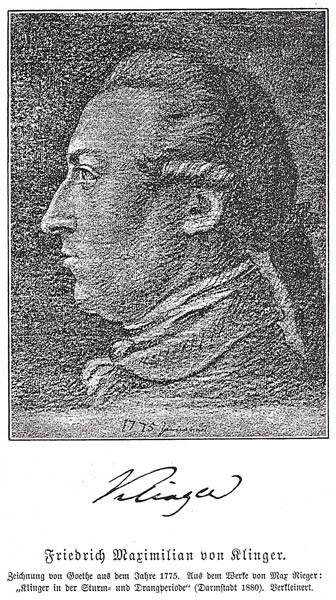
‘Profile portrait of Friedrich Maximilian Klinger with his signature reproduced below’ - Johann Wolfgang von Goethe (German, 1749–1832)
Wikimedia Commons
But instead of a much-needed composure and unity, fresh distractions and disorganisation rapidly transpired.
Several days passed, at first, before a pianoforte was procured, tested, tuned, and positioned according to the will and desire of our headstrong artist, and even then, there was still a failure, it seems, to meet his wishes and demands. However, the effort and delay were soon rewarded with the effortless performance, by that highly talented individual perfectly suited to our age, of even the most difficult works of the moment. So that the connoisseur of musical history may immediately understand what I speak of, note that at this time Schubart (Christian Friedrich Daniel Schubart, composer, organist, and poet) was considered unsurpassable, and the performance of a set of variations was regarded as the supreme test of a skilled pianist, whereby the audience were eventually allowed to regain their breath on hearing the apparently natural reappearance of the simple initial theme, only after its development in the most artful manner.
He brought with him the score of ‘Egmont’, and encouraged my further endeavours in that direction, which aimed more than ever at musical drama, out of necessity and desire.
‘Erwin and Elmire’ and ‘Claudine von Villa Bella’ were also due to be despatched to Germany; however, the standard I demanded of myself was so much higher, given my adaptation of ‘Egmont’, that I could not bring myself to release them in their initial form. Much of the lyric material they contained was dear to me; it testified to many hours spent foolishly, yet happily, as well as to the pain and sorrow to which youth, with its boundless vivacity, is exposed. The dialogue, on the other hand, which was prosaic and overly reminiscent of those French operettas deserving of our fondest memories, since they were the first to bring a cheerful, and singable quality to our theatre, was now no longer satisfying to me as a naturalised Italian, who wished the melodic singing interwoven, at least, with recitative, and a declamatory element.
Both operas will now be found to have been amended in that manner; their compositions have given pleasure, here and there, and so they too have floated past borne on the dramatic current of their day.
Italian librettos are usually criticised, in terms thoughtless people repeat; they are certainly light and cheerful, and make no more demands on the composer and the singer than both are willing to commit to. Without entering into too much detail, I might mention here the libretto of ‘The Secret Marriage’. Who wrote it is unknown to me (‘Il Matrimonio Segreto’ is a dramma giocoso, music by Domenico Cimarosa, libretto by Giovanni Bertati, based on the 1766 play ‘The Clandestine Marriage’ by George Colman the Elder and David Garrick. It was first performed in 1792), but he is one of the most skilful to have worked in this field, whoever he may be. To act in that same spirit, to work with equal freedom while aiming at a specific result, was my intention, though I myself cannot say to what extent I came close to achieving my goal.
Unfortunately, my friend Kayser and I had been involved for some time in an undertaking that felt increasingly more dubious and less feasible. One must recall that innocent era of German opera, when even a simple intermezzo, like Pergolesi’s ‘La Serva Padrona,’ (‘The Maid Turned Mistress’, of 1733, by Giovanni Battista Pergolesi to a libretto by Gennaro Federico, after the play by Jacopo Angello Nelli) found acceptance and applause. At that time, a German basso buffo named Berger, with a pretty, stately, and agile wife, performed various light-hearted and entertaining shows in various German towns and villages, often with minimal use of stage-costume, and indifferent musical accompaniment; shows which, inevitably seemed to culminate in the deception and humiliation of an old, lovelorn dandy.
I envisioned a third, tenor voice, easy to cast, and so, years ago, the Singspiel ‘Scherz, List und Rache’ was written, and sent to Kayser in Zurich. However, Kayser, being a serious, and a conscientious fellow, attacked the task too rigorously, and treated the work too elaborately. I myself had already extended it beyond the scope of an intermezzo, and the seemingly petty subject matter unfolded into so many arias, duets and trios, that even with a shorter and sparser score, three performers would scarcely have been able to complete the performance. However, Kayser had treated the arias extensively, according to the old style, and in places, one must say, quite successfully, the whole thing not lacking a certain charm.
But how and where was it to be performed? Unfortunately, following earlier principles that leant towards moderation, it suffered from vocal thinness; it could never rise above a trio, and one almost wished to bring the doctor’s flasks of theriac (a medicinal compound) to life, so as to create a chorus (the Singspiel’s plot, involves a young couple, Scapin and Scapine, who employ trickery to win back an inheritance stolen by the greedy old doctor). All our efforts, therefore, confined to a bounded simplicity, went for naught when Mozart appeared. ‘The Abduction from the Seraglio’ (‘Die Entführung aus dem Serail’ or ‘Il Seraglio’, 1782) crushed our hopes, and our carefully crafted piece has never, to date, been seen on stage again.
Kayser’s presence heightened and broadened our love of music, which until then had been limited to theatrical performances. He was meticulous in bringing church festivals to our notice, and we were prompted to attend the solemn music performed on such days, alongside him. We found it, to be honest, almost wholly secular, and with a full orchestral accompaniment, though the singing still predominated. I remember hearing on St. Cecilia’s Day (November 22nd), a bravura aria with a participating chorus, for the first time; it had an extraordinary effect on me, as such arias still do on opera audiences whenever they occur.
Besides all this, Kayser possessed another virtue. Because he was deeply interested in early music, he also felt it his duty to research the history of it, most seriously, and thus he consulted the libraries extensively; indeed, his diligent efforts found a particularly good reception and support later in the periodical Minerva (‘A Journal of Historical and Political Content’, founded by Johann Wilhelm von Archenholz in 1792). His research there had the effect of drawing our attention to the older copperplate engravings of the sixteenth century, and he never failed to remind us of, for example, the ‘Speculum Romanae Magnificentiae’ (‘The Mirror of Roman Magnificence’, prints of art-works, published by Antonio Salamanca and Antonio Lafreri, 1553-1563), Gian Paolo Lomazzo’s ‘Trattato Dell’ Arte Della Pittura, Scultura Ed Architettura’ (1585) and not least the later ‘Admiranda Romae,’ (‘Admiranda Romanarum ac Veteris Sculpturae Vestigia’, ‘The Marvels of Ancient Rome’, etchings of ancient reliefs, sarcophagi, and sculpture etc. produced by the draughtsman and engraver Pietro Santi Bartoli and the scholar Giovanni Pietro Bellori, published in Rome, c.1693 by Giovanni Giacomo de Rossi). These collections of books and leaflets, to which we others made pilgrimages too, are especially valuable when viewed in fine reproduction: they bring to mind that earlier time when antiquity was regarded with seriousness and reverence, and its ruins were described in a dignified manner. So, one approached, for example, the Colossi, as they still stood on their original spot in the Colonna Garden; the semi-ruin of the Temple of Septimius Severus which still gives an idea of that vanished building; St. Peter’s Basilica without its facade, the large central building without a dome; the old Vatican, in whose courtyard tournaments could still be held – all of this recalled ancient times and at the same time made abundantly clear the various changes that the following two centuries had brought about and how, despite significant obstacles, they had endeavoured to restore what had been destroyed, and to repair what had been neglected.
Heinrich Meyer of Zurich, whom I have often had reason to mention, however secluded a life he was seeking to maintain, and however busy he was, was nevertheless rarely absent whenever there was something significant to see, experience, or learn; for others sought him out, desirous of his company, as he proved himself to be both modest and full of knowledge. He calmly followed the clear path opened up by Winckelmann and Mengs, and because he knew how to depict antique busts with sepia in the commendable style of Seydelmann (Jakob Crescenz Seydelmann, the graphic artist and illustrator, born in Dresden) none had more opportunity than he to examine and learn about the subtle gradations of earlier and later art.
When we made our preparations to pay a torchlit visit to the museums of both the Vatican and the Capitol, a visit desired by all travellers; artists, connoisseurs, and laymen, alike; he joined us; and I find among my papers one of his essays, in which a delightful encounter with the magnificent remnants of ancient art, leaving a series of images that hover before the soul like the scenes of a delightful, slowly-fading dream, also acquires a lasting significance through its beneficial effects on one’s knowledge and insight. I quote as follows:
‘The practice of viewing the great Roman museums, for example the Museo Pio-Clementino in the Vatican, the Capitoline Museum, and so on, by the light of wax torches seems to have been quite new in the 80’s of the last century, though I know not when it actually began.
The advantages of viewing by such a light are that each piece is seen individually, isolated from all others, and the viewer’s attention remains focused solely there; also, in the bright, and very effective torchlight, all the delicate nuances of the work are far more evident, all distracting reflections (particularly troublesome as regards highly-polished statues) are eliminated, the shadows are more clearly defined, and the illuminated parts are highlighted more intensely. Another major advantage, moreover, is that pieces positioned unfavourably are thereby given their due. For example, the Laocoön can only be seen properly, in the niche where it stands, by torchlight, because no daylight falls there, only reflected rays from the small, round courtyard of the Belvedere, surrounded by its colonnade; the same is true of the Apollo Belvedere and the so-called Antinous (the Belvedere Hermes). Torch lighting was even more necessary to see the sculptured Nile, and the Meleager, and to appreciate their merits. Torchlight is advantageous to no antiquity more than to the so-called Phocion, because only then, and not under ordinary light, when it is unfavourably illuminated, can one perceive the wondrously delicate parts of the body that shine, almost translucently, through the simple garment. The excellent torso of a seated Bacchus also appears in all its beauty, as does the upper part of a standing Bacchus with a fine head, and the half-figure of a Triton, but above all, the wonder of art, the famous Belvedere Torso, which can never be praised enough.
While the monuments in the Capitoline Museum are, in general, less important than those in the Pio-Clementine Museum, there are some of major significance, and to appreciate their merits properly, it is advisable again to view them by torchlight. The so-called Pyrrhus (the colossal Statue of Mars Ultor), exquisitely crafted, stands on the steps and receives no daylight at all; while on the gallery in front of the columns is a beautiful half-figure, believed to be a clothed Venus, which receives dim light from three sides. The nude Capitoline Venus, the finest statue of its kind in Rome, does not appear to advantage in daylight, as it is placed in a corner room, and the so-called beautifully clothed Juno stands against the wall between windows, where it is grazed by only a few rays; even the famous head of Ariadne in the Miscellany Room cannot be seen in its full glory except by torchlight. Several other pieces in this museum are similarly unfavourably-positioned, making torchlight absolutely necessary if one is to properly view and appreciate them.
As so much that is done to follow fashionable usage is misused, so too is torch lighting. It can only be beneficial if its purpose is understood. It is necessary for viewing items that, as I have already mentioned, receive only a mediocre amount of daylight, as it allows for a more accurate perception of height and depth and the transitions between the different parts. Above all, however, it is advantageous for viewing works from the very best period of art (provided that both the torch-carrier and the viewer understand what is important); it will better reveal their dimensions, and highlight the most delicate nuances of a work. Works in the oldest artistic styles, on the other hand, even those in a powerful and noble style, have little to gain if they are seen in a bright light. For since the artists of the time were not yet knowledgeable as regards light and shadow, how could they have calculated their work based on it? The same is true of things completed in a later age, when artists grew more careless, since taste had declined so much that the effects of light and shadow in sculpture were considered unimportant, and the principles of mass and proportion forgotten. What purpose could torchlight serve as regards works of that kind?’
On such a solemn occasion, it is fitting to remember Aloys Hirt (the art historian, and archaeologist of architecture) who has been useful and beneficial to society in more ways than one. Born in Fürstenberg, near Hüfingen, in 1759, after studying the ancient texts, he felt an irresistible urge to visit Rome. He arrived there (in 1782) a few years before I did and had thoroughly familiarised himself with the ancient and modern buildings, and the sculptures of every kind, proving himself an instructive guide to inquisitive visitors. He extended this same courtesy to me with selfless devotion.
His main field of study was architecture, though he never neglected the classical sites or the numerous other curiosities. His theoretical views on art provided ample opportunity for lively discussion in contentious and partisan Rome. From diversity of opinion arises a great deal of conversational to-ing and fro-ing, particularly when art is the subject, which stimulates and promotes intellectual development, especially in the presence of important works. Aloys Hirt’s theories rest on his derivation of Greek and Roman architecture from the oldest, most essential forms of construction in wood, and upon this he bases his praise and criticism of more recent efforts, employing historical examples most skilfully. Others, however, maintain that in architecture, as in every other art, questions of fancy and taste occur, which must never be forgone, since, in the varied cases encountered, the architect must sometimes resort to one style, sometimes another, and is compelled to deviate from strict rule.
With regard to beauty, he often came into conflict with other artists, in that he argued its basis lay in the character of the work, since he agreed with those convinced that character must, of necessity, be the basis of every artistic effort, but insisted that the detailed treatment, obliged to render character in an appropriate as well as graceful fashion, should pay regard to taste and our sense of beauty. Though, since art consists in doing and not talking, and yet people will always talk more than do, such conversations were as endless then as they are now.
While the differing opinions of the various artists gave rise to all kinds of awkwardness, even estrangements between them, it also happened, though rarely, that amusing incidents occurred. The following may serve as an example.
A number of artists had spent the afternoon in the Vatican and, to avoid a lengthy walk through the city to their lodgings, and arriving late, headed out of the gate by the Colonnade, past the vineyards, and on to the Tiber. They argued along the way, arrived at the riverbank still arguing, and continued the lively conversation during the ferry crossing. Disembarking by the Via Ripetta, they might have separated, stifling the remaining points on both sides, and rendering the discussion superfluous. Instead, they therefore agreed to stay together, and cross the river, riding the swaying ferry back and forth, so as to allow the dialectic to continue. But the second trip proving insufficient, they demanded of the ferryman several more crossings. He, too, was pleased enough, since each trip back and forth earned him a baiocco (a copper coin of the Papal States, one hundredth of a silver scudo), earning him an amount he had scarcely expected so late in the day. Therefore, he fulfilled their wish, in silence; and when his young son asked him, in a voice full of wonder: ‘What are they doing?’, he answered calmly: ‘I haven’t a clue, they’re quite mad.’
Around this time, I received the following letter, only in French, in the packet from home:
‘Sir, I am not surprised that you have few readers; so many people prefer to talk rather than feel, but one must pity them, and be glad not to be like them. — Truly, Sir, I owe to you the best deed I have ever enacted in my life, which will prove the basis of many others, and your book has therefore benefited me. If it were my good fortune to live in the same country as yourself, I would come and embrace you, and tell you the details, for, sadly, I live in a place where no one would ever believe the reason I have been prompted to take the course I have. Be satisfied, sir, that you have been able, at a distance of almost nine hundred miles from him, to draw a young man’s heart back to honesty and virtue, such that an entire family is at peace, while my heart rejoices in a fine deed executed. If I had talent, knowledge, or rank such that I might influence the fate of others, I would tell you my name, but I am nothing, and not what I would seek to be. I hope, sir, that you will remain youthful, and maintain the urge to write, that you will be the husband of a ‘Lotte’ who never encountered a ‘Werther’, and will be the happiest of men, since I believe that you love virtue.’
Rome, December 1.
This much I can assure you: I am more than certain regarding the most important points, and though the acquisition of knowledge extends endlessly, I nonetheless have a secure, indeed clear and communicable, concept of that finite infinite. I still have the most wondrous things planned, and am holding back my powers of learning to some extent so that only my active powers progress. For there are wonderful things to be achieved, as easy to comprehend as the flat of one’s hand, once one grasps them.
Rome, December 7, 1787.
This week has been spent drawing, as I seemed unable to take the poetry further; one must observe and search out, making use of every hour. Our ‘academy at home’ continues, and we are trying to rouse old Angantyr (a tragic figure in Norse saga. Herder translated a poem about Angantyr in his ballad collection ‘Volkslieder’) from his slumber; perspective occupies us in the evenings, and I am forever trying to learn how to draw certain parts of the human body better, and more confidently. But anything done thoroughly is all too difficult, and demands great skill in execution.
Angelika is so good and kind, I am indebted to her in every way. We spend Sundays together, and during the week I see her once in the evening. She creates so much, and so well, one scarcely knows how, and yet she always seems to be doing nothing.
Rome, December 8th.
How delighted I am that you liked my little song, you can’t imagine how happy it makes me to find a voice that captures your mood. That is precisely what I wished for ‘Egmont ’of which you say so little, and rather seem as if it causes you pain rather than pleasure. Oh, I know well enough that one can hardly pitch such a large composition in the perfect key throughput; after all, no one truly understands the difficulty of art except the artist themself.
There is far more positive – I mean teachable and transmittable – material in art than is commonly believed; and there are many techniques by which one can produce the most intelligent effects (that is always assuming an intelligent audience). If one knows these little tricks, much that appears wondrous is mere play, and nowhere do I believe one can learn more of matters both high and low, in the arts, than in Rome.
Rome, December 15th.
I am writing to you late, but am at least writing something. I have spent the week very happily. Last week did not go well, with one thing and another, and since the weather was so beautiful on Monday and my knowledge of the cloud pattern led me to hope for a few fine days, I set off with Christoph Kayser and my second ‘Fritz’ (Friedrich Bury, the portraitist; the first ‘Fritz’ being Fritz von Stein, Charlotte Stein’s son to whom Goethe was tutor. Fritz is a diminutive of Freidrich) and from Tuesday till this evening we visited the places I already knew, and various areas I had not yet explored.
On Tuesday evening we reached Frascati. On Wednesday we visited the most beautiful villas, and especially the delightful bust of Antinous at Villa Mondragone (near Monte Porzio Catone). On Thursday we went from Frascati to Monte Cavo (in the Alban hills) via Rocca di Papa, of which you must acquire drawings someday, for words and description are nothing; then down to Albano. On Friday Kayser, who was not feeling too well, left us, and I went with ‘Fritz II’ to Aricia, Genzano, along Lake Nemi, and back to Albano. Today we went to Castel Gandolfo and Marino and from there back to Rome. The weather was incredibly kind; it was almost the best of the whole year. Besides the evergreen trees, some oaks still have their leaves, and the young chestnut trees too, albeit yellowing. The landscape is a palette of the most beautiful colours, and magnificent, grand forms appear in the darkness of night! I had a great time, in which I was with you from afar. I have been very happy and well.
Rome, December 21.
That I draw and study art enhances my poetic abilities rather than hindering them; since I need little time to write, but a great deal to draw well. I wish I could only share with you the knowledge of visual art that I now possess; however subordinate it may still be, it is still gratifying because it is true and always leads further. The degree of intelligence and persistence of the great masters is incredible. If I felt reborn upon my arrival in Italy, I now begin to feel as if I have been re-educated.
What I have sent so far are just reckless attempts. With Tourneisen (Johann Jakob Torneisen, of Basel, the Swiss publisher) I am sending a sheaf the best of which are foreign scenes that will delight you.
Rome, December 25th.
This year Christ has been born amidst thunder and lightning; we had a severe storm around midnight.
The splendour of the greatest works of art no longer dazzles me; I now walk about in a state of contemplation, of true discernment and knowledge. How much I owe, as regards this, to a quiet, solitary, diligent Swiss man named Heinrich Meyer, I cannot say. He was the first to open my eyes to the detail, to the various qualities of individual forms, and initiated me into the actual process of their creation. He is frugal, and modest in his possessions. He actually takes more pleasure in works of art than the great collectors who barely understand them, and more pleasure than those artists who are driven, in a state of anxiety, by the desire to imitate the unattainable. He possesses a heavenly clarity as regards concepts, and an angelic kindness of heart. He never speaks to me without my wanting to write down everything he says, so definite and correct are his words, which describe the only true path. His instructions grant me what no other human being could, and he will be irreplaceable when he leaves. In his presence, I still hope to reach, in time, a level of drawing that I can scarcely imagine myself capable of now. All that I learned, undertook, and thought in Germany relates to his guidance as the bark of a tree does to the core of its fruit. I have no words to express the quiet, active bliss with which I now begin to contemplate works of art; my mind has expanded enough to grasp them, and is constantly developing its powers of appreciation.
There are visitors here again, with whom I sometimes go to view a gallery; they seem to me like wasps in a room, flying against the windows, and mistaking the bright panes of glass for the open air, bouncing off them and buzzing against the walls.
I would not wish an enemy to be in so silent and withdrawn a state. Yet to be considered moody and insular, as others usually consider me, is less appropriate than ever. So, my dear friend, think, act, and work on my behalf in the best manner possible, and so preserve my life, which otherwise will perish without benefiting anyone. I must say, I have indeed been very deficient this year, socially. I stood alone for a time, completely cut off from the world. Now a close circle surrounds me once more, the members of which are excellent, all on the right path, and that they can bear to be with me, that they like me, and find joy in my presence, is a strong indication that they too are on the right road as regards thought and action. For I am mercilessly intolerant of all those who wander along, or stray from, the path, and yet wish to be considered as messengers and true travellers. I make jest of them and mock them until they alter their lives, or we part ways. Here, of course, I speak only of decent, upright people; half-wits and dolts are immediately sieved out, without further ado. Two people have already thanked me for causing their change of heart, and manner of living, indeed three, who will, I trust, thank me for it throughout the rest of their lives. There, where I am making an impact, I feel my soundness and expansiveness; my feet only become sore when the shoes pinch while, placed in front of a wall, I can see nothing.
December – Later Notes
The month of December began with bright and fairly consistent weather, which gave rise to an idea destined to provide many a pleasant day for our happy company. We said: ‘Imagine we’ve just arrived in Rome and, as travellers in haste, must learn as swiftly as possible about the most important things to be viewed here. Let’s plan a venture to that effect, such that what we know already will be renewed, mentally and spiritually.’
The execution of the idea was thus begun immediately, and carried out with some consistency, though, sadly, little remains of the many good ideas that were noted and considered on that occasion. The letters, notes, drawings, and details of our planned visits, drafted at the time, are almost entirely lost, though a few of the locations are presented here briefly:
In an area of Rome near the Tiber, stands a moderately-sized church (Santi Vincenzo e Anastasio alle Tre Fontane), within the site of the Abbazia delle Tre Fontane whose ‘Three Springs’, it is said, arose from the blood of Saint Paul who was beheaded at that place, and which still pour forth to this day.
The church I refer to is situated on a low-lying site, and the water welling in its interior naturally contributes to the humid atmosphere. The interior is sparsely decorated, almost bare, though maintained in a state of cleanliness, albeit a somewhat musty one, to provide for the rare occasions on which worship takes place. Its greatest adornments, however, are the life-size, colourful paintings of Christ and his twelve Apostles, said to be after designs by Raphael, arranged in a row on the pillars of the nave. That extraordinary artist elsewhere presented those pious men in a group, dressed uniformly, while each one is shown here, separately and individually, not as if in the Lord’s retinue, but as if, after the Ascension, he has had to stand on his own two feet, and now live and endure life, according to his own character,
However, to allow us to appreciate the merits of these images even from afar, engravings, by Marcantonio Raimondi’s faithful hand, of such Raphael designs have survived (designs said to have been created for the Sala dei Palafrenieri in the Vatican; a set of the Marcantonio engravings is in the Royal Collection, United Kingdom) which have often provided me with an opportunity and occasion to refresh my memory and pen my observations (see the article that was published in the journal ‘Der Neue Teutsche Merkur’ in 1791).
From this small, unassuming church, it is not far to a larger building dedicated to the noble Apostle, namely the Church of St. Paul Outside the Walls, a large and artistically-constructed monument assembled from ancient, and magnificent remnants. Entering this church makes for a sublime impression; rows of mighty columns support the heights of painted wall which, surmounted by the interlocked timber-framing of the roof, present a barn-like appearance to our sophisticated eyes, though the whole thing, if the beams were hung with tapestries on festive days, would have an incredible effect. Many a wonderful remnant of highly-ornamented architecture, including the capitals, is found here, properly preserved, taken from the once colossal ruins nearby, of the now almost entirely vanished Palace of Caracalla.
The Circus, which still bears the name of that emperor (now known as the Circus of Maxentius) though largely in ruins, still gives an idea of that immense space. If an onlooker were to stand on the north side of the track, they would see, to the south, high above the now-shattered rows of seats for spectators, the tomb of Cecilia Metella amidst its more recent surroundings, from which the line of the former seats would extend to infinity, while in the distance, impressive villas and pleasure palaces would be visible. Returning to the view before us, the ruins of the Spina (the barrier running down the centre of the course), can still be clearly traced directly ahead, and anyone of an architectural fancy can grasp to some degree the exuberant nature of the design. The scene, in ruins, as it now lies before us, would still make for a pleasing image, should a skilful and knowledgeable artist wish to undertake it, though the sketch would have to be twice as long as it is high.
The Pyramid of Cestius was, on this occasion, viewed only from the outside, and the ruins of the Baths of Caracalla (the Antonine Baths), which Piranesi has so vividly re-imagined (see the series of engravings ‘Vedute di Roma’, ‘The Views of Rome’, by Giovanni Battista Piranesi, 1748-88), could scarcely offer any satisfaction to even the most artistically accustomed eye. Yet, here, the memory of Hermann von Swanevelt (the Dutch painter, who trained in Rome under Claude Lorrain) should be revived, who, with his delicate etching-needle, expressing the purest feeling for Nature and Art, knew how to bring the monuments of the past to life, indeed, to transform them into the most graceful pillars of the living present.
In the square in front of San Pietro in Montorio, we greeted the torrent of water from the Fontana dell’ Acqua Paola, which, via the gates and portals of a triumphal arch, fills a large, relatively large basin to the brim, its water delivered in five streams. This torrent, carried by an aqueduct restored by Paul V, traces a twenty-five-mile path from behind Lake Bracciano, via a curious zigzag course of varying elevation, to this spot, supplying the needs of various mills and factories before spreading into Trastevere.
Here, our friends of architecture praised the happy idea of having provided these waters with a clearly visible, triumphal entrance. Columns and arches, cornices and attics remind us of those magnificent gateways through which warlike conquerors once entered; here, the most peaceful of providers enters with equal power and might, and immediately receives thanks and admiration for the effort involved in its long journey. The inscriptions also reminded us that the providence and benevolence of a pope from the Borghese family (Paul V was born Camillo Borghese) have made here, as it were, an eternal, uninterrupted, and stately entrance.
A new visitor from the North, who had arrived shortly before, suggested that it would have been better to set a heap of rocks here to give the water a natural emergence to the light. He was countered with the argument that this was not a natural water source, but an artificial one, whose arrival they were quite justified in embellishing in a similar manner.
But no agreement was reached on this point, just as there was no agreement about the magnificent image of the ‘Transfiguration’, which one has the opportunity to admire in the nearby church (Raphael’s ‘Transfiguration’ was previously installed by Cardinal Giulio Medici, later Clement VII, who had commissioned it, over the high altar of San Pietro in Montorio. After removal to France under Napoleon, it was returned and housed, as now, in the Pinacoteca Vaticana). There was much talk; the calmer members, however, were annoyed to see the old criticism of the dual sections of the composition repeated. It would only be natural, in this world of ours, if a worthless coin, set beside a valuable one, counted as currency, to a degree, especially if the transaction was carried out quickly, and an obligation fulfilled without lengthy deliberation or hesitation. It remains remarkable, however, that anyone has ever dared to criticise the greatness of so unified a creation as that of Raphael. Depicted in the lower part, a pair of despondent parents present their son, who is possessed, to the Lord’s disciples, whose Master is absent; they may well have already attempted to banish the evil spirit; a book has been consulted to see if some traditional formula effective against the child’s madness might be found; but in vain. At this moment, the sole Powerful One, transfigured, and acknowledged by his ancestors, appears; hastily, one figure points upward to the vision as the sole source of salvation. How, then, can one separate the upper and lower parts of the painting? Both are one: below, the suffering and needy; above, the powerful bringing aid, both relating to one another, and interacting with each other. To express my meaning in another way, can the composition be other than that of the ideal in relation to the actual?
The like-minded individuals among us reinforced that conviction: ‘Raphael,’ they said, ‘was distinguished precisely by the exactness of his thinking, and yet that divinely gifted artist, whose work is recognised for that quality, is supposed to have thought and acted inexactly in the prime of his life? No! He is forever right, like Nature, and most thoroughly and correctly where we least comprehend him.’
That idea of ours, to gain a brief overview of Rome, united in excellent company, could not be carried out in complete isolation, as was originally the intention; one or two were absent, perhaps due to unforeseen circumstances, while others joined us, wanting to view this or that along the way. Nevertheless, the main group stayed together, choosing to absorb others, separate from them, lag behind, or race ahead. Occasionally, however, some rather odd expressions were heard. There is a certain kind of empirical judgement, which has recently gained greater traction, especially among English and French travellers; people express their immediate, unconsidered opinion without considering that every artist is influenced in multiple ways: by the nature of their particular talent, by their predecessors and masters, by the place and time, by their patrons and the commissioners of their work. None of that, which is consequently necessary for a clear appreciation, is considered however, and thus an ugly mix of praise and blame, affirmation and denial, arises, amidst which every interesting feature of the work in question actually vanishes.
Our good Johann Volkmann (Johann Jacob Volkmann’s ‘Historisch-Kritische Nachrichten von Italien’: ‘Historical and Critical Account of Italy’, 1778, was the standard guide-book), otherwise so attentive and helpful as a guide, seems to have yielded entirely to such foreign judgements, which is why his own assessments appear so odd. Could one, for example, express oneself more unfortunately than he does regarding the church of Santa Maria della Pace?
‘Over the first chapel, Raphael painted some Sibyls, which have suffered greatly. The drawing is correct, but the composition is weak, which must doubtless be attributed to the awkwardness of the space to be filled. The second chapel is decorated with arabesques based on drawings by Michaelangelo; these are highly regarded but not straightforward enough in their execution. Beneath the dome, one notices three paintings: the first, ‘The Visitation of Mary’ by Carlo Maratti, is painted in a cold style but well composed; the second, ‘The Birth of Our Lady’ by Rafaello Vanni, in the manner of Pietro da Cortona; and the third, ‘The Death of Mary’ by Giovanni Maria Morandi. The arrangement is somewhat confused and crude. On the vault above the choir, Francesco Albani has depicted ‘The Assumption of Mary’ in weak colours. His frescoes on the pillars below the dome are better. Bramante designed the courtyard of the monastery belonging to this church.’
Such inadequate, lukewarm judgements certainly confuse the reader who chooses such a book as a guide. Some things are indeed utterly wrong, for example, what is said here about the Sibyls. Raphael was never embarrassed by the space that architecture offered him; rather, it is part of the greatness and elegance of his genius that he knew how to fill and adorn every such space with the utmost grace, as he so clearly demonstrated in the Farnesina. Even the magnificent paintings of the ‘Mass at Bolsena,’ the ‘Liberation of Saint Peter,’ and the ‘Parnassus’ would not be conceived as so ingeniously and incomparably composed without the remarkable constraints of the space utilised. Likewise, in the Sibyls, the effortless symmetry, upon which everything depends in composition, asserts itself in a most skilful manner; for just as in the forms of Nature, so too in Art, it is within the most precise of limits that the perfect expression of life reveals itself.
Be that as it may, the manner in which one perceives and judges works of art should be left entirely to each individual. During these visits, I grasped a feeling, concept, perception of what one might, in the highest sense, call the presence of the Classical foundations. I might term this the sensual, and spiritual, conviction that greatness has been, is now, and will always be, here on earth. That the greatest and most glorious things should pass from us is inherent in the nature of time, and the mutually irreconcilable interaction of intellectual and physical elements. In conducting a general survey, we could not ignore, sadly, what had been destroyed; rather, we had reason to rejoice that so much has been preserved, and restored, more magnificently and more extensively than before.
St. Peter’s Basilica was certainly conceived to be as grand, and probably larger and bolder, than any of the ancient temples, for not only the partial ruins of two thousand years lay before our eyes, but also what increased knowledge has been able to add.
Even the fluctuation in artistic taste, a striving for the grand but simple, a return to the small but complex, all pointed to life and movement; art history and human history stood synchronistically displayed before our eyes.
We should not be discouraged by the observation that greatness is transient; rather, if we find that the past contained great things, it should inspire us to accomplish something of significance ourselves, something that will inspire our successors even in its ruin, encouraging us to noble activity, something our ancestors never lacked.
These instructive and uplifting thoughts were, I scarcely dare say disturbed and interrupted, but nevertheless mingled with painful feelings that accompanied me everywhere; for I learned that the fiancé of the charming Milanese woman, had retracted his promise, on I know not what pretext, and had broken off the engagement. While I considered myself fortunate, on the one hand, to have not yielded to my affections and to have very quickly withdrawn myself from the dear girl’s presence — and indeed, after the most thorough inquiry, to have established that any relationship between us of that kind had not been considered — it was nevertheless extremely distressing for me to find that the pleasant image that had so cheerfully and kindly accompanied me thus far was now harmed and distorted; for I heard that the lady, from her pain and distress at this event, had fallen into a violent fever, which gave cause to fear for her life. Through enquiring as to the state of her health daily, in fact twice a day for the first few days, I was tormented by my imagination seeking to conjure up the unimaginable: that those cheerful features belonging solely to the open, joyful light of day, that expression of her free, calm progression through life, were now clouded by tears, and disfigured by illness, and that her youthful features had been rendered, prematurely, pale, her body frail, through inward and outward suffering.
In such a frame of mind, of course, the counterweight of viewing a sequence of great and significant things, which sufficiently employed the eye with their existence, and the imagination with their everlasting nobility, was highly desirable, though nothing was more natural than to gaze at them with a degree of heartfelt sadness.
While the ancient monuments had mostly crumbled into formless masses after so many centuries, one had also to lament the decline of so many noble families in later times, even when surrounded by their more recent, yet magnificent buildings; indeed, even those still freshly preserved seemed to be suffering from a secret sickness; for how could worldly lineages, lacking in actual physical strength, sustain themselves, these days, solely through moral and religious props? And just as a cheerful spirit can bring ruins to life, in the way fresh, ever-renewed vegetation revives crumbling walls and scattered blocks of stone, so a melancholy spirit will strip life of its finest adornments and willingly impose upon us a naked skeleton.
I could not bring myself even to undertake a mountain trip, which I had planned to make in cheerful company before the winter, until, certain of her recovery, and her health being secured by loving care and attention, I had received news of that recovery, in the very place where I had met her cheerful and charming self, during those most beautiful autumn days.
The very first letters from Weimar concerning ‘Egmont’ contained several criticisms of this and that; at which, my old observation resurfaced that the unpoetic art-lover, comfortably ensconced in bourgeois complacency, usually takes offence whenever the poet has sought to resolve, gloss over, or hide a problem. Everything, according to the complacent reader, should flow naturally; yet even the unexpected can be natural, although it may not seem so to someone who clings to their own opinions. A letter of that nature arrived; I took it up, and went off to the Villa Borghese; there I read that some scenes were considered too long. I pondered this, but still knew not how I might have shortened them, since various important motifs within them had required development. But what seemed most objectionable to my female friends were the laconic words with which Egmont commends Clara to Ferdinand’s care (See Act V Scene IV).
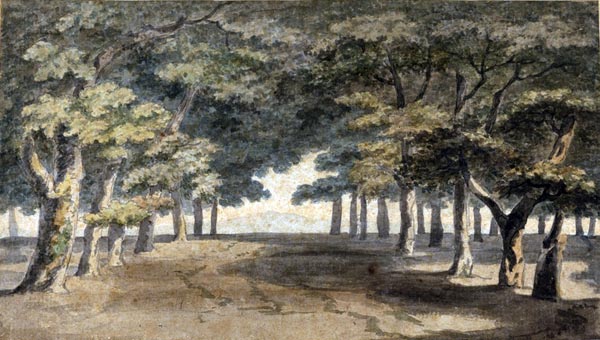
‘Tree-lined avenue in the Villa Borghese gardens, Rome’ - Johann Wolfgang von Goethe (German, 1749–1832)
Klassik Stiftung Weimar, Museen (Inv. GGz/1955)
Digital reproduction · See Art. L. 111-1 CPI and § 68 UrhG
An excerpt from my reply at the time will provide the best insight into my thoughts and situation. ‘How I wish I could fulfil your wish, and make some modification to Egmont’s statement! I hurried to the Villa Borghese one fine morning with your letter, and spent two hours thinking through the plot, characters, and relationships, and could find nothing to shorten. How I would love to pen for you all my considerations, all the pros and cons; they would fill a book, and contain a dissertation on the necessary length of my play. On Sunday, I visited Angelika and presented the question to her. She has a copy which she has studied. If only you could have been present, and heard how delicately she gave her feminine view of it all, and how it boils down to this: that what you wished the hero to explain verbally was implicitly contained in his dream (see the end of Act V Scene IV). Angelika said that the dream-vision represents what is taking place in the mind of the sleeping hero, and that he could not express more strongly in words how much he loves and cherishes her than is witnessed by his dream. What he does, is to raise the beloved creature, not merely to his level, but above him. Indeed, it pleased her that the hero who, throughout his entire life, has spent his life as if in a waking dream, cherishing life and love more than anything else, or rather, cherishing them only by way of enjoyment, should at last wake from his dream, and tell us quietly told how deeply his beloved dwells in his heart and what a noble and lofty place she occupies therein. She added a further consideration, namely that in Egmont’s scene with Ferdinand, Clara could only be recalled in a subordinate role, so as not to diminish the significance of the farewell to his young friend, who, in any case, was incapable of hearing or understanding anything at that moment as regards Egmont’s love for her.
Moritz As an Etymologist
A wise man long ago uttered the truth: ‘A person whose powers are insufficient for what is necessary and useful, happily occupies themself with what is unnecessary and useless!’ Perhaps some might wish to judge the following in this way.
Our companion Karl Moritz never ceased to ponder and speculate about the inner nature of human beings, their predispositions and development, while amidst examples of the highest art, and amidst the beauties of Nature; thus, he devoted himself in particular to the general principles underlying our use of language.
At that time, following Herder’s prize essay ‘On the Origin of Language’ (‘Abhandlung uber den Ursprung der Sprache’, 1770) and in accordance with the prevailing view, the idea gained ground that human beings had not spread across the entire earth arising from a single pair in the East, but rather that in a remarkably productive era in world history, after Nature had gradually attempted to bring forth the most diverse animals, here and there, under various favourable circumstances, the human race had emerged, more or less fully developed. Language, it was believed, was innate to humans, intrinsically linked to both our physical and mental faculties. No supernatural guidance was needed, nor any tradition. And in this sense, a universal language existed, which every indigenous group had attempted to manifest. The kinship of all languages lay in the idea that a shared creative force had formed humankind and its abilities. Thereafter, partly driven by inner impulse, partly by external influence, the strictly limited number of possible vowels and consonants had been used consistently or inconsistently to express our feelings and ideas; thus, it was natural, indeed inevitable, that diverse indigenous languages had partly converged on and partly diverged from the original, and this or that language had consequently been either impoverished or enriched. What is true of the root language was also true of each of its derivatives, that of being a means by which the relationships between individual concepts and ideas could be expressed, and designated more precisely. This, is all fine, though remaining something unprovable, and thereby incapable of being determined with any certainty.
I found the following among my papers:
‘I am pleased that Moritz is turning from his brooding indolence, discontent, and self-doubt, to some kind of activity, for when he does so he becomes a delight to be with. His daydreaming then has a solid foundation, and his reveries possess purpose and meaning. Now he is occupied with an idea, which I have also embraced and which entertains us both greatly. It is difficult to share, because it sounds rather odd. But I will try:
He has invented an alphabet of thought and feeling, claiming that the letters are not arbitrary, but are grounded in human nature and belong to certain regions of inner meaning, which, when spoken, they express. Now, languages can be judged, he claims, according to this alphabet, and he finds that every group of human beings has tried to express themselves according to this inner meaning, but all have been led astray by chance and arbitrary. Consequently, we must seek out in any language the words that are most happily chosen; sometimes one word has this feature, sometimes another; if not we must alter a word until it seems right to us, or create a new one. Indeed, if we play the game correctly, we must create names for individuals, and investigate whether this or that name truly belongs to this person or no, and so on.
This etymological game has already occupied the minds of a number of our company, and gives us plenty to do by way of entertainment. As soon as we gather together, we play as if each word were a chess move, hundreds of combinations being tried, so that anyone who chanced to overhear us would think us mad. I would only confide the nature of it to my closest friends. Enough said, but it is the most amusing game in all the world, and exercises one’s feeling for language most thoroughly.’
The End of Part IX of Goethe’s ‘Italian Journey’