Johann Wolfgang von Goethe
Italian Journey (1786-88)
Part X: Second Stay in Rome – 1788, January to April
Translated by A. S. Kline © Copyright 2026 All Rights Reserved
This work may be freely reproduced, stored and transmitted, electronically or otherwise, for any non-commercial purpose. Conditions and Exceptions apply.
Contents
- Second Stay in Rome – 1788, January to April.
- Admission to the Society of Arcadians.
- The Roman Carnival.
Second Stay in Rome – 1788, January to April
Rome, January 5, 1788.
Forgive me for writing so little today. This year has begun in a state of earnestness and diligence, and I scarcely have time to look around me.
After a period of stagnation lasting several weeks, during which I have suffered, I am once again experiencing the most beautiful, I may well call them, revelations. I am being allowed to glimpse the essence of things and their relationships, opening depths of great richness to me. This is the consequence, for my mind, of constantly learning, and learning from others moreover. When one teaches oneself, the effort of instructing and processing the instruction falls on the same person, and progress is of necessity slower, and takes place in smaller increments.
The study of the human body now absorbs me, utterly. Everything else pales by comparison; a strange state of mind that I have experienced, now and again, throughout my life, and which appertains now. There is no point in discussing it further; time will tell what I am to do next.
Opera no longer entertains me; only what is profoundly and eternally true now brings me joy.
I feel that an epoch of my life will come to a head around Easter; what will happen, I know not.
Rome, January 10th.
‘Erwin and Elmire’ reaches you with this letter; may you enjoy that little trifle! However, a good operetta libretto never satisfies on its own; music must be added to fully express the concept the poet envisioned. ‘Claudine von Villa Bella’ will follow soon. Both pieces are more meticulously crafted than may be apparent, because I have been studying the Singspiel form, especially with Kaysern.
My work of drawing the human body continues diligently, as do the evening classes in perspective. I am preparing for my departure, which the gods have decreed for Easter, so that I may yield to it with a confident heart. May it be for the best.
My interest in the human form now overrides everything else. I felt it strongly, yet always shied away from it as if from the blinding sun; moreover, every attempt to study the subject somewhere other than Rome is in vain. Without the guiding thread, the clew, which only here can one learn how to spin, one cannot find one’s way out of the labyrinth. Sadly, my ball of thread is not long enough, but it helps me traverse the initial passages.
If my writing continues to be influenced in the same manner as before, it seems I will be obliged to fall in love with a Princess this year in order to progress ‘Tasso,’ and submit to the Devil in order to progress ‘Faust,’ though I have little desire to do either. So far, this is how things have gone. To render my ‘Egmont’ interesting, the Holy Roman Emperor (Joseph II) sparked unrest in Brabant, and to grant my operas a degree of perfection, Christoph Kayser (an alternative spelling of ‘Kaiser’, meaning ‘Emperor’) came from Zurich to Rome! That is what Herder calls being a ‘distinguished Roman’, and I find it quite amusing to be the ‘final cause’ (‘ultimate goal’ in philosophy) of actions and events that were not at all intended for my benefit. That one might call my good luck. So, I shall await, with patience, the Princess and the Devil.
Rome, January 10th.
To Herder
Here comes another sample of German art and tradition, from Rome, ‘Erwin and Elmire’. It was finished before ‘Claudine von Villa Bella’, though I have a wish to see it printed first.
You will soon realise that everything in it is geared towards the needs of the lyric stage, which I have only had the opportunity to study here: which are, to keep all the characters occupied, in a particular sequence, and to a specific extent, so that each singer has enough moments to rest the voice, and so on. There are a hundred things to observe, to achieve which Italians sacrifice the whole meaning of the libretto. I hope that I have succeeded in satisfying the musical and theatrical requirements, with a little trifle that is not entirely nonsensical. I also took into consideration that both operettas must be readable too, so that they would not bring shame upon their neighbour, ‘Egmont.’ No one reads an Italian libretto except on the evening of the performance, and to bind it up with a tragedy would be considered as impossible, in this country, as singing in German.
Regarding ‘Erwin and Elmire,’ I must add that you will frequently find I have employed the trochaic metre, especially in the second act; this is not accidental, or a matter of habit, but rather adopted from Italian examples. The metre is exceptionally well-suited to music, and the composer can vary it, through the use of a different time signature, or rhythm, in such a way that the listener is never aware of it. Indeed, the Italians generally adhere exclusively to smooth, simple metres and tempos.
Young Camper (The son of Petrus Camper, Adriaan Gilles Camper, mathematician, physicist, and editor of his father’s posthumous anatomical and paleontological work, was on a Grand Tour of France, Italy, and Switzerland) is a whirlwind of energy, who knows a lot, grasps things easily, but glosses over things.
Congratulations on the fourth part of ‘Ideas’! The third is like a sacred book to me, which I keep locked away; only now has Moritz read it, and he considers himself fortunate to live in this era of human knowledge and education. He greatly enjoyed the book, and was absolutely taken by the ending.
If I could only entertain you on the Capitol, in return for all the good you have done me. It is one of my dearest wishes.
My titanic ideas were merely phantoms, presaging a more serious epoch. I am now truly immersed in the study of the human form, which is the ultimate expression of all human knowledge and action. My diligent preparation in the study of all of Nature, especially osteology (the study of bones and the skeletal system), has helped me to make strides. Now I can truly see and enjoy the noblest works of art remaining from antiquity: the statues. Indeed, I fully understand how one could study a subject for a whole lifetime and still, in the end, exclaim: ‘Now I see, now I truly enjoy.’
I am gathering everything together that I can, to bring to a close a certain period of my life, as far as I can, by Easter, so that I can leave Rome without reluctance, and be able, as I hope, to continue my various studies in Germany, in comfort, and with greater thoroughness, though doubtless slowly enough. Here, the current carries you away as soon as you board the boat.
January – Later Notes.
‘Cupid, you, willful, endlessly obstinate, boy!
You asked for shelter, you said, for just a few hours.
Yet many a night, you’ve stayed, and many a day!
Imperious, as if you were lord of my home!
From my broad bed I’m ousted, and driven away,
To sit on the ground, spending my nights tormented;
While you stoke the fire, as you wish, flame upon flame,
Consume my winter fuel, and scorch me poor wretch.
You’ve rummaged, and rearranged all my possessions;
Now I, simply, search around, blind and bewildered.
You make such a dreadful row; I fear that my soul
Must flee, escape you, so, and abandon this house.’
(From ‘Claudine von Villa Bella’)
If one avoids taking the little song literally, and thinks not of that demonic spirit commonly called Amor, but instead imagines a gathering of active minds addressing one, beckoning, pulling this way and that, and thereby confusing one’s innermost being, then one may participate symbolically in the state in which I found myself, sufficiently illustrated by the preceding excerpts from letters, and my later notes; and will doubtless readily concede that a mighty effort was required to maintain oneself against it all, work on tirelessly, and not become complacent as regards learning new things.
Admission to the Society of Arcadians
As early as the end of last year, I was repeatedly assailed by a proposal, which I also saw as a consequence of that unfortunate concert due to which I had recklessly revealed my incognito. However, there may have been other reasons why several interested parties sought to persuade me to be received in ‘Arcadia’ as a prominent shepherd. I resisted for a long time, but finally had to yield to my friends, who seemed to attach a special importance to the matter. What this Arcadian society consists of is generally known; however, it is probably not uninteresting to hear something about it.
During the course of the seventeenth century, Italian poetry had deteriorated, in many ways; for towards the end of the century, educated, and well-meaning men claimed its content wholly neglected what was then called ‘inner beauty’; it was also, they said, reprehensible with regard to form, to ‘external beauty’, since it had, through employing barbaric expressions, unbearably harsh rhymes, faulty images and tropes, and particularly by the continual use of excessive hyperbole, metonymy and metaphor, completely forfeited the grace and sweetness in which one takes pleasure when appreciating outward form.
However, those who were involved in such misguided efforts dismissed, as is ever their wont, what was excellent and genuine criticism, such that their abuses continued unrestrainedly. This defiance could no longer be tolerated by sensible and educated folk, so that in 1690 a number of prudent and capable men met, and resolved to take a different path.
In order that their meetings might not attract attention, or provoke a reaction, they gathered outdoors, in rural gardens, of which Rome herself, within her walls, possessed and enclosed a sufficient number. This afforded them the benefit of being closer to Nature, in the fresh air, invoking the primal spirit of poetry. There, in randomly chosen spots, they occupied the grass, and seated themselves on the architectural ruins and stone blocks, even the cardinals present honoured only by a softer cushion. There they discussed their convictions, principles, and plans privately, among themselves; and there they read their poems which sought to revive the spirit of classical antiquity, the spirit of the noble Tuscan school. One of them exclaiming in rapture: ‘Here, is our Arcadia!’ his thought gave their society its name (the ‘Accademia degli Arcadi’) as well as describing the idyllic nature of its organisation. No patronage provided by some great and influential man was to protect them; they refused to acknowledge a leader or president. A Custos (custodian) would open and close the ‘Arcadian gatherings’ (they found a permanent summer home in the ‘Bosco Parrasio’, the ‘Parrhasian Woods’, on the Janiculum Hill, in 1725), and in specific matters, would be assisted by a council of elected elders.
Here the name Giovanni Mario Crescimbeni (the poet and literary historian) is to be revered, he being regarded as a co-founder, who faithfully performed his duties as the first Custos for several years, monitoring the revival of a finer, purer style, which increasingly achieved the suppression of its barbaric predecessors.
His dialogues, ‘Bellezza della Volgar Poesia,’ of 1700, which is not to be translated as ‘the beauty of popular verse’ but rather as ‘the beauty of poetry befitting a people, practised by truly gifted individuals, and not distorted by the whims and idiosyncrasies of isolated madmen,’; his dialogues, in which he presents their superior doctrine, clearly a product of Arcadian conversations, are of paramount importance when considering our own new aesthetic endeavours. The poems of ‘The Arcadia’ a volume which he edited and published (in 1711) also deserve our full attention; I will only venture the following remarks:
Those esteemed shepherds, lounging about outdoors on the green grass, had intended to draw closer to Nature, within whose realm love and passion are, it must be confessed, likely to stir the human heart; but the society consisted of members of the clergy, and other worthy folk, who were forbidden to associate with the Cupid of the Roman triumvirate (Ovid, Propertius, and Tibullus), whom they therefore expressly ignored. Therefore, since love is utterly indispensable to the poet, nothing remained but to turn to otherworldly and, in a sense, Platonic longing, and no less to the allegorical, which is how their poems acquired a truly notable and distinctive character, wherein they could, at any rate, follow in the footsteps of their great predecessors Dante and Petrarch.
This society, when I arrived in Rome, had been in existence for almost a hundred years, and in its outward form had always maintained itself with decorum, if not with tremendous prestige, through its various changes of location and attitude, while no important visitor was allowed to remain in Rome without being enticed to attend a meeting, all the more so since the custodian of this poetic realm could only support himself, in a modest way, by so doing.
The ceremony itself proceeded as follows: in the anterooms of a respectable building (the Teatro degli Arcadi within the Palazzo Salviati, the winter home of the Academy), I was introduced to a distinguished member of the clergy, who was introduced to me as the person who would initiate me, as my guarantor or godfather, so to speak. I entered a large, already fairly-full hall, and sat down in the first row of chairs, directly in the centre, facing a tall lectern. More and more of the audience approached; on the seat to my right, which had been empty, a handsome elderly man seated himself, who, judging by his attire and the reverence shown to him, must be a cardinal.
The custodian gave a general introductory speech, from the lectern, calling on several people to speak, who gave utterance some in verse, some in prose. After a good amount of time had passed thus, one of them began a speech, the content and delivery of which I will omit, as it corresponded entirely to the diploma I received and intend to present here. Thereupon, I was formally declared one of their own, and received and acknowledged, with great applause.
My godfather, so-called, and I had risen meanwhile and thanked him with many a bow. He then gave a well-chosen, not over-long, and very proper speech, which was once again met with general applause. After the applause had died down, I took the opportunity to thank each person individually, and take my leave. The diploma, which I received the following day, follows here, in translation, though it loses its distinctive character in a language other than Italian. Meanwhile, this new member of the company endeavoured to place himself on the best of terms with the custodian.
C.U.C.
(Universal Commander of the Company)
Nivildo Amarinzio
General Custodian of Arcadia
‘There happening to be, on the banks of the Tiber, one of those first-rate Geniuses who flourish in Germany today, the Illustrious and Erudite Signore von Goethe, current State Councillor to His Serene Highness the Duke of Saxe-Weimar, who, though concealing from us, with the modesty of an ancient philosopher, the nobility of his Birth, his Office, and his Virtues, has not been able to hide the light shed by his highly learned productions, both in Prose and Poetry, for which he has become famous throughout the Literary World, therefore, the aforementioned, renowned Signore von Goethe, having been pleased to attend one of our public gatherings of the Academy, at the very moment of his appearance, like a new star from a foreign sky among our woods and fields, and be received into one of our Meetings of Genii, attended by the Arcadians in great number, with marks of sincere Jubilation, and applause distinguishing him as the author of so many celebrated works, and verbally numbering him among the most illustrious members of this Pastoral Society under the name of Megalius, the members also wish to assign to him the possession of the Melpomenian Fields sacred to the Tragic Muse, thereby declaring him an Arcadian Pastor of Note. At the same time, the Universal Commander orders the General Custodian to register this public and solemn act of welcome among the fasti (records) of Arcadia, and to present to the Most Illustrious New Pastoral Member, Megalius Melpomenius, this Diploma as a sign of highest esteem, so as to preserve a perpetual memory of this, our Pastoral Literary Republic of clear and noble intellects. Given at the shepherd’s hut (winter session), of the Bosco Parrasio, this first day of the month Poseideôn, Olympiad DCXLI, Year II, being Olympiad XXIV, Year IV since the revival of Arcadia. Sealed this day, by general acclaim.’
Nivildo Amarinzio, General Custodian.
Corimbo, Melicronio, Florimonte, and Egiréo: Sub-Custodians.
The seal features a wreath, half-laurel, half-pine, with a Pan-pipe in the centre, and ‘Gli Arcadi’ (‘The Arcadians’) below. (Note that the above grants a pleasantly amusing second meaning to the motto ‘I too, am in Arcadia,’ with which Goethe began the text of the ‘Italian Journey’.)
The Roman Carnival
(January 31st 1788, ‘Giovedì Grasso’, or ‘Fat Thursday’ to, February 5th, ‘Martedi Grasso’, Shrove Tuesday)
In attempting to describe the Roman Carnival, I anticipate the objection that such a celebration cannot reasonably be described at all. Such a large, sensory mass of living objects in motion, before one’s very eyes, requires to be viewed and comprehended by every person in their own way
The objection is even more troubling in that I myself am forced to admit that the Roman Carnival grants the visitor, seeing it for the first time, who desires and is able to see it, neither a unified nor a harmonious impression, failing to delight the eye particularly, nor satisfy the mind.
The long, narrow Corso, teeming with countless people, is impossible to miss; one can scarcely discern anything clearly visible amidst the throng. The commotion is monotonous, the noise deafening, the conclusion of the day’s affairs desultory. However, such concern will soon be dispelled, if I explain the event in more detail; the primary question then being whether the description itself is worthwhile.
The Roman Carnival is a festival that is not actually held for the benefit of the people, but rather one that the people mount themselves.
The State makes little effort, scarcely any at all. The cycles of pleasure move of their own accord, and the police officials govern them with only a gentle hand.
It is not a festival that, like many of the other religious festivals of Rome, dazzles the eyes of the spectator; there is no fireworks display, offered in a sudden burst from the Castello Sant’Angelo; there is not that illumination of Saint Peter’s Basilica and its Dome which attracts and satisfies the many visitors from every land; it lacks a splendid procession at whose approach people are meant to marvel, and kneel in prayer; here, instead, the sign is simply given for everyone to be as madly foolish as they wish, and, apart from blows of the fist and stabbings with a knife, almost everything is permitted.
The difference between high status and low seems momentarily forgotten: people mingle with one another, and embrace, happily, whomever they encounter, and the mutual sense of audacity and freedom is kept in hand by the universal good mood of all involved.
Even in our day, the Romans are content that the Birth of Christ may have postponed the festival of Saturnalia and its privileges by a few weeks but has failed to abolish it.
I will endeavour to bring the delight and revelry of these days before the reader’s imagination. I also flatter myself that it may enable those who have attended the Carnival themselves, to revive a vivid recollection or two of that time; and prove no less useful to those for whom the experience still lies ahead, and for whom my description may serve as a general view of what is to the people an overwhelmingly pleasurable but fleeting joy.
The Corso
The Roman Carnival gathers in the Corso. The street defines and limits the public festivities during this period of time. In any other location, it would be a very different celebration; and therefore, we must first and foremost describe the Corso itself.
It received its name, like several long streets in Italian cities, from the horse-race with which every Carnival evening in Rome concludes, as do various celebrations elsewhere, such as the festival of a patron saint or the consecration of a church.
The perfectly straight street runs from the Piazza del Popolo to the Palazzo Venezia. It is approximately four thousand nine hundred feet long, and is lined with tall, mostly magnificent buildings. Its width is disproportionate to its length and the height of the buildings. Raised pavements limit the width for pedestrians to about six to eight feet on each side. In the centre, only twelve to fourteen feet remain for carriages in most places, and it is easy to see that at most three vehicles can pass each other simultaneously.
During the Carnival, the obelisk in the Piazza del Popolo marks the lower end of this street, the Palazzo Venezia the upper end.
A Stroll Along the Corso
Every Sunday, and on holidays throughout the year, the Roman promenade is in full flow. The more distinguished and wealthier Romans take a stroll here for an hour, or an hour and a half, before nightfall; a long line of carriages descends the Corso from the Palazzo Venezia, keeping to the left hand side of the street, and, if the weather is fine, the carriages drive past the obelisk, out through the gate, and onto the Flaminian Way, sometimes as far as Ponte Molle (the Ponte Milvio bridge). Those who return, sooner or later, keep to the other side, the right; thus, the two lines of vehicles approach each other in good order.
Envoys have the right to travel up and down between the two lines. The Young Pretender (Charles Edward Stuart, ‘Bonnie Prince Charlie’), who resided in Rome under the name of the Count of Albany, had likewise been granted this right (he died on January 31st, 1788).
As soon as night falls, the ordered lines are broken; everyone goes where they please, seeking the nearest route, often to the inconvenience of other carriages, which are thereby hindered and delayed in the narrow street.
This evening drive, which is a splendid sight in all major Italian cities, and imitated in every small town, even if with only a few carriages, attracts many pedestrians to the promenade; everyone comes to see or be seen.
Carnival, as we will soon reveal, is really just a continuation, or rather the culmination, of those ordinary Sunday and holiday pleasures; it is nothing new, nothing strange, nothing unique, but simply a natural extension of the Roman way of life.
Masks and Religious Vestments
It seems equally natural to see a host of masks worn in the open air, since one is accustomed to seeing many and varied scenes of life occurring beneath the bright, and cheerful sky throughout the year. At every festival, tapestries, scattered flowers, and stretched-out cloths transform the streets into large halls and galleries.
Likewise, nobody is buried unaccompanied by a masked escort from one of the brotherhoods; while the many monastic robes accustom the eye to strange and peculiar figures. It seems like Carnival all year round, with the abbots in black clothing, amidst the other religious masks, playing the role of Carnival nobles in tabarros (Venetian long cloaks).
The First Stages of the Carnival
The theatres have been open since the New Year, and Carnival has begun. Here and there in the boxes, one sees a beautiful woman, dressed as an officer, proudly displaying her epaulettes to the people. The parades are becoming more frequent; but everyone’s anticipation is focused on the final eight days.
Preparations for the Concluding Days.
Various preparations announce these paradisiacal days to the public. The Corso, one of the few streets in Rome that are kept clean all year round, is now being swept and cleaned even more carefully. Work is underway to remove the beautiful paving stones, composed of small, square, fairly uniform pieces of basalt, wherever they appear to be slightly out of place, and to replace the basalt wedges.
Besides this, there are also vivid harbingers of what is to come. Every Carnival evening concludes, as we have already mentioned, with a horse-race. The horses kept for this purpose are mostly small but robust, and because of the North African origin of the best breeds among them, they are called Barberi.
Each little horse, covered with a blanket of white linen that fits snugly around its head, neck, and body, and is adorned with colourful ribbons along the seams, is led to the spot in front of the obelisk where the race will later finish. It is trained to stand for a while with its head facing the course, then gently led along the street, and fed a few handfuls of oats at the top, near the Palazzo Venezia, to encourage it to complete the race more quickly.
Since this exercise is repeated with each of the horses, of which there are often fifteen to twenty in number, and as the promenade is always accompanied by a number of cheerful lads shouting loudly, one has a foretaste already of the greater noise and jubilation soon to follow.
In earlier times, the wealthiest Roman households kept such horses in their stables; it was considered an honour if one of these horses won the prize. Bets were placed, and the victory was celebrated with a feast. In recent times, however, this practice has greatly diminished, and the desire to achieve fame through the success of one’s horses has descended to the middle, and indeed every, class.
The custom may have persisted, from those times, that the troop of horsemen, accompanied by trumpeters, who now display around Rome the prizes to be won, ride into the courtyards of the nobility and receive a reward after a trumpet piece has been played.
Each prize consists of a piece of gold or silver fabric about seven feet long and not quite two feet wide, suspended from a colourful pole, and much like a flag, with the woven image of some galloping horses at its lower end.
This prize is called the Palio, and for as many days as the Carnival lasts, that is how many of these quasi-standards are displayed during the procession through the streets of Rome.
Meanwhile, the parade route is also modified to suit; the obelisk now marks the end of the street. In front of it, scaffolding with many rows of seats is being erected, facing directly onto the parade route. Barriers are built in front of the scaffolding, between which the horses will henceforth be led, to the starting place.
Furthermore, large scaffolded structures are built on both sides, adjoining the first houses along the promenade thus extending the street into the square itself. On both sides of the barriers are small, raised and covered arches for the people who regulate the flow of horses.
Further along the promenade, scaffolding can also be seen erected in front of various houses. The squares of San Carlo al Corso, and of the Antonine Column (Piazza Colonna, with its second-century Column of Marcus Aurelius, previously named the Antonine Column), are separated from the street by barriers, such that everything indicates that the entire festivities should, and will be, confined to the long, narrow promenade.
Finally, the middle of the street is sprinkled with pozzolana (volcanic ash) to prevent the horses from slipping on the smooth cobblestones.
The Signal for Complete Carnival Licence
Thus, anticipation is maintained and nourished, every day until finally, a little after noon, a bell from the Capitol gives the signal that one is permitted to go mad in public.
At this moment, serious Romans, who spend the rest of the year guarding themselves from every mishap, suddenly abandon their seriousness and air of deliberation.
The workmen, who clatter away until the very last moment, pack up their tools and jokingly bring their labours to an end. All the balconies and windows are hung with carpets, chairs are placed on the raised stone pavements on either side of the street, while the lesser residents, and all the children throng the street, which now ceased to be one, resembling instead a vast banqueting hall, an immense decorated gallery.
For just as all the windows are hung with carpets, so too all the scaffolding is covered with old woven hangings; the many chairs outside reinforce the idea of a gallery, while the benign sky occasionally reminds one that it lacks a roof.
Gradually, the street seems to become more and more habitable. Stepping outside, one feels not outdoors among strangers, but in a hall among acquaintances.
The Military Guard
Meanwhile, as the promenade becomes increasingly lively, and a Pulcinello appears here and there among the host of people strolling about in their everyday clothes, a military squad assembles in front of the Porta del Popolo. Led by a general on horseback, they march, in good order, dressed in new uniforms, and with a band playing, along the promenade and immediately occupy all the entrances to the Corso, post a few guards in the main squares, and assume responsibility for maintaining order throughout the entire proceedings.
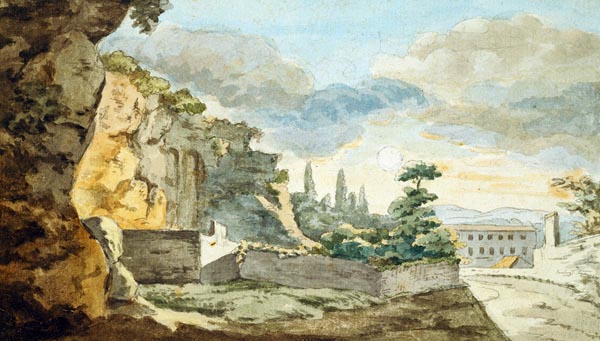
‘Evening at the Muro Torto by the Porta del Popolo, Rome’ - Johann Wolfgang von Goethe (German, 1749–1832)
Artvee
Public domain.
The renters of chairs, and of seats on the scaffolding, call out loudly to the passers-by: ‘Luoghi! Luoghi, Padroni! Luoghi!’ (‘Seats, seats!’)
The Masks
Now the maskers begin to multiply. Young men, dressed as lower-class women in festive clothes, are usually the first to appear, exhibiting bared chests and brazen effrontery. They embrace the men they meet, act openly and familiarly with the women as if they were of their gender, and otherwise do whatever their whim, wit, or wanton manners dictate.
I recall, among others, a young man who played, superbly, the role of a passionate, quarrelsome, and militant woman, loudly making his way down the entire promenade, picking a fight with everyone he met, while his companions seemed to make every effort to restrain him.
Here comes a Pulcinello, a large horn dangling from colourful cords about his hips. With a slight movement, as he converses with the women, he boldly imitates the figure of the ancient god of the gardens of sacred Rome (Priapus), his light-hearted pose arousing delight rather than resentment. Here comes another of his kind, more modest and placid, bringing his beautiful partner with him.
Since the women are as eager to show themselves in men’s clothes as the men are to display themselves in the women’s, the former adapt Pulcinello’s attire, and it must be admitted that they often succeed in appearing all the more charming in that androgynous form.
With swift steps, a lawyer pushes his way through the crowd, declaiming as if in court; he calls to the windows above and, grabbing masked and unmasked passers-by, threatens everyone with a lawsuit, now accusing some person of a long tale of ridiculous crimes they are supposed to have committed, now listing the precise details of their debts for another. He berates the women for their cicisbei (admirers, male escorts), the girls for their lovers; he refers to a portfolio he carries, produces documents from it, and all this in a penetrating voice and with a fluent tongue. He seeks to shame and embarrass everyone. Just when one thinks he is about to cease, he starts up again only more so; just when one thinks he is about to depart, he turns back; he advances on one person without speaking, he seizes another who has already passed by; and if a fellow lawyer happens to be coming towards him, his madness attains its highest degree.
But none of this holds the onlooker’s attention for long; the most impressive of sights is immediately swallowed up by the sheer quantity and variety of people and activity.
The Quacqueri (Quakers), while not making as much noise, attract just as much attention as the lawyers. The Quacquer persona seems to have become widespread due to the ease with which their quaint, old-fashioned clothing can be found in the flea markets.
The main requirements for this mask are that the clothing, while old-fashioned, be well-preserved and of fine fabric. These men are rarely seen dressed in anything other than velvet or silk; they wear brocade or embroidered waistcoats, and a Quacquer must be of a stout build; his face mask is solid, with chubby cheeks and small eyes; his wig is peculiarly braided; his hat is small and usually trimmed.
One notes that this persona closely resembles the ‘Buffo caricato’ of comic opera, and just as the latter usually represents a silly, lovesick, easily-deceived fool, so these characters too appear as dandies lacking in taste. They hop back and forth on their toes with great ease, and carry a pair of large black hoops without lenses instead of a lorgnette, with which they peer into all carriages and look up at all windows. They usually make a stiff, deep bow, and express their joy, whenever they meet one another, by repeatedly jumping upwards feet together, and uttering a bright, piercing, inarticulate sound combined with the consonant ‘brr’.
They often signal to each other by uttering this cry, and the ones nearby respond, so that in a short time, the shrill sound runs back and forth along the entire procession. Meanwhile, mischievous boys blow into large, twisted shells, offending the ear unbearably.
It soon becomes clear that, given the confined space and the similarity of so many costumes (for there must be several hundred Pulcinellos, and around a hundred Quacqueri, at any one time, continually racing up and down the parade route), few have a real intent to cause a stir, or be noticed. Moreover, those who wished to do so would have to arrive at the parade route early enough. Rather, everyone is simply out to enjoy themselves, indulge their follies, and make the most of the freedom allowed.
During this time, the women and girls especially seek out ways to make fun of others. Everyone wants to be outdoors, disguised in some way, and because few can afford to spend much on doing so, they are inventive enough in devising all sorts of schemes to hide rather than adorn themselves.
Beggar-like masks are very easy to make; a mass of fine hair is essential, along with a completely white face- mask, an earthenware pot hanging from a coloured ribbon, a staff, and a hat. They approach the windows, and everyone in the street, with humble gestures and receive sweets, nuts, and whatever else one likes to give instead of alms.
Others make themselves more comfortable, wrapped in furs or dressed in neat domestic attire but with a face mask. These mostly walk about alone, carrying a small broom, made from reeds with feathery blossom, as both an offensive and defensive weapon. With this, they fend off bothersome individuals, or, quite deliberately, tickle the faces of acquaintances and strangers without masks who approach.
If someone targeted by these girls gets caught amidst four or five of them, he is at his wits’ end. The dense crowd prevents him from escaping, and wherever he turns, he feels their brooms under his nose. Seriously resisting them, or any other form of their teasing, would be very risky, because the maskers are deemed invulnerable, and the guards ordered to assist them.
Likewise, day to day clothing worn by any social class may serve the masker. Stable-hands with their curry brushes rub anyone’s back whenever they please. The vetturini (carriage drivers) offer their services with their usual importunity. More ornate are the masks of country girls, Frascati women, fishermen, Neapolitan boatmen and sbirri (police officers), and Greeks.
Sometimes a mask is imitated from the theatre. Others make themselves very comfortable by wrapping themselves in carpets or sheets, which they tie together above their heads.
A white figure often steps into other people’s paths, and leaps about in front of them, imitating a ghost. Some are distinguished by their peculiar composition, while the tabarro is always considered the noblest mask being not at all distinctive.
Witty and satirical masks are quite rare, since they have a specific aim, and are meant to be noticed. However, there was one Pulcinello dressed as a cuckold. His horns were movable; he could retract them like a snail. When he stepped under the window of some newlyweds, and let just a sliver of one horn show, or when he stretched both horns out fully before another, the bells attached to the tips jingling merrily, the audience would momentarily take notice, and sometimes burst into copious laughter.
A conjuror mingles with the crowd, shows the people a book of numbers, and reminds them of his passion for playing the lottery.
A man with two faces is lodged amongst the throng: one knows not which is his front, which is his back, or whether he is coming or going.
Strangers must also accept being mocked at this time. The long robes of the Northerners, their large buttons, their peculiar round hats, catch the Romans’ attention, and so the stranger too becomes a mask to them.
Because the visiting artists, especially those who study landscapes and buildings, sit and draw in public everywhere in Rome, they are also imitated among the Carnival crowds, appearing as very busy, with large portfolios, long surtouts, and colossal drawing-pencils.
The German bakers’ apprentices are often seen drunk in Rome, and they are also imitated, staggering around with a bottle of wine in their actual, or somewhat embellished, traditional dress.
I recall a single, very suggestive mask. An obelisk was due to be erected in front of the Trinità de’ Monti church. The public was less than taken with the idea, partly because the space was narrow and cramped, and partly because an extremely tall pedestal had to be built to support the small obelisk and raise it to the required height. One wit had therefore seized an opportunity to wear a large white pedestal on his head, like a cap, to the top of which a tiny reddish obelisk was attached. Large letters were daubed on the pedestal, the meaning of which was opaque perhaps to all but a few.
The Carriages
Meanwhile, as the number of masks increases, carriages gradually enter the street, in the same order as we described above when discussing the Sunday and holiday promenades, except that these carriages descending from the Palazzo Venezia, on the left hand side, turn around where the promenade ends, and immediately drive back up on the other side. I have already noted above that, if you subtract the raised pavements for pedestrians, the road is little more than three carriage-widths across in most places.
The pavements are all encumbered with scaffolded seating, and occupied by chairs, and many spectators have already taken their places. A line of carriages runs along the scaffolding and chairs, very close to the paving, and another line runs up the other side. The pedestrians on each side are confined to a space of no more than eight feet, pushing and shoving as best they can, and from every window and balcony, a dense throng looks down on the crush.
In the first few days, one usually sees only ordinary carriages; since everyone saves for the following days whatever elegant or magnificent display they might wish to present. Towards the end of the Carnival, more open carriages appear, some of which are six-seaters: two ladies sit facing each other on a raised platform, so that their entire figures can be seen, four gentlemen occupy the four remaining seats in the corners, the coachmen and servants are masked, and the horses are adorned with ribbons and flowers.
Often a beautiful, white poodle, adorned with rose-coloured ribbons, stands between the coachman’s feet, bells jingling on its collar, and the attention of the public is fixed on the group for a few moments.
As may easily be supposed, only the most beautiful women dare to display themselves so prominently before the entire crowd, while only a truly beautiful woman would show herself without a mask. But whenever such a carriage approaches, travelling slowly enough most often, all eyes are fixed on it, and its fair occupant has the pleasure of hearing from many sides: ‘O quanto è bella!’ (Oh, how lovely she is!)
Formerly, these magnificent carriages are said to have been far more common, more expensively adorned, and more interesting too, due to many a mythological or allegorical representation; but recently, for whatever reason, the more distinguished people seem content to lose themselves amidst the masses, preferring to enjoy the pleasure they find in this ceremony rather than distinguish themselves from others.
The further the carnival progresses, the more amusing the carriages which appear. Even serious people, seated within and unmasked, allow their coachmen and servants to disguise themselves. The coachmen mostly choose women’s clothing, and in recent days it has seemed as if only women were in charge of the horses. They are decently, even charmingly, dressed in general; while in contrast, some broad-chested, ugly fellow in utterly newfangled finery with a tall hairstyle and feathers, offers a striking caricature; and while the beautiful women heard themselves praised, so he must endure having someone rise in his face and shout: ‘O fratello mio, che brutta puttana sei!’ (‘Oh, my brother, what an ugly whore you are!’)
The coachman usually does a favour for one, or even a couple, of his girlfriends, if he encounters them in the crowd, by lifting them up onto the box. They then usually seat themselves at his side, dressed in men’s clothing, dangling their neat little legs and feet, their high heels floating above the heads of passers-by.
The servants do the same, taking their friends and girlfriends up, at the rear of the carriage, and even seating them on top of the box, as on English country coaches.
The gentry themselves seem happy to see their carriages fully occupied; everything is permitted, and deemed acceptable at this time.
The Crowd
Now take a look across the long, narrow Corso, where from every balcony and window, over lengths of colourful carpet, tightly-packed spectators look down on the scaffolded seats filled with spectators, and at the long rows of fully-occupied chairs on both sides of the street. The two lines of carriages move slowly through the centre ground, while the space that a third carriage might occupy is completely filled with people, not walking back and forth, but pushing and shoving against each other. Since the carriages, as far as possible, always keep a little distance from each other so as not to collide at every halt, many pedestrians, merely to gain some breathing space, venture out of the crush into the centre, between the wheels of the carriage in front and the horses and shaft of the one behind, and the greater the trouble and risk for the pedestrians, the more their spirits and boldness seem to rise.
Since most pedestrians, who pass between the two rows of carriages carefully avoid the wheels and axles, to protect their limbs and clothing, they usually leave more space between themselves and the carriages than is necessary; whoever can no longer bear to travel along with the slowly moving mass, and has the courage to slip between the wheels and the pedestrians, between the danger and those who are avoiding it, can cover a great distance in a short time, until they find themself halted again by another obstacle.
Now my narrative will seem to stray beyond the bounds of credibility, and I would scarcely dare continue were it not for the fact that many who have attended the Roman Carnival can attest to the fact that I have adhered precisely to the truth, and were it not for the fact again that the festival is repeated annually and can be viewed by anyone, in future with my text in hand.
For what will my readers say if I explain that everything recounted so far is merely the first stage of the crush, commotion, noise, and revelry?
The Governor and Senator’s Procession
By moving forward only slowly, and halting when things ahead come to a standstill, the carriages inconvenience the pedestrians in various ways.
The Papal guard ride back and forth through the throng, individually, during the occasional disturbances and conflicts, so as to bring the carriages into line, and when a pedestrian avoids the carriage-horses, they may well feel, the head of a riding horse at their neck before they know it; yet a greater inconvenience follows.
The Governor, in a large State carriage with an entourage of several coaches, passes down the centre of the Corso between the two rows of carriages. The Papal guard, and the attendants, warn the people ahead to make way, and the procession momentarily occupies the entire width of the street that had, moments before, been reserved for the pedestrians. They push their way, as best they can, between the other carriages, and, in one way or another, reach the pavement. Then just as water, when a vessel passes by, parts for a moment but immediately merges again behind its passage, so too does the mass of masked figures and other pedestrians immediately coalesce behind the procession. Before long, however, a fresh movement disturbs the crowded gathering.
The Senator approaches with similar priority; his large State carriage and the carriages of his retinue float as if over the heads of the crushed crowd, and if the native Roman or visitor is captivated and charmed by the amiability of the present senator, Prince Rezzonico (Abbondio Rezzonico, a nephew of Pope Clement XIII), nonetheless this is an instance where the mass of people considers itself fortunate as he departs.
Once these two carriage trains carrying Rome’s supreme lords of the judiciary and the police, had pushed through the promenade on that first day, the Duke of Albany, much to the inconvenience of the crowd, was also accustomed to travel the route daily, reminding Rome, the ancient ruler of kings, at that time of general masquerade, of the Carnival nonsense of his royal pretensions.
The envoys, who possess the same right, use it sparingly and with thoughtful discretion.
Society at the Ruspoli Palace
But it is not only these carriages that interrupt and hinder the flow along the promenade; at and near the Palazzo Ruspoli (at Via del Corso 418), where the road is no wider, but the pavements on both sides are raised, the fashionable set gathers, and all the chairs there are soon occupied or spoken for. The most beautiful middle-class women, charmingly-masked, surrounded by their companions, display themselves there to the passing, curious eye. All who draw near the area linger to look through the well-dressed rows; each is curious to note the women among the many male figures who are sitting there, or discover in a handsome officer the object of their desire. Here, at this spot, the procession first comes to a standstill, while the carriages linger as long as they can, and when one is finally brought to a halt, one prefers to remain amidst that pleasant company.
The Confetti
If our description so far has given the reader an idea of one’s constrained, indeed almost troubled, situation, it will grant an even stranger impression if I further recount how this merry throng is agitated by a kind of petty, mostly light-hearted but sometimes all too serious, war.
It is quite likely that, on some past occasion, it chanced that a beautiful woman, attempting to attract the attention of her friend passing amidst the masked crowd, threw some sugar-coated seeds at him, it being only natural, that the man would then turn around, and discover his charming friend in her. This became a common custom, and one often sees a pair of faces, familiar to each other, meet after the seeds are thrown. However, people were too frugal to waste real eatables, and their misuse necessitated a larger, and cheaper supply.
It is now a trade in its own right to carry large baskets of plaster pellets, which have the appearance of dragees and are produced from a funnel, for sale amidst the crowd.
No one is safe from attack; everyone is on the defensive, and so, whether out of malice or necessity, a duel, a skirmish, or a battle breaks out here or there. Pedestrians, carriage-drivers, and spectators, from the windows, scaffolded seats, and chairs, attack and defend each other in turn.
The ladies carry gilded, or silvered, baskets full of these pellets, while the men are fiercely protective of their lovely companions. With carriage windows lowered, they await the assault, joking with their friends and stubbornly defending themselves against strangers.
Nowhere, however, are the battles more serious and widespread than in the vicinity of the Palazzo Ruspoli. All the masked figures who have settled there are equipped with baskets, pouches, and handkerchiefs full of the things. They attack more often than they are attacked; no carriage passes by unpunished, that is without at least a few masks scattering something at it. No pedestrian is safe from them; if an abbot, in particular, appears in his black robe they throw things at him from every direction, and because plaster and chalk stain wherever they land, the individual assailed is soon covered in grey and white specks. Moreover, these disputes often become more serious and widespread, and one gazes with astonishment as jealousy and personal hatred are allowed to run free.
A hooded figure will creep up unnoticed and, with a handful of confetti, strike one of the first of these beauties so hard, and so precisely, that her mask rattles, and her lovely neck is marked. Her companions on either side are greatly aroused, and hurling the contents of their bags and baskets, rush furiously upon the attacker; but he is often so well disguised, so heavily armoured, that he fails to feel their repeated attacks. The more confident he becomes, the more fiercely he continues his own assault; the defenders cover the women’s flanks with their tabarros, and because the attacker, in the heat of battle, also causes injury to their neighbours, and generally offends all around with his rudeness and impetuosity, those seated nearby join the fight, and spare not their pellets of plaster, commonly keeping somewhat larger pieces of ammunition in reserve for such cases, items roughly the size of sugared almonds, whereby the attacker is ultimately so attacked and assailed from all sides that nothing but retreat remains, especially if he has almost expended his shot.
Usually, someone embarking on such an adventure has a second with him, who slips him more ammunition, while the men who deal in such plaster confetti are busy with their baskets during the fight, hurriedly weighing out as many pounds for each man as he desires.
I myself witnessed such a dispute nearby, in which, in the end, the combatants, lacking fresh ammunition, threw the gilded baskets at each other’s heads, and were not deterred by the warnings of the guards, who themselves were struck all over.
Certainly, many such exchanges would end in knife fights if it weren’t for the lengths of rope, well-known instruments of punishment employed by the Italian police, strung up at several corners, reminding everyone in the midst of their revelry that it was risky to resort to dangerous weapons at that time. These disputes are countless, and most are more comical than serious.
For example, an open wagon full of Pulcinellos approaches Ruspoli. They intend to strike everyone in turn as they drive past the spectators; unfortunately, the crowd is too dense, and the wagon becomes stuck in its midst. The entire throng suddenly decides to go into action, and a hail of pellets rains down on the wagon from all sides. The Pulcinellos expend their ammunition, then remain exposed to the crossfire from all sides, for a good long while, so that in the end, the wagon, covered as if with a fall of hail and snow, slowly departs amidst general mockery and hoots of disapproval.
A Verbal Exchange at the Upper End of the Procession
Meanwhile, while these lively and vigorous antics occupy a large part of the beau monde in the centre of the parade, another section of the audience finds a different kind of entertainment at its upper end.
Not far from the French Academy, the so-called Capitano of the Italian theatre, dressed in Spanish garb with a feathered hat, sword, and large gloves, suddenly appears amidst the masks watching from the scaffolding and begins recounting his great deeds on land and sea in an emphatic tone. It is not long before a Pulcinello rises to oppose him, raising doubts and objections, and, while seemingly accepting everything, ridicules the hero’s boastfulness with wordplay, and interposed platitudes.
Here, too, every passer-by stops to listen to the lively exchange.
The Pulcinello King
Often a new set of entrants swell the crowd. Here, a dozen Pulcinellos band together, choose a king, crown him, hand him a sceptre, accompany him with music, and lead him, with loud cries, along the parade route seated on an ornate cart. As the procession moves forward, all the Pulcinello rush forward, increasing the number of participants, and forging a path with shouts and the waving of their hats.
Only then does one notice how they have chosen to vary the common mask. One wears a wig, another a woman’s hood over his blackened face, a third has a cage on his head instead of a cap, in which a pair of birds, dressed as an abbot and a lady, hop back and forth on their perches.
The Side Streets
The dreadful crush, which I have tried to convey to the reader as vividly as I can, naturally forces a large number of masks out of the parade and into the neighbouring streets. There, pairs of lovers walk together more privately and quietly, and there too, wilder people find space to indulge in all sorts of wondrous performances
A group of men in common Sunday best, wearing short doublets over gold-trimmed waistcoats, their hair tied in long, flowing nets, are strolling back and forth with youngsters dressed as women. One of them appears to be heavily pregnant; they are walking up and down peacefully. Suddenly, the men quarrel, a lively exchange ensues, the women join in, the argument grows increasingly heated, and finally, the combatants pull out large knives made of silver-plated cardboard and attack each other. The women, with dreadful cries, keep them apart, pulling one this way, another that, while the onlookers participate as if it were a real battle, trying to appease each side. Meanwhile, the pregnant woman is feeling unwell from the fright; a chair is brought to her, the other women attend to her, she moans piteously, and before anyone knows it, she ‘gives birth’ to an un-shapely doll to the great amusement of the onlookers. The play is over, and the troupe moves on to perform the same or a similar farce elsewhere.
The Romans, in whose minds tales of murder always lurk, like to toy with the idea, at every opportunity. Even the children have a game they call ‘Chiesa,’ (‘Church’) where one takes the role of a murderer who is fleeing to the church for sanctuary, while the others imagine themselves as police officers, and attempt to catch hold of the first, any way they can, before the ‘murderer’, can reach the place of refuge. So, things are quite lively in the side streets especially the Via del Babuino, and in the Piazza di Spagna.
The Quacqueri also arrive in droves to display their gallantries more freely. They have a manoeuvre that makes everyone laugh. They march about in groups of twelve, with small, quick steps while standing on tiptoe, in a solid row; when they reach a square, they suddenly form a line, turning right, or left, and then tiptoeing away one after the other. Suddenly, they will re-establish the row by each turning to the left, or right, and off they go down another street; then, before you know it, they turn right, or left, in a line again: the column pushes through a door as if strung on a skewer, and the fools vanish.
Evening
Now evening approaches, and everyone heads, increasingly, towards the Corso. The lines of carriages have long since been brought to a standstill; indeed, two hours before nightfall, it may be the case that not a single carriage can move.
The Papal Guard and the foot soldiers now busy themselves moving all the carriages, as far as possible, away from the centre of the street, and forming them into a perfectly straight line and, given the crowd, there is much trouble and annoyance. A deal of kicking, pushing, and pulling ensues, and when one horse kicks, everything behind has to back up, until finally some carriage gets so wedged that the driver has to steer his team into the centre of the street again. Then the scolding of the guards, and the cursing and threats of the foot soldiers re-commence.
It is in vain for the unfortunate coachman to demonstrate the obvious impossibility of his moving; he is scolded and threatened, and either has to comply, or, if a side street is nearby, he is forced out of the line through no fault of his own. Usually, the side streets are also occupied by a queue of carriages that have arrived too late and, because the procession has already slowed to a halt, can no longer join the line.
The Preparations for the Race
The time for the horse-race to start is now drawing ever nearer, on which many thousands of people are intent, who are eagerly anticipating the moment.
The renters of chairs, and of seats on the scaffolding, are now increasing their cries of offers: ‘Luoghi! Luoghi avanti! Luoghi Nobili! Luoghi, Padroni!’ The aim is to ensure that, in these final moments, all the seats are filled, even if at a lower price.
Fortunate it is if a space is to be found here and there; for the general, now riding along accompanied by a squadron of the guards, proceeds down the street between the twin rows of carriages, driving the pedestrians from the only space left for them. Everyone then tries to find a chair, a seat on the scaffolding, on board a carriage, between the vehicles, or at a friend’s window, all such now being full of spectators.
Meanwhile, the area in front of the obelisk has been completely cleared of people and perhaps offers one of the finest sights in the world today.
Three facades of scaffolded seating, hung with tapestries as described above, border the square. Thousands of heads peer out one above the other, producing the appearance of an ancient amphitheatre or circus. Above the central scaffolding, the entire obelisk rises into the air, the scaffolding itself doing no more than hide the pedestal, and only now does one truly appreciate its immense height, as indeed it serves to measure that of the crowd seated beneath.
The open space offers the eyes a brief respite, as the onlooker gazes, full of anticipation, at the empty course, with its barriers of taut rope.
Now the general descends the Corso, as a sign that the course has been cleared, while the guards behind him ensure no one steps out from the line of carriages. He takes a seat in one of the boxes.
The Horse-Race
The horses are led by well-dressed stable-lads into the pens behind the ropes, in randomly selected order. They have no tack or covering on their bodies. Spiked balls are attached to them, here and there, with cords, and the area from which they will start is hung with leather until all are ready; large sheets of tinsel are also stuck to them.
They are usually restless and impatient when brought into line, and the stable-lads need all their force and skill to restrain them.
Their eagerness to begin the race makes them difficult to restrain, while the presence of so many people makes them shy. They often strike the neighbouring barrier, often rear beyond the ropes, and this turbulence and disorder intensifies the anticipation, at every moment.
The stable-hands are extremely tense and attentive, because at the moment when they start, the skill of the person releasing the reins, as well as chance circumstance, can decide the thing in favour of one horse or the other.
Finally, the starting-rope is dropped, and the horses are away. In the open space they still try to gain an advantage over one another, but once they enter the narrow space between the two lines of carriages, all competition is normally in vain.
The few ahead exert all their strength. Despite the scattered pozzolana, sparks fly from the ground, manes swirl, the tinsel rustles, and they are barely seen before they are past. The rest of the horses, pushing and shoving, hinder one another; now and then a trailing horse gallops by, while individual pieces of torn tinsel flutter on the deserted track. Soon the horses vanish from sight, as the crowd surges forward, filling the street again.
Other stable-hands are already waiting at the Palazzo Venezia for the leaders to arrive. They know how to catch them, and restrain them safely, in an enclosed area. The winner will soon be awarded the prize.
Thus, one’s last instantaneous impression of the celebrations is of a violent, lightning-fast event, which the many thousands of people have been eagerly awaiting, for quite some time, though few can account for why they are prepared to wait so patiently, and why they revel in it so.
From my description, it is easy to see that the event carries risk for both animals and humans. Let me cite just a few examples: a single rear wheel may protrude slightly into the narrow space between the carriages, and by chance a somewhat wider space may appear to be have been left. A race-horse, rushing on, bunched with others, in trying to utilise the wider space, leaping forward, may collide directly with the protruding wheel.
I myself witnessed a case where one horse fell after such a shock, three of the horses following stumbled over the first, and somersaulted, while the later runners jumped over the fallen, and continued the race.
Often such a horse dies instantly, while spectators have lost their lives in such circumstances on several occasions. Likewise, great harm can occur if the horses behind try to turn back.
It has also happened that, when a horse has gained a considerable lead, people have struck it in the face with their coat, out of malice or spite, forcing it to turn around or swerve. Even worse is when the horses are not caught and held, safely, in the Piazza Venezia; they then, inevitably, return, and because the track is already crowded with people again, they cause much mischief that either goes unnoticed or is ignored.
Order is Abandoned
The horses usually only begin the race at nightfall. Once they reach the Palazzo Venezia at the top of the Corso, small mortars are fired; this signal is repeated in the middle of the promenade and, for the last time, near the obelisk.
At that moment the guards abandon their posts, order is no longer maintained as regards the lines of carriages, and indeed, it constitutes a troubling moment, causing anxiety even for a spectator standing calmly at a window, and justifies a remark or two.
We have already seen before that the onset of darkness, which determines so much in Italy, also disrupts the customary Sunday and holiday processions. There are no guards or watchmen; it is an ancient custom, a common convention, that folk proceed to depart in proper order. But as soon as the Ave Maria bell rings, no one relinquishes their right to turn back whenever and however they wish. Since the Carnival procession takes place on the same street and according to a similar rule, though the crowds and other circumstances render the issue more difficult, no one wishes to relinquish the right to break ranks, as night falls.
Looking back towards the tremendous throng, and finding the race-course, which had only been cleared briefly for the race itself, immediately flooded with people once more, logic and fairness seem to dictate that each carriage, in turn, should simply try to reach the nearest convenient alleyway, and drive away.
However, immediately after the signals are fired, some vehicles insist on steering into the centre of the Corso, hindering and confusing the foot-soldiers, and when one decides to descend, and other to ascent the street, in the confined space, neither can move, and often the more sensible drivers who have remained in line, are thereby prevented from departing.
If a stray horse happens to encounter such a knot of carriages, the risk of misfortune, and the degree of vexation caused are increased on every side.
Night
And yet the confusion is later, and most often happily, resolved. Night falls, and everyone longs for some peace, or entertainment.
Theatre
Face masks are removed from that moment on, and a large number of the spectators hurry towards the theatre. Only in the boxes does one see, if at all, tabarros, and ladies in masked costumes; the people in the stalls are once more dressed in ordinary attire.
The Teatro Aliberti (the Teatro delle Dame, not extant) and the Teatro Argentina (in the square Largo di Torre Argentina) present serious operas, with ballets interspersed; Teatro Valle (extant, but currently inactive) and Teatro Capranica (in Piazza Capranica, housed in the Palazzo Capranica) both stage comedies and tragedies, with comic operas as intermezzos; the Teatro Pace (near Piazza Navona, now a hotel) imitates them, albeit imperfectly, and there are many subordinate theatrical stagings down to the level of puppet shows and the performances in tightrope walkers’ booths.
The grand Teatro Tordinona (near Ponte Sant’Angelo, Longotevere Tordinona), which burned down (in 1781) and, after being rebuilt, immediately collapsed, unfortunately no longer entertains the people with its major State and other fine performances (it was rebuilt once more, and reopened in 1795).
The Romans have a great passion for theatre, a passion formerly even more ardent during Carnival season, as that was the only time when it could be fully indulged. Nowadays, at least one theatre remains open during the summer and autumn, allowing the public to satisfy its wish, to some extent, for most of the year.
It would be too much of a distraction from my purpose to delve into a lengthy description of the theatres and of what might be special about those in Rome. The reader will recall that the subject has been discussed elsewhere.
Festini (Masked Balls)
Likewise, I will have little to say about the so-called festini; these are large masked balls, held on several occasions in the beautifully-lit Teatro Aliberti.
Here too, tabarros are considered by both men and women to be the most suitable costume, and the whole hall is filled with figures robed and masked in black; a few colourful character masks are mingled amongst them.
The interest is all the greater, since various noble persons attend, though now more rarely, wearing masks in the style of various artistic periods, and imitating, masterfully, a number of statues located in Rome. Thus, when I was present, Egyptian deities, priestesses, Bacchus and Ariadne, the Tragic Muse (Melpomene), the Muse of History (Clio), a symbolic township, Vestal Virgins, and a Consul were depicted, more or less effectively according to the appropriateness of the costume.
The Dancing
The dances at these festivals are usually conducted in line, in the English style; they differ only in that in a few figures they often mime some characteristic scene; for example, two lovers are seen to part then reconcile, they separate then find each other again.
The Romans, accustomed to highly expressive gestures in their pantomime ballets, also favour, in their social dancing an expressiveness that seems exaggerated and affected to us. No one readily dares to dance except those who have learned the art; the minuet, in particular, is regarded as a true work of art, and performed by only a select few couples. Such a couple is then enclosed in a circle by the rest of the party, receiving admiring applause at the end.
Next Morning
While the fashionable crowd enjoys themselves in this manner until morning, work is already underway at dawn to clean and tidy the Corso. Particular care is taken to ensure that the pozzolana in the middle of the street is spread evenly and neatly.
Before long, stable-hands lead the racehorse that performed least well the day before to the obelisk. A small boy is seated astride, and another rider with a whip drives it forward, and forces it to exert all its strength in completing the course as swiftly as possible.
Each day, at about two in the afternoon, after the bell has been rung, the festive cycle, as already described, begins again. Strollers gather, the guard assembles, balconies, windows, and scaffolding are draped with carpets and tapestries, the masks multiply and perform their antics, the carriages drive up and down, and the street is more or less crowded, depending on whether the weather or other circumstances are favourable or no. Towards the end of the Carnival, naturally, the number of spectators, masks, floats, and decorations, and the level of noise increase. But nothing compares to the crush and excess of the last day, and evening.
The Last Day (Shrove Tuesday)
Usually, the lines of carriages fall silent two hours before nightfall; no carriage can move, none can enter from the side streets. The scaffolded seating and chairs are occupied earlier than usual, even though the seats are expensive; everyone tries to find a place as quickly as possible, and the horse-race is awaited with greater expectancy even than before.
Finally, the moment arrives when the signal is given that the festival is over; but neither the carriages, nor the masks, nor the spectators move from their spots. Everything is calm, everything is still, as twilight gently deepens.
The Festa dei Moccoletti (Festival of the Little Candles)
As soon as it is dark in the narrow street, little lights can be seen appearing here and there, moving behind the windows, and amidst the seating, and in a short time, more and more being lit, the whole street is illuminated by burning wax candles.
The balconies are decorated with translucent paper lanterns, and everyone holds a candle out of the window, all the scaffolding is illuminated, and one can often see into the various carriages, from whose ceilings inside hang small crystal chandeliers revealing the occupants; while, in others, ladies with colourful candles in their hands seem to invite one’s contemplation of their beauty.
The servants attach candles to the rims of the carriage roofs, open wagons with colourful paper lanterns appear, some pedestrians are seen with a tall pyramid of lights on their head, others have set their lights on reeds fastened together to make a rod, often reaching, by means of such tall holders, a height of two or three stories.
Now it becomes every person’s duty to carry a lit candle in their hand, and the Romans’ favourite curse ‘Sia ammazzato’ can be heard being repeated from all corners. ‘Sia ammazzato chi non porta moccolo!’ ‘Death to whoever carries no candle!’ one shouts to another, while trying to blow out the other’s light. Lighting and blowing out other people’s candles, and the unrestrained cries of ‘Sia ammazzato!’ soon brings life, movement, and common purpose to the vast crowd.
Regardless of whether one encounters acquaintances or strangers, one seeks only to extinguish the nearest light, or relight one’s own, and in doing so, extinguish that of the one who helped re-light it. And the more loudly the cries of ‘Sia ammazzato’ echo from all sides, the more the phrase loses its darker meaning, and the more one forgets that one is still in Rome, where that curse can be fulfilled against one person or another simply over some trifle or other.
Gradually the original sense of the expression fades away completely. And just as we often hear curses and indecencies used as signs of admiration and joy in other languages, so ‘Sia ammazzato’ becomes the evening’s password, a cry of joy and the refrain added to every joke, compliment, or tease.
Thus, one hears, in a mocking tone: ‘Sia ammazzato, il Signore Abbate, che fa l’amore (the lovemaker)’ Or a call to a good friend passing by: ‘Sia ammazzato, il Signore Filippo.’ Or flattery and compliment combined in: ‘Sia ammazzata, la bella Principessa! Sia ammazzata, la Signora Angelika, la prima pittrice del secolo (the finest painter of the age).’
All these phrases, are shouted out loudly and rapidly, with a long, sustained note on the penultimate or ante-penultimate syllable. Amidst this incessant shouting, the blowing-out and lighting of candles continues unabated. Whether encountering someone in the house, on the stairs, in a group gathered in a room, or leaning from one window towards the next, everywhere people try to gain the upper hand, and extinguish a candle.
All classes and ages do battle, they clamber onto the steps of the carriages; no chandelier, scarcely even the lanterns being safe; the son extinguishes his father’s light, continually shouting: ‘Sia ammazzato, il Signore Padre!’ In vain does the old man rebuke him for his lack of respect; the lad is asserting his freedom for the evening, and only ‘curses’ his father all the more vehemently. Though the tumult soon fades away at both ends of the Corso, it becomes all the more unrestrained amidst the throng nearer the centre, while the crush there defies all comprehension, indeed, is greater than even the most vivid memory can recall.
No one can move from their position; the warmth of the many people, the lights, the smoke from so many repeatedly extinguished candles, the shouts of the multitude who roar all the more vehemently the less they are able to stir a limb, finally renders even the soundest of minds dazed; it seems impossible for some misfortune not to occur, the carriage horses to break free, or someone be squeezed, crushed, or otherwise harmed.
And yet, because everyone eventually longs to escape, and each person takes to a side-street or seeks clear air, and a chance to breathe, in the nearest square, this central crowd also dissolves, melting away from the ends towards the centre, and this festival of universal freedom and liberation, this modern Saturnalia, ends in general numbness.
Ordinary folk now hurry away, to revel in a long-prepared feast of soon-to-be-forbidden meat, until midnight, while the more refined crowd head to the theatres to bid farewell to the now heavily-abridged plays, but even these pleasures are brought to an end by the approach of midnight.
Ash Wednesday
Thus, the extravagant festival passes like a dream, like a fairy-tale, and perhaps less of it remains in the mind of its participants than in the mind of the reader, to whose imagination and comprehension I have presented the whole, in context.
If, during the course of these follies, Pulcinello has reminded us, crudely and excessively, of those joys of love to which we owe our existence, if Baubo (the sacred female fool of Greek mythology) has profaned the secrets of women in labour, in the public square, at a time of night when the many lit candles remind us that there will come an end to all celebration, then, amidst all that nonsense, we at least have been made aware of the most significant moments of our lives.
The long, narrow, crowded street reminds us, even more cogently of the ways of this world, where every spectator of and participant in life, bare-faced or behind a mask, sees only a little space in front of, and around them, from the balcony or seated amidst the scaffolding, and in a carriage or on foot only progresses a yard at a time, is driven forward rather than strides ahead, is supported more than stands upright on their own, ever more eagerly seeking a place where all is better and happier, and even there finding themself in trouble, and ultimately pushed aside.
If I may continue speaking in this more serious vein than the subject seems to justify, let me observe that the liveliest and highest pleasures, like horses speeding by, last only for a moment, stir us, yet scarcely leave a trace in the mind; that freedom and equality seem only ever to be enjoyed in moments of intoxication and madness; and that the greatest pleasure is most stimulating only when it borders on danger, and greedily, but still anxiously, enjoys the sweet sensory delights in its vicinity.
And so, without deliberately intending them, we may well conclude our Carnival with a reflection or two, on Ash Wednesday, without fear of saddening the reader. Rather, let me wish that everyone of us, though life as a whole, like the Roman Carnival, remains overwhelming fraught, indeed troublesome, may be reminded by this carefree, masked gathering of the importance of every momentary, often seemingly insignificant, pleasure in life.
Rome, Friday, February 1st, 1788, midway through the Carnival
How glad I will be when all this foolishness ends next Tuesday evening. It is a dreadful nuisance to see others running mad when you are not infected yourself
As much as possible, I continued my studies. ‘Claudine von Villa Bella’ has also progressed, and unless all the genii fail to offer their help, the third act will be completed and off to Herder this day week, and thus I will be rid of the fifth volume. Then a new predicament will arise, in which no one can advise or help me. ‘Tasso’ must be reworked; what is written is useless. I can neither end it as it is, nor throw it all away. Such labour has God granted humankind!
The sixth volume will probably contain ‘Tasso’, and two Singspiele ‘Lila’ and ‘Jery and Bätely’, all three reworked and elaborated to such an extent that one would no longer recognise them.
At the same time, I have gone through my short poems and thought about the eighth volume, which I might publish before the seventh. It is a strange thing, drawing up such a summation of one’s life. How little trace remains of anyone’s existence!
Here they are pestering me with translations of ‘Werther,’ showing them to me, and asking which one is the best and whether everything in the tale is true! It is a plague of sorts that would haunt me all the way to India, if I travelled there trying to escape it.
Rome, February 6
Here is the third act of ‘Claudine von Villa Bella’; I hope you are even half as much pleased with it as I am to have finished it. Now that I understand the needs of lyric theatre more precisely, I have tried, through a measure of sacrifice, to accommodate both the composer and the performers. The fabric on which embroidery is to be worked should always be of broader thread, yet for a comic opera must absolutely be woven like Marli (a fine, open-work net, often used as a base for intricate embroidery). And with this work, as with ‘Erwin and Elmire,’ I have also been obliged to keep the reader in mind. Enough, I have done what I could.
I am quite quiet and clear-minded, and, as I have already assured you, ready for, and devoted, to any summons. I am too old for the fine arts, so whether I dabble in them a little less or a little more is of no consequence. My thirst is quenched, I am on the right path, that of contemplation and study, and peaceful and content in my enjoyment of them. In all this, grant me your blessing. I have nothing more to do now than to finish these last three works. Then I shall be on to ‘Wilhelm Meister’ and other things.
Rome, Thursday, February 9th
The revellers were still making a tremendous racket on Monday and Tuesday (Shrove Tuesday). Especially Tuesday evening, when the revelry with the moccoletti candles was in full swing. On Wednesday (Ash Wednesday), they gave thanks to God and the Church for the fast. I did not attend any festini (that’s what they call the masquerades); I am working hard, as much as my brain will allow. Now the fifth volume is done, I simply wish to work through some art studies, then go straight on to the sixth. I have been reading Leonardo da Vinci’s treatise on painting (‘Trattato della Pittura’, a collection of Leonardo’s notes on painting, first published in 1651) these past few days, and now understand why I could grasp little of the matter before.
Oh, how happy an audience is! They think themselves so clever, they think they know what is good. So do the enthusiasts, and the connoisseurs. One can scarcely believe how complacent a bunch they are, while the good artist must always remain humble. Yet lately I have developed a disgust for hearing judgement passed by someone who is not an artist themself, so much so that I can barely express it. Like tobacco smoke, such talk makes me instantly uncomfortable.
Angelika has treated herself to two paintings. One by Titian (the ‘Cornaro Triple Portrait’, National Gallery of Art, Washington DC) the other by Paris Bordone (‘Christ Taking Leave of His Mother’, Philadelphia Museum of Art). Both at a high price. Since she is so wealthy that she never spends her income, and earns more each year, it is good that she acquires things that bring her pleasure, and augment her artistic zeal. As soon as she had the paintings in the house, she began to paint in a new manner, seeking to adopt certain qualities of those masters. She is tireless not only in her work but also in her studies. It is a great pleasure to view art in her presence.
Christoph Kayser is also a most worthy artist. His music for ‘Egmont’ is progressing rapidly. I have not listened to the whole yet, but it all seems perfectly suited to its final purpose. He will also compose music for ‘Cupid, you, willful, endlessly obstinate, boy!’ (see above, from ‘Claudine von Villa Bella’). I shall send it to you right away so that it can be sung often, in memory of me. It is also my favourite song from the piece.
My mind is in a whirl from all the writing, doing, and thinking. I am no wiser, rather I am still demanding too much of myself, and taking too much on.
February 16
I recently received a letter from our Duke (Karl August of Saxe-Weimar) via the Prussian courier. It was so friendly, kind, genuine, and delightful — a rare thing. Since he was able to write unreservedly, he described the entire political situation, his own, and others. He spoke most affectionately as regards myself.
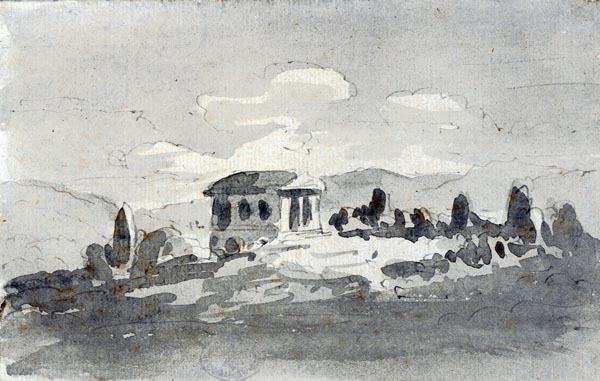
‘The Roman House in Weimar (1794)’ - Johann Wolfgang von Goethe (German, 1749–1832)
Klassik Stiftung Weimar, Museen (Inv. GGz/1166)
Digital reproduction · See Art. L. 111-1 CPI and § 68 UrhG
February 22
This week we had a case that has saddened the entire artistic community. A Frenchman named Jean-Germain Drouais, a young man of about twenty-five, wealthy and well-educated, the only son of a loving mother, and considered the most promising of all the artists studying here, has died of smallpox. It has caused widespread grief and dismay. In his deserted studio, I saw a painting of a life-size figure of Philoctetes (‘Philoctetes on the Island of Lemnos’, Musée des Beaux-Arts de Chartres), cooling the pain of his wound, by waving the wing of a slain bird of prey. A beautifully conceived image, with much merit in its execution; sadly, it was the artist’s last completed work.
I am diligent and cheerful, and await the future thus. It becomes clearer to me daily that I was indeed born to write poetry, and that I should cultivate that talent, so as to create something worthwhile during the next ten years, which is the maximum time I may have left to work, for it was the fire of youth that allowed me to achieve as much as I have without extensive study. My extended stay in Rome has had the advantage of teaching me to forgo the visual arts.
Angelika complimented me, saying she knows few in Rome who have a better eye for art than I do. I know quite well how, and in what way, my eye fails, and feel that I am still constantly improving, and also what would be needed to see even further into the subject. Enough, I have achieved my wish: to grope my way blindly no longer, through a region to which I feel passionately drawn.
I shall send you a poem, ‘Cupid as a Landscape Painter,’ (‘Amor als Landschaftsmaler’) as soon as possible and wish it good luck. I have tried to arrange my little poems into a certain order; they seem rather odd together. The poems on Hans Sachs (‘Hans Sachsens Poetische Sendung’, 1776, written on the two hundredth anniversary of the Meistersinger’s death) and on the death of Mieding (‘Auf Mieding’s Tod’, 1782. Mieding was the Court carpenter) conclude the eighth volume, and thus my writings, for now. If, however, they lay me to rest at the Pyramid of Cestius (near the Protestant cemetery, established in 1716), then these two poems can serve to witness my identity and origin.
Tomorrow morning there is a service at the Papal Chapel, and the famous old music will begin, music which later reaches its peak of popularity during Holy Week. I intend to go every Sunday morning to familiarise myself with the style. Kayser, who actually studies these things, will surely explain their meaning to me. We expect a printed copy of the Maundy Thursday music from Zurich, where Kayser left it, with every mail. It will be played first on the piano and then heard in the chapel.
February 1788 – Later Notes
When one is born an artist, certain subjects appeal to the contemplative eye, and this worked to my advantage amidst the hustle and bustle of the Carnival follies and absurdities. It was the second time I had witnessed the Carnival, and it was soon apparent to me that this folk festival, like any other recurring cycle of life, followed its own decided course.
This reconciled me to all the commotion; I viewed it as one more significant natural phenomenon, and national event. I took an interest in it all, in that sense, carefully observing the course of the follies and how it unfolded in a certain manner and with a certain degree of decorum. I then noted the individual incidents in sequence, preliminary work which I later used for my essay. At the same time, I also asked our housemate, Georg Schütz, to sketch and colour the individual masks, which he did with his usual helpfulness.
These drawings were subsequently etched in quarto by Georg Melchior Krause of Frankfurt am Main, director of the Weimar Princely Free Drawing Institute (Fürstliche freie Zeichenschule Weimar), and illuminated from the originals for the first edition by Unger (Johann Friedrich Gottlieb Unger, engraver and publisher), which is now rare.
For the aforementioned purpose, I had to push in among the masked crowd more than usual, which, despite my artistic purpose, often left a distasteful and sinister impression. Accustomed to the noble subjects with which I had occupied myself throughout the year in Rome, my mind seemed to be aware, at times, that it was to some degree out of its proper sphere.
But as regards my inner peace, an event guaranteed to revive me was imminent. In the Piazza Venezia, where various carriages, before rejoining the lively procession, are wont to halt to gaze at the passers-by, I saw Angelika’s carriage, and stepped forward to greet her. After leaning forward to acknowledge me in her usual friendly manner, she moved back a little so that I could greet the lady from Milan seated beside her, and now fully recovered. I found her looks unchanged, for youth, once recovered, quickly regains its strength. Indeed, her eyes seemed fresher and brighter as they looked at me, with a joyfulness there that pierced me to the very core. We remained thus speechless for a while, until Angelika spoke and, as the other woman bent forward, said to me: ‘I must only act as interpreter, for I see that my young friend cannot express what she has so long desired, what she has so often intended to say, and what she has repeatedly told me: how deeply she is indebted to you for the support you have shown her during her illness, and your interest in her fate. The first thing that comforted her upon returning to life, and had a healing and restorative effect on her, was the support of her friends, and especially your friendship; from the deepest solitude she suddenly found herself once more among a host of good people, and in the fairest circle.’
‘All that is true, indeed,’ said the lady, reaching over her friend, and offering me her hand, which I could fittingly touch with my own, though not with my lips.
With quiet satisfaction I withdrew back into the madcap throng, with the tenderest feeling of gratitude towards Angelika, who knew how to comfort the good girl immediately after the accident and, what is rare in Rome, had taken a previously unknown woman into her distinguished circle, a kindness which moved me all the more as I flattered myself that my part in the girl’s recovery had carried no small weight in that regard.
The sole Senator of Rome, Prince Abbondio Rezzonico (Venetian nobleman and politician, and nephew of Pope Clement XIII), had previously visited me upon his return from Germany. He had established a close friendship with Wilhelm Christoph Diede zum Fürstenstein and his wife, and brought me warm greetings from these esteemed patrons and friends; but, as was my custom, I declined any closer relationship, though I it was inevitable that I would be drawn into their circle eventually.
The husband and wife paid their esteemed companion a return visit, and I could hardly resist accepting an invitation, especially since the lady (Louise Diede zum Fürstenstein, musician and composer) who was renowned as a pianist, had agreed to perform during a concert at the Senator’s Capitoline residence (Palazzo Senatorio), and our comrade Christoph Kayser, whose own pianistic skill had become well-known, had received a flattering invitation to participate in the same. The incomparable sunset view towards the Coliseum from the Senator’s rooms, with all that adjoins that structure on its other sides, certainly provided the artistic eye with a most magnificent spectacle, which, however, one could not over-indulge in lest one appeared disrespectful and discourteous to the company. Madam Diede then gave a noteworthy performance, displaying considerable merit, and shortly afterwards our friend followed her, assuming a place of which he seemed more than worthy, if one can trust the applause he won. Their performances continued alternately for a while, a lady also sang a favourite aria, and finally, when it was Kayser’s turn once more to play, he based his offering on a graceful theme which he then varied in the most diverse ways.
Everything had gone well, and the Senator said many kind things to me, in conversation, but could not help assuring me, half-regretfully, in that soft Venetian manner of his, that he was actually no lover of such variations, but was always completely delighted by the lady’s most expressive adagios.
Now, I would not seek to claim that the yearning tones which are usually present in adagios and largos have ever been repugnant to me, but I have always loved the more positive aspects of music, since our own feelings, our own reflections on loss and failure, all too often threaten, to drag us down, and overwhelm us.
On the other hand, I could not object to the Senator’s opinion; indeed, I was obliged to concede the kindness which led him to give ear, willingly, to those same variations, and assure him of my gratitude that he had entertained a performance by my beloved and highly esteemed friend, in this, which was surely the most splendid residence in all the world.
For the German attendees in particular, it was an invaluable pleasure to be able, as I did, while listening to that distinguished, well-known, and highly-esteemed lady elicit the most delicate tones from the instrument, to gaze down, at that moment, from the window, over that unique earthly landscape and survey, in the evening glow of the sun, with barely a turn of my head, the vast panorama that stretched on the left from the Arch of Septimius Severus across the Campo Vaccino (the Forum) to the remains of the Temple of Minerva (Forum of Nerva) and the Temple of Peace, and then to the Coliseum in line of view, after which, turning my gaze to the right, the eye glided back past the Arch of Titus, to become confused and linger amidst the labyrinth of the Palatine ruins, their desolation adorned with cultivated gardens, and wild vegetation. Here I request that the reader inspects the etching ‘Northwestern View of Rome Taken from the Capitoline Tower’, drawn and engraved, in 1824, by Ernst Fries and Joseph Thürmer (see, for example, the print ‘Nord-Westliche Uebersicht von Rom, Genommen von dem Thurme des Capitols’ in the British Museum, London); the view is from several stories higher, and based on the more recent excavations, while at that time I saw it bathed in evening light and shadow, so that the glowing colours and shadowy-blue contrasts, and all the magic that arises from them, would of course need to be added.
While there, we were fortunate enough to be able to contemplate, quietly, perhaps the most magnificent picture that Anton Mengs ever painted, the portrait of Pope Clement XIII Rezzonico (created 1758, Museo del Settecento Veneziano, Ca’ Rezzonico, Venice), who later appointed his nephew our patron, to his Senatorial post (in 1766), a painting whose value is attested by a passage from our friend’s diary, which I quote, in conclusion:
‘Among the portraits painted by Anton Mengs, in which his skill asserted itself most completely, is the portrait of Pope Rezzonico. In this work, the artist imitated the Venetian masters in technique and use of colour, and achieved a happy success; the colour tones are true and warm, and the expression of the face animated and intelligent; the curtain of gold fabric, against which the head and the rest of the figure stand out beautifully, is considered a daring touch, but succeeds superbly, giving the picture a rich, harmonious appearance, pleasing to the eye.’
Rome, Saturday, March 1
To Herder
Last Sunday I visited the Sistine Chapel, where the Pope and the Cardinals were attending Mass. Since the Cardinals were dressed in violet, not red, for Lent, it was a spectacle new to me. A few days earlier I had seen some paintings attributed to Albrecht Dürer and was delighted to encounter something similar in real life. The whole thing was uniquely grand yet simple, and I am not surprised that strangers who visit during Holy Week, when all comes together, are often overwhelmed. I know the Sistine Chapel itself quite well; I had lunch there last summer, and took my midday rest on the Pope’s throne, and I know the paintings almost by heart. And yet, when everything that serves its true purpose is brought together, it becomes something else entirely, and one hardly recognises it oneself.
An old motet, composed by a Spaniard named Morales (Cristóbal de Morales, early sixteenth century), was sung, and granted us a taste of what was to come. Christoph Kayser believes, also, that this music should only be heard here, partly because nowhere else are singers trained in such a style, without organ or instrumental accompaniment, and partly because it uniquely complements the antique adornments of the Papal chapel and the ensemble of Michelangelo’s works, the ‘Last Judgement’, the ‘Prophets’, and paintings of Biblical history. Kayser will one day write a definitive account of all this. He is a great admirer of early music, and studies everything related to it, diligently.
In consequence we have a remarkable collection of psalms at home; they are settings of versions of the Psalms of David in Italian verse (translated from the Latin of the Vulgate by the poet Girolamo Ascanio Giustiniani), composed at the beginning of this century by a Venetian nobleman, Benedetto Marcello. For some, he adapted Sephardic Jewish cantillation melodies, part Spanish, part German, to provide his motifs; others, he based on ancient Greek melodies, executing them with great intelligence, artistry, and restraint. They are set partly as solos, partly as duets, and partly as choral pieces, and are extremely original, though one must first acquire some understanding of them. Kayser greatly appreciates them and will copy some of them. Perhaps one day we will be able to acquire the complete work, which was printed in Venice in 1724 (‘Estro Poetico Armonico’, printed by Domenico Lovisa, 1724-26) and contains the first fifty psalms. Herder should check his catalogues; he might find this interesting work in one or another.
I have found the courage to reconsider my last three volumes, taken together, and now know exactly what I wish to achieve; may Heaven grant me the mood, and the good fortune, to do so. It was a frantic week, which in retrospect feels like a month.
First, the plan for ‘Faust’ (Faust Part I) was drawn up, and I hope the undertaking has been successful. Of course, it is quite another matter to develop the thing further, now and not fifteen years ago; yet I think it will lose nothing in the process, especially since I believe I can now pick up the threads. As for capturing the previous tone, I am also relieved; I have already completed a fresh scene, and if I darken the paper a little, no one I think would be able to discern it from the old ones. Now this long period of rest and seclusion has restored my true sense of being, it is remarkable how much I resemble my former self, and how little it has altered for the worse despite all the years and events. The old manuscript gives me pause for thought, now and then, when I place it before me. It is the first version, indeed, written, in the main, without any amendment at all; now it is so yellowed with age, so worn (the pages were never sewn together), and so brittle and torn at the edges, that it really does look like the fragment of an old codex, and, just as I then transported myself, by means of my senses and intuition, to an earlier world, I am now required to transport myself back to a past that I myself have lived.
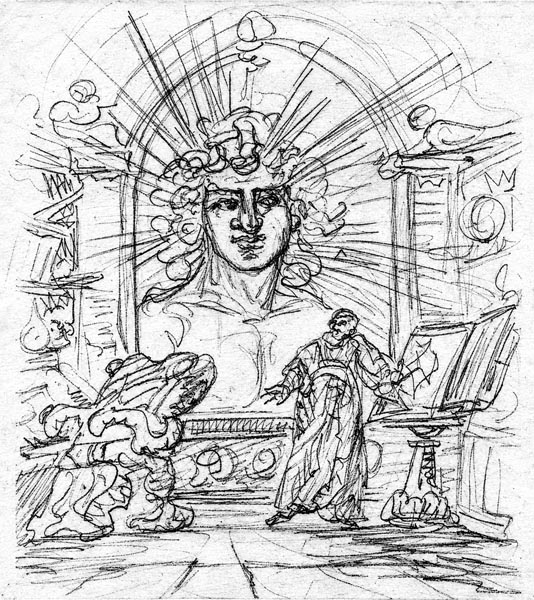
‘Faust confronting the Earth Spirit’ - Johann Wolfgang von Goethe (German, 1749–1832)
Wikimedia Commons
The plan for ‘Tasso’ is also sound, and the various miscellaneous poems for the final volume are mostly complete and in their final form. ‘The Artist’s Earthly Wanderings’ (‘Des Künstlers Erdewallen’, 1774) will be reworked, and his ‘Apotheosis’ (‘Des Künstlers Apotheose, 1789’) added. I have only just begun to study these youthful fragments again, and all the ideas and details are now quite vivid in my mind. I am looking forward to the task, and have the highest hopes for the last three volumes; I can already see them standing before me in their entirety and only wish for enough leisure and peace of mind to carry out my thoughts step by step.
For the arrangement of the various short poems, I have used your various collections of ‘Scattered Leaves’ (‘Zerstreute Blätter’) as a model, and hope to have found a good means for connecting such disparate things, as well as a way to make the overly-personal pieces, and those purely of the moment, somewhat more palatable.
Following these reflections, the new edition of Mengs’ writings arrived, a volume that now holds immense interest for me because I possess the sensory perception that is a necessary requirement for gaining a true understanding of even a single line of the work. It is, in every sense, an excellent book; not a page but offers definite value. I also owe happy insights to his ‘Thoughts on Beauty in Painting,’ (‘Gedanken über die Schönheit und über den Geschmack in der Malerei’, 1762) which may seem obscure to some.
Furthermore, I have a theory of sorts regarding colours, which are of great interest to me because this is the aspect of art I understand the least, so far. I see that with some practice and continued thought, I will also be able to appreciate this lovely aspect of the world’s surfaces.
I spent a morning in the Borghese Gallery, which I had not visited for a year, and found, to my delight, that I saw it with much more discerning eyes. Prince Borghese (Marcantonio Borghese IV) possesses indescribably valuable art treasures.
Rome, March 7
Another good, fulfilling, and peaceful week has come to an end. On Sunday, I forewent the Papal chapel, but Angelika and I saw a very beautiful painting that is often mistaken for a Correggio (possibly the ‘Danaë’, which is in fact by Correggio, now in the Borghese Gallery, after its wanderings).
I visited the collection of the Accademia di San Luca, where Raphael’s skull is kept, This, relic seems to me beyond doubt. A splendid skeletal structure in which a beautiful soul could comfortably rest (the actual skull was exhumed, as part of his intact skeleton, from the Pantheon, Santa Maria Rotonda, in 1833). The Duke of Saxe-Weimar has requested a cast of it, which I will probably be able to obtain. The self-portrait of Raphael (in his ‘Saint Luke Painting the Virgin’) which can be seen in the same hall, is worthy of it.
I also visited the Capitol again, and some other things that I had omitted, especially the house of Bartolomeo Cavaceppi (the sculptor), which I had delayed seeing. Among many delightful things, I was particularly pleased by two casts of the heads of the colossal statues on Monte Cavallo. They can be seen at Cavaceppi’s in all their size and beauty. Unfortunately, the finest one has lost almost a straw’s thickness of smooth facial surface due to time and weathering, and seen near to it looks as if is badly disfigured by smallpox.
Today I witnessed the funeral service for Cardinal Visconti (Antonio Eugenio Visconti, who had died on March 4) at the Church of Santi Ambrogio e Carlo al Corso. Since the Papal chapel choir were singing, we went there, at High Mass, to cleanse our ears for tomorrow. A Requiem was sung by two sopranos, the strangest thing one could hear. Note that there was neither organ nor any other music.
And what a tiresome instrument the organ is; I was struck by the thought last night in the choir of Saint Peter’s, where it accompanied the singing at Vespers; it blends so poorly with the human voice, and is so powerful. How charming the music of the Sistine Chapel is, by contrast, where the voices are unaccompanied.
The weather has been overcast, and mild for the past few days. The almond trees have mostly finished blooming, and are now green, with only a few blossoms still visible at the top. The peach trees follow, their beautiful colour adorning the gardens. Viburnum tinus (laurestine) is blooming on all the ruins, the dwarf-elder bushes in the hedges are showing fresh shoots, and others which I failed to recognise are also in bloom. The walls and roofs are greening, and wildflowers are appearing on some. From my new study, to which I have moved because we are expecting Tischbein back from Naples, I have a varied view of countless little gardens, and the rear galleries of many houses. It is quite delightful.
I have started doing a little modelling in clay. As far as knowledge is concerned, I proceed very clearly and confidently, but in the active application of it, I remain a little confused. That is how things are for me, and all my brethren alike.
Rome, Friday, March 14th
There is nothing to be thought about, or done here next week; one must go with the festive flow. After Easter, I shall see what remains, tie up any loose ends, settle my debts, pack my things, and set off with Kayser. If everything goes as I hope and plan, I shall be in Florence at the end of April. You will hear from me again in the meantime.
It was strange that, due to external circumstances, I was obliged to adopt various measures which involved me in fresh relationships, thereby making my stay in Rome ever more pleasant, useful, and happy. Indeed, I can say that I have enjoyed the greatest satisfaction of my life in these last eight weeks, and now at least have a highest thermometer reading by means of which I can, henceforth, determine the temperature of my inner being.
This week, despite the foul weather, has passed off well. On Sunday, we heard a motet by Palestrina in the Sistine Chapel. On Tuesday, we were fortunate enough to hear various parts of the Holy Week music sung in a hall in honour of a foreign lady. We thus listened in utmost comfort and, having sung it so often at the piano, were able to confirm our preliminary impressions. It is an incredibly great, but simple work of art, whose ever-renewed performance could probably not have been preserved anywhere else but in this place, and under these circumstances. On closer hearing, of course, most of the vulgar tradition that considers it marvellous and unprecedented is found to be worthless, yet with all this, it remains something extraordinary, and a completely new concept to me. Kayser will one day be able to give you an account of it. He will be granted the privilege of listening to a rehearsal in the chapel, something which no one else is allowed to attend.
In addition, this week I modelled a foot in clay, after a prior study of the bones and muscles, and my teacher praised me. Anyone who modelled the entire body in this way would be considerably wiser; in Rome, of course, with all the necessary aids, and a good deal of expert advice. I now possess a cast of a skeletal foot, a beautiful piece of anatomy done from Nature, half a dozen casts of the finest antique feet, and some poorer ones — some for me to copy, some to remind me what to avoid — and then I can consult Nature also. In every villa I enter, I find an opportunity to look at these appendages; the paintings show me what painters have designed and achieved. Three or four artists visit my room daily, whose advice and comments I make use of, though among them, after closer observation, Heinrich Meyer’s advice and assistance are the most helpful. If a vessel was unable to progress with so favourable a following wind, it must either lack sails or be steered by a crazed helmsman. Having gained a general overview of art, I needed now to approach individual aspects of it, with attention and diligence. It is pleasant to make progress even on an endless journey.
I continue to wander about, observing things I have neglected. Yesterday, for the first time, I visited Raphael’s Villa (destroyed in 1849, the Casino di Raffaello, or Casino Olgiati, a 16th-century building in the Villa Borghese gardens, was believed to have been inhabited or decorated by Raphael) where, at the side of his lover, he preferred the enjoyment of life to all art and fame. It is a sacred monument. Prince Doria (Andrea IV Doria Pamphilj Landi) has acquired it, and seems to intend to treat it as it deserves to be treated. Raphael portrayed his lover twenty-eight times on the wall in all sorts of dresses and costumes; even in the historical compositions, the women resemble her. The location of the house is very beautiful. It will be pleasanter to describe it verbally than write a description here. One must cover all the detail. Then, I visited Villa Albani (on Via Salaria) and just had a general look around. It was a glorious day.
It rained heavily last night, but now the sun is shining again, and there’s a paradise outside my window. The almond tree is completely green, the peach blossoms are already starting to fall, and the lemon blossoms are bursting open at the top of the tree.
My imminent departure from here deeply saddens three people. They say they will never again find what they have possessed in me; I shall part from them with sorrow. In Rome I have found myself; for the first time I have been truly happy, in control, and in harmony with myself, and as such, these three people, in different ways and to varying degrees, have known, possessed, and enjoyed my company and myself.
Rome, Saturday, March 22
Today I will not visit Saint Peter’s, but write a little something. Holy Week, with its wonders and afflictions, is now over; tomorrow we receive a blessing, and then my thoughts will turn to a different life completely.
Through the favour and effort of some good friends, I was able to see and hear everything; in particular, permission to view ‘the washing of the feet’, and ‘the feeding of pilgrims’, was obtained though only through persistent urging and pressure.
The chapel music is unimaginably beautiful. Especially Allegri’s ‘Miserere’, and the ‘Improperia’ so-called, the reproaches that the crucified God makes against his people. They are sung early on Good Friday. The moment when the Pope, stripped of all his splendour, descends from the throne to venerate the Cross, while everybody else remains in place and is silent, and the choir begins: ‘Populus meus, quid feci tibi?’ (‘My people, what have I done to you?’), is one of the most beautiful moments of all these remarkable acts of devotion. All of this shall be presented to you by word of mouth, and Kayser will bring you whatever of the music he can. I enjoyed everything that was to be enjoyed, as regards the various services, as I desired, and reflected silently on the rest. Nothing had any great effect on me, one might say, nothing truly impressed me, but I admired it all, for it must be said of the participants that they have thoroughly mastered the Christian tradition. As regards the Pope’s involvement, especially in the Sistine Chapel, every aspect of Catholic worship that might otherwise seem uncongenial is performed with great taste and perfect dignity, though these qualities can only be present in places where the arts have been exercised in full for centuries.
The details are too numerous to recount now. Had I not, given the inducement, kept quiet meanwhile, and trusted myself to a longer stay, I might have been ready to leave next week. But this suits me best. I have used the time for further extensive study, and the period of my life I had anticipated, has been completed and draws to a close. It is always a strange feeling, of course, to depart suddenly from the path one has been striding down with such vigour, but one must adjust to it, and not make too much of it. In every major departure lie the seeds of madness; one must be careful not to let things fester or brood over them.
I have received some fine drawings from Naples, from Christoph Kniep, the artist who accompanied me to Sicily. They are some of the delightful, lovely fruits of my journey, and will please you; for what one can place before someone’s eyes, provides the best witness. Some of them, judged by their colour, have turned out quite exquisitely, and you will scarcely believe the world is so beautiful.
I can say this much: I have become ever happier in Rome, and my pleasure grows with each passing day; and if it might seem sad that I should leave now, when I am most deserving of a longer stay, it is nevertheless a great comfort that I have been able to remain long enough to have attained this state of mind.
March 23, Easter Sunday
The Lord Christ has just risen, amidst dreadful noise, the castle firing its cannon, all the bells ringing, and everywhere the sound of firecrackers, flares, and rifle-volleys, at eleven in the morning.
March 1788 – Later Notes
I recall that Saint Philip Neri often made it his duty to visit the seven principal churches of Rome, thereby giving clear proof of his fervour as regards devotion. It must be noted here, however, that a pilgrimage to these churches is required of every pilgrim arriving for the Jubilee and, due to the remote location of these stations, is equivalent to a further strenuous journey if the pilgrimage is to be completed in a day.
The seven churches are: Saint Peter in the Vatican, Saint Mary Major, Saint Lawrence Outside the Walls, Saint Sebastian Outside the Walls, Saint John Lateran, the Basilica of the Holy Cross in Jerusalem, and Saint Paul Outside the Walls.
Local devotees also engage in the practice during Holy Week, especially on Good Friday. Since the pleasure of physical exercise is added to the spiritual benefit that these souls acquire and enjoy, through the associated religious indulgence, the purpose and end are rendered even more appealing.
Those who, after completing their pilgrimage, enter, at last, the gates of Saint Paul Outside the Walls, bearing the appropriate credentials, receive a ticket there, allowing them to participate in a public feast, held for the pious at the Casino di Villa Mattei (now re-named the Villa Celimontana, lying in the valley between the Caelian and Aventine hills) on certain days. Those admitted receive a collation of bread and wine, accompanied by cheese or eggs; they dine in the garden, primarily in the small amphitheatre located there. Opposite, in the Casino, high society gathers: cardinals, prelates, princes, and lords, to enjoy the spectacle, and contribute their donations to that of the Mattei family.
I watched a procession of boys, about ten to twelve years old, arrive in pairs, dressed not in clerical garb, but as one might expect apprentice craftsmen to appear on a feast day, in clothes of identical colour and cut; there must have been forty of them. They sang, piously, and recited their litanies to themselves, as they walked along quietly and chastely.
An old man of robust, artisan bearing walked alongside them, apparently ordering and directing the whole procession. It was striking to see the well-dressed line, as they passed, joined by half a dozen beggar-like children, ragged and barefoot, who nevertheless progressed with the same discipline and decorum. Enquiry revealed that the man, a shoemaker by trade and childless, had felt compelled, at one time, to take a poor boy under his wing, as his apprentice, clothing him with the help of other benefactors, and guiding him on his journey. By setting such an example, he had succeeded in persuading other master craftsmen to take in children, in a similar manner, whom he then took it upon himself to promote along with his own apprentice. In this way, a small group had formed, whom he constantly encouraged to perform pious acts, so as to avoid a harmful state of idleness on Sundays and holidays, even requiring them to visit the seven widely-separated churches in a single day. In this way, the pious institution had continued to expand. He maintains the meritorious pilgrimages, and since more and more flock to such a clearly useful institution than can be accommodated, he uses this means to arouse wider charity by including the children who still need to be cared for and clothed in his procession, thereby always succeeding in obtaining sufficient donations to provide for both.
While I was being informed of all this, one of the older, boys approached us, offered a plate, and, with well-chosen words, asked, humbly, for a donation for the naked and shoeless. He received a generous contribution, not only from ourselves, foreign visitors moved by their plight, but also from the otherwise-stingy Romans who stood nearby, who, in addition to a modest donation, added a pious weight of words in blessing and recognition of the lad’s merit.
People were made aware that the pious ‘father’ of these children always allowed his pupils to benefit from the donations, after taking part in the pilgrimage, so there was never a lack of reasonable income for his noble purpose.
Rome, April 10
I am still in Rome physically, though not emotionally. As soon as I had made the decision to leave, I lost all interest, and would have preferred to have gone two weeks ago. Actually, I am staying for Christoph Kayser’s sake and for Friedrich Bury’s. The former still has to complete some studies that he can only undertake here in Rome, and collect various musical scores; the latter still has to finalise the drawing for a painting based on my design, and he needs my advice on the matter. But I have set April 21st or 22nd as my departure date.
Rome, April 11th.
The days pass, and I can do nothing further. I scarcely take the time to view things anymore; honest Meyer is still with me, and I am enjoying his instructive company for one last time. If I did not have Kayser with me, I would have brought him along. If I had only had his assistance for a year, I would have progressed far enough for my satisfaction. In particular, he would have helped me overcome, and soon, all my scruples as regards drawing heads.
This morning I was with my good friend Meyer at the French Academy, where casts of the finest statues of antiquity are housed together. How could I express the feeling I had there, as if offering my farewell? In such company, one becomes more than one is; one feels that the most valuable thing one can concern oneself with is the human form, which one perceives here in all its manifold splendour. Yet who, at such a sight, does not immediately feel their own inadequacy? Even prepared for the moment, one stands annihilated. I had clarified the principles of proportion, anatomy, and natural poise for myself, to some extent, but there it struck me, all too clearly, that form ultimately encompasses everything: the purposefulness, proportion, character, and beauty of human limbs.
Rome, April 14th.
The confusion here could not be greater! As I continued working on that cast of a foot, it dawned on me that I ought to tackle ‘Tasso’ directly, and my thoughts immediately turned to him — a welcome companion for the upcoming journey. Meanwhile, packing is taking place, and it is only at such a moment that one realises, suddenly, the mass of what one has gathered and dragged around behind one.
April – Later Notes
My correspondence of the last few weeks offered little of significance; my situation was too complicated, caught between art and distant friends, between achievement and aspiration, between a familiar present and a future I needed to adjust to once more. In such circumstances, my letters could contain little of interest; the anticipated joy of seeing my old, tried friends again was only mutedly expressed, while the pain of parting was barely concealed. Therefore, in these belated notes, I must summarise a great deal, and include only what has been preserved for me, from that time, partly through documents and mementos, and partly from memory
Tischbein was still in Naples, even though he had repeatedly announced that he would return in the Spring. Otherwise, he was easy to live with, but that quirk of his became tiresome after a while. He left his plans in a state of vagueness, often causing others inconvenience and displeasure, though without any real ill-intent. This was the case with me, also; since he had seemed about to return, I had to change my accommodation, so we could all be comfortably settled, and as the upper floor of the house was becoming vacant, I had not hesitated to rent and move in, so that he would find everything ready for him on the lower floor, upon his arrival.
The upper rooms were similar to the lower, but the rear had the advantage of a most delightful view over the garden and others of the neighbourhood which, since the house was a corner house, extended in all directions.
Here one could see the most diverse plots, separated regularly by walls, and maintained and planted, in endless variety. To glorify this verdant and blooming paradise, simple elegant architecture was evident everywhere: garden houses, balconies, terraces, even, on the higher houses to the rear, open loggias, amidst all the tree and plant species of the area.
In our garden, an elderly clergyman tended a number of well-maintained orange and lemon trees, of moderate height, planted in ornate earthenware vases. They enjoyed the open air in summer but were taken indoors during the winter. Once perfectly ripe, the fruits were picked carefully, each individually wrapped in soft paper, packed, and shipped. They are popular in the trade due to their exceptional quality. Such an orangery is treated like capital by middle-class families, earning them a certain interest each year.
The same windows from which, while undisturbed one could contemplate the gracious scene, and under the clearest skies, also provided excellent light for viewing works of art. Kniep had just sent, as agreed, several watercolour drawings, executed from outlines he had sketched during our journey through Sicily, which now, bathed in the most favourable light, brought joy to, and elicited admiration from, all who visited and viewed them. Perhaps no one has achieved a better clarity and airiness of composition than Kniep, who has devoted himself so wholeheartedly to the task. Viewing these drawings was truly enchanting, for one felt as if one were seeing and experiencing again the dampness of the sea, the blue shadows of the rocks, the yellowish-red hues of the mountains, and the background distances fading into the most brilliant of skies. But not only were the drawings favoured by the light; any painting on the easel, in that same location, appeared more effective and striking. I remember how, on several occasions as I entered the room, such an image seemed to magically confront me.
The secret of favourable or unfavourable, direct or indirect, atmospheric lighting had not yet been fully explored at that time, but the effect was certainly felt and admired, though regarded as merely accidental and inexplicable.
My new apartment now provided an opportunity to arrange, in pleasant order and good light, a number of plaster casts that had gradually accumulated around me, and I finally enjoyed those things, which are truly worth possessing. When, as is the case in Rome, one is constantly surrounded by sculptures created by the ancients, one feels in the presence of Nature as if before something infinite and unfathomable. The impression of the sublime, the beautiful, however beneficial it may be, unsettles us; we long to put our feelings, our perceptions, into words. But to do so, we first have to recognise, understand, and comprehend; we begin to classify, to distinguish, to order, and even this we find, if not impossible, then extremely difficult, and thus we finally return to contemplative and appreciative admiration.
This, above all, is the most decisive effect of all works of art: that they transport us to the time and situation of the individuals who produced them. Surrounded by antique statues, one feels immersed in a vibrant natural world; one becomes aware of the diversity of human form, and one is ultimately returned to the purest state of human existence, thereby making the viewer themself feel alive and purely human. Even clothing, if harmonising with Nature and even, to some degree, emphasising the form, is beneficial in a general sense. In enjoying such surroundings, daily, in Rome, one simultaneously develops a yearning for such works of art; one desires to place those creations near oneself, and good plaster casts, as the truest facsimiles, provide the best opportunity for doing so. When one opens one’s eyes in the morning, one feels moved by the most exquisite things; all one’s thoughts and feelings are accompanied by admirable forms, and it becomes impossible to relapse into barbarism.
The Juno Ludovisi (the marble head, now in the Palazzo Altemps, Museo Nazionale Romano, with a number of casts housed elsewhere) claimed first place among us, all the more highly valued and revered because the original is only rarely seen, and then only by chance, and so one considered it a stroke of luck to have a cast of the work constantly before one’s eyes; for none of our contemporaries, standing before it for the first time, claimed to be equal to the sight.
Several smaller casts of Juno stood beside it, for comparison, and most notably various busts of Jupiter and, alongside other things, a fine old cast of the Medusa Rondanini (the original is now in the Glyptothek in Munich); a wondrous work which, expressing the dissonance between life and death, pleasure and pain, exerts an ineffable influence on us like any other deep symbol.
I must also mention a Hercules Anax (Hercules as king or leader), represented as being as strong and tall as intelligent and gentle, and then a most beloved Mercury, the originals of both of which are now in England (the British Museum houses a number of original representations of both subjects).
Half-height works, and earthenware casts of some beautiful items, including Egyptian ones taken from the summit of the great obelisk, and other fragments some of which were of marble, stood neatly lined up all around.
I speak of these treasures, which were housed in the new apartment for only a few weeks, like someone contemplating his will, who gazes at the possessions around him with composure, yet also with emotion. Issues of inconvenience, effort and expense, and a certain awkwardness in such matters, prevented me from immediately consigning the most prized items to Germany. The Juno Ludovisi I intended for the noble Angelika, a few others for nearby artists, some still belonged to the Tischbein family’s possessions, and other items were to remain untouched and be used in his own way by Bury, who moved into the apartment after me.
In writing this, my thoughts return to the earliest part of my youth, and various occasions are evoked that acquainted me, initially, with such subjects, arousing interest and exuberant enthusiasm in a completely unformed mind, which resulted in my boundless longing for Italy.
In those days, I noticed little that was sculptural in my hometown, Frankfurt am Main; in was in Leipzig, that a cast of the Dancing Faun (the original is in the Uffizi Gallery, Florence), first made a deep impression upon me, seemingly stamping while about to strike together the cymbals he clasps, one in each hand, such that I can still imagine the individual cast in its setting. After a long while, I was plunged suddenly into the full ocean of art when I found myself amidst the Mannheim collection in its well-lit hall.
Afterwards, makers of plaster casts arrived in Frankfurt, having crossed the Alps with some of their original output, which they then made moulds of, selling the original casts for a reasonable price. Thus, I acquired a rather good head of Laocoön, a cast of Niobe’s daughters, a small head later mistaken for a Sappho, and a few other pieces. These excellent pieces were a kind of secret antidote, working on me when things weak, false, and affected threatened to gain the upper hand. But in reality, I always felt the inner pain of an unsatisfied longing, a yearning for the unknown, often subdued, yet always rekindled. Great, therefore, were the painful feelings when, on leaving Rome, I was obliged to part with what I had so fervently hoped for and had finally won.
My theory of the principles governing plant organisation, which resulted from my observations in Sicily, occupied me constantly, as is the way with inclinations that seize hold of one’s mind while simultaneously proving consistent with one’s abilities. I visited the botanical garden, which, limited in what it offered, in its outdated state, exerted little charm, nevertheless had a favourable influence on me, for what I found there seemed new and unexpected to me. I therefore took the opportunity to gather some of the rarer plants around me, as well as those I had cultivated from seeds and kernels, and continue my observations.
Several friends wished to share news of one item in particular, after I left. I had planted an already somewhat mature pine sapling, a presage of the future tree, in Angelika’s garden, where it grew to a considerable height over many years. Visitors who had met me there, had a great deal to say about it, much to our mutual amusement, as well as of the memories of my visit. Sadly, the new owner, who occupied the house (at Via Sistina 72, which Anton Mengs had owned prior to Angelika and her husband’s occupancy) after the death of that invaluable friend of mine (she died in 1807), found it inappropriate that an out-of-place pine tree was flourishing in his flowerbed. Later, well-meaning travellers who inquired about it found the spot empty, and the traces of at least one gracious existence extinguished.
More fortunate were some palms I had grown from date pits. I had observed their remarkable development by sacrificing several specimens, from time to time; the remaining, newly-sprouted ones I gave to a Roman friend, who planted them in their garden on Sistina Street, where they are still alive, having grown to the height of a man, as a distinguished traveller had the grace to assure me. May they not become a nuisance to their owners, and may they continue to flourish, grow, and thrive in my memory!
On the list of things still be seen before leaving Rome, two final items were quite different in character: the Cloaca Maxima and the Catacombs of Saint Sebastian. The former certainly heightened the sense of the colossal that Piranesi grants us; however, my visit to the latter did not go so well, for the first steps into that murky space immediately aroused such unease in me that I promptly re-emerged into the daylight, and waited there, in an unfamiliar, and remote part of the city, for the return of the rest of the group, who, more composed than I, were able to tolerate the conditions there, calmly.
In that great work ‘Roma Sotterranea’, by Antonio Bosio (published posthumously in 1632) I later studied at length everything I would have seen there, or perhaps failed to see, and believed myself to be sufficiently compensated by doing so.
I undertook another pilgrimage, however, of more benefit and consequence: it was to the Academy of San Luca to show my veneration for the skull of Raphael, which is kept there as a relic since it was removed from the tomb of that extraordinary man, which had been opened during a building project, and brought there. (Raphael’s actual skull was exhumed, in 1833, from the Pantheon, as noted earlier)
A truly wondrous thing! A skull so beautifully formed and rounded, without a trace of those bumps, bulges, and lumps which, observed on other skulls, became so significant in Franz Joseph Gall’s later theory. I could not tear myself away from the sight, and remarked as I was leaving how important it might be for lovers of Nature and Art to view a cast of it, if it could be arranged. Joseph Reiffenstein, my influential friend, gave me hope of that being possible, and fulfilled it later by sending a cast to me in Germany, the sight of which still often inspires me to the most varied of contemplations.
The charming image, by Raphael’s hand, of Saint Luke, to whom the mother of God appears so that he might depict her in her full divine majesty and grace (see earlier), offered a most pleasing sight. In the painting, Raphael portrayed himself, still young, standing at a distance, watching the Evangelist at work. One could hardly express and profess a more graceful calling to a profession to which one feels summoned.
Pietro da Cortona, it is said, was formerly the owner of this work and bequeathed it to the Academy. It is admittedly damaged and restored in places, but it remains a painting of considerable value.
During this time, however, I was subjected to a particular temptation that threatened to thwart my journey and bind me to Rome anew. Signore Antonio Rega, an artist and art-dealer, came from Naples to visit my friend Heinrich Meyer, announcing privately that he had arrived by ship, and was moored off the river-port of Ripa Grande, and that he invited Signore Meyer to come aboard. He explained that he had with him a significant antique statue, that of a dancer or muse, which, along with others, had stood in a niche in the courtyard of the Palazzo Caraffa di Colombrano, in Naples, for ages, and was considered a truly fine work. He wished to sell it, but discreetly, and therefore inquired whether Signore Meyer himself, or one of his trusted friends, might be willing to undertake the transaction. He offered the exquisite artwork at the very reasonable price of three hundred zecchini, a price that would undoubtedly have been set higher if there had not been reason to proceed with discretion, in consideration of both the seller and the buyer.
I was immediately informed of the matter, and we hurried to the landing-place, which was quite a distance from our house. Rega at once lifted the lid of a crate that was standing on deck, and we saw a charming little head, which had never parted from the rest of the statue, looking out from beneath carved curls of loose hair, and gradually, as was revealed bit by bit, a lovely, and lively statue, dressed in the most respectable attire, and only slightly damaged, one hand being perfectly preserved.
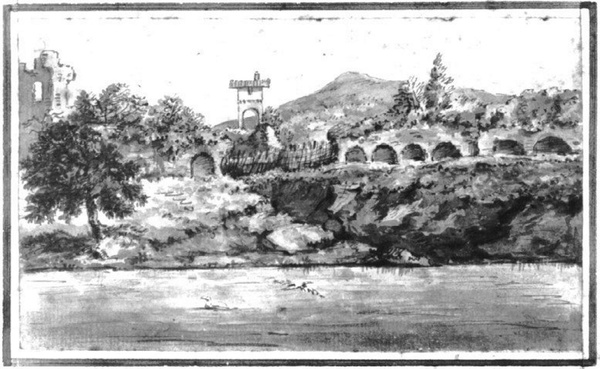
‘The Tiber downstream of Rome’ - Johann Wolfgang von Goethe (German, 1749–1832)
Klassik Stiftung Weimar, Museen (Inv. GGz/1280)
Digital reproduction · See Art. L. 111-1 CPI and § 68 UrhG
I immediately remembered having seen the statue in Naples, without suspecting that it would ever be offered for sale.
It occurred to me to say, for who would not have thought the same: ‘Indeed, if one spent a whole year digging, at great expense, and finally stumbled upon such a treasure, one would consider oneself extremely fortunate.’ We could hardly tear ourselves away from contemplating the piece, for we had probably never before seen such a well-preserved antiquity, in such an easily-restorable condition. So, we departed intending and promising to give a reply as soon as possible.
We were both engaged in a genuine struggle, for it seemed financially unwise, in many respects, for us to make the purchase; we therefore decided to report the situation to our good friend Angelika, as she was wealthy enough to do so and, through her connections in restoration work, and other related fields, sufficiently qualified to judge the statue’s value and the costs involved. Heinrich Meyer took on the task of informing her, as he had previously done regarding the painting by Daniele da Volterra, and we hoped for the best. However, the prudent wife, and even more so her frugal husband, declined the transaction, explaining that while they had invested considerable sums in paintings, they could by no means bring themselves to commit to buying statues.
After this negative answer, we were roused again to further consideration; the chance seemed quite unique; Meyer examined the treasure once more and convinced himself that the work, based on its overall characteristics, was, in all probability, of ancient Greek origin, dating to a considerable time before Augustus, perhaps even to Hiero II of Syracuse.
I had sufficient credit to acquire an important work of art; Rega even seemed willing to receive payment in instalments, and there was a moment when I actually thought I now owned the statue, and was envisaging it displayed, well-lit, in my large salon.
But as is often the case in converting a passionate romantic inclination into a firm marriage contract, so it was here, and I could not undertake such a union without the advice and consent of our noble artistic collaborators, Antonio Zucchi and his well-intentioned wife Angelika, for it was a marriage in the idealistic sense, à la Pygmalion, and I cannot deny that the idea of possessing the thing had taken deep root in me. Indeed, as proof of how much I flattered myself as regards my artistic perception, I confess that I saw the event as a sign from the higher powers, who intended to keep me in Rome, and actively suppress the many reasons that had decided me on leaving.
Fortunately, we were already of an age when reason tends to support intellect in such cases, and so artistic inclination and acquisitiveness, and whatever else supported them — dialectic, and superstition — had to yield to the prudent guidance that our noble friend Angelika, full of both commonsense and goodwill, was inclined to direct our way. Through her representation, all the difficulties and concerns that stood in the way of such a transaction became clearly apparent. Private individuals, men devoted to the study of art and antiquity, were now intervening in the art market, and had aroused the jealousy of those traditionally entitled to transact such business. The difficulties of restoration were manifold, and it was questionable to what extent it would be executed fairly and honestly. Furthermore, even if everything went as smoothly as possible, obstacles could still arise regarding the export permit for such a work of art, preventing its despatch, and further difficulties might well be encountered concerning its passage, landing, and arrival back home. She said that professional art dealers disregarded such considerations, believing that both the effort and risk were acceptable within the wider context of the market, whereas an individual undertaking this kind of thing would inherently incur risk.
Through her advice, our desire, wish, and intention became gradually tempered, and weakened, though never entirely extinguished, especially since the work finally achieved great honour; for it currently stands in the Museo Pio-Clementino in a small, adjoining cabinet (La Salle de la Muse) connected to the main museum, where the floor is inlaid with a beautiful mosaic of masks and foliage. The remaining group of statues in that cabinet consists of: 1) a Crouching Venus seated on her left heel, at whose base the name of Bupalus (the 6th-century BC, Greek sculptor from Chios) is engraved; 2) a very fine little Ganymede; 3) the beautiful statue of a youth, to whom, I know not if correctly, the name Adonis has been given; 4) a faun in Rosso Antico marble; 5) a Discobolus standing calmly at rest.
Visconti (Ennio Quirino Visconti politician, antiquarian, art historian, and Papal Prefect of Antiquities) described the sculpture in the third volume of his ‘Museo Pio-Clementino’ (1790), dedicated to the aforementioned museum, in his own manner, and it is depicted on the thirtieth plate of that volume; thus, every art lover can join us in regretting that we did not succeed in bringing it to Germany, and adding it to one of our great national collections.
It should be noted that I, quite naturally, did not forget that charming Milanese woman during my farewell visits. Over time, I had heard many pleasant things about her: how she had become ever closer to Angelika and how she behaved most becomingly in the noble society she had entered. The suspicion and wish were also nurtured that a wealthy young man, who was on excellent terms with Signore and Signora Zucchi, was perhaps not unmoved by her charms, and might not be averse to pursuing a more serious intention.
I found her in bright morning dress, just as I had first seen her at Castel Gandolfo; she received me with a gracious openness and, with natural elegance, expressed most amiably her repeated thanks for the concern I had shown. ‘I shall never forget,’ she said, ‘that, recovering from my distress, I heard your name mentioned among the names of beloved and revered people enquiring after my health; I enquired myself several times as to whether it was indeed true. You continued your enquiries for several weeks until at last my brother was able to visit you and thank you on both our behalf. I do not know if he conveyed it as I instructed him; I would gladly have visited with him, if it had been appropriate.’ She asked which route home I intended to take, and on telling her of my plans, she replied: ‘You are fortunate to be so wealthy that you have no need to deny yourself anything; the rest of us must accept the place God and his saints assign to us. For a long while now, I have watched the ships coming and going, unloading and loading, from my window; it is entertaining, and I sometimes wonder, where do they all come from and where are they going?’ The windows overlooked the steps of the Porto di Ripetta (the stepped harbour built in 1704, and destroyed in the late nineteenth century), and the activity there was quite lively.
She spoke of her brother with tenderness, being pleased at managing his household properly, and making it possible for him, despite a modest salary, to still invest something in a profitable business venture; in fact, she allowed me to become quite familiar with her circumstances. I enjoyed her talkativeness; for I actually cut a rather peculiar figure, being compelled to relive, swiftly, every moment of our tender relationship from the very first to the very last. Then her brother entered, and the farewell concluded in friendly, measured prose.
When I reached the door, ready to depart, I found my carriage lacking its coachman, whom an active lad had run off to find. She leaned out of the window of the mezzanine floor which they occupied in the stately building; it was not very high up, such that it looked possible to stretch out an arm, and touch hands.
‘They object to taking me from you, you see,’ I exclaimed, ‘they know, it seems, that I am reluctant to leave.’
What she replied, what I countered, the course of that most graceful conversation, which, free from all constraints, revealed the inner lives of two people who were only half-consciously in love, I do not wish to desecrate through its repetition, and my retelling; it was a wonderful, accidentally-initiated, laconic, concluding confession of a most innocent and tender mutual affection, elicited by an inner impulse, which is why it has never left my mind and soul.
My departure from Rome was to be announced in a particularly solemn manner; three nights prior (April 20th), the full moon had stood in the clearest sky, and the spell, so often felt before, cast on the immense city was now, as a result, most intensely palpable. The great illuminated masses, clear as if lit by mild daylight, their contrasting depths of shadow, penetrated, here and there, by reflected rays, and hinting at individual details, rendered me like to a being inhabiting some simpler, grander world.
After two more days, spent in a distracted, and sometimes embarrassed state, I passed some time alone with a few friends. Having wandered the length of the Corso, doubtless for the last time, I climbed the Capitoline Hill, which rose like a palace of faery amidst a wasteland. The equestrian statue of Marcus Aurelius brought to mind the Commander in Mozart’s ‘Don Juan’, and made it clear to the wanderer that he was involved in something unusual. Nevertheless, I descended the rear staircase. Quite dark, and casting a sombre shadow, the Arch of Septimius Severus stood before me, the otherwise familiar objects appearing strange and ghostly, amidst the solitude of the Via Sacra. And as I approached the sublime remains of the Coliseum and peered through the grating into its locked interior, I cannot deny that a shiver ran through me, hastening my return.
Everything which is on a massive scale produces a unique impression, simultaneously sublime yet comprehensible, and amidst such I drew up, as it were, an incalculable summation of my entire stay. This, deeply and profoundly felt, in an agitation of spirit, produced a mood in me that I may call heroic-elegiac, from which an elegy sought to rise and take shape in poetic form.
How too could Ovid’s elegy not return to my mind, at such a moment, he who destined for exile left Rome on just such a moonlit night? ‘Cum repeto noctem!’ (‘When I recall that night!’) his poem of recollection, composed far away on the Black Sea shore, in a state of mourning and lamentation, would not leave my mind. I repeated the verses, which rose, vividly, in memory, but which, in truth, confused my thoughts, and prevented me creating my own poem; which even when attempted later, never came to fruition.
‘Cum subit illius tristissima noctis imago,
Quae mihi supremum tempus in urbe fuit,
Cum repeto noctem, qua tot mihi cara reliqui,
Labitur ex oculis nunc quoque gutta meis…
Iamque quiescebant voces hominumque canumque
Lunaque nocturnos alta regebat equos.
Hanc ego suspiciens et ad hanc Capitolia cernens,
quae nostro frustra iuncta fuere Lari….’
‘When that saddest of memories comes to mind,
Of that night, my last hour in the city;
When I recall that night, relinquishing so much
So dear to me; tears, even now, fall from my eyes…
For, then, the cries of men and dogs grew silent:
The Moon, on high, steered her midnight course;
I, gazing at her and, by her light, the Capitol,
To which my spirit was joined now, in vain…’
(Ovid: Tristia, Book I: III, Lines 1-4 and 27-30)
The End of Part X, and of Goethe’s ‘Italian Journey’