Johann Wolfgang von Goethe
Italian Journey (1786-88)
Part VII: Naples
Translated by A. S. Kline © Copyright 2026 All Rights Reserved
This work may be freely reproduced, stored and transmitted, electronically or otherwise, for any non-commercial purpose. Conditions and Exceptions apply.
Contents
Velletri
February 22, 1787.
We arrived here in good time. The weather had already become overcast the day before yesterday; the beautiful days led to gloomy ones, but various aerial signs indicated that it would improve, and indeed it did. The clouds gradually parted, and here and there the blue sky appeared, and finally the sun illumined our route. We passed through Albano, after stopping, before Genzano di Roma, at the entrance to a park which Prince Chigi (Sigismondo Chigi Albani della Rovere), the owner, maintains in a peculiar way — that is, not at all; and, in consequence, he dislikes anyone from looking round within the grounds. There a true wilderness has taken shape: trees and bushes, herbs and vines grow as they please, wither, collapse, and rot. Which is fine, and the scenery is all the better for it. The area in front of the entrance is indescribably beautiful. A high wall closes off the valley, a gated entrance allows a glimpse inside, then the hill rises, to where the castle (The Ducal Palace of Ariccia) sits at the top. It would make the most magnificent painting if a true artist were to create one.
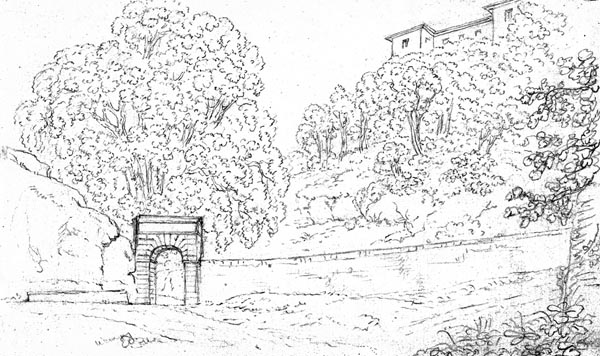
‘Park gate and Palazzo Chigi at Ariccia’ - Johann Wolfgang von Goethe (German, 1749–1832)
Klassik Stiftung Weimar, Museen (Inv. GGz/0268)
Digital reproduction · See Art. L. 111-1 CPI and § 68 UrhG
I shall not describe it further, apart from saying that as we gazed, from the heights, at the mountains above Sezze, the Pontine marshes, the sea and the islands, a heavy, swirling burst of rain swept across the marshes towards the coast, and light and shadow, shifting and alternating, enlivened the desolate landscape in a complex way. Add to that the beautiful effect of several columns of smoke, illumined by the sun, rising from scattered, barely visible cottages.
Velletri is very pleasantly situated on a volcanic hill, which is connected to others on the north, but offers the most open of views in other directions.
We visited a museum created by the Cavaliere Giampaolo Borgia, who, favoured by his kinship with Cardinal Stefano Borgia, his brother, and by the Congregatio de Propaganda Fide, has been able to assemble an excellent collection of antiquities and other curiosities: Egyptian idols made of the hardest stone; small metal figures from earlier and later times; and flat, raised sculptures made of fired clay, excavated in the area, which lead one to attribute a distinctive style to the ancient tribe of the Volsci.
The museum possesses a variety of other rarities. I made a note of two Chinese ink-boxes, one depicting the entire process of breeding silkworms, the other the method of rice cultivation, both rendered in a highly naive yet detailed manner. The boxes and their covers are exceptionally beautiful and would be a fitting addition to the Congregatio de Propaganda Fide’s library, alongside the book I have already praised.
It is surely inexplicable that these treasures are housed so near to Rome, and yet not visited more often. However, the inconvenience of having to travel here, and the attractions of Rome, may serve as an excuse. As we walked towards the inn, several women seated in front of the houses called out to us, asking if we might like to buy various antiquities. When we expressed serious interest, they brought out various old cauldrons, fire tongs, and other shoddy household items, and almost burst with laughter at having made fools of us. As we seemed annoyed, our guide smoothed things over, assuring us that the little game they played was customary, and that all visitors had to submit to it.
I am writing this in a most wretched inn, and feel neither the strength nor the inclination to continue. So, the kindest of goodnights!
Fondi
February 23, 1787.
We set off early, at three a.m. As day broke, we found ourselves amidst the Pontine Marshes, which do not appear quite as atrocious as they are commonly described as being in Rome. While one cannot properly assess such a large and extensive undertaking as the planned drainage of the marshland when merely passing through, it seems to me that the work ordered by the Pope will, to a large extent, achieve its intended goals. Imagine a wide valley here, stretching from north to south with a gentle slope downwards towards the mountains to the east, and rising towards the sea to the west.
The old Via Appia has been restored along its entire length in a direct line, the main drainage channel has been dug on its right, and the water flows gently down into this, thus drying out the soil on the right hand side towards the sea, and allowing it to be given over to agriculture; it is cultivated as far as the eye can see, or could be if tenants could be found, except for a few spots that are too low-lying.
The left side, towards the mountains, is more difficult to manage. Though transverse channels run beneath the road into the main canal, the land slopes steeply there, towards the mountains to the north, preventing it from being drained in the same manner. It is said that a second drainage channel is planned to run along the mountainside. Large stretches, especially towards Terracina, are overgrown with willows and poplars.
A post-station in these parts consists of nothing more than a long thatched shed. Tischbein sketched ours and, as a reward, enjoyed a pleasure that only he truly knows how to appreciate. On the parched plain, a white horse had broken free and, taking advantage of its freedom, galloped back and forth over the brown soil, like a lightning flash; it was truly a magnificent sight, rendered all the more glorious by Tischbein’s delight.
Where the town of Meza (Ad Medias, or Casale di Mesa) once stood, Pope Pius VI has had a large and beautiful building erected (in 1780), marking the centre of the marshlands. The sight of it increased our hope for, and confidence in, the success of the entire undertaking. Thus, we pressed on, engaged in lively conversation, mindful of the warning not to fall asleep on the way, and indeed, the bluish haze, which even at this time of year hovers at a certain altitude above the ground, reminded us of the dangers of breathing the air thereabouts. All the more pleasing and welcome, then, was the rocky location of Terracina, which we had scarcely enjoyed before catching sight of the sea immediately in front. Shortly afterward, the far side of the hill revealed a vista filled with fresh vegetation. The large, plump leaves of prickly pear cacti (ficus indica) rose among low, greyish-green myrtles, beneath the yellowish-green pomegranate trees, and pale green olive branches. Along the way, we saw nameless, never-before-seen flowers and shrubs. Daffodils and adonis bloomed in the meadows. For a while, the sea is to the right of the road; the limestone cliffs, close on the left. These are a continuation of the Apennines, which extend from Tivoli and connect to the sea, from which they are separated first by the Romagna, then by the volcanic hills of Frascati, the Alban Hills, and Velletri, and finally by the Pontine Marshes. Monte Circello, the promontory opposite Terracina, where the Pontine Marshes end, may well also consist of a series of limestone cliffs.
At Terracina we moved away from the sea, and shortly afterwards entered the charming plain of Fondi. This small area of fertile, cultivated land, enclosed by a not-too-rugged mountain range, would surely charm anyone. Most of the oranges still hang on the trees, the crops are green, and there is plenty of wheat; olive trees grow in the fields, the little town lies to the north. A palm tree stood forth, which we greeted. Enough, for this evening. Forgive my rambling letter. I am obliged to write without thinking, simply in order to write at all. There are too many tasks to do, and the accommodation is too unsatisfactory, though my desire to confide something to paper is excessive. We arrived as night fell, and it is now time to seek rest.
Sant’Agata (near Sessa Aurunca)
February 24, 1787.
Seated in a cold room, I must try to report on a beautiful day. As we drove out of Fondi, it was almost light, and we were immediately greeted by orange trees hanging over the walls on both sides of the road. The trees are so laden with fruit they are beyond compare. The young leaves are yellowish at the top, but underneath and in the centre, they are the most vibrant green. Mignon (the enigmatic character in Goethe’s novel ‘Wilhelm Meisters Lehrjahre’, ‘Wilhelm Meister’s Apprenticeship’, 1795–96) was certainly right to long for such a place (see her song ‘Kennst du das Land, wo die Zitronen blühn’: ‘Do you know the land where the lemon-trees grow, in darkened leaves the gold-oranges glow’).
Then we drove through well-ploughed and cultivated wheat fields, interspersed with neat rows of olive trees. The wind stirred them, revealing the silvery undersides of the leaves, the branches bending gently and gracefully. It was a grey morning, and a strong north wind promised to dispel all the clouds completely.
Then the road wound its way through the valley, between stony but well-cultivated fields, the crops a beautiful green. In some places, we saw spacious, round, paved areas surrounded by low walls; here, the grain is threshed at once, without needing to be transported home in sheaves. The valley narrowed, and the road climbed between bare limestone cliffs on either side. The storm was more violent, to our rear. Hail and snow fell, melting only slowly.
The walls of various ancient buildings surprised us with their net-like stonework. On the higher ground, the terrain is rocky, yet planted with olive trees where even the smallest amount of soil can support them. We then crossed a plain dotted with olive-groves, followed by a small town. Within the walls of garden enclosures, we came upon altars, ancient tombstones, and fragments of every kind. Then we came across the excellently constructed, but now earth-filled, basements of old country houses, overgrown with olive trees. Finally, we caught sight of Vesuvius, a plume of smoke rising from its summit.
Mola di Gaeta (Formia) once again greeted us with its abundant orange trees. We stayed there several hours. The bay in front of the town offers one of the most beautiful views, the sea lapping the shore. If the eye follows the latter to the west, till it reaches the horn of the bay which is shaped like a crescent moon, it encounters the fortress of Gaeta perched on a rock in the mid-distance. The view of the horn on the east extends much further; first one sees a range of hills, then Vesuvius, then the islands. Ischia lies in the sea, almost directly opposite the centre of the crescent.
Here, I found my first starfish and sea urchins washed on shore; a beautiful green leaf, like the finest vellum paper; then curious glacial erratics, most often of common limestone, but also serpentine, jasper, quartz, siliceous breccias, granites, porphyries, various types of marble, and green and blue glass. The latter two are hardly formed in this region; they are probably the debris from ancient buildings, and so we witnessed how the waves played, before our eyes, with the splendours of the ancient world. We lingered happily, and took pleasure in behaving almost like savages, which is indeed human nature. Leaving the neighbourhood of Mola di Gaeta, the beautiful view is maintained, even though the sea is lost. The last glimpse of it is a lovely bay, which we sketched. Now follow excellent orchards, fenced with aloes. We glimpsed an aqueduct that stretched from the mountains towards some indistinct, entangled ruins.
Then came the crossing of the Garigliano River. One then passes through fairly fertile areas towards a range of hills. Nothing remarkable is seen until, at last, the first mound of volcanic lava. Here begins a large, magnificent region of hills and valleys, above which snow-capped peaks eventually rise. Along the nearby heights, stretches a striking township (Sessa Aurunca). In the valley below lies Sant’Agata, and a respectable inn, where a lively fire burned in a fireplace designed like a small room. Meanwhile, our own room is cold, no windows, only shutters, which I am hastening to close.
Naples
February 25, 1787
Finally, we have arrived, in a happy mood and accompanied by good omens. Regarding the day’s journey, I shall say only that we left Sant’Agata at sunrise, the wind was blowing fiercely behind us, and this north-easterly persisted all day. Only in the afternoon did we finally break free of the clouds; we suffered much from the cold.
Our route led us through and over the volcanic hills, among which I thought I discerned a few limestone cliffs. Finally, we reached the Capuan plain and, soon after, Capua itself, where we stopped for lunch. In the afternoon, the beautiful, flat plain opened up before us. The broad road ran between fields carpeted with green wheat, several feet at least in height. Poplars are planted in rows across the fields, branching at a certain height, up which vines, are trained (the ‘vite maritata’ technique).
This continues all the way to Naples. The soil is light, exceedingly loose, and well-cultivated. The vines are of unusual strength and height, their tendrils hanging like nets from poplar to poplar.
Vesuvius was visible to the south and somewhat to the left, violently steaming, and I was quietly pleased to see that remarkable object at last, with my own eyes. The sky grew ever clearer, and at last the sun shone, quite hotly, into our cramped abode as we rolled along. Beneath a perfectly clear, bright sky we drew nearer to Naples; and now we truly found ourselves in another country. The flat-roofed buildings suggested a different clime; their interiors must be none too welcoming, since everyone was out on the street, sitting about in the sun, as long as it chose to shine. The Neapolitan believes himself to be in paradise, and has a very bleak view of the Northern lands: ‘Sempre neve, case di legno, gran ignoranza, ma danari assai.’ That is the image they have of our state of existence. For the edification of the reader, this characterisation translates as: ‘Perpetual snow, wooden houses, great ignorance, but wealth enough.’
Naples announced itself as a joyful, free and lively city, full of countless people running around in confusion; the king was out hunting, the queen ‘expecting’, and so things could not have been better.
Naples, Monday, February 26.
‘Alla Locanda del Sgr. Moriconi, al Largo del Castello.’
‘At the Inn of Signore Moriconi, at Largo del Castello’ (Piazza del Municipio). Letters from all four corners of the world may now find us at this address, sounding as cheerful as it is magnificent. Around the large medieval castle (Castel Nuovo) fronting the sea, stretches a broad, open space which, though surrounded on all four sides by houses, has therefore, probably since the time, long ago, when it was still unenclosed ground, been called not a piazza but a largo. We are lodged in a spacious corner room, in this large corner house, a room which affords a clear and joyous view of the ever-changing scene. An iron balcony runs along the exterior past several windows, and even rounds the corner. One would never feel like leaving these lodgings, were it not for the sharp wind being so intensely noticeable.
The apartment is cheerful decorated, especially the ceiling, whose arabesques in a hundred compartments already hint at the proximity of Pompeii and Herculaneum. It would all be fine and good, but there is no sign of a fireplace or hearth, and February is certainly making its presence felt even here. I requested some warmth.
A tripod was brought, raised off the ground so that one can hold one’s hands near it in comfort. A shallow basin is attached, containing gently-glowing coals, almost completely covered with ash. Here, one must be economical, as we learned in Rome. From time to time, one brushes the surface ash off with the head of a key, so that some of the coals are exposed to the air. If, however, one stirs the embers impatiently, one indeed feels an increase in warmth for a moment, but soon the entire ember is exhausted, at which point the basin needs to be refilled for a certain sum of money
I am not feeling entirely well, and would certainly have appreciated greater comfort. A reed mat serves as protection against the cold, concrete floor. Furs are not commonly available here, so I decided to put on a sailor’s cloak we had brought along for fun, which serves me well, especially since I fasten it round my waist with a cord from the luggage. I must look like an amusing cross between a sailor and a Capuchin monk, since Tischbein, returning from visiting friends, couldn’t help but laugh.
Naples, February 27, 1787.
Yesterday I spent the day peacefully waiting out a minor physical discomfort; today I indulged myself, and spent the time contemplating the most magnificent views. Say, tell, or paint what you will, there is more here than anywhere else. The shores, bays, and inlets of the sea, Vesuvius, the city, the suburbs, the castles, the pleasure palaces! We even visited the Grotto at Posillipo (the Crypta Neapolitana, a Roman tunnel between Piedigrotta and Fuorigrotta) in the evening, just as the setting sun was shining into it from the other side. I immediately forgave all those who are mad for Naples, and remembered, with emotion, my father, who received an indelible impression from the sights, especially those I saw for the first time today. And just as it is said that one to whom a ghost has appeared can never be totally happy again, so it could be said of my father, conversely, that he was never totally unhappy, because he could always recall Naples. For myself, I am very restrained these days, and only open my eyes wide when something is truly impressive.
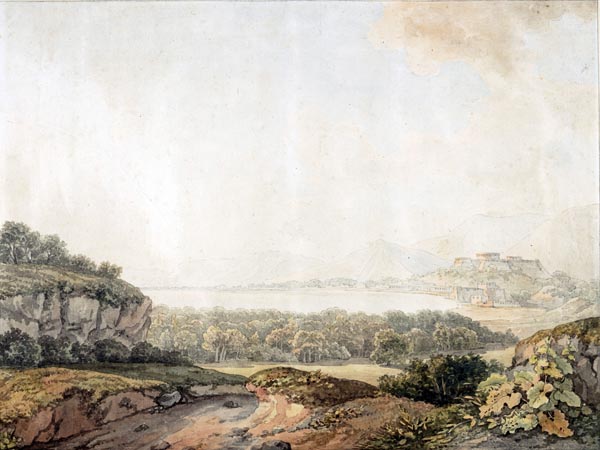
‘Bay and castle near Naples’ - Johann Wolfgang von Goethe (German, 1749–1832)
Klassik Stiftung Weimar, Museen (Inv. GGz/0924)
Digital reproduction · See Art. L. 111-1 CPI and § 68 UrhG
Naples, February 28, 1787.
Today we visited Philipp Hackert, the well-known landscape painter, who enjoys the special trust and exceptional favour of King Ferdinand and Queen Maria Carolina. He has been granted a wing of the Palazzo Francavilla (near Piazza dei Martiri) which he has furnished artistically, and inhabits contentedly. He is a very determined, and intelligent fellow who, despite his tireless diligence, knows how to enjoy life.
Then we went to the sea and saw all sorts of fish and strange creatures among the waves. The day was glorious, the Tramontane wind (a north-westerly) tolerable.
Naples, March 1st.
Even in Rome, my stubborn, solitary nature has shown a more sociable side than I care to admit. Indeed, it seems peculiar to venture out into the world with the intention of remaining solitary. Thus, I could not resist the Prince of Waldeck (Christian August, Prince of Waldeck and Pyrmont), who most kindly offered me an invitation and, through his rank and influence, has granted me access to many pleasant things. We had scarcely arrived in Naples, where he has already been residing for some time, when he sent for us to join him on a trip to Pozzuoli and the surrounding area. I was already thinking of a trip to Vesuvius, but Tischbein is pressing me to accept his invitation, the outing being pleasant in itself, and promising much joy and benefit in the company of such a well-rounded and knowledgeable individual, especially given the beautiful weather. Also, a beautiful lady we met in Rome, who is inseparable from the prince, is to be part of the group along with her husband, and we all hope for a delightful experience.
I was familiar with this distinguished company, through previous conversations. Indeed, the Prince asked me at our first meeting what I was currently working on, and my ‘Iphigenie’ was so fresh in my mind that I was able to recount the details at length one evening. They listened; but I sensed that they had expected something more lively, more exuberant from me.
The same date, in the evening.
It would be difficult to give a sensible account of today. Who has not known that fleeting reading of a book which has irresistibly swept them away, and had the greatest of influences on their life, an effect already substantial, to which subsequent rereading and serious reflection adds little? It is something I experienced on reading ‘Shakuntala’ (the play by Kalidasa; an apparent anachronism since the first German translation was only published in1791, by traveller, naturalist, and author Georg Forster, not taken directly from the Sanskrit, but, in turn, a translation of Sir William Jones’s English translation, ‘Sacontalá or The Fatal Ring’, published in 1789. Goethe however may well have read the work pre-publication, in manuscript form), and is it not the same for us with the significant people in our lives? A boat trip to Pozzuoli, was followed by an easy journey overland, and a cheerful stroll through the most wondrous region in the world, under the purest sky, but over the most difficult ground. We noted the ruins of buildings created long ago by unimaginable wealth, now condemned and unpleasant, boiling pools, sulphur-emitting clefts, slag heaps resisting plant life, barren and repulsive stretches, and yet ever-lush vegetation growing wherever it could, rising above all that has been killed off, bordering lakes and streams, indeed, existing in the form of a most magnificent oak forest on the walls of an ancient crater.
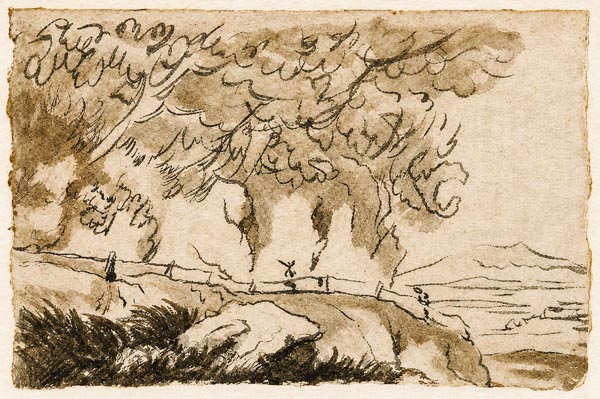
‘Fumaroles rising from the Solfatara crater at Pozzuoli’ - Johann Wolfgang von Goethe (German, 1749–1832)
Wikimedia Commons
And so, one is tossed back and forth between a natural and a historical reality. One wishes to think but feels quite unfit to do so. Meanwhile, life goes on happily, and we too certainly didn’t lack for that. Educated individuals, belonging to the world and its ways, but also, warned of the seriousness of our fate, are inclined to contemplation. Our unlimited view over land, sea, and sky bowed to the presence of a charming young lady, accustomed and inclined to accept homage.
Amidst all this commotion, however, I did not fail to make a few notes. In their future interpretation, the map we consulted in situ, and a quick sketch by Tischbein, will be of the greatest assistance; at the moment it is impossible for me to add even the slightest thing.
March 2nd.
Today I climbed Vesuvius, though the weather was gloomy and the summit shrouded in clouds. I travelled by carriage to Resina, then rode a mule up a mountain track among vineyards; then went on foot across the lava caused by the active flows of 1771, which is already covered by a fine but firm layer of moss; and then along the side of this lava-field. The hermit’s hut (a well-known landmark) was on my left, on the ridge. Further on, I climbed the ash hill, which is hard work. Two-thirds of the summit were covered with clouds. Finally, my guide and I reached the ancient caldera, now-completely filled, and found the fresh lava flows, two months and fourteen days old, and even a feeble one, five days old, which had already cooled. We climbed above these to a newly formed volcanic mound, which steamed on all sides. The vapour was drifting away from us, so I sought to advance towards the crater. We had gone about fifty paces amidst the vapour when it became so thick that I could hardly see my shoes. Holding a handkerchief up to my face was no use, the guide had also disappeared in the mist, and my footing on the ejected lava fragments was unsteady. I thought it best to turn back, and save for a clearer day with less vapour the view I had hoped to see. Moreover, I now realised how difficult it is to breathe in such an atmosphere.
Incidentally, the mountain was completely still and silent. No flame, or roar, or hurling forth of stones, as it has been threatening the whole time lately. I have now reconnoitred it, so that I can readily conquer it as soon as the weather improves.
The lavas I found were mostly types I recognised. However, I discovered a phenomenon that seemed very strange to me, which I intend to investigate further, and about which I will consult experts and collectors. It is a stalactite-like lining of a volcanic chimney that was formerly domed, but has opened up and protrudes from the old, now choked crater. This solid, greyish, stalactite-like rock appears to me to have been formed by the sublimation of the finest volcanic vapours without the involvement of moisture, and without melting; it gives occasion for further thought.
Today being a Friday, there was a grand procession of the nobility, where everyone displayed their carriages, especially the horses. One could not possibly see anything more graceful than those creatures; it is the first time in my life that my heart has been so warmed by them.
March 3rd.
Today the sky is overcast and the sirocco is blowing; good weather for dealing with the post. So far, I have already seen a plentiful mixture of people here, some fine horses, and some very strange fish. ‘Vedi Napoli e poi muori!’ they say here. ‘See Naples and die!’ That no Neapolitan wants to leave their city, that their poets sing of its blissful location while employing magnificent hyperboles, would hardly be surprising even were there no Vesuvius nearby. One scarcely even recalls Rome here; compared to this free and open location, that ‘capital of the world’ seems like an old, out of place monastery nestled on the banks of the Tiber.
Maritime life is also bringing me entirely new food for thought. The frigate to Palermo departed yesterday, with a clear sky, and a strong Tramontane wind behind her. She will doubtless have spent no more than thirty-six hours at sea. With what longing I watched her in full sail as she passed between Capri and Cape Minerva (Punta Campanella, the tip of the Sorrento peninsula) and finally disappeared. If one saw someone one loved vanishing like that, one might well die of it! Now the sirocco is blowing hard; if the wind strengthens further the waves round the breakwater will be quite lively.
The same date, March 3rd.
Enclosed, I send a few pressed leaves, as a sign of my visit here. Also, a slightly scorched envelope from your last letter, as proof that it was with me on Vesuvius. But do not imagine me, either in dreams or in waking life, as surrounded by danger; be assured that where I was there is no more risk than on the road to Schloss Belvedere (outside Weimar). The world is in the Lord’s hands everywhere! One could surely say so on such an ascent. It is not that I seek adventures out of mere curiosity or because of some peculiarity of mine, but because I am clear-headed, usually, and grasp the essence of a subject quickly; I can do and dare more than some others. The voyage to Sicily is anything but dangerous. Once here, it doesn’t seem as risky in reality as folk make it out to be, from afar.
The volcanic activity is scarcely felt at all in the south of Italy but, in the north, Rimini and nearby towns recently sustained damage. It exhibits strange whims; here, people talk of it as they do the wind and weather, as they discuss earthquakes similarly in Thuringia.
I am pleased that you have now become acquainted with the new version of ‘Iphigenie’; I would have been even happier if the difference between the versions had been more obvious to you. I know what I did to achieve it, may speak to you about it, because I could still improve it further. If it is a pleasure to enjoy what is good, it is a greater one to perceive what is better, and in art only the best is good enough.
Naples, March 5th.
We spent the second Sunday of Lent (March 4th) wandering from church to church. While everything in Rome is utterly serious, here everything is lively and cheerful. The Neapolitan school of painting can only be truly understood in Naples. Here, one marvels at seeing the entire facade of a church (Chiesa dei Girolamini) frescoed from top to bottom, with Christ, above the door, driving from the Temple the buyers, sellers, and money-lenders, who, on either side, tumble down the steps, merrily and gracefully, if in somewhat startled a state. Luca Giordano, the artist responsible, must have been working swiftly to fill such a large area. Inside another church (Chiesa del Gesù Nuovo), the space above the entrance is richly decorated with a fresco (by Francesco Solimena) depicting the ‘Expulsion of Heliodorus from the Temple’. How much there is to describe here! For example, the pulpit is not always, as elsewhere, a lectern, a platform for the priest, but rather a gallery in which, on one occasion, I saw a Capuchin friar pacing back and forth, from one end to the other, exhorting the people to forego their sinfulness.
But the splendour of the full moon as we enjoyed it last night, wandering through the streets and squares, along the Chiaia, the endless promenade, and then back and forth along the seashore, is not be recounted or described. I was truly overwhelmed by the feeling of the infiniteness of space. To attain one’s dream is certainly worth all the trouble.
The same date, March 5, 1787.
I must say something, at least of a general nature, about a distinguished man I met a few days ago. He is Prince Filangieri (Gaetano Filangieri, fifth Prince of Satriano, the Italian jurist and philosopher) known for his work concerned with legislation (‘La Scienza della Legislazione’, 1780). He belongs to those admirable young men who, most laudably, keep the happiness of human beings, and their freedom, at the forefront of their minds. His conduct displays him as a soldier, a knight, and as a man of the world; however, his decorum is tempered by the expression of delicate moral feelings which, pervading his entire being, shine forth most gracefully from both his words and his deeds.
He, is a heartfelt supporter of King Ferdinand, and the kingdom, even if he does not approve of everything that is done; he, too, is oppressed by fear of Joseph I (Holy Roman Emperor and ruler of the Habsburg monarchy from 1780 until his death in 1790). The thought of despotism, even if it only hovers in the air, is already terrifying to people of nobility. He spoke quite frankly with me about what Naples has to fear. He enjoys discussing Montesquieu (Charles Louis de Secondat, judge, historian, and political philosopher), Beccaria (Cesare Bonesana di Beccaria, criminologist, jurist, philosopher, economist, and politician), and even his own writings, all with the same good intentions, and a passionate, youthful desire to do good. He is still only in his thirties (he was thirty-three years old at the time).
He introduced me to the work of a writer whose unfathomable depths the newer Italian legalists find highly refreshing and edifying; his name was Giambattista Vico, and they prefer his works to those of Montesquieu. From a cursory glance at the book (‘Scienza Nuova’: ‘New Science’, 1725) which they presented to me as if it were a sacred text, it seemed to contain Sibylline prophecies of the triumph of the good and the right that is to come, or ought to come, given an earnest contemplation of the tradition, and of life itself. It is truly wonderful when a nation owns to such a forerunner; Hamann (Johann Georg Hamann the Lutheran philosopher from Königsberg, known as ‘the Wizard of the North’) will doubtless produce a similar code for the Germans, one day.
Naples, March 6, 1787.
Reluctantly, but out of a spirit of loyal companionship, Tischbein today accompanied me on my second visit to Mount Vesuvius. To a visual artist like himself, who only concerns himself with the most beautiful of human and animal forms, and indeed with the formless itself, rocks and landscapes, only by humanising them through the exercise of his good sense and taste, such a dreadful, shapeless accumulation of lava, constantly devouring itself, and waging war on every concept of beauty, must seem utterly abhorrent.
We drove off in a pair of caleches, not daring to navigate the city’s hustle and bustle ourselves. The drivers shouted: ‘Spostati!’(‘Move!’) incessantly so that donkeys, carrying a load of wood or a heap of rubbish, oncoming carriages, porters hauling loads, pedestrians walking freely, children, and the elderly, would take care, and make way, so that our horses’ brisk trot could continue unhindered.
The route through the outermost suburbs and gardens already hinted at something Plutonian, since it had not rained for a good while, and all the evergreen trees and shrubs were covered with thick, ash-grey dust; all the roofs, cornices, and anything else that offered a surface had likewise turned a shade of grey, so that only the magnificent blue sky and the light of a blazing sun gave any indication that one was still among the living.
At the foot of the steep slope, we were met by two guides, one old and one young, both capable men. The first hauled me, and the second carried Tischbein, up the mountain. Hauled, I say, because the guide girds himself with a leather strap, which the traveller grasps and, pulled upwards, can then more easily support himself on his own feet with the aid of a stick.
Thus, we reached the region above which the cone of Vesuvius rises, within the collapsed caldera of Mount Somma which spreads around it to the north and north-east.
After a glance westward across the landscape, a glance which like a healing bath washed away all the effects of exertion, and physical tiredness, we circled the ever-smoking, ash-spouting conical mount. As long as the ground allowed us to keep a safe distance, we could gaze at that magnificent and awe-inspiring spectacle. First, a violent roar of thunder would resound from the deepest abyss, then stones, large and small, were launched into the air by the thousand, enveloped in clouds of ash. Most fell back into the depths once more. The rest, hurled sideways, fell onto the outer slopes of the cone, making a wondrous sound: first the heavier ones thumped and bounced down the side of the cone accompanied by dull thuds, then the smaller and lighter fragments, which had flown further, rattled down behind them, and finally a trickled of ash followed. All this occurred at regular intervals, which we could easily measure by counting to ourselves calmly.
The space of ground between Mount Somma and the cone, became quite narrow in extent, however, and several stones fell around us, rendering our path unpleasant. Tischbein felt even more displeased with the mountain, as that monstrosity, not content with being distinctly ugly, was now proving dangerous also.
But as a present danger may possess a certain allure, and challenge the human spirit to defy it, I considered that it must be possible, in the interim between two eruptions, to reach the crater’s mouth and also find the way back down during that period. I discussed this with the guides under an overhanging rock of Mount Somma, where, safely encamped, we refreshed ourselves with the provisions we had brought. The younger one pledged to attempt the daring feat with me; we lined our hats with cloths, linen and silk, and stood ready, sticks in hand, I myself grasping his belt.
Small stones were still rattling around us, and the ash still trickling, as the nimble young man started pulling me onwards, over the glowing scree. Once there, we stood at the edge of that immense maw, a gentle breeze diverting the vapour away from us, but at the same time concealing the interior of the abyss, which steamed from a thousand cracks all around it. Through gaps in the vapour, one glimpsed fractured rock faces, here and there. The sight was neither particularly instructive nor pleasing, but precisely because one could see nothing, one lingered, hoping to glimpse at least something. Our silent counting was neglected; we stood on the sharp rim before the monstrous precipice. Suddenly, there was a thunderous roar, a terrible charge of stones flew past us, and we instinctively ducked, as if that would save us from the tumbling mass if it fell directly upon us. Smaller stones were already rattling down, and, without considering whether we had another quieter interval ahead, simply glad to have survived the danger, we reached the foot of the cone, with the ash still trickling, and our hats and the shoulders of our coats charred enough.
Received most tenderly by Tischbein, scolded, and slowly reviving, I was now able to devote particular attention to the older and newer lava flows. The older guide knew precisely how to identify the varying ages of the lava flows. Older ones were already covered with ash, and smooth, while newer ones, especially those which had flowed slowly, presented a curious sight. For as they crept along, carrying the masses that had solidified on their surface for a while, it inevitably happened that these masses would stall, from time to time but, propelled still by the molten currents, would be pushed one upon another, remaining wonderfully jagged and solid, and looking more peculiar than ice floes driven upon one another in a similar situation. Among this molten, raw matter, there were also large blocks which, when broken open, seemed exactly like the type of ancient rock found by fracturing fresh stone from the mountain. The guides maintained that these were old lava flows from the deepest depths, which the mountain sometimes ejected.
On returning to Naples, I noted various small, strange, single-storey houses that were oddly constructed, lacking windows, with the rooms illuminated only by the door opening onto the street. From early morning until late at night, the inhabitants seated themselves in front of them, finally retreating into their caves.
The city, tumultuous in quite a different way in the evening, awakened in me the desire to be able to remain here some time, to sketch the busy scene to the best of my ability. I would not feel entirely comfortable in staying, however.
Naples, Wednesday, March 7, 1787.
This week Tischbein has been showing me, and describing, concisely, the finer points of a large part of Naples’ art treasures. He is an excellent connoisseur of animals, and a draughtsman, and he had previously drawn my attention to the bronze head of a horse in the Palazzo Colombrano (the Palazzo Diomede Carafa, or Palazzo Sant Angelo, at Via San Biagio dei Librai, nos. 119-121). We visited today. The sculpture stands in the courtyard (cast by ‘Donatello’ c.1455, it is now in the National Archaeological Museum of Naples, and replaced by a plaster cast, sited where Goethe saw it), directly opposite the gateway, in a niche over a fountain, and is truly astonishing; what an effect the head must have had when combined with the other limbs to form a whole! The horse when entire was much larger than the ones on St. Mark’s Basilica, and here, the individual head, viewed more closely than they, inspires even more admiration for what is revealed. The magnificent brow ridge, flaring nostrils, alert ears, and stiff mane all display the powerful agitation of a strong creature.
On turning round, we noted the statue of a female, which stood in a niche above the gateway. Winckelmann formerly considered it a representation of a dancer, saying, in his work, that diverse ancient sculptors depicted forms in lively motion which the great painters present as frozen nymphs and goddesses. It is very light and beautiful; the head has, at some time, been broken off, and re-attached subsequently, with care, it is otherwise undamaged, and certainly deserves siting in a better place.
Naples, March 9th.
Today I received your kind letters, dated February 16th. Please keep writing. I left a forwarding address, and will do so again when I resume my journey. It seems quite strange to me, reading them at such a great distance, that my friends have not met together, and yet often nothing is more natural than not being able to meet, even when one is close by.
The weather has darkened, and is changeable; spring is arriving, and we shall have rainy days. The summit of Vesuvius has not cleared since our visit. These last few nights flames were sometimes seen, but now all is quiet again; a stronger eruption is expected.
The storms of these days have revealed the magnificence of the sea to me, allowing me to study the waves in all their dignified form and motion; Nature is truly the only book that offers profundity on every page. In contrast, the theatre no longer gives me any pleasure at all. Here, during Lent, they perform sacred operas that are indistinguishable from secular ones, except that there are no ballets inserted between the acts; otherwise, they are as colourful as possible. At the Teatro San Carlo, they are staging ‘The Destruction of Jerusalem by Nebuchadnezzar.’ To me, it was no more than a large peepshow; it seems I have been spoiled for such things.
Today we were at the Prince of Waldeck’s, at Capodimonte, where the large collection of paintings, coins, and other items is housed — not exactly aesthetically pleasing, but valuable nonetheless. So many traditional concepts are now being realised, and confirmed for me. What reach the North as individual items — coins, gems, vases —look quite different, as the pruned lemon trees do, when seen en masse here, in the country of which these treasures are native works of art. For where works of art are rare, their very grants them value; here one learns to appreciate only what is truly the best.
A high price is paid for Etruscan vases at the moment, and there are certainly some beautiful and excellent pieces among them. Every traveller seems to want to own one. They are not as expensive as they would be at home; so, I am afraid I may be tempted buy something myself.
Naples, Friday, March 9, 1787.
One pleasant thing about travel is that even the commonplace, through novelty and surprise, takes on the air of an adventure. When I returned from Capodimonte, I paid an evening visit to Signore Filangieri’s home, where I found a woman seated on the sofa beside the lady of the house. The former’s appearance seemed incongruous given the intimate manner in which she engaged, quite freely, in conversation. In a light, striped, silk shawl, her head strangely adorned, the small, charming figure resembled a milliner who, concerned with the adornment of others, pays little attention to her own appearance. Milliners are so accustomed to charging for their work they cannot bear to think of performing the same for themselves without being paid. My arrival in no way interrupted her chatter, and she recounted a series of amusing stories that had come to her attention recently, or rather, had been prompted by her whimsical activities.
The lady of the house wished to allow me a chance to speak also, and talked of the magnificent location of Capodimonte and the treasures there. The woman, however, rose, in a lively manner, and, once on her feet, showed me greater politeness than before. She took her leave, and advanced to the door, saying to me, as she passed: ‘The Filangieris are dining at my table these days; I hope to see you there too!’ She was gone before I could accept. Only then did I learn that she was the Princess *** (Teresa Ravaschieri, the wife of Prince Filippo Ravaschieri Fieschi di Satriano), and closely related to the family (she was the sister of Gaetano Filangieri). The Filangieris were not rich and lived in a modest way. I imagined the little princess to live in a similar manner, since noble titles are not uncommon in Naples. I noted the name, day, and hour, so as to be sure to be in the right place, and at the right time.
Naples, Sunday, March 11, 1787
Since my stay in Naples will be brief, I shall address more distant locations first; the nearer ones will follow. With Tischbein I travelled to Pompeii, where we found magnificent views opening to left and right, which, though familiar to us from many a landscape drawing, now appeared in all their splendour. Pompeii astonishes everyone by its narrowness and littleness. The streets are confined, though straight, and paved with stepping stones along the sides, the houses small and lacking windows, the rooms illumined only by the light from the doorways leading to the courtyards and open galleries. Even public furniture and buildings — the bench by the gateway, the temple, and a nearby villa — are more like toy models for children to play with than anything. The rooms, corridors, and galleries, however, are painted in the most cheerful manner; the wall surfaces are uniform, each with a detailed painting in the centre, now mostly erased, and light and tasteful arabesques bordering it, from which charming figures of children and nymphs emerge, while elsewhere wild and tame animals spring forth from huge garlands of flowers. Thus, the current, utterly desolate state of the town, covered long ago by a rain of stones and ash, and then plundered by excavators, nonetheless points to its people’s love of art and their creation of images of which even the most ardent amateur has no conception, and neither a feeling for, nor need.
Considering the distance between Pompeii and Mount Vesuvius, the volcanic layers that cover it could not have been driven here by simple projection, or by gusts of wind; rather, one must imagine the stones and ash floating in the air like clouds for a time, until they finally descended on this unfortunate place.
To better visualise the event, imagine how a deep snowfall might affect a mountain village. The spaces between the buildings, and indeed the shattered buildings themselves, were completely covered; only here and there remnants of masonry protruded. Later, when the hillside was first cultivated again and vineyards and gardens were created, many a landowner, before ploughing his land, was doubtless obliged to undertake a cautious search. Several rooms would often be discovered, empty except, say, for a pile of ashes in the corner of one, concealing various small household items, and works of art.
We washed away the strange, somewhat unpleasant, impression of the mummified city as, seated in a small taverna, in a bower near the sea, we ate a frugal meal, and delighted in the blueness of the sky, the brilliance and brightness of the waves, hoping that, we might meet here again, and enjoy ourselves together once more when the spot was covered with vine leaves.
Closer to the city, I again noticed the little houses, perfect replicas of those in Pompeii. We asked permission to enter one, and found that it was very neatly furnished. There were woven cane-chairs, and a chest of drawers entirely gilded, decorated with colourful flowers and varnished, showing that, after many centuries, after countless periods of change, the inhabitants of the region still maintain their way of life, its customs, inclinations and crafts.
Naples, Monday, March 12.
Today, gazing about in my usual manner, I wandered the city and noted many things worthy of future description, which are unfortunately not yet in a form to be shared. Everything here shows that a prosperous country, one that provides for basic needs in abundance, also produces a people of happy disposition who anticipate, without worrying, that tomorrow will bring what today has brought, and therefore are able to live carefree lives, filled with present gratification, moderate enjoyment, and a cheerful endurance of any temporary suffering! Here follows a fine example of the latter.
The morning was cold and damp; it had rained a little. I entered a square where the large paving stones appeared neatly swept. To my great surprise, I saw a number of ragged boys huddled in a circle, in this perfectly level space, the palms of their hands towards the ground as if warming themselves. At first, I thought it was a game of some sorts, but when I saw that their expressions were wholly calm and composed, as if some need of theirs were being met, I strained my senses to find an explanation, but the latter served me not. I therefore had occasion to ask what had prompted these little rascals to assume that peculiar posture, and drawn them into a regular circle.
I learned that a local blacksmith had heated a wheel rim on the spot, which was done in the following way: The iron rim was laid on the ground, and as many oak shavings as necessary were heaped around it in a circle to warm it by the required amount. The kindling burnt down, the rim was fitted to the wheel, and the ashes were carefully swept away. The heat transferred to the pavement was then instantly employed by these little wretches, who would not move from the spot until they had absorbed the last degree of warmth. There are countless examples of such frugality and careful use of what would otherwise be lost. I find in this people the most lively and ingenious industry, not for garnering wealth, but for living without a care.
The same date, in the evening.
So that I would arrive at the odd little princess’s house at the appointed time and not fail her, I summoned a servant. He guided me to the courtyard gate of a large palazzo (the Palazzo Ravaschieri di Satriano, at Riviera di Chaia, no. 287) but not thinking she might live in such a magnificent residence, I spelt the name for him once more, very clearly; he assured me I was in the correct place. The courtyard was spacious, secluded, quiet, clean and empty, bordered by the main building and its wings. The architecture was in the familiar cheerful Neapolitan style, as was the overall colour scheme. Opposite, was a large portal and a broad, gently-rising staircase. Servants in sumptuous livery were lined up on both sides of the stairs, who bowed low as I passed by. I felt like the Sultan in Wieland’s fairy tale (see Christoph Martin Wieland’s collection of tales, ‘Dschinnistan’, 1786-1789) and, following that prince’s example, took heart. I was then received by higher-ranking servants, until finally a most courtly one opened the door to a large hall, revealing a room that I found just as cheerful, but also just as deserted as the rest of the palace seemed. As I paced back and forth, I saw a splendid table set, for about forty people, in a side gallery. A diocesan priest entered; and without asking who I was or where I came from, assumed my presence was known, and spoke of general matters.
A pair of French doors swung open, then immediately closed again behind the elderly gentleman who had entered. The priest lunged at him, and so did I. We greeted him with a few polite words, which he answered with barking, stammering sounds, in a strange dialect of which I was unable to decipher a single syllable. When he had taken his place by the fireplace, the priest withdrew, and I followed him. A handsome Benedictine monk entered, accompanied by a younger companion; he too greeted the elderly fellow, and he too was barked at, whereupon he retreated to join us at the window. Monks, especially those more elegantly dressed, have the greatest social advantage; their clothing suggests humility and renunciation while simultaneously bestowing upon them a resolute dignity. In their demeanour, they can appear subservient without flaunting themselves, and then, when they stand forth again, a certain self-satisfaction even, suits them well, a quality one would not expect to be exhibited by any other class. Such was this fellow. I inquired about Monte Cassino (the Benedictine Abbey); he invited me to visit him there, and promised the warmest of welcomes.
Meanwhile, the hall had become crowded: officers, courtiers, diocesan priests, even some Capuchins were present. I searched in vain for our hostess, though her presence was imminent. Once again, a pair of double doors opened and closed. An old lady had entered, probably even older than our host, and now the presence, seemingly, of the lady of the house gave me the complete assurance that I was in a palace strange to me, while being utterly unknown to its inhabitants. The food was already being served, and I remained close to the clergymen, eager to slip into that paradise of a banquet hall with them, when suddenly Signore Filangieri and his wife entered, apologising for being late. A moment later, the princess also bounded into the hall, curtsying, bowing, and nodding her head as she rushed past everyone, and advanced on me. ‘It is so good of you to keep your word!’ she cried. ‘Sit next to me at the table; you’ll sample the best fare. Just wait a moment! I must choose a suitable place first, then you can sit yourself right beside me.’ Thus prompted, I followed her various directions, and we finally seated ourselves, with the Benedictines directly opposite us, and Filangieri at my other side. — ‘The food is quite good,’ she said, ‘all Lenten fare, but carefully chosen; I’ll point out the best to you. Now I must go and tease the priests. I can’t stand the fellows; they steal from our house every single day. What we have, we should eat ourselves, with friends!’ — The soup tureen was passed around; the Benedictine ate with decorum. — ‘Please, don’t be embarrassed, to utter a request, Your Reverence.’ she exclaimed, ‘Is the spoon too small? I’ll have a larger one brought. You gentlemen are used to a decent mouthful.’ The priest replied that everything in that princely house was so excellently arranged that guests quite superior to himself would experience the most complete satisfaction.
The priest took only one of the pastries, but she called out to him that he should take half a dozen! Puff pastry, he must know, was easy enough to digest. The fellow took another, feelingly, thanking her for her gracious attention, as if he had not understood her sly jest. Even a more commonplace pastry, gave her an opportunity to unleash her malice; for when the priest pierced a slice, and drew it onto his plate, a second one came with it. ‘Take a third, Father,’ she cried, ‘you seem to be laying a good foundation there!’ ‘When such excellent materials are given him, the builder has an easy job of it!’ replied the priest. And so, it went on, without her pausing other than to allot me, conscientiously, the best bites.
Meanwhile, I was discussing the most serious matters with my neighbour. In fact, I have never heard Filangieri utter an idle word. In this, as in many other ways, he resembles our friend Schlosser, except that, as a Neapolitan and a man of the world, he has a gentler nature and a more easy-going manner.
The clergymen were never left alone by my mischievous neighbour on the other side; in particular, the fish transformed into flesh form during Lent gave her inexhaustible cause to make irreligious and immoral remarks, but especially to emphasise and condone carnal lust, arguing that one should at least revel in the form, even if the essence was forbidden.
I remember even more such jokes, but don’t dare to share them. Such things might sound quite tolerable at the time, especially coming from a pleasant enough lady, but in black and white, one may well find them distasteful. And then there’s the peculiar quality of such audaciousness: it delights in the present moment because it surprises, but when recounted strikes one as insulting and repulsive.
Dessert had been served, and I feared things would continue in this way forever; but unexpectedly, she turned to me, quite composedly, and said: ‘Let the priests swallow their Syracusan wine in peace; it seems I can’t annoy them to death, nor even spoil their appetite. Now let us have a sensible talk! For what a conversation you’ve been entertaining with Filangieri! The good creature! He’s always so busy with serious matters. I’ve often told him: ‘When you make new laws, we’re obliged, yet again, to work ourselves to the bone, simply to decide how to break those too; and always just when we’ve worked out how to transgress the old ones. See how beautifully Naples has managed itself to date; the people have lived carefree and happy for many a long year. Now and then, someone is hanged, and everything is allowed to continue on its own splendid course.’
She then suggested that I visit Sorrento, where she owned a large estate; her steward would feed me the finest fish, and the most delicious veal from milk-fed calves (the veal known as mungata: ‘milked’) The mountain air and the heavenly view would cure me of all my philosophical musings, and then she herself would arrive, and all the wrinkles which I was allowing to appear too soon on my brow would disappear completely; and there we would live a truly pleasant life together.
Naples, Tuesday, March 13, 1787.
Today also I shall write you a few words, so that the one letter may provoke another in reply. I am doing well, but seeing less than I ought. The place inspires a carefree attitude and a leisurely pace of life, though my understanding of the city gradually becomes clearer.
On Sunday, you will recall, we were in Pompeii. Much misfortune has befallen the world, but little that has given posterity so much that is interesting. I know of few places that are more so. Despite the houses being small and cramped, all were painted most delicately inside. The city gate is remarkable, and the tombs adjoining it. That of a priestess is a semi-circular bench with a stone backrest, and an inscription carved in large letters. Beyond it, lies a view of the sea to the west, and thus the setting sun. A magnificent place, designed for the contemplation of beauty.
We found a good and lively company from Naples in the vicinity. They were quite relaxed and easy-going people. We dined at Torre Annunziata, enjoying the sea view. The day was most beautiful, the view of Castellammare di Stabia and nearby Sorrento delightful. The whole group seemed very much at home, some remarking that life must be impossible if not in sight of the sea. I am quite content to have the image of the waves in my soul, and so may happily return to the mountains again, from time to time.
Fortunately, there is a painter of very accurate landscapes here who, in his work, manages to convey a feeling of the open and abundant countryside round about. He has already produced quite a few sketches for me.
I have now studied the samples from Vesuvius thoroughly; everything is different when viewed in context. I should really devote the rest of my life to observation; I might discover much that would enrich human knowledge. Please inform Herder that my botanical investigations continue; always according to the same principle, but they will require a lifetime to carry through. Perhaps I am already capable of summarising the main points.
Now I am anticipating a visit to the Museum in the Royal Palace at Portici. Usually, one views it first; we will do so last. I still don’t know what I shall be doing next: everyone wants me back in Rome for Easter. I wish things to take their course. Angelika Kauffman has undertaken to paint a picture based on my ‘Iphigenie’; the idea is very felicitous, and I have no doubt she will execute it superbly. She has chosen the moment (act III, scene III) when Orestes finds himself in the presence of his sister (Iphigenie) and his friend (Pylades). The successive speeches made by the three characters she has chosen to present as a simultaneous event, transforming their words into gestures. Here, too, one can see her delicacy of feeling, and her knowledge of how to appropriate what is fitting to her craft. And in truth, it is the axis of the play.
Farewell, and love me! Everyone here is kind to me, even if they know not quite what to do with me; Tischbein, on the other hand, provides greater satisfaction, painting several life-size heads for them in the evenings, and they react to them like primitive peoples at the sight of a warship. The session amused me, as follows:
Tischbein possesses a remarkable gift for sketching gods and heroes, life-size and larger, with a pen. He uses minimal hatching, and applies the shading diligently with a broad brush, so that the heads stand out, rounded and majestic. The onlookers watched in amazement at how effortlessly he achieved this, and were genuinely delighted. They were then inspired to try painting like him; they seized brushes and took turns painting beards and smearing their faces. Is there not something primal about humanity in this regard? And this was a cultured gathering in the house of our host who himself draws and paints quite skillfully. One cannot truly grasp the nature of these people unless one has seen them.
Caserta, Wednesday, March 14th.
We are at Hackert’s, in his most-comfortable apartment, which has been granted him for his use, in the old castle. The new one, is an admittedly enormous palace (Reggia ’e Caserta), like to the Escorial in style, built in a square, with several courtyards, and truly regal. The location is extraordinarily beautiful, on the most fertile plain in the world, while the gardens extend as far as the mountains. There, an aqueduct carries a stream to irrigate the entire castle and the surrounding area, while an entire mass of water, led over artificially created rocks, forms a most magnificent cascade. The gardens are beautiful, and perfectly suited to a region that is itself a garden entire.
The castle, though regal indeed, seemed to me insufficiently lively, and to someone like myself its vast empty rooms could never feel comfortable or liveable in. The king may well share the same view, since he has a place (the Belvedere di San Lucio) at the foot of the mountains that, closer to the local people, is a suitable base for hunting and the enjoyment of life.
Caserta, Thursday, March 15th.
Hackert lives quite comfortably in the old castle; there is plenty of room for him and his guests. Constantly occupied with drawing or painting, he nevertheless remains sociable and knows how to attract people by accepting everyone as a pupil. He has completely won me over as well, tolerating my lack of skill, patiently, and insisting above all on precision in drawing, and then on confidence and clarity in composition. He always has three different shades of ink on hand when he is working, and by applying them, one after the other, starting with the background, a picture emerges, its source a mystery. If only it were as easy to do as it looks! He said to me with his usual strict candour: ‘You have talent, but you don’t know how to deploy it. Study with me for eighteen months, and you will produce something that will bring pleasure to yourself and others.’ Is that not a text that should be the subject of an endless sermon delivered to all dilettantes? We shall see what he can do for me.
The special trust with which the Queen honours him is evidenced not only by his giving practical lessons to the princesses, but especially by the fact that he is frequently summoned in the evenings for instructive discussions on art and related topics. He bases his discussions on Sulzer’s encyclopedia from which he selects one or another entry according to his own preference and conviction.
I was obliged to accept his method, and smile at, and to, myself. What a difference there is between a person who seeks inner growth and one who wants to influence the world and instruct it for its own benefit! Sulzer’s theory had always been detestable to me, previously, because of its flawed fundamental principle, but now I saw that his work contained far more than most people need. The wealth of knowledge shared there, the way of thinking in which such a worthy man as Sulzer found solace — should that not be sufficient enough for ordinary folk?
We spent several enjoyable and meaningful hours with the restorer Federico Andres, who, summoned from Rome, also lives here in the old castle and diligently continues his work, in which the king takes an interest. I cannot begin to describe his skill in restoring old paintings; one would have to explain the difficulty of the task and, at the same time, the successful solution that this unique craft entails.
Caserta, March 16, 1787.
Your delightful letters of February 19th have come to my attention today, and I must immediately address them. How I long to recover my old self, by thinking of my friends.
Naples is a paradise; everyone lives in a kind of drunken self-forgetfulness. I experience the like; I hardly recognise myself, I feel like a completely different person. Yesterday I thought: ‘Either you were mad before, or you are now.’
From here, I have also visited the remains of ancient Capua, as well, and everything associated with them.
In this region, one truly learns what crops there are here, and how the land is cultivated. The flax is already close to flowering, and the wheat is a foot or more high. Around Caserta, the land is perfectly flat, the fields as uniform and neatly worked as garden flower beds. All is covered with poplars, around which the vines twine, and despite their shade, the soil still yields the most perfect harvest. If only spring would finally arrive with a vengeance! So far, despite the beautiful sunshine, we have suffered very cold winds — a result of the mountain snows.
In a fortnight’s time, I have to decide whether to visit Sicily. Never before have I been so strangely torn. One day something arises that urges me to go, the next some circumstance that advises against it. Two spirits are at war over me.
Confidentially, and I say this to my female friends only, since it is something my male friends should not be made aware of, I realise that my ‘Iphigenie’ has fared poorly; people were so accustomed to the original version, and knew various lines they had memorised through repeated readings; now it all sounds quite different, and, in sum, no one will thank me for my endless efforts. Such a work is never truly complete; one declares it finished when one has done everything possible, given the time and circumstances.
But that must not deter me from undertaking a similar revision of ‘Tasso.’ I would rather throw it into the fire than leave it as it is; I intend to stand by my decision, since there’s no other course, and will make something unique of it. That is why I am quite pleased that the printing of my work progresses so slowly. Yet it is also good to find oneself threatened, at a distance, by the typesetter’s schedule. Is it not strange that one expects, indeed demands, a certain amount of coercion to complete the freest of actions.
Caserta, March 16, 1787
Though in Rome one enjoys studying, here one only wishes to live; one forgets oneself and the world, and for me it is a strange sensation to be surrounded by people who simply enjoy life. Sir William Hamilton (diplomat, politician, antiquarian, and vulcanologist, who served as the British Envoy Extraordinary to Naples from 1764 to 1800, Horatio Nelson’s mistress Emma being Hamilton’s second wife) who is here as the English ambassador has now attained, after long being an art-lover, and long a student of Nature, the pinnacle of all enjoyment of Nature and art in a beautiful girl (Emma Hart as she called herself at the time, born Amy Lyon, had arrived in Naples with her mother, on her 21st birthday, 26 April 1786). She lives with him, an Englishwoman of twenty or so. She is very beautiful and well-formed. He has had a Greek gown made for her, which suits her perfectly; she loosens her hair, adds a few scarves, and performs a variety of poses, gestures, and expressions, etc., so that one truly feels as if one were dreaming of ancient times. One sees what many an artist would like to achieve, here fully realised, in movement, and surprising in its variety. Standing, kneeling, sitting, lying down, serious, sad, teasing, extravagant, penitent, alluring, threatening, anxious, etc., each pose flows from and follows another. She knows how to alter the folds of her veil with every expression, and creates a hundred different headdresses from the same fabrics. Her old knight (Hamilton was fifty-six at the time) holds the light, and surrenders himself completely to the performance. He finds in her all the women of ancient sculpture, all the beautiful profiles seen on Sicilian coins, even that of the Belvedere Apollo! This much is certain: the entertainment is unique! We have enjoyed it for two evenings already. This morning Tischbein is painting her portrait (‘Lady Hamilton as a Sibyl’, now in the Goethe-Nationalmuseum, Weimar, 1788, though she did not, in fact, marry Hamilton till 1791).
What I have gathered about the people, and the environment at Court, needs to be re-examined and organised. Today the king is out hunting wolves; they hope to kill at least five.
Naples, March 17th.
Though I wish to pen words, images of the fertile landscape, the open sea, the fragrant isles, the fiery mountain forever come before my eyes, and I lack the means to depict it all.
Only here, in this land, can one truly understand how humans first conceived of settled agriculture, here where the soil yields everything and where one can hope for four or five harvests a year. In the best seasons, they say corn can be harvested three times from the same field.
I have seen much, and reflected still more: the world opens wider and wider to me, and even everything I have long known is finally becoming my own. What creatures, we are — practising late what we know much earlier!
It is a pity I am unable to share my thoughts at every moment; Tischbein is with me, but as a person and artist, he is tossed to and fro by a thousand ideas, occupied with the demands of a hundred people. His situation is peculiar and remarkable; he cannot participate freely in another’s doings, because he feels his time so limited for executing his own endeavours.
And yet the world is just a simple wheel, whose surroundings are ever the same, but seem ever-new to us to us because we are rotating with it.
What I always told myself was the case, has been proven true: that I could only learn to develop my understanding of a multitude of natural phenomena, and resolve many a conflict of opinions in this country. I gather information from all sides, and will return with much, without losing my love of my native country, or my joy in life with a few close friends.
The gods still hold the scales regarding my Sicilian journey; the pointer swings to and fro. Who might the friend be whom those gods secretly announce as destined to be my companion (see Goethe’s comments of March 19). I must not fail to have him join me on my island voyage, and my wanderings there, if I do go!
The frigate from Palermo is back once more; today, in eight days’ time, it departs again. Whether I shall sail with it, whether I shall return to Rome for Holy Week and Easter, I still do not know. Never have I been so undecided; any event, any little thing, could decide it.
I feel better as regards people; one simply has to weigh them like a shopkeeper, not with a jeweller’s scales, as sadly even friends tend to do among themselves, on experiencing each other’s hypochondriacal whims, and strange demands.
Here, people know nothing of one another; they hardly notice those running to and fro beside them; they race around all day in this paradise without looking around them much at all, and when the neighbouring, volcanic ‘mouth of hell’ begins to rage, they seek the protection offered by the blood of Saint Januarius (the patron saint of Naples; people gathered three times a year in the Cathedral, to witness the liquefaction of a portion of ‘the saint’s blood’ held in a sealed ampoule), just as the rest of the world seeks protection from, and would even offer some of their own blood to escape, Death and the Devil.
To walk through such a countless, restlessly-moving crowd is both intriguing and therapeutic. How they all flow together in a chaotic mass, and yet each individual finds their way to their destination. In such a large company amidst so much movement, I feel all the more motionless and alone; the louder the streets roar, the calmer I become.
Often, I think of Jean-Jacques Rousseau, and his hypochondriacal lamentations, and yet I understand how such a fine organisation as his could be disrupted. If I did not feel such a connection to natural things and see that, despite my confusion, a hundred observations can be made, compared, and ordered, just as a surveyor uses a single, continuous line to take many individual measurements, I would often consider myself mad.
Naples, March 18, 1787.
We could no longer delay visiting Herculaneum, and the collection of excavated items, at Portici. The ancient city, lying at the foot of Vesuvius, was completely covered with lava, the level of which was raised by subsequent eruptions, so that its buildings now lie sixty feet underground. They were discovered when digging a well, and encountering a floor paved with marble. It is a great pity that the excavation was not carried out properly by German excavators; for surely many precious relics of antiquity were lost or plundered amidst the haphazard movement of soil. One descends sixty steps into a crypt, where one marvels, by the light of a torch, at a theatre which was once open to the air, and hears about all that was found, and raised.
Well-recommended, we entered the museum and were warmly received. Yet we were not permitted to record anything. Perhaps this served to make us pay close attention, and so immerse ourselves more vividly in that bygone era when all these items stood in their living owners’ homes, ready for use and enjoyment. Those small houses and rooms in Pompeii now seemed to me, simultaneously, both narrower and broader; narrower, because I imagined them crammed with many interesting objects like these, broader, because these same objects were not merely present as a necessity, but were most skilfully, and gracefully, adorned and enlivened by the visual arts, delighting and expanding the senses in a way that even the most spacious of houses, lacking such artistry, could not.
For example, one views a beautifully shaped urn, with the most delicate rolled rim at the top. Upon closer inspection, this rim is taken upwards in a curve on two sides; one grasps the semicircles extended as handles, and can lift the vessel comfortably. Various lamps are decorated with masks, and tendrils, matching the number of wicks they supported, such that each flame illuminated a true work of art. A number of tall, slender, bronze frames were designed to support the lamps, while other, hanging lamps are adorned with all sorts of ingeniously conceived figures, which, as they dangle and swing about, surpass even their intended purpose of pleasing and delighting.
Hoping to return, we followed the guides from room to room, experiencing, as best we could, as much pleasure and instruction as the allotted time allowed.
Naples, Monday, March 19, 1787.
In recent days, a new friendship has indeed developed. After Tischbein’s faithful and helpful guidance through the realms of Nature and Art over these four weeks, and our visit to Portici yesterday, it became clear, after mutual consideration, that his artistic pursuits, as well as the business he is obligated to conduct in Naples, and at Court in anticipation of a future position there, are incompatible with my intentions, desires, and passions. Therefore, ever concerned for my well-being, he suggested a young man as a travelling companion, whom I have seen frequently during my first few days here, and not without interest and affection. He is Christoph Heinrich Kniep, who has spent some time in Rome before his move to Naples, where he is at the very heart of landscape painting. Even in Rome, I heard him praised as a skilled draughtsman, but his creative work was not accorded the same acclaim there. I have come to know him quite well already, and would rather attribute this perceived shortcoming to indecisiveness, which I am sure can be overcome once we have spent some time together. A promising start confirms this hope, and if I have my way, we shall remain good friends for quite a while.
Naples, The same date.
One only needs to walk on the street, and to possess clear eyes, and one will see the most inimitable images.
Yesterday, at the Molo, a major and noisy spot in the city, I saw a Pulcinello arguing with a little monkey on a piece of wooden scaffolding, with a balcony above, where a rather demure girl was displaying her charms. Next to the monkey’s scaffolding was a miracle-working doctor offering his arcana against all ills to the credulous faithful; if painted by Gerrit Dou, such a picture would have brought delight to contemporaries and posterity alike.
Today was also the Feast of Saint Joseph; he is the patron saint of all fritoleri, ‘bakers’ that is in the broadest sense. Because strong flames constantly leap from beneath their pans of black, boiling oil, all fiery torments belong to his domain; therefore, yesterday evening they decorated the houses with paintings of souls in Purgatory, and Last Judgements, glowing and flaming all around. Large pans stood before the doors on crudely built stoves. One man worked the dough, while another shaped it, drew it into rings, and threw them into the boiling fat. A third stood by the pan with a small roasting skewer; he took the rings out as they were cooked, and slid them onto another skewer for a fourth, who offered them to the onlookers; the latter two were young men with blond, curly wigs, which here signify angels. Several more figures completed the group, offering wine to the workers, drinking it themselves, and shouting praise for the food; even the angels and the cooks shouted. The crowd thronged forward, for all baked goods are sold at a discount, and a portion of the proceeds goes to the poor.
One could recount such details endlessly; it is the same every day, always something new and more amazing, even simply the variety of clothes one encounters on the street, or the crowd of people on Via Toledo alone!
And there is still much original entertainment to be found, when one lives among the people; it is all so natural that one can be natural with them. There is, for example, Pulcinello, the true national mask, the ‘Harlequin’ of Bergamo, the ‘Hanswurst’ of the Tyrol. Pulcinello is a truly serene, calm, to a certain extent indifferent, almost lazy, and yet humorous servant; attributes one finds everywhere in many a waiter or domestic. I found particular amusement with ours today, though it involved nothing more than sending him to fetch some paper and quills. Misunderstandings, hesitations, good intentions, and a degree of mischief, produced the most charming scene that one could, with any luck, stage at the theatre.
Naples, Tuesday, March 20, 1787.
The news of a lava eruption just moments before, flowing unseen from Naples towards Ottaviano (formerly Ottajano), tempted me to visit Vesuvius for a third time. No sooner had I jumped from my two-wheeled, one-horse carriage, at the base of the moment than the two guides, who had previously accompanied us, appeared. Not wishing to be without the pair of them, I had hired the one out of habit and gratitude, the other because of my trust in him, and both for the sake of greater convenience.
Having reached the heights, the elder one stayed with the coats and provisions, the younger followed me, and we set off bravely towards the immense cloud of steam that rose in bursts from the mountainside below the cone; then we walked cautiously alongside it until we finally were able to view the lava welling up from beneath the wildly dispersing vapour, under the clear sky.
One may have heard of a thing a thousand times, yet its unique character is communicated to one only through direct observation. The lava stream was narrow, perhaps no wider than ten feet, but the way it flowed down the gentle, fairly-level slope nearby was striking enough. As it cooled along its sides and surface, a channel formed, which was raised ever higher as the molten material solidified below the fiery stream, despite its heat. This stream, in turn, spilled the slag floating on its surface to right and left, continuously, thereby gradually creating a walled canal along which the molten lava flowed, calmly, like a millstream. We walked beside this considerably-raised channel, the slag regularly rolling down the sides to our feet. Through some gaps in the wall, we could see the fiery stream from below, and, as it continued its descent, observe it from above.
The bright sunlight dimmed the effect of the glowing lava, and only a faint wisp of smoke rose into the clear air. I wished to approach the place where it burst from the mountain-side; there, my guide assured me, it would immediately form a vault-like roof overhead, on the like of which he had often stood during previous eruptions. To experience and confirm this, we climbed the mountain again, this time to approach the source from the rear. Fortunately, we found the place exposed to light by the brisk breeze, though not entirely, since steam was billowing from countless cracks all around, and now we truly stood on the doughy, contorted, solidifying layer, which, however, extended sufficiently far forward that we were unable to see the lava actually gushing forth.
We tried a few dozen more paces, but the ground grew ever hotter; an impassable barrier of light-obscuring and suffocating smoke swirled around us. The guide who had gone on ahead quickly turned back, seized me by the arm, and we escaped the inferno.
After we had refreshed our eyes gazing at the view, and cleansed our throats and palates with wine, we wandered about, observing other features of that hellish peak piled high in the midst of paradise. I again paid close attention to several open vents, which, like volcanic chimneys, continuously and violently spewed forth not smoke, but glowing vapour. I saw that they were completely coated with stalactite-like formations, which, in the shape of teats and cones, clad the vents all the way to the top. Given the wide variety of chimneys present, several of these pendent forms caused by the flow were readily available to us, so that we could easily collect them with our sticks, and some hook-like contrivances. I had already found similar specimens at the shop of a dealer in lava, labelled under the heading of ‘true’ lava, and was pleased to discover that they were lumps of volcanic soot, deposited from the hot vapour plumes, and revealing the mineral components incorporated.
A heavenly evening, with the most glorious of sunsets, refreshed me on my return; yet I still felt the disturbance of mind and senses caused by so tremendous a contrast. The juxtaposition of the appalling and the beautiful, the beautiful and the appalling, cancels out the effect of, and produces an indifference to, both. Surely the Neapolitan would be a different person if he or she did not feel themself caught between God and Satan.
Naples, March 22, 1787.
Were it not for my German temperament, and desire to learn and do more than merely enjoy myself, I would choose to remain in this school dedicated to the light-hearted and cheerful life for some time longer, and try to gain a greater benefit from doing so. It is quite delightful here, if only one could settle oneself to it. The city’s location and the mild climate can never be praised enough, but that is almost all the stranger can rely on.
Of course, anyone who has the time, temperament, and means, may settle comfortably and well here. Sir William Hamilton has thus created a pleasant life for himself, and is now enjoying his mature years here (in the Palazzo Sessa). The rooms he has furnished in the English style are absolutely charming, and the view from the corner salon is perhaps unique. Below lies the sea, offering a view of Capri; to the right is Posillipo, and close by, the Villa Reale (now Villa Communale) promenade; while to the left there is an old Jesuit building, and further away the coast from Sorrento to Cape Minerva (opposite Capri). Such a view would be hard to find anywhere else in Europe, at least not at the heart of a large, populated city.
William Hamilton is a man of universal taste, who, after traversing all the realms of creation, has arrived at a beautiful wife, a masterpiece of that great artist, Nature.
And now, after all this and many another pleasure, the Sirens beckon me over the waves. If the wind is favourable, I will depart at the same time as this letter, destined to travel northward, I southward. The human mind loves the boundless; I, in particular, have a great need for wide open spaces. Not so much intellectual perseverance, but rather a period of rapid comprehension ought to be the focus of my efforts now. If I can only touch the tip of my finger to an object, I can readily appropriate the whole by listening to others, and applying my mind to it.
Strangely enough, a friend reminded me, recently, of ‘Wilhelm Meister’ and demanded a sequel; in this clime, it seems impossible, yet perhaps something of this heavenly air could be imparted to a final volume. May my life develop sufficiently to allow this, may the stem grow longer, and the flowers bloom more richly and beautifully. Certainly, if I cannot return home like one reborn, it would be better not to return at all.
Naples, March 22nd.
Today we came across a painting by Correggio, which is for sale, one not perfectly preserved, but which nevertheless retains the most delightful charm. It depicts the Virgin Mary and the Christ Child at the moment when he is torn between accepting his mother’s breast or some pears an angel is offering him. Thus, a ‘Weaning of Christ’ (‘The Virgin Nursing the Christ Child’ or ‘The Virgin with an Angel’, is now in the Museum of Fine Arts, Budapest). The idea strikes me as extremely subtle and tender, the composition moving, natural, and joyful, and executed with the utmost charm. It immediately brings to mind his ‘Marriage of Saint Catherine’ and seems to me undoubtedly the work of Correggio’s hand. (One version of ‘The Mystic Marriage of Saint Catherine of Alexandria with Saint Sebastian’, not universally attributed to Correggio, is in the Museo di Capodimonte, Naples. Another, definitely by that artist, is in the Louvre, Paris)
Naples, Friday, March 23, 1787.
My relationship with Christoph Kniep has developed, and solidified in a rather practical way. We were together in Paestum, where, as on the journey there and back, he proved himself most active in drawing various subjects. The most magnificent sketches have been achieved; he is now enjoying this busy, and industrious life, which has awakened a talent he scarcely dared dream he possessed. In such circumstances, one must be resolute; and it is precisely here that his precision and his meticulous skill are revealed. He never fails to draw an exact rectangle around the area of paper within which he intends to place his scene; sharpening and repeatedly sharpening his best English pencils is almost as much a pleasure for him as drawing itself; and his sketches are, in turn, everything one could wish for.
We have agreed on the following: from today, we will live and travel together, without his having to do anything beyond sketching, as he has these past few days. All the resulting items will belong to me, but so that he might derive profit from them after our return, he will paint from them a number of chosen subjects, for a certain predetermined sum. Given his skill, the significance of the views to be covered, and other factors, the rest will readily fall into place. The arrangement pleases me, and now, at last, I shall give a brief account of our journey.
Seated on the light, two-wheeled carriage, taking turns holding the reins, and with a good-natured, rough-hewn boy on the back, we rolled along through magnificent countryside, which Kniep, with his eye for the picturesque, welcomed. We then reached a mountain gorge, which one traverses at breakneck speed on the smoothest road, flying past the most delightful stretches of forest and cliff. Finally, Kniep couldn’t resist sketching a splendid mountain near Cava de’ Terreni, which stood out sharply against the sky before us, the summit of which he neatly and characteristically captured, its flanks also, down to its base. We both rejoiced in this, as the start of his execution of our contract.
In the evening, he made a like sketch, from the window, at Salerno, of the unique and truly fertile landscape, a description of which I shall forego. Who would not have been inclined to study, there, during those excellent times when academic and intellectual life flourished? (In the 16th century, under the auspices of the Sanseverino family, the city was a centre of learning and the arts). At the crack of dawn, we travelled along an unpaved, often marshy road towards a pair of beautifully formed mountains; we crossed streams and waterways, where we gazed into the wild blood-shot eyes of buffaloes, wallowing there like hippopotami.
The land became increasingly flat and barren; a few buildings hinted at a meagre level of agriculture. Finally, uncertain whether we were passing among rocks or ruins, we made out some large, elongated, rectangular masses, which we decided, from a distance, were the remaining temples and monuments of a once magnificent city (Paestum). Kniep, who had already been sketching the pair of picturesque limestone summits, quickly sought a vantage point from which the distinctive character of this wholly un-picturesque region might be grasped and delineated.
Meanwhile, one of the locals showed me around the edifices; my first impression was one of astonishment. I found myself in a completely foreign world. For just as the centuries evolved from the austere to the pleasing, so too that progression shaped our human response, indeed, created it. Now, our sight, and through it our entire inner sensibility, is drawn to, and decisively shaped by, a slenderer architecture, so that those blunt, conical, tightly packed, massed columns appear cumbersome, even frightening. But I quickly composed myself, recalled my knowledge of art history and, reflecting on the age whose spirit found such architecture appropriate, absorbed the austere sculptural style, and in less than an hour felt at ease, indeed I praised the genius (Winckelmann had described the temples at Paestum in his 1762 publication ‘Anmerkungen über die Baukunst der Alten: Observations on the Architecture of the Ancients’, identifying them as Doric Greek in style) who allowed me to comprehend those well-preserved ruins, now seen with my own eyes, no mere image serving to convey their true nature. For in architectural elevation, they appear more elegant, in perspective clumsier, than they actually are; only when one walks around them, and through them, does one truly perceive the spirit that created them; one feels again, amidst them, what the architect inwardly intended. Thus, I spent the whole day, while Kniep wasted no time in capturing the most precise outlines. How glad I was to be completely free from the need to do so, and yet gain such reliable aids to memory. Unfortunately, there was no opportunity to spend the night there; we returned to Salerno, and the next morning set off early for Naples. Vesuvius was seen from its far side, amidst the most fertile region, with pyramidal poplars in the foreground along the road. This, too, was a pleasing sight, a record of which we acquired by pausing briefly.
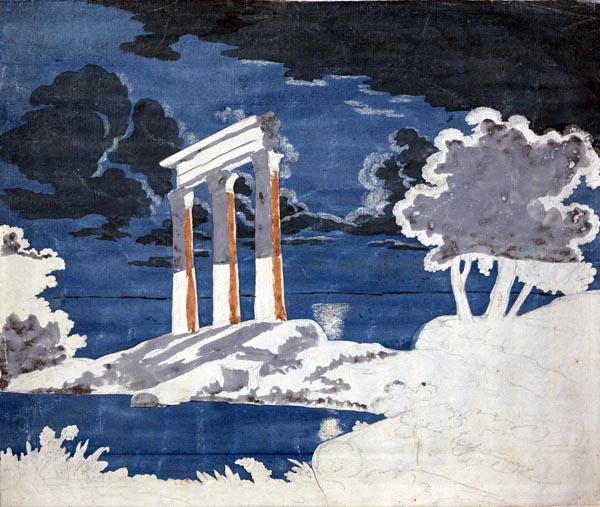
‘Temple ruins beneath a dark blue sky (c. 1820)’ - Johann Wolfgang von Goethe (German, 1749–1832)
Klassik Stiftung Weimar, Museen (Inv. GGz/1380)
Digital reproduction · See Art. L. 111-1 CPI and § 68 UrhG
As we reached a high point; the greatest of views opened up before us. Naples in all its glory, with its miles-long rows of houses along the flat shore of the gulf, then the promontories, headlands, cliffs, then the islands, and beyond all the sea – it was a delightful sight.
A dreadful burst of song, or rather, a gleeful shout and a howl of joy from the boy standing behind us, startled me and disturbed my thoughts. I reprimanded him sharply; he who had never had a harsh word from us before, and indeed was the most good-natured of lads.
For a while he was motionless, then he gently patted me on the shoulder, extended his right arm between us with his index finger raised, and said: ‘Signor, perdonate! Questa è la mia patria!’— Which translated, means: ‘Sir, forgive me! There is my native place!’— And so, I was startled a second time, and tears rose to the eyes of this poor northerner!
Naples, Sunday March 25, 1787. The Annunciation of the Virgin Mary.
Although I felt that Kniep was most happy to visit Sicily with me, I could also tell that there was someone he was reluctant to leave behind. Given his sincerity, I soon discovered that he had a sweetheart, who was closely and faithfully attached to him. How they had met was quite charming to hear; and how the girl had behaved thus far was quite endearing; now I was to see, for myself, how beautiful she was. Arrangements had been made for this, in such a way that I could at the same time enjoy one of the most beautiful views of Naples. Kniep led me onto the flat roof of a house, from which one could see the lower part of the city towards the Molo, the gulf, and the coast of Sorrento in its entirety; everything further to the right was foreshortened in the most peculiar way, which one could only perceive when standing at that very spot. Naples is beautiful and magnificent everywhere.
As we admired the scenery, a rather charming little head emerged suddenly, from below, though we had anticipated its owner’s arrival, the entrance to the balcony simply being a long, rectangular opening in the floor, covered with a trapdoor. When the little angel had appeared fully, it occurred to me that older artists had depicted the Annunciation in just such a way, with the angel likewise ascending a staircase. This angel, however, was of a very beautiful form, with a lovely face and a pleasant, natural demeanour. I was delighted to see my new friend Kniep so happy, framed by the magnificent sky, and the most beautiful scenery in the world. He confessed to me, after she had departed, that he had thus far accepted his state of poverty willingly, precisely because it had revealed her love for him, and he had learned therein to appreciate her frugality; now, his improved prospects, and the promise of a more comfortable life, were especially prized by him since he could offer her, too, a better life.
The same date, March 25th.
After this pleasant adventure, I strolled along the seafront, quietly and contentedly. There, I obtained a profound insight into botanical matters. Please tell Herder that I will soon have completed my work on the archetypal plant (der Urpflanze), but I fear lest no one else is able to recognise the rest of the plant world within it. My remarkable theory of cotyledons is so refined that it would be difficult to take the subject any further.
Naples, March 26, 1787.
Tomorrow this letter to you will be dispatched. On Thursday the 29th, I will finally set sail for Palermo aboard the corvette, which, being unfamiliar with naval matters I elevated to the rank of frigate in my previous letters. The doubt as to whether I should travel or remain here rendered me unsettled for part of my stay; now that I have made up my mind, I feel much better. For a person of my disposition, the voyage will prove salutary, indeed necessary. Sicily looks towards Asia and Africa, and to stand, myself, at the wondrous point on which so many radii of world history converge is no small thing.
I have treated my stay in Naples after its own manner, and been anything but diligent, yet have seen a great deal and formed a general impression of the country, its inhabitants, and its general state. On my return, I intend to catch up on various tasks; admittedly, only a few, for I must be back in Rome before June 29th, St. Peter’s Day. If I miss Holy Week, I at least wish to celebrate the feast day there. My Sicilian journey must not divert me too far from my original intention.
The day before yesterday we had dreadful weather with thunder, lightning and torrential rain; now it has cleared again, and a wonderful Tramontane is blowing; if the wind remains constant, we will experience the swiftest of journeys.
Yesterday, my companion and I went to inspect our vessel and visit the cabin that will house us. A sea voyage is something I have never experienced before; the brief crossing, involving a circumnavigation of the coast perhaps, will stimulate my imagination and broaden my horizons. The captain is a young, lively fellow, the vessel quite dainty and charming, built in America, a good sailing ship.
Here all the vegetation is turning green; in Sicily I expect to find it even more so. By the time you receive this letter, I will be on my way back, having left Trinacria (the ancient name for the island) behind. Such is human nature: our thoughts are always leaping forward and back; I have not even arrived there yet, and an already returning. Yet I am not to blame for the confusion of this letter, being interrupted every moment, and yet desiring to finish writing this page.
I have just received a visit from a certain Marchese Berio (Francesco Maria Berio, art and book collector, later famous for his literary salons) a young man who seems to have acquired a good deal of knowledge. He too wished to meet the author of ‘The Sorrows of Young Werther.’ There seems to be a great yearning and desire for education and knowledge here. They are simply too happy though, to pursue that path thoroughly. If only I had more time, I would gladly offer it in their service. These last four weeks — what are they when considering all the tremendous and various life here! Farewell! I may have learned how to travel on this journey, but whether I will have learned how to live, I know not. Those people who appear to understand the matter are too different from me in nature and character for me to lay claim to their talent.
Farewell and love me, as I remember you, from the heart.
Naples, March 28, 1787.
These few days are proving a complete loss, filled with packing and saying goodbye, with shopping and settling bills, catching up with my tasks, and preparing for the voyage.
The Prince of Waldeck unsettled me once more, on parting. He spoke to me of nothing less than my preparing, on my return, to journey with him to Greece and Dalmatia. Once one ventures out into the world, and engages with it, one must beware of becoming detached from reality, or even driven mad. I am incapable of adding another word.
Naples, March 29, 1787.
For several days the weather has been uncertain, but today, on the appointed day of departure, it is as beautiful as can be. A most favourable Tramontane is blowing, in a clear, sunny sky, which makes one long to be off into the wide world. I bid a fond farewell to all my friends in Weimar and Gotha! May your love accompany me, which I am sure of always needing. Last night I dreamt my previous dream once more. It is as if I am destined to unload my boat of pheasants’ feathers nowhere except among you. May it be laden with all the more splendid a cargo!
The End of Goethe’s ‘Italian Journey’ Part VII