Johann Wolfgang von Goethe
Italian Journey (1786-88)
Part VI: Rome
Translated by A. S. Kline © Copyright 2026 All Rights Reserved
This work may be freely reproduced, stored and transmitted, electronically or otherwise, for any non-commercial purpose. Conditions and Exceptions apply.
Contents
Rome
November 1, 1786.
At last, I can breathe, and greet my friends with joy. May I be forgiven for the secretive nature of my well-nigh ‘subterranean’ journey here. I scarcely dared tell myself, where I was going; even on the way I was still afraid, and only beneath the arch of the Porta del Popolo did I feel certain of having reached Rome.
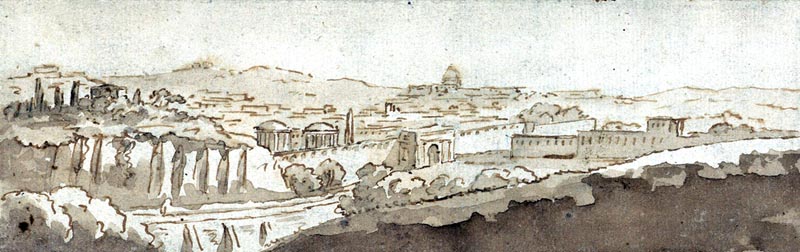
‘Panorama of Rome from the Porta del Popolo’ - Johann Wolfgang von Goethe (German, 1749–1832)
Klassik Stiftung Weimar, Museen (Inv. GGz/1957)
Digital reproduction · See Art. L. 111-1 CPI and § 68 UrhG
And let me say also that I think of you a thousand times, indeed constantly now, in the vicinity of objects I never thought I would visit alone. Only when I had come to realise how everyone back there was bound, body and soul, to the North, and all desire to see these regions quenched, did I decide to make this long, solitary journey and seek the central point toward which an irresistible longing drew me. Indeed, in recent years it became a kind of illness from which only the sight and presence of Nature could cure me. Now I may confess that, of late, I had no longer allowed myself to open a book written in Latin, nor view a drawing of an Italian landscape. My need to see this country was overripe: now that it is satisfied, my friends and homeland have become truly dear to me again, and my return to them is desirable, indeed all the more desirable since I feel certain that I shall not so much be arriving with possessions for my own, private use, but treasures that will offer both myself and others guidance and a means of development throughout life.
Rome, November 1, 1786.
Yes, I have finally arrived in this great capital of the world! If I had seen it fifteen years ago, in good company, with a truly knowledgeable guide, I would have considered myself fortunate. But now that I have been able to visit it, and see it with my own eyes, alone, it is better that this joy has come to me so late.
I well-nigh flew over the Tyrolean mountains. I viewed Verona, Vicenza, Padua, and Venice, thoroughly, Ferrara, Cento, and Bologna, fleetingly, and Florence scarcely at all. My desire to reach Rome was so great, and increasing so with every passing moment, that I was unable to rest, spending only three hours in Florence. Now I am here, and calm, and seemingly destined to be at peace for the rest of my life. For, one may well say, a ‘new life’ begins when one sees, with one’s own eyes, without and within, a whole of which one knew only part. All the dreams of my youth I now see realised, vividly, before me; the first copperplate engravings I remember (my father had hung views of Rome in an anteroom) I now see in reality, and everything I have long known only from paintings and drawings, copperplate engravings and woodcuts, or modelled in plaster or cork, now, together, meet my sight. Wherever I go, I find an old acquaintance, yet in a new world; it is all as I imagined it, and yet all quite fresh. I can say the same about my observations and ideas. I have had no entirely new thoughts, have found nothing completely strange to me, but my established ones have become so definite, so vivid, and so coherent that they may be considered new.
When Pygmalion’s Galatea (Elise), whom he had shaped according to his desire, and granted as much real existence as any artist is capable of, finally approached him, saying: ‘It is I!’, how different was the living person from the carved stone!
How beneficial then, morally, it is for me, to live among so sensual a people, about whom so much has been said and written, and whom every stranger judges according to his own standards. I forgive all who criticise and rebuke them, because they are too far removed from us, and as a stranger, interacting with them is both difficult and complex.
Rome, November 3rd.
One of the major reasons I had for hurrying towards Rome, was the fast-approaching Feast of All Saints, on the first of November, thinking that if they bestowed so much honour on any one saint, what would they not bestow on all? But how wrong I was! The Roman Church celebrates no widespread feast on that day, as each order prefers to celebrate the memory of its patron saint quietly; for it is the name day, and the day of honour, the feast day, assigned to their saint, that truly allows each worshipper to share in that saint’s glory.
Yesterday, however, on All Souls’ Day, I fared better. The Pope commemorates the day in his private chapel on the Quirinal Hill. All are welcome. I hurried, with my friend, the artist Johann Tischbein, to Monte Cavallo (Piazza del Quirinale). The square in front of the Quirinal Palace has an individual, nay unique, character, being as irregular as it is grand, and charming. And there I beheld the two Colossi (the statues of the Dioscuri, Castor and Pollux). Neither eye nor mind are sufficient to encompass them wholly. We hurried, amidst the crowd, through the splendidly spacious courtyard, and ascended the staircase to an exceptionally spacious hall. In this anteroom, opposite the chapel, in sight of a series of rooms, one feels united under one roof with the Vicar of Christ, and wonderfully so.
The proceedings had begun; the Pope (Pius VI, Giovanni Angelo Braschi) and cardinals were already in the church; the Holy Father, being a most handsome and dignified man, the cardinals of varying ages and backgrounds.
I was seized by a strange longing for the head of the Church to open his golden mouth, speak with rapture of the ineffable salvation of blessed souls, and fill us, in turn, with rapture. But seeing him merely pace back and forth before the altar, turning now this way, now that, and behaving and muttering like a common priest, Protestant original sin stirred within me, and the familiar and customary Mass held no appeal at all. Certainly, Christ, even as a boy, did not teach and work silently, but gave his oral interpretation of Scripture then, and throughout his youth; for he spoke openly, intelligently, and well, as we know from the Gospels. What would he say, I thought, if he entered and found his representative on Earth, murmuring and swaying back and forth? I recalled the phrase ‘Venio iterum crucifigi!’ once more, and I nudged my companion, to suggest that we might exit into the vaulted and painted hall.
Here we found many people attentively admiring the exquisite paintings, for this All Souls’ Day is also in Rome a celebration of all artists. Like the chapel, the entire palace, all its rooms, are open this day to everyone and freely accessible for many an hour; no tip is required, and the castellan never presses one to depart.
The murals fascinated me, and thus I encountered excellent painters, only known to me by name, such as the happy Carlo Maratti (also Maratta), whose work I have come to like and appreciate.
I was particularly pleased, however, by various masterpieces by artists whose styles I had already memorised. I gazed with admiration at the ‘Saint Petronilla’ by Guercino, commissioned for St. Peter’s, where a mosaic copy now stands in place of the original (‘The Burial and Glory of Saint Petronilla’, a baroque altarpiece, is now in the Musei Capitolini). The saint’s body is shown here raised from the grave, while the living saint, resurrected in heaven, is received by a divine youth. Whatever one might say as regards the parallel narrative, the painting is beyond price.
I was even more astonished by a Titian (‘The Madonna of San Niccolò dei Frari’, c 1533-1535, now in the Vatican Pinacoteca, originally created for San Niccolò della Lattuga in Venice). It surpasses all others I have seen. Whether my perception is simply more refined, or whether it is truly the most excellent of all, I cannot quite discern. An immense chasuble, replete with embroidery, indeed with repoussé gold figures, envelops a handsome episcopal figure. Holding a massive crozier in his left hand, he gazes rapturously upwards; in his right he holds a book, from which he seems to have received divine inspiration. To the left a beautiful virgin, palm frond in hand, looks with sweet interest at the open book. To the right, a solemn old man, quite close to the book, seems to pay no attention to it: keys in hand, he may well be confident in his own ability to decipher it. Opposite this group, a naked, well-formed, bound youth, wounded by arrows, gazes ahead, humbly resigned. In the space between, two monks, one bearing a cross the other a lily, turn devoutly towards various heavenly beings, as the semicircular structure that encloses the group is open at the top. There, in supreme glory, the Madonna leans downwards, participating in the scene. The lively and happy child in her lap offers a wreath with a joyful gesture, indeed, seems about to cast it downwards. On both sides hover angels, holding wreaths. High above all, and above a triple circle of rays, reigns the heavenly dove, as both centre and keystone (the dove, and therefore presumably an upper section of the painting, is not extant).
One tells oneself that there must have been some sacred, ancient tradition at the root of this, that allowed these diverse, disparate individuals to be brought together in such an artistic and meaningful way. One asks not how or why; one simply accepts, and admires artistry beyond price.
Less incomprehensible, but still mysterious, is a mural by Guido Reni in a side-chapel. The most childlike, sweetest, most devout Virgin sits quietly sewing, two angels at her side attending on her every gesture. The lovely image tells us that youthful innocence and diligence are watched over and honoured by these heavenly beings. No legend, no interpretation is needed here.
Now, to lighten this mood of artistic seriousness, let me recount an amusing adventure. I noticed several German artists who greeted Tischbein as an acquaintance, noting my presence, and then pacing back and forth. Tischbein, who had left me for a few moments, returned and said: ‘Here’s a great deal of fun to be had! The rumour that you were in Rome has already spread, and the artists are aware of your being the only stranger unknown to them. Now, there’s one among them who has long claimed to know you; indeed, he even claims to have enjoyed a friendly relationship with you, which none of us quite believed. He has been asked to look at you and dispel any doubt, but has assured us, clearly and succinctly, that it is not you, and that the stranger displays not a trace of your appearance or features. So at least your incognito is safe for the moment, and it will be something to smile about later.’
I mingled more freely with the group of artists, and enquired as to the creators of various paintings whose styles were still unknown to me. Finally, one in particular caught my eye: ‘Saint George’, the dragon slayer and liberator of maidens. No one could name the artist. A small, unassuming man, who had been silent until then, stepped forward, and informed me that it was by Il Pordenone (Giovanni Antonio de’ Sacchis), the Venetian, and one of his best paintings, in which his entire merit was evident. Now my inclination towards it was readily explicable: the painting had appealed because, already more familiar with the Venetian school, I am better able to appreciate the virtues of its masters.
The artist who identified the painter is Johann Heinrich Meyer, a Swiss who has been studying here for several years with a friend named Cölla, who draws antique busts, excellently done, working in sepia, and is well-versed in art history.
Rome, November 7th.
Now I have been here for seven days, the general layout of the city is gradually emerging in my mind. We walk back and forth, diligently, and I familiarise myself with the plans of both ancient and modern Rome, examine the ruins and buildings, and visit one villa after another. The greatest and most intriguing things I deal with very slowly, I simply open my eyes, look, and depart; and then return again, for one can only prepare oneself for Rome in Rome.
Let me admit, however, that it is a sad task to distinguish the old Rome from the new, but it must be done nonetheless, and in the end, one can hope to gain immeasurable satisfaction. One encounters traces of glory and a scale of destruction that both defy comprehension. What the barbarians left standing, the builders of the new Rome have ravaged.
When one considers the existence of a city two thousand years old and more, so extensively and fundamentally altered by the changing times, yet still on the same soil, encompassing the same hills, indeed often the same pillars and walls; and, as regards the people, traces still of the ancient Roman character, one becomes a participant in the vast decrees of Fate. Thus, it becomes difficult for the observer to grasp, from the outset, how one Rome follows on another, and not only does the new succeed the old, but various epochs of the old and new have also followed in succession. I myself seek at first merely to discern the half-hidden transitions; only then can the excellent preliminary work done by others be fully utilised. For from the fifteenth century to the present day, distinguished artists and scholars have devoted their entire lives to the subject.
And the immense scale of everything has a calming effect on one, while one scurries to and fro in Rome seeking out the most important sights. In other towns and cities, one has to seek out what is significant; here, one is overwhelmed, and overcome by it. Wherever one goes views of every sort unfold: palaces and ruins, gardens and wasteland, wide or narrow spaces, cottages, stables, triumphal arches and columns — often all so close together that they could be captured on a single sheet of paper. One needs a thousand styluses; what use is a pen here! And then, in the evening, one is tired and exhausted from so much seeing and marvelling.
November 7, 1786.
My friends must forgive me if I am henceforth thought of as taciturn; on a journey, one gathers what one can along the way, each day brings something new, and one hastens to reflect on, and judge, it all. Here, however, one enters a truly vast school, where a single day conveys so much that one dares say nothing. Indeed, one would do well, having remained here for years, to observe a Pythagorean silence (a strict, multi-year vow of silence was imposed on new initiates in the ancient Greek school of Pythagoras, so as to enhance the powers of contemplation).
The same date.
I am quite well. The weather is, as the Romans say, brutal; there is a midday wind, the sirocco, which brings rain more or less daily; but I fail to find the weather unpleasant, it is warm, unlike rainy days in our Northern summer.
The same date.
I am now coming to know and appreciate Tischbein’s talents more and more, as well as his artistic aims and intentions. He has shown me his drawings and sketches, which convey and express much that is good. His time with Johann Jacob Bodmer (the Swiss author, academic, and critic) led him to reflect on the earliest ages of humanity, when human beings, awakening to their presence on Earth, tasked themselves with mastery of the world.
As a thoughtful introduction to the whole, he has striven in one work to depict, in a realistic manner, the great age of the Earth. Here are mountains covered with magnificent forests, gorges carved by torrents of water, extinct volcanoes, barely emitting a faint cloud of vapour. In the foreground, a mighty stump of an ancient oak tree remains embedded in the earth, on whose half-exposed roots a stag tests the strength of its antlers — as well-conceived a work as it is charmingly executed.
Then, in a most remarkable drawing, he has depicted Man as both a horse-tamer and superior to all the creatures of earth, air, and water, if not in strength, at least in cunning. The composition is extraordinarily beautiful; as an oil painting, it would have a major impact. We must absolutely obtain a copy of it for Weimar. Next, he had envisaged a work involving a gathering of old, wise, experienced men, in which he would have the opportunity to portray realistic figures. Exhibiting the greatest enthusiasm, however, he has chosen instead to sketch a battle scene in which two cavalry squadrons are attacking each other with equal fury, at a point framed by an immense rocky gorge, which the horses can only cross with the greatest effort. Defence is out of the question here. A bold attack is required, fierce determination, leading to success or a descent into the abyss. This scene will give him the opportunity to develop, in a most significant way, the knowledge he possesses of the horse, its anatomy and movement.
He then wishes to link these images, and a series of subsequent interspersed works, with poems which will serve to explain what is depicted, and which in turn, would grant the images, through various poetic ideas, body and charm. The idea is beautiful, but of course artist and poet would need to work together for several years to carry out such a project.
The same date.
I have only viewed Raphael’s Loggias and the large fresco of ‘The School of Athens,’ etc., once, which is like trying to study Homer from a damaged, and partially-faded manuscript. The pleasure derived from one’s first impression is partial; only when one has gradually examined, and studied, everything fully is one’s enjoyment complete. The best preserved are the ceiling panels of the Loggias depicting biblical stories, the paint as fresh as if they were done yesterday — admittedly, very few are by Raphael’s own hand, but all were superbly executed according to his designs and under his supervision.
The same date, November 7th, 1786.
Formerly, on various occasions, I entertained the curious notion that I would like to be guided on my travels in Italy by a well-informed individual, for example an Englishman knowledgeable as regards both art and history; however, all has turned out now more beautifully than I could have imagined. Tischbein has visited, and now lives, here (he had visited in the period 1779 to 1781, and settled in the city permanently in 1783), and has long been a dear friend. He cherished a desire to show me Rome one day; our relationship, old as regards letters, is yet new through our now being here together; where could I find a more worthy guide? Though my time is limited, I will nevertheless enjoy and learn as much as possible. Yet despite all that, I foresee that as I leave Rome, I shall wish that I was only just arriving.
November 8th.
My odd, perhaps eccentric, semi-incognito has brought me advantages I would not have imagined. Since everyone feels obliged to ignore my identity, and thus no one is allowed to speak to me regarding my true self, the people here have no choice but to talk about themselves, and things that interest them. In this way, I am able to learn, albeit indirectly, what occupies everyone’s thoughts, and whatever remarkable things are happening or about to. Court Councillor Reiffenstein (Hofrat Johann Friedrich Reiffenstein, antiquarian, art-dealer, painter, and guide who played a pivotal role in the 18th-century art-world, as a key agent in Rome) also indulges this whim of mine; but since, for some reason of his own, he could not endure the name I had adopted, he soon bestowed the title of Baron upon me, and I am now Baron Rondanini (‘the Baron who lives opposite the Palazzo Rondanini’, or Rondinini, at Via del Corso, 518). This sufficiently identifies me, all the more so since Italians only ever refer to people by their first names or their nicknames. Enough, I have it my way, and escape the endless inconvenience of having to account for myself, and my previous work.
November 9th.
Sometimes, I stand still for a moment, and survey the highest peaks that I have already gained. I greatly enjoy looking back at my time in Venice, that great city which sprang from the bosom of the sea like Pallas Athene from the head of Jupiter. Here, in Rome, the Rotonda (the Pantheon), both internally and externally, moved me to joyful veneration of its grandeur. In St. Peter’s, I learned how art, like Nature, can transcend all comparisons. And thus, the Apollo Belvedere (in the Vatican) transported me beyond mere reality. For just as the most accurate drawings cannot convey the essence of the buildings, so it is here if one compares the original marble to the plaster casts, of which I had seen some very beautiful examples previously.
November 10, 1786.
I now live, here, in a state of clarity and peace that I have not experienced in a long time. My practice of seeing and interpreting all things as they are; my faithfulness to my rule, that of keeping my eyes wide open; and my complete relinquishment of all pretensions to knowledge, are once again proving most useful and, in a quiet way, render me extremely happy. Every day reveals some new and interesting object for study, every day offers fresh, grand, unfamiliar images, forming a whole that one may think and dream about for hours, without the imagination ever quite grasping it in its completeness.
Today I visited the Pyramid of Cestius, and this evening the Palatine Hill, topped by the ruins of the Imperial Palace complex, like a series of cliff faces. Of course, nothing of this can be conveyed! There is, in truth, nothing here which is insignificant, even if here and there one views something reprehensible and tasteless; for even such things play a part in the overall grandeur.
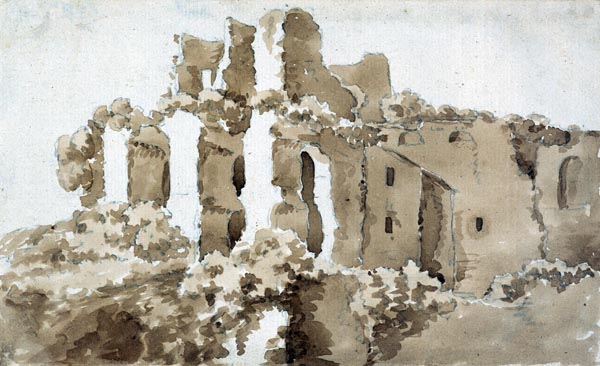
‘Ruins on the Palatine Hill, Rome’ - Johann Wolfgang von Goethe (German, 1749–1832)
Klassik Stiftung Weimar, Museen (Inv. GGz/0160)
Digital reproduction · See Art. L. 111-1 CPI and § 68 UrhG
Turning to myself once more, as human beings so readily do at every opportunity, I harbour a feeling of boundless joy within, indeed, one that I will even dare to express. A person who looks around with any degree of earnestness, here, and has eyes to see, must feel more solid; and must grasp the concept of solidity in a way that they have never before experienced so vividly.
The mind is imbued with increasing competence, and one attains seriousness without dryness, a calmly composed state imbued with joy. For my part, at least, it is as if I had never truly appreciated the things of this world as I do here. I anticipate blessed consequences from it, affecting my entire life.
And so let me but compose myself, and whatever may come, all will fall into place, and rightful order. I am not here to indulge myself at whim; I wish to devote myself to great pursuits, to learn and educate myself before I reach the age of forty (Goethe was thirty-seven at the time).
November 11th.
Today I visited the nymph Egeria (the Nymphaeum of Egeria, a 2nd-century AD structure in the Caffarella Valley) then the Circus of Caracalla (Circus of Maxentius), and the ruined tombs along the Appian Way, including the tomb of Caecilia Metella, which truly gives one a sense of solid masonry. Those people laboured to produce works for eternity; everything was allowed for in advance, except the senselessness of the Vandals, to which everything was forced to give way (in 455AD). I longed for you all to be here. The remains of the great aqueducts are most venerable. What a beautiful, and grand aim, to bring water to the people by means of so immense an endeavour! In the evening I reached the Coliseum as dusk was falling. When you gaze at it, everything else is rendered small; it is so vast that one cannot hold the entire thing in one’s mind. One remembers it as being smaller, yet if one returns there, it seems even larger.
Frascati, November 15th.
The company are all abed, and I am still writing using the ink they use for drawing. We have had a series of beautiful, rain-free days here, warm and sunny, such that one misses summer not at all. The area is very pleasant; the place is situated on a hillside, or rather, a mountainside, and for an artist every step offers the most magnificent subjects. The view is boundless; one can see Rome, and beyond Rome to the sea, and on the right, the mountains above Tivoli, and further still. In this delightful region, country houses are built solely for pleasure, and just as the ancient Romans had their villas here, so too, for a hundred years ago and more, rich and exuberant Romans have built their country houses in the most beautiful places. We have been walking the area for two days now, and there is always something new and charming to discover.
And then, it is hard to say whether the evenings are not even more enjoyable than the days. As soon as the stately landlady places the brass triple-branched lamp on the large round table and says ‘Felicissima notte!’, ‘Have a most pleasant night!’, everyone gathers in a circle and presents the drawings and sketches they have made throughout the day. They discuss whether the subject should have been presented to greater advantage, whether its essence has been captured, and whether those initial general requirements, which one must consider even in a first draft, have been met. Court Councillor Reiffenstein, a man of insight and authority, knows how to keep order, and chair these meetings. This commendable institution, however, really owes its existence to the artist Philipp Hackert, who knows how to depict and execute landscape paintings, and with the utmost taste. When in Rome, he kept artists and enthusiasts, men and women, old and young, up to the mark, encouraging all to try their hand at something, each according to their talent and ability, and leading the company by example. This way of gathering and entertaining a group of artists was faithfully continued by Councillor Reiffenstein after Hackert’s departure (for Naples, and ultimately Florence) and we find it commendable that he welcomes the active participation of all and sundry. The nature and character of the various members of the society emerge in a pleasant manner. Tischbein, for example, as a painter of neo-classical scenes, views landscape quite differently than a traditional landscape-painter does. He perceives significant groupings, and other graceful and expressive subjects, where another would notice nothing of significance, and thus he succeeds in capturing many an innocent human trait, be it in children, peasants, beggars and other such unsophisticated people, or even animal traits, since he knows how to depict creatures very successfully with a few characteristic strokes, thereby constantly providing new and charming material for conversation.
When conversation is exhausted, then, evoking Hackert’s legacy, someone reads from Sulzer’s ‘Theory,’ (Johann Georg Sulzer’s artistic theory, detailed in his ‘General Theory of the Fine Arts’, 1771–1774, emphasised their civilising effect), and even if one cannot be entirely satisfied with that work from a more elevated standpoint, one nevertheless notes with pleasure its beneficial influence on those who are at an intermediate level of knowledge.
Rome, November 17th.
We have returned to Rome! Last night there was a dreadful downpour accompanied by
thunder and lightning, now it continues to rain but the air is warm.
I can only describe the pleasures of this day in a few words. I saw the frescoes by Domenichino in Sant’Andrea della Valle, and similarly, those in the Farnese Gallery, by Annibale Carracci and his studio. More than enough, surely, to occupy one for months, let alone a single day.
November 18th.
The weather is fine again, a bright, friendly, warm day. In the Villa Farnesina I saw the frescoes (by Raphael and his workshop) depicting the tale of Psyche, colourful reproductions of which have long brightened my rooms, then, in the church of San Pietro in Montorio, Raphael’s ‘Transfiguration’ (now in the Vatican Pinacoteca) All these are old acquaintances, like friends one has made through corresponding from afar, whom one now sees face to face. Experiencing them all together is something else entirely; every genuine sympathy or its opposite is immediately apparent.
There are wonderful things to be found everywhere here; things that are not often spoken of, being less frequently reproduced in the form of copperplate engravings, or reproductions. I have brought some of the latter with me, drawn by talented young artists.
The same date.
The fact that I have maintained such an excellent relationship with Tischbein for so long, through our letters to each other, and that I have shared with him many a wish, even though seemingly hopeless of fulfilment, of visiting Italy, has made our meeting immediately both fruitful and enjoyable. He was forever thinking of me, and assisting me. He is also completely at home with the various types of stone employed in both ancient and modern buildings; he has studied them thoroughly, his artistic eye, and appreciation of solid matter serving him well. He recently sent a collection of samples, especially selected for myself, to Weimar, which will be a welcome and warming sight on my return. Meanwhile, a significant further gift has come to light. A clergyman, currently in France and intending to write a work on ancient types of stone, received, through the favour of the Congregation for the Propagation of the Faith, (the Congregatio de Propaganda Fide, known as the ‘Propaganda’, a committee of cardinals tasked with managing foreign missions and training missionaries to spread Catholicism), various considerable pieces of marble from the island of Paros. These have been cut into sample pieces here, and twelve different ones were set aside for me, ranging from the finest to the coarsest grain, from the purest to those mixed with varying amounts of mica — some suitable for sculpture, others for architectural use. How much a precise knowledge of the material employed in the arts contributes to evaluation of the resulting work is readily apparent.
There are plenty of opportunities to gather such samples here. Visiting the ruins of Nero’s palace (the Domus Aurea), we walked through freshly ploughed artichoke fields, and could not resist filling our pockets full of granite, porphyry, and marble fragments, thousands of which lie scattered about, as inexhaustible witnesses to the ancient glories of the walls they once covered.
The same date.
But now I must also speak of a wonderfully problematic drawing that can be clearly seen as related to all these excellent things. Several years ago, a Frenchman, known as an art lover and collector, stayed here. He was said to have come into possession of an antique fresco on plaster, its origin unknown, and that he had Anton Raphael Mengs restore it, and included it as a prized work in his collection. Johann Winckelmann, the art historian speaks of it enthusiastically somewhere. It depicts Ganymede offering Jupiter a bowl of wine, and receiving a kiss in return. The Frenchman died, leaving the painting to his landlady as an antique. Mengs died, but had declared on his deathbed that it was not antique, and that he had painted it (He and Giacomo Casanova created it in imitation of an ancient Roman fresco, sufficiently skilfully to deceive Winckelmann. It resides in the National Gallery of Ancient Art, in Rome). And now everyone is arguing about it. Some claim that Mengs simply dashed it off in jest, while others say that Mengs could never have produced anything of that quality, indeed, that it was almost too beautiful for Raphael. I saw it yesterday and must say that I know of nothing more beautiful than the figure of Ganymede, particularly the head and back, the rest has been extensively restored. Meanwhile, however, the painting is discredited, and nobody wants to relieve the poor landlady of her treasure.
November 20, 1786.
Since experience has ever taught us that people wish drawings and engravings to accompany poetry of every sort, and indeed, that painters themselves often dedicate their most elaborate paintings to a particular poetic passage, Tischbein’s idea that poets and artists might collaborate to form a unified whole from the outset is highly commendable. The difficulty of doing so would, of course, be considerably reduced if the poems were short, and easily appreciated and promoted.
Tischbein also has some very charming, nay idyllic, suggestions as regards this idea, and it is truly remarkable that the subjects he wishes to explore in this manner are of such a nature that neither poetry nor the visual arts, on their own, would be sufficient to realise them. He told me about this on our walks, to entice me to enter into his plan. The title engraving for our joint work, has already been designed; if I weren’t afraid of venturing into yet another new project, I might well allow myself to be seduced.
Rome, November 22, 1786, the Feast of St. Cecilia.
I must preserve the memory of this happy day in a few vivid lines, and at least recount in order all that I enjoyed. The weather was utterly beautiful and tranquil, with a perfectly clear sky, and warm sunshine. I walked with Tischbein to St. Peter’s Square (Piazza San Pietro), where we first strolled up and down, and when it became too warm, in the shade of the great obelisk, the shade being just wide enough for two people to do so, eating grapes we had bought nearby. Then we entered the Sistine Chapel (in the Apostolic Palace), which we also found bright and cheerful, and the paintings well-lit. The ‘Last Judgement’ and the paintings on the ceiling, by Michelangelo, we jointly admired. For myself, I could only look and marvel. The master’s inner confidence and manly energy, his grandeur, is beyond all description. After gazing at everything over and over, we left this sanctuary, and visited St. Peter’s Basilica, which was filled with the most beautiful light from the dome, and appeared bright and clear in every part. As two people who appreciate life’s finer things, we revelled in the grandeur and splendour, without, on this occasion, allowing ourselves to be troubled by overly-critical or rational thought, and we suppressed harsher judgement. We found it sufficient to take pleasure in what is pleasing.
Finally, we climbed to the roof terrace, where one finds in miniature a plan of the well-built city. Houses and warehouses, fountains (judging by appearances), churches, and a large temple, all suspended in the air, as it were, with pleasant walkways in between. We climbed to the dome, and gazed out over the bright, sunny landscape of the Apennines, Mount Soracte, the volcanic hills beyond Tivoli, Frascati, Castel Gandolfo, the plains, and further on, the sea. Beneath us, stretched the entire city of Rome in all its breadth and vastness, with its hilltop palaces, domes, and so forth. The air was still, and inside the copper dome, it was as hot as a greenhouse. Having absorbed all this, we descended, and the doors to the cornices of the dome, the drum, and the nave were unlocked for us; one can walk around, and view these parts, and the church from above. As we stood on the cornice of the drum, the Pope passed below, occupied with afternoon prayers. So, we lacked nothing from our visit. We descended to ground level, enjoyed a cheerful, if frugal meal at a nearby inn, and then continued on our way to St. Cecilia’s Church (Santa Cecilia in Trastevere).
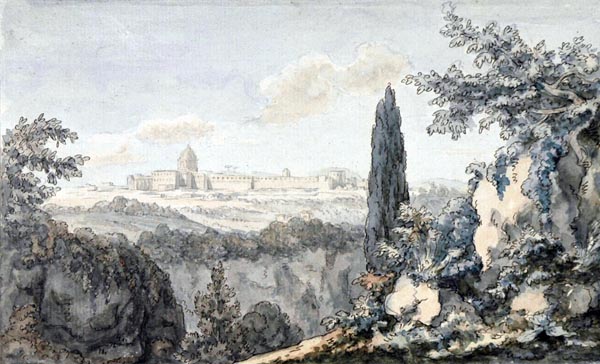
‘Saint Peter’s Basilica seen from the Arco Oscuro in Rome’ - Johann Wolfgang von Goethe (German, 1749–1832)
Wikimedia Commons
I would need many a written page to describe the decoration of the church, which was densely packed with people. Not a single stone of the pavement was visible. The columns were covered in red velvet and wound with gold braid, the capitals in embroidered velvet approximating their underlying shapes, and all the cornices and pillars were hung and covered in this way. All the spaces between the walls were covered with vividly-painted hangings, so that the whole church seemed as if lined with mosaics, and over two hundred wax candles burned around and beside the high altar, so that one entire wall was covered with lights, and the nave of the church was completely illuminated. The side aisles and side altars were similarly decorated and lit. Opposite the high altar, above and below the organ, were two scaffolded platforms, also covered in velvet, one for the singers, the other for the members of the orchestra who played continuously. The church was thronged.
I heard a beautiful musical performance here of a kind previously unknown to me. Just as there are violin and other concertos, here they perform concertos with added voices, with one dominant voice, the soprano for example, singing solo, the choir joining in, from time to time, as an accompaniment, and the full orchestra, of course, playing throughout. It produces a very fine effect. — I must end, with our ending to the day. In the evening we chanced to reach the opera house (Teatro Valle, built 1726), where ‘Fra i Due Litiganti’ (by Giuseppe Sarti, 1782) was being performed, but had enjoyed the day so much that we decided to pass it by.
November 23rd.
So that I, with my beloved incognito, might not end up, like an ostrich, thinking itself hidden because it has buried its head in the sand, I am yielding to a certain degree, while still maintaining my former title. I greeted, openly, the Prince of Liechtenstein (Karl Michale Joseph, called Borromaus, von Liechtenstein) a relation of the Countess von Harrach (Countess Maria Josefa von Harrach-Rohrau) whom I esteem so highly, and I dined with him several times, and soon realised that this concession of mine would have further consequences, and so it did. I had been told about Abate Vicenzo Monti and his ‘Aristodemo,’ a tragedy that was soon to receive its first performance. The author, I was told, wished to present a copy to me, and hear my opinion. I let the matter drop without specifically rejecting the idea, and finally met the poet and one of his friends at the prince’s residence, where the play was read aloud.
The hero, as is well known, is a king of Sparta who takes his own life due to his pangs of conscience, and I was politely informed that the author of ‘The Sorrows of Young Werther’ would probably not object to finding some passages from his excellent book utilised in this work. And so, there was no escape from the wrathful spirit of that unfortunate young man even within the walls of Sparta.
The piece has a very simple, calm pace; the sentiments and language are appropriate to the subject matter, both powerful and gentle. The work testifies to a fine talent.
I did not fail, in my own way — though certainly not in an Italian way — to highlight all the good and praiseworthy aspects of the play, with which the gathering was reasonably satisfied, though, exhibiting a southern impatience, they still demanded something more. In particular, I was expected to predict what effect the play would have on a theatre audience. I excused myself by referring to my ignorance of the country, its ways of thought, and its taste, but was honest enough to add that I did not know whether the pampered Romans, who were accustomed to seeing a complete three-act comedy and a complete two-act opera as an interlude, or a grand opera with entirely foreign ballet interludes as intermezzi, would take pleasure in the noble, tranquil course of a tragedy unfolding without interruption. Furthermore, the subject of suicide seemed to me to lie entirely outside the realm of Italian ideas. I hear about people killing others almost every day, here, but I have not heard of anyone robbing themselves of their own life, or even considering it a possibility.
I was happy to receive a detailed explanation of the objections pertinent to my disbelief, and yielded readily to the most plausible of arguments. I also assured them that I desired nothing more than to see the play performed and to offer the most sincere and enthusiastic applause, amidst a chorus of friends. This declaration was most graciously received, and I had every reason to be satisfied with my concession at this time — for Prince Liechtenstein is the epitome of kindness, and has arranged for me to view many art treasures with him, for which special permission from the owners and thus a higher degree of influence, is required.
However, my sense of humour proved insufficient when the Pretender’s daughter (Charlotte Stuart, Duchess of Albany, the illegitimate daughter of Charles Edward Stuart, he being known as the ‘Young Pretender’, and nicknamed ‘Bonnie Prince Charlie’. She had joined her father in Rome in 1785) also demanded to see the foreign ‘marmoset’. I refused, and buried myself, decisively, once more.
And yet, this is not quite the right approach either, and I feel very vividly here what I have noticed earlier in life: that the person who wishes to do good must be just as active and engaged with others as the selfish, the petty, or the wicked. It is an easy thing to comprehend; but it is difficult to act accordingly.
November 24th.
I can say nothing more about the Italians than that they are children of Nature who, amidst the splendour and dignity of religion and the arts, are not an iota different than they would be if they dwelt in caverns in the forest. What strikes all foreigners, and what is once again the talk of the whole city— but only talk — is the high frequency of killings. Four people have already been murdered in our district, in the last three weeks. Today, a fine artist, Joseph Caspar Schwendimann, a Swiss medallist and engraver, the last pupil of Johann Carl Hedlinger (died 1771), the medallist and sculptor, was attacked, just like Winckelmann (who was murdered in Trieste, while returning from Vienna to Rome, in 1768). The murderer, with whom Schwendimann struggled, dealt him about twenty stab wounds, and when the police arrived, the wretch stabbed himself. That is not usually the case, here. The murderer reaches the nearest church, and finds sanctuary.
And so, in order to add some shade to my descriptions, I should doubtless report on crimes and calamities, earthquakes and floods, though it is the current eruption of Vesuvius that has set most of the foreigners here in motion, and one has to exert considerable self-control, not to be swept away by the crowd. This natural phenomenon truly has about it something akin to a rattlesnake, whose rattle irresistibly attracts people. It is as if all the art treasures of Rome were rendered irrelevant; all the foreigners are breaking off their courses of study, and hastening to Naples. But I will persevere here, in the hope Vesuvius will keep something back to impress me.
December 1st, 1786.
Karl Phillip Moritz is here, the author who has sparked our interest in him through his auto-biographical novel ‘Anton Reiser’ (1785-86), and his previous ‘Travels of a German in England in 1782’ (published 1783). He is an honest, an excellent man, whose company we greatly enjoy.
Same date.
Here in Rome, where they see so many foreigners, not all of whom visit this capital of the world for the sake of the fine arts but seek entertainment in other ways, the inhabitants are prepared for anything. There are certain lesser arts, requiring manual dexterity, and a love of craftsmanship, in which people here have developed substantial skills, and will gladly share their interest with foreigners.
Painting in wax belongs in this category. The preliminary work and preparation, followed by firing and various other necessary steps, may readily engage any person with even a basic understanding of watercolours, and the end result often achieves a modest artistic status, through the sheer novelty of the process. There are practised artists who offer instruction in the techniques involved, and under the guise of guidance, they often exercise their own skills, so that in the end, when the gleaming wax-enhanced picture is displayed in a golden frame, the fair disciple is quite surprised by the manifestation of her unconscious talent.
Another activity is to take impressions in fine clay of incised cameos, which can also be done with medals, reproducing both sides at once.
The production of glass-paste jewellery requires even more skill, attention, and diligence. For all these tasks, Court Councillor Reiffenstein possesses the necessary equipment and facilities, in his house, or at least in the immediate vicinity.
December 2nd.
I stumbled upon Johann Archenholzen’s ‘England und Italien’ (‘England and Italy’, 1785) here, quite by chance. How such writing seems to shrink, faced with the actual place itself, as if the little book were to be placed on coals, and gradually turn brown and black, the pages curling, and vanishing in smoke. Certainly, he saw all that is here; but possesses far too little knowledge to justify so grandiose and contemptuous a manner, as he stumbles along, praising and criticising.
The same date.
This beautiful, warm, and calm weather, interrupted only occasionally by a few rainy days, is something completely new to me at the end of November and the start of December. We make the most of the good weather outdoors, and of the bad weather indoors; everywhere there is something to enjoy, learn, or do.
On November 28th, we returned to the Sistine Chapel and had the gallery unlocked, from which one can obtain a closer view of the ceiling. It is quite narrow, and one has to squeeze along behind the iron railing with some difficulty, and in apparent danger, which is why those prone to vertigo stay behind. But all is compensated for by the sight of the greatest of masterpieces. And, there and then, I was so captivated by Michelangelo that even Nature momentarily lost its appeal, since I am unable to see it with the wide-eyed wonder that he did. If only there were a way to truly commit such images to memory! At least I shall bring back whatever engravings and drawings of his works I can find.
From there we visited Raphael’s Loggias, and, dare I say, one could barely endure to look at them. One’s eyesight was so exercised and affected by those great forms, and the magnificent perfection of the details, that the eyes failed to trace the ingenious playfulness of the arabesques, while the biblical stories, beautiful as they are, could not compete with them. To view these works more often, to compare them, at greater leisure and without prejudice, must bring great joy; for initially, the encounter is far too one-sided.
From there, we progressed, in sunlight that was almost too warm, to the Villa Pamphili, with its most beautiful gardens, and stayed there until evening. A large, flat meadow, bordered by evergreen oaks and tall pines, was completely covered with daisies, all turning their heads towards the sun; and then my botanical speculations superseded all others, which I continued the next day on a walk to Monte Mario, Villa Mellini, and Villa Madama.
It is quite interesting to observe the continuous and vigorous growth of vegetation when uninterrupted by any severe period of cold; here there are no buds, and only now one begins to understand what a bud actually is. The strawberry trees, Arbutus unedo, are now blooming again, even as their last fruits ripen, and the orange trees also display their blossom, alongside half and fully-ripe fruit (though these latter trees, if not sheltered by buildings, are now being covered). There is plenty to think about as regards the cypresses, most respectable trees when quite old and well-established. I shall visit the Botanical Garden soon (the University botanical garden, on the Janiculum, the Gianicolo Hill, at that time), and hope to learn a lot there. In general, nothing compares to the new perspective on life which contemplating a foreign country grants a thoughtful person. Though I am still the same being, I believe I have been transformed to my very core.
Let me close for now, and let me fill the next page entirely with misfortune, murder, earthquake, and calamity, so that my paintings too may possess their share of shade.
December 3rd.
The weather has been mostly unpredictable so far, alternating every six days or so. Two absolutely glorious days, an overcast one, two or three rainy days, and then beautiful ones again. I try to make the most of each.
Yet the magnificent objects around me still feel like new acquaintances. One has not lived with them long enough to learn their unique qualities. Some seize me so forcefully that, for a time, I become indifferent, even unjust, to others. For example, the Pantheon, the Apollo Belvedere, various colossal heads, and most recently the Sistine Chapel have so captivated my mind that I can scarcely see anything beyond them. How can one, as puny as one is and accustomed to littleness, compare oneself to these noble, immense, and skilled works of art? And if one tries to view things in perspective, an enormous multitude press in from all sides, and meet one at every step, each demanding its own tribute of one’s attention. How can one extricate oneself from this? Only by letting it work on one, and develop patiently, and by diligently paying attention to what others have accomplished for our benefit.
Winckelmann’s art history (‘Geschichte der Kunst des Altertums’, ‘History of the Art of Antiquity’, 1764), translated into Italian by Carlo Fea (as ‘Storia delle Arti del Disegno presso gli Antichi’, 1783/4), the new edition, is a very useful work which I immediately acquired, and find very useful here amidst honest, interpretive and instructive company.
Even simple Roman antiquities are beginning to delight me. Historical inscriptions, and coins — things I previously dismissed — all, now, are drawing me in. Just as I once felt about natural history, so I feel here, since the entire history of Europe, and beyond, is linked to this place, and I count as a second birthday, a true rebirth, the day I entered Rome.
December 5th.
In the few weeks I have been here, I have seen many a visitor come and go, and marvelled at the casualness with which so many of them treat these valuable objects. Thank God that none of these migratory birds will be able to impress me hereafter, in the North, if they speak of Rome; none will trouble my digestion; for I shall have seen it all before, and know more or less where I stand on the matter.
December 8th.
Every now and then, we have the most beautiful days. The rain, which falls from time to time, turns the grass and garden plants green. There are numerous evergreens here and there, also, so one barely misses the fallen leaves of the deciduous trees. In the gardens there are orange trees laden with fruit, planted directly in the ground, and uncovered.
I was all set to tell you, at length, about a most pleasant walk we took to the sea, and about the fishing we did there, when, in the evening, Moritz broke his arm while riding back, his horse slipping on the smooth Roman cobblestones. It ruined all the pleasure of the day, and has laid a curse on our little circle.
December 13th.
How truly pleased I am that you have all accepted my vanishing from sight, as I dearly wished. Please reconcile me with any who might have been offended by my doing so. That was not my intent, though even now I can say nothing to justify my behaviour. God forbid that I should ever grieve a friend because of my decision.
I am gradually recovering now from my fateful leap (salto mortale) and studying not merely enjoying myself. Rome is a world, and it takes years just to become acquainted with it. How happy those travellers seem who only look and depart.
This morning I came across Winckelmann’s letters, which he wrote from Italy. With what emotion I began to read them! Thirty-one years ago, at this time of year, he, more a poor fool even than I, came to Rome, and he too was typically German in his seriousness as regards thorough and comprehensive study of its art. How diligently and skillfully he ploughed his way through it all! And where, now, is the memory of the man in this place!
Apart from the objects of Nature, which are true and consistent in all their aspects, nothing speaks to us as loudly as the traces of an honest, thoughtful man and true art, which are equally consistent. Here in Rome, one truly feels this, where so much that is transient has occurred, where so much foolishness has been perpetuated by power and wealth.
One passage in Winckelmann’s letter regarding Franconia (the region in northern Bavaria) particularly pleased me: ‘One must view all things in Rome with a certain phlegmatism, lest one is thought to be a Frenchman. Rome, I believe, offers the noblest school for educating the world, and I too have been tried and tested herein.’
That fits perfectly with my method of approaching things, and certainly, beyond Rome, there is no concept of how it educates one. One must be, so to speak, reborn, and one looks back on one’s previous ideas as if they were one’s childhood shoes. The most ordinary person becomes someone here, or at least gains an extraordinary understanding, even if it fails to become part of their very being.
This letter is sent as we prepare for the New Year; all happiness to you at its start; before it ends, we shall see each other again, and that will be no small joy. This past year has been the most important of my life; whether I die now, or live for a while longer, in either case life has been good to me. Now a word or two for the little ones.
You can read, or tell the children the following: winter is barely noticeable; the gardens are planted with evergreens, the sun is bright and warm, and the only snow to be seen is on the most distant mountain peaks to the north. The lemon trees, planted against the walls in the gardens, are gradually being protected with reed matting, but the orange trees remain devoid of cover. A mass of beautiful fruit hangs on each of these trees, which, unlike ours, are not pruned and planted in pots, but stand happily and freely in the ground, in rows with their companions. One can imagine few things more delightful than such a sight. For a small tip, one can eat as many as one chooses. They are already good; in March they will be even better.
Recently we were at the coast, on a fishing expedition; the most wondrous creatures appeared in the shape of fish, crabs, and others with strange deformities; also, fish that give an electric shock to the person who touches them.
December 20th.
And yet all this causes more toil and anguish than pleasure. The rebirth that has transformed me from within continues to do its work. I thought I would learn worthwhile things here; but never imagined that I would have to return to so early a stage of schooling, that I would have to unlearn, indeed completely relearn, so much. Now, however, I am convinced of the need, and have given myself up to doing so entirely, while the more I must deny my former self, the more I rejoice. I am like a builder who, wishing to erect a tower, lays down poor foundations; quickly realising this he gladly tears down what he has already built, seeking to expand and refine his ground plan, so as to be more certain of his tower’s grounding, and already rejoicing in the greater stability the future structure will possess. Heaven grant that, on my return, I also appreciate the moral consequences which life in the wider world has brought me. Indeed, my moral sensibility undergoes major renewal along with my artistic sensibility.
Doctor Münter (Friedrich Münter, the German-Danish scholar, theologian, and Bishop of Zealand), who is an energetic and impetuous fellow, is here, having returned from a trip to Sicily. I know nothing of his motive for undertaking the journey. He will be visiting you in May, and will have much to tell you. He has been travelling about Italy for some two years. He is dissatisfied with the Italians, who, it seems, showed insufficient respect for the important letters of recommendation he had brought with him, which were supposed to grant him access to many archives, and private libraries, so he has failed to fully achieve his wishes.
He has collected many beautiful coins and, as he told me, owns a manuscript that allows those studying numismatics to classify their precise characteristics, in the manner of Linnaeus. Herder is apparently inquiring further into all this; perhaps I will be permitted to take a copy. Creating something along those lines seems possible, and would be a good thing when done, because, sooner or later, I must delve more seriously into the subject.
December 25th.
I am now beginning to visit and view, for a second time, the best things I have seen; initial wonder dissolves into a more extended experience, and one obtains a deeper sense of their value. To truly grasp the highest concept of what humanity has accomplished, the spirit must first attain perfect freedom.
Marble is a strange material, which is why seeing the actual Apollo Belvedere is a boundless delight, because the noblest breath of that living, ageless, eternally-youthful, form is lost immediately even in the best plaster cast.
Opposite us in the Rondanini Palace stands a Medusa mask (the ‘Medusa Rondanini’, is now in the Glyptothek, Munich) where, in a long and beautiful face, larger than life, the fearful stare of death is expressed, to unspeakable perfection. I already possess an excellent cast, but the magic the marble achieves fails to survive there. The noble translucency of the yellowish stone, approaching the colour of flesh, has vanished. Plaster, by comparison, always looks chalky and lifeless.
And yet, what a joy it is to enter a plaster caster’s workshop, where one sees the magnificent limbs of statues emerging individually from the mould, and thereby gains an entirely new perspective on the resulting figures. There one can see, side by side, objects that are scattered throughout Rome, which provides an invaluable means of comparison. I could not resist acquiring a colossal head of Jupiter. It now stands opposite my bed, well-lit, so that I can immediately address my morning devotions to it, and which, despite its grandeur and dignity, has given rise to an amusing little story.
Our old landlady is usually followed by her faithful cat, when she enters to make the bed. I was seated in the main hall, and heard her going about her business within. Suddenly, contrary to her usual habit, she opened the door and called out to me, very hastily and vehemently, to come quickly, and see a miracle. When I asked her what it was, she replied that the cat was worshipping God the Father. She had long since noticed, she said, that the creature possessed a Christian intelligence, but it was a great miracle nonetheless. I hurried to see with my own eyes, and, truly, it was a wondrous enough sight. The bust stands on a high base, and is truncated well below the breast, so the head is set high. The cat had jumped onto the table, placed its paws on the god’s chest, and, stretching its limbs as far as possible and reaching with its muzzle as far as the sacred beard, was licking away, with the utmost delicacy, undisturbed in the slightest by either the landlady’s interjections or my arrival. I allowed the good woman to express her astonishment, but explained this strange feline devotion to myself by suggesting that the animal, endowed with a fine sense of smell, must have detected the pungent grease that had seeped from the mould into the hollows of the beard and now clung there.
December 29, 1786.
I still have much to say and to praise as regards Tischbein who, a true German original, has made himself what he is. Moreover, I must report, with gratitude, how during his second stay in Rome he has looked after me in a very friendly manner, obtaining a number of copies, after the best masters, for me, some in black chalk, others in sepia and watercolour, which will gain value in Germany, where we are far removed from the originals, and which will remind me of all that is best.
During his artistic career, in which he initially focused on portraiture, Tischbein came into contact with various important men, especially in Zurich, and strengthened his sensibility, and broadened his insight through knowing them.
I brought the second part of ‘Scattered Leaves’ (‘Zerstreute Blätter’ by Johann Gottfried von Herder) with me, and was doubly welcome. Herder shall learn, though circuitously, just how effective his little book can prove, even after repeated readings. Tischbein simply cannot comprehend how anyone could have written the like without having visited Italy.
The same date.
In this world of art, one lives as if in a hall of mirrors, where, even against one’s will, one often sees oneself and others repeatedly reflected. I noticed that Tischbein often observes me attentively, and now it turns out that he intends to paint my portrait. His sketch is finished; he has already stretched the canvas. I am to be depicted life-size, as a traveller wrapped in a white coat, seated, in the open air on a fallen obelisk, in the Roman countryside, with various edifices and ruins far off in the background (Tischbein’s painting of ‘Goethe in the Roman Campagna’, 1787, is in the Städel Museum, Frankfurt am Main). It will be a beautiful painting, only too large for my northern apartments. I will doubtless retreat there again, but the portrait will find no place.
The same date, December 29th.
Incidentally, the numerous attempts made to draw me from my mode of concealment, the manner in which poets read their works to me or have them read to me, and how they all depend on me to play a part, none of this fools me, though it is entertaining enough, as I have already foreseen where such things lead. The many little cliques that surround the feet of their Rome, ‘Ruler of the World’, here and there, hint at something small and country-townish about the place.
Yes, it is the same here as everywhere else, and what might happen, to me or through me, bores me well before it happens. One, it seems, is obliged to take sides, help champion their passions and intrigues, praise the artists and dilettantes, belittle their rivals, and let the powerful and wealthy behave as they wish. Am I supposed to run the whole gamut here, which might well drive one to escape their world, and all to no purpose at all?
No, I won’t delve any deeper than to know them, and then rest content, indoors and in private, and refrain from indulging myself, or others, in the wider world. I wish to see the true Rome, the essential Rome, not the one that alters with each passing decade. If I had more time, I would seek to use it more wisely. History is read quite differently here compared with anywhere else in the world. Elsewhere, one reads from the outside in; here, one feels as if reading the outer from the inner, everything swirls around one and then flows forth again. And this applies not only to Roman history, but to all of wider history. From here, one can follow the ancient Romans, conquering the lands as far as the Weser (which flows from the Thuringian Forest to the North Sea) or the Euphrates, or, if one wants to be a sight-seer, one can await their generals, returning in triumph, along the Sacred Way, nourish oneself on their gifts of grain and coins, and comfortably participate in all that splendour.
January 2, 1787.
One may say what one likes in favour of oral and written tradition, but in very few cases does it suffice, since it cannot convey the true character of any existent being, not even in spiritual matters. However, once one has gained a firm understanding, then one may happily listen or read, for doing so links to the live impression; now, one is able to think and judge.
You have often mocked me, and wished to demur when I was inclined to view stones, plants, and creatures from a fixed, and to me decisive, point of view: now I have turned my attention to architecture, sculpture and painting and will learn how to seek out my own way here also.
January 4th, 1787.
I must, after all, speak to you of the state of indecision I am now in, regarding my stay in Italy. In my last letter I wrote that I proposed to leave Rome immediately after Easter, and return home in stages. Until then I would gather a few more shells from the Mediterranean shore, and so appease my most urgent need. I am now cured of a violent passion, nay an illness, and am restored to the enjoyment of life, history, poetry, and antiquities, and have gathered items of treasure which it will take me many a long year to polish and finish.
Recently, however, friendly voices have reached me, to the effect that I ought not to be in such a hurry, but should wait until I can return home with even richer spoils. From the duke also (Karl August, Duke of Saxe-Weimar and Saxe-Eisenach, in whose service Goethe then was), I have received a very kind and considerate letter, in which he excuses me from my duties for an indefinite period, and sets me quite at ease with respect to my absence. My mind, therefore, turns to vast fields which I must otherwise have left untrodden. For instance, in the case of coins and cameos, I have as yet been able to do little or nothing. I have, indeed, begun to read Winckelmann’s ‘History of the Art of Antiquity,’ but have passed swiftly over the art of ancient Egypt: for there I feel, once again, that I must be cautious; and am so, therefore, with regard to Egyptian matters. The more we look, the more distant becomes the horizon of art; and he who would step surely, must step carefully.
I intend to stay here till the Carnival (held during the eight days ending on Shrove Tuesday, 20th February, 1787, Gregorian Calendar); and, then, in the first week of Lent (beginning on Ash Wednesday, 21st February), set off for Naples, taking Tischbein with me, because it will be a treat to him, and also because, in his company, my enjoyment is more than doubled. I purpose to return hither before Easter (Good Friday fell on 6th April), for the sake of the solemnities of Passion Week. But there lies Sicily — to the south. That journey requires greater preparation, and ought to be carried out in the autumn. It must be more than a mere ride round and across the island, which is soon done, but from which one would derive, in return for a deal of fatigue and money, nothing but a simple: ‘I have seen it’. The best way would be to lodge, first of all, in Palermo, and afterward in Catania; and then, from those points, to make planned and useful excursions, having previously, however, made a thorough study of Riedesel (Johann Herman von Riedesel’s ‘Reise durch Sicilien und Grossgriechenland’, ‘Travels through Sicily and Magna Graecia’, published 1771) and others, with regard to the locality.
If I spend the summer in Rome, I shall set to work, and study and prepare myself for such a visit to Sicily. As I cannot very well travel there before November, and must stay there till December is over, it will be the spring of 1788 before I can hope to return home. Then, again, I have had before my mind a medius terminus (middle course), relinquishing the idea of visiting Sicily, spending a part of the summer in Rome, then, after paying a second visit to Florence, arriving home by the autumn.
But all these plans have been much perplexed by the news of the duke’s misfortune. Since receiving the letters which informed me of the event I have had no rest, and would prefer to set off at Easter, laden with the fragments of my conquests and, passing swiftly through Upper Italy, be in Weimar again by June.
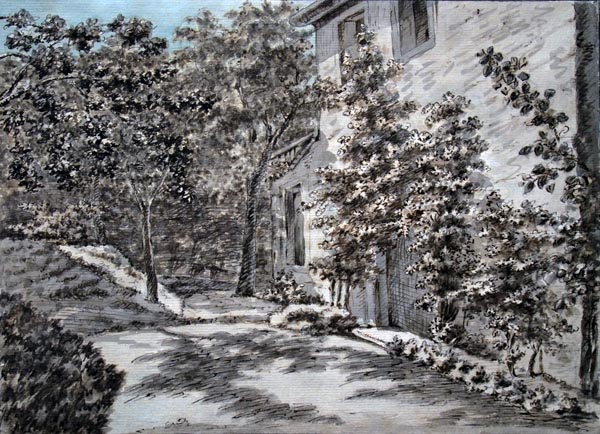
‘Garden entrance side of Goethe’s garden house in Weimar, framed by trees’ - Johann Wolfgang von Goethe (German, 1749–1832)
Wikimedia Commons
I am too much alone here to decide; and I write you this long tale of my entire situation, that you may be good enough to summon a council of those who love me, and who, being on the spot, know the circumstances better than I. Let them, therefore, determine the proper course for me to take, on the assumption, which I assure you is fact, that I am myself more disposed to return home than to stay. The strongest tie that holds me here in Italy is Tischbein. Even were it to be my happy lot to return to this beautiful land, I could never learn so much in so brief a stay as I have done in the society of this well-educated, highly-refined, and upright fellow, who is devoted to me, both body and soul, for I cannot tell you how greatly he is helping the scales fall, gradually, from my eyes. He who travels at night mistakes the dawn for day, and the darkness of a cloudy day for brightness: how shall it be when the sun truly rises? Moreover, I have hitherto kept myself private from the social world, which nonetheless is seizing hold of me by degrees, a world which I, for my part, was not unhappy to merely watch and observe, with stealthy glances.
I have written to Fritz (Fritz von Stein the eldest son of Charlotte von Stein, who was fourteen at the time) a humorous account of my reception into the Accademia dell’Arcadia (the Pontificia Accademia degli Arcadi, a literary academy in Rome, founded in 1690) and indeed it is a subject reserved for humour, as the institution has really been reduced to miserable insignificance.
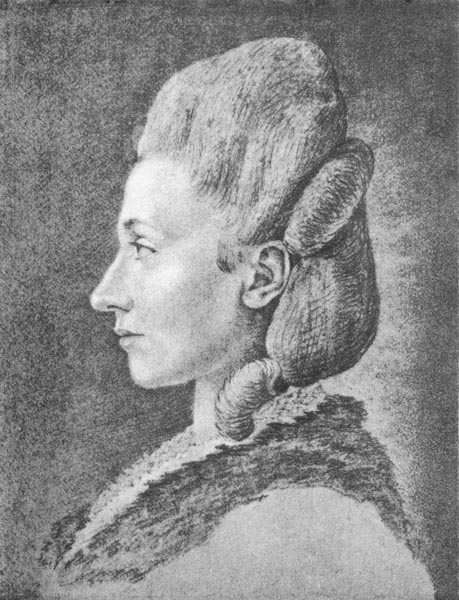
‘Profile portrait of a woman, probably Charlotte von Stein’ - Johann Wolfgang von Goethe (German, 1749–1832)
Wikimedia Commons
Next Monday week Vincenzo Monti’s tragedy (‘Aristodemo’) is to be acted. He is extremely anxious, and not without cause. It will be exposed to the approval or disapproval of a very demanding public, which requires to be amused from moment to moment; and his play lacks any passages of brilliance. He has asked me to accompany him to his box, and stand by him as his confessor at this critical moment. Another person is ready to translate my ‘Iphigenie’; another, to do I know not what, in honour of me. They are all so divided into factions, and so bitterly against one another. But then my countrymen are so unanimous in my favour, that if I gave them any encouragement, and yielded in the very least to them, they would perform a hundred follies, and end with crowning me on the Capitol, an event of which it seems they have already seriously thought — as foolish as it would be to have a stranger and a Protestant, at that, play the leading part in such a comedy. What my role is in all this, and how great a fool I would be to think it all intended simply to honour me — all that we will speak of together one day.
January 6th.
I have just left Moritz, whose almost-mended arm was re-bandaged today. It is healing quite well. What I experienced and learned during the last forty days with the sufferer — in the role of his attendant, confessor and confidant, finance minister and private secretary, all in one — may benefit us both in the future. The deadliest affliction and the noblest pleasures have forever gone hand in hand, during this period.
To my delight, I was able to place a cast of the colossal head of Juno, the original of which is in the Villa Ludovisi (now in the Museo Nazionale Romano, Palazzo Altemps), in the hall yesterday. She was the object of my first love affair in Rome, and now I possess her. No words can describe her. She is like a Homeric hymn.
I have certainly earned the company of such people in future, since I can now announce that ‘Iphigenie’ is finally complete, that is to say, that two almost-identical copies lie before me on the table, one of which will soon be sent to you. Please accept it kindly, for while the work does not explicitly state what I thought to do, one can, I am sure, surmise what I intended.
You have complained several times about various obscure passages in my letters, which suggest the pressure I am under amidst glorious experiences. This Greek travelling companion of mine (‘Iphigenie’) has played a significant role in the matter, compelling me to work when I should have been gazing about me.
I remembered that excellent friend of ours who proposed to set out on a mighty journey, one that might well have been called a ‘voyage of discovery’. After several years of studious economy, it occurred to him to kidnap the daughter of a respected family, thinking it would be a quicker way to achieve his aim. Equally blasphemously, I decided to carry ‘Iphigenie’ off to Carlsbad. I shall record briefly the places where I had my most intense converse with her.
As I left the Brenner Pass, I took her from the larger package, and carried her with me. At Lake Garda, when the mighty mid-day wind drove the waves on shore, and where I was at least as alone as my heroine was on the coast of Tauris, I sketched the first lines of a new version, which I continued in Verona, Vicenza, and Padua, but most diligently in Venice. Then, however, the work stalled; indeed, I was led on to a new idea, namely to writ an ‘Iphigenie at Delphi,’ which I would have started immediately had various distractions, and a sense of loyalty to the older work not prevented me.
In Rome, however, the original work continued, with due diligence. In the evenings, before going to bed, I prepared for the morning’s work, which I then began immediately upon waking. My method was quite simple: I calmly wrote a section, then read it through aloud in an orderly fashion, line by line, period by period. You will judge the result. I learned more than I accomplished. A few more remarks will follow regarding the piece itself.
January 6th.
Speaking of church matters once more, I must recount that we spent Christmas Eve wandering around, visiting churches where services were being held. One church in particular is very popular; its organ and the music are arranged in such a way that nothing is lacking of the pastoral scene, neither the shepherds’ shawms, nor the birdsong, nor the bleating of sheep.
On Christmas Day, in St. Peter’s Basilica, I viewed the Pope, and the entire clergy, as he celebrated High Mass, partly in front of the throne and partly from it. It provides a unique spectacle, magnificent and dignified enough, but I have grown so old in Protestant cynicism à la Diogenes, that its splendour takes more from me than it grants; I would also like to say, as did that pious Greek, my ancestor, to these later spiritual conquerors of the world: ‘Hide not the sun from me!’, the sun, that is, of the noble arts, and true humanity. (Diogenes of Sinope was said to have addressed Alexander the Great in that manner, see Plutarch’s ‘Life of Alexander’:14).
Today, it being Epiphany, I saw and heard Mass celebrated according to the Greek rite. The ceremonies seem to me more stately, more austere, more contemplative, and yet more directed to the people than the Latin ones.
Here, too, I felt that I was too old now for anything unreal. Their ceremonies and operas, their processions and ballets, all slide over me like water from an oilskin. But a natural phenomenon like the sunset seen from Villa Madama, a work of art like my much-revered Juno, produce a deep and lasting impression.
Now I am dreading the theatre season. Seven productions open next week. Pasquale Anfossi himself is here directing his ‘Alexander in India’ (‘Alessandro nell’ Indie’, 1772, libretto by Pietro Metastasio); there’s also to be a production of ‘Cyrus’ and a ballet of ‘The Conquest of Troy.’ That will be something the children would enjoy.
January 10th.
Here, then, comes the ‘troubled child’, for ‘Iphigenie’ deserves this epithet in more ways than one. On the occasion of my reading the work aloud, to our group of artists, I marked various lines, some of which I have improved upon according to my own view, while leaving others as they were, in case Herder might wish to add a few strokes of his pen. I worked it over quite ruthlessly.
The reason I have preferred to work in prose for several years now is actually due to the fact that our prosody is in a state of great uncertainty, since my insightful, learned, company of friends leave the decision on various questions a matter of taste and feeling, which then results in a lack of any guidelines.
I would never have dared to redo ‘Iphigenie’ in iambic verse had Moritz’s ‘Prosody’ (‘Versuch Einer Deutschen Prosodie’, 1786) not served as my guiding light. My interactions with the author, particularly during his illness, have further enlightened me, and I urge my friends to consider the result favourably.
It is striking that in our language we have only a few syllables that are decidedly short or long. With the others, we proceed according to taste or arbitrariness. Now, Moritz’s idea is that there is a specific hierarchy of syllables, and that a more significant syllable seems long in relation to a less significant one, rendering the latter short, but can also itself be rendered short when juxtaposed with some other syllable that seems of greater weight to the mind. Here, then, is at least a starting point, and even if it fails to solve everything, it nevertheless provides a guideline to follow. I have often consulted this maxim, and found it to be in accord with my own views and feeling.
Since I mentioned a recent public reading above, I must also recount how it went. These young men, accustomed to my earlier, vigorous, and intense works, expected something more in the style of my ‘Götz von Berlichingen’ and could not immediately adjust to the more measured pace; yet the nobler and purer passages did not fail of their effect. Tischbein, who was also barely able to comprehend the almost complete absence of passion, sketched a clever analogy for the work, or a symbol of it. He compared it to a sacrifice whose smoke, kept low by the gentle pressure of the air, drifts along the ground, while the flame seeks to rise more freely. He drew this very nicely and meaningfully. I have enclosed the result.
And so, this work, which I thought I would soon be finished with, has entertained and delayed me, occupied and tormented me, for a full three months. It is not the first time I have uttered work of utmost importance almost as an aside, and shall not dwell on it further.
Enclosed is a lovely cameo, a lion with a gadfly buzzing at its nose. The ancients loved the subject, and often employed it. I hope you will use it to seal your letters in the future, so that through this small token a kind of artistic echo may resonate between us.
January 13, 1787.
How much I feel the need to say each day, and how great the effort, and the distractions, that prevent me from setting a single meaningful word down on paper. Add to that the crisp, fresh air, when anywhere is preferable to the rooms indoors that, even without the effects of a stove or fireplace, only allow one to sleep or feel wretched. However, I cannot let various incidents of the past week go unaddressed.
In the Palazzo Giustiniani there is a sculpture of Minerva (The ‘Athena Giustiniani’, now in the Vatican Museum) that commands my utmost veneration. Winckelmann scarcely mentions it, at least not in the appropriate place in his writings, while I myself do not feel worthy enough to say anything about it. As we gazed upon the statue and lingered there for some time, the custodian’s wife told us that it had once been a sacred image, and that the English, who were of ‘that religion’, still venerated it by kissing its left hand, which was indeed entirely white, while the rest of the statue is brownish. She added that a lady of that faith who had recently visited, had thrown herself to her knees, and worshipped the statue. She, a Christian, could not watch such a strange act without being amused, and indeed had run out of the hall to avoid bursting out laughing. Since I, too, did not wish to leave off gazing at the statue, she asked me if I perhaps knew a beautiful woman who resembled that work in marble, since it attracted me so greatly. The good woman knew of religious adoration and of love, and could not conceive of pure admiration for a magnificent work of art, of a ‘platonic’ veneration for an expression of the human spirit. We rejoiced in being of the English lady’s company, and left with a desire to return. I will certainly visit again soon. If my friends wish to hear more, they should read what Winckelmann has to say regarding the high style of the Greeks. Unfortunately, he does not mention the Minerva there. But if I am not mistaken, she is of that high, austere style that transitions to the beautiful, like the bud as it opens, and so produces a Minerva whose severe character is appropriate to precisely such a transition!
Now for a different kind of spectacle! On Epiphany, the feast of salvation proclaimed to the Gentiles, we were at the Feast arranged by the Congregatio de Propaganda Fide. There, in the presence of three cardinals and a large audience, firstly, a speech was delivered on the subject of whereabouts Mary was when she received the three Magi — in the stable or elsewhere? Then, after the reading of several Latin poems on a like subject, about thirty seminarians came forward one after another and recited short poems, each in their native language: Malabarese, Epirote Greek, Turkish, Moldavian, Elean Greek, Persian, Colchian, Hebrew, Arabic, Syriac, Coptic, Sarrazinois, Armenian, Gaelic, Malagasy, Icelandic, Boyanese, Egyptian, Greek, Isaurian, Ethiopian, etc., and several others that I equally failed to understand. The poems, mostly composed in the national syllabary, seemed to be recited in national declamatory style; since barbaric rhythms and sounds emerged. The Greek sounded like a star appearing in the night. The audience laughed, uncontrollably, at the foreign voices, and so this performance, too, was reduced to mere farce.
Now, a little tale about how lightly the sacred is treated in holy Rome. The late Cardinal Albani (Alessandro Albani, a patron of the arts. He had died in 1779) was at one of these festive gatherings, much like the one I have just described. One of the students began speaking in a foreign dialect, addressing the cardinals, thus: ‘Gnaja! Gnaja!’, sounding roughly like ‘Canaglia! Canaglia!’ (‘Scoundrel!’ ‘Scoundrel!’). The cardinal turned to his fellow cardinals, and said: ‘He knows us!’
January 13th.
How much Winckelmann failed to do; how much was left wanting! With the materials he appropriated, he built quickly just so as to have a roof over his head. If he were still alive, and healthy, he would be the first to grant us a revised version of his work. What more would he have observed, and corrected; what more could he have utilised of what others have newly unearthed and discovered by observing and effecting things according to his principles? And then Cardinal Albani is dead, for whose sake he wrote so extensively, while keeping so much perhaps to himself.
January 15, 1787.
And so, at last, ‘Aristodemo’ has achieved its first performance; very successfully, and to great applause. Since Vincenzo Monti is a member of the House of Nepos, and highly esteemed among the upper classes, all good things were to be expected. The stalls were immediately captivated by the poet’s beautiful language, and the actors’ excellent diction, and no opportunity was missed to express their satisfaction. The boxes, were generous in their applause, too. The German artists’ group distinguished itself considerably, which was anticipated, as they are generally rather vociferous.
The author had stayed home, anxiously awaiting the success of the play, but favourable news arrived act by act, gradually transforming his anxiety to the greatest joy. Now there will be no shortage of repeat performances, and everything is progressing perfectly. Thus, in seemingly contradictory manner, provided each aspect of a work has its merits, one can win the applause of both the public and the connoisseur.
The performance itself was very commendable, and the main actor, who carried the weight of the entire play, spoke and acted superbly: one could almost believe one was witnessing the appearance of one of the ancient emperors. They had adapted the costume, which so impresses as carved on the statues, quite well to theatrical splendour, and one could see that the actor had studied the manners of antiquity.
January 16th.
Rome is facing a great loss of art. The King of Naples (Ferdinand IV) has ordered the Farnese Hercules to be transferred to his residence there (it is now in the Museo Archeologico Nazionale, Naples). All the artists are in mourning, but the occasion will grant us the opportunity of viewing something not available to our ancestors, as follows:
The known statue, namely the body from the head to the knees, and the lower feet along with the base on which they stand, was unearthed on Farnese land. However, the legs, from the knees to the ankles, were missing and were replaced by the sculptor and architect Giuglielmo della Porta. It has stood on those legs until now. Meanwhile, the original, ancient legs were found on Borghese land and were subsequently displayed in the Villa Borghese.
Now, Prince Borghese (Marcantonio Borghese IV) has relinquished his objections, and presented these precious relics to the King of Naples. The legs carved by Giuglielmo della Porta have been removed, the original ones are now in their place, and although one was quite satisfied with the former, a completely new perspective on, and enjoyment of, the now-harmonious work is anticipated.
January 18th.
Yesterday, on the feast of Saint Anthony Abbot, we had an enjoyable day; the weather was the most beautiful in the world, there had been a hard frost overnight, and the day was bright and warm.
It may be observed that all religions which extended their worship, or their speculation, inevitably reached the point where animals, too, partook of spiritual favours. Saint Anthony (Anthony the Great), the abbot or bishop, is the patron saint of four-legged creatures; his feast day is a Saturnalian holiday for otherwise oppressed animals, as well as for their keepers and drivers. All members of the nobility are obliged to stay home or walk on that day; and one never fails to hear alarming stories of how irreligious nobles, who forced their coachmen to drive then, were punished by experiencing serious accidents.
The church (Sant’Antonio Abate all’ Esquilino) stands in such a spacious location that it almost seems deserted, but on the feast day it is bustling with life. Horses and mules, their manes and tails beautifully, even magnificently, braided with ribbons, are led to a small chapel, set slightly apart from the church. There, a priest, armed with a large aspergillum, sprinkles holy water, from tubs and buckets standing before him, over the creatures, not gently, but quite forcefully, or playfully, to tease them. Devout coachmen bring candles of varying sizes, and the gentry send alms and gifts, so that the valuable and useful animals may be blessed and remain safe from all harm for a year. Donkeys and cattle, equally useful and valuable to their owners, likewise share in this blessing.
Afterwards, we enjoyed a long walk, under a cheerful sky, surrounded by the most interesting objects, to which we paid little attention on this occasion, rather letting pleasure and good humour prevail to the fullest.
January 19th.
So then, the great king (Frederick the Great), whose fame filled the world, whose deeds made him worthy of even the Catholic paradise, has finally passed beyond (on August 17th, 1786), to converse with his fellow heroes in the realm of shadows. One is pleased to be silent, when one has laid such a man to rest.
Today we had a wonderful day, exploring a part of the Capitoline Hill I had previously neglected. Then we crossed the Tiber, and drank Spanish wine, on a newly-docked ship. It is in this area that Romulus and Remus are said to have been found, and so, as if at a double and triple Pentecost, one can be simultaneously intoxicated by the sacred spirit of art, the mildest of climes, and memories of the ancients, as well as sweet wine.
January 20th.
What initially provides a joyful pleasure when experienced superficially later becomes burdensome when one sees that real enjoyment is deficient, if one lacks thorough knowledge.
I am fairly well prepared in anatomy, and have acquired a certain degree of knowledge of the human body, though not without effort. Here, one is constantly guided, but in a nobler way, by endless contemplation of ancient statues. In our medical and surgical anatomy, it is merely a matter of knowing the various parts, and even a meagre musculature will suffice for the purpose. In Rome, however, the parts are worthless if they do not contribute to a noble, and beautiful whole.
In the large San Spirito hospital (Ospedale di Santo Spirito in Sassia), a very finely muscular body has been prepared for the benefit of artists, in such a manner that its beauty astonishes. It could truly be mistaken for a battered demigod, a Marsyas.
Following the advice of the ancients, one should not study the skeleton as an artificially assembled mass of bones, but rather together with the ligaments which give it life and movement.
If I say that we also study perspective in the evenings, it surely confirms that we are hardly idle. But nonetheless, one always hopes to do more than one actually achieves.
January 22nd.
Of the German appreciation of art, and the artistic scene there, one might say one hears the bells ringing, but they fail to chime together. When I consider now what wonderful things there are at home, and how little I have made use of them, I feel like despairing, but then I look forward to my return, when I can hope to ‘recognise’ those masterpieces I have only skirted past.
Even in Rome, too little is available to those who are serious about gaining a complete picture. One must piece everything together from endless, though abundant, fragments. Of course, few foreigners are truly serious about seeing and learning anything worthwhile. They follow their whims, display their arrogance, and all those who deal with ‘the foreigners’ are well aware of this. Every guide has ulterior motives; everyone wants to recommend some merchant, or favours some artist, and why should they not? For does not the inexperienced person reject the most excellent of things, even when offered?
It would prove an extraordinary advantage to collectors, indeed would furnish a museum in its own right, if the government, whose permission has to be obtained before an antiquity can be exported, firmly insisted that a cast be previously made in every case. But, had even the Pope entertained such a notion, it would have been opposed by the few, for in no time at all the people would have been dismayed by the importance and value of what was being carried off, for which permission is often obtained secretly, in specific cases, through employing all sorts of means.
January 22nd.
Even before, but especially during the performance of ‘Aristodemo’ the patriotism of our German artists was roused. They never failed to speak well of my ‘Iphigenie,’ individual passages were again requested, and I ultimately found myself compelled to repeat my public reading of the entire work. Even then, I discovered some passages that flowed from my lips more smoothly than they seemed to do on the page. Of course, poetry is not meant for the eye alone.
Their favourable opinion reached the ears of the art dealer Johann Reiffenstein and the painter Angelika Kaufmann, and I was asked to read the work to them also. I requested a brief respite but, there and then, recounted the plot and the development of the play at some length. To a greater degree than I had expected, this summary won the favour of the aforementioned individuals; even the artist Antonio Zucchi, from whom I least expected it, showed a quite open and well-intentioned interest. This is easily explained by the fact that the play approximates to the form of drama long established in Greek, Italian, and French theatre, and still appeals most to those who have not yet grown accustomed to the freedom of the English form.
Rome, January 25, 1787.
It is becoming increasingly difficult, now, for me to pen a straightforward account of my stay in Rome; for just as the sea deepens the further out one goes, so it is for me in my contemplation of this city.
One cannot understand the present without comprehending the past, and comparing the two requires a great deal more time and tranquillity. Even the location of this ‘capital of the world’ leads one to consider its origins. One soon realises that no great, and well-governed people, with any degree of wisdom, would have ceased its wandering and settled here, choosing this site for the capital of an empire; no prince, if he had the power, would have designated it a suitable place for a colony. It was rather shepherds and vagrants who first chose the site; a few vigorous youths laid foundations to be utilised by the later palaces of the lords of the world, on these hills to whose feet, amidst reedy marshland, the arbitrary will of some ruler had driven them. Thus, the seven hills of Rome were not employed as an elevated defence against the land that lay behind them; they were simply carved out by the Tiber, rising here above its ancient bed, which became the Campus Martius. If the spring season allows me to explore more widely, I will describe the city’s disadvantageous situation in more detail. Even now I share most keenly the lamentations and anguish of the women of Alba Longa, who saw their city destroyed (by Tullius Hostilius, Rome’s third king) and were forced to leave their beautiful city, chosen by a wiser leader, in order to partake of the mists of the Tiber, inhabit the wretched Caelian Hill, and from there look back at their abandoned paradise. I know little of the area yet, but I am convinced no capital city of an ancient people was ever as badly situated as Rome, and it is no surprise, since the Romans ultimately occupied all the free land within its boundaries, that they chose to build their country houses further away, on the sites of cities and towns they had destroyed, in order to live a less cramped and more enjoyable life.
January 25th.
It gives cause for peaceful contemplation to see how many people live here quietly, and how each occupies their time in their own way. We have viewed, at his home, some interesting copies of excellent paintings, recreated in miniature, by a clergyman who, though without great innate talent, has dedicated his life to art. His finest is of Leonardo da Vinci’s ‘Last Supper’ in Milan. It depicts the moment when Christ says to the disciples, with whom he sits at table, in pleasant and amicable fellowship: ‘Yet there is one among you who will betray me.’
One hopes for a copper engraving, either based on this copy, or on others that have been undertaken. It would be to the greatest benefit if a faithful reproduction were to appear before a wide audience.
A few days ago, I visited Father François Jacquier, a Minim friar, at Chiesa della Trinità dei Monti. He is French by birth, known for his mathematical work, advanced in years, very pleasant to speak to, and intelligent. He has known the most distinguished men of his time, and even spent several months with Voltaire, who took a great liking to him.
And so, I have become acquainted with even more fine and sound individuals, of whom there are countless here, separated only by a kind of priestly mistrust. The book trade offers me no connections, and the literary news is rarely fruitful, so it is fitting for a solitary fellow to seek out hermits. Ever since the performance of ‘Aristodemo,’ in support of which we had worked energetically, I have once again been sought after; but it was all too clear that it was never about myself, they merely wished to strengthen their own party, and make use of me as an instrument, and if I had been willing to come forward and declare myself, I would merely have played a brief, phantom-like role. But once they saw that nothing was doing they let me alone, and I continued on my own safe and secure path.
Indeed, my existence is now burdened with enough weight to grant it the necessary gravity; I no longer fear the spectres that have so often toyed with me. Take heart, you will keep me elevated, and draw me back to you.
January 28, 1787.
Two considerations that affect everything, which one is summoned at every instant to pursue, I must not fail to mention, now that they have become clear to me.
Firstly, given the immense number of nonetheless fragmentary treasures in this city, when faced with each work of art, one is compelled to inquire about the era that gave rise to it. Thanks to Winckelmann, we are prompted to distinguish, as a matter of urgency, the various epochs, and recognise the differing styles employed by various schools; styles which they developed gradually and which were ultimately debased, over time. Every true art lover is convinced of this need. We all acknowledge the correctness and weight of his admonition.
But how to arrive at such a level of insight? Little groundwork has been done; the concept is correctly, even splendidly, formulated, but the details remain uncertain. Years of dedicated observation are necessary, and one must first learn to ask the right questions. Hesitation and delay are no help; attention is already keenly focused on this crucial point, and anyone who is serious about the matter will surely recognise that, in this field also, no judgement is possible except through historical analysis.
The second consideration refers exclusively to the art of the Greeks, and the need to investigate how those incomparable artists proceeded to create, based on the human form, a realm of divine types, which is perfectly complete in itself, and in which no principal figure is lacking, nor are the transitions and intermediate stages between them. I suspect that they proceeded according to the very laws by which Nature herself operates, and which I am attempting to trace. However, there is something further involved that I cannot at present articulate.
February 2, 1787.
The beauty of walking through Rome, by the light of a full moon, is incomprehensible unless one has done so. Everything is swallowed up by vast expanses of light and shadow, and only the largest, most general images are revealed to the eye. For three nights now, we have enjoyed, thoroughly and completely, the brightest and most glorious of skies. The Coliseum offers a particularly beautiful sight, at this time. The entrance is locked at night; a hermit lives there, next to a little chapel (the Chapel of Santa Maria della Pietà, below the twenty-fourth arch), and beggars sleep beneath the crumbling vaults. They had lighted their fire on flat ground, and a gentle breeze carried the smoke at first towards the arena, so that the lower parts of the ruins were veiled, and the immense walls above loomed darkly. We stood by the gate, and watched the phenomenon; the moon was high and bright. Gradually, the smoke spread through the walls, cracks, and openings, like a mist in the moonlight. The sight was exquisite. One should see the Pantheon, and the Capitol, illuminated thus, and the courtyard of St. Peter’s Basilica, and the other major streets and squares. And so, the sun and moon, just like the human mind, perform a completely different function here than in other places; here where their gaze is met by immense yet civilising masses.
February 13th.
I must mention a stroke of luck, albeit a minor one, though all good fortune, great or small, is of the same kind and always gratifying. At Trinità dei Monti, the foundation for the new obelisk (the Obelisco Sallustiano, erected 1789) is being made; all the earth, from the ruins of the Gardens of Lucullus, which later came into the emperors’ possession, is piled in a heap. My wigmaker passed by early in the morning, and found in the rubble a flat piece of fired clay with several figures on it, which he washed, and brought to show us. I immediately claimed it for myself. It is not much larger than a hand, and seems to have come from the rim of a large bowl. Two griffins stand at an offering table; they are of the finest workmanship, and please me immensely. Were they set in a cameo ring, how gladly one would use them for sealing letters!
Many another relic I also gather round me, and nothing is futile or worthless, a thing which would be impossible here, where everything is instructive and meaningful. But what I love most is what I possess within my soul, and which, ever-growing, will ever-increase.
February 15th.
Before my departure for Naples, I could not avoid another reading of my ‘Iphigenie.’ Angelika Kauffman and Court Councillor Reiffenstein were among the listeners; even Antonio Zucchi insisted on it, as it was his wife’s wish; he, meanwhile, is working on a large architectural drawing, which he is executing, masterfully, in a decorative style. He formerly visited Dalmatia with Charles-Louis Clerisseau, who had become a close associate, and is now drawing plans, which Clerisseau publishes, of the edifices and ruins, having learnt so much about perspective and various other effects, that he can now, in his old age, entertain himself on paper in a decent manner.
Angelika, she of the delicate soul, received the piece with an unbelievable show of empathy; she promised to make a drawing of one of the scenes for me, to keep as a memento. And so, just as I am preparing to leave Rome, I feel I am connecting, in a tender way, to these kind people. It is both a pleasant and a painful feeling to realise that they are reluctant to let me go.
February 16, 1787.
The happy arrival of ‘Iphigenie’, in Weimar, was announced to me in a surprising, and pleasant way. On my way to the opera, a letter was brought to me written in a familiar hand, and on this occasion doubly welcome, sealed as it was with the lion’s head as an obvious sign of the package having arrived safely. I entered the crammed opera house and found myself a place beneath the large chandelier, among the unfamiliar crowd. There I, nonetheless, felt so close to my loved ones that I felt like jumping up and embracing them. I thank you most sincerely for the news of its arrival; may you greet the next arrival with as kindly a show of praise!
Here is the list of how I anticipate the copies I receive from Göschen (Georg Joachim Göschen, his publisher, based in Leipzig) being distributed among my friends, for though I am completely indifferent to how the public views these things, I nevertheless hope to bring some joy to my friends through them.
One simply attempts too much. When I think of my last four volumes as a whole, I feel a certain dizziness; I contemplate them individually, and that’s how I rid myself of it.
Would it perhaps not have been better to have sent them out into the world, one by one, as I originally decided, and to have undertaken other projects, in which I have a fresher interest, with renewed courage and energy? Would it not have been better to write an ‘Iphigenie at Delphi’ than wrestle with the vagaries of ‘Torquato Tasso’? (Goethe’s play of that name was began in Weimar in 1780, mostly written while in Italy, and completed in 1790) And yet, I have already invested too much of myself in the Tasso to abandon it fruitlessly.
I sit myself down by the fireplace in the anteroom, and the warmth of a well-fuelled fire, for once, gives me fresh courage to begin a new sheet; for is it not truly wonderful that one can reach so far afield with one’s immediate thoughts, indeed, transport one’s current surroundings elsewhere merely with words. The weather is absolutely glorious, the days are lengthening noticeably, the laurels and boxwoods are in bloom, as are the almond trees. This morning I was surprised by a wondrous sight: in the distance, I saw tall, pole-like trees, clothed all over in the most beautiful violet colour. Upon closer inspection, it was the tree known in our greenhouses as the Judas Tree, or to botanists as ‘cercis siliquastrum’. It produces its violet, butterfly-shaped flowers directly from the twigs and branches. The poles I saw before me, from whose bark the well-formed and coloured flowers burst forth by the thousand, had been pruned last winter. Meadowsweet flowers emerge from the ground like a hive of ants; the crocus and pheasant’s eye adonis (adonis vernalis) appear less frequently, but are even more delicate and ornamental.
What joys and insights this southerly land will bring me, from which new creations will emerge! It is with natural things as with works of art; so much has been written about them, and yet everyone who sees them can still put them together in fresh ways.
When I think of Naples, or even Sicily, I find it striking, from both the accounts and images of them, that in those earthly paradises, so violent a volcanic hell reveals itself, frightening and maddening the inhabitants, as it did all those who witnessed those eruptions throughout the millennia.
However, I happily banish from my mind the hope of viewing those particular sights, in order to make proper use of the ancient capital of the world before my departure.
For a fortnight now, I have been in action from morning till night; I seek out all I have not yet seen. The most important things are examined a second and a third time, and now it is all starting to fall into place. For as the main objects come to occupy their proper positions, I find room and space for many lesser matters, in between. My love affairs with certain things are being clarified and resolved, and only now can my mind rise with serene participation to what is greater and most genuine.
One can only envy the artists, who, through reproduction and imitation, approach those great intentions in every way more closely, understanding them better than mere observers and thinkers. But in the end, everyone must do as they are able, and so I hoist every mental sail to navigate these shores.
The fireplace is quite warm, now, and the finest coals are heaped there, which rarely happens at home since not everyone has the desire, or the time, to devote hours of attention to the hearth, and so I wish to use this pleasant temperature to copy some comments from my note-book, that are already half-erased.
On February 2nd, we attended the Sistine Chapel for the service during which the candles are blessed. I immediately felt most uncomfortable, and soon left with my friends, realising that similar candles have been darkening the magnificent paintings for three hundred years with their smoke, while the incense, in holy arrogance, not only clouds those artificial suns, but dims them more and more every year, and finally plunges them into complete obscurity.
We sought the open air and, after a long walk, arrived at Sant’ Onofrio, where Tasso is buried in a corner. His death mask is in the monastery library (extant, and displayed in the Museo Tassiano, the room dedicated to Tasso’s memory). The mask is of wax, and I readily believe it was cast from his corpse. Not entirely intact, marred here and there, it nevertheless suggests, more than any other portrait of him, a talented, delicate, refined, and self-contained individual.
That is all for now. I want to turn to the second part of Volkmann’s book (Johann Jacob Volkmann’s ‘Historisch-Kritische Nachrichten von Italien’: ‘Historical and Critical Account of Italy’, 1778, the standard guide-book), covering Rome, to find what I have not yet seen, therein. Before I travel to Naples, the harvest must be gathered; I will find a better time later to bind it into sheaves.
February 17th.
The weather is incredibly, and indescribably beautiful; all through February, except for four rainy days, the sky has been clear and bright, almost too warm around noon. Now one seeks the outdoors, and if previously one has only contemplated gods and heroes, the landscape now, suddenly, reclaims its rightful place, and one becomes captivated by one’s surroundings, enlivened by the most glorious of days. Now and then I recall how as an artist in the North one seeks to make something of thatched roofs and crumbling castles, how one manoeuvres about among streams and bushes, and scattered ruins, to capture a picturesque scene; so it feels quite strange, and all the more so because those things, after such long habit, still cling to one’s mind, that for the past two weeks, having mustered my courage I have set off with modest sheets of paper, throughout the depths and heights where the villas stand, and without great deliberation, have sketched small, but striking, southern, and truly Roman, subjects, and now, with the help of good fortune, I am trying to add highlights and shadows. It is quite odd that one can see, most clearly, and comprehend whatever is good or better; but when one tries to appropriate that same, it seems to slip through one’s fingers, and we grasp not what is right, but only what we are accustomed to grasping. Only through systematic practice could one progress, but how shall I find the time and power of concentration! Nevertheless, I feel much improved by this passionate, fortnightly, striving.
Various artists are happy to teach me, since I am quick on the uptake. But comprehending something does not always allow one to effect it right away; understanding something swiftly is, after all, a characteristic of the mind, but executing something correctly requires a lifetime of practice.
And yet the art-lover, however weakly he strives, must not be deterred. The few lines I draw on paper, often hastily, rarely correctly, facilitate my understanding of physical things; for one more readily approaches the universal the more one considers individual objects, sharply and precisely.
One should not consider oneself an artist, but rather proceed in one’s own way. Nature has provided for her children, and the least among them is not hindered in his own existence, not even by the existence of what is most excellent: ‘A little man is also a man!’ And with that, let me leave the subject for now.
I have seen the sea twice, first the Adriatic, then the Mediterranean, briefly, as it were. In Naples, I wish to become better acquainted with it. Everything I have experienced suddenly comes flooding back to my mind; why not sooner, and why not more easily! How many thousands of things, some entirely new, studied from scratch, I could share!
February 17, 1787. Evening, the Carnival revelry having subsided.
I am reluctant to leave Moritz alone when I depart. His work is on the right track, but as he walks his own path, he seeks familiar hiding-places as usual. I encouraged him to write to Herder; the letter is enclosed. I hope for a reply containing something useful and helpful. Moritz is a remarkably good man; he would be much further on, if he had found, from time to time, people capable and kind enough to enlighten him about his true level of achievement. Currently, he cannot establish a more blessed relationship than Herder allowing him to write occasionally. He is engaged in a commendable antiquarian enterprise that well deserves support. Friend Herder will hardly have applied his efforts better or sown his excellent teachings in more fertile ground.
The large portrait that Tischbein has undertaken of me is already emerging from the canvas. The artist has had a skilled sculptor create a small clay model, which he then draped quite delicately in a cloak. He is painting diligently using this model, because the work must, of course, be at a certain stage of development before our departure for Naples, and it takes time merely to cover such a large canvas with paint.
February 19th.
The weather continues to be beautiful beyond compare; today was an agonising one spent among fools. At nightfall, I recovered, at the Villa Medici; the new moon is waxing, and framed by its delicate crescent, I could see the entire darkened disc almost with the naked eye, and quite clearly through an eyeglass. The day’s perfumed mist hangs over the earth, a fragrant mist known only from Claude Lorrain’s paintings and drawings, but the phenomenon is not easily seen so beautifully in Nature as it is here. Now, various flowers, I don’t yet know the names of, are emerging from the ground, and new blossoms deck the trees; the almond trees are in bloom, creating a new, airy appearance among the dark green oaks; the sky is like a pale blue taffeta, illumined by the sun. What will the heavens be like in Naples! We find that most things are already green here. My botanical fancies are confirmed by all of this, and I am on my way to discovering new and beautiful ways in which Nature, such a monstrous thing in itself, that looks like nothing one can grasp, develops the most diverse of things from the simplest.
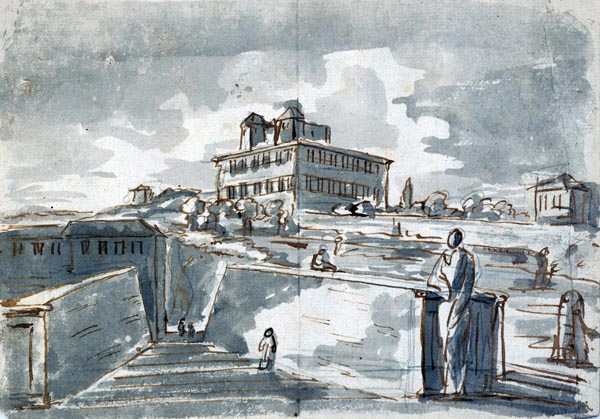
‘Villa Medici from the Salita di San Sebastiano, Rome’ - Johann Wolfgang von Goethe (German, 1749–1832)
Klassik Stiftung Weimar, Museen (Inv. GGz/0185)
Digital reproduction · See Art. L. 111-1 CPI and § 68 UrhG
Vesuvius, it seems, spews forth stones and ash, and at night the summit glows. Grant us a lava flow, in all its power! Now I can hardly wait until those magnificent scenes are mine.
February 21st, Ash Wednesday.
Now, at last, the foolishness is over. The countless lights last night were a magnificent spectacle. One must have witnessed the Carnival in Rome to completely rid oneself of the desire ever to see it again. It is impossible to write about it; an oral account at best might be entertaining. What is unpleasant is that people lack inner joy, and the ability or wish to indulge what little capacity for pleasure they might still possess. The wealthy are economical and hold back, the middle class are impoverished, and the people lethargic. These past few days have been indescribably noisy, but devoid of any heartfelt joy. The sky, infinitely pure and beautiful, looked down nobly, and ever so innocently, upon these antics.
Since I cannot refrain from my attempts to depict things here, I have made some drawings of Carnival masks, and of the clothing, peculiar to Rome, to entertain the children, then washed them with colours, so that they might provide an extra chapter of their ‘Orbis Pictus’ (‘Orbis Sensualium Pictus’, 1658, a children’s textbook written by the Czech educator John Amos Comenius, published in 1658 with pictures, initially in Latin and German ) for the little dears.
The same date. February 21, 1787
I am employing the intervals between packing my belongings to catch up on various tasks. Tomorrow, we leave for Naples. I am looking forward to the fresh experience, since the scenery is said to be indescribably beautiful, and hope to regain new freedom and joy in that natural paradise, before returning to my artistic studies here in sober Rome.
Packing I find easy; I do it with a lighter heart than six months ago, when I parted with everything dear and precious to me. Yes, half a year has passed already, and of the four months I have spent in Rome, I have wasted scarcely a moment, which is to claim a great deal, yet I exaggerate not at all.
I know that ‘Iphigenie’ has arrived in Weimar; I hope to learn, at the foot of Vesuvius, that it has been well received.
Taking this trip with Tischbein, who has as magnificent a set of views about Nature as he does about Art, is of the utmost importance to me; yet, as true Germans, we cannot quite shake off our prior resolutions, and the prospect of achieving useful work. The finest quality paper has been bought, and we intend to sketch thereon, even though the sheer quantity, beauty, and brilliance of the scenes we shall view will most likely limit our good intentions.
One thing I am determined on, that I shall take none of my incomplete poetic works with me except ‘Tasso’; I have the greatest hopes for it. If I but knew what you will think of ‘Iphigenie,’ it would serve me as a guide, since Tasso is a similar work, its subject matter even more limited than the former, and requiring even more detailed effort. But I am unsure as yet as to how it might develop; I must destroy, and completely, what I have done so far; it has been lying around far too long, and neither the characters, nor the plot, nor the tone of it, bear the slightest resemblance to my current ideas.
While tidying my papers, I came across some of your delightful letters, and upon reading them, encountered the accusation that I often contradict myself. While I could hardly be expected to realise that myself, since I dispatch what I have written immediately, it seems all too likely to me, as I am tossed about by tremendous conflicting forces, and it is only natural that I sometimes fail in knowing where I stand.
A story is told of a sailor who, caught in a stormy night at sea, tried to steer towards harbour. His small son, clinging to him in the darkness, asked: ‘Father, what’s that strange little light I see, sometimes above us, sometimes below?’ His father promised him an explanation later, and it seems it was the lighthouse beacon, which appeared now above, now below, to those tossed up and down, midst the wild waves.
I too am sailing towards harbour on a madly-turbulent sea; yet if I can but keep my eye fixed on the lighthouse’s beam, even if its location appears to change, I shall ultimately recover the shore.
When departing a place, one involuntarily recalls every previous parting, and anticipates the future and final one, as I do now, and more strongly than usual, such that the thought occurs to me that we spend far too much time making preparations to live, since while doing so Tischbein and I are turning our backs on many a glorious thing, even on our own well-furnished ‘museum’. Here stand three statues of Juno, side by side for comparison, and we are ignoring all three, as if they meant nothing at all.
The End of Goethe’s ‘Italian Journey’ Part VI