Johann Wolfgang von Goethe
Italian Journey (1786-88)
Part V: From Ferrara to Rome
Translated by A. S. Kline © Copyright 2026 All Rights Reserved
This work may be freely reproduced, stored and transmitted, electronically or otherwise, for any non-commercial purpose. Conditions and Exceptions apply.
Contents
- From Ferrara to Rome.
- Ferrara.
- Cento.
- Bologna.
- Loiano.
- Monghidoro.
- Assisi.
- Terni.
- Civita Castellana.
From Ferrara to Rome
October 16th, early morning, on board.
My travelling companions, men and women, all perfectly acceptable and honest people, are still asleep in the cabin. I, however, wrapped in my coat, have remained on deck both nights. Only towards morning has it become cool. I have now truly entered the forty-fifth degree of latitude, and still repeat my old song: I would gladly leave all of this land to its inhabitants if only I could secure, like Dido in myth, a great enough extent of their skies to encircle our own Northern dwellings (fleeing from Tyre, she famously encircled enough space, by dividing a bull’s hide into thin strips, to purchase the ground on which Carthage was founded). It is indeed a different state of existence here. The passage in glorious weather was very pleasant, the views simple but charming. The River Po, a friendly stream, flows here through vast plains; one sees only its bushy and wooded banks, no distant views. Here, as on the Adige, I saw foolish hydraulic engineering works, childish and harmful like those on the Saale.
Ferrara
October 16th, at night.
Having arrived here this morning at seven o’clock, German time, I am preparing to leave again tomorrow. In this large, beautiful, flat, but depopulated city, I am overcome by a feeling of dissatisfaction for the first time. These same streets were once enlivened by a glittering court; here Ariosto lived, discontentedly, Tasso, unhappily, and yet I think to edify myself by visiting the place. Ariosto’s tomb (at that time in the Church of San Benedetto, now in the Sala Ariosto, on the first floor of Palazzo Paradiso, the Ariostea Library) contains a wealth of marble, poorly arranged. Instead of Tasso’s cell one is shown a wooden stable or coal-cellar, where he certainly was not imprisoned. And scarcely anyone there seems to know enough to answer one’s questions. Finally, they reconsider, for the consideration of a tip. It is rather like Martin Luther’s ink-stain, which the castellan (of Wartburg Castle, where Luther supposedly threw his inkwell at Satan for distracting him) renews from time to time. Most travellers have something of the practical person’s love of detail about them, and like to seek out such things. I had become quite irritable, so that I failed to appreciate a fine institute and academy, founded and enriched by a cardinal born in Ferrara, but some old monuments in the courtyard refreshed me.
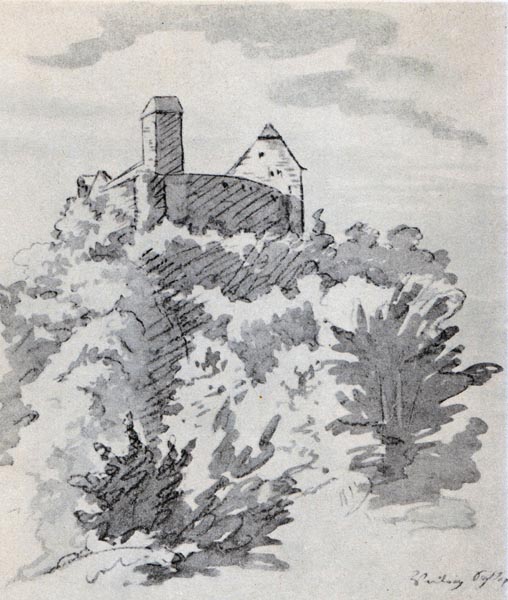
‘Wartburg Castle viewed from the south above a wooded slope’ - Johann Wolfgang von Goethe (German, 1749–1832)
Wikimedia Commons
Then I was amused by a painter’s clever idea: ‘John the Baptist before Herod and Herodias’. The prophet, in his usual desert attire, points emphatically at the lady. She calmly regards the prince sitting beside her, and the prince, quietly and intelligently, observes the enthusiastic prophet. A medium-sized, white dog stands before the king, while a small Bolognese dog emerges from under Herodias’s skirts, and both bark at the prophet. I think it a very felicitous idea.
Cento
October 17th, in the evening.
In a better mood than yesterday, I write from the artist Guercino’s hometown. It is a completely different place to Ferrara. A friendly, well-built little place of about five thousand inhabitants, flourishing, lively, clean, situated on a vast, cultivated plain. As is my custom, I immediately climbed a tower. A sea of poplars, amidst which one can glimpse small nearby farmsteads, each surrounded by its own fields. Fertile soil, and a mild climate. It was an autumn evening such as we rarely experience in summer at home. The sky, overcast all day, cleared, the clouds north and south drifting towards the mountains, and I hope for a beautiful morning tomorrow.
From here I can view the Apennines, which I am approaching for the first time. Winter here lasts only for December and January; April sees rain — otherwise, the weather is good throughout. The rain never persists for long; and September was finer and warmer than August at home. I gave the Apennines, to the south, a kindly greeting, for I shall soon have had had enough of the plain. Tomorrow I shall be writing at their feet.
Guercino loved his hometown, as Italians in general cherish and cultivate local patriotism to the highest degree, from which love so many delightful institutions, and indeed a multitude of local saints, have sprung. Under that master’s direction, an academy of painting was established here. He left behind several works that still bring joy to the townsfolk, and which are indeed worthy of appreciation. Guercino is a sacred name, spoken by children and the elderly alike.
I was very taken by his painting depicting the risen Christ appearing to his mother (‘The Resurrected Christ Appears to the Virgin’, 1629,originally painted for the Oratorio della Confraternita del Santissimo Nome di Dio, and now in the Pinacoteca Comunale, Cento). Kneeling before him, she gazes at him with indescribable tenderness. Her left hand touches his body just beneath the grievous wound that mars his form. He has placed his left hand around her neck and, to gaze at her the better, is leaning back slightly. This gives the figure something of an unusual — not to say forced, air. Nonetheless, it remains infinitely pleasing. The quietly sorrowful gaze with which he looks at her is exceptional, as if the memory of his and her suffering, not immediately healed by the Resurrection, hovers before his noble soul. Sir Robert Strange has produced an engraving of the work; I wish my friends could at least see his attempt.
Then a Madonna captured my affection. The child longs for her breast, she hesitates shyly to expose it. The work is natural, noble, exquisite, and beautiful. Furthermore, there is a painting of Mary, guiding the arm of the child standing before her, and facing the spectator, as he bestows a blessing with raised fingers. A very fortunate and frequently repeated idea in the context of Catholic mythology.
Guercino is an inwardly-upright, robustly-masculine painter, devoid of any crudity. Rather, his works possess a delicate moral grace, a serene freedom and grandeur, and a distinctive quality that, once one has trained the eye to recognise it, is unmistakable. The lightness, purity, and perfection of his brushwork are astonishing. He employs particularly beautiful, reddish-brown hues for his garments. These harmonise remarkably well with the blue he frequently uses.
The subjects of the rest of the paintings are more or less unfortunate. In them, an excellent artist has laboured to realise his ideas, yet has squandered and lost both invention and execution, mind and hand alike lacking in power. But I am glad and grateful to have seen this fine series, even though such a rushed inspection offers scant enjoyment or instruction.
Bologna
October 18th, at night.
Early this morning, before daybreak, I left Cento and arrived here soon enough. A nimble and well-informed guide, once he knew that I intended only a brief stay, hurried me through all the streets, and past so many palazzos and churches that I scarcely had time to mark on my copy of Johann Volkmann’s map where I had been, and who knows if I will remember all these places in the future even with the marks I made. But I still recall a few glowing works of art before which I felt truly at peace.
First, then, Raphael’s ‘St. Cecilia’! (‘The Ecstasy of St. Cecilia’, or the ‘St. Cecilia Altarpiece’, c 1516-7, painted for the church of San Giovanni in Monte, and now in the Pinacoteca Nazionale, Bologna). As I already knew, but now have seen with my own eyes: he simply executed what others wished to perform, and so I will say nothing further about the painting now, other than to say that it is by him. Five saints stand side by side, none of whom is concerned with ourselves, yet whose existence is so perfectly realistic that one wishes the scene preserved for all eternity, even if one is destined to vanish oneself. But to truly understand him, to truly appreciate him, and yet not praise him as though he were a deity who, like Melchizedek, appeared without father or mother (see Hebrews 7:3), one should consider his predecessors, his masters. They laid the foundations of their art on the firm ground of truth; they diligently, even anxiously, created a broad base and, competing with one another, built a pyramid, step by step, upon which, finally, profiting from their labours, and illuminated by heavenly genius, he was able to place the last summit stone, above and beyond which no other can rise.
One’s artistic interest is particularly aroused by consideration of the works of the older masters. Francesco Francia (Francesco Raibolini of Bologna) was quite a decent artist; Pietro Perugino such a genuine fellow one might term him an honest German. If only fate had led Albrecht Dürer to explore Italy further! In Munich, I saw a few of his works, of incomparable greatness. The wretched fellow went awry in Venice, making a deal with the priests that cost him weeks and months! On his Dutch journey, he traded parrots for magnificent artworks of his, with which he had hoped to make his fortune, and, to save on gratuities, painted portraits of the servants who brought him plates of fruit! I find such a poor fool of an artist infinitely touching because, in essence, it is also my fate, only I know how to look after myself a little better.
Towards evening, I finally escaped this ancient, venerable, and learned city, and the crowds who, protected from wind and sun, wander to and fro amidst the arched arcades that one sees on almost every street, gawking, buying, and conducting their business transactions. I climbed the tower, and revelled in the pure air. The view is magnificent! To the north, one sees the Paduan hills, then the Swiss, Tyrolean, and Friulian Alps — in short, the entire northern range, which at that hour was shrouded in mist. To the west, is an endless view, amidst which only the towers of Modena rise. To the east, a level plain stretches to the Adriatic Sea, which one glimpses at sunrise. To the south, the foothills of the Apennines, planted and overgrown right up to their peaks, are dotted with churches, palaces, and garden pavilions, like the Vicentine hills. The sky was perfectly clear, not a cloud in sight, only a kind of high-altitude mist on the horizon. The watchman assured me that for six years now, the mists had never encroached on the city. He said that previously, through his spyglass, he could easily see the hills around Vicenza with their houses and chapels, but now, even on the brightest days, only rarely. And this fog, he explained, clings particularly to the northern ridges, making of my own beloved homeland a veritable Cimmeria. The man also pointed out the healthy climate and the quality of the city air, noting that its roofs looked brand new, not a single tile marred by damp or moss. Admittedly, the roofs are all clean and beautiful, but the quality of the tiles may also contribute to this; at least in olden times, they were expertly fired in these parts, at great expense.
The leaning towers are a fearsome sight, and yet I think it highly possible that they were deliberately built that way (the pair, Asinelli and Garisenda, actually lean due to subsidence). I explain this to myself as follows. In times of urban unrest, every large building became a fortress, above which every powerful family raised a tower. Gradually, this became a matter of pride and honour; everyone wished to boast of a tower, and when finally straight towers became all too commonplace, crooked ones were built. The architect and the owner achieved their joint goal. One gazes at the many straight, slender towers but the eye seeks out the crooked ones. I was later at the top of the tower with the greatest tilt (Garisenda). The brick courses seemed to be set horizontally. With good, tightly-binding mortar and iron clamps, one can certainly create some amazing things.
Bologna, October 19th, evening.
I made best use of my day, observing and revisiting things, but art is like life: the deeper you delve into it, the more extensive it becomes. New stars appear in the firmament, stars that I cannot comprehend and that bewilder me: the Carracci brothers (Annibale and Agostino), Guido Reni, Domenichino (Domenico Zampieri), all Bolognese, born to a later, more fortunate era of art; but to truly appreciate them requires knowledge and judgement, which I lack and which can only be acquired gradually. A major obstacle to genuine contemplation, and immediate understanding, of their artistry is the often nonsensical subject matter of the paintings, which drives anyone mad who desires to venerate and love them.
It is as if the sons of the gods had been wed to the daughters of men, and that from this union all manner of monsters were born. While Guido Reni’s heavenly vision, and his brush, which should have painted only the most perfect things imaginable, attracts the eye, one immediately longs to turn from his hideous and stupid subjects, which could scarcely escape the most damning insults in the world. And so, it goes on; one is forever confronted by anatomy, the chopping block, the slaughterhouse, always the hero or heroine’s suffering, never any action, never any lively interest, always some fantasy engendered from without. Wrongdoers or ecstatics, criminals or fools, are his subjects, whereupon the painter, to save himself, drags in a naked man, a pretty female spectator, treating his spiritual heroes as no more than mere caricatures, while draping them in rather attractive pleated cloaks. There is nothing in them that displays any real understanding of human beings! Out of ten subjects, not one should have been painted, and the artist failed to treat even that one in the correct manner.
The large ‘Pieta’ by Guido Reni in the Church of the Mendicanti is everything one could possibly ask for in a painting, yet also everything absurd one might demand and expect of an artist. It is a votive painting. I believe the entire Senate praised and doubtless conceived the subject. The two angels, worthy of comforting a Psyche in her misfortune, are certainly needed here. The Saint Proclus, is a fine effort; but then the others, that bishop, those priests! Below are heavenly children playing with their various attributes and symbols. The painter, seemingly with a knife at his throat, tried to help himself as best he could, and toiled away, just to prove that he was no barbarian. Two nude figures by Guido also: a Saint John in the desert, and a Saint Sebastian, how exquisitely painted, yet what do they communicate? One half-opens his mouth, and the other writhes in agony.
Contemplating history in this discontented mood, I would claim that faith revived the arts but superstition became their master, and ruined them again.
After dinner, in a somewhat milder and less arrogant mood, I made the following note. In the Palazzo Tanari there is a famous painting by Guido Reni depicting the Virgin Mary nursing the infant Jesus, larger than life-size, her head as if painted by a god; the expression with which she looks down upon the suckling child is indescribable. It seems to me a quiet, profound acceptance, as if she were allowing not a child of love and joy but rather a heavenly changeling to suckle, simply because things are as they are, and she, in a state of deepest humility, knows not at all how she has come to be in this situation (‘The Tanari Madonna’ is now lost, but recorded through an engraving by Mauro Gandolfi). A large part of the painting is filled with an enormous cloth hanging, which connoisseurs praise highly; though I was unsure what to make of it. Its colours, too, have darkened; the room and the day were not of the brightest.
Despite the state of confusion that I find myself in, with regard to painting, I already feel that experience, familiarity, and taste will come to my aid even in these labyrinths. Thus, a ‘Circumcision of Christ’ by Guercino, (1646, painted for the demolished Augustinian Church of Jesus and Mary, in Bologna, and now in the Musée des Beaux-Arts de Lyon) appealed to me, because I already know and love the artist’s work. I overlooked the unattractive content and took pleasure in the artistic execution. He painted every subject imaginable, all of it respectfully and perfectly, as if on enamel. And so I am like Balaam, the confused prophet, who blessed when he intended to curse (see Numbers: 22-24), and this would occur even more often if I were to stay longer.
Whenever one chances to come across a work by Raphael, or at least one that is reasonably attributable to him, one is immediately completely cured of irritation, and rendered happy. Thus, I found a ‘Saint Agatha’, a valuable, though not particularly well-preserved, painting. The artist has shown her as a healthy, self-possessed virgin, one free of any coldness or rusticity. I have noted her form and features carefully, and will mentally recite my ‘Iphigenia’ to her, permitting my heroine to say nothing that this saint would not seek to utter.
Since I am once again thinking of that sweet burden, in manuscript, I carry with me on my journey, I cannot conceal the fact that, in addition to the great works of art and Nature which I must work my way through, a wondrous succession of poetic figures also passes through my mind, diverting me. After Cento, I intended to continue my work on ‘Iphigenia in Tauris’ but what happened? My mind presented me with the plot of an ‘Iphigenia at Delphi,’ and I feel obliged to develop it. I record it here as briefly as possible:
Electra, in a final act of atonement, hoping that Orestes will bring the statue of Taurian Diana to Delphi, appears in the temple of Apollo and dedicates, to that god, the cruel axe-blade which has brought such havoc to the House of Pelops. Sadly, a Greek warrior approaches her and recounts how he had accompanied Orestes and Pylades to Tauris, and witnessed his two friends being led to their deaths, while he escaped unharmed. The passionate Electra is unsure whether to direct her resulting anger at the gods or at the mortals involved.
Meanwhile, Iphigenia, Orestes, and Pylades also arrive at Delphi. Iphigenia’s serene composure contrasts strikingly with Electra’s worldly passion as the two sisters meet, without recognising one another. The Greek warrior on seeing Iphigenia, recognises in her the priestess to whom his friends were to be sacrificed, and informs Electra of the fact. She is about to slay Iphigenia with the axe she dedicated, and has now retrieved from the altar, when a fortunate turn of events averts a final, and terrible, act of evil.
If this scenario were to be worked through successfully, then hardly anything greater or more moving could be seen on the stage. But where can I find the energy and time, even if the mind is willing!
Feeling burdened and overwhelmed, now, by an abundance of good and desirable projects, I remind my friends of a dream I experienced, about a year ago, which seemed highly significant to me. I dreamt that I landed in a rather large boat on a fertile, richly-vegetated island, where I knew the most beautiful pheasants might be found. I immediately began bargaining with the inhabitants for examples of these birds, which they promptly killed and brought to me. They were indeed pheasants, but as dreams tend to transform reality, they had long, brightly-coloured tails, like those of peacocks, or rare birds of paradise. They were brought to me in bundles, laid with their heads inwards, and so neatly tied that their long, colourful plumes, hanging outwards, formed the most magnificent heaps imaginable in the sunlight, ones so large that there was scarcely any space left for the helmsman or oarsmen, neither fore nor aft. Thus, we ploughed through the calm water, and I was already thinking of various friends with whom I intended to share these colourful treasures. Finally attaining a sizeable harbour, I found myself lost among tall-masted vessels, and mounting deck after deck to observe and locate a safe landing place. We revel in such fantastic and illusory scenes, which, because they originate from within ourselves, must surely bear some analogy to our actual lives and destinies.
I have just visited the Academy of Sciences of the Institute of Bologna (then housed in the Palazzo Poggi). The large building, especially the inner courtyard, looks quite impressive, although not of the finest architectural quality. The staircases and corridors are adorned with stucco and fresco decorations; everything is well laid-out, in a dignified manner, and one is justifiably amazed by the many beautiful and informative things that have been brought together here, yet a German accustomed to a freer course of study might not feel entirely comfortable.
An earlier observation of mine comes to mind: that in the ever-changing course of time, humankind finds it difficult to detach itself from the original form of various types of building, even if the use of them has subsequently altered. Christian churches still cling to the basilica form, although the temple form might be more advantageous for modern worship. Scientific institutions still retain a monastic appearance because students of science originally found space and tranquillity in such pious environments. Italian courtrooms are as large and high-ceilinged as the community’s resources allow; one feels as if one is standing in one of those open-air marketplaces where justice was once administered. And do we not still build even the largest theatres, complete with all their appurtenances, under the one roof, as if they were mere makeshift booths, hastily cobbled together, as at first, from wooden planks? Due to the enormous thirst for knowledge at the time of the Reformation, students were driven to using private houses, but what a length of time it took before we opened colleges to provide poor youths with a much-needed education!
Bologna, the evening of the 20th.
I spent this beautiful, sunny day entirely outdoors. As soon as I approach the mountains, I am drawn back to considering rock formations. I feel like Antaeus, in myth, who was ever more invigorated the more deeply he was connected to Mother Earth.
I rode on horseback to Monte Paderno, where the so-called Bolognese barite is found, from which small ‘cakes’ are made which, when calcined, glow in the dark if they have previously been exposed to light, and which are simply called fosfori here.
On the way, after climbing a sandstone hillside, I found entire boulders of fraueneis (selenite, a crystalline form of gypsum) exposed. Near a brickyard, a torrent ran down into which many smaller streams flow. At first glance, one might think one is viewing a mound of clay washed down by the rains, but upon closer inspection, I was able to discover a great deal regarding its nature: the solid rock of which this part of the mountains consists is a very fine-grained shale, alternating with gypsum. The shale is so intimately blended with pyrites that, when exposed to air and moisture, it alters completely. It swells; the layers become indistinct; and a kind of crumbly, conchoidal clay is formed, its surfaces shining like anthracite. Only by observing both forms, in the larger pieces, several of which I broke open, could one be convinced of the transition and transformation. At the same time, one sees the conchoidal surfaces covered with white edges, sometimes yellow patches; so that, gradually, the entire surface disintegrates. The hillside then looks like a large-scale, weathered deposit of pyrites. Harder, green, and red layers can also be found beneath the surface. I’ve also frequently found pyrite particles embedded in the rock.
I then ascended various ravines, carved, in the crumbling and disintegrating mountain-side, by recent downpours, and to my delight found the sought-after barite quite often, mostly in imperfect egg shapes, emerging from several places in the recently eroded rock, some examples quite pure, others still completely surrounded by the clay in which they were embedded. That they are not glacial erratics can be verified at first glance. Whether they formed simultaneously with the shale-clay layer, or only during the process of swelling or decomposition, warrants closer examination. The pieces I found, whether larger or smaller, approximate an imperfect egg-shape; the smallest even transition to an indistinct crystalline form. The heaviest piece I found weighs seventeen loth (eight and three quarter ounces). I also found loose, and perfect, gypsum crystals in the same clay. Experts will be able to develop a more precise identification based on the pieces I brought away with me. And now I am burdened with stones again! I have packaged up an eighth of a hundredweight of this barite.
October 20th, at night.
How much more I would have to say, if I were to confess everything that went through my mind during this beautiful day! But my desire is stronger than thought. I feel irresistibly drawn onwards; I can only attend to the present moment with difficulty. And it seems heaven has heard my plea. A fellow traveller is just now arranging to depart for Rome, and so I will inevitably leave here the day after tomorrow. I must, therefore see to my belongings today and tomorrow, take care of a few matters, and finish my work.
Loiano
In the Apennines, October 21st, evening.
Whether I quit Bologna myself, or was driven forth, I know not. Suffice it to say that, urged on by my passion, I seized upon a more immediate opportunity for leaving. Now here I am, in a wretched inn, in the company of a Papal officer who is on his way to Perugia, his home town. When I sat down next to him in the two-wheeler, I paid him the compliment of saying, just for something to talk about, that, as a German accustomed to the company of soldiers, I found it very pleasant to now be travelling in the company of a Papal officer. — ‘Please don’t take offence,’ he replied, ‘ but though you may well have an inclination towards military life, since I hear that in Germany everything has a military flavour, for myself, despite the service making light demands on one, and the fact that I fully enjoy a comfortable life in Bologna, where I’m garrisoned, I would nonetheless like to be rid of this military jacket, and manage my father’s estate instead. But I am the younger son, and so must accept my lot.’
Monghidoro
The evening of the 22nd.
I am in another small village in the Apennines, where I feel quite happy, travelling as I am in pursuit of my dreams. Today, a gentleman and a lady, both on horseback, joined us; an Englishman supposedly accompanied by his sister. Their horses are fine, but they travel without attendants, and the gentleman seems to be acting as both groom and valet. They find something to complain of everywhere; it is almost like reading the pages of Archenholz (Johann Wilhelm Archenholz, historian, and publisher of the periodical ‘Litteratur und Völkerkunde’, ‘Literature and Ethnology’, which contained comments on English political and social institutions).
The Apennines are an intriguing part of the world. Below the vast expanse of the River Po basin, a mountain range rose from the depths, which separates the lands to the south, lying between the eastern and western coasts. If the mountains had not been so steep, so high above sea level, and so strangely convoluted that the ebb and flow of the tides was prevented from having a greater and more extensive impact in ancient times, by inundating larger areas and lowering their height, one of the most fertile regions of Italy would have been created, with the most wonderful climate, though still lying somewhat higher than the surrounding area.
As it is, the range forms a curious network of mountain ridges intersecting one another; often one cannot even decide in which direction the water is likely to flow. If the valleys were shallower, the plains smoother and more irrigated, one might compare the land to Bohemia, except that the mountains possess a completely different character. However, one should not conceive of the region being a mountainous waste, but rather mostly-cultivated, though elevated. Chestnut trees thrive here, the wheat is excellent, and the fresh stems are already a fine shade of green. Small-leafed evergreen oaks line the roads, while slender cypresses surround the churches and chapels.
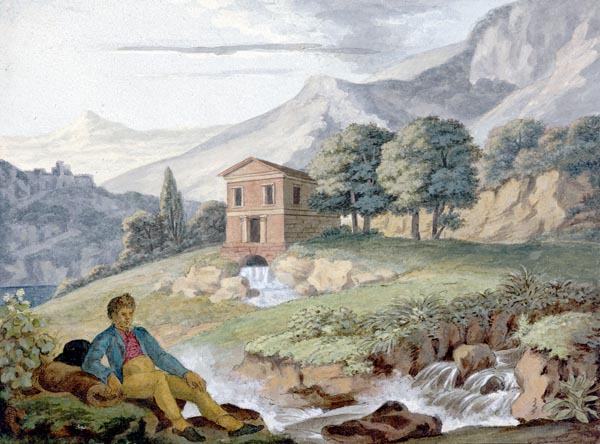
‘Mountain landscape with a small Italian house (1808)’ - Johann Wolfgang von Goethe (German, 1749–1832)
Klassik Stiftung Weimar, Museen (Inv. GGz/1258)
Digital reproduction · See Art. L. 111-1 CPI and § 68 UrhG
Yesterday evening the weather was gloomy, today it is bright and beautiful again.
The evening of the 25th.
I failed to write anything the last two evenings. The inns were so bad that drawing forth a clean sheet of paper was out of the question. Besides, my things are in some disarray; since leaving Venice, my travelling-bag has grown more disorganised, and finding what I need goes less easily and smoothly.
Early on the twenty-third, at ten o’clock German time, we emerged from the Apennines, and I saw Florence lying in a wide, densely-cultivated valley strewn with endless villas and houses.
I hastened through the city, past the Cathedral and the Baptistery. Here, a completely new, unknown world opens to the traveller, but one I have chosen not to linger in. The Boboli Gardens are delightful. I departed as rapidly as I had come.
The city shows clearly how wealthy the folk were who built it; one can see that it has enjoyed a succession of fortunate governments. In general, it is striking how beautiful and magnificent the public works, roads, and bridges are in Tuscany. Everything here is clean and efficient; use and benefit are achieved with grace, and everywhere one notices a lively sense of care. The Papal State, on the other hand, appears to have to survived only because the earth refuses to swallow it whole.
When I said before, how fertile the Apennines might have been, that is the case with Tuscany. Because the land is so much lower, the ancient sea truly did its work, and deposited a layer of deep clay soil. It is the colour of straw, and easy to work. They plough the fields deeply, but in the traditional way still: the plough lacks wheels, and the ploughshare is fixed in place. Thus, the farmer, bending forward behind his oxen, drags the share along and furrows the earth. They plough the ground up to five times, scattering only a little very light manure by hand. Finally, they sow wheat on the narrow heaped ridges, so that rain is obliged to run down the sloping sides into the deep furrows between them. The crop grows on the ridges, and they weed the ground walking back and forth along the furrows. This method is understandable where excess moisture is a concern; why they do it in the most beautiful areas, however, I cannot understand. I observed all this near Arezzo, where a magnificent plain opens out. One could not see purer soil, not a single clod anywhere, as if it had been sifted. Wheat does here quite well, seemingly finding the conditions suitable. Every second year they grow beans for the horses, which are not fed on oats here. Legumes are also sown, which are already a splendid green colour, and will seed in March. The flax has also already sprouted; it will stand throughout the winter; the frost only strengthens it.
Olive trees are strange things; they look almost like willows, and they lose their heartwood, and their bark splits in a similar manner. But they nevertheless have a more solid appearance. One can also see from the wood, which is finely-grained in the extreme, that the trees grow slowly. The leaves are willow-like, only with fewer leaves on the branches. On the hills around Florence, there are olive trees and grapevines everywhere; the soil in between is used for growing grain. Near Arezzo and beyond, the fields are more open. I think too little care is taken to keep the ivy down, which is harmful to olive trees and other plants, and would be quite easy to eradicate. Not a meadow is to be seen. It is said that buckwheat depletes the soil; and that since its introduction, agriculture here has suffered in this respect. I can well believe it, given the meagre amounts of manure used.
This evening I said goodbye to my captain, with the assurance, nay the promise, that I would visit him in Bologna during my return journey. He is a true representative of a large proportion of his countrymen. Here are a couple of his comments, in particular, which characterised him. Since I was often quiet and thoughtful, on one occasion he exclaimed: ‘Che pensa! Non deve mai pensar l’uomo, pensando s’invecchia.’ This translates as: ‘What are you thinking of! One should avoid thinking. It ages one so.’ And after a conversation: ‘Non deve fermarsi l’uomo in una sola cosa, perchè allora divien matto; bisogna aver mille cose, una confusione nella testa: one should not fixate on a single topic, or one will go mad; one should have a thousand things going on in one’s head.’
The good man, of course, couldn’t know that I was quiet and thoughtful precisely because a confused series of thoughts, old and new, filled my mind. The nature of such an Italian’s education will become even clearer from the following. Since he no doubt realised that I was a Protestant, he suggested, after some preamble, that I might permit him to ask certain questions, for he had heard many strange things about Protestants, which he wished to be sure of. ‘Are you allowed,’ he asked, ‘to live on close terms with a pretty girl without actually being married to her? Do your priests permit you that?’ I replied: ‘Our priests are wise men who take little notice of such trifles. Of course, if we were to ask them, they would object.’ ‘So, you are not obliged to ask?’ he exclaimed. ‘Oh, you fortunate fellows! And since there is no confessional in your churches, they will never know.’ Thereupon he launched into a tirade, criticising the Catholic priests of whom he disapproved, while praising our blessed freedom. — ‘But as regards confession,’ he continued, ‘what is the situation in your country? We hear that everyone, even those who are not Christians, must nevertheless attend confession; but because in their obstinacy they follow an incorrect path, they make their confession to some kind of ancient tree, which is certainly ridiculous and godless enough, but nevertheless proves that they recognise the need for confession.’ Thereupon I explained to him our Lutheran understanding of confession and how it is conducted. To his way of thinking it all seemed highly convenient, but he considered it only about as helpful as confessing to a tree. After some hesitation, he asked me, earnestly, to give him an honest answer on another point: he had heard from one of his priests, who was a truly upright man, that we were allowed to marry a widowed sister-in-law, which was a matter of some gravity here. When I denied this and tried to explain the human aspects of our doctrine to him, he refused to grant it much attention, as it all seemed too commonplace to him, and turned instead to a new question:
‘We are assured,’ he said, ‘that Frederick the Great, who won so many victories, even over the faithful, and filled the world with his fame, he whom everyone considers a heretic, is truly a Catholic and has the Pope’s permission to conceal the fact; for, as is known, he never enters any of your churches, but performs divine worship in an underground chapel, though with a contrite heart in that he is not allowed to profess the holy religion publicly; for, of course, if he did so, his Prussians, who are a brutish people, and furiously heretical, would kill him on the spot, which would scarcely help the cause. That is why the Holy Father granted him permission, and in return, Frederick favours the one true religion, and allows it to spread as far as possible.’ I indulged him in this, and simply replied that since it was a great secret, no one, of course, was able to bear witness to it. Our subsequent conversation was always roughly the same in nature, so that I could only marvel at the cunning clergy, who seek to reject and distort anything that might penetrate, and thereby trouble, the shadowy realm of traditional doctrine.
I left Perugia on a glorious morning, feeling the bliss of being alone once more. The city’s location is beautiful, the view of the lake (Lake Trasimeno) most delightful. Those scenes are certainly etched in my memory. The path led first downhill, then along a pleasant valley, framed on both sides by distant hills, until finally I saw Assisi lying before me.
Assisi
From Palladio’s and Johann Volkmann’s texts, I knew that a magnificent Temple of Minerva, built in the days of Augustus, was still standing, and perfectly preserved (housing the Church of Santa Maria sopra Minerva since 1539). I parted from my driver, who continued on his way to Foligno, at the Basilica Santa Maria degli Angeli, and climbed up to Assisi, battling against a strong breeze, for I longed to undertake a walk through this lonely countryside. The monstrous substructures of the Babylonian-style basilica, consisting of an upper church and the lower church in which Saint Francis rests, I left behind, and with a feeling of aversion, thinking that the people there would be of the same stamp as my Papal officer. I asked a handsome lad for directions to Santa Maria sopra Minerva; he accompanied me to the top of the town, which is built against the hillside. At last, we reached what is properly speaking the old town, and behold, the most praiseworthy of buildings stood before my eyes, the first complete monument of antiquity that I had ever seen. A modest temple, befitting so small a town, yet so perfectly and beautifully conceived that it would be notable anywhere.
Now, consider its location! Ever since I read in Vitruvius and Palladio how cities should be laid out, and how temples and public buildings should be constructed, I have had a great respect for such things. Here, too, the ancients proved themselves admirably attuned to the natural world. The temple stands about halfway up the slope, where two hills meet, in the square that is still called ‘the Piazza’ (del Commune) The square itself slopes slightly, and four streets converge on it, forming a compact St. Andrew’s cross, two streets ascending from below, two descending from above. In ancient times, the houses opposite the temple, which now obstruct the view, would not have existed. If one imagines them removed, one would have a view towards the south into the rich countryside, and at the same time, Minerva’s sanctuary would be visible from all sides. The layout of the streets may well be ancient, for they follow the shape and slope of the hill. The temple is not in the centre of the square, but is positioned so that it is clearly visible, even in foreshortened form, to those approaching from Rome. In a drawing, one should not only depict the building itself, but also its happy location.
I could hardly tear my eyes away from the facade, admiring how ingeniously consistent the artist had been. The order is Corinthian; the columns span spaces slightly more than two column thicknesses wide. The column bases and the slabs beneath them appear to stand on pedestals, but this is only an illusion; for the base is pierced five times, and each time five steps ascend between the columns, leading to the platform on which the columns actually stand, and from which one enters the temple. The daring move of piercing the base was perfectly appropriate here, for since the temple is situated on a hillside, the staircase leading up to it would have had to extend too far and would have reduced the space available. How many more steps were set below cannot be determined; they are, with the exception of a very few, filled in, and paved over.
I tore myself away, reluctantly, from the sight and resolved to draw all architects’ attention to this building, so that a precise set of drawings might be produced. I was reminded yet again how useless tradition is! Palladio, in whom I trusted completely, depicts this temple, but could scarcely have seen it himself, since he sets pedestals on the platform, rendering the columns immoderately tall and creating a hideous Palmyrene monstrosity (i.e., akin to the Temple of Bel at Palmyra), instead of this tranquil, lovely sight that delights the eye and mind. What is unfolding within me, through contemplating this work, is inexpressible and will bear eternal fruit.
I was walking along the Roman road (Via Flaminia), the evening fine, my mind at peace, when I heard rough, voices, arguing vehemently, behind me. I suspected they might be the Sbirri (police officers) I had already noted in the city. I walked calmly onward, listening to the shouts behind me. Then I soon realised that they were directing themselves towards me. Four of them, of unpleasant appearance, two armed with muskets, strode past, muttering, then after a few steps turned back and surrounded me. They asked who I was, and what I was doing there. I replied that I was a stranger travelling on foot via Assisi, while my driver and carriage went on to Foligno. They found it unlikely that someone would pay for a carriage and then walk. They asked if I had been to the Gran Convento. I said not, assuring them that I knew the building of old. However, since I was an architect, I had visited Santa Maria sopra Minerva on this occasion, which, as they knew, was a model of architecture. They did not deny this, but took great offence at my failure to pay homage to Saint Francis, and expressed their suspicion that my profession might be that of inciting conspiracy. I was told I was an indigent, and would be considered a contrabandist. I pointed out to them the absurdity of a contrabandist walking along the road, alone, without a knapsack. I offered to return to the town with them and present my papers to the Podestà, so that he might endorse my being an honourable foreigner. They grumbled at this, saying it was unnecessary, and as I continued to speak firmly, in a serious manner, they finally left for the town. I watched them go.
The coarse fellows strode away, while behind them, the beautiful Minerva gazed at me once more, in a very kindly and consoling way. I glanced to my left at the dreary Basilica of Saint Francis and was about to continue on my road when one of the unarmed men separated from the group and approached me quite amicably. Greeting me, he said: ‘You should at least give me a tip, dear stranger. I assure you I instantly thought you a good man and said so, loudly, to my companions. They are hotheads, quick to speak, but without worldly wisdom. You will have noticed that it was I who granted your words the most weight and approval.’ I praised him, at this, and asked him to protect, in future, the honourable foreigners who came to Assisi for both religious and artistic reasons; especially the architects who, to the glory of their town, wished to measure and sketch the Temple of Minerva, which had never before been properly drawn or engraved. He must assist them, as they would surely be grateful; and I pressed some silver coins into his hand, which pleased him beyond expectation. He begged me to return, saying that I particularly should avoid missing the Saint’s feast day, at which time I was certain to find inspiration and enjoyment. Yes, and if it were right for me, a handsome man, to seek a pretty woman, he assured me that the most beautiful and honourable woman in all of Assisi would gladly welcome me on his recommendation. He then departed, assuring me that he would remember me, in his prayers at the saint’s tomb, that very evening, and pray for the success of my onward journey.
Thus, we parted, and I felt more than pleased to be alone once more with Nature and myself. The walk to Foligno was one of the most beautiful and pleasant I have ever taken. Four full hours along the mountainside, with a richly cultivated valley to the right.
Travelling by carriage makes for a tiresome journey; the best of it is that one can, if one wishes, follow behind, comfortably, on foot. I had let myself be dragged along from Ferrara, as far as here. Italy, highly favoured by Nature, has lagged behind other countries in every technical and mechanical aspect that makes for a more comfortable and less wearying way of life. The vettura (carriage), which is still called a sedia, a chair, surely originated from the old sedan chairs in which women, the elderly, and those of higher rank were carried by a pair of mules. Instead of the rear mule, harnessed to the fork, two wheels were added, and no further improvement was considered. One is still rocked along as folk were centuries ago, and that is how the Italians maintain their homes, and everything else.
If one wishes to see the ancient poetic idea realised — when people mostly lived outdoors and occasionally retreated to caves out of necessity — one must enter the buildings around here, especially in the countryside, entirely in keeping with the spirit and character of those cave-dwellings. Such incredible carefreeness the Italians exhibit, so as not to grow old too quickly! With unbelievable recklessness, they neglect to prepare for winter, and the longer nights, and consequently suffer like dogs for a good part of the year. Here in Foligno, I have seized the opportunity to write this, in an utterly Homeric household, where everyone has gathered around a fire burning on the floor in a large hall, shouting and clamouring, dining at a long table as in the ‘Wedding at Cana’ (the painting by Paolo Veronese, 1563, now in the Louvre), since someone brought me an inkwell, something I wouldn’t have expected under such circumstances. But even the page before me betrays the chilly discomfort of my writing desk.
Now, I feel my audacity in traversing this country unprepared myself, and unaccompanied. Given the various currencies, the need for carriages, the extortionate prices, and poor inns, someone travelling alone for the first time, as I am, hoping and seeking uninterrupted enjoyment, will find it a daily hardship and feel wretched enough. However, I wish nothing more than to see the country, whatever the cost, and if they dragged me to Rome on Ixion’s wheel, I would not complain.
Terni
October 27th, evening.
I am seated in a cave once more, one that suffered damage in the earthquake last October; the town is in a delightful area, which I happily explored on my walk, at the edge of a beautiful plain between mountain ranges, all of which are of limestone still. Like Bologna to the north, Terni in the south is situated at the foot of the Apennines.
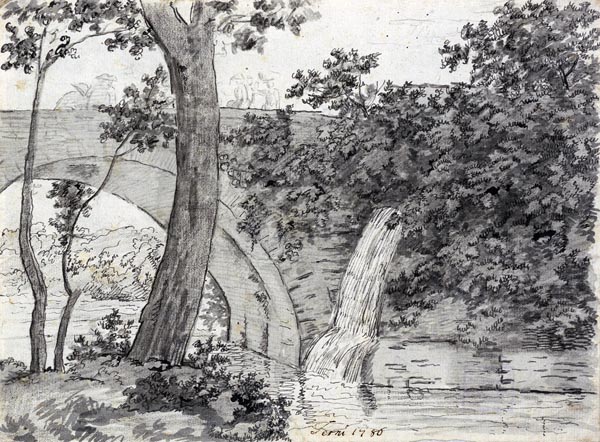
‘Bridge over the Nera near Terni’ - Johann Wolfgang von Goethe (German, 1749–1832)
Klassik Stiftung Weimar, Museen (Inv. KK 1305)
Digital reproduction · See Art. L. 111-1 CPI and § 68 UrhG
Now the Papal officer has left me, a priest is my companion. He seems more content with his particular situation and, although he recognises me as a heretic, he readily answers my questions about the Catholic rite and other related matters. By constantly meeting new people, I am achieving my goal in full; one only needs to listen to the people talking amongst themselves to realise how vivid a picture of the entire country it grants one. They are all adversaries in the oddest way, possessing the most striking provincial, and urban, zeal, and cannot endure one another. The social classes are in perpetual conflict, and all this with such a lively, and immediate passion that they provide a day-long comedic performance, revealing themselves as if in a charade. Yet at the same time, they immediately grasp and recognise when a stranger finds their actions alien to him.
I climbed the hillside at Spoleto, and stood on the aqueduct (Ponte delle Torre), which is also a bridge from one mountain to another. The ten arches spanning the valley, made of brick, have stood so serenely for centuries, and the water still gushes forth in Spoleto everywhere. This is now the third work of the ancients that I have seen, and always with some grand purpose. It was second nature to them, to act for civic purposes — such is their architecture; so, the amphitheatre, the temple, and the aqueduct were conceived. Now I understand how right I was in detesting all arbitrary constructions, such as that barracks on the Weissenstein (the Hercules Monument, with its grand cascade, in Wilhelmshöhe Park, at Kassel), a piece of nothing about nothing, a monstrous confection, and so it is with a thousand other things. All of it is stillborn, for what lacks a true inner existence is lifeless, and is neither great nor can become great.
What joy and insight I have gained over the past eight weeks; though it has cost me enough toil. I simply keep my eyes open and observe things closely. I would scarcely even attempt to judge them if only that were possible.
San Crocefisso is a curious chapel by the roadside, I don’t believe it to be the remains of a temple that once stood there, but rather various columns, pillars, and beams were found, and have been pieced together – not stupidly, but well. It is impossible to describe; it must surely have been engraved somewhere on copper.
It feels quite strange that, in our efforts, thus, to gain an idea of antiquity, we are confronted only with ruins, from which we must now, painstakingly, reconstruct that of which we have, still, no clear concept.
Considering what we call ‘classic ground’ it’s a different story. If one avoids indulging in fantasy, and accepts the landscape as it is, one can always see some fateful arena that gave rise to the greatest of deeds. And so, I have always utilised my perspective on the geology of a given landscape to suppress imagination and emotion, and so maintain a clear unprejudiced view of the locale. Then, history unfolds vividly, and in a wondrous way, and one understands within oneself what happened, to some degree, and thus I feel the greatest longing to read Tacitus in Rome.
I must not neglect to comment on the weather, too. As I ascended the Apennines from Bologna, the clouds were still drifting north, but later they changed direction and progressed towards Lake Trasimeno. They lingered there, travelling onwards probably around midday. So instead of the vast plain of the River Po sending the clouds towards the Tyrolean mountains all summer, it is now sending a portion towards the Apennines; which might well explain the rainfall here.
They are starting to harvest the olives now. Here they do it by hand, in other places they beat the branches with sticks to bring the fruit down. If there’s an early winter, the remaining olives stay on the trees until spring. Today I saw the largest, and oldest of trees growing on very stony ground.
The Muses’ favour, like that of the demons, is not always granted us at the right time. Today I agitated myself, through attempting to develop a poetic idea prematurely. Approaching the heart of Catholicism, surrounded by Catholics, confined to a sedia with a priest, striving, clear-mindedly, to observe and comprehend true Nature, and noble art, it became vividly clear to me that all trace of original Christianity has vanished; indeed, when I imagine it in all its purity, as we see it demonstrated in the Acts of the Apostles, I shudder at the formless, even baroque, paganism that has been built upon, and weighs upon, those humble beginnings. Then I remembered the tale of the Wandering Jew who witnessed all those wondrous developments and revelations, and is doomed to experience his strange fate till Christ himself returns to look again upon the fruits of his teachings, and discover himself in danger of being crucified a second time. The phrase: ‘Venio iterum crucifigi,’ was to serve as the subject of my catastrophic attempt (cf. various versions of the apocryphal text, ‘The Acts of Peter’, where in reply to ‘Domine, Quo Vadis?’ ‘Lord, whither goest thou?’ Jesus is supposed to have replied ‘I go to Rome, to be crucified once more.’)
Such dreams float before my mind. Out of impatience to move on, I sleep fully clothed and know of nothing more delightful than being awakened before daybreak, clambering swiftly into the carriage and, between sleep and wakefulness, going forth to meet the day, allowing my earliest and best fantasies to run wild, as I please.
Civita Castellana
October 28th.
I wish to record this, my last evening before Rome. It is not even eight yet, but everyone is already in bed; so, I am free to take a final look at the past, and anticipate what is to come. Today was a truly bright, a glorious, day, the morning very cold, the afternoon clear and warm, the evening a bit windy, but very beautiful.
We left Terni very early, and reached Narni before daybreak, so I failed to see the bridge (The ‘Ponte d’Augusto’ the Roman arched bridge built to carry the Flaminian Way over the river Nera). There were valleys, and plains, near and far, a delightful landscape, all limestone mountains, not a trace of any other rock.
Otricoli lies on one of the gravel hills washed together by the ancient currents, and is built of lava brought from over the river.
Once one crosses the bridge (Ponte Felici, which carried the Via Flaminia over the Tiber), you find yourself in volcanic terrain, whether actual lava, or ancient rock altered by heat and fusion. One climbs a mountain that appears to be composed of grey lava. It contains many white, garnet-shaped crystals. The road leading from the heights to Civita Castellana, made of this same stone, is very smooth; the town itself is built on volcanic tuff, in which I thought I detected ash, pumice, and pieces of lava. The view from the castle (Forte Sangallo, also known as the Rocca dei Borgia) is very fine; Mount Soracte rises, picturesquely; most likely a limestone outcrop belonging to the Apennines. The volcanic strata are much lower than those of the Apennines, and the flow of water alone has carved out mountains, and isolated crags, from them, creating wonderful scenic features: overhanging cliffs, and other irregularities of landscape.
Tomorrow evening, then, I shall be in Rome. I can hardly believe it even now, and once my wish is fulfilled, what else should I wish for? I can think of nothing, except that I might return home safely, with my boatful of pheasants, and find my friends healthy, happy, and well-disposed towards me.
The End of Goethe’s ‘Italian Journey’ Part V