Victor Hugo
The Pyrenees (En Voyage: Pyrénées, 1843)
Part II: San-Sebastián to Pamplona
Translated by A. S. Kline © Copyright 2026 All Rights Reserved
This work may be freely reproduced, stored and transmitted, electronically or otherwise, for any non-commercial purpose.
Conditions and Exceptions apply.
Contents
- Chapter VIII: The Passage (Pasajes) – Pasai (Pasai Donibane, Pasajes San Juan).
- Chapter IX: Around Pasai.
- Chapter X: Lezo.
- Chapter XI: Pamplona.
Chapter VIII: The Passage (Pasajes) – Pasai (Pasai Donibane, Pasajes San Juan)
The other day, I left San Sebastián as the tide was on the turn. I made my way to the left (east) at the end of the promenade, crossing the wooden bridge over the Urumea, the toll being one cuarto (or ‘quarto’, a fourth of a ‘real’). A road presented itself, I accepted it at random, and off I went. I walked in the mountains without really knowing where I was; little by little the exterior landscape, which I looked at vaguely, was transformed to that other interior landscape which we call reverie; my sight was turned inward, and opened clearly within me, and I no longer saw Nature, I saw into my own mind. I could not say what I was doing in that state, to which you know me to be subject; I only remember in a confused way that I remained motionless, for a few minutes in front of a bindweed over which an ant came and went, and that in my reverie this spectacle was translated into this thought: — ‘An ant on a bindweed. Labour and scent.’ Two great mysteries, two great ideas.
I know not how long I had been walking like this when, suddenly, a high-pitched noise composed of a thousand strange cries roused me. I looked; I was between two hills, with high mountains on the horizon, and I was heading straight towards an arm of the sea, at a place where the road I was following ended abruptly, forty feet or so in front of me. There, at the point where the path plunged into the water, I could see something singular.
About fifty women, in a single line like a company of infantry, seemed to be waiting for someone, calling for them, demanding their attention, with tremendous yelps. The thing amazed me greatly; but what redoubled my surprise was to recognise, after a moment, that this someone, so awaited, so called upon, whose attention was so demanded, was myself. The road was deserted, I was alone, and all this storm of shouts seemed truly addressed to me.
I approached, and my astonishment increased still further. These women all threw at me the most lively and engaging words at once: ‘Señor frances, benga usted con migo! — Con migo, caballero! — Ven, homhre, muy bonita soy! Frenchman, come with me! — With me, sir! — Come, sir, I am very pretty!’
They called to me with the most expressive and varied pantomimes, yet not one of them advanced towards me. They seemed like living statues rooted to the ground to whom a magician had said: ‘Utter your cries, perform your gestures; but take not a step.’ Moreover, they were of all ages and of every shape and size, young, old, ugly, pretty, the pretty ones dressed and adorned like coquettes, the older ones in rags. In these rural areas, women are less fortunate than butterflies in a field. The latter begin as caterpillars; here the women end that way.
As they were all talking at once, I could grasp nothing, and it took me some time to understand. Finally, some boats moored by the shore explained the matter to me. I was in the middle of a group of boatwomen offering to help me cross the water.
But why boatwomen and not boatmen? What was the meaning of their burning obsession that condemned them to remain behind a hidden boundary never to cross it? Finally, where were they leading me? So many enigmas, so many reasons to advance. I asked the prettiest one her name; it was Pepa. I jumped into her boat.
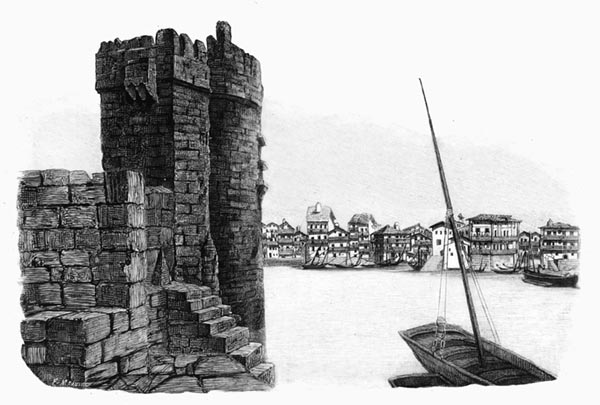
‘Boat passage’- Victor Hugo (1894)
Paris Musées
At that moment I noticed a passenger who was already seated in another boat; we were running the risk of having to wait a long time each on our own; by joining together we could depart at once. As the last to arrive, it was my duty to join the other. So, I left Pepa’s boat. Pepa pouted; I gave her a peseta; she took the money, and continued to pout, which flattered me immensely; for a peseta was, as my travelling companion explained to me, double the maximum price of the passage. So, she had gained the fare, without the usual effort.
Meanwhile, we had left the shore behind, and were sailing over a gulf where all was green, the waves and the hills, the land and the water. Our boat was steered by two women, one old and one young, mother and daughter. The daughter, very pretty and very cheerful, was named Manuela, and nicknamed Catalana. The two boatwomen rowed standing up, at bow and stern, each with a single oar, with a slow, supple, and graceful movement. Both spoke passable French. Manuela, with her little oilcloth hat adorned with a large rose, her long braided plait floating down her back in the local fashion, her bright yellow kerchief, her short petticoat, and her well-shaped legs, showed the most beautiful teeth in the world, laughed a lot, and was charming. As for the mother, alas, she too had once been a butterfly.
My companion was a silent Spaniard, who, finding me quieter than himself, decided, as always happens, to speak. He began, of course, by finishing his cigar. Then he turned to me. In Spain, when a cigar ends, a conversation begins. As for me, as I don’t smoke, I don’t talk. I never possess that great pretext which marks the beginning of a conversation, namely, the end of a cigar.
— ‘Señor,’ my man said to me in Spanish, ‘have you seen it before?’ I answered him in Spanish:
— ‘No, Señor.’
Notice this ‘No’, and admire it. If I had said: ‘What?’, which would have been more natural, I would have received an explanation, and I would probably have understood the key to the enigma at once; but I wished to keep it a mystery as long as possible, having no desire to know where I was going.
— ‘In that case, Señor,’ continued my companion, ‘you are going to see something very beautiful.’
— ‘Truly?’ I asked.
— ‘It is very long.’
— ‘Very long!’ I thought: ‘What can it be?’
The Spaniard replied: ‘She’s the longest one in the province.’
— ‘Well,’ I said to myself, ‘according to the pronoun this thing is feminine.’
— ‘Señor,’ continued my companion, ‘have you seen any others?’
— ‘Sometimes,’ I replied. Another answer in much the same vein as the first.
— ‘I bet you haven’t seen a longer one.’
— ‘Aha! You might lose.’
— ‘Well, which ones has the noble Señor already seen?’
This question was somewhat more demanding. I answered: ‘The one in Bayonne,’ still without knowing what we were talking of.
— ‘In Bayonne!’ cried my companion, ‘In Bayonne! Well, sir, that of Bayonne is three hundred feet shorter than this. Did you measure it?’
— ‘I answered, with the same composure: — ‘Yes, Señor.’
— ‘Well, measure this one.’
— ‘I’m counting on doing so.’
— ‘You will be enlightened. A squadron of cavalry could fit in it, single file.’
— ‘Impossible.’
— ‘It is as I say, Señor. I see that the noble Señor is an amateur.’
— ‘Amazing.’
— ‘You are French,’ replied my man, and, brightening up, he added:
— ‘Perhaps you have come from France, especially to see it.’
— ‘Precisely. On purpose.’
My Spaniard was radiant. He held out his hand and said:
— ‘Well, Monsieur’ (he uttered the French ‘monsieur’, in a most courteous manner) ‘you’ll be pleased. It’s as straight as a letter I, it’s as if drawn with a ruler, it’s magnificent.’
— ‘The Devil!’ I thought, ‘Would this pretty gulf possess, in extension, a Rue de Rivoli? What a bitter mockery! To flee the Rue de Rivoli, reach Gipuzkoa, and find the Rue de Rivoli there, stuck to an arm of the sea, that would be sad, indeed!
Meanwhile our boat continued to advance. It rounded a small cape dominated by a large ruined house, its four walls pierced by doorframes without doors, and windows without windowpanes.
Suddenly, as if by magic, and without my having heard the customary stagehand’s whistle, the scenery changed, and a delightful spectacle appeared before me:
A curtain of high green mountains, their peaks outlined against a dazzling sky; at the foot of these mountains, a row of closely juxtaposed houses; all these houses painted white, saffron, green, with two or three stories of large balconies sheltered by the projection of their wide red roofs covered with hollow tiles; on all these balconies a thousand floating things: clothes to dry; fishing nets; red, yellow, and blue rags; at the foot of these houses, the sea; to my right, halfway up the hill, a white church; to my left, in the foreground, at the foot of another mountain, another group of houses with balconies leading to an old dilapidated tower; ships of all shapes and boats of all sizes were lined up in front of the houses, moored beneath the tower, or sailing the bay; on these ships, on this tower, on these houses, on these rags, on this church, on these mountains and in this sky, life, movement, the sun, an azure expanse, an air of inexpressible gaiety; that is what I had before my eyes. This place, magnificent and charming like everything that has the double character of joy and grandeur, this unique place which is one of the most beautiful that I have seen and which no ‘tourist’ ever visits, this humble corner of earth and water which would be admired if it were in Switzerland, and famous if it were in Italy, and which is unknown because it is in Gipuzkoa, this little radiant Eden at which I had arrived by chance, and without knowing where I was going, or knowing where I was, is called in Spanish Pasajes, and in French Le Passage (the Pasaia Bay area with two coastal sections: Los Pasajes de San Juan, and Los Pasajes de San Pedroko).
Low tide leaves half of the bay dry, and prevents navigation to and from San Sebastian, which itself is almost cut off from the world. High tide re-establishes the ‘Passage’. Hence the name.
The population of this town has only one industry, toil on the water. The two sexes share the work according to their respective strength. The men sail the ships, the woman row the boats; the men take to the open sea, the women occupy the bay; the men go fishing and leave the gulf, the women stay within the gulf and render passage, when the tide is in, to all those whose business or interests bring them there from San Sebastian overland. Hence the bateleras (boatwomen)
These poor women so rarely have a passenger that they have reached an agreement among themselves. In competing for each passerby, they would have devoured each other, and perhaps devoured the passerby. They have a set line they do not cross, and a charter they never violate. It is an extraordinary country.
As soon as the tide rises, they bring their boats to the place where the road floods, and stand there on the rocks, spinning their distaffs, waiting.
If a stranger appears, they rush to the line they have set for themselves, and each tries to render herself the newcomer’s choice. The stranger chooses. Having made his choice, all are silent. The stranger who has chosen is sacred. He is left to the one who has secured him. The passage costs little. The poor give a cuarto (a quarter of a real), the bourgeois a real (a quarter of a peseta), the nobility a media-peseta (half a peseta), the emperors, princes and poets a peseta.
Meanwhile the boat had touched at the landing stage. I was so dazzled by the place that I hastily threw my peseta to Manuela, and leapt ashore, forgetting everything the Spaniard had told me, and the Spaniard himself, who, now I come to think of it, must have watched me leave with a very astonished air.
Once on land, I took the first street I found; an excellent method that always delivers you where you want to be, especially in towns like Pasai (Pasai Donibane) that only have one street.
I walked along the entire length of this unique street. It consists of the mountain on the right; and, on the left, the rear facade of all the houses whose fronts overlook the gulf. Here was a new surprise. Nothing is more cheerful and fresh than the Passage seen from the water; nothing is more severe and sombre than the Passage seen from the mountainside.
These houses, so pretty, so cheerful, so white, so luminous beside the sea, offer, seen from its narrow, winding street paved like a Roman road, nothing more than high walls of blackish granite, pierced by the occasional square window, impregnated with the humid emanations of the rock, a gloomy row of strange buildings affixed to which, and sculpted in the round, are enormous coats of arms borne by lions, and figures of Hercules, and topped with gigantic morions (helmets). In front they are houses; behind they are fortresses.
I asked myself a thousand questions. What is this extraordinary place? What does it mean that the street displays coats of arms from one end to the other? You only see streets like these in knightly cities like Rhodes and Malta. Coats of arms seldom sit side by side. They require isolation; they need space, like everything grand. A coat of arms needs an entire keep, as an eagle demands an entire mountain. What is the meaning of a village bearing coats of arms possess? Huts in front, palaces behind, what do they signify? When you arrive by sea, your chest expands, you think a bucolic scene lies before you; you cry aloud: ‘Oh, the sweet, candid, naive fisher folk!’ You enter the place, and you are in the home of hidalgos (noblemen), you breathe the air of the Inquisition; you see the livid spectre of Philip II arising at the far end of the street.
In whose house is one, when one is in Pasai? Is one dwelling amidst peasants, or great lords? Is this Switzerland or Castile? Is not this little corner of Spain, unique in the world, a place where history and Nature meet, and each create an aspect of the same town, Nature employing its most graceful aspect, history its most sinister?
There are three churches in Pasai, two black and one white. The main one (San Juan Bautista), which is black, is of a surprising character. On the outside, it is a block of stone; on the inside, it reveals the bareness of a sarcophagus. Except that, amidst those gloomy walls, unrevealed by any sculpture, unenlightened by any fresco, unpierced by any stained-glass window, you suddenly see an altar shining and gleaming, which is in itself a whole cathedral.
It is an immense piece of woodwork applied to the wall, carved, painted, carpentered, worked, gilded, with statues, statuettes, twisted columns, foliage, arabesques, volutes, relics, roses, wax figures, saints, tinsel and other ornamentation. It rises from the pavement, and reaches as far as the vault. There is no transition between the nakedness of the walls and the adornment of the altar. It is a magnificent exercise in gleaming, flowery architecture which is vegetating, one scarcely knows how, in the shadows, in this granite cave, and which reveals thickets of gold and precious stones in the darkest of corners when one least expects them.
There are four or five of these altars in the church at Pasai. This style is, moreover, typical of all the churches of the province; but it is at Pasai that it produces its most singular contrast.
The first thing that struck me as I left the church was a head carved into a wall facing the portal. This head is painted black, with white eyes, white teeth, and red lips, and stares at the church with an air of amazement. As I was contemplating this mysterious sculpture, the Señor Cura (parish priest) passed by; he approached me; I asked him if he knew what this African mask in front of the threshold of his church meant. He had no idea, and, told me that no one in the area did either.
After two hours, having seen everything, or at least visited everything, I embarked again. Manuela was waiting for me. As my excursion was over, she had taken possession of me, I belonged to her, I was her thing.
As I stepped over the edge of the boat, someone grabbed my arm; I turned around. It was the worthy passenger with whom I had traversed the arm of the sea, that morning, and whose portrait I have neglected to give you; let me make up for the oversight: a threadbare hat of tall shape and narrow brim, a blue frock coat worn at the seams, one side buttoned with two buttons, a thick watch chain with a cornelian key hanging from it, and the face of a penniless fellow who will lend his name to dubious operations. Here follows our dialogue on board the boat. Imagine it delivered in the swiftest stream of Castilian you can imagine:
— ‘Well, French Senõr?’
— ‘Well, what?’
— ‘What do you say?’
— ‘Say to what?’
— ‘Have you seen it?’
— ‘What?’
— ‘Have you measured it?’
— ‘What?’
— ‘Is it not the longest in the province?’
— ‘Which province, and what is longest?’
— ‘Goodness! The rope factory!’
— ‘What rope factory?’
— ‘The rope factory you just visited! The rope factory here!
— ‘Is there a rope factory here?’
— ‘Ah! The French lord is in a good mood and wishes to have fun; but he knows very well that there is a rope factory, since he travelled five hundred miles expressly to see it.’
— ‘I? Not at all.’
— ‘Is it not beautiful? Long? Straight? Magnificent? Straight as a letter I?’
— ‘I’ve no idea.’
— ‘Ah, indeed!’ replied the man, looking me straight in the eye. ‘Seriously, Monsieur, you have not seen it then?
— ‘What?’
— ‘The rope factory?’
— ‘Understand, Senõr,’ I replied majestically, ‘that I particularly hate long, magnificent things drawn with a ruler, and that I would travel five hundred miles not to see a rope-factory.’
I said these memorable words in such a solemn manner and with such a deep accent that the man recoiled. He looked at me with a frightened air; and, as the boat departed the shore, I heard him say to the boatmen who had remained on the stairs, while indicating myself with a shrug of his shoulders: ‘Un loco!’ A madman.
Back in San Sebastian, I announced at the inn that I would be moving to Pasai next day. This caused general consternation.
— ‘What are you going to do there, sir? It’s a hole. A desert. A land of savages. You’ll find not a single inn there!’
— ‘I’ll stay in the first house I come across. One can always find a house, a room, a bed.’
— ‘But there are no roofs to the houses, no doors to the rooms, no mattresses on the beds.’
— ‘That must be interesting.’
— ‘And what will you eat?’
— ‘Whatever they have.’
— ‘There’ll be nothing but mouldy bread, spoiled cider, rancid oil, and wine in a goatskin.’
— ‘I’ll try their usual fare.’
— ‘What, Monsieur, you are decided?’
— ‘Yes, decided.’
— ‘You will be doing what no one here would dare to do.’
— ‘Really? I’m tempted by that thought.’
— ‘Going to sleep in Pasai, it’s never been seen before!’
And they almost made the sign of the cross. I refused to hear any more and, the next day, left for Pasai in time to catch the tide.
‘Now, do you wish to know the result? This is where my recklessness led me. I will begin by telling you what I have before my eyes as I write to you. I am on a long balcony overlooking the sea. I am leaning on a square table covered with a green rug. To my right is a French window that opens into my room, for I have a room, and the room has a door. To my left is the bay. Beneath my balcony two ships are moored, one of which is old, and in which a sailor from Bayonne works who sings from morning to night. In front of me, two cables’ length away, another brand new and very fine ship sways, which is about to leave for the Indies. Beyond this ship, the old dilapidated tower, the group of houses called el otro Pasaje (the other Pasai), and the triple ridge of a mountain. All around the bay, the wide semicircle of hills, whose undulations vanish into the horizon, is dominated by the bare ridge above Irun.
The bay is brightened by the boatwomen’s craft, to-ing and fro-ing without cease, as they hail each other from one end of the gulf to the other with cries that resemble the crowing of a rooster. The weather is magnificent, and the sunlight is the brightest in all the world. I hear my sailor humming, children laughing, the boatwomen calling to each other, the washerwomen beating the linen on stones in the local manner, the oxcarts creaking in the ravines, the goats bleating in the mountains, the hammers clanging in the shipyard, the cables unwinding on the capstans, the wind blowing, the sea rising. All this noise is music, for joy fills it.
If I lean over the balcony, I see at my feet a narrow stone terrace on which grass grows, a black staircase that descends to the sea, and whose steps the tide climbs, an old anchor sunk in the mud, and a group of fisherfolk, men and women, knee-deep in the water, pulling their nets from the water while singing.
Finally, if you wish me to tell you of everything, there before my eyes, on the terrace and the staircase, constellations of crabs perform, with solemn slowness, all the mysterious dances that Plato ever dreamed of.
The sky contains every shade of blue from turquoise to sapphire, and the bay every shade of green from emerald to chrysoprase. The bay is not lacking in gracefulness; when I look at the horizon that encloses it, it is a lake; when I look at the rising tide, it is the sea.
What say you to that? In regard to one matter — I’ve been thinking about it, and you reminded me of it in your letter — for the three weeks that I’ve been travelling, I’ve been unfaithful to my custom of describing the landscape from my window. I’ll make up for this oversight at once. In Bordeaux, my window looked out onto a large wall; in Bayonne, onto a street planted with trees; in Saint-Sébastien, onto an old woman killing her fleas. Your need is now satisfied. I return in haste to Pasai.
The house I inhabit (Casa Gaviria) is at once one of the most solemn that overlooks the street, and one of the most cheerful that overlooks the gulf. Above the roof, I see stairs, amidst the rocks, that climb through tufts of greenery to the old white church (Dona Ane Basaeliza) which looks like another heifer waving its bell around its neck on the hillside. For, in the churches of Gipuzkoa, one sees the bell hanging naked from the edge of the church roof under a kind of arcade that looks like a necklace.
The house I lodge in has two floors and two entrances. It is curious and rare above all others, and bears to the highest degree the dual character so original to the houses of Pasai. It is the monumental patched together with the rustic. It is a house joined to, and welded to, a palace.
The first of these entrances is a portal with pillars from the time of Philip II, sculpted by the delightful artists of the Renaissance, mutilated by time and children at play, eaten away by the rain, the moonlight, the sea wind. You know rough sandstone erodes in an admirable fashion. The portal is a beautiful buff colour. The coat of arms remains, but the years have erased the blazon.
One pushes on, and opens, the small door to the right of the gate, and finds a staircase of beams and planks; beams and planks as black as coal, roughly hewn, and barely squared. At the top of the staircase, whose centuries-old steps display wide gaps, a heavy fortress door, in the centre of which is a narrow skylight with a grille, creaks on its massive iron hinges, and ushers you into the dwelling.
The antechamber is a whitewashed corridor which, since I don’t wish to conceal anything from you, is covered with vast spider webs, and lit by a window overlooking the street. Opposite this window, the escarpment of the mountain rises in a gigantic wall as far as the eye can see.
The corridor, which leads to the staircase on the second floor, is pierced by two doors; the one on the right leads to the kitchen, which one reaches via two mouldy wooden steps; the other on the left opens into a large room, flanked at the four corners by four small bedrooms, which along with these four closets and the kitchen, composes the first floor of the house. Two of these closets are dark, and have no other opening than their door onto the room. Yet someone sleeps there. The other two bedrooms are, like the room, on the same level as the balcony, with which they communicate by French windows painted green, and decorated with small shuttered panes. Each bedroom has one of these French windows. The large room has two, between which is a pretty, almost square window.
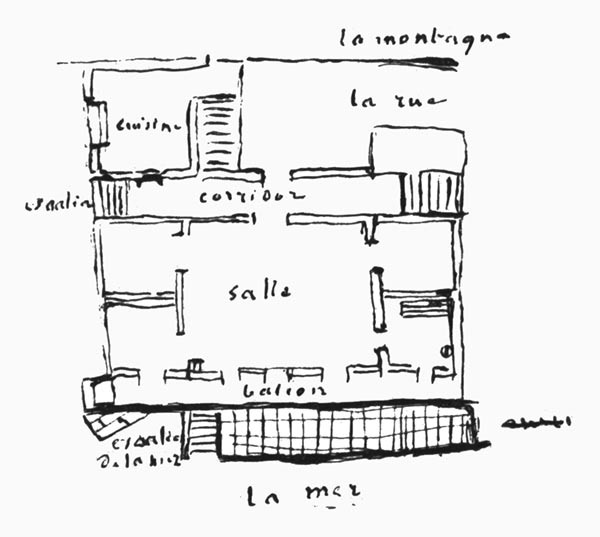
‘A house joined to, and welded to, a palace’- Victor Hugo (1894)
Paris Musées
The interiors of the rooms are whitewashed, like the facade onto the lake; the parquet floors, black and rotten like the staircase, resemble the wooden deck of a rustic bridge; the doors resemble the parquet floors. A round table, a few sideboards, a few straw-bottomed chairs, are the furnishings of the great hall. A coat of arms, barely heraldic, is crudely painted above the middle door. No fireplaces. The climate renders them redundant. The walls are made of stone, and as thick as those of a dungeon.
I occupy the room on the balcony at the corner of the hall on the left. The other rooms are those of the various inhabitants of the house, of whom I will speak to you presently.
The second floor is identical to the first. A bedroom replaces the kitchen. The second-floor balcony shelters the first-floor balcony and is itself protected by the wide edge of the roof, which is brightened by charming curved and carved joists. The balconies are tiled with red brick and painted green.
But all this seems about to collapse. The walls have cracks that reveal the view; the bricks of the balcony above reveal the one below; the floors of the rooms bend beneath one’s feet. The staircase leading from the first to the second floor is most strange:
‘Tout branlait dessous nous, jusqu’au dernier étage’
‘All shook beneath us, up to the highest floor’
(Mathurin Régnier, ‘Satire XI’)
said Mathurin Régnier, speaking of such a house somewhere. This staircase is both rickety and massive. It was formed three hundred years ago, of large timbers, planks, and nails, adjusted and assembled in a crude way, which tremble with age, and yet still have something robust and formidable about them. The whole stair threatens, in the dual sense of the word. No skylight; no light except for a slanted ray from above. The steps, put together with a billhook, the planks laid crooked and as if at random, look like wolf-traps. It is both massive and crumbling away. Huge spiders weave to and fro amidst this dark tangle. An oak door, four inches thick, fitted to a solid, though rust-eaten, frame, closes this staircase off from the second floor, and from the first if necessary. A fortress of a building.
What do I think of the structure? Is it sad? Repulsive? Terrible? Well, no, it is charming.
First of all, nothing could be more unexpected. This is a house like no other. Just when you think you are in a mere house, a sculpture, a fresco, some useless but exquisite ornament warns you that you are in a palace; you are waxing ecstatic over this detail which is luxurious and full of grace, when the hoarse shriek of a bolt leads you to believe you are living in a prison; you go to the window, there is the balcony, there is the lake, you are in a chalet in Zug or Lucerne.
Moreover, bright daylight enters and fills this singular dwelling; its plan is cheerful, comfortable and original; the salt sea air cleanses it; the pure midday sun dries it, warms it and vivifies it. Everything becomes joyous in this joyous light.
Everywhere else, dust is filth. Here, dust is merely decay. Yesterday’s dust is odious; the ash of three centuries is venerable. Finally, what more can I tell you? In this land of fishing and hunting, the spider that also hunts and spreads its nets has a right to citizenship. It is at home. In short, I accept the house as it is. Except that I have my room swept, and have given notice to the spiders who occupied it before me.
What completes the strange appearance of this house is that I never see a man here. Four women and a child occupy it; the mistress of the house, her two daughters, her servant Iñacia, a beautiful barefoot Basque girl, and her grandson, a pretty eighteen-month-old toddler.
The hostess, Madame Basquetz, is an excellent woman with intelligent eyes, pleasant, cordial, and cheerful, who is somewhat French by origin, quite French at heart, and who speaks French very well. Her two daughters speak only Spanish and Basque.
The eldest is a sickly young woman, sweet and pensive. The youngest is called Pepa like almost all Spanish women! She is twenty years old, with a slender figure, a supple bodice, well-formed hands, small feet, a rare thing in Gipuzkoa, large black eyes, and superb hair; she leans on the balcony in the evening in a sad attitude, yet she turns around, if her mother calls to her, with an expression of joyful vivacity. She is at that age where the carefree attitude of the young girl begins to disappear, imperceptibly veiled by the melancholy of the woman.
The child, who crawls up and down the stairs from one floor to another, comes and goes all day, laughs, fills the house with life, and warms it with his innocence, grace and naivety. A child in a house is a furnace of gaiety. As he sleeps near my room, in the evening I hear him whispering softly while the four women lull him to sleep with a song.
I told you that the house has a second entrance. It is a staircase without a banister, made of large cut stones, which rises from the street to the kitchen, and there joins a flight of stone staircases which ascend the mountain amidst the foliage.
The house bridges the street, as the Château de Chenonceaux does the River Cher, the street passing beneath via a kind of long, narrow, dark and vaulted arch, lit by a lantern at night, where in a niche, next to a basement window behind a fifteenth-century grille, a blessed wax candle commends itself to the poor sailors passing by, with the following inscription:
‘Una limosna para
alvmbrar al sto cto
d. bven biaje’
año 1756’
‘Given, to light the Holy Christ, after a safe journey —1756.’
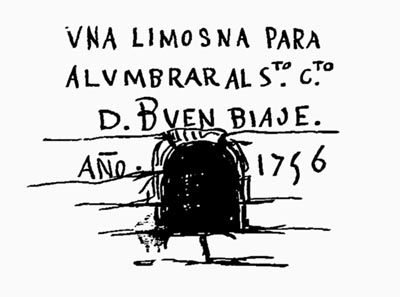
‘A basement window behind a fifteenth-century grille’- Victor Hugo (1894)
Now you know the house, and its inhabitants. I have told you where my room is; but I have not told you what it looks like. Picture to yourself four white walls; two straw-bottomed chairs; a basin on a tripod; a child’s hat, decorated with feathers and glass beads, hanging from a nail; a shelf bearing some pots of ointment and three mismatched volumes of Jean-Jacques Rousseau; an antique four-poster bed with curtains of very fine Persian fabric, with two mattresses as hard as marble and a headboard of the most beautiful painted wood in the world; a slanted mirror with an exquisite frame hanging on the wall; and a cellar door that refuses to close. That is my room. Add to that the French window I have already told you about, and my table which is on the balcony. From my bed I can see the sea and the mountains.
You see that, despite the dire predictions of the civilised people of San Sebastian, I managed to find lodging with the ‘Hurons’ of Pasai. Now how do I survive here? Judge for yourself.
At about ten o’clock, the gracious Pepa, who wakes with the dawn, places a white napkin on my green-cloth covered table, which never leaves the balcony; then she brings me oysters gathered that very morning from the rocks in the bay, two lamb chops, a fried sea-bass, which is a delicious fish, sweet fried eggs, chocolate cream, pears and peaches, a cup of very good coffee, and a glass of Malaga wine. I also drink cider, unable to accustom myself to wine from a goatskin. Such is my lunch.
Now for my dinner, which takes place in the evening around seven, when I have returned from my errands in the bay or on the coast. An excellent soup; puchero (Spanish stew) with bacon and chickpeas but without saffron and chilies; slices of hake fried in oil; a roast chicken; a salad of watercress picked from the washhouse stream; peas with hard-boiled eggs; a corn cake with milk and orange blossom; nectarines; strawberries; and a glass of Malaga wine.
While Pepita serves me, going back and forth all around me, with all these items that appeal to my mountain appetite, the sun sets, the moon rises, a fishing boat leaves the bay, all the spectacles of the ocean and the mountains unfold before me, married to all the spectacles of the sky. I speak Basque and Spanish to Pépita. I tell her incredible stories of sorcerers that I invent, and in which I appear to believe; she laughs and tries to dissuade me from continuing, I hear the boatwomen singing in the distance, and I refrain from noticing that the porcelain is earthenware and the silverware is pewter. All this costs me five francs a day. In San Sebastian, they probably think I have died of hunger and been devoured by savages.
In truth, nothing was easier for me than to settle here. I had asked Manuela if she knew of a house in Pasai where I could stay for a few days. The whim surprised Manuela a little at first; but I persisted, and she led me to where I am. The worthy Madame Basquetz welcomed me with a smile; I paid her the price she asked. It is all very simple, as you see.
The bay, sheltered on all sides from every wind, would make a magnificent port. Napoleon thought so and, as he was a fine engineer, he himself drew up a plan of what was required. The basin is several miles around, while the inlet leading to the sea is so narrow that only one vessel can pass through at a time. This narrow inlet, between two tall ridges of rock, is itself divided into three small basins separated by narrow passages that are easy to fortify and defend.
In the eighteenth century, the Caracas Company (The Royal Gipuzkoan Company of Caracas existed from 1728 to 1785, then merged with the Barcelona Trading Company to form the Royal Company of the Philippines) since united with that of the Philippines, had its warehouse and stores in Pasai. The company enhanced the fine roughly-circular tower (early seventeenth century, demolished 1867) which protects the bay, and today adorns it. This tower was damaged a few years ago by the Carlists (in 1835). The Carlists, by the way, left sad traces in Pasai. They demolished and burned several houses. The one where I live was only looted. ‘A great happiness!’ my hostess said to me, clasping her hands.
The English also occupied Pasajes San Juan at various times, and even more recently. They built a few forts on the high points of the coast, now destroyed, burned by the inhabitants. And, it must be said, the fires were festive ones. The English are not liked in Gipuzkoa. Lord Wellington’s landing here, with the Portuguese, in 1813, is a sinister memory for the Basques. The hearts of these mountaineers contain, like the mountains themselves, prolonged and deep echoes, and the bombardment of San Sebastian still resounds there.
The English left no other vestiges in the town of Pasai than the two syllables: …OLD …COLD, which were part of some merchant’s sign and which are still legible, next to the gate of Philip II, on the wall of the house where I lodge.
Now, the port of Pasajes San Juan (the Spanish name for Pasai Donibane) is almost deserted. Only fishing boats are moored there. Shipowners from Bayonne build ships there, with Spanish names, attributed to them in Bilbao or Santander; ships intended for the Spanish trade and which would not enjoy the relevant franchises if they were not built in Spain. Pasai is used for this purpose. And that is why, in 1842 I think, they established the large rope factory in the shipyard, which I so disdained. This rope factory is a long tunnel, and indeed a ‘beautiful’ rope factory. I finally visited it. You will note that I am becoming civilised.
The port is no longer protected, militarily, except by a small castle installed on the rock halfway up the slope, at the entrance to the second articulation of the gorge. This fortress is defended by countless fleas, and also a few soldiers.
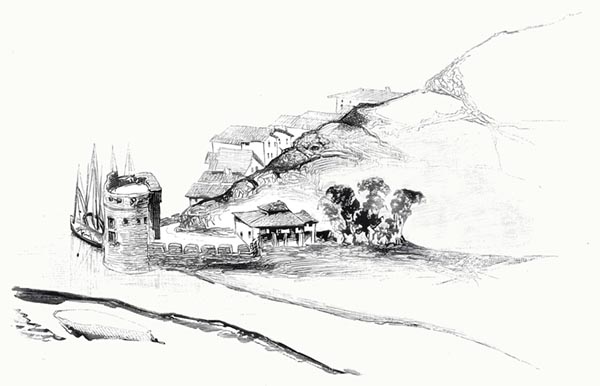
‘The Bay of Pasai’- Victor Hugo (1894)
Paris Musées
Pasai, however, well-nigh guards itself. Nature has fortified it, admirably. The entrance to the port is formidable. Every year some vessel is lost there. Last year, a ship loaded with planks worth about fifty thousand francs, seeking refuge in heavy weather, was caught side on as it entered the second basin of the strait, and thrown by a huge wave onto the rocks more than sixty feet above the sea. It remained there. The points of rock pierced and gripped it on all sides. An iron cross, that trembles in the wind, today marks the spot where this great ship was nailed.
Would you like to hear now of the life I lead? Since I never close my window or door, the dawn sunlight and the child’s chatter wake me. I lack the crowing of a rooster, but I have the cries of the bateleras, which amount to the same thing. If the tide is rising, even as I rise myself, I see, from my balcony, the boatwomen, hastening towards the end of the gulf,
There are always two women in a boat, partly because of the boat’s weight, and partly because of the jealousy exhibited by their husbands or lovers. They thus go about in pairs, and each couple has a name: ‘la Catalana y su madre’; ‘Maria Juana and Maria Andres’, ‘Pepa and Pepita’, las compañeras and las evaristas (the companions and the charmers). The evaristas are very pretty; the officers of the garrison of San Sebastian are happy to walk out with them, but the former are wise; they do in fact simply walk. They always have a bouquet fastened to their oilskin hats, and when they bend over the oar, their short, heavily pleated black-cloth petticoats reveal well-shaped, well-shod legs. They are among the few who have stockings; they are the aristocracy of boatwomen. Pepa and Pepita, the two sisters, are perhaps the prettiest.
Nothing is as vivid and pure as this bay in the morning. I hear the bells of the three churches ringing behind me; the sun marks the wrinkles on the old tower. The boats leave long wakes in the gulf, each seemingly dragging behind it a long silver fir-tree complete with all its branches.
Before lunch I take a walk around the village, or the town, as you will, since I am unsure what name to give to this special place. I always discover something I failed to see the day before. There are sheds, dug into the rocks that pierce the street, and yawning open between the houses; in these sheds are supplies of wood, tree-stumps bristling like chestnuts, torn pieces from boats, the carcasses of ships. There is a woman spinning in front of the door; the thread leaves her hand, and rises to the roof of the house, from whence it falls, bearing at its end the spindle that hangs in front of the spinner. There are oriental shutters at Gothic windows, and fresh faces behind those tight meshes of black wood. There are beautiful little girls, bare-legged, and already tanned by the climate, who dance and sing:
‘Gentil muchacha,
Toma la derecha.
Hombre de moda,
Toma la izquierda.’
Which I would translate as follows, more in spirit than in the letter:
‘Clever little girl,
You take the right side.
Handsome fellow,
You take the left.’
In Pasai, they work, dance, and sing. Some work, many dance, all sing. As in all unsophisticated, rustic places, there are only young girls and old women in Pasai, that is to say flowers and... well, seek the other word in Ronsard’s works. Beautiful women, strictly speaking, are those magnificent roses that bloom between twenty-five and forty years of age, those exquisite and rare products of extreme civilisation, of elegant civilisation, which exist only in cities. To make a beautiful woman, one needs culture; one needs, pardon the expression, that cultivation we call the spirit of society. Where there is no spirit of society, such women are lacking. Rather, there is Agnes, and Gertrude; but no Elmire (see Molière’s play ‘Tartuffe’).
In Pasai there are always girls washing clothes, and clothes drying; the girls wash clothes in the streams, the clothes dry on the balconies. It’s a delight to the ear and the eye. These balconies are the most curious things in the world to look at and study. You cannot imagine all that there is to see, besides the laundry drying in the open air, as regards a balcony in Pasai.
The balustrade itself, which is almost always old, that is to say worked or carved, is already worth examining. Then, from the ceiling of the balcony — for every balcony has a ceiling which is the upper balcony or the edge of the roof — from this ceiling, are suspended lines, traps, nets, coils of rope, sponges, a parrot in a wooden cage, and boxes full of red carnations beneath which knots of rope are entangled, like little aerial gardens which make you think of Semiramis and the hanging gardens of Babylon. On the wall, between the windows, are suspended bouquets of immortelles tied in a cross, rags, old embroidered jackets, flags, and tea towels; then wondrous things whose use one cannot guess and which are there as ornamentation, four slats tied in a square, a wire hoop, or a punctured tambourine. A few charcoal drawings on the whitewashed wall, buckets with shiny iron bands for drawing water, and a laughing young girl leaning on the balustrade complete the furnishings of such a balcony.
In old San Pedro, on the other side of the bay, I saw a fifteenth-century house whose balcony, fuller of objects and more cluttered than a Normandy farmyard, was framed between two severe knightly profiles carved on wide oak planks.
The day I arrived, as if to celebrate my welcome, an old petticoat, made of several rags of every colour sewn together, fluttered like a banner from one of these balconies. This dazzling work of motley swelled in the wind with inexpressible pride and pomp. I have never seen a more magnificent harlequin’s cloak.
In the midday sun, wide bands of horizontal shadow occupy the spaces beneath all the roofs and balconies, highlighting the whiteness of the facades and making this little town, if seen from afar, bright against the dark green background of the mountains, a thing of luminous and extraordinary life.
The square, above all, is dazzling. For there is a square in Pasai, which, like all Spanish squares, is called Plaza de la Constitucion. Despite this dour parliamentary name, the Plaza de Pasai sparkles and shines with admirable verve. This square is nothing other than an extension of the street, widened, and open to the sea. Some of the tall houses that surround it are perched on colossal arches. The central house bears the city’s colourful coat of arms on its front. All the ground floors are shops.
On certain Sundays, the city treats itself to a bullfight, and this square serves as its amphitheatre, as indicated by the assemblages of posts planted in the pavement along the parapet. Next to the Plaza de la Constitucion, which is the Plaza de Toros, nothing, I repeat, is more cheerful, more curious, or more entertaining to the eye.
The overabundant life that animates Pasai is gathered in this square, and reaches its climax there. The bateleras stand at one end, the majos (well-dressed workers) and sailors at the other; children crawl, climb, walk, toddle, shout and play on the cobblestones; the painted facades display all the colours of a parrot’s fathers, the brightest yellows, the freshest greens, the reddest vermilions. The rooms and shops are caverns full of magical chiaroscuro, where one glimpses among the glimmers and reflections all sorts of fanciful furniture, sideboards such as one sees only in Spain, mirrors such as one sees only in Pasai. Good, honest, and cordial figures occupy all these thresholds.
I was telling you earlier about Pasai San Pedro, the Old Pasai, which is also called el otro Pasai. There are in fact two Pasais, a young one and an old one. The young one is three hundred years old. It is the one I am lodging in. The other morning, I decided to cross the water and visit the old village. It’s a sort of southern Bacharach am Rhein. Here, as in the Rhine version, the stranger is truly strange. Haggard children and pale old women watch you pass by in amazement.
One called out to me, as I halted in front of her house: ‘Hijo, dibuja eso. Viejas cosas, hermosas cosas: Son, draw this. Old things, beautiful things). The house was indeed a magnificent thirteenth-century hovel, the most dilapidated and crumbling one could find.
The street of the Old Pasai is a real Arab street; whitewashed houses, massive, with bumpy walls, barely pierced by a few holes. If it weren’t for the roofs, one would think one was in Tetouan (in northern Morocco). This street, where ivy runs from one side to the other, is paved with flagstones, large slabs of stone that undulate like the scaly back of a snake.
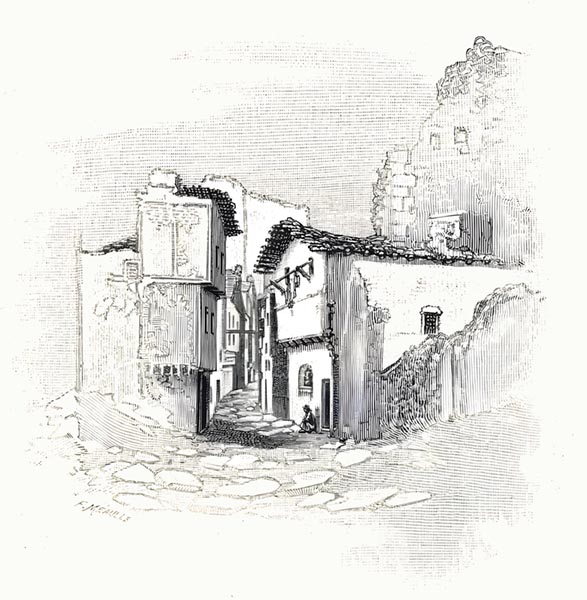
‘The Street of the Old Pasai’- Victor Hugo (1894)
Paris Musées
The church (the parish church of San Pedro) spoils the ensemble. It is modern and rebuilt in the last century. I had it opened up for me for half a peseta. An inscription on the organ gives the date, which is all too clearly written in the architecture:
manvel martin
carrera me hizo
año 1774
Manuel Martin Carrero built me, 1774
The church is gloomy; this Old Pasai is sad. Nothing could be less alike: gloominess is the sadness of what is small. Whereas Pasai San Pedro has grandeur.
You will see, my friend, that my morning walks are not without interest. My walk completed, I return, I have breakfast, and I wander along the rocky paths. I give the mornings to the city and the days to the mountain.
I climb the mountain by perpendicular staircases, with tall and narrow steps, solidly built into the escarpment and amidst the rough vegetation of the rock. When one reaches the top of one staircase, one finds another. They are thus joined end to end, rising towards the sky like those fearful ladders one sees trembling in the impossible and mysterious architectural engravings of Giovanni Piranesi. However, Piranesi’s ladders vanish into infinite regions, while the staircases of Pasai reach an end.
Once I am at the top of the stairs, I usually seek a ledge, a goat’s path, a sort of gutter made by the rain and the torrents forming a ledge on the mountain. I go in that direction, at the risk of tumbling down onto one of the village roofs, falling down a chimney into a cooking pot, and adding myself as one more ingredient to some olla podrida (Spanish stew).
The mountain peaks are a world unknown to us. Therein, vegetates, flowers, and throbs a Nature finding refuge, that lives apart. There, the fierce and the gentle, the wild and the peaceful, combine in a mysterious form of union. Mankind is far away, Nature is tranquil. A sort of confidence, unknown in the plains where the creatures may suddenly hear human footsteps, calms them and modifies their instincts. This is no longer the fearful anxious world of the countryside. The butterfly does not flee; the grasshopper allows itself to be caught; the lizard, which is to the stones what the bird is to the leaves, emerges from its hole and watches one pass. No other sound but the wind, no other movement than the grass below, and the cloud above. On the mountain slopes the soul is elevated, the heart is purified; thought takes its share in this profound peace. One seems to feel the eye of Jehovah upon one.
The Pasajes mountains have a dual attraction for me. The first is that they reach the sea, which at every moment transforms their valleys into gulfs, and their ridges into promontories. The second is that they are formed of sandstone, which is rather disdained by geologists who classify it, I believe, among the parasites of the mineral kingdom. As for me, I think highly of sandstone.
You know, my friend, that, to thoughtful minds, all parts of Nature, even those, at first glance, the most disparate, are connected by a host of secret harmonies, invisible threads of creation that the contemplative eye perceives, which make of the great whole an inextricable network alive with a single breath of life, nourished by a single sap, a unity in variety; those threads which are, so to speak, the very roots of being. Thus, for me, there is a harmony between the oak and the granite, which awaken in the mind, the one amidst the vegetable order, the other within the mineral region, the same idea as the lion and the eagle awaken among animals: power, grandeur, strength, excellence.
There is another harmony, even more hidden, but to me just as obvious, between the elms and the sandstone.
Sandstone is the most amusing and strangely kneaded stone there is. It is among rocks what the elm is among trees. There is no appearance that it fails to assume; no whim that it fails to exercise; no dream that it fails to realise; it adopts all the faces, it displays all the grimaces. It seems animated by a multiple soul. Forgive me the use of the word with regard to mere things.
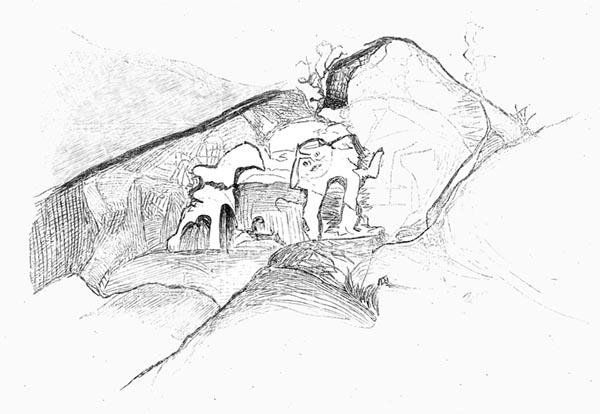
‘It adopts all the faces, it displays all the grimaces’- Victor Hugo (1894)
Paris Musées
In the great drama of the landscape, it plays the role of a creature of fantasy; sometimes tall and severe, sometimes buffoonish; bending like a wrestler, curling up like a clown; it is a sponge, a piece of pudding, a tent, a hut, a tree-stump; it appears in a field among the grass at ground level in small tawny, flaky bumps, imitating a somnolent flock of sheep; it has faces which laugh, eyes that gaze, jaws that seem to bite and graze the ferns; it grasps the undergrowth like a giant fist suddenly emerging from the earth. Antiquity, which loved finished allegories, should have carved statues of Proteus from sandstone.
A plain strewn with elms is never dull; a sandstone mountainside is always full of surprise and interest. Whenever the still life seems to come alive, it moves me with a strange emotion.
It is especially in the evening, at the troubling hour of twilight, that these elements of creation begin to take shape, and become ghostly. A dark and mysterious transfiguration!
Have you noticed, at nightfall, on the main roads around Paris, the monstrous, supernatural profiles of all the elm-trees that one’s carriage, travelling at full gallop, causes to appear and disappear before one, in succession? Some yawn, others twist towards the sky, and open wide a mouth that howls dreadfully; there are some that laugh with a fierce and hideous laughter, peculiar to darkness; the wind agitates them; they lean back displaying the contortions of the damned, or lean towards each other and whisper in each other’s vast leafy ears words of which you hear in passing who knows what strange syllables. There are some that possess disproportionate eyebrows, ridiculous noses, dishevelled hair, formidable wigs; which in no way detracts from the fearsome, lugubrious nature of their wondrous reality; they are caricatures, but they are also spectres; some are grotesque, all are terrible. The dreamer believes he is seeing the unknown, and possibly monstrous denizens of the night, lined up at the edge of the road, in threatening, deformed rows, leaning above him as he passes.
One is tempted to ask whether these are not the mysterious beings whose very medium is the darkness, beings composed of shadow as the crocodile is composed of stoniness, as the hummingbird is composed of air and sunlight. All thinkers are dreamers; reverie is simply thought in its fluid, floating state. Every great mind has been obsessed, charmed, frightened, or at the very least astonished, by the visions that emanate from Nature. Some have spoken of them, and have, in a manner, deposited in their works, to forever live there, with the immortal life granted by their style and thought, those extraordinary and fleeting forms, the nameless things that they had ‘glimpsed in the darkness of night: visa sub obscurum noctis’ (Virgil: ‘Georgics’ I, 478). Cicero calls them imagines, Cassius Dio spectra, Quintilian figurae, Lucretius effigies, Virgil simulacra, and the Lombard Laws, the Edictum Rothari of 643AD, masca. In Shakespeare, Hamlet talks of such to Horatio. Pierre Gassendi was concerned about them and Joseph-Louis Lagrange dreamed about them, after translating Lucretius, and meditating on Gassendi.
I am thinking aloud along with you, my friend. One idea leads me to another. I let my thoughts roam. You are kind and sympathetic and indulgent. You are accustomed to my pace, and permit me to think with a free rein. Yet here I am far from sandstone, in appearance at least. Let me return to it.
The aspects presented by sandstone, the singular copies it makes of a thousand things, have this peculiarity that the clarity of day does not dissipate them, nor does it make them vanish. Here, at Pasajes, the mountain, sculpted and worked by the rains, the sea and the wind, is populated by the sandstone with a crowd of stony inhabitants, mute, motionless, eternal, almost terrifying. There, sits a hooded hermit, at the entrance to the bay, on the summit of an inaccessible rock, arms outstretched, who, depending on whether the sky is blue or stormy, seems to bless the sea or warn the sailors. There, are dwarfs with birds’ beaks, monsters in human form and with two heads, one of which laughs and the other weeps, close to the sky, on a deserted plateau, amidst the clouds, where nothing makes one laugh and nothing makes one weep. Here, are the dismembered limbs of a giant, disjecti membra gigantis (see Horace ‘Satires’, 1.4.62; a variant on his ‘disjecti membra poetae’); here a knee, there a torso and shoulder-blade, further on, the head. Here, is a pot-bellied idol, with an ox’s muzzle, necklaces around its neck, and two pairs of thick, short arms, behind which large branches of brushwood wave like fly swatters. And here, crouching at the top of a high hill, is a gigantic toad, marbled by lichens with yellow and livid spots, which opens a horrible mouth, and seems to blow the storm over the ocean.
My notes: Pasai. In the evening, dancing, laughter, guitars. Suddenly a doorbell rings, and a voice says: paralme almas del purgaterio: pray for the souls in purgatory. Everyone falls to their knees.
On Sundays, a concert is paid for by the town. Two ragged, sad-looking fiddlers play the violin and bang the tambourine. Always the same cadence; the dancing of bears. To this music, the most beautiful girls in the world dance with a deep, solemn joy. Pepa and Pepita, the two boatwomen, the two beautiful sisters, both have something pure and noble about them. The elder looks chaste, the younger looks virginal. One might think one was seeing the Madonna dancing opposite the goddess Diana.
Handsome shepherds; handsome fishermen; dark-skinned, swarthy, robust. Respectful and tender as regards their gestures with these modest girls. This dance, however, resembles our proscribed dances. The children dance as well; two-year-olds who sway in such a manner as would doubtless frighten Parisian police officers. These fisher-folk dancing like this in their picturesque costumes, in white shirts, red belts, blue berets, jackets on their shoulders; are beautiful, noble, graceful, almost antique in profile.
Pot-bellied gnomes with broad, flat faces, in frock coats and blunderbuss hats, look at them with disdain. They are the bourgeoisie.
Chapter IX: Around Pasai
Excursions in the mountains. Written while walking.
I
August 3rd, 5 p.m.
While walking along the harbour, I noticed a kind of ruin at the top of a mountain (Fuerte de Lord John Hay, a British fort, completed 1838, rebuilt 1875). It in no way has the look of an ancient ruin. It is a modern, and probably recent, result of demolition. The English during their stay in Pasajes, and the Carlists and the Cristinos during the last war, built forts on the heights; the ruin is undoubtedly one of those forts since razed. I intend to visit it.
I climb the mountain. There is a path apparently, but not one I know. I venture on through the broom. The climb is long, almost sheer, and quite arduous. Halfway up, I sit down on a shelf of sandstone.
The horizon is higher; the sea has reappeared over there. The sound of the bells round the necks of the goats that graze on the precipice reaches me. Near my foot I see a beautiful green buprestid (jewel beetle) dotted with golden spots.
I resume my climb; the mountain summit curves, and rounds; walking becomes easier. I arrive at the ruin. A stone chimney, black with smoke, stands above a wall. A huge pile of demolished ashlars. A ditch full of rubble. I clamber over the stones. They are mixed with broken tiles and bricks. I am on the plateau.
A road for cannon-carriages, paved, brand new, and looking like it was laid yesterday. Yet grass grows in the spaces between the slabs.
I enter the first pile of ruins. — A square stone room. — A large, thick wall. — Three loopholes looking down on the houses of Pasai. — In the centre of the room, an enormous brick and stone chimney, the one whose flue I could see, mostly demolished, and of a strange appearance. — Several brick compartments, cubic and circular, are probably a furnace for red-hot cannonballs. The interior is nothing but a heap of rubble. No human noise reaches here. All you can hear is the wind and the sea. It is starting to rain. Stones roll beneath my feet. I extricate myself with difficulty.
A second room, about ten feet square; identical to the first. Three loopholes overlooking the village. A window overlooking the sea. The remains of a beam in an embrasure; it is rotten; I break a piece from it. Two other small rooms without windows; one completely blackened with smoke. I make a plan of the first set of ruins, leaning on the top of the wall. Burnt wood is mixed with the rubble. The three rooms no longer have roofs; not even vestiges of them remain.
I enter the second area of ruins. A large room, less cluttered with rubble, with a small fireplace at the back. Next to it, a smaller room; both square. Everything is torn away, destroyed, collapsed. Hideous insects flee from under the stones I lift with the tip of my cane. The rain intensifies. Fog covers the sea and the mountain. I exit and descend.
I decide to climb the rest of the ruins. A pile of stones that must have been a third building. Behind this pile, a small cultivated field twelve feet square covered with sections of burnt wood. The ditch borders the field and surrounds the three sets of ruins. — It is now pouring with rain. A kind of darkness is forming. The mist is thickening more and more. Everything disappears around me. I can see nothing but the ruins, the paved road, and the plateau. — I shall be unable to find my way and find myself lost among the escarpments. God protect me!
A magnificent butterfly, driven by the rain, comes to take refuge behind me, on a stone. It is less afraid of me than of the storm. It is right to be so; I leave it alone. I retreat downhill randomly.
The weather is clearing. The rain is easing, daylight is returning. — I can see the small harbour. — It is populated by fishing boats with four oars, racing over the water. From where I am, the harbour, full of these boats, looks like a pond covered with water-spiders.
II
August 4th, 2:30 p.m., on the mountain
Desolate nature. — Violent wind. — The small bay narrowly confined between the two capes of Pasajes. — The sea breaks furiously on a shelf of rocks that half closes the bay. The high sea is dark and agitated. Leaden sky. The sunlight and shadow wander over the waves.
In the distance, a trincadour (a flat-bottomed, undecked coastal vessel with a raised bow, and two or three lug or lateen sails) from Hondaribbia, its twin sails in the wind, struggles, to enter the bay. It sets course for the passage. The tide rocks it back and forth. Just now, a shepherd was saying to me in the mountains: ‘Iguraldia gaiztoa: bad weather’. — Here it is, the boat is almost touching the rocks that the waves cover with foam. It passes by. It has passed. — A cicada sings in the grass beside me.
3 p.m. on the edge of the precipice
Bare rocks like skulls. Heather. I stick my cane in the moor, and it stands upright. Flowers everywhere, and grasshoppers of a thousand colours, and the most beautiful butterflies in the world. I hear laughter, in the abyss, of young girls whom I cannot see.
One of the rocks in front of me has an interesting profile. I draw it. The cheek seems to have been eaten away, as well as the eye and the ear, and one would think one could see the inside of the exposed trunk.
In front of this rock, another represents a dog. It looks as if it is barking at the open sea.
5 p.m.
I am on a rocky point at the end of a cape. I circle the rock, climbing the escarpment. In climbing I place my hands and feet into the strange holes with which the rock of this shore is riddled, and which resemble the imprints of enormous feet. I thus reach a kind of console with a backrest that projects over the abyss. I sit there; my feet dangle in the void.
The sea, nothing but the sea. — Magnificent and eternal spectacle! It whitens there, below, on black rocks. The horizon is misty, although the sun burns me. Always a strong wind. — A gull passes majestically in the abyss a hundred fathoms below my gaze. — The noise is continuous and deep. From time to time, one hears sudden bursts of sound, like that of sudden and distant fall, as if something collapsed; then there are murmurs that resemble a multitude of human voices; one might think one heard the noise of a crowd.
A thin, shining silvery fringe winds along the coast as far as the eye can see. Behind me, a large, standing rock represents an immense eagle lowering itself toward its nest, its two claws resting on the mountain. A dark and superb sculpture of the ocean.
6 p.m.
Here I am at the very tip of a high mountain, on the highest peak I have been able to reach in a day. Here again I have had to climb on my hands and knees.
I discover an immense horizon. All the mountains as far as Roncesvalles. The whole sea of Bilbao to the left, the whole sea of Bayonne to the right. I write this leaning on a rooster’s crest shaped block that forms the extreme ridge of the mountain. On this rock, three letters have been deeply engraved with a pickaxe on the left: LRH, and two letters on the right: VH.
Around this rock, there is a small triangular plateau covered with dried-up heather, and surrounded by a kind of very rough ditch. However, I notice in a crevice a pretty little pink heather-flower in bloom. I pick it.
7 p.m.
Another fort (The Admiral’s Fort, on Mount Ulia, built by the British in 1836), much larger than that of yesterday. A thousand insects are bothering me. I am within the enclosure, after climbing the moat. A large square of stone walls topped by an earthen wall; still intact here and there, and covered with grass. Four Basque shepherds, wearing berets and red jackets, are sleeping in the shade in the moat. A large white dog is sleeping on top of the wall.
The remains of rooms. In one of them, the damaged pieces of a chimney are still visible. In the middle of the large enclosure, a smaller one, one corner of which is burnt and blackened with smoke. Behind this small enclosure, a terrace leading to a staircase of four steps.
One of the shepherds woke up, and came over to me. I said to him gravely: ‘Jaincoa berorrecrequin: God be with you.’ He walked away in astonishment. — He went to wake the others — I see them through the embrasures looking at me with a strange air. — Is it a worried air? Is it a threatening air? I know not; perhaps both. I have no other weapon than my cane. The dog has woken up too, and is growling.
A marvellous carpet of green grass, as thick as fur, dotted with a million daisies and chamomiles in bloom, fills the entire ruin, right to the last corners. I am ascending to the terrace.
Here I am. I am sitting on top of the dry brick wall. Behind me is the sea, in front of me is a cirque of mountains. To my left, in the distance, on a ridge that touches the clouds, I can see the demolished fort I visited yesterday; to my right, even further away, Fort Wellington and the old lighthouse tower beyond San Sebastian (on Santa Clara Island). In one hollow, the Loyola Valley (the valley of the River Urola, containing the Loiola Sanctuary); in another hollow, the Hernani Valley.
One of the shepherds approached me again; I looked at him fixedly; he ran away shouting: — ‘Ahuatlacouata! Ahuatlacouata!’ I am descending.
On the way back down, the strangest sight in the world. A small triangle of water in a huge circle of mountains; in this water a few aphids. This water is the bay; these aphids are the ships.
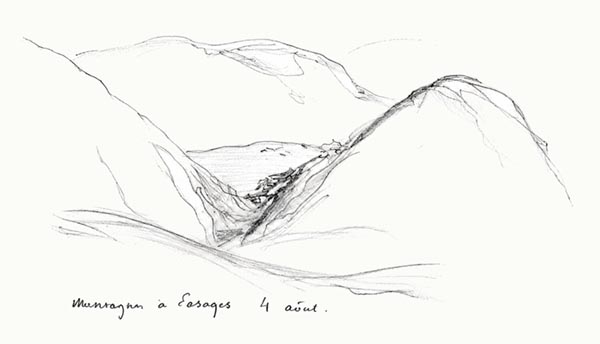
‘A small triangle of water in a huge circle of mountains’- Victor Hugo (1894)
Internet Archive Book Images
III
August 5th, noon
Still following the road halfway up the hill, after passing the castle, its sentry box, and its sentry, I come across a wash-house.
This wash-house is the most charming cavern ever. An enormous rock, which is one of the sharp edges of the mountain, and which extends quite far above my head, forms here a sort of natural grotto. Through the vault of this cavern a spring filters, its water falling abundantly, drop by drop, from every crack in the ceiling. It looks like a shower of pearls. The entrance to the cave is carpeted with vegetation so rich and so dense it forms an enormous porch of greenery. All this greenery is full of flowers. In the middle of the branches and leaves, a long blade of grass forms a sort of microscopic aqueduct, and serves as a conduit for a small stream of water which runs along its entire length then falls from its end, pouring itself into the dark depths of the cave, as a silver thread. A sheet of clear water which is restricted by a parapet fills the entire floor. The uncemented stones provide an outlet for the water which runs away into the pebbles.
The path passes some distance from the parapet, from which it is separated by a wide, fresh lawn of watercress. You can see the water through the leaves, and hear the spring murmuring beneath the greenery. If you turn around, you can see Pasajes Bay and, on the horizon, the open sea.
Three women, their legs up to their knees in water, are washing their clothes in the washhouse. One cannot say they are beating them, but rather thrashing them Their method consists of violently whipping the stone parapet with the clothes they hold in their hands. One is an old woman. The other two are young girls. They stop for a few moments, look at me, then return to their work.
After a few moments of silence: ‘Monsieur,’ the old woman says to me in bad French, ‘have you come from the mountain?’ I reply in poor Basque: ‘Buy, bicho nequesa (more correctly, ‘bai, bide neketsua: yes, a wearisome path’). The young girls look at each other with lowered eyes, and start to laugh.
One is blonde, the other is brunette. The blonde is the younger and prettier. Her hair, braided in a single pigtail at the back, according to the fashion of the country, takes on a tawny tint on the top of her head, like silk braids that have been left exposed to the air, whose colour has faded. Moreover, the young washerwoman is full of grace, in her red petticoat and blue corset, the two favourite colours of the Basque people.
I approach her and start the conversation in Spanish:
— ‘What is your name?’
— ‘Maria Juana, at your service, Senõr.’
— ‘How old are you?’
— ‘Seventeen.’
— ‘Are you from this country?’
— ‘Yes, Senõr.’
— ‘Daughter of a bourgeois?’
— ‘No, sir, I am a boatwoman.’
— ‘A batelera! And you are not at sea?’
— ‘The tide is low; and then, we have to wash our clothes.’
Here the girl grows bolder and continues of her own accord:
— ‘I was on the shore the other day, Senõr, when you arrived. I saw you. You had first chosen Pepa to take you across; but, as you were with Senõr Leon, and the lord had already embarked, and Manuela the Catalan is his boatwoman, you crossed with Manuela. Poor Pepa! But you gave her a coin. — Do you remember,’ she said, turning to her companion, ‘do you remember, Maria Andrès? The Senõr chose Pepa first.’
— ‘And why did I choose her?’
The girl looks at me with her big, naive eyes and answers without hesitation:
— ‘Because she’s the prettiest.’
Then she starts beating her laundry again. The old woman, who has finished her task and is leaving, says, as she passes by me:
— ‘The muchacha is right, Senõr.’
And saying this, she places her basket on the ground and sits down at the edge of the path, fixing on the two young girls and on me her little grey eyes, pierced as if with a gimlet amidst the wrinkles.
— ‘Would you like me to help you replace this basket on your head?’ I ask her.
— ‘A thousand thanks, Senõr! But no one helped me yesterday, and no one will help me tomorrow; it is better if no one helps me today.’
— ‘What do you call this herb in Spanish?’ I said, pointing at the watercress with the tip of my cane.
— ‘Berro, Senõr.’
— ‘And in Basque?’
She gives me a lengthy answer which I don’t recall well enough to write down.
I turn to the young girls:
— ‘Maria Juana, what is the name of your querido (boyfriend)?’
— ‘I don’t have one.’
— ‘And Maria Andres?’
— ‘Maria Andrès has one.’
The girl said this deliberately, without hesitation, without appearing surprised by the question or embarrassed by replying.
— ‘What is the name of Maria Andrès’ querido?’
— ‘Oh! He’s a fisherman, a poor lad. He’s very jealous. Look, he’s over there in the bay; you can see him from here in his boat.’
Here the old woman spoke again:
— ‘And, luckily, he doesn’t see you! He would be happy indeed if he saw Maria Andrès laughing and talking with a Senõr! Talking with a Frenchman, Sweet Jesus! Better to chat with the four demons of the east, west, north and south.’
A soldier passes by; I wave to the girls; they return my wave with a smile, and I continue on my way.
IV
August 6th, 3 p.m.
I hear a young rooster crowing in the distance, and I keep walking. I arrive, via a very rough road cut into the rock for oxcarts, at a strangely wild ravine. The rocks emerging from the heather on the steep mountain slope almost all represent gigantic heads; there are death’s-heads, Egyptian profiles, bearded Sileni laughing in the grass, and gloomy knights with severe profiles. Everything, and everyone, is here, even Odry (Jacques Charles Odry, the comic actor and poet), who is sneering beneath a brushwood wig.
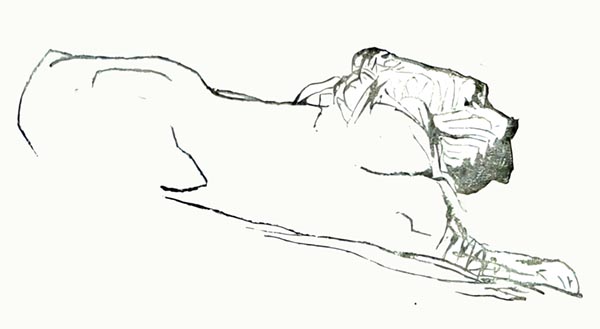
‘There are death’s-heads, Egyptian profiles’- Victor Hugo (1894)
Internet Archive Book Images
Through the break between the two mountains, on the right, I see an arm of the sea, three villages, two ruins, including a monastery, a wonderful valley, and a chain of high peaks covered in clouds.
The village of Lezo, which is the nearest of the three, has its beautiful Gothic church of a simple and large design; it looks like a fortress. God himself lives in citadels in this country where war is never extinguished at one corner of the horizon without reigniting at the other.
5:30 p.m.
Here the spectacle is one of tremendous magnificence. The horizon forms two segments, sea and mountain. The shore extends before me as far as the eye can see. It has the angle and shape of the immense escarpment of an immense entrenchment that the heather clothes. A precipice at the same angle forms the counterscarp.
On the landward side, the sea furiously besieges and batters this entrenchment, on the edge of which nature has placed a parapet that looks as if it was built with a set-square. The entrenchment is collapsing, here and there, in long wave-like sections that fall as a single block into the ocean. Imagine slabs eighty feet long. Where I am, the assault has been furious, the devastation is terrible. A monstrous breach has been made.
I sit on the very tip of the overhanging rock that dominates this gap. A forest of ferns fills the top of the collapsed part. A crowd of dwarf-oaks, which the wind from the sea has stunted to the height of a lawn, grow around me. I pluck a pretty red leaf.
Well-nigh imperceptible fishing boats swim at the bottom of the abyss, at my feet; mackerel, lubines (sea-bass), and sardines gleam in the sun, in the bottom of the boats, in starry heaps. The shadows of the clouds give the sea a bronze hue.
7 p.m.
The sun is setting. I walk back down. A child is singing amidst the mountain slopes. I see him passing at the bottom of a sunken path, chasing six cows before him. The mountain’s battlements cast wide shadows across a red field where sheep graze.
The sea is chrysoprase green. It becomes darker. The sky fades.
Chapter X: Lezo
August 8th
For several days I had noticed from the mountains a village of strange and severe appearance. This village is called, Lezo. It is situated at the end of the Pasajes inlet, at a place left dry by the tide when it withdraws. Yesterday, as the sun was setting, I followed an ox-track halfway up the hill which leads to it.
The road is often very rough, paved in places with sandstone and marble slabs, and interrupted here and there by a kind of steep staircase formed from the crumbling slabs. Moreover, it runs along the slopes of two mountains which are now covered with an immense blanket of flowers, purple heather, and yellow broom.
I left behind, on my right, a large stone farm with an ogival door, then, on my left, a wild gorge, from which a torrent bursts forth in the most furious and strange manner from a ruin that was once a house. I crossed this torrent on a small single-arched bridge, and climbed the slope of the opposite mountain.
Women were singing; children were bathing in puddles; French workmen from Bayonne, who are currently constructing a building in the bay, were traversing a ravine, seven of them carrying a long wooden frame; I could hear the bells of the oxen, and the rustling of the trees; the landscape was magnificently cheerful; the wind brought everything to life; the sun gilded everything.
Then I came across a ruin on the right, a ruin on the left, and another, and then a group of three or four behind a clump of apple trees, and suddenly I found myself a few steps from the village.
I used the word ruin incorrectly; I should have used the word ‘hovel’. The hovels usually consist of four roofless walls pierced by a few windows, most of them blocked with a brick apron and converted into loopholes, with traces of fire everywhere, and inside a cow or a goat peacefully grazing the grass on the paving, and the ivy on the walls. These ruins are the result of the last war.
As I entered the village, a solemn beggar-woman, at least a hundred years old, rose from the corner of a wall and asked me for alms with a gesture, to formidable effect. I gave this centenarian a sou.
I entered a gloomy street, lined with large black houses, all of stone, some with balconies of heavy iron of ancient workmanship, others with enormous coats of arms, carved in the round, in the centre of their facade.
Livid faces, which seemed to have suddenly awakened, appeared on the thresholds as I passed. Almost all the windows revealed, instead of curtains, vast cobwebs. Through these long, narrow windows, I looked into the houses, and saw what looked like the interiors of sepulchres.
In an instant, a head appeared at each window, a head even older than the window. All these dull, cadaverous heads, as if dazed by too bright a shaft of sunlight, were moving, leaning over, whispering. My arrival had set this anthill of spectres in turmoil. It seemed to me that I was in a village of ghosts and lamiae, and all these shades were gazing in anger and with terror at a living being.
The street I entered was winding and divided, so to speak, into two levels. The right side leaned against the mountain; the left side plunged into the valley.
There were many fifteenth-century houses, with two large doors; on the keystone of the first door was carved, in the most delicate and elegant manner, the house number intertwined with some religious symbol, a cross, a dove, a cluster of lilies; on the keystone of the second were carved the attributes of the inhabitant’s trade, a wheel for a wheelwright, an axe for a woodcutter. In this village, everything possessed a sombre and singular grandeur. One sign was a bas-relief.
There was deep poverty here, but not a vulgar poverty. It was a poverty housed in cut stone; a poverty with balconies of wrought iron like the Louvre, and coats of arms on marble slabs like the Escorial. A tribe of gentlefolk in rags, in granite huts.
I saw not a single young face, except for a few ragged children who followed me at a distance, and who, as soon as I turned around, retreated without fleeing, like frightened young wolves.
Between every two houses there was a ruin, mostly covered with ivy and blocked with brushwood, sometimes old, more often recent.
Climbing over the sections of wall, I came to a house that appeared uninhabited. The entire facade on what had been the street possessed the gloomy air of a home without owners, the doors carefully shut, the green shutters, of Louis XIII period woodwork, at the windows everywhere closed. I climbed a small fence to go around this house, and found it open on the far side, dreadfully open, open from top to bottom due to the entire demolition of the rear facade the remains of which lay on the ground, in one piece, in a field of crushed corn. I walked along this wall as on broad paving, and entered the house.
What desolation! I saw at a glance that the four floors had been gutted. The staircase had burned; the stairwell was nothing more than a large hole into which all the rooms led. The walls, red and hideous, showed scorch marks everywhere. I was only able to walk around the ground floor; the staircase having collapsed.
The house was very large and very tall; it is supported only by a few pillars and beams now, thinned by the fire. I felt it hanging and trembling above my head; from time to time a stone, a brick, a piece of plasterwork would shake loose and fall at my feet, making a sinister noise of life in that dead dwelling. On the third floor, a half-burnt board remained hanging from a nail; the wind stirred it and made it creak sadly. I saw again in the bedrooms that the shutters were firmly clasped. There were a few shreds of paper on the walls. One room is painted pink. In the kitchen, in a place now inaccessible, I noticed, on the white jamb of the tall chimney, a small ship drawn in charcoal by a child’s hand.
From a centuries-old ruin one emerges with an enlarged and expanded soul. From a ruin of yesterday one emerges with a heavy heart. In the ancient ruin, I imagined ghosts; in the recent ruin, I imagined its last owner. The ghosts were less sad.
The tall, enormous, gloomy, granite church of San Juan Bautista dominates this wild village. From a distance, it is not a church, it is a solid block. As one approaches, one can see a few holes in the wall, and in the apse three or four fifteenth-century ribbed vaults. As they probably found that too much light entered this stone box, the ribbed vaults were walled up, leaving only a narrow bull’s-eye window in the centre of each one. The walls are red, rough, and eaten away by lichen.
The facade is a large, square-cut wall, without a rose window, without a bay, and offering the eye no other opening than the portal, which is low and sad, with two crude columns and a bare pediment. Two long slashes of black stone scar this facade from top to bottom. It is flanked on the right by a long, narrow tower, which barely exceeds the height of the building.
Seven or eight hideous and solitary old women were crouched at intervals around the exterior of the church. I know not whether this arrangement was the effect of pure chance, but each of these old women seemed to be paired with a gargoyle that stretched out its neck above her head, at the edge of the roof. At times, the old women raised their eyes to the sky and seemed to exchange tender glances with the gargoyles.
One of these wild beggars fixed on me a wilder and more intense gaze than the others. I went straight up to her, which seemed to surprise her; then I indicated the church and said to her: ‘Giltza,’ which means in Basque: ‘the key’. The living gargoyle, tamed by this magic word, and the fifty centimes coin that I threw into her apron, stood up and said: ‘Bai,’ that is to say: yes. She disappeared behind the church.
I stood alone in front of the porch. The other old women had all risen, and gathered at one corner from which they were watching me. A few moments later, the one who had vanished reappeared holding a key. She opened the church door, and I went in.
Was it the hour, the approaching night, the disposition of my mind, or an emanation of the building itself? I have never felt a more chilling impression than when I entered this church.
It was a high nave, as bare inside as it was outside, dark, cold, miserable and large, barely lit by the pale, earthy rays of twilight.
At the back, behind the tabernacle, on a stone platform, from the pavement to the vault, stretched an immense altarpiece, laden with statues and bas-reliefs, once gilded, now rust-coloured, displaying over a surface sixty feet high the formidable saints of the Inquisition mingled with the tragic and sinister architecture of Philip II. This altar, glimpsed in the shadows, had something pitiless and terrible about it.
The old woman had lit a candle, which glittered in a large, tastefully stamped tin-lamp hanging before the altar. This candle did nothing to alleviate the darkness and added something to the horror.
The priest ascends to the altar by a wide staircase which is enclosed by a massive ramp, admirably worked in the dark and elegant taste of Charles V, which corresponds to what we call in France the François I style, and to what is known in England as Tudor architecture. I climbed this staircase, and from there inspected the church interior, which is truly majestic and funereal. The old woman was somewhere in a dark corner.
The door had remained half-open, and I saw in the distance the countryside already covered in shadow, the darkened sky, the arm of the sea, and a vast beach, at that moment dry; in the foreground, a ruin which was a hovel; in the mid-distance, a ruin which was an alcalde’s house; in the background, a ruin which was a monastery. The ruined hut, the ruined house, the ruined monastery, the sky from which the day was departing, the beach from which the sea had withdrawn, was that not a complete symbol? It seemed to me that, from the depths of this mysterious church, I saw, not just any countryside, but the aspect of Spain itself.
At that moment, a strange noise reached me. I listened, unable to believe my ears, and listened again. A surprising thing, and one which announces how profound the revolution taking place in this country already is: the group of children who had followed me from afar had seen the church door open; they had settled under the porch, and were chanting away at the tops of their voices, and with derision and long bursts of laughter, the Mass and Vespers, parodying the priest at the altar, and the singers in the choir.
Shall I tell you, friend? At that moment, I felt in my soul an infinite pity for these poor children who will lack religion before they acquire civilisation.
And then, from the children, my pity went to this poor old nave of the Holy Office, obliged to endure the affront in silence. What a torment! What a reversal! Children mocking what has so long made men tremble! Oh! if stones have entrails, if the souls of institutions communicate themselves to the edifices they construct, what gloomy and inexpressible anger must at that moment be stirring these austere and formidable walls to their very foundations! And to think that this was happening near the cradle of Saint Ignatius, thirty miles from the valley of Loiola! — As the children sang, the nave became darker, and this nightfall in the church seemed to be the image of the nightfall of their faith. Sad church of San Juan, you thought you had defeated Satan, and you are defeated by Voltaire!
Thus, everything is in ruins in Spain! The houses, their human dwellings, are ruined in the countryside; religion, that dwelling of the soul, is ruined in their hearts.
It was dark when I left the church. All the windows and doors in the village were shut. Not a light, not a single inhabitant. It was as if the tombs had closed and the ghosts had returned to their slumber
However, in one square, I distinguished a glimmer. I headed towards it. A shutter was half-open on the ground floor, and I saw in a low room an old woman crouching, motionless, leaning against a freshly whitewashed wall. Above her head burned a lamp attached to a nail, the old Spanish lamp with the shape of a sepulchral lamp. I thought I saw Lady Macbeth dreaming.
The rays of this lamp allowed me to read this inscription on the door of the house opposite:
posada
i habii
inn
and lodgings
I had hardly expected to find an inn there.
The moon was rising behind the Jaizkibel Mountains as I left the village. It was easy for me to find my way back. Yet, in the frame of mind in which my visit to this strange place had left me, I had difficulty recognising the countryside that had charmed me so, but a few hours before. That landscape, so cheerful in the sun, had become gloomy in the moonlight. The solitude of night filled the horizon.
I was approaching Pasai. A few passers-by were beginning to appear on the road. I had my eye fixed on the ruin of a castillo (fort) highlighted in the distance, by the moonlight, on the crest of a fairly high mountain, at the end of a narrow, wild and deserted valley.
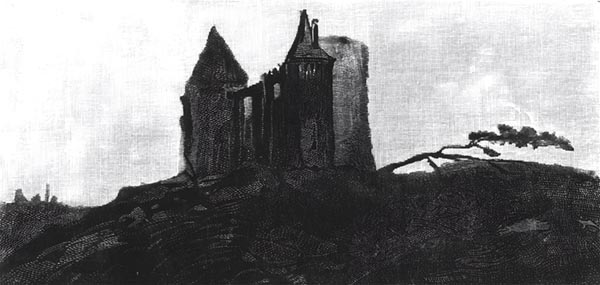
‘Ruined castle’- Victor Hugo (1894)
Paris Musées
What occupied me was a light that had just appeared in this ruin, at the end of the gable. This light had something inexplicable and singular about it, first because of the place where it shone, then because of the way in which it shone. It behaved like a lighthouse, flaring, then dying, then flaring again, shining suddenly with the brightness of a large star. What was this light, and what did it mean?
As I reached the gorge where the bridge stands, a poor woman who usually stands at the entrance to the rope- factory, and to whom I give alms almost every morning, was crossing the road to ascend to her hut halfway up the slope. On seeing me, she turned around, made the sign of the cross and pointed to the light, saying: Los demonios; Demons. I walked on.
A little further on, at the entrance to the steep pavement that leads down to Pasai, a man, a fisherman, was standing on a shelf of red marble, and, like the old woman, he was looking at the light. ‘Que es eso; what is it?’ I said to him as I approached.
The man did not take his eyes off the light, and answered me: — ‘Contrabandistas (Smugglers)’.
As I was going upstairs, at my lodgings, my hostess, the excellent Madame Basquetz, came to me:
— ‘Ah! Sir, how late you are! Have you had supper? Where have you come from, at this hour?’
— ‘From Lezo.’
— ‘Ah! You went to Lezo?’
— ‘Yes, madam.’
She repeated a moment later, with a thoughtful air:
— ‘From Lezo?’
— ‘Yes,’ I said. ‘And you, have you never been there?’
— ‘No, sir.’
— ‘And why not?’
— ‘Because the folk round here; we never go to Leso.’
— ‘And why do you never go there?’
— ‘I have no idea.’
Chapter XI: Pamplona
August 11th
I am in Pamplona, and I cannot describe what I feel. I have never visited this city before, yet it seems to me that I recognise every street, every house, every door. All of that Spain I saw as a child appears to me here. As they did on my hearing the first oxcart pass, the intervening thirty years or so have faded from my life; I have become the child again, the little Frenchman, el niño, el chiquito frances, as they called me. A whole world that was sleeping inside me has awakened and lives again, and my mind teems with memories. I thought that world was well-nigh erased; now it is more resplendent than ever.
This is truly the real Spain. I see arcaded squares, cobblestone mosaic pavements, balconies with awnings, houses painted with frills, which make my heart beat. It seems to me as if I was here only yesterday. Yes, it was surely yesterday I entered beneath that large carriage arch which opens onto a small staircase; the other Sunday, while going for a walk with my young comrades from the noblemen’s seminary, I bought I don’t know what peppered gimblettes (‘rosquillas’, ring-shaped, soft pastries) in that shop from the pediment of which hang goatskins for carrying wine; I played ball along that high wall, behind the old church. All this is certain to me, real, distinct, palpable.
There are walls coloured with extravagant marble that delight my soul. I spent two delightful hours alone, with an old green shutter with small panels that opens in two sections to make a window if you open it halfway, and a balcony if you open it completely. This shutter had been there for thirty odd years, without my realising it, in a corner of my thoughts. I said: ‘Look! There’s my old shutter!’
What a mystery the past is! And how true it is that we deposit a part of ourselves in each of the objects that surround us! We believe them to be inanimate, yet they live; they live with the mysterious life that we have given them. At each phase of our life, we shed our entire being, and leave it in some corner of the world. All that collection of inexpressible things, that were each a part of oneself, remains there in the shadows, becoming one with the objects on which we have imprinted ourself without our knowing. One day, finally, by chance, we see these objects again; they suddenly appear before us, and there they are, with the immediacy and omnipotence of reality, restoring our past to us. It is like a sudden light; they recognise us, they make themselves recognised by us, they bring back to us, in dazzling wholeness, our store of memories, and give back to us a charming ghost of ourselves: the child who played, the young man who loved.
I left San Sebastian yesterday. The mountains produce two kinds of roads: those that wind flat along the ground like vipers, and those that wind, in an undulating manner with sudden humps, like boa constrictors. Permit me those two comparisons that render my thoughts tangible. The road from San Sebastian to Tolosa is of the latter kind; that from Tolosa to Pamplona is of the former. That is to say, the road from San Sebastian to Tolosa climbs and descends along the ridges of the hills, while the road from Tolosa to Pamplona follows the windings of the valleys. One is charming, the other is wild.
Leaving San Sebastian, I took a last look at the peninsula, at the sea foaming superbly, whitening the sand, at Mount Urgull, and at the three monasteries at the gates of the town, that were burned, one by the Cristinos, two by the Carlists.
Hernani has no monuments — a random church whose Pompadour portal is nevertheless quite richly worked, and an insignificant ayuntamiento — but Hernani has an admirable landscape round about it, and a street worth a cathedral. The main street of Hernani, lined with projecting coats of arms, jewel-like balconies, and stately portals, secured by an old ruined postern gate which at this moment bears, instead of battlements, tufts of flowering nasturtiums, is a magnificent book in which one can read, page by page, house by house, the architecture of four centuries.
I regretted, while crossing the town, that nothing indicated to the passer-by the house where Juan de Urbieta was born, a Spanish captain who, at the battle of Pavia, had the honour of capturing Francis I. Urbieta behaved like a gentleman, while Francis I suffered like a king. Spain owes Urbieta at least a marble plaque in the main street of Hernani.
Moreover, these mountains are full of illustrious names. Mutriku is the homeland of Churruca who died at Trafalgar (Cosme Damián Churruca, commander of the ‘San Juan Nepomuceno’). Juan Sebastián Elcano, who circumnavigated the world in 1519, note the date (in the ‘Victoria’, on the Magellan expedition to the Spice islands) and Alonso de Ercilla, who wrote an epic poem (‘La Araucana’ concerning the Spanish conquest of Chile), were born, one in Getaria, the other in Bermeo. The Loiola valley saw the birth, in, 1491 of Ignatius Loyola, who from being a page (in a relative’s service) became a saint, while the port of Laredo saw the landing (in 1556) of Charles V, on his way from Germany to the monastery of Yuste (in Extramadura), he who, abdicating his imperial role, became a monk.
Tolosa, which may have been the old Iturissa, has more grace than Hernani, and greater life and wealth, but less grandeur and solemnity. Despite the light rain that had been falling since morning, I viewed the whole town. A few old houses, including one built under Alfonso X of Castile, the Wise, the astronomer king; a rather beautiful church, which has been converted into a storage place for fodder; two pretty rivers, the Oria and the Araxes, were all I gained for my trouble.
On the first-floor frontage of a building in the main street, there is an inscription on black marble which begins with Sic visum, superis and ends with el emperador le armo caballero. I had begun to copy it, but this unheard-of action produced in a few minutes such a crowd around me that I gave up the inscription. At this moment when the ayuntamientos (town halls) are trembling like a leaf, I feared to inadvertently cause a revolution in Tolosa.
Hernani, which I had passed through as a child, and whose memory remained with me, has much more of a Spanish physiognomy than Tolosa. The fourteen diligences that leave Tolosa every day bear off, each morning, something of the old manners, the old ideas, the old customs, of all that which makes old Spain in short.
And then there is manufacture in Tolosa. There is the Urbieta hat factory, a paper-factory, many leatherworks, and many factories making nails, horseshoes, wrought-iron pots, polished-iron balcony railings, sabres and rifles; the whole mountainside is full of forges. Now, if anything can transform Spain, it is work.
Spain is essentially the land of gentlemanly people who, for three centuries, were fed, while doing nothing, by the Indies and the Americas. Hence the emblazoned streets. In Spain, one awaited the treasure-galleon, as in France one votes on the nation’s budget. Tolosa, with its activity, its industry, its mills, its rivers, its shade, its anvils, and its noise, resembles a pretty French town. Its buzzing must surely annoy the old Castle Gate (Puerta de Castilla), and the latter must have been tempted more than once to turn around, half asleep as it is, to say: ‘Be quiet!’
As I descended from the coach, at Tolosa, at the door of the inn, a swarm of maidservants in short petticoats, with bare legs, eager, cordial and some pretty, surrounded me and seized my luggage. All sought to say a few words to me in French.
This morning, at three, well before daybreak, I clambered into the coupé of the Coronilla de Aragon coach and left Tolosa. We traversed the street and the bridge, and reached the main road in the darkness, the eight mules galloping furiously, roused, urged on, whipped, spurred, goaded, and harassed by the three crew.
One of these was a child, but he was worth the other two. He looked no more than eight or nine years old. This fierce brat, whom before leaving I had glimpsed under the stable-lantern, with his Henry II hat, his straw smock, and his leather gaiters, had an Arab profile, almond-shaped eyes, and the most graceful bearing in the world. As soon as he was on horseback, he was transfigured; he looked like a gnome acting as a postilion. He was almost insignificant astride his immense mule, seemed glued to his saddle, brandished with his little arm a monstrous whip, each blow of which made the team jump, and hurtled headlong into the darkness amidst all this enormous equipage, as it clanged, jolted, and rolled over bridge and road, with the noise of an earthquake. He was the gadfly, but what a formidable one!
Imagine a demon trailing thunder. The mayoral (driver), seated to the right at the front, grave as a bishop, waved a gigantic whip, like a sceptre, whose tip reached the eighth mule at the end of the team, and appeared to sting like fire. From time to time, he shouted: ‘Anda, niño; go on, my child!’ Then the little postilion bent furiously over his mule, and everything leapt about as if the carriage were about to fly away.
To the left of the mayoral stood a tall, twenty-year-old fellow, almost as astounding as the postilion. He was the zagal (the lad). This odd youth, strapped around with rope, shod with rags, clothed in a rag, and wearing a beret, risked his life twenty times an hour. At any moment he would leap to the ground, race to the head of the carriage, and insult the mules, calling them by their names with terrifying cries: La capitana! La capitana! La générale! Leona! La carabinera! La collegiana! La carcana! whipping, pricking, pinching, biting, and striking them with his fist and foot, urging them to a triple gallop, which he seemed unable to match, the coach overtaking him with the speed of lightning, yet at the moment when one might of thought he had been left half a mile behind, as the fastest pace was achieved in this wild race, a figure that seemed to have been hurled by a bombard suddenly landed on the seat next to the mayoral. It was the zagal seating himself again, who did so as calmly as possible, without seeming troubled, or panting, and without a drop of sweat on his brow. A miser who has just given a penny to a beggar would, without a doubt, appear more out of breath. Anyone who has not seen a Navarrese zagal racing along, on the road from Tolosa to Pamplona, is ignorant of all that is contained in the famous proverb: to run like a Basque.
My head was heavy with the kind of sleep into which the fatigue due to a bad night, the fresh morning air and the swaying of a coach plunge the traveller. You will know that drowsiness, both opaque and transparent, amidst which the mind floats half-drowned, and in which the realities that one perceives tremble confusedly, expand, waver, become fearful, and turn to dream while yet remaining real. The diligence becomes a whirlwind, yet remains a diligence. The mouths of people speaking emit sounds like a horn; at the relay-station the postilion’s lantern blazes like Sirius, the dog-star: the shadows it projects on the pavement seems like an immense spider that seizes the carriage, and shakes it between its antennae. It is through this reverie, magnifying all, that the eight mules and three postilions appeared to me.
But is there not a degree of reason sometimes in our hallucinations, of truth in our dreams? And are not the strangest states of the soul full of revelations?
What shall I add as regards my reverie? In that state, in which many a philosopher has tried to study their own mind, singular doubts and strange, new questions presented themselves to my own. I asked myself: ‘What might take place, what does take place in the minds of these poor mules, who, in the state of somnambulism in which they live, vaguely illuminated by flickering gleams of instinct, deafened by a hundred bells in their ears, almost blinded by their blinkers, imprisoned by the harness, terrified by the noise of the chains, the wheels, and the paving stones which pursue them incessantly, feel a relentless shadow upon them, and amidst the tumult three devils whom they do not know, but whose blows they suffer, whom they cannot see, but can hear? What does this dream, this vision, this reality mean to them? Is it a punishment? Yet they have committed no crime. What do they think of Mankind?
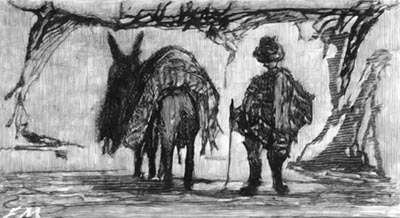
‘Aragonese mule driver. The Tolosa gorge. August 11th’- Victor Hugo (1894)
Paris Musées
My friend, dawn was beginning to break; a corner of the firmament was whitening with that sinister whiteness which the first light of morning always displays; everything that lives a distinct and individual life was still sleeping; in the nests lost under the leaves, in the huts buried in the woods; but it seemed to me that nature was not asleep; the trees, glimpsed in the darkness like ghosts, were gradually emerging from the mist in the deep gorges of Tolosa and appeared above us, at the edge of the sky, as if they were thrusting their heads forward over the tops of the hills; the grasses were shivering on the bank beside the road; black and confused brushwood was writhing over the rocks as if in despair; I heard no noise, no voice, no complaint; but, I tell you, it seemed to me that Nature was not asleep. It seemed to me that she was gradually awakening around us, and that, in the trees, the grasses, the brushwood, it was she, the common mother, who leant down, in ineffable pain, with inexpressible pity, from the edge of the road and the summits of the mountains, to see those poor terrified mules pass by, suffering, on this road full of darkness, those creatures wretched and abandoned who are her children like us, and who live closer to her than we do.
O my friend, if Nature indeed looks upon us at certain times, if she sees the brutal actions that we commit needlessly and as if for pleasure, if she suffers from the evil things that men do, how gloomy her aspect must be, how terrible her silence!
No one has yet fathomed the depths of such questions. Human philosophy has paid little attention to the world outside of mankind, and has examined only superficially, and almost with a smile of disdain, the relationship of mankind to the things about us, and the creatures, which to it are no more than things. Yet are there not abysses there for the mind to sound?
Is one to be deemed insane, merely because one feels in one’s heart universal pity? Are there not certain mysterious laws of equity, of justice, that emerge from the unity of things, and which are harmed by the unintelligent and useless acts of man towards the creatures? Without doubt, the sovereignty of Mankind over things cannot be denied; but the sovereignty of God is above that of Mankind. Do you believe, for example, that man has turned the ox, the donkey, the horse into the ‘convicts’ of Creation, without violating the secret and paternal intent of the Creator? Let Mankind have them serve, that is fine; but let not Mankind make them suffer! Let Mankind even kill them, if it must be so, if it is necessary and thought right, but let not Mankind see them suffer. At the least, and I insist on this, let us not make them suffer needlessly.
For myself, I think that pity is a law like justice, that kindness is a duty like probity. The weak have a right to the kindness, and pity, of the strong. The animal is weak, in that it lacks higher intelligence. Let us therefore be kind and show pity where it is concerned.
There is in the relationship between man and the creatures, the flowers, the objects of Creation, a whole great morality barely glimpsed as yet, but which will eventually see the light and which will be the corollary and complement of human morality. I admit the innumerable exceptions and restrictions, but I am certain myself that, on the day Jesus said: ‘Do not unto others what you would not have them do unto you,’ (the common paraphrase of ‘Matthew’ 7:12, ‘Therefore all things whatsoever ye would that men should do to you, do ye even so to them: for this is the law and the prophets’) in his mind, that word ‘others’ was immense in scope; that word ‘others’ surpassed Mankind, and encompassed the universe.
The main purpose for which Mankind was created, its great aim, its great function, is to love. Understanding is secondary. God wishes Mankind to love. He or she who does not love is far below the man who does not think. In other words, the egoist is lower than the fool, those who are evil are lower on the human scale than those who are mentally impaired yet innocent.
Everything in Nature grants Mankind the fruit it bears, the benefit it delivers. All objects serve Mankind, according to their own laws; the sun gives its light, fire its warmth, the animal its instincts, the flower its perfume. This is their way of loving Mankind. They each follow their law, and do not resist it, and never shirk it; Mankind must obey its law. It must give to Humanity, and return to Nature, its own light, warmth, instincts and perfume, Love.
Without doubt, this was the first duty — and this is where we were required to begin, and the various legislators of human affairs were right to neglect all other cares for this one — it was necessary to civilise Mankind with regard to the affairs of Mankind. The task has already advanced, and progresses every day. But we must also civilise Mankind with regard to Nature. There, everything is yet to be done.
Such was my reverie. Take it for what it is; but whatever you say of it, I declare to you that it comes from a well of deep feeling within me. Now, let me reflect on it, but not speak of it any more. One must sow the seed, and let the furrow do its work.
August 12th
What shall I write? I am charmed. It is a wonderful country, and very beautiful, curious, and interesting. While you have rain in Paris, I have sun here, and blue skies, and just enough cloud to create magnificent mist in the mountains.
Everything here is singular, capricious, contradictory; a mix of primitive and degenerate moral attitudes is evident; naivety and corruption; nobility and bastardy; pastoral life and civil war; beggars with the air of heroes, heroes with the look of beggars; an ancient civilisation which is finally decaying amidst ever-youthful Nature, at the same moment that a new nation is coming into being; it is old and reborn, it is rancid and fresh; it is inexpressible. Above all, it is interesting.
A unique country where incompatibilities are to be found at every moment, at every turn of the road, at every street corner. The waitresses at the table d’hôte bow like duchesses to receive two sous. Look at this village girl passing by; she is miraculously pretty, with beautiful hair, coquettish and adorned like a Madonna; lower your eyes, and there’s a horrid ragged skirt beneath which emerge dreadfully large, bare, dirty feet. The Madonna’s body ends in that of a muleteer. The wine is execrable, it smells of goatskin; the oil is abominable, it smells of I know not what; the sign on every shop offers you wine and oil: Vino y aceite. The main streets have pavements, the beggars wear jewellery, hovels bear coats of arms, their inhabitants lack shoes. Every soldier in every sentry-box plays the guitar. Priests climb on top of the coach’s imperial, smoke cigars, stare at women’s legs, eat like tigers, and are as thin as nails. The roads are littered with picturesque rascals.
O decrepit Spain! O brand-new people! A great history! A great past! A great future! A hideous and wretched present! O misery! O marvels! One is repelled; one is attracted. I tell you: it is quite inexpressible!
In the evening, we see them again, these same rascals, standing on the hilltops, a rifle on their back, silhouetted against the sky. All in all, an admirable country.
The gorge that leads from Tolosa to Pamplona would be famous if it were known. But it is one of those roads no one takes. A zigzag journey in Spain would rate as a voyage of discovery. There are seven or eight major roads; everyone follows them. No one sees the places in between.
Moreover, Europe is threatened with something similar. The abandonment of intermediate regions is one of the probable and formidable results of rail travel. Civilisation will certainly find the remedy, but it must seek it.
There is a host of people, of minds, if you will, wearied or overwhelmed by shows of enthusiasm, who employ, when faced with the beauties of art or creation, the ready-made phrase: ‘It’s forever the same.’ For these profound despisers of all about them, what is the sea? A cliff, or a dune, and a large, monotonous blue or green arc. What is the Rhine? Water, a rock, and a ruin; then more water, another rock, another ruin; and so on, from Mainz to Cologne. What is a cathedral? A spire, a few ribbed arches, some stained-glass windows, and flying buttresses. What is a forest? Trees, and then more trees. What is a gorge? The cleft a torrent carves between two mountains. ‘It's forever the same!’
Excellent fools, who fail to suspect the immense role detail and nuance plays in this world! In Nature, it is life; in art, it is style. Superb, disdainful fools, who fail to comprehend that the air, the sun, the sky whether grey or serene, a gust of wind, an accident of light, a reflection, the season, the wondrous creations of God, the wondrous creations of poets, the wonders of landscape, are worlds! The same combination of land and sea produces the Bay of Constantinople, the Bay of Naples, the Bay of Rio-Janeiro. The same skeleton yields Venus or the Virgin. All of Creation, in fact, this multiple, varied, dazzling, and melancholy spectacle, which all thinkers have studied since Plato, which all poets have contemplated since Homer, can be reduced to two colours: green and blue. Yes, but God is the painter. With this green he makes the earth; with this blue he makes the sky.
The Tolosa gorge is therefore a gorge like every other gorge, ‘forever the same,’ a torrent between two mountains; but this torrent utters such a horrid cry, these mountains possess such haughty attitudes that on penetrating them a human being feels small and weak. A forest combines with the rocks, and there are wide sheets of scree descending from the highest peaks, strewn with unbelievably large oaks. One considers the tree, one considers the rock, and one wonders where the roots are and what it lives on.
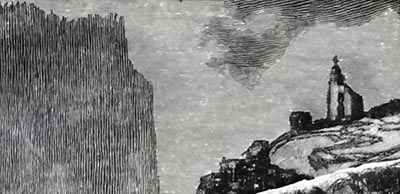
‘Gorges of the Spanish Pyrenees. August 12. Fog and Rain’- Victor Hugo (1894)
Paris Musées
As amidst all the awe-inspiring things that Nature produces, there are charming corners, lawns, streams detached from the torrent which murmur alongside with that sweet chirping eaglets must make in the nest, grasses full of flowers and perfumes, a thousand graceful resting places for the eye and the mind. The human alone remains gloomy. The peasants who pass have a dreamy air; there are no villages, but, here and there tall stone houses pierced by three or four small windows which have still been thought too large, since they have been half walled-up.
In this country, I am obliged to repeat, the window is no longer a window; it is a loophole. The house is no longer a house; it is a fortress. At every step, there is a ruin. That is because all the civil wars of Navarre, for four centuries, have spilled pell-mell into this ravine, with its torrent, such that its foamy white water has many times run red with blood. Perhaps that is why the torrent howls so sadly. It is certainly why Mankind dreams.
A high mountain, a vast climb in traveller’s terms, a steep slope in postilion’s language, cuts the gorge in two. The road, quite beautiful in other respects, twists and turns around the edges of the precipice in fearful bends. Two oxen had been added to our eight mules, and the coach, towed by this immense team, ascended at walking pace. In the middle of this ascent, a large stone marker warns one that one is six leagues, or fifteen miles, from Pamplona, seis leguas a Pamplona. The mountains tower above the precipices. Harvesters as small as ants were reaping their wheat at the foot of the abyss.
I descended from the coach and, while walking, to the sound of the chains of the oxen and mules, I picked a bouquet of wild flowers. At the top of the mountain, I met a beggar, I gave him a real. Then I came across a small waterfall; I threw my bouquet into it. One must give alms to the naiads too.
Then, I climbed back on top of the diligence, while the oxen were unhitched. At that moment, the six mules in front, feeling themselves freed, set off at a gallop. The mayoral, the postilion, and the zagal ran after the mules, swearing, and leaving the carriage behind. The vehicle was still on a very steep slope. The two guide mules left to hold it back alone lacked the strength; they yielded, and the carriage began to roll back slowly toward the precipice. We travellers, very frightened, called out to the drivers, who failed to hear us. The rear wheel was only a few inches from the edge when the beggar, a poor old man, bent over and well-nigh paralysed, approached and kicked over a stone. That proved sufficient. The stone obstructed the wheel, and the carriage halted.
There was a priest next to me on the bench. He made the sign of the cross and said to me, ‘God has just saved twenty people.’ I replied: ‘By means of a stone and an old man.’ The drivers retrieved the mules, which were already a distance away.
An hour later, we emerged between two enormous promontories, which are the last towers that the mountain displays at this end, onto the plain of Pamplona.
Pamplona is a city that delivers more than it promises. From a distance, one nods one’s head; no monumental buildings raise their profiles; once you are in the city, one’s impression changes. In the streets, there is interest at every step; on the ramparts, one is charmed.
Its situation is admirable. Nature has formed a plain, round like an arena, and surrounded it with mountains; in the centre of this plain, Mankind has made a city. It is Pamplona.
A city of the Vascones according to some, with the ancient name of Pompaelo; a Roman city according to others with Pompey as its founder (c.75BC), Pamplona is today the Navarrese city which the House of Evreux (a cadet branch of the Capetian dynasty) turned into a Gothic city, the House of Austria turned into a Castilian city, and the sun almost turns into an Oriental city.
All around, the mountains are bald, the plain is parched. A pretty river, the Arga, nourishes a few poplar-trees here. The gentle undulations that run from the plain to the mountains are full of ruins and edifices à la Poussin. It is not just a vast plain, it is a vast landscape.
Close to, the city has the same character. The streets of dark houses brightened by paintings, balconies, and fluttering curtains, are at the same time cheerful and severe.
A magnificent square tower (San Saturnino, otherwise San Cernin) of dry brick, with the simplest and proudest lines, dominates the tree-lined promenade. It represents the thirteenth century as modified by the Arab style, as that century is, in Germany and Lombardy, by the Byzantine. A portal in the style of Philip IV richly furnishes the lower part of the tower, which without it would perhaps be a little bare. This portal, which is in no way garish or excessive, is a happy addition. It is almost Rococo, yet still of the Renaissance.
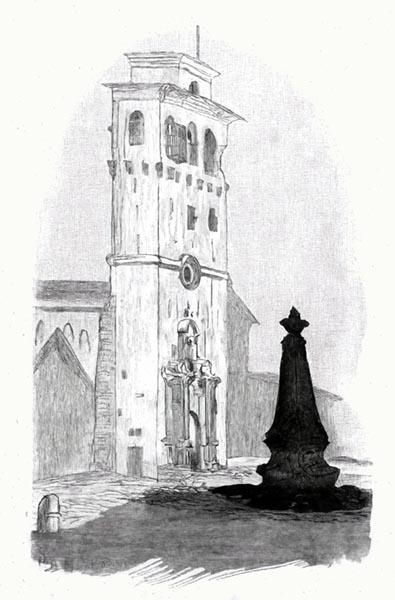
‘San Cernin Bell-Tower’- Victor Hugo (1894) Paris Musées
However, the Spanish Rococo is a backward-looking Rococo, like everything produced in Spain; it borrowed from the sixteenth century, and retained in the seventeenth, and even the eighteenth, the smallness of the columns and the complex broken arch of the pediments, that so graced the style of Henri II. These forms of the Renaissance, mixed with acanthus leaves and rocailles, give to the Castilian Rococo an originality deriving from nobility and caprice.
This magnificent tower is a bell-tower. The old church which it adjoined has vanished. Who destroyed it? Was it burned down during one of the many sieges that Pamplona has endured?
I was asking myself this question, when the sight of a deep breach in one corner of the bell-tower, seemingly caused by some bombardment, confirmed the conjecture in my mind. However, I pushed open a door at the foot of the tower and entered a ‘tasteful’ but dreadful church, in the most mediocre style, that of the Madeleine or the Guardhouse on the Boulevard du Temple. This perplexed me. Was it to display this dull architecture, decorated with triglyphs and archivolts, that the old half-Romanesque, half-Moorish church of the thirteenth century had been demolished?
The ‘tasteful school’, alas, has penetrated as far as Spain, and this building is worthy of it. Such architecture has disfigured old cities more than all the sieges and fires. I would rather wish a hail of bombs to descend on a monument rather than an architect of the ‘tasteful’ school. By all means, bombard the old buildings, don’t restore them! The bomb is merely brutal, while ‘Classical’ masons are stupid. Our venerable cathedrals proudly braved shells, grenades, cannonballs, and Congreve rockets; they tremble to their foundations before our great neo-classical architect, Pierre-François-Léonard Fontaine. At least rockets, cannonballs, grenades, and shells do not sculpt Corinthian capitals, nor cut grooves, nor cause newly carved ovoids to bloom around a Romanesque semicircular arch, accompanied by the customary rosary of paternosters. Saint-Denis has just been restored, and is no longer Saint-Denis; the Parthenon was bombed yet is still the Parthenon.
The houses, almost all built of yellow bricks, the obtuse angled roofs of hollow tiles, the dust in the air, the reddish plain, and the scorched mountains on the horizon, give Pamplona an indescribably earthy appearance that saddens the eye at first glance; but, as I was saying, everything in this city delights. The fanciful taste for ornamentation, peculiar to southern peoples, takes revenge on the bare fronts of all the houses. The variegated hangings, the gaiety of frescoes, the groups of pretty women, half-leaning over the street and signalling to each other from balcony to balcony, the varied and intriguing shop displays, the joyous noise and perpetual elbowing at the crossroads, have something ever lively and radiant about them.
At every moment, the bold taste, both wild and elegant, characteristic of semi-civilised nations, is revealed. Here is a commonplace well whose barely-hewn stone rim supports six small white marble columns surmounted by a dome, that serves as a pedestal for the statue of a saint; here is a doll-like Madonna, surrounded by paintings, laden with trinkets, tinsel, and sequins, installed beneath a canopy of red damask at the corner of a promenade with whitewashed arcades.
It is a style, impressed on the decoration and furnishings of churches, that sheds grace and light. In Pamplona, the exterior architecture of the monuments being very austere, the interior architecture avoids being dull. For myself, I am grateful; in my opinion the greatest merit of rocaille and acanthus-leaf art, which encourages one to forgive all its vices, is the continual effort it makes to please and amuse.
Apart from the cathedral, which I will tell you about later, the churches of Pamplona, although almost all have old naves, have preserved few traces of their Gothic origins. However, I noticed in one of them, in the middle of a high wall, above a door, a fourteenth-century bas-relief representing a knight leaving for the Crusade. The man and the horse disappear under their war caparison. The knight, proudly-seated, the cross marked on his shield, urges his horse, which hastens to advance. Behind the baron, on a hill, one sees his castle with crenellated towers, whose portcullis is still raised, whose door is still open, whence he has come, and to which he may never return. Above the keep is a large cloud parted to display an arm and hand, an all-powerful and fatal hand, whose outstretched finger indicates to the knight his path and his goal. The lord of the castle turns his back on this hand, and thus is not looking at it, but one surmises that he feels it. It pushes him onwards; it holds him to his task. The work is full of mystery and grandeur. I thought I saw revived, there, roughly but superbly carved in granite, that beautiful Castilian romance which begins: — ‘By the banks of the Arlanza, Bernardo del Carpio rides, on a black horse caped with scarlet; a hefty lance in his hand, and armed to the teeth,’ (Bernardo del Carpio was a legendary hero of medieval Spain, once considered a historical personage to rival El Cid. He appears in many ballads, and other literary works).
All the churches have an altar to Saint Saturnin, who was the first apostle of Pamplona, and another altar to Saint Firmin, who was its first bishop. Pamplona is the oldest Christian city in Spain, and is proud of it, if such a thing is ever a matter of pride. These two names, Firmin and Saturnin, are not only in every church, they are also on every shop. On every street corner one reads: Saturnino, ropero (clothier) — Fermin, sastre (tailor).
There is in I forget which street, a hôtel portal that struck me. Imagine a large archivolt around which creep, climb, and twist, like stone vegetation, all the strange tulips and extravagant lotuses that the Rococo mixes with its shells and volutes; now, draw forth from these lotuses and tulips, in place of scaly sirens and naked nymphs, kettle-drummers wearing tricorn hats, and mustachioed halberdiers, dressed like the infantrymen of the Chevalier de Folard (an eighteenth century military theorist who championed the use of infantry columns); add to this rocailles and garlands amidst which cannoneers load their pieces; and arabesques bearing, delicately, at the ends of their tendrils drums, bayonets and grenades burst forth; add to this ensemble the somewhat round and heavy, but quite fluid, style of the time of Charles II, and you will have some idea of the little military and pastoral poem carved on this door. It is an eclogue decorated with cannonballs.
The first thing one look for when first catching sight of a city on the horizon is its cathedral. Arriving in Pamplona, I had viewed from a distance, towards the eastern end of the city, two abominable bell-towers from the time of Charles III, a period which corresponds to our worst Louis XV. These two bell-towers, which are intended to be spires, are identical. If you want to imagine one of these spires, imagine a tall rectangular tower, topped by four large corkscrew columns supporting a kind of pot-bellied and turgid vessel with a lid, which in turn is crowned with one of those classic pots, commonly called urns, which look as if they were born from the marriage of an amphora and a jug, turned upside down. All of this in stone. I was perfectly angry.
— ‘What!’ I cried, ‘Is this what was done to the almost Romanesque cathedral (Santa María la Real) of Pamplona, which Charles II of Évreux, King of Navarre, found so beautiful that he wanted his tomb built there (he died in 1387); is it this building that saw a French cannonball wound Ignatius of Loyola (in 1521), and which saw the construction of Philip II’s citadel (begun in 1571)?’. (The current fourteenth and fifteenth century Gothic church replaced the Romanesque one; the Neoclassical facade was added in 1783)
I was tempted not to visit it. However, when I arrived in Pamplona and saw the pitiful appearance of the two bell-towers at the end of a street, I felt a scruple and headed towards the gate.
Seen up close, the building is even worse. Those two outgrowths pierced like cabbage stalks, and blessed with the name of spires, that I have just sketched for you are supported by a colonnade to which I can compare nothing except the colonnade of Saint-Denys-du-Saint-Sacrement, in our Rue Turenne in Paris. And these turpitudes are passed off in schools as Greek and Roman art! Oh, my friend, how ugly is ugliness when it has pretensions of being beautiful!
I recoiled from this architecture, and was about to leave the church when, turning left, I saw behind the front façade the high black walls, pointed arches with flamboyant windows, delicate bell-towers, and robust buttresses of the venerable and ancient cathedral of Pamplona. I recognised the church I had dreamed of.
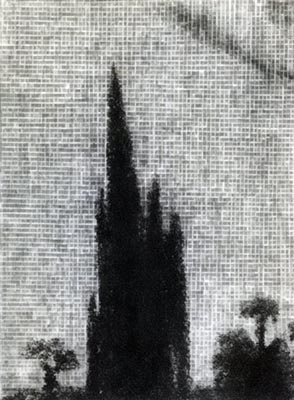
‘View of a Church, Pamplona’- Victor Hugo (1894)
Paris Musées
She stands there, as if she were suffering some kind of punishment, hidden, darkened, sad, and humiliated, behind that odious portal with which ‘good taste’ has saddled her. What a mask that facade is! What dunces’ caps those two bell towers are!
Reconciled and satisfied, I entered the building through a side portal which is fifteenth century, simple, lightly decorated, but elegant. The doors are studded with nails and fleurs-de-lis, and the iron door-hammer, composed of dragons biting at each other, is of a beautiful Byzantine form. The interior of the church delighted me. It is Gothic with magnificent stained-glass windows.
I was telling you earlier about a hôtel entrance which forms a pretty little poem. The cathedral of Pamplona is also a poem, but a great and beautiful poem, and, since I have been led to this association, which arises so naturally, between the forms of architecture and the forms of poetry, allow me to add that this poem is in four parts, which I would title: the high altar, the choir, the cloister, and the sacristy.
As I entered the cathedral, it was a little after five in the morning. The doors had just been opened; the building was still deserted, and dark. The first rays of the rising sun shone, horizontally, through the stained-glass windows of the high nave, and threw great golden beams from one ogive to another, which were highlighted sharply against the dark background and glowed resplendently in the gloomy church. An old, bowed priest was saying the first Mass before the high altar.
The high altar, barely lit by a few lighted candles, half surrounded by a floating wall of tapestries and hangings suspended from the pillars of the apse and intercepting the daylight, seemed, in the mist that enveloped it, like a pile of precious stones. Around it stood all sorts of glittering furniture that one only sees in Spanish churches, credenzas, cabinets, sideboards, sheathed buffets with little drawers. At the back, behind clusters of lilies, above the high altar, in the midst of a glorious display that was perhaps only gilded wood, but to which the hour and the place gave a strange majesty, and between the dazzling walls of a golden armoire with two open doors, stood a radiant Madonna in a silver robe, an imperial crown on her head, and the infant Jesus in her arms. I glimpsed this through a marvellous iron gate from the time of Joanna the Mad (Joanna I, nominal queen of Castile from 1504, and queen of Aragon from 1516), crafted with magical skill, by the metalworkers of the fifteenth century, laden with flowers, arabesque, and figurines. This gate, more than twenty feet high and to which one ascends by a staircase of a few steps, shuts off the sanctuary on the only side where an eye can penetrate.
Nothing could be more striking, at that sublime and sacred hour of the morning, than this white-haired man, alone in the middle of this vast church, dressed in splendid clothes, speaking in a low voice, leafing through a book and acting out something mysterious in this magnificent, dark, silent, veiled place. His Mass was addressed to God, the immensity, and an old woman who was listening to him, huddled behind a pillar, a few steps from me.
It all possessed grandeur. The ancient church, the old priest and this old woman seemed to form a kind of Trinity, as one. The two genders, and the building; here was a symbol which lacked nothing. The priest had been strong, and was weak, the woman had been beautiful, and was withered, the building had been complete, and was mutilated. The man, grown old in his flesh, and his task, worshipping God in the presence of the dazzling light that nothing dims, that nothing darkens, that nothing alters, that nothing extinguishes; say, do you not find grandeur in that?
I was moved to the depths of my heart. No discordant thought arose in me, from this melancholy contrast; on the contrary, I felt that an inexpressible unity emanated from it. Certainly, only a profound and unfathomable mystery can thus unite, in an intimate and religious harmony, the incurable decrepitude of the creature, and the eternal newness of Creation.
After Mass, I turned around, and viewed the choir, which in the churches of northern Spain faces the altar. The choir of Pamplona cathedral, tall, dark woodwork of the sixteenth century, is composed of two tiers of stalls that occupy the three sides of a rectangle, the fourth side of which is filled and closed off by an iron grille, in magnificent metalwork of the same period. Behind each stall one of the saints of the liturgy is carved in solid oak. All this wood was cut with the smooth and skilful chisel-work of the Renaissance. In the middle of the short side of the rectangle that faces the grille, and consequently the altar, stands the bishop’s throne surmounted by a charming openwork bell-tower. The current bishop of Pamplona (Severo Leonardo Andriani Escofet) who is at odds with Baldomero Espartero, has been in France for the last two years, in Pau, I believe, where he has taken refuge.
I was tired from walking all morning, I sat down on this vacant throne. A throne! Do you not you think it a singular resting place? I did. The bishop’s choir-book was before me on his desk. I opened it. Almost every page was torn.
The choir grille, whereon angels flutter and wriggle as if in enchanted foliage, faces the grille of the high altar. The art of the fifteenth century and the art of the sixteenth are there, both with their most distinctive and contrasting characteristics; one is more delicate, the other is more copious; one knows not which is the most charming.
In the centre of the choir, is another iron grille, resembling a large cage, which covers and protects the cenotaph of Charles III of Évreux, King of Navarre, while still allowing it to be seen.
It is an admirable tomb from the fifteenth century, worthy of being sited in Bruges beside the tombs of Mary of Flanders and Charles the Bold (in the Church of Our Lady), or in Dijon beside the tombs of the Dukes of Burgundy, Philp the Bold and John the Fearless (in the Musée des Beaux-Arts), or in Bourg-en-Bresse beside the tombs of Philibert II, Duke of Savoy, his wife Margaret of Austria, and his mother Margaret of Bourbon (in the Royal Monastery of Brou). The motif does not vary, but it is so simple and so beautiful! The king with a lion at his feet, the queen with her greyhounds, are lying side by side, crowns on their heads, on a bed of marble; a touching marital tomb, around which revolve, beneath little arches of the most exquisite workmanship, a procession of weeping figurines. This part of the tomb is badly mutilated. Almost all the statuettes are in two pieces.
Seven or eight enormous missals, their format that of the copy of the Infortiat (the ‘Infortiat’ or ‘Pandects’ is a subdivision of the ‘Digest of Justinian’, a key part of the’ Corpus Juris Civilis’) which provided Nicolas Boileau with such a beautiful rhyme (of ‘Infortiat’ and ‘Alciat, for Andrea Alciato the jurist) and such a charming verse (see Boileau’s ‘Le Lutrin’, Chant V), all bound in parchment, and armed with copper wedges, are arranged around the cenotaph, and placed on the ground like the shields of resting soldiers. They are raised against the gate of the sepulchre. It seems that chance has thought to lean these books of religion against the tomb.
A large organ, in the style of the last century, rich and gilded, dominates the entire choir but does not mar it. Below, one reads this verse which is also inscribed on almost all the organs in Spain: ‘Laudate Deum in chordis et organo: Praise God with stringed instruments and organs’ (‘Psalm 150’: line 4). Further down is the date: año 1742.
The chapels surrounding the high altar and the choir are adorned, one might almost say cluttered, with those immense carved and gilded altar-tops that this old Catholic country has always loved. The fashion is an old one. I saw one of these altar-tops in a chapel that dated from the fifteenth century, and in a side-aisle another from the thirteenth. In the middle of the altarpiece a large Byzantine Christ, all black, with a curly beard and prominent ribs, dressed in a vast, white lace petticoat hangs from three nails. What on earth is the lace hiding?
Various banners affixed to the walls, Madonnas in red damask niches, and tombs carved into the wall at sundry heights, complete the furnishings of the church.
As I left the choir, some effect of chiaroscuro drew me to the right, towards the side door opposite the one through which I had entered, and I suddenly found myself in one of the most beautiful cloisters I have ever seen in my life.
It is a vast quadrangle, surrounded by large ogives whose mullions form rich and robust fourteenth-century windows. Some of these ogives bear the traces of recent and, I hasten to say, intelligent restoration. Above the ogival gallery, a second, lower gallery, with sculpted joists, supports the hollow-tiled roof from which black stone pinnacles of exquisite form rise here and there. The cloister courtyard is a well-kept garden, in which clipped box trees trace all the charming arabesques of seventeenth-century gardens.
Everything is beautiful in this cloister: the size and proportion, the shape and colour, the whole and the detail, the shadow and the light. Sometimes an old fresco animates the walls and brings them to life, sometimes a marble sepulchre eaten away by the years, sometimes an oak door mended and patched in such a way as to curiously mix the woodwork of all eras.
As I passed by, the wind made old Navarrese lilies, half-plucked, sway on the iron fences of the garden, alongside which the eternal lilies of God were blooming in all their fragrance and splendor.
The pavement on which one walks is formed of long black slabs. Each slab bears a number, and covers a tomb. There is something icy and arid in this manner of labelling the dead. I consent to become dust, ashes, a shade; I am repelled by the thought of becoming a number. It is nothingness without the poetry; an excess of nothingness.
At one corner of the cloister, a few lancet arches, partly walled-up, extend around a sort of mysterious chamber. It is a chapel. But why separate it from the church? I saw only some rather dilapidated furniture, a crucifix, a wooden altar, a stamped-tin lamp. However, I admired the iron grille that closes the two sides of the chapel opening onto the cloister, which is a precious example of the dense and complicated ironwork of the fourteenth century. This grille is the curiosity of the chapel, as regards both its workmanship and its material. It is only iron, perhaps, but it is illustrious iron.
At the Battle of Las Navas de Tolosa (in 1212), the camp of the Amir al-Mu’minin (Commander of the Faithful), Caliph al-Nasir, was surrounded by an iron chain, which Sancho VII, King of Navarre, severed with an axe blow. Like Berenice’s hair, which took its place among the stars, the chain became one of the constellations on a coat of arms, that of the Kingdom of Navarre, and, in days gone by, occupied one half of the coat of arms of France (when Henri IV ascended the throne in 1589). Now, it is from the iron of this chain that the grille in the cathedral was made. This at least is what is revealed to the passer-by and confirmed by a sign placed above the gate, with this quatrain in a somewhat barbaric and enigmatic Latin:
cinger quæ cernis crucifixum ferrea vincla
barraricæ gentis funere rupta manent.
santius exuvias discerpias vindice ferro
huc, illuc sparsit stemata frusia pius.
año 1212
The iron chains you see all about the crucifix
were broken when the Barbarian horde were slain.
Pious Sancho scattered the remnants, torn away
by the avenging blade, here and there, as spoils on his coat of arms.
I have nothing to add, as regards this quatrain, except that the workmanship of the grille indicates the fourteenth century and not the thirteenth.
What is also entirely fourteenth century is the interior portal beneath which I entered the cloister from the church. Here, tympanums, arches, capitals, small columns, medallions, statuettes, everything is in the most beautiful style of that beautiful era. Furthermore, protected by the cloister against the action of the atmosphere, and by good fortune against whitewash, this portal has preserved in well-nigh all its lustre, and freshness, the gilding and painting of that time. I was amazed. — ‘Indeed,’ I thought, ‘it’s enough to make you want to kneel before it!’
I turned around, and saw someone who was actually doing so, kneeling on the paving. Who was it? A woman of about forty, still beautiful, with a noble face, and wrapped in a rich, black lace mantilla. As I was looking at her in surprise, another woman, old and raggedly dressed, entered the cloister, and came and knelt near the first. Then a third. Note that we were outside the church. ‘That,’ I said, ‘is how to worship architecture devoutly!’ Closer attention explained all. There was a doll-like Madonna on the mullion of the portal, and next to it on the wall this inscription:
ed eminen mo s r carde
nal pereira concedio
80 dias de yndulgen a
y el s r orispo murillo
40 al que rezare una
salve de brodillas de
lane esta s ma ymagen
de n ra s rs de el amparo
The most eminent Senõr
Cardinal Pereira, has granted
80 days of indulgences
and Senõr Bishop Murillo
40 to whoever recites
a prayer on their knees
before this most holy image
of Our Lady of Amparo.
It is likely that this inscription is the good fortune I was talking about earlier, which prevented any use of whitewash. The Madonna protected the portal. As I finished copying the inscription, the beautiful kneeling devotee rose, and as she passed near me, almost without turning away, said over her shoulder: ‘French gentleman, who looks at everything, go and see the sacristy.’ Then she walked away quickly.
I entered the church, I searched everywhere, and finally, after pushing open all the doors, I arrived at the sacristy. Oh! Here indeed was a sacristy to stir the heart of a beautiful devout Spanish woman! Imagine an immense rocaille boudoir, gilded, tangled, flowery, coquettish, tinted in amber, and charming. Wall-paper imitated the damask it replaced; the brick and stone pavement imitated mosaic. Everywhere beautiful ivory Christs, swooning Magdalens, sloping mirrors, sofas with large cushions, dressing tables with goat’s feet, corner cabinets with Aleppo breccia tops; brilliant daylight, mysterious nooks; unusual and varied items of furniture; priests coming and going; chasubles sparkling in half-open drawers; a marquis’ perfume unfamiliar to me, an abbot’s odour likewise; such is the sacristy of Pamplona.
It was the worthy Cardinal Antonio Zapata y Cisneros, Bishop of Pamplona (from 1596 to 1600) who executed this gallant addition to the cathedral. The transition is abrupt; it is almost a shock. Dante inhabits the cloister, Madame de Pompadour the sacristy. Though, here again, one complements the other, and there is a profound harmony. The sacristy invites sin; the cloister invites penance.
Mass was already being said in all the chapels, and the church was filling with the faithful, especially women. I wandered around it one last time.
On the side of the grand portal, the choir is protected by a large wall against which is a white marble tomb. The epitaph, in almost-erased gold lettering, indicates that therein are the remains of that brave Jean Bonaventure Thierry Du Mont, Ist Count of Gages, who fought against Prince Eugene of Savoy himself (during the War of the Spanish Succession, 1701-14) and defeated the Imperial armies in many encounters (during the War of the Austrian Succession, 1740-48).
One of these encounters resulted in a fierce battle, which can be seen sculpted in bas-relief above the epitaph. There are cannons being aimed, horses rearing, officers issuing commands, dense battalions wielding their pikes while resembling brushwood stirred by an angry wind. Nothing could be stranger than this petrified, mute melee, forever motionless in the darkened church, where, from time to time, I could hear the faint and intermittent voice of a choirboy.
The great tumult of that battle and the deep silence of the tomb grant the heart a grave lesson. This then is the glory of dead warriors! A silent one, while the glory of poets and thinkers sings and speaks on, eternally.
While I was dreaming, lost in a kind of reverie, before this tomb, the sound of an organ and a violent, lugubrious, wild chant, suddenly bursting forth to my left from a neighbouring chapel, made me turn my head.
A coffin, which had probably just arrived, was placed on the ground, on the paving. One could see its wooden lid, barely hidden by a black cloth torn and full of holes. Four candles burned around it; three round loaves were arranged on a board on the ground, at the head of the coffin. A few steps to the right four large resin torches blazed, whose rays revealed to me, confusedly, in a dark chapel, the priest, in a black chasuble black adorned with a white cross, saying the Mass for the dead. The chanting, and the organ notes, descended from above like a kind of supernatural music. It was impossible to distinguish where it came from. Around me, a crowd of women of all ages, forming a sort of semicircle some distance from the bier, all gracefully coiffed and wrapped in black silk mantillas, squatted on the paving of the church, according to the Spanish fashion, in the soft, charming attitudes of the women of the Turkish Seraglio, their eyes more often raised than lowered, plying their fans, listening to the Mass and gazing at the passers-by.
I, in turn, gazed at the sepulchre of the Count of Gages, and at the coffin of this poor stranger, two wells of nothingness, one honoured, the other disdained. Oh, my friend, if the things we call inanimate could, suddenly, speak, what a dialogue might ensue between the marble tomb and the fir-wood coffin!
In the evening, I walked along the ramparts, thoughtful and alone.
There are days in life that stir the whole past within us. I was full of inexpressible ideas. The grass of the counterscarps, stirred by the wind, whistled faintly at my feet. The cannons poked their necks between the battlements as if looking out onto the countryside. The mountains on the horizon, blurred by the twilight, had taken on magnificent shapes; the plain was dark; the Arga’s flow, wrinkled with a thousand luminous reflections, slid beneath the trees like a silver snake.
As I passed the entrance to the town, I heard the creaking of the drawbridge chains, and the dull thud of the portcullis as it fell. The gate had just been closed. At that moment the moon was rising. Then, if you will forgive the ridiculousness of my quoting myself, these lines I wrote fifteen years ago came back to me:
Toujours prête au combat, la sombre Pampelune,
Avant de s’endormir aux rayons de la lune,
Ferme sa ceinture de tours.
Always ready for battle, sombre Pamplona,
Before falling asleep, in the gleaming moonlight,
Clasps tight its belt of towers.
(see verse 8 of Hugo’s poem ‘Grenade’, 1828)
August 13th
In the cities of Spain there are many ventas, or café dance-halls; a few posadas, or inns, and scarcely any fondas, or hôtels. In San Sebastian there is only the Fonda Ysabel, so named to distinguish it from the French-style hôtel, run by an honest and brave man, one Laffitte. In Tolosa, and in Pamplona, the only fonda has neither name nor sign. It is simply called The Fonda; a clear indication of its uniqueness.
The room I occupy in The Fonda of Pamplona, al segundo piso (on the second floor), has two large windows overlooking the main square. This square is nothing remarkable. Currently under construction at one end, on the east side, is something hideous that looks like a theatre, and will be fashioned of cut stone. I commend it to the first intelligent man to bombard Pamplona.
Forgive me, my friend, for this dismal jest. I have left it here, because such happenings are in the very nature of things. Is it not the fate of all the cities of Spain to be bombed periodically? Last year Baldomero Espartero bombed Barcelona. This year Van-Halen (Juan Van Halen y Sartí, who followed Espartero into exile in 1843) is bombing Seville. Who will direct the bombardment next year, and what will be bombed? I know not. But take it for granted such will happen. That being so, I offer up a prayer for the inhabitants, the houses and the cathedrals; and, since one must expect bombardment, I will gladly grant that person all the replicas of our ugly and foolish Paris Bourse (the Stock Exchange) I come across.
That said, let me return to Pamplona, and ascend again to my room. It is a kind of whitewashed hall, with two beds, one of which is wide, which the maids call el matrimonio. On the wall are some illuminated frames representing smiling lovers and sulking spouses. Also, there is a small table, two straw-bottomed chairs, and an enormous door, its panels buttressed by an oak frame, with bolts like those of a prison cell, or that of a fortress.
It seems that in Spain defence against assault is provided for on every floor of every house. Arming one’s window and balcony with tightly meshed shutters to protect one’s wife from gallants, and one’s door with sturdy ironwork to protect one’s house from pillage, is the dual concern of the bourgeoisie in Spain; jealousy bars the window, and fear bars the door.
Half of the main square of Pamplona is occupied, at this moment, that is to say has been invaded, by a colossal mass of scaffolding erected for the bullfight, which is to take place in about ten days’ time, and the advent of which is causing commotion in the city. The bullfight will last four days, from August 18th to the 22nd. On the first day there will be a bullfight, and on the last day a famous espada (matador, ‘swordsman’) in this region, ‘Cúchares’ (Francisco Arjona Herrera), will kill the bull.
The arena then is the Grand Plaza del Castillo; panels hide the ground floors of the houses on two sides of the square, while their balconies and windows will, on the day of the bullfight, serve as lower and upper tiers of boxes; and the attics will serve as the ‘gods’. This theatre, for that is what it is, is quite simply built of timbering, with innumerable tiers, the crudest there could be, and from my room I can make out the numbering of the benches. Add to this theatre set two or three unhitched coaches, and a guardhouse whose military incumbent is walking up and down in front of the fonda, and you have the view from my window.
The town hall in Pamplona is an elegant little building from the time of Philip III. The facade offers a curious example of a type of ornamentation peculiar to seventeenth-century Spain. It consists of arabesques and flat volutes that seem to have been cut out of the stone with a punch. I had already seen a house in this style, in that strange and gloomy village of Lezo in Gipuzkoa. The pediment of this town hall is surmounted by lions, bells, and statues that produce an entertaining effect.
What entertained me no less was the fair, which is currently being held in a small square (the Plaza Consistorial) directly in front of the town hall. The open-air shops full of gilded items, and trinkets, vendors full of cheer, passers-by jostling, and buyers busily assessing the wares, all the whirlwind of noise, laughter, insult and song, that is called a fair, achieves more noise and gaiety beneath the Spanish sun.
In the midst of this crowd, leaning against a pillar of the town hall, stood a tall and formidable fellow. His large bare feet protruded from his red knitted leggings; a muleta (cape) of whitish wool with madder stripes covered his head, enveloping it entirely in its sculptural folds, and leaving only his swarthy face with its prominent cheekbones, square nose, angular jaw, jutting chin, and black, bristling beard visible; a figure seemingly of Florentine bronze, with the eyes of a wild-cat. In the midst of all this noise and movement, the man remained motionless, grave, silent. He was a Spaniard no more but an Arab.
A stone’s throw from this ‘statue’, a grimacing Italian, with large glasses on his nose, was advertising his puppet show, by beating a drum, while singing, on his platform, that ancient rhythmic tune of Pulcinello’s: ‘Fantoccini, burattini, puppi’ (types of puppets: ‘burattini’ are moved from below by hand, ‘fantoccini’ and ‘puppi’ are manipulated with strings or wires) to which we rhyming French set a villanelle:
‘Le pantalon
De Toinon
N’a pas d’fond.’
‘Antoinette’s pantaloons lack a seat.’
The ‘Pantalone’ and the ‘Savage’ looked at each other without comprehending one another, like inhabitants from two different planets. (Pantalone is a Commedia dell’arte character, old and miserly)
One cannot traverse a fair, especially this one, without buying something. I let myself go; I opened my purse, and sent off to the fonda everything I bought.
On my return, I found, on the table in my room, a complete set of peddler’s wares: amulets from Zaragoza, in gold, silver-gilt, and filigree; garters, bearing mottoes, from Segovia; glass holy-water fonts from Bilbao; tin nightlights from Cauterets; a box of chemical matches from Hernani; a bundle of resinous sticks that serve as candles in Elizondo; paper from Tolosa; a mountaineer’s belt from the Panticosa Pass; a wooden iron-shod staff; rope shoes’ and two muletas (capes) from Pamplona itself, of magnificent wool, crude workmanship, and exquisite taste.
Apart from this fair, and a few busy crossroads, Pamplona is gloomy and silent all day; but, as soon as evening comes, as soon as the sun sets, as soon as the windows and lanterns are lit, the city awakens, life quivers everywhere, joy sparkles; it is a hive of noise. A fanfare of trumpets and cymbals bursts forth from the main square; the musicians of the garrison are serenading the city. The city replies. On every floor, at every window, on every balcony, one hears songs, voices, the sound of guitars and castanets. Each house rings like an enormous bell. And add to that the Angelus, sounding from all the city’s bell-towers.
You might think the whole thing is discordant, and that from all these intermingled sounds only one immense, perfectly dreadful hullabaloo must emerge. You would be wrong. When a city becomes an orchestra, a symphony always emerges. The wind softens the shrill tones, the wide-open spaces extinguish the false notes, everything merges into one whole, and the result is harmony. On a small scale, it would be a din; on a large scale, it is music.
This music cheers the population. Children play in front of the shops; residents emerge from their houses; the main square is filled with people strolling about; priests and officers approach women in mantillas; words are exchanged behind fans; beneath the arcades, muleteers tease the wenches; a soft glow, shed from a hundred wide-open, brightly lit windows vaguely illuminates the square. The crowd come and go, and cross paths in the shadows, and nothing is more charming than this discreet mingling of pretty faces briefly glimpsed, and joyful stifled laughter.
The freedom of priests in this beautiful climate causes no scandal. There is a certain familiarity that the religion allows. However, observing everything from my window, I heard three priests, wearing prodigious sombreros and wrapped in vast black capes, talking in front of the fonda, and I must admit that one of them pronounced the word muchachas (young women) in a manner that would have made Voltaire smile.
Around ten in the evening, the square empties, and Pamplona falls asleep. But the noise refuses to die there and then; it continues, not choosing to end where sleep begins. It seems, during the first hours, that the city’s slumber still resonates with all the evening’s joy.
At midnight, however, silence falls, and one hears only the voice of the night-watchman calling out the hour which, at the very moment when you are about to fall asleep, sounds out, bursts forth, suddenly, from the neighbouring bell-tower, then is repeated, distantly and diminished, by another tower at the far end of the square, and then again, more and more faintly, from bell-tower to bell-tower, till it vanishes into the darkness.
The End of Part II of Hugo’s ‘Pyrénées’