Victor Hugo
The Pyrenees (En Voyage: Pyrénées, 1843)
Part III: Pamplona to the Île d’Oléron
Translated by A. S. Kline © Copyright 2026 All Rights Reserved
This work may be freely reproduced, stored and transmitted, electronically or otherwise, for any non-commercial purpose.
Conditions and Exceptions apply.
Contents
- Chapter XII: The Cabin in the Mountains.
- Chapter XIII: Notes on Spain.
- Chapter XIV: From Bayonne to Pau.
- Chapter XV: From Pau to Cauterets.
- Chapter XVI: Cauterets.
- Chapter XVII: Banks of the Gave de Marcadau.
- Chapter XVIII: Luz.
- Chapter XIX: Gavarnie.
- Chapter XX: Auch Cathedral.
- Chapter XXI: From Auch to Agen.
- Chapter XXII: From Périgueux to Saintes.
- Chapter XXIII: The Isle of Oléron (l’Île d’Oléron).
- Chapter XXIV: Editor’s Epilogue (Hetzel and Quantin Edition, 1880).
Chapter XII: The Cabin in the Mountains
The sun was setting; the mists were beginning to rise from the torrents that could be heard roaring deep among lost ravines. The pass was becoming wilder and wilder. No trace of habitation. I was exhausted with fatigue. I noticed to the right, halfway up the slope, a few steps from the path, at the foot of a high, sheer cliff, a block of white marble half-sunken into the earth. A large fir-tree, dead from old age, and fallen from the escarpment, had stopped this block as it rolled down the slope, and clothed it in dry and hideous branches. Exhausted as I was, this boulder and the dead tree, on which in my mind I had already hung our muletas and our blankets, to form a sort of tent, seemed to me to offer the possibility of a most comfortable bedroom.
I called my companions, who were about twenty paces ahead of me, and explained my idea of nocturnal architecture, declaring that my intention was to bivouac there. Azcoaga began to laugh. Irumberri’s only reply was to watch the smoke from his cigar float away in the sun. Escumuturra el Puño (‘the Fist’) took my hand:
— ‘You think so, French lord? Is that your decision?’
— ‘Not my decision,’ I said,’ but I’m simply exhausted.’
— ‘You wish to sleep here!’
— ‘I resign myself to sleeping here.’
— ‘Bah! Look what your home will be made from. Only the dead sleep in rooms made of marble and fir-wood.’
Mountaineers, like sailors, are superstitious. Now, I claim that in the mountains I am a mountaineer and at sea I am a sailor, that is to say, superstitious in both scenarios, and without reason, simply being superstitious in the same way that the people around me are. Escumuturra’s sepulchral reflection made me think.
‘Come,’ he continued, ‘just a few yards more, amigo. I swear to you, lord, that a quarter of a mile from here there’s a good place to rest.’
— ‘A quarter of a mile, in Spain!’ I cried. ‘It’s six in the evening; we’ll not arrive till midnight.’
Escumuturra answered me gravely:
— ‘Midnight, it will be, if the Devil makes the journey longer, or twenty minutes if the Frenchman quickens his pace.’
— ‘Andamos,’ said I. The caravan set off again.
The sun set, twilight came; yet I must say that the Devil failed to lengthen the path. We had been climbing for about half an hour, a steep path winding between granite blocks that looked as if a giant had seeded the mountainside with them. Suddenly a lawn appeared, the softest, freshest, most unexpected lawn and the most pleasant underfoot.
Escumuturra turned to me. — ‘Here we are’, he said.
I looked ahead to discover what was there, and saw nothing but the dark, bare line of the mountain. The lawn narrowed to an avenue, between two low dry-stone walls which I had not seen at first. However, my companions had doubled their pace, and I did the same.
Soon I saw a sort of angular, dark bump rising up little by little, like something emerging from the earth, to appear against the clear twilight sky, which seemed to be a roof topped with a chimney. It was indeed a house hidden in a fold of the mountain.
As I approached, I gazed at it. The sky was not completely dark. I was attempting what is called a strategic reconnaissance.
The house was quite large, and built, like the wall around the lawn, of dry-stone mixed with marble blocks; the thatched roof was cut to provide a staircase. I have since found this the fashion in the poorer hamlets of the Pyrenees.
At the bottom of the wall, facing the slope of the mountain, there was a square hole from which a small sheet of clear, fresh water emerged, falling onto the rock, then disappearing into the ravine with a lively and joyful sound.
The low, massive door was closed. There was only one window, next to the door, very narrow and three-quarters blocked with roughly-laid bricks.
This poor dwelling, like all the isolated dwellings of Gipuzkoa and Navarre, had the air of a fortress; but it was more with an air of defiance than defence, since the thatched roof was at head-height, and one could have forced the place to surrender without any other artillery than a lighted match.
However, there was no light within, no voice, no footsteps, no noise. It was not a house; it was a mass of blackness, mute and dead as a tomb.
Escumuturra dismounted, approached the door, and began to whistle softly the first part of an odd but charming melody; then he stopped whistling and waited.
Nothing moved in the cabin. Not a breath answered. Night, which had fallen completely, added something gloomy and funereal to this silence so mysterious and so profound.
Escumuturra began his melody again; then, reaching the same note, he stopped. The cabin remained silent. Escumuturra began a third time, even more softly, whistling at low volume, as it were.
The four of us leant toward the door, listening. I admit I was holding my breath and my heart was pounding a little.
Suddenly, as Escumuturra stopped, the rest of the melody was heard from behind the door in the house, but whistled so faintly and so low that it was perhaps more singular and even more frightening than silence. It was mournful because it was so sweet. It was like the song of a spirit in a sepulchre.
El Puño clapped his hands three times.
Then a man’s voice rose in the hut, and here is the laconic and rapid dialogue which was exchanged in the shadows, in Basque, between this voice which questioned and Escumuturra who answered:
— ‘Zuec? (You?)’
— ‘Guc. (All of us.)’
— ‘Nun? (Where?)’
— ‘Emen. (Here.)’
— ‘Zenbat? (How many?)’
— ‘Lau. (Four.)’
A spark flashed inside the house, a candle was lit, and the door opened. Slowly and noisily, since it was barricaded. A man appeared in the doorway. He held in his hand, raised above his head, a large iron candlestick in which a resin torch burned.
Here was one of those swarthy, burnt faces that are ageless; he might have been thirty, he could have been fifty. However, he had fine teeth, a lively eye, and a pleasant smile, when he smiled. A red handkerchief was tied around his forehead, after the fashion of Aragonese muleteers, and his thick, black hair was held back from his temples. The top of his head was shaved, a wide white muleta covered him from chin to knees, and he wore short olive velvet breeches, white wool leggings with black buttonholes, and rope shoes on bare feet.
The thick strand of burning resin, stirred by the wind, flickered over this figure, casting tremulous shadows. Nothing could be stranger than his cordial smile beneath this sinister blaze.
A moment later, he noticed me, and his smile vanished like a lamp being blown out. His brow furrowed, his gaze remained fixed on me. He said not a word.
Escumuturra touched his shoulder with his hand, and said in a low voice, pointing at me with his thumb:
— ‘Adiskide. (A friend.)’
The man stepped aside to let me in; but his smile failed to reappear. Meanwhile, Azcoaga and Irumberri had driven the mules into the hut; Escumuturra and the host talked in low voices in a corner. The door had been closed and Irumberri had carefully re-barricaded it as if he were accustomed to the task; and, while Azcoaga was unloading his mule, I sat down on a bale of straw from which I surveyed the interior of the house.
The house only contained the one room, in which we were, but that room contained a world. It was large and low, the ceiling being composed of slats and battens, supported here and there on beams acting as pillars, allowing the straw, with which the top of the house was filled to the angle of the roof, to pass through and hang in long strands. Openwork partitions, resembling trellises rather than partitions, created capricious compartments in this room.
One of these compartments, to the left of the door, took in a corner of the cabin, the window, the fireplace, which was an enormous cavern of stone blackened by the fire, and the bed, that is to say, a sort of coffin on which the thousandfold intricacies of a brown straw mattress and a red blanket lay. This was the bedroom.
Opposite the bedroom, another compartment contained a calf lying on manure, and some hens asleep in a kind of box. This was the stable.
In the opposite corner, in a third compartment, a shapeless pyramid of bristling stumps, and thorny bundles of sticks, was piled, a supply of wood for the winter. A few wineskins and mule harnesses were arranged with some care near the bundles. This was the cellar. There was a rifle in the corner of the wall next to the window; and, between the cellar and the stable, in the final compartment cluttered with all sorts of junk, old muletas, old baskets, a broken tambourine, a stringless guitar, I saw gleaming beneath a basket of rags the handle of a fine navaja (a long folding knife), black, and braided with copper, like the sleeve of an Andalusian. I distinguished in the shadows beside it two or three rifle-barrels buried under rags, and a sort of large, flared metal horn which, at first, I took to be the end of a mountaineer’s bugle, but which was in fact a blunderbuss. This pile of rags was the arsenal.
A large lump of rock that filled the corner to the right of the door, and on which the wall was built, formed a granite shelf in the interior of the cabin, which served as a bedside table to a few bales of straw thrown on the ground. This was, without doubt, the inn.
A naked child, who had probably been fast asleep on this straw, and whom our arrival had awakened, crouched on the granite shelf, his knees pressed against his chest and his arms crossed on his knees, and was looking at us with frightened eyes. At first, I took him for a gnome; then I thought a monkey was seated there; finally, I realised that it was a child.
Two tall wrought iron fire-dogs, rusted by rain, and scorched by the flames, commanded the fireplace, standing on four massive feet, open jaws lifted at the ends of their long necks. They looked like two house dragons, ready to roar and bite.
Except for a frying pan hanging in the chimney, there was no other cooking utensil in the cabin; this, with the iron candlestick, the andirons and the bed, made up all the furniture.
A jar of oil stood near the bed, and another jar full of milk beside the door. On the rim of the milk jar hung a wooden begging bowl of the most elegant and pure form. It was almost Etruscan in style.
Two lean, yellow cats, which, like the child, we had awakened, prowled around us with a menacing air. From the way they looked at us, it was clear that they deemed themselves tigers. I seem to recall there was a pig too, grunting in a dark corner.
The dwelling had that sweet, stale smell that all Spanish cabins have. There was neither table nor chair. Anyone who entered either stood, or sat on the floor. Anyone carrying a knapsack sat on that. In this house, the phrase ‘seat yourself at the table.’ had no meaning; I remained for a few moments lost in this melancholic reflection. I was dying of hunger. In such cases, sad thoughts rise from the stomach.
A small, graceful sound, a sort of discreet, continuous chirping that I had heard since I entered the cabin, brought me out of this reverie. When one has nothing to eat, what can one do in a cabin except stare about you? So, I stared, but failed to discover where the noise was coming from.
At last, as my eyes lowered to the ground, I distinguished in the darkness a sort of metallic quivering, a luminous line in moiré, and saw that a stream traversed the cabin from one side to the other.
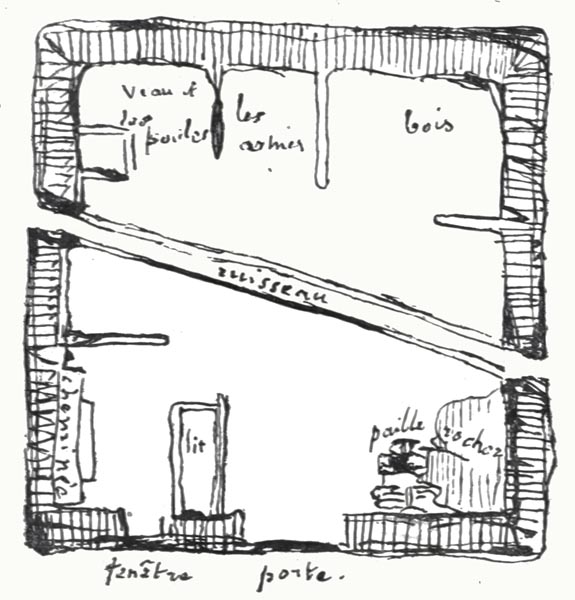
‘A stream traversed the cabin’- Victor Hugo (1894)
Internet Archive Book Images
This stream, which flowed rapidly, at an oblique and inclined angle, along a hollow beam set in the ground, opened into the cabin through a hole made in the wall, and exited through the opposite wall. There it fed the little waterfall in the ravine I had noticed on arrival. A unique room where the mountain seemed to feel at home and entered familiarly: the rock lodged there; the stream passed through it.
While I was making these observations, in the elegiac manner of a dreamer who has not yet had supper, the mules, unloaded and unmuzzled, were peacefully tearing at the long strands of hay hanging from the ceiling. Seeing this, Escumuturra signalled to the host, who drove them to the back of the hut, and gave each of them a bundle of fodder. Meanwhile my companions settled down, one on a bale, like me, one on a saddle placed on the ground; Azcoaga lay down at full length, wrapped in his muleta.
The host propped two bundles of broom in the fireplace, on a bed of dry ferns. He set his resin torch to it; and in the twinkling of an eye a large, crackling fire rose in the hearth, emitting swirls of sparks, and a beautiful, blazing, red glow filled the cabin, and made the mules’ rumps, the chicken-coop, the sleeping calf, the hidden blunderbuss, the rock, the stream, the strands of straw hanging from the ceiling like golden threads, the harsh faces of my companions, and the haggard eyes of the frightened child stand out in relief against the dark recesses of the hut. The two black andirons with monstrous mouths stood out against their background of burning embers, and looked like two hellhounds panting in the fiery furnace. But none of this, I confess, attracted my attention; it was entirely elsewhere.
A great event had just taken place in the cabin. The host had taken the frying pan from the nail!
Chapter XIII: Notes on Spain
The Passport
One is forever making two journeys in Spain at the same time: that which one intends to make, and that which one’s passport is making. What a terrible wanderer one’s passport is in Spain! It won’t stay still for a moment. At every instant it flies from your pocket, unfolds, and vanishes. One chases after it; to the jefetara (police station) to the politica (political authority) to the casa del alcade (the mayor’s office); then to the ayuntamiento (the council office), and finally to the refrendar (the registrar, to have it stamped)! And each time it costs a media-peseta. One has already paid one franc for a passport to Spain to the authorities in Paris, five francs in Bayonne to the consulate, and two francs in Irun to enter. Now, one must pay ten sous to the policeman every time it changes hands, and one must have one’s passport stamped in every town, to access each particular gate of the town. If one changes one’s mind, and alters the gate of choice, the passport has to be returned. Ten sous. — One pays ten sous for everything in Spain. Yesterday I was arrested by a clown of a police sergeant and dragged through the town to the alcalde. Found innocent, the police sergeant asked me, for the trouble he had taken and the honour he had done me, ten sous. Poor, noble Spain! Just now a scoundrel followed me down the street, shouting: ‘Caballero! Señor Caballero!’ I turned around, saw the poor devil, searched my pocket, and gave him a sou. He took the sou and asked for my passport. I had taken him for a beggar; he was a public official, the State embodied. Yet it turned out he was also a beggar. He took the penny, and asked for my passport, but happily accepted the alms.
The Spanish Priest
The priest insisted on speaking French to me. Dreadful gibberish. At one point, he was talking about grammar and linguistics, and I understood not a word. I kept hearing the obscure phrase: ‘les-tigres-morts-au-logis: dead tigers in the house.’ I racked my brains. Finally, at some point I realised that the good priest meant: ‘l’étymologie: etymology.’
He wrote in the travellers’ book, at the foot: — ‘Think, while here, O mortal, that once dead you will be eaten by worms.’ I took up the pen and added:’ and that while alive you will be eaten by fleas.’ In Spanish: ‘Pensa aqui, o hombre mortal, que muerto comido eras de las viermes. — Y que vivo comido eras de las pulgas.’
Mules and Muleteers
Mules, shorn except for the tail, which is used as a stencil to draw a letter T on the animal’s rump. Mules with copper plates on their snouts, harnessed, clothed with wool caparisons with red tassels, bearing paniers of enormous fish; tuna or sturgeon, whose tails stick out from under the lids. The fish that travels in the sun among the mountains must arrive fresh.
Muleteers with tonsured heads. A handkerchief tied around them. Further south, the heads are shaved, and the handkerchief becomes a turban. This is the best headdress because sweat would otherwise drip from the hair into the eyes.
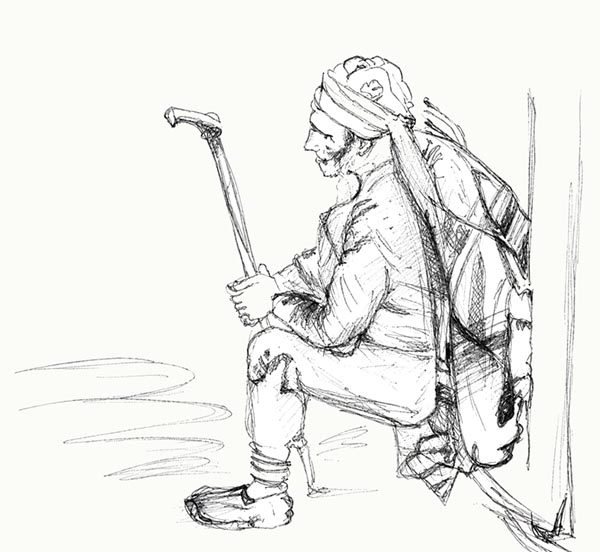
‘Muleteers with tonsured heads’- Victor Hugo (1894)
Internet Archive Book Images
First muleteer — Short breeches, blue stockings, velvet jacket, and a large round hat with wide brim. White blanket with red checquering on the shoulder. Espadrilles. Second Muleteer — Straw hat with black ribbon, short breeches, white stocking with raised designs. A pack on the end of a stick. The muleta, motley yellow, blue, green and red, across the shoulder. Their trousers, unbuttoned towards the knee, reveal their rough, hairy legs.
The Basque Muleteers Who Were My Guides
A formidable pass. A frightening bend. A narrow path strewn with small round stones, the bend emerging abruptly above the abyss and empty air. The mule stopped short, I felt her every limb tremble beneath me. But I had to move forward. ‘And’usted: Go on!’ shouted Escumuturra to me. I pushed at the mule, she leant on her hind legs, rushed forward, the stones rolling from under her feet into the precipice; and leapt across.
The Kitchen
One doesn’t know what kind of meat one is eating. It’s red, thin, and tough. — Is it beef, pork, sheep, dog, horse, camel, bear? — It’s veal.
Pamplona. — ‘What’s this?’ I cried in horror. A calm reply: ‘Langusta’ (Spiny lobster). I remembered that the tide brought the mullet with it. Something with oil. One chews. Teeth get tangled in hair. A wig à la barigoule (with barigoule mushrooms)! Pharmaceutical-tasting herbs dressed in rancid oil claiming to be English-style green beans. No sugar; a sort of yellow-brown substance, instead, mixed with ants and flies.
The bare-legged maid chases away the flies with a stick adorned with a feather duster while you dine. No butter. No milk. No coffee. And that’s only in the best inns. Saffron, chili, cinnamon, and pepper everywhere. Always pork, in all its forms.
The Inhabitants
Lots of pretty girls, no pretty women. — Aragonese woman. Swarthy-faced. Dazzling white headdresses. Men’s jackets of bronze-green velvet with tight sleeves. Black cloth skirts, a thousand pleats around the waist. Blue stockings with decoration.
When you enter a cabin here and see its poor, bare interior, having viewed the countryside, admirable Nature who gives everything, lavishes everything, wheat, corn, vines, apple-trees, oak-trees, elms, pines, mountains, rivers, torrents, gulfs, mines yielding gold, silver, lead, iron, and quarries yielding sandstone, lime, plaster, granite, and marble, one wonders how human beings can have managed to extract so much misery from so much wealth!
Oh! If this great nation could only find a great man to lead it, what great things it might achieve! What misery! To need a Napoleon, and find only an Espartero!
The coquettish and vain officers love finery too much not to love glory also.
Chapter XIV: From Bayonne to Pau
August 14th
Four in the morning. — Seated on the Imperial. — Mist. — Vast plains. — The sun in one’s eyes. — A trail of vapour marks the Gave de Pau (the river flows through the city of Pau) on the right. — By noon, the Pyrenees could only be distinguished by a few white streaks on the horizon, as if the blue robe of the sky, frayed in places, revealed its silver weave. At a large village, Biaudos, I think, a hill topped by a beautiful ruin. Further on, Peyrehorade. The name seems to indicate an ancient gnomon, perhaps a peulven (a menhir) whose moving shadow tells the time.
Orthez. — A beautiful, tall square tower of the old viscounts. A cheerful town open to the sun. At the entrance to the place, countrywomen going to the market put on their stockings, naively, in the street.
In a beautiful deserted valley, two women were herding a flock that included a goose. Each of these two women seemed very busy guarding her half of the goose. The goose seemed to be mocking them.
Pau. — The château. One is only able to view three or four rooms, poorly restored but admirably furnished, with old chests and tapestries from the storeroom. As I am waiting for the Duke of Montpensier (Antoine d’Orléans, the youngest son of Louis Philippe), the floors are being scrubbed. A footman charged with protecting the parquet seeks to prevent my viewing a statue of Henry IV in the great hall, on the first floor. I scold the footman, and go and find the statue. Beautiful, fine, intelligent, delicate sixteenth century sculpture. Yet it is a last flourish. Already the heaviness of the Louis XIII style is making itself felt.
The main tower is opened up for me. An admirable view from the platform. All of the Pyrenees. The whole town with its slate roofs. A young English lady whom I had assisted, along with the people who accompanied her, including a local resident, looked with great curiosity at a low, closed house, isolated in a garden. Not an open window. Vines and ivy hiding the walls. A man was working in the garden. It was the house of the executioner of Pau (Joseph Faroux). The gardener was the executioner. ‘He is rich’, said the resident.
A Renaissance chapel door; charmingly, completely, and exquisitely restored. However, it is marred by a tasteless cross replacing the impost. Admirable spiral staircases, skilfully restored.
The cradle of Henri IV (born at the Chateau de Pau, in 1553). Its tortoiseshell surround is gnawed at the edges. Is it authentic? See the book by Saget (Pierre Saget, ‘Description du Château de Pau et de ses Dépendances’ 1831). Ridiculously adorned with a bundle of gilded wooden pikes, and a cardboard helmet with white plumes in the Louis XVIII style. A relic of the sixteenth century, and of the royalism, with its bulging fleurs-de-lis, of 1814. A garish and unfortunate combination.
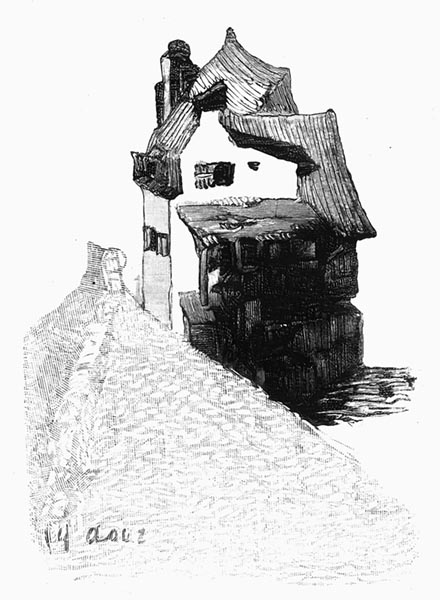
‘Pau. 14 August - old house below the château terrace, birthplace of Henri IV’- Victor Hugo (1894)
Paris Musées
Pau — a cheerful, pretty, clean city. A little too rebuilt and re-modelled, which detracts from its historic air. Only the trench made by the old moat through the city indicates the layout of the ancient Pau, that of Antoine de Bourbon (Antoine, King of Navarre from 1555 to 1562, the first monarch of the House of Bourbon, and father of Henri IV). Old slate houses, though. Buffeted, marked by curious architectural accidents, and displaying on every floor the original and curious warts of fifteenth-century domestic masonry.
Chapter XV: From Pau to Cauterets
Six in the morning. It is raining. The rain above, the Gave below, mingle their sounds. A picturesque road, shaded, green, and cheerful despite the bad weather. The Pyrenees on the horizon. Mountain peaks, broken, chewed, twisted, kneaded, as if tweaked by the formidable hand of a giant. Small snow-water lakes in the hollows.
Here one no longer hear those resounding names hurled at the top of our lungs by the Spanish muleteers to their mules: La generala! La capitana! The Béarnese coachman instead talks to his mares in the local patois, in a low voice, and in a tone that is sometimes mocking, sometimes caressing: Yo grisa! Yo blonda!
In a village this inscription on a door: ‘lo que ha de ser ne puede faltar: what must be will be.’ One feels the proximity of Spain.
Here, slate roofs are everywhere; sharply-pitched roofs, sloping to allow the snow and rain to drain away. Travel a few miles, cross these mountains, and you will find flat roofs, with hollow tiles. Here, are villages of the Ardennes; there, the villages of Calabria. The north occupies one slope of the Pyrenees, the south the other.
Saint Pé de Bigorre — A charming town with traces of the fifteenth and sixteenth centuries. Countrywomen emerge from Mass in long lines, dressed in black, with grey, white, and red hoods. They look like processions of nuns of every religious order. In Cauterets the effect is even stranger. They have grey hoods and bare feet. Saint Anthony from above; Goton (a slattern) from below.
Lourdes. — A magical arrival. A magnificent thirteenth-century keep perched on a rock. The Gave de Pau on one side, the town on the other. In the background, the mountains, high, steep, cut by deep valleys from which rise mists, wind, and noise.
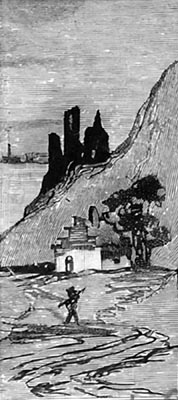
‘Lourdes’- Victor Hugo (1894)
Paris Musées
At Lourdes begins the great gorge of the high Pyrenees which opens at Agos-Vidalos, diverges, and divides into four ravines, forming that immense crow’s foot (patte d’oie, literally goose’s foot) whose base is Argelès (Argelès-Gazost) and whose four claws reach Arbéost to the west, via the valley of Estrem de Salles; Aucun to the south-west, via the valley of Azun; Cauterets to the south, by the defile of Pierrefitte (Pierrfitte-Nestalas); and Barèges to the south-east, via the Luz pass. — The gorge from Lourdes to Argelès is, so to speak, its handle, like the wrist of this open hand.
Lourdes is the gateway to the Hautes-Pyrénées. In 1755 it felt the aftershocks of the Lisbon earthquake. The central network of the Pyrenees was well-guarded in the Middle Ages. Every arm of the valleys had its castle which overlooked the castles of the two neighbouring valleys, and conversed with them by means of fire-beacons. Today one sees their ruins, which add immense interest to the landscape; nothing is more poignant than the ruins of Mankind amidst the wildness of Nature.
The Château Fort de Lourdes viewed the three turrets of the Château de Pau, which viewed, in turn, the square Tower of Vidalos (Agos-Vidalos), which could communicate by signals with the ancient castrum built by the Romans, and raised from the ruins by Charlemagne, on the hill of Saint-Savin (Saint-Savin en Lavedan, site of the Abbey Church of Saint Savin), which was connected across the mountains to the feudal fortress of Beaucens. The signals thus passed, from tower to tower, along the valley of Luz, to the Château Sainte-Marie d’Esterre (occupied by the Knights Hospitaller in the fourteenth century), as far as the valley of Gavarnie, as far as the citadel of the ‘Templars’. The castellans of the Pyrenees, like the burgraves of the Rhine, passed warnings to each other. In a few hours the bailiwicks were roused, the mountain was on fire.
The countryfolk, felt no hatred for the castellans, a remarkable feature and one local to the area. They felt that these fortresses, while dominating them, even oppressing them, protected the border. It was the mountain people who gave one of these castles not far from the Ousse valley, the name of Bon-Château, which it still retains: Castelloubon. (This ancient ruined castle of the Viscounts of Lavedan, at Cotdoussan, having been abandoned, was finally destroyed by the earthquake of 1660.)
Chapter XVI: Cauterets
To Louis Boulanger
I am writing to you, dear Louis, with the state of my eyesight the worst in the world. Yet writing to you is a sweet and familiar habit that I do not wish to forego. I would not want to loosen a single stone of our friendship. For almost twenty years we have been brothers, brothers in heart, brothers in thought. We see Creation with the same eyes; we view Art with the same spirit. You love Dante, in the same way that I love Raphael. We have gone through many days of struggle and trial together without our sympathy weakening, without retreating a step in our devotion. Let us therefore remain until the last day what we have been from the first. Let us change nothing of what has been so good and so sweet. In Paris, let us shake hands; absent, let us write to one another.
When I am far from you, I need to write a letter to tell you something of what I see, think, and feel. This time it will be shorter, that is to say, less lengthy than usual. My eyes force me to spare yours. Complain not, you will receive less grammar, but just as much friendship.
I come from the sea, and am in the mountains. Which is not a change in my emotional life, so to speak. The mountains and the sea address the same regions of the mind.
If you were here (I cannot help dreaming of it, constantly), what a charming life we would lead! What pictures you would carry away in your thoughts, so as to render them afterwards in art, even more beautifully than Nature would offer them to you!
Imagine, Louis, that I rise every day at four in the morning, and at that hour, a twilight of both darkness and light, I visit the mountains. I walk beside a torrent, I plunge into the wildest gorge there is, and, under the pretext of soaking myself in hot water, and drinking the sulphurous liquid, I witness, every day, a new, unexpected and marvellous spectacle.
Yesterday, the night was rainy, the air was cold, the wet fir-trees were blacker than usual, mists rose from the ravines on all sides, like the smoke from the cracks at Solfatara (Solfatara is a shallow volcanic crater at Pozzuoli, near Naples, part of the Phlegraean Fields, emitting jets of steam with sulphurous fumes); a hideous and terrible noise came from the darkness, below, in the precipice, beneath my feet; it was the raging cry of the torrent hidden in the fog. Something vague, supernatural, inconceivable, mingled with the landscape; everything was dark, as if pensive around me; the immense spectres of the mountains appeared to me through gaps in the clouds, as through torn shrouds. The twilight illuminated nothing; but, through a stony crevasse above my head, I perceived, far away in the infinite, a corner of blue sky, pale, icy, gloomy, yet brilliant; all I could distinguish of the terrain; rocks, forests, meadows, glaciers, shifted chaotically amidst the vapour, and seemed to flee, borne by the wind, through space, amidst a gigantic network of cloud.
Before dawn, the night was serene. The sky was starry; but what a sky, and what stars! You know, that freshness, that grace, that melancholic and inexpressible transparency of dawn, bright stars against a whitening sky, a crystal vault strewn with diamonds. Enormous mountains on every side leaned against this luminous vault; mountains black, hairy, and misshapen. The summits of those in the east were highlighted by the brightest of dawns, their fir-tree forests resembling those leaves of which aphids leave only the veins, and which look like lacework. Those in the west, black at their bases, glowed on their summits, and throughout almost their entire height, with a rosy clarity. Not a cloud, not a sign of vapour. An obscure and delightful life animated the dark slopes of the mountains; one could distinguish the grass, flowers, stones, the heather, all softly and joyful teeming. The noise of the Gave du Marcadau was no longer dreadful; it was a great murmur mingling with this great silence. No sad thought, no anxiety emerged from this harmonious whole. The whole valley was like an immense urn into which the sky, during the sacred hours of dawn, poured the peace of the spheres, and the radiance of the constellations.
It seems to me, my friend, that these sights are more than mere landscapes. They are Nature glimpsed at certain mysterious moments when everything seems to dream, I almost said ‘think’; when trees, rocks, clouds and bushes are more visibly alive than at other times, and seem to quiver with the soft beat of universal life.
A strange vision, and one that for me is very close to being a reality. At the moments when human eyes are closed, something unknown fills Creation. Do you not see it as I do? Does it not seem that, at the moment of falling asleep, when coherent thought ceases in the mind it commences in Nature? Is the calm not deeper, the silence more absolute, the solitude more complete, such that the dreamer who is still awake then can better grasp, in its subtle and marvellous detail, the extraordinary fact of Creation? Or is it that some revelation, some manifestation of the supreme intelligence enters into communication with the great whole, as some new state of Nature? Does Nature feel more at ease when we are absent? Does it expand more freely?
It is certain that, in appearance at least, there exists for the objects that we call inanimate a twilight life and a nocturnal life. This state is perhaps only in one’s mind; sensible realities present themselves to us at certain times in an unusual aspect; they move us; a mirage is formed from them within us, and we mistake the new ideas that they suggest for a new life that they truly have.
These are the questions. Decide. As for me, I limit myself to dreaming. I devote my mind to contemplating the world and studying mystery. I spend my life between the state of admiration and one of questioning all.
Chapter XVII: Banks of the Gave de Marcadau
Cauterets, August 18th
A huge landslide. Scattered stones have rolled right into the Gave de Marcadau. They still bear all the disordered marks of their fall. You would think that they had fallen yesterday, were it not that they are eaten away by lichen. One of them, the largest, is split down the middle. A shepherd dreams among these rocks to the sounds of tumultuous Nature. The goats bleat, and hang from the rocks. A large green grasshopper allows me to pick it up in my hands. I place it on the rock; it stays where I place it. A lizard emerges from a crack. The grasshopper and the lizard look at each other. The lizard approaches. The grasshopper skims away like a bird, and descends far off among the tall grass.
I cross the wooden bridge at the confluence of the Gaves of Marcadau and Lutour. A smell of sulphur rises from the torrent. Here, the flow is frightening. It is an avalanche of liquid snow. A furious noise. On the sides, hosts of flowers grow; small side-branches of the torrent make microscopic cascades over small boulders. There are little, tranquil pools with pebbled beds, that look as if they have been arranged by a child for their garden. A ray of sunlight pierces the clouds, and makes each drop of water sparkle. — Beautiful green puddles. All shades of green. Light greens, dark greens. The pieces of granite and marble, stained with pink, that one sees through the glaucous water veined with light, resemble gigantic agates.
I started out in blazing sunlight, and suddenly a heavy grey cloud invaded the whole sky. It was about to rain. I took refuge beneath the porch of the thermal baths. An old woman who was knitting saw me enter, grumbling. She was a broken-down, hideously wretched figure, her face all wrinkled, wrapped in a ragged cape. Seeing that I persisted in remaining there, and had taken a chair, she rose, dragged herself, while leaning on two sticks, towards a dark corridor, and departed. — From a niche on the outer wall, I picked a beautiful yellow flower, which had the shape of a tulip, and the scent of an apricot.
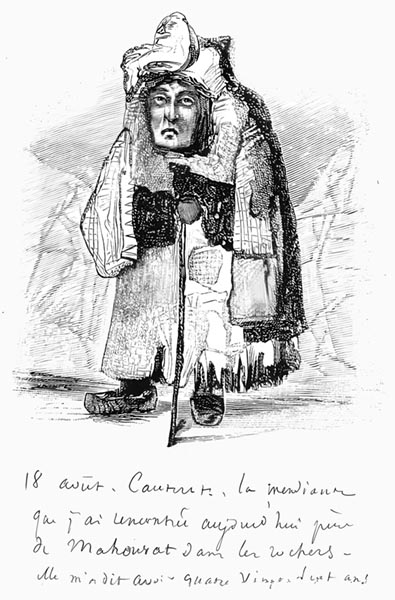
‘Beggar, Cauterêts’- Victor Hugo (1894)
The storm is approaching. Large, sonorous drops of rain fall on the trees and rocks. A flash of lightning. A clap of thunder. A clap of thunder in these gorges is no longer a clap of thunder; it is a pistol-shot, a monstrous pistol-shot that bursts from among the clouds, falls on the nearest peak, and bounces from crest to crest with a dry, sinister, and formidable noise. — It is raining hard. All except the cloud and the rain is invisible. It is a sort of pale night, interrupted by lightning, amidst which one hears nothing but two roaring sounds: the torrent which howls incessantly, and the thunder which rumbles from time to time. I thought in reverie about this dual noise, and said to myself: ‘the torrent resembles rage, and the thunder resembles anger’.
August 23rd. 3 a.m.
After a two-hour climb, I reach an immense meadow with two or three wretched huts, whose gardens are a meagre tangle, with marble walls. To the right, is a torrent. Before me, an enormous block of white marble, and an old, dried-up stump. Around me, magnificent mountains. The sun’s rays create broad swathes of light and shadow. Small snow-filled tarns near the sky, fill the crevices. As well as the snow and ice, rock-slides of slate sparkle in the sun up there. It looks like the back of an enormous dragon. Broad swathes of darkness and light. Immense, simple planes. Four mountains fill the horizon. Nothing but short, sparse grass, and some heather. Yet it makes for a gigantic blanket of greenery that covers the mountains as far as the entrance to the passes. The torrent flows smoothly and almost peacefully through the depths of the ravine. No sound. No voices. Blue sky. Deep calm. Absolute solitude. I have never seen anything more beautiful or grand in the Pyrenees.
August 24th
The two torrents form a Y. On this Y, stands a wooden bridge (the Pont d’Espagne, reconstructed in stone in 1886) with three arches, triply bonded, made of fir-trees stretching from rock to rock. On the Gave du Marcadau, there are four other bridges, at four different levels, along the mountain side, formed of tree trunks. Rocks collapsing.
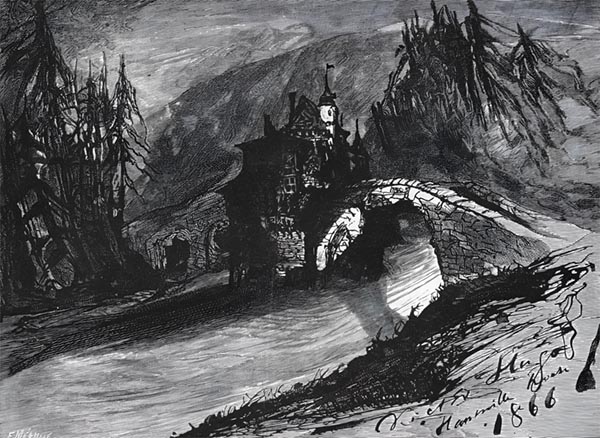
‘Old bridge at Cauterets’- Victor Hugo (1894)
Paris Musées
A torrent of water over a torrent of stones.
At the first bridge (Cascade d’Escane Gat): dried fir trees with short, broken branches that could serve as top-gallant masts for bears to climb. In one of these hollow fir-trees, a fire has been made. It still makes for a fairly large chimney. Hairy lichens clothe these skeletons. Multi-layered vegetation. All the flowers of the mountain. Green, peaceful water in a cove below the falls with dead fir trees hanging over it.
At the second bridge (Cascade de Ceriset): two black walls. The light catches the projections, and creates small, bright terraces covered with grass and flowers. The water is luminous; the light is moist. Between the two black walls, the white Gave.
In the background: a four-tiered waterfall. Trees cut down by lumberjacks. Forest. Immense mountains below.
At the third bridge: (Cascade de Pouey Bacou): Another waterfall. A rainbow. The waterfall drops to a plateau, then plunges into the chasm. I descend, holding onto the tree roots, to a jutting rock. The bridge is above my head. The rock receiving the splash of the waterfall is perforated like a sponge. Mist and rain. I clamber back up. The rotten branches break easily. (The fourth bridge is the ‘Pont du Pas de l’Ours’)
Lac de Gaube. — It is said to be thirteen hundred feet deep. Our old Notre Dame would have to be piled upon itself six times, before the highest balustrades of the towers (226 feet) reached the surface of the water. If the Great Pyramid (454 feet) were to be submerged in it, if Strasbourg Minster (446 feet) were placed on Cheops’ Pyramid, and the spire of Antwerp (404 feet) on the Minster, the tip of the spire of Antwerp would barely rise above the lake’s surface, like the tip of the mast of a shipwrecked vessel.
A wild valley. Pine forest crushed by a collapsed mountain. Pollarded trees, dead trees. Here, the years, thunderclaps, and avalanches are the only lumberjacks.
At the lake; four in the afternoon. — A pool of the greenest, most graceful, prettiest, most cheerful water, surrounded by hideous, chewed, deformed, ruined and terrifying rocks. In the background the snowy ridges of Mount Vignemale, the highest French mountain, form an immense inverted Y towards the east. At the edge of the pool, transparent water beneath which one sees the granite bed, which swiftly deepens. The great shadows of the peaks fall on the western escarpment like the shadows of battlements.
Foreground: — A cabin wherein kirsch is drunk; a cage full of chickens, ducks; a rock that forms a small peninsula. Beside the lake one finds a kind of tomb (destroyed in 1944) in white marble, and surrounded by a grille. The tomb is of an English couple who drowned here, and whose epitaph is as follows:
In memory
of
William Henry Pattisson, Esquire,
Barrister-at-Law, of Lincoln’s Inn, London,
and Sarah Frances, his wife,
aged 31 and 26, married
only a month. A terrible accident took them from their inconsolable
relatives
and friends.
They were swallowed up in this lake
on September 20, 1832. Their
remains, borne to England,
are buried at Witham in the county of Essex.
(The inscription on the memorial stone at the lake, was in French on one side, English the other. A bas-relief, by Charles Augustus Rivers, commemorating the couple, can be found in the church of Saint Nicolas, Chipping Hill, Witham, Essex. William Henry Ebenezer Pattison, was admitted to the Middle Temple in 1818, called to the Bar in 1825, and admitted to Lincoln’s inn in 1828. They had married on August 22nd, 1832. See the painting of William and his younger brother Jacob Howell Pattison, entitled ‘The Masters Pattison’ by Sir Thomas Lawrence.)
Icy water. Whoever falls in dies. In the ninety years that the old fisherman had been there, he had not seen anyone bold enough to bathe in it. It costs three sous per person to enter the tomb enclosure. I picked some cineraria from the granite overhanging the lake. I slipped, and almost fell into the water. That would have made a second grave. It cost them six sous to do so.
Cauterets, August 26th
The valley is peaceful; the escarpment is silent. The wind dies down. Suddenly, at a bend in the mountain road, the Gave appears. It has the sound of a melee; which is its appearance. One thinks one hears the combatants howl with rage, and sees the projectiles flying. — They are drawing nearer. — Large funnels end in large vats in which the water leaps and boils, covered with foam, as in some enormous pot heated by an everlasting fire. Monstrous tree stumps, hideous roots, gaunt and deformed, roll about in the torrent like the carcasses of Hydras. — Everything about the place is terrifying.
The mountain horses are admirable, patient, gentle, obedient, full of instincts, and adaptable. They climb stairs and descend ladders. They journey over grass, granite, and ice. They skirt the very edge of precipices. They walk delicately, and spiritedly, like cats. True ‘alley-horses’.
Mine was curious and somewhat of an original. He seemed to love adventure. He always chose to walk along the narrow edge of all the abysses we encountered. He seemed to be saying to himself: ‘This gentleman is an artist, an amateur. We must allow him to see everything clearly. Ah! You want torrents, Parisian! You want Gaves, waterfalls, chasms, precipices, adventure! Well, here they are. Here, look, lean over, here, and here, and here. Is that enough for you?’
I trotted thus along overhanging escarpments eight hundred feet high, with a small, dark blue river beneath my gaze. I tried at first to make him take less a picturesque route, but he persisted and, when I saw that it was to his liking, I had too much interest in keeping well in with him to contradict, and let him alone.
Chapter XVIII: Luz
Luz, is a charming old town — a rare thing in the French Pyrenees — delightfully situated in a deep triangular valley. Three great shafts of daylight enter it through the triple embrasures of three mountains. When the miquelets (Spanish guerillas), and Spanish smugglers arrived from Aragón by La Brèche de Roland (‘Roland’s Breach’ is a natural gap, in the Pyrenees on the border between Aragón, in northern Spain, and the Hautes-Pyrénées) and by the dark and hideous valley of Gavarnie (Gavarnie Gèdre), they suddenly perceived, at the end of the dark gorge, a sudden brightness, like the opening of a cellar door to those inside. They hastened on, and found a large village, lively, and lit by the sun. This village, they named Lumière, Luz (Luz Saint-Sauveur).
I made four drawings of the Castle of Sainte-Marie Esterre. The church (Saint André, l’Église des Templiers) was built by the ‘Templars’ (the Saint John Hospitallers in the twelfth century); it is rare and curious; a fortress as much as a church; a crenellated enclosure, a gatehouse-keep.
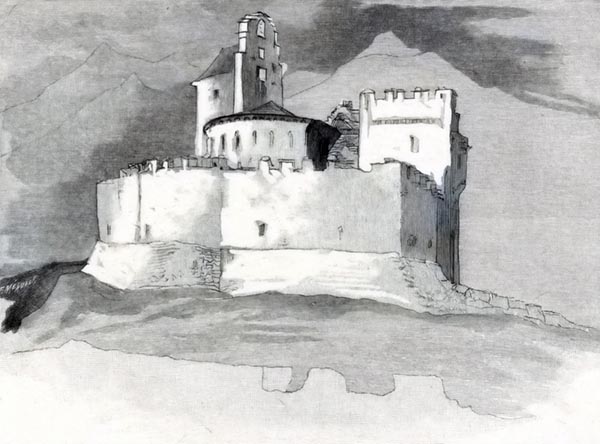
‘The church of Luz’- Victor Hugo (1894)
Paris Musées
I walked around, between the church and the crenellated wall. The cemetery there is dotted with large slates from which the crosses, and the names of mountaineers, dug with a nail, are erased by rain, snow, and the feet of passersby.
The Cagots’ Gate, in the cemetery is walled up. These sufferers from goitre were outcasts. They had their own gate. A low one, as far as one can judge from the vague line marked by the stones that block it.
The exterior holy-water font is a charming little Byzantine tomb to which two almost Roman capitals still adhere. The key to the cemetery is hidden there, in order to oblige foreigners to pay to view the place. For everything here has to be paid for. The tomb’s inscription is illegible, erased by time, scored with a knife, covered in dust. A few Spanish words can be made out. Aqui: Here: Abris: Find. However, the words filla de (Basque: daughter of) ... seem to indicate the patois. I have more or less deciphered the last line, which makes no sense though: SUB DESERA LO FE (Latin: ‘below the wastelands’, plus ‘Spanish: ‘the faith’)
The corbels on the exterior wall of the apse are adorned with curious and charming designs. The main portal, which depicts Jesus between the four symbolic creatures, is of the finest Romanesque style; firm, robust, powerful, severe. Remains of paintings on the wall depict mosaics and buildings. The interior of the church is a nondescript barn.
Under the vault of the portal of the entrance tower, the Byzantine paintings, restored and half colour-washed, have lost much of their character. At the top of the vault, Christ, with the imperial crown. Below, the angels of judgment blowing their trumpets, and this inscription: SVRGYTE MORIVY-BENYTE-AD-JVDYCIVM (‘Surgite morui venite ad judicium: Rise, you who have died, and come to judgment.’)
At the four corners, some remnants of the four evangelists. The ox, with the inscription SANC-LUC (Saint Luke). The eagle, with SANC… (Saint John). Mould has clouded it, and the rest is lost. The winged lion, in a beautiful style, with the inscription SANT-MARC (Saint Mark). In the shadow, an angel’s head with this remnant of the inscription … CTE MYCHAEL (Saint Michael).
Chapter XIX: Gavarnie
When you have crossed the Pont de Douroucate bridge (at Pragnères) and are only a quarter of an hour from Gèdre (Gavarnie-Gèdre), two mountains suddenly seem to part and, in whatever manner you approach Gavarnie, you discover something unexpected.
You may have visited the Alps, the Andes, the Cordilleras; for several weeks you have had the Pyrenees before your eyes; whatever you may have seen, what you now perceive resembles nothing you have encountered elsewhere. Until now you have seen mountains; you have contemplated outcrops of all shapes, of all heights; you have explored green ridges; slopes of gneiss, marble or schist; precipices; rounded or jagged summits; glaciers; forests of fir-trees among the clouds; needles of granite; needles of ice; but, I repeat, you have nowhere seen what you see, at this very moment, on the horizon.
Amidst the capricious curves of the mountains, bristling with obtuse and acute angles, straight lines suddenly appear, simple, calm, horizontal or vertical, parallel or intersecting at right angles, and combined in such a way that the dazzling, real form, penetrated by sun and azure, of an impossible and extraordinary object results from their ensemble.
Is it a mountain? But what mountain has ever presented these rectilinear surfaces, these regular planes, these rigorous parallels, these strange symmetries, this geometric aspect? Is it a wall? Here are towers indeed which buttress and support it, here are battlements, cornices, architraves, ledges, and walls of stone, which the eye distinguishes and could almost count; here are two breaches, deeply cut, which awaken in the mind ideas of sieges, trenches and assaults; but here also is snow, large bands of snow placed on these ledges, on these battlements, architraves, and towers; we are in the heart of summer and the south; these are therefore eternal snows; now, what wall, what human architecture has ever risen to the frightening heights of eternal snow? Babel, the effort of the whole human race, collapsed upon itself before attaining them.
What is this inexplicable object that cannot be a mountain, yet which is as high as a mountain, which cannot be a wall yet which has the shape of a wall?
It is a mountain, and a wall at the same time; it is the most mysterious building, by the most mysterious of architects; it is Nature’s Colosseum; it is the Cirque de Gavarnie.
Imagine this magnificent silhouette as it first appears at a distance of seven or eight miles: a long, dark wall whose every projection, every wrinkle, is marked by lines of snow, whose every platform bears a glacier. Towards the middle, two large towers; one to the east, square and turning one of its angles towards France; the other to the west, fluted as if it were less a tower than a sheaf of turrets; both covered with snow. To the right, two deep notches, the breaches, which cut into the wall like two vases filled with clouds; finally, still to the right and at the western end, a sort of enormous edge pleated with a thousand steps, which offers to the eye, in monstrous proportions, what in architecture would be called the cross-section of an amphitheatre.
Picture it as I saw it: the black wall, the black towers; the dazzling snow, the blue sky; a scene complete in short, grand to the point of incredulity, serene to the point of sublimity.
It is an impression unlike any other, so singular and so powerful at the same time that it erases everything else, and one becomes for a few moments, even when this magical vision has disappeared behind a bend in the road, indifferent to everything else.
The landscape that surrounds you, however, is admirable; you enter a valley where all the magnificence and all the graces envelop you. A pair of upper and lower villages, like Tracy-le-Mont and Tracy-le-Val, namely Gèdre-Dessus and Gèdre-Dessous, with their stepped gables and their old ‘Templar’ church (Not extant, replaced by the late nineteenth century church of Saint-Matthieu), curl-up and unfold on the slopes of two mountains, along a foaming-white Gave (Gave de Gavarnie), below cheerful, whimsical tufts of charming vegetation. All this is lively, ravishing, happy, exquisite; it is Switzerland and the Black Forest suddenly merged with the Pyrenees. A thousand joyful sounds reach you as if they were the voices and words of this sweet landscape: birdsong, children’s laughter, the Gave’s murmur, the rustling of leaves, the calming breaths of wind.
You see nothing; you hear nothing; you barely retain of this graceful ensemble even a vague and confused impression. The apparition of the Cirque de Gavarnie is always before your eyes, and shines in your thoughts like those supernatural horizons one sometimes sees in the depths of dream.
In the evening, returning from Gavarnie, I experience an admirable moment. From my window: a great mountain fills the earth; a great cloud fills the sky. Between the cloud and the mountain, a thin strip of twilit sky, clear, vivid, and limpid, and Jupiter sparkling, like a golden pebble in a silver stream. Nothing is more melancholic, more reassuring, or more beautiful than this little point of light between these two blocks of darkness.
Chapter XX: Auch Cathedral
September 4th
There is a degree of analogy with the cathedral of Pamplona. Rich internally; mediocre externally. A hideous portal attached to the old nave by some architect stupefied by ‘good taste’. The fifteenth century side portals are beautiful and well preserved.
The interior has admirable stained-glass windows which are, I believe, by Arnaud de Moles. The Sibyl of Delphi next to the prophet Elisha. The Tiburtine Sibyl opposite Saint Matthew and next to the prophet Habakkuk. The Sibyl Agrippina (Aegyptia) between the prophets Nahum and Jeremiah. The Sibyl of Cumae next to Daniel facing the prophets Sophonias, Elijah, and Uriah. The Sibyl Europa, her throat almost bare and sword in hand, between the prophet Amos and the patriarch Joshua. The Libyan Sibyl between Enoch and Moses. She predicts the ascension of the Virgin to heaven. Superb costumes.
A huge fleur-de-lis in the stained-glass window of the apse, repeated on the upper lancet. The Revolution respected them, strangely enough.
Joseph sold into bondage. An admirable composition. Joseph innocent and gentle, in a white shirt. The merchant rummages through his bags, looking sideways at Joseph with the expression of one haggling over the price. In the background, the loaded donkeys, exactly like the arrieros’ mules of today.
An Entombment of Christ, early sixteenth century. Larger than life. Admirably guarded by four proud statues, one with an immense sword in its hand, on which it leans at full height. As I passed, a beautiful young woman, sad and serious, was overseeing the cleaning of this magnificent work by a kneeling servant.
There is no grant for the upkeep of the church. When Napoleon saw it, he was ecstatic about the stained-glass windows and the choir, and exclaimed: ‘There are cathedrals one would like to place in a museum’. He granted the church six thousand francs a year, which the revolution of 1830 (the July Revolution) abolished. Formerly, liberal meant magnificently generous; now, liberal means stingy.
The Choir. A Renaissance door decorated with a large Louis XV cherub. Inscription:
HÆC-PORTA-DOMINI-IVSTI-INTRABVNT-IN-EAM-PSAL. – 117
THIS IS THE GATE OF THE LORD, THROUGH WHICH THE RIGHTEOUS MAY ENTER
(Psalm 117 in the Vulgate, Psalm 118 otherwise, verse 20)
In the choir, above this door, the Precepts of the Church translated into Latin as follows:
FESTOS DIES CELEBRATO.
MISSAM IN FERTIS AUDITORO.
JEJUNIA INDICTA OBSERVATIO.
QUO ANNIS SACERDOTI
CONFITEOR.
IN PASCHATE
COMMUNICATO.
OBSERVANCE OF FEAST DAYS.
HEARING MASS.
FASTING AS REQUIRED.
CONFESSING ONE’S SINS AT LEAST ONCE A YEAR.
RECEIVING COMMUNION AT EASTER.
On the other side the Precepts of God:
UNUM COLE DEUM.
NON JURES VANA
PER IPSUM.
SABRATHA SANCTIAETCIS.
HABEAS IN HONORE
PATENTES.
NON SIS OCCISOR
FUR MAECHUS.
TESTIS ANIQUUS.
ALTERIUS NUPIAM
NEC REM CUPIAS
ALIENAM.
THOU SHALT HAVE NO OTHER GODS BEFORE ME.
THOU SHALT NOT MAKE UNTO THEE ANY GRAVEN IMAGE.
THOU SHALT NOT TAKE THE NAME OF THE LORD THY GOD IN VAIN.
REMEMBER THE SABBATH DAY, TO KEEP IT HOLY.
HONOUR THY FATHER AND THY MOTHER.
THOU SHALT NOT MURDER.
THOU SHALT NOT COMMIT ADULTERY.
THOU SHALT NOT STEAL.
THOU SHALT NOT BEAR FALSE WITNESS AGAINST THY NEIGHBOUR.
THOU SHALT NOT COVET.
Above them we read:
PRÆCEPTA EJUS COR TUUM CUSTODIA
KEEP HIS PRECEPTS IN YOUR HEART
Horrid, S-shaped balustrades around the nave. In the choir, a charming Renaissance high-altar on which are carved, in marble, two pulpits, one for the Gospel the other for the Epistles.
In front of the altar, the tombstones of three archbishops: the Count of Morlhon (André-Etienne-Antoine de Morlhon), Cardinal d’Isoard (Joachim-Jean-Xavier d’Isoard) and Léonard de Trapes, whose epitaph, composed by himself, reads:
LEONARDUS DESTRAPPES-ARCHIEPS-AUXITANUS.
VERMIS ET NON HOMO.
OPPROBRIUM HOMINUM
ET ABJECTIO PLEBIS
LÉONARD DE TRAPES, ARCHBISHOP OF AUCH,
A WORM AND NOT A MAN.
A REPROACH TO MANKIND
AND REJECTED BY THE PEOPLE.
He died amidst the odour of sanctity.
It took almost two hundred years to build the cathedral (1489-1680), sixty-five to carve the woodwork of the choir-stalls, which were completed in 1554, which is admirable and comparable to the woodwork of Chartres and Amiens. Statues in the proud and fleshy style of Rubens. Details I noted here and there: four demons fighting over a head and holding it by the hair; Saint Luke writing on his wax tablet, stylus in hand, thumb securing the tablet; Justice and her scales; Abundance, and the cornucopia of Amalthea the goat (which nursed Zeus); among the mingled saints and apostles.
This cathedral is remarkable for the cult of the Sibyls. There are Sibyls in the stained-glass windows, there are Sibyls in the choir. — The Sibyl of Samos, who predicted the birth of Jesus Christ, holds a crib in her hand. — The Tiburtine Sibyl predicted that a soldier would strike Christ, she holds the hand of this soldier. — The Delphic Sibyl predicted that he would be crowned with thorns. She holds the crown. The Sibyl Europa predicted the flight into Egypt, and the Massacre of the Innocents. She holds the sword. All these figures, life-size, sculpted in half-relief, form the backs of the canons’ stalls. All the characters from the Old and New Testaments are there.
In the stained-glass windows there are only figures from the Old Testament. Pagan allegories find a place among these figures. Among others, Death. Beautiful, grave, dressed as a nun, half-veiled, she holds a skull in one hand, and a mirror in the other, in which she looks at herself. She seems to be contrasting death to beauty. — The prophet Habakkuk, beside a hut, a bow in his hand, wearing boots, and with a Germanic beard. A crossbow depicting the triumph of Maximilian. — Four stalls depict a minor drama, to strange effect in this grave choir: Uriah speaks of his betrayal to Saint George, and points to Bathsheba, who is tenderly gazing at King David. — Various stalls are distinguished by coats of arms and attributes. The stall of Archbishop Augustine de Maupeou, with his coat of arms. The fleurs-de-lis have been scraped off. Only a lion remains. — The stall of Cardinal Jean d’Armagnac, Archbishop of Auch, to the left of the door as you enter, matching, though lower than, the archbishop’s throne, and larger than the other canonical stalls, with Adam and Eve carved on the backrest, and the serpent in the shadows. It was later the stall of the King of France who held the title of first canon of the cathedral of Auch. Another archbishop’s stall. Tall and splendid. With Saints Peter and Paul as backrests.
In the middle of the choir is an immense lectern on the four sides of which are engraved the four cardinal names: Petrus, Paulus, Joannes, Jacobus (Peter, Paul, John, James). The fleurs-de-lis have been scratched over everywhere.
Chapter XXI: From Auch to Agen.
September 4th
Night. — The carriage was moving swiftly. I was asleep. However, I could perceive, vaguely, the noise of the wheels and the galloping of the horses, the brightness of the moon, and the fresh night wind. Then my sleep became deeper. A jolt woke me. I half-opened my eyes.
There was a precipice to my right. I could see only the edge of the road. The sky was so unusual in appearance that, still half-immersed in dreams, I was for a moment unaware of what I was looking at. Patches of mist were rising on the horizon to the right; a few torn and brownish clouds mingled with them. A strange light, created by the setting moon, and the breaking dawn, floated over all. At first, I thought the sky, marbled with black clouds and white fragments of mist, of which I could see only a corner through the narrow square of the window, was an immense mountain whose escarpment was lost in infinity. The stars seemed to me like shepherds’ fires lit, here and there, on that gigantic slope.
Then I awoke completely, and the strange optical illusion was dispelled, though the spectacle remained admirable. I saw constellations we usually only see when they are above our heads setting, on the horizon. The Great Bear, already half-enveloped in the mists, seemed monstrous in size. Its seven stars shone like seven small moons; its immense chariot tilted towards to the Earth, behind which its splendid team was about to vanish, granted the whole sky an extraordinary and terrible aspect.
An effect of fog. Still half-asleep as we arrived in Agen, I thought I saw the sea. It was the Garonne that was playing a Gascon trick on me.
Chapter XXII: From Périgueux to Saintes
September 5th
Périgueux
Saint-Front Cathedral. An initial square tower served as a porch. Today it is buried in a block of houses. A baker lives there and rents its four floors to poor families who dry their laundry at those windows said to have been built by the Templars. A fortress-church for soldier-monks. Once past this first tower, one is in a narrow courtyard which adjoins the bell-tower. An admirable Romanesque tower. Almost-Roman pilasters. At the top, a string of columns pressed against each other, bearing a stone tiara. A rough, original, and rare form. — Inside the church, on the left, a magnificent wooden altar from the time of Louis XIII. An ‘Assumption’. Dazed figures of the apostles. Spiral columns around which angels, birds, squirrels, eagles, a whole fantastic world, clamber and twist.
The entire church is whitewashed. Corinthian columns from the ninth century. Four enormous square pillars, pierced by cross-shaped archivolts, support the central dome, which is oval as in the Orient. The church is shaped like a Greek cross and has five domes.
In the choir, below the lectern, is the tombstone of Saint-Front. The lectern allows the first words of the epitaph to be read:
SEPVE
CHRVM
BEATI
FRON
and hides the rest. Saint-Front was the first apostle of Périgord.
On the climb to the bell-tower, one has to stop halfway, and visit the top of the church vault. Very curious. Timber frames. Dust. Caves. Crude sculptures, truncated columns that look like mummies standing in their cases and leaning against the wall. Ladders. Square holes, former cells of razed bell-towers. The five domes were uncovered. In the last century, a roof was built over them. Hence this strange interior, a mixture of chance and architecture, reminiscent of Piranesi’s nightmares. The previous bishop (Thomas-Marie-Joseph Gousset), now Archbishop of Reims, demolished the Romanesque choir to enlarge his garden.
From the top of the tower one can see the whole city, a venerable mass of gables and turrets, one of those labyrinths of pointed roofs in which the fantastic and rich genius of the fifteenth century appears with all its fantasies.
The landscape is composed of two sections, a reddish city, a green plain; the Isle, a pretty river, marks the separation; a circle of hills, borders and surrounds the basin. In the background one sees, at the end of a street called the Rue des Vieux-Cimetières, the Tour de Vésone (the tower of Vesunna, a tutelary goddess of the Petrocorii, a Gallic tribe), an ancient temple of the goddess, and on the heights the vague outlines of a Roman camp.
The roof, built in the last century, hides the domes, and spoils the church’s silhouette. Grass grows on the bell-tower. One climbs ladder after ladder, to the line of small columns. Some are made of marble. Externally, time has carved holy-water fonts into the stone, which the rain keeps filled. Beneath the church pavement is a crypt full of bones.
The Tour de Vésone. — A temple of the goddess which the Middle Ages considered a sinister place. It was here that criminals were hanged. An enormous tower built of small stones. There was a marble covering which has collapsed. The tower, gutted to the east, perpendicularly like the castles that Cardinal Richelieu dismantled, is so large that it looks like a small amphitheatre. It is in a vineyard which one enters through a door, which sets a bell ringing. The owner thus earns a few sous from showing it. Sections of Roman columns. A cornfield. Vineyards. An orchard. — I found some charming Renaissance debris inside the tower, mixed with the ancient rubble. A lawn. A small grassy eminence where the gallows were planted. Four ceilings, still indicated by scars on the wall, have collapsed, successively. On the very spot where the gallows once stood, next to a stone resembling a Roman altar, lies a delightful Renaissance relic that, broken by chance, has the shape of a cross. A salamander is carved at its centre, and two angels praying on either side. A sixteenth century edifice, a chapel or altar no doubt, must have been erected next to the Tower. The lawn is covered with scabious, and flowering hemlock. Around what remains of the tower stand nine archivolted bays that have been walled up with brick.
Château Barrière. — Next to the Tour de Vésone. A beautiful ruin. A charming interior, from the fifteenth century. Roman remains. Entablatures. Hollowed-out columns used as troughs for a reservoir. Roman capitals used as seats. Ivy serves as a tapestry. The upper doorframe of a large fireplace with small columns. A Roman altar in a casement. A pretty door with an ornate transom. Traces of excavations. A brick pavement. The ruins appear to belong to an intelligent owner.
After Périgueux
Château-l'Évêque
A charming sixteenth-century chatelet, the summer residence of the bishops of Périgueux. It belongs to a lawyer and justice of the peace.
Angoulême
A glimpse. Daybreak. Five in the morning. A beautiful thirteenth and fifteenth-century castle in the centre of the town. It serves a purpose, since there’s a sentry. So much the better, it is unlikely to be demolished (it was remodelled as the Town Hall, 1858-1869). A Romanesque cathedral (Saint-Pierre). An admirable portal with five levels of bas-reliefs, the wall covered with arabesques and statues, but spoiled by a blue window-shutter right in the middle. A beautiful Romanesque bell tower, five-storeyed, like the portal.
After Angoulême
Jarnac
No vestige of the historic site (of the Battle of Jarnac in 1569, between Catholic and Huguenot forces. The Huguenot leader Louis I de Bourbon, Prince de Condé was killed). A long white village with a yellow poster on a wall reading: Ball at Monsieur Baraud’s. — I recall seeing at the Duke of Rohan’s in Laroche-Guyon, in 1821, in the antechamber, a beautiful and rare painting on wood representing the duel (known as the ‘Coup de Jarnac’) between Guy Chabot de Saint-Gelais, the future second Baron de Jarnac, and Francois de Vivonne, Lord of La Châtaigneraye (in which the latter was the unexpected loser; mortified by his defeat, he tore off his bandages and died as a result of the fight in 1547).
Cognac
An interesting and fairly well-preserved old town.
Saintes
The old bridge has lost all its character. Mutilated, and repointed. The triumphal arch (The Arch of Germanicus) is currently being demolished to be transported elsewhere, they say (saved, by Prosper Mérimée, and rebuilt on the river-bank). Necessitating a barbaric and ridiculous operation. The bridge is cluttered with the debris of the arch, reduced to dust. I saw a stone numbered C5 being carried away; a jolt almost caused the cart to overturn. At a steeper angle the stone would have fallen onto the pavement and crumbled to dust, like two-thirds of the monument. Only the two lower arches remain. The workmen on them, the framework above and around them, the crane at the top. The old stones, furrowed by age and rain, are being crushed under the weight of the ladders. At the corner, there, on the right, an engaged, fluted, cantilevered column will obviously have to be rebuilt, or will be lost. This is called ‘rescuing’ a monument. The bridge, it seems, was hindering navigation. At the time it was built, the sea, as an old sailor told me, was felt more in Saintes than it is now. Now the piles are three or four feet too high. They tried to reduce them beneath one arch. But it is such a skilfully knotted framework that it locks together as a whole. It could not have been reduced in one place, without the rest collapsing. Hence this very regrettable demolition.
In Saintes, there are three beautiful bell-towers; one Romanesque (attached to Sainte Marie des Saintes) on the right bank of the Charente; the other two, Gothic, on the left bank. Of these latter two-bell towers, the first, in a very rich and noble manner, is the oldest. It is attached to the church of Saint Peter (Saintes Cathedral) which has a beautiful portal. This bell-tower is topped with an unfortunate dome (the church was rebuilt, starting in the fifteenth century; the spire was never completed). No stained-glass windows, whitewashed walls and at the back of the apse a pretty Renaissance chapel. On the outside wall of the apse this sign: Bossuet, court usher. The other Gothic bell-tower, from the fifteenth century, is attached to the Basilica of Saint Eutrope, outside the city. Nearby is a Roman amphitheatre (I failed to visit it).
Nothing is as charming as the Charente from Saintes to Rochefort. A narrow, clear, lively river. Meadows and hills. Old castles like Taillebourg, old towns like Saint-Savinien. A few miles further on, this river enters the marshlands, and becomes a pool of mud that the tide stirs and renders fetid.
Chapter XXIII: The Isle of Oléron (l’Île d’Oléron)
September 8th
Imagine a ladder lying on a sheet of ice on the ground, or better still a window frame laid flat with its grid of glass panes; grant this window half a mile or more each way, and consider it a salt marsh. When the panes look frosted, it is because salt is forming.
Now, imagine a long, flat, narrow strip of land, which, in bird’s eye view, appears covered with these immense windows, and between them narrow strips of ground with gorse and tamarinds; here and there a few meadows, a few vineyards, which are fertilised with kelp, and which yield an oily and bitter wine, a few clumps of trees, a few paths; here and there, white villages along the beach; on the side towards mainland France, a fortified border; on the ocean side, an escarpment termed the wild coast; at the southern tip, dunes strewn with pines which announce the vicinity of moorland; cover this land with grey, dirty mists which rise from the marshes on all sides, and there you have the Isle of Oléron.
If, after having contemplated the whole, you consider it in detail, sadness increases with every step you take, and you feel your heart gradually gripped by a gloomy pang.
A mud-bank, an empty horizon, two or three mills turning slowly; lean cattle in meagre pastures; on the edge of the marshes, piles of salt, in grey or white cones depending on whether they are covered with thatch to survive the winter or exposed to the sun to dry; on the thresholds of the houses, beautiful pallid girls, livid children, dejected and shivering men, few old people, fever everywhere; this is the little gloomy world into which you sink.
It is not easy to reach the Isle of Oléron. You have to want to do so. The traveller only arrives at the Isle of Oléron in stages; it seems it wishes to give one time to think and change one’s mind.
From Rochefort one is conveyed to Marennes, in a sort of omnibus that leaves Rochefort twice a day. This is one’s initiation.
Fourteen miles amidst the salt marshes. Vast plains, from which, the beautiful English-style stone steeples with spires of Moëze (Saint Pierre-et-Saint Paul) and Marennes (Saint-Pierre-de-Sales) rise, like two obelisks in a cemetery; all along the road, pools of green water; in all the fields, which are marshes, enormous padlocked fences; no passers-by; from time to time a Customs officer with a rifle in his hand standing in front of his hut of earth and brushwood with a pale, dismayed face; no trees; no shelter from the wind and rain if it is winter, from the sun if it is a heatwave; icy cold or a hot furnace; in the middle of the marshes, the unhealthy village of Brouage enclosed within its square of walls, with its ruins from the time of the Wars of Religion, its low houses, whitewashed like the tombs spoken of in the Bible (Matthew 23:27), and its ghosts shivering before the doors at midday. Such is the first stage of the journey.
At Marennes, if one insists, a cabriolet driver will seize one, deposit one, the fifteenth passenger, into a vehicle legally allowed to hold at most six; and with the fifteen victims inside, and a mountain of packages on top will depart, to the lame and faltering trot of a single horse, across the moors and heather, for the point.
There, if one still insists, one will be disembarked or embarked, as one chooses, in one of those chancy ferries that the local people term ‘risk-alls’. It has a crew of three, four oars, two masts and two sails, one of which is called the ‘wind-cutter’. One has a couple of sea-miles to cover on this plank. The sailors who load the boat begin by placing the oxen, horses, and carts, safely, in the sturdiest section; then the baggage is stowed; then in the remaining spaces, between the horns of an ox and the wheels of a cart, the passengers are inserted.
There one dreams, at the discretion of the wind, sun, or rain. During the journey, you hear the passengers’ feverish moaning, and the roar of the Maumusson strait (Pertuis de Maumusson) which is at the tip of the island and which sailors can hear from thirty miles away. As a diversion, I will explain the cause of this noise to you.
The Maumusson passage is one of the sea’s navels. The waters of the Seudre and the waters of the Gironde, the great currents of the Ocean and the small currents of the southern extremity of the island, mingle there from four different directions over the shifting sands that the sea has piled along the coast, and make a whirlpool of their liquid mass. It is not a chasm, the sea appears flat and smooth on the surface, one can barely distinguish a slight fluctutation; but one hears a formidable noise from beneath the calm surface.
Any large ship that touches the whirlpool is lost. It halts in its course, then sinks slowly, sinks ever deeper, and gradually vanishes from sight. Soon the gun ports are no longer visible, then the deck plunges beneath the waves, then the yards and topsails, until only the tip of the mast can be seen, then a small ripple appears in the sea; everything has disappeared. Nothing can stop the slow and terrible movement of the fearsome spiral current that has seized the ship.
However, vessels of shallow draught cross the strait boldly, without danger, as the sailors tell one. A moment later they add: ‘Yet on one occasion old Monier, the castle pilot, only had time to throw himself into the sea, letting his boat sink, and swam for four hours before breaking free of the undertow.’
Amidst these conversations, the boat arrives, the wind-cutter sail is lowered, the anchor is deployed, and we are moored at the pier. On the right is a fortress (Citadelle du Château-d’Oléron) which is a prison, on the left a hideous beach which is also a source of marsh-fever; one disembarks between the two.

‘The boat arrives’- Victor Hugo (1894)
Paris Musées
Pretty Charente maids, with immense white headdresses which they wear with grace, wait for one on the pierhead, take one’s suitcase and overnight bag, and lead the way.
You traverse a rampart, at the foot of which a swarm of a few hundred men dressed in grey, haggard, silent, and guarded by gendarmes, in all attitudes of work, dig trenches in the foul mud. They are men condemned to hard labour, poor soldiers, most of them deserters, victims of homesickness, whom the law does not brand, but whom the disciplinary code punishes severely, and who die here, though not condemned to death.
While reflecting on all this, you arrive at the White Horse, which is the local inn. A good inn, to be fair. You are shown into a vast whitewashed room, amidst which a large four-poster bed juts out to form a promontory, in the fashion of the seventeenth century. The walls are white, the sheets are white; the host is cordial, the hostess is gracious; everything is appropriate and pleasing in this house. Only one must not gaze at the water in one’s water jug, though it is considered fresh water on the island.
The evening of my arrival in Oléron, I was overwhelmed with sadness. The island seemed desolate to me, yet I did not dislike it. I walked along the beach, wading through the kelp so as to avoid the mud. I walked along the castle moat. The condemned men had just returned, the roll-call was being taken, and I heard their voices responding successively to the voice of the inspecting officer as their names were called. To my right the marshes stretched as far as the eye could see, to my left the lead-coloured sea was lost in the mists that masked the coast.
I saw no other human creature on the whole island except a soldier on sentry duty, motionless at the crest of an entrenchment, and silhouetted against the fog. I could barely distinguish, in the distance on the horizon, the small fortress (Fort Louvois, also known as Fort Chapus), isolated in the sea between the mainland and the isle, which is called the pâté (sand-castle), locally. No sound from the sea. No sails. No birds. In the depths of the sky, at sunset, an enormous, round moon appeared which seemed, amidst the livid mists, only a reddened, gilded imprint of the moon.
I felt dead at heart. Perhaps everything I saw was coloured by my despondency. Perhaps another day, at another time, I would have received a different impression. But that evening all felt funereal, full of melancholy. It seemed to me that the island was a great coffin floating on the waves, and the moon a funeral torch above.
Chapter XXIV: Editor’s Epilogue (Hetzel and Quantin Edition, 1880)
The next day, September 9th, Hugo quit the unhealthy island, where he had experienced feelings of oppression, and travelled to Rochefort. While waiting for the coach to leave, he entered a café, where he asked for a beer. His eyes fell on a newspaper.
Suddenly, a witness saw him turn pale, place his hand to his heart as if to prevent it from bursting, rise, leave the town, and walk like a madman along the ramparts. The newspaper he had read recounted a disaster at Villequier.
Five days earlier, on September 4th, 1843, his daughter Léopoldine had died while boating on the Seine. She had been married for scarcely six months to Charles Vacquerie, who, unable to save her, had died with her. They were buried in the churchyard at Villequier, in the same coffin.
(The similarity of their deaths with those of William and Sarah Pattison, drowned in the Lac de Gaube, is striking, Hugo, as previously described, having viewed the memorial stone there, barely a fortnight before, on August 24th.)
Hugo’s travels, therefore, were interrupted, and he returned in haste to Paris.
The End of Part III, and of Hugo’s ‘Pyrénées’