Victor Hugo
The Pyrenees (En Voyage: Pyrénées, 1843)
Part I: The Loire to San-Sebastián
Translated by A. S. Kline © Copyright 2026 All Rights Reserved
This work may be freely reproduced, stored and transmitted, electronically or otherwise, for any non-commercial purpose.
Conditions and Exceptions apply.
Contents
- Translator’s Introduction.
- The Pyrenees.
- Chapter I: The Loire – Bordeaux.
- Chapter II: From Bordeaux to Bayonne.
- Chapter III: Bayonne — The Charnel House.
- Chapter IV: Biarritz.
- Chapter V: The Ox-Cart/
- Chapter VI: From Bayonne to San Sebastián.
- Chapter VII: San Sebastián.
Translator’s Introduction
Victor-Marie Hugo (1802 –1885) novelist, poet, essayist, playwright, artist, and politician, became a leading light of the French Romantic literary movement, witnessed by the turbulent opening night of his play Hernani in 1830, which portrayed the Romantic hero as a figure in conflict with society, dedicated to love and driven by fate; and supported by the lengthy preface to his play Cromwell, which championed freer forms closer to Shakespearean drama, interweaving tragic, comic, and grotesque elements, rather than the rigid rules of previous French theatre. He later achieved wider fame with his poetry, and the novels Notre-Dame de Paris and Les Misérables.
With the Revolution of 1848, Hugo was elected a deputy for Paris in the Constituent Assembly and later in the Legislative Assembly, where he adopted a position increasingly critical of the ruling powers. When in December 1851 a coup d’état inaugurated the Second Empire under Napoleon III, Hugo, opposed to political absolutism and authoritarianism, left France for Brussels. A twenty-year exile, mostly spent in the Channel Islands, ensued; initially enforced then voluntary. The French defeat in the Franco-German War, and the proclamation of the Third Republic in 1871, brought Hugo back to Paris, where he was received as a living symbol of republicanism and a national hero.
On July 18, 1843, Hugo, then aged 41, began a summer trip. The nigh-on two-month journey took him from the Loire to the Île d’Oléron, off the west coast of France, passing through Spain and the Pyrenees. He penned this travel journal which he intended to publish, however, he received news of the tragic death of his daughter Leopoldine and her husband, on September 4th, who died when their boat capsized on the Seine. He ended his travels, and immediately returned to Paris. His account of his travels appeared, belatedly, in 1880, published by Pierre-Jules Hetzel (pen-name P. J. Stahl) and as a separate, posthumous, edition in 1890, as part of En Voyages: Alpes et Pyrénées.
This enhanced translation has been designed to offer maximum compatibility with current search engines. Among other modifications, the proper names of people and places, and the titles given to works of art, have been fully researched, modernised, and expanded; comments in parentheses have been added here and there to provide a reference, or clarify meaning; and minor typographic or factual errors, for example incorrect attributions and dates, in the original text, have been eliminated from this new translation.
The Pyrenees
Chapter I: The Loire – Bordeaux
Bordeaux, July 20th
You who never travel except in the mind, journeying from book to book, from thought to thought, but never from country to country; you who spend your summers in the shade of the same trees, and your winters by the same hearth, wish me, once I have left Paris, to inform you, I a vagabond, you a recluse, of everything I have done and everything I have seen. So be it. I obey.
What have I done since the day before yesterday, July 18th? Travelled three hundred and seventy miles as the crow flies, in thirty-six hours. What have I seen? I have seen Étampes, Orléans, Blois, Tours, Poitiers and Angoulême.
Do you seek more? A description? Do you wish to know more of these cities, in what aspect they appeared to me, what treasures of history, art, and poetry I gathered along the way, everything in short that I saw? So be it. Still, I obey.
Étampes was a large tower glimpsed on the right, in the twilight, above the roofs of a long street, where I heard the postilions saying: ‘Another rail disaster! Two coaches crushed, the passengers killed. An engine rammed the train from Étampes to Étréchy. At least it wasn’t us.’
Orléans was a candle, on a round table, in a low room, where a pallid girl served one thin broth.
Blois was a bridge on the left with a Pompadour-style obelisk. The traveller suspected there might be houses on the right, perhaps a town.
Tours was another bridge, a large, wide street, and a clock reading nine in the morning.
Poitiers was a fatty soup, duck with turnips, eel-stew, roast-chicken, fried sole, green beans, salad, and strawberries.
Angoulême was a gas-light with a wall bearing this inscription: ‘Café de la Marine’, and to the left another wall adorned with a blue poster on which I read: ‘La Rue de la Lune, vaudeville’.
That is what France is like when you see it by mail-coach. What will it be like when one can see it by train?
I think I have already said this elsewhere: the Loire and Touraine have been over-praised. It is high time I set the record straight. The Seine is far more beautiful than the Loire; Normandy is a much more charming ‘garden’ than Touraine.
Wide, yellow water, flat river-banks, poplars everywhere, such is the Loire. Poplars are the only trees, which is stupid. They hide one’s view of the Loire. Along the river, on the islands, at the edge of the levee, in the distance, one sees only poplars. To my mind, there is an intimate connection, an ineffable resemblance, between a landscape composed of poplars and a tragedy written in Alexandrines. The poplar is, like the Alexandrine, one of the classic forms of ennui.
It was raining, I had spent a sleepless night, I know not if that put me in a bad mood, but everything on the Loire seemed cold, sad, methodical, monotonous, staid, and solemn.
From time to time, one encounters convoys of five or six boats ascending or descending. Each boat has only the one mast with a square sail. The boat with the largest sail precedes the others, and guides them, and the convoy is arranged in such a way that the sails diminish in size from boat to boat, from first to last, in a kind of symmetrical decrescendo that nothing disturbs, and no whim deranges. One involuntarily recalls a caricature of the English family; it is like seeing the chromatic scale under full sail. I have only ever seen it on the Loire; and I much prefer, I confess, those Norman sloops and tide-chasers, fishing boats of all shapes and sizes, that fly like birds of prey, and whose yellow and red sails mingle in squalls, rain, and sun, between Quilleboeuf-sur-Seine and Tancarville.
The Spanish call the Manzanares the Viscount of Rivers; I propose calling the Loire the Dowager of Rivers. The Loire lacks, unlike the Seine or the Rhine, a host of pretty towns and beautiful villages built on the very edge of the river, their gables, bell-towers, and shop-fronts reflected in the water. The Loire crosses that great alluvial flood-plain we call the Sologne; it carries sand in its flow, which often obstructs and encumbers its bed, causing, on this low-lying land, frequent floods and inundations, which leave the villages high and dry. On the right bank, they shelter behind the levee; and there they are almost lost to the eye; the passer-by fails to see them.
Yet the Loire has its beauties. Madame de Staël, exiled by Napoleon to ‘fifty leagues from Paris’, found on the banks of the Loire, at a distance of exactly those hundred and twenty-five miles from Paris, a castle called, I believe, Chaumont.
It was there that she stayed (from April to August 1810), not wishing to reduce her exile by a quarter of a league. I pity her not. Chaumont-sur-Loire is a noble and stately residence. The castle, which is surely from the early sixteenth century, is of a beautiful style; the towers possess mass. The village, at the bottom of a tree-clad hill, presents the appearance, perhaps unique as regards the Loire, of a village on the Rhine; a long facade extending along the water’s edge.
Amboise is a cheerful and pretty town, crowned by a magnificent building.
A mile or so from Tours, opposite those three precious arches of the old bridge which will one of these days disappear beneath some municipal embellishment, the ruin of the abbey of Marmoutier is a grand and beautiful sight. A few steps from the road, stands a fifteenth-century construction, which is the most original I have seen; a house by its size, a fortress by its machicolations, a town-hall by its belfry, a church by its ribbed portal. This construction summarises, and makes visible to the eye, so to speak, that kind of hybrid and complex power and authority which, in feudal times, was attached to abbeys in general, and to the abbey of Marmoutier in particular.
But what the Loire does possess, something extremely picturesque and grandiose, is its immense limestone wall, intermixed with sandstone, millstone, and potter’s clay, which borders and encloses its right bank, and which extends from Blois to Tours, with inexpressible variety and gaiety, sometimes solid rock, sometimes English garden, clothed with trees and flowers, crowned with ripening vines and smoking chimneys, perforated like a sponge, and inhabited, like an anthill.
There are deep caves in which counterfeiters once hid, imitating the emblem of the Tours coinage, and flooding the province with fake tournois coins. Today the rough embrasures of these dens are closed by pretty facades fitted, coquettishly, to the rock and, from time to time, one glimpses through a window the graceful profile of a young girl with a strangely-coiffed hairstyle, busily packaging anise, angelica, or coriander. Confectioners have replaced the counterfeiters.
And, since I am on the subject of what is charming about the Loire, I give thanks to the workings of chance which naturally led me to tell you about the lovely girls who work and sing amidst this beautiful landscape.
‘La terra molle e lieta e dilettosa
Simili a se gli abitator produce’
‘The earth soft, fertile, and delightful
Yields a population much like itself’
(Tasso, Gerusalemme Liberata, I, 62)
Unlike the Loire, Bordeaux has not been praised enough, or at least it has been inadequately praised. They praise Bordeaux as they praise the Rue de Rivoli: for its regularity, symmetry, large white facades all alike, etc.; which to a sensible person means insipid architecture, a city that is tedious to view. However, as regards Bordeaux, nothing could be less true.
Bordeaux is a curious, original, perhaps unique city. Take Versailles, mix it with Antwerp, and you have Bordeaux. I exclude from the mix, however – so as to be fair – the greatest and most beautiful adornments of Versailles and Antwerp, the castle of the former, the cathedral of the latter.
There are two cities of Bordeaux, the new and the old. Everything in the modern Bordeaux exudes grandeur, like Versailles; everything in the old Bordeaux tells a story, like Antwerp.
The fountains and rostral columns, the vast, well-planted avenues, the Place Royale (Place de Bourse) which is simply half of the Place Vendôme set at the water’s edge, the bridge (Pont de Pierre) almost a third of a mile long, the superb quay, the wide streets, the enormous and monumental theatre (Grand Théâtre), these are things which none of the splendours of Versailles can match, and which would worthily surround in Versailles itself that great château which housed the ‘great’ century.
The inextricable crossroads, the labyrinths of passages and buildings; the Rue du Loup which recalls the time when wolves devoured children at the heart of the city; the fortress-houses once haunted by demons in so inconvenient a manner that a decree of Parliament of 1596 declared it sufficient for a dwelling to be frequented by the Devil for the lease to be automatically terminated; the tinder-coloured facades sculpted by the fine chisels of the Renaissance; the portals and staircases, adorned with balustrades and twisted pillars painted blue in the Flemish style; the charming and delicate Porte Cailhau, a gate built in memory of the Battle of Fornovo (1495); the other beautiful portal, that of the town hall, its belfry suspended so proudly beneath an openwork arch; the shapeless sections of the gloomy Fort du Hâ; the old churches, Saint-André with its two spires, Saint-Seurin, whose greedy canons sold the town of Langon for twelve lampreys a year, Sainte-Croix, which was burned by the Normans, Saint-Michel, which was set ablaze by lightning; all the mass of old porches, gables and roofs, memories which are monuments, buildings which represent ages, would certainly be worthy of being reflected in the Scheldt, as they are reflected in the Gironde, and of being grouped amidst those most Flemish and picturesque of houses surrounding Antwerp cathedral.
Add to all that, my friend, the magnificent Gironde estuary cluttered with ships; a gentle horizon of green hills; a beautiful sky; a warm sun; and you would love Bordeaux, even you who drink only water and never glance at pretty girls.
They are charming here, with their orange and red madras dresses like those in Marseille, and their yellow stockings.
It is an instinct of women in all countries to add coquetry to Nature. Nature gives them hair, but that is not enough for them, they must style it; Nature gives them a white and supple neck; that’s a commonplace, they attach a necklace to it; Nature gives them small, neat feet; that is not enough, they enhance them with shoes. God made them beautiful, that is not enough for them, they make themselves pretty.
And behind all this coquetry, there is a thought, an instinct, if you will, which dates back to our mother Eve. Allow me a paradox, a blasphemy which, I am afraid, contains a truth: it is God who makes a woman beautiful, it is the Devil who makes her pretty. Ah, it seems to me I am preaching, which scarcely suits me, since I love women, even with what the Devil grants them in addition. Let us return, if you please, to Bordeaux.
Bordeaux’s dual physiognomy is curious; time and chance have created it; people should not spoil it. One cannot hide from the fact that the mania for ‘well-made’ streets, as they say, and ‘tasteful’ buildings is gaining ground every day, and gradually razing the old historic city to the ground. In other words, Bordeaux-Versailles is intent on devouring Bordeaux-Antwerp.
Let the people of Bordeaux take heed! Antwerp, all things considered, is more interesting as regards art, history, and intellectual thought than Versailles. Versailles represents a single man and a single reign; Antwerp represents an entire people, and several centuries. So, maintain the balance between the two cities; put an end to the battle of Antwerp versus Versailles; beautify the new city, preserve the old city. You have a history, you are a nation, remember and be proud!
Nothing is more disastrous or more reductive than this taste for demolition. Whoever demolishes his house demolishes his family; whoever demolishes his city demolishes his homeland; whoever destroys his home destroys his name. It is the old idea of honour that is alive in these old stones.
All these disdained buildings are illustrious; they speak, they have a voice; they attest to what the city’s former inhabitants achieved.
The amphitheatre of Emperor Gallienus declares: ‘I saw Gaius Tetricus proclaimed emperor and governor of Gaul (in 271AD); I saw Ausonius born (310), who was both poet and Roman consul; I saw Saint Martin, Pope Martin I, preside over the first Lateran council (649); I saw Abd al-Rahman (Emir of the Emirate of Córdoba, from 756), pass by, I saw the Black Prince pass by (1355)’. The church of Sainte-Croix declares: ‘I saw Louis the Younger (Louis VII) marry Eleanor of Aquitaine (1137), Gaston de Foix, Prince of Viana, marry Madeleine of France (1461), and Louis XIII marry Anne of Austria (1615).’ The Pey Berland Tower declares: I saw Charles VII and Catherine de Medici (in 1453).’ The city belfry declares: ‘It was beneath my vault that Michel de Montaigne, who was mayor (1581-1585), and Montesquieu (Charles Louis de Secondat, baron de La Brède et de Montesquieu), who was president (1714-1726), sat.’ The old wall declares: ‘It was through a breach in my stones, that Anne de Montmorency, Constable of France, entered (in 1548).’ Is all this not worth more than some street drawn with a ruler? This is the past; the past which is a great, a venerable, a fruitful thing.
I have said it elsewhere: let us respect the buildings and the books; only in them is the past alive; everywhere else it is dead. Now, the past is a part of ourselves, perhaps the most essential. All the current that carries us, all the sap that gives us life, comes from the past. What is a tree without its roots? What is a river without its source? What is a people without its past?
Was Louis-Urbain-Aubert de Tourny, the intendant in 1743, who began the destruction of the old Bordeaux and the construction of the new, useful or harmful to the city? That is a question I cannot answer. A statue was erected to him, there is a Rue de Tourny, Quai de Tourny, Cours de Tourny, all that is fine. But, while admitting that he served the city worthily, is that a reason for Bordeaux to present itself to the world as having only ever known Monsieur de Tourny?
What! An emperor of the Severan dynasty erected the Pillars of Guardianship (Piliers de Tutelles) for you; you tore them down (in 1677). Gallienus built the amphitheatre for you; you dismantled it. Clovis gave you the Ombrière Palace; you ruined it. The Dukes of Aquitaine built you a wall and towers; you tore them down. The Kings of England built you a great wall from the Tanners’ Ditch (Cours Pasteur) to the Salinières Ditch; you razed it to the ground. Charles VII built the Château Trompette for you (in 1453); you demolished it. You tear all the pages from your ancient book, one after the other, keeping only the last. You drove Charles VII, the Kings of England, the Dukes of Aquitaine, Clovis, Gallienus, and the Severan dynasty from your city and erased them from your history, and yet you erect a statue to Monsieur de Tourny! That is but to overthrow something major, to raise something minor.
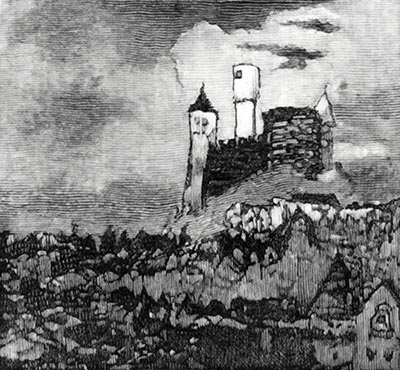
‘Castle’- Victor Hugo (1894)
Paris Musées
Bordeaux, July 25th
The Bordeaux Bridge is the city’s jewel. There are always four men working on the bridge. busy repointing the paving, and cleaning the pavement. On the other hand, the churches are in a sad state of disrepair. Yet is it not true that everything in a church deserves the attention of religion, even the stones? This is something that the priests, who are ever the first to demolish things, readily forget.
The two main churches of Bordeaux, Saint-André and Saint-Michel, have campaniles instead of bell towers, isolated from the main building, as in Venice and Pisa.
The bell tower of the Cathedral, Saint-André, is a rather beautiful one; its shape recalling the Tour de Beurre at Rouen; it is called the Pey Berland, after Pierre Berland, who was archbishop from 1430 to 1457. The cathedral has two bold spires, also, pierced through, in openwork manner, which I have already spoken of. The church, begun in the eleventh century, as the Romanesque pillars of the nave attest, was left untouched for three centuries, to be resumed under Charles VII, and finished under Charles VIII. The delightful era of Louis XII put the finishing touches to it, and an exquisite porch which supports the organ was built, at the end opposite the apse. The two large bas-reliefs applied to the wall beneath this porch are two paintings on stone in the most beautiful style and ‘carved’, one could almost say, so powerful is the modelling, by means of a magnificent use of colour. In the painting on the left the eagle and the lion worship Christ, while exhibiting deep, intelligent gazes, since it is fitting for them as the spirits of the place to worship God.
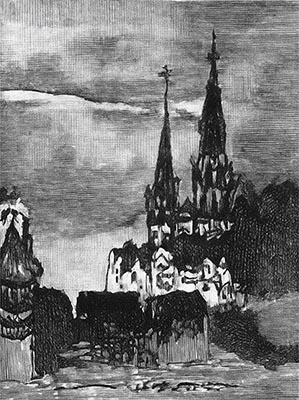
‘Saint-André cathedral, Bordeaux’- Victor Hugo (1894)
Paris Musées
The portal, though merely lateral, is of great beauty; but I am eager to tell you about an old ruined cloister which borders the cathedral on the south, and which I entered by chance.
Nothing could be sadder or more charming, more imposing or more abject. Imagine this. Dark galleries pierced by ogives with flamboyant fenestrations; a wooden trellis over those ogives; the cloister transformed into a shed, all the flagstones unpaved, dust and cobwebs everywhere; latrines in a neighbouring courtyard; rusty copper lamp-posts, black crosses, silver hour-glasses, the cast-offs from hearses and undertakers in every dark corner; and yet, beneath these false cenotaphs of wood and painted canvas, one glimpses real tombstones, their severe-looking statues reclining at too sharp an angle ever to rise again, and too deeply asleep to ever wake. Is that not scandalous? Should not the priest be accused of presiding over the degradation of his church, and the desecration of its tombs? For myself, if I had to spell out their duty to the priests, I would do it in two sentences: Pity for the living, piety for the dead.
In the middle, between the four arcades of the cloister, debris and rubble clutters a small corner, once a cemetery, where tall grasses, wild jasmine, brambles, and undergrowth mingle and prosper, with inexpressible joy one might almost say. Vegetation has seized the building; the work of God prevails over the work of mankind.
Yet there is nothing mean or bitter about this incursion. Their joy is the innocent and regal gaiety of Nature. Nothing more. Amidst the ruins and the grass, a thousand flowers bloom. Sweet, charming flowers! I felt the scents assail me, I saw their pretty white, yellow, and blue heads fluttering, and it seemed to me that they were all trying their best to console those poor abandoned stones. However, it is destiny. The monks vanish before the priests, and the cloisters vanish before the churches.
From Saint-André, I went to Saint-Michel... — But I’m being called, the carriage for Bayonne is leaving, I’ll tell you what happened to me during my visit to Saint-Michel next time.
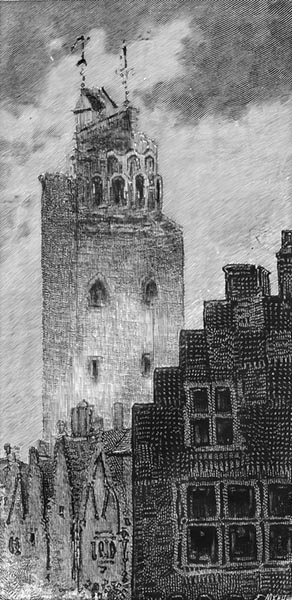
‘The Tower of the Basilica of St Michael, Bordeaux’- Victor Hugo (1894)
Paris Musées
Chapter II: From Bordeaux to Bayonne.
Bayonne, July 23rd
You have to be a tough and hardened traveller to feel comfortable on top of the Dotezac Brothers coach, which runs from Bordeaux to Bayonne. I have never in my life encountered a padded bench of such ferocity. That seat may, however, be of service to literature, by providing a new metaphor for those in need of one. Let us abandon the ancient Classical comparisons that have expressed the hardness of objects for three thousand years; let steel, bronze, and the tyrant’s heart, rest. Instead of quoting:
‘Le Caucase affreux, t’engendrant en fureur,
De ses plus durs rochers fit ton barbare cœur’
‘The dreadful Caucasus, engendering you in fury,
Carved your barbaric heart from its hardest stones’
(Jacques Delille, from his translation of Virgil’s ‘Aeneid’, 1804)
the poets will say of some given thing that it is: ‘Harder than the Dotezac stagecoach seat’.
Yet one does not climb to that high, and rugged position, without some difficulty. First, one must pay fourteen francs, that goes without saying; and then one must give one’s name to the conductor. So, I gave my name. When I am asked about my name in the offices of the mail-coach companies, I readily remove the first syllable, and answer Monsieur Go, leaving the spelling to the fancy of the questioner. When I am asked how the thing is written, I answer: I know not. This generally satisfies the author of the register; he grasps the syllable that I gave him, and embroiders that simple theme with greater or lesser imagination, according to whether he is, or is not, a man of taste. My manner of doing things has earned me, in my various travels, the satisfaction of seeing my name written in the following varied ways: Monsieur Go. — Monsieur Got. — Monsieur Gaut. — Monsieur Gault. — Monsieur Gaud. — Monsieur Gauld. — Monsieur Gaulx. — Monsieur Gaux. — Monsieur Gau.
None of these writers has yet had the idea of writing Monsieur Goth. I have, until now, only noticed that nuance in the satires of Jean-Pons-Guillaume Viennet, and the feuilletons of Le Constitutionnel.
The registrar at the Dotezac office first wrote Monsieur Gau, then hesitated for a moment, looked at the name he had just written, and, no doubt finding it a little bare, added an x. So it was under this name, Monsieur Gaux, that I climbed onto the formidable saddle on which the Dotezac Brothers parade their victims for a hundred and fifteen miles or more.
I have already observed that hunchbacks may like the imperials on carriages. I do not. I don’t seek to delve into coincidences, but the fact is that on top of the Meaux stagecoach I met one, and on top of the Bayonne coach two. They were travelling together, and what made the couple curious was that one was hunched behind and the other in front. The first seemed to exercise I know not what influence over the second, whose waistcoat was half-open and dishevelled, but as I arrived, he said to him authoritatively: ‘My dear fellow, button up your deformity’.
The driver of the coach looked at the two hunchbacks with an air of humiliation. The good man appeared exactly like Monsieur de Rambuteau (Claude-Philibert Barthelot, Comte de Rambuteau, Prefect of the Seine). As I looked at him, I said to myself that perhaps shaving him would suffice to make him Prefect of the Seine, and that it would also suffice for Monsieur de Rambuteau to cease shaving to make of him an excellent coach driver.
Assimilation, as we say today in political language, is, however, neither unfortunate nor hurtful. A diligence is far more than a mere prefecture; it is the perfect image of a nation with its own constitution and government. The coach has three sections like the state. The aristocracy is in the coupé; the bourgeoisie in the interior; and the people are in the rotunda. On the imperial, above them all, are the dreamers, the artists, the classless. The king is the driver, who is readily considered a tyrant; the government is the postilion, changed at every relay. When the carriage is too loaded with baggage, that is to say, when society sets its material interests above all else, it runs the risk of tipping over.
Since I am rejuvenating ancient metaphors, I advise worthy scholars whose style is so often lumbered with the chariot of state to henceforth speak of the diligence of state. It will be less noble, but more accurate.
For the rest, the road was fine and we travelled at a brisk pace. This is due to a battle that is currently being waged between the Dotezac diligence and another carriage that the Dotezac postilions disdainfully call the competition, without otherwise designating it. This second carriage seemed excellent to me; it was new, smart and attractive. From time to time, it would overtake us, and then it would trot for an hour or two, twenty paces in front of us, until we returned the favour. It was very unpleasant. In the classic combats of ancient times, one made one’s enemy ‘bite the dust’; in these, one is content to make him merely swallow it.
Les Landes, from Bazas to Mont-de-Marsan, are nothing but endless pine forest, dotted here and there with tall oak-trees, and penetrated by immense clearings covered as far as the eye can see by green moorland, yellow broom, and purple heather. The presence of man is revealed in the most deserted parts of this forest by long strips of bark removed from the trunks of the pines to encourage the flow of resin.
There are no villages; but, at intervals, two or three houses with large roofs, covered with hollow tiles in the Spanish manner, sheltering beneath clumps of oak and chestnut trees. Sometimes the countryside grows harsher, the pines vanish into the horizon, and everything is heather or sand; a few low cottages, buried under a sort of coating of dried ferns applied to the wall, appear here and there, then one sees them no more, and encounters nothing more at the roadside than the mud hut of a road-mender, or, at times, a large circle of burnt turf and blackened ash, indicating the site of a nocturnal fire.
All sorts of flocks graze these heaths: flocks of geese and pigs led by children, flocks of black and red sheep led by women, herds of large-horned oxen led by men on horseback. Like flock, like shepherd. Without realising it, believing I was merely describing a wilderness, I have penned a maxim of government.
And on that note, would you believe that while I was crossing Les Landes, everyone there was talking politics? That hardly fits such a landscape, does it? A breath of revolution seems to be stirring the old pine-trees.
It was at that very moment that Baldomero Espartero’s government in Spain collapsed. Nothing, as yet, was known, while everything was surmised. The postilions, climbing to their seats, said to the driver: ‘He’s in Cadiz.’ ‘No, he’s embarked.’ ‘Yes, for England.’ ‘No, for France.’ ‘He seeks neither France nor England. He’s off to a Spanish colony.’ ‘Bah!’
The two hunchbacks propounded their politics while the postilions’ propounded theirs, and the one hunched in front said, neatly: ‘Espartero has taken ship, and taken flight.’
As we approached Mont-de-Marsan, the roads were filled with Spaniards, on foot, on horseback, in carriages, traveling in bands or individually. On a cart loaded with men in rags, I saw a young peasant girl, dressed in a graceful manner, whose pretty, grave, and sweet face was shaded by the most exquisite hat that could be seen; something black bordered with something red, it was charming. What kind of political system is it that blows such a storm that it is capable of driving a poor but pretty girl, with such stylish headgear, from her country?
As new refugees arrived, the recent refugees left. In two mail-coaches, galloping in opposite directions, which must have crossed on the way, I saw the Duchess of Gor (Maria de la O Jacoba Guiráldez y Cañas Mendoza y Portocarrero) on her way to Madrid, and the Duchess of San Fernando (María Luisa de Borbón y Vallabriga) on her way to Paris. Two coaches full of Spaniards crossed halfway between Captieux and Traversères, and, following the custom of postilions in such cases, exchanged their teams. The same horses that were returning yesterday’s exiles to their homeland were bearing those of today to exile.
However, regardless of whatever new revolution was taking place close to us, it only disturbed grave and tranquil Nature on the surface. The storm which displaces the powers that be, and topples thrones, failed to make the pine cone trembling at the end of its branch fall from the tree any sooner. Carts, drawn by oxen, passed, with an air of ancient gravity, the fleeing post-chaises and the mail-coaches full of anxious faces.
Nothing could be stranger, by the way, than these teams of oxen. The cart is of wood, with four equal-sized wheels, which ensures that it never deviates from its course, but always forges ahead. Each of the oxen is entirely covered by a large white cloth that drags on the ground; between their horns they have a sort of wig made of sheepskin, and on their muzzles a white, fringed net that is a perfect parody of a beard. A few oak-branches wrapped around their heads complete their outfit. The oxen, thus garbed, possess the illusory air of high priests of tragedy; and resemble, to the point of duplication, the extras of the Théâtre-Français disguised as flamens and druids.
At Bazas, as we dismounted, one of these oxen passed by with such a majestic and pontifical gait that I was tempted to say to him: ‘Priests are not as wise as foolish people think’ (Voltaire, ‘Oedipe’ Act IV, Scene I). I recall telling him so. I must add, to be exact, that he failed to bellow a reply.
Beyond Roquefort, the moors are brightened by the tile factories that one encounters from time to time; some, very old, dating back to Louis XIII, as attested by the keystones of their archivolts, but abandoned; others in working order, and full production, steaming on all sides like a bundle of green wood on a hot fire.
Thirty years ago, as a child, I travelled through this country. I remember that the carriages progressed at walking pace, with sand up to their wheel-hubs. There was no track marked, in those days. From time to time, one came across a stretch of road formed of pine trunks juxtaposed and knotted together like the deck of a rustic bridge. Today, the sandy tracts are crossed by a wide causeway, lined with poplars, that runs from Bordeaux to Bayonne, and has almost the beauty of a Roman road.
In a given time this roadway, the product of industry and perseverance, will sink into the sand, then vanish. The ground tends to give way beneath it, and will engulf it as it engulfed the military road made by Brutus which ran from Capbreton, Caput Bruti, to Boïos, today La Teste-de-Buch, and that other road, the work of Caesar, which linked Gamarde, Saint-Géours-de-Maremne, and Saint-Michel de Jouarare.
I note in passing that those two words, Jovis ara, or ara Jovis (altar of Jupiter) are the origin of the names of many towns, which, though derived from the same source, barely resemble each other today, from Jouarre in Champagne, to Saint-Michel de Jouarare in Les Landes, to Aranjuez in Spain.
From Roquefort to Tartas, the pines give way to a host of other trees. Dense and varied vegetation clads the plains and hills, and the road runs through a delightful garden. At every moment, one crosses old bridges with pointed arches, above charming rivers. First the Douze, then the Midou, then the Midouze, formed, as the name indicates, from the Douze and the Midou, then the Adour. The syllable dour or dou, which is found in all these names, obviously derives from the Celtic word dhu (dhub) which means dark.
All these rivers are deep, clear, green, and pleasant. Young girls beat their laundry at the water’s edge; goldfinches sing in the bushes; cheerful life breathes amidst gentle Nature.
However, at times, between two tree branches that the wind joyously pushes aside, one sees in the distance on the horizon the heather and the piñadas (pine-woods) clothed in sunset red, and remembers that one is in Les Landes. One recalls that beyond this happy garden, dotted with all these pretty towns, Roquefort, Mont-de-Marsan, Tartas, cut by all these fresh rivers, the Adour, the Douze, the Midou, only a few hours’ walk away, is the forest, then beyond the forest the heather, the moors, the wasteland, a dark solitude where the cicadas sing, where the birds are silent, where all human habitation vanishes, a region crossed at long intervals, by silent caravans of large oxen dressed in white shrouds; one says to oneself that beyond those sandy solitudes are the lakes, the watery solitudes of Sanguinet, Biscarosse, Parentis-en-Born, Mimizan, Léon, with their populations of wild boars, wolves, polecats, and squirrels; their inextricable vegetation, composed of buckthorn, bay laurel, black locust, sage-leaved cistus, enormous hollies, gigantic hawthorns, and gorse twenty feet high; and their virgin forests where one cannot venture without axe and compass; one envisages, amidst these immense woods, the great Cassou, that mysterious oak whose dread branches scatter superstition and terror across the whole region. One is aware that beyond the lakes lie the dunes, mountains of sand which drift, chasing the lakes before them, swallowing the piñadas, villages and bell-towers, their shape altered by tempests; and one says to oneself that beyond the dunes lies the ocean. The dunes devour the lakes; the Atlantic devours the dunes.
These, the moors, the lakes, the dunes, the sea, are the four zones one’s thought traverses. One summons them up, in imagination, one after another, each fiercer than the last. One sees vultures flying above the moors, cranes over the lagoons, and gulls over the sea. One watches turtles and snakes crawling over the dunes. The spectre of melancholy Nature appears before one. Reverie fills the mind. Unknown, fantastic landscapes tremble and shimmer before one’s eyes. Shepherds mounted on stilts, each leaning on a long stick, pass through the mists of the horizon, on the hill-crests, like giant spiders; one conjures up the enigmatic pyramids of Mimizan (five eleventh century stones marking a religious sanctuary) rising amidst the undulations of the dunes; one listens as if hearing the wild, sweet songs of the peasant women of Parentis; and one gazes into the distance as if seeing the beautiful girls of Biscarosse walking barefoot in the waves, wearing the flowers of those immortelles that grow amidst the sand. For thought too has its mirages. Imagination makes journeys that the Dotezac stagecoach does not.
Meanwhile, we have reached Tartas, the former capital of the Tarusates tribe, which is a pretty town on the Midouze. In the Middle Ages, it was one of the four seneschalsies of the Duchy of Albret. The other three were Nérac, Castelmoron-sur-Lot, and Casteljaloux. As we passed, I greeted, on the left side of the road, a remaining section of the venerable wall that resisted the formidable English siege in 1440, and gave Charles II d’Albret, cousin to Charles VII, time to arrive. The people of Tartas have built inns and open-air cafés with the stones of this wall that defended their homes.
As we were leaving Tartas, a huge hare came out of a nearby thicket and crossed the road, then stopped within range of the coach, in a meadow, looking boldly at us. This bravery of the hares in this country is undoubtedly due to the fact that they know that it is they who gave their name to the House of Albret. Pride has taken hold of them, and they behave, when it suits, like gentlemen.
Meanwhile, night was falling. Evening, which provided Virgil with so many poetic lines, all alike in concept, all different in form, was pouring shadow over the landscape, and sleep over the eyelids of the travellers. As the darkness deepened, blurring the shapeless silhouettes on the horizon, it seemed to me — was it a nocturnal illusion? — that the countryside was becoming wilder and rougher, that the piñadas and clearings were reappearing, and that we were in reality, in profound darkness, performing that journey across Les Landes that I had imagined but a few hours before. The sky was starry, the earth offered to the eye only a sort of dark plain where here and there flickered reddish gleams, as if shepherds’ fires were lit amidst the heather; one heard, without seeing or distinguishing anything, a delicate, shrill ringing of bells, a seemingly harmonious tinkling; then everything returned to silence while the carriage seemed to roll on blindly, through the night, in darkened solitude, while, here and there, large pools of light alone, appearing amidst the black trees, revealed the presence of lakes.
I felt happy. I had caught several times that scent of bindweed which reminds me of my childhood. I thought of all those who love me, I forgot about those who hate me, and looked into the shadow, with a lost gaze, so to speak, letting the vague nocturnal forms which passed confusedly before my eyes populate my reverie.
The two hunchbacks had descended at Mont-de-Marsan. I was alone on my bench, the chill was deepening; I wrapped myself in my coat and, gradually, fell asleep.
The sleep afforded by a carriage that bears you along at a gallop is a transparent sleep through which one still feels and hears. At a certain moment the driver descended, the coach stopped; the driver’s voice said: ‘Gentlemen, here we are at the Dax bridge’; then the doors opened and closed as if travellers were dismounting, then the coach lurched, and set off again. A few moments later, the horses’ hooves sounded on a wooden floor; the coach, suddenly tilted forward, and gave a violent jolt; I opened an eye; the postilion, bent over his horses, seemed to be staring ahead anxiously, and applying caution. I opened both eyes.
The heavy, and heavily laden, carriage, drawn by five horses harnessed to chains, was moving at walking pace over a wooden bridge, in a sort of narrow lane bounded on the left by the parapet, which was very low, and on the right by a mass of beams and timbers; below the bridge, a widish river (the Adour) flowed at quite a depth, which seemed increased by nocturnal uncertainty. At certain moments, the diligence tilted; in certain places, the parapet was absent. I sat up. I was alone on top of the carriage; the driver had not returned to his seat; the carriage was still moving; the postilion, still bent over his team, which was barely lit by the coupé’s lantern was muttering I know not what vigorous imprecations. Finally, the horses climbed a small slope, another jolt shook the carriage, and then it halted. We were on the paved road again.
The travellers who had crossed the bridge on foot, walking before the carriage, returned to the three compartments, and, I heard the driver saying, while opening and closing the doors: — ‘Devil of a bridge! Always under repair! — When will it be done? — The police are badly organised in Dax. The carpenters leave their tools in the way to try and tip the carriage over. — For a moment I thought the diligence would end in the river. — One cannot conceive the danger here. — You’ll see, one of these days something bad will happen. — Was I not right, gentlemen, to make you descend?’ Having said that, he clambered back to his seat, and on seeing me gave a cry: — ‘Goodness, Monsieur! I forgot you!’
Chapter III: Bayonne — The Charnel House
July 26th
I entered Bayonne with some emotion. For me, Bayonne is a source of childhood memories. I came to Bayonne when I was eight years old, towards the end of 1810, at the time of the Peninsular War. My father was in Spain as a soldier, serving the emperor, and was holding in check two provinces, the insurgents there being led by El Empecinado (Juan Martín Díez, a Spanish guerrilla leader), namely Avila, Guadalajara, and the entire course of the Tagus.
My mother, travelling to join him, had stopped in Bayonne to wait for a convoy, because to make the journey from Bayonne to Madrid at that time, it was necessary to be accompanied by three thousand men, and preceded by four pieces of cannon. I will say something of that journey which had its moments of interest, if only as an historical record.
My mother had with her my two brothers Abel and Eugène, and myself, the youngest of us three boys. I remember that the day after our arrival in Bayonne, a sort of pot-bellied signor, adorned with exaggerated trinkets and mumbling in Italian, appeared at my mother’s door. The man struck us children, watching him enter through a glass door, as a charlatan. He was the director of the Bayonne theatre. He came to ask my mother to rent a box at his theatre. My mother rented one for a month, which was the length of time we were supposed to remain in Bayonne.
This rented box made us jump for joy. We children, able to visit the theatre every evening for a whole month, we who had only done so once a year, and who had no memory of the stage other than Molière’s La Comtesse d’Escarbagnas.
That same evening, we tormented my mother, who yielded to us, as mothers always do, and took us to the theatre. The manager installed us in a magnificent front box decorated with red calico draperies adorned with saffron rosettes. They were performing Les Ruines de Babylone, a melodrama (‘The Ruins of Babylon, or Giafar and Zaida’, by René-Charles Guilbert de Pixérécourt, 1810) which at that time was enjoying immense success throughout France.
It was magnificent, at least for Bayonne. Apricot-coloured knights, and Arabs dressed from head to toe in mail-cloth appeared momentarily, then were swallowed up, amidst dreadful prose, in cardboard ruins littered with caltrops, and wolf-traps. The Caliph Haroun commanded the stage, and also the eunuch Giafar. We were in awe.
The next day, when evening came, we again tormented our mother, who again yielded to us. We attended the show in our rosette-adorned box. — What would they perform? We were anxious. The curtain rose. Giafar appeared. They were repeating The Ruins of Babylon. This did not displease us. We were happy to see that beautiful work once more, which again amused us greatly.
The following day, my mother was as kind, as ever, and we returned to the theatre. They were once more acting The Ruins of Babylon. We viewed it with pleasure, though we would have preferred a different set of ruins.
On the fourth day, the playbill was sure to be different; we went; my mother indulged and accompanied us, smiling. They were showing The Ruins of Babylon. We fell asleep.
On the fifth day, we sent Bertrand, my mother’s valet, early in the morning to view the playbill. They were showing The Ruins of Babylon. We begged my mother not to take us. On the sixth day, they were showing The Ruins of Babylon again. Such was the case all month. One fine day the playbill changed; that day, we were leaving.
It was this memory that made me speak somewhere about ‘teasing Chance that toys with children’.
Apart from The Ruins of Babylon, I remember that month spent in Bayonne with happiness. There was a beautiful promenade by the water, under some trees, where we used to walk every evening. We would pout as we passed by the theatre, which we no longer set foot in, and which now inspired in us a kind of ennui mixed with horror. We would sit on a bench, watch the ships, and listen while my mother spoke. She was a noble and religious woman who is now but a figure in my memory (Hugo’s mother, Sophie Françoise Trébuchet, died in 1821), yet one which will shine in my soul, and over my life, until my last day.
The house we lived in was cheerful. I remember my window over which beautiful bunches of ripe corn hung. During all that long month, we experienced not a moment of boredom, always excepting The Ruins of Babylon.
One day we went to see a ship of the line anchored at the mouth of the Adour. An English squadron had given chase to it; after a few hours battle it had taken refuge there, and the English had blockaded it. I still can see, as if it were before my eyes, that admirable vessel which could be seen half a mile from the coast, lit by a beautiful shaft of sunlight, all sails furled, leaning proudly into the waves, and which seemed to me to possess I know not what threatening air, having retreated from the shrapnel yet about to face it once more perhaps.
Our lodgings backed onto the ramparts. It was there, on the green grassy slopes, among the upturned cannons, the sunlight on the grass, and the mortars lying face down, that we would go and play in the morning.
In the evening, Abel, my poor Eugène (died 1837) and I, grouped around our mother, smearing the contents of a box of paints, illuminated as best we could, and in the most ferocious manner, the engravings in an old copy of the Thousand and One Nights. This copy had been given to me by General Lahorie (Victor Fanneau de La Horie, who joined the Moreau conspiracy against Napoleon), my godfather, who was executed, two years after the time of which I speak (in October, 1812), on the plain of Grenelle in Paris.
Eugène and I bought all the goldfinches and greenfinches brought to us by the little lads in town. We imprisoned these poor birds in wicker cages. When one cage was full, we bought another. We soon had five cages full. When it was time to leave, we granted all those pretty birds their freedom. It was both a joy and a heartbreak to us.
It was a widow from the town, I believe, who rented the house to my mother. The widow herself lived in a house nearby. She had a daughter of fourteen or fifteen. My memory, after thirty years, has lost none of the features of that angelic figure. I can see her still. She was blonde and slender, and seemed tall to me. Her gaze was soft and veiled, her face a Virgilian profile, as one dreamt that of Amaryllis or Galatea to be, fleeing among the willows. She had an admirably well-set neck of adorable purity, a small hand, a white arm, and a slightly red elbow, which reflected her age; a detail I was unaware of given mine. She usually wore a tea-coloured madras headdress, with a green border, tightly tied about her head and down to the nape of her neck, so as to leave her forehead uncovered, and hiding only half her hair. I don’t remember the dress she wore.
This lovely child came to play with us. Sometimes Abel and Eugène, my elders, taller and more serious than me, ‘acting like men,’ as my mother said, went to watch the shooting practice on the ramparts, or ascended to their room to study Sobrino, and leaf through Cormon (the dictionary, ‘Sobrino Aumentado, o Nuevo Diccionario de Las Lenguas Española, Francesa y Latina Compuesto de Los Mejores Diccionarios,’ by Francisco Sobrino, augmented by François Cormon, 1776). Then I was alone, I felt ennui descending; what to do? The daughter would call me and say: ‘Come, let me read you something.’
In the courtyard there was a doorway, raised by a few steps, the door closed by a large rusty bolt that I can still see, a round bolt, with a pig’s tail handle, like the ones you sometimes find in old cellars. It was on those steps that she would sit. I stood behind her, my back against the door.
She would read to me from the book that was open on her knees. Above our heads was a bright sky, and a beautiful sun that filled the linden trees with light, and changed their green leaves to gold. A warm breeze blew through the cracks in the old door and caressed our faces. Bent over her book, she would read aloud.
While she was reading, I listened, not to grasp the meaning of the words but to hear the sound of her voice. At times my eyes would lower, my gaze would meet her half-open kerchief below me, and I would see, with a confusion mingled with a strange fascination, her round, white throat rising and falling gently in the shadow, vaguely gilded with a warm reflection of the sun.
Sometimes at such times she would suddenly raise her large blue eyes and say to me: ‘Well, Victor! Are you listening?’ I would be rendered completely speechless; blushing, trembling, and pretending to play with the big bolt. I never kissed her myself; it was she who called me and said: ‘Kiss me then.’ The day we left Bayonne, I felt two great sorrows: that of leaving her, and that of freeing my birds.
What was that, my friend? What did I feel, so small a fellow, next to that tall, beautiful, innocent girl? I had no idea then, but I’ve often thought about it since.
Bayonne has remained in my memory as a vermilion-coloured and smiling place. It is there that the oldest memories of my heart lie. O naive days, and yet already gently stirred! It was there that, in the obscurest corner of my soul, I saw that first inexpressible glimmer dawn, the divine dawn of love.
Do you not find, my friend, that such a memory is a bond, and a bond that nothing can destroy! Is it not a strange thing, that two human beings can be bound by an indissoluble chain like this all their lives, and yet not miss each other, not seek each other, rather become strangers to each other, and no longer know each other! The chain that binds me to that sweet child has never broken, yet the thread has snapped.
As soon as I arrived in Bayonne this week, I walked round the city, along the ramparts, looking for that house, looking for the door, looking for the lock; I found nothing, or at least recognised nothing.
Where is she? What is she doing? Is she dead? Is she still alive? If she is alive, she is probably married, and has children. She is perhaps a widow, and growing old in her turn. How can it be that beauty departs and the woman remains? Is the woman of today really the same being as the young girl of the past? Perhaps I have just passed her? Perhaps she is the commonplace person I asked for directions earlier, and who watched me walk away like a stranger?
What bitter sadness there is in all this! We are, then, mere shadows. We pass by one another, and we fade away, like smoke in the deep, blue sky of eternity. Men are to space what the hours are to time. When an hour strikes, it vanishes. Where is our youth? Where is our childhood, alas! Where is that beautiful young girl of 1810? Where is the child I was then? We touched in those days, and now we perhaps still touch, yet there’s an abyss between us. Memory, that bridge to the past, is broken, somewhere between her and myself. She would not know my face, and I would not recognise the sound of her voice. She no longer knows my name, nor I hers.
I have little to tell you as regards Bayonne. The city is gracefully situated, amidst green hills, at the confluence of the Nive and the Adour, which forms an area of ground like a little Gironde. But of this pretty city and this beautiful place it was felt necessary to create a citadel.
Woe to the landscapes we think it appropriate to fortify! I have said before, and I cannot refrain from saying again: a zigzag ditch makes the saddest of ravines, a scarp with its counterscarp the ugliest of hills! Bayonne is a Vauban masterpiece (Sébastien Le Prestre, Marquis of Vauban, was military engineer to Louis XIV). Fine. But assuredly, Vauban’s masterpieces spoil those God created.
Bayonne Cathedral (Saint-Marie) is a rather beautiful fourteenth-century church (begun in the thirteenth, completed in the seventeenth century), the colour of tinder, and all eaten away by the wind from the sea. Nowhere have I seen mullions provide richer, more capricious, fenestrations inside the ribbed vaults. It possesses all the strength of the fourteenth century mingled, without tempering it, with all the fantasy of the fifteenth. Here and there some beautiful stained-glass windows remain, almost all of them from the sixteenth century. To the right of what was the great portal, I admired a small bay whose design is composed of flowers and leaves, marvellously shaped into a rosette. The doors are of great character; they are great black slabs studded with large nails, and once both enhanced with gilded iron door-hammers. Only one of these remains, which is of beautiful Romanesque workmanship.
The church is flanked to the south by a vast cloister from the same period, which is currently being restored with skill and intelligence, and which formerly communicated with the choir by a magnificent portal, today walled up and whitewashed, the ornamentation and statues of which recall, by their grand style, Amiens, Reims and Chartres.
There were many tombs in the church and the cloister, which have been ripped away. A few mutilated sarcophagi still cling to the wall. They are empty. A hideous dust of some kind has replaced the human dust. The spider spins its web in these dark dwellings of death.
I stopped at a chapel where all that remains of one of these tombs is the place, still recognisable by the marks of destruction on the wall; and yet the deceased had taken precautions to guard his tomb. ‘This sepulchre is his,’ as an inscription on black marble sealed in the stone, still reads, ‘April 22, 1664.’ If we are to believe this same inscription, which I quote verbatim, ‘E. Reboul, royal notary and gentlemen of the chapter’ has granted ‘Pierre de Baraduc, bourgeois, and man-at-arms in the old castle of this town, title and possession of this tomb, for the enjoyment of himself and his family.’
As regards this, my visit to Saint-Michel in Bordeaux returns to me. I had just left that church, which is from the thirteenth century and very remarkable, especially for the portals, and an exquisite chapel of the Virgin, sculpted, I should say ‘worked’, by the admirable figurists of the days of Louis XII. I glanced at the bell-tower which is next to the church, and surmounted by a telegraph. It was once a superb spire, three hundred feet high; it is now a tower of the strangest and most original appearance.
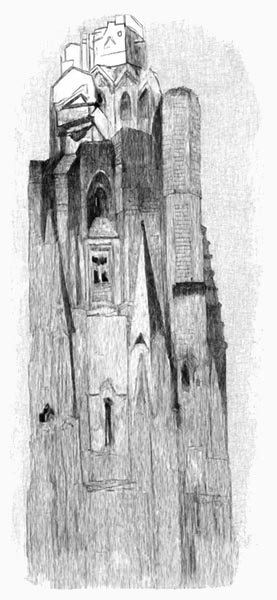
‘The Bell Tower of the Basilica of St Michael, Bordeaux’- Victor Hugo (1894)
Paris Musées
For those who are unaware, lightning struck this spire in 1768 causing it to collapse. Due to the ensuing fire which simultaneously devoured the church’s framework, this enormous tower, which seems both military and ecclesiastical, as rugged as a keep and as ornate as a bell-tower, is most problematic. There are no longer any louvres in the upper bays. The bells, chimes, gongs, hammers, and clock, are no more. The tower, though still crowned with a solid block possessing eight sides and eight gables, is raw and truncated at its summit. One feels it has been decapitated, and is thus dead. The air and daylight pass through its long, windowless, mullion-less ribs as if through large segments of bone. It is no longer a bell-tower; it is the skeleton of a bell tower.
Well, I was alone in the courtyard, planted with a few trees, in which this isolated bell-tower stands. The courtyard is the old cemetery. I contemplated, although a little bothered by the sun, this gloomy yet magnificent building, and attempted to read its history in its architecture, and its misfortunes in its wounds. You know that a building interests me almost as much as a human being. For me, it is in some way a person whose adventures I try to discover.
I was standing there, dreamily, when suddenly, a few steps from me, I heard someone say: ‘Monsieur! Monsieur!’ I looked; I listened. No one. The courtyard was deserted. A few sparrows chattered in the old trees of the cemetery. Yet a voice had called me, a weak, soft, broken voice, which still echoed in my ear.
I took a few steps, and heard the voice again: ‘Monsieur!’ This time I turned quickly, and saw, at the corner of the courtyard, near the door, the figure of an old woman emerging from a skylight. This skylight, horribly dilapidated, revealed the interior of a miserable room. Beside the old woman was an old man.
I have never in my life seen anything more decrepit than that hovel, except for the couple. The interior was whitewashed with that whitewash that recalls a shroud, and I saw no other furniture than the two stools on which sat, looking at me with their little grey eyes, those two tanned, wrinkled, scuffed faces, which were as if coated with bistre and bitumen, and seemed wrapped, rather than dressed, in old patched grave-cloths.
I am not like Salvator Rosa who said: ‘Me figuro il sepulcro in ogui loco: I see images of the tomb everywhere.’ Yet, even in broad daylight, at midday, under a warm, living sun, the apparition surprised me for a moment, and it seemed to me that I heard myself summoned, by two four thousand years old spectres from the depths of an antediluvian crypt.
After a few seconds reflection, I gave them fifteen sous. They were simply the gatekeepers of the cemetery. Philemon and Baucis (for the myth see Ovid’s ‘Metamorphoses’, Book VIII).
Philemon, dazzled by the fifteen-sou piece, made a dreadful grimace of joy and astonishment, and placed the coin in a sort of old leather pouch nailed to the wall, ‘another relic of the years’, as La Fontaine would have said (see his ‘Fables’: Book XII, 25, Philémon et Baucis), while Baucis said to me, with a kindly smile: — ‘Would you like to see the charnel house?’
This phrase, the charnel house, awakened a vague memory in my mind of something I thought I understood, and I replied: ‘With pleasure, madam.’ ‘I thought so,’ the old woman continued. And she added: ‘Here is the bell-ringer who will show it to you; it is very beautiful to see.’ As she spoke thus, she placed her red, diaphanous, palpitating hand, hairy and cold like a bat’s wing, over my hand, in a most friendly manner.
The new character who had just appeared, and who had no doubt smelled the odour of the fifteen-sou piece, namely the bell-ringer, was standing a few steps away on the outer staircase of the tower, the door to which he had half-opened. He was a fellow of about thirty-six, stocky, robust, fat, pink, and fresh, with all the air of a bon vivant, as befits one who lives at the expense of the dead. My company of two ghosts was completed by a vampire.
The old woman introduced me to the bell-ringer with a certain air of pomp: ‘Here is an English gentleman who wishes to see the mass grave.’ The vampire, without saying a word, retraced the few steps he had descended, pushed open the tower door, and beckoned me to follow him. I entered.
Still silent, he closed the door behind me. We found ourselves in profound darkness. However, there was a nightlight in the corner of a step, behind a large paving stone. By the light of this nightlight, I saw the bell-ringer bend down and light a lamp. The lamp lit, he began to descend the steps of a narrow spiral staircase; I did likewise.
After about ten steps, I think, I bent down to negotiate a low door, and climbed, still led by the bell-ringer, two or three steps; I no longer have the exact details in memory; I was plunged in a sort of reverie which made me walk as if in sleep. At a certain moment the bell-ringer held out his big bony hand to me, I heard our footsteps echo from the floor; we were in a very dark place, a sort of secret vault.
I shall never forget what I next experienced. The bell ringer, mute and motionless, stood in the middle of the vault, leaning against a post driven into the floor and, with his left hand, raised his lamp above his head. I looked around us. A hazy, diffuse glow vaguely illuminated the vault; I could make out its pointed arch.
Suddenly, fixing my eyes on the wall, I saw that we were not alone. Strange figures, standing and leaning against the walls, surrounded us everywhere. By the light of the lamp, I could glimpse them dimly through the damp fug that fills the low, dark places.
Imagine a circle of terrifying faces, in the centre of which I stood. Their blackish, naked bodies sank into, and were lost in, the night; but I saw pressed against each other, protruding from the shadows, and leaning as it were towards me, a crowd of sinister, terrible heads which seemed to call to me from wide-open mouths, but voicelessly, and to gaze at me from eyeless sockets. What were these figures? Statues, no doubt. I took the lamp from the bell-ringer’s hands and approached. They were corpses.
In 1793, while the royal necropolis in Saint-Denis was being violated, the people’s cemetery in Bordeaux was being treated in a like manner. Royalty and the People are twin sovereignties; the populace insulted them at the same time. Which proves, by the way, to those who do not comprehend my grammar, that the words people and populace are not synonymous.
The Saint-Michel cemetery in Bordeaux was devastated like the others. The coffins were torn from the ground, and the dust within thrown to the wind. When the pickaxes reached the foundations of the tower, they were surprised to find not more rotten coffins and ruptured vertebrae, but whole bodies, desiccated and preserved by the clay that had covered them for so many years. This inspired them to create a museum around this mass grave. The idea was suited to the time.
They found the little children of Rue Montfaucon and Chemin de Règles playing knucklebones with the scattered relics from the cemetery. They took them from their hands; all that could be found were collected, and the bones were piled up in the lower vault of the Saint-Michel bell-tower. They made a pile seventeen feet deep over which a platform with a balustrade was erected.
They crowned it all with the strangely intact corpses that had just been unearthed. There were seventy of them. They were placed upright against the wall in the circular space reserved between the balustrade and the wall. It was that floor which resonated beneath my feet; it was on those bones I had walked; it was those corpses that gazed at me.
When the bell-ringer had orchestrated his effect, for the artist staged the whole thing like some melodrama, he approached, and deigned to speak to me. He explained his corpses to me. The vampire became a cicerone (guide). It was like listening to a museum booklet chattering away. At times he attained the eloquence of a bear trainer.
— ‘Look at this one, sir, it’s number one. He’s got all his teeth. — See how well-preserved number two is; yet its’s nearly four hundred years old. — As for number three, he looks as if he’s breathing still, and can hear us. That’s hardly surprising. He’s only been dead sixty years. He’s one of the youngest here. I know people in town who knew him.’
He continued the tour in this way, passing gracefully from one spectre to another, and delivering his lesson with imperturbable exactitude. When I interrupted him with a question in mid-sentence, he answered me in his natural voice, then resumed his sentence at the very point where I had stopped him. At times, he struck a corpse with the stick he held in his hand, and it sounded like an empty suitcase. What, in fact, is the body of a human being when thought is no longer there, if not an empty suitcase?
I know of no more terrifying revue. Neither Dante nor the sculptor Orcagna (Andrea di Cione di Arcangelo) dreamed of anything more lugubrious. The macabre dances of the Lucerne Bridge (the series of 17th-century paintings lining the interior of Lucerne’s Spreuer Bridge, depicting the Danse Macabre, ‘Dance of Death’, and created by Caspar Meglinger) and the Campo Santo in Pisa (the ‘Triumph of Death’ fresco, also known as the ‘Dance of Death,’ in the Camposanto Monumentale, attributed to Buonamico Buffalmacco) are only a shadow of this reality.
There was a Black African woman, hanging from a nail by a rope under her armpits, who laughed at me with a hideous laugh. In a corner a whole family who died, it is said, poisoned by mushrooms, were gathered; there were four of them. The mother, her head bowed, seemed still trying to calm her youngest child who lay dying between her knees; the eldest son, whose profile had retained something youthful, rested his forehead on his father’s shoulder. The arm of a woman who had died of breast-cancer was strangely bent as if to show her wound, enlarged by the dreadful work of death. Beside her stood a gigantic porter, who had one day placed a bet that he would carry a load weighing two thousand pounds from the Caillau Gate to the Chartrons district. He carried it, won his bet, and died. The man slain by a bet stood elbow to elbow with a man killed in a duel. The sword-hole by which death had entered was still visible in the right side of that gaunt chest.
A few steps away writhed a poor fifteen-year-old child who, it is said, had been buried alive. This was the height of terror. This spectre was suffering. He still struggles, after six hundred years, against the vanished coffin. He lifts the lid with his skull and knee; he presses the oak boards with his heel and elbow; he breaks his nails, in desperation, against the walls; his chest expands; the muscles of his neck swell in a dreadful manner; he screams. We can no longer hear this scream, but we see it. It is all horrible.
The last of the seventy was the oldest. It dates back eight hundred years. The bell-ringer pointed out the teeth and hair to me in a coquettish manner. Next to it was a small child.
As I was retracing my steps, I noticed one of these spectral forms seated on the ground near the door. His neck was outstretched, his head raised, his mouth piteous in shape, and his right palm open; a loincloth clothed the middle of his body, one leg and one foot were bare, and from his other thigh protruded a bare shin set on a stone like a wooden leg. He seemed to be asking for alms. Nothing could be stranger or more mysterious than such a beggar at such a door.
What should I give him? What alms to disburse? How much coinage do the dead need? I remained motionless for a long time before this apparition, and my reverie gradually became a prayer.
When one thinks that all these misshapen forms, today chained in frozen silence and distressing attitudes, once lived, palpitated, suffered, loved; when one thinks that they viewed the spectacles of Nature, the trees, the countryside, the flowers, the sun, the blue vault of the sky, instead of this livid vault; when one thinks that they once possessed youth, life, beauty, knew joy and pleasure, and that amidst the feast they too have indulged in long bursts of laughter, imprudently and forgetfully; when one thinks that they have been as we are and that we will be as they are; when one finds oneself thus, alas, face to face with one’s future state, a gloomy thought comes to oppress the heart, one seeks in vain to hold on to the human things one possesses, which will all successively slip through one’s fingers like sand, and one feels oneself falling into the abyss.
For anyone who looks on these human remains with an eye for the flesh, nothing is more hideous. Their ragged shrouds barely hide them. Their ribs appear bare through their torn diaphragms; their teeth are yellow, the nails black, the hair sparse and frizzy; the skin is a tawny sheepskin that secretes a greyish dust; the muscles have lost their outlines, the viscera and the intestines have resolved into a sort of reddish tow from which hang dreadful threads that silently unwind in the darkness an invisible distaff of death. At the bottom of an open-belly one sees a spinal column. — ‘Monsieur,’ my guide said to me, ‘see how well preserved they are!’ For anyone who looks at all this with the eye of the mind, nothing is more formidable.
The bell-ringer, seeing me lost in reverie, crept away, and left me alone. The lamp remained on the ground. When the fellow was no longer there, it seemed to me that something troubling me had vanished with him. I felt in direct and intimate communication, so to speak, with the gloomy inhabitants of the vault.
I looked with a kind of dizziness at this circle surrounding me, motionless and yet convulsed at the same time. The arms of some hung down, others were twisted; some seemed to clasp their hands together. A certain expression of terror and anguish remains on all those faces that have seen the interior of the sepulchre. However the tomb treats it, a dead body is still terrible.
To me, as you have already gathered, they were not mummies; they were ghosts. I saw all these heads turned towards each other, all these ears which seemed to listen leaning towards all these mouths which seemed to whisper, and it seemed to me that these dead people, torn from the earth and condemned to endure, lived, in this night of dreadful and eternal life, that they spoke to each other in the dense mist of their dungeon, that they recounted the dark adventures of the soul in the tomb, and that they said inexpressible things to each other.
What frightening dialogues! What can they converse about? O chasms where thought is lost! They know what lies beyond life. They know the secret of the journey. They have rounded the promontory. The vast clouds have been torn for them. We remain in the land of conjectures, hopes, ambitions, passions, of all the follies we call wisdom, of all the chimeras we call truths. They have entered the region of the infinite, the immutable, the realm of reality. They know the things that are, and the only things that are. All the questions that occupy us night and day, we dreamers, we philosophers, all the subjects of our endless meditations, the goal of life, the object of creation, the persistence of the self, the ultimate state of the soul; they know the depths of them; to all our enigmas, they hold the answers. They know the end of all our beginnings. Why do they appear so vile? Who gave them this desperate and fearsome appearance?
If our hearing was not too coarse to comprehend their words, if God had not placed between themselves and ourselves the insurmountable wall of flesh and life, what would they say to us? What revelations would they utter to us? What advice would they give? Would we emerge from it wise or foolish? What do they bring to us from the tomb?
It would be terrifying to us if we were to believe these spectral apparitions to be all. But they are only appearance, and it would be foolish to believe in that alone. Whatever we imagine, we dreamers, we only touch the surface of things, we only reach to a limited depth. The sphere of infinity no more allows itself to be penetrated by thought than the core of the terrestrial globe by a probe.
The various philosophies are simply artesian wells; they all cause the same water to spring from the same soil, the same truth mixed with human mud, and heated with the warmth of God. But no well, no philosophy reaches to the centre of things. The mind of genius itself, the most powerful of all probes, cannot touch the fiery core, Being, the geometric and mystical point, the ineffable heart of truth. We will never make anything emerge from the rock except a drop of water sometimes, sometimes a spark of fire.
Let us think, however. Let us strike the rock, let us dig the earth. That is to fulfil the law of Nature. Some must think as others must plough.
And then let us resign ourselves. The secret that philosophy seeks to wrest from her Nature keeps. Who will ever be able to defeat you, O Nature? We see only one side of things; God sees both.
Human remains terrify us when we contemplate them; but they are only remains, empty, vain and uninhabited. It seems to us that these relics reveal dreadful things to us. No. They arouse fear, nothing more. Do we see the intellect there? Do we see the soul? Do we see the spirit? Do we know what the spirits of the dead would tell us, if we were given a glimpse of them in their glorious radiance? Let us not believe, then, in the body, which degenerates horribly, and which is repelled by its own destruction; let us not believe in the corpse, nor the skeleton, nor the mummy, rather let us remember that, if there is night in the sepulchre, there is also light. The soul entered the light while the body remained behind in the night; the soul contemplates this light. What does it matter if the body grimaces, if the soul smiles?
I was plunged into this chaos of thought. Those dead people, who were conversing with each other no longer inspired me with fear; I felt almost at ease among them. Suddenly, I know not why, it struck me that at that very moment, at the top of that tower of Saint-Michel, two hundred feet above my head, and above these spectres who were exchanging in the night who knows what mysterious communications, the telegraph, a poor wooden machine pulled by ropes, was stirring beneath the clouds, and sending across space, in the mysterious language that it likewise employs, one after another, all those events imperceptible from here which will appear tomorrow in the newspaper.
Never have I felt more deeply than at that moment the vanity of everything that fascinates us. What a poem that tower of Saint-Michel is! What a contrast is there, and what a lesson! On its summit, in the light and in the sun, in the middle of the azure of the sky, above the faces of the busy crowd swarming in the streets, a telegraph machine, gesticulating and struggling like Pasquin on his plinth (The Hellenistic-style statue on Piazza Pasquino in Rome, on which lampoons have been pasted since the fifteenth century), communicates, and details minutely, all the poverty of the history of the day, and the politics of the last quarter of an hour: Baldomero Espartero falls, Ramon Narváez rises, Joaquín López succeeds Álvaro Becerra (as Prime Minister of Spain, July 23rd, 1843, after earlier presiding over the ‘ten-day’ government); all the great microscopic events, the infusoria who become dictators, the algae who become tribunes, the bacteria who become tyrants; all the pettiness of which transient humanity and the fleeting moment are composed. Yet, all the while, at its base, in the middle of the mass on which the tower rests, in a crypt to which neither a sound nor a ray of sunlight reach, a council of spectres, seated in a circle in the darkness, talk quietly of the tomb and eternity.
Chapter IV: Biarritz
July 25th (written before the preceding note)
You know, my friend, of those three points on the Normandy coast that I like best: Bourg-d’Ault (Ault), Le Tréport and Étretat; Étretat with its immense arches carved through the cliff by the waves; Le Tréport with its old church, its old stone cross, and its old port teeming with fishing boats; Bourg-d’Ault with its wide Gothic street that abruptly ends at the open sea. Well, now you may add Biarritz to Le Tréport, Étretat, and Bourg-d’Ault as one of the places I would choose for the pleasure of my eyes, as Fénelon says (in ‘Les Aventures de Télémaque’, Book I).
I know of no place more charming and magnificent than Biarritz. There are no trees, say people who criticise everything, even the good Lord in his most beautiful works. But one must choose: either the ocean or the forest. The wind from the sea stunts the trees.
Biarritz is a white village with red roofs and green shutters, set on hillocks of grass and heather, whose undulations it follows. You leave the village, you descend the dunes, the sand crumbles under your heels, and suddenly you find yourself on a soft, even shore in the midst of an inextricable labyrinth of rocks, chambers, arches, grottoes, and caverns, a strange architecture thrown pell-mell into the midst of the waves, which the sky fills with azure, the sun with light and shadow, the sea with foam, and the wind with noise.
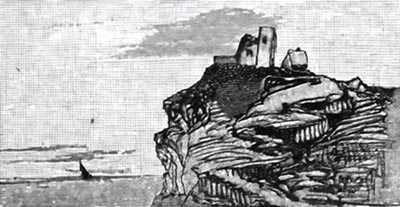
‘Biarritz’- Victor Hugo (1894)
Paris Musées
Nowhere have I seen old Neptune ravage old Cybele with more power, gaiety, and grandeur. This whole coast is full of reverberations. The waters of the Bay of Biscay gnaw and tear at it, and extend their vast murmuring to the reefs. Yet I have never wandered this deserted shore, at whatever hour, without a great feeling of peace rising in my heart. The tumult of Nature never disturbs solitude.
You could not conceive of all that lives, palpitates, and vegetates amidst the seeming chaos of a disintegrating shoreline. A crust of living shells covers the rocks; zoophytes and molluscs swim and float, themselves translucent, in the translucent waves. Water filters drop by drop, and rains down in large pearls, from the vaults of the caves; crabs and sea-slugs crawl, among the kelp and the seaweed which trace on the wet sand the contours of the waves that brought them. Above the caves, a whole range of curious and botanical specimens grow well-nigh unseen: the Bayonne milk-vetch (Astragalus baionensis), the Gallic pink (Dianthus gallicus), the sea-flax (Linum maritinum), the burnet-leaved rose (Rosa Pimpinellifolia), and the daisy-leaved snapdragon (Antirrhinum thymifolium).
There are narrow coves where humble fishermen, squatting around an old rowboat, skin and gut the fish they caught during the night, to the deafening sound of the tide rising and falling among the reefs. Young girls, barefoot, wash the skins of dogfish in the waves, and, each time the sea white with foam rises up at them, like an angry lion turning about; they lift up their skirts and recoil with great bursts of laughter.
One bathes at Biarritz as at Dieppe, Le Havre, and Le Tréport; but with a freedom that its beautiful skies inspire, and its mild climate tolerates. Women, wrapped in large shawls from head to toe, but wearing the latest hats from Paris, lace veils over their faces, enter with lowered gaze one of those canvas huts with which the beach is strewn; a moment later, they emerge, bare-legged, dressed in a simple brown woollen shirt which often barely reaches below the knee, and run, with peals of laughter, to throw themselves into the sea. This exercise of liberty, together with human joy, and the grandeur of the sky, has a grace all its own.
The village girls, and the pretty grisettes of Bayonne, bathe in serge shirts, often with large holes, without worrying too much about what the holes show and what the shirts hide.
On the second day I visited Biarritz, as I was walking at low tide among the caves, looking for shells and scaring away the crabs that fled obliquely and burrowed into the sand, I heard a voice behind a rock, singing the following verse in a local patois, but not enough to prevent me from distinguishing the words:
‘Gastibelza, l’homme à la carabine.
Chantait ainsi:
Quelqu’un a-t-il connu doña Sabine,
Quelqu’un d’ici?
Dansez, chantez, villageois, la nuit gagne
Le mont Falù.
Le vent qui vient à travers la montagne
Me rendra fou.’
‘Gastibelza, the man with the carabine.
Sang loud and clear:
Does anyone know of Doña Sabine,
Anyone here?
Dance, villagers, sing; its night for certain
On Mount Falù.
The wind that blows from the mountain
Will drive me cuckoo.’
It was a woman’s voice. I turned the corner of the rock. The singer was a bathing. A beautiful young girl swimming, in a white chemise and a short petticoat, in a small cove closed off by two reefs at the entrance to a cave. Her clothes lay on the sand at the end of the cave. When she saw me, she came halfway out of the water and began to sing the second stanza, and, seeing that, motionless while standing on the rock, I was listening to her, she said to me with a smile in a jargon combining our language and Spanish:
— ‘Senor estrangero, conoce usted this song?’
— ‘I think so’, I told her. ‘A little.’
Then I walked away, though it was not that she sent me away. Do you not find in this a memory of Ulysses listening to the Siren? Nature repeats, and return to us, again and again, while rejuvenating them, the innumerable themes and motifs with which the imagination of humankind created all the old poems and mythologies.
All in all, with its friendly population; its white and pretty houses; its wide dunes; its fine sand; its enormous caves; its superb sea; Biarritz is an admirable place. My only fear is that it will become fashionable. People are already visiting from Madrid, and soon they will be doing so from Paris.
Then Biarritz, this rural, rustic, and still honest village, will be taken up with a sordid yearning for profit; sacra fames (‘Auri sacra fames: the accursed hunger for gold.’ Virgil’s ‘Aeneid’ Book III, 57). Biarritz will plant poplars on its hills, build ramps on its dunes, stairs on its precipices, kiosks on its rocks, and put benches in its caves, and trousers on its bathers. Biarritz will become modest, and rapacious. Prudishness, which as regards the body possesses nothing chaste but the ears, as Molière might have put it (compare ‘Women are more chaste as regards their ears than the rest of their bodies’ from ‘La Critique de l’École des femmes’, 1663) will do away with the free and innocent familiarity of these young women who play with the waves. And then there will be a reading room and a theatre. The newspaper will be read in Biarritz; melodramas and tragedies will be performed in Biarritz. ‘O Zaire, what do you wish of me?’ (A mock reference to Voltaire’s tragedy ‘Zaïre’ of 1732, on which Bellini’s opera ‘Zaira’ of 1829 was based). In the evening, one will go to the concert, because there will certainly be a concert every evening, and a tenor, a pot-bellied nightingale of about fifty, will sing soprano arias, in Italian, a few steps from this old ocean which sings the eternal music of tides, hurricanes and storms. Thus, Biarritz will no longer be Biarritz. It will be something faded and bastardised like Dieppe and Ostend.
Nothing is grander than a fishing hamlet, with its naive and ancient traditions, sited at the edge of the ocean; while nothing is grander than a city that seemingly possesses the august function of thinking on behalf of all humanity and proposing to the world those novelties, often difficult and formidable, that civilisation demands. But nothing is smaller, more petty, more ridiculous than an imitation Paris.
Cities bathed by the sea should carefully preserve the physiognomy that their location grants them. The ocean possesses every grace, every beauty, all the grandeur one could desire. When one has the ocean, what is the point of trying to reproduce Paris?
Already various symptoms announce the imminent transformation of Biarritz. Ten years ago, people came here from Bayonne in a cacolet (a Basque-style mule-mounted pannier, carrying two, one in each side-basket); two years ago, they came in a coucou (a two wheeled cabriolet) now they come by omnibus. A hundred years ago, twenty years ago even, people bathed in the old port, a small bay overlooked by two ancient dilapidated towers. Today, people bathe in the new port. Ten years ago, there was barely a single inn in Biarritz; today, there are three or four ‘hôtels’.
It is not that I blame the omnibuses, nor the new port where the waves break more broadly than in the old port and where bathing is consequently more efficient, nor the ‘hôtels’ whose only fault is a lack of windows overlooking the sea; but I fear other potential improvements, and would like Biarritz to remain Biarritz. So far all is well, but let it be left there. Meanwhile, the omnibus service from Bayonne to Biarritz has not been established without resistance. The coucou struggles against the omnibus, as no doubt, ten years ago, the cacolet struggled against the coucou. All the carters of the city are in revolt against two saddlers, Castex and Anatol, who introduced these omnibuses. A league against them has been formed, competition has ensued, a coalition has been formed. It is an Iliad of cab drivers, which exposes the traveller’s purse to strange assaults.
The day after my arrival in Bayonne, I wished to go to Biarritz. Not knowing the way, I asked a passer-by, a Navarrese peasant in a splendid suit, with wide olive-velvet trousers, a red belt, a shirt with a large turned-down collar attached with a silver ring, a jacket of heavy chocolate-coloured cloth embroidered with brown silk, and a small Henri II hat edged with velvet, and adorned with a black, curly ostrich-feather. I asked this magnificent passer-by the way to Biarritz.
— ‘Take the Rue du Pont Mayou,’ he told me, ‘and follow it to the Porte d’Espagne.’
— ‘Is it easy,’ I added, ‘to find a carriage to go to Biarritz?’
The Navarrese looked at me, smiled a grave smile, and spoke, with the accent of his country, these memorable words, the full depth of which I only understood later:
— ‘Monsieur, it is easy to go, but difficult to return.’
I took the Rue du Pont Mayou. While ascending it, I came across several posters in various colours, which advertised carriages to Biarritz at various honest prices; I noticed, but perfunctorily, that all these posters ended with the following invariable protocol: ‘Prices fixed until eight in the evening.’
I arrived at the Porte d’Espagne. There a host of vehicles of all kinds were gathered, and piled up, pell-mell: chariots, cabriolets, coucous, gondolas, calèches, coupés, omnibuses. I had barely glanced at the crowd of carriages before another crowd had gathered round me. They were the coachmen. In a moment I was deafened. All their voices, accents, dialects, curses, and offers sounded forth together.
One took my right arm:
— ‘Monsieur, I am Monsieur Castex’s coachman; take the coupé; a seat for fifteen sous.’
Another took my left arm:
— ‘Monsieur, I am Ruspil; I also have a coupé; a seat for twelve sous.’
A third blocked my path:
— ‘Monsieur, I am Anatol. Here is my carriage; I’ll take you for ten sous.’
A fourth spoke in my ear:
— ‘Monsieur, come with Momus; I am Momus; full speed to Biarritz for six sous!’
— ‘Five sous!’ Other faces around me shouted.
— ‘Look, Monsieur, what a pretty car: The Sultana of Biarritz! A seat for five sous!’
The first one who had spoken, who was holding my right arm, finally dominated all this uproar:
— ‘Monsieur, I was the one who spoke to you first. I ask you for the preference.’
— ‘He’s asking you for fifteen sous!’ shouted the other coachmen.
— ‘Monsieur,’ the man replied coldly, ‘I ask you for only three sous.’
There was a long silence.
— ‘I spoke to the gentleman first,’ added the man.
Then, taking advantage of the stupor of the other contestants, he opened the door of his coupé swiftly, pushed me in before I had time to think, closed the coupé’s door, climbed onto his seat, and galloped on. His carriage was full. It seemed he had merely been waiting for me.
The carriage was brand new and very good; the horses were excellent. In less than half an hour we were in Biarritz.
When I got there, not wanting to abuse my position, I took fifteen sous from my purse, and gave them to the coachman. I was about to leave. He held me back by the arm:
— ‘Monsieur,’ he said to me, ‘it is only three sous.’
— ‘Nonsense!’ I replied, ‘You said fifteen sous at first. Fifteen sous it shall be.’
— ‘No, Monsieur, I said I’d take you for three sous. Three sous it is.’
He returned me the rest, and almost forced me to receive them.
— ‘Goodness me,’ I said as I left him, ‘there’s an honest man.’
The other travellers, like myself, had only paid three sous.
After walking all day on the beach, when evening came, I was ready to return to Bayonne. I was tired, and I thought, not without a degree of pleasure, of the excellent carriage and the virtuous coachman who had brought me. Eight o’clock struck on the distant clocks of the plain around, as I climbed the escarpment of the old port. I took no notice of a crowd of strollers appearing from all directions, who seemed to be hastening towards the entrance of the village where the carriages halt.
The evening was superb; a few stars were pricked out on the clear twilight sky; the sea, barely stirring, displayed the heavy, opaque shimmer of an immense oil slick.
A lighthouse, with a rotating lens, had just become apparent on my right, sited on a nearby headland; it shone, then vanished, then returned, and cast a sudden and brilliant beam, as if it were trying to contend with eternal Sirius shining resplendently in the mist at the opposite end of the horizon. I stopped, and contemplated this melancholy spectacle for a while, which seemed to me a metaphor for human effort in the presence of divine power.
Meanwhile, the night was thickening, and the thought of Bayonne, and the inn, suddenly came to mind. I set off again, and reached the square. There was only one carriage left; a lantern lying on the ground illuminated it. It was a four-seater; three places were already occupied. As I approached, a voice called to me:
— ‘Hasten, Monsieur, here’s the last seat, and we’re the last carriage.’
I recognised the voice of my earlier coachman. I had met with that man of ancient honesty, once more. Chance seemed to have been kind. I praised God. A moment later, and I would have been obliged to walk a good five miles of road.
— ‘Goodness me,’ I said, ‘you’re a fine fellow, and I’m pleased to see you again.’
— ‘Climb up quickly, Monsieur,’ the man continued.
I did so. When I was seated, the coachman, his hand on the door-catch, said to me:
— ‘Does the gentleman know that the hour has struck?’
— ‘What hour?’ I asked him.
— ‘Eight o’clock.’
— ‘Indeed, I heard some such hour strike.’
— ‘Monsieur knows,’ replied the man, ‘that after eight in the evening the price alters. We come and collect travellers to oblige them. The custom is to pay before leaving.’
— ‘Fine,’ I replied, taking out my purse. ‘How much is the fare?’
The man continued, quietly:
— ‘Monsieur, it’s twelve francs.’
I comprehended the game at once. In the morning it was announced that interested parties would be taken to Biarritz for three sous per person: there was a crowd; in the evening, that crowd was returned to Bayonne at twelve francs a head.
That very morning, I had experienced stoic self-denial in my coachman; I answered not a word, and paid.
As we were galloping back to Bayonne, I recalled that beautiful maxim of the Navarrese peasantry, of which I made this translation into the vernacular for the benefit of travellers: ‘Carriages to Biarritz. Price, per person, one way: Three sous; to return: Twelve francs. — ‘Is that not a splendid balancing act?
Some distance from Bayonne, one of my travelling companions pointed out the Chateau de Marracq, or at least what remains of it today, in the shade, on a hill.
The Chateau de Marracq is famous for having been, in 1808, the residence of the Emperor Napoleon, at the time of the ‘interview at Bayonne’ (a series of meetings at which Napoleon pressured Ferdinand VII and his father, former King Charles IV, to renounce their claims to the Spanish throne). Napoleon’s concept was splendid; but Providence works otherwise; and, though Joseph I (Joseph Bonaparte, Napoleon’s elder brother) governed the Old and New Castile like a good and wise prince, the concept, potentially so useful moreover to Europe, France, Spain and civilisation, of establishing a new dynasty in Spain, was as disastrous for Napoleon as it had been for Louis XIV.
Joséphine (Napoleon’s first wife, Joséphine de Beauharnais) who was a Creole, and superstitious, accompanied the Emperor to Bayonne. She was subject to premonitions, like Nuño Salido in the Spanish romance, and often repeated: ‘Something ill will come of this.’ (See the fragmentary medieval Spanish romance ‘Los Siente Infantes de Lara’, in which the seven Infantes come to a sad end, the ill omens of which Nuño Salido their tutor, recognises. See also the etching of the relevant scene by Antonio Tempesta, 1612, Los Angeles County Museum of Art)
Today, when we see the reverse side of these events, already buried in history, and from a distance of thirty years, we can distinguish, in their smallest details, all that was sinister about them, and of which it seems fate held all the threads.
Here is a completely unknown oddity which deserves to be recorded. During his stay in Bayonne, the emperor wanted to visit the project he was having carried out at Boucaut. The Bayonne residents, who were adults at that time, remember the emperor, one morning, crossing the shore on foot to reach the brigantine anchored in the port which was to transport him to the mouth of the Adour.
He gave Josephine his arm. As everywhere, he had a retinue of kings; on this occasion the princes of the south and the Bourbons of Spain formed his entourage: the old King Charles IV and his wife; the Prince of Asturias, who has succeeded him, and called himself Ferdinand VII; and Don Carlos, today a pretender under the name of Charles V.
The entire population of Bayonne crowded the alleys leading to the sea, and surrounded the emperor, who walked without guards. Soon the crowd became so numerous, and so importunate, driven by southern curiosity, that Napoleon doubled his pace. The poor, breathless Bourbons followed him with great difficulty.
The emperor arrived at the brigantine’s boat at such a pace that, as she entered, Joséphine, trying, hastily, to grasp the hand offered to her by the ship’s captain, sank into the water up to her knees. In any other circumstance, she would have only laughed. ‘It would have been an opportunity for her,’ Madame the Duchess of C*** told me as she related the story, ‘to show off her legs, which were charmingly formed.’ But on this occasion, it was noted, she shook her head sadly. The omen boded ill.
All who witnessed this adventure came to a sad end. Napoleon died in exile; Joséphine died repudiated; Charles IV and his wife died dethroned. As for those who were then young princes, one of them, Ferdinand VII., died at forty-eight; the other, Don Carlos, is in exile. The brigantine, that the emperor sailed in, was lost a year later, crew and all, off Cap Ferret in the Bay of Arcachon (at the Battle of l’Île d’Aix, 1809); the captain who had given his hand to the Empress, and whose name was Jean-Baptiste Lafon, was condemned to death for abandoning his vessel (La Calcutta), and shot. Finally, the Château de Marracq, where Napoleon had lodged, which was transformed successively into a barracks and a seminary, burned down. In 1825, during a stormy night, some unknown hand, set fires at all four corners.
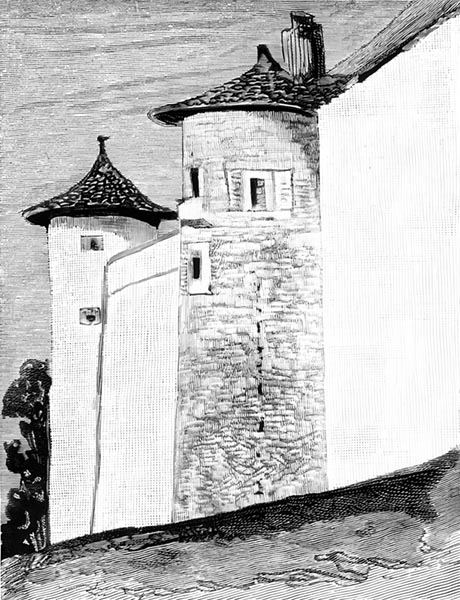
‘Bayonne. Château-Vieux, July 26, 2 p.m. Grey sky’- Victor Hugo (1894)
Paris Musées
Chapter V: The Ox-Cart
San Sebastián, July 28th
It was on July 27th, 1843, at ten thirty in the morning, at the instant of my entering Spain, between Bidart and Saint-Jean-de-Luz, that at the door of a humble inn I saw an old Spanish ox cart, again. By this I mean one of the small carts of Biscay, with a pair of oxen and two solid wheels which turn with the axle, and make a terrible noise which can be heard two miles away in the mountains.
Do not smile, my friend, at the loving care with which I minutely record the memory. If you only knew how charming that noise, dreadful to every other ear, is to mine! It reminds me of a blessed time.
I was very small when I crossed these mountains and heard it for the first time. The other day, as soon as it struck my ear, I felt suddenly rejuvenated at the very sound, and it seemed to me that the whole of my childhood was alive again in me, I cannot tell you what strange and supernatural effect of memory rendered it all fresh as an April dawn. I recalled everything at once; the smallest details of that happy time appeared again, clear, luminous, as if lit by the rising sun. As the oxcart approached with its rough music, I distinctly saw again that delightful past of mine, and it seemed to me that between that past and today no time at all had gone by. It was as if it were yesterday.
Oh, the beautiful days! The sweet and radiant years! I was a child, I was little, I was loved. I was untainted by experience, and my mother was there!
The travellers around me covered their ears; I was filled with rapture. Never has a Weber chorus, a Beethoven symphony, or a Mozart melody so awakened in the soul everything that is angelic and ineffable, as the furious and bizarre grinding of those two poorly greased wheels on a poorly paved road did in mine.
The ox-cart moved away, the noise gradually grew fainter, and as it faded among the mountains, the dazzling apparition of my childhood faded from my mind; then everything seemed to fade, and when the last note of that song, harmonious to me alone, had vanished in the distance, I felt myself slowly returning to reality, the present, life, and the night.
Blessed be the poor unknown cowherd who possessed the mysterious power to make my thoughts glow, and who, without knowing it, had aroused that magical evocation in my soul! May Heaven bless the passer-by, who with an unexpected burst of clarity makes the dark spirit of the dreamer rejoice!
My friend, this has filled my heart. I will write nothing more to you today.
Chapter VI: From Bayonne to San Sebastián
July 29th
I left Bayonne at sunrise. The road was delightful; it runs over a high plateau, with Biarritz on the right and the sea on the horizon. Closer, a mountain; closer still, a large green salty pool. A naked child was giving a cow water. The landscape was magnificent; blue sky, blue sea, bright sun. From the top of a hill a donkey watched all this,
Dans le mol abandon
D’un mandarin lettré qui mange du chardon.
With the casual abandonment
Of a learned mandarin, munching a thistle.
My notes: we passed a pretty Louis XIII castle, the last one on the French side of the southern border. In Bidart, they change the horses. A sort of strange idol at the church door, venerated now as in the past. The destiny of that piece of stone was to be worshipped: a god to the pagans, a saint to the Christians. He who neglects to think needs such fetishes.
Next, Saint-Jean-de-Luz, a village thrust into the crevices of a mountain. Arms of the sea, about sand. Puddles of murky water smelling of fish; washerwomen. An air of joy. A small hotel, with turrets like the Hôtel d’Angoulême in the Marais in Paris, and probably built for Cardinal Mazarin at the time of Louis XIV’s marriage (After the Treaty of the Pyrenees of 1659, Maria Theresa of Spain was married by proxy to Louis XIV at Fuenterrabia in 1660. She met Louis for the first time on the Isle of Pheasants. in the Bidasoa river).
The Bidasoa, a pretty river with a Basque name, acts as the border between two languages and two countries, and maintains its neutrality as regards being French or Spanish.
I crossed the bridge. At the southern end the carriage stopped. Passports were requested. A soldier in torn canvas trousers, and a green jacket patched with blue at the elbow and collar, appeared at the door. It was the sentry. I am in Spain. Here I am in the country where they pronounce v as b; which is what that drunkard Julius Caesar Scaliger was ecstatic about: ‘Felices populi,’ he cried, ‘quibus vivere est bibere: a happy people where to live is to drink.’
There are no pheasants on the Isle of Pheasants, which is merely a kind of green plateau. A cow and three ducks represented the pheasants; extras no doubt hired to play this role for the satisfaction of passers-by.
It seems to be a general rule. In Paris, in the Marais, there is no marsh; in the Rue des Trois-Pavillons (now Rue Elzévir), there are no pavilions; in Rue de la Perle, there are only sluts; on the Île aux Cygnes (Isle of Swans), there are only cast-up slippers, and dead dogs. If a place is called Pheasant Island, there will only be ducks. O travellers, impertinent beings driven by curiosity, forget not this maxim!
I nonetheless gazed at Pheasant Island, where the House of France married the House of Austria (Maria Theresa, Infanta of Spain, was also an Archduchess of Austria as a member of the Spanish branch of the House of Habsburg); where Cardinal Mazarin, that doyen of cunning, fought in close combat with Luis Méndez de Haro (the ‘bridegroom’ in the proxy marriage, who had negotiated with Mazarin over the Treaty of the Pyrenees, which was signed on the island), the doyen of pride; and where a cow was now grazing the grass. Was the spectacle any the less grand? Is the meadow diminished as a result? Machiavelli would say yes; Hesiod would say no.
I am in Irun. My eyes had sought Irun eagerly. It was here that Spain appeared to me for the first time, and so astonished me, with its dark houses, its narrow streets, its wooden balconies, and fortress-like doors, I being a French child raised amidst the mahogany of the empire-style. My eyes, accustomed to starred bed-curtains, swan-necked armchairs, sphinx-shaped firedogs, gilded bronzes, and turquoise-blue marble, gazed with a sort of terror at the large sculpted sideboards, the tables with twisted legs, the four-poster beds, the crooked and squat silverware, the leaded windows; a whole world, at the same time old and new, revealed itself to me here.
Alas! Irun is no longer Irun. Irun now displays more mahogany in the empire style than Paris. It is nothing but white houses and green shutters. One senses that Spain, always behind the times, is reading Jean-Jacques Rousseau at this very moment. Irun has lost all its physiognomy. O, villages that are being embellished, how ugly you become! Where is history? Where is the past? Where the poetry? Where the memories? Irun resembles Batignolles.
There are barely two or three black houses with overhanging balconies left. I thought I recognised, however, and saluted from the depths of my soul, the house opposite the one my mother had occupied, the old house that I contemplated for long hours with such astonishment, and already, though a child, and French, and raised amidst mahogany, with a measure of sympathy. The house where my mother lived has disappeared beneath an embellishment.
There is still an old column in the square bearing the Spanish coat of arms from the time of Philip II of Spain. Napoleon, passing through Irun, leaned against that column.
Leaving Irun, I recognised the junction, the road rises in one direction and descends in the other. I recalled it as I saw it as a child. It was morning. The soldiers of our escort, cheerful as soldiers always are in wartime when they set out with food for three days, marched up the road that rises, and we followed the road that descends.
Hondarribia had left a luminous impression on me. It had remained in my mind as the golden silhouette of a village, with a pointed bell-tower, in the depths of a blue gulf, at an immense distance. I found it not to be as I recalled it. Hondarribia is a rather pretty village situated on a plateau with a tree-lined promenade at the foot, and the sea beside it, and is quite close to Irun; a mile or so away.
The road plunges into mountains of superb shape, and charming vegetation. The hills are covered in green velvet, worn here and there. A house appears, a large stone house with a balcony, with a vast coat of arms that one at first takes for the coat of arms of Spain, so pompous and imperially variegated is it. An inscription warns: Estas armas de la casa Solar, año 1759: these are the arms of the House of Solar, 1759.
A torrent runs alongside the highway. Every now and then, an ivy-covered arched bridge swayed beneath some oxcart crossing its deck. The wheels screeched horribly in the ravines.
For a few moments a man armed with a rifle runs alongside the stagecoach, dressed like a Parisian; round jacket and wide trousers in leather-coloured cotton velvet; a cartridge belt across his stomach; a round waxed hat like our cab-drivers, with this inscription: ‘Cazadores de Gipuzkoa’ (Riflemen of Gipuzkoa). He is a gendarme. He is escorting the stagecoach.
Are there thieves? Is it possible. We are leaving France. We shrug our shoulders. However, we arrive at a village. What is this place called? Astigarraga. What is that long, green-painted carriage at the door of the inn? It's the mail-coach. Why is it here, unhitched, and unloaded? It’s unloaded because it no longer has any cargo; unhitched because it no longer has any horses; here because it was stopped. Stopped? By whom? By thieves, who killed the postilion, took the horses, robbed the mail, and robbed the travellers. And the poor devils standing there on the threshold of the inn with that pitiful expression? They are the travellers. Oh! Really? We become more alert. So, it is possible. We can see we are certainly no longer in France.
The cazador leaves. Another one arrives. The one who is leaving approaches the coach door and asks for alms. That’s his pay. One thinks of the gold coins one has in one’s pocket, then gives him a silver one. The poor give a penny, the misers a farthing. The cazador receives the peseta, takes the penny, accepts the farthing. The cazador knows little more than to run along the road, carrying a rifle, and beg for alms. That constitutes all his labour. I ask myself this question: what would become of the cazador if there were no thieves? Good question! He would become a thief, himself. At least so I fear. The rifleman must live.
Two-thirds of the villages are ruined. Carlists (supporters of the claim of the Bourbon Don Carlos, Count of Molina, brother of Ferdinand VII, to the Spanish throne) oppose Cristinos (supporters of Queen Maria Cristina and her Liberal government). The Chouan civil war was taking place in Gipuzkoa, and Navarre six years ago. In Spain, the highway is given over to civil war, from time to time, and to thieves always. Thieves are the norm.
As one enters Hernani, the road bends sharply to the right. A pedestrian pavement runs alongside the road. A crowd of countrymen in berets were heading to the market to sell their livestock.
As the coach came galloping downhill, a poor, frightened ox plunged into a thicket. A little boy of four or five who was driving it took its head, and clasped it to his chest, stroking it gently with his hand. He was doing to the ox what his mother no doubt did to him. The ox, trembling all over, confidently buried its large head, armed with enormous horns, between the child’s little arms, and cast a sideways, frightened glance at the coach passing by drawn by six mules to a dreadful din of bells and chains. The child smiled, and spoke to it in a low voice. There is nothing so touching and admirable as seeing brute, blind strength graciously reassured by intelligent weakness.
The coach reached the summit of a hill; a magnificent spectacle lay below. A promontory on the right, a promontory on the left, two gulfs with an isthmus in the middle, a mountain at its end planted in the sea; at the foot of the mountain, a city. Such is San Sebastián.
The first glance is magical; the second full of interest. An old lighthouse on the headland to the left. An island in the bay below this lighthouse. A ruined convent. A sandy beach. Ox-carts unloading ships loaded with iron ore onto the beach, and the port of San Sebastián, a curious tangle of complicated pierheads.
‘St Sébastien, the old lighthouse’- Victor Hugo (1894)
Paris Musées
To the right, the Loyola Valley, full of robins, where the Urumea, a beautiful steel-coloured river, forms a gigantic horseshoe. On the northern promontory, a few sections of razed wall remain, relics of the fort from which the Duke of Wellington bombarded the city in 1813. The waves break there admirably.
At the entrance to the city, a drawbridge, a fortress. On the city gate, a beautiful, crude cartouche from the time of Philip II of Spain, which probably contained the city’s coat of arms, part-erased by some French revolutionary. Inside this same gate, above the guardhouse and the sentry, was a large painted wooden Christ bleeding large drops from under his crown of thorns. A font of holy water stood beside it. The soldiers on guard were playing on a guitar and castanets. The dreadful paving consists of small pebbles. San Sebastián’s appearance is that of a newly rebuilt city, in regular squares like a chessboard.
While dining, I heard laughter in the street, and the sound of castanets. I went to see, and a swarm of strange men surrounded me; ragged, draped in rags, but proud and elegant like the figures in Jaques Callot etchings; their hats those of the Incroyables (dandies) of the Directory period; small moustaches; a noble, witty, and impudent air. People around me were shouting: ‘Los estudiantes! Los estudiantes!’ They were students from Salamanca on vacation. One of them approached me, bowed to me, and held out his hat. I threw a peseta into it. He rose. They all shouted: ‘Viva!’ The students race around the country begging for alms. Some are rich. It amuses them. In Spain, begging for alms is nothing shocking. It’s the ‘done’ thing.
I entered a barber’s shop. This artiste lived in a sort of cave. Three large walls and a ceiling; no windows; a door at the back. The house is furnished with an exquisite Louis XV mirror, two coloured engravings of the battles of Austerlitz and Marengo, a small child, and four or five large wheels such as might once have been found in an executioner’s lodgings. The man speaks four languages, smells very bad, and shaves one admirably.
This is his story. He was born in Aix-la-Chapelle, and speaks German. The emperor made him a Frenchman and the empire a soldier, he speaks French. The Spanish took him prisoner in 1811, he speaks Spanish. He married, here, a Basquaise, his word, he speaks Basque. That’s what it’s like to pursue one’s life in four different languages.
I passed a ruined convent near San Sebastián. Quite a beautiful ruin, especially from a distance. The church dates from the sixteenth century. The tower is crumbling. The stones of the vault were coming loose and falling at my feet as I sketched. A poor family has settled there in a corner of what was once the garden. They have half walled-up the door of a chapel and turned it into a stable. There are angels painted on the wall. As in the nativity scene, we see the manger, the ox, and the donkey.
Auster Oyarbide, a witty Basque, takes charge of carrying my belongings. He lifts them. — ‘They’re heavy!’ — ‘How much?’ — ‘One peseta.’ — It’s settled. — He loads everything onto his head, and affects to groan at the weight. At the city gate, on the way out, he meets a woman, a poor old woman, barefoot, already laden. He goes to her, says something in Basque; the woman stops. He loads his entire bundle into the vast basket which she is already carrying half-full on her head, then he returns to my side. The woman walks in front. Auster, his hands behind his back, walks beside me, and talks to me. He has a horse; he offers it to me for an excursion to Renteria and Hondarribia; one day, eight pesetas. We arrive. The old woman places the package at Oyarbide’s feet and bows to him. I give Oyarbide his peseta. ‘Won’t you give the poor woman something?’ he says.
Chapter VII: San Sebastián
San Sebastian — August 2nd
I am in Spain. At least, I have one foot planted here. This is a country of poets and smugglers. Nature is magnificent; as wild as dreamers require, as harsh as thieves could wish. A mountain in the middle of the sea. Traces of bombardment on all the houses, traces of storm on all the rocks, traces of fleas on all the shirts; such is San Sebastián.
But am I truly in Spain? San Sebastián is attached to Spain as Spain is attached to Europe, by a strip of land. It is a peninsula within a peninsula; and here again, as in a host of other things, the physical aspect is an emblem of the society. One is scarcely Spanish in San Sebastián; one is Basque.
This is Gipuzkoa, it is the ancient land of the fueros (outsiders), one of the free provinces, the vascongadas (the others are Álava and Biscay). They speak a little Castilian, but they mostly speak Basque. The women wear the mantilla, but not the basquine (a tight-fitting Basque bodice); and even the mantilla, which the women of Madrid wear with such coquetry and grace, and even over their eyes, the Gipuzkoans relegate to the back of the head, which does not prevent them from appearing coquettish and very graceful. They dance in the evening on the lawns, snapping the fingers of both hands, like pale shadows of the castanets. The dancers sway with harmonious suppleness, but without verve, without passion, without ardour, without voluptuousness; a mere shadow of the cachucha (a solo dance similar to the bolero).
And then the French are everywhere; in the city, out of every twelve shops three are run by the French. I am not complaining; I simply note the fact. Besides, considering them only with regard to the populace, all these cities, here and beyond, Bayonne as well as San Sebastián, Oloron as well as Tolosa, contain mixed populations. One feels an eddy of peoples mingling. They are like river mouths. This is neither France nor Spain, neither sea nor river.
A singular aspect, moreover, and one worthy of study I might add, is that here a deep and hidden bond, that nothing has been able to break, unites, despite treaties and diplomatic borders, despite even the Pyrenees, the natural border, all the members of the mysterious Basque family. The old name Navarre is nothing. One is born Basque, one speaks Basque, one lives a Basque, and one dies a Basque. The Basque language is a homeland, in itself; I almost said a religion. Speak a Basque word to a mountaineer among the mountains; before you speak it, you are barely a man to him; once spoken, you are his brother. The Spanish language is a foreign language here, as is the French language.
No doubt this Basque unity is weakening, and will eventually disappear. Large states absorb small ones; such is the law of history and Nature. But it is remarkable that this unity, seemingly so negligible, has resisted so long. France received one setback amidst the Pyrenees, Spain another; neither France nor Spain have been able to dissolve Basque solidarity. Despite the more recent history superimposed on it for four centuries, it is still perfectly visible like a crater beneath a lake.
Never has the force of molecular adhesion, through which nations are formed, worked more energetically against the thousand causes of every kind that dissolve and recompose these vast natural conglomerations. I would wish, by the way, history-makers and treaty-makers to study, a little more closely than they are accustomed to, the laws of this mysterious chemistry through which humanity is made and unmade.
This Basque unity leads to strange results. Thus, Gipuzkoa is a land of ancient communes. The old republican spirit of Andorra and Bagnères-de-Bigorre has spread for centuries in the Jaizkibel mountains, which are in some ways the Jura of the Pyrenees. Here the people possessed a charter, while France was ruled by a Christian absolutist monarchy, and Spain a Catholic absolutist one. Here, since time immemorial, the people elect the alcalde and the alcalde governs the people. The alcalde is mayor and judge, and belongs to the people. The priest belongs to the Pope. Who is left to belong to the king? The soldier. But if he is a Castilian soldier, the people reject him; if he is a Basque, the priest and the alcalde take him to their hearts; the king merely provides his uniform.
At first glance, it would seem such a nation is admirably prepared to adopt French innovations. An error. Old freedoms fear new freedom. The Basque people have proven this well.
At the beginning of the nineteenth century, the Cortes (parliament), adopted the decrees of the Constituent Assembly at every opportunity and, often appropriately, proclaimed Spanish unity. Basque unity rebelled. Basque unity, protected by its mountains, undertook a war of the north against the south. The day the Crown broke with the Cortes, it was in Gipuzkoa that a terrified and hunted royalty took refuge. The country of rights, the nation of fueros cried: ‘Viva el rey neto! Long live the true king!’ Ancient Basque liberty made common cause against the Revolutionary spirit as well as the ancient monarchy of Spain and the Indies.
And behind this apparent contradiction there was deep logic and a true instinct. Revolutions — let me insist — treat old liberties no less harshly than the ancient powers that be. They put everything on the table, and remake everything on a grand scale; for they work on behalf the future, and have already measured the Europe to come.
Hence those immense generalisations which are, so to speak, the frameworks within which the nations of the future will be built, and which are so difficult for people to appropriate, through their taking so little account of older societies, laws, customs, franchises, frontiers, idioms, habits, constraints, and the old tangles that all things end in, the old principles, systems, facts.
In the language of the Revolution, old principles are termed prejudices, old facts are termed abuses. The words are both true and false. Whether they are republican or monarchical, traditional societies are full of abuses, much as the faces of the old are full of wrinkles, and old buildings of brambles; but one ought to make distinctions, tear out the brambles but respect the building, eliminate the abuses but respect the state. This is what revolutions know not how to do, nor wish to do, nor furthermore are capable of doing. Select, choose, prune, do they really have time for that! They come not to weed the fields, but to make the earth tremble. A revolution is not a gardener; it is the breath of God. It passes by a first time, and everything collapses; it passes a second time, and all is reborn.
Revolutions, therefore, mistreat the past. Everything with a past fears them. In the eyes of revolution, the ancient monarchy of Spain was an abuse, the ancient Basque mayoralty was another. Both abuses sensed danger, and joined forces against the common enemy. The king relied on the mayor; and this is how it happened that, to the great astonishment of those who only view the surface of things, the old Gipuzkoan republic fought for the old Castilian despotism against the Constitution of 1812.
This, however, is not without analogy with the uprising in the Vendée (a counter-revolutionary insurrection in the Vendée region of Brittany from 1793 to 1796). Brittany was a country of states and franchises. The day when the one, indivisible Republic was decreed, the inhabitants of Brittany felt, though confusedly, that Breton unity would be lost in this greater French unity; Brittany rose to a man to defend the past, and fought for the King of France against the National Convention. The ancient nations who fight in this way are too weak to descend to the plains and deliver pitched battles against new races, ideas, and armies; they call Nature to their aid; they wage war on the moors, in the mountains, in the desert. The Vendée fought a war of the moorlands; Gipuzkoa fought a war of the mountains; North Africa fought a war of the desert.
War has left its mark everywhere here. In the midst of the most beautiful Nature and the most beautiful results of cultivation, among fields of tomatoes that reach up to your hips, among fields of corn over which the plough passes twice a season, you suddenly see a house without windows, door, roof, or inhabitants. Who did this? You look closely. There are traces of flames on the stones of the walls. Who burned this house? It was the Carlists. The road bends. Here is another one. Who burned this? The Cristinos. Between Hernani and San Sebastián, I started counting the ruins I saw from the road. In five minutes, I counted seventeen. I gave up.
On the other hand, the little anti-Espartero revolution, which is called el pronunciamiento de Riego (1820), ‘took place in San Sebastián as peacefully as possible’. San Sebastián refused to stir, leaving the other towns of the province to ‘pronounce’ as they wished. Then, a threat arrived from the people of Pamplona, that a pronunciamiento was necessary in San Sebastián, or else they would descend upon it. San Sebastián was unafraid, but the people were weary. To wage Baldomero Espartero’s civil war after Don Carlos’ civil war was too much. The principals of the town met at the ayuntamiento (city hall); the two officers in command of each company of the urban militia were summoned; a table with a green cloth was set up in one of the rooms; at this table something was penned, the result was read from a window to the passers-by in the square; some children who were playing hopscotch stopped for a moment and shouted: ‘Vivat!’ That same evening, the event was notified to the garrison in the Castillo (fortress). The garrison agreed to what had been penned at the table in the town hall, and then read aloud at the window on the square. The next day the general took a post-carriage, the day after that the political leader took the mail-coach; two days later the colonel left. The revolution was over. At least that’s the tale as it was told to me.
I was travelling this beautiful devastated countryside, with a former Carlist captain, perched like me on the imperial platform of the peninsular diligencias of Bayonne. He was a well-mannered man, distinguished, silent, thoughtful. I asked him point-blank in Spanish: ‘Que pensa usted de don Carlos? What think you of Don Carlos.’ He answered me blow for blow: ‘He’s an imbecile.’ Take imbecile in the sense of imbecillus, weakling. You have there a true judgment, not of the man, but of the moment in which the man lived.
That war from 1835 to 1839 was savage and violent. For those five years the populace lived, scattered throughout the woods and the mountains, without setting foot in their homes. It is sad for a nation when the concept of ‘home’ vanishes. Some were enlisted, others fled. One was obliged to be a Carlist or a Cristino. Political parties always wish you to be of their party. The Cristinos burned the Carlists, and the Carlists burned the Cristinos. The ancient law, and ancient history, of the age-old human spirit.
Those who abstained were hunted down today by the Carlists, and shot next day by the Cristinos. There was always some fire smouldering on the horizon. Nations at war respect the laws of nations, political parties do not. Here Nature does all it can to reassure mankind, and mankind does all it can to darken Nature.
Don Carlos (Carlos María Isidro de Borbón), took no personal part in the war. He resided sometimes at Tolosa, sometimes at Hernani. Sometimes, he went from one town to another, holding a small court, raising levies, and living according to the most rigorous Spanish etiquette. When he arrived in some village where he had not yet lodged, they chose the best house for him; yet he knew how to be content with little. He usually dressed in a dark-coloured frock-coat, without epaulettes or adornments, bearing the Golden Fleece (an Order of Knighthood founded in Burgundy in 1430, and associated later especially with Habsburg Austria, and with Spain), and the emblem of Charles III. His son, the Conde de Montemolín, wore the Basque beret, and looked very handsome in it. Don Carlos his wife the Princess of Beira (Infanta Maria Teresa of Braganza), and the Conde de Montemolín travelled on horseback; the Princess of Beira setting an example of courage amidst peril, and cheerfulness despite fatigue. Several times the royal group were nearly surprised by Espartero; The princess then mounted her horse happily, and said laughingly: ‘Vamos: Let’s go.’
Ferdinand VII disliked Don Carlos and feared him. He accused him of conspiring against him; which was not the case. Yet, the last person King Ferdinand saw every night before going to sleep was this very brother. At midnight, Don Carlos would come in, kiss the king’s hand, and leave, often without the two brothers having exchanged a word.
The bodyguards had orders to allow only Don Carlos, and the famous Père Cirilo (Cirilo de Alamèda y Brea, initially a Member of the Council of State under Ferdinand VII, and Minister General of the Franciscans, later Archbishop of Toledo, a Cardinal, and a Carlist) into the royal chamber at this hour. Père Cirilo had wit and learning. His profile would have been worth sketching, set between two such princes, two such brothers. The political parties both denigrated him at will, and with a strange fury.
There were many English among Ferdinand VII’s bodyguards. It was to them that the king spoke most willingly when he went, after mass, to play a game of billiards, that being his greatest interest, a session which lasted almost all day. When he was in a good mood, he handed out cigars. In truth, Don Carlos was lost as a pretender to the throne the day Zumalacárregui died (24th June 1835). Tomás de Zumalacárregui e Imaz (the Spanish Basque officer who led the Carlist faction as Captain General of the Army during the First Carlist War) was a true Basque. He was the heart of the Carlist faction. After his death, the army of ‘Charles V’ was nothing more than a loose bundle of men, as the Marquis de Mirabeau (Victor de Riqueti) said. There were two parties around Don Carlos, the party of the court, of el rey neto (the true king), and the party of rights, of los fueros, the outsiders. Zumalacárregui was the man of ‘rights.’ He neutralised the clerical influence exerted on the prince; he often said: ‘El demonio los frayles! Devil take these friars!’ He stood up to Père Larranaga, Don Carlos’ confessor. Navarre adored Zumalacárregui. Thanks to him, Don Carlos’ army at one point numbered thirty thousand regular combatants and two hundred and fifty thousand auxiliary insurgents, spread throughout the plains, forest, and mountains. The Basque general, moreover, treated ‘his king’ rather cavalierly. It was he who directed and moved, at will, that capital piece in the chess game then being played in Spain. Zumalacárregui wrote on a scrap of paper: ‘Hoy su magestad ira a tal parte! Today his majesty will go to such and such a place!’ Don Carlos did so.
In the First Carlist War, the conflict in the Basque Country ended abruptly in 1839. General Rafael Maroto Yserns’ betrayal, reportedly bought for a million piastres, broke the Carlist army. Don Carlos, forced to take refuge in France, was chased over the border, to the sound of gunfire.
That day, some families from Bayonne were amusing themselves at precisely that point on the border to which chance brought Don Carlos. They witnessed the prince’s crossing, and the last struggle of the small, faithful band that surrounded him. As soon as he set foot on French territory, the rifle volleys stopped.
There was a poor goatherd’s hut nearby. Don Carlos entered. As he did so, he said to the Princess of Beira, who was accompanying him: ‘Were you afraid?’ ‘No, Señor,’ she replied.
Then the prince asked for a chair. and had his chaplain say Mass. After hearing the Mass, he was served a drink of chocolate, and smoked a cigar.
The handful of men who had fought for him until the last moment consisted wholly of Navarrese. They were surrounded and seized by a French detachment. Those poor soldiers went one way, and Don Carlos the other. He said not a word to them; he did not even deign to look at them. The prince and the army parted without a farewell.
General Elio (General Joaquín Elio y Ezpeleta Elio, made Duke of Elio by Don Carlos), who had spent seventeen months in prison by order of Don Carlos, was a member of this troop. When he arrived in Bayonne, General Harispe (Jean Isidore Harispe, 1st Comte Harispe) said to him: ‘General Elio, I have orders to make exception for you. Ask whatever you wish. What do you need for yourself and your family?’ ‘Bread and shoes for my soldiers,’ said Elio. ‘And for your family?’ ‘As I have said.’ ‘Your request only addresses your soldiers.’ General Harispe continued. — ‘My soldiers,’ Elio replied, ‘are my family’. — Elio was indeed a hero.
San Sebastián saw all these events, and more. It was bombarded by the French in 1719, and burned in 1813 by the English.
But I am told the mail is about to leave. I am hastily thrusting the result of all my scribbling into an envelope without rereading it. I am obliged to finish my letter, it seems, with a bombardment and a fire.
The End of Part I of Hugo’s ‘Pyrénées’