Victor Hugo
The Rhine (Le Rhin, 1838, 1839, 1840)
Part X: Letter XXIX-XXXIII
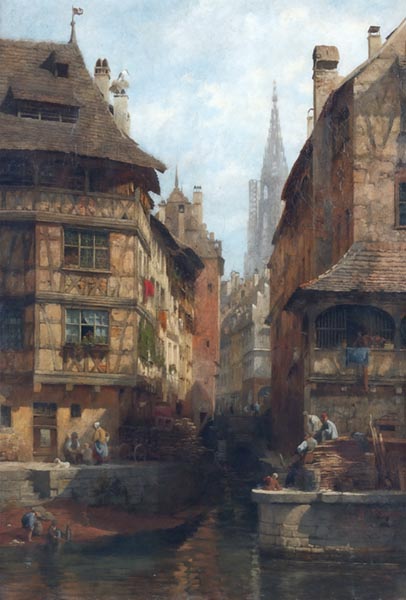
‘Strasbourg with a view of the cathedral’
Karl Weysser (German, 1833-1904)
Artvee
Translated by A. S. Kline © Copyright 2026 All Rights Reserved
This work may be freely reproduced, stored and transmitted, electronically or otherwise, for any non-commercial purpose.
Conditions and Exceptions apply.
Contents
- Letter XXIX: The Road to Strasbourg.
- Letter XXX: Strasbourg.
- Letter XXXI: Freiburg im Breisgau.
- Letter XXXII: The Road to Basel.
- Letter XXXIII: Basel.
Letter XXIX: The Road to Strasbourg
1839 (Second Journey)
Strasbourg, August
Here I am, in Strasbourg, my friend. My window opens onto the Place d’Armes (Place Kléber). To my right I have a clump of trees, to my left the Strasburger Münster (Cathedral of Our Lady of Strasbourg), whose bells are in full cry at this moment; in front of me, at the end of the square, is a sixteenth-century house, very beautiful, though washed in yellow, and with green shutters; behind this house, the high gables of an old nave, where the town’s library stands; in the middle of the square, a wooden hut out of which, it is said, a monument to Kléber (Jean-Baptiste Kléber, French army officer, and architect) will emerge; all around me, a string of old, rather picturesque roofs; a few steps from my window, a lantern-gallows, at the foot of which a few blond, pot-bellied German kids are chattering. From time to time, an elegant English post-chaise, a carriage or a landau, stops in front of the door of the Maison-Rouge — where I lodge — with its Baden postilion. The Baden postilion is charming; he has a bright yellow jacket, a black varnished hat with wide silver-braid, and carries, across the middle of his back, and slung over his shoulder, a small hunting-horn with an enormous tuft of red tassels. Our French postilions are hideous; the postillion of Longjumeau is a myth (a character from the comic-opera of that name by Adolphe Adam, 1836); a dirty old blouse with a hideous cotton cap, that’s the French postilion for you. Now, add to the Baden postilion the post chaise, the German children, the old houses, trees, huts and a bell-tower, a pretty sky of blue with white clouds, and you’ll possess an idea of the scene.
I have had very few adventures; however I spent two nights in a mail coach, which left me with a lofty idea of the solidity of our human machinery. A night in a mail coach is a horrible thing. At the moment of departure, all is well, the postilion cracks his whip, the horses’ bells tinkle joyfully, one feels in a strange and sweet state, the movement of the carriage adds gaiety to one’s spirits, the twilight adds melancholy. Little by little night falls, the conversation of one’s neighbours languishes, one feels one’s eyelids grow heavy, the mail’s lanterns are lit, the horses are changed, then it departs again like the wind; the sky is completely dark, one falls asleep, and it is precisely at this moment that the road chooses to deteriorate; the bumps and quagmires enhance each other; the coach begins to dance. It is no longer a road, it is a chain of mountains with tarns and peaks, which must provide magnificent view-points for ants. Then two opposing motions seize the car and shake it furiously, like two enormous hands that seek to clutch it in passing: a movement from front to back and back to front, and a movement from left to right and right to left — both a pitching and a yawing motion. It results from the happy complication that every jolt is multiplied at the height of the axles, and is raised to the third power in the interior of the car; so much so that a stone as big as your fist causes one to hit one’s head on the same spot eight times in succession, as if hammering a nail into it. It is charming. From that moment on, one is no longer in a carriage but a whirlwind. It feels as if the thing is possessed by a frenzy. The comfortable mail-coach introduced by Antoine Conte (Directeur Général des Postes, 1832-47) is transformed into an abominable patache (a badly sprung two-wheeler), one’s Voltaire (padded armchair) is nothing more than an infamous tape-cul (see-saw). One leaps, dances, bounces, lurches against one’s neighbour — all while asleep. For that’s the beauty of it all, you sleep. Sleep grips you on the one hand, the infernal carriage on the other. Out of this arises a nightmare like no other.
Nothing can be compared to one’s dreams in a sleep punctuated by jolting. One sleeps and at the same time fails to do so, one is at once immersed in both reality and the dreamworld. It is an amphibious sort of nightmare. From time to time, you half-open an eyelid. Everything has a deformed appearance, especially if it is raining, as it was the other night. The sky is black, or rather there is no sky, it seems as if you are fleeing madly across an abyss; the lanterns of the carriage cast a pale glow which makes the horses’ rumps look monstrous; At intervals, fierce mops of elm trees suddenly appear in the light, and vanish; puddles of water sparkle and quiver in the rain like drops in a frying pan; bushes take on a crouched and hostile air; piles of stones adopt the forms of recumbent corpses; one looks around vaguely; the trees in the plain are no longer trees, they are hideous giants one thinks one sees advancing slowly towards the roadside; every old wall resembles an enormous toothless jaw. Suddenly a spectre passes by, stretching out its arms. By day, it would simply be a signpost, and would honestly proclaim the road from Coulommiers to Sézanne. By night, it is a dreadful phantom that seems to cast a curse on the traveller. And then, I know not why, one’s mind is full of images of snakes; it’s as if snakes were crawling in one’s brain; the brambles hisses on the edge of the embankments like handfuls of asps; the postilion’s whip is a winged viper that follows the carriage and tries to bite you through the window; in the distance, in the mist, the line of hills undulates like the belly of a boa constrictor digesting its meal and, magnified by sleep, takes the shape of a prodigious dragon seeking to encircle the horizon. The wind moans like a weary Cyclops, and makes you dream of some terrifying workman labouring painfully in the darkness. — Everything is alive, with the dreadful life that a stormy night grants to things.
The towns one passes through also begin to dance, the streets rise and fall perpendicularly, the houses lean wildly over the car, and some gaze into it with burning eyes. Those are the ones whose windows are still lit. Around five in the morning, one thinks oneself done for; but the sun rises, and you forget it all. That is what a night in a mail coach is like, and I am talking to you here about the new mail-coaches, which are, moreover, excellent vehicles during daylight, when the road is good — which is rare in France.
You can imagine, dear friend, how difficult it is for me to give you an idea of the countryside traversed in this way. I passed through Sézanne, and this is what remains of it in my mind: a long, dilapidated street, low houses, a square with a fountain, an open-fronted shop where a man lit by a candle was planing a plank. I traversed Phalsbourg, and what I have retained of it is the sound of chains and drawbridges, soldiers on watch with lanterns, and black fortified gateways beneath which the carriage plunged.
From Vitry-le François to Nancy, I travelled by day. I saw nothing of particular note. It is true that the mail-coach hardly reveals anything.
Vitry-le François is a Rococo military fortress. Saint-Dizier is a long, wide street lined here and there with beautiful Louis XV houses built of cut stone. Bar-le-Duc is quite picturesque; a pretty river runs through it. I take it be the Ornain; but I am saying nothing about the river, since I happened to rouse all of Brittany by confusing the Vilaine with the Couesnon. Naiads are touchy, and I do not care to grapple with green-haired river-gods. So, pretend I have said not a word.
By the way, I have made this whole journey in company with a good provincial notary who has his office in some small town in the South, and who is going to spend his holidays in Baden, ‘because’, he says, ‘everyone goes to Baden-Baden’. No conversation was possible, of course. The worthy notary smells of stamped-paper as a rabbit in its hutch smells of cabbage-leaves.
However, as travel makes one talkative, I tried to broach a variety of subjects in a hundred ways, to see if I might find him edible, as Diderot said. I chipped away at him on all sides, but failed to obtain anything more than lumps of stupidity. There are many people like him. I was like those children who long to bite an imitation sweet at all costs; they seek sugar, they find plaster.
The town of Bar-le-Duc is dominated by an immense sloping vineyard which is bright green in August and which, as I was passing by, was framed against a wholly blue sky. There was nothing crude about the blueness or the greenness, warmly clothed by a shaft of sunlight. In the countryside around Bar-le-Duc, the fashion is for houses with any pretensions to possess, instead of a half-timbered door, a small porch made of cut stone, with a square ceiling, raised on a flight of steps. These are quite pretty. You know I like to note local architectural quirks, as I have said a hundred times, whenever the architecture is natural, and not adulterated by the efforts of architects. The local climate is written in the architecture. A pointed roof indicates rain; a flat one indicates sun; one laden with stones indicates wind.
However, I met with nothing of note in Bar-le-Duc, except that the postal officer ordered four hundred jars of jam for his annual sale, and that just as I was leaving the town, an old, crippled horse was entering, probably on its way to the slaughterhouse. Do you recall the famous Saval made by our sweet child, our dear little D..., which remained for so long exposed to all the storms, melting away in the rain, in a corner of the balcony of the Place-Royale, with a grey paper nose, neither ears nor tail, and nothing left but three wheels? Such was my poor horse of Bar-le-Duc.
From Vitry-le François to Saint-Dizier, the landscape is mediocre. There were large, reddish-brown ridges of mown wheat, which look gloomy at this time of year. No more ploughmen, no more harvesters, no more gleaners walking barefoot, heads bowed, with a meagre sheaf under their arm. Everything was deserted. From time to time a huntsman and a pointer, motionless at the top of a hill, silhouetted against the clear sky. The villages are not visible; they are nestled between the hills, in small green valleys at the bottom of which a small stream almost always flows. At times you can see the tip of a bell-tower.
On one occasion, this summit of a bell-tower presented a singular aspect. The hill was green; it was covered with grass. Above this hill one could see absolutely nothing but the tin hat of a church tower which seemed to be sited exactly on top of the hill. This hat was of Flemish form. (In Flanders, in village churches, the bell-tower has the shape of a bell.) One can see it from here: it looks like a vast green carpet on which Gargantua seems to have left his giant bell.
After Saint-Dizier, the road is charming. A fresh mantle of trees is spread on all sides, the valleys deepen, the hills thin out, and at times take on the illusory air of mountains. What helps the illusion is that sometimes, despite their charming appearance, the soil is shallow, and the tops of the hills are scarred, and peeling. One feels that the grasses lack strength enough to drive their sap to such a height. This makes the hills larger only in appearance, but it does at least render them larger.
Ligny-en-Barrois is a pretty town. Three or four hills meet in a star-shaped valley. The houses of Ligny-en-Barrois are all heaped up at the bottom of this valley, as if they have slid downwards from the top of the hills. It makes for a delightful little town; and then there is a pretty river and two beautiful ruined towers. The hills are charming; they were kind enough to oblige the mail coach to ascend them at a walking pace, so that I was able to descend, follow the coach on foot, and see the town.
I have doubts about Toul Cathedral. I suspect it has some affinity with Orléans Cathedral, that odious church which from afar makes so many promises, and near-to keeps none of them. However, I hold a rather better opinion of Toul Church; though it is true that I have not seen it up close. Toul is in a valley, the mail-coach descended at a gallop, the sun was setting, and cast an admirable horizontal shaft of light on the facade of the cathedral; the building has a singularly dilapidated appearance, it has solidity, and is very beautiful. As I approached, I saw that the dilapidation was at least as much due to decay as old age, that the towers were octagonal, which displeased me, and that they were surmounted by a balustrade similar to the summits of the towers of Orléans Cathedral, which shocked me. However, I will not condemn Toul Cathedral. Seen from the apse, it is quite beautiful. As we crossed the bridge at Toul, my travelling companion asked me if the House of Lorraine was not the same as the House of Medici (the House of Lorraine succeeded the House of Medici as the Grand Dukes of Tuscany in 1737 after the extinction of the Medici male line, ruling until Tuscany’s annexation into the Kingdom of Italy in 1860).
Nancy, like Toul, is in a valley, but a beautiful, wide, and opulent valley. The town has an insignificant appearance; the steeples of the cathedral are Pompadour pepper-pots. However, I have become reconciled to Nancy, firstly because I dined there, and was very hungry; secondly because the Place de l’Hôtel-de-Ville (Place Stanislas) is one of the prettiest, most cheerful, and most complete Rococo squares I have seen. It is a very well-designed and splendidly laid out area, with all sorts of adornments that go well together, and aid each other in achieving a fine effect: rocaille fountains; groves of clipped and shaped trees; thick, gilded, and ornate iron railings; a statue of King Stanislas; a triumphal arch (the Arc Héré) in an ornate and entertaining style; and noble, and elegant facades, well linked and arranged at thoughtful angles. The pavement itself, made of sharp pebbles, is compartmented like a mosaic. It is a marquetry square.
I truly regretted that I lacked the time to view that city, entirely in the style of Louis XV, in detail and at leisure. The architecture of the eighteenth century, when it is thoroughly applied, ends up redeeming its bad taste. Its vegetative fantasies grow and blossom at the top of buildings in clusters of flowers so extravagant and so bushy, that all one’s irritation disappears, and one becomes accustomed to them. In hot climates, in Lisbon for example, which is also a Rococo city, it seems as if the sun acts on this stone vegetation as on other vegetation. It is as if sap has circulated in the granite; the vegetation has emerged, expanded, and extended prodigious branches on all sides, in arabesques that rise, swollen, towards the sky. On monasteries, on palaces, on churches, ornamentation has been added everywhere, at every opportunity, on one pretext or another. There is not a single pediment in Lisbon whose line is unbroken.
What is remarkable, and what completes this comparison of eighteenth-century architecture to vegetation, a thing I observed in Nancy while passing the cathedral, is that, just as the trunks of trees are dark and melancholy, the lower levels of Pompadour buildings are bare, morose, heavy and lugubrious. Rococo has ugly feet. I arrived in Nancy on Sunday at seven in the evening; at eight the mail-coach departed again. This stage at night was more settled than the first. Was I wearier? Was the road better? The fact is that I clung on to the carriage straps, and slept. That’s how I came to see Phalsbourg.
Around four in the morning, I woke. A cool wind was striking my face, the coach, driven at full speed, was leaning forward, we were descending the famous Saverne pass (Col de Saverne). I received one of the most beautiful impressions of my life. The rain had stopped, the mists were dispersing to the four winds, the crescent moon was traversing the clouds swiftly and, at times, sailing freely within a quadrilateral patch of azure, like a boat on a small lake. A breeze, rising from the Rhine, made the trees at the edge of the road quiver. From time to time, they parted and allowed me to see a vague and dazzling abyss: in the foreground, a copse, behind which the mountain was hidden; below, immense plains with watery meanders gleaming like lightning; in the background a dark, confused and dense line — the Black Forest — a whole magical panorama glimpsed in the moonlight. Such incomplete sketches have perhaps even more value than finished ones. They are dreams that one can gaze at, and almost touch. I knew that before my eyes lay France, Germany, and Switzerland; Strasbourg with its spire, the Black Forest with its mountains, the Rhine with its twists and turns; I was looking at everything, divining everything, yet seeing nothing. I have never experienced a more extraordinary sensation. Add to that the hour, our speed, the horses plunging downwards, the violent noise of the wheels, the rustling of the lowered windows, the trees in frequent passage, or rather their shadows, the sighs that issue from the mountains in the early hours, a kind of murmur rising from the plain, the beauty of the sky, and you will understand something of what I felt. By day, this valley amazes; by night, it fascinates.
The descent takes a quarter of an hour and its length is a little more than three miles. — Half an hour later, it was twilight; dawn to my left was whitening the edge of the horizon, a group of pale houses covered with black tiles was visible at the top of a hill, the true azure of day would soon overflow the horizon, a few country folk were already passing on their way to their vineyards, a clear, cold, violet light was struggling with the ashen glow of the moon, the constellations were fading, two stars of the Pleiades had disappeared, the Charioteer Auriga’s triple team were plunging rapidly towards their stable with its blue doors, it was cold, I was frozen, I had to raise the windows. A moment later the sun rose, and the first thing it revealed was a village notary shaving at his window, next to a red calico curtain, his nose reflected in a broken mirror.
A couple of miles further on, the country-folk were now of picturesque appearance, the wagons magnificent; I counted thirteen mules attached to one of them, harnessed with widely spaced chains. One could feel the approach of Strasbourg, the old German city.
As we galloped, we traversed Marmoutier, and Wasselonne a long, narrow passage between houses, squeezed into the last gorge of the Vosges near Strasbourg. Of Marmoutier, I glimpsed only the unusual church façade, topped by a juxtaposition of two capped octagonal bell-towers and a square one, which the movement of the coach suddenly presented in front of my window, the image of the building jolting like a stage flat, and then immediately bore away.
Suddenly, at a bend in the road, the mist lifted, and I saw Strasbourg Minster. It was six in the morning. The enormous cathedral, the tallest construction built by the hand of man after the Great Pyramid (till 1874, when it was surpassed by Saint Nikolai’s Church, Hamburg), was highlighted clearly against a background of dark mountains of magnificent form, sunlight, here and there, bathing the wide valleys between them. The labour of God on Mankind’s behalf, the labour of Mankind on God’s behalf, the mountains and the cathedral, competed in grandeur. I have never seen anything more imposing.
Letter XXX: Strasbourg
September
Yesterday I visited the Cathedral (Liebfrauenmünster zu Strassburg, Our Lady of Strasbourg). The Minster is truly a marvel. The portals of the church are beautiful, particularly the Romanesque portal; there are some superb figures on horseback on the facade, the rose window is noble and well executed. The whole face of the church is a skillfully composed poem. But the true triumph of this cathedral is the spire. It is a true stone tiara with its crown and its cross. It is a prodigy of the gigantic and the delicate. I had seen Chartres, I had seen Antwerp, I was obliged to visit Strasbourg.
The church was never completed. The apse, miserably truncated, was arranged according to the taste of Cardinal de Rohan, that imbecile, he of that affair of the Queen’s necklace. The apse is hideous. The stained-glass window that was adapted to it displays a common carpet design. It is ignoble. The other stained-glass windows are beautiful, except for a few that have been renewed, notably the great rose window. The entire church is shamefully plastered; some of the sculptures have been restored with a degree of taste. The cathedral has been added to in every style. The pulpit is a small fifteenth-century construction, florid Gothic, and of a delightful design and manner. Unfortunately, it has been gilded in a stupid way. The baptismal font is from the same period and superbly restored. It is a vase surrounded by an intricate stone mesh of the most marvellous sculpting in the world. Beside it, in a dark chapel, there are two tombs. One, that of a bishop of the time of Emperor Louis IV, presents the fearsome concept that Gothic art expressed in every form: a bed beneath which is a tomb, sleep superimposed on death, the man above the corpse, death above eternity. The sepulchre is on two levels. The bishop (Konrad von Lichtenberg), in his pontifical robes, his mitre on his head, is lying on his bed, under a canopy; he is sleeping. Below, in the shadows, beneath the feet of the bed, we glimpse an enormous stone in which two enormous iron rings are sealed; it is the lid of the tomb. We see no more. The architects of the sixteenth century showed the corpse (you will recall the tombs at Brou), those of the fourteenth hid it; which is even more frightening. Nothing could be more sinister than those two iron rings.
In the depths of my reverie, I was distracted by an Englishman, who was asking questions about the affair of the Queen’s necklace, and about Jeanne de La Motte, in the belief that he was looking at the tomb of Cardinal de Rohan. In any other place I could not have stopped myself from laughing. Yet, after all, it would have been wrong of me. Who does not possess areas of gross ignorance? I know, and you also know, a learned doctor who says Dentrifice Powder (a tautology) which proves that he knows how to use neither Latin nor French. A lawyer, I forget whom, an opponent of literary property in the Chamber of Deputies, says: Monsieur Réaumur, Monsieur Fahrenheit, Monsieur Centigrade. An infallible philosopher, our contemporary, invented the previously non-existent past tense recollexit. Bernhard Roillet, a very learned rector of the University of Paris in the fifteenth century, was indignant that schoolchildren wrote: mater tuus, pater tua (the adjectives are of incorrect gender) yet himself said: Marmouseti (for Marmouset). A barbarism moralising over a solecism.
I return to my cathedral. The tomb I just told you about is in the north semi-transept. In the south semi-transept, there is a chapel that scaffolding prevented me from seeing. Beside this chapel, in the choir, runs a fifteenth-century balustrade fixed to the wall. A painted and sculpted figure leans on this balustrade, seemingly admiring a pillar (the Pillar of Angels) surrounded by superimposed statues, opposite him, and which is of marvellous effect. Tradition has it that this figure represents the first architect of the Minster, Erwin von Steinbach.
Statues tell me a lot, so, I have a habit of questioning them, and when I meet one that I like, I keep it company awhile. Thus, I was alone with the great Erwin, and deep in thought for more than an hour, when a scoundrel came to disturb me. It was the Swiss guard of the church, who, to earn thirty sous, offered to explain the cathedral to me. Imagine a dreadful Swiss, half German and half Alsatian, offering me his explanations: — Monsir, fous afre pas fu lé champelle? — I dismissed this trader in gibberish somewhat harshly.
I was unable to see the astronomical clock in the nave, which is a charming little sixteenth-century construction. It is being restored and is covered with a wooden casing.
Having seen the church, I climbed the bell-tower. You know my taste for perpendicular excursions. I was careful not to miss the tallest spire in the world. Strasbourg Minster is more than four hundred and sixty feet high. It is one of that family of bell-towers which are flanked by open staircases. It is an admirable thing to move about in, this monstrous mass of stone, completely filled with air and light, hollowed out like a toy from Dieppe, a lantern as well as a pyramid, which vibrates and throbs at every breath of wind. I climbed to the top of the vertical ladders. On the way up, I met a visitor who was coming down, quite pale and trembling, half-carried by his guide. Yet there is no danger. Only at the point where I stopped, at the base of the spire itself, was there the possibility. Four open spiral staircases, corresponding to the four vertical turrets, delicate winding spirals of thinned, worked stone, rest on the spire, whose angles they follow, and clamber up to what is called the crown, about thirty feet from the lantern, surmounted by a cross which forms the summit of the bell-tower. The steps of these staircases are very tall and narrow, and become narrower as one ascends. So much so that at the top they barely protrude far enough to rest one’s heels on them. It is necessary to climb thus about a hundred feet, and one is four hundred feet from the ground. There are no guardrails, or so few that it is not worth mentioning them. The entrance to the staircase was closed by an iron gate. The gate is only opened with special permission from the mayor of Strasbourg, and one can only climb accompanied by two roofers, who tie a rope round your body, the end of which they attach at intervals, as you climb, to the iron bars that connect the mullions. Eight days ago, three women, three Germans, a mother and her two daughters, made the ascent. However, no one, except the roofers who maintain the bell-tower, ascend to the lantern, where there is no longer a staircase, but simply iron bars arranged in steps.
From where I stood, the view is admirable. Strasbourg is beneath one’s feet, an ancient town with jagged gables and large roofs laden with dormer windows, interspersed with towers and churches as picturesque as any town in Flanders. Two pretty rivers, the Ill and the Rhône, brighten this dark mass of buildings with their clear, green stretches of water. All around the walls, as far as the eye can see, stretches an immense landscape full of trees and dotted with villages. The Rhine, which passes within a league of the town, flows through this countryside, twisting and turning about itself. Moving around the bell tower, one can view three mountain ranges: the ridges of the Black Forest to the north, the Vosges to the west, and the Alps to the south.
One is so high that the landscape is no longer a landscape; it is, akin to what I saw from the mountain above Heidelberg, a geographical map, but a living map, with mist, smoke, shadows, gleaming and tremulous waters and leaves, clouds, rain, and rays of sunlight.
The sun cheerfully celebrates those who are on high peaks. While I was at the top of the Minster, it suddenly dispelled the clouds that had covered the sky all day long, and set fire to all the city vapour, all the mists of the plain, while pouring golden rain on Saverne, whose magnificent slopes I saw again thirty miles away on the edge of the horizon, through a resplendent gauze. Behind me a large cloud showered rain on the Rhine; at my feet the city murmured softly, and its syllables reached me through gusts of wind; the bells of a hundred villages rang out; red and white insects, which were really a herd of oxen, lowed in a meadow on the right; other blue and red insects, who were gunners, were involved in firing practice, in the quadrant on the left; a black beetle, which was really a stagecoach, was pursuing the road to Metz; and to the north, on the ridge of a hill, the Castle of the Margraves of Baden-Baden (Hohenbaden, Altes Schloss) shone in a pool of light, like a precious gem. I went from one turret to another, gazing in turn at France, Switzerland and Germany, in a single shaft of sunlight. Each turret faces a different nation.
During my descent, I halted for a few moments at one of the upper doors of the turret’s staircase. On the two sides of this door are the stone figures of the two architects of the Cathedral. These two great poets are represented squatting, their backs and faces tilted back, as if marvelling at the height of their work. I began to do as they did, and remained as statuesque as they themselves were for several minutes. On the platform, they had me write my name in a visitor’s book; after which I left. The bells and the clock are of no interest.
From the Cathedral I walked to the Church of Saint Thomas, which is the oldest in the city, and in which is to be found the tomb of Marshal Maurice de Saxe. This tomb is to Strasbourg what Charles Antoine Bridan’s ‘Assumption’ is to Chartres Cathedral, a very famous thing, much vaunted, but quite mediocre. It is a large marble operatic group, in the inadequate style of Jean-Baptiste Pigalle, whereon Louis XV boasts in lapidary style of being himself the author and guide — auctor and dux — of the victories of Marshal de Saxe. A cupboard is revealed with a bewigged plaster head therein; it is the bust of Pigalle. — Fortunately, there are other things to see in Saint Thomas: first the church itself, which is Romanesque, and whose squat dark bell-towers possess great character; then the stained-glass windows, which are beautiful, though their lower part has been stupidly plastered over; then the tombs and sarcophagi, which abound in this church. One of these tombs is from the fourteenth century; it is a stone slab set in the wall, on which is sculpted a German knight of the most superb figure. The knight’s heart, in a silver-gilt box, had once been placed in a small square hole dug in the figure’s belly. In 1793, some local Brutus, out of hatred for knights and love of silver-gilt boxes, tore the heart out of the statue. All that remains is the empty perfectly-square hole. On another stone slab is carved a Polish colonel, helmet and plume on his head, in that beautiful armour that soldiers still wore in the seventeenth century. It is thought to be a knight; no, it is a colonel. There are also two marvellous stone sarcophagi; one, which is gigantic and laden with coats of arms in the opulent style of the sixteenth century, is the coffin of a Danish gentleman who was laid to rest, I know not why, in this church; the other, even more curious, if not more beautiful, is hidden in a cupboard, like the bust of Pigalle. A general rule: sacristans hide everything they can, because they are paid to show them. In this way, they sweat fifty-centime coins from poor granite sarcophagi that can’t avoid it. This one is from the ninth century; a great rarity. It is the coffin of a bishop who could not have been more than four feet high, judging by his coffin; a magnificent sarcophagus, moreover, covered with Byzantine sculptures, figures and flowers, and supported by three stone lions, one under the head, two beneath the feet. As it is in a cupboard against the wall, one can only see one side. This is unfortunate as regards the artistry; it would be better if the coffin were in the open air in a chapel. The church, the sarcophagus and the traveller would benefit; but what would become of the sacristan? Sacristans first and foremost; that is the rule in such churches.
It goes without saying that the Romanesque nave of Saint Thomas is painted bright yellow. I was about to leave when the Protestant sacristan, a fat, chubby Swiss of about thirty, caught me by the arm: ‘Would you like to see a few mummies?’ ‘I would.’ Another hiding place, another key. I enter a vault. These mummies have nothing Egyptian about them. They are of a Count of Nassau and his daughter, who were found embalmed while searching the church cellars, and who were placed in this corner under glass. The two poor dead people sleep there in broad daylight, lying in their coffins, from which the lids have been removed. The Count of Nassau’s coffin is adorned with painted coats of arms. The old prince is dressed in a simple costume tailored in the style of Henry IV. He has large, yellow leather gloves, black shoes with high heels, a guipure collar, and a linen cap edged with lace. His face is a dark brown colour. The eyes are closed. A few hairs of his moustache are still visible. His daughter is wearing a splendid costume like that of Elizabeth the ‘Winter Queen’. The head has lost its human form; it is a death’s-head; it has hair no more; only a bouquet of pink ribbons remains on the bare skull. The dead woman has a necklace around her neck, rings on her hands, mules on her feet, a cluster of ribbons, jewels and lace on the sleeves, and a small, richly-enamelled canoness’s cross on the chest. Her small, grey, gaunt hands are folded and she sleeps on a bed of linen akin to that which children make for their dolls. I saw in it the hideous doll, called Death. It is recommended that one not touch the coffin. If one were to do so what was once the Princess of Nassau would crumble to dust.
Turning around to see the Count, I was struck by a sort of shiny, buttery coating to his face. The sacristan —ever the sacristan — explained to me that eight years ago, when the mummy was discovered, it had been thought necessary to varnish it. What do you think of that? What good was it to have been Count of Nassau only to be varnished by Frenchmen, two hundred years after one’s death? The Bible promises the human corpse every metamorphosis, every humiliation, every fate, except this one. It says: ‘The living will scatter you like dust, trample you underfoot like mud, burn you like dung’ (see 2nd Samuel 22:43, in the French ‘Martin’ Bible of 1744) but it does not say: ‘They will end up polishing you like a pair of boots!’
Letter XXXI: Freiburg im Breisgau
September 6th
Here is an account of my entry to Freiburg im Breisgau: — it was nearly four in the morning; I had been travelling all night aboard the coupé of the Baden mail, emblazoned in gold with a red line, and driven by those fine yellow-coated postilions I told you about, while traversing a cluster of clean, healthy, pretty, and happy villages, dotted with blossoming gardens round the houses, watered by small, lively rivers whose bridges are adorned with rustic statues I glimpsed in the light of our lanterns. I had been talking until eleven in the evening with my companion in the coupé; a very modest and intelligent young man, an architect from the city of Haguenau; then, as the road is good, as the mail-coaches of Leopold I, Grand Duke of Baden, travel very slowly, I fell asleep. Thus, around four in the morning, the cheerful, but cold breath of dawn entered via the lowered window, and struck me in the face; I half awoke, with a confused impression of real objects, still retaining enough of the dreams of sleep to follow with my eyes a fantastic dwarf as tall as my thumb, dressed in a golden cope, and wearing a red wig, who was dancing merrily behind the postilion, on the rump of the carrier horse, with many a bizarre contortion, gambolling like a mountebank, parodying the posture of the postilion, and dodging the whip with comical leaps when by chance it passed near him. From time to time this dwarf turned towards me, and it seemed to me that he greeted me, ironically, with great bursts of laughter. There was in the front part of the carriage a badly-greased nut that sang a song which the wicked little rascal seemed to be enjoying greatly. At times, his mischievousness and insolence almost made me angry, and I was tempted to warn the postilion. When there was more daylight in the sky, and less sleep in my head, I recognised that this dwarf jumping about in his gold cope was a small copper button with a scarlet tuft attached to the horse's crupper. The horse’s movements were communicated to the crupper in an exaggerated fashion, such that the copper button assumed a thousand mad attitudes — I woke fully — it had rained all night, but the wind had dispersed the clouds; patches of diffuse, woolly mist blotted out the sky, here and there, like shreds of black fur; to my right stretched a vast brown plain, barely touched by the light; to my left, behind a dark hill, on the summit of which vivid silhouettes of trees were outlined, the eastern reaches were turning a vague blue. Amidst this blue, above the trees, and below the clouds, Venus shone — you know how I love the planet Venus — I was gazing at it, unable to take my eyes away, when suddenly, at a bend in the road, an immense black arrow silhouetted in the clear air, rose from the centre of the horizon. We had reached Freiburg.
A few moments later, the carriage stopped on a broad, new, white street, and deposited its sundry contents, packages, suitcases, and travellers, under a large carriage entrance lit by a flickering lantern. My French companion bid me adieu, and left me. I was not sorry to arrive; I was quite tired. I was about to enter the house boldly, when a fellow took my arm and barred my way with some sharp words in German, which were completely unintelligible to me. I cried aloud in good French, addressing the people around me; but there were no longer any but Prussian, Austrian, or Baden travellers there, some carrying their trunks, others their portmanteaus, all very German and very sleepy. My complaints nevertheless woke them a little, and they answered me. But not a word of French from them, not a word of German from me. We jabbered back and forth, each trying to find the right words. I finally understood, however, that this carriage entrance was not a hotel: it was the post office, and nothing more.
What to do? Where to go? Here they no longer understood me. I would have liked to follow them; but most of them were Freiburgers returning home, and dwelt in different directions. I had the disappointment of seeing them depart, one after another, until the last, and at the end of five minutes I was alone beneath the carriage entrance. The carriage had gone. At this point, I noticed that my overnight bag, which contained not only my clothes, but also my money, had disappeared. The scene was acquiring an air of tragedy; I assumed it to be an act of Providence; and finding myself suddenly without clothes, money, or shelter, lost among the Scythians what is more, I turned to the right, and began to walk straight ahead. I felt rather dreamy. Meanwhile the sun, which waits for no one, had continued on its way. It was early morning; I gazed at all the houses one after the other, like a fellow who would greatly like to enter one; but they were all daubed in yellow and grey and shut tight. As a consolation, in my much-perplexed explorations, I came across an exquisite fifteenth-century fountain, which poured its water joyously into a large stone basin via four shiny copper taps. There was enough daylight for me to distinguish the three tiers of statuettes grouped around the central column, and I made out with some difficulty that the statue, in Heilbronn sandstone, which had been destined to crown this charming little building, had been replaced by a wicked weather-vane of painted tin, depicting Fame. After walking all around the fountain to view the figurines, I set off again.
Two or three houses beyond the fountain, a lighted lantern shone above an open door. Well, I went in. No one under the carriage entrance. I called, no one answered. In front of me, a staircase; to my left, a half-open door. I pushed on a door opposite at random; it opened. I entered, I found myself in a dark room, with the vague shape of a window to my left. I called out: ‘Anyone there?’ No answer. I felt along the wall, I found a door; I pushed on it, it opened. Here was another dark room, with light glowing at the rear, and a half-open door. I approached the door and looked inside. Here comes the frightening part. In an oblong room, vast and supported in the centre by two pillars, curious figures were seated, around a long table, dimly lit by candles placed at intervals,
They were pale, serious, sleepy beings. At the end of the table, closest to me, sat a tall, pale woman wearing a cap topped with an enormous black plume. Beside her was a young man of seventeen, livid and with a serious air, wrapped in an immense floral dressing gown, with a black silk cap over his eyes. Beside the young man, was an old man with a greenish face whose wore three tiers of head-dress on his head: the first tier, a cotton cap; the second a scarf; the third, a hat. And, chair by chair, a handful of living Nuremberg nutcrackers, grotesquely dressed and engulfed in immense felt hats, with dark faces, and enamel eyes, were spread on either side of the table. The rest of the long table was deserted, and the tablecloth, white and bare as a shroud, was lost in the shadows at the back of the room. Each of these unusual guests had in front of them a white cup, and some unusually-shaped vessels on a small tray. None of them said a word. From time to time, and in the deepest silence, they raised their white cup in which a black liquor was steaming, to their lips and drank gravely. I realised that these ghosts were drinking coffee. Having considered the matter, and judging that the moment had come to produce an effect, I pushed open the half-open door and entered the room boldly.
A pause; no effect. The tall woman, dressed like a herald, alone turned her head, glanced at me fixedly showing the whites of her eyes, and returned to drinking her potion. Otherwise, not a word, nothing. The other ghosts failed even to look at me. A little disconcerted, cap in hand, I took three steps towards the table, and said, while very much afraid of showing disrespect in this castle of Udolpho: — ‘Gentlemen, is this not an inn?’ Here the old man with the triple coiffure produced a sort of inarticulate grunt which vanished heavily into his cravat. The others remained immobile.
I confess that then I lost patience, and was heard shouting, at the top of my lungs: — ‘Hello! Ahoy! Innkeeper! Taverner! By all the devils! Hotelier Waiter! Anyone! Kellner!’ I had acquired this word, Kellner, in my comings and goings along the Rhine, without really knowing its meaning, and had carefully tucked it away in a corner of my mind, with a vague idea that it might someday be useful to me. Indeed, at the magical cry of: ‘Kellner!’ a door opened in the darkest part of the cavern. Open Sesame! could have not proved more successful. The door closed, after yielding to an apparition which advanced straight towards me. It was a young girl, pretty, pale, with swollen eyes, dressed in black, wearing a strange headdress on her head, which looked like an enormous black butterfly lying flat on its forehead, its wings open. She also had a large piece of black silk wrapped around her neck, as if this graceful spectre was obliged to hide the red, circular line Mary Stuart and Marie Antoinette were fated to wear. — ‘Kellner? she asked me. ‘Kellner!’ I answered fearlessly.
She took a torch and signalled me to follow her. We returned to the rooms I had traversed, and in the middle of the first room I had entered, she showed me with a smile a man sleeping the deep sleep of the righteous, on a wooden bench, his head on my travelling-bag. Greatly surprised by this last prodigy, I shook the man; he woke; the young girl and he exchanged a few words, in a low voice, and two minutes later we found ourselves, my sleeping bag and I, very comfortably installed in an excellent room, with snow-white curtains.
There I was, in the Hotel of the Court of Zähringen. And here is the explanation of this tale à la Ann Radcliffe:
At the Customs office in Kehl, the driver of the Baden mail-coach, having heard me conversing in Latin (not without a few barbarisms) with a worthy pastor who was returning to Zurich, and in Spanish with a certain Colonel Duarte, who was off, via Savoy, to join Don Carlos (Carlos María Isidro de Borbón), had concluded that I knew German, and had not therefore been otherwise concerned as to my fate. At Freiburg, the kellner, that is to say the factotum of the Hotel Zähringen, was waiting for the mail-coach on its arrival, and the courier, upon disembarking, had pointed me out to him without my knowledge, saying: ‘Here’s one for you’; and had handed him my night bag while I was struggling amidst the Germans. The Kellner, believing me to be forewarned, had gone on ahead with my bag and waited for me at the hotel, where he slept in the lower room. You can guess the rest. Yet, as regards my adventure, it was a fine act of providence that when I left the post office I turned right, and not left. God is great.
The impassive spectres drinking coffee were simply the passengers on the stagecoach from Frankfurt to Geneva, taking advantage of the hour’s respite the carrier grants one at dawn; good people, dressed somewhat in the German style, who seemed strange to me, and to whom I must have seemed absurd. The young girl was a pretty servant from the Hotel de Zähringen. The large black butterfly is the headdress of the country. A graceful headdress. Broad, black silk ribbons fitted like a cockade on the forehead, sewn to a cap that is also black, though sometimes embroidered with gold at its top, the hair hanging down behind the back, in two long braids. The two ends of the thick black necktie, which is also a local fashion, also hang down behind the back.
I had left Strasbourg at seven in the evening the day before. Night was falling when I crossed the Rhine at Kehl over the pontoon bridge. On reaching the other bank, the coach stopped, and the Baden Customs officers commenced their inspection. I handed over my keys, and went off to view the Rhine at dusk. This period of contemplation allowed me to fill the time waiting at Customs, and spared me the displeasure of seeing all that my companion the architect related to me afterwards concerning a poor actress going to Karlsruhe; a rather pretty gypsy, whom the Customs officers amused themselves by tormenting, obliging her to pay seventeen sous for an unhemmed calico bustle, and dragging all her tinsel and wigs out of her suitcase, to the poor girl’s great confusion.
The Freiburg Minster, except for its lower height, is equal to the Strasbourg one. It possesses, though in a different style, the same elegance, the same boldness of line, the same verve, the same solidity of rusted, dark stone, dotted here and there with light-filled holes of all shapes and sizes. The architect of the new cast iron bell-tower of Rouen Cathedral had, it is said, the bell-tower of Freiburg Cathedral in mind. Alas!
Freiburg Minster possesses two other bell-towers. They are Romanesque, small, low, severe, with round arches and Romanesque dentils, and are placed, not, as usual, at the ends of the transept, but in the angles formed by the intersection of the lesser nave with the greater. The Minster is also, in a way, independent of the church, though it adjoins it. It is built at the entrance to the great nave, above an almost Romanesque porch, full of painted and gilded statues, of the greatest interest. On the square outside the church, there is a pretty fountain from the sixteenth century, and in front of the porch, three columns from the same period, which bear a statue of the Virgin between the figures of Saint Peter and Saint Paul. At the foot of these columns the pavement is laid out as a labyrinth.
To the right, the shadow of the church shelters, in the same square, a sixteenth-century house (the Merchant’s Hall, the Kaufhaus), with an immense roof of coloured tiles, with stepped gables, flanked by two pointed turrets, supported by four arches, pierced by charming bays, and adorned with coloured coats of arms, and an ornate balcony on the first floor, and, between the cross-windows of this balcony, four painted and gilded statues, representing Emperor Maximilian I; Philip I, King of Castile; Emperor Charles V; and Emperor Ferdinand I. This admirable building serves I know not what dull municipal and bourgeois purpose, but it has been colour-washed in red. On this side of the Rhine, they colour-wash in red. They decorate their churches as the savages of the South Seas decorate their faces.
The Minster, fortunately, is not so plastered. The church is coated with a layer of grey, which is almost tolerable when you consider that it could have been beetroot-coloured. The stained-glass windows, almost all of which have been preserved, are of marvellous beauty. As the spire occupies the place of the large rose window on the facade, the side aisles end in two medium-sized rose windows inscribed in triangular arches to the most mysterious and charming effect. The flamboyant Gothic pulpit is superb, the canopy added above is wretched. These sorts of pulpit had no canopy. That is what churchwardens should learn before fiddling with these beautiful buildings, at random. The entire lower part of the church is Romanesque, as are the two side portals, one of which, the one on the right, is hidden by a Renaissance porch. Nothing is more interesting, in my opinion, than these conjunctions of the Romanesque and the Renaissance styles; the Byzantine archivolt, so austere, the neo-Roman archivolt, so elegant, meet together and combine, and, as they are both fanciful, this common basis renders them harmonious and allows them to align without clashing.
A string of engaged Romanesque arches runs along the base of the great nave on both sides. Each of the capitals might have been designed separately. The Romanesque style is richer in capitals than the Gothic style. At the foot of one of these arcades lies Duke Berthold V, who died in 1218, without posterity, and is buried beneath his statue: sub haec statua, says the epitaph. Haec statua is a stone giant with a long garment, leaning against the wall, feet on the pavement, sculpted in the sinister manner of the thirteenth century, who gazes at the passers-by with a formidable air. He would be a terrifying Commander (a reference to the Commander in Mozart’s opera ‘Don Giovanni’). I would not care to hear him ascending my stairs one evening. This great nave, darkened by the stained-glass windows, is entirely paved with mossy-green tombstones; the carved coats of arms and stern faces of the knights of Breisgau are worn away by the passage of feet, the faces of proud gentlemen who formerly would not have suffered a prince to touch their faces must now suffer the passage of cowherds.
Before entering the choir, you should admire two exquisite Renaissance porticoes, located, one on the right, the other on the left, in the arms of the transept; then, in a chapel (the Suter Chapel) fronted by a grille, at the end of a small golden cavern, you can glimpse a hideous skeleton dressed in gold brocade and pearls, that of Saint Alexander, martyr; then two gloomy chapels, also with grilles, which face each other, arrest your passage: one is full of statues, a ‘Last Supper’ with Jesus, all the apostles, and the traitor Judas; the other contains only the one figure of Christ in the tomb; two funereal scenes, one of which completes the other, the verso and recto, as it were, of that marvellous poem called the Passion. Sleeping soldiers are sculpted on the sarcophagus of Christ.
The sacristan has reserved the choir and the chapels of the apse for himself. One may enter, but must pay. However, one does not regret the cost. This apse, like those in Flanders, is a museum, and a varied one. It contains Romanesque goldwork, flamboyant carpentry, Venetian fabrics, Persian tapestries, paintings by Holbein (The Oberried Altarpiece’s two surviving panels), jewelled locksmith’s work that could be by Biscornet (the legendary thirteenth century iron-worker who is said to have created the intricate side doors of Notre Dame de Paris). The tombs of the Dukes of Zähringen, in the choir, are very beautiful, nobly-sculpted slabs; the two Romanesque doors of the small bell-towers, one of which has dentils, are very interesting; but what I admired above all was, in a chapel at the rear, a Byzantine Christ, about five feet high, brought back from Palestine by a bishop of Freiburg. The figure of Christ, and the cross, are made of gilded copper enhanced with brilliant stones. The Christ, fashioned in a barbaric but powerful style, is dressed in a richly-worked tunic. A large uncut ruby adorns the side. The stone statue of a bishop, leaning against the neighbouring wall, contemplates him with adoration. The bishop is standing; he has a proud, bearded face, a mitre on his head, a crozier in his fist, a cuirass on his stomach, a sword at his side, his shield at his elbow, iron boots on his legs, and his foot resting on a lion. It is all very beautiful.
I shirked climbing the bell-tower. Freiburg is dominated by a large hill, almost a mountain, higher than the bell-tower. I preferred to climb the hill. I was rewarded for my trouble with a delightful view. In the centre, at my feet, the dark cathedral with its three-hundred and eighty foot high spire; all around it the city’s carved cables, and weather-vaned roofs adorned with arabesques of coloured tiles; here and there, among the houses, a few old square towers belonging to the old city wall; beyond the city an immense velvet-green plain fringed with hedges, in which the sun makes the cottage windows shine like gold sequins; trees, vineyards, roads that flee; to the left, a wooded height whose shape recalls the Ducal horned hat (corno ducale) of the Doge of Venice; along the horizon, thirty five miles of mountains. It had rained all day, but as I reached the summit of the hill, the sky cleared, and an immense arch of cloud curved above the dark spire, penetrated everywhere by the sun’s rays.
Just as I was about to descend, I saw a path that wound between two walls of sheer rock. I followed this path, and after a few steps suddenly found myself, as if at a window, overlooking another valley quite different from that of Freiburg. One would think one was hundreds of miles away. It was a dark, narrow, gloomy valley, with only a few houses among the trees, and was hemmed in on all sides between high hills. A heavy ceiling of cloud rested on the separated ridges of the mountains like a roof over a series of battlements; and, through the gaps in the hills, like the skylights of an enormous tower, I saw the blue sky.
By the way, I ate some trout from the Upper Rhine, in Freiburg, which are excellent little fish — and very pretty, blue, spotted with red.
Letter XXXII: The Road to Basel
Basel, September 7th
Yesterday, dear friend, at five in the morning, I left Freiburg. At noon I entered Basel. The route I am following is more picturesque every day. I saw the sunrise. Around six its powerful light pierced the clouds, and the horizontal rays stretched out into the distance, revealing the monstrous humps of the Jura on the horizon. They are already formidable. One feels that they are the last undulations of those enormous waves of granite called the Alps.
The Baden mail coupé was fully booked. The interior was composed thus: a German librarian, sad at having forgotten his blouse in an inn on Mount Rigi; a little old man dressed as in the days of Louis XV, mocking another old man in the costume of a dandy, who looked to me like a travelling version of the opera singer Jean Elleviou, by asking him if he had visited the land of the Grisons; finally a tall tradesman’s agent, a peddler of fabrics who declared with a loud laugh that, as he had been unable to place his samples he was traveling in wines (in vain); moreover, he had whiskers on his cheeks as clipped poodles do elsewhere. — Seeing this, I climbed onto the imperial. It was quite cold; I was up there alone.
The young girls at this southern end of the Haut-Rhin wear an exquisite local costume: the cockade-headdress I told you about, a brown petticoat with large, rather short pleats, and a man’s jacket of black cloth with pieces of red silk, imitating cuts and slashes, sewn to the waist and sleeves. Some, instead of a cockade, have a red handkerchief tied like a fichu (a small triangular shawl) under their chin. They look charming dressed like that. It doesn’t stop them from blowing their noses with their fingers, however.
Around eight in the morning, in a wilderness conducive to reverie, I saw a gentleman of venerable age, dressed in a yellow waistcoat, grey trousers and a grey frock coat, with a large round hat on his head, an umbrella under his left arm, and a book in his right hand. He was reading attentively. What intrigued me was that he had a whip in his left hand. Moreover, I heard a strange grunting noise from behind bushes bordering the road. Suddenly the bushes parted, and I realised that this philosopher was tending a herd of pigs.
The road from Freiburg to Basel runs along a chain of magnificent hills high enough to block the clouds. From time to time, one meets on the road a cart drawn by oxen, and driven by a peasant in a large hat, whose mode of dress recalls Lower Brittany; or a wagon drawn by eight mules; or a long wooden beam that was once a fir tree, being transported to Basel on two pairs of wheels which it links together like a hyphen; or an old woman kneeling before an ancient carved cross. Two hours before arriving in Basel, the road cuts a corner of the forest: deep thickets, pines, firs, larches; at times a clearing, in which a large oak stands alone like a seven-branched candlestick; then ravines where one hears torrents murmuring. It is the Black Forest.
I will tell you about Basel in detail in my next letter. I lodge at The Stork, and from the window where I am writing, I can see, in a small square, two pretty fountains side by side, one from the fifteenth, the other from the sixteenth century. The larger one, that of the fifteenth, flows into a stone basin full of beautiful green shimmering water, which the rays of the sun seem to fill, as they penetrate, with a crowd of golden eels.
These fountains are remarkable things, by the way. I counted eight in Freiburg; in Basel there are fountains on every street corner. They abound in Lucerne, Zurich, Bern, and Solothurn. They are a typical feature of mountainous areas. Mountains generate torrents, torrents beget streams, streams produce fountains; from which it follows that all those charming Gothic fountains in Swiss towns must be classified among the flowers of the Alps.
I saw some beautiful things in Basel Minster, and some curious ones, among others the tomb of Erasmus. It is a simple marble coffee-coloured slab, standing upright, with a very long epitaph in Latin. Above the epitaph is a roundel containing a face in profile which resembles, to some extent, the portrait of Erasmus by Holbein, beneath which is written the mysterious word: Terminus. There is also the sarcophagus of the Empress Anna (Gertrude of Hohenberg) wife of Rudolf I von Habsburg, with her sleeping child (Charles, who died in infancy) beside her; and, in one arm of the window, another fourteenth-century tomb, on which lies a sombre stone Marquise, the Lady of Hochburg. — But, not wishing to encroach, I will tell you about Basel in my next letter.
Tomorrow at five in the morning I leave for Zurich, where a fracas has erupted that they term, here, a revolution. Grant me a storm on the lake, and the spectacle will be complete.
Letter XXXIII: Basel
Frick, September 8th
Dear friend, I have a wretched quill pen, and am waiting for a penknife to sharpen it. That doesn’t stop me from writing to you, as you see. The town where I am lodging is called Frick, offering nothing remarkable except a rather pretty landscape, and an excellent lunch which I have just devoured. I was very hungry. — Ah! I have been brought a penknife, and some ink. I had begun this letter with my carafe for a writing desk. Since the ink is fine, I shall tell you about Basel, as I promised.
At first sight, Basel Minster is shocking and disgraceful. Firstly, it no longer has stained-glass windows; secondly, it is plastered in deep red, not only inside, which is right, but outside, which is infamous; and this, from the paving of the square to the tips of the bell-towers: so much so that the two spires, which the fifteenth-century architect had made charming, now look like two carrots with openwork ornamental carving. — However, once one’s first irritation has passed, one looks at the church as a whole, and finds it pleasing; it is well preserved. The roof, with coloured tiles, has originality and grace (the interior construction is of little interest). The spires, flanked by lantern staircases, are pretty. On the main facade there are four interesting female statues: two holy women dreaming and reading; two mad women, barely dressed, showing their beautiful, firm, plump Swiss shoulders, mocking and insulting each other, and laughing broadly, on both sides of the Gothic portal. A way of representing the Devil that is new and witty. Two equestrian saints, Saint George and Saint Martin, depicted on horseback and larger than life, complete the decorations of the facade. Saint Martin shares half of his cloak with a poor man, which was perhaps only a meagre woollen blanket in reality, but later, transfigured by alms-giving, was carved of marble, granite, jasper, porphyry, velvet, satin, purple, silver cloth, and gold brocade, embroidered with diamonds and pearls, cast by Benvenuto Cellini, sculpted by Jean Goujon, and painted by Raphael. — Saint George, on whose head two angels are placing a Germanic helm, thrusts his lance deep into the mouth of the dragon which is writhing on a plinth composed of hideous plants.
The northern portal, that of Saint Gallus is a beautiful Romanesque poem. At the sides beneath the archivolt, are the four evangelists; to the right and left, all their works of charity depicted in small niches one above the other, framed by two pillars and surmounted by an architrave. This forms two pilasters, at the top of which a glorifying angel blows a trumpet. The poem ends with an ode. Above, a Byzantine rose window completes the portal; and, in beautiful sunshine, it makes a charming picture in a superb frame.
The southern portal is less curious, but it communicates with a noble fifteenth-century cloister, paved, panelled, and ceilinged with sepulchral stones, and somewhat analogous to the admirable cloister of Saint Wandrille Abbey (Fontenelle Abbey, Caudebec-en-Caux, Normandy), so stupidly ruined by an inept restorer. The tombs here hang suspended on all sides, rising high under the ogives with their flamboyant mullions; they are worked slabs, some in stone, others in marble, some in bronze; they are falling into ruin; moss eats the granite, the bronze oxidises. However, the mingling of all the styles of the last five hundred years, reveals the history of architecture. All the dead forms of that great art are there, pell-mell, juxtaposed in collision, at all angles, superseded one by another, and as if buried in their tombs: the ogive and the semicircular arch, the lowered arch of Charles V, the notched pediment of Henry III, the twisted column of Louis XIII, the chicory leaves of Louis XV. All these successive manifestations of human thought, hanging on the wall like paintings in a living room, frame epitaphs. A single idea is at the centre of these creations executed with dazzling artistry — Death. The varied, living vegetation of architecture flourished around this one idea.
In the centre of the cloister there is a small square courtyard full of that beautiful dense grass that grows over the dead. Inside the church, besides the tombs I mentioned in my last letter, I found fifteenth, and sixteenth century woodworked stalls. These little carved wooden constructions are, for me, very amusing little books to read; each stall is a chapter. The carved wooden stalls of Amiens Cathedral represent the Iliad of such epics.
The pulpit, which is fifteenth century, rises from the pavement like a large stone tulip entangled by a network of inextricable ribs. This beautiful flower has been endowed with an absurd canopy, as in Freiburg. — In general, Calvinism, without ill intention, has mistreated this poor church; it has plastered it, it has whitewashed the windows, it has masked, with a balustrade with swollen calves, the beautiful Romanesque order of the tall bays of the nave, and has engendered beneath the beautiful Catholic vault a Puritan atmosphere which is merely tedious. The old cathedral of the Bishop Prince of Basel, who wore argent with a sable crozier, is now nothing more than a Protestant Hall.
Yet Methodism has respected the Romanesque capitals of the choir, which are mysterious and remarkable; it has respected the crypt under the altar, where there are twelfth-century pillars and thirteenth-century paintings. Some Romanesque monsters, of chimerical deformity, torn from some ancient church that has disappeared, lie there, on the dark pavement of this crypt, like sleeping mastiffs. They are so frightening that one passes by in the shadows for fear of waking them.
The old woman who was guiding me offered to show me the cathedral archives, and I accepted. Here is a description: an immense carved wooden chest from the fifteenth century, magnificent, but empty — as one enters the archive room, one hears a dreadful yawn; it is this great chest opening — I continue. A vast cupboard from the same period, with a thousand drawers. I opened some of these drawers; they were empty. In one or two I found small engravings representing Zurich, Berne, or Mount Rigi; in the largest there was an image of some men squatting around a fire; at the foot of this image, which is in the most Swiss of tastes, I read this inscription: Bivoic des Bohémiens. Add to this a few old iron cannonballs placed on a window sill, a mace, two Swiss clubs that country folk may have used to hammer Charles the Bold, with four rows of nails arranged like shark jaws, some mediocre wax reproductions of Johann Baptiste Klauber’s ‘Danse Macabre’, destroyed in 1805 along with the Dominican cemetery; a table laden with fossils from the Black Forest; two rather curious sixteenth-century earthenware bricks; a Liège almanac for 1837, and there you have the archives of Basel Cathedral. These archives are reached through a beautiful black gate, extravagant, curled, and skilfully worked, which is four hundred years old. Birds and chimeras are perched, here and there, in its dark iron foliage.
From the top of the bell towers the view is admirable. I had beneath my feet, three hundred and fifty feet below, the wide, green Rhine; beyond the river outer Basel, in front of me inner Basel: for the Rhine cuts the city in two; and, as in all cities traversed by a river, one bank has developed at the expense of the other. In Paris it is the right bank, in Basel the left bank. The two Basels are connected by a long wooden bridge (Mittlere Brücke) often attacked by the Rhine, which has stone piers on only one side of the river, and in the centre of which stands a pretty fifteenth-century sentry-box turret. The two parts of the town offer a delightful embroidery of carved gables, Gothic facades, roofs with weathervanes, turrets and towers, along the Rhine on both sides. These rows of old houses are mirrored in the Rhine. The bridge and its reflection have the odd look of a large ladder laid from one bank to the other. Clumps of trees, and a host of gardens, their vegetation hanging from the house fronts mingles with the zigzags of ancient architecture. The naves of the churches, and towers of the fortified enclosures, appear as large dark knots, to which the capricious lines which run tumultuously from the bell towers to the gables, from the gables to the dormers, are attached here and there. All of this laughs, sings, speaks, chatters, springs, crawls, flows, walks, dances, and shines in the midst of a line of high mountains on the horizon, which only part to let the Rhine pass through.
I descended to the city, which abounds in exquisite fancies, well-conceived doors, extravagant ironwork, and curious constructions from all periods. Among other things, there is a large building that today serves as a shed for a train of carts, and whose bays wickets, doors, and windows, offer everywhere, Gordian knots of ribs, often cut short by the architect, which are the most bizarre in the world. I have not encountered anything like it anywhere. The stone is twisted and woven like a wicker basket. You can find basket-handles like them in Normandy; but to see a whole basket done in this manner, you must come to Basel. Near this waggon-depot, I visited the old gunsmiths’ house, a beautiful sixteenth-century building, with paintings on the frontage, in which Venus and the Virgin are charmingly mingled.
The town hall (the Roothuus) dates from the same period. The facade, surmounted by a plumed man-at-arms, who bears the shield of the city, would be beautiful if it were not plastered (always in red!) and, what is more, adorned with hideous painted figures leaning on a figurative balcony which is in the Gothic revival style of 1810. The inner courtyard has undergone the same form of decoration. The grand staircase possesses two statues: one, at its foot, is a handsome Renaissance warrior claiming to represent the Roman consul Munatius Plancus; the other, which is at the top, at the corner of the impost of a lowered door, is a city official who holds a letter in his hand; he is painted, dressed half in black and half in white, which are the colours of the coat of arms of the city, while the letter, tightly folded, has a red seal. This Gothic official has survived all the European revolutions. I encountered him that very morning near the Hôtel des Trois-Rois, going through the town, in good health and very much alive, preceded by his man-at-arms carrying a sword; which made some merchants, who were reading the Constitutionnel at the door of a tavern, burst out laughing.
To continue; a young woman suddenly emerged from the lowered doorway; she addressed a few words to me in German, and, since I failed to understand her, I followed her. I was right to do so. The girl kindly showed me into a room where there is a most exquisite spiral staircase, then into a room entirely of polished oak, with beautiful stained-glass windows in the casements, and a superb Renaissance door in the place where we usually have a fireplace: here, as in Alsace, as in Germany, there are no fireplaces, only stoves. Seeing all these marvels, I gave the gracious girl a fine French silver coin which made her smile. Beside the town hall staircase there is a curious fresco of the Last Judgment, which is from the sixteenth century.
I could not leave Basel without visiting the library. I knew that Basel is as regards Hans Holbein the Younger, what Frankfurt is as regards Albrecht Durer. In the library, in fact, there is a nest, a heap, an encumbrance of Holbeins; whichever way you turn, all is Holbein. There is Luther, there is Erasmus, there is Melanchthon, there is Katherina von Bora (the wife of Martin Luther), there is Holbein himself; there is Holbein’s wife (Elsbeth Binzenstock) a fine woman of about forty, still charming, who has wept, and who dreams between her two pensive children, who looks like a woman who has suffered, and yet who makes you want to kiss her strong neck. There is also a drawing of Thomas More with all his family, his father, his children, even his monkey (at the right-hand edge of the drawing), for the grave chancellor loved monkeys. And then there are two Passions, one painted, the other drawn with a pen; two dead Christs, admirable corpses that make you shudder. All this is by Holbein; all this is divine in its reality, poetry and invention. I have always loved Holbein; I find in his painting the two things that touch me most, sadness and sweetness.
Besides the paintings, the library has furniture; many Roman bronzes found at Augst, a Chinese chest, a Venetian tapestry-door, a prodigious sixteenth-century wardrobe (for which twelve thousand francs have already been offered, my guide told me), and finally the table of the Diet of the Thirteen Cantons. It is a magnificent sixteenth-century table, adorned with wyverns, lions, and satyrs that support the coat of arms of Basel, carved with the arms of the cantons, inlaid with tin, mother-of-pearl, and ivory; a table around which meditated these avoyers (magistrates) and landammans (council chairmen) feared by the emperors; a table where these governors of men could see the solemn inscription: Supra naturam præsto est Deus (Above Nature there is God). — It is, however, in poor condition. The library of Basel is rather poorly maintained; the objects are heaped there like oyster shells. I saw on a sideboard a small painting by Rubens standing upright against a pile of books, and it must have already fallen a few times since the frame was all broken. — You can see that there was something of everything in this library, paintings, furniture, rare fabrics; there were even some books.
My friend, I end this letter here, scribbled, as you can see, on some Egyptian papyrus, more porous and absorbent than a sponge. That is one torture I now record among those I’d never wish on my worst enemy: writing with a pen that spits, on paper that drinks the ink.
The End of Part X of Hugo’s ‘Le Rhin’