Victor Hugo
The Rhine (Le Rhin, 1838, 1839, 1840)
Part IX: Letter XXVII-XXVIII
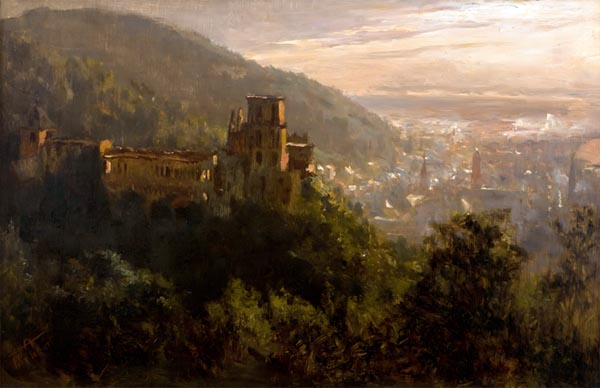
‘View of Heidelberg castle in the light of evening’
Felix Possart (German, 1837-1928)
Artvee
Translated by A. S. Kline © Copyright 2026 All Rights Reserved
This work may be freely reproduced, stored and transmitted, electronically or otherwise, for any non-commercial purpose.
Conditions and Exceptions apply.
Contents
Letter XXVII: Speyer
Banks of the Nectar, October
What shall I tell you of Spire, or Speyer as the Germans call it, or Spira, as the Franks named it? Noviomagus, says the legend. Civitas Nemetum, says history. It is an illustrious city. Julius Caesar may have camped there; Drusus fortified it; Tacitus spoke of the Nemetes tribe there (see ‘Germania’ XXVIII); the Huns burned it; Constantine rebuilt it; Julian enlarged it; Bishop Dagobert I converted a temple of Mercury there into the church of Saint Germain (in the seventh century); Otto I gave Christianity its first tournament there, Conrad I of the Salian dynasty made it the capital of the empire, Conrad II made it the sepulchre of the emperors. The Templars, who left a beautiful ruin there, fulfilled their function as sentinels of the Frontiers. All those torrents of men that devastated and fertilised Europe traversed Speyer: during the first few centuries, the Vandals and the Allemani (‘all men’, men of all tribes, is the etymology, according to Gaius Asinius Quadratus, the third century Greek historian); during the latter, the French. During the Middle Ages, from 1125 to 1422, during three hundred years, Speyer suffered eleven sieges. As a consequence the old Carolingian city was deeply affected. Its privileges were revoked; its blood, and its population, flowed everywhere. It hosted the Imperial Supreme Court which the city of Wetzlar inherited, and the Imperial Diets (assemblies) a shadow of which remains in Frankfurt. It had thirty thousand inhabitants; and now only eight.
Who today remembers the holy bishop Rudiger Hüzmann? Where does the Spira stream flow? Where is the village of Spira? What has been done with the lofty church of Saint John? In what state is that chapel of Olivet the old registers call the incomparable? What has become of the admirable square tower with angular turrets that dominated the gate of the road to Speyerbach? What vestiges remain of Saint Vildnberg? Where was the Imperial Court housed? Where is the hotel of the advocate-assessors, who, says an old charter, establish and administer justice in the name of his Imperial Majesty, the Electors, and other princes of the Empire, in the public consistory of the whole Empire established by Charles the Fifth? Of this high jurisdiction, to which all the others were devolved and ultimately subject, what remains? Nothing, not even the four-pillared stone gallows in the meadow beside the Rhine. Only the sun continues to treat Speyer with as much magnificence as if it were still the queen of imperial cities. The proverbial Speyer wheat is still as beautiful and golden as in the time of Charles V, and the excellent red ‘goosefoot’ wine is still worthy of being drunk by bishop-princes in scarlet stockings, and electors in ermine hats.
The cathedral, begun by Conrad I, continued by Conrad II and Heinrich III, and completed by Heinrich IV in 1097, is one of the most superb buildings of the eleventh century. The first Conrad dedicated it, the charters say, to the ‘Blessed Virgin Mary.’ It is still today of incomparable majesty. It has resisted time, men, wars, assaults, fires, riots, revolutions, and even the embellishments of the bishop-princes of Speyer and Bruchsal. I visited it; I will not, however, describe it to you in detail. Here, as in the Ibach house, I cannot say that I saw the church, so absorbed was I by the thoughts that filled me. No, I failed to see the building, I saw only my thoughts. Let me tell you of them. I know nothing of the rest; everything passed before my eyes like a shadow. Search, if you wish, among the itineraries and monographs, for a description of the cathedral of Speyer; you will not read one from me. Something even higher and more magnificent seized me in the midst of my contemplation of that dark architecture. Before now I have often had, and will often have again, the opportunity to show you churches; this time let me show you God.
Between 1024 and 1308, for three centuries, Conrad II’s plan was carried out. Of the nine emperors, and various kings of the Romans, who reigned during this period, four emperors (Conrad II, Heinrich III, IV and V) and four kings (Philp of Swabia, Rudolph I, Adolph of Nassau, and Albrecht I) were buried in the crypt beneath Speyer Cathedral. As for the other five emperors, Lothair III, Frederick I Barbarossa, Henry VI, Otto IV, and Frederick II, and the other dozen or so kings, destiny did not grant them that august burial. The wind that blows over men at the hour of their death bore them elsewhere.
Of this latter group of emperors and kings, two only, who were not Germans, were interred in tombs in their native country: Richard of Cornwall in England, Alfonso of Castile in Spain. The others were cast to the four cardinal points: Lothair III was interred at the monastery of Königslutter, Otto IV at Brunswick, William of Holland at Middelburg, Henry VII at Pisa, Frederick II and Conrad IV at Palermo, and Barbarossa near the River Cydnus (according to one account, his heart and internal organs were interred in Saint Paul’s Church Tarsus, Turkey; his flesh in the Church of Saint Peter, Antioch, now Antakya, Turkey; and his bones in the Cathedral of the Holy Cross, destroyed in 1291, in Tyre, Lebanon),
Barbarossa in particular, the great Barbarossa, where is he? In the River Cydnus, says history; in Antioch, says the chronicler; in the Kyffhäuser cave, says the Württemberg legend; in the Kaiserslautern cave, says the legend of the Rhine.
The four Caesars lying beneath the slabs of the apse of Speyer were almost all glorious emperors. It was the founder of the cathedral, that contemporary of Canute the Great, Conrad II, who divided old Teutonia into six classes, called Military Shields, Clypei Militares, a hierarchy that was overturned by the Golden Bull, but which Poland adopted and imitated: so much so that, even in these last centuries, the republican constitution of Poland, reproducing the old feudal constitution of Germany, has acted like a mirror that has retained the image long after the object it reflects has disappeared. It was Heinrich III, who proclaimed and maintained universal peace for three years, preferring to a war of people against people, the duel of king against king that he offered Henri I of France (in 1056); Heinrich IV, conquered the Saxons (in 1069 and 1071) and was excommunicated then absolved by Gregory VII; Heinrich V was the ally of Venice. Of the kings, Conrad III, the friend of the Diets, called himself Emperor of the Romans; Philip of Swabia, was the formidable adversary of Pope Innocent III. The king who triumphed over Ottokar II of Bohemia, the exterminator of burgraves, the founder of dynasties, and the father of emperors, was Rudolf of Habsburg. Adolph of Nassau, was the valiant monarch killed by an axe blow on the battlefield (at the Battle of Göllheim in 1298). Finally, it was Adolph’s enemy, his rival, his murderer, Albrecht I of Austria, who, with the crown on his head, had the King of Bohemia (Wenceslaus III) serve him at table, Albrecht who abolished tolls, and tamed, iron caltrop in hand, the four formidable electors of the Rhine; a prince immeasurable in everything, in his ambition as in his power, to whom Boniface VIII one morning offered the kingdom of France: faced with such a gift, one does not know whom to admire most, the pope who had the audacity to offer it, or the emperor who had the audacity to accept.
Alas! What could be more like dreams than these grandeurs? And how similar those princes often were in the wretchedness of their demise! Albrecht of Austria, at Göllheim, near Mainz, had killed with his own hand his cousin and his emperor, Adolph of Nassau; ten years later, in 1308, John of Habsburg killed, at Windisch on the River Reuss (in Switzerland), his uncle and emperor, Albrecht of Austria. Albrecht, who was one-eyed and ugly, and who was advised, said Boniface VIII, by a woman with viper blood, sanguine viperali, had been nicknamed the Regicide; John was nicknamed the Parricide.
However, it may be, eight princes, good, bad or mediocre, were buried, side by side, though varied, so to speak, in the diversity of their destinies, with the glory of arms proper to a few, and the splendour of the empire common to all, in the vault of Speyer, enveloped in the mysterious majesty of death. For all of Germany, a sort of national superstition surrounded these sleeping emperors and kings. The people, who possess the quarrelsome and mutinous instincts of children, willingly hate the present and living powers that be, simply because they possess power, because they are present, because they are alive. ‘Those of Flanders’, says Philip of Commines, ‘always love the son of their prince; never the prince himself’. The Bishop of Olmütz wrote to Pope Gregory X: ‘Volunt imperatorem, sed potentiam abhorrent: they desire an emperor, but abhor power.’
Yet, as soon as power meets its demise, we love it; as soon as it is vanquished, we admire it; once it is dead, we respect it. Nothing was therefore greater, more august and more sacred in Germany and Europe than those four imperial and those four royal tombs covered, as if by a triple veil, by silence, darkness, and veneration. Who broke the silence? Who disturbed the darkness? Who profaned that veneration? Listen:
In 1693, Louis XIV suddenly despatched an army to the Palatinate, commanded by men whose names can still be read in the records of the Gazette de France: ‘ARMY OF GERMANY, April 11th — Maréchal de Boufflers, Maréchal Duc de Lorges, Maréchal de Choiseul — Lieutenant Generals: Marquis de Chamilly, Marquis de la Feuillée, Marquis d’Uxelles, Milord Mountcassel, Marquis de Revel, Sieur de la Bretesche, Marquis de Villars, Sieur de Mélac. — Sergeant-Major Generals: Duc de la Ferté, Sieur de Barbezières, Comte de Bourg, Marquis d’Alègre, Marquis de Vaubecourt, Comte de Saint-Fremont.’
Civilisation was then beginning to coat barbarism everywhere; but the coating was not very thick as yet. At the slightest shock, with the next war, it broke, and barbarism, finding a passage, spread everywhere. That is what happened in the Palatinate War. The Great Monarch’s army entered Speyer. Everything was shut fast: the houses, the cathedral, the tombs. The soldiers opened the doors of the houses, opened the doors of the cathedral, and broke the stone of the tombs. They violated families, they violated religion, they violated death itself.
The first two crimes were almost commonplace crimes. War, in those times which we sometimes admire too much, accustomed men to such things. The last was a monstrous affront. Death was violated, and with death, a thing not seen before, royal majesty, and with royal majesty the whole history of a great people, the whole past of a great empire. The soldiers searched the coffins, tore off the shrouds, and from the skeletons, those sleeping majesties, stole their golden sceptres, their jewelled crowns, their rings that had sealed the declarations of peace and war, and their banners of investiture, hastas vexilliferas. They sold to the Jews what Popes had blessed. They sold the ragged purple robes, and the objects buried in ashes. They sorted the gold, the diamonds, and the pearls; and, when there was nothing precious left in those sepulchres, when nothing remained but dust, they swept the bones that had been emperors and kings, pell-mell, into a hole in the ground. Drunken corporals rolled the skulls of four Caesars and four monarchs, into a common grave, with their feet. That is what Louis XIV initiated in 1693. Just one hundred years later, in 1793, this is what God initiated:
There was in France a royal ossuary just as there was an imperial one in Germany. One day, one fatal day when all the barbarity of ten centuries reappeared from beneath the surface of civilisation and submerged it, the dreadful and hideous armed hordes, who waged war, no longer against one king, but against all kings, no longer against a mere cathedral, but against all religion, no longer against a city or an entire state, but against the entire history of the human race: fearful hordes, I say, blood-stained, ragged, and ferocious, rushed upon the ancient sepulchre of the kings of France. These folk, whom nothing could stop in their formidable work, also came to break tombs, tear apart shrouds and desecrate bones. Strange and mysterious labourers, they came to turn dust into dust. Listen to this: — the first spectre they awoke, the first king they brutally tore from his coffin, as one shakes a servant who has slept too long, the first skeleton in a purple robe that they seized, so as to cast him into the charnel house, was Louis XIV.
O vengeful Fates! 1693; 1793! Two sides of a sinister equation! Admire its formidable exactitude! After a century for Mankind, a mere instant for the Eternal One, what Louis XIV had caused to happen at Speyer to the emperors of Germany, God returned upon him at Saint-Denis.
One last thing that should be noted is that the founder of Speyer Cathedral, the oldest of those old Germanic princes, Conrad II, before he became Emperor of Germany, had been the Duke of Rhenish France. A Duke of France was outraged by a King of France. Retribution! Retribution!
If Louis XIV, during his campaigns in Germany, had passed through Otterberg (near Kaiserslautern), which I visited not long ago, he would have seen there, an admirable Abbey church (thirteenth century Romanesque, formerly part of the Cistercian monastery) akin to the cathedral in Speyer. The church is said, like the cathedral, to have been built by Conrad II, and on the main portal of that sombre church he might have read a severe and melancholy warning, which might not have proved unhelpful to that great monarch, a warning which one can still see there today:
MEMENTO CONRADI: REMEMBER CONRAD
Letter XXVIII: Heidelberg
Heidelberg, October
Dear Louis (the artist, Louis Candide Boulanger), take care, I am in the mood to write you an interminable letter. You ask me for four pages; ‘I would give you a hundred’, as Orosmane says (in Voltaire’s play ‘Zaïre’ Act I, Scene IV). Well, hard luck! Escape me if you can; old friends are talkative.
I arrived in this city ten days ago, dear friend, and I cannot tear myself away. During your excursion to Germany twelve years ago, did you visit Heidelberg? Above all, did you stop here? For one must not merely pass through Heidelberg, one must stay here, one must live here. I certainly will have more to tell you regarding it than I did regarding that sort of mock Versailles of Baden, called Mannheim, that insipid city whose right-angled streets seem to be cut from a block of plaster, and whose bell-towers, like those of Namur, are not bell-towers, but the result of successfully completed cup-and-ball games. Landing from the Rhine steamboat, I stayed in Mannheim long enough to have a carriage hitched, and then fled in haste to Heidelberg. Do the same if you ever find yourself there.
Heidelberg, situated at the entrance to the Neckar valley, as if taking refuge amidst the trees, between two wooded ridges prouder than hills but less severe than mountains, has admirable ruins, two fifteenth-century churches, a charming house from 1595, with a red facade and gilded statues, called the House of the Knight Saint George (Haus zum Ritter Sankt Georg, on Hauptstrasse), old towers over the water, its bridge, and above all its river, its limpid, tranquil and untamed river, where trout abound, legends abound, rocks bristle, and where the water’s flow, complicated by reefs, is no less than an inextricable network of whirlpools and currents; a delightful torrent of a river in which, one can be sure, no steamboat will ever seek to entangle itself.
I lam leading a busy life here, a little haphazardly so, it is true, but I waste not a moment, I assure you; I haunt the forest and the library, that other forest; and in the evening, in my inn room, like your friend Benvenuto Cellini, I write on sheets of paper, which will end I know not where, my adventures of the day. ‘Questa mia vita travagliata io scrivo: I write about this troubled life of mine.’ (see Cellini’s autobiography)
Except that Benvenuto’s adventures involved sword or stiletto blows, escapes from the Castel Sant’Angelo, fighting with sharpened blades on behalf of Rosso Fiorentino against the disciples of Raphael, fortified towns, colossi undertaken, insolent attempts against the Pope or the Duchesse d’Étampes (mistress of Francis I), Bohemian travels, with his two pupils Paul and Ascanius, an assault on the Hôtel de Nesle, the furniture and people hurled from the windows; and then, here and there, a masterpiece, qualchè bell’ opera, as he himself says, a Juno, a Leda, a silver Jupiter as tall as Francis I, or a gold ewer for which the King of France gave the Cardinal of Ferrara an abbey and with it an income of seven thousand crowns.
My own adventures, and works, those of a laborious idler with whom you are well acquainted, dear Louis, you know by heart, you have shared them long enough; a solitary walk on an abandoned path, the contemplation of a ray of sunlight on a bed of moss, a visit to a cathedral or a village church, an old book, leafed through in the shade of an ancient tree, a countryman whom I question, a beautiful burying-beetle armoured in purple and gold, unfortunately fallen on its back and struggling, that I right in passing with the tip of my foot; some verse amidst it all; and then, reveries of several hours duration, in front of Rochemaure Castle on the Rhône, Château-Gaillard on the Seine, or Rolandseck on the Rhine, in front of a ruin beside a river, in front of what has fallen and beside what flows, or, a spectacle no less touching in my opinion, in front of what blossoms and beside what sings, in front of a forget-me-not’s cluster of blue flowers and beside a stream of running water. That is what I am involved in, or, to put it better, that is what I am: because, for me, doing inevitably and immediately flows from being. As one is, so one does.
Here in Heidelberg, in this city, in this valley, among these ruins, the life of a thoughtful man is charmed. I feel I would never leave this country if you were here, dear Louis, if I had all my family here, and if summer would last a little longer. In the morning, I depart, but first, I pass (forgive me a shamelessly bold expression, but which captures my thoughts), to nourish my spirit, before the House of the Knight Saint George. It is truly a delightful building. Imagine a ground floor then three stories with narrow windows supporting a triangular windowed pediment with large curled openwork volutes at the sides; from top to bottom of those three stories, two columns of windows with fanciful surrounds, projecting onto the street; finally, the whole facade built of red sandstone, sculpted, chiselled, carved, sometimes boldly and mockingly, sometimes merely severely, covered from top to bottom with arabesques, medallions, and gilded busts. When the poet who built this house had finished it, he wrote in gold letters, in the middle of the frontage, the dutiful religious verse: Si Jehova non ædificet domum, frustra laborant ædificantes eam. (A Latin variant of Vulgate, Psalm 126: Nisi Dominus ædificaverit domum, in vanum laboraverunt qui ædificant eam: Except the Lord build the house, the builders labour in vain.’).
That was in 1592. Twenty-eight years later, in 1620, the Thirty Years’ War began with the Battle of White Mountain near Prague, and continued until the Peace of Westphalia in 1648. During this long Iliad, of which Gustavus Adolphus was the Achilles, Heidelberg, four times besieged, taken and retaken, twice bombarded, was burned down in 1635. Only one house escaped the fire, this one of 1592. All the others, which had been built without the Lord’s help, burned from top to bottom.
After peace was declared (the Peace of Westphalia, 1648), the Elector Palatine, Charles I Louis, who has been nicknamed the ‘Solomon of Germany’, returned from England (in 1649) and rebuilt his city. ‘Solomon’ was succeeded by ‘Elagabalus’ (referring to the Roman emperor whose reign was notorious for religious controversy and alleged sexual debauchery), Count Charles Louis by his son Charles II, then by the Palatine branch of Wittelsbach-Simmern, by the Palatine branch of Pfalz-Neuburg, and finally the Thirty Years’ War was succeeded by the Palatine War. In 1689, a man whose name is employed today, in Heidelberg, to frighten small children, Mélac, (Ezéchiel du Mas, Comte de Mélac), lieutenant-general of the armies of the King of France sacked the Palatine city and reduced it to a pile of rubble. Only one house survived, this one of 1592.
Heidelberg was quickly rebuilt. Four years later, in 1693, the French returned; the soldiers of Louis XIV violated the Imperial tombs in Speyer, and the Palatine tombs in Heidelberg. Marshal de Lorges (Guy Aldonce de Durfort, 1st Duke of Lorges) set fire to the four corners of the electoral residence, the conflagration was terrible, all of Heidelberg burned. When the whirlwind of flame and smoke that enveloped the city dissipated, a house, just one, was seen standing in the heap of ashes. It was still, as ever, this house of 1592.
Today, the charming vermilion façade, damascened with gold, still virgin, intact and proud, and alone worthy of being attached to the castle amidst the insignificant pile of white houses which now composes Heidelberg, rises superbly over the city, its triumphant inscription sparkling in the sun, wherein I read every morning in passing that the Lord was the builder and saviour.
It is true, and must be said, for the religious devotions of the Renaissance were seasoned with pagan fantasies, that the effect of this grave psalm is somewhat tempered by the more profane line that the architect engraved above it: Persta invicta Venus (‘Beauty’ always unconquered), which itself must feel a little embarrassed by a third legend with which the pediment is crowned: Soli. Deo. Gloria. (To the Sun, to God: Glory). Having greeted the miraculous house, I cross the bridge and head off into the mountains.
There, I immerse myself, lose myself, walk, take the path that presents itself; I gaze at the trees, at those pillars, capital on capital, of the vast mysterious cathedral; and, immersed in the reading of Nature, like the Puritans of old in their meditation of the Bible, I seek God.
To each his own book, you see, my friend, and in the Gospel as in the landscape, the same hand has written the same things. As for myself, I think that all the faces of Jehovah require, and must be awarded, our contemplation, and this idea has governed and filled all my reveries for twenty years; you are aware of this, Louis, you who love me and whom I love. I also think that the study of Nature in no way harms the practice of life, while the spirit which knows how to be free and winged among the birds, fragrant among the flowers, mobile and vibrant among the waves and the trees, high, serene, and peaceful among the mountains, also knows, when the time comes, and perhaps better than anyone, how to be intelligent and eloquent among others. I am nothing, I know, but I compose my nothingness of little fragments of everything.
I walk, thus, all day without really knowing where I am, my eyes most often fixed on the ground, my head bent towards the path, my arms behind my back, letting the hours pass, and gathering thoughts where I find them. I sit in those excellent armchairs covered with moss, that is to say, with green velvet, which ancient Pales (a Roman deity; the patron of shepherds and their flocks) hollows out at the foot of all the old oak-trees for the weary traveller; Like a good-natured sovereign, I set free, in reward for my welcome there, all the flies and butterflies that I find caught in nets of which I am the author; a small and obscure amnesty, which, like all amnesties, only angers spiders. And then, in the vale below my throne, I watch some admirable stream flowing, strewn with pointed rocks where the silver tunics of the naiads gather in a thousand folds; or else, if the mountain has no torrent, if the wind, the leaves and the grass are silent, if the place is calm, deserted, far from any town, far from any house, even a mere hut, I silence within myself all the murmurs that arise incessantly within us, and open my ears to the song of some young mountaineer lost amidst the trees, with his flock of goats, far off, over there, above or below me. Nothing is as melancholy and sweet as a wild Tyrolean air, sung in the shade, by a poor little goatherd, invisible to the solitude that listens. Sometimes, over a whole great mountain-side, there is only that child-like voice. The mountaineers of these forests near the Black Forest have a kind of ‘chiaroscuro’ song which is charming.
Since I walk every day, I have become known and accepted, to some extent, in the villages. Children playing at being soldiers go out of their way to let me pass; the carter from the Neckar valley smiles at me from under his felt hat adorned with silver braid, with pendant fringes, and artificial roses; the peasants greet me gravely in their large Henri IV hats; young girls and old women consider me a familiar passer-by, and greet me with: ‘Guten tag’ I wonder, by the way, and here more than anywhere, each time I cross the street in some town or hamlet, how such pretty young girls turn into such ugly old women. — I sketch, here and there, the huts that possess some sort of style. In this country devastated by feudal wars, monarchical wars and revolutionary wars, cabins are built from castle ruins; which produces strange buildings. The other day I came across a labourer’s hovel composed as follows: four mud walls, whitewashed, a door and a window at the front; to the right of the door, the crowned lion of Bavaria, carrying the orb and the sceptre, sculpted, almost in the round, on a large slab of red sandstone. To the left of the window, another slab of red sandstone, a large bas-relief representing a fist clenched on a block and half severed by an axe. Above the axe, this erased date, 16… and below the block, another date, 1731; between the two dates, this word RENOVATUM (made anew). Nothing could be more mysterious or sinister than this bas-relief. We are not shown the man, whose fist is represented; we are not shown the executioner, whose axe is visible. This horrible thing seems to have dropped from the clouds. The two bas-reliefs are embedded in the wall, a little below some old roof slats. The Palatine lion turns as if irritated and furious towards this half-severed fist. Now, who set this lion there? What does this hideous bas-relief signify? What crime is signified that led to such punishment? What singular chance led to this idea of adorning a cottage with a roaring lion and a bloody hand? A vine, laden with grapes, climbs joyously across this dark enigma.
By dint of looking, I found some characters engraved on the summit of this bas-relief with the severed fist; and, by disturbing the leaves and bunches of grapes, I deciphered the name Burg Freiheit.
That same day, towards evening, I had left the city at noon by the so-called Philosophers’ Walk, which path leads I know not where, as befits a philosophers’ path, and found myself in some valley or other. I began to climb the escarpment of a tall hill by one of those ancient tracks that one often finds in this country, stepped paths, paved with large rough stones, giving the appearance of a Cyclopean wall laid flat on the ground, attributed by the ignorant to the Giants, and by the learned to the Romans, which is as much as to say, to the giants by all.
The light was fading, behind me, over the shores of the Rhine. It was one of those sinister sunsets where the sun seems to sink endlessly into shadow, crushed beneath granite clouds, shapeless, and swimming in an immense pool of blood. I climbed slowly towards the sunset. Little by little it paled, then faded away. When I was halfway up the hill I turned around.
I had before my eyes alone one of those vast twilit landscapes in which the mountains drag themselves across the horizon like enormous snails, of which the rivers and streams, pale and vague beneath the mist, seem to be the silvery traces.
The mountain slope steepened sharply, the rocky staircase stretched on indefinitely; but the heather and the young dwarf-chestnut trees sighed around me, with that friendly and hospitable murmur which invites the traveller to continue. So, I resumed my ascent.
As I reached the summit of the mountain-slope, the moon, that full moon, round and brilliant, which rises with a coppery hue in the plains, a golden hue over the mountains, suddenly appeared before me; and, itself climbing the neighbouring hill, began to glide over the ground amidst the black undergrowth like a splendid disc pushed by invisible genies. The whole chain of peaks and valleys, seen in that light, from the stairs on this pathway of the Giants, took on I know not what supernatural form.
I was on the point of seeking help. The moon lit my path, which suited me perfectly. At the same time, my shadow began to walk beside me as if to keep me company. Ten minutes later, I was at the top of the mountain. From below, I had not thought it so high. Incidentally, that is the story of all great things seen from below. Hence the diminishing and narrow judgment of small men regarding great men.
There was nothing in the sky but the moon. Not a cloud, not a star. It was that sort of bright night that only exists once a month if at all. At the summit of the mountain, a vast ridge covered with heather and scoured by the wind, I had before my eyes not a landscape, but a large geographical map, almost circular, blurred by distance and mist, like that which Jesus Christ would have seen when Satan transported him to the mountain to offer him the kingdoms of the earth. Incidentally, to make such a proposition to one who knows himself to be God and whom one knows to be God, to offer the kingdoms of the earth to one who already possesses the kingdom of heaven, is a mark of stupidity, that I have, between ourselves, difficulty in understanding as regards that sort of antediluvian Voltaire whom we call the Devil.
Towards the north, the heath led to a forest. Not a cottage, not a woodcutter’s hut. A profound solitude. As I was walking along the ridge, I saw, a few steps from the barely distinct path, beneath some bristling bushes (regarding bushes, an equivalent to the Latin word horridus is lacking in our language: a word which means less than horrible and more than bristling), I saw, I say, a sort of hole towards which I headed.
It was a fairly large square pit, ten or twelve feet deep, eight or nine feet wide, into which reddish bramble arms sagged, and into which the moonlight entered through the crevices of the undergrowth. I could vaguely distinguish in its depths a pavement of large flagstones undermined by the rain, and four walls of solid masonry, enormous stones, now shapeless and hideous beneath weeds and moss. I thought I could detect some crude sculptures mixed with rubble on the pavement, and among this rubble a large rounded block, roughly flared, pierced in its middle with a small square hole, which seemed as if it might be a Celtic altar, or the capitol of a pillar from the sixth century. There were no stairs, however, by which to descend into the excavation.
It may have been just a cistern, but I assure you that the time, the place, the moon, the brambles and the confusion of objects glimpsed in the deep, gave this mysterious room without stairs, sunk into the earth, with the sky for a ceiling, something of a wild and formidable air. What was this singular pit? You know me: I persisted, I searched, I wanted to know more about this cave than the moon and the heath told me; I pushed aside the brambles with my cane, I clung to the branches, grasped by the handful, and bent over the shadowy space.
At that moment I heard a deep, broken voice behind me pronounce, distinctly, the word: ‘Heidenloch’. Despite my little German I knew the word. It means: Pit of the Pagans. I turned around. No one in the heather; the wind blowing, the moon shining. Nothing more. Only it seemed to me that there, towards the forest, about thirty paces away, between myself and the moon, there was a mass of shadow, a tall bush that I had not as yet noticed.
I thought I was mistaken, and that, like all those who walk in solitude, I was seeing visions, and I started to explore the edge of the pit again. Here the voice rose a second time, and I heard again behind me the three strange syllables: Heidenloch. Instantly, I turned around at this, and in turn said, out loud: ‘Who’s there?’
At that point, I believe I noticed, and not without an involuntary shudder, I confess, that the tall bush had moved a few steps closer. I said again: ‘Who’s there?’ and, just as I was about to walk resolutely towards it, I saw it approaching me, and heard for the third time, a faint voice saying: ‘Heidenloch’.
In such deserted places, at a strange hour of the night, one is prone to superstition, and I declare that I was starting to recall all the legends of the Rhine and the Neckar, which rose to my brain like smoke, when the supernatural bush turned round. Then, what had lurked in the shadows now faced the moon, and I saw a little old woman her chin almost resting on a stick bulging with large knots, her body almost buried beneath a great pile of branches overflowing on all sides, sweeping the earth behind her, and swaying above her head in the most fantastic manner. Her grey eyes looked at me, as she repeated the word: ‘Heidenloch! Heidenloch!’ She looked like an old dryad who had been chased away by the woodcutters, bearing her tree on her back.
She was simply a poor old woman, returning from cutting brushwood in the forest, who had seen a stranger and granted him some information, and who was now off to her cottage, dragging her bundle of sticks along the Giants’ path, in the moonlight. I thanked her with a few kreutzers, while looking at her with admiration. I have never in my life seen a smaller old woman beneath a more enormous bundle of wood.
She addressed me, with a grateful grunt, a fearful, but gracious grimace, which fifty years before would have been a fresh and charming smile. Then she turned her back on me, that is to say, on the undergrowth; and, after a few minutes, having reached the slope of the mountain, sank into the earth and vanished like an apparition. Her explanation, however, had explained nothing. It was simply a lugubrious word now added to a lugubrious thing. That was all.
I confess to you that I remained a long time in this place, looking at the Pit of the Pagans, which is perhaps the open and empty tomb of a Giant, perhaps a Druidic chamber, perhaps the cesspool of a Roman camp, or the rainwater reservoir of some vanished Romanesque monastery, or the hideous sepulchral cellar beneath a demolished gallows, whose silent walls may have been watered with human blood, or piled high with skeletons, or deafened by Sabbath dancers circling about the ossuary; a pit full of darkness, into which the moon today casts a livid ray, and an old woman a sinister word. As I descended the mountain, I saw in the trees, on a neighbouring summit, a ruined tower which is undoubtedly connected to the excavation whose significance is lost today (the ruins of Saint Stephen’s Monastery stood nearby).
Now, the Pagans, that is to say the Sicambri, according to some, and the Romans, according to others, have left deep traces of their passing in the popular legends which are everywhere mixed with history and encumber it. At Lorch, at the entrance to the Wisperthal, there is another Pit of the Pagans also called the Heidenloch. At Winkel, on the Rhine, the old Winkela, there is a Street of the Pagans, the Heidengass; and at Wiesbaden, the old Aquae Mattiacorum, there is a Wall of the Pagans, the Heidenmauer.
I exclude from these pagan remains a kind of arch whose section, covered with ivy, crumbles away on the mountain behind Kaub, about a league from Gutenfels, and which the peasants call the Pagan Bridge, the Heidenbrukke, because it seems obvious to me that it is the ruin of a bridge built there by the Swedes during the Thirty Years’ War. Though, tradition is never greatly in error. Gustavus Adolphus was almost a Scipio; and what he waged on the Rhine in the seventeenth century was a great classical war, a Roman war. The same strategies that Polybius described as being employed during the Punic War, the military strategist Jean-Charles Folard (Le Chevalier Folard) recognised and observed during the Thirty Years’ War.
These, dear Louis, are the adventures I meet with on my walks, and I am not at all surprised that tales and legends have sprouted everywhere in a country where bushes walk about at night and speak to passers-by.
The other evening, at dusk, I had before me a high, black, bare hilltop, filling the entire horizon and surmounted at its summit by a large ruined tower, isolated like the Maximilian towers of Linz (thirty-two small circular forts named after Archduke Maximilian Joseph of Austria-Este and built by him, from 1831-33, to defend that city). Four large sections of the battlements, their dentils worn, chipped, and transformed to triangular shapes by time, completed the dark silhouette of the tower, and gave it a crown of pointed fleurons. Country folk, the current inhabitants of this ruin, had lit an immense fire of faggots inside, the light from the blaze seen externally through the only three openings of the tower, an arched door at the bottom, and two windows at the top. Illuminated thus, it was no longer a tower, it was the black and monstrous head of the terrifying god Pluto, opening his fiery mouth and gazing over the hill with eyes like burning embers.
At such times, when the sun has set, when the moon has not yet risen, one encounters valleys which seem cluttered with strange collapsed shapes; times when the rocks resemble ruins, and the ruins resemble rocks. Sometimes the poet in me triumphs over the antiquarian, and I am content with such imaginings. Sometimes I return next day, at daybreak; I explore the ruins step by step, and try to determine their age from the outward projection of the machicolations, the shape of the dentils, or the spacing of the ribs.
There is a ruin of this kind, two miles from Heidelberg, in a ravishing valley, an archaeologist’s valley and a dreamer’s valley. Four old castles (Vorderburg, Mittelburg, Hinterburg, and Schwalbennest), on four rocky outcrops, like four vultures face each other; between these four keeps an ancient dilapidated town seems to have taken refuge, in terror, at the summit of a conical mountain, against whose slopes it clings, and from which it has observed for six hundred years the formidable presence of the castles. The Neckar seems to have taken up the cause of the town, and it surrounds the mountain of the burghers with its steel arm. Old forests, at this hour, bedecked with the gilded leaves of autumn, lean over this valley on all sides, as if awaiting battle. There, among the oak and chestnut groves, are tall pine trees, inhabited by owls and squirrels. At certain times the whole scene is not merely a landscape, it is a stage, and one awaits the hour when the actors, the city and the castles, that anthill of dwarves and those four petrified giants, will come to life and commence the drama. This admirable place is called Neckarsteinach.
One of these four keeps was converted into a farmhouse, and a second into a summer residence. The third and fourth, which are completely ruined, devastated, and deserted, particularly interested me and made me return several times. The fourth was called, in the twelfth century and is still so called today, Schwalbennest (Schadeck, formerly Shadheck), which means the Swallow’s Nest. It was in fact built, with its projecting masonry, as if by some gigantic swallow, on a platform of rock in a bay of the enormous red, sandstone mountain.
In the days of Rudolf I of Habsburg, it was the manor of a dreadful gentleman-bandit called Bligger I, ‘the Scourge’ (The ‘four castles’ of Neckarsteinach were built in the thirteenth century, by the noble family known as the Edelfrein von Steinach whose main forename was Bligger. Bligger II von Steinach, a Minnesinger, has been claimed as the author of the Nibelungenlied epic). The whole valley, from Heilbronn to Heidelberg, was prey to this human-faced bird of prey. Like all his peers, the Diet summoned him. Bligger refused to attend. The emperor ostracised him from the empire. Bligger only laughed. The League of a Hundred Cities sent its best troops and its finest captain to besiege the Swallow’s Nest. In three sorties the Scourge exterminated the besiegers. This Bligger was a fighter of colossal stature whose arm struck with the power of that of a blacksmith. Finally, the Pope excommunicated him and all his adherents. When Bligger heard the sentence of excommunication read at the foot of his wall by one of the bannerets of the Holy Empire, he merely shrugged his shoulders.
The next day, when he awoke, he found his castle deserted, and the gate and postern walled up. All his men-at-arms had left the accursed citadel during the night and had blocked the exits. Then one of them, who had hidden himself on the mountain, on a cliff from which he could view the interior of the castle, saw Bligger the Scourge lower his head, and slowly circle his courtyard. He shunned the keep, and walked alone, thus, until evening, the flagstones ringing under his steel sabatons.
As the sun set behind the hills of Neckargemünd, the formidable burgrave fell flat on his face on the pavement.
He was dead. His son Bligger II, was only able to free his family from excommunication by going on crusade (the Third Crusade, 1189-92) and bringing back from the Holy Land the head of the Sultan, which still appears today on the shield of the stone knight named Ulrich Landschad (Ulrich V, died 1369), a descendant of Bligger II, who sleeps stretched out on his tomb in the Evangelical Church at Neckarsteinach. The family is now extinct.
Isn’t this a beautiful story, Louis, and just as worth the telling as the great battles and marriages of kings? Yet it must be retrieved from the popular memory. Historians disdain these details. They say they are trivial; I declare them great. They are old wives’ tales, they add; but do you know anything more magnificent and more terrible than old wives’ tales? To me, Homer seems so sublime that I rank the Iliad among the old wives’ tales.
On this subject, George Buchanan (author of Rerum Scoticarum Historia, 1582), whom I was leafing through recently in the Heidelberg library, makes a naive admission. This is what he writes about ‘Macbeth’: ‘Multa hic fabulose affingunt; sed, quia theatris aut fabulis milesiis sunt aptiora quam historiae, ea omitto: some of our people here fabricate many a thing in a fabulous manner; but because they are more suitable for theatres or Milesian fables than history, I omit them.’ What Buchanan thus places in parentheses is Shakespeare.
The people, moreover, are not wrong. They love great personages, and they love stories. They even willingly exaggerate aspects of the characters in their legends, and place them, by an august magnification of detail, at the level of the great men of history. Chroniclers are no shyer than historians of overturning the order of Nature when it is a question of solemnising one of their heroes. When the Scottish laird Donwald assassinated King Duff (Dubh mac Maíl Chaluim, in 967) in the castle of Forres, there were wonders, and the sun was veiled as at the death of Caesar (note the solar eclipse of July 967).
As long as the narrators of these happenings are called Hector Boece (Scottish philosopher and historian) or Hailes (David Dalrymple, Lord Hailes, 3rd Baronet of Hailes, advocate, judge, and historian), such happenings are not deemed history, but mere tales. The moment those narrators are called Homer, Virgil or Shakespeare, those same events are more than mere history, they are deemed epic.
Schwalbennest Castle still has a proud and sombre appearance today. It is a square keep whose two remaining corners facing the valley are hidden and absorbed by round turrets with machicolations; a double circumvallation covered with ivy envelops the keep, and the whole ruin clings, as I said, to the side of the mountain almost overhanging the Neckar.
I climbed the path, once so formidable, where boiling oil, burning pitch, and molten lead once flowed from the machicolations. I entered through that postern gate and door that were once walled up, now wide crevices that allow passage to the first comer, and I carved with a nail these words on a stone of the doorframe: ‘Where the door of the tomb has closed on a family to open no more, the door of the house opens to close no more.’
The interior of the burg has a gloomy appearance. Tree roots, here and there, have lifted the old twelfth-century paving stones, on which Bligger’s colossal armour resonated when that same burgrave fell down dead. Water, from the mountain which is penetrated by springs, continues to ooze drop by drop into the half-filled cistern. Strawberry plants in bloom flourish between the flagstones. The stones of the walls, lashed by the rain and gnawed by the moonlight, are pockmarked with a thousand holes where the larvae of ghostly butterflies spin their cocoons in the shadows. No human footsteps can be heard in this dwelling. At the inaccessible windows of the keep the wild chatelaines of this ruin appear: ferns, waving their fans, and hemlocks, lowering their parasols. The great hall, whose roof and ceilings have collapsed, is still decorated regally with thirteen wide-open windows overlooking the valley. When I was there, the setting sun framed a magnificent Claude Lorrain landscape in one of them.
The other keep has, so to speak, no name, no history, no date, almost no shape, and was much more formidable than the Swallow’s Nest. If we forget for a moment the square tower that still dominates it, it is no longer a keep, no longer a dwelling, no longer a ruin, no longer a building with human form (for mankind gives form to buildings); it is a block, a cavernous mass, a rock pierced like a lung with bronchi and alveoli; it is an enormous madrepore (mass of stony coral) that penetrates and inextricably fills, with all its antennae, all its feet, fingers, necks, spirals, beaks, trunks, and with all its hair-like entangling vegetation, that frightening mass of polyps. I entered with great difficulty, making a noise in the undergrowth like a wild beast.
This castle (Hinterburg) is a century older than the Schwalbennest. The square tower has only one entrance, a twelfth-century portal, below which the two diamond-edged consoles that supported the drawbridge still protrude from the walls, at a height of about forty feet. The shadowy archivolt of this inaccessible doorway is as pure as if the stone were cut yesterday.
The only thing, apart from the square tower, that still has a shape is a large round tower, three-quarters razed, which flanked one of the corners of the wall, and which I saw during my ascent. Once I had entered the labyrinthine caverns of the collapsed castle, I had some difficulty finding it again. Finally, I noticed between two clumps of brambles the narrow mouth of a corridor. I slipped through it, and thus arrived at a small, unusual crossroads: there were four vaulted, low oblong cells, radiating towards four different points of the valley, each ending in a loophole, and all four starting from the end of the corridor where I had entered. Imagine the inside of a mould where the bronze to form the foot of a colossal eagle was cooling. These four cells were embrasures for onagers (catapults) or falcons (mangonels). From the point where I was, the burgrave could see from the same place, through the first loophole, on his right, the side of the mountain; through the second, opposite him, the Schwalbennest; through the third, the town clustered on the hill-slopes; and, through the fourth, on his left, the other two castles (Mittleburg and Vorderberg) in the valley. This eagle’s claw, the nails of which were four war-machines, was the interior of the round tower.
Between the four embrasures, everything was massive, cemented, granite masonry. I sketched the Schwalbennest as seen through the loophole. In spring, the ruin, transformed to a bouquet of flowers, must be quite charming. Beyond this, no one here knows anything about the burg. It lacks a legend or even a ghost. The generations who inhabited it have seemingly entered, one after another, into a bottomless cavern, and not a single shadow has emerged.
As I had arrived at sunset, night fell while I was still there. It was then that this ruin in the scrubland gradually filled with strange noises. Dear Louis, if anyone ever speaks to you of the silence of ruins at night, make an exception, I beg you, of Hinterburg castle, above Neckarsteinach. I have never in my life heard such a din. You know that delightful tumult that bursts forth in a forest, in April, at sunrise; a note springs from every branch, a melody from every tree; the warbler chirps, the wood-pigeon coos, the goldfinch trills and buzzes, the sparrow, a merry fife, whistles gaily amidst the tutti. The wood is an orchestra. All those winged voices sing at once, spreading the mysterious symphony of the great invisible musician over the hills and meadows. In the Hinterburg, at dusk, it is the same, but transformed to a thing of horror. All the monsters in the shadows wake and swarm. The bat beats its wings, the spider taps the wall with a hammer, the toad whirls its hideous rattle. Who knows what poisonous and funereal life crawls between the stones, in the grass, among the branches. And then, dull rumblings, strange knocking, yelping, crackling sounds beneath the leaves, faint sighs, that one hears close to oneself, the weird moans of deformed beings exhaling lugubrious noises: what one has never heard before, howled or murmured, by what one never sees. At times dreadful cries rise suddenly from the ruined and deserted rooms; uttered by the owls who moan like dying people. At other moments, one thinks one hears something treading through the thicket a few steps away; it is the noise of drooping branches moving of their own accord. Two burning coals, fallen from who knows what furnace, shine in the shadows among the brambles; an owl there is gazing at you.
I hurried away, feeling rather ill at ease, unable to see where to set my hands in the darkness, prodding the stones with the tip of my cane. I assure you that I felt a vast surge of joy when, as I emerged from the dark and impenetrable canopy of vegetation that encloses and envelops the ruins, the blue sky, vague, starry and splendid, appeared to me like an immense basin of lapis lazuli flecked with gold, seen through a gap in the mountains. It seemed to me that I had emerged from the grave, to embrace life once more.
In the evening, after such expeditions, I return to the city. On the way I meet groups of students from the renowned University of Heidelberg; noble, serious young men with thoughtful expressions. The road runs beside the Neckar. The bell of Neuburg Abbey rings at intervals, in the distance. The hills cast their long shadows on the river; the water sparkles in the moonlight, glittering with the shimmer of silver; long dark boats ride the rapids like arrows, or free of boats and passers-by, beyond the houses, the valley is silent, the river deserted, and the rocks emerging haphazardly amidst the currents take on the shapes of crocodiles and giant frogs, surfacing so as to breathe the evening air above.
Since I am speaking of sunsets, twilight, and moonlight, I must tell you about the evening two days ago. To me, as you know, these great events are never ‘the same’, nor do I consider myself spared from gazing at the heavens today merely because I saw them yesterday. So, allow me to continue. As the day was declining, I climbed, amidst a fine chestnut grove overlooking the Castle of Heidelberg (on the Jettenbühl), to a high hill called the Kleiner Gaisberg. There was a fortress there in the twelfth century, built by Conrad of Hohenstauffen, Count Palatine of the Holy Roman Empire, and half-brother to the Emperor Barbarossa. From the remains of this fortress, burned in 1278 at the same time as the city of Heidelberg, the Swedes made a dry-stone entrenchment in 1633; at present, a farmer has made Gustavus Adolphus’ entrenchment the boundary to his potato field.
The Rhine plain, seen from the Kleiner Gaisberg, is like the ocean seen from the Bois-Rosé cliff (La Falaise d’Amont, the cliff at Fécamp, which the Chevalier de Bois-Rosé, companion of Henri de Navarre, the future Henri IV, climbed at night, with fifty men, to take the fort of Bourg-Baudouin). The horizon is immense. Mannheim, Philippsburg, the high bell-towers of Speyer, a host of villages, forests, endless plains, the Rhine, the Neckar, countless islands, and in the background the Vosges.
To the right, on the Heiligenberg, a wooded area which fifteen hundred years ago was called Mons Piri, and a thousand years ago Aberinesberg, the ruins tell the same story as those of Conrad’s keep on the Gaisberg. The Romans had erected a temple to Jupiter and a temple to Mercury, there; from the debris of these two temples, Clovis, after the Battle of Tolbiac in 496, built a palace that the Frankish kings inhabited. Four hundred years or so later, under Louis the German, Thiotroch, Abbot of Lorsch, built a church from the remains of Clovis’ palace. In 1622, the Imperial army, commanded by the Count of Tilly (Johann Tserclaes) seized Heiligenberg, tore down the Romanesque abbey of Thiotroch, and built batteries and breastworks on the mountain ridge from the rubble. Today, of these stones that were a temple to Jupiter, a palace of the Frankish kings, a Catholic church, and an Imperial battery, the folk of the neighbouring villages make dwellings.
I sat at the top of the Gaisberg, next to a wild honeysuckle still in bloom, on a stone placed there during the Thirty Years’ War. The sun had disappeared. I contemplated the magnificent landscape. A few clouds fled towards the east. The sunset laid its long bands painted with the colours of the solar spectrum over the violet-tinted Vosges. A star shone in the clearest part of the sky.
It seemed to me that all those men, those ghosts, those shadows who had passed through these mountains for two thousand years, Attila, Clovis, Conrad of Hohenstauffen, Barbarossa, Frederick I the Victorious, Gustavus Adolphus, Turenne (Henri de La Tour d’Auvergne, vicomte de Turenne), and Custine (Adam Philippe, Comte de Custine), still stood there behind me and gazed like me at that splendid view. I had, below my feet the ruined Hohenstauffen, to my right the Roman ruins; below me, hanging over the precipice, the Palatinate ruins; in the background, in the mist, a humble church built by the Catholics in the fifteenth century, despoiled by the Protestants in the sixteenth, and today divided by a partition between the Protestants and the Catholics, that is to say, in the eyes of Rome, half paradise and half hell, profaned, and destroyed; around this church, a little town four times burned, three times bombarded, sacked, rebuilt, devastated and rebuilt, yesterday a princely residence, today a university factory, school, and workshop city, a city of bachelors and working people, that is to say, an anthill of children studying the obscure, and adults inhabiting nothingness; in the space before me, I had the river with its eternal gleam of mother-of-pearl, the sky’s eternal sapphire, the clouds ever purple, the ever diamantine stars; beside me the flowers forever fragrant, the wind ever joyful, the trees always trembling and youthful. At that moment, I felt amidst all that immensity the smallness of man and the greatness of God, and there came to me one of those dazzling sensations that Nature delivers, akin to what must be felt by those eagles one sees motionless, in the evening, at the summit of the Alps or the Atlas Mountains, absorbed in profound contemplation.
You know, Louis, in high places, in solemn moments, there is a flowing tide of ideas that gradually invades the mind and almost floods the intellect. To tell you everything that passed and repassed in my mind during those two or three hours of reverie on the Gaisberg would be impossible.
Four thousand years ago, this vast countryside, which can be seen from its summit, wide as a sea, was indeed a lake, an immense lake whose waves beat against this great circle of mountains, Mont Tonerre, the Taunus, the Melibokus, Mons Piri, and the Vosges. The Rhine, like the Niagara, descended thence, from lake to lake, to the Ocean. An ancient legend tells that a necromancer, captured by a king, dried up this lake to obtain his freedom. This imprisoned magician was, in truth, the captive Rhine, which gnawed at the western barrier of the lake in order to plunge more deeply between the double chain of extinct volcanoes that begins with the Taunus and ends at the Seven Mountains. Since then, the lake has become a plain, mankind has succeeded the waves, and keeps have occupied the reefs.
I have mentioned some of the great ghosts from history who have crossed this plain over the past twenty centuries. Caesar was the first, Bonaparte the last. There are cities around which, periodically, through a sort of local fatality ambient in the air, through a combination of their geographical situation and their political value, knots of events form, at certain times, as knots of clouds form over high mountains. Heidelberg is one of those cities.
To speak only of its castle (for I must return now to speaking of it, and indeed should have started here), what adventures has it not experienced! For five hundred years it has been the victim of everything that has shaken Europe, and has ended in ruins. This is due to the fact that, in truth, the Castle of Heidelberg, residence of the Count Palatine, who bowed only to kings, emperors, and popes, and was too grand to remain bowed at their feet, could only raise its own head by conflicting with them; this is due, I say, to the fact that the Castle of Heidelberg has always adopted an attitude of opposition to the powers that be. From 1300, the time of its foundation, that conflict began with a Thebaid; it had, in Count Palatine Rudolph I and the Emperor Louis IV the Bavarian, its Eteocles and its Polynices, those two unnatural brothers. Then the role of the Elector expanded. In 1400, the Palatine Rupert II, assisted by the three electors of the Rhine, deposed Emperor Wenceslaus and took his place; one hundred and twenty years later, in 1519, the Palatine Frederick II made the young King Charles I of Spain Emperor, as Charles V. In 1415, Duke Louis VII, the Bearded, had declared himself protector of the Council of Constance, and imprisoned in his Heidelberg castle a Pope, John XXIII (the Pisan antipope), whom he calls, in a letter to the emperor, your simoniac Baldassarre Cossa. A century later, Luther took refuge in Mannheim, near this same Heidelberg, under the wing of the Palatine Frederick V. I deliberately omit here, in order to tell you more about him in a moment, Frederick I the Victorious, the great Titan of Heidelberg. In 1619, Frederick V, a young man of twenty-three, seized the royal crown of Bohemia in spite of the emperor, and in 1685 the Palatine Philip William of Neuberg, an old man of seventy-nine, took the Elector’s hat in spite of the King of France. After that, Heidelberg experienced endless struggles, upheavals, and commotions; the Thirty Years’ War, which enhanced Gustavus Adolphus’ glory; and the Palatinate War, which was a stain on that of Turenne. Every formidable event struck this castle. Three emperors, Louis of Bavaria, Adolf of Nassau and Leopold of Austria, besieged it; Pius II launched excommunications from here; Louis XIV launched thunderbolts.
One could even say that heaven intervened. On June 23, 1764, the day before Charles Theodore, Count Palatine of the Rhine, was due to arrive at the castle and establish his residence there (which, incidentally, would have been a great misfortune; for, if Charles Theodore had spent his thirties there, the severe ruin we admire today would, without a doubt, be encrusted with hideous Pompadour damascening); on the eve of that day, therefore, when the prince’s furniture was already loaded at the door of the Church of the Holy Spirit, a lightning-bolt from the heavens struck the octagonal tower, set fire to the roof, and completed the destruction of the centuries-old castle in a few hours. Already two hundred years earlier, in 1537, the old palace built by Conrad on the Gaisberg and converted by Frederick II into a powder magazine had been struck by lightning and destroyed. Remarkably, the same phenomenon struck those two castles of Heidelberg, the keep of the Hohenstauffen, and the manor of the Palatines. They both ended like a tragic dream, with a thunderclap.
That dull, veiled, jealous conflict, of which I spoke to you just now, between the elector and the emperor, the sovereign count and the Caesar, is visibly translated to, and bursts forth on the facades of the castle. On the palace of Elector Palatine Otto-Henry, the artist, full of the spirit of that prince, has set medallions of Roman emperors. Among these Caesars he has displayed Nero, and, surreptitiously, added Brutus. He has subordinated the composition of his three storied building to four statues proudly placed on the ground floor. These four statues are symbols; they are demigods and demi-kings. Here are Joshua, Samson, Hercules, and David. As regards David he has chosen to show not the king, but the shepherd. Each statue has an inscription below, which seeks to explain the Elector Palatine’s proud thought. Beneath Joshua’s feet one reads:
DUKE JOSHUA (HERZOG JOSHUA)
WITH GOD’S AID
CAUSED
THIRTY-ONE KINGS TO PERISH
Samson, in his legend, almost becomes an elector palatine:
SAMSON THE STRONG
WAS GOD’S LIEUTENANT
AND GOVERNED ISRAEL
FOR TWENTY YEARS
Hercules is Frederick II, who said, after having saved Germany twice, and beaten the Turks at the head of the army of the German Confederation:
I AM HERCULES
SON OF JUPITER
KNOWN BY MY NOBLE WORKS
AND WIDELY KNOWN
Finally, David, the shepherd David, who holds his sling in one hand and Goliath’s head in the other, is the usurper legitimised by glory, Frederick the Victorious, who seemingly addresses the Emperor Adolph:
DAVID WAS A YOUNG BOY
COURAGEOUS AND CAUTIOUS;
FROM INSOLENT GOLIATH
HE SEVERED THE HEAD
Goliath should have been warned. The Elector Palatine was, indeed, a great and formidable prince. He held the same rank among the Ducal Electors as the Archbishop of Mainz among the Bishop-Electors. He carried the orb of the Holy Roman Empire at Germanic solemnities. Since the time of Charles V, it was added to his coat of arms.
The Counts Palatine freely displayed their literacy, the ornament and coquetry of true princes. In the fourteenth century (in 1386) Rupert I, the Elder founded the University of Heidelberg; in the seventeenth, the Palatine Charles I Louis was a doctor of the University of Oxford. Otto Heinrich the Magnanimous, Elector Palatine (who rebuilt Heidelberg Castle) drew and sculpted. It is true that Otto Heinrich belongs to that admirable sixteenth century, which commonly combined the prince and the artist on its dazzling summits. Charles V picked up Titian's brush. Francis I, like Charles IX later, wrote verses, painted and drew. ‘Molte volte’, says Gian Paulo Lamozzo (author of ‘Trattato dell’arte della pittura, scoltura et architettura’ 1584, and ‘Idea del tempio della pittura’, 1590) ‘si dilettava di prendere lo stilo in mano e esercitarsi nel disegnare e dipingere: he often enjoyed taking the stylus in his hand and practicing drawing and painting.’
Frederick the Victorious was a learned prince too, thanks to his old chaplain the astronomer and humanist Mathias von Kemnat (Matthias Widmann), who was the twin so to speak at the time, in the fifteenth century, of Charles Martin the Bold, the valiant Duke of Burgundy, and one whose friendship the latter preferred to the title of king. History has no prouder a figure. He commenced with usurpation, because his country needed a man and not a child (He was regent for his nephew Philip, but arrogated the Elector’s title in 1451). He defended the Palatinate against the emperor (Frederick III), and the Archbishop of Mainz (Diether von Isenburg) against Pope Pius II; he was thrice excommunicated; he defeated the League of Thirteen Princes; he lent support to the Rhine Hanseatic League; he stood against all of Germany; he won the Battle of Pfeddersheim (1460), and that of Seckenheim (1462) after which he gave his prisoners, Margrave Charles I of Baden; George of Baden, Bishop of Metz; Count Ulrich V of Württemberg, and their one hundred and twenty-three knights, a famous meal without bread; he declared war on the burgrave-bandits and purged the Neckar of them, as Barbarossa and Rudolph of Habsburg had purged the Rhine; finally, after a life in military camp, he died in a cloister. A life similar to that of Frederick II the Great, later in history, a death similar to that of Charles V. A hero with a dual aspect, in whom Providence sketched those two great leaders in advance.
Seen in bird’s eye view, Heidelberg Castle looks roughly like an F, as if chance had decided to make this magnificent manor house into a gigantic initial, that of the victorious Frederick, its most illustrious inhabitant.
The long jamb of the F is parallel to the Neckar, and faces north towards the town, which the castle, halfway up the slope, dominates. The larger arm, which runs at right angles to the upper end of the jamb, extends above a valley which separates it from the mountains to the east. The smaller arm in the middle, shortened by the ruins which terminate it, closes off the castle to the west, towards the Rhine plain, and turns its towers, which it still seems to hold, despite its broken wrist, towards Mount Gaisberg.
The Heidelberg manor possesses every feature. It is one of those buildings in which beauties scattered elsewhere accumulate and mingle. There are notched towers as at Château de Pierrefonds; jewel-like facades as at Château d’Anet; halves of moats that have fallen in one piece into the ditch as at Rheinfels Castle; large, sad, crumbling, mossy pools, as at the Villa Pamphili; regal fireplaces full of brambles as at the Château de Meung-sur-Loire; grandeur as at Tancarville Castle; grace as at Chambord; a sense of dread as at Chillon.
The traces of war and assault are everywhere. One cannot conceive with what fury the French in particular must have ravaged this castle from 1689 to 1693 (during the Nine Year’s War). They returned thrice or more. They exploded mines beneath the terraces, and in the bowels of the main towers; they set fire to the roofs; they sent bombs flying amidst the Dianas and Venuses of the most delicate facades. I saw traces of cannonball fragments embedded in the doorframes of those ravishing windows on the ground floor and in the Knights’ Hall, windows through which the Palatine had leapt in an attempt to become a man. This same Palatine (Philipp Wilhelm von Neuberg), so witty, so wicked, and so desperate to be a girl, was later the cause of the war. Strangely enough, there are cities that have been lost by women who were marvels of beauty; this miracle of ugliness lost Heidelberg.
Yet, whatever the devastation, when one climbs to the castle via the ramps, arches, and terraces which lead there, one regrets that the longer side facing the town, although admirably composed, at its western end, of a gutted tower which was the great tower; at its eastern end, of a beautiful octagonal tower which was the bell-tower; and, at its centre, of a hôtel with two gables, in the style of 1600, which was the palace of Frederick IV; one regrets, I say, that this whole large side is rather monotonous. I confess I would prefer one or two breaches there. If I had gained the honour of accompanying Marshal de Lorges (Guy Aldonce de Durfort) in his savage action of 1693, I would have advised him to fire a few cannon volleys, which might have enlivened the tedious lines of the great facade. When one creates a ruin, one should do so thoroughly.
You recall the admirable Château de Blois, so stupidly employed as a barracks, the inner courtyard of which has four facades, each telling a tale of great architecture. Well, when one enters the inner courtyard of the Palatines, the impression is no less profound or less complex. One is dazzled. One is tempted to close one’s eyes, as one is tempted to plug one’s ears in front of Paolo Veronese’ ‘Marriage at Cana’. In this courtyard there is an immense radiance which seems to shine from all sides at once. Everything solicits one, and calls out to one. Facing the palace of Frederick IV, one has before one’s eyes the two high triangular pediments of the dense and dark facade, with widely projecting entablatures, where between four rows of windows, and carved with the proudest of chisels, stand nine Palatines, two kings and five emperors. To its right, is Otto Henry’s exquisite Italian frontage with its divinities, chimeras, and nymphs, velveted with soft powdery shadows, who seem to live and breathe; with its Roman Caesars, its Greek demigods, its Hebrew heroes, and its porch with sculptures from Ariosto (the author of ‘Orlando Furioso’). To its left, one glimpses the Gothic frontispiece of the palace of Louis VII the Bearded, furiously pierced and cracked as if by blows from the horns of a gigantic bull. Behind it, under the ogives of a porch sheltering a half-filled well, are the four grey granite columns given by Pope Leo III to the great Emperor of Aix-la-Chapelle (Charlemagne), brought from Ravenna to the banks of the Rhine in the eighth century, and in the fifteenth from the banks of the Rhine to the banks of the Neckar, and which, after having seen the fall of Charlemagne’s palace at Ingelheim, saw the Palatine castle crumble at Heidelberg. The entire pavement of the courtyard, in fact, is blocked by crumbling steps, dried-up fountains, and chipped basins. Everywhere the stone is cracking and nettles are emerging.
The two Renaissance facades that give such splendor to this courtyard are of red sandstone, while the statues that adorn them are of white sandstone, an admirable combination that proves that those great sculptors were also great colourists. Over time, the red sandstone has rusted and the white sandstone has become gilded. Of these two facades, the one, that of Frederick IV, is entirely severe; the other, that of Otto Henry, is entirely charming. The first is historical, the second is out of myth and legend. Charlemagne dominates one, Jupiter dominates the other.
The more one contemplates those two juxtaposed palaces, and the more one penetrates their marvellous details, the more one is overcome by sadness. A strange destiny has overtaken these masterpieces of marble and stone; a stupid passer-by as disfigured them, or an absurd cannonball annihilated them; and it is not the artists, it is the rulers, whose names are attached to them. No one today knows who the divinely-inspired artists who built and sculpted the walls of Heidelberg were. The glory of ten great artists floats above this illustrious ruin without our being able to settle on their names. Some unknown ‘Boccador’ (Domenico da Cortona) designed the palace of Frederick IV, some unknown ‘Primaticcio’ (Francesco Primaticcio) composed the façade of Otto-Heinrich; a ‘Cesare Cesariano’, his name lost amidst shadows, created the pure equilaterally-triangular ogives of Louis V’s manor. Here are arabesques by some vanished ‘Raphael’, figurines by an unknown ‘Benvenuto Cellini’. Darkness shrouds them all. Soon these marble poems will die, their poets being dead already. Do you not think. Louis, that the bitterest denial of justice is the denial of glory, and mere oblivion.
For whom did they work, these admirable men? Alas, for the wind that blows, for the grass that grows, for the ivy that seeks to compare its foliage to theirs, for the swallow that passes by, for the rain that falls, for the night that descends.
It is a singular thing that the three or more bombardments which ploughed through these two facades chose not to ravage them in the same manner. On Otto Heinrich’s facade, they shattered scarcely anything but cornices or architraves. The immortal Olympians who populate it barely suffered. Neither Hercules, nor Minerva, nor Hebe, were touched. The cannonballs and the fire-bombs whirred around these invulnerable statues without marring them. Contrariwise, the sixteen crowned knights who have lion-headed knee-guards and display so valiant a presence on that of Frederick IV were treated like men of war by the bombs. Almost all were wounded. The emperor Otto I, was scarred across the face; Otto III, the King of Hungary, had his left leg shattered; Otto Heinrich, the Elector Palatine, had his hand blown off. A bullet disfigured Frederick III the Pious. A bomb fragment cut Frederick II in two, and broke the back of John Casimir (a younger son of Frederick III). In these assaults, the one who begins this royal series of statues, at the top, near the sky, Charlemagne, lost his orb, and the one at the bottom, Frederick IV, lost his sceptre.
Nonetheless, nothing is more superb than that legion of princes, all mutilated, yet all still standing. The anger of Leopold I and Louis XIV, the celestial anger’s thunder and lightning, the French Revolution, the anger of the people, assailed them in vain; each is there still, defending the facade, hip forward, leg outstretched, heel firmly planted, head held high. The lion of Bavaria grimaces proudly beneath their feet. On the second floor, beneath a leafy branch that has pierced the architrave and that toys gracefully with the stony plumes of his helmet, Frederick I the Victorious half-draws his sword. The sculptor has imbued his face with an air of Ajax offering combat to Jupiter, or Nimrod shooting his arrow at Jehovah.
It must have been a wondrous spectacle, those two palaces of Otto Heinrich and Frederick IV, seen by the light of that bombardment on the fatal night of May 21, 1693. Marshal de Lorges had placed a battery on the plain, in front of the village of Neuenheim, another on the Heiligenberg, a third on the road to Wolfsbrunnen, a fourth on the Kleine Gaisberg. From these encircling points, the mortars, surrounding Heidelberg like a ring of dreadful hydra-heads, plunged long necks of flame into the courtyard of the castle, relentlessly, and simultaneously from all sides; the shells scored the paving with their iron skulls; rifled cannonballs and red-hot cannonballs flew amidst trails of fire, and by their light, tumultuous and terrible, the colossi of the Electors Palatine and the Emperors, armoured like scarabs, sword in hand, were outlined in combat posture, on Frederick IV’s facade; while beside them, on the other facade, naked, serene and tranquil, vaguely lit by the reflections from the grenades, the radiant gods and blushing goddesses smiled beneath a rain of bombs.
Among these royal figures, who seem to be more like petrified souls than statues, two only seemed to me to have lost a degree of pride; Louis V and Frederick V. Indeed they are not part of the dazzling constellation of princes scattered over the palace of Frederick IV. They are leaning in the shadows against the ruin which was once the Great Tower.
Frederick V is overwhelmed; it seems that he is thinking deeply about the error that determined his destiny. The crown of Bohemia, seized by the Bohemians from the brow of Ferdinand II of Austria had been offered by them to the Elector of Saxony, who refused it; then to Charles Emmanuel II, Duke of Savoy, who refused it; then to Christian IV, King of Denmark, who refused it; they finally offered it to the Palatine Frederick V, who, advised by his wife, took this crown with both hands He had himself crowned in Prague in 1619; then war broke out, and he went away to die, a wandering exile, banished by the events he himself had caused, far from his country. His wife was Elizabeth Stuart of England (the ‘Winter Queen’), granddaughter of Mary Queen of Scots. She had brought her husband, as a dowry, her family’s ill destiny. It was not so much that Elizabeth wed a king, as that Frederick V wed exile.
Frederick V, in that dark niche where the bushes almost completely hide him, still has on his head the Bohemian crown, which initiated the Thirty Years’ War; but he lacks the hands that once grasped it. Strangely enough, it was a Swedish bomb that severed them.
Louis V, next to him, is no less gloomy. He seems aware that there are no longer guards on the parade ground, that the ‘never-empty’ tower is empty, that there are no longer priests in the chapel, nor lions in the Giant’s Tower, nor Electors in Germany, nor Palatines in Heidelberg, and that the Great Tower he built which, after the keep of Bourges (the main tower of the Castle of Charles VII at Mehun-sur-Yèvre), was the highest tower in Europe, leans partially-collapsed behind him. He looks sadly at the ivy which is gradually creeping across his face.
This large tower had a counterpart at the other end of this palace-fortress, the Tower of Frederick the Victorious. Around 1455, Frederick I, wishing to make his castle impregnable, had a mighty tower built above the small valley that separates it from the mountains to the east. This tower was eighty feet high, built of granite and closed with iron gates. The side of its wall that faced the enemy was twenty feet thick. Frederick had three formidable batteries erected inside, one above the other, and, for the purpose of manoeuvering his war-engines, sealed enormous iron rings in the vaulting that still hang there. In 1610, his great-grandnephew Frederick IV raised this immense tower by a large octagonal storey. When the prodigious construction was finished and complete, the thumb of an angry King of France rested upon it and cracked it like a nut. Today the Tower of Frederick the Victorious is referred to as the Split Tower. Half of that colossal cylinder of masonry lies in the ditch. Other broken sections have parted from the whole, and would have collapsed long ago, but monstrous trees have seized them in their powerful claws and hold them suspended above the abyss.
A few steps from this terrifying ruin, chance has created a delightful one; the interior of the palace of Otto Heinrich, of which until now, dear Louis, I have only described the facade. There, standing wide-open, delivered to the first comer, beneath the sun and rain, the snow and wind, without ceiling, panelling, or roof, amidst the dilapidated walls pierced as if at random, are twelve Renaissance doors, twelve jewels akin to goldsmith’s work, twelve masterpieces, twelve idylls of stone, amidst which are mingled, as if emerging from the same roots, an admirable and charming host of wild flowers worthy of the Palatines, consule dignae (‘worthy of a consul’, Virgil: ‘Eclogue IV’, line 3). There is something inexpressible in this mixture of art and reality; there is at the same time conflict and harmony; Nature, which rivals Beethoven, also rivals the sculptor, Jean Goujon. Arabesques render brushwood, brushwood forms arabesques. One knows not which to choose and admire the most, the living leaf or the sculpted one.
For myself, it seemed to me that the ruin is full of divine order; that this palace, built by the faeries of the Renaissance, is now in its natural state. All those marvellous fantasies of free and intense art must have been ill at ease in rooms where peace or war were signed, where shadowy princes dreamed, where queens were married, where German emperors were designated. Could these Vertumni, Pomonas and Ganymedes understand aught of the ideas emerging from the mind of Frederick IV or Frederick V, by the grace of God, Count Palatine of the Rhine, Vicar of the Holy Roman Empire, Elector, Duke of Upper and Lower Bavaria? A great lord slept in this room with a king’s daughter under a ducal canopy; now there is neither lord, nor king’s daughter, nor canopy, nor even a ceiling; bindweed thrives in it, and wild mint perfumes it. Which is fine. Far better. These charming sculptures were made to be kissed by flowers, and gazed at by the stars. Nature, just and holy, celebrates the work, though the workmen are forgotten.
Besides an innumerable quantity of basins, grottoes and fountains, pavilions and triumphal arches, besides the chapel dedicated to Saint Ulrich of Augsburg, and erected by Julius III as the foremost chapel in Germany; besides the large Military Square, the two arsenals, the Handball Court of Elector Charles, the Lion Menagerie, the Aviary, the Bird House, the Great Chancellery, and the Mint flanked by four turrets, Heidelberg Castle contained and united, in its magnificent whole, eight palaces of eight princes, from eight different eras. One from the fourteenth century, the palace of Pfalzgraf Rudolf III; one from the fifteenth century, the palace of Emperor Rupert III; three from the sixteenth: the palaces of Louis V, Frederick II, and Otto Heinrich; three from the seventeenth: those of Frederick IV, Frederick V, and Elizabeth the White Queen. Its ruin today consists of all those ruins.
Besides the turrets, the arbours and the lantern-stairs of the interior, there were nine exterior towers: the Charles Tower, the Rondelle, the Great Tower, the Tower of Frederick the Victorious, the Never-Empty Tower, the Communication Tower, the Giant’s Tower, the Octagonal Tower, and the Library tower, which contained the Palatine Library of the Vatican, and whose Greek manuscripts and Byzantine missals served as bedding, for lack of straw, for the horses of the Imperial army in 1622.
Five of these towers still exist: the Library Tower, the Octagonal Tower, the Great Tower, the Split Tower (the Tower of Frederick the Victorious), and the Giant’s Tower, the only one that is square.
A strange destiny! This prodigious palace, once the scene of festivals and wars, the residence of the Counts of the Rhine and the Dukes of Bavaria, the Kings of Bohemia and the Emperors of Germany, is today nothing more than the tangled remains of an empty barrel.
Beneath the Church of St. Philibert in Tournus is a crypt, beneath Saint-Denis a sepulchre, beneath Heidelberg Castle a cellar. When you have traversed this grandiose remnant, this epic of collapsed ruins, the demolished halls of arms, the palaces full of moss, brambles, shade and oblivion, the towers that tottered like drunken men and fell like dead men, the vast courtyards where, barely two hundred years ago, a landsknecht stood on the steps, pike raised high, all this great edifice, all this great witness to history, a man arrives with a lantern, opens a low door, shows you a dark staircase, and beckons you down. You descend, the vault is dark, the crypt is a meditative place, the basement windows cast a religious half-light, you expect the tombs of the Electors Palatine, you find a large tun, a Pantagruelian fantasy, a throne for a colossal Jean Ramponneau (a famed eighteenth-century Parisian wine-merchant). On seeing this strange object, one thinks one hears, amidst the darkness of the ruins, an immense burst of Gargantuan laughter.
The Heidelberg Tun is Rabelais lodged with Homer. The Great Tun, lying on its side in the vast cellar that shelters it, presents the appearance of a ship in dry-dock. It is twenty-four feet in diameter and thirty-three feet long. It bears on its front face a rocaille shield on which is sculpted the cipher of the Elector Karl Theodore. Two double-flighted staircases wind around it, and rise to a platform set on its back. It can hold two hundred and thirty-six casks worth of wine, each cask containing twelve hundred double-sized bottles; from which it follows that the Great Tun of Heidelberg can hold five hundred and sixty-six thousand four hundred ordinary-sized bottles. It was filled through a hole pierced in the vault above the bung, and emptied with a pump that is still hanging there on the wall. This monster cask was filled three times with Rhine wine. The wine matured and improved there. The first time it was filled, the Elector and the members of his court danced on the platform above it. It has stood empty since 1770.
However, this barrel is not the old Great Tun of Heidelberg, covered with curious sculptures and constructed in 1595 by Elector John Casimir, to solemnise some kind of reconciliation between the Lutherans and Calvinists. Karl Theodore had it broken up around 1750, and constructed this one, larger, but less ornate.
Besides the large barrel, the deep vaults of the Palatine Castle, which extend on all sides like a network of caves, contained what were termed the small barrels. These small barrels were barely as high as a first storey. There were ten or twelve of them. Only one remains, which I was shown in its stall, a few steps from the Great Tun. Its capacity was only a fifth of the latter’s. It is a splendid assembly of oak staves, constructed in the time of Louis XIII, decorated, by the Electors Palatine, with the coat of arms of Bavaria and three lion-heads on each of its faces, and by the French soldiers with sundry blows of their axes. That was in 1799. The barrel was thought to be full of Rhine wine, our soldiers wanted to break in. The barrel held firm. They had shattered the walls of the citadel; they failed to breach the barrel. This small barrel has stood empty since 1800.
Walking amidst the shadows cast by the large barrel, one suddenly sees, behind the props that support it, a singular wooden statue on which a basement window casts its pallid ray. It is a statue of a jovial little old man, grotesquely attired, beside whom hangs a crude clock attached to a nail. A string hangs from beneath this clock; you pull it, the clock opens suddenly, and out leaps a fox’s tail that strikes you in the face. The little old man is a court jester; the clock an example of his buffoonery.
This is the only thing that still stirs and moves in Heidelberg Castle, this royal jester’s prank. Up above on the ruins, Charlemagne lacks a sceptre, Frederick the Victorious his tower, the King of Bohemia an arm, Frederick II a head; Frederick V’s royal orb was shattered in his hand by a cannonball, a different kind of royal orb; everything has collapsed, ended, died away, except for this jester. He is still there, standing, almost breathing and calling out: ‘Here I am!’ He wears a blue coat, an extravagant waistcoat, and the half-green, half-red wig of a court fool; he looks at you, he detains you, pulls you by the sleeve, he plays his stupid prank, and laughs in your face. In my opinion, the gloomiest, and saddest thing in this ruin of Heidelberg is not those dead princes and kings, but this living buffoon.
He was the Court fool of the Palatine Charles III Philip. His nickname was Perkeo (supposedly from his cry of ‘Perché no?’ ‘Why not?’ in Italian, when offered a drink. His birth name was possibly Clemens Pankert or Giovanni Clementi). He was three feet six inches tall, like his statue, below which his name is engraved. He drank fifteen double-bottles (seven English gallons) of Rhine wine a day. Such was the talent for which he was famous. One day, in perhaps 1710, he made the Elector Palatine of Bavaria, and the Emperor of Germany, those shades passing by at that time, laugh uproariously, when several foreign princes were guests at the Palatine Castle. Perkeo was measured against one of those great grenadiers of Frederick I, King of Prussia, who, with their high-heeled boots and huge bearskin hats, were obliged to descend the palace stairs backwards. The jester was barely taller than the grenadier’s boot. This caused great laughter, says a narrator of the time. Sad princes of a degenerate age, occupying themselves with dwarves and giants, and neglecting the people!
If Perkeo failed to drink his fifteen bottles, he was whipped. Deep down, beneath the wretched fellow’s grimacing gaiety, there was of necessity a vast well of sarcasm and disdain. The princes, in the whirlwind of greater affairs, failed to notice. The splendid radiance of the Palatine court concealed the glimmers of hatred which occasionally lit the jester’s face; but today, in the shadow of its ruin, they reappear; they render the secret thoughts of the jester distinctly visible. The shadow of Death, which passed over that grinning countenance, stole his facetiousness and left only irony. Perkeo’s statue mocks that of Charlemagne.
You should avoid returning to see Perkeo again. On first viewing he saddens, the second time he scares. Nothing is more sinister than frozen laughter. In that deserted palace, near that empty barrel, one thinks of this poor fellow beaten by his masters because he was not yet drunk, and his hideously joyous mask becomes a thing of dread. It is no longer the laughter of a jester who mocks, it is the sneer of a demon wreaking his vengeance. In this ruin full of ghosts, Perkeo too is a spectre.
Forgive me, dear Louis, if I entertain a diversion; but, speaking of phantoms, I can tell you about the ghosts. Many, they say, haunt the castle of Heidelberg. They walk about there on moonlit, stormy nights. Sometimes it is Jutta, the wife of Anchises, Duke of the Franks (according to late medieval legend, Count Palatine of the Rhine and Duke of Brabant, who founded the town of Handschuhsheim, later part of Heidelberg, around the year 510), who sits, pale and crowned, beneath the small ogives of the gazebo of Louis the Bearded. Sometimes it is two Frankish judges, two black knights who are seen walking along by the statue of Jupiter, on the inaccessible frieze of the palace of Otto Heinrich. Sometimes hunchbacked musicians, familiar demons who whistle satanic melodies in the attic of the chapel. Sometimes it is the White Lady who passes beneath the vaults, and who sometimes speaks. It is this White Lady who, it is said, appeared in 1655, in Otto Heinrich’s Rittersaal (Knight’s Hall) to Count Frederick of Zweibrücken, the son of John II, and predicted the fall of the Palatinate. During the time of the Electors Palatine, she appeared each time one of the country’s sovereigns was about to die. She failed to return to announce the deaths of the Grand Dukes of Baden. It seems that she chose not to recognise the Treaty of Lunéville (in 1801 between the French Republic and Emperor Francis II).
These, dear Louis, are the apparitions that tourists seek in that old palace. For myself, I must admit, I only saw a different kind of apparition, a pair of tourists, one day, around noon, two immense chimney-sweeps from the Black Forest, who had come to visit as artists and connoisseurs the huge chimney-tower of the Palatinate, and were in ecstasies regarding it, and who, all in black, with white teeth, each waving with both arms a vast cloak they wore like a shawl, had the air of two large bats, from the Odéon performance of ‘Robin des Bois’ (François Castil-Blaze’s translation and arrangement, in 1824, of Carl Maria von Weber’s ‘Der Freischütz’, of 1821) amidst the ruins of Heidelberg Schloss.
Every kind of devastation has afflicted this castle. So far, I have spoken to you of Jacques de Tilly, of the Count of Birkenfeld, of Marshal de Lorges, of the Emperor of Germany and of the King of France, the great demolishers. I have told you nothing of the lesser ones. When one is searching for the spoor of lions, one ignores the footprints of rats. Heidelberg Schloss, however, had its rats. The least of ravagers, official architects, rushed upon this monument as if it were in France, indeed as if it were in Paris. Invalid soldiers who had been housed there mutilated the old edifice in hatred, ruin by ruin. They completely demolished two pediments out of four in Otto Heinrich’s bedroom. The English struck the caryatid pilasters, in the dining room, with hammer blows, so as to carry them away. An architect, commissioned to build a water conduit from Heidelberg to Mannheim, brought down the ceiling of the Knights’ Hall, in order to make cement from the bricks, for his aqueducts. You will recall how our gate in the Place Royale (the Place des Vosges, where Hugo resided at No. 6 from 1832 to 1848), a rare and still complete monument of seventeenth-century ironwork, that good old gate of which Madame de Sévigné speaks (Marie de Rabutin-Chantal, born at No. 1bis); a gate which had witnessed the ‘Birds of the Tournelles’ (a society of Parisian gallants linked to the famous courtesan Ninon de l’Enclos who lived on rue des Tournelles) flit by; a gate which Corneille had elbowed, on his way to the courtesan Marion Delorme’s lodgings, and Molière on his way to those of Ninon de Lenclos, was sold this year, before my very door, for five sous per pound in weight. Well, dear Louis, the simpletons who perpetrated that foolish thing hardly invented it. The simpletons who hatched the idea were from Heidelberg; the former are mere plagiarists. Around Otto Heinrich’s steps there stood an admirable iron railing from the Renaissance. The city architects sold it by weight for less than six liards a pound. I quote the text from the chronicle of the market itself. What say you? Those six liards (in total less than two sous in value) are a poor match for our five sous.
You have doubtless forgotten the hill of the little Gaissberg, where I was situated when I began to speak to you of the Castle of Heidelberg; and where I so forgot myself that I was seized by profound reverie. Night had fallen, clouds had spread across the sky, the moon had risen almost to its zenith, while I, still seated on the same stone, gazed into the darkness around me, and the shadows within me. Suddenly the town bell-tower far beneath my feet struck the hour, it was midnight: I rose and descended. The road which leads to Heidelberg passes in front of the ruins. At the moment I arrived at this stretch, the moon, veiled by diffuse clouds and surrounded by an immense halo, shed a lugubrious light on that magnificent mass of ruins. Beyond the ditch, thirty paces from me, in the middle of a vast thicket, the Split Tower, whose interior I could see, appeared to me like an enormous Death’s Head. I could distinguish the nasal cavities, the vault of the palate, the double brow-ridge, the deep and terrible sockets of the extinguished eyes. The large central pillar with its capital was the root of the nose. Torn sections formed the cartilages. Below, on the slope of the ravine, the collapsed remnants of wall horribly represented the projecting jaw. I have never in my life seen anything more melancholic than that great skull set amidst that great nothingness which is called the Palatine Castle.
The ruin, always open, is deserted at that hour. The idea of entering struck me. The two stone giants guarding the Square Tower let me pass. I crossed the black porch above which the old iron portcullis still hangs, and entered the courtyard. The moon had almost vanished behind the clouds. Only a pale light issued from the sky.
Louis, nothing is greater than what has fallen. This ruin, lit in this way, seen at this hour, had an inexpressible sadness, sweetness, and majesty. I thought I felt in the barely distinguishable trembling of the trees and brambles something grave and respectful. I heard no footsteps, no voices, not a breath. There were neither shadows nor lights in the courtyard; a sort of dreamy half-light tempered everything, illuminated everything, and veiled everything. The tangle of breaches and crevices allowed faint rays of moonlight to reach even the darkest corners; and in the black depths, beneath inaccessible vaults and corridors, I saw a patch of whiteness moving slowly.
It was the hour when the facades of old abandoned buildings are no longer facades, but faces. I advanced over the uneven and hilly pavement without daring to make a noise, and felt, within the four walls of the enclosure, that strange discomfort, that indefinable feeling the ancients called the horror of the sacred woods. There is a sort of insurmountable terror in the sinister mingled with the sublime.
However, I climbed the damp, greening steps of the old porch lacking balustrades, and entered the old roofless palace of Otto Heinrich. You may laugh; but I assure you that walking at night through rooms which have been inhabited by people, whose doors are adorned with, whose chambers still reveal, their unique identities; to say to oneself: ‘This was the dining room, this was the bedroom, this was an alcove, this was the fireplace,’ and yet feel the grass under one’s feet, and see the sky above one’s head, is terrifying. A room which still has the appearance of a room, and whose ceiling has been removed by an invisible hand like the lid of a box, is a gloomy and nameless thing, no longer a place of residence, yet no tomb either. In a tomb one feels the soul of Mankind; in this one feels only the shadow of that same.
Just as I was about to pass from the vestibule into the Knights’ Hall, I halted. There was a singular noise there, all the more distinct because the rest of the ruin was filled by a sepulchral silence. It was a sort of low, strident, continuous rattling sound, interspersed at times with a short, sharp, rapid hammering, which sometimes seemed to come from the depths of the darkness, from a distant point among the trees, or the ruins; sometimes seeming to rise from beneath my feet, from between the cracks in the pavement. Whence did this noise come? What nocturnal being caused the rattling and hammering? I know not, but it resembled the creaking of a loom, and I could not help thinking, as I listened to it, of the hideous spinner of the legends who spun rope for the gallows amidst ruins.
However, nothing appeared, no creature, no living person. The room was as deserted as the rest of the palace. I struck the pavement with my cane, the noise stopped, then started again a moment later. I struck it again, it stopped, then started again. Yet, I saw nothing but a large, frightened bat, which the shock of my cane on the flagstone had caused to emerge from one of the sculpted consoles of the wall, and which was now circling above my head in that funereal flight that seems made for the interior of collapsed towers.
Shall I tell all? Why not? Are you not one who understands all the dream states of the mind? It seemed to me that I was bothering someone in this ruin. Whom? I know not. But it is certain that I was disturbing some mysterious entity. Night reigned alone; I had disturbed it. All the supernatural inhabitants of these royal ruins fixed their vague frightened eyes on me simultaneously. The tritons, the satyrs, the double-tailed sirens, the winged Cupid who has been toying for three centuries with a garland on the threshold of the Knights’ Hall, the two naked Victories whom the invalid-soldiers had mutilated, the caryatids hidden by purple shrubs, the chimeras holding stone rings in their mouths, the naiads who seem to be listening to the stony flow of water falling from their urns, had something troubled and sad about them; the grimaces of the stone masks took on a strange expression; a light made the sombre Isis of the vestibule stand out lugubriously in the shadows, to whom the rains that abrade and erode it have granted the indefinable smile of the artist Piere-Paul Prud’hon’s figures; two helmeted sphinxes, each with a woman’s breasts and a faun’s ears, seemed to whisper in low voices, while gazing at me, transversa tuentes (guardians of the way); and I thought I could hear the lions by the hearth breathing in the undergrowth where they have been crouching since the foot of the pensive Elector Palatine ceased to rest against either of their marble manes. Something motionless and terrible palpitated around me within the walls of this enclosure, and each time I approached a dark door or a misty corner, I thought I saw a mysterious gaze fixed on me. Are you a visionary like me? Have you experienced this? Statues that sleep during the day, but at night they wake and become ghosts?
I left Otto’s palace and entered the courtyard, still pursued by that strange little noise made by some ‘watchman’ in the Knights’ Hall. As I reached the foot of the stairway, the moon suddenly appeared, clear and brilliant, through a wide rent in the clouds; the double-pedimented palace of Frederick IV was suddenly visible to my eyes, magnificent, lit as in broad daylight, with those sixteen pale and formidable giants; while to my right Otto’s façade, rising black against the luminous sky, allowed dazzling rays of moonlight to escape through its twenty-four windows simultaneously.
I wrote lit as in broad daylight; I was wrong, it was both more and less. The moon shining on ruins does more than shed light, it brings harmony. It hides no detail, but exaggerates no scar; it casts a veil over shattered things and adds I know not what misty halo to the majesty of old buildings. It is far better to view a crumbling palace or cloister by night than by day. The harsh clarity of sunlight seems to render the ruins more tired-looking and trouble the melancholy mood of the statues.
The shades of the emperors and the Electors Palatine looked at me in turn; those simulacra. Strangely enough, it had felt, a moment before, as if the sirens, nymphs and chimeras were looking at me in anger; it seemed to me now that all those formidable old princes were fixing on me, an insignificant passer-by, a kind and hospitable eye. Some of them seemed even taller, lit by the enchanted radiance of the moon. One of them, who had been struck and half-toppled by a bomb, Jean Casimir, leaning against the wall, with pallid face, aquiline nose and long beard, had the air of an exhumed Henry IV.
I left the palace via the garden and, on the way down, stopped for a moment on one of the lower terraces. Behind me, the ruins, hiding the moon, formed a broad patch of shadow, halfway up the slope, from which sprang long stony lines in all directions, both darkened and luminous, streaking the vague, vaporous landscape in the background. Below me Heidelberg lay asleep, stretched along the mountain-slopes in the depths below, all lights extinguished, every door closed tight; beyond Heidelberg I could heard the Neckar flowing, seeming to murmur in a low voice to the hills and the plain; and the thoughts which had filled me all evening, of the nothingness of Mankind’s past; of the fragility of Mankind’s present; and of God’s eternity and Nature’s grandeur, all came to mind at the same moment, as I descended slowly into the darkness, as if represented by the triple aspect of that ever-wakeful living river, the sleeping city, and the dead palace.
Postscript
Carlsrühe, November
Dear Louis, my endless letter is over at last. Praise be to God, and forgive me. Do not read this ‘folio’ I send you, rather visit and view Heidelberg.
I have just made a magnificent tour of the Bergstrasse (the road from Darmstadt in southern Hesse via Heidelberg to Wiesloch, eight miles south of that city, in northern Baden-Württemberg). I encountered mud and snow, but you know I am a bit of a mountaineer. I suffered greatly, not from the cold but from the stoves. Imagine! Since I have been in Germany, I have not yet been able to warm myself at a hearth, a lit ember, a burning bundle of sticks. Here there are only horrid stoves whose pipes twist about the room like snakes. They give out a nasty, treacherous heat that boils your head and freezes your feet. One is no warmer, one merely suffocates.
Apart from this small inconvenience — of asphyxiation evening and morning — the country is truly admirable. There are downpours of rain all night; I hear it beating against my windows; I anticipate dreadful wet days; yet, I know not how, in the morning the cloud parts, the mists disperse, and I see the loveliest things in the world.
‘Nocte pluit tota, redeunt spectacula mane’
‘It rains all night, at dawn it’s fine for the Games’
(Aelius Donatus/Suetonius: ‘Vita Vergili’)
Farewell, dear friend. I will see you soon. In a few weeks I will shake your generous hand. Love me.
The End of Part IX of Hugo’s ‘Le Rhin’