Victor Hugo
The Rhine (Le Rhin, 1838, 1839, 1840)
Part VIII: Letter XXV-XXVI
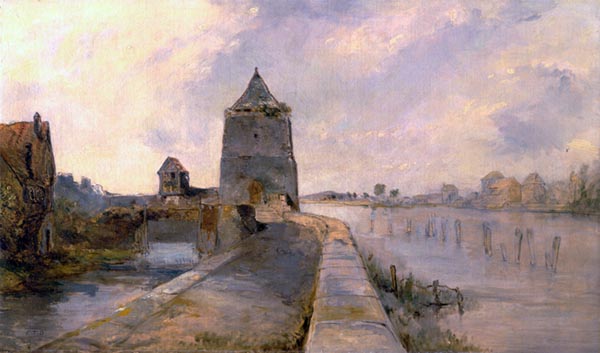
‘The Rhine at Constance’
Edward Thomas Daniell (1804–1842)
Yale Center for British Art
Translated by A. S. Kline © Copyright 2026 All Rights Reserved
This work may be freely reproduced, stored and transmitted, electronically or otherwise, for any non-commercial purpose.
Conditions and Exceptions apply.
Contents
Letter XXV: The Rhine
Mainz, October 1st
A stream flows from Lake Toma (Tomasee, Lai da Tuma), on the north-eastern slopes of the Saint Gotthard Pass; it joins a second stream, that flows from a second lake at the foot of Mount Lukmanierberg (Lai da Songta Maria, in the Lukmanier Pass, to form the Vorderrhein); a third (the Hinterrein) oozes from a glacier and descends amidst the rocks, from a height of more than five thousand feet above sea-level. Fifty miles from their respective sources, the waters meet in the same ravine near Reichenau (Reichenau Tamins). There, they mingle. Do you not admire, my friend, the powerful and simple way in which Providence produces greatness? Three shepherds meet, there is a people; three streams meet, there is a river.
A people emerged then, on November 17, 1307 (at the start of the ‘William Tell’ Rebellion), at night, on the edge of a lake, where three shepherds had embraced; the people rose up, they attested to the great God who makes commoners and Caesars alike, then they took up their scourges and pitchforks. A rustic giant took on a giant sovereign, the Emperor of Germany, hand to hand. At Küssnacht, they defeated the bailiff Albrecht Gessler, who made people bow down before his hat; at Sarnen, the bailiff Landenberg, who gouged out the eyes of old men; at Thalwil, the bailiff Wolfenschiessen, who killed women with axes; at Morgarten (1315), Duke Leopold I of Austria. They buried the three thousand Englishmen of Enguerrand de Coucy below the hill of Buttisholz (1375). They held in check four formidable enemies who came from the four cardinal points of the compass; they defeated the Duke of Austria at Sempach (1386); Charles the Bold, Duke of Burgundy at Morat (Murten, 1476), and again at Grandson (1486); the Duke of Milan at Novara (1513); and the Duke of Savoy at Chillon (1536); and let me note in passing that at Novara, in 1513, the Duke of Milan was a duke by right of the sword, and was called Louis XII, King of France. The people hung, on nails in their arsenals, above their commoners clothes and next to the iron collars intended for them, the splendid ducal armour of these vanquished princes; they possessed great citizens, William Tell first, then the three liberators (Walter Fürst, Werner Stauffacher, and Arnold von Melchtal), then Petermann of Gundoldingen (slain at Sempach), who left his blood on the banner of the city, and Konrad Baumgarten, and Niklaus von Scharnachthal (leader at Morat/Murten), and Arnold Winkelried who sacrificed himself at Sempach, as Marcus Curtius had in that chasm in Rome (in 362 BC); the people fought at Bellinzona (the Battle of Giornico, 1478) for the inviolability of the land, and at Kappel for the inviolability of conscience; they lost Huldrych Zwingli, slain at Kappel, in 1531, but freed François Bonnivard (the prisoner of Chillon) in 1536; and since then have stood firm. The Swiss fulfilled their destiny between the four colossi of the continent, as a strong, solid, impenetrable, centre of civilisation, an asylum for science, a refuge for thought, an obstacle to unjust invasions, a point of support for legitimate resistance. For six hundred years, in the heart of Europe, in the midst of hostile Nature, under the eye of a benevolent providence, these great mountaineers, worthy sons of the great mountains themselves, grave, cold, and serene like them, subject only to necessity, jealous of their independence, in the presence of absolute monarchies, idle aristocracies, and envious democracies, have lived a strong communal life, exercising at the same time the most fundamental of rights, liberty, and the most sacred of duties, work.
The Rhine is born between granite walls; it takes a step, and encounters at Andeer, a Roman village (Lapidaria), the memory of Charlemagne; at Chur, the ancient Curia Raetorum, the memory of Drusus; in Feldkirch, a memory of André Masséna (his failed second battle of 1799); then, as if consecrated for the destiny that awaits it by this triple Germanic, Roman, and French baptism, leaving the mind undecided between its Greek etymology Ρἑειν, and its German etymology Rinnen, which both mean to flow, it takes its flowing course, traverses forests and mountains, reaches Lake Constance, leaps the falls at Schaffhausen, skirts the rear ridges of the Jura and the Vosges, pierces the chain of dead volcanoes of the Taunus, crosses the plains of Friesland, floods and drowns the lowlands of Holland, and after having dug, through the rocks, earth, lava, sand, and reeds, a tortuous valley of seven hundred and sixty five miles, after having sounded, in traversing the great European anthill, the perpetual murmur of its waves, which one might say is composed of the eternal quarrel between the north and the south, after having received twelve thousand tributaries, watered a hundred and fourteen cities, separated, or, to put it better, divided eleven nations, bearing in its foam, and mingling with its noise, the history of thirty centuries and thirty peoples, is lost in the sea. A Protean River; the border of empires, the frontier of ambition, a brake to conquerors; the serpent of the enormous caduceus that the god of Commerce extends over Europe; a grace and adornment of the globe; a long green lock of Alpine hair, that trails down to the Ocean. Thus, from three shepherds and a triple-stream, Switzerland and the Rhine were born, in similar manner in the same mountains.
The Rhine has many aspects. It is sometimes wide, sometimes joyful. Murky or translucent, it is always swift, and joyful with that great joy proper to all that is powerful. It is a torrent at Schaffhausen, a chasm full of rapids at Laufen, a river at Sickingen, a stream at Mainz, a lake at Sankt Goar, a marsh at Leiden. It is said that it calms and slows towards evening as if falling asleep; a phenomenon, more apparent than real, visible as regards all large rivers.
I have said elsewhere: unity in variety is the principle of all complete art. In this respect, Nature is the greatest artist of all. She never abandons a form without having made it rehearse all its qualities. Nothing resembles each other less in appearance than a tree and a river; yet, at bottom, the tree and the river have the same general outline. Examine, in winter, a tree stripped of its leaves, lay it flat on the ground in your mind, and you will have the structure of a river seen by a giant, in bird’s eye view. The trunk of the tree is the river itself; the large branches the tributaries, the twigs and small branches the torrents, streams, and springs; the spread of its roots the mouth. All rivers, seen on a geographical map, are trees which bear cities, sometimes at the end of their branches like fruit, sometimes in between their branches like nests; and their confluences and the innumerable tributaries imitate, according to the inclination of the slopes and the nature of the terrain, the varied branches of the different plant species, which all, as we know, launch shoots, more or less well-separated, from the stem, according to the particular pressure of their sap and the density of their wood. It is remarkable that, if one considers the Rhine in this way, the regal idea which seems to attach itself to that robust river is evident. The Ys of almost all the tributaries of the Rhine, the Murg, the Neckar, the Main, the Nahe, the Lahn, the Moselle and the Aare contain an angle of about ninety degrees. Bingen, Niederlahnstein, and Koblenz are within such right angles. If one, in thought, were to lay out the immense geometric pattern of the river, and stand the result upright on the ground, the Rhine, gathering all its tributaries in its outstretched arms, would take the form of an oak-tree. The countless streams into which it divides at its mouth, before reaching the North Sea, would represent the roots laid bare.
The most famous and most admired part of the river, the richest for the geologist, the most interesting to the historian, the most important for the politician, and the most beautiful to the poet, is this section of the central Rhine which, from Bingen to Königswinter (near Bonn), traverses from east to west the black chaos of volcanic and metamorphic hills that the Romans called the Alps of the Chatti.
This is the famous stretch of the river from Mainz to Cologne, that almost all tourists travel in fourteen hours during the long summer days. In this way, you gain a dazzling sight of the Rhine, and nothing more. When a river flows fast, to see it properly, you must ascend, not descend it. As regards myself, the journey from Cologne to Mainz, took me a month, as you know.
From Mainz to Bingen, as from Königswinter to Cologne, there are twenty miles of rich, green and smiling terrain, with beautiful and cheerful villages at the water’s edge. But, as I told you just now, the great embankment of the Rhine begins at Bingen beside the Rupertsberg and the Niederwald, two mountains of schist and slate, and ends at Königswinter, at the feet of the Seven Mountains.
Here everything is beautiful. The dark escarpments of both banks are reflected in the wide stretches of water. The steepness of the slopes means that vines are cultivated on the Rhine in the same manner as olive trees on the coast of Provençe. Wherever the southern sunlight falls, if the rocks project at all, the country folk carry sacks and baskets of earth there by hand, and, in this earth, in Provençe they plant an olive tree, and on the Rhine a vine. Then they buttress their earthwork with a dry-stone wall which holds back the soil, and lets rainwater drain away. Here, as an added precaution, so that the rains do not destroy everything, the winegrower covers the ground, as one does a roof, with pieces of slate from the mountain. In this way, on the top of the steepest rocks, the Rhenish vine, like the Mediterranean olive-tree, grows on a kind of platform set above the head of passers-by like a flowerpot in an attic window. All the gentle slopes bristle with vines.
It is a thankless job, when all is said and done. For ten years, the Rhine has not seen a good harvest. In several places, especially in Sankt Goarshausen, in the Nassau region, I saw abandoned vineyards. From below, all these shoulders of dry stone which follow the thousand undulations of the slope, and to which the layers of rock necessarily almost always give the shape of a crescent, surmounted by their green fringe of vines, attached to, as if hanging from, the projections of the mountain at their two ends where they are thinner, represent innumerable garlands suspended from the austere walls of the Rhine. In winter, when the vines and the soil are black, these dirty grey earthworks resemble those large cobwebs, stacked in layers in the corners of abandoned ruins, a kind of hideous hammock in which dust has heaped itself.
At every bend in the river, a cluster of houses gathered, to become a town or a city. Above each group of houses stands a ruined keep. The towns and villages, bristling with gables, turrets, and bell-towers, look from a distance like barbed arrows set down on the lower slopes of the mountains.
Often the hamlets stretch out, at the edge of the bank, in the shape of a pigtail, enlivened by singing washerwomen, and children playing. Here and there a goat grazes the young shoots of the osier beds. The houses along the Rhine resemble large slate-coloured helmets placed on the river bank. The exquisite interlocking beams painted red and blue, against the white plaster, form the ornamentation of the facades. Several of these villages, like those of Mülheim and Mondorf near Cologne, are inhabited by salmon fishermen and basket-weavers. On beautiful summer days, this makes for a charming sight; the basket-maker weaves his basket on the threshold of his house, the fisherman mends his nets in his boat; above their heads the sun ripens the vines on the hill. All do what God grants them to do, the sun as well as Mankind.
The towns are of a more complex and tumultuous nature. They abound on the Rhine. Such as Bingen, Oberwesel, Sankt Goar, Neuwied, Andernach. There is Linz am Rhein, a large town with square towers, which suffered from the plague in 1476, and which stand opposite Sinzig (Sentiacum), on the other side of the Rhine, built by Sentius to guard the mouth of the Aar. There is Boppard, the ancient Vicus Baudobriga, a fort built by Drusus, a royal estate of Frankish kings, an imperial town proclaimed at the same time as Oberwesel, a bailiwick of Trier, and a charming old town in which a pagan statue is preserved in the church, above which church the two Romanesque bell-towers coupled by bridgework resemble two large oxen beneath a yoke. I noticed there near the town gate a lovely ruined apse upstream. There is Kaub, a town of the Palatinate. There is Braubach, named in a charter of 933, a fiefdom of the Counts of Arnstein von Lahngau, an imperial town under Rudolph in 1270, a domain of the Counts of Katzenelnbogen in 1283, which accrued to Hesse in 1473, to Darmstadt in 1632, and in 1802 to Nassau.
Braubach, which communicates with the Baths of Taunus (thermal spas), is admirably situated at the foot of the tall rock which bears the Marksburg at its summit. This old castle of Saint Mark is today a state prison. Every marquis seems to collect squires; it seems to me that Monsieur de Nassau wishes to collect state prisoners. It is a strange luxury.
Twelve thousand six hundred inhabitants in eleven hundred houses; a bridge (destroyed in 1945), formed of thirty-six boats built in 1819 on the Rhine; a bridge (the Balduinbrücke) of fourteen arches over the Moselle built of lava-stone on the very foundations of the bridge built around 1311 by Archbishop Baudoin, through a large expenditure of indulgences; the famous fort Ehrenbreitstein, surrendered to the French on January 27, 1799 after a blockade during which the besieged had paid three francs for a cat, and thirty sous for a pound of horsemeat; a well five hundred and eighty feet deep, dug by Margrave John II of Baden; the arsenal square, which once saw the famous culverin named the Griffon, which fired shot weighing a hundred and sixty pounds, and itself weighed twenty thousand; a fine old Franciscan convent (the Kapuzinerkloster) converted into a hospital in 1804; a Romanesque Church of Our Lady (the Liebfrauenkirche, destroyed in 1944, and since restored), redone in the Pompadour style and painted pink; a church of Saint Florin (the Florinskirche), converted into an artillery magazine by the French, and today an evangelical church, which is far worse from an artistic point of view, also painted pink; a collegiate Basilica of Saint Castor enriched with a portal from 1805 and painted pink; no library: such is Koblenz, which the French write as Coblentz, out of politeness to the Germans, and which the Germans write as Koblence out of consideration for the French. First a Roman castrum in the area of the Altstadt, then a royal court under the Franks, an imperial residence until the reign of Louis IV the Bavarian, a city patronised by the Counts of Arnstein until 1250, and then, from Arnould II of Isenberg, by the archbishops of Trier, besieged in vain in 1688 by Vauban and by Louis XIV himself, Koblenz was taken by the French in 1794 and given to the Prussians in 1815 (after the Congress of Vienna). As for myself, I chose not to enter it. So great a number of pink churches frightened me.
As a military centre, Koblenz is an important site. Its three fortresses face each other from three sides. Fort Grossfürst Konstantin dominates the road to Mainz, the Kaiser Franz fortress on the Petersberg guards the road to Trier and Cologne, and Ehrenbreistein watches over the Rhine and the road to Nassau.
As a site, Koblenz is perhaps over-praised, especially when compared with other Rhine towns that no one visits and no one talks about. Ehrenbreistein, once a beautiful and colossal ruin (in 1801, a new fortress was built by the Prussian 1817-28), is now a cold and gloomy citadel crowning, in a dull manner, a magnificent rock. The true crowns of the mountains were the line of ancient fortresses. Each tower was a jewel.
Some of these cities have inestimable riches of art and archaeology. The oldest masters, and the greatest painters, populate their museums. Domenichino, the Carracci, Guercino, Jacob Jordaens, Frans Snyders, Lorenzo di Credi, are in Mainz. Augustin Braun, William of Cologne, Rubens, Albrecht Dürer, Guillermo Mesquida, are in Cologne. Hans Holbein the Younger, Lucas van der Leyden, Lucas Cranach the Elder, Jan van Scorel, Raphael, and a copy of Titian’s ‘Sleeping Venus’, are in Darmstadt. Koblenz has engravings of the works of Albrecht Dürer, complete except for four leaves. Mainz has the Psalter of 1457 (Fust and Schöffer’s edition, the second book printed with movable type). Cologne had the famous missal of the castle of Drachenfels, coloured in the twelfth century; it lost it (extant, now at Saint Remigius, Königswinter); but it has preserved and still preserves the precious letters of Gottfried Leibnitz to the Jesuit, Barthélemy Des Bosses.
These beautiful towns and charming villages are set amidst wildest Nature. Mists creep through the ravines; clouds cling to the hills, seeming to hesitate then riding the winds; dark druidic forests sink between mountain peaks in the violet distance; large birds of prey soar beneath a marvellous sky that partakes of those of two lands distant from the Rhine, sometimes full of dazzling light like an Italian sky, sometimes cloaked in reddish vapour like a Greenland one. The slopes are rough, the lavas blue, the basalts black; everywhere mica and quartz dust; everywhere violent fractures; the rocks have the profiles of snub-nosed giants. Ridges of flaky slate, shiny as silk, gleam in the sunlight, which resemble the backs of enormous wild boars. The views along the entire river are extraordinary.
It is evident that, before forming the Rhine, Nature had premeditated a desert; mankind made of it a street. In Roman and barbarian times, it was a military street. In the Middle Ages, as the river was almost entirely bordered by ecclesiastical states and held in some manner, from its source to its mouth, by the Abbot of Saint Gall, the Prince-Bishop of Constance, the Prince-Bishop of Basel, the Prince-Bishop of Strasbourg, the Prince-Bishop of Speyer, the Prince-Bishop of Worms, the Archbishop-Elector of Mainz, the Archbishop-Elector of Trier, and the Archbishop-Elector of Cologne, the Rhine was called the Priests’ Street (Priestergasser). Today it is the Merchants’ Street.
The traveller who ascends the river, sees the world flowing towards him, so to speak, and, on this account, the spectacle is more beautiful. At every moment one encounters something passing by: sometimes a narrow arrow-shaped boat, fearful to see in motion so laden with people is it, especially if it is a Sunday, the day when these brave Catholic river-dwellers, ruled by Huguenots, often travel far to hear the Mass; sometimes a steamboat decked with flags; sometimes a long-boat with two lateen sails descending the Rhine, with its cargo humped beneath the mainmast, its attentive and serious pilot, and its busy sailors, a woman seated at the door of the cabin, and amidst the bales the sailors’ store-chest coloured with red, green and blue rosettes. Or one sees long teams of horses attached to heavily-loaded vessels slowly ascending; or a brave little horse towing a large, decked boat like a lone ant dragging a dead beetle. Suddenly the river bends, and, at the turn which presents itself, a large raft from Namedy (in Andernach) majestically emerges. Three hundred sailors manoeuvre the monstrous object, immense oars beating the water rhythmically at bow and stern; a whole ox, cut-open and bleeding, hangs attached to the sheers (crane), another live ox turns about the post to which it is tied and bellows at the sight of heifers grazing on the bank; the skipper strides up and down the double staircase to his platform, the tricolour flag, unfurled, flutters horizontally in the wind; the cook stirs his fire beneath the large cooking pot; smoke emerges from three or four huts to and from which the sailors pass: a whole floating village lives aboard this prodigious fir-wood platform.
Yet these gigantic rafts when compared to the huge old rafts of the Rhine are like a rowboat to a three-decker. The rafts of old, composed, as today, of oak-trees, with fir-wood masts, wooden planks, and smaller items, trimmed at their ends with spars called bundsparren, fastened together with osier ties, and iron crampons, carried up to twenty huts, a dozen boats loaded with anchors, plumblines, and spare ropes, and a thousand oarsmen; their draft was some eight feet, they were seventy feet wide, and about nine hundred feet long, that is to say the length of ten mature fir trees of the river Murg, tied end to end. Around the central raft, and moored to its edge by means of a tree-trunk which served both as bridge and cable, floated, so as to maintain its course, and lessen the dangers of grounding, up to a dozen trains of smaller rafts about eighty feet long, some called kniee, others anhänge. On the main raft an alleyway between the huts terminated at one end at a vast tent, on the other at the captain’s hut, a sort of wooden palace. The kitchen emitted smoke constantly. A large copper cauldron bubbled away day and night. Each morning and evening the pilot shouted a word of command, and raised above the raft a basket suspended from a pole; it was the signal for mealtime, and the host of labourers rushed to the tent with their wooden bowls. The men on these rafts consumed, in a single trip, eight barrels of wine, six hundred hogsheads of beer, forty sacks of dried vegetables, twelve thousand pounds of cheese, fifteen hundred pounds of butter, ten thousand pounds of smoked meat, twenty thousand pounds of fresh meat and fifty thousand pounds of bread. They carried a herd of cows, and their own butchers. Each of these rafts represented seven or eight hundred thousand florins worth of timber, that is to say about two million francs.
It is difficult to imagine such a vast wooden island winding its way from Namedy to Dordrecht, dragging its archipelagos of islets through the tortuous bends, narrows, falls, whirlpools, and serpentine currents of the Rhine. Shipwrecks were frequent. It was also said, proverbially, and still is repeated, that the raft operator needed three sets of funds: the first floating on the Rhine, the second locked away on shore, and the third the coins in his pocket. The art of steering these frightening assemblages past the many reefs was usually exercised by one pilot per generation. At the end of the last century, the secret of it belonged to a master from Rudesheim called Old Jung. When Jung died, the great rafts disappeared.
At the present time, twenty-five steamboats are in the process of ascending and descending the Rhine each day. The nineteen Cologne Company’s vessels, recognisable by their black and white funnels, run from Strasbourg to Düsseldorf; the six ships of the Düsseldorf company, with tricolour funnels, run from Mainz to Rotterdam. This immense operation extends to Switzerland by means of the steamboat from Strasbourg to Basel, and to England by means of the steamships running from Rotterdam to London.
The old means of navigating the Rhine, represented by the sail-boats, contrasts with the new represented by the steamboats. The steamboats, cheerful, coquettish, elegant, comfortable, fast, decorated and flagged with various colours, including those of England, Prussia, Nassau, Hesse, Baden, and the Dutch tricolour, invoke the names of rulers or cities: Ludwig II, Gross Herzog von Hessen, Königin Victoria, Herzog von Nassau, Prinzessinn Mariann, Gross Herzog von Baden, Stadt Manheim, Stadt Coblentz ; the sail-boats pass by slowly, bearing on their prows grave, sweet names: Pius, Columbus, Amor, Sancta Maria, Gratia Dei. The steamships are varnished and gilded, the sail-boats tarred. The steamboats represent speculation; the sail-boats the old, true austere, reverent means of navigation. Some sail while advertising themselves, others while saying a prayer. Some rely on men, others on God. This lively and striking contrast of dissimilar vessels is accentuated by endless encounters and clashes on the Rhine.
Through this contrast, and with the singular force of reality, breathes the dual spirit of our era, which is the daughter of a religious past, and believes itself the mother of an industrial future.
Forty-nine islands, covered with thick vegetation, hiding houses with smoking chimneys, adorned with tufts of flowers, and sheltering boats in their charming harbours, are scattered along the Rhine from Cologne to Mainz. All recall some memory: there is Grafenwerth, where the Dutch built a fort which they called The Priest’s Hat, Pfaffenmüth, a fort which the scandalised Spaniards captured and re-named Isabella. There is Graswerth, the island of grass, where Johann Philipp Von Reiffenberg wrote his Antiquitates Saynenses. There is Niederwerth, once rich with the endowments of the Margrave John II of Baden, Archbishop of Trier. There is Urmitzer Werth, which saw Caesar pas by; there is Nonnenswerth (Rolandswerth), which saw Roland.
The memories recalled by the river banks seem to correspond to those recalled by the islands. Allow me to touch on a few of them here; I will return in more detail to this interesting subject later. Every shade that rises on one bank of the river causes another to rise on the opposite bank. The coffin of the Blessed Rizza, granddaughter of Louis the Pious, is in Koblenz; the tomb of Ida, niece to Otto III, is in Cologne (in Sankt Maria im Kapitol, of which she was the Abbess). Saint Hildegard is said to have left in Eibingen a ring that Saint Bernard gave her, with the motto: I love to suffer. Sigebert I was the last king of Austrasia to live in Andernach. Saint Genevieve lived in Frauenkirch, in the woods, near a mineral spring that today adjoins a memorial chapel; her husband resided in Simmern. Schinderhannes (Johannes Bückler, the outlaw) devastated the Nahe valley. It was there that one day he amused himself, pistol in hand, by forcing a group of Jews to remove their shoes; then forced them to don shoes again, after mixing them up, and hobble away, which was a source of laughter to him. Before Schinderhannes, this gentle valley had known Louis I of Zweibrücken known as the Black (‘der Schwarze’).
When a traveller who is ascending the river has passed Koblenz and left behind him the graceful island of Oberwerth, where a white building has replaced the old ruined abbey of the noble ladies of Sainte Madeleine auf der Insel, the mouth of the Lahn appears to him. The view is admirable. At the water’s edge, behind a clutter of moored boats, rise the two crumbling bell-towers of the Johanniskirche (Larnstein), vaguely reminiscent of Jumiéges Abbey. On the left bank, above the village of Cappellen, on a ridge of rocks, stands Stolzenfels (rebuilt 1823-1842), the vast and magnificent archiepiscopal fortress where Elector Werner von Falkenstein studied the Almuchabala (Al-Muchabala refers to the process of balancing an equation, i.e. performing the same operation on both sides, a concept introduced by the mathematician al-Khwarizmi in his work Kitab al-Jabr w’al-Muqabala); and on the right bank, on the Lahn, at the far end of the horizon, the clouds and the sun mingle with the dark ruins of Burg Lahneck, full of enigmas for the historian, and obscurities for the antiquarian. On both sides of the Lahn, two pretty towns, Niederlahnstein and Oberlahnstein, linked to each other by an avenue of trees, gaze at each other and seem to smile. A few stone-throws from the eastern gate of Oberlahnstein, which still retains its dark ring of moats and machicolations, the trees of an orchard reveal, and at the same time conceal, a small chapel (Marien Kapelle) from the fourteenth century, plastered and re-plastered, surmounted by a puny bell tower. This chapel saw the deposition of Emperor Wenceslas IV, King of Bohemia and Germany.
For it was in this village church that, in the year of Christ 1400, the four Electors of the Rhine, Johan II von Nassau-Wiesbaden-Idstein, Archbishop of Mainz; Friedrich III von Saarwerden, Archbishop of Cologne; Werner von Falkenstein, Archbishop of Trier; and Rupert III, Count Palatine, solemnly proclaimed from the top of the portal the deposition of this Wenzel, Emperor of Germany. Wenceslas was a sluggish and wicked individual, a drunkard and ferocious when drunk. He had priests drowned who refused to reveal the secrets of the confessional. While doubtful of his wife’s fidelity, he had confidence in her intellect and was influenced by her ideas. Now, this caused concern in Rome. Wenceslas’ second wife was Sophie of Bavaria, whose confessor was Jan Hus. Jan Hus, propagating Wycliffe’s doctrines, was seen to be undermining the Papal See; the Pope struck at the emperor. It was at the instigation of the Holy See that the three archbishops summoned the Count Palatine. The Rhine from then on dominated Germany. The four of them deposed the emperor, and appointed in his place the one among them who was not a clergyman, Count Rupert. Rupert, to whom this reward had undoubtedly been secretly promised, was, moreover, a worthy and noble Emperor. One can see from this, that in its overall guardianship of kingdoms and kingships, the actions of Rome, sometimes public, sometimes hidden, were on occasions beneficial. The judgment rendered against Wenceslas was on six counts, the four principal grievances being: first, the squandering of his domain; second, the schism caused to the Church; third, the civil wars of the Empire; and fourth, having allowed his hounds to sleep in his room.
Jan Hus continued his preaching, and so did Rome. — Jan Hus is claimed to have said ‘I would rather be thrown into the sea with a millstone around my neck than recant’. He took up the sword of the spirit and fought hand to hand against Rome. Then, when the Council summoned him, he attended boldly without safe conduct. Venimus sine salvo conductu. You know the result, accomplished on July 6, 1415 (the date of Hus’ execution). The years, which gnaw away at all that is flesh and merely superficial, also grant facts a death-like status, and lay bare the fibres of history. Today, to any who choose to consider, thanks to the insights caused by this abrasion, the providential series of events of that dark era, the deposition of Wenceslas is the prologue to a tragedy of which the pyre at Constance is the catastrophic denouement.
Opposite this chapel, on the opposite bank, at the edge of the river, one could still see not half a century ago the royal seat, the ancient Königsstühl, of Rhens, of which I have already spoken (destroyed in 1795, demolished in 1806, reconstructed in 1842, then relocated in 1929 to the Rheinhöhe). The Königsstühl, taken as a whole, was seventeen German feet (slightly shorter than the French pied du roi, both being slightly longer than the English equivalent) high, and twenty-four in diameter. This was its form: seven stone pillars supported a large octagonal stone platform, also supported at its centre by an eighth pillar larger than the others, representing the emperor in the middle of the seven electors. Seven stone chairs, corresponding to the seven pillars above which each of them was placed, arranged in a circle and facing each other, occupied, seven of the sides of the platform. The eighth side, which faced south, was filled by the staircase, a massive stone step composed of fourteen steps, two steps per elector. Every feature of this grave and venerable edifice possessed a meaning. Behind each chair, on the face of each side of the octagonal platform, were sculpted and painted the coats of arms of the seven electors: the twin-tailed lion of Bohemia; the crossed swords of Brandenburg; Saxony, which bore black with gold stripes; the Palatinate, a gold lion on a black field; Trier, argent with a red cross; Cologne, argent with a black cross; and Mainz, which bore gules with a silver wheel. These coats of arms, whose enamelling, colours, and gilding rusted in the sun and rain, were the only ornament of this old granite throne.
It was there that, in the open air, beneath the sunlight and breeze from the sky, seated in those rigid stone armchairs over which the trees shed their leaves, and across which the shadows of the clouds ran, as rough, simple, naïve, and august as the kings in Homer’s epics, the ancient electors of Germany chose the emperor among themselves. Later, these grand ideas faded, a less epic civilisation invited the seven princes, raised to nine, towards the end of the seventeenth century, by the accession of Bavaria and Brunswick to the electorate, to meet around that leather-covered table in Frankfurt.
The seven princes who sat on those stone seats in the Middle Ages were men of considerable power. The electors occupied the highest positions of the Holy Empire. They preceded, in the imperial marching line, the four dukes, the four arch-marshals, the four landgraves, the four burgraves, the four counts who were warlords, the four abbots, the four boroughs, the four knights, the four towns, the four villages, the four rustics, the four marquises, the four ordinary counts, the four lords, the four mountains, the four barons, the four possessions, the four huntsmen, the four offices of Swabians, and the four servants. Each of them had his own marshal to bear before him a sword with a gilded scabbard. They called the other princes the crowned heads, and called themselves the crowning hands. The Golden Bull (a founding document of the Holy Roman Empire, issued by Emperor Charles IV, taking its name from the gold seal it bore) compared them to the seven gifts of the Holy Spirit, to the seven hills of Rome, to the seven branches of Solomon’s candlestick. Among them, electoral powers took precedence over royal powers; The Archbishop of Mainz walked on the emperor’s right, and the King of Bohemia on the archbishop’s right. They were of such high status, the impact of their actions was so visible across Europe, and they so dominated the nations from on high, that the folk of Weesen, in Switzerland, called, and still call, the seven peaks above their lake, Walensee, the Sieben Churfirsten, the Seven Electors.
The Königsstühl is gone, and so are the electors. Four stones now mark the site of the Königsstühl; nothing at present marks the seats of the electors.
In the sixteenth century, when it became the fashion to proclaim the emperor in Frankfurt, sometimes in the hall of the Römer, sometimes in the conclave-chapel of Saint Bartholomew’s Cathedral, the election became a complicated ceremony. Spanish etiquette was reflected in it. The form was meticulous; the apparatus strict, guarded, sometimes awe-inspiring. From the morning of the day fixed for the election, the gates of the city were closed, the bourgeoisie took up arms, the military drums sounded, the alarm bell rang; the Electors, dressed in cloth of gold, and wearing red robes lined with ermine, the secular Electors wearing the electoral cap on their heads, the archbishops their scarlet mitres, solemnly received the oath of the magistrate of the city who undertook to guarantee them against any attack of one on another; this done, they themselves swore an oath to each other before the Archbishop of Mainz; then Mass was said for them; they sat on black velvet chairs, the Marshal of the Holy Roman Empire closed the doors and they proceeded with the election. However well sealed the doors were, the chancellors and the notaries passed to and fro. Finally, the most reverends declared agreement with the most illustrious; the king of the Romans was named, the princes rose from their chairs, and while the presentation to the people took place at the windows of the Römer, one of the suffragans of Mainz sang Saint Bartholomew a Te Deum to a triple chorus of Deum on the church organs, on the Electors’ trumpets, and on those of the emperor. All this, to the sound of the great bells ringing from the towers, and the great cannons, firing joyfully, says the anonymous narrator regarding the election of Mathias II (in 1612) in his curious manuscript.
At the Königsstühl, things were done more simply and grandly, in my opinion. The Electors ascended the platform in procession, via the fourteen steps each a foot high, and took their places in their stone armchairs. The people of Rhens, held back by soldiers with arquebuses (early firearms), surrounded the royal seat. The Archbishop of Mainz, standing, said: ‘Most generous princes, the Holy Empire is vacant’. Then he intoned the antiphon Veni, Sancte Spiritus, and the Archbishops of Cologne and Trier sang the other collects dependant thereon. The chant finished, all seven took the oath, the seculars with their hands on the Gospel, the ecclesiastics with their hands on their hearts. A beautiful and touching distinction, which means that the heart of every priest should be a copy of the Gospel. After the oath, they sat in a circle talking to each other in low voices; suddenly, the Archbishop of Mainz rose, stretched out his hands towards the sky, and cried out to the people, scattered far and wide among meadows adorned with hedges and bushes, the name of the new temporal head of Christianity. Then the marshal of the empire planted the imperial banner on the banks of the Rhine, and the people shouted: ‘Vivat rex!’
Before Lothair III, who was elected on September 13, 1125, (at Aachen) the same eagle, the golden eagle, adorned the banner of the Eastern Empire and that of the Western Empire; but the crimson sky of dawn was reflected in one, and the cold northern sky in the other. The Eastern banner was red; the Western banner was blue. Lothair substituted for these colours the colours of his house, gold and sable. The golden eagle in a blue sky was replaced on the imperial banner by the black eagle in a gold sky. As long as there were two empires, there were two eagles, and these two eagles each had only one head. But at the end of the fifteenth century, when the Greek empire had collapsed, the Germanic eagle, remaining alone, seeking to represent the two empires, looked both to the West and to the East, and acquired two heads.
This is not, moreover, the first appearance of the double-headed eagle. It can be seen sculpted on the shield of one of the soldiers on Trajan’s Column, and, if we are to believe the monk Hermann of Attaich (Henricus Sterv) and the writings collated by Urstisius (Christian Wurstisen), Rudolf I of Habsburg wore it embroidered on his chest on August 26, 1278, at the Battle on the Marchfeld.
When the banner was planted on the banks of the Rhine in honour of the new emperor, the wind would stir its folds, and from the manner in which it fluttered the people derived omens. In 1346, when the electors, urged on by Pope Clement VI, proclaimed Charles, Margrave of Moravia, King of the Romans from the top of the Königsstühl, with a cry of vivat rex, although Duke Louis V, heir to Louis IV, was still alive, the imperial banner toppled into the Rhine and was lost. Fifty-four years later, in 1400, the fatal omen was fulfilled: Wenceslas, son of Charles, was deposed.
And this fallen banner indicated the fall of the House of Luxembourg, which, after Charles IV and Wenceslas, produced only one emperor, Sigismund, and was forever eclipsed by the House of Austria.
After leaving the place where the Königsstühl once stood, cast down, as a symbol of feudalism, by the French Revolution, one ascends the river towards Braubach, passing Boppard, Wellmich, Saint Goar, and Oberwesel, and suddenly to the left, on the right bank, appears a large shelf of slate like the roof of a giant’s house, surmounted by an enormous tower which seems to disgorge the cold vapour of the clouds like some colossal chimney. At the foot of this rock, along the shore, a pretty town, grouped around a Romanesque church with a spire, extends its facades to the south. In the centre of the Rhine, in front of the town, often half-veiled by the mists of the river, on a rock at water level, stands an oblong, narrow, high-sided building, whose front and rear part the water like the prow and stern of a vessel, whose wide, low windows imitate hatches and gun ports, and on the lower wall of which a thousand iron crampons possess the vague outlines of anchors and grappling hooks. Capricious bossages, and small outbuildings hang, like boats and rowboats, from the sides of this strange construction which yields itself to the wind, like the banners on its masts, and the hundred weather vanes on its pointed bell-towers. The enormous tower is Burg Gutenfels; the town is Kaub; and the stone ship, eternally afloat on the Rhine and eternally at anchor before the Palatine city, is the palace, the Pfalzgrafenstein.
I have already spoken to you of the Pfalz. One could only enter this symbolic residence, built on a marble platform called The Rock of the Counts Palatine, by means of a ladder, which led to a drawbridge that can still be seen. There were dungeons there for state prisoners, and a small room where the Countesses Palatine were forced to await the hour of their delivery, with no other distraction than to visit, in the cellars of the palace, a well dug in the rock below the bed of the Rhine, and full of water that was not Rhine water. Today the Pfalz has changed masters. Monsieur de Nassau owns the Palatine ‘Louvre’; the palace is deserted, no princely cradle rocks to and fro on its flagstones, no wailing sovereign disturbs those black vaults. There is nothing left but the mysterious well that is always full. Alas, a well replenished by drops of water filtering through rock endures longer than a royal lineage.
Beside the course of this mighty river, the Pfalz stood near to the Königsstühl. The Rhine saw, almost at the same place, a woman give birth to the Count Palatine, and the Empire give birth to its Emperor.
From the Taunus to the Seven Mountains, on both sides of the magnificent escarpment which encloses the river, there are fourteen great castles on the right bank: Ehrenfels, Fürsteneck, Gutenfels (Kaub), Rheineck, Burg Katz, Burg Maus, Liebenstein and Sternberg, which are called the ‘Brothers’, then Marksburg, Philipsburg, Lahneck, Sayn, Hammerstein and Okenfels; and twelve on the left bank: Vogtsburg (Rheinstein), Reichenstein (Falkenburg), Sooneck, Heimburg (Hohneck), Fürstenberg, Stahleck, Schönberg, Rheinfels, Rheinberg, Stolzenfels, Rheineck and Rolandseck, in all, twenty-six half-ruined fortresses, superimposing the history of the Rhinegraves on the history of the ancient volcanoes, the traces of war on the traces of lava, and completing in a formidable way the severe outline of the hills.
One of these castles Hammerstein was built in the tenth century by the Conradines. Three were built or restored in the twelfth century: Stahleck by the Archbishops of Cologne; Sayn by Frederick, first Count of Sayn, conqueror of the Moors of Spain; and Rolandseck by Archbishop Frederick I of Cologne. Four were built or restored in the thirteenth century: Ehrenfels by Archbishop Siegfried II in 1212; Fürstenberg by the Archbishop of Cologne, Engelbert I in 1219; Gutenfels by the Falkensteins in 1220; and Rheinfels, in 1245, by Dieter V, Count of Katzenelnbogen. Four castles were built in the fourteenth century: Fürsteneck, possibly in 1309, by Archbishop Heinrich III von Virnenburg of Mainz; Vogtsberg (Rheinstein), in 1316, by a Falkenstein; Burg Maus, in 1356, by Bohemund II Archbishop of Trier, and Burg Katz, in 1371, by Count William II of Katzenelnbogen. Only one dates from the sixteenth century: Philipsburg, constructed, from 1568 to 1571, by the Landgrave Philipp II of Hesse-Rheinfels. Four of these citadels, on the left bank, Reichenstein, Rheinstein, Falkenburg, and Sooneck, were captured in 1282 by Emperor Rudolph I of Habsburg, Sooneck was destroyed (rebuilt in 1346, and later restored); one, Rolandseck, was destroyed by Emperor Heinrich V; five were destroyed by Louis XIV, in 1689, Fursteneck, Stahleck, Schönberg, Stolzenfels and Hammerstein; one, Rheinfels, by Napoleon; one by a fire, Rheineck; and one by the Black Band (La Bande Noire, a group of post-Revolutionary speculators), Gutenfels. I am not exactly sure who built Reichenstein, Rheinstein, Stolzenfels, Rheineck, or Marksburg restored in 1644 by George II, Landgrave of Hesse-Darmstadt. Nor who demolished Reichenstein former residence of a lord devoted to serving, as the name indicates, Ehrenfels, Fursteneck, Sayn, Burg Katz and Burg Maus. An even deeper obscurity covers six of these manors: Heimburg, Rheinberg, Liebenstein, Sternberg, Lahneck, and Okenfels. They emerged from the shadows, and returned to them. I neither know who built them or who destroyed them.
Nothing is stranger, as regards the passage of history than this dense darkness in which one can dimly perceive, around 1400, the tumultuous activity of the Rhineland Hanseatic League, waging war against the lords, and in which one can distinguish, even further back, in the deeper darkness of the twelfth century, the formidable ghost of Barbarossa exterminating the burgraves. Several of these ancient fortresses, whose history is now lost, were half Roman and half Carolingian. More clearly-lit figures appear with regard to the other ruins. We can find their chronicles scattered here and there in the old charterhouses. Stahleck, which dominates Bacharach, and is said to have been founded by the Huns, saw the death of Hermann von Stahleck in the twelfth century (1156); the Hohenstaufen, the Guelphs and the Wittelsbachs inhabited it, and it was besieged and taken eight times (during the Thirty Years’ War) between 1620 and 1644. Schönberg, from which sprang the Belmont family (Belmont is French for Schönberg) and the legend of the Seven Sisters (who were turned to seven rocks in the Rhine), saw the birth of that great general Frederick of Schönberg, whose singular destiny was to strengthen the House of Braganza and precipitate the fall of the House of Stuart (in the Glorious Revolution of 1688; he was killed at the Battle of the Boyne in 1690). Rheinfels resisted the cities of the Rhine in the thirteenth century, and Marshal Tallard in 1692, but surrendered to the French Republic in 1794. Stolzenfels was the residence of the archbishops of Trier. Rheineck saw the death of the last Count of Rheineck, who died in 1544 as canon custodian of Trier Cathedral. Hammerstein suffered the quarrel between the Counts of Engersgau and the Archbishops of Mainz, the attack by Emperor Henry II in 1017, the flight of Emperor Henry IV in 1125, the Thirty Years’ War, the passage of the Swedes and the Spanish, and the devastation created by the French in 1689. Rheinstein experienced the shame of being sold for a hundred crowns in 1823. Gutenfels (Kaub), the proud sentry-box of Gustavus Adolphus, the sweet asylum of the beautiful Countess Guda and the amorous Emperor Richard, four times besieged, in 1504 and in 1631 by Metz, in 1620 and in 1642 by the Imperial troops, once sold in 1289 by Garnier of Münzenberg to Ludwig IV of Bavaria, son of Ludwig II, the Severe, for two thousand one hundred marks of silver, was partially demolished in 1807, the stone being sold, for a profit of six hundred francs.
This long, dual line of buildings, at once poetic and military, whose facades bear witness to every era of the Rhine, and evoke all the legends, commences in front of Bingen, with the castle of Ehrenfels on the right bank, and Burg Ratz on the left, and ends at Königswinter, with the Rolandseck on the left bank and Drachenfels on the right. A striking example of symbolism and worthy of being noted along the way, is that of the immense ivy-covered arches of Rolandseck facing the cave of that dragon Siegfried the Horny-Skinned stunned, while Burg Maus faces the Ehrenfels; here fable and history are linked to one other.
I have only recorded the castles that were built on the Rhine, which every traveller views in passing. But if one penetrates the valleys and mountains, one encounters a ruin at every step. In the valley of the Wisper alone, on the right bank, in a walk of a few leagues I noted seven: Rheinberg, castle of the Counts of the Rhingau, hereditary squires of the Holy Roman Empire, extinct in the seventeenth century; a formidable fortress that once worried the large commune of Lorch, in the scrubland, Burgruine Waldeck; at the crest of a schist rock, near a mineral spring that provides water to a few puny huts, Sauerburg, built in 1355 by Ruprecht I, Count Palatine, and sold for a thousand florins during the Bavarian War, by the Elector Philip to Philip of Kronberg, his marshal; Heppeneff, destroyed no one knows when; Kammerberg, Mainz state property; Nollig, an ancient castrum of which one tower remains; and Sareck, which stands in the forest opposite the Winsbach convent, like the knight opposite the priest in ancient society. Today the castle and the convent, the nobleman and the priest, are both ruins. Only the forest and the society, renewed each year, have survived.
If one explores the Seven Mountains, one finds there, in the form of fragments buried under ivy, an abbey, Schomberg, and six castles: Drachenfels, ruined by Heinrich V; the Wolkenburg hidden in the clouds, as its name says, ruined by Heinrich V; Löwenberg, in which the Protestant reformers Martin Bucer and Philipp Melanchthon took refuge, and to which Agnes of Mansfeld (Agnes von Mansfeld-Eisleben) and Archbishop Gebhard (Gebhard Truchsess von Waldburg, the Prince-Elector of Cologne) fled, after the marriage which glorified their heresy; Nonnenstromberg and Ölberg, built by Valentinian in 368; and Hemmerich, manor of those bold knights of Heinsberg who waged war on the electors of Cologne.
In the plain, towards Mainz, there is Frauenstein, which dates from the twelfth century; Scharfenstein, an archiepiscopal fief; Greifenklau, built in 1350. Towards Cologne, there is the admirable Godesberg. Where does this name, Godesberg, come from? Is it from the cantonal court, Goding, which was held there in the Middle Ages? Is it from Wotan, the ten-handed monster, whom the Ubians worshipped there? No etymological antiquarian has decided the question for me. However, that may be, Nature, before historical times, made Godesberg, a volcanic hill; the Emperor Julian, in 362, had made it a camp; Archbishop Dietric I von Hengebach, Archbishop of Cologne, in 1210, a castle; Elector Frederick II, in 1375, a fortress; the Elector of Bavaria, in 1583, a ruin. The last Elector of Cologne, Maximilian Francis, turned it into a vineyard.
These ancient castles on the banks of the Rhine, colossal landmarks placed by feudalism along its course, fill the landscape with their reverie. Silent witnesses to vanished times, they assisted the events, framed the scenes, heard the words that were uttered. They are there like ever-present wings to the stage on which a dark drama has been played out along the Rhine for a thousand years. They have seen, the most ancient of them at least, all the actors, proud, strange, or formidable, enter and leave amidst the providential twists and turns of history: Pepin, who gave cities to the Pope; Charlemagne dressed in a wool shirt and an otterskin jacket, leaning on the old deacon, Peter of Pisa, and caressing with his strong hand the elephant Abul-Abbas; Otto IV, the Lion, shaking his blond mane; the Margrave of Italy, Azzo, carrying the banner adorned with angels, victorious at the Battle of Merseburg (the Battle of Riad in 933); Heinrich II, the Lame; Conrad of Thuringia, the Older, and Conrad I, the Younger; Henry IX, Duke of Bavaria, the Black, who imposed four German popes on Rome; Rudolph of Saxony, bearing inscribed on his crown the papal hexameter: Petra dedit Petro, Petrus diadema Rudolpho (meaning ‘Saint Peter, the Rock on which the Church was founded, grants the Pope authority, and the Pope, ‘Gregory VII’, confers the crown on you’); Godfrey of Bouillon, who drove the pike of the imperial flag into the belly of the enemies of the empire; and Heinrich V, who climbed on horseback the marble steps of St. Peter’s in Rome.
There is not a single great figure of German history whose shadow is not cast on these venerable stones; the old Duke Welf I of Bavaria; Albrecht the Bear, Margrave of Brandenburg; Saint Bernard; Barbarossa, who held the Pope’s stirrup with the wrong hand; Rainald of Dassel, Archbishop of Cologne, who tore off the fringes of the carrocio (standard-bearing cart) of Milan; Richard the Lionheart; William II, Count of Holland; Frederick II, the gentle emperor with the Greek face, the friend of poets as was the Emperor Augustus, the friend of Caliphs as was Charlemagne, studying in his tent, furnished with a clock on which a golden sun and a silver moon marked the seasons and the hours. These fortresses beheld, as they appeared: the monk Christian preaching the Gospel to the peasants of Prussia; Hermann von Salza, fourth grand master of the Teutonic Order, great builder of cities; Ottokar I and Ottokar II, kings of Bohemia; Frederick I, Margrave of Baden, and Conradin (Conrad III) Duke of Swabia, beheaded at sixteen; Louis IV, Landgrave of Thuringia and husband of Saint Elizabeth of Hungary; Frederick I, Margrave of Meissen, called ‘the Bitten’, who bore on his cheek the mark of his mother’s despair (at parting from her husband Albert II); and Rudolf I of Habsburg, who mended his grey doublet himself.
Those walls resounded to the motto of Eberhard I, Count of Württemberg: Glory to God! War to the rest! They lodged Sigismund, that emperor whose justice was well-weighed, and badly-executed; Louis IV, the last emperor to be excommunicated; Frederick III, the last emperor to be crowned in Rome. They listened to Petrarch scolding Charles IV for having remained in Rome for only a day and shouting at him: ‘What would your ancestors, the Caesars, say if they met you at this hour in the Alps, head bowed and back turned to Italy?’ They saw, ‘the German Achilles’, Albrecht III of Brandenburg, furious and humiliated, after his defeat at Nuremberg (1450), and ‘the Burgundian Achilles’, Charles the Bold, after his fifty-six assaults on Neuss (1474/5). They saw, the Western bishops, haughty and proud, on their mules and in their litters, skirting the Rhine in long lines, journeying, in 1415, to the Council of Constance to judge Jan Hus; in 1431, to the Council of Basel to depose Pope Eugene IV; and in 1519 to the Diet of Worms to question Luther. They saw the white and dripping corpse of Saint Werner, a sad little child supposedly martyred by Jews, and thrown into the Rhine in 1287, floating, in sinister fashion, upriver from Oberwesel to Bacharach, his blond hair mingling with the flow. They saw Mary of Burgundy, mortally hurt by a fall from her horse while hunting heron, borne from Wijnendale to Bruges, in a velvet-lined coffin, beneath a golden pall.
The hideous Magyar hordes, and the tumult of the Mongols arrested by Henry II, the Pious, in the thirteenth century; the cry of the Hussites who wanted to reduce all the cities of the earth to five; the threat of Procopius the Great and Procopius the Small (military commanders of the Hussites, both slain at the Battle of Lipany in 1434 which ended the Hussite Wars); the tumultuous noise of the Turks ascending the Danube after their capture of Constantinople (in 1453); the iron cage in which the vengeance of kings paraded John of Leiden (the Dutch Anabaptist insurrectionist, in 1536), chained between his chancellor Bernhard Krechting and his former executioner Bernhard Knipperdolling; the young Charles V, the word Nondum (of his motto, ‘Nondum in auge: not yet at the zenith’) sparkling in diamond stars on his shield; Albrecht von Wallenstein (Bohemian military leader on the Catholic side in the Thirty Years’ War of 1618-1648) served by sixty gentlemen squires; Tilly (Johann Tserclaes, Count of Tilly, commander of the Catholic League in that war), in a green satin coat on his little grey horse; Gustavus Adolphus (King of Sweden) crossing the Thuringian forest (in the 1630s); the anger of Louis XIV; the anger of Frederick II; the anger of Napoleon; all those terrible things which shook or terrified Europe in turn, struck the old walls like lightning. Those glorious fortresses received the blows of the Swiss, who destroyed the ancient Hapsburg cavalry at Sempach (in 1386), and of the Grand Condé who destroyed the ancient infantry at Rocroi (in 1643). They heard the ladders crack, the boiling pitch hissing, the cannons roaring. The lansquenets (mercenaries), servants of the lance, their lines of ‘hedgehog’ pikes so fatal to the squadrons; the sudden assaults of Franz von Sickingen, ‘the last knight’ in the sixteenth century; the learned assaults of Burtenbach (Sebastian Schertlin von Burtenbach Hapsburg military leader in the Italian Wars, who fought at Pavia in 1525), that great captain; these fortresses saw all, braved all, suffered all. Melancholy now, when the moon at night covers their spectral forms with a white shroud, even more melancholy in full sunlight; replete once with glory and renown, reduced now to a tedious nothingness, eroded by time, undermined by men, casting shadows that diminish year by year on the sloping vineyards, they watch the past fall stone by stone into the Rhine, day by day into oblivion.
O noble towers! O saddened, ancient, paralysed giants! O combatant knights! A steamboat, full of merchants and bourgeoisie, blows its smoke in your face as it passes!
Letter XXVI: Worms – Mannheim
Banks of the Neckar, October
Night was falling. The indescribable feeling of ennui that seizes the soul as daylight vanishes seemed as if spreading over the entire horizon around us. Whence the sadness at such times? Is it in Nature? Is it only in ourselves? A white crepe-like mist rose from the depths of this immense valley of the Vosges, the reeds of the river rustling lugubriously, the steamboat beating at the water like a large, tired dog; all the travellers, feeling heavy or dozing, had descended to the cabin, which was cluttered with packages, overnight bags, disordered tables, and sleeping people; the deck was deserted; three German students alone remained there, motionless, silent, smoking their decorated earthenware pipes, without making a gesture or saying a word; three statues; I made a fourth, gazing vaguely into the wide expanse. I said to myself: ‘I see nothing on the horizon. We won’t be in Worms before dark. It’s strange.’ I had not thought Worms so far from Mainz. Suddenly the steamboat stopped. ‘There,’ I said to myself, ‘the water is low along this stretch, the bed of the Rhine is blocked by sandbanks; we’re stuck fast.’
The skipper of the boat emerged from his hutch. ‘Well now! Captain,’ I said, since these days, as you know, everyone has acquired a sonorous name: an actor is called an ‘artiste’, a singer a ‘virtuoso’; a skipper is therefore a ‘captain’. — ‘Well now! Captain, here’s something of a setback. We’ll not arrive before midnight, then.’ The skipper gazed at me with the wide blue eyes of a stunned Teuton, and replied: ‘You have arrived!’ I looked at him in turn, no less stunned than he was. At that moment, we must have represented, in an admirable manner, French astonishment and German astonishment.
— ‘Arrived, Captain?’
— ‘Yes, arrived.’
— ‘Where?’
— ‘At Worms, of course!’
I exclaimed, and cast my eyes around me. At Worms! Was I daydreaming? Was I the toy of some twilight vision? Was the navigator mocking the traveller? Was the Rhinelander playing a trick on the Parisian? Was the German mocking the Gaul? At Worms! But where was that tall and magnificent stretch of wall flanked by square towers which bordered the river, proudly employing the Rhine as a moat? I saw only a vast plain whose depths were hidden from me by dense mists, pale curtains of poplars, the bank of the river barely distinguishable, so mingled was it with reeds, and on that very bank, quite close to us, a fine green lawn where some women were hanging out their linen to whiten it in the dew.
Meanwhile the skipper, his arm stretched out towards the front of the boat, pointed to a sort of house, newly built, square, plastered, with green shutters, and very ugly, a kind of large whitish paving stone that I had not noted at first.
— ‘Monsieur, this is Worms.’
— ‘Worms!’ I replied; ‘Worms, this! That white house! But at most it’s an inn!’
— ‘An inn, indeed. You’ll be fine there.’
— ‘But, the city?’
— ‘Oh! the city! Is it the city you want?’
— ‘Certainly.’
— ‘Very well. You’ll find it over there, in the plain; but you have to walk! It’s a long way. Ah! Monsieur, is here to visit the town? It’s generally very rare for people to stop here; gentlemen travellers are content with my inn. It’s very comfortable. Ah! Monsieur, is keen to see the town? That’s different. For myself, I always pass by quite late in the evening, or very early in the morning, and I’ve never seen it.’
Were you once an imperial city? Did you possess gaugraves, sovereign archbishops, bishop-princes, a pfalz (palace), four fortresses, three bridges over the Rhine, three convents with bell-towers, fourteen churches, and thirty thousand inhabitants! Were you once one of the four main cities in the formidable Hanseatic League of a hundred cities! To those who are enamored of fanciful traditions, as to those who study and criticise real facts, as strange, poetic, and famous a place as any other city in Europe! Did you possess, in your marvellous past, all that the past can contain of fable and history, those two trees, more similar than one thinks, whose roots and branches are sometimes so inextricably intertwined in the memory of men! Are you the city that saw Caesar conquer, Attila pass by, Brunhilda (wife of Sigebert I, and thrice ruler of Austrasia) dream, and Charlemagne marry! Are you the city that saw the combat in the ‘Rose Garden’ between Siegfried the Horn-Skinned and the dragon; and that disputation, before the facade of its cathedral, of Kriemhild’s (Siegfried’s wife), from which arose an epic (the Nibelungenlied); and that disputation of Martin Luther’s, on the benches of the Diet, from which arose a religious sect! Are you that Borbetomagus of Drusus the Younger, the Vormatia of the Vangiones, the Wonnegau of the poets, the chief town of the heroes of the Nibelungenlied, the capital of the Frankish kings, the judicial court of the emperors! Worms, in a word, so diminished that an oaf, intoxicated with tobacco, who no longer even knows whether he descended from the Vangiones or the Nemetes says, in speaking of you: ‘Oh! Worms! The city! It’s over there! I’ve never seen it!’
Yes, my friend, Worms is all of those things. An illustrious city, as you know. An Imperial and royal residence, with thirty thousand inhabitants, and fourteen churches, whose names are now completely forgotten. Which is why I record them here:
The Cathedral of Saint Peter.
Sancta Caecilia.
Saint Savin’s.
Saint Andrew’s.
Saint Mang’s.
Saint John’s.
The Church of Our Lady.
Saint Paul’s.
Saint Rupert’s.
The Church of the Dominicans
Saint Lamprecht’s.
Saint Sixtus’.
Saint Martin’s.
Saint Amand’s.
Nonetheless, I disembarked, to the great surprise of my fellow passengers, who seemed unable to comprehend my strange whim. The steamboat had resumed its route towards Mannheim, leaving me alone with my luggage in a narrow craft which was being violently shaken by the eddies of the river, and agitated by the wheels of the steamboat. I had approached the landing stage without really noticing the two men who were standing there as the boat approached, and the steamer moved away. One of the two, a sort of chubby Hercules with rolled-up sleeves, and the most insolent air ever, was leaning, while smoking his pipe, on a rather large handcart. The other, thin and puny, stood, without a like pipe or show of insolence, beside a small wheelbarrow, the humblest and most pitiful in the world. He possessed one of those pallid, withered faces which are indicative of no particular age, and which leave the mind hesitant as to whether they reveal precocious old age or late adolescence.
After I had landed, and while I was still gazing at the poor devil with the wheelbarrow, I failed to notice that my sleeping-bag, left on the grass at my feet by the boatman, had suddenly disappeared. However, the sound of wheels in motion made me turn my head: there was my sleeping-bag moving off aboard the handcart, gallantly pulled by the fellow with the pipe. The other looked at me sadly, without taking a step forward, without risking a gesture, without saying a word, with the air of an oppressed man resigning himself to something beyond my understanding. I ran after my sleeping bag.
‘Ahoy, friend!’ I shouted to the man, ‘Where are you off to?’
The noise his cart made, the smoke from his pipe, and perhaps also his self-importance, prevented him from hearing me. I reached his side, breathless, and repeated my question.
— ‘Where am I going?’ he said in French, without stopping.
— ‘Yes,’ I replied.
— ‘Pardieu,’ he said, ‘why there!’
And he nodded towards the white house, which was now only a stone’s throw away.
— ‘Well! What is that place?’ I said to him.
— ‘Well! It’s the inn.’
— ‘That’s not where I’m going.’
He stopped short. He looked at me, like the skipper of the steamboat, with the most astonished air imaginable; then, after a moment’s silence, he added with that fatuity peculiar to innkeepers who being the only one, in a deserted place, allow themselves the luxury of being insolent, because they believe themselves to be indispensable:
— ‘Does Monsieur wish to sleep in a field?’
I felt I should avoid becoming angry.
— ‘No,’ I told him, ‘I’m heading for town.’
— ‘Which town?’
— ‘For Worms.’
— ‘What, for Worms?’
— ‘For Worms!’
— ‘For Worms?’
— ‘For Worms!’
— ‘Ah!’ the man continued.
How many things can be implied by an ah! That one, I will never forget. There was, therein, surprise, anger, contempt, indignation, mockery, irony, pity, a deep and legitimate regret for my thalers and my silbergrossen, and, in short, a certain air of disgust. This ah! meant: ‘Who is this man? What kind of trouble have I landed in? He’s going to Worms! What will he do in Worms? Some schemer! A bankrupt in hiding! Why go to the effort of building an inn on the banks of the Rhine for such travellers as this one! This fellow irritates me. Going off to Worms is stupid! He would have happily spent ten French francs with me; he owes me them! He’s a thief. What makes him think he’s the right to go elsewhere? It’s abominable! And to think that I went so far as to carry his luggage! A meagre overnight bag! There’s a fine traveller, who has only an overnight bag! What rags does he keep in there? Does he even possess a shirt? In fact, though it seems this Frenchman is scarcely penniless, he’d probably have left without paying. What things one meets with, though! What we are exposed to! Perhaps I should offer him up to the officers. Well, well! One must take pity on him. Let him go wherever he wants, to Worms, to Hell, with him! I might as well leave him here, in the middle of the road, with his bag!’
My friend, have you noticed that there are great speeches that are mere empty words, while there are monosyllables that are full of meaning?
All this he uttered in that single ah! He picked up my ‘bag’ and threw it on the ground.
Then he set off majestically, with his cart. I thought I should remonstrate with him, a little.
— ‘Well!’ I said to him, ‘are you going away like this? Simply leaving me here with my overnight bag? What the Devil! At least take the trouble to put it back where you found it.’
He continued to move away.
— ‘Hey there, you oaf!’ I shouted at him.
But he no longer understood French, and continued on his way, whistling.
I was forced to accept the situation. I could have run after him, fuelled my anger, and lost my temper; but what can one do with an oaf, except knock him down? And, to tell the truth, comparing myself to that fellow, I doubt that of the pair of us, he would have been the one toppled. Nature, which seems to disdain equality, had not intended it to exist between that Teuton and myself. Obviously, at dusk there, in the open air, on the highway, I was the inferior, and he the superior. O sovereign law of the fist, which rules all passers-by with perfect inequity! Dura lex, sed lex! (The law is harsh, but it is the law!). Thus, I resigned myself.
I picked up my overnight bag, and tucked it under my arm; then I re-oriented myself. Night had fallen, the horizon was black, I could see nothing around me but the whitish, indistinct mass of the inn on which I had chosen to turn my back. All I could hear was the vague, soft sound of the Rhine in the reeds.
— ‘You’ll find Worms over there’, the captain of the steamboat had said, indicating the depths of the plain. Over there! Nothing more. How to reach there? Was it a mere stone’s throw away? Was it five miles away? Worms, the city of legends, which I had come so far to seek, was beginning to seem like one of those towns in fairytale which recede as the traveller advances towards them.
And those terrible and ironic words of the man with the cart came back to me: ‘Does Monsieur wish to sleep in a field?’ I seemed to hear the familiar spirits of the Rhine, the goblins and gnomes, repeating them in my ear with mocking laughter. It was precisely the hour when they emerge, mingling with the sylphs, the masked figures, the sorceresses, and the ghosts of the excommunicated, and attend those mysterious dances which leave great circular traces on the trampled lawns, traces which the cows, the next morning, gaze at dreamily.
The moon was about to rise. What to do? Join their dance? That would be strange. But sleeping in the fields is hard. Retrace my steps? Ask for hospitality at the inn I had disdained? Face another ah! from the boor with the cart? Who knows? Perhaps find the door closed in my face, and hear behind me, around me, in the reeds, in the mist, in the agitated foliage of the aspens, redoubled bursts of laughter from the gnomes with eyes like garnets, and the goblins with green faces? To be humiliated thus before the faeries! To see Titania’s sweet and luminous face light with a smile of mocking pity! Never! Better, to sleep under the stars! Better to walk all night!
After consulting with myself awhile, I decided to return to the landing-stage. There I would probably find some track that would lead me to Worms. The moon was rising. I addressed a mental invocation to her, in which I conjured up an abominable mixture of all the poets who have spoken of the moon, from Virgil to Antoine-Marin Lemierre. I called her the pale courier and the queen of the night, and I begged her to enlighten me a little, declaring to her brazenly that I acknowledge Diana as the sister of Apollo, and, having thus sought her favour, according to the classical rite, I set off, bravely, once more, my satchel under my arm, in the direction of the Rhine.
I had barely taken a few steps, immersed in a deep reverie, when a slight noise disturbed me. I raised my head. It is right to invoke the goddess. The moonlight enabled me to see. Thanks to the horizontal rays which were beginning to silver the tips of the wild oats, I distinguished perfectly, in front of me, only a few steps away, beside an old willow-tree whose wrinkled trunk grimaced horribly, I distinguished, I say, a pale and livid figure, a spectre which looked at me with a frightened air. This ghost was pushing a wheelbarrow.
— ‘Ah!’ I said, ‘Here’s an apparition.’
Then, my eyes fell on the wheelbarrow, and a second thought followed the first:
— ‘Behold!’ I said, ‘It’s a porter.’
It was neither a ghost nor a porter; I recognised the second witness to my landing on this hitherto inhospitable shore, the man with the pale face.
He himself, on seeing me, had taken a step backwards, and seemed only slightly reassured. I thought it appropriate to speak:
— ‘My friend,’ I said to him, ‘our meeting has obviously been destined from all eternity. I have an overnight bag that I find much too heavy at the moment, while you have a completely empty wheelbarrow; may I place my bag in your wheelbarrow? Eh? What do you say?’
On this left bank of the Rhine, everyone speaks and understands French, including the ghosts. The apparition answered me:
— ‘Where is Monsieur going?’
— ‘I am going to Worms.’
— ‘To Worms?’
— ‘To Worms.’
— ‘Would Monsieur like to try the Pheasant?’
— ‘Why not?’
— ‘Then, Monsieur is going to Worms?’
— ‘To Worms.’
— ‘Ah!’ said the man with the wheelbarrow.
I would like to have avoided here that parallelism which has all the appearance of a symmetrical construct; but I am simply a historian, and cannot refuse to note that this ah! was precisely the counterpart and the opposite of the ah! of the man with the cart.
This ah! expressed astonishment mingled with joy, satisfied pride, ecstasy, tenderness, love, legitimate admiration for my person, and sincere enthusiasm for my pfennings and my kreutzers.
This ah! meant: ‘Ah! what an admirable traveller and a magnificent passer-by! This gentleman is going to Worms! He will stay at the Pheasant! How one recognises the Frenchman in that! This gentleman will spend at least three thalers at my inn! He will give me a good tip. He is a generous lord, and certainly an intelligent individual. He is going to Worms! He has the wit to choose Worms, this one! Good! Why are passers-by of this sort so rare? Alas! It is an elegiac and interesting situation to be an innkeeper in this city of Worms, where there are three inns open every day to the traveller who arrives every three years! Welcome, illustrious foreigner, wise Frenchman, amiable gentleman! What! He is here to visit Worms! He comes here nobly, simply, his cap on his head, his night-bag under his arm, without pomp, without fuss, without seeking to make an impression, much like one who is at home here! That’s fine! What a great nation the French nation is! Long live the Emperor Napoleon!’
After this beautiful monologue expressed by the one syllable, he took my satchel and placed it in his wheelbarrow, looking at me with a kind air and an ineffable smile that meant to say: ‘A night-bag! Nothing but a night-bag! How noble and elegant it is to have only a night-bag! One sees that this worthy lord feels sufficiently grand in himself, that he finds himself, rightly, quite dazzling as he is, and disdains to try and efface the poor innkeeper with a semblance of opulence, a display of luggage, the encumbrance of suitcases, coat-racks, hat-boxes and umbrella-cases, with those deceptively large trunks, which are left behind at inns to cover the expense, and which most often contain nothing but wood-shavings and paving stones, bundles of hay and old copies of the Constitutionnel! Nothing but a night-bag! He is a prince, indeed.’
After this harangue and a smile, he joyfully lifted the arms of his wheelbarrow, finally loaded, and set off, saying to me in a soft and caressing voice: ‘Monsieur, this way!’
Along the path he spoke to me; happiness had made him talkative. The poor devil came every day to the landing stage to wait for travellers. Most of the time, the boat passed without stopping. There was scarcely even a person travelling steerage, gazing at the melancholy silhouette of the four bell-towers, and wondering what the two innkeepers of Worms, were about before the splendid sunset horizon. Sometimes, however, the vessel stopped, the signal was given, the boatman from the landing-stage detached himself, ran to the steamboat, and returned with one, two, or even three travellers. He had seen up to six at one time! Oh! The admirable windfall! The new arrivals disembark with that open, astonished, and foolish air which is the joy of every innkeeper; but, alas, the innkeeper of the inn at the water’s edge snatches and swallows them instantly. Who, ever, wishes to go to Worms? Who suspects that Worms even exists? So that my poor fellow would see the big cart from the riverside hotel sink into the trees, jolting and creaking beneath a weight of trunks and suitcases, while he, a pensive philosopher, returned by the light of the stars with his empty wheelbarrow. Such emotions had rendered him lean; but he came there nevertheless every day, with the consciousness of duty accomplished, to this ironic-landing stage, to this derisory jetty, to watch the waters of the Rhine flow, the travellers pass by and the neighbouring inn fill with guests. He disdains to struggle, or become irritated, he starts no war, utters no words; he resigns himself, pushes his wheelbarrow there, and protests, as much as a small wheelbarrow can protest, against the presence of a large cart. He has within him, and he bears on his face, become impassive by dint of humiliation undergone and disappointment suffered, that feeling of strength and grandeur which resignation joined to perseverance gives to the weak and small. Next to the superb, bloated, and triumphant innkeeper by the water’s edge, who scarcely deigns to notice his existence, he, the stubborn, patient, tenacious and oppressed individual, maintains the serious and inexpressible attitude shown by the eunuch before the pasha, the angler in the presence of the fisherman casting his net.
To continue; we crossed plains, meadows, fields of lucerne; we crossed, with the aid of I know not what shapeless assemblage of old beams and piles adorned with a trembling deck of openwork planks, the little arm of the Rhine where one can still see, two centuries later, the beautiful covered wooden bridge leading to the large and proud square tower adorned with projecting turrets, built by Maximilian I. The moon had borne away all the mists which rose to the zenith in whitish clouds; the background to the landscape had cleared, and the magnificent profile of the cathedral of Worms (Saint Peter’s), with its twin towers and its bell-towers, its gables, naves and counter-naves, appeared on the horizon, an immense mass of shadow standing proud, lugubriously, against a sky full of constellations, like a great nocturnal ship, at anchor among the stars.
Having passed the small arm of the Rhine, we still had to cross the larger arm. We turned to the left, and I concluded that the beautiful stone bridge that once led to the fortress gate near the Carmelite monastery no longer existed. After a few minutes’ walk, through charming greenery, we arrived at an old, dilapidated bridge, probably built on the site of the old wooden bridge at the Saint Mang gate. Once I crossed this bridge, I glimpsed a length of the superb wall of Worms, which once possessed eighteen square towers on the side of the city that faced the Rhine. Alas! What remained? A few sections of decrepit wall pierced with windows, a few old fragments of towers collapsed beneath ivy or transformed into bourgeois dwellings, with white-curtained windows, green shutters and trellised arbours, instead of battlements and machicolations. A shapeless remnant of a round tower which stood out at the eastern end of the wall seemed to me to be the Nideck tower; but in vain I looked, I could not find except for this ruined Nideck tower either the sharp spire of the Cathedral, or the pretty low bell-tower of Sainte Cecilia. As for the Frauwenthurm, the square tower nearest to the Nideck tower, it has been replaced, it seemed to me, by a market garden. Moreover, ancient Worms was already asleep; all was profoundly silent there; silence everywhere, not a light in the windows. Close to the path we were following, through the fields of beets and tobacco that surround the town, an old woman, bent over in the undergrowth, was searching for herbs in the moonlight.
We entered the city: no chains creaked, no drawbridge fell, no portcullis rose; we entered the old feudal and military city of the gaugraves and bishop-princes through a gap that had been a fortress gate and was now only a breach. Two poplars on the right, a dunghill on the left. There are farms installed in old castles that have such entrances.
Then we turned to the right, my companion whistling as he pushed his wheelbarrow cheerfully, and I mused. We followed the old wall on the inside for a while, then entered a maze of deserted alleys. The appearance of the town was still the same. A tomb rather than a town. Not a candle in the windows, not a passerby in the streets. It was about eight in the evening.
However, we entered a fairly wide square, which led to what, in the moonlight, seemed to me to be a large street. One side of this square was occupied by the ruin, or rather the ghost, of an old church.
— ‘What church is this?’ I asked my guide, who had stopped to catch his breath.
He answered me with that expressive shrug of the shoulders, which means: ‘I’ve no idea.’
The church, unlike the town, was neither deserted nor silent; a noise escaped from it, a light escaped through the door. I approached the door. And what a door! Imagine a few boards roughly attached to each other by shapeless crosspieces studded with large nails, leaving wide, unequal spaces between them at the bottom, and chipped at the top, barricading, with the insolent air of a servant who is master in his lord’s house, a magnificent and royal portal of the fourteenth century.
I looked through the skylights and had a vague glimpse of the interior of the church. The severe archivolts of the time of Charles IV stood out painfully in the darkness amidst an inexpressible clutter of tuns, hooped barrels, and empty casks. At the back, by the light of a tallow candle placed on a stone projection that must have been the high altar, a cooper, with rolled-up sleeves and a leather apron, was pegging a large barrel. The staves echoed under the mallet with that hollow wooden sound which sounds so mournful to anyone who has heard the gravedigger’s hammer resonate on a coffin.
What church was this? Above the portal, rose a powerful square tower which must once have borne a tall spire. A little behind us, on the left, were the four bell-towers of the cathedral. I saw some distance ahead, towards the southwest, an apse which must have been the Church of the Dominicans; it is true that I failed to locate on the left the bell-tower of Saint Paul’s engaged between its two low towers; but we were not far enough into the city nor close enough to the Saint Martin gate for it to be Saint Lamprecht’s; moreover I could not see the small spire of Saint Sixtus, which should have been on the right, nor the taller tower of Saint Martin’s, which should have been on the left. I concluded that this tower must be Saint Ruprecht’s.
Once these conjectures were settled, and this discovery made, I returned to inspect the wretched interior of this venerable edifice, the candle gleaming amidst the shadows which had once been starred by the imperial lamps during coronations, the leather apron spread out where purple robes once floated, the cooper awake alone in the nocturnal sleeping city, hammering away at his cask on the high altar, and all the past of that illustrious church appeared before me. Recollections flooded my mind. Alas! This same nave of Saint Ruprecht had seen the approach and solemn entry, in great pomp, from the main street of Worms, popes and emperors, sometimes both together under the same canopy, the pope on the right on his white mule, the emperor on the left on his jet-black horse, bugles and flutes at the head, eagles and gonfalons fluttering in the breeze, and all the princes and all the cardinals on horseback preceding the pope and the emperor, the Marquis of Montferrat holding the sword, the Duke of Urbino holding the sceptre, the Count Palatine carrying the orb, the Duke of Savoy carrying the crown! Alas! How everything transient vanishes!
A quarter of an hour later, I was installed in the inn, the Pheasant (which was perhaps the Swan, unless it was the Peacock. Reader, beware of the author on this point), but which, I must say, had the finest appearance in the world. I ate an excellent supper in a room furnished with a long table, adorned with two men busy with their two pipes. Unfortunately, the dining room was dark, which saddened me. On entering it, one saw only a candle in a fog. Those two men emitted more smoke than ten heroes.
As I began to eat supper, a third guest entered. This one was not smoking; he spoke. He spoke French with a polyglot’s accent; one could not distinguish, listening to him, whether he was German, Italian, or English or even from Auvergne; he was perhaps all of those at once. Add to that, great self-confidence combined with little intellect, and, it seemed to me, some pretensions of being a handsome fellow; too much tie, too much shirt-collar; and too much winking at the maids; he was a man of perhaps fifty-eight years of age, but poorly preserved.
He started a conversation on his own, and maintained it; no one replied. The two Germans were smoking, I was eating.
— ‘Monsieur, you come from France! Beautiful country! Noble country! The classical soil! The land of taste! Homeland of Racine! But, my, my, I don’t like your Bonaparte! For me, the emperor has spoilt the general. I am a Republican, sir. I say it out loud, your Napoleon is a false example of a great man: I shall return to him. But how beautiful the tragedies of Racine are! (He pronounced beautiful, as peautiful) There is the true glory of France. Racine is not appreciated in Germany; a barbaric land; Napoleon is loved there almost as much as in France. Those good Germans are well named. It’s pitiful; do you not think so, Monsieur?’
As I finished consuming my partridge coincidentally with the end of his sentence, I replied, turning to the boy: ‘The next course.’ This answer seemed sufficient for him to start a conversation, and he continued.
— ‘Monsieur is right to visit Worms. It is wrong to disdain Worms. Do you know, sir, that Worms is the fourth city of the Grand Duchy of Hesse? That Worms is the capital of a canton? That Worms has a permanent garrison, sir, and a gymnasium, sir? Tobacco, sugar, and white lead are produced here; wine, wheat, and oil are produced here. There is a beautiful fresco by Johann Conrad Seekatz in the Lutheran church, a work of the good old days; from 1701 or 1712. Behold, Monsieur, Worms has beautiful, well-made roads, the new road, the Gaustrasse, which runs to Mainz via Hessloch (Dittelsheim-Hessloch); and the road to Mont-Tonnerre, via the Zell valley (the Zellertal). The old Roman road which runs alongside the Rhine is now nothing more than a curiosity. And for myself, sir — Are you the same? — I dislike curiosities. Antiquities? Nonsense. Since I’ve been in Worms, I have avoided visiting the famous Rosengarten (the fictional garden in the epic poem), the rose-garden where their Siegfried, they say, killed their dragon. Mere folly! Utter nonsense! Who believes in such old wives’ tales since Voltaire? An invention of the priesthood. Oh! Sad humanity! How long you have let yourself be dictated to by nonsense? Did Siegfried exist? Did the dragon exist? Have you ever seen a dragon in your life, my dear Monsieur? Did Cuvier, the learned Georges Cuvier, see dragons? Besides, is it possible? Can a creature, come let us be serious, can a creature emit fire from its nose and mouth? Fire consumes everything; it would begin by reducing the unfortunate animal to ashes, Monsieur. Do you not think so? These are gross errors. The mind is not moved by what it cannot credit. That is Boileau. Note it. Boileau! (He pronounced the name poilu) It’s like their Luther oak (in Wittenberg, beneath which Luther burned the Papal Bull etc. in 1520, which was replaced in 1830)! I’ve no more respect for their Luther oak, which one sees on the way to Alzey beside the Pfalzerstrasse, the old Palatine Road. Luther! What has Luther to do with me? A Voltairean pities a Lutheran. And as for their Church of Our Lady, which is outside the Mainz gate, with its portal of the five wise virgins, and the five foolish virgins (see Matthew 25:1-13), I only esteem it because of its vineyard, which produces the wine Liebfraumilch. Drink some, sir, there are some excellent bottles in this inn! Ah! You French! You are bons vivants, all of you! And do taste also, trust me, the Katterloch wine and Luginsland wine. My goodness, I’d seek out Worms just for a glass of each of those three wines.’
He paused to breathe, and one of the smokers took advantage of the pause to say to his neighbour: ‘My dear sir, I never close my year-end with less than a seven-figure inventory.’ This was doubtless in response to a question that the other smoker had asked him before my arrival; but two smokers, and two German smokers, never bother to force the pace of their conversation; their pipes absorb them: the dialogue staggers along, as best it can, amidst the smoke.
This smoke served me well; my supper was finished, and, thanks to the fog from the two pipes, I was able to disappear without being seen, leaving the orator to grapple with the smokers, and the dialogue to continue between puffs of verbiage and puffs of tobacco.
I was installed in a rather pretty German room, washed clean, and cold; white curtains at the windows, white towels on the bed. I say towels, you know why; what we call a pair of sheets does not exist on the banks of the Rhine. Having said that, the beds are very large. The result is the most bizarre in the world; those who made the mattress planned it for Patagonians, those who cut the sheets planned them for Lapps. An opportunity for philosophy. The average weary traveller accepts the weather as God deals it to him, and the bed as the maid makes it for him.
My room was furnished somewhat haphazardly, as inn rooms generally are. Some travellers take things when they leave, and others forget something; this creates an ebb and flow that is apparent in the furniture of hotel rooms. Thus, between the two windows, a sofa was replaced by two cushions placed on a large wooden trunk evidently left there by a guest. On one side of the fireplace, on a nail, hung a small portable bronze barometer; on the other side only the nail remained, which must once have supported the natural counterpart, some convenient portable thermometer, probably taken by an unscrupulous traveller. Over this same fireplace, between two bouquets of artificial flowers under glass domes, such as are made on the Rue Saint-Denis, stood a genuine antique vase, made of coarse earthenware, doubtless found in some excavation in the surrounding area, a sort of Roman ewer with a wide belly such as are unearthed in Sologne, on the banks of the Sauldre; a rather precious vase, moreover, though it had neither the ornamentation of the vases of Nola, nor the shape exhibited by the vases of Bari.
At the head of the bed, in a black wooden frame, hung one of those ‘troubadour’ engravings, in the Empire style, with which our Rue Saint-Jacques flooded all of Europe forty years ago. At the bottom of the image was engraved this inscription, of which I even preserve the spelling and grammar: ‘BIANCA AND HER LOVER FLEEING TOWARDS FLORENCE ACROSS THE APENINS. Feer of pursute made them choose a little-used path, where they lost their way for several days. Young Bianca, her feet torn by brambles and stones, made a shoe for herself out of plants.’ (The original oil painting was created by Jean-Louis Ducis, in 1824. Bianca Cappello a Venetian noblewoman loved Pietro Bonaventuri, a young Florentine employee of the Salviati banking family, and in 1563, she eloped with him to Florence, where they married). The next day I took a walk around the city.
You Parisians are so accustomed to the spectacle of a city in perpetual change that you have ended up paying no attention to it. Around you there is a continual explosion of timber and stone. The city grows like a forest. It is as if the foundations of your homes are not simply foundations, but roots, living roots through which sap flows. The small house becomes a large house as naturally, it seems, as the young oak becomes a mature tree. Almost night and day, you hear the sound of hammers and saws, cranes being erected, ladders being moved, of scaffolding being placed in position, pulleys, winches, and cables creaking, stones being raised, the noise of streets being paved, the noise of buildings being erected. Every week, there’s some new experiment; cut-sandstone, Volvic lava, tar macadam, bitumen paving, wooden paving. You’re away for two months and, on your return, you find everything changed. In front of your door there was a garden; now there is a street; a brand-new street, yet already complete, with eight-story houses, shops on the ground floor, inhabited from top to bottom, women on the balconies, traffic congestion in the roadway, crowds on the pavements. You don’t rub your eyes, you don’t cry out at the miracle, you don’t think you’re daydreaming. No, you find it quite simple. Well, what’s this? A new street, that’s all. Only one thing surprises you: the tenant of the garden had it on a lease, so how was all this managed? A neighbour explains it to you. The tenant paid fifteen hundred francs rent; he was given a hundred thousand francs to leave, he left. It all becomes quite simple again. Where will this expansion of Paris end? Who can say? Paris has already overflowed five fortified defensive walls, there is talk of building a sixth; before half a century it will have filled the space, then it will flow beyond. Every year, every day, every hour, by a sort of slow, irresistible process of infiltration, the city spreads into the suburbs, the suburbs become townships, then the townships become part of the city. And, I will repeat, this does not amaze you in the least, you Parisians. Goodness me! The population’s increasing; the city must grow; what does it matter to you! You go about your business. And what a business, all these worldly affairs. The day before yesterday a revolution, yesterday a riot, today the great and holy work of civilisation, peace, and thought. What does the moving of stones in your suburb matter to you, Parisians, who move the minds of Europe and the whole world! The bees don’t look to the hive, they look to the flowers; you do not look to your city, you look to ideas.
And you barely reflect on the fact that, amidst this formidable and lively city of Paris, which was already a great city, and which is becoming a gigantic city, that elsewhere there are cities which are declining, and dying. Worms is one of them. Alas! Rome was once supreme; Rome which resembles you, Rome which preceded you, Rome which was the Paris of the pagan world. A dying city! A sad and solemn thing! The streets are deteriorating. Where there was a row of houses, there is now only a wall; where there was a wall, there is nothing. Grass replaces the pavements. Life retreats toward the centre, toward the heart, like blood in the veins of a dying man. It is the extremities that die first, the limbs in humans, the suburbs in cities. Abandoned places lose their houses, inhabited places lose their upper floors. Churches collapse, are ruined, and turn to dust, not for lack of belief as in our industrial anthills, but for lack of believers. Entire neighbourhoods fall into disuse. They are almost strange to traverse; a kind of savage tribe settles therein. Here the city no longer spreads into the countryside, it is the countryside that re-enters the city. The streets are cleared, the crossroads are cultivated, the thresholds of the houses are ploughed; the deep rut of the manure carts digs and overturns the old paving stones; the rain makes puddles in front of the doors; discordant cackling farmyard sounds replace the murmurs of the crowd. A square reserved for Imperial ceremonies is turned into a lettuce patch. The church becomes a barn, the palace becomes a farm, the tower becomes a dovecote, the house becomes a shack, the shop becomes a stall, the lake becomes a pond, the city dweller becomes a farm-labourer; and the city is dead. Everywhere solitude, tedium, dust, ruin, oblivion. Everywhere: on the deserted squares; on the shrouded and gloomy passers-by, on their sad faces; on crumbling lengths of wall; on the low, silent and sparse houses, the eyes of the mind see the long, melancholy shadows of a setting sun projected.
Despite all this, perhaps because of all this, Worms, framed by the dual heights of the Vosges and the Taunus, bathed by its beautiful river, seated amidst the innumerable islands of the Rhine, surrounded by its decrepit lengths of wall, and its fresh belt of greenery, Worms is a beautiful, and intriguing city full of interest. I have searched in vain for that part of the city built outside the line of walls and square towers, which, from the gate of Saint Martin, met the Rhine at right angles. The suburb no longer exists. I found no vestige of the Neuturm (destroyed by the French in 1689), which terminated the north-eastern end, with its pointed spire and its four turrets. Not a single stone remains of that magnificent Mainz Gate (the Golden Gate), adjoining the Neuturm, which, with its two high bell-towers, seen from the Rhine amidst the others, resembled a church, seen from the plain among the towers, resembled a fortress. The small nave of Saint Amandus has disappeared; and, as for the Church of Our Lady, once so tightly enclosed by houses and roofs, it is today lost amidst the fields. Before the portal of the wise virgins and the foolish virgins, young girls who were as beautiful as the wise and as cheerful as the foolish, spread out their linen washed in the Rhine on the meadow. Between the outer buttresses of the nave, old men seated on the ruins warmed themselves in the sun. Aprici…senes (aprici for apricantes: ‘old men basking’) says Persius (Satire V:179); solibus aptum (‘suited to the sun’), says Horace (Epistles Book I: XX, 24).
As I was wandering through the streets, a gentleman local to the place, passing a few steps from me, suddenly dazzled me. This brave young man wore, heroically, a small, low, long-haired blunderbuss hat and wide trousers, without foot-straps, which only reached down to the ankle. At the other end of him, the collar of his shirt, straight and starched, reached to the middle of his ears; and the collar of his coat, ample, heavy and lined with buckram, reached to his occiput. If I am to judge from this example, such is the state of elegance in Worms. A true freemason in his Sunday best, minus the bright, and satisfied air, minus the perfect, naive joy. I remembered that this was the attire of elegant fellows under the Restoration. You know that I disdain no detail, and that for me everything that touches the man reveals the man. I examine clothing as I study buildings. Costume is a man’s first garment; his house is the second. This elegant fellow, in Worms, a living anachronism, recalled to my eyes the progress that costume has made in France, and consequently in Europe, over the last twenty years, thanks to womankind, artists, and poets. Women’s clothing, so laughably ugly under the Empire, has become quite charming. Men’s clothing has improved. Hats have taken on a taller shape and wider brims. Coats have acquired long tails and low collars, which benefit well-made men by developing the hips and freeing the shoulders, and ill-made men by concealing the thinness and slenderness of their limbs. The waistcoat has been opened and lowered; the shirt-collar is now turned down; the trousers, a hideous garment, have been given some shape by means of the sash. All this is good and could be even better. In terms of grace and inventiveness in clothing, though, we are far from the exquisite elegance of Francis I, Louis XIII, and even Louis XV. We still have many more steps to take towards true beauty and art, of which costume is a part; and that is all the more fortunate, since fashion, which is mere mental fantasy, marches indifferently, forward or back. All it would take to spoil everything is a rich, young fool, freshly arrived from London. Nothing says that we will not soon see the reappearance of little hairy hats, large straight collars, leg-of-mutton sleeves, fish-tails, high cravats, short waistcoats, and ankle trousers, and that my elegant grotesque from Worms will not turn into an elegant one from Paris. Di! talem avertite vestem! (‘Gods, prevent such a garment’, vestem substituted for casem’ see Virgil ‘Aeneid’ Book III; 265).
Worms Cathedral, like those of Bonn, Mainz, and Speyer, belongs to the Romanesque family of double-apse cathedrals, the magnificent flowers of early medieval architecture, which are rare throughout Europe and seem to flourish by preference on the banks of the Rhine. This double apse necessarily creates four bell-towers and eliminates the portals of the facade, requiring only side portals. The parable of the wise and foolish virgins, already sculpted at Worms on one of the tympanums of the Church of Our Lady, is reproduced on the southern portal of the Dom. A charming and profound subject, often chosen by those sculptors of the naive era, who were all poets.
When you visit the interior of the cathedral, the impression given is both varied and powerful. The Byzantine frescoes, the Flemish paintings, the thirteenth-century bas-reliefs, the exquisite chapels in the florid Gothic style, the neo-pagan tombs of the Renaissance, the delicate consoles carved at the ends of the double-arches, the coloured and gilded coats of arms, the intercolumnar spaces populated by statuettes and figurines, compose one of those extraordinary ensembles where all styles, all periods, all fantasies, all fashions, all arts, appear before you simultaneously. The exaggerated and violent rocailles of the last bishops-princes, who were at the same time archbishops of Mainz, provide gigantic yet coquettish features in the corners. Here and there large sections of wall, formerly painted and decorated, today bare, sadden the eye. These bare walls are deemed an indication of progress. The style is one of simplicity, sobriety, or who knows what? Oh, the bad taste revealed by ‘tastefulness’! Fortunately, the forest of arabesques and ornaments which filled the cathedral of Worms was far too dense for ‘tastefulness’ to destroy it entirely. One finds magnificent remains of it at every step. In a large low chapel, which serves, I believe, as a sacristy, I admired several marvels of the fifteenth century: a baptismal font, an immense urn on the rim of which is depicted Jesus surrounded by the apostles, the apostles as small as children, Jesus as large as a giant; several sculptural pages taken from the two Testaments, vast poems in stone composed more like paintings than bas-reliefs; and lastly a ‘Christ on the Cross’ almost life-size, a work which makes one cry out, and dream, so well does the curious and perfect delicacy of the details combine with a sublime pride of expression, without disturbing it.
In a narrow, rather dark and very ugly square, a few steps from the cathedral of Worms, next to this marvellous edifice which possesses height, depth, mystery, colour and form, which clothes an imperishable and eternal thought with all the prodigious luxury of granite images and metaphors; just next to it, I say — like criticism beside poetry —a poor little Lutheran church, topped with a puny Roman dome, decked out with a nasty Greek pediment, white, square, angular, bare, cold, sad, morose, boring, low, envious — registers its protest.
I have reread the lines I have just written, and am almost tempted to erase them. Do not misunderstand me, my friend, and find in them what I did not seek to place there. They are an artist’s opinion on two works of art, nothing more. Beware of seeing in them an attempt to judge between two religions. Every religion is venerable to me. Catholicism is necessary to society; Protestantism is useful to civilisation. And then, to insult Luther at Worms would be a double profanation. It was at Worms above all that the great man showed greatness. No, irony will ever pass my lips in the presence of those thinkers and sages who suffered for what they believed to be good and true, and who generously spent their genius to augment, some divine faith, others human reason. Their work is holy as regards the world, and sacred to me. Happy and blessed are those who love and believe, whether like the Catholics, they make a religion of every philosophy, or whether like the Protestants, they make a philosophy of every religion.
Mannheim is only fifteen miles from Worms, on the other bank of the Rhine. Mannheim has, in my eyes, little merit other than having been founded in the same year as Pierre Corneille was born, in 1606. Two hundred years of age, for a city, is mere adolescence. So, Mannheim is brand-new. The good bourgeoisie, who take the regular for the beautiful, and the monotonous for the harmonious, and who admire, with all their hearts, French tragedy and the stone facings of the Rue de Rivoli, would greatly admire Mannheim. It is tiresome: there are thirty streets, and yet there is only one street; there are a thousand houses, and yet there is only one house. All the facades are identical; all the streets intersect at right angles. Beyond that, cleanliness, simplicity, whiteness, straight lines: it is the beauty of the chessboard that I have spoken about somewhere.
You know that the good Lord is, for me the great creator of antitheses. He perpetrated one, and one of the most complete, by setting Mannheim down next to Worms. Here, a city that is dying; there, a city that is being born; here, the Middle Ages with its unity which is so harmonious and so profound; there, classical taste with all its tedium. Mannheim arrives, and Worms leaves; the past is Worms, the future is Mannheim. (Here I open a parenthesis: do not conclude from that, however, that the future will be classical in taste.) Worms contains the remains of a Roman road; Mannheim lies between a pontoon bridge and a railway. Now it is pointless for me to tell you where my preference lies, you are not unaware of it. Indeed, as regards cities, I like the ancient ones.
I admire the rich plain no less, however, on which Mannheim sits, and which is twenty-six miles wide between the mountains of Neckar, and the hills of the Isenach. The first twelve miles or so, from Heidelberg to Mannheim, are covered by rail; and the other fourteen from Mannheim to Dürkheim (Bad Dürkheim since 1904) by carriage (the link to Mannheim by rail was completed in 1913). Here again, the past and the future join hands.
Otherwise, in Mannheim itself, I noted only the magnificent trees in the castle park, an excellent hotel, the Palatinat, a fine Rococo bronze fountain in the square, and this inscription in gold letters on the window of a hairdresser’s: ‘SALON WHERE ONE CUTS HAIR LIKE MONSIEUR CHIRARD, OF PARIS’.
The End of Part VIII of Hugo’s ‘Le Rhin’