Victor Hugo
The Rhine (Le Rhin, 1838, 1839, 1840)
Part VII: Letter XXII-XXIV
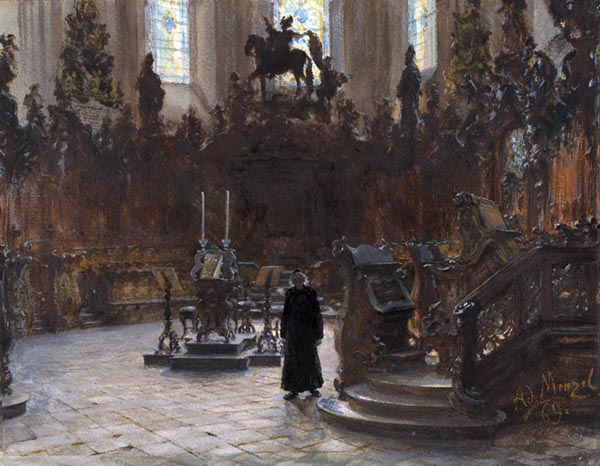
‘The Choirstalls in the Mainz Cathedral’
Adolph von Menzel (German, 1815 - 1905)
Artvee
Translated by A. S. Kline © Copyright 2026 All Rights Reserved
This work may be freely reproduced, stored and transmitted, electronically or otherwise, for any non-commercial purpose.
Conditions and Exceptions apply.
Contents
Letter XXII: Bingen am Rhein
Mainz, September 15th
You scold me in your last letter, my friend, and you are partly wrong and partly right. You are wrong about the church at Épernay, because I did not really write what you thought I had. And yet at the same time you are right, because it seems that I was unclear. You write to me that you have made inquiries about the church at Épernay, that I was mistaken in attributing it to Monsieur Poterlet-Galichet; that Monsieur Poterlet-Galichet, a brave, worthy and honourable bourgeois of Epernay, had nothing to with the construction of the church; and that in addition there are in that town two very distinguished men by the name of Poterlet: an engineer of rare merit, and a young painter full of promise. I subscribe to all this; and I myself knew, ten years ago, a young and charming painter called Poterlet (Hippolyte Poterlet, 1803-1835, not to be confused with his first cousin Pierre Saint-Ange Poterlet, also an artist), who, if death had not snatched him away at the age of thirty-two, would today be regarded as a great talent by the public, as he was, in 1828, by his friends. But I did not say what you thought I said. Reread my letter, the second one, I believe; I do not attribute the church at Épernay to Monsieur Galichet in the least. I simply wrote: ‘The current church appears to me to have been built,’ etc. A comment, in jest, that only applied to the church.
That minor matter settled, I return from Épernay to Bingen. The transition is abrupt and the distance long; but you are one of those intelligent and kindly readers, aware of Necessity, as well as of the laws of Nature, who both grant poets and dreamers their enjambments.
Bingen is a charming and beautiful city, both dark and light in aspect, serious like an ancient city, yet cheerful like a new one, a city which, from Drusus the Younger (14BC-23AD) to the Emperor Charlemagne (c747-814), from the Emperor Charlemagne to Archbishop Willigis of Mainz (940-1011), from Archbishop Willigis to the merchant Montemagno (Richard of Montemagno, a Lombard, was granted permission to remain in the city in 1373), from the merchant Montemagno to the visionary Bartholomew Holzhauser (1613-1658), from the visionary Bartholomew Holzhauser, to the lawyer Hermann Gottfried Joseph Faber (1767-1851), currently reigning in the castle (Burg Klopp, rebuilt 1875-9), on the site where Drusus established a fortress, has gradually agglomerated, house by house, in the Y formed by the Rhine and the Nahe, like dew gathering drop by drop in the calyx of a lily. Excuse me this comparison, which has the defect of being flowery, but which has the merit of being true, and which faithfully represents, and covers all possible examples of, the mode of formation of a city at a confluence.
Everything contributes to making Bingen an antithesis, built in the midst of a landscape that is itself a living antithesis. The town, constrained to the west by the Nahe, and to the north by the Rhine, developed in the shape of a triangle around a Gothic church backed by a Roman fort. In the fort, which dates from the first century and which long served as a hideout for rogue knights, there is a priest’s garden; in the church (Basilica Sankt Martin), which is from the fifteenth century, there is the tomb of that quasi-sorcerer doctor, Bartholomew Holzhauser, whom the Archbishop Elector of Mainz (Johann Philipp von Schönborn) would probably have burned as a soothsayer, if he had not paid him to act as his astrologer. On the side towards Mainz, the east, the famous paradise-plain that opens onto the Rheingau shines, sparkles, and is green with vegetation. On the Koblenz side, the north, the dark mountains of Leyen frown. Here Nature smiles like a fair nymph stretched out naked on the grass; there she threatens like a recumbent giant.
A thousand memories, evoked here by a forest, there by a rock, and elsewhere by some building, mingle and collide in this corner of the Rheingau. Over there, on the right bank of the Rhine, that green hillside is the smiling Johannisberg; at the foot of the Johannisberg, that formidable square keep, which flanks the corner of the strong town of Rudesheim, served as a bridgehead for the Romans. On the summit of the Niederwald, which faces Bingen, at the edge of a marvellous forest, on that mountain which now encroaches on the Rhine, and which in pre-historic times barred its entrance, a small temple (built 1790, destroyed 1944, rebuilt 2006) with white columns, like a Parisian café rotunda, rises above the gloomy and superb Ehrenfels Castle, built in the twelfth century by Archbishop Siegfried II of Mainz, a set of gloomy towers that were once a formidable citadel, and are now a magnificent ruin. The folly dominates, and humbles, the fortress. On the left side of the Rhine, on the Ruppertsberg, which looks out over the Niederwald, and amidst the ruins of the Disibodenberg convent (between the rivers Glan and Nahe), the blessed well dug by Saint Hildegard borders the infamous tower built by Hatto II. Vineyards surround the convent; chasms surround the tower. Blacksmiths have set up shop in the tower, the Prussian Customs Office has moved into the convent. Hatto’s ghost hears the anvil ringing, and Hildegard’s shade watches parcels being sealed.
By a bizarre contrast, the rebellion of Julius Civilis (69AD) which destroyed the bridge of Drusus the Younger; the legions of Julius Tutor (during the Civilis Rebellion); the Normans in 890; the burghers of Bad Kreuznach in 1279; Baldwin of Luxembourg, Archbishop of Trier in 1334; the plague in 1349; the flood in 1458; the quarrels of the Gaugraves, Adolph II of Nassau-Wiesbaden-Idstein and Diether von Isenburg (c1459); the Palatine Bailiff of Kreuznach, Albrecht V Göler von Ravensberg, in 1496; Landgrave William II of Hesse in 1504; the War of the Palatinate Succession (1688-1697) which destroyed the bridge of Archbishop Willigis (in 1689); the Thirty Years’ War; the armies of the French Revolution and the Empire; all the forces of devastation, successively crossed this happy and serene plain, while the most appealing figures of the liturgy and legend, Gela of Gelnhausen; Jutta von Sponheim (Abbess of Disibodenberg); Lioba von Tauberbischofsheim; Guda (the twelfth century nun and illuminator); Gisela, the sweet daughter of Hans Brömser von Rüdesheim; Hildegard, the friend of Saint Bernard; Saint Hiltrude of Liessies, the penitent of Pope Eugene, all inhabited these sinister rocks in turn. The smell of blood still haunts the plain, the perfume of saintliness and beautiful lives still veils the mountains.
The more you examine this lovely place, the more the antithesis intensifies before your eyes and in your mind. It exists in a thousand forms. The instant the waters of the Nahe flow beneath the arches of the stone bridge, on the parapet of which the lion of Hesse turns his back to the eagle of Prussia, which leads the Hessians to say that he disdains to recognise them, and the Prussians to say that he is afraid; at that instant, I say, when the waters of the Nahe, flowing calmly and slowly, from Mont Tonerre (the Donnersberg), emerge from beneath the bridge which forms a boundary, the bronze-green arm of the Rhine suddenly seizes the blonde and indolent river, and plunges it into the Bingerloch. What is wrought in the abyss is the gods’ affair. But it is certain that Jupiter never delivered a sleepier naiad to a more violent river.
The church of Bingen is washed in grey, both inside and out. Which is absurd. Yet I declare that the abominable restorations now being carried out in France will eventually reconcile me to whitewashing. In passing, I know of nothing in this line more deplorable than the restoration of the Abbey of Saint-Denis, now completed, alas, or the restoration of Notre-Dame de Paris, which is being sketched out at this moment. I will return one day, you may be sure, to those two barbaric operations. I cannot help feeling a sense of personal shame when I think that the first was carried out on my doorstep, and the second is taking place in the very heart of Paris. We are all guilty of this dual architectural crime, by our silence, tolerance, and inertia, and it is upon us and our contemporaries that posterity will one day rightly lay the blame, and against us that it will express its indignation, when, in the presence of two disfigured, debased, parodied, mutilated, disguised, dishonoured, and unrecognisable buildings, it will ask us to account for those two admirable basilicas, beautiful among beautiful churches everywhere, illustrious among illustrious monuments everywhere, one which was the metropolis of royalty, the other which is the metropolis of France. Let us bow our heads in advance. Such restorations are tantamount to demolition.
Whitewashing, on the other hand, is content to be merely stupid. It does not in itself commit devastation. It dirties, glues, soils, flours, tattoos, it ridicules, it uglifies; but does not destroy. It accommodates the thoughts of the architect Cesare Cesariano (who wrote a commentary on Vitruvius and worked on the Duomo in Milan), or Erwyn von Steinbach (the thirteenth century architect of Strasbourg Cathedral) as it does the face of Gautier-Garguille (the stage name of Hugues Guéru, the seventeenth century comic actor); it places a plaster mask thereon. Nothing more. Cleanse the long-suffering facade, plastered with white, yellow, pink, or grey, and you will find the venerable face of the church alive and well.
To seat oneself at the summit of Burg Klopp, around sunset, and from there look down on the city at its foot, and around at the immense horizon; to see the mountains darken, the chimneys emit smoke, the shadows lengthen, and the landscape evoke Virgil’s lines; to breathe, in the same breath, the breeze from the trees, the breath of the river, the mountain air, and the town’s exhalations, when the weather is warm, the season mild, and the evening fine, is an intimate sensation, exquisite, inexpressible, full of little secret pleasures concealed by the grandeur of the spectacle, and the depth of one’s contemplation. At the attic windows, young girls sing, their eyes lowered on their work; the birds trill gaily in the ruin’s ivy, the streets teem with people, and the sound of those people is one of work and happiness; boats pass on the Rhine, oars can be heard cutting the waves, and sails shiver; doves fly around the church; the river shimmers, the sky pales; and a horizontal shaft of sunlight crimsons the distant dust clouds on the ducal road from Rüdesheim to Biberach, and makes the express carriages sparkle, and seemingly flee in a golden cloud, borne along by four stars. The washerwomen of the Rhine spread their sheets over the bushes; the washerwomen of the Nahe beat their laundry, and go to and fro, bare-legged and with wet feet, on the rafts made of fir-tree trunks moored at the water’s edge, and laugh at some tourist sketching the Ehrenfels. The Maüseturm, standing in the midst of this joy, steams in the shadow of the mountains.
The sun sets, evening comes, night falls, the roofs of the town become one roof, the mountains gather themselves into a single mass of darkness into which the pale clear waters of the Rhine sink and are lost. Crepe-like mists rise slowly from the horizon to the zenith; the little steamboat (dampfschiff) from Mainz to Bingen arrives to take up its nocturnal station alongside the quay, opposite the Hotel Victoria; the washerwomen, their bundles on their heads, return home along the sunken lanes; the sounds die away, the voices fall silent; a last pink glow, which resembles the reflection of the other world in the pale face of a dying man, colours, for a little while longer, Burg Ehrenfels, pale, decrepit, and gaunt, on the top of its rocky outcrop, Then it too fades — and Hatto’s tower, almost unnoticed a couple of hours before, suddenly seems to grow taller, and take possession of the landscape. Amidst the reverberations of the forge, its cloud of smoke, which was dark in daylight, now reddens little by little, and, like the soul of a villain plotting revenge, grows luminous as the sky grows blacker.
I was, a few days ago, on the platform of Burg Klopp, and, while all this dreamy reverie was taking place around me, had allowed my thoughts to drift I know not where, when a little window suddenly opened in a house below my feet, a candle shone, a young girl leant on the window, and I heard a fresh, clear, pure voice — the voice of that young girl — singing this verse to a slow, sad, plaintive tune:
‘Plas mi cavalier frances,
E la dona catalana,
E l’onraz del ginoes,
E la court de castelana,
Lou contaz provencales,
E la danza trevizana,
E lou corps aragones,
E la perla Julliana,
La mans a kara d’angles,
E lou donzel de Toscana.’
‘I’m pleased by a French cavalier,
And a Catalonian lady;
Hold Genoese courtesy dear,
And Castilians, so courtly;
Provençal songs, I love to hear,
Treviso’s dances, delight me.
And how the Aragonese appear,
And the pearl, Giuliana, truly,
An English hand and face, so clear,
And a squire from Tuscany, highly.’
I recognised those joyful lines penned by Frederick Barbarossa, and I cannot tell you what effect it had on me, that emperor’s poem transformed to a popular air, that knight’s chant to a young girl’s song, those Roman rhymes in a German mouth, the gaiety of times past changed to melancholy, the bright light of the Crusades piercing the shadow of the present and, suddenly, shedding its light on me, a poor, terrified dreamer, in a Roman ruin transformed to a lawyer’s candlelit villa, amidst the darkness, four hundred yards or so from the Mäuseturm transformed to a locksmith’s workshop, four paces from the Victoria Hotel, ten from a steamboat jetty.
And, since I am speaking of the music I happened to hear on the banks of the Rhine, why not say that at Braubach, as our steamboat was mooring at the quayside to allow the passengers to disembark, a group of students, seated on a fir-tree log, lost from some raft belonging to the River Murg, sang in chorus, in German, Quasimodo’s admirable aria, one of the most lively and original adornments of Mademoiselle Louise Bertin’s opera (‘La Esmerelda’, 1836, based on his novel ‘Notre-Dame de Paris’, 1831). The future, I have no doubt, my friend, will restore that severe and remarkable work, savaged at its first appearance with such violence, and proscribed with such injustice, to its rightful place. The public, too often abused by the hateful uproar arising round all great works, will finally revise that passionate burst of criticism, unanimously fulminated by political parties, musical rivalry, and literary cliques, and will one day be able to admire its sweet and profound music, so full of pathos and strength, so graceful in places, so painfully moving at times; a creation in which are mingled, in each musical phrase, so to speak, what is most tender and what is most serious, the heart of a woman, and the mind of a thinker. Germany already does it justice, France will soon do so.
As I am a little wary of exploitative local curiosities, I confess I chose not to go and see the miraculous ox- horn, nor the nuptial bed, nor the iron chain borne by old Hans Brömser von Rüdesheim. On the other hand, I visited the square keep of Rüdesheim (Brömserburg), inhabited at the present time by an intelligent owner (the Count of Ingelheim) who was aware that this ruin had to retain its ruined state, so as to retain the air of a palace. Buildings are like the gentry, the older they are the nobler. What an admirable manor-house that square keep represents! Roman cellars, Roman walls, a Knights’ Hall, whose table is lit by a candelabra like the one above Charlemagne’s tomb (the Barbarossa candelabra), Renaissance stained-glass windows, nigh-on Homeric mastiffs barking in the courtyard, thirteenth-century iron lanterns on the walls, narrow spiral staircases, dungeons whose depths are fearful, sepulchral urns arranged in a kind of ossuary, a whole collection of dark and terrible things, at the summit of which blossoms an enormous tuft of flowers and greenery. These are the thousand plants covering the ruins that this current owner, a man of true taste, maintains, thickens, and cultivates. They form a fragrant and bushy terrace, from which one may contemplate the magnificence of the Rhine. There are paths allowing one to walk through this monstrous bouquet. From a distance it forms a coronet, from close-to a garden.
The hills of Johannisberg shelter this venerable keep, and protect it from the north-winds, while warm southerlies enter through the windows opening onto the Rhine. I know of no breeze more charming, no wind more literary than a southerly. It makes happy, profound, serious, and noble ideas germinate in one’s head. By warming the body, it seems to also enlighten the mind. The Athenians, who knew what they were doing, expressed this thought in one of their most ingenious sculptures. In the bas-reliefs of the Tower of the Winds (in the Roman agora in Athens), the ice-cold winds are hideous and hirsute, with a stupid air, and are dressed like barbarians; the gentle, warm winds are dressed as Greek philosophers.
At Bingen, I sometimes saw, at the far end of the room in which I dined two very differently set tables. At one a fat Bavarian major sat, all alone, who spoke a little French, and every day watched a real and complete five-course German dinner pass before him, close enough to touch. At the other table, a poor wretch was leaning, in melancholy fashion, over a dish of sauerkraut, and who, after eating his meagre meal, finished by devouring with his eyes his neighbour’s gargantuan feast. I have never witnessed a better example of the vivid parable provided by those words of Nicolas Perrot d’Ablancourt: ‘Providence cheerfully creates wealth on one side, and appetite on the other.’
The poor wretch was a young scholar, pale, serious, and bearded, very fond of entomology and a little in love with a maid at the inn, which is a scholarly taste. However, a scholar in love always presents me with a problem. How does passion exist, with its turmoil, anger, jealousy and time-wasting, amidst a calm sequence of precise studies, cold experiments, and meticulous observations which composes the life of the scholar? Can you imagine passion, for example, in the mind of John Huxham, the doctor, who in his beautiful treatise Aere et Morbis epidemicis recorded, month by month, from 1728 to 1738, the amount of rain that fell in Plymouth, and the occurrence of epidemics, for ten consecutive years?
Can you imagine Romeo, with his eye to a microscope, counting the four thousand facets of a fly’s eye; or Don Juan, in a serge apron, analysing antimony paratartrate (tartar emetic) or potassium bitartrate (cream of tartar); or Othello, bent over a high-power lens, looking for species of Galionella (bacteria) or Diatomophyceae (algae) in fossilised flour from China?
However, despite all theories to the contrary, my entomologist was in love. He conversed sometimes, spoke better French than the major, and had a noble system for describing the world about him, but was penniless. I like systems, though I don’t much believe in them. René Descartes dreams, Christiaan Huyghens amends Descartes’ dreams, Edme Mariotte amends Huyghens’ amendments. Where Descartes sees starry objects, Huyghens investigates microscopic globules, and Mariotte observes pinprick-sized points in the retina. What is proven in all this? Nothing but the limitations of Mankind and the greatness of God. That is something of note. But, all things considered, I like systems. Systems are the ladders by which we ascend to truth.
Sometimes my young scholar would drink a bottle of beer at the table d’hôte; I took a newspaper, sat down in the embrasure of a window and watched him. The table d’hôte at the Hotel Victoria was very mixed and very unharmonious, like every juxtaposition created by chance. At the top of the table sat an oldish English lady with three pretty children. A duenna rather than a nurse; an aunt rather than a mother. I felt very sorry for the poor little ones. The good lady’s hand was a basket full of slaps. The major sometimes dined next to the lady to whet his appetite. He was talking with a Parisian lawyer on holiday, who was going to Baden-Baden because, he said, one must go there, everyone goes there. Near the lawyer, sat a noble and worthy gentleman with white hair, more than eighty years old, who had the gentle air that comes from having one foot in the grave, and readily quoted verses from Horace. As he had no teeth, the word mors (death) in his pronunciation changed to mox (soon): which in this old man’s mouth had, thus, a melancholy meaning.
Opposite the old man sat a gentleman who wrote poetry in French, and who one day read to his neighbours, after a few drinks, a dithyramb in free verse about Holland, in which he spoke pompously of the ‘harangues’ that come out of the sea. ‘Harangues’ from the sea! I confess that, for my part, I have scarcely ever seen anything but herrings emerge.
The whole was completed by two large merchants from Alsace, enriched by smuggling weasel-skins, who are electors and jurors these days, and who smoked their pipes while telling each other the same stories over and over. When they had finished them, they began the whole series again. As they had invariably forgotten the names of the people they were talking about, one said Monsieur Thing, and the other Monsieur Machine. They understood each other perfectly.
The writer of verse —the poet, if you will — was a classical, philosophical, constitutional, ironic, Voltairean fellow, who took pleasure in undermining, so he said, prejudice, that is to say, in insulting, while repeating commonplace objections regarding them, past things, many of them serious, mysterious, and holy that other folk respect. He liked to strike, it was his expression, great lance-blows against human error; and, though he never chanced to attack the real windmills of this century, he gaily called himself Don Quichotte (Don Quixote). I called him Don Quichoque (Don Qui-Shock, i.e. one who gives offence).
Sometimes the poet and the lawyer, though born to get along, quarrelled. The poet, to complete my portrait of him, was an unintelligible author, troubled in mind about everything, one of those people with an impediment of sorts, who stammer when speaking, and scribble when writing. The lawyer crushed him with his show of superiority. Sometimes the poet was transported, and angered the other. Then the irritated lawyer would talk for two hours, with a clear, limpid, flowing, transparent, inexhaustible eloquence, as my fountain’s tap speaks when the cap is on askew. When this occurred, the entomologist, a man of wit, amused himself, in turn, by crushing the lawyer. He spoke extremely well, was admired by the rest, and from time to time glanced sideways to see if the pretty maid was listening to him.
One day he had very pertinently held forth on the subject of virtue, resignation, and renunciation; having not eaten. Now, philosophy is a meagre supper when one has no sauce with which to dress it. I invited him to dinner, and, although he could hardly have guessed, from the two or three words I had spoken, what country I was from, he willingly accepted. We conversed. He took a liking to me, and we made a few excursions together to the Maüseturm and to the right bank of the Rhine. I paid the boatman’s fee.
One evening, as we were returning from Hatto’s tower, I asked him to have supper with me. The major was at the table. My learned companion had found a beautiful scarab-beetle on the island with an azure breastplate, and, while showing it to me, he said: ‘Nothing is as fine as the sagres bleus (blue Sagra beetles). At this, the major, who was listening, could not help interrupting him: – ‘By Jove, sir!’ he said, sacrebleus (swearwords) are useful sometimes for making soldiers march and horses gallop, but I don’t see what’s so fine about them.’
That is the sum total of my adventures in Bingen. As for the rest, though the town is not large, it is one of those where the flood of tips I described elsewhere, is to be distributed widely, from the doorman to the boatman, the boatman to the guide, the guide to the maid, the maid to the innkeeper, at the end of which the unfortunate traveller’s purse is wholly plundered, flattened, and empty.
By the way, since Bacharach, I am done with thalers, silbergrossen, and pfennigs, and have progressed to florins and kreutzers. The mystifications are redoubled. This, if one ventures into a shop, is an example of one’s conversation with the tradesman: ‘How much is this?’ The merchant replies: ‘Sir, one florin fifty-three kreutzers.’ — ‘Please explain more clearly.’ — ‘Monsieur, that makes one thaler, and two gros, and eighteen Prussian pfennigs.’ — ‘I beg your pardon, I still don’t understand. And in French money?’— ‘Monsieur, one florin is worth two francs three sous, and one centime; one Prussian thaler is worth three francs and three quarters; one silbergrossen is worth two and a half sous; one kreutzer is worth three-quarters of a sou; one pfennig is worth three-quarters of a liard.’ So, I reply like Don Caesar (Don César de Bazan, a character in Hugo’s play Ruy Blas) whom you know of: ‘That’s perfectly clear’, and open my purse at random, trusting in the ancient god of honesty, at whose altar the Ubians perhaps worshipped, the altar which Tacitus speaks of. Ara Ubiorum.
Mystification is rendered still more complete by the effects of pronunciation. Kreutzer is pronounced creusse among the Hessians, criche among the Badeners, and cruche in Switzerland.
Letter XXIII: Mainz (Mayence)
Mainz, September
Mainz and Frankfurt, like Versailles and Paris, are now one and the same city. In the Middle Ages there were twenty-six miles between the respective cities, that is to say, two days travel; today an hour and a quarter separate them, or rather join them together. Between the Imperial city and the Electoral city, our civilisation has laid that link that we call a railway. A charming railway, which borders the River Main at times, crosses a rich, and vast, green plain, without viaducts, tunnels, cuttings or embankments, with simple wooden sleepers under the rails; a railway that the apple trees shade paternally as if it were a village path; which is exposed, lacking ditches or gates, and being all on the one level, to the saturnine good nature of German children, and along which an invisible hand seemingly presents the orchards, gardens and cultivated fields, one after another, and then hastily removes them, pushing them pell-mell into the depths of the landscape, like pieces of fabric disdained by the buyer.
Frankfurt and Mainz are, like Liège, admirable cities ruined by good taste. I know not what corrosive attraction pallid architecture, plaster colonnades, churches like theatres, and palaces like dance-halls have; but it is a fact that all the ancient cities are melting and dissolving rapidly into these dreadful piles of white houses. In Mainz, I had hoped to see the Martinsburg, the feudal residence of the Archbishop Electors until the seventeenth century; we French had turned it into a hospital, the Hessians razed it (in 1806/7) to enlarge the free port. As for the Merchants’ Hotel, built by the famous league of a hundred cities (the Rhine League out of which the Hanseatic League developed), splendidly decorated with stone statues of the seven Electors bearing their coats of arms, below which two colossal figures supported the shield of the empire, it was demolished to create space. I was planning to stay opposite, in the Three Crowns Inn (Zu den Drei Kronen), opened in 1360 by the Cleemann family, and undoubtedly the oldest inn in Europe; I was expecting one of those inns as described by the Chevalier de Gramont (Michel de Gramont, the privateer), with a vast dining room with pillars and joists, an immense fireplace the front wall of which is nothing but a leaded window, and outside a mounting-block for mule-riders. I chose not to enter. The old Cleemann inn is now a kind of fake Hôtel Le Meurice (on the Rue de Rivoli, opened in 1835 by Charles-Augustin Meurice, and designed to appeal to English travellers), with imitation-stone cardboard rosettes on the ceilings, and at the windows that luxury of draperies and poverty of curtains which characterise German inns.
Someday, Mainz will do to the house of Buona Monte (Guten Berg in German! Gutenburg Court, Hof zum Gutenberg, the fourteenth century house where Johannes Gutenberg was probably born, was located at the corner of what is now Schusterstrasse and Christophsstrasse. Destroyed in 1636 during the Thirty Year’s War, it was rebuilt in 1661, and destroyed by fire in 1894) and to the house Zum Jungen (at Mailandgasse 3, built after 1250, destroyed in 1945, demolished in 1948), what Paris has done to the venerable buildings of Les Piliers des Halles (arcade shops on the Rue de la Tonnellerie dating back to the thirteenth century of which the last pillars disappeared when the Rue du Pont Neuf was built in 1866). The paternal roof of Johannes Gensfleisch zur Laden zum Gutenberg, gentleman of the Elector Adolphe of Nassau’s court (Johannes was made a ‘Hofman’, in 1465) whom posterity knows simply by the name Gutenberg, just as it knows Jean-Baptiste Poquelin, valet of the chamber of King Louis XIV by the name Molière, will be destroyed, and replaced by some wretched facade adorned with a wretched bust. However, the old churches still defend what surrounds them; and it is around its cathedral that one must seek to discover Mainz, just as it is around its collegiate church that one must seek to discover Frankfurt.
Cologne is a Gothic city still lingering in the Romanesque period; Frankfurt and Mainz are Gothic cities already immersed in the Renaissance, and even, in many ways, the Rococo and Chinese style. Hence, as regards Mainz and Frankfurt, an air of the Flemish cities distinguishes them, almost uniquely, among the cities of the Rhine.
In Cologne, one senses that the breath of the austere builders of the Cathedral, Master Gerhard, Master Arnold, and Master Johann, has long filled the entire city. Those three mighty shades have seemingly watched over Cologne for four centuries, protecting the Church of Plectrude (Sankt Maria im Kapitol; Plectrude was the wife of Pepin of Herstal), the church of Saint Anno (the Apolstelkirche), the sarcophagus of Theophanu (of the Holy Roman Empress Theophanu, wife of Otto II, in Sankt Pantaleon), and the golden chamber of the eleven thousand virgins, preventing the exercise of false taste, barely tolerating the almost classical imaginings of the Renaissance, preserving the purity of the ogives and archivolts, weeding out the chicory-leaf (acanthus-leaf) ornamentations of Louis XV wherever they ventured to appear, maintaining the lines of the carved gables, and the severe mansions, of the fourteenth century in all their vivacity; and only withdrew, like the lion before the ass, in the presence of the stupid and abominable ideas of the Parisian architects of the Empire and Restoration. In Mainz and Frankfurt, the Rubens-inspired architecture, the swollen and powerful lines, the rich Flemish capriciousness, the dense and inextricable flourishes of those iron grilles laden with flowers and animals, the inexhaustible variety of the corners and turrets; the phenomenal colours of the stonework; the plump, pot-bellied, opulent outlines, possessing more health than beauty; the masks, the tritons, the naiads, the dripping dolphins, all that ample and robust pagan sculpture; the enormous, hyperbolic and exorbitant ornamentation; that whole magnificent display of bad taste, invaded the city at the beginning of the seventeenth century, and has since plumed and garlanded, in accord with its whimsical poetry, the old and grave German masonry. While, everywhere there are historiated, decorated shop-fronts, with braided and interlaced ornamentation, complex pediments, fire-vases, pomegranates, pine-cones, cippi and rocailles, offering crayfish-pyramid profiles, and voluted gables possessing three rows of hammer-curls like the ceremonial wig of Louis XIV.
From a bird’s eye view, Mainz and Frankfurt, the one on the Rhine, the other on the Main, having a similar position to Cologne, necessarily have similar layouts. The pontoon bridge at Mainz engendered Kastel on the opposite bank, as the stone bridge at Frankfurt engendered Sachsenhausen, and as the Cologne bridge, engendered Deutz.
Mainz Cathedral (Saint Martin’s), like those of Worms and Trier, lacks a façade, and terminates at each end in a choir. These two Romanesque apses, each with its own transept, face each other and are joined by a large nave. It is as if two churches were welded to one another to form the one. The layout is that of two crosses touching and blending at the base. This geometric arrangement generates in elevation six campaniles, that is to say on each apse a large bell-tower between two turrets, like the priest between the deacon and the subdeacon, symbolism which is displayed, as I have said elsewhere, in the large rose windows of our cathedrals between their two side ribs.
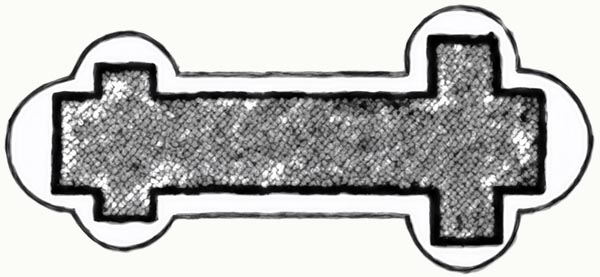
The two apses which unite to form the cathedral of Mainz are from two different periods, and, although almost identical in geometric design, except for dimensions, present, as buildings, a complete and striking contrast. The first, and smaller, western one dates from the tenth century. Begun 975/6, it was inaugurated, and damaged by fire, in 1009. The second, eastern chancel, whose large bell tower is two hundred feet high, was begun soon after, but was burned down in 1081; following the rebuilding, each century has added its stone. A hundred years ago, the reigning architectural style invaded the dome; the flora of Pompadour architecture inserted its jets of stone, its frills, and its foliage alongside the Byzantine dentils, Lombard lozenges, and Saxon round arches, and today this odd, grimacing ‘vegetation’ clothes the old apse. The large main bell-tower, a wide, squat cylinder, ample at its base, superbly laden with three rich fleur-de-lis diadems whose diameters decrease from its base to its summit, carved everywhere with roses and facets, seems rather built with precious stones than common ones. On the other large tower, grave, simple, Romanesque and Gothic, which faces it, modern masons erected, probably for economy, a similarly conical dome, supported at its base on a circle of pointed gables resembling the iron crown of the Lombard kings, a zinc cupola, perfectly bare, without gilding and without ornament, with a slightly swollen profile, which recalls the ancient pontifical headdress of primitive times. The appearance of the pair of bell-towers is akin to that of the severe tiara of Gregory VII facing the splendid double-circlet tiara of Boniface VIII. Nobly devised, ordered, built, and sculpted there by Time and Chance, those two great architects (note that a neo-Romanesque tower was erected in place of the eastern cross-tower in 1875).
This entire venerable ensemble is painted pink; everything, from top to bottom, the two apses, the great nave and the six bell-towers. The thing was done with care and taste. Pale pink was awarded to the Romanesque bell tower, and bright pink to the Pompadour bell tower.
Like the chapel at Aix, the bronze doors of Mainz cathedral are decorated with lions’ heads; those at Aix-la-Chapelle are Roman. When I visited Aix and viewed those doors, I searched in vain, as you will remember, for the split in them that the Devil’s kick had made, so it is said, when he departed in a rage at having swallowed the soul of a wolf instead of the soul of a bourgeois shop-keeper. No such story is associated with the doors of the Mainzer Dom. They are from the early eleventh century, and originally donated by Archbishop Willigis to the now-demolished (1803-7) church of Our Lady (Sankt Mariengraden), from which they were taken, and then set in the majestic Romanesque portal of the cathedral. On the two upper doors are written, in Roman characters, the privileges granted to the city in 1135 by Archbishop Adalbert (Adalbert I von Saarbrücken), second elector of Cologne. Below is engraved on a single line this older legend:

(‘Archbishop Willigis was first to effect doors made of metallic substance, i.e. bronze’)
If the centre of Mainz recalls Flemish cities, the interior of its cathedral recalls Belgian churches. The nave, the chapels, the two transepts, and the two apses lack stained glass and mystery, being whitewashed from the pavement to the vault, though sumptuously furnished. On all sides loom frescoes, paintings, woodwork, and twisted and gilded columns; but the true jewels of this immense edifice are the tombs of the Archbishop Electors. The church is paved with them, the altars are made of them, the pillars are supported with them, the walls are covered with them; they are magnificent slabs of marble and stone, sometimes more precious in their sculpture and workmanship than the golden slabs of Solomon’s temple. I found, both in the church and in the chapter house and cloister, one tomb from the eighth century, two from the thirteenth, six from the fourteenth, six from the fifteenth, eleven from the sixteenth, eight from the seventeenth, and nine from the eighteenth; in all forty-three sepulchres. Among this number I count neither the altar-tombs, difficult to approach and explore, nor the pavement-tombs, a dark and confused funereal mosaic, abraded more and more, day by day, beneath the feet of visitors. I also omit four or five insignificant tombs from the nineteenth century.
All these tombs, except five, are the graves of archbishops. Of these thirty-eight cenotaphs, distributed without chronological order, as if at random, among a forest of Byzantine columns with enigmatic capitals, the art of six centuries develops, vegetates, and inextricably intertwines its branches, from which, like dual fruit, falls the history of thought, at the same time as the history of events. There, Liebenstein, Homburg, Gemmingen, Heufenstein, Brandenburg, Steinburg, Ingelheim, Dalberg, Eltz-Kempenich, Stadion, Weinsberg, Ostein, Leyen-Hohengeroldseck, Hennenberg-Römhild, Thurn-und-Taxis, almost all the great names of Rhineland Germany, appear within the sombre radiance these tombs spread in the darkness of the church. All the fantasies of the period, of the artist and of the dying, mingle with the epitaphs. The mausoleums of the eighteenth century, half-open, have allowed their skeletons to escape, bearing in long, fleshless fingers archbishops’ mitres and electors’ hats. Archbishops who were contemporaries of Richelieu and Louis XIV dream as they recline, at the foot of their sarcophagi, leaning on their elbows. The arabesques of the Renaissance display their hanging tendrils and perched monsters amidst the delicate foliage of the fifteenth century, and reveal, amidst a thousand charming decorations, statuettes, Latin couplets, and coloured coats of arms. Severe names, Mathias Burhecg, Conradus Rheingraf (Conrad, Count of the Rhine), are inscribed, between a tonsured monk who represents the clergy and a morioned man-at-arms who represents the nobility, beneath a pure equilateral triangle of an ogive of the fourteenth century; while on a painted and gilded slab of the thirteenth century, gigantic archbishops, with apocalyptic monsters beneath their feet, crown, with both hands, kings and emperors less than themselves. It is in this haughty attitude that Archbishops Siegfried III von Eppstein, who crowned two emperors, Henry of Thuringia and William II of Holland; and Peter von Aspelt, who crowned two emperors and a king, Louis of Bavaria, Henry VII, and John of Bohemia, stare at you with the eyes of an Egyptian mummy. An abundance of coats of arms, heraldic mantles, mitres, crowns, electoral hats, cardinal’s hats, sceptres, swords, crosiers, are piled higher and higher on these monuments, and strive to recreate, for the eyes of passers-by, that great and formidable figure, who presided over the nine Electors of the German Empire, and was called the Archbishop of Mainz. A chaos, half-submerged in the shadows, of august or illustrious objects, of venerable or formidable emblems, from which these powerful princes wished to conjure the idea of grandeur and which merely conjure thoughts of nothingness.
A remarkable thing, which proves to what extent the French Revolution was an act of providence, the necessary and, so to speak, algebraic, result of the whole ancient European effort, is that everything it destroyed was destroyed forever. It arrived at the appointed hour, like a woodcutter in haste to finish his work, and felled swiftly and pell-mell all the ancient trees mysteriously marked by the Lord. One feels, as I believe I have already indicated somewhere, that it had within it the quid divinum (divine inspiration). Nothing that it razed rose again, nothing that it condemned survived, nothing that it undid was restored. And let us observe here that the life of states is not suspended by the same thread as that of individuals; it is not enough to strike at an empire to kill it; one can only kill cities and kingdoms when they are about to die. The French Revolution touched Venice, and Venice fell; it touched the German Empire, and the German Empire fell; it touched the Electors, and the Electors vanished. In the same year, the great abyssal year of 1793, the King of France, a man well-nigh treated as a god, and the Archbishop of Mainz, a priest well-nigh treated as a king, were swallowed up.
The Revolution neither extirpated nor destroyed Rome, because Rome has no foundations, but roots; roots which are constantly growing, in the shadows beneath Rome and beneath all nations; which traverse and penetrate the entire globe from one end to the other; and which we see reappearing at this very moment in China and Japan, on the far side of the earth.
The Jean de Troyes (author of The Memoirs of Philip De Commines) of Cologne, namely Gottfried Hagen, clerk of the city in 1270, recounts, it is said, in the manuscript of his ‘little’ chronicle (‘Reimchronik der Stadt Köln aus Dem Dreizehnten Jahrhundert’), unfortunately torn apart during the French occupation and of which only a few mismatched pages remain in Darmstadt, that during the reign of that same Archbishop of Mainz Siegfried II, whose tomb is such a formidable presence in the cathedral, an old astrologer named Mabusius was condemned to the gallows as a sorcerer and soothsayer, and led to die on the stone gallows of Lorchhausen, which marked the boundary of the Archbishop of Mainz, facing another gallows which marked the boundary of the Count Palatine. On arriving there, since the astrologer refused the crucifix and persisted in calling himself a prophet, the monk who accompanied him mockingly asked him in what year the line of Archbishops of Mainz would end. The old man asked that his right hand be untied, which was done; then he picked up a gallows nail that had fallen to the ground, and, after reflecting for a moment, engraved with this nail, on the face of the gallows that looked towards Mainz, this singular polygram:
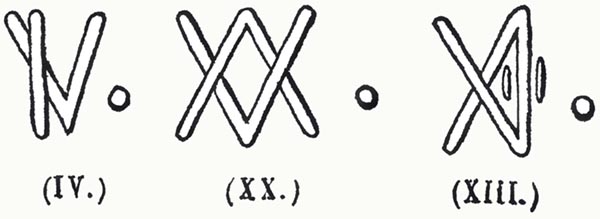
After which he delivered himself up to the executioner, while the bystanders laughed at his madness and the enigma. Today, by combining the three mysterious numbers written by the old man, one can unlock the meaning of that formidable figure: ninety-three (‘quatre-vingt-treize’, four times twenty, plus thirteen).
It is to be noted that the menacing gallows which, since the thirteenth century, had borne on its sinister plinth the date of the fall of empires, bore at the same time a condemnation of itself, and the date of its own collapse. The gallows were emblems of the old power. The French Revolution no more respected the permanence of gallows than the permanence of dynasties. Just as nothing is made of marble any longer, nothing is made even of stone. In the nineteenth century, the scaffold too lost its majesty and grandeur; it is now made of fir-wood, like the throne.
Like Aix-la-Chapelle, Mainz had a bishop (Joseph Ludwig Colmar), one only, who was appointed by Napoleon, and a worthy and respectable pastor, it is said, who sat from 1802 to 1818, and who is buried, like the others, in what was his cathedral. However, it must be admitted that in the presence of the majestic nothingness of the archiepiscopal electors of Mainz, the nothingness of Monsieur Louis Colmar, bishop of the department of Mont-Tonnerre, in his ogival tomb in the ‘troubadour’ style, which would be an admirable model of a Gothic clock for the rich bourgeois of the rue Saint-Denis, if a dial had been set there instead of a bishop, seems diminished and impoverished. Moreover, as I said just now, this puny bishop, whose only greatness was that of being a Revolutionary instrument, ended the line of sovereign archbishops. Since Monsieur Louis Colmar, there has only been the one bishop in Mainz, today the capital of Rhenish Hesse.
I also found there, in the cathedral, an Arcadian pair of brother archbishops, buried opposite each other, after having reigned over the same people, and governed the same souls, one dying in 1390, and the other in 1420. Johann II and Adolph I von Nassau gaze at each other in the nave of Mainz as do Adolph II and Anton von Schauenburg in the choir at Cologne.
I said that one of the forty-three tombs was from the eighth century. This monument, which is not that of an archbishop, is the one I sought first and which detained me the longest, because it was coupled in my mind with the great sepulchre of Aix-la-Chapelle. It is the tomb of Fastrada, wife of Charlemagne. Fastrada’s tomb is a simple slab of white marble now set in the wall. I deciphered the epitaph, written in Roman letters with Byzantine abbreviations:
FASTRADANA PIA CAROLI CONIVNX VOCITATA
CHRISTO DILECTA IACET HOC SVB MARMORE TECTA
ANNO SEPTENGENTESIMO NONAGESIMO QVARTO
Then come these three mysterious verses:
QVEM NVMERVM METRO CLAVDERE MVSA NEGAT
REX PIE QVEM GESSIT VIRGO LICET HIC CINERESCIT
SPIRITVS HÆRES SIT PATRIE QVÆ TRISTIA NESCIT
‘The pious wife of Charles, named Fastrada,
Beloved of Christ, lies here beneath the marble lid,
In the year seven hundred and ninety-four,
Which number the Muse refuses to enshrine in metre.
Pious king, whom these ashes bore, grant that
Her spirit be heir to a land free of tribulation’
And below, the year in Arabic numerals:

It was in 794, in fact, that Fastrada, buried first at Saint Alban’s Abbey, slept the sleep of death beneath the slab. After the destruction of the Abbey in 1552, her tombstone was transferred to Mainz Cathedral, A thousand years later, in 1794, for history sometimes repeats great things, with fearful, almost geometric, precision, the companion of Charlemagne awoke. Her old town of Mainz was under siege; her church of Saint Alban was bathed in flames; her tomb lay open. It is not known what became of her bones. Today a poor old Swiss in an aventurine wig, dressed in a sort of invalid’s uniform, recounts all this to passers-by.
In addition to the tombs, the statuettes on plinths, the triptych paintings with gold backgrounds, and the altar bas-reliefs, each of the two apses has its own special furnishings. The old apse from 975/6, adorned with two charming Romanesque staircases, curves around a magnificent bronze baptismal urn from the fourteenth century. On the exterior of this vast basin are sculpted the twelve apostles and Saint Martin, patron saint of the church. The cover was broken during the siege. During the Empire, a period of taste, the Gothic basin was topped with a sort of large saucepan lid.
The western apse, the largest and least ancient, is occupied, cluttered so to speak, by a large choir panelled in black oak, in which the tormented and furious style of the eighteenth century is deployed, which defies the straight line with such violence, that it almost attains beauty. Never has a more delicate chisel, a more powerful fantasy, a more varied invention been placed at the service of bad taste. Four statues, those of Crescens, the legendary first bishop of Mainz c. 80AD; of Saint Boniface, the first archbishop in 755; of Willigis, first Elector in 1011, and Bardo, founder of the Dom in 1050, stand gravely on the perimeter of the choir, dominated, above the archbishop’s Asiatic canopy, by the equestrian group of Saint Martin and the Beggar (erected 1769). At the entrance to the choir, displaying all the mysterious pomp of the Hebrew High Priests, stand Aaron, who represents the bishop within, and Melchizedek, who represents the bishop without. The archbishop of Mainz, like the Bishop Princes of Worms and Liège, the Archbishops of Cologne and Trier, and the Pope himself, unites in one person the dual pontiff. He is both Aaron and Melchizedek.
The chapter house, which adjoins the choir, and which, with its splendid Pompadour joinery-work, echoes the contrast between the two large bell-towers, is a dark and superb Romanesque Hall. There is nothing but a large bare wall; a dusty pavement dented by the reliefs of tombs; a remnant of stained glass in the lower window; a coloured tympanum depicting Saint Martin, not as a Roman horseman but as the Bishop of Tours; three large sculptures from the sixteenth century, representing the Crucifixion, the Exit from the Tomb, and the Ascension; a stone bench lining the walls for the canons; and at the back, for the presiding archbishop, a large stool also in stone, which recalls the severe marble chair of the first popes that is displayed at Notre-Dame des Doms in Avignon. Leaving this hall, one enters the fourteenth-century cloister, which has always been an austere place and is today a gloomy one. The result of the bombardment of 1794 is evident everywhere. Tall, damp grasses, among which stones silvered by the saliva of reptiles are mouldering; ribbed arcades with broken windows; tombs cracked by incendiary shells like panes of glass; stone knights fully armed, blasted head on by bomb fragments and retaining nothing but a scar for a face; old women’s rags hung to dry on a line; plank partitions patching granite walls here and there; a gloomy solitude, a profound despondency broken only by the intermittent croaking of crows; this is today the archiepiscopal cloister of Mainz. The foundations of one buttress, struck by a cannonball, slipped entirely under the shock, but the buttress failed to fall, and still hangs there today like a harpsichord key on which an invisible finger seeks to rest. Two or three sad and wretched statues, standing in a corner, exposed to the wind and rain, gaze silently at this desolation.
Here, beneath the galleries of the cloister, is an obscure monument, a fourteenth-century bas-relief, the enigma presented by which I have sought in vain to divine. On one side are men chained in attitudes of despair; on the other, an emperor accompanied by a bishop and surrounded by a crowd of triumphant personages. Is this Barbarossa? Is it Louis of Bavaria? Is it the revolt of 1160? Is it to do with the conflict between Mainz and Frankfurt in 1332? Is it none of these things? — I know not. I passed on.
As I was about to leave the galleries, I distinguished in the shadows a stone head emerging halfway from the wall and encircled by a crown with three carved fleurons of wild celery (apium) like the kings of the eleventh century. I looked. It was a gentle and severe figure at the same time, one of those faces imbued with the august beauty that the habit of deep thought gives to a man’s face. Below, the hand of a passerby had charcoaled this name: Frauenlob. I was reminded of that ‘Tasso’ of Mainz, so slandered during his life, so venerated after his death. When Heinrich Frauenlob (a noted Minnesinger) died, in 1318, I believe, the women of Mainz, who had mocked and insulted him, sought to carry his coffin. The women, and his coffin laden with coronets and flowers, are chiselled into the slab set a little lower than the head. I looked again at that noble face. The sculptor had carved the eyes as open. In this church full of sepulchres, amidst this crowd of reclining princes and bishops, in this cloister sleeping the sleep of death, a lone poet remains, standing there, and watching on.
The Market Square (Marktplatz), which borders the cathedral on two sides, is a copious, flowery and intriguing ensemble. In the middle stands a pretty trigonal fountain of the German Renaissance; a delightful little poem of a fountain which, from a heap of coats of arms, mitres, river-gods, naiads, bishop’s crosiers, cornucopias, angels, dolphins, and mermaids, makes a pedestal for the Virgin Mary. On one of the faces, I read this pentameter:
Albertus princeps, civibus ipse suis (Prince Albert himself, to his fellow citizens), which recalls, the friendlier dedication inscribed on the fountain erected by the last Elector of Trier, near to his palace, in the improved city of Koblenz: Clemens Vinceslaus, elector, vicinis suis (Clemens Wenceslaus, Elector, to his neighbours). ‘To his fellow citizens’ is constitutional. ‘To his neighbours’ is charming.
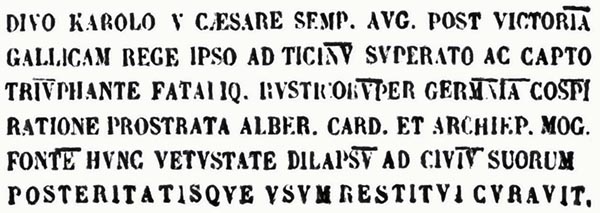
The fountain of Mainz was built by Albrecht von Brandenburg, who reigned as Archbishop of Mainz from 1514 to 1545, and whose epitaph I had just read in the cathedral: Albert, Cardinal-Priest of Saint Peter in Chains, Archchancellor of the Holy Roman Empire, Marquis of Brandenburg, Duke of Stettin and Pomerania, Elector. He erected or rather rebuilt the fountain, in memory of the success of Charles V (at the Battle of Pavia in 1525), and his capture there of Francis I, as this inscription in recently revived gold letters states:
Seen from the summit of the citadel, Mainz presents sixteen towers towards which the cannons of the Germanic Confederation gracefully turn: the six bell-towers of the cathedral, two fine military belfries, a twelfth-century spire, four Flemish pinnacles, plus the dome of the Carmelites of the Rue Cassette in Paris (Saint-Joseph-des-Carmes) thrice repeated, which is sufficient. On the slope of the hill crowned by the fortress, one of these ignoble domes crowns a sad old Saxon church, the saddest and most humble in the world, flanked by a charming Gothic cloister adorned with flamboyant mullions where the Kaiserlichs (Imperial troops) water their horses from Romanesque sarcophagi.
The beauty of the Rhenish women of Mainz is undeniable; only the women there are full of curiosity in the manner of both Flanders and Alsace. Mainz unites the spy’s-mirror of Antwerp and the spy’s-turret of Strasbourg.
The city, however whitewashed it may be, has retained, in many places, the honourable appearance of a merchant city of the Rhineland Hanseatic League. One can still read on the doors PRO CELERI MERCATVRÆ EXPEDITIONE (The swift expediting of goods). In two or three years one will read Roulage accéléré (the French equivalent).
Moreover, a profound flow of life, from the Rhine, animates this city. It is no less bristling with masts, no less cluttered with bales, no less full of noise than Cologne. People walk, talk, push, drag, arrive, depart, they buy, sell, shout, sing, in short, they live life, in all the districts, houses, and streets. At night, this immense buzz falls silent; and one hears in Mainz nothing but the murmur of the Rhine, and the eternal noise of the seventeen mill-ships moored to the submerged piles of the Charlemagne Bridge (a wooden bridge linking Mainz to Kastel, built at Charlemagne’s command between 803 and 813, on the stone foundations of the former Roman bridge, but burned down in 813).
Whatever the Congresses have done, or rather have not done as regards Mainz, the vacuum left by the triple domination of the Romans, the Archbishops, and the French has not been filled. No one is home. The Grand Duke of Hesse reigns there only in name. On his fortress in Cassel, he can read: CURA CONFOEDERATIONIS CONDITUM (‘built to guard the ‘German’ Confederation, 1832’); and in front of his fortress at Mainz he can see a white-coated soldier and a blue-coated soldier, that is to say Austria and Prussia, patrolling night and day, weapons in hand. Neither Prussia nor Austria are at home there either; they obstruct each other, and jostle each other. Obviously, this is only a temporary state of affairs. There is in the very wall of the citadel a ruin, half-engaged in the new rampart — a kind of truncated pedestal which is still called the Eagle Stone, the Adlerstein. It is the tomb of Drusus. An eagle indeed, an imperial eagle, a formidable and all-powerful eagle, perched there for sixteen hundred years and then vanished (at the time of the Thirty Year’s War). In 1804, it reappeared; in 1814, it flew away again — today, at this very hour, Mainz can see, on the horizon towards France, a black dot growing larger and approaching. It is the eagle returning.
Letter XXIV: Frankfurt am Main
Mainz, September
I was in Frankfurt on a Saturday. I had been walking around, at random, for some time, searching for my old Frankfurt amidst a labyrinth of very ugly new houses, and very beautiful gardens, when I suddenly arrived at the entrance to a singular street. Two long parallel rows of tall, black, sombre, and sinister houses, almost alike, but with those slight differences between like features which characterise periods of fine architecture; and between these houses, all contiguous and compact, as if pressed with terror against each other, this narrow, dark roadway, drawn with a ruler; nothing but large doorways surmounted by strangely confused iron latticework; all the doors closed; on the ground floors nothing but windows fitted with solid iron shutters; all these shutters closed; on the upper floors, wooden frontages, almost everywhere armed with iron bars; a gloomy silence, no singing, no voices, no breathing, only at intervals the muffled sound of footsteps inside the houses; beside each door, a grilled peephole half-open revealing a dark alley; everywhere dust, ashes, cobwebs, rot and decay, a poverty perhaps more affected than real; an air of anxiety and fear imbuing the facades of the buildings; one or two passers-by in the street gazing at me with suspicion and mistrust: at the windows of the first floors, beautiful young well-dressed girls, brown-skinned, with semitic profiles, appearing, furtively, or the faces of old women with like profiles, their hair dressed in exorbitant fashion, motionless and pale behind the clouded glass; in the alleys on the ground-floor, piles of bales, and other merchandise; fortresses rather than houses, caverns rather than fortresses, spectres rather than passers-by — I was in the street the Jews inhabit, and I was there on their Sabbath.
In Frankfurt there are still Jews and Christians; true Christians, that is, who despise the Jews, true Jews who, in turn, loathe the Christians. On both sides, they hate and shun one another. Our civilisation, which seeks to maintain a balance of ideas and to quell anger everywhere, no longer understands these looks full of abomination that strangers cast at each other. The Jews of Frankfurt live in their gloomy houses, and withdraw to their rear courtyards to avoid the breath of the Christians. Twelve years ago, this street, rebuilt and slightly widened in 1662, still had iron gates at both ends, fitted with bars and reinforcements on the outside and inside. When night fell, the Jews returned and the two gates were closed. They were barred from the outside, like plague victims, and barricaded themselves inside like those under siege. Judenstrasse (or Judengasse) is not a street, it is a city within a city. Exiting Judenstrasse, I found myself in the old city. I had just entered Frankfurt.
Frankfurt is a city of caryatids. Nowhere have I seen so many colossal supports as in Frankfurt. It is impossible to make marble, stone, bronze, and wood-work groan and howl with richer invention and more varied cruelty. Whichever way you turn, there are wretched figures of every period, style, age, sex, and imagining, writhing and groaning miserably beneath enormous weighty masses. Horned satyrs, nymphs with Flemish busts, dwarves, giants, sphinxes, dragons, angels, devils, a whole unfortunate population of supernatural beings, captured by some magician who has shamelessly trawled all mythologies simultaneously, and enclosed by him in petrified forms, are chained there beneath the entablatures, imposts and architraves, and are sealed up to their waists in the walls. Some bear balconies; others, turrets; the most oppressed, bear houses. Others again raise on their shoulders some insolent bronze black African dressed in a robe of gilded tin, or an immense Roman emperor of stone in all the pompous costume of Louis XIV, with his large wig, ample cloak, and armchair, his platform and credence table on which his crown is placed, and his canopy with carved panels and vast draperies; a colossal construction which represents an engraving by Gérard Audran completely reproduced, in the round, in a monolith twenty feet high. These prodigious monuments project like inn signs. Beneath their titanic burdens, the caryatids bend in every posture of rage, pain and fatigue. Some bow their heads, others half-turn; some place their two clenched hands on their hips, or fill their swollen chests ready to burst; there are disdainful Hercules who support six-story houses with a single shoulder, and shake their fists at folk; there are sad, hunchbacked Vulcans who support themselves on their knees, or unfortunate sirens whose scaly tails are crushed horribly between stone partitions; there are exasperated Chimeras who bite each other furiously; others that weep, or laugh bitterly, or make frightful grimaces at passers-by. I have noticed that many an overhanging cabaret-hall, resounding to the clink of glasses, is supported on the heads of caryatids. It seems that it is the taste of the old free bourgeoisie of Frankfurt to have their feasts borne by suffering statues.
The most dreadful nightmare one could experience, in Frankfurt is neither the invasion of the Russians, nor the irruption of the French, nor a European war devastating the country, nor a civil war, as in the past, ravaging the city’s fourteen districts again, nor typhus, nor cholera; it would be the awakening, the unleashing of the revenge of the caryatids.
One of the curiosities of Frankfurt, which will soon vanish, I fear, is the butchers’ quarter, occupying two old streets. It would be impossible to find older or blacker houses leaning over a more splendid heap of fresh meat. An indescribable air of gluttonous joviality is imprinted on the bizarrely slated and sculpted facades, whose ground floors seems to devour, like deep, wide-open maws, innumerable quarters of beef and mutton. The blood-stained and rosy butchers converse gracefully beneath garlands of legs of lamb. A red stream, whose colour is barely diluted by two gushing fountains, flows and steams down the middle of the street. As I passed by, the place was full of terrifying cries. Inexorable murderous lads, with Herodian faces, were carrying out a massacre of suckling pigs. The maids, baskets on their arms, laughed amidst the din. There are futile and ridiculous emotions one must contain; yet I confess that, if I had known what to do with the poor little suckling pig that a butcher was bearing away, by its two hind feet, in front of me and gave not a cry, ignorant of what would be done to it, and understanding nothing of the matter, I would have purchased it, and saved it. A pretty little girl of four, who, like me, was looking at it with compassion, seemed to encourage me with her gaze. I failed to do as those charming eyes told me, I disobeyed that sweet look, and I reproach myself for it. — A superb and grandiose golden ensign, supported by a gallows grille, the most beautiful and richest in the world, composed of all the emblems of the butchers’ corps and surmounted by the imperial crown, dominates and completes this magnificent slaughterhouse worthy of Paris in the Middle Ages, faced with which, Caltagirone (Bonaventure Caltagirone, General of the Franciscan Order, who helped negotiate the Peace of Vervins in 1598, and described his visit to the Parisian equivalent) or Rabelais, in the sixteenth century, would doubtless have been astonished.
From the slaughterhouse one emerges into a square of moderate grandeur (Römerberg), worthy of Flanders and which deserves to be celebrated and admired, even compared with the Old Market of Brussels. It is one of those trapezoidal squares where all the styles and whims of the bourgeois architecture of the Middle Ages and Renaissance are represented by model houses whose ornamentation has been employed, according to the period and taste, with prodigious appropriateness, slate as well as stone, lead as well as wood. Each shop-front is of individual worth, and contributes to the present-day composition and general harmony of the square. In Frankfurt, as in Brussels, two or three new houses, of the most stupid appearance, seeming like imbeciles amidst a gathering of intelligent people, spoil the whole, yet enhance the beauty of the older buildings which are their neighbours. A marvellous fifteenth-century building (Old Saint Nicholas Church), composed, I know not for what purpose, of a church nave and a town-hall belfry, fills one side of the trapezoid with its superb and elegant silhouette. Towards the middle of the square, randomly, without evidently any desire for symmetry, two fountains have sprouted, like perennial bushes, one from the Renaissance, the other from the eighteenth century. On these two fountains, by a singular chance, each standing at the top of her column, Minerva and Judith, the Homeric virago and the Biblical virago, the former grasping the head of Medusa, the latter no longer grasping the head of Holofernes, meet and confront each other.
Judith, beautiful, haughty and charming, surrounded by four celebrated Sirens blowing trumpets at her feet, is a heroic girl of the Renaissance. She no longer has the head of Holofernes, which she once raised in her left hand, but still holds the sword in her right, while her dress, blown by the wind, and with the proudest fold one could see, rises above her marble knee, to reveal her thin, firm leg.
Some expositors claim that this statue represents Justice, and that she held in her hand, not the head of Holofernes, but a pair of scales. I give that little credence. Justice holding the scales in her left hand, and the sword in her right would represent Injustice. Besides, Justice has no right to be either so pretty or so elegantly posed.
Opposite this figure and displaying a black dial and five grave windows of unequal height, rise the three juxtaposed gables of the Römer (restored 1945-75). It was in the Römer that the emperors were elected; it was in this place that they were proclaimed; it was also in this square that the two famous Frankfurt Fairs were held and still are held: the September Fair, established in 1240 by letter of permit of Frederick II; and the Easter Fair, established in 1330 by Ludwig of Bavaria. The fairs have survived the emperors and the empire.
I entered the Römer. After wandering, without meeting anyone, through a large, low, crooked room, vaulted and cluttered with booths from the fair, then up a wide staircase with a Louis XIII banister, lined with mediocre, unframed paintings, then along a host of dark corridors and stairs, I finally found a servant, by dint of knocking on all the doors, who, at the word: Kaisersaal, took a key from a nail in her kitchen and led me to the Hall of the Emperors.
The smiling and kindly girl first took me through the Hall of the Electors, which today, I believe, is used for the sessions of the High Senate of the city of Frankfurt. It was there that the electors or their delegates declared the emperor King of the Romans among themselves. On an armchair between the two windows, the Archbishop of Mainz presided. Then seated in order around an immense table covered in tawny leather, each below his coat of arms painted on the ceiling, were, to the right of the Archbishop of Mainz, Trier, Bohemia and Saxony; to his left, Cologne, the Palatinate, and Brandenburg; and opposite him, Brunswick and Bavaria. The passer-by experiences the impression produced by simple things that express great things, when he sees and touches the red and dusty leather of this table at which the Emperors of Germany were elected. Apart from the table, which has been transported to a neighbouring room, the Hall of the Electors is today in the state it was in during the seventeenth century. The nine coats of arms on the ceiling framing a mediocre fresco, a red damask hanging, silver-plated copper sconces acting as candelabras depicting Fame, a large mirror with curved rods opposite which, in the last century, a full-length portrait of Joseph II was placed as a counterpart; a space above the door with a portrait of the last of Charlemagne’s grandsons (Louis, the last East Frankish ruler of the Carolingian dynasty) who died in 911, ending his reign, and whom the Germans call the Child. Nothing more. — The whole is austere, serious, and tranquil, and makes one think rather than merely look.
After the Electors’ Hall, I viewed the Emperors’ Hall (Kaisersaal). In the fourteenth century, the Lombard merchants who gave their name to the Römer, and who had shops there, had the idea of surrounding the great hall with niches, in order to display their goods. An architect, whose name has been lost, measured the perimeter of the hall and built forty-five niches. In 1564, Maximilian II was elected in Frankfurt, and shown to the people from the balcony of this hall which, from Maximilian II onwards, was called the Kaisersaal, and was used for the proclamation of emperors. They decided to decorate it, and the first thought that came to mind was to install, in the niches created around the imperial hall, the portraits of all the German Caesars elected and crowned since the extinction of the line of Charlemagne, reserving the vacant niches for future Caesars. However, from Conrad I in 911, to Ferdinand I in 1556, thirty-six kings and emperors had already been crowned at Aix-la-Chapelle. Adding to this the new King of the Romans, there remained only eight empty niches for the future. This was very few. The thing was nevertheless done, with a promise to enlarge the hall when necessary. The niches were furnished little by little, at roughly four emperors per century. In 1765, when Joseph II ascended the sacred imperial Caesarean throne, there remained only one empty place. Serious consideration was once again given to extending the Kaisersaal and adding new compartments to those created five centuries earlier by the architect of the Lombard merchants. In 1794, Francis II, the forty-fifth king of the Romans, arrived to occupy the forty-fifth compartment. It was the last niche; he was the last emperor. The spaces were filled, the Germanic empire collapsed. The unknown architect was destiny; the mysterious room with its forty-five niches the very history of Germany, which, once the line of Charlemagne was extinguished, was fated to reveal only forty-five emperors.
There, in fact, in this oblong, vast, cold, almost dark room, cluttered at one of its corners with discarded furniture, among which I saw the Electors’ leather-covered table, and barely lit at its eastern end by the five narrow unequal windows which mount in pyramid fashion towards the exterior gable, between four high walls covered with faded frescoes, under a wooden vault with formerly gilded ribs, alone, in a kind of half-light which resembled the beginning of oblivion, each crudely pictured, and depicted therein as bronze busts whose pedestals bear the two dates that open and close their respective reigns, some wearing laurel crowns like Roman Caesars, others adorned with the Germanic diadem, silently looking at each other, each in his sombre ogive, are the three Conrads, the seven Henrys, the four Ottos, the one Lothair, the four Fredericks, the one Philip, the two Rudolfs, the one Adolphus, the two Alberts, the one Louis, the four Charles, the one Wenceslas, the one Robert, the one Sigismund, the two Maximilians, the three Ferdinands, the one Mathias, the two Leopolds, the two Josephs, the two named Francis, the forty-five phantoms who, for nine centuries, from 911 to 1806, helped to determine the course of history, with the sword of Saint Peter in one hand and Charlemagne’s orb in the other. At the end opposite the five windows, near the ceiling, a mediocre painting depicting the Judgment of Solomon is blackening and peeling.
When the Electors had finally designated an Emperor, the Frankfurt Senate met in this hall; the burghers, arranged in fourteen groups, corresponding to the fourteen districts of the city, assembled outside in the square. Then the five windows of the Kaisersaal were opened, facing the people. The large window, the middle one, was surmounted by a canopy and remained empty. At the first window on the right, adorned with a black iron balcony from which I could see the road to Mainz, the Emperor appeared, alone, in full costume, the crown on his head. To his right, in the small window, were gathered the three Archbishop-Electors of Mainz, Trier and Cologne. At the other two windows, to the left of the large empty window, in the first stood Bohemia, Bavaria and the Palatinate of the Rhine; in the smaller one, Saxony, Brunswick and Brandenburg. In the square, in front of the facade of the Römer, in the middle of the vast empty square surrounded by guards, there was a large sack for oats, an urn full of gold and silver coins, a table bearing a silver basin and a silver-gilt jar, and another table burdened with a whole roast ox. At the moment when the emperor appeared, the trumpets and cymbals burst forth, and the Arch-Marshal (Erzmarschall) of the Holy Roman Empire, the Arch-Chancellor (Erzkanzler), the Arch-Cupbearer (Erzmundschenk), the Arch-Treasurer (Erzschatzmeister) and the Grand Carver (Grossmundschenk) entered the square in procession. Amidst cheers and fanfares, the Arch-Marshal on horseback, lifted the sack for oats to his saddle, and filled it with a measure of silver; the Arch-Chancellor took the basin from the table; the Arch-Cupbearer filled the silver-gilt jar with wine and water; The Arch-Treasurer drew coins from the urn and threw them to the people by the handful; the Grand Carver sliced a portion from the roast ox. At that moment, the Archbishop of Mainz appeared, proclaimed aloud the new Caesar, and read the formula of the oath. When he had finished, the Senate in the hall and the bourgeois in the square answered gravely: Yes. During the taking of the oath, the new emperor, already formidable in power, removed the crown but held the sword.
From 1564 to 1794, the now-neglected square, and now-deserted hall, witnessed this majestic ceremony nine times. The great offices of the empire, being hereditarily acquired by the Electors, were filled by their delegates. In the Middle Ages, the secondary monarchies held it as a signal honour and good policy to occupy the great offices of the two empires which had replaced the Roman Empire. Each prince gravitated towards the imperial centre nearest to him. The King of Bohemia was Arch-Cupbearer of the German empire; the Doge of Venice was Protospatharios (the highest dignitary) of the Eastern empire.
After the proclamation at the Römer came the coronation at the collegiate church. I followed the order of ceremony. After leaving the Kaisersaal, I visited the church (the Kaiserdom).
The collegiate church of Frankfurt, dedicated to Saint Bartholomew, consists of a double cross-nave from the fourteenth century, surmounted by a beautiful fifteenth-century tower, unfortunately unfinished. The church and the tower are made of beautiful red sandstone, blackened and rusted by the years. Only the interior is whitewashed. (The Kaiserdom was destroyed by fire and rebuilt in 1867, burned out in 1944 and reconstructed again in the 1950s)
Here again, is a Belgian church. White walls; no stained-glass windows; a rich furnishing of sculpted altars, coloured tombs, paintings, and bas-reliefs. In the naves, severe marble knights, mustachioed bishops from the time of Gustavus Adolphus who have the faces of landsknechts (mercenaries), admirable stone bell-towers hollowed out and carved by faeries, magnificent copper light fixtures reminiscent of the lamp of the alchemist-painter Gerrit Dou, a ‘Christ in the Tomb’ painted in the fourteenth century, a ‘Virgin on her Deathbed’, sculpted in the fifteenth. In the choir, curious frescoes, horribly adorned with Saint Bartholomew, charmingly with the Magdalen; rough and savage woodwork carved around 1400; woodwork and frescoes donated by the Knight of Ingelheim, who had himself painted kneeling in a corner, wearing gold with gules chevrons. On the walls, a complete collection of those fantastic morions with frightening crests proper to Germanic chivalry, hung on nails like the pots and pans in a kitchen. Near the door, one of those enormous clocks which are akin to a two-story house, a three-volume book, a poem in twenty cantos, a whole world. Above, on a large Flemish pediment, the hours of the day tick by; below, in the depths of a kind of cave where things are in motion pell-mell in the darkness, a crowd of thick rods that one might take for the antennae of monstrous insects, mysteriously articulate the time of year. The hours turn above, the seasons march below. The sun, with its glorious golden rays, the full and dark moon, the stars on a blue background, operate complicated evolutions, which reveal at the lower end of the clock a series of small pictures in which schoolchildren skate, old people warm themselves, country folk harvest the wheat, or shepherdesses pick flowers. Maxims and phrases somewhat faded shine in the sky by the light of the equally faded stars. Each time the hand reaches a numeral, doors open and close on the pediment of the clock, and Jacquemarts armed with hammers, emerging then retreating, strike the hour on the bell, executing bizarre sounds to the rhythm of a Pyrrhic dance. All this, throbs and rumbles, as if the very walls of the church were alive, with the sound of a sperm whale imprisoned in the great Heidelberg Tun (the huge barrel in Heidelberg Castle).
This collegiate church has an admirable Crucifixion by Van Dyck. Albrecht Durer and Rubens each have a painting there, of ‘Christ on the Virgin’s Knees’. The subject is the same; the two paintings differ significantly. Rubens placed a child Jesus on the knees of the Divine Mother; Albrecht Durer placed a crucified Christ there. Nothing equals the grace of the first painting, except the anguish of the second. Each of the two painters followed his genius. Rubens chose life, Durer chose death.
Another painting, in which anguish and grace are mixed, is a precious one on leather, from the sixteenth century, which represents the interior of the tomb of Saint Cecilia. The various frames are composed of all the principal moments of the saint’s life. In the middle, in a dark crypt, the saint is lying full length on her face, in her golden robe, with the mark of the axe on her neck, a pink and delicate wound that resembles a charming mouth one would like to kiss on one’s knees. It seems as if one is about to hear the voice of the holy musician rise and sing por la boca de su herida (through the mouth of her wound). Below the open coffin, is written in gold letters: En tibi sanctissimae virginis Ceciliae in sepulchro jacentis imaginem, prorsus eodem corporis situ expressam: here is an image of the most holy virgin Cecilia lying in her tomb, depicted in the exact same position as her body.
Indeed, in the sixteenth century, a pope, Leo X, I am told, had the actual tomb of Saint Cecilia (in the Basilica of Saint Cecilia in Trastevere, Rome) opened (it was opened during restoration work in 1599, under Clement VIII), and this ravishing painting is, it is said, an exact portrait of the miraculous corpse.
Since Maximilian II, it is in the centre of the collegiate church, at the entrance to the choir, at the intersection of the transept and the nave, that the emperors have been crowned. I saw in a corner of the transept, wrapped in a grey paper sack granted the shape of a child’s padded headdress, the immense imperial crown in a gold-plated frame that was suspended above their heads during the ceremony, and remembered that a year ago I had seen the fleur-de-lis carpet from the coronation of Charles X, rolled up, roped, and forgotten on a wheelbarrow in the attic of Reims Cathedral. To the right of the choir door, exactly adjoining the place where the emperor was crowned, the Gothic woodwork complacently displays two contrasting figures sculpted in oak: Saint Bartholomew flayed, carrying his skin on his arm, looking disdainfully to his left at the Devil perched on a magnificent pyramid of mitres, diadems, crests, tiaras, sceptres, swords and crowns. A little further on, the new Caesar could, under the tapestries from which it was doubtless hidden, glimpse at times standing in shadow and against the wall, like some sinister apparition, the stone spectre of that unfortunate pseudo-emperor Günther XXI von Schwarzburg, fatality and hatred in his look, holding with one hand and arm his shield with the rampant lion, and with the other his imperial helm; a proud and fearsome statue tomb, which for two hundred and thirty years witnessed the enthronement of emperors, and whose granite sadness survived all those festivals of painted cardboard and gilded wood.
I wanted to climb the bell tower. The glockner (bell-ringer) who had guided me into the church, and who knew not a word of French, abandoned me at the first steps of the spiral stair, and I ascended alone. Arriving at the summit, I found the staircase blocked by a barrier with iron spikes; I called out, no one answered; whereupon I decided to climb the barrier. Once the obstacle was overcome, I was on the platform of the Pfarthurm (cathedral tower). From there, I had a charming view. Above my head a glorious sun, at my feet the whole city; to my left Römer Square, to my right the Judenstrasse, like a long, inflexible, black ridge among the white houses; here and there a few only-partially ruined apses of ancient churches, two or three high belfries flanked by turrets, sculpted with the eagle of Frankfurt and repeated, like echoes, in the depths of the view, by the three or four old watchtowers which once marked the limits of the little free State; behind me the Main, a silver sheet striped with gold by the wakes of the boats; the old bridge with the roofs of Sachsenhausen, and the reddish walls of the old Teutonic house; around the town, a thick belt of trees; beyond the trees, a great tableland of plains and ploughed fields, ending in the blue ridges of the Taunus range. While lost in I know not what reverie, I leant against the section of the truncated bell tower from 1509, clouds began to roll across the sky, driven by the wind, hiding and revealing wide azure rents at every moment, and causing great patches of shadow and light to form everywhere on the ground below. The city and the horizon presented an admirable picture. The landscape is never more beautiful than when it dons its tiger’s hide. — I thought I was alone on the tower, and would have stayed there all day. Suddenly, I heard a slight noise beside me; I turned my head: it was a young girl of about fourteen, leaning half out of a skylight, who was looking at me with a smile. I risked a few steps, I traversed a corner of the Pfarthurm which I had not yet crossed, and found myself amidst the inhabitants of the bell-tower. There was a whole little world there, a sweet and happy one. The young girl, who was knitting; an old woman, her mother no doubt, who was at her spinning-wheel; doves perched on the gargoyles of the bell-tower, cooing; a hospitable monkey who held out his hand from the depths of his little hutch; the weights of the big clock which rise and fall with a dull noise and amuse themselves by working the figures in the church where emperors have been crowned; add to this the profound peace one feels in high places, composed of the murmur of the wind, the rays of the sun, and the beauty of the landscape — does that not make a pure and charming whole? — Of the cage of ancient bells, the girl had made herself a room; she had her bed there in the shade, and sang as the bells sang, but in a sweeter voice, for herself and God alone. Of one of the unfinished pinnacles, the mother had made a chimney for the meagre widow’s fire above which her cooking pot hangs. Such is the summit of the bell-tower of Frankfurt Cathedral. How and why was that little colony there; to what purpose? I knew not; but I admired it all the same. This proud imperial city, which has endured so many wars, which has been bombarded with so many cannonballs, which has enthroned so many Caesars, whose walls were once like a suit of armour, and whose eagle held in its two talons the diadems the Austrian eagle bore on its twin heads, is today dominated and crowned by the humble hearth of an old woman, from which a little wisp of smoke rises.
The End of Part VII of Hugo’s ‘Le Rhin’