Victor Hugo
The Rhine (Le Rhin, 1838, 1839, 1840)
Part VI: Letter XXI
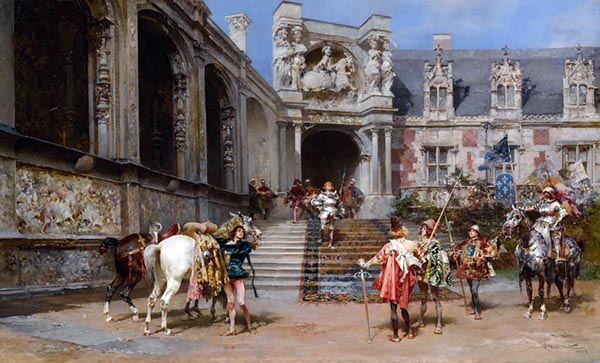
‘The knight of the lily’
Ludovico Marchetti (Italian, 1853 - 1909)
Artvee
Translated by A. S. Kline © Copyright 2026 All Rights Reserved
This work may be freely reproduced, stored and transmitted, electronically or otherwise, for any non-commercial purpose.
Conditions and Exceptions apply.
Contents
- Letter XXI: The Legend of Handsome Pécopin and Beautiful Bauldour.
- Part I.
- Part II.
- Part III.
- Part IV.
- Part V.
- Part VI.
- Part VII.
- Part VIII.
- Part IX.
- Part X.
- Part XI.
Letter XXI: The Legend of Handsome Pécopin and Beautiful Bauldour
Bingen, August
I promised you one of the famous legends of the Falkenburg, perhaps even the finest, the dark adventure of Guntram and Liba. But I’ve been thinking. What is the point of telling you tales you can read in the first collection you come across, told more skilfully than I can manage? But since you absolutely desire a story to amuse your grandchildren with, here is one, my friend. At least it’s a legend you’ll not find in any legendarium. I am sending it to you, just as I wrote it, under the very walls of the collapsed manor, with the enchanted Forest of Sooneck before my eyes, and, or so it seemed to me, under the direction of the trees, the birds, and the wind amongst the ruins. I had just been talking with that old French soldier who had become a goatherd in these mountains, and well-nigh a savage and a sorcerer; a singular end for a drummer-master of the 37th Light Infantry (which served in the West Indies and Gibraltar, and participated in the late stages of the Peninsular War in 1814). This brave man, a former child-soldier in the Voltairean army of the Republic, appears to believe in faeries and gnomes as he once believed in the emperor. Solitude always acts thus on the intelligence; it develops the poetic side of a man; every shepherd is a dreamer.
So I wrote this ‘legendary’ tale in that very place, hidden in the moated ravine, sitting on a block that was once a rock, and then part of a tower in the twelfth century, and now a rock again, picking a wild flower from time to time, to imbibe its soul, one of those bindweeds that are so fragrant, and die so quickly, and looking alternately at the green grass and the radiant sky, while great golden clouds swam past the dark ruins of Falkenburg. That said, here is the tale:
I
A Legend
The handsome Pécopin loved the beautiful Bauldour, and the beautiful Bauldour loved the handsome Pécopin. Pécopin was the son of the burgrave of Sooneck, and Bauldour was the daughter of the lord of Falkenburg. One held the forest, the other the mountain. Now what could be simpler than wedding the mountain to the forest? The two fathers came to an agreement, and Bauldour was betrothed to Pécopin.
That day, it was an April day, the elderberries and hawthorns, in bloom in the forest, were opening to the sun, a thousand delightful little waterfalls, the snow and rain transformed into streams, the horrors of winter become the graces of spring, leapt harmoniously down the mountain, and love, the April of Mankind, sang, shone and blossomed in the hearts of the two affianced young people.
Pécopin’s father, an old and valiant knight, the honour of the County of Nahegau, died not long after the betrothal, blessing his son, and recommending Bauldour to him. Pécopin wept, then little by little, from the tomb where his father had disappeared, his eyes returned to the sweet and radiant face of his fiancée, and he was consoled. When the moon rises, who thinks of the setting sun?
Pécopin possessed the finest qualities of a youth, an honest man, and a gentleman. Bauldour was a queen in the manor-house, a holy virgin in church, a nymph in the woods, a faery at her tasks.
Pécopin was a great hunter, and Bauldour was a beautiful spinner of thread. Now, there is no hatred between the spindle and the game-bag. The spinner spins while the hunter hunts. He is absent, the distaff consoles and relieves ennui. The pack barks, the spinning-wheel sings. The distant barking of the hounds, mingled with the barely-heard notes of the hunting-horn, lost deep amidst thickets, murmurs quietly, amidst its vague sounds of the chase: ‘Think of your lover’. The spinning-wheel, which obliges the beautiful dreamer to lower her gaze, whispers aloud and constantly in its small, sweet, and severe voice: ‘Think of your fiancé’. And, when the husband and the lover are one, all is well. So, wed the spinner to the hunter, and fear nothing.
However, I must say, Pécopin loved hunting a little too much. When he was on his horse, when he had the falcon on his fist, or followed it with his eyes, when he heard the ferocious yapping of his bloodhounds stretching their muscular legs, he launched himself, he flew, through the air, forgetting everything. Now, ‘Nothing in excess’. Happiness is achieved by moderation. Keep your tastes in balance, and your appetites in check. Whoever loves horses and dogs too much angers the women; whoever loves women too much angers God.
When Bauldour, and this happened often, when Bauldour saw Pécopin ready to set off on his horse, which was already neighing with joy and prouder than if it were bearing Alexander the Great in his imperial robes; when she saw Pécopin caress him, pass his hand over his neck, and, curbing the spur, present the palfrey with a bouquet of grass to refresh him, Bauldour was jealous of the horse. When Bauldour, that proud and noble young lady, that bright star of love, youth and beauty, saw Pécopin caressing his mastiff, and raising that snub-nosed head, those large nostrils, those wide ears, and that black face, to his charming and manly one, in a friendly manner, Bauldour was jealous of the dog.
She would retreat to her private chamber, saddened and angry, and she would weep. Then she would scold her maids, and after her maids she would scold her dwarf. For anger in women is like rain in the forest; it falls twice. Bis pluit.
In the evening, Pécopin would arrive dusty and tired. Bauldour would sulk and murmur a little, with a tear in the corners of each of her blue eyes. But Pécopin would kiss her hand, and she would remain silent; Pécopin would kiss her beautiful forehead, and she would smile. Bauldour’s brow was white, pure, and admirable like King Charlemagne’s tusk of ivory.
Then she would retire to her turret and Pécopin to his. She never allowed this knight to undo her belt. One evening he lightly pressed her elbow, and she blushed very deeply. She was engaged and not married. Modesty is to a woman what chivalry is to a man.
II
The Phoenix and the Planet Venus
They liked to arouse envy. Pécopin had, in his armoury at Sooneck, a large painting in a gilded frame representing the sky and the seven heavens, each planet with its own colour, and its name written in vermilion beside it; Saturn was leaden white; Jupiter, a clear yellow; Mars inflamed and a little sanguine; Venus, the Oriental goddess, blazing bright; Mercury, sparkling; the Moon icy silver; the Sun, all radiant fire. Pécopin erased the name of Venus, and wrote Bauldour in its place.
Bauldour had in her perfumery a high-warp tapestry on which was depicted a bird the size of an eagle, with a golden neck, a purple body, a blue tail mixed with crimson feathers, and a crest on its head surmounted by a tuft of feathers. Below this marvellous bird the workman had written this Greek word: Phoenix. Bauldour erased this word, and embroidered in its place the name: Pécopin.
Meanwhile the day appointed for the wedding was approaching. Pécopin was joyful and Bauldour was happy.
There was, in the forest of Sooneck, a huntsman, a very clever fellow, free of speech and malicious in his comments, who was called Erilangus. This man, who was a very fine archer, had been sought in marriage by several rich countrywomen in the neighbourhood of Lorch; but he had rejected the brides and had become a slave to the pack. One day when Pécopin asked him the reason, Erilangus replied: ‘My lord, dogs suffer from several strains of rabies, women a thousand.’ On another day, learning of his master’s upcoming wedding, he addressed him boldly saying: Sire, why are you marrying? Pécopin chased the fellow away.
This should have troubled the knight, since Erilangus possessed a subtle mind and a long memory. But the man went off to the court of the Marquis of Lusatia (the Markgrafschaft Lausitz, was a lord of the Bohemian marches), where he became master of the hunt, and Pécopin heard no more of him.
A week before the wedding, Bauldour was spinning in a window embrasure. Her dwarf came to warn her that Pécopin was ascending the stairs. She wished to run to meet her fiancé, but as she rose from her chair, which had a straight, carved back, her foot entangled itself in the thread of her distaff. She fell. Poor Bauldour rose. She was without injury, but she remembered that a similar accident had once happened to that lady of the manor, Liba, and her heart sank. Pécopin entered, smiling, spoke to her about their marriage, and future happiness, and the cloud in her soul flew away.
III
In Which the Difference in Hearing Between a Young Man and an Old Man is Explained
The next day, Bauldour was spinning thread in her room, while Pécopin was hunting in the woods. He was alone and had only a single hound with him. During the course of the hunt, he arrived at a farmhouse at the entrance to the Sooneck forest, marking the boundary between the Sooneck and Falkenburg estates. This farmhouse was shaded on the east by four large trees, an ash, an elm, a fir, and an oak, which were called in the country the Four Evangelists. It seems that they were enchanted trees. As Pécopin passed beneath their shade, a bird was perched on each of these four trees: a jay on the ash, a blackbird on the elm, a magpie on the fir, and a crow on the oak. The four calls of these four feathered creatures mingled in a strange way, and seemed at times to question and answer one another. He could also hear a pigeon, which he could not see because it was in the woods, and a hen, which he could not see because it was in the farmyard. A few steps further on, a bowed old man was arranging tree stumps along a wall for the winter fire. Seeing Pécopin approach, he turned round and straightened. — ‘Sir Knight,’ he cried, ‘do you hear what the birds are saying?’ — ‘Good fellow’, replied Pécopin, ‘what does it matter to me!’ — ‘Sire,’ the old man continued, ‘as far as a young man is concerned, the blackbird merely whistles, the jay is garrulous, the magpie squawks, the crow croaks, the pigeon coos, the hen clucks; to an old man, the birds speak.’ — The knight burst out laughing. — ‘Pardieu! That’s but a fantasy.’— The old man replied, gravely: You are wrong, master Pécopin.’ ‘You have never met me,’ cried the young man, ‘how do you know my name?’ — ‘The birds named you,’ replied the old man. — ‘You are an old fool, my good fellow,’ cried Pécopin, and rode on.
About an hour later, as he was crossing a clearing, he heard a horn blowing, and saw a fine troop of horsemen traversing the woods; it was the Count Palatine out hunting. The Count Palatine was accompanied by the burgraves, who are the counts of the castles, the wildgraves, who are the counts of the forests, the landgraves, who are the counts of the land, the Rhinegraves, who are the counts of the Rhine, and the raugraves, who are counts by right of force. A gentleman horseman belonging to the Pfalzgraf (the Count Palatine), named Gaïfreroi, saw Pécopin, and called out to him: ‘Halloo, there good huntsman! Will you ride with us?’ ‘Where are you going?’ said Pécopin. ‘Good huntsman,’ replied Gaïfreroi, ‘we are off to hunt down a kite, which is destroying our pheasants at Heimburg (Heimberg in Niederheimbach, otherwise Burg Hohneck); we are off to hunt a black vulture which is at Vautsberg (Rheinstein), and is exterminating our falcons; we are off to hunt an eagle at Reichenstein that is killing our merlins. Come with us.’ — ‘When will you return?’ asked Pécopin. — ‘Tomorrow’, said Gaïfreroi. — ‘I’ll follow you’, said Pécopin. The hunt lasted three days. On the first day Pécopin killed the kite, on the second day Pécopin killed the vulture, on the third day Pécopin killed the eagle. The Count Palatine marvelled at such excellent archery. — ‘Knight of Sooneck,’ he said to him, ‘I grant you the fiefdom of Rhinestein (Vautsberg), upstream from my castle of Gutenfels. You will follow me to Stahlech (a ruined castle, overlooking Bacharach) to receive the investiture and take the oath of allegiance, in public and in the presence of the aldermen, in mallo publico et coram scabinis, as the charters of the Holy Roman Emperor Charlemagne say.’ It was necessary to obey. Pécopin sent Bauldour a message in which he sadly announced to her that the gracious will of the Pfalzgraf obliged him to go, immediately, to Stahleck, concerning a very great and important matter. — ‘Be calm, my dear lady, he added in closing, I will return next month.’ — The messenger having left, Pécopin followed the Palatine and went to lodge with the knights of the prince’s suite in the lower courtyard of the castle at Bacharach. That night he had a dream. He saw again the entrance to the Forest of Sooneck, the farm, the four trees and the four birds; the birds neither called, nor whistled, nor sang; they spoke. Their voices, with which the voices of the hen and the pigeon mingled, consisted of this strange dialogue, which Pécopin, while asleep, heard distinctly:
The Jay
‘The pigeon’s in the woods.’
The Blackbird
‘The hen, in the yard, says: Pécopin.’
The Jay
‘The pigeon says: Bauldour.’
The Raven
‘The lord is on his way.’
The Magpie
‘The lady is in the tower.’
The Jay
Will he come from Aleppo?
The Blackbird
From Fez?
The Raven
From Damanhur?
The Magpie
The hen has bet against it, the pigeon for.
The Hen
Pécopin! Pécopin!
The Pigeon
Bauldour! Bauldour! Bauldour!
Pécopin awoke, he was in a cold sweat; at first he recalled the old man, and was terrified, without knowing why, by the dream and this dialogue; then he tried to understand, then he failed to understand; then he fell asleep again, and the next day, when day broke, when he saw the beautiful sunlight once more, which chases away ghosts, dissipates dreams, and gilds the mists, he no longer thought of the four trees, nor of the four birds.
IV
In Which the Various Qualities Specific to the Various Embassies are discussed
Pécopin was a gentleman of renown, breeding, wit, and excellent looks. Once introduced to the Court of the Pfalzgraf and installed in his new fiefdom, he pleased the Palatine to such an extent that the worthy prince said to him one day: ‘My friend, I am sending an embassy to my cousin in Burgundy, and I have chosen you as ambassador because of your fine reputation.’ Pécopin was obliged to do as his prince wished. Arriving at Dijon, he distinguished himself so well by his eloquent speeches that the duke said to him one evening, after having emptied three large glasses of Bacharach wine: ‘Sir Pécopin, you are our friend; I have something of a quarrel with my lord the king of France, and the Count Palatine has allowed me to send you to address the king; I have chosen you as my ambassador because of your noble race.’ Pécopin left for Paris. The king took a great liking to him, and taking him aside one morning said to him: ‘Pardieu, Sir Pécopin; since the Palatine lent you to the Burgundian to serve Burgundy, the Burgundian will lend you to the king of France to serve Christianity. I require a noble lord to make certain remonstrances on my behalf to the Miramolin (The Amir al-Mu’minin, or Supreme Leader) of the Moors in Spain, and I have chosen you, as my ambassador, because of your fine wit. — One could refuse the emperor one’s support; one might refuse the Pope one’s wife; but one could refuse the King of France nothing. Pécopin set off for Spain. In Granada the Miramolin welcomed him in style, and invited him to the zambras (festivities) of the Alhambra. Every day was nothing but feasts, contests with javelins and lances, and falcon hunts, and Pécopin took part in them as the great jouster and hunter that he was. In his capacity as a Moorish leader, the Miramolin kept fine peregrines, excellent saker falcons, and admirable merlins, and at these hunts there were the finest flights of falcons imaginable. However, Pécopin did not forget to attend to the King of France’s affairs. When the negotiation was over, the knight presented himself to the Sultan to take his leave. — ‘I accept your request, Christian sire’, said the Miramolin, ‘as you are indeed leaving immediately, for Baghdad’. — ‘For Baghdad!’ cried Pécopin. — Yes, sir knight,’ replied the Moorish prince; for I cannot sign the treaty with the king in Paris without the consent of the Caliph of Baghdad, who is Commander of the Faithful; I must send someone of consequence to the Caliph, and I have chosen you as ambassador because of your good looks.’ When one is among the Moors, one goes where the Moors desire, though they are dogs and infidels. Pécopin departed for Baghdad. There he met with an adventure. One day, as he was passing under the walls of the Seraglio, the favourite Sultana saw him, and as he was handsome, proud, and sad, she fell in love with him. She sent a black female slave to him, who spoke to the knight in the garden next to a tall microphylla (small-leaved) linden tree (Tillia Europaea, Microphylla) that can still be seen there, and who gave him a talisman, saying: ‘This is from a princess who loves you, and whom you will never see. Keep this talisman. As long as you carry it with you, you will retain your youth. When you are at risk of dying, touch it, and it will save you.’ —Pécopin accepted the talisman, just in case, which was a very beautiful turquoise stone inlaid with characters unknown to him. He attached it to his neck chain. ‘Yet, my lord,’ added the slave as she left him, ‘beware of this: As long as you have this turquoise about your neck, you will not age a day; but if you lose it, you will be aged, in a minute, by all the years you have previously lived. Farewell, handsome giaour (infidel).’ With that, the slave-girl departed. Meanwhile, the Caliph had seen the Sultana’s slave accost the Christian knight. This Caliph was a very jealous individual, and something of a magician. He invited Pécopin to a feast, and when night came, he led the knight to a high tower. Pécopin, without noticing, had advanced quite close to the parapet, which was very low, when the Caliph spoke to him thus: ‘Sir knight, the Count Palatine sent you to the Duke of Burgundy because of your fine reputation, the Duke of Burgundy sent you to the King of France because of your nobility, the King of France sent you to the Miramolin of Granada because of your fine mind, the Miramolin of Granada has sent you to the Caliph of Baghdad because of your good looks; I, because of your fine reputation, your nobility, your fine mind and your good looks, I send you to the Devil.’ As he uttered the final word, the Caliph pushed Pécopin violently, such that the latter lost his balance, and fell from the top of the tower.
V
The Excellent Effect of an Excellent Thought
When a man falls into the abyss, a dreadful flash of lightning strikes his eyelids at that instant, and shows him at once the life from which he is about to emerge, and the death into which he is about to enter. In that supreme moment, Pécopin, distraught, sent a last thought to Bauldour, and placed his hand to his heart; which caused him, without thinking, to touch the talisman. Hardly had he touched the magic turquoise stone with his fingers than he felt himself carried away as if on wings. He was no longer falling, he was gliding. He flew in that manner all night. When day broke, the invisible hand that supported him placed him on a solitary beach, at the edge of the sea.
VI
In Which We See that the Devil Himself is Wrong to be Greedy
Now, at that very time, the Devil had met with a disagreeable and singular adventure. The Devil is accustomed to carry off his souls in a basket, as can be seen on the portal of the Cathedral of Saint Nicholas in Fribourg, in Switzerland, where he is depicted with a pig’s head on his shoulders, a hook in his hand, and a rag-picker’s basket on his back; for the Devil finds and gathers the souls of the wicked from the detritus that the human race deposits at the threshold of all the great earthly or divine truths. The Devil was not in the habit of closing his basket, which is why many souls escaped, thanks to the celestial interference of the angels. The Devil noticed this and fitted a strong lid to his basket equipped with a fine padlock. But the souls, being very subtle, ignored the lid; and, aided by the little pink fingers of many a Cherubim, still found a way to escape through holes in the basket. Seeing this, the Devil, very vexed, killed a dromedary, and from the skin of its hump made a bag like a wineskin, which he knew how to seal marvellously well, with the assistance of a demon, Hermes, and which rendered him more joyful, once it was filled with souls, than a purse filled with gold sequins would a schoolboy. It is ordinarily in Upper Egypt, on the shore of the Red Sea, that the Devil, after having made his rounds of the lands of the pagans and unbelievers, completes the filling of his bag. The place is deserted; it is a sandy beach near a small palm grove which is situated between Coma (Qiman al-Arus, Egypt), where Saint Anthony was born and Clysma, where Saint Sisoës the Great died.
So, one day when the Devil’s soul-gathering had gone better than usual, he was happily topping up his bag when turning around by chance, he saw an angel a few paces from him gazing at him smilingly. The Devil shrugged his shoulders, and continued to pile the souls into his bag, with little prior preparation, I confess, since allof them were fit for his cauldron. When he had finished, he grasped the bag with one hand ready to load it onto his shoulders; but he found it impossible to lift from the ground, so many souls were inside, and so heavy and burdensome were the iniquities with which they were laden. He seized the infernal bag with both arms; but his second attempt was as ineffective as the first, he could no more lift the bag than if it had been the tip of a rock protruding from the earth. ‘Oh! Leaden souls!’ said the Devil, and began to swear. Turning round, he saw the beautiful angel gazing at him and laughing. ‘What are you doing here?’ cried the Devil. ‘As you see,’ said the angel, ‘I was smiling before, and now I’m laughing.’ ‘O, Celestial Fowl! Great Innocent, depart!’ replied Asmodeus. But the angel with a stern expression, spoke to him thus: ‘Dragon, these are the words I speak to you on behalf of the Lord above: you will fail to drag this bag of souls to Gehenna until a saint from Paradise, or a Christian fallen from the heavens, has helped you raise it from the earth, and placed it on your shoulders.’ With this, the angel spread his aquiline wings and flew away.
The Devil was puzzled, indeed. ‘What can the fool mean?’ he muttered between his teeth. ‘A saint from Paradise or a Christian fallen from the heavens? I’ll be stuck here a long while if I have to wait till such help arrives! Why on earth did I fill this bag so outrageously full? Yet that fool, neither man nor bird, was screeching it! Come, now! I’m obliged to wait for this saint who will come from Paradise or the Christian who will fall from the heavens!’ What a stupid tale, they must be short of entertainment up there!’ While he was talking to himself, the inhabitants of Coma and Clysma thought they heard thunder rumbling dully on the horizon. It was the Devil grumbling.
For a carter stuck in a bog, swearing is fine, but getting free of the rut he is in is even better. The poor Devil racked his brains, and thought hard. He is a very clever fellow, the one who seduced Eve. He enters everywhere, when he wants. Just as he can corrupt love, he can slither into Paradise. He maintains relations with Saint Cyprian the Magician, and he knows how to ingratiate himself with the other saints when occasion arises, sometimes by performing small mysterious services for them, sometimes by addressing them charmingly. This great scholar knows what conversation pleases each person. He attacks them all by way of their weakness. He brings Saint Robert of Knaresborough (who lived on herbs, roots and water) little oat-rolls with butter. He talks about goldsmith’s work with Saint Eligius (who was a goldsmith) and cuisine with Saint Euphrosynus the Cook. He speaks to the holy bishop Germanus of Paris about King Childebert I, to the holy abbot Wandrille about King Dagobert I, and to the holy eunuch Usthazade about King Shapur II. He speaks to Saint Paul the Simple, of Egypt, about Saint Anthony (of whom he was a disciple), and he speaks to Saint Anthony about his pig. He speaks to Saint Lupus of Troyes about his wife Pimeniole (whom he was forced to leave), and is careful not to speak to Saint Gomer (Saint Gummerus of Lier) about his wife Guinmarie (who was a difficult woman). — For the Devil is a great flatterer. A heart of gall, a mouth of honey.
Now, four saints, who were known for their close friendship, Saint Nilus the Solitary, Saint Austremonius, Saint John the Dwarf, and Saint Medard, were out walking that very day, on the shore of the Red Sea. As they neared the palm grove, deep in conversation, the Devil saw them approaching before himself being seen. He instantly assumed the form of a poor, broken-down old man, and began uttering piteous cries. The saints drew close. ‘What on earth is the matter?’ asked Saint Nilus. ‘Alas, alas, my good lords,’ cried the Devil, ‘aid me, I beg you. I am but a poor slave. My master, who is very wicked, is a merchant from Fez. Now you know all who dwell there, the Moors, the Numidians, the Garamantes, and all the inhabitants of Barbary, Nubia and Egypt, are evil, perverse, obsessed with women and illicit relationships; reckless ravishers, they are vicious and pitiless due to the influence of the planet Mars. Moreover, my master is a man tormented by black bile, yellow bile and Cicero’s phlegm (see Marcus Tullius Cicero’s ‘Tusculan Disputations’, Book IV, X); and hence a cold, dry melancholy which makes him timid, of little courage, with a great inclination nevertheless for evil. Which renders his poor slaves oppressed, including myself a poor and aged fellow.’ — ‘Where is all this leading, my friend?’ said Saint Austremonius, intrigued. — ‘Well, my good lord,’ replied the Devil. My master is a great traveller. He has a strange obsession. In every country he visits, this wicked man heaps up, in his garden, a vast pile of sand collected from the seashore nearby. In Zeeland he gathered a mountain of muddy, black sand; in Friesland a pile of coarse sand, mixed with those reddish shells, in which the Tiger Cone is found (the sea snail, Conus canonicus); and in the Cimbrian Chersonese, which is today called Jutland, a heap of fine sand mixed with those pale banded shells among which it is not unusual to find the Sunrise Tellin (the bivalve mollusc Tellina radiata)…’ — ‘May the Devil take you! interrupted Saint Nilus, who was impatient by nature. ‘Come to the point. You’ve wasted our time for a quarter of an hour listening to your nonsense. I’ve counted the minutes.’ The Devil bowed humbly: ‘You count the minutes, my lord? A noble pursuit. You must be from the South; for those from the South are ingenious, and given to mathematics, being closer than other men to the circuit of the planets.’ Then, suddenly, bursting into tears and beating his chest with his fist, he cried: ‘Alas, alas, my good princes, I have a very cruel master. To build his mountain, he forces me, an old man, to come here every day, so as to fill this bag with sand from the shore. I have to bear it away on my shoulders. When I have done so, and completed the trip, I must begin again; it occupies me from dawn till sunset. If I want to rest, if I wish to sleep, if I succumb to fatigue, if the bag is not quite full, he has me whipped. Alas! I am very miserable, and sore, and overwhelmed with infirmities. Yesterday, I made six such trips in the one day; when evening came, I was so weary I could barely lift this bag I had filled to my back; and I spent the whole night here, weeping beside my burden, terrified to face my master. My lords, my good lords, of mercy, for pity’s sake, help me to set this burden on my shoulders, so I can return to my master, for, if I delay, he will kill me. Oh! Oh!’
Listening to this pathetic harangue, Saint Nilus, Saint Austremonius, and Saint John the Dwarf were moved, and Saint Medard began to weep, which caused rain to fall on the earth for forty days.
But Saint Nilus said to the Devil: ‘I cannot help you, my friend, and I regret it; for I would have to put my hand to this bag made of skin, which is a dead thing, and a verse from the most Holy Scripture forbids our touching dead things under penalty of remaining impure.’
Saint Austremonius said to the Devil: ‘I cannot help you, my friend, and I regret it; for I consider it would be a good action, and good actions have this disadvantage, that they lead the one who does them to exhibit vanity, so I abstain from doing them in order to retain my humility.’
Saint John the Dwarf said to the Devil: ‘I cannot help you, my friend, and I regret it; but, as you see, I am so small in height I could not reach your belt. How could I set the burden on your shoulders?’
Saint Medard, in tears, said to the Devil: ‘I cannot help you, my friend, and I regret it; but I am truly so moved that my arms are too weak.’
And they continued on their way. The Devil was furious. ‘These creatures!’ he cried, as he watched the saints depart. ‘The old pedants! How absurd they are with their long beards! On my word, they are even more stupid than that angel!’
When we get angry, we can at least swear, and send to the Devil whoever has irritated us. The Devil lacks this recourse. Also, his anger possesses a sharpness that pierces and exasperates himself also.
As he grumbled, fixing his eyes, full of flame and fury, on his enemy the heavens, behold, he saw in the clouds a black dot. This dot grew larger, it approached; the Devil gazed at it; it was a man — an armed and helmeted knight, a Christian with a red cross marked on his chest — falling from the clouds.
‘Praise be to whoever!’ cried the Devil, leaping for joy. ‘I’m saved. Here comes my Christian! I had no joy of those four saints, but it would be the very Devil if I couldn’t defeat one man.’ At that instant, Pécopin, gently deposited on the shore, landed beside him.
Seeing the old man, resting like a slave by his burden, he walked towards him, and asked: ‘Who are you, friend, and where am I?’
The Devil began to moan piteously: ‘You are on the shore of the Red Sea, my lord, and I am the most miserable of wretches.’ Then, he sang to the knight the same antiphon as to the saints, begging him, in conclusion, to help him load the bag made of skin on his back.
Pécopin nodded: ‘My good man, that’s a most unlikely tale. ‘My fair lord, who fell from the sky,’ replied the Devil, ‘yours is even less so, and yet it’s true.’
— ‘Indeed’, said Pécopin.
— ‘And then,’ continued the Devil, ‘what can I do about it? If my complaint appears inadequate, is it my fault? I lack wealth and wit; I know not how to invent; my lamentations simply tell of what has happened to me, and I can only speak the truth. Such is my meat; such my soup.’
— ‘Indeed,’ said Pécopin.
— ‘And then, finally,’ continued the Devil, ‘what harm can it do you, my young and valiant fellow, to help a poor, infirm old man set this bag on his shoulders?’
This seemed conclusive to Pécopin. He bent down, lifted the bag from the ground, without difficulty, and, supporting it in his arms, prepared to place it on the back of the old man who was bending his back before him. A moment more, and it would be done.
Now, the Devil has vices; that is what ruins him. He is greedy. The idea came to him that very moment of adding Pécopin's soul to the other souls he was going to carry away; but to do so he had to kill Pécopin first. So, he began to summon, in a low voice, an invisible spirit of whom he then demanded something in obscure words.
Everyone knows that when the Devil converses and talks with other devils, he speaks a jargon that is half Italian, half Spanish. He also employs a few Latin words, here and there. This has been proven and clearly established in several encounters, and in particular at the trial of Doctor Eugenio Torralba, (the Castilian ‘magician’) which began in Valladolid on January 10, 1528 and duly ended on May 6, 1531. (Torralba had been an advisor to many at Court and in the Curia. He was sentenced to imprisonment and the wearing of the penitential garment, the sambenito. Deemed a madman, he was released by the inquisitor in 1535.)
Pécopin was knowledgeable. He was, as I told you, an intelligent knight, a man who could endure an evening vigil bravely. He was well-read. He knew the Devil’s language.
At the very moment when he was about to set the bag on the old man’s shoulder, he heard him, bent over as he was, murmur in a low voice: ‘Bamos, non cierra occhi, verbera frappa, y echa la piedra’ (‘Now, look sharp, strike the blow, and let the stone fall’; a mixture of all three languages). It was like a flash of lightning in Pécopin’s mind. It instantly aroused his suspicions. He looked upwards, and saw at a great height above him an enormous stone that some invisible giant held suspended over his head.
Throwing himself backwards, and touching the talisman with his left hand, while grasping his dagger with his right, Pécopin pierced the bag with the tremendous force and speed of a whirlwind which, in the same instant, passes above, whirls about in flight, lightens, thunders and strikes.
The Devil let out a loud cry. The freed souls fled through the exit that Pécopin's dagger had opened for them, leaving behind in the bag their nastiness, their crimes, and their darkest thoughts, a hideous heap, an abominable wart, which was instantly attracted to the Devil himself, became embedded in him, and, covered by the hairy skin of the bag, remained fixed forever between his shoulders. Since that day Asmodeus has been hunchbacked.
Moreover, just as Pecopin threw himself backwards, the invisible giant dropped his stone, which fell on the Devil’s foot and crushed it. Since that day, Asmodeus has been lame.
The Devil, like God, commands the thunder; a hideous, but inferior, thunder that rises from the ground and uproots trees. Pécopin felt the shore tremble beneath him, and something terrible envelop him; black smoke blinded him, a frightful noise deafened him; it seemed to him that he had fallen, and was rolling rapidly, skimming the ground, as if he were a dead leaf driven by the wind. He fainted.
VII
A Friendly Proposal from an Old Scholar in a Hut Roofed with Leaves
When he regained consciousness, he heard a soft voice saying: ‘Hu fi ‘al sama’, which in Arabic means: ‘He is in heaven’. He felt a hand placed on his chest, and he heard another deep, slow voice replying: ‘La, la, lam yamut’, which means: ‘No, no, he is not dead’. He opened his eyes and saw an old man and a young girl kneeling beside him. The old man was as black as night, he had a long white beard braided into small plaits in the fashion of the ancient magi, and he was dressed in a large, smooth green silk robe. The young girl was the colour of red copper, with large eyes like porcelain and lips like coral. She had gold rings in her nose and ears. She was charming.
Pécopin was no longer on the shore. The breath from Hell, driving him on, at random, had blown him into a valley filled with rocks, and strangely-shaped trees. He rose. The old man and the young girl gazed at him gently. He approached one of the trees; the leaves shrank; the branches withdrew; the flowers, which had been pale white, turned red; and the whole tree seemed to recoil in some way before him. Pécopin recognising the Tree of Shame concluded that he had left Arabia and was in the famous land of Pudiferan (Punt).
Then, the old man beckoned to him. Pécopin followed and, a few moments later, the old man, the young girl and Pécopin were seated, all three, on a mat in the hut roofed with palm leaves, the interior of which, full of precious stones of all kinds, sparkled like a burning brazier.
The old man turned to Pécopin and said to him in German: ‘My son, I am he who knows everything, the great Ethiopian lapidary, the Taleb (seeker of knowledge) of the Arabs. My name is Zin-Eddin to men and Evil-Merodach (for the derivation of the name see the Bible: 2 Kings 25:27) to the genies. I am the first man to have penetrated this valley; you are the second. I have spent my life extracting from Nature the science of all things, and pouring into all things the science of the soul. Thanks to my knowledge, thanks to the light infused for a hundred years from my eyes, the stones of this valley live, the plants think, and the creatures possess understanding. It is I who have taught them the true art of healing, which Mankind lacks. I taught the pelican to wound itself to cure its young bitten by vipers, the blindworm to eat fennel to regain its sight, the bear suffering from cataracts to annoy the bees so they stung his eyes. I brought to the eagles, when confined, the Oolite (Oolitic limestone, the name from the Greek word òoion, an egg) which helps them lay eggs easily. If the jay purges itself with a bay leaf, the tortoise with hemlock, the deer with dittany, the wolf with mandrake, the wild boar with ivy, the turtledove with the herb helxine (Soleirolia); if horses, bothered by a swelling, open a vein in their rear thigh themselves; if the stellion (a stellate lizard), when moulting, devours its skin to cure itself of epilepsy; if the swallow cures ophthalmia in its young by means of the Chelidonius stone (‘Swallow stone’, an agate, fossil, or calcareous secretion) which it searches for beyond the seas; if the weasel equips itself with rue when it chooses to fight the snake — it is I, my son, who taught them. Until now I have only had creatures for disciples. I was awaiting a man. You are here. Be my son. I am old. I will leave you my hut, my gems, my valley, and my knowledge. You will marry my daughter, who is called Aïssa, and who is beautiful. I will teach you to distinguish the sandastre ruby (marked with gold spots in the shape of stars) from the chrysolampis (described by Pliny the Elder as having a fiery lustre), to cleanse mother of pearl in a pot of salt, and relight the fire of dulled rubies by soaking them in vinegar. Each day’s worth of vinegar grants them a year of beauty. We will spend our lives quietly gathering diamonds, and eating roots. Be my son.’
— ‘Thank you, venerable lord,’ said Pécopin. ‘I accept with joy.’ When night came, he fled.
VIII
The Wandering Christian
He wandered for a long time through many countries. To recount the journeys that he made would require one to describe the whole world. He walked barefoot, and in sandals: he rode all kinds of mounts: donkeys, horses, mules, camels, zebras, onagers and even elephants. He sailed in every kind of vessel, on every course; the rounded ocean-going vessel, and the longship of the Mediterranean, the oneraria and remigia (Roman cargo boats un-oared and oared), the galley and galleon, frigate and frigatoon (a Venetian ship with a lateen sail), felucca, polacca (a three-masted vessel) and tartane, barque, barquette, and barcarolle. He ventured to travel aboard the wooden caracores (the Malayan kurakura) of the natives of Banten (in Indonesia) and the leather boats (Armenian kuphars or guffas) of the Euphrates of which Herodotus spoke (‘The Histories’, Book I, 194). He was buffeted by all the winds, the Levante/Sirocco and the Sirocco/Mezzogiorno, the Tramontane and the Galerna. He crossed Persia, Bago (Myanmar), and those places under the rule of Bago: Brama, Tazatay, Transiana, Sagistan, and Cassubi. He saw Monomotapa (the ancient Kingdom of Mutapa, occupying parts of Zimbabwe/Mozambique) as did Vincent Leblanc (of Marseilles, in the 17th century); Sofala (Mozambique) as did Pedro Ordoñez (Pedro Ordóñez de Ceballos; Hormuz (the eastern shores of the Persian Gulf) as did the Sieur de Fines; savages, as did Acosta (José de Acosta); and giants as did Pierre-Olivier Malherbe of Vitré. He lost four toes in the desert, as had Jerome Costilla (in Chile). He was sold seventeen times like Fernão Mendez-Pinto, was a convict like Texeus, and was spared being rendered a eunuch like Parisol. He suffered from the sickness called the pyans (possibly malaria), from which the black-skinned peoples perish, scurvy, which terrified Avicenna, and seasickness, to which Cicero preferred death. Pécopin climbed mountains so high that, on reaching the summit, he vomited blood, phlegm, and bile. He landed on that island one sometimes encounters without seeking it, and that one can never find while doing so, and verified that the inhabitants of the place are good Christians. In Midelpalie, which is to the north, he noted a castle in a place where there is none, but the prestige of the north is so great that one should not be surprised by this. He stayed for several months with the king of Mogor Ekebas, well-regarded and cherished by that prince, of whose Court he later recounted everything that the English, the Dutch, and even the Jesuit fathers have since written down. He became a learned individual, for he had been taught by the two masters of all doctrine: travel and misfortune. He studied the fauna and flora of every clime. He observed the winds, through the migrations of birds, and the currents, through the migrations of cephalopods. He noted Ommastrephes sagittatus (the European flying squid, now classified as Todarodes sagittatus) passing through the underwater regions on its way to the North Pole, and Ommastrephes giganteus (the jumbo squid, now classified as Dosidicus gigas) on its way to the South Pole. He saw men and monsters as well as the ancient Greek, Ulysses. He knew all the marvellous beasts, the rosmar (or rostunger, the walrus), the black rail (the bird Laterallus jamaicensis), the solen goose (the northern gannet, Morus bassanus), garagians which are similar to sea-eagles, pintails (the bird, Anas acuta), of the Comoro Islands (in the Mozambique channel), the capercaillies of Scotland, the antenales which flock together, the alcatrazes (pit vipers, lanceheads) as big as geese, the moraxos bigger than a shark, the peymones of the Maldives islands which eat men, the manare fish (the manta ray) which has a head like an ox, the claki bird which is born from certain kinds of rotten wood, the little saru which talks better than a parrot, and finally the boranet, the animal-plant of the Tartar countries, which has a root in the ground and which grazes the grass around it. He killed, while out sea-fishing, a Triton snail of the yapiara species, and, while fishing in a pond, inspired love in a Great Crested newt of the baëpapinus species. One day, on the island of Mannar (off Sri Lanka), which is many a mile from Goa Island (off Mozambique), he was hailed by some fishermen, who showed him seven mermen and nine mermaids that they had caught in their nets. He heard the nocturnal noise of the marine blacksmith, and he ate one hundred and fifty-three kinds of fish that live in the sea, and all that were found in the net of the apostles when they went fishing at the Lord’s command. In Scythia, he pierced with his arrows a griffin against which the Arimaspi (a legendary tribe of one-eyed people, see Herodotus 4.13.1) were making war to obtain the gold that the creature guarded. They wished to make him their king, but he escaped. He was almost shipwrecked in many encounters, and notably near Cape Gardafui (a Somalian headland), which the ancients called Aromata Promontorium; and amidst all his many adventures and wanderings, his fatigue, feats of prowess, efforts and miseries, that brave and faithful knight Pécopin had only one aim, to reach Germany; only one hope, to return to Falkenburg; only one thought, to see Bauldour again.
Thanks to the Sultana’s talisman that he always carried with him, he could, as we remember, neither age nor die. Yet he counted the years, sadly. By the time he finally reached the north of France, five years had passed since he had last seen Bauldour. Sometimes he thought about her in the evening, after walking since dawn, and he would sit on a stone by the side of the road and weep. Then his spirits would revive, and he would take courage: ‘Five years,’ he would murmur to himself; ‘yes, but at last I shall see her again. She was fifteen, now, she will be twenty!’ His clothes were in tatters, his shoes were worn, and his feet were bleeding, but his strength and joy had returned, and he was soon on his way again. In that state, he reached the Vosges Mountains.
IX
In Which We See What Fun a Dwarf Can Have in a Forest
One evening, after having journeyed all day among the heights, seeking a passage by which to descend to the Rhine, he arrived at the entrance to a grove of firs, ash-trees, and maples. He entered without hesitation. After walking for more than an hour, the path he was following suddenly emerged in a clearing dotted with holly, juniper, and wild raspberry bushes. Beside the clearing lay a marsh. Exhausted by his efforts and dying of hunger and thirst, he looked from side to side, seeking a cottage, a charcoal kiln, or a shepherd’s fire, when suddenly a flock of shelducks passed close to him, flapping their wings and calling. Pécopin shuddered when he recognized these strange birds that make their nests underground in rabbit burrows, such that the country folk in the Vosges call them duck-rabbits. He pushed aside the clumps of holly, and found stonecrop, angelica, hellebore and great yellow gentian, growing and flourishing everywhere in the grass. As he bent down to inspect them, a mussel-shell that had fallen on the lawn caught his eye. He picked it up. It was one of those freshwater mussels from the Vologne river (a right tributary of the Moselle) that can contain pearls as big as peas. He looked up; an eagle owl was hovering above his head.
Pécopin was beginning to worry. With good reason, it must be confessed. The hollies and raspberry bushes, the shelducks, the magic herbs, the mussel, the eagle-owl, none of this was very reassuring. He was quite alarmed, and anxiously wondering where in truth he was, when a distant song reached him. He listened. The voice producing it was hoarse, broken, sad, annoying, dull and shrill at the same time, and this is what it sang:
‘My little lake engenders, in the shade that veils it darkly,
Laughing Amphitrite, and jet-black Neptunus;
My humble depths nourish, midst mountains that are nameless,
The Emperor Neptunus, and Queen Amphitrite.
I am the dwarf, the giants’ grandfather,
Two seas are born from my drop of water.
I pour, from out my rocks, that no wing touches ever,
For her a blue river, a green river just for him.
I pour out from my cave, free of fire, dark and dim,
A green river for him, and for her a blue river.
I am the dwarf, the giants’ grandfather,
Two seas are born from my drop of water.
A fine emerald’s concealed amidst my sand and stone;
A pure sapphire within my moist casket, rich and fine.
My emerald melts, and becomes the flowing Rhine;
My sapphire dissolves and, behold, creates the Rhône.
I am the dwarf, the giants’ grandfather,
Two seas are born from my drop of water.’
Pécopin could no longer doubt it. A poor weary traveller, he was already deep in the fatal Bois des Pas-Perdus (‘The Wood of Lost Footsteps’). This wood is a vast forest full of labyrinths, enigmatic trails, and mazes in which the dwarf Roulon wanders. Roulon dwells in a lake in the Vosges, at the top of a mountain; and because he sends from there a stream that descends to the Rhône (via the Saône), and another to the Rhine (via the Moselle), this boastful dwarf calls himself the father of the Mediterranean and the North Sea. His pleasure is to wander in the forest and mislead passers-by. The traveller who enters the Bois des Pas-Perdus never leaves.
The voice and the song were that wicked dwarf Roulon’s song and voice. Pécopin, distraught, threw himself face down on the ground. ‘Alas!’ he cried, ‘All is over. I shall never see Bauldour again.’ ‘Quite so,’ said a voice nearby.
X
Equis Canibusque (Horses and Hounds)
He sat up; an old nobleman, dressed in a magnificent hunting outfit, was standing a few paces before him. This gentleman was fully equipped for the chase. A cutlass with a hilt of chased gold was at his hip, and from his belt hung a hunting-horn, inlaid with tin and carved from the horn of a buffalo. There was something strange, and vaguely luminous, about his pale smiling face, lit by the last glimmer of twilight. This old huntsman, appearing, suddenly, in such a place, at such an hour, would certainly have seemed singular to you as well as I; but in the Bois des Pas-Perdus one thinks only of Roulon; the old man was not the dwarf, and that was enough for Pécopin.
The good fellow, moreover, had a gracious, courteous, and pleasing appearance. And then, although definitely dressed for the chase, he was so old, so worn, so bent, so broken, his hands were so wrinkled and weak, his eyebrows so white, and his legs so emaciated, that it would have been pitiful to fear him. His smile, on closer examination, was the banal, shallow smile of an imbecilic king.
— ‘What do you want of me?’ asked Pécopin.
— ‘To go join Bauldour’, said the old hunter, still smiling.
— ‘When shall I go?’
— ‘Spend but a night hunting beside me.’
— ‘Which night?’
— ‘This one.’
— ‘And then I will see Bauldour again?’
— ‘When our night of hunting is over, at sunrise, I will leave you at the gates of Falkenburg.’
— ‘Hunting at night?’
— ‘Why not?’
— ‘Yet it’s strange, indeed.’
— ‘Well?’
— ‘Is it not very tiring?’
— ‘No.’
— ‘But you are quite old.’
— ‘Don’t worry about me.’
— ‘Well, I’m tired, I’ve walked all day, and I’m dying of hunger and thirst,’ said Pécopin. ‘I’ll scarcely be able to ride a horse.’ The old lord took a silver damascened gourd from his belt, and presented it to him.
—’ Drink this,’ he said.
Pécopin raised the flask, eagerly, to his lips. He had barely swallowed a few mouthfuls when he felt revived. He was young, strong, alert, powerful. He had slept, he had eaten, he had drunk. At times, he even thought he had drunk too much.
— ‘Come, then;’ he said, ‘let us walk, ride, and hunt all night, I’m happy to do so; but will I see Bauldour again?’
— ‘After the night has passed, at sunrise.’
— ‘And what guarantee do you give me?’
— ‘My very presence. The aid I bring you. I could well have left you to die here of hunger, weariness, and misery, abandoning you to the errant dwarf of Lake Roulon; but I took pity on you.’
— ‘I’m with you, then’ said Pécopin. ‘You’ve promised. At sunrise, I shall be in Falkenburg.’
— ‘Hello! You, others! On with you! On with the hunt!’ cried the old lord, straining his aged voice.
As he shouted towards the thicket, he turned around, and Pécopin saw that he was hunchbacked. Then he took a few steps, and Pécopin saw that he was lame.
At the call of the old lord, a troop of horsemen dressed like princes and mounted like kings, came out of the dense woodland. They gathered in profound silence around the old man, who appeared to be their master. All were armed with knives or spears; the master alone bore a horn. Night had fallen, and around the gentlemen stood two hundred servants carrying two hundred torches.
— ‘Ebbene,’ said the master, ‘ubi sunt los perros?’ (‘Well, where are the hounds?’)
The mixture of Italian, Latin and Spanish jarred with Pécopin. But the old man continued impatiently: ‘The dogs! The dogs!’ He had barely finished speaking, when a terrible barking filled the clearing. A pack had just appeared there. An admirable pack, a true emperor’s pack. Servants in yellow jackets and red stockings, kennel attendants with fierce faces, and naked black Africans, held the hounds tightly on the leash.
Never was a pack of dogs more complete. Every possible breed of hunting dog was there, coupled and divided in separate groups, according to breed and instinct. The first group consisted of a hundred English mastiffs and a hundred greyhounds, with twelve pairs of tiger-hounds (Kai Ken) and twelve pairs of deer-hounds. The second group was made up entirely of Barbary greffiers (Italian pointers) with red and white markings, brave dogs that are not startled by loud noises, are good for three years, inclined to run after cattle, and are used for hunting large prey. The third group was a legion of Norwegian Elkhounds: tawny dogs, with lively reddish hair, with white patches on the forehead or neck, possessing a fine sense of smell and a big heart, which take particular delight in chasing elk and deer; grey dogs, with leopard-like flecking on the back, and legs displaying the same kind of fur as a hare’s paws or grooved with red and black. The choice was excellent. There was not a single mongrel among them. Pécopin, who knew what he was talking about, could not see a single one among the fawn-coloured hounds that was yellowish or marked with grey, nor among the greys a single one that was silvery or had tawny paws. All were true and authentic.
The fourth group was formidable; it was a dense, deep, tightly-packed crowd of those powerful black-backed hounds from Saint-Hubert Abbey (now officially the Abbey of St Peter in the Ardennes; Saint Hubert is the patron saint of hunting, and the bloodhound breed is said to have descended from hounds bred there), which have short legs and cannot run fast, but are formidable bloodhounds that chase wild-boars, foxes, and strong-scented beasts, furiously. Like those of Norway, all were noble dogs and of true breed, and had evidently been suckled close to the heart. They had an average-size head, arched rather than flattened, a mouth black not red, long ears, curving loins, a muscular saddle, wide legs, broad and muscular thighs, straight harp-shaped hocks, a tail thick near the loins with the rest thinner, rough hair beneath the belly, strong claws, and straight feet shaped like those of a fox. The fifth group were Orientals. They must have cost immense sums; for the only dogs in the group were those from Palibothra (Patna, India) that will attack bulls; those that attack lions, which were from Cintiqui (Cuiju, Guizhou in southwest China? See Marco Polo’s ‘Travels’, chapter LIX for such dogs), and those from Monomotapa (Mutapa, Zimbabwe/Mozambique), all of which had formed part of the guard of the Emperor of India. The whole pack, whether from England, Barbary, Norway, the Ardennes or India, howled abominably. Parliament could not have done better.
Pécopin was dazzled by this pack, and his hunting appetite was roused. However, it had to have come from somewhere, and he could not help telling himself that it was strange that, given the loud barking, no one had heard it before seeing it.
The servant who was master of the hunt, and leading the chase, was a few steps away from Pécopin, his back to him. Pécopin went to him to question him, and put his hand on his shoulder; the servant turned around. He was masked.
This rendered Pécopin speechless. He was even beginning to wonder very seriously whether he should indeed follow the hunt, when the old man accosted him. ‘Well, sir knight, what do you say to our dogs?’
— ‘I say, my fair lord, that to follow such magnificent dogs, one would need magnificent horses.’
The old man, without answering, raised to his mouth a silver whistle, which was tied to the little finger of his left hand, a precaution taken by a discerning individual accustomed to meeting with upsets, then he whistled.
At the sound of the whistle, there was a noise amidst the trees, the participants lined up, and four grooms in scarlet livery appeared, leading two noble steeds. One was a fine Spanish genet, of magisterial appearance, with smooth, blackish, long, rounded, and well-formed hooves and coronets; short, straight, moon-shaped pasterns; bare, sinewy cannons; and lean, well-set knees. He had the hocks, gaskins, and forearms of a fine stag, a broad, open chest, and a firm, well-padded, and quivering back. The other was a Tartar racer with an enormous rump, a long body, well-proportioned flanks, and a bay-coloured coat. His neck, of medium curvature, but not too arched, was covered with a vast, flowing, curling mane; his thick tail hung to the ground. He had a seamed brow, above large, sparkling eyes; a wide mouth; restless ears, and broad nostrils; a star on his forehead; and two ‘stockings’ on his legs: a brave and mature seven-year-old. The former had a chamfron to protect his head, a breastplate with a coat of arms, and a war-saddle. The latter was less proudly, but more splendidly, harnessed; he had a silver bit, gilded studs, a gold-embroidered bridle, a regal saddle, a brocaded carapace with hanging trimmings, and a waving plume. The first stamped his feet, curveted, snorted, bit at his bridle, and scattered the pebbles under his feet, as if eager for battle. The other looked here and there, sought applause, neighed joyfully, played the part of a king, and pawed the ground marvellously, sweeping at it with the tips of his hooves Both were as black as ebony. Pécopin, his eyes full of admiration, contemplated these two wondrous beasts.
— ‘Well,’ said the lord, hobbling about, coughing, and still smiling, ‘which one shall you take?’
Pécopin no longer hesitated, and leapt onto the genet.
— ‘Are you well-set?’ the old man called out to him.
— ‘Indeed,’ said Pécopin.
Then the old man laughed aloud, tore away the harness, plume, saddle and caparison of the Tartar horse with one hand, seized it by the mane with the other, leapt like a tiger, and mounted the superb beast, which was trembling in every limb, bareback; then, snatching his hunting horn from his belt, he began to sound such a formidable fanfare that Pécopin, deafened, thought the frightening old man must have a chest filled with thunder.
XI
What one exposes oneself to when riding an unfamiliar horse
At the sound of the hunting- horn, the depths of the forest were illumined by a thousand extraordinary lights, shadows passed amongst the trees, distant voices cried: ‘On with the chase!’ The pack barked, the horses snorted, and the trees shuddered as if in a high wind.
At that moment a cracked bell, which seemed to bleat like a goat in the darkness, struck midnight. At the twelfth stroke the old lord blew his ivory horn a second time, the servants unleashed the pack, the dogs leapt forward like a handful of stones thrown from a ballista, the cries and howls redoubled, and the huntsmen, whippers-in, the mounted field, and the old man and Pécopin, galloped away.
There followed a wild, violent, rapid, radiant, dizzying, supernatural gallop, which gripped Pécopin, dragged him along, carried him away, such that every step his steed took resonated in his brain as if his skull were the road beneath him, dazzled him like lightning, intoxicated him like an orgy, and roused him like warfare; a gallop which at times became a whirlwind, a whirlwind which now and then became a hurricane.
The forest was immense, the hunters innumerable, clearing followed clearing, the wind wailed, and whistled through the undergrowth, the hounds barked, the colossal black silhouette of an enormous stag, a monarch of sixteen tines, appeared at times through the branches, and fled amidst the light and shadow, Pécopin's horse panted terribly, the trees leaned forward as if to watch the hunt pass by, and fell back after doing so, fearful peals from the hunting-horns burst forth at intervals, then the horns suddenly fell silent, and in the distance, the single hunting-horn of the old huntsman was heard.
Pécopin had no idea where he was. Galloping past a ruin shaded by fir trees, amidst which a waterfall poured from the top of a great wall of porphyry, he thought he had glimpsed the Château of Nideck (at Oberhaslach, in the Bas-Rhine, France). Then he passed a line of mountains to his left, which appeared to him to be the Basses-Vosges; he recognized successively, by the shape of their four summits, Le Ban de la Roche, Champ du Feu, Le Climont and Ungersberg. A moment later he was in the Hautes-Vosges. In less than a quarter of an hour his horse crossed the Giromagny, the Rotabac, the Soultz, the Baerenkopf, the Gresson, the Bressoir, the Haut-de-Honce, the Montagne de Lure, the Tête-de-l’Ours, the Grand Donon and the Grand Ventron. These vast peaks seemed jumbled together in the darkness, without order or connection; it was as if a giant had overturned the great chain of peaks of Alsace. At times, he thought he could distinguish below him the lakes the Vosges display near their summits, as the mountains seemingly passed beneath the belly of his horse. Thus, he saw his shadow reflected in the Bain-des-Païens (Cascade du Heidenbad), in the lakes of Saut-des-Cuves, and in Le Lac Blanc and Le Lac Noir of the Val d’Orbey. But he saw it as swallows see their shadows, in skimming a pond’s mirror, disappearing no sooner than they have appeared. However, so strange and so frantic was the chase, that he had to reassure himself by touching his hand to his talisman, and recalling that after all he was not far from the Rhine.
Suddenly a thick mist enveloped him, the trees faded into the mist, then vanished within it; the noise of the hunt redoubled amidst the shadows, and his Spanish genet began to gallop with renewed fury. Soon the fog was so dense that Pécopin could barely distinguish his horse’s pricked-up ears in front of him. In such terrible moments, it must require a great effort, and is certainly an act of great merit, to trust one’s soul to God and one’s heart to one’s mistress. Which is what the brave knight achieved, most devoutly. He was thinking only of God and Bauldour, perhaps even more of Bauldour than of God, when it seemed to him that the lamentation of the wind became like a voice and distinctly pronounced the name: Heimburg; At that moment a large torch carried by a huntsman pierced the fog, and by the light of this torch, Pécopin saw a kite pass over his head, pierced by an arrow, yet still in flight. He tried to follow the bird with his eyes, but his horse leapt, the kite flapped its wings, the torch plunged amidst the woods, and Pécopin fell back into the night. A few moments later the wind spoke again, saying: Vautsberg; a new glimmer of light illuminated the fog, and Pécopin saw in the shadows a black vulture, its wing pierced by a javelin and yet still flying. He opened his eyes to follow it, he opened his mouth to call out; but before he could fix his gaze, before he had uttered his cry, the glimmer of light, the vulture, and the javelin, had disappeared. His horse had not slowed for a moment, and was running headlong at all these phantoms, as if it were the blind horse of the demon Paphos, or the deaf horse of King Sisymordachus. The wind screeched a third time, and Pécopin heard that mournful voice in the air say the name: Rheinstein; a third flash of light crimsoned the misty trees, and a third bird passed. It was an eagle its belly pierced by a sapling, yet it still flew. Then Pécopin remembered the Pfalzgraf’s hunt, in which he had been involved, and shuddered. But the genet was galloping so strongly, the trees and the vague objects of the nocturnal landscape fled by so swiftly, the speed of Pécopin’s passage was so prodigious, that, nothing outside, nor even within him, found rest. Visions and apparitions succeeded one another so confusedly in his mind, that he was even unable to fix his thoughts on his own sad memories. Ideas blew through his brain like the wind. The noise of the hunt could still be heard in the distance, and now and then the monstrous nocturnal stag roared amidst the thickets.
Little by little the fog lifted. The air suddenly became warm, the trees altered in shape; cork-oaks, pistachio trees, and Aleppo pines appeared among the rocks; a large white moon, surrounded by an immense halo, lit the gloomy heather. Yet there ought to have been no moon that night.
Riding along a sunken path, Pécopin bent down, and tugged a handful of herbs from the bank. By moonlight he examined the plants and recognised, with anguish, the Anthyllis vulneraria (woundwort) of the Cévennes, Veronica filiformis (slender speedwell) and Ferula communis (giant fennel) whose hideous wispy leaves end in claws. Half an hour later the wind was even warmer; strange oceanic mirages filled the spaces of the high forest at times; he bent down once more to the bank and again grasped the first plants his hand came across. This time they were the silver broom (Argyrolobium zanonii) of Sète, the broad-leaved anemone (Anemone Stellata) of Nice, the tree mallow (Lavatera maritima) of Toulon, the bloody-cranesbill (Geranium sanguineum) of the Basses-Pyrénées, recognisable by its five-lobed leaf, and the great masterwort (Astrantia major) each of whose flower-heads, a cluster of tiny whitish-green florets, shines brightly amidst a circle of petal-like bracteoles, like the planet Saturn gleaming amidst its set of rings. Pécopin knew he was moving away from the Rhine, at frightening speed; he had travelled more than two hundred and fifty miles between his plucking the two handfuls. He had crossed the Vosges, the Cévennes, and was now crossing the Pyrenees. — ‘Death rather than this’, he thought, and sought to throw himself from his horse. As he moved to plunge from the saddle, he felt his feet gripped as if by two iron hands. He looked down. His stirrups had seized and were holding him fast. They were alive.
The distant cries, the neighing and barking raged on; the old hunter’s horn, preceding the hunt at a fearful distance, sounded its sinister melodies; and through large bluish branches that the wind shook, Pécopin saw the hounds swimming across ponds full of magical reflections.
The wretched knight resigned himself, shut his eyes, and allowed himself to be borne along. When he opened them again; the heat, like that of a furnace, of a tropical night struck his face; a vague roaring of tigers, and the wailing howls of jackals, reached him: he glimpsed ruined pagodas on the tops of which vultures, philosophers, and storks, perched gravely, arranged in long lines; trees of bizarre shape displayed a thousand strange attitudes in the valleys; he recognized banyans and baobabs; the pitta (Pitta brachyura) whistled, the thun-thuni (the purple sunbird, Cinnyris asiaticus) whirred, the little sholakili (the blue robin, Sholicola albiventris) sang. Pécopin was in a forest in India.
He closed his eyes. Then he opened them again. In a quarter of an hour the equatorial gusts had been replaced by an icy wind. The cold was dreadful. His horse’s hooves made the frost creak. Reindeer, elks, and satyrs moved like shadows through the mist. The harshness of the woods and the mountains was severe. There were only a few cliffs of immense height on the horizon, around which gulls and skuas (stercoraria) flew, while through horrible black vegetation, one could glimpse tall white waves, at which the sky hurled snowflakes, and which in turn hurled flakes of foam at the sky. Pécopin was traversing the larch forests of Biarmia (Bjarmland, mentioned in the Viking Sagas), which are at the North Cape.
A moment later the darkness deepened. Pécopin saw nothing more, but he did hear a dreadful sound and recognised that he was passing close to the Maelstrom whirlpool (Moskstraumen, off the Lofoten Islands) which is the Tartarus of the ancients, and the navel of the sea.
What was the nature of this terrible belt of trees that circled the earth? The sixteen-tined stag reappeared at intervals, ever fleeing and ever pursued. Shadows and murmurs flew pell-mell on its trail, and the old hunter’s horn dominated all, even the sound of the Maelstrom.
Suddenly, the genet stopped short. The barking ceased, everything around fell silent. The wretched knight, who had ridden with closed eyes for more than an hour, opened them again. He found himself in front of the facade of an enormous dark building, whose lit windows seemed to gaze at him. The facade was as black as a mask, and as alive as a face.
XII
An Ill Place to Lodge in Described
What the building was, he found it difficult to guess. It was a manor house as well fortified as a citadel, a citadel as magnificent as a palace, a palace as menacing as a cavern, a cavern as silent as the tomb. Not a voice could be heard, not a shade could be seen.
Around this castle, whose immensity had something supernatural about it, the forest stretched as far as the eye could see. There was no longer a moon above the horizon. Only a few stars could be seen in a sky red as blood.
His horse had stopped at the foot of a flight of stairs that led to a large closed door. Pécopin looked to right and left, and thought he could distinguish other flights of stairs, all along the façade, at the feet of which other motionless riders stood, waiting like himself, seemingly in silence.
Pécopin drew his dagger, and was about to strike the pommel against the marble balustrade of the steps, when the old hunter’s horn suddenly sounded from the castle, from behind the façade perhaps, vastly powerful and sonorous, as deafening as the storm-filled bugle into which the dark angel blows. That horn, the sound from which bent the trees visibly, sang a terrible death-knell in the darkness.
The horn fell silent. No sooner had it done so, than the castle gates swung open, as if the wind had violently and instantly thrust them aside. A flood of light issued forth. The genet climbed the steps of the porch, and Pécopin entered a vast, splendidly-illuminated hall.
The walls of this chamber were covered with tapestries depicting subjects taken from Roman history. The spaces between the panelling were clad in cypress-wood and ivory. Above, there was a gallery full of flowers and shrubs, and in one corner, beneath a rotunda, was an area set aside for the women, paved with agate. The area of the pavement was a mosaic depicting the Trojan War.
Other than himself, no one was present; the room was deserted. There was nothing more sinister than this bright hall, and intense solitude.
The horse, which was advancing of its own accord and whose steps sounded loudly on the pavement, slowly crossed this first hall, and entered a second chamber, which was likewise immense, illuminated, and deserted. Large panels of carved cedar extended around the walls of the chamber, and within the panels a mysterious artist had framed marvellous paintings, inlaid with mother-of-pearl and gold. There were battles, hunts, festivities in castles lit by fireworks, which were besieged and stormed by fauns and savages, jousts, and naval engagements with all kinds of vessels moving over an ocean of turquoise, emeralds and sapphires, which admirably imitated the briny, swollen waves, and tumescence of the sea.
Below these paintings a frieze, carved by the finest and most masterful of chisels, showed, in all the innumerable aspects and relationships between them, the three species of terrestrial creatures that possess fully-developed intellects: giants, humans, and dwarves; and everywhere, in this work, the giants and dwarves humiliated the humans, who were shown as smaller than the giants, and more foolish than the dwarves.
The ceiling, however, seemed to pay a partial homage to human genius. It was entirely composed of medallions placed side by side in which shone, lit by obscure fire, and crowned with Plutonic crowns (of cypress), the portraits of all the men to whom the world owes discoveries that have been deemed useful, and who, for this reason, are called the benefactors of humanity. Each was there because of the area to which his inventiveness had been applied: Arabos, son of Hermes, medicine; Daedalus, labyrinths; Pisistratus books; Aristotle, libraries; Tubal Cain, anvils; Archytas of Tarentum, war-engines; Noah, navigation; Abraham, geometry; Moses, the trumpet; Amphictyon, the divination of dreams; Frederick Barbarossa, falconry; and Jean Bachou from Lyon, the squaring of the circle (the mathematician and alchemist, Jean Bachou, published his ‘Demonstration du Divin Theoreme de la Quadrature du Cercle: ‘Demonstration of the Divine Theorem of the Quadrature of the Circle’, in 1671). In the angles of the vault, and in the pendentives, many illustrious faces were grouped, constellations of masters in this sky filled with human stars: Flavius Amalfitanus (Flavio Gioia), who invented the magnetic compass; Christopher Columbus, who discovered America; Botargus (Carolus Battus, Carel Baten, a sixteenth century Dutch physician author of the cookery book ‘Eenen Seer Excellenten Gheexperimenteerden Nieuwen Cocboeckin’ in 1593) who invented culinary sauces; Mars, who invented war; Faustus, who invented printing; the monk Berthold Schwartz (a fourteenth century alchemist), who invented gunpowder; and Pope Pontian (Bishop of Rome in 235AD), who invented cardinals. Several of these famous characters were unknown to Pécopin, for the simple reason that they had not yet been born at the time when this story takes place.
The knight entered, thus, a long series of magnificent rooms, his horse leading him. In one of them he noticed on the eastern wall this inscription in gold letters: ‘The caoua of the Arabs, otherwise known as kawa (coffee), is derived from a plant that grows in abundance in the Turkish empire, and which is called in India the miraculous plant, being prepared as follows: take half an ounce of the leaves, grind them to powder, and infuse them in a pint of fresh water for three or four hours; then boil it so that one third makes a kind of consommé. Sip it little by little, almost as if inhaling it. People of status sweeten it with sugar and flavour it with ambergris.’
Opposite, on the western wall, shone another inscription: ‘Greek fire is made from willow-charcoal, salt, brandy, sulphur, pitch, incense and camphor, and burns on the surface of water without any other mixture, consuming all matter.’
In another room, the only ornament was a portrait, the very likeness, of Trimalchio, who at his feast (see the ‘Satyricon’ by Petronius Arbiter), sang in a vile voice about the ‘sauce’ to which Asafoetida had been added.
Everywhere torches, chandeliers, candles and candelabras, reflected in immense copper and steel mirrors, glittered amidst these immense and opulent rooms in which Pécopin encountered not a single living being, and through which he advanced, his eyes haggard, his mind troubled, alone, anxious, and fearful, full of those inexpressible, confused ideas which haunt dreamers in the darkness of the forest.
Finally, he arrived in front of a door of reddish metal above which, amidst a cluster of precious stones, was set a large golden apple and, on this apple, he read this two-line inscription:
ADAM INVENTED THE MEAL,
EVE INVENTED THE DESSERT
XIII
As the Inn, so the Menu
As he sought to explore the lugubriously ironic meaning of the inscription, the door slowly opened, the horse entered, and Pécopin was like a man who suddenly passes from the full noon sun to a cellar. The door closed behind him, and the place he had entered was so dark that, at first, he thought he had been blinded. He could only see a large pale glow some distance away. Little by little his eyes, dazzled by the supernatural light of the antechambers he had previously passed through, became accustomed to the darkness, and he began to distinguish, as if through a mist, the thousand monstrous pillars of a prodigious Babylonian style hall. The light at the centre of this room took on visible contours, forms took shape there, and after a few moments the knight saw, in the shadow, in the midst of a forest of twisted columns, a large table emerge, lividly lit by a seven-branched candlestick, at the candle-tips of which trembled and flickered seven blue flames.
At the top of this table, on a throne of pure gold, sat a living bronze giant. This giant was Nimrod. To his right and left sat a crowd of pale, silent guests on iron chairs, some wearing Moorish caps, others covered more completely in pearls than the King of Visnagar (in Gujarat, India).
Pécopin recognised all the famous hunters there, who have left their mark on history: King Mithrobuzanes (the Orontid King of Sophene, between Armenia and Syria, second century BC, see Polybius, ‘Histories’ Book XXXI) the tyrant Machanidas (of Sparta third century BC), the Roman consul Lucius Aemilius Barbula (consul in 281BC); Rollo, king of the sea (Viking ruler of Normandy in the tenth century); Zwentibold, the illegitimate son of the great Arnulf, King of Lorraine (Lotharingia, late tenth century); Haganon, favourite of Charles III (Charles the Simple, tenth century) of France; Herbert II, Count of Vermandois (said to have been executed by Louis IV during a hunt); William III of Aquitaine Tête-d’Etoupe (Towhead), count of Poitiers, founder of the illustrious House of Rechignevoisin; Pope Vitalian (seventh century); Fardulfus, Abbot of Saint-Denis (ninth century); Athelstan, king of England (tenth century), and Harald, King of Denmark. Beside Nimrod stood the great Cyrus, who founded the Persian Empire more than five hundred years before Jesus Christ, and who wore on his chest his coat of arms, which was, as we know, sinople (green) with a lion argent (silver) rampant, crowned with gold laurel, with a crenellated border of or (gold) and gules (red) charged with eight tierce-leaves (clover-leaf shapes) with tails, argent.
The table was laid according to imperial etiquette, and at the four corners there were four distinguished and illustrious huntresses: Queen Emma (wife of Aethelred the Unready), Queen Ogive (Eadgifu of Wessex, Queen of West Francia, wife of Charles the Simple) mother of Louis IV d’Outremer, Queen Gerberga (of Saxony, wife of Louis IV), and Diana, who, as a goddess, had her canopy and casket (of eating utensils) like the three queens.
None of the guests ate, spoke, or looked at each other. A large empty space in the middle of the tablecloth seemed to be awaiting the meal, while there were flasks on the table in which sparkled liquids from many a varied country: palm-wine from India, rice-wine from Bengal, distilled-water from Sumatra, sake from Japan, grapefruit juice from China, and pekmez from Turkey. Here and there, in vast jugs of richly enamelled earthenware, foamed that beverage the Norwegians called øl, the Goths buska, the Carinthians vo, the Sclavonians oll, the Dalmatians bieu, the Hungarians ser, the Bohemians pio, the Poles piwo, and which we call beer.
Black Africans who looked like demons, or demons who looked like black Africans, surrounded the table, standing there silently, napkins on their arms, ewers in their hands. Each guest had, as was fitting, their dwarf beside them. Diana had her greyhound.
Looking attentively into the misty depths of this extraordinary place, Pécopin saw that in the apparently endless immensity of the hall, beneath the forest of columns, there was a multitude of spectators; all on horseback like himself, all in hunting attire: shadows in the darkness, statues in the stillness, spectres in the silence. Among those closest to him, he thought he recognized the horsemen who had accompanied the old hunter in the Bois des Pas-Perdus. As I have just said, guests, servants, assistants, maintained a dreadful silence, and one would have been more likely to have heard whispers from a stone tomb, than the sound of a breath even from that crowd.
It was cold indeed in the darkness. Pécopin was frozen to the bone; nonetheless he felt sweat trickling down all his limbs.
Suddenly, a loud barking sounded, at first distant, but soon wild, violent, joyful; then the hunting-horn of the old huntsman joined it, and began to execute, with triumphal splendour, an admirable, perfectly strange, and new hallali, which, reinvented several centuries later by Roland de Lattre (Orlando di Lasso, the Late-Renaissance composer) as a result of a nocturnal inspiration, earned that great musician, on April 7th, 1574, the honour of being created by Pope Gregory XIII a knight of Saint Peter, and awarded the Order of the Golden Spur de numero participantium (participating in their number).
At the sound, Nimrod raised his head, Abbot Fardulfus half turned away, and Cyrus, who was leaning on his right elbow, shifted his weight to his left.
XIV
A New Way of Falling from a Horse
The barking and horn blasts drew nearer; the twin leafs of a large door, opposite that through which Pécopin had entered, opened, and the knight beheld the two hundred torchbearers entering from a long, dark corridor, supporting on their shoulders an immense pure-gold dish in which lay, in the middle of a vast pool of sauce, the venison from the stag of sixteen tines, roasted, blackened, and smoking hot.
In front of the servants, whose two hundred torches were as red as glowing embers, rode the old huntsman his buffalo-horn in hand, astride the Tartar racer, bathed in foam. He was no longer blowing his horn; but smiled courteously, ignoring the howling pack, still led by the masked huntsman escorting the stag.
As this procession emerged from the corridor, and entered the hall, the servants’ torches turned a bluish colour, and the dogs suddenly fell silent. These fearful mastiffs, with the jaws of lions and the roar of tigers, advanced towards the table, behind their master, at a slow pace, heads bowed, tails tucked between their legs, loins trembling, in profound terror, eyes raised in supplication. There the mysterious guests sat, pale as ever, impassive and gloomy, their faces like those of marble statues.
Nearing the table, the old man gazed at the faces of the gloomy diners, and burst out laughing: ‘Hombres y mujeres, or çà, vosotros, belle signore, domini et dominæ, amigos mios (‘Well then, ladies and gentlemen, my fine cavaliers, lords and ladies, my friends’ in a mixture of Spanish, French, Italian, and Latin) how are matters progressing’
— ‘You’re very late,’ said the man of bronze.
— ‘That is because of a friend here, to whom I wished to show our hunting skills,’ replied the old man.
— ‘Indeed,’ replied Nimrod, ‘but, behold.’
And extending the thumb of his right hand over his bronze shoulder, he pointed behind him to the rear of the room. Pécopin's eye mechanically followed the giant’s gesture, and in the distance saw whitish lines outlined on the black walls, as if there had been windows there struck dimly by the first glimmer of dawn.
— ‘Well, then!’ the huntsman continued, ‘We must hurry.’
At his signal, the two hundred torchbearers, helped by the black Africans, prepared to place the roasted venison on the table, at the foot of the seven-branched candlestick.
Suddenly, Pécopin drove his spurs into the flanks of the genet, which obeyed him strangely enough, perhaps because of the approach of daylight, which weakened the enchantment; he urged his horse between the servants and the table, stood upright in the stirrups, drew his sword, looked fixedly in turn at the sinister faces round the great table and at the old huntsman, and cried out in a thunderous voice: ‘Pardieu! Whoever you are, spectres, monstrous visions, apparitions of emperors or devils, I forbid you to take a step, or, by Death itself, God help me, I will teach you all, even you, man of bronze, what the iron-clad foot of a living knight weighs when it lands on the head of a phantom! I am in a ghostly den, but I intend to do real and terrible things here, in whatever manner I choose! Interfere not, my masters! And you who lied to me, you old wretch, draw your sword with your young man’s strength, since you blow your hunting-horn with the ferocity of a raging bull. On guard or, by the Mass, I will slice your loins and belly, even though you be King Pluto himself!’
— ‘Ah! It’s you, my friend!’ said the old man. ‘Well! You shall dine with us.’
The smile that accompanied this gracious invitation exasperated Pécopin: ‘On guard, you old rascal! Ah! You made me a promise, and have deceived me!
— ‘Hijo, (my son) all is not ever yet! What can you know of the matter?’
— ‘On guard, I tell you!’
— ‘Come! My good friend, you’re taking things the wrong way.’
— ‘Return me to Bauldour, as you promised!
— ‘Who says I will not? But what will you do with her when you do see her again?’
— ‘She is my fiancée, you know that well, you wretch, and I shall marry her,’ said Pécopin.
— ‘And make one more sad and unhappy couple before long, no doubt,’ replied the old huntsman, shaking his head. ‘Well, after all! What does it matter to me? Things are ever this way. A bad example is still set to all the males and females down here by the male and female up there, the sun and moon, who form a detestable household and are never in the sky together.’
— ‘What! End your mockery,’ cried the knight, ‘or I’ll exterminate you, and these demons and their demonesses, and purge this cavern of them.’
The old man replied with a dismissive smile: ‘Purge yourself, my friend! Here’s the formula for you: senna, rhubarb, and Epsom salt. Senna clears the stomach, rhubarb cleanses the duodenum, Epsom salt purges the intestines.’
Pécopin, furious, rushed at him, with raised sword; but scarcely had his horse taken a step or two when he felt it trembling and collapsing. He looked around. A cold, white ray of daylight had penetrated the cave and was gliding over the bluish flagstones. Except for the old huntsman, still smiling and motionless, all the bystanders were starting to vanish. The flames of the candles and torches were dying; the light in the eyes of the ghosts, which Pécopin's sudden outburst had momentarily revived, had died; and through the enormous brazen torso of the giant Nimrod, as through a statue of glass, Pécopin could clearly distinguish the pillars at the rear of the hall.
His horse was becoming unsolid, and slowly melting beneath him. Pécopin’s feet were now almost touching the ground. Suddenly a rooster crowed. There was something terrible in that clear, metallic, vibrant song, which cut through Pécopin’s ear like a steel blade. At the same moment a fresh breeze blew, his horse vanished beneath him, and he staggered and almost fell. When he rose once more, all had disappeared.
He found himself alone, standing on solid ground, sword in hand, in a ravine choked with heather, a few steps from a torrent of water foaming over the rocks, at the gate of an old castle. Day was breaking. He looked up and gave a cry of joy. The castle before him was that of Falkenburg.
XV
In Which We Learn of the Rhetorical Device the Good Lord Employs Most Willingly
The rooster crowed a second time. The sound came from the castle’s farmyard. This rooster, whose voice had just brought the dizzying palace of the nocturnal huntsmen down around Pécopin, had perhaps that very night pecked at the crumbs that fell every evening from Bauldour’s blessed hands.
Oh, the power of love! The generous strength of the heart! The warm and beautiful radiance of youth and passion! Scarcely had Pécopin seen those beloved turrets again than the fresh and dazzling image of his fiancée appeared to him, filling him with light, and he felt the miseries of the past, the embassies, kings, and journeys, the spectres, the frightening visions from amidst whose depths he was emerging, all dissolve within like smoke.
Certainly, it was not thus, with head held high and eyes of flame, that the crowned priest (the Pope), of whom the Speculum Historiale (Vincent of Beauvais’ thirteenth century work, ‘The Mirror of History’) speaks, emerged from amidst the ghosts after visiting the dark and splendid interior of the bronze dragon. And since just such a fearsome figure had appeared to the one who tells this tale, it is fitting to cast a curse upon him, and impose a stigma here also on that false sage who had two faces, one turned towards the light, the other the darkness, and who appeared as Pope Sylvester II before God, and the magician Gerbert (of Aurillac) before the Devil.
Hatred is a duty towards traitors and double-dealers. Every Parisian owes a stone to Perrinet Leclerc (who betrayed Paris to the Burgundians in 1418), every Spaniard to Count Julian (of Ceuta, who aided the Moors in their conquest of Spain), every Christian to Judas, and every human being to Satan.
Moreover, let us not forget that God invariably sets day against night, good against evil, the Angels against the Devil. The austere teaching of Providence results from that sublime and eternal antithesis. It seems that God is constantly saying: ‘Choose!’ In the eleventh century, in opposition to the Cabalist priest Gerbert, he placed the chaste and learned Emuldus. The magician was Pope, the holy doctor a physician, so all could see beneath the same sky, amidst the same events, at the same moment, white science in a black robe and black science in a white robe.
Pécopin had put his sword back in its scabbard and was striding toward the manor, whose windows, already brightened by a ray of sunlight, seemed to reflect the dawn’s smile. As he approached the bridge, of which only an arch remains today, he heard a voice behind him saying: ‘Well, Knight of Sooneck, have I kept my promise?’
XVI
In Which the Question of Whether One Can Recognise Someone One Does Not Know Is Addressed
He turned around. Two figures stood there in the heather. One was the masked huntsman, and Pécopin shuddered when he saw him. He carried a large red wallet under his arm. The other was a small, hunchbacked old man, lame and very ugly. It was he who had spoken to Pécopin, and Pécopin tried to remember where he had seen that face before.
— ‘My good sir,’ said the hunchback, ‘do you not recognise me, then?’
— ‘Indeed, I do,’ Pécopin replied.
— ‘Splendid!’
— ‘You are the slave I met on the shore of the Red Sea.’
— ‘I am the hunter of the Bois des Pas-Perdus,’ replied the little old man. It was the Devil.
— ‘Upon my word,’ replied Pécopin, ‘be whoever you please to be; but, since, to be brief, you have kept your word to me, and I am here at Falkenburg, and since I am about to see Bauldour again, I am yours to command, sir, and in all loyalty, I thank you.’
— ‘Last night you accused me of breaking my promise. What did I say?’
— ‘You told me: all is not over yet.’
— ‘Well, now you should thank me; and I say to you, again: all is not over yet! Perhaps you were in too much of a hurry in accusing me, and perhaps you are in too much of a hurry now, in thanking me.’
As he spoke, the little hunchback displayed an inscrutable expression. Irony is the very face of the Devil. Pécopin shuddered:
— ‘Why, what do you mean?’ The Devil pointed to the masked huntsman:
— ‘Do you recognise this fellow.’
— ‘Yes.’
— ‘Do you know who he is?’
— ‘Why, no.’ The huntsman unmasked himself: it was his valet Erilangus. Pécopin felt himself tremble. The Devil continued:
— ‘Pécopin,’ you were my creditor. It is to you I owed two things: my hump, and my clubfoot. Now I am an honest debtor. I sought your old valet Erilangus, to inquire about your tastes. He told me that you liked hunting. So, I thought: ‘It would be a shame not to have this handsome hunter involve himself in the Black Hunt. As the sun was setting, I met you in the clearing. You were in the Bois des Pas-Perdus. I arrived just in time; the dwarf Roulon was going to capture you for himself, but I took you for myself. There, you have it.’
Pécopin shuddered involuntarily. The Devil added:
— ‘If you had not had your talisman with you, I would have kept hold of you. But I like things as they are. Revenge must be seasoned with various sauces.’
— ‘But what do you want with me, you demon?’ Pécopin said with an effort.
The Devil continued:
— ‘To reward Erilangus for the information, I made him my bearer. He has profited well from it.’
— ‘You vile wretch, will you tell me, at last, what this means?’ repeated Pécopin.
— ‘What did I promise you?’
— ‘That after the night spent hunting, you would bring me to the Falkenburg at sunrise’
— ‘And here you are.’
— ‘Tell me, you demon, is Bauldour dead?’
— ‘No.’
— ‘Is she married?’
— ‘No.’
— ‘Did she take the veil?’
— ‘No.’
— ‘Is she still at Falkenburg?’
— ‘She is.’
— ‘Does she love me still?’
— ‘Forever.’
— ‘In that case, and if you are speaking the truth,’ cried Pécopin, breathing freely, as if a mountain had been lifted from his shoulders, ‘whoever you are, and whatever happens, I thank you.’
— ‘Carry on then!’ said the Devil. ‘You’re happy and so am I.’
Having said this, he seized Erilangus in his arms, though he himself was small and Erilangus tall; then, twisting his deformed leg around the other, and standing on tiptoe, he did a pirouette, and Pécopin saw him sink into the ground like a drill-bit. A second later he disappeared.
The ground, closing on the Devil, and emitted a charming little violet glow, strewn with green sparks, which flew gaily, with many a gambol and caper, towards the forest, where it remained at rest for some time, hanging amidst the trees, and colouring them with a thousand luminous shades, like a rainbow in front of their leaves.
XVII
The Small Matter of an Oak-Tree
Pécopin shrugged his shoulders. — ‘Bauldour is alive, Bauldour is free to wed,’ he thought, ‘and Bauldour loves me! What is there to fear? It was five years ago yestereve exactly, before meeting the Devil, that I quit her side. So, it will be five years and a day! I shall see her again, and she will be more beautiful than ever. Woman is the fair sex; and twenty is the golden age.’ In those times of steadfast loyalty, a separation of five years was not unusual.
While performing a monologue in this manner, he approached the castle and recognised, with pleasure, every boss on the doors, every tooth of the portcullis, and every nail in the drawbridge. It felt happy and welcoming. The threshold of a house that saw us as children smiles at us as adults, like a mother satisfied with what she sees.
As he crossed the bridge, he noticed, near the third arch, a very fine oak-tree whose crown rose high above the parapet. ‘That’s strange!’ he said to himself, ‘I don’t recall a tree there.’ Then he remembered that, two or three weeks before the day on which he had encountered the Palatine’s hunt, he had played a game of acorns and knucklebones, with Bauldour, while leaning on the parapet of the bridge, and that, at that very spot he had dropped an acorn in the moat. — ‘Bless me,’ he thought, ‘that acorn has grown into an oak-tree in a mere five years. This ground is fertile indeed!’
Four birds, perched in the tree, were chattering away; a jay, a blackbird, a magpie, and a crow. Pécopin scarcely paid any attention to them, nor to the pigeon cooing in its cote, nor the hen clucking, in the farmyard. He thought only of Bauldour and hurried on.
The sun being on the horizon, the porter’s servants had recently lowered the drawbridge. At the moment when Pécopin entered beneath the portal, he heard a burst of laughter behind him, which seemingly came from far away, though perfectly distinct, and prolonged. He looked everywhere, but saw no one. It was the Devil laughing in his underground cavern.
There was a trough of water under the arch, of which the light and shadow made a mirror. The knight leant down to it. After the fatigue of his long journey, which had left him with barely a rag on his body, especially after the tumult of his night of supernatural hunting, he expected to be shocked by his appearance. Not at all. Was it by virtue of the talisman the Sultana had given him, or was it the effect of the elixir the Devil had made him drink? He looked more charming, fresher, younger, and more rested than ever. What astonished him most was to see himself suddenly clad in brand new, and extremely magnificent, clothes. His mind was so confused he had no memory at all of when during the night he had acquired them. He appeared very handsome, so dressed. He possessed the attire of a prince, and the air of a genie.
As he was gazing at himself, a little surprised, but wholly satisfied, finding all to his liking, he heard a second burst of laughter, even more joyous than the first. He turned around but saw no one. It was the Devil laughing in his cavern.
He crossed the main courtyard. The men-at-arms leant over the battlements of the walls; none of them recognised him, and he, in return, recognized none of them. The maids in short petticoats who were beating the linen at the edge of the wash-houses turned around; none recognised him, and he recognised none of them. But he had such a handsome face that they let him pass. A fair face implies a great name.
He knew his way and headed towards the little turret-staircase which led to Bauldour’s room. As he crossed the courtyard, it seemed to him that the walls of the castle were a little darker and more scarred, that the ivy on the northern walls had grown excessively thick, and the vines on the southern walls had grown remarkably large. But does a loving heart marvel at a few dark stones, or a few leaves more or less?
When he reached the turret, he barely recognised the door. The vaulting of this staircase was a quarter-spiral suspended in a round tower, and at the time when Pécopin had left the country, Bauldour’s father had just finished having the entrance rebuilt from scratch, using beautiful white sandstone from Heidelberg. Now this entrance, which, according to Pécopin’s calculations, had been standing for barely five years, was now brown and split, and, eaten away by creeping plants, it sheltered three or four swallows’ nests beneath its arch. But is a loving heart surprised by a few swallows’ nests?
If lightning-flashes were accustomed to climbing stairs, I would compare Pécopin to them. In the blink of an eye he was on the fifth floor, in front of the door of Bauldour’s retreat. This door at least was neither blackened nor changed; it was clean, cheerful, neat and spotless as ever, its ironwork gleaming like silver, the knots of its wood as clear as the pupils of a lovely girl’s eyes, and he saw that it was indeed the same virginal door that the young lady of the castle had never failed to have cleaned by her women every morning. The key was in the lock, as if Bauldour had been waiting for him.
All Pécopin had to do was set his hand to the key and enter. He halted. He was panting with joy, tenderness, and happiness, and from having climbed five floors. Great pink flames passed before his eyes, and it seemed to him that they were cooling his forehead which was even hotter. A buzzing noise filled his head, and the blood pounded beneath his temples.
When this first tremor had calmed, and silence fell within him, he listened. How can I describe what was stirring in his poor soul, intoxicated with love? He heard through the door the sound of a spinning-wheel in the room.
XVIII
In Which Sober Minds Will Learn the Rudest of Metaphors
Strictly speaking, it might not be Bauldour’s spinning wheel; perhaps it was only the spinning wheel of one of her women: for near her room Bauldour had her oratory, where she often spent her days. If she spun a lot, she prayed even more. Pécopin said all this to himself; but he nevertheless listened to the spinning-wheel with rapture. Such are the foolish things a man in love does, especially when he has a great mind and heart.
Moments like the one in which Pécopin found himself are composed of ecstasy that seeks to prolong the moment, and impatience that longs to enter; the balancing act lasts a few minutes, then the moment arrives when impatience wins. Pécopin, trembling, finally set his hand to the key, it turned in the lock; the bolt gave way, the door opened; he entered.
— ‘Ah!’ he thought, ‘I was mistaken, it wasn’t Bauldour at the spinning-wheel.’
Indeed, there was someone spinning in the room, but she was an old woman. ‘An old woman’ is an understatement; it was an old faery, for only faeries reach so fabulous an age, and such aged decrepitude. Now this old crone appeared to be, and indeed had to be, more than a hundred years old. Imagine, if you can, a poor little human, or superhuman being bent, folded, creaking, tanned, rusted, scuffed, flaking, sullen, shrivelled and sulky; white in eyebrows and hair, black in teeth and lips, yellow in the rest, thin, bald, hairless, creased, trembling and hideous. And if you want to acquire some idea of this face, in which a thousand wrinkles ended at its mouth, like the spokes of a wheel at its hub, imagine that you are witnessing a living incarnation of that rude metaphor of the Romans – anus (which also means, when the ‘a’ is taken as short, not long, ‘an old woman’). This venerable, and revolting being was seated or squatting near the window, her eyes lowered to her spinning-wheel, and the spindle in her hand, like one of the Fates.
The good lady was probably very deaf; for at the noise made by the door opening and Pécopin entering she made no movement.
However, the knight took off his infula (headband) and his bycoket, (the medieval cap with a wide brim pointed at the front, turned up at the rear) as is fitting when encountering someone of such great age, and said, taking a step forward: — ‘Madame, where is Bauldour?’
The lady centenarian raised her eyes, dropped her thread, trembled in all her limbs, gave a little cry, half-raised herself on her chair, stretched out her long skeletal hands towards Pécopin, fixed her ghastly eyes on him, and said in a weak, brittle voice that seemed to issue from a sepulchre: — ‘O heavens above! Sir Pécopin, what do you want of me? Do you wish me to say a mass for you? Oh, Dear God! Sir Pécopin, are you dead indeed, and your shade returned to haunt us?’
— ‘Pardieu! My good lady,’ — replied Pécopin, bursting into laughter, and speaking very loudly so that Bauldour could hear him if she were in her oratory, a little surprised, however, that this crone knew his name. — ‘I am not dead. Nor is it my shade that appears here; it is I who have returned, if you please, I, Pécopin, a kindly ghost of flesh and blood. And I need no masses said, I wish only a kiss from my fiancée, from Bauldour, whom I love more than ever. Do you hear, my good lady!’
As he finished these words, the old woman threw herself on his neck. It was Bauldour. Alas, the Devil’s hunt of a single night had lasted a hundred years. Bauldour was not dead, thanks to God or the Devil; but, at the moment when Pécopin, as young as, and perhaps even more handsome than, before, reached her, and saw her again, the poor girl of twenty he remembered was now a hundred and twenty years old and a day.
XIX
The Beautiful and Wise Words of Four Philosophers Whose Legs Are Adorned with Feathers
Pécopin fled, distraught. He rushed to the foot of the stairs, crossed the courtyard, threw open the doors, crossed the bridge, climbed the escarpment, traversed the ravine, jumped the torrent, broke through the undergrowth, climbed the mountain, and took refuge in the Forest of Sooneck. He ran about there all day, frightened, terrified, desperate, maddened. He still loved Bauldour, but he was horrified by that spectral form. He no longer knew his mind, his memory, nor his heart. When evening came, seeing that he was approaching the towers of his native castle, he tore off his rich clothes, gifted to him, ironically, by the Devil, and cast them into the deep torrent of Sooneck. Then he tore at his head, and realised, suddenly, that he was holding a handful of white hair. Then his knees trembled, and his loins gave way; he was forced to lean against a tree, his hands were horribly wrinkled. In the confusion of his grief, while no longer aware of what he was doing, he had seized the talisman hanging from his neck, broken the chain, and hurled it into the torrent along with his clothes.
At that moment the words of the Sultana’s slave were instantly fulfilled. He had aged a hundred years in a minute. In the morning, he had lost his love, come the evening he had lost his youth. At that moment, for the third time on that fateful day, someone burst out laughing, somewhere behind him. He turned around and saw no one. The Devil was laughing in his cavern.
What to do after this final disappointment? He picked up a stick from the ground, left behind by some wood-cutter; and, leaning on this, he walked painfully towards his castle, which fortunately was very close. As he arrived, he saw in the last rays of twilight a jay, a magpie, a blackbird, and a crow, perched on the roof of the gatehouse between the weather vanes, who seemed to be waiting for him. He heard a hen he could not see clucking: Pécopin! Pécopin! He heard a pigeon he could not see cooing: Bauldour! Bauldour! Bauldour! Then he remembered his dream in Bacharach, and the words that had been addressed to him long ago — alas, it was a hundred and five years ago — by the old man arranging tree-stumps along the wall: ‘Sire, as far as a young man is concerned, the blackbird merely whistles, the jay is garrulous, the magpie squawks, the crow croaks, the pigeon coos, the hen clucks; to an old man, the birds speak.’ So, he listened, and this is the dialogue he heard:
THE BLACKBIRD
My handsome hunter, you’re here once more!
THE JAY
For a day, young men leave; for years, tis sure.
THE RAVEN
Kite, eagle, and vulture, you hunted before.
THE MAGPIE
Far better to hunt the sweet bird, Amour!
THE HEN
Pecopin! Pecopin!
THE PIGEON
Bauldour! Bauldour! Bauldour!
The End of Part VI of Hugo’s ‘Le Rhin’