Victor Hugo
The Rhine (Le Rhin, 1838, 1839, 1840)
Part V: Letters XVIII-XX
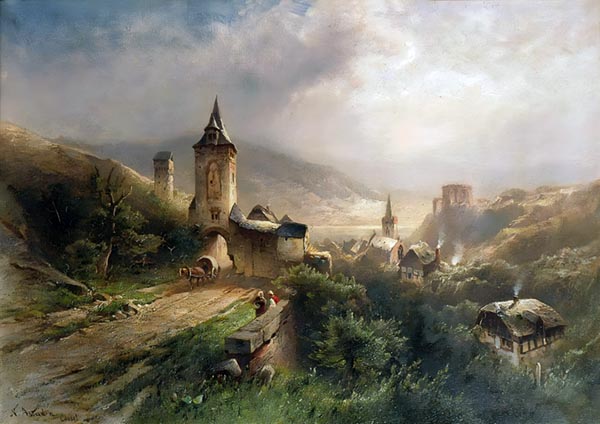
‘The Steeger Gate in Bacharach on the Rhine’
Nicolai Astudin (1847–1925)
Wikimedia Commons
Translated by A. S. Kline © Copyright 2026 All Rights Reserved
This work may be freely reproduced, stored and transmitted, electronically or otherwise, for any non-commercial purpose.
Conditions and Exceptions apply.
Contents
Letter XVIII: Bacharach
Lorch, August 23rd
I am currently surrounded by the most beautiful, honest, yet unknown old towns in the world. I lodge in Rembrandt interiors, with cagefuls of birds at the windows, strange lanterns hanging from the ceiling, and, in the corner of the rooms, spiral steps that a ray of sunlight slowly climbs. An old woman and a spinning wheel with twisted legs grumble together in the shadows, trying to outdo one another.
I spent three days in Bacharach, a sort of Court of Miracles (an area of beggars and thieves in Paris) on a stretch of the Rhine, forgotten, due to Voltaire’s good taste, by the French Revolution, by the battles of Louis XIV, by the cannonades of 1797 and 1805, and by the elegant and wise architects who build houses in the shape of chests of drawers and secretaries. Bacharach is truly the most ancient heap of human dwellings I have ever seen in my life. Next to Bacharach, the streets of Oberwesel, Saint-Goar and Andernach are, by comparison, akin to the Rue de Rivoli and the Rue de Bergère in Paris.
Bacharach is the ancient Bacchi Ara (Altar to Bacchus). It is as if a giant, who was also a dealer in bric-a-brac, wishing to open a shop on the Rhine, took a mountain as his set of shelves, and arranged on it, from top to bottom, with a giant’s taste, a pile of enormous curiosities, commencing with a shelf beneath the Rhine itself. There, at water level, there is a lump of volcanic rock according to some; a Celtic menhir according to others; a Roman altar according to the rest, which is the Ara Bacchi itself. Then, on the bank of the river, two or three old worm-eaten ship’s hulls are visible, sliced in two and planted upright in the ground, which serve as huts for fishermen. Then again, behind the huts, is a formerly-crenellated enclosure, buttressed by four square towers, the most chipped, the most machine-gunned, the most dilapidated ever seen. Then, set against the walls themselves, houses with pierced windows and galleries; and beyond them, at the foot of the mountain, an indescribable jumble of intriguing buildings, jewel-like hovels, with fantastic turrets; humped facades; impossible gables whose double staircase bears a bell-tower emerging like an asparagus stem on each step; frontages on which heavy beams trace delicate arabesques; volute-shaped attics; openwork-balconies; chimneys representing tiaras and crowns, smoking philosophically; and extravagant weather-vanes, which are no longer weather-vanes but capital letters from old manuscripts cut from a sheet of metal with a punch, and which creak in the wind (I had, among others, above my head an ‘R’ which spent all night naming itself: — rrrr.) Amidst this delightful jumble lies a square — a tortuous square, surrounded by blocks of houses fallen from the sky at random, and possessing more bays, islets, reefs, and promontories than a Norwegian fjord. On one side of this square two polyhedrons composed of Gothic constructions, overhanging, leaning, grimacing, while standing upright, and brazenly defying all geometry and all sense of balance. On the other side, is a beautiful and rare Romanesque church (Saint Peter’s), pierced by a lozenge-shaped portal; surmounted by a tall militaristic bell-tower; joined to the apse by a gallery of small archivolts with black marble columns; and everywhere inlaid with Renaissance tombs like a jewelled shrine. Above the church, higher up the slope, are the ruins of another church (the Wernerkapelle), completed in the fifteenth century in red sandstone, now without doors, roof, or stained glass, a magnificent skeleton, standing proudly against the sky. Finally, as a crowning glory, at the top of the mountain, are the rubble, and ivy-covered remnants, of a schloss, the Castle of Stahleck, residence of the Counts Palatine in the twelfth century. Such is Bacharach.
This old town out of a faery tale, teeming with stories and legends, is inhabited by a picturesque population, all of whom, old and young, children and grandfathers, the ugly women with goitre and the pretty girls too, have in their eyes, in their profile, and in their bearing, an air of the thirteenth century. Which does not prevent the pretty girls there from being very pretty; on the contrary.
From the top of the schloss one has an immense view, and one discovers in the embrasures of the mountains five other ruined castles; on the left bank, Fürstenberg (at Oberdiebach), Sooneck (at Niederheimbach) and Heimburg (Burg Hohneck, Niederheimbach); on the other side of the river, to the west, one glimpses the vast Gutenfels (at Kaub, overlooking Pfalzgrafenstein, the toll castle on Falkenau island), full of the memory of Gustavus Adolphus (King of Sweden, who died at the Battle of Lützen, in 1632, during the Thirty Years’ War); and towards the east, above a valley which is the Wisperthal of fable, at the top of a hill, on a small eminence which serves as its base, a ruined black tower (Nollig), resembling the old Bastille of Paris, which is the inhospitable manor whose door, according to the legend, Sibo von Lorch refused to open to the gnomes on stormy nights.
Bacharach is sited amidst a wild landscape. Clouds, forever clinging to its high ruins, steep rocks, and turbulent water, fittingly envelop this austere old town, which is Roman, Romanesque, Gothic, and which steadfastly refuses to become modern. Remarkably, a belt of sandbanks bordering it upstream and downstream prevents steamboats from berthing, and keeps civilisation at a distance.
No discordant touch, no white facade with green shutters disturbs the austere harmony of the scene. Everything contributes to it, even the name, Bacharach, which seems like an ancient cry of the Bacchantes (the wild female followers of Dionysus) adapted to the Sabbath. I must say, however, as a faithful historian, that I only saw a milliner there, installed, with her pink ribbons and white bonnets, below a terrifying black ogive from the twelfth century.
The Rhine roars magnificently around Bacharach. It seems to love and guard the ancient town, proudly. One is tempted to shout: ‘Well roared, lion!’ (see Shakespeare’s ‘A Midsummer Night’s Dream’, Act V, scene I). Within arquebus range of the town, it races along, and whirls about in a funnel of rocks, imitating the foam and noise of the Ocean. This fearsome passage is called the Wildes Gefäert. It is much more fearsome, yet much less dangerous than the ‘Bank’ at Saint-Goar — One should not judge chasms, etc.
When the sun pierces the clouds, and smiles through the windows, nothing is more delightful than Bacharach. All those decrepit and shabby facades brighten and blossom. The shadows of the turrets and weathervanes sketch out a thousand bizarre, angular shapes. Flowers — there are flowers everywhere — appear at the windows along with the women, and on every threshold, in joyous and peaceful groups, children and old people, everywhere warming themselves in the midday rays — the old people with that pallid smile that says: No more! the children with that sweet look that says: Not yet!
In the midst of these good people, a Prussian sergeant in uniform wanders about, looking like something between a dog and a wolf. And yet, whether it be the spirit of the country, whether it be envy of Prussia, I have not yet seen, in the picture frames hanging on the walls of the inns, any other portraits of great men than those of that conqueror with a somewhat rococo profile, a sort of Napoleon combined with Louis XV, a true hero, a true thinker, and a true prince moreover, Frederick II.
In Bacharach, a passer-by is a phenomenon. One is not only a stranger, one appears strange. The traveller is gazed at and followed with anxious eyes. No doubt because, no one deigns to visit this ancient, repudiated capital of the Counts Palatine, a dreadful hole which the dampfschiffs (steamboats) avoid, and which all the Rhine guidebooks describe as a sad town, except, that is, for a few poor painters wandering past with their knapsacks on their backs.
Nonetheless, I must also confess that in a study next to my room there was a lithograph representing Europe, that is to say two beautiful ladies with low-cut necklines, and a handsome gentleman with a moustache, singing around a piano, accompanied by this playful quatrain hardly worthy of Bacharach:
L’EUROPE
L’Europe enchanteresse où la France en jouant
Donne partout les lois de sa mode éphémère.
Les plaisirs, les beaux-arts et le sexe charmant
Sont les cultes chéris de cette heureuse terre.
Enchanting Europe, in which France, at leisure,
Shares, with all, the laws of ephemeral fashion.
The charming sex, the fine arts, and pleasure,
Are the cherished cults of that happy nation.
With the milliner and her pink ribbons, the lithograph, and that quatrain of the Empire, the dawn of the nineteenth century is beginning to break in Bacharach.
I had beneath my window a whole little world, happy and charming. It was a sort of backyard adjoining the Romanesque church, from which one can climb a steep lava staircase to the ruins of the Gothic church. There, all day long, with the tall grass up to their chins, three little boys and two little girls, who happily beat the three little boys, played. The sum of their ages could not have been much more than fifteen years old in total. The grass, slightly undulating in places, was so thick the ground was invisible. Amidst this grass, two green arbours laden with magnificent grapes stood joyfully, and amidst the vines, two scarecrow-mannequins, dressed like Lubins (the title character in the 1762 French comic-opera ‘Annette et Lubin’ by Marie-Justine-Benoîte Favart) from comic opera, with wigs and hideous three-cornered hats, were trying to scare the little birds, which did not prevent greenfinches, pipits, and wagtails from flocking to these bunches of fruit. In every corner of the little garden, starry sprays of sunflowers, hollyhocks, and daisies burst forth like showers of light in a firework display. Around these clusters, fluttered a living snow of white butterflies, mingled with feathers that had escaped from a neighbouring dovecote. Each flower and cluster had, moreover, its cloud of flies of all colours shining resplendently in the sun. The flies buzzed, the children chattered, and the birds sang; and the buzzing of the flies, the chatter of the children, and the song of the birds rose amidst a continuous cooing of pigeons and turtledoves.
On the evening of my arrival, after admiring this delightful garden till nightfall, the lava staircase attracted me and I took it into my head to climb, in beautiful starlight, to the ruins of the Gothic church, which was dedicated to Saint Werner who, it was claimed, was martyred at Oberwesel (despite uncertainty about the manner of his death the claim led to pogroms against the Jews, along the middle and lower Rhine and the Moselle). After climbing the sixty or eighty steps without banisters or guardrails, I arrived at the grass-covered platform, in which the beautiful dismantled nave is deeply rooted. There, while the city slept in deep shadow beneath my feet, I contemplated the sky, and the misshapen ruins of the Palatine Castle, through the black fenestration of mullions and rose windows. A gentle night wind barely bent the stalks of the withered wild oats. Suddenly I felt the earth cave, and sink beneath me. I lowered my eyes, and by the light of the constellations, I recognized that I was walking on a freshly dug grave. I looked around me; black crosses with white death’s heads were vaguely emerging from all sides. I then remembered the soft undulations of the ground lower down. I confess that at that moment I could not resist that kind of frisson that the unexpected grants. My charming little garden full of children’s chatter, birds, doves, butterflies, light, life, and joy, was a cemetery.
Letter XIX: Fire! Fire!
Lorch, August
At Bacharach, when midnight comes, one goes to bed, one closes one’s eyes, one lets go of the thoughts one has been carrying around all day. One arrives at that moment when within one there is both something awake and something asleep, when the tired body is already resting, but the stubborn mind is still at work, when it seems that sleep feels like life, and life like sleep. Suddenly a noise pierces the darkness and reaches your ears, a singular, inexpressible, dreadful noise, a kind of wild growling, at once threatening and plaintive, which mingles with the night wind and which seems to come from that high cemetery situated above the town where you saw that very morning the eleven stone gargoyles of the ruined church of Saint Werner open their mouths as if they were preparing to scream. You wake with a start, you sit up, you listen: ‘What was that?’ It was the night crier blowing his horn, and warning the town that all is well, so that it can sleep peacefully. So be it; but I scarcely think it possible to reassure people in a more troubling manner.
In Lorch you can be woken up in an even more dramatic way. But first, my friend, let me tell you about the place. Lorch is a large town of about eighteen hundred inhabitants, situated on the right bank of the Rhine and extending at right angles along the Wisper, whose mouth it marks. The Wisper valley is a valley of stories and fables; it is the country of those little grasshopper-like faeries. Lorch is located at the foot of the Devil’s Ladder, a high, almost sheer, rock that the valiant Gilgen climbed on horseback to seek his fiancée, Gerlinde, hidden by the gnomes on the summit of the mountain. It was in Lorch that the faery Ave invented, according to legend, the art of weaving cloth to clothe her lover, the chilly Roman knight Heppius — who gave his name to Heppenheim. It is remarkable, incidentally, that, among all peoples and in all mythologies, the art of weaving fabrics was invented by a woman: in ancient Egypt, it was Isis; in Lydia, Arachne; in Greece, Athene; in Peru, Mama Ocllo, sister-wife of Manco Capac; in the villages of the Rhine, it was the faery Ave. The Chinese alone, it is said, attribute the invention to a man, the emperor Yao; though to the Chinese the emperor is not a man, he is a being of fantasy whose reality vanishes behind the bizarre titles with which they endow him. They know not his nature, for they call him the Dragon; they know not his age, for they call him Ten-Thousand-Years; they know not his sex, for they call him also The Mother. But what have we to do with China, here? I shall return to Lorch. Forgive me the diversion.
The first red wine from the Rhine was made in Lorch (in Roman times, according to legend). Lorch existed before Charlemagne, and left traces in charters from 732. Heinrich III von Virneburg, Archbishop of Mainz, enjoyed himself there, and resided there, in 1348. Today there are no more Roman knights, faeries, or archbishops in Lorch; but the little town is happy, the landscape is magnificent, the inhabitants are hospitable. The beautiful Renaissance house (the Hilchenhaus, 1546) on the banks of the Rhine has a facade as original and as rich in that genre as that of our Château de Meillant. Old Sibo’s fabled fortress protects the town, which is threatened from the other bank of the river by the historic castle of Fürstenberg with its large tower, round on the outside, hexagonal, it is said, on the inside. And nothing is more charming than to see this small, lively colony of country folk prospering happily between the two fearsome skeletons which were once two citadels.
Now, here is how one of my nights at Lorch was disturbed. Last week, at perhaps one in the morning, while the town was asleep, I was writing in my room, when I suddenly noticed that my paper had reddened under my pen. I looked up; it was no longer lit by my lamp, but by my windows. Both had become two large pink opal rectangles through which a strange reverberation reached my ears. I opened the windows and looked out. A wide arch of flame and smoke was curving a few yards above my head with a frightening noise. Quite simply, the Hôtel P…. the gasthaus next to mine, had caught fire and was burning.
In an instant the inn awoke, the people of the township were afoot, the cry of Feuer! Feuer! filled the quay and the streets, the tocsin rang out. I closed my windows and opened the door. Another spectacle. The great wooden staircase of my gasthaus, almost touching the burning building, and lit by large windows, seemed itself to be on fire; and on this staircase, from top to bottom, a crowd of burdened shadows with bizarre silhouettes jostled, pressed, and trampled. The whole crowd of guests were in motion, some in their underpants, others in their chemises, the travellers dragging their trunks, the servants the furniture. All these fugitives were still half-asleep. No one shouted or spoke. The turmoil was that of an antheap. The dreadful blaze filled the view behind their heads. As for myself, since everyone thinks of themselves at such times, I had very little luggage, I was staying on the first floor, and I ran no risk other than being forced to leave the inn by way of the window.
Meanwhile a storm had risen, it was pouring with rain. As always occurs when one is in a hurry, the hotel emptied only slowly, and there were moments of terrible confusion. Some wanted to enter, others to exit; the heavier furniture was being lowered from the windows, attached to ropes; mattresses, sleeping bags and bundles of linen were dropped from the rooftop onto the pavement; the women were terrified, the children cried; the country folk, awakened by the tocsin, came running from the mountain slope, their large hats brimful of water, and leather buckets in their hands. The fire had already reached the attic floor of the house, and it was said that it had been set deliberately at the P… inn; a circumstance which always adds a darker interest and a sort of dramatic background to a fire.
Soon the pumps arrived, chains of workers formed, and I ascended to the attic, an enormous tangle, several stories high, of picturesque timbers, like those supporting all the tall slate roofs on the banks of the Rhine. The entire timber frame of the neighbouring building was clothed in a single sheet of flame. This immense pyramid of burning wood, topped by a vast red plume shaken by the storm-wind, giving off dull sounds, arched over our roof, already alight here and there and crackling. The issue was serious; if our roof caught fire, ten houses certainly, and perhaps, given the strong wind, a third of the town would burn. The labour was difficult. It was necessary, beneath the whirlwind of flame and sparks, to peel the slates from part of the roof, and cut through the weathervane gables of the dormers. The pumps were admirably served. From the attic windows my gaze plunged into the furnace and I was, so to speak, inside the fire itself. It is a terrible and admirable thing, a fire in one’s face. I had never seen a like spectacle — but since I was there, I accepted its reality.
At first, when one sees oneself as if enveloped in a monstrous cave of fire where everything blazes, shines, sparkles, shrieks, suffers, bursts and collapses, one cannot avoid a feeling of anxiety; it seems that all is lost and that nothing will be able to combat the fire’s dreadful force; but as soon as the pumps arrive one regains one’s courage.
Conceive with what rage the water attacked its enemy. Scarcely had the pump’s hose, that long serpent that one heard panting below in the darkness, passed its slender neck above the dark wall and set its fine sparkling copper head amidst the flames than it spat a furious jet of liquid steel onto that fearful chimera with a thousand heads. The burning pyre, attacked unexpectedly, howled, rose, leapt frightfully, opened dreadful jaws full of rubies, and licked all the doors and windows at once with its innumerable tongues. Steam mixed with the smoke; white whirlwinds and black whirlwinds spiralled away at every breath of wind, twisting and clasping one another in the shadows beneath the clouds. The water’s hiss answered the fire’s roar. Nothing is greater or more terrible than that ancient and eternal combat between the hydra and the dragon.
The force of the column of water thrown up by the pump was prodigious. The slates and bricks it touched shattered and scattered like scales. When the roof structure finally collapsed, a magnificent moment, when the scarlet plume of the fire was replaced, amidst a terrible noise, by an immense and tall plume of sparks, a single chimney of the inn remained standing like a sort of small stone tower. A jet of water from the pump hurled it into the abyss.
The Rhine, the township, the mountains, the ruins, the whole crimsoned spectral landscape re-emerging in this light, were wreathed with the smoke and flame, amidst the continual tolling of the tocsin, the crashes of sections of wall falling in one piece like drawbridges, the dull blows of the axe, the tumult of the storm, and the noise of the townsfolk. It was hideous, yet, in truth, it was also beautiful.
Observing the details of the fire, nothing was more singular. In the gap between a whirlwind of flame and a whirlwind of smoke, men’s heads emerged at the end of a ladder. One saw these men flooding, at point-blank range as it were, the fierce flame that struggled and fluttered, and persisted, beneath the solid jet of water. In the midst of this dreadful chaos, there were well-nigh noiseless areas where small, silent fires crackled gently in corners as in a widow’s meagre hearth. The windows of the rooms, now inaccessible, swayed to and fro in the wind. Pretty blue flames quivered at the tips of beams. Heavy timbers, detached from the edge of the roof, remained suspended from a nail, swinging above the street in the hurricane, enveloped in a long sheet of flame. Others fell into the narrow space between the houses and established bridges of glowing embers there. Inside the apartments, Parisian wallpaper with pretentious borders disappeared and reappeared amidst puffs of red ash. On the third floor, there was a mediocre Louis XV wall painting, by ‘Gentil’ Bernard (Pierre-Joseph Bernard), with rocks, trees and shepherds which struggled to survive for a long time. I gazed at it with admiration. I had never seen an eclogue put on such a brave face. Finally, a great flame entered the room, seizing the unfortunate celadon-green landscape, and the villager embracing the villager’s wife, and Thyrsis cajoling Glycera went up in smoke. As if in tandem, a poor little garden, horribly drenched in hot coals, was burning away at the foot of the house. A young acacia, leaning against a blazing trellis, stubbornly refused to catch fire and remained untouched for four hours, the green and pretty crown nodding amidst showers of sparks.
Add to all this a few pale, blonde English girls half-dressed in the downpour, beside their luggage, a few steps from the inn, and all the local children laughing out loud and clapping their hands every time a jet of water came towards them, and you will have a fairly complete idea of the fire at the Hôtel P… at Lorch. A burning building is simply a burning building; but the truly sad part of it was that a poor fellow died there.
Around four in the morning, we were what is called masters of the fire; the gasthaus P… its roofs, ceilings, stairs. and floors collapsed, was still ablaze within its four walls, and we had succeeded in saving our inn. Then, and almost without intermission, water succeeded fire. A swarm of maids, brushing, rubbing, sponging, wiping, invaded the rooms, and in less than an hour the house had been cleaned from top to bottom.
Remarkably, nothing was stolen. All these belongings, moved in haste, in the rain, in the middle of the night, were religiously brought back by the far-from-wealthy folk of Lorch. Such accidents are hardly rare on the banks of the Rhine. Every wooden house has a hearth, and here wooden houses abound. In Saint-Goar alone, there are at this moment, in different places in the town, four or five ruins created due to fires.
The next morning, I noted, with some surprise, two or three closed ground floor rooms of the inn, which were perfectly intact, and about which the blaze had raged without disturbing anything. There is a little tale about this that is told in the country. I do not vouch for it. — A few years ago, an Englishman arrived quite late at an inn in Braubach, had supper and went to bed. In the middle of the night, the inn caught fire. They rushed to the Englishman’s room. He was asleep. They woke him. They explained the situation, and that the house was on fire, and that he had to leave at once. — ‘What the Devil!’ cried the Englishman, ‘You’ve woken me for that! Leave me alone. I’m tired, I’ve no intention of rising. You’re all quite mad if you think I’m going to start running around the fields in my shirt at midnight! I intend to enjoy my nine hours sleep, comfortably. Put out the fire if you like, I shan’t stop you. As for me, I’m happy in bed, I’ll stay here. Good night, my friends, I’ll see you tomorrow.’ That said, he retired to bed once more. There was no way to make him see reason, and, as the fire spread, the people ran away, after closing the door on the Englishman, who was asleep again, and snoring. The fire was terrible, and it was extinguished with great difficulty. The next morning, the men who were clearing the rubble arrived at the Englishman’s room, opened the door and found the traveller half-awake and rubbing his eyes in his bed, who yawned and called to them as soon as he saw them: ‘Can you tell me if there’s a bootjack in this place?’ He rose, had a very hearty breakfast, and left admirably rested and refreshed, much to the displeasure of the local boys, who were counting on utilising the Englishman’s mummified body as what is called in the Rhine valley a dry burgomaster, that is to say, a perfectly smoked and preserved corpse, which is shown to foreigners for a few farthings.
Letter XX: From Lorch to Bingen
Bingen, August 27th
From Lorch to Bingen is two German miles, in other words, four French leagues, or nearly sixteen kilometres, in the horrible language that the law wishes us to use, as if it were up to the law to create the language. Quite the contrary, my friend, in a host of cases it is up to the language to create the law.
You know my preference. Whenever I can travel a portion of my route on foot, that is to say, converting the journey into a walk, I never fail to do so.
Nothing is as charming, in my opinion, as travelling – on foot! One belongs to oneself, one is free, one is joyful; one is entirely and, un-dividedly, absorbed in the incidents of the road, in the farm where one has lunch, in the tree where one shelters, in the church where one meditates. One departs, one stops; one departs again – nothing hinders, nothing holds one back. One journeys and dreams alone. Walking lulls one’s reveries; one’s reveries veil fatigue. The beauty of the landscape hides the distance involved. One does not travel, one wanders. With each step one takes, an idea is born. It seems as if one feels swarms of them hatching and buzzing in one’s brain. Many a time, seated in the shade at the edge of a highway, beside a small, lively spring from which flowed joy, life, and freshness accompanying its progress, beneath an elm tree full of birds, near a field full of haymakers, rested, serene, happy, gently occupied with a thousand dreams, I have watched with compassion the post-chaise pass before me, like a whirlwind amidst which lightning flickers, a swift, sparkling thing which contains I know not what slow, heavy, bored, and drowsy travellers; a flash of lightning that bears away a heap of tortoises. Oh! How quickly those poor people, who are, after all, often people of heart and spirit, would throw themselves from their loving prison, in which the harmony of the landscape is turned to noise, the sun to mere heat and the road to dust, if only they knew of all the flowers to be found in the undergrowth, all the pearls to be gathered among the pebbles, all the houris to be discovered among the country girls, by the winged, opulent and joyful imagination of he who is walking! Musaque pedestri (‘and the Muse too afoot’, see Horace’s ‘Satires’ II.6, line 17).
And then everything comes to the man who walks. It is not only that ideas arise in him; adventures befall him, and, for my part, I greatly love every adventure that happens to myself. If it is pleasant for others to invent adventures, it is even pleasanter to experience them oneself.
I remember a visit I made seven or eight years ago to Claye (Claye-Souilly), a few miles from Paris. Why? I no longer remember. I happened to find these few lines in my notebook. I am transcribing them for you because they are, so to speak, a part of the random things I wish to tell of:
— ‘A canal on the ground floor, a cemetery on the first floor, a few houses on the second, that’s Claye. The cemetery occupies a terrace, with a balcony overlooking the canal, from which the ears of the country folk of Claye can hear the passing serenades, if there are any, rising from the mail-boat from Paris to Meaux, which travels ten miles an hour. In that country, you are not merely interred, you are buried deep. It’s a fate, like any other.’
I remember I was returning to Paris on foot; I had left quite early in the morning, and, around midday, the beautiful trees of the forest of Bondy inviting me to rest at a place where the path bends sharply, I sat down on a grassy bank, leaning against an oak, my feet dangling in a ditch, and began to scribble in my green notebook the comments you have just read.
As I was finishing the fourth line — which I see today in the manuscript separated from the fifth by a fairly large gap — I raised my eyes, vaguely, and saw, on the other side of the ditch, at the edge of the road, in front of me, a few steps away, a bear staring at me. In broad daylight one is spared nightmares; one cannot be fooled by a shape, an apparition, a misshapen rock, or an absurd tree trunk. ‘Lo que puede un sastre’ (‘What a tailor can do!’ The title of Goya’s etching, no.52, from his ‘Los Caprichos’ showing a forked tree covered by clothing, turned thereby into a fearsome scarecrow figure) may be formidable at night; but at midday, under a May sun, one is free of hallucinations. It was indeed a bear, a real bear, a live bear, and perfectly hideous. He was sitting gravely, showing me the dusty underside of his hind legs and paws, of which I could distinguish all the claws, his front paws lazily crossed on his belly. His mouth was half-open; one of his ears, torn and bleeding, was half hanging down; his lower lip, half torn off, revealed bare fangs; one of his eyes was gouged out, and with the other he was gazing at me with a serious air.
There was no sign of a woodcutter in the forest, and what little I could see of the path at that point was absolutely deserted. I felt a degree of emotion. One sometimes avoids trouble from a stray dog by calling it by a canine name Fox, Soliman, or Azor; but what can one say to a bear? Where had it come from? What was this bear doing in the forest of Bondy, on the main road from Paris to Claye? What was the meaning of this new sort of vagabond? It was all very strange, ridiculous, unreasonable, and, when all was said and done, very unfortunate. I was, I confess, most perplexed. I sat still, however; I must say that the bear, for its part, did the same; it even seemed to me, up to a certain point, benevolent. It looked at me as tenderly as a one-eyed bear can look. All things considered, though it opened its jaws it opened them as a mouth usually opens. It was not a grin; it was a yawn; it was in no way ferocious; it was almost literary. This bear had something honest, beatific, resigned and somnolent about it; and I have since noted the same facial expression in old theatre-goers listening to some tragedy or other. In short, his countenance was so tame that I also resolved to put on a good face. I accepted the bear as a spectator, and continued what I had begun. I therefore began to sketch in my book the fifth line of the note above, which fifth line, as I told you just now, is in my manuscript distant from the fourth; because, as I began to write it, my eyes were fixed on the bear’s eyes.
While I was writing, a large fly came and landed on the bloodied ear of the spectator. He slowly raised his right paw and flicked it over his ear with a catlike movement. The fly flew off. He looked for it; then, once it had disappeared, seized his two hind legs with his forelegs, and, as if satisfied with this classic attitude, resumed his contemplation of me. I declare I followed these various movements with interest.
I was beginning to grow accustomed to this tête-à-tête, and was writing the sixth line of my note, when an incident occurred: a sound of hurried footsteps was heard in the main road, and suddenly I saw another bear emerge from around the bend, a large black bear; the first being a tawny one. This black bear arrived at a brisk trot, and, seeing the tawny bear, came and rolled gracefully on the ground beside it. The tawny bear did not deign to look at the black bear, nor did the black bear deign to pay any attention to me.
I confess that, at this second apparition, which raised my perplexity to the second power, my hand trembled. I was writing the phrase: ‘.... can hear the passing serenades.’ On the manuscript, I find today a rather large gap between the words: hear the passing, and the word: serenades. The gap indicates: — Another bear!
Two bears! It was all too much. What was the reason? By what chance? Judging by the direction from which the black bear had emerged, both had come from Paris, a place where there are few animals — especially wild ones.
I remained as if petrified. The first bear had ended up taking part in the other’s games, and, from rolling in the dust, both had turned grey. However, I had managed to rise, and was wondering if I should try and retrieve my cane which had rolled into the ditch at my feet, when a third bear appeared, a reddish bear, small, deformed, even more torn and bleeding than the first; then a fourth, a fifth, a sixth, the last two padding along together. These last four bears crossed the road like extras crossing backstage, seeing nothing and looking at nothing, almost running, and as if they were being pursued. The strange scene prompted one to seek an explanation. Then I heard barking and shouts; a dozen bulldogs, and eight men or so armed with iron-tipped sticks and carrying muzzles in their hands, burst onto the road, chasing the fleeing bears. One of these men stopped, and while the others brought back the now-muzzled beasts, he provided the answer to the riddle. The manager of the circus at the Barrière du Combat (the Paris toll-gate on the road to Meaux, not extant) was taking advantage of the Easter holiday to send his bears and mastiffs to perform at Meaux. The entire menagerie was travelling on foot. At the last stop they had unmuzzled them to feed them; and while their keepers were seated at the neighbouring tavern, the bears had taken advantage of their moment of freedom to stroll at leisure, happy and alone, for a part of the way. They were actors on leave. Such was one of my adventures as a traveller afoot.
Dante begins his Divine Comedy by telling us that one day he met a leopard in a wood, then after the leopard a lion, then after the lion a she-wolf. If the traditional tale is true, in their travels in Egypt, Phoenicia, Chaldea and India, the seven wise men of Greece all had like adventures. They each encountered a different beast, as befits wise men who all have different wisdom. Thales of Miletus was followed for a long time by a winged griffin; Bias of Priene walked side by side with a lynx; Periander of Corinth made a leopard back down by staring at it; Solon of Athens walked boldly towards a furious bull; Pittacus of Mitylene encountered a bullfrog; Cleobulus of Rhodes was accosted by a lion, and Chilon of Lacedaemon by a lioness. All these marvellous events, if examined closely, could likely be explained by the equivalent of my menagerie on leave, Easter holiday, and Barrière du Combat. If I had recounted my adventure with the bears, in proper style, I might perhaps in two thousand years’ time have acquired something of the air of an Orpheus. Dictus ob hoc lenire tigres (‘he is said to have tamed tigers’ see Horace, ‘Ars Poetica’, line 393). You see, my friend, my poor acrobatic bears hold the key to many wonders. With all due respect to the ancient poets and Greek philosophers, I hardly believe in the virtue of a stanza when faced with a leopard or the power of a syllogism as regards a hyena; but long ago, I think, Mankind, equipped with an intellect that can transform instinct at will, discovered the secret of taming lions and tigers, subduing animals, and brutalising beasts. Mankind, always and everywhere, believes it has made a great step forward when it has substituted, through intelligent training, stupidity for ferocity. All things considered, it may indeed be such, since without that step, I might have been eaten — and the seven wise men of Greece with me.
Since I am reminiscing, let me tell you one little story more. You know G…, that old poet-scholar who proves that a poet can be patient, that a scholar can be charming and that an old man can retain his youth. He walks as if he were a mere twenty years old. In April 183... we were together on some excursion in the Gâtinais (around the Loing valley). We were walking side by side on a fresh morning warmed by a pleasant sun. I, whom truth charms, and paradox amuses, know no more agreeable company than G.... He knows all the proven truths, and invents every possible paradox.
I remember that his fancy at that moment was to maintain that the basilisk exists. Pliny speaks of it (in his ‘Naturalis Historia’ VIII, 32), and describes it, so G… said. The basilisk is born in the neighbourhood of Cyrenaica in Africa. It is about twelve fingers long; it has a white spot on its head like a coronet; and when it hisses, the snakes flee. The Bible (Isaiah 14:29, in some versions) says that it has wings. What is known is that in the time of Saint Leo (Pope Leo the First) there was in Rome, in the church of Santa Lucia, a basilisk which infected the whole city with its breath. The Pope dared to approach the damp, dark vault which was the monster ‘s lair, and the humanist Julius Caesar Scaliger says, (in his ‘Exercitationes’, 1557), in a rather beautiful phrase, that he extinguished it with his prayers.
G… added, noting my incredulity regarding the basilisk, that certain places have a particular effect on certain animals: that at Seriphus, in the Archipelago, the frogs never croak; that at Reggio, in Calabria, the cicadas never sing; that wild boars are mute in Macedonia; that the serpents of the Euphrates never bite the natives, even when the latter are asleep, but only foreigners; while the scorpions of Mount Latmos, harmless to foreigners, mortally sting the inhabitants of that place. He asked me, or rather he asked himself, a host of questions, and I let him continue. Why are there a multitude of rabbits in Majorca, but why is there not a single one in Ibiza? Why do hares die in Ithaca? Why is it that one cannot find a wolf on Mount Olympus, nor an owl on the island of Crete, nor an eagle on the island of Rhodes?
Seeing me smile, he would interrupt himself: ‘All very well, my dear fellow! But such was the opinion of Aristotle!’ To which I would simply reply: ‘My friend, it’s dead science; and dead science is no longer science, it is merely erudition.’ And G… would reply with his gentle look full of gravity and enthusiasm: ‘You are right. Science dies. Only art is immortal. One great scholar arrives, and another is forgotten; while as for the great poets of the past, those of the present and future can only try to match them. Aristotle has been surpassed, Homer has not.’ Having said this, he would become thoughtful, and then he would start looking for a buprestid (jewel beetle) in the grass, or a rhyme in the clouds.
We were approaching Milly-la-Forêt, thus, amidst that plain where one can still see the remains of a hovel that become famous in the witch trials of the seventeenth century. Here is the occasion. A lynx was ravaging the countryside. Gentlemen of the king’s hunting party chased it down, accompanied by a force of servants and country folk. The wolf, pursued across the plain, reached the hovel and threw itself inside. The hunters surrounded the hovel, then entered abruptly. They found an old woman there. A hideous old woman, at whose feet lay the wolf’s skin that Satan had not had time to spirit away through a trapdoor. It goes without saying that the old woman was burned on a bundle of green wood; this was done in front of the beautiful portal of the Cathedral of Sens. I admire the fact that men, with a sort of inept sense of display, have always sought out such calm, serene, and wondrous creations of human intelligence, before which to enact their greatest stupidities. This occurred, they say, in 1636, the year in which Corneille staged Le Cid.
As I was telling this story to G… he said ‘Listen.’ I could indeed hear a fanfare produced by some charlatan or other, that emerged from a small group of houses on our left, hidden in the trees. G… has always had a taste for that kind of grotesque, triumphant noise. ‘The world,’ he said to me that day, ‘is full of a great and serious uproar of which this is a parody. While lawyers declaim on the political stage, while rhetoricians hold forth on the scholastic, I visit the meadows, I catalogue midges, and collate blades of grass, I am impressed with the greatness of God, and always charmed to encounter, at some place or other, this noisy emblem of the pettiness of men, this charlatan thumping on his bass drum, this Bobino (a nineteenth-century Italian clown who performed in the Luxembourg Gardens in Paris), this Bobèche (Antoine Mandelot, a clown in the French theatre), this figure of irony! The charlatan mingles in my mind with my studies and completes them; I pin his form to my cardboard like a beetle or butterfly, and classify the human insect among the others.’
G… therefore led me towards the group of houses from which the noise was coming — a little hamlet which is called, I believe, Petit-Sou, which made me think of the village of Asculum, on the road from Trivicum to Brundisium (Brindisi), which made Horace (see ‘Satires’ Book I.5, lines 87-88) devise a rebus:
…quod versus dicere non est,
Signis perfacile est………………
…what can’t be said in verse,
is quite easy to signal…………………
Asculum, cannot, indeed, be accommodated in dactylic hexameter verse, nor Petit-Sou in an alexandrine. It was the village festival. The square, the church, and the town hall were all adorned. The sky itself, coquettishly decorated with a crowd of pretty white and pink clouds, had something rustic, joyful and Sunday-like about it. Circles of little children and young girls, contemplated fondly by old men, occupied one end of the square which was clothed with grass; at the other end, paved with sharp pebbles, the crowd surrounded a kind of trestle leaning against a sort of hut. The trestle comprised two planks and a ladder; the hut was covered with that classic blue and white checkered canvas used for mattresses, and which, when a smock is made from it, when needed, has given the nickname of paillasses (straw-mattresses) to the servants of every charlatan. Beside the trestle, was the door of the hut, a simple slit in the canvas; and above this door, on a white sign, decorated with this word in large black capital letters, MICROSCOPE, teemed, more frightening animals, more chimerical monsters, more impossible beings, crudely drawn in a thousand fantastic attitudes, than Saint Anthony saw or the artist Jacques Callot ever dreamed.
Two men occupied this stage. One, as dirty as Job, as tanned as Ptah, coiffed like Osiris, and making a moaning sound like Memnon’s statue, with something oriental, foolish, fabulous and Egyptian about him, was beating a large drum while blowing randomly into a flute. The other was watching him. He was a kind of Sbrigani (a schemer in Molière’s play ‘Monsieur de Pourceaugnac’, 1669), pot-bellied, bearded, hairy of head and body, with a ferocious air, and dressed as a melodramatic Hungarian.
Around this hut, this trestle and these two men, stood many an impassioned countryman, many a fascinated countrywoman, many of the most horrified admirers in the world their silly mouths agape and stupid eyes open wide. Behind the platform, some children were making holes, artistically, in the aged blue and white canvas, which offered little resistance, allowing them to see the inside of the hut. As we arrived, the Egyptian finished his fanfare the Sbrigani began to speak, and G… began to listen.
Except for the usual invitation: ‘Enter and you will behold, etc., I declare that what this clown said was perfectly unintelligible to me, to the country-folk and to the Egyptian, who had assumed the posture of a bas-relief, and listened with as much dignity as if he was attending the dedication of the great columns of the hypostyle hall of Karnak by Merenptah Seti I, the father of Ramesses II.
However, at the first words the charlatan spoke, G… shuddered. After a few minutes, he leaned towards me and said in a low voice: ‘Being young, with good eyesight and a pencil, do me the favour of writing down what this man says.’ I wanted to ask G… for an explanation of this strange request, but his attention had already returned to the trestle too energetically for him to hear me. I decided to comply, and as the charlatan spoke slowly and solemnly, here is what I wrote down from his dictation:
‘The family of mites is divided into two groups: the first has no eyes; the second has up to five, including the genus cunaxa with two, and the genus bdella with four.’
Here G…, who was listening with ever-deepening interest, took off his hat, and, addressing the charlatan in his most gracious and gentle voice said: ‘Pardon, Monsieur, but you tell us nothing about the genus gamasus?
— ‘Whom do we have here?’ said the man, glancing around at the audience, but without surprise or hesitation. ‘This old gentleman? Well, old gentleman, in the genus gamasus I have only found one species, it is dermanyssus, a parasite of the pipistrelle bat.’
— ‘I thought, G… continued timidly, that it was a glycyphagus cursor?
— ‘A mistake, my good man,’ replied the Sbrigani. ‘There is a gulf between the glycyphagus and the dermanyssus. Since you are concerned with these great questions, study Nature. Consult Charles De Geer, Constantine Hering and Johann Hermann. Observe (I was still writing as yet) the sarcoptes ovis, which has at least one of the two pairs of hind legs complete and wattled; the sarcoptes rupicaprae, whose hind legs are rudimentary and setigerous, without vesicle, and without tarsus; the sarcoptes hippopodos, which is perhaps one of the glycyphagidae.’
— ‘You are not sure?’ G… interrupted, almost respectfully.
— ‘I am not sure,’ the charlatan replied majestically. ‘Yes, I must confess, holding truth to be sacred, that I am not sure. What I am sure of is that I collected one of the glycyphagidae from the feathers of the eagle-owl. What I am sure of is that, while visiting galleries of comparative anatomy, I found glycyphagidae in the cavities, between the cartilages and under the epiphyses of skeletons.’
— ‘That is amazing!’ murmured G….
— ‘But,’ continued the man, ‘this is taking me too far from my subject. I will speak to you another time, gentlemen, of the glycyphagidae and the psoroptes. The extraordinary and formidable animal that I am going to show you today is the sarcoptes. A frightening and marvellous thing: the camel mite, which does not resemble that of the horse, resembles that of man! Hence a possible confusion, the consequences of which would be disastrous (I was still writing away). Let us study them, gentlemen; let us study these monsters. The form of each is almost the same; but the dromedary sarcoptes is a little more elongated than the human sarcoptes; the intermediate pair of posterior hairs, instead of being the smallest, is the largest. The ventral surface also has its peculiarities. The collar is more clearly separated in sarcoptes hominis (sarcoptes scabiei var. hominis), and it sends down below an aciculiform point which does not exist in sarcoptes dromadarii. The latter is larger than the other. There is also an enormous difference in the spines at the base of the hind legs; they are simple in the first species, and unequally bifid in the second...’
At this point, tired of writing all these dark and imposing things, I could not help but nudge G…’s elbow and ask him in a low voice: ‘But what the devil is the man talking about?’
G... half turned to me and said gravely: ‘The mites that cause scabies.’
I burst into such a fit of laughter that the notebook fell from my hands. G... picked it up, snatched the pencil from me, and without deigning to reply to my gaiety, even with a gesture of contempt, while more attentive than ever to the charlatan’s words, he continued to write in my place, in the calm, collected, and Raphaelesque attitude of a disciple of the school of Athens.
I must say that the country folk, more and more dazzled, shared, to a supreme degree, the admiration and beatitude of G…. Extreme science, and extreme ignorance, meet each other in extreme naivety. The obscure and formidable dialogue of the charlatan had perfectly succeeded with the villagers of the honest neighbourhood of Petit-Sou. These people are like children: they marvel at what they do not understand. They love the unintelligible, the bristling, the declamatory and marvellous amphigouri (nonsensical rigmarole). The more ignorant the man, the more the obscure charms him; the more barbaric the man, the more complexity pleases him. Nothing is less simple than a savage. The idioms of the Huron, the Botocudo (of Eastern Brazil) and the Chesapeake peoples are forests of consonants through which, half-swallowed in the mud of poorly-rendered ideas, crawl immense and hideous words, like antediluvian monsters beneath the inextricable vegetation of the primeval world. The Algonquins translate the name France, short, simple and sweet as it is, by Mittigouchiouekendalakiank.
So, when the hut opened, the crowd, impatient to contemplate the promised wonders, poured in. A charlatan’s Mittigouchiouekendalakiank always results in a shower of liards or doubloons in their purse, depending on whether they have addressed themselves to the people below them or to the people above.
An hour later we resumed our walk and were following the edge of a small wood. G... had not yet spoken a word to me. I was making a thousand futile efforts to regain his favour. Suddenly, seeming to emerge from a deep reverie and as if answering himself, he said: ‘And he speaks very well concerning it!’
— ‘Of scabies?’ I said very timidly.
— ‘Yes, of course, scabies,’ G... replied firmly.
He added after a brief silence: ‘This man has made magnificent microscopic observations. Real discoveries.’
I ventured another word. ‘Doubtless, he will have studied the subject with this Egyptian pharaoh whom he has made his lackey and musician.’
But G... was no longer listening. ‘What a prodigious thing!’ he cried, ‘and what a subject for melancholy meditation! Illness pursues Mankind after death. Skeletons suffer from scabies!’
There was another silence, then he continued: ‘This man should be in the third class at the Institute. There are many academics who are charlatans; here is a charlatan who ought to be an academic.’
Now, my friend, I can see you laughing in turn, and exclaiming: ‘Is that all? Oh, what pleasant adventures, what engaging stories, and what a traveller on foot you are! To meet bears, or to hear a sabre-swallower, bare-armed and red-belted, confront, in the open air, the human mite with the camel mite, and deliver a philosophical course in comparative mange to country folk! Truly one should hasten to leap from one’s post-chaise, for these are wondrous delights.’
If you wish. As for me, I know not if it’s dawn, spring, or youth that enlivens these memories, now ancient, alas, but they glow in my mind. I find a charm in them I cannot express. Laugh as much as you like at the traveller afoot, I am always ready to start out again, and if some similar adventure happened to me today, I would take extreme pleasure in it. (See Jean de La Fontaine, Fables, VIII, 4 ‘Le Pouvoir des fables’.)
But such good fortune is rare, and when I undertake an excursion on foot, provided the sky has a joyful look, the villages have an air of happiness, the dew trembles on the tips of the grass, mankind labours, the sun shines and the bird sings, I thank the good Lord, and ask him for no other adventure. The other day, then, at five thirty in the morning, having given the necessary orders to have my luggage transported to Bingen, I left Lorch, as dawn broke, and a boat transported me to the opposite bank. If you ever follow this route, do the same. The Roman, Romanesque, and Gothic ruins of the left bank are of much greater interest to the pedestrian than the slate layers of the right bank. At six, I was seated, after a rather steep climb through the vines and scrubland, on the ridge of a hill of extinct lava which overlooks the castle of Furstenberg and the valley of Diebach, and there I noticed an error of the antiquarians. They say, and I followed them when I wrote my previous letter to you, that the large tower of Furstenberg, round on the outside, is hexagonal on the inside. Now, from the high point where I had placed myself, my gaze plunged deep into the tower, and I can assure you, if it is of interest, that it is round inside as well as outside. What is remarkable is its height which is prodigious, and its shape which is singular. As it has enormous battlements without machicolations, and as it widens from the top to the base, without bays, without windows, pierced only by a few tall loopholes, it resembles in the strangest way the mysterious and massive dungeons of Samarkand, Calicut (Kozhikode, India) or Granganor (Koci, India); and one might have expected to see the Maharaja of Lahore or the Zamorin of Malabar appear, at the top of this large, almost Hindu, tower, rather than Louis V of Bavaria or Gustavus Adolphus of Sweden. Yet this citadel, more oriental than Gothic, played a great role in the struggles of Europe. At the moment in which I was recalling the host of ladders successively applied to the sides of this stone giant, the siege of the Bavarians in 1321, the Swedes in 1632, and the French in 1689, a tree-creeper was gaily climbing it.
What caused the antiquarians’ error, is a turret which defends the citadel from the mountain side, and which, round on the inside, is armed at its summit with a crowning of machicolations carved with six sides. They took the turret for the tower, and the exterior for the interior. However, at that early hour, thanks to the vapours still settling and resting on the ground, I could only distinguish the summit of the keep, the top of the walls, and on the horizon, all around me, the high crests of the hills. At my feet, the depths of the landscape were hidden by a thick white mist whose edges were gilded by the sun. It was as if a cloud had plunged into the valley.
As seven o’clock struck, from the clouded bell tower of Rheindiebach which is the hamlet below Furstenberg, the treecreeper flew away, and I rose. As I descended, the fog rose too, and as I reached the village, the rays of the sun were also reaching it. A few minutes later, I had left the village behind, without seeking, I confess, to test the famous echo from its ravine; I walked happily along the Rhine, and exchanged a friendly ‘hello’ with three young artists who were heading towards Bacharach, their knapsacks and umbrellas on their backs. Meeting a trio of young people travelling on foot and lightly burdened, cheerful in all respects, and with radiant eyes as if their pupils reflected future enchantment, I could not help hoping for the realisation of their dreams, and thinking of those three brothers, Honoré d'Albert, Seigneur de Cadenet; Charles d’Albert Duc de Luynes; and Léon, Seigneur de Brantes, who, two hundred years ago, set out one fine morning, on foot, for the court of King Henry IV, having between them only a cloak worn by each in turn, and who, fifteen years later, under Louis XIII, were, the first, Duke of Chaulnes; the second, Constable of France; and the third, Duke of Luxembourg — dream then, youngsters, and stride on!
This complement of three when journeying seems to be fashionable on the banks of the Rhine; for I had not travelled half a league, and barely reached Niederheimbach, when I met three more young men walking in company. They were evidently students of one of those noble universities that fertilise old Teutonia by civilising young Germany. The wore the classic cap and belted tight frock-coat, and bore a stick in one hand, a coloured earthenware pipe in their mouth, and, like the trio of artists, knapsack on their backs. On the pipe sported by the youngest of the three a coat of arms was painted, probably his own. They seemed to be involved in a heated discussion and were heading, like the painters, towards Bacharach. As they passed by, one of them called out to me, saluting me with his cap: ‘Dic nobis, domine, in qua parte corporis animam veteres locant philosophi?’ (‘Master, tell us in which part of the body the ancients located the spirit?’). I returned the salute and replied: ‘In corde, Plato; in sanguine Empedocles; inter duo supercilia Lucretius.’ (‘In the heart, Plato; in the blood Empedocles; and between the eyebrows, Lucretius.’) The three young men smiled and the eldest called out: ‘Vivat Gallia regina!’ (‘Long live Queen Gallia!’) I replied: ‘Vivat Germania mater!’ (‘Long live Mother Germania!’)We waved to each other again, and I walked on. I approve of that way of travelling, as a company of three. A pair of lovers, a trio of friends.
Above Niederheimbach, the hills of the dark forest of Sann, or Sonn, are layered and overlapping, and there, among the oaks, stand two crumbling fortresses: Heimburg in Niederheimbach, the Roman castle, and Sooneck, the brigands’ castle. King Rudolf the First destroyed Sooneck in 1282; time itself has demolished Heimburg. An even more melancholy ruin is hidden deep in the folds of these mountains: Falkenburg.
I had, as I told you, left the village behind me. The sun was burning hot, the fresh breeze from the Rhine was growing cooler, the road was becoming cloaked with dust; to my right a charming ravine, full of shade, opened narrowly between two rocks; a host of little birds chattered there to their heart’s content and indulged in dreadful gossip about each other in the depths of the trees; a stream of running water swollen by the rains, falling from stone to stone, taking on the air of a torrent, devastated the daisies, frightened the midges, and made noisy little cascades in the pebbles; I distinguished, vaguely, along this stream, in the gentle shade shed by the foliage, a path on which a thousand wild flowers, bindweed, amaranth, helichrysum (strawflower), the gladiolus with grooved lanceolata, the iris with nine bluish-grey petals, hidden from the layman spread a carpet for the poet. You know there are moments when I almost believe in the intelligence of things; it seemed to me that a crowd of voices murmured amidst this ravine, saying: ‘Where are you going? You seek the places where there are few human footprints, and many divine traces; you wish to set your soul in harmony with the soul of solitude; you want shade yet light, motion yet peace, both transformation and serenity; you seek the place where the Word flourishes in silence, where one sees life as the surface of everything, while feeling that eternity is in the depths; you love the wilderness yet feel no hatred for Mankind; you seek grass and moss, damp leaves, branches swollen with sap, birds that sing, streams that run, perfumes that spread. Well then! Enter. This is your path.’ I did not wait to be asked twice, I entered the ravine.
To tell you what I did there, or rather what solitude did to me there; of how the wasps buzzed around the purple bellflowers; of how the coppery necrophores (burying beetles) and the blue feronias (ground beetles) took refuge in the small microscopic caves that the rain excavates for them under the roots of the heather; of how wings rustled the leaves; of who it was that scuttled dimly amongst the mosses, or chattered in its nest; of the soft and indistinct noise of the vegetation, of mysterious mineralisation and fertilisation; the richness of beetles, the activity of bees, the gaiety of dragonflies, the patience of spiders; of the aromas, the reflections, the blossoming, the plaints; the distant cries; of the struggles of insect against insect, the catastrophes of anthills, the minor dramas of the grass; the breezes that exhaled from out the rocks like sighs, the rays that fell from the sky through the trees like glances, the drops of water that fell from the flowers like tears; the half-revelations that came from everything; the calm, harmonious, slow and continuous work of all these beings, and all these things that appear to live closer to God than Man; to tell you of all this, my friend, would be to express the ineffable, to show you the invisible, to paint the infinite for you. What was I doing there? I no longer knew. As in the ravines of Sankt Goarshausen, I wandered, I dreamed, I worshipped, I prayed. What was I thinking of? Don’t ask. There are moments, you know, when thought floats along as if drowned, amidst a thousand confused ideas.
Everything in these mountains mingled with my meditations, and combined with my reveries: the greenery, the ruins, the ghosts, the landscape, the memories, the human beings who passed through these solitudes, the history that once blazed there, the sun that still shines there. Julius Caesar, I said to myself, walking like me, may have crossed this stream, followed by the soldier who carried his sword. Almost all the great voices that have shaken human intelligence have disturbed the echoes of the Rheingau and the Taunus. These mountains are the same ones that were moved when Thomas Aquinas, long nicknamed Bos mutus (‘the dumb ox’, so named by his fellow university students), finally uttered as doctrine a roar that made the world tremble. ‘Dedit in doctrina mugitum, quod in toto mundo sonavit.’ It was amidst these mountains that Jan Hus, paving the way for Martin Luther, as if the curtain that was torn aside at the last allowed the future to be seen clearly, is said to have uttered, from the height of his pyre in Constance, the prophetic cry: ‘You are burning a goose, but in a hundred years you will hear a swan sing’ (‘Hus’ means ‘goose’ in the Czech language). Finally, it was amidst these rocks that Luther, a hundred years later, emerging at the appointed hour, opened his wings, and issued his formidable clamour: let the bishops and princes, the monasteries and cloisters, the churches and palaces die, rather than a single soul! And it seemed to me that, from the midst of the branches and brambles, the ruins answered on all sides: ‘O Luther, the bishops and princes, the monasteries and cloisters, the churches and palaces are dead indeed!’
Plunged, thus, among inexhaustible and perennial things, which exist, persist, flower, become green, and clothe history in their eternal vegetation; is history weighty or slight? Decide the question if you can. To me, it seems that contact with Nature, which is next to God, sometimes diminishes Mankind, sometimes magnifies. It is a weighty thought that Humanity is a creature with intelligence, with its own laws, which exercises its powers, and fulfils a role amidst the immense reality of Creation. But, in the presence of a great oak, redolent with antiquity, yet full of life, swollen with sap, laden with foliage, inhabited by a thousand birds, how much does the phantom which was Luther, the spectre which was Jan Hus, the shade which was Caesar weigh?
Yet, I confess to you, there was a moment during my walk when all such considerations disappeared, when Mankind vanished, when I had naught in my soul but God alone. I had arrived, I could no longer say by what path, at the summit of a very high hill covered with bushy heather, bearing some analogy to the kermes-oak scrub of Provençe, and had before my eyes a wasteland, but a joyful and superb wasteland, a divine wasteland. I have seen nothing more beautiful in all my excursions along the Rhine. I knew not what the place was called. Around me, as far as the eye could see, were only mountains, meadows, running water, vague greenery, soft mist, damp gleams that shimmered like half-open eyes, vivid reflections of gold drowned in the blue of distance, magical forests like tufts of green feathers, a horizon shimmering with shadow and light. It was one of those places where it seems you see before you that magnificent peacock, we call Nature, displaying its tail.
Behind the hill where I was sitting, at the top of a mound covered with firs, chestnut-trees, and maple, I saw a dark ruin, a colossal heap of brown basalt. It looked like a pile of lava kneaded by a giant into the shape of a fortress. What was this castle? I could not say, I knew not where I was. It is my habit to question a building near to, as you know. In a quarter of an hour, I was among its remains.
An antiquarian who paints the portrait of a ruin, much like a lover who paints a portrait of his mistress, charms himself, but risks boring others. To an indifferent person listening to one who is enamoured, all beauties are alike, and all ruins too. I am not saying, my friend, that I will henceforth abstain from all descriptions of buildings where you are concerned. I know that history and art fascinate you; I know that you are part of the intelligent public, and not the indifferent public. This time, however, I will refer you to the detailed portrait I gave you of the Burg Maus. Imagine a deal of undergrowth, a host of collapsed ceilings, many a broken window, and above all those four, or was it five, tall devilish towers, black, gutted and formidable.
I went to and fro among these ruins, searching, rummaging, questioning; I was turning over the broken stones in the hope of finding some inscription that would highlight a fact, or a sculpture that would reveal an era, when a bay, which had once been a door, provided passage for me beneath a vault, through which a brilliant ray of sunlight penetrated via a crevice. I entered and found myself in a sort of low room lit by loopholes, the shape and embrasure of which indicated that they had been used for the play of onagers (catapults), falconets (light cannons) and scorpions (large mounted crossbows). I leant from one of these loopholes, after pushing aside the clump of flowers that blocked it. The view from the window was not cheerful: a dark and narrow valley, or rather a tear in the mountain, once crossed by a bridge of which only the supporting arch now remains. On one side was a landslide of earth and rocks, on the other a torrent, with a black basalt floor, racing down, to break in foam along the ravine. Sick and unhealthy trees shaded small meadows carpeted with thick grass like that of a cemetery. I know not if it was an illusion or the play of wind and shadow, but I thought I saw, in places, large circles traced in the tall soft grasses, as if mysterious nocturnal round-dances had compressed the earth, here and there. That ravine is not only solitary, it is gloomy. One feels that at certain moments it witnesses hideous spectacles, that it sees supernatural and evil things happening in the darkness, and that it retains, even in broad daylight, even in full sunlight, a degree of sadness mixed with horror. In that valley, more than in any other place, one distinctly feels that the nocturnal hours are dark and chill; it seems that they imbue the scent of the grasses, the colour of the soil, the shape of the rocks, with all they bear of what is vague, sinister and desolate.
As I was about to leave the lower room, the crest of a tombstone half-buried in the rubble struck my eyes. I bent down quickly. Judge of my eagerness; perhaps I would find there the explanation I was seeking, the answer I demanded of this mysterious ruin, the name of that ruined castle? With my hands and feet, I pushed aside the rubble, and in a few moments had exposed a very beautiful sepulchral slab of the fourteenth century, quarried from the red sandstone of Heilbronn. On this slab, sculpted almost in the round, lay a knight fully-armed, but lacking his head. Under the feet of this stone figure was engraved in Roman capitals a crude couplet, still legible and easy to decipher:
VOX TACUIT. PERIIT LUX, NOX RVIT ET RVIT VMBRA.
VIR CARET IN TUMBA QUO CARET EFFIGIES.
THE VOICE IS SILENT. LIGHT PERISHES, NIGHT FALLS AND THE SHADOWS FALL.
THE MAN IN THE GRAVE LACKS WHAT THE EFFIGY LACKS.
I was little more advanced than before. The castle was an enigma; I had sought an answer, and had found one. The answer to the enigma was an inscription without a date, an epitaph without a name, a man without a head. That, you will agree, is a sombre answer and a gloomy explanation.
What personage was this couplet, gloomy in substance, barbaric in form, referring to? If one were to believe the second line engraved on this sepulchral stone, the skeleton beneath was headless like the effigy above. What did those three, capital letter Xs signify, detached, so to speak, from the rest of the inscription through their size? On looking more carefully, and cleaning the slab with a handful of leaves from the plants around, I found strange engravings on the effigy. Three Roman numerals were traced in three different places; this on the right  , this on the left
  , and this last instead of the head:

Now these three figures are only variations of the one monogram. Each of the three is composed of the three letter Xs that the engraver of the epitaph highlighted in the inscription. If the tomb had been in Brittany, the three Xs could have alluded to the Combat of the Thirty (1351, an episode in the Breton War of Succession); if it had dated from the seventeenth century, the three Xs could have indicated the Thirty Years’ War; but in Germany and in the fourteenth century, what meaning could they have borne? And then, was it chance which, to add to the obscurity, had used in the formation of this funereal figure no other element than the letter X, which denies access to the answer, and designates the Unknown? I confess I have been unable to dispel the darkness.
However, I recall that this way of concealing, while indicating, the tomb and the memory of a decapitated individual is common to all eras and all peoples. In Venice, in the Chamber of the Grand Council (Sala del Maggior Consiglio) in the Doge’s Palace, there is a black frame where the portrait of the fifty-seventh Doge should hang, and below it the gloomy Republic has written this sinister memento:
LOCUS MARINI FALIERI DECAPITATI.
THE PLACE FOR MARINA FALIERI, DECAPITATED.
In Egypt, when the weary traveller arrives at Biban-el-Molouk (The Valley of the Kings, near Luxor), he finds amidst the sand, amongst the ruined palaces and temples, a mysterious sepulchre which is that of Ramesses V (and VI), and on that sepulchre he sees the legend:

And this hieroglyph, which tells a tale in the desert, means: he who is headless. But in Egypt as in Venice, at the Doge’s Palace as in Biban-el-Molouk, one knows where one is, one knows one is dealing with Marino Faliero or with Ramesses V. Here I knew neither the name of the place nor of the man. My curiosity was aroused to the highest degree. I confess that this ruin, so utterly silent, intrigued me and almost angered me. I fail to accept that a ruin, even a tomb, has the right to maintain such a silence.
I was about to leave the lower chamber, charmed to have found so curious a monument, but disappointed not to learn more, when a sound of clear, sonorous, and cheerful voices reached me. I heard a lively and rapid dialogue in progress, in which I could distinguish, amidst laughter and joyful cries, only these few words: Fallen rocks... subterranean passage... very ugly foot-path. A moment later, as I rose from the tomb where I was seated, three slender young girls, dressed in white, three blonde and rosy heads, with fresh smiles and blue eyes, suddenly appeared beneath the arch, and, on seeing me, stopped short in the shaft of sunlight which illuminated the threshold. Nothing could be more magical and more charming for a dreamer seated on a sepulchre in a ruin, than that apparition and in that light. A poet would have been right to see angels and halos there. I confess that I only saw a trio of Englishwomen.
I confess also, to my shame, that at once the rather dull and prosaic idea came to me of taking advantage of these angels to discover the name of the castle. This was my rapid sequence of thoughts: ‘These Englishwomen — for they are obviously English, they speak English, and are blonde — these Englishwomen, are to all appearances visitors who come from some nearby pleasure resort, from Bingen or Rudesheim. It is clear that they have made this ruin an object of their expedition, and must necessarily know the name of the place they have chosen as the goal of their walk.’ — Once this was settled in my mind, it only remained to begin a conversation, and I confess again that I had recourse to the most awkward of all the array of means employed in such situation. I opened my notebook to give myself an excuse, called to my aid the little English I think to command, and began gazing through the loophole into the ravine, murmuring, as if speaking to myself, I know not what awed and ridiculous epiphonemas (exclamations): Beautiful view! — Very fine, very pretty waterfall! etc., etc. — The young girls, at first intimidated and surprised by encountering me, began to whisper in low voices, stifling a little discreet laughter. They did so charmingly, but were evidently making fun of me. I then made a mighty decision, I resolved to go straight to the point; and, although I pronounce English like an Irishman, although the th in particular is a formidable obstacle for me, I took a step towards the still motionless group, and addressing myself, with the most graceful air I could muster, to the tallest of the three: ‘Miss,’ I said, amending the laconic nature of my question by my exaggerated manner, ‘what is, if you please, the name of this castle?’ The lovely child smiled; since I doubtless deserved a burst of laughter and had expected one, I was touched by this act of clemency; then she looked at her two companions and answered me, blushing slightly, and in the best French in the world: — ‘Monsieur, it seems that this castle is called Falkenburg. At least that is what a goatherd, who is French and who is talking with our father in the great tower, said. If you wish to go that way, you will find them.’ The Englishwomen were Frenchwomen. Her words, so clearly spoken and without the slightest accent, were enough to demonstrate the fact; but the lovely child took the trouble to add: ‘We have no need to speak English, Monsieur, we are French. and you are French.’
— ‘But, Mademoiselle,’ I continued, ‘how did you know that I was French?’
— ‘By your English,’ said the younger one.
Her older sister looked at her almost sternly, if ever beauty, grace, adolescence, innocence, and joy can look stern. I began to laugh.
— ‘But, Mesdemoiselles, you yourselves were speaking English just now.’
— ‘To amuse ourselves,’ said the youngest.
— ‘For practice,’ continued the eldest.
This imposing and almost maternal correction seemed lost on the younger, who ran gaily to the tomb, lifting her dress because of the stones, and revealing the prettiest little foot in the world. ‘Oh!’ she cried, ‘Come and see! A statue on the ground! Look! It has no head. It’s a man.’
‘It is a knight,’ said the eldest, who had approached. There was still a shadow of reproach in the word, and the tone of voice with which it was pronounced implied: ‘My sister, a young person should not say it’s a man, but she can say it is a knight.’
Such is somewhat the story of women in general. It says everything about them. They are repulsed by things, but dress those things in words, and they are acceptable. Choose the words carefully, however. They are indignant at crude ones, frightened by honest ones, tolerate more delicate ones, welcome elegant ones, and smile at the periphrasis (circumlocution). They only realise later — often too late — how much reality there was in the approximation. Most women slip, and many tumble, down the dangerous slope of a mollifying translation.
For the rest, that simple nuance, it is a man — it is a knight, revealed the state of those two young hearts. One was still sound asleep; the other was awake. The elder of the two sisters was already a woman, the youngest was still a child. Yet there was barely two years between them. The middle sister was simply a young girl. Since their entry into the vault, she had blushed a lot, smiled a little, and not said a word.
Meanwhile, all three of them had bent over the tomb, and enchanted rays of sunlight outlined their graceful profiles on the spectral slab of granite. A moment ago, I had been wondering about the name of the spectre, now I was wondering about the names of these young girls, and I cannot say what I felt on finding these two mysteries commingled, one so full of terror, the other full of charm.
By listening to their subdued whispers, I caught one of their three names, the name of the youngest. She was the prettiest. A true fairy-tale princess. Her long blonde eyelashes hid blue eyes whose pure light nevertheless penetrated them. Between the younger sister and the older sister, she was like modesty poised between naivety and grace, and softly tinted by vague reflections of both. She looked at me twice, but did not speak to me. She was the only one of the three whose voice I had not heard, but she was also the only one whose name I knew. There was a moment when her younger sister said to her very quietly: ‘Look, Stella!’ I have never gained a better comprehension than I did in that moment of all that is limpid, luminous and charming in that starry name.
The youngest was thinking aloud — ‘Poor man (the elder sister’s lesson had been lost on her)! They cut off his head. What an age that was when men’s heads were cut off!’ — Suddenly she broke off: — ‘Ah! Here’s the epitaph! It’s in Latin — Vox— tacuit — periit — lux... — It’s difficult to read. I’d like to know what it means.’
— ‘Mesdemoiselles,’ said the eldest, ‘let’s go and find father, he will explain it to us.’
And they rushed out of the crypt like three deer.
They had not even thought of addressing me; I was a little humiliated that my English had given them such a poor idea of my Latin.
At some point, a kind of plasterwork had been added to the tomb, leaving a patch smoothed out with a trowel next to the epitaph. I took a pencil, and on that blank page wrote my translation of the couplet:
The girls had been gone scarcely two minutes, when I heard their voices cry: ‘This way, father! This way!’ They were returning. I wrote the last line in haste, and before they reappeared, slipped away. Did they find the translation I had left them? Who knows? I exited among the twists and turns of the ruined walls, and never saw them again.
Nor did I learn anything of the mysterious decapitated knight. Sad destiny! What crime had this wretch committed? Men had inflicted death, Providence had added oblivion. Darkness on darkness. His head was severed from the statue, his name from legend, his story from human memory. His tombstone itself will doubtless soon vanish. Some winegrower from Sooneck, or even Ruppertsberg, will commandeer it one fine day, scatter with his foot the mutilated skeleton that it perhaps still covers, slice the tombstone in half, and make of it the frame for a tavern door. And the men will sit, and the old women spin, and the children laugh, beside the nameless effigy, decapitated long ago by the executioner and now sawn apart by a mason.
For, these days, in Germany as in France, ruins are put to use. New houses are made from old palaces. Alas! Old laws and societies undergo much the same transformation. Let us watch, study, meditate, and not complain. God knows what he is doing. Only sometimes I wonder: ‘Why does the valet-at-arms, not content merely to be still standing, always seem to be seeking vengeance on the buried emperor?
But, my friend, I have strayed far from Falkenburg (a former name for Burg Reichenstein; now restored). Let me return there. — It meant a great deal for me to know that I was amidst a nest of legends, and be able to speak directly to those old towers that still stand so proud and straight, though dying, their entrails flowing into the grass. So, there I was in that manor famous in story, whose tales I may tell you of, if you know them not. Guntram and Liba especially comes to mind. It was on this bridge that Guntram met the two men carrying a coffin. It was on that staircase that Liba threw herself into his arms and said to him, laughing: ‘A coffin? No, it is our marriage bed you must have seen’. It was near that fireplace, still sealed to the wall in a room without floor or ceiling, that the bedstead was located, which had just been brought and which she showed him. It was in that courtyard, today full of flowering hemlocks, that Guntram, leading his fiancée to the altar, saw a knight dressed in black and a veiled woman walking before him, visible to him alone. It was in this crumbling Romanesque chapel, where live lizards scuttle over sculpted lizards, that at the moment of placing the sacred ring on the pretty pink finger of his fiancée, he suddenly felt a cold hand in his — that of the maiden of the Castle in the Forest, who combed her hair at night while singing beside an open, empty tomb. — It was in this low room that he expired, and that Liba died, on seeing him die. Ruins bring tales to life, and tales render them living.
I spent several hours amongst the rubble, seated below impenetrable thickets, allowing whatever ideas came to me to linger, Spiritus loci (the spirit of the place). Perhaps my next letter will bear them to you. However, hunger also came, and around three o’clock, thanks to the French goatherd, whom the lovely visitors had told me about and whom I happily encountered, I reached a village on the banks of the Rhine, Trechtingshausen, I believe, the ancient Trajani Castrum.
There was no inn there, but a beer-tavern, and no dinner but a very tough leg of lamb, from which a student, smoking his pipe at the door, tried to dissuade me, by saying that a starving Englishman, who had arrived an hour before me, had been unable to embark upon it, and had been disheartened by it. I declined to answer, proudly, as Marshal Créquy (Charles I de Blanchefort, Marquis de Créquy) did, in 1625, before the Genoese fortress of Gavi (in Piedmont): ‘What Barbarossa could not take, Barbegrise (Greybeard) will’; but I ate the leg of lamb.
I started walking again as the sun was setting. The landscape was severe but delightful. I had left behind me the Gothic chapel of Saint Clement. To my left, was the right bank of the Rhine formed of slate and clothed in vines. In the distance, the last rays of sunlight reddened the famed slopes of Assmannshausen, at the foot of which, clothed in vapour, smoke perhaps, lay Aulhausen, the village of earthenware potters. To my right, above the road I was following, upstream of Reichenstein (Falkenberg, demolished by King Rudolph of Habsburg and rebuilt by the Count Palatine), was Burg Reichenstein (also called the Vautsberg, Vogtsburg or Feitsburg), inhabited in 1348 by Kuno II von Falkenstein, Archbishop of Mainz, and restored in our day by Prince Frederick William Louis of Prussia. Rheinstein played a great role in the wars over feudal rights. The Archbishop of Mainz once rented it to the Emperor of Germany for forty thousand livres tournois. Which reminds me that Thibaut, Count of Champagne, not knowing how to repay a debt to the Queen of Cyprus, sold to his dearest lord Louis, King of France, the County of Chartres, the County of Blois, the County of Sancerre, and the Viscounty of Châteaudun, also for the sum of forty thousand livres. Today, forty thousand livres is the price a retired bailiff pays for a country house in Bagatelle or Pantin (suburbs of Paris).
Yet I paid scant attention to the landscape and its history. Since the day was declining, I had only one thought. I knew that before arriving in Bingen, at the confluence with the Nahe, I would see a strange building, a gloomy ruin (rebuilt in 1855 as a Prussian signal tower, extant) standing in the reeds in the middle of the river between two high mountains. This ruin is the Maüsethurm.
In my childhood, over my bed was a small painting in a black frame that some German maid had hung on the wall. It represented an old, isolated tower, mouldy and dilapidated, surrounded by deep, black water that covered it with vapour, and mountains that clothed it in shadow. The sky above this tower was gloomy and full of horrible clouds. In the evening, after praying to God, and before going to sleep, I always looked at this painting. At night I saw it again in my dreams, and saw it with dread. The tower grew taller, the water seethed, lightning fell from the clouds, the wind whistled in the mountains, and seemed at times to emit cries. One day I asked the maid what this tower was called. She answered me, while making the sign of the cross: the Maüsethurm.
And then she told me a story. That once upon a time in Mainz, in her country, there had been a wicked archbishop named Hatto (Hatto II, Archbishop of Mainz from 968 to 970), who was also Abbot of Fulda, a miserly priest, she said, raising his hand to bless rather than to give. That, in a year of poor harvest, he bought all the wheat to resell it at a high price to the people, because the priest wanted to be rich. That the famine became so great that the peasants were dying of hunger in all the villages along the Rhine. That the people gathered around the burg of Mainz, weeping and asking for bread, and that the archbishop refused. Here the story became horrible. The starving people refused to disperse and surrounded the archbishop’s palace, muttering. Hatto, annoyed, had these poor people surrounded by his archers, who seized the men and women, the old men and the children, and locked them all in a barn which was set on fire. ‘It was,’ added the old woman, ‘a spectacle to make stones weep’. Hatto only laughed; and as the wretched people, expiring in the flames, uttered piteous cries, he remarked: ‘Do you hear the mice squeaking’ The next day the barn was in ashes; Mainz was empty of people; the city seemed dead and deserted, when suddenly a multitude of rats and mice, swarming from the remnants of the barn like the worms from Job’s ulcerous flesh (see Job 7:5), rising from underground, emerging from between the paving stones, forcing their way through the cracks in the walls, reborn under the feet that sought to crush them, multiplying among the stones and beneath the bushes, flooded the streets, the citadel, the palace, the cellars, the rooms, and the alcoves; a disease, a plague, a hideous seething. Hatto, distraught, quit Mainz and fled across the plain, the rats and mice following; he ran to shut himself up in Bingen, which had high walls, the rodents crossed the walls and entered Bingen. Then the archbishop fled to a tower built in the middle of the Rhine, and took refuge there, after crossing in a boat with ten archers beating the surface of the water; the rats and mice swam in pursuit, crossed the Rhine, climbed the tower, gnawed the doors, the roof, the windows, the floors, and the ceilings, and, finally reaching the deep cellar where the miserable archbishop had hidden himself, devoured him alive. And now the curse of heaven and the horror of men are upon this tower, which is called the Maüsethurm. It is deserted; it has fallen to ruin in the middle of the river; and sometimes at night a strange reddish vapour is seen issuing from it, which resembles the smoke from a furnace: it is the soul of Hatto returning.
Have you noticed how history is often immoral, but the tales are always honest, moral, and virtuous? In history, the strongest prosper, tyrants succeed, executioners are happy, monsters grow fat, men like Sulla (the Roman dictator) are transformed into fine bourgeoisie, Louis XI, and Cromwell die in their beds. In tales, Hell is always visible; not a fault but finds its punishment, sometimes even an exaggerated one; no crime but bring its torment, often hideous; no villain but turns into an unfortunate, sometimes pitiable, wretch. That is because history moves in the infinite, and the tale in the finite. Whoever creates a tale feels they lack the right to simply state facts and hint at consequences; they grope in the shadows, certain of nothing, needing to reduce everything to a moral, a morsel of advice, a lesson; and would never dare to describe events without reaching an immediate conclusion. God, who determines the course of history, reveals what he wishes, and hides his knowledge of all that will follow.
Maüsethurm is a convenient word. One finds in it what one wishes to find. There are those who believe themselves to be realists but are merely arid; who squeeze the poetry from everything, always ready to say, like that other realist on hearing the song of the nightingale: ‘Be silent, you noisy creature!’ Such folk affirm that Maüsethurm comes from maus or mauth, which means a toll. They declare that in the tenth century, before the river’s course was widened, this stretch of the Rhine was only clear on the left hand side, and that the city of Bingen established, by means of this tower, its right to deny vessels passage. They base their argument on the fact that there are still two similar towers near Strasbourg dedicated to the collection of taxes on passers-by, which are also called Maüsethurm. For these serious thinkers immune to fables, the cursed tower is a toll-house, and Hatto was a customs officer.
To the old wives, whom I eagerly support, Maüsethurm comes from maüse, which comes from mus and which means mouse or rat. This supposed toll-house is the Mouse Tower, and the customs officer is a phantom. Yet, after all, the two opinions can be reconciled. It is not absolutely impossible that, around the sixteenth or seventeenth century, after Luther, after Erasmus, strong-minded burgomasters used the Hatto tower, and temporarily installed a tax and toll office in this ill-haunted ruin. Why not? The Temple of Antoninus and Faustina, in Rome, is depicted as a Customs House, Rome’s Dogana, by artists. What Rome did historically, Bingen could well have done in legend. Mauth would then be correct, though Maüse would not be incorrect.
However, ever since that old servant told me the tale of Hatto, the Maüsethurm has always been a familiar image in mind. You know, there are none without their ghosts, just as there are none without their illusions. At night we belong to dreams; sometimes it is a ray of light that crosses them, sometimes a tongue of flame; and, according to its colour, the dream may be of celestial glory, or be a vision of Hell, an effect like that of Bengal fire (coloured flares) that occurs in the imagination.
I must admit that the Mouse Tower, in the midst of its river, never appeared to me to be anything other than horrible. So, I confess, when chance, which leads me somewhat at whim, brought me to the banks of the Rhine, my first thought was not that I would now see the dome of Mainz, or Cologne Cathedral, or the Rheinpfalz, but that I might visit the Mouse Tower.
Judge then what I felt, poor believer of a poet, though unbelieving, and poor passionate antiquarian that I am. Twilight slowly followed day, the hills turned brown, the trees turned black, a few stars twinkled, the Rhine murmured in the shadows, no one passed on the vague whitish road, which shrank to my gaze as the darkness deepened, and was lost in mist, so to speak, a few steps in front of me. I walked slowly, my eyes straining in the darkness; I felt that I was approaching the Maüsethurm and that in a few moments this formidable ruin, which had been for me until that day only an image, would become a reality.
There is a Chinese proverb that says: ‘Over-stretch the bow, and the arrow goes astray’. The same thing happens to one’s thoughts. Little by little that mist called reverie entered my mind. The vague rustling of foliage barely sounded from the mountain; a clear, faint, pleasant tapping from a distant, unseen forge reached me; imperceptibly, I forgot about the Maüsethurm, the rats and mice, and the archbishop; I began to listen, as I walked, to that noise from an anvil, which is, among all the voices of evening, one that awakens in me the most inexpressible ideas; it ceased while I was listening, and at the end of a quarter of an hour I had composed, I know not how, almost without wishing to, the following commonplace lines:
Cupid was at his forge. At the anvil’s sound,
All the birds, disturbed, opened their eyes;
It was the evening hour, when mists abound,
And Venus, a bright celestial gem, is found,
High above the mountains, a fire in the skies.
The nesting thrush, the quail in its barley field,
Wondered, crying: ‘What does he fashion there?
What does he forge so late?’ A robin revealed
The answer: ‘Oh, I know what’s there concealed;
He’s shaping a starry glance snatched from the air.’
Then all the birds, mocking the young master,
Cried out: ‘Cupid, what is it you seek to do
With a glance, in which ill can never linger?
It’s far too pure to serve your aim, O traitor!
Too gentle, villain, to serve such as one as you!’
But Cupid, midst the sparks, said: ‘Seek your rest;
Sleep, little birds of the woods, as the stars arise;
Fold your wings, and warm the eggs in your nest.
Each pure glance, a deadly dart, is fatally blessed,
And my quiver is filled from the sweetest of eyes.’
As I was finishing this composition, I came to a bend in the road, and halted abruptly. This is what lay before me. At my feet, through the undergrowth I saw the Rhine racing past me, downstream, with a hoarse and furious murmur, as if it were escaping some evil; to left and right, mountains, or rather immense darkened masses their summits lost in the cloudy night sky, dotted here and there with a few stars; in the background, an immense curtain of shadow; in the centre of the river, in the distance, standing in flat, oily, almost dead water, a tall black tower, of horrendous shape, from the top of which, strangely agitated and seeming to sway, issued a reddish nebulosity. This brightness, which resembled the light shed from some burning air-hole, or the steam from a furnace, cast its pale, wan radiance over the mountain slopes and, highlighting a gloomy ruin halfway between myself and the right bank, a monstrous silhouette, was reflected in the fantastic shimmering of the water.
Imagine, if you can, that sinister landscape vaguely filled with light and darkness. And, not a human noise in that solitude, not a single bird-call; an icy, gloomy silence, troubled only by the irritated and monotonous complaint of the Rhine. The Maüsethurm was before my eyes.
It was no less frightening than when I had conjured it in imagination. Everything was there: the night, the clouds, the mountains, the shivering reeds, the sound of the river full of secret horrors, as if one could hear the hissing of hydras hidden beneath the water, the sad and feeble breaths of wind, the shadows, the abandoned appearance of the tower, the isolation, and even the steam from the forge wreathing the tower, like the very soul of Archbishop Hatto! Here then was the scene from my dreams, was it to remain a dream?
Thus, the idea came to me, the simplest in the world, but which at that moment had a vertiginous effect on me: I desired, instantly, at that hour, without waiting for the dawn, for the morrow, to visit the ruin. The apparition was before my eyes, the darkness was profound, the pale ghost of the archbishop hovered above the Rhine; it was the moment to visit the Mouse Tower.
But how? Where to find a boat? At such a time? In such a place? To swim across the Rhine would have been to take a taste for encountering ghosts a little too far. Besides, had I been a strong enough swimmer, and a big enough fool at that, there is precisely at that spot, a few yards from the Maüsethurm, a most formidable chasm, the Bingerloch, which formerly swallowed cargo boats as a shark swallows herrings, and to which, a swimmer would in consequence, scarcely amount to a gudgeon. I was in difficulties.
As I approached the ruin, I remembered that the tremor of the silver bell, and the ghosts, of the Wellmich dungeon had not prevented the staked vines rooting in their hillside, and climbing the ruins, and I concluded that, the proximity of a chasm necessarily rendering the river a good fishing ground, I would probably encounter at the water’s edge, near the tower, some salmon fisherman’s hut. If winegrowers dared to brave Archbishop Kuno von Falkenstein’s Burg Maus, fishermen might easily confront Archbishop Hatto and his Maüsethurm.
I was not mistaken, though I walked for a long time without encountering anyone. I reached the point of the bank nearest to the ruin, I passed it, I advanced almost as far as the confluence with the Nahe, and I was beginning to lose hope of finding a boatman, when, descending to the osiers on the bank, I saw one of those large spider-nets of which I spoke previously. A few steps from the net a boat was moored, in which a man wrapped in a blanket was sleeping. I clambered aboard, I woke the man, I showed him one of those large Saxon crowns which are worth two florins forty-two kreutzers, that is to say six francs; he understood me, and a few minutes later, without having said a word, as if we had been two ghosts ourselves, we floated towards the Maüsethurm.
Once in the centre of the river, it seemed to me that the tower we were approaching, instead of growing in size, was diminishing; it was the vastness of the Rhine that created the effect, which soon faded. As I had boarded the boat at a point on the shore higher than the Maüsethurm, we descended the Rhine, advancing rapidly.
I had my eyes fixed on the tower, at the top of which that faint light still appeared, and which I now saw distinctly enlarging, with each stroke of the oar, in a way which, I do not know why, seemed terrifying. Suddenly, I felt the boat sink beneath me as if the water was receding beneath it, and the jolt made my stick roll about my feet; I looked at my companion; he looked at me with a smile which, lit in sinister manner by the supernatural light from the Maüsethurm, had something fearful about it, and said to me: ‘Bingerloch’ We were above the abyss.
The boat veered; the man rose; gripped a hook in one hand, and a rope in the other; plunged the hook into the waves, leaning on it with all his weight, and began to walk along the deck planks. As he walked, the underside of the boat made a harsh scraping noise against the tops of the rocks hidden beneath the water. This delicate manoeuvre was done simply, with marvellous skill and admirable composure, and without him uttering a word.
Suddenly, he pulled his hook out of the water, and held it horizontally, throwing one end of the rope out of the boat. The boat came to a sudden halt. We were approaching shore. I looked up. Half a pistol-shot away, on a small island that cannot be seen from the river bank, stood the Maüsethurm, huge, dark, formidable, jagged at the summit, widely and deeply gnawed at the base, as if the dreadful rats of legend had even eaten away at the stones.
The light was no longer a light; it was a fierce, dazzling blaze that cast its rays far into the mountains, issuing from the crevices and misshapen bays of the tower as if through the holes of a gigantic, dark-lantern. It seemed to me that I heard in the fateful building a singular and continuous sort of shrill noise, like that of a grindstone.
I disembarked, signalled to the boatman to wait for me, and strode towards the building.
At last, I had reached it! — Here, in reality, was Hatto’s tower; this was indeed the rats’ tower, the Maüsethurm! It was before my eyes, a few steps away from me, and I was about to enter in! To penetrate a nightmare, walk around within the atmosphere of a nightmare, touch the stones of a nightmare, tread the grass of a nightmare, wet my feet in the waters of a nightmare, was, beyond doubt, an extraordinary sensation.
The facade towards which I was walking was pierced by a small dormer window and four other unequal windows, all lit, two on the first floor, one on the second, and one on the third. At eye level, below the two lower windows, a broad, low doorway, wide open, could be reached from the ground by means of a solid wooden ladder with three rungs. This doorway, from which issued even more light than the windows, was closed by a roughly- finished oak panel, that the wind from the river caused to creak gently on its hinges. As I walked towards this door, rather slowly because of the sharp rocks in the undergrowth, a round, black mass sped quickly by me, almost between my feet, and I thought I saw a large rat fleeing into the reeds. I could still hear the creaking. I continued to advance and, in a few strides, I stood in front of the door.
This doorway, which the wicked archbishop’s architect had built only a few feet above the ground, probably in order to render the climb an obstacle to rats, had once been the entrance to the lower chamber of the tower; now the ruin no longer possessed lower or upper rooms. All the floors having tumbled on top of each other, the ceilings having collapsed, successively, Maüsethurm was a chamber enclosed by four high walls, with rubble for a floor and the clouds above for a ceiling.
However, I ventured to look into the interior of this room, from which came the strange creaking and extraordinary radiance. Here is what I saw:
In a corner facing the door were two men, with their backs to me. They were leaning forward, one squatting, the other bent over a kind of iron vice that with a little imagination one could easily have taken for an instrument of torture. They were barefoot, bare-armed, dressed in rags, with leather aprons over their knees, and large hooded jackets on their backs. One was old; I could see his grey hair; the other young; I could see his blond hair, which was reddened, thanks to the purplish light from a large furnace, illuminated, in the opposite corner of the ruin. The old man had his hood tilted to the right like the Guelphs, the young man wore it tilted to the left like the Ghibellines. However, they were neither Ghibelline nor Guelph; nor were they two executioners, two demons, nor even two ghosts; they were merely two blacksmiths. This furnace, in which a long bar of iron glowed, was equipped with a chimney. The glow, which so strangely represented, amidst that melancholy landscape, the soul of Hatto changed hellishly into a living flame, was the fire and smoke from this chimney. The creaking was the sound of a file being employed. Near the door, beside a tub full of water, two long-handled hammers rested on an anvil; it was the noise of this anvil I had heard an hour or so before and which led me to compose the verses you have read.
So today the Maüsethurm is a forge. Why then might it not have been a Customs House in the past? You see, my friend, that derivation from Mauth is not, definitively, in error...
Nothing is more dilapidated and decrepit than the interior of the tower. Those walls, to which were attached the splendid episcopal tapestries from which the rats and mice, say the legends, gnawed Hatto’s name everywhere, those walls are now bare, wrinkled, hollowed by the rains, greened externally by the river mist, blackened on the inside by the smoke of the forge.
Yet the two blacksmiths were the best people in the world. I had climbed the ladder and entered the chamber. They showed me, next to their chimney, the narrow, cracked door of a windowless turret, now inaccessible, where, they said, the archbishop first took refuge. Then they lent me a lantern, and I was able to visit the whole of the little island. It is a long, narrow strip of land where, amidst a belt of rushes and reeds, euphorbia officinalis (spurge) grows everywhere. At every stride, while crossing the island, one’s foot knocks against mounds, or sinks into underground tunnels. Moles have replaced the rats there. The Rhine has stripped and exposed the eastern tip of the islet, which battles like a boat’s prow against the current. There is neither soil nor vegetation at the tip, but a pink marble outcrop which, in the light of my lantern, seemed to me to be veined with blood. It is on this marble that the tower is built.
The Maüsethurm is square. The turret above, whose interior the blacksmiths had shown me, forms a picturesque bulge on the side facing Bingen. The pentagonal cross-section of this long, slender turret, and the sham machicolations, on which it rests suggests a tenth-century construction (the tower itself was originally Roman, Hatto II restored it in 968). Below this turret the rats seem to have gnawed deeply at the base of the tower. The bays have so lost all form that it seems impossible to deduce any date from them. The cladding is scratched here and there, as if a hideous form of leprosy is attacking the exterior walls. Shapeless stones, at the top of the building, which were once battlements or machicolations, look like sperm-whale teeth, or mastodon bones, sealed in the wall. Above the turret, at the end of a long mast, a sad black and white rag flaps and flutters in the wind.
At first, I felt a kind of harmony between the ruin in mourning, and that funereal rag. But it was simply the Prussian flag. I remembered that the Grand Duke of Hesse’s domain actually ends at Bingen. Rhenish Prussia begins there. Please refrain from taking my comments about the Prussian flag in a bad light. I am speaking of the effect it produces; nothing more. All flags are glorious. He who loves Napoleon’s flag could never insult Frederick’s.
After viewing everything and picking a sprig of spurge, I quit the Maüsethurm. My boatman had fallen asleep again. As he was taking up his oar again, and prodding the boat away from the island, the two blacksmiths returned to their anvil, and I heard the red-hot iron bar they had plunged into the tub of water hissing.
Now what more I can tell you? That half an hour later I was in Bingen, that I was extremely hungry, and that after my supper, though I was tired, though it was very late, and though the good citizens were asleep, I climbed, for a thaler offered appropriately, to Klopp Castle, an old ruin (Burg Klopp, rebuilt 1875-79) which dominates Bingen. There I met with a spectacle worthy of closing a day in which I had seen so many things, and rubbed shoulders with so many ideas.
The night was at its deepest, and drowsiest. Below me lay a cluster of black houses, a pool of darkness. There were now only seven windows still lit in the whole town. By an odd chance, those seven windows, like seven red stars, reproduced with perfect exactitude the Great Bear, which was sparkling, at that very moment, pure and white in the far reaches of the sky; so exactly, in fact, that the constellation, in all its majesty, billions of miles above my head, seemed as if reflected at my feet in an inky mirror.
The End of Part V of Hugo’s ‘Le Rhin’