Victor Hugo
The Rhine (Le Rhin, 1838, 1839, 1840)
Part IV: Letters XII-XVII
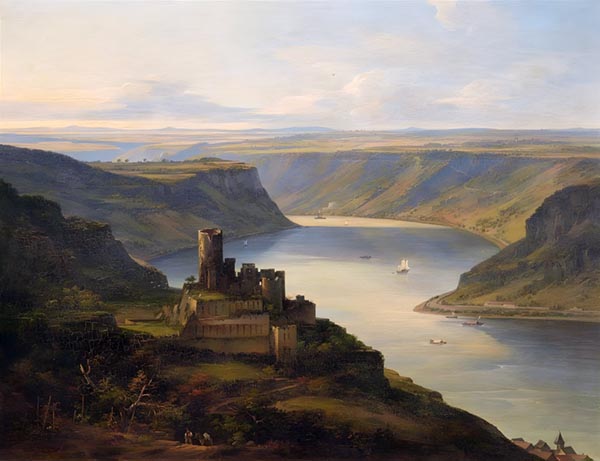
‘Maus Castle and the Loreley’
Johannes Jakob Diezler (1789–1855)
Wikimedia Commons
Translated by A. S. Kline © Copyright 2026 All Rights Reserved
This work may be freely reproduced, stored and transmitted, electronically or otherwise, for any non-commercial purpose.
Conditions and Exceptions apply.
Contents
- Letter XII: Apropos the Wallraf Museum.
- Letter XIII: Andernach.
- Letter XIV: The Rhine.
- Letter XV: Mouse Castle (Burg Maus).
- Letter XVI: Over the Fields.
- Letter XVII: Sankt Goar.
Letter XII: Apropos the Wallraf Museum
Besides the Cathedral of Cologne, the Town Hall and the Ibach house, I also visited, at Schleis Kotten (Klettenberg?), near the city, the remains of the underground aqueduct (the Eifel Aqueduct) which, in Roman times, according to legend, ran from Cologne to Trier, and traces of which can still be found today in thirty-three villages. In Cologne itself, I saw the Wallraf Museum (housing a collection donated by Ferdinand Franz Wallraf to the city in 1824, and at the time of Hugo’s visit provisionally located in the former quarters of the Cologne archbishops in Trankgasse, the Wallrafianum). I would be tempted to give you an inventory of it here, but I will spare you. Let it suffice for you to know that, although, thanks to the depredations of Baron Hupsch (the notorious collector and charlatan Johann Wilhelm von Honvlez-Ardenn Hüpsch Lontzen) I failed to find the war-chariot of the ancient Germans there, nor the famous Egyptian mummy, nor the large culverin, four ells long, cast in Cologne in 1400; on the other hand, I saw a very beautiful Roman sarcophagus, and the armour of Bishop Bernhard von Galen (Christoph Bernhard Freiherr von Galen, prince-bishop of Münster). I was also shown an enormous cuirass which is said to have belonged to an Imperial general, Jan von Werth (Johann von Werth, a cavalry general in the Thirty Years’ War); but I searched in vain for his great sword eight and a half feet long, his large pike akin to Polyphemus’ pine-tree (see Virgil’s ‘Aeneid’ III, 659), and his large Homeric helmet which two men, it is said, had difficulty lifting.
The pleasure of seeing all these beautiful or curious things, museums, churches, town halls, is tempered, it must be said, by the endless persistent demands for a tip. On the banks of the Rhine, as elsewhere in all much-visited countries, the need to tip is like a very unwelcome mosquito, which returns, at every instant and every opportunity, to bite, not your skin, but your purse. Now the traveller’s purse, that precious purse, contains all he has, since sacred hospitality is no longer there to receive him at the threshold with its sweet smile and august cordiality. Here is the degree of importance to which the intelligent natives of this country have raised the tip, and I am stating the facts, I am not exaggerating. You enter any town or city; at the gate, a steward enquires for the name of the hotel in which you intend to stay, asks for your passport, takes it and keeps it. The carriage stops in the courtyard of the post office, the driver, who has not looked at you the whole journey, approaches, opens the door for you and offers you his hand with a beatific expression. Tip. A moment later, the postilion approaches in turn, though it’s forbidden by police regulations, and addresses you in a gibberish harangue which means: tip. You unpack, a large fellow commands the carriage, and sets your trunk, and overnight bag on the ground. Tip. Another fellow places the luggage on a wheelbarrow, asks you which hotel you are going to, and starts racing ahead of you pushing his wheelbarrow. When you arrive at the hotel, the host appears, and commence a little dialogue that should be written in every language on the door of every inn: — ‘Good morning, monsieur,’— ‘Monsieur, I would like a room.’ — ‘Very good, Monsieur.’ To the attendants: ‘Show monsieur to number four.’ ‘Monsieur, I would like dinner.’ — ‘Right away, monsieur,’ etc., etc. You reach number four. Your luggage is already there. A man appears; it is the one with the wheelbarrow who carried it to the hotel. Tip. A second arrives; what does he want? It is the fellow who brought your things to the room. You tell him: ‘All right, I’ll give it you when I leave, like the other servants.’ ‘Monsieur,’ the man replies, ‘I don't belong to the hotel.’ Tip. You go out. Here’s a church, a beautiful church. You wish to go in. You turn around, you look, you search. The doors are closed. Jesus said: ‘Compelle intrare’ (‘Urge them to enter’, Vulgate, Luke 14:21-23). Priests should keep the doors open, but the vergers close them to earn thirty sous. However, an old woman has seen your embarrassment, she comes to you and points to a bell next to a small wicket-gate. You understand, you ring, the wicket opens, the verger appears; you ask to see the church, the verger takes a bunch of keys and approaches the gate. Just as you are about to enter the church, you feel a tug on your sleeve; it is the obliging old woman whom you, ungratefully, forgot and who followed you. Tip. There you are in the church; you contemplate, you admire, you exclaim. ‘Why is there a green curtain covering this painting?’ ‘Because it is the most beautiful painting in the church,’ says the verger. Hang on. Here one hides beautiful paintings, when elsewhere one would display them. ‘Who painted it?’ ‘Rubens.’ ‘I would like to see it.’ The verger leaves you and returns a few minutes later with a very grave and sad-looking individual. It is the custodian. This good man presses a spring, the curtain opens, you view the painting. Once the painting has been viewed, the curtain closes, and the custodian gives you a meaningful bow. Tip. Continuing your walk through the church, still towed behind the verger, you arrive at the choir gate, which is firmly locked, and before which stands a magnificent figure splendidly accoutred, it is the Swiss, who has been warned of your passage and who is waiting for you. The choir is behind the Swiss. You tour it. As you leave, your plumed and braided guide greets you majestically. Tip. The Swiss returns you to the verger. You pass in front of the sacristy. O miracle! It is open. You enter. Here is a sacristan. The verger leaves with dignity, since it is right to leave the sacristan to his prey. The sacristan takes hold of you, shows you the ciboria, the chasubles, the stained-glass windows that you could see very well without him, the bishop’s mitres, and, beneath a pane of glass, in a box lined with faded white satin, the skeleton of some saint dressed like a troubadour. The sacristy has been viewed, the sacristan remains. Tip. The verger leads the way back. Here is the staircase to the towers. The view from the top of the great bell-tower must be beautiful, you wish to ascend. The verger pushes the door open, silently; you climb about thirty steps of the Vis-de-Saint-Gilles (a reference to the twelfth century winding staircase at the former Abbey of Saint Gilles, Gard). Then the passage is suddenly barred to you. There’s a closed door. You turn round. You are alone. The verger is no longer there. You knock. A face appears at a peephole. It is the bellringer. He opens it and says to you: ‘Come up, Monsieur’. Tip. You go up, the bellringer fails to follow; so much the better, you think; you breathe, you enjoy being alone, you thus happily reach the summit-platform of the tower. There, you look around, you walk to and fro, the sky is blue, the landscape is superb, the horizon is immense. Suddenly, you realise that for some moments an unwelcome being has been following you and elbowing you and muttering obscure phrases in your ears. This is the sworn and privileged ‘explainer’, charged with commenting to strangers on the magnificence of the bell-tower, the church and the landscape. This fellow is usually a stutterer. Sometimes he stutters and is also deaf. You choose not to listen to him, you let him babble at leisure, and forget him while contemplating the enormous croup of the church, from which the flying buttresses emerge like dissected ribs, the thousand details of the stone spire, the roofs, the streets, the gables, the roads that run in all directions like the spokes of a wheel whose rim is the horizon and whose hub is the city, the plain, the trees, the rivers, the hills. When you have seen everything, you think about descending, you head towards the turret of the staircase. The man stands before you. Tip. ‘That’s fine, sir,’ he says, pocketing your offering; ‘now would you give me a little for myself?’ ‘What! What have I just given you?’ ‘That’s for the church, Monsieur, to which I owe two francs per person; but now, Monsieur understands, I need a little something for myself.’ Tip. You descend. Suddenly, a trapdoor opens next to you. It’s the bell-cage. You must see the bells in this beautiful bell-tower. A young fellow shows them to you and names them. Tip. At the bottom of the bell-tower you find the verger, who has waited for you, patiently, and who escorts you, respectfully, to the threshold of the church. Tip. You return to your hotel, and you are careful not to ask for directions from any passer-by, because they would seize the opportunity to extract a tip. You have hardly set foot in the inn, when you see someone coming towards you with a friendly air, a figure who is completely unknown to you. It is the steward who returns your passport. Tip. You dine, the time of departure arrives, the servant brings you the bill. Tip. A stable-lad carries your luggage to the stagecoach, or the schnellpost (express mail coach). Tip. An attendant hoists it onto the luggage rack. Tip. You enter the carriage, you leave, night falls; all will commence again tomorrow.
Let us recap: tip to the driver, tip to the postilion, tip to the luggage-retriever, tip to the wheelbarrow-pusher, tip to the man who is not from the hotel, tip to the old woman, tip for Rubens, tip to the Swiss, tip to the sacristan, tip to the bellringer, tip to the mutterer, tip to the church, tip to the sub-bellringer, tip to the verger, tip to the steward, tip to the servants, tip to the stable-lad, tip to the attendant: that’s eighteen tips in a day. Subtract those regarding the church, which proved very expensive, and nine remain. Now calculate all these tips based on a minimum of fifty centimes and a maximum of two francs, which is sometimes obligatory, and you have a worrying large sum. Don’t forget that every tip has to involve a silver coin. Copper coins and sous are shavings and sweepings which the lowest fellow contemplates with inexpressible disdain.
For these ingenious people, the traveller is nothing but a purse to be deflated as quickly as possible. Everyone is at it, individually. The government itself sometimes gets involved; it takes your trunk and portmanteau, loads them on its shoulders, and offers you a hand. In the bigger cities, the baggage porters owe the royal treasury twelve sous and two liards per traveller. I had not been in Aix-la-Chapelle for a quarter of an hour before I had already bought the King of Prussia a drink.
Letter XIII: Andernach
Andernach
I am writing to you again from Andernach, on the banks of the Rhine, at which I disembarked three days ago. Andernach is a former Roman municipality (Antunnacum) replaced by a Gothic township that still exists. The landscape from my window is delightful. I have before me, at the foot of a high hill that barely allows me to see a thin slice of sky, a beautiful thirteenth-century tower, from the top of which rises, a charming feature that I have seen only here, another smaller octagonal tower with eight pediments, crowned with a conical roof; to my right the Rhine and the pretty white village of Leutesdorf, glimpsed among the trees; to my left the four Romanesque bell-towers of a magnificent eleventh-century church (Saint Mary’s Cathedral, the Mariendom), two above the portal, two above the apse. The two large bell-towers of the portal are of an incised design, tall and unusual; they are square towers surmounted by four sharp, triangular gables, bearing in the interspaces four slate lozenges which meet at their summits in a point. Beneath my window, chickens, children, and ducks, quack, chatter and cluck in perfect harmony. In the background, further off, country folk are tending the vines — however, it seems this picture felt inadequate to the man of taste who decorated the room I occupy; next to my window he nailed another one, as a pendant no doubt: it is an image representing two large candlesticks placed on the ground with this inscription: View of Paris. By dint of racking my brains, I realised that it was, in fact, a view of the Barrière du Trône (the twin monumental columns of the Vincennes Gate) — it bears a likeness.
The day I arrived, I visited the church, beautiful inside, but hideously whitewashed. The Emperor Valentinian and a child of Frederick Barbarossa are said to have been interred there. No vestiges remain. A beautiful ‘Christ in the Tomb’ in the round; a life-size figure, from the fifteenth century; a knight from the sixteenth century in half-relief, leaning against the wall; and in an attic, a pile of coloured figurines, in grey alabaster, the debris from a commonplace but admirable mausoleum of the Renaissance: this is all that the hunchbacked, smiling bell-ringer was able to show me for the sacrifice of a small coin of silver-plated copper which here represents thirty sous.
Now I must tell you something real, an encounter rather than an adventure, which left in my mind the veiled and dark impression of a dream.
Leaving the church, which opens almost onto the countryside, I walked around the town. The sun had just set behind the high, cultivated and wooded hill, a heap of lava in prehistoric times and today a quarry extracting basalt millstones, which dominated Antunnacum two thousand years ago and today dominates Andernach, and which has seen the successive disappearance of the citadel of a Roman prefect, the palace of the kings of Austrasia, from whose windows those naïve princes of earlier times fished for carp in the Rhine, the supposed imperial tomb of Valentinian, the Abbey of the Noble Daughters of Saint-Thomas (‘Our Lady Outside the Walls’ which housed a hundred women in its convent), and which now sees the old walls of this feudal city of the electors of Trier crumbling stone by stone.
I followed the ditch that runs alongside these walls, where labourers’ hovels lean against each other familiarly today, and which serve merely to shelter cabbage and lettuce patches from the north winds. The part-dismantled but noble city still has its fourteen round or square towers, but converted into poor gardeners’ lodgings; half-naked children sit and play on the fallen stones, and young girls sit at the window and chat about their lovers in the embrasures intended for catapults. The formidable castle (the Electoral Castle) that defended Andernach from attacks from the east is now nothing more than a vast ruin, the bays of its broken windows melancholically open to the rays of sun or moon, while the parade ground of the fortress is now a beautiful green lawn, where the women of the city bleach the linen in summer that they spun in winter.
After leaving behind me the large arched gate of Andernach, riddled with bullet-holes blackened by time, I found myself on the banks of the Rhine. The fine sand between small turf lawns looked inviting, and I began to ascend the river, slowly, towards the distant hills about Sayn. The evening was charmingly mild; Nature was growing calm on the threshold of sleep. Wagtails came to drink in the river, and fled into the osier beds; above the tobacco-fields I saw carts pulled by oxen passing-by on narrow paths, carts laden with the basalt tufa with which Holland builds its dikes. Near me was moored a decked boat from Leutesdorf, bearing on its prow the austere and sweet word: Pius. On the other side of the Rhine, at the foot of a long, dark hill, thirteen horses were slowly towing another boat, which was assisted by two large triangular sails billowing in the evening breeze. The measured pace of the team, the sound of bells, and the cracking of whips reached me. A pale city was lost in the distance in the mist; and far away, toward the east, at the very edge of the horizon, the full moon, red and round like a Cyclops’ eye, appeared between two eyelids of cloud on the brow of the sky.
How long did I walk like this, absorbed in the reverie of all Nature? I know not. But night had fallen, the countryside was completely deserted, and the bright moon was almost at its zenith when I awoke, so to speak, at the foot of an eminence crowned at its summit by a dark cube, around which were black silhouettes, some imitating gallows; others, masts with transverse yards. I climbed to the summit, stepping over sheaves of large, freshly-cut bean plants. The block, set on a circular mass of masonry, was a tomb wrapped in scaffolding.
Who was it for? Why the scaffolding? Set in the masonry was a low, arched door roughly closed by a few planks. I knocked on it with the tip of my cane; the sleeping occupant gave no answer. Then, by means of a gentle ramp carpeted with thick grass, and sown with blue flowers which the full moon seemingly had caused to open, I climbed onto the circular mass, and inspected the tomb.
A large truncated obelisk, set on an enormous block representing a Roman sarcophagus, the whole, both obelisk and block, of bluish granite; around the monument and as high as its summit, a slender framework traversed by a long ladder; the four faces of the cube pierced and open as if four bas-reliefs had been torn loose; and here and there, at my feet, on the circular platform, broken blades of blue granite, and fragments of cornices, the debris from an entablature, this is what the moon showed me.
I walked around the tomb (in Weissenthurm, erected in 1797), looking for the dead person’s name. On the first three facades there was nothing; on the fourth I saw this dedication in glittering copper letters: The Army of Sambre-et-Meuse to its Commander-in-Chief; and, below these two lines, the moonlight allowed me to read this name, indicated rather than written:
HOCHE
The lettering had been torn away, but had left a vague imprint on the granite. That name, in that place, at that hour, and seen in that light, made a deep and inexpressible impression on me. I have always loved Hoche. Louis Lazare Hoche was, like General Marceau (François Séverin Marceau-Desgraviers), one of those great men, young, barely delineated, in whom Providence, wishing the Revolution to conquer and France to be dominant, anticipated Bonaparte; half-successful attempts, incomplete trials whom Fate shattered as soon as it had drawn, from out of the shadows, their finished, severe and definitive profile.
‘So,’ I thought, ‘this is where Hoche died! — And the heroic date of April 18, 1797 (the Battle of Neuwied), came to mind.
I was unsure where I was. I looked around. To the north, was a vast plain; to the south, within rifle range, the Rhine; and at my feet, at the bottom of the mound that was like the base of a tomb, a village at the entrance to which stood an old square tower.
At that moment a man was crossing a field a few steps from the monument; I asked him in French the name of the village. The man — an old soldier perhaps, for war, as much as civilisation, has taught our language to the nations of the world —shouted: ‘Weissenthurm,’ then disappeared behind a hedge.
The name, Weissenthurm, means the White Tower; I recalled the Turris Alba of the Romans. Hoche died in an illustrious place. It was here, near this very spot, that almost nineteen hundred years ago (55BC) Caesar crossed the Rhine for the first time.
What is the purpose of the scaffolding around the monument? Are they restoring it? Or destroying it? I know not. I climbed the base, and, holding onto the timbers, I looked into the tomb through one of the four openings made in the block. It was a small quadrangular chamber, bare, sinister, and cold. A ray of moonlight entering through one of the crevices highlighted a white form, in the shadows, standing upright against the wall.
I entered the chamber via the narrow loophole, bowing my head, and hauling myself through on my knees. There, I saw in the centre of the pavement a round, gaping hole, full of darkness. It was through this hole, no doubt, that the coffin had once been lowered into the vault beneath. A rope hung down, and was lost in the night. I approached. I risked a glance into this hole, this shadow, this vault; I looked for the coffin; I saw nothing. I could barely make out the vague outline of a sort of funereal alcove, cut into the vault, which stood out in the gloom. I remained there, for a long while, my eyes and thoughts immersed, in vain, in the double mystery of death and night. A sort of icy breath issued from the hole in the vault as from an open mouth.
I can scarcely say what was happening within me. The tomb, encountered so suddenly, that great name, recognised unexpectedly, the gloomy room, the inhabited or perhaps empty vault, the scaffolding that I glimpsed through the breach in the monument, the solitude and the moonlight enveloping the sepulchre, all these ideas presented themselves at once to my thoughts, and cloaked them in shadow. A profound feeling of pity wrung my heart. This is what becomes of the illustrious dead, exiled or forgotten abroad! This funeral trophy raised by an entire army is at the mercy of the passer-by. The French general sleeps far from his country amidst a field of beans, and Prussian masons do what they please to his tomb. It seemed to me that I heard a voice coming from that pile of stones saying: France must retake the Rhine. Half an hour later, I was on the road back to Andernach, only two and a half miles distant.
I don’t understand ‘tourists.’ Andernach is an admirable place. I travelled here through superb country. From the top of the hills the view embraces a circus of giants, from the Siebengebirge to the ridges of Ehrenbreistein. Here, there is not a stone in the buildings that is not a memory, not a detail of the landscape that is not a blessing. The inhabitants have those affectionate and kind faces that delight the stranger. The inn (the Hôtel-de-l’Empereur) is excellent, among the best in Germany. Andernach is a charming town; well, Andernach is a deserted town, no one comes here — they go where the hustle and bustle is, to Koblenz, to Baden, to Mannheim; no one comes to a place of history, Nature, poetry; no one comes to Andernach.
I returned to the church a second time. The Romanesque ornamentation of the bell towers is of a rare richness and a taste both unusual and exquisite. The southern portal has strange capitals, and a large, deeply-carved archivolt. The obtuse-angled tympanum bears a Romanesque painting of the Crucifixion, still perfectly visible and distinct. On the façade, next to the ribbed doorway, a painted bas-relief, which is from the Renaissance, represents Christ kneeling, his arms outstretched, in an attitude of terror. Around him swirl and mingle, as in a dreadful dream, all the dread things of which his Passion will be composed: the paltry cloak, the reed sceptre, the crown with thorny florets, the rods, the pincers, the hammer, the nails, the ladder, the lance, the sponge of gall, the sinister profile of the bad thief, the livid mask of Judas with the purse around his neck; finally, before the eyes of the divine master, the cross, and between the arms of the cross, like a supreme torment, a most poignant pain of pains, a small column at the top of which stands a crowing rooster, that is to say, the ingratitude of, and abandonment by, a friend. This last detail is admirably beautiful. Therein lies the whole great theory of moral suffering, far worse than physical suffering. The gigantic shadow of the two tall bell-towers spreads over this sombre elegy. Around the bas-relief, the sculptor engraved a legend that I copied (sic):
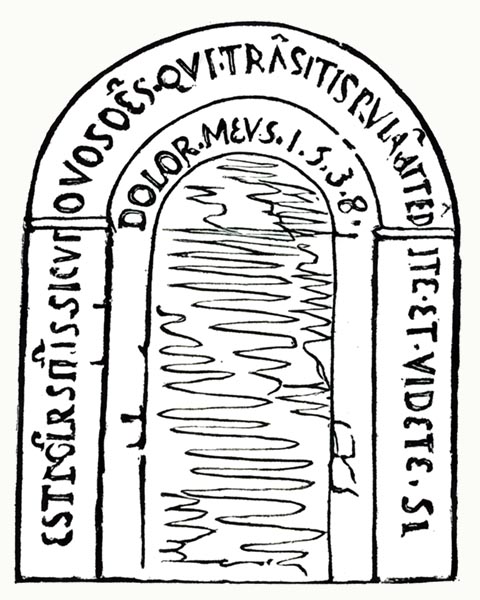
‘O vos omnes qui transitis per viam, attendite et videte si est dolor similis sicut dolor meus.’ 1538
‘O all you that pass this way, take note and see if there is any suffering like to my suffering.’
(Vulgate, Lamentations1:12)
In front of this severe facade, a few steps from this double lamentation, that of both Job and Jesus, charming little children, joyful and rosy, were frolicking on a green lawn and, with loud cries, were feeding grass to a poor rabbit, tame and frightened. No one else chose to pass this way.
There is a second beautiful church in Andernach (the Christuskirche). This one is Gothic. It is a fourteenth-century nave, now converted into a barracks’ stable, and guarded by Prussian cavalrymen, sabres in hand. Through the half-open door, a long line of horses’ rumps can be seen, disappearing in the shadows of the chapels. Above, on the portal, one reads: Sancta Maria, ora pro nobis. Now, it is left to the horses, who are unable to read, to repeat the plea.
I would have liked to climb the curious tower, which I can see from my window, and which is, to all appearances, the ancient town sentinel; but the staircase is broken, and the vaults have collapsed. I was forced to abandon the idea. Yet, the magnificent ruin has so many flowers, such charming flowers, flowers arranged with such taste and maintained with such care at all the windows, that one would think it inhabited. It is inhabited in fact, inhabited, at one the same time, by the most coquettish and the fiercest of inhabitants, by that sweet invisible faery who lodges in all ruins, who appropriates them for herself, and for herself alone, who destroys all the floors, the ceilings, the staircases, so that human footsteps will not disturb the birds’ nests, and who places at all the windows and in front of all the doors flower-holders that she alone knows how to make, being the faery she is, out of some old stone hollowed out by the rain, or carved by time.
Letter XIV: The Rhine
Sankt-Goar, August 17th
You know, for I have often told you, how I love rivers. Rivers bear ideas as well as goods. Everything has its magnificent role in Creation. Rivers, like immense trumpets, sound forth to the ocean the beauty of the earth, the cultivation of the fields, the splendour of cities, and the glory of humankind.
And, as I have also told you, of all rivers, I love the Rhine. The first time I saw the Rhine was a year ago, at at Kehl, crossing the pontoon bridge. Night was falling, the carriage was moving slowly. I remember I felt a certain respect as I crossed the old river. I had wished to see it for a long time. It is never without emotion that I enter into communication, I almost said communion, with these great natural entities which are also great historical entities. Add to this, that the most disparate objects often seem to me to present, I know not why, strange affinities and harmonies. Do you remember, my friend, the Rhône at Valserhône? — We saw it together in 1825, on that sweet journey to Switzerland which is one of the luminous memories of my life. We were then in our twenties! Do you remember with what a cry of rage, with what a ferocious roar the Rhône rushed into the abyss, while the frail wooden bridge trembled beneath our feet? Well, since that time, the idea of the Rhône in my mind is that of a tiger, while the Rhine roused in me that of a lion.
This evening, at Kehl, at my first sight of the Rhine, the idea failed to trouble me. I contemplated, for a long time, that proud and noble river, violent, but lacking in fury, wild, yet majestic. It was swollen and magnificent at the moment when I crossed it. It wiped its tawny mane, its muddy beard, as Nicolas Boileau says (see his ‘Épîtres: Au Roi (I), Le passage du Rhin’) on the boat-bridge. Its two banks were lost in the twilight. Its noise was a powerful yet peaceful roar. I found something of the ocean therein.
Yes, my friend, it is a noble river, feudal, republican, imperial, worthy of being both French and German. There is a whole history of Europe, contained in its two great aspects, this river of warriors and thinkers, in its superb flood which makes France leap forth, in its deep murmur which makes Germany dream.
The Rhine unites everything. The Rhine is as swift as the Rhône, as wide as the Loire, as deep as the Meuse, as winding as the Seine, as clear and green as the Somme, as full of history as the Tiber, as regal as the Danube, as mysterious as the Nile, as glittering with gold as an American river, as full of fables and ghosts as a river of Asia.
Before history was written, before human beings existed perhaps, a double chain of volcanoes smoked and blazed where the Rhine flows today, volcanoes which died, leaving on the surface two lines of lava and basalt arranged parallel to each other like two long walls. At the same time, the gigantic crystallisations which form primitive mountains concluded, the enormous layers of alluvium which form secondary mountains dried, the fearful mass we now call the Alps slowly cooled, the snow accumulating there; two great flows from this accumulated snow spread over the land: one, the flow from the northern slopes, crossed the plains, encountered the double trench of extinct volcanoes, and fled from there to the Ocean; the other, the flow from the western slopes, descended the heights, skirted the second block of expired volcanoes that we call the Ardèche, and was lost in the Mediterranean. The first of these flows formed the Rhine; the second the Rhône. The first tribes that history witnesses on the banks of the Rhine were members of that great family of half-savage peoples who called themselves Celts, and whom the Romans called Gauls: qui ipsorum lingua CELTAE, nostra vero GALLI vocantur, writes Julius Caesar (see ‘De Bello Gallico’ Book I, I).
The Rauraci established themselves near the source, the Argentorati and the Moguntians nearer the mouth. Then, in time, Rome appeared: Caesar crossed the Rhine; Nero Claudius Drusus built his fifty citadels; the consul Munatius Plancus had already begun a city on the northern ridge of the Jura (Augusta Raurica, now Augst); Drusus built a fort at the mouth of the River Main (a major tributary of the Rhine), then he established a colony opposite Tuitium (Deutz): a senator, Antonius, founded a municipality under Nero near the Batavian waters; and the whole of the Rhine was under the control of Rome. When one of the legions which had encamped under the very olive trees where Jesus Christ had lain, returned from the siege of Jerusalem, Titus sent it to the Rhine. The Roman legions continued the work of Drusus; a city seemed necessary to the conquerors to link the Melibokus hills to the Taunus mountains; and Moguntiacum (Mainz), sketched out by Drusus, was built by the legion, then enlarged by Trajan and embellished by Hadrian — A striking thing, and one which must be noted in passing! — This legion had, according to legend, brought with it one Crescentius, who was the first to carry the word of Christ to the Rhine and introduce the new religion. God wanted these same blind men who had overturned the last stones of the Temple near the Jordan, to lay the first stone on the Rhine — After Trajan and Hadrian, came Julian, who consolidated a fortress (later Koblenz), built by Drusus at the confluence of the Rhine and the Moselle; after Julian, Valentinian, who erected castles on the two extinct volcanoes which we call the Lowemberg and the Stromberg; and thus were founded, linked together and consolidated in a few centuries, like a chain riveted to the river, that long and robust line of Roman colonies, Vinicella (Winkle), Altavilla, Lorica, Trajani Castrum (Trechtingshausen), Versalia, Mola Romanorum, Turris Alba (Weissenthurm), Victoria (Neuwied), Rodobriga, Antoniacum, Sentiacum, Rigodulum, Rigomagus (Remagen), Tulpetum, Broilum, which started from the Cornu Romanorum at Lake Constance, descended the Rhine past Basilia, which is Basel; Argentoratum, which is Strasbourg; Moguntiacum, which is Mainz; Confluentes, which is Koblenz; Colonia Agrippinensium, which is Cologne; and, nearer the Ocean, reached Traiectum-ad-Mosam, which is Maestricht, and Traiectum-ad-Rhenum, which is Utrecht.
From then on, the Rhine was Roman. It was nothing more than the river watering the later Helvetic province, the first and second Germania, the first Belgium and the Batavian province. The hairy Gaul of the North, whom the toga-clad Gaul of Milan and the breeched Gaul of Lyon came to visit, out of curiosity, in the third century, the hairy Gaul was tamed. The Roman castles on the left bank kept the right bank in check, and the legionary dressed in cloth from Trier, armed with a halberd from Tongeren, had only to watch from the top of the rocks the old war chariot of the Germans, a massive rolling tower, with wheels armed with scythes, a pole bristling with pikes, drawn by oxen, and crenellated for ten archers, which sometimes ventured to the other side of the Rhine and even beneath the ballistae of the fortresses of Drusus.
That dread passage of men from the north to the regions of the south, which inevitably renews itself at certain climacteric periods in the life of nations and which is called the Invasion of the Barbarians, came to submerge Rome at the moment when Rome was destined to transform itself. The granite military barrier of the citadels of the Rhine was crushed by this outpouring, and there was a moment around the sixth century when the hills of the Rhine were crowned with Roman ruins as they are today with feudal ones.
Charlemagne restored the ruins, rebuilt the fortresses, and opposed the old Germanic hordes reborn under other names, the Boemans, the Abotrites, the Welebates, the Sarabes; he built, at Mainz, where his wife Fastrada was buried (in Saint Alban’s Abbey in Mainz, the tomb later transferred to Mainz Cathedral) a bridge with stone piers, the ruins of which, it is said, can still be seen beneath the water; raised the aqueduct at Bonn; repaired the Roman roads of Victoria, now Neuwied; of Baccarachus, now Bacharach; of Vinicella, now Winkel; and of Thronus-Bacchi, now Trarbach; and built for himself, from the debris of a bath of Julian, a palace, the Saal, at Nieder-Ingelheim. But, despite all his genius and willpower, Charlemagne only galvanised dry bones. Old Rome was dead. The physiognomy of the Rhine had changed.
Already, as I have indicated above, under Roman domination a germ of life had been deposited, unnoticed, in the Rheingau. Christianity, the divine eagle which began to spread its wings, had laid its eggs among these rocks which contained a world. Following the example of Saint Crescentius, who, from 70AD, evangelised the Taunus, Saint Apollinaris had visited Rigomagus (Remagen); Saint Goar had preached at Baccarachus; Saint Martin, bishop of Tours, had catechised Confluentes (Koblenz); Saint Materne, before Tongeren, had lived in Cologne; Saint Eucharius had built a hermitage in the woods near Trier, and, in the same forests, Saint Gezelin (of Schlebusch), it is said, while standing for three years on a column, fought hand to hand with a statue of Diana which he finally brought down by merely gazing at it. At Trier itself, many obscure Christians had died the death of martyrs in the courtyard of the palace of the prefects of Gaul, and their ashes had been cast to the wind; yet those ashes were a seed.
The seed was in the furrow; but, as long as the Barbarians were active, nothing grew. On the contrary, there was a profound collapse in which civilisation seemed to fail; the chain of fixed traditions was broken; history seemed to fade; the men and events of that dark era crossed the Rhine like shadows, barely casting a fanciful reflection on the river, vanished as soon as seen. Then, for the Rhine, after a historical lacuna, a wondrous age commenced.
The imagination of man, no more than Nature herself, accepts emptiness. When Mankind is silent, Nature fills the birds’ nests with cries, makes the leaves whisper, and the thousand voices of solitude murmur. Where historical certainty is lacking, imagination brings shadows, dreams, and appearances to life. Fables vegetate, grow, intermingle, and flower in the gaps of truncated history, like hawthorns and gentians in the crevices of a ruined palace.
Civilisation is like the world itself, it has its nights and its days, its fullness and its eclipses; it vanishes and reappears. As soon as the dawn of civilisation reborn began to break above the Taunus, on the banks of the Rhine there was a delightful murmur of legend and fable; in all the regions illuminated by that distant ray, a thousand supernatural and charming figures shone forth, while in the darker places hideous forms and frightening phantoms were stirring. Then, while the Saxon and Gothic castles, now dismantled, were being built in fine new basalt, beside the Roman ruins now almost erased, a whole population of imaginary beings, in direct communication with its lovely girls and handsome knights, spread throughout the Rheingau: the oreads, who claimed the mountains; the undines, who claimed the waters; the gnomes, who claimed the interior of the earth; the Spirit of the Rocks; the Striker; the Black Hunter, crossing the thickets mounted on a large stag with sixteen antlers; the Maiden of the Black Marsh; the Six Maidens of the Red Marsh; Wotan, the god with ten hands; the Twelve Black Men; the starling who proposed riddles; the crow who croaked his song; the magpie who told the story of his grandmother; the dwarfs of Zeitelmoos forest; Everard the Bearded, who advised princes lost in the hunt; Sigefried the Horned, who stunned dragons in their caves. The Devil placed his stone at Teufelstein and his ladder at Teufelsleiter; he even dared to go and preach publicly at Gernsbach near the Black Forest; but happily, God erected, on the other side of the river, opposite the Devil’s Pulpit, the Angel’s Pulpit. While the Seven Mountains, that vast extinct crater, were filling with monsters, hydras and gigantic spectres, at the other end of the chain, at the entrance to the Rheingau, the harsh wind off the River Wisper brought, as far as Bingen, clouds of little faeries as small as grasshoppers. Mythology grafted itself in these valleys onto the legends of the saints and produced strange results, bizarre flowers of the human imagination. The Drachenfels had, under other names, its Tarasque and its Sainte-Marthe (Martha of Bethany, according to Tarascon legend, subdued the monstrous Tarasque); the double fable of Echo and Hylas attached itself to the formidable Rock of Lurley (the Lorelei Rock); the serpent-maiden crawled in the underground passages of Augst; Hatto (Hatto II, Archbishop of Mainz), the wicked bishop, was eaten in his tower by his subjects, who had been changed into mice; the seven mocking sisters of Schönburg Castle were transformed into rocks, and the Rhine had its maidens as the Meuse had its ladies. The demon Urian crossed the Rhine at Dusseldorf, having on his back, folded in two like a miller’s sack, the large dune that he had taken from the shore at Leiden to swallow up Aix-la-Chapelle, and which, exhausted with fatigue and deceived by an old woman, he dropped, foolishly, at the gates of the imperial city where the dune the Looseberg lies today. From that time, plunged in darkness, wherein magical lights sparkle here and there, in the woods, rocks, and valleys, only apparitions appear, visions, prodigious encounters, diabolical hunts, infernal castles, sounds of harps in the thickets, melodious songs sung by invisible singers, frightful bursts of laughter uttered by mysterious passers-by. Human heroes, almost as fantastic as the supernatural characters, Cunon of Sayn, Sibo de Lorch Strong Sword; Griso the pagan; Adalrich, Duke of Alsace; Tassilo III, Duke of Bavaria; Anthyses, Duke of the Franks; Samo, King of the Wends; wander terrified in these vertiginous forests, seeking, and weeping for, their beautiful, tall, slender white princesses crowned with charming names, Gela, Garlinda, Liba, Williswinda, Schonetta. These knights and adventurers, half-immersed in the impossible, and barely gripping real life by the heel, pass to and fro in the legends, lost towards evening in the inextricable forests, breaking through brambles and thorns beneath the hooves of their heavy steeds, as in Albrecht Durer’s etching Knight Death and the Devil, followed by a scrawny greyhound, watched by imps among the branches, and sometimes accosting, in the shadows, a blackened charcoal-burner seated near a fire, who is Satan disguised, casting the souls of the dead into a cauldron; sometimes naked nymphs who offer them caskets full of precious stones; sometimes little old men, who return a sister, a daughter, a fiancée to them, whom they have found on a mountain asleep amidst a bed of moss, in the depths of a beautiful pavilion covered with corals, shells and crystals; sometimes some powerful dwarf whose word, say the old poems, is as good as a giant’s.
From time to time, among these chimerical heroes, figures of flesh and blood appear: first and foremost Charlemagne and Roland; Charlemagne at every age, as a child, a young man, an old man; Charlemagne, whom legend has being born at a miller’s in the Black Forest; Roland, whom legend has being killed, not at Roncevaux by the blows of an entire army, but of love on the Rhine, in front of the convent of Nonnenwerth (the island in the Rhine at Remagen); later, the Emperor Otto the First, Frederick Barbarossa, and Adolph Count of Nassau, King of the Germans (from 1292). These historical figures, mingle in the tales with marvellous characters out of legend; there is a factual tradition that persists beneath the clutter of dreams and imaginings, a history that vaguely emerges through the fables, a ruin that reappears here and there beneath the flowers.
However, the shadows dissipate, the tales fade, day breaks, civilisation forms again and, with that, history takes shape once more. Here are four men from four different directions who meet, from time to time, near a stone on the left bank of the Rhine, a few steps from an avenue of trees, between Rhens and Kapellen (Stolzenfels). These four men sit on this stone, and there they make and unmake the emperors of Germany. These men are the four electors of the Rhine; this stone is the royal seat, the Königsthül.
The place they choose, roughly in the middle of the Rhens valley, which belongs to the Elector of Cologne, looks both to the north-west, on the left bank, to Kapellen (Stolzenfels), which belongs to the Elector of Trier; and to the south-east, on the right bank, to Oberlahnstein, which belongs to the Elector of Mainz, and Braubach, which belongs to the Elector Palatine. In an hour each Elector can reach Rhens from his home.
For their part, every year, on the second day of Pentecost, the notables of Koblenz and Rhens meet in the same place under the pretext of a festival, and confer among themselves regarding certain obscure matters; the beginnings of a town, and of a bourgeoisie, quietly making their den in the foundations of the formidable Germanic edifice already fully-constructed; a lively and eternal conspiracy of the little against the great, germinating audaciously near the Königsthül, in the very shadow of this stony throne of feudalism.
Almost in the same place, in the electoral castle of Stolzenfels, which dominates the small town of Kapellen, and is today a magnificent ruin, Werner, Archbishop of Trier (Werner von Falkenstein), lodged, and maintained, from 1388 to 1418, alchemists who failed to make gold, but who found on their way to the philosopher’s stone several of the basic laws of chemistry. Thus, in a relatively short space of time, the same point on the Rhine, a place barely noticed today, which faces the mouth of the Lahn, saw the birth of empire, democracy, and science in Germany.
Thenceforth, the Rhine took on both a military and religious aspect. Abbeys and convents multiplied; churches halfway up the slope linked the riverside villages to mountain keeps, a striking example, renewed at every bend of the Rhine, of the way in which the priest should be situated in human society. The ecclesiastical princes multiplied the number of buildings in the Rheingau, as the prefects of Rome had done a thousand years before. Archbishop Baldwin of Trier (Baldwin of Luxembourg) builds the church at Oberwesel, and the bridge at Koblenz (the Balduinbrücke) over the Moselle; Archbishop Walram of Jülich (Archbishop of Cologne) sanctifies with a magnificently carved stone cross the Roman ruins and the volcanic peak of Godersberg (at Bad Godersberg), ruins and a hill suspected, to a degree, of magical powers. Spiritual power and temporal power are inherent in these princes as in the Pope. From that, stems their dual jurisdiction which oversees the soul and the body, as in purely secular states, without seeking the benefit of clergy. John of Bornich, chaplain of Sankt Goar, poisons his lady, the Countess of Katzenelnbogen, the poison being added to the communion wine; the Elector of Cologne, as his bishop, excommunicates him, and, as his prince, has him burned alive.
For his part, the Elector Palatine felt the need to protest perpetually against the possible encroachments of the three archbishops of Cologne, Trier and Mainz; and the Palatine Countesses as a sign of sovereignty, went to give birth in the Pfalz, a tower built in front of Kaub, on a rock, in the very centre of the Rhine.
At the same time, amidst the simultaneous or successive efforts to develop the prince-electors’ authority, the orders of chivalry established positions on the Rhine. The Teutonic Order settled in Mainz, within sight of the Taunus, while, near Trier, within sight of the Seven Mountains, the Knights of Rhodes established themselves at Martinshof. From Mainz the Teutonic Order branched out as far as Koblenz, where one of its commanderies gained a foothold. The Templars, already masters of Courgenay and Porrentruy in the bishopric of Basel, had Boppard and Sankt Goar on the banks of the Rhine, and Trarbach between the Rhine and the Moselle. It was this same Trarbach, the land of exquisite wines, the Thronus-Bacchi of the Romans, which later belonged to that Pierre Flotte (Chancellor of France under Philip V) whom Pope Boniface called one-eyed in body and blind in mind.
While princes, bishops, and knights were laying the foundations of their power, commerce was also establishing its colonies. A host of small merchant towns sprouted, in imitation of Koblenz on the Moselle and Mainz near the River Main, at the confluences of all the rivers and torrents which flow into the Rhine from the innumerable valleys of the Hündsruck, the Hohenruck, the Hammerstein ridges, and the Seven Mountains. Bingen was founded on the Nahe; Niederlahnstein on the Lahn; Engers, beside the Sayn; Irrlich, on the Wied; Linz, beside the Aar; Rheindorf on the Mahrbachs; and Berghein, on the Sieg.
However, in the gaps which separated the ecclesiastical princes and the feudal princes, the commanderies of the knight-monks, and the bailiwicks of the communes, the spirit of the times and the nature of place had given rise to a singular race of lords. From Lake Constance to the Seven Mountains, each hill-crest of the Rhine had its burg and its burgrave. These formidable Rhine barons, robust products of a harsh and fierce landscape, nestled amidst the basalts and heaths, in their crenellated dens, served like the emperor by officers on their knees, men of prey possessed of the conjoined characters of the eagle and the owl, powerful only in their neighbourhood, but all-powerful there, these barons, commanding their ravines and their valleys, raised soldiers, made the roads, imposed tolls, ransomed the merchants, whether they came from Saint Gallen or Dusseldorf, blocked the Rhine with their chains, and sent challenges, proudly, to the neighbouring towns when they ventured to affront them. Thus, it was that the burgrave of Ockenfels provoked the larger commune of Linz am Rein, and the knight Hausner of Hegau, the imperial city of Kaufbeuern. Sometimes, amidst these strange duels, the cities, feeling they lacked strength, were fearful and asked the emperor for help; then the burgrave would burst out laughing, and at the next patronal festival, would attend the town tournament mounted, insolently, on his miller’s donkey. During the terrible wars of Adolph, Count of Nassau, and Dietrich the First of Isenburg, several of these knights who had their fortresses in the Taunus, pushed their audacity to the point of pillaging a suburb of Mainz under the very eyes of the two pretenders who were disputing possession of the town. This was their way of displaying their neutrality. The burgrave was neither for Isenburg nor for Nassau; he was for the burgrave. It was only under Maximilian the First, when that great captain of the Holy Roman Empire, George von Frundsberg, had destroyed the last of the burgs, Hohenkrähen, that this formidable species of gentlemen savages, who began in the tenth century as hero-burgraves and ended in the sixteenth as brigand-burgraves, became extinct.
But one of those hidden movements whose results are only evident after many years was also being accomplished on the Rhine. At the same time as the spread of commerce, and in the same vessels, so to speak, the spirit of heresy, enquiry, and liberty ascended and descended this great river, along which, it seems, all the ideas of humanity were destined to pass. One could say that the soul of Tanquelin (the itinerant preacher Tanchelm), who in the twelfth century preached against the Pope before the cathedral in Antwerp, escorted by three thousand armed sectarians, with the pomp and equipage of a king, ascended the Rhine after his death and thereby inspired Jan Hus in his house in Constance, then descended again, from the Alps to the Rhône, and brought forth Doucin (a second Fra Dolcino, leader of the Dulcinian reformist movement, executed in 1307 for heresy?) in the county of Avignon. Jan Hus was burned, Doucin was quartered. Martin Luther’s hour had not yet struck. In the ways of Providence, there are men destined to eat green fruit and others ripe fruit.
However, the sixteenth century was dawning. The Rhine, in the fourteenth century, had seen, not far from its course, the birth of artillery, in Nuremberg; and in the fifteenth, on its very bank, in Strasbourg, of printing (Johannes Gutenberg’s movable-type printing press). In 1400, Cologne had cast a famous culverin fourteen feet long. In 1471, Wendelin von Speyer printed his Bible (in Venice, in Italian). A new world was about to emerge, and, remarkably and a fact worthy of emphasis, it was on the banks of the Rhine that those two mysterious tools with which God works ceaselessly for the civilisation of man, the cannon and the printed book, war and ideas, had been re-invented and taken on a new form.
The Rhine, as regards the destiny of Europe, has a kind of providential significance. It is the great transverse ditch that separates the South from the North. Providence has made it the river that acts as a border; fortresses have made it the river that acts as a wall. The Rhine has seen the faces, and reflected the forms, of almost all the great men of warfare who, for thirty centuries, have ploughed the old continent with that ploughshare called the sword. Caesar crossed the Rhine, ascending from the south; Attila crossed the Rhine descending from the north. Clovis won the Battle of Tolbiac there. Charlemagne and Bonaparte reigned there. Emperor Frederick Barbarossa, Emperor Rudolf the First of Hapsburg, and the Elector Palatine, Frederick the First, displayed their greatness, and were victorious, and formidable there. Gustavus Adolphus (King of Sweden) commanded his armies there from the top of the sentry-box at Kaub. Louis XIV saw the Rhine. The Duke of Enghien (in 1804) and the great Condé (in 1672) crossed it. Alas, Turenne too (killed at Sasbach, in 1675)! Drusus has his stone in Mainz (the Drususstein), as François Marceau does in Koblenz (the pyramid-tomb designed by Jean-Baptiste Kléber, though his remains are in the Panthéon), and Lazare Hoche at Andernach (reburied there in 1919, having been first interred beside Marceau at Fort Petersberg in Koblenz). To the eye of the thinker who views history as a living thing, two great eagles perpetually soar over the Rhine, the eagle of the Roman legions and the eagle of the regiments of France.
This noble Rhine, which the Romans called Rhenus superbus, sometimes carried the lines of boats bristling with lances, spears or bayonets which bore to Germany the armies of Italy, Spain and France, or bore to the old Roman world, always geographically adjacent, the barbarian hordes, forever the same; sometimes peacefully transported the fir-trees of the Murg and Saint Gallen, the porphyries and serpentines of Basel, the potash of Bingen, the salt of Karlshall, the leathers of Stromberg, the quicksilver of Lansberg, the wines of Johannisberg and Bacharach, the slates of Kaub, the salmon of Oberwesel, the cherries of Bad Salzig, the charcoal of Boppard, the tinware of Koblenz, the glassware of the Moselle, the wrought iron of Bendorf, the tuffs and millstones of Andernach, the sheets of Neuwied, the mineral water of Antoniustein, the cloths and pottery of Vallendar, the red wines of the Aar, the copper and lead of Linz, the cut stone of Königswinter, the wools and silks of Cologne; and it majestically fulfilled, in its passage through Europe, in accord with the will of God, its double function of river of war and river of peace, displaying, uninterruptedly, on the dual line of hills which encloses the most notable part of its course, on the one side oak-trees, on the other vineyards, that is to say on the one side the north, on the other the south; on the one side strength, on the other joy.
The Rhine did not exist for Homer. It was one of the likely, though unknown, rivers of that dark land of the Cimmerians, on which it rained incessantly and which never saw the sun. For Virgil, it was not an unknown river, but the icy river, Frigora Rheni (see Virgil ‘Eclogues’ X, 47). For Shakespeare it was a source of ‘Rhenish’ wine (‘Hamlet’ Act V Scene 1). For us until the day when the Rhine becomes Europe’s burning question, it is an opportunity for a fashionable and picturesque excursion, the promenade-ground of the idlers of Ems, Baden, and Spa. Petrarch visited Aix-la-Chapelle, but failed I think to mention the Rhine.
Geography grants, through the inflexible stubbornness of hills, basins and slopes, which all the Congresses of the world cannot thwart for long, geography grants the left bank of the Rhine to France. Divine Providence thrice granted it both banks. Under Pepin the Short, under Charlemagne, and under Napoleon.
Pepin the Short’s empire straddled the Rhine. It included France proper, less Aquitaine and Gascony, and Germany proper, up to and including the state of Bavaria.
Charlemagne’s empire was twice as large as Napoleon’s. It is true, and a considerable fact, that Napoleon possessed three empires, or, to put it better, was emperor in three ways: immediately and directly, of the French empire; mediately and through his brothers, of Spain, Italy, Westphalia and Holland, kingdoms which he had made the buttresses of his central empire; morally and by right of supremacy, of Europe, which was no more than the base, more deeply invaded day by day, of his prodigious imperial edifice. Understood in this way, Napoleon’s empire was at least as large as Charlemagne’s.
Charlemagne, whose empire had the same central point, and the same extended axes as Napoleon’s, seized, and agglomerated, about Pepin the Short’s heritage: Saxony as far as the Elbe, Germany as far as the Saal, Slavonia as far as the Danube, Dalmatia as far as Cattaro (Kotor, Montenegro, on the Škurda River), Italy as far as Gaeta, Spain as far as the Ebro. In Italy he halted only at the borders of Campania, and the Greek colonies, and in Spain only at the borders with the Moors.
When this immense conglomeration dissolved for the first time, in 843, Louis the Pious having died (in 840) and the Moors having recovered that whole slice of Spain between the rivers Ebro and El Llobregat, from the three pieces into which the remaining empire divided there was enough to make one emperor, Lothair I, who reigned in Italy and a large triangular fragment of Gaul, and two kings, Louis the German, in Germany, and Charles II, the Bald, in France. Then, in 855, when the first of these three fragments was divided in turn, from the pieces of that fraction of Charlemagne’s empire it was still possible to make one emperor, Louis II (the eldest son of Lothair I and nephew of Louis the German), reigning in Italy; a king, Charles of Provence (youngest son of Lothair I), holding Provence and Burgundy; and another king, Lothair II (the second eldest son of Lothair I), with Austrasia, which was thereafter called Lotharingia, and then Lorraine. When the time came for the second fragment, the kingdom of Louis the German, to be torn apart, the largest section formed the German Empire, and the smaller an anthill of innumerable counties, duchies, principalities and free cities, protected by the margraviates, guardians of the borders. Finally, when the third fragment, the state of Charles the Bald, bent and broke under the burden of the years and its princes, the last remnants were enough to support a king, the King of France; five sovereign dukes, of Burgundy, Normandy, Brittany, Aquitaine and Gascony; and three count-princes, the Count of Champagne, the Count of Toulouse and the Count of Flanders.
These emperors were Titans. They held the universe in their hands for a moment, then death drew their fingers apart, and everything fell to ruin.
One might say that the right bank of the Rhine belonged to Napoleon as it had to Charlemagne. Bonaparte dreamed not of a mere duchy of the Rhine, as some mediocre politicians had done during the long struggle of the House of France against the House of Austria. He knew that a longitudinal kingdom that is not insular cannot last; it folds and splits in two at the first violent shock. One principality must not affect the basic order; profound order is necessary for States to maintain themselves and resist disintegration. With some mutilation and agglomeration, the emperor accepted the Confederation of the Rhine as geography and history had wrought it, and was content to systematise it. The Confederation of the Rhine needed to stand up to, and obstruct, both North and South. It was aligned against France, the emperor turned it about. His strategy was steered by a hand that placed and moved empires, with the strength of a giant and the sagacity of a chess player. By elevating the princes of the Rhine, the emperor understood that he was augmenting the crown of France and diminishing the crown of Germany. Indeed, these electors who became kings, these margraves and landgraves who became grand dukes, gained in escarpments on the borders of Austria and Russia what they lost on the border with France, enhanced in front, belittled behind, kings to the emperors of the North, prefects to Napoleon.
Thus, the Rhine has seen four quite distinct phases, displaying four clear physiognomies. The first phase was the antediluvian and perhaps pre-Adamite era, of the volcanoes; the second phase: the ancient historical era, the struggles of Germany against Rome, in which the Caesars shine; the third phase: the marvellous era in which Charlemagne emerges; and the fourth phase: the modern historical era, the struggles of Germany and France, dominated by Napoleon. For, whatever the writer does to avoid the monotony of glory, when one scans European history from one end to the other, Caesar, Charlemagne, and Napoleon are the three enormous militaristic, or rather millennial, milestones one always finds on the way.
And now, to end with a final observation, the Rhine, a river blessed by providence, also seems to be a symbolic river. In its flow, in its course, in the environments it crosses, it is, so to speak, the image of civilisation, which it has already served greatly, and will, in future, serve even more. It descends from Constance to Rotterdam, from the land of eagles to the city of herrings, from the city of popes, councils, and emperors to a trading post of merchants and the bourgeoisie, from the Alps to the Ocean, as humanity itself has descended from lofty, immutable, inaccessible, serene, resplendent ideas, to broadly mobile, stormy, dark, utilitarian, navigable, dangerous, and unfathomable ideas, which command everything, bear everything, fertilise everything, and engulf everything; descended, that is, from theocracy to democracy, from one great system to another.
Letter XV: Mouse Castle (Burg Maus)
Sankt Goar, August
Last Saturday it rained all morning. I had taken passage to Andernach on the steamship Stadt Manheim. We had ascended the Rhine for a few hours when suddenly, the westerly wind, the Favonius of Virgil and Horace, the same that, under the name Foehn, brings such terrible storms to Lake Constance, pierced, on whim, as it is usually from that direction the clouds come, with a stroke of its wing the great vault of cloud that we had above our heads and began to disperse the wreckage to all the corners of the sky with childish joy. In a few minutes the true and eternal blue dome reappeared resting on the four corners of the horizon, and a warm midday ray brought all the passengers back on deck.
At that moment, still between the vines and the oaks, we were passing in front of a picturesque old village on the right bank, Wellmich (part of Sankt Goarshausen), whose Romanesque bell-tower, today stupidly castrated and restored, was adorned a few years ago by four pointed turrets like the military tower of a burgrave. Above Wellmich rose, almost vertically, one of those enormous lava banks along the Rhine whose cross-section resembles, in disproportionate proportion, that of a tree trunk sliced in half by the woodcutter’s axe. On this volcanic ridge, stood a superb though ruined feudal fortress, of the same stone and the same colour, as if it were a natural outgrowth of the mountain. On the very edge of the Rhine a group of young washerwomen, were chattering away, while gaily beating their linen in the sun.
This cliff tempted me; I disembarked there. I knew the ruined castle (now restored) of Wellmich as one of the most infamous and least visited on the Rhine. To travellers, it is a site difficult of approach and even, it is said, dangerous. To the countryfolk, it is full of spectres and a source of fearful stories. It is inhabited by living flames which vanish into inaccessible underground passages during the day, and only become visible at night at the top of the great round tower. This great tower itself is simply the above-ground extension of an immense well, now in-filled, which once pierced the entire mountain, and descended below the level of the Rhine. Into this well, a lord of Wellmich, a Falkenstein, that fatal name in legends, who lived in the fourteenth century, had whoever he saw fit among passers-by, or among his vassals, thrown, without confession. It is all these troubled souls who, it is said, now inhabit the castle. At that time, there was in the bell tower of Wellmich a silver bell given and blessed by Winfried, Bishop of Mainz, in 740AD, a memorable time when Constantine V was Emperor of Rome in Constantinople, when the pagan king Marsilius, according to legend, had four kingdoms in Spain, and when King Clothaire IV (Chlothar IV) is said to have reigned over the Franks, he who was later excommunicated, with triple excommunication, by Saint Zachary, the fifty-first pope. This silver bell was only rung for the forty-hours of prayer when a lord of Wellmich was seriously ill and in danger of death. Now, Falkenstein, who did not believe in God, nor even the devil, and who lacked funds, coveted this beautiful bell. He had it torn from the bell-tower and brought to his keep. The prior of Wellmich was moved to approach this lord, in chasuble and stole, preceded by two altar boys carrying the cross, to ask for his bell back. Falkenstein began to laugh and shouted at him: ‘You desire your bell? Well, you shall have it, nor will it ever leave you’. Having said this, he had the priest thrown into the well with the silver bell tied around his neck. Then, on the lord’s orders, sixty ells (seventy-five yards) of the well were filled with large stones, above the priest and the bell. A few days later, Falkenstein suddenly fell ill. When night came, the astrologer and the physician who were keeping watch over their lord, heard with terror the tolling of the silver bell sounding from the depths of the earth. The next day Falkenstein was dead. Since that time, every year, on the night of January 18, the anniversary of Falkenstein’s death, and the day of commemoration of Saint Peter’s first sermon in Rome, the silver bell can be distinctly heard ringing beneath the mountain — such is one of the local legends — in addition, the neighbouring mountain, which encloses the Wellmich torrent on the other side, is itself claimed to be the tomb of an ancient giant; for the human imagination, which has rightly seen volcanoes as Nature’s great forges, has placed Cyclopes everywhere it has found mountains emitting smoke, and every Etna has its Polyphemus.
Thus, I began to climb towards the ruin, accompanied by the memory of Falkenstein and that of the giant. I should tell you that some children of the village had first shown me the best path, for which service I let them take from my purse whatever they wanted; for the silver and copper coins of foreign peoples, thalers, groschen, pfennigs, are strange and unintelligible things to their world and, indeed, for my part, I understand nothing of the barbaric currencies imposed by the Borussians (Prussians) on the land of the Ubians (the Ubii, who populated Cologne).
The path is indeed rough; but not dangerous, except for people prone to vertigo, or perhaps after heavy rain, when the earth and rocks are slippery. Besides, this accursed and much-dreaded ruin has the advantage over the other ruins of the Rhine of not being exploited. No official follows you on the ascent, no guardian of the spectres asks you for a tip, no locked and padlocked door blocks your way halfway up. One climbs, one scales the old basalt staircase of the burgraves which still reappears in places, clings to the brushwood and tufts of grass, and no one helps you and no one hinders. After twenty minutes, I was at the summit of the mountain, on the threshold of the ruin. There I turned and paused for a moment before entering. Behind me, below a postern gate transformed to a shapeless hole, rose a steep staircase transformed to a grassy ramp. Before me unfolded an immense landscape, geometrically, yet not coldly, composed of concentric views; at my feet, the village was grouped about its bell-tower, a bend in the Rhine about the village, and a dark crescent of mountains about the Rhine, crowned in the distance here and there with dungeons and old castles and then, around and above the mountains, the arch of the blue sky.
After catching my breath, I entered by the postern gate, and began to climb the narrow slope of turf. At that moment, the ruined fortress appeared to me in so dilapidated an aspect, in such a formidable and wild form, that I confess I would not have been in the least surprised to see some supernatural form emerge from beneath its ivy curtain carrying bizarre flowers in its apron: Gela, beloved of Barbarossa, or Hildegard, the wife of Charlemagne, that sweet empress who knew the occult virtues of herbs and minerals and who went botanising in the mountains. I glanced for a moment towards the northern wall, possessed by a vague desire to see rise up, suddenly, between the stones those goblins who are everywhere in the north, as the gnome said to Cuno of Sayn, or the three little old women singing the sinister song of the folktales:
‘On the giant’s grave
I picked three nettle shoots;
I turned them into thread:
Take this gift, my sister.’
But I had to resign myself to seeing and hearing nothing, only the mocking note of a rock thrush perched somewhere about.
Now, friend, if you wish for a complete idea of the interior of this famous yet unknown ruin, I can do no better than to transcribe here what I wrote in my notebook as I walked there. It is a castle seen in a disorderly manner, minutely, but taken as I went, and in consequence a mere resemblance.
‘I am among the ruins. The round tower, though eroded at the top, is still of a prodigious height. Two-thirds of the way up are the vertical notches of a drawbridge whose bay is blocked. On all sides, immense walls with distorted windows still delineating rooms without doors or ceilings. Floors without stairs — stairs without rooms. Uneven, hilly ground, formed of collapsed vaults, covered with grass. An inextricable jumble. I have often admired with what jealousy, akin to that of a miserly owner, solitude guards, encloses, and defends what man has abandoned. It carefully arranges on the threshold the fiercest most bristly brushwood, the most vicious and best-armed plants, holly, nettles, thistles, hawthorn, heath, that is to say, more nails and claws than there are in a menagerie of tigers. Through those savage and snarling bushes, the brambles, those serpents of vegetation, stretch and slither and bite your feet. Here, however, as Nature never forgets ornamentation, this jumble is also charming. It is a sort of vast wild bouquet where plants of all shapes and species abound, some with flowers, others with their fruits, those over there with their rich autumn foliage: mallow, bindweed, bell-flower, anise, burnet, white mullein, yellow gentian, strawberry, thyme, deep-purple blackthorn, hawthorn which in August we ought to call red-thorn with its scarlet berries, the brambles’ long runners laden with blackberries already the colour of blood. An elderberry. Two pretty acacias. An unexpected corner where some Voltairean countryman, taking advantage of others’ superstition, has cultivated for himself a small patch of beet. Enough to make a lump of sugar. To my left the tower without door, window, or visible means of entrance. To my right, an underground passage its vaulting shattered. Changed into a chasm. A superb noise created by the wind, an admirable display of blue sky in the crevices of this immense ruin. I climb a grassy staircase into a kind of high room. I am there. Nothing but two magical views of the Rhine, the hills and the villages. I lean into the embrasure, at the foot of which is the underground chasm. Above my head two chimneys carved in blue granite, fifteenth century. Remains of soot and smoke in the hearth. Faded paintings in the window arches. Up above, a pretty turret without roof or stairs, full of flowering plants leaning down to look at me. I hear the washerwomen of the Rhine laughing. I go back down into a lower room. Nothing. Traces of excavations through the pavement. Some treasure buried by the gnomes that the villagers have sought. Another low room. A square hole in the centre leading to a vault. Two names on the wall: Phaedovius, Kutorga. I write mine beside it with a pointed sliver of basalt. Another vault. Nothing. From here I can see the chasm again. It is inaccessible. A ray of sunlight penetrates it. This underground passage is at the bottom of the large square keep that occupied the corner opposite the round tower. This must have been the burg’s prison. A large compartment facing the Rhine. Three chimneys, one with small columns severed at various heights hanging there. Three shattered floors under my feet. At the rear, two vaulted arches. Over one, dead branches; over the other, two pretty swathes of ivy, balanced there, gracefully. I approach them. Vaults built on the raw basalt of the mountain which outcrops again here Traces of smoke. In the other large compartment which I entered first, and which must have been the courtyard, near the round tower, white plaster on the wall with a remnant of paint and two numbers traced in red: 23 — 18 — (sic)
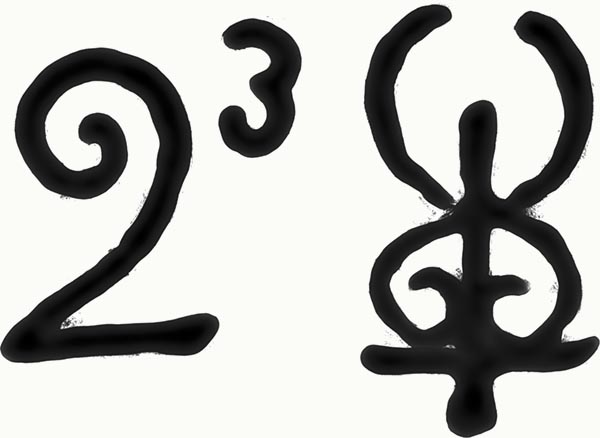
I circle the outside of the castle along the moat. Rather a difficult scramble. The grass is slippery. You have to crawl from bush to bush above a deep precipice. Still no entrance or trace of a walled-up door at the bottom of the large tower. Remains of paintings on the machicolations. The wind turns the pages of my notebook, and makes it difficult for me to write. I am going to re-enter the ruin. I am there. I write on a small green velvet panel that the old wall lends me.’
I forgot to tell you that this enormous ruin is called the Mouse (die Maus). Here is why. In the twelfth century, there was only a small burg there, always watched and very often harassed by the lord of a large fortified castle located half a league further away, which was called the Cat (die Katz), an abbreviation of the name of its lord, Katzenelnbogen. Kuno von Falkenstein, to whom the puny burg of Wellmich fell as an inheritance, had the original burg razed, and built, on the same site, his castle, much larger than the neighbouring Katz castle, declaring that ‘from now on it would be the Mouse who would eat the Cat’.
He was right. Die Maus, in fact, although ruined today, is still a sinister and formidable creature, once armed and alive, with hips of lava and basalt, from the very bowels of this extinct volcano which, it seems, bears her with pride. I doubt that any have been tempted to mock the mountain which gave birth to this mouse (a reference to Horace, ‘Ars Poetica’: ‘parturient montes, nascetur ridiculus mus: the mountains are in labour, a ridiculous mouse is born’).
I stayed amongst the ruins until sunset, which is the hour of spectres and ghosts. My friend, it seemed to me that I had become a happy schoolboy again; I wandered and climbed everywhere, I turned over large stones, I ate raw blackberries, I tried to irritate the supernatural inhabitants, to tease them from the shadows; and, as I crushed thickets of grass, while walking at random, I felt the acrid odor, vaguely rising to my nostrils, of plants amidst ruins, which I loved so much in my childhood.
It is certainly the fact, after all is said and done, that with its evil reputation as a well as its host of souls and skeletons, this impenetrable tower lacking doors or windows has a lugubrious and singular appearance.
Meanwhile the sun had sunk behind the mountain, and I was about to do likewise, when something strange stirred, suddenly, near me. I bent down. A large lizard of extraordinary shape, about nine inches long, with a large belly, a short tail, a flat, triangular head like a viper, black as ink, and traversed from head to tail by two golden-yellow stripes, was placing its four black feet, on legs like arms with prominent elbows, on the damp grass, and creeping slowly towards a low crevice in the old wall. It was the mysterious, solitary inhabitant of the ruin, its animal-spirit, a creature at once real and fabulous — a salamander — gazing at me, calmly, as it returned to its crevice.
Letter XVI: Over the Fields
Sankt Goar, August
I could barely tear myself away from the ruins. Several times I started to descend, then returned. Nature, like a smiling mother, lends herself to all our dreams and all our whims. As I was finally about to leave the Burg Maus, the idea came to me, and I confess I carried it out, of placing my ear against the base of the large tower in order to be able to tell myself, in all conscience, that if I had not entered, I had at least listened at the wall. I hoped for some noise, without flattering myself, however, that Winfried’s bell would deign to ring for me. At that moment, oh wonder, I heard, with my own ears, honestly heard, a vague metallic quivering, the faint and barely distinct sound of a bell, which rose up towards me through the twilight, and seemed in fact to sound from beneath the tower. I confess that at that strange noise the lines Hamlet speaks to Horatio were suddenly brought to mind (‘Look, my Lord, it comes’ etc: Hamlet, Act I Scene IV), as if written there in luminous characters; I even believed that, for a moment, they had illuminated my mind. But I swiftly returned to the real world. It was the Angelus of some village lost far away among the folds of the valleys, that the wind obligingly brought me. No matter. I choose to believe, and relate, that I heard the mysterious silver bell of Wellmich ringing and chiming beneath the mountain.
As I was emerging from the northern ditch, which has become an extremely thorny ravine, the neighbouring mountain, the tomb of the giant, was suddenly visible. From the point where I was, the rock at the base of that mountain, very close to the Rhine, displayed the colossal profile of a head rearing backwards, its mouth gaping. It seemed as if the giant who, according to legend, lies there prone, crushed and suffocated by the mountain’s weight, had managed to raise the frightful mass a little, and that his head was already emerging from between the rocks, but that at that very moment Apollo or Saint Michael had set his foot on the mountain, so that the flattened monster had expired in that same posture with a great cry. The cry was lost amidst the darkness of forty centuries, the mouth remained open.
Nonetheless, I must declare that neither the giant, nor the silver bell, nor the ghost of Falkenstein, prevent the staked vines climbing from terrace to terrace close to the Maus. Too bad for ghosts who haunt a countryside of vineyards! Wine-making is at their door, and the tendrils of the vine will cling gaily to their ruins. Unless, of course, the hillside of Wellmich is cultivated by the spirits themselves, and it is necessary to apply to its strange winemakers the sentence that I read yesterday in some Teutonic guide to the banks of the Rhine: ‘Behind the mountain of Johannisberg, is the village of the same name with nearly seven hundred souls who produce a very fine wine.’
However, even the thirstiest passer-by must beware of touching the grapes, bewitched or not. In Wellmich, we are in the Duchy of Nassau, and the laws of Nassau are ferocious with regard to rural offences. Any offender seized is required to pay a fine equal to the sum of the damage caused by all previous offences where the guilty parties escaped. Recently, an English tourist picked, and ate, a plum in a field, for which he was fined fifty florins.
I sought lodgings in Sankt Goar, which is on the left bank, three miles or so upstream from Wellmich. A boatman from the village took me across the Rhine, and dropped me politely at the King of Prussia’s property, for the left bank belongs to the King. Then, as he left me, this good man gave me, in a mongrel language, half-German, half-Gaulish, further information about the route which I probably misunderstood, because, instead of following the road which runs along the river, I took to the mountain-side, thinking I was taking a short cut, and found myself somewhat lost.
However, as I was crossing the high reddish plateaus where strong winds blow in the evening, and trampling the freshly-cut stubble, a ravine suddenly appeared on my left. I entered it, and after a few moments of very steep descent, along a path that at times seemed like a staircase made of large slates, I saw the Rhine again. There I sat down; I was tired.
The daylight had not yet completely vanished. It was pitch-black in the ravine where I was, as in the valleys on the left bank, backed by large ebony-hued hills; but an inexpressible pink glow, a reflection of the purple sunset, floated over the mountains on the far side of the Rhine and the vague silhouetted ruins that appeared to me on all sides. Before my eyes, in an abyss, the Rhine, whose murmur reached me, was hidden beneath a broad layer of whitish mist from which, at my feet, emerged the tall needle of a Gothic bell-tower half submerged in the fog. There was doubtless a town there, hidden by that sheet of vapour. I saw to my right, a few yards below me, the grass-covered roof of a large grey tower, dilapidated yet still standing, proudly, on the slope of the mountain, devoid of battlements, machicolations or staircase. On this roof, set in a section of wall that remained standing, there was a doorway, wide open since there was no longer a door, through which no human foot could pass. Above my head I heard some unknown passers-by talking as they walked the mountain-slope, and whose shadows I saw moving by in the darkness. The pink glow had vanished.
I rested there for a long time, seated on a stone, my mind quiet, watching, in silence, the passage of that dark hour when crepe-like smoke and vapour slowly hide the landscape, and the outlines of objects take on fantastic and lugubrious forms. A few stars seemed to catch, and nail to the zenith, the black shroud of night spread over half the sky, and the white shroud of twilight spread, sinisterly, over the other.
Little by little the sound of footsteps and voices ceased in the ravine, the wind died, and with it that gentle tremor amidst the grasses that maintains a conversation with the weary passer-by and keeps him company. No sound came from the invisible town; the Rhine itself seemed to have fallen asleep; a pale and livid cloud invaded the immense spaces, from west to east; the stars veiled themselves one by one, and above me I had nothing but one of those leaden skies where visible to the poet, hovers that great bat which bears written on its belly, the word Melancholia.
Suddenly a breeze arose, the mist parted, and cleared the church, and a dark block of houses, studded with a thousand lighted window-panes, appeared at the foot of the precipice, through the gap that had opened in the fog. It was Sankt Goar.
Letter XVII: Sankt Goar
Sankt Goar, August
One can pass a very well-spent week at Sankt Goar. One should take care that, from the very comfortable gasthaus Zur Lilie, one’s windows allow a view of the Rhine. There, one is between the Cat and the Mouse. To the left, is the Burg Maus, in the distance, half-veiled by the Rhine mists; to the right, in front of one, the Burg Katz, a robust keep surrounded by turrets, which, at the top of the slope, occupies the tip of a triangle the other two corners of which the picturesque village of Sankt Goarshausen, on the banks of the Rhine and forming the base, marks with two old towers, one square, the other round. — The two hostile burgs watch each other, seeming to dart withering glances across the landscape; for, though a keep may be in ruins, its shattered windows still gaze outwards, with the hideous look of a gouged-out eye-socket. Opposite them, on the left bank, as if ready to call a halt to the machinations of the two adversaries, the colossal spectre of the castle-palace of the Landgraves of Hesse, the Rheinfels, stands and gazes.
At Sankt Goar, the Rhine is no longer a river; it is a lake, a real lake as in the Jura Mountains, seemingly closed on all sides, with sombre recesses, shimmering depths, and immense echoes.
If you keep to your room, you can enjoy the activity on the Rhine all day long: the rafts, the long sailing vessels, the little arrow-shaped boats, and the ten or so steam omnibuses that go to and fro, ascending and descending the river, passing by every moment, splashing like a large dog swimming, emitting smoke, and decked out with flags. In the distance, on the opposite bank, beneath beautiful walnut trees shading a lawn, you can watch the soldiers of the Duke of Nassau manoeuvring in their green jackets and white trousers, and listen to their boisterous drumming on behalf of a minor sovereign. Close by, under your window, you can watch the women of Sankt Goar go by in their sky-blue bonnets, like tiaras altered by a blow from a fist, and hear a host of little children laughing and chattering as they come out to play in the Rhine. Why not? The children of Tréport and Étretat play in the sea. Besides, the children of the Rhine are charming. None of them have the harsh, severe look of English children, for example. The German children have an indulgent air about them like that of aged priests.
If you choose to go out, you can cross the Rhine for six sous, the price of a Parisian omnibus ride, and climb to the Burg Katz. It was in this manor of the Barons of Katzenelnbogen that the lugubrious adventure of the chaplain, John of Bornich, took place, in 1471. Today, Die Katz is a beautiful ruin, the usufruct of which is rented by the Duke of Nassau to a Prussian major for four or five florins a year. Three or four visitors effectively pay the rent. I leafed through the book in which foreigners are registered; and in the last thirty pages — about a year’s worth — I saw not a single French name. Many German ones, a few English, and two or three Italian comprised the whole register. Moreover, the interior of the Burg Katz is completely dilapidated. The lower room of the tower in which the chaplain prepared the poison he employed on the countess is now used as a cellar. A few meagre vines twist about their stakes on the very spot where the portrait gallery used to be. In a small room, the only one with a door and a window, an engraving of Bohdan Khmelnytsky (who created, between 1648 and 1654, an independent Cossack state in the Ukraine) has been nailed to the wall, and at the foot of it one reads: Belli servilis autor (sic) rebelliumque Cosaccorum et plebis Ukraynen: the instigator of the Ruthenian war, and the uprisings of the Cossacks and the Ukrainian people. That formidable leader of the Zaporozhian Host (responsible for the massacre of tens of thousands of Poles and Jews) dressed in a costume that is somewhere between Muscovite and Turkish, seems to be looking askance, perhaps through the fault of the engraver, at a few portraits of currently reigning princes ranged around him.
From the top of the Burg Katz, the eye plunges into the famous narrows of the Rhine called the Bank. Between a sandbank and the square tower of Sankt Goarshausen there is only a narrow passage. On one side the narrows, on the other the sandbank. The Rhine has everything, even its own Scylla and Charybdis. In order to cross these much-feared narrows, a tree trunk called the hund is tied to the downstream side of the boats with a fairly long rope, and as they pass between the sandbank and the tower, they throw the tree trunk into the narrows. The narrows in their anger seize the tree trunk, so that the raft is held downstream of the tower. When the danger is over, the rope is cut, and the narrows take the hund, as an offering to this Cerberus.
On the platform of the Burg Katz, one may consult the guide: Where is the Bank? It indicates a small fold in the Rhine at your feet. This fold is the dreaded narrows. One should not judge chasms by their appearance.
A little further upstream from the Bank, in a wild bend, the fabled Lorelei rock, with its thousand granite layers which give it the appearance of a collapsed staircase, plunges precipitously into the Rhine. There is a famous echo there which repeats, it is said, seven times everything that is said or sung to it.
If I were not fearful of appearing to diminish the reputation of this echo, I would confess that for me the echo has never achieved more than five repetitions. It is likely that the oread (mountain nymph) of the Lorelei, once courted by so many mythological princes and counts, is beginning to grow hoarse and bored. The poor nymph now has only one worshipper, who has dug two small rooms in the rocks opposite her, on the other bank of the Rhine, and spends his day playing his hunting horn, and firing gunshots at her. This man, whose task is to conjure up the echo, and who makes a living doing so, is a courageous old French hussar.
In truth, the effect of the Lorelei’s echo on an unsuspecting passer-by, is extraordinary. The boat equipped with two small oars which crosses the Rhine at this point, makes a tremendous sound. If you close your eyes, you would think you were listening to a Maltese galley passing with its fifty large oars, each oar moved by four chained convicts.
Descending from the Burg Katz, before leaving Sankt Goarshausen, one should visit, in an old street parallel to the Rhine, a charming house from the German Renaissance, much disdained, of course, by its inhabitants. Then one turns right, crosses a torrent bridge, and plunges, to the sound of water-mills, into the ‘Swiss Valley,’ a superb, almost alpine ravine formed by the high hill of Patersberg and one of the rear ridges of the Lorelei rock.
The ‘Swiss Valley’ is a delightful walk. One can wander, visit the villages above, or plunge into narrow gorges so dark and deserted that in one of them I saw the freshly-turned earth and trampled grass created by the tusks and hooves of a wild boar. Or one can follow the bottom of the ravine, between rocks that look like cyclopean walls, beneath the willows and alders. There, alone, deeply engulfed in an abyss of leaves and flowers, one can wander and dream all day and listen, like a friend admitted as a third party to a tête-à-tête, to the mysterious conversation of the torrent and the trail. Then, if one approaches the farms and the mills, by rutted lanes, everything encountered seems arranged and grouped in advance to furnish the corner of a Poussin landscape. There is a half-naked shepherd, alone with his flock in a tawny field, blowing strange melodies into a kind of ancient lituus (Etruscan curved trumpet). Here is a cart drawn by oxen, like the ones I saw in the vignettes from Virgil, printed by Louis-Etienne Herhan, that I used to pore over in my childhood. Between the yoke and each oxen’s forehead there is a small leather pad embroidered with red flowers and dazzling arabesques. Young girls pass by, barefoot, their hair dressed like statues from the late Empire. I saw one who was charming. She was seated near a fruit-drying oven that was smoking gently; she raised her large, sad blue eyes, shaped like two almonds in a face browned by the sun, to the sky; her neck was laden with glass beads and necklaces artistically arranged to hide a nascent goitre. With that deformity and her beauty, one might have thought her an Indian idol crouching beside her altar.
One crosses a meadow, the mouth of the ravine widens suddenly, and one sees at the top of a wooded hill an admirable ruin. This schloss (castle) is the Reichenberg. It was here that, during the wars of the Middle Ages over feudal rights, one of the most formidable of these bandit knights who called themselves scourges of the country (landschaden) lived. The neighbouring town lamented in vain, the emperor could cite the emblazoned brigand at the Imperial Diet in vain, the iron-willed fellow shut himself in his granite home, boldly continued his orgy of omnipotence and plunder, and lived, excommunicated by the Church, condemned by the Diet, hunted by the emperor, until his white beard was down to his belly. I entered the Reichenberg. There is nothing left in that cave of Homeric thieves but wild scabious, the shadows of ruined windows wandering over the rubble, two or three cows grazing the grass among the ruins, a remnant of a coat of arms, mutilated by hammer blows, above the great door, and here and there, under the traveller’s feet, stones pushed aside by the passage of reptiles.
I also visited, behind the Reichenberg hill, some hovels, barely visible today, of a lost village which is called the Village of Barbers. Here is the tale of this village:
The Devil, who had a grudge against Frederick Barbarossa because of his presence on two Crusades, had the idea one day of cutting off his beard. A truly magisterial trick, very fitting for a Devil to play on an emperor. He therefore arranged, with a local Delilah, an unanticipated act of betrayal whereby the Emperor Barbarossa, passing through Bacharach, was to be lulled to sleep, then shaved by one of the many barbers of the city. Now, Barbarossa, when still only the Duke of Swabia, at the time of his love affair with the beautiful Gela, had obliged an old faery who dwelt by the River Wisper, who now resolved to thwart the Devil. The little fairy, the size of a grasshopper, sought out a very stupid giant friend of hers, and asked him to lend her his bag. The giant consented and even graciously offered to accompany the faery, an offer which she accepted. The little faery probably made herself a little taller, then went to Bacharach on the very night that was to precede Barbarossa’s visit there, and one by one took up all the barbers of the town while they were fast asleep, and placed them in the giant’s sack. After which she told the giant to load this sack on his shoulders and take it somewhere far off. The giant, who, because of the darkness and his stupidity, had seen nothing of what the old woman had done, obeyed her and strode away through the sleeping countryside with the sack on his back. Meanwhile the barbers of Bacharach, knocking against each other randomly, began to wake, and struggle about inside the sack. The giant was fearful and redoubled his pace. As he was passing over the Reichenberg he raised his leg a little because of the tall castle tower, and one of the barbers, who had his razor in his pocket, and had pulled it free, cut a large hole in the bag, through which all the barbers escaped, though somewhat buffeted and bruised through landing in the undergrowth, while uttering terrifying cries. The giant thought he had a nest of demons on his back, and sped away as fast as he was able. The next day, when the emperor passed through Bacharach, there was no longer a barber to be found there; and, as Beelzebub arrived, a crow perched on the city gate said, mockingly to the Devil: ‘My friend, you’ve been thwarted, someone’s thumbed their nose at you.’ Since that time, Bacharach has lacked even a single barber. It’s impossible to this day to find even a shop to shave in. As for the barbers who were spirited away by the faery, they settled on the very spot where they had escaped from the sack, and built a village there which was called the Village of Barbers. And that is how Emperor Frederick I, kept his beard, and his nickname (Barbarossa, Red-Beard).
Besides the Burg Maus, the Burg Katz, the Lorelie Rock, the Swiss Valley, and the Reichenberg, near Sankt Goar there is also, the Rheinfels, which I mentioned to you a moment ago.
A whole mountain, hollowed out inside, with ruins on its summit ridge; two or more floors of chambers and underground corridors that appear to have been dug by colossal moles; immense piles of rubble, vast rooms each with an ogive fifty feet wide; seven dungeons, their oubliettes full of stagnant water that echoes, with a flat, dead sound, at the splash of a stone; the noise of watermills in the little valley behind the castle; and, through the crevices in the façade, the Rhine and a steamboat which, seen from this height, seems like a large green fish with yellow eyes that has been trained to carry men and carriages on its back, moving over the water; a feudal palace of the Landgraves of Hesse transformed to an enormous ruin; embrasures for cannons and catapults, resembling those stalls for wild beasts beneath the old Roman Circus, and on which grass grows; in various places, half-embedded in the ancient gutted wall, a ruined and choked spiral staircase, whose crude helix looks like some monstrous antediluvian shell; uncut slates and basalts which give the archivolts the profiles of saws or open jaws; large bulging timbers fallen in a heap, or, to put it better perhaps, lying on their sides as if they were tired of standing upright; such is the Rheinfels. One can view it for two sous.
It seems that the earth trembled beneath this ruin. It was no earthquake; it was the French Revolutionary Army passing through. In 1797 they slighted the Rheinfels.
A strange thing! Everything has collapsed, but not the four walls of the chapel. One cannot traverse this place of peace, alone preserved in the midst of this fearful citadel in ruins, without a certain melancholy emotion. In the window embrasures one reads these grave inscriptions, two per window: — Sanctus Franciscus de Paula vixit 1500 — Sanctus Franciscus vixit 1526. — Sanctus Dominicus vixit... (half-erased) — Sanctus Albertus vixit 1292. — Sanctus Norbertus, 1150 — Sanctus Bernardus, 1139. —Sanctus Bruno, 1115 — Sanctus Benedictus, 1140. —There is still another name, half-erased; then, after having gone back, thus, through the Christian centuries, from halo to halo, one arrives at these three majestic lines: — Sanctus Basilius magnus, episc. Cæsareæ Cappadoci, magister monachorum orientalium, vixit anno 372: Saint Basil the Great, Bishop of Caesarea in Cappadocia, teacher of Eastern monks, lived in the year 372. — Next to Basil the Great, below the very door of the chapel, these two names are inscribed: Sanctus Antonius magnus. Sanctus Paulus eremita... — That is all that the bombs and the mines have respected.
This formidable castle, in a state of ruin under Napoleon, had trembled before Louis XIV. The old Gazette de France, which was printed at the Bureau de l’Adresse, on the mezzanine floors of the Louvre, announced, on January 23rd, 1693, that ‘the Landgrave of Hesse-Cassel takes possession of the town of Sankt Goar and the Rheinfels, ceded to him by Landgrave Frederick of Hesse, who has decided to end his days in Cologne.’ In its next issue, on February 5th, it announced that ‘five hundred labourers are working alongside the soldiers on the fortifications of the Rheinfels.’ A fortnight later, it proclaimed that ‘the Count of Thüngen is having chains stretched across, and redoubts built on, the Rhine.’ Why did this Landgrave flee? Why did these five hundred labourers work alongside the soldiers? Why these redoubts and chains hastily stretched across the Rhine? Louis the Great (Louis XIV) had frowned. The German war was about to recommence.
Today the Rheinfels, at the gate of which the ducal crown of the Landgraves, carved in red sandstone, is still embedded in the wall, houses the outbuildings of a farm. A few vines grow there, and a few goats graze. In the evening, the whole ruin, silhouetted against the sky with its openwork windows, is magnificent in its massiveness.
Ascending the Rhine a mile from Sankt Goar (the Prussian mile, like the Spanish legua, like the Turkish ‘hour’s march’, is worth two French leagues, or five or so English miles), one suddenly sees, in the gap between two mountains, a beautiful feudal town spreading halfway up the slope from the banks of the Rhine, with ancient streets such as in Paris we only see depicted on the scenery at the Opéra, fourteen crenellated towers more or less draped in ivy, and two large churches of the purest Gothic period. This is Oberwesel, one of the towns on the Rhine which has seen the most warfare. The old walls of Oberwesel are riddled with cannon-shot and bullet-holes. One can decipher there, like a palimpsest, the large iron cannonballs of the archbishops of Trier, Louis XIV’s Biscayans (clustered small-calibre cannonballs), and the canister rounds delivered by our Revolutionaries. Today, Oberwesel is an old soldier who has become a winemaker. His red wine is excellent.
Like almost all the towns on the Rhine, Oberwesel has a ruined castle, above it on the mountainside, the Schönberg, one of the most admirable ruined fortresses in Europe (now restored). In Burg Schönberg, in the tenth century, there lived seven cruel, mocking damsels who can be seen today, through the breaches of their castle, transformed into seven rocks in the middle of the river.
The excursion from Sankt Goar to Oberwesel is most attractive. The road runs alongside the Rhine, which suddenly narrows there, confined between the high slopes. Ther are no houses, almost no passers-by. The area is deserted, silent, wild. Large banks of half-eroded slate emerge from the river and cover the bank like gigantic scaly integuments. From time to time, half-hidden beneath the thorns and osiers and as if lying in ambush on the banks of the Rhine, one glimpses a kind of immense spider, formed of two long, flexible, curved poles, crossed transversely and joined at their middle, with, at the highest point, a large knot attached to a lever, plunging its four points into the water.
It is indeed a spider. At times, amidst the solitude and silence, the mysterious lever is worked, and one sees the hideous insect slowly rise, gripping its web in its feet, in the midst of which a beautiful silver salmon leaps and writhes.
In the evening, after having previously consumed one of those magnificent dinners which fills the deep cavern of the stomach to the caecum, one returns to Sankt Goar, and encounters at the end of a long table, adorned at intervals with silent smokers, one of these excellent and honest German suppers the partridges of which are bigger than chickens. There, one sates one’s remaining appetite wonderfully, especially if one knows how to adapt like the wanderer Ulysses to the national customs, and if one has the good sense not to demur at certain bizarre combinations served on the same dish, for example, roast duck with apple compote, or a boar’s head with jam. Towards the end of the supper, a fanfare accompanied by musket-fire suddenly bursts forth, outside. People hurry to the window. The French hussar is raising echoes at Sankt Goar. The echo of Sankt Goar is no less marvellous than the echo of Lorelei. The thing makes an admirable sound. Each pistol-shot becomes a cannon-shot repeated by the mountain. Each flourish of the fanfare echoes with prodigious clarity from the dark depths of the valleys, in delightful, exquisite, veiled, but weaker and slightly ironic notes that seem to mock you, but caressingly. As it is impossible to believe that this vast, black and heavy mountain can be so minded, after a very few moments the sincerest positivist is led by the illusion, into thinking, and being ready to swear, that there is over there, in the shadows, within some fantastic grove, a supernatural and solitary being, a faery of some kind, a Titania who amuses herself by parodying, in a delightful manner, our human music, and making half a mountain tumble and resound every time she hears a gunshot. It is at once fearful and charming. The effect would be even more profound if one could forget for a moment that one is dining at an inn, and that this extraordinary sensation is served you as if it were one more dessert dish. But everything happens in as natural a manner as possible; the operation completed, a servant, holding in his hand a pewter plate which he presents as a receptacle for offerings, makes a tour of the room for the hussar, who stands in a corner to preserve his dignity, and everything is over. All retire having paid their dues.
The End of Part IV of Hugo’s ‘Le Rhin’