Victor Hugo
The Rhine (Le Rhin, 1838, 1839, 1840)
Part III: Letters IX-XI
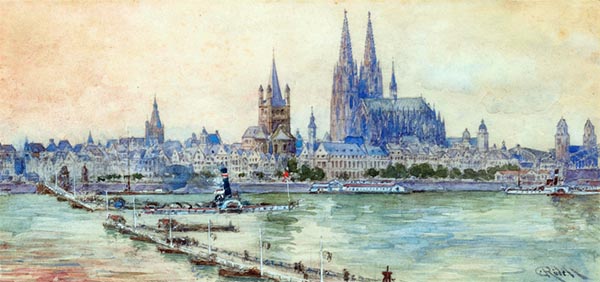
‘View of Cologne's old town’
Carl Rüdell (German, 1855-1939)
Artvee
Translated by A. S. Kline © Copyright 2026 All Rights Reserved
This work may be freely reproduced, stored and transmitted, electronically or otherwise, for any non-commercial purpose.
Conditions and Exceptions apply.
Contents
- Letter IX: Aix-la-Chapelle (Aachen) – Charlemagne’s Tomb.
- Letter X: Cologne.
- Letter XI: Concerning the Ibach House.
Letter IX: Aix-la-Chapelle (Aachen) – Charlemagne’s Tomb
Aix-la-Chapelle, August 6th
To invalids, Aix-la-Chapelle (Aachen) represents a cluster of mineral springs (the Aachener Thermalquellen), hot, cold, ferruginous, and sulphurous; to the tourist, a place of military redoubts, and concerts (the Lower Rhenish Music Festival; the Niederrheinische Musikfeste); to the pilgrim, a shrine of revered relics, which are on view only once every seven years: the robe of the Virgin, the blood of the infant Jesus, and the cloth on which Saint John the Baptist was beheaded; to the antiquarian and the chronicler, a noble convent for girls with an abbess who is the direct heiress of the monastery built by that Saint Gregory who was the son of Nicephorus II Phokas, Emperor of the East; to the hunting enthusiast, an ancient valley of wild boars, Porcetum, which gave its name to the Borcette (Burtscheid) district of the city; to the manufacturer, it is a source of water suitable for cleansing wool; to the merchant, it is a set of factories for the production of cloth including sundry casimirs (serge fabrics), as well as needles and pins; to those who are neither merchants, nor manufacturers, nor hunters, nor antiquarians, nor pilgrims, nor tourists, nor invalids, it is the city of Charlemagne.
Charlemagne was indeed born in Aix-la-Chapelle (c. 748), and he died there (814). He was born in the old half-Roman palace of the Frankish kings, of which only the Granus Tower remains, since incorporated in the Town Hall. He was buried in the Palatine chapel (of the present Cathedral, the Aachener Dom) which he had founded in 796, two years after the death of his wife Fastrada; the chapel which Pope Leo III blessed in 805, and at the consecration of which, or so tradition says, two bishops of Tongres (Tongeren-Borgloon), who had died and were buried at Maastricht, rose from their tombs, so as to complete the total of three hundred and sixty-five archbishops and bishops, representing the days of the year, involved in the ceremony.
This historic and fabulous church, which gave its name to the city, has undergone many transformations over the past thousand years. As soon as I arrived in Aix, I visited the chapel.
If one approaches the church facade, this is its appearance: a Louis XV-era portal in grey-blue granite with eighth-century bronze doors, backed by a Carolingian wall surmounted by a tier of Romanesque semicircular arches. Above these archivolts a beautiful, richly carved Gothic tier which displays the severe ogive of the fourteenth century; and as a crowning glory, vile brick masonry with a slate roof, dating back about twenty years. To the right of the portal, a large pine cone, in tenth-century bronze is set on a granite pillar, and on the other side, on a second pillar, there is a bronze she-wolf also ancient, probably Roman, which half turns towards the passer-by, its mouth half-open and its teeth bared.
(Pardon me, my friend, but allow me to open a parenthesis here. The pine cone has a meaning, and this she-wolf too, or this wolf, for I was not able to clearly recognize the sex of the bronze beast. Here is what the old wives of the country say of it.
— A long time ago, the people of Aix-la-Chapelle wished to build a church. They all contributed, and the work was begun. Foundations were dug, the walls were raised, the framework was roughed out, and for six months there was a deafening din of hammers, saws, and axes. At the end of six months, the funds were exhausted. Pilgrims were encouraged to give alms, and a tin basin was placed at the door of the church; but only a few targes and liards to pay for the cross were placed therein. What was to be done? The senate assembled, enquired, talked, considered, consulted. The workmen refused to work, while grass, brambles, ivy, all the insolent plants that clothe ruins began to conquer the fresh stonework of the abandoned building. Was the church to be left in that state? The burgomasters of the noble senate were dismayed. As they deliberated, an unknown stranger, a tall and handsome man, entered.
— ‘Greetings, gentlemen. What is all this? You seem dismayed. Is not your church dear to your heart? Have you not the means to complete it? Is it money you lack, as people say?’
— ‘Stranger,’ came the reply, ‘to the Devil with you! We would need a million in gold.’
— ‘Then, here it is,’ said the unknown; and, opening a window, he showed the burgomasters a large cart in the square, which had halted at the door of the Town Hall. The cart was drawn by ten pairs of oxen, and guarded by twenty black Africans armed to the teeth.
One of the mayors descended with the man, and grasped one of the bags with which the cart was loaded, at random, then both ascended, the stranger and the burgomaster. The bag was emptied before the senate: it was indeed full of gold.
The senators, stupefied and wide-eyed asked:
— ‘Who are you, my lord?’
— ‘My dear citizens, I am a fellow with money. What more do you wish to know? I live in the Black Forest, near Lake Wildsee, not far from the ruins of Heidenstadt, city of the pagans. I own gold and silver mines, and at night heaps of garnets pour through my fingers. But my tastes are simple, I feel ennui, I am a melancholy being, I spend my days watching the water-beetles play on the surface of the transparent waters of the lake, the newts playing below, and the smartweed (Polygonum amphibium) growing among the rocks. But, enough questions and distractions. I have thrown off my shackles; so, come profit from it. Here’s your million in gold. Do you wish to take it’
— ‘By the Lord, yes!’ cried the senators. ‘We’ll complete our church.’
— ‘Well, take it; but on one condition.’
— ‘Which is, my lord?’
— ‘Finish your church, burgomasters; take all this wealth; but promise me, in exchange, the first soul that crosses the threshold of your church, on the day of its consecration, when the bells ring out.’
— ‘Are you the Devil, then?’ cried the senators.
— ‘What fools you are!’ Master Urian (a medieval name and epithet for the Devil) replied.
The burgomasters began to leap about in fear, making the sign of the cross. But since Urian was a benign devil, and laughed until his ribs burst while jingling his brand-new coins, they felt reassured, and negotiations began. The Devil has his wits about him. That’s why he’s the very devil. ‘After all,’ he said, ‘in this bargain it’s I who lose. You’ll have your million, and your church. I’ll have only a single soul. And whose soul, if you please? The first that comes along. A random soul. Some false, hypocritical fellow whose devotion is a sham and who, to show zeal, seeks to be first to enter. Burgomasters, the plans for your church are fine. I like the design. The building will be beautiful, I think. I see, with pleasure, that your architect prefers the Montpellier-squinch (trompe de Montpellier) to the corner-squinch (trompe-sous-le-coin). I don’t utterly hate this pendentive vault, with a rectangular face and curved sides; but I would have preferred a groin vault with sloping and rectangular tops to the piers. I approve of the fact that he shows a door there in the round tower, but I doubt he’s allowed long enough tie-stones for the walls. What’s your architect’s name, citizens? —Tell him from me that, to construct the arch of a portal in his hollow tower, it is necessary that there be four layers: two of voussoirs (ring-stones), with a layer of mortar between; the fourth, the webbing, forms the outer curve of the arch. But it’s all the same to me. Here’s a barrel-vaulted stairway, with squinches, leading down to a crypt, all in a very fine style and perfectly planned. It would be a shame to leave things as they are — we must complete the church. Come, my friends, a million for you, a soul for me. Is it settled?’ Thus spoke Master Urian.
— ‘After all,’ thought the burghers, ‘we are most fortunate that he is content with only one soul. He might well, if he looked a little more closely, seize on everyone in this city.’
The deal was struck, the million was accepted. Urian disappeared through a trapdoor from which a small blue flame emerged, as was fitting, and two years later the church was built.
It goes without saying that the senators all swore not to disclose the details to anyone, and it goes without saying that each of them, that very evening, told his wife all about it. It’s a law of nature. A law the senators had not made, but that all observe. So much so that, since the whole city, thanks to the senators’ wives, knew the secret, when the church was finished, no one wished to be first to enter.
A new embarrassment, as great as was the previous. The building was finished, but no one wished to set foot in it; the church was complete, but empty. Now, what good is an empty church? — The Senate gathered. They could think of no solution. — They called upon the Bishop of Tongres (Tongeren-Borgloon). He offered no ideas. — They called upon the canons of the chapter. They could conceive of nothing. — They called upon the monks in their monastery. — ‘By heavens’, said a monk, ‘it must be admitted, my lords, that you are committed to very little. You owe Urian the first soul that enters the church doorway. But he failed to stipulate what kind of soul it should be. Urian is naught but a fool, I tell you. My lords, after a lengthy chase, a wolf was caught alive this morning in the valley of Borcette. Bring this wolf to the church. Urian will have to be content with that. It’s only a wolf’s soul, but it’s still a soul of sorts.’
— ‘Bravo!’, cried the senators. ‘Here’s a monk with his wits about him.’
The next day, at dawn, the bells rang. ‘Well,’ said the townspeople, ‘today is the consecration! But who will dare to enter first?’ ‘Not I.’ — ‘Nor I.’ — ‘Nor I. – ‘Nor I.’ They hastened there in a crowd. The senate and the chapter stood before the gate. The wolf was brought in a cage, and at a given signal, the doors of the cage and the doors of the church were suddenly opened. The wolf, frightened by the crowd, saw the church was deserted and plunged inside. Urian was waiting, mouth open, eyes closed voluptuously. Judge of his rage when he found it was a wolf he was swallowing. He let out a terrifying roar, and flew about for some time beneath the high arches of the church, with a thunderous sound. Then he finally flew out, consumed with anger, kicking the great bronze doors (the Wolfstür) so furiously, as he left, that they split from top to bottom — the split is still shown today.
That is why, the old women add, the bronze statue of the wolf was placed to the left of the church doorway, and to the right a pine cone to represent its wretched soul, devoured by Urian who had been made to look so foolish.
Leaving the legend, and returning to the church, I must tell you, however, that I sought the famous split made by the Devil’s heel, and failed to find it. Here, I close the parenthesis.)
Now, when one approaches the chapel through the great portal, the Roman, Romanesque, Gothic, and Rococo styles, and the modern style, blend and overlap on the facade, but without true affinity, without the force of necessity, without order, and, consequently, without grandeur.
If you approach via the eastern end of the church, the effect is quite different. The high fourteenth-century apse appears to you in all its audacity and beauty, with the cleverly-conceived pitch of its roof, the rich workmanship of its balustrades, the variety of its gargoyles, the dark colour of its stone, and the glassy translucency of the immense lancets at its base, due to which the two-storey houses hidden between the buttresses seem imperceptible.
However, from this point on, the appearance of the church, imposing as it may be, is hybrid and discordant. Between the apse and the portal, in a sort of hole into which all the lines of the building collapse, the Byzantine dome with triangular pediments that Otto III had built in the tenth century above the tomb of Charlemagne is concealed, barely connected to the facade by a pretty sculpted bridge from the fourteenth century.
A flattened façade, a buried dome, a detached apse, such is the chapel of Aix. The architect of 1355 wanted his prodigious chapel to absorb Charlemagne’s church, devastated in 881 by the Normans, and the dome of Otto III, destroyed by fire in 1236. A system of low chapels, attached to the base of the large central chapel, was to envelop in its embrace the entire building, except for the portal. Two of these chapels, which still exist, and which are admirable, were already built when the fire of 1366 occurred. Execution of this powerful, vegetative architectural design was halted. Strangely enough, the fifteenth and sixteenth centuries added nothing to the church. The eighteenth and nineteenth centuries have spoiled it.
However, it must be said that, taken as a whole, as it stands the chapel of Aix has both mass and grandeur. After a period of contemplation on the part of the visitor, a singular majesty is evident in this extraordinary building, which remained unfinished, like the life’s work of Charlemagne himself, and is composed of architecture in a host of styles, as his empire was composed of nations that spoke a host of languages.
All in all, to the thoughtful person who gazes at it externally, there is a strange and profound harmony between the great man and the great tomb. I couldn’t wait to enter.
After passing through the arch of the portico, and leaving the ancient bronze doors behind me, each adorned in the centre with a lion’s head, and partitioned in rectangular panels with moulded architraves, what first struck my eye was a white rotunda on two floors, lit from above, in which all the coquettish fancies of rocaille and chicory-leaf decoration flourish on all sides. Then, lowering my eyes to the ground, I saw in the centre of the pavement of this rotunda, beneath the pale light that falls through the plain-glass panes, a large slab of black marble, worn by the feet of passers-by, with this inscription in copper letters: CAROLO MAGNO.
Nothing could be more shocking or brazen than this Rococo chapel, displaying its courtesan’s graces above the great Carolingian name. Angels resembling cupids, palms resembling plumes, garlands of flowers, and ribbons with bows, that is what the Pompadour style has placed beneath the dome of Otto III, and above the tomb of Charlemagne.
The only thing in this indecent chapel worthy of the man, and the place, is an immense circular chandelier with forty-eight candles, which is about twelve feet in diameter, a gift in the twelfth century offered by Frederick Barbarossa to Charlemagne. This chandelier, made of copper and gilded silver, has the shape of an imperial crown; it is suspended from the vault, above the black marble slab, by a thick iron chain ninety feet long.
The black slab is about nine feet long by seven feet wide. It is obvious, moreover, that there was once another monument to Charlemagne in the very same place. Nothing indicates that the black slab, framed by a thin copper strip and surrounded by a border of white marble, is ancient. As for the letters CAROLO MAGNO, they are no more than a hundred years old.
Charlemagne no longer lies beneath this stone. In 1165, Frederick Barbarossa, whose sacrilege the chandelier-crown, magnificent as it may be, fails to redeem, had the great emperor unearthed. The church took the imperial skeleton and dismembered it like that of a saint, rendering each bone a relic. In the neighbouring sacristy, a vicar shows the relics to passers-by, and I saw, for the fixed price of three francs seventy-five centimes, the arm of Charlemagne, that arm which held the orb of the world, a venerable bone which bears on its dried integuments this inscription written, for a few liards, by a twelfth century scribe: Brachium sancti Caroli Magni. After the arm, I viewed the skull, that skull the brain within which moulded a whole new Europe, and which a verger taps with his fingernail.
These things are in a cupboard. A wooden cabinet painted grey with gold decorations, adorned at its top with some of those angels resembling cupids of which I spoke just now, this, today, is the tomb of that Charles whose name shines still, for us, across ten centuries and who left this world only after having adorned his name, thus rendered doubly immortal, with the two words, sanctus, magnus, saintly and great, the two most august epithets with which heaven and earth can crown a human head!
One thing that is astonishing is the material grandeur of this skull and this arm, grandia ossa. Charlemagne was indeed one of those rare great men who are also of great stature. The son of Pepin the Short was a colossus in body as well as in mind. He was said to be seven times taller than his foot was long, the latter distance becoming a measure of length (though reputedly he was 6 feet five inches tall, while the Parisian foot measure, ‘pied du roi’, was slightly longer than the English one). It is this king’s foot, Charlemagne’s foot, that we have just replaced by a fraction of a meter, thus sacrificing, I know not why, in one fell swoop, history, poetry, and language to an invention that the human race has done without for six thousand years, which we call the decimal system.
Moreover, on opening, this cupboard produces a sort of dazzlement, so resplendent is it with gold. The doors are covered inside with paintings on a golden background, among which I noticed eight admirable panels which are said to be by Albrecht Durer. Besides the skull and the arm, the cabinet contains: the ‘Horn of Charlemagne’, an enormous elephant’s tusk hollowed out, and curiously sculpted towards the wider end (of Saracen origin, and of the 11th century); the ‘Cross of Charlemagne’, a jewel in which is set a piece of the true cross and which was around the emperor’s neck in the tomb (‘Charlemagne’s Talisman’, now in Reims Cathedral); a charming Renaissance monstrance given by Charles V and marred in the last century by the addition of an excess of tasteless ornamentation; the fourteen gold plaques, covered with Byzantine sculptures, which adorned the marble armchair of the great emperor; a monstrance given by Philip II, which reproduces the profile of the dome of Milan; the rope with which Jesus Christ was tied during the flagellation; a piece of the sponge soaked in gall with which his thirst was quenched on the cross; finally, the knitted belt of the Holy Virgin, and the leather belt of Jesus Christ. This small twisted and rolled strap, like the whips used on schoolboys, attracted the attention of three emperors; after Constantine, who affixed his sigillum (seal) to it, which is still attached, and which I saw, it fell to Harun-al-Rashid (fifth Caliph of the Abbasid Caliphate), who gave it to Charlemagne.
All these venerable objects are enclosed in glittering Gothic and Byzantine reliquaries, which are like microscopic cathedrals, chapels, and spires, made of solid gold, with sapphires, emeralds and diamonds serving as stained glass windows.
Amidst these innumerable jewels piled up on the two shelves of the cabinet, there rise, like two mountains of gold and precious stones, two large reliquaries of immense value and wondrous beauty. The first and oldest, which is Byzantine, encircled with niches in which sixteen crowned emperors are seated, contains the remains of Charlemagne’s bones and is never opened. The second, which is from the twelfth century, and which Frederick Barbarossa gave to the church, contains the famous relics of which I spoke to you at the beginning of this letter and is opened only every seven years. A single showing of this reliquary, in 1496, attracted one hundred and forty-two thousand pilgrims, and brought in eighty thousand gold florins, in fifteen days.
This shrine has only one key. The key is separated into two pieces, one of which is kept by the chapter, the other by the city magistrate. The shrine is sometimes opened in particular circumstances, but only for crowned heads. The current King of Prussia, when still only a royal prince, requested that it be opened. The request was refused.
In a small cupboard, next to the large one, I saw an exact copy, in gilded silver, of the Germanic crown of Charlemagne. The Carolingian Germanic crown, surmounted by a cross, loaded with precious stones and cameos, is formed of a fleur-de-lis circle which surrounds the head, and a semicircle welded from the forehead to the nape of the neck with a slight inflection which imitates the profile of the horned ducal cap (corno ducale) of the Venetian doges. Of the three crowns which Charlemagne wore ten centuries ago, as Emperor of Germany, as King of France, and as King of the Lombards, the first, the Imperial Crown of the Holy Roman Empire, is in Vienna (at the Hofburg); the second, the Crown of France was in Reims Cathedral (the crown was destroyed during the Revolution); the third, the Iron Crown, is in Milan (‘The Iron Crown of Lombardy’, in the Cathedral of Monza). As I left the sacristy, the verger entrusted me to a Swiss who began to progress through the church in front of me, occasionally opening gloomy panels, from which magnificence suddenly burst forth.
Thus, the ambo (Heinrichskanzel), which has all the appearance of a village pulpit, sheds its hideous chrysalis of reddish wood and suddenly appears as a splendid tower of silver gilt. A prodigy of eleventh-century chiselling, and goldsmith’s work, it was donated to the chapel by the Emperor Henry II. Deeply-incised Byzantine ivories, a rock-crystal cup with its saucer, and a monstrous onyx nine inches long, are inlaid in this gold ‘breastplate’ which encases the priest speaking in the name of God, and whose front panel represents Charlemagne carrying the chapel of Aix on his arm.
This pulpit is placed at the corner of the choir, which occupies the marvellous apse of 1353. All the coloured stained-glass windows have vanished. The lancets are plain-glass from top to bottom. The rich tomb of Otto III, founder of the dome, destroyed in 1794, was replaced by a flat stone marking its location at the entrance to the choir. An organ given by the Empress Josephine, near the admirable fourteenth-century vault, is in the mediocre style of 1804. Vault, pillars, capitals, small columns, statues, the entire choir is whitewashed.
In the midst of this degraded apse, the bronze eagle of Otto III, with open beak, angry eye, and wings half-spread, transformed into a lectern, is fearful and shivering, indignant at bearing the book of plaint-chant, he who has the globe of the world beneath his feet.
Yet the eagle should be shown more respect. When Napoleon visited the Chapel, the lightning-bolts that I saw today attached to both sides of that imperial globe carried in its talons by Otto’s eagle, were added. The Swiss unscrews the lightning-bolts at the request of the curious.
On the back of this eagle, as if by a sad and ironic foreboding, the tenth-century sculptor extended a bronze bat with a human face, which is as if nailed there, and on which the lectern’s book now rests.
To the right of the altar is enshrined the heart of Marc-Antoine Berdolet, the first and last bishop of Aix-la-Chapelle. For this church has never had but the one bishop, whom Bonaparte appointed (in 1802). His epitaph describes him as primus Aquisgranensis episcopus. Now, as in the past, the chapel is administered by a chapter presided over by a dean with the title of provost.
In a darkened room of the chapel, the Swiss opened another cupboard for me. Therein is the sarcophagus of Charlemagne. It is a magnificent Roman coffin of white marble, on the front of which is sculpted, with the most masterful chisel, the abduction of Proserpina. I contemplated, this bas-relief which is two thousand years old, for a long time. At the end of the composition, four frenzied horses, at once infernal and divine, led by Mercury, are dragging a chariot, in which Proserpina, having been seized by Pluto, is screaming, struggling, and writhing in despair, towards a half-open chasm in the plinth. The strong hand of the god presses the half-naked throat of the young girl, who leans back, and whose dishevelled head meets the straight and impassive gaze of the helmeted Minerva. Pluto carries off Proserpina, in whose ear Minerva the counsellor whispers. Smiling, Cupid is seated on the chariot between Pluto’s colossal legs. Behind Proserpine, struggle a group of nymphs and furies, portrayed with the proudest of sculptural lines. Proserpine’s companions strive to stop a second chariot drawn by two fire-eating winged dragons, which follows in succession. One of the young goddesses, who has boldly seized a dragon by the wings, causes it to cry out in pain. This bas-relief is a poem. It is a violent, vigorous, exorbitant, superb, somewhat emphatic piece of sculpture, which pagan Rome created, and which Rubens might have done. This sarcophagus, before acting as a coffin for Charlemagne, was, it is said, that of Augustus.
Finally, via another narrow and dark staircase, which many kings, emperors, and illustrious tourists have climbed for six centuries, my guide led me to the gallery which forms the first floor of the rotunda, and which is called the Hochmunster (High Minster).
There, beneath a wooden box that was half-open, and which is never opened entirely except for crowned visitors, I saw Charlemagne’s stone armchair. This armchair, low and wide, with a back semi-circular at the top, is formed of four slabs of white marble, bare and without sculptures, joined by bronze brackets. It has an oak board covered with a red velvet cushion for a seat, and is raised on six steps, two of which are of granite and four of white marble.
On this chair, clad in the fourteen Byzantine plaques I spoke to you about earlier, at the top of the stone platform to which these four white marble steps lead, with the crown on his head, the globe in one hand and the sceptre in the other, his Germanic sword at his side, the mantle of the Empire on his shoulders, the cross of Jesus Christ around his neck, and his feet plunged in the sarcophagus of Augustus, the Emperor Charlemagne was seated in the tomb. He remained in shadow, on this throne, and in this attitude, for three hundred and fifty-two years, from 814 to 1166.
It was in 1165 that Frederick Barbarossa, seeking to legitimise his reign, entered the tomb, the monumental form of which no tradition has preserved, and to which belonged the two sacred bronze doors adapted for use in the portal. Barbarossa was himself an illustrious prince and a valiant knight. It must have been a strange and formidable moment when this crowned king (he was crowned King of the Romans in 1152, and Holy Roman Emperor in Rome in 1155) found himself face to face with the crowned corpse; one emperor, clad in all the majesty of the empire; the other, in all the majesty of death. The soldier vanquished the shade; the living dispossessed the dead. The chapel retained the skeleton, Barbarossa took the marble seat; and, of this chair where the dead Charlemagne had sat, he made the throne on which the emperors came to sit in grandeur for four centuries.
In fact, thirty-one emperors, not including Barbarossa, have been anointed and crowned on this chair in the Hochmunster of Aix-la-Chapelle. Ferdinand I was the last; Charles V the penultimate. Since then, the coronation of the Holy Roman Emperors has taken place in Frankfurt.
I could not tear myself away from this armchair, so simple and so grand. I contemplated the four marble steps scratched by the heels of those thirty-one illustrious ‘Caesars’ who had seen their radiance kindled there, and who had been extinguished in their turn. Countless ideas and memories came to my mind. I remembered that the violator of this sepulchre, Frederick Barbarossa, having grown old, wishing to crusade for a second time (he participated in the Second Crusade, and led the Third Crusade), travelled to the East. There, one day, he came to a beautiful river. The river was the Calycadnus (the Saleph, now named the Göksu). He was over-heated, and fancied bathing therein. The man who had profaned Charlemagne’s tomb, had forgotten about Alexander the Great. He entered the river, whose icy water seized him. Alexander, a young man, had almost died in the River Cydnus (the Tarsus Stream, the modern Berdan) not far distant from the Calycadnus — Barbarossa, an old man, did.
One day, I have no doubt, a pious and holy thought will come to some king or emperor. Charlemagne will be removed from the cupboard where the sacristans have put him, and be replaced in his tomb. All that remains of his great skeleton will be religiously gathered together. He will be returned to his Byzantine vault, with its bronze doors, his Roman sarcophagus, his marble armchair raised on the stone platform and adorned with the fourteen gold plaques. The Carolingian diadem will be placed on his skull, the orb of empire in his hand, the mantle of cloth-of-gold about his bones. The bronze eagle will proudly resume its place at the feet of that master of the world. All the gold and diamond reliquaries will be arranged around the platform, like the furniture and chests of a last royal chamber; and then — since the Church prefers its saints to be contemplated in the form that death gave them —through some narrow skylight, cut into the thickness of the wall and adorned with iron bars, by the light of a lamp suspended from the vault of the sepulchre, the kneeling traveller will be able to view, at the top of those four white steps no human foot will ever touch again, on that marble chair flecked with gold, crown on forehead, globe in hand, shining vaguely in the darkness, the imperial ghost that will once have been Charlemagne.
It will be a profound sight to see, for anyone who dares to venture a glance into that vault, and each will take away from that tomb a profound thought. People will travel there from the ends of the earth, and all kinds of thinkers will visit. Charles, son of Pepin, was indeed one of those complete beings whom humanity can consider from four different angles. Historically, he is a great man like Augustus or Sesostris (the legendary Twelfth Dynasty pharaoh based on Senusret I, Senusret III and others); as regards fable, he is a paladin like Roland, a magician like Merlin; the Church views him as a saint like Jerome or Peter; while to the philosopher, he is civilisation itself personified, which, achieving a giant’s stature every thousand years strides across some deep abyss, amidst civil war, barbarism, revolution, calling itself sometimes Caesar, sometimes Charlemagne, sometimes Napoleon.
Shortly before Bonaparte was crowned in Notre-Dame, as Napoleon I (December 2nd 1804), he visited Aix-la-Chapelle (October 2nd 1804). Josephine, who accompanied him, wished, on whim, to sit in the marble armchair. The emperor, who, out of respect, had put on his full-dress uniform, allowed this woman of Creole heritage to do so, while he remained motionless, standing, silent, and bare-headed before Charlemagne’s chair.
Remarkably, a fact, which comes to mind here, in passing, is that Charlemagne died in January 814. A thousand years later, in June 1814, Napoleon was exiled.
In that same fateful year, the allied sovereigns made a visit to the shade of the great Charles (in January 1814). Emperor Alexander I of Russia, like Napoleon, had donned his full-dress uniform; Frederick William III, King of Prussia, wore his undress greatcoat and cap; Francis I of Austria (also known as Francis II, the last Holy Roman Emperor) was in a frock coat and round hat. The King of Prussia mounted two of the marble steps and asked the provost of the chapter to explain the details of the coronation of German emperors. The two emperors remained silent. Today, in 1838, Napoleon, Josephine, Alexander, Frederick William and Francis are all dead.
My guide, who gave me these details, is a former French soldier who fought at Austerlitz and Jena, has since settled in Aix-la-Chapelle, and has become Prussian by the grace of the Congress of 1815. Now he wears the baldric and the halberd before the chapter, during ceremonies. I admired that Providence which shines forth in the smallest of things. The mind of this man, who speaks to travellers of Charlemagne, is full of Napoleon. Due to that, without his knowledge, I found I know not what grandeur in his words. Tears came to his eyes when he told me of his old battles, his old comrades, his old colonel. It was in the same tones that he spoke to me of Marshal Soult, Colonel Graindorge (Jean-Francois, Baron Graindorge, mortally wounded in the Peninsula War), and, without knowing how much the name would interest me, of General Hugo (Victor Hugo’s father, Joseph Léopold Sigisbert Hugo). He had recognised in me a Frenchman, and I will never forget with what simple and profound solemnity he said to me as he left: ‘You will be able to say, sir, that you saw, in Aix-la-Chapelle, a sapper of the thirty-sixth Swiss Cathedral regiment.’
On another occasion he had said to me: ‘You see in me, sir, a citizen of three nations: I am Prussian by chance, Swiss by profession, French at heart. However, I must admit that his military-man’s ignorance of ecclesiastical matters made me smile more than once during the course of my visit, notably in the choir, when he showed me the stalls and said gravely: Here are the places for the ‘chamoines’ (chanoines, canons). Do you not think it should be pronounced chats-moines (cat-monks)?
As I left the chapel, I was so absorbed by a single thought that I barely looked at a façade, a few steps from the church and very beautiful, of the fourteenth century, which was adorned with seven statues of proud emperors, and today grants access to some kind of cesspool. And then at that moment a distraction occurred. Two visitors had, like myself, emerged from the chapel, into which my old soldier-guide had probably just piloted them for a few minutes. Since they were laughing out loud, I turned round. I recognised two travellers, the eldest of whom had written his name, that very morning, in front of me, in the register of the Hotel de L’Empereur (not extant), namely Monsieur le Comte d’A — one of the oldest and noblest names in Artois. They were now speaking loudly.
— ‘Such names!’ they said. ‘It took the Revolution to produce them. Captain Lasoupe! Colonel Graindorge! Wherever did they hail from?’ — They were the names of the captain and colonel of my poor old Swiss, who had apparently spoken of them to these travellers as he had to me.’ I could not help replying: ‘Where did they hail from? I will tell you, gentlemen. Colonel Graindorge was a great-grandcousin of Marshal de Lorges, father-in-law of the Duke of Saint-Simon; and as for Captain Lasoupe, I suppose he was some relation to the Duke of Bouillon, uncle of the Elector Palatine.’ A few moments later I was in the square containing the Town Hall, which I was eager to visit.
The Town Hall of Aix is, like the chapel, a building composed of five or six others (the Town Hall has been extensively restored and remodelled since this description of 1838). On both sides of a dark facade with long, narrow, closely spaced windows, which dates from the time of Charles V, rise two belfries, one low, round, wide, and flattened; the other high, slender, and quadrangular. The second belfry is a beautiful fourteenth-century construction. The first is the famous Granus Tower, which is difficult to recognise under the strange, convoluted bell-tower with which it is crowned. This bell-tower, which is repeated in a smaller version on the other tower, is like a pyramid of gigantic turbans of all shapes and sizes, placed one on top of the other, and decreasing in size sharply at each stage. At the foot of the facade is a vast staircase, whose layout is similar to that of the staircase of the Cour du Cheval-Blanc at Fontainebleau. Opposite, in the centre of the square, a marble Renaissance fountain, somewhat altered and retouched in the eighteenth century, supports, above a large bronze cup, a bronze statue of Charlemagne, armed and crowned. To the right and left two other smaller fountains bear at their summit two fearful and dreadful black eagles, half-turned towards the grave and tranquil emperor.
It was there, on this site, in the Roman Granus tower perhaps, that Charlemagne was born. The fountain, the facade, the belfries, the whole ensemble, is regal, melancholic, and severe. Charlemagne is still wholly present. A presence which grants a powerful unity to the disparities of the edifice. The tower of Granus recalls Rome, his imperial predecessor; the facade and the fountains recall Charles V, the greatest of his successors. Even the oriental figure of the belfry makes one think, vaguely, of the magnificent Caliph Harun-al-Rashid, his friend.
Evening was approaching. Having spent all day in the presence of these great and austere memories, it seemed to me that I was coated in the dust of ten centuries; I felt the need to leave the city, to breathe, to see the fields, trees, and birds. This led me out of Aix-la-Chapelle, into the fresh green lanes, which I wandered until nightfall, beside the old walls. Aix-la-Chapelle still has its ring of towers. Vauban failed to pay it a visit. But, the underground passages, which ran from the lower rooms of the Town Hall and the Chapel vaults as far as Burtscheid Abbey, and even as far as Limburg, are now filled in and lost.
As night fell, I sat down on a grassy slope. Aix-la-Chapelle was spread before me, set in its valley as if in a graceful basin. Little by little the evening mist, reaching the jagged roofs of the old streets, erased the outline of the two belfries, which, mingled, in perspective, with the steeples of the city, vaguely recall the Muscovite and Asiatic profile of the Kremlin. Only two distinct masses stood out from the whole city, the Town Hall and the Cathedral. Then all the day’s emotions, thoughts, and sights, came flooding back to me. The city itself, the illustrious and symbolic city, was as if transfigured in my mind, and before my gaze. The former of those two black masses that I could still distinguish, and that alone I could distinguish, was for me nothing more than a child’s crib; the latter only the tomb of a dead man; and at times, in the depths of my contemplation, in which I was as if buried, it seemed to me that I saw the shadow of that giant whom we call Charlemagne rising slowly, on the pale nocturnal horizon, in all his grandeur, between the cradle, and the tomb.
Letter X: Cologne
The Banks of the Rhine. Andernach, August 11th
Dear friend, I am annoyed with myself. I sped through Cologne like a barbarian. I barely spent forty-eight hours there. I intended to stay for two weeks or more; but, after almost a whole week of fog and rain, such a beautiful shaft of sunlight lit the Rhine, that I wished to take advantage of it, in order to view the riverine landscape in all its richness and joy. So, I left Cologne this morning by the steam-boat, Cockerill. I left the city of Agrippina behind me (Colonia Claudia Ara Agrippinensium was the Roman colony from which the city developed, Agrippinians being the new name granted the Ubian tribe, as a tribute to Agrippina Minor, wife to the Emperor Claudius), and I saw neither the old paintings in the Church of Saint Mary’s in the Capitol, nor the mosaic-paved crypt of the Basilica of Saint Gereon, nor the Crucifixion of Saint Peter, painted by Rubens for the old half-Roman church of Saint Peter where he was baptised, nor the bones of the eleven thousand virgins in the Ursuline cloister, nor the incorruptible corpse of the martyr Albinus, nor the silver sarcophagus of Saint Cunibert, nor the tomb of Duns Scotus in the Church of the Minorites; nor the sepulchre of Empress Theophania, wife of Otto II, in the Church of Saint Pantaleon; nor the Maternus-Gruft (the Maternus crypt) in the Church of Saint Maria in Lyskirchen (according to legend, the church was founded in the 4th century by Bishop Maternus), nor the two Golden Chambers, that of the Basilica of Saint Ursula, and that of the Cathedral; nor the Hall of the Imperial Diets (the Gürzenich), today a warehouse; nor the old Arsenal (the Zeughaus), today a wheat store. I saw nothing of it all. It’s absurd, but that’s how it is.
So, what did I see in Cologne? The Cathedral and the Town Hall; nothing more. You have to be in a wonderful city like Cologne for that to be a small thing. For they are two rare and wonderful buildings.
I arrived in Cologne after sunset. I headed straight for the Cathedral, after having placed my overnight bag in the hands of one of those worthy messengers, in blue uniforms with orange collars, who work in this country for the King of Prussia (excellent and lucrative work, I assure you; the traveller is heavily taxed, and the messenger shares the proceeds with the king). Here is a useful detail: before quitting this good man (the messenger), I asked him, to his great surprise, to take my baggage, not to a hotel in Cologne, but to a hotel in Deutz, which is a small town on the other side of the Rhine, linked to Cologne by a pontoon bridge. Here is the reason: I like to select, as far as possible, the view of the landscape and horizon from my window, whenever I stay for several days at the same inn. Now the windows in Cologne look across the river to Deutz, and the windows of Deutz look out on Cologne; which led me to select an inn in Deutz, following an incontestable principle of mine. It is better to dwell in Deutz and view Cologne than to live in Cologne and view Deutz.
Once alone, I began to walk, seeking the Cathedral and expecting it at every street corner. But that inextricable city was unknown to me, and the evening shadows had darkened the narrow streets; I dislike asking for directions, and wandered around at random for quite a while.
Finally, after venturing through a sort of carriage entrance into a sort of courtyard, ending on the left in a sort of corridor, I emerged, suddenly, onto a quite large, and perfectly dark and deserted square (the Domplatz).
There I came upon a magnificent spectacle. Before me, beneath the unreal light of a twilight sky, in the midst of a crowd of low houses with capricious gables, an enormous black mass, laden with needles and pinnacles, rose and then broadened; a stone’s throw away, stood, another isolated black mass, narrower and taller, a sort of large square fortress, flanked at its four corners by four tall engaged towers, at the top of which was highlighted a strangely inclined framework shaped like a gigantic feather and placed as if on a helmet on the brow of the old keep. The dark mass was an apse; the keep was the lower section of a bell-tower; the apse and the section of a bell-tower comprised the Cathedral of Cologne.
What had seemed to me to be a black feather leaning above the crest of the sombre monument was an immense and symbolic crane, clad and armoured with lead plating, that I saw again the next day, which, from the summit of its tower, declares to all who pass that this unfinished basilica will be continued, that this section of bell-tower and this section of church, separated at this moment by a vast space, will one day fuse together and live a common life; and that Archbishop Engelbert von Berg’s dream, which became a building (begun in 1248) under Archbishop Conrad von Hochsteden, will, in a century or two, be the greatest Cathedral in the world, and that modern Homers still place their hopes in this incomplete Iliad.
The church was shut. I approached the bell-tower; its dimensions are enormous. What I had taken for towers at the four corners were simply the bulging outlines of the buttresses. Only the ground floor and the first floor, composed of a colossal ogive, of each are yet built, but already their construction is almost the height of the towers of Notre-Dame de Paris. If the projected spires are ever raised above these monstrous blocks of stone, Strasbourg Cathedral will be nothing compared to it. I doubt that the bell-tower of Mechelen itself, also unfinished, can match it as regards stature and magnitude.
As I have said elsewhere, nothing resembles a ruin like a rough sketch. Already brambles, saxifrages and wall-pellitories, all the herbs that like to gnaw at the mortar and sink their nails into the joints of the stones, have attacked the venerable portal. Man has not finished building before Nature is busy destroying.
The square was silent. No one passed by. I had approached as close to the gate as the rich fifteenth-century iron-grille that protects it allowed me, and I could hear the peaceful murmur of the countless little host of plants that grow and thrive on the projections of old buildings whispering peacefully in the night wind. A light, that appeared at a nearby window, illuminated for a moment, beneath the arches, a crowd of exquisite seated statuettes, angels and saints, reading from large books open on their knees, or speaking and preaching, their fingers raised. Thus, some study, others teach. An admirable prologue for a church, which is nothing other than the Word rendered in marble, bronze, and stone! The gentler architecture of swallows’ nests blends with the stone on all sides, as a charming corrective to the severe architecture of the building.
Then the light was extinguished, and I saw nothing but the vast, eighty-foot wide, open arch, without a frame and without a windbreak, gutting the tower from top to bottom and allowing my gaze to penetrate into its darkened bowels. In this window was framed, diminished by perspective, the opposite window, also broad and open, whose rose-window and mullions, as if drawn in ink, stood out with inexpressible purity against the clear, metallic twilit sky. Nothing could be more melancholic, or more singular, than that elegant little white ogive within the large black ogive. Such was my first encounter with Cologne Cathedral.
I have failed to tell you anything of the road from Aix-la-Chapelle to Cologne. There is little to say. A pure and simple landscape akin to that of Picardy or Touraine, a green and blond plain with from time to time a twisted elm or a pale curtain of poplars in the background. I don’t dislike that peaceful sort of landscape, but I enjoy it without cries of enthusiasm. In the villages, old peasant women passed like ghosts, wrapped in long grey or soft pink calico mantles whose hoods are drawn down over their eyes; the young women, in short petticoats, wearing a little headband covered with spangles and glass beads that barely hides their magnificent hair, tied above the nape of the neck with a large silver arrow, were cheerfully cleaning the doorways of their houses, and, bending, showed their hamstrings to passers-by as in the paintings of the old Dutch masters. As for the men, they are dressed in a blue smock and a blunderbuss hat, as if they were countrymen in a country with a constitution.
As for the road, it had rained; it was very wet. I failed to meet anyone, except, at times, some young blond musician, thin and pale, on his way to Aix-la-Chapelle or Spa (in Belgium), knapsack at his side, his double-bass covered with a green cloth on his back, his baton in one hand, his cornet in the other; dressed in a blue coat, a flowered waistcoat, a white tie, and half-tights rolled up above his boots because of the mud; a poor devil clad from head to waist for a ballroom, and waist down for travel. I also saw, in a field near the path, a local hunter whose appearance was as follows: a round apple-green hat with a large lilac cockade in faded satin, a grey blouse, a large nose, and a rifle.
In a pretty little squarish town, flanked by brick walls and ruined towers, which is halfway there and whose name I know not (Düren), I admired four magnificent travellers seated, the shutters being open wide, on the ground floor of an inn, before a gargantuan table piled high with meat, fish, wine, pâtés and fruit; drinking, cutting, biting, twisting, skinning, devouring; one red, another crimson, the third purple, the fourth violet, like four living personifications of voracity and gluttony. It seemed to me that I saw the gods of Gluttony, namely Goulu, Glouton, Goinfre and Guliaf, seated around a mountain of food.
That said, the inns are excellent in this country, except, however, the one in which I stayed in Aix-la-Chapelle which is only passable (the Hôtel de l’Empereur), and in which my room provided, to keep my feet warm, a superb dyed carpet on the floor, a magnificence which probably explains the exorbitant cost of the said gasthof.
To complete my comments regarding Aix-la-Chapelle, I will tell you that the counterfeit book trade flourishes there as in Belgium. In a large street which terminates at the Place de l’Hôtel-de-Ville, I found my pirated works displayed in a shop window, side by side with those of Lamartine, therefore in valued and illustrious company. The counterfeit portrait of myself in this Prussian reprint was a little less ugly than all those horrible caricatures that the traders in portraits, and the booksellers, including my publishers in Paris, purvey to the credulous and terrified public as being my exact likeness; an abominable slander, against which I solemnly protest. Cælum hoc et conscia sidera testor: as heaven and the stars above are my witness.
I live like a true German. When I dine my napkins are as large as kerchiefs, I sleep in sheets as large as napkins. I eat leg of lamb with cherries, and hare with prunes, and drink excellent Rhine wine, and excellent Moselle wine which an ingenious Frenchman, dining yesterday a few steps from me, called ‘vin de demoiselle’ (‘young ladies’ wine’). This same Frenchman, after tasting the liquid in his carafe, formulated this axiom: ‘Rhine water is no match for Rhine wine’.
In the inns, the host, hostess, valets and maids speak only German; but there is always a waiter who speaks French, a French, in truth, somewhat coloured by the Germanic milieu in which he is immersed; but this variety is not without charm. Yesterday I heard this same traveller, my companion, ask the waiter, while showing him the dish that had just been served to him: ‘What is this?’ The waiter replied with dignity: ‘It is bichons.’ It was indeed pigeons.
Besides, a Frenchman who, like me, knows no German, is wasting his time if he asks this ‘head waiter,’ as he is called here, questions other than those provided for, and printed in, the Travellers’ Guide. The waiter bears only a surface varnish of French; if you choose to dig a little further, you will find German, pure German, incomprehensible German.
I come to my second visit to Cologne Cathedral. I returned in the morning — one approaches this masterpiece by a shabby courtyard. There, poverty-stricken women besiege you. While distributing some local currency to them, I remembered that prior to the French occupation there were twelve thousand beggars in Cologne, who had the privilege of passing on to their children the fixed and special sites where each of them stood. This institution has disappeared. Aristocracies are crumbling. Our century has no more respect for hereditary beggar-ship than for the hereditary peerage. Now the barefoot have nothing to bequeath to their families. Once past the poor, one enters the church.
A forest of pillars and columns, large and small, their bases entangled with wooden palisades and lost at their summits in a tangle of low vaults made of rafters and battens, varying in curvature and unequal in height; there is scant daylight in the church; all the vaults are low and prevent one seeing beyond about forty feet; on the left four or five dazzling stained-glass windows, descending from the wooden ceiling to the stone paving in wide sheets of topaz, emerald and ruby; on the right a jumble of ladders, pulleys, ropes, sheaves, winches and tackles; in the background, plain-chant, the deep voices of the cantors and prebendaries, the beautiful Latin of the psalms travelling the ceiling fragmentedly, amidst puffs of incense, and the sound of an admirable organ weeping with ineffable sweetness; in the foreground the grinding of saws, the groaning of pulleys and cranes, the deafening banging of hammers on planking: that is how the interior of Cologne Cathedral appeared to me.
This Gothic Cathedral wed to a carpenter’s workshop, this noble canoness brutally married to a mason, this great lady obliged to patiently combine her quiet habits, her august and discreet life, songs, prayers, and meditation, with these tools, this uproar, this coarse dialogue, this low company, all this misalliance, produces at first a strange impression, due to the fact that one no longer sees Gothic churches being built, which dissipates after a moment when one reflects that, after all, nothing is more natural. The crane on the bell-tower carries a meaning: that the work interrupted in 1473 has been resumed. All this tumult involving carpenters and stonemasons is necessary. The Cathedral of Cologne is being continued, and, if it pleases God, will be completed. Nothing could be finer, if the skill exists to complete it. These pillars supporting the wooden vaulting sketch out a nave, which will one day join the apse to the bell-tower.
I examined the stained-glass windows, which date from the time of Maximilian I, the Holy Roman Emperor, and are painted in the robust and magnificently exaggerated style of the German Renaissance. There is an abundance of kings and knights with stern faces, superb figures, monstrous plumes, fierce lambrequins, exorbitant morions, and enormous swords, armed like executioners, bent like archers, and coiffed like warhorses. Near them are their wives, or, to put it better, their formidable females, kneeling in the corners of the stained-glass windows with the profiles of lionesses and wolves. The sunlight passes through these figures, adds fire to their eyes, and brings them to life.
One of these windows presents a beautiful motif that I have already encountered many times, the genealogy of the Virgin (the ‘Tree of Jesse’ window, of 1509). At the bottom of the painting, a giant Adam, dressed as an emperor, is lying on his back. From his belly emerges a large tree that fills the entire window, and on the branches of which appear all the crowned ancestors of Mary; David playing the harp; Solomon pensive; while at the top of the tree, in a large blue compartment, the last flower opens and reveals the Virgin carrying the Child.
A few steps further on I read on a large pillar this sad and resigned epitaph:
INCLITVS ANTE FVI, COMES EMVNDVS
VOCITATVS, HIC NECE PROSTRATVS, SUB
TEGOR VT VOLUI. FRISHEIM, SANCTE,
MEVM FERO, PETRE, TIBI COMITATVM,
ET MIHI REDDE STATVM, TE PRECOR,
ÆTHEREVM. HÆC LAPIDVM MASSA
COMITIS COMPLECTITVR OSSA.
‘I was once famous, Count Edmund my name,
Now I lie here prostrate in death,
Beneath the pavement I sought. Holy
Peter, now I bring you my county
Of Frisheim, grant me the heavenly city,
I pray you. This mass of stone
Covers a Count, every bone.’
I transcribe this epitaph as it is laid out on a vertical stone tablet, like prose, without any indication of the somewhat barbaric hexameters and pentameters that form couplets. The pair of rhyming lines with their caesura that end the inscription contain a quantitative error, massa, which surprised me, because the Middle Ages knew how to write Latin verse.
The left arm of the transept is as yet merely indicated, and ends in a large oratory, cold, ugly, dull, and poorly- furnished, except for a few confessionals. I hastened to enter the church, and, as I left the oratory, three things struck me almost at once: to my left, a charming little sixteenth-century pulpit, very spiritedly done and delicately carved in black oak; a little further on, the choir grille, a rare and complete example of exquisite fifteenth-century ironwork; and opposite me, a very beautiful gallery with squat pilasters and low arches, in the style of our late Renaissance, which I suppose was created for that sad refugee, Queen Marie de Medici (the second wife of Henri IV; banished by her son Louis XIII, she eventually took refuge in Cologne, in a house loaned to her by Rubens, the artist).
At the entrance to the choir, in an elegant rococo armoire, a true Italian Madonna sparkles and shines laden with sequins and tinsel, along with her bambino. Below this opulent Madonna, with her bracelets and pearl necklaces, has been placed, as an apparent antithesis, a massive poor-box, fashioned in the twelfth century, garlanded with chains and iron padlocks and half-sunk into a roughly carved block of granite. It looks like a log sealed in a paving stone.
As I looked up, I saw, hanging from the ogee above my head, some gilded rods attached at one end to a transverse rod. Beside these is the inscription: — ‘Quot pendere vides baculos, tot episcopus annos huic Agrippinæ præfuit ecclesiæ: the bishop has presided over this Church of Agrippina for as many years as you see rods suspended.’ — I like this strict way of counting the years, and of making perpetually visible to the archbishop the time he has already employed or wasted. Three rods are hanging from the vault at this moment (Clemens August Droste zu Vischering was Archbishop of Cologne from 1835 to 1845).
The choir constitutes the interior of this famous apse which is still, so to speak, the entire cathedral of Cologne, since the bell-tower lacks its spire, the nave its vault, and the church its transept. In this choir riches abound. There are sacristies full of delicate woodwork, chapels full of severe sculptures; paintings from all periods, tombs of all shapes; bishops of granite couched in a fortress, bishops of jasper couched on a bier borne by a procession of weeping figurines, bishops of marble couched beneath an iron trellis, bronze bishops couched on the ground, wooden bishops kneeling before altars; lieutenant-generals from the days of Louis XIV leaning on their sepulchres, knights from the time of the Crusades lying facing upwards with their dogs resting lovingly against their steel feet; statues of apostles dressed in golden robes: oak confessionals with twisted columns; noble canonical stalls; Gothic baptismal fonts in the form of coffins; altarpieces laden with statuettes; beautiful fragments of stained glass; fifteenth-century Annunciations on a background of gold, displaying the rich wings, multi-coloured above, white below, of the Angel who gazes at, and well-nigh covets, the Virgin; tapestries woven from designs by Rubens; iron-grilles that one would think were by Quentin Matsys, painted and gilded shuttered wardrobes that one would think were by Frans Floris the Elder.
All this, it should be said, is shamefully dilapidated. Whoever is building Cologne Cathedral externally, someone is demolishing it internally. Not a tomb whose figurines are not marred or truncated; not a grille that is not rusty where once it was gilded. Dust, ashes, and filth lie everywhere. Flies dishonour the venerable face of Archbishop Philip von Heinsberg. The man of bronze lying on a slab, whose name was Konrad von Hochstaden, and who laid the cornerstone of this Cathedral (in 1248), cannot today crush the spiders that bind him to the ground like Gulliver with their innumerable threads. Alas! Arms of bronze are no match for living ones.
I believe that a bearded statue of a reclining old man, which I saw in a dark corner, broken and mutilated, is by Michelangelo. This reminds me that I saw at Aix-la-Chapelle, lying in a corner of the old cloister-cemetery, like tree trunks awaiting the butcher, those famous antique marble columns (imported from Rome and Ravenna to construct Charlemagne’s Palatine Chapel) seized by Napoleon and recovered by Blücher. Napoleon had seized them for the Louvre, Blücher recovered them for the charnel house. One of the phrases I most often utter is, ‘To what end?’
In all this degradation, I only saw two somewhat-respected and occasionally-cleaned tombs, the cenotaphs of two Counts of Holstein-Schauenburg (Adolf III and Anton). These two Counts of Schauenburg form one of those pairs who seem to have been foreseen by Virgil. They were brothers, both archbishops of Cologne, both buried in the choir, both having very beautiful seventeenth-century tombs facing each other. Adolf gazes across at Anton.
I have purposely omitted until now, in order to tell you of it in some detail, the most venerated sepulchre in the Cathedral of Cologne, the famous Shrine of the Three Kings. There is a rather large chamber (since removed) of multi-coloured marble enclosed by thick copper grilles; a hybrid and bizarre design in which the architectural styles of Louis XIII and Louis XV blend coquetry with heaviness. This is located behind the high altar in the culminating chapel of the apse. Three turbans amidst the design of the main grille strike the eye first. One raises one’s eyes, to view a bas-relief representing the Adoration of the Magi; one lowers them, to read this mediocre couplet:
‘Corpora sanctorum recubant hic terna magorum.
Ex his sublatum nihil est alibive locatum’
‘The sacred bodies of the three magi lie here.
Nothing of them has been removed, or placed elsewhere’
Here an idea, at the same time both humorous and serious, stirs one’s thoughts. It is in this place, then, that those three poetic Kings of the Orient lie who came, led by the star, ab Oriente venerunt, and who worshipped a child in a stable, et procidentes adoraverunt. I too worshipped in my turn. I confess that nothing in the world charms me more than that Thousand-and-One-Nights’ tale enshrined in the Gospel. I approached the tomb, and behind the jealously closed grating, through a darkened window, I saw, amidst the shadows, a large and marvellous Mosan Art reliquary in solid gold, sparkling with arabesques, pearls and diamonds, exactly as one glimpses, through the darkness of nineteen centuries and more, behind the dark and austere grille of Church tradition, the oriental and dazzling history of the Three Kings.
On both sides of the venerated grille, two gilded copper hands emerge from the marble, each half-opening a bag to receive alms, below which the chapter has engraved this subtle exhortation: — ‘And opening their treasure-chests, they offered him gifts’ (see Matthew 2:11).
Opposite the tomb three copper lamps burn, one of which bears the name: Gaspar, the second Melchior, the third Balthazar. It was an ingenious idea to display, illuminated as it were, in front of the sepulchre, the names of the three Magi.
As I was about to retreat, something pointed pierced the sole of my boot; I looked down; it was the head of a copper nail driven into the large slab of black marble over which I was walking. I remembered, while examining this stone, that Marie de Medici had wanted her heart to be placed under the pavement of Cologne Cathedral in front of the Shrine of the Three Kings. This slab that I was trampling underfoot doubtless covered her heart. There was once on this slab, where one can still distinguish the imprint, a copper or gilded bronze panel bearing, in the German manner, the coat of arms and epitaph of the dead woman, for the affixing of which the nail that tore my boot had served. When the French occupied Cologne, Revolutionary ideas, probably aided by a speculative coppersmith, uprooted this panel decorated with a fleur-de-lis, like the others which once surrounded it, because a number of copper nails coming loose from the neighbouring slabs attest to and proclaim many similar efforts. Thus, the poor queen saw herself first erased from the heart of Louis XIII, her son, then the memory of Richelieu, his creature; and now it is erased from the very earth!
And what strange whims destiny pursues! This queen, Marie de Medici, this widow of Henry IV, exiled, abandoned, destitute as her daughter Henriette, widow of Charles I, was to prove a few years later, came to die in Cologne, in 1642, in the Ibach house, No. 10 Sterngasse, the very house where sixty-five years earlier, in 1577, Rubens, her artist, was born.
The Cathedral of Cologne, seen again in broad daylight, stripped of the unreal magnification that evening lends to objects, and which I call twilight grandeur, seemed to me, I must say, to have lost a little of its sublimity. The outline is still beautiful, but its lines possess a certain dryness. This is perhaps due to the relentlessness with which the current architect (Ernst Friedrich Zwirner) is mortaring and sealing this venerable apse. Old churches should not be over-renovated. In such an operation, which diminishes the architectural form while trying to rectify it, the mysterious vagueness of its outline vanishes. At the moment, I prefer the sketchy mass of the bell-tower to a perfect apse. In any case, and with all due respect to various people of refinement who would wish to make of Cologne Cathedral the Parthenon of Christian architecture, I see, for my part, no reason to prefer this Cathedral apse to our old, complete Notre-Dames of Amiens, Reims, Chartres, and Paris. I even admit that Beauvais Cathedral, which has also remained a mere apse, barely known and very little praised, seems to me in no way inferior, either in mass or in detail, to Cologne Cathedral.
Cologne Town Hall, situated quite close to the Cathedral, is one of those delightful harlequin-style buildings made of elements from all periods, and in all styles, that one encounters in the old municipalities which have created their laws, morals, and customs, in much the same way. The mode of formation of both buildings and customs is an interesting study. There was agglomeration rather than construction, successive growth, capricious enlargement, encroachment on neighbouring edifices; nothing was done according to a regular or pre-determined plan; everything happened as and when, according to the needs arising.
Thus the Town Hall of Cologne, whose foundations probably contain some Roman cellar, was, around the year 1250, only a grave, severe ribbed dwelling like our Maison-aux-Piliers (the House of Pillars, in Paris, on Place de Grève, was a precursor to the current Hôtel de Ville); then it was felt that a belfry was needed to house the tocsin bell as a call to arms, and the night watchmen, and a beautiful fifteenth-century tower (the Ratsturm), both bourgeois and feudal, was built; then, under Maximilian I, as the joyful breath of the Renaissance began to blow above the dark stone foliage of the cathedrals, and a taste for elegance and ornamentation spread everywhere, the aldermen of Cologne began to feel the need to improve their town house. They, perhaps, summoned from Italy, as architect, a pupil of old Michelangelo, or from France some sculptor, a friend of young Jean Goujon, and added a triumphant and magnificent loggia (the Rathauslaube, designed by Wilhelm Vernukken) to the black fourteenth-century facade. A few years later, they needed a promenade next to their registry, and they built a charming courtyard with arcaded galleries, sumptuously enlivened with coats of arms and bas-reliefs, which I saw, and which in two or three years no one will see, because it is being allowed to fall into ruin. Finally, they recognized that a large hall was necessary for meetings, auctions, and assemblies, and (between 1608 and 1615) they commissioned, opposite their belfry and loggia, a splendid building in stone and brick (the Spanischer Bau) in the finest taste, and of the noblest design. — Today, the fourteenth-century ribbed building, the fifteenth-century belfry, the Renaissance loggia, and courtyard, and the early seventeenth-century hall, mutually aged by time, laden by events with tradition and memories, fused and grouped together by chance in the most original and picturesque way, form the Town Hall of Cologne.
May I say in passing, my friend, that, as both a product of art and as an expression of history, this Town Hall is worth somewhat more than the cold and pale building, bastardised by its triple frontage cluttered with archivolts, bastardised by the economical and petty monotony of its ornamentation where everything is repeated and nothing stands out, and bastardised by its truncated roofs without crests or chimneys, in which a handful of mediocre masons, in the very face of our good city of Paris, are today drowning the ravishing masterpiece created by ‘Boccador’ (the architect Domenico da Cortona). We are a strange people; we allow the Hôtel de la Trémouille to be demolished and we build this thing! We allow gentlemen who believe and call themselves architects to lower, slyly, by two or three feet, that is to say, completely disfigure Boccador’s charming pointed roof, so as to enhance it, alas, with the horrible flattened attics they invented. Will we forever be the same people that admires Corneille and yet sees him retouched, pruned and corrected by François Andrieux? — Well, let us return to Cologne.
I climbed the Town Hall belfry, and from there, beneath a grey and gloomy sky, which was, to a degree, in harmony with the buildings and my thoughts, I had at my feet all that admirable city.
Cologne on the Rhine, like Rouen on the Seine, and Antwerp on the Scheldt, like all cities bordering on a watercourse too wide to be easily crossed, has the shape of a taut bow to which the river is the bowstring.
The roofs are of slate, tightly packed together, angled like maps folded in two; the streets are narrow, the gables are carved. A reddish curve of moated brick wall, which appears and reappears everywhere above the roofs, ties the city like a buckled belt to the river itself, meeting it downstream by the Thürmchen turret (at the eastern end of modern Thürmchenswall, not extant,), upstream by the superb Bayenturm tower (restored in the 1990’s), amidst the crenellations of which stands a marble bishop blessing the Rhine. From the Thürmchen to the Bayenturm the city extends along the river, over two miles of windows and facades. Towards the middle of this long line a large pontoon bridge, gracefully pressing against the current, crosses the river, very wide at this point, and connects Deutz, a small block of white houses on the other bank, to the vast cluster of black buildings, which is Cologne.
Seen from the Town Hall belfry, amidst the mass of Cologne, among the roofs, turrets and attics full of flowers, rise the varied and prominent peaks of twenty-seven churches among which, without counting the Cathedral, are four majestic Romanesque churches, all differing in design, worthy by their grandeur and beauty of being cathedrals themselves, Great Saint Martin to the east, Saint Gereon to the west, the Holy Apostles (Saint Aposteln) to the south-west, and Saint Mary’s of the Capitol to the south, surrounded by enormous clusters of apses, towers and bell towers.
If one examines the city in detail, all is alive and throbbing; the bridge is laden with passers-by and carriages, the river is covered with sails, the shore is lined with masts. All the streets teem, all the windows seem to speak, all the roofs to sing. Here and there, green clumps of trees gently caress these black houses, and amidst the monotony of slate roofs and brick frontages, the old stone mansions of the fifteenth century display their long friezes of flowers, fruits and sculpted foliage, on which pigeons come to perch with joy.
Around this large city, commercial in aspect by virtue of its industry, militaristic by virtue of its location, and maritime by virtue of its river, a vast and fertile plain spreads and widens in all directions, sinking down in folds in the direction of Holland, which the Rhine traverses from one side to the other, and to the northeast crowned by its seven historic ridges, that marvellous nest of traditions and legends which we call the Seven Mountains (the Siebengebirge).
Thus, Holland and its commerce, Germany and its poetry, present two great aspects of the human spirit, the material and the ideal, on Cologne’s horizon, itself a city of commerce and reverie.
Descending from the belfry, I halted in the courtyard in front of the charming Renaissance porch. I called it a moment ago the triumphant loggia, but I should have said the triumphal loggia; for the second floor of this exquisite composition is formed of a series of small triumphal arches joined together to form arcades and dedicated, in inscriptions of the period, firstly to Julius Caesar, secondly Augustus, thirdly Agrippina, who gave her name to the site of Cologne (Colonia Agrippinensum); fourthly Constantine, the Christian emperor; fifthly Justinian, the law-giving emperor; and lastly to Maximilian, at that time a recent emperor. On the facade the sculptor-poet chiselled three bas-reliefs representing the three lion tamers, Milo of Croton, Pepin the Short, and Daniel. At the two extremities he placed Milo of Croton, who overcame the lions by the power of his body, and Daniel, who subdued them by the power of his mind; between Daniel and Milo, linking both in a natural manner, he placed Pepin the Short, who attacked wild beasts with that mixture of physical and moral vigour that marks the soldier. Between pure strength and pure thought, stands courage. Between the athlete and the prophet, the hero.
Pepin has his sword in hand, while his left arm wrapped in his cloak is plunged into the lion’s mouth; the lion, claws and jaws opened, is raised on its hind feet in the formidable attitude which heraldry terms ‘rampant’. Pepin faces him valiantly, in a fighting stance. Daniel stands motionless, his arms hanging down, his eyes raised to heaven while the friendly lions roll at his feet; the spirit does not struggle, it triumphs. As for Milo of Croton, his arms trapped in the tree-trunk, he struggles, as the lion devours him; his is the agony of the unintelligent man, blind with presumption, believing in his muscles and his fists; yet pure force is vanquished — these three bas-reliefs are of great significance. The last produces a terrifying effect. I know not what fearful and fatal idea emerges, perhaps without the sculptor himself being aware, from this dark poem. It is Nature taking revenge on Man, vegetation and animals making common cause, the oak tree aiding the lion.
Unfortunately, archivolts, bas-reliefs, entablatures, imposts, cornices and columns, all that beautiful porch, has been restored, scraped, repointed and whitewashed, to a state of the most deplorable cleanliness.
As I was about to leave the Town Hall, a man, aged rather than old, debased rather than bent, of wretched appearance but proud bearing, was crossing the courtyard. The concierge who had led me to the belfry pointed him out to me. The man is a poet, who lives on his income from recitals and who writes epics. His name, however, is completely unknown to all. My guide, who greatly admired him, told me he had written epics against Napoleon, against the Revolution of 1830, against the Romantics, against the French, and another fine epic to invite the current architect of Cologne to complete the church in the style of the Pantheon in Paris. Epics they might be. But the man is covered in filth. I have never seen a less presentable fellow in all my life. I doubt we have anyone in France comparable to that epic poet.
On the other hand, a few moments later, just as I was traversing a dark and narrow street, a little old man with a sharp-eyed look emerged suddenly from a barber’s shop and ran up to me, shouting: Monsieur! Monsieur! The crazy French! Oh! The French! Rat-a-tat! Rat-a-tat! Fight the lot! Hurrah! Hurrah! Is Napoleon not the fellow! Fight all Europe! Oh! The French! Cry Hurrah! Monsieur! A bayonet for every Prussian! Good riddance, like at Jena! Hurrah, the French! Rat-a-tat!
I confess that I enjoyed his speech. France looms great in the memories, and hopes, of these noble people. This whole bank of the Rhine loves us — I almost said awaits us.
In the evening, as the stars were appearing, I walked along the other side of the river, on the shore opposite Cologne. I had before me the whole city, whose countless gables and black steeples stood out in all their detail against the pale sunset sky. To my left rose, like the giantess of Cologne, the tall spire of Great Saint Martin with its pierced turrets. Almost opposite me, the dark apse of the Cathedral, raised its thousand sharp pinnacles, like some monstrous hedgehog, crouched at the water’s edge, the crane on the steeple seeming to form its tail, and to which two lighted street lamps towards the foot of that dark mass added flaming eyes. I heard, amidst the shadows, only the caressingly discreet tremors of the water at my feet, the dull sound of a horse’s hooves on the planks of the pontoon bridge, and in the distance, from a forge I had glimpsed, the ringing, glittering sound of hammer on anvil. No other noise from the city crossed the Rhine. A few panes of glass glittered vaguely, while from beneath the forge, a blazing furnace, a long luminous trail, no mere gleam, flowed, and dispersed in the river, as if this pocketful of fire were emptying itself into the water.
This beautiful and sombre ensemble, stirred a melancholy reverie in my mind. I said to myself: — ‘The Germanic city has disappeared, the city dedicated to Agrippina has disappeared, the city of Saint Engelbert (Count Engelbert II, Archbishop of Cologne from 1216 to 1225) still stands. But for how long? The temple (fourth century) housing the shrine (of the Three Magi) endowed by Saint Helena vanished a thousand years ago; the church built by Archbishop Anno (Arno II, Archbishop from 1056 to1075) will fall. The city is worn away by its river. Every day some old stone, some old memory, some old custom is detached from it due to the friction produced by a score of steamboats. A city on the great artery of Europe cannot exist with impunity. Cologne (founded in 50AD), though less ancient than Trier (in Germany, founded in 16BC) or Solothurn (in Switzerland, founded in 15AD), two of the very oldest Roman towns in Europe, has already been altered and transformed thrice, by the rapid and violent tide of events and ideas which traversed it, constantly pulsing from the cities of William the Silent (William of Orange) to the mountains of William Tell, the tributaries of Germany flowing to Cologne from Mainz, the tributaries of France from Strasbourg. Now a fourth climacteric epoch of Cologne appears to be proclaiming itself. The spirit of positivism and utilitarianism, as the barbarians of today have it, is penetrating and invading it; new styles affect it, entering the labyrinth of its ancient architecture on all sides; new streets drive wide gaps through the Gothic mass; ‘modern good taste’ applies, building Rue de Rivoli type facades, which enjoy the admiration of foolish shopkeepers. Drunken rhymesters advise the city of Konrad von Hochstaden to imitate the architect Jacques-Germain Soufflot’s Pantheon. The archbishops’ tombs are falling into disrepair in a Cathedral being raised today by vanity, not faith. The splendid country-women dressed in scarlet, and wearing gold and silver head-dresses, have disappeared; Parisian grisettes stroll on the quaysides; I saw today a few last desiccated bricks fall from the Romanesque cloister of Saint Martin; a Café Tortoni (like that in Paris, on the Boulevard des Italiens, in Paris, founded around 1800) is about to open there. Long rows of white-coloured houses give the feudal and Catholic suburb of the Martyrs-of-Thebes (around Saint Gereon’s church, the site according to legend of the martyrdom of the Theban Legion) an air, falsely, of Batignolles in Paris. An omnibus crosses the old pontoon bridge, and one can travel for six sous from Agrippinensium to Tuitium (Deutz, the Roman Castrum Divitia, known as Tuitium from the tenth century onwards) — alas, the ancient towns are vanishing!
Letter XI: Concerning the Ibach House
My friend! My friend! What other things do, perhaps they know; but, as has been said before, men know not what they do. Often, when comparing history with Nature, amidst those eternal comparisons which my mind cannot help but draw between events, in which God hides himself, and the Creation in which he shows himself, I have shuddered, suddenly, with a secret anguish, and have imagined that the forests, lakes, mountains, the thunder amidst the clouds, the flower that nods its head when we pass, the star that twinkles on the misty horizon, the ocean that mutters or roars, forever seeming to issue a warning, are manifest and dreadful things, full of light and knowledge, that gaze with pity at Man, the creature of pride whose arms are tied by impotence, the thing of vanity whose eyes are blinded by ignorance, as he gropes among them all in that darkness peculiar to himself. Nothing in me finds this thought repugnant, that a tree might be conscious of its fruit; but, of a certainty Man has no consciousness of his own destiny.
The life and intellect of Mankind are at the mercy of some obscure yet divine machine, called by some Providence, by others Chance, which mingles, combines and decomposes everything, which hides its workings in the darkness, to display the result in broad daylight. We believe we are doing one thing, and do another. ‘Urceus exit’ (see Horace: ‘Ars Poetica: lines 21-22. ‘Amphora coepit institui; currente rota cur urceus exit? An amphora’s begun, the potter’s wheel turns, why does a mere jug emerge?). History is full of examples. When the husband (Henri II) of Catherine de Medici, and lover of Diane de Poitiers, yields to the mysterious attractions of Filippa Duci, the beautiful Piedmontese girl, he not only engenders Diane de France who will wed Orazio Farnese, but thereby the de facto alliance between his fourth son who will become Henri III, with his cousin who will become Henri IV (Henri III’s ninth cousin once removed). When the Duke of Nemours (Jacques de Savoie) gallops down the steps of the Sainte-Chapelle on his chestnut horse, Réal, it is not only a mad and dangerous folly he is rendering fashionable, it is the death of the King of France he is preparing. On July 10, 1559, in the lists on the rue Saint-Antoine, when Montgomery (Gabriel de Lorges, Count of Montgomery), dripping with sweat beneath his vast red plume, lowers his lance, and charges the handsome fleur-de-lis adorned cavalier applauded by all the ladies, he has no suspicion of the prodigious consequences arising from what he holds in his hand. Never has a fairy wand worked so wondrously as that lance. In a single blow Montgomery fatally injures Henri II, demolishes the Hôtel des Tournelles (in which Henri II died from his wound) and builds the Place Royale (initiated by Henri IV, it was later renamed the Place des Vosges), that is to say, he upsets the workings of the play, eliminates the hero, and alters the decor.
When Charles II of England, after the Battle of Worcester, hid in the hollow oak-tree (the Boscobel Oak, in 1651), he thought he was doing no more than that; not at all, he gave his name to a royal constellation (Robur Carolinum, Charles’ Oak, so named by Edmund Halley the Astronomer Royal in 1679), and gave Halley an opportunity to outdo the famous Tycho Brahe. Madame de Maintenon’s second husband (Louis XIV), by revoking the Edict of Nantes, and the Parliament of 1688, by expelling James II, did nothing other than make possible the curious Battle of Almansa (1707) where face to face, on the same field, were to be seen a French army commanded by an Englishman, Marshal Berwick (James FitzJames, Ist Duke of Berwick), and an English army commanded by a Frenchman, the Marquis de Ruvigny and Earl of Galway (Henri de Massue). If Louis XIII had not died on May the 14th, 1643, the idea would not have occurred to the aged Comtefontaine (Paul-Bernard de Fontaines) to attack Rocroi within five days; and a heroic prince, at twenty-one years of age, would not have been presented with that magnificent opportunity on May 19th (the Battle of Rocroi), which turned the Duke of Enghien into the great Condé. And amidst all this tumult of facts which clutter the histories, what singular echoes, what extraordinary parallels, what formidable counter-blows! In 1664, after the insult offered to the Comte de Créqui (Charles III de Blanchefort de Créquy later made a duke; the incident was known as the Corsican Guard Affair), his ambassador, Louis XIV had the Corsicans banished from Rome; one hundred and forty years later, in 1804, Napoleon Buonaparte saw the Bourbon dynasty exiled from France.
What shadows! And what lightning-flashes in the shadows! Around 1612, when the young Henri de Montmorency (the 4th Duke in 1614, and Viceroy of New France in North America in 1620, who supported Gaston Duke of Orleans, was defeated at the Battle of Castelnaudary in 1632, and was subsequently executed ), then aged seventeen, saw, among the gentlemen-servants going to and fro in his father’s house, in the humble attitude appropriate to service, bearing and offering an ewer for the guests to wash their hands, a pale and puny page, the little Charles de Laubespine de Châteauneuf, what could have told him that this page, bowing so respectfully before him, would become a sub-deacon, that this sub-deacon would become Keeper of the Seals, that this Keeper of the Seals would preside by commission over the parliament of Toulouse, and that, twenty years later, this page, sub-deacon, and president would slyly seek a dispensation from the Pope, so that the rascal could have his master, he himself, Henri, Duke of Montmorency, Marshal of France by election of the sword, peer of the kingdom by the grace of God, decapitated! When President de Thou (Jacques Auguste de Thou), in his history of France, polished, sharpened, and carefully refurbished the edict of Louis XI of December 22, 1477, what could have told this father that one day that same edict would be the axe, with Jean-Martin Laubardemont as its handle, with which Richelieu would cut off his son’s head! (The son was François-Auguste de Thou, executed for conspiracy against Louis XIII)
Amidst this chaos there is still law. Chaos is only the appearance; there is order at its heart. After long periods of time, the same fearful happenings that once made our fathers raise their eyes to the heavens, return, like comets, out of the darkest depths of history. Ever the same entanglements, the same falls from grace, the same betrayals, ever the same shipwrecks on the same reefs; names change, things persist. A few days before the fatal Easter of 1814, the emperor might well have said to his thirteen marshals: Amen dico vobis quia unus vestrûm me traditurus est Truly, I say to you, that one of you will betray me (see the Vulgate Matthew 26:21). Caesar forever adopts Brutus; Charles I forever prevents Cromwell from leaving for Jamaica; Louis XVI forever prevents Mirabeau from embarking for the Indies; always and everywhere cruel queens are punished by cruel sons; always and everywhere ungrateful queens are punished by ungrateful sons. Every Agrippina gives birth to the Nero who will slay her; every Marie de Medici gives birth to the Louis XIII who will banish her.
And as regards myself, do you not notice in what strange way my thoughts pass from idea to idea, and so, almost without my knowledge, to those two women, those two Italians, those two ghosts, Agrippina the Younger and Marie de Medici, the two spectres of Cologne! Cologne is the city of unhappy queen-mothers. Some sixteen hundred years apart, the names and memory of the daughter of Germanicus, mother of Nero, and the wife of Henry IV, mother of Louis XIII, were attached to Cologne. Of these two widows — parentless when widowed — the first rendered so by poison (the rumoured fate of her husband Claudius), the second by the dagger (the assassination of her husband Henri IV), Marie de Medici, died there; the other, Agrippina, was born there.
I visited the house in Cologne where Marie de France died — the Ibach House according to some, the Jabach House according to others — and, instead of telling you what I saw there, I shall say what I thought of it. Forgive me, my friend, for not describing for you, on this occasion, all the little local details that I like and which, in my opinion, paint the picture of a person, whose appearance explains that person, and leads the mind from external facts to internal ones. This time I will refrain from doing so. I am afraid of wearying you with my festoons and my astragals (excessive detail: see Nicolas Boileau, ‘L’Art Poétique’, Chant I, 1674).
The melancholy queen, Marie, died there on July 3, 1642. She was sixty-eight years old. She had been exiled from France for eleven years. She had wandered everywhere, to Flanders, to England, a great burden to every country. In London, Charles the First treated her with dignity; during the three years she spent there, he gave her one hundred pounds sterling a day. Later, I regret to say, Paris failed to show the Queen of England the same hospitality that London had shown the Queen of France. Henrietta, the daughter of Henri IV, and the widow of Charles the First was housed in the Louvre, in some garret or other, where she remained in her bed for lack of a bundle of firewood in the winter, awaiting the few coins the coadjutor loaned her. Her mother, the widow of Henri IV, found a last refuge in Cologne in much the same state — in the deepest poverty. At the request of Cardinal Richelieu, Charles the First had ejected her from England. I am sorry for Charles, the melancholic author of the Eikon Basilike (Charles’ spiritual autobiography, probably ghost-written by Bishop John Gauden) yet I fail to understand how the man who knew how to display kingship as regards Cromwell failed to do so as regards Richelieu.
However, I insist on noting one detail full of deep significance: Marie de Medici’s death was closely followed by that of Richelieu, in the same year, and by Louis XIII, who died the year following. What was the point of all that unnatural hatred between three human creatures, what was the point of those intrigues, that persecution, the many quarrels, the perfidy, when all three die almost at the same hour? — God knows His own purpose.
There is an unfortunate element of doubt where Marie de Medici is concerned. The shadow cast by François Ravaillac (who assassinated Henri IV) has always seemed to me to haunt the trailing folds of her dress. I have always been appalled by the dreadful sentence that President Hénault (the historian Charles-Jean-François Hénault, who was President of the Parliament), without malicious intent perhaps, wrote about that queen: ‘She was not sufficiently surprised by the death of Henri IV.’
I confess that all of that renders the clear, loyal, if pompous era of Louis XIV more admirable to me. The shadows and obscurities that mar the beginning of that era highlight the splendours of its end. Louis XIV represents power as did Richelieu, but with the addition of majesty; he represents grandeur, like Cromwell, plus serenity. Louis XIV’s genius resided not within himself, but in the geniuses around him, which renders the king a lesser being perhaps, but his reign a greater one. As for me, who love, as you know, things which are successful and complete, without disputing all the qualifications that must be admitted, I have always had a profound sympathy for that grave and magnificent prince so nobly born, so well suited to his role, so ably surrounded, a king from the cradle and a king in death; a true monarch in the highest sense of the word, a central sovereign of our civilisation, a pivot of Europe, who was able to employ, so to speak, among those whom he saw appear, shine forth, and disappear around his throne in turn, during his reign: seven popes; four Ottoman sultans; two Holy Roman emperors; two kings of Spain (excluding Archduke Charles, a disputed claimant); two kings of Portugal; four kings and two queens (Mary II who ruled jointly with William III, and Anne) of England; three kings of Denmark; two kings of Sweden; four kings of Poland; and four Tsars of Russia; that pole star of a whole century who, for seventy-two years, saw all the constellations revolve, majestically, around him!
The End of Part III of Hugo’s ‘Le Rhin’