Victor Hugo
The Rhine (Le Rhin, 1838, 1839, 1840)
Part II: Letters V-VIII
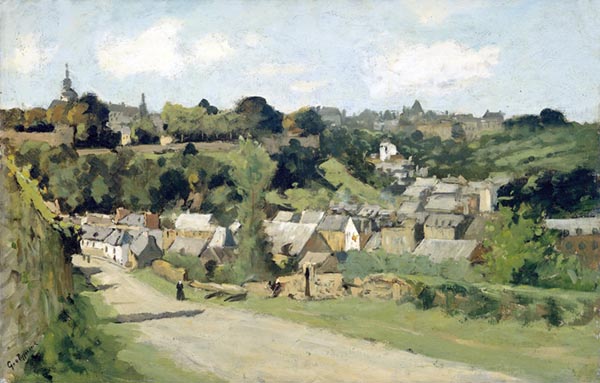
‘View of Dinant’
Geo Poggenbeek (Dutch, 1853-1903)
Artvee
Translated by A. S. Kline © Copyright 2026 All Rights Reserved
This work may be freely reproduced, stored and transmitted, electronically or otherwise, for any non-commercial purpose.
Conditions and Exceptions apply.
Contents
- Letter V: Givet.
- Letter VI: The Banks of the Meuse – Dinant – Namur.
- Letter VII: The Banks of the Meuse – Huy – Liège.
- Letter VIII: The Banks of the Vesdre – Verviers.
Letter V: Givet
On the road, at an inn, August 1st
Givet is a pretty town, clean, gracious, and hospitable, situated on both banks of the Meuse, which divides it into Grand and Petit Givet, at the foot of a high, and beautiful wall of rock, whose summit is somewhat spoiled by the geometric lines of the Fort de Charlemont. The inn, which is called the Hôtel du Mont-d’Or (not extant), is very good, although it is the only one, and could therefore accommodate passers-by in any way it chose, and serve them anything it wished for dinner.
The bell-tower of Petit Givet is a simple slate needle; as for the bell-tower (of Saint-Hilaire Church) in Grand Givet, it exhibits a more complex and erudite architectural style. Here, it seems, is how the architect designed it. The bold fellow took a square priest’s or lawyer’s cap. On this square cap he placed an inverted salad bowl; on the platform provided by the upturned base of this salad bowl, he placed a sugar bowl; on the sugar bowl, a bottle; on the bottle, a sun-orb fixed into the neck by means of its lower vertical ray; and finally, on the sun-orb, a rooster skewered by the upper vertical ray. Assuming that it took him a day to engender these six ideas, on the seventh day he rested. The architect must have been Flemish.
For about two centuries, Flemish architects imagined that nothing was more beautiful than pieces of crockery or kitchen utensils raised to gigantic, nay titanic proportions. So, when they were given to building bell-towers, they seized the opportunity, valiantly, and set about crowning their cities with a host of colossal pitchers.
The views in Givet are no less charming, especially if you stand towards evening, as I did, in the centre of the bridge, and look south. Night, which is the best means of hiding our follies, was beginning to veil the ridiculous outline of the bell tower. Smoke oozed from all the roofs. To my left, I heard the infinitely gentle rustling of some tall elms, above which the evening glow vividly highlighted a large eleventh-century tower, dominating Petit Givet halfway up the hill. To my right, another old tower, half stone and half brick, with a conical cap, was entirely reflected in the Meuse, a dazzling, metallic mirror crossing the darkened landscape. Further away, at the foot of the formidable Charlemont rock, I could make out, like a whitish line, the long building that I had seen the day before when I entered, which was simply an empty barracks. Above the city, above the towers, above the bell-tower, a huge wall of rock rose up sheer, extending as far as the eye could see to the mountains on the horizon, and enclosing the view as if in a stadium. In the distance, in a clear green sky, the crescent moon was slowly descending, so fine, so pure and so delicate, that one would have said that God was letting us glimpse half of his gold ring.
During the day, I wished to visit the venerable tower which once held Petit Givet in check. The path is rough and engages the hands as well as the feet; it is necessary to climb the rock a little, which is composed of a very beautiful and very hard granite. Arriving, not without some difficulty, at the foot of the tower which is falling to ruin and whose Romanesque bays have been shattered, I found it barricaded by a door adorned with a large padlock. I called out, I knocked, no one answered. I had to descend the way I had climbed. However, my ascent was not entirely wasted. While circling the old building, whose facing has almost completely peeled away, I noticed, among the rubble which every day crumbles further to dust in the ravine, a large stone on which one could still distinguish the remains of an inscription. I examined it carefully; there remained of the inscription only a few decipherable letters — here is the order in which they were arranged:
LOQVE ... SA.L.OMBRE
PARAS .... MODI.SL.
ACAV.P ..... SOTROS.
The letters, carved deeply into the stone, seemed to have been traced with a nail; and a little below, the same nail had engraved this signature which remained intact: — IOSE GVTIEREZ, 1643. I have always had a taste for inscriptions. I confess that this one occupied my thoughts a great deal. What did it mean? In what language was it? At first glance, making some concessions to the spelling, one might believe it to be in French, and read these absurd words: Loque sale (Dirty rag) — Ombre (Shadow) — Parasol (Parasol) — Modis (Accursed, maudis) — La cave (The cavern) — Sot (Fool) — Ros (Pink). But one could only form these words by ignoring the spaces where letters had been erased, and besides it seemed to me that the grave Castilian signature, Jose Gutierez, was there as a protest against such poverty of thinking. By comparing the signature with the sequence paras and the sequence otros, which are Spanish, I concluded that the inscription must be in Castilian, and, after thinking about it, here is how I believe it might be read:
LO QUE EMPESA EL HOMBRE
PARA SIMISMO DIOS LE
ACAVA PARA LOS OTROS
‘What Man commences for himself, God achieves through others’
Which seems to me, in truth, a very fine sentence, very Catholic, very sad, very Castilian. Now, who was this Gutierez? The stone was evidently torn from the inside of the tower. 1643 is the date of the Battle of Rocroi. Was Jose Gutierez one of the vanquished in that battle? Had he been captured? Had they imprisoned him there? Had he been granted the leisure, in his dungeon, to write that melancholy summary of his life, and of all human life? My suppositions are all the more probable since to engrave such a long sentence in the granite with a nail, it would have taken all the patience that only prisoners possess, which is so greatly composed of ennui. Then, who had mutilated the inscription in this way? Was it simply due to time and chance? Was it the work of some malicious fool? I leant towards the latter hypothesis. Some boor, a wicked wigmaker turned rebellious soldier, will have been locked up as a disciplinary measure in this tower, and thought he was being witty by creating a ridiculous meaning from the hidalgo’s grave lament. He turned a serious expression into a grimace. — Today the gentleman and the boor, lament and farce, tragedy and parody, mingle together haphazardly, at the feet of the passer-by, in the same thicket, in the same ravine, in the same state of oblivion!
Next day, at five in the morning, very comfortable, this time, and all alone on the bench-seat of the Van Gend and Company stagecoach, I left France by the Namur road, and climbed the first ridge of the only chain of high hills that exists in Belgium; due to the Meuse, which persists in flowing in the opposite direction to the slope of the Ardennes plateau, having succeeded in carving a deep valley through the immense plain that we call Flanders; a plain on which Man has built many a fortress, Nature having denied him mountains.
After a quarter of an hour’s climb, the horses, already out of breath, and the Belgian driver, already thirsty, stopped by common accord, with touching unanimity, in front of a tavern, in a poor but picturesque village, spreading on both sides of a wide gorge that cuts through the hills. This gorge, which is at once the bed of a torrent and the main street of the village, is naturally paved with the exposed blue granite of the hillside. As we passed through it, six horses, harnessed to chains, were moving, or rather climbing, along this strange, dreadfully steep street, dragging behind them a large, empty, four-wheeled cart. If the cart had been loaded, it would have required twenty horses, or rather twenty mules. I failed to see what use the cart could be in this ravine, if not to create an improbable subject for the sketches produced by the poor young Dutch painters that one encounters here and there on the road, knapsack on back, and stave in hand.
What could one occupy oneself with on the bench of a stagecoach except gazing? — I was admirably situated for that. I had, before my eyes, a large section of the Meuse valley; to the south, Petit and Grand Givet, gracefully linked by their bridge; to the west, the great ruined tower of the Château d'Agimont, blending with the hillside and casting an immense pyramidal shadow behind; to the north, the dark trench into which the Meuse plunges and from which rose a luminous blue mist. In the foreground, two strides from my bench, in the attic of the inn, a pretty country girl, seated on her bed in her chemise, was dressing near her wide-open window, which let in both the rays of the rising sun, and the glances of random travellers perched on top of their stagecoaches. Above this attic, in the distance, like a crowning glory, on the borders of France, stood the formidable batteries of Charlemont, stretching out in an immense line.
While I was contemplating this landscape, the country girl looked up, saw me, smiled, gave me a gracious nod, did not close her window, and slowly continued her toilette.
Letter VI: The Banks of the Meuse – Dinant – Namur
Liège, August 3rd
I have just arrived in Liège, via a delightful road that follows the entire course of the Meuse from Givet. The banks of the Meuse are beautiful and charming. It is strange that they are so little mentioned. Here is a summary.
After the village, the inn, and the country girl who was dressing herself for the benefit of the rising sun, we negotiated an ascent that reminded me of Val-Suzon near Dijon, since the road, constantly turning back on itself, twisted and turned, for the next three-quarters of an hour, amidst a forest, over deep ravines dug by the torrents. We reached a plateau, where we were speeding quickly over the vast flat countryside, which stretched around us as far as the eye could see, and where one might have thought oneself in the midst of Beauce, when, suddenly, the ground fell away horribly a few paces to the left. From the road, the eye plunged to the bottom of a fearful vertical cliff, on which only vegetation can climb. It is a sudden and dreadful precipice, two or three hundred feet deep. At the bottom of this precipice, in the shadows, through the gaps in the brushwood on the bank, I saw the Meuse and a boat thereon travelling peacefully along towed by horses, and at the edge of the river a pretty Rococo gatehouse which looked like a mannered pastry-shop, or a clock-tower from the time of Louis XV, with a Lilliputian pool and a Pompadour garden whose volutes, fancies, and grimaces one could take in at a glance. Nothing is more singular than this little piece of Chinoiserie amidst the vastness of nature. It looked like a garish human protest, in bad taste, against the sublime poetry of God.
Then we moved away from the abyss, and the plain began again, since the Meuse slices through this plateau, in its steep sharply-cut valley, like a furrow in a field.
A quarter of a league further on, we slowed; the road sloped down steeply to join the river. This time the abyss was charming. A riot of flowers, and beautiful trees lit by the radiant morning sky. Orchards surrounded by hedges rose and fell pell-mell on both sides of the road. The Meuse, narrow and green, flowed to the left, deeply entrenched in a double escarpment. A bridge appeared; another river, smaller and even more delightful, flowed into the Meuse: it was the Lesse. Nine miles away, in the gorge which opens on the right, are the famous caves of Han-sur-Lesse. The coach passed beyond, and drew away. The sound of the watermills along the Lesse is lost in the hills. The left bank of the Meuse slopes down gracefully, bordered by an uninterrupted line of farms and villages; the right bank swells and rises. A wall of rocks invaded and narrowed the road; the brambles on the bank shivered in the wind and sun two hundred feet above our heads. Suddenly a large pyramidal rock, sharp and bold as a cathedral spire, appeared at a bend in the road. ‘There’s the Bayard Rock,’ the driver informed me. The road passes between the hillside and this colossal marker, then turns again, and, at the foot of an enormous block of granite crowned with a citadel, the eye plunges into a long street of old houses, connected to the left bank by a fine bridge and dominated at its end by the pointed ridges, and large flamboyant mullioned windows, of a fifteenth-century church. Here was Dinant.
We halted in Dinant for fifteen minutes, just enough time to note a small garden in the coach-yard, which alone would have been enough to tell me that I was in Flanders. The flowers were very beautiful, and in the midst of these flowers there were three painted terracotta statues. One of these statues was that of a woman. She was more of a mannequin than a statue, being clad in a calico dress, and wearing an old silk hat. After a few moments, from a small sound I could hear, and a singular splashing from beneath her skirts, I realised that the statue was a fountain.
The bell tower of Dinant’s church (the Collegiate Church of Notre Dame) is like a huge water-barrel. However, seen from the bridge, the church’s facade has retained much of its character, and the entire town is beautifully laid out.
At Dinant, we left the right bank of the Meuse. The suburb on the left bank, which we crossed, curves upwards admirably round an old crumbling moat belonging to the ancient city wall. At the foot of this curve, through a block of houses, I glimpsed, as I passed, an exquisite fifteenth-century castle with its scrolled facade, its casements of stone, its brick turret, and its extravagant weather vanes.
After Dinant the valley opens up, the Meuse widens; on two distant ridges on the right bank two ruined castles can be seen; then the valley widens again, the cliffs appear only here and there, beneath a rich caparison of vegetation; a green velvet cover, embroidered with flowers, covers the entire landscape. On all sides hop-fields, orchards, the trees with more fruit than leaves, purple plum-trees, and red apple-trees overflow, and at every moment the scarlet clustered berries of the rowan-trees, like a vegetative coral, appear in enormous clumps. Ducks and chickens quack and squawk on the road; one hears the boatmen singing on the river; young girls, their arms bared to their shoulders, pass by, baskets laden with herbs on their heads, and from time to time a village cemetery rubs melancholic shoulders with the road full of joy, light and life.
In one of these cemeteries, whose tall grass and sloping wall lean over the path, I read this inscription:
— ‘O pie, defunctis miseris succurre, viator!’ —
— ‘O, pious traveller, aid the wretched dead!’ —
No memento, in my opinion, conveys so profound an effect. Usually the dead warn; here they implore. Further on, as you pass by a hill where the rocks on the right bank, eroded and sculpted by the rain, imitate the worn and wavy stones of our old fountain in the Luxemburg Gardens, now so deplorably renovated, by the way (the Medici fountain, renovated in 1811), you feel that you are approaching Namur. Country-houses begin to mingle with labourers’ dwellings, villas with villages, statues with rocks, English parkland with hop fields, and, it must be said, all without too much conflict and disagreement.
The stagecoach stopped in one of these composite villages. On the one side was a magnificent garden interspersed with colonnades, and Ionic temples, on the other a tavern, adorned on the left with a group of drinkers, and on the right with a splendid clump of hollyhocks. Behind the gilded gates of the villa, on a pedestal of white marble veined black by the shadows of the branches, a Venus de Medici was half-hidden in the leaves, as if ashamed and indignant at being seen stark naked by Flemish peasants seated around pots of beer. A few steps further on, a trio of tall, beautiful girls were ravaging a lofty plum tree, and one of them was perched on a thick arm of the tree in a graceful attitude, the passers-by so completely forgotten that she gave the passengers of the imperial I know not what vague desire to descend.
An hour later I was in Namur. The two valleys of the Sambre and the Meuse meet and merge at Namur, which sits on the confluence of the two rivers. The women of Namur seemed to me pretty and pleasant; the men have a sensible, serious, and hospitable physiognomy. As for the city itself, except for glimpses of the Meuse and Sambre bridges, it reveals little of note. It is a city whose past is no longer written on its present face. Lacking in architecture, monuments, buildings, and old houses, furnished with four or five mediocre Rococo churches, and a few Louis XV fountains in poor, dull, and sad taste, Namur has only ever inspired two poems, an ode by Boileau (see his ‘Odes’, I, ‘Ode Sur la Prise de Namur’, 1693) and a song by an unknown poet in which there is talk of an old woman and the Prince of Orange; in truth, Namur deserves no other poetry.
The citadel crowns the city, coldly and sadly. Yet I will say that I regard with a certain respect those severe fortifications, which one day had the honour of being besieged by Vauban, and defended by Menno van Coehoorn (in 1692).
Where there is lack of churches, I look at the shop-signs. For anyone who knows how to approach a city, shop signs hold great meaning. Apart from the dominant professions, and local industries, that are first revealed there, particular phrases abound, and the names of the bourgeoisie, almost as important to study as the names of the nobility, appear there in their most naive form, and also in their most enlightened aspect.
Here are three names taken almost at random from the shop fronts in Namur; all three have a meaning. Firstly, L’épouse Debarsy, négociante (The Wife of Debarsy, merchant). One feels, reading this, that one is in a country which was French yesterday, foreign today, French, the next; one in which the language is altering and denaturing itself imperceptibly, crumbling at the edges, and taking, within the form of French expressions, awkward German turns. The three words are French; the phrase is already no longer so. Next, Crucifix-Piret, haberdasher. This is indeed a name from Catholic Flanders. As a surname, first name or nickname, Crucifix would be unknown to all of Voltairean France. Lastly, Menandez-Wodon, watchmaker. A Castilian name, and a Flemish name, united by a hyphen. Is not that the whole century and a half of Spanish rule over the Netherlands written, attested to, and recounted in a single surname? So, there before us are three names, each of which expresses, and summarises one of the major aspects of the country; one highlights the language, the second the religion, the last its history.
Let me also observe, immediately, that among the shop-signs in Dinant, Namur, and Liège, the name Demeuse is very frequently observed. Around Paris and Rouen, we have Desenne and Deseine.
And to end on a note of pure fantasy, I also noticed in a suburb of Namur a certain Janus, baker, which reminded me that I had previously noted in Paris, at the entrance to the Faubourg Saint-Denis, Nero, confectioner, and in Arles, on the very pediment of a ruined Roman temple, Marius, hairdresser.
Letter VII: The Banks of the Meuse – Huy – Liège
Liège, August 4th
The road to Liège from Namur leads through an avenue of magnificent trees. The immense foliage does its best to hide from the traveller the gloomy bell-towers of the city, which, from a distance, dotted with cup-and-ball shapes, seem like some gigantic nine-pin bowling game. The moment one emerges from the shade of these beautiful trees, a fresh breeze from the Meuse reaches your face, and the road begins to skirt the river, joyfully. The Meuse, now swollen by the Sambre, has widened its course; but the double wall of cliffs reappears, presenting at every moment cyclopean fortresses, great ruined keeps, groups of titanic towers. These rocky heights of the Meuse contain a lot of iron; fused with the landscape, they are of an admirable colour; the rain, air, and sunlight darken them splendidly; but torn from the earth, exploited, and cut, they are metamorphosed into the odious grey-blue granite with which all of Belgium is infested. What makes magnificent mountains then produces only hideous houses. God made the rock; Man made the rubble.
We passed through Sanson (Thon-Sanson), at pace; a village above which the remains of a fortified castle, built it is said under Clodion (Chlodio, a 5th century Frankish king) are crumbling away in the brambles. The rock there represents a human face, bearded and severe, which the driver does not fail to point out to his passengers. Then we reached Andenne, where I noted, an inestimable rarity for antiquarians to savour, a little rustic church from the twelfth century still intact (L’Église Saint-Pierre d’Andenelle). In another village, Sclayn, I believe, one reads this inscription in large letters above the main door of the church (L’Église Saint-Maurice de Sclayn): ‘No dogs in God’s house’. If I were the worthy priest of Sclayn, I would deem it more pressing to advise people to enter than warn the dogs to keep out.
After Andenne, the mountains recede, the valley becomes a plain, and the Meuse turns away from the road and through the meadows. The landscape is still beautiful, but factory chimneys appear a little too often, those sad obelisks of our industrial civilisation.
Then the hills draw closer, and the river and the road meet. One sees the vast bastions of a fortress, seated like an eagle’s nest on the brow of a rock; a beautiful fourteenth-century church (La Collégiale Notre-Dame) flanked by a high square tower; a city gate flanked by a ruined moat; and a wealth of charming houses, designed by the complex whimsical, and spirited genius of the Flemish Renaissance to entertain the eyes, reflected in the Meuse, with terraces in bloom on both sides of an old bridge (Li Pontia). We were in Huy.
Huy and Dinant are the two prettiest towns on the Meuse. Huy is halfway between Namur and Liège, as is Dinant between Namur and Givet. Huy, which is still a formidable citadel, was once a warlike commune and withstood sieges conducted by the forces of Liège, as Dinant did those of Namur, in that heroic time when towns declared war on each other as kingdoms do today, a time in which Jean Froissart said:
‘La grand’ville de Bar-sur-Saigne
A fait trembler Troye en Champaigne’
‘The noble town of Bar-sur-Seine,
Made Troyes tremble in Champagne’
After Huy, the delightful scenic contrasts that enliven the entire landscape along the Meuse recommence. Nothing is more severe than the cliffs, nothing more cheerful than the meadows. There are a few hill-slopes, bristling with staked vines, which produce a mediocre wine. They constitute, I believe, the only vineyards in Belgium.
From time to time one encounters, at the edge of the river, in some ravine or other over which the road passes, a zinc-processing factory of dilapidated appearance with cracked roofs, from which smoke escapes through all the tiles, simulating a fire that is kindling or going out; or a zinc mine with its vast mounds of reddish earth; or again, behind a hop field, next to a field of large beans, amidst the scents of a small garden overflowing with flowers, surrounded by a hedge patched here and there with a worm-eaten trellis, and amidst the deafening cackle of a population of hens, geese and ducks, one sees a brick house, solemn, clean, sweet, and brightened by a climbing vine, with slate turrets, stone windows, leaded windows, doves on its roof, birdcages at its windows, and a little child and a ray of sunshine on its threshold, and one dreams of the paintings of David Teniers the Younger and Frans van Mieris the Elder.
However, evening arrives, the wind dies, the meadows, the bushes, and the trees fall silent, and only the sound of water can be heard. The interiors of the houses are dimly lit; objects fade as if in clouds of mist; the travellers in the carriage, yawn as best they can, saying: ‘We will be in Liège in an hour.’ It is at this moment that the landscape suddenly takes on an extraordinary aspect. There, in the high forests, at the foot of the brown and rugged hills in the west, two round orbs of fire burst forth, gleaming like the eyes of a tiger. Here, at the edge of the road, there is a frightening candlestick-shape, only eighty feet high, which blazes amidst the landscape and casts sinister patches of light on the cliffs, forests and ravines. Further on, at the entrance to this valley buried in shadow, a mouth filled with embers opens and closes, suddenly, from which a tongue of flame emerges at times with dreadful hiccupping sounds. These are factories that illuminate all around them.
When one has passed the place called Petite-Flemalle, the scene is rendered inexpressible and truly magnificent. The whole valley seems pierced by erupting craters. Some of them disgorge, from behind the copses, swirls of scarlet vapour starred with sparks; others highlight, lugubriously, against a red background the black silhouette of a village; elsewhere flames are visible in the gaps between buildings. One might think an enemy army had recently traversed the countryside, and twenty sacked towns were offering you, simultaneously, in the nocturnal darkness, all the various aspects and phases of the flames consuming them, some kindling, others giving off smoke, and others blazing.
This warlike spectacle is produced in a time of peace; this dreadful vision of devastation is created by industry. You have there, before your eyes, John Cockerill’s blast furnaces.
A fierce and violent din surrounds this productive chaos. I was interested enough to descend, and approach one of these dens. There, I could admire the industrial process. It is a beautiful and prodigious spectacle, which, at night, seems to borrow something supernatural from the solemn sadness of the hour. The wheels, saws, boilers, rolling-mills, cylinders, balances, all those monsters of copper, sheet-metal, and bronze we call machines and which steam endows with a frightening and terrible life, roar, whistle, squeak, rattle, snort, bark, and yelp, tearing the bronze, twisting the iron, chewing granite, and, at times, in the midst of the smoke-blackened workers who harass them, howling with pain amidst the burning atmosphere of the factory, like hydras or dragons tormented by demons in Hell.
Liège is one of those old towns that are in the process of becoming new ones — a deplorable, but fatal transformation! It is one of those towns where everywhere the ancient carved and painted shop fronts, flaking and peeling, are giving way instead to white facades adorned with plaster statues; where the good old large slate roofs laden with dormer windows, carillons, pinnacles, and weather-vanes, are sadly collapsing, gazed at in horror by some dazed bourgeois reading the Constitutionnel (the French newspaper, founded in 1815 by Joseph Fouché) on a flat zinc-paved terrace; where the toll-house, a Greek temple equipped with a Customs officer, has replaced the gate flanked by towers, and bristling with partizans; and where the long red chimneys of the blast furnaces have replaced the resounding bell-towers of the churches. The old towns produced noise, the modern towns give off smoke.
Liège no longer has the enormous cathedral (Saint Lambert’s) of the prince-bishops, built by the illustrious Bishop Notger in the year 1000 and demolished in 1795 (after the Liège Revolution) by no one knows who; but it does possess Cockerill’s factory.
Nor does Liège any longer possess its Dominican convent, a sombre cloister of high renown, a noble edifice of proud architecture; but it does have, on precisely the same site, a theatre (Théâtre Royal de Liège) embellished with columns with cast-iron capitals, where comic opera is performed, and of which Mademoiselle Mars (the actress Anne Françoise Boutet) laid the first stone.
Liège is still, in the nineteenth century as in the sixteenth, a city of gunsmiths. It competed with France for weapons of war, and with Versailles in particular for decorative weapons. But the old city of Saint-Hubert, formerly a combination of church and fortress, an ecclesiastical and military commune, no longer prays or fights; it buys and sells. Today it is a large industrial hive. Liège has transformed itself into a wealthy commercial centre. The Meuse valley has one arm in France, and the other in Holland, and, thanks to its two great arms, constantly takes with the one and receives payment with the other.
Everything is vanishing in this city, even as regards etymology. The ancient Legia stream is now called the Ri-de-Coq-Fontaine.
However, it must be said that Liège, gracefully scattered along the green ridge of the Sainte-Walburge hill, divided by the Meuse, crossed by thirteen bridges, some of which have an architectural presence, into upper and lower towns, and surrounded, as far as the eye, can see by trees, hills and meadows, still has enough turrets, enough facades with scrolled or carved gables, enough Romanesque bell-towers, enough gates like Porte Saint-Martin and Porte d’Amercoeur, to amaze even the most irritated of poets and antiquarians faced with its factories, workshops, and machinery.
As it was pouring with rain, I was only able to visit four churches: — Saint-Paul’s, the present cathedral, a fine nave from the fifteenth century, flanked by a Gothic cloister and a charming Renaissance portal that has been foolishly whitewashed, and surmounted by a bell tower which must have been very beautiful, but the angles of which some inept contemporary architect has debased, a shameful operation which the old roofs of our Hôtel de Ville in Paris are undergoing at this very moment. — The Collegiate Church of St. John the Evangelist, a grave façade from the tenth century, composed of a large square tower with a slate spire against both sides of which are crowded two other low bell-towers, also square. Against this façade leans, insolently, the octagonal dome, or rather the hump, of an abominable Rococo church one door of which opens onto an ogival cloister disfigured, scraped, whitewashed, sad, and full of tall grasses. — Saint-Denis, a curious tenth-century church whose large tower is from the ninth. This tower bears obvious traces of fire and devastation on its lower part. It was probably burned during the great Viking invasion, in 882, I believe. The Romanesque architects naively repaired and continued the brick tower, as the fire had left it, placing the new walls on the old, eroded stone, so that the outline of its ruined state was perfectly preserved in the bell-tower as it is today. This large red section which envelops the bell tower, ragged at the edge, produces a singular effect. — Lastly, Saint-Hubert’s (not extant), whose Romanesque apse bordered by low, semicircular galleries is of a magnificent order.
As I was walking from Saint-Denis, to Saint-Hubert, through a labyrinth of old, low, narrow streets, adorned here and there with Madonnas above which arc concentric hoops, like large strips of tin, bearing devout inscriptions, I was suddenly confronted by a vast, dark stone wall pierced with large basket-handle bays, and enriched by the luxurious ribbing that announces the rear facade of a medieval palace. I came to a dark door, I entered, and after a few steps, found myself in a vast courtyard. This courtyard, which no one speaks of and which should be more famous, is the inner courtyard of the palace of the ecclesiastical princes of Liège. Nowhere have I seen a stranger, gloomier, or more superb architectural ensemble. Four granite facades topped by four prodigious slate roofs, supported by four low galleries of ribbed arches, which seemed to sag and widen under the weight, enclosed the view on all sides. Two of these facades perfectly intact, offer the beautiful arrangement of ribs and low arches which characterises the end of the fifteenth century, and the beginning of the sixteenth. The windows of this clerical palace have mullions like church windows. Unfortunately, the other two facades, destroyed by the great fire of 1734, were rebuilt in the mediocre style of that period, and somewhat spoil the general effect. However, their dry character is not in absolute contradiction to the austerity of the old palace. The bishop who reigned one hundred and four years ago (Georges-Louis de Berghes) wisely refused rocailles and chicory-leaves, and was presented with two poor and gloomy facades; for such was the rule in the architecture of the eighteenth century, there was no middle ground: it was either superficiality or bareness; vulgarity or wretchedness.
The four-sided gallery that encloses the courtyard is admirably preserved. I walked round it. Nothing is more interesting than the pillars on which the projections of these large, low ribs rest. The pillars are made of grey granite, like the whole palace. Half the length of the shaft of each pillar vanishes, above or below depending on which of the four arcades one examines, beneath a bulge enriched with arabesques. In one whole row of pillars, the western row, the bulge is repeated and the shaft entirely concealed. This is nothing more than a Flemish whim of the sixteenth century. But what perplexes the investigator of ancient architecture is that the arabesques carved on these bulges, and the capitals of the pillars, which are naively and crudely sculpted, and loaded to the abacus (the flat, slab-like component at the top of a capital), with chimerical figures, impossible foliage, apocalyptic animals, and winged dragons, in an almost Egyptian and hieroglyphic manner, seem to belong to the art of the eleventh century; but in order to avoid claiming these short, squat, swollen pillars as Byzantine architecture, it must be remembered that the princely-episcopal palace of Liège was begun only in 1526, by Prince Érard de La Marck, who reigned for thirty-two years (1506-1538).
This grave building is now the courthouse. Bookshops, and stalls selling trinkets, have been set up beneath all the arcades. A vegetable market is held in the courtyard. One sees the black robes of busy lawyers passing between large baskets full of red and purple cabbages. Groups of happy or angry Flemish merchants chat or quarrel in front of each pillar; the sounds of fractious pleas issue from all the windows; and in this dark courtyard, once collected and silent as a cloister, whose form it possesses, the inexhaustible words of both the lawyers and the gossipers, their chattering and babbling, now perpetually intersect and mingle.
Above the great roofs of the palace appears a tall and massive square brick tower. This tower, which was once the prince-bishop’s belfry, is now the prison for prostitutes; a sad and cold antithesis that the Voltairean bourgeois of thirty years ago would have remarked on wittily, while the utilitarian and positive bourgeois of today does so stupidly.
Leaving the palace through the main gate, I was able to contemplate its current facade, a glacial and declamatory work by the disastrous architect (Jan Andries Anneessens) of the 1734 rebuilding. One might almost think one was viewing a tragedy by the playwright François Lagrange-Chancel (who failed to match his predecessor Racine), only in marble and stone. There was a fine fellow in the square, in front of this facade, who longed for me to admire it. I turned my back on him, mercilessly, though he told me that Liège is called Luik in Dutch, Lüttich in German and Leodicum in Latin.
The room which I occupied in Liège was decorated with muslin curtains on which were embroidered, not bouquets, but melons. I also admired the room’s triumphal engravings, depicting, in honour of the allies, our French disasters of 1814, and cruelly humiliating us in our own language. Here is the text of the caption printed at the bottom of one of these images: ‘Battle of Arcis-sur-Aube, March 21, 1814. Most of the garrison of this place, composed of the ancient guard (doubtless meaning the Old Guard), were taken prisoner, and the allies entered Paris, victoriously, on April 2nd (in fact on the 31st March; on the 2nd of April the Senate declared Napoleon’s deposition).’
Letter VIII: The Banks of the Vesdre – Verviers
Aix-la-Chapelle (Aachen), August 4th
Yesterday, at nine in the morning, as the stagecoach from Liège to Aix-la-Chapelle was about to leave, a brave Walloon bourgeois roused the passers-by, through refusing to mount on top of the coach, reminding me by the energy of his resistance of that Auvergne countryman who had paid to be in the ‘box’ and not in ‘the opera’. I offered to take the place of this worthy traveller; I took my place in the ‘opera’; everyone calmed down, and the stagecoach left.
I was right to do so. The road is cheerful and charming. The river is no longer the Meuse, but the Vesdre (the Dutch ‘Wesder’, the German ‘Weser’). The Meuse flows through Maastricht and Roermond to Rotterdam and the sea.
The Vesdre is a torrent that descends from Kornelimünster, between Aix-la-Chapelle (Aachen) (Aachen) and Duren, and flows via Verviers and Chaudfontaine to Liége, through the most ravishing valley in the world. At this time of year, on a fine day, with a blue sky, it is sometimes a ravine, often a garden, and always a paradise. The road does not leave the river for a moment. Sometimes they cross, together, a fortunate village huddled beneath the trees with a rustic bridge outside every gate; sometimes, in a solitary fold of the valley, they skirt an old alderman’s castle with its square towers, high pointed roofs, and large facade pierced by a few rare windows, proud and modest at the same time as befits a building whose place is somewhere between the countryman’s cottage and the lord’s keep. Then the landscape, suddenly, takes on a noisy, joyful voice, and at the turn of a hill the eye glimpses, beneath a clump of lime-trees and alders through which the sunlight passes, the low house and large black wheel flooded with gems of light which we call a water-mill.
Between Chaudfontaine and Verviers the valley appeared to me to be of a Virgilian sweetness. The weather was wonderfully fine, delightful little children played on the thresholds of the gardens, the breeze from the aspens and poplars blew over the roadway, beautiful heifers, grouped in threes and fours, rested in the shade, lying about, gracefully in the green meadows. Elsewhere, far from any house, and alone in the middle of a large meadow enclosed by hedges, an admirable heifer, worthy of being guarded by Argus, grazed majestically. I imagine the sound of a flute among the hills.
‘Mercurius septem mulcet arundinibus’
‘Mercury lulls to sleep, with the seven-reed pipe’
(This non-classical Latin quotation can be found as part of the inscription at the foot of an 18th century copy by Hendrik Voogd, engraved by Giovanni Volpato, of a Nicolas Poussin design showing Mercury lulling Argus to sleep by playing his reed pipe, a scene from the Greek myth of Io. A public domain digital image of the engraving is in the Collections de Montpellier Méditerannée Métropole)
From time to time a factory chimney, or a length of cloth drying in the sun beside the road, interrupted this eclogue.
The railway that crosses the whole of Belgium from Antwerp to Liège, and which is to be extended as far as Verviers, will pierce these hills, and cut through the valleys.
The stretch of track, a colossal undertaking, will thread the mountains up to fifteen times. Everywhere one encounters earthworks, embankments, the beginnings of bridges and viaducts; or one sees, at the bottom of an immense wall of living rock, a swarm of little black ants busily digging a small hole. These ants are doing the work of giants.
At times, in places where the holes are already deep and wide, a gasp of air, and a hoarse sound are suddenly emitted. It is as if the mountain, violated, were crying aloud through an open mouth. It is the mine playing to the gallery. Then, the stagecoach stops abruptly, the workers who were digging, on a nearby earthwork, flee in all directions, a crack of thunder is heard, repeated by the echo from the hill, and pieces of rock leap from a corner of the landscape, to splatter the plain on all sides. It is the mine playing to the heavens above. During our halt, we travellers heard that yesterday a man was killed, and a tree smashed in two by one of these blocks, weighing twenty tons, and the day before yesterday a workman’s wife who was bringing coffee (not soup) to her husband was struck by lightning in the same way —This also disturbed the idyll somewhat.
Verviers, an insignificant town, is divided into three districts (from south-west to north-east along the Vesdre) called Chic-Chac (south of the river, around and south of Parc de l’Harmoni), Dardanelles (north of the river, around Rue des Dardanelles), and Basse-Grotte (north of the river around Rue de Renoupré). I noticed, there, a little boy of six smoking his pipe masterfully, seated on the threshold of his house. When the little smoker saw me pass by, he burst out laughing. I concluded that I seemed very ridiculous to him.
After Verviers, the road continues north-east, beside the Vesdre, to Limbourg. Limbourg, that county town, that pie whose crust was found so hard by Louis XIV (it put up a stiff resistance in 1673 during the Dutch War), is today nothing more than a dismantled fortress, picturesquely crowning a hill.
Seemingly a moment later, the terrain flattens, a plain appears, a large double door opens: it is the Customs barrier; a sentry-box, decorated in black and white from top to bottom, appears; we are on the threshold of the King of Prussia’s house.
The End of Part II of Hugo’s ‘Le Rhin’