Victor Hugo
The Rhine (Le Rhin, 1838, 1839, 1840)
Part I: Letters I-IV
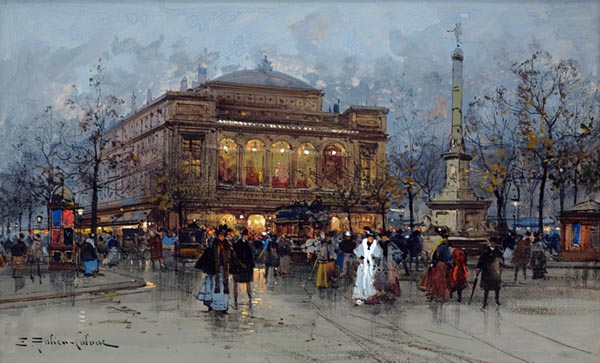
‘Le Théâtre du Châtelet, Paris’
Eugène Galien-Laloue (French, 1854–1941)
Artvee
Translated by A. S. Kline © Copyright 2026 All Rights Reserved
This work may be freely reproduced, stored and transmitted, electronically or otherwise, for any non-commercial purpose.
Conditions and Exceptions apply.
Contents
- Translator’s Introduction.
- Letter I: From Paris to La-Ferté-sous-Jouarre.
- Letter II: Montmirail – Montmort – Épernay.
- Letter III: Châlons-en-Champagne – Sainte-Menehould – Varennes-en-Argonne.
- Letter IV: From Villers-Cotterêts to the Border.
Translator’s Introduction
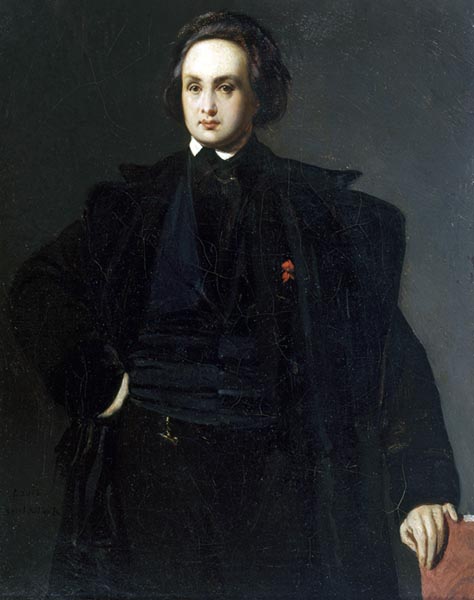
‘Victor Hugo’ (1839)
Louis Candide Boulanger (French, 1806-1867)
Artvee
Victor-Marie Hugo (1802 – 1885) novelist, poet, essayist, playwright, artist, and politician, became a leading light of the French Romantic literary movement, witnessed by the turbulent opening night of his play Hernani in 1830, which portrayed the Romantic hero as a figure in conflict with society, dedicated to love and driven by fate; and supported by the lengthy preface to his play Cromwell, which championed freer forms closer to Shakespearean drama, interweaving tragic, comic, and grotesque elements, rather than the rigid rules of previous French theatre. He later achieved wider fame with his poetry, and the novels Notre-Dame de Paris and Les Misérables.
With the Revolution of 1848, Hugo was elected a deputy for Paris in the Constituent Assembly and later in the Legislative Assembly, where he adopted a position increasingly critical of the ruling powers. When in December 1851 a coup d’état inaugurated the Second Empire under Napoleon III, Hugo, opposed to political absolutism and authoritarianism, left France for Brussels. A twenty-year exile, mostly spent in the Channel Islands, ensued; initially enforced then voluntary. The French defeat in the Franco-German War, and the proclamation of the Third Republic in 1871, brought Hugo back to Paris, where he was received as a living symbol of republicanism and a national hero.
Hugo made three trips to the Rhineland with Juliette Drouet in 1838, 1839, and 1840, and the notes, letters and recollections of these excursions, plus added research, formed the basis of a collection of mainly fictitious letters, written so as to describe a single tour, published as ‘Le Rhin’ in 1842. The preface and conclusion to Hugo’s account were written to address the political issue of the left bank of the Rhine, ceded to Prussia, at France’s expense, in 1815, which was a topic of much debate in the late 1830’s. He sought a utopian compromise that would satisfy both countries, and yet maintain the rights of France, in a spirit of friendship between the nations.
This translation omits both preface and conclusion, though they reveal facets of Hugo’s character as well as his political thought, to allow the reader to enjoy his travel writing without major distraction. His portrait of Champagne, Belgium, and the Rhineland, well before the Franco-Prussian War and the two World Wars, is of great historical interest, as well as providing a charming and fascinating picture of those regions.
This enhanced translation has been designed to offer maximum compatibility with current search engines. Among other modifications, the proper names of people and places, and the titles given to works of art, have been fully researched, modernised, and expanded; comments in parentheses have been added here and there to provide a reference, or clarify meaning; and minor typographic or factual errors, for example incorrect attributions and dates, in the original text, have been eliminated from this new translation.
You may view a map of all locations on Hugo's route, provided by uMap (open map in new tab).
Letter I: From Paris to La-Ferté-sous-Jouarre
La Ferté-sous-Jouarre, July 1838
As I wrote to you, my friend, it was the day before yesterday, at around eleven in the morning, that I quit Paris. I departed via the road to Meaux, leaving behind, to the west and north, Saint-Denis, and Montmorency, and at the very end of the hills the slopes of ‘S-P’. I thought of you all at that moment in a good and tender way, and I kept my gaze fixed on that small dark bump at the end of the plain, until the moment when a bend in the road suddenly hid it from me.
You know my taste for making long journeys in brief stages, to avoid fatigue, without luggage, in a cabriolet (a two-wheeled carriage drawn by a single horse), and alone, except for my old childhood friends, Virgil and Tacitus. So, you know from that how I am equipped.
I took the road to Châlons, because I know the road to Soissons all too well from having followed it a few years ago; the latter thanks to the demolition-men, is of little interest today. Nanteuil-le-Haudouin has lost its castle built under François I. Villers-Cotterêts has turned the magnificent manor-house of the Duke of Valois into a workhouse, and there, as almost everywhere, sculptures, paintings, all the spirit of the Renaissance, all the grace of the sixteenth century, has disappeared shamefully beneath the scraper and whitewash. Dammartin-en-Goële’s enormous tower has been razed, from the top of which Montmartre could be distinctly seen, a full twenty-seven miles away, and whose large vertical crack gave rise to that saying whose meaning I have never fully grasped: It’s like the castle of Dammartin, dying of laughter. Today, widowed of its old fortress, in which the Bishop of Meaux, when he was in dispute with the Count of Champagne, had the right to take refuge with seven of his entourage, Dammartin no longer generates proverbs but merely gives rise to literary notes of this kind, which I copied verbatim, during the time I spent there, from I no longer know which little local guide-book spread out on the inn table:
‘Dammartin (Seine-et-Marne): small town on a hill. Lace is made there. Hotel: Sainte-Anne. Things of interest: the parish church, the market hall, sixteen hundred inhabitants.’
The short time allowed for dinner by that tyrant of the stagecoaches called ‘the conductor’ did not allow me to verify to what extent the sixteen hundred inhabitants of Dammartin were all truly of interest.
So, I took the road to Meaux. Between Claye-Souilly and Meaux, in the most beautiful weather and on the finest road in the world, a wheel of my cabriolet broke. You know that I am one of those men who press on with their journey; the cabriolet forsook me, I forsook the cabriolet. Just then a small stagecoach was passing, the diligence of Touchard and Company. There was only one seat free, I took it; and ten minutes after the accident, I ‘pressed on with my journey’ perched on the imperial (the roof, carrying people and luggage) between a hunchback and a gendarme.
I am, at present, here in La Ferté-sous-Jouarre, a pretty little town that I am very happy to see again for the fourth time, with its three bridges, its charming islands, its old mill in the middle of the river which is connected to the land by five arches, and its beautiful pavilion from the time of Louis XIII which belonged, it is said, to the Duke of Saint-Simon, and which today is changing shape in the hands of a grocer.
If indeed Monsieur de Saint-Simon owned the old dwelling, I doubt that his native manor of La Ferté-Vidame had a more proud and lordly air, or was better suited to framing the haughty figure of that duke and peer, than the charming and severe châtelet of La Ferté-sous-Jouarre.
It is a perfect time for travel. The countryside is full of workers. The harvest is being completed. Here and there, large haystacks are being constructed, which, when half-finished, resemble those disembowelled pyramids found in Syria. The cut wheat is stacked on the ground, on the hillsides, in a way that mimics the patterns on zebras’ backs.
You know, my friend, it is not events I seek in travelling, but ideas and sensations; and for that, novelty suffices. Besides, I am content with little. Provided I have trees, grass, air, the road in front, and the road behind, everything suits. If the country is flat, well, I like broad horizons. If the country is hilly, I like unexpected views, and there is one at the top of every hill. Just now I passed a charming valley. To right and left are capricious vagaries of terrain; sizeable hills transected by farmland, and a multitude of escarpments amusing to see; here and there, groups of lowly cottages whose roofs seem to touch the ground. At the bottom of the valley, is a stream marked by a long line of greenery, and crossed by a little old bridge of stained and worm-eaten stone where the two stretches of high-road meet. At the moment we arrived, a wagon was crossing the bridge, an enormous German wagon, swollen, strapped, and tied, looking like Gargantua’s belly, mounted on four wheels and drawn by eight horses. In front of me, following the undulation of the opposite hill, bright with sunlight, rose the road on which the shadows of rows of tree drew in black the shape of large combs with several teeth missing.
Well, these trees, these shadow-combs, which you may smile at, this wagon, this white road, this old bridge, these low stubble fields, all this heartens me and makes me smile too. Such a valley, with the sky above, satisfies me. I alone in the carriage was gazing at it and enjoying it. The other passengers were yawning dreadfully.
When we change relays, I find everything entertaining. We halt at the door of the inn. The horses arrive with a clattering sound. There is a white hen on the main road, a black hen in the bushes, a harrow or an old broken wheel in a corner, children smeared with dust playing on a sand-heap; above my head Charles V, Joseph II, or Napoleon hang from an old iron gallows, to act as an inn-sign, mighty emperors who are now only good for proclaiming a tavern. The house is full of voices shouting commands; on the doorstep, the stable-boys and kitchen-maids flirt with one another, dung and dishwater mingle; and I, I take advantage of my lofty position — on the imperial — to listen to the hunchback and the gendarme in conversation, or admire the pretty little colonies of dwarf poppies that form oases on an old roof nearby.
Besides, my gendarme and my hunchback are philosophers, ‘not at all proud,’ and converse in a friendly manner with each other, the gendarme without disdaining the hunchback, the hunchback without despising the gendarme. The hunchback pays six hundred francs in taxes to Jouarre, the former Jovis ara (altar of Jupiter), as he was kind enough to explain to the gendarme. He also has a father who pays nine hundred livres in Paris, and he waxes indignant with the government every time he has to pay the toll, of one sou, to cross the bridge over the Marne between Meaux and La Ferté. The gendarme pays no taxes, and simply recounts his history. In 1814, at Montmirail (where Napoleon was victorious), he fought like a lion; he was a conscript. In 1830, during the Three Glorious Days (the July Revolution that overthrew Charles X, and installed Louis-Philippe as king), he was afraid and ran away; he was a gendarme at the time. It was a surprise to him, but not to me. As a conscript, a mere twenty years old, he was brave. As a gendarme, having a wife and children, and, he added, his own horse, he was a coward. The same man, but not, however, the same life. Life is a dish that is only rendered pleasant by its sauce. Nothing is more intrepid than a convict. In this world, it is not to one’s skin that one clings, but one’s clothes. He who is completely naked clings to nothing.
Also, you will agree, the two eras were very different. Whatever is in the air acts on a soldier as on every other man. The ideas that blow about him freeze him or warm him, too. In 1830, the wind of revolution was blowing. He bowed to, and was overcome by, the force of the idea which is like the soul of the power within events. And then, what could be sadder and more enervating, than to fight for a strange cause, for shadows that have passed through a troubled brain, for an insane dream, brother against brother, soldier against worker, Frenchman against Parisian! In 1814, on the contrary, the conscript was battling the foreigner, the enemy, for a clear and simple reason, for himself, for everyone, for his father, mother, sisters, for the plough he had just left, for the thatched roof that was burning over there; for the earth beneath the nails of his shoes, for his living, blood-stained homeland. In 1830, the soldier knew not why he was fighting. In 1814, he more than knew it, he understood it; he more than understood it, he felt it; he more than felt it, he saw it plain.
Three things interested me in Meaux: a delightful little Renaissance portal attached to an old dilapidated church, on the right, as you enter the town; then the cathedral; then, behind the cathedral, a fine old stone dwelling, half-fortified, flanked by large engaged turrets (the old Cathedral Chapter). There was a courtyard. I bravely entered the courtyard, although I had noted an old woman knitting there. But the good lady let me pass. I wanted to study a very beautiful exterior staircase, paved with stone and framed in wood, supported by two lowered arches and covered with a canopy roof with basket-handle arcades, which lead up to the old house. I lacked the time to sketch it. I regret that; it is the first staircase of this kind that I have seen. It seemed to me to date from the fifteenth century (that of the Chapter is 13th century).
The cathedral (Saint-Etienne) is a noble church, begun in the twelfth century and completed in the sixteenth. It has just been restored in an odious manner. The restoration is not even finished. Of the work on the two towers planned by the architect, the restoration of only one has been completed. The other, the restoration of which has only been sketched out, hides its stump beneath a covering of slate. The central door, and that on the right are from the fourteenth century; the one on the left is from the fifteenth. All three are very beautiful, although made of a stone that the wind and rain have eroded.
I wanted to decipher the bas-reliefs. The tympanum of the left door represents the story of Saint John the Baptist; but the sun, which fell directly onto the facade, prevented me from deciphering anything further. The interior of the church is of a superb composition. There are large openwork tri-lobed ribs on the choir, of the most beautiful effect. In the apse, there remains only a magnificent stained-glass window, which causes one to regret the others. At the moment, at the entrance to the choir, two altars in ravishing fifteenth-century woodwork are being restored; but they are being daubed with wood-coloured oil-paint. Such is the taste of the natives of the area. To the left of the choir, near a charming low door with a transom, I saw a beautiful kneeling marble statue of a sixteenth-century warrior, without coat of arms or inscription. I was unable to divine the name associated with the statue. You, who know everything, would have done so. On the other side is another statue; this one bears an inscription, and it’s a good thing too: for you yourself would not have recognised in its hard, dull marble the severe figure of Jacques-Bénigne Bossuet (Bishop of Meaux, tutor to the Dauphin, and renowned theologian, 1627-1704). As regards Bossuet, I am much afraid that the destruction of the stained-glass windows was his doing. I saw his episcopal throne, with rather beautiful woodwork in the Louis XIV style, and a figured canopy. I lacked the time to visit his famous study at the episcopal palace (now the Musée Bossuet).
A strange fact is that Meaux possessed a theatre before Paris did, a true performance hall, built in 1547 — according to a manuscript from the local library — reminiscent of the ancient circus in that it was covered with a velarium (retractable awning), and also of the modern theatre in that ‘there were set all around it boxes that could be locked, which were rented to the inhabitants of Meaux’. Mystery plays were performed there. A man named Pascalus played the Devil and retained the nickname (‘le diable verd’). In 1562 he delivered the city to the Huguenots, and the following year the Catholics hanged him, partly because he had delivered the city, and partly because of his nickname. —Today Paris has twenty theatres, while this city of ancient Champagne no longer has a single one. It is claimed that Meaux boasts of the fact; as if it were proud of not being Paris.
This country is full of reminders of Louis XIV’s century. Here, the Duke of Saint-Simon; at Meaux, Bossuet; at La Ferté-Milon, Racine; at Château-Thierry, La Fontaine (the latter two were born in those respective towns) All within a radius of forty miles or so. The great lord is a neighbour of the great bishop, while tragedy rubs shoulders with fable.
Leaving the cathedral, I found the sun veiled and was able to examine the façade. The large tympanum of the central portal is most curious. The lower compartment represents Joan (Joan I of Navarre), wife of Philip the Fair (Philip IV of France), with whose funds the church was built after his death. The Queen of France, her cathedral in hand, presents herself at the gates of paradise. Saint Peter opens them for her. Behind the queen stands the handsome King Philip with an air of embarrassed poverty. The queen, sculpted in a spirited manner, turning, indicates the poor devil of a king with a sideways glance, and a shrug of the shoulder, seemingly saying to Saint Peter: ‘Bah! Admit him too, into the bargain!’
Letter II: Montmirail – Montmort – Épernay
Épernay, July 21st
At La Ferté-sous-Jouarre I hired the first cart I came across, asking only one thing: does it know the way, and are the wheels sound? And off I went to Montmirail. There was nothing in that little town but a pleasantly green meadow at the entrance to two beautiful tree-lined avenues. The rest, except for the castle, is a jumble of hovels.
On Monday, around five in the evening, I left Montmirail, heading towards the road from Sézanne to Épernay. An hour later I was at Vauchamps, and crossed the famous battlefield (the Battle of Vauchamps in 1814 was a Napoleonic victory). A few moments before arriving there, I encountered an oddly-loaded cart on the road, drawn by a donkey and a horse. On the cart were pots and pans, old chests, chairs with straw seats, and a pile of other furniture; in the front, in a kind of basket, were three small, semi-naked children; in the back, in another basket, were a number of chickens. It was led by a man in a smock, on foot, carrying a child on his back. A few steps away, was a woman, also walking, and carrying a child, though still in her womb. All this equipage was hastening towards Montmirail, as if that great battle of 1814 were about to recommence. ‘Yes,’ I said to myself, ‘one would have encountered carts like these here twenty-five years ago.’ I made inquiries, they were not relocating, it was an expatriation. They were on their way not to Montmirail, but to America. It was not a battle, but poverty they were fleeing. In short, my dear friend, it was a family of poor Alsatian peasants who were emigrating having been promised land in Ohio, and who were leaving their country without suspecting that Virgil had written the most beautiful verses in the world about them two thousand years ago (see Virgil’s ‘Aeneid’, the end of Book II, ‘the departure from Troy’).
As for the rest, these good people were departing with an air of perfect indifference. The man was mending a strand of his whip, the woman was singing to herself tunelessly, the children were playing. Only the furniture had something unhappy, painful, and out of place about it. The chickens also seemed to me to be aware of their misfortune. This indifference surprised me. I really thought the homeland was more deeply engraved on people’s hearts. Did it not matter to these folk that they will no longer see the same trees and fields? I followed them for a while with my eyes. Where was this little group heading, jolting and stumbling along? Where was I heading myself? The road turned, they disappeared from view. I heard, now and then, the sound of the man’s whip and the woman’s song, then all sign of them vanished.
A few minutes later I was amidst the glorious plain that had known the emperor (Napoleon). The sun was setting. The trees cast long shadows. The furrows, already marked here and there, were a blond colour. A blue mist rose from the depths of the ravines. The countryside was deserted. In the distance, one could see only a few forgotten ploughs, looking like large grasshoppers. To my left, there was a quarry, producing millstones; large, ready-carved, and rounded millstones, some pale and new, others old and black, lay on the ground pell-mell, upright, prone, or in heaps, like the pieces of an enormous, overturned chequerboard. Indeed, giants had played many a game there.
I wished to see the Château de Montmort, so twelve miles or so from Montmirail, beyond Fromentières at Champaubert, I turned sharply left and took the road north to Épernay. There were sixteen of the most delightful giant elm-trees in the world, leaning over the road with sullen profiles and dishevelled wigs. Elm-trees are one of my joys when traveling. Each elm is worth viewing separately. All other trees are stupid and look alike; only elms possess imagination, and make fun of their neighbours, falling over where the latter lean, thin where they are bushy, and making all sorts of grimacing faces at passers-by, in the evening. Young elms have foliage that shoots out in all directions, like a firework bursting. From La Ferté to the place where these sixteen elms are found, the road is lined only with poplars, aspens or here and there walnut trees, which lightened my mood.
The country is flat, the plain stretches away as far as the eye can see. Suddenly, emerging from a clump of trees, one sees on the right, as if half buried in a fold of the ground, a delightful riot of turrets, weather-vanes, gables, dormers, and chimneys. This is the Château de Montmort.
My cabriolet turned the corner, and I dismounted in front of the castle gate. It is an exquisite sixteenth-century fortress, built of brick, with slate roofs and ornate weathervanes, with its double enclosure, its double moat, its triple-arched bridge leading to the drawbridge, the village at its feet, and an admirable landscape all around, for twenty miles or more. Except for the windows, which have almost all been refurbished, the building is well preserved. The entrance tower contains, wound one upon the other, a spiral staircase for the men and a ramp for the horses. At the foot there is still an old portcullis, and as I climbed up, within the embrasures of the tower, I counted four small fifteenth-century pulleys. The garrison of the fortress consisted at the time of an old servant, Mademoiselle Jeannette, who received me very graciously. All that remains of the old apartments inside are the kitchen, a beautiful vaulted room with a large fireplace; the old drawing room, which has been converted into a billiard room; and a charming little study with gilded woodwork, the ceiling of which has a very ingeniously twisted figure as a rosette. The old drawing room is magnificent. The ceiling with painted, gilded and carved beams is still intact. The fireplace, surmounted by two very noble statues, is in the finest style of the time of Henri III. The walls were once covered with vast tapestry panels, containing family portraits. During the Revolution, some spirited folk from the neighbouring village tore down these tapestries and burned them, dealing a mortal blow to feudalism. The current owner has replaced these panels with old engravings, representing views of Rome, and the battles of the great Condé (Louis II de Bourbon, Prince of Condé, 1621–1686), pasted on the bare wall. Having viewed all this, I gave thirty sous to Mademoiselle Jeannette, who seemed dazed by my generosity. Then I looked at the ducks and the chickens in the castle moat, and went away.
Leaving Montmort — which one arrives at by the most dreadful road in the world, by the way — I came across the mail-coach which must have brought you my previous letter. I entrusted it, my friend, with all sorts of fine thoughts for you.
The road plunged into a wood, just as night was falling, and I saw nothing till Épernay but charcoal-burners’ huts, emitting smoke, amidst the branches. The red visage of a distant forge appeared to me at times, the wind stirred the vivid silhouettes of trees along the roadside, and above my head, in the sky, the splendid Wain made its journey among the stars, while my poor two-wheeler made its own among the stones.
Épernay is the city of Champagne wine. No more, no less. Three churches have succeeded one another in Épernay. The first, a Romanesque church, built in 1037 by Thibaut I, Count of Champagne (1010-1089), son of Eudes II. The second, a Renaissance church, built in 1540 by Piero Strozzi (1510-1558), Marshal of France, Lord of Épernay, killed at the siege of Thionville in 1558. The third, the current church, appears to me to have been built according to the designs of Monsieur Poterlet-Galichet, a brave merchant whose shop bearing his name is next to the church. The three churches seem to me to be admirably characterised and summed-up by these three names: Thibaut I, Count of Champagne; Pierre Strozzi, Marshal of France; Poterlet-Galichet, grocer.
Which is enough for you to divine that the last, the current church, is a hideous plastered building, dull, white and heavy, with triglyphs supporting the archivolts. Nothing remains of the first church. All that remains of the second are some beautiful stained-glass windows, and an exquisite portal. One of the windows tells the whole story of Noah in the naivest manner. The stained-glass windows and portal are, of course, enclosed and imprisoned in the frightful plaster of the new church. It was as though I was seeing the comic actor Jacques-Charles Odry, with his over-short white trousers, blue stockings and large shirt collar, wearing the helmet and breastplate of Francis I.
I was urged to visit the region’s main curiosity, a large cellar containing one and a half million bottles. On the way, I encountered a field of rapeseed in bloom, complete with poppies, butterflies and a beautiful shaft of sunlight. I remained there. The grand cellar will have to do without my visit.
The ointment which aids hair-growth, named ‘Pilogène’ in La Ferté, is in Épernay named, ‘Phyothrix’, and ‘imported from Greece’.
By the way, in Montmirail, the Hôtel de la Poste charged me forty sous for four fresh eggs, which seemed a bit excessive to me.
I forgot to tell you that Thibaut I was buried in his church, and Strozzi in his. I demand a tomb for Monsieur Poterlet-Galichet in the current one.
This Strozzi was a fine fellow. Brisquet, Henry II’s fool, amused himself one day by larding, with bacon fat, from behind, in the middle of the courtyard, a very fine new coat that the marshal had donned that very day. It seems this caused a deal of laughter, since Strozzi later took cruel revenge. For myself, I would not have laughed, nor taken revenge. Larding a velvet coat with bacon! I was never impressed by such Renaissance jests.
Letter III: Châlons-en-Champagne – Sainte-Menehould – Varennes-en-Argonne
Varennes-en-Argonne, July 25th
Yesterday, at nightfall, my cabriolet was on the road, beyond Sainte-Menehould; I had just reread those admirable and eternal lines:
‘…speluncae vivique lacus, at frigida tempe
mugitusque boum mollesque sub arbore somni’
‘…caves, and natural lakes, and cool valleys,
the cattle lowing, and sweet sleep under the trees’
(Virgil: ‘Georgics’ Book II:469-70)
I had remained leaning on the old half-open book, the pages of which were crumpling under my elbow. My soul was full of all those vague, sweet, sad ideas which often fill my mind at sunset, when the sound of wheels on paving stones woke me. We were entering a town — ‘What town is this?’ — My coachman answered: ‘It’s Varennes.’ Then the carriage turned into a street which slopes down, between two rows of houses which have a grave and pensive air to them. The doors and shutters were closed; there was grass growing in the courtyards. Suddenly, after passing through an old carriage-entrance from the time of Louis XIII, made of dark stone, flanked by a large well covered with a lid of planking, the carriage emerged into a small triangular open space surrounded by single-storey, whitewashed houses, and with two stunted trees guarding a door in one corner. The long side of this trigonal intersection was adorned with an ugly belfry of flaking slate. It was in this square that Louis XVI was arrested as he fled, on June 21st, 1791. He was arrested by Drouet, the postmaster of Sainte-Menehould (there was no post office in Varennes at the time), in front of a yellow house that forms the corner of the square after passing the belfry. The king’s carriage followed the hypotenuse of the triangle. Ours travelled the same path. I descended from the cabriolet and gazed at this little square for a long time. How quickly it widened out, thereafter! In a few months it grew to become monstrous, it became the Place de la Révolution (in Paris, renamed the Place de la Concorde, for a second time, after the July Revolution of 1830).
This is what is said in the region. The king protested vigorously that he was not the king (which Charles I would not have done, incidentally). They were about to release him, not having confirmed his identity, when a certain Monsieur Ethé arrived, who had some reason, I know what, to hate the monarchy. This Monsieur Ethé (I know not if that is the correct spelling of the name, but the name of traitor is always sufficiently plain), this man approached the king, in the manner of Judas, saying: ‘Good day, sire.’ That was enough. The king was detained. There were five royal personages in the carriage; the wretch, with that phrase, condemned all five of them. That ‘good day, sire’, meant, for Louis XVI, for Marie-Antoinette and for Madame Élisabeth (Louis’ granddaughter), the guillotine; for the Dauphin (Louis’ younger son, Louix XVII, though he never reigned), the agony of the Temple prison; for Madame Royale (Louis’ eldest daughter), the extinction of her line, and exile.
To those who are not reflecting on that event, the little triangle in Varennes has a gloomy appearance; to those who are, it has a sinister aspect.
I believe I have already pointed out to you, on more than one occasion, that material Nature sometimes offers up remarkably symbolic events. Louis XVI at that time was descending a very steep and even dangerous slope, where the lead horse of my carriage almost fell. Five days previously, I had come across a sort of gigantic chequerboard on the battlefield of Montmirail. Today I crossed that fatal little triangle in Varennes, which has the shape of the guillotine’s knife.
The man who assisted Drouet, and who seized Louis XVI there was called Billaud —why not Billot (meaning ‘the block’)?
Varennes is sixty miles from Reims. The ‘Place du 21 Janvier’ (an imagined name for the Place de la Révolution; 21st of January 1793 was the date of Louis XVI’s execution) is but a stone’s throw from the Tuileries. How these juxtapositions must have tormented the poor king! Between Reims and Varennes, between his coronation and dethronement, was a journey of only sixty miles for my coachman; for the mind, it represented an abyss we name ‘the Revolution’.
I asked for lodging at a very old inn whose name is: Au Grand Monarque (on the site of the modern Hôtel de Grand Monarque, 1 Place de l’Église), and whose sign displays a portrait of Louis-Philippe. Probably, over the last hundred years, the faces of Louis XV, Bonaparte, and Charles X have appeared there, in their turn. Forty-five years ago, on the day when this town denied passage to the royal carriage, what hung over this door on its old curved iron arm, still sealed to the wall today, was undoubtedly a portrait of Louis XVI.
Louis XVI may have stopped at the Grand Monarque, and seen himself there painted in ensign, himself merely a ‘painted’ king — Poor ‘Grand Monarque!’
This morning, I walked round the town, which is very gracefully situated indeed, on both banks of a pretty river (the Aire). The old houses of the upper town form a most picturesque amphitheatre on the right bank. The church, which is in the lower town, is insignificant. It is opposite my inn. I can see it from the table where I am writing. The bell tower bears this date: 1776. It was two years older than Madame Royale.
This gloomy event has left its trace here, a rare thing in France. People still talk of it. The innkeeper told me that ‘a gentleman from the town has composed a play about it. —That reminded me, that on the night of the attempted escape, the little Dauphin was disguised as a girl, and had asked Madame Royale if it was for a play. It was indeed, for the play that the ‘gentleman from the town’ composed.
I owe the church (the Église Notre-Dame, destroyed in 1914, and rebuilt to the same plan) some amends; I have just viewed it again. It has a charming little tri-lobed portal on the right-hand side.
If all this architecture is not too tedious, I may tell you that Châlons failed to quite live up to my idea of it, the cathedral, at least. And by the way, without dwelling on the fact, I will add that the road from Épernay to Châlons was not what I expected either. You only get a glimpse of the Marne, on the banks of which I noted, however, in the villages, two or three Romanesque churches with not particularly pointed bell-towers, akin to the bell-tower of Fécamp. The whole countryside is nothing but flat plains; always flat plains, it’s too beautiful. As for the rest of the landscape, there are many sheep and many Champenois (the people of Champagne).
The nave of the cathedral (Saint-Étienne) is noble, and of a beautiful design; some rich stained-glass windows remain, a rose window among others, and I saw in the church a charming Renaissance chapel with the ‘F’ and the salamander emblem of Francis I. Outside the church, there is a very severe, pure Romanesque tower, and a precious fourteenth-century portal. All this is hideously dilapidated; and the church is very dirty; and the sculptures of Francis I are colour-washed in yellow; and all the ribs of the vaults are painted; and the facade is a poor copy of our facade of Saint-Gervais; and the spires! — I had been promised openwork spires. I was counting on the spires. And I found two types of towers with pointed caps, openwork indeed, and of an appearance, all things considered, original enough, but heavily hollowed out, and with volutes mingled with ogives! I left quite discontented.
On the other hand, if I did not find what I expected, I found what I did not expect, that is to say, a very beautiful Notre-Dame in Châlons. What were the antiquarians thinking of? They talk of Saint-Étienne, the cathedral, and breathe not a word about Notre-Dame (La Collégiale Notre-Dame-en-Vaux de Châlons). The Notre-Dame of Châlons is a Romanesque church with squat vaults and robust round arches, very august and very complete, with a superb remaining spire of lead-covered timber, which dates from the fourteenth century. This spire, on which the lead sheets form lozenges and scales, like those on a snake’s skin, is lightened in the middle by a charming lantern crowned with small lead gables, to which I climbed. The city, the Marne, and the hills are beautiful to see from there.
The traveller can also admire some beautiful stained-glass windows in Notre-Dame, and a rich thirteenth-century portal. But, in 1793, the locals smashed the stained-glass windows, and shattered the statues on the portal. They scraped the opulent archivolts (ornamental mouldings) as one scrapes a carrot. They treated the side portal of the cathedral, and all the sculptures they encountered in the city, in the same way. Notre-Dame had four spires, two tall and two lower; they demolished three of them (a second, twin to the one described above, has since been restored). It was an act of enraged stupidity that was nowhere as marked as here. The French Revolution was terrible; the Revolution in Champagne was stupid.
Within the lantern, into which I had climbed, I found this inscription engraved in lead, by hand and in sixteenth-century style: ‘On August 28, 1580, peace was published at Châl...’
This inscription, half-erased, lost in the shadows, which no one seeks and no one reads, is all that remains today of that great political act, that great event, that great achievement, that peace (the Edict of Beaulieu-lès-Loches, 1576) concluded between Henry III and the Huguenots, through the intermediation of the Duke of Anjou, formerly Duke of Alençon. The Duke of Anjou, who was the king’s brother, had designs on the Netherlands and claims to the hand of Elizabeth of England. The internal religious war hampered his plans. Hence this peace, this famous affair published at Châlons on August 28, 1580, and forgotten throughout the world this day of July 22, 1838.
The fellow who helped me climb, from ladder to ladder, to this lantern is the city watchman, le guettier, as he is called. This man spends his life in the watch-tower, a small stone cage with four skylights facing the four winds. This cage and its ladder are his universe. He is no longer a mere mortal, he is the eye of the city, which is always open, always awake. To make sure he stays awake, he is forced to call the hour each time it strikes, leaving a silence between the penultimate stroke, and the last. This perpetual insomnia would be impossible to sustain if his wife did not help him. Each night at midnight, she ascends, and he sleeps; then he rises at noon, and she descends. Their two existences rotate one around the other, without touching except for a minute at noon and one at midnight. A small gnome with an odd face, which they call their child, is the result of their occasional tangent.
Châlons has three other churches: Saint-Alpin, Saint-Jean, and Saint-Loup. Saint-Alpin has beautiful stained-glass windows. As for the town hall, its only remarkable feature is the four enormous stone guard-dogs crouching, formidably, in front of the facade. I was delighted with these Champenois lions.
Five miles or so from Châlons, on the road to Sainte-Menehould, in a place where there are only flat fields of stubble as far as the eye can see, except for the dusty trees along the road, a magnificent object suddenly appears before you. It is the abbey of Notre-Dame-de-l'Épine. There is a true fifteenth-century spire there, worked like lace and admirable to see, though flanked by a telegraph-station, which ‘she’ gazes at, it is true, disdainfully like the great lady that she is. It is a strange surprise to see this splendid flower of Gothic architecture blooming superbly among fields which barely support a few withered poppies. I spent two hours in this church; I prowled all around it buffeted by a dreadful wind that made the pinnacles sway distinctly. I held my hat in both hands, and I admired it with whirlwinds of dust in my eyes. From time to time a piece of stone-work would break from the spire, and fall into the cemetery next to me (the second spire which was razed so as to install the telegraph in 1798 was rebuilt in 1868). There were a thousand details, there, worth sketching. The gargoyles are particularly complex and curious. They are generally composed of two monstrous shapes, one of which bears the other on its shoulders. Those on the apse seemed to me to represent the seven deadly sins. ‘Lust’, a pretty country girl with her hair pulled back too far, must have really set the poor monks dreaming.
There are at most three or four hovels nearby, and it would be difficult to explain the presence of this cathedral without a town, village, or even a hamlet to speak of, if there was not, in a chapel, closed by a latch, a small, but very deep, well, which is a miraculous one, though very humble, very simple and much like an ordinary village well, as befits a miraculous object. The marvellous edifice grew from it. The well produced the church as a bulb produces a tulip.
I continued on my way. Three miles further on we passed through a village whose feast day was being celebrated, with the most jarring music. As I left the village, I noticed on the top of a hill, a meagre white hovel, on the roof of which a kind of large black insect was gesticulating. It was the telegraph chatting amicably with that of Our Lady of the Thorn.
Evening was approaching, the sun was setting, the sky was magnificent. I gazed at the hills at the far end of the plain, half-covered by an immense cloak of purple heather like a bishop’s cape. I saw a road-mender suddenly straighten his hurdle lying on the ground, and arrange it as if to shelter himself beneath it. Then the carriage passed a flock of geese gossiping happily. ‘It’s about to rain,’ said the coachman. Indeed, I turned my head and half the sky behind us had been invaded by a large black cloud, the wind was violent, the hemlocks in bloom were bending to the ground, the trees seemed to be calling to each other in terror, small dried thistle-heads scurried along the road faster than the carriage, and great clouds flew above us. A moment later one of the most beautiful storms I have ever seen broke forth. The rain was pouring down, but the whole sky was not clouded as yet. A huge arc of light remained of the sunset. Large black shafts of rain falling from the clouds crossed the golden rays streaming from the sun. There was no longer a single living being visible in the landscape, not a person on the road, not a bird in the sky; it thundered loudly, and at times, over the fields, large flashes of lightning struck the ground. The leaves twisted about in a hundred ways. The storm lasted a quarter of an hour, then a gust of wind drove the rain away, the cloud settled as a diffuse mist on the eastern hill-slopes, and the sky became pure and calm again. In the interval, twilight had fallen. The sun seemed to have dissolved in the west, to form three or four large bars of red-hot iron, which night was slowly extinguishing on the horizon. The stars were shining when I arrived at Sainte-Menehould.
Sainte-Menehould is quite a picturesque little town, spreading pleasantly over the slopes of a very green hill, topped with large trees. I saw a fine thing there: the kitchen of the Hôtel de Metz.
It was a real kitchen. An immense room. One wall is occupied by copperware, the other by earthenware. In the middle, opposite the windows, is the fireplace, an enormous cavern, which contained a splendid fire. On the ceiling, was a blackened network of magnificently smoke-stained beams, from which hung all sorts of joyous things, baskets, lamps, a meat-safe, and in the centre a large openwork basket in which vast trapezoids of bacon were displayed. Beneath the mantlepiece, besides the spit, the rack, and the cauldron, a dazzling set of a dozen shovels and tongs, of all shapes and sizes, gleamed and sparkled. The blazing hearth sent rays of light into every corner, cast great shadows on the ceiling, gave a fresh pink tint to the blue earthenware, and made a fantastic edifice of saucepans glow like a wall of embers. If I were a Homer or a Rabelais, I might have said: ‘This kitchen is a world, to which this fireplace is the sun.’
It was a world indeed. A world in which a whole republic of men, women, and animals moved. Boys, maids, kitchen-lads, carters seated at tables, stoves on stoves, pots clucking, fried food squeaking, pipes, cards, children playing, cats, and dogs, and the master who watches over all. Mens agitat molem (mind moves matter: see Virgil’s ‘Aeneid’ Book VI,727). In one corner, a large clock with a box and weights gravely tells the time to all these busy people.
Among the countless things hanging from the ceiling, I admired one especially, on the evening of my arrival. It was a small cage in which a little bird was sleeping. This bird seemed to me to be the most admirable emblem of trust. That den, that forge for indigestion, that terrifying kitchen, was full of noise day and night, yet the bird slept. No matter how people raged around it, men swore, women quarrelled, children screamed, dogs barked and cats meowed, the clock struck, the cleaver clanged, the dripping-pan squawked, the turnspit creaked, the sink wept, the bottles sobbed, the windows shuddered, and the coaches passed under the arch like thunder; that little ball of feathers never moved. — God is delightful. He inspires faith even in little birds.
And, in this connection, I must declare that too much is complained of as regards inns in general, and I myself, first and foremost, have sometimes spoken too harshly of them. An inn, all things considered, is a good thing, and one is very happy to meet with one. And then, I have noticed that in almost every inn there is a fine woman. She is the hostess. I leave the host to the bad-tempered travellers, but grant me the hostess. The host is a rather gloomy being. The hostess is amiable. Poor woman! Sometimes old, sometimes ill, often overweight, she goes, she comes, plans everything, carries everything, arranges everything, nudges the servants, blows the children’s noses, chases the dogs, compliments the travellers, rouses the chef, smiles at one, scolds another, watches over a stove, carries a traveller’s bags, welcomes this one, sees that one away, and shines in every direction, as does the soul. She is the soul, in fact, of that great body that we call the inn. The host is only fit for drinking with carters in a corner.
In short, thanks to the hostess, the welcome an inn provides loses something of the ugliness of paid-for hospitality. The hostess supplies those fine feminine attentions that veil all venality. It is all a little banal, but it is pleasant.
The hostess of the Hôtel de Metz at Sainte-Menehould (at 33 Rue Chanzy from1821, it ceased trading around 1930) is a young girl of fifteen or sixteen who is everywhere, and who runs this giant machine wonderfully-well, while occasionally playing the piano. The host, her father — is this an exception? — is a fine fellow. All in all, it’s an excellent inn.
Yesterday, as I wrote to you at the beginning of this letter, I departed Sainte-Menehould. From Sainte-Menehould to Clermont-en-Argonne, the road is delightful. A continuous orchard. On both sides of the road, a riot of fruit trees whose beautiful green leaves revel in the sun, and which spread their shade, in formal shapes, over the path. The villages have something of a Swiss or German air about them. White stone houses, half-clad in planks, with large hollow-tile roofs that extend two or three feet beyond the wall. Almost, they are chalets. One senses the proximity of the mountains. Indeed, the Ardennes, to the north, are not far away.
Before arriving at the large town of Clermont-en-Argonne, we traversed a wonderful valley in which the Marne and the Meuse flow together as one (La Biesme). The descent into this valley is magical. The road plunges between two hills, and at first you see only a chasm full of foliage below you. Then the road bends, and the whole valley appears. A vast circuit of hills, and in the middle a beautiful village, almost Italian so flat are the roofs; to the right and left several other villages on wooded hilltops; bell-towers in the mist that reveal other hamlets hidden in the folds of the valley as if on a green velvet dress, immense meadows where large herds of cattle graze, and, through all this, the pretty, lively river that flows joyfully. It took me an hour to cross this valley. During that time, a telegraph-station at the end of it was displaying the following three signs:
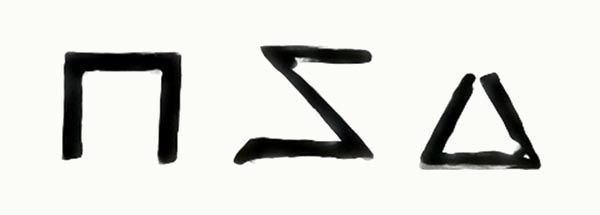
While the machinery was doing this, the trees rustled, the water ran, the flocks mooed and bleated, the sun shone brightly, and I compared the works of Man to those of God.
Clermont is a beautiful village that sits above a sea of greenery, with its church on its head, like Le Tréport above an ocean of waves.
In the centre of Clermont, we turned left and, passing through a beautiful landscape of plains, hillsides, and running water, we arrived in Varennes in two hours. Louis XVI followed this graceful route.
My friend, in rereading this letter, I realise that I have two or three times used the word Champenois, since it came to my mind involuntarily, ironically nuanced by a popular saying. However, do not misunderstand the true meaning that I attach to it. The saying (that Champagne is a land of beasts), perhaps more familiar than appropriate, speaks of the region as Madame de la Sablière spoke of La Fontaine (Marguerite de la Sablière, held an intellectual salon, and was patron to Jean de La Fontaine, whose fables are populated by beasts/animals) who was a man of ‘beastly’ genius, as befits a genius from Champagne. This does not prevent La Fontaine from being, between Régnier and Molière, an admirable poet, and Champagne from being, between the Rhine and the Seine, a noble and illustrious region. Virgil might have said of Champagne, in the manner in which he did speak of Italy: Alma parens frugum, alma virum (‘Kind mother of crops, kind mother of men’. Compare Virgil’s ‘Georgics II’, 173).
Champagne produced Jacques Amyot, another fine fellow who spent his efforts on Plutarch, as La Fontaine spent his on Aesop; Thibaut IV, the poet (‘the Troubadour’, Count of Champagne and King of Navarre, who was rumoured to have sought an affair with Blanche of Castile, Louis VIII’s widow) who, next to being king, would have asked nothing better than to be the father of Saint Louis (Louis IX); Robert de Sorbon, who was the founder of the College of the Sorbonne; Jean Charlier de Gerson, who was chancellor of the University of Paris; Nicolas Durand de Villegagnon, who almost won Algiers for France in the sixteenth century; Amadis Jamyn (poet and disciple of Ronsard), Jean-Baptiste Colbert, and Denis Diderot; two painters, Simon Mathurin Lantara and Le Valentin (Valentin de Boulogne); two sculptors, François Girardon and Edmé Bouchardon; two historians, Flodoard of Reims and Jean Mabillon; two cardinals of genius, Charles de Lorraine and Jean-François-Paul de Gondi; two popes full of virtue, Martin IV (Simon de Brion) and Urban IV (Jacques Pantaléon); and a king full of glory, Philippe Auguste (Philip II of France).
People who invoke popular lore, and derive the name of the town of Sézanne from sexdecim asini (sixteen donkeys), as others, thirty years ago, derived that of Fontanes from faciunt asinos (they breed donkeys); such people wax triumphant over the fact that Champagne engendered César-Pierre Richelet, publisher of the Dictionnaire des Rimes (claimed as his, but actually a revision of Nicolas Frémont d’Ablancourt’s work), and the playwright Antoine-Alexandre-Henri Poinsinet, the most ‘mystified’ man of that century in which Voltaire mystified the world. Well, you who love harmony and correspondences, who want the character, work and spirit of a man to resemble the natural products of his homeland, and who find it admirable that Bonaparte was a Corsican, Mazarin an Italian, and Henri IV a Gascon, know this: Mirabeau (born at Le Bignon, near Nemours) too was, almost, from Champagne, and Danton (born in Arcis-sur-Aube) completely so. So there. My God! Why shouldn’t Danton have been from Champagne? Claude Favre de Vaugelas, the grammarian, was definitely from Savoy!
The great Abraham de Fabert, Marquis d’Esternay, Marshal of France, was also, almost, from Champagne, that son of a printer, who never wished to rise too high nor fall too low; a pure and serious spirit, who always kept himself free from the extremes, and who, successively tested by fate, first with regard to his nobility, then his modesty, was ever the same with regard to the actions whether base or lofty proposed to him, neither rejecting the base out of pride, nor the lofty out of humility, but repudiating both due to his chaste character, refusing to spy for Mazarin, or accept the Order of the Holy Spirit, from Louis XIV. To Louis XIV he said: ‘I am a soldier, not a gentleman’. To Mazarin: ‘I am an arm, and not an eye’.
Champagne was a powerful and robust province. The Count of Champagne was the lord of the Viscounty of Brie, which Brie itself was, strictly speaking, only a lesser Champagne, as Belgium is a lesser France. The Count of Champagne was a peer of France, and carried the fleur-de-lis banner at coronations. He himself reigned over counties held by the seven Counts, termed the Peers of Champagne, who were the Counts of Joigny, Rethel, Braine, Roucy, Brienne, Grandpré and Bar-sur-Seine.
Each city and town, in Champagne, is unique. The larger towns are intertwined with our history; the smaller ones all tell of some event. Reims, which possesses the cathedral among cathedrals, Reims baptised Clovis I after the Battle of Tolbiac (c.496). Troyes was saved from Attila, by Bishop Lupus, and saw, in 878, what Paris saw only in 1804, a pope consecrating an emperor in France, namely John VIII crowning Louis the Stammerer. It was at Attigny that Pepin the Short, ‘Mayor of the Palace’ (a historical title in the Frankish kingdoms, under the Merovingian kings), held his plenary court from which he made Waiofar, Duke of Aquitaine (the last independent Duke) tremble. It was at Andelot (Andelot-Blancheville) that the pact between Gontran, King of Burgundy, and his nephew Childebert II, King of Austrasia, was established (in 587), in the presence of the leudes (the Frankish vassals). Hincmar (Archbishop of Reims) took refuge in Épernay; Peter Abelard, in Provins; Héloïse, in the Abbey of the Paraclete. A Council of Bishops was held at Fismes (in 881). Langres saw the triumph of the two Gordians in the late empire (Gordian I was Roman emperor for 22 days with his son Gordian II, in 238, the Year of the Six Emperors), while, in the Middle Ages, its bourgeoisie destroyed the seven formidable castles around them, those of Changey, Saint-Broing, Heuilly-Coton, Coubon, Bourg, Humes (Humes-Jorquenay) and Le Pailly. The Treaty of Joinville was concluded with the Catholic League in 1584. Châlons sided with Henri IV in 1591. Saint-Dizier saw the death of the Prince of Orange (René de Châlon, who was killed during the siege of 1544). Doulevant (Doulevant-le-Château) sheltered the Comte de Moret (Antoine de Bourbon). Bourmont was the ancient fortified town of the Lingones (a Gallic tribe of the Iron Age and Roman periods). Sézanne is the ancient parade ground of the Dukes of Burgundy. Signy-l’Abbaye was founded by Saint Bernard, in the domain of the Lord of Châtillon, to whom the saint promised, by authentic act, ‘as many acres in heaven as the lord would grant him on earth’. Mouzon was the fief of the Abbot of Saint-Hubert, who sent every year to the King of France ‘six hounds and six birds of prey for hawking’. Chaumont is the naive city where one hopes ‘to play the devil on Saint John’s Day and pay one’s debts’ (whoever acted the part of the Devil, in the celebrations on the Nativity of Saint John the Baptist, 24th June, was granted the freedom of the region for 8 days). Château-Porcien is the town which the Constable of Châtillon (Jean II) sold to Louis I Duke of Orléans. Bar-sur-Aube is the town ‘that the king could neither sell nor give away’. Clairvaux had its tun (a giant wine vat) like Heidelberg. Villenauxe (Villenauxe-la-Grande) had its statue of Queen Pedauque (a mythical queen, said to have originated in Visigothic Toulouse, characterised by her crow’s feet wrinkles). Arconville still has the pile of stones from the Huguenot massacre, to which each peasant adds a pebble as he passes. The signal fires of Mont-Aigu answered those of Mont-Aimé sixty miles away. Wassy was burned twice, by the Romans in 211, and in 1544 by the Imperial troops (of Charles V), as Langres was by the Huns in 351, and the Vandals in 407, and as Vitry (Vitry-le-François) was by Louis VII in the twelfth century and Charles V in the sixteenth. Sainte-Menehould is the noble capital of the Argonne, which, sold by a traitor to Charles II, Duke of Lorraine, refused to surrender. Carignan is the ancient ‘Yvois’. Attila is said to have raised an altar at Pont-le-Roi (Pont-sur-Seine, in 451). Voltaire was entombed near Romilly-sur-Seine (Voltaire’s tomb was in the Abbey of Sellières, prior to his remains being transferred to the Pantheon in Paris, in 1791).
As you can see, the local history of these Champenois towns is the history of France, fragmentary it is true, but great in scope.
Champagne retains the imprint of our ancient kings. It was in Reims that they were crowned. It was in Attigny that Charles the Simple (Charles III) decreed that the estate of Bourbon (Bourbon-l’Archambault) be ruled by a Sire de Bourbon. Both Saint Louis (Louis IX) and Louis XIV, the holy monarch, and the great monarch of the Capetian lineage first bloodied their swords in Champagne: the former, in 1228, at Troyes, where he raised the siege; the latter, in 1652, at Sainte-Menehould, where he entered through the breach in the walls. Remarkably, both kings were fourteen years old.
Champagne bears the mark of Napoleon. He filled (in 1814) the last pages of his prodigious epic with Champenois names: Arcis-sur-Aube, Châlons, Reims, Champaubert, Sézanne, Vertus, Méry-sur-Seine, Fère-Champenois, Montmirail. So many battles, so many triumphs. Fismes, Vitry-le-François, and Doulevant each held the honour of being his headquarters once, Piney twice, Troyes three times. Nogent-sur-Seine saw five victories for the emperor in five days, manoeuvring on the Marne, accompanied by his handful of heroes. Saint-Dizier had already seen two in two days. At Brienne-le-Château, where he had been schooled by the Benedictines, he was almost killed by the Cossacks.
The ancient annals of this Belgian Gaul, which became Champagne, are no less poetic than the modern ones. All these fields are full of memories; Merovech and the Franks, Flavius Aetius and the Romans, Theodoric and the Visigoths; Mount Julius (Mont-Jules, Neuville-lès-This), and the tomb of Flavius Jovinus (at Reims, Durocortorum); Attila’s camp near La Cheppe (prior to the Battle of the Catalaunian Plains, 451); the military roads of Châlons, Gruyères and Warcq; Viridomarus, Caracalla; Julius Sabinus (of the Lingones) and Eponina (his wife); the Arch of the Two Gordians (Gordian I and Gordian II his son) at Langres, the Gate of Mars at Reims; all this antiquity, clothed in shadows, speaks, lives, still palpitates, cries out from the depths of darkness to every passer-by: Sta, viator! (Halt, Traveller!). Celtic antiquity itself stammers, in an intelligible murmur, from the dark ages of history. Osiris was worshipped at Troyes; the god Borvo Tomona left his name to Bourbonne-les-Bains, while near Wassy, beneath the fearful branches of the Fôret de Dér, where the Haute-Borne menhir still stands (between Aviz and Oiry), like the ghost of a druid, over the mysterious ruins of Noviomagus Vadicassium, Champagne has its Palenque (the Mayan city ruins in Mexico).
From the Romans to our times, invested in turn by the Alans, the Suevi, the Vandals, the Burgundians and the Germans, these Champenois towns, built on the plains, allowed themselves to be burned rather than surrender to the enemy. The Champenois towns built on the hills have taken as their motto: Donec moveantur (‘until these move’). It is the blood of ancient Gallia Comata, the blood of the Catti, the Lingones, the Tricasses, the Catalauni, who defeated the Vandals, the Nervii who defeated Syagrius, which flows today in the heroic veins of the Champenois peasant. It was a Champenois native, Louis Florentin Bertèche, a captain, who at Jemmapes (in 1792) killed seven Austrian dragoons with his own hand. In 451, the plains of Champagne devoured the Huns; if God had willed, in 1814, they would have devoured the Russians.
Let us never speak, therefore, except with respect, of this admirable province which, during the invasion, sacrificed half of its sons for France. The population of the department of Marne alone, in 1813, was three hundred and eleven thousand inhabitants; by 1830, it was still only three hundred and nine thousand. Fifteen years of peace had not been enough to restore it.
So, returning to the explanation I needed to give: when applied to Champagne, the word beast carries another meaning. It signifies naive, simple, rough, primitive, sometimes formidable. The beast could very well be an eagle or a lion. As Champagne proved in 1814.
Letter IV: From Villers-Cotterêts to the Border
Givet, July 29
This, after a long stage of my journey. Dear friend, I write to you today from Givet, an ancient little town which had the honour of providing the dying Louis XVIII with the last password he issued, and his last pun (his response to being asked for the day’s watchword and password was ‘Saint-Denis, Givet’: Saint Denis being the burial place of the French Kings, and Givet a homophone for ‘j’y vais’, ‘I’m on my way there’), and at which I have just arrived at four in the morning, crushed by the jolting of a dreadful ‘cart’ that they call, here, a diligence. I have slept for two hours, fully clothed, on the bed, day has come and I am writing to you. I have opened my window to enjoy the view from my room, which consists of the corner of a whitewashed roof, an ancient wooden gutter full of moss, and a cabriolet wheel leaning against a wall. As for my room itself, it is a large hall furnished with four large beds, with an immense woodwork fireplace, adorned on the outside by a tiny mirror, and on the inside by a tiny bundle of sticks. On the bundle of sticks, delicately placed next to a broom, is an enormous and antediluvian boot-jack, carved with a billhook by some carpenter in a rage. The fantastic opening of this boot jack imitates the windings of the Meuse; and it is almost impossible to pull one’s foot out, if one is imprudent enough to place it within. One runs the risk of wandering, as I just did, throughout the inn, boot-jack on foot, crying for help. To be fair, I owe the place a slight amendment. Just now, I heard chickens cackling. I leant over to view the courtyard, and saw beneath my window a charming little common mallow in full bloom, looking much like a hollyhock, on a board propped up by two old pots.
Since my last letter, an incident, that is scarcely worth telling you of, caused me to suddenly retreat from Varennes-en-Argonne to Villers-Cotterêts, and the day before yesterday, after having dismissed my carriage from La Ferté-sous-Jouarre, I took the stagecoach for Soissons in order to make up for lost time: it was completely empty, which, between you and me, did not displease me. I was able to spread out the sheets of my Cassini map, at my ease, on the coupé’s bench seat.
As I approached Soissons, evening was falling. Night was already opening her smoke-filled hand over this ravishing valley into which the road plunges after the hamlet of La Folie, and was slowly spreading her immense shadow over the cathedral tower, and the double spire of the Abbey of Saint-Jean-des-Vignes (in decay after the Revolution). However, through the heavy mist that crept slowly over the countryside, one could still distinguish the cluster of walls, roofs, and buildings that is Soissons, half-contained by the steely crescent of the River Aisne, like a sheaf that the sickle is about to cut. I halted for a moment at the top of the descent to enjoy this beautiful spectacle. A cricket was singing in a neighbouring field, the trees along the path were murmuring softly, quivering in the last evening breeze before falling asleep; I watched attentively, as a great and profound peace clothed the dark plain which, in my mind’s eye, saw Caesar conquer, Clovis reign, and Napoleon falter. Men, even a Caesar, a Clovis, a Napoleon, are only shadows that pass, and war only a shadow which passes with them, while God, and Nature which comes from God, and peace, which comes from Nature, are eternal things.
Planning to collect the trunk from Sedan, which would not arrive in Soissons till midnight, I had time on my hands, and had foregone my seat in the stagecoach. The distance separating me from Soissons was no more than a charming stroll, which I completed on foot. Some distance from the town, I sat down near a pretty little house, softly lit by the glow from a blacksmith’s forge on the opposite side of the road. There I looked, reverently, at the sky, which was superb and serene. The only three planets visible at that hour were all shining, in the same half of the heavens, as I gazed to the southwest. Jupiter — our beautiful Jupiter, you know it, my friend — which was retrograde three months ago, lay on a perfectly straight geometric line between the two stars which currently frame it (Regulus in Leo, and Spica in Virgo). Further, and to the north-west, Mars, red as fire or blood, imitated the stellar scintillations in its fierce blaze; and, to the south-east, that monster-planet, that frightening and mysterious world that we call Saturn, shone softly, with the appearance of a pale and peaceful star. Opposite, in the same arc of sky as Mars, in the depths of the landscape, I thought I saw a magnificent lighthouse with revolving rays, blue, scarlet and white, illuminating with dazzling rutilation the dark hillsides that separate Noyon from Soisson. As I was wondering what a lighthouse could be doing on open ground, in the immense plain, I saw it leave the heights of the hills, cross the violet mist of the horizon, and sink from sight. This ‘lighthouse’ was Aldebaran, the tricolour sun, the enormous star of purple, silver, and turquoise, sinking majestically through the vague and sinister pallor of twilight.
O my friend! What secret lies in these stars which all poets since there have been poets, all thinkers since there have been thinkers, all dreamers since there have been dreamers, have in turn contemplated, studied, and adored: some, like Zoroaster, with confident wonder; others, like Pythagoras, with inexpressible terror! Seth named the stars as Adam named the animals. The Chaldeans and the Genethliacs (astrologers), Ezra and Zerubbabel, Orpheus, Homer and Hesiod, Cadmus, Pherecydes, Xenophon, Hecataeus, Herodotus and Thucydides, all those earth-bound eyes, for so long extinguished now and shuttered, devoted themselves to watching, from century to century, and with anguish, those eyes of heaven which are always open, always alight, always alive. The same planets, the same stars that we look at today, were observed by all these men. Job (see ‘Job’ 9:9 and 38:31) speaks of Orion and the Hyades; Plato listened and distinctly heard the vague music of the spheres (see his ‘Timaeus’); Pliny believed the sun to be a god (see his ‘Natural History’ Book 2:12) and attributed the spots of the moon to the fumes of the earth (Book 2: 46). The Tartar poets called the pole senesticol, which meant ‘the iron nail’, Some dreamers, seized by a kind of vertigo, have dared to mock the constellations. ‘The lion (Leo),’ says Jean-Baptiste de Rocoles, ‘could just as easily be called an ape’. Marcus Pacuvius, however, barely reassured, tried to stupefy himself, and disbelieved in the astrologers, on the pretext that they would be equal to Jupiter:
‘Nam si qui, quæ ventura sunt, prævideant,
Aequiparent Jovi’
‘For if any foresaw the things that are to come,
They would be equal to Jupiter himself’
Favorinus of Arles asked himself this formidable question: What if the causes of everything are not in the stars? ‘Si vitae mortisque hominum rerumque humanarum omnium tempus et ratio et causa in caelo et apud stellas foret?’ He believed that the sidereal influence extended to flies and worms, ‘muscis aut vermiculis’, and, he adds, to hedgehogs, ‘aut echinis’. Aulus Gellius, sailing from Aegina to Piraeus, over a ‘calm sea’, sat, by night, at the stern and considered the stars: ‘Nox fuit, et clemens mare, et anni aestas, caelumque liquid serenum; sedebamus ergo in puppi simul universi, et lucentia sidera considerabamus: it was night, the sea was calm, the time summer, and the sky bright and clear. So, we all sat together, at the stern, and watched the brilliant stars’ (see Aulus Gellius, Attic Nights; 2:21). Horace himself, that practical philosopher, that Voltaire of the age of Augustus, though a greater poet, it is true, than the Voltaire of Louis XV, Horace himself shuddered as he looked at the stars, a strange anxiety filled his heart, and he wrote these lines sufficient to inspire dread:
‘Hunc solem, and stellas, et decedentia certis
Tempora momentis, sunt qui formidine nulla
Imbuti spectator!’
‘The sun up there, the stars, the seasons, going past
In unerring flow, some can watch unmoved by awe’
(Horace ‘Epistles’ Book I:VI)
As for myself, I do not fear the stars, I love them — yet I have never reflected without a certain pang in my heart that the normal state of the heavens is darkness. What we call day exists for us only because we are close to a star.
One cannot always gaze at immensity; infinity crushes; ecstasy is as devout a state as prayer, but prayer soothes while ecstasy exhausts. From the constellations, my eyes fell to the humble rustic wall against which I was leaning. Here again there was subject for meditation and thought. Into this wall, the peasant who had built it had sealed a stone, a venerable stone, on which the reverberations of the chisel allowed me to recognise the almost entirely erased traces of an ancient inscription; I could only distinguish two intact letters, IC; the rest was eroded. What was this inscription? Roman, or Romanesque? It spoke of Rome, without a doubt, but of which Rome? Of pagan Rome, or of Christian Rome? Of the city of power, or the city of faith? I remained, awhile, with my eyes fixed on this stone, my mind lost in endless hypotheses. I know not if the contemplation of the stars had predisposed me to reverie, but I reached a point at which I saw in those two mysterious letters — IC — those letters which, the first time they appeared to men, governed the world, and, the second time, transformed it, revive and shine in some manner before my gaze. Iulius (Julius) Caesar, and Iesus (Jesus) Christ!
It was doubtless under the inspiration of an idea similar to the one which absorbed me, at that moment, that Dante placed together in the pit of the Inferno, being devoured forever by the fetid jaws of Satan, both the great traitor and the great assassin, Judas and Brutus.
Three cities succeeded Soissons, the Noviodunum of the Gauls, the Augusta Suessonium of the Romans, and the ancient Soissons of Clovis, Charles the Simple, and the Duke of Mayenne (Charles II of Lorraine, who died at Soissons in 1611). Nothing remains of Noviodunum which Caesar’s speedy advance compromised. The Suessones, according to Caesar’s ‘Commentaries’ (‘De Bello Gallico’, Book II, 12) ‘celeritate Romanorum permoti, legatos ad Cæsarem de deditione mittunt: troubled by the speed of the Romans, sent ambassadors to Caesar with regards to their surrender’.
All that remains of Augusta Suessonium are a few damaged remnants, amongst others those of an ancient temple which in the Middle Ages became the church of Saint-Pierre-au-Parvis. Ancient Soissons is richer. It possesses the Abbey of Saint-Jean-des-Vignes, and its ancient castle. In the Church of Saint Gervais and Saint Protais which preceded the existing Gothic cathedral, Pepin the Short was crowned in 752. I have not been able to verify what remains of the fortifications of the Duke of Mayenne, and whether it was those fortifications which led the Emperor Napoleon to say, in 1814, on noticing some fossil shells, gryphaea or belemnites, embedded in the walls, that those of Soissons were built of the same stone as those of Saint-Jean-d’Acre. An intriguing observation when one considers where it was made, by whom, and on what date.
The night was too dark when I entered Soissons to be able to search for Noviodunum or Suessonium. I was content to have supper while waiting for the stagecoach to appear, and to wander around the gigantic silhouette of Saint-Jean-des-Vignes, rising boldly against the sky, with the appearance of a stage set. As I walked, the stars appeared in, and disappeared from, the crevices of the darkened building, as if it were full of fearful people, ascending, descending, running everywhere with lights in their hands.
As I was returning to the inn, midnight struck. The whole town was as black as an oven. Suddenly a tempestuous noise was heard at the end of a narrow street, perfectly peaceful until that moment, and in itself apparently incapable of such nocturnal disturbances. The mail coach was arriving. It halted a few steps from my inn. There was precisely one empty space, which was all to the good. These new coaches are truly most elegant and comfortable; you sit in them as if in an armchair, your legs at ease, with headrests on the right and left if you choose to close your eyes, and a large window in front of you if you keep them open. Just as I was about to settle, very voluptuously, such a strange uproar, mingled with shouts, the noise of wheels, and the stamping of horses, rose from
another small dark street that, despite the courier, who granted me a scant five minutes, I hastened there. On entering the narrow street, this is what I saw: — At the foot of a vast wall, which displayed the odious and icy appearance peculiar to prisons, a low, arched door, armed with enormous bolts, stood open. A few steps from this door, between two mounted gendarmes, a sort of lugubrious cart had halted, half-visible in the darkness. Between the cart and the doorway, a group of four or five men were struggling, dragging a woman, who was uttering terrifying screams, towards the cart. A dark-lantern, carried by a man lost in the shadows it cast, cast a gloomy light on the scene. The woman, a robust country-woman of about thirty, put up a desperate resistance, screaming, hitting, scratching, and biting, and at times a shaft of light from the lantern fell on her dishevelled and sinister-looking head, like to that of a statue of Despair. She had seized hold of one of the iron bars of the door-grille and was clinging to it. As I approached, the men made a violent effort, tore her from the grille, and carried her in a single bound to the carriage. This carriage, which was now brightly-lit by the lantern, had no other opening than small round holes bored in the two sides, and a door at the back, closed on the outside by large bolts. The man with the lantern drew the bolts, the door opened, and the inside of the cart was suddenly visible. It was a kind of box, closed to daylight, and almost airless, divided transversely into two oblong compartments by a solid partition. The single door was arranged in such a way that once locked it met the wood of the partition, sealing both compartments, at the same time. No communication was possible between the two cells, furnished, by way of seating, with a board pierced with a hole. The left-hand side was empty; but the right was occupied. There, in the corner, half-crouched like a wild beast, lying across the bench since he lacked space for his knees, was a man — if he could still be called a man — a sort of ghost with a squarish face, a flat skull, broad temples, grizzled hair, and short, hairy, and stocky limbs, dressed in old trousers of torn canvas, and a rag that had once been a smock. The wretch’s legs were tightly bound by a doubly knotted rope that reached almost to the hocks. His right foot was concealed in a wooden clog; his bare left foot was wrapped in a bloody cloth that left a set of horribly bruised and diseased toes visible. This hideous being was peacefully eating a lump of black bread. He seemed to pay no attention to what was happening around him. He did not even stop eating to view the unfortunate companion who was being brought to him. She, however, with her head thrown back, still resisting the guards who were trying to push her into the empty compartment, continued to cry: ‘I won’t! Never! Never! Kill me instead!’ She had not yet seen the other. Suddenly, in one of her convulsions, her eyes fell on the interior of the carriage, and saw the dreadful prisoner in the shadows. Then her cries suddenly ceased, her knees buckled, she turned away trembling in every limb, with barely the strength to say in a subdued voice, but with an expression of anguish that I will never forget: ‘Oh! That man!’
At that instant, he looked up at her with a fierce and stupid air, like the tiger of a peasant he was. I confess that here I could not resist intervening. It was clear that she was a thief, perhaps even something worse, whom the gendarmerie was transferring from one place to another, in one of those odious vehicles that the Parisian urchins call, metaphorically, salad-baskets; but after all, she was a woman. I thought I should involve myself, and called out to the guards. They did not even turn their heads; only, a worthy gendarme, who would surely have asked even Don Quixote for his papers, took advantage of the opportunity to demand that I show my passport. I had just given the said document to the courier, at the mail-coach. While I was explaining myself to the gendarme, the doormen made a final effort, plunged the half-dead woman into the cart, closed the door, and slid home the bolts, so that, at the moment when I turned towards them again, there was no trace of the carriage in the street but the sound of its wheels and the hooves of the escort, plunging, together with a loud clatter, into the darkness.
A short while later I myself was being borne, at the gallop, along the road to Reims, seated in an excellent coach, drawn by four excellent horses. I thought of that unfortunate woman, and with a heart-felt pang compared my journey to hers. It was in the midst of these thoughts that I fell asleep.
When I awoke, dawn was beginning to revive the trees, the meadows, the hills, the bushes along the road, all those peaceful things whose sleep our coaches and mail coaches so brutally invade. We were in a charming valley, probably that of Braine-sur-Vesle. A faint, fragrant breath of air rose from the as yet still darkened hillsides. Towards the east, at the southerly end of the dawn glow, very close to the horizon, in a limpid, blue, dark, dazzling medium, an ineffable mixture of shadowy pearl and sapphire, Venus shone resplendent, and her magnificent radiance clothed the fields and woods, dimly glimpsed, with an inexpressible serenity, grace, and melancholy. It was like a celestial eye opened, lovingly, upon that beautiful sleeping landscape.
The mail coach gallops through Reims, with no respect for the cathedral (Notre-Dame de Reims). As it passes, one can barely see, above the gables in a narrow street, two or three lancet windows of the apse, the coat of arms of Charles VII, and the beautiful spire of the Suppliciés, above the apse.
From Reims to Rethel, nothing — an impoverished Champagne, whose golden hair July has trimmed; vast, bare, yellow plains, immense, smooth waves of land on top of which quiver a few miserable patches of brushwood, like vegetative foam; now and then, in the depths of the landscape, a mill, turning slowly as if overwhelmed by the midday sun, or, at the roadside, a potter drying a few dozen rough flower pots, on planks at the threshold of his cottage.
Rethel spreads gracefully from the top of a hill down to the Aisne, whose branches intersect the town in two or three places. Otherwise, there is nothing to proclaim it the former princely residence of one of the seven Counts of Champagne who were Peers of France. The streets are those of a large village rather than city streets. The church is in a mediocre style.
From Rethel to Mézières (Charleville-Mézières), the road climbs those vast steps with which the Argonne plateau connects to the higher plateau of Rocroi. The large slate roofs, the facades, the whitewashed wooden cladding, protecting the north side of the houses from the rain, grants the villages a distinctive appearance. Now and then, the first ridges of the Faucilles heights (Col de la Faucille) appear on the horizon to the southeast. For the rest, there are few or no forests. Here and there, in the distance, one can see a few tufted hills. Deforestation, that bastard offspring of civilisation, has sadly devastated the old lair of the Boar of the Ardennes (William de la Marck).
Upon arriving at Mézières, I looked for the old, half-ruined towers of the Saxon castle of Hellebarde; I found there only the cold, hard zigzags of a citadel by Sébastien Vauban. On the other hand, inspecting the ditches, I saw, in various places, a few rather beautiful, though dismantled, remnants of the moated wall attacked by Charles V (in 1521) and defended by Bayard (Pierre Terrail, the Chevalier de Bayard). The church of Mézières (Notre-Dame-d'Espérance, since rebuilt after war-damage) had a reputation for its stained-glass windows. I took advantage of the half-hour the mail coach allows travellers for lunch to visit it. The stained-glass windows must have been beautiful indeed; some fragments sadly lost amidst large windows of plain glass remain, in the apse. But what is remarkable is the church itself, which is sixteenth century, and of charming form, with flamboyant mullioned bays, and a charming porch backing onto the southern portal. Two bas-reliefs from the time of Charles VIII, on pillars, to the right and left of the choir, have been sealed, sadly daubed with whitewash, and mutilated. The whole church is colour-washed, in a yellow hue, with ribs and keystones of various colours. Which renders it very stupid and ugly. While walking along the north aisle of the apse, I noticed on the wall an inscription which recalls that Mézières was cruelly attacked and bombarded by the Prussians in 1815. Below the inscription, these two ridiculous lines have been added in Latin: ‘Lector, leva oculos ad fornicem et vide quasi quoddam divinæ manus indicium: Reader, raise your eyes to the vault, and see, as it were, a sign of the divine hand’.
I raised my eyes ad fornicem (to the vault), and saw a large rent in the ceiling above my head. In this rent a large bomb, which I could distinguish perfectly, was, and is, suspended from projecting stones by its metal ear. It is a Prussian bomb which, having pierced the roof of the church, the framework, and the mass of masonry, halted thus, as if by a miracle, at the moment of falling to the paving below. For twenty-five years, it has remained there as God suspended it. Around the bomb, there is a jumble of broken bricks, rubble, and plaster, the entrails of the vaulting. This bomb, and the gaping wound created above the heads of passers-by produces a strange effect, rendered even more singular by the historical echo that springs to mind, when one recalls that it was precisely Mézières that received the first bombs ever employed in warfare, in 1521. On the other side of the church, another inscription states that the wedding of Charles IX with Elizabeth of Austria was ‘happily celebrated,’ feliciter celebrata fuere, in the church of Mézières, on November 17, 1570 — two years before the Saint Bartholomew’s Day Massacres.
The main portal is from this same period, and consequently in fine and noble taste. Unfortunately, it is one of those late facades of the sixteenth century, the form of which was not fully realised till the seventeenth. The bell-tower was not completed till 1626. It would be impossible to find anything heavier or more awkward, except for those of the various new churches of Paris being constructed at this moment.
For the rest, Mézières has large trees on its ramparts, clean, sad streets, doubtless brightened with difficulty on Sundays and holidays, while nothing in the town recalls Hellebarde and Garinus (his son) who founded it (in 899), nor Count Balthazar of Rethel who sacked it (in 940), nor Count Hugues III of Rethel who granted it the status of a city (in 1233), nor the archbishops of Reims who besieged it, Foulques and Adalbero. The god Macer, who gave his name to Mézières, became the Saint Masert of the church chapels.
There are no monuments, no architectural edifices, in Sedan, at which I arrived around noon. Pretty women, handsome carabinieri, trees and meadows along the Meuse, cannons, drawbridges and bastions, such is Sedan. It is one of those places where the severe air of citadel towns mingles strangely with the joyful air of garrison towns. I would have liked to have found vestiges of Turenne (Henri de La Tour d’Auvergne, vicomte de Turenne) in Sedan; there are none. The pavilion where he was born has been demolished, and replaced by a piece of grey stone with this inscription in gold letters: ‘Turenne Nacqit ici (Turenne was born here), 11th September 1611’.
This date, which sparkled on the grey stone, struck me. I brought to mind everything it recalled. In 1611, Sully (Maximilien de Béthune Sully, 1st Prince of Sully) retired to private life. Henri IV had been assassinated the previous year. Louis XIII, who was to die on May 14th, like his father (in 1610 and 1643 respectively), was ten years old. Anne of Austria, his wife, was the same age, five days younger than him (born on the 22nd and 27th of September respectively). Richelieu (Armand Jean du Plessis, Cardinal Richelieu from 1622) was in his twenty-sixth year. Some fine bourgeois parents in Rouen were raising their little one, Pierre; he whom the universe later named the great Corneille; he was five years old. Shakespeare and Cervantes were still alive. Brantôme (Pierre de Bourdeille, soldier and memoirist), and Pierre Mathieu, the playwright, were also alive. Elizabeth I of England had been dead eight years, and, seven years previously, Clement VIII, the peaceful pope and good Frenchman, as Pierre de l’Estoile, the diarist, termed him. In 1611, ‘Papirius’ Masson (Jean Papire Masson, the historian) and Jean Busée (Joannes Busaeus, the theologian) died; Emperor Rudolph II was declining (he died in 1612); Gustavus Adolphus would succeed Charles IX of Sweden, the visionary king; Philip III was driving the Moors from Spain, against the advice of the Duke of Osuna (Pedro Téllez-Girón, 3rd Duke of Osuna); and in 1611, the Dutch astronomer John Fabricius was noting the existence of sunspots. This is what was happening in the world when Turenne was born.
Sedan has not proved a pious guardian of his memory. The pavilion where Monsieur de Turenne was born has been demolished, as I have said, and his castle razed to the ground.
I lacked the courage to visit Bazeilles, to see whether some landowner or other had not had the avenue of trees he planted torn up. Instead, the main square in Sedan offers the visitor a rather mediocre bronze statue of Turenne, which consoled me not at all. This statue is nothing but a glorification. The room where he was born, the castle where he lived, the trees he planted, those held memories of the man.
Nor are there even any memories of William I de La Marck, that terrifying predecessor of Turenne in the annals of Sedan. A remarkable thing, and one that must be mentioned in passing: over time, and due to no more than the natural progress of things and ideas, the city of that ‘Wild Boar of the Ardennes’ altered to such an extent that it produced Turenne.
After a very good lunch, at an excellent place called the Hôtel de la Croix-d’Or (at 1 Place Turenne, not extant), there was nothing to keep me in Sedan; I decided to return to Mézières and take the coach for Givet. It is about fifteen miles, but fifteen very picturesque ones. I traversed them on foot, followed by a young, dark-skinned, barefoot fellow who cheerfully carried my overnight bag. The road, halfway up the hillside, mostly follows the Meuse valley. About three miles from Sedan, is Donchery, with its old wooden bridge and its beautiful trees; then there are smiling villages, pretty castles with pepper-pot turrets buried in clumps of greenery, wide meadows where herds of cattle graze in the sun, and the Meuse which one loses sight of and then finds once more. The weather was the finest in the world, it was charming. Halfway there, I felt very hot and thirsty; I looked everywhere for a house where I might obtain a drink. Finally, I saw one. I hastened there, hoping it was a tavern, and read this sign above the door: Bernier-Hannas, oat merchant, and pork butcher. On a bench, next to the door, there was a person afflicted with a goitre. Goitres abound in the region. I nevertheless entered, bravely, the butcher’s shop selling oats, and drank with great pleasure a glass of the water which had doubtless caused the goitre.
At six in the evening, I arrived at Mézières; at seven, I left for Givet, gloomily wedged into a low, narrow, and dark carriage, between a fat gentleman and a fat lady, husband and wife, who spoke across me, to each other, tenderly. The lady called her husband my poor chiat. I know if her intention was to call him my poor dog (chien) or my poor cat (chat). While traversing Charleville, which is only a cannon-shot from Mézières, I noted the central square, which was built in 1605, in a very grand style, by Charles I Gonzaga, Duke of Nevers and Mantua, and which is the true sister of our Place Royale in Paris. There are the same houses with arcades, brick facades, and tall roofs. Then, as night was descending, and having nothing better to do, I slept; but a violent sleep, a troubled and dreadful sleep, between the snores of the fat man, and the groans of the fat woman. I was awakened, from time to time, when we changed horses, by lanterns suddenly visible in the window, and by dialogues such as: ‘Hey! Hey! What nag is that? I don’t want her. She’s the fidgeter’ — ‘and Monsieur Simon? Where is Monsieur Simon?’ —'Monsieur Simon? Well! He’s working. He’s always working. He works like a madman, only worse.’ On another occasion, when the carriage halted at a relay-station, I opened my eyes, to find the wind blowing strongly, the sky dark, and an immense mill, its sails turning sinisterly overhead, which seemed to be gazing at us from its two lit skylights as if with burning eyes. On yet another occasion, as soldiers surrounded the stagecoach, and a gendarme asked for our passports, I could hear the chains of a drawbridge rattling, and a street lamp illuminated piles of cannonballs at the foot of a high black wall; the carriage was almost touching the muzzle of a cannon; we were at Rocroi. The name awakened me completely. Although it cannot be called ‘seeing Rocroi’, I took a certain pleasure in thinking that I had visited, in the same day and only a few hours apart, those two heroic places, Rocroi and Sedan. Turenne was born in Sedan; one could say that the great Condé was born in Rocroi (his first major battle, in 1643, which launched his military career).
Meanwhile, the two fat people, my neighbours, were talking between themselves, and telling each other, as if in some scene of a badly-written play, things that they were well aware of: — that they had not been to Rocroi since 1818. Twenty-two years ago! — that Monsieur Crochard, the secretary of the sub-prefecture, was their close friend — that, as it was midnight, he must be in bed, good Monsieur Crochard, etc. The lady seasoned these fascinating revelations with bizarre phrases familiar to her; thus, she said: ‘Selfish as an old hare’ and ‘a poor man’s luck’ instead of pot-luck. That monstrous fellow, her husband, for his part, uttered puns, like this one: They say it’s a commonplace (‘comme un’, ‘like one’), I say it’s a place ‘comme trois’ (‘like three’), or twisted proverbs, like this one: Sell-your-wife-and-stop-your-ears. Then he laughed in a good-natured way.
The carriage departed, my two neighbours were still talking. I was making a great effort to listen not to their conversation but to the horses’ bells, the noise of the wheels on the paving stones, the axle-hubs, the creaking of nuts and screws, the sonorous rustling of the window-blinds, when suddenly a delightful chiming sound came to my rescue, a series of fine, light, crystalline, fantastic, ethereal chimes, which rang out suddenly from the darkness, announcing our arrival in Belgium, a country of tinkling sounds, endlessly pouring forth their mocking, ironic, witty banter, as if reproaching my two ponderous neighbours for their foolish chatter.
This chiming, which would have woken me, sent them to sleep. I assume we must have been at Fumay, but the night was too dark to distinguish anything. I was obliged to pass by the magnificent ruins of the castle of Hierges, and those beautiful sheer-sided rocks called the Ladies of the Meuse (Les Dames de Meuse), without seeing a thing. From time to time, at the foot of a precipice clothed in vapour, I saw, as if through a hole in the smoke, something whitish: it was the Meuse.
Finally, as the first glimmers of dawn appeared, a drawbridge was lowered, a gate was opened, and the coach entered, at a brisk trot, a sort of long defile formed on the left by a black sheer-sided cliff, and on the right by a long, low, interminable, and most strange building, apparently uninhabited, pierced from one end to the other by a multitude of doors and windows which seemed to be open, and lacking shutters, frames or glass, allowing patches of light, or rather of the twilight already tinting the edge of the sky on the far side of the Meuse, to be seen through the dark, fantastic interior of the house. At the far end of this singular dwelling, there was a single closed and dimly-lit window. Then the carriage passed, briefly, in front of a large tower with a striking profile, entered a narrow street, and turned into a courtyard. Inn-maids appeared with candles, and stable-boys with lanterns; I was at Givet.
The End of Part I of Hugo’s ‘Le Rhin’