Victor Hugo
The Rhine (Le Rhin, 1838, 1839, 1840)
Part XI: Letter XXXIV-XXXIX
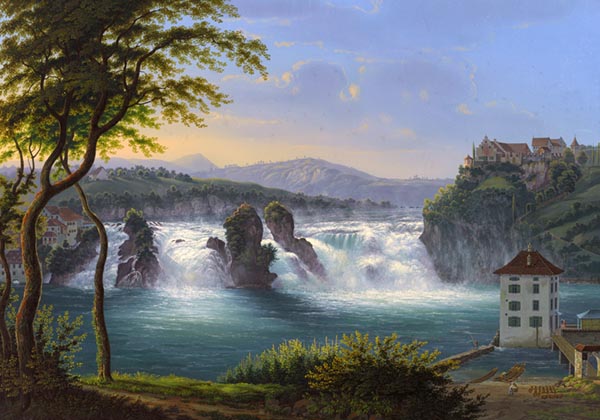
‘The Rhine Falls near Schaffhausen’
Johann Heinrich Bleuler the Younger (Swiss, 1787-1857)
Artvee
Translated by A. S. Kline © Copyright 2026 All Rights Reserved
This work may be freely reproduced, stored and transmitted, electronically or otherwise, for any non-commercial purpose.
Conditions and Exceptions apply.
Contents
- Letter XXXIV: The Road to Zurich.
- Letter XXXV: Zurich.
- Letter XXXVI: Zurich Continued.
- Letter XXXVII: Schaffhausen.
- Letter XXXVIII: The Rhine Falls.
- Letter XXXIX: Vévey – Chillon – Lausanne.
Letter XXXIV: The Road to Zurich
September 9th
I am in Zurich. Four o’clock in the morning has just sounded from the city belfry, accompanied by trumpets. It sounded like reveille, so I opened my window. It is pitch black, and no one is asleep. The city of Zurich is buzzing like an irritated hive. The wooden bridges tremble under the measured steps of battalions passing confusedly in the shadows. The noise of drums can be heard among the hills. Alpine Marseillaises are being sung in front of the lit taverns on street corners. Zurich bisets (National Guards in plain clothes) are practicing in a small square near the Hôtel de l’Epée (at Weinplatz 10, now the Hotel zum Schwert, first mentioned in 1408, renovated in 1991), where I lodge, and I hear the commands in French: Shoulder arms! Carry arms! From the room next to mine, a young girl answers with a tender, heroic, and monotonous song, whose tune explains the words. There is a lit skylight in the belfry, and another amongst the tall spires of the cathedral. The glow of my candle vaguely illuminates a large diagonal bicolour flag in white and blue, which is hanging above the quay (the Zurich cantonal flag). Peals of laughter can be heard, loud shouts, the sound of doors closing, strange clicks. Shadows pass and repass everywhere. A joyful rumour of war keeps this little nation awake. However, the lake with its reflections of the stars, murmurs majestically, at my window, those words of tranquility, comfort, and peace that Nature voices to Humanity. I watch the dark nocturnal ripples decompose and recompose themselves on its surface. A rooster crows, and up there, to my left, above the cathedral, between the two black bell-towers, Venus gleams like the tip of a spear between two turrets on a stretch of battlements. There is revolution in Zurich. Small towns wish to act like great ones. Every marquis desires a squire. Zurich has just slain its mayor, and changed its government.
Since they have woken me, I am taking advantage of this to write to you, my friend. A benefit accruing to you from this little revolution.
It was dawn yesterday morning when I left Basel. The road to Zurich runs for half a mile or more alongside the old towers of the city. I have not told you about the towers of Basel; yet they are remarkable, all of different shapes and heights, separated from each other by a crenellated wall above a formidable moat in which the city of Basel successfully cultivates potatoes. In the days of bows and arrows, the encircling wall defended a mighty fortress; now it is no more than a flimsy pretence.
The entrances to the city are still adorned with those beautiful fourteenth-century portcullises, whose hooked teeth adorn the tops of the gateways, so that as you leave you think you are emerging from a monster’s mouth. By the way, the day before yesterday, at the top of the spire of Basel Minster, a gargoyle seemed to stare at me; I leaned over, put my hand in its mouth, resolutely, and all was fine. You can tell the story to those people who marvel at Isaac van Amburgh (the noted American lion-tamer, of Dutch extraction).
Almost all the entrances to greater Basel are fortress gates of noble character, especially the one leading to the polygon (military training ground), a proud keep with a pointed roof (the Spalentor), flanked by two turrets, adorned with statues like the Porte de Vincennes and the ancient gate of the old Louvre. It goes without saying that it has been scraped, planed, mortared, and colour-washed (in red). Two archers carved into the battlements are curious. They lean their poulaine (long, pointed, medieval) shoes against the wall and seem to be supporting their weapons with enormous effort, so heavy are they to carry. At this moment a platoon of about two hundred men is passing beneath the gate, returning from the polygon with a cannon. I believe this to be the army of Basel.
Near this gate is a delightful Renaissance fountain, heaped with cannons, mortars, and piles of sculpted cannonballs around its basin, from which the water spurts with the twittering sounds of a bird. This poor fountain is shamefully mutilated and degraded; the central column was laden with exquisite figures, of which only the torsos remain, and here and there an arm or a leg. Poor masterpiece, violated by all the soldiers of the arsenal! — But I am now on the road from Basel to Zurich.
For four hours, until Rheinfelden, it skirts the Rhine, following a ravishing valley in which all the damp glimmers of morning showered on us from the clouds. We left Grenzach on the left, whose high tower (Saint Leodegar), marked with a clockface, can be seen from the bell-towers of Basel; then we traversed Augst. Augst, is a barbaric name. Yet, the name is short for Augusta, since Augst was a Roman township, the capital of the Rauraci, the ancient Augusta Raurica founded by the consul Munatius Plancus, to whom the people of Basel erected a statue in their town hall, with an epitaph written by a bold pedant named Beatus Rhenanus (Beatus Bild, the sixteenth century humanist scholar). A glorious history, I would say, for a very small town. Indeed, Augusta Raurica is now nothing more than the adorable setting for a Swiss vaudeville. A group of picturesque cabins, perched on a rock, connected by two old fortress gates; two mildewed bridges, beneath which races a pretty torrent, the Ergolz, which descends from the mountain, thrusting aside the tree-branches; the sound of mill-wheels; wooden balconies brightened by vines, an old cemetery in which I noted, in passing, a strange tomb from the fourth century that seems to be collapsing into the Rhine, which it adjoins; such is Augst, Raurica, Augusta. The ground is marked by excavations. A pile of small bronze statuettes is being extracted, with which the Basel library is mounting a display of curiosities.
Half an hour further on, a pretty ribbon of old wooden houses transected by a waterfall, on the right bank of the Rhine, is Warmbach. And then, after a mile or so of trees, ravines and meadows, the Rhine broadens; in the middle of the water a large rock (Inseli Burgstell) crouches, covered with ruins and connected to the two banks by a covered bridge, built of wood, of a singular appearance. A small Gothic town, bristling with towers, battlements and bell-towers, descends in disorder towards this bridge: it is Rheinfelden, a military and religious citadel, one of the four forest towns (with Säckingen, Laufenburg, and Waldshut, forming the Old League of Upper Germany) a famous and charming place. The ruin in the middle of the Rhine is the old castle, which is called the Stone of Rheinfelden (Castle Stein on Inseli Burgstell island). Under the wooden bridge which has only one arch, beyond the rock, on the side opposite the city, the Rhine is no longer a river, it is an abyss. Many boats are lost there every day. — I halted for a good quarter of an hour at Rheinfelden. The inn signs, the most entertaining in the world, hang from enormous flowery iron arms. The main street is enlivened by a beautiful fountain (the Albrechtsbrunnen, of 1542 but later named after Archduke Albrecht VI; now a copy, the original is in the Fricktal museum) whose column bears a noble man-at-arms, who himself bears the arms of the city, with his own arm raised proudly above his head.
From Rheinfelden to Albbruck, the landscape remains charming, but there is nothing for the antiquarian, unless, like myself, they are driven more by curiosity than archaeology, and are more of a wanderer on the highway than a traveller. I am a diligent observer of all things, nothing more; but I believe I am right to be so; everything elicits a thought; I try to extract the thought from the thing. It is an exercise in chemistry like any other.
Letter XXXV: Zurich
September
When one travels in the plains, the journey’s interest is provided by the sides of the road; when one travels through a mountainous country, by the horizon. But, even with the admirable line of the Jura before my eyes, I wished to see everything, and gazed at the roadside as much as at the skyline. The countryside bordering the road is admirable at this season, amidst such a landscape. The meadows are dotted with yellow, blue, white, and violet flowers, as in spring; magnificent brambles scratched the body of the carriage as we passed; here and there steep banks imitated the shapes of the mountains, and streams of water as thick as my thumb parodied their torrents; everywhere, the autumn spiders have stretched their hammocks on the thousandfold tips of the bushes: the dew sits there in large pearls.
And then there are the domestic scenes in which local peculiarities are revealed. Near Rheinfelden, three men were shoeing an ox that looked very stupid, tethered, and restrained for the purpose. At Augst, a poor deformed tree, leaning on a forked prop, served as a horse for the little boys of the village, children with Rome for an ancestor. Near the Basel gate, a man was beating his wife, something common to labourers and kings. Did not the Duke of Buckingham (George Villiers) tell Madame de Chevreuse (Marie Aimée de Rohan, Duchesse de Chevreuse) that he had loved three queens, and been obliged to discipline all three? A hundred yards from Frick, I saw a hive placed on a board above the door of a hut. The ploughmen went in and out through the door of the hut, the bees entered and departed through the door of the hive; men and insects did the work of the good Lord.
All this amused and delighted me. In Freiburg, I neglected for a long while the immense landscape I had before my eyes, while concentrating on the patch of grass on which I was sitting. It was situated on a small overgrown hump of the hill. Therein too was a world. Beetles crawled ponderously through the deeply-rooted stems of vegetation; parasol-shaped hemlock flowers imitated the pine-trees of Italy; a long leaf, like a half-open bean pod, revealed beautiful drops of rain, like a diamond necklace in a case of green satin; a poor wet bumblebee, in its yellow and black velvet, climbed painfully along a thorny branch; thick clouds of midges hid the light from it; a bluebell trembled in the breeze, and a whole nation of aphids sheltered under its enormous tent. Near a puddle of water that would not have filled a basin, I saw emerging from the mud, and writhing towards the sky to absorb the air, an earthworm similar to an antediluvian python, fated perhaps to find, in that microscopic universe too, the Hercules that would slay it, and the Cuvier who would describe it. In short, I found that little universe as great as the other. I supposed myself to be Micromégas (a visitor from another planet, in Voltaire’s early science fiction tale of that name, 1752); my scarabs were examples of megatherium giganteum (first specimen discovered 1787, named by Cuvier in 1796) my bumblebee was a winged elephant, my midges were eagles, my puddle of water a lake, and three tufts of tall grass a virgin forest. — You recognise me in this picture, don’t you, my friend? — At Rheinfelden, the exuberant inn signs engrossed me as completely as any cathedral does; and my mind is so constructed that at certain moments a village pond, clear as a steel mirror, surrounded by thatched cottages, and crossed by a flotilla of ducks, delights me quite as much as Lake Geneva.
At Rheinfelden we left the Rhine and only saw it again for a moment at Bad Säckingen: an ugly church, a covered wooden bridge, an insignificant town at the bottom of a delightful valley. Then the road ran through cheerful villages across a wide, high plateau around which one sees a monstrous herd of mountains gambolling in the distance. Suddenly, you come across a clump of trees near an inn, you hear the sound of a brake applied, and the road drops away into the dazzling Aare valley.
The eye plunges at first into the depths of the sky and finds there, on the far horizon, a series of jagged, steep and rugged ridges, which I believe to be the Graue Hôrner; then it plunges to the depths of the valley to find Brugg, a beautiful little town bound tightly by a picturesque ligature of walls and battlements, with a bridge over the Aare; and then it climbs again along a dark wooded swell and halts at a tall ruin. This ruin is the Castle of Habsburg the cradle of the House of Austria. I gazed for a long time at that tower, from which the two-headed eagle flew.
The Aare, blocked by boulders, has torn the valley floor into capes and promontories. This beautiful landscape is one of the great places in history. Rome fought there, Vitellius’ destiny crushed that of Galba; Austria was born there. From this crumbling keep, built in the eleventh century by Count Radbot of Klettgau (Swabia), flowed an immense river of archdukes and emperors covering the entire history of modern Europe.
To the north of Brugg, the valley is lost in mist. There is the confluence of the Aare, the Reuss, and the Limmat. The Limmat flows from Lake Zurich bringing the water from the springs on Mount Todi; the Aare flows from Lake Thun (Thunersee) and Lake Brienz (Brienzersee), and brings the water from the Grimsell waterfalls; the Reuss flows from Lake Lucerne, and brings the torrents of Mount Rigi, the Windgällen, and Mount Pilatus. The Rhine bears all this to the ocean.
All I have just written to you, the three rivers, the ruin, and the magnificent shape of the rocks eaten away by the Aare, filled my reverie as the carriage galloped down to Brugg. Suddenly, I was awakened from my thoughts by the charming composition offered by the approach to the town. It is one of the most delightful clusters of roofs, towers, and steeples I have yet seen. I had always promised myself, if ever I visited Brugg, to pay great attention to an ancient bas-relief inlaid in the wall near the bridge, which, it is said, represents a Hun’s head. As it was Sunday, the bridge was decked with a crowd of pretty, smiling girls, full of curiosity and in their finest attire, so much so that I forgot the Hun’s head. By the time I remembered, the town was a good two miles behind me.
With their cockades of ribbons on their foreheads, less exaggerated than in Freiburg, their black velvet bodices adorned with silver chains, and rows of buttons, their velvet cravats with gold-embroidered corners worn tight around their necks like the iron gorgets of knights, their brown skirts with thick pleats, and their alert faces, the women of Brugg all appeared pretty; many are. The men were dressed like our masons in their Sunday best, and looked hideous. I understand there are male lovers in Brugg; I can’t conceive of too many female ones.
The town, clean, sanitary, and happy in appearance, made up of pretty houses, almost all of them ornate, is no less delightful inside than outside. A singular thing is that both sexes, in their Sunday gatherings, play out the tale of Alpheus and Arethusa (separated by the sea, the river god Alpheus in Greece nonetheless pursued the nymph Arethusa to Syracuse, Sicily), for as I crossed the city, I saw all the women at the Bridge gate, and all the men at the other end of the main street (Haupstrasse), at the Zurich gate. Nor do the sexes mingle further in the fields; we met a group of men, then a group of women; this custom, in which the children themselves participate, is specific to the whole canton and extends as far as Zurich. It is a strange thing, and, like many strange things, a wise thing. In this land of vigour and beauty, of exuberant nature and exquisite costumes, Nature tends to make the men enterprising, while the costume makes the women coquettish; custom intervenes, separates the sexes, and forms an obstacle.
The valley, indeed, is not only a confluence of rivers, it is a confluence of costumes too. One crosses the Reuss and the black velvet bodice becomes a corselet of flowered damask, to the middle of which is sewn a wide gold braid. One crosses the Limmat and the brown skirt becomes a red skirt with an embroidered muslin apron. All hairstyles mingle equally; ten minutes later one encounters beautiful girls with large exorbitant combs as in Lima, with high-shaped black straw hats as in Florence, and lace as in Madrid. All wear a bouquet of natural flowers at the side. A refinement.
The variety of hairstyles was such that I anticipated every possibility. After the Reuss bridge, there is a small hill. I was climbing it on foot. I saw an old woman coming towards me wearing a sort of vast Spanish sombrero in black leather, to adorn which, as a crowning glory, were added a pair of boots and an umbrella. I was about to record this strange headdress, when I noticed that the good woman was simply carrying on her head a traveller’s suitcase. The traveller himself was following a few steps behind; a fine man, who doubtless prided himself on speaking French, and who accosted me to tell me about the revolution in Zurich. All I could understand, amidst a lot of gibberish, was that there had been a proclamation from the mayor, and that the proclamation began thus: Brave Iroquois! — I presume that the worthy man meant: Brave Zuriquois.
The Aare valley network bears two charming adornments: Brugg where the Aare valley widens, Baden where the Limmat narrows. For half an hour we had been following the banks of the Limmat, which raises a dreadful outcry at the bottom of a charming ravine whose sloping landslides are planted with vines. Suddenly a gate with four turrets blocks the road; below this gate, wooden houses whose attics seem to hunch together rush pell-mell into the ravine; above, among the trees, stands an old ruined castle (Ruine Stein) whose battlements form a cockerel’s crest on the mountain. At the far end, under a covered bridge, the Limmat rushes swiftly over a bed of rocks, which roughen the water violently. And then a bell-tower with coloured tiles, seemingly clad in a snakeskin, is seen. It is Baden.
There is everything in Baden: Gothic ruins, Roman ruins, thermal waters, a statue of Isis, excavations where many gambling dice have been found, a town hall where Prince Eugène of Savoy and Marshal de Villars (Claude Louis Hector, Ist Duke of Villars) exchanged signatures (the Treaty of Baden, 1714, formally ended the War of the Spanish Succession). As I wished to arrive in Zurich before nightfall, I contented myself with viewing, in the square while they were changing horses, a charming Renaissance fountain surmounted, like the one in Rheinfelden, by the haughty and severe figure of a soldier. The water gushes from the mouth of a frightening bronze serpent that roils its tail amidst the ironwork of the fountain. Two familiar pigeons had perched on this serpent, and one of them drank by dipping its beak in the arched stream of water, fine as a silver hair, that fell from the tap into the basin below.
The Romans called the thermal waters of Baden the talkative waters, ‘aquae verbigenae’— As I write to you, my friend, it seems to me I must have drunk of them.
The sun was setting, the mountains were steepening, the horses were galloping on an excellent road in the opposite direction to the Limmat’s flow; we were traversing a completely wild region; beneath our feet there was a white monastery with a red steeple, like a child’s toy; before our eyes, a mountain shaped like a hill, but so high that a forest there seemed like a heath; in the severe garden of the monastery, a white-robed monk was walking, talking with a black-robed monk; above the mountain, an old tower half-showed its face, reddened by the horizontal rays of sunlight. What was this place? I do not know. Konrad of Tegerfelden, one of the murderers of the Emperor Albert (Albrecht I) held a castle in this solitude. — Were these the ruins? — I was only a passer-by, and knew nothing, I have left to these sinister places their secrets; but I could not help thinking vaguely of that nocturnal assassination in 1308, and the revenge, according to legend, executed by Agnes (Albert’s daughter, and Queen of Hungary) while this savage tower, hidden, little by little, by the folds of the ground, slowly returned to the mountain.
We came to a bend in the road; an unexpected crevasse let pass an immense shaft of sunset light; the villages, the smoke, the herds, and people reappeared, and the beautiful valley of the Limmat began to smile again.
The villages are truly remarkable in this canton of Zurich. They are composed of magnificent thatched cottages comprising three sections. At one end the dwelling-house, of wood and masonry, with its three stories, with low cross-shaped window frames, and small round stained-glass panes; the other end, houses the animals, in stables and stalls made of planks; in the centre are the quarters for the wagons and utensils, fitted with a large carriage door. In the roof, which is enormous, are the haybarn and attic. Three houses under one roof. Three heads under one hat. That is the Zurich cottage. As you can see, it is a palace.
Night had fallen, and I had fallen asleep in the carriage, when a noise of planks sounding beneath the trampling of the horses woke me. I opened my eyes. I was in a sort of timber cavern of the most singular appearance. Above me large beams curved into low arches and, inextricably buttressed, supported a dark vault; to the right and left, low arches made of squat joists allowed me to glimpse two dark, narrow galleries, pierced here and there with square holes through which the night breeze and the sound of a river reached me. At the very end of this strange crypt, I could see bayonets gleaming vaguely. The carriage rolled slowly over a floor from the cracks in which issued a deafening roar. A distant torch, quivering in the wind, cast gleams and shadows on these massive wooden arches. I was on the covered bridge of Zurich. Patrols were bivouacking round it. No description could give a true idea of the bridge, seen like that, and at that hour. Imagine the beams of a cathedral roof, laid across a river, shaking under the wheels of a stagecoach.
As I am writing all this, day is breaking. I am a little disappointed. Zurich loses something in the daylight; I miss the vague profiles of the night. The cathedral steeples are ignoble pepper-pots. Almost all the facades are plastered and whitewashed. On my left I have a kind of Hôtel Guénégaud (the only complete Hôtel designed by François Mansart still standing in Paris; constructed 1651-55). But the lake is beautiful; and, over there, the barrier of the Alps is admirable. It corrects perhaps the overly-cheerful, or so it seems to me, view of the lake, bordered by white houses and green crops. The mountains always give the impression of immense tombs; the lower ones have a black shroud of larch-trees; the upper ones a white shroud of snow.
Four in the afternoon
I have just taken a ride on the lake, in a sort of little gondola, like a hackney carriage, for thirty sous an hour. I generously contributed three francs worth (two hours fee) to Lake Zurich; I regret them a little. It is beautiful, but very nice. They have a brand-new church (the Neumünster) which they show you with pride, the interior of which resembles the church at Pantin (Saint-Germain de Pantin). The Zurich senators live in whitewashed villas, which have the false air of the guinguettes (café dance-halls) of Vaugirard in Paris. I saw an omnibus go by, God forgive me, as at Passy. I am no longer surprised that these fellows make revolutions.
Fortunately, the blue water of the lake is transparent. I could see, in the glassy depths, mountains on the bed of the lake, and forests on these mountains. The rocks and weed were quite a good representation, I thought, of the lands drowned by the Flood, and, leaning over the edge of my two-oared boat, I felt Noah’s emotions as he stood at the window of the Ark. From time to time, I saw large fish, striped with black like tigers, swim by. I rescued, with the tip of my stick, two or three drowning flies.
Zurich must be very popular with those who adore the façade of the Saint-Sulpice seminary. Superb buildings are currently being built here, the architecture of which recalls the Madeleine, or the guardhouse on the Boulevard du Temple. As for me, apart from the Romanesque portal of the cathedral, a few old houses lost as if drowned amidst the new ones, two church spires, and three or four surrounding towers, of which an enormous one resembles the Pantagruelian belly of a burgomaster, I am not one to admire Zurich. I searched in vain for the famous Wellenberg tower which was in the middle of the Limmat, and which had served as a prison for the Count of Habsburg (Johann II of Habsburg-Laufenburg, in 1350) and the Mayor, Hans Waldman beheaded in 1489. Has it been demolished? (It stood between today’s Münster Bridge and the Quaibrücke, and had indeed been demolished, in 1837)
While I am in full flow, pardieu, let me speak about the inn! At the Hôtel de l’Epée, the traveller is not flayed; rather he is skillfully dissected. The innkeeper provides you with a view of the lake, at the rate of eight francs per window, per day. The high prices at the Hôtel de l’Epée reminded me of a verse by Ronsard, who, it seems, dined badly:
‘Life is harnessed
To two wretched horses, drinking and eating’
(Ronsard, Sonnet LXXI: Au Sieur Galandius)
Nowhere are those two horses more wretched than at the Hotel de l’Epée. By the way, I neglected to tell you that Zurich was once called Turicum. The Limmat divides it into two cities, Greater Zurich and Lesser Zurich, which are connected by three beautiful bridges, ‘over which the bourgeoisie often stroll’, says George Braun of Cologne (publisher of Civitates Orbis Terrarum from 1572 to 1617, covering many cities of the world). The vineyard is well exposed to the sun. There is Zurich wine, and Zurich wheat.
I embrace you, though I am thirteen hundred and thirty-eight feet above you (the height of Zurich above sea level).
Letter XXXVI: Zurich Continued
September
I have quit the Hôtel de l’Epée. I decided to stay in the city, no matter whereabouts. My inn is no longer a bad one, though I no longer have sight of the lake. There are times when I miss those wretched dinners in losing the magnificent view.
The day before yesterday was one of those times. It was raining. I was confined to the room I lodge in — a small, sad, cold room, decorated with a bed painted grey with white curtains, chairs with lyre-shaped backs, and bluish wallpaper mottled with those tasteless and styleless designs that are employed indiscriminately on the garments of badly-dressed women, and on the walls of poorly-furnished rooms. I opened the window, which is one of those hideous windows from fifty years ago that are called ‘guillotine’ windows, and I watched in melancholy mood, the rain falling. The street was deserted; all the windows of the house opposite were closed; not a single profile behind the panes, not a passerby on the pavement made of small, rounded, black pebbles that the rain caused to shine like ripe chestnuts. The only thing that enlivened the landscape was the gutter on the neighbouring roof, a sort of tin gargoyle representing a donkey’s head with an open mouth, from which the rain poured in torrents; a dirty yellow rain, which had washed the tiles, and was about to wash the pavement. It is sad that something should take the trouble to fall from the heavens with no other result than to turn dust to mud.
I was confined to my lodgings; the lodgings were not very pleasant. What to do? La Fontaine wrote his tales for just such an occasion. So, I was thinking. Unfortunately, I was in one of those states of mind that you are doubtless familiar with, in which one has no reason to be sad and no motive to be cheerful; where one is equally incapable of deciding whether to burst out laughing or to burst out crying; where life seems perfectly logical, uniform, flat, boring, and sad; where everything is grey and pallid inside and out. The weather was the same within me as it was in the street, and, if you will allow me the metaphor, I would say it was raining in my mind. You know, I am somewhat of the nature of a lake; I simply reflect the azure heavens or the cloud. The thoughts that I have in my soul resemble the sky that is over my head.
Turning one’s eyes inward — if you will excuse the expression — one finds a landscape within oneself. Now, at that moment, the landscape that I could see within myself was scarcely much better than the one before my eyes.
There were a few wardrobes in the room. I opened them mechanically, as if I might be lucky enough to discover a treasure trove. Now, inn-cupboards are always empty; a full cupboard indicates a permanent dwelling. The passer-by has no nest here. So, I found nothing in the cupboards.
Yet, just as I was closing the last one, I saw on the top shelf something that seemed of interest. I put my hand on it. First dust, and then a book. A small, square book like the Liège almanacs (annual compendiums popular from the seventeenth to the early nineteenth centuries), bound in grey paper, covered in dust, forgotten for years. What good luck! I brushed off the dust, I opened it at random. It was in French. I looked at the title: — The Secret Loves and Shameful Adventures of Napoleon Buonaparte, with engravings — I looked at the engravings — a man with a large belly and the profile of a Punchinello, wearing a frock coat and a little hat, mingled there amongst all sorts of naked women. I looked at the date: — 1814 (compare the ‘Mémoires secretes sur Napoléon Buonaparte’ by Charles Doris, published that year).
I was curious to read on. Oh, my friend, what can I tell you about it? How to give you an idea of this book, printed in Paris by some pamphleteer and left behind in Zurich by some Austrian? Napoleon Buonaparte was ugly; his small, sunken eyes, his wolfish profile, and his bare ears made him look atrocious. He spoke badly; he had no wit and no presence of mind; he walked awkwardly; he carried himself without grace, and took lessons from Talma (the actor François Joseph Talma) every time he had to ‘sit in state’ Besides, his military fame was greatly exaggerated; he wasted men’s lives; he only won victories by dint of his battalions. (To blame conquerors for deploying battalions! The author is doubtless one of those people who blame poets for employing metaphors!) He lost more battles than he won. It was not he who won the battle of Marengo; it was Louis Desaix; It was not he who won the Battle of Austerlitz; it was Jean-de-Dieu Soult; it was not he who won the battle of Borodino, but Michel Ney. — He was only a second-rate captain, far inferior to the generals of the great century, Turenne, Condé, the Duke of Luxembourg (François-Henri de Montmorency), or Vendôme (Louis Joseph de Bourbon, Duke of Vendôme); and even in our day, his ‘military talent’ was nothing, compared to the ‘warrior genius’ of the Duke of Wellington. His character was that of a coward. He was afraid of cannon-fire. He hid during the cannonade at Brienne. At Brienne! (in 1814 where Napoleon was nearly captured by Cossacks after the battle but rescued by General Gaspard Gourgaud) — He suffered from vice upon vice — he lied like a lackey — he was miserly to the point of giving only ten francs a day to a woman he kept in a small, solitary street in the Faubourg Saint Marceau (the author says: I saw the street, the house, and the woman). He was jealous to the point of locking up this woman, who scarcely ever went out, and lived separated from the whole world, without a human creature to serve her, a prey to terror and despair. That is what Napoleon Buonaparté’s love-life was like! — he had, moreover — for this fierce jealous man was a shameless libertine, the character of an Othello mixed with that of Don Juan — he had, moreover, in all the districts of Paris, little rooms, cellars, attics, dungeons, rented under assumed names, to which he attracted poor young girls under various pretexts, etc., etc., etc. From this, arose flocks of children, little new Napoleonic dynasties, relegated today to attics, or picking up scraps and tatters by boundary stones, bowed down by a rag-picker’s basket. That is what Napoleon Buonaparté’s love-life was like! — What say you? The first tale is somewhat reminiscent of Geneviève de Brabant in the depths of her wood; the second is stolen from that of the Minotaur. I glimpsed many others and worse, but have not had the courage to read further. I never have encounters of any length with books that ennui opens and disgust closes.
Are you laughing? I confess I am not. There is always something in slander directed against great men, while they are still alive, that grips my heart. I say to myself: so, this is how contemporary recognition treated those geniuses whom posterity surrounds with respect, some because they rendered their nation greater, others because they improved humanity! If you are Molière, you will be accused of having bedded your daughter; Napoleon, you will be accused of the like with your sisters. — Hatred and envy are never inventive, you say; they always repeat more or less the same nonsense, which is rendered harmless by dint of being repeated. What is slander worth if it is simply plagiarism? — Doubtless that is so, if the public are aware of it; but does the public know that what is said of some great man of our day is precisely what was said yesterday about another? I agree with you. But the crowd knows nothing. Great men disdain such things, you will say again; no doubt; but how do you know the suffering it caused did not equal the disdain? Who knows all the poignant pain that lurks in disdain’s silent depths? What is more repulsive than injustice, or more bitter than receiving a vicious insult when one deserves a glittering crown? How do you know that this odious little book, at which you laugh today, was not sent unofficially, in 1815, to the prisoner of Saint Helena, and did not, stupid as it seems to you and indeed is, cause the man who slept so soundly on the eve of Marengo, and that of Austerlitz, a troubled night? Are there not times when hatred, with its brazen and furious affronts, can torment even a genius who is aware of his strength, and his destiny, by penning a caricature for posterity, when all the world has sought to leave his private life deep among shadows! No, my friend, I cannot laugh at this infamous little libel. When I explore the past in depth, when I visit the ruined cellars of an ancient prison, I take every single thing seriously, the old calumnies that I pluck from oblivion, the hideous rusty instruments of torture I find in the dust.
May they wither in ignominy these miserable effectors of base works, whose only function is to torment while alive those whom posterity will glorify when dead!
If the nameless author of this ignoble book still exists today, in some obscure corner of Paris, what a punishment it must be for that filthy old man, whose white hair is but a crown of opprobrium and shame, to witness, each time he has the misfortune to pass through the Place Vendôme, that same Napoleon, become a man of bronze, standing erect, in eternal glory, on his eternal column, greeted now, at all hours, beneath clouds and in sunlight, by the crowd!
After I closed that volume, everything darkened; the rain had become more violent outside, and the sadness deeper within me. My window remained open, and my gaze mechanically fixed itself on that grotesque tin gutter which furiously disgorged its yellowish, muddy flood. The sight calmed me. I said to myself that for the most part those who work evil are not fully aware of it, that the ignorance and ineptitude within them exceeds even their wickedness; and I remained there, motionless, silent, absorbing the mysterious teaching that things deliver to us through the harmony that exists between them, my elbows resting on that stupid pamphlet out of which so much hatred and slander had poured, my eyes fixed on that tin donkey’s mouth vomiting dirty water.
Letter XXXVII: Schaffhausen
September
I have been in Schaffhausen a few hours. Write Schaffhausen, and pronounce it as you please. Imagine a Swiss ‘Anxur’, a German ‘Terracina’, a fifteenth-century town, whose houses are a cross between the chalets of Unterseen and the sculpted dwellings of old Rouen; perched in the mountains; traversed by the Rhine which twists in its stony bed with a great clamour; dominated by ruined towers; full of steep, zigzag streets, and given over to the deafening din of the nymphs, or the waters — nymphis, lymphis, transcribe Horace as you wish — and to the uproar of the washerwomen. After passing the city gate, which is a thirteenth-century fortress, I turned around and saw above the ogive this inscription: SALVS EXEVNTIBVS (GOOD HEALTH ON LEAVING). I concluded that on the other side it probably read: PAX INTRANTIBVS (PEACE ON ENTERING). I like a hospitable manner of greeting.
I told you to write Schaffhausen and pronounce it however you like. You can write it however you like too. Nothing compares, for stubbornness and diversity of opinion, to the herd of antiquaries, except the herd of grammarians. Bartolomeo Platina (Bartolomeo Sacchi) writes Schaphuse, Johann Stumpf writes Schapfuse, Georg Braun writes Shaphusia, and Oswald Myconius writes Probatopolis. Make what you will of that. After the name, the etymology. Another matter entirely. Schaffhausen means the city of sheep, says Heinrich Glarean — ‘Not at all’ exclaims Strumpf! Schaffhausen mean a port for vessels, from schafa, a ship, and hause, a dwelling. — ‘City of sheep!’ Glarean insists; the coat of arms of the city are gold with a sable ram. — ‘Port for vessels!’ cries Strumpf; Here is where the boat stops, unable to progress any further. — Ma foi! Let the etymology be as it may. I leave Strumpf and Glarean to fight it out.
Doubtless they would fight over the old Munot Fortress (Festung Munot), which is near Schaffhausen, on the Emmersberg, and which has the etymology Munitio, say the antiquarians, because of a Roman citadel once sited there. Today there are only a few ruins, a large tower, and an immense casemated vault which can shelter several hundred men.
Two centuries ago, Schaffhausen was even more picturesque. The town hall, and All Saints Abbey Monastery (Kloster Allerheiligen), and the church of Saint Johann were then in all their beauty; the towers and walls completely enclosing the town were intact. There were thirteen towers, not counting the castle and not counting the two tall towers on which rested that strange and magnificent suspension bridge over the Rhine which Nicolas Oudinot destroyed on April 13, 1799, with that ignorance and carelessness of masterpieces which is pardonable only in heroes. Finally, outside the city, beyond the gate which leads to the Black Forest, in the mountains, on an eminence, beside a chapel, one could then have distinguished in the distance, on the misty horizon, a hideous little edifice of timber and stone — the gallows. In the Middle Ages, and even no more than a hundred years ago, in any sovereign commune, a suitably-furnished gallows was an elegant and masterly thing. The city adorned with its gallows; the gallows adorned with its hanged man. That meant a free city.
I was very hungry, it was late; I commenced dining. They brought me a French meal, served by a French waiter, with a menu in French. Some originalities, doubtless involuntary, were mingled, not without grace, in the spelling of this menu. As my eyes wandered among the rich fantasies of its local compiler, seeking to complete my repast, below these three lines:
Haumelette au chantpinnions,
Biffeteque au craison,
Hépole d’agnot au laidgume,
(Omelette with mushrooms, Steak with cranberries, Shoulder of lamb with vegetables, all misspelt)
I came across this. Calaïsche à la choute – 10 francs. ‘Pardieu!’ I said to myself, ‘here is a local dish: calaïsche à la choute. I must try it. Ten francs! It must be some refinement unique to Schaffhausen cuisine.’ I called the waiter. ‘Monsieur, the calaïsche à la choute.’ The conversation began in French. I told you that the waiter spoke French. (The following conversation is in heavily accented Swiss French on the part of the waiter, not reproduced in English here)
— ‘Very good sir. Tomorrow morning.’
— ‘No,’ I said, ‘right away.’
— ‘But, sir, it’s quite late.’
— ‘What does that matter?’
— ‘But it will be dark in an hour.’
— ‘Well?’
— ‘But Monsieur will not be able to see.’
— ‘See! See what? I don’t need to see.’
— ‘I don’t understand, Monsieur’.
— ‘Ah! So, it’s truly beautiful to contemplate, your calaïsche à la choute?’
— ‘Very fine, sir, admirable, magnificent!’
— ‘Well, you can light four candles all round me.’
— ‘Four candles! Monsieur jests. I don’t understand.’
— ‘Pardieu!’ I continued with some impatience, ‘I understand perfectly, I am hungry. I wish to eat.’
— ‘Eat what?
— ‘Eat your calaïsche.’
— ‘Our calaïsche?’
— ‘Your choute.’
— ‘Our choute! Eat our choute! Monsieur, jests. Eat the Rhine choute!’
Here I burst out laughing. The poor devil of a boy no longer understood, while I had, suddenly. I had been toyed with by the hallucination in my brain created by the innkeeper’s wondrous spelling. Calaïsche à la choute meant a carriage to the waterfall. In other words, after offering you dinner, the menu kindly offered you a carriage to visit the Rhine Falls at Schloss Laufen, for ten francs.
Seeing me laugh, the boy took me for a madman, and went away muttering: — ‘Eat the falls! Light the Rhine Falls with four candles! Monsieur jests.’
I have reserved a calaïsche à la choute for tomorrow morning.
Letter XXXVIII: The Rhine Falls
Schloss Laufen, September
My friend, what can I say? I am viewing an incredible thing. I am only a few steps away. I hear its noise. I am writing to you without knowing my own thoughts. Ideas and images pile up, pell-mell, pour into my mind, collide, break, and vanish in smoke, foam, sound and mist. Within me, is an immense bubbling of some kind. It seems to me as though I have the Rhine Falls in my brain.
I write at random, as thoughts arrive. You will understand, if that is possible. We arrived at Schloss Laufen, a thirteenth-century castle, of good size, built in a fine style. There are two golden wyverns on the door, their mouths are open. They are barking. It seemed as if they were the ones making the mysterious noise one heard. We entered. We were in the castle courtyard. It is no longer a castle; it is a farm. Chickens, geese, turkeys, manure, a cart in a corner; a lime vat. A door opened. The waterfall appeared.
A wonderful display! A dreadful tumult! That’s one’s first thought. Then one looks more closely. The cataract carves gulfs filled with large white scales. As in the heart of a fire, there are little peaceful patches in the midst of this thing full of terror; bushes are mingled with the foam; charming streams thread the mosses; fountains for Poussin’s Arcadian shepherds, are shaded by small, gently waving branches. — And then these details vanish, and the impression of the whole returns to you. An eternal storm. Living, raging snow.
The water is strangely transparent. Black rocks form sinister faces underwater. They seem to touch the surface, yet are ten feet deep. Below the two main vomitories of the waterfall, two great jets of foam bloom on the river and disperse in green mist. On the other side of the Rhine, I could see a group of calm little houses, where housewives were going to and fro.
While I watched, my guide spoke: — ‘Lake Constance froze over in the winter of 1829-1830. It hadn’t frozen so for a hundred and four years. People drove across it. The poor folk froze to death in Schaffhausen.’ — I descended a little further, towards the abyss. The sky was grey and overcast. The waterfall roars like a tiger. The noise is frightful, its speed terrifying. A dense mist on the water, like smoke and rain combined. Through this mist one sees the cataract in full flow. Five large rocks split it into five streams of different appearances and sizes. It is as if one were seeing five gnawed piers of a titanic bridge. In winter, the ice makes blue arches on these black abutments.
The closest of these rocks is of a strange shape; it seems as if the dread, impassive head of a Hindu idol with an elephant’s trunk is emerging from the raging water. Trees and bushes which intertwine at its summit give the effect of horrid spiky hair. At the most fearful point of the falls, a great rock appears and disappears beneath the foam like the skull of a submerged giant, thrashed hard, for six thousand years, by the dreadful onslaught.
The guide continued his monologue. — ‘The Rhine Falls are two miles from Schaffhausen as the crow flies. The entire mass of the river falls here from a height of seventy-five feet.’ —
The steep path that descends from Laufen Castle to the abyss crosses a garden. As I passed by, deafened by the formidable waterfall, a child, accustomed to living with this wonder of the world, was playing among the flowers and singing, sticking its little fingers into the pink snapdragons.
This path has various stations, at which you pay a little from time to time. The poor cataract can’t work for nothing. Look at the effort it exerts. It is essential that along with all the foam it hurls at the trees, rocks, riverbanks and clouds, it also hurls a few pennies into someone’s pocket. It’s the least it can do.
Walking along the path, I came to a kind of shaky balcony almost at the base of the falls, above the abyss and almost in the abyss.
There, everything stirs in you at once. You are dazed, stunned, overwhelmed, terrified, but charmed. You lean against a trembling wooden barrier. Yellowed trees — it is autumn — and red-berried rowan trees surround a small pavilion in the style of the Café Turc (the ‘Café et Jardin Turc’ in Paris, on Boulevard du Temple) from where one may observe all the horrors of the scene. Women cover themselves with an oilcloth mantle (a franc per person). One is enveloped in a frightful thundering downpour.
Pretty little yellow snails crawl, voluptuously, amidst the dew on the edge of the balcony. The rock that overhangs it weeps drop after drop into the falls. On a rock in the middle of the cataract a painted wooden troubadour knight stands, leaning on a red shield with a white cross. Some fellow must have risked his life to plant that ambiguous figure amidst Jehovah’s great and eternal poetry.
Two giants who raise their heads, I mean the two largest rocks, seem to be speaking to each other. The thunderous sound is that of their voices. Above a fearful ridge of foam, one sees a peaceful little house with a small orchard. One might say the dreadful hydra is condemned to carry that sweet and happy cabin on its back forever.
I moved to the end of the balcony; I leant against the rock. The view was even more terrifying. It is a scene of fearful collapse. The hideous but splendid abyss furiously hurls a rain of pearls in the faces of those who dare to gaze at it so closely. It is admirable. The four great swollen plumes of the cataract constantly fall, rise and descend again. It as if one was viewing the four flashing wheels of a storm chariot turning before one.
The wooden bridge was flooded. The planks were slippery. Dead leaves rustled beneath my feet. In a crevice in the rock, I noticed a small tuft of withered grass, bone dry beneath the Schaffhausen cataract! In all that deluge, it lacked a little water. There are hearts that resemble that tuft of grass. In the midst of a whirlwind of human well-being, they are parched. Alas! It’s because they lack that drop of water, which comes not from the earth but the heavens, and is called ‘love’!
In the Turkish pavilion, which has stained-glass windows, and what stained-glass windows, there is a book in which visitors are asked to write their names. I leafed through it. I noticed the signature: Henri, with this initial  . Is it a V?
How long I remained there, lost in this great spectacle, I could not say! During my contemplation of the falls, hours could pass in the mind, like waves in the abyss, without leaving a trace in the memory.
However, someone arrived to warn me that the daylight was fading. I ascended to the castle, and from there went down to the shore where one crosses the Rhine to reach the right bank. This strand is at the foot of the waterfall, and one crosses the river a few fathoms from the cataract. One makes this venturesome journey in a charming little boat, light, exquisite, fitted out like a savage’s canoe, built of a wood as supple as sharkskin, solid, elastic, fibrous, which despite touching the rocks at every moment is barely scratched, and is manoeuvred, like all the canoes of the Rhine and the Meuse, with a hook and a shovel-shaped oar. Nothing is stranger than to feel, seated in this shell, the profound and stormy shock of the water.
As the boat moved away from the jetty, I looked overhead at the tiled battlements and carved gables of the castle overlooking the precipice. Fishing-nets were drying on the pebbles by the river. So, people fish in this whirlpool? Yes, indeed. Since the fish struggle to leap the cataract, they catch a lot of salmon there. Besides, into what whirlpool does humankind not cast its line?
Now let me summarise all these vivid, almost poignant sensations. On first impression, one does not know what to think, one is overwhelmed, as by all great epics. Then the whole thing sorts itself in the mind. Beauties emerge from the clouds. All in all, it is vast, dark, terrible, hideous, magnificent, inexpressible.
On the far side of the Rhine, it turns the mills. On one bank, is the castle; on the other, the village, which is called Neuhausen am Rheinfall. While I yielded to the rocking of the boat, I admired the superb colour of the water. It was like swimming in liquid serpentine. Remarkably, each of the two great rivers of the Alps, as it leaves the mountains, has the colour of the sea to which it flows. The Rhône, as it emerges from Lake Geneva, is blue like the Mediterranean; the Rhine, as it flows from Lake Constance, is green like the ocean.
Unfortunately, the sky was overcast. I cannot say therefore that I saw the Laufen Falls in all their splendour. Nothing is as rich and marvellous as that shower of pearls of which I have already spoken, and which the cataract casts far and wide. Yet it must be even more admirable when the sun changes those pearls into diamonds, and the rainbow’s emerald neck curves into the dazzling foam like a divine bird come to drink from the abyss.
From the far side of the Rhine, where I am writing to you at this moment, the cataract can be seen in its entirety, split into five distinct parts, each with its own distinctive physiognomy, forming together a kind of crescendo. The first is a mill overflow; the second, composed almost symmetrically due to the passage of the river and time, is like a Versailles fountain; the third is a cascade; the fourth is an avalanche; the fifth is pure chaos.
One last word, and I will close this letter. A few steps from the waterfall, the limestone cliffs, which are very beautiful, are being mined. From the middle of one of the quarries there, a galley slave, striped in grey and black, pickaxe in hand, a double chain attached to one foot, was gazing at the cataract. Chance sometimes seems to delight in confronting us with such antitheses, sometimes melancholy, sometimes frightening, the work of Nature and the work of society.
Letter XXXIX: Vévey – Chillon – Lausanne
Vévey, September 24th
To Louis Boulanger
I am writing this letter to you, dear Louis, almost at random, not knowing where, or even if, it will find you. Where are you at this moment? What are you doing? Are you in Paris? Are you in Normandy? Are you gazing at the canvases that your thoughts illuminate? Or are you, like me, visiting God’s art gallery? I don't know what you are doing; but I am thinking of you, I am writing to you, and I love you.
I am journeying at this moment like a swallow. I race ahead seeking good weather. Whenever I see a patch of blue sky, I speed towards it. The clouds, the rain, the north wind, the winter, follow like enemies in pursuit, enveloping the poor countries I leave behind. It is now pouring in Strasbourg, which I visited a fortnight ago; Zurich, where I was last week; Bern, where I spent yesterday. I am in Vévey, a pretty little town, white, clean, English-looking, and very comfortable, heated by the southern slopes of Mount Chardonne as if by a giant stove and sheltered by the Alps as if by a screen. I have above me a summer sky, the sunlight, hillsides covered with ripe vines, and the magnificent emerald expanse of Lake Geneva (Lac Léman, through which the Rhône flows) set amidst snowy mountains as if in a silver bracelet. — I miss you.
Vévey has only three things to offer; but those three things are charming: its cleanliness, its climate, and its church. I will confine myself to talking about its tower, since the church itself no longer owns to anything worth remarking on. It has undergone the kind of careful, methodical, and varnished devastation that Protestantism inflicts on Gothic churches. Everything is scraped, planed, cleaned, disfigured, whitewashed, polished, and rubbed. It is a stupid and pretentious mixture of barbarism and cleanliness. No more ornate altars, no more chapels, no more reliquaries, no more painted or sculpted figures; a table and wooden stalls that clutter the nave, that is the church of Vévey (Saint-Martin’s).
I was walking about there, rather gloomily, escorted by that old woman, ever the same, who acts as the verger in Calvinist churches, while striking my knees against the pews assigned to the prefect, the justice of the peace, the pastors, etc., etc., when I noticed, next to a condemned chapel to which I had been attracted by some beautiful old consoles from the fourteenth century, left there and forgotten by the Puritan architect, in a dark hollow, a large slab of black marble attached to the wall. It is the tomb of Edmond Ludlow, one of the judges of Charles I, who died an exile in Vévey in 1698. I had thought his tomb was in Lausanne. As I bent down to pick up my pencil which had fallen to the ground, the word depositorium, engraved on the slab, struck my eyes. I was treading on another tomb, that of another regicide, another outlaw, Andrew Broughton. Andrew Broughton was Ludlow’s friend. As his friend had done, he had signed Charles I’s death-warrant; he had loved Cromwell; and then hated Cromwell, and now sleeps in the cold church of Vévey, near his friend. — In 1816, the artist Jacques-Louis David, in exile, like Ludlow and Broughton, passed through Vévey. Did he visit the church? I know not; but the judges of Charles I had many things to say to that judge of Louis XVI. They had this to tell him: that everything collapses, even fortunes built on the back of a scaffold; that revolutions are like waves, in which one must seek to be neither the foam nor the mire left behind; that every revolutionary idea is a two edged sword, one edge cuts others, the second cuts oneself; that the exiles who have created exiles, the proscribed who have proscribed others, drag behind them a dark shadow, of self-pity mixed with anger; its source the reflection of the miseries of others shining like the angel’s blazing sword on their own misfortune. They could also tell this great painter — could they, not Louis? —that for a thinker, from a single day’s quiet contemplation, there emerge, from the serenity of the sky or the deep azure of Lake Geneva, more noble and benevolent ideas, more ideas useful to humanity, than will emerge in ten centuries from twenty revolutions like those which did away with Charles I, and Louis XVI; and that above the agitations of politics, above the climatic storms which forever afflict nations, storms whose muddy flow brings new Jean-Paul Marats and new Comtes de Mirabeau, there exists, for great souls, Art, which contains the intelligence of man, and that of Nature, which contains, indeed, the intelligence of God!
While I was giving myself over to these daydreams, a ray of the setting sun, entered through a sort of skylight and, seemingly stunned by the bareness and gloom, came to rest on those two tombs like the light of a torch, allowing me to read the epitaphs. They are long, grave protestations in which the spirits of the two old regicides, upright, pure, and noble men, seem to breathe. Both set forth the facts of their lives, and the fact of their deaths without anger, but without any concessions. They employ rigid and haughty sentences, worthy indeed of being uttered by marble. One feels how both missed their homeland. One’s native country is always beautiful, even London seen from Lake Geneva. But what struck me was that each of the two old men adopted a different attitude in the tomb. Edmond Ludlow flew joyfully to the eternal dwelling, sedes aeternas laetus advolavit, says the epitaph on the slab attached to the wall. Andrew Broughton, weary of the labours of life, fell asleep in the Lord, in Domino obdormivit, says the epitaph on the slab laid on the ground. Thus, one was joyful, the other weary. One found wings in the sepulchre; the other found a pillow there on which to rest. One had slain a king and longed for paradise; the other had done the same and sought rest.
Does it not seem to you, as it does to me, that in those two short sentences lies the key to these two men and the nuance that shades their similar political convictions? Ludlow was a thinker; he had already forgotten the dead king, and saw only an emancipated people. Broughton was a doer; he no longer thought of the people, but had ever had in mind that difficult task of overthrowing a king. Ludlow had never seen anything but the end in view, Broughton only the means. Ludlow looked forward, Broughton looked back. One died dazzled by the reality, the other exhausted by it.
As I quit those two tombs, a third epitaph attracted me, a long and solemn apostrophe to the passer-by engraved in gold on black marble, like that of Ludlow. My poor Louis, all great things attract parody. Near the two regicides lies an apothecary. He was a respectable practitioner, called Laurent Matte, a very honest and very charitable man, who, since he happened to make his fortune in Libourne (in France) and retired from commerce in Vévey, absolutely desires the reader to stop and reflect: ‘Morare parumper, qui hac transis, et respice rerum humanarum inconstantiam et ludibrium: Stay a while, passer-by, and consider the instability and absurdity of human affairs.’ If ever an emphatic inscription proved, by contrast, ridiculous, it is surely this, which elbows aside those two severe slabs beneath which Ludlow and Broughton lie with bloodied hands.
In the evening — it was yesterday — I walked along the lakeshore. I thought of you, Louis, a great deal, and of our pleasant walks, in 1828, when you and I were twenty-two and twenty-six respectively, when you had recently created your ‘Supplice de Mazeppa’, and I was creating ‘Les Orientales’, and when we were pleased with a horizontal shaft of sunset light spread above Vaugirard. The moon as I walked was almost full. The high cliffs of Meillerie (on the shore of Lake Geneva), black at the summit and vague in their shape halfway, filled the horizon. In the background, to my left, below the moon, the Dent d’Oche was highlighted by a charming pearl-grey cloud, while mountains of all shapes and sizes fled tumultuously in the mist. The admirable clarity of the moon tempered the violent aspects of the landscape. I walked along the very edge of the shore. It was the night of the equinox (the twenty-third of September, in 1839). The lake had that feverish agitation which, at high tide, seizes the mass of water and makes it shudder. At times, little waves invaded the pebbled path along which I walked, wetting the soles of my boots. To the west, in the direction of Geneva, the lake, lost in the mists, had the appearance of an enormous piece of slate. The sounds of voices reached me from the town, and I saw a boat leaving Vévey to fish the lake. These fishing-boats of Lake Geneva have a shape determined by the airflow over the water. They are equipped with two lateen sails facing in opposite directions, attached to separate masts, so as to catch the two main winds that pour into Lake Geneva from its two ends, one, via Geneva, which rises from the plains, the other, via Villeneuve, which descends from the mountains. By day, in sunlight, the lake is blue, and the sails are white, giving the boats the appearance of mayflies running over the water with wings raised. By night, the water is grey and the insect is black. So, I watched this seemingly gigantic mayfly, progressing slowly towards Meillerie, silhouetted against the moonlight with its pair of membranous, translucent wings. The lake murmured at my feet. There was an immense peace amidst the immensity of Nature. It was vast, yet it was gentle. A quarter of an hour later the boat had disappeared, the fever of the lake had calmed, the city had fallen asleep. I was alone, but I felt all creation living and dreaming around me.
I thought of my two regicides, who also had their share of this sleep, this rest of all things in this beautiful place. I lost myself in contemplation of a place that God had filled with his peace, and that men have afflicted with their wars. It is a sad privilege of the most charming places to attract invasion and avalanche. Men are like snow; they melt, and race through the valleys lit by the sun. All the delightful low shores of Lake Geneva have been devasted, for three thousand years, constantly, by armed adventurers who came, strangely enough, from the south as well as from the north. The Romans found traces of the Greeks here; the Germans found traces of the Arabs. The Chateau de Glérolles was built by the Romans to ward off the Huns. Nine hundred years later the Tour de Gourze was built by the Waldensians to ward off the Hungarians. One guards Vévey; the other protects Lausanne. While leafing through, in the library of Basel, the other day, a rather interesting copy of Caesar’s Commentaries, I came across a passage where Caesar says that tablets written in Greek characters were found in the Helvetians’ camp, and I noted the phrase: tabulae repertae sunt litteris graecis confectae (‘tablets were found written in Greek letters’: see ‘De Bello Gallico I, xxix’).
The Romans’ legacy to this delightful country comprised two or three military towers; various tombs, among others that sombre and touching one bearing the epitaph of Julia Alpinula (a forged Renaissance epitaph of 1588 which led to the invention of her as a Swiss heroine; it reads: ‘Julia Alpinula: Hic jaceo. Infelicis patris, infelix proles. Deae Aventiae Sacerdos; exorare patris necem non potui male mori in fatis ille erat, Vixi annos XXIII: Julia Alpinula: I lie here. Unhappy offspring of an unhappy father. Priestess of the goddess Aventia, I was unable to pray for my dead father, the victim of an evil fate. I lived twenty-three years’); weapons; milestones; and the great military road which scars these admirable valleys from Valais to Avenches via Vévey and Attalens, and of which one still discovers traces here and there. The Greek legacy is one of pantomime processions, which recall the naturalistic theories of drama, in which young girls crowned with ivy are borne along in chariots. They also left behind the koraule, notably the Grand Koraule of the Count of Gruyère, that dance explained by its name, χoρoς (dance) and αυλη (court). Thus, fortresses, sepulchres, an epitaph which is an elegy, and a strategic road, bear the imprint of Rome; processions that seem ordered by Thespis, and a dance to the sound of the flute, a remembrance of Greece.
This morning, I visited Chillon in beautiful sunshine. The road runs between vineyards, along the lake. The wind made of Lake Geneva an immense blue moiré; the white sails sparkled. At the bottom of the road, seagulls gracefully landed on rocks at water level. Towards Geneva, the horizon mimicked the ocean.
Chillon is a mass of towers perched on a rocky outcrop. The entire castle dates from the twelfth and thirteenth centuries, with the exception of some woodwork, doors, tables, ceilings, etc., which are from the sixteenth. Today, it serves as an arsenal and powder magazine for the Canton of Vaud. The muzzles of the cannons touch the embrasures intended for catapults. A French woman, displaying much grace and intelligence, guides visitors on a tour of the castle.
The crypt, which is at the level of the lake, is divided into three main underground passages. The first, which is like an antechamber to the other two, was the guard room. It is a vast nave formed of two juxtaposed ribbed vaults, the arches of which rest, in the middle of the room, on a transverse row of pillars. The second underground passage, which is smaller, is divided into two very dark rooms. The first was a dungeon, the second is a most sinister place. In the first, one glimpses a large stone bed dug into the living rock; in the second, between two enormous square pillars, one of which is part of the wall itself, one can vaguely distinguish, after standing for a few minutes in this cellar, a beam fixed transversely at both ends into the rough granite, the upper edge of which presents a row of notches, as if it had been worn and scored deeply, in various places, by a rope or chain which had been tied there. In the middle of this crosspiece there is a square hole which lets in the daylight, if one can call the pale and earthy light, which clings here and there to the angles of the vault, daylight. This vague and horrible apparatus is a set of gallows. The notches were in fact made by gallows chains. The hole admitted the hangman’s rope. The two ladders for the victim and the executioner, which leant on the two opposing pillars, have disappeared. Opposite the gallows there was a hole in the wall through which the corpse was thrown into the lake. This hole has been walled up, and is now a low dark niche like a black stain at the foot of the wall. A few steps from this niche a spiral staircase ends, a staircase which led to the chamber of justice with its massive, barely squared oak door.
The third room resembles the first; only it is even darker. The loopholes have been filled in and transformed into air vents. In each intercolumn there was a cell. The partitions have been torn down, and the compartments that saw so much diverse misery for three centuries eliminated. It is the fifth of these compartments that François Bonivard (‘The Prisoner of Chillon’) famously occupied. All that remains of his dungeon is the pillar, of the chain that shackled his feet only an iron ring sealed in that same pillar, of the chain that circled his neck only a hole in the stone. The ring that held the neck-chain has been torn out. I remained for a long time as if riveted to this pillar, around which that free-thinker circled for six years like a wild animal. He could lie down — on the stone floor — only with great difficulty and without being able to stretch his limbs fully. He had, in fact, confined there, no other distraction than those of a wild creature. He wore the base of the pillar with his heels. I put my hand into the furrow he had made. And he marked, in a similar manner with his foot, the granite projection which his chain allowed him to reach. For a prospect he had only a hideous wall of solid rock, that opposite the wall which plunges into the lake. — Such are the cages in which thinkers were imprisoned in 1530.
The first of the five compartments interested me no less than the fifth. In Bonivard’s cell dwelt intelligence, in this cell devotion. A young man from Geneva, named Michel Cotié, had an attachment, mixed with admiration, for the prior of Saint-Victor. When he discovered that Bonivard was in Chillon, he wished to rescue him. He knew the castle of Chillon from having served there; he entered it again, and obtained some kind of domestic work. Imprudence betrayed him: he was caught trying to communicate with Bonivard. He was treated as a spy and shut in a dungeon (the first on the right as you enter). He would have been hanged, but the Duke of Savoy desired a confession that would compromise Bonivard. Cotié resisted torture valiantly. One night he sought to escape: he sawed through his chain, pierced the wall, climbed one of the air vents, and pulled out an iron bar. He thought himself safe. The night was intensely dark; he threw himself into the lake; he had only known the castle before in summer, and had noted that the water in the lake rose to a few feet below the air vents: but it was winter; in winter, there is no snow melt, the water level in the lake drops, and leaves the rocks in which Chillon is rooted exposed; he failed to realise the fact, and was shattered in his fall. — Such is the story of Cotié.
He left nothing but a few charcoal drawings on the wall. They are half life-size figures not lacking in a certain style: an almost erased Christ on the cross, a kneeling saint with her legend around her head in Gothic characters, a Saint Christopher (which I copied; you know my mania), and a Saint Joseph. Cotié’s fate contradicts, to my great regret, the ancient tradition of Christofori faciem etc. (‘Christofori faciem die quacumque tueris, Illa nempe die non morte mala morieris: on whatever day you see the likeness of St Christopher, on that same day you will escape death’s evil blow’. See for example the woodcut from a manuscript dated 1417 from Bohemia, the ‘Laus Virginis’, generally regarded as the earliest dated woodcut in Europe). His Saint Christopher did not save him from violent death.
The air-vent, through which Michel Cotié climbed faces the third pillar. It was on this pillar that Byron, in 1816, appears to have written his own name, with an old ivory-handled awl, which, it is said, was found in 1536 in the Duke of Savoy’s bedroom by the Bernese who freed Bonivard. The name, Byron, (the signature’s authenticity is doubtful) engraved on the granite column, in large, slightly inclined letters, cast a strange glow over the dungeon.
It was noon, I was still in the crypt, I was drawing Saint Christopher; — I looked up by chance, and the vault was blue. — The phenomenon of the Grotta Azzurra (in Capri) was accomplished in the Chillon dungeon, and Lake Geneva created as fine an effect as the Mediterranean. You see, Louis, Nature forgets no one; thus, it did not forget Bonivard in his cell. At midday it transformed that cell into a palace; it covered the entire vault with that splendid blue moiré of which I spoke to you just now, and Lake Geneva ceilinged his dungeon.
And Nature even sent kingfishers to the prisoner, which came to perch on his air vent. The Dukes of Savoy have disappeared from the castle of Chillon, the kingfishers still frequent the lake-shore. The dreadful crypt does not frighten them; one might think they believe the place built for them; they enter boldly through the loopholes, and perch there for shelter, sometimes from the heat, sometimes from storms.
There are seven columns in the crypt, there were seven dungeons. The people of Bern, in 1536, found six prisoners there, among them Bonivard; and freed them all, except a murderer named Albrignan, whom they hanged from the crosspiece of that dark room. This was the last time the gallows were used.
Every tower of Chillon could tell of dark events. In one, I was shown three cells, one above the other; the upper one was entered through a door, the other two through holes covered with slabs that were lifted and allowed to fall behind the prisoner. The lower dungeon received a little light through a skylight; the middle dungeon had neither a vent nor daylight. Fifteen months ago, someone descended on a rope, and found a bed of coarse straw on the paving stones on which the place of a body was still marked, and here and there human bones. The upper dungeon is decorated with those gloomy paintings that prisoners are wont to draw in blood. There are arabesques, flowers, coats of arms, a palace with a broken pediment in the Renaissance style. — Through the skylight its occupant could see leaves and grass in the moat.
In a separate tower, after a few steps over a worm-eaten floor that threatened to collapse, and across which it is forbidden to walk, I saw, through a square hole, a deep abyss sunk in the very heart of the tower: this too was a dungeon. The floor lay at a depth of ninety-one feet, and was bristling with knives. There they found a dislocated skeleton, and an old goat-hair blanket striped with grey and black, which had been thrown into a corner, and on which I was standing while I looked into the abyss.
In another tower there was a cellar that had been filled-in. Lord Byron, in 1816, had asked permission to excavate it. He was refused on some pretext or other. Since then, the vault has been cleared. I descended. This was the temporary burial-place of Count Peter II of Savoy, who was one of the great men of his time, and who was nicknamed Little Charlemagne (an ill-matched pair of words). In 1268, Count Peter’s corpse was lowered into this vault with great pomp. Today, both the tomb and the corpse have vanished. I saw the old rotten door of the vault, without hinges or lock, leaning against the wall under the shed in a neighbouring courtyard; and nothing remains of Count Peter except the square imprint of the head of his sarcophagus, torn from the wall by the Bernese. (Peter II of Savoy had renovated Chillon. He had died in France, and was ultimately interred at Hautecombe Abbey in Saint-Pierre-de Curtille in Savoy)
The neighbouring courtyard was itself a cemetery where several great Savoyard lords had tombs. Now there is only a little grass, and an old dead ivy tangled around an old, dilapidated beam.
I was unable to visit the chapel, which is replete with gargoyles. The chamber of the dukes is above the burial vault. The Bernese mutilated the panelling and made a guardroom of it. The smoke from their pipes has blackened the wooden ceiling, its fleur-de-lis coffers, and its ribs strewn with silver crosses. The bear of Bern is painted on the fireplace. The coat of arms of Savoy is scarred. A hole in the wall is shown, where, it is said, treasure was once stored, and from which the people of Bern extracted, with great cries of joy, beautiful gold objects belonging to the Duke of Savoy. All those marvellous vases of Benvenuto Cellini and François Colomb must have made an admirable effect pouring out pell-mell into the guardroom. Once can imagine the picture it made. If you painted the subject, Louis, it would be delightful. — The room was decorated with a beautiful frescoed reliquary, in which one can still see some legs and arms. The window is a fifteenth-century casement rather finely carved on the outside.
The door to this ducal chamber was torn off after the assault of 1536. I was shown this door in a large adjoining room, where there are, incidentally, some curious tables and a beautiful fireplace. It is of solid oak fortified with iron plates flattened on an anvil. Towards the bottom of the door is a round, bevelled opening through which a falcon’s beak has passed (a polearm with a long spike at front and rear, known as a Lucerne Hammer). A Bernese bullet had pierced the iron frame deeply, and lodged in the oak. If one puts one’s finger in the hole, one can feel the bullet.
The Hall of Justice is next to the Ducal Chamber. Imagine a magnificent nave, with a coffered ceiling, heated by an immense fireplace, brightened by ten or twelve trefoiled ogival windows from the thirteenth century, and furnished today with cannons, which however fails to spoil the effect. All the neighbouring rooms are full of cannonballs, bombs, howitzers and cannons, some of which possess the beautiful monstrous forms of previous centuries. Through the half-open doors one can glimpse those formidable copper mouths gleaming in the shadows.
At the end of the Hall of Justice is the torture chamber. A few feet below the ceiling, a large beam crosses it from side to side. I saw in this beam the three holes through which the rope of the strappado passed. This beam rests on a wooden pillar crowned with a charming fourteenth-century capital, which has been painted and gilded. The base of the pillar, to which the victim was tied, is marked by deep, black scars. The instruments of torture, as they moved over the victim’s body, encountered the wood from time to time. Hence the hideous scars. The room is lit by a beautiful ogival window offering a dazzling view.
A remarkable thing is that the castle of Chillon, though surrounded by water, is free of the lake’s humidity, such that the windows are left open winter and summer. In spring, small birds come to make their nests in the mouths of the howitzers.
After a three-hour visit, I left Chillon and, having returned to Vévey, visited Ludlow again in his church. It is greatly fitting, in my opinion, that Providence sited Ludlow’s tomb close to Bonivard’s dungeon. A mysterious thread, which runs through the events of two centuries, links these two men. Bonivard and Ludlow had the same idea: emancipation of the mind and of the people. Luther’s reforms, in which Bonivard assisted, prompted, after a hundred and thirty years, Cromwell’s revolution, in which Ludlow was involved. What Bonivard desired for Geneva, Ludlow desired for London. Only, Bonivard was the persecuted thinker; Ludlow the persecuting thinker; what the Duke of Savoy did to Bonivard, Ludlow returned with interest on Charles I. The history of human thought is full of these surprising echoes. Therefore, and this is the culmination of Providence’s magnificent logic, Ludlow’s tomb needed to be sited near Bonivard’s prison.
Lausanne, September 25th, ten o’clock in the evening
It is in Lausanne, dear Louis, that I seek to end this interminable letter. An icy wind blows through my window; but I leave it open for love of the lake, which I can see, almost in its entirety, from here. Strangely enough, Vévey is the warmest city in Switzerland, Lausanne is the coldest. Only eleven miles or so separate Lausanne from Vévey; Provençe adjoins Siberia.
Paris receives, on average, a hundred and fifty-one days of rain a year; Vévey, fifty-six. Take that as you will, and unfold your umbrella.
Lausanne has not a single monument that mediocre Puritan taste has not spoiled. All the delightful fountains of the fifteenth century have been replaced by hideous granite cippi (low, square or rounded Roman-style posts), stupid and ugly as cippi always are. The town hall has its belfry, its roof, and its gargoyles of decorative, cut and painted iron; but the windows and doors have been poorly retouched. The old bailiffs’ castle (Château Saint-Maire) a cube of stone enhanced by brick machicolations, with four turrets at the four corners, is of fine size; but all the bays have been redone; Jean-Jacques Rousseau’s green shutters are stupidly cramponed to the venerable cross-windows of Guillaume de Challant, Bishop of Lausanne. The cathedral is a noble edifice of the twelfth and thirteenth centuries; but almost all the figures have been carefully amputated; not a painting remains; not a stained-glass window; and it is daubed in sugar-paper grey; and they have but poorly restored the spire of the bell-tower over the transept, and they have placed on the bell-tower over the portal the pointed hat of the magician Rothomago (a character in Dominique Séraphin’s shadow-puppet play of that name, staged at the end of the eighteenth century). However, there are still superb statues beneath the southern portal, and, apart from a few figurines, the beautiful flamboyant doors of Sébastien de Montfaucon, the last bishop of Lausanne have been left intact. Inside, I was in error, there still remains one stained-glass window, the rose window. They have also preserved a charming bench of transitional workmanship, mixed with flowery Gothic and Renaissance, a gift from this same Sébastien de Montfaucon; a large number of Romanesque capitals, of exquisite complexity; and some admirable tombs, among others that of the knight Otto I de Granson, who is lying on his tomb, his hands severed, having been defeated in a duel. Below the knight, dressed in his coat of armour, I noticed the mortuary stone of Samuel Constant, Marquis de Rebecque, the grandfather of Benjamin Constant.
As I left the church, night was falling, and I thought of you again, my sublime artist. Lausanne is a mass of picturesque houses, spread over two or three hills, starting from the same central point, and topped with the cathedral like a tiara. I was on the esplanade of the church in front of its portal, the head of the city, so to speak. I saw the lake above the roofs, the mountains above the lake, the clouds above the mountains, and the stars above the clouds. It was like a staircase which my thoughts ascended from step to step, expanding at each degree. You will have noticed, as I, that in the evening, the clouds, in cooling, lengthen, flatten, and can take on the shape of crocodiles. One of these large black crocodiles swam slowly in the air, towards the west; its tail blocked a luminous arch built by the clouds at sunset; rain fell on Geneva, buried in the mist, from the creature’s belly; two or three glittering stars emerged from its mouth like sparks. Below it, the lake, dark and metallic, spread inland like a pool of molten lead. A few plumes of smoke crept over the roofs of the city. To the south, the horizon was fearsome. One caught only a glimpse of the broad bases of the mountains buried beneath a monstrous explosion of mist and cloud. There will be a storm tonight.
I am about to return home, and am writing to you, though I would much rather shake you by the hand, and speak to you. I have tried to make my letter a sort of window through which you are able to see what I can see.
Farewell Louis, and I shall be with you soon. You know how much I am yours; be mine, for your part. You are creating beautiful things, I am sure; I think good thoughts, and they are for you; for you are in the first rank of those I love. You know that truly, do you not?
I shall be in Paris in ten days’ time.
The End of Part XI, and of Victor Hugo’s ‘Le Rhin’