François Fénelon
The Adventures of Telemachus
Books IV to VI
Translated by N. Hewitt © Copyright 2025 All Rights Reserved.
No part of this publication may be reproduced or transmitted in any form or by any means, electronic or mechanical, including photocopy, recording, or any information storage and retrieval system, without permission in writing from the publisher. For information about permission to reproduce selections from this book, please write to Fenelon Classics LLC, PO Box 22041, Houston, Texas 77227 or [email protected].
Contents
BOOK IV
Calypso, who had been until that moment motionless and transported with pleasure in listening to the adventures of Telemachus, interrupted him to have him rest. “It is time,” she said, “that you enjoy the sweetness of sleep after so many travails. You have nothing to fear here; everything is favourable to you. Abandon yourself to joy then, enjoy peace and all the other gifts of the gods with which you will be filled. Tomorrow, when Dawn with her rose-red fingers cracks open the golden doors of the East and the horses of the Sun, emerging from the bitter waves, spread the flames of day to chase before them all the stars of heaven, we will take up again, my dear Telemachus, the story of your misfortunes. Never did your father equal your wisdom and your courage. Neither Achilles, victor over Hector, nor Theseus, returned from the Underworld, nor even the great Alcides, who purged the land of so many monsters, showed as much strength and virtue as you.
“I wish for a deep sleep to render this night short for you. But alas, how long it will be for me. How it will delay me seeing you again, hearing you, having you retell what I already know and asking you what I do not yet know. Go, my dear Telemachus, with wise Mentor, whom the gods have restored to you, go into this secluded grotto, where all is prepared for your rest. I pray for Morpheus to spread his sweetest spells over your heavy eyelids, to have a divine vapour flow through all your tired limbs, and send you light Dreams that, flitting round you, flatter your senses through the most pleasant images and repel far from you all that could wake you too quickly.”
The goddess herself led Telemachus into this grotto separate from her own. It was neither less rustic nor less agreeable. A spring flowing in a corner made a gentle murmur that was calling Sleep. There, the nymphs had prepared two beds of a soft verdure on which they had laid out two large hides, one of lion for Telemachus, and the other of bear for Mentor.
Before allowing him to close his eyes in sleep, Mentor spoke in this way to Telemachus:
“The pleasure of recounting your stories swept you away. You have enchanted the goddess in explaining to her the dangers from which your courage and cleverness pulled you. By doing so, you have only inflamed her heart further and prepared a more dangerous captivity for yourself. How can you hope that she will allow you to get off her island now, you who enchanted her through the tale of your adventures? The love of vainglory made you speak imprudently. She had promised to recount stories and to inform you of the destiny of Odysseus, she found a way of speaking for a long time without saying anything, and she got you to promise to explain to her everything that she desires to know. Such is the art of flattering and passionate women. When is it, O Telemachus, that you will be wise enough to never speak out of vanity and will know how to keep quiet about all that is advantageous to you, when it is not useful to tell? Others admire your wisdom at such an age when it is pardonable to lack it. As for me, I can pardon you nothing. I am the only one who knows you and who loves you enough to warn you of all your errors. How distant you still are from the wisdom of your father!”
“What then,” responded Telemachus, “could I refuse recounting my misfortunes to Calypso?”
“No,” resumed Mentor, “you had to recount them to her, but you should have done it by telling her only what could make her compassionate. You could say that you had been sometimes wandering, sometimes captive in Sicily and then in Egypt. That would have been enough, and all the rest only served to increase the poison that already burns her heart. Would to the gods that your own may be preserved from it.”
“But what will I do then?” continued Telemachus in a restrained and meek tone.
“There is no longer time,” Mentor rejoined, “to hide from her what remains of your adventures. She knows enough about them not to be deceived about what she does not yet know. Your reserve would only serve to irritate her. Finish, then, tomorrow by recounting to her all the gods have done in your favour and learn another time to speak more soberly of all that can attract some praise for you.” Telemachus received such good counsel with goodwill, and they slept.
As soon as Phoebus had spread his first rays over the land, Mentor, hearing the voice of the goddess who was calling her nymphs into the woods, awakened Telemachus.
“It is time,” he said to him, “to vanquish Sleep. Let us go find Calypso. But distrust her sweet words—never open your heart to her; fear the flattering poison of her praises. Yesterday, she elevated you above your wise father, the invincible Achilles, the famous Theseus, Heracles, who became immortal. Did you not sense how excessive this praise was? Did you believe what she said? Know that she does not believe it herself. She only praises you because she believes you weak and vain enough to allow yourself to be deceived by praises disproportionate to your deeds.”
After these words, they went to the spot where the goddess was awaiting them. She smiled at seeing them and hid under an appearance of joy the fear and unease that troubled her heart, for she foresaw that Telemachus, led by Mentor, would escape her the same as Odysseus.
“Hasten,” she said, “my dear Telemachus, to satisfy my curiosity. I imagined throughout the night to see you departing Phoenicia and seeking a new destiny on the island of Cyprus. Tell us then what this journey was and let us not waste a moment.” Then they sat on the grass sprinkled with violets in the shade of a thick grove. Calypso could not keep from incessantly casting tender and passionate looks at Telemachus and seeing with indignation that Mentor was observing even the slightest movement of her eyes. Meanwhile, all the nymphs were leaning forward in silence to lend an ear and forming a kind of semi-circle to better listen and see. The eyes of all assembled were fixed on and attached to this young man. Telemachus, lowering his eyes and blushing charmingly, thus resumed the rest of his story:
“No sooner had the gentle breath of a favourable wind filled our sails than the land of Phoenicia disappeared to our eyes. As I was with the Cypriots, of whose mores I was ignorant, I resolved to keep quiet, notice everything, and observe all the rules of discretion so as to gain their esteem. But during my silence, a sweet and powerful sleep gripped me. My senses were tied and suspended. I tasted a peace and a profound joy that intoxicated my heart. All of a sudden, I believed to see Aphrodite, who split the clouds in her flying chariot drawn by two doves. She had that radiant beauty, that vibrant youthfulness, those tender charms that appear in her when she emerges from the foam of the Ocean and dazzle the eyes of Zeus himself. She suddenly descended from a rapid flight just alongside me. Smiling, she placed her hand on my shoulder and, calling me by name, uttered these words:
“‘Young Greek, you are going to enter into my empire. You will soon arrive on this happy island where pleasures, laughter, and coltish games sprout under my footsteps. There, you will burn perfumes on my altars. There, I will plunge you into a river of delights. Open your heart to the sweetest expectations, and be very careful of resisting the most mighty of all goddesses, who desires to make you happy.’
“At the same time, I spied the infant Eros, who, with his tiny fluttering wings, was flying round his mother. Though he had on his face the tenderness, charms, and playfulness of childhood, he had a certain something in his piercing eyes that frightened me. He laughed while looking at me, and his laugh was malignant, mocking, and cruel. He drew from his golden quiver the sharpest of his arrows; he flexed his bow and was going to pierce me when Athena suddenly appeared to cover me with her aegis. The face of this goddess did not have that soft beauty and passionate languor that I had noticed in the face and the posture of Aphrodite. It was, on the contrary, a natural, unaffected, modest beauty. All was grave, vigorous, noble, full of strength and majesty. Eros’ arrow, unable to pierce the aegis, tumbled to the ground. Eros, indignant, sighed bitterly about it. He was ashamed to find himself defeated. ‘Away from here!’ Athena cried out. ‘Away from here, brash child! You will only ever defeat cowardly souls who prefer your shameful pleasures to wisdom, virtue, and glory.’ At these words, frustrated Eros flitted away, and I watched for a long time as Aphrodite in her chariot with its two doves ascended back to Olympus in a cloud of gold and azure. Then she disappeared.
“Lowering my eyes to earth, I no longer found Athena. It seemed to me that I was transported into a delightful garden such as the Elysian Fields are depicted. In this place, I recognised Mentor, who said to me, ‘Flee this cruel land, this pestilent island, where one only breathes voluptuousness. The most courageous virtue must tremble here and can only save itself in fleeing.’ As soon as I saw him, I wanted to throw myself at his neck to embrace him, but I felt that my feet were unable to move, my knees were buckling under me, and my hands, striving to grasp Mentor, were seeking a vain shade that always escaped me. In that effort, I awoke, and I felt that this mysterious dream was a divine warning. I felt filled with courage against pleasures and with distrust of myself so as to detest the soft life of the Cypriots. But what pierced my heart was that I believed Mentor had lost his life and, having passed over the waters of the Styx, was dwelling in the happy resting place of just souls. This thought caused me to shed a torrent of tears. They asked me why I was crying. ‘The tears,’ I answered, ‘suit only too well an unhappy foreigner who wanders without hope of seeing his homeland again.’
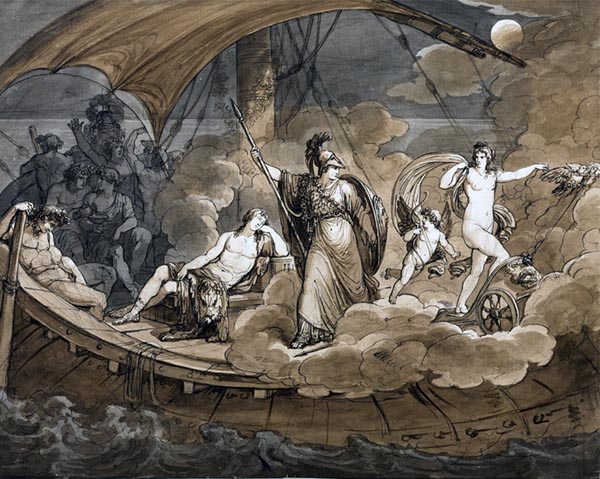
‘The dream of Telemachus.’ (1808) - Bartolomeo Pinelli (Italian, 1781-1835)
Artvee
“Meanwhile, all those Cypriots who were on the vessel abandoned themselves to a delirious glee. The oarsmen, hostile to work, were sleeping on their oars. The helmsman, wreathed with flowers, left the helm and was holding in his hand a large jug of wine that he had almost emptied; he and all the others, troubled by the fury of Dionysus, were singing—in honour of Aphrodite and Eros— verses that should horrify all those who love virtue.
“While they were forgetting so the dangers of the sea, a sudden tempest troubled the sky and the sea. Unleashed winds bellowed furiously into the sails. Black surges were beating the flanks of the ship, which groaned under their blows. At times we rode the backs of billowing waves. At times the sea seemed to give way beneath the ship and fling us into the abyss. We saw alongside us rocks against which the angry waves were breaking with a terrifying noise. Then I understood through experience what I had often heard said by Mentor—men, effete and abandoned to pleasure, lack courage in danger. All our despondent Cypriots were crying like women. I heard only pitiful cries, laments about the delights of life, vain promises to the gods to make sacrifices to them if they could arrive in the port.
“No one preserved enough presence of mind either to order manoeuvres or to do them. It seemed to me that I must, in saving my life, save those of the others. I took the helm in hand because the pilot, troubled by the wine like a maenad, was not in a state to recognise the danger to the vessel. I encouraged the frightened sailors. I had them lower the sails. They rowed vigorously; we passed through the reefs, and we saw up close all the horrors of death. This adventure seemed like a dream to all those who owed me for the preservation of their life. They were looking at me with astonishment.
“We arrived on the island of Cyprus in the month of spring which is consecrated to Aphrodite.
“‘This season,’ said the Cypriots, ‘suits this goddess, for she seems to bring all nature back to life and to make pleasures sprout like flowers.’
“Arriving on the island, I felt a gentle air that rendered the body loose and lazy, yet inspired a playful and coltish humour. I noticed that the countryside, naturally fertile and agreeable, was almost uncultivated—as so many inhabitants are hostile to work.
I saw, in every direction, women and young girls vainly attired, who were going, while singing the praises of Aphrodite, to consecrate themselves at her temple; beauty, charms, joy, pleasures glowed equally on their faces. But these charms were affected. You did not see a noble simplicity and a lovable modesty that make up the greatest enchantments of beauty. The effete air, the art of composing their faces, their vain finery, their languishing walk, their regards that seemed to seek those of men, their jealousies among them to ignite great passions—in a word, all that I saw in those women seemed vile and contemptible to me; by dint of wanting to please, they disgusted me.
“They led me to the temple of the goddess; she has several of them on this island, for she is particularly adored in Cythera, Idalium, and Paphos. It is to Cythera that I was led. The temple is all marble. It is a perfect peristyle, the columns are of a thickness and height that render this edifice very majestic. Above the architrave and the frieze are, on each side, great pediments, where one sees in bas relief all the most pleasing adventures of the goddess.
“At the door of the temple is an incessant crowd of peoples who come to make their offerings. They never slaughter any victim within the interior of the sacred place. They do not burn there, as elsewhere, the fat of the heifers and bulls. They never spill their blood. They only present the beasts they offer before the altar, and none can be offered up that is not young, white, without defect and spotless. They cover them with streamers of purple embroidered with gold; their horns are gilded and adorned with bouquets of the most fragrant flowers. After they have been presented before the altar, they are sent to a place well away, where they are slain for the feasts of the priests of the goddess. They also offer all kinds of perfumed liquors and wine sweeter than nectar. The priests are dressed in long white robes, with bands of the same gold, and fringe down to the bottom of their robes. They burn day and night on the altars the most exquisite perfumes of the East, and they form a kind of cloud that mounts to the sky. All the columns of the temple are adorned with hanging festoons. All the vessels that are used for sacrifices are of gold. A sacred wood of myrtles surrounds the building. There are only young boys and girls of a rare beauty, who may present the victims to the priests and who dare to light the fire of the altars. But impudence and dissoluteness dishonour a temple so magnificent.
“At first, I was horrified by all that I saw. But imperceptibly I began to become accustomed to it. Vice no longer frightened me. All the gatherings inspired an inexplicable inclination for disorder in me. They mocked my innocence. My restraint and my modesty served as a plaything for those shameless peoples. They spared no effort to excite all my passions, to set traps for me and awaken in me a taste for pleasure. I felt myself weakening every day. The good education I had received almost no longer sustained me. All my good resolutions were vanishing. I no longer felt the strength to resist the evil that was pressing down from all sides. I even had a wicked shame of virtue.
“I was like a man who swims in a deep and rapid river. At first, he slices through the water and swims against the strong current. But if the banks are steep, and if he cannot rest on the shore, he finally wearies little by little. His strength abandons him, his exhausted limbs go numb, and the river’s current sweeps him away. Like so, my eyes were beginning to dim, my heart was failing, I could no longer recall either my reason or the memory of the virtues of my father. The dream where I believed I had seen wise Mentor descend to the Elysian Fields completed my discouragement. A secret and sweet languor was taking hold of me; I already loved the flattering poison that slipped from vein to vein and penetrated to the marrow of my bones. I still heaved, however, deep sighs. I shed bitter tears. I roared like a lion in my fury. ‘O unhappy youth!’ I said, ‘O gods, who cruelly toy with men, why do you make them pass through this age that is a time of madness and blazing fever? O may I be covered with white hair, stooped and near the grave, like Laertes my grandfather. Death would be sweeter to me than the shameful weakness where I find myself.’ Barely had I spoken so when my pain eased and my heart, drunk with a mad passion, shook off almost all modesty. Then I found myself plunged into an abyss of remorse again. During this distress, I ran roving hither and yon in the sacred grove, like a doe that a hunter has wounded. She runs through vast forests to relieve her pain, but the arrow that pierced her in the flank follows her everywhere. She carries the murderous shaft everywhere. Like so, I ran in vain to forget myself, and nothing eased the cut in my heart.
“At that moment, I spied somewhat far from me in the thick shade of this wood the figure of wise Mentor, but his face looked so pale, so sad, and so austere to me that I could feel no joy in it.
“‘Is it you, then,’ I cried out, ‘O my dear friend, my only hope, is it you? What then? Is it really you? Does a deceiving image come to trick my eyes? Is it you, Mentor? Is it not your shade, still sensitive to my woes? Are you not among the ranks of happy souls who possess their virtue, and to whom the gods give pure pleasures in an eternal peace in the Elysian Fields? Speak, Mentor, are you still alive? Am I fortuitous enough to possess you? Or rather is it only a shade of my friend?’ Saying these words, I ran toward him, frenzied, until I was out of breath. He waited for me tranquilly, without taking a step toward me. O gods, you know what was my joy when I felt my arms touching him. No, it is not a vain shade. I am holding him, I am embracing my dear Mentor. That is what I cried inside. I drenched his face with a torrent of tears. I clung to his neck, unable to speak. He regarded me sadly, eyes filled with a tender compassion.
“Finally, I said to him, ‘Alas! Where do you come from? In what dangers have you not left me during your absence, and what would I do now without you?’
“But, without answering my questions, ‘Flee!’ he said in a terrifying tone. ‘Flee, hasten to flee! Here, the land only bears poison as fruit. The air one breathes is pestilent. The contagious men only speak to each other in order to spread a mortal venom. Craven and infamous voluptuousness, which is the most horrible of the evils released from Pandora’s box, softens all hearts and tolerates no virtue here. Flee. What delays you? Do not even look behind you in fleeing. Blot out even the least memory of this execrable island.’
“He spoke, and immediately I felt as if a thick cloud dissipated before my eyes and allowed me to see pure light. A joy sweet and filled with a steadfast courage was reborn in my heart. This joy was very different from that other soft and coltish joy with which my senses had been poisoned at first. One is a drunken and troubled joy that is interspersed with furious passions and stinging remorse. The other is a joy of reason that has something of blissfulness and heaven. It is always pure and balanced; nothing can drain it; the more one plunges in, the sweeter it is; it delights the soul without troubling it. Then I shed tears of joy, and I found that nothing was so sweet as to cry so.
“‘O happy the men to whom virtue reveals herself in all her beauty!’ I said, ‘Can one see her without loving her? Can one love her without being happy?’
“Mentor said to me, ‘I must leave you. I am departing as we speak. It is not permitted for me to stay.’
“‘Where are you going, then?’ I responded to him. ‘In what uninhabitable land would I not follow you? Do not think of being able to escape me. I would rather die in your footsteps.’ Saying these words, I held him tightly with all my strength.
“‘It is in vain,’ he said to me, ‘that you hope to detain me. Cruel Metophis sold me to Ethiopians or Arabs. They, being allied with Damascus in Syria for their commerce, wanted to rid themselves of me, believing to draw in a great sum from someone named Hazael, who was seeking a Greek slave in order to get acquainted with the mores of Greece and to learn about our sciences. Indeed, Hazael paid dearly for me. What I have taught him about our mores gave him the curiosity to spend time on the island of Crete to study the wise laws of Minos. During our voyage, the winds compelled us to put in on the island of Cyprus. While waiting for a favourable wind, he came to make his offerings at the temple. There he is, coming out. The winds are calling us, already our sails swell. Farewell, dear Telemachus; a slave who reveres the gods must faithfully follow his master. The gods no longer permit me to be my own. If I were my own, the gods know, I would be but yours alone. Farewell! Remember the travails of Odysseus and the tears of Penelope. Remember the just gods. O gods, protectors of innocence, in what land am I compelled to leave Telemachus.’
“‘No, no,’ I told him, ‘my dear Mentor, it will not be up to you to leave me here—I would rather die than see you depart without me. This Syrian master, is he merciless? Was it a tigress whose teats he suckled in his infancy? Would he want to snatch you from my arms? He must give me death or suffer me to follow you. You yourself exhort me to flee, yet you do not wish that I flee following your footsteps. I am going to speak to Hazael; he will perhaps have pity on my youth and my tears. Since he loves wisdom and he goes so far seeking it, he cannot have a ferocious and insensitive heart. I will fling myself at his feet. I will embrace his knees. I will not let him go unless he agrees to let me follow you. My dear Mentor, I will make myself a slave along with you; I will offer to give myself to him. If he refuses me, I am done for. I will deliver myself from life.’
“At that moment, Hazael called Mentor. I bowed down before him. He was surprised to see a stranger in this posture.
“‘What do you want?’ he said to me.
“‘Life,’ I answered. ‘For I cannot live if you do not suffer that I follow Mentor, who is yours. I am the son of the great Odysseus, the wisest of the Greek kings who overthrew the superb city of Troy, famous throughout Asia. I do not tell you of my birth to boast, but only to inspire in you some pity for my misfortunes. I have sought my father by all the seas, having with me this man, who was for me another father. Fortune, to top off my woes, took him from me. She made him your slave. Suffer that I be one too. If it is true that you love justice, and that you are going to Crete in order to learn the laws of the good King Minos, do not harden your heart to my sighs and to my tears. You see the son of a king who is reduced to asking for servitude as his only recourse. Another time, I wanted to die in Sicily to avoid slavery. But my former woes were only weak attempts by the outrages of Fortune. Now I fear being unable to be received among your slaves. O gods, see my woes. O Hazael, remember Minos, whose wisdom you admire, and who will judge us both in the kingdom of Hades.’
“Hazael, looking at me with a kind and humane face, held out his hand and lifted me up. ‘I am not ignorant,’ he said to me ‘of the wisdom and virtue of Odysseus. Mentor often recounted to me what glory he acquired among the Greeks and, besides, winged Rumour made his name heard by all the peoples of the East. Follow me, son of Odysseus. I will be your father until you find the one who gave life to you. Even if I were not touched by the glory of your father, by his misfortunes, and by yours, the friendship I have for Mentor would commit me to take care of you. It is true I purchased him as a slave, but I keep him as a faithful friend. The silver he cost me acquired for me the dearest and most precious friend that I have on earth. I found wisdom in him. I owe him all that I have of love for virtue. From this moment, he is free; you will be also. I only ask each of you for your heart.’
“In an instant, I passed from the most bitter pain to the most vibrant joy mortals can feel—I found myself saved from a horrible danger; I was approaching my country, I found help to return there; I enjoyed the consolation of being alongside a man who already loved me through the pure love of virtue; lastly, I found everything in finding Mentor again, to part from him no more.
“Hazael advances along the sand of the shore. We follow him, we board the vessel, the oarsmen plough the peaceful waters. A light zephyr plays with our sails, animating the entire vessel and giving it a gentle motion. The island of Cyprus soon disappears.
“Hazael, who was impatient to know my sentiments, asked me what I thought of the mores of that island. I told him ingenuously to what danger my youth had been exposed and the struggle I had suffered within. He was touched by my horror for vice, and spoke these words, ‘O Aphrodite, I recognise your might and that of your son. I burned incense on your altars, but suffer that I detest the infamous effeteness of the inhabitants of your island and the brutal impudence with which they celebrate your festivals.’
“Then he conversed with Mentor about that first might that formed heaven and earth, that unique light, infinite and immutable, that gives to all without dividing, that sovereign and universal truth that illuminates all minds, as the sun illuminates all bodies. ‘The one,’ he added, ‘who has never seen this pure light is blind, as if born blind. He spends his life in a profound night, like the peoples that the sun does not shine on for several months of the year; he believes himself wise, and he is foolish. He believes he sees all, and he sees nothing. He dies having never seen anything: at most, he glimpses sombre and false glimmers, vain shades, phantoms that have nothing real. Like so are all men swept away by sensual pleasure and by the enchantment of the unreal. There are not on earth any true men, except those who consult, who love, who follow this eternal reasoning; it is reason that inspires us when we think well; it is reason that corrects us when we think poorly. We do not hold reason less valuable than life. Reason is like a great ocean of light. Our minds are like streams that leave it and return in order to lose themselves in it.’
“Though I did not yet perfectly understand the profound wisdom of these discourses, I did not fail to appreciate a certain something of pureness and sublimity. My heart was warmed by it, and truth seemed to shine in all those words. They continued to talk of the origin of the gods, the heroes, the poets, the golden age, the flood, the first stories of humankind, the river of oblivion into which the souls of the dead plunge, the endless pains prepared for the impious ones in the gloomy pit of Tartarus, and of that happy peace the just enjoy in the Elysian Fields, without fear of losing it.
“While Hazael and Mentor were talking, we caught sight of dolphins covered with scales that appeared to be of gold and azure. Playing together, they whipped the swells into lots of spume. After them came Tritons, who were trumpeting with their curved conch shells; they surrounded Amphitrite’s chariot pulled by seahorses, whiter than snow who, ploughing the salty waters, left far behind them a vast furrow in the sea. Their eyes were ablaze and their mouths steaming. The goddess’ chariot was a conch shell of a marvellous shape. It was of a whiteness more brilliant than ivory, and the wheels were of gold. This chariot seemed to fly over the surface of the peaceful water. A throng of nymphs wreathed with flowers were swimming in droves behind the chariot, their beautiful hair hanging to their shoulders and flowing with the wind. The goddess held in one hand a golden sceptre to command the waves, and in the other she carried on her knees the little god Palaemon, her son, nursing at her breast. She had a serene expression and a gentle majesty that made the seditious winds and all the black tempests flee. The Tritons drove the horses and held the golden reins. A great purple sail floated in the air above the chariot. It was half-filled by the puffs of a multitude of tiny zephyrs striving to push it with their breath. In midair, Aeolus could be seen, driven, restless, and ardent. His wrinkled and sorrowful face, his menacing voice, his thick and hanging eyebrows, his eyes filled with a sombre and austere fire held the proud Northwind in silence and pushed back all the clouds. The immense whales and all the monsters of the sea, making the bitter water ebb and flow with their spouts, hastily came out of their deep grottos to see the goddess.”
END OF BOOK IV
BOOK V
“After we had marvelled at this spectacle, we began to behold the mountains of Crete, which we still had some difficulty distinguishing from the clouds in the sky and the swells of the sea. Soon we saw the summit of Mount Ida that rises above the other mountains of the island, just as an old stag in a forest bears his branchy antlers above the heads of the young fawns who follow him. Little by little we saw more distinctly the coasts of this island that presented themselves before our eyes like an amphitheatre. As much as the land of Cyprus had appeared neglected and uncultivated to us, so that of Crete revealed itself fertile and adorned with every fruit through the labour of its inhabitants.
“On all sides we noticed well-built villages, burgs that rivalled cities, as well as superb cities. We found no field where the hand of the diligent ploughman was not impressed. Everywhere the plough had left deep furrows. Brambles, thorns, and all the plants that uselessly occupy the land are unknown in this country. We considered with pleasure the deep vales where herds of oxen bellowed in the rich grasses along the streams, the grazing sheep on the hillside, the vast countryside covered with yellow ears of grain, rich gifts of fruitful Demeter; lastly, mountains adorned with vines and clusters of a grape, already coloured, that promised winemakers the sweet presents of Dionysus to enchant the worries of men.
“Mentor told us that he had once been to Crete and explained what he knew of it. ‘This island,’ he said, ‘admired by all foreigners, and famous for its hundred cities, effortlessly feeds all its inhabitants, though they are countless; for the Earth never tires of spreading her bounty on those who cultivate her, and her fruitful womb cannot be exhausted. The more men there are in a country, provided they are hard-working, the more they enjoy abundance. They never need be jealous of each other. Earth, this good mother, multiplies her gifts according to the number of her children who merit her fruits through their work. The ambition and avarice of men are the only sources of their unhappiness. Men want to have it all, and they make themselves unhappy through the desire for superfluities. If they wanted to live simply and be content in satisfying true needs, one would see abundance, joy, peace, and unity everywhere.
‘That is what Minos, the wisest and the best of all kings, had understood. All that which you will see of the most marvellous on this island is the fruit of his laws. The education he had given to the children renders healthy and robust bodies. They are accustomed from the start to a simple, frugal, and hard-working life. They assume all voluptuousness softens the body and mind. They never propose any other pleasure to them than that of being invincible through virtue and of acquiring much glory—not only the glory that comes from the courage to scorn death in the dangers of war, but even that which comes from trampling underfoot excessive riches and shameful pleasures. Here, they punish three vices that are unpunished by other peoples: ingratitude, dissimulation, and avarice. As for flamboyance and softness, they never need to repress them, for they are unknown in Crete. Everyone works here and no one dreams of enriching himself. Each believes himself paid enough for his work to lead a gentle and orderly life, where he enjoys in peace and with abundance all that is truly necessary in life.
‘Here they tolerate neither precious furnishings, nor magnificent garments, nor delicious feasts, nor gilded palaces. The garments are of fine wool and beautiful colours, yet completely plain and unembroidered. The meals here are sober. They drink little wine, and good bread makes up the main part, along with the fruits the trees offer as if of their own accord, and milk from the flocks. At most, they eat a little plain meat, without rich sauces. Even so, they attend to reserve what there is of the best in the great cattle herds in order to make agriculture flourish.
‘The houses here are clean, comfortable, pleasant, yet without ornamentation. Superb architecture is not ignored; however, it is reserved for the temples of the gods, and men would not dare have houses resembling those of immortals. The great possessions of the Cretans are health, strength, courage, peace and family unity, liberty of all citizens, abundance of necessary things, scorn for superfluities, the habit of work and horror of idleness, emulation of virtue, submission to the laws, and reverential awe of the just gods.’
“I asked him what the authority of the king consisted of and he answered, ‘He has complete authority over the peoples, but the laws have complete authority over him. He has an absolute power to do good, but his hands are tied as soon as he wants to do evil. The laws entrust to him the peoples, as the most precious of all trusts, on condition that he will be the father of his subjects. They desire a single man serve, through his wisdom and his restraint, the felicity of so many men, and not that so many men serve, through their destitution and through their craven servitude, to flatter the effete pride of a single man. The king must have nothing above others except what is necessary either to relieve them in their arduous duties or to impress upon the peoples respect for the one who must sustain the laws.
‘Furthermore, the king must be more sober, more hostile to softness, more exempt from flamboyance and haughtiness than any other. He must not have more riches and pleasures, but more wisdom, virtue, and glory than the rest of men. He must be the defender of the homeland without, in commanding armies, and the judge of the peoples within, so as to render them good, wise, and happy. It is not for himself that the gods have made him king. He is only king in order to be the man of the peoples. It is to the peoples that he owes all his time, all his attentions, all his affection, and he is only worthy of kingship to the extent that he forgets himself in order to sacrifice himself for the public good.
‘Minos only wanted his children to reign after him on condition they reign following these maxims. He loved his people even more than his family. It is through such wisdom that he rendered Crete so mighty and so happy; it is through that restraint that he eclipsed the glory of all the conquerors who want to make use of the peoples for their own grandeur—that is to say, for their vanity. Lastly, it is through his justice that he merited being in the Underworld the sovereign judge of the dead.’
“While Mentor was making this speech, we landed on the island. We saw the famous labyrinth, a work from the hands of the ingenious Daedalus, which was an imitation of the great labyrinth we had seen in Egypt. While we were considering this curious edifice, we saw people covering the shore and running in droves to a spot near the edge of the sea. We asked the cause of their eagerness, and this is what a Cretan named Nausicrates recounted to us:
“‘Idomeneus, son of Deucalion and grandson of Minos,’ he said, ‘had gone like the other Greek kings to the siege of Troy. After the ruin of that city, he set sail to return to Crete. But a tempest was so violent that the pilot of his vessel and all the others who were experienced in navigation believed their wreck was inevitable. Each had Death before his eyes. Each saw the abysses opening up to engulf him. Each deplored his misfortune, not even hoping for the sad repose of the shades that traverse the Styx after having received sepulchre.
“‘Idomeneus, raising his eyes and hands toward the sky, invoked Poseidon: “O mighty god,” he cried out, “you who hold the empire of the waters, deign to listen to a poor wretch. If you cause me to see the island of Crete again, despite the furore of the winds, I will sacrifice to you the first head that presents itself to my eyes.”
“‘Meanwhile, his son, impatient to see his father again, was hastening to go out to meet and embrace him, poor unfortunate who did not know that he was running to his doom. The father, escaped from the tempest, arrived in the desired port. He was thanking Poseidon for having listened to his vows, but soon he sensed how ill-fated his vows were to him; a presentiment of his misfortune gave him a burning repentance for his indiscreet vow. He feared arriving among his own, and he was apprehensive about seeing again what he held most dear in the world. But cruel Nemesis, merciless goddess who keeps vigil in order to punish men, above all prideful kings, was pushing Idomeneus with a fatal and invisible hand. He arrives. Barely does he dare to raise his eyes; he sees his son; he recoils, seized with horror. His eyes search, but in vain, for some other head less dear that might serve him as victim.
“‘At the same time the son flings himself at his neck and is completely stunned that his father responds so poorly to his affection. He sees him melting in tears. “O my father,” he said, “where does this sadness come from? After so long an absence, are you irritated finding yourself in your kingdom again and making the joy of your son? What have I done? You turn your eyes away for fear of seeing me?”
“‘The father, crushed with pain, said nothing. Finally, after deep sighs, he said, “O Poseidon, what have I promised you? At what price have you preserved me from shipwreck? Render me to the waves and rocks, which should, in breaking me apart, end my sad life. Allow my son to live. O cruel god! Here! Here is my blood, spare his.” Speaking so, he drew his sword to impale himself. But those around him arrested his hand.’
“‘The elder Sophronymus, interpreter of the will of the gods, assured him that he could satisfy Poseidon without giving death to his son. “Your promise,” he said, “was imprudent. The gods do not want to be honoured through cruelty; be very careful of adding to the error of your promise that of fulfilling it against the laws of nature. Offer one hundred bulls whiter than snow to Poseidon. Have their blood stream round his altar wreathed with flowers. Have a sweet incense burned in honour of this god.”
“‘Idomeneus was listening to this discourse, head lowered, without responding. Fury was alight in his eyes. His face, pale and disfigured, changed colour every second. They saw his limbs trembling. Meanwhile, his son was saying to him, “Here I am, my father. Your son is ready to die to appease the god. Do not draw his anger to you. I die content, since my death will have preserved you from yours. Strike, my father. Do not fear finding in me a son unworthy of you, who fears to die.”
“‘At that moment, Idomeneus, completely beside himself, as if ripped apart by the infernal Furies, shocks all those who are observing him closely. He sinks his sword into the heart of this child. He withdraws it all steaming and bloody to plunge it into his own entrails. He is once again restrained by those surrounding him. The child falls in his own blood. His eyes cloud over with the shadows of death. He half-opens them to the light, but no sooner has he found it than he can no longer bear it. Just as a beautiful lily in the middle of the fields, cut at its root by the blade of the plough, languishes, and no longer sustains itself; it has not yet lost that vibrant white and that brilliance that charms the eyes, but the earth no longer nourishes it, and its life is put out. So the son of Idomeneus, like a young and tender flower, is cruelly reaped in his earliest boyhood. The father, in the excess of his pain, goes insane. He does not know where he is, nor what he did, nor what he should do. He staggers toward the city and asks for his son.
“‘The people, however, touched with compassion for the child and horror at the barbaric action of the father, cry out that the just gods have delivered him over to the Furies. Fury provides them with arms. They take up sticks and stones. Discord blows into every heart a deadly venom. The Cretans, the wise Cretans, forget the wisdom they had so loved. They no longer recognise the grandson of wise Minos. Idomeneus’ friends no longer find any salvation for him other than taking him back to his vessels. They embark with him, they flee at the mercy of the waves; Idomeneus, returning to himself, thanks them for having snatched him from a land he had soaked with the blood of his son and where he would no longer know how to live. The winds drive them toward Hesperia, and they go seeking a new kingdom in the country of the Salentines.
“'Meanwhile, the Cretans, no longer having a king to govern them, resolved to choose one who preserves, in their purity, the established laws. Here are the measures they have taken to make this choice. All the principal citizens from a hundred cities are assembled here. They have already begun with sacrifices. They have assembled all the most famous wise men from neighbouring countries to examine the wisdom of those who would appear worthy of commanding. They have prepared public games, where all the pretenders to the throne fight, for they want to give the kingship as a prize to the one who they judge victor over all the others, not only in mind but also in body. They want a king whose body is strong and adept, and whose soul is adorned with wisdom and virtue. They summon here all foreigners.
“After recounting this astonishing story to us, Nausicrates says to us: ‘Hasten, then, O foreigners, to come into our assembly. You will fight with the others and, if the gods destine victory to either of you, you will reign in this country.’ We followed him, without any desire for victory but merely out of curiosity to see a thing so extraordinary.
“We arrived at a type of very vast stadium surrounded by a thick forest. The middle of the stadium was an arena prepared for the fighters. It was bordered by a great amphitheatre of a fresh lawn on which were seated and arranged a countless number of people. When we arrived, they received us with honour, for the Cretans are the peoples of the world who practise hospitality the most nobly and the most scrupulously. They had us seated and invited us to fight. Mentor excused himself based on his age, and Hazael on his weak health. My youth and my vigour denied me every excuse. I nevertheless cast a glance at Mentor to discern his thoughts, and I perceived that he wished for me to fight. So, I accepted the offer they made me.
“I stripped off my garments, they streamed sweet and glistening oil over all the limbs of my body, and I mingled among the fighters. From every direction, they were saying that it was the son of Odysseus who had come to try and take home the prize, and several Cretans, who had been in Ithaca during my childhood, recognised me. The first fight was that of wrestling.
“A Rhodian around thirty-five years old overcame all the others who dared stand before him. He was still in the full vigour of youth. His arms were sinewy and fit. With the slightest movement, one saw all his muscles. He was equally supple and strong. I did not look worthy to him of being vanquished and, regarding my tender youth with pity, he wanted to withdraw. But I stood before him. Then we seized each another. We squeezed each other breathless. We were shoulder to shoulder, foot to foot, every muscle stretched, and arms intertwined, like serpents, each striving to lift his enemy off the ground. At times he tried to overtake me by pushing me from the right side. At times he strove to lean on me from the left. While he was groping me so, I pushed him so violently that his back gave way. He fell on the sand and dragged me on top of him. In vain, he tried to put me under him. I held him fast under me. All the people shouted, ‘Victory to the son of Odysseus!’ And I helped the confused Rhodian to get up.
“The boxing match was more difficult. The son of a rich citizen of Samos had acquired a high reputation in this type of fighting. All the others ceded to him. I alone hoped for victory. At first, he beat me on the head, and then in the stomach with blows that made me vomit blood and spread a thick cloud over my eyes. I staggered, he squeezed me, and I could no longer breathe. But I was reanimated by the voice of Mentor, shouting out, ‘O son of Odysseus, will you be vanquished?’ Anger gave me new strength. I evaded several blows, which would have overwhelmed me. As soon as the Samian had swung and missed, and his arms were outstretched in vain, I surprised him in this forward posture. He was already recoiling when I raised my glove to fall upon him with more force. He wanted to dodge and, losing balance, he gave me the means of knocking him to the ground. No sooner was he stretched out on the ground than I held out my hand to help him up. He got up on his own, covered with dust and blood. His shame was extreme, but he dared not renew the fight.
“Straightaway they began the chariot races, distributing the chariots by lot. Mine found itself the least when it came to the lightness of the wheels and the vigour of the horses. We took off. A cloud of dust flew up and covered the sky. At the start, I let the others pass ahead of me. A young Lacedaemonian named Crantor immediately left all the others behind. A Cretan named Polycletes followed him closely. Hippomachus, Idomeneus’ relative, who aspired to succeed him, loosening the reins of his horses that were steaming with sweat, was leaning far out over their flowing manes, and the motion of his chariot's wheels was so rapid they looked motionless, like the wings of an eagle that slices through the air. My horses came alive and, little by little, putting themselves to work, I left far behind me almost all those who had taken off with such ardour.
“Hippomachus, pushing his horses too hard, the most vigorous went down and denied, by its fall, its master the hope of reigning. Polycletes, leaning too far over his horses, could not hold firm over a jolt. He fell. The reins escaped him, and he was only too happy to be able to avoid death. Crantor, seeing with eyes full of indignation that I was right alongside him, redoubled his ardour. At times he invoked the gods and promised them rich offerings, at times he spoke to his horses to animate them. He feared my passing between the boundary and him, for my horses, better handled than his, were in position to pull ahead of him. There no longer remained to him any other recourse than that of closing off the passage to me. To succeed at it, he risked breaking apart against the boundary. Indeed, he broke his wheel on it. I only thought to make the turn quickly so as not to be embroiled in his disorder, and he saw me a moment after at the end of the course. The people cried out once more, ‘Victory to the son of Odysseus. It is he whom the gods destine to reign over us.’
“Meanwhile, the most illustrious and the wisest among the Cretans led us into an ancient and sacred wood, secluded from the view of profane men, where the elders, whom Minos had established as judges of the people and guardians of the laws, assembled us. We were the same ones who had fought in the games. No others were admitted.
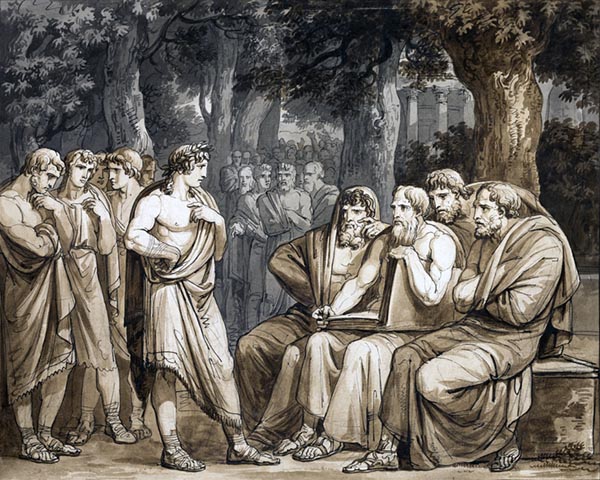
‘Telemachus describes how he was admitted into the assembly in Crete.’ (1808) - Bartolomeo Pinelli (Italian, 1781-1835)
Artvee
“The wise men opened the book where all the laws of Minos are collected. I felt seized with respect and shame when I approached those elders, whom age rendered venerable without taking away the vigour of the mind. They were seated with order and fixed in their places. Their hair was white. Several of them had hardly any. One saw shining on their grave faces a gentle and tranquil wisdom. They did not rush to speak. They only said what they had resolved to say. When they were of different views, they were so restrained in sustaining what they thought, on both sides, that one would have believed they all held the same opinion. Long experience of things past and the habit of work gave them great views on all things. But what perfected their reasoning the most was the calmness of their minds, which were delivered from mad passions and the whims of youth. Wisdom alone acted in them, and the fruit of their long virtue was to have so well tamed their humours that they effortlessly enjoyed the sweet and noble pleasure of listening to reason. Admiring them, I wished that my life could leap ahead to arrive all at once at such an estimable old age. I found unhappy youth to be so impetuous and so distant from that virtue so enlightened and so tranquil.
“The first among those elders opened the book of the laws of Minos. It was a large book that was ordinarily kept encased in a golden coffer along with perfumes. All those elders kissed it respectfully, for they say that after the gods from whom the good laws come, nothing should be so sacred to man as the laws intended to render them good, wise, and happy. Those who have in their hands the laws to govern the peoples must always let themselves be governed by the laws. It is the law, and not man, which must reign. Such is the discourse of these wise men. Then the one who was presiding proposed three questions, which should be decided according to the maxims of Minos. The first question is to know, who is the most free of all men?
“Some answered that it was a king who had over his people an absolute empire and who was victorious over all his enemies. Others maintained it was a man so rich that he could satisfy all his desires. Others said it was a man who did not marry, and who travelled throughout his entire life in various countries, without ever being subjugated to the laws of any nation. Others imagined it was a barbarian who, living off his hunt in the middle of the woods, was independent of all government policies and every need. Others believed it was a man newly set free, because in getting out of the rigours of servitude, he enjoyed more than any other the sweetness of liberty. Lastly, others dared to say that it was a dying man, because death delivered him from everything, and all men together no longer had any power over him.
“When my turn came, I had no difficulty answering because I had not forgotten what Mentor had often said to me. ‘The freest of all men,’ I answered, ‘is the one who can be free even in slavery. In whatever country and in whatever station he may be, he is very free, provided he reveres the gods and he reveres only them—in a word, the man truly free is the one who, released from all fear and all desire, only bows to the gods and to his reason.’ The elders looked at each other, smiling, and were surprised to see that my answer was precisely that of Minos.
“Then they proposed the second question in these terms: ‘Who is the most unhappy of all men?’ Each said what came to his mind. One said, ‘It is a man who has neither possessions, nor health, nor honour.’ Another said, ‘It is a man who has not one friend.’ Others maintained that it is a man who has children, ungrateful and unworthy of him. Coming to a wise man from the island of Lesbos, he said, ‘The most unhappy of all men is the one who believes himself to be, for unhappiness depends less on the things that one suffers than the impatience with which one increases his unhappiness.’
“At those words, all assembled cried out again. They applauded, and each believed this wise Lesbian would bring home the prize on this question. But they asked me my thought, and I responded according to the maxims of Mentor. ‘The most unhappy of all men is a king who believes himself to be happy in rendering other men miserable. He is doubly unhappy through his blindness—not recognising his unhappiness, he cannot heal himself of it; he even fears recognising it; truth cannot pierce the crowd of flatterers to reach him; he is tyrannised by his passions; he does not recognise his duties. He has never tasted the pleasure of doing good, nor felt the enchantment of pure virtue. He is unhappy and worthy of being so. His unhappiness increases every day. He races to his ruin, and the gods prepare to confound him through an eternal punishment.’ All assembled avowed that I had defeated the wise Lesbian, and the elders declared that I had met the true sense of Minos.
“As for the third question, they asked, ‘Which of the two is preferable, on the one hand, a king conquering and invincible in war; on the other, a king inexperienced in war, yet suitable to wisely establish policies for the peoples in peacetime?’ Most answered that the king invincible in war was preferable. ‘What does it serve,’ they said, ‘to have a king who knows how to govern well in peace if he does not know how to defend the country when war comes? The enemies will vanquish him and reduce his people to servitude.’ Others maintained on the contrary that the peace-loving king would be better because he would fear war and would avoid it through his attentions. Others were saying that a conquering king would strive for the glory of his people as well as his own and would render his subjects masters over other nations, whereas a peace-loving king would hold them in a shameful cowardice.
“They wanted to know my sentiment. I answered, ‘A king who only knows how to govern in peace or in war and who is not capable of leading his people under both those conditions is only half a king. But if you compare a king who only knows warfare to a wise king who, without knowing warfare, is capable of sustaining it when necessary through his generals, I find him preferable to the other. A king entirely turned toward war would always want to wage it in order to extend his dominion and his own glory—he would ruin his peoples. What does it serve a people that their king subjugates other nations if they are unhappy under his reign?
“‘Besides, long wars always drag after them much disorder. The victors themselves are out of kilter during those times of confusion. See what it cost them in Greece in order to triumph over Troy. She was deprived of her kings for more than ten years. While everything is on fire for war, the laws, the agriculture, the industrial arts languish. Even the best princes, while they have a war to sustain, are compelled to do the greatest of evils, which is to tolerate licentiousness and to make use of the wicked. How many scoundrels there are who would be punished during peace, and whose audacity must be rewarded in the disorder of war.
“‘Never has any people had a conquering king without having suffered much from his ambition. A conqueror, drunk on his glory, ruins his victorious nation almost as much as the vanquished nation. A prince who does not have the qualities necessary for peace cannot have his subjects enjoy the fruits of a war happily ended. He is like a man who would defend his field against his neighbour, and would even usurp that of his neighbour, yet does not know how to plough or to sow in order to reap any harvest. Such a man seems born to destroy, ravage, and overthrow the world and not to render a people happy through a wise government.
“‘Now we come to the peace-loving king. It is true that he is not suitable for great conquests; that is to say, he was not born to trouble the happiness of his people in wanting to vanquish other peoples that justice has not subjugated to him. But if he is truly suitable to govern in peace, he has all the qualities necessary to keep his people safe against his enemies. Here is how: he is just, restrained, and accommodating with regard to his neighbours. He never undertakes against them any design that might disturb his peace. He is loyal in his alliances. His allies love him, do not fear him, and have a complete confidence in him. If there is some restless neighbour, haughty and ambitious, all the other neighbouring kings, who fear that restless neighbour and who have no jealousy toward the peace-loving king, join up with this good king to keep him from being oppressed. His probity, his good faith, his moderation render him the arbiter of all the states that surround his. While the enterprising king is odious to all the others and incessantly exposed to their leagues, this one has the glory of being like a father and tutor to all the other kings. Voila, those are the advantages that he has without. Those he possesses within are even more solid.
“‘Since he is suitable for governing in peace, I must assume that he governs by the wisest laws. He curtails flamboyance, softness, and all the arts that only serve to indulge vices. He causes the other arts useful to the true necessities of life to flourish. Above all, he applies his subjects to agriculture. In doing so, he puts them in abundance of necessary things. This hard-working people, simple in their mores, accustomed to living on little, easily earning their living through the cultivation of their lands, multiplies to infinity. There are in this kingdom a countless number of people, yet a healthy, vigorous, robust, people who are not softened through voluptuousness, who are trained in virtue, who are not attached to the sweetness of a craven and indulgent life, who know how to scorn death, who would rather die than lose that liberty they enjoy under a wise king who applies himself to reign only in order to make reason reign.
“‘Should a conquering neighbour attack this people, he will perhaps not find them so accustomed to encampments, to battle formations, or to erecting machinery to besiege a city, but he will find them invincible through their multitude, their courage, their patience in struggles, their habit of enduring poverty, their vigour in combat, and a virtue that even setbacks cannot beat down. Besides, if the king is not experienced enough to command his armies himself, he will have them commanded by people who are capable of it, and he will know how to make use of them without losing his authority. Meanwhile, he will draw succour from his allies. His subjects will prefer to die rather than to pass under the dominion of another king, violent and unjust. The gods themselves will fight for him. You see what resources he will have amidst the greatest perils.
“‘I conclude, therefore, that the peace-loving king who is ignorant of warfare is a very imperfect king since he does not know how to fulfil one of his greatest functions, which is to vanquish his enemies; but I add that he is nevertheless infinitely superior to the conquering king who lacks the necessary qualities in peacetime and who is only suited to war.’
“I perceived in the assembly many people who were unable to appreciate this opinion, for most men, dazzled by brilliant things, like victories and conquests, prefer them to what is natural, tranquil, and solid, like peace and good policies for the peoples. But all the elders declared that I had spoken like Minos.
“The head of these elders exclaimed: ‘I see the fulfilment of an oracle of Apollo, known throughout our island. Minos had consulted the god in order to know how much time his race would reign, following the laws that he had just established. The god answered him, “Your race will cease to reign when a foreigner enters onto your island in order to make your laws reign there.’’
“‘We had feared that some foreigner would come to conquer the island of Crete. But the misfortune of Idomeneus and the wisdom of the son of Odysseus, who understands better than any other mortal the laws of Minos, show us the meaning of the oracle. What delays us in crowning the one whom the destinies give us as king?’
“Immediately, the elders leave the interior of the sacred wood, and the first elder, taking me by the hand, announces to the people, already impatient in awaiting a decision, that I had won the prize. Barely had he finished speaking when we hear a confused noise from the entire assembly. All loose cries of joy. The entire seashore and all the neighbouring mountains reverberate with this cry, ‘May the son of Odysseus, like Minos, reign over the Cretans!’
“I waited a moment, and I motioned with my hand for them to listen to me. At the same time, Mentor said in my ear, ‘Are you renouncing your homeland? The ambition to reign, will it make you forget Penelope, who is waiting for you as her last hope, and the great Odysseus, whom the gods have resolved to return to you?’ These words pierced my heart and sustained me against the vain desire to reign.
“Meanwhile, a profound silence from this entire tumultuous assembly gave me the means of speaking thus: ‘O illustrious Cretans, I do not merit commanding you. The oracle that was just related shows indeed that the race of Minos will cease to reign when a foreigner enters onto this island and causes the laws of this wise king to reign here. But it is not said that this foreigner will reign. I want to believe that I am this foreigner decreed by the oracle. I have fulfilled the prediction. I came onto this island. I revealed the true sense of the laws, and I hope that my explication serves to make them reign with the man whom you will choose. As for me, I prefer my homeland, the poor, small island of Ithaca, to the hundred cities of Crete, to the glory and to the opulence of this beautiful kingdom.
‘Suffer that I follow what the destinies have decreed. If I fought in your games, it was not in the hope of reigning here. It was to merit your esteem and your compassion; it was so that you would give me the means of swiftly returning to the place of my birth. I prefer to obey my father Odysseus and to console my mother Penelope than to reign over all the peoples of the universe. O Cretans, you see the depths of my heart. I must part from you, but death alone will be able to end my gratitude. Yes, until my last breath, Telemachus will love the Cretans and will be as interested in their glory as his very own.’
“No sooner had I spoken than there arose a deafening sound, like that of ocean waves crashing together in a tempest. Some were saying, ‘Is this some deity beneath a human figure?’ Others maintained that they had seen me in other countries, and that they recognised me. Others cried out, ‘We must compel him to reign here.’ Finally, I spoke again, and each hastened to be silent, not knowing if I was going to accept what I had at first refused. Here are the words that I said to them:
‘Suffer, O Cretans, that I say to you what I think. You are the wisest of all the peoples. But wisdom demands, it seems to me, a precaution that escapes you. You should choose not the man who reasons the best about the laws but the one who practises them with the most constant virtue. For me, I am young, consequently inexperienced, exposed to the violence of passions, and more at the stage of educating myself in obeying so as to command one day rather than to command now. Do not seek a man, therefore, who has vanquished others in these games of mind and body, but one who can vanquish himself; seek a man who has your laws written deep in his heart and whose entire life has been the practice of these laws. May his actions, rather than his words, cause you to choose him.’
“All the elders, charmed by this speech, and seeing the assembly’s applause still rising, said to me, ‘Since the gods deny us the hope of seeing you reign among us, at least help us to find a king who would cause our laws to reign. Do you know of someone who might command with this restraint?’
“‘I know,’ I told them, ‘of a man for whom I hold all that you have esteemed in me. It is his wisdom and not mine that just spoke and he inspired in me all the answers that you just heard.’
“At the same time the entire assembly cast their eyes on Mentor whom I was indicating, holding him by the hand. I recounted the cares he had taken of my childhood, the perils from which he had delivered me, the misfortunes that had melted down on me as soon as I ceased following his counsel. At first, they had not looked at him because of his simple and scruffy garments, his modest countenance, his almost continual silence, his cold and reserved air. But, when they made the effort to look at him, they discovered in his face a certain something of firmness and elevation; they noticed the vivacity of his eyes and the vigour with which he did even the least deeds.
“They questioned him. He was admired. They resolved to make him king. He declined unemotionally. He said that he preferred the sweetness of a private life to the brilliance of kingship, as the best kings were unhappy in that they almost never did the good that they wanted to do, and they often did, through enterprising flatterers, the evils they did not want to do. He added that, if servitude is miserable, kingship is no less so, since it is servitude in disguise. ‘When one is king,’ he said, ‘he depends on all those he needs in order to be obeyed. Happy the one who is not obliged to command! We only owe to our motherland alone, when she entrusts the authority to us, the sacrifice of our liberty so as to strive for the public good.’
“Then the Cretans, unable to get over their surprise, asked him which man they should choose. ‘A man,’ he answered, ‘whom you know well, since he must govern you, and who fears governing you. The one who desires kingship does not know it, and how will he fulfil the obligations of it, not knowing them? He seeks it for himself, and you must desire a man who only accepts it for the love of you.’
“All the Cretans were in a strange astonishment to see two foreigners refusing the kingship sought by so many others. They wanted to know with whom they had come. Nausicrates, who had led us from the port to the stadium where they celebrated the games, pointed out Hazael, with whom Mentor and I had come from the island of Cyprus. But their astonishment was even much greater when they learned that Mentor had been the slave of Hazael, that Hazael, touched by the wisdom and virtue of his slave, had made him his counsellor and best friend, that this freed slave was the same who had just refused to be king, and that Hazael had come from Damascus in Syria, to learn from the laws of Minos, so much had the love of wisdom filled his heart.
“The elders said to Hazael, ‘We do not dare pray for you to govern us, for we judge that you have the same thoughts as Mentor. You scorn men too much to want to be burdened with leading them. Besides, you are too detached from riches and the brilliance of kingship to want to attain that brilliance through the difficulties attached to the governance of the peoples.’
“Hazael responded, ‘Do not believe, O Cretans, that I scorn men. No, no, I know how grand it is to work to render them good and happy, but this work is full of difficulties and dangers. The brilliance that is attached to it is false and can only dazzle vain souls. Life is short, and grandeurs irritate passions more than they can satisfy them. It is in order to learn to do without those false possessions, and not in order to come by them, that I have come so far. Farewell. I only dream of returning to a peaceful and secluded life where wisdom nourishes my heart and where the hopes that one draws from virtue for another better life after death consoles me in the griefs of old age. If I had something to wish for, it would not be to be king; it would be to never separate from these two men whom you see.’
“Finally, the Cretans cried out, speaking to Mentor, ‘Tell us, O wisest and greatest of all mortals, tell us then, who is it that we can choose for our king? We will only let you go when you have informed us of the choice we must make.’
“He answered, ‘While I was in the crowd of spectators, I noticed a man who demonstrated no eagerness; he is an old man, yet vigorous enough. I asked who this man was. They answered that he was called Aristodemus. Then I heard that someone told him his two children were in the number of those who fought. He seemed to take no joy in it. He said that as for the one, he would not wish the perils of kingship on him, and that he loved his homeland too much to consent the other ever reigned; by that, I realised this father loved with a reasonable love one of his children, who has virtue, and he did not indulge the other in his unruliness.
“‘My curiosity rising, I asked what the life of this old man had been. One of your citizens answered me, “He bore arms for a long time, and he is covered with scars, but his sincere virtue and hostility to flattery rendered him inconvenient to Idomeneus; it is what kept the king from using him in the siege of Troy. He feared a man who would give him wise counsel that he could not resolve himself to follow. He was even jealous of the glory that this man would not fail to soon acquire. He forgot all his military service. He left him here poor, scorned by uncouth and cowardly men who only esteem riches, yet content in his poverty. He lives cheerfully in a place set apart on the island where he cultivates his field with his own hands. One of his sons works with him. They love each other tenderly. They are happy. Through their frugality and work, they have an abundance of the things necessary for a simple life. The wise old man gives to the poor and sick of his neighbourhood all that remains to him beyond his needs and those of his son. He makes all the young people work; he exhorts them, he instructs them, he judges all the disagreements of his neighbourhood. He is the father of all the families. His misfortune is in having a second son who does not want to follow any of his counsel. The father, after having tolerated him for a long time trying to correct him of his vices, finally ran him off. The son abandoned himself to a mad ambition and to every pleasure.”
“‘There you have it, O Cretans; this is what I was told. You must know if this story is true. But if this man is as they depict him, why do these games? Why assemble so many strangers? You have amidst you a man who knows you and whom you know, who knows warfare, who has shown his courage, not only against arrows and spears, but against frightful poverty, who has scorned riches acquired through flattery, who loves work, who knows how useful agriculture is to a people, who detests flamboyance, who does not allow himself to be softened by a blind love of his children, who loves the virtue of the one and condemns the vice of the other—in a word, a man who is already the father of the people. There is your king, if it is true that you desire to make the laws of the wise Minos reign here.’
“All the people cried out, ‘It is true, Aristodemus is just as you say. It is he who is worthy of reigning.’ The elders had him called up. They searched for him in the crowd where he was blended in with the people farthest away. He looked tranquil. They declared to him that they wanted to make him king. He responded, ‘I could only consent under three conditions: first, that I will quit the kingship in two years if I do not render you better off than you are, and if you are resistant to the laws; second, that I will be free to continue a simple and frugal life; third, that my children will have no rank, and after my death they will be treated without distinction, according to their merit, like the rest of the citizens.’
“At these words, there arose in the air a thousand cries of joy. The diadem was placed onto Aristodemus’ head by the chief of the elders, guardians of the laws. They made sacrifices to Zeus and the other great gods. Aristodemus made gifts to us, not with the magnificence usual with kings, but with a noble simplicity. He gave to Hazael the laws of Minos, handwritten by Minos himself. He also gave him a collection of the complete history of Crete since the reign of Saturn and the golden age. He had a vessel loaded with good fruits of every kind from Crete and unknown in Syria, and he offered him all the assistance he could need. As we were hurrying our departure, he had a vessel with a great number of good oarsmen and men at arms readied for us. He had clothing and provisions put on board for us. At that instant, there arose a favourable wind for going to Ithaca. This wind, which was not favourable for Hazael, compelled him to wait. He saw us departing; he embraced us like friends who he should never see again.
“‘The gods are just,’ Hazael said. ‘They see a friendship that is based only on virtue. One day they will reunite us, and those fortunate fields, where they say the just enjoy an eternal peace after death, will see our souls meet, never to separate again. O if my ashes could also be gathered with yours…!’
“In pronouncing these words, he shed torrents of tears, and sighs choked off his voice. We cried no less than he, and he led us to the vessel.
“As for Aristodemus, he told us, ‘It is you who just made me king. Remember the dangers where you have put me. Ask that the gods inspire true wisdom in me, and may I surpass other men in restraint as much as I surpass them in authority. As for me, I pray for the gods to guide you happily to your homeland, to confound the insolence of your enemies there, and to have you see Odysseus reigning with his dear Penelope in peace there. Telemachus, I give you a good vessel full of oarsmen and armed men; they will be able to serve you against those unjust men who persecute your mother. O Mentor, your wisdom, which has need of nothing, leaves me nothing to desire for you. Go, both of you. Live happily together. Remember Aristodemus, and if ever the Ithacans have need of the Cretans, count on me until the last breath of my life.’ He embraced us, and we could not, in thanking him, hold back our tears.
“Meanwhile, the wind that swelled our sails promised us a gentle voyage. Already, Mount Ida was no more than a hill to our eyes; all the shorelines disappeared. The coasts of the Peloponnese seem to advance into the sea to welcome us. All of a sudden, a black tempest enveloped the sky and stirred up all the waves of the sea. Day turned into night, and Death presented itself before us. O Poseidon, it is you who excited, with your superb trident, all the waters of your empire! Aphrodite, in order to take vengeance for our having scorned her even in her temple of Cythera, went to find this god. She spoke to him in pain; her beautiful eyes were bathed in tears. At least, that is what Mentor, learned in divine things, assured me of.
“‘Do you suffer, Poseidon,’ she said, ‘that those impious men make light of my might with impunity? Even the gods sense it, and those brash mortals have dared to condemn all I have done on my island. They pride themselves on an unfailing wisdom, and they treated love as folly. Have you forgotten I was born in your empire? Why do you delay burying in your deep abysses those two men who I cannot suffer?’
“Barely had she spoken when Poseidon heaved the swells to the sky, and Aphrodite laughed, believing our wreck inevitable; our pilot, distressed, cried out that he could no longer fight the winds that were violently pushing us toward the rocks. A gale broke our mast, and a moment after we heard the peaks of the rocks breaking open the hull of the ship, water enters from all sides. The ship sinks, all our oarsmen loose lamentable cries to the sky. I embrace Mentor and say to him, ‘Here is Death; we must receive it courageously; the gods have only delivered us from so many perils to have us perish today. We are dying, Mentor, let us die. It is a consolation for me to die with you. It would be useless to fight for our life against this tempest.’
“Mentor responded, ‘True courage always finds some resource. It is not enough to be ready to tranquilly receive Death. One must, without fearing it, make every effort to repulse it. Let us take, you and me, one of these large rowing benches. While this multitude of timid and distressed men lament life without seeking the means of preserving it, let’s not waste a moment to save ours.’
“Quickly, he takes a hatchet. He successfully cuts the mast that was already broken and leaning into the sea, putting the vessel on its side. He throws the mast out of the vessel and launches himself on top amidst the furious waves. He calls me by name and encourages me to follow him. Just as a great tree that all the conjured winds attack, yet remains unmoved on its deep roots, such that the tempest can only agitate its leaves, so did Mentor, not only firm and courageous, but gentle and tranquil, seemed to command the winds and the sea. I follow him—and who would have been able not to follow him, being encouraged by him?
“We drove ourselves onto the top of that floating mast. It was a great help to us, for we could seat ourselves on top, and had it been necessary to swim without resting, our forces would have soon been drained. But the tempest overturned that great shaft of wood often, and we found ourselves plunged into the sea. Then we drank bitter water that flowed from our mouth, nostrils, and ears, and we were compelled to fight against the waves to get back on top of that mast. Sometimes a tall cresting wave like a mountain came passing over us, and we held ourselves firm for fear that, in this violent jolt, the mast, which was our only hope, would escape us.
“While we were in this dreadful state, Mentor, as peaceful as he is now seated on this turf, said to me, ’Do you believe, Telemachus, that your life could be abandoned to the winds and the waves? Do you believe that they could destroy you without the command of the gods? No, no—the gods decide everything. It is the gods then and not the sea that must be feared. Were you at the bottom of the abyss, the hand of Zeus could pull you out. Were you on Olympus, seeing the heavens under your feet, Zeus could plunge you into the depths of the abyss or hurl you into the flames of gloomy Tartarus.’
“I listened and pondered this discourse that consoled me a bit, but I did not have a clear enough mind to respond. He did not see me; I could not see him. We spent the entire night, shivering from cold and half-dead without knowing where the tempest had cast us. Finally, the winds began to be appeased, and the bellowing sea resembled a person who, having been angry for a long time, no longer has but a remnant of distress and emotion left, being weary from having been put into a fury. She grumbled dully, and her waves were hardly more than the furrows that one finds in a ploughed field.
“Meanwhile, Dawn opened to the Sun the doors of the sky and announced a beautiful day to us; the East was all afire, and the stars that had been hidden for so long reappeared and fled upon the arrival of Phoebus. We caught sight of land in the distance, and the wind was bringing it to us. Then I felt hope reborn in my heart. But we saw none of our comrades. By appearances, they had lost courage, and the tempest had submerged them all with the vessel. When we neared land, the sea was pushing us against the peaks of the rocks that had broken us apart, but we attempted to present the end of our mast to them, and Mentor did with that mast what a wise helmsman does with the best rudder. In this way, we avoided those dreadful rocks, and we finally found a gentle and uniform coast where, swimming effortlessly, we landed on the sand. It is there that you saw us, O great goddess who inhabits this island. It is there that you deigned to receive us.”
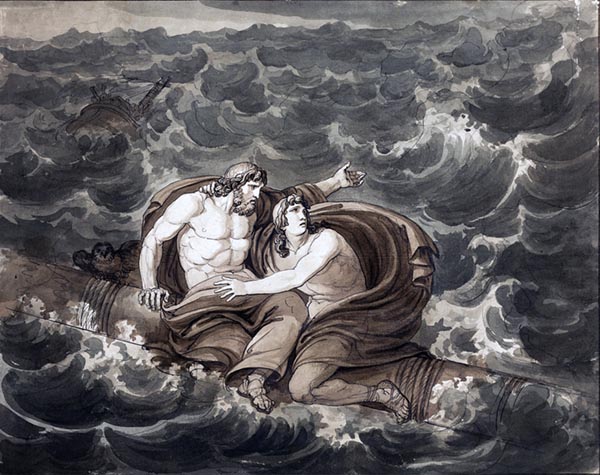
‘Mentor and Telemachus, having survived the storm, are spirited to the island of Calypso on a mast.’ (1808) - Bartolomeo Pinelli (Italian, 1781-1835)
Artvee
END OF BOOK V
BOOK VI
When Telemachus had finished this discourse, all the nymphs, who had been motionless, eyes fixed on him, looked at one another. They were saying with amazement,
“Who are then these two men so cherished by the gods?”
“Have you ever heard told such marvellous adventures?”
“The son of Odysseus already surpasses him in eloquence, in wisdom, and in valour.”
“What mien, what beauty!”
“What sweetness, what modesty!”
“Yet what nobility, and what grandeur!”
“If we did not know that he was the son of a mortal, we would easily take him for Dionysus, for Hermes, or even for the great Apollo.”
“But what is this Mentor, who appears to be a simple man, obscure and of a common class? When one looks at him closely, one finds something about him that is above man.”
Calypso was listening to these discourses with a distress that she could not hide. Her roving eyes were incessantly going from Mentor to Telemachus, and from Telemachus to Mentor. Sometimes she wanted Telemachus to start that long tale of his adventures over again. Then, all at once, she caught herself. Finally rising brusquely, she led Telemachus into a myrtle grove alone where she spared no effort to learn from him whether or not Mentor was a deity hidden beneath the shape of a man. Telemachus could not tell her, for Athena, accompanying him beneath the figure of Mentor, had not revealed herself to him due to his youth—she did not yet trust him enough with her secret to confide her designs to him. Besides, she wanted to test him through the greatest dangers, and if he had known that Athena was with him, such an aid would have been too supportive. He would have had no difficulty scorning the most dreadful accidents. So, he took Athena for Mentor, and all of Calypso’s artifices were useless in uncovering what she desired to know.
Meanwhile, all the nymphs assembled around Mentor took pleasure in questioning him. One asked him the circumstances of his Ethiopian trek. Another wanted to know what he had seen in Damascus. Another one asked him if he had once known Odysseus before the siege of Troy. He answered all of them with gentleness, and his words, though simple, were full of charm.
Calypso did not leave them in this conversation for long. She returned, and as her nymphs set about picking flowers while singing to amuse Telemachus, she took Mentor aside in order to draw him out. The sweet vapour of sleep does not flow more sweetly into heavy eyelids and into all the weary limbs of a beaten-down man than did the flattering words of the goddess that were creeping in to bewitch the heart of Mentor. But she always felt a certain something that repelled all of her efforts and mocked her spells.
Like a steep cliff that hides its brow in the clouds and mocks the rage of the winds, Mentor, immovable in his wise designs, allowed himself to be pressed by Calypso. Sometimes, he even allowed her to hope that she would rattle him with her questions and draw the truth from the depths of his heart. But, just when she believed she was about to satisfy her curiosity, her hopes vanished—all she thought in her grasp escaped her in an instant, and a curt response from Mentor plunged her into her uncertainties again. She passed the days in this way, at times flattering Telemachus, at times seeking a way to detach him from Mentor, whom she no longer hoped to draw out. She used her most beautiful nymphs to light the fires of love in the heart of young Telemachus, and a deity more mighty than she came to help her succeed.
~ Aphrodite, still filled with resentment for the scorn Mentor and Telemachus had shown for the worship that was rendered her on the island of Cyprus, could not console herself upon seeing that these two brazen mortals had escaped the winds and the sea in the tempest excited by Poseidon. She made bitter complaints of it to Zeus, but the father of the gods, smiling, without wanting to reveal to her that Athena, beneath the figure of Mentor, had saved the son of Odysseus, permits Aphrodite to seek the means of taking revenge on these two men. She quits Olympus, she forgets about the sweet perfumes they burn on her altars in Paphos, Cythera, and Idalium. She flies in her chariot hitched to doves. She calls to her son and, pain spreading new charms on her face, she spoke,
“Do you see, my son, those two men who scorn your might and mine? Who will want to venerate us after this? Go, pierce with your arrows those two unfeeling hearts. Descend with me onto that island. I will speak to Calypso.”
She spoke and, slicing through the air in a golden cloud, she presents herself to Calypso, who at this moment was alone on the bank of a spring somewhat far from her grotto.
“Unhappy goddess,” she said to her. “The ungrateful Odysseus scorned you. His son, even more harsh than he, prepares a similar scorn for you. But Love himself comes to avenge you. I am leaving him with you. He will dwell among your nymphs, just as the infant Dionysus was once raised by the nymphs of the island of Naxos. Telemachus will see him as an ordinary infant. He will be unable to distrust him, and he will soon feel his power.” She spoke and, ascending again in that golden cloud from which she had come, left after her an ambrosial fragrance with which all of Calypso’s woods were perfumed.
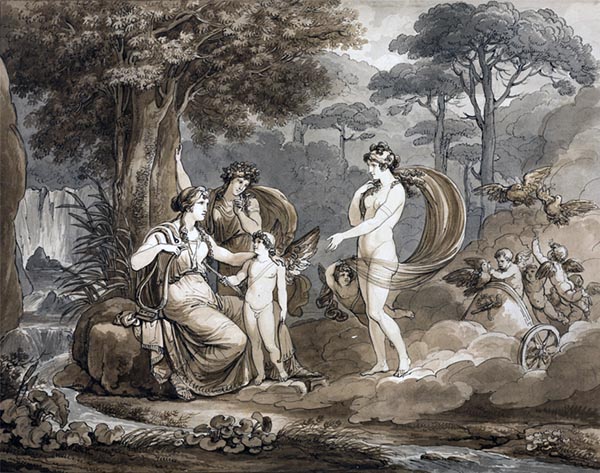
‘Venus presents Cupid to Calypso.’ (1808) - Bartolomeo Pinelli (Italian, 1781-1835)
Artvee
Eros remained in Calypso’s arms. Though a goddess, she felt the flame that was already flowing in her breast. To assuage it, she quickly gave him to the nymph who was alongside her named Eucharis— but alas, afterward, how many times did she repent having done it! At first, nothing seemed more innocent, more gentle, more lovable, more ingenuous, and more charming than this infant. To see him playful, cuddly, always laughing, one would have believed he could give only pleasure. But barely had one trusted his caresses when they felt somehow poisoned. The malignant and deceptive infant only caressed in order to betray, and he only ever laughed from the cruel evils that he had done, or that he desired to do. He dared not approach Mentor, whose severe air terrified him, and he sensed that this stranger was invulnerable such that none of his arrows would be able to pierce him. As for the nymphs, they soon felt the fires this deceitful infant lights. But they carefully hid the deep cut that festered in their hearts.
Meanwhile, Telemachus, seeing this infant who was playing with the nymphs, was taken in by his sweetness and his beauty. He embraces him, he takes him at times in his lap, at times in his arms, he feels an uneasiness inside for which he cannot find the cause. The more he seeks to play innocently, the more he is flustered and weakened.
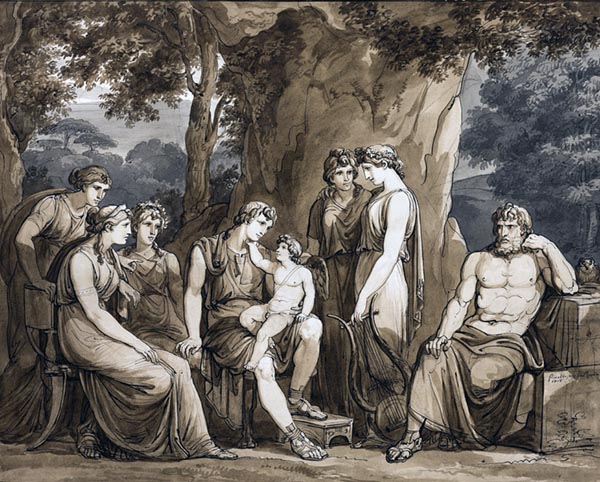
‘Calypso watches Telemachus with Cupid on his knee, while Mentor watches in anger.’ (1808) - Bartolomeo Pinelli (Italian, 1781-1835)
Artvee
“Do you see these nymphs?” he said to Mentor. “How different they are from those women on the island of Cyprus, whose beauty was shocking due to their immodesty! These immortal beauties display an innocence, a modesty, a simplicity that enchants.” Speaking so, he blushed without knowing why. He could not stop himself from talking, but barely had he started when he could not continue. His words were cut off, unintelligible, and sometimes nonsensical.
Mentor said to him, “O Telemachus, the dangers of the island of Cyprus were nothing if they are compared to those of which you are now unsuspecting. Crude vice horrifies; brutal impudence yields indignation, but modest beauty is much more dangerous. In loving it, one believes to love only virtue and, bit by bit, indulges in the deceptive allure of a passion that is only perceived when there is almost no time left to put it out. Flee, O my dear Telemachus, flee these nymphs, who are only so discrete in order to better deceive you. Flee the dangers of your youth. But above all, flee this infant whom you do not know. It is Love whom Aphrodite, his mother, brought onto this island to avenge the scorn you showed for the worship they render her in Cythera. He wounded the heart of the goddess Calypso. She is passionate for you. He burned all the nymphs who surround him. You are burning yourself, O wretched young man, almost without knowing it.”
Telemachus interrupted Mentor often, saying to him,
“Why would we not stay on this island? Odysseus no longer lives. He had to have been buried in the ocean waves a long time ago. Penelope, seeing neither him nor me return, will not have been able to resist so many pretenders. Her father, Icarius, will have compelled her to accept a new spouse. Shall I return to Ithaca to see her committed to new bloodlines and failing to keep the faith she had given my father? The Ithacans have forgotten Odysseus. We could only return there to seek an assured death since Penelope’s suitors have occupied all the avenues of the port to better assure our death upon our return.”
Mentor answered, “Voila the effect of a blind passion. One subtly searches for all the reasons that favour it and turns away for fear of seeing all those that condemn it. One is only ingenious in deceiving himself and smothering his remorse. Have you forgotten all the gods have done to bring you back to your homeland? How you got out of Sicily? The misfortunes that tested you in Egypt— were they not all of a sudden turned into prosperity? What unknown hand snatched you from every danger that threatened your head in the city of Tyre? After so many miracles, are you still ignorant of what the destinies have prepared for you? But what am I saying? You are unworthy of it. As for me, I am leaving, and I know well how to get off this island. Craven son of a father so wise and so generous, lead an effete and dishonourable life here amidst women. Do, despite the gods, what your father believed unworthy of him.”
Those scornful words pierced Telemachus to the bottom of his heart. He was touched with tenderness for Mentor. His pain was mixed with shame. He feared the indignation and the departure of this man, so wise, to whom he owed so much. But a nascent passion that he did not recognise in himself, caused him to no longer be the same man.
“What then,” he said to Mentor, tears in his eyes, “you count for nothing the immortality offered me by the goddess?”
“I count for nothing,” answered Mentor, “all that which is against virtue and against the commands of the gods. Virtue calls you back to your homeland to see Odysseus and Penelope again. Virtue forbids you to abandon yourself to a mad passion. The gods, who have delivered you from so many perils to prepare for you a glory equal to that of your father, command you to quit this island. Eros alone, that shameful tyrant, can detain you here. Ho! What will you do with an immortal life without liberty, without virtue, and without glory? That life would be even more unhappy in that it could not end.”
Telemachus only responded to this discourse with sighs. Sometimes, he wished that Mentor would have snatched him, in spite of himself, off the island. Sometimes he longed that Mentor would depart so as to no longer have before his eyes this severe friend who reproached him for his weakness. All these contrary thoughts agitated his heart in turn, and nothing about them was constant. His heart was like the sea, which is the toy of all the contrary winds. He often remained stretched out and motionless on the shores of the sea, often deep in some gloomy wood, shedding bitter tears and heaving cries like the roars of a lion. He had become thin. His hollow eyes were filled with a devouring fire. To see him pale, beaten-down, and disfigured, one would have thought that it was not Telemachus—his beauty, his cheerfulness, his noble pride fled far from him; he was perishing. Like a flower which, having bloomed in the morning, spreads its sweet perfumes in the countryside and wilts little by little toward dusk. Its vibrant colours fade away, it languishes, it dries up, and its beautiful head droops, no longer able to support itself. Thus was the son of Odysseus at the Gates of Death.
Mentor, seeing that Telemachus was unable to resist the violence of his passion, conceived a plan full of deftness to deliver him from so great a danger. He had noticed that Calypso madly loved Telemachus, and that Telemachus loved, no less, the nymph Eucharis; for cruel Love, in order to torment mortals, makes it so that one hardly ever loves the person who loves them. Mentor resolved to excite Calypso’s jealousy. Eucharis was supposed to take Telemachus on a hunt.
Mentor said to Calypso, “I have noticed in Telemachus a passion for hunting that I have never seen in him. This pleasure is beginning to disgust him with every other. He no longer likes anything but the forests and the wildest mountains. Is it you, O goddess, who inspires this great ardour in him?”
Calypso felt a cruel spite listening to these words and was unable to hold back. “This Telemachus,” she answered, “who scorned all the pleasures on the island of Cyprus, cannot resist the mediocre beauty of one of my nymphs. How dare he boast of having done so many marvellous deeds, he whose heart cravenly melts for voluptuousness and who seems only born to spend an obscure life amid women?” Mentor, noting with pleasure how much jealousy troubled Calypso’s heart, said nothing more about it for fear of making her distrust him; he only presented a sad and beaten-down face.
The goddess revealed to him her pains over all the things she was seeing and she incessantly made new complaints. This hunt, of which Mentor had advised her, tipped her into a fury. She knew that Telemachus was only seeking to rid himself of the other nymphs in order to speak with Eucharis. They had even proposed a second hunt already, where she foresaw that he would do as in the first. To frustrate Telemachus’ plans, she declared that she wanted to be in the hunt. Then, all of a sudden, no longer able to hold back her resentment, she spoke to Telemachus in this way:
“Is it like this, then, O young brazen one, that you came onto my island to escape the just shipwreck that Poseidon prepared for you as vengeance from the gods? Did you enter onto this island, which is open to no mortal, only to scorn my might and the love that I have shown you? O divinities of Olympus and of the Styx, listen to an unhappy goddess. Hasten to confound this perfidious man, this ingrate, this impious one. Since you are even more harsh and more unjust than your father, may you suffer evils even more lasting and more cruel than his! No, no, may you never see your homeland again, that poor and miserable Ithaca that you have been shameless in preferring to immortality. Or rather may you perish seeing it from a distance, in the middle of the sea, and may your body, becoming the toy of the waves, be rejected without hope of sepulchre on the sands of this shore; may my eyes see it eaten by vultures! She whom you love will see it too. She will see it. She will have her heart broken apart by it, and her despair will make my happiness.”
As she was speaking so, Calypso’s eyes were red and inflamed; her gaze never stayed on any spot. They had an indescribable gloom and fierceness. Her trembling cheeks were covered with dark and livid stains. She changed colour every moment; often, a mortal pallor spread over her entire face. Her tears no longer flowed with abundance as they once did—rage and despair seemed to have dried them up at the source and barely did a single tear stream down her cheek. Her voice was hoarse, trembling, and choked up.
Mentor observed all her movements and no longer spoke to Telemachus. He treated him like a hopeless invalid whom one abandons. He often cast looks of compassion at him. Telemachus felt how culpable he was and unworthy of Mentor’s friendship. He dared not lift his eyes for fear of encountering those of his friend, whose very silence condemned him. Sometimes, he wanted to throw his arms around his neck and show him how much he was affected by his error, but he held back—at times by a wicked shame, and at times by the fear of going further than he wanted to pull himself out of peril; for the peril seemed sweet to him, and he could not yet resolve himself to vanquish his mad passion.
The gods and goddesses of Olympus, assembled in a profound silence, had their eyes fixed on the island of Calypso to see who would be victorious, Athena or Eros. Eros, playing with the nymphs, had set everything ablaze on the island. Athena, beneath the figure of Mentor, was making use of jealousy, inseparable from love, against Eros himself. Zeus had resolved to be the spectator to this fight and remain neutral.
Meanwhile, Eucharis, who feared that Telemachus would escape her, was using a thousand artifices to keep him in his chains. She was already leaving with him for the second hunt and was dressed as Artemis. Aphrodite and Eros had spread new spells over her, of the sort that, this day, her beauty eclipsed that of the goddess Calypso herself. Calypso, regarding Eucharis from a distance, regarded herself at the same moment in the clearest of her springs and was ashamed at the sight. So she hid deep in her grotto and spoke all alone:
“It serves me nothing, then, to have wanted to trouble these two lovers in declaring that I want to be in this hunt! Will I be in it? Will I go to make her triumph, and to use my beauty to enhance hers? Must Telemachus, in seeing me, be even more passionate for his Eucharis? O wretch, what have I done? No, I will not go. They will not go themselves. I know well how to keep them from it. I am going to find Mentor. I will urge him to take Telemachus away. He will take him back to Ithaca. But what am I saying, and what will become of me when Telemachus departs? Where am I? What remains to be done? O cruel Aphrodite, you deceived me. O perfidious present that you gave me! Pernicious child, pestilent Love, I only opened my heart to you in the hope of living happily with Telemachus, and you have brought into this heart only distress and despair. My nymphs are rebellious against me. My divinity only serves to render my unhappiness eternal. O, if I were free to give myself death to end my pains.
“Telemachus, you must die since I cannot die. I will avenge your ingratitudes. Your nymph will witness it, I will pierce you before her eyes—but, I stray. O unhappy Calypso, what do you want? To destroy an innocent, whom you yourself cast into this abyss of woes? It is I who put the fatal flame to the bosom of chaste Telemachus. What innocence, what virtue, what horror of vice, what courage against shameful pleasures! Was it necessary to poison his heart? He would have forsaken me. Oh well… must he not forsake me, or else I see him full of scorn for me, no longer living but for my rival? No, no, I only suffer what I well merited. Leave, Telemachus, go beyond the seas. Leave Calypso without consolation, unable to bear life, nor to find death. Leave her inconsolable, covered with shame, hopeless, with your prideful Eucharis.”
She was speaking like this alone in her grotto. But all of a sudden she left impetuously.
“Where are you, O Mentor?” she said. “Is this how you support Telemachus against the vice to which he succumbs? You sleep while Love keeps vigil against you. I can no longer tolerate this craven indifference you show. Do you always tranquilly watch the son of Odysseus dishonour his father and neglect his high destiny? Is it to you or to me that his parents have entrusted his conduct? It is me who seeks the means of healing his heart, and you, you do nothing? There are, in the most remote part of this forest, great poplars suitable for constructing a vessel. It is there that Odysseus made the one in which he got off this island. You will find at the same spot a deep cavern, where there are all the instruments necessary to plane and join all the pieces of a vessel.”
No sooner had she spoken these words than she repented them. Mentor did not waste a moment. He went into that cavern, found the instruments, felled the poplars, and, in a single day, readied a vessel in sailing condition; for the might and skill of Athena do not need a great amount of time to achieve the greatest works. Calypso found herself in a terrible state of mind. On the one hand, she wanted to see if Mentor’s work was advancing. On the other, she could not resolve herself to quit the hunt where Eucharis would have been in complete liberty with Telemachus. Jealousy never permitted her to lose sight of the two lovers, but she tried to turn the hunt away from the side where she knew Mentor was building the vessel. She heard the blows of the axe and the hammer. She listened. Each blow caused her to shudder. But, at the same time, she feared this reverie robbing her of seeing some sign or some glance from Telemachus to the young nymph.
Meanwhile, Eucharis was saying to Telemachus in a teasing tone, “Are you not afraid that Mentor faults you for having come on the hunt without him? O how you are to be pitied for living under so harsh a master! Nothing can soften his austerity. He feigns to be hostile to every pleasure. He cannot tolerate you enjoying any of them. He makes the most innocent things a crime to you. You were able to depend on him when you were not in a state to lead yourself, but after having shown so much wisdom, you should no longer allow yourself to be treated like a child.”
These artful words pierced Telemachus’ heart and filled it with spite for Mentor, whose yoke he wanted to shake off. He feared seeing him again and he said nothing to Eucharis, troubled as he was. At last, toward nightfall, the hunt having passed from one side to another in a perpetual constraint, they returned through a corner of the forest somewhere near the spot where Mentor had worked all day. Calypso glimpsed the finished vessel in the distance. Her eyes instantly covered over with a thick cloud, like that of death. Her trembling knees gave way under her. A cold sweat broke out over all the limbs of her body. She was compelled to lean on one of the nymphs who surrounded her and Eucharis, holding out her hand to support her, was repulsed as Calypso cast her a terrifying look.
Telemachus, who saw this vessel but did not see Mentor because he had already retired, having finished his work, asked the goddess whose vessel it was and for what it was intended. At first, she could not answer. But finally she said, “It is to send Mentor back that I had it made. You will no longer be impeded by this severe friend, who is opposed to your happiness and who would be jealous if you became immortal.”
“Mentor abandons me—I am done for!” Telemachus cried out. “O Eucharis, if Mentor forsakes me, I only have you!” These words escaped him in a frenzy of emotion. He saw the wrong he had done in saying them, but he had not been free to think about the meaning of his words. All the nymphs, stunned, remained silent. Eucharis, blushing and lowering her eyes, remained behind, completely taken aback, not daring to show herself. But while shame was on her face, joy was at the bottom of her heart. Telemachus no longer understood himself and could not believe he had spoken so indiscreetly. What he had done seemed like a dream to him, but a dream from which he remained confused and distressed.
Calypso, more furious than a lioness whose cubs had been snatched, ran through the forest without following any path, and not knowing where she was going. Finally, she found herself at the entrance to her grotto where Mentor was waiting for her.
“Get off my island,” she said, “O foreigners, who came to trouble my repose. Get this young fool far away from me! And you, imprudent old man, you will feel what the wrath of a goddess can do if you do not take him away from here this instant. I no longer want to see him. I no longer want to tolerate any of my nymphs speaking to him nor looking at him. I swear by the waters of the Styx—oath that makes the gods themselves tremble. But be informed, Telemachus, that your woes are not ended. Ingrate, you will only get off my island to be prey to new misfortunes. I will be avenged. You will lament Calypso, but in vain. Poseidon, still angry with your father who offended him in Sicily, and solicited by Aphrodite whom you scorned on the island of Cyprus, prepares other tempests for you. You will see your father, who is not dead. But you will see him without knowing him. You will only reunite with him in Ithaca after having been the plaything of the cruelest fortune. Go. I conjure the celestial powers to avenge me. May you, in the middle of the seas, suspended on the peak of a rock and struck by lightning, invoke in vain Calypso, whom your torture will fill with joy!”
Having said these words, her agitated mind was already poised to make contrary resolutions. Love recalled into her heart the desire to detain Telemachus. May he live, she said to herself, may he stay here. Perhaps he will sense at last all that I have done for him. Eucharis would not know, as I do, how to give him immortality. O too-blind Calypso, you betrayed yourself through your oath. Here you are committed, and the waters of the Styx, by which you swore, no longer permit you any hope.
No one heard these words, but they saw painted on her face the Furies and all the pestilent venom of the black Cocytus seemed to exude from her heart.
Telemachus was seized with horror by it. Calypso realised it (for what does jealous love not guess?) and Telemachus’ horror redoubled the frenzy of the goddess. Like a maenad, who fills the air with her howls and causes them to reverberate off the high mountains of Thrace, she runs through the woods with a spear in hand, calling all her nymphs and threatening to pierce all those who will not follow her. They run in droves, frightened by this threat. Even Eucharis moves forward, tears in her eyes, regarding from afar Telemachus, to whom she no longer dared to speak. The goddess shudders in seeing Eucharis alongside her and, far from being appeased by the submissiveness of this nymph, she feels a new furore seeing that affliction enhances Eucharis’ beauty.
Meanwhile, Telemachus had stayed alone with Mentor. He embraces his knees; for he dared not embrace him otherwise, nor look at him. He sheds a torrent of tears. He wants to speak; his voice fails him. Words fail him even more. He knows neither what he should do, nor what he is doing, nor what he wants. At last he cries out, “O my true father, O Mentor, deliver me from so many evils! I can neither abandon you nor follow you. Deliver me from so many evils, deliver me from myself—give me death.”
Mentor embraces him, consoles him, encourages him, teaches him to bear up, without indulging his passion, and says to him, “Son of the wise Odysseus whom the gods have so loved, and still love, it is as a result of their love that you suffer such horrible evils. The one who has not felt his own weakness and the violence of his passions is not yet wise, for he does not yet know himself and does not know how to distrust himself. The gods have led you, as if by the hand, just to the brink of the abyss in order to show you all its depth without allowing you to fall in. Understand now what you would never have understood if you had not experienced it. Someone would have spoken to you of the betrayals of love, that flatters in order to ruin and that, under an appearance of sweetness, hides the most dreadful bitterness.
“This child came full of spells, amidst Laughter, Games, and Graces. You saw him. He captured your heart, and you took pleasure in allowing him to capture it. You sought pretexts to ignore the wound in your heart. You sought to deceive me and to flatter yourself. You feared nothing. See the fruit of your temerity—you are now asking for death, and it is the only hope that remains to you; the distraught goddess resembles an infernal Fury; Eucharis burns with a fire more cruel than all the pains of death; all those jealous nymphs are ready to tear each other apart. Voila. That is what the traitor Eros does, who appears so sweet. Recall all your courage. Realise to what extent the gods love you, since they open so fine a path to let you flee Eros and see your dear homeland again. Calypso herself is compelled to chase you out. The vessel is ready. What delays us quitting this island, where virtue cannot live?”
Saying these words, Mentor took him by the hand and dragged him toward the shore. Telemachus barely followed him, always looking back. He gazed at Eucharis, who was distancing herself from him. Unable to see her face, he looked at her beautiful, knotted hair, her flowing gown, and her noble gait. He would have wanted to be able to kiss the traces of her steps. Even when he lost sight of her, he still listened carefully, imagining he heard her voice. Though absent, he saw her. Her living image was painted before his eyes.
He even believed he spoke to her, no longer knowing where he was, and he was unable to listen to Mentor.
Finally, returning to himself as from a deep sleep, he says to Mentor, “I am resolved to follow you, but I have not yet bade farewell to Eucharis. I would rather die than abandon her ungratefully like this. Wait so that I may see her one last time to give her an eternal farewell. At least tolerate that I may tell her, ‘O nymph, the cruel gods, the gods jealous of my happiness, compel me to depart. But they will instead prevent me from living rather than from remembering you forever.’ O my father, either allow me this last consolation, which is so just, or snatch life from me at this moment. No, I want neither to stay on this island, nor abandon myself to love. Love is not in my heart. I only feel friendship and gratitude for Eucharis. It suffices for me to tell her farewell one more time, and I will depart with you without delay!”
“How I pity you,” Mentor responded. “Your passion is so furious that you do not sense it. You believe to be tranquil and you ask for death! You dare to say you are not vanquished by love, and you cannot tear yourself away from the nymph you love. You only see, you only hear her. You are blind and deaf to all the rest. A man whom fever renders frenetic says, ‘I am not sick.’ O blind Telemachus, you were ready to renounce Penelope, who is waiting for you, Odysseus whom you will see in Ithaca where you must reign in the glory and the high destiny that the gods have promised you through so many miracles that they have done in your favour.
“You renounced all those good possessions to live dishonoured alongside Eucharis. Do you still say that love does not attach you to her? What is it then that distresses you? Why do you want to die? Why did you speak before the goddess with such abandon? I do not accuse you of bad faith, but I deplore your blindness. Flee, Telemachus, flee—one can only vanquish love in fleeing it. Against such an enemy, true courage consists of fearing and fleeing, but fleeing without deliberating and without giving oneself the time to ever look back.
“You have not forgotten the cares you have cost me since your childhood and the perils you got out of through my counsel. Either believe me or suffer that I abandon you. If you knew how much it hurts me to see you racing to your ruin! If you knew all that I have suffered while I dared not speak to you; the mother who brought you into the world suffered less in the pains of childbirth. I kept quiet. I swallowed my pain. I choked back my sighs, to see if you would return to me. O my son, my dear son, relieve my heart; return to me what is more dear to me than my being. Return to me Telemachus, whom I lost. Return you to yourself. If wisdom in you surpasses love, I live and I live happily, but if love sweeps you away in spite of wisdom, Mentor can no longer live.”
While Mentor was speaking so, he continued along his path toward the sea, and Telemachus, who was not yet strong enough to follow him on his own, was already strong enough to allow himself to be led without resistance. Athena, always hidden beneath the figure of Mentor, was invisibly covering Telemachus with her aegis and spreading a divine ray around him, causing him to feel a courage that he had not experienced since he had arrived on this island. Finally, they arrived at a part of the island where the seashore was steep. It was a rock always buffeted by the foaming waves. They looked from this height to see whether the vessel that Mentor had prepared was still in the same place. But they beheld a sad spectacle.
Eros was extremely piqued to find that this strange old man was not only insensitive to his shafts but was even abducting Telemachus. He cried with spite and went to find Calypso roving in the gloomy forests. She could not see him without groaning, and she felt he would reopen all the scars of her heart. Love said to her, “You are a goddess, and you allow yourself to be vanquished by a weak mortal who is captive on your island! Why are you allowing him to leave?”
“O wretched Eros,” she answered, “I no longer want to listen to your pernicious counsel. It is you who pulled me from a sweet and profound peace to fling me into an abyss of woes. It is done. I swore by the waters of the Styx that I would allow Telemachus to depart. Even Zeus, father of the gods, with all his might, would not dare break so formidable an oath. Telemachus is getting off my island. Get off too, pernicious child. You have done more evil to me than he!”
Eros, wiping away his tears, smiled mockingly and malignantly. “In truth,” he said, “that is a great obstacle. Leave it to me. Follow your oath. Do not oppose Telemachus’ departure. Neither your nymphs nor I have sworn by the waters of the Styx to let him depart. I will inspire a plan in them to burn the vessel that Mentor made with such precipitation. His diligence, which caught us by surprise, will be useless. He will be surprised, in turn, and there will no longer remain to him any means of snatching Telemachus away from you.”
Those flattering words caused hope and joy to slip deep into Calypso’s bosom. What a refreshing zephyr does on the banks of a stream to relax the languishing flocks that the summer blaze consumes, so did this discourse appease the goddess’ despair. Her face became serene, her eyes softened, the dark worries that were gnawing at her heart momentarily fled far from her. She stopped, she smiled, she caressed playful Love and, in caressing him, she prepared herself for new pains.
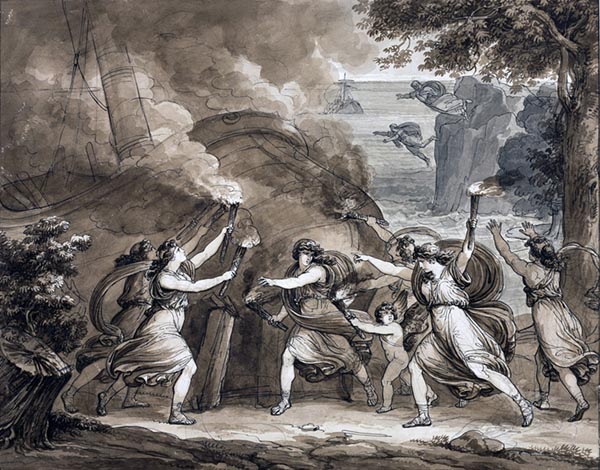
‘Cupid advises Calypso to set fire to Mentor’s ship.’ (1808) - Bartolomeo Pinelli (Italian, 1781-1835)
Artvee
Eros, satisfied in having persuaded her, went to persuade the nymphs as well, who were roaming and dispersed all over the mountains like a flock of sheep that the rage of famished wolves put in flight far from the shepherd. Eros gathers them and says, “Telemachus is still in your hands. Hasten to burn that vessel, which the brazen Mentor built in order to flee.”
Quickly, they light torches. They run along the shore. They shudder. They howl. They shake their disheveled hair like maenads. Already the flame soars. It devours the vessel, which is of a dry wood, coated with resin. Swirls of smoke and flame rise to the clouds.
Telemachus and Mentor spot the fire from the top of the cliff and hear the screams of the nymphs. Telemachus was tempted to rejoice with them, for his heart was not yet healed, and Mentor noticed that his passion was like a fire poorly put out that emerges from time to time from beneath the ashes and rises again from live sparks.
“Well… here I am,” said Telemachus, “back in my chains. There no longer remains any hope of us quitting this island.”
Mentor saw well that Telemachus was going to fall back into all his weaknesses, and that there was not a moment to lose. He spied in the distance, amidst the swells, a stalled vessel that dared not approach the island, for every pilot knew the island of Calypso was inaccessible to all mortals. Immediately, wise Mentor, pushing Telemachus who was seated on the edge of the cliff, hurls him into the sea and leaps in with him. Telemachus, startled by this violent fall, drank bitter water and became the toy of the waves. But, returning to himself and seeing Mentor, who was holding out his hand to help him swim, he no longer thought of anything but distancing himself from the fatal island.
The nymphs, who had believed they held them captive, loosed screams full of fury, no longer able to prevent their flight. Calypso, inconsolable, reentered her grotto, which she filled with her howls. Love, who saw his triumph change into a shameful defeat, rose up to the middle of the air, fluttering his wings, and flew into the grove of Idalium, where his cruel mother was waiting for him. The child, even more cruel, only consoled himself by laughing with her at all the evils he had done.
As Telemachus distanced himself from the island, he felt with pleasure his courage born again, along with his love for virtue.
“I am experiencing,” he shouted out, telling Mentor, “what you told me and what I could not believe for lack of experience—one only overcomes vice in fleeing it. O my father, how the gods have loved me in giving me your help! I merited being deprived of it and being abandoned to myself. I no longer fear the seas, the winds, or the tempests. I no longer fear anything but my passions. Love is itself alone more to be feared than all shipwrecks.”
END OF BOOK VI