François Fénelon
The Adventures of Telemachus
Books VII to IX
Translated by N. Hewitt © Copyright 2025 All Rights Reserved.
No part of this publication may be reproduced or transmitted in any form or by any means, electronic or mechanical, including photocopy, recording, or any information storage and retrieval system, without permission in writing from the publisher. For information about permission to reproduce selections from this book, please write to Fenelon Classics LLC, PO Box 22041, Houston, Texas 77227 or [email protected].
Contents
BOOK VII
The stalled vessel toward which they advanced was a Phoenician vessel going to Epirus. Those Phoenicians had seen Telemachus on the Egyptian voyage but could hardly recognise him amidst the waves. When Mentor was close enough to the vessel to make his voice heard, he cried out in a loud voice, raising his head above the water, “Phoenicians, so helpful to all nations, do not deny life to two men who expect it of your humanity. If respect for the gods touches you, receive us onto your vessel. We will go wherever you go.”
The one who was in command answered, “We will receive you with joy. We are not ignorant of what one must do for strangers who appear so unfortunate.”
Straightaway, they received them onto the vessel. Barely were they boarded when, no longer able to breathe, they remained still, for they had swum for a long time and with effort, fighting against the surf. Little by little, they regained their strength. They were given other garments because theirs were weighed down with water that soaked them and streamed from all sides. When they were in a state to speak, all those Phoenicians pressing round them wanted to know of their adventures.
The one in command said to them, “How were you able to get onto that island you left? It is, they say, possessed by a cruel goddess, who never suffers one landing there. It is even rimmed with frightful rocks against which the sea madly fights, and one could not approach it without wrecking.”
Mentor answered, “We were cast there. We are Greek. Our homeland is the island of Ithaca, neighbouring Epirus, where you are headed. Even if you would not wish to put in at Ithaca, which is on your route, it will suffice that you carry us to Epirus. We will find friends there who will help us make the short crossing that remains, and we will forever owe you for the joy of seeing again what we have of the most dear in the world.”
So then, it was Mentor who spoke and Telemachus, keeping silent, let him speak, for the errors he had made on the island of Calypso had greatly increased his wisdom. He distrusted himself; he felt the need to always follow the wise counsel of Mentor, and when he could not speak to him to ask his advice, he at least consulted his eyes and tried to guess all his thoughts.
The Phoenician commander, settling his eyes on Telemachus, believed to remember having seen him, but it was a confused memory that he could not sort out.
“Suffer,” he said, “that I ask you if you remember having seen me another time, as it seems to me that I remember having seen you. Your face is not unknown to me. It struck me immediately, but I do not know where I have seen you. Your memory, perhaps, will aid mine.”
Then Telemachus answered with an astonishment mixed with joy, “I am, seeing you, as you are with regard to me—I saw you, I recognised you, but I could not recall if it was in Egypt or in Tyre.”
Then this Phoenician, like a man who awakes in the morning, and who, little by little, recalls from a distance the fugitive dream that disappeared upon awakening, exclaimed all of a sudden, “You are Telemachus, whom Narbal took in friendship when we were returning from Egypt! I am his brother, whom he will undoubtedly have spoken of often. I left you in his hands after the Egyptian expedition. I had to go beyond all the seas into the famous Baetica, near the Pillars of Heracles. Consequently, I only caught sight of you, and it should not be astonishing if I had so much difficulty recognising you at first.”
“I see indeed that you are Adoam. I only caught a glimpse of you then, but I knew of you through conversations with Narbal. O what joy to be able to learn through you news of a man who will always be so dear to me. Is he still in Tyre? He did not suffer some cruel treatment from the suspicious and barbarous Pygmalion?”
Adoam answered, interrupting him, “Know, Telemachus, that favourable Fortune entrusts you to a man who will take every kind of care of you. I will take you back to the island of Ithaca before going on to Epirus, and Narbal’s brother will have no less friendship for you than Narbal himself.”
Having spoken so, he noticed the wind that he was waiting for was beginning to blow. He had the anchors raised, set the sails, and ploughed the sea by dint of oars. Straightaway, he took Telemachus and Mentor aside, to talk with them.
“I am going,” he said, looking at Telemachus, “to satisfy your curiosity. Pygmalion is no more. The just gods have delivered the earth from him. As he trusted no one, no one could trust him. The good contented themselves with groaning and fleeing his cruelties, unable to resolve themselves to do him any harm. The wicked believed they could only assure their lives by ending his. There was not one Tyrian who was not at risk each day of being the object of his distrust. His very guards were more exposed than the others. As his life was in their hands, he feared them more than all the rest of men. At the least suspicion, he sacrificed them to his safety. So, by dint of seeking his safety, he could no longer find it. Those who were the keepers of his life were in a continual peril through his distrust, and they could only get out of so horrible a state by preventing, through the death of the tyrant, his cruel suspicions.
“The impious Astarbe, of whom you have heard spoken so often, was the first to resolve the loss of the king. She passionately loved a very rich young Tyrian named Joazar. She hoped to put him on the throne. To succeed in this scheme, she persuaded the king that the eldest of his two sons, named Phadael, impatient to succeed his father, had conspired against him. She found false witnesses to prove the conspiracy. The wretched king had his innocent son killed. The second, named Baleazar, was sent to Samos under the pretext of learning the mores and sciences of Greece. But in reality, it was because Astarbe convinced the king that he must drive him away for fear that he might form liaisons with the malcontents. Barely had he departed, when those who steered the vessel, having been corrupted by this cruel woman, took measures to wreck during the night. They saved themselves by swimming to foreign barges that were waiting for them, and they flung the young prince to the bottom of the sea.
“Meanwhile, Astarbe’s amours were unknown only to Pygmalion, and he imagined that she would only ever love him alone. This prince, so distrustful, was thus filled with a blind confidence in this wicked woman. It was love that blinded him so excessively. At the same time, avarice caused him to seek pretexts to kill Joazar, for whom Astarbe was so passionate. He only thought of stealing the riches of that young man.
“But while Pygmalion was prey to distrust, love and avarice, Astarbe hastened to take his life. She believed he had perhaps discovered something of her infamous amours with that young man. Besides, she knew that avarice alone would suffice to carry the king to a cruel act against Joazar. She concluded that there was not a moment to lose to prevent it: she saw the principal officers of the palace ready to dip their hands in the blood of the king; she heard some new conspiracy spoken of every day. But she feared confiding in anyone who might betray her. In the end, it seemed safest to poison Pygmalion.
“He ate most often all alone with her and prepared all he should eat himself, only able to trust his own hands. He confined himself to the most remote part of his palace so as to better hide his distrust and to never be observed when he prepared his meals. He no longer dared seek any pleasures of the table. He could not resolve himself to eat any of the things he did not know how to prepare himself. So, not only all the meats cooked with rich sauces by the cooks, but even wine, bread, salt, milk, and all the other usual foods could not be of use to him. He only ate fruits he had picked himself in his garden, or vegetables he had sown and cooked. Furthermore, he never drank any water other than what he drew for himself from a spring that was locked up in a part of his palace to which he always kept the key. Even though he seemed so filled with confidence in Astarbe, he did not fail to take precautions. He always had her eat and drink before him everything that should serve as his meal so that he could not be poisoned without her, and she would have no hope of living longer than him. But she took an antidote that an old woman—even more wicked than she and who was the confidante of her amours—supplied her, after which she no longer feared poisoning the king.
“This is how she went about it. At the moment when they were beginning their meal, this old woman, of whom I spoke, suddenly made a noise at a door. The king, who always believed that someone was going to murder him, is troubled and runs to this door to see if it is closed well enough. The old woman withdraws. The king remains taken aback, not knowing what he should think of what he had heard. He does not dare, however, open the door to find out. Astarbe reassures him, flatters him, and presses him to eat. She had already tossed the poison into his golden cup while he was going to the door. Pygmalion, according to his custom, had her drink first. She drank without fear, trusting the antidote. Pygmalion also drank, and a short time afterward he fell into a faint.
“Astarbe, who knew him to be capable of killing her over the slightest suspicion, began to rend her garments, pull out her hair, and loose lamentable wails. She embraced the dying king, she held him tightly in her arms, she drenched him in a torrent of tears—for tears cost nothing to this artful woman. Finally, when she saw that the king’s forces were drained, and that he was in the throes of death, for fear of him coming round and wanting her to die with him, she passed from caresses and the most tender marks of friendship to the most horrific fury. She threw herself on him and smothered him. Then she snatched from his finger the royal ring, removed the diadem from him, and had Joazar enter, to whom she gave the one and the other.
“She believed that all those who had been attached to her would not fail to follow her passion and that her lover would be proclaimed king. But those who had been the most eager to please her, being of low and mercenary minds, were incapable of sincere affection. Besides, they lacked courage and feared the enemies Astarbe attracted. In the end, they feared the haughtiness, the dissimulation, and the cruelty of this impious woman even more. Each, for his own safety, desired she perish.
“Meanwhile, the entire palace is filled with a dreadful tumult. Everywhere, cries can be heard of those saying, ‘The king is dead.’
Some are frightened. Others run to arms. All appear troubled in the aftermath yet delighted by this news. Rumour causes it to fly from mouth to mouth throughout the great city of Tyre, and not a single man is found who laments the king. His death is the deliverance and the consolation of all the people.
“Narbal, struck by so terrible a blow, deplored as a good man the misfortune of Pygmalion, who had betrayed himself in delivering himself over to the impious Astarbe, and who had preferred being a terrifying and monstrous tyrant to being, according to the duty of a king, the father of his people. Narbal thought of the welfare of the state and hastened to rally all the good people to oppose Astarbe, under whom they would have seen a reign even more harsh than the one they saw end.
“Narbal knew that Baleazar had not drowned when he was flung into the sea. Those who assured Astarbe that he was dead spoke so believing that he was. But, thanks to the cover of darkness, he saved himself by swimming, and Cretan fishermen, touched with compassion, had received him onto their barge. He had not dared return to the kingdom of his father, suspecting that they had wanted to slay him, and fearing the cruel jealousies of Pygmalion as much as the artifices of Astarbe. For a long time, he remained wandering and disguised on the edge of the sea in Syria, where the Cretan fishermen had left him. He was even obliged to guard a flock to earn his living. Finally, he found a means of letting Narbal know the state he was in. He believed he could confide his secret and his life to a man of such proven virtue. Narbal, poorly treated by the father, never stopped loving the son and watching out for his interests. But he only looked after them in order to keep him from ever failing in what he owed his father, and he enlisted him to suffer his bad fortune patiently.
“Baleazar had summoned Narbal, ‘If you judge that I can come and find you, send me a golden ring, and I will immediately understand that it is time to join you.’
“Narbal did not judge it appropriate, while Pygmalion was alive, to have Baleazar come. He would have risked everything, the life of the prince and his own, as difficult as it was to protect oneself from the rigorous searches of Pygmalion. But, as soon as that wretched king had met an end worthy of his crimes, Narbal hastened to send the golden ring to Baleazar. Baleazar immediately departed and arrived at the gates of Tyre during the time that all the city was in turmoil to know who would succeed Pygmalion. Baleazar was easily recognised by the principal Tyrians and by all the people. They loved him, not for love of the late king, his father, who was universally hated, but because of his gentleness and his restraint. Even his long misfortunes gave him something of a radiance that enhanced all his good qualities and touched the hearts of all the Tyrians in his favour.
“Narbal assembled the leaders of the people, the elders who formed the council, and the priests of the great Phoenician goddess. They bowed to Baleazar as their king and had him proclaimed by heralds. The people responded with a thousand acclamations of joy. Astarbe heard them from the depths of the palace where she was shut up along with her cowardly and infamous Joazar. All the wicked who had served her during Pygmalion’s lifetime had abandoned her—for the wicked fear the wicked, distrust them, and do not wish to see them in positions of influence. Corrupt men know well how much their kind would abuse authority, and how violent they would be. But as for the good, the wicked are more adapting because at least they hope to find in them restraint and indulgence. There only remained around Astarbe certain accomplices to her most dreadful crimes who could only expect torture. The palace was stormed. Those scoundrels dared not resist for long and only thought to flee. Astarbe, disguised as a slave, wanted to escape into the crowd, but a soldier recognised her. She was taken, and they had great difficulty keeping her from being ripped apart by the enraged people. They had already begun dragging her through the mud. But Narbal pulled her from the hands of the rabble. Then she asked to speak to Baleazar, hoping to dazzle him with her charms and make him hope that she would reveal important secrets to him. Baleazar could not refuse listening to her. At first she displayed, along with her beauty, a sweetness and a modesty capable of touching the angriest hearts. She flattered Baleazar through the most delicate and insinuating praises. She represented to him how much Pygmalion had loved her. She beseeched him on Pygmalion’s ashes to have mercy on her. She invoked the gods, as if she had sincerely venerated them. She shed torrents of tears. She threw herself at the knees of the new king. But then, she did her utmost to render suspect and odious to him all the servants most attached to him. She accused Narbal of having entered into a conspiracy against Pygmalion and of having tried to suborn the peoples in order to make himself king to the detriment of Baleazar. She added that he wanted to poison this young prince. She invented similar calumnies against all the other Tyrians who love virtue. She hoped to find in the heart of Baleazar the same distrust, and the same suspicions, that she had seen in that of the king, his father. But Baleazar, no longer able to tolerate the black malignity of this woman, interrupted her and called the guards. They put her in prison.
“The wisest elders were commissioned to examine all her deeds. They discovered with horror that she had poisoned and smothered Pygmalion. The entire course of her life seemed a continuous chain of monstrous crimes. They were going to condemn her to the torture meant to punish the greatest crimes in Phoenicia: being burned to death over a low flame. But when she realised that there no longer remained any hope for her, she became like a Fury out of the Underworld. She swallowed the poison that she always carried to kill herself should they want to make her suffer long tortures. Those who were guarding her saw that she was suffering violent pain. They wanted to help her, but she never wanted to answer them and she motioned that she wanted no relief. They spoke to her of the just gods she had angered. Instead of showing shame and repentance for what her wrongdoings merited, she glared at the sky with scorn and arrogance, as if to insult the gods.
“Rage and impiety were painted on her dying face. One no longer saw any remnant of that beauty that had caused the misfortune of so many men. All her charms were rubbed out. Her lifeless eyes rolled into her head and cast fierce looks. A convulsive movement contorted her lips and her mouth gaped horrifically. Her entire face, drawn and shrunken, grimaced hideously. A livid pallor and a mortal chill had seized her entire body. Sometimes she seemed to come round, but it was only to let loose howls. Finally, she expired, leaving filled with horror and fright all those who witnessed it. Undoubtedly, her impious manes descended into those sad places where the cruel Danaids eternally draw water into porous vessels, where Ixion forever turns his wheel, where Tantalus, scorched with thirst, cannot swallow the water that flees from his lips, where Sisyphus uselessly rolls a rock that tumbles again without ceasing, and where Tityus will eternally feel, in his ever-regenerating entrails, a vulture gnawing away at them.
“Baleazar, delivered from this monster, rendered thanks to the gods through countless sacrifices. He began his reign with conduct completely opposite that of Pygmalion. He applied himself to making commerce—which was languishing more and more every day—flourish again. He has taken Narbal’s counsel with regard to the most important affairs of state and yet is not governed by him—for he wants to see everything himself; he listens to all the different opinions that they want to offer him, and then he decides what seems the best to him. He is loved by the peoples. In possessing their hearts, he possesses more treasures than his father had amassed through his cruel avarice, for there is no family who would not give him all that they have of property should he find himself in a pressing need. In this way, what he leaves them is more his than if he took it away from them. He does not need to take precautions for his personal safety, for he always has around him the most sure guard, which is the love of the peoples. There is not one of his subjects who does not fear losing him and who would not risk his own life to preserve that of so good a king. He lives happily, and all his people are happy along with him. He fears overburdening his peoples. His peoples fear not offering him a large enough portion of their goods. He leaves them in abundance, and this abundance renders them neither unruly nor insolent, for they are hard-working, devoted to commerce, steadfast in preserving the purity of the old laws. Phoenicia has ascended back to the height of her grandeur and glory. It is to her young king that she owes such prosperity. Narbal governs under him.
“O Telemachus, if he could see you now, with what joy would he shower you with presents! What pleasure it would be for him to send you back magnificently into your homeland! Am I not happy to do what he would want to be able to do himself, going into the island of Ithaca to put the son of Odysseus on the throne so that he reigns as wisely there as Baleazar reigns in Tyre?”
After Adoam had spoken so, Telemachus, enchanted by the story this Phoenician had just recounted, and even more by the marks of friendship he had received from him in his misfortune, embraced him tenderly. Then Adoam asked him by what adventure he had gotten onto the island of Calypso. Telemachus recounted to him in turn the story of his departure from Tyre, his passage into the island of Cyprus, the manner by which he had found Mentor again, their voyage to Crete, the public games for the election of a king after the flight of Idomeneus, the anger of Aphrodite, their shipwreck, the pleasure with which Calypso had received them, the jealousy of this goddess of one of her nymphs, and the action of Mentor, who had flung his friend into the sea as soon as he saw the Phoenician vessel.
After these conversations, Adoam had a magnificent meal served, and, to bear witness to a greater joy, he brought together all the pleasures one could enjoy. During the meal, which was served by young Phoenicians dressed in white and crowned with flowers, they burned the most exquisite perfumes of the East. All the rowing benches were filled with flutists. Achitoas interrupted them from time to time with the sweet harmony of his voice and his lyre, worthy of being heard at the table of the gods and delighting the ears of Apollo himself. The Tritons, the Nereids, all the deities who obey Poseidon, even the sea monsters, came out of their damp and deep grottos to come in droves around the vessel, entranced by this melody. A troupe of young Phoenicians of a rare beauty and dressed in fine linen whiter than snow danced the dances of their country for a long time, followed by those of Egypt and, finally, those of Greece. From time to time, trumpets reverberated over the water to distant shores. The silence of the night, the calm of the sea, the trembling light of the moon spread over the surface of the waters, the dark blue of the skies sprinkled with shining stars, served to render this spectacle even more beautiful.
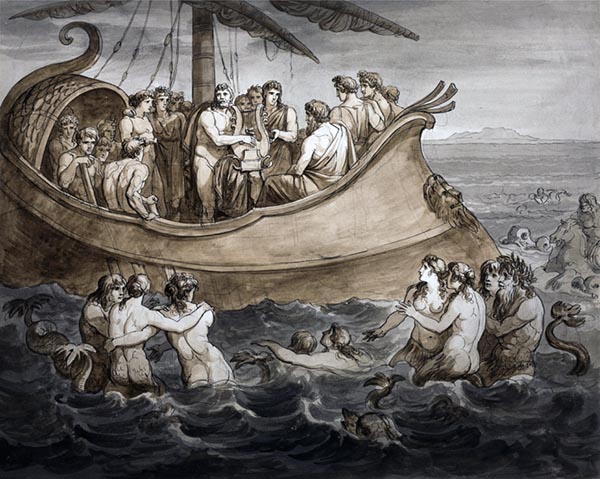
‘Telemachus and Mentor in a galley after fleeing the island of Calypso.’ (1808) - Bartolomeo Pinelli (Italian, 1781-1835)
Artvee
Telemachus, of a keen and sensitive nature, was enjoying all these pleasures, but he dared not deliver his heart over to them. Since he had so shamefully experienced, on the island of Calypso, how quick youth is to become inflamed, every pleasure, even the most innocent, frightened him. All was suspect to him. He looked at Mentor. He searched his face and his eyes for what he should think of all these pleasures.
Mentor was glad to see him in this dilemma and pretended not to notice. Finally, touched by Telemachus’ restraint, he said to him, smiling, “I understand what you fear. You are laudable for this fear. But you must not push it too far. No one would ever wish more than me for you to enjoy pleasures, but pleasures that neither impassion nor soften you. They should be pleasures that relax you and that you enjoy while in possession of yourself, but not pleasures that sweep you away. I wish sweet and moderate pleasures for you that do not rob you of reason and that never make you like an enraged beast. Now it is appropriate for you to unwind from all your difficulties. Enjoy, in deference to Adoam, the pleasures that he offers you. Rejoice, Telemachus, rejoice. Wisdom has nothing of austerity or affectation. It is what gives true pleasure. It alone knows how to season pleasures to make them pure and lasting. It knows how to mix games and laughter with grave and serious business. It prepares for pleasure through work and relaxes from work through pleasure. Wisdom is not ashamed of appearing playful when necessary.”
While speaking, Mentor took up a lyre and played it so artfully that Achitoas, jealous, allowed his to fall from spite. His eyes sparked, his distressed face changed colour. Everyone would have seen his pain and his shame had Mentor’s lyre not captured the hearts and souls of all there. They hardly dared breathe for fear of disturbing the silence and missing something of that divine song. They continually feared he would finish too soon. Mentor’s voice had no effeminate sweetness. Rather it was supple, strong, and impassioned even the least things.
First, he sang the praises of Zeus, father and king of the gods and men, who, with a nod of his head, rattles the universe. Then he represented Athena who came out of the head of Zeus—that is to say, wisdom that this god shapes within himself and that comes out of him so as to instruct docile men. Mentor sang these truths in a tone so religious and so sublime that the entire assembly believed themselves transported to the heights of Olympus before Zeus, whose gaze is more piercing than his thunder. Afterward, he sang of the misfortune of young Narcissus, who, becoming so madly in love with his own beauty that he incessantly gazed at himself on the banks of a spring, was consumed with pain, and was changed into a flower that bears his name. Finally, he also sang of the gruesome death of beautiful Adonis, whom a wild boar ripped apart and whom Aphrodite, passionate for him, could not bring back to life by complaining bitterly to heaven.
All those listening to him could not hold back their tears, and each felt an indescribable pleasure in weeping. When he had ceased singing, the stunned Phoenicians looked at each other. One said, “It is Orpheus. That is how, with a lyre, he tamed the ferocious beasts and enraptured the woods and the rocks. That is how he enchanted Cerberus, how he suspended the torments of Ixion and the Danaids, and how he touched the inexorable Hades so as to extract the beautiful Eurydice from the Underworld.”
Another exclaimed, “No, it is Linus, the son of Apollo.”
Another responded, “You are wrong. It is Apollo himself.”
Telemachus was hardly less surprised than the others, for he had never thought Mentor would know how, with so much perfection, to sing and to play the lyre.
Achitoas, who had had time to hide his jealousy, began to praise Mentor, but he blushed while praising him and he could not finish his speech. Mentor, who saw his distress, spoke up as if he had wanted to interrupt him and tried to console him by giving him all the praises he merited. Achitoas was not consoled, for he felt Mentor surpassed him even more in his modesty than in the enchantments of his voice.
Meanwhile, Telemachus said to Adoam, “I remember that you spoke to me of a voyage you had made into Baetica after we were parted in Egypt. Baetica is a country of which such wonders are told that one can hardly believe them. Deign to inform me if all they say of it is true.”
“I would be glad,” responded Adoam, “to depict to you this famous country worthy of your curiosity, which surpasses all that Rumour trumpets of it.” Immediately, he began in this way:
“The Baetis river runs through a fertile country and under a gentle sky that is always serene. The country took the name of the river that flows into the great Ocean somewhat near the Pillars of Heracles and from that spot where the furious sea, breaking its dikes, once separated the land of Tharsis from great Africa. This country seems to have preserved the delights of the golden age. The winters there are warm, and the rigorous Northwind never blows. The blazing heat of summer is always tempered by refreshing zephyrs that come to soften the air toward the middle of the day. So, all year round is just a happy marriage of springtime and autumn, who seem to hold each other’s hand. The land in the vales and in the flat countrysides bear a double harvest each year. There, the trails are fringed with laurel trees, pomegranate trees, jasmine, and other trees, ever-green and ever-blooming. The mountains are covered with flocks that supply fine wools sought after by all the known nations. There are several gold and silver mines in this beautiful country. But the inhabitants, simple, and happy in their simplicity, do not even deign to count silver and gold among their riches. They only esteem what truly serves the needs of man.
“When we began to trade with these peoples, we found the gold and silver among them employed for the same uses as iron, such as the blades of ploughs, for example. As they did no commerce outside, they had no need of any money. They are almost all shepherds or ploughmen. Few artisans are seen in this country, for they only want to tolerate the arts that serve the true necessities of men. Even so, most of the men in this country, being devoted to agriculture or to driving flocks, do not fail to exercise the arts necessary for their simple and frugal life.
“The women spin this beautiful wool and make a fine cloth of a marvellous white from it. They make the bread, prepare the meals, and this work is easy for them, for one sees in this country fruits or milk, and rarely beef. They use the hide of their sheep to make a light shoe for themselves, their husbands, and their children. They make tents, some of which are of waxed pelts and others of stripped tree bark. They make, they wash all the garments of the family and keep the homes in an admirable orderliness and cleanliness. Their garments are easy to make, for in this gentle climate, one only wears a piece of fine and light cloth that is not tailored and that each of them arranges in long folds around the body for modesty, giving it the shape they desire.
“The men have no other arts to exercise, outside of the cultivation of land and the driving of flocks, than the art of working with wood and iron. Nevertheless, they hardly make use of iron, except for the instruments needed for ploughing. All the arts having to do with architecture are useless to them, for they never build houses. ‘That is,’ they say, ‘attaching oneself too much to the land, to build a dwelling on it that lasts so much longer than us. It suffices to protect oneself from the assaults of the air.’
“As for all the other arts esteemed by the Greeks, the Egyptians, and all other well-governed peoples, they detest them as inventions of vanity and softness. When you speak to them of the peoples who have the art of making superb buildings, gold and silver furnishings, fabrics embellished with embroidery and precious stones, exquisite perfumes, delicious dishes, musical instruments of enchanting harmony, they respond in these terms:
‘Those people are unfortunate indeed, to have employed so much work and cleverness to corrupt themselves. That superfluity softens, intoxicates, torments those who possess it. It tempts those who are deprived of it to want to acquire it through injustice and violence. Can one call ‘good’ a superfluity that only serves to render men bad? The men of these lands, are they healthier and more robust than us? Do they live longer? Are they more united among themselves? Do they lead a life more free, more tranquil, more cheerful? On the contrary, they must be jealous of one another, gnawed at by a craven and black envy, always tormented by ambition, by fear, by avarice, incapable of pure and simple pleasures since they are slaves to so many false necessities on which they make all their happiness depend.’
“This is how these wise men speak,” continued Adoam, “who only learned wisdom in studying simple nature. They are horrified by our politesse, and it must be confessed that theirs is great in its lovable simplicity. They live all together without dividing the lands. Each family is governed by its chief, who is the true king over them. The father of the family has the right to punish each of his children or grandchildren who does a bad deed. But before punishing them, he takes the opinion of the rest of the family. These punishments almost never happen, for the innocence of the mores, good faith, obedience, and a horror of vice live in this happy land.
“It seems that Astraea, who they say retreated into the sky, is still here below hidden among these men. Judges are not needed among them for their own conscience judges them. All goods are common. The fruits of the trees, the vegetables of the land, the milk from the flocks are riches so abundant that people so sober and restrained have no need of dividing them. Each family, roaming in this beautiful country, carries their tents from one place to another when they have consumed the fruits and exhausted the grazing land in the spot where they were. So, they have no interest in supporting one against another, and they all love each other with a brotherly love that nothing troubles. It is the curtailment of vain riches and deceptive pleasures that preserves this peace, this union, and this liberty for them. They are all free and all equal.
“There is no distinction to be found among them other than what comes from the experience of the wise old men or the extraordinary wisdom of some young men that equals the old men steeped in virtue. Fraud, violence, perjury, trials, wars never make their cruel and pestilent voices heard in this country cherished by the gods. Never has human blood reddened this land; barely do you see that of lambs flow. When one speaks to these peoples of bloody battles, rapid conquests, the overthrow of states that are seen in other nations, they cannot be astonished enough.
“‘What!’ They say. ‘Men, are they not mortal enough without giving themselves, and even each other, an early death? Life is so short! And it seems that it appears too long for them! Are they on earth to rip each other apart and render each other mutually unhappy?’
“Moreover, these peoples of Baetica cannot understand how we so admire conquerors who subjugate great empires.
“‘What madness,’ they say, ‘to put one’s happiness in governing other men, the governance of whom is so difficult if one wants to govern them with reason and according to justice. But why take pleasure in governing them in spite of themselves? It is all a wise man can do in wanting to subject himself to governing a docile people with whom the gods have charged him, or a people who beg him to be their father and their shepherd. But to govern peoples against their will, that is to make yourself very miserable in order to have the false honour of holding them in slavery. A conqueror is a man whom the gods, angry with mankind, have given the earth in their anger to ravage kingdoms, spread fright, misery, despair everywhere, and to make as many slaves as there are free men. A man who seeks glory, will he not find enough of it in wisely leading what the gods have placed in his hands? Does he think he can only merit praise in becoming violent, unjust, haughty, usurping, tyrannical over all his neighbours? War must only ever be considered in order to defend his liberty. Happy is the one who, not being the slave of another, does not have the mad ambition to make another his slave! Those great conquerors who are depicted to us with so much glory resemble those rivers overflowing their banks that look majestic, yet ravage all the fertile countryside that they should only water.’”
After Adoam had given this portrayal of Baetica, Telemachus, enchanted, posed various questions to him out of curiosity.
“These people, do they drink wine?”
“They drink hardly any,” resumed Adoam, “for they have never wanted to make any. It is not that they lack grapes. No land bears more delicious ones. But they are content to eat the grape like other fruits, and they fear wine as the corrupter of men.
“‘It is a type of poison,’ they say, ‘that enrages. It does not kill man, but it renders him beastly. Men can preserve their health and their strength without wine; with wine, they run the risk of ruining their health and of losing good mores.’”
Then Telemachus said, “I would very much like to know what laws regulate marriages in this nation.”
“Each man,” answered Adoam “can have only one wife, and he must keep her as long as she lives. The honour of men in this country depends as much on their fidelity with regard to their wives as the honour of wives depends, among other peoples, on their fidelity to their husbands. Never were a people so honest, or so jealous of purity. There, the wives are beautiful and pleasant, yet natural, modest, and hard-working. There, the marriages are peaceful, fruitful, unstained. The husband and wife seem to no longer be but a single person in two different bodies. The husband and wife together share all the domestic cares. The husband puts all the outside affairs in order while the wife confines herself to her housework; she unburdens her husband, she seems to be created to please only him. She wins his confidence and enchants him less by her beauty than by her virtue. This true enchantment in their companionship lasts as long as their lives. Sobriety, moderation, and the pure mores of this people give a long life to them, exempt from maladies. There, one sees old men of a hundred, a hundred twenty years, who still have gaiety and vigour.”
“It remains for me to know,” added Telemachus, “what they do to avoid war with other neighbouring peoples.”
“Nature,” said Adoam, “has separated them from other peoples on the one side by the sea, on the other by the high mountains of the north. Besides, the neighbouring peoples respect them because of their virtue. Often, other peoples, unable to agree among themselves, have taken them as judges of their differences and have entrusted to them the lands and cities they were disputing over. As this wise nation has never done any violence, no one is distrustful of it. They laugh when one speaks to them of kings who cannot sort out the borders of their states among themselves.
“‘Can they fear,’ they say, ‘that land is lacking to men? There will always be more of it than they will be able to cultivate. As long as there remains open and uncultivated lands we would not even want to defend ours against neighbours who would want to seize it.’
“Neither pridefulness, nor haughtiness, nor bad faith, nor the desire to extend their dominion are found throughout the inhabitants of Baetica. So, their neighbours never have anything to fear from such a people, and they cannot hope to make themselves feared by them; that is why they leave them in repose. This people would abandon their country or deliver themselves over to death rather than accept servitude. Therefore, they are as difficult to subjugate as they are incapable of wanting to subjugate others. This is what causes a profound peace between them and their neighbours.”
Adoam finished this discourse by recounting the manner in which the Phoenicians conduct their commerce in Baetica.
“These peoples,” he said, “were astonished when they saw crossing the waters of the sea strange men who came from so far. They allowed us to found a city on the island of Gibraltar. They even received us with kindness and gave us part of all they had without wanting any payment from us. Moreover, they offered to liberally give us all that remained of their wools after they had made provision for their use and, indeed, they sent us a rich present of them. It is a pleasure for them to give their superfluity to foreigners.
“As for their mines, they had no difficulty abandoning them to us, they were useless to them. It seemed to them that men were hardly wise to go seeking through so much work, in the bowels of the earth, that which can neither render them happy nor satisfy any true need.
“‘Do not dig,’ they told us, ‘so deep into the earth. Be contented to plough it. It will give you true goods that will nourish you. You will draw from it fruits that are worth more than gold and silver, since men only want gold and silver to buy the foods that sustain their life.’
“We had often wanted to teach navigation to them and bring the young men of their country into Phoenicia. But they never wanted their children to learn to live like us.
“‘They would learn,’ they told us, ‘to need all the things that have become necessities to you. They would want to have them. They would abandon virtue to obtain them through evil skills. They would become like a man who has good legs and who, losing the habit of walking, finally accustoms himself to the need of always being carried like a sick person.’
“As for navigation, they admire it because of the cleverness of this art, but they believe it is a pernicious art. ‘If those people,’ they say, ‘sufficiently have in their country that which is necessary for life, what are they going to seek in another? That which suffices the needs of nature, is it not sufficient for them? They would merit shipwreck, since they seek death amidst the tempests in order to assuage the avarice of merchants and to flatter the passions of other men.’
Telemachus was delighted to hear these discourses of Adoam, and he rejoiced that there were still in the world a people who, in following simple nature, were so wise and so happy together.
“O how distant those mores are,” he said, “from the vain and ambitious mores of the peoples whom we believe the wisest! We are so spoiled that we can barely believe such natural simplicity could truly be. We look upon the mores of those people as a beautiful fable, and they must look upon ours as a horrific dream.”
END OF BOOK VII
BOOK VIII
While Telemachus and Adoam were talking so, forgetting sleep and not noticing the night was already in the middle of its course, a hostile and deceiving deity was distancing them from Ithaca, which their pilot, Acamas, was seeking in vain. Poseidon, though favourable toward the Phoenicians, could no longer bear that Telemachus had escaped the tempest that had flung him against the rocks of the island of Calypso. Aphrodite was even angrier seeing this young man triumphant, having vanquished Eros and all his spells. In the transport of her pain, she quit Cythera, Paphos, Idalium, and all the honours that are rendered to her on the island of Cyprus. She could no longer stay in those places where Telemachus had scorned her empire. She ascended toward brilliant Olympus where the gods were assembled alongside the throne of Zeus.
From there they behold the celestial bodies wheeling under their feet. They can see the sphere of the earth like a little mass of mud. The immense seas appear to them as mere drops of water from which this morsel of mud is a bit sodden. The greatest kingdoms are, to their eyes, only a little sand that covers the surface of this mud. The countless peoples and the mightiest armies are like mere ants disputing over a blade of grass on this morsel of mud. The immortals laugh at the most serious affairs that agitate weak mortals, and they appear as child’s play to them. What men call grandeur, glory, power, deep politics, seem to these supreme deities as only misery and weakness.
It is in that spot, so elevated above earth, that Zeus set his immovable throne. His eyes pierce into the abyss and light up the deepest recesses of hearts. His gentle and serene gaze spreads calm and joy throughout the universe. On the contrary, when he shakes his locks, he rattles Heaven and Earth. Even the gods, dazzled by the glorious rays that surround him, only approach him with trembling. All the celestial deities are at that moment alongside him. Aphrodite presents herself to him with all the enchantments that blossom in her bosom. Her flowing robe had more radiance than all the colours with which Iris drapes herself in the midst of the gloomy clouds when she comes to promise frightened mortals the end of tempests and to announce the return of beautiful weather. Her robe was knotted with that famous belt on which the Graces appear. The hair of the goddess was casually gathered behind with a golden braid. All the gods were startled by her beauty, as if they had never seen her, and their eyes were dazzled by it, like those of mortals are when Phoebus, after a long night, comes to shine on them with his rays. They regarded each other with astonishment, and their eyes always came back to Aphrodite. But they saw that the eyes of that goddess were bathed in tears, and a bitter pain was painted on her face. Meanwhile, she advanced toward the throne of Zeus with a soft and light step, like the rapid flight of a bird parts the immense space of the air. Regarding her with complaisance, he gave her a gentle smile and, rising, he embraced her.
“My dear daughter,” he said to her, “what troubles you? I cannot see your tears without being touched by them. Do not fear opening up your heart to me. You know my affection and my complaisance.”
Aphrodite answered him in a voice sweet, but choked by deep sighs, “O father of the gods and men, you who see all, can you not know what causes my difficulty? Athena is not satisfied having knocked to its foundations the lofty city of Troy, which I defended, and having taken revenge on Paris, who had preferred my beauty to hers. She leads round all the lands and round all the seas the son of Odysseus, that cruel destroyer of Troy. Telemachus is accompanied by Athena. That is what keeps her from appearing here in her rank with the other deities. She led that brash young man onto the island of Cyprus to outrage me. He scorned my might. Not only did he not deign to burn incense on my altars, but he expressed horror for the feasts that are celebrated in my honour. He closed his heart to all my pleasures. In vain, Poseidon, to punish him at my request, whipped up the winds and the waves against him. Telemachus, cast by a horrible shipwreck onto the island of Calypso, triumphed over Eros himself, whom I had sent onto the island to touch the heart of that young Greek. Neither his youth, nor the spells of Calypso, nor her nymphs, nor the flaming shafts of Love were able overcome the artifices of Athena. She snatched him from that island. Here I am, foiled. A child triumphs over me.”
Zeus, to console Aphrodite, said to her, “It is true, my daughter, that Athena defends the heart of this young Greek against all the arrows of your son, and that she prepares for him a glory that no young man has ever merited. I am annoyed that he would have scorned your altars. But I cannot subject him to your might. I consent, for the love of you, that he will still rove by sea and by land, that he will live far from his homeland, exposed to all sorts of evils and dangers. But the destinies neither permit that he should perish, nor that his virtue should succumb to the pleasures with which you flatter men. Console yourself then, my daughter. Be content to hold in your empire so many other heroes and so many immortals.”
In saying these words, he smiled at Aphrodite, a smile filled with charm and majesty. A shard of light like the most piercing lightning bolt leapt from his eyes. Kissing Aphrodite affectionately, he spread the scent of ambrosia with which Olympus was perfumed. The goddess could not keep from being sensitive to this caress from the greatest of the gods. Despite her tears and her pain, joy was seen spreading over her face. She lowered her veil to hide her blushing cheeks and the embarrassment in which she found herself. The entire assembly of gods applauded the words of Zeus, and Aphrodite, without wasting a moment, went to find Poseidon to devise with him the means of exacting vengeance on Telemachus.
She recounted to Poseidon what Zeus had said to her.
“I already knew,” responded Poseidon, “the immutable order of the destinies. But if we cannot fling Telemachus into the abyss amidst the swells of the sea, at least we will spare no effort to make him wretched and delay his return to Ithaca. I cannot consent to cause the Phoenician vessel on which he embarked to perish. I love the Phoenicians. They are my people. No other nation in the universe grows my empire like them. It is through them that the sea became the link to the society of all the peoples of the earth. They honour me through continual sacrifices on my altars. They are just, wise, and hardworking in commerce. They spread convenience and abundance everywhere. No, goddess, I cannot suffer that one of their vessels wrecks. But I will make it so that the pilot will lose his way and distance himself from Ithaca, where he intends to go.”
Aphrodite, content with this promise, laughed malignantly and returned in her flying chariot to the flowery fields of Idalium, where the Graces, Games, and Laughter bore witness to their joy in seeing her again, dancing round her on the flowers that perfume that enchanting place.
Poseidon quickly sent a deceiving deity resembling Dreams, except that Dreams only deceive during sleep whereas this deity bewitches the senses of those who keep vigil. This maleficent god, surrounded by a countless horde of winged Lies that flitted around him, spilled a subtle and magical liquor over the eyes of the pilot Acamas, who was attentively considering, by the light of the moon, the course of the stars and the shoreline of Ithaca whose craggy cliffs he already beheld fairly close to him. At that same moment, the pilot’s eyes no longer revealed anything real to him. A false sky and a feigned land were presenting themselves to him. The stars seemed as if they had changed their course and they were retracing their steps. All Olympus seemed to be moving by new laws. Even the land was changed. A false Ithaca always presented itself to the pilot to distract him as he was distancing himself from the real one. The more he advanced toward that deceptive image of the shore of the island, the more that image recoiled. It always fled before him, and he did not know what to think of that flight. Sometimes he imagined he already heard the noise that is made in a port. He was already preparing, according to the orders he had received, to secretly land on a small island alongside the large one in order to hide Telemachus’ return from Penelope’s suitors who were conspired against him. Sometimes he feared the reefs with which this seacoast is rimmed, and he seemed to hear the horrible bellowing of the waves breaking apart against those reefs. Then, all of a sudden, he noticed that the land appeared to be even more distant. The mountains were, to his eyes at that distance, merely tiny clouds that sometimes obscure the horizon when the sun sets. Thus, Acamas was stunned, and the impact of the deceitful deity, who bewitched his eyes, caused him to experience a certain seizure that had been unknown to him up until then. He was even tempted to believe he was no longer on watch and was under the illusion of a dream. Meanwhile, Poseidon ordered the Eastwind to blow, in order to cast the ship onto the coasts of Hesperia. The wind obeyed with so much violence that the ship soon arrived on the shore Poseidon had marked out.
Already Dawn had announced the day. Already the stars, who fear the rays of the Sun and are jealous of them, had gone to hide their sombre fires in the Ocean, when the pilot cried out, “At last, I can no longer doubt it, we are almost touching the island of Ithaca. Telemachus, rejoice. In an hour, you will be able to see Penelope again and perhaps find Odysseus remounted on his throne.”
At this cry, Telemachus, who was motionless in the arms of Sleep, awakes, rises, climbs up to the helm, embraces the pilot and, with his eyes still barely open, stares at the nearby coast. He groans, not recognising the shoreline of his homeland.
“Alas! Where are we?” he said. “That is not my dear Ithaca. You are wrong, Acamas, you know this coast poorly, so distant from your country.”
“No, no,” responded Acamas, “I cannot be wrong regarding the shoreline of this island. How many times have I entered your harbour? I know it even down to the smallest rocks in it. The shore of Tyre is hardly better in my memory. Recognise that mountain that is approaching. See that cliff that rises up like a tower. Do you not hear the waterfall crashing against those other rocks, while it seems to threaten the sea with its fall? But do you not notice the temple of Athena that splits the cloud? There it is, the fortress, and the house of Odysseus your father.”
“You are mistaken, O Acamas. I see on the contrary, a coast somewhat raised, but uniform. I behold a city that is not Ithaca. O gods, is it thus that you toy with men?”
While Telemachus was speaking, all at once Acamas’ eyes were changed. The spell broke. He saw the shoreline such as it truly was and recognised his mistake.
“I confess it, O Telemachus!” he cried out. “Some hostile deity had bewitched my eyes. I believed to see Ithaca and its entire image presented itself to me, but at this moment it disappears like a dream. I see another city. It is undoubtedly Salentum, which Idomeneus, fugitive from Crete, just founded in Hesperia. I spy walls that are rising and are not yet completed. I see a port that is not yet entirely fortified.”
While Acamas was noticing the various newly built works in this emerging city and Telemachus was deploring his misfortune, the wind that Poseidon caused to blow pushed them at full sail into a natural harbour, where they were sheltered and very near the port.
Mentor, who was ignorant of neither the vengeance of Poseidon nor the cruel artifice of Aphrodite only smiled at Acamas’ mistake. When they were in this natural harbour, Mentor said to Telemachus, “Zeus tests you, but he does not desire your ruin. On the contrary, he only tests you in order to open up the path of glory to you. Remember the labours of Heracles. Always have before your eyes those of your father. Whoever does not know how to suffer does not have a great heart. You must, through your patience and through your courage, weary cruel Fortune, whom it pleases to persecute you. I fear the most dreadful disgraces of Poseidon less than I feared for you the flattering caresses of the goddess who kept you on her island. What delays us? Let us enter into this harbour. Here are a friendly people. They are Greek where we arrive. Idomeneus, so poorly treated by Fortune, will have pity for the wretched.”
Straightaway, they entered the port of Salentum, where the Phoenician vessel was received without difficulty because the Phoenicians are at peace and in commerce with all the peoples of the universe.
Telemachus marvelled at that emerging city, resembling a young plant which, having been nourished by the sweet dew of the night, feels, since the morn, the rays of the sun that come to embellish it; it grows, it opens up its tender buds, it stretches its green leaves, it blooms its fragrant blossoms with a thousand new colours. At each moment one looks at it, one finds a new brilliance. Thus, Idomeneus’ new city was flourishing on the shores of the sea. Each day, each hour, it grew magnificently, and it showed from afar, to foreigners out to sea, new architectural adornments that rose to the sky. The entire coast reverberated with the cries of workers and the blows of hammers. Stones were suspended in the air by cranes with ropes. All the chiefs animated the people to work as soon as Dawn appeared, and King Idomeneus, giving orders everywhere himself, made the works move forward with an incredible haste.
Barely had the Phoenician vessel arrived when the Cretans gave Telemachus and Mentor all the marks of sincere friendship. They hastened to advise Idomeneus of the arrival of the son of Odysseus.
“The son of Odysseus!” he exclaimed, “Odysseus, that dear friend, that wise hero through whom we finally overthrew the city of Troy! May they bring him here, and may I show him how much I loved his father!”
Straightaway, they present Telemachus, who asks for hospitality, telling him his name. Idomeneus answered him with a gentle and smiling face,
“Even if they had not told me who you are, I believe I would have recognised you. Voila, Odysseus himself. Voila, his eyes full of fire, from which the gaze was so firm. Voila, his air, cold and reserved at first, that hid so much vivacity and charm. I even recognise that sly smile, that casual manner, that smooth-talk, plain and insinuating, that persuaded without one having time to distrust it. Yes, you are the son of Odysseus, but you will also be mine. O my son, my dear son, what adventure leads you onto this shore? Is it to seek your father? Alas, I have no news of him; Fortune persecuted us, him and me. He had the misfortune of being unable to find his homeland again, and I had that of finding mine full of the anger of the gods against me.”
While Idomeneus was saying these words, he was staring at Mentor like a man whose face was not unknown to him but for whom he could not find the name.
Meanwhile, Telemachus responded to him, tears in his eyes, “O King, forgive me the pain that I would not know how to hide, at a time when I should only bear witness to joy and gratitude for your goodness. By the regret you show me for the loss of Odysseus, you inform me yourself of feeling the misfortune of being unable to find my father. I have already been seeking him for a long time throughout the seas. The angry gods do not permit me to either see him again, or to know if he shipwrecked, or to be able to return to Ithaca, where Penelope languishes in the desire to be delivered from her suitors. I had thought to find you on the island of Crete. I learned of your cruel destiny there, and I did not think I would be obliged to approach Hesperia, where you founded a new kingdom. But Fortune, who toys with men, and who keeps me roving throughout countries far from Ithaca, has finally cast me onto your coasts. Among all the woes that Fortune has caused me, it is this one that I bear most willingly. If she distances me from my homeland, at least she causes me to know the most generous of all the kings.”
At those words, Idomeneus embraced Telemachus tenderly and, leading him into his palace, said to him, “So who is, then, this prudent old man who accompanies you? It seems to me that I have seen him often another time.”
“He is Mentor,” replied Telemachus, “Mentor, Odysseus’ friend, to whom he entrusted my childhood. Who would be able to tell you all that I owe him?”
Immediately, Idomeneus advances and holds out his hand to Mentor.
“We saw each other once before,” he said. “Do you remember the voyage you made to Crete, and the good counsel you gave me? But then the ardour of youth and the taste for vain pleasures swept me away. It was necessary that my misfortunes instruct me in order to teach me what I did not want to believe. Would to the gods that I had believed you, O wise old man. But I notice with astonishment you have hardly changed over so many years. It is the same fresh face, the same upright build, the same vigour. Only your hair is a little whiter.”
“Great King,” responded Mentor, “if I were a flatterer, I would say the same to you, that you have preserved that flower of youth that glowed on your face before the siege of Troy. But I would prefer to displease you than to wound the truth. Besides, I see by your wise discourse that you do not like flattery and that one hazards nothing in speaking to you with sincerity. You are indeed changed, and I would have had difficulty recognising you. I clearly conceive the cause of it—it is that you have suffered much in your misfortune, but you have gained much in suffering since you have acquired wisdom. A man must console himself easily for the wrinkles that come to his face while the heart trains and fortifies itself in virtue. Furthermore, know that kings always wear themselves out more than other men. In adversity, the mental difficulties and the travails of the body cause them to age before their time. In prosperity, the delights of a soft life wear them out even more than all the travails of war. Nothing is so unhealthy as the pleasures in which one cannot moderate oneself. Hence it is that kings, not only in peace but even in war, always have difficulties and pleasures that cause old age to come before the age when it should naturally come. A life sober, restrained, simple, exempt from restlessness and passions, orderly, and hard-working retains in the limbs of a wise man lively youth which, without those precautions, is always ready to fly away on the wings of time.”
Idomeneus, enchanted by Mentor’s discourse, would have listened to him for a long time had someone not come to advise him of a sacrifice that he must make to Zeus. Telemachus and Mentor followed him, surrounded by a large crowd of people who were considering with eagerness and curiosity these two foreigners. The Salentines were saying one to another, “Those two men are indeed different. The young one has a certain something of keenness and affability. All the charms of beauty and youth are spread over his face and his entire body. But that beauty has nothing of softness or femininity; along with this tender flower of youth, he appears vigorous, robust, hardened to work. But this other one, though much older, has still lost none of his strength. His mien appears, at first, less high, and his face less charming, but when one looks at him closely, one finds in his simplicity signs of wisdom and virtue, along with a nobility that astounds. When the gods descended to earth to communicate with mortals, undoubtedly they took on such figures of foreigners and travellers.”
Meanwhile, they arrive at the temple of Zeus that Idomeneus, of the bloodline of this god, had adorned with much magnificence. It was surrounded by a double row of mottled marble columns. The capitals were of silver. The temple was all inlaid with marble, along with bas-reliefs that represented Zeus changed into a bull, the ravishing of Europa, and his passage into Crete across the waves. They seemed to respect Zeus, even though he was in a foreign shape. Then one saw the birth and the youth of Minos. Finally, that wise king giving, at a more advanced age, laws to his entire island to render it forever flourishing. There, Telemachus also noticed the principal adventures of the siege of Troy, where Idomeneus had acquired the glory of a great captain. Among those representations of combat, he searched for his father. He recognised him taking the horses of Rhesus, whom Diomedes had just killed; then, fighting with Great Ajax over the arms of Achilles before all the assembled chiefs of the Greek army; lastly, emerging from the fatal horse to spill the blood of so many Trojans. Telemachus recognised him instantly by those famous deeds of which he had often heard spoken and which Nestor himself had recounted to him. Tears streamed from his eyes. He changed colour. His face looked distressed. Idomeneus saw it, even though Telemachus turned away to hide his distress.
“Do not be ashamed,” Idomeneus said to him, “of allowing us to see how touched you are by the glory and misfortunes of your father.”
Meanwhile, the people were assembling in droves beneath the vast porticos formed by the double row of columns that surrounded the temple. There were two troupes of young boys and young girls, who were singing verses of praise to the god who holds the thunderbolt in his hands. These children, chosen from the most pleasant faces, had long hair floating on their shoulders. Their heads were wreathed with roses and perfumed. They were all dressed in white. Idomeneus sacrificed to Zeus a hundred bulls to render him favourable in a war that he had undertaken against his neighbours. The blood of the victims steamed on all sides. One saw it streaming into deep cups of gold and silver.
The old man Theophanes, friend of the gods and priest of the temple, kept, during the sacrifice, his head covered with a tip of his purple robe. Afterward he consulted the entrails of the victims, that still palpitated. Then, placing himself on the sacred tripod, “O gods,” he cried out, “who then are these two foreigners that heaven sends to these places? Without them, the war undertaken would be ill-fated to us, and Salentum would tumble in ruin before having been raised on its foundations. I see a young hero, whom Wisdom leads by the hand. It is not permitted for a mortal mouth to say more of it.”
Saying these words, his look was fierce and his eyes sparkling. He seemed to be seeing things other than those that appeared before him. His face was ablaze. He was distressed and beside himself, his hair stood on end, his mouth frothing, his arms raised and unmoving. His stirring voice was louder than any human voice. He was out of breath, and unable to keep contained within him the divine spirit that was shaking him.
“O happy Idomeneus!” he cried out again, “what do I see! What misfortunes avoided! What sweet peace within! But without, what combats! What victories! O Telemachus, your travails surpass those of your father. The proud enemy groans in the dust under your glaive. Brass gates, inaccessible ramparts fall at your feet. O great goddess, may his father… O young man, you will see at last…”
At these words, speech dies on his lips, and he remains, as if in spite of himself, in a silence full of astonishment.
All the people are frozen with fear. Idomeneus, trembling, dares not ask him to finish. Even Telemachus, startled, barely understands what he just heard; barely can he believe that he had heard those lofty predictions. Mentor is the only one whom the divine spirit did not astound.
“You hear,” he said to Idomeneus, “the plan of the gods. Against whatever nation you have to fight, victory will be in your hands, and you will owe to the young son of your friend the good fortune of your armies. Do not be jealous of him, only profit from what the gods give you through him.”
Idomeneus, having not yet recovered from his astonishment, sought words in vain. His tongue remained still.
Telemachus, quicker to react, said to Mentor, “So much promised glory does not touch me. But what can, then, those last words mean, ‘you will see…’? Is it my father, or only Ithaca? Alas! What did he not complete? He left me more in doubt than I was. O Odysseus, O my father, would it be you, you yourself who I should see? Would it be true? But I flatter myself. Cruel oracle, you take pleasure in toying with an unhappy wretch. One more word, and I would have been overflowing with happiness!”
Mentor said to him, “Respect what the gods reveal, and do not undertake to reveal what they want to hide. A brazen curiosity merits being confounded. It is through a wisdom full of goodness that the gods hide from weak men their destiny in an impenetrable night. It is useful to foresee what depends on us in order to do it well. But it is no less useful to ignore what does not depend on our cares, and what the gods desire to do with us.”
Telemachus, touched by these words, restrained himself with much difficulty. Idomeneus, who had recovered from his astonishment, began for his part to praise great Zeus, who had sent young Telemachus and wise Mentor to him in order to render him victorious over his enemies. After they had had a magnificent meal following the sacrifice, he spoke to the two foreigners in private.
“I confess that I did not yet know enough the art of reigning when I returned to Crete after the siege of Troy. You know, dear friends, the misfortunes that deprived me of reigning on that great island, since you assure me that you have been there since I departed. Even happier would I be had the cruelest strikes of Fortune served to instruct me and to render me more moderate! I traversed the seas as a fugitive whom the vengeance of the gods and men pursue. All my past grandeur only served to make my fall more shameful and more unbearable. I came to seek refuge with my household gods on this deserted coast where I found only uncultivated lands covered with brambles and thorns, forests as old as the earth, cliffs almost inaccessible, where ferocious beasts retreat. I was reduced to being glad to possess—along with a small number of soldiers and companions, who were happy to follow me in my misfortunes—this savage land, and to make it my homeland, no longer able to hope to ever see that happy island again, where the gods had caused my birth in order to have me reign there.
“’Alas!’ I told myself, ‘What a change! What a horrific example I am to kings! I must be held up to all those who reign in the world to instruct them through my example. They imagine themselves having nothing to fear because of their elevation above the rest of men. Ho! It is their elevation itself that causes them to have everything to fear. I was feared by my enemies and loved by my subjects. I commanded a mighty and bellicose nation. Rumour had carried my name into the most distant countries. I reigned on a fertile and delightful island. A hundred cities gave me a tribute of their riches every year. Those peoples recognised me as being of the bloodline of Zeus, born in their country. They loved me as the grandson of wise Minos, whose laws rendered them so mighty and so happy. What was missing from my happiness, other than knowing how to enjoy it with moderation? But my pridefulness, and the flattery I listened to, toppled my throne. Thus will fall all kings who deliver themselves over to their desires and to the counsel of flattering minds.
“Throughout the day, I tried to display a face, cheerful and full of hope, to sustain the courage of those who had followed me. ‘Let us build,’ I said to them, ‘a new city that consoles us for all we have lost. We are surrounded by peoples who have given us a beautiful example for this enterprise. We see Tarentum, which is rising up fairly close to us. It is Phalantus, along with his Lacedaemonians, who founded this new kingdom. Philoctetes gives the name of Petelia to a great city that he built on the same coast. Metapontum is yet a similar colony. Will we do less than all these foreigners roving like us? Fortune is no more rigorous to us.’
“While I tried to ease, through these speeches, the difficulties of my companions, I was hiding in the depths of my heart a mortal pain. It was a consolation to me that the light of day forsook me, and that the night came to wrap me in her shadows so as to deplore, in freedom, my miserable destiny. Two torrents of bitter tears flowed from my eyes, and sweet Sleep was unknown to them. The following day, I would begin my work again with a new ardour. Voila Mentor, that is what causes you to find me so aged.”
After Idomeneus had finished recounting his difficulties, he asked Telemachus and Mentor for their succour in the war in which he found himself engaged.
“I will send you back to Ithaca,” he said to them, “as soon as the war is ended. In the meantime, I will have vessels depart for all the most distant coasts to learn news of Odysseus. In whatever place in unknown lands that the tempest or the anger of some deity has cast him, I will know well how to retrieve him from it. Would to the gods that he still lives. As for you, I will send you back along with the best vessels that have ever been built on the island of Crete. They are made of timber felled on the veritable Mount Ida, where Zeus was born. This sacred wood would not know how to perish in the waves. The winds and the rocks fear it and respect it. Even Poseidon, in his greatest wrath, would not dare to whip up the ocean waves against it. Be assured, then, that you will return happily to Ithaca without difficulty, and that no hostile deity will be able to make you wander any longer on so many seas. The trip is short and easy. Send the Phoenician vessel back that brought you here and only think to acquire the glory of establishing the new kingdom of Idomeneus in order to mend all his misfortunes. It is at this price, O son of Odysseus, that you will be judged worthy of your father. Even if the rigorous destinies have already caused him to descend into the gloomy kingdom of Hades, all of enchanted Greece will believe to see him again in you.”At these words, Telemachus interrupted Idomeneus.
“Let us send the Phoenician vessel back. What delays us in taking up arms to attack your enemies? They have become ours. If we were victorious fighting in Sicily for Acestes, a Trojan and enemy of Greece, will we not be even more ardent and more favoured by the gods when we fight for one of the Greek heroes who overthrew the city of Priam? The oracle that we just heard does not permit us to doubt it.”
END OF BOOK VIII
BOOK IX
Mentor, regarding with a gentle and tranquil eye Telemachus, who was already filled with a noble ardour for combat, spoke up:
“I am glad, son of Odysseus, to see so fine a passion for glory in you, but remember that your father only acquired so great a glory among the Greeks at the siege of Troy in showing himself to be the wisest and the most moderate among them. Achilles, though invincible and invulnerable, though he brought terror and death wherever he fought, could not take the city of Troy. He fell himself at the foot of the walls of that city, and she triumphed over Hector’s murderer. But Odysseus, in whom prudence led valour, brought the flame and the sword into the midst of the Trojans, and it is to his hands that we owe the fall of those tall and superb towers, which threatened all of confederated Greece for ten years.
As far as Athena is above Ares so does a discreet and foresighted valour surpass a boiling and fierce courage. Let us begin, then, by informing ourselves of the circumstances of this war that must be sustained. I refuse no peril. But I believe, O Idomeneus, that you must first explain to us if your war is just, then against whom you wage it, and lastly what your military forces are to hope for a favourable outcome.”
Idomeneus answered, “When we arrived on this coast, we found a savage people who roved in the forests, living off their hunt and the fruits the trees bear. These peoples, who are called Mandurians, were horrified seeing our vessels and our arms. They retreated into the mountains, but, as our soldiers were curious to see the country and wanted to hunt deer, they encountered those fugitive savages. Then the chiefs of those savages said to them, ‘We have abandoned the gentle shores of the sea in order to cede them to you. There only remain to us the almost inaccessible mountains. At the least, is it not just that you leave us there in peace and liberty? We find you roaming, dispersed, and weaker than us. It would only be up to us to slit your throats and even to deny your companions the knowledge of your misfortune. But we do not want to dip our hands into the blood of those who are men as well as us. Go, remember that you owe your life to our sentiments of humaneness. Never forget that it is from a people whom you call uncouth and savage that you receive this lesson in moderation and generosity.’
“Those among our own, who were sent back in this way by those barbarians, returned to camp and recounted what had happened to them. Our soldiers were stirred up by it. They were ashamed to see that Cretans owed their lives to that troop of fugitive men, who appeared to them to resemble bears more than men. They went out hunting them in a greater number than the former ones and with all sorts of arms. Soon they encountered the savages and attacked them. The combat was cruel. Shafts flew from both sides like hail falls in the countryside during a storm. The savages were compelled to retreat into their craggy mountains where our men dared not engage them.
“Soon after, those peoples sent my way two of their wisest old men to ask for peace. They brought presents. They were the hides of ferocious beasts they had killed and fruits of the country. After having given me their presents, they spoke so:
“‘O king, we hold, as you see, in one hand the sword and in the other an olive branch.’ (Indeed, they held one and the other in their hands.) ‘Here is peace, and war—choose. We would prefer peace. It is for the love of it that we had no shame in ceding to you the gentle shores of the sea, where the sun renders the earth fertile and produces so many delicious fruits. Peace is sweeter than all those fruits. It is for peace that we retreated into those tall mountains always covered with ice and snow, where one never sees either the flowers of spring or the rich fruits of autumn. We are horrified by this brutality which, under the fine names of ambition and glory, madly ravages provinces and sheds the blood of men who are all brothers. If that false glory touches you, we are far from envying you; we feel sorry for you and we pray to the gods to preserve us from a like fury. If the sciences that the Greeks learn with so much care, and if the politesse, on which they pride themselves, only inspire this detestable injustice in them, we believe ourselves only too fortunate not to have these advantages. We will glory in being forever ignorant and barbaric, yet just, humane, loyal, selfless, accustomed to being content with little and to scorning the vain delicateness that makes one need so much. What we esteem, it is health, frugality, liberty, vigour in body and mind; it is love of virtue, reverential awe of the gods, good character with respect to our kin, attachment to our friends, fidelity to everyone, moderation in prosperity, steadfastness in misfortunes, courage to always boldly tell the truth, horror of flattery. There, these are the peoples we are offering you as neighbours and allies. If the angry gods blind you to the point of making you refuse peace, you will learn, but too late, that those who love, through moderation, peace, are the most formidable in war.’
“While these old men were speaking so, I could not weary of looking at them. They had long and scruffy beards; shorter hair, but white; thick eyebrows; keen eyes; a steady gaze and countenance; a speech, grave and full of authority; simple and ingenuous manners. The furs that served them for garments, being knotted at the shoulder, allowed one to see arms more sinewy and muscles more developed than those of our athletes. I answered these two envoys that I would desire peace. We sorted out together in good faith several conditions. We prayed for all the gods to witness, and I sent those men back to their dwellings with presents.
“But the gods, who had chased me from the kingdom of my ancestors, were not yet weary of persecuting me. Our hunters, who could not yet have been alerted to the peace we had just made, encountered that very day, a large troop of those barbarians, who were accompanying their envoys as they returned from our camp. They attacked them with fury, killing a number of them and pursuing the rest into the wood. Voila, the war reignited.
“These barbarians believe they can no longer trust either our promises or our oaths. In order to be more mighty against us, they call to succour them the Locrians, the Apulians, the Lucanians, the Bruttians, the peoples of Crotona, of Neritus and of Brindisi. The Lucanians come with chariots armed with sharp scythes. Among the Apulians, each is covered with the hide of some ferocious animal he has killed; they bear clubs full of fat knots and garnished with iron tips. They are almost the size of giants, and their bodies are rendered so robust through the arduous exercise to which they are devoted, that the very sight of them terrifies. The Locrians, coming from Greece, are still in touch with their origins and are more humane than the others, but they have joined together the exacting discipline of Greek troops, the vigour of barbarians, and the habit of leading a hard life, all of which renders them invincible. They carry light shields that are made of wicker work and covered with skins. Their swords are long. The Bruttians are light runners, like the stag and the fallow deer. It is believed that even the most tender grass is not trampled under their feet, barely do they leave in the sand any trace of their step. One sees them melt down upon their enemies all at once and then disappear with an equal rapidity. The peoples of Crotona are adept at archery. An ordinary man among the Greeks could not draw a bow such as is commonly seen with the Crotoniates, and, if they ever apply themselves to our games, they will bring home the prize. Their arrows are dipped in the sap of certain poisonous weeds that come, it is said, from the banks of the Avernus and from which the poison is mortal. As for those of Neritus, Brindisi, and Messapia, they only share strong bodies and an artless valour. The screams they loose to the sky at the sight of their enemies are dreadful. They use the slingshot fairly well and they obscure the air with a hail of hurled stones, but they fight without order. Voila Mentor, what you desired to know. You now know the origin of this war and who our enemies are.”
After this enlightenment, Telemachus, impatient for combat, believed there was nothing left to do but to take up arms. Mentor still restrained him and said to Idomeneus, “How does it come about then, that even the Locrians, peoples out of Greece, unite with barbarians against the Greeks? How does it come about that so many colonies flourish on this same seacoast without having the same wars to sustain as you? O Idomeneus, you say that the gods are not yet weary of persecuting you, and me, I say they have not yet finished instructing you. The many misfortunes you have suffered have not yet taught you what must be done to prevent war. What you recount yourself of the good faith of these barbarians suffices to show that you would have been able to live in peace with them. But haughtiness and pridefulness attract the most dangerous wars. You would have been able to give them hostages and take some from them. It would have been easy to send, along with their ambassadors, some of your chiefs to conduct them back safely. Since this war renewed, you should have still been able to appease them by representing to them that they were attacked for want of knowing about the alliance that had just been sworn to. It would have been necessary to offer them all the assurances they would have asked for and to establish rigorous penalties against all those of your subjects who would have failed to keep the alliance. But what has happened since the beginning of this war?”
“I believed,” responded Idomeneus, “that we could not, without baseness, search for those barbarians who hastily assembled all their men of fighting age and implored succour from all the neighbouring peoples to whom they rendered us suspect and odious. It seemed to me that the most assured position was to quickly capture certain passages in the mountains that were poorly guarded. We took them without difficulty, and in doing so positioned ourselves to desolate those barbarians. I had towers raised there, from which our troops can overwhelm with shafts all the enemies who come from the mountains into our country. We are able to enter into theirs, and to ravage, when it pleases us, their principal dwellings. Through this means, we are in a position to resist with unequal forces, that countless multitude of enemies that surround us. Furthermore, peace between them and us has become very difficult. We would not know how to abandon these towers to them without exposing ourselves to their incursions, and they regard them as citadels that we want to use to reduce them to servitude.”
Mentor responded to Idomeneus, “You are a wise king, and you want the truth revealed to you without any softening. You are not like those weak men who fear seeing it and who, lacking courage to mend their ways, only use their authority to sustain the errors they have made. Know then, that this barbarous people gave you a marvellous lesson when they came to ask you for peace. Was it through weakness that they asked for it? Did they lack courage or resources against you? You see well the answer is no, since they are so warlike and supported by so many formidable neighbours. Why did you not imitate their moderation? Now a wicked shame and a false glory have cast you into this misfortune. You feared rendering the enemy too proud, and you did not fear rendering him too powerful in uniting so many peoples against you through a haughty and unjust conduct. Of what use are these towers you vaunt so, if not to put all of your neighbours in the necessity of perishing, or perishing yourself in order to preserve yourself from an imminent servitude? You only raised these towers for your assurance, and it is through these towers that you are in so great a peril. The surest rampart of a state is justice, moderation, good faith, and the assurance—where your neighbours are concerned— that you are incapable of usurping their lands. The strongest walls can tumble through various unforeseen accidents. Fortune is capricious and inconstant in war. But the love and confidence of your neighbours, when they have felt your moderation, make it so that your state cannot be vanquished and is almost never attacked. Even when an unjust neighbour should attack it, all the others, interested in their own preservation, will quickly take up arms to defend it. This support from so many peoples, who find their true interests in sustaining yours, would render you much more powerful than these towers that render your woes irremediable. If you had thought from the beginning to avoid the jealousy of all your neighbours, your emerging city would flourish in a happy peace, and you would be the arbiter of all the nations of Hesperia.
“Let us step back now to examine how we can mend the past through the future. You had begun to tell me that there are on this coast various Greek colonies. These peoples should be disposed to helping you. They have not forgotten either the great name of Minos, son of Zeus, or your travails at the siege of Troy, where you distinguished yourself so many times among the Greek princes with regard to the common quarrel of all Greece. Why are you not thinking to put these colonies on your side?”
“They are all,” answered Idomeneus, “resolved to remain neutral. It is not that they would not have some inclination to help me, but the overly grand brilliance that this city has had since its birth terrified them. These Greeks, as well as the other peoples, feared we would have designs on their liberty. They thought that after having subjugated the barbarians of the mountains, we would push our ambition further. In a word, all are against us. Even those who do not wage open war against us desire our abasement, and jealousy leaves us no ally.”
“Bizarre ending!” replied Mentor. “In wanting to look too mighty, you ruin your might, and, while you are, on the outside, the object of the fear and hatred of your neighbours, you are, on the inside, draining yourself through the efforts necessary to sustain such a war. O wretched and doubly-wretched Idomeneus, whom even misfortune has only been able to half instruct! Will you still need a second downfall to learn to anticipate the woes that threaten the greatest kings? Leave it to me and just recount to me in detail which Greek cities, then, are refusing your alliance.”
“The main one,” answered Idomeneus, “is the city of Tarentum. Phalantus founded it three years ago. He gathered in Laconia a great number of young men born of women who had forgotten their husbands, absent during the Trojan war. When the husbands returned, those women only thought to appease them and to disavow their wrongdoings. Those numerous youths, who were born outside of wedlock, no longer knowing either father or mother, lived with an unbounded licentiousness. The severity of the laws repressed their disorder. They united under Phalantus, bold, intrepid, ambitious chief, who knows how to win hearts through his artifices. He came onto this coast with those young Laconians. They made of Tarentum a second Lacedaemon. On another side, Philoctetes, who had so great a glory at the siege of Troy, carrying the arrows of Heracles, has raised in this neighbourhood the walls of Petelia, less mighty to tell the truth, but more wisely governed than Tarentum. Lastly, we have near here the city of Metapontum, which wise Nestor founded along with his Pylians.”
“What, you have Nestor in Hesperia, and you have not known how to engage him in your interests, Nestor, who saw you so many times fighting against the Trojans, and with whom you have a friendship!”
“I lost it,” replied Idomeneus, “through the artifice of those peoples, who have nothing barbaric about them other than the name. They had the address of persuading him that I wanted to make myself the tyrant of Hesperia.”
“We will set him straight,” Mentor said. “Telemachus saw him in Pylos before he would have come to found his colony and before we would have undertaken our great voyages in search of Odysseus. He will not yet have forgotten that hero, nor the marks of affection he gave his son Telemachus. But the main thing is to heal his distrust. It is through the umbrage taken by your neighbours that this war ignited, and it is through dissipating this umbrage that this war can be put out. Once again, leave it to me.”
At these words, Idomeneus, embracing Mentor, was touched with tenderness and unable to speak. Finally, he could hardly pronounce these words:
“O wise old man sent by the gods to mend all my errors, I confess that I would be angry with any other who would have spoken to me as freely as you. I confess that there is only you alone who would be able to oblige me to seek peace. I had resolved to either perish, or to vanquish all my enemies. But it is right to believe your wise counsel rather than my passion. O fortunate Telemachus, who can never go astray like me since you have such a guide! Mentor, you are the master. All the wisdom of the gods is in you. Athena herself could not give more salutary counsel. Go, promise, conclude, give all that is mine. Idomeneus will approve all that which you judge appropriate to do.”
While they were reasoning so, all of a sudden a confused noise was heard of chariots, horses whinnying, men loosing horrific howls, and trumpets filling the air with a bellicose sound. Someone cries out, “Here are the enemies who made a great detour to avoid the guarded passages. Here they are, coming to besiege Salentum!” The old men and the women looked dismayed. “Alas, was it necessary to quit our dear homeland, fertile Crete, and follow a luckless king across so many seas to found a new city that will be reduced to ashes like Troy?”
From the top of the newly built walls, they saw in the vast countryside, glinting in the sun, the helmets, cuirasses, and shields of the enemies. Their eyes were dazzled by them. They also saw bristling pikes that covered the land, as if it were covered by an abundant crop that Demeter prepares in the countryside of Enna in Sicily during the heat of summer to reward the ploughman for all his troubles. Already they noticed chariots armed with sharp scythes. They easily distinguished each people coming to this war.
Mentor ascended onto a high tower to better see. Idomeneus and Telemachus followed him closely. No sooner had he arrived there than he spotted on one side Philoctetes and on another Nestor with Pisistratus his son. Nestor was easy to recognise in his venerable old age.
“What then!” Mentor exclaimed. “You thought, O Idomeneus, that Philoctetes and Nestor were content to not assist you. Here they are, they have taken up arms against you. And if I am not mistaken, those other troops that march in such good order with so much slowness are the Lacedaemonian troops commanded by Phalantus. All are against you. There is no neighbour on this coast of whom you have not made an enemy without wanting to.”
Saying these words, Mentor hastily descends from this tower; he advances toward a gate of the city on the side where the enemies were advancing. He has it opened, and Idomeneus, surprised by the majesty with which he does these things, dares not even ask him what his design is. Mentor motions with his hand so that no one thinks of following him. He goes before the enemies, astonished to see a lone man presenting himself to them. He showed them, from a distance, an olive branch as a sign of peace, and when he was within range to make himself heard, he asked them to assemble all the chiefs. Quickly the chiefs assembled, and he spoke thus:
“O generous men assembled from so many nations that flourish in rich Hesperia, I know that you only came here in the common interest of liberty. I laud your zeal. But suffer that I represent to you an easy means of preserving the liberty and glory of all your peoples, without shedding human blood.
“O Nestor, wise Nestor whom I spied in this assembly, you are not ignorant of how calamitous war is, even to those who undertake it with justice and under the protection of the gods. War is the greatest of the evils with which the gods afflict men. You will never forget what the Greeks suffered for ten years outside wretched Troy. What divisions among the chiefs! What caprices of Fortune! What carnage of the Greeks at the hands of Hector! What woes in all the most powerful cities, caused by the war during the long absence of their kings! In returning, some shipwrecked at the promontory of Caphereus; others found a gruesome death even in the very bosom of their spouses. O gods, it is in your anger that you armed the Greeks for that glorious expedition. O Hesperian peoples, I pray the gods never give you a victory so ill-fated. Troy is in ashes, it is true. But it would be worth more to the Greeks were she still in all her glory and craven Paris still enjoyed his infamous amours with Helen in peace. Philoctetes, so wretched and abandoned for so long on the island of Lemnos, do you not fear finding similar woes in a similar war? I know that the people of Laconia have also felt the troubles caused by the long absence of the princes, captains, and soldiers who went against the Trojans. O Greeks, who passed into Hesperia, all of you have only passed here through a series of misfortunes that were the aftermath of the Trojan war.”
After speaking so, Mentor advanced toward the Pylians, and Nestor, who had recognised him, also advanced to receive him. “O Mentor,” he said, “it is with pleasure that I see you again. It was many years ago that I saw you for the first time in Phocis. You were only fifteen years old, and I foresaw then that you would be as wise as you have been since. But by what adventure have you been driven to these places? What are then the means that you have to end this war? Idomeneus has compelled us to attack him. We only asked for peace. Each of us had a pressing interest to desire it. But we were no longer able to find any security with him. He violated all his promises with regard to his closest neighbours; peace with him would not be a peace—it would only serve him to dissipate our league, which is our only resource. He has demonstrated to all the peoples his ambitious design to enslave them, and he left us no means of defending our liberty than in trying to overthrow his new kingdom. Through his bad faith, we are reduced to slaying him or receiving the yoke of servitude from him. If you find some expedient to arrange things in such a way that we can trust him and be assured of a good peace, all the peoples you see here will gladly quit their arms, and we will joyfully avow that you surpass us in wisdom.”
Mentor responded, “Wise Nestor, you know that Odysseus has entrusted his son, Telemachus, to me. This young man, impatient to discover the destiny of his father, stayed with you in Pylos, and you received him with all the attentions that he could expect from a loyal friend of his father. You even gave him your son to guide him. He then undertook long voyages on the sea. He saw Sicily, Egypt, the island of Cyprus, that of Crete. The winds, or rather the gods, cast him onto this coast as he was wanting to return to Ithaca. We arrived here just in time to spare you the horrors of a cruel war. It is no longer Idomeneus, it is the son of wise Odysseus, it is I who answers to you for all these things that will be promised to you.”
While Mentor was speaking so with Nestor amidst the confederated troops, Idomeneus and Telemachus, along with all the armed Cretans, were regarding them from atop the walls of Salentum. They were attentive to note how Mentor’s discourse would be received, and they would have wanted to be able to hear the wise discussions of those two old men. Nestor had always passed for the most experienced and the most eloquent of all the kings of Greece. It was he who moderated, during the siege of Troy, the boiling wrath of Achilles, the arrogance of Agamemnon, the pride of Ajax, and the impetuous courage of Diomedes. Sweet persuasion flowed from his lips like a stream of honey. The sound of his voice alone caused him to be heard by all those heroes: all fell silent as soon as he opened his mouth, and there was only he who could appease in the camp fierce Discord. He was beginning to feel the insults of trembling old age, but his words were still filled with strength and sweetness. He recounted events of the past to instruct the youth through his experience, yet he recounted them with charm, though with a little slowness. This old man, admired by all Greece, seemed to have lost all his eloquence and all his majesty as soon as Mentor appeared with him. His old age appeared wilted and beaten-down alongside that of Mentor, in whom the years seemed to have respected the strength and vigour of his temperament. Mentor’s speech, though grave and simple, had a vivacity and an authority that were beginning to lack in the other. All that he said was brief, precise, and taut. Never did he repeat himself. Never did he recount anything but the facts necessary for the affair that must be decided. If he was obliged to speak several times of the same thing in order to instil it or to persuade, it was always through new turns and through relatable comparisons. He even had a certain something of complaisance and playfulness when he wanted to adapt to the needs of others and to insinuate some truth to them. Those two men, so venerable, were a touching spectacle to so many assembled peoples.
While all the allied enemies of Salentum were throwing themselves on top each other in droves in order to see them more closely and to try to hear their wise discourse, Idomeneus, and all of his people were striving to discover, through their avid and eager gaze, what their gestures and the looks on their faces signified.
Meanwhile, Telemachus, impatient, steals away from the multitude that surrounds him. He runs to the gate by which Mentor had left. He has it opened with authority. Presently, Idomeneus, who believes him at his side, is stunned to see him running to the middle of the campaign and that he is already alongside Nestor. Nestor recognises him and hastens, but with a heavy and halting step, to receive him. Telemachus throws himself at his neck and holds him tightly in his arms, without speaking. Finally, he cries out, “O my father! I am not afraid to call you such. The misfortune of not finding my real father, and the kindnesses you have made me feel, give me the right to use so tender a name. My father, my dear father, I see you again. May I also see Odysseus again! If something could console me in being deprived of him, it would be finding in you another like him.”
Nestor could not, at these words, hold back his tears, and he was touched by a secret joy, seeing those that streamed with a marvellous charm down Telemachus’ cheeks. The beauty, the sweetness, and the noble assurance of this young stranger, who so recklessly crossed through so many enemy troops, stunned all the allies.
“Is he not,” they were saying, “the son of this old man who came to speak to Nestor?”
“Undoubtedly, it is the same wisdom in the two ages of life so far apart. In the one, it is only just beginning to bud; in the other, it abundantly bears the ripest fruits.”
Mentor, who had been pleased to see the tenderness with which Nestor had just received Telemachus, profited from this happy disposition.
“Voila,” he said to him. “The son of Odysseus, so dear to all Greece, so dear to even you, O wise Nestor. Here he is. I deliver him to you, as a hostage, and as the most precious gage that one could give you of the fidelity of Idomeneus’ promises. You judge well that I would not want that the loss of the son should follow that of the father and that the unhappy Penelope would be able to reproach Mentor for having sacrificed her son to the ambition of the new king of Salentum. With this gage, which he himself has just offered, and which the gods, admirers of peace, send to you, I begin, O peoples assembled from so many nations, to make propositions to you to establish a solid everlasting peace.”
At the name of peace, a confused noise is heard from rank to rank. All those different nations quaked with wrath and believed time was being wasted as combat was delayed. They imagined they were only making all these speeches to damp their fury and allow their prey to escape. The Mandurians in particular were impatiently suffering that Idomeneus would hope to deceive them once again. They often undertook to interrupt Mentor, for they feared his speeches, filled with wisdom, would detach their allies. They were beginning to distrust all the Greeks who were in the assembly. Mentor, perceiving it, hastened to increase this distrust in order to cast division into the minds of all those peoples.
“I confess,” he said, “that the Mandurians have cause to complain and to ask for some reparation for the wrongs they have suffered. But, it is also not right that the Greeks, who build colonies on this coast, should be suspect and odious to the former peoples of their country. On the contrary, the Greeks must be united among themselves and well-treated by others. It is only necessary that they be restrained and that they never undertake to usurp the lands of their neighbours. I know that Idomeneus has had the misfortune of causing you to take umbrage, but it is easy to heal all your distrust—Telemachus and I, we offer ourselves as hostages who will answer to you for the good faith of Idomeneus. We will remain in your hands until the things that will be promised you are faithfully accomplished.
“What irritates you, O Mandurians,” he shouted out, “it is that the Cretan troops have seized the passages of your mountains by surprise, and, in so doing, they are in a position to enter despite you, as often as they please, into the country where you retreated in order to leave them the level country along the shore of the sea. Those passages, which the Cretans fortified with tall towers full of armed men are then the real subject of the war. Answer me. Is there still any other?”
Then the chief of the Mandurians advanced and spoke thus:
“What have we not done to avoid this war? The gods are our witnesses that we only renounced peace when peace eluded us, without recourse, through the restless ambition of the Cretans and through the impossible position they put us of having to rely on their oaths. Foolish nation that has reduced us, in spite of ourselves, to the frightful necessity of taking a position of despair against it and of no longer being able to seek our salvation but in its destruction! As long as they preserve these passages, we will always believe they want to usurp our lands and put us in servitude. If it is true that they now only think of living in peace with their neighbours, they would be content with what we have ceded to them, without difficulty, and they would not endeavour to preserve entries into a country against whose liberty they would form no ambitious design. But you do not know them, O wise old man. It is through a great misfortune that we learned to know them. Cease, O beloved man of the gods, delaying a just and necessary war, without which Hesperia will never be able to hope for a continual peace. O ungrateful, deceptive and cruel nation that the angry gods sent alongside us to trouble our peace and to punish us for our wrongdoings! But after having punished us, O gods, you will avenge us! You will be no less just against our enemies than against us.”
At these words, the entire assembly appeared stirred up; it seemed that Ares and Enyo were going from rank to rank, reigniting in their hearts the fury of combat that Mentor was trying to put out. Thus, he resumed speaking, “If I only had promises to make to you, you could refuse to rely on them, but I am offering you things certain and present. If you are not content to have Telemachus and myself as hostages, I will have twelve of the noblest and most valiant Cretans given to you. It is also just that you would give hostages from your side, for Idomeneus, who sincerely desires peace, desires it without fear and without abasement. He desires peace, as you say yourselves that you have desired it, through wisdom and moderation, but not through the love of a soft life or through weakness at the sight of the dangers with which war threatens men. He is ready to perish or to vanquish. But he prefers peace to the most brilliant victory. He would be ashamed to fear being vanquished. But he fears being unjust, and he is not ashamed to want to mend his errors. Arms in hand, he offers you peace. He does not want to impose high-handed conditions on it, for he makes no case for a forced peace; he wants a peace in which all the parties are content, which ends all jealousies, appeases all resentments, and heals all distrusts— in a word, Idomeneus is of the sentiment where I am sure you would like him to be. It is only a question of persuading you of it. Persuasion will not be difficult if you want to listen to me with an open and tranquil mind.
“Listen, then, O peoples full of valour, and you, O chiefs so wise and so united, listen to what I offer you on behalf of Idomeneus. It is not right that he would be able to enter into the lands of his neighbours; neither is it right that his neighbours would be able to enter into his. He consents that the passages, which have been fortified by tall towers, be guarded by neutral troops. You, Nestor, and you, Philoctetes, you are of Greek origin. But on this occasion, you have declared yourselves against Idomeneus. So then, you cannot be suspected of being too favourable to his interests. What touches you, it is the common interest of the peace and liberty of Hesperia. May you yourselves be the custodians and guardians of those passages that are causing the war. You have no less interest in preventing the ancient peoples of Hesperia from destroying Salentum, new colony of the Greeks similar to those that you founded, than in preventing Idomeneus from usurping the land of his neighbours. Keep the balance between the one and the other. Instead of bringing iron and fire to a people that you should love, reserve for yourself the glory of being the judges and mediators. You will say to me that these conditions would seem wonderful to you if you could assure yourselves that Idomeneus will carry them out in good faith, but I am going to satisfy you.
“There will be, for reciprocal security, hostages, of whom I have spoken, just until all the passages are put into the custody of your hands. When the salvation of all Hesperia, when that of Salentum itself, and of Idomeneus will be at your discretion, will you be content? Who will you distrust after that? Will it be yourselves? You dare not put your trust in Idomeneus, and Idomeneus is so incapable of deceiving you that he wants to trust you. Yes, he wants to entrust you with the repose, the liberty, the lives of all his people and of himself. If it is true that you only desire a good peace, here is what presents itself to you and what removes all pretext to back away. Once again, do not imagine that fear reduces Idomeneus to making these offers. It is wisdom and justice that commit him to take this position without putting himself in difficulty, should you impute to weakness what he does through virtue.
“In the beginning, he made errors, and he puts his glory in recognising them through the offers he provides you. It is weakness, it is vanity, it is gross ignorance of his own interest to hope to be able to hide his errors in affecting to sustain them with pride and haughtiness. The one who confesses his errors to his enemy, and who offers to mend them, demonstrates thereby that he has become incapable of committing them and that the enemy has everything to fear from a conduct so wise and so steadfast unless he makes peace. Be very wary of tolerating that he put you in the wrong in turn. If you refuse the peace and the justice that comes to you, peace and justice will be avenged. Idomeneus, who should fear finding the gods angry with him, will turn them from him against you. Telemachus and I, we will fight for the good cause. I take all the gods of heaven and of the underworld as witnesses of the just proposals I make to you now.”
Finishing these remarks, Mentor raised his arms to show to so many peoples the olive branch that was, in his hand, the sign of peace. The chiefs, who regarded him closely, were stunned and dazzled by the divine fire that glowed in his eyes. He appeared with a majesty and an authority that is above all one sees in the greatest among mortals. The enchantment of his sweet and forceful words captured their hearts. They were like those magical words that all of a sudden in the deep silence of the night halt, in the midst of Olympus, the moon and the stars, calm the angry sea, silence the winds and the waves, and suspend the course of rushing rivers. Mentor was, in the midst of these furious peoples, like Dionysus when he was surrounded by tigers that, forgetting their cruelty, came, through the power of his sweet voice, to lick his feet and submit to his caresses. At first, there was a profound silence throughout the army. The chiefs were regarding each other, unable to resist this man nor to comprehend who he was. All the troops, stock-still, had their eyes attached to him. They dared not speak for fear he would still have something to say and they would keep him from being heard. Though nothing could be added to the things he had said, they wished he had spoken longer. Everything he had said remained as if engraved in every heart. Speaking so, he made himself loved. He made himself believed. Each person was avid and held in suspense to gather even the least words that left his mouth.
Finally, after a fairly long silence, a dull noise was heard that spread little by little. It was no longer that confused noise of peoples quaking in their indignation. It was, on the contrary, a sweet and favourable murmur. One already beheld on their faces an indescribable serenity and mellowness. The Mandurians, so angry, felt their weapons falling from their hands. Fierce Phalantus with his Lacedaemonians was startled to find his heart of iron soften. The others began to yearn for that happy peace that had just been shown them. Philoctetes, more sensitive than the others through the experience of his misfortunes, could not hold back his tears. Nestor, unable to speak in the emotional state where Mentor’s discourse had put him, embraced Mentor tenderly, and all those peoples at once, as if there had been a signal, quickly cried out, “O wise old man, you disarm us! Peace! Peace!”
Nestor, a moment after, wanted to begin a speech, but all the impatient troops feared he wanted to present some difficulty.
“Peace! Peace!,” they shouted out again. Silence could only be imposed on them by having all the chiefs of the army cry out along with them, “Peace! Peace!”
Nestor, seeing clearly that he was not free to make a follow-on speech, contented himself in saying, “You see, O Mentor, the power of the word of a good man. When wisdom and virtue speak, they calm all passions. Our just resentments turn into friendship and into the desire for a lasting peace. We accept it, such as you offer it.” At the same time, all the chiefs shook hands in a sign of consent.
Mentor ran toward the city gate to have it opened and to summon Idomeneus out of Salentum without precaution. Meanwhile, Nestor embraced Telemachus, saying, “O lovable son of the wisest of all the Greeks, may you be as wise and more fortunate than he. Have you discovered nothing of his destiny? The memory of your father, whom you resemble, served to smother our indignation.”
Phalantus, though harsh and fierce, though he had never seen Odysseus, could not help being touched by his misfortunes and by those of his son. They were already pressing Telemachus to recount his adventures when Mentor returned with Idomeneus and all the Cretan youth who followed him.
At the sight of Idomeneus, the allies felt their wrath reigniting, but the words of Mentor extinguished that fire ready to break out.
“What delays us in concluding this holy alliance, to which the gods will be the witnesses and the defenders? May they avenge it, if ever some impious one dares to violate it, and may all the horrible evils of war, far from crushing faithful and innocent peoples, come down on the perjurious and execrable head of the ambitious one who would trample underfoot the sacred rights of this alliance. May he be detested by the gods and men. May he never enjoy the fruit of his perfidy. May the infernal Furies, beneath the most hideous figures, come to incite his rage and his despair. May he fall dead with no hope of sepulchre. May his body be the prey of dogs and vultures, and may he be, in the Underworld, in the deepest abyss of Tartarus, forever tormented more rigorously than Tantalus, Ixion, and the Danaids. May rather, this peace be unshakable like the rocks of Atlas that hold up the sky. May all the peoples revere it and enjoy its fruits from generation to generation. May the names of those who have sworn to it be in the mouths of our last descendants along with love and veneration. May this peace, founded on justice and good faith, be the model of all peace that will be made in the future by all the nations of the world. And, may all the peoples, who want to render themselves happy in reuniting together, think to imitate the people of Hesperia!”
At these words, Idomeneus and the other kings swear to peace on the conditions specified. They give twelve hostages from each side. Telemachus wants to be in the number of hostages given by Idomeneus, but they cannot consent to Mentor being one because the allies wish for him to remain alongside Idomeneus to answer for his conduct and that of his counsellors, just until the complete execution of the things promised.
They sacrificed, between the city and the enemy army, a hundred heifers, white as snow, and as many bulls of the same colour, whose horns were gilded and adorned with garlands. The dreadful bellowing of the victims that fell under the sacred knife was heard reverberating to the neighbouring mountains. Steaming blood streamed from all sides. An exquisite wine flowed with abundance for libations. The haruspices consulted the entrails, which still palpitated. The sacrificing priests burned on the altars an incense that formed a thick cloud, the good scent of which perfumed all the countryside. Meanwhile, the soldiers of the two sides, ceasing to look at each other with an enemy eye, began to talk of their adventures. They were already unwinding from their travails and savouring, in advance, the sweetness of peace.
Several of those who had followed Idomeneus at the siege of Troy recognised those of Nestor, who had fought in the same war. They embraced each other with affection, and mutually recounted all that had befallen them since they had ruined that superb city, which was the ornament of all Asia. They were already bedded down on the grass, crowning themselves with flowers and drinking together the wine that was brought from the city in large vessels to celebrate so happy a day.
All of a sudden, Mentor said to the kings and captains assembled, “Henceforth, under various names and under various chiefs, you will no longer make but one single people—this is how the just gods, admirers of the men they have formed, want the eternal bond of their perfect concord to be. All humankind is only one family dispersed over the face of all the earth. All peoples are brothers and must love each other as such. Woe betide those impious ones who seek a cruel glory in the blood of their brothers, which is their own blood. War is sometimes necessary, it is true, but it is the shame of humankind that it is inevitable on certain occasions. O kings, do not say that one must wish for war in order to attain glory—true glory is not found outside of humaneness. Whoever prefers his own glory to sentiments of humanity is a vainglorious monster and not a man. He will only ever attain a false glory, for the true is only found in moderation and goodness. Men may flatter him in order to satisfy his mad vanity, but they will always say of him in secret, when they want to speak sincerely, ‘He merited glory all the less because he desired it with an unjust passion.’ Men should not esteem him, since he has esteemed men so little and he has spilled their blood prodigiously for a brutal vanity. Happy the king who loves his people; who is loved by them; who trusts his neighbours, and who has their trust; who, far from waging war with them, stops them from having it among themselves, and who makes all the foreign nations envy the happiness his subjects have in having him as king.
“Think, then, of reassembling together from time to time, O you who govern the mighty cities of Hesperia. Every three years have a general assembly where all the kings who are present here meet to renew the alliance through a new oath, in order to reaffirm the promised friendship and deliberate about all the common interests. As long as you are united, you will have inside this beautiful country peace, glory, and abundance; outside, you will always be invincible. There is only Discord, coming out of the Underworld to torment men, that can trouble the felicity that the gods prepare for you.”
Nestor responded to him, “You see, by the ease with which we made peace, how distant we are from wanting to wage war through vainglory or through an unjust avidity to grow bigger to the detriment of our neighbours. But what can one do when he finds himself next to a violent prince who knows no other law than his own interest and who wastes no occasion to invade the lands of other states? Do not think that I am speaking of Idomeneus. No, I no longer have this thought of him. It is Adrastus, king of the Daunians, from whom we have everything to fear. He scorns the gods and believes all men who are on the earth were only born to serve his glory through their servitude. He does not want subjects to whom he would be king and father. He wants slaves and worshippers; he has divine honours rendered to him. Up until now, blind Fortune has favoured his most unjust enterprises. We were hastening to attack Salentum to rid ourselves of the weaker of our enemies, who was only beginning to establish itself on this coast, so as to then turn our arms against that other, more powerful enemy. He has already taken several cities of our allies. Those of Croton have lost two battles against him. He uses all sorts of means to satisfy his ambition. Military might and artifice, all are the same to him, provided he crushes his enemies. He has amassed great treasures. His troops are disciplined and warlike. His captains are experienced. He is well served. He unceasingly keeps vigil himself over all those who act by his orders; he severely punishes the least errors and liberally rewards the services rendered him. His valour sustains and animates that of all his troops. He would be an accomplished king if justice and good faith ruled his conduct. But he fears neither the gods nor the reproach of his conscience. He even counts his reputation for nothing. He regards it as a vain phantom that only arrests weak minds. He only counts, as a solid and real good, the advantage of possessing great riches, of being feared, and of trampling underfoot all humankind. Soon, his army will appear on our lands, and if the union of so many peoples does not put us in a state to resist him, all hope of liberty will be taken away from us. It is in the interest of Idomeneus, as well as our own, to oppose this neighbour who cannot suffer any liberty in his neighbourhood. If we are vanquished, Salentum would be threatened with the same misfortune. Let us hasten then, all together, to prevent it.”
While Nestor was speaking so they were advancing toward the city, for Idomeneus had urged all the kings and all the principal chiefs to enter in order to pass the night there.”
END OF BOOK IX