François Fénelon
The Adventures of Telemachus
Books I to III
Translated by N. Hewitt © Copyright 2025 All Rights Reserved.
No part of this publication may be reproduced or transmitted in any form or by any means, electronic or mechanical, including photocopy, recording, or any information storage and retrieval system, without permission in writing from the publisher. For information about permission to reproduce selections from this book, please write to Fenelon Classics LLC, PO Box 22041, Houston, Texas 77227 or [email protected].
Contents
BOOK I
Calypso could not console herself after the departure of Odysseus. In her pain, she found herself unhappy being immortal. Her grotto no longer resounded with her song. The nymphs who served her dared not speak to her. She often strolled alone on the flowery turf that bordered her island in an everlasting springtime. But these beautiful places, far from moderating her pain, only served to remind her of the sad memory of Odysseus, whom she had seen alongside her so many times. Often, she remained motionless on the shore of the sea, watering it with her tears and incessantly turning toward the side where Odysseus’ vessel, ploughing the waters, had disappeared before her eyes.
All of a sudden, she caught sight of debris from a ship that had just wrecked: shattered rowing benches, oars scattered here and there on the sand, a rudder, a mast, cordage floating along the coast. Then she spied from afar two men, one of whom appeared old; the other, though young, resembled Odysseus. He had his gentleness and pride, along with his build and majestic gait. The goddess realised it was Telemachus, son of that hero, but, although the gods surpass by far all men in knowledge, she could not tell who that venerable man was who accompanied Telemachus; for the superior gods hide whatever they please from those inferior, and Athena, who was accompanying Telemachus in the figure of Mentor, did not wish to be known to Calypso.
All the same, Calypso rejoiced at a shipwreck that put on her island the son of Odysseus, so like his father. She advances toward him, and pretending not to know who he is, asks, “Where does this temerity to land on my island come from? Know, young stranger, that one does not come into my empire with impunity.”
She tried to cover under these menacing words the joy in her heart, which glowed on her face in spite of herself.
Telemachus answered, “O you, whomever you may be, mortal or goddess (though to see you, one could only take you for a deity), would you be insensitive to the misfortune of a son, who, seeking his father at the mercy of the winds and the waves, saw his ship break apart against your rocks?”
“Who is, then, your father you seek?” resumed the goddess.
“His name is Odysseus,” said Telemachus. “He is one of the kings who, after a ten-year siege, overthrew the famous Troy. His name was celebrated throughout Greece and throughout Asia for his valour in combat and even more for his wisdom in council. Now, roving the whole stretch of the seas, he crosses all the most terrifying reefs. His homeland seems to flee before him. Penelope, his wife, and I, his son, we have lost hope of seeing him again. I race on, with the same dangers as him, to learn where he is. But, what am I saying, perhaps he is now buried in the deep abysses of the sea. Take pity on our misfortunes, and, if you know, O goddess, what the destinies have done to save or to destroy Odysseus, deign to inform his son Telemachus.”
Calypso, stunned and touched to see in one so young so much wisdom and eloquence, could not sate her eyes in gazing at him, and she remained silent. Finally, she said to him, “Telemachus, we will apprise you of what befell your father, but the story is long. It is time for you to unwind from all your travails. Come into my dwelling, where I will receive you as my son. Come, you will be my consolation in this solitude, and I will make your happiness, provided you know how to enjoy it.”
Telemachus followed the goddess, surrounded by a throng of young nymphs, above which she rose a full head, the way a great oak in a forest raises its thick branches above all the trees that surround it. He marvelled at the radiance of her beauty, the rich purple of her long and flowing robe, her hair casually, yet charmingly, knotted behind, the fire that leapt from her eyes, and the sweetness that tempered this vivacity. Mentor, eyes downcast, keeping a restrained silence, followed Telemachus.
They arrived at the entrance to Calypso’s grotto, where Telemachus was surprised to see, with an appearance of rustic simplicity, all that can enchant the eyes. One saw neither gold, nor silver, nor marble, nor columns, nor paintings, nor statues there. This grotto was carved into the rock, in vaulted ceilings filled with rockery and shells. It was tapestried with a young vine that stretched its supple branches equally on all sides. The gentle zephyrs preserved in this place, despite the blazing heat of the sun, a delightful coolness. Springs, flowing with a gentle murmur over fields sprinkled with amaranths and violets, formed in several spots baths as pure and as clear as crystal. A thousand budding flowers enamelled the green carpet that surrounded the grotto. There, one found a wood of those leafy trees that bear golden apples, and whose flower, which blooms throughout the seasons, spreads the sweetest of all perfumes. This wood seemed to crown those beautiful prairies and formed a night, which the rays of the sun could not pierce. There, one only ever heard the singing of birds or the noise of a stream that, rushing from the top of a rock, tumbled in a great gush full of foam and fled across the prairie.
The grotto of the goddess was on the slope of a hill. From there one beheld the sea, sometimes as clear and smooth as glass, sometimes madly angry with the rocks on which it shattered, groaning and billowing its waves like mountains. On another side, one saw a river where islands formed, rimmed with blossoming linden trees and tall poplars that held their lofty heads in the clouds. The various canals that formed the islands appeared to play in the countryside; some were rapidly rolling their clear waters, others had a peaceful and sleeping water, others, through long winding turns, were retracing their steps, as if ascending back toward their source and seemed unable to quit those enchanted banks. One spied in the distance hills and mountains that lost themselves in the clouds and whose bizarre shape formed a horizon to delight the eyes. The neighbouring mountains were covered with green vines that hung in festoons. The grape, more brilliant than royal purple, could not hide under the leaves, and the vine was bowed by its fruit. The fig, olive, pomegranate, and all the other trees covered the countryside, making a great garden of it.
Calypso, having shown Telemachus all these beauties of nature, said to him, “Rest. Your garments are wet. It is time you changed out of them. Afterward, we will see each other again, and I will recount stories to you that will touch your heart.”
At the same time, she had him enter with Mentor into the most secret and the most remote part of a grotto neighbouring the one where she dwelt. The nymphs had taken care to light in this place a great fire of cedar wood, the good scent of which wafted to all sides, and they had left garments for the new guests.
Telemachus, seeing they intended for him a tunic of a fine wool, the whiteness of which surpassed that of snow, and a purple robe with gold embroidery, took the pleasure that is natural to a young man in considering this magnificence.
Mentor said in a grave tone, “Are these then, O Telemachus, the thoughts that should occupy the heart of the son of Odysseus? Think rather of sustaining the reputation of your father and vanquishing the fortune that persecutes you. A young man who loves to vainly attire himself, like a woman, is unworthy of wisdom and of glory. Glory is only due a heart that knows how to suffer difficulty and trample pleasure underfoot.”
Telemachus answered, sighing, “May the gods destroy me rather than suffer that softness and voluptuousness capture my heart. No, no, the son of Odysseus will never be vanquished by the enchantments of a cowardly and effeminate life. But what favour from heaven has caused us to find, after our shipwreck, this goddess, or this mortal, who showers us with goods?”
“Fear,” Mentor rejoined, “that she does not laden you with evils. Fear her deceitful sweetness more than the reefs that broke apart our ship—shipwreck and death are less dreadful than the pleasures that attack virtue. Be very wary of believing what she will tell you. Youth is presumptuous. It expects everything of itself alone; though fragile, it believes it can do everything and never have anything to fear; it confides lightly and without precaution. Be wary of listening to the flattering sweet speech of Calypso, which will slither like a serpent beneath the flowers. Fear the hidden poison. Distrust yourself and always wait for my counsel.”
Then they returned alongside Calypso, who was awaiting them. The nymphs, with their braided hair and white robes, first served a meal, simple, yet exquisite in taste and elegant in presentation. No meat was seen other than that of birds they had caught in their nets, or animals they had pierced with their hunting arrows. A wine sweeter than nectar flowed from great silver vessels into golden cups wreathed with flowers. They brought, in baskets, all the fruits that spring promises and autumn spreads over the land. At the same time, four young nymphs began to sing. At first, they sang of the combats of the gods against the giants, then the amours of Zeus and Semele, the birth of Dionysus, and his education guided by old Silenus; the race of Atalanta and Hippomenes, who was victor by means of golden apples picked from the garden of Hesperides; lastly, the Trojan war was also sung, Odysseus’ combats and his wisdom were raised to the heavens. The head nymph, who was called Leucothea, combined the chords of her lyre with those sweet voices. When Telemachus heard the name of his father, the tears that streamed down his cheeks gave a new lustre to his beauty. But as Calypso perceived that he could not eat and he was seized with pain, she motioned to the nymphs. Instantly, they sang of the combat of the Centaurs with the Lapiths, and Orpheus’ descent to the Underworld to retrieve Eurydice.
When the meal was ended, the goddess took Telemachus aside and spoke to him in this way: “You see, son of the great Odysseus, with what favour I receive you. I am immortal. No mortal can enter into this island without being punished for his temerity, and even your shipwreck would not protect you from my indignation if I did not otherwise love you. Your father had the same good fortune as you, but, alas, he did not know how to profit from it. I kept him on this island for a long time. He had only to live here with me as an immortal, but blind passion to see his miserable homeland again caused him to reject all these advantages. You see all he lost in order to see Ithaca again, which he was unable see again. He wanted to forsake me; he departed, and I was avenged by the tempest. His vessel, after having been the toy of the winds, was buried in the swells. Profit from so sad an example; after his wreck, you no longer have anything to hope for, neither to see him again, nor to ever reign on the island of Ithaca after him. Console yourself in having lost him, since you find here a deity ready to make you happy, and a kingdom that she offers you.”
The goddess added to these words long discourses to show how happy Odysseus had been alongside her. She recounted his adventures in the cavern of the Cyclops Polyphemus and at the house of Antiphates, king of the Laestrygonians. She forgot nothing of what had befallen him on the island of Circe, daughter of the Sun, nor the dangers he had run between Scylla and Charybdis. She described the last tempest which Poseidon had excited against him when he left her. She wanted it understood that he had perished in that wreck, and she suppressed telling of his arrival on the island of the Phaeacians.
Telemachus, who had at first abandoned himself too swiftly to the joy of being so well-treated by Calypso, finally recognised her artifice, and the wisdom of the counsel that Mentor had just given him. He responded in few words. “O goddess, forgive my pain, now I can only grieve. Perhaps afterward I will have more strength to enjoy the fortune you are offering me. Allow me in this moment to mourn my father. You know better than I how much he merits being mourned.”
Calypso dared not, at first, press him further; she even feigned to enter into his pain and to soften toward Odysseus. But, to better know the means of touching his heart, she asked him how he had shipwrecked and by what adventures he was on these coasts.
“The story of my misfortunes,” he said, “would be too long.”
“No, no,” she said, “I long to know them. Hasten to recount them to me.”
She pressed him for a long time. In the end, he could not resist her, and he spoke thus:
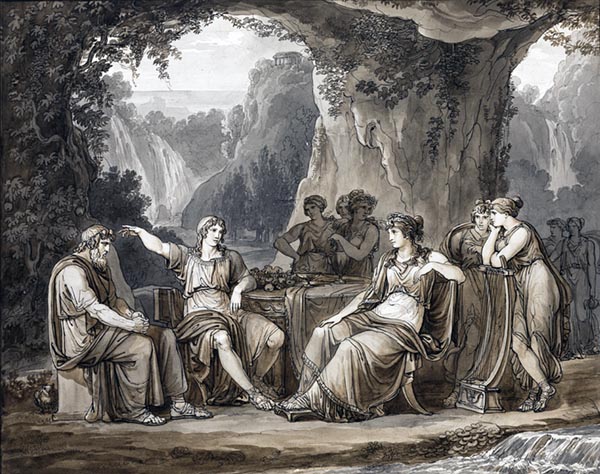
‘Telemachus relates his adventures to the goddess Calypso.’ (1808) - Bartolomeo Pinelli (Italian, 1781-1835)
Artvee
“I had left Ithaca to go and ask the other kings returned from the siege of Troy for news of my father. The suitors of my mother, Penelope, were surprised by my departure—I had taken care to hide it from them, knowing their perfidy. Neither Nestor, whom I saw at Pylos, nor Menelaus, who received me with friendship in Lacedaemon, were able to inform me whether my father was still alive. Weary of always living in suspense and in uncertainty, I had resolved to go into Sicily, where I had heard it said that my father had been tossed by the winds. But wise Mentor, who you see present here, opposed this rash plan. He represented to me on the one hand the Cyclops, monstrous giants that devour men, on the other the fleet of Aeneas and the Trojans who were on those coasts:
“‘Those Trojans,’ he said, ‘are animated against all Greeks, but above all they will gladly shed the blood of the son of Odysseus.’”
“‘Return to Ithaca,’ he continued. ‘Perhaps your father, loved by the gods, will be there as soon as you. But, if the gods have resolved his loss, if he should never see his homeland again, at the least you must go avenge him, deliver your mother, show your wisdom to all the peoples, and cause all Greece to see in you a king as worthy of reigning as Odysseus ever was himself.’
“These words were salutary, but I was not prudent enough to listen to them. I only listened to my passion. Wise Mentor loved me so much as to follow me into a rash voyage that I undertook against his counsel, and the gods permitted me to commit an error, which ought serve to correct me of my presumptuousness.”
While he was speaking, Calypso was regarding Mentor. She was stunned. She believed to sense in him something divine, but she could not untangle her confused thoughts; so, she remained filled with fear and distrust at the sight of this stranger. Then she became apprehensive lest Mentor should see her distress. “Continue,” she said to Telemachus, “and satisfy my curiosity.”
Telemachus resumed, “We had for some time a favourable wind for going to Sicily, but then a dark tempest stole the sky from our eyes, and we were wrapped in a deep night. By flashes of lightning, we caught sight of other vessels exposed to the same peril, and we soon recognised that they were Aeneas’ vessels. They were no less to be feared by us than the rocks. I understood then, but too late, what the ardour of an imprudent youth had kept me from considering attentively.
“Mentor appeared, in this danger, not only firm and intrepid but even more gay than usual; it was he who encouraged me. I felt that he inspired an invincible strength in me. He was tranquilly giving every order while the pilot was distressed. I said to him, ‘My dear Mentor, why did I refuse to follow your counsel? Was I not unfortunate to have wanted to believe myself, at an age when one has neither foresight of the future, nor experience of the past, nor restraint to manage the present. O! If we ever escape this tempest, I will distrust myself as my most dangerous enemy. It is you, Mentor, whom I will always believe.’
“Mentor, smiling, responded, ‘I am far from wanting to reproach you for the error you have made. It suffices that you sense it and that it serves to make you more restrained in your desires another time. But, when the peril is passed, the presumptuousness will perhaps return. For now, we must support each other through courage. Before plunging into peril, it must be anticipated and feared, but, when one is in it, there only remains to scorn it. Be then the worthy son of Odysseus. Show a heart greater than all the evils that threaten you.’
“The gentleness and courage of wise Mentor enchanted me, but I was still more surprised when I saw with what address he delivered us from the Trojans. At the moment when the sky was beginning to clear, and when all the Trojans, seeing us up close, would not have failed to recognise us, he noticed one of their vessels that the tempest had separated, very similar to ours, whose stern was wreathed with certain flowers. He hastened to put similar flowers on our own stern. He attached them himself with small bands of the same colour as those of the Trojans. He ordered all our oarsmen to crouch as low as they could along their benches to avoid being recognised by the enemy. In this state, we passed through the middle of their fleet. Seeing us, they loosed cries of joy, as if seeing companions they had thought lost. We were even compelled, by the violence of the sea, to go along with them for some time. Finally, we remained a bit behind and, while the impetuous winds pushed them toward Africa, we made the final efforts, by dint of rowing, to land on the nearby coast of Sicily.
“We arrived there indeed. But what we sought was hardly less calamitous than the fleet we were fleeing. We found on that Sicilian coast other Trojan enemies of the Greeks. It was there that old Acestes out of Troy reigned. Barely had we arrived on that shore when the inhabitants believed we were either other peoples of the island armed to overtake them, or foreigners who came to capture their lands. They burned our vessel. In their first frenzy, they slit the throats of all our comrades. They only spared Mentor and me to present us to Acestes so that he could learn from us what our designs were and where we came from. We entered the city with our hands tied behind our backs, and our death was only delayed to have us serve as spectacle for a cruel people when they learned that we were Greek.
“Straight away, they presented us to Acestes who, holding his golden sceptre in hand, was judging the peoples and preparing for a great sacrifice. He asked us, in a severe tone, for our country and the purpose of our voyage.
“Mentor hastened to answer, and said to him, ‘We come from the coasts of the great Hesperia, and our homeland is not far from there.’
“In this way, he avoided saying we were Greek. But Acestes, without listening further, and taking us for foreigners who were hiding their plan, ordered we be sent into a nearby forest, where we would serve as slaves under those who govern his flocks. This condition seemed to me more harsh than death. I cried out,
‘O King! Execute us rather than treat us so unworthily. Know that I am Telemachus, son of the wise Odysseus, king of the Ithacans. I am seeking my father throughout the seas; if I can neither find him, nor return to my homeland, nor avoid servitude, take from me the life, that I would not know how to bear’.
“No sooner had I pronounced these words than all the people, stirred up, cried out that the son of that cruel Odysseus, whose artifices had overthrown the city of Troy, must perish.
‘O son of Odysseus,’ Acestes said, ‘I cannot refuse your blood to the manes of so many Trojans that your father hurled onto the banks of the black Cocytus. You and the one who guides you, you will perish.’
“At the same time, an old man of the troop proposed to the king to sacrifice us on the tomb of Anchises. ‘Their blood,’ he said, ‘will be agreeable to the shade of this hero. Even Aeneas, when he learns of such a sacrifice, will be touched to see how much you love what he cherished most in the world.’
“All the people applauded this proposition and they only thought thereafter to sacrifice us. They were already leading us on to the tomb of Anchises; two altars had been erected there, where the sacred fire was lit. The glaive that should impale us lay before our eyes. They had crowned us with flowers, and no compassion could preserve our lives. We were done for, when Mentor tranquilly asked to speak to the king. He said to him,
‘O, Acestes! If the misfortune of young Telemachus, who has never borne arms against the Trojans, cannot touch you, at least may your own interest touch you. The science that I have acquired of presages and of the will of the gods causes me to know that before three days have elapsed, you will be attacked by barbarous peoples, coming like a torrent from the top of the mountains to flood your city and ravage all your country. Hasten to forestall them. Arm your peoples and waste not a moment to bring the abundant flocks you have in the countryside within your walls. If my prediction is false, you will be free to sacrifice us in three days. If, on the contrary, it is true, remember that one must not deny life to those from whom one holds it.’
“Acestes was stunned by these words which Mentor said with an assurance he had never found in any man.
“‘I see well,’ he responded, ‘O foreigner, that the gods, who have so poorly shared with you all the gifts of fortune, have granted you a wisdom which is more estimable than all prosperities.’
“At the same time, he delayed the sacrifice and diligently gave the orders necessary to forestall the attack with which Mentor had threatened him. One only saw, from all sides, trembling women, stooped old men, little children with tears in their eyes, who were withdrawing into the city. The bellowing oxen and bleating ewes came in droves, quitting the rich pastures and unable to find enough stables for shelter. There were, from every direction, confused cries of people who were pushing one another, who could not hear each other, who, in the midst of this trouble, took a stranger for their friend, and who were running without knowing where to set their feet. But the principals of the city, believing themselves wiser than the others, imagined that Mentor was an impostor, who had made a false prediction to save his life.
“Before the end of the third day, while they were filled with these thoughts, they saw on the slope of the neighbouring mountains a whirlwind of dust. Then they spotted a countless troop of armed barbarians—it was the Himerans, ferocious peoples, along with the nations that live on the Nebrodes Mountains and on the summit of Acragas, where a winter reigns that the zephyrs have never eased. Those who had scorned Mentor’s wise prediction lost their slaves and their flocks.
“The king said to Mentor, ‘I forget that you are Greek. Our enemies become our loyal friends. The gods have sent you to save us! I expect no less of your valour than of the wisdom of your counsel. Hasten to rescue us.’
“Mentor shows in his eyes an audacity that stuns the proudest fighters. He takes a shield, a helmet, a sword, a lance; he ranks Acestes’ soldiers; he marches at their head and advances in good order toward the enemy. Acestes, though full of courage, can only, in his old age, follow him from afar. I follow him more closely, but I cannot match his valour. His cuirass resembled, in combat, the immortal aegis. Death raced everywhere from rank to rank under his strikes. Resembling a Numidian lion that cruel hunger devours, and that enters upon a flock of weak ewes—he rends, he slaughters, he swims in blood, and the shepherds, far from rescuing the flock, flee trembling to get away from his fury.
“Those barbarians, who were hoping to take the city by surprise, were themselves surprised and disconcerted. Acestes’ subjects, animated by the example and orders of Mentor, had a vigour which they did not believe themselves capable of. With my lance I knocked the son of the king of that enemy people to the ground. He was my age, but he was much taller than me, for this people came from a race of giants who were of the same origin as the Cyclops. He scorned an enemy as weak as me. But, undaunted by his prodigious strength or his savage and brutal air, I thrust my lance against his chest and made him vomit, in dying, torrents of a black blood. He thought to crush me. In his fall, the noise of his armour reverberated to the mountains. I took his spoils, and I returned to Acestes with the armour of the dead that I had removed. Mentor, having put the enemy into disarray, carved them to pieces and pushed the deserters into the forests.
“An outcome so unexpected caused Mentor to be regarded as a man cherished and inspired by the gods. Acestes, touched with gratitude, warned us that he feared everything for us should Aeneas’ vessels return to Sicily. He gave us one of his to return to our own country, showered us with presents, and pressed us to depart to prevent all the misfortunes he foresaw. But he did not want to give us either a pilot or any oarsmen of his own nation for fear they would be too exposed along the coasts of Greece. He gave us Phoenician merchants, who, being in commerce with all the peoples of the world, had nothing to fear, and who must bring the vessel back to Acestes when they had left us in Ithaca. But the gods, who play with the designs of men, reserved other dangers for us.”
END OF BOOK I
BOOK II
“The Tyrians, through their pride, had angered the great King Sesostris, who reigned in Egypt and who had conquered so many kingdoms. The riches they had acquired through commerce and the strength of the impregnable city of Tyre, situated in the sea, had swelled the hearts of these peoples. They had refused to pay Sesostris the tribute he had imposed on them upon returning from his conquests, and they had supplied troops to his brother, who had wanted, upon his return, to massacre him amidst the rejoicing at a great feast.
“Sesostris had resolved, in order to put down their pridefulness, to disrupt their commerce throughout the seas. His vessels were going in all directions, seeking Phoenicians. An Egyptian fleet encountered us as we were beginning to lose sight of the mountains of Sicily. The harbour and the land seemed to flee behind us and lose themselves in the clouds. At the same time, we see Egyptian ships approaching like a floating city. The Phoenicians recognised them and wanted to distance themselves, but there was no longer time. Their sails were better than ours. The wind favoured them. Their oarsmen were in greater numbers—they come alongside us, seize us, and take us as prisoners to Egypt.
“In vain I represented to them that I was not Phoenician; they barely deigned to listen to me. They regarded us as slaves in which the Phoenicians trafficked, and they only thought of the profit from such a prize.
“We already notice the waters of the sea whiten through mixing with that of the Nile, and we see the Egyptian coast, almost as low as the sea. Then we arrive at the island of Pharos, neighbouring the city of No; from there we proceed up the Nile to Memphis.
“If the pain of our captivity had not rendered us numb to every pleasure, our eyes would have been enchanted to see that fertile land of Egypt, resembling a delightful garden watered by an infinite number of canals. We could not cast our eyes on the two banks without seeing opulent cities, country homes agreeably situated, lands that are covered every year with a golden harvest, never resting, prairies full of flocks, ploughmen who were bowed under the weight of the produce that the earth poured forth from her womb, shepherds making the sweet sounds of their flutes and chalumeaux echo all around them.
“‘Happy,’ Mentor said, ‘are the people who are led by a wise king. They are in abundance; they live happily and love the one to whom they owe all their happiness. It is in this way O Telemachus,’ he added, ‘that you should reign and make the joy of your peoples, if the gods ever grant you possession of the kingdom of your father. Love your peoples as your children; enjoy the pleasure of being loved by them and make it so that they can never feel peace and joy without being reminded that it is a good king who brought them those rich presents. Kings who only think of making themselves feared and crushing their subjects in order to render them more submissive are the scourges of humankind. They are feared as they wish to be, but they are hated, detested, and have even more to fear from their subjects than their subjects have to fear from them.’
“I responded to Mentor, ‘Alas! It is not a question of thinking of maxims by which one must reign. There is no longer any Ithaca for us. We will never see either our homeland or Penelope again, and, even if Odysseus returns full of glory to his kingdom, he will never have the joy of seeing me there; never will I ever have that of obeying him in order to learn how to command. Let us die, my dear Mentor. No other thought is permitted us any longer; let us die, for the gods have no mercy on us.’
“While I was speaking so, deep sighs cut off my words. But Mentor, who feared evils before they arrive, no longer knew what it was to fear them as soon as they arrived.
‘Unworthy son of the wise Odysseus,” he exclaimed, “what then, you allow yourself to be vanquished by your misfortune! Know that you will one day see the island of Ithaca and Penelope again. You will even see in his former glory the one you have not known—the invincible Odysseus whom Fortune cannot beat down and who, in his misfortunes even greater than yours, teaches you to never be discouraged. O! If he should learn in the distant lands where the tempests have cast him that his son knows neither how to imitate his patience nor his courage, this news would crush him with shame and would be rougher on him than all the misfortunes he has so long suffered.’
“Then Mentor pointed out to me the joy and abundance spread throughout the Egyptian countryside, where one counted up to twenty-two thousand cities. He was admiring the good policies of those cities: the justice exercised in favour of the poor against the rich; the good education of the children, who are accustomed to obedience, work, sobriety; love of the manual arts and scholarship; exactness in all religious ceremonies; selflessness, the desire for honour, the fidelity to men, and the reverential awe of the gods that each father inspired in his children. He never wearied of admiring that beautiful orderliness.
‘Happy,’ he told me incessantly, ‘are the people that a wise king leads in this way. But even happier the king who makes the happiness of so many peoples and who finds his own in his virtue. He is more than feared, for he is loved. Not only do they obey him, but more—he is even king of every heart; each, far from wanting to be rid of him, fears losing him and would give their life for him.’
“I noted what Mentor said and I felt courage born again deep in my heart as this wise friend was speaking to me.
“As soon as we had arrived in the opulent and magnificent city of Memphis, the governor ordered we go on to Thebes to be presented to King Sesostris, who wanted to examine things himself and was extremely animated against the Tyrians. So we continued up the length of the Nile to that famous Thebes of a hundred gates where that great king lived. This city looked to be of an immense expanse to us and more populated than the most flourishing cities of Greece. The policies there are perfect for the cleanliness of the streets, the waterworks, the convenience of the baths, the cultivation of the arts, and public safety. The plazas are ornamented with fountains and obelisks. The temples are of marble and a simple, yet majestic architecture. The palace of the prince is like a great city to him alone. Only there does one see marble columns, pyramids and obelisks, colossal statues, furniture of gold and solid silver.
“Those who had taken us told the king that we had been found on a Phoenician ship. He listened each day at certain set hours, to all those of his subjects who had either complaints to make or advice to give him. He neither scorned nor rebuked anyone and believed himself king only in order to do good for all of his subjects, whom he loved as his children. As for foreigners, he received them with goodwill and wanted to see them because he believed that one always learned something useful in informing oneself of the mores and manners of distant peoples.
“This curiosity of the king caused us to be presented before him. He was on a throne of ivory, holding in hand a golden sceptre. He was already old, yet agreeable, full of gentleness and majesty. Every day he judged the peoples with a patience and a wisdom that was sincerely admired. After having worked all day long to regulate affairs and to render an exact justice, he unwound in the evening by listening to learned men or conversing with the most upright people, whom he knew well how to choose for admittance into his inner circle. One could only reproach him throughout his life for having triumphed with too much pageantry over the kings he had vanquished, and of having trusted in one of his subjects, whom I will describe to you presently.
“When he saw me, he was touched by my youth and my pain. He asked me for my homeland and my name. We were astonished by the wisdom coming out of his mouth. I answered him, ‘O great king, you are not ignorant of the siege of Troy, which lasted ten years, and her ruin, which cost so much bloodshed to all Greece. Odysseus, my father, was one of the principal kings who ruined that city. He roves over all the seas, unable to find the island of Ithaca again, which is his kingdom. I am seeking him, and a misfortune like his caused me to be taken. Restore me to my father and my homeland. Thus may the gods preserve you for your children, and have them feel the joy of living under so good a father.’
“Sesostris continued to regard me with an eye of compassion, but, wanting to know if what I said was true, he sent us back to one of his officers, who was charged with determining from those who had taken our vessel if we were actually Greeks or Phoenicians.
“‘If they are Phoenicians,’ said the king, ‘they must be doubly punished for being our enemies, and even more for wanting to deceive us with a cowardly lie. If, on the contrary, they are Greek, I want them treated favourably and sent back to their country on one of my vessels, for I love Greece—many Egyptians have given laws to them. I am familiar with the virtue of Heracles, the glory of Achilles has reached us, and I admire what has been told me of the wisdom of the unfortunate Odysseus. It is my pleasure to come to the aid of hapless virtue.’
“The officer with whom the king charged the examination of our affair had a soul as corrupt and artful as the soul of Sesostris was sincere and generous. This officer was named Metophis. He interrogated us by attempting to entrap us, and as he saw that Mentor answered with more wisdom than I, he regarded him with aversion and distrust—for the wicked are irritated by the good. He separated us, and from that moment on, I did not know what became of Mentor.
“This separation hit me like a thunderbolt. Metophis was still hoping that, in questioning us separately, he would be able to make us say contradictory things. Above all, he thought to dazzle me with his flattering promises and make me confess what Mentor had hidden from him. In the end, he was not seeking the truth in good faith, but wanted to find some pretext to tell the king that we were Phoenicians in order to make us his slaves. Indeed, despite our innocence and despite the king’s wisdom, he found the means to deceive him.
“Alas, what kings are exposed to. Even the wisest are often taken in. Artful and self-serving men surround them. The good withdraw because they are neither eager to please nor flatterers. The good wait until they are sought, and princes hardly know how to seek them. In contrast, the wicked are bold, deceitful, eager to insinuate themselves and to please, adroit at dissimulation, ready to do anything against honour and conscience to satisfy the passions of the one who reigns. O how unfortunate a king is to be exposed to the artifices of the wicked! He is lost if he does not repulse flattery and if he does not love those who boldly tell the truth. Voila. Those were my reflections during my misfortune, and I recalled everything that I had heard Mentor say.
“Meanwhile, Metophis sent me to those mountains of the Oasis desert with his slaves so that I might serve with them in driving his great flocks.”
At this spot, Calypso interrupted Telemachus, saying, “Well! What did you do then, you, who had preferred in Sicily death to servitude?”
Telemachus answered, “My misfortune was ever-increasing. I no longer had the miserable consolation of choosing between servitude and death. It was necessary to be a slave and exhaust, so to speak, all the rigours of fortune. There no longer remained any hope in me, and I could not even say a single word to strive to free myself. Mentor has since told me that he had been sold to Ethiopians and followed them into Ethiopia.
“As for me, I arrived in the dreadful deserts. There one finds scorching sands in the middle of the plains; snows that never melt, causing a perpetual winter on the summits of the mountains, and, for feeding the flocks, one only finds pastures among the rocks toward the middle of the slope of those craggy mountains. The valleys are so deep there that the sun can barely light them with her rays.
“I found no other men in this country than shepherds as wild as the country itself. There, I spent the nights deploring my misfortune and the days following a flock to avoid the brutal fury of a head slave, who, hoping to procure his freedom, incessantly accused the others in order to highlight his zeal and devotion to his master’s interests. This slave was named Butis.
“I was bound to succumb in these circumstances. Pain pressing down on me, I forgot about my flock one day, and I stretched out on the grass alongside a cavern where I awaited death, no longer able to bear my sorrows.
“At that moment, I noticed the entire mountain quaked; the oaks and firs seemed to bow down from the summit of the mountain; the winds held their breath; a bellowing voice came out of the cavern, and caused me to hear these words:
’Son of the wise Odysseus, you must become, like him, great through patience. Princes who have always been happy are hardly worthy of being so—softness corrupts them, pridefulness intoxicates them. How happy you will be if you overcome your misfortunes and if you never forget them. You will see Ithaca again, and your glory will ascend to the heavens. When you are the master of other men, remember that you have been weak, poor, and suffering like them. Take pleasure in comforting them, love your people, detest flattery, and know that you will only be great to the extent you are restrained and courageous in vanquishing your passions.’
“These divine words penetrated to the bottom of my heart. They caused joy and courage to be reborn. I did not feel that blood-curdling terror that makes the hair stand on end when the gods communicate with mortals. I sat up tranquilly. Kneeling, hands raised toward heaven, I venerated Athena, to whom I believed I owed this oracle. At the same time, I found myself a new man. Wisdom enlightened my mind; I felt a gentle strength to moderate all my passions and arrest the impetuosity of my youth. I made myself loved by all the shepherds of the desert. In the end, my meekness, my patience, my exactitude appeased the cruel Butis, who was in authority over the other slaves and who had wanted, in the beginning, to torment me.
“To better endure the tedium of captivity and solitude, I sought books, for I was overwhelmed with boredom for want of some instruction that could feed my mind and sustain it. Fortunate, I was saying, are those who are disgusted by violent pleasures and who know how to be satisfied with the sweetness of an innocent life. Fortunate are those who amuse themselves in learning and who find pleasure in cultivating their minds through the sciences. Wherever hostile Fortune casts them, they always carry with them something to amuse themselves, and ennui, which devours other men even in the midst of delights, is unknown to those who know how to occupy themselves through some reading. Fortunate are those who love to read and are not, like me, deprived of reading.’ While these thoughts were wheeling in my mind, I entered deep into a sombre forest, where I suddenly spied an old man, who was holding a book in his hand.
“This old man had a large forehead, bald and a little wrinkled. A white beard hung down to his belt. His build was tall and majestic. His complexion was still fresh and ruddy, his eyes bright and piercing, his voice soft, his words plain and friendly. Never had I seen so venerable an old man. His name was Termosiris, and he was a priest of Apollo, whom he served in a marble temple, which the Egyptian kings had consecrated to that god in this forest. The book he held was a collection of hymns in honour of the gods. He came up to me in a friendly way. We talked together. He recounted things of the past so well that you believed you saw them, yet he told them with brevity, and his stories never wearied me. He foresaw the future through the profound wisdom that caused him to know men and the designs of which they are capable. Along with so much prudence, he was cheerful, obliging, and the most playful youth does not have as much charm as this man had in his advanced old age. He enjoyed young people as well, when they were docile and had a taste for virtue.
“Soon he loved me tenderly and gave me books to console me. He called me ‘my son.’ I often said to him, ‘My father, the gods, who have taken Mentor from me, have had mercy on me. They have given me another support in you.’
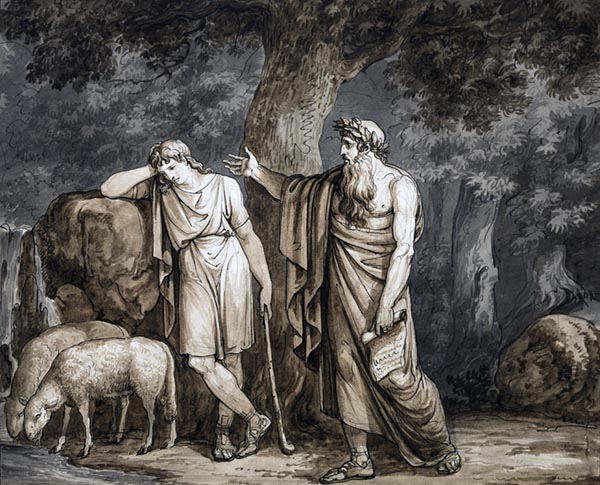
‘Telemachus is consoled by Termosiris, priest of Apollo.’ (1808) - Bartolomeo Pinelli (Italian, 1781-1835)
Artvee
“This man, resembling Orpheus or Linus, was undoubtedly inspired by the gods; he recited verses to me that he had made and gave me those of several excellent poets favoured by the Muses. When he was dressed in his long robe of a brilliant whiteness and took in hand his ivory lyre, tigers, lions, and bears came to nuzzle him and lick his feet. The Satyrs came out of the forests to dance round him. Even the trees appeared moved, and you would have thought the boulders, touched with tenderness, were going to descend from the tops of the mountains under the spell of his sweet chords. He only sang of the greatness of the gods, the virtue of the heroes, and the wisdom of the men who prefer glory to pleasures.
“He often said to me that I should be courageous and that the gods would not abandon either Odysseus or his son. Lastly, he assured me that I should teach the shepherds to cultivate the Muses, following the example of Apollo:
‘Apollo,’ he said, ‘indignant that Zeus, with his thunderbolts, troubled the skies on the most beautiful days, wanted to take vengeance on the Cyclops, who forged the thunderbolts, and he pierced them with his arrows. Immediately, Mount Etna ceased to vomit swirls of flames. One no longer heard the blows of the terrifying hammers, which, striking the anvil, made the deepest caverns of the earth and the abysses of the seas groan. The iron and brass, no longer being polished by the Cyclops, began to rust.
‘Hephaestus, furious, comes out of his blazing furnace. Though lame, he hurriedly ascends toward Olympus, he arrives sweating and covered with black dust in the assembly of the gods. He makes bitter complaints. Zeus, angry with Apollo, chases him out of the sky and hurls him to Earth. His empty chariot makes its usual course on its own in order to give men the days and the nights with the regular changing of the seasons.
‘Apollo, stripped of all his rays, was compelled to be a shepherd and guard the flocks of King Admetus. He played the flute, and all the other shepherds came to the shade of the young elms, along the banks of a clear spring, to listen to his songs. Up until then, they had led a wild and brutal life. They only knew how to drive their ewes, shear them, milk them, and make cheeses. The entire countryside was like a frightful desert.
‘Soon, Apollo demonstrated to all those shepherds the arts that can render their life agreeable. He sang of the flowers with which springtime crowns herself, the perfumes she spreads, and the verdure that sprouts underfoot. Then he sang of the delightful summer nights, when zephyrs refresh men and dew quenches the land. He also mixed into his songs the golden fruits with which autumn rewards the labours of ploughmen, and repose of winter, during which coltish youth dance alongside the fire. Lastly, he represented the sombre forests that cover the mountains and deep vales, where rivers, by a thousand turns, seem to play together in the middle of laughing prairies. In this way, he taught the shepherds about the charms of the country life when one knows how to enjoy what simple nature has of the marvellous. Soon the shepherds, with their flutes, found themselves happier than kings, and their huts attracted in droves the pure pleasures that flee gilded palaces. Games, Laughter, and the Graces followed the innocent shepherds everywhere. Every day was festival day. One only ever heard the chirping of birds, or the gentle breath of zephyrs that played in the branches of the trees, or the murmur of a clear water that tumbled from some rock, or the songs the Muses inspired in the shepherds who followed Apollo. This god taught them to bring home the prize from the race and to shoot the fallow deer and stags with arrows. The gods themselves became jealous of the shepherds; this life appeared sweeter to them than all their glory, and they called Apollo back to Olympus.
‘My son, this story should instruct you, since you are in the same state as Apollo was. Clear this savage land; make the desert flower like him; teach all these shepherds about the enchantment of harmony; soften fierce hearts; show them lovable virtue; make them feel how sweet it is to enjoy, in solitude, innocent pleasures that nothing can take away from them. One day, my son, one day the troubles and cruel worries that surround kings will cause you to lament from the throne the pastoral life.’
“Having spoken so, Termosiris gave me a flute so sweet that the echoes of those mountains, which caused it to be heard from all sides, soon attracted all the neighbouring shepherds around us. My voice had a divine harmony; I felt moved and beside myself to sing of the charms with which nature adorned the countryside. We spent entire days and part of the nights singing together. All the shepherds, forgetting their huts and their flocks, were entranced and motionless around me while I gave them lessons. It seemed those deserts no longer had anything of wildness, all had become gentle and laughing there. The manners of the inhabitants seemed to sweeten the earth.
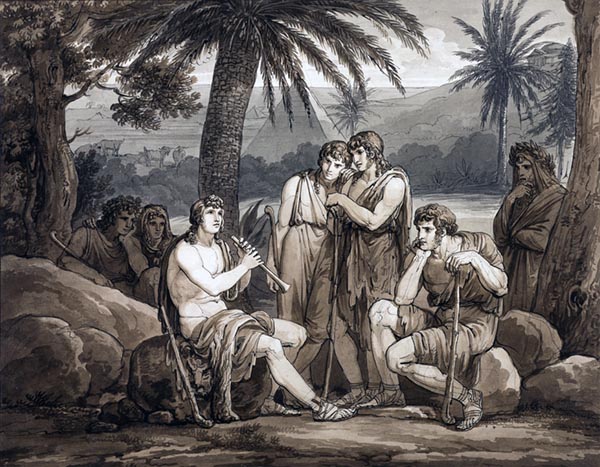
‘Telemachus plays and sings to the shepherds in Egypt.’ (1808) - Bartolomeo Pinelli (Italian, 1781-1835)
Artvee
“We often gathered together to offer sacrifices in the temple of Apollo where Termosiris was priest. The shepherds came crowned with laurels in honour of the god. The shepherdesses also came dancing with crowns of flowers and bearing on their heads baskets filled with sacred gifts. After the sacrifice, we had a country feast. Our sweetest dishes were the milk of our goats and our ewes that we took care to milk ourselves, along with fruits freshly picked with our own hands, such as dates, figs, and grapes. Our seats were the green lawns. Leafy trees gave us a shade more agreeable than the gilded paneling of the palaces of the kings.
“But what ended up making me famous among our shepherds is that one day a famished lion came to pounce upon our flock. He had already begun a dreadful carnage. I only had my shepherd’s crook in hand. I advance boldly. The lion bristles his mane, bares his teeth and claws, opens a dry and inflamed maw; his eyes appear filled with blood and fire. He bats his flanks with his long tail. I throw him to the ground. The small coat of mail with which I was clad, according to the custom of Egyptian shepherds, keeps him from ripping me apart. Three times he rises again. He heaves roars that reverberate throughout the forests. Three times I beat him down. Finally, I choke him in my arms, and the shepherds, witnesses to my victory, want me to don the skin of that terrifying lion.
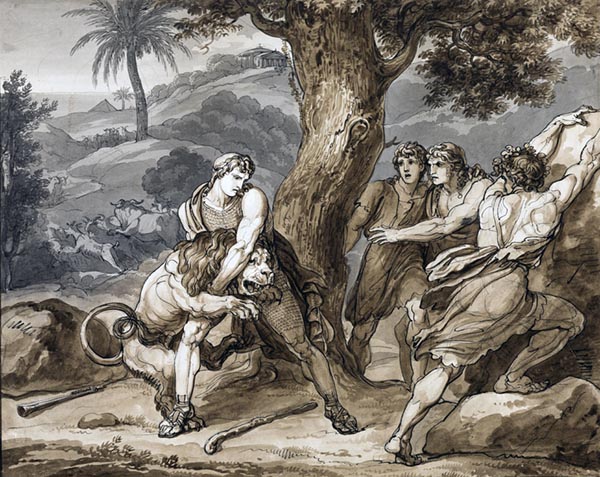
‘Telemachus battles the lion.’ (1808) - Bartolomeo Pinelli (Italian, 1781-1835)
Artvee
“The rumours of this deed, and that of the beautiful change in all our shepherds, spread throughout Egypt. It even reached the ears of Sesostris. He knew that one of those two captives, who had been taken as Phoenicians, had brought back the golden age in those almost uninhabitable deserts. He wanted to see me, for he loved the Muses, and all that can instruct men touched his great heart. He saw me, he listened to me with pleasure, he discovered that Metophis had deceived him through avarice, he condemned him to life imprisonment and took away all the riches which he unjustly possessed.
“‘O, how unfortunate one is,’ he said, ‘when he is above the rest of men! Often, he cannot see the truth with his own eyes. He is surrounded by people who keep it from reaching the one who commands. Each is interested in deceiving him. Each, beneath an appearance of zeal, hides his ambition. They pretend to love the king, and they love only the riches he gives. They love him so little that, in order to obtain his favours, they flatter and betray him.’
“Afterward, Sesostris treated me with a tender friendship and resolved to send me back to Ithaca along with vessels and troops to deliver Penelope from all her suitors. The fleet was already prepared, and we thought only to embark. I marvelled at the strikes of Fortune, who suddenly lifts up those she has lowered the most. This experience caused me to hope that Odysseus might indeed return, after such long suffering, to his kingdom at last. I was also thinking to myself that I could yet see Mentor again, though he had been taken to the most unknown regions of Ethiopia. While I delayed my departure a bit, attempting to learn news of Odysseus and Mentor, Sesostris, who was very old, died unexpectedly and his death plunged me back into new misfortunes.
“All Egypt seemed inconsolable at this loss. Each family believed they had lost their best friend, their protector, their father. The old men, raising their hands to the skies, cried out, ‘Never has Egypt had so good a king. Never will she have another like him. O gods! You should either not have revealed him to men or never have taken him from them. Why must we survive the great Sesostris?’
“The young people were saying, ‘The hope of Egypt is destroyed. Our fathers were fortunate to spend their life under so good a king. As for us, we only saw enough of him to feel his loss.’
“His attendants were crying day and night. When the funeral rites of the king were held for forty days, all the most distant peoples came running in droves. Each wanted to see the body of Sesostris once more. Each wanted to preserve the image of him. Several wanted to be placed in the tomb along with him.
“What increased the pain of his loss even more, it was that his son Bocchoris had neither humaneness toward foreigners, nor curiosity for the sciences, nor esteem for virtuous men, nor love of glory. The greatness of his father had contributed to rendering him so unworthy of reigning. He had been nurtured in a softness and a brutal pride. He counted men for nothing, believing that they were only created for him and that he was of another nature than they. He only thought of satisfying his passions, dissipating the immense treasures his father had managed with so much care, tormenting the peoples and sucking the blood of unfortunate wretches, and, finally, following the flattering counsel of the senseless youth who surrounded him while he scornfully distanced all the wise old men who had had the confidence of his father. He was a monster and not a king. All Egypt groaned, and, although the name of Sesostris, so dear to the Egyptians, made them bear the craven and cruel conduct of his son, the son was racing to his ruin, and a prince so unworthy of the throne could not reign for long.
“I was no longer permitted to hope for my return to Ithaca. I remained in a tower on the edge of the sea near Pelusium, where our departure should have been, had Sesostris not died. Metophis had had the address to get out of prison and to re-establish himself alongside the new king. He had me shut up in this tower in order to avenge the disgrace I had caused him. I spent the days and nights in a profound sadness. All Termosiris had foretold and all I had heard in the cavern seemed no more than a dream.
I was lost in the most bitter pain. I watched the surf that came to pound the foot of that tower where I was a prisoner. Often, I occupied myself in considering the vessels agitated by the tempest, which were in danger of breaking apart against the rocks on which the tower was built. Far from pitying those men threatened with wreck, I envied their lot. Soon, I said to myself, they will end the misfortunes of their lives, or they will arrive in their country. Alas, here, I can neither hope for one nor the other.
“While I was thus consumed in useless regrets, I spied a forest of ships’ masts. The sea was covered with sails swollen by the winds. The water was spuming under the strikes of countless oars. I heard confused cries from every direction. On the shore I made out a group of frightened Egyptians who were running to arms and others who seemed to be going out to meet this fleet that was seen arriving. Immediately, I recognised that some of those foreign vessels were from Phoenicia, and others from the island of Cyprus, for my misfortunes were beginning to make me experienced with regard to navigation. The Egyptians seemed to be divided among themselves.
“I had no difficulty believing the senseless King Bocchoris had, through his violences, caused a revolt of his subjects and ignited a civil war. From the top of this tower, I was spectator to a bloody combat. Egyptians who had called foreigners to succour them, after having favoured their invasion, were attacking other Egyptians who had the king at their head. I saw this king who animated his men through his example; he looked like the god Ares. Streams of blood flowed round him. The wheels of his chariot were stained with a black blood, thick and foaming. Barely could they roll over the heaps of crushed corpses. This young king, well built, vigorous, of a proud and haughty mien, had fury and despair in his eyes. He was like a beautiful horse, unbroken. His courage was pushing him haphazardly, and wisdom did not moderate his valour. He knew neither how to mend his errors, nor to give precise orders, nor to anticipate the evils that were threatening him, nor to manage the people of whom he had the greatest need. It was not that he lacked genius. His intelligence equaled his courage, but he had never been instructed by bad fortune. His tutors had poisoned, through flattery, his beautiful nature. He was intoxicated with his power and his good fortune. He believed that all should cede to his fiery desires. The least resistance inflamed his anger—then, he no longer reasoned; he was beside himself; his furious pridefulness transformed him into a ferocious beast; his natural goodness and right reasoning abandoned him in an instant. His most loyal servants were reduced to flight. He only liked those who flattered his passions. So, he always took extreme sides against his true interests, and he forced all the good people to detest his mad conduct.
“For a long time his valour sustained him against the multitude of his enemies, but in the end he was overwhelmed. I saw him perish. The spear of a Phoenician pierced his chest. He tumbled from his chariot as the horses still dragged on and, no longer able to hold the reins, he fell under the horses’ feet. A soldier from the island of Cyprus struck off his head, and holding it by the hair, he displayed it as if in triumph to all the victorious army.
“I will remember all my life having seen that head swimming in blood, his eyes closed and the light put out, that face pale and disfigured, that mouth gaping, which seemed to still want to finish the words begun, that superb and menacing air, which even death could not blot out. All my life, it will be painted before my eyes, and, should the gods ever cause me to reign, I will never forget, after so gruesome an example, that a king is only worthy of commanding, and is only happy in his power, to the extent he submits it to reason. O what unhappiness for a man destined to make the happiness of the public, to be the master of so many men only to render them unhappy!”
END OF BOOK II
BOOK III
Calypso listened with astonishment to such wise words. What enchanted her most was seeing how young Telemachus ingenuously recounted the errors he had made through precipitation and in lacking docility with regard to wise Mentor. She found a nobility and a stunning grandeur in this young prince who faulted himself and seemed to have profited so well from his imprudence so as to become wise, foresighted, and restrained.
“Continue,” she said, “my dear Telemachus. I long to know how you got out of Egypt and where you found wise Mentor again, whose loss you so rightly felt.”
Telemachus resumed his discourse:
“The Egyptians who were the most virtuous and loyal to the king, being the weakest and seeing the king dead, were compelled to cede to the others. They established another king named Termutis. The Phoenicians, along with the troops from the island of Cyprus, withdrew after having made an alliance with the new king. He returned all the Phoenician prisoners; I was counted as being among this number. They had me released from the tower. I embarked with the others, and hope began to shine again in the depths of my heart. A favourable wind already filled our sails, the oarsmen ploughed the foaming waters, the vast sea was covered with ships, the sailors loosed cries of joy. The Egyptian shores fled far from us. The hills and mountains were flattening little by little. We were beginning to see nothing but sky and sea while the sun, which was rising, appeared to release her sparkling fires from the sea. Her rays gilded the summits of the mountains, which we were still barely finding on the horizon, and the whole sky, painted a sombre azure, promised us a happy voyage.
“Although they had sent me back as being Phoenician, none of the Phoenicians I was with knew me. Narbal, who captained the vessel on which they had put me, asked me for my name and homeland.
“‘Which Phoenician city are you from?’ he asked me.
“‘I am not from Phoenicia,’ I told him. ‘But the Egyptians had taken me at sea on board a Phoenician vessel. I remained captive in Egypt for a long time as a Phoenician. It is under this name that I suffered for a long time; it is under this name they freed me.’
“‘What country are you from, then?’ resumed Narbal.
“Then I said to him:
‘I am Telemachus, son of Odysseus, king of Ithaca, in Greece. My father made himself famous among all the kings who besieged the city of Troy. But the gods have not granted he see his homeland again. I have sought him in several countries. Fortune persecutes me like him. You see a poor wretch who only yearns for the happiness of returning among his own and finding his father.’
“Narbal was looking at me with astonishment and he believed to perceive in me a certain something, a favour that comes from the gifts of heaven and is not in common man. He was naturally sincere and generous. He was touched by my misfortune and spoke to me with a trust that the gods inspired in him in order to save me from a great peril.
“‘Telemachus, I do not doubt,’ he said to me, ‘what you tell me, and I would not know how to doubt it. The pain and virtue painted on your face do not permit me to distrust you. I even sense that the gods, whom I have always served, love you and desire I love you too, as if you were my son. I will give you a salutary counsel, and in return I ask only for secrecy.’
“‘Do not fear,’ I said, ‘that I would have any difficulty keeping quiet about the things you wish to confide in me. Though I may be very young, I have already aged in the habit of never telling my secrets and even more in never betraying, under any pretext, the secrets of others.’
“‘How have you,’ he said to me, ‘been able to accustom yourself to secrecy at such a young age? I would be delighted to learn by what means you have acquired this quality, which is the foundation of the wisest conduct and without which all talents are useless.’
“‘When Odysseus,’ I said to him, ‘set out for the siege of Troy, he took me on his knees and in his arms (that is what was recounted to me). After kissing me tenderly, he said these words to me, though I could not understand them: ‘O my son, may the gods preserve me from ever seeing you again; may rather the scissors of the Spinner cut the thread of your days when it is barely formed, just as the reaper cuts with his scythe a tender flower that is beginning to open up; may my enemies crush you before your mother’s eyes and mine should you one day become corrupt and abandon virtue. O my friends,’ he continued, ‘I am leaving you this son who is so dear to me; attend to his childhood. If you love me, distance from him pernicious flattery. Teach him self-control. May he be like a young sapling, still tender, that one bends in order to straighten it. Above all, do your utmost to render him just, beneficent, sincere, and loyal in keeping a secret. Whoever is capable of lying is unworthy of being counted among men, and whoever does not know how to keep silent is unworthy of governing.’
“‘I relate these words to you because they took care to repeat them to me often and they have penetrated to the bottom of my heart. I also repeated them to myself often. My father’s friends took care to train me early in secrecy. I was still in tender boyhood, and they already confided in me about all the pain they were feeling at seeing my mother exposed to a great number of brazen suitors who wanted to marry her. Consequently, they have treated me since then as a reasonable and sure man. They secretly discussed the greatest affairs with me; they informed me of everything they had resolved in order to scatter those pretenders. I was delighted they had this confidence in me, by which I believed myself already a sure man. Never have I abused this trust; never has there escaped from me a single word that could reveal the least secret. Often, the pretenders tried to make me speak, hoping a child, who could have seen or heard something important, would not know how to keep it to himself, but I knew well how to answer them without lying and without informing them of what I should not say.’
“Then Narbal said to me, ‘You see, Telemachus, the might of the Phoenicians. They are formidable to all neighbouring nations through their countless ships. The commerce they conduct as far as the Pillars of Heracles gives them riches that surpass those of the most flourishing peoples. The great King Sesostris, who would never have been able to vanquish them by sea, had much difficulty vanquishing them by land with his armies that had conquered all the East. He imposed a tribute on us that we did not pay for long. The Phoenicians found themselves too rich and too mighty to patiently bear the yoke of servitude. We took back our liberty. Death did not allow Sesostris time to finish the war against us. It is true we had everything to fear from his wisdom, even more than from his might, but, with his might passing into the hands of his son, who was deprived of all wisdom, we concluded we no longer had anything to fear. Indeed, the Egyptians, far from returning to our country, arms in hand, to subjugate us again, have been compelled to call on us for succour to deliver them from this impious and furious king. We have been their liberators. What glory is added to the liberty and opulence of the Phoenicians! But, while we deliver others, we are slaves ourselves.
‘O Telemachus, fear falling into the cruel hands of Pygmalion, our king. He dipped them, those cruel hands, into the blood of Sychaeus, husband of Dido, his sister. Dido, filled with horror and vengeance, escaped from Tyre along with several vessels. Most of those who love virtue and liberty followed her. She founded on the coast of Africa a superb city named Carthage. Pygmalion, tormented by an insatiable thirst for riches, makes himself more and more miserable and odious to his subjects. It is a crime in Tyre to have great possessions. Avarice renders him distrustful, suspicious, cruel. He persecutes the rich, and he fears the poor. It is an even greater crime in Tyre to have virtue, for Pygmalion assumes that the good cannot tolerate his injustices and his infamies. Virtue condemns him, he is embittered and irritated by it. Everything agitates him, disquiets him, gnaws at him. He is afraid of his own shadow. He sleeps neither day nor night. The gods, to confound him, laden him with treasures he dare not enjoy. What he seeks in order to be happy is precisely what prevents him from being so. He regrets everything he hands out. He always fears losing, he torments himself in order to win.
“‘One almost never sees him. He is alone, sad, beaten-down in the depths of his palace. Even his friends dare not go up to him for fear of becoming suspect to him. A terrifying guard always keeps swords drawn and pikes raised all around his house. Thirty rooms connected one to another, and each of them having an iron door with six huge bolts, are where he confines himself. One never knows in which of these rooms he sleeps, and it is assured he never sleeps two consecutive nights in the same for fear of having his throat slit. He knows neither sweet pleasures nor friendship, sweeter still. If one speaks to him of seeking joy, he feels it flees far from him and refuses to enter into his heart. His hollow eyes are filled with a harsh and fierce fire. They are incessantly roving in all directions. He lends an ear to the slightest rumour and is very upset. He is pale, haggard, and dark worries are painted on his ever-wrinkled face. He is silent, he sighs, he heaves groans from deep within his heart; he cannot hide the remorse that is ripping his entrails apart. The most exquisite dishes disgust him. His children, far from being his hope, are the subject of his terror. He has made of them his most dangerous enemies. He has never in his entire life had a moment of assurance. He only survives by dint of shedding the blood of all those he fears. Fool, who does not see that his cruelty, to which he entrusts himself, will destroy him! One of his attendants, as distrustful as he, will hasten to deliver the world from this monster. As for me, I revere the gods. Whatever it may cost me, I will be loyal to the king they have given me. I would prefer he have me put to death than to take his life or even fail to defend it. As for you, O Telemachus, be very careful of telling him you are the son of Odysseus. He would hope that Odysseus, returning to Ithaca, would pay him some great sum to ransom you, and he would hold you in prison.’”
“When we arrived in Tyre, I followed Narbal’s counsel, and I recognised the truth of everything he had recounted to me. I could not understand how a man could render himself as miserable as Pygmalion seemed to me. Startled by a spectacle so dreadful and so new to me, I said to myself: Here you have a man who only sought to make himself happy. He believed to come by it through riches and through an absolute authority. He possesses all he can desire and yet he is miserable through his riches and even through his authority. If he were a shepherd, as I was not so long ago, he would be as happy as I was. He would enjoy the innocent pleasures of the countryside and enjoy them without remorse. He would fear neither the sword, nor poison. He would love men; he would be loved by them. He would not have these great riches, which are as useless to him as sand since he dares not touch them. But he would freely enjoy the fruits of the land and suffer no true need. This man seems to do all that he wants, but that is not necessarily so—he does all that his fierce passions want. He is always swept along by his avarice, his fear, his suspicions. He seems to be master of all other men, but he is not master of himself—for he has as many masters and executioners as he has violent desires.
“I reasoned thus of Pygmalion without seeing him, for one did not see him, and only gazed with fear upon those tall towers, which were surrounded night and day by guards, into which he had practically imprisoned himself, locked up with his treasures. I compared this invisible king with Sesostris, so gentle, so accessible, so affable, so curious to see foreigners, so attentive in listening to everyone and drawing from the hearts of men the truth that is hidden from kings. Sesostris, I said, feared nothing and had nothing to fear; he showed himself to all his subjects as to his own children. This one here fears all and has all to fear. This wicked king is always exposed to a gruesome death, even in his inaccessible palace in the middle of all his guards; on the contrary, the good King Sesostris was safe in the middle of a crowd of peoples, like a good father in his house, surrounded by his family.
“Pygmalion gave the order to send back the troops from the island of Cyprus, who had come to succour his own under an alliance between the two peoples. Narbal took this opportunity to set me free. He had me pass review among the Cypriot soldiers, for the king took umbrage at the least things. The flaw of princes too easygoing and distracted is to deliver themselves over with a blind confidence to artful and corrupt favourites. The flaw of this one was, on the contrary, that of distrusting the most upright men. He did not know how to discern straightforward and natural men, who act without disguise; indeed, he had never seen good people, for such people do not go seeking a king so corrupt. Besides, he had seen, since he had been on the throne, in the men who he made use of, so much dissimulation, perfidy, and dreadful vices disguised under the appearance of virtue, that he regarded all men without exception as if they were masked. He assumed there was no sincere virtue on earth. So, he regarded all men as more or less equal. When he found a false and corrupt man, he did not go to the trouble of seeking another, figuring another would not be better. The good seemed worse to him than the most overtly wicked because he believed them just as wicked, and more deceptive.
“Coming back to me, I blended in with the Cypriots, and I escaped the penetrating distrust of the king. Narbal was trembling for fear I might be discovered. It would have cost him his life, and mine too. His impatience to see us leave was incredible, but the headwinds detained us for some time in Tyre.
“I took advantage of this stay to get acquainted with the mores of the Phoenicians, so famous in all the known nations. I was marveling at the fortunate site of this great city, which is on an island in the middle of the sea. The nearby coast is delightful through its fertility, the exquisite fruits it bears, the number of towns and villages that almost touch each other, lastly, through the mildness of its climate: for the mountains shelter this coast from the scorching Southwinds; it is cooled by the Northwind that blows in from the side of the sea. This country is at the foot of Mount Lebanon, whose summit splits the clouds and goes on to touch the heavens. Eternal ice covers its brow. Rivers full of snow tumble like torrents from the peaks of the rocks that surround its head. Below, one sees a vast forest of ancient cedars that looked as old as the land where they are planted and that carry their thick branches up to the clouds. This forest has at its feet rich grazing lands on the slope of the mountain. It is there that one sees roaming bellowing bulls, bleating ewes along with their tender lambs that bound over the fresh grass. There flow a thousand different clear streams, distributing water everywhere. Lastly, one sees below those pastures the foot of the mountain, which is like a garden. Spring and autumn reign together there to join the flowers with the fruits. Never has either the pestilential Southwind that dries and scorches everything, nor the rigorous Northwind ever dared to fade the bright colours that adorn this garden. It is along this beautiful coast of the island, rising from the sea, that the city of Tyre is built. This great city seems to swim on top of the water and to be queen of all the sea. Merchants flock there from all parts of the world, and her inhabitants themselves are the most famous merchants that there are in the universe. When you enter this city, you believe at first that it is not one city that belongs to one particular people, but that it is the city common to all the peoples and the centre of their commerce. It has two long moles resembling two arms that jut out into the sea and embrace a vast harbour where the winds cannot enter. In this harbour, you see a forest of ship’s masts, and these ships are so numerous you can barely make out the sea that bears them. All the citizens apply themselves to commerce, and their great riches never put them off from the work necessary to increase them. There, in every direction, one finds fine Egyptian linen and twice-dyed Tyrian purple of a marvellous sheen. This double dyeing is so vivid that time cannot fade it. It is used for fine wools that they enhance with gold and silver embroidery. The Phoenicians trade with all the peoples as far as the Strait of Gibraltar, and they have even penetrated into the vast ocean that surrounds the entire earth. They have also made long voyages on the Red Sea, and it is by this route that they search unknown islands for gold, perfumes, and various animals that are not found anywhere else.
“I could not sate my eyes with the magnificent spectacle of this great city where all was in motion. There, I did not see, as in the cities of Greece, idle and curious men who go to seek news in the public square or to watch foreigners arriving in the port. In Tyre, the men are busy unloading their vessels, transporting their merchandise or selling it, arranging their warehouses, and keeping an exact account of what is owed them by foreign traders. The women never cease either spinning wool, or making embroidery designs, or folding the rich fabrics.
“‘How does it come about,’ I said to Narbal, ‘that the Phoenicians have become masters of commerce over all the earth, and that they enrich themselves so at the expense of all other peoples?’
“‘You see it,’ he answered. ‘The situation of Tyre is favourable for navigation. It is our homeland that has the glory of having invented navigation. The Tyrians were the first (if we must believe what is recounted of the most obscure antiquity) to subdue the tides, long before the age of Tiphys and the Argonauts, so vaunted in Greece. They were, I say, the first who dared put themselves in a frail vessel at the mercy of the billowing waves and tempests, who plumbed the depths of the sea, who observed the heavens far from earth following the science of the Egyptians and the Babylonians, lastly, who reunited so many peoples the sea had separated. The Tyrians are clever, patient, hard-working, neat, sober, and frugal. They have exact policies. They are in perfect accord with one another. Never has a people been more constant, more sincere, more loyal, more sure, more accommodating to all foreigners. There you have it, without looking for other causes, that is what gives them the empire of the sea and what causes such useful commerce to flourish in their ports. If division and jealousy came between them, if they began to soften in delights and idleness, if the leaders of the nation scorned work and economy, if the industrial arts ceased being honoured in their city, if they lacked good faith toward foreigners, if they altered even a little the rules of free commerce, if they neglected their manufacturers, and if they ceased making the great advances that are necessary to render their merchandise perfect, each in its way, you would soon see this might you admire tumble.’
“‘But explain to me,’ I said to him, ‘the true means of establishing one day such a commerce in Ithaca.’
“‘Do,’ he responded, ‘as we do here: receive all foreigners well and readily. Have them find in your ports safety, convenience, complete freedom. Never allow yourself to be swept up by either avarice or pridefulness. The true means of winning a lot is in never wanting to win too much and knowing how to lose as need be. Make yourself loved by all foreigners. Even tolerate something from them. Fear exciting their jealousy through your haughtiness. Be consistent in the rules of commerce; may they be straightforward and simple. Accustom your peoples to follow them inviolably, severely punish fraud, and even the negligence or flamboyance of merchants that ruin commerce in ruining the men who do it.
“‘Above all, never undertake to interfere with commerce in order to make it accord with your own views. The prince must not meddle in it for fear of interfering with it, and he must leave all the profit from it to his subjects, who have the trouble of it. Otherwise he will discourage them. He will derive enough advantages from it through the great riches that will enter into his states. Commerce is like certain springs—if you want to divert their course, you cause them to dry up. There is only profit and convenience that attract foreigners to you. If you render commerce less convenient and less useful to them, they withdraw imperceptibly, and no longer return, because other peoples, profiting from your imprudence, attract them there and accustom them to passing you by.
“’I must even confess to you that, for some time, the glory of Tyre has indeed dimmed. O, if you had seen it, my dear Telemachus, before Pygmalion’s reign, you would have been even more amazed. Now, you find here only the sad remains of a grandeur that threatens ruin. O unfortunate Tyre, in what hands you have fallen! Once the sea brought you the tribute of all the peoples of the earth! Pygmalion fears all, not only foreigners, but even his subjects. Instead of opening, according to our ancient custom, his ports to all the most distant nations in complete freedom, he wants to know the number of ships that arrive, their country, the names of the men on them, their type of commerce, the price of their merchandise, and the length of time they must stay here. He does even worse, for he uses chicanery to entrap the merchants and confiscate their merchandise. He worries the merchants whom he believes the most opulent. He establishes, under various pretexts, new taxes. He wants to enter into commerce himself, and everyone fears having any business with him; so, commerce languishes. Foreigners forget, little by little, the route to Tyre that was once so sweet to them, and if Pygmalion does not change his conduct, our glory and our might will soon be transported to some other people better governed than us.’
“Then I asked Narbal how the Tyrians had become so powerful on the sea, for I wanted to be ignorant of nothing that could serve in the governance of a kingdom.
“‘We have the forests of Lebanon,’ he answered, ‘which supply the wood for the vessels, and we carefully reserve them for that use. They are only ever felled for public needs. As for the construction of vessels, we have the advantage of having able workers.’
“‘How were you able to find those workers?’ I said to him.
“He answered, ‘They are trained little by little in the country. When those who excel in the industrial arts are well rewarded, you are sure to soon have men who lead them to their ultimate perfection. For men who have the most wisdom and talent do not fail to devote themselves to the arts to which great rewards are attached. Here, all those who succeed in the arts and the sciences useful to navigation are treated with honour. We respect a good surveyor, we highly esteem a good astronomer, we shower goods on a helmsman who surpasses others in his function. We do not scorn a good carpenter. On the contrary, he is well paid and well treated. Even the good oarsmen have rewards sure and proportionate to their service: we feed them well; we attend them when they are sick; in their absence, we attend to their wives and children; if they perish in a shipwreck, we indemnify their families; we send home those who have served for a certain time. In this way, we have as many of them as we want. The father is delighted to raise his son in so good a profession, and, from his earliest childhood, he hastens to teach him how to handle the oar, tend the ropes and scorn the tempests. This is how one leads men without coercion, through reward, and through orderliness. Authority alone never does well; the submission of inferiors is not sufficient—one must win hearts and make men see their advantage with regard to the things where we want to make use of their skill.’
“After this discourse, Narbal led me to visit all the warehouses, the arsenals, and all the professions that serve in the construction of ships. I asked for detail of the least things and wrote down all that I had learned for fear of forgetting some useful particularity.
“Meanwhile, Narbal, who knew Pygmalion and loved me, impatiently awaited my departure, fearful lest I be discovered by the king’s spies, who were going day and night throughout the city, but the winds did not yet permit us to embark. While we were busy curiously visiting the port and interrogating various merchants, we saw coming toward us an officer of Pygmalion, who said to Narbal, ‘The king just learned from one of the ship captains who returned from Egypt with you, that you brought a foreigner who passes for a Cypriot. The king wants him arrested and to know for certain which country he is from. You will answer on peril of your head.’
“At that moment, I had stepped away to look more closely at the proportions the Tyrians had used in the construction of an almost new vessel which, they said, due to these exact proportions of all its parts, was the best sailing ship that had ever been seen in the port, and I was interrogating the workman who had set those proportions.
“Narbal, startled and frightened, answered, ‘I am seeking this foreigner who is from the island of Cyprus.’ When he had lost sight of this officer, he ran toward me to warn me of the danger I was in.
“‘I had foreseen it only too well, my dear Telemachus. We are lost,’ he said. ‘The king, whose distrust torments him night and day, suspects you are not from the island of Cyprus. He orders you be arrested. He wants to have me killed if I do not put you into his hands. What will we do? O gods, give us the wisdom to pull ourselves out of this peril! I must, Telemachus, lead you to the king’s palace. You will maintain you are a Cypriot from the city of Amathus, son of a sculptor of Aphrodite. I will declare that I once knew your father, and perhaps the king, without delving further, will allow you to depart. I no longer see any other means of saving your life and mine.’
“I responded to Narbal, ‘Allow to perish a poor wretch whom destiny wants to destroy. I know how to die, Narbal, and I owe you too much to want to drag you into my misfortune. I cannot resolve myself to lie. I am not a Cypriot, and I would only know how to say what I am. The gods see my sincerity. It is up to them to preserve my life through their might, if they desire it. But I do not want to save it through a lie.’
“Narbal responded, ‘This lie, Telemachus, has nothing about it that is not innocent. The gods themselves cannot condemn it. It does no harm to anyone. It saves the lives of two innocents. It only deceives the king in order to keep him from committing a great crime. You push the love of virtue and the fear of wounding religion too far.’
“‘It suffices,’ I told him, ‘that the lie is a lie to not be worthy of a man who speaks in the presence of gods and who owes everything to the truth. He who wounds the truth offends the gods and wounds himself, for he speaks against his conscience. Cease, Narbal, proposing to me what is unworthy of you and of me—if the gods have mercy on us, they will indeed know how to deliver us. If they want to allow us to perish, we will be, in dying, victims of the truth, and we will leave to mankind the example of preferring unstained virtue to a long life. Mine is already only too long, being so unhappy. It is you alone, O my dear Narbal, for whom my heart is touched. Must your friendship for an unhappy foreigner be so ill-fated to you?’
“We remained in this type of conflict for a long time, but at last we saw a man arriving who was short of breath. It was another officer of the king who came on behalf of Astarbe. This woman was beautiful like a goddess. She combined all the charms of the body with those of the mind. She was playful, flattering, insinuating. Along with so many deceptive charms, she had, like the Sirens, a cruel heart filled with malignity. But she knew how to hide her corrupt feelings through a profound artifice. She had known how to win Pygmalion’s heart through her beauty, her wit, her sweet voice, and the harmony of her lyre. Pygmalion, blinded by a violent love for her, had abandoned Queen Topha, his wife. He thought only of satisfying every passion of the ambitious Astarbe. Love for this woman was hardly less ill-fated to him than his infamous avarice. But though he had so much passion for her, she had for him only scorn and disgust. She hid her true feelings and pretended she only wanted to live for him at the same time that she could not bear him.
“There was, in Tyre, a young Lydian named Malachon, of a marvellous beauty, yet soft, effeminate, drowned in pleasures. He only thought of preserving the delicateness of his complexion, combing his blond hair that flowed over his shoulders, perfuming himself, giving a gracious turn to the folds of his robe, finally, singing of his amours on his lyre. Astarbe saw him; she loved him and became infatuated. He scorned her because he was passionate for another woman. Besides, he feared exposing himself to the cruel jealousy of the king. Astarbe, feeling scorned, abandoned herself to her resentment. In her despair, she thought she could pass Malachon off for the foreigner whom the king was seeking, and who was said to have come with Narbal. Indeed, she persuaded Pygmalion of it and corrupted all those who could have set him straight. As he did not like virtuous men and did not know how to discern them, he was only surrounded by self-interested, artful men, ready to execute his unjust and bloody orders. Such people feared Astarbe’s authority, and they helped her deceive the king for fear of displeasing this haughty woman, who had his complete confidence. Thus Malachon, though known as Lydian throughout the city, passed for the young foreigner Narbal had brought from Egypt. He was imprisoned.
“Astarbe, who feared Narbal might go speak to the king and reveal her impostor, hurriedly sent this officer to Narbal, who said these words to him: ‘Astarbe forbids you to reveal to the king which one is your foreigner. She only asks for your silence, and she knows well how to arrange things in such a way that the king will be satisfied with you. Meanwhile, hasten to have the young foreigner that you brought from Egypt embark with the Cypriots so that he will no longer be seen in the city.’ Narbal, delighted to be able to save his life and mine in this way, promised to keep quiet, and the officer, satisfied with having obtained what he asked for, returned to render an account of his commission to Astarbe.”
“Narbal and I, we marvelled at the goodness of the gods who rewarded our sincerity and who take such touching care of those who risk everything for virtue. We regarded with horror a king delivered over to avarice and voluptuousness. The one who has such excessive fear of being deceived, we told ourselves, merits being so and he is almost always grossly deceived. He distrusts good people and abandons himself to scoundrels. He is the only one who is ignorant of what is happening. Witness Pygmalion; he is the toy of an indecent woman. Meanwhile, the gods make use of the lies of the wicked to save the good, who prefer to lose their life than to lie. At the same time, we perceived that the winds were changing and becoming favourable to the Cyprian vessels.
“‘The gods declare themselves!’ exclaimed Narbal. ‘They desire, my dear Telemachus, to keep you safe. Flee this cruel and accursed land! Happy the one who could follow you to the most unknown shores! Happy the one who could live and die with you! But a severe destiny attaches me to this unhappy motherland. I must suffer with her. Perhaps I must be buried in her ruins. What does it matter, provided that I always speak the truth and my heart only loves justice? As for you, O my dear Telemachus, I pray to the gods who lead you by the hand to grant you the most precious of all their gifts, which is pure and unstained virtue, until death. Live, return to Ithaca, console Penelope, deliver her from her brazen suitors; may your eyes be able to see, may your hands be able to embrace the wise Odysseus, and may he find in you a son who equals his wisdom. But, in your happiness, remember the unhappy Narbal and never cease loving me.’
“When he had finished this speech, I soaked him with my tears without responding, for heavy sighs kept me from speaking. We embraced each other in silence. He led me to the vessel, and he remained on the shore. When the vessel had departed, we did not cease looking at each other for as long as we could see.”
END OF BOOK III