François de Chateaubriand
Mémoires d’Outre-Tombe
Book XXXIX: Venice 1833
Translated by A. S. Kline © Copyright 2005 All Rights Reserved
This work may be freely reproduced, stored and transmitted, electronically or otherwise, for any non-commercial purpose. Conditions and Exceptions apply.
Contents
- Book XXXIX: Chapter 1: What Madame la Duchesse de Berry had been doing – Charles X’s Council in France – My ideas regarding Henri V – My letter to Madame la Dauphine
- Book XXXIX: Chapter 2: A letter from Madame la Duchesse de Berry
- Book XXXIX: Chapter 3: JOURNAL FROM PARIS TO VENICE: Jura – the Alps – Milan – Verona – A Roll-call of the Dead – The Brenta
- Book XXXIX: Chapter 4: DIGRESSIONS: Venice
- Book XXXIX: Chapter 5: Venetian Architecture – Antonio – The Abbé Bettio and Monsieur Gamba – Rooms in the Doge’s palace – Prisons
- Book XXXIX: Chapter 6: The Prison of Silvio Pellico
- Book XXXIX: Chapter 7: The Frari – The Accademia di Belle Arti – Titian’s Assumption – The Metopes of the Parthenon – Original drawings by Leonardo da Vinci, Michelangelo and Raphael – The Church of Santi Giovanni e Paolo
- Book XXXIX: Chapter 8: The Arsenal – Henri IV – A frigate leaving for America
- Book XXXIX: Chapter 9: Saint Christopher’s Cemetery
- Book XXXIX: Chapter 10: San Michele di Murano – Murano – The woman and child - Gondoliers
- Book XXXIX: Chapter 11: The Bretons and Venetians – Breakfast on the Riva degli Schiavoni – Mesdames at Trieste
- Book XXXIX: Chapter 12: Rousseau and Byron
- Book XXXIX: Chapter 13: Great Geniuses inspired by Venice – Courtesans ancient and modern – Rousseau and Byron born to be unhappy
- Book XXXIX: Chapter 14: Zanze
- Book XXXIX: Chapter 15: Madame Mocenigo – Count Cicognara – A bust of Madame Récamier
- Book XXXIX: Chapter 16: A Soirée at Madame Albrizzi’s – Lord Byron according to Madame Albrizzi
- Book XXXIX: Chapter 17: A Soirée at Madame Benzoni’s – Lord Byron according to Madame Benzoni
- Book XXXIX: Chapter 18: A gondola ride – Poetry – Catechism at St Peter’s – An aqueduct – A conversation with a fisher-girl – The Giudecca – Jewish women
- Book XXXIX: Chapter 19: Nine centuries of Venice seen from the Piazzetta – The decline and fall of Venice
- Book XXXIX: Chapter 20: The Lido – Venetian Festivities – The Lagoon on leaving Venice for the first time – News of Madame la Duchesse de Berry – The Jewish Cemetery
- Book XXXIX: Chapter 21: Reverie on the Lido
Book XXXIX: Chapter 1: What Madame la Duchesse de Berry had been doing – Charles X’s Council in France – My ideas regarding Henri V – My letter to Madame la Dauphine
Paris, Rue d’Enfer, 6th of June 1833.
BkXXXIX:Chap1:Sec1
On descending from the carriage, and before going to bed, I wrote a letter to Madame la Duchesse de Berry to give an account of my mission. My return had caused a commotion amongst the police; the telegraph announced the news to the Prefect of Bordeaux and the commander of the fortress of Blaye: they were ordered to redouble their surveillance; it seemed they had even forced Madame to embark before the day fixed for her departure. My letter missed Her Royal Highness by a few hours and was sent on to her in Italy. If Madame had not made her declaration; if even after that declaration she had denied the consequences; moreover, if, on arrival in Sicily, she had continued to protest about the role she had been constrained to play to escape her gaolers, France and Europe would have believed what she said, Philippe’s government being so suspect. All the Judases would have been punished for the spectacle they had given the world, by the murkiness of Blaye. But Madame did not wish to preserve her political character by denying her marriage; what is gained by a lie regarding one’s reputation for ability, is lost in lack of esteem; the sincerity you have been able to claim scarcely aids you. Let someone valued by the public debase themselves, and they are no longer protected by their fame, but are forced to shelter behind their fame. Madame, by confessing, escaped the shadow of prison: the female eagle, like the male, desires freedom and sunlight.
In Prague, Monsieur le Duc de Blacas, announced the formation of a Council which I was to lead, with the former Chancellor, and Monsieur le Marquis de Latour-Maubourg: I (according to Monsieur le Duc) was to be the only one of Charles X’s councillors to act in absentia in various matters. They showed me a plan: the workings were very complicated; Monsieur de Blacas’ draft retained several arrangements made by the Duchesse de Berry, while, on her side, she intended to organise the State, by coming foolishly, but courageously, to place herself at the head of her kingdom in partibus. That adventurous woman’s ideas did not lack sense: she had divided France into four large military enclaves, designated their leaders, named the officers, formed the soldiers into regiments, and without worrying whether everyone was for the flag, she hastened to bear it herself; she had no doubts of finding in the field Saint Martin’s cope, or the Oriflamme, Galaor or Bayard. Blows from war-axes, musket-balls, retreats through the forest, danger at the hearths of loyal friends, caves, castles, cottages, and scaling-ladders: all that was fine and pleasing to Madame. There was something odd, original and attractive in the character which gave her life; the future found her willing, despite correct advisors and wise cowards.
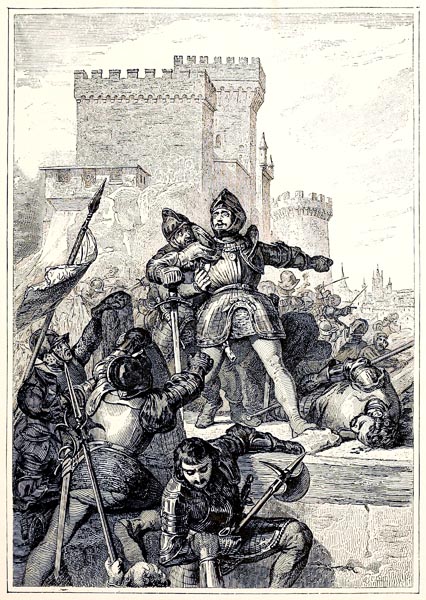
‘The Chevalier Bayard’
Character Sketches of Romance, Fiction and the Drama - Ebenezer Cobham Brewer (p200, 1892)
Internet Archive Book Images
If they had summoned me, I would have brought the Bourbons the popularity I enjoyed under my twin titles of writer and Statesman, since I had received support from all shades of opinion. This was not expressed in generalities; each told me what he expected from events; several confessed their genius and freely pointed out the position to which they were eminently suited. Everyone (friends and enemies) sent me to see the Duc de Bordeaux. Because of my various shades of opinion and my chequered fortune, because the ravages of death had removed in succession the men of my generation, I seemed to be the Royal Family’s sole remaining choice.
I might have been tempted by the role they assigned me; there was something flattering to my vanity, I, the servant ignored and rejected by the Bourbons, to be a prop to their race, to clasp the hands of Philippe-Auguste, Saint-Louis, Charles V, Louis XII, Francis I, Henri IV, Louis XIV in their tombs; to defend with my feeble renown the blood, the crown, the shades of so many great men, I, alone against faithless France and a debased Europe.
But to achieve it what would I have to do? What the humblest spirit had done: flatter the Court in Prague, overcome its antipathy, and conceal my thoughts from it until I was in a position to develop them.
And indeed, those ideas went far: if I had been the young Prince’s tutor, I would have tried hard to win his confidence. If he were destined to recover his crown, I would have counselled him to wear it only in order to sacrifice it at a future time. I wished to see the Capets depart in a manner worthy of their greatness. What a fine and noteworthy day that would be when, having exalted religion, perfected the constitution of the State, extended the rights of citizens, broken the last shackles of the Press, emancipated the boroughs, destroyed monopolies, matched salaries fairly to the work done, strengthened the rights of property while curbing its abuses, re-invigorated industry, lowered taxes, re-established our honour among the nations, and assured, by extending our borders, our freedom from foreign interference; what a fine day that would be when, all of the above being accomplished, my pupil could say to the nation in solemn conclave:
‘People of France your education has ended with mine. My first ancestor, Robert the Strong died for you, while my own father demanded mercy for the man who took his life. My forefathers created France and raised it from barbarism: now the march of the centuries, the progress of civilisation no longer requires that you have a tutor. I relinquish the throne; I confirm all my ancestors’ benefactions and deliver you from your oaths to the monarchy.’ Tell me whether that end would not surpass whatever was most marvellous about that race? Tell me if as great a temple could ever be erected in its memory? Compare that end, to the one the decrepit sons of Henri IV achieved, obstinately clinging to a throne submerged by democracy, trying to retain power with the aid of police measures, violence, corrupt votes, dragging on a degraded existence for a few instants? ‘Let them make my brother King,’ said the young Louis XIII, after the death of Henri IV, ‘as for me, I do not wish to be King.’ Henri V has no brother other than his people: let them make him King.
To achieve this outcome, chimerical as it may seem to be, he must feel the greatness of his race, not because he is descended from an ancient line, but because he is the heir of men through whom France became powerful, enlightened and civilised.
Now, as I have explained but a short while ago, the means of being summoned to put my hand to that plan was to fawn on the weak people in Prague, to fly ‘shrikes’ with the heir to the throne in imitation of Luynes, to flatter Concini as Richelieu did. I had started well in Carlsbad; a little communiqué full of deference and gossip would have advanced my affairs. To inter myself while still alive in Prague, it is true, would not be easy, for I would not only have to overcome the repugnance of the Royal Family, but also hatred for a stranger. My ideas are odious to government; they know I detest the Treaty of Vienna, that I would embrace war at any price to give France back its required frontiers, and re-establish the balance of power in Europe.
Yet by signs of repentance, tears, expiating my sins against national honour, beating my breast, admiring, as a penance, the genius of the fools who govern the world, perhaps I would be able to crawl to the place occupied by Baron Damas; then, suddenly straightening myself, I would throw away my crutches.
But alas! My ambition, where is it? My ability to deceive where is it? My prop to support the constraint and boredom, where is it? My means of attaching importance to everything that happens, where is that? I picked up my pen two or three times; I began two or three deceitful drafts in obedience to Madame la Dauphine who had commanded me to write to her. Swiftly, rebelling against myself, I wrote in one go, in my own style, the letter which was to end things for me. I knew it well; I weighed the consequences carefully: they mattered little to me. Today, even though the thing is done, I am delighted to have sent it all to the devil and thrown my tutorship through a high enough window. People will say: ‘Could you not have expressed the same truths but enunciated them with less crudity?’ Yes, yes, by prevaricating, writhing, flattering, squirming about, and trembling:
...His penitent eye weeps only holy water.
I know not how to do it.
Here is the letter (abridged however by almost half) which made the hairs of our drawing-room diplomats bristle. The Duc de Choiseul shared a little of my mood; and he ended his life at Chanteloup.
A LETTER TO MADAME LADAUPHINE
‘Paris, Rue d ‘Enfer, 30th of June 1833.
Madame,
The most precious moments in my long career have been those that Madame la Dauphine has allowed me to spend with her. On a humble mission to Carlsbad a Princess, the object of universal veneration, has deigned to speak to me in confidence. In the depths of her soul Heaven has placed a treasure, of magnanimity and religion, which excessive misfortune has failed to exhaust. I had before me the daughter of Louis XVI in a new exile; that orphan of the Temple, whom the martyred king had pressed to his heart before going to win the palm! God’s name alone is to be spoken when one loses oneself in contemplation of the impenetrable designs of his providence.
Praise addressed to prosperity is suspect: regarding the Dauphine, admiration may be unrestrained. I have said Madame that your misfortunes have mounted so high they have become one of the glories of the Revolution. I have therefore met once in my life with a destiny so elevated, so individual, as to be able to speak, without fear of harming it or of not being understood, about the future state of society. One can discuss with you the fate of empires, you who would see all the kingdoms of the earth pass before your feet without regret, kingdoms several of which have already fallen at the feet of your race.
The catastrophes that made you their most illustrious witness and most sublime victim, as great as they may seem, are nevertheless only particular events within a general transformation operating on the human species; the reign of Napoleon, who shook the world, is no more than a link in the revolutionary chain. One must begin with that reality in order to understand what is possible for a third Restoration, and by what means that Restoration might be framed within the envisaged social change. If it is not incorporated as a homogenous element, it would inevitably be rejected by an order of things inimical to its nature.
Thus, Madame, if I were to tell you that there was a possibility of the Legitimacy returning, with the aristocratic nobility and clergy and all their privileges, with the Court and its distinctions, royalty with its prestige, I would be deceiving you. The Legitimacy in France is no more than a sentiment; it is a principle as long as it guarantees property and interest, rights and freedoms; but if it were to demonstrate that it refused to defend, or was powerless to protect, that property and interest, those rights and freedoms, it would cease even to be a principle. If anyone were to claim that the Legitimacy could return by force, that people cannot do without it, that it would only have to appear for France to offer thanks to it on her knees, they would be in error. The Restoration will never re-appear nor last more than a moment, if the Legitimacy seeks power where it no longer resides.
Yes, Madame, and I say this sadly, Henri V may remain a foreign, exiled Prince; a young and recent ruin of an ancient building that has already fallen, but still a ruin. We former servants of the Legitimacy, we will soon have expended the little fund of years remaining to us, we will shortly rest in the grave, slumbering among our outdated ideas, like knights of old in their ancient armour gnawed by time and rust, armour that no longer fits nor is adapted to modern use.
Everything that in 1789 militated in favour of the old regime, religion, laws, customs, habits, ownership, class, privilege, institutions, no longer exists. A general ferment is in evidence; Europe is hardly more safe from it than ourselves; no mode of society has wholly vanished, none is wholly secure; everything is either worn-out or a novelty, either decrepit or rootless; everything shows the weakness of old age or infancy. Kingdoms born of territorial limitation mapped out by former treaties are things of yesterday; attachment to country has lost its force, because the concept of country is vague and transient for populations sold at auction, hawked like second-hand furniture, now annexed to alien populations, now handed over to unknown masters. Trampled, furrowed, ploughed, the soil was thus ready to receive the democratic seed that the July Days have nurtured.
Kings believe that by keeping watch from their thrones, they will halt the progress of ideas; they imagine that by issuing a description of principles they can have them seized at their frontiers; they are persuaded that by increasing the number of customs men, gendarmes, police spies, and military commissions, they will prevent them circulating. But ideas do not travel on foot, they are in the air, they fly about, people breathe them in. Absolute governments that establish telegraph posts, railways, steamboats, and yet at the same time wish to keep thought at the level of fourteenth century political dogma are neither here nor there; at once progressive and reactionary, they mire themselves in the confusion that results from theory and practice in contradiction one with the other. One cannot divorce industrialisation from the principle of liberty; one is forced to suppress both or accept both. Everywhere the French language extends, ideas arrive with passports issued by the century.
You will see, Madame, how essential it is to make the right start. The child of hope under your protection, the innocent protected by your virtues and misfortune as beneath a royal dais, I know no more imposing spectacle; if the Legitimacy has any chance of success, there it stands in its entirety. The France of the future might bow, without lowering itself, before the glory of its past, halting dumbfounded before this mighty apparition of its history represented by the daughter of Louis XVI, leading the latest Henri by the hand. As Royal protector of the young Prince, you would bring to bear on the nation the influence of vast memories which merge with your august person. Who will not feel an unaccustomed confidence if the orphan of the Temple oversees the education of the orphan of Saint Louis’ race?
It would be desirable, Madame, if that education, directed by men whose names are popular in France, were to be to some degree public. Louis XIV, who otherwise justified his pride in his motto, did his nation great harm by isolating the sons of France within the confines of an oriental education.
The young Prince seemed to me to be endowed with a lively intelligence. He should finish his studies by visiting ancient lands and even the New World, to understand politics and so fear neither institutions nor doctrines. If he has the opportunity to serve as a soldier in some distant foreign war, one should not fear to expose him to it. He has a resolute air; he seems to have his father’s and mother’s heart; but if he ever knows anything other than a feeling of glory when faced with danger, let him abdicate: without courage, in France, no crown.
In seeing me project Henri V’s education into the distant future, Madame, you will naturally assume that I do not consider him destined to remount the throne for a long time. I will try to explain impartially my contrasting reasons for hope and doubt.
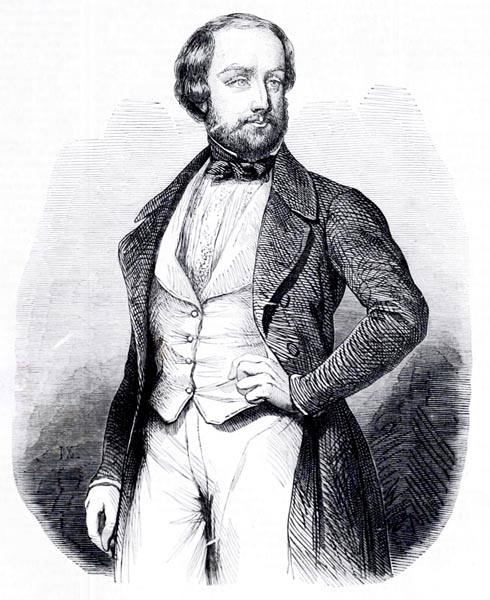
‘Monsieur le Compte de Chambord’
L'Illustration: Journal Universel (p152, 1843)
Internet Archive Book Images
The Restoration could take place today, or tomorrow. Something abrupt and inconstant is so much a part of the French character that change is always likely; the odds are always a hundred to one in France of something failing to last long: it is when the government seems most secure that it falls. We have seen a nation adore and detest Bonaparte, abandon him, re-adopt him, desert him once more, forget him in exile, erect altars to him after his death, then lose its enthusiasm for him. This flighty nation, which loves freedom only on whim, but is always terrified by equality; this multiform nation, was fanatical under Henri IV, factious under Louis XIII, serious under Louis XIV, revolutionary under Louis XVI, sombre under the Republic, bellicose under Bonaparte, and constitutional under the Restoration: it prostitutes its freedom today to a so-called republican monarchy, altering its nature perpetually according to the minds of its leaders. Its changeability has increased since it freed itself from family customs and the yoke of religion. So, some mischance may lead to the fall of the government of the 9th of August; but mischance may be expected: an abortion has been born to us; but France is a robust mother; she can, with her breast-milk, correct the vices of a depraved paternity.
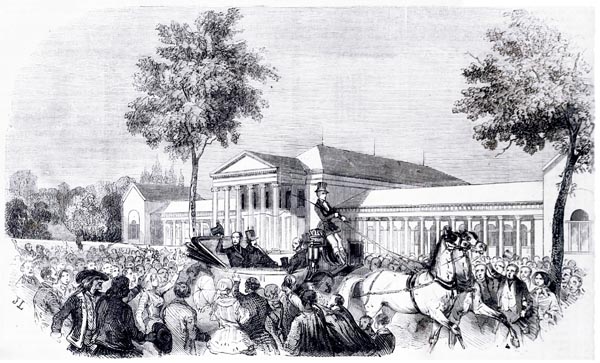
‘M. le Compte de Chambord à Wiesbaden’
L'Illustration: Journal Universel (p151, 1843)
Internet Archive Book Images
Though the present monarchy does not seem viable, I still fear lest it survive beyond the term one might assign to it. For forty years, each government in France has only perished through its own mistakes. Louis XVI could have saved his life and his crown twenty times; the Republic only succumbed to the excesses of its own fury; Bonaparte could have established his dynasty, and yet hurled himself from the heights to the depths of his glory; without the July ordinances, the Legitimacy would still be in place. The leader of the present government will not commit any of the faults that kill; his reign will never commit suicide; all his skill is employed in self-preservation: he is too intelligent to die by folly, and does not have in him whatever makes one guilty of the errors of genius, or the frailties of honour and virtue. He has realised he might perish in war, he will not make war; let France be lowered in the eyes of foreign powers: it matters little to him: the publicists will show that disgrace is good for industry and ignominy for credit.
The quasi-Legitimacy wants everything the Legitimacy wants, except for the royal personage: it wants order; it can obtain it by arbitrary power more effectively than the Legitimacy. To act despotically, while employing words of freedom and so-called royalist institutions, is all it desires: every deed accomplished enhances its right to exist: every hour its legitimacy increases. The age employs twin powers: with one hand it overthrows, with the other it builds. Moreover time works on minds by the mere fact that it passes; people are completely alienated from those in power, they attack them, they want nothing to do with them; then lassitude intervenes; success reconciles them to their cause; soon only a few elevated souls remain independent, whose perseverance makes those who have surrendered ill at ease.
Madame, this long dissertation obliges me to explain myself to Your Royal Highness.
If I had not raised a free voice in the days of good fortune, I would not have the courage to speak the truth in times of misfortune. I did not go to Prague on my own account; I would not have dared annoy you with my presence: the risks of devotion are in France, not in the neighbourhood of your august person: it is there I have sought them. Since the July Days I have not ceased fighting on behalf of the Legitimist cause. I was the first to dare to proclaim Henri V’s royalty. A French jury, by acquitting me, allowed my proclamation to stand. I only wish for peace, the need of my old age; yet I have not hesitated in sacrificing it whenever decrees extended and renewed the royal family’s proscription. Offers were made to me to attach myself to Louis-Philippe’s government; I did not merit that kindness; I showed how incompatible it was with my nature, by claiming what might be due to me of my aged King’s adversities. Alas! I did not cause those adversities, and I tried to prevent them. I do not recall these circumstances to give myself a false importance or create a merit I do not possess: I only did my duty; I am merely justifying myself, in order to excuse my freedom of expression. Madame will pardon the frankness of a man who would delight in going to the scaffold in order to grant her a throne.
When I appeared before Your Majesty at Carlsbad, I may say that I had never had the pleasure of being known there. You had barely had the honour of addressing a word to me during my whole life. You may have felt in private conversation with me that I was not the man others had described to you; that my independence of spirit has not altered my innate sense of moderation, and above all has not broken the bonds of my admiration and respect for the illustrious daughter of kings.
Yet I beg Your Majesty to reflect on the fact that the series of truths developed in this letter, or rather this memo, are what constitutes my power, if I have any: it is through them that I move men of diverse parties and bring them back to the royal cause. If I had repudiated the opinions of this century, I would have had no hold on my times. I seek to rally round the ancient throne those modern ideas which, inimical though they may be, become friends by passing the gate of my loyalty. If the flood of Liberal opinion is not diverted to the benefit of legitimate monarchy, European monarchy will perish. There will be a battle to the death between the two principles of monarchy and republicanism, if they remain separate and distinct: the consecration of a unique edifice constructed from the diverse material of the two edifices will belong to you Madame, who have been admitted to the most elevated as well as the most mysterious of initiations, unmerited misfortune, to you who have been marked at the altar with the blood of innocent victims, to you who by winning a saintly austerity will open the gates of the new temple with pure hands.
Your intelligence, Madame, and your superior powers of reason will clarify and rectify whatever is doubtful or erroneous in my sentiments concerning the present situation in France.
My emotion, in terminating this letter, is greater than I can say.
The Palace of the Kings of Bohemia is now the Louvre of Charles X and his royal and pious son! The Hradschin is young Henri’s Château of Pau! And you Madame, what Versailles do you inhabit? To what can one compare your religiosity, your greatness, and suffering, if not to that of the women of the House of David who wept at the foot of the cross? May Your Majesty see the royal line of Saint Louis rise radiantly from the tomb! May I proclaim it, while recalling the age which bears the name of your glorious ancestor; for, Madame, nothing is yours, nothing is contemporary with you but the great and the sacred:
“...O happy day for me!
With what ardour I will recognize my King!”
I am, Madame, with the profoundest respect for Your Majesty,
Your very humble and obedient servant,
CHATEAUBRIAND.’
Having written this letter, I lapsed back into my usual life: I sought out my old priests again, the solitary corner of my garden which appeared more beautiful to me than that of Count Choteck, my Boulevard d’Enfer, my Cemetery of the West, my Memoirs recalling past days, and above all the little select society of the Abbaye-aux-Bois. The kindness of a deep friendship creates a plenitude of thoughts; a few moments of commerce between souls satisfies the needs of my nature; I then atone for that expenditure of intellect by twenty-four hours of idleness and sleep.
Book XXXIX: Chapter 2: A letter from Madame la Duchesse de Berry
Paris, Rue d’Enfer, 25th of August 1833.
BkXXXIX:Chap2:Sec1
While I was regaining my breath, I witnessed the entry to my house one morning of the traveller who had taken a letter of mine to Madame la Duchesse de Berry in Palermo; he brought me this reply from the Princess:
‘Naples, 10th of August 1833.
I have written a word to you, Monsieur le Vicomte, to acknowledge receipt of your letter, desiring a sure opportunity of speaking to you of what you have seen and done in Prague. It seems to me that they allowed you to see very little, yet enough to judge that despite the means employed the result, as regards our dear child, gives no grounds for fear. I am very relieved to have had your assurance about the matter; but they tell me from Paris that Monsieur Barrande has been dismissed. What is to be made of that? How I long to take up my rightful place!
As for the requests I asked you to make (which were not exactly welcome) they have shown that they were no better informed about it than I: since I have no need of what I requested, having relinquished none of my rights.
I am going to ask your advice in replying to the solicitations made to me on all sides. In your wisdom, you may make what use you deem suitable of what follows. Royalist France, people devoted to Henri V, await a proclamation from his mother, free at last.
I left a few lines behind at Blaye which should be known by now; they expect more from me; they want to know the sad history of my detention for seven months in that impenetrable fortress. It shall be known in all its terrible detail; let them see the cause of the many tears and sorrows that have broken my heart. They will understand the moral torments I had to suffer. Justice ought to be rendered to the guilty; but also those atrocious measures should be revealed, taken against a woman, defenceless since they always refused her a lawyer, by a government headed by her relative, in order to drag from me a secret which, in any event, should not have concerned politicians, and whose discovery could not alter my position if I was an object of fear to the French government, which had the power to imprison me, but not the right, without a trial which I have more than once demanded.
But my relative, my aunt’s husband, head of a family to which, despite the opinions so generally and justly levelled against it, I had wished to marry my daughter, Louis-Phillipe himself, believing me pregnant and unmarried (which would have resulted in any other family opening the prison gates for me) inflicted every moral torment on me to force me to take steps by which he thought to establish his niece’s dishonour. Moreover, if I have to explain in a positive way my declarations and what motivated them, without entering into details of my private life, of which I need account to no one, I say truthfully that they were dragged from me by vexation, moral torment and the hope of recovering my freedom.
The bearer will give you details and tell you of the inevitable uncertainty at the time regarding the date of my embarkation and its destination, which thwarted the desire I had to profit from your obliging offer in asking you to meet me before your arrival in Prague, having great need of your advice. Now would be too late, since I hope to be with my children as soon as possible. But since nothing is certain in this world, and since I am accustomed to setbacks, if, against my will, my arrival in Prague is delayed, I certainly count on seeing you wherever I am forced to stop, from where I will write to you; if on the contrary, I am with my son as soon as I wish, you know better than I whether you ought to come. I can only assure you of the pleasure I would have in seeing you at any time and in any place.
MARIE-CAROLINE.’
‘Naples, 18th of August 1833
Our friend having been unable to leave as yet, I am receiving reports about what is happening in Prague which do nothing to diminish my desire to go there, but also make my need of your advice more urgent. If then you can travel to Venice without delay you will find me there, or letters waiting at the post-office, which will tell you where you can find me. I will be making part of the journey with people for whom I have great friendship and know well, Monsieur and Madame Bauffremont. We often speak of you; their devotion to me, and our Henri, makes them wish to see your arrival. Monsieur de Mesnard shares that desire as well.’
Madame de Berry mentions in her letter a little manifesto published on leaving Blaye which was worth little since it said neither yes nor no. The letter however is interesting as a historical document in revealing the Princess’ sentiments regarding the relatives who were her gaolers, and indicating the suffering she had endured. Marie-Caroline’s reflections are just; she expresses them with animation and pride. One loves to see that devoted and courageous mother, imprisoned or free, still constantly preoccupied with her son’s interests. There, in that heart at least, was youth and life. It would cost me something to start a long journey once more, but I was too moved by that poor Princess’ confidences to refuse her wishes and forsake her on the highroad. Monsieur Jauge hastened to relieve my distress as on the first occasion.
I went on campaign with a dozen or so volumes scattered around me. Now, while I journeyed once more in the Prince of Benevento’s calash, he dined in London at the expense of his fifth master, in hopes of some accident which might lead him to sleep at Westminster, among the saints, kings and sages; a sepulchre justly due his religiosity, loyalty and virtue.
Book XXXIX: Chapter 3: JOURNAL FROM PARIS TO VENICE: Jura – the Alps – Milan – Verona – A Roll-call of the Dead – The Brenta
En route, the 7th to the 10th of September 1833.
BkXXXIX:Chap3:Sec1
I left Paris on the 3rd of September 1833, taking the Simplon road via Pontarlier.
Salins, destroyed by fire, had been rebuilt; I preferred it in its ugliness and Spanish decrepitude. The Abbé d’Olivet was born on the banks of the Furieuse; Voltaire’s first schoolmaster, who welcomed his pupil to the Academy, had no similarity to his native stream.
The great storm which caused so many shipwrecks in the Channel assailed me on the Jura. I arrived at night among the wastes of the Lévier relay station. The caravanserai built of planks, brightly illuminated, full of travellers taking refuge, looked remarkably like the gathering-place for a witches’ Sabbath. I did not want to stop: they brought the horses. When it was necessary to shut the lamps on the calash, there was some difficulty; the hostess, a young and extremely pretty sorceress, leant her assistance while laughing. She took care to hold her light, protected by a glass cover, near her face, so as to be seen.
At Pontarlier, my former host, a great legitimist in his lifetime, was dead. I supped at the National Inn: a good omen for the newspaper of that name. Armand Carrel is the leader of those who did not tell lies during the July Days.
The Château de Joux protects the approaches to Pontarlier; it has seen two men whose memory the Revolution will preserve occupy its dungeons in succession, Mirabeau, and Toussaint-Louverture, the black Napoleon, imitated, and done to death, by the white Napoleon. ‘Toussaint,’ said Madame de Staël, ‘was sent to a prison in France where he perished in the most wretched manner. Perhaps Bonaparte only fails to remember that crime, because he has been less criticised for it than others.’
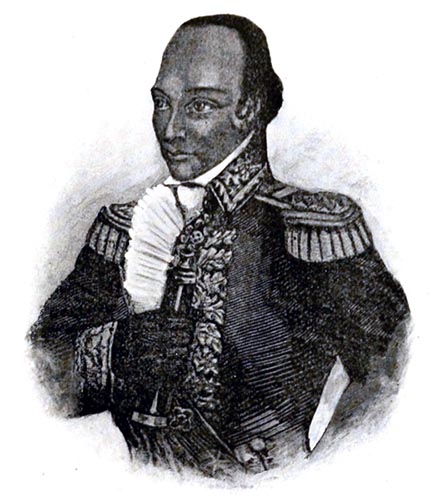
‘Toussaint L'Ouverture’
The Storied West Indies - Frederick Albion Ober (p194, 1900)
Internet Archive Book Images
The storm passed by: I suffered its worst violence between Pontarlier and Orbes. It made the mountains seem taller, made the bells chime in the hamlets, smothered the sound of the torrents with that of the thunder, and threw itself howling at my calash, like a black squall at a vessel’s sails. When flashes of lightning below lit the heather, you saw flocks of motionless sheep, heads hidden between their front legs, presenting their docked tails and woolly rumps to the flurries of rain and hail whipped along by the wind. The cry of a man shouting out the time, from the top of a mountain belfry, seemed like the voice of doom.
At Lausanne everything was smiling again: I had visited the town a few times before; I no longer knew anyone there.
At Bex, while they hitched the horses, which may have drawn Madame de Custine’s coffin, to my carriage, I leant against the wall of the house where my hostess of Fervaques died. She was noted, before the revolutionary Tribunal, for her long hair. In Rome I saw lovely blond hair recovered from a tomb.
In the Rhône valley, I met a little lass, almost naked, dancing with her goat; she begged charity of a rich well-dressed young man travelling post, with a courier in gold-braid in front and two lackeys seated at the back of the gleaming coach. And you imagine such a distribution of property can continue? Do you not think it justifies popular uprisings?
Sion recalled an epoch in my life: from being Secretary to the Rome Embassy, the First Consul nominated me as Plenipotentiary Minister to the Valais.
At Brig, I left the Jesuits trying hard to re-create what can no longer exist; established vainly at the feet of time, they were crushed beneath its weight, as their monastery was by the mountainous masses.
I was crossing the Alps for the tenth time; I had said what I had to say to them at various times and in the differing circumstances of my life. Forever regretful of what he has lost, forever wandering among memories, forever marching towards the grave, weeping and in isolation: that is Man.
Images borrowed, above all, from mountainous regions bear an obvious relationship to our lives; this one passes silently like the outflow from a spring; this makes a noise on its way like a torrent; that one pours out its existence like a cataract that terrifies and vanishes.
The Simplon already has a deserted air, like the life of Napoleon; like that life, it no longer possesses any glory; it is too great a work to belong to the little States to whom it has devolved. Genius has no family; its heritage fell by right of alienation to a plebeian people, who scratch away at it, planting a cabbage or growing a cedar.
Last time I crossed the Simplon, I was going to Rome as Ambassador; I have fallen; the shepherds I left behind on the mountain heights are still there: snow, clouds, shattered cliffs, pine forests, thunderous waters, endlessly surround the hut menaced by avalanches. The liveliest personage among those chalets is the she-goat. Why die? I know. Why be born? I have no idea. Yet you realise that the greatest suffering, moral suffering, the torments of the spirit are lessened among the habitations of that region of chamois and eagles. When I went to the Congress of Verona in 1822, the summit station on the Simplon was run by a Frenchwoman; in the midst of a cold night and a squall that prevented my seeing, she spoke to me of La Scala in Milan; she was waiting for ribbons from Paris; her voice, the only thing I could know of the woman, was very sweet in the wind and darkness.
The descent to Domo d’Ossola seemed more and more wonderful to me; some play of light and shadow increased the magic. One was caressed by a little breeze, in our ancient language called l’aure, a kind of advanced breath of the morning, bathed and perfumed with dew. I found Lake Maggiore again, where I was so sad in 1828, and which I glimpsed from the valley of Bellinzona in 1832. At Sesto-Calende, Italy proclaimed itself: a blind Paganini was singing and playing his violin by the edge of the lake as we crossed the Ticino.
I saw once more, on entering Milan, the magnificent avenue of tulip-trees which no one mentions: travellers apparently take them to be plane-trees. I protest against this silence, in memory of my savages: it is the slightest of ways in which America grants shade to Italy. One could also plant magnolias mixed with palm and orange trees at Genoa. But who dreams of that? Who thinks of adorning the earth? They leave all that to God. Governments are pre-occupied with their survival, and people prefer a cardboard tree in a puppet-theatre to the magnolia whose flowers might perfume Christopher Columbus’ birthplace.
In Milan, the vexation occasioned by passports is as stupid as it is brutal. I never pass through Verona without emotion: it was there that my active political career really began. What might have become of the world, if that career had not been interrupted by wretched envy, presented itself to my mind.
Verona, so animated in 1822 by the presence of the European sovereigns, had returned, in 1833, to silence; in those solitary streets the Congress seemed as distant as the Court of the Scaligeri and the Roman Senate. The amphitheatre, whose tiers had offered themselves to my eyes charged with a hundred thousand spectators, yawned empty; the buildings I had admired, beneath the illuminated embroidery of their architecture, were enveloped, grey and bare, by a rainy atmosphere.
How many ambitions were stirred among the actors at Verona! The destinies of how many nations were examined, discussed and weighed! Let us make a roll-call of those pursuers of dreams; let us open the book of the Day of Wrath: Liber scriptus proferetur;the book that is written will be revealed; Monarchs! Princes! Ministers! Here is your ambassador, here is your colleague returned to his post: where are you? Can you reply?
Alexander, Emperor of Russia? – Dead.
Francis II, Emperor of Austria? – Dead.
Louis XVIII, King of France? – Dead.
Charles X, King of France? – Dead.
George IV, King of England? – Dead.
Ferdinand I, King of Naples? – Dead.
The Grand Duke of Tuscany? – Dead.
Pope Pius VII? – Dead.
Charles-Félix, King of Sardinia? – Dead.
The Duke of Montmorency, Foreign Minister of France? – Dead.
Mr Canning, Foreign Minister of England? – Dead.
Count von Bernstorff, Foreign Minister of Prussia? – Dead.
Herr von Gentz, of the Austrian Chancellery? – Dead.
Cardinal Consalvi, Secretary of State to His Holiness? – Dead.
Monsieur de Serre, my colleague at the Congress? – Dead.
Monsieur d’Aspremont, my secretary at the Embassy? – Dead.
Count von Neipperg, husband of Napoleon’s widow? – Dead.
Countess Tolstoï? – Dead.
Her younger and elder son? – Dead.
My host at the Palazzo Lorenzi? – Dead.
If so many men appearing with me on the register of attendees at the Congress have been inscribed in the death register; if nations and royal dynasties have perished; if Poland has succumbed; if Spain is being torn apart once more; if I have been to Prague to inquire about the fugitive remnants of the great race whose representative I was in Verona, what then are the things of this earth? No one remembers the speeches we uttered around Prince Metternich’s table; but, oh the power of genius! No traveller can hear the lark sing in the fields around Verona without recalling Shakespeare. Each of us, searching the depths of their memory, finds a different obituary column, other extinguished feelings, other chimeras nursed in vain, like those of Herculaneum, at the breast of Hope. On leaving Verona, I was obliged to alter my way of measuring past time; I travelled back twenty-seven years, since I had not taken the route from Verona to Venice since 1806. At Brescia, Vicenza, and Padua, I traversed walls due to Palladio, Scamozzi, Franceschini, Nicholas of Pisa, and Fra Giovanni.
The banks of the Brenta failed my expectation; in my imagination they had remained more welcoming; the elevated dikes along the canal enclose too much marshland. Several villas have been demolished; but several elegant ones still remain. There, perhaps, Signor Procurante lives whom great ladies in need of sonnets disgust, whom two pretty girls are beginning to weary, whom music fatigues after a quarter of an hour, who finds Homer a mortal bore, who detests pious Aeneas, little Ascanius, idiotic King Latinus, vulgar Amata and insipid Lavinia; who cares little for Horace’s bad dinner on the road to Brindisi, who declares that he never reads Cicero, and still less Milton, a barbarian who ruins Tasso’s hell and his devil. ‘Alas!’ Candide whispered to Martin, ‘I fear this man has a sovereign contempt for our German poets!’
Despite my partial disappointment and the many gods among the little gardens, I was delighted with the silk trees (asclepias), the orange and fig-trees and the mildness of the air, I who, such a short time before, was travelling through German pine-woods and Czech mountains where the sun barely shows its face.
I arrived at Fusina, which Philippe de Comines and Montaigne call Chaffousine, at daybreak on the 10th of September. At ten thirty I embarked for Venice. My first care was to send to the post-office: there was nothing for me under either my direct address or my indirect one, via Paolo: of Madame la Duchesse de Berry, no news. I wrote to Count Griffi, the Ambassador of Naples to Florence, to ask him to let me know Her Royal Highness’ whereabouts.
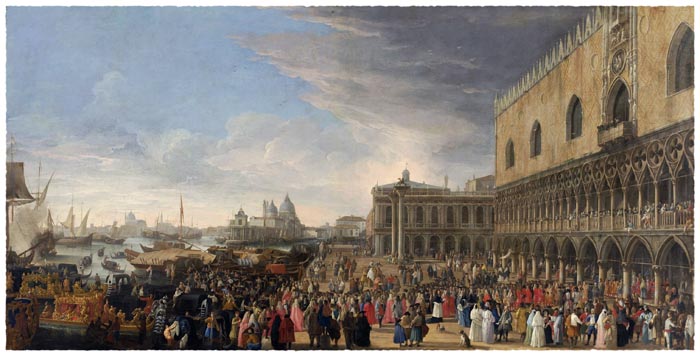
‘The Entry of the French Ambassador in Venice in 1706’
Luca Carlevarijs, 1706 - 1708
The Rijksmuseum
Settling in, I resolved to wait patiently for the Princess: Satan sent me a temptation. I chose, through his diabolical suggestion, to live alone for a fortnight in the Hôtel de l’Europe, to the great detriment of the Legitimacy. I wished the august voyager a poor journey without considering that my restoration of King Henri V might be delayed by a half-month: I asked, as Danton did, forgiveness for it of God and men.
Book XXXIX: Chapter 4: DIGRESSIONS: Venice
Venice, Hôtel de l’Europe, 10th of September 1833.
BkXXXIX:Chap4:Sec1
‘Salve, Italum Regina.
Nec tu semper eris.
Hail, Queen of Italy.
Though you live not forever.’
(SANNAZAR)
‘O d’Italia dolente
Eterno lume.
Venezia!
Of sorrowful Italy
Eternal light.
O Venice!’
At Venice, one might think oneself at the tiller of a superb galley at anchor, on the Bucentaur, where they will give you dinner and from whose side you can view admirable things. My hotel, the Hôtel de l’Europe, is sited at the entrance to the Grand Canal facing the Dogana di Mare, Giudecca and San Giorgio Maggiore. When one travels the Grand Canal between its two rows of palaces, stamped by their centuries, so varied architecturally, when one takes oneself to the great and little piazzas, contemplates the Basilica and its domes, the Doge’s Palace, the Procuratie Nuove, the Zecca, the Torre dell’Orologio, the Campanile, and the Lion Column, all of it interspersed with the masts and sails of boats, the movements of the crowds and the gondolas, the azure sea and sky, the caprices of a dream or the play of an oriental imagination are no more fantastic. Cicéri sometimes paints and groups on canvas, for theatrical spectacles, monuments of every kind, every age, every country and every clime: such is Venice.
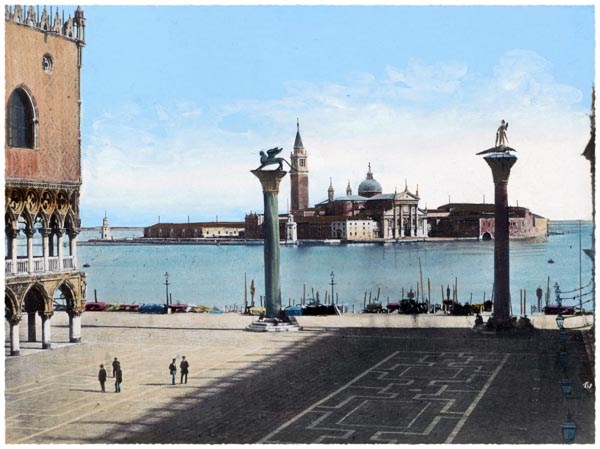
‘View of San Giorgio Maggiore from San Marco Square in Venice’
Anonymous, 1850 - 1876
The Rijksmuseum
Those gilded edifices, adorned profusely by Giorgione, Titian, Paulo Veronese, Tintoretto, Giovanni Bellini, Paris Bordone, and the two Palmas, are full of bronze, marble, granite, porphyry, precious antiques and rare manuscripts; their magic within matches their magic without; and when, in the subtle light that illuminates them, one discovers illustrious names and noble remembrances attached to their vaults, one cries with Philippe de Comines: ‘It is the most triumphant city I have ever seen!’
And yet she is no longer the Venice of Louis XI’s Minister, Venice wedded to the Adriatic and mistress of the seas; Venice who gave Constantinople emperors, Cyprus kings, Dalmatia, the Peloponnese, and Crete princes; Venice who humiliated the German Caesars, and welcomed suppliant Popes to her inviolable hearths; Venice of whom monarchs held it an honour to be citizens, to whom Petrarch, Plethon, and Bessarion bequeathed the remnants of Greek and Roman Letters saved from the barbarian wreckage; Venice who, a republic in the midst of feudal Europe, served as a shield for Christianity; Venice planter of the lion who set her feet upon the ramparts of Acre, Ascalon, Tyre, and defeated the Crescent at Lepanto; Venice whose Doges were the knights’ sages and merchants; Venice who subdued the Orient or bought her spices there, who brought from Greece conquered turbans or new-found masterpieces; Venice who emerged victorious from the thankless League of Cambrai; Venice who triumphed as much by her festivals, her courtesans and her arts, as by war and great men; Venice at once a Corinth, an Athens, a Carthage, decking her brow with rostral crowns and flowered diadems.
She is no longer the city I traversed when I visited the shores which witnessed her glory; but, thanks to her voluptuous breezes and her delightful waves, she keeps her charm; decadent countries above all need a beautiful climate. There is enough civilization in Venice for existence to play out its sensitivities there. The seductive sky prevents one needing a more than human dignity; an attractive strength emanates from those traces of grandeur, those remnants of the arts with which one is surrounded. The fragments of the ancient society that produced such things, leaves one no wish for the future. You love to feel yourself dying amongst all that is dying around you; you care for nothing but to adorn the rest of your life while she sheds her leaves. Nature, as quick to create fresh generations among the ruins as to clothe them with flowers, retains in the weakest of races the employments of passion and the enchantments of pleasure.
Venice no longer knows idolatry; she grew Christian on the island where she was nurtured, far from Attila’s brutality. The descendants of the Scipios, Paula and Eustochium, escaped the violence of Alaric in the caves of Bethlehem.
Different to all other cities, eldest daughter of ancient civilization and neither dishonoured nor conquered, Venice contains neither Roman remains nor Barbarian monuments. One sees nothing of what one sees in the north and west of Europe, amongst works of industrial progress; I speak of those new constructions, entire streets thrown up in haste, whose houses remain half-built or empty. What could they build here? Wretched shacks which would show the poverty of conception of the sons beside the magnificent genius of their fathers; pallid huts which could not compare with the gigantic residences of the Foscati and the Pesaro. When one thinks of the trowel full of mortar and handful of plaster whose application to a marble capitol urgent repairs have demanded, one is shocked. Rather the worm-eaten planks barring Greek or Moorish windows, the rags hung out to dry on elegant balconies, than the imprint of our century’s puny hand.
If only I might shut myself up in this city in harmony with my destiny, in this city of poets, which Dante, Petrarch and Byron passed through! If only I might finish writing my Memoirs by the light of the sun which falls on these pages! At this very moment the sun still scorches my Floridian savannahs and is setting here at the extremity of the Grand Canal. I no longer see it; but through a gap in those lonely palaces, its rays strike the globe of the Dogana, the spars of boats, the yards of vessels, and the gates of the monastery of San Giorgio Maggiore. The monastery tower, changed to a rose-coloured pillar, is reflected in the waves; the white façade of the church is so brightly lit that I can see the tiniest of chiselled details. The shop walls of the Giudecca are painted with Titianesque light; the gondolas on the canal and in the harbour swim in the same glow. Venice is seated there at the edge of the sea, like a beautiful woman who will vanish with the day: the evening breeze lifts her fragrant hair; she is dying, hailed by all of Nature’s smiles and graces.
Book XXXIX: Chapter 5: Venetian Architecture – Antonio – The Abbé Bettio and Monsieur Gamba – Rooms in the Doge’s palace – Prisons
Venice, September 1833.
BkXXXIX:Chap5:Sec1
In Venice, in 1806, I remember the young Signor Armani, the Italian translator, or a friend of the translator, of Le Génie du Christianisme. His sister, so he said, was a nun (monaca). There was also a Jewish gentleman on his way to the farce of Napoleon’s Grand Sanhedrin who eyed my purse; then there was Monsieur Lagarde, head of French espionage, who had me to dinner: my translator, his sister, and the Sanhedrin Jew, are either dead or no longer live in Venice. In those days, I stayed at the White Lion Inn, near the Rialto; that inn has changed location. Almost facing my former hostelry is the Foscari Palace which is falling down. Away, all these old fragments of my life! Those ruins will drive me mad: let us speak of the present.
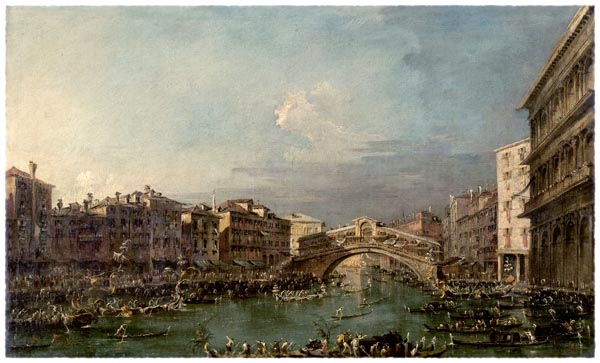
‘Regatta on the Canale Grande near the Rialto Bridge in Venice’
Francesco Guardi, 1780 - 1793
The Rijksmuseum
I have tried to describe the general effect of Venetian architecture; in order to give an account of the details I travelled up and down the Grand Canal, and visited and revisited St Mark’s Square.
Volumes are needed to cover the subject exhaustively. Count Cicognara’s Le Fabbriche più cospicue di Venezia shows the features of the monuments; but the presentation is not clear enough. I will content myself with noting two or three of the most common arrangements.
From the capital of a Corinthian column a semi-circle is described which ends on the capital of a second Corinthian column: in the midst of these a third is erected, of the same order and dimensions; from the capital of this central column two further semi-circles rise to left and right whose extremities also rest on the capitals of the other columns. The result of this design is that the arches, intersecting, give rise to ogives at the point of intersection (It is clear to me that the ogive whose origin, deemed mysterious, is sought far and wide, is born fortuitously from the intersection of two rounded arches; and it is found everywhere. Architects have merely succeeded in extracting it from the designs in which it appears) such that it forms a delightful blend of two architectural styles, the Roman rounded arch and the Arab ogive, or oriental Gothic. I here agree with present opinion, in supposing the Arab ogive to be Gothic, or of the Middle Ages, in origin; but it definitely exists in the monuments termed cyclopean: I have seen it in its pure form in the tombs of Argos.
The Doge’s Palace reveals tracery reproduced in other palaces, particularly the Foscari Palace: the pillars support ogive arches; these arches leave intervening spaces: in these spaces the architect has placed rose windows. Each rose window rests between the points of two arches. These rose-windows, which also touch one another at a point on their circumference, on the building’s façade, act like a row of wheels on which the rest of the building rises.
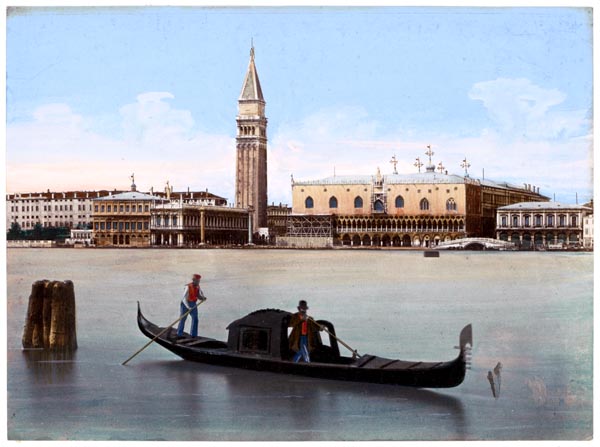
‘View of the Doge's Palace, Campanile and Surrounding Buildings in Venice’
Anonymous, 1850 - 1876
The Rijksmuseum
In most construction the base is usually substantial; the building reduces in thickness as it ascends into the sky. The Ducal Palace precisely contradicts this natural architecture: the base, pierced by light porticoes surmounted by a gallery with arabesques, indented with four-leaved clover tracery, supports an almost bare rectangular mass: it could be called a fortress on pillars, or rather an upturned building planted on its airy crown its thick roots in the air.
The architectural masks and heads decorating the Venetian buildings are noteworthy. On the Pescaro Palace, the entablature of the first storey, of Doric order, is decorated with the heads of giants; the Ionic order of the second storey is decorated with the heads of knights projecting horizontally from the wall, faces turned towards the water: some cased in a beaver, others with visor half-lowered; all with helmets whose plumes curl into the ornamentation of the cornice. Finally, on the third storey, of Corinthian order, there are heads of female statues with variously knotted hair.
At St Mark’s, embossed with domes, incrusted with mosaics, loaded incoherently with the spoils of the Orient, I thought myself at the same moment at San Vitale in Ravenna, Sancta Sophia in Constantinople, St Saviour in Jerusalem, and in those lesser churches of the Morea, Chios and Malta: St Mark’s, of composite Byzantine architecture is a monument of victory and conquest raised to the Cross, as the whole of Venice is a trophy. The most remarkable effect of its architecture is its shadiness under a bright sky; but today, the 10th of September, the dim light outdoors was in harmony with the sombre basilica. They have completed the forty hours of prayer required to obtain good weather. The fervour of the faithful, praying against rain, was profound: a grey and aqueous sky is like the plague to Venetians.
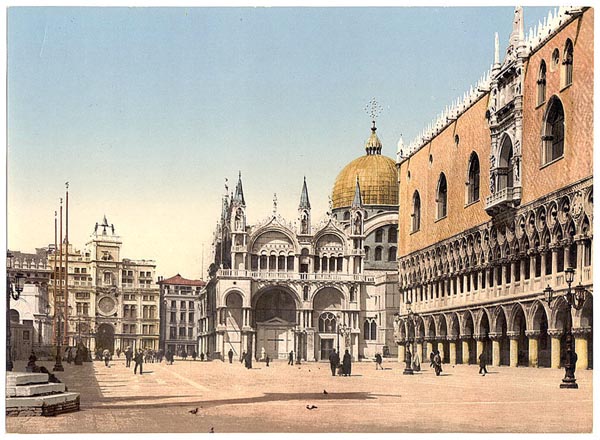
‘Clock tower, St. Mark's, and Doges' Palace, Piazzetta di San Marco, Venice’
Anonymous, 1890 - 1900
The Library of Congress
Our wishes have been granted: the evening was delightful; tonight I walked along the quay. The sea was smooth; the stars mingled with the scattered lights of the boats and other vessels anchored here and there. The cafes were full; but I saw no Punchinellos, Greeks, or Barbary Pirates: all that is done with. A Madonna, brightly lit at the entrance to a bridge, drew a crowd: girls on their knees said their paternosters devotedly; with her right hand she made the sign of the cross, with her left hand she stopped passers-by. Returning to my inn, I lay down and slept to the singing of the gondoliers stationed beneath my windows.
I have Antonio as my guide, the oldest and wisest cicerone in the land: he knows the palaces, statues and paintings by heart.
On the 11th of September, I visit the Abbé Bettio and Monsieur Gamba, curators at the library: they welcome me with extreme courtesy, even without a letter of recommendation.
Traversing the rooms of the Ducal Palace, you pass from marvel to marvel. There the entire history of Venice is revealed painted by the greatest masters: their pictures have been described a thousand times.
Among the antiquities, I noted, as all do, the group of Leda and the Swan, and the Ganymede said to be by Praxiteles. The swan is prodigious in terms of its grip and its voluptuousness; Leda is too complacent. The eagle of the Ganymede is not a true eagle; it looks like the gentlest of creatures. Ganymede, pleased to be carried off, is delightful: he speaks to the eagle who replies.
These antiquities are placed at either end of the magnificent halls of the library. With a poet’s sacred respect, I contemplated a manuscript of Dante’s, and gazed with a traveller’s avidity at Fra Mauro’s Mappa Mundi (1460). Africa however did not seemed as accurately traced as was said. Above all one ought to explore the archives of Venice: one would find there many precious documents.
From painted and gilded salons, I passed to dungeons and cells; the one palace offers a microcosm of society, pleasure and sorrow. The cells are beneath the leads, the dungeons at the level of the canal and on the second storey. They tell a thousand tales of secret strangulations and decapitations; by contrast, they tell of one prisoner who emerged, large, fat and ruddy from the oubliettes, after eighteen years in captivity: he had survived like a toad inside a stone. Honour to the human race! What a fine thing it is!
Perhaps philanthropic maxims adorn the walls and ceilings of dungeons, since our Revolution, so hostile to shedding blood ‘to that fearful stay, with a blow from an AXE, brought the light of day.’ In France, they cluttered the cells with victims whom they got rid of by cutting their throats; but they delivered the shades of those who were never there perhaps from the prisons of Venice; the gentle executioners who beheaded old men and children, the benign spectators who helped to guillotine women were moved by the progress of humanity, as is well proven by the opening of the Venetian dungeons. As for me, I am cold-hearted; I cannot match these heroes of sensibility. No old headless larvae were presented to my eyes beneath the Doge’s Palace; I only seemed to see in the dungeons of the aristocracy what the Christians saw when they shattered the idols, nests of mice escaping from the heads of the gods. That is what happens to all power eviscerated and exposed to the light; vermin emerge that worshippers have adored.
The Bridge of Sighs links the Ducal Palace to the city prison; it is divided in two lengthwise: on one side ordinary prisoners entered; on the other prisoners of State approached the Tribunal of Inquisitors or the Ten. The bridge is elegant on the outside, and the prison’s façade is admired: you cannot avoid beauty in Venice, even with regard to tyranny and misfortune! Pigeons make their nests on the window ledges of the gaol; little doves, covered with down, flap their wings and coo at the bars while waiting for their mother. In days past, they cloistered innocent creatures almost as they emerged from the cradle; their parents no longer saw them except through the visiting-room grille or the wicket gate.
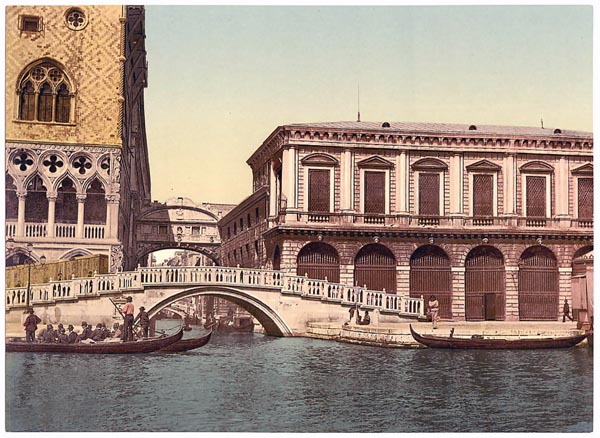
‘The Bridge of Sighs, Venice’
Anonymous, 1890 - 1900
The Library of Congress
Book XXXIX: Chapter 6: The Prison of Silvio Pellico
Venice, September 1833.
BkXXXIX:Chap6:Sec1
You may well imagine that in Venice I was of necessity interested in Silvio Pellico. Monsieur Gamba told me that Abbé Bettio was keeper of the palace, and that by addressing him I could carry out my research. The excellent librarian, to whom I had recourse one morning, took a great bunch of keys and led me through several corridors and up various stairs, to the attic rooms of the author of Mie Prigioni.
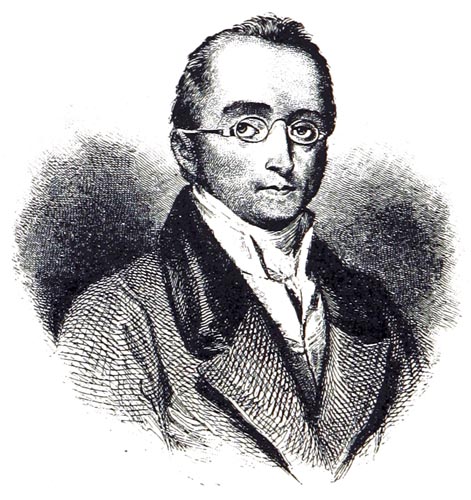
‘Silvio Pellico’
Francesca da Rimini. A Tragedy - Silvio Pellico (p10, 1897)
The British Library
Monsieur Silvio Pellico was not wrong about one thing; he spoke of his gaol as of those famous dungeons in the air, called from their roofs sotti I piombi (above the leads). Those prisons are, or rather were five in number in the part of the Ducal Palace which is close to the Ponte della Paglia and the canal with its Bridge of Sighs. Pellico did not stay there; he was incarcerated at the other end of the palace, towards the Ponte di Canonico, in a building attached to the palace; a building transformed into a prison for political detainees in 1820. Moreover, he was also beneath the leads, since a sheath of that metal formed the roof of his hermitage.
The description the prisoner gave of his two rooms is exact to the last detail. Through the window of the first room, you overlook the heights of St Mark’s; you can see the wells in the interior courtyard of the palace, one end of the great square, various bell-towers of the city, and beyond the lagoon, on the horizon, the mountains towards Padua; you recognize the second room by its large window and its other high little window; through the large one Pellico saw his companions in misfortune in the central building facing him, and to his left, above, the sweet children who spoke to him from their mother’s casement.
Today all these rooms are abandoned, since no one inhabits them, not even prisoners; the window grilles have been removed, the walls and ceilings white-washed. The gentle and wise Abbé Bettio, lodged in this deserted part of the palace, is its peaceable and solitary guardian.
The rooms which immortalise Pellico’s captivity do not lack elevation; they have air, and a superb view; they are a poet’s prison; he had little to tell, as tyranny and absurdity admitted: but the death-sentence for speculative opinions! A dungeon in Moravia! Ten years of life, youth and talent! Mosquitoes, foul insects that ate me too in the Hôtel de l’Europe, hardened as I am by time and by the maringouins (mosquitoes) of the Floridas. Moreover I have often been worse lodged than Pellico was in his belvedere of the Ducal Palace, notably at the Prefecture of the doges of the French police: I was also obliged to climb on a table to see the light of day.
The author of Francesca da Rimini thought of Zanze in his gaol; in mine I sang of a young girl I had just seen die. I very much wanted to know what had become of Pellico’s little gaoler. I have set my people searching for her: if I find anything out, I will let you know.
Book XXXIX: Chapter 7: The Frari – The Accademia di Belle Arti – Titian’s Assumption – The Metopes of the Parthenon – Original drawings by Leonardo da Vinci, Michelangelo and Raphael – The Church of Santi Giovanni e Paolo
Venice, September 1833.
BkXXXIX:Chap7:Sec1
A gondola dropped me at the Frari, where we French, accustomed as we are to the Greek or Gothic exteriors of our churches, are struck by the facade of a brick basilica unprepossessing and ordinary to the eye; but in the interior the harmony of line, and disposition of mass produces simplicity and a calm of composition which enchants.
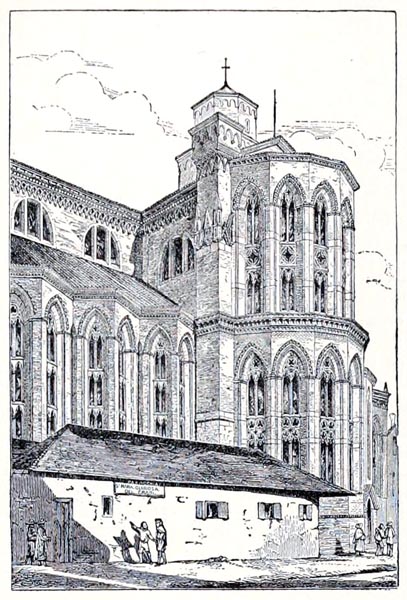
‘Church of the Frari, Venice’
A Dictionary of Architecture and Building: Biographical, Historical, and Descriptive - Russell Sturgis (p329, 1902)
Internet Archive Book Images
The Frari tombs, set in the lateral walls, adorn the edifice without cluttering it. The magnificence of the marble gleams on every side, the delightful ornamental leafage testifies to the end of ancient Venetian sculpture. On one of the paving stones in the nave one reads these words: Here lies Titian who emulated Zeuxis and Apelles. The stone lies beneath one of the painter’s masterpieces.
Canova’s sumptuous sepulchre lies not far from Titian’s slab: the sepulchre is a realisation of the monument which the sculptor had conceived for Titian himself, and which he later executed for the Arch-Duchess Marie-Christine. The remains of the creator of the Hebe and the Magdalen were not all buried together in this structure: thus Canova inhabits the realisation of a tomb made by him, but not for him, which is only a half-cenotaph.
From the Frari, I went to the Manfrin Gallery. The portrait of Ariosto is alive. Titian has painted his mother, an old woman of the people, grimy and ugly: the artist’s pride is felt in the exaggeration of the woman’s age and poverty.
At the Accademia di Belle Arti, I hastened to the painting of the Assumption, discovered by Count Cicognara: there are ten large male figures at the foot of the painting; note the man, gazing at Mary and transported by ecstasy, at the left. The Virgin, above this group, rises from a semi-circle of cherubs; there are a multitude of admirable faces lost in glorification: a woman’s head at the right, at the end of the curve is of indescribable beauty; two or three divine spirits are thrown horizontally across the sky in the bold and picturesque manner of Tintoretto. I am not sure if an angel standing does not display too earthly a sentiment of love. The Virgin’s proportions are good; she is covered by a red robe; her blue sash floats in the air; her eyes are raised towards the Eternal Father, appearing to her, at the culminating point. Four distinct colours, brown, green, red and blue, adorn the work: the aspect of it all is sombre, the character not idealised, but of an incomparable natural truth and vivacity: yet I prefer the Presentation of the Virgin in the Temple, by the same painter, which can be seen in the same room.
Facing the Assumption, lit with much artifice, is the Miracle of St Mark, by Tintoretto, a vigorous drama which seems rather to have been carved from the canvas with mallet and chisel than painted with a brush.
I passed to the plaster casts of the Metopes from the Parthenon; these casts have a triple interest for me; in Athens I saw the empty spaces left behind by the ravages of Lord Elgin, and, in London, the marbles he removed whose casts I found in Venice. The errant destiny of these masterpieces is bound up with mine, and yet Phidias did not fashion my clay.
I could not tear myself away from the original drawings by Leonardo, Michelangelo and Raphael. Nothing is more engaging than these sketches of genius, owed only to its studies and caprices; it admits you to intimacy; it initiates you into its secrets; it allows you to learn by what degrees and effort it achieved perfection: you are delighted to see how it made mistakes, how it realised and redressed its errors. Those strokes of the crayon traced on a table corner, on a wretched scrap of paper, retain nature’s marvellous abundance and simplicity. When one thinks that Raphael’s hand has traversed those immortal fragments, one wishes oneself inside the glass that prevents one kissing the holy relics.
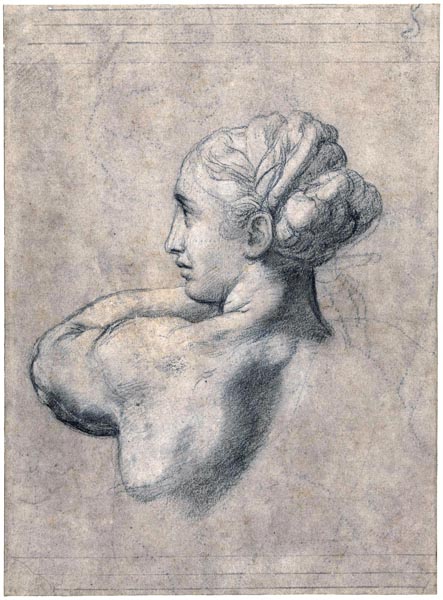
‘Study of a Head and Left Shoulder of a Woman’
Raphael, 1519 - 1520
The Rijksmuseum
I relaxed from the admiration I felt in the Accademia di Belle Arti by an admiration of a different sort in Santi Giovanni e Paolo; so one refreshes the spirit by a change of study. This church, whose unknown architect followed in the footsteps of Nicolo Pisano, is rich and vast. The apse which contains the main altar presents a kind of upright conch; two sanctuary altars abut this conch laterally; they are tall, narrow, with multi-centred arches, and separated from the apse by grooved planks.
The remains of the Doges Mocenigo, Morosini, Vendramin and other leaders of the Republic, rest here. Also the skin of Antonio Bragadino, defender of Famagusta, to which Tertullian’s expression can be applied: a living skin. These famous tombs inspire a deep and painful sentiment; Venice herself, the magnificent catafalque of her warrior magistrates, double coffin of their remains, is nothing but a living skin.
Stained glass and red draperies, by veiling the light in Santi Giovanni e Paolo, add to the religious effect. The countless pillars, brought from Greece and the Orient, have been planted in the basilica like alleys of foreign trees.
A storm arrived as I was wandering about the church: when the trumpet sounds who will wake all these dead? I would have said there were as many below Jerusalem in the Valley of Jehosaphat.
After these visits, returning to the Hôtel de l’Europe, I thanked God for having transported me from the pigs of Waldmünchen to the pictures of Venice.
Book XXXIX: Chapter 8: The Arsenal – Henri IV – A frigate leaving for America
Venice, September 1833.
BkXXXIX:Chap8:Sec1
After my discovery of the prisons where Austrian materiality tried to stifle Italian intellect, I went to the Arsenal. No monarchy, however powerful, has offered an equivalent maritime factory.
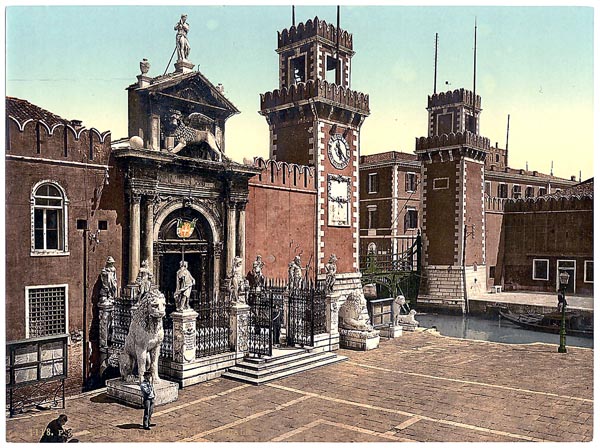
‘The Arsenal, Venice’
Anonymous, 1890 - 1900
The Library of Congress
An immense space, enclosed by crenellated walls, surrounds four docks for high-sided vessels, the shipyards to build such vessels, the workshops for whatever concerns the navy and merchant marine, from rope-works to foundries for cannon, from the workshops where they shape the oars for gondolas to those where they carve out the keel of a seventy-four, from the rooms given over to antique weapons won at Constantinople, Cyprus, the Morea and Lepanto, to the rooms where modern weapons are displayed: the whole mingled with pillared galleries, architecture designed and created by the leading masters.
In the naval arsenals of Spain, England, France and Holland you see only what relates to the purpose of those arsenals; in Venice, the arts unite with industry. The monument to Admiral Emo, by Canova, awaits you beside the carcass of a ship; rows of cannon appear through long porticoes: the two colossal lions from Piraeus guard the gates of the dockyard from which frigates emerged to a world that Athens never knew, and that revealed the genius of modern Italy. Despite these fine Neptunian remains, the arsenal merely recalls those lines of Dante:
‘As in the arsenal in Venice,
they boil the clammy pitch in winter
to caulk those damaged ships
they cannot sail, and labouring there
one builds anew, another stops the ribs
of a vessel that has widely fared;
some hammer at the prow, some the stern;
some shape oars, and others twine the rope;
one mends the mainsail, another mends the jib:’.
All that activity is done with; the emptiness of nine tenths of the Arsenal, the unlit furnaces, the rusting boilers, the shipyard without workers, the rope-works without winding-wheels, bear witness to the same death which has struck the palaces. Instead of a crowd of carpenters, sail-makers, sailors, caulkers and ship’s apprentices, I glimpsed a few galley-slaves dragging their shackles: two of them were eating on a cannon’s breech-block; at that iron table they could at least dream of liberty.
In the past, when those galley-slaves rowed the Bucentaur, they threw a purple tunic over their stringy shoulders to make them look like kings: cleaving the waves with gilded oars, they exercised their labour to the rattle of chains, as in Bengal, at the Durga, the dances of the dancing girls, clothed in golden gauze, are accompanied by the tinkling of the bracelets with which their necks, arms and legs are adorned. The Venetian convicts wedded the Doge to the sea, and themselves renewed in slavery their indissoluble union.
Of the numerous fleets that carried the crusaders to the shores of Palestine and denied all foreign sails access to the Adriatic breezes, one Bucentaur in miniature remains, Napoleon’s canoe, a dugout of savages, and plans for vessels, traced in chalk on the blackboards of the Naval colleges.
A Frenchman arriving from Prague and waiting in Venice for Henri V’s mother cannot help but be touched to see Henri IV’s armour in the Venice Arsenal. The sword the Béarnais carried at the Battle of Ivry belongs with the armour: the sword is now missing.
By a decree of the Grand Council of Venice, of the 3rd of April 1600; Enrico di Borbone IV, re di Francia e di Navarra, con li figliuoli e discendenti suoi, sia annumerato tra I nobili di questo nostro maggiore consiglio: Henry IV of Bourbon, King of France and Navarre, with all his sons and descendants, will be counted among the nobles of this our Grand Council.
Charles X, Louis XIX and Henri V, descendants di Enrico di Borbone, are thus gentlemen of the Venetian Republic which no longer exists, as they are kings of France and Bohemia, as they are canons of St John Lateran in Rome, and always by virtue of Henri IV; I represented them in that capacity: they have lost their hoods and furs, and I have lost my Embassy. Yet I was so fine in my stall at St John Lateran! What a lovely church! What a beautiful sky! What admirable music! Those hymns have lasted longer than my greatness and that of my Royal Canon.
My glory bothered me in the Arsenal; it shone on my brow without my knowing it: Field-Marshal Palucci, Admiral and Commander-in-Chief of the Navy, recognized me by my horns of fire. He hastened to show me various curiosities himself; then, excusing himself for not being able to accompany me longer, because of a council meeting which he was off to preside over, he left me in the hands of a senior officer.
We met the captain of the frigate which was about to depart. He approached me without any fuss, and said, with that sailor’s easiness that I so love: ‘Monsieur le Vicomte (as if he had known me all his life) have you any commissions for America?’ – ‘No, captain: but give it my best compliments, it is a long time since I saw it!’
I cannot gaze at any ship without dying of envy to sail in her: if I were free, the first vessel travelling to the Indies would have its opportunity to carry me. How I regret not accompanying Captain Parry to the Polar Regions! My life is only enjoyable in the midst of sea and cloud: I always hope that it will vanish under sail. The heavy years we throw into the waves of time are not anchors; they do not arrest our course.
Book XXXIX: Chapter 9: Saint Christopher’s Cemetery
Venice, September 1833.
BkXXXIX:Chap9:Sec1
At the Arsenal, I was not far from the Isle of San Cristoforo, which serves today as a cemetery. The island contains a Capuchin monastery; the monastery has been razed and its site is merely an enclosure, square in shape. The graves are not very prolific, or at least they do not show above the levelled ground covered with grass. Against the west wall are piled half a dozen stone monuments; little crosses of blackened wood with a white date are scattered around the enclosure: this is how they inter the Venetians now whose ancestors rest in the mausoleums of the Frari and San Giovanni e Paolo. Society while expanding has abased itself; democracy has overcome death.
At the edge of the cemetery, to the east, one finds the sepulchres of Greek schismatics and those of Protestants; they are separated by a wall between and separated further from the Catholic burials by another wall: sad dissensions whose memory is perpetuated in the place where all quarrels end. Attached to the Greek cemetery is another entrenchment which protects a hole where they hurl children, born dead, into Limbo. Fortunate creatures! You have passed from the night of the maternal womb to the eternal night, without having traversed the light!
Near this hole, lie bones dug from the soil like roots, whenever they clear the ground for new graves: some, the oldest, are white and dry; others, recently unearthed, are yellow and moist. Lizards scamper among the remains, gliding between the teeth, traversing the eye-sockets and nostrils, emerging from the skulls’ mouths and ears, their homes or lairs. A few butterflies, symbols of the soul under skies descended from those beneath which the story of Psyche was invented, flutter among the mallow flowers growing between the bones. One cranium still bore hair the colour of mine. Poor old gondolier! Did you at least steer your boat better than I have steered mine?
A common grave remains open in the enclosure; a doctor has just descended there to lie beside his former patients. His black coffin was only covered with earth above, and his naked flank awaited the touch of another corpse’s flank to warm him. Antonio had deposited his wife there a fortnight ago, and the deceased doctor had dispatched her there. Antonio blessed the God who repays and revenges, and accepted his misfortune patiently. The individual coffins are conducted to this gloomy bazaar in individual gondolas followed by a priest in another gondola. As the gondolas are like coffins they suit the ceremony. A larger boat, the omnibus of the Cocytus, provides a service to the hospitals. Thus are revived the interments of Egypt and the myth of Charon and his barque.
In the cemetery towards Venice an octagonal chapel rises, consecrated to St Christopher. This saint, carrying a child on his shoulders over a ford, found him heavy: now, the child was the son of Mary and held the world in his hand; the altar painting depicts that great crossing.
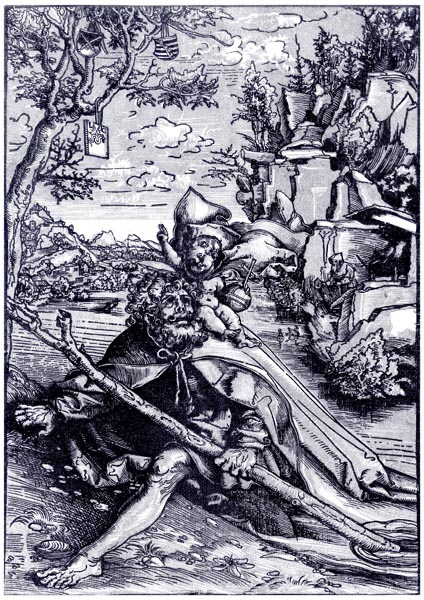
‘Saint Christopher’
Lucas Cranach the Elder (German, 1472 - 1553)
Yale University Art Gallery
And I too chose to carry a child King, but I did not notice that he was asleep in his cradle with ten centuries or more: a burden too heavy for my arms. In the chapel I noted a wooden candlestick (the candle was out), a stoop used to bless the graves, and a booklet: Pars Ritualis romani pro usu ad exsequianda corpora defunctorum: Part of the Roman ritual to be used for the obsequies of the dead; when we are already forgotten, Religion, immortal parent, ever unwearied, weeps for us and follows us, exsequor fugam: followed in flight. A box contained a flame; God alone disposes of the spark of life. Two quatrains written on ordinary paper had been pasted inside the notice boards on a couple of doors of the building:
‘Quivi dell’ uom le frali spoglie ascose
Pallida morte, o passeggier, t’addita, etc.
The fragile remains of men are buried here,
You, O passer-by, Pale Death marks out, etc.’
The only tomb in the cemetery which was the least unusual was raised in advance by a woman who then waited eighteen years before dying; the inscription explains this circumstance; so the woman longed in vain for her grave for eighteen years. What disappointment nurtured that enduring hope in her?
On a little black wooden cross this other epitaph can be read: Virginia Acerbi, d’anni 72, 1824. Morta nel bacio del Signore. Virginia Acerbi, 72 years old, 1824. Dead in the arms of the Lord: the years are hard on a beautiful Venetian.
Antonio said to me: ‘When this cemetery is full, they will leave it lie, and inter the dead on the Island of San Michele di Murano.’ The phrase was fitting; the harvest done one leaves the earth fallow and ploughs other furrows elsewhere.
Book XXXIX: Chapter 10: San Michele di Murano – Murano – The woman and child - Gondoliers
Venice, September 1833.
BkXXXIX:Chap10:Sec1
We went to see the other field that awaits the great ploughman. San Michele di Murano is a pleasant monastery with an elegant church, porticoes and a white cloister. From the monastery windows you can see the Venice Lagoon through the porticoes; a garden full of flowers meets the lawn whose compost is still maturing beneath a young girl’s skin. This charming retreat has been surrendered to the Franciscans: it would suit nuns better, who might sing like the little pupils of Rousseau’s Scuole. ‘Happy are those,’ says Manzoni, ‘who have taken the holy veil before setting eyes on a man’s face!’
Grant me a cell there, I beg you, to complete my Memoirs.
Fra Paolo is buried at the entrance to the church; that seeker of noise must be furious at the silence that surrounds him.
Pellico, condemned to death, was held at San Michele before being transported to the fortress of Spielburg. The President of the Tribunal that Pellico appeared before replaced the poet at San Michele; the former is buried in the cloister; he has never emerged from that prison.
Not far from the magistrate’s grave is that of a foreign lady: married at twenty, in January, she died in the following February. She did not wish to outlive her honeymoon; the epitaph reads: Ci rivedremo: we will meet again. If it be true.
Away with that doubt, away with the thought that anguish may fail to tear apart the nothingness! Atheist, when death sinks his nails in your heart, who knows if in the last moment of consciousness, before the destruction of the self, you will not experience an agony of grief capable of filling eternity, an immensity of suffering of which no human being can form an idea within time’s circumscribed limits? Oh, yes, ci rivedremo!
I was too close to the island and town of Murano, not to visit the workshop from which Combourg obtained the mirrors in my mother’s room. I did not see that workshop, which is now closed; but they spun before me, as time spins our fragile life, a thin rope of glass: it was of that glass that the bead was made that hung from the nose of the little Iroquois girl at Niagara Falls: a Venetian hand had shaped the ornament for a savage.
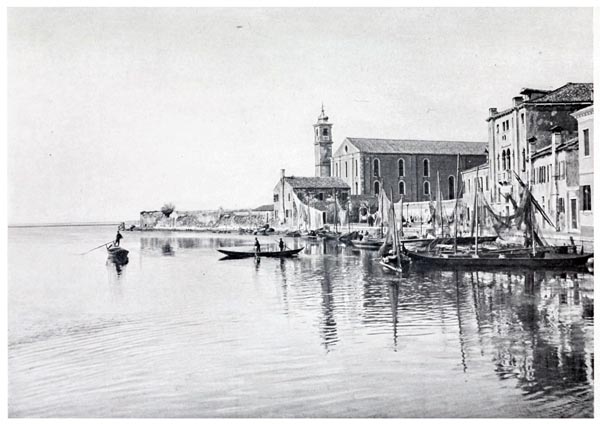
‘Murano (Fot. F. Trombini)’
Le Isole Della Laguna Veneta - Pompeo Molmenti, Dino Mantovani (p94, 1904)
Internet Archive Book Images
I met with greater beauty than Mila’s, a woman carrying a child in swaddling clothes; the fineness of colouring, and the charming glance of that Muranese are idealized in my memory. She had a sad and preoccupied air. If I had been Lord Byron, the occasion might have been favourable for an attempt at seducing the wretched; you get a long way here with a little money. Then, drunk on my success and my genius I might have created desperation and loneliness beside the waves. Love seems something else to me: I have lost sight of René for many years; but I do not know that he found the cure for his boredom in pleasure.
Every day after my sightseeing I went to the post-office, and found nothing there: Count Griffi failed to reply to me from Florence; the newspapers permitted in this land of liberty had not dared to record that a traveller had arrived at the White Lion. Venice, where the gazette was born, is reduced to reading the notices that announce on the same placard both the opera of the day and the time of Holy Sacrament. The Aldus’s will not rise from their graves to embrace, in my person, the defender of liberty and the Press. They must wait for me there instead. Returning to my inn, I dined and amused myself with the society of the gondoliers stationed, as I said, beneath my window at the entrance to the Grand Canal.
The gaiety of these sons of Nereus never leaves them; clothed by the sun, the sea nourishes them. They are not lazing around, at a loose end, like the lazzaroni of Naples: always in motion, they are sailors without a ship or a task, but who would nevertheless create world trade and win the battle of Lepanto, if the age of Venetian liberty and glory were not past.
At six in the morning they arrive at their gondolas, moored, prow shoreward, to the posts. Then they begin to scrape and clean their barchette (little boats) at the Traghetti (piers), like dragoons currying, sponging and grooming their horses at the picket. The touchy sea-horse cavorts about, rocked by the movement of her rider who scoops up water in a wooden bucket and pours it over the sides and interior of the vessel. He repeats the process several times, having to skim the surface to get at the purer water beneath. Then he scrapes the oar, and polishes the leather upholstery and the windows of the little black cabin; he dusts off the cushions, the curtains, and burnishes the iron that trims the prow. All is done with humorous or tender comments addressed, in the charming Venetian dialect, to the capricious or docile gondola.
The gondola’s toilette having been completed, the gondolier turns his attention to his own: he combs his hair, shakes out his jacket and his blue, red or grey cap; and washes his face, feet and hands. His wife, daughter or mistress brings him a bowl with an assortment of vegetables, bread and meat. Breakfast finished, each gondolier awaits good-fortune while singing: he has her image before him, one foot in the air, offering her robe to the wind and serving as a weather-vane, at the top of the Dogana di Mare. Has she given the signal? The favoured gondolier, oar raised, departs standing at the rear of his boat, as Achilles once stood in his chariot, or as one of Franconi’s riders gallops along today standing on his horse’s hindquarters. The gondola, shaped like an ice skate, slides over the water as if it were frozen. Then it’s ‘Sia stati!’ and ‘Sta longo!’ (Halt! Go on!), all day long. Then comes the night, and the calle (alley) will see my gondolier with his zitella (girl) singing and drinking away the half-sequin (gold) I give him as I depart to replace Henri V, in all probability, on his throne.
Book XXXIX: Chapter 11: The Bretons and Venetians – Breakfast on the Riva degli Schiavoni – Mesdames at Trieste
Venice, September 1833.
BkXXXIX:Chap11:Sec1
On waking, I discovered why I love Venice so much: suddenly imagining I was in Brittany: the blood in me was roused. In Caesar’s day was there not a tribe of Venetians in Armorica, civitas Venetum, civitas Venetica? Does not Strabo say that they say that the Venetians were descended from the Gallic Venetians?
It has been maintained, in contradiction to this, that the fishers of Morbihan were a colony of pescatori from Pellestrina: Venice was the mother and not the daughter of Vannes. One can settle the matter by supposing (which is quite probable moreover) that Vannes and Venice were mutually derived from one another. So I consider the Venetians as Bretons; the gondoliers and I are cousins and emerged from the horn of Gaul, cornu Galliae.
Rejoicing in this thought, I went to breakfast in a café on the Riva degli Schiavoni, the Quay of Slav(e)s. The bread was soft, the tea scented, the cream like that in Brittany, the butter à la Prévalaie; since butter, thanks to the progress of the enlightenment, has improved everywhere: I ate some excellent butter in Granada. A harbour’s activity always delights me: boatmen were having a picnic; fruit and flower sellers offered me citrons, raisins and bouquets; fishermen were preparing their boats; naval cadets leapt into a launch, off to their sailing lessons aboard the flagship; gondolas carried passengers to the Trieste steamboat. It was Trieste which nearly caused me to be cut to pieces by Bonaparte on the steps of the Tuileries, when he threatened me, after I had taken it into my head to write in the Mercury:
‘He left to us the discovery, at the end of the Adriatic, of the grave of two royal daughters whose funeral oration we heard pronounced in an attic in London. Oh, the grave that contains those noble ladies will have found its silence broken once at least; the sound of a Frenchman’s footsteps will have made two Frenchwomen stir in their coffins! Respects paid by a poor gentleman, at Versailles, would have meant nothing to the Princesses; the prayer of a Christian, on foreign soil, will perhaps have proved agreeable to the saints.’
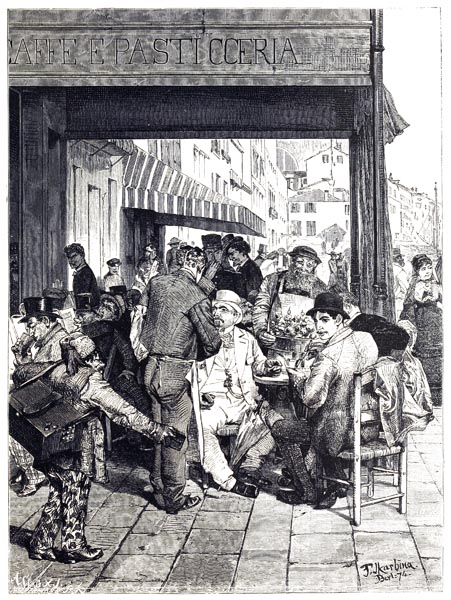
‘Coffee House on the Riva degli Schiavoni’
Italy from the Alps to Mount Etna - Karl Stieler, conte Antonio Cavagna Sangiuliani di Gualdana, Eduard Paulus, Woldemar Kaden, Frances Eleanor Trollope, Thomas Adolphus Trollope (p106, 1877)
Internet Archive Book Images
It seems to me I have served the Bourbons for years: they have scouted my loyalty, but they never tire of it. I breakfast on the Quay of Slav(e)s, while waiting for the exile.
Book XXXIX: Chapter 12: Rousseau and Byron
Venice, September 1833.
BkXXXIX:Chap12:Sec1
From my little table my eyes roaming over the whole harbour: a sea-breeze refreshes the air; the tide rises; a three-master enters. The Lido on one side, the Doge’s palace on the other, the Lagoon between, such is the picture. From this port so many glorious fleets have sailed: old Dandolo embarked with all the pomp of naval chivalry, of which Villehardouin, who initiates our language and our memoirs, has left this description:
‘Et quand les nefs furent chargiées d’armes...And when the ships were filled with weapons, provisions, knights, and sergeants, the shields were ranged round the bulwarks and castles of the ships, and the banners displayed, many and fair. Never did finer fleet sail from any port.’
My morning scene in Venice brought to mind the story of Captain Olivet and Zulietta, so well recounted:
‘The gondola,’ says Rousseau, ‘reached the ship’s side, and I saw a dazzling young person come aboard, very lightly and coquettishly dressed, who was in the cabin in three steps; and I saw her seated beside me before I had noticed they had set a cover for her. She was as charming as she was lively, a brunette, not more than twenty years of age. She spoke only Italian, and her accent alone was sufficient to turn my head. As she ate and chattered she glanced at me, gazed at me fixedly a moment, and then exclaimed, “Blessed Virgin! Ah, my dear Bremond, what an age it is since I saw you!” Then she threw herself into my arms, pressed her lips to mine, and clasped me almost to strangling. Her large black oriental eyes sent fiery shafts into my heart, and although the surprise at first stupefied me, voluptuousness made rapid progress within..she said I resembled Monsieur de Bremond, Director of the Tuscan Customs, to such a degree as to be mistaken for him; that she had turned this Monsieur de Bremond’s head, and would do it again; that she had quit him because he was a fool; that she took me in his place; that she would love me because it pleased her so to do, for which reason I must love her as long as it was agreeable to her, and when she thought it proper to send me about my business, I must be as patient as her dear Bremond had been. No sooner said than done. In the evening we conducted her to her apartments. As we conversed, I saw a couple of pistols on her dressing-table. “Aha!” I said, lifting one of them, “this is a handkerchief box, of a new design: may I ask what its use is? ” . She said to us, with a naivety which rendered her still more charming: “When I am indulgent to persons whom I do not love, I make them pay for the boredom they cause me; nothing could be more just; but though I suffer their caresses, I will not bear their insults; nor fail to shoot the first who shall be wanting in respect to me.”
On taking leave of her, I made another appointment for the next day. I did not keep her waiting I found her in vestito di confidenza, in an undress more than wanton, only known in southern countries, which I will not amuse myself in describing, though I recollect it perfectly well. I had no idea of the transports which awaited me. I have spoken of Madame de Larnage with the delight which the remembrance of her still sometimes brings me; but how old, ugly and cold she appeared, compared with my Zulietta! Do not attempt to imagine the charms and graces of that enchanting girl, you will fall far short of the truth: young virgins in cloisters are not so fresh: the beauties of the seraglio are less lively: the houris of paradise less engaging.’
The adventure finishes with one of Rousseau’s eccentricities, and Zulietta’s phrase: Lascia le donne e studia la matematica: leave off women and take up mathematics.
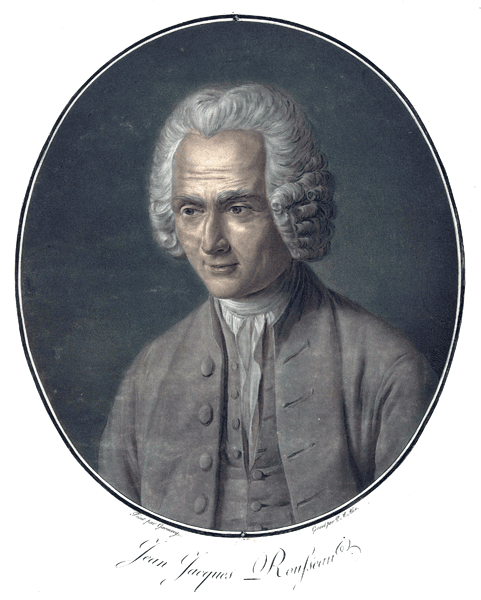
‘Portrait of Jean-Jacques Rousseau’
Pierre Michel Alix, Marie François Drouhin (1791 - 1795)
The Rijksmuseum
Lord Byron also indulged in paid Venuses: he filled the Mocenigo Palace with Venetian beauties taking refuge, according to him, beneath their fazzioli (head-scarves). Sometimes, troubled by shame, he fled, and spent the night on the water in his gondola. As his favourite Sultana he had Margarita Cogni, called, from her husband’s occupation, La Fornarina (the Baker’s wife): ‘Very dark, tall,’ (as Lord Byron says) ‘the Venetian face, very fine black eyes...she was two and twenty years old. In the autumn, one day, going to the Lido.we were overtaken by a heavy Squall. On our return, after a tight struggle, I found her on the open steps of the Mocenigo palace, on the Grand Canal, with her great black eyes flashing through her tears, and the long dark hair, which was streaming drenched with rain over her brows and breast. She was perfectly exposed to the storm; and the wind blowing her hair and dress about her thin figure, and the lightning flashing round her, with the waves rolling at her feet, made her look like Medea alighted from her chariot, or the Sibyl of the tempest that was rolling around her, the only living thing within hail at that moment except ourselves. On seeing me safe, she did not wait to greet me, as might be expected, but called out to me “Ah! can’ della Madonna, e esto il tempo per andar’ al’ Lido? (Ah! Dog of the Virgin, is this a time to go to the Lido?).”’
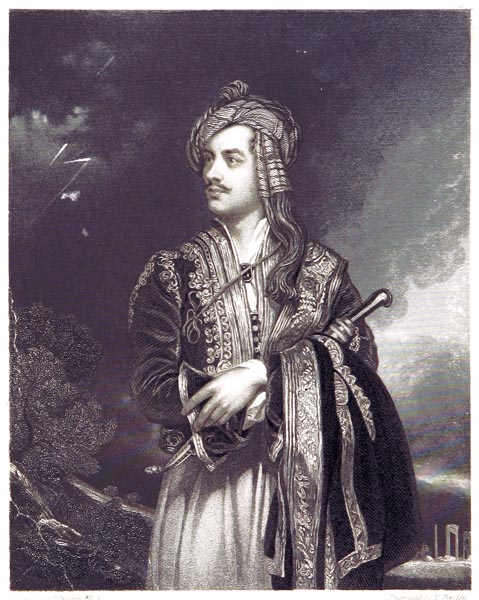
‘Lord Byron’
The Poetical Works of Lord Byron. Collected and Arranged with Notes by Sir Walter Scott, Lord Jeffrey and others - Baron George Gordon Byron (p16, 1859)
The British Library
In these two recitals by Rousseau and Byron, one feels the difference in social position, education and character of the two men. Through the delightful style of the author of the Confessions, something vulgar and cynical appears, and in very poor taste; the obscenity of expression obtaining to that epoch further spoils the picture. Zulietta is superior to her lover in the nobility of her feelings and her elegance of dress; she is almost like a great lady having an affair with the mean little secretary of a minor ambassador. The same inferiority is there again when Rousseau arranges with his friend Carrio, to raise, at joint expense, a little girl of eleven whose favours or rather tears they wish to share.
Lord Byron has a different allure: he forgoes the manners and conceits of the aristocracy; a Peer of Great Britain, enjoying himself with a commoner he has seduced, he raises her to his level by his caresses and the magic of his talent. Byron arrived in Venice rich and famous, Rousseau disembarked there poor and unknown; everyone knows the Palazzo that reveals the errors of the celebrated English Commodore’s noble heir; no guide can show you the house where the plebeian son of an obscure Genevan watchmaker concealed his pleasures. Rousseau does not even speak of Venice; he seems to have lived there without seeing her: Byron has sung her admirably.
You have read what I have said in these Memoirs about the connections in imagination and destiny which seem to have existed between René’s storyteller and Childe-Harold’s bard. Here I again mention one of those similarities so flattering to my pride. Is not La Fornarina, Lord Byron’s brunette, of the same family as the blonde Velléda of Les Martyrs, her elder sister?
‘Concealed among the rocks, I waited awhile without seeing a thing. Suddenly my ear was struck by sounds carried on the breeze from the midst of the lake. I listened and made out the accents of a human voice; at the same moment I saw a frail craft suspended on the summit of a breaker; it fell, disappeared between two waves, and then revealed itself again on the crest of a watery mass; it approached the shore. A woman sailed it; she chanted while fighting the storm, seeming to delight in the winds: one might have said they were in her power, so readily did she seem to challenge them. I saw her throwing lengths of cloth, fleeces, blocks of wax, and little bars of gold and silver into the lake, one after the other, as sacrificial offerings.
Soon she reached the shore, leapt from her boat, moored it to a willow-branch, and plunged into the trees, using the poplar-wood oar she clasped in her hand as an aid. She passed quite close to me without seeing me. She was of great height; her tunic was black, sleeveless and short, scarcely serving to hide her nakedness. She wore a golden sickle suspended from a bronze belt, and was crowned with a chaplet of oak leaves. The whiteness of her face and arms, her blue eyes and reddened lips, her long blond hair, floating wild, proclaimed her a daughter of Gaul, and by their beauty contrasted with her proud and savage advance. She chanted dire words in a melodious voice, and her naked breast rose and fell like the foam of the waves.’
I would be embarrassed at setting myself alongside Byron and Jean-Jacques, without knowing what the place granted to me by posterity will be, were these Memoirs to appear during my lifetime; but by the time they see the light of day I will have passed forever, like my illustrious predecessors, to a foreign shore; my shade will bow to the breath of public opinion, as powerless and slight as the little that will remain of my ashes.
Rousseau and Byron in Venice resembled each other in one respect: neither appreciated the arts. Rousseau, marvellously gifted at music, has the air of not knowing pictures, statues and monuments exist beside Zulietta; and yet how charmingly those masterpieces suit love whose object they deify and whose flame they augment! As for Lord Byron, he is disgusted with the infernal glare of Rubens’ colours; he spits upon all the sacred subjects that the churches disgorge; he never saw a picture or a statue which came within a league of his conception. He prefers to these artistic impostures the beauty of mountains, seas, horses, a certain lion in the Morea, and a tiger at supper in Exeter Change. Is that not all a little one-sided?
What affectation and braggadocio!
Book XXXIX: Chapter 13: Great Geniuses inspired by Venice – Courtesans ancient and modern – Rousseau and Byron born to be unhappy
Venice, the 10th to the 17th of September 1833.
[This chapter and the following chapters of Book XXXIX contain material excised from Chateaubriand’s 1846 revisions]
BkXXXIX:Chap13:Sec1
What then is this city where the greatest intellects arranged to meet? I experience indescribable pleasure in viewing the masterpieces of the great masters once more in the very places they were designed for. I breathe more easily amidst the immortal choir, like a humble traveller admitted to the heart of a rich and handsome family. Some have visited her themselves; others have sent their Muses here. Something would have been lacking to the immortality of their genius, if they had not hung their paintings in this temple of voluptuousness and glory.
Without even mentioning the great poets of Italy, the geniuses of all Europe have set their creations here: here Shakespeare’s Desdemona, so different from Rousseau’s Zulietta and Byron’s Margarita, breathed, that modest Venetian who declared her tenderness for Othello: ‘If you have a friend who loves me, teach him how to tell your story, and that will woo me.’ There Otway’s Belvidera appears, she who tells Jaffeir:
‘O smile, as when our loves were in their spring...
O lead me to some desert wide and wild,
Barren as our misfortunes, where my soul
May have its vent: where I may tell aloud
To the high heavens, and ever list’ning planet,
With what a boundless stock my bosom’s fraught!
Where I may throw my eager arms about thee,
Give loose to love with kisses, kindling joy,
And let off all the fire that’s in my heart.’
In our day, Goethe has celebrated Venice, and ‘le gentil’ Marot, who, first to lend his voice to the awakening of the French Muses, took refuge at Titian’s hearth. Montesquieu wrote: ‘One can have seen all the cities of the world and still be amazed on arrival in Venice.’
When, in too explicit a picture, the author of the Persian Letters describes a Muslim girl given over to the attentions of two men of divine nature in paradise, does he not appear to have described the courtesan of Rousseau’s Confessions and she of Byron’s letter? Was not I, between my two Floridians, like Anais between her two angels? But the painted ladies and I, we were not immortals.
Madame de Staël delivered Venice up to Corinne’s inspiration: the latter hears the sound of cannon fire proclaiming a young girl’s obscure sacrifice.solemn notice ‘that a resigned woman gives to all women who still struggle against destiny’. Corinne climbs to the summit of the Campanile, contemplates the city and the waves, turns her gaze on the clouds towards Greece: ‘In the darkness, she saw only the reflection of the lanterns that light the gondolas: one might have thought them shades gliding over the water, guided by a little star.’ Oswald departs; Corinne rushes out to summon him back. ‘A terrible rainstorm then commenced: the most violent of winds was heard.’ Corinne descends to the canal bank. ‘The night was so dark there was not a single boat; Corinne called at random to the boatmen who took her cries for the cries of distress of some unfortunate drowning in the midst of the storm, and yet no one dared draw near, so tumultuous were the waves stirring the Grand Canal.’
Here again is Byron’s Margarita.
Lord Byron indeed considered La Fornarina among the women whose beauty resembled that of the tiger at supper: what then if he and Rousseau had seen the courtesans of ancient Venice and not their degenerate descendants? Montaigne who never hides anything, says that it seemed as ‘admirable as anything else, to see such a number of them, perhaps a hundred and fifty or thereabouts, throwing money away on the clothes and trappings of princesses, and having no other funds to maintain themselves than that traffic of theirs.’
When the French took Venice they forbade the courtesans from placing the little light in their windows that Hero used to guide Leander. The Austrians have suppressed the Benemerite meretrici: meritorious whores tolerated by the Venetian Senate, en masse. Today they simply resemble the vagabond creatures of our own city streets.
A few steps from my inn is a house, on whose gate three or four quite pretty and half-naked beauties swing, by way of a sign. A corporal on his beat sticking close to the wall, his arms extended, the palms of both hands pressed against the outside of his thighs, his chest flat, his neck rigid, his gaze fixed, turning his head neither to right nor left, is on duty before these Young Ladies who mock him, and try to make him violate his trust. He sees the Pourchois (Bourgeois) enter and leave, proclaiming by his presence that all must pass by without noise or scandal: no one is yet of the opinion in France that we should put the obedience of our own conscripts to this test.
Let us pity Rousseau and Byron for having burnt incense on altars unworthy of their sacrifice. Misers perhaps of their time whose every minute belonged to the world, they only desired pleasure, charging their genius with transforming it into passion and glory. For their lyres the melancholy, the jealousy, the sadness of love; for themselves its voluptuousness and slumber beneath gentle hands. They sought dreams, unhappiness, tears, despair among wildernesses, winds, shadows, storms, forests and oceans, and composed, for their readers, the torments of Childe-Harold and Saint-Preux on the breast of their Zulietta and Margarita.
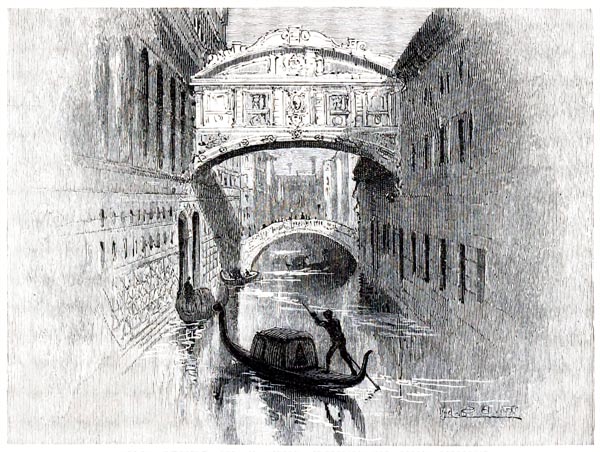
‘Canto IV, VI’
Childe Harold's Pilgrimage, a Romaunt - Baron George Gordon Byron (p168, 1886)
Internet Archive Book Images
Whatever the case, in the moment of intoxication, the illusion of love was fulfilled for them. Moreover they knew that they clasped faithlessness itself in their arms; that she would vanish with the dawn: she did not deceive them with a false semblance of constancy; she did not condemn herself to follow them, wearied of their tenderness or her own. All in all, Jean-Jacques and Lord Byron were unfortunate men; it was a condition of their genius: the former was maddened; while the latter, fatigued by his excesses and in need of esteem, returned to the shores of Greece where his Muse and Death served him well, in turn.
‘Glory and Greece around us see!
..............
The land of honourable death
Is here: – up to the field, and give
Away thy breath!’
Book XXXIX: Chapter 14: Zanze
Venice, the 10th to the 17th of September 1833.
BkXXXIX:Chap14:Sec1
As I was making all these notes in pencil, while breakfasting in a leisurely manner at my little table, a policeman hovered round me: he doubtless recognised me, but did not dare speak. Detested by Kings whose humble, but not very obedient, servant I have had the honour to be, I represent to them the freedom of the Press incarnate.
Hyacinthe rejoined me at the café and informed me of the success of his investigations regarding Zanze. The latter’s father, Brollo, the gaoler, had died some years previously; Zanze’s mother lodged in the Cicognara Palace behind the Accademia di Belle Arti, which she rented from the owner and in which she sub-let rooms to artists, clerks and officers of the garrison. Brollo’s widow had two sons: one, Angelo, worked for a manufacturer of mosaics, the other, Antonio, ran the shop for a cheese-seller; Zanze had married; she and her husband, who was employed at La Centrale, lived with her mother: she worked on mosaics and embroidery.
Matters having reached this point, I decided to visit Madame Brollo. I went to meet Angelo at the inn, and we left in a gondola.
The gaoler’s wife received me at her door in the alley. We climbed a stair: Madame Brollo went in front, as if she were conducting me to prison, begging my pardon for leading me through the kitchen first. Zanze was at the Accademia with a pupil, and had taken the key of her room with her; but Madame Brollo, seeing a second key hanging from a nail, hastened to open her daughter’s apartment.
The room was large, lit by two windows. The furniture comprised a six-foot long bed without curtains, a table and a few chairs.
The august widow took from the wall a portrait of Francis II, done in glass beads; Zanze’s work: I presented myself as an amateur interested in mosaics. Antonio was despatched as messenger to the creator of the portrait.
Left alone with Madame Antonia Brollo, we began an animated conversation. Madame Antonia had been twice married; her first husband, Jean Olagnon, from Picardy, had died in the Army of Egypt. Madame Antonia spoke French, and even pronounced it quite well, though she had difficulty remembering the words: so she mostly used the Italian language mixed with Venetian dialect. Here is Pellico’s description of the Carceriere: ‘La moglie era quella che piû manteneva il contegno ed it carattere di carceriere. Era una donna di viso asciutto, asciutto, verso i quarant’ anni, di parole asciutte, asciutte, no dante il minimo segno d’essere capace di qualche benevolenza ad altri che a suoi figli: the wife was the person who best supported the character or behaviour of a gaoler. She was a woman with a sour, sour face about forty years of age, curt, very curt in speech, giving not the least sign of a capacity for kindness to anyone except her children.’
Madame Antonia must have altered in six years. Here is a fresh description:
A small woman with a very common air; a rounded figure; a florid complexion; wearing nothing on her greying hair; appearing very grasping and deeply concerned about her family’s means of sustenance.
When we had sat down together, she seized my hand which she clasped and wanted to kiss; I drew my hand away modestly, and said:
‘– Madame Antonia, you knew Monsieur Silvio Pellico?’
‘– Signor, si; un carbonaro; tutti carbonari!’
‘– You would take him his coffee during the day, and your daughter often replaced you?’
‘– Vero, la sua Eccellenza.’
‘– Have you another daughter?
‘– No, Sir; only the one.’
‘– Who is called Zanze?’
‘– Signor, si, and due sons.’
‘– Just so. And your daughter served Monsieur Silvio Pellico ably?’
‘– Signor, si: tutti dottori, canonici, nobili (all the scholars, canons, noblemen). When they were condemned, O Dio! I lit a candle, thick as that, to Nostra Dama di Pietà.’
At this point, Madame Antonia told me that, after the sentence, they had put her, her husband and all her family nella strada (on the street), with twenty sous in their purse; that she had requested, demanded a pension, threatened to write to the Emperor, and at last obtained a hundred écus with the aid of which she had raised her children.
Antonio arrived with Zanze.
I found the girl was even smaller than her mother, seven or eight months pregnant, her dark hair plaited, a gold chain round her neck, her shoulders bare and very shapely, her eyes large and grey in colour and di pietosi sguardi (with a kind expression), a slender nose, a slender physiognomy, a thin face, a refined smile, but the teeth less white than other Venetian women, the colouring pale rather than white, the skin without translucency, but also without freckles.
Antonio became the general interpreter of the conversation.
I told Zanze that as an admirer of Monsieur Pellico I had wished to meet the lady who was so kind to the poor prisoner.
Zanze seized my hand as her mother had, and, for some reason, I did not withdraw my hand. Zanze seemed to search her memory a moment for the name I had just pronounced; then: ‘Yes, yes, Monsieur Pellico; I remember him; a Carbonaro!’
‘– Do you know he has written a book about his prisons and that he speaks of you?’
‘– No I did not.’
Old Antonio, who knew everything about it, was less reticent, and with a very droll smile, said:
‘– But, Zanze, you told him you were in love.’
SIORA ZANZE
‘What! Inamorata! Invaghita! (In love!) Ah! I went to school; I was just a little girl! I was only twelve.’
ANTONIO
‘Corpo di Christo! At twelve everyone in Venice is deeply in love.’
SIORA ANTONIA
‘You were fourteen, Zanze; you were in love: it’s true.’
SIORA ZANZE
‘It’s not true; I was never in love till I went to the country, because I was ill. I was in love then, with my cousin.’
‘– And you married your cousin?’ I asked.
‘– No, Excellenza: I did not marry my cousin.’
I laughed. Madame Antonia had explained that Brollo, learning that the prisoners would probably be condemned, had sent the children to the country.
I continued: ‘– Perhaps there was another Zanze in the prison? Perhaps you are not the Zanze who took Monsieur Pellico his coffee?’
‘– Yes, yes. There was no other Zanze in the prison but me. The daughter of the secondino was called. (I forget the name): there was an old woman too.’
Zanze took my hand again in hers, and started to tell me in detail the history of her study of mosaics. She grew more attractive the more she spoke. Pellico described the charm of what he called his little gaoler’s ugliness, bruttina: graziose, adulazioncelle, venezianina adolescente sbirra; ugly, but gracious, a little flatterer a little adolescent Venetian gaoler. Zanze, according to her own mother’s calculation, was twenty-four; she was fourteen when she confided the anxieties of her tender years to the author of Francesca da Rimini. In those days she did not have three children and was not pregnant with a fourth. Zanze told me that two of her children were dead and that she only had one left. ‘What of the fourth, then?’ I asked. Zanzre laughed, and looking down at her large belly, said: stimo costui: I treasure it.
Antonio, speaking to me in French, said: ‘She will never admit her confession to Pellico; but it’s certainly true.’
– ‘I am not seeking to find out Zanze’s secret,’ I replied, ‘and if you had not spoken to her about the affair then I would never have said a word. Now ask Zanze if she wants me to bring her a copy of Le Mie Prigioni; she can read it, and tell me if she recalls things she may have forgotten.’ – Zanze agreed to the proposal; but she suggested I not bring the book until after her husband had returned from his office. ‘– My husband, she added, ‘is a year younger than me.’
That is the point we have reached: I ought to return to buy a few of Zanze’s little efforts. She accompanied me to the door onto the alley (calle) with her mother. The elder, not losing sight of her object, invited me to ritornare. Zanze was more reserved.
Such is the power of talent: Pellico lent his little bruttina consoler, who chased the flies away with her fan so effectively, a charm she perhaps did not possess. Sior Zanze seems an angel of love when, after kissing a verse from the Bible, she says to the prisoner: ‘Every time you read this passage, I want you to remember I placed a kiss there.’ She is irresistibly seductive when Pellico, encircled by her dear arms, dalle sue care braccia, without pressing her to him, without kissing her, stammers: ‘Vi prego, Zanze, non m’abbraciate mai; cio non va bene: Go Zanze, please, don’t ever embrace me; it wouldn’t be right.’
Book XXXIX: Chapter 15: Madame Mocenigo – Count Cicognara – A bust of Madame Récamier
Venice, the 10th to the 17th of September 1833.
BkXXXIX:Chap15:Sec1
I had met by chance, in Paris under the Empire, Madame Mocenigo whose ancestors were seven times honoured by being made Doge. Bonaparte, in order to regenerate Italy, forced the great transalpine families to hand over their children to him. Madame Mocenigo, caught up in those general measures, prepared her two little Doges, on Mont Sainte-Geneviève, for the Imperial military service. It was no longer an age when Venice could force an Emperor to bow before her, in order to obtain one of her son’s freedom.
Madame Mocenigo, having learnt of my presence in her native city, was obliging enough as to wish to see me. I took myself to the great Lady’s house on leaving my rendezvous with the little Soria.
The poet of modern Albion has blessed one of the three Mocenigo Palaces with his presence. A signpost planted in the Grand Canal indicates to the passer-by Byron’s former residence. One is less moved at seeing the noble lord’s half-effaced coat of arms on this signpost, than one would be on seeing his broken lyre hanging there.
Madame Mocenigo lived tucked away in a small corner of her Louvre whose vastness dwarfed her, and whose deserted part every day gained a little more on the inhabited part. I found her sitting facing an original painting by Tintoretto, of the Glory of Paradise. Her portrait (that of Madame Mocenigo) painted in her youth (a first and authentic proof of her beauty) hung on the wall before her: a View of Venice, by Canaletto, in his earlier style, made a pendant to a weaker View of Venice by Bonington.
Though Madame Mocenigo is still beautiful, it is as though she were in the shadow of her years. I overwhelmed her with compliments which she returned; we were both lying, and knew it well. ‘Madame, you are younger than ever.’ – ‘Monsieur, you never age.’ We took to lamenting the ruinous state of Venice, in order to avoid speaking about ourselves; we placed to the Republic’s account all the complaints we made regarding time, all our regrets for past days. I kissed, respectfully, on leaving, the hand of that daughter of the Doges; but I glanced at the other beautiful hand of the portrait which seemed to have withered beneath my lips: when the plebeian Zanze’s hand pressed mine, I was not aware of any transformation.
Monsieur Gamba, my learned patron, accompanied me to Count Cicognara’s. The Count is a tall man of handsome appearance; but reduced by consumption to a frightening degree of thinness. He rose, painfully, from his armchair to greet me and said: ‘So I have seen you before I die!’
– ‘Monsieur,’ I replied, ‘you anticipate me; I was going to say precisely the same thing to you as you have said to me: it is probable that I will go first. I am happy to meet a man who has given life to Venice, as much as one can rekindle these illustrious ashes.’
Madame Cicognara was there, and wished to stop her husband talking too much; her tender efforts were in vain. For the first time since I had crossed the Alps, I talked politics; we moaned about the state of Italy. We then fell into a conversation on the arts; I congratulated Monsieur Cicognara on his discovery of Titian’s Assumption: the priest who had abandoned the painting, without realising its merit, later wished to initiate proceedings against the knowledgeable amateur: the business has been settled.
I knew of Monsieur Cicognara’s exceptional admiration for Canova: I thought I ought to mention the urn in the Accademia which contains the sculptor’s hand even though that butchery, the cutting up of a human body, that materialistic adoration of a skeletal claw was abominable to me. You find Canova’s bust in the hostelries and even the cottages of peasants in Venetian Lombardy. We are a long way from sharing that taste for the arts and that kind of national pride. If we possess talented men we rush to deprecate them: it seems as if we are being robbed of admiration. We cannot endure anyone acquiring reputation; our vanity takes umbrage at everything; everyone rejoices inwardly when a man of worth dies: that’s one rival less; his irksome fame prevents that of fools being recognised, and the flock crows over mediocrities. They rush to dissect the illustrious deceased in three or four newspaper articles; then cease to talk of him; no one opens his works; they thrust his fame back into his books, as they seal his corpse in its coffin, dispatching the whole lot into Eternity, with the help of death and time. I will leave, for those who survive me, my own obituary notice written in advance, such as I remember having read in Pierre de l’Estoile’s journal: ‘this Thursday..the good Dufour was interred.he made a trip to Jerusalem, and was none the wiser for it.’
At Madame Albrizzi’s I saw Canova’s Leda; while at Count Cicognara’s I admired the Beatrice of that Italian Praxiteles. Monsieur Artaud in his translation of Dante and my excellent friend Monsieur Ballanche in his Essays on Palingenesis, tell of what inspired the sculptor:
‘An artist of great renown,’ says the philosopher of Christianity, ‘a sculptor who had previously brought so much glory to Dante’s illustrious homeland, and whose refined imagination had so often been stirred by the masterworks of antiquity, saw one day, for the first time, a woman who seemed to him the living embodiment of Beatrice. Full of that religious emotion which prompts genius, he immediately demanded that the marble, obedient as ever to his chisel, express the sudden inspiration of the moment, and Dante’s Beatrice passed from the vague domain of poetry to the actualised domain of the arts. The feeling that resides in that harmonious physiognomy has now become a new instance of pure and virginal beauty that, in its turn, inspires both artists and poets.’
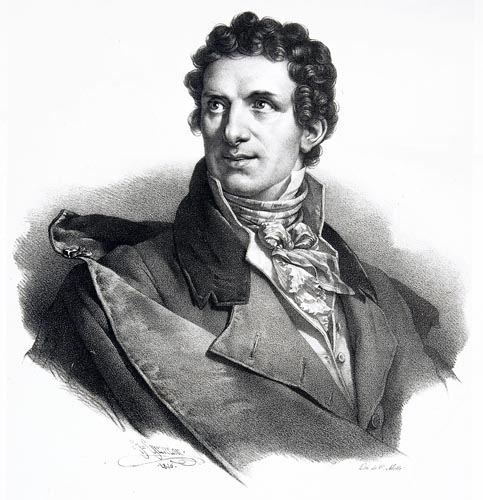
‘Portrait of Antonio Canova’
Henri Grevedon (French, 1776 - 1860)
Yale University Art Gallery
Canova sculpted three admirable busts of Beatrice modelled on Madame Récamier: the one he presented to his model, as a portrait from life, wears a crown of olive leaves. The great artist, acknowledging both the woman and the poet, wrote these lines of Dante’s, with his own hand, on the note to Madame Récamier dispatched with it:
‘Sovra candido velo cinta d’oliva
donna m’apparve.
A lady appeared to me, crowned with olive,
over her white veil.’
I was deeply moved by that homage of genius to one whose caring friendship will endure in these Memoirs. If she appeared to Canova in her white veil, she appeared to me, in a further citation:
‘...dentro una nuvola di fiori
Che dalle mani angeliche saliva.
...within a cloud of flowers
that rose from out angelic hands.’
I trace in turn these few words on the bust’s plinth, regretting that Heaven did not endow me with Canova’s chisel, or Dante’s lyre.
Book XXXIX: Chapter 16: A Soirée at Madame Albrizzi’s – Lord Byron according to Madame Albrizzi
Venice, the 10th to the 17th of September 1833.
BkXXXIX:Chap16:Sec1
After dinner I dressed in order to spend the evening at the home of Madame Teotochi Albrizzi, the spiritual author of the Rittrati so warmly praised by Monsieur Denon at a time when my name was scarcely known among travellers. Monsieur Gamba had resolved to present me to the celebrated Signora. I was annoyed: to go out at nine in the evening, at the hour when I go to bed, that is, when I go late! But what does one not do for Venice?
Madame Albrizzi is a pleasant elderly lady, of an imaginative countenance. I found a crowd of men at her salon, almost all of them professors and scholars. Among the women, there was a newly married lady rather beautiful; but too grand, a Venetian of ancient family, with a pale face and dark eyes, a somewhat mocking and sulky air, in all quite caustic; and she lacked the most seductive of graces, she never smiled. Another woman with a kind appearance scared me less; I dared to chat to her. She had travelled in Switzerland, and had been to Florence; she was ashamed never to have visited Rome. ‘But you know, we Italians remain where we are.’ One might well have remained with her.
Madame Albrizzi told me all about Lord Byron; she was the more infatuated with him, because he had come to her soirées. His Lordship spoke to neither the English nor French, but exchanged a few words with the Venetians and only them. His Lordship was never seen walking in St Mark’s Square, because of his lameness. Madame Albrizzi claimed that when he entered her rooms, he had a certain trick of walking by means of which he concealed his limp. Decidedly he was a fine swimmer. He had given Madame Albrizzi a portrait of himself. In the miniature, Childe Harold is charming, quite young, or quite rejuvenated; he displays a naïve and childlike character. Nature perhaps made him thus; then a disposition born of some misfortune, seizing hold of his spirit, produced the famous Byron. Madame Albrizzi affirms that in moments of intimacy one found in him the man portrayed in his works. He considered himself scorned by his nation and for that reason detested it: he lacked esteem with the Venetian people because of his wild behaviour.
Canova gave Madame Albrizzi, Greek by birth, a bust of Helen: I was shown it by torchlight.
Madame Albrizzi had seen me, she said, in the amphitheatre of Verona and claimed to have picked me out amidst the Kings. I was so stunned by so fine a compliment that I departed at eleven to the great amazement of the Venetians. It was high time; sleep was overcoming me and I had exhausted my wit: one must never spend one’s last idea or one’s last franc. Speaking of francs, Law died and was buried in Venice: I felt like going and asking him for some of those excellent bank-notes to fund the Legitimacy and a land-concession for myself among the Natchez.
Book XXXIX: Chapter 17: A Soirée at Madame Benzoni’s – Lord Byron according to Madame Benzoni
Venice, the 10th to the 17th of September 1833.
BkXXXIX:Chap17:Sec1
If people knew what I suffered in salons, charitable souls would never do me the honour of inviting me to one. One of the cruel torments of my past grandeur was to receive and make visits, to go to Court, give balls, dinners, talk and smile while dying of ennui, be polite and amused by the sweat of my brow: there were the true and only anxieties resulting from my ambition. Every time I fell from the heights of fortune, I experienced inexpressible joy at returning to my poverty and my solitude, throwing away my lace, medals, and ribbons, donning my old frock coat, and resuming my poetic walks, in wind and rain, along the Seine towards Charenton or Saint-Cloud. Having spent an evening at Madame Albrizzi’s, I could not avoid another at Countess Benzoni’s. At ten I arrived in my gondola, like a corpse being carried to St Christopher’s.
Madame Benzoni has merited her reputation for beauty; her hands served as a model for Canova; she is the heroine of La Biondina in gondoletta. She made me sit beside her on a sofa. Various ladies arrived in succession: a host of men pressed around.
Thos who know me can imagine whether I was at ease, exposed like the Blessed Sacrament to their gaze, fixed as it was on my divine rays. I am not godlike, and have no right to adoration, or love of incense. I begged Madame Benzoni, despite all the happiness I had in being near her, to allow me to give up the place I occupied so badly to one of the ladies: she would not countenance it. She went to find two or three interesting men: they had the goodness to come and exchange a few words with me, chained in captivity on my silk cushions, like a galley-slave on his bench.
A noble gentleman whom I had glimpsed at Madame Albrizzi’s said: ‘Ah, you are only pretending to be old! We shall no longer be fooled by what you write about yourself.’
‘– Sir,’ I replied, ‘you are doing me a disservice; to achieve glory in Venice one must be old. Of your hundred and twenty Doges more than fifty became famous at an age when other men lose their renown: Dandolo, blind, was ninety-five when he conquered Constantinople, Zeno eighty when he liberated Cyprus; Titian and Sansovino almost centenarians, died in the full flow of their talent. In accusing me of youth, you criticise my work.’
Coffee was brought; I took some for appearance’s sake. Madame Benzoni complimented me on my Venetian ways, and went off to find me some feminine companions.
During this time I remained alone in the centre of my wretched ottoman, fascinated by and trembling beneath the gaze of a dark-haired lady with the half-closed eyes of a serpent; she seemed to draw me: I think there are magnetic women who attract one.
A blonde lady, in the springtime of her years, rose gracefully, making the sound of a flower stirring; she advanced and leaned her face of dazzling freshness towards me; she was all curiosity, all mystery: one might have thought her a rose bending under the weight of its perfumes and secrets.
In Venice they sell secrets of that sort to make oneself desirable; I would have liked to buy one, but a story which I remembered made me uneasy: a Neapolitan fell in love with a French girl who owned a goat; being unable to move her heart, he had recourse to a philtre: unfortunately he erred in his mixture of ingredients and magic words, and behold the goat came running, capering and bounding about, leaping at his neck, and giving him a thousand caresses. The charm had acted on the poor maddened beast!
Madame Benzoni returned; she had addressed herself to the various beautiful women in the room; she had invited them to sit with the stranger; they had all replied: ‘We dare not.’ If they had known how frightened I was of them, they would have dared.
‘You defend yourself in vain,’ my gracious hostess said, ‘we will force Eudore to love a Venetian; we desire to oust those beautiful Roman ladies.’ – ‘Madame,’ I replied, ‘it is indeed at your house that people fall in love.’ (Lord Byron met Madame Guiccioli there.) ‘As for my beautiful Romans, as you are pleased to call them, I am merely an ex-ambassador. It is very easy doubtless to be seduced by your delightful compatriots; but I have passed the age for seduction. One should only make promises when one is young enough to keep them.’
The dark-haired lady listened to our conversation; the rose paid attention with her eyes.
Countess Benzoni spoke about Lord Byron to me in a different manner to Madame Albrizzi. She expressed herself with rancour: ‘He placed himself in a corner because he had a twisted foot. He had quite a good face; but the rest of his person scarcely matched. He was an actor, not behaving as others do, so that they would notice him, never letting himself be lost sight of, posing incessantly, always for effect, even when eating Zucca Arrostita (roast pumpkin).’ The moral aspect of the man was still more badly mauled. I took up the defence of Childe Harold: ‘Madame, I see that he is far from being a friend of yours; you are, it seems to me, a little harsh in your judgement. An affectation of eccentricity, singularity, and originality, belongs to the English character in general. Lord Byron may have paid for his genius with a few weaknesses; but posterity will be little concerned with those unfortunate matters, or rather will ignore them completely. The poet will mask the man; he will interpose his talent between himself and future generations, and through that divine veil, posterity will only see the god.’
Madame Benzoni boasted of having spoken that morning with a Frenchman who knew me very well, and had told her all my history; she would not tell me his name. Living alone, confiding my affairs to no one, I did not see how anyone could know me very well: through the biographies of me? Some, while kindly, swarm with errors; others, malevolent, are full of absurd anecdotes. It seemed however that Madame Benzoni’s Frenchman was not an enemy.
At midnight I retired, despite my hostess’s insistence and the beseeching air of the dark-haired lady with the eyes of a serpent. My gondola, silent and solitary, bore me along the Grand Canal to the Hôtel de l’Europe: no light shone from the windows of the Palazzi whose enchantments Madame Benzoni had shut away along with her youth: those dilapidated palaces were ending their lives when the Bionda’s first adventures began. (Mesdames Albrizzi and Benzoni are no more; thus I saw the end of the two last great Venetian ladies. What has become of Lord Byron himself? You can see the place where he bathed: they set his name in the midst of the Grand Canal. Today they do not even know it. Venice is mute. The noble lord’s coat of arms has vanished from the place where they displayed it. Austria has extended her blanket of silence: she has smitten the waters and all is dead. Note: Paris, 1841)
Book XXXIX: Chapter 18: A gondola ride – Poetry – Catechism at St Peter’s – An aqueduct – A conversation with a fisher-girl – The Giudecca – Jewish women
Venice, the 10th to the 17th of September 1833.
BkXXXIX:Chap18:Sec1
On Sunday the 15th, the Patriarch, having been promoted to Cardinal, took the hat with all the usual ceremony. The bells rang, the city rejoiced; well-dressed women sat beneath the arcades of the cafés: Florian’s, Quadri’s, Leoni’s and Sutti’s: Monsieur Gamba assured me that they were assembled in such numbers in hopes of seeing me; that they had climbed on the benches and the bases of the columns of St Mark’s when the rumour spread that I was entering the Basilica; that I would meet the Venetian lady whose disdainful beauty had charmed me at Madame Albrizzi’s.
I thought little of these tricks of Italian flattery, which nevertheless puffed up my vanity; but instinctive humility overcame my delusions of grandeur: Mr Crow, instead of singing, was seized with terror; I hastened to flee from shyness, mistrust of myself, a horror of scenes, and a love of obscurity and silence. I hurled myself into a gondola and departed with Hyacinthe and Antonio, threading the labyrinth of least frequented canals.
Only the sound of our oars could be heard at the foot of the sonorous palaces, echoing all the more from their emptiness. Many of them, sealed for forty years, had seen not a soul enter: there, forgotten portraits hung, gazing at each other in silence through the darkness: if I had knocked, their subjects might have come to open the door, and asked me what I wanted, and why I was troubling their repose.
Full of memories of the poets, my thoughts elevated by the loves of yesterday, Saint Mark of Venice and Saint Anthony of Padua know the magnificent stories I dreamed then, while passing through the midst of the rats emerging from the marble. At the Bridge of Bianca Capello, I created a peerless romantic novel. Oh, how young, handsome, well-favoured I was! But how many dangers too! A haughty and jealous family, State inquisitors, the Bridge of Sighs from which one heard lamentable cries! ‘Let the galley-slaves make ready: let them row easily, and cleave the waves; bear us to the shores of Cyprus. Fair prisoner of palaces, the gondola awaits your beauty at the hidden sea-gate. Descend, adored girl! You whose blue eyes command the lily of your breast and the rose of your lips, as the azure heavens smile on the tinctures of spring.’
All this led me to San Pietro, Venice’s former cathedral. Little boys were repeating their catechism, interrogating each other under the direction of a priest. Their mothers and sisters, heads hidden in kerchiefs, stood listening. I gazed at them; I gazed at the painting by Alessandro Lazarini, representing San Lorenzo Giustiniani distributing his belongings to the poor. Since he was in the act of doing so, he might well have extended his good deed to us, the crowd of beggars cluttering up his church. Once I have spent the money set aside for my trip, what will I have left? And will those ragged young girls continue to sell the Levantines two kisses for five-pence?
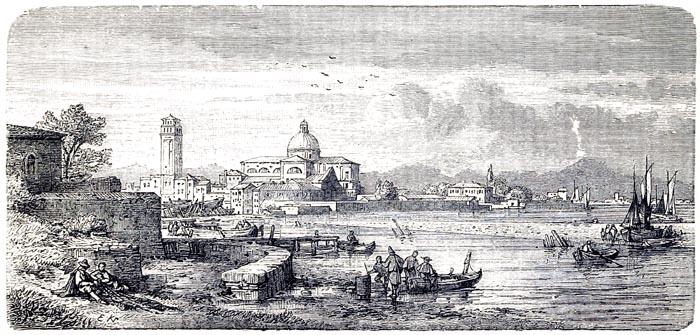
‘San Pietro, Castello’
Italy from the Alps to Mount Etna - Karl Stieler, conte Antonio Cavagna Sangiuliani di Gualdana, Eduard Paulus, Woldemar Kaden, Frances Eleanor Trollope, Thomas Adolphus Trollope (p99, 1877)
Internet Archive Book Images
From the eastern extremity of Venice I had myself rowed to the opposite extremity, girando (via a detour) by way of the Lagoon to the north. We passed close to the new island created by the Austrians, from gravel and piles of mud; it is on this emerging soil that they exercise the foreign troops who oppress Venice’s liberty: Cybele hidden in the breast of her son, Neptune, only emerges in order to betray him. I am not an Academician for nothing, and I know my Classics.
There was once a plan to link Venice to the mainland by a roadway. It astonishes me that the Republic at the height of its power did not think of bringing water to the city, by means of an aqueduct. An aerial canal running over the sea, through all the events of night and day, calm and storm, seeing the vessels pass beneath its arches, would have added its marvel to the city of marvels.
The western boundary of Venice is inhabited by the fishermen of the Lagoon; the end of the Riva delgi Schiavoni is the haunt of deep-sea fishermen; the former are the poorer: their shacks, like those of Olpis and Asphalion in Theocritus, have no other neighbour than the sea which bathes them.
There I might have nourished intrigue with Checca or Orsetta, from the comedy Le Baruffe Chiozzote: we hailed una ragazza (a little girl) who was wandering the shore. Antonio interpreted the tricky passages of dialogue.
‘– Carina, do you want to cross to the Giudecca? We’ll take you in our gondola.’
‘– Sior, no: vo a granzi: No, Sir: I am after crabs.’
‘– We can give you a better supper.’
‘– Col dona Mare: with my mother?’
‘– If you wish.’
‘– My mother is in the boat with my father.’
‘– Have you any sisters?’
‘– No.’
‘– Any brothers?’
‘– Uno: Tonino.’
Tonino, aged between ten and twelve, appeared, wearing a red Greek skull-cap, dressed only in a shirt clinging tightly to his flanks; his bare feet, legs and thighs were bronzed by the sun: he was carrying a vessel filled with oil; he had the air of a young Triton. He placed his urn on the ground, and began listening to our conversation with his sister.
Soon a water-carrier arrived, whom I had already met by the cistern of the Ducal Palace: she was a brunette, lively and happy; she had a man’s hat on her head, tilted to the back, and on the hat a bunch of flowers which, tangled with her hair, fell over her brow. Her right hand rested on the shoulder of a tall young man with whom she was laughing; she seemed to be saying to him, in the sight of God and the whole human race: ‘I love you madly.’
We continued to exchange remarks with the picturesque group. We spoke about marriage, love, feasts, dances, Christmas Mass, celebrated in the past by the Patriarch assisted by the Doge; we talked about the Carnival; we argued about kerchiefs, ribbons, fishing, nets, boats (tartanes), good or bad fortune at sea, the joys of Venice, though, except for Antonio, none of us had seen or known life under the Republic; so far had the past receded. That did not stop us saying with Goldoni: ‘Semo donne da ben, e semo donne onorate; ma semo aliegre, e volemo saltare aliegre, e volemo ballare. E viva il Chiozotti, e viva le Chiozotte! We are good women, honourable women: but we’re happy, and we want to stay happy, and dance, and leap.and Long live the Chiozzotti, Long live Chiozzotte!’
In 1802 I dined on the Quai de la Râpée with Madame de Staël and Benjamin Constant; the boatmen of Bercy have left no portrait of us: the fisher-folk of the Lagoon, and the sun of the Brenta, need a Léopold Robert. ‘Do you know that land where the lemon-trees bloom’ sings Mignon, the exile from Italy.’ (Goethe).
The Giudecca, which we touched at, while returning, contains only a few poverty-stricken Jewish families. They are recognisable by their features. In their race the women seem much more handsome than the men, and seem to have escaped the maledictions to which their fathers, husbands and sons are subjected. There was no Jewess among the crowd of Priests, and others, who insulted the Son of Man, flagellated him, crowned him with thorns, and made him endure the ignominies and sorrows of the Cross. The women of Judea believed in the Saviour, loved him, followed him, aided him out of their goodness, and relieved his sufferings. A woman of Bethany, poured precious ointment over his head from an alabaster vase; the sinner anointed his feet with perfumed oil and wiped them with her hair. Christ in turn extended his grace and mercy to the Jewish women-folk: he resurrected the son of the widow of Nain, and Martha’s brother; he healed Simon’s mother-in-law, and the woman who touched the border of his garment; to the woman of Samaria he was a source of living water, a compassionate judge to the woman taken in adultery. The daughters of Jerusalem wept for him; the female saints accompanied him to Calvary, bought spice and ointments and sought the sepulchre weeping. ‘Mulier quid ploras? Woman, why weepest thou?’ His first appearance after his glorious resurrection was to Mary Magdalene; she did not recognize him, but he said to her: ‘Mary’. At the sound of that voice her eyes were opened and she replied: ‘Rabboni: Master’ Reflections of a beautiful light remain on the brows of Jewish women.
Book XXXIX: Chapter 19: Nine centuries of Venice seen from the Piazzetta – The decline and fall of Venice
Venice, the 10th to the 17th of September 1833.
BkXXXIX:Chap19:Sec1
Sunday was not yet over, and I was afraid to visit the great square and its three hundred beautiful women. Henri IV said of Catherine de Médici’s Maids of Honour: ‘I have never seen a more dangerous squadron.’ After dinner I ventured an exit via the stairs to the Piazzetta. The weather was equivocal; it rained at intervals; the wind authorised extra clothing. His Eminence, wrapped in a cloak, happily made his descent without being recognized. The grey sky seemed as if in mourning: I was struck more than ever by Venice’s enslavement, while walking in front of the Austrian cannons, at the foot of the Ducal Palace.
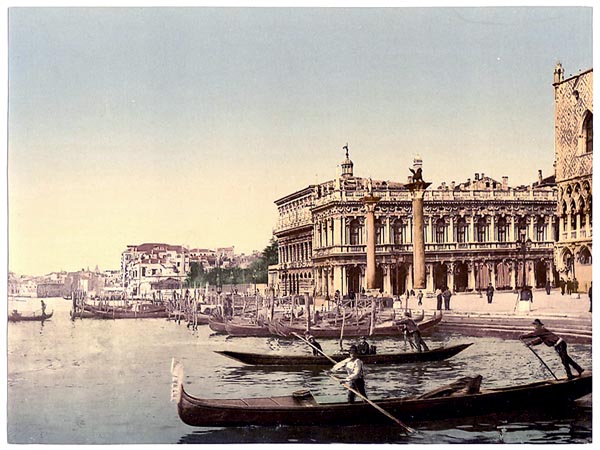
‘Gondolas and Piazzetta di San Marco, Venice’
Anonymous, 1890 - 1900
The Library of Congress
Monsieur Gamba had suggested that if I wanted to see nine centuries of Venice’s history at a glance, I should stand near the two large columns, in the place where the Piazzetta café borders the Lagoon. I read around me those chronicles in stone, written indeed by time and art.
Eleventh century.
Il Campanile, or the bell-tower of St Mark: commenced by Nicolas Barattieri a Lombard architect.
Twelfth century.
The façade along one side of the Basilica of St Mark: architects unknown.
Thirteenth century.
The Ducal Palace: by Filippo Calendario, a Venetian.
Fourteenth century.
The Torre dell’Orologio: built by Piero Lombardi.
Fifteenth century.
The Procuratie Vecchie: by Bartholomeo Bono of Bergama.
Sixteenth century.
The Libreria(currently the Royal Palace) and the Zecca, or Mint: by Sansovino, a Florentine.
Seventeenth century.
The church of Santa Maria della Salute on the opposite side of the Grand Canal: the work of Baldassare Longhena.
Eighteenth century.
The Dogona di Mare: by Joseph Benoni.
Nineteenth century.
The Café or Pavilion, beside the gardens of the Royal Palace on the Lagoon: by a living architect, Professor Santi.
Venice begins with a bell-tower and ends with a café: via successive ages and masterpieces she has progressed from the Basilica of St Mark to a coffee-house. Nothing bears greater witness to the genius of the past and the spirit of present times, the character of ancient society and the mode of modern society, than those two monuments; they give out their centuries.
Three Venices, the Venetia of the Romans, the Venetia of the Lagoon created by people escaping from the flail of God, Attila, and the Venetia or core Venice that superseded the other two; this latter Venice which Petrarch called Aurea, and whosestones were gilded and painted, according to Philippe de Comines; the Venice that possessed three Kingdoms, the Venice whose inland towns sufficed to win fame for Bonaparte’s generals; that Republic perished not, as with so many other States, by a feat of French arms: attacked by mere threats, she succumbed without even making a stand.
In the thirteenth and fourteenth centuries, Venice was all-powerful at sea, and in the fifteenth on land; she maintained power in the sixteenth, declined in the seventeenth and degenerated in the eighteenth, during which the old European order was eaten away and dissolved. The nobles of the Grand Canal became pharaoh’s money-gatherers, and merchants, for the idle countryside of the Brenta. Venice merely lived on its Carnival, its Punchinellos, its courtesans and its spies: its Doge, a powerless old man, renewed his marriage with the adulterous Adriatic in vain. And yet the Republic was still not lacking in material assets.
When, in 1797, she allowed her continental territory to be invaded, there remained, as defence for her island possessions, 205 fortified buildings with 750 artillery pieces manned by 2,516 artillerymen; seven batteries and fortresses, 11,000 Dalmation soldiers and 3,500 Italians; a population of 150,000 souls; and 800 ordinance pieces installed around the Lagoon. Out of effective range of cannon and incendiary device, Venice was the more impregnable in that she lacked ground from which to board her: the besiegers, only able to approach in boats, would have been exposed, on the narrow canals, to projectiles fired by the besieged ensconced in the houses, churches and waterside buildings. Master of St Mark’s Square, the Doge’s Palace, the Arsenal, one would still be master of nothing. If Venice defended herself, she could be burnt but not taken; the inhabitants would have had a further safe refuge in their vessels. At such times the thought of national glory is truly powerful: indeed the shades of the Barbarigos, Pesaros, Zenos Morisini, and Loredanos, re-peopling their imperilled hearths and fighting from the windows of their palaces, would not be idle shades.
Venice, in 1797, besides the forces I have just enumerated, had money to swell them, and credit greater than her reserves. England, at war with us, would have hastened to supply her with soldiers and ships; Austria which sought her alliance, could have landed 10,000 Hungarian grenadiers from the harbours of Fiume and Trieste. Would the Directory, incapable of seizing a reef on the Normandy coast defended by a handful of English marines, have been able to take a Venice fully armed and protected by her vessels? The French only had 300 men and a single small-calibre artillery piece at Malghera; they even lacked boats.
Venice was not possessed of all these means of defence in 1700, when Addison found it already impregnable: ‘it has neither rocks nor fortifications near it, and yet is, perhaps, the most impregnable town in Europe.’ he remarked that on the landward side one could not reach it across the ice as in Holland, and on the Adriatic side the entrance to the port is narrow, the navigable canals difficult to explore; that at the approach of an enemy fleet they would hasten to free the buoys that mark out those canals. If one assumed a rigorous blockade by land and sea, Addison goes on to say, the Venetians could still defend themselves against all except famine; even the latter would be greatly mitigated by the shoals of fish with which the waters abound and which the city’s island inhabitants catcheven ‘in the midst of their very streets.’
Well! A few contemptuous lines from Bonaparte’s hand sufficed to overthrow the ancient city ruled by one of those fearful magistracies which, according to Montesquieu, returned the State forcibly to Liberty. Those trembling magistrates, once so firm, complied with the injunctions in the note written on a drumhead. The Senate was not convened; the Signoria wept, betrayed and dismayed; Ludovico Manin, the one hundred and twentieth, and last, Doge, in the midst of sobs and tears, offered to abdicate, in a tremulous voice; the Dalmations were dismissed, the ships withdrawn. On the 12th of May 1797, the Grand Council adopted the representative system of provisional government, in order to meet Bonaparte’s wishes, s’empreché con questo, s’incontrino i desiderii del general medesimo. The enslavement of the Republic, victorious for centuries, Dandolo’s immortal country, was achieved not on the field of battle, or in the negotiations of some new League of Cambrai, but in Venice itself, by an obscure embassy secretary, who has since died in the madhouse at Charenton.
Four days after the Council decision, on the 16th of May, our soldiers embarking peacefully in gondolas, weapons on their shoulders, and without firing a shot, took possession of the virgin colony of the ancient world. What delivered her to the yoke in a manner that seems so inexplicable, so extraordinary? The age, and a destiny fulfilled. The contortions of the great French revolutionary phantom, the gestures of that foreign masker arriving at the shore-side, terrified a Venice weakened by the years: she fell through fear and hid in the swaddling clothes of her cradle. It was not indeed our army that crossed the sea, it was the century; it strode across the Lagoon and installed itself in the Doge’s armchair, with Napoleon as its representative. The Council said naught of putting the two new arrivals to the question or imprisoning them under the leads; it handed over to them the Lion of St Mark, the keys of the Palace and the ducal hat: the Bridge of Sighs heard none pass through.
Since that time, decrepit Venice, with her hair sprinkled with bell-towers, her marble brow, and her gilded wrinkles, has been sold and re-sold, like a pile of old wares: she has gone to the highest and latest bidder, Austria. She languishes now in chains at the foot of the Alps of Friuli, as once the Queen of Palmyra did at the foot of the Sabine mountains.
Book XXXIX: Chapter 20: The Lido – Venetian Festivities – The Lagoon on leaving Venice for the first time – News of Madame la Duchesse de Berry – The Jewish Cemetery
Venice, the 10th to the 17th of September 1833.
BkXXXIX:Chap20:Sec1
Every Monday during September, the people of Venice go to the Lido to drink and dance. As it had rained on the two previous Mondays, a great crowd was expected on Monday the 16th, if the weather was fine. I was curious to see the spectacle.
I had another reason for going to the Lido, namely my wish to say a tender word to the sea, my darling, my mistress, my love. Men of the Mediterranean lands never meet with them again once they have left them. We others, born as we are on the waves, are in a happier state: our homeland, the sea, embraces the globe; we find her again everywhere; she seems to follow us and enter exile with us. Her face and voice are the same in all climates; she has no trees or valleys that alter in form and aspect; only she seems sadder to us, as we are ourselves, on distant shores under a foreign sun; on those shores she has an air of saying to us: ‘Halt your steps and I will allow my waves to turn back, and carry you again to our own land.’
The Lido, a long narrow island, extends north-east to south-west opposite Venice, separating the Lagoon from the Adriatic. At its eastern extremity is the San Nicolò fort below which the little boats change course; its western extremity is defended by the Fortdegli Alberoni where the channel is open to larger vessels. The San Nicolò fort faces the castle of Sant’Andrea; the fortdegli Alberoni looks towards the port of Malamocco and the shoreline of Pellestrina.
On the Lido itself, from the Lagoon, one sees the village of Santa Maria Elizabetta and a hamlet composed of a few sheds: the latter served as a stable for Lord Byron’s horses.
The contrast presented by the two sides of the Lido is neatly described by Monsieur Nodier: ‘On the one side, from which you can see Venice, the Lido is covered with gardens, pretty orchards, simple but picturesque houses. From there Venice appears to the gaze in all her magnificence; the canal covered with gondolas, presents, with its broad extent, the image of an immense river bathing the foot of the Ducal Palace and the steps of Saint Mark’s.’
Today one only needs to delete those pretty orchards, and simple but picturesque houses from the description, and in their place put barracks, vegetable plots, and beds of reeds growing in the brackish water.
Unfortunately, having left Venice quite late, I was caught in the rain while disembarking at the Lido, beside San Nicolò fort, and I lacked the time to cross the isle to reach the sea.
In the interior of the fort’s grounds dances take place beneath the mulberry, willow, walnut and cherry trees; but this shade was almost deserted. At the tables, a few ragazze (lads) and sailors were eating avidly; you shouted and they brought you Zucca arrostita (roasted pumpkin); you drank straight from the long thin-necked bottles. Two or three groups were rushing through a tumultuous farandole to the sound of a screeching violin; a scene inferior in every way to the saltarella in the gardens of the Villa Borghese.
A spirit of mockery seemed to be amusing itself by thwarting the ideas I had formed of Venetian festivities according to Madame Renier Michielli. On the Lido they celebrated, at Ascension, the marriage of the Doge with the sea. The Bucentaur (the name of Aeneas’ galley also), crowned with flowers like a new bride, progressed to the midst of the waters, to the noise of canon, the sounds of music, and the stanzas of an epithalamion in old Venetian which was no longer understood.
The Feast della Marie (of the Marys) recalled the engagement, abduction and rescue of twelve young girls, when in 944 they were taken by pirates from Trieste and freed by their Venetian relatives. Each of them at the moment of abduction wore a gilded breastplate embroidered with pearls: during the commemorative feast the breastplate was exchanged for a hat of gilded straw, oranges from Malta, and malmsey wine.
In July, at Santa Marta, illuminated gondolas carried moveable banquets along the canals, amongst the uninhabited palaces: the feast is still kept by the populace; it is defunct among the nobility.
The church of San Zaccario furnished the occasion for, and destination of, a solemn celebration: the leaders of the Republic went there in gilded boats in memory of the Corno Ducale which the nuns and abbess of the convent had once presented to the Doge. This Corno Ducale was of gold, adorned with twenty-four large pearls, surmounted by an eight-faceted diamond, an enormous ruby and a cross of opals and emeralds.
I expected a glimpse of those fiancées, those apples and orange-flowers, those gems transformed into gleaming finery; that repast accompanied by songs and malmsey, and found instead clumsy Austrian soldiers, in smocks and heavy boots, waltzing together, pipe to pipe, moustache to moustache: seized with horror, I threw myself into my gondola and returned to Venice.
The Lagoon was lifeless; the falling tide revealed banks of silt. Monsieur Ampère saw what I saw, when he wrote these lines, which ring true:
‘This wave extending round me endlessly,
In which one scarce can see the dripping land,
Treeless, uninhabited, with grass-less sand,
From which at tide’s ebb a few isles break free,
Like some soft sponge, soaking up the sea.’
Yet I am happy to have crossed the route of that same young man who, a French poet in Italy, a student of Slavic art in Bohemia, advances towards the future, while I am returning to the past. It is a consolation to me, at the end of my travels, to meet those children of the dawn who accompany me towards my last sunset. All is not finished? Onwards! Those soldiers of the Young Guard will make the veteran’s remaining journey seem shorter and the bivouacs seem less harsh.
Philippe de Comines described the Lagoon in his day: ‘Surrounding the said City of Venice there are a good seventy monasteries at a distance of less than a French half-league, broadly speaking, and it is strange to see such grand and beautiful churches founded in the sea..so many bell-towers, and such large buildings in the flood, and the people have no other means of reaching them than these little boats (gondolas) of which I believe they have thirty thousand.’
I searched the islands with my gaze to find these monasteries: some have been razed; others converted into civil or military establishments. I promised myself that I would visit the learned eastern monks. My nephew, Christian de Chateaubriand, wrote his name in their book; they took him for me. Those religious foreigners still ignore what happens in Venice; they had barely heard of Lord Byron who made a semblance of studying Armenian with them. They show editions of Saint John Chrysostom; far from their homeland, inhabiting the past, they live in a triple solitude, that of their little island, their studies, and the cloister.
Comines speaks of thirty thousand gondolas: the scarceness of these boats today bears witness to the grandeur of the ruins. ‘I would compare this gondola,’ says Goethe, ‘to a gently rocking cradle; and the cabin on top to a spacious coffin. Thus! Between cradle and coffin, carefree, we float and sway, along the Grand Canal of life!’ My gondola on its return from the Lido followed that of a group of ladies chanting lines from Tasso; but instead of heading for Venice they turned towards Pellestrina as if they wished to take to the high seas: their voices were lost in the unison of the waves. Away with my music and my dreams!
Everything changes always and in every moment: I look behind and see it as if it were another lagoon, the lagoon I crossed in 1806 on my way to Trieste: I have lifted this description from the Itinerary.
‘I left Venice on the 28th (of July) and embarked at ten at night for the mainland. The South-East wind was strong enough to inflate the sail, but not sufficient to stir the sea. As the boat pulled away I saw the lights of Venice sinking below the horizon, and distinguished the shadows of the various islands with which the coast is scattered, like dark stains on the water. These islands, instead of being covered with forts and bastions, are occupied by churches and monasteries. The bells of the hospices and lazarets could be heard, and brought to mind only thoughts of tranquillity and aid in the midst of an empire of storms and dangers. We approached near enough to one of these retreats to glimpse the monks as they watched our gondola go by; they looked like ancient mariners who had reached harbour after their long voyage; perhaps they blessed the traveller, since they recalled having been like him a stranger in the land of Egypt: fuistis enim et vos advenae in terra Aegypti.’
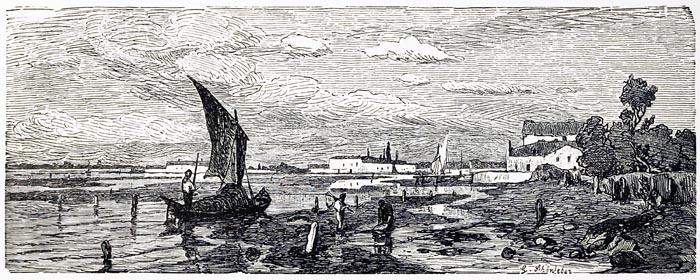
‘From the Lagoons’
Italy from the Alps to Mount Etna - Karl Stieler, conte Antonio Cavagna Sangiuliani di Gualdana, Eduard Paulus, Woldemar Kaden, Frances Eleanor Trollope, Thomas Adolphus Trollope (p117, 1877)
Internet Archive Book Images
The traveller has returned: has he been blessed? He has retraced his course; wandering endlessly, he has done no more than follow his own wake: ‘To look once more on what you have seen,’ says Marcus Aurelius, ‘is to begin to live again.’ I say: it is to begin to die again.
At last, news of Madame la Duchesse de Berry is waiting for me at the Hôtel de l’Europe. The Princess de Bauffremont newly arrived in Venice, and staying at the White Lion, desires to speak to me tomorrow, Tuesday the 17th at eleven.
On my trip to the Lido, as you have read, I was unable to reach the sea; now I am not a man to capitulate on such a matter. For fear some accident might prevent me returning to Venice once I have left, I will rise before daybreak tomorrow, and go to salute the Adriatic.
Tuesday, the 17th.
I have accomplished my plan.
Disembarking at dawn at San Nicolò, I took the path leaving the fort on the left. I stumbled amongst gravestones: I was in an unenclosed cemetery where they once disposed of the descendants of Judah. The stones carried Hebrew inscriptions; one was dated 1435 and that was not the oldest. The occupant had been named Violante; she had waited three hundred and ninety eight years for me to read and reveal her name. At the time of her death Doge Foscari began to experience that series of tragic incidents in his family: happy that obscure woman, above whose grave the sea birds fly, if she had no son.
An embankment built with the timber from old boats, on the same site, protects a new cemetery; wreckage shored up with the remains of wreckage. Through the peg-holes piercing the planks of those vessels’ shells, I spied on the dead, surrounding two cinerary urns; the dawn lit them: sunrise over the field where men rise no more is sadder than its setting. The Jews of Venice have marble tombs. They are not so richly buried at Jerusalem; I visited their graves at the foot of the Temple: when I reflect at night that I have returned from the Valley of Jehoshaphat, I feel afraid. In Tunis, in the Jewish cemetery, instead of alabaster urns, one sees by moonlight the veiled daughters of Zion, sitting like shades among the tombs: the cross and the turban sometimes come to console them.
I continued to walk towards the Adriatic; I could not see it, though I was very close. The Lido is an area of irregular dunes something like the sand-hills of the desert of Sabbah, which borders the Dead Sea. The dunes are covered with hardy plants; these plants are sometimes contiguous, sometimes separated into tufts that emerge from the bare sand, each like a lock of hair on a corpse’s skull. The land sloping towards the sea is scattered with fennel, sage, and thistles with spiky bluish flowers; the waves seemed to have dyed them with their colour: these thick, blue-green, prickly thistles, are reminiscent of cacti, and represent the transition from Northern vegetation to that of the South. A gentle breeze skimming the ground whistled among those rigid plants: one might have thought the earth sighing. Stagnant rain-water formed marshy pools. Here and there goldfinches flew with little cries among the clumps of bulrushes. A herd of cows smelling of milk, whose bull mingled his dull bellowing with that of Neptune, followed me as if I were their cowherd.
My joy and sadness were great when I discovered the sea, grey and wrinkled in the half-light. I set down here, under the title of Reverie, an imperfect picture of what I saw, felt and thought in those confused moments of meditation and seeing.
Book XXXIX: Chapter 21: Reverie on the Lido
Venice, the 17th of September 1833.
BkXXXIX:Chap21:Sec1
Only a half-formed unsmiling dawn emerged from the sea. The transformation of shadow to light, with its changing marvels, its voiceless-ness and melody, its stars extinguished one by one in the rose and gold of morning, failed to occurr. A handful of boats hugged the wind along the coast; a large ship vanished on the horizon. A flock of resting seagulls patterned the beach; some wheeled heavily above the broad sea-swell. The tide had left traces of its concentric arcs along the shoreline. The sand, garlanded with sea-weed, was wrinkled by every wave, like a brow over which time has passed. The flowing wave chained white festoons to the deserted shore.
I addressed words of love to the waves, my companions: like young girls holding each other by the hand in a ring, they had surrounded me at birth. I caressed those singers of lullabies to my cradle; I plunged my hands in the sea; I carried its sacred water to my lips, without tasting the bitterness: then I walked the waves’ edge, listening to their doleful cries, sweet and familiar to my ear. I filled my pockets with shells from which the Venetians make necklaces. I often stopped to contemplate the marine immensity with a tender gaze. A mast, a cloud were enough to waken my memories.
I had crossed that sea, long years ago; opposite the Lido a storm gathered. I said to myself in the midst of the storm ‘that I had braved others, but at the time of my Ocean voyage I was young, and that dangers were pleasures to me then.’ I thought myself very old, then, when I sailed for Greece and Syria? What weight of days was I buried under, then?
What was I doing there by the wastes of the Adriatic? The follies of age border on those of the cradle: I wrote my name beside the net of foam, where the last wave had died; successive waves slowly attacked the consolation of a name; only on the sixteenth surge had they finally carried it away, letter by letter, as if with regret: I felt they were erasing my life.
Lord Byron rode beside this solitary sea: what were his thoughts and songs, his despondencies and hopes? Did he raise his voice to confide the inspirations of his genius to the storm? Was it to the murmur of those waves that he composed these lines?
‘...If my fame should be, as my fortunes are,
Of hasty growth and blight, and dull Oblivion bar
My name from out the temple where the dead
Are honoured by the nations, - let it be -’
Byron felt that his fortunes were of hasty growth and blight; in those moments of doubt concerning his fame, since he thought of no other immortality, only nothingness was left to him of his joys. His disgust would have been less bitter, his flight down here less barren, if he had altered course: beyond his exhausted passions, some generous force would have carried him to a new existence. People fail to believe because they halt at the surface of things: tunnel through the earth and you will find the heavens. Here is the boundary stone at whose foot Byron marked out his grave: was it to recall Homer buried on the shore of Ios? God had already measured out a grave for the poet, whom I preceded into the world, elsewhere. I had already visited the American forests when, beneath young Childe Harold’s elm, near London, I dreamed René’s ennui and the tide of his sadness. I followed the traces of Byron’s first footsteps along the pathways at Harrow-on-the-Hill; I met with the prints of his last steps at one of the stations of his pilgrimage: no, I searched for those prints in vain: blown by the storm, the sand has covered the hoof-prints of his horse robbed of its master: ‘Fisherman of Malamocco, have you heard tell of Lord Byron?’ – ‘He rode here almost every day.’ – ‘Do you know where he has gone?’ The fisherman looked at the sea. And the sea remembered the command Christ uttered to it: ‘tace; obmutesce: peace, be still.’ Before Byron, Virgil had crossed the gulf dreaded by that poet of the Tiber: who brought Byron and Virgil back from Athens? On these very shores Venice mourns their loss: the Bucentaur no longer bathes its golden flanks in the shadow of its purple canopy; a few boats hide behind the deserted headlands, as in the first age of the Republic.
One stormy day, between Malta and the Syrtes, preparing to die, I placed this note in an empty bottle: F. A. de Chateaubriand, wrecked on the island of Lampedusa on the 26th of December 1806, while returning from the Holy Land. A fragile glass vessel, a few lines tossed about over the abyss, are all that would have acknowledged my existence. The current would have carried my wandering epitaph to the Lido, as today the tide of the years has cast my wandering life ashore. Dinelli, second in command of my polacre to Alexandria, was a Venetian: he spent the night with me, three or four hours by the glass, leaning against the mast and singing to the gusts of wind,
‘Si tanto mi piace
Si rara Bella,
Io perdere la pace
Quando se destera.
She pleases me so
So rare a Beauty,
No peace do I know
When she awakes.’
Is Dinelli reposing sul’margine d’un rio beside his slumbering mistress? Has she woken? Does my vessel still exist? Has it been sunk? Has it been repaired? Its passenger can do nothing to restore his life! Perhaps that boat whose distant yards I see, is the same that was entrusted with my former fate? Perhaps the dismembered keel of my skiff has furnished the palisades of the Jewish cemetery?
But have I told all, in the Itinerary, about my voyage beginning at Desdemona’s harbour and ending in Chimène’s country? Did I travel to Christ’s tomb in a mood of repentance? One thought alone then filled my soul; I consumed the hours: beneath my impatient sail, my gaze fixed on the evening star, I asked of it a northerly wind to drive me on more swiftly. How my heart beat approaching the shores of Spain! What miseries followed that mystery! The sun lights them yet; the reason I still have reminds me of them.
Venice, when I saw you, a quarter of a century ago, you were ruled by a great man, your oppressor and mine; an island awaited his tomb; an island is yours: you sleep, each of you immortal, on your St Helena. Venice! Our fates have run in parallel! My dreams vanished as your palaces crumbled; the days of my youth have darkened, as have the arabesques with which the summits of your monuments are adorned. But you will perish unaware; I see my own ruins; your voluptuous sky, the elegance of the waves that wash you, find me as foolish as ever I was. I have grown old in vain; I still dream a thousand chimeras. The energy of my nature is penned in my heart; the years instead of calming me, have only succeeded in driving my youthfulness from my external self, in order to lodge it in my breast. What caresses will draw it forth, to prevent it stifling me? What dew will fall on me? What breeze emanating from the flowers will penetrate me with its gentle breath? The wind that sighs above this half-naked head blows from no happy shore!
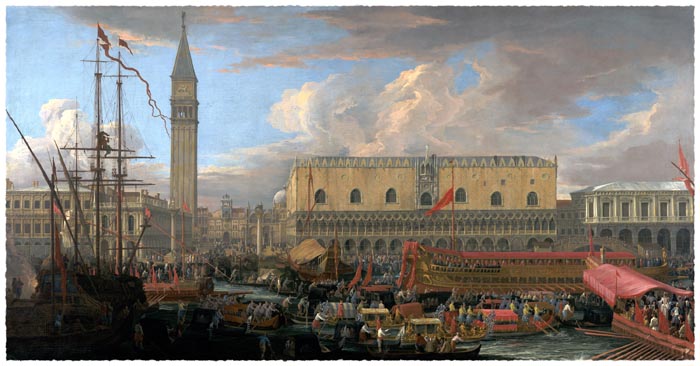
‘The Bucintoro Departing from the Bacino di San Marco’
Luca Carlevarijs (Italian, 1663 - 1730)
The Getty Open Content Program
End of Book XXXIX