François de Chateaubriand
Mémoires d’Outre-Tombe
Book XXII: Napoleon - Defeat and Exile: to 1815
Translated by A. S. Kline © Copyright 2005 All Rights Reserved
This work may be freely reproduced, stored and transmitted, electronically or otherwise, for any non-commercial purpose. Conditions and Exceptions apply.
Contents
- Book XXII: Chapter 1: The ills of France – Forced celebrations – A sojourn in my Valley – The Legitimacy awakes
- Book XXII: Chapter 2: The Pope at Fontainebleau
- Book XXII: Chapter 3: Defections – The deaths of Lagrange and Delille
- Book XXII: Chapter 4: The Battles of Lützen, Bautzen and Dresden – Reverses in Spain
- Book XXII: Chapter 5: The Campaign in Saxony, or the Campaign of The Poets
- Book XXII: Chapter 6: The Battle of Leipzig – Bonaparte’s return to Paris – the Treaty of Valençay
- Book XXII: Chapter 7: The Legislature convened – Then adjourned – The Allies cross the Rhine – Bonaparte’s anger – New Year’s Day 1814
- Book XXII: Chapter 8: The Pope set at liberty
- Book XXII: Chapter 9: Notes which became the pamphlet: De Bonaparte et des Bourbons – I take an apartment on the Rue de Rivoli – The notable Campaign of 1814 in France
- Book XXII: Chapter 10: I begin printing my pamphlet – A note from Madame de Chateaubriand
- Book XXII: Chapter 11: War at the gates of Paris – The appearance of Paris – Battle at Belleville – The Flight of Marie-Louise and the Regency – Monsieur de Talleyrand remains in Paris
- Book XXII: Chapter 12: The proclamation of General the Prince Schwarzenberg – Alexander’s speech – The capitulation of Paris
- Book XXII: Chapter 13: The Allies enter Paris.
- Book XXII: Chapter 14: Bonaparte at Fontainebleau – The Regency at Blois
- Book XXII: Chapter 15: The publication of my pamphlet – De Bonaparte et Des Bourbons
- Book XXII: Chapter 16: The Senate issue the Decree of Deposition
- Book XXII: Chapter 17: The Hôtel de la Rue Saint-Florentin – Monsieur de Talleyrand
- Book XXII: Chapter 18: The Proclamations of the Provisional Government – The Constitution proposed by the Senate
- Book XXII: Chapter 19: The arrival of the Comte d’Artois – Bonaparte’s abdication at Fontainebleau
- Book XXII: Chapter 20: Napoleon’s Journey to the Isle of Elba
- Book XXII: Chapter 21: Louis XVIII at Compiègne – His entry into Paris – The Old Guard – An Irreparable Fault – The Declaration of Saint-Ouen – The Treaty of Paris – The Charter – Departure of the Allies
- Book XXII: Chapter 22: The first year of the Restoration
- Book XXII: Chapter 23: Were the Royalists to blame for the Restoration?
- Book XXII: Chapter 24: First Minister – I publish Réflexions Politiques – Madame la Duchesse de Duras – I am named as Ambassador to Sweden
- Book XXII: Chapter 25: The exhumation of the remains of Louis XVI – My first 21st of January at Saint-Denis
- Book XXII: Chapter 26: The Island of Elba
Book XXII: Chapter 1: The ills of France – Forced celebrations – A sojourn in my Valley – The Legitimacy awakes
BkXXII:Chap1:Sec1
When Bonaparte arrived, preceded by his bulletin, there was general consternation. ‘The Empire,’ says Monsieur Ségur, ‘could only count on men aged by time or war, and children! Almost all the mature men, where were they? Women’s tears, mothers’ cries, spoke clearly enough! Bowed laboriously over the land, which without them would have remained untilled, they cursed the war he personified.’
Returning from the Berezina, there was no less of a requirement to dance: that is what one learns from the Souvenirs pour servir à l’histoire, of Queen Hortense. One was forced to go to the ball, death in one’s heart, weeping inwardly for relatives or friends. Such was the dishonour to which despotism had condemned France: one saw in the salons what one met with in the streets, creatures distracting themselves from their own lives by singing out their misery to divert the passers-by.
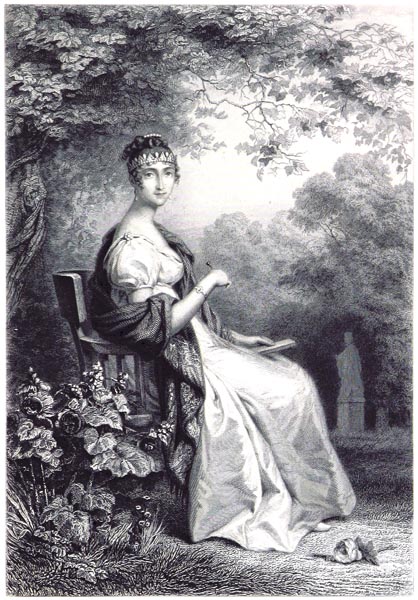
‘La Reine Hortense’
Histoire du Consulat et de l'Empire, Faisant Suite à l'Histoire de la Révolution Française, Vol 12
Louis Adolphe Thiers - President of the French Republic (p175, 1845)
The British Library
For three years I had been in retirement at Aulnay: from my pine-clad hill, in 1811, I had followed with my eyes the comet which during the night fled towards the wooded horizon; she was beautiful and melancholy, and, like a queen, drew her long train behind her. Whom did she seek, that lost stranger to our world? Towards whom did she make her way through the wastes of the sky?
On the 23rd of October 1812, sheltering for a moment in Paris, on the Rue des Saints-Pères, at the Hôtel Lavalette, Madame Lavalette, my hostess, being deaf and furnished with her long ear-trumpet, roused me: ‘Monsieur! Monsieur! Bonaparte is dead! General Malet has killed Hulin. All the powers that be are changed. The Revolution is over.’
Bonaparte was so beloved that for a while Paris was in a state of joy, except for the authorities who were left in an absurd limbo. A rumour had almost toppled the Empire. Escaping from prison at midnight a soldier was master of the world at daybreak; a fantasy was close to carrying off a formidable reality. The most moderate said: ‘If Napoleon is not dead, he will return chastened by his mistakes and reverses; he will make peace with Europe, and our remaining children will be saved.’ Two hours after his wife had spoken to me, Monsieur Lavelette entered to inform me of Malet’s arrest: it was no secret (that was his habitual phrase) that all was over. Day and night occurred simultaneously. I have related how Bonaparte received the news in a snowy field near Smolensk. The Senatus Consulte (of 12th of January 1813) put at the disposal of the returning Napoleon two hundred and fifty thousand men; inexhaustible France saw flow, from its blood through its wounds, fresh soldiers. Then a long-forgotten voice was heard; a few aged French ears thought they recognised the sound: it was the voice of Louis XVIII; it rose from the depths of exile. Louis XVI’s brother proclaimed the principles to be established one day by constitutional charter; the first aspiration towards liberty that emanated from our former kings.
Alexander, having entered Warsaw, addressed a proclamation to Europe: .............................
‘If the North will imitate the sublime example set by the Castilians, the world’s period of mourning is over. Europe, on the verge of falling prey to a monster, will recover its freedom and tranquillity. Let this blood-stained colossus who has menaced the continent with his endless criminality remain in the end merely a distant memory of horror and pity!’
That monster, that blood-stained colossus who menaced the continent with his endless criminality, had learnt so little from misfortune that barely escaped from the Cossacks he flung himself upon an old man whom he still held prisoner.
Book XXII: Chapter 2: The Pope at Fontainebleau
BkXXII:Chap2:Sec1
We saw the Pope’s abduction from Rome, his stay at Savona, then his detention at Fontainebleau. Discord held sway in the Sacred College: some Cardinals wished the Holy Father to resist for spiritual reasons, and they were ordered to only wear black garments; some were sent into exile in the provinces; some of the leading French clergy were imprisoned at Vincennes: other Cardinals assented to the Pope’s total submission; they retained their red garments; it was a second visitation of the Candlemas candles.
While at Fontainebleau the Pope obtained some respite from the obsession with Red Cardinals, he walked alone in the galleries of Francis I; he recognised some remnants of arts which recalled the Holy City, and from his windows he could see the pine trees that Louis XVI had planted facing the gloomy apartments where Monaldeschi was assassinated. From this deserted place, like Jesus, he could take pity on the kingdoms of the earth. The septuagenarian, half-dead, Bonaparte himself visiting to torment him, mechanically signed that Concordat of 1813, which he protested against as soon as Cardinals Pacca and Consalvi arrived.
When Pacca rejoined the captive with whom he had left Rome, he thought to find a large crowd around the royal jail; he only found a few servants in the courtyards and a sentry on duty at the top of the Horseshoe Staircase. The windows and doors to the palace were closed: in the first antechamber to the apartments he found Cardinal Doria, in the other rooms stood several French bishops. Pacca was announced to His Holiness: he was standing motionless, pale, hunched, thin, his eyes sunken in his head.
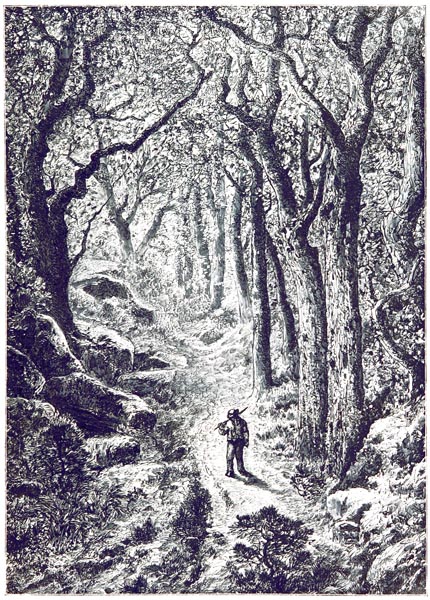
‘Sentier de la Forêt de Fontainebleau — Dessin d'Après Desjobert’
La France et les Colonies, Illustré - Onésime Reclus (p143, 1887)
The British Library
The Cardinal told him that he had hurried his journey to throw himself at his feet. Then the Pope said: ‘These Cardinals dragged us to the table and made us sign.’ Pacca withdrew to the apartment prepared for him, overcome by the solitariness of the residence, the expressionless eyes, the despondent faces, and the profound sorrow imprinted on the Pope’s visage. Returning to His Holiness, he ‘found him’ (he himself speaks) ‘in a state worthy of compassion and in fear of his life. He was overwhelmed by an inconsolable sadness when speaking of what had taken place; that tormenting thought stopped him sleeping and prevented him taking the nourishment which sufficed to keep him from death: - “As to that”, he said, “I shall die mad like Clement XIV.”’
In the silence of those empty galleries, where the voices of Saint Louis, Francis I, Henry IV, and Louis XIV were no longer heard, the Holy Father, spent several days composing and copying the letter which was to be sent to the Emperor. Cardinal Pacca carried the document about hidden in his robes, at some risk since the Pope had added a few lines to it in his own handwriting. The work done, the Pope gave it, on the 24th of May 1813, to Colonel Lagorce and asked him to take it to the Emperor. At the same time he read a short speech to the various Cardinals who were present: he considered the brief he had issued at Savona and the Concordat of 25th January as null and void. ‘May the Lord be blessed,’ the speech read, ‘who has not removed his mercy from us! He has simply wished to humble us through salutary confession. Let us then be humbled for the good of our soul; to Him, through all the centuries, exaltation, honour and glory!
From the Palace of Fontainebleau, the 24th of March 1813.’
No finer decree has ever issued from that Palace. The Pope’s conscience was eased, the martyr’s expression became serene; his smile and his lips regained their charm, and his eyes closed in sleep.
At first Napoleon threatened to make the heads of some of those priests at Fontainebleau leap from their shoulders; he considered declaring himself head of State religion; then, regaining his temper, he pretended to know nothing of the Pope’s letter, But his fortunes were in decline. The Pope, from an order of poor monks, dragged by misfortune among the crowd, seemed to have taken on the great mantle of Tribune of the People once more, and given the signal for the deposition of the oppressor of public freedom.
Book XXII: Chapter 3: Defections – The deaths of Lagrange and Delille
BkXXII:Chap3:Sec1
Ill fortune brings betrayal with it but does not justify it; in March of 1813, Prussia allies itself with Russia at Kalisz. On the 3rd of March, Sweden signs a treaty with the Court of St James; she is obliged to provide thirty thousand men, Hamburg is evacuated by the French, Berlin entered by Cossacks, Dresden occupied by the Russians and Prussians.
The defection of the Confederation of the Rhine is imminent. Austria adheres to its alliance with Russia and Prussia. The war in Italy re-commences and Prince Eugène is sent there.
In Spain, the English army defeats Joseph at Vittoria; the paintings stripped from the churches and palaces fall into the Ebro; I have seen them in Madrid and at the Escorial; I had seen them when they were restored in Paris: the waves and Napoleon had passed over these Murillos and Raphaels, velut umbra (like a shadow). Wellington, ever advancing, defeats Soult at Roncesvalles: our noblest memories formed the background to the scene of our later fate.
On the 14th of February, at the opening of the Legislature, Bonaparte had declared that he had always wanted peace and that it was essential for the world. This lie no longer emanated from him. Moreover there was little sympathy for the grief of France from the lips of one who called us his subjects: Bonaparte exacted suffering from us, as a tribute due to him.
On the 3rd of April, the Senate (Conservateur) added a hundred and eighty thousand combatants to those it had already allocated: an extraordinary levy of men in the midst of the regular levies. On the 10th of April, Lagrange was taken; the Abbé Delille died some days later. If nobility of feeling outweighs depth of thought in Heaven, the singer of La Pitié is nearer the throne of God than the author of the Theory of Analytic Functions. Bonaparte left Paris on the 15th of April.
Book XXII: Chapter 4: The Battles of Lützen, Bautzen and Dresden – Reverses in Spain
BkXXII:Chap4:Sec1
The levies of 1812, following one another, have halted in Saxony. Napoleon arrives. The honours of the former lost host are handed to two hundred thousand conscripts who fight like the grenadiers of Marengo. On the 2nd of May, the battle of Lützen is won: Bonaparte, in these fresh battles, scarcely used artillery any longer. Entering Dresden, he tells the inhabitants: ‘I am not unaware of the joy in which you indulged when the Emperor Alexander and the King of Prussia entered your walls. We can still see on the cobblestones the remains of the flowers that your young girls scattered in the path of those monarchs.’ Did Napoleon remember the young girls of Verdun? It was in the days of his youth.
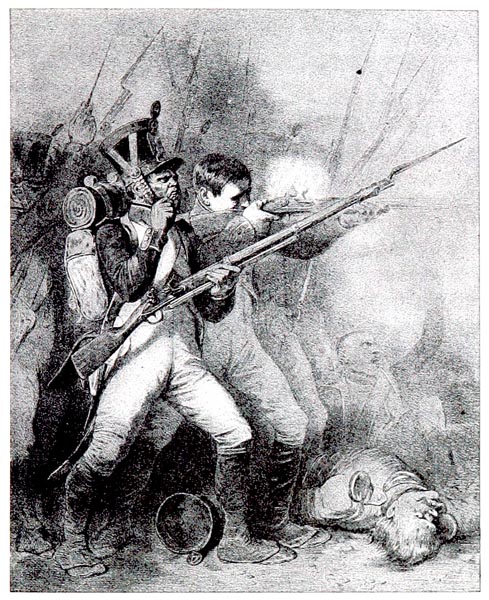
‘Campagne de Saxe, Les Conscrits de 1813. Peint par Raffet, Lithographié par Llanta’
Napoléon Ier et Son Temps - Roger Peyre (p843, 1888)
The British Library
At Bautzen, another triumph, but one after which the Commander of the Engineers, Kirgener, and Duroc, the Grand Marshal of the Palace, were buried. ‘There is a future life,’ the Emperor told Duroc, ‘we will meet again.’ Did Duroc care much about that meeting?
On the 26th and 27th of August, they reached the Elbe, on fields already famous. Returned from America, having seen Bernadotte in Stockholm, and Alexander in Prague, Moreau had both legs carried away by a cannonball, at Dresden, at the side of the Russian Emperor: a familiar outcome of Napoleonic destiny. They learned, in the French camp, of the death of the victor of Hohenlinden, by means of a stray dog, on whose collar was inscribed the name of the new Turenne; the animal, living on without its master, ran here and there among the dead: Te, janitor Orci (You, oh guardian of the Underworld)!
The Prince of Sweden, who had become the Generalissimo of the Army of North Germany, had addressed a proclamation to his soldiers on the 15th of August:
‘Soldiers, the same feelings that guided the French in 1792, and which led them to unite, and combat the armies entering their territory, must now direct your valour against one who, having invaded the soil which bore you, still enslaves your brothers, your wives and your children.’
Bonaparte, incurring universal disapproval, set himself against liberty which attacked him on all sides, in all its forms. A Senatus-Consulte of the 28th of August annulled the judgement of a jury at Anvers: a very minor infraction, doubtless, of the rights of citizens, after the arbitrary enormities employed by the Emperor; but at the heart of the law is a sacred freedom whose cry must be heard: that oppression practised against a jury made more noise than the many other oppressions to which France fell victim.
Finally, in the south, the enemy trod our soil; the English, Bonaparte’s obsession and the source of almost all his mistakes, crossed the Bidasoa on the 7th of October: Wellington, the man of destiny, was the first to set his foot on the soil of France.
Insisting on remaining in Saxony, despite Vandamme’s capture in Bohemia and Ney’s defeat near Berlin by Bernadotte, Napoleon returned to Dresden. Then the Landsturm was levied; a patriotic war, similar to that which had freed Spain, was being organised.
Book XXII: Chapter 5: The Campaign in Saxony, or the Campaign of The Poets
BkXXII:Chap5:Sec1
The battles of 1813 have been referred to as the Campaign in Saxony: they would be better named the Campaign of Young Germany or the Campaign of the Poets. To what despair had Bonaparte not reduced us by his oppression, that while watching our own blood flow, we could yet deny a gesture of support for generous youth taking up the sword in the name of freedom? Each of those battles was a protest on behalf of national rights.
In one of his proclamations, dated from Kalisz on the 25th of March 1813, Alexander called the people of Germany to arms, promising them, in the name of his royal ‘brothers’, free institutions. This was the signal for open activity by the Burschenschaft, which had already been formed in secret. The German universities re-opened; they set aside sorrow in order to think only of reparation for their injuries: ‘Let mourning and tears be brief, grief and distress long-lasting.’ said the ancient Germans, ‘it is right for women to weep, for men to remember: ‘Lamenta ac lacrymas cito, dolorem et tristitiam tarde ponunt. Feminis lugere honestum est, viris meminisse.’ Then the young Germans hastened to free their country; then they were in a hurry, those Germans, allies of the Empire, whom ancient Rome aided, in supplying them with armour and spears, velut tela atque arma.
In Berlin, in 1813, Professor Fichte gave a lecture on duty; he spoke of the disasters which afflicted Germany, and finished his lecture with these words: ‘This course will be suspended until the end of the Campaign. We will continue it when our country is free, or we will die regaining our freedom.’ His young audience rise to their feet in acclamation: Fichte descends from his seat, passes through the crowd, and goes to enrol in a corps leaving for the army.
All Bonaparte has scorned and insulted becomes a danger to him: intellect enters the lists against brute force; Moscow is the flame by whose light Germany dons its harness: ‘To arms!’ the Muse cries. ‘The Phoenix of Russia has soared from its pyre!’ That Queen of Prussia, so defenceless and so beautiful, whom Napoleon showered his clever insults upon, is transformed into an implored and imploring shade: ‘How softly she sleeps!’ sing the bards, ‘Ah, may you sleep until that day when your people wash away the rust of their swords with blood! Wake, then! Wake! Be our angel of liberty and vengeance!’
Körner had only one fear, that of dying in prose: ‘Poesy! Poesy!’ he exclaimed, ‘bring me death at the break of day!’
He composed, in camp, the hymn of The Lyre and the Sword.
THE KNIGHT.
‘Tell me fine sword, sword at my side, why the light of your glance is so ardent today? You glance at me with the gaze of love, fine sword, sword that is my joy. Huzza!’
THE SWORD.
‘It’s because a brave knight bears me along: that is what inflames my glance; for I am the strength of a free man. Huzza!’
THE KNIGHT.
‘Yes, my blade, yes, I am a free man, and I love you from the depths of my heart: I love you as if you were my betrothed; I love you like a dear mistress.’
THE SWORD.
‘And I, I give myself to you! To you my life, to you my soul of steel! Oh! If we are betrothed, when will you say: Come to me, come my dear mistress?’
Might one not believe one is listening to one of those Northern warriors, one of those men of battle and solitude, of whom Saxo Grammaticus wrote: ‘He fell, smiling: and died.’
It is not the cool enthusiasm of a Skald certainly: Körner had his sword by his side; handsome, fair, young, an Apollo on horseback, he sang of the darkness like an Arab in the saddle; his maoual (chant), while charging the enemy, was accompanied by the sound of his galloping mount. Wounded at Lützen, he dragged himself into the woods, where some peasants found him; he emerged to die on the plains of Mecklenburg, at the age of twenty-one: he fled the arms of a woman he loved, and forsook all the delights of life. ‘Women take pleasure,’ said Tyrtaeus, ‘in contemplating the radiant and upright man: he is no less handsome if he falls in the front ranks.’
The new followers of Arminius, raised in the school of Greece, had a common national anthem: when these students abandoned the peaceful avenues of science for the field of battle, the silent joys of study for the noisy perils of war, Homer and the Niebelungenlied for the sword, with what did they counter our hymn of blood, our Revolutionary canticle? These stanzas full of religious feeling, and human sincerity:
‘Where is Germany? Name that great land to me! Wherever the German language sounds, and our German song is heard praising God: there is Germany.
Germany is the land where a shake of the hand suffices as a pledge, where simple honesty shines in every glance, where affection glows in every heart.
O God, in Heaven, cast your eyes on us: grant us that purity of spirit, truly German, so that we may be loyal and true. There, is a German’s country, all that land is his land.’
These college friends, now companions in arms, do not join clubs where Septembrists vow to murder with the knife: loyal to their poetic imaginings, to historical tradition, to the cult of the past, they make an old castle, an ancient forest, a defensive sanctuary of the Burschenschaft. The Queen of Prussia becomes their patroness, instead of the Queen of Night.
At the summit of a hill, among the ruins, the soldier-scholars, with their officer-professors, see revealed the pinnacle of their beloved university halls: moved by memories of their learned past, and by this sight of the sanctuary of their studies and the games of their youth, they swear to free their country, as Melchthal, Fürst and Stauffacher had pronounced their triple oath in sight of the Alps, immortalised by them, and depicted by them. The German spirit has something mystical about it; Schiller’s Thekla for example is a Teutonic daughter gifted with second-sight and imbued with a divine element. The Germans today worship liberty with an indefinable mysticism, just as they once designated the secret depths of the forests as God: Deorumque nominibus appellant secretum illud. The man whose life was a dithyramb of action only fell when the poets of Young Germany had sung, and taken up the sword, against their rival Napoleon, the armed poet.
Alexander was worthy of being the herald sent to the young Germans: he shared their elevated feelings, and he was in a position of power which made their plans achievable; but he let himself be made fearful by the fears of the monarchs who surrounded him. Those monarchs had never kept their promises; they gave their people nothing in the way of benevolent political institutions. The children of the Muse (the flame by whom the inert mass of soldiers had been animated) were thrust into dungeons in recompense for their devotion and their noble beliefs. Alas, the generation that brought the Teutons freedom had vanished; there were only old worn out political incumbents in Germany. They praised Napoleon as a great man at every opportunity, so that their present admiration might excuse their past abasement. In that foolish enthusiasm for the man which made governments continue to grovel when they been whipped, they barely remembered Körner: ‘Arminius, Germany’s liberator,’ says Tacitus, ‘was unknown to the Greeks who only admired themselves, and little celebrated among the Romans whom he had vanquished; but the barbarous nations still sing of him, caniturque barbaras apud gentes.’
Book XXII: Chapter 6: The Battle of Leipzig – Bonaparte’s return to Paris – the Treaty of Valençay
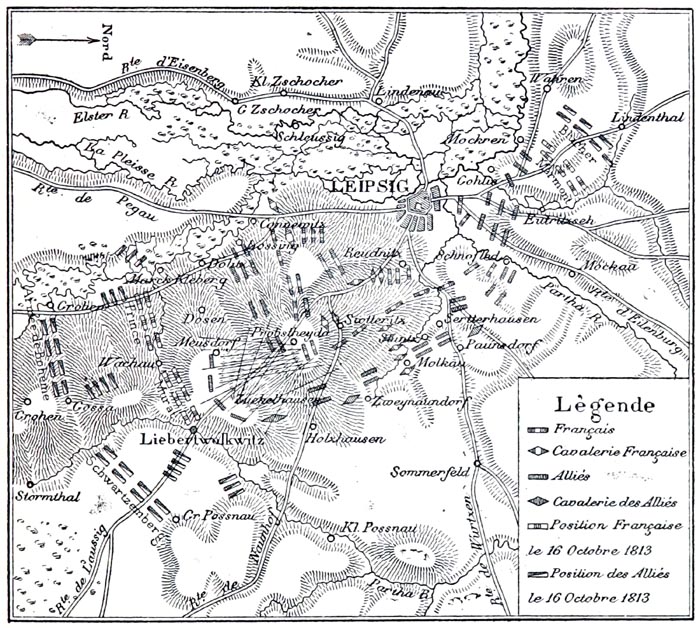
‘Plan de la Bataille de Leipzig, dite la Bataille des Nations’
Napoléon Ier et Son Temps - Roger Peyre (p863, 1888)
The British Library
BkXXII:Chap6:Sec1
On the 18th and 19th of October 1813 the battle took place on the fields of Leipzig that the Germans call the Battle of the Nations. Towards the end of the second day, the Saxons and the Wurtenbergers, deserting Napoleon’s camp beneath the banner of Bernadotte, decided the outcome of the action: victory was tarnished by betrayal. The Prince of Sweden, the Emperor of Russia, and the King of Prussia entered Leipzig through three different gates. Napoleon, having experienced a crushing defeat, retreated. Since he knew nothing of sergeant’s retreats, as he once said, he blew the bridges behind him. Prince Poniatowski, twice wounded, was drowned in the Weisse Elster: Poland fell with its last defender.
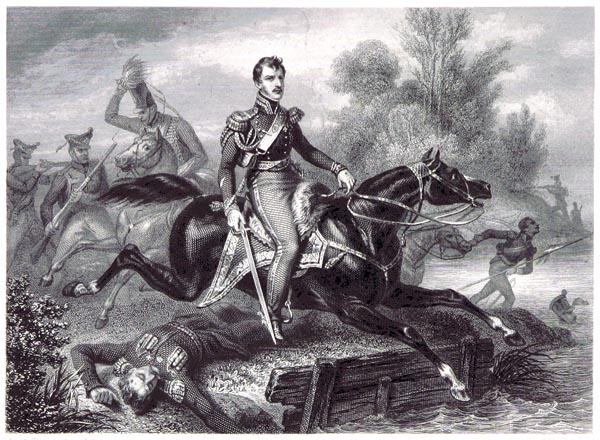
‘Poniatowski - Mort en Traversant l'Elster, le 19 octobre 1813’
Histoire du Consulat et de l'Empire, Faisant Suite à l'Histoire de la Révolution Française, Vol 12
Louis Adolphe Thiers - President of the French Republic (p165, 1845)
The British Library
Napoleon did not halt till Erfurt: from there his bulletin announced that his army, ever victorious, had met with a great battle: Erfurt, not long before, had seen Napoleon at the height of his prosperity.
Finally, the Bavarians, following the other deserters from ill fortune, tried to annihilate the rest of our soldiers at Hanau. Wrède was defeated by the Guards of Honour alone: a few conscripts, already veterans, treated him ruthlessly; they saved Bonaparte and took up position behind the Rhine. Arriving in Mainz as a fugitive, Napoleon, returned to Saint-Cloud on the 9th of November; the indefatigable De Lacépède arrived to tell him: ‘Your Majesty has overcome all.’ Monsieur de Lacépède spoke appropriately concerning oviparous creatures; but could not keep on his feet.
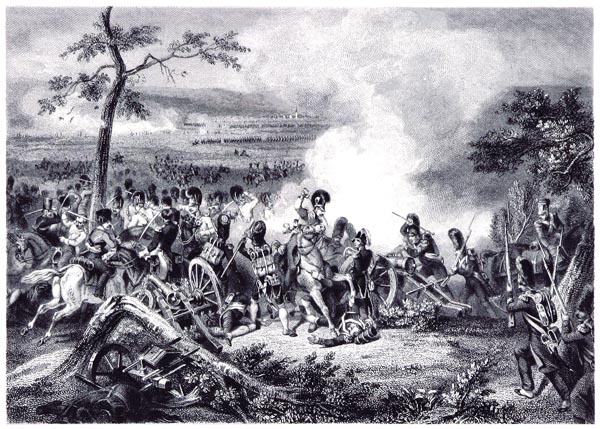
‘Bataille de Hanau’
Histoire du Consulat et de l'Empire, Faisant Suite à l'Histoire de la Révolution Française, Vol 12
Louis Adolphe Thiers - President of the French Republic (p213, 1845)
The British Library
Holland regained its freedom, and recalled the Prince of Orange. On the 1st of December the Allied Powers declared: ‘that they were not making war against France, only against the Emperor, or rather against that domination he had exercised for too long, beyond the borders of his Empire, to the detriment of Europe and France.’
As the moment approached when we would be shut in our former territory once more we asked what purpose the upheaval in Europe, and the massacre of so many millions of men, had served? Time swallows us and continues tranquilly on its course.
By the Treaty of Valençay of the 11th of December, the wretched Ferdinand VII was returned to Madrid: thus ended, obscurely and in haste, that criminal enterprise in Spain, the primary cause of Napoleon’s fall. One can always go to the bad, one can always kill people, including a king; but the way back is difficult: Jacques Clément repaired his sandals for the journey to Saint-Cloud, his colleagues, smiling, questioned how long his handiwork would last: ‘Long enough for the road I travel, ‘ he replied, ‘I am obliged to go, not to return.’
Book XXII: Chapter 7: The Legislature convened – Then adjourned – The Allies cross the Rhine – Bonaparte’s anger – New Year’s Day 1814
BkXXII:Chap7:Sec1
The Legislature assembled on the 19th of December 1813. Astounding on the field of battle, remarkable in his councils of State, Bonaparte was less effective in politics: the language of liberty he knew nothing of; if he wished to express congenial feelings, or paternal sentiments, he was moved in an inappropriate way, and masked a lack of feeling with tender words. ‘My heart,’ he told the Legislature, ‘needs the presence and affection of my subjects. I have never been seduced by prosperity; adversity will find me immune to its sufferings. I have conceived and executed great schemes for the prosperity and good of the world. Monarch and father, I feel that peace enhances the security of thrones and that of families.’
An official Moniteur article said, in July 1804, that under the Empire, France would never extend beyond the Rhine, and its armies would no longer cross it.
The allies crossed that river on the 21st of December 1813, from Basle to Schaffhausen, with more than a hundred thousand men; on the 31st of the same month, the Army of Silesia commanded by Blücher, crossed in turn, from Mannheim to Coblentz.
By order of the Emperor, the Senate and the Legislature appointed two commissions charged with examining documents related to negotiation with the Coalition powers; foresight on the part of a power which, denying consequences which had become inevitable, wished to transfer the responsibility to another authority.
The Legislative commission, presided over by Monsieur Lainé, dared to state ‘that steps towards peace would be assured of their effect if the French were convinced that their blood would only be shed in order to defend the country and laws which protect them; that His Majesty must be implored to maintain the whole and constant execution of the laws which guarantee to the French the rights of liberty, security, and property, and to the nation the free exercise of its political rights.’
The Minister of Police, the Duke of Rovigo, has all traces of their report removed; a decree of the 31st December adjourns the Legislature; the doors of the room are locked. Bonaparte considered the members of the Legislative commission as agents in the pay of England: ‘The said Lainé, ‘he remarked, ‘is a traitor who corresponds with the Prince Regent through the intermediary De Sèze; Raynouard, Maine de Biran, and Flaugergues are dissidents.’
The soldier was astonished not to be encountering those Poles he had abandoned, who, drowning themselves in order to obey his orders, still shouted: ‘Long Live the Emperor!’ He called the report of the commission a motion passed by a Jacobin club. There is not a speech of Bonaparte’s in which his aversion for the Republic which spawned him does not emerge; though he detested its crimes less than its freedoms. Regarding this same report, he added: ‘Do they want to re-establish the sovereignty of the people? Well, in that case, I constitute the people; since I intend always to be wherever sovereignty resides.’ No despot has ever revealed his character more clearly: it is Louis XIV’s phrase re-visited: ‘The State: that is I.’
At the reception on New Year’s Day 1814, a scene was anticipated. I knew someone attached to the Court, who proposed to take his sword along in his hand, just in case. Nevertheless Napoleon went no further than violent words, though he uttered them in a quantity that even caused some embarrassment to his halberdiers: ‘Why,’ he shouted, ‘talk about these domestic matters in front of all Europe? Dirty linen should be washed in private. What is a throne? A piece of wood covered with a piece of cloth: all depends on who is seated there. France has more need of me than I of her. I am one of those men one can kill, but not dishonour. We will have peace in three months, or the enemy will be driven from our territory, or I will be dead.’
Bonaparte was accustomed to wash French linen in blood. In three months there was no peace, the enemy was not driven from our territory, and Bonaparte had not lost his life: death was not yet his fate. Overwhelmed by so many problems and the obstinate ingratitude of the master she had bestowed on herself, France saw herself invaded with the motionless stupor born of despair.
An Imperial decree mobilised one hundred and twenty-one battalions of the National Guard; another decree created a Regency Cabinet, presided over by Cambacérès and composed of Ministers, at whose head the Empress was installed. Joseph, an available monarch, back from Spain with his spoils, was made Commandant General of Paris. On the 25th of January 1814, Bonaparte left his palace for the army, off to light a brilliant flame as he faded away.
Book XXII: Chapter 8: The Pope set at liberty
BkXXII:Chap8:Sec1
A few days before, the Pope had regained his freedom; the hand that went to him bearing chains was forced to break those irons he had bestowed: Providence had altered their fates, and the wind which blew in Napoleon’s face drove the allies towards Paris.
Pius VII, informed of his deliverance, hastened to make a brief prayer in the chapel of Francis I; he climbed into a carriage and traversed that forest in which, according to popular tradition, the great hunter Death could be seen when a king was about to visit Saint Denis.
The Pope travelled under the surveillance of an officer of the gendarmerie who followed him in a second carriage. At Orléans, he learnt the name of the town he was entering.
He followed the Southern route to the acclamations of the people of those provinces which Napoleon would soon pass through, scarcely feeling safe despite the guardianship of foreign officers. His Holiness was delayed in his journey by his oppressor’s very fall: the authorities had ceased to function; no one was obeyed; an order penned by Bonaparte, an order which twenty-four hours earlier would have bowed the noblest head and made a kingdom topple, was worthless paper: Napoleon lacked those remaining moments of power in which to protect the captive his power had persecuted. A provisional mandate of the Bourbons was needed to ensure that Pontiff was set free who had placed their crown on an alien head: what a confusion of destinies!
Pius VII travelled among hymns and tears, to the sound of bells, to cries of: ‘Long live the Pope! Long live the Head of the Church!’ They brought him, not the keys of towns, capitulations drenched with blood and obtained by murder, rather they brought to the sides of his carriage the sick for him to heal, and newly married couples for him to bless; he said to the former: ‘May God console you!’ He extended his peace-giving hands over the latter; he touched little children in their mother’s arms. Only those unable to walk remained in the towns. The pilgrims spent the night in the fields to await the arrival of an old freed priest. The peasants, in their simplicity, thought that the Holy Father resembled Our Lord; Protestants, moved, said: ‘There is the greatest man of his century. Such is the grandeur of a truly Christian society, where God ceaselessly mingles with men; such is the superiority over the power of the sword and the sceptre of the power of humility, sustained by religion and misfortune.
Pius VII passed through Carcassonne, Béziers, Montpellier and Nîmes, to reach Italy once more. On the banks of the Rhine, it seemed as if the innumerable crusaders of Raymond of Toulouse were still passing in revue at Saint-Rémy. The Pope saw Nice again, Savona, Imola, witness of his fresh afflictions and the first mortifications of his life: one likes to weep where one has wept. In commonplace moments one remembers places or times of happiness. Pius VII travelled again his virtuous hours and his sufferings, as a man in memory reviews his faded passions.
At Bologna, the Pope was left in the hands of the Austrian authorities. Murat, Joachim-Napoléon, King of Naples, wrote to him on the 4th of April 1814:
‘Most Holy Father, the fortunes of war having rendered me master of the States which you possessed when you were forced to leave Rome, I do not hesitate to return them to your authority, renouncing all my rights of conquest over these lands, in your favour.’
What remained to Joachim and Napoleon at their deaths?
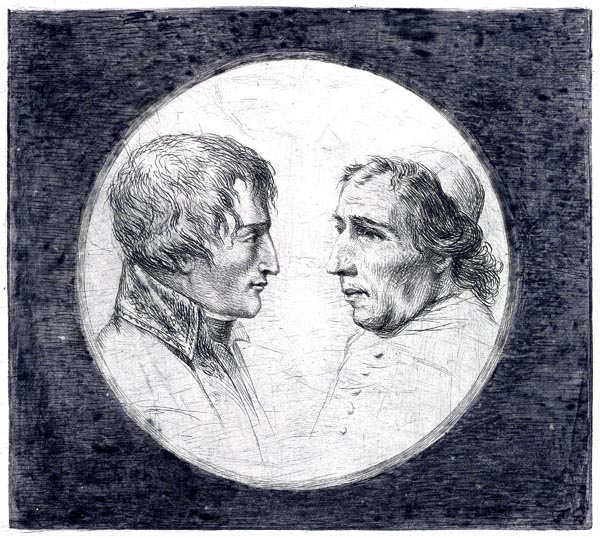
‘Double portrait of Napoleon Bonaparte and Pope Pius VII’
Bernard Coclers, c. 1801 - c. 1804
The Rijksmuseum
The Pope no sooner arrived in Rome than he offered refuge to Napoleon’s mother. The legates had retaken possession of the Eternal City. On the 23rd of May, in the fullness of spring, Pius VII saw the dome of Saint-Peter’s. He has told of shedding tears on seeing the sacred dome again. Preparing to enter the Porta del Populo, the Pontiff halted: twenty-two orphans dressed in white robes, and forty-five young girls carrying large gilded palm-leaves came forward singing hymns. The crowd shouted: ‘Hosanna!’ Pignatelli who had commanded the troops on the Quirinal when Radet took Pius VII’s Garden of Olives by assault, now led the procession of palms. At the same time that Pignatelli was changing roles, various noble perjurers, in Paris, were once more taking up their functions as grand-domestics, behind Louis XVIII’s armchair: prosperity was handed to us with slavery, as in former times a seigniorial estate was sold with its serfs.
Book XXII: Chapter 9: Notes which became the pamphlet: De Bonaparte et des Bourbons – I take an apartment on the Rue de Rivoli – The notable Campaign of 1814 in France
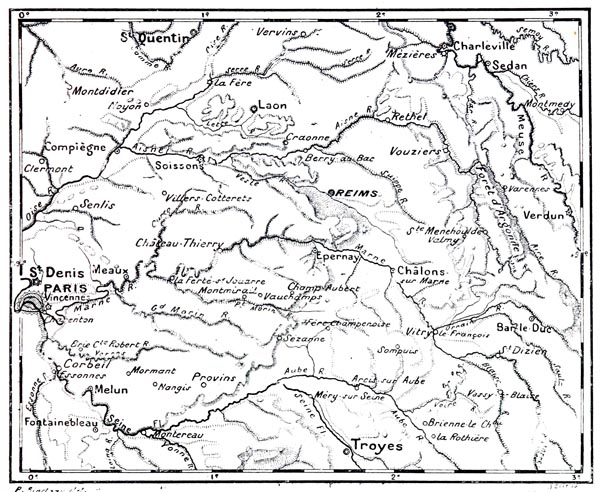
‘Carte de la Campagne de France.’
Napoléon Ier et Son Temps - Roger Peyre (p881, 1888)
The British Library
BkXXII:Chap9:Sec1
In the second book of these Memoirs, it states (I was then returning from my first exile in Dieppe): ‘I was allowed to return to my Vallée. The earth trembles under the feet of foreign soldiers. I write like one of the last Romans, amidst the sounds of the Barbarian invasion. By day I trace pages as troubled as the events of the day..at night, while the rumble of distant cannon dies away among my woods, I return to the silence of years that sleep in the tomb, to the tranquillity of my earliest memories.’
These restless pages that I trace today were notes respecting the events of the time, which, collected, became my pamphlet: De Bonaparte et des Bourbons. I had such an elevated idea of Napoleon’s genius and the bravery of our soldiers, that foreign invasion, happy as it might be in its final outcome, would never have entered my head: but I thought that invasion, in making France realise the danger into which Napoleon’s ambition had led her, would lead to an internal reaction, and that the freedom of the French would be achieved by their own efforts. It was with this idea in mind that I wrote my notes, in order that if our political assemblies halted the march of the Allies, and resolved to divorce themselves from the great man, who had become a scourge, they would know whom to resort to; it seemed to me that recourse was to be found in that authority, modified to suit the times, under which our ancestors had lived for eight centuries: when in a storm one finds only an old building within reach, ruined as it is, one shelters there.
In the winter of 1813-1814, I took an apartment on the Rue de Rivoli, facing the front railings of the Tuileries Garden, before which I had heard the death of the Duc d’Enghien being cried aloud. As yet in that street one could only see the arcades built by the Government and a few isolated houses, rising up here and there, their jagged sides outlines of waiting stone.
It required nothing less than the ills that weighed on France, to maintain the aversion that Napoleon inspired and at the same time resist the admiration that he could arouse as soon as he stirred: he was the most incredible genius in action who ever existed; his first Campaign in Italy and his last Campaign in France (I do not speak of Waterloo) were his two finest campaigns; Condé in the first, Turenne in the second, a great warrior in the former, a great man in the latter; though they differed in their outcomes: since with the one he gained an Empire, with the other he lost it. His last moments of power, naked and rootless as they were, could not have been extracted from him, like the teeth of a lion, except by the exertion of all Europe. Napoleon’s name was still so formidable that the enemy armies only crossed the Rhine with apprehension; they looked behind them constantly to make sure that retreat was still possible; masters of Paris they still trembled. Alexander glancing back at Russia, on entering France, congratulated those who could return there, and wrote to his mother to express his anxiety and regret.
Napoleon beat the Russians at Saint-Dizier, the Prussians and the Russians at Brienne, as if to honour the fields in which he had been nurtured. He overthrew the Silesian army at Montmirail, at Champaubert and a section of the Grand Army at Montereau. He resisted everywhere; passing and re-passing in his own steps; pushing back the columns that surrounded him. The Allies proposed an armistice; Bonaparte tore up the peace preliminaries offered and shouted: ‘I am nearer to Vienna than the Austrian Emperor is to Paris!’
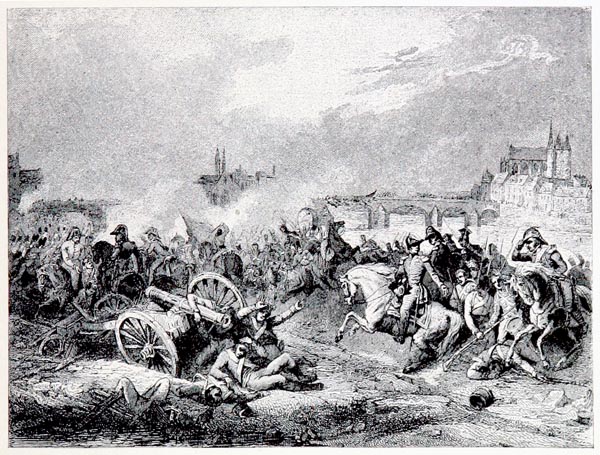
‘Bataille de Montereau, 18 février 1814. Peint par Ch. Langlois’
Napoléon Ier et Son Temps - Roger Peyre (p895, 1888)
The British Library
Russia, Austria, Prussia and England, for mutual support, concluded a fresh treaty of alliance at Chaumont; but at heart, alarmed by Bonaparte’s resistance, they thought of retreat. At Lyons, an army presented itself on the Austrian flank; in the south, Marshal Soult halted the English; the Congress of Châtillon, which was not dissolved till the 15th of March, was still in negotiations. Bonaparte drove Blücher from the heights of Craonne. The Allied Grand Army only triumphed at Bar-sur-Aube, on the 27th of February, by weight of numbers. Bonaparte, increasing his forces, had recovered Troyes which had been reoccupied by the Allies. From Craonne he took himself to Rheims. ‘Tonight,’ he said, ‘I am off to catch my father-in-law at Troyes.’
On the 20th of March, an engagement took place near Arcis-sur-Aube. During an artillery barrage, on a shell falling in front of a Guards’ square the square appeared to make a slight movement. Bonaparte dashed up to the projectile whose fuse was smoking and made his horse sniff at it; the shell exploded, while the Emperor emerged safe and sound from the midst of the shattered lightning-bolt.
The battle was due to recommence the following day; but Bonaparte, yielding to the inspiration of genius, an inspiration nonetheless fatal to him, withdrew in order to bear down on the rear of the allied troops, separate them from their supplies, and swell his army with the garrisons from the frontier forts. The invaders were preparing to fall back towards the Rhine, when Alexander, by one of those heaven-sent impulses which change the world, decided to march on Paris, to which the road was now open (I have heard General Pozzo recount that it was he who persuaded the Emperor to advance). Napoleon thought he was drawing the bulk of the enemy after him, but he was only followed by ten thousand cavalry, whom he took to be the vanguard of the main body, and who were masking the true movement of the Prussians and Muscovites. He scattered those ten thousand horsemen at Saint-Dizier and Vitry, and then realised that the Allied Grand Army was not behind them; that army, hastening towards the capital, had only Marshals Marmont and Mortier facing it, with about twelve thousand conscripts.
Napoleon headed in haste for Fontainebleau: where the sacred prisoner, in departing, had left it to those who would repay and avenge. Two things are always linked together throughout history: when a man opens the way to injustice, at that same moment he opens a way to perdition, into which, after a certain distance, the former path will collapse.
Book XXII: Chapter 10: I begin printing my pamphlet – A note from Madame de Chateaubriand
BkXXII:Chap10:Sec1
Minds were greatly agitated: the hope of seeing the end, cost what it might, of the cruel war which had weighed on a France sated for twenty years with glory and misfortune overcame national pride among the masses. All were concerned with the part they would have to play in the imminent catastrophe. Every evening my friends came to Madame de Chateaubriand’s to talk, to recount and comment on the day’s events. Messieurs de Fontanes, de Clausel, and Joubert, came with a crowd of those transient friends whom events bring and events take away. Madame la Duchesse de Lévis, beautiful, tranquil and devoted, whom we will meet again in Ghent, kept Madame de Chateaubriand faithful company. Madame la Duchesse de Duras was also in Paris, and I often went to see Madame la Marquise de Montcalm, the Duc de Richelieu’s sister.
I continued to be persuaded, despite the approach of fighting, that the Allies would not enter Paris, and that a national uprising would put an end to our fears. My obsession with that idea prevented me reacting to the presence of the foreign armies as keenly as I might have done: but I could not help reflecting on the calamities which we had inflicted on Europe, seeing Europe bringing them upon us in turn.
I did not stop working at my pamphlet; I was preparing it like a remedy for the time when anarchy would burst upon us. We no longer write like that today, at our ease, and with nothing to fear but newspaper skirmishes: at night I locked myself in; I put my papers under my pillow, a pair of loaded pistols on my table: I slept between those two Muses. My text was a double one; I had composed it in the form, which it retained, of a pamphlet, and also as a speech, differing in some respects from the pamphlet; I assumed that when France met, it would gather at the Hôtel de Ville, and I was doubly prepared.
Madame de Chateaubriand took notes at various times in our life together; among these notes, I find the following paragraph:
‘Monsieur de Chateaubriand wrote his pamphlet De Bonaparte et des Bourbons. If this pamphlet had been seized, punishment was not in doubt: the sentence would have been the scaffold. Yet the author betrayed unbelievable negligence in hiding it. Often, when he went out, he left it forgotten on the table; his prudence never went beyond placing it under his pillow, which he did in front of his manservant, a very honest lad, but one who might have succumbed to temptation. As for me, I was in mortal fear: as soon as Monsieur de Chateaubriand went out, I went to get the manuscript and hid it about me. One day, crossing the Tuileries, I realised I no longer had it, and, sure it was there when I went out, I was certain I had lost it en route. I saw the fatal writing already in the hands of the police, and Monsieur de Chateabriand arrested: I fell down, unconscious, in the middle of the gardens; some kind gentlemen came to my assistance, and took me back to the house which was not far away. What torment as I climbed the stairs, torn between fear, which was almost certainty, and a faint hope of having forgotten to pick up the pamphlet! Nearing my husband’s room, I felt a new faintness: I entered finally, nothing on the table: I went towards the bed; I first felt the pillow: I could feel nothing; I lifted it: I saw the scroll of paper! My heart quivers every time I think of it. I have never in my life experienced such a joyous moment. Certainly, I can truthfully say, it could have been no greater if I had found myself saved at the foot of the scaffold: since it was in fact someone dearer to me than my self who had been saved.’
How unhappy I would have been if I had realised I was capable of causing Madame de Chateaubriand a moment of pain!
However I had been obliged to entrust a printer with my secret; he had agreed to take the risk; according to the news of the hour, he returned or came to collect the half-composed proofs, as the sound of cannon fire approached or receded from Paris: for almost a fortnight I played heads or tails like this with my life.
Book XXII: Chapter 11: War at the gates of Paris – The appearance of Paris – Battle at Belleville – The Flight of Marie-Louise and the Regency – Monsieur de Talleyrand remains in Paris
BkXXII:Chap11:Sec1
The circle was tightening round the capital: every instant we learnt of the enemy’s progress. Russian prisoners and wounded Frenchmen were carried pell-mell through the gates in carts; some, half-dead, fell beneath the wheels which they stained with blood. Conscripts, called-up from the interior, crossed the capital in long files, to join the army. At night, you could hear artillery trains passing along the outer boulevards, and no one knew if the distant explosions proclaimed decisive victory or final defeat.
The war finally reached the gates of Paris. From the towers of Notre-Dame you could see the heads of the Russian columns appearing, like the first undulations of a tidal-wave on the beach. I felt as a Roman must have felt, on the summit of the Capitol, with Alaric’s soldiers and the ancient city of the Latins at his feet, just as I had Russian soldiers at my feet and the ancient city of the Gauls. Farewell then, paternal Lares, hearths which preserved national traditions, roofs beneath which breathed both Virginia sacrificed by her father to modesty and freedom, and that Héloïse consecrated by love to letters and religion.
For centuries Paris had not seen the smoke of enemy camp-fires, and it was Bonaparte, passing from triumph to triumph, who had given the Thebans sight of the women of Sparta. Paris was the marker from which he left to roam the earth: he returned leaving behind him the vast conflagration of his vain conquests.
People rushed to the Jardin des Plantes which the fortified abbey of Saint-Victor might once have been able to protect: the little world of swans and plantain-trees, to which our power had promised eternal peace, was troubled. From the summit of the maze, above the great cedar, over the granaries which Bonaparte had not had time to complete, beyond the site of the Bastille and the keep of Vincennes (places which tell of our historical development), the crowd could see the infantry-fire of the fight at Belleville. Montmartre was taken; cannonballs fell as far as the Boulevard du Temple. A few companies of the National Guard made a sortie and lost three hundred men in the fields around the ‘tomb of the martyrs’. Never did military France shine more brightly in the midst of her reverses: the ultimate heroes were the hundred and fifty young men of the École Polytechnique, transformed into artillery-men in the redoubts of the Chemin de Vincennes. Surrounded by the enemy, they refused to surrender; they had to be dragged from their guns: the Russian Grenadier seized them blackened with powder and covered with wounds; while they struggled in his arms, he lifted those young French palm branches in the air with cries of triumph and admiration, and restored them blood-stained to their mothers.
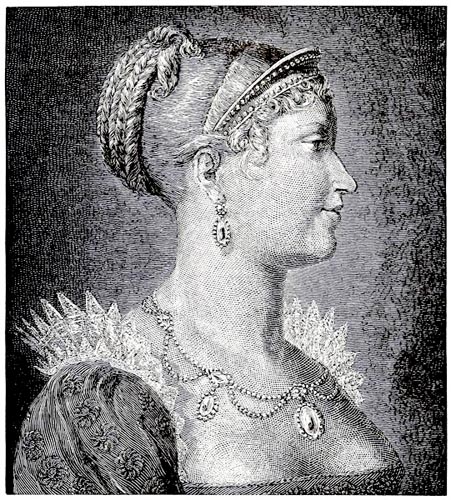
‘Marie-Louise of Austria, Second Wife of Napoleon I’
The Story History of France From the Reign of Clovis, 481 A.D., to the Signing of the Armistice, November, 1918 - John Bonner (p368, 1919)
Internet Archive Book Images
At that time Cambacérès had fled with Marie-Louise, the King of Rome and the Regency. On the walls you could read the following proclamation:
‘King Joseph, Lieutenant-General of the Emperor
Commander-in-Chief of the National Guard.
Citizens of Paris,
The Regency Council has provided for the safety of the Empress and the King of Rome: I remain here with you. Let us arm ourselves to defend our city, its monuments, its riches, our women, our children, and all that is dear to us. Let this vast city become a fortified camp for a while, and let the enemy find shame beneath her walls which he hopes to enter in triumph.’
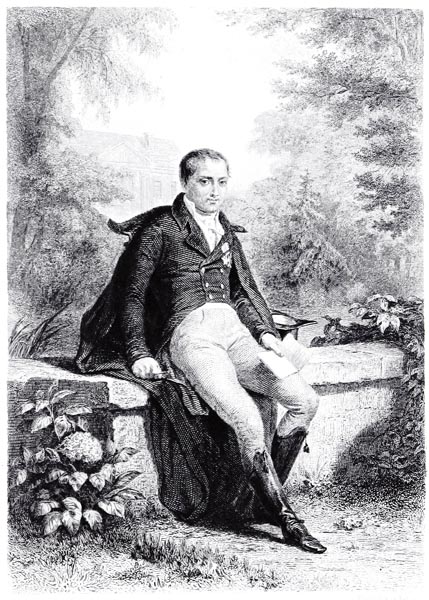
‘Joseph Bonaparte’
Histoire du Consulat et de l'Empire, Faisant Suite à l'Histoire de la Révolution Française, Vol 12
Louis Adolphe Thiers - President of the French Republic (p223, 1845)
The British Library
Rostopchin had not tried to defend Moscow; he set fire to it. Joseph announced that he would never abandon the Parisians, and decamped quietly, leaving us his brave words posted on the street corners.
Monsieur de Talleyrand was nominated as a member of the Regency by Napoleon. From the moment that the Bishop of Autun ceased to be Minister for Foreign Affairs, under the Empire, he only dreamt of one thing, Bonaparte’s disappearance, followed by the Regency of Marie-Louise; a Regency of which he, the Prince of Benevento, would be the head. Bonaparte, in naming him a member of the provisional Regency in 1814, seemed to have favoured his secret wishes. Napoleon’s death had not yet happened; it remained only for Monsieur de Talleyrand to hobble at the feet of the colossus he could not overthrow, and take advantage of the moment in his own interests: his savoir-faire was the genius of that man of bargains and compromise. The situation was difficult: to remain in the capital was what was indicated; but if Bonaparte returned, the Prince separated from the fugitive Regency, the tardy Prince, ran the risk of being shot; on the other hand, how could he abandon Paris at the moment when the Allies might enter? Would that not be to renounce the benefits of success, betray that dawn of events, for which Monsieur de Talleyrand had been created? Far from siding with the Bourbons, he feared them because of their sundry apostasies. However, since they stood a chance of power, Monsieur de Vitrolles, with the consent of the married priest, went furtively to the Congress of Châtillon, as the unacknowledged go-between with the Legitimacy. That precaution taken, the Prince, in order to extract himself from his Paris difficulty, had recourse to one of those tricks of which he was past master.
Monsieur Laborie, who a little later became, under Monsieur Dupont de Nemours, Private Secretary to the Provisional Government, went to find Monsieur de Laborde, attaché to the National Guard; he told him of Monsieur de Talleyrand’s departure: ‘He is disposed,’ he said, ‘to follow the Regency; it may appear necessary to you to prevent him, in order for him to be in a position to negotiate with the Allies, if needs be.’ The comedy was played to perfection. The Prince’s carriages were loaded up, with great commotion; he set out at high noon, on the 30th of March: arriving at the Barrière d’Enfer, he was inexorably returned to his residence, despite his protestations. In case of Napoleon’s miraculous return, the evidence was there, witnessing that the former Minister had wished to join Marie-Louise and that armed force had refused him passage.
Book XXII: Chapter 12: The proclamation of General the Prince Schwarzenberg – Alexander’s speech – The capitulation of Paris
BkXXII:Chap12:Sec1
Meanwhile, on the arrival of the Allies, Comte Alexander de Laborde and Monsieur Tourton, senior officers of the National Guard, had been sent to General the Prince Schwarzenberg, who had been one of Napoleon’s generals during the Russian Campaign. The General’s proclamation was issued in Paris on the evening of the 30th of March. It read: ‘For twenty years Europe has been drenched in blood and tears; attempts to put an end to these ills have proven vain, since there exists, in the very nature of the Government which oppresses you, an insurmountable obstacle to peace. Parisians, you know the state of your country: the preservation and tranquillity of your city will be subject to careful attention on the part of the Allies. It is with these sentiments that Europe, in arms beneath your walls, addresses you.’
What a magnificent acknowledgement of France’s greatness: Europe, in arms beneath your walls, addresses you!
We, who had respected nothing, were granted respect by those whose cities we had ravaged, and who, in turn, had become stronger. We seemed to them a sacred nation; our land appeared to them like the fields of Elis which, by decree of the gods, no army could tread. Nevertheless, if Paris had thought it necessary to resist, within twenty four hours the result might quite easily have been different; but no one, except soldiers intoxicated by war and honour, desired Bonaparte any longer, and, in fear of his remaining in power, they rushed to open the gates.
Paris capitulated on the 31st of March 1814: the military surrender was signed, in the names of Marshals Mortier and Marmont, by Colonels Denis and Fabvier; the civil surrender took place in the name of the mayors of Paris. The municipal and departmental council were deputed to visit the Russian headquarters in order to settle the various articles: my companion in exile, Christian de Lamoignon, was one of the representatives. Alexander told them:
‘Your Emperor, who was my ally, recently entered the heart of my State and brought to it evils whose traces will be long lasting; the rights of defence led me here. I am far from wishing to cause France the ills which I have experienced. I am just, and I know it is not the fault of the French. The French are my friends, and I will prove it to them by rendering good for evil. Napoleon alone is my enemy. I promise my personal protection to the city of Paris; I will protect your National Guard which is composed of the elite of your citizens. It is for you to assure your future happiness; you must adopt a Government which will bring you and Europe peace. It is for you to voice your wishes: you will find me ready always to support your efforts.’
Words which were swiftly realised: the joy of victory overrode every other interest, as far as the Allies were concerned. What must Alexander’s feelings have been, as he gazed at the domed buildings of that city which the stranger only ever enters in order to admire, to enjoy the wonders of civilisation and intellect; of that inviolable city, defended by its great men for twelve centuries; of that glorious capital which seemed protected now from Louis XIV’s shadow, and Bonaparte’s return!
Book XXII: Chapter 13: The Allies enter Paris.
BkXXII:Chap13:Sec1
God had uttered one of those words which at rare intervals shatter the silence of eternity. Now, for the present generation, the hammer that Paris had only heard sound once before, rose to strike the hour; on the 25th of December 496, Rheims proclaimed the baptism of Clovis, and the gates of Lutetia opened to the Franks; on the 30th of March 1814, after the blood-stained baptism of Louis XVI, the old hammer, motionless for so long, rose anew in the belfry of the ancient monarchy; a second stroke rang out, and the Tartars entered Paris. In the intervening one thousand three hundred and eighteen years, foreigners had damaged the walls of our Empire’s capital without ever finding the means to enter, save when they slipped in, summoned by our own divisions. The Normans besieged the city of the Parisii; the Parisii jeered at the sparrow-hawks they bore on their fists; Odo, child of Paris and future king, rex futurus, says Abbo, drove back the pirates from the North: the Parisiens let slip their eagles in 1814; the Allies entered the Louvre.
Bonaparte had waged war unjustly against Alexander, his admirer, who had begged for peace on his knees; Bonaparte had ordered the carnage at Borodino; he had forced the Russians to set fire to Moscow themselves; Bonaparte had plundered Berlin; humiliated its King, insulted its Queen: what reprisals were we then to expect? You shall see.
In the Floridas, I had wandered round nameless monuments, devastated long ago by conquerors of whom no trace remains, and had lived to see the Caucasian hordes encamped in the courtyard of the Louvre. In those events of history which, according to Montaigne: ‘are feeble testimony to our worth and capacity’, my tongue cleaves to my palate:
‘Adhaeret lingua mea faucibus meis’
The Allied Army entered Paris at midday on the 31st of March 1814, only ten days after the anniversary of the death of the Duc d’Enghien, on the 21st of March 1804. Was it worth Bonaparte’s while to commit a deed so long remembered for the sake of so short a reign? The Emperor of Russia and the King of Prussia rode at the head of their troops. I watched them marching along the boulevards. Stupefied and inwardly amazed, as if someone had torn from me my French identity and substituted a number by which I would henceforth be known in the mines of Siberia, at the same time I felt my exasperation with that man, whose glory had reduced us to this shame, increase.
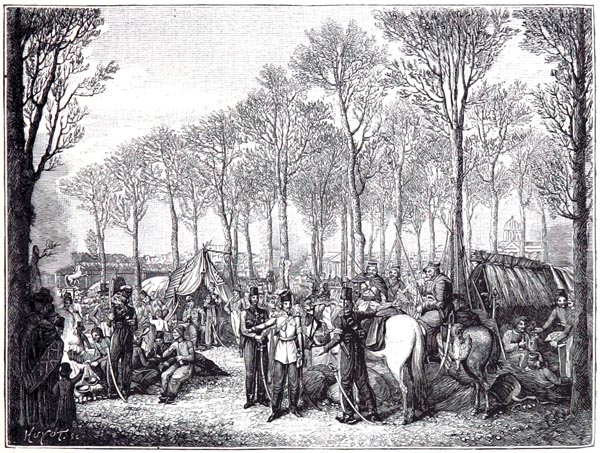
‘Bivouac des Cosaques, dans les Champs-Élysées, à Paris, d'Après une Aquarelle de G. Opiz (Collection Hennin)’
Napoléon Ier et Son Temps - Roger Peyre (p907, 1888)
The British Library
However, this first invasion of the Allies remains unparalleled in the history of the world: peace, order, and moderation reigned everywhere; the shops re-opened; Russian guardsmen, six feet tall, were guided through the streets by little French urchins who laughed at them, as if they were wooden puppets or carnival mummers. The conquered might have been taken for conquerors; the latter, trembling at their success, had an apologetic air. The National Guard alone garrisoned the interior of Paris, with the exception of the houses in which foreign kings and princes lodged. On the 31st of March 1814, countless armies were occupying France; a few months later, all those troops re-crossed the frontier, without firing a shot, without shedding a drop of blood, after the return of the Bourbons. The former France found herself augmented on some of her frontiers; the ships and warehouses of Antwerp were shared with her; three hundred thousand prisoners scattered throughout the countries where victory or defeat had left them, were restored to her. After twenty years of fighting, the sound of weapons ceased from one end of Europe to the other; Alexander departed, leaving us the looted masterpieces and the freedom enshrined in the Charter, freedom which we owed as much to his enlightenment as his influence. The head of the two supreme authorities, autocrat by means of both the sword and religion, he alone of all the sovereigns of Europe had understood that at the stage of civilisation which France had attained, she could only be governed by virtue of a free constitution.
In our quite natural hostility towards foreigners, we have confused the invasions of 1814 and 1815, which were in no sense alike.
Alexander considered himself merely an instrument of Providence and took no credit himself. Madame de Staël complimenting him on the good fortune which his subjects, lacking a constitution, enjoyed in being governed by him, he made his well known reply: ‘I am merely a happy accident.’
A young man, in a Paris street, expressed to him his admiration at the affability with which he greeted the humblest citizens; he replied: ‘Are sovereigns not made for that?’ He had no wish to inhabit the Tuileries, remembering that Bonaparte had taken his pleasure in the palaces of Vienna, Berlin and Moscow.
Gazing at the statue of Napoleon on the column in the Place Vendôme, he remarked: ‘If I were as high up as that, I would be afraid of vertigo.’
When he was touring the Tuileries Palace, he was shown the Salon de la Paix: ‘What use,’ he said laughing, ‘was this room to Bonaparte?’
On the day Louis XVIII entered Paris, Alexander hid behind a window, wearing no mark of distinction, to watch the procession pass.
He frequently displayed elegant and charming manners. Visiting a madhouse, he asked a woman if the number who had gone mad with love was considerable: ‘Not until now,’ she replied, ‘but it is to be feared it will increase from the time of Your Majesty’s entering Paris.’
One of Napoleon’s grand dignitaries said to the Tsar: ‘We have been waiting and hoping here for your arrival, for a long time, Sire.’ – ‘I would have come sooner,’ he replied, ‘blame French valour alone for my delay.’ it is known that when crossing the Rhine he had regretted not being able to return peacefully to his family.
At the Hôtel des Invalides, he found the maimed soldiers who had defeated him at Austerlitz: they were silent and sombre; only the sound of their wooden legs echoed in the empty courtyards and denuded church; Alexander was moved by this sound made by brave men: he ordered that twelve Russian cannon should be given to them.
A proposal to change the name of the Pont d’Austerlitz was made to him: ‘No,’ he said, ‘it is enough for me to have crossed that bridge with my army.’
Alexander had something calm and sorrowful about him: he went about Paris, on horseback or on foot, without his suite and without affectation. He seemed surprised at his triumph; his almost tender gaze wandered over a population whom he seemed to consider superior to himself: one would have said that he found himself a barbarian among us, as a Roman would have felt ashamed in Athens. Perhaps he also reflected that these same Frenchmen had appeared in his burnt-out capital; that his soldiers were in turn masters of Paris where he might have found some of the extinguished torches by which Moscow was freed and consumed. This sense of destiny, of changing fortunes, of the common suffering of nations and kings, must have struck a mind as religious as his profoundly.
Book XXII: Chapter 14: Bonaparte at Fontainebleau – The Regency at Blois
BkXXII:Chap14:Sec1
What was the victor of Borodino doing? As soon as he heard of Alexander’s decision, he sent orders to Major Maillard de Lescourt of the artillery to blow up the powder-magazine at Grenelle: Rostopchin had set fire to Moscow, but he had evacuated the inhabitants first. From Fontainebleau, to which he had returned, Napoleon advanced as far as Villejuif: there he looked down on Paris; foreign soldiers were guarding the city gates; the conqueror recalled the days when his grenadiers had kept watch on the ramparts of Berlin, Moscow, and Vienna.
Events erase other events: how insignificant today seems the grief of Henri IV learning at Villejuif of the death of Gabrielle, and returning thence to Fontainebleau! Bonaparte returned to that solitude also; nothing awaited him there but the memory of his august prisoner: the captive of peace had mot long since departed the palace in order to leave it free for the captive of war, ‘so swiftly does misfortune fill a place.’
The Regency had retired to Blois. Bonaparte had given orders for the Empress and the King of Rome to leave Paris, saying he would prefer to see them at the bottom of the Seine than led to Vienna in triumph; but at the same time he urged Joseph to remain in the capital. His brother’s flight made him furious, and he accused the King of Spain of ruining everything. The Ministers, the members of the Regency, Napoleon’s brothers, his wife and son arrived at Blois in disorder, swept away by the debacle: wagons, baggage-vans, carriages, everything was there; even the royal coaches were there and were dragged through the mud of the Beauce to Chambord, the only morsel of France left to Louis XIV’s heirs. Some of the ministers crossed over, and went to hide in Brittany, while Cambacérès was carried in state in a sedan-chair through the steep streets of Blois. Various rumours were current; there was talk of two camps and a general requisition. For several days they knew nothing of what was happening in Paris; the uncertainty only ended with the arrival of a carter whose pass was signed Sacken. Soon the Russian General Shuvalov arrived at the Auberge de la Galère: he was promptly besieged by the grandees, desperate to obtain visas from him for their headlong flight. However, before leaving Blois, they all drew on Regency funds for their travelling expenses and arrears of salary: they grasped their passports in one hand and their money in the other, taking care at the same time to assure the Provisional Government of their support, not losing their heads. Madame Mère and her brother, Cardinal Fesch, left for Rome. Prince Esterhazy arrived on behalf of Francis II to fetch Marie-Louise and her son. Joseph and Jérôme headed for Switzerland, after trying to compel the Empress, in vain, to share their fate. Marie-Louise hastened to join her father: indifferently attached to Bonaparte, she found thereby the means to console herself, and rejoiced at being delivered from the double tyranny of a husband and master. When, the following year, Bonaparte brought this same confused flight on the Bourbons, the latter, barely free of their long tribulations, had not enjoyed fourteen years of unexampled prosperity in which to grow accustomed to the comfort of a throne.
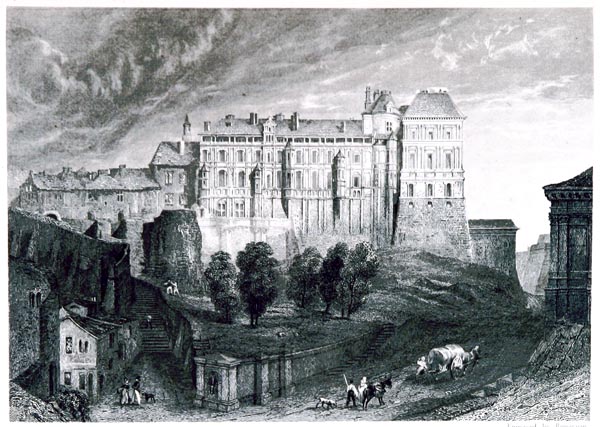
‘Château de Blois’
L'Orléanais. Histoire des Ducs et du Duché d'Oriéans...Illustrée par MM. Baron, Louis Français - Henri-Charles-Antoine Baron (p507, 1845)
The British Library
Book XXII: Chapter 15: The publication of my pamphlet – De Bonaparte et Des Bourbons
BkXXII:Chap15:Sec1
However Napoleon was not yet dethroned; more than forty thousand of the best soldiers in the world accompanied him; he could withdraw beyond the Loire; the French armies which had arrived from Spain were making growling noises in the south; the seething military population might still discharge its lava; even among the foreign leaders, there was still talk of Napoleon or his son ruling France: for two days Alexander hesitated. Monsieur de Talleyrand was secretly inclined, as I have said, to the policy which favoured crowning the King of Rome, since he dreaded the Bourbons; if he did not enter unreservedly into the plan for the Regency of Marie-Louise, it was because, Napoleon still being alive, he, the Prince of Benevento, feared that he would be unable to retain control during a minority threatened by the existence of a restless, unpredictable and enterprising man still in the prime of life.
It was during these critical days that I launched my pamphlet De Bonaparte et des Bourbons in order to turn the scale: the effect is well known. I threw myself headlong into the fray to serve as a shield to renascent liberty against a tyranny which was still active and whose strength was increased threefold by despair. I spoke in the name of the Legitimacy, in order to lend my words the authority of pragmatic politics. I apprised France of what the old royal family represented; I told her how many members of that family were still alive, and their names and characters; it was as if I were listing the children of the Emperor of China, so thoroughly had the Republic and Empire invaded the present and relegated the Bourbons to the past. Louis XVIII declared, as I have mentioned several times elsewhere, that my pamphlet had been more use to him than an army of a hundred thousand men; he might have added that it acted as proof of his existence. I helped to crown him for a second time, by the favourable outcome of the Spanish War.
From the very beginning of my political career, I had made myself unpopular with the people, but from that moment on I also lost favour with the powerful. All those who had been slaves under Bonaparte detested me; on the other hand, I was suspect among all those who wished to return France to a state of vassalage. Of all the sovereigns, only Bonaparte himself was on my side at first. He perused my pamphlet at Fontainebleau: the Duke of Bassano had brought it to him; he discussed it impartially, saying: ‘This is right, this is not right. I have nothing to reproach Chateaubriand with; he opposed me when I was in power; but those swine, such and such!’ and he named them.
My admiration for Bonaparte has always been great and sincere, even when I attacked Napoleon most fiercely.
Posterity is not as just in its assessments as they say; there are passions, infatuations, errors of distance as there are passions and errors of proximity. When posterity admires someone unreservedly it is scandalised if the contemporaries of the man it admires had not the same opinion it holds itself. Yet, it is obvious: the things which offended in that person are done with; his infirmities died with him; of him, only the imperishable life remains; but the evil he caused is no less real; evil in itself and in essence, evil above all for those who endured it.
It is fashionable today to exaggerate Bonaparte’s victories: those who suffered have disappeared; we no longer hear the curses, the cries of pain, the distress of the victims; we no longer see France exhausted, with only women to till her soil; we no longer see parents arrested as hostages for their sons, or the inhabitants of a village sentenced one and all to punishments applicable to a deserter; we no longer see conscription notices posted on street corners, the passers-by crowding to see those vast death-warrants, searching, in consternation for the names of children, brothers, friends and neighbours. We forget that everyone mourned the victories; we forget that the slightest allusion antagonistic to Bonaparte, in the theatre, that escaped the censors, was seized on with joy; we forget that the people, the Court, the generals, the ministers, and Napoleon’s relatives were weary of his oppression and his conquests, weary of that game which was always won and always in play, of that existence which was brought into question each morning by the impossibility of peace.
The reality of our sufferings is revealed by the catastrophe itself: if France had been devoted to Bonaparte, would she have rejected him twice, abruptly and totally, without making a last effort to retain him? If France owed everything to Bonaparte, glory, liberty, order, prosperity, industry, commerce, manufacture, monuments, literature, and fine arts; if the nation had achieved nothing itself prior to his period of rule; if the Republic had neither defended nor enlarged its borders, devoid of genius and courage, then would not France have been truly ungrateful, truly cowardly, in allowing Napoleon to fall into the hands of his enemies, or at least in not protesting against the captivity of so great a benefactor?
This reproach, which might be justly levelled against us, is not however levelled against us, and why? Because it is evident that, at the moment of his fall, France did not wish to defend Napoleon; on the contrary, she deliberately abandoned him; in our bitter distaste, we no longer recognised anything in him but the author and despiser of our woes. The Allies did not conquer us: it was we ourselves, choosing between two scourges, who renounced the shedding of our blood, which had ceased to flow for freedom.
The Republic had been too cruel, it is true, but everyone had hoped it would end, that sooner or later we would recover our rights, while retaining the defensive conquests it had made in the Alps and on the Rhine. All the victories it had brought us were gained in our name; for the Republic it was a question of France solely; it was ever France that had triumphed, that had conquered; it was our soldiers who had achieved everything and for whom triumphs or funeral celebrations were established; the generals (and there were some very great ones) won an honourable but humble place in public memory: such were Marceau, Moreau, Hoche, Joubert; the two latter destined to hold command under Bonaparte, who, new to glory, quickly encountered General Hoche, and rendered illustrious by his jealousy that warrior and peacemaker, who died shortly after his triumphs at Altenkirchen, Neuwied and Kleinnister.
Under the Empire, we vanished; it was no longer a question of us, everything belonged to Bonaparte: I have ordered, I have conquered, I have spoken; my eagles, my crown, my blood, my family, my subjects.
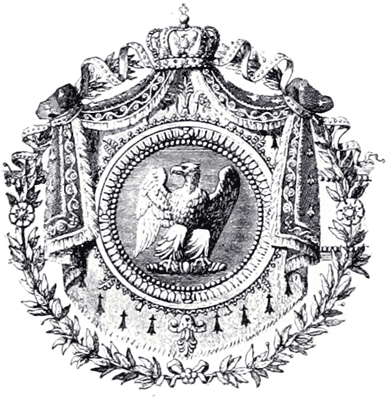
Napoléon Ier et Son Temps - Roger Peyre (p922, 1888)
The British Library
Yet what happened in those two situations at once similar and contrasting? We did not abandon the Republic in its reverses; it killed us, but it honoured us; we avoided the shame of being someone else’s property; thanks to our efforts, it was not invaded; the Russians, defeated beyond the mountains, had just shot their bolt at Zürich.
As for Bonaparte, he, despite his vast acquisitions, succumbed, not because he was defeated, but because France no longer wanted him. A mighty lesson! One that we ought always to remember, that there is a germ of death in everything that wounds human dignity.
BkXXII:Chap15:Sec2
Free spirits of every shade of opinion employed a common language at the time when my pamphlet was published. Lafayette, Camille Jordan, Ducis, Lemercier, Lanjuinais, Madame de Staël, Chénier, Benjamin Constant, Lebrun, thought and wrote as I did. Lanjuinais said: ‘We have been seeking a master among men whom the Romans did not desire as slaves.’
Chénier treated Bonaparte no more favourably:
‘A Corsican devoured the French inheritance.
You the elite, you heroes reaped in battle,
You martyrs, dragged with glory to the scaffold,
You died content with other hopes perchance.
Waves of blood, of tears have drenched France,
Those tears; that blood, one man inherited.
.....................
Believer, for a while, I praised his victories,
In forum, senate, pleasures, and festivities.
.....................
But, when he hurried home again, in flight,
Forsaking laurels for an Empire, overnight,
I did not bow before his glittering infamy;
My voice has ever been oppression’s enemy;
Watching while waves of flatterers, or worse,
Sold him, the State, their adulatory verse,
The court, the tyrant, caught no sight of me;
For I sang not of power, I sang of glory.’
(Promenade, 1805)
Madame de Staël passed no less severe a judgement on Napoleon:
‘Would it not provide a fine example to the human species, if the Directors (the five members of the Directory), very unwarlike men, could rise again from their ashes and call Napoleon to account for the lost frontiers of the Rhine and the Alps, conquered by the Republic, for the two-fold entry of foreign armies into Paris; for the three million French who perished from Cadiz to Moscow; above all for that sympathy the nations felt for the cause of French freedom, which is now transformed into an inveterate aversion?’
(Considérations sur la Révolution Française)
Let us listen to Benjamin Constant:
‘He who, for twelve years, proclaimed he was destined to conquer the world, has made honourable amends for his pretensions..........
Even before his territory was invaded, he was the victim of problems he could not conceal. His frontiers were scarcely breached, when he divested himself of all his conquests. He required the abdication of one of his brothers; he agreed the expulsion of another; without being asked he announced his renunciation of it all.
While royalty, though conquered, never lost its dignity, why did the conqueror of the earth yield at the first obstacle? His relatives’ pleas, we are told, tore at his heart. Were not those who perished in Russia from the triple agony of wounds, cold and hunger, part of that family? Yet, while they died, deserted by their leader, that leader thought he was secure; now, the danger he shares has imbued him suddenly with feeling.
Fear is a poor counsellor, especially where there is a lack of conscience: there is no moderation in adversity, as in success, except through morality. Where morality holds no sway, success destroys itself in mania, adversity in debasement.................
What effect did that blind fear, that sudden faint-heartedness, without precedent in all our many troubles, have on a courageous nation? National pride found (it was at fault) a certain compensation in being oppressed by a leader who was at least invincible. Today what remains? No more prestige, no more triumphs, a mutilated Empire, the world’s execration, a throne whose glory is tarnished, whose trophies have been toppled, and whose only entourage are the wandering shades of the Duc d’Enghien, of Pichegru, of the many others who were murdered to establish it.’
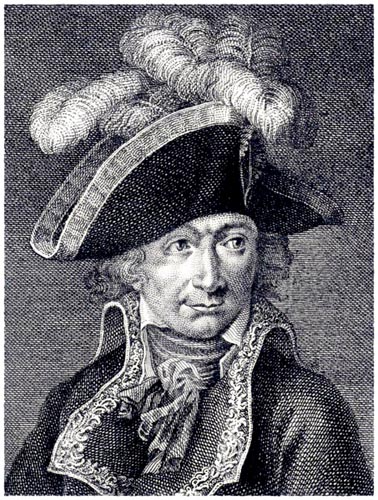
‘Portrait of General Charles Pichegru’
Reinier Vinkeles, 1786 - 1809
The Rijksmuseum
Was I more extreme than that in writing De Bonaparte et des Bourbons? Do not the proclamations of the authorities in 1814, which I am going to reproduce in a moment, repeat, affirm, and confirm these various opinions? That the authorities who expressed themselves in this way have been revealed as cowardly and degraded by their initial admiration has harmed the writers of these addresses, but does not reduce the force of their arguments.
I could multiply these quotations endlessly, but I will repeat no more than two, because of the opinion held regarding the two authors: Béranger, that constant and admirable admirer of Bonaparte, did not think it necessary to excuse himself, witness these words: ‘My enthusiastic and constant admiration for the Emperor’s genius, my idolatry, had never blinded me to the tyranny ever present in the Empire.’ Paul-Louis Courier, speaking of Napoleon’s advent to the throne, said: ‘What is the point, tell me., of a man like him, Bonaparte, a soldier, military leader, chief captain of the world, wanting to be called Majesty! To be Bonaparte and wish to be Sire! He aspires to descend: rather he thinks he is ascending by imitating kings. He prefers a title to a name. Poor man, his ideas are inferior to his success.Caesar understood it all better, and was a different kind of man: he made no use of worn-out titles; but of his name he made a title superior to that of kings.’ Our living talents have taken the same path to freedom, Monsieur de Lamartine at the rostrum, Monsieur de Latouche in retirement; in two or three of his finest odes, Monsieur Victor Hugo has echoed the sound of those noble tones:
‘In the gloom of crime, in the glare of victory,
That man oblivious to God, who sent him, etc’
BkXXII:Chap15:Sec3
Finally, beyond our frontiers, the judgement of Europe was just as severe. I will only quote the sentiments of the English Opposition, who accepted our Revolution in its entirety and supported it entirely: read Mackintosh in his defence of Peltier. Sheridan, at the time of the Peace of Amiens, said in Parliament: ‘Whoever arrives in England, after leaving France, thinks to escape a prison in order to breathe the air and spirit of freedom.’
Lord Byron, in his Ode to Napoleon, treats him with indignation:
’T is done – but yesterday a king!
And arm’d with kings to strive,
And now thou art a nameless thing
So abject – yet alive.
The whole ode is in this style; each stanza bids to outdo the last, which did not prevent Lord Byron celebrating the grave on St Helena. Poets are birds: any sound makes them sing.
Whenever the finest of minds of great diversity find themselves in agreement in their judgement, no admiration sincere or insincere, no arrangement of facts, no system dreamed up after the fact, can change the sentence. What! Could one, as Napoleon did, substitute his will for law, persecute all independent life, enjoy dishonouring men of character, trouble existence, violate private morals as well as public freedom; and could the generous-minded opposition rising up against these enormities, be declared slanderous and blasphemous! Who would defend the cause of the weak against the strong, if courage, exposed to the vengeance of present vileness, had still to wait on the blame cast by cowards yet to come!
That illustrious minority, formed in part from the children of the Muses, gradually became the national majority: as the Empire drew to an end everyone hated the Imperial tyranny. A grave reproach is associated with Bonaparte’s memory: he rendered his yoke so heavy that the hostile feeling against foreigners was weakened, and invasion, deplorable though it is to recall today, seemed, at the moment of its accomplishment, something of a deliverance: that is indeed the Republican opinion, enunciated by my brave and unfortunate friend Carrel. ‘The return of the Bourbons’ said Carnot in turn, ‘produced universal delight in France; they were welcomed with an inexpressible effusion of feeling, former Republicans sharing sincerely in the universal transports of joy. Napoleon had persecuted them especially; all the classes in society had suffered so greatly, that there was no one to be found who was not truly intoxicated with it all.’
There is only one authority lacking to sanction and confirm these opinions: Bonaparte is charged with certifying their truth. Taking leave of his soldiers in the courtyard of Fontainebleau, he admitted proudly that France rejected him: ‘France herself,’ he said, ‘has chosen another course.’ An unexpected and memorable confession, whose weight nothing can diminish, whose value nothing can reduce.
God, in his infinite patience, sooner or later brings justice: in the moments when Heaven seems asleep, all will be well if an honest man’s disapproval wakes, acting as a brake on absolute power. France has never repudiated noble spirits, who denounced her servitude, when all were prostrate, when there were many advantages in being so, many blessings to be received through flattery, much persecution to be suffered through sincerity. Honour then to Lafayette, De Staël, Benjamin Constant, Camille Jordan, Ducis, Lermercier, Lanjuinais, and Chénier, who, standing amidst the swirling crowd of nations and kings, dared to scorn conquest and protest against tyranny!
Book XXII: Chapter 16: The Senate issue the Decree of Deposition
BkXXII:Chap16:Sec1
On the 2nd of April, the Senators, to whom we owe only one article of the Charter of 1814, the unworthy article which guaranteed their pensions, decreed Bonaparte’s deposition. If the decree of liberation for France, an infamy on the part of those who issued it, was an affront to the human race, at the same time it taught posterity the cost of greatness and success, when they disdain to found themselves on morality, justice and liberty.
Decree of the Senate Conservateur
‘The Senate Conservateur decrees, given that in a constitutional monarchy the monarchy only exists in virtue of the constitution or the social covenant;
That Napoleon Bonaparte, firm and prudent in Government for many years, gave the nation reason to expect, in future, acts of wisdom and justice; but then tore up the covenant which united the French people, in particular by levying taxes, establishing those charges other than by virtue of the law, against the express tenor of the speech he gave on mounting the throne, in conformance with article 53 of the constitution of 28 Floréal, Year XII;
That he committed that assault on the rights of the people, at the very time when he chose to adjourn for no reason the Legislative Body, and suppress, as criminal, a report of that body, whose title and report to the national representatives he contested.
That he started a series of wars in violation of article 50 of the constitutional act of Year VIII, which stated that a declaration of war is to be proposed, discussed, decreed and promulgated, like the law;
That he has, unconstitutionally, issued several decrees carrying sentence of death, namely the two decrees of 5th March last, tending to imply that a war which took place only in the interests of his boundless ambition was to be treated as a national war;
That he has violated the laws of the constitution by his decrees regarding State prisons;
That he has done away with ministerial responsibility, confused all powers, and destroyed the independence of the judiciary;
Considering that the freedom of the press, established and consecrated as a national right, has been constantly subjected to arbitrary police censure, and that at the same time he has continually used the press to fill France and Europe with fabricated information, false maxims, doctrines favouring tyranny, and insults against foreign governments;
That the acts and reports, heard by the Senate, have been subject to alteration in the process of publication;
Considering that, instead of ruling solely with a view to the interests, well-being and glory of the French people, according to the terms of his speech, Napoleon has capped the country’s misfortunes by his refusal to negotiate conditions that the national interest obliged him to accept and which did not compromise the honour of France; by the way he has abused the resources of men and money entrusted to him; by abandoning the wounded without help, without medical supplies, without means of subsistence; by various measures whose results were the ruin of cities, the depopulation of countries, famine and contagious illness:
Considering that, for all these reasons, the Imperial Government established by the senatus-consulte of 28th Floréal, Year XII, or 18th of May 1804, has ceased to exist, and that the manifest wish of all French people calls for an order of things whose first result would be the re-establishment of universal peace, which would also be a period of solemn reconciliation between all the States of the great European family, the Senate declares and decrees as follows: that Napoleon be deposed from the throne; that hereditary rights be abolished in his family; and that the French people and the army be freed from their oath of fidelity towards him.’
The Roman Senate was less harsh when it declared Nero a public enemy: history is merely a repetition of the same events applied to different men and varying times.
Can you imagine the Emperor reading the official document at Fontainebleau? What must he have thought of what had happened, and of the men he had summoned to complicity in his suppression of our freedoms? When I published my pamphlet De Bonaparte et des Bourbons, could I have anticipated that it would be amplified and converted into a decree of deposition by the Senate? What prevented the legislators, in the days of previous success, from discovering the ills for which they blamed Bonaparte as the author, from realising that the constitution had been violated? What sudden zeal for the freedom of the press seized these deaf mutes? How could those who had showered adulation on Napoleon in respect of each of his wars, now discover that he had undertaken them only in the interests of his boundless ambition? What suddenly moved those, who had thrown him so many conscripts to devour, to feel on behalf of the wounded soldiers, abandoned without help, without medical supplies, without means of subsistence? There are times when one ought only to dispense contempt economically, because of the great number who deserve it: I will handle them sparingly for the moment, since they will deserve it again during and after the Hundred Days.
When I ask what Napoleon at Fontainebleau thought of the actions of the Senate, the answer is extant: an order of the day of the 5th of April 1814, not officially published, but replicated in various newspapers outside the capital, thanks the army for its loyalty, adding:
‘The Senate has taken the liberty of disposing of the government of France; it has forgotten that it owes the power it has now abused to the Emperor; that it was he who saved half the members from the storm of the Revolution, dragged the rest from obscurity and protected them against the hatred of the nation. The Senate has referred to the articles of the Constitution in order to overthrow it; it has felt no shame in blaming the Emperor, without noting that, as the supreme state body, it has taken part in all these events. The Senate has felt no shame in speaking of public libels against foreign governments: it has forgotten that they were drawn up in its name. As long as fortune continued to shine on their sovereign, these men remained loyal and not a word was heard about abuse of power. If the Emperor has shown his scorn of men, as they have attributed blame to him, then the world will recognise today that he had his reasons which have motivated his scorn.’
It is a homage paid by Bonaparte himself to the freedom of the press: he must have considered there was some good in it, since it offered him a last shelter and a last recourse.
And I who struggle against the age, I who seek to make it account to itself for what it has seen, I who write this so long after those events, in the reign of Louis-Philippe, false heir to so great a heritage, what am I in the hands of Time, that mighty devourer of centuries that I believe to have been ordained, of Time that makes me pirouette with him through space?
Book XXII: Chapter 17: The Hôtel de la Rue Saint-Florentin – Monsieur de Talleyrand
BkXXII:Chap17:Sec1
Alexander stayed at Monsieur de Talleyrand’s residence. I was not involved in any of the discussions: they can be read of in the Abbé de Pradt’s account and in those of the various intriguers who held in their dirty little hands the fate of one of the greatest men in history and the destiny of the world. I counted for nothing in politics apart from that of the masses; there was not a single meddling subordinate who failed to possess more right and favour in the antechambers of power than I: a future member of the potential Restoration, I waited under the windows, in the street.
Due to the machinations within that residence in the Rue Saint-Florentin, the Senate Conservateur named a Provisional Government composed of General Beurnonville, Senator Jaucourt, the Duke de Dalberg, the Abbé de Montesquiou, and Dupont de Nemours; the Prince of Benevento awarded himself the Presidency.
On encountering that name for the first time, I ought to say more about a personage who played a remarkable part in public affairs at that time; but I will reserve his portrait for the final part of my Memoirs.
The intrigue which detained Monsieur de Talleyrand in Paris, during the Allies’ entry, was the reason for his success at the commencement of the Restoration. The Emperor of Russia knew him, having met him at Tilsit. In the absence of the French authorities Alexander stayed at the Hôtel de l’Infantado, which the owner of the residence hastened to offer him.
From that moment Monsieur de Talleyrand passed for the universal arbitrator; his rooms became the centre of negotiations. Composing the Provisional Government as he wished, he placed there the partners in his game of whist; the Abbé de Montesquiou alone figured there at the Legitimacy’s request.
It was to the barrenness of the Bishop of Autun that the first works of the Restoration were entrusted: he blasted that Restoration with sterility, and communicated to it the incipient mark of death.
Book XXII: Chapter 18: The Proclamations of the Provisional Government – The Constitution proposed by the Senate
BkXXII:Chap18:Sec1
The first acts of the Provisional Government, as directed by its President, were proclamations addressed to the army and the people. ‘Soldiers,’ they said to the former, ‘France has but now broken the yoke under which it has groaned with you for so many years. Consider all you have suffered from that tyranny. Soldiers it is time to end the country’s misfortunes. You are her noblest offspring; you cannot ascribe to what has ravaged her, what has sought to make your name hateful to all nations, which would even have compromised your glory if a man who IS NOT EVEN FRENCH could ever diminish the honour of our arms and the nobility of our soldiers.’
So, in the eyes of his most servile slaves, he who brought them so many victories was not even French! When, in the days of the League, Du Bourg gave up the Bastille to Henri IV, he refused to doff the black scarf and take the money offered to him for surrendering the place. Begged to acknowledge the King, he replied ‘that he was no doubt an excellent Prince, but that he had given his word to Monsieur de Mayenne. Moreover that Brissac was a traitor, and, to support that, he would fight him between four pikes, in the King’s presence, and eat the heart from his breast.’ How different the men and the age!
On the 4th of April a new proclamation of the Provisional Government to the French nation, appeared; it said:
‘Emerging from your civil discord you chose as leader a man who appeared on the world’s stage with the character of greatness. On the ruins of anarchy, he founded only tyranny; he might at least in gratitude have become French like you; he has never done so. He has not ceased to wage pointless, unmotivated and unjust wars, in adventuring on which he sought to become famous. Perhaps he still dreams of vast designs, even though unheard-of defeats punish the vanity and abuse of conquest so emphatically. He has ruled neither in the national interest, nor even the interest of his own despotism. He has destroyed everything he sought to create, and re-vitalised everything he sought to destroy. He believes only in force; force now overcomes him: a just reward for foolish ambition.’
Incontestable truths, justifiable criticism; but who uttered this criticism? What was become of my poor little pamphlet, jostled by these virulent speeches? On the same day, the 4th of April, the Provisional Government proscribed the marks and emblems of the Imperial Government; if the Arc de Triomphe had existed, they would have torn it down. Mailhe, who had once voted for the death of Louis XVI, Cambacérès, who was first to welcome Napoleon as Emperor, greeted the Provisional Government’s actions with enthusiasm.
On the 6th, the Senate printed a constitution: it was fairly closed based on the concepts of the future Charter; the Senate was retained as the senior Chamber; the ‘nobility’ of the senators was pronounced immutable and hereditary; to their entitlement to a Majorat was added the granting of Sénatoreries; the Constitution allowed these titles and majorats to be transmitted to their possessor’s descendants: it was fortunate that these ignoble inheritances ‘involved the Fates’, as the ancients said.
The sordid effrontery of these senators who, in the midst of the invasion of their country, did not for a moment lose sight of the main chance, was striking even amidst the immensities of public events.
Would it not have been more convenient to the Bourbons to continue on their arrival with the established government, a docile Legislature, a private slavish Senate, a shackled Press? On reflection, the thing appears impossible: natural; independence, standing upright once more in the absence of the chains that bowed it, had resumed its upward path given the weakness of those bonds. If the legitimate princes had dismissed Bonaparte’s army as they should have done (that was Napoleon’s opinion on Elba), and if they had at the same time retained the Imperial mode of government, it would have been enough simply to destroy the instrument of his glory in order to retain the instrument of tyranny: the Charter was Louis XVIII’s ransom.
Book XXII: Chapter 19: The arrival of the Comte d’Artois – Bonaparte’s abdication at Fontainebleau
BkXXII:Chap19:Sec1
On the 12th of April, the Comte d’Artois arrived in the capacity of Lieutenant-General of the Kingdom. Three or four hundred men rode before him; I was one of them. He charmed by his graciousness, a contrast with Empire manners. The delighted French recognised their former aspect in his person, their former politeness, and their former way of speaking; the crowd surrounded and pressed around him; a consoling apparition from the past, a dual recourse, being opposed to the foreign conquerors and opposed to the continuing menace of Bonaparte. Alas! That Prince only set foot on French soil once more in order to see his son assassinated and to return to die in the land of exile from which he had come: there are men over whose necks life is thrown like a chain.
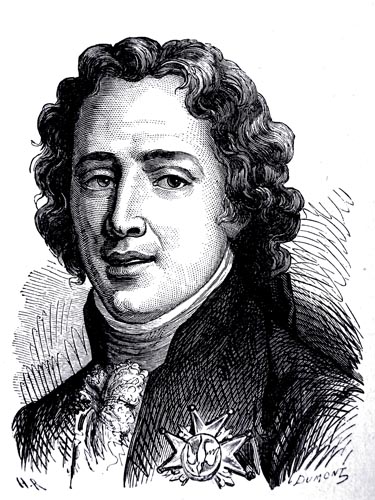
‘The Comte d'Artois, Engraved by L. Dumont from the Design by H. Rousseau’
Album du Centenaire, Grands Hommes et Grands Faits de la Révolution Française (1789-1804) - Augustin Challamel, Desire Lacroix (1889)
Wikimedia Commons
I was presented to the King’s brother; he had been given my pamphlet to read, otherwise he would not have known my name; he recalled neither having seen me at Louis XVI’s court, nor in camp at Thionville, and unquestionably had never heard of the Génie du Christianisme: it was understandable. When one has suffered greatly for a long time, one only thinks of oneself; selfish adversity is a companion somewhat cold, and hard to please; it haunts one; it leaves no room for any other feeling, never leaves you, clasps your knees and your coat.
The day before the Comte d’Artois’ arrival, Napoleon, after fruitless negotiations with Alexander conducted by Monsieur de Caulaincourt, had published his act of abdication.
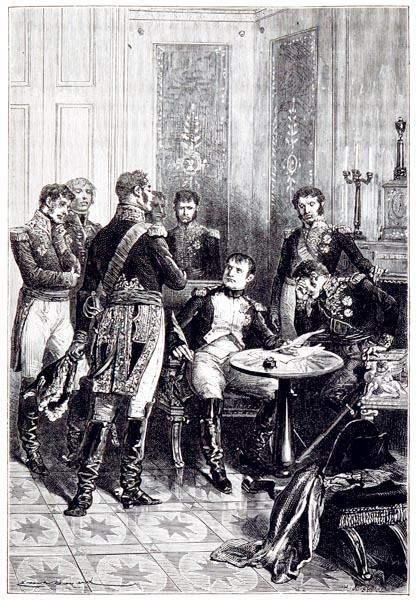
‘Abdication de l'Empereur Napoléon’
L'Histoire de France Depuis 1789 Jusqu'en 1848, Racontée à mes Petits-Enfants, par M. Guizot. Leçons Recueillies par Madame de Witt, Vol 02 - François Pierre Guillaume Guizot (p439, 1878)
The British Library
‘The Allied Powers having proclaimed that the Emperor Napoleon was the sole obstacle to the re-establishment of peace in Europe, the Emperor Napoleon, loyal to his oath, declares, on behalf of his thrones and heirs, that he renounces the thrones of France and Italy, because there is no personal sacrifice, even that of his life, which he is not ready to make in the interests of the French people.’
The Emperor wasted no time in giving the lie, in an equally resounding manner, to these resounding words, by his return: he needed only enough time to visit the island of Elba. He remained at Fontainebleau until the 20th of April.
The 20th of April having arrived, Napoleon descended the double flight of steps leading to the peristyle of the deserted palace of the Capet monarchy. A few grenadiers, the remnants of the soldiers who had conquered Europe, formed up in line in the great courtyard, as if on their final battlefield; they were surrounded by ancient trees, mutilated companions of Francis I and Henri IV. Bonaparte addressed these words to those last witnesses to his battles:
‘Generals, officers, non-commissioned officers, and men of my Old Guard, I bid you farewell: for twenty years I have been satisfied with you; I have always found you on the paths of glory.
The Allied Powers have armed the whole of Europe against me, sections of the army have betrayed their duty, and France herself has chosen another destiny.
With you and the brave men who have remained loyal to me, I could have carried on a civil war for three years: but France would have suffered, which is contrary to the aims I adopted.
Be faithful to the new King whom France has chosen; do not desert our beloved country, which has been unhappy for so long! Love her always, and love her well, that dear country of ours.
Do not pity my fate; I will always be happy if I know that you are happy.
I might have died; nothing would have been easier for me; but I will always follow the path of honour. I have still to write the history of all we have achieved.
I cannot embrace you all; but I will embrace your general! ...General, come here...’ (He clasped General Petit in his arms.) ‘Bring me the eagle! ...’ (He kissed it.) ‘Beloved eagle! May these kisses resound in the hearts of all my brave lads! . Farewell, my children! . My prayers will always be with you; preserve your memories of me.’
Having spoken, Napoleon struck his tent which covered the world.
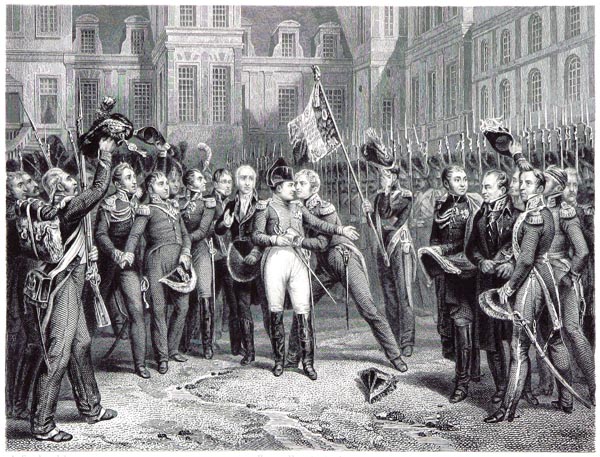
‘Adieux de Fontainebleau’
Histoire du Consulat et de l'Empire, Faisant Suite à l'Histoire de la Révolution Française, Vol 12
Louis Adolphe Thiers - President of the French Republic (p227, 1845)
The British Library
Book XXII: Chapter 20: Napoleon’s Journey to the Isle of Elba
BkXXII:Chap 20:Sec1
Bonaparte had requested that the Alliance provide Commissioners to escort him to the island which the sovereigns granted him as his own exclusive property and as a gift to his heirs. Count Shuvalov was appointed to represent Russia, General Koller Austria, Colonel Campbell England and Count Truchsess von Waldeburg Prussia; the latter wrote Napoleon’s Itinerary from Fontainebleau to the Isle of Elba. This pamphlet and that of the Abbé de Pradt on his Polish Embassy are the two accounts which most distressed Napoleon. Doubtless he regretted the period of liberal censorship, when he had poor Palm, a German bookseller, shot, for having distributed Monsieur de Gentz’s pamphlet: Germany in her Deep Humiliation. Nuremberg, at the time of publication of that pamphlet, being still a free city, did not belong to France: was Palm obliged to have divined its conquest!
Count von Waldburg continues his account thus:
‘The Emperor started his journey, with four other carriages, on the 21st around midday, having again had a long conversation with General Kohler of which this is a summary: “Well! Yesterday you heard my speech to the Old Guard; you enjoyed it, and you saw the effect it produced. That’s how one must speak and act with them, and if Louis XVIII fails to follow my example, he will make nothing of the French soldier”...........
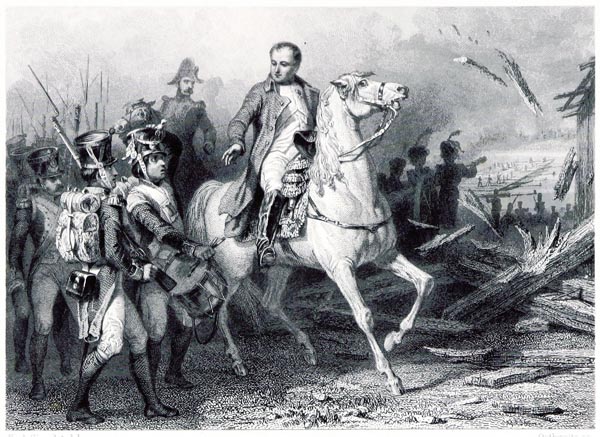
‘Napolean au Passage de l'Elbe’
Histoire du Consulat et de l'Empire, Faisant Suite à l'Histoire de la Révolution Française, Vol 12
Louis Adolphe Thiers - President of the French Republic (p221, 1845)
The British Library
The cries of: “Long live the Emperor!” ceased as soon as the French troops no longer accompanied us. At Moulins, we saw the first white cockades, and the inhabitants welcomed us with shouts of: “Long live the Allies!” Colonel Campbell left Lyons before us, to find an English frigate at Toulon or Marseilles which could carry Napoleon to his island, as he wished.
At Lyons, which we passed through at about eleven at night, a few people gathered to shout: “Vive Napoleon!” On the 24th, towards noon, we met Marshal Augereau near Valence. The Emperor and the Marshal got down from their carriages. Napoleon removed his hat, and held out his arms to Augereau, who embraced him, but without saluting him. “Where are you off to like this?” the Emperor asked, taking him by the arm, “are you going to Court?” Augereau replied that for the present he was going to Lyons: they walked together for about a quarter of an hour, following the road towards Valence. The Emperor reproached the Marshal concerning his conduct towards him, and said: “Your statement is quite foolish; why insult me? It’s enough to say: ‘The wish of the Nation having been pronounced in favour of a new sovereign, the army’s duty is to conform to it. Long live the King! Long live Louis XVIII!’” Augureau then began to address Bonaparte as tu also and in turn reproached him bitterly regarding his insatiable ambition, to which he had sacrificed everything, even the happiness of the whole of France. This speech wearying Napoleon, he left the Marshal’s side brusquely, embraced him, removed his hat once more, and threw himself into the carriage.
Augereau, his hands behind his back, made no move towards the helmet on his head; and, when the Emperor had re-entered his carriage, merely made a dismissive gesture of his hand in token of farewell’...........................
BkXXII:Chap 20:Sec2
‘On the 25th, we arrived at Orange; we were greeted with shouts of: “Long live the King! Long live Louis XVIII!”
On the same day, in the morning, at a halt a short distance before Avignon, where the horses needed to be changed, the Emperor found a crowd of people gathered waiting for him to pass by, who welcomed him with shouts of: “Long live the King! Long live the Allies! Down with the tyrant, the scoundrel, the lousy beggar!”. This crowd continued to spew out a flood of invective against him.
We did what we could to terminate this disgraceful scene, and broke up the crowd attacking the carriage; we could not get these maniacs to stop insulting that man, whom, they said, had made them so wretched and still had no other wish than to add to their misery...............
Everywhere we passed, we were greeted in the same manner. At Orgon, a little town where the horses were changed, the people’s anger reached new heights; before the very inn where we halted, they had erected a gallows from which a blood-stained mannequin was hanging, dressed in French uniform, with a placard on its chest which read: “Such sooner or later will be the tyrant’s fate.”
The crowd clung to Napoleon’s carriage and tried to see his face to insult him more savagely. The Emperor concealed himself behind General Bertrand as much as he could; he was pale and haggard, not saying a word. By dint of haranguing the crowd, we managed to deter them from their hostile course of action.
Count Shuvalov, beside Bonaparte’s carriage, addressed the populace in this manner: “Aren’t you ashamed, insulting an unfortunate defenceless man? He is humiliated enough by the sad position he finds himself in, he who thought to hand down laws to the world and who finds himself today at the mercy of your generosity! Leave him be; look at him: you will see that contempt is the only weapon you should employ against a man who is no longer dangerous. It would be beneath the French nation to take any other vengeance!” The people applauded this speech, and Bonaparte, seeing the effect it produced, made signs of approbation to Shuvalov, and then thanked him for the service he had rendered him.
At a quarter of a league this side of Orgon, he thought it necessary to take the precaution of disguising himself: he put on a wretched blue frock coat, set a round hat with a white cockade on his head, and mounted a post-horse to gallop in front of the carriage, wishing in this way to pass for a courier. As we could not accompany him, we arrived at Saint-Cannat well after him. Not knowing what means he had taken to elude the crowd, we thought he might be in great danger, since we could see his carriage surrounded by furious men trying to open the doors: fortunately they were tightly shut, which saved General Bertrand. The tenacity of the women astonished us most; they begged us to hand him over to them, saying: “He has truly merited it by his wrongs towards us and towards you, so that we are only asking something justifiable.”
At half a league from Saint-Cannat, we met with the Emperor’s carriage, who soon afterwards entered a humble inn situated on the main road and called La Calade. We followed him, and it was only when we were within that we learned of the disguise he had adopted and his arrival at the inn favoured by that strange clothing; he had only been accompanied by a single courier; his suite, from the General down to the scullion, were sporting white cockades, with which they seemed to have provisioned themselves in advance. His valet, who arrived before us, asked us to address the Emperor as Colonel Campbell, since on arrival he was announced as such to the landlady. We promised to conform to his wish, and I was the first to enter a room of sorts where I was struck by seeing the former ruler of the world plunged in profound reflection, his head buried in his hands. I did not acknowledge him at first, and approached him. He leapt up in surprise hearing someone walk in, allowing me to see his face wet with tears. He made a sign to me to say nothing, made me sit down beside him, and all the time the landlady was in the room spoke to me of trivial things only. But when she had left, he took up his former position again. I thought it right to leave him alone; he persuaded us however to spend time in his room now and then so they would not suspect his presence.
We made him aware that Colonel Campbell was known to have spent a night in that very inn, on his way to Toulon. He immediately resolved to adopt the name of Lord Burghers.
We sat down to dinner; but as it was not prepared by his cooks, he could not bring himself to take any nourishment, for fear of being poisoned. However, seeing us eat heartily, he was ashamed to let us see the misgivings that troubled him, and accepted everything offered him; he made a semblance of enjoying it, but sent back what he was given without touching it; sometimes he threw what he had accepted under the table, in order to make it appear as though he had eaten it. His dinner comprised a little bread and a flask of wine which he had brought from his carriage, and likewise shared with us.
He spoke a great deal, and was remarkably friendly. When we were alone, and the landlady who had served us had left, he gave us to understand how much he considered his life in danger; he was certain that the French Government had taken measures to seize him or assassinate him in that very place.
A thousand ideas crowded his mind of the manner in which he might save himself; he also thought of ways of fooling the people of Aix, since he had been warned that a very large crowd was waiting at the posting station. He then declared to us what seemed most appropriate to him, which was to return to Lyons, and take an alternative route from there to embark for Italy. We could not, under any circumstances, consent to this plan, and we sought to persuade him to go directly to Toulon or to travel via Digne to Fréjus. We tried to convince him that it was impossible for the French Government to have such perfidious intentions concerning him without us being aware of it, and that the people, despite the unpleasant way they behaved, were incapable of a crime of that nature.
In order the better to convince us, and prove to us how well-founded, according to him, his fears were, he told us what had passed between himself and the landlady, who did not know who he was. – “Well,” she had said, “have you come across Bonaparte?” – “No,” he had replied. – “I am curious to see,” she continued, “if he can save himself; I keep thinking the people will kill him: and it must be admitted he certainly deserves it, that rascal! So, tell me, are they going to ship him to the island?” – “Yes indeed.” – “They’ll drown him, won’t they?” – “I truly expect so!” Napoleon replied. “So you see,” he added, “to what dangers I am exposed.”
Then he began again to weary us with his anxieties and uncertainties. He even begged us to check whether there was a hidden door somewhere by which he might escape, or whether the window, whose shutters he had ordered fastened on arrival, was too high for him to jump down and so flee.
The window was barred outside, and I put him into an extreme agony by communicating this discovery to him. At the least noise he shuddered and changed colour.
After dinner we left him to his reflections; and when, from time to time, we went into his room, according to the wish he had expressed, we found him constantly in tears...................
The aide-de-camp General Shuvalov came to tell us that the people who had been crowding the street had almost all vanished. The Emperor decided to leave at midnight.
His exaggerated forebodings led him to take yet more measures to avoid being recognised.
On his own authority, he compelled General Shuvalov’s aide-de-camp to dress himself in the blue frock coat and the round hat in which he himself had arrived at the inn.
Bonaparte, who now wished to make himself look like an Austrian general, put on General Koller’s uniform, decorated himself with the Order of St. Theresa, which the General was entitled to wear, put my travelling helmet on his head, and wrapped himself in General Shuvalov’s cloak.
After the Commissioners of the Allied Powers had thus equipped him, the carriages came forward; but before we descended, we rehearsed, in our room, the order in which we were to travel. General Drouot headed the procession; next came the supposed Emperor, General Shuvalov’s aide-de-camp; then General Koller, the Emperor, General Shuvalov, and I, who had the honour of forming part of the rear-guard, to which the Emperor’s suite attached itself.
In this way we drove through the silent crowd who were trying their hardest to discover him whom they called their tyrant among us.
Shuvalov’s aide-de-camp (Major Oloviev) took Napoleon’s place in the carriage, and Napoleon left with General Koller in his barouche...
However the Emperor was not re-assured; he remained in the Austrian general’s barouche, and ordered the coachman to smoke, so that familiarity might add to the deception concerning his presence. He even asked General Koller to sing, and when he replied that he did not know how to sing, Bonaparte told him to whistle.
In this way he spent the journey, hidden in a corner of the barouche, feigning sleep, lulled by the General’s pleasant music and bathed in the coachman’s smoke.
At Saint-Maximin, he lunched with us. When he heard that the sub-prefect of Aix was present, he summoned him, and addressed him in these terms: “You should be ashamed to see me in an Austrian uniform; I have had to don it to protect myself from the insults of the people of your Provence. I would come among you with the greatest confidence, if I could have six thousand of my guardsmen with me. I find a crowd of extremists threatening my life. This race of Provence is a wicked one; they perpetrated all sorts of crimes and horrors during the Revolution and are ready, all of them, to begin again: but when it’s a question of fighting courageously, then they are cowards. Provence never yielded me a single regiment to satisfy me. But they may perhaps set themselves against Louis XVIII tomorrow as they appear to have done today against me etc.”
Then, turning towards us, he said that Louis XVIII would never do anything with the French nation if he treated it too gently. “And then,” he continued, “it will be necessary for him to raise taxes considerably, and those measures will immediately attract the hatred of his subjects.”
He told us that it was eighteen years since he had been in this part of the country, with several thousand men, to free two royalists who ought to have been hung for wearing the white cockade. “I saved them with the greatest difficulty from the hands of those extremists; and today,” he continued, “these men are practising the same excesses once more against any of them who refuse to wear the white cockade! Such are the vagaries of the French people!”
We learned that there were two squadrons of Austrian hussars at Luc; and at Napoleon’s request we sent an order to their commander to wait for us there in order to escort the Emperor to Fréjus.’
BkXXII:Chap 20:Sec3
Here the Count von Waldburg’s narrative ends: the recital makes sad reading. What! Could the Commissioners not provide better protection to him whom they had the honour to be answerable for? Who were they to adopt such superior airs with that same man? Bonaparte said, rightly, that if he had wished he could have been escorted by a section of his Guard. It seems only too evident that they were indifferent to his fate: they enjoyed his degradation; they consented obligingly to the demeaning measures that the victim requested for his own safety: it was so sweet to trample under foot the destiny of one who had overcome the noblest leaders, to take revenge, by insult, on pride! Moreover the Commissioners found nothing to say, not one word of philosophical feeling, regarding such a change in fortune, to warn the man of his nothingness and the grandeur of God’s judgement! In the Allied ranks, there were numerous former admirers of Napoleon: when one falls to one’s knees before power, one is not entitled to exult at misfortune. Prussia, I admit, would have needed to make an effort of virtue to forget what it had suffered, she and her King and Queen; but that effort should have been made. Alas! Bonaparte was pitied by no one; every heart was cold towards him. The moment when he showed himself at his cruellest, was at Jaffa; at his most negligible, on the way to the Isle of Elba; in the first case, military necessity provides an excuse; in the second, the harshness of the foreign Commissioners influences the feelings of readers and lessens the impression of abasement.
The Provisional Government of France itself does not seem quite irreproachable to me: I reject Maubreuil’s claims nevertheless; considering the terror Napoleon still inspired in his former servants, a fortuitous catastrophe might well have presented itself to them as a mere mischance.
One might choose to doubt the truth of the facts reported by Count von Waldburg, but General Koller confirms, in a continuation of Waldburg’s Itinerary, part of his colleague’s narration;for his part, General Shuvalov has assured me of the correctness of these events: his restrained words speaking louder than the expansive words of Waldburg. Finally Fabry’s Itinerary is based on authentic French documents, furnished by eye-witnesses.
Now I have done justice to the Commissioners and the Allies, can one still recognise the world-conqueror in Waldburg’s Itinerary? The hero reduced to disguises and tears, weeping, in a courier’s jacket, in the depths of the back-room of an inn! Was it thus that Marius behaved among the ruins of Carthage, how Hannibal died in Bithynia, Caesar in the Senate House? How did Pompey disguise himself? He covered his head with his toga. He who had donned the purple sheltering beneath a white cockade, uttering the salute: ‘Long live the King!’ That King whose heir he had shot! The ruler of nations encouraging the humiliations that the Commissioners granted him in order to conceal himself more effectively, delighted that General Koller whistled for him, that a coachman blew smoke in his face, forcing General Shuvalov’s aide-de-camp to play the part of the Emperor, while Bonaparte wore an Austrian colonel’s uniform and wrapped himself in a Russian general’s cloak! One must love life cruelly: these immortals cannot consent to death.
Moreau said of Bonaparte: ‘What characterises him is his mendacity and his love of life. I will beat him and I will see him at my feet begging for mercy.’ Moreau thought in that way, unable to understand Bonaparte’s nature; he fell into the same error as Lord Byron. At least, on St Helena, Napoleon, given grandeur by the Muses, though scarcely shown as noble in his difficulties with the English Governor, had only to support the weight of his greatness. In France, the evil he had perpetrated appeared personified to him by the widows and orphans, and obliged him to tremble at the hands of a few women.
All that is quite true; but Bonaparte should not be judged by the rules one applies to great geniuses, because he lacked magnanimity. There are men who have the ability to climb but not to descend. He, Napoleon, possessed both qualities: like the rebellious angel, he could reduce his incommensurable size to enclose it in a moderate space; his flexibility gave him the means of salvation and rebirth: with him all was not over when it seemed over. Changing his costume and manners at will, as accomplished in comedy as in tragedy, that actor knew how to appear natural in a slave’s tunic as in the cloak of a king, in the role of Attalus, or in the role of Caesar. Wait a moment, and you will see, from the depths of his degradation, the dwarf raise once more Briareus’ head; Asmodeus will emerge in a vast cloud of smoke from the bottle in which he is imprisoned. Napoleon valued life for what it could bring him; he had an instinct for what remained for him to depict; he only wanted the canvas he lacked to achieve his paintings.
Regarding Napoleon’s fears, Walter Scott, lest unjust than the Commissioners, remarks frankly that the people’s fury made a great impression on Bonaparte, that he shed tears, that he showed more weakness than his known courage would have suggested ; but he adds: ‘The danger was of a particularly unpleasant kind and capable of intimidating those who were accustomed to the terror of the battlefield: the bravest soldier could shiver at the death of de Witt.’
‘Johan and Cornelis de Witt’
Leeven en Dood der Doorlugtige Heeren Gebroeders Cornelis de Witt, en Johan de Witt - Emanuel van der Hoeven (p753, 1705)
Internet Archive Book Images
Napoleon was subject to that Revolutionary anguish in the same locations where he began his career in the Terror.
The Prussian general, interrupting his narrative once, feels himself obliged to reveal a weakness that the Emperor did not hide: Count von Waldburg may have mistaken the sufferings which Monsieur Ségur had been witness to during the Russian Campaign, for what he had seen: there Bonaparte, forced to dismount, would press his head against a cannon. In the count of infirmities of famous warriors, genuine history only includes the dagger which pierced Henri IV’s heart, or the cannonball which carried off Turenne.
After his recital of Bonaparte’s arrival at Fréjus, Walter Scott, lacking great scenes, falls back delightedly on his talent; he goes to the House of Gossip, as Madame de Sévigné would say; he talks about Napoleon’s crossing to Elba, of the impression Bonaparte made on the English sailors, except Hinton, who could not hear the praise bestowed on the Emperor without murmuring the word humbug. When Napoleon disembarked, Hinton wished His Honour good health and better luck another time. Napoleon showed all the wretchedness and all the grandeur of Man.
Book XXII: Chapter 21: Louis XVIII at Compiègne – His entry into Paris – The Old Guard – An Irreparable Fault – The Declaration of Saint-Ouen – The Treaty of Paris – The Charter – Departure of the Allies
BkXXII:Chap 21:Sec1
While Bonaparte, known to the whole world, fled France in a shower of curses, Louis XVIII, forgotten by all, left London under a cloud of white banners and garlands. Napoleon, landing on the Isle of Elba, recovered his strength. Louis XVIII, landing at Calais, might well have seen Louvel; he did meet General Maison, charged, sixteen years later, with escorting Charles X aboard at Cherbourg. Charles X, had given Monsieur Maison the baton of a Marshal of France, apparently to render him worthy of his future mission, just as a knight, before an encounter, would confer knighthood on a man of lesser rank with whom he deigned to cross swords.
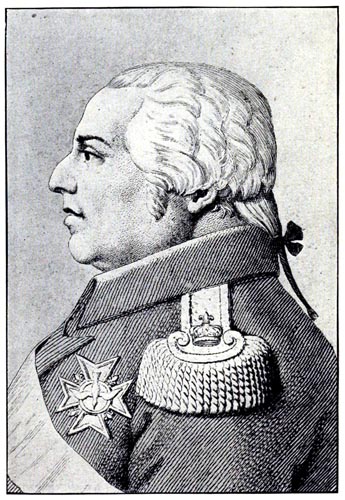
‘Louis XVIII’
Mental and Moral Heredity in Royalty, a Statistical Study in History and Psychology - Frederick Adams Woods (p160, 1906)
Internet Archive Book Images
I feared the effects of Louis XVIII’s appearance. I hastened to arrive before him at that Royal residence where Joan of Arc fell into English hands and where they showed me a volume struck by one of the cannonballs fired at Bonaparte. What was one to think at the sight of the Royal invalid replacing the horseman, who might have said as Attila did: ‘The grass no longer grows where my horse has passed?’ Without the taste for it, and without being asked, I undertook (having been cursed with it) somewhat of a difficult task, namely to depict The Arrival at Compiègne, to portray the descendant of Saint Louis such as I have idealised him with the aid of the Muses. I expressed myself thus:
‘The King’s coach was preceded by Generals and Marshals of France, who had left before His Majesty. The cries of “Long live the King!” had given way to confused sounds in which nothing could be distinguished but the accents of joy and emotion. The King wore a blue coat, decorated only by a medal and epaulettes; his legs were encased in long boots of red velvet, edged with fine gold cord. When he was sitting in his armchair, with his old-style boots, holding his cane between his legs, one might have been looking at Louis XIV at fifty.................
Marshals Macdonald, Ney, Moncey, Sérurier, and Brune, and the Prince de Neuchâtel, all the generals, all the people present, received the most affectionate words from the King, without exception. Such is the power of the legitimate sovereign in France; that magic associated with the name of king. A man arrives alone from exile, despoiled of everything, without followers, without bodyguards, without wealth; he has nothing to give, almost nothing to promise. He descends from his carriage, leaning on the arm of a young woman; he shows himself to officers who have never seen him before, to grenadiers who scarcely know his name. Who is this man? It is the King! Everybody falls at his feet.’
What I said therein about the military, for the purposes which I intended, was true as far as the leaders were concerned; but I lied in regard to the soldiers. I have present in memory, as if I saw it still, the spectacle I witnessed when Louis XVIII, entering Paris on the 3rd of May, went to visit Notre-Dame: they wished to spare the King the sight of foreign troops; so a regiment of the old Foot-guards lined the route from the Pont-Neuf to Notre-Dame, along the Quai des Orfèvres. I doubt that human faces ever wore so terrible and threatening an expression. Those battle-scarred grenadiers, the conquerors of Europe, who had seen so many thousand of cannonballs pass over their heads, who smelt of flame and powder; those same men, robbed of their leader, were obliged to salute an old king, disabled by time not war, watched as they were by an army of Russians, Austrians and Prussians, in Napoleon’s occupied capital. Some, wrinkling the skin of their foreheads, brought their great busbies down over their eyes so as not to see; others turned down the corners of their mouths in angry contempt; others again bared their teeth between their moustaches, like tigers. When they presented arms, it was with a furious movement, and the sound of those arms made one tremble. Never, it must be confessed, have men been put to so great a test or suffered such torment. If they had been called upon to exact vengeance at that moment, it would have been necessary to exterminate every last one of them, or they would have devoured the earth.
At the end of the line was a young hussar, on horseback; he held a naked sword, and made it leap and dance as it were with a convulsive movement of anger. He was pale; his eyes rolled in their sockets; he kept opening and closing his mouth, clashing his teeth, and stifling cries of which only the first sound could be heard. He caught sight of a Russian officer: the look he gave him cannot be described. When the King’s carriage passed before him, he made his horse rear, and he must have been tempted to hurl himself at the King.
The Restoration, at its inception, committed an irreparable fault: it should have dismissed the army while retaining the marshals, generals, military governors, and officers, with their pensions, honours and rank; the soldiers could then have been re-admitted in succession to the reconstituted army, as they since have been into the Royal Guard: for one thing the Legitimacy would not have experienced the opposition of those soldiers of the Empire, organised, recruited into brigades, designated as they were in the days of their glory, chattering endlessly amongst themselves about the past, nourishing regrets and hostile feelings towards their new master.
The wretched resurrection of the Maison-Rouge, that mixture of military men of the old monarchy and soldiers of the new empire, added to the problem: to believe that the illustrious veterans of a thousand battlefields would not be shocked to see young men, brave doubtless, but for the most part new to the profession of arms, to see them wear, without having won them, the insignia of high military rank, would be to reveal ignorance of human nature.
During the stay Louis XVIII had made at Compiègne, Alexander came to visit him. Louis XVIII offended him by his vanity: the declaration of the 2nd of May, at Saint-Ouen was the result of that meeting. The King said: that he was resolved to grant as the basis of the constitution his intention to make his people the following guarantees: representative government organised in two chambers, free consent to taxation, public and individual liberty, freedom of the press, freedom of religion, the inviolability and sacredness of property, the irrevocability of the sale of national possessions, responsible ministers, permanent judges with independent judicial power, all French people admissible for all positions, etc. etc.
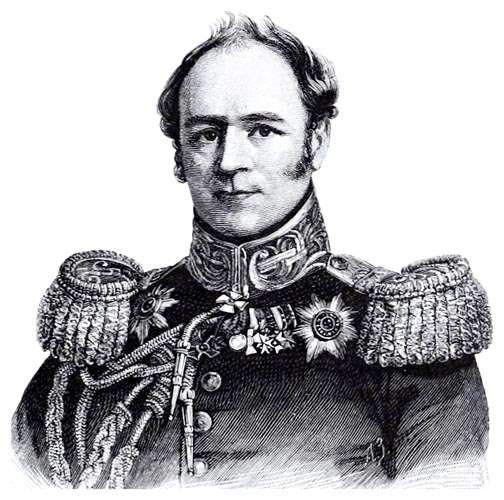
‘Alexander I, Emperor of Russia’
Imperator Aleksandr Pervy - Nikola Karlovich Schilder (p246, 1897)
Internet Archive Book Images
This declaration, though it suited Louis XVIII’s temperament, nevertheless owed nothing to him or his councillors; it was quite simply the age waking from sleep: its wings had been furled, its flight suspended since 1792: it took its course through the air once more. The excesses of the Terror, the tyranny of Bonaparte, had stemmed the flow of ideas; but, as soon as the obstacles which thwarted them had been destroyed, they poured once more through the channel they were immediately obliged to follow and deepen. Things resumed from the point where they had halted; what was past was if it had not happened: human expectations, postponed at the start of the Revolution, had merely lost twenty years of life; now what is twenty years in the life of a society? That lacuna has vanished while the severed segments of time have been re-joined.
On the 30th of May 1814 the Treaty of Paris between France and the Allies was concluded. It was agreed that within two months the powers which had been engaged on one or other side during the recent war would send plenipotentiaries to Vienna to a general Congress to determine the final arrangements.
On the 4th of June, Louis XVIII appeared at a Royal session of the assembled members of the Legislature and a section of the Senate. He gave a fine speech; aged, faded, worn, these fastidious details only serve as a historical record.
The Charter, for the majority of the nation, had the disadvantage of being granted: which rekindled, by an unhelpful word, the burning question of whether it was to be a sovereign or a popular monarchy. Louis XVIII also dated his benefaction according to the year of his reign, treating Bonaparte as if he had not occurred, just as Charles II had played leapfrog with Cromwell: it acted as a kind of insult towards those sovereigns who had all recognised Napoleon, and who happened at the time to be in Paris. That outmoded language and those pretensions of the former monarchy added nothing to the rights of the Legitimacy and were merely puerile anachronisms. Other than the fact that the Charter in replacing despotism brought us legal freedom, it had done nothing to satisfy men of conscience. Nevertheless, the Royalists who won much advantage from it, emerging from their villages, or wretched hearths, or other obscure places where they had existed during the Empire, after being summoned to high public office, merely received the benefaction with mutterings; the liberals, who had cheerfully adjusted to Bonaparte’s tyranny, considered the Charter a veritable code of slavery. We returned to the time of Babel; but we no longer worked on a public monument in the confusion: each built their tower to their own height, according to their strength and stature. Moreover, if the Charter seemed defective, it was because the Revolution was not yet at an end; the principle of equality and democracy was in people’s minds and worked in a contrary direction to monarchical order.
The Allied princes did not wait to leave Paris: Alexander, before his departure had celebrated mass in the Place de la Concorde. An altar was raised on the spot where Louis XVI’s scaffold had been erected. Seven Muscovite priests performed the rite, and the foreign troops filed in front of the altar. The Te Deum was sung to one of the lovely melodies of ancient Greek music. The soldiers and sovereigns knelt on the ground to receive the benediction. French thoughts returned to 1793 and 1794, when the oxen refused to cross pavements which the smell of blood rendered obnoxious to them. What hand had led these men from every country to this service of expiation, these descendants of the ancient barbarian incursions, these Tartars, some of whom had dwelt in sheepskin tents at the foot of the Great Wall of China? These are sights that the feeble generations who will follow my age will no longer witness.
Book XXII: Chapter 22: The first year of the Restoration
BkXXII:Chap 22:Sec1
During the first year of the Restoration, I was present at a third transformation of society: I had seen the old monarchy turn into the constitutional monarchy and the latter into the Republic; I had seen the Republic become a military tyranny; I was now seeing military despotism reverting to a free monarchy, new ideas and new generations returning to old principles and old men. The Marshals of the Empire became Marshals of France; to the uniforms of Napoleon’s Guard were added the uniforms of the Lifeguards and the Maison-Rouge, cut in precisely the former fashion; the old Duc d’Havré, with his powdered wig and his black cane, ambled along nodding his head, as Captain of the Lifeguards, beside Marshal Victor, limping in the Bonaparte manner; the Duc de Mouchy, who had never seen a cannonball fired, went to mass alongside Marshal Oudinot, who was riddled with wounds; the Palace of the Tuileries, so clean and militaristic under Napoleon, began to reek everywhere with the odour of food, instead of the smell of powder: under the Gentlemen of the Bedchamber, and the Officers of the Mouth and the Wardrobe, everything took on an air of domesticity again. In the streets, one saw decrepit emigrants with the manners and clothes of former times, highly respectable men no doubt, but as outlandish among the modern crowd as the Republican captains had looked among Napoleon’s soldiers. The ladies of the Imperial Court introduced the dowagers of the Faubourg Saint-Germain to the palace, and taught them their way around the corridors. Deputations from Bordeaux arrived, wearing armbands; and captains from parishes of the Vendée wearing La Rochejacquelein hats. These diverse persons retained the habits of feeling, thought, dress and manners familiar to them. Liberty which was at the root of this epoch, made things co-exist which at first sight looked as though they should not exist at all; but it was difficult to recognise that liberty, since it wore the colours both of the ancient monarchy and imperial despotism. Everyone was untutored in the language of the constitution also; the Royalists made gross errors when speaking of the Charter; the Imperialists were even less well-informed; the Members of the Convention, who had become in turn counts, barons, senators under Napoleon and peers under Louis XVIII, lapsed at one moment into the Republican jargon they had almost forgotten, at another into the absolutist idiom which they had learned by heart. Lieutenant-Colonels were promoted to become royal gamekeepers. Aides-de-camp of the former military tyrant were heard discussing the inviolable liberty of nations, while regicides upheld the sacred dogma of Legitimacy.
Such metamorphoses would be odious, if they did not belong in part to the flexibility of the French genius. The people of Athens governed themselves; orators appealed to their feelings in the public squares; the sovereign crowd was composed of sculptors, painters, and artisans, observers of speeches and listeners to deeds, as Thucydides says. But when a decree, good or bad, was delivered, who came forward from that incoherent and inexpert mass to execute it? Socrates, Phocion, Pericles, Alcibiades.
Book XXII: Chapter 23: Were the Royalists to blame for the Restoration?
BkXXII:Chap 23:Sec1
Were the Royalists to blame for the Restoration, as is claimed today? Not in the least: would that not imply that thirty million men stood by in consternation while a handful of Legitimists accomplished a detestable Restoration, against the will of all, by waving a few handkerchiefs and tying their wives’ ribbons round their hats? It is true that the vast majority of Frenchmen were delighted; but that majority was not Legitimist in the narrow sense of the word, applicable only to devoted supporters of the former monarchy. The majority was a mass of people of every shade of opinion, happy to be delivered from tyranny, and violently incensed against the man they accused of all their misfortunes; hence the success of my pamphlet. How many avowed aristocrats were numbered among those proclaiming the King’s name? Messieurs Matthieu and Adrien de Montmorency, the Messieurs de Polignac, released from gaol, Monsieur Alexis de Noailles, and Monsieur Sosthènes de La Rochefoucauld. Did these six, or perhaps there were eight men, whom the people neither knew nor followed, lay down the law to a whole nation?
Madame de Montcalm had sent me a purse containing twelve hundred francs to be distributed amongst the race of pure Legitimists: I sent it back to her, having been unable to place a single crown. A disreputable rope was slung around the neck of the statue surmounting the column on the Place Vendôme; there were so few Royalists to be found to jeer at glory and pull on the rope, that it was the authorities, Bonapartists to a man, who lowered their master’s effigy with the aid of a derrick: the colossus was forced to bow his head: he fell at the feet of the sovereigns of Europe, who had so often prostrated themselves before him. It was men of the Republic and the Empire who welcomed the Restoration with enthusiasm. The conduct and ingratitude of those elevated by the Revolution towards him whom today they pretend to regret and admire was abominable.
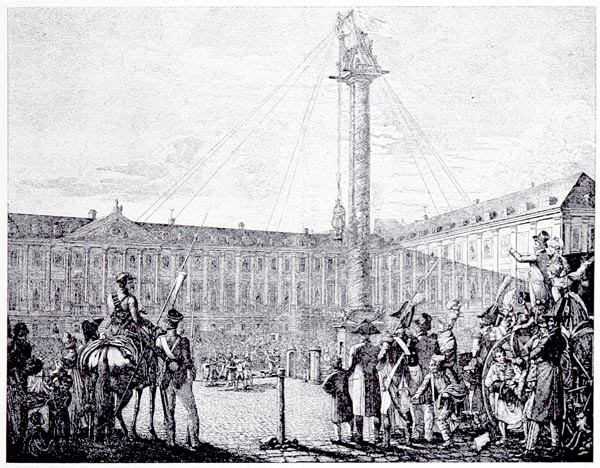
‘Descente de la Statue de Napoléon de la Colonne Triomphale sur la Place Vendôme, d'Après un Dessin de G. Opiz’
Napoléon Ier et Son Temps - Roger Peyre (p925, 1888)
The British Library
Imperialists and Liberals, it is you into whose hands power fell, you who knelt before the descendants of Henri IV! It was perfectly natural that Royalists should be happy to recover their princes and see the end of the reign of him whom they considered a usurper; but not that you, creatures of that usurper, should surpass the Royalists in your excesses of feeling. The ministers and grand dignitaries swore loyalty to the Legitimacy at every opportunity; all the civil and judicial authorities queued to protest their hatred for the newly proscribed dynasty, and their love for the ancient race they had condemned a thousand times. Who drew up those proclamations, those insulting and accusatory addresses for Napoleon, with which France was flooded? Royalists? No: the ministers, generals, and officials, chosen and maintained by Bonaparte. Where was the corruption of the Restoration carried out? Among the Royalists? No: at Monsieur de Talleyrand’s. With whom? With Monsieur de Pradt, chaplain to the god Mars and mitred mountebank. Where and with whom did the Lieutenant-General of the Kingdom dine on his arrival? At a Royalist house with Royalists? No: at the Bishop of Autun’s, with Monsieur de Caulaincourt. Where were receptions given for the infamous foreign princes? In Royalist palaces? No: at Malmaison, at the Empress Josephine’s. To whom did Napoleon’s dearest friends, Berthier for example, offer their ardent devotion? To the Legitimacy. Who spent their time with the autocratic Alexander, with that brutal Tartar? The Members of the Institute, the scholars, the men of letters, the philosophers of philanthropy, theo-philanthropy, and so forth; they returned charmed, laden with praise and snuff-boxes. As for us, poor devils of Legitimists, we were admitted nowhere; we counted for nothing. Now, we were told in the street to go home to bed; now, we were recommended not to shout ‘Long Live the King!’ too loudly, others being so charged. Far from forcing anyone to be a Legitimist, those in power declared that no one would be obliged to change their role or language, that the Bishop of Autun would no more be compelled to say Mass under the monarchy than he had been under the Empire. I saw no lady of the manor, no Joan of Arc proclaiming the rightful sovereign, falcon on wrist, or lance in hand; but Madame de Talleyrand, whom Bonaparte had pinned to her husband like a parchment, drove through the streets in a barouche, singing hymns about the pious family of the Bourbons. A few sheets hanging from the windows of the familiars of the Imperial Court made the simple Cossacks believe that there were as many fleurs-de-lis in the hearts of converted Bonapartists as there were white rags at their casements. Contagion is a marvellous thing in France, and a man would cry: ‘Off with my head!” if he heard his neighbour shout it. The Imperialists went so far as to enter our houses and make us, the other Bourbonists, display such white scraps as our linen-rooms contained, by way of spotless flags: that’s what happened in my house; but Madame de Chateaubriand would have none of it, and defended her muslins valiantly.
Book XXII: Chapter 24: First Minister – I publish Réflexions Politiques – Madame la Duchesse de Duras – I am named as Ambassador to Sweden
BkXXII:Chap 24:Sec1
The Legislative Body transformed into a Chamber of Deputies, and the Chamber of Peers, composed of a hundred and fifty-two members, appointed for life, among which were more than sixty senators, formed the two supreme legislative Chambers. Monsieur de Talleyrand, installed as Foreign Minister, left for the Congress of Vienna, whose opening was fixed for the 3rd of November, in fulfilment of article 32 of the treaty of the 30th of May; Monsieur de Jaucourt held his portfolio during the interim, until the Battle of Waterloo. The Abbé de Montesquiou became Minister of the Interior, with Monsieur Guizot as his secretary-general; Monsieur Malouët took the Navy; he died and was replaced by Monsieur Beugnot; General Dupont obtained the War Department; he was replaced by Marshal Soult, who distinguished himself by erecting a funeral monument at Quiberon; the Duc de Blacas was Minister for the King’s Household, Monsieur Anglès Prefect of Police, Chancellor Dambray Minister of Justice, and Abbé Louis Minister of Finance.
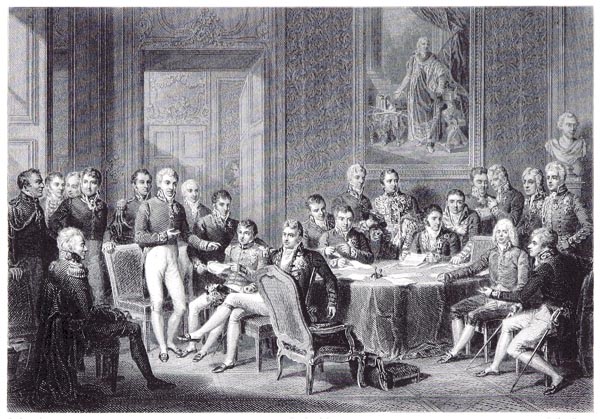
‘Congrès de Vienne’
Histoire du Consulat et de l'Empire, Faisant Suite à l'Histoire de la Révolution Française, Vol 12
Louis Adolphe Thiers - President of the French Republic (p241, 1845)
The British Library
On the 21st of October, the Abbé de Montesquiou presented the first law on the subject of the Press; it required all writings of less than twenty printed sheets to be submitted to censure: Monsieur Guizot drafted this first law of liberty.
Carnot sent a letter to the King: he confessed that the Bourbons had been welcomed with joy; but, without taking account of the short time elapsed, nor all that the Charter granted, he gave a haughty lecture mingled with dangerous advice: valueless from one who was forced to accept the rank of Minister and title of Count of the Empire; it is not appropriate to show pride towards a weak and liberal prince when one has been subject to a prince who was violent and despotic; when, an instrument of the Terror, one has been found to be inadequate in calculating the dimensions of Napoleonic warfare. In reply I published the Réflexions Politiques; they contained the substance of Monarchie selon la Charte. Monsieur Lainé, President of the Chamber of Deputies, spoke in praise of the work to the King. The King was always delighted with the services I had the good fortune to render him; the heavens seemed to have placed on my shoulders the insignia of herald to the Legitimacy: but the more success the work achieved, the less the author pleased His Majesty. The Réflexions Politiques disclosed my constitutional doctrines: the Court received the impression from it that my loyalty to the Bourbons could be weakened. Louis XVIII said to his followers: ‘Take care never to admit a poet to our counsels: he will lose us everything. Such people are good for nothing.’
A strong and lively friendship then filled my heart: the Duchesse de Duras had imagination and something of Madame de Staël’s expression of countenance: one can assess her talent as an author by Ourika. Returning from emigration, retiring for several years to her chateau d’Ussé, on the banks of the Loire, it was in the lovely gardens of Méréville that I heard her speak for the first time, after having passed her in London without meeting her. She came to Paris to educate her delightful daughters, Félicité and Clara. Connections with her family, her province, and her literary and political opinions had opened the door to her society. Her warmth of heart, nobility of character, elevation of mind, and generosity of feeling made her a superior woman. At the commencement of the Restoration, she took me under her wing, since, despite what I had done for the legitimate monarchy and the services Louis XVIII confessed to having received from me, I had been ignored to the extent that I thought of retiring to Switzerland. Perhaps I would have been better to do so: would I not have been happier in those solitudes that Napoleon had destined me for, as his ambassador to the mountains, than in the Palace of the Tuileries? When I entered those chambers on the return of the Legitimacy, they made almost as painful an impression on me as the day when I saw Bonaparte there, preparing to murder the Duc d’Enghien. Madame de Duras spoke about me to Monsieur de Blacas. He replied that I was quite free to go where I wished. Madame de Duras was so forceful, she had such courage on behalf of her friends, that they dug up a vacant embassy for me, that of Sweden. Louis XVIII, already weary of my name, was happy to make a present of me to his dear brother King Bernadotte. Did the latter not realise that they were sending me to Stockholm to dethrone him? Good Heavens! Princes of the earth, I dethrone nobody; keep your crowns, if you can, and above all do not give them to me, since I want naught of them.
Madame de Duras, that excellent woman who allowed me to call her sister, whom I had the happiness to see again in Paris over several years, has died at Nice: a re-opened wound yet. The Duchesse de Duras knew Madame de Staël well: I cannot understand why I was not drawn into the path of Madame Récamier, who had returned from Italy to France; I would have welcomed the help that has come to aid my life: already I belong no more to those days which are their own consolation, I have reached those twilight hours which have need of being consoled.
Book XXII: Chapter 25: The exhumation of the remains of Louis XVI – My first 21st of January at Saint-Denis
BkXXII:Chap 25:Sec1
On the 30th of December 1814, the Legislative Chambers were adjourned until the 1st of May 1815, as if they had been summoned to Bonaparte’s ceremony on the Champ-de-Mai. On the 18th of January the remains of Marie-Antoinette and Louis XVI were exhumed. I was present at that exhumation in the cemetery where Fontaine and Percier have since raised, at the pious command of Madame la Dauphine and in imitation of a sepulchral chapel at Rimini, perhaps the most remarkable monument in Paris. This church, formed of linked mausoleums, seizes the imagination and fills it with sadness. In Book IV of these Memoirs, I spoke of the exhumations of 1815: among the bones I recognised the queen’s skull from the smile that head had bestowed on me at Versailles.
On the 21st of January the first stone of the plinth was laid for the statue which ought to have been raised in the Place Louis XV, and which has not yet been raised. I have written about the funeral ceremony on the 21st of January; I said: ‘Those monks, who carried the Oriflamme before Saint Louis’ reliquary, will not receive the sacred King’s descendant. In those subterranean places where those vanished kings and princes slept, Louis XVI will find himself alone! ....How can so many dead have risen? Why is Saint-Denis deserted? Let us ask rather why its roof has been restored, why its altar is standing? Whose hand reconstructed the arches of these cellars, and prepared these empty tombs? It was the hand of that very man who sat on the throne of the Bourbons. O Providence! He thought he was preparing sepulchres for his race, and he was merely building a tomb for Louis XVI.’
I had long desired a statue of Louis XVI to be placed on the very site where the martyr shed his blood: I am no longer of that opinion. One must praise the Bourbons for having thought of Louis XVI, at the first moment of their return; they had to bow to his remains, before placing the crown on their head. Now I presume they do not feel obliged to do anything more. There was no Commission in Paris, as in London, to try the King, the whole Convention did so; from that stems the annual reproach that a repeated funeral ceremony would seem to represent with respect to the nation, displayed in the form of a mass gathering. Every people has appointed anniversaries for the celebration of its triumphs, its disturbances or its misfortunes, for all equally have wished to preserve the memory of such things; we have had solemnities for the barricades, hymns for St Bartholomew’s Day, festivals for the death of Capet; but is it not remarkable that the law is powerless to create days of remembrance, while religion has kept the most obscure saints alive from age to age? If the fasts and prayers instituted for Charles I’s martyrdom still endure, that is because in England the State unites supremacy in religion to supremacy in politics, and in virtue of that supremacy the 30th of January 1649 has become a public holiday. In France, there is nothing of that sort: Rome alone has the right to command in matters of religion; consequently, what power does some ordinance published by a prince have, some decree promulgated by a political assembly, if another prince, another assembly, has the power to efface it? So now I consider that a symbol of a remembrance that might be abolished, that a testament to a tragic event, not consecrated by religion, would not be appropriately sited in a thoroughfare crowded with people going carelessly and distractedly about their pleasures. At the present time, it is indeed to be feared that a monument raised with the aim of advertising the horrors of popular excess might give the populace the desire to imitate it: evil is more tempting than good; in wishing to perpetuate grief, one often perpetuates the precedent. The centuries do not espouse a legacy of mourning; there are enough contemporary subjects for weeping without needing to turn to hereditary tears.
Watching the catafalque, containing the remains of the king and queen, leaving Desclozeaux’s cemetery, I felt stricken; I followed it with my eyes with a fatal presentiment. At last Louis XVI would rest at Saint-Denis; Louis XVIII, for his part, slept at the Louvre, the two brothers together began a new era of kings and legitimate spectres: idle this restoration of thrones and tombs whose twin power time had already swept aside.
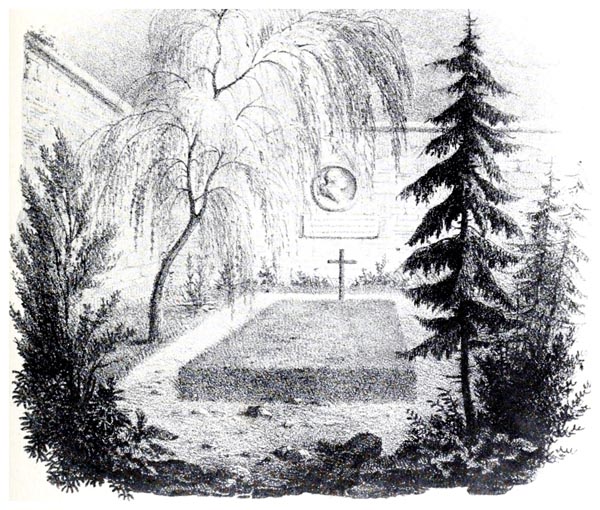
‘La Tombe du Roi au Cimetière de la Madeleine en 1814, d'Après un Dessin du François-Alexandre Pernot’
La Mort du Roi (21 Janvier 1793) - Pierre de Vaissière (p250, 1910)
Internet Archive Book Images
Since I am speaking of funeral ceremonies which so often recur, I will tell you of the nightmare which oppressed me, when, the ceremony over, I walked at night in the half-obscured basilica: that I might think of the vanity of human greatness among those destroyed tombs, that goes without saying: an everyday observation flowing indeed from that sight; but my mind did not stop there; I looked into the nature of man. Is it all emptiness and absence in the realm of sepulchres? Is there nothing in that nothing? Is there no being from nothingness, no thought from the dust? Do those remains have some mode of existence we know nothing of? Who knows the passions, the delights, the embraces of the dead? The things they dreamed of, believed, waited for, are they like them ideal entities, swallowed pell-mell with them? Dreams, prospects, joy, grief, freedom and slavery, power and weakness, crime and virtue, honour and infamy, wealth and poverty, talent, genius, intellect, glory, illusions, love, are you perceptions of an instant, perceptions lost with the shattered skull in which you were engendered, with the vanished breast where a heart once beat? In your eternal silence, O tombs, if you are tombs, is there only an eternal mocking laughter to be heard? Is that laughter God, the sole ironic reality, which will survive the imposture of this world? Let us close our eyes; let us fill the despairing abyss of existence with those great and mysterious words of the martyr: ‘I am a Christian.’
Book XXII: Chapter 26: The Island of Elba
BkXXII:Chap 26:Sec1
Bonaparte had refused to embark in a French ship, only setting store at that time by the English Navy, because it was victorious; he had forgotten his hatred, the slanders, the insults which he had heaped on perfidious Albion; he saw no one worthy of his admiration save the winning party, and it was the Undaunted which took him to the place of his first exile; he was not without anxiety as to the manner in which he would be received: would the French Garrison hand the territory they guarded over to him? Of the Italian islanders, some wanted to bring in the English, others to remain free of all masters; the tricolour and the white banner waved on opposing headlands. Nevertheless everything was arranged satisfactorily. When they realised that Bonaparte was bringing millions of francs with him, public opinion decided generously to welcome the ‘august victim’. The civil and religious authorities were brought round to the same conviction. Joseph-Philippe Arrighi, the Vicar-General, issued a pastoral letter: ‘Divine Providence,’ the pious injunction read, ‘has decreed that in future we shall be the subjects of Napoleon the Great. The Isle of Elba, elevated to so sublime an honour, receives the Lord’s Anointed in its bosom. We order a solemn Te Deum to be sung by way of thanksgiving etc.’
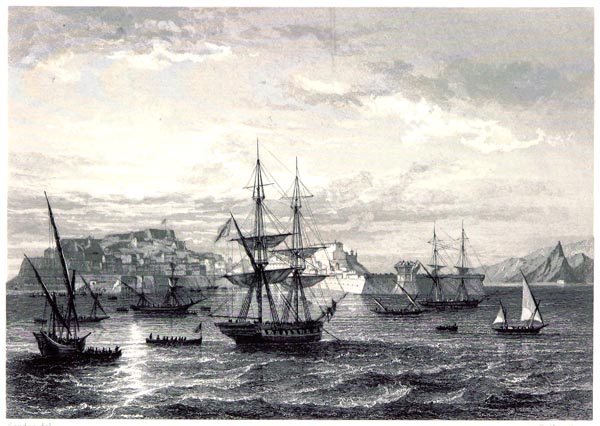
‘L'Ile d'Elbe’
Histoire du Consulat et de l'Empire, Faisant Suite à l'Histoire de la Révolution Française, Vol 12
Louis Adolphe Thiers - President of the French Republic (p243, 1845)
The British Library
The Emperor had written to General Dalesme, the commander of the French garrison, to say that he should let the people of Elba know that he had chosen their island for his stay, because of the gentleness of their manners and their climate. He landed at Porto-Ferrajo, to the sound of a double salute, from the English frigate which had brought him and from the batteries on shore. From there, he was conducted beneath the parish canopy to the church where the Te Deum was sung. The beadle, as master of ceremonies, was a short, fat man, who was unable to clasp his hands across his body. Napoleon was then taken to the town hall; there his lodgings had been prepared. The new Imperial standard was unfurled: a white ground crossed by a red stripe powdered with three gold bees. Three violins and two basses followed him with lively scraping sounds. The throne, hastily erected in the public ballroom, was decorated with gold paper and scarlet rags. These arrangements appealed to the theatrical side of the prisoner’s nature: Napoleon played along, just as he used to amuse his Court with old-fashioned games in his palace at the Tuileries, before going off to kill men as a pastime. He ordered his household: it was composed of four chamberlains, three orderlies, and two stewards. He declared that ladies would be received twice a week, at eight in the evening. He gave a ball. He commandeered, as his own residence, a building intended for the engineer corps. Bonaparte was forever encountering in his life the two sources from which it had sprung, democracy and royal power; his strength was derived from the masses, his rank from his genius; that is why he passed effortlessly from the market-place to the throne, from the kings and queens who crowded round him at Erfurt, to the grocers and bakers who danced in his barn at Porto-Ferrajo. Among princes he was of the people, and among the people, a prince. At five in the morning, in silk stockings and shoes with buckles, he presided over his bricklayers on the Isle of Elba.
Installed in his empire, its iron workings producing an inexhaustible flow since Virgil’s day – ‘Insula inexhaustis Chalybum generosa metallis’ –
Bonaparte had not forgotten the insults to which he had recently been subjected; he had not renounced his intention of ripping away his shroud; but it suited him to seem as if buried, while making a few ghostly visitations round his grave. That is why, looking as though he thought of nothing else, he lost no time in visiting his iron quarries, with their crystalline and magnetic ore; one might have taken him for the former Inspector of Mines of his erstwhile States. He regretted having previously dedicated the revenue of the Elban forges to the Legion of Honour: five hundred thousand francs now seemed to him worth more than the blood-stained crosses on his grenadiers’ chests. ‘What was I thinking of?’ he said; ‘though I issued several stupid decrees of that sort.’ He concluded a commercial treaty with Leghorn, and proposed to conclude another with Genoa. He began to build, somewhat haphazardly, five or six furlongs of highroad and planned the sites of four large towns, just as Dido marked out the limits of Carthage. A philosopher, sated with human grandeur, he declared that henceforth he intended to live like a Justice of the Peace in an English county: and yet, climbing a hill which overlooked Porto-Ferrajo, in sight of the sea which lapped against the foot of the cliffs on every side, these words escaped him: ‘Devil take it! It must be confessed, my island is very small.’ Within a few hours, he had visited his whole domain; he wished to join to it a rock named Pianosa. ‘Europe,’ he said with a smile, ‘will accuse me of already achieving a conquest.’ The Allied Powers amused themselves at the thought of having left him, derisively, four hundred soldiers; he needed no more to bring all of them back to the flag.
Napoleon’s presence off the coast of Italy, which had seen the dawn of his glory and retained his memory, troubled everyone. Murat was his neighbour; his friends, and strangers, came secretly or publicly to his retreat; his mother and his sister, Princess Pauline, visited him; Marie-Louise and his son were expected to arrive soon after. In fact a woman did appear with a child: welcomed with great secrecy, she went to a secluded villa in the remotest corner of the isle: on the shore of Ogygia, Calypso spoke of her love to Ulysses who, instead of listening, thought about how to defend himself against the usurpers. After two days rest, the Swan of the North took to sea once more, to land among the myrtles of Baiae, taking her little one away in her white yawl.
If we had been less trustful it would have been easy for us to recognize the approaching catastrophe. Bonaparte was too near his cradle and his conquests; his fatal island was to be further away and surrounded by the deep. It is hard to explain why the Allies had thought of banishing Napoleon to these rocks, where he was forced to serve his apprenticeship in exile: did they really believe that in sight of the Apennines, smelling the powder of the battlefields of Montenotte, Arcola and Marengo, able to make out Venice, Rome and Naples, his three lovely slaves, his heart would not be seized by irresistible temptation? Had they forgotten he had troubled the earth, and that he had admirers and debtors everywhere, all of them his accomplices? His ambition had been disappointed not extinguished; misfortune and revenge rekindled its flames: when the Prince of Darkness looked on Man and the World from the edge of the newly created universe, he resolved to destroy them.
Before the break-out, the dreaded captive contained himself for a few weeks. In the immense public game of faro whose bank he held, his genius played for a fortune or a kingdom. Fouchés, and Guzmans d’Alfarache, swarmed around. The great actor had long ago created a melodrama for his police force and reserved for himself the finest scene; he diverted himself with common victims who vanished through the trap doors of his theatre.
Bonapartism, in the first year of the Restoration, passed for a simple desire for action, to the extent that his hopes grew and he better understood the feeble nature of the Bourbons. When the plans had been finalised externally, they were finalised internally, and the conspiracy became overt. During the skilful administration of Monsieur Ferrand, Monsieur de Lavalette undertook the correspondence: the couriers of the monarchy carried the dispatches of the Empire. The matter was no longer hidden; caricatures depicted the wished-for return: one saw eagles shown returning through the windows of the Tuileries Palace, from the doors of which a flock of turkeys fled; the Nain Jaune or Vert (The Yellow or Green Dwarf) spoke of ‘plumes de cane’ (duck-feathers, a pun on Cannes). Warnings flooded in from all directions, and no one wanted to believe them. The Swiss Government hastened in vain to warn the Royal Government of the plotting of Joseph Bonaparte, who had retired to the Canton of Vaud. A woman who had arrived from Elba gave the most circumstantial details of what was happening in Porto-Ferrajo, and the police threw her in prison. It was held for certain that Napoleon would dare attempt nothing before the dissolution of the Congress, and that, in any case, his sights were set on Italy. Others, yet more knowing, prayed that the little corporal, the ogre, the prisoner, would land on the French coast: that would be too fortunate; he could be finished off with a single blow! Monsieur Pozzo di Borgo declared in Vienna that the delinquent would be hung from the branch of a tree. If one had access to certain papers, one would find proof there that from 1814 a military conspiracy was under way that ran parallel to the political conspiracy that the Prince de Talleyrand was conducting in Vienna, at Fouché’s instigation. Napoleon’s friends had written to tell him that if he did not hasten to return, he would find his place at the Tuileries taken by the Duc d’Orléans: they imagined that this revelation would serve to initiate the Emperor’s return. I believe these intrigues existed, but I also believe that the determining cause which made Napoleon decide the question was quite simply the nature of his genius.
The conspiracy of Drouet d’Erlon and Lefebvre-Desnouettes came to fruition. Some days before the raising of shields by these generals, I was dining at Marshal Soult’s, he having been made Minister of War on the 3rd of December 1814: some idiot was recounting Louis XVIII’s exile at Hartwell; the Marshal listened; as each circumstance was recalled he replied with these two words: ‘That’s historic.’ – Someone brought His Majesty’s slippers. – ‘That’s historic!’ – The King, on days of abstinence, swallowed three fresh eggs at the start of dinner. – ‘That’s historic!’ The reply struck me. When a government is not firmly established, everyone with whom conscience does not count becomes, according to his greater or lesser energy of character, a quarter, a half, or three quarters a conspirator; he waits for the judgement of fate: events are greater traitors than opinions.
End of Book XXII