Heinrich Heine
Germany: A Winter’s Tale (Deutschland: Ein Wintermärchen, 1844)
Part III: Chapters XVIII-XXVII
Translated by A. S. Kline © Copyright 2026 All Rights Reserved
This work may be freely reproduced, stored and transmitted, electronically or otherwise, for any non-commercial purpose. Conditions and Exceptions apply.
Contents
- Chapter XVIII: Minden.
- Chapter XIX: Bückeburg and Hanover
- Chapter XX: Hamburg.
- Chapter XXI: Hamburg - Continued.
- Chapter XXII: Hamburg - Continued.
- Chapter XXIII: Hamburg - Continued.
- Chapter XXIV: Hamburg - Continued.
- Chapter XXV: Hamburg - Continued.
- Chapter XXVI: Hamburg - Concluded.
- Chapter XXVII: Epilogue.
Chapter XVIII: Minden
Minden is a stronghold
With fine walls and weaponry,
However, Prussian forts
Are not my speciality.
We arrived in the evening,
The drawbridge groaned a warning,
Eerily, as we rolled across,
The dark ditches yawning.
The sullen bastions looked down,
Threateningly, from on high;
The gate rattled open,
And closed, once we’d gone by.
My soul, alas, was troubled,
Like that of Ulysses,
When Polyphemus sealed the cave,
With a boulder, if you please.
A guard approached the carriage,
And asked me for my name.
‘I’m Nobody, an oculist,
Cataracts are my game.’
At the inn, I felt no easier.
As for taste, the food had none;
I went to bed, but tossed and turned;
The blankets weighed a ton.
The feather-bed was wide,
The damask curtains red,
The canopy was faded gold,
A soiled tassel overhead.
That cursed tassel robbed me
Of my rest all blessed night!
Like the sword of Damocles
It hung there, in full sight.
Sometimes like a snake it seemed,
I heard its quiet hiss,
‘You’re in a fortress now,
So, try escaping this!’
‘Oh, that I was at home,
In Paris, and lying there,
Beside my wife ‘Mathilde’,
In the Faubourg Poissonnière!
I felt as if something, at times,
Was stroked across my brow,
Like the censor’s chilly hand,
Erasing my thoughts, somehow.
Policemen wrapped in shrouds,
In ghostly white confusion.
Haunted my bed, while I heard
Chains clanking in collusion.
The ghosts bore me away, alas,
And I found myself outside,
Pressed against a steep rock face,
To which my limbs were tied.
That soiled tassel was there too,
Though I was now outdoors,
But took a vulture’s shape
With black plumage and red claws,
Much like the Prussian eagle.
It clutched me to its breast,
Before plucking at my liver,
While I moaned and groaned with zest.
I lamented, till the cock crowed,
When my dream fled the castle,
And I lay in bed in Minden,
With the eagle just a tassel.
I departed on the express coach,
And first drew breath again,
On the soil of Bückeburg,
In the fresh air, in the rain.
Notes: In Homer’s ‘Odyssey’, Ulysses/Odysseus and his men were trapped in a cave by the one-eyed Cyclops, Polyphemus. Ulysses when asked his name, answered ‘Nobody’. Damocles, according to a Greek tale quoted by Cicero, was a courtier at the court of Dionysius I of Syracuse. The king allowed him to take his place for a day, but ser a sword above Damocles’ head, symbolic of the ever-present threats a king faced. Heine’s wife was Crescence Eugénie Mirat, whom he nicknamed ‘Mathilde’, and they lived at 72 Rue du Faubourg-Poissonnière, in Paris, from September 1841 to April 1846.
Chapter XIX: Bückeburg and Hanover
Danton, you were in error,
And for that you had to pay!
One can take one’s country with one,
On one’s boot-soles, any day.
The principality of Bückeburg,
Half, at least, stuck to my feet
I doubt I’ve seen a muddier road,
None elsewhere could compete.
I halted at Bückeburg, from whence
My grandfather Chaim came,
His family seat; to Hamburg
Grandmother Eva laid claim.
I reached Hanover about noon,
And went off to view the city,
Having had my boots polished,
Seeking to travel profitably.
By God, the streets are clean there,
There wasn’t a speck of mud!
And many a fine building I saw;
Impressive, that neighbourhood.
I greatly liked a spacious square,
By stately mansions bounded;
There the king dwells, in his palace,
By beautiful sights surrounded.
Before the palace gates
There’s a sentry-box each side,
Redcoats with rifles stand there,
Fierce and threatening; my guide
Said: ‘Here lives Ernst Augustus,
Who’s still a British nobleman,
And a Tory lord, and very spry,
Though he’s quite an aged man.
He lives idyllically, here, secure;
Better than all his bodyguards,
Our dear friends’ lack of courage
Protects him and the palace yards.
I see him sometimes, he complains
About the tedium of his role,
The royal office that condemns him
To Hanover, poor soul.
Used to the British way of life,
He finds it confining here;
Plagued by spleen, someday
He’ll hang himself, I fear.
Yesterday I found him bowed
Over the hearth, at dawn,
Cooking up an enema,
For a hound, ill that morn.’
Notes: When urged to flee when threatened with the guillotine, Georges Danton (1759-1794), the revolutionary politician, replied, ‘One cannot take one’s country with one on the soles of one’s boots.’ Ernst Augustus (1771-1851) was King of Hanover from 1837 until his death. He was the fifth son of George III of Britain and Hanover, and an active member of the British House of Lords.
Chapter XX: Hamburg
From Harburg, I rode to Hamburg,
In an hour; twas already evening,
The stars in the sky greeted me,
The air was mild and refreshing.
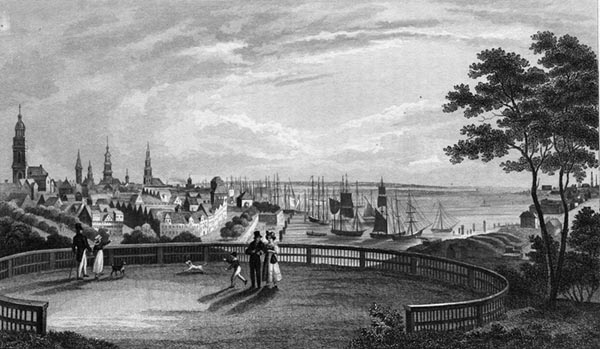
‘Hamburg’ - S. Davenport
Raw Pixel
When I reached my mother’s house,
She well-nigh shrieked with joy,
She clapped her hands together,
And cried: ‘My darling boy!’
‘My darling boy, thirteen years
Have swiftly passed us by,
You must be simply starving,
What will you take now? I
Have goose, and fish for you to eat,
And the oranges taste fine.’
‘Then give me goose, and fish to eat,
And those oranges shall be mine.’
And, as I quenched my appetite,
My mother, cheerful and happy,
Asked me this, and asked me that,
The questions sometimes tricky.
‘My dear child, in that foreign land,
Are you cared for properly?
Is your wife a good housekeeper,
Mending shirts and stockings neatly?’
‘Mother dear, this fish is good,
But should be eaten in silence,
Or one may get a bone in one’s throat,
And choke to death, mid-sentence.’
And when I’d finished the tasty fish,
The goose was served, large portions,
And she asked of this and that again,
Sometimes posing tricky questions.
‘My dear child, in which country
Do you find that life holds zest,
Here or in France, and which folk
Do you prefer? Who’s best?’
‘Mother dear, this goose is good,
But the French, dear mother,
Stuff their geese better than us,
And their sauces, too, are better.’
And when the goose made its farewell,
The oranges came on station,
Which tasted very sweet indeed,
Beyond all expectation.
But then my mother began again
To ask her difficult questions,
About a thousand things, and some,
Prompted further digressions.
‘My dear child, what are your views?
Are politics still your inclination?
To which party, do you now belong,
And is it by chance, or conviction?’
‘The oranges, dear mother, are good,
And to eat them is a pleasure;
I leave the bitter peel behind,
And swallow the juice at leisure.’
Note: Heine’s mother, Peira van Geldern (1771-1859), known as Betty, came from a family of considerable standing in the Jewish community. Her father, Gottschalk van Geldern (1727-1795), was a prominent physician. She was known for her intelligence and rationalism, and played a significant role in her son’s life.
Chapter XXI: Hamburg - Continued
Hamburg, which was half burned down
Is being rebuilt, though slowly.
Looking like a half-shaven poodle,
The city is somewhat gloomy.
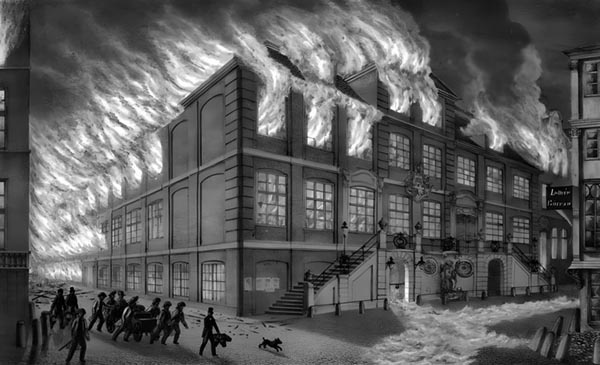
‘The Eimbeck House in Hamburg with the former Ratskeller during the Great Fire on the night of May 6th to 7th, 1842’ - Peter Suhr 1842
Wikimedia Commons
Many the vanished streets I miss,
And I grudge their disappearance.
Where’s the house where my first kiss
Was won? Marked down for clearance.
Where is the printshop where I
Printed my ‘Travel Pictures’
Where now the cellar in which
I swallowed my first oysters?
And the Dreckwall, where’s the Dreckwall gone?
I searched for it in vain.
Where’s the Pavillon, where I ate
All those cakes, for little gain?
Where’s the town hall, where the Senate
And citizens sat in state?
Prey to the flames! The holy of holies,
Has met with the common fate.
The people, full of fear still, sigh,
And, with melancholy gaze,
Tell me the dreadful tale
Of that vast and ruinous blaze.
‘The Great Fire flared in every corner,
Every church tower was a pyre,
Nothing but smoke and flames seen,
Till they fell with a crash; twas dire.
The old Stock Exchange has gone,
The Börse where our fathers stood,
Talked, and traded for centuries
There, as honestly as they could.
The Bank, the city’s soul of silver,
The books, in which, written plain,
Each man’s account’s recorded –
God be thanked, they still remain!
God be thanked, money was sent,
From even the furthest nations –
A fine thing – they collected
Seven million marks, in donations!
Funds from every country,
Into our hands were paid,
We accepted food and clothing too,
And never refused their aid.
They sent us bedding and beds,
As well as the bread and soup,
The King of Prussia even wanted
To send us a body of troops.
For the material loss, we received
Its full value, as estimated,
But for all one’s fear, one’s terror,
How can one be compensated!’
I said, sympathetically: ‘Dear friends,
You must help each other, in turn,
Troy was an even greater city,
And yet Troy, too, had to burn.
Dry the puddles of water,
Rebuild your houses once more,
Improve your fire-engines,
And revise the relevant law;
And don’t add too much cayenne pepper
To your mock-turtle soup, at that;
And a carp will damage your health,
Cooked, with the scales on, in fat;
While a turkey will do you no harm,
All the better, if it’s good and big;
Yet beware the treacherous bird,
That lays its egg in the mayor’s wig –
There’s no need, I think, to repeat
That fatal bird’s true name,
But I’m always sick to my stomach,
Whenever I think of that same.
Notes: The great fire of Hamburg in May 1842, destroyed about a third of the buildings in the Old Town. Heine’s ‘Reisebilder’ (‘Travel Pictures’) was published in 1826. The volume, covering four journeys, included ‘Die Harzreise’, which marked a new style in German travel-writing, mixing Romantic descriptions of nature with satire. The Dreckwall, now the Alter Wall, is a historic street in Hamburg’s Altstadt (Old Town), which was originally part of the city’s medieval fortifications, and where a community of Sephardic Jews settled. The treacherous and fatal bird is the Prussian eagle.
Chapter XXII: Hamburg - Continued
But even more than the city,
The people seem changed to me,
Going about, sad and broken,
A ruinous sight to see.
The lean ones are even leaner,
The fat ones seem fatter, even
The children seem old, the old
Have almost become children.
Many I left behind as calves
Have grown to be oxen too,
Many a little gosling it seems
Is a goose, and white of hue.
Old Gudel was wearing make-up,
I found, quite the Siren-like sight,
Having acquired curly black hair,
And teeth of a dazzling white.
While my friend the stationer
Was the best-preserved of all,
His hair, turned yellow, encircling his face,
Like John the Baptist, or Saul.
I caught only a glimpse of ***
As he passed, the former wit.
I heard his brain was scorched,
And twas Bieber had insured it.
And I saw my old Censor again,
Stumbling about with the rest,
In the Gänsemarkt, in the fog,
And seemingly very depressed.
We shook hands, and a tear
Welled up in the fellow’s eye.
How happy he was to see me again!
He was touched and so was I.
There were some I failed to find;
A number have passed away.
Oh, even my ‘Gumpelino’
Is gone, just the other day.
The noble fellow has breathed his last;
His great soul, free of flesh and bone,
Transfigured, as one of the seraphim,
Now flits round Jehovah’s throne.
And I searched for the crooked Adonis
Who sold items in porcelain,
And chamber pots, in the Hamburg streets,
But looked for him in vain.
Sarras, the faithful poodle, is dead,
A great loss! Campe would grieve
For the loss of a host of his authors
Less than that creature, I believe.
The State of Hamburg’s population
Since time immemorial, I’d say,
Has been part Jewish, part Christian;
Even the latter give little away.
The Christians are all virtuous,
They eat lunch heartily too,
And they pay their bill’s promptly,
Even before the date they’re due.
The Jews are once more divided,
Their denominations two;
The old attend the synagogue,
To the Temple, go the new.
The new eat pork, and are rebels,
Their instincts democratic,
The old are quite the opposite,
Their manners aristocratic.
I like the old, I like the new –
But, by the Lord God, I swear,
I like those little fish more,
Smoked sprats, eaten everywhere.
Notes: Georg Ehlert Bieber (1761–1845) founded the private Fire Insurance Association in 1795, which went bankrupt after the 1842 fire. Heine, and his publisher Julius Campe (1792-1867) who took over the Hoffmann and Campe publishing house in Hamburg in 1823, had frequent problems with the censor. The Gänsemarkt (Goose Market) is a public square in Hamburg’s Neustadt district. Lazarus Gumpel (1770-1843), Heine’s ‘Gumpelino’, was a merchant and founder of an association to provide housing for impoverished Jews.
Chapter XXIII: Hamburg - Continued
As a Republic, Hamburg was never
As great as was Venice, or Florence,
But Hamburg has better oysters; try
The cellar-bar owned by Lorenz.
It was a lovely evening when I
And Campe dined there together,
We wished to gorge ourselves,
On Rhine wine, and many an oyster.
There, we met with good company,
And amidst a host of others,
Old comrades, like Chaufepié,
And a handful of new brothers.
There was Wille, whose face
Is a record of all the blows
Legibly inscribed there
By his academic foes.
And there was Fuchs, a blind heathen,
An enemy of Jehovah,
Who only believes in Hegel,
And the Venus, perhaps, of Canova.
Campe was my Amphitryon;
Glowing, in deep delight,
Like a transfigured Madonna;
With bliss his eyes shone bright.
I ate and drank with appetite,
And truly felt, at that hour:
‘Campe’s a great man indeed,
Of publishers, he’s the flower.
Another publisher might
Have let me starve to death,
While he fills up my glass,
And toasts me, in a breath.
So, I thank the Lord, on high,
Who gave us the fruit of the vine,
And Joseph Campe, the publisher,
Who fills my glass with wine!
I thank the Lord, on high,
Who, thanks to his Creation,
Granted oysters to the sea,
And Rhine wine to our nation!
He also made lemons grow,
Of that there is no question,
To add flavour to the oysters.
Father, now spare me indigestion!
Rhine wine mollifies me,
Every hatred can remove
From my heart, kindling therein,
The need for human love.
It drives me out of the room,
Sets me wandering the street;
Soul needs soul, and seeks
Petticoats white as a sheet.
At such moments I well-nigh melt,
From wistfulness and yearning;
All the cats seem grey to me,
Every woman a Helen, burning.
When I came to the Drehbahn,
I saw in the moonlight there,
A noble woman, high-breasted,
A woman wondrously fair.
Her face was round, and blooming,
Her eyes were turquoise blue,
Her cheeks like roses, her lips like cherries,
Her nose of a reddish hue.
A cap of white starched linen
Was seated atop her hair,
Pleated like a mural crown
With turrets and towers to spare.
She wore a tunic, all white;
Down to her calves, its border.
And what calves! Those legs,
Were gems of the Doric order.
A most worldly naturalness
Could be seen in her features,
But her profile from the rear,
Set her above God’s creatures.
‘Welcome to the Elbe,’ she said,
Drawing near, and speaking my name,
‘After thirteen years away,
I can see you’re still the same!
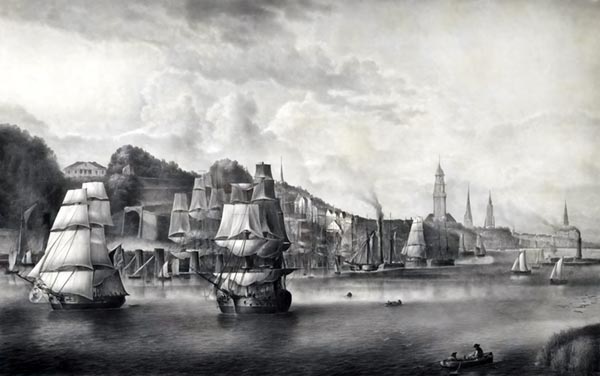
‘Hamburg from the Elbe’
Picryl
You seek the beautiful souls, perhaps,
That you often met, face to face,
And passed the night away with,
In this beautiful place.
Life has devoured the monster,
The hundred-headed Hydra,
You’ll not recover the old days,
Nor those you once chased after!
You’ll find those lovely flowers no more,
That your heart adored when young,
They bloomed – now, they’re withered,
The storm stripped the petals you sung.
Withered, and stripped, and trampled
Beneath the harsh feet of fate –
My friend, that is ever the lot,
Of the fair and sweet, soon and late!’
‘Who are you,’ I cried, ‘that gaze at me,
As if in an ancient dream made new.
Splendid woman, where do you dwell,
And may I accompany you?’
The woman smiled, and replied:
‘You’re in error, I’m refined,
A decent, and moral person.
You’re in error, I’m not that kind!
No, I’m no little mademoiselle.
No Parisian ‘lorette’,
I’m Hammonia, and a goddess,
And Hamburg’s protectress yet.
You seem startled now, and fearful,
You, the brave singer elsewhere.
Still wish to accompany me?
Well don’t stand wavering there.’
But I laughed aloud, and said to her:
‘Yes, I’ll follow you even so –
Go on, then, and I’ll follow.
Though it’s off to Hell we go!’
Notes: Heine, a Freemason, speaks of his ‘Brothers’. From Molière’s line ‘Le véritable Amphitryon est l’Amphitryon où l’on dîne,’ the name Amphitryon came to mean a generous host. The street, Drehbahn, in Hamburg, was named after the rope makers’ yards once located there. A ‘lorette’ was a 19th-century French prostitute, her status somewhere between the kept woman or courtesan, and the common grisette.
Chapter XXIV: Hamburg - Continued
How I mounted the narrow
Staircase, I hardly know;
Perhaps invisible spirits
Raised me up from below.
Once in Hammonia’s chamber,
The hours passed swiftly, she
Confessed a profound sympathy,
She had always felt for me.
‘You see,’ she said, ‘in former days,
To me that poet was dear
Who sang of the Messiah,
To his lyre; twas sweet and clear.
The bust of my dear Klopstock,
Is there on the dresser still,
Though its role is as a hatstand,
Not one it was meant to fulfil.
But you’re my darling now, your portrait
Hangs at the head of my bed,
And, as you see, a fresh laurel wreath,
Frames the picture, and your head.
But the way you scold my ‘sons’,
Sometime hurts me, I confess,
It must never happen again,
Or I’ll surely admire you less.
Hopefully time has cured you
Of that bad habit of yours,
And given you greater tolerance,
Even for fools, and boors.
But, given the wintry weather,
What, on earth, inspired the idea
Of a journey so far north
At the coldest time of year?’
‘O goddess mine,’ I replied,
‘In the human heart, lie deep
Those thoughts that, at the fatal hour,
Waken from silent sleep.
Outwardly, I seemed fine,
Yet I was troubled inside,
And the feeling grew daily,
A homesickness I’d denied.
The air in France, I thought so light,
Nonetheless, weighed heavy on me,
And I felt that to breathe more freely,
I needed to visit Germany.
I longed for the scent of peat,
And of German tobacco burning.
Once more, to tread German soil,
The soles of my feet were yearning.
At night, I sighed with longing,
To see that old woman again,
Who lives on Dammtorstrasse;
‘Lottchen’ lives near that same.
I even directed many a sigh
At that noble gentleman, he
Who was forever scolding,
Yet defended me, regally.
I wanted to hear the words:
‘Stupid youth,’ from his lips, once more.
They ever sounded like music,
Here, in my heart’s deep core.
I longed for the blue smoke rising
From German chimney-pots,
For Lower Saxony nightingales,
For the beech-groves’ quiet spots.
I even longed for those stations,
Sites of suffering and loss,
Where I wore my crown of thorns,
In my youth, and bore my cross.
I longed to weep, where I
Once wept the bitterest tears –
Such foolish longings are called
True patriotism, it appears.
I don’t like to speak of it;
It’s a kind of heart-sickness
I hide from the public gaze,
Ashamed of my weakness.
I dread the mindless rabble
Who to win hearts to their cause,
Display their patriotism
With all its running sores.
Those wretched shameless beggars,
Seeking to win alms
For Menzel, and his Swabians,
And nationalism’s charms!
My goddess, oh, you find me
In a softened mood today;
I’m somewhat ill; I’ll pause,
To recover if I may.
Yes, I’m ill, yet you might
Refresh my soul, in sum,
With a strong cup of tea –
And, perhaps, a drop of rum.’
Chapter XXV: Hamburg - Continued
She made some tea, and added rum,
To the cup she poured for me,
While she herself enjoyed the rum,
Dispensing with the tea.
She leant against my shoulder,
(Her cap, like a mural crown,
Thus, was slightly crumpled)
And said gently, with a frown:
‘I sometimes think with horror,
Of the life that, unsupervised,
You lead in less than moral Paris,
Midst those French; it’s ill-advised.
You wander there, without
Your publisher at your side,
A loyal German, who could act
As a mentor, and a guide.
The temptations there are great,
All those sylphs, and you’ll find
It’s unhealthy, all too easily,
One can lose one’s peace of mind.
Don’t go; remain with us, for here
Custom and discipline reign,
And many quiet pleasures,
In peace, and calm, obtain.
Remain with us, in Germany;
You’ll enjoy the life here more
Than you did; we’re making progress,
You’ll have noticed it, I’m sure.
The censorship is less severe,
Hoffman’s older now and milder,
And no longer seeks to mutilate
‘Travel Pictures’, in his anger.
You yourself are older, milder,
More adaptable, I’m sure,
And may even see the past
Far more clearly than before.
Yes, to claim that things were dreadful
Here is mere exaggeration;
As in Rome, by embracing suicide,
One could escape subjugation.
Freedom of thought was enjoyed;
Censorship only touched, if any,
Those young writers, few in number,
Who were published, not the many.
The law was never arbitrary
In pursuing what was vile;
The worst demagogue never lost
His citizenship without a trial.
It was not so bad, in Germany,
Despite the hardship seen at times,
In prison no one starved to death
Believe me, for their crimes.
In the past, there were so many
Shows of faith, midst the devout,
And sweet consolation flourished,
Not denial, as now, and doubt.
Freedom, in practice, will one day
Destroy the ideal, that we all bore
Within our hearts, which was as pure
As the lilies that, in dreams, we saw.
While even our loveliest poetry,
Is faded somewhat, and failing,
Freiligrath’s ‘Moorish Prince’, dies,
With every other prince and king.
Their grandsons will eat and drink
But not in quiet contemplation,
The spectacle goes rumbling by,
The idyll nears its termination.
If you could hold your tongue, I would
Unseal the book of fate for you,
And, in my magic mirror, show
All that will follow, clear and true.
What I’ve ne’er shown to mortal man,
To you would be rendered plain,
The future of our fatherland,
Could you silence but maintain!’
‘Dear God, O Goddess, my delight,
You can judge from my expression;
Show me the future Germany,
For I’ll be the soul of discretion.
I’ll swear, by anything you wish,
Any oath, my heart laid bare,
That will guarantee my silence;
So, tell me, how shall I swear?’
She replied: ‘Then swear to me
As Abraham made Eliezer swear,
When the latter, before his journey,
Swore, to guarantee the affair.
Lift my robe and place your hand
In that manner, beneath my thigh,
And swear that in speech or writing
You’ll keep silence till you die!’
A solemn moment! I felt the breath
Of antiquity; the air grew cold,
As I swore the oath she requested,
Like some patriarch of old.
I raised her robe, and placed my hand
In that manner, beneath her thigh,
And swore that in speech or writing
I’d keep silence; and shall, till I die!
Notes: Friedrich Gottlieb Klopstock (1724-1803) is best known for the poems ‘Der Messias’ (‘The Messiah’) and Die Auferstehung (‘The Resurrection’). Heine’s mother lived on Dammtorstrasse; his sister Charlotte (‘Lottchen’, 1800-1899) was married to a merchant, Moritz Embden. Heine’s uncle, Salomon Heine, was the ‘noble gentleman’ who helped him so generously. Wolfgang Menzel (1798-1873) the German poet, critic and literary historian was a proponent of German nationalism, and one of Heine’s greatest literary enemies. Friedrich Lorenz Hoffmann (1790-1871), as well as acting as censor, was also a jurist, attorney, and librarian. Ferdinand Freiligrath’s poem ‘Der Mohrenfürst’ (‘The Moorish Prince’) was published in 1838. Eliezer was the head of Abraham’s household who was sent to find a bride for Abraham, and on his behalf obtained the hand of Rebecca. In Genesis 24:2, Abraham instructs Eliezer to place his hand under his, Abraham’s, thigh to seal his oath.
Chapter XXVI: Hamburg - Concluded
The rum had risen to her crown,
I think, her cheeks glowed red;
Quietly, the goddess spoke to me,
In a melancholy tone, and said:
‘I’m growing old, I was born
When Hamburg came to be;
My mother was the Haddock Queen,
Where the Elbe joins the sea.
My father was an emperor,
Charlemagne was his name,
Greater than Frederick the Great
Of Prussia, and wiser I’d claim.
In Aachen is the chair he used,
At his coronation, no other;
While the one he used at night
The king left to his mother.
And she, in turn, left it to me,
A plain chair on which to sit,
But if Rothschild offered all his wealth,
I’d be disinclined to sell it.
It’s that old armchair in the corner,
Behold it, standing there;
The leather at the back is torn,
Moths laid the cushion bare.
But go and lift it from the seat,
And underneath the cushion,
You’ll see a round opening
For beneath it lies a cauldron.
It’s an enchanted pot, wherein
Magical potions brew;
If you stick your head in the hole,
The future’s revealed to you.
The future Germany you’ll see,
Phantasms will surge and rise,
And try not to shudder, when
Vile vapours sting your eyes!’
She said this, and laughed, strangely,
But, intrigued, I showed no fear,
And stuck my head in the dreadful hole,
Unsure what might appear.
What I saw I’ll not reveal,
I’ve sworn not to say a word,
I’m barely allowed to describe, my God,
The smell therein interred! –
I still think with deep disgust,
Of that first foul, accursed stink,
Like a vile mixture of muskrat
And old cabbage, I would think.
More dreadful was the smell, my God,
That rose next, to addle my wits,
Like that of the dung being drained
From thirty-six foul dung pits.
I recall when Saint-Just addressed
The Committee of Public Safety,
He said: ‘You can’t cure a cancer
With musk and with rose-oil, only.’
But the scent of the German future,
May have surpassed every smell
That my nose has ever sensed.
I could bear it no longer; I fell
Into a swoon, lost consciousness,
And when half-recovered at best,
Still sat by my goddess’ side,
My head leaning against her breast.
Her eyes glittered, her mouth glowed,
Her nostrils twitched; bacchanalianly,
She embraced her poet and sang
In a wild paroxysm of ecstasy:
‘Stay in Hamburg, for I love you;
We may drink and eat, as yet,
The wine and oysters of the present;
The dark future we’ll forget.
Replace that cushion, so the smell
Spoils not our joy while we’re together;
I love you, as much as any woman
Has loved her German poet, ever!
When I kiss you, I feel the thrill
Of your genius beside me;
A wondrous intoxication
Has gripped my soul entirely.
The night watch, now, I seem to hear
Singing in the street,
There are hymns, wedding music,
Dear companion, soft and sweet!
Now the mounted escort comes
Their torches shining bravely;
They jump, hop and wobble,
As they dance the torch-dance gravely.
The all-wise senators arrive,
And the elders, each by each;
The mayor clears his throat,
And desires to make a speech.
The diplomatic corps appear,
Offering their congratulations,
In the name of neighbouring states
With the usual reservations.
Here come the clerics too,
The rabbis and the pastors –
But, alas, there’s the censor;
It’s Hoffman with his scissors!
They’re clinking in his hand,
He moves around your body –
He snips away your flesh –
‘But that’s the best bit, surely!’
Notes: Charlemagne built a fortress, the Hammaburg, in 810AD, the precursor to the city of Hamburg. Louis Antoine Léon de Saint-Just 1767-1794), sometimes called the ‘Archangel of Terror’, was a French revolutionary, political philosopher, and president of the French National Convention.
Chapter XXVII: Epilogue
What other things occurred
Upon that wondrous night,
I’ll tell you some other day
When summer skies shine bright.
The former, hypocritical
Generation’s disappearing,
Thank God, its lies have killed it;
Into the grave it’s sinking.
A new generation’s rising,
Free of artifice and sin,
With free thoughts, free passions;
I’ll tell them everything.
Already there are youngsters
Who embrace the poet’s diction,
His kindness, pride, warm heart,
And sunny disposition.
My heart is kindly as the light,
And chaste and pure as fire,
The noble Graces have tuned
The seven strings of my lyre.
The same my ‘master’ played
Thrice-blessed Aristophanes,
The darling of the Muses,
Who divined the mysteries.
It is the very lyre on which
He sang of Pisthetaerus,
Who courted Basileia,
And soared so high above us,
In the previous chapter, I tried
To imitate, in many ways,
The ending of ‘The Birds’,
The best of my master’s plays.
‘The Frogs’ is also excellent,
Played, in German, every night,
On the Berlin stage, it seems
To the King’s great delight.
His Majesty loves the play,
His artistic leanings showing;
His father was more amused
By modern ‘frogs’ a-croaking.
If Aristophanes were here,
He’d be in a plight, poor man,
A whole choir of police,
Would soon enforce a ban.
The mob would be encouraged
To curse him, not applaud
And the officers commanded
To send him back abroad.
O king, I do mean well by you,
So, here’s some good advice,
If you honour the dead poets,
Spare the living, and think twice!
Don’t insult those now alive,
We’ve better weapons than you,
More dreadful than Jove’s lightning,
Which the poets created too.
Insult the gods, new and old;
Scorn Olympus, next the sky,
But don’t scorn the poets, save it
For Jehovah, up on high!
The gods punish humans harshly,
For our sins, since that’s our lot;
In Hell one roasts and stews,
Since Hellfire is quite hot.
But there are saints who pray,
For the sinners in the fire;
Through donations, shrines, and masses,
One salvation may acquire.
And then, at the end of days,
Christ will break the gates of Hell,
And though his Judgement’s strict,
He’ll free many a soul, as well.
Yet there are hells from whose depths
There is no liberation,
Prayer’s vain, and the Redeemer
Has no power to save the nation.
Do you know Dante’s Inferno,
Those dread circles of dead souls?
Those whom the poet set there,
Can’t escape its burning coals.
No saviour can deliver them,
No god, from scorching flame!
Beware, then, lest some poet,
Condemns you to that same!
Notes: The Latin Camenae (in Heine’s text) were identified with the Greek Muses. The standard classical lyre had seven strings. In Aristophanes play ‘The Birds’, Zeus gives Basileia, who is his universal agent, in marriage to the main protagonist Pisthetaerus. Berlin was the Prussian capital. The King of Prussia at the time was Frederick William IV (1795-1861), his father Frederick William III, born in 1770, had died in 1840.
End of Part III, and of Heinrich Heine’s ‘Deutschland: Ein Wintermärchen’