Johann Wolfgang von Goethe
Italian Journey (1786-88)
Part III: From Verona to Venice
Translated by A. S. Kline © Copyright 2026 All Rights Reserved
This work may be freely reproduced, stored and transmitted, electronically or otherwise, for any non-commercial purpose. Conditions and Exceptions apply.
Contents
From Verona to Venice
Verona
September 16th.
The amphitheatre (the Arena) is the first significant monument of antiquity that I have seen, and how well-preserved it is! When I entered it, and even more so when I walked around the top tier, it seemed strange to me to be viewing something grand, and yet in truth it seemed nothing at all. It was not meant to be seen when empty, but rather full of people, as it was more recently in honour of Joseph II and Pius VI (Pius VI was in Verona in May 1782, having met the Holy Roman Emperor Joseph II in Vienna). The emperor, though accustomed to encountering large crowds, is said to have been astonished. But it achieved its full effect only in ancient times, when the people were more of an entity than now. For such an amphitheatre is actually designed to impress the crowd with their own numbers, to allow them to be, themselves, the source of their entertainment.
When a spectacle is presented on flat ground, everyone presses forwards to see, those at the back seeking, by every means available, to climb above those at the front: they step onto benches, mount barrels, stand on wagons, lay boards to and fro, or occupy a neighbouring hill, surrounding the crater formed in the centre, in the process.
If such a spectacle occurs often, in the same spot, light scaffolding and platforms are usually erected for those who can pay, while the rest of the crowd must make do as they please. Satisfying the general need was the architect’s task here. He prepared such a crater through art, as simply as possible, so that the people themselves might act as its ornamentation. Seeing themselves gathered together in this way, they were bound to marvel at themselves en masse. Otherwise accustomed only to seeing themselves wandering about in a confused manner, amidst a tumult, without order or particular discipline, that many-headed, many-minded, wavering, wandering creature, the people, now saw itself united in a single and noble body, a single entity, destined to be bound and fixed in form, and animated by one spirit. The simplicity of the oval shape is pleasing to every eye, and each person serves as a measure of the immensity of the whole. Now, seeing it empty, one has no standard by which to judge it; one cannot judge whether it is large or small.
The people of Verona deserve praise for the upkeep of the monument. It is built of reddish marble, which is susceptible to weathering, so the eroded steps are constantly being repaired, and almost all appear brand new. An inscription commemorates Hieronymus Maurigenus (Girolamo Maurigeno) and the incredible diligence he devoted to the task. Only a section of the outer wall remains, and I doubt it was ever fully completed. The lower arches, which open onto the large square called Piazza Brà, are rented out to craftsmen, and it is pleasant to see these vaults bustling with activity once again.
Verona, September 16th.
The most beautiful city gate, though always closed, is called Porta Stupa or Porta Palio. As a portal, given the distance from which it is visible, it is poorly designed; only close to does one recognise the merit of the edifice.
All sorts of reasons are given as to why it is kept closed. However, my suspicion is that the artist’s intent was to create a new promenade leading to this gate, since it is misaligned with the current street. The left side of the area is nothing but barracks, and a horizontal line from the gate’s centre points towards a nunnery, which would have had to have been demolished. This was doubtless recognised, and the wealthy and prominent citizenry likely had no desire to reside in this distant quarter. Perhaps the architect died, and the gate was closed, thus ending the project abruptly.
Verona, September 16th.
The portico of the theatre (Teatro Filarmonico), with its six large Ionic columns, is quite imposing. All the less so, therefore, is the life-size bust, of the Marchese Scipione Maffei wearing a large wig, positioned above the door in a painted niche supported by two Corinthian columns. The location is honourable, but to hold its own against the size and grandeur of the columns, the bust would have had to be colossal. As it is, it perches, modestly, on a small corbel, quite out of harmony with the rest of the structure.
The gallery enclosing the forecourt is also rather small, and the fluted Doric columns look like pitiful dwarfs next to those smooth-faced Ionic giants. But one should forgive the fact, in light of the fine display of objects arranged beneath these colonnades. Here, antiquities, unearthed mostly in and around Verona, have been gathered and mounted. Some are said to have been found in the amphitheatre itself. They include Etruscan, Greek, and Roman artefacts, dating back to the early periods, and also some more recent ones. The bas-reliefs are embedded in the walls and marked with the numbers Maffei gave them, when he described them in his work ‘Verona Illustrata’ (published 1731). There are altars, fragments of columns, and similar remains; including a truly excellent tripod of white marble, upon which stand engaged genii with the attributes of gods. Raphael imitated, and embellished, similar motifs within the spandrels of the Villa Farnesina (in Rome).
The breeze blowing from the graves of the ancients carries a sweet perfume, as if from a hill of roses. The gravestones are designed with warmth and are touching, ever evoking life. Here is a man, beside his wife, looking out from a niche as if from a window. There a father and mother, their son between them, gazing at each other with ineffable naturalness. Here a couple clasps hands. There a father, reclining on a sofa, is seemingly being entertained by his family. The presence and immediacy of these headstones deeply moved me. They are of a later period of art, but simple, natural, and universally appealing. Here are no armoured knights on their knees awaiting a joyful resurrection. The artists, with varying degrees of skill, have depicted the simple reality of people, thereby continuing and preserving their existence. They neither fold their hands, nor look up to heaven, but, here below, are what they were, and as they were. They stand together, sharing in each other’s lives and loving each other, and this is charmingly expressed by the images on the gravestones, even if a certain lack of craftsmanship is evident. A very richly decorated marble pillar also aroused new concepts of art in me.
As commendable as this exhibition is, it is evident that the spirit of noble preservation that initiated it no longer lives within. The precious tripod will soon perish, since it is free-standing and exposed to the elements on its western side. A wooden case would easily protect this treasure.
Had the unfinished palace of the Proveditore (civil administrator) been completed, it would have granted Verona a fine piece of architecture; otherwise, the nobility is raising new buildings, on an extensive scale, though unfortunately, each member is utilising the site of their previous residence, often in a narrow alleyway. Thus, a magnificent facade for a new seminary is being built in a lane in the most remote suburb.
As I was passing by the grand, solemn gate of a magnificent building, with a guide whom I had met by chance, he asked me if I would kindly step into its courtyard for a moment. It was the Palace of Justice (the Palazzo della Ragione, late twelfth century) and because of the building’s height, the courtyard appeared like an immense well. ‘Here,’ he said, ‘all the suspects and criminals are housed.’ I looked around, and saw that on every floor, open corridors with iron railings led to numerous doors. A prisoner, as he emerged from his cell to be led to his interrogation, was obliged to stand in the open air, exposed to everyone’s gaze; and since there were likely several interrogation rooms, the chains rattled first down one corridor, then another, floor by floor. It was an unpleasant sight, and I don’t deny that the good humour with which I formerly dealt with my fellow ‘Birds’ (in his theatre production of the Aristophanes’ play) would have likely been found lacking here.
I walked along the rim of the craterlike amphitheatre at sunset, enjoying the most beautiful view over the city and surrounding area. I was completely alone, and below on the broad stones of the Piazza Brà, crowds of people strolled: middle-class women, and men of all classes. From this bird’s-eye view, the former, in their black clothing, looked almost mummified. The zendale (cape, or shawl) and the veste (dress), which serve them in place of all other outer garments, form a costume entirely suited to those who often care little about cleanliness, yet always wish to appear in public, whether attending church or out for a stroll. The veste is a black taffeta gown which is worn above underskirts. If the woman has a clean white one underneath, she contrives to lift the black one at one side. This is fastened with a belt in such a way that it cuts off at the waist and covers the lappets of the corset, which can be of any colour. The zendale is a large hooded shawl (often of satin and lace), the hood itself raised high above the head on a wire frame, while the shawl is tied around the body like a sash, the ends falling down behind.
Verona, September 16th.
As I was walking away from the Arena today, I viewed a modern spectacle taking place a few hundred yards away. Four noblemen from Verona were playing ball (pallone) against four from Vicenza. The Veronese customarily form teams among themselves, and play for about two hours before nightfall throughout the year; on this occasion, because their opponents were from elsewhere, the crowd was extremely large. There must have been four to five thousand spectators there, at any one time. I saw no women from any social class.
Earlier, when I spoke of meeting the crowd’s needs in such a situation, I described the formation of a natural, and accidental amphitheatre, as the people gathered in ranks and tiers. I could already, from afar, hear lively applause accompanying every significant blow. The game proceeds as follows: two gently sloping boards are erected at a suitable distance from each other. The player striking the ball stands at the top of the board at his end, his right hand armed with a broad, wooden, spiked ring. Another player from his side tosses the ball towards him, and he runs down to meet it, thereby increasing the force of his blow. The opponents seek to return it, and so it goes back and forth, until the ball finally comes to rest on the ground. The most beautiful poses, worthy of being immortalised in marble, are revealed. Since they are all well-built, vigorous young men, dressed in short, crisp, white clothing, the sides are distinguished only by a coloured badge. Particularly fine is the pose which the striker adopts as he runs down the sloping surface, and prepares to strike the ball; it resembles that of the Borghese Gladiator (the Hellenistic life-size sculpture, in the Louvre).
It struck me as odd that they were performing this exercise on the old city wall providing not the slightest ease for the spectators; why did not they perform it in the amphitheatre, where there would be ample room!
Verona, September 17th.
What I have seen of the paintings here, I will only touch on briefly, while adding a few observations. I am not undertaking this wondrous journey under any illusions as to my degree of knowledge, but rather to learn about the objects I view; therefore, I tell myself that, frankly, I understand little about the art and the craft of painting. My attention, my observation, must therefore be directed toward the resulting aspect, the subject matter and its treatment in general.
The Church of San Giorgio (Chiesa di San Giorgio in Braida) contains a gallery of fine paintings; all the altarpieces, though not of equal worth, are nonetheless remarkable. But those unfortunate artists, what subjects they were obliged to paint! And how! A shower of manna, perhaps thirty feet long and twenty high! The miracle of the five loaves as its counterpart! (Paolo Farinati and Felice Brusasorzi, respectively, painted the two large canvases of the ‘Multiplication of the Loaves and Fishes’, and ‘Manna in the Desert’) What was there worth depicting? Hungry people devouring tiny grains, and countless others being presented with bread and fish. The artists strained to make such meagre elements significant. And yet, spurred on by necessity, genius produces beautiful works. One artist (Giovan Francesco Caroto), tasked with depicting Saint Ursula and the Eleven Thousand virgins, accomplished the task with great intelligence. The saint stands in the foreground, as if she has triumphantly taken possession of the land. She is very noble, an Amazonian virgin, lacking all charm; one sees her throng, diminished by distance, disembarking from the ships, and approaching in procession. Titian’s ‘The Assumption of the Virgin’ in Verona cathedral is quite blackened; the idea of depicting her as an incipient goddess not look heavenward, but down at her friends, is commendable.
In the Gallery of the Palazzo Gherardini, I found some very beautiful works by L’Orbetto (Alessandro Turchi) and became instantly acquainted with this deserving artist. From afar, one only learns about the most prominent artists, and one is often content merely to know their names; but when one approaches the starry firmament, and those lights of the second and third magnitude also begin to shimmer, each emerging as an individual element of the entire stellar configuration, then the universe becomes vaster and art richer. I must commend the concept behind one of his paintings here. Just the two main figures. Samson has fallen asleep in Delilah’s lap; she quietly reaches out for a pair of scissors lying on the table next to the lamp. The execution is very skilful. I noticed a Danaë in the Palazzo Canossa (Turchi treated this subject; see the painting in the Royal Collection, England).
The Palazzo Bevilacqua contains the most exquisite things. A so-called ‘Paradise’ by Tintoretto (see the smaller ‘Paradise’ version in the Louvre), actually a ‘Coronation of the Virgin’ as Queen of Heaven in the presence of all the patriarchs, prophets, apostles, saints, and angels, etc., provided that genius with a happy opportunity to develop the full richness of his art. The lightness of the brushwork, the intelligent execution, the variety of expression — to admire and rejoice in all this, one would need to own the piece oneself, so that it would be available to one’s eyes for a lifetime. The background stretches to infinity; indeed, even the furthest cherubs, disappearing in glory, still possess character. The largest figures in the mid-ground may be a foot high, Mary and Christ, higher up, the latter placing the crown upon her head, about four inches in height. Eve is however the most beautiful woman in the picture, a little voluptuous as depicted from time immemorial.
A few portraits by Paolo Veronese (born in Verona) have only increased my admiration for that artist. The collection of antiquities is magnificent, a reclining son of Niobe is delightful, the busts, despite their restored noses, are mostly highly interesting, including an Augustus with the civic crown, a Caligula, and others.
It is my nature to venerate, willingly and joyfully, all that is great and beautiful; to cultivate this inclination day after day, hour after hour, through appreciating such magnificent objects, is the most blessed of all feelings.
In a land where people enjoy the daytime, but especially rejoice in the evening, nightfall is of the utmost importance. Then work ceases, and the stroller returns, the father wishes to have his daughter home again, the day has reached its end; yet what daylight truly is, we Cimmerians scarcely know. Living in the perpetual fog and gloom of the North, it is all the same to us whether it is day or night. For, how many hours can we truly roam and enjoy ourselves beneath the open sky? As soon as night falls here, the day, which consisted of morning and evening, is definitively over, twenty-four hours have passed, a new chapter begins, the church bells ring, rosaries are lifted in prayer, and the maid enters one’s room with a lighted candle and says: ‘Felicissima notte!’ The length of evening changes with the season, and anyone who lives their life here is never disoriented, since the enjoyment of their whole existence is based not on the hour, but on the point of day attained. If one were to impose German clocks for timekeeping on the people, it would only confuse them, for their own clock is an intimate feature of their inner nature. An hour and a half, or an hour at least, before nightfall, the nobility set forth, heading towards the Piazza Brà, and the long, wide road leading to the Porta Nuova, and then out through the gate, along the edge of the city; then, as night falls, the process reverses. Some drive to church to say their ‘Ave Maria della Sera,’ others keep to the Piazza Brà, the gentlemen approaching the carriages to converse with the ladies, and so it goes on for quite some time; I have never been the last there; pedestrians linger well into the night. Today, just enough rain had fallen to wash away the dust; it was truly a lively and cheerful sight.
To further align myself with local custom in an important aspect, I have devised a method to comprehend, more readily, their reckoning of time. The following diagram may give an idea of this.
COMPARATIVE TABLE OF GERMAN AND ITALIAN TIME,
WITH THE HOURS OF THE ITALIAN SUN-DIAL. FOR THE LATTER
HALF OF SEPTEMBER.
MID-DAY.
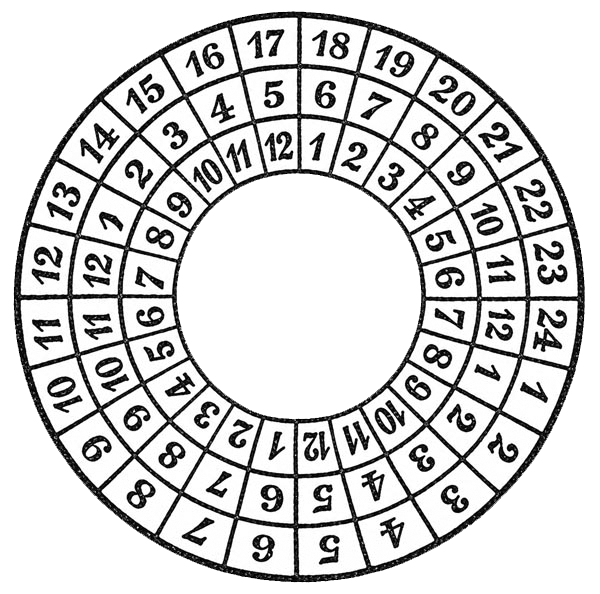
‘Comparative table of German and Italian time’ - Johann Wolfgang von Goethe (German, 1749–1832)
Project Gutenberg
MIDNIGHT.
January
July
The inner circle represents our twenty-four hours from midnight to midnight, divided into the two sets of twelve, as we number them, and as our clocks depict them. The middle circle indicates when the church bells strike here at this time of year, namely also twice twelve in twenty-four hours, but in such a way that it strikes one here when it would strike eight at home, and so on, until twelve is reached. At eight in the morning, according to our clock, it strikes one again here, and so on. The outer circle finally shows how one reckons the twenty-four hours in actuality. For example, if I hear the seventh hour strike, at night and know that midnight is at five, I subtract that number from the previous one, and thus I have two hours past midnight. If I hear the seventh hour strike during the day and know that noon is also at five, I proceed in the same way and have two in the afternoon. If I want to express the hours in the local way, I must know that noon is seventeen o’clock, to which I add two, and say nineteen o’clock.
When one first hears about and considers all this, it seems extremely confusing and difficult to execute; however, one soon becomes accustomed to it and finds this activity entertaining, just as the people here delight in such constant back-and-forth calculations, like children working a simple problem. Their fingers are always waving in the air anyway, they calculate everything in their heads, and enjoy working with numbers. Furthermore, the matter is so much easier for those born here, because they rarely concern themselves with noon and midnight and do not, as the foreigner in this country does, have to compare clocks. They simply count the hours from evening onward as they strike; during the day, they add the number to the alternating noon number they know. The table accompanying the diagram explains the rest.
Verona, September 17th.
The people here bustle about; especially in various streets where the shops and workshops stand side by side, the scene is lively. There is scarcely a closed door; the entire width of each of the premises stands open, and you can see to the rear, and observe everything taking place within: tailors sewing, shoemakers pulling leather and hammering, all half in the street; indeed, the workshops make up part of the street itself. In the evenings, when the lights are on, it appears truly vibrant.
The squares are packed on market days, with vegetables and fruit everywhere one looks, garlic and onions as plentiful as one can imagine. And then, they shout, jest, and sing all day long, throwing things, and wrestling, while cheering, and laughing incessantly. The mild climate, and the low food prices, allow them to live easily. Everything possible, takes place outdoors.
At night the singing and noise reach full volume. The ballad of ‘Malbrook’ (‘Malbrough s’en va-t-en guerre’) can be heard on every street, then the sounds of a dulcimer, or a violin. They practise birdsong on a flute. imitating every kind of bird. The most wondrous sounds burst forth everywhere. Such a climate lends a heightened sense of existence even to poverty, and the very shadow of the people seems venerable.
The striking uncleanliness of the houses and a lack of home-comforts, stems from this: they are always outdoors, and in their casualness, lack thought. Everything is fine and good to the commoners; even the middle class live from one day to the next, while the rich and noble alone lock themselves away in their apartments, which are certainly not as comfortable as those of the North. They hold their gatherings in public meeting houses. The courtyards and colonnades are all squalid, and everything is done there, and in the most natural way. The people are always on guard as to their rights. The rich may be rich, and build palaces, the nobleman may rule, but if a colonnade or a courtyard is constructed, the people soon employ it for their own needs, and they seem to have no greater desire than to rid themselves as quickly as possible of what they have consumed, and do so as frequently as possible. If any man objects to this, he is ill-advised to try and play the great lord; rather, he is obliged to act as if part of his building belongs to the public. He must simply close his door, and act as if all is perfectly fine. The people will not allow their rights to be limited as regards public buildings, leaving foreign visitors throughout Italy to complain about the fact.
Today, on various routes through the city, I observed the dress and manners, of the middle class especially, who are frequently present and busily occupied. They swing their arms as they walk. People of higher rank, who carry a sword on occasion, only swing the one arm, because accustomed to keeping their left arm still, and at the ready.
Although the people go about their business, and address their needs, most casually, they still keep a sharp eye on everything foreign in appearance. During the first few days, I noticed that everyone was gazing at my boots, since they are considered expensive items, and are scarcely worn even in winter. Now that I am wearing shoes and stockings, they no longer stare at me. But I noticed this morning, as they were all bustling about with their flowers, vegetables, garlic, and other market goods, that none of them failed to notice the cypress branch I was carrying. A few green cones hung from it, and next to them I held some caper twigs in flower. They all, young and old, looked at what I was holding, and seemed full of curiosity.
The branch and twigs I collected in the Giusti Gardens, which are in a splendid location, and contain tremendous cypress trees, pointing skyward, like spikes. The yew-trees trimmed to a point in Nordic gardens are doubtless imitations of these magnificent products of Nature. A tree whose branches, from bottom to top, the oldest as well as the youngest, seek the heavens, and which lives three hundred years or more, is surely worthy of veneration. Considering the time since the garden was laid out, these trees have already reached a great age.
Vicenza
September 19th.
The road here from Verona was very pleasant. One travels north-east following, to one’s left, the foothills of the mountains, which are composed of sand, limestone, clay, and marl. On the slopes are sited villages, castles, and houses. To the right, the wide plain, through which one is travelling, stretches some distance. The broad, straight, well-maintained road leads through fertile fields. One can see dense rows of trees on which the vines are trained upwards, to cascade down as if they were aerial branches. The idea of festoons must have been derived from this! The grapes mature early, and weigh down the long, swaying vines. The road is full of people of every kind and trade. I was particularly taken with the carts with low, saucer-shaped, solid wheels, which, drawn by four oxen, pull large trough-like carts in which the grapes are brought from the vineyards to be pressed. When empty, the drivers stand inside, and the whole line resembles a Bacchic triumph. Between the rows of vines, the land is used to grow various types of grain, especially buckwheat and sorghum.
As one approaches Vicenza, the hills rise to north to south; they are said to be volcanic and enclose the plain. Vicenza lies at their foot, cradled, if you will, in the hollow that they form.
Vicenza, September 19th.
I arrived here a few hours ago, and have already walked about the city, and viewed the Teatro Olimpico and other buildings designed by Andrea Palladio. A very nice little book with engravings has been published for the convenience of visitors, accompanied by an insightful text on the architecture. Seeing these works in person, one truly appreciates their great worth; for they are meant both to fill the eye with their sheer physical size, and to satisfy the mind with the beautiful harmony of their dimensions, not only in abstract elevations and sketches but displaying the entire interplay of distance and perspective. And so, I say of Palladio: he was a truly great man, in what he achieved outwardly, and within. The greatest difficulty with which he, like our modern architects, had to contend, is the appropriate use of the columnar orders in civic architecture; combining columns and walls always contains a contradiction. How well he integrated them, how greatly the presence exhibited by his works impresses such that one is almost persuaded by his various solutions! There is truly something divine in the power of his designs, entirely like that of a great poet who creates a third realm woven of truth and falsehood, the conjured existence of which enchants us.
The Olympic Theatre is a theatre like those of the ancients, realised on a smaller scale and indescribably beautiful, but compared to ours it seems to me like a rich, genteel, well-educated child compared to a clever, worldly adult who, though neither as rich, nor genteel, nor as well-educated, has a better understanding of what can be achieved in accord with his means.
When one considers here, in situ, the magnificent buildings that this one man erected, and sees how they are fouled by people’s narrow, squalid needs, how his projects were mostly beyond the builders’ capabilities, how little these exquisite monuments of a noble human spirit reflect the lives of the population, it occurs to one that it is much the same in other fields of endeavour. One earns little gratitude from people when one seeks to elevate their inner needs, to give them a greater idea of themselves, to make them feel the splendour of truly noble existence. But if one lies to the ‘birds’, fills their heads with fairy tales, assists them in their day to day lives, and in the process worsens their lives, then one is theirs, and that is why our modern age takes such delight in tastelessness. I do not say this to belittle any of my friends, I am only saying that this is how they behave, and that one should not be surprised that everything is as it is.
How the Basilica Palladiana connects to, and contrasts with, the older, castle-like building beside it, riddled with unequally sized windows, which the architect surely envisioned as absent, along with its tower, is impossible to describe, though I must try to compose my own work (Faust Part II) in an equally new manner; for here too, alas, I find exactly what I am fleeing from (the Romanticism of Faust Part I), and what I am seeking (the Classical World), side by side.
September 20th.
Yesterday there was opera; the performance lasted until after midnight, and I longed for my bed. ‘The Three Sultanas’ (‘Les Trois Sultanes’, a 1761 musical comedy by Charles-Simon Favart) and ‘The Abduction from the Seraglio’ (‘Il Seraglio’, Mozart’s ‘Die Entführung aus dem Serail’, of 1782) provided the scraps from which the piece was, rather ineptly, stitched together. The music sounded pleasant enough, but was probably composed by an amateur — since it contained nothing new or surprising to me. The ballets, on the other hand, were delightful. The lead couple danced an allemande so gracefully that no has ever seen anything more elegant.
The theatre is new, charming, beautiful, modestly splendid, and uniform throughout, as befits a provincial town; each box has its own hangings of the same colour, those of the Capitano Grande distinguished only by their slightly longer length.
The prima donna, much favoured by the entire crowd, was applauded tremendously as soon as she appeared, and the ‘birds’ behaved in a quite unruly manner, full of joy whenever she executed something well, which apparently was a frequent occurrence. She is a person with a natural manner, a pretty figure, a beautiful voice, a pleasing face, and a modest demeanour; though the movements of her arms could do with being a little more graceful. However, I shall not repeat the experience; I feel I have been corrupted to the point of becoming a ‘bird’ myself.
September 21st.
Today I visited Dr. Antonio Turra (a prominent physician, botanist, and naturalist). For about five years, under the previous bishop, he devoted himself, passionately, to botany; creating his herbarium of Italian flora, and establishing a botanical garden. But all that is over with now. Medical practice drove out Natural History, the herbarium is infested with worms, the bishop is dead, and the botanical garden, which is as good as, is once again planted with cabbage and garlic.
Dr. Turra is a very fine and good man. He told me his history with frankness, purity of heart, and modesty, and spoke very confidently and pleasantly, but he had no desire to open his specimen cabinets, which were likely not in a presentable state. Our conversation soon stalled.
September 21st, in the evening.
I went to see the old architect Ottavio Bertotti Scamozzi, who has published an edition of Palladio’s work (‘Le Fabbriche e i Disegni di Andrea Palladio Raccolti e Illustrati’, ‘The Buildings and Designs of Andrea Palladio Collected and Illustrated’, 1776-83) and is a worthy, and passionate artist. He offered me some guidance, being pleased by my interest. Among Palladio’s buildings is one (Casa Cogollo) for which I have always had a particular fondness; it is said to have been his own residence. But up close, there is far more than one can see in the paintings depicting it. I would like to have drawn it, and illuminated the drawing with colours showing the material used and the effects that time has produced. But do not think the architect built himself a palace. It is the most modest house in the world, with only two windows on the first floor, separated by a wide space that could easily accommodate a third. If one were to recreate it in a painting, with the neighbouring houses also depicted, it would be delightful to see how it nestles among them. Canaletto should have done so.
Today I visited a magnificent house designed by him called the Rotonda (Villa la Rotonda, Villa Almerico Capra Valmarana), situated half an hour from the city, and at a pleasant height. It is a square building enclosing a circular hall illuminated from above. On each of the four sides, one can ascend a broad staircase, leading to a portico formed by six Corinthian columns. Architectural luxury has never reached greater heights, perhaps. The space occupied by the staircases and porticoes is far greater than that of the house itself; since each side might supply a satisfactory front facade for a temple. Inside, it can be called habitable, but not comfortable. The hall is of the most beautiful proportions, as are the rooms; but they would hardly suffice for the needs of a decent-sized family during a summer stay. However, it presents a most splendid appearance to the district, from every angle The variety with which its main mass, together with the projecting columns, offers itself to the eyes of passers-by is great, and the owner’s intention was perfectly achieved: he wished to leave behind a large estate in trust, and at the same time a tangible monument to his wealth. And just as the building is seen in all its splendour from all points of the compass, so too the view from it is most pleasing. One can see the course of the River Bacchiglione, bearing vessels from Verona downstream towards the River Brenta; and can survey the extensive possessions that the Marchese Capra wished to keep intact within his family. The inscriptions on the four pediments, which together comprise the following whole, deserve to be recorded:
Marcus Capra Gabrielis filius
qui aedes has
arctissimo primogeniturae gradui subiecit
una cum omnibus
censibus agris vallibus et collibus
citra viam magnam
memoriae perpetuae mandans haec
dum sustinet ac abstinet.
Marco Capra, son of Gabriele,
who this edifice
has subjected to the strictest primogeniture,
together with all
the censuses, fields, valleys, and hills
this side of the high road,
bequeathing them to perpetual memory,
bears and forbears the while.
The last line is particularly intriguing: a man who possessed so much wealth and power still feeling that he must ‘bear’ and ‘forbear’ the use of all this. The lesson could have been learned with less effort.
September 22nd.
This evening, I attended a meeting held by the Academy of Olympians (The Accademia Olimpica, founded in 1555, dedicated to promoting science, arts, and the humanities.) A bit lightweight, but rather fine, in its way; it maintains a certain spark of intellectual life among the people. A large hall (the Odeo) next to Palladio’s theatre, was decently lit, the Capitano and a few of the nobility were present, with a well-educated audience, many of them clergy, amounting to about five hundred persons in total.
The question posed by the President for the evening session was whether invention or imitation had delivered more benefit to the fine arts. The subject was quite well-chosen; since if one debates the alternatives inherent in the question, one could argue back and forth for a hundred years. Also, the academicians had made ample use of the opportunity, and produced a variety of works in prose and verse, much of it of a decent quality.
The audience was most lively. The listeners cried ‘Bravo!’, laughed, and applauded. If only one could stand before one’s entire nation like that, and entertain it personally! We are obliged to compose our best work in literary form: then each reader must curl, up in a corner with it and grapple with it as best they can.
As one can imagine, Palladio’s name was mentioned at every turn on this occasion too, whether the discussion revolved around invention or imitation. At the end, where a few humorous remarks are always called for, one academician had a bright thought, claiming that the others had left him nothing more to say as regards Palladio, so he would instead speak in praise of Franceschini, the great silk manufacturer, instead (Palazzo Franceschini Folco, designed by Ottavio Scamozzi, was built in 1770 on behalf of Giovanni Franceschini a famous silk weaver, and his brother Girolamo.). He then sought to demonstrate the advantage the imitation of Lyon and Florentine fabrics had brought this capable entrepreneur and, through him, the city of Vicenza, proving that imitation was far superior to invention. And this was done with such good humour that it aroused continual laughter. In general, those who spoke in favour of imitation received more applause; for they said only what the mass of people thinks and is capable of. At one point, the audience gave enthusiastic applause to a somewhat crude sophism, having failed to appreciate many good, indeed excellent, things said in honour of invention. Nonetheless, I am most pleased to have witnessed the debate, and it was most gratifying to find Palladio, after so many years, still revered by his fellow citizens as a guiding star and their role model.
September 22nd.
This morning, I was at Thiene, which lies north of Vicenza towards the mountains, where a new building is being erected according to an old plan, for which something might be said. Here, everything from the good old days is honoured, and it makes perfect sense to build a new structure based on an inherited design. The castle (the Palazzo or Villa, Porto Colleoni Thiene) is perfectly situated in the plain, the limestone Alps rising behind it without the distraction of any intermediate hills. From the building, alongside the perfectly straight road, water flows on both sides, irrigating the vast rice paddies through which one travels.
I have only seen two Italian cities so far, and spoken to a few people, but I already know my Italians well. They are like courtiers, who think themselves the foremost people in the world and, owing to certain undeniable advantages, can indulge themselves with impunity, and at their ease. To me, the Italians seem rather a fine nation: one only has to look at the children, and the ordinary folk, as I now see them, and can observe them, since I am constantly exposed to their presence, and constantly avail myself of it. What characters, what faces, there are!
I must especially praise the Vicentines, for they offer the benefit of a large city. No one stares at you, and you can keep to yourself; yet if you approach them, they are talkative and charming, and I find the women particularly appealing. I would not wish that to seem a criticism of the Veronese women, who are well-educated with strong personalities; but they are mostly pale, and the zendale does them a disservice, since one forever seeks an attractive figure beneath the beautiful costume. Here, however, I find quite lovely creatures, especially of the dark-haired type which arouses my personal interest. There is also a blonde type, which appeals to me less.
Padua
September 26th, evening.
Today I travelled from Vicenza for four hours, crammed with all my luggage into a single-seater gig, called a sediola. The journey usually takes a comfortable three and a half hours; but since I wished to enjoy the glorious day, under a clear sky, I was pleased that the gig was running behind schedule. One travels southeast across a most fertile plain, between hedges and trees, without any distant views, until one sees a beautiful stretch of hills, running north to south, on the right. The abundance of vegetation and fruit festooned over the walls and hedges, and hanging from the trees, is indescribable. Pumpkins weigh down the roofs, and a most unusual type of cucumber adorns trellises and poles.
From the Padua Observatory (La Specola, a renamed tower built by Ezzelino II da Romana, became the city’s observatory in 1765), I had a perfectly clear view of the city’s magnificent location. To the north, the Tyrolean mountains, snow-covered and half-hidden in cloud, merged to the northwest with the Vicentine Alps, and finally, to the west, with the nearby Este Mountains, whose contours and hollows were clearly visible. To the southeast, stretched a sea of vegetation, without a single elevated spot: tree after tree, bush upon bush, plantation following plantation, countless white houses, villas, and churches emerging from the greenery. On the horizon, I could clearly see St. Mark’s Campanile in Venice, and other, smaller towers.
Padua, September 27th.
I have finally acquired the works of Palladio, not the original edition I saw in Vicenza, with its woodcut plates, but an exact copy, indeed a facsimile in copper, produced by an excellent man, the former English consul in Venice, Joseph Smith (consul from 1744 to 1760, he published, in 1768, a facsimile edition of Palladio’s ‘I Quattro Libri dell’Architettura’ of 1570) One must give the English credit for having long appreciated what is good, and for finding so magnificent a way of disseminating it.
On the occasion of this purchase, I visited a bookshop that enjoys a special reputation in Italy. All the books are displayed, bound, around the room, and there is good company to be found there throughout the day. Any with even a passing interest in literature — clergymen, noblemen, artists — are constantly coming and going. People ask for a book, look something up, read, and converse as the mood takes them. I found about half a dozen people gathered, all of whom paid attention when I inquired about the works of Palladio. While the owner of the shop searched for the book, they praised it, and informed me about the original and the facsimile; they were familiar with both the work itself, and the author’s merits. Since they took me for an architect, they commended me for having taken the time to study the works of this master before any other, claiming that he had contributed more to practical application and usage than Vitruvius himself, for he had studied the ancients and antiquity thoroughly, and had sought to make their knowledge more suited to modern needs. I talked for a long time with these affable folk, learning a little more about the city’s historical landmarks, then took my leave.
Though churches are dedicated to saints, there is no reason why places in them should not be designated for monuments to people of intellect. I saw a marble bust of Cardinal Pietro Bembo Padua (in the Basilica del Santo, by the Tuscan sculptor Danese Cattaneo) set between Ionic columns, with a handsome, forcefully-carved face, I may say, and a luxurious beard; the inscription reads:
‘Petri Bembi Card. imaginem Hier. Guerinus Ismeni f. in publico ponendam curavit ut cujus ingenii monumenta aeterna sint ejus corporis quoque memoria ne aber posteritate desideretur.’
‘Cardinal Pietro Bembo’s image was placed here, for the public, by Girolamo Guerino of Ismeno, as an eternal monument to Pietro’s genius, and so that his portrait may remain visible to posterity.’
The University of Padua, despite its grandeur, horrified me. I was glad I was not enrolled learn there. One could not imagine more cramped conditions, even though, as a student in the German academies one has to endure much as regards the lecture halls. The anatomical theatre, in particular, is a model of how to cram students together. The listeners are stacked one on top of the other in a tall pointed, funnel. They peer down, steeply, at the narrow platform on which the table is placed, and on which in turn no light falls, so that the lecturer must carry out his demonstrations by lamplight. The botanical garden (Orto Botanico), on the other hand, is much more cheerful and charming. Many plants can remain outside here even during the winter, if they are planted against a wall, or not far away. The whole area is then covered over at the end of October, and heated throughout the few winter months. It is both enjoyable and instructive to walk among unfamiliar vegetation. Faced with the familiar plants we observe, as well as other objects long-known to us, we tend not to think at all, and what is observation without thought? Here, amidst this newly encountered diversity, the idea that all plant forms might develop from a single form becomes ever more vivid. Only by means of such a principle would it be possible to truly determine gender and species, which, it seems to me, has so far been done most arbitrarily. At this point, I have become quite stuck as regards my botanical theories, and I do not yet see how to extricate myself. The depth and breadth of the subject seem equally difficult.
The large square, called Prato della Valle, is a very spacious area in which the main market is held in June. The wooden stalls at its centre certainly lack an attractive appearance, but the inhabitants assure me that a proper stone Market Hall, like the Fiera Verona, will soon be built here. The area surrounding the square already offers a fine site for this, offering a very beautiful and impressive view.
An enormous oval is surrounded by statues representing all the famous men who have taught and studied in Padua. Any local person or foreigner is permitted to erect a statue of a pre-determined size here in honour of any compatriot or relative, provided the person’s merit and academic presence in Padua are well proven.
A moat encircles the ellipse. On the four bridges leading up to it stand colossal statues of popes and doges; the others, smaller in size, were erected by guilds, private citizens, and foreigners. King Gustave III of Sweden commissioned a statue (by Giovanni Farrari, in 1784) of Gustavus Adolphus, because it is said that the latter once attended a lecture in Padua. Archduke Leopold of Tuscany has memorialised Petrarch and Galileo (in 1780, the sculptor was Pietro Danieletti). The statues are made in a decent, modern style; a few are overly ornate, some quite natural in manner, all done in the costumes of their day appropriate to their rank and dignity. The inscriptions are also commendable. There is nothing tasteless or petty among them.
The idea, as executed, would be a welcome addition to any university, and most welcome at this one, since it is pleasant in the extreme to see history brought to life. It would become a truly beautiful place if they removed the wooden market stalls, and built a stone Fiera, as is the plan.
In the meeting place (the Scoletta del Santo, adjoining the Basilica del Santo) of the Confraternity of Saint Anthony, there are paintings reminiscent of the old German masters, including some early frescoes (1511) by Titian, where the major progress already evident in his art — progress that no artist north of the Alps had achieved at that time — is clearly visible. Immediately afterwards, I viewed works by some later artists, who, unable to attain the same profound degree of seriousness, nonetheless captured, successfully, the lighter aspects of their task. Giovanni Battista Piazzetta’s ‘The Beheading of Saint John’ is, if one grants the master’s manner, a rather tame painting in that style. John kneels, his hands folded before him, his right knee against a stone. He gazes toward heaven. A soldier, holding him bound from behind, turns to the side and looks into his face, as if astonished by the serenity with which the man submits. Above him stands another, who is supposed to deliver the blow, but lacks a sword; instead, he merely gestures with his hands, as if he were about to strike. Below, a third draws the sword from its scabbard. The idea is happy, if not grand; the composition is striking and of the best effect.
In the Church of the Hermits (Chiesa degli Eremitani), I found frescoes by Mantegna, one of the old masters, before which I stood amazed. What a sharp, assured sense of actuality these paintings convey! This utterly solid sense of reality — not a reality merely apparent, deceptive, appealing only to the imagination, but rather a robust, pure, luminous, detailed, conscientious, delicate, and circumscribed reality, which at the same time possesses an air of rigorous, industrious, and laborious effort — was adopted by subsequent painters, as I observed in paintings by Titian, so that the vitality of their genius, the energy of their nature, illuminated by the spirit of their predecessors augmented by their own strength, might rise ever higher, lift from the Earth, and bring forth heavenly, yet true, forms. Thus, art developed after the age of barbarity.
The audience hall of the town hall (Palazzo della Ragione), rightly titled ‘Il Salone’, is the most immense enclosed space imaginable, one that cannot be grasped in a moment. It is three hundred feet long, a hundred feet wide, and a hundred feet high to the vault which covers it lengthwise. The people were so accustomed to living outdoors that the builders took a marketplace and vaulted it over. There is no doubt that the immense vaulted space evokes a unique sensation. It is an enclosed infinity, yet one related more to human beings than is the starry sky. The latter draws us out of ourselves, the former gently returns us to ourselves.
For that reason, also, I chose to linger in the Basilica di Santa Justina. It is three hundred and eighty nine feet long, relatively high and wide, simply but spaciously built. This evening, I sat in a quiet corner in silent contemplation; I felt quite alone, for no one in the world beyond, who might have been thinking of me at that moment, would have thought to have found me there.
Now it is time to pack once more; tomorrow morning I shall set out along the Brenta River. It rained today, but now it is clear again, and I hope to view the lagoons, and witness the Queen of the River (Venice) being wedded to the sea, in all the beauty of daylight; and to greet my friends from the depths of her embrace.
The End of Goethe’s ‘Italian Journey’ Part III