Johann Wolfgang von Goethe
Italian Journey (1786-88)
Part II – From the Brenner Pass to Verona
Translated by A. S. Kline © Copyright 2026 All Rights Reserved
This work may be freely reproduced, stored and transmitted, electronically or otherwise, for any non-commercial purpose. Conditions and Exceptions apply.
Contents
From the Brenner Pass to Verona
Trento
September 11th, early morning.
After a full fifty hours of looking lively, and being constantly busy, I arrived here yesterday evening at eight, soon went to bed, and now find myself able to continue my narrative. On the evening of the ninth, when I had finished the first notes for my diary, I wished to sketch the inn, the post-house on the Brenner Pass, in situ, but failed to achieve it; I missed the mark, and returned somewhat disgruntled. The innkeeper asked me whether I wished to depart, as it was a moonlit night and best for travel, making me aware that he needed the horses the following morning to bring in the hay, and would like to be back by then. His advice was therefore self-serving, nevertheless I accepted it at face value since it corresponded with my inner urge. The sun reappeared, the weather was tolerable; I packed my things, and at seven I set off. The sky cleared above the clouds, and the evening was quite beautiful.
The postilion fell asleep, and the horses trotted downhill at their fastest pace, following their customary route; whenever they reached a level spot, they slowed down. The driver awoke, and urged them on again, and so I arrived swiftly, passing between high cliffs, at the rushing Adige River. The moon rose and illuminated immense vistas. Several mills, among ancient fir trees above the foaming stream, were utterly quaint in appearance.
When I arrived in Sterzing (Vipiteno, Italy) at nine, it was made clear to me that I was expected to leave immediately. In Mittenwald (Mezzaselva) at precisely twelve, I found everyone fast asleep except for the postilion, and so I continued on to Brixen (Bressanone), where I was practically abducted again, so that I arrived in Kollmann (Colma) at daybreak. The postilions drove so fast it was almost unbearable, and as much as I regretted having to traverse these magnificent regions at such a terrifying speed and at night, as if flying by, I was nevertheless inwardly pleased that a favourable wind was blowing behind me, propelling me towards my desired destination. At daybreak, I caught sight of the first vineyards. I met a woman carrying pears and peaches, and so I set off for Titschen (Monte Pozza), where I arrived at seven o’clock and was immediately sent on my way again. Now, finally, under a bright sun, after travelling northwards for a while, I beheld the valley in which Bozen (Bolzano) lies. Surrounded by steep mountains, cultivated to a considerable height, the area opens towards the south, sheltered to the north by the Tyrolean mountains. A mild, gentle air filled the region. Here, the Adige River turns south again. The hills at the foot of the mountains are planted with vines. These are trained over long, low arbours, the blue grapes hanging gracefully from the top, ripening in the warmth from the nearby soil. Even on the valley floor, where otherwise there are only meadows, vines are cultivated in similar closely spaced rows, interspersed with maize, which is now sending up ever taller stalks. I have often seen it ten feet high. The wispy male flowers have not yet been removed, as is done when fertilisation has been over for some time.
I arrived in Bolzano (Bozen) under a bright, sunny sky. The many mercantile faces, gathered together, delighted me. Their state, namely a deliberate and comfortable existence, was quite vividly expressed. In the square fruit vendors were seated alongside round, flat baskets, over four feet in diameter, in which peaches lay side by side so as not to be damaged. The same was true for the pears. Here I recalled what I had seen written on the window of the inn at Regensburg:
‘Comme les pêches et les mélons
Sont pour la bouche d’un baron,
Ainsi les verges et les batons
Sont pour les fous, dit Salomon.’
‘As for the lips of some baron,
Are meant the peaches and melons,
So, for the fools, said Solomon,
Are meant the sticks and batons,’
That a Nordic baron wrote this is obvious, and that he would be obliged to alter his ideas in these regions is also clear.
The Bolzano Fair involves a brisk silk trade; fabrics are also offered there, along with whatever leather is brought in from the mountainous regions. However, several merchants come primarily to collect payments, take orders, and extend fresh credit. I felt a great desire to examine all of the products gathered there at once, but the urge, the restlessness that drives me onwards, prevents me from resting, and I hurried away again immediately. I can console myself with the fact that in our times which are preoccupied with statistics, all of this has probably already been printed, and one can readily learn about it from books. For me, the whole thing is about sensory impressions which no book, or picture can provide. I am renewing my interest in the world, testing my powers of observation, and examining the extent of my knowledge and understanding, whether, that is, my eyesight is clear, bright, and keen, how much I can grasp at a moment’s notice, and whether the wrinkles that have formed that burden my brow can be erased. Even now, the fact that I have to attend to myself, be ever attentive, always present, has improved and altered my elasticity of mind completely, in but a few days. I have to worry about the currency, the rate of exchange, pay the amounts, remember them, and write them down, instead of just thinking, seeking, reflecting, issuing orders, and dictating.
From Bolzano to Trento, the road runs for thirty-seven miles along a fertile, and increasingly fertile, valley. Everything that struggles to survive in the higher mountains already shows greater vigour and life here; the sun shines hotly, and one feels a renewed sense of faith in a deity.
A poor woman called to me, asking me to take her child in the carriage because the heat of the ground was burning its feet. I performed the act of charity in honour of the mighty light from the heavens. The child was strangely dressed and adorned, but I failed to learn the reason why no matter what language I tried.
The Adige here flows more gently, forming broad gravel banks in many places. In the countryside, close to the river, and on the hill slopes, everything is planted so densely — and so intertwined — that it seems as if everything is stifling everything else: there are vineyards, corn-fields, mulberry trees, apple, pear, quince, and nut trees. Dwarf-elder (sambucus ebulus) cascades luxuriantly over the walls. Strong stems of ivory climb the rocks and spread far across them; lizards slip through the gaps, and everything that moves to and fro reminds one of charming paintings one has seen. The women’s braided hair, the men’s bare chests and light jackets, the sturdy oxen pulling their carts home from market, the heavily-laden donkeys — everything is like a vivid, dynamic painting by Johann Heinrich Roos. And, after sunset, as evening falls, with only a few clouds resting on the mountains amidst the mild air, or stationary rather than drifting in the sky, and the shrill chirping of the grasshoppers growing louder, one feels truly at home in the world, not banished or in exile. I enjoy it as if I were born and raised here, and have just returned from a voyage to Greenland, and a whaling expedition there. Even the clouds of dust, which sometimes swirl around the wagon, which have been strangers to me for so long, are welcome. The bell-like chirping of the grasshoppers is most charming, penetrating, and far from unpleasant. It makes for a merry sound when mischievous lads whistle in competition with a field full of these little singers; truly trying to outdo each other it seems. The evening is perfectly mild, as the day has been.
If someone born in the South, or who has lived in the South, were to hear of my delight at it all, they would consider me very childish. Alas, what I am expressing here I have been conscious of for a long time, while suffering beneath a harsh northern sky, having felt what one should enjoy as a natural and lifelong necessity to be solely an exception there.
Trento, September 10th, evening.
I have been wandering around this ancient city, which in some streets boasts new, well-built houses. In one of the churches, there is a painting depicting the assembled members of the Council of Trent (1545-1563) listening to a sermon by the Superior-General of the Jesuits (there are a number of paintings extant depicting the Council of Trent, for example that by Elia Naurizio painted for the Church of Santa Maria Maggiore in Trento, and now in the Tridentine Diocesan Museum). I would love to know what he was preaching to them about. The church of the Jesuit fathers (Chiesa di San Francesco Saverio, the Church of St. Francis Xavier) is clearly identifiable from the outside by the red marble pilasters on its facade; a heavy curtain closes the door to keep out the dust. I lifted it and entered a small vestibule; the interior is fronted by an iron grille, but in such a way that it can be seen in its entirety. Everything was quiet and deserted, since services are no longer held there. The front door was open only because all churches are supposed to be open for Vespers.
As I stood there contemplating the architecture, which I found similar to other Jesuit churches, an old man entered, and immediately removed his black cap. His old, faded black coat suggested a needy priest; he knelt before the grille and, after a brief prayer, rose again. As he turned round, he said to himself, almost under his breath: ‘Since they’ve driven out the Jesuits; they should at least have paid them what the church cost. I know how many thousands were spent on it, and the seminary too.’ Once, he had departed, and the door curtain had fallen behind him, I raised it again, but stayed silent. He halted on the upper step and said: ‘It wasn’t the emperor’s doing, it was the Pope’s.’ Turning his face toward the street, not suspecting that I overheard, he continued: ‘First the Spaniards, then us, then the French. Abel’s blood cries out against his brother Cain!’ And thus, he descended the steps, talking to himself, and reached the street. He is probably a man whom the Jesuits supported, and who, driven mad by the monstrous suppression of the order, now visits daily, to seek the shades of its former inhabitants in the empty building and, after a brief prayer, curse their enemies.
A young man, whom I asked about items of interest in the town, showed me a place called the Devil’s House, which that otherwise ever-destructive entity was said to have built, in a single night, of rapidly-gathered stone. The truly remarkable thing about it, however, was something the good man failed to notice: that it is the only house in good taste I have seen in Trento, doubtless built in earlier times by some refined Italian.
I departed at five in the evening; the same spectacle as the previous evening unfolding, with the grasshoppers beginning their shrill chirping after sunset. For a good mile, one travels between walls over which one sees trellises burdened by grapevines; other walls, insufficiently high at first, have been raised in height with stones, thorns, and other materials to prevent passers-by from picking the grapes. Many owners spray the front rows with lime, which renders the grapes inedible, but does no harm to the wine, as fermentation frees the juice of contaminants.
Rovereto
September 11th, in the evening.
Now I am in Rovereto, where the language apparently alters; northwards, it still fluctuates between German and Italian. Now, for the first time, I encountered a postilion who spoke pure Italian; nor does the innkeeper speak German, and I am obliged to essay my linguistic skills. How glad I am that the language I love is alive here, and in everyday use!
Torbole
September 12th, after dinner.
How I wished my friends could be here a moment, so they could enjoy the view that lies before me! I could have reached Verona this evening, but a delightful sight, a magnificent natural spectacle, lay before me: Lake Garda, which I wished to see, and I was wonderfully rewarded for my detour. I had set off from Rovereto after five, ascending a side valley where the stream still flows to the Adige River. As one climbs, an immense rocky barrier looms ahead, over which you must pass to descend to the lake There, the most beautiful limestone cliffs presented themselves, offering picturesque views. On descending, a small village lies at the northern end of the lake, with a little port, or rather, a landing stage there; the village is called Torbole. Fig trees accompanied the upward journey, while on descending to the rocky amphitheatre, I met with the first olive trees, laden with olives. Here, too, I encountered for the first time, as a common fruit, the small white figs that Countess Lantieri (Maria Luisa, daughter of Count Adolfo of Wagensperg, governor of Trieste in 1773. She married Count Federico Lantieri in 1764) had promised I should find.
From the room in which I am sitting, a door leads down to the courtyard; I have moved the table before it, and sketched the view in a few lines. You can see almost the entire length of the lake; only on the far left does the water disappear from view. The shore, bordered on both sides by hills and mountains, is dotted with countless small villages.
After midnight the wind blows from north to south, so anyone wishing to descend the lake must do so then; since several hours before sunrise the currents of air turn around, and flow northward. At this time in the afternoon, it blows strongly towards me, and cools the atmosphere quite pleasantly. Meanwhile, my edition of Volkmann (see Johan Jacob Volkmann’s ‘Historisch-Kritische Nachrichten von Italien’, published 1718) informs me (page 790, Goethe changes ‘adsurgens: rising’ below, to ‘resonans: resonant’) that Lake Garda was formerly called Lake Benacus, and quotes a verse by Virgil (Georgics II, 160) confirming the fact:
Fluctibus et fremitu resonans Benace marino.
Benacus’ waves, resonant and roaring like the sea.
This is the first line of Latin whose subject has ever stood vividly before me, a line which, at this very moment, as the wind grows ever stronger, and the waves rise higher as they break against the shore, is still as true today as it was those many centuries ago. Much has changed, yet the wind still rages over the lake, whose aspect still graces a line of Virgil’s.
Written at a latitude of forty-five degrees, fifty minutes, north.
In the cool evening air, I went for a walk, and now find myself truly in a new and foreign country, amidst utterly unfamiliar surroundings. The people here live a carefree, idyllic life: firstly, the doors have no locks; but the innkeeper assured me I could rest easy, even were all my possessions made of diamonds; secondly, the windows are covered with oiled paper instead of being fitted with panes of glass; thirdly, a much-needed convenience is lacking, so that one exists almost in a state of Nature here. When I asked the waiter to direct me to a certain place, he pointed down into the courtyard. ‘Qui abasso può servirsi!’ (‘You can do it down there!’). I asked: ‘Dove?’ (‘Where?’) — ‘Da per tutto, dove vuol!’ (‘Anywhere, wherever you wish!’) he replied kindly. The highest degree of casualness is evident, yet there is plenty of life and activity. All day long, the neighbourhood’s women engage in chattering and shouting, yet all working away, accomplishing something, at the same time. I have not yet seen a single idle woman.
The innkeeper announced to me, with Italian fervour, that he was delighted to be able to serve me the most delicious trout. They are caught near Torbole, where the stream flows from the mountains, and the fish seek to make their way upstream. The emperor receives ten thousand from the annual catch. They are not true trout, being large, sometimes weighing fifty pounds, and speckled all over their bodies, even as far as their heads; the taste is somewhere between trout and salmon, delicate and exquisite. (Carpione, salmo carpio, a salmonid, are endemic to Lake Garda).
My true delight, however, is in the fruit, in the figs, also the pears, which are bound to be delicious at a latitude where one can already see lemon-trees growing.
September 13th, in the evening.
This morning at three o’clock I set off from Torbole, with two oarsmen rowing. At first the wind was favourable enough for them to raise the sail. The morning was glorious, cloudy but calm though it was dawn. We passed Limone sul Garda, the terraced, hillside gardens of which, planted with lemon trees, appear rich and in pristine condition. The gardens consist entirely of rows of white, square pillars, spaced a certain distance apart and rising in steps up the mountain. Sturdy poles are laid across these pillars to protect the trees planted between them during the winter. Our slow pace of travel meant that it was easier to admire the pleasant views, and we had only reached Malcesine when the wind completely reversed, resuming its usual daytime course, and blowing northwards. Rowing was of little use against the overwhelming force of the wind, and so we were obliged to land on the shore at Malcesine. It is the first Venetian town on the eastern side of the lake. When you are aboard a boat, you cannot say: ‘I’ll be here, or I’ll be there, today.’ I wished to make the most of the time, especially to sketch the castle (Castello Scaligero), which is sited on the water, and is a fine subject. I made a sketch of it today as we sailed by.
September 14th.
The headwind that drove us to the port of Malcesine yesterday presented me with a perilous adventure, which I overcame with good humour and find amusing in retrospect. As I had planned, I went, early in the morning, to the old castle, which is accessible to everyone, lacking a gate, door, or guards. In the castle courtyard, I sat down opposite the old tower built on and into the rock; here I found a very comfortable spot for sketching: an ornate stone seat, raised three or four steps, beside a doorway such as one still finds in the older buildings of this region.
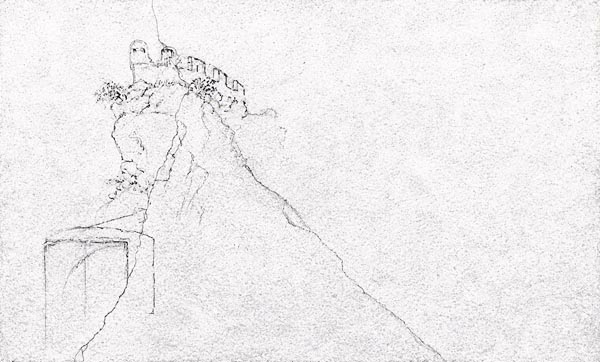
‘Goethe’s sketch of the castle on a rocky headland at Malcesine’ - Johann Wolfgang von Goethe (German, 1749–1832)
Wikimedia Commons
I had not been sitting long, when several people entered the courtyard, glanced at me, then started to walk back and forth. The crowd grew larger, and dense enough that they eventually came to a halt in front of me. I noticed that my drawing had attracted attention but, little bothered, I continued sketching quite calmly. Finally, a man, not of the most prepossessing appearance, pressed close to me, and asked what I was about. I replied that I was developing a sketch of the old tower as a souvenir of Malcesine. He said that this was not allowed, and that I should cease. Since he said this in the local Venetian dialect, and I could barely understand him, I replied that I understood not a word. With true Italian composure, he then seized my sheet of paper, tore it across, and left it lying on the pasteboard. At this, I detected signs of discontent among the onlookers; in particular, an elderly woman said it was not right, and that they should summon the Podestà (magistrate), who knew how to judge such matters. I stood on the steps, my back against the door, and surveyed the ever-growing crowd. The fixed stares of curiosity, coupled with the good-natured expressions on most of the faces, and everything else that might characterise a foreign crowd, produced the most amusing impression on me. I thought I saw before me the chorus of birds, (in Aristophanes’ comedy, ‘The Birds’) which I, as their loyal friend, had often performed in at the Ettersburg Theatre (c.1780. Castle Ettersburg was a residence for the dukes of Saxe-Weimar-Eisenach, and a cultural centre.). This put me in the most cheerful mood, so that when the Podestà approached with his clerk, I greeted him freely and, in response to his question as to why I was sketching their fortress, modestly replied that I did not consider the structure to be one. I drew his, and the crowd’s attention, to the sad state of decay of the towers and walls, and to the lack of gates, in short, to the lack of defences generally, and assured them that I had intended to inspect, and draw, nothing here but a ruin. They said, if so, what could possibly be remarkable about a ruin? I responded at great length, while seeking to gain their attention and favour, that they surely must know that many travellers came to Italy simply for the sake of the ruins, and that Rome, the capital of the world, ravaged by barbarian invasions, was full of ruins, which had been sketched many hundreds of times, and that not everything from antiquity was as well preserved as the amphitheatre in Verona, which I hoped soon to visit.
The Podestà, who stood before me, but nearer the ground, was a tall, not exactly thin man of about thirty. The flat features of his dull face perfectly matched the slow and turgid manner in which he posed his questions. Even the clerk who was there, shorter and livelier, also seemed unable to find his bearings at first, in such a novel and unusual situation. I said several more things along the same lines; they seemed pleased to listen, and appealing to the friendly faces of some of the women, I thought I perceived agreement and approval.
However, when I mentioned the amphitheatre in Verona, known locally as the Arena, the clerk, who had meanwhile reconsidered, said that this might well be true, as it was a world-famous Roman edifice, but there was nothing remarkable about their fortress except that it marked the border between the territory of Venice and the Austrian Empire, and therefore should not be spied upon. I explained at length, however, that not only Greek and Roman antiquities, but also those of the Middle Ages deserved attention. They could hardly be blamed, of course, for not considering the building, which they had known since their childhood, to be as picturesque as I did. Fortunately, the morning sun bathed the tower, rocks, and walls in the most beautiful light, and I began to describe this scene to them with enthusiasm. Because the objects of my praise were behind my audience, and because they preferred not to turn away from me entirely, they suddenly twisted their heads, like those birds called wrynecks (jynx torquilla), to see with their own eyes, what their ears heard me lauding; indeed, the podestà himself turned his head, albeit with somewhat more decorum, toward the scene described. This struck me as so ridiculous that my good humour increased, and my description spared them nothing, least of all the ivy that had already richly adorned the rocks and stonework for some centuries.
The actuary replied that this was all very well, but the Emperor Joseph was a restless individual who certainly harboured evil designs against the Republic of Venice, and I must be one of his subjects, assigned to spy on the Empire’s borders.
‘Far from belonging to the Empire,’ I exclaimed, ‘I can boast, as genuinely as you, of being a citizen of a republic which, although it cannot be compared in power and size to the illustrious state of Venice, nevertheless governs itself, and is second to none in Germany in terms of trade, wealth, and the wisdom of its rulers. I am a native of Frankfurt am Main, a city whose name and reputation have certainly reached you.’
‘From Frankfurt am Main!’ cried a pretty young woman. ‘There, Signore Podestà, one could see there was something special about this stranger, whom I consider to be a good man; let Gregorio be summoned, who was in training there for a long time, he’s best equipped to decide the matter.’
Already the faces around me had gained in benevolence, as their previously unpleasant expressions vanished, and when Gregorio arrived, the situation turned entirely in my favour. He was a man in his fifties, with a tanned Italian face, of the type one usually encounters. He spoke and behaved as someone familiar with foreign cultures, and he told me, at once, that he had been in Jakob Bolongaro’s service (Jakob Bolongaro and his partner Josef Maria Markus were renowned tobacco merchants and manufacturers) and would be delighted to hear news of that family, and the city, which he recalled with pleasure. Fortunately, as his visit had coincided with my youth there, I thus possessed the double advantage of being able to remind him of exactly what it had been like during his time, and what had changed since. I mentioned all the Italian families, none of which were unfamiliar to me; he was very pleased to hear some of the details, for example, that Herr Allesina (Johann Maria Allesina dealt in silk and fashion items) had celebrated his golden wedding anniversary in 1774 and that a medal had been struck to commemorate it, which I myself possessed. He remembered quite clearly that the wife of this wealthy merchant was a Brentano by birth (Johann had married Clara Francesca Brentano, in May 1724). I also knew something of the children and grandchildren of these families, how they had been educated, provided for, and whom they had married.
As I gave him the most precise information about almost everything he asked, the man’s expression alternated between pleasure and solemnity. He was happy and touched; the crowd became increasingly interested and were listening, tirelessly, to our conversation, part of which he, naturally, had to translate for them.
Finally, he said: ‘Signore Podestà, I am convinced that here is a good, skilful, well-educated man who travels in order to learn. We should treat him well, such that he will speak well of us to his countrymen and encourage them to visit Malcesine, whose beautiful location is indeed worthy of being admired by strangers.’ I reinforced these kind words by praising the region, the location, and the inhabitants, not forgetting the magistrates as wise and prudent men.
All this was deemed acceptable, and I received permission to explore the town, and the surrounding area, with Master Gregorio as I pleased. The innkeeper, in whose establishment I had been staying, now joined us, already anticipating an influx of tourists who would flock to his premises once the advantages of Malcesine became more widely known. He examined my clothing with lively curiosity, but was particularly envious of a little pistol that could be slipped conveniently into my pocket. He praised those fortunate enough to be able to carry such fine weapons, something forbidden in their own country under the most severe of penalties. I interrupted the friendly but persistent fellow, several times, in order to express gratitude to my liberator. ‘Don’t thank me,’ replied the good man, ‘you owe me nothing. If the Podestà knew his trade, and the clerk wasn’t the most self-serving of men, you would not have escaped their attentions so readily. That magistrate was more embarrassed than you, and your arrest, the reports, and your deportation to Verona would not have earned him a penny. He quickly realised that, and you were free even before our conversation was over.’
Towards evening, the good man took me to his vineyard, which was very well-sited, down by the lake. We were accompanied by his fifteen-year-old son, who was there to climb the trees, and pick the best fruit for me, while the old man selected the ripest grapes.
Between these two, innocent, well-meaning people, and alone in the infinite solitude of this corner of the earth, I felt, as I reflected vividly on the day’s adventures, what a strange creature a man is, in that things he might enjoy with security and comfort in benevolent company, are often rendered awkward and dangerous simply out of his desiring, on whim, to appropriate the world and its contents to himself, after his own fashion.
Near midnight, my host accompanied me to the boat, carrying the fruit basket Gregorio had presented to me, and so I departed, with a favourable wind, that shore which had threatened at one stage to become Laestrygonian (in Homer’s ‘Odyssey’, the Laestrygonians were man-eaters).
As regards my lake voyage, it ended happily, after the splendour of the lake’s surface, and the Brescian shoreline, had truly refreshed my heart. Where the mountains lose height on the western side, and the land slopes more gently down to the lake, the townships of Gargnano, Bogliaco, Cecina, Toscolano, Maderno, the Duomo di Santa Maria Annunziata, and the town of Salò, all elongated along the shore, lie in a line. At ten in the morning, I landed on the eastern shore, at Bardolino, and loaded my luggage onto a mule, and myself onto another. The road then led over a ridge that separates the lake from the Adige valley. Here, the primeval waters seem to have wrought against each other, immense currents, flowing from both sides, creating a colossal dam of gravel. Fertile soil was deposited above in calmer periods, though the farmers are constantly plagued by the ever-present boulders. They rid the fields of them as much as possible, piling them up in rows and layers, thus forming thick quasi-walls along the road. The mulberry trees looked sorry for themselves at this altitude, due to the lack of moisture. Not a stream is to be found. From time to time, one encounters puddles of rainwater that have collected, from which the mules, and perhaps even the drivers, quench their thirst. Down by the river, water-wheels are installed to irrigate the lower-lying land as needed.
Verona
September 15th
But the splendour of the new region (the Adige Valley), which one looks down on during the descent, cannot be described in words. It forms a wide garden, miles long, perfectly pristine and flat, at the foot of the high mountains and rugged cliffs. And so, on September 15th, at around one o’clock, I arrived in Verona, where I am, firstly, finishing this account, before collating and stapling the sheets of this second part of my diary, and where I hope, in joyful anticipation, to view the amphitheatre this evening.
Regarding the weather of these past few days, I report the following. The night of the ninth to the tenth was alternately bright and overcast, the moon always retaining a glow. Around five in the morning, the entire sky became covered with grey but thin cloud, which disappeared as the day lengthened. The lower I descended the lake, the finer the weather became. Where the great mountain range near Bolzano darkened the sky, the air exhibited a completely different quality; one could see from the various levels of the landscape, appearing quite lovely, which were distinguished from one another by their slightly more or less blue tints, that the atmosphere was full of evenly distributed vapour, which it was able to retain, and which therefore fell neither as dew nor rain, nor gathered as cloud. As I descended further, I could clearly observe that all the vapour emanating from the Bolzano valley, all the wisps of cloud rising from the mountains at noon, drifted towards the higher regions towards midnight, not obscuring them, but enveloping them in a kind of high-altitude mist. In the far distance, above the mountains, I could see a ‘water-gall’ so called (a secondary rainbow, signalling rainfall). South of Bolzano, they have had the most beautiful weather all summer, just a little rain, now and then (they say ‘acqua’ to describe the gentle rain), followed immediately by sunshine once more. Even yesterday, a few drops fell from time to time, though the sun was always shining. They have not had as good a year in a long time; everything is fine there; they have sent the bad weather our way.
I will only mention the mountains and types of stone briefly, since John James Ferber’s account of his journey to Italy (in 1771/2) and Balthasar Hacquet’s through the Alps (in 1779, and 1781) provide ample information about the route. A quarter of an hour from the Brenner Pass, is a marble quarry, which I passed at dusk. It may well, nay must, like the one on the other side, rest on mica schist. I found this schist near Colma when day broke; further down, porphyry appeared. The rocks were so magnificent, and the heaps along the road so fractured, that one could have easily extracted and packed a roomful of them à la Voigt (Johann Karl Wilhelm Voigt, a prominent mineralogist, geologist, and mining engineer active in Weimar). I could assemble such examples, without any difficulty whatsoever, if only I could limit my eyes, and my desires, to a smaller scale. Soon after Colma, I found porphyry that split into regular plates; and between Branzoll (Bronzolo) and Neumarkt (Egna), a similar example, whose plates, however, divided into columns. Ferber considered them volcanic products, but that was fourteen years ago, when the whole world was ablaze. Hacquet ridicules the notion.
I have little to say about the people, and little of it pleasant. At daybreak, descending from the Brenner Pass, I noticed a marked change in their appearance; I was particularly displeased by the pale, brownish complexion of the women. Their features suggested lack of nourishment; the children were equally pitiful to behold, the men a little better, their appearance being otherwise quite regular and good. I believe the cause of this morbid condition lies in the frequent consumption of maize and buckwheat flour. The former, which they also call yellow blende, and the latter, called black blende, are ground down, and the flour cooked in water to form a thick porridge, which is eaten as such. The Germans on this side of the mountains knead the dough, and fry it in butter. The Italian Tyroleans, on the other hand, eat it as is, sometimes with grated cheese on top, and taste no meat all year round. Inevitably, this must clog and block the main passageways, especially in women and children, and their cachectic colour indicated such a condition.
They also eat fruit and green beans, which they boil in water and season with garlic and oil. I asked if there were any rich farmers. — ‘Yes, of course.’ — ‘Don’t they indulge themselves? Don’t they eat better food?’ — ‘No, they are used to this.’ — ‘What do they do with their money? What other expenses have they?’ — ‘Oh, they have their masters too, who take it from them.’ —That was the gist of my conversation with the landlady’s daughter in Bolzano.
Furthermore, I learned from her that the winegrowers who seem the wealthiest are in the worst position, for they are in the hands of urban merchants who, in bad years, advance them enough to support life and, in good years, pay a pittance for the wine. But such is the same everywhere.
What confirms my opinion about their diet is that the women in the towns always look healthier. Pretty, full of face, their bodies appearing somewhat short, given their stoutness and the size of their heads, but their expressions sometimes quite friendly and welcoming. We know the look of the men from the itinerant Tyroleans who visit us. In the countryside, the men look duller in complexion than the women, probably because the women do more physical work, and gain more exercise, while the men are sedentary, being shopkeepers or craftsmen. By Lake Garda, I found the people quite tanned, without the slightest hint of rosiness in their cheeks, but not at all unhealthy in appearance; on the contrary, they looked quite fresh and well-fed. The tan is probably due to exposure to the intense sunlight and heat at the foot of their cliffs.
The End of Goethe’s ‘Italian Journey’ Part II