Maxime du Camp
Selected Poems from ‘Les Chants Modernes’, 1855
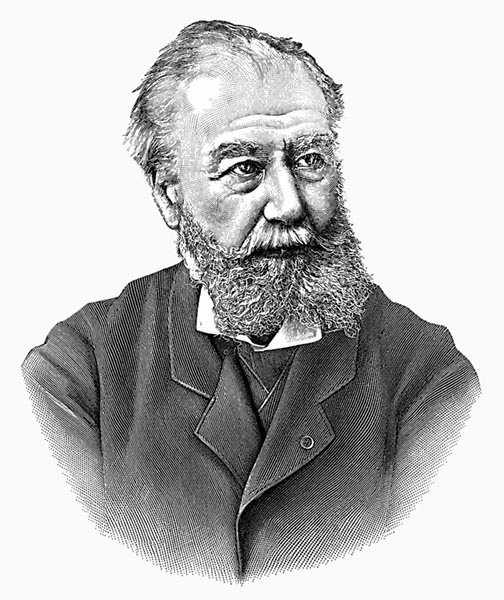
Portrait of Maxime Du Camp (1822–1894), engraving. From La Jeunesse de Maxime Du Camp et le Maine, Henri Bruneau
(Le Mans: Imprimerie-Librairie Leguicheux, 15–17 Rue Marchande, 1894)
Internet Archive
Translated by A. S. Kline © Copyright 2026 All Rights Reserved
This work may be freely reproduced, stored and transmitted, electronically or otherwise, for any non-commercial purpose. Conditions and Exceptions apply.
Contents
- Translator’s Introduction
- The Voyager (Le Voyageur)
- Landscape (Paysage)
- Turkish Women (Femmes Turques)
- The Genoese Palace (Le Palais Génois)
- Wreckage (Épave)
- Impertinence (Impertinence)
- Insomnia (Insomnie)
- Aspiration (Aspiration)
- Duet (Duo)
- A Piece of Nonsense (Fadaise)
- Spes Non Vana (Spes Non Vana)
- Storm (Tourmente)
- Sun (Soleil)
- Anniversary (Anniversaire)
- In Flight (En Fuite)
- The Demolished House (La Maison Démolie)
- Morning in Rome (Matin)
- Evening (Soir)
- Avatars (Avataras)
- To Portia (Á Porcia)
- Epitaph (Épitaphe)
- Index of First Lines
Translator’s Introduction
Maxime du Camp (1822 – 1894), journalist, poet, novelist, photographer, and historian, was born in Paris, the son of a successful surgeon Théodore-Joseph du Camp, who died shortly after Maxime’s birth. His mother Alexandrine (née Cheronnet) died when he was fifteen, and he was cared for by his maternal grandparents. After finishing college with a bachelor’s degree in literature, he indulged a strong desire for travel, thanks to an inheritance from his father.
He journeyed in Europe, and to the Near East, between 1844 and 1845, visiting Italy, Greece, Asia Minor, and Algiers. In 1847 he undertook a walking trip to Brittany with his friend Gustave Flaubert, which was partly a literary pilgrimage, motivated by admiration for François-René de Chateaubriand, the father of French Romanticism. They travelled through North-Western France from May to August, taking in Saint-Malo, Chateaubriand’s birthplace and the site of his tomb, and co-wrote an account of the trip. Between 1849 and 1851, again in company with Flaubert, with whom he maintained a close and lasting friendship, he travelled to North Africa, primarily Egypt.
Among his travel publications of particular note, are his Souvenirs et Paysages d’Orient (1848) covering the earlier Levant journey, and Egypte, Nubie, Palestine, Syrie (1852) covering the latter. As an early photographer, having learned the basics from Gustave Le Gray prior to his 1849–1851 trip to Egypt, his account of that journey was among the first to contain photographic illustrations.
On his return to Paris, in 1851, Du Camp became a co-founder, together with Arsène Houssaye, Théophile Gautier, and Louis de Cormenin, of the Revue de Paris, and was also a frequent contributor to the Revue des Deux Mondes. In 1853, he was appointed an officer of the Legion of Honour. He later served as a volunteer under Garibaldi, during the latter’s 1860 conquest of the Kingdom of the Two Sicilies. A friend of Gautier, Du Camp published a full literary study of the latter in 1890. Indeed, he was associated with many literary figures of his day, including Victor Hugo, Gérard de Nerval, and Alfred de Musset.
Elements and motifs from his 1855 poetry collection, Les Chants Modernes, which includes the poem entitled Le Voyageur, are frequently echoed in Baudelaire’s poetic works, though Baudelaire’s concept of modernity is far different from that of Du Camp. Du Camp was the dedicatee of perhaps the finest of Baudelaire’s poems in Les Fleurs du Mal, ‘Le Voyage’, written in 1859, and while the dedication was to some extent ironic, Baudelaire thereby indicated his debt to Du Camp in terms of material which Baudelaire’s poetry reworks. As a transitional figure between the French Romantic poets, and Baudelaire and the Symbolists, his thematic influence can be traced in Mallarmé’s works, and, in Russia, in Innokenty Annensky’s poetry, and Alexander Blok’s early verse.
The Voyager (Le Voyageur)
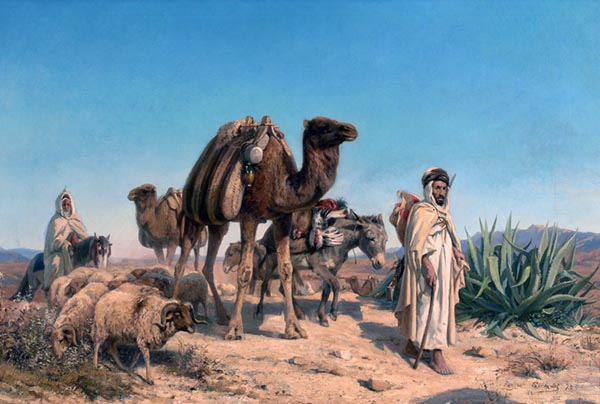
‘Caravan in the Desert’ (1875) - Eugène Girardet (French, 1853-1907)
Artvee
Voyager! Traveller! Why journey without end?
Why searching always for some fresh horizon?
Why spend your youthful energy on the world;
Why not sleep on, when languor demands rest?
Why in a tent, and not contentment’s mansion?
The desert sands retain not a trace of you,
Each day more spent, and more debilitated,
With never a seat beside a friendly hearth,
While the tracks leading on to empty space,
Are harsh for delicate feet, and desiccated.
‘I fear to rest; my instinct, in this life,
Is to wander, lost, beneath a sky of blue,
Hearing my youthful spirit sing within,
Bearing, in my heart, a sun ever new!
I fear to rest; for if, on some near shore,
I chose to lend my heart to another,
I would leave paler, my courage gone,
Like a soldier, with his first skirmish over.
Not love I seek, but rather, midst the waves,
To watch the suns, descending, drown;
Love terrifies; it is never love I seek,
But rather to traverse forests profound!’
Forward then, poor wretch, stumble on!
Take the saddest road; pursue your fate;
You’ll quit this life in some dusty corner,
Your corpse smothered in depths of sand,
Or in the far blue breakers, soon or late!
Better to sleep drowned in bitter brine,
On a mountain peak, by a stream, apart,
Or beneath unknown cliffs in solitude,
Than to be buried, prey to hidden pain,
In the mute tomb of an indifferent heart!
Naples, March 1851
Landscape (Paysage)
Goats wander over the ground, at random,
Browsing acorns from the dwarf oaks there,
Far from the goatherd in his white burnous,
Butting their horned heads, seeking pasture,
Pensive camels slumber, couched in the shade;
Beside them, their young extend hairy necks,
Long and curving, while numerous flies
Flicker, buzzing, over their humps and backs!
Bearing a round copper platter on his head,
A dark-skinned child passes, hands on haunches;
His half-open mouth in a white-toothed grin,
That mounts to his eyes, and lights his brow.
The palm-trees, ruffled, quiver on the hill;
White vultures, mewing, wheel through the air;
While the setting sun, reddening the ground,
Sinks in the waves, bathing his blond hair!
Oran, October 1848
Turkish Women (Femmes Turques)
For Théophile Gautier
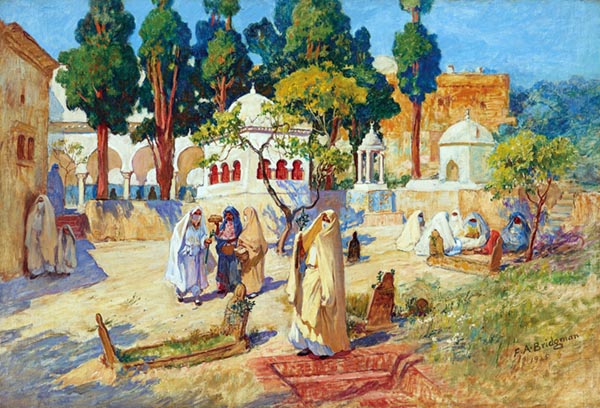
‘Arab Women’s Day in the Cemetery, Bou-Kobrine’ (1925) - Frederick Arthur Bridgman (American, 1847-1928)
Internet Archive
I’ve often watched women in long veils pass,
Beneath the cypress trees that gird Scutari,
Holding bouquets of swiftly-fading flowers,
In the Great Cemetery’s lugubrious alleys.
They’d seat themselves by some fresh grave,
To tell their dead whatever had transpired,
As if speaking to old friends, while, on high,
Black kites, midst the blue, wheeled and gyred.
Behind the pleated folds that hid their faces,
I could see naught but the glitter of wide eyes,
As one might see, at the edge of some cloud,
Twin stars, shining brightly, in distant skies!
On the light tissue, the breath from their lips,
Traced, a humid furrow, as they respired;
Their feet, henna-dyed, once free of slippers,
Seemed white marble, with vermilion fired!
Large capes, woven in some striking colour,
Swelled as they moved, by the breeze lifted,
While, shaking gently, as they paced by slowly,
On their arms large golden bracelets tinkled.
In their white veils, all seemed delightful;
One imagined, beneath pale linen, there,
Charming faces, solemn hidden beauties,
Divine, paradisial sights, as in blue air.
Motionless, I would gaze at them, in silence,
Full of strange ardour, longing, for my part,
To embrace them, without violence or cry,
Resting my heart against an unknown heart,
Not seeking to uncover the face concealed,
Not seeking a form, or troubling a single seam,
So, I might hide, in my melancholy soul,
The memory, veiled, of a perfected dream!
Chaville, Hauts-de-Seine, June 1853
Note: Scutari is the Greek name for Üsküdar, a district of Istanbul, Turkey.
The Genoese Palace (Le Palais Génois)
On an isle of the Archipelago,
The Mediterranean nearby,
I know a crenellated mansion,
Silhouetted against the sky;
Hidden beneath parasol pines,
Its foundations buried in grass,
Like a Sultana, gazing afar,
Couched, where the vessels pass
Across Ionia’s blue horizon;
It’s a Genoese palace complete,
Which I’ve longed, many a time,
To adopt as a blessed retreat.
Oh, a charming nest it would be,
To dispel one’s sadness, for there
In that very last harbour, one might,
Live sweetly, as free as the air!
If ever I chose to quit La France,
To go and dwell nearer the sun;
If ever I sought to nurture hope
In the heat, my journeying done;
If ever I left, in anger, one day,
This land where all must contend,
And depart the field, like a soldier,
Tired of fighting on to the end,
It’s there I would exile myself,
To erase the pain of the past;
Alive, in the depths of my heart
One fond memory, at the last.
I would live there calm and alone,
In deep silence, forgotten, apart,
Glad to be, in the end, insensible,
Saying, to my enfeebled heart:
‘Rest here, now, far from the storm,
While recalling the days gone by,
And the happiness you once knew;
The last of your journeys is nigh!’
And should Death declare: ‘I am here;
Rise and go, I’ve reserved you a place.’
I’d depart, with infinite joyousness,
Replying: ‘My thanks to Your Grace!
Chaville, July 1853
Wreckage (Épave)
Often a sailor, upon reaching land,
Walks the shore, pensive and alone,
By the foaming sea, on the pale sand.
He crushes gleaming shells in his track,
Tramples, carelessly, the trailing weed,
The wet leathery fronds of umber wrack.
He walks, eyes lowered, amidst the sweet
And acrid odour of the mounting tide,
The hiss of flowing waves at his feet.
The ocean waves sound their symphony,
Sunset tints the far horizon; all is joy,
And Nature, placid, seems in harmony.
He walks, unseeing without eyes or ears
For all these wonders, all these sounds,
The ‘thousand divine aspects’ of the seers.
Insensible and mute, his sluggish pace,
Betrays a mind, pursuing its deep wish,
Full of thoughts of some far-off place.
He dreams of hours rocked by the breeze,
Approaching, at last, that promised land,
Lit by the sun, green with tall palm-trees.
He recalls, at will, the dark-skinned bayaderes,
The deep forests full of fluttering doves,
The pensive Brahmin, murmuring his prayers.
He longs to pursue a course, to sail further,
To view, once more, the towering pagodas,
Dipping their bases in the gleaming water.
He longs to join some caravan, at night,
Setting out to cross the wide savannah,
Leaving, midst birdsong, in the morning light.
He longs to be far from his own country!
Yet the indifferent tide may bring ashore,
While he is lost in his own sad reverie,
A piece of jetsam, some shipwreck’s debris,
Fragments of some vessel caught by a storm,
Messengers of death, conveyed by the sea.
He halts; suspends, as if at some command,
His fond memories, his vows, his dreams,
And bends, trembling now, towards the sand;
He turns a board, in his hand, seeks to read
The captain’s or the vessel’s name perhaps,
A witness now, whose presence fate decreed.
No name, no word! A length of rope, alone,
Clings to a spar, and trails across the shore,
Like a skeletal snake, stripped to the bone.
He walks on, slowly; far from the savannah,
Far from the caravan, the gleaming palms,
With pain in his heart, in mournful manner.
He thinks of comrades lost beneath the wave,
Sunk in the night, midst the glittering foam,
Roiled by the tempest, in their watery grave;
Lost without last farewells, a prayer, a kiss,
Without absolution, blessing, at that hour,
To ease their soul’s path to a place of bliss.
Sea-creatures will consume their corpses, there,
Or the waves bear them to some sandy haven,
Swollen and gangrenous, deformed, laid bare.
Then the voracious birds, on flapping wing,
Will swoop, to void the sockets of their eyes,
And squabble over many a repulsive thing.
Meanwhile, in vain, somewhere, women gaze
Undiscouraged, towards the far horizon
And, waiting still, wear out their nights and days.
The wretched sailor feels the advent of tears,
His thoughts darkened, his sight troubled,
Burdened with grief, and nursing his fears.
Whenever I, as solitary as him, invite
My soul to erase all my losses past,
And seek a sanctuary full of joy and light,
Where far from the present I can forget
The weight of pain, the trouble and care,
Pursue a like fond dream, and cease to fret,
Often, I encounter such wreckage lost,
Floating sadly, in the wide immense,
Borne on the wave, flotsam, tempest-tossed.
Viewing that debris borne from the past,
A bitter memory erodes my joy,
While in my heart, fresh tears are amassed.
Since I am one who seeks an answer, ever,
Since I have banished every blasphemy,
Since I have faith, and harbour love, forever,
Since an ineffable hope is alive in me;
Of memories full of grief and suffering,
The debris of my heart, may I win free!
Neuilly, May 1852
Impertinence (Impertinence)
You may turn your languishing gaze on me,
Those wide eyes, Madame, of pale blue,
You may well offer me, as consolation,
That charming smile on your lips, anew.
Yet you will never penetrate my soul, so,
It’s stubbornly closed to you, that same,
And I smile, in turn, at your obtuseness,
In thinking my heart ever felt the flame!
Leave me to live in peace, and to dream;
Believe, if I had loved you, as may seem,
I’d have spoken long ago, for my part.
Cease the task of trying to clasp me, again,
To draw closer to this, my rebellious heart,
Which, far from you, you never can attain.
November 1854
Insomnia (Insomnie)
Lord, show me pity, I’m feeble, I cry,
I’m wrapped alive, in shroud-like pain,
Hearing the hour strike, a slow lament,
Bringing deceiving hope in its train.
I return to my solitary bed, in the dark,
I close my eyes, and attempt to sleep,
It escapes me, lying here, silent, in tears.
Lord, bring the sun; now, where I weep.
Like a child lost in the darkness beyond,
I fear its depths, which seem without end;
Here I’m ringed by funereal phantoms,
With memory’s whips poised to descend.
My fragmented soul shudders in terror,
My heart bows low, burdened by sighs,
As in a whirlwind that drives on the tide,
Sorrows flood me, the dark breakers rise.
My forehead is bathed in sweat, as bitter
As that which once moistened Christ’s brow!
Mother, my mother, you whom I loved so,
Why are you not here, where I suffer, now?
Chaville, September 1853
Note: Maxime du Camp’s mother was Alexandrine Chéronnet (1801-1837)
Aspiration (Aspiration)
If I could drink, with you, forgetfulness,
And drown the memories of things past;
If from my heart, despite my weakness,
I could drive all sombre thought, at last;
If I could stifle that voice, forever,
Which speaks to me, oh, ceaselessly;
A chant that, amidst our loving, ever
Sounds a note of pain and misery.
And all those words spoken by another,
If I could dispel those from my soul!
If those fierce flames I could smother
That once consumed the other, whole!
Ah, could I feel your heart, as before,
Beating hard in my warm embrace,
Immaculate, and enviably pure,
And could but murmur to you, face to face:
‘Listen, nothing will ever prosper here;
All fades, in turn, all withers thus, and dies;
All that we love, every hope or fear,
The dreams of each day and night, the lies;
All disappears: Earth’s an evil place!
Let us leave then, and vanish in a kiss,
Departing, as one, with mutual grace,
For the heavens where all exist in bliss!
Let us demand of the powers above,
A little of that eternal tenderness!
Let us ascend into the blue, and prove
That every gesture there is a caress!
Let us die, together! Our love too deep,
To survive on this planet, here below;
Let us not lose, from our perfumed sleep,
All that’s rejected by this world of woe.
Let us depart for a future that’s blessed;
Open our wings midst the infinite, on high;
Mount the eternal spheres; and find rest,
Where true love, unending, can never die!
Smyrna, 1844
Duet (Duo)
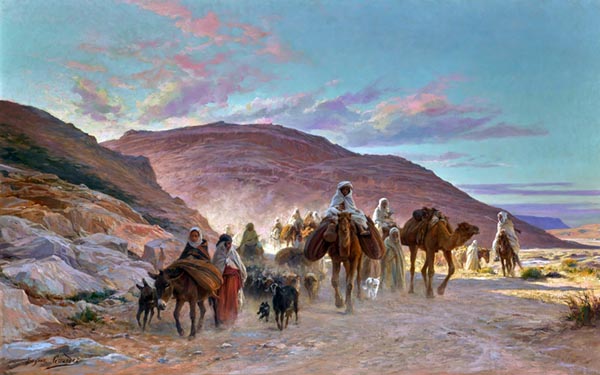
‘A Desert Caravan’ - Eugène Girardet (French, 1853-1907)
Artvee
Where is my heart?... Oh, my heart’s in Nubia,
Beside the Nile’s palms, ruins, dusty tells;
It’s there, in the wastes that stretch to Arabia;
There in the khamsin that dries up the wells.
It’s there in the perfumes, from Abyssinia,
Pervading the palace that houses the Sultan;
And in the pale sands of the shores of Ionia;
It’s in your dark eyes, O women of Lebanon!
Voyaging gulls, it is borne on your wings;
With you, in the light, it traverses the waves;
It follows the barque, where that sailor sings,
It slumbers with doves, amidst wooded glades.
It’s lost in the air, in the clouds on high,
Neath the silvery stars of the Milky Way,
It whirls in the storm, in the sounding sky,
Laughs at the sinister lightning’s display!
It carries my thought abroad, in a breath!
When, after the pain has pierced my heart,
I examine my house, emptied by death.
I seek it, in vain, where it soars there, apart.
‘Why then is your heart voyaging still?
Can it not live so, enclosed in its cage?
The bird when it’s free, travels at will,
It flies, wild, forever, from hill to hill.
Have it return, and extinguish its rage!
Bring me that heart, that travels each day
High over the Earth, its flight ever further;
I’ll wean that heart from its wandering way,
And create for it, in the soul’s deepest bay,
A nest full of love, and light, and laughter.
I will set that heart in my ardent breast,
Next to my own, just to feel it move;
Both will live here, calm, in my chest,
And sing with that rapture, ever-blessed,
Reserved for those who able to love.
My own is sad, and bored, it demands
A companion to weep by its side;
It sings your sad tale of distant lands,
Offers itself to the priest’s chill hands,
Yet would love, and smile, and abide.
To cherish you and keep you from harm,
It will dry its tears, and find, by its art,
In its depths, many a philtre and charm,
To quench your sorrow, soothe and calm,
And dispel the fierce pain in your heart.
Bring it here; I thirst for its tenderness;
I know how to see true happiness won;
We’ll sing, with the force of a last caress,
A hosanna, together, in joyousness,
Two amorous hearts, united as one!’
Come then, my heart, return from Nubia;
Leave the palm-trees, the ruins, the tells;
Leave those pilgrims on the path to Arabia,
Fly from the khamsin that dries up the wells.
Come now, and slumber, in the white breast
Of one who says: ‘We will love evermore!’
Sink to those lips that you thirst to address,
Be drunk with joy now, and sing of Amor.
Like a sick child, who is weakened with crying,
And seeks, from its mother, an hour of repose,
Rest there unmoving, amidst tender sighing,
Forget your pain, your dreams, and your woes.
Yet later, if she, her promise belying,
Rejects you, a vessel emptied, alone,
Depart thence, without sorrow, flying
Towards a distant dreamed-of unknown.
Direct, like a sun, towards Nature entire,
The fire within you, the light that you bear;
Without hope of return, seek your desire,
Throughout the world: an answer to prayer.
Love the air’s azure, the forests profound;
The headlands, and shores, stack after stack,
Where, above the breakers, the cliffs resound,
Their stony feet bathed in gleaming wrack.
Love the mountains, birds, the stars, the flowers,
Each guarding the secret contained at its heart;
Love white-veiled seas, the summit towers,
The deserts from which none return, or depart.
Love all creation. Midst souls, none ignore;
In an endless kiss, find your God, on the way,
But seek not to love her, refuse to adore
One whose perjured affection expires in a day.
‘Then, your heart need never again take flight,
For my heart is bound to yours in this place,
And a loyal soul too, that seeks to do right;
My tomorrow’s eternal, it’s life in the light,
It’s the kiss that’s divine, in infinite space.’
September 1845
Note: The khamsin is the hot, dry, dusty wind from the Sahara that blows across Egypt and the Levant, usually in late winter and spring.
A Piece of Nonsense (Fadaise)
Since you are off on your travels,
Take all my pleasure with you,
To ease your heart on the way;
Add it to a suitcase, or two.
Consult it for your amusement,
It will speak of all that is sweet,
And like my kiss it will clamber
To your red lips, from your feet.
If it proves true, and faithful,
If for you, alone, it sings,
Clasp it tight, to your loving heart,
Before you clip its wings!
I entrust it to you, and have faith,
Take care none covet it though;
Soon a kiss bestowed on your lips
Will return it to me, I know.
October 1846
Spes Non Vana (Spes Non Vana)
Amongst the treasures life holds in its hand,
That are sometimes revealed to us on the road,
As we march, bowed down by a burden of woe,
Dragging our chains midst the convict band;
Amidst the events we attend on each day,
Amidst the passions, the hatreds, affection,
Amidst the desires that dictate our direction,
Amidst all the human soul dreams of, or may;
Amidst all the endless things that we lack,
Amidst all that gleams above our dark track
Like the stars in a stormy sky, far out at sea,
All the voice of the future, incorruptible,
May promise, ardent, imprescriptible;
It’s you I love, evermore, sacred Liberty!
December 1852
Storm (Tourmente)
O Sailors! Sailors! When storm-winds blow,
When the tempest howls in the rigging above,
When, lost to the waves, the cargo foregone,
You see the spectres of shipwrecked crews,
Advancing, at pace, from the distant horizon;
When the sails are ripped from the mast, on high,
When, the compass, changing direction wildly,
Spins from east to north, then south to west,
When the bright pole-star is invisible, veiled,
And no longer tells you which course is best;
When Saint-Elmo’s fire illumines the spars;
When you plough the waves, in uncertain light,
Amidst pallid flares, amidst thunderous noise;
When all seems lost; when the captain trembles
At every strange sound that traverses the night;
When you see the voracious great-white sharks
Swimming beside you, haunting your course,
Prepared to dispute your drowned cadavers;
When your soundings show fathomless deeps;
When the bravest hearts feel fear and remorse;
When all seems over! When the storm-birds call
Over your heads, as they soar through the sky;
When the rudder, rendered powerless, shattered,
Can no longer serve to save you from danger;
When, all recourse lost, the waves mount on high;
When the memories trouble your beating heart
Of your aged parents, your children, and wives,
And the grief they’ll know, to see you no more
Or only your corpse, perchance, roiled in the tide,
Now swollen, disfigured, re-entering their lives;
When sensing the agony that you must know,
Looming before you, as, chanting the litany
Of Our Lady of Mercy, the Star of the Sea,
Kneeling, arms raised, to that blessed Virgin,
You place yourself in her calm hands, utterly;
You’ll suffer, I swear, less, Sailors, O Sailors,
Than he who, at night, bound by infinite bonds,
Head bowed, watches over one whom he loves,
Hearing Death, momently, sounding, above her,
The sinister summons, to which she responds!
Venice, August 1846
Sun (Soleil)
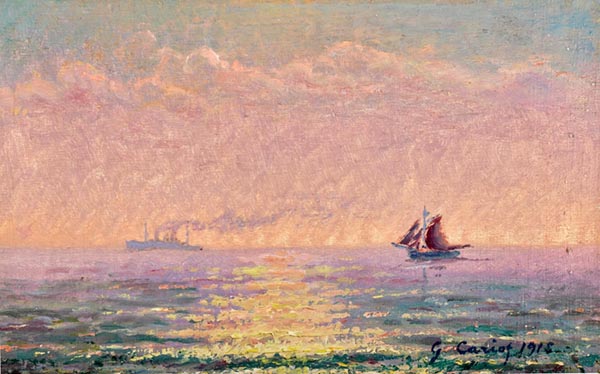
‘Sea study at St Malo, against the sun’ (1918) - Gustave Cariot (French, 1872-1950)
Artvee
O Sailors! Sailors! When the wind’s joyous,
When it sings while filling the radiant sails,
When the clouds are somnolent in the sky;
When sweet delight, to all danger, oblivious,
Eases your heart, and gleams in your eye;
When, your gaze fixed on scattered cloud,
You find life fine, and filled with promise,
Beneath your breath, voicing love’s refrain;
When you feel the approach, in a sweet kiss,
Of a deep, tender sigh, seeking you again;
When the sky’s blue, and all seems prosperous;
When, free from fear of the monsoon rains,
Thunder, lightning, gales, cold and hunger,
When you breathe your home shore’s perfume,
A messenger from the harbour you’ve gained;
When you feel an ardent desire in your heart
To end the voyage you’ve endured, at last,
And embrace, on your doorsill, the woman
Who often burdened with tears, in the past,
Prayed for you, as she scanned the horizon;
When the porpoises joyfully leap the waves,
Those familiar headlands already in view,
As the crew begin preparations to anchor,
And the village church, there, in the distance.
Whose bells are chiming: ‘Welcome, anew!’
When you distinguish a crowd, on the shore,
Of those who, lacking peace or rest, sought
And end to your travels, fraught with danger;
When the children, held aloft, near the port,
Are those infants grown large in your absence;
When the anchor has bitten its native sea-bed,
When you feel in your soul, softened by fate,
The poignant remembrance of dangers out-faced,
And you render thanks to the Virgin Mary,
Whom bare-footed, silent, you worship, prostrate;
You’ll yet be less joyful, O Sailors, I swear,
Than he who, at night, bound by infinite bonds,
Head bowed, watching over one that he loves,
Dispels thoughts of death, and gently murmurs
A clear summons to life, to which she responds!
Venice, September 1846
Anniversary (Anniversaire)
The bright sun, traversing the window pane,
Looked down on me, at your feet, as ever,
Like a priest prostrated before the altar.
Three years, already! Do you remember…?
I was happy at last! I had fled the city,
Whose noise my winged dream offended,
I had seated myself in the shade of a tree,
Like a miser who a rich treasure defended.
There I rested awhile, full of bitter joy,
My hopes mingled with pain and regret;
My memory of you and my mother united,
The one near me, the other so distant yet.
The future sang loud in my ravished soul,
Love lit me within, and I felt, deep inside,
I had touched at last the dream of my life,
That my youth and faith dwelt at your side.
I knew you were affianced to me ever,
And that day, by the wood, my heart, bonded
To yours, commenced a hymn in my mind
One of adoration, to which you responded.
Not the ravages of time, all must endure,
Not disappointment, nor pain, nor distress
Can prevent my heart feeling, my heart loving,
My voice from expressing soul’s tenderness.
I’ll love you forever! For the soul is eternal.
I’ll, endlessly, sing this hymn to our love;
Now and ever, in a world which is mortal,
Or midst the stars, a true singer I’ll prove!
For, our souls are united for all eternity;
We will traverse all the transmigrations,
Pursuing together those infinite pathways,
By which we’ll achieve our incarnations.
And we will move, side by side, without cease,
Closer, and loving more deeply; thereby,
Rendering existence one endless caress,
As vast as an ocean, immense as the sky.
Till the day when, as one, suffused with light,
Sated with tenderness, joy, and love’s wine,
We embrace the last day, seeking death’s night,
To be once more united, amidst the divine!
September 1848
In Flight (En Fuite)
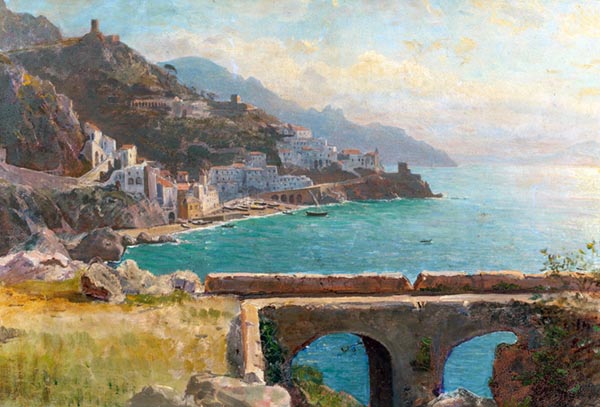
‘View of the Amalfi Coast, Italy’ (1856) - William Stanley Haseltine (American, 1835-1900)
Artvee
Ah! I long to travel, fly far from here!
Far! Far off! All disturbs; all annoys me,
All goes ill in this world of hypocrisy.
And my sensitive heart, it bleeds; I fear
I’m dying, I’m stifling, I’ll suffocate,
Breathing the impure vapours, of late.
Air! Air! Before I’m ended for good!
I need to journey through empty plains,
Transport my miseries, and my pains,
To azure seas, some far field or wood.
I long to discover whether Nature
Contains some tract of blessed sky,
A paradise the breeze passing by
Perfumes, a spring of bright water.
There! There, in that joyous clime,
Where the sun’s liberated from time,
I may find some charming retreat;
Where in a tranquil, pensive state,
Scorning your deceptions, O Fate,
I might lead a life calm and discreet.
My heart is feeble, my strength is gone,
Shipwrecked, fearful, I can no more
Ply my oars on this sea sans shore,
Threading the reefs of the past and done;
Where is the harbour? Where, my star?
The storms that drove my vessel afar,
Have ceased; I suffer! A weary affair!
Towards the horizon I raise my head,
I see those tempestuous shoals ahead,
The jagged cliffs that await me there.
From the heights, there’s nothing in view.
The sky is empty, my mood sombre.
All seems mute, in a darkened future;
I hear nothing; see but shadows anew,
That, dimly, invade the path, each day,
On which, hands outstretched, I stray,
Blind now, unsure of what I’m about;
Though two companions are at my side,
Both enfeebled, weeping, terrified,
My old friends: Sorrow and Doubt!
I long to depart! Now! This instant!
I no longer fear darkened solitudes,
Rugged peaks, endless vicissitudes,
Desert wastes; for I hear the insistent
Voice that whispers, in hours serene,
That seductive Siren’s voice, I mean;
I know what it sings, and am unafraid,
Though in parting I erase, in a night,
The only joy I have known, outright…
O Portia, come, quit a world decayed!
Quit, by my side, without fear or regret,
This impious world that the heart denies,
With its dulled instincts, its hideous lies,
Mindless contempt for what’s sacred yet,
Its betrayals, and its slanderous disdain,
Our pure hearts need not suffer in pain;
Let us flee its evils, its cowardly dress;
We are spied on by the malicious, who
Would seek to expose our lives to view,
And exhibit our depths of tenderness!
Come with me now, for the world is ours!
We’ll find some lovely clime; and there,
Amidst flowering isles, in the balmy air,
Where skies are pure and sweet, the hours
Will be those when all about must smile;
A land full of charms, devoid of guile,
Where eternal summer gilds each tree,
And we, as pilgrims of love eternal,
Will traverse its glades, ever vernal,
With fresh strength, in newfound liberty!
If you but knew the places that I
Have known, there, in the Orient,
Under a sun that, smiling assent,
Climbs the vast and cloudless sky;
Vines that clamber on bush and wall,
Hiding nests, where songbirds call;
Cattle browsing, pensively, silently;
Stretches of cotton-plants, like seas,
Spreading beside pale lemon trees,
With leaves like spears, seemingly.
Little flies, gilded by gleaming rays,
Hover, joyously, there, in the light;
Green lizards, on the walls, cling tight,
And, quivering, blink as they laze;
Horned goats, mingled with buffaloes,
Drink in herds, where the Nile flows
Dotted with islands, as, with odd grace,
By legendary temples, along the trails
Dromedaries pass, ships without sails,
Their neck-bells tinkling, at every pace.
There! There, we should flee, we two;
Forgetting our every pain and regret,
Living happily, drinking deeper yet
Of the blessings those skies bring anew!
Are you not tired of suffering here?
Why struggle on? What reason to fear,
A departure offering us true content?
Neath a deeper blue than your eyes, there,
On sands that are blonder than your hair,
By the Nile’s shore, we will pitch our tent.
There we will live, delivered from pain,
Calm, joyous, banishing from memory
Those burning moments that so cruelly
Scorched like flames, giving thanks again,
For our happiness, the delights of rest,
For light after torment, doubly blessed,
For perfect peace, at last, dear friend!
And our only need, while rest we enjoy,
Proving our friendship an infinite joy,
To live happily, in a love without end!
The Demolished House (La Maison Démolie)
Men have arrived with massive pickaxes,
Bearing large canvas bags on their backs,
From which emerge hammers, and metal
Hooks, and hand-tools of singular form,
To raze the walls, and shatter the stones,
And bring down every pillar and capital.
They gather here at this empty mansion.
Having fixed to the wall, scarcely solid
A wooden buttress, to prevent its falling,
They clamber swiftly up all five stories,
Then commence their sad assault, on high,
Removing the tiles, and then each ceiling.
The building, attacked, reveals its entrails;
The workmen, with energy, strike at the walls,
That, collapsing, mask the ground with debris;
While stretches of stone, falling at intervals,
Cause a vast clamour, as they shake and fall,
And seem to complain, with fateful voices.
Wallpaper appears, now hanging, in shreds,
From the shattered sections of the building,
A checkerboard of partitions and coverings;
Black ribbons of soot trailing here and there,
Like dark rivulets, born of heavy rainfall,
From attics to cellars, silently, creeping.
A crowd watches on. When some heavy stone
Crashing down forcefully, makes the dust fly,
It amuses them greatly, their laughter loud,
As I too gaze on, though sadder and graver,
Seeing the ruins grow, moment by moment,
For my house it is, that falls midst the crowd.
It’s my mansion, in which, for ten years now,
I spent my days, as the hours slipped by,
Today filled with joy, tomorrow with sighs;
Loved, dreamed, a thinker, laboured in silence,
My spirit ardent, or plagued by indolence,
Ever far from the earth, seeking the skies.
It’s there that my longing to travel arose,
My aspiration to see those vast countries,
In which gleaming, the sacred rivers flow;
It’s there that my dream, ever expanding,
Led me to deserts, revealing those places,
Where I slept sound midst the sand’s warm glow.
It’s there, that often, on countless evenings,
Speaking, conversing on art and religion,
Amongst old friends, on things yet revered,
Summoning my slowly maturing vows,
I rested, pensively, close to the hearth,
Reviving dreams well-nigh disappeared.
It’s in that house, now tumbling, falling,
That, to me, always seemed sad as a tomb,
It’s amidst that debris, stirred by the breeze,
Where I see, alas, my reveries vanishing,
As one sees sometimes, in the farmyard,
The birds, a loud noise has frightened, flee;
It’s in that mansion, old and decrepit,
Crumbling beneath the hammer-blows,
From which a mountain of debris will rise,
That I filled whole days, endless hours,
Gathering from lips I adored utterly,
Sweet words, mingled with kisses and cries.
It’s the house she visited, hidden from sight;
She, to whom my soul, always inclined,
Directed, each instant, its reborn desire;
It’s there that disdaining every calumny,
Young, charming, blonde, she came to me,
Like an angel, midst incense borne higher.
As soon as I heard the sound of her carriage,
I hastened there and, beneath a dark vault,
Guided her, veiled, to the door, at her sign;
We mounted, already caught up in our poem,
Paused often, as one, saying: ‘I love you!’
My lips on her lips, and her hand in mine.
There was our bower! Devoid of witnesses,
Of prying eyes spying on our passing joys,
Talkative confidantes, or curious faces;
Far from all, in our paradise, our ecstasy,
Without, ever a pause, chanting the phrases
Of love’s canticle, of hearts’ radiant spaces.
It’s there that I felt, while she was by me,
My senses glowing as if some new faith
Slowly pervaded the very heart of me;
How I wept with love, kissing those lips,
How I cried, with joy and enchantment,
That the god had gathered us to him closely.
Oh, each of those walls razed to the ground,
Each of those ornaments cracked and broken,
Takes with it my memories of things past.
Every brick and stone a part of my history;
And I hear the murmur within, of a swarm
Of cancelled dreams, now fading at last.
Oh, to rest in that sacred place, no more,
Not a single wall left to mark its demise,
All fallen, destroyed, brought to an end
In a day, not a trace to signal its loss,
And I forced to retrieve its existence
From memory alone; its ruins transcend.
All fallen, the stair where the Sylph trod,
Mounting the steps, in our swift course,
Her slender arm pressed tight against mine;
The landings on which, pausing for breath,
She whispered, blinded by her soft veil,
Sweet words, to me, of our love divine!
The salon in which, calmly lifting that veil,
Like a cloud, in passing, revealing a star,
Her face, no longer a mystery, appeared;
As she sought for the flight of my thought,
Demanding to know if the work I’d begun
Would launch me on some splendid career.
Alas, my room too, always austere,
Which my mother’s portrait adorned,
The piece of boxwood hanging there,
Seeming to promise, in sorrowful times,
Like a sacred branch, green with hope,
The happiness she dreamed I might share.
There, where often plagued by insomnia,
Repeating within the tale of my woes,
My soundless tears troubled the shadows;
My room, in which I aired my distress,
My tender thoughts that death coveted,
Night-thoughts, revealing my sorrows.
The room which you entered, dear heart,
Our room, that sacred chamber, to which
None ought to have mounted but we two;
The room where I spent delightful hours,
Charmed, intoxicated, lost in your gaze,
Kissing your hands, kneeling beside you.
The room where far from every obstacle
We united in happiness, as if in a shrine,
To worship together, moment by moment;
The room in which the world was forgot,
The evil, the jealous, the liars, the envious,
While towards paradise we made ascent.
Now that stairway, that salon, that room,
Your perfume more fragrant than amber,
And the hearth that warmed your feet so,
The balcony where I saw you, motionless,
Watching the sunset descend on the city,
As the white clouds drowned in its glow;
All is lost to the cruel pick and the axe,
Later they’ll come armed with trowels,
And build, where our love lived ever,
A fine façade, adorned with sculptures,
With tall capitals supporting the roof,
To replace all we knew, lost forever.
It will fall. Well, so much the better,
Fall like the chateaux grapeshot razes.
Tumble, walls; shattered each ceiling,
Topple midst groans, as of some storm,
Be annihilated, rooftop to foundations,
Fall, and erase all our sweet dreaming.
Let nothing be left of the house I knew,
Let even its name be forgotten and fade,
Let it leave behind no trace of happiness,
Let none love there, where we were a one,
Let none rake the ashes, left from that fire,
In which we burnt, inflamed to excess.
Let none of the vulgar, nor the profane,
Sleep in that room where I slept then,
Dreaming of love granted the blessed;
Let none come there with indiscreet hand,
Seeking the secrets of our dear retreat,
Where, two together, we made our nest.
Let all crumble and fall! What matter to me!
When I crossed that threshold, long ago
I took, my love in my arms, like a child,
And it slept, in tranquility, on my breast.
I remain, untroubled; a palace, my heart,
That none can demolish, pure, undefiled.
April 1840
Morning in Rome (Matin)
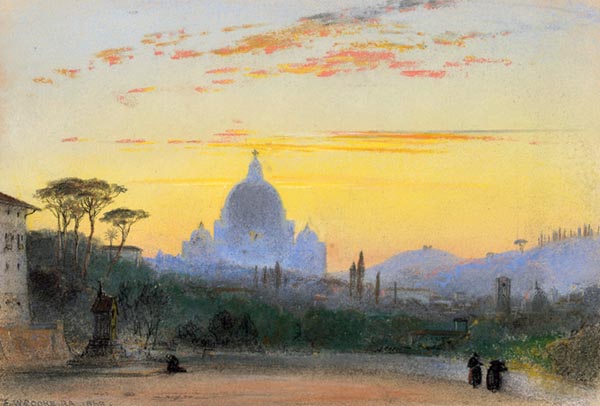
‘Rome’ (1868) - Edward William Cooke (English, 1811 - 1880)
Artvee
It was four in the morning; in the pale sky
The dense clouds in the depths of night,
Were bordered, in flight, by opal fringes;
The city mute, lifeless, devoid of light.
The monstrous domes of the vast basilicas,
Seemed to support veiled shadowy drapes,
My echoing steps, midst ancient temples,
Awakened the poor, wrapped in their capes.
Rome slept still. Slowly the sentinels
Passed and repassed before the closed gates,
Not a bird in the air beating its wings,
Not a boat on the water, tempting the Fates.
The Tiber was voiceless, empty the air,
I felt the cold, though my spirit within
Sang its song of love, full of ardent joy,
For myself alone, the heart’s secret hymn.
My heart was joyful; I felt on my lips
Kisses still warm, heard, echoing still,
Those feverish words of pure affection,
Ineffable treasures, resisting my will.
Day came; night faded, the stars disappeared,
Moment by moment, while, in the vague light,
White clouds flew, now spreading their sails,
Voyaging on swiftly, windblown and bright.
It reminded me of my past departures,
Before dawn, on the shore, in desert sand,
Striding along, on the trail, a dreamer,
The mule-bells tinkling on either hand.
What were you doing, tell me, pale one,
While I walked on, ever further from you?
Did you seek my image in your memory,
Repeated my words when I swore to be true?
Or saddened, leaning from your high window,
Rewinding the rope, I climbed with scant art,
When I saw, in the sky, the sun appearing
I found less proud and fine than my heart!
Rome, March 1847
Evening (Soir)
A few rare passers-by sped through the rain;
It poured torrents; the sky overhead was black;
The gutters overflowed with soot-dark water,
Flooding the pavements, piercing each crack.
The gaslights quivered, amidst gusts of air,
Flames dancing like writhing snakes of fire;
The cathedral bells sounded the night-hour,
Borne by the wind toward some distant spire.
All was cold, and melancholy. A few girls
Clung close to the houses, whispering low
To sordid old men, with sunken shoulders,
Who sometimes smiled, and failed to say no.
On the filthy boulevard, coated in mire
Our carriage passed them by, at a trot,
To the coachmen’s vague cries, as the wheels
Made the mud leap high, like bursts of shot.
We were alone, we two. Our four hands,
Clasped together, her blue eyes trembling;
The glass panes, fogged by our breath,
Seemed a mist that enclosed us, gleaming.
I rested, calm, my brow on her shoulder;
Her enrapturing voice like a distant choir,
Her body charming, supple as a willow,
Parted her satin dress, which slid higher.
A warm fragrance enveloped my being;
I rested there, silently, feeling within,
A childish weakness, religious ecstasy,
And yet the power of a man free of sin.
It was one of those rare moments in life,
When the heart swells, the spirit, no less
Inspired, attains the heights, when desire
Drinks deep of an untroubled happiness.
‘I’m dying of love,’ I said, bending towards her,
Her delicate lips almost touching mine,
And knew then the lure of eternal life,
Of a fate that leans towards the divine!
Paris, November 1847
Avatars (Avataras)
For Louis Jourdan
‘I was born to travel; I’m active and lean,
Like a Bedouin with horny, arched feet:
My sight undimmed by the burning sun,
Hair curled, like an African’s, in the heat.’
And I love to sleep, without cover or veil,
Far from civilisation, in the starry night
Of infinite azure, beneath distant skies,
In an empty desert, unbounded, immense,
On a bed of sand, that’s as soft and light,
As the breeze that wakes me in passing.
I love to ride those pale dromedaries,
Swaying to their calm and gentle pace.
I love to follow, some old bronzed guide,
In a white burnous, beyond every trace.
When I ascend some wondrous river;
Refresh my brow; in its peace, delight,
My mind is alert, my spirit joyous;
I love the south wind’s dusty passage,
I love the Orient, the light,
And the age-old vultures, wings beating.
I love, on some mound where reptiles swarm,
Near an ibis perched on a sombre pylon,
To view hypostyle halls, silhouetted,
Ramses, or Cambyses, knew, long gone.
I love the mosques’ towering minarets,
I love the grilles, the masked windows,
From which a woman can watch, unseen;
I love the bright sun that gilds it entire,
And the flight of red flamingoes,
On the blue lakes, aloft at evening.
And whenever I can escape from France,
Whenever I leave, my duties done,
I depart, with hope alive in my heart,
For those wide lands beloved of the sun.
If I voyage onwards, and never cease,
A dreamer, unquiet, here is my quest:
I search for my footprints left long ago,
Among the shades, the vanished peoples,
I search the ancient lands once blessed
With my presence, it seems, in ages past.
I have lived, I believe, in radiant lands,
And lived many an unsung life before,
I can find, I feel, those places, again,
Half-recalled, on some distant shore.
I fought by Nestor, beside the Scamander,
I was at the Granicus, with Alexander;
And wept with grief when he slew Clitus.
I followed the Pharaohs in their conquests,
And have seen the priests, moreover,
At feasts, gold-braceleted, tread the lotus.
I studied, with the Chaldeans, the orbits,
Of planets, tight bound by sacred laws,
And, in Azerbaijan, beside Zoroaster,
Viewed the Yazatas, and the Manticores.
Long ago, I lived in Upper Nubia,
Selling raw gold to men of Arabia,
Worshipped Amun-Ra, Ptah, Sobek, Anubis,
Maat, whom the solar barque bore through the sky,
Tefnut, of leonine nature,
And thrice-great Thoth, with the head of an ibis.
Beside the Indus, and on the high peaks
Of the Himalayas, I heard Manu utter;
Reverently, I penned his precepts sublime,
Tablet on knees, beside that lawgiver.
In Tibetan forests covered with snow,
I once saw a peaceful cortege pass by,
Of yellow-robed monks, with shaven heads,
Following, slowly, a hollow-eyed youth,
Who spoke grave words with a sigh:
The Buddha, whom they would deify.
In Greece, I marched in the Panathenaic,
Bare-foot, my brow wreathed in agnus-castus;
Often, I passed my days in the shade,
Listening to Socrates, by the Illisus.
Sometimes, sprawled on Asian cushions,
Midst perfumes, beside blonde Aspasia,
Close to Pericles discoursing on Solon,
I could at last, quenching past hatred,
Unite in calm dance together,
The flute of Bacchus, the lyre of Apollo.
I remember how, later, in Samaria,
By lakeshores, amidst the wastelands,
Following Jesus, the son of Mary,
I bowed my head beneath his two hands.
I was there when he said: ‘Lazarus,
Lazarus, rise!’ I saw the ointment
Mary Magdalen applied to his feet;
The people rose to him like a tide.
Alas, among the crowd, silent,
I saw him flogged, his message denied.
Since that time, I have ever harboured
A hatred, unquenchable, year on year,
For those who, to confirm their power,
Condemned him to the Cross, in their fear.
Nothing can ever calm the anger
I feel, then and now, for the Court
Of Pharisees, foolish, treacherous,
Stifling the spirit, measuring all,
By their own meagre thought:
Urban the Eighth, or Philip the Second!
I opposed Mani, in the days of the Sassanids,
Denying his dualism, wrong, incomplete,
Condemning his lies, when to the crowd
That heretic declared: ‘I’m the Paraclete!’
One of the first to believe in the Prophet,
When he claimed himself chosen by Allah,
Who’d dictated, to him, the blessed Quran,
I was there, beside him, in the darkness
Of the miraculous cave, thereafter,
When the dove laid eggs, and the spider span.
These are the memories that, in my travels,
I ever invoke, like the oldest of friends;
They arise in me in those distant lands;
I waken them when time’s veil descends.
I feel my past youth reviving there,
My passions, my ardour, my love,
A belief in God that’s untarnished,
And I comprehend those uncertain things
That midst distant shadows move;
I view the past, believe in the future.
For the time will come, when France
Oblivious to herself, with closed eyes,
Will be dead to all, faithless, dimmed,
Like a spent star lost from the skies;
When the fields will revert to Nature,
When the temples are ruined entire,
When the rivers will drown the cities,
When all is ended, and razed to the ground
Is every palace and spire,
And only the creatures live there;
When none can even remember the names
Of town, chateau, river or harbour, when
Paris is mentioned like ancient Rome,
And the French language unspoken;
When there scarcely remains a single trace
Of triumphal arch, or cathedral,
When bold explorers from distant lands
Discuss the marks on an obscure stone,
In some cemetery; when all
Is trodden to dust by sheep and goats;
When from here to Australia they chant
The sacred hymn of eternal progress;
When the works of Greece and Italy,
Are eclipsed by science’s brilliant success.
When mankind fulfilling its destiny
Exerts its sway over time’s dark course,
And achieves at last true liberty;
When it feels itself godlike, within,
When it drinks, there at the source,
From the spring of divine fraternity;
I’ll return, a citizen of the world,
To the saddened land I inhabit today;
My curiosity, powerful, profound,
Will urge me, despite myself, on the way.
I’ll return to search among green hills,
In broad forests, or on the empty plain,
Amidst the heaped ruins, and chaos,
Amidst monumental piles of stone,
On river banks, swollen by rain,
Where time has slowly amassed its relics.
To a land, reduced to decrepitude,
Fallen as far as a country can fall,
Beneath mournful skies, in solitude,
Where dark birds of prey circle and call,
I’ll return, to seek some trace of the life
That I know now, filled with ardent envy,
Like a pilgrim saint in my devotion
I will worship you, sad remnants, yet
More precious than any reliquary
That one kisses prostrate, head bowed low.
I’ll demand from you the rest of those dreams
That I commenced when last among you,
And my cries of love, those piercing knives,
And my words, distraught, recalled anew.
You will tell me then: ‘Life’s a mystery,
To which heaven’s grandeur holds the key;
Your dreams of the past are now your faith;
One to which you yielded your joyfulness,
Of which, you savoured the tenderness,
Do you know it not, for it lives in you?’
Boulainvilliers, June 1854
Notes: The Sanskrit word ‘Avatara’, in English avatar, means an incarnation, or the presence, of one of the gods or goddesses on Earth, whether in visible form, or as a mode of existence or empowerment, or as an aspect of elapsed time. The Yazatas (Izedhs) are divine beings in Zoroastrianism, the Manticores (Martichoras) mythological Persian creatures. Pope Urban VIII (1558-1644) militant, and a nepotist on a grand scale, weakened the Papacy through debt, and was notable for the prosecution of Galileo for heresy. Philip II of Spain was noted for his persecution of Protestants. Mani was the originator of the dualist Manichean doctrine. The legend of a spider’s web and a dove’s nest protecting the Prophet Muhammad, by indicating that the cave of Thawr, in which he and Abu Bakr had taken shelter during the migration from Mecca to Medina, was empty, is popular, but likely inauthentic. Louis Jourdan (1810–1881) to whom the poem is dedicated was a journalist, writer, and publisher of the newspaper ‘Le Siècle’ from 1849 onwards. Subsequently, he founded ‘Le Journal des Actionnaires’, the ‘Shareholder’s Journal’, with the banker Moïse Polydore Millaud.
To Portia (Á Porcia)
Portia, you know, the depths of my tenderness,
When you hear me, humbly, say: ‘I love you!’
And have learnt the intoxication, it’s true,
That my heart feels, which never grows less.
You know: love for me is a world entire,
The one living cult, the sacred belief;
The sun whose light I see, the sole fire,
The sole god that I worship constantly.
At least, you did so once! But do you yet?
In that far land to which fate has led you,
Do you yet retain, somewhere within you,
The memory of one whose loss you regret?
I have forgotten naught of those past hours;
This moment, leafing again through my verse,
I hear the voice of lost thoughts rehearse
Those moments of happiness that were ours.
Do you remember, Portia, that bright flame
With which our love blazed, when your eyes
Pierced my soul, which they raised to the skies;
The intoxication produced by those same?
Do your recall our marks of tenderness,
My cries of despair, and my lost laments,
When I fell to earth, in those rapid descents,
Seeking to recall each kiss, each caress?
Do you remember our every foolishness,
Our ceaseless joys, our nights, our days,
Your burning lips on mine, every phrase
Of our promise of endless faithfulness?
Do you recall those happy times, and how
We devoured that future, joined together,
Our days of travel, Rome, ours forever,
And Naples we could not leave, each vow
Made in Florence, Milan, Padua, Venice!
Venice, where the Lion wept, constrained!
All those dear places; where Love reigned,
As a pious pilgrim to those shrines of his.
Do you remember? Alas, our twin destiny,
That fused our lives, and rendered us one,
Shattered, in a day, the life we had won,
And rendered us lost to Chance, our enemy.
You are far from me now; five long years
Have vanished, it seems, in Time’s abyss,
Since we lovers, parting from love’s bliss,
Said our adieus. Five wells of sad tears!
I suffer! Yet know that time and distance
Will never weaken a heart true as mine,
What if misfortune dogs our existence,
My heart still love’s, despite fate’s ill design.
Beyond the shipwreck, beyond the grief,
On a sombre sea, neath a darkened sky,
I feel, O Portia, this love cannot die,
Guarding hope undrowned, a fond belief.
Today I reread my verses – our history,
Those lines I recited, there, at your side,
All the sweet hours, in which you reside,
Recalled again from the well of memory.
Alas, they are my youth’s echoing cries,
Accept them still, not as a souvenir,
But a hope, a promise, one I hold dear,
Of joy that in some distant future lies.
The hope of another life, beyond death,
Where the dream, lost, may live once more,
All our past tenderness, on some far shore,
Again, un-withered, revived in a breath.
There we’ll find again that wondrous spring
From which our lips drank without cease,
And seek there, proud souls, as we please,
Still bound by our faith, joy in everything.
Nothing, then, could destroy our tenderness,
Nothing, then, could disturb our serenity,
Nothing curb, then, the sublime excess,
Of a rendezvous thus blessed for eternity.
January 1855
Epitaph (Épitaphe)
To Portia
They say: ‘Gain learning, for power lies there!
They say: ‘Work hard, and life will be joyous!
Forget the Earth, and consider the heavens,
Then, with patience, life will be easier to bear.’
What use is work? What use is knowledge?
None of it worth a glance from your eyes!
I see no more horizon than your pale brow;
Memory, I seek, and the hope that it buys!
I work hard at cherishing you forever,
I love you, and wish to love so, till I die;
While, proud of the flame, lit by your heart,
I’d happily render my soul with a sigh;
Then you could engrave, there, by your art,
‘Here lies the one who adored me ever!’
May 1848
Index of First Lines
- Voyager! Traveller! Why journey without end?
- Goats wander over the ground, at random,
- I’ve often watched women in long veils pass,
- On an isle of the Archipelago,
- Often a sailor, upon reaching land,
- You may turn your languishing gaze on me,
- Lord, show me pity, I’m feeble, I cry,
- If I could drink, with you, forgetfulness,
- Where is my heart?... Oh, my heart’s in Nubia,
- Since you are off on your travels,
- Amongst the treasures life holds in its hand,
- O Sailors! Sailors! When storm-winds blow,
- O Sailors! Sailors! When the wind’s joyous,
- The bright sun, traversing the window pane,
- Ah! I long to travel, fly far from here!
- Men have arrived with massive pickaxes,
- It was four in the morning; in the pale sky
- A few rare passers-by sped through the rain;
- I was born to travel; I’m active and lean;
- Portia, you know, the depths of my tenderness,
- They say: ‘Gain learning, for power lies there!