Alfred de Musset
Selected Poems
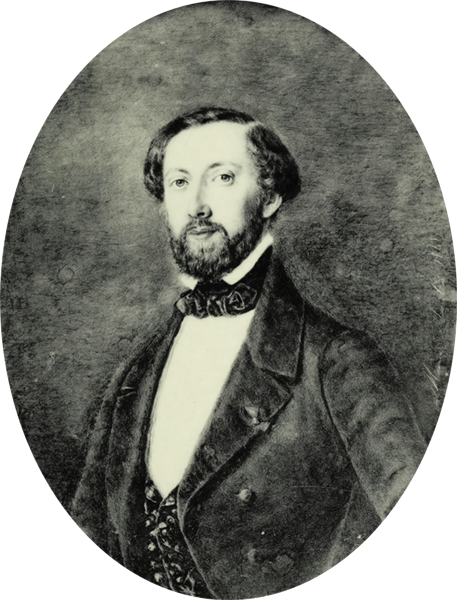
‘Alfred de Musset’
Mme Marie Moulin. Paris: 1848
Internet Archive Book Images
Translated by A. S. Kline © Copyright 2025 All Rights Reserved
This work may be freely reproduced, stored and transmitted, electronically or otherwise, for any non-commercial purpose.
Conditions and Exceptions apply.
Contents
- Translator’s Introduction
- Song: At Saint Blaise (Chanson: À Saint-Blaise)
- Song: ‘I said to my heart...’ (Chanson: ‘J’ai dit à mon cœur…’)
- Barbarina’s Song (Chanson de Barberine)
- On a Dead Lady (Sur Une Morte)
- Sonnet (‘Se voir le plus possible…’)
- Song: ‘Good day, Suzon…’ (‘Bonjour, Suzon…’)
- My Lovely Neighbour’s Curtain (Le Rideau de Ma Voisine)
- Madrid
- Venice
- A Lost Evening (Une Soirée Perdue)
- Promenade.
- Written in Marie Taglioni’s Album (Sur l’Album de Mademoiselle Taglioni)
- Sonnet: A Stroll in the Jardin des Plantes (Une Promenade au Jardin des Plantes)
- Sonnet: Marie.
- Song: ‘When one loses through sad mischance…’ (Chanson: ‘Quand on perd par triste occurrence’)
- Sonnet: ‘No, not even if bitter suffering…’ (‘Quand bien même une amère souffrance…’)
- Remember (Rapelle-toi)
- To George Sand (À George Sand, VI)
- Sonnet: ‘How I love the first shiver of winter…’ (‘Que j’aime le premier frisson d’hiver...’)
- Titian’s Son (Le Fils du Titien)
- Impromptu.
- Farewell (Adieu)
- Index of First Lines
Translator’s Introduction
Alfred Louis Charles de Musset-Pathay (1810–1857) poet, novelist, and dramatist, better known as Alfred de Musset, was born in Paris to an upper-class but not particularly wealthy family. After attempting various careers he published, in 1829, a first collection of poems, Contes d’Espagne et d’Italie (Tales of Spain and Italy), which was influenced by the Romantic movement. Posing as a dandy in the style of Beau Brummell, he led a dissipated life, which adversely affected his reputation. He gives a version of his celebrated relationship with George Sand (the pen-name of Amantine Dupin de Francueil), from 1833 to 1835, which continued intermittently until 1839, in his semi-autobiographical novel La Confession d’un Enfant du Siècle (The Confession of a Child of the Century, 1836). De Musset held the post of librarian to the Ministry of the Interior under the July Monarchy, but was dismissed after the 1848 Revolution, though later, in 1853, he was appointed librarian of the Ministry of Public Instruction. Meanwhile he had been awarded the Légion d’honneur, at the same time as Balzac, and had been elected to the Académie Française in 1852 after two failed attempts in 1848 and 1850. He died in Paris in 1857, the official cause being heart failure, which was due to a combination of alcoholism and aortic insufficiency.
Song: At Saint Blaise (Chanson: À Saint-Blaise)
At Saint Blaise, on the Zueca,
You were fine and happy there,
At Saint Blaise,
At Saint Blaise, on the Zueca,
We were happy there.
Yet, to hold that memory,
Will you always care?
Yet, to hold that memory,
And so, return there?
At Saint Blaise, on the Zueca,
Midst flowers, picking the verbena,
At Saint Blaise, on the Zueca,
To live, and die, there!
Note: ‘Zueca’ is the Venetian dialect version of ‘Giudecca’, an island in the Venetian Lagoon. San Biagio e Cataldo was a church on the western corner of the isle, dedicated to Saint Blaise and Saint Catald.
Song: ‘I said to my heart...’ (Chanson: ‘J’ai dit à mon cœur…’)
I said to my heart, my feeble heart:
It’s surely enough to love one’s mistress?
And don’t you see that changeableness,
Is to lose time’s joy in heart’s yearning?
My heart replied: It’s never enough,
It’s never enough to love one’s mistress;
And don’t you see that changeableness
Makes past delights dearer and sweeter?
I said to my heart, my feeble heart;
Haven’t we had enough of sadness?
And don’t you see that changeableness
Is to find new grief at every turning?
My heart replied: It’s never enough,
We’ll never have enough of sadness:
And don’t you see that changeableness
Makes past sorrows dearer and sweeter?
Barbarina’s Song (Chanson de Barberine)
Off to the wars, Knight, so fair,
What will you there
So far from home?
Don’t you see the night is deep,
The world brings care
To those who roam?
You who believe a love left behind
Flees the mind,
Alas, alas,
Seekers of fame, your living name,
Your smoke and flame
Will, swiftly, pass!
Off to the wars, Knight, so fair,
What will you there,
So far from me?
I’ll go weep, who was beguiled,
And told my smile
Was sweet to see.
On a Dead Lady (Sur Une Morte)
She was beautiful, if Night,
Who sleeps in the sombre chapel
Where Michelangelo made light,
Can, motionless, be beautiful.
She was good, if it will suffice
For a hand to open, and give in passing,
Without God seeing, or saying, a thing;
If coins are alms – though cold as ice.
She thought – if the empty noise
Of a sweet harmonious voice
Like a murmuring stream, untaught,
Could make one believe it thought.
She prayed, if two lovely eyes,
Now fixed on the earth,
Now raised to the skies,
Can be termed a prayer’s birth.
She would have smiled, if the flower
That never bloomed, to please,
Could open to the coolest hour
Of the passing forgetful breeze.
She might have wept, if her hand
Coldly placed against her heart,
Had ever felt dewdrops land,
On human clay, with celestial art.
She might have loved, if pride
Had not, like the light that, uselessly,
One lights beside the one who died,
Watched over her heart’s sterility.
She is dead, and yet never lived.
She made a pretence of living:
From her hands the book has slipped,
In which she had read – nothing.
Sonnet (‘Se voir le plus possible…’)
‘To see the other truly, and to love the other only,
Without deceit or diversion, shame, or lies,
Without desire’s delusions, and never remorsefully,
To live as one, giving the heart to the moment as it flies;
To respect the other’s thought, the passing stream,
To make of one’s love a day, and not a dream,
And breathe in that clarity, freely, forever’ –
So, Laura softly sighed, and sang to her lover.
You, to whose every step, ‘the height of grace’ applies,
It’s you, crowned with flowers, and who seem carefree,
It’s you who said: ‘That’s how one must love’, to me.
And it’s I, long the child of doubt, of blasphemy and lies,
Who listen, and think, and answer you, carefully:
‘Yes, that’s how one loves, though one lives otherwise.’
Song: ‘Good day, Suzon…’ (‘Bonjour, Suzon…’)
Good day, Suzon, my flower of the woods!
Are you still the prettiest? Well, we’ll see!
I’ve just returned, like tarnished goods,
From my grand journey to Italy.
Of Paradise I’ve made a tour,
I’ve written verse, pursued Amor,
But what’s it to you?
But what’s it to you?
I’m passing by your house, anon,
Open, please do.
Good day, Suzon!
It was lilac time when I thought to vanish.
A joyful heart, in full bloom, you bore.
And you said to me: ‘It’s not my wish,
It’s not my wish to be loved anymore.’
What have you done, then, since that date?
He who leaves too soon, returns too late.
But what’s it to me?
But what’s it to me?
I’m passing by your house, anon,
Open, quickly.
Good day, Suzon!
My Lovely Neighbour’s Curtain (Le Rideau de Ma Voisine)
My lovely neighbour’s curtain,
Rises dreadfully slowly.
She must be seeking, I’m certain,
A breath of air, discreetly.
It opens a little, the window,
I feel my heart palpitate.
Perhaps she wishes to know,
If I’ve been watching, of late.
But, alas, only in dreams!
It’s with some lout she’s in love.
It’s only the breeze it seems,
That makes her curtain move.
Madrid
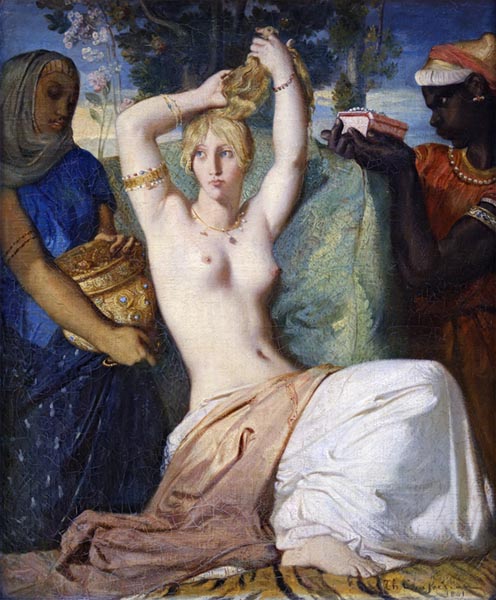
‘Esther Preparing to be Presented to King Ahasuerus’
Théodore Chassériau (French, 1819–1856)
Wikimedia Commons
Madrid, fair Princess of Spain,
There pass, o’er your fields and plain,
Many dark eyes, many an eye of blue.
White city of serenades,
Every evening, there, promenades
Many a little foot, passing through.
Madrid, when the bull roams abroad,
Many a white hand will applaud,
While many a silken sash is at stake.
And when starry night prevails,
Many senoras, in long black veils,
The descent of your azure stairs, will make.
Madrid, they’re not to my taste,
Those ladies with narrow waist,
Who all wear your tight court shoes;
For there is one I have met
Neither blonde nor brunette,
Who, above all, I would choose.
I know one, whose duenna
Combs her hair, and guards her,
Opening the window only to me.
Whoever would make a pass,
Need only approach her at Mass,
King, or priest, whatever his degree.
She’s my Andalusian princess!
She’s my jealous lover no less!
She’s my beautiful widow, darkly veiled!
She’s an angel! A demon lover!
Much like an orange in colour,
As lively as a bird, glossily-tailed.
Oh, when my idolatrous lips
She bends down to eclipse,
You should see, midst our alarms,
Her body, supple yet fragile,
Like a snake, and as agile,
Slithering and sliding in my arms!
Now if by chance you’d know
What earned my conquest, oh,
Twas simply my steed’s charms I believe,
Compliments on her manilla,
And some bonbons, pure vanilla,
All on a lovely carnival eve.
Venice
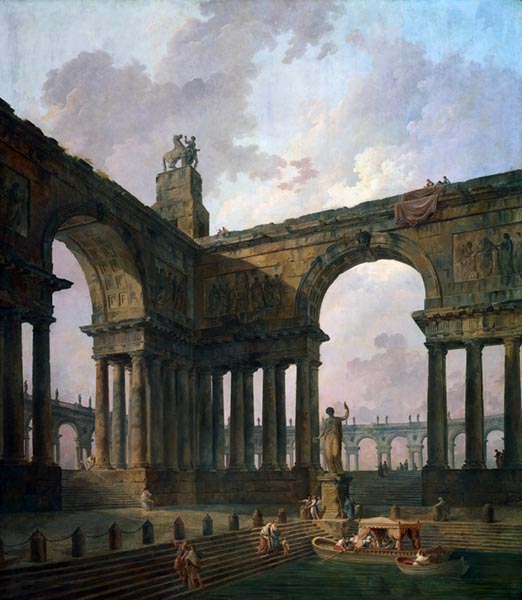
‘The Landing Place’
Hubert Robert (French, 1733-1808)
The Art Institute of Chicago
Venice, the scarlet,
Not one boat as yet,
No anglers in sight,
Not even a light.
Alone, on the shore,
The lion’s bronze paw,
He lifts in the air,
Serene everywhere.
Around him a score
Of vessels, and more,
Like herons set out,
In circles about,
Sleep, neath the sky,
Their flags set on high
Flapping lightly,
Packed in tightly,
The moon in place,
Hiding her face,
Half-veiled, endowed
With a starry cloud.
Thus, the Lady Abbess.
Of Sainte-Croix no less,
O’er her surplice will drape
The folds of her cape.
And the old palazzos,
And sombre porticoes,
And the stairs, all white,
Known to many a knight,
And each bridge and street,
And each statue, discreet,
And the shifting lagoon,
Trembling under the moon,
Are mute, but the guards,
In the arsenal’s yards,
Keep watch on the wall,
Their halberds full tall,
– Ah, more than one, now,
Should the moonlight allow,
Ear cocked, waits the sight,
Of his lady’s love-light.
More than one, if not all,
Prepares for the ball,
Black mask, as ever,
Dark in her mirror.
La Vanina, who swoons
Midst her couch’s perfumes,
Still presses her lover,
While sinking to slumber.
As mad Narcisa,
Shut in her gondola,
Feasts through the night,
Till the morning light.
For who, in Italy’s
Free of all folly,
His finest days, there,
Kept for some affair?
Let the Doges’ clock,
At the palace, tick-tock,
Measure out its ennui,
All night, by the sea.
Let us count instead,
On the mutinous red
Of your lips, kisses given,
Or is it – forgiven?
Count, instead, the sighs,
The sweet tears in our eyes,
That voluptuousness
Forced them to express!
A Lost Evening (Une Soirée Perdue)
I was alone, last night, at the Théâtre Français,
Or almost alone; the play found scant success.
It was only Molière, and we know, at best,
That maladroit fellow, who created Alceste,
Lacked the fine art of stimulating the spirit,
Or cooking up a denouement served with wit.
By God’s grace, our authors went another road,
Since we much prefer theatre that’s à la mode,
Where the plot, a twisting, turning ribbon,
Is like the motto encircling a mirliton.
And yet I took note of its simple harmonies;
How genius, offering commonsense, can please,
And admired the love of truth, the harsh verity,
Proudly revealed in all its pure naivete.
How deep his knowledge of the world, I found,
What manly humour, so sad, and so profound,
And asked myself: ‘Does mere admiration suffice?
Seated, like this, by a chance throw of the dice,
To hear, in one’s soul, human nature cry,
So that, having laughed, one surely ought to sigh?
To wipe away a tear, and then swiftly depart,
Carelessly, as one does, since it’s merely art!
Entranced as I was, lost, thus, in my reverie,
My eyes resting, here and there, on the gallery,
I saw a neck, before me, slender and charming,
Swaying beneath a dark braid, most disarming:
On seeing its ivory, thus adorned with ebony,
A verse of André Chénier’s rose to memory,
Two well-nigh unknown lines, an unfinished refrain,
Less written than dreamt, yet in a fortuitous strain.
I dared to recall them now, in Molière’s presence,
Listening to the play, yet murmuring, slowly,
While gazing at the child, unsuspecting, wholly,
For they seemed quite inoffensive, in essence:
‘Below your head, that neck, its delicate whiteness,
Sways tenderly, outdoing the snow in brightness.’
Then I mused again (for so the free mind wanders):
The old frankness being, seemingly, beyond us,
Is not the finesse, the mocking tone of our art,
Enough to make one aware of its lack of heart?
And how shameful is the wretchedness we share,
In consigning to solitude poor Molière;
And, it’s high time, perhaps, as the song says,
To escape this society, or change its ways;
For to what can one compare this muddied scene,
In which the Muse’s shame is well-nigh obscene?
Cowardice reigns us in, fools lecture everyone,
Claiming we’ve seen everything under the sun,
As if the sins of the human family
Were not renewed each week, each year. Our century
Has its own manners, and therefore, its own truth;
That one who dares speak is heard, provides the proof.
Ah! I would dare to speak, were I eloquent;
Dare to wield satire’s whip, and ne’er repent;
Dress Alceste, ‘the man with green ribbons’, in black,
Who, by a wretched poem, was taken aback.
If he returned to our Paris, for a short while,
He’d find something far worse, to arouse his bile,
Than a flighty woman, and a mediocre sonnet;
For we’ve a deal of skeletons in our closet.
O, our Master in all, though the tomb is dark,
From your ashes let me raise a transient spark,
And I’ll strive to match your honesty, your wit.
(It would be enough my merely attempting it.)
Teach me the tone in which, on your bold lips,
Truth, your sole passion, spoke; I’d be heard,
Though no genius, though truth is in eclipse,
Courage, and indignation, fueling every word!
Thus, madly, I pursued my dream; however,
The child was still seated there, beside her mother,
And still her slender neck, its perfect whiteness,
Swayed, gently, beneath the braid’s pure darkness.
Then she rose, the unknown, the performance over,
Her beautiful nape, and her half-naked shoulder,
Veiling themselves, her hand in her muff; and only
When I saw her pass through her house door, swiftly
Fleeing, did I realise I’d followed her there.
Alas, dear friend, that’s my life, the whole affair!
While mind tried to exercise its will, sincerely,
Body, aware of its role, chased after beauty;
And when I awoke, from my charming reverie,
But one, sole, cherished image remained to me:
‘Below your head, that neck, its delicate whiteness,
Sways tenderly, outdoing the snow in brightness.’
Notes: The Théâtre Français, at 2 Rue de Richelieu, is now known as the Comédie-Française. Alceste ‘the man with the green ribbons’, an adherent of truth and honesty, is the chief character in Moliere’s play ‘Le Misanthrope’, of 1666. Mirlitons, a form of kazoo, with mottos twined about them were a popular, and irritating, form of entertainment at the Saint-Cloud Fair, held near Paris. The poetry of André Chénier, who was executed during the French Revolution, was seen as a link between the Enlightenment and the Romantic Movement – De Musset’s quote is a modified version of: ‘Sous leur tête mobile, un cou blanc, délicat, se plie, et de la neige effacerait l’éclat,’ a couplet from Chénier’s poem ‘Les Colombes’ (‘The Doves’).
Promenade
In the woods, a cloud turns to gold.
See the shadows vanishing, slowly!
It’s not eve; let the dawn unfold,
Which seems to be fleeing, gladly,
For one finds it returns, quite swiftly.
Likewise, allowing hope to flower,
Our memories vanish, hour by hour.
Written in Marie Taglioni’s Album (Sur l’Album de Mademoiselle Taglioni)
If you no longer wish to dance,
If you only pass, in advance,
Over our sombre stage, below,
Don’t chase after your shadow,
Leave it, our lives to enhance.
Sonnet: A Stroll in the Jardin des Plantes (Une Promenade au Jardin des Plantes)
Beneath those beloved trees, where I made my way,
To gather, alone, in passing, a sprig of vervain,
Beneath those charming trees, where your breath, I maintain,
Challenged Spring as regards the fresh scents of the day,
The children played, all about; ever on the move,
I passed by, thinking of you, dragging my chain;
And if you are unsure of my grief, of my pain,
Then, at least, you can’t be uncertain of my love.
Who will know of the ill tormenting me deeply?
Though this wildflower once knew of it, so they say!
Dark-eyed antelope, who’s my beloved? Tell me.
Noble lion, you know, imprisoned so day after day;
You, who saw me turn pale when her hand, gently
Bent down to your inclined forehead, as if in play.
Note: The wildflower, Vervain, or Verbena (Verbena officinalis), bearing pale mauve flowers, is otherwise known as the ‘Herb of the Cross’ since it is said to have been used to staunch Christ’s wounds after the Crucifixion. The Jardin des Plantes, the main botanical garden in Paris, also houses a menagerie.
Sonnet: Marie
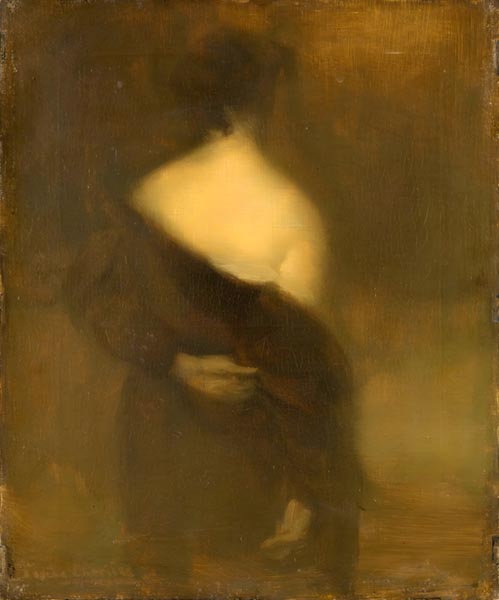
‘Woman from Behind Undressing’
Eugène Carrière (1849–1906)
Wikimedia Commons
As, when the flower of Spring, secretly,
Opens its bud to the woodland air,
Of the Zephyr’s first sweet breath aware,
Till its smile fills with mystery,
And the fresh, weightless stem, you see,
Feeling the chalice to light laid bare,
To the depths of its root, instantly,
Shivers with joy, and desire, there,
Likewise, when my sweet Marie,
Opens her lips and, charmingly,
Singing, raises her azure eyes,
Midst the harmony, the light, they share,
Her soul seems wholly, one would swear,
To mount, trembling, towards the skies.
Song: ‘When one loses through sad mischance…’ (Chanson: ‘Quand on perd par triste occurrence’)
When one loses, through sad mischance,
One’s hope perchance,
And gaiety,
What remedy, for the melancholic,
If not music,
If not beauty?
One’s more grateful for, in such a case,
A lovely face
Than an armed foe.
What’s better than hearing, amidst one’s cares,
Sweet, tender airs
Loved long ago!
Sonnet: ‘No, not even if bitter suffering…’ (‘Quand bien même une amère souffrance…’)
No, not even if bitter suffering
Were revived in this dead heart;
No, not even if hope, reflowering,
Adorned my path, by some art;
Not though modesty, grace, innocence,
Summoned pity, and charmed me too,
No, dear girl, in your sweet innocence,
I could not, dare not, speak love to you.
Yet one day, when you search, in vain,
A universe seemingly void, alone,
May, my show of respect, sustain!
For you’ll find, amidst joy and pain,
Here’s a hand, to raise yours again,
A sad heart, to reply to your own.
Remember (Rapelle-toi)
(‘Vergiss mein nicht’: words inspired by Mozart’s music)
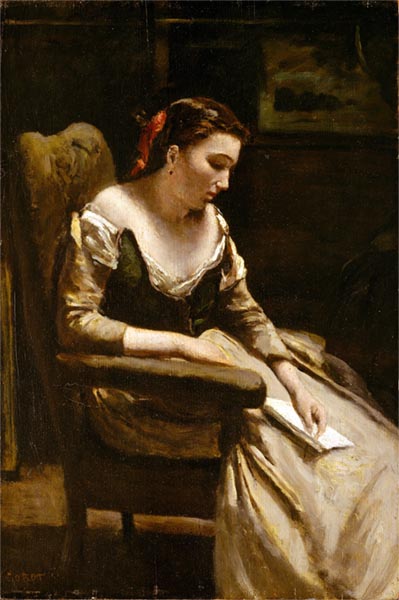
‘The Letter’
Jean-Baptiste Camille Corot (French, 1796–1875)
The Metropolitan Museum of Art
Remember, when trembling dawn sheds light,
Opening, to the sun, the enchanted dale;
Remember, when, pensively, the night
Dreamily passes, in her silvery veil;
At the call of pleasure, your heart beating,
In the dream, the shadows bring at evening,
Hear a soft voice sound,
Midst the trees around:
‘Remember.’
Remember, when your unknown destiny
Has separated you and I, forever,
When the years, and exile, and misery,
Have withered this heart, dark as ever;
Think of my sad love, of our last goodbye!
Absence and time’s power, love will deny.
Ever, till I must die,
Ever, my heart will cry:
‘Remember.’
Remember, when, under the cold earth,
My heart, shattered forever, lies asleep;
Remember, when a lonely flower, at birth,
Opens gently, over my tomb, to weep,
My immortal soul, though I see you no longer,
Will return to you like a faithful sister.
Listen then, to that slight
Voice sigh, in the night:
‘Remember.’
Note: ‘Vergiss mein nicht’ (‘Forget me not’: also, the name of the flower in German) is the title of a song for voice and piano, with parallel lyrics in German, Italian, and English, misattributed to Mozart and listed as Kv. Anhang 246, but written by George Laurenz Schneider.
To George Sand (À George Sand, VI)
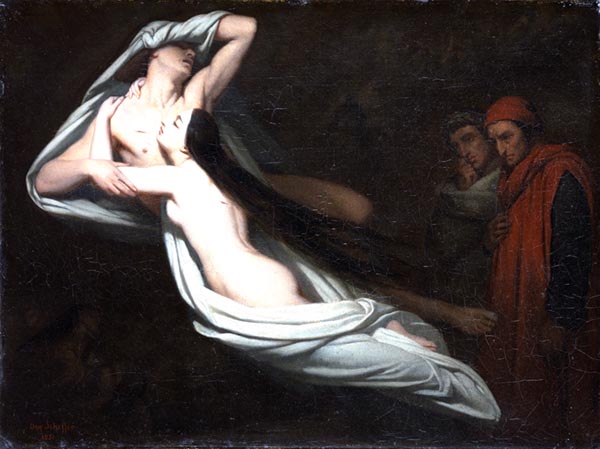
‘The Shades of Francesca da Rimini and Paolo Malatesta’
Ary Scheffer (Dutch, 1795–1858)
The Cleveland Museum of Art
Go, live a life elsewhere, O you who were my life,
Pour out elsewhere those treasures I thought fine.
You who were once my homeland, free of strife,
Seek other lands, bloom there, my Sun divine;
Enrich some other love; yet remember mine.
Far from France, may memories of me pursue
Your course, a spray of flowers next your heart;
Fading, yet formed when Hope was fresh and new,
When I believed in happiness, though my part
Has been to suffer, without granting it to you.
Sonnet: ‘How I love the first shiver of winter…’ (‘Que j’aime le premier frisson d’hiver...’)
How I love the first shiver of winter! Stubble,
That, under the huntsman’s feet, refuses to bend!
When magpies visit the fields, the scents redouble,
And deep in the old chateau, the hearth is a friend;
Time to return to the city – oh, when last year,
I saw the Louvre once more, its curious dome,
Paris with all its smoke, where I feel at home,
(The postilion’s loud cry rings yet in my ear)
How I loved the grey sky, the passers-by, the Seine,
Beneath her thousand lanterns, enthroned, again!
Another winter I’d see – and you, my life, and you!
Oh, my soul would be drowned in your lingering gaze!
How could I know (saluting your house, as always)
Your heart had altered towards me; so swiftly too?
Titian’s Son (Le Fils du Titien)
When I read Petrarch’s poems, still a child as yet,
I longed to share in some small part of his glory.
He sang like a lover, and loved like a poet,
He alone, in the gods’ own tongue, told love’s story.
He alone held the secret of seizing, as and when,
Those heartbeats that last for a moment only,
And engraved them, enriched by a smile, precisely,
On pure diamond, with the tip of a golden pen.
O you, who addressed a friendly word to me,
Written yesterday, to be forgotten tomorrow,
Remember one who thanks you, most gratefully.
I have Petrarch’s heart; his genius escapes me.
I can only give, traversing this place of sorrow,
My hand to you, and my life to those who love me.
Impromptu
(In answer to the question; What is Poetry?)
To chase every memory, and fix one’s thought,
Then, balanced on an axis of gold, hold all taut,
Unstable, unquiet, yet immobile so twould seem,
To immortalise, perhaps, a moment’s dream;
To love the true, the beautiful, seek their harmony,
Listen in one’s heart for the echo of one’s mastery;
Alone, to sing, laugh, cry, without aim, led by chance;
From a sigh, a word, a smile, from a passing glance,
To create an exquisite work full of charm, and fear;
To fashion a pearl from a tear;
Here below, such is the poet’s passion
Such is his realm, his life, his ambition.
Farewell (Adieu)
Farewell! I doubt that I will see
You again, in this life; it’s true:
God passes, calls you, forgets me,
I loved you, I feel, on losing you.
No tears, and no complaint, in vain;
Respecting the future, for my part,
Though the sail bears you off again,
Smiling, I’ll see it depart.
Full of hope, you leave my presence,
You’ll return with pride in your eyes;
But those who suffer your absence
You’ll no longer recognise.
Farewell! Your dream will be fair,
Intoxicated with dangerous pleasure,
And the rising star, on your path there,
Will dazzle your eyes, in full measure.
One day, perhaps, you’ll glance behind,
And value the sympathetic heart,
The good that, in knowing it, we find,
And the loss we feel, should it depart.
Index of First Lines
- At Saint Blaise, on the Zueca,
- I said to my heart, my feeble heart:
- Off to the wars, Knight, so fair,
- She was beautiful, if Night,
- ‘To see the other truly, and to love the other only,
- Good day, Suzon, my flower of the woods!
- My lovely neighbour’s curtain,
- Madrid, fair Princess of Spain,
- Venice, the scarlet,
- I was alone, last night, at the Théâtre Français,
- In the woods, a cloud turns to gold.
- If you no longer wish to dance,
- Beneath those beloved trees, where I made my way,
- As, when the flower of Spring, secretly,
- When one loses, through sad mischance,
- No, not even if bitter suffering
- Remember, when trembling dawn sheds light,
- Go, live a life elsewhere, O you who were my life,
- How I love the first shiver of winter! Stubble,
- When I read Petrarch’s poems, still a child as yet,
- To chase every memory, and fix one’s thought,
- Farewell! I doubt that I will see