The Odes
, translated by Kline, A.S., (contact-email)

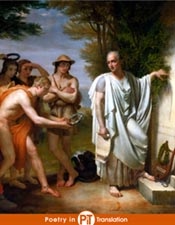
Quintus Horatius Flaccus (65–8 BC) was a Roman poet, educated in both Rome and Athens, whose career was shaped by the civil wars following Julius Caesar’s assassination. After fighting for Marcus Junius Brutus and receiving amnesty from Augustus, he returned to Italy to gain patronage from Maecenas, He produced several influential works including the Odes, Satires, Epistles, and Ars Poetica - blending Greek models with Roman themes.
Horace’s Odes (Carmina) is a collection of 103 Latin lyric poems across four books. Books 1–3 were published in 23 BC; Book 4, comprising 15 poems, followed in 13 BC. The work draws on Greek lyric models, principally Pindar, Sappho, and Alcaeus, adapting their forms and metres to Roman social and political life under Augustus.
The poems address a wide range of subjects: love, friendship, wine, religion, morality, patriotism, and the praise of Augustus and his circle. Philosophical themes recur throughout, particularly the brevity of life, the value of moderation (the “golden mean”), and contentment with one’s lot. Several widely cited Latin phrases originate here, including carpe diem (“Seize the day”), nunc est bibendum (“Now’s the time for drinking”), and dulce et decorum est pro patria mori (“It’s sweet and fitting to die for one’s country”).
Kline, A.S.,
Support Open-Access:
Your contribution keeps our classical translations available to all. Every dollar helps support classics education and funds the expansion of our catalogue. Value what we do? Donate now.
File Downloads:
© Copyright, All Rights Reserved. This work may be freely reproduced, stored and transmitted, electronically or otherwise, for any non-commercial purpose. Conditions and Exceptions apply.