Victor Hugo
Selected Poems
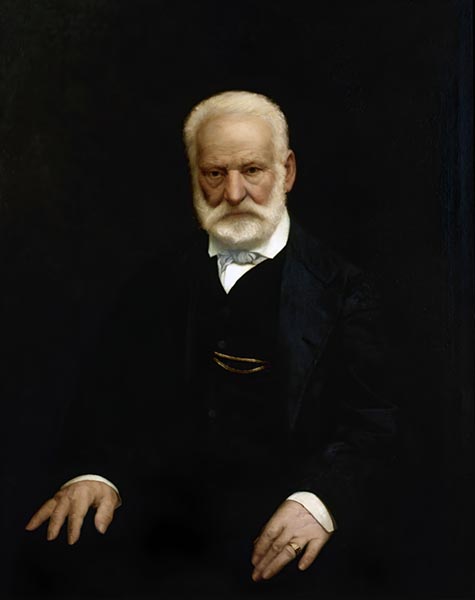
‘Portrait of Victor Hugo’
Aimé Morot (French, 1850–1913)
Artvee
Translated by A. S. Kline © Copyright 2025 All Rights Reserved
This work may be freely reproduced, stored and transmitted, electronically or otherwise, for any non-commercial purpose.
Conditions and Exceptions apply.
Contents
- Translator’s Introduction.
- To the Lovely Imperious One (À la belle impérieuse)
- To Mademoiselle Fanny de P … (À Mlle Fanny de P…)
- To a Young Girl (À une jeune fille)
- To a Woman (À une femme)
- In May (En mai)
- The Stupidity of War (Bêtise de la guerre)
- Tomorrow, At Dawn (Demain, dès l’aube)
- Song (Chanson)
- Epitaph for Jean Valjean (Épitaphe de Jean Valjean)
- Yesterday, At Evening (Hier au soir)
- Spring (Printemps)
- We Were Bound for The Orchard (Nous allions au verger)
- Laetitia Rerum (The joy of things)
- At Noon (En Midi)
- Orpheus, in the Starlight (Orphée, au bois du Caystre)
- The Day of the Festival (Jour de fête)
- Anacreon (Anacréon)
- The High Life (Vivants)
- One Lives; One Speaks… (On vit, on parle…)
- From the Woods I Demand Nothing More (Je ne demande pas autre chose aux forêts)
- Behold How the Season Declines (Voici que la saison decline)
- June Nights (Nuits de juin)
- When I Was, As Yet, a Pallid Young Fellow (Lorsque j’étais encore un tout jeune homme pale)
- Moonlight (Clair de Lune)
- Since I Have Touched My Lips… (Puisque j'ai mis ma lèvre…)
- He Said to Her: ‘Do you see…’ (Il lui disait: ‘Vois-tu…’)
- To She Who Is Veiled (A celle qui est voilée)
- My Poems, Both Frail and Sweet (Mes vers fuiraient, doux et frêles)
- Let Us Love ever! Let Us Love Still! (Aimons toujours! Aimons encore!)
- Reality (Réalité)
- My Two Daughters (Mes deux filles)
- Her Feet Were Bare (Elle était déchaussée)
- The Swallow in Spring (L’hirondelle au printemps)
- Ave, Dea; Moriturus Te Salutat (Hail, Goddess; he who is about to die salutes you)
- To Théophile Gautier (Á Theophile Gautier)
- Index of First Lines
Translator’s Introduction
Victor-Marie Hugo (1802 –1885) novelist, poet, essayist, playwright, artist, and politician, became a leading light of the French Romantic literary movement, witnessed by the turbulent opening night of his play Hernani in 1830, which portrayed the Romantic hero as a figure in conflict with society, dedicated to love and driven by fate; and supported by the lengthy preface to his play Cromwell, which championed freer forms closer to Shakespearean drama, interweaving tragic, comic, and grotesque elements, rather than the rigid rules of previous French theatre. He later achieved wider fame with his poetry, and the novels Notre-Dame de Paris and Les Misérables.
With the Revolution of 1848, Hugo was elected a deputy for Paris in the Constituent Assembly and later in the Legislative Assembly, where he adopted a position increasingly critical of the ruling powers. When in December 1851 a coup d’état inaugurated the Second Empire under Napoleon III, Hugo, opposed to political absolutism and authoritarianism, left France for Brussels. A twenty-year exile, mostly spent in the Channel Islands, ensued; initially enforced then voluntary. The French defeat in the Franco-German War, and the proclamation of the Third Republic in 1871, brought Hugo back to Paris, where he was received as a living symbol of republicanism and a national hero.
His poetry ranges over personal, philosophical, political and social themes. The personal aspects were deepened by the premature loss of his recently-married daughter in 1843 and his internal religious and philosophical struggles; the political and social aspects by his republican sympathies and the turbulent events of French nineteenth-century politics. In this selection the personal dominates, rather than the political or religious, revealing the calmer more introspective aspect of the poet invoked in Les Misèrables, particularly in the figure of Jean Valjean with whom he identified spiritually, rather than the polemical and rhetorical aspects which guaranteed his fame.
To the Lovely Imperious One (À la belle impérieuse)
Love, the panic
Of Reason’s
Conveyed
By a frisson.
I’ll speak, yet thereby
Offer nothing.
It’s fine, when I sigh,
If you sing.
If, sad, I should rest
At your feet,
It’s fine if you laugh
While I weep.
It seems a man’s
Often in error.
But, oh, have a care,
If I shiver.
To Mademoiselle Fanny de P … (À Mlle Fanny de P…)
O you whom your age protects,
Smile; all caresses you still.
Go sing and play, be a child!
Be a flower, the dawn, at will.
Don’t dream of your destiny,
The sky’s black, life is sombre.
What, alas, are we doing here,
Briefly, where shadows linger?
Fate is harsh, as we discover.
Child, often a sparkling eye
That sheds the brightest rays,
Sheds the most tears, by and by.
You, who are untested as yet,
Possess all, pleasure free of guile,
Innocence that makes us dream,
Ignorance that makes us smile.
Lily, untouched by the breeze,
You’ve a heart full of visions,
The happiness of children,
Their mothers’ pure reflections.
Your candour embellishes you,
I prefer of all flames that I know,
Your pupils that shine so clear,
With the clear light of your soul.
No cares, no sorrows, for you,
Whom your family idolize.
In summer, amidst the flowers,
In winter, firelight in your eyes.
Poetry, the heavenly spirit,
Has settled there, at your side,
Revealed in your mother’s eyes,
To your father, in thought, allied.
Enjoy this, the sweetest of times!
Live! Joy is too swiftly flown.
Even the dullest among us,
The brightest of dawns have known.
As one offers a parting prayer,
Young one, a blessing from me –
Fair angel, the martyr to come!
Fair child of the woman to be!
To a Young Girl (À une jeune fille)
‘Why complain, tender child?
Are these not the days of your youth?’
(From a Lithuanian Song)
Dear child, don’t envy my age, so full of sorrow,
When a smile is often sadder than your tears,
In which the heart is by turns a slave, a rebel.
You cannot know the beauty of childhood years.
One forgets the sweetness of those carefree days.
They pass by, like a breath of breeze in the air,
Like a joyful cry that gradually fades away,
Like a halycon taking flight from the water there.
Don’t be in such haste to see your thoughts ripen,
Take delight, in the Spring, in the morning,
Your hours are flowers that entwine together,
Don’t cull them faster than Time in passing.
Let the years arrive of themselves! For destiny
Will bring to you, as to us, false friendship, regret,
All those evils, without hope, that pride disavows,
All those pitiful pleasures, beyond you as yet.
Laugh, instead! And ignore the power of fate,
Smile! From your brow, all traces of sadness remove,
Your azure eyes mirrors of innocence and peace,
That reveal your soul, and reflect the sky above.
To a Woman (À une femme)
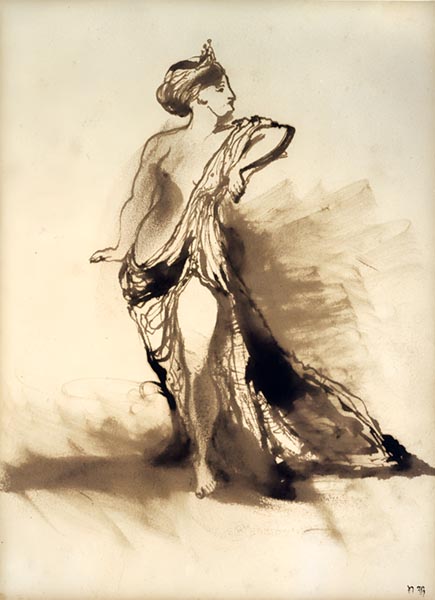
‘The Awakening (1866)’
Victor Hugo (French, 1802 – 1885)
Artvee
My dear, if I were a king I’d give my empire,
My chariot, sceptre, my people on their knees,
My crown of gold, my porphyry baths entire,
My fleet of ships, too numerous for our seas,
For a single glance from you!
Were I God, I’d give the earth, the air, the ocean,
All the angels, the demons subject to my law,
With chaos profound, and its fecund commotion,
Eternity, space, the heavens, the worlds, and more,
For a single kiss from you!
In May (En mai)
A strange sort of inspiration, no deaf, mute thing,
Bursts forth everywhere, and makes a poet of Spring.
All speaks, and listens, and loves, so it would seem;
Every cavern a mouth, and a voice in every stream.
The blackbird stirs, and looks at his anxious other,
Then thinks: ‘What of a nest?’ and regards his lover.
Like a dreamer dreaming, her head on the pillow,
Nature begins her work in the oak, and the willow,
Stammers, expressing a thought in her secret language,
Makes stanzas born of the alders; many an eclogue
Fills with the almond blossom, the lilac in bloom,
Mocked by the blackbird, whistling amid the broom.
Splendid and novel ideas arise in her mind,
She mixes wild oats and grass, woven, combined.
The fields are her poem, it seems, in which flocks graze,
Diligent, she finds no rest, no respite, for days,
Until she has brought together, and rendered as one,
In the deep sap within, both incense and venom.
From out the monstrous night she brings forth day,
In hatred often, makes love, which is ever her way;
Feverishly, like a sombre artist, in secret, creates,
All that’s hostile and sad, that the undergrowth hates,
The bristling brushwood, the steppe, and the maquis,
Mysteriously forming, a perfect masterpiece,
Which thorns complete, and yet with dawn’s moisture glows,
For the briar’s inspiration is ever the rose.
The Stupidity of War (Bêtise de la guerre)
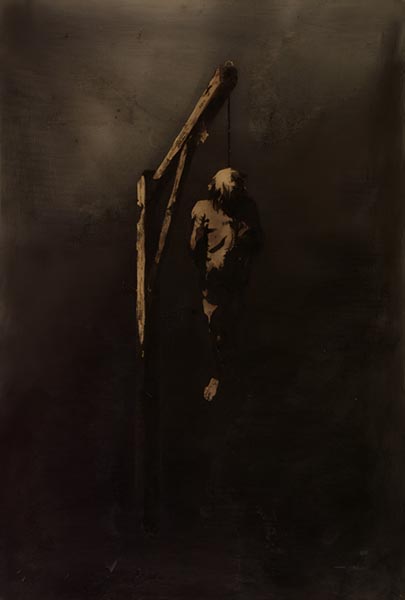
‘The Hanged Man (1854)’
Victor Hugo (French, 1802 – 1885)
Artvee
Labourer without eyes, mindless Penelope,
Cradle of chaos, where nothingness strives to be,
War, O war, midst which violent squadrons pass,
Filled with the furious clamour of sounding brass,
Drinker of blood, fierce, withered, of hideous hue,
Drawing Mankind deep into your drunken stew,
Cloud where fate is tormented, God flees the sky,
And darker than night, a brightness floats on high,
Madwoman, vast, armed with lightning and thunder,
What use are you, Giantess, smoke torn asunder,
If your destructiveness once more ends in evil,
If you hunt the creature, and serve the bestial,
If your die, cast in a place the shadows cover,
Unmakes one emperor, only to forge another.
Tomorrow, At Dawn (Demain, dès l’aube)
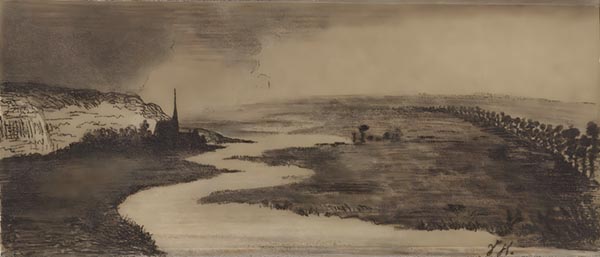
‘The River’
Victor Hugo (French, 1802 – 1885)
Artvee
Tomorrow, at dawn, when the countryside whitens,
I’ll go. You see, I know you are waiting for me.
I’ll travel the forest, I’ll travel the mountains,
Closer to where you are is where I must be.
I will walk, deep in thought, with fixed gaze ever,
Not hearing a sound, not seeing a single sight;
Alone, unknown, head bowed, hands crossed together,
Sadly, the day for me will be darker than night.
I’ll view neither the gold of descending evening
Nor the sails nearing Harfleur, in tranquil weather,
But I will place on your grave there, on arriving,
A bouquet of green holly and flowering heather.
Note: The grave of Hugo’s daughter, Léopoldine, is located in the churchyard in Villequier, near Harfleur. She drowned in the Seine, at the age of nineteen, along with her husband, Charles Vacquerie, in 1843.
Song (Chanson)
If you’ve nothing to say to me,
Why appear to me now?
Why that smile, so lovely to see,
Before which kings might bow?
If you’ve nothing to say to me,
Why appear to me now?
If you’ve nothing to teach me, why
Press my hand in this way?
If, of that tender, angelic sigh
At a dream you muse on alway,
You’ve nothing to teach me, why
Press my hand in this way?
If you’d have me vanish anew,
Why do you pass by here?
I tremble whenever I see you,
It brings joy, and care, I fear.
If you’d have me vanish anew,
Why do you pass by here?
Epitaph for Jean Valjean (Épitaphe de Jean Valjean)
He sleeps. Though his fate to strangeness was allied,
He lived. Once he’d relinquished his angel, he died.
It happened of itself, the event, and simply,
As the night descends when the day departs swiftly.
Note: Jean Valjean is the main protagonist in Hugo’s novel ‘Les Misérables’, a figure with whom he identified.
Yesterday, At Evening (Hier au soir)
Yesterday, the evening wind, its breath caressing,
Brought us the scent of flowers, opening tardily.
Night fell, the birds slept, deep in the darkened ways.
Spring was fragrant, but less than your young being,
The stars shone, but less brightly than your gaze.
I spoke in a quiet voice, at the sombre hour,
When the soul loves to sing its hymn most sweetly.
Seeing the night so pure, and you so lovely,
I said to the golden stars: shower heaven above
Over her! And to your eyes: on us shower love!
Spring (Printemps)
Now the days are long, here’s love, delirium, light!
Here’s the smiling spring! March, April, the ever-bright,
All the friendly months, flowery May, and scorching June!
Poplars on river-banks, slumbering through afternoon,
Bow themselves, gently, like giant palms in the breeze;
Birds flutter among the calm, warm, untroubled trees;
All seems so full of laughter, the leaves floating free,
Joyful to be together, murmuring poetry.
The day is born in a dawn both fresh and tender;
The evening is full of love, one thinks, moreover,
One hears, in shadow, blessed by the night on high,
A song of happiness, deep in the infinite sky.
We Were Bound for The Orchard (Nous allions au verger)
We were bound for the orchard, eager in pursuit
Of cherries; she climbed a tree, adorned with fruit,
Bent a branch, her arms like Parian marble, white
As her breast, which rose and fell in the shade, the light,
While the leaves, O Virgil, shivered there in the breeze,
And her slender fingers gathered the spoils with ease,
That shone like the fire at the burning bush’s heart.
I climbed behind her, her leg gleamed. ‘Don’t you start!
Be quiet!’ she said to me, seeing my ardent gaze,
And began to sing. Now and then, seeming always
Like to fierce Diana except for the singing,
Offering me a cherry in her lips, while bending
To meet my smiling mouth, ever content, at this,
To rest there, forego the cherry, and take the kiss.
Laetitia Rerum (The joy of things)
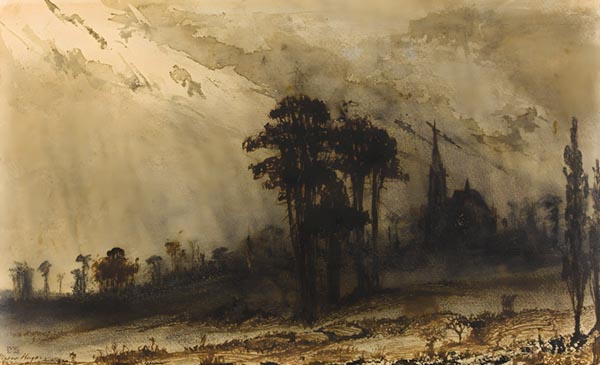
‘Countryside’
Victor Hugo (French, 1802 – 1885)
Artvee
All is seized by a sudden frisson,
Winter flees, hides its miserliness.
The year doffs its former garment,
The Earth dons her loveliest dress.
All’s new, all’s risen once more,
Youth is dancing over the plain,
A seductive beauty, everywhere,
Mirrored in the lake once again.
The tree flaunts; midst the flowers,
It’s a question who’s more gracious;
Every bloom displays its colours,
Even the ugliest are vivacious.
The weeds spring from the cliff,
The air kisses leaf and nest;
June smiles to see the ferns,
Adorned in their Sunday best.
It’s a feast, a festival indeed,
The thistle too attends, I fear;
In summer’s mighty palace,
Stars supply the chandelier.
Hay is cut, and soon the wheat.
The reaper sleeps beneath a tree,
And his sighing breath mingles
With the scent of the grassy sea.
Who sings there? The nightingale.
Pupae have split, the butterflies
Have taken flight, left behind
Their chrysalises, neath the skies.
The pond-skaters circle about.
Clear skies, the trellis’s shade,
The rushes tremble, the midges,
Hum in your ears, in the glade.
The bees are foraging, the wasps
Crawl about, the hornets watch;
To all these imbibers of pollen,
Spring has drawn back the latch.
The bumblebee, inclined to excess,
Enters while crumpling the petals;
A carnation provides a full glass,
A lily’s spread tablecloth settles.
A fly drinks midst the vermilion
And gold of a half-opened flower,
A butterfly plays the drunkard,
Midst the roses, its inns, for hours.
Ecstatic, the heart fills with delight,
Intoxication means deliverance,
There’s not a sign here employed
To hail the joys of temperance.
A providential pageantry
Glows, explodes, greets the dawn;
And the edges of our only book,
The sky, are gilded by the morn.
Children, in your shining eyes,
I see the empyrean, its glow;
Your laughter like the spring,
Your tears like the dew, below.
At Noon (En Midi)
At noon, when the sun hangs plumb over my head,
And I feel the warm sweat beading my brow,
And the weary Hours dance their round no more,
All slumbers; I look for a cave, I seek the shade.
The flowers droop, asleep, and the marble nymphs,
Even they, are warm in the darkened park,
As the shadow of their breasts reaches their navels.
Orpheus, in the Starlight (Orphée, au bois du Caystre)
Orpheus heard, in the woodland
By the Cayster, in the starlight,
A dark and sinister laughter
From unknown lips in the night.
Phtas, the Theban Sibyl,
Near Phygale, saw a vision,
Of ebony forms dancing
On the starry horizon.
Old Aeschylus, in Sicily,
Wandered around in the twilight,
Drunk on the sound of flutes,
Deep in the woods, at midnight.
While Pliny, forgetting all else,
Spied the nymphs of Miletus,
Revealing their rosy legs,
The breeze raising their dresses.
Plautus, prowling Viterbo,
In the orchard’s radiant light,
Gathered fruit from the grass,
The gods having taken a bite.
Versailles is a place sublime,
Where with one foot in the water
The faun offered Molière a rhyme
To astonish Boileau further.
Dante, who saw the shades below
Their dark likenesses revealing,
Was witness to women escaping
Midst the branches, at evening.
André Chenier, neath the willows,
Was greatly dazzled, moreover,
By those fleeing shoulders,
Of which Virgil was the lover.
While Shakespeare, on watch, beneath
The dormant oak-tree’s shade,
Heard a vague stamping of feet
Within the solitary glade.
Oh, I delight in you, foliage,
Some divinity dwells in you;
I believe that satyrs still dance,
In the depths of the forest too.
The Day of the Festival (Jour de fête)
Noon heats and dries the moss;
Fields ring to the tambourine;
In the soft light couples pass,
Families wander, all serene.
On the horizon, over there,
Is Saint Louis’ dusty keep;
High above the joyful affair,
The sun dazzles; meadows sleep.
Burning air, with silent breath,
Free of murmur, or refrain,
Makes the poppies’ embers glow
Midst the furnace of the plain.
Sheep are grazing here and there,
The hillside is slumbering too;
Shadows scarce, cicadas sing,
Beneath the flamboyant blue.
Behold the harvest’s gathered!
A rest from work. Friends, some wine!
Round the newly opened barrels,
Springs forth the laughter divine.
The drinker stumbles from the board,
Which staggers too, fraternally.
The drunkard knows every truth,
Forgets the heavens he can’t see,
And all else, the straight road, shame,
The law, the gendarme, every fear,
All order; that beanpole of Surène,
Gives the toll-house post a leer.
The donkey, a philosopher
Of old, long-eared, grins for hours,
Unhampered by a morning-coat,
Content with the meadow’s flowers.
The children run about in flocks,
Clichy toasts its elders, there,
Its great wall scarred and starred
By Prussian grapeshot, everywhere.
Carts, roll, and jolt, and pass,
Distant Paris hums, and rings,
Dark rag-picker, in her haul
Gathering the spoils of kings.
Far off the city’s chimneys rise,
And its high domes, veiled in blue;
Girls pass, crowned with every joy
Midst the wheat, and flowers too.
Anacreon (Anacréon)
Anacreon, poet of those erotic streams that flow
From the heights of ancient wisdom to folk below;
Rills we meet half-way, on the slopes, as we pass,
Spreading, bright in the shade, reviving the grass.
Pleasing, poet, is their calm and limpid course!
On a swift climb to the summit, to their source,
Wearied by the heat, scrambling, I love to drink
Deep of the trickling stream, at the stony brink.
The High Life (Vivants)
Yes. I understand: one parties all night,
One’s crowd bright to the eye,
That one does, friends, what others might,
And with never a sigh,
But to live beneath the stars, so,
Beneath the veils, to come and go,
Of desert where we can forget,
To breath the immense atmosphere,
Is harsh, and sad, yet I prefer,
That lions’ dwelling-place yet.
One Lives; One Speaks… (On vit, on parle…)
One lives, one speaks, one sees the sky overhead
One sees the clouds; one delights in writers long dead;
One reads Virgil and Dante; travels with joyous face,
On public transport, to some quite charming place,
Laughing out loud at one’s lodgings and the view;
The glance of a woman, in passing, stirs one anew;
One loves, one is loved, a pleasure denied to kings!
One hears every little bird in the wood that sings.
In the morning, one wakes, and an entire family
Embraces one; mother, sister, daughter, all three!
One breakfasts, while reading the paper. All day long,
Stir thoughts of love, work, hopes; a seething throng.
Life arrives with its host of troublesome passions;
One delivers one’s vital words, in sombre sessions;
Faced with the goals one seeks, and one’s actual fate,
One feels weak, or strong, one feels little, or great;
One is a wave in the flood, a soul amidst storms;
Everything passes; one celebrates, and one mourns;
One advances, retreats; one struggles, with baited breath...
And then…the immense, the profound silence of death!
From the Woods I Demand Nothing More (Je ne demande pas autre chose aux forêts)
From the woods I demand nothing more than this:
To maintain the cavern’s coolness and freshness,
And not to disturb the songbirds in their singing.
I want to hear the dark weaver’s shuttles moving,
As Pan, whom we only glimpse on the quietest days,
Spins the breeze, the waters, the moon’s bright rays,
The vast network of life, the immense, sombre show,
While the star trembles above, and the flower below.
Behold How the Season Declines (Voici que la saison decline)
Behold how the season declines,
Azure fades, wind’s fresh on the hill.
All the shadows lengthen their lines;
Birds are shivering; the grass is chill.
August contends with September.
The halcyons gone from the waves,
Each day loses a minute, forever,
Each dawn weeps its delicate rays.
The fly motionless on my ceiling,
Exists as if trapped, here to stay,
While, like a flake of snow falling,
The summer melts slowly away.
June Nights (Nuits de juin)
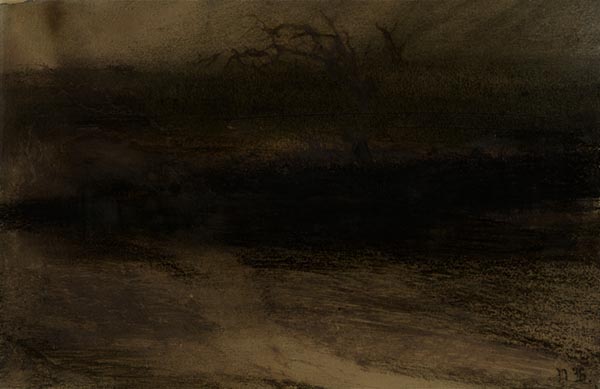
‘The Evening’
Victor Hugo (French, 1802 – 1885)
Artvee
In summer, when day has fled, and the flowery plain
Pours its heady perfume over the distant scene,
Eyes closed, yet ears half-open to every strain,
One sleeps but a half-sleep, in translucent dream.
The starlight seems purer then, the shadows deeper;
A vague twilight tints the eternal dome on high;
And dawn, tender and pale, awaiting the sleeper,
Seems to wander all night in the depths of the sky.
When I Was, As Yet, a Pallid Young Fellow (Lorsque j’étais encore un tout jeune homme pale)
When I was, as yet, a pallid young fellow,
About to enter the lists, and strike a blow,
In that arena where many have lost a lance,
The harsh Muse, said, with mysterious glance:
‘You’re off to war, but when El Cid did the same,
To fight for the right, and for his beloved Spain,
He’d twin blades, twin daggers, to take the field,
His lance to hand, and more than a single shield.
He needed duplicate weapons, that brave lord,
Before, like the Archangel, he drew his sword.
Have you steel at your side? Come, what armour,
Dear soldier, will you wear, to adorn a martyr?
What blades will you show, amidst the people?’
‘I bear a love of justice, Muse, a hatred of evil.
Better armed than a paladin, I enter the plain.’
‘And for your twin shields?’ – ‘Contempt and disdain.’
Moonlight (Clair de Lune)
The moon is serene; her light plays on the waves –
The window still open, free to the breeze,
The Sultana gazes; the sea, that heaves
Down there, dark isles with pure silver laves.
The lute escapes from her vibrant fingers.
She listens…soft sounds from echoing shores.
A Turkish trader from Cos’s waters,
Up from the isles of Greece, on Tartar oars?
Or cormorants plunging one by one, cutting
The flood, pearls flying from their wings?
Or a Djinn above in a high voice piping,
Hurling tall towers to the sea as he spins?
Who stirs the waves by the women’s seraglio?
Not the cormorant, cradled there on the sea,
Not stones from the walls, or the rhythmic beat
Of a trader’s oars thrashing the waves below,
But heaving sacks, from which sobs break free.
See them, sounding the flood that floats them on,
Moving their sides quite like to human forms…
The moon is serene; her light plays on the sea.
Since I Have Touched My Lips… (Puisque j'ai mis ma lèvre…)
Since I have touched my lips to your brimming cup,
Since I have bowed my pale brow in your hands,
Since I have sometime breathed the sweet breath
Of your soul, a perfume buried in shadow lands;
Since it was granted to me to hear you utter
Words in which the mysterious heart but sighs,
Since I have witnessed smiles, witnessed tears,
Your mouth on my mouth, your eyes on my eyes;
Since I have seen over my enraptured head
A light from your star shine, ah, ever -veiled!
Since I have seen, falling to my life’s flood,
The leaf of a rose snatched from out your days,
Now at last I can say to the fleeting years:
– Pass by! Pass by, forever! No more age!
Away with you and all your withered flowers,
I have a flower in my soul no one can take!
Your wings, brushing it, spill never a drop
From the glass I fill, from which my thirst I quench.
My soul possesses more fire than you have ashes!
My heart more love than your forgetfulness!
He Said to Her: ‘Do you see…’ (Il lui disait: ‘Vois-tu…’)
He said to her: ‘Do you see, if the two of us might,
With souls full of faith, and our hearts full of light,
Drunk on ecstatic sweetness, and melancholy,
Break the city’s thousand knots that bind, and be free,
If we could quit this Paris of sadness, madness, despair,
We could flee, go somewhere, no matter, anywhere,
Seek far from the vain noise, from hateful jealousy,
Some quiet corner, with a garden, a lawn, a tree,
A little house, flower-beds, a little solitude,
A little silence, azure above, our spirits renewed,
The song of a bird perched on the roof, up high,
Deep shade, for what else do we need, you and I?
To She Who Is Veiled (A celle qui est voilée)
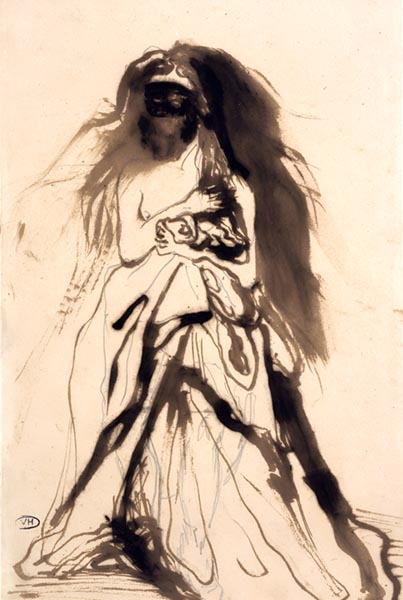
‘Masked Woman Holding Her Mantle’
Victor Hugo (French, 1802 – 1885)
Artvee
You speak from the depths of dream,
As a soul speaks to the living.
Like the foam on the ocean stream,
Your dress in the breeze, flowing.
I’m flotsam on endless waves,
A captive of fate, set apart.
I’m the one the shadows cover
Though they fail to stifle his heart.
My fate is like to this island,
And my destiny to this ocean,
I, a tranquil dweller amidst
That fiery tempestuous motion.
I’m the outlaw who hides his face,
Who, with the owl, the starlight,
Dreams, and sings, far from day,
The sombre songs of the night.
You are not, as I seem to be,
A flame in a bitter world,
‘Soul’, that’s to say enigma,
‘Woman’, in exile furled.
Emerge from the cloud, fair shade,
Reveal yourself to the eye!
Be a lighthouse to one in torment,
Be a glance to search my dark sky.
Look among the seabirds for me!
Cast a shaft of light on the reef.
Be the whiteness, deep in my silence,
Of the pensive angel of grief!
Be the wing that passes, and touches
The vast anger of waves, at your feet!
Come! Oh, you must be beautiful,
For your distant song is so sweet.
Since night engenders the dawn,
Perhaps it’s heaven’s strange law,
That my dark fate should elicit
Your mysterious smile, on this shore!
In the shadowy world I wander,
We were bound to meet, at night,
I myself bent wholly on duty,
You wholly composed of light!
From afar, you tell me you love me,
And that on the horizon, you roam,
You seek here, on a pallid coast,
The spectral place now my home.
Beneath the vast dome, meditating,
By the endless turbulent sea,
Surprised to find a mere atom
Partake of the vast immensity,
Without knowing me, you compare
Man to wave, exile to shadow;
To those stars, shining to infinity,
The lamp that shines in my window!
Sometimes, as in the grave’s depths,
On my brow, your touch I feel,
Mouth of the Unknown, letting fall
The pure kiss of the Ideal.
At your breath, sent heavenwards,
I feel a sweet quiver within me,
A shiver of fear through my thoughts,
Those leaves of the internal tree.
But you chose not to be seen,
At will, come and go, above,
Not wishing to be known as joy,
Having claimed: ‘My name is love.’
Oh, take one step more, and enter!
If no law exists that forbids it,
Come visit my soul in its den,
The heart a child, a lion the spirit;
See the desert in which I dwell
Alone, beneath the fearful sky,
Be the angel to the lone hermit,
Be a light to the far-seeing eye.
Amidst the ruins, change to pearls
All my tears of sweat, and place
On my works, my sombre labour,
Your finger that illuminates space!
At the edge of the sinister ravine
Of dreams and apparitions, I see
A glimpse, perhaps, of the divine –
Render whole that vision for me!
Visit the self-immolated dreamer,
The more ruined the more alight,
Who, day by day, within his soul
Finds more of death, less of night.
Enter the vague mist, raw within,
Where faith is born, mind elevated,
Wherein I can see though confusedly,
The hidden forms of what is fated.
All’s illuminated by the funeral pyre;
Heaven ever opens, for the hopeless,
Saddened thinker, in the shadows,
Sudden chasms, shafts of brightness.
Before I was here on this planet,
I feel I once hovered, high above;
I was the solitary Archangel,
And being born but ill did prove.
Come you, that bear heaven’s seal,
To my soul, that once flew above.
For sometimes a feather will fall
On to the dead corpse of a dove.
My irreparable misfortune:
On more than one element,
Miserable wretch, I depend:
Earth’s mud, and the firmament.
This is what it is to be human,
To dream all was fair; my doom
To scorn what I know myself to be,
A thing of heaven and the tomb!
To be a convict who must pursue
His vile labour, beneath the sky;
To bear all the weight of being,
Not the wings you gave, Lord on high!
To drag my material burden about,
I, a son of the heavens above,
To be formed of the cemetery’s earth,
Though the cry I utter is: ‘Love!’
My Poems, Both Frail and Sweet (Mes vers fuiraient, doux et frêles)
My poems, both frail and sweet,
Would fly to your garden, oh,
If only my poems had wings,
Like the birds, and could do so.
They would fly, sparks of light,
Towards your smile, that glow,
If only my poems had wings,
Like my spirit, and could do so.
Faithful and pure, to be near
To you, at all hours, they’d go,
If only my poems had wings,
As love has, and could do so.
Let Us Love ever! Let Us Love Still! (Aimons toujours! Aimons encore!)
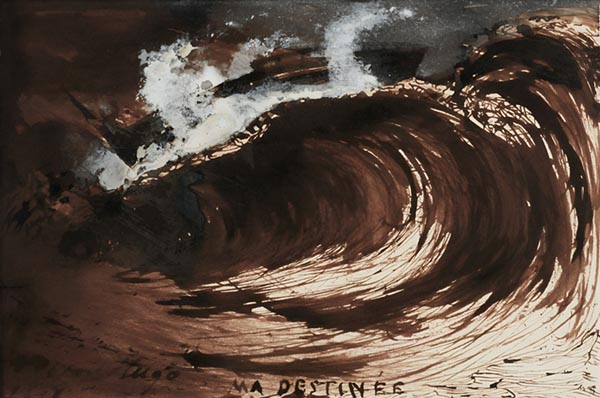
‘My Destiny (1857)’
Victor Hugo (French, 1802 – 1885)
Artvee
Let us love ever! Let us love still!
When love goes, hope too takes flight.
Love is the cry of dawn on the hill,
Love is the hymn in the night;
What the waves say to the shore,
What the wind says, high above,
What the stars say to the clouds,
That ineffable cry: ‘Let us love!’
Love makes us live, dream, believe,
Emits, to warm hearts in distress,
A ray that is brighter than glory,
A flame that is called happiness!
Love! Whether praised or blamed,
Great hearts embrace love always,
So, join to your youthful form,
The soul of your youthful days.
Love! And so, enchant the hours,
That in your lovely eyes one sees
That mysterious smile that hides
The pleasures within that please!
Let us love more and more each day,
Let us join more firmly together.
The trees add leaves to their foliage,
Let our souls merge, one with another!
Be the mirror and the reflection!
Be the flower and its scent in one!
Lovers beneath the shade, who feel
Not two hearts but their union!
Poets seek out what is beautiful.
Woman, angel of chaste favours,
Loves to refresh with her wings,
Dreamers heated by their labours.
Come to me, beauty that moves me!
Come to me, all my good, my law!
Angel come to me when you sing,
And when you weep, I implore!
I alone know your ecstasies,
Mock none, ply no magic arts,
For poets are vessels, into which
Women pour all their hearts.
I who seek, in all this world,
But the one sole reality,
I, who let pass like the waves
All that’s simply vanity,
Prefer to what merely intoxicates
The pride of a king or a soldier,
The shadow you cast on my page,
When your forehead leans closer.
Every ambition set alight
In that subtle brazier, the mind,
Falls to ashes, ascends in smoke,
And what remnants do we find?
Pleasure, a flower barely open,
In an April, darkened and chill,
Lily, myrtle, or rose, fades and dies,
And must vanish, despite our will.
Noble lady, only love remains.
If you’d dwell in this vile place,
Guard your faith, guard your soul,
Guard your love, guard every grace!
Conserve in your heart, free of fear,
Though you may suffer and sigh,
The flame that cannot be quenched,
And the flower that cannot die!
Reality (Réalité)
Nature is everywhere the same,
In Japan or France; Triptolemus
Sowed seed as any farmer does,
Chlamys, petticoat, what’s in a name?
To Louis, the Sun King, La Vallière
Was quite as harsh as, to Mars,
Venus was, who floated ashore,
On a scallop shell, neath the stars.
O poets, my brothers, my sons,
Utter the true words for things.
Be pure in spirit, and deed;
Nothing’s coarse if the soul sings.
A hiccup escaped Silenus,
Among the roses of Paestum.
If Horace presents Priapus,
Shakespeare can risk Bottom.
Truth herself knows no bounds.
Pan, the bestial god, take a bow,
For reality ever displays its horns,
On the Ideal’s immaculate brow.
My Two Daughters (Mes deux filles)
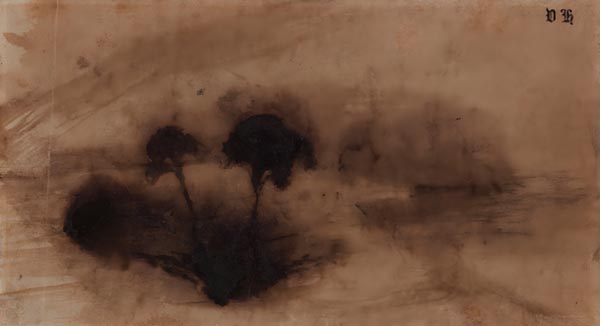
‘Two Trees on an Islet’
Victor Hugo (French, 1802 – 1885)
Artvee
In the pleasant evening’s fresh-clear darkness,
One seems a swan, and the other a dove,
Both joyous, both lovely, O sweetness!
See, both the elder and younger move
To sit at the garden’s edge, beside them
White carnations, with long frail stems,
From their marble urn, stirred by the breeze,
Lean, watching them, motionless, at ease,
Who, trembling in shade there, seem to be
Butterflies caught in flight; a frozen ecstasy.
Note: Written in 1842. The two daughters are the ill-fated Léopoldine and her sister Adèle.
Her Feet Were Bare (Elle était déchaussée)
Her feet were bare she’d undone her hair,
Sitting, fair, by the bowing reeds;
I, as I passed, thought a fairy there,
And said: Will you walk in the meads?
She looked at me with a haughty look
That beauty retains when we conquer,
And I said: ‘Will you? It’s the month of love,
Will a walk in the woods be your answer?’
She dried her feet on the riverside grass;
She looked at me once again,
And the playful beauty then took thought.
Oh, the birds that sang deep in the day!
The water caressed the shore so gently!
That joyous sweet girl, fearful and wild,
Among the green rushes she came to me,
Her hair in her eyes, and through it a smile.
The Swallow in Spring (L’hirondelle au printemps)
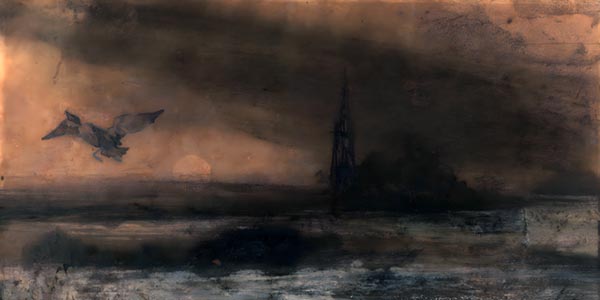
‘Memory of Brittany (1858)’
Victor Hugo (French, 1802 – 1885)
Artvee
The swallow in spring seeks out the ruined tower,
Forgotten debris, yet where life retains its power.
The blackbird in April, beloved, chooses to glide
Into the wood’s freshness and shade, and hide
Among knotted branches, the moss, the canopy,
That roof that’s formed of the overlapping leaves.
The birds act so, and as for us, in the city,
We seek some corner, tranquil and solitary,
Deserted, and free of sly, of ill-meaning eyes,
The street with closed shutters, the grassy rise,
The path of the shepherd, the poet, the unknown
Woodland clearing, mute, scarcely overgrown,
Where silence extinguishes every sound above,
Where the birds hide their nests and we, our love.
Ave, Dea; Moriturus Te Salutat (Hail, Goddess; he who is about to die salutes you)
To Judith Gautier
Death and beauty are things so profound,
So, of dark and azure, one might offer
Them to be sisters terrible and fecund,
Possessing the one secret, one enigma.
O women, voices, gazes, black hair, blonde tresses,
Blaze forth, I die! Own to light, love, attraction,
O pearls the sea mingles with its great masses,
O gleaming birds of the forest’s sombre ocean!
Judith, our fates are closer to one another’s
Than one might think, seeing my face and yours:
The whole divine abyss is present in your eyes,
And I feel the starry gulf within my soul;
We are both neighbours of the silent skies.
Madame, since you are lovely, and I am old.
Note: Judith Gautier, poetess, translator, and historical novelist, was the daughter of Théophile Gautier and Ernesta Grisi, sister of the noted singer and ballerina Carlotta Grisi. Hugo was more than forty years her elder.
To Théophile Gautier (Á Theophile Gautier)
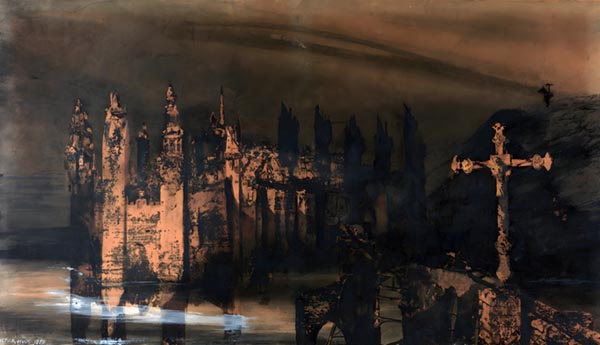
‘The Castle of the Cross (1850)’
Victor Hugo (French, 1802 – 1885)
Artvee
Friend, Poet, Spirit, you have fled our night,
You quit our noise, to penetrate the light,
Your name to shine on some pure summit.
I who once knew you young and beautiful, I
Who loved you, I who in my long flight,
Distraught, took comfort from your true spirit,
I, white with the years that snow upon my head,
Remembering times past, now dream, instead,
Of youthful days that witnessed our new dawn,
The struggle, the loud arena, the fierce storm;
Our new art, offered to the mob’s loud braying;
And hear, yet, that vast, sublime tempest fading.
Son of Ancient Greece, and the ‘Young France’,
Lauding the dead, you yet with hope advanced,
Never closing your eyes to the distant future,
Theban mage, Druid by the dark menhir,
Flamen by Tiber, Brahmin by the Ganges,
Fitting a celestial arrow to godlike bow,
Viewing the haunts of Roland, Achilles,
Mysterious smith, born of those who know
How to bend light-beams to a single ray;
For, in your soul, the sunset met the day,
Tomorrow, yesterday, in your fertile brain;
You crowned the old art, father of the new;
You understood how, when an unknown soul
Speaks to a nation, flaring midst the cloud,
Our hearts must open, greet it, cry aloud;
Calm, you scorned the base attempts of those
Dribbling Shakespeare, drooling Aeschylus;
You knew this age had its own air to breathe,
That art progresses by self-transformation,
Beauty’s achieved by yearning for creation.
And you were heard to utter cries of joy,
When Drama gripped old Paris in its teeth,
When spring chased ancient winter away,
When the wondrous star of our new ideals
Suddenly glittered in the burning sky,
And the Hippogriff stole Pegasus’ place.
Now, on the tomb’s severe sill, I greet you.
You knew the Beautiful; go find the True.
Climb the harsh stair. From the black steps’ height,
The arches of the dark bridge loom in sight;
Go! Die! The final hour is our last flight.
Soar, Eagle, find the gulfs that you desired;
You’ll view the absolute, the real, sublime.
Feeling the ominous breeze there on high,
Knowing an eternal wonder’s vertigo.
From heaven’s top, your Olympus, see
From truth’s high peak, Man’s unreality;
From Job’s, from Homer’s summit, view,
Soul, at God’s own height, Jehovah too.
Soar Spirit! Hover higher on open wings!
After the living leave us, moved, I gaze;
For to enter death, is entering the Temple;
Whenever a man dies, and goes his way,
I see my own ascent, as clear as crystal,
Friend, for I feel fate’s darkening plenitude;
I have commenced my death in solitude,
I see my own deep vaguely-starlit night,
Nearing the hour when I too take flight,
My long thread trembling close to the knife;
The breeze that takes you lifts me up alive,
I, the exile, to follow all whom I’ve loved,
For their gaze draws me into infinite space.
I hasten there. Don’t close the sombre gate.
Pass on; for it’s the law; none can deny;
All leans; and this great age with all its light
Slides to the shade to which we, pallid, flee.
Oh, the oaks they felled for Hercules’ pyre,
Harsh is the roar they make this night of fire!
Death’s steeds neigh joyfully: the bright day flies;
Our great century that tamed the hostile breeze
Expires … Their peer, their brother, Gautier,
You join now Lamartine, Dumas, Musset.
The ancient sea that spawned young men is dry,
Youth’s fount is gone. Now we pass the Styx,
And the grim reaper, with his pointed scythe,
Steps forward, thoughtfully, to clear the field;
My turn arrives; night fills my troubled eye,
Reading, alas, from doves’ flights, coming days,
Weeps over cradles, smiles to see new graves!
Note: Gautier, born in 1811, died in 1872; Hugo, born in 1802, in 1885. Gautier maintained a lifelong admiration for Hugo having been a strong supporter of his in their youth. The above was one of the many poetic tributes offered at Gautier’s grave.
Index of First Lines
- Love, the panic
- O you whom your age protects,
- Dear child, don’t envy my age, so full of sorrow,
- My dear, if I were a king I’d give my empire,
- A strange sort of inspiration, no deaf, mute thing,
- Labourer without eyes, mindless Penelope,
- Tomorrow, at dawn, when the countryside whitens,
- If you’ve nothing to say to me,
- Yesterday, the evening wind, its breath caressing,
- Now the days are long, here’s love, delirium, light!
- We were bound for the orchard, eager in pursuit
- All is seized by a sudden frisson,
- At noon, when the sun hangs plumb over my head,
- Orpheus heard, in the woodland
- Noon heats and dries the moss;
- Anacreon, poet of those erotic streams that flow
- Yes. I understand: one parties all night,
- One lives, one speaks, one sees the sky overhead
- From the woods I demand nothing more than this:
- Behold how the season declines,
- In summer, when day has fled, and the flowery plain
- When I was, as yet, a pallid young fellow,
- The moon is serene; her light plays on the waves –
- Since I have touched my lips to your brimming cup,
- He said to her: ‘Do you see, if the two of us might,
- You speak from the depths of dream,
- My poems, both frail and sweet,
- Let us love ever! Let us love still!
- Nature is everywhere the same,
- In the pleasant evening’s fresh-clear darkness,
- Her feet were bare she’d undone her hair,
- The swallow in spring seeks out the ruined tower,
- Death and beauty are things so profound,
- Friend, Poet, Spirit, you have fled our night,