Gérard de Nerval
Aurelia (Aurélia, ou Le Rêve et La Vie, 1855)
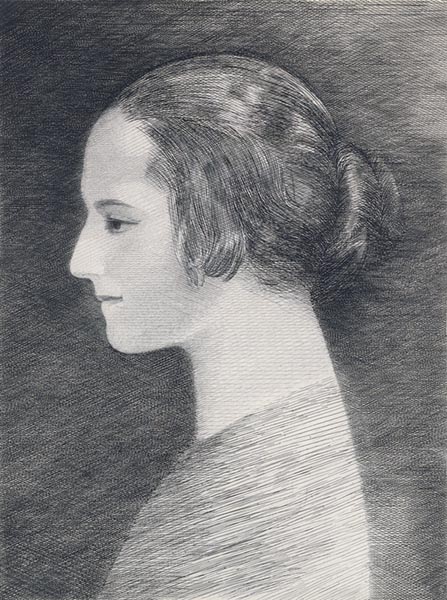
Louis Marcoussis (French, 1883-1941)
Artvee
Translated by A. S. Kline © Copyright 2026 All Rights Reserved
This work may be freely reproduced, stored and transmitted, electronically or otherwise, for any non-commercial purpose.
Conditions and Exceptions apply.
Contents
Translator’s Introduction
Gérard de Nerval was the pen-name of Gérard Labrunie (1808-1855), essayist, translator, poet, playwright, and travel writer. He was a major figure during the era of French Romanticism, and is best known for his novellas and poetry, especially the collection ‘Les Filles du feu (The Daughters of Fire)’, which contained a set of eight novellas, including ‘Sylvie’, and a selection of poems including ‘El Desdichado’. Gérard played a major role in introducing French readers to the works of the German Romantic authors, including Goethe and Schiller, initially through his prose translation of the first part of Goethe’s ‘Faust’. His later work, merging poetry and journalism in a fictional manner, influenced Proust, particularly ‘Sylvie’’ which explores the theme of time lost and recalled, its most obvious literary descendant being Alain-Fournier’s ‘Le Grand Meaulnes’, while its antecedents are Rousseau’s ‘La Nouvelle Héloïse’ and Goethe’s ‘Sorrows of Young Werther’.
At college, he had met Théophile Gautier, who became a lifelong friend, and in 1836 accompanied Gautier on a trip to Belgium. In 1840 he took over the latter’s column in ‘La Presse’.
He began to experience serious mental health problems in 1841. In late 1842 and 1843, Gérard travelled to, and around, the Near East, later publishing articles deriving from his travels, and the major work ‘Voyage en Orient’ which expanded on his journey. Between 1844 and 1847, Nerval travelled to Belgium, the Netherlands, and London, writing about his experiences. At the same time, he was writing novellas and opera librettos, and translating the poems of his friend Heinrich Heine, publishing a selection of these in 1848. His last years were troubled by severe emotional and financial problems, and he sadly took his own life in January 1855.
Gérard’s last novella, ‘Aurélia, ou la Reve et La Vie’ (‘Aurelia, or Life and the Dream’), modelled stylistically, to a degree, on Dante’s semi-autobiographical ‘La Vita Nuova’, and sharing the latter’s theme of self-reassessment and renewal through the fact of the beloved’s death, drew on Gérard’s unrequited love, and memories of his own troubled mental states, particularly in the period prior to his suicide. Believing that the artist, especially the writer, should bear witness to every facet of human experience, and as a warning to others, he created in this text a psychological profile of his inner disturbances, and the power of dreams, as well as producing an accomplished literary work, one which strongly influenced André Breton and the Surrealist movement. There are aspects of the text that foreshadow science-fiction, while also invoking myth, legend, and arcane religious beliefs, and anticipating the exploration of the psychology of dreams and mania, by Freud, Jung and others. The extent to which Gérard himself believed in the reality or otherwise of his dreams or visions, is unknown, and doubtless varied from time to time. But like Coleridge, with regard to his poem ‘Kubla Khan’, or Dante with regard to his ‘Divine Comedy’, though Gérard’s dreams and visionary experiences stirred his imagination and prompted the work, its literary development was performed by a mind in complete intellectual and rational control.
Part One
Chapter One
The dream is a second life. I cannot penetrate without trembling those doors, of ivory or horn, which separate us from the invisible world. The first moments of sleep are an image of death; a nebulous numbness seizes my thoughts, nor can I determine the precise moment when the Self, in another form, continues the course of existence. There is a vague subterranean space which gradually becomes clearer, in which the pale, grave, motionless figures which inhabit the abode of Limbo emerge from the shadow and the night. Then the picture takes shape, a new clarity illuminates, and engages, those strange apparitions: – the world of Spirits opens to me.
Swedenborg called his visions Memorabilia; he experienced them in reverie more often than he did in sleep; Apuleius’ ‘Golden Ass, Dante’s ‘Divine Comedy’, are the poetic models for such studies of the human soul. I will try, following their example, to transcribe my impressions of a long illness which took place entirely in my mind — though I know not why I employ the term illness, since I have never, in my experience, felt better. Sometimes I thought my strength and activity re-doubled; I seemed to know everything, and understand everything; imagination brought me infinite delights. In recovering what men call Reason, will I have cause to regret the vanishing of these visions?...
My Vita Nuova had two phases. Here are the notes that relate to the first. A lady I had loved for a long while, whom I will call Aurelia, was lost to me. The circumstances of this event, which was to have such a great influence on my life, matter little. All can find amongst their memories the most heartbreaking emotion, the most terrible blow struck against their soul by fate; one must resolve, at that moment, to live or to die: — I will speak later of why I chose life over death. Condemned by the one I loved, guilty of a fault for which I no longer hoped to be forgiven, there was nothing left for me but to indulge in vulgar forms of intoxication; I affected joy and carelessness, I travelled the world, madly, in love with variety and caprice: I loved above all the costumes and strange customs of distant nations, it seemed to me that I was redefining for myself the meaning of good and ill; the meaning of what we French term sentiment. — ‘What madness,’ I said to myself, to love thus, with platonic love, a woman who no longer loves me! This is all the fault of my reading: I took the inventions of the poets seriously, and made a Laura or a Beatrix of an ordinary person belonging to this century… — Let me pursue other affairs and this one will be swiftly forgotten.’ — The giddy joys of Carnival in an Italian city chased away my melancholy thoughts. I was so content with the relief I felt, that I shared my joy with all my friends and, in my letters, portrayed as a constant state of mind what was simply my feverish over-excitement.
One day, a woman of some renown arrived in the city, who took a liking to me, and being accustomed to please and impress, drew me, willingly, among her circle of admirers. After an evening in which she had displayed a natural and charming manner felt by all there, I was so taken with her that I declined to delay a moment in writing to her. I felt so happy to feel my heart capable of fresh affection! I borrowed, in this artificial state of enthusiasm, the very formulae which had served, but a brief time before, to imitate a true and long-nurtured love. The letter once sent, I would have wished to retract it, and went away to dream, in solitude, of what seemed to me a profanation of those memories.
The evening restored to my new love all the previous day’s power. The lady showed herself sensitive to what I had written, while displaying some astonishment at my sudden fervour. I had experienced, in one day, and conveyed to her, the several degrees of feeling one can conceive for a woman, while giving the appearance of complete sincerity. She confessed that I had astonished her, while her pride was flattered. I tried to convince her of my affection; but, whenever I wished to address her, I failed, subsequently, to achieve in our conversations the same elevated style, so that I was reduced to confessing to her, with tears, that I had deceived myself, in deceiving her. My tender confidences nevertheless possessed some charm, and a friendship, stronger in its sweetness, succeeded my fruitless protestations of tenderness.
Chapter II
Later, I met her again, in another city, where the lady I still loved, though hopelessly, was living. A chance encounter brought them together, and the former had occasion, no doubt, to soften the feelings towards me of she who had exiled me from her heart. So, finding myself in the circle to which she belonged, I saw her, one day, approach me and extend her hand. How should I interpret her advance, and the deep, sad look which accompanied her greeting? I thought I saw, there, forgiveness for the past; a divine hint of pity granted an inexpressible value to the simple words she now addressed to me, as if an element religious in nature were mingled with the sweetness of an affection hitherto profane, and gave it something of an eternal character.
An imperative duty forced me to return to Paris, but I resolved, immediately, to remain there only a few days and to return to these two friends. Joy and impatience produced a sort of dizziness, complicated by the attention the business I needed to conclude required. One evening, close to midnight, I was walking through the suburb where I dwelt, when, looking upwards by chance, I noticed a house number, illuminated by the street lamp. The number corresponded to my own age. Immediately, casting my eyes down, I thought I saw before me a woman with a pale complexion and hollow eyes, who seemed to me to possess Aurelia’s features. I said to myself: ‘It is her death or mine that is thus announced!’ But I know not why, it was the latter supposition that impressed me, and I was convinced that my death would, of necessity, occur the following day at the same time.
That night I experienced a dream that confirmed my thoughts. I was wandering through a vast building composed of several rooms, some of which were devoted to study, others to conversation or philosophical debate. I stopped, intrigued, at one of the first, where I thought I recognised my former teachers and classmates. The lesson continued, on the subject of the Greek and Latin authors, with that monotonous drone which ever seems like a prayer to the goddess of memory, Mnemosyne. I entered another room, where a philosophical discussion was taking place. I took part in it for a while, then departed to seek my room, which appeared to be located in a kind of hostelry with immense staircases, full of travellers busy about their own affairs.
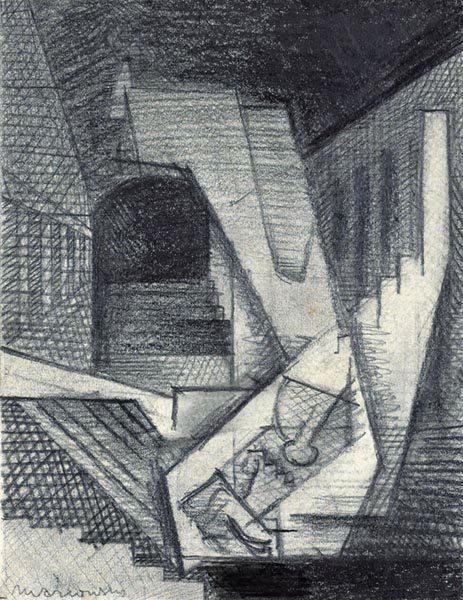
A Dream (Drawings for Aurelia)
Louis Marcoussis (French, 1883-1941)
Artvee
I lost my way several times among the long corridors, and, while crossing one of the central galleries, was struck by a strange spectacle. A being of immense size — male or female, I know not — was fluttering painfully above the floor, seemingly struggling amidst dense cloud. Lacking strength and breath, it fell to the ground, at last, in the centre of that dark courtyard, its wings catching, and crumpling, on the roofs and balustrades. I was able to contemplate it for a moment. It was coloured in vermilion hues, and its wings gleamed with a thousand varying reflections. Dressed in a long robe, the folds in antique style, it resembled that Angel, the ‘Melancolia I’, of Albrecht Dürer’s creation. I could not help uttering a cry of fright, which woke me with a start.
The next day I hastened to visit all my friends. I mentally bade them farewell, and, without relating anything of what occupied my mind, I discoursed warmly on mystical subjects; I astonished them with a particular show of eloquence; it seemed to me that I knew all, and that the mysteries of the world had been revealed to me in these supreme hours.
In the evening, when the fatal moment seemed to be approaching, I was discussing with two friends, in my circle, the subjects of painting and music, defining, from my viewpoint, the origin of colours and the meaning of numbers. One of them, named Paul **, wished to accompany me home, but I told him I was not intending to return there. ‘Where are you going?’ he said. ‘To the Orient,’ I replied. While in his company, I began to search in the sky for a particular star, which I seemed to know of, as if it exercised some influence over my fate. Having found it, I continued to walk, following various streets, in the direction in which it was visible; walking, so to speak, ahead of my fate, wishing to keep my eyes on that star, till the moment when death was destined to strike me. Having arrived, however, at the confluence of three streets, I felt no desire to advance further. It seemed to me that my friend was deploying superhuman strength in order to oblige me to change direction; he was growing taller in my eyes and took on the features of one of the apostles. I thought I saw the place where we stood elevating, while losing the form granted to it by its urban configuration — on a hill, amidst immense solitude, the scene turned into the combat of two Spirits, and akin to a Biblical moment of temptation. — ‘No!’ I said, ‘I do not belong to your heavens. In that star, those who await me dwell. They existed prior to the revelation you announce. Let me join them, for the one I love is among them, and it is there that we must meet again!’
Chapter III
Here commenced what I will call the ‘effusion’ of my dream into real life. From that moment on, everything acquired a dual aspect, and this without my reasoning ever lacking logic, without the slightest details of what was happening to me lapsing from memory. Only, my actions, apparently senseless, were subject to what is termed ‘illusion’, according to human reason...
I have thought, many a time, that, at certain grave moments of life, a Spirit from the outside world suddenly renders itself incarnate, thus, in the shape of an ordinary person, and acts, or attempts to act, on us, without that person possessing any knowledge or memory of it.
My friend had left me, finding his efforts in vain, and doubtless believing me prey to some idée fixe from which walking would distract me. Finding myself alone, I rose with an effort, and set off again in the direction in which the star was visible, the one on which my gaze had settled. As I walked, I sang a mysterious hymn which I thought I recalled hearing in some other existence, and which filled me with an ineffable joy. At the same time, I doffed my earthly clothes, and scattered them around me. The road seemed to rise endlessly, though the star grew larger. Then I halted, arms outstretched, awaiting the moment when my soul would separate from the body, magnetically attracted to that beam of starlight. I felt a shudder, then. Regret for the Earth, and those I loved there, seized my heart, and I implored the Spirit who drew me to him, to release me, and did so with such ardour and success that seemingly I descended again among Mankind. The night-watch surrounded me – the idea possessed me that I had become immensely large – and that, fully empowered by the electric force, I could overthrow anything that approached. There was something ridiculous in the care with which I sought to spare the strength and lives of the soldiers who had gathered me up.
If I were not of the view that the writer’s mission is to analyse, sincerely, what he feels during the serious events in life, and if I had not set myself a goal that I believe to be useful, I would halt here, and not attempt to describe what I next experienced; a series of visions, perhaps insane, or at least vulgarly morbid... Lying on a camp bed, I thought I saw the sky open to reveal a thousand aspects of unheard-of magnificence. The destiny of the Soul, once delivered from the body, seemed to reveal itself, prompting me to regret having wished to regain a foothold, with all the strength of my spirit, on the Earth that I was about to leave... Immense circles were traced in the sky’s infinite depths, like those formed in water disturbed by a falling body; each separate region, peopled with radiant figures, was tinted with its own colour, traversed the heavens, and melted, in turn, while a divinity, always the same, rejected, furtively, but smilingly, the masks of its various incarnations, and finally took refuge, ever elusive, in the mystical splendour of the Eastern sky.
This celestial vision, obeying the law of such phenomena that all may experience in certain dreams, left me partially aware of what was happening around me. Lying on a guard-house camp-bed, I heard the soldiers speaking of a stranger they had arrested, as I had been arrested, whose voice had just sounded in the same room. By a singular vibratory effect, it seemed to me that this voice resonated in my own chest, and that my soul was split, so to speak; divided, distinctly, between vision and reality. For a moment, I had the idea of exerting myself, and turning towards the half in question, then shuddered as I remembered the tradition, well known in Germany, which says that each of us has a double, a döppleganger, and that when one sees it, death is near. — I closed my eyes, and entered a confused state of mind, in which the real or fantastic figures that surrounded me shattered into a thousand transient images. For a moment, I thought I saw two of my friends close by, who had called to collect me, the soldiers pointing me out to them; then the door opened and someone of my stature, whose face I could not see, exited with my friends whom I begged, in vain, to return. — ‘But they’re in error!’ I cried, ‘I’m the one they’ve come for, and the one who is departing with them is someone else completely!’ I made so much noise that I was locked in a cell.
I remained there for several hours, in a sort of stupor; finally, the two friends I thought I had seen before came with a carriage to gather me up. I told them all that had happened, but they denied having been there during the night. I dined with them quite peacefully, but, as night approached, it seemed to me that I had reason to fear the very hour which, the day before, would have proved fatal to me. I asked one of them for the oriental ring he wore on his finger which I considered an ancient talisman, and threaded it through a scarf, which I tied around my neck, taking care to turn the turquoise stone, with which it was set, towards that point on the nape of my neck where I felt pain. According to my reasoning, this point was the one via which my soul would dare to leave, at the moment when a certain ray of light, emitted by the star I had seen the day before, would coincide with the zenith, situated relative to myself. Either by chance, or due to the effect of my profound obsession, I fell as if struck by lightning, at the very same time when I had fallen the previous day. I was placed on a bed, and lost, for a long while, my power to grasp the meaning of, and connections between, the images that presented themselves to me.
This state lasted for several days. I was taken to a nursing-home. Many relatives and friends visited me, though without my knowing. The only difference between waking and sleeping, as far as I was concerned, was that, in the former state, everything was transfigured before my eyes; each person who approached seemed changed, material objects glistened in a sort of half-light, which modified their form, and the play of light, the combinations of colours, decomposed, in such a way as to maintain within me, a constant stream of linked impressions, in which stream those of the dream state, which was more significantly detached from external elements, continued to prove the most apparent.
Chapter IV
One evening, I thought I had been transported to the banks of the Rhine. In front of me were sinister rocks whose profiles were outlined in the shadows. I entered a pleasant house, a ray of the setting sun gaily lighting its green shutters festooned with vines. It seemed to me that the home I was entering was familiar to me, being that of a maternal uncle of mine, a Flemish painter, dead for more than a century. His sketches and pictures hung here and there; one of them represented the famous siren of that river-bank, the Lorelei. An old servant, whom I addressed as Marguerite and whom I seemed to have known since childhood, said to me: ‘Are you ready to retire to bed? You’ve had a long journey, and your uncle will be home late; we’ll wake you for supper.’ I lay down on a four-poster bed draped in chintz adorned with large red flowers. There was a rustic clock hanging on the wall in front of me, and on this clock perched a bird that began to speak like a human being. The idea came to me that the soul of my grandfather was in this bird; but I was no more surprised by its language and its form than by finding myself transported back a century or so. The bird spoke to me of members of my family, living or dead, from various times, as if they existed simultaneously, and said to me: ‘You see that your uncle took care to paint her portrait in advance... for now she is with us.’ I glanced at the canvas, representing a woman in traditional German costume, leaning over the river bank, while gazing at a clump of forget-me-nots. – Meanwhile, the darkness was gradually deepening, and the sights, sounds, and feelings of various places merged in my sleepy mind; I thought I was falling into an abyss that furrowed the globe. I felt myself borne away, painlessly, by a flow of molten metal, while a thousand similar streams, whose colours indicated the chemical differences between them, carved the breast of the earth like the vessels and veins that wind between the lobes of the brain. The streams all flowed, circulated, and quivered in the same manner, and I felt their currents were composed of living souls, in a molecular state, which the speed of movement alone prevented me from distinguishing. A clear brightness gradually infiltrated these conduits, and I finally saw a fresh horizon expanding above, in a vast dome, in which islands surrounded by luminous waves could be traced. I found myself on an illumined coast beneath this sunless sky, and there I saw an old man who was cultivating the ground. I recognised him as the same old man who had spoken to me through the voice of the bird, and, whether he spoke to me, or whether I understood him internally, it became clear to me that our ancestors adopt the form of certain creatures to visit us on earth, and that they thus attend, as mute observers, the various phases of our existence.
The old man left his work, and accompanied me to a house that stood nearby. The landscape that surrounded us reminded me of a French region of Flanders where my parents had dwelt, and where their graves are located: the field surrounded by groves at the edge of the wood, the nearby lake, the river and wash-house, the village and its sloping street, and the dark sandstone hills with their clumps of broom and heather — composed rejuvenated images of the places I had once loved. Yet, the house I entered was unfamiliar to me. I understood that it had existed in some other age, and that in the world that I was now visiting, the ghosts of things accompanied that of the body.
I entered a large room in which many people had gathered. Everywhere I saw familiar faces. The features of dead relatives I had mourned were reproduced there in other folk who, dressed in outdated costumes, gave me the same paternalistic welcome. They seemed to be there for a family banquet. One of these relatives approached me and embraced me tenderly. He wore an old costume whose colour seemed faded, and his smiling face, beneath his powdered hair, bore some resemblance to mine. He seemed to me more fully alive than the rest, and in more immediate and willing rapport with my mind, so to speak. — It was my uncle. He had me seat myself near him, and a form of communication was established between us; for though I cannot say I heard his voice, as my thoughts turned to address some question or other to him the answer immediately became clear to me, and the images before my eyes became more vivid like animated paintings.
— ‘So, it is true!’ I said with delight, ‘we are indeed immortal and here are preserved the images of the world we inhabited. What happiness to think that all that we have loved will forever exist around us! I was weary of life!’
— ‘Don’t be so quick to rejoice,’ he said, ‘for you still belong to the world above, and you must yet endure years of harsh trial. This abode that enchants you so possesses its own pains, struggles and dangers. The land in which we were once alive is forever the theatre in which our destinies are wound and unwound: we are but rays of the central fire which animates it, and which already grows less...’
— ‘What!’ I cried, ‘Then the Earth might die, and we be invaded by nothingness?’
— ‘Nothingness,’ he said, ‘cannot exist, in the sense that we understand it; but the Earth is itself a material body, and the gathering of spirits its soul. Matter can no more perish than spirit, but it can alter, for good or ill. Our past and future are interdependent. We live in our species, and our species is alive in us.’
This idea immediately became palpable to me, and, as if the walls of the room had opened on an infinite perspective, it seemed to me that I viewed an uninterrupted chain of men and women, in whom I existed and who existed in me; the costumes of all peoples, the images of all countries appeared to me, distinctly and simultaneously, as if my powers of attention had increased greatly without becoming confused, due to a spatial phenomenon analogous to that temporal one which can concentrate a century of events in a dream-minute. My astonishment increased on seeing that this immense enumeration was comprised of only those people in the room, whose images I had seen dividing and combining in a thousand fleeting ways.
— ‘There are seven of us, here,’ I said to my uncle.
— ‘Indeed,’ he said, ‘that is the typical composition of a human family, and, by extension, seven times seven, or more,’ (Seven was the number of Noah’s family, but one of the seven was mysteriously connected with the earlier generations, those of the Elohim! Imagination, like a lightning flash, presented to my mind the multiple gods of India as forming images of the family, as originally composed, so to speak. I shudder to address this further, for a formidable mystery still resides in the Trinity… I was born under Biblical law…)
I cannot hope to render this answer comprehensible, which has remained obscure even to myself. Metaphysics lacks the terms to define the perception that struck me, at that moment, regarding the relationship between that number of persons, seven, and universal harmony. One can well conceive that ‘the father’ and ‘the mother’ are analogous to the magnetic poles, in Nature; but how to comprehend the individual centres emanating from them, and from which they emanate, as a combined animistic figure, whose plethora would be at once multiple and yet bounded? It would be as well to ask a flower for an account of the numbers of its petals, or the divisions of its corolla... or the ground to account for the contours it traces, the sun for the colours it illuminates.
Chapter V
Everything around me was changing shape. The spirit with whom I was conversing no longer appeared the same as before. Now he was a young man who received ideas from me, rather than communicating them to me… Had I ascended those dizzying heights too boldly? It seemed to me that I knew these questions to be obscure or dangerous, even for the spirits of the world I then perceived … Perhaps also a higher power forbade me such investigations. I found myself wandering the streets of a densely populated yet unknown city. I noticed that it was hilly, and dominated by a mountain completely covered with dwellings. Among the folk of this capital, I distinguished certain individuals who seemed to belong to a particular nation; their lively, resolute air, the vigorous nature of their features, brought to mind the independent, warlike peoples of mountainous countries, or of certain islands little frequented by outsiders. Moreover, amidst that vast city, with its mixed and commonplace population, they maintained a fierce individuality of manner. Who were these people? My guide led me on the ascent of the steep and noisy streets where varied sounds of industry rang out. We climbed higher, via a long series of stairways, beyond which a view was revealed. Here and there, terraces covered with trellises, small gardens arranged on the few level spaces, wide roofs, lightly built pavilions painted and sculpted with capricious patience, and broad perspectives connected by long trails of climbing vegetation, seduced the eye, and pleased the mind, like the view of some delightful oasis, an undiscovered solitude above the tumult and noise below, which was now no more than a murmur. We often speak of proscribed nations, dwelling in the shadow of necropolises and catacombs; here, was undoubtedly the opposite. A fortunate race had created this retreat for itself, enriched by the birds and flowers, by pure air, and light. ‘They are,’ my guide said, ‘the ancient inhabitants of the mountain which overlooks this town in which we now are. For a long time, they lived simple lives, amicable and just, preserving the natural virtues of earlier days. The surrounding peoples honoured them, and modelled themselves on them.’
From the point where I stood, I descended, following my guide, and entered one of those tall dwellings whose joined roofs presented so strange an aspect. It seemed to me that my feet sank into successive layers of buildings of various ages. These phantoms of construction always revealed others in which the particular style of each century could be distinguished, seeming to me like the various levels revealed by the excavations undertaken in ancient cities, except that all was airy, alive, adorned by a thousand effects of the light. I finally found myself in a vast room where I saw an old man working at a table on some complex labour or other. At the moment when I crossed the threshold, a man dressed in white, whose face I could barely distinguish, threatened me with the weapon he held in his hand; but my companion signalled to him to move aside. It seemed that someone wished to prevent me from penetrating the mystery of this place. Without needing to ask my guide, I understood, intuitively, that these heights and depths were the retreat of those primal inhabitants of the mountain. Forever braving the invading flood of accumulated buildings constructed by younger nations, they lived their simple lives there, moral, affectionate, and just; skilful, enduring, and ingenious; and victorious, in a peaceful manner, over the blind masses who had on many occasions invaded their inherited spaces. Neither corrupted, destroyed, nor enslaved! Pure in mind, through having conquered ignorance; preserving, in their lives of ease, the virtues of poverty.
A child was playing by himself on the ground, with a heap of crystals, shells, and engraved stones, doubtless making a game of his studies. A woman, elderly but still beautiful, was busy about the household. At that moment, several young people entered noisily, as if returning from their labours. I was surprised to see that all were dressed in white; but it seems this was mere illusion; so as to make them perceptible, my guide began to draw their brightly coloured costumes, variously dyed, giving me to understand that that is how they looked in reality. The whiteness which had astonished me derived perhaps from a particular brilliance, a play of light, in which the spectrum split by a prism was again merged. I left the room and found myself on a terrace arranged in a series of flowerbeds. There, young girls and children were walking and playing. Their clothes seemed white to me like the others, but they were embellished with rose-coloured embroidery. These people were so beautiful, their features so graceful, and the radiance of their souls shone so vividly through their delicate forms, that they all inspired a kind of love, without inspiring preference or desire, yet comprising, in sum, all that intoxicates the vague passions of youth.
I cannot describe my feelings for these charming beings, who were dear to me without my knowing them. They were like a primeval, celestial family, whose smiling eyes sought mine with sweet compassion. I began to weep hot tears, as if at the memory of a lost paradise. I felt, bitterly, that I was a passer-by in this world at once foreign to me and yet beloved, and I shuddered at the thought that I must return to life. In vain, women and children pressed around, seeking to stop my leaving. Already their delightful forms were melting amidst vague mists; their lovely faces paled, and those accentuated features, those sparkling eyes, were lost in shadow, in which the last gleam of a smile still shone…
Such was my vision, or at least such were the principal details I retained in memory. The cataleptic state I had occupied for several days was explained to me in scientific terms, yet the accounts of those who had seen me thus afflicted caused me an irritation of sorts on finding that the words or gestures coinciding with the various phases of what constituted for me a series of logical events were attributed to mental aberration. I preferred those of my friends who, through their patient compliance with my wishes, or as a result of holding ideas similar to my own, elicited from me long accounts of the things I had viewed in my mind.
One of them said to me, weeping: ‘It is true then, that there is a God?’ ‘Yes!’ I replied, enthusiastically. And we embraced as if we were brothers from that mystical homeland I had glimpsed. — What happiness I found at first in my new-found conviction! Thus, the endless doubt regarding the immortality of the soul, which affects the best of minds, was resolved for me. No more death, no more sadness, no more anxiety. Those I had loved, parents, friends, gave me sure signs of their eternal existence, and I was no longer separated from them except by the hours of the day. I awaited those of the night in a state of sweet melancholy.
Chapter VI
A dream I experienced re-confirmed these thoughts. I found myself, suddenly, in a room that was part of my grandfather’s house. Only, it seemed to have grown larger. The old furniture was wondrously polished and shining, the carpets and curtains were as if refurbished, while light three times brighter than normal entered through the window and doorway, and there was a freshness, and a scent of the first days of spring, in the air. Three women were working in this room, who appeared, without absolutely resembling them, like the relatives and friends of my youth. Each seemed to possess the features of several of those familiar folk. The contours of their faces flickered like the flame of a lamp, and at every moment something of one would transfer to another; the smile, the voice, the colour of their eyes, of their hair, their height, their everyday gestures, were exchanged among them as if they had lived the one life, and each was thereby a composite of all, like those features that painters create from several models to achieve a completeness of beauty.
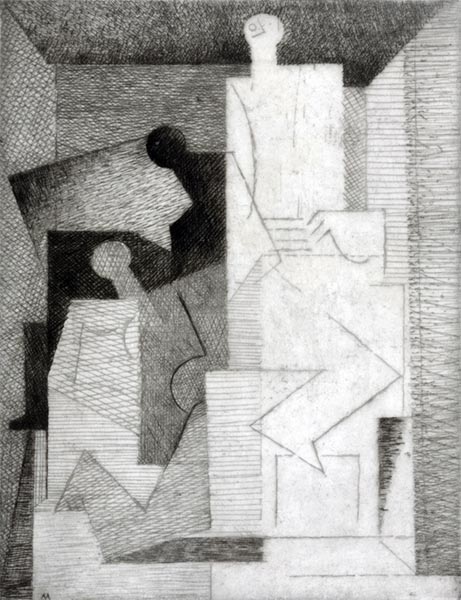
Three Women (Drawings for Aurelia)
Louis Marcoussis (French, 1883-1941)
The eldest spoke to me with a vibrant, melodious voice that I recognised, from having heard it in childhood, and something she said struck me with a sense of its profound accuracy. Whatever it was, it turned my thoughts towards myself, and I found I was dressed in a short brown coat in an old-fashioned style, entirely woven of fine threads like the strands of a cobweb. It was neat, graceful, and impregnated with sweet odours. I felt quite rejuvenated and handsome in this garment woven and sewn by their magical hands, and I thanked them, blushing, as if I were only a little child before grand and beautiful ladies. Then one of them rose, and moved towards the garden.
Everyone knows that in dreams one never sees the sun, though we often perceive a far brighter light. Objects and bodies are luminous in themselves. I found myself in a little park where trellises extended in arches, laden with weighty bunches of pale and black grapes; as the lady who guided me advanced beneath these arches, the shadow of the woven trellises altered her form and clothing. I finally emerged, and found that we were in an open space. where one could see the faint traces of ancient paths that had once traversed it and had produced the appearance of a cross. Its cultivation had been neglected for many years, and scattered plants, clematis, hops, honeysuckle, jasmine, ivy, and birthwort stretched in long trailing vines between trees in vigorous growth. Branches laden with fruit bent to the ground, and among tufts of parasitic grasses a few garden flowers that had returned to their wild state flourished.
Here and there rose clumps of poplars, acacias, and pines, amidst which one could glimpse statues darkened by time. I saw before me a pile of ivy-covered rocks from which a spring of fresh water gushed, whose harmonious lapping echoed across a pool of still water half-veiled by the broad leaves of water lilies.
The slender figure of the lady I was following, with a movement that made the folds of her changing taffeta dress shimmer, gracefully embraced a long hollyhock stem with her bare arm, while that plant began to grow within a clear shaft of light, such that, little by little, the garden took on her shape, and the flowerbeds and trees became the rosettes and festoons of her clothing, as her face and arms imprinted the purple clouds of the sky with their contours. I lost sight of her as she was thus transfigured, for she seemed to vanish amidst her own grandeur. ‘Oh, don’t go!’ I cried... or Nature dies with you!’
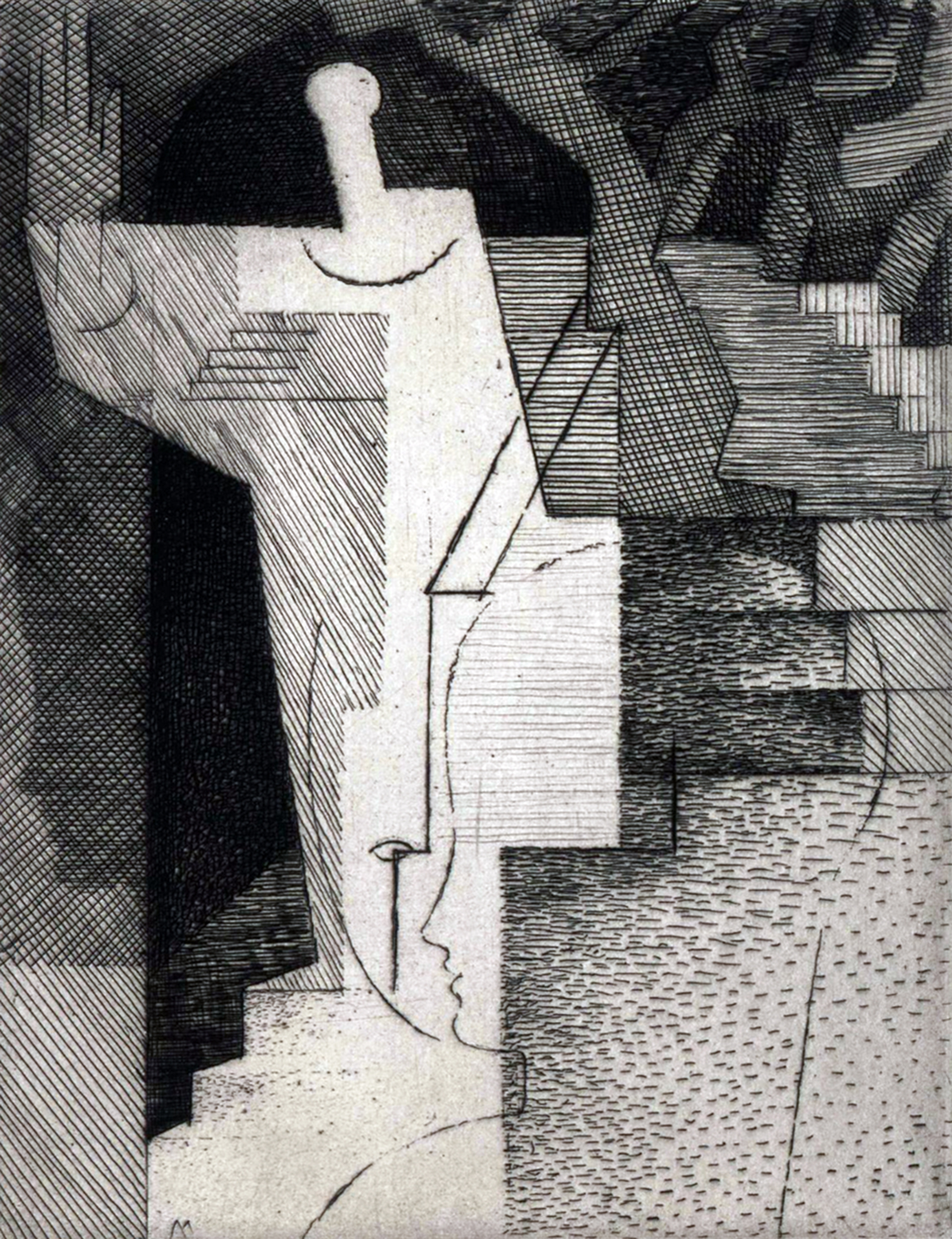
The Garden (Drawings for Aurelia)
Louis Marcoussis (French, 1883-1941)
As I said these words, I was struggling painfully through the brambles, as if to catch the expanding shadow that was escaping me; but stopped short faced with a section of dilapidated wall, at the foot of which lay the sculpted head and bust of a woman. As I lifted it, I was persuaded that it was hers... I recognised cherished features, and, looking about me, saw that the garden had acquired the air of a cemetery. Voices were murmuring: ‘The Universe is now benighted!’
Chapter VII
This dream, so happy at first, left me in great perplexity. What did it mean? I learned only later that Aurelia was dead.
At first, I only received news of her illness. Due to my state of mind, I felt only a vague sorrow mingled with hope. I believed that I myself had only a short time to live, and was now assured of the existence of another world where loving hearts find each other once more. Besides, she would be mine more truly in death than in life... A selfish thought that, I would bitterly regret, and pay for later with my reason.
I would not like to claim it as premonition; chance does strange things; but I was preoccupied now with a memory of our too rapid union. I had gifted her a ring of antique workmanship set with a heart-shaped opal. As this ring was too large for her finger, I had conceived the fatal idea of having it cut to size; I failed to understand my error until I heard the noise of the saw. I thought I saw blood flow...
The care I received had restored me to health without having returned my mind to its regular course, and re-established the normal human powers of reason. The house where I was, situated on a height, possessed a vast garden planted with rare trees. The pure air of the hill on which it was sited, the first breath of spring, and the sweetness of friendly society, allowed me long days of calm.
The fresh leaves of the sycamores delighted me with the liveliness of their colours, which seemed to me like those of a cock-pheasant’s plumage. The view, which extended over the plain, presented a charming horizon from morning to evening, whose graduated hues stirred my imagination. I peopled the hillsides and clouds with divine figures whose forms I seemed to see distinctly. — I wished to fix my favoured ideas more firmly and, with the help of pieces of coal and brick that I collected as drawing implements, I soon covered the walls with a series of frescoes in which my impressions were realised. One figure always dominated the others: that of Aurelia, depicted with the features of divinity, just as she had appeared to me in dream. Below her feet a wheel turned, and the gods formed a procession round her. I succeeded in colouring this group by expressing the juices of herbs and flowers. — How often I dreamed before that dear idol! I did more, I tried to represent, with clay, the body of the one I loved; every morning, my work had to be redone, because the insane residents, jealous of my happiness, took pleasure in destroying her image.
I was given paper, and for a long time applied myself to representing, in a thousand forms, accompanied by stories, verses, and inscriptions in all known languages, a sort of history of the world mixed with memories of my studies, and fragments of dreams that my preoccupation made more striking, or whose duration it prolonged. Nor did I deal only with modern traditions of creation. My thoughts went further back in time: I glimpsed, as in memory, the first pact formed by the genies, by means of talismans. I had tried to bring together the stones of the Sacred Table, and to represent around them the first seven Elohim who had divided the world between them.
This system of history, borrowed from Eastern tradition, began with the happy agreement of the Powers of Nature, which formed and organised the universe. — During the night which preceded my labours, I had believed myself transported to a darkened planet where the first germs of creation were struggling. From the depths of the clay which was still soft, rose gigantic palm trees, poisonous euphorbias, and acanthuses twisting about cacti; the arid shapes of the rocks leapt like skeletons from this sketchy beginning, and hideous reptiles, swollen and rounded, wound amidst the inextricable network of wild vegetation. The pale light of the stars alone illuminated the bluish outlines of this strange perspective; however, as these various efforts at creation were formed, one star, a brighter one, extracted from them the seeds of a greater clarity.
Chapter VIII
Then the monsters changed form, and, shedding the skins they had first acquired, rose up more powerfully on gigantic legs; the enormous mass of their bodies broke through the branches and trampled the grass, and, in the disorder of nature, they engaged in combats in which I myself took part, for I had as strange a body as theirs. Suddenly a singular harmony resounded amidst our solitude, and it seemed that the cries, roars and confused hisses of these primitive beings were henceforth modulated by this divine air. Variations succeeded one another, to an infinite degree; the planet was illuminated little by little; divine forms appeared amid the verdure; and in the depths of the groves, the monsters, henceforth tame, that I had seen, shed their bizarre forms, and became individual men and women; others in their transformations, assumed the figures of wild animals, fish, and birds.
Who had performed this miracle? A radiant goddess guided the rapid evolution of humanity through these new avatars. A distinction between species was established which, starting from the order of birds, also included mammals, fish and reptiles: these were the Dives, Peris, Ondines, and Salamanders; each time one of these beings died, it was immediately reborn in more beautiful form, and sang the glory of the gods. However, one of the Elohim had the idea of creating a fifth species, composed of the elements of the earth, to be called the Afrites. This was the signal for a complete revolution among the Spirits who refused to recognise these new possessors of the world. I know not how many thousand years these battles lasted which bloodied the globe. Three of the Elohim, were finally relegated, with the Spirits of their kind, to the southern hemisphere, where they founded vast kingdoms. They had taken with them the secrets of the divine Kabbalah that binds the worlds together, and drew their strength from the continual worship of certain stars to which they corresponded. These necromancers, banished to the ends of the earth, had agreed to transmit power to each other. Surrounded by women and slaves, each of their sovereigns ensured his rebirth in the form of one of his children. Their lives were a thousand years long. Powerful Kabbalists, the necromancers imprisoned the sovereign, when his death approached, in a well-guarded tomb where he was fed on elixirs and preservatives. For a long while, an appearance of life would be visible, then, like the chrysalis spinning its cocoon, he would fall asleep for forty days, to be reborn in the form of a young child who was later summoned to rule the empire.
However, the life-giving forces of the earth were exhausted in nourishing these dynasties, whose blood, ever pure, flooded their new offspring. In vast underground chambers, excavated beneath the hypogea and the pyramids, they accumulated all the treasures of past peoples, along with certain talismans which protected them against the wrath of the gods.
It was in the heart of Africa, south-west of the mountains of the Moon and ancient Ethiopia, that these strange mysteries took place. For a long while, I groaned there in captivity, as part of the human species. The groves that I had seen, once so green, now bore only pale flowers and withered foliage; an implacable sun devoured these regions, and the weak children of these eternal dynasties seemed overwhelmed by the burden of life. The imposing and monotonous grandeur of their days, regulated by etiquette and hieratic ceremonies, weighed on everyone though none dared attempt to escape it. Old men languished under the weight of their crowns and imperial ornaments, amidst doctors and priests whose knowledge guaranteed them immortality. As for the people, forever enmeshed in their divisive castes, they could count on neither life nor liberty. At the foot of trees struck by sterility and death, at the mouths of dried-up springs, one saw children and young women withering away on the scorched grass, enervated and pallid. The splendour of the royal chambers, the majesty of the porticoes, the brilliance of the clothes and finery, were but weak consolation for the eternal afflictions in these solitary places.
Soon the peoples were decimated by disease, the animals and plants died, and the immortals themselves wasted away beneath their finery. A scourge greater than the others came, suddenly, to rejuvenate and save the world. The constellation of Orion, through its influence, brought cataracts of water from the sky; the poles of an Earth overburdened by the mass of ice in the north, exchanged places, and the seas, surmounting their shores, flowed over the plateaux of Africa and Asia; the flood penetrated the sands, filled the tombs and the pyramids, while for forty days a mysterious ark wandered over the seas carrying the hope of a new creation.
Three of the Elohim had taken refuge on the highest peak of the African mountains. A struggle took place between them. Here, my memory is deficient, and I know not the result of that supreme conflict. Only, I still see, on a peak bathed by the waters, a woman with dishevelled hair, abandoned by them, who cried out, as she struggled against death. Her plaintive accents dominated the noise of the waters… Was she saved? I know not. The gods, her brothers, had condemned her; but above her head shone the Evening Star, pouring fiery rays on her forehead.
The interrupted hymn of the earth and the heavens resounded harmoniously, consecrating the concord of the new peoples. And, while the sons of Noah toiled in the rays of the new-born sun, the necromancers, huddled in their subterranean dwellings, guarding their treasures and delighting in silence and the night. Sometimes they emerged, cautiously, from their retreats, and appeared among the living to frighten them, or to spread among the wicked the fatal teachings of their science.
Such are the memories I traced, by a sort of vague intuition of the past: I shuddered as I reproduced the hideous features of those accursed races. Everywhere was the image of the Eternal Mother dying, weeping, languishing, suffering. Amidst the vague civilisations of Asia and Africa, a bloody scene of orgy and carnage was enacted, and constantly renewed, reproduced by the same spirits in new forms.
The last took place in Granada, where the sacred talisman crumbled beneath the opposing blows of Christians and Moors. How many more years must the world suffer, simply because the vengeance of these eternal enemies must ever be renewed under other skies! They are the separate segments of the serpent that winds about the earth... divided by the clash of steel, they are joined in a hideous kiss, cemented by human blood.
Chapter IX
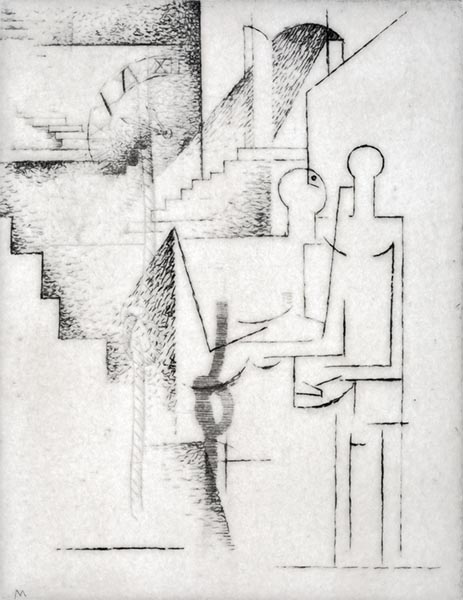
Insane Asylum (Drawings for Aurelia)
Louis Marcoussis (French, 1883-1941)
Such were the images that appeared, one after another, before my eyes. Little by little, calm returned to my mind, and I left the asylum which had been for me a paradise. Fatal circumstances caused, long after, a relapse which renewed in my mind the interrupted series of strange reveries. — I was walking in the countryside, preoccupied with some labour connected with my religious ideas. Passing before a house, I heard a bird which spoke according to the few words which it had been taught, but whose confused chatter seemed to me to contain a meaning: it reminded me of the bird in that vision I recounted above, and I felt a shudder of ill omen. A few steps further on, I met a friend whom I had not seen for a long time, and who had moved to a neighbouring house. He showed me around his property, and, during my visit, he made me ascend to a high terrace from which a vast stretch of the horizon could be seen. It was sunset. As I descended a rustic stairway, I took a false step, and my chest struck the corner of a piece of garden furniture. I had strength enough to rise, and stagger to the middle of the garden, believing myself to be mortally wounded, but wanting, before dying, to take one last look at the setting sun. In the midst of the regrets that such a moment brought, I felt happy to die in that way, at that hour, amidst the trees, trellises, and autumn flowers. It was, however, only a fainting spell, after which I still had the strength to return to my home and bed. Fever took hold; remembering the place where I had stumbled, I recalled that the view I had so admired overlooked a cemetery, the very one in which Aurelia’s tomb was located. It was only then that I thought of the fact; otherwise, I might have attributed my fall to the impression the sight of her grave led me to experience. — That thought, in turn, prompted a more fatal idea still.
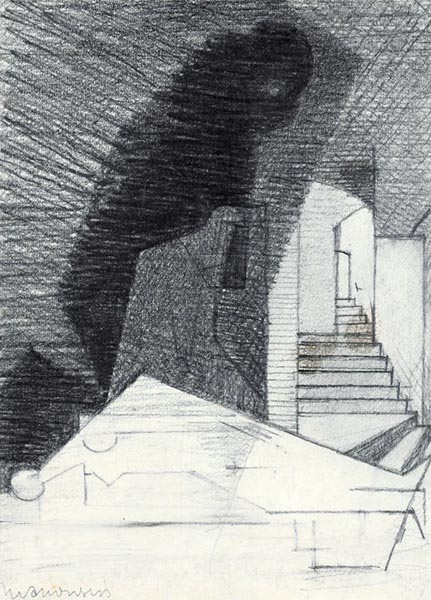
Aurelia's Tomb (Drawings for Aurelia)
Louis Marcoussis (French, 1883-1941)
Artvee
I regretted all the more that death had not reunited us. On reflection, I told myself that I was not worthy of such a circumstance. I recalled, bitterly, the life I had led since her death, reproaching myself, not for having forgotten her, which was indeed not the case, but for having, with facile displays of affection, insulted her memory. The idea came to me to seek answers in my sleep: but her image, which had often appeared, no longer returned to my dreams. At first, those dreams were merely confused, and full of blood-stained scenes. It seemed that the ambitions of a fatal people had been unleashed on the ideal world I had previously seen, of which she was queen. The same Spirit who had threatened me, when I entered the dwellings of those pure families who inhabited the heights of the Mysterious City, passed before me, no longer in that white costume that he had worn then, like those of his kind, but dressed as a Prince of the Orient. I rushed towards him, threatening him, but he turned towards me calmly. O terror! O anger! His face was my own, his form mine, but idealised and enlarged... Then, I remembered the person who had been arrested on the same night as I had been, and who, according to my thoughts, had emerged from the guardhouse under my name, when those two friends of mine came to look for me. He was, now, carrying a weapon in his hand, the shape of which I could hardly distinguish, while one of those who accompanied him said: ‘That’s what he struck him with.’
I know not how to explain that, in my mind, terrestrial events were able to occur concurrently with those of the supernatural world; it was easier to feel it to be so, rather than it is to state it clearly (to me it had to do with the blow I felt in my fall). But who or what was this Spirit who was both myself, and yet external to me? Was he the doppelgänger of legend, or that mystical brother that the Orientals call the Ferouër? — Had I not been struck, long ago, by the story of the knight who fights all night, in a forest, against a stranger who proves to be his own self? Whatever the case, I believe the human imagination has invented nothing that is not true, in this world or in others, and I could not doubt what I had seen so distinctly.
A terrible idea came to me: — ‘Mankind is dual’, I said to myself. — ‘I feel two men within me,’ wrote a Father of the Church. — The concurrence of twin souls deposited this mixed seed in a body itself offering to the view two similar facets reproduced in all the organs within its structure. There is in every man a spectator and an actor, the one who speaks and the one who replies. The Orientals saw two enemies there: the good and the bad spirit. — ‘Am I the good one?’’ Am I the bad?’ I asked myself. ‘In either case, the other is hostile to me… Who knows if there is not a circumstance or a given age when these two spirits separate? Though both are attached to the same body by a material affinity, perhaps one is destined for glory and happiness, the other annihilation or eternal suffering?’ — A fatal lightning-flash, suddenly pierced this darkness... Aurelia was no longer mine!... I thought I heard talk of a ceremony taking place elsewhere, and of the preparations for a mystical marriage which should have been mine, whereby the other would profit from my friends’ error, and that of Aurelia herself. The dearest people who came to visit and console me seemed to me prey to uncertainty, that is to say, the two halves of their souls were also as if separated where I was concerned, one affectionate and trusting, the other as if lacking all regard for me. There was a double meaning in what these people said to me, though they failed to realise it, since they were not, in spirit, like myself. For a moment, this thought even seemed comical to me, when I recalled Amphitryon and his servant Sosie, who were masks for the god’s disguises. But what if that grotesque symbolism were something else—what if, as in other of the fables of antiquity, the fatal truth was concealed by a mask of madness? — ‘Well,’ I said to myself, ‘let us fight against the fatal spirit, let us fight against the god himself, with the weapons of tradition and science. Whatever he may do in the shadows and the night, I exist — and have all the time remaining to me on Earth in which to vanquish him.’
Chapter X
How can I describe the strange state of despair to which these ideas gradually reduced me? An evil genius had taken my place in the world of souls; as far as Aurelia was concerned, this spirit was myself, while the desolate spirit that vivified my body, weakened and disdained, saw itself, unknown to her, forever destined to despair or nothingness. I employed all my strength of will to further penetrate the mystery, of which I had raised a veil or two. The dream sometimes toyed with my efforts, bringing only grimacing, transient figures. I can give here only a somewhat strange idea of what resulted from this mental restraint. I felt myself sliding, as if along a taut wire whose length was infinite. The Earth, traversed by coloured veins of molten metal, as I had seen it before, gradually brightened with the blossoming of the central fire, whose whiteness blended with the cherry hues that coloured the sides of the interior orb. From time to time, I was surprised to encounter vast pools of water, suspended like clouds in the air, yet so dense that slivers could be detached from them; yet it was clear that this was a liquid different from terrestrial water, and doubtless the evaporation of whatever represented the sea and rivers in the spirit world.
I came in sight of a vast, hilly shore covered with a species of greenish reed, yellowed at the tip as if the sun’s rays had partly scorched them, but I saw no more sign of the sun than on other occasions. A castle dominated the hill, which I began to climb. On the far side, I saw an immense city spread out beneath me. While I was crossing the mountain, night had fallen, and I could see lights in the houses, and street lamps. As I descended, I arrived at a market where fruits and vegetables similar to those of the South were sold.
I walked down a dark staircase and found myself in the street. The opening of a casino was being advertised, of which the details were depicted in posters. Their typographical frame was made of garlands of flowers, so well represented and coloured that they seemed natural. — Part of the building was still under construction. I entered a workshop where I saw men modelling an enormous animal, in the form of a llama, in clay, though it seemed to possess large wings. This monster was as if bathed by a jet of fire, which animated it little by little, so that it writhed, penetrated by a thousand purple flames, forming the veins and arteries and fertilising, so to speak, its inert matter, which was clothed in an instant, by a flowering of fibrous appendages, of fins and woolly tufts of hair. I stopped to contemplate this masterpiece, in the manufacture of which the secrets of divine creation seemed to have been re-discovered. — ‘That is because here you see,’ I was told, ‘the primitive fire which animated the first beings… Formerly, it rushed to the surface of the earth, but those founts have run dry.’ I also saw goldsmith’s work in which two metals unknown on Earth were used: one was red in colour, and seemed to correspond to cinnabar, the other an azure blue. The ornaments were neither hammered nor chiselled, but were formed, coloured, and blossomed like metallic plants derived from certain chemical mixtures. ‘Cannot human beings too be created?’ I asked one of the workers; he replied: ‘Human beings derive from above, and not from below: can we create ourselves? Here, we only formulate, benefiting from the continual development of our industrial processes, a more subtle material than that which composes the Earth’s crust. These flowers which seem natural to you, this creature which will seem to live, are only the products of art created through a supreme refinement of knowledge, and everyone will judge them thus.’
These are roughly the words that were said to me, or at least the meaning of them that I thought I perceived. I began to wander through the rooms of the casino, and came upon a large crowd, in which I distinguished a few people who were known to me, some living, others having died at various periods. The first seemed not to see me, while the others answered seemingly without knowing me. I arrived at the largest room, which was entirely hung with dark red velvet, bands of woven gold thereon forming a rich design. In the centre was a sofa in the form of a throne. Some passers-by each sat on it to test its degree of comfort and elasticity; but the preparations being as yet unfinished, they soon headed to other rooms. There was talk of a marriage, and of the bridegroom who, it was said, was due to arrive to announce the hour of its celebration. Immediately a mad transport seized me. I imagined that the one they were awaiting was my double, who was to wed Aurelia, and I made a scandalous fuss which seemed to dismay the assembly. I began to speak in a violent manner, explaining my grievance, and invoking the help of those who knew me. An old man said to me: ‘But one doesn’t behave like this, you will frighten everyone.’ Then I cried out: ‘I know very well that he has already struck me with his weapon, but I await him without fear, and know the hidden sign that will defeat him.’
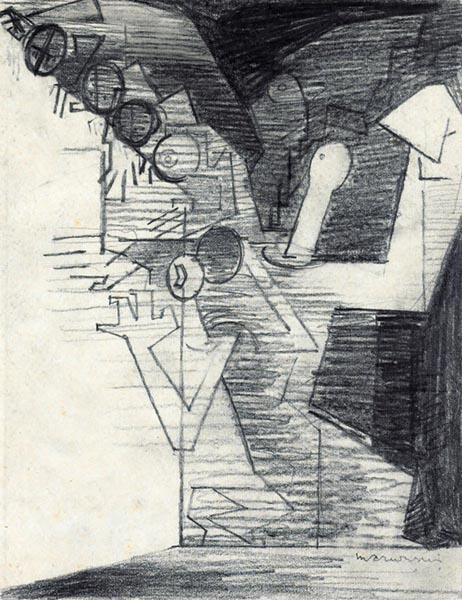
At the Casino (Drawings for Aurelia)
Louis Marcoussis (French, 1883-1941)
Artvee
At that moment, one of the men from the workshop, which I had visited upon entering, appeared, holding a long iron bar whose end consisted of a red-hot sphere. I desired to rush upon him, but the sphere he held threatened my head… The folk around me seemed to mock my impotence… I retreated, then, to the throne at the centre, my soul filled with indescribable pride, and raised my arm to make the sign that I deemed to possess magical power. The cry of a woman, distinct and vibrant, imbued with heart-rending pain, woke me with a start! The syllables of the undisclosed word I was about to pronounce expired on my lips… I threw myself to the ground, and began to pray fervently, weeping hot tears. — But whose was this voice that had echoed so painfully in the night?
It was not a part of the dream; it was the voice of a living person, yet it seemed to me I heard the voice and tones of Aurelia…
I opened my window; all was quiet, and the cry was not repeated. — I enquired outside, no one had heard a thing. — And yet, I am still certain that the cry was real, and that the world of the living had resounded with it… Doubtless, I will be told that chance may have caused some woman, in pain, to cry out at that moment in the vicinity of my home. — But, according to my ideas, terrestrial events were linked to those of the invisible world. That being one of the strange relationships, the details of which I myself have no awareness of, and which it is easier to indicate than to define…
What had I done? I had disturbed the harmony of the mystical universe from which my soul drew the certainty of our immortal existence. I was cursed perhaps for having sought to pierce so formidable a mystery, and thus offend the divine law; I could expect now nothing but anger and contempt! The shades fled, uttering cries of annoyance, and tracing fatal circles in the air, like birds on the approach of a storm.
Part Two
Eurydice! Eurydice!
Chapter I
Lost for the second time! All is over, all is past! Now, I am the one who must die, and die without hope! — What is death then? If it were nothingness… would to God! But God himself cannot make of death a nothingness.
Why then is this the first time in so long that I have thought of Him? The fatal system that had been created in my mind did not admit this lone sovereign... or rather it was absorbed in the sum of beings: it was the god of Lucretius, powerless and lost in immensity.
She, however, had believed in God, and one day I heard the name of Jesus leave her lips. It flowed forth so gently that I wept. My God! That tear, — that tear… It dried up long ago! That tear, my God; restore it to me!
When the soul floats, uncertainly, between life and the dream, between disorder of the mind and the return of cold reflection, it is in religious thought that one may seek help; — I have never been able to obtain from that philosophy which presents us only with selfish maxims or at most the concept of reciprocity, anything but vain experience, and bitter doubt — it is a philosophy that combats moral pain by annihilating sensitivity; like surgery, it knows no better than to remove the organ causing that pain. But for us, born in days of revolution and storm, in which all beliefs have been shattered, raised in a faith, vague at best, which is content with external practice, an indifferent adherence to which is perhaps more culpable than impiety and heresy, it is difficult in the extreme, when we happen to feel the need, to reconstruct that mystical edifice the lines of whose contours the innocent and simple trace in their hearts. The tree of science is not the tree of life! Yet, how can we reject from our minds what so many generations of intelligent effort have poured into them, for good or evil? Ignorance cannot be re-acquired.
I place greater hope in the goodness of God: perhaps we are approaching the time foreseen when science, having completed its entire circle of analysis and synthesis, of belief and negation, will be able to purify itself and bring forth from ruin and disorder the wondrous city of the future… We should not make so little of human reason as to believe that it gains anything by humiliating itself completely, for that would be to deny its celestial origin… God will doubtless appreciate purity of intent; and no father could be pleased to see his son abdicate all reason and pride before him! The apostle who wanted to touch before believing was not accursed for so wishing!
What have I written here? These are blasphemies. Christian humility should not speak thus. Such thoughts are far from tempering the soul. They betray on their brow the gleams of pride from Satan’s crown... A pact with God himself?... O science! O vanity!
I had collected a few books on the Kabbalah. I immersed myself in my studies therein, and persuaded myself that everything the human mind had accumulated on the subject over the centuries was valid. The conviction that I had formed of the existence of the world beyond coincided too well with my reading for me to doubt henceforth those revelations from past ages. The dogmas and rites of the various religions seemed to me to relate to it in such a way that each possessed a certain portion of the arcana which constituted that world’s means of expansion and defence. Such powers could weaken, diminish, and vanish, which in turn led to the invasion of certain peoples by others, none proving victorious or finding themselves vanquished except through the Spirit.
— ‘However,’ I said to myself, ‘it is certain that these sciences are full of human error. The magic alphabet, the mysterious hieroglyphs, have only reached us in an incomplete manner, distorted either by time or by those who have some vested interest in maintaining our ignorance; let us but find the lost letter, or the erased sign, let us recompose the dissonant scale, and we will gain strength in the world of spirits.’
This is how I perceived the relationship, I believe, between the real world and that same world of spirits. The Earth, its inhabitants and their history, was the theatre in which those physical actions were accomplished which the existence and situation of the immortal beings, attached to its destiny, determined. Without touching on the impenetrable mystery of the eternity of the worlds, my thoughts returned to the age when the sun, like the sunflower which represents it and which, with head inclined, follows the revolution of its celestial march, sowed on Earth the fertile seeds of plants and animals. It was none other than fire itself which, being compounded of souls, instinctively formed our common dwelling-place. The Spirit of the Divine Being, reproduced, so to speak, and mirrored on Earth, became the common ground of human souls, each of which, consequently, was at once Human and Divine. Such were the Elohim.
When one feels unhappy, one thinks of the unhappiness of others. I had been somewhat negligent as regards visiting one of my dearest friends, who I had been told was ill. On my way to the house where he was being treated, I reproached myself deeply for being so remiss. I was even more distressed when my friend told me that the day before he had felt at his worst. I entered a whitewashed hospice room. The sunlight reflected cheerfully from the walls, and played over a vase of flowers a nun had just placed on the patient’s table. The room was an Italian anchorite’s cell. — His emaciated face, his complexion like yellowed ivory, enhanced by the dark colour of his beard and hair, his eyes alight with a remnant of fever, perhaps also the arrangement of a hooded cloak, wrapped around his shoulders, made him appear to me like a being half-removed from the person I had known. He was no longer the joyful companion of my labours, and my pleasures; there was the look of an apostle about him. He told me how he had felt himself, at the height of suffering caused by his illness, seized by a last transport which seemed to him to indicate the supreme moment. Immediately his pain had ceased, as if by a miracle. What he told me next is impossible for me to convey: a sublime dream in the vaguest reaches of infinite space, a conversation with a being at once different from, yet participating in, himself, of whom he asked, believing himself to be dead, where God resided. ‘But God is everywhere,’ his spirit companion answered, ‘he is in you, and in all. He judges, he listens, he advises; he is you and I, who think and dream together, and have never left each other, and are eternal!’
I am unable to quote anything more of this conversation, which I may have misheard or misunderstood. I only know that the impression it made was profound. I dare not attribute to my friend the conclusions I may have, wrongly, drawn from his words. I know not whether the feelings that resulted from the conversation are even in conformity with the ideas of Christianity.
— ‘God is with him!’ I cried, ‘but he is no longer with me! Oh, woe is me! I have driven him from myself, threatened him, cursed him! It was, indeed, this mystical brother, who had moved further and further away from my soul, and who had warned me in vain! That favourite spouse, that king of glory, it is he who judges and condemns me, and who has snatched away forever, to his heaven, the one he would have granted me, and of whom I am henceforth unworthy!’
Chapter II
I cannot describe the state of dejection into which these ideas cast me. — ‘I understand’, I said to myself, ‘I have preferred the creature to the creator; I deified my love and adored, according to pagan rites, one whose last breath was consecrated to Christ. But if this religion speaks the truth, God may still forgive me. He may give her back to me, if I humble myself before him; perhaps her spirit will return to me!’ — I wandered through the streets, at random, full of this thought. A procession crossed my path; it was heading towards the cemetery where she had been buried; I had the idea of going along with them, and joining the procession. — ‘I know not,’ I said to myself, ‘who this dead person is who is being borne to the grave; but I know now that the dead see and hear us — perhaps he will be happy to see himself followed by a companion in sorrow, a brother, sadder than any of those who accompany him.’ This idea made me shed tears, and no doubt people thought, seeing me weep, that I was some close friend of the deceased. O blessed tears! For a long time your sweetness was denied me! My head cleared, and a ray of hope still guided me. I felt the strength to pray, and I exercised it with delight.
I failed even to enquire the name of the man whose coffin I had followed. The cemetery I had entered was sacred to me for several reasons. Three maternal relatives of mine had been buried there; but I could not go to pray at their tombs, as their remains had been transported several years before to a distant land, their place of origin. I searched for Aurelia’s tomb for a long while, and was unable to find it. The layout of the cemetery had been altered, — perhaps my memory was also at fault… It seemed to me that this lost opportunity, this forgetfulness, added further to my self-condemnation. — I dared not mention to the officials the name of a woman, now dead, having no right in religion to do so… But I remembered that I had at home the exact details of the whereabouts of her grave, and I ran there with a palpitating heart, my thoughts wild. I have said it before: I had surrounded the relics of my love with the elements of strange superstitions. — In a small box that had belonged to her, I kept her last letter. Dare I confess that I had made a sort of reliquary of this box, whose contents recalled long journeys during which thoughts of her had haunted me: a rose picked in the gardens of Shubra, in Cairo; a piece of bandage brought back from Egypt; bay-leaves picked beside the Beirut River; two small golden crystals, pieces of mosaic, from Hagia Sophia; a rosary bead; what else?... Finally, the piece of paper that had been placed in my hands the day her tomb was dug, so that I might find the place again... I blushed; I shuddered, as I sifted through this foolish collection. I took the letter and the piece of paper, but as I turned towards the cemetery, I changed my mind. ‘No,’ I said to myself, ‘I am not worthy to kneel by the tomb of a Christian woman; let me not add one profanation more to my many others!’ And to calm the storm that was rumbling in my head, I journeyed some miles from Paris, to a small town where I had spent a few happy days of my youth, with old relatives, long since dead. I had often enjoyed watching the sun setting behind their house. There was a terrace, shaded by lime trees, that also brought back memories of the young girls, my relatives, among whom I had grown up. One of them...
But to set up that vague childhood love in opposition to the love which devoured my youth: had I ever thought to do that? I saw the sun set over the valley which was filling with mist and shadow; it vanished, bathing in reddish fire the tops of the woods bordering the high hills. The gloomiest of sadnesses entered my heart. — I went to lodge in an inn where I was known. The innkeeper told me of an old friend of mine, a resident of the city, who, as a result of unfortunate speculations, had shot himself with a pistol…
Sleep brought terrible dreams, of which I have retained only a confused memory. I found myself in a strange room and was talking with someone from the world beyond — the friend I have just spoken of, perhaps. A very tall mirror hung behind us. Glancing at it by chance, I seemed to recognise Aurelia therein. She seemed sad and pensive, and suddenly, whether she emerged from the mirror, or whether, in passing into the room, she had merely been reflected there a moment before, her sweet, beloved face was near me. She held out her hand, looked at me with a pained expression, and said, ‘We will see each other later... at your friend’s house.’
In an instant, I pictured her marriage day, the curse that separated us... and I said to myself: ‘Is it possible? Would she return to me?’ ‘Have you forgiven me?’ I asked, in tears. But everything had vanished. I found myself in a deserted place, a steep ascent strewn with rocks, amidst forest-trees. A house, I seemed to recognise, dominated this desolate spot. I advanced yet found myself returning by inexplicable detours. Tired of walking among rocks and brambles, I looked for an easier route through the woods. — ‘They are awaiting me there!’ I thought. A certain hour struck… I said to myself: ‘It is too late!’ Voices replied: ‘She is lost!’
The deep darkness of night surrounded me, the distant house shone as if lit for a feast, filled with guests who had arrived in time. ‘She is lost!’ I cried, ‘and why?... I understand — she made a last effort to save me — I failed to recognise that supreme moment, when forgiveness was still possible. From the heights of heaven, she might pray for me to the Divine Spouse... yet what does my salvation matter? The abyss has received its prey! She is lost to me and to all!’ I seemed to see her as if in the glare of a lightning-flash, pallid, dying, borne away by dark horsemen... The cry of pain and rage that I uttered at that moment woke me up, breathing hard. ‘My God! My God! For her, and her alone, my God, forgive me!’ I cried, throwing myself on my knees.
It was dawn. Due to a train of thought which it is difficult for me to explain, I immediately resolved to destroy the two pieces of paper I had taken from the casket the day before: the letter, which I reread, alas, wetting it with tears, and the funeral paper which bore the cemetery seal. — ‘Seek her grave again now?’ I asked myself, ‘But it was yesterday I should have returned there, — and my fatal dream is only a reflection of that fatal day!’
Chapter III
The flames devoured those relics of love and death, which were connected most painfully to the fibres of my heart. I went to wander in sorrow, with belated remorse, in the countryside, seeking, in the act of walking, and the resulting fatigue, a numbness of thought, and a certain hope perhaps of a less fatal sleep the following night. Given the idea I had formed of the dream as a means of opening, to human beings, a path of communication with the world of spirits, I hoped… I still hoped! Perhaps God would be satisfied with the sacrifice of my relics. — Here, I must stop; it would be far too arrogant of me to pretend that my state of mind was caused solely by memories of love. Let us say rather that, involuntarily, I burdened it with something more profound, my remorse for a wildly dissipated life, in which evil had triumphed too often, and whose errors I recognised only through suffering the blows of misfortune. I no longer found myself worthy even to think of one whom I now tormented when dead, having afflicted her in life, yet to whose sweet and sacred pity alone I owed her last look of forgiveness.
The following night, I could sleep for only a few moments. A woman, who had taken care of me in my youth, appeared to me in dream, and reproached me for a serious fault I had committed long ago. I recognised her, though she seemed much older than she had the last time I saw her. That alone made me recall, and bitterly, that I had neglected to go and visit her in her last moments. It seemed to me that she was saying to me: ‘You failed to mourn your old parents as deeply as you mourn this woman. How then can you hope for forgiveness?’ The dream became confused. Figures of people I had known at various times passed rapidly before my eyes. They filed by, illuminated for a moment, then fading and falling back into the darkness, like the beads of a rosary whose thread has broken. Next, I saw sculpted images of antiquity form vaguely, which were sketchy at first, and then became fixed, seemingly representing symbols whose meaning I could only grasp with difficulty. Yet, I believed their message to be: ‘All this was done to teach you the secret of life, and you failed to understand. Religion and fable, saints and poets, concurred in explaining the fatal enigma, and you misinterpreted all... Now it’s too late!’ I rose, full of terror, saying to myself: ‘This day will be my last!’ Ten years later, the same idea, that I outlined in the first part of this account, returned to haunt me, even more oppressively, and threateningly than before: ‘God has given me time to repent, and I have failed to take advantage of it.’ After the visit by the Stone Guest, I had sat down again to the feast!
Chapter IV
The feeling of sadness that resulted from these visions, and the reflections they brought about during my hours of solitude, were so intense that I felt as if I were lost. All the actions of my life appeared to me in their most unfavourable light, and in the examination of my conscience to which I devoted myself, my oldest memories re-presented themselves with singular clarity. I know not what false shame prevented me from presenting myself to the confessional: the fear perhaps of engaging with the dogmas and practices of a formidable religion, against certain aspects of which I had retained a philosophical prejudice. My early years were too imbued with ideas stemming from the Revolution, my education was too free, my life too errant, for me to easily accept a yoke which, on many points, would offend my reason still. I shudder to think what a Christian I would have made if certain principles borrowed from the free enquiries of the last two centuries, and the study of the various religions, had not halted me on that slope. — I never knew my mother, who had wanted to follow my father to the wars, as did the women of the ancient German tribes; she died of fever and exhaustion in a chilly region of Germany, and my father himself was unable to direct my early studies in that direction.
The country where I was raised was full of strange legends and odd superstitions. One of my uncles who had the greatest influence on my early education occupied himself, for his amusement, with Roman and Celtic antiquities. He sometimes found, in his field or nearby, images of gods and emperors which his scholarly admiration led me to venerate, and of whose history his books taught me. A certain Mars in gilded bronze, an armed Pallas or Venus, a sculpted Neptune and Amphitrite above the village fountain, and above all the good, fat, bearded figure of the smiling god Pan at the entrance to a cave, among the festoons of birthwort and ivy, were the domestic and protective gods of that retreat. I confess that, as a child, they inspired more veneration in me than the mediocre Christian images in the church, and the two shapeless saints at the portal, which some scholars claimed to be the divinities Esus and Cernunnos of the Gauls. Embarrassed by this host of symbols, I asked my uncle one day what God was. ‘God is the sun,’ he told me. That was the intimate thought of an honest man who had been a Christian all his life, but who had lived through the Revolution, and in a country where many had a like idea of the Divinity. This did not prevent the women and children from going to church, and I owed to one of my aunts some instruction which made me understand the beauties and grandeur of Christianity. Around 1815, an Englishman who was in our country had me learn the Sermon on the Mount, and gave me a copy of the New Testament… I only cite these details to indicate the root causes of a certain irresolution which is often combined in me with a most pronounced religious leaning.
I wish to explain how, having been far removed from the true path for a long time, I felt myself returned to it by the cherished memory of a dead person, and how the need to believe that she still existed recalled to my mind a precise feeling for various truths that I had not yet firmly gathered in my soul. Despair and suicide are the result of certain fatal situations for those who lack faith in immortality, in its sorrows and its joys: — I believe that I will achieve something good and useful, by naively stating the succession of ideas through which I found peace, and a new strength to oppose the future misfortunes of life.
The visions that had followed one another in my sleep had reduced me to such a state of despair that I could barely speak; the society of my friends granted me only vague distractions; my mind, entirely occupied with my illusions, refused to entertain the slightest concept that challenged them; I could read and understand not ten lines in a row. I told myself the most beautiful falsehoods: ‘What matter! None of that’s for me.’ One of my friends, named Georges, undertook to overcome this disinterest. He took me to visit various regions around Paris, and agreed to converse with me as the leading voice while I replied with but a few disconnected sentences. His expressive, almost monkish, face, one day worked to great effect on me, through the eloquent points he raised in condemning those years of scepticism, and political and social discouragement, that followed the July Revolution. I was one of the young people of that time, and had tasted its ardour and bitterness.
A reaction occurred within me; I said to myself that such lessons could not be given without Providence’s intent, and that a spirit was undoubtedly speaking in him… One day, we were dining beneath a trellis, in a small village near Paris; a woman came and sang near our table, and something in her worn but sympathetic voice, reminded me of Aurelia. I looked at her more closely: her features were not without resemblance to those of the woman I had loved. She was sent away, nor did I dare detain her, but I said to myself: ‘Who knows if her spirit is not in this woman!’ and I felt happy with the alms I had given her.
I said to myself: — ‘I have misused life, but if the dead forgive, it is doubtless on condition that one abstains from evil forever, and that one repairs all one has done. Can that be? ... From this moment, let me try to do evil no more, and repay the equivalent of all that I may owe.’ — I had recently wronged someone; it was only negligence, but I began by visiting them to apologise. The joy I received from this reparation did me great good; henceforth, I had a reason to live and act, I took an interest in the world again.
Difficulties arose: events inexplicable to me seemed to combine to thwart my good resolution. My state of mind made it impossible to carry out certain tasks I had determined on. Believing me to be sane now, people became more demanding, and, as I now refused to lie, I found my faults were detected by people who were not afraid to use the fact against me. The host of reparations to be undertaken overwhelmed me because of my powerlessness. Political events, acting indirectly, conspired to both afflict me and deprive me of the means of setting my affairs in order. The death of one of my friends added to these sources of discouragement. I saw again, in sorrow, his home, his paintings which he had shown me with joy but a month before; I passed close to his coffin at the moment when his corpse was being nailed within. As he was of my age, and of my era, I said to myself: ‘What would happen if I were to die like that, quite suddenly?’
The following Sunday, I rose from my bed gripped by a feeling of dull grief. I went to visit my father, whose maid was ill, and who seemed to be in a bad mood. He wanted to ascend alone to retrieve some wood from his attic, and I was only able to do him the service of handing him some log that he needed. I left in dismay. I met a friend in the street who wished me to dine at his house, so as to distract me a little. I refused, and, without having eaten, I headed towards Montmartre. The cemetery was closed, which I regarded as an ill omen. A German poet had given me a few pages to translate, and had advanced me an amount on the work. I visited his house to return the money to him.
As I passed the Clichy barrier, I witnessed an argument. I tried to separate the combatants, but failed. At that moment, a tall workman walked by me on the very square where the fight had just taken place, carrying, on his left shoulder, a child dressed in a hyacinth-coloured robe. I conceived that this was Saint Christopher carrying Christ, and that I had been condemned for my lack of moral strength in the scene that had just taken place. From that moment on, I wandered in despair amidst the wastelands that separate the suburbs from the barrier. It was too late to complete the visit I had planned. I returned through the streets toward the centre of Paris. Near the Rue de la Victoire, I met a priest, and, in my disordered mental state, wished to confess to him. He told me that he was not from that parish and that he was going to someone’s house that evening; but that, if I wished to consult him the next day at Notre-Dame, I only had to ask for Abbé Dubois.
In despair, I went weeping to the church of Notre-Dame-de-Lorette, where I threw myself at the foot of the altar of the Virgin, asking forgiveness for my sins. Something inside me said: ‘The Virgin is dead, and your prayers are useless.’ I went and knelt in the last row of seats in the choir, and I slipped from my finger a silver ring whose setting bore engraved these three Arabic words: Allah! Muhammad! Ali! Immediately several candles shone in the choir, and a service began with which I tried to unite myself in spirit. When they reached the Ave Maria, the priest stopped in the middle of the prayer, and began again, seven times, without my being able to store his following words in my memory. They completed the prayer, and the priest made a speech which seemed, I thought, to allude to me alone. When the lights were extinguished, I rose, and departed, heading towards the Champs-Élysées.
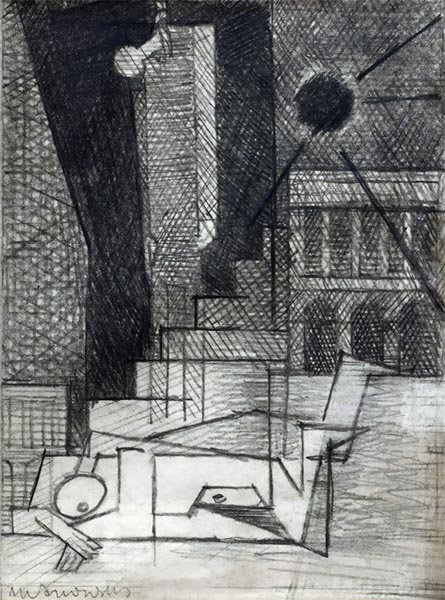
Place de la Concorde (Drawings for Aurelia)
Louis Marcoussis (French, 1883-1941)
Arriving at the Place de la Concorde, my thoughts were of self-destruction. Several times I headed towards the Seine, but something prevented me from accomplishing my plan. The stars shone in the firmament. Suddenly it seemed to me that their light died, all at once, like the candles in the church. I believed that the time appointed was fulfilled, and that we were approaching the end of the world announced in the Apocalypse of Saint John. I thought I saw a black sun in an empty sky, and a blood-red orb above the Tuileries. I said to myself: ‘Eternal night is begun, and will be a thing of terror. What will happen when men realise that the sun is no more?’ I returned by the Rue Saint-Honoré, and I pitied the belated folk I met. Approaching the Louvre, I walked to the square, and there, a strange spectacle awaited me. Through clouds, swiftly driven on the wind, I saw several moons passing at great speed. I thought the earth had left its orbit and was wandering in the firmament like a dismasted vessel, advancing on, or retreating from, the stars which grew larger or diminished in turn. For two or three hours, I contemplated this disorder then, finally, I headed towards the market halls. The countryfolk were bringing in their goods, and I said to myself: ‘How astonished they will be to find that the night is endlessly prolonged...’ Meanwhile, dogs barked, here and there, and roosters crowed.
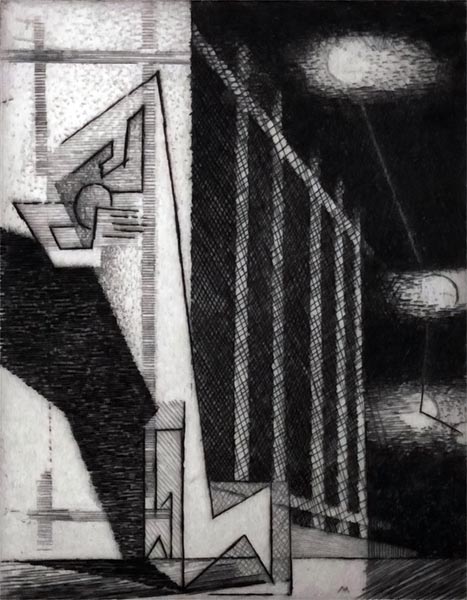
Several Moons (Drawings for Aurelia)
Louis Marcoussis (French, 1883-1941)
Exhausted, I went home and threw myself on my bed. When I awoke, I was astonished to see it was light again. The sound of a kind of mysterious choir reached my ears; children’s voices repeated in chorus: — ‘Christe! Christe! Christe! ‘I thought a large number of children must have gathered in the neighbouring church (Notre-Dame-des-Victoires) to invoke Christ. — ‘Christ is no more!’ I said to myself; ‘but as yet they are ignorant of the fact!’ — The invocation lasted about an hour. I finally rose, and visited the arcades of the Palais-Royal. I told myself that the sun probably had sufficient power still to illuminate the earth for three days, but that it was consuming its own substance, and, indeed, I thought it cold and discoloured. I appeased my hunger with a piece of cake to give me the strength to visit the German poet’s house. As I entered, I told him that all was over, and that we must prepare to die. He called his wife, who said to me: ‘What is the matter with you?’ ‘I know not,’ I said, ‘I am lost.’ She sent for a cab, and a young girl took me to the Maison Dubois.
Chapter V
There, my illness returned with variations. After a month I was well again. During the two months that followed, I resumed my wanderings around Paris. The longest journey I made was to visit the cathedral at Reims. Little by little, I began to write again, and composed one of my best short stories. However, I wrote it with difficulty, almost always in pencil, on loose sheets of paper, depending on the chance thoughts that came to me in my daydream or my walk. The editing of it agitated me greatly. A few days after it was published, I was seized by persistent insomnia. I would walk, all night, on the hill of Montmartre, and watch the sunrise there. I would chat at length with the countryfolk and workers. At other times, I would head to the covered market. One night, I had supper in a café on the boulevard and amused myself by tossing gold and silver coins in the air. Then I visited the market and had an argument with a stranger, whose face I struck; it came to nothing, how I don’t know how. At a certain hour, hearing the clock of Saint-Eustache strike, I began to think of the civil war between the Burgundians and the Armagnacs, and thought I saw the ghosts of the combatants of that time surging round me. I quarrelled with a postman who wore a silver emblem on his chest, and whom I declared to be Duke Jean of Burgundy. I wanted to prevent him from entering a tavern. For some peculiar reason, that I cannot explain, on seeing that I was threatening him with death, his face was covered with tears. I felt moved, and let him pass.
I headed towards the Tuileries Gardens, which were closed, and followed the line of the quays; I then crossed the river and ascended the streets to the Luxembourg Gardens, then returned to lunch with one of my friends. After that I entered Saint-Eustache, where I knelt piously at the altar of the Virgin, while thinking of my mother. The tears I shed relaxed my soul, and, on leaving the church, I bought a silver ring. From there, I went to visit my father, leaving a bouquet of daisies at his house, because he was absent. I went from there to the Jardin des Plantes. It was crowded, but I stayed for a while watching the hippopotamus bathing in its pool. — I then went to visit the gallery of fossil skeletons. The sight of the monsters there made me think of the Flood, and, when I emerged, a dreadful downpour was falling on the gardens. I said to myself: ‘What a misfortune! All these women, all these children, are going to get wet!’ Then I said to myself: ‘But it’s even worse! The real Deluge is beginning.’ The water was rising in the neighbouring streets; I raced down the Rue Saint-Victor, and, with the idea of stopping what I believed to be the universal flood, I threw into the deepest puddle the ring I had bought near Saint-Eustache. At about that moment, the storm abated, and a few rays of sunlight began to shine.
Hope returned to my soul. I had an appointment at four o’clock to meet my friend Georges; I headed towards his home. Passing a curio shop, I bought two velvet-covered screens adorned with hieroglyphic figures. It seemed to me that this was the consecration of heaven’s forgiveness. I arrived at Georges’ house at the exact hour we had arranged and confided my hopes to him. I was wet and tired. I changed my clothes and lay down on his bed. During my sleep, I had a marvellous vision. It seemed to me that the goddess appeared to me, saying: ‘I am the same as Mary, the same as your mother, the same also as she, in all forms, whom you have ever loved. In each of your periods of trial, I have doffed one of the masks with which I veil my features, and soon you will see me as I truly am... a delightful line of orchard-trees emerged from the clouds behind her, a soft and penetrating light illuminated this paradise, and yet I heard only her voice, feeling myself plunged into the depths of a charmed intoxication. — I awoke a short time later, and said to Georges: — ‘Let’s go for a walk.’ As we were crossing the Pont des Arts, I explained to him the doctrine of the migrations of souls, and said to him: — ‘It seems to me that, this evening, I have within me the soul of Napoleon, who inspires me and commands me to do great things.’ — In the Rue du Coq, I bought a hat, and, while Georges gathered up the change from the gold piece that I had thrown on the counter, I continued on my way, and reached the arcades of the Palais-Royal.
There, it seemed to me that everyone was looking at me. A persistent idea had lodged itself in my mind, that death was no more. I walked through the Galerie de Montpensier saying: ‘I have made some mistake,’ but in consulting my memory, which I believed to be Napoleon’s, failed to discover what it might have been... ‘There is something I forgot to pay for near here!’ I entered the Café de Foy with that idea in my head, and thought I recognised, in one of the regulars seated there, Père Bertin of the Journal des Débats. Then, I crossed the garden, and took some interest in seeing the little girls at play there. I left the galleries, and headed towards the Rue Saint-Honoré. I went into a shop to buy a cigar, and when I came out, the crowd was so dense that I was almost suffocated. Three of my friends freed me, answered for me, and took me into a café, while one of them found a cab. I was taken to the Hôpital de la Charité.
During the night, my delirium increased, especially in the morning when I realised that I was being restrained. I managed to rid myself of the straitjacket, and towards morning, walked about the wards. The idea that I had become godlike, and had the power to heal, made me lay hands on some of the sick, and, approaching a statue of the Virgin, I removed her crown of artificial flowers, to bolster the power I believed I possessed. I walked in great strides, speaking, animatedly, of the ignorance of human beings who believed they could heal through science alone, and, seeing a flask of ether on a table, I swallowed its contents in one gulp. An intern whose form I compared to that of the angels sought to stop me, but my nervous strength sustained me and, ready to knock him down, I halted, myself, telling him that he failed to understand my mission. The doctors arrived then, while I continued my discourse on the impotence of their art. Then I went downstairs, though I had no shoes. Arriving in front of a flowerbed, I invaded it, then picked the petals from the flowers I had gathered while walking on the lawn.
One of my friends had returned to collect me. I then left the terrace, and while I was talking to him, a straitjacket was strapped around me, then I was placed in a cab, and taken to a sanatorium outside Paris. Finding myself among the insane, I realised, that events, till then, had been prompted by delusion. However, it seemed to me that the promise I attributed to the goddess Isis would be fulfilled by a series of trials that I was destined to undergo. I therefore accepted my situation with resignation.
The part of the house in which I was located overlooked a vast promenade shaded by walnut trees. In one corner was a small hut around which one of the patients walked all day, in a circle. Others, like myself, confined their efforts to walking on open ground, or on the terrace bordered by a grassy bank. On a wall, facing west, figures had been drawn, one of which represented the moon, with geometrically-drawn eyes, and a mouth; on this figure a sort of mask had been painted; the left-hand wall presented various profiles, one of which represented a sort of Japanese idol. Further on, a death’s head was carved into the plaster; on the opposite side, two cut stones had been sculpted by one of the garden’s guests and represented small, fairly well-rendered masks. Two doors opened onto cellar-holes, and I imagined they must be underground passages, similar to those I had seen at the entrance to the Pyramids.
Chapter VI
At first, I imagined that the people gathered in the garden all had some influence over the stars, and that the one who constantly turned in the same circle was regulating the course of the sun. An old man, who was brought out at certain times of the day, who tied knots while consulting his watch, appeared to me to be responsible for observing the course of the hours. I attributed to myself an influence on the moon’s orbit, and believed its orb had suffered lightning bolts delivered by the Almighty who had traced on its face the imprint of the lunar mask I had noticed.
I attributed a mystical meaning to the conversations of the attendants, and to those of my companions. It seemed to me that they were representatives of all the nations of the earth, and that it was a question of our rectifying, between us, the course of the stars, and of granting a wider sphere to the celestial system. It was my opinion that an error had occurred in its generic and numeric combinations, and thence arose all the ills of humanity. I believed, still, that the celestial spirits took on human forms, and were present at this general gathering, while appearing to be occupied with every day matters. My role seemed to me to be that of reestablishing universal harmony through the cabalistic arts, and seeking a solution by evoking the occult forces described by the various religions.
Besides the promenade, we were free to utilise a room whose perpendicularly-striped windows looked out onto a horizon of greenery. Looking through these at the external lines of the building, I saw the facade and windows as forming a thousand pavilions decorated with arabesques, surmounted by openwork spires, which reminded me of the imperial kiosks bordering the Bosphorus. This naturally led my thoughts in an Oriental direction. Around two o’clock, I was placed in a bath, believing myself to be served by the Valkyries, the daughters of Odin, who wished to raise me to immortality by gradually cleansing my body of all that was impure.
In the evening, I walked, serenely, in the moonlight, and, raising my eyes towards the trees, it seemed to me that the leaves blew about, capriciously, in such a way as to form images of knights and their ladies borne on caparisoned steeds. They were for me the triumphal figures of my ancestors. This thought led to another: that there was a vast conspiracy of all animated beings to restore the world to its original harmony, and that communication between them took place through the magnetic influences of the stars, that an unbroken chain around the earth linked the many intelligences devoted to this general communication, and that songs, dances, even glances, magnetised near and far, expressed this same aspiration. The moon was for me the refuge of fraternal souls who, freed from their mortal bodies, laboured more readily at the regeneration of the universe.
To me, the length of each day seemed to have increased by two hours; so that when I rose at the time fixed by the clocks in the building, I was walking in the empire of shadows. The companions who surrounded me seemed to me to be asleep, like those spectres who dwelt in Tartarus, till the hour when the sun rose for me. Then, I greeted that star with a prayer, and my real life commenced.
From the moment I had been assured on this one point, that I was subject to the trials of a sacred initiation, an invincible force had entered my mind. I judged myself a living hero in the eyes of the gods; everything in Nature took on a new aspect, and secret voices issued from plants, trees, animals, and the humblest insects, warning and encouraging me. The language of my companions took mysterious turns, whose meaning I understood; formless and lifeless objects lent themselves to the calculations of my mind — in combinations of pebbles, angular figures, cracks and furrows, the profile of leaves, colours, scents, sounds, I found emerging harmonies hitherto unknown. — ‘How,’ I asked myself, ‘could I have existed so long outside of Nature, while failing to identify myself with it? Everything is alive, everything acts, everything corresponds; the magnetic rays emanating from myself, and from others, traverse, without barriers, the infinite chain of created things; it is a transparent network which covers the world, and whose loose threads link themselves, near and far, to the planets and stars. Captive at this moment on earth, I converse with the choir of stars, which takes part in my joys and my sorrows!’
At once I shuddered at the thought that this very mystery could be attacked. — ‘If electricity,’ I said to myself, ‘which is created by the effects of magnetism in physical bodies, can be harnessed in a manner imposed by the laws of Nature, how much more readily can hostile and tyrannical spirits enslave intelligent beings, and use their divisive powers for the purpose of domination. That is how the ancient gods were defeated, and enslaved by new divinities. That is how,’ I said to myself again, consulting my memories of the ancient world, ‘necromancers dominated entire peoples, whose succeeding generations remain captive beneath an everlasting sceptre. Sadly, death itself cannot free them! For we live again in our sons as we lived in our fathers, and the pitiless science of our enemies knows how to recognise us everywhere. The hour of our birth, the point on earth where we appear, the first gesture, the identity of our room, and all the consecrations and rites imposed on us, all these establish a fortunate or fatal series on which the future entirely depends. But if this is already dreadful, according to human calculation alone, understand what it must be with reference to the mysterious formulae which establish the order of the worlds. It has been rightly said: nothing is indifferent, nothing is powerless in the universe; an atom can dissolve everything, an atom can save everything!
O terror! Here lies the eternal distinction between good and ill. Is my soul an indestructible molecule, a globule that a little air inflates, but which finds its place in Nature, or the very void itself, an image of nothingness which vanishes amidst the immensity? Could it be a fatal particle destined still to suffer, in all its transformations, the vengeance of powerful beings? Thus, I found myself led to render up an account of my life, and even of my previous existences. By proving to myself that I was good, I would prove that I must always have been so. ‘And if I have been bad,’ I said to myself, ‘will not my present existence prove sufficient expiation?’ These thoughts reassured me, but failed to remove my fear of being forever classified among the unfortunates. I felt myself plunged into cold water, while even colder water streamed over my forehead. My thoughts returned to the eternal Isis, the mother, and sacred wife; all my aspirations, all my prayers focussed on that magic name. I felt myself revived in her, and sometimes she appeared to me in the figure of ancient Venus, sometimes also in the features of the Virgin of the Christians. The night showed me that beloved apparition, more distinctly, and yet I said to myself: ‘What can she do, vanquished, perhaps oppressed, for her poor children? Pale and ragged, the moon’s crescent grew thinner each evening and would soon vanish; perhaps I would never again see it in the sky! However, it seemed to me that this star was the refuge of all my sister-souls, and thought it populated by plaintive shadows destined to be reborn one day on Earth...
My room is at the end of a corridor inhabited on one side by the mad, and on the other by the attendants. It alone has gained the privilege of possessing a window, looking out on the courtyard planted with trees, which serves as a promenade during the day. My gaze rests with pleasure on a bushy walnut-tree and two Chinese mulberry-trees. Beyond, one can see, vaguely, a fairly busy street, through trellises which are painted green. At sunset, the horizon broadens; the scene is like a little village, the windows are covered with greenery and adorned with hanging cages, or drying clothes, and from them one sees, from time to time, the profile emerge of a young or aged housewife, or the pink head of a child. People shout, they sing, they laugh aloud; it is joyful or sad to hear, according to the time and according to the impression produced.
Here, I found all the debris of my varied past, the confused remains of several pieces of furniture, the rest dispersed or resold over the past twenty years. It is a jumble like that of Doctor Faust’s study. An antique tripod table with eagle-head fittings, a console table supported by a winged sphinx, a seventeenth-century chest of drawers, a bookcase from the eighteenth century, a bed from the same period, whose canopy and oval top are covered with red silk (though the latter has not been erected); a rustic shelf loaded with Sèvres porcelain and earthenware, most of which is quite damaged; a hookah I brought from Constantinople, a large alabaster cup, and crystal vase; woodwork panels from the demolition of an old house I had lived in sited near the Louvre, and covered with mythological paintings executed by friends who are now famous; and two large canvases in the style of Pierre-Paul Prud’hon, representing the Muse of History and the Muse of Comedy.
I enjoyed a few days arranging it all, creating in this narrow attic space an odd ensemble that has an air of being part-palace, part-cottage, and which sums up my errant existence quite well. I hung my Arab clothing, my two industriously mended cashmeres, a pilgrim’s flask, and a hunting bag, over my bed. Over the bookcase is a vast map of Cairo; a bamboo console table placed beside my bed supports a varnished Indian tray, on which I set my toiletry utensils. I found joy in rediscovering these humble remains of my years of alternating fortune and wretchedness, to which all the memories of my life are attached. They had set apart only a small painting mounted on copper, in the style of Correggio, representing Venus and Cupid, some columnar sculptures of huntresses and satyrs, and an arrow that I had retained in memory of the company of archers, in the Valois, of which I had been a member in my youth: weapons had to be sold due to recent changes in the law. In short, I found there almost everything I still possessed. My books, a strange heap of the science of all times, of history, travel, religion, the Kabbalah, and astrology, sufficient to delight the shades of Pico della Mirandola, Johannes Meursius the wise, or Nicholas of Cusa – the whole Tower of Babel in two hundred volumes – they had left me all! There was enough to drive a sensible man mad; let me try to ensure it is also enough to render a madman wise.
With what delight I was able to seat myself, and classify, drawer by drawer, my mass of notes and correspondence, intimate or public, obscure or illustrious, according as chance encounters or the distant countries to which I have travelled decreed. On parchment rolls, more carefully wrapped than the rest, I found examples of Arabic lettering, relics from Cairo and Istanbul. O happiness! O mortal sadness! These yellowed characters, these erased drafts, these half-crumpled letters, are the treasured remains of my only love... let me reread them... many letters are missing, in many others the pages are torn or struck through; here I might someday set down what I have found…
One night, I was talking and singing in a kind of ecstasy. One of the attendants led me from my cell, and took me down to a room on the ground floor, the door of which he locked. I continued my dreaming and, standing upright, believed myself enclosed in a sort of Oriental kiosk. I probed all its corners, and found it was octagonal. A couch ran round seven of the walls, and it seemed to me that these latter were formed of dense ice, beyond which I saw shining treasures, shawls, and tapestries. A moonlit landscape was visible through the trellis-work of the door, and I seemed to recognize the shape of its tree-trunks and rocks. I had stayed there before, in some other existence, and believed I recognized the deep caves of Ellora in India. Little by little a bluish light penetrated the kiosk, and strange images appeared. I thought I was then at the heart of a vast charnel-house where universal history was written in lines of blood. The body of a woman, a gigantic figure, was painted in the air in front of me; only, its various limbs were severed as if by a sabre; other women of various nations, whose bodies seemed more and more dominant, presented, on the other walls, a bloody jumble of limbs and heads, from those of empresses and queens to those of the humblest of women. All the crimes of history, crimes against woman, were displayed there, and one only needed to fix one’s gaze on this or that point to find some tragic scene depicted. ‘This,’ I said to myself, ‘is what the deferring of all power to men has produced. Men have, little by little, slashed to a thousand pieces, and destroyed, the eternal type of beauty, with the result that the nations have lost more and more of their strength and perfection... and I saw, in fact, in the form of a shadowy line which vanished through one of the openings of the door, the descent and decline of their future generations.
I was finally torn from my gloomy contemplation. The kind and compassionate face of my excellent doctor restored me to the world of the living. He showed me a patient who greatly interested me. Among the sick was a young man, a former soldier in Africa, who for six weeks had refused to eat. By means of a long rubber tube, inserted into one of his nostrils, fairly large amounts of semolina or chocolate were made to enter his stomach.
This spectacle made a deep impression on me. Abandoned, until then, to the monotonous circle of my own sensations and moral suffering, I encountered this indefinable being, taciturn and patient, seated like a sphinx at the last gate of existence. I began to love him because of his misfortune, and abandonment, and felt uplifted by my own sympathy and pity. He seemed to me, placed thus between life and death, like a sublime interpreter, a confessor predestined to hear those secrets of the soul that none would dare to transmit in words, or which words were unable to render. He was the ear of God, without the admixture of another’s thoughts. I spent entire hours mentally questioning myself, my head bent over his, while holding his hands. It seemed to me that a certain magnetic force united our two spirits, and I felt delighted when he uttered a word for the first time. No one could believe it, while I attributed this beginning of his return to health to my own ardent will.
That night, I had a delightful dream, the first for a long while. I was in a tower, buried so deep in the earth below and rising so high in the sky above, that my whole existence seemed about to be consumed by either its ascent or descent. My strength was already exhausted, and I was about to lose all courage, when a side door opened; a spirit appeared and said: — ‘Come, my brother!’ I know not how, but I understood his name to be Saturnin. He had the features of the poor patient, but transfigured and glowing with intelligence. We were in the countryside lit by the fires of the stars; we stopped to contemplate the spectacle, and the spirit stretched out his hand over my forehead as I had done the day before when trying to magnetise my companion; immediately one of the stars that I saw in the sky began to expand, and the divinity of my dreams appeared to me, in something akin to a costume of India, and smiling just as I had seen her before. She walked between the two of us, and the meadows greened, while flowers and foliage rose from the earth, in her footsteps … She said to me: ‘The trial to which you have been subjected is at an end; these countless stairs that you wearied yourself by descending or climbing were themselves the bonds of ancient illusion that burdened your thoughts; now, recall the day on which you implored the aid of the Holy Virgin and when, believing her dead, delirium took hold of your mind. It was necessary that your wish be borne to her by a simple soul freed from the bonds of earth. That soul was found nearby, and that is why I myself am permitted to appear and hereby encourage you.’ The joy which filled my mind at this dream, granted me a delighted awakening. Day was breaking. I desired a material record of the visit of this apparition that had consoled me, and I wrote on the wall the words: ‘You visited me this night.’
Chapter VII
I record here, under the title of Memorabilia, the impressions produced on me by several dreams, which followed the one I have just reported:
‘On a soaring peak in the Auvergne, the song of the shepherds resounded. Poor Mary! Queen of Heaven! It is to you that they address themselves so piously. Their rustic melody struck the ear of the Corybantes. They emerged, singing, in turn, from the secret caves of which Amor had made for them a retreat: — ‘Hosanna! Peace on earth and glory to the heavens above!’
In the Himalayan mountains a little flower was born — ‘Forget-me-not!’ — The shimmering gaze of a star fixed itself for a moment upon it, and a response was heard in a sweet foreign tongue — ‘Myosotis!’
A silver pearl shone in the sand; a golden pearl gleamed in the sky… the world was created. Chaste loves, divine sighs! Set the holy mountain ablaze… for you have brothers in the valleys, and timid sisters who hide in the woods!
Fragrant groves of Paphos, you cannot equal those sanctuaries where one breathes, with filled lungs, the invigorating air of one’s homeland. — Up there, on the mountains, the world dwells, content; the nightingale is itself my contentment!’
Oh, how beautiful is my great friend! She is so great that she forgives the world, so good that she has forgiven me. The other night, she was lying in some palace I know not in, and I could not join her. My chestnut steed was collapsing beneath me. The broken reins fluttered on his sweating rump, and it took all my strength to prevent him from lying down.
That night, good Saturnin came to my aid, and my great friend, on her white mare caparisoned in silver, took her place at my side. She said to me: ‘Courage, brother! for this is the last act.’ And her large eyes devoured space, and her long hair, impregnated with the perfumes of Yemen, flew behind her in the breeze.
I recognized the divine features of ***. We were flying in triumph, and our enemies knelt at our feet. The hoopoe, as messenger, guided us towards the highest heavens, and the bow of light flashed in Apollo’s divine hands. The enchanted horn of Adonis echoed through the woods.
O Death, where is your victory, for the victorious Messiah rode there between us two! His robe was of hyacinthine sulphur, and his wrists, and his ankles, sparkled with diamonds and rubies. When his whip touched lightly on the mother-of-pearl gate of the New Jerusalem, we three were flooded with light. It was then that I descended among men to announce the happy news.
I have just emerged from the sweetest of dreams: I saw the one I had loved, again, transfigured and radiant. The sky opened in all its glory, and I read there the word forgiveness signed with the blood of Jesus Christ.
A star shone, suddenly, and revealed the secret of the world of worlds, to me. Hosanna! Peace on earth and glory in heaven!
From the bosom of silence and darkness, two notes sounded, one low in pitch, the other high — and the eternal orb began to turn at once. Be blessed, O first octave, that began the divine hymn! From Sunday to Sunday, entwine all days in your magic network. The mountains sing of you to the valleys, the springs to the rivers, the rivers to the waves, the waves to the Ocean; the air vibrates, and light breaks harmoniously over the budding flowers. A sigh, a shudder of love, rises from the swollen breast of the earth, and the choir of stars unfolds to infinity; it spreads and returns on itself, furls and blossoms, and sows far and wide the seeds of new creations.
On the summit of a bluish mountain a little flower was born — ‘Forget-me-not!’ — The shimmering gaze of a star fixed itself for a moment upon it, and a response was heard in a sweet foreign tongue — ‘Myosotis!’
Woe to you, God of the North, — who broke with a hammer blow the holy table, composed of the seven most precious metals, for you failed to break the roseate Pearl that lay at its centre. It rebounded under the iron, — and now we have armed ourselves on its behalf… Hosannah!
The macrocosm, or greater world, was constructed by Kabbalistic art; the microcosm, or lesser world, is its image reflected in all hearts. The roseate Pearl was dyed with the royal blood of the Valkyries. Woe to you, divine blacksmith, who wished to shatter a world!
Yet for you too Christ’s forgiveness has been proclaimed!
Be blessed in yourself, O giant Thor — mightiest of Odin’s sons! Be blessed in Hela your mother, for often death is sweet — and in your brother Loki, and in your dog Garmr!
The serpent that encircles the World is itself blessed, for it unwinds its coils, and its gaping mouth sucks in the anxoka flower, the sulphurous flower, — the bright flower of the sun!
God preserve the divine Balder, the son of Odin, and Freya the beautiful!
Chapter VIII
I found myself, in spirit, at Zaandam, which I visited last year. Snow covered the ground. A little girl was walking, sliding on the hardened earth, heading, I think, towards the house of Peter the Great. Her majestic profile had something of Bourbon lineage about it. Her neck, dazzling white, half emerged from a cape of swan feathers. With her little pink hand, she was protecting a lighted lamp from the wind, and was about to knock on the green door of Tsar Peter’s house, when a lean cat emerging from it tangled itself in her legs, and caused her to fall. ‘Why, it’s only a cat!’ said the little girl, rising to her feet. ‘A cat is something, too!’ replied a gentle voice. I was present at the scene, and was carrying on my arm a little grey cat which began to meow. ‘It’s the child of that old faery!’ said the little girl. And she entered the house.
Last night, my dream transported itself, first, to Vienna. — It is known that in each of the main squares of that city stand large columns called Begnadigungen. Marbled clouds accumulate, representing the Solomonic order, and support globes where seated divinities preside. Suddenly, oh wonder! I began to think of that august sister of the Emperor of Russia, whose imperial palace I saw at Weimar. — A melancholy feeling, full of sweetness, made visible to me the coloured mists of a Norwegian landscape lit by a grey and soft day. The clouds became transparent and I saw a deep abyss opening before me, into which the waves of the frozen Baltic were tumultuously rushing. It seemed as if the entire Neva River, with its blue waters, was about to be swallowed up in this global fissure. The ships of Kronstadt and Saint Petersburg were tossing about on their anchor-chains, ready to break loose and disappear into the abyss, when a divine light illuminated the scene of desolation from above.
Beneath the bright ray that pierced the mist, I suddenly saw the rock appear, that supports Peter the Great’s statue. Above this solid pedestal, clouds rose to the zenith. They were laden with radiant and divine figures, among whom could be distinguished the two Catherines, and the Empress Saint Helena, accompanied by the most beautiful princesses of Muscovy and Poland. Their gentle gaze, directed towards France, brought that country closer by means of long crystalline telescopes. I saw by this that my homeland was becoming the arbiter of the Eastern Question, and that they were awaiting its solution. My dream ended with the sweet hope that peace would finally be granted us.
Here is how I roused myself to a bold attempt. I resolved to capture the dream, and learn its secret. ‘Why’, I said to myself, ‘not force, finally, those mystical doors, by exercising all my willpower, and so dominate my sensations instead of submitting to them? Is it not possible to tame this attractive and formidable chimera, to impose my rule on these spirits of the night who toy with my reason? Sleep occupies a third of our life. It is the consolation for the pain of our days, or the pain of their pleasures; yet I have never experienced sleep as rest. After a torpor of a few minutes, a new life begins, freed from the conditions of time and space, and doubtless similar to that which awaits us after death. Who knows if there is not a link between these two existences, and if so whether it is not possible for the soul to establish that link from henceforth?’
From that moment on, I set out to discover the meaning of my dreams, and my anxiety to do so influenced my reflections in the waking state. I thought I comprehended the link that existed between the external world and the internal world; and that inattention, or a disorder of mind, alone distorted the apparent relationship, which explained the oddity of certain scenes, akin to the contortions undergone by the images of real objects when reflected from water that has been disturbed.
Such was the aspiration of my nights; my days were spent sweetly in the company of those wretched patients with whom I had established a friendship. The consciousness that henceforth I was purified of the faults of my past life gave me infinite moral delight; the certainty of immortality, and of the coexistence of all the people I had loved, affected me materially, so to speak, and I blessed that fraternal soul which, from the bosom of despair, had helped me return to the luminous paths of religion.
The poor boy from whom the life of the intellect had so singularly withdrawn, received such care that his torpor was gradually overcome. Having learned that he was born in the countryside, I spent whole hours singing to him old village songs, to which I tried to give a most touching expression. I had the happiness of finding that he could hear me, and that he repeated certain parts of these songs. One day, finally, he opened his eyes for a single instant, and I saw that they were blue like those of the Spirit who had appeared to me in a dream. One morning, a few days later, he opened those eyes wide, and kept them so. He immediately began to speak, though only intermittently, recognising me, addressing me informally, and calling me brother. However, he would not eat a thing. One day, returning from the garden, he said to me: ‘I am thirsty.’ I went to obtain something for him to drink; the glass touched his lips without him being able to swallow. ‘Why,’ I said to him, ‘do you not wish to eat, and drink like the rest?’ ‘It’s because I am dead.’ he said, ‘I was buried in such and such a cemetery, in such and such a place...’ ‘And now, where do you think you are?’ ‘In purgatory; I am expiating my sins.’
Such are the strange ideas that these kinds of illness produce; I recognised that I had not been far from as strange a persuasion myself. The care I had received had already restored me to the affection of my family and friends, and I could judge more sanely of the world of illusions I had inhabited for a time. However, I feel happy with the beliefs I have acquired, and I compare the series of trials I have passed through to those that, for the ancients, represented the idea of a descent to the underworld.
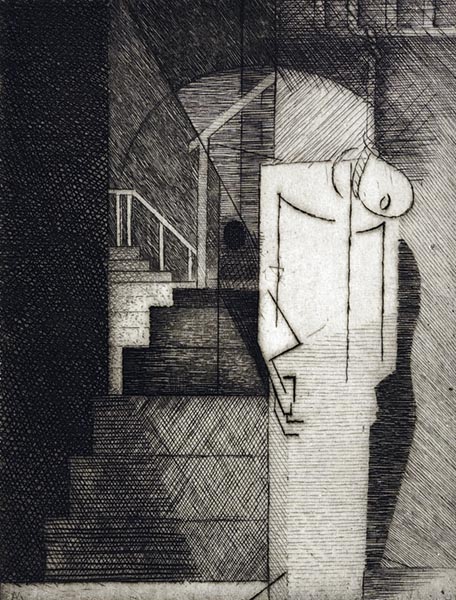
The Death of Nerval (Drawings for Aurelia)
Louis Marcoussis (French, 1883-1941)
Hood Museum
Notes to the Text
Part I: Chapter I
Beatrix, meaning ‘Blessed One’, is the Latin name from which the Italian and English form, Beatrice, as employed by Dante in the ‘Vita Nuova’ and the ‘Divine Comedy’ derives.
Part I: Chapter III
The word döppleganger is not employed in the original text, but the concept of the supernatural or mystical double of a living person, is rooted in the German folklore to which Gérard alludes.
Part I: Chapter IV
Again, Gerard does not employ the name, Lorelei, though it is clearly referred to. The Lorelei, is a rock in the Rhine gorge at Sankt Goarshausen. Clement Brentano in 1801 created a tale, elaborated famously by Heinrich Heine in 1824, of a siren figure, the Lorelei, who attracted sailors to their death.
Gérard’s mother was named Marie-Antoinette-Marguerite Laurent. She died in 1810 at a military camp in Silesia, probably from influenza, and was buried in a local cemetery. His great-uncle Antoine Boucher, who lived at Mortefontaine in the Valois, took care of him for the next four years. See also the references to his mother and uncle in Part II: Chapter IV.
Elohim is an Old Testament Hebraic word which when used in the plural signifies divinities or angels.
Part I: Chapter VIII
Kabbalah is a system of Jewish esoteric thought, fostering a mystical view of humanity’s relationship with the divine. It is distinct from conventional religious practice, and was originally an oral tradition.
Part I: Chapter IX
Amphitryon and his servant Sosie are characters in Moliere’s play ‘Amphitryon’, of 1668. Sosie, who was portrayed by Molière in the comedy’s first production is a doppelgänger of the God Mercury, Amphitryon of Jupiter.
Part II: Chapter III
The Stone Guest, is a character in Pushkin’s poetic drama of that title which was inspired by Mozart’s opera ‘Don Giovanni’, and the Spanish legend of Don Juan. The ghost of Commander de Salva, who was slain by the Don, accepts an invitation to visit him, appears in the form of a stone statue, and drags him down to Hell.
Part II: Chapter IV
In the year 1653, Vincent de Paul established a Maison de Santé in the Faubourg Saint-Laurent, (now the Faubourg Saint-Martin) Doctor Antoine Dubois was placed in charge in 1802, and his son succeeded him under the July Monarchy. The Maison de Santé was often referred to as the Maison Dubois. In May 1816 the house was moved to Rue du Faubourg Saint-Denis and enlarged with a pavilion, a garden, and a chapel. But note also the previous mention in the text of the Abbé Dubois.
Part II: Chapter V
The civil war between the Burgundians and the Armagnacs was a conflict between two cadet branches of the French royal family: the House of Orléans (the Armagnacs) and the House of Burgundy, from 1407 to 1435. Jean I, ‘sans Peur’ (John, the Fearless) ruled the Burgundian State from 1404 until his assassination in 1419.
The Galerie Montpensier, an arcade of the Palais-Royale, contained, at Nos. 57–60, the Café de Foy opened in 1784 which remained there until its closure in 1863.
Louis-Francois de Bertin, Bertin the Elder (see the famous portrait by Ingres) acquired the Journal des Débats in 1799, which he directed, with a few interruptions, until his death in 1841.
L’Hôpital de la Charité de Paris, founded in the early seventeenth century and located at 45 Rue des Saints-Pères was closed and demolished around 1935.
Part II: Chapter VI
Pierre-Paul Prud’hon (1758–1823) was a French Neoclassical painter best known for his allegorical paintings, portraits, and drawings.
The company of archers, in the Valois, appears in ‘Sylvie’, Gérard’s novel which incorporates his memories of that region, where his great-uncle lived, and which he often visited in his youth.
Giovanni Pico della Mirandola, (1463 –1494), was an Italian Renaissance philosopher. He wrote the ‘Oration on the Dignity of Man’ often termed the ‘Manifesto of the Renaissance’, and founded the tradition of Christian Kabbalah.
Johannes Meursius (van Meurs; 1579 – 1639) was a Dutch classical scholar and antiquary.
Nicholas of Cusa (1401 – 1464), was a bishop and polymath, and one of the first German proponents of Renaissance humanism.
The Ellora caves are in Aurangabad, India, and form one of the largest rock-cut cave complexes in the world, with Hindu, Buddhist, and Jain artwork. The Kailash temple features sculptures depicting Hindu deities as well as relief panels representing scenes from the Hindu epics.
Part II: Chapter VII
The Corybantes were armed dancers who worshipped the Phrygian goddess Cybele. They were of Asiatic origin and their rites were of an orgiastic nature.
The anxoka flower suggests ‘angsoka’, a name given to a number of different plants, but of these the yellow colour here suggests the ‘ashoka’ flowers of the ‘saraco indica’ tree, or the ‘saraco asoca’, noted for their bright orange-yellow colours.
Part II: Chapter VIII
Zaandam, in the Netherlands is where the ‘Czaar Peterhuisje’ is located, the building in which Tsar Peter I of Russia, Peter the Great, resided in 1697 during the Grand Embassy, his diplomatic mission to Europe at that time. The building was constructed in 1632.
The notable columns in Vienna called, according to Gérard, Pardons in French; which would be Begnadigungen in German; Reprieves or Acts of Mercy in English, are the Plague Column (Pestsäule) in Graben Street erected after the 1679 plague, and the Marian Column (Mariensäule) in Am Hof Square, erected in 1647 in gratitude to the Virgin Mary for protecting the city from Swedish invasion.
The sister of the Emperor of Russia, was Maria Pavlovna (1786-1859), daughter to Paul I, and sister to Alexander I, who became Grand Duchess of Saxe-Weimar-Eisenach by her marriage.
The statue of Peter the Great, in Saint Petersburg, is the ‘Bronze Horseman’, the famous equestrian statue of that Tsar in Senate Square, beside the Admiralty Building, and in front of St. Isaac’s Cathedral.
The two Catherines, were Empress Catherine the I of Russia (Alekseyevna Mikhailova, born Marta Samuilovna Skavronskaya) the second wife of Peter the Great, and the Empress Catherine II, ‘the Great’ (Princess Sophie of Anhalt-Zerbst), who ruled Russia after overthrowing her husband Peter III.
The Empress Saint Helena was the mother of the Eastern Emperor Constantine I. She is revered as a saint of the Russian Church, which is an autocephalous Eastern Orthodox Church.
The Eastern Question was that of who was to benefit, and how, from the decline of the Ottoman Empire, with the various European Powers pursuing their own interest in the outcome.
The series of trials of the ancients, is a reference to the initiation rites of Demeter and Persephone, the Maiden, known as the Eleusinian Mysteries, which involved visions, and the conjuring of an afterlife, and involved the stages of descent, quest, and ascent. Based on a Bronze Age agrarian cult, the rites celebrated rebirth, and the flow of life from generation to generation.
The End of Gérard de Nerval’s ‘Aurelia’