François Fénelon
The Adventures of Telemachus
Books XIII to XV
Translated by N. Hewitt © Copyright 2025 All Rights Reserved.
No part of this publication may be reproduced or transmitted in any form or by any means, electronic or mechanical, including photocopy, recording, or any information storage and retrieval system, without permission in writing from the publisher. For information about permission to reproduce selections from this book, please write to Fenelon Classics LLC, PO Box 22041, Houston, Texas 77227 or [email protected].
Contents
BOOK XIII
While Philoctetes was recounting his adventures in this way, Telemachus had remained in suspense and motionless. His eyes were attached on that great man who was speaking. All the different passions that had agitated Heracles, Philoctetes, Odysseus, Neoptolemus appeared in turn on the naïve face of Telemachus as they were represented in the course of that narration. Sometimes he cried out and interrupted Philoctetes without thinking to; sometimes he appeared to be dreamy like a man who thinks deeply about the course of affairs. When Philoctetes depicted the discomfort of Neoptolemus, who did not know how to dissimulate, Telemachus seemed to be in the same discomfort and, at that moment, one would have taken him for Neoptolemus.
Meanwhile, the army of the allies marched in good order against Adrastus, king of the Daunians, who scorned the gods and only sought to deceive men. Telemachus faced great difficulties with regard to comporting himself well among so many kings jealous of one another. He had to render himself suspect to no one and make himself loved by all. His nature was good and sincere, but hardly welcoming. He was barely aware of what could please others. He was not attached to riches, yet he did know how to give. So, with a heart noble and inclined to good, he appeared neither obliging, nor sensitive to friendship, nor open-handed, nor appreciative for the attentions given him, nor alert to distinguish merit. He followed his taste without reflection.
His mother Penelope had nurtured him, despite Mentor, in a haughtiness and a pride that tarnished all there was of the most lovable in him. He regarded himself as being of another nature than the rest of men. Others seemed to him only put on earth by the gods to please him, to serve him, to anticipate all his desires, and to attribute everything to him as to a deity. The good fortune of serving him was, according to him, a high enough reward for those who served him. Nothing should ever be impossible when it concerned satisfying him, and the least delays provoked his ardent nature.
Those who would have seen him in his natural state would have judged he was incapable of loving anything other than himself, he was only sensitive to his glory and to his pleasure. But this indifference for others and this constant attention to himself only came from the constant frenzy into which he was thrown by the violence of his passions. He had been indulged by his mother since the cradle, and he was a great example of the misfortune of those who are highborn. The rigours of Fortune that he had felt since his earliest youth had not been able to moderate this impetuosity and this haughtiness. Stripped of everything, abandoned, exposed to so many evils, he had lost none of his pride; it always rose again, just as the supple palm unceasingly rises again, no matter the effort one makes to lower it.
While Telemachus was with Mentor, these faults did not appear, and they diminished every day. Like a spirited steed that bounds in the vast prairies that neither cliffs, nor precipices, nor fast mountain streams stop, that only knows the voice and the hand of a single man capable of taming it, Telemachus, full of a noble ardour, could only be held back by Mentor alone. Moreover, just one of his looks could stop him all at once in his greatest impetuosity; he immediately understood what that look signified; he immediately recalled into his heart all the sentiments of virtue. Wisdom, in an instant, rendered his expression soft and serene. Poseidon, when he raises his trident and threatens the heaving waves, does not appease more suddenly the black tempests.
When Telemachus found himself alone, all those passions, pent-up like a mountain stream arrested by a strong dike, resumed their course. He could not tolerate the arrogance of the Lacedaemonians and Phalanthus, who was at their head. That colony, which had come to found Tarentum, was comprised of young men born during the siege of Troy who had not had any education. Their illegitimate birth, the dissoluteness of their mothers, the licentiousness in which they had been raised, gave them a certain something of fierceness and barbarity. They resembled a troop of brigands rather than a Greek colony.
Phalanthus, on every occasion, sought to contradict Telemachus. He often interrupted him in the assemblies, scorning his counsels like those of an inexperienced young man. He made fun of him, treating him as weak and effeminate. He pointed out his slightest errors to the chiefs of the army. He tried to sow jealousy everywhere and render Telemachus’ pride odious to all the allies.
One day, Telemachus having taken several Daunians prisoner, Phalanthus claimed those captives should belong to him because, he said, it was he who, at the head of the Lacedaemonians, had defeated that enemy troop and Telemachus, finding the Daunians already vanquished and fleeing, had no other difficulty than that of letting them live and leading them into camp. Telemachus sustained, on the contrary, it was he who had kept Phalanthus from being vanquished and who had brought home the victory over the Daunians. They both went to defend their cause in the assembly of the allied kings. Telemachus lost his temper to the point of threatening Phalanthus. They would have fought on the spot had they not been stopped.
Phalanthus had a brother named Hippias, famous throughout the army for his valour, for his strength, and for his prowess. Polydeuces, the Tarentins said, did not fight better at boxing; Castor could not have surpassed him in driving a horse. He had nearly the size and strength of Heracles. The entire army feared him, for he was even more quarrelsome and more brutal than he was strong and valiant. Hippias, having seen with what haughtiness Telemachus had threatened his brother, hastily goes to take the prisoners to bring them to Tarentum without waiting for the judgement of the assembly. Telemachus, whom someone came to tell in secret, left quaking with rage. Just like a wild boar, frothing at the mouth that seeks the hunter by whom he was wounded, he was seen roving through the camp, seeking the eyes of his enemy and brandishing the spear with which he wanted to pierce him. Finally he encounters him and, seeing him, his fury redoubles. It was no longer that wise Telemachus instructed by Athena under the figure of Mentor. It was a frenzied lunatic or an enraged lion.
Straightaway, he shouts at Hippias, “Halt! O most cowardly of all men! Halt! We will see if you can take from me the spoils of those I vanquished. You will not drive them to Tarentum. Go! Descend this instant to the gloomy banks of the Styx!”
He spoke and hurled his spear, but he hurled it with so much fury he could not gauge his mark. The spear did not touch Hippias. Quickly, Telemachus took his sword, the cross guard of which was gold, that Laertes had given him when he departed Ithaca as a measure of his tender affection. Laertes had used it with much glory when he was young, and it had been stained with the blood of several famous captains of the Epirotes in a war in which Laertes was victorious. No sooner had Telemachus drawn this sword than Hippias, who wanted to profit from the advantage of his strength, lunged to snatch it from the hands of the young son of Odysseus. The sword snaps in their hands. They seize and grip each other. There they are, like two cruel beasts seeking to rip each other apart; fire shines in their eyes; they press, they pull back, they duck, they rise, they lunge at each other, they are thirsty for blood. There they are, grappling foot to foot, hand to hand; those two intertwined bodies seemed only one. But Hippias, who was older, seemed to overwhelm Telemachus, whose tender youth was less muscular. Telemachus, already out of breath, felt his knees buckling. Hippias, seeing him rattled, redoubled his efforts. The son of Odysseus was done for. He was going to bear the pain of his temerity and his hot-headedness, had not Athena—who was watching over him from afar, and who was only leaving him in this extreme peril to instruct him—determined the victory in his favour.
She did not quit the palace of Salentum, but she sent Iris, swift messenger of the gods. Iris, flying on light wings, ripped through the immense space of the air, leaving behind a long trail of light that painted a cloud of a thousand different colours. She only sets down on the shore of the sea where the countless army of allies was encamped. She sees in the distance the quarrel, the ardour, and the efforts of the two fighters; she shudders at the sight of the danger the young Telemachus is in. She approaches, wrapped in a light cloud she had formed from delicate mists. At the moment when Hippias, feeling all his strength, believed himself victorious, she covered the young nursling of Athena with the aegis the wise goddess had entrusted to her.
Immediately, Telemachus, whose forces were drained, begins to come alive. As he comes alive, Hippias is troubled. He feels a certain something of the divine that stuns him and is weighing down on him. Telemachus presses him and attacks, sometimes in one spot, sometimes in another; he rattles him, he leaves him no time to steady himself; finally, he throws him to the ground and falls on him. A great oak of Mount Ida that the axe has hacked by a thousand blows, from which the entire forest reverberates, does not make a more horrible noise in falling; the ground groans from it, all that surrounds it is rattled by it.
Meanwhile, wisdom had returned with force within Telemachus. No sooner had Hippias fallen under him than the son of Odysseus realised the error he had made in attacking so the brother of one of the allied kings whom he had come to help. Confusedly, he recalled the wise counsel of Mentor. He was ashamed of his victory and understood how much he had merited being defeated. At that moment, Phalanthus, transported with fury, came running to the aid of his brother. He would have run Telemachus through with the spear he carried had he not feared piercing Hippias also, whom Telemachus held under him in the dust. The son of Odysseus could have effortlessly taken the life of his enemy, but his anger was appeased, and he no longer thought of anything but mending his error by showing restraint.
He rises, saying, “O Hippias, it suffices for me to have taught you to never scorn my youth. Live. I admire your strength and your courage. The gods have protected me—cede to their might. Let us no longer think of anything but fighting together against the Daunians.”
As Telemachus was speaking so, Hippias got up, covered with dust and blood, filled with shame and rage. Phalanthus dared not take the life of the one who had just given it so generously to his brother. He was unsettled and beside himself. All the allied kings come running. They lead to one side Telemachus, to another Phalanthus and Hippias, who, having lost his pride, dared not lift his eyes. The entire army could not be more astonished that Telemachus—at so tender an age, when men do not yet have their full strength—would have been able to take down Hippias, resembling in size and strength those giants, children of the Earth, who once dared to chase the immortals from Olympus.
But the son of Odysseus was quite far from enjoying the pleasure of this victory. While they could not weary of admiring him, he withdrew into his tent, ashamed of his error, and no longer able to bear himself. He groaned over his quick temper. He recognised how unjust and unreasonable he was in his fits of anger. He found a certain something of vainness, weakness, and lowness in this unbounded and unjust haughtiness. He recognised that true greatness is only in restraint, justice, modesty, and humaneness. He saw it, but he dared not hope to correct himself of it after so many relapses. He was struggling, with himself, and was heard roaring like an enraged lion. He remained shut up alone in his tent for two days, unable to resolve himself to reenter into any society and punishing himself. Alas, he said, dare I see Mentor again? Am I the son of Odysseus, the wisest and most patient of men? Did I come to bring division and disorder into the army of the allies? Is it their blood or that of the Daunians, their enemies, I should shed? I was brash; I did not even know how to hurl my spear. I exposed myself, in a fight with Hippias, to unequal forces. I should have expected only death from it, along with the shame of being vanquished. But what would that matter! I would no longer be, no, I would no longer be that brash Telemachus, that young fool, who does not profit from any counsel. My shame would end with my life. Alas! If I could at least hope to no longer do what I am sorry for having done! Too happy would I be, only too happy! But perhaps before the end of the day I will make, and will want to make, the same mistakes again for which I now have so much shame and horror. O ill-fated victory! O praises that I cannot suffer, and that are cruel reproaches of my madness!
While he was alone, inconsolable, Nestor and Philoctetes came to find him. Nestor wanted to point out to him the wrong he had done, but this wise old man, quickly recognising the young man’s desolation, changed his grave reproaches to words of tenderness to ease his despair.
The allied princes were halted by this quarrel, and they could only march toward the enemy after reconciling Telemachus with Phalanthus and Hippias. They feared at all hours the troops of the Tarentins would attack the hundred young Cretans who had followed Telemachus into this war. All was in turmoil through the error of Telemachus alone, and Telemachus, who saw so many evils present and perils still to come, of which he was the author, abandoned himself to a bitter pain. All the princes were in an extreme predicament. They dared not have the army march for fear that, in the march, Telemachus’ Cretans and Phalanthus’ Tarentins would fight each other. It was difficult enough restraining them within the camp where they were closely guarded. Nestor and Philoctetes were incessantly coming and going from Telemachus’ tent to that of the implacable Phalanthus, who only breathed vengeance. The sweet eloquence of Nestor and the authority of the great Philoctetes could not moderate that savage heart that was still incessantly angered by the rage-filled discourses of his brother Hippias. Telemachus was much more meek, but he was despondent through a pain that nothing could console.
While the princes were in this unrest, all the troops were filled with dismay. The entire camp seemed like a house desolated, having just lost the father of the family—the support of all his kin and the sweet hope of his grandchildren.
In this disorder and consternation of the army, all of a sudden a horrifying noise is heard of chariots, arms, whinnying of horses, the screams of men—some victorious and animated by carnage, others fleeing, or dying, or wounded. A whirlwind of dust forms a thick cloud that shrouds the sky and envelops the entire camp. Soon, the dust combines with a thick smoke, obstructing the air and stifling the breath. A dull sound was heard, like that of the swirl of flame that Mount Etna vomits up from the bottom of its blazing bowels when Hephaestus, along with his Cyclops, forges thunderbolts there for the father of the gods. Horror seizes hearts.
Adrastus, vigilant and tireless, had surprised the allies. He had hidden his march from them and had been informed of theirs. For two nights, he had made incredible haste to go around a nearly inaccessible mountain of which the allies had seized all the passes. Holding those narrow passes, they believed themselves in complete safety and even claimed, through these passes that they occupied, to be able to fall upon their enemy behind the mountain once the troops they were awaiting had come.
Adrastus, who scattered silver by the handful so as to know his enemy’s secrets, had learned of their resolution; for Nestor and Philoctetes, those two captains otherwise so wise and so experienced, were not so tight-lipped in their enterprises. Nestor, in his declining age, took too much pleasure in recounting what could draw some praise to him. Philoctetes by nature spoke less, but he was temperamental, and if the least thing excited his quick temper, he could be made to say what he had resolved to keep quiet. Artful people had found the key to his heart so as to draw the most important secrets from it: he only had to be provoked. Then, hot-headed and beside himself, he exploded with threats and boasted of having the sure means to attain what he wanted. If one merely appeared to doubt those means, he thoughtlessly hastened to explain them, and the most intimate secret escaped from the bottom of his heart. Just as a precious yet cracked vase from which flows all the most delicious liquors, the heart of this great captain could hold nothing.
Traitors, corrupted by Adrastus’ silver, did not fail to play on the weaknesses of these two kings. They incessantly flattered Nestor through vain praises; they recalled his past victories to him, admired his foresight, never wearied of applauding him. On the other hand, they set continual traps for the impatient temper of Philoctetes; they only spoke to him of difficulties, setbacks, dangers, inconveniences, irremediable errors. As soon as his irascible nature was inflamed, wisdom abandoned him, and he was no longer the same man.
Telemachus, despite the faults we have seen, was much more prudent in keeping a secret. He was accustomed to it through his misfortunes and from having, since his childhood, to hide himself from the suitors of Penelope. He knew how to keep a secret without telling any lie; he did not even have that certain reserved and mysterious air that secretive people usually have, he did not appear burdened by the weight of a secret he was obliged to keep, one always found him free, natural, open, like a man who wears his heart on his sleeve. But, while saying all that could be said without consequence, he knew how to stop precisely and without affectation at the things that could draw some suspicion and broach his secret. In so doing, his heart was impenetrable and inaccessible. Even his best friends only knew what he believed useful to reveal to them so as to draw wise counsel from them, and there was only Mentor alone with whom he showed no reserve. He confided in other friends, but to varying degrees, and in proportion to what he had experienced of their friendship and their wisdom.
Telemachus had often noticed the resolutions of the council were spreading a little too much in the camp. He had warned Nestor and Philoctetes of it. But these two men, so experienced, did not pay enough attention to such salutary advice. Old age no longer has any suppleness —longtime habits hold it as if shackled; it no longer has hardly any resources against its faults. Just as trees whose rough and knotty trunks have hardened by the number of years and can no longer be straightened, men of a certain age can almost no longer bend away from certain habits that have aged with them and have entered into the marrow of their bones. Often, they recognise them, but too late. They bemoan them in vain, and tender youth is the only age when man is still able to correct himself on his own.
There was a Dolope in the army named Eurymachus, flattering, insinuating, knowing how to adapt to all the tastes and inclinations of the princes, inventive and clever in finding new ways to please them. To hear him tell it, nothing was ever difficult. Ask him for his opinion? He divined what would be the most agreeable. He was pleasing, mocking of weak people, complaisant with those he feared, able to season a delicate praise, which would be well received by the most modest of men. He was serious with the serious, playful with those who were of a playful humour. It cost him nothing to take on all sorts of shapes. Sincere and virtuous men, who are always the same, and who submit to the rules of virtue, would never know how to be as agreeable to princes whose passions dominate them.
Eurymachus knew warfare. He was capable in affairs. He was an adventurer who had given himself over to Nestor and who had gained his confidence. He drew from the depths of Nestor’s heart, somewhat vain and sensitive to praise, all he desired to know from him. Although Philoctetes did not confide in Eurymachus, anger and impatience did in him what trust did in Nestor. Eurymachus only had to contradict him; for, in provoking him, he discovered everything.
This man had received great sums from Adrastus to send him all the plans of the allies. The king of the Daunians had a certain number of defectors in the army who were obliged to escape from the camp of the allies and return to his, one after another. As there was some important affair to make known to Adrastus, Eurymachus had one of these defectors depart. The deception could not easily be discovered because these defectors did not carry letters. If they were overtaken, nothing was found that could render Eurymachus suspect. Meanwhile, Adrastus was apprised of all the undertakings of the allies. No sooner had a resolution been made in council than the Daunians did precisely what was necessary to impede its success. Telemachus did not tire of seeking the cause for this and inciting the distrust of Nestor and Philoctetes, but his attention was useless—they were blind.
They had resolved in council to wait for the numerous troops that were to come, and they had a hundred vessels advance secretly during the night to conduct these troops more swiftly from a very rough seacoast, where they should arrive, to the spot where the army was encamped. Meanwhile, they believed themselves safe, because their troops held the narrow passes of the neighbouring mountain, which is an almost inaccessible coast of the Apennines. The army was encamped on the banks of the Galesus river, fairly close to the sea. This delightful countryside is abundant in grazing land and all the produce that can feed an army.
Adrastus was behind the mountain and they counted on him being unable to pass over it. But, as he knew the allies were still weak, they were waiting for large reinforcements, vessels were waiting for the arrival of the troops that should come and the army was divided by Telemachus' quarrel with Phalanthus, they hastened to make a great detour. He hurriedly came day and night along the edge of the sea and passed by trails that were always believed to be absolutely impassable. Thus, boldness and obstinate work overcome the greatest obstacles; thus, there is almost nothing impossible for those who know how to dare and to suffer; thus, those who sleep, figuring difficult things are impossible, merit being surprised and crushed.
Adrastus surprised, at daybreak, the hundred vessels that belonged to the allies. As these vessels were poorly guarded and wary of nothing, he seized them without resistance and used them to transport his troops with an incredible haste to the mouth of the Galesus. Then he very swiftly went up the length of the river. Those who were in the forward posts around the encampment toward the river, believed these vessels were bringing the troops they were awaiting. They immediately loosed great cries of joy. Adrastus and his soldiers descended before they could recognise them. They fell upon the allies, who were suspecting nothing; they found the allies in a camp completely open, without order, without chiefs, without weapons.
The side of the camp they attacked first was that of the Tarentins, where Phalanthus commanded. The Daunians entered with so much vigour that this Lacedaemonian youth, being surprised, could not fight back.
While they search for their weapons and hamper each other in this confusion, Adrastus sets fire to the camp. Quickly, the flame rises from the pavilions and ascends to the clouds. The noise from the fire is like that of a torrent that floods an entire countryside and sweeps along in its swift current great oaks with their deep roots, crops, barns, stables, and flocks. The wind impetuously pushes the flame from pavilion to pavilion, and soon the entire camp is like an ancient forest an ember has set ablaze.
Phalanthus, who sees the peril more closely than any other, is unable to remedy it. He realises all the troops are going to perish in this inferno if they do not hasten to abandon the camp. But he also understands how much the disorder of this retreat is to be feared before a victorious enemy. He begins to get his Lacedaemonian youth out, still half-unarmed. But Adrastus does not allow them to breathe. From one side, a troop of adept archers pierce Phalanthus’ soldiers with countless arrows. From the other, sling-shooters hurl a hail of fat stones. Adrastus himself, sword in hand, marching at the head of a troop chosen from the most intrepid Daunians, pursues, by the glow of the fire, the troops who are fleeing. He reaps with his sharp blade all who have escaped the fire. He swims in blood, and he cannot slake himself of carnage. Lions and tigers do not equal his fury, when they slay the shepherds along with their flocks. Phalanthus’ troops succumb and courage abandons them. Pale Death, driven by an infernal Fury whose head bristles with serpents, freezes the blood in their veins. Their numb limbs stiffen, and their buckling knees deny them even the hope of flight.
Phalanthus, to whom shame and despair still give a remnant of fortitude and vigour, raises his hands and eyes toward the sky. He sees fall at his feet his brother Hippias under the strikes of the lethal hand of Adrastus. Hippias, stretched out on the ground, rolls in the dust; a black and bubbling blood flows out like a stream from the deep wound that crosses his side; his eyes close to the light; his furious soul flees with all his blood. Phalanthus himself, completely covered with the blood of his brother, and unable to help him, finds himself enveloped by a horde of enemies endeavouring to strike him down; his shield is pierced with a thousand shafts. He is wounded in many parts of his body. He can no longer rally his fugitive troops. The gods see him, and they have no mercy on him.
Zeus, in the midst of all the celestial deities, watched from the heights of Olympus this carnage of the allies. At the same time, he consulted the immutable destinies and saw all the chiefs for whom the thread must this very day be cut by the scissors of the Fates. Each of the gods was attentive to discover on the face of Zeus what would be his will. But the father of gods and men said to them in a gentle and majestic voice, “You see to what extremity the allies are reduced. You see Adrastus who strikes down all his enemies. But this spectacle is very deceptive. The glory and prosperity of the wicked is fleeting. Adrastus, impious and odious through his bad faith, will not bring home a complete victory. This misfortune is only happening to the allies to teach them to mend their ways and to better keep their enterprises secret. Here wise Athena prepares a new glory for her young Telemachus, in whom she delights.
Then Zeus ceased speaking. All the gods continued to watch the combat in silence.
Meanwhile, Nestor and Philoctetes were advised a part of the camp had already burned, the flame pushed by the wind was still advancing, their troops were in disorder, and
Phalanthus could no longer sustain the efforts of the enemy. Barely do these calamitous words strike their ears and they are already running to arms, assembling the captains, and ordering them to hasten to get out of the camp to evade this inferno.
Telemachus, who had been despondent and inconsolable, forgets his pain. He takes up his armour, precious gift from wise Athena, who, appearing in the figure of Mentor, pretended to have received them from an excellent craftsman of Salentum, but who had had them made by Hephaestus in the steaming caverns of Mount Etna.
These arms were polished like glass and shining like the rays of the sun. On it, one saw Poseidon and Pallas disputing over who would have the glory of giving their name to an emerging city. Poseidon was striking the ground with his trident, and one saw emerging from it a spirited horse. Fire leapt from his eyes, and froth from his mouth. His mane floated with the wind. His supple and muscular legs pranced with vigour and lightness; he was not walking, he was lunging with his hind legs, but with so much quickness that he left no trace of his steps. One believed to hear him whinny.
On the other side, Athena was giving the inhabitants of her new city the olive, fruit of the tree she had planted. The branch on which its fruit hung represented sweet peace, along with abundance, preferable to the turmoil of war for which that horse was the image. The goddess remained victorious through her simple and useful gifts, and superb Athens bore her name.
One also saw Athena gathering round her all the fine arts, who were tender, winged infants. They took refuge around her, being horrified by the brutal fury of Ares who ravages everything, like bleating lambs take refuge under their mother at the sight of a famished wolf, who, with his gaping and inflamed maw, pounces to devour them. Athena, with a disdainful and angry expression, was confounding, through the excellence of her work, the foolish temerity of Arachne, who had dared to dispute her over the perfection of tapestries. One saw that poor wretch, whose extended limbs were disfiguring and changing into those of a spider.
On another side appeared Athena again, who, in the war of the giants, served as counsel to Zeus himself and supported all the other stunned gods. Lastly, she was represented with her lance and her aegis on the banks of the Xanthus and the Simois, leading Odysseus by the hand, reanimating the fugitive troops of Greece, standing up to the efforts of the most valiant Trojan captains, and the redoubtable Hector himself, finally, having Odysseus enter that fatal machine which ought, in a single night, topple Priam’s empire.
On another side, this shield represented Demeter in the fertile countrysides of Enna that are in the middle of Sicily. The goddess is seen gathering the peoples scattered hither and yon, seeking their nourishment through hunting or picking wild fruit that falls from the trees. She was demonstrating to those crude men the art of softening the land and drawing from its fruitful womb their nourishment. She was presenting a plough to them and having oxen yoked to it. One saw the land opened up in furrows by the blade of the plough. Then one spied golden crops which covered those fertile countrysides. The reaper, with his scythe, was cleaving the sweet produce of the land and was rewarded for all his troubles. Iron, destined elsewhere to destroy everything, only seemed used in this place to prepare abundance and to make every pleasure sprout.
Nymphs, crowned with flowers, danced together in a meadow on the banks of a stream, alongside a grove. Pan played the flute. Fauni and coltish Satyrs frolicked in a corner. Dionysus appeared there also, wreathed with ivy, leaning with one hand on his thyrsus, and holding with the other a vine festooned with green leaves and several clusters of grapes; his was a soft beauty with a certain nobleness, passionate and languishing. He was just as he appeared to the unhappy Ariadne, when he found her alone, abandoned and lost in pain on an unknown shore.
Lastly, one saw on all sides numerous people: old men carrying the first of their produce into the temples; young men returning to their spouses, weary from the work of the day; wives going to welcome them, leading by the hand their little children whom they caressed. Shepherds were also seen, seeming to be singing, and some of them were dancing to the sound of the chalumeaux—all represented peace, abundance, delights; all appeared laughing and happy. One even saw wolves frolicking in the pastures amidst the sheep. The lion and the tiger, having forsaken their ferocity, were grazing with the tender lambs. A little shepherd was driving them together under his crook. This lovable painting recalled all the charms of the golden age.
Telemachus, having donned this divine armour, instead of taking his regular sword-belt, took the terrifying aegis that Athena had sent him, entrusting it to Iris, the swift messenger of the gods. Iris had removed his sword-belt without him noticing and had given him in its place this aegis, redoubtable to the gods themselves.
In this state, he runs out of the camp to avoid the flames. He summons to him in a loud voice all the chiefs of the army, and this voice already reanimates all the distraught allies. A divine fire flashes in the eyes of the young warrior. He always appears gentle, always free and tranquil, always attentive to giving orders just like a wise old man attentive to sorting out his family and teaching his children. But he is swift and rapid in the execution, like an impetuous river that not only precipitously rolls its foaming waves, but even sweeps along its course the heaviest vessels with which it is burdened.
Philoctetes, Nestor, the chiefs of the Mandurians, and other nations sense in the son of Odysseus a certain authority to which they must all cede; the experience of the old men fails them; the counsel and wisdom are taken away from all the commanders; even jealousy, so natural to men, is extinguished in their hearts. All are silent, all admire Telemachus, all fall in line to obey him without questioning him, as if they were accustomed to it. He advances and ascends a hill, from where he observes the disposition of the enemy. Then, all of a sudden, he judges they must hasten to take them by surprise in the disorder where they have put themselves in burning the camp of the allies. He hurriedly makes the turn, and all the most experienced captains follow him. He attacks the Daunians from behind at a time when they believed the army of the allies to be enveloped in the flames of the blaze. This surprise attack distresses them. They fall under the hand of Telemachus like leaves in the last days of autumn fall in the forests when a proud Northwind, bringing back winter, causes the trunks of the old trees to groan and shakes all the branches. The ground is covered with the men Telemachus strikes down. With his spear, he pierces the heart of Iphicles, the youngest of Adrastus’ children; this one dared to stand against him in combat to save the life of his father, who he thought would be overtaken by Telemachus. The son of Odysseus and Iphicles were both handsome, vigorous, full of prowess and courage, of the same size, the same sweetness, the same age. Both were cherished by their parents. But Iphicles was like a flower that blossoms in a field and that must be cut down by the blade of the reaper’s scythe. Then Telemachus strikes down Euphorion, the most famous of all the Lydians coming from Etruria. Finally, his glaive pierces Cleomene, newly married, who had promised his spouse to bring her the rich spoils of his enemy and who should never see her again.
Adrastus quakes with rage, seeing the death of his dear son, that of several captains, and victory escaping from his hands. Phalanthus, almost slain at his feet, is like a sacrifice, throat half-slit, that gets away from the sacred knife and flees far from the altar. It would have taken Adrastus only an instant to finish off the Lacedomonian.
Phalanthus, drowning in his own blood and that of the soldiers who are fighting alongside him, hears the shouts of Telemachus, who is advancing to come to his rescue. In that instant, life is returned to him; the cloud that already covered his eyes dissipates. The Daunians, sensing this unforeseen attack, abandon Phalanthus to repulse a more dangerous enemy. Adrastus is like a tiger from whom the shepherds, banded together, snatch the prey it was ready to devour. Telemachus seeks him in the melee and wants to instantly end the war by delivering the allies from their implacable enemy.
But Zeus did not want to give the son of Odysseus a victory so swift and so easy. Even Athena desired he should suffer evils even longer to better learn how to govern men. The impious Adrastus was thus preserved by the father of the gods so that Telemachus would have the time to acquire more glory and more virtue. A cloud that Zeus gathered in the air saved the Daunians. A horrifying thunderclap declared the will of the gods. One would have thought the eternal vaults of high Olympus were going to crash down on the heads of weak mortals. Flashes of lightning split the cloud from one pole to the other, and in an instant when their eyes were dazzled by their piercing fires, everything fell back into the dreadful darkness of the night. An abundant rain that fell in an instant served to separate the two armies.
Adrastus profited from the succour of the gods, without being touched by their might, and merited by this ingratitude being reserved for a more cruel vengeance. He hastened to have his troops pass between the half-burned camp and a marsh that extended to the river. He did it with so much cleverness and swiftness that this retreat demonstrated how much resourcefulness and presence of mind he had. The allies, animated by Telemachus, wanted to pursue him, but thanks to this storm, he escaped them like a bird with a light wing escapes the nets of the hunters.
The allies no longer thought of anything but reentering their camp and mending their losses. Reentering the camp, they saw what war has of the most lamentable: the sick and wounded, being unable to drag themselves out of the tents, were unable to save themselves from the fire. They appeared half-burnt, loosing to the sky, in plaintive and dying voices, painful shrieks. Telemachus’ heart was pierced by them. He could not hold back his tears. He averted his eyes several times, gripped with horror and compassion. He could not witness, without shuddering, those bodies still alive and committed to a long and cruel death. They looked like the flesh of the sacrifices one burns on the altars, the odour of which spreads in every direction.
“Alas,” Telemachus cried out, “here then, are the evils war drags along after it! What blind fury pushes wretched mortals! They have so few days to live on earth. Those days are so miserable. Why hurry a death already so near? Why add so much dreadful desolation to the bitterness with which the gods have filled this life that is so short? Men are all brothers, yet they tear each other apart. Ferocious beasts are less cruel than them. Lions do not wage war with lions, nor tigers with tigers. They only attack animals of a different species. Man alone, despite his reason, does what animals without reason would never do.
But still, why these wars? Is there not enough land in the universe to give every man more of it than he can cultivate? How much deserted land is there? Humankind would not know how to fill it. What then! A false glory, a vain title of conqueror that a prince wants to acquire, ignites war in immense countries! So then, a single man, given to the world by the anger of the gods, brutally sacrifices so many other men to his vanity—all must perish, all swim in blood, all be devoured by flames. He who escapes the sword and fire cannot escape hunger, even more cruel, so that a single man, who toys with the whole of human nature, finds in this general destruction his pleasure and his glory. What monstrous glory!
Can one abhor too much and scorn too much the men who have so forgotten humanity? No, no—so very far from being demigods, they are not even men, and they should be an execration to all the centuries in which they believed they would be admired. O how kings must be wary of the wars they undertake! They must be just. That is not enough though—they must be necessary for the public good; the blood of a people must only be spilled in order to save that people in extreme need. But flattering counsel, false ideas of glory, vain jealousies, unjust avidity that cloaks itself in beautiful pretexts, lastly, insensitive commitments nearly always drag kings into wars where they make themselves wretched, where they risk everything unnecessarily, and where they do as much evil to their subjects as to their enemies.” Thus reasoned Telemachus.
But he was not content to deplore the evils of war, he tried to soften them. He was seen going into tents to help the sick and dying himself: he gave them silver and remedies; he consoled and encouraged them through discourses full of friendliness. Those whom he could not visit himself, he had visited by others.
Among the Cretans who were with him, there were two old men, one of whom was named Traumaphilus and the other Nosophugus. Traumaphilus had been at the siege of Troy with Idomeneus and had learned from the children of Asclepius the divine art of healing cuts. He spread into the deepest and most infected wounds a fragrant liqueur that consumed the dead and corrupt flesh without needing to make any incision and swiftly formed new flesh healthier and finer than the former.
As for Nosophugus, he had never seen the children of Asclepius, but he had received, through the intermediary Meriones, a sacred and mysterious book that Asclepius had given his children. Besides, Nosophugus was a friend of the gods; he had composed hymns in honour of the children of Leto; every day he offered the sacrifice of a white and unstained ewe to Apollo, by whom he was often inspired. No sooner had he seen a sick person than he knew by his eyes, by the colour of his complexion, by the conformation of his body, and by his breathing the cause of his sickness. At times, he gave remedies that caused sweating, and he demonstrated through the success of the sweats how much perspiration facilitates, diminishes, disconcerts, or re-establishes all the workings of the body. At times he gave, for the aches of languor, certain brews that, bit by bit, fortified the vital organs and rejuvenated men by softening their blood. But he assured that it was for want of virtue and courage that men so often needed medicine.
“It is a shame,” he said, “with regard to men that they have so many maladies, for good mores produce health. Their intemperance,” he said again, “changes into deadly poisons the foods intended to preserve life. Pleasures, taken without moderation, abridge the days of men more than remedies can prolong them. The poor are less often sick for want of nourishment than the rich become sick from taking too much of it. Foods that flatter the taste too much, and cause one to eat beyond need, poison them instead of nourishing. Remedies are themselves true evils make use of nature and that must be used only in pressing need. The great remedy, which is always innocent, and always useful: it is sobriety, it is temperance in all pleasures, it is tranquillity of the mind, and it is exercising the body. In doing so, one causes a soft and temperate blood and dissipates all the superfluous black bile.”
Thus, wise Nosophugus was less admirable for his remedies than for the diet he counselled to prevent maladies and to render remedies unnecessary.
These two men were sent by Telemachus to visit all the sick in the army. They healed many of them through their remedies, but they healed even more of them through the care they took to have them attended properly; for they applied themselves to keeping them clean, to prevent poor air through this cleanliness, and to keep them on a diet of strict sobriety in their convalescence.
All the soldiers, touched by these aids, rendered thanks to the gods for having sent Telemachus into the army of the allies.
“He is not a man,” they were saying. “He is undoubtedly some beneficent deity beneath a human figure. At least, if he is a man, he resembles less the rest of men than the gods. He is only on earth to do good. He is even more lovable through his gentleness and through his goodness than through his valour! O if we could have him as king! But the gods reserve him for some people more fortunate that they cherish, and for whom they wish to renew the golden age.”
Telemachus, while he was going nightly to visit the quarters of the camp as a precaution against Adrastus’ ruses, heard these praises, which were not suspect of flattery like those that flatterers often give in front of princes, assuming they have neither modesty nor delicateness and one only has to praise them without measure to capture their favour. The son of Odysseus could only appreciate what was true; he could not tolerate praises other than those which were given of him in private, far from him, and that he truly merited. His heart was not insensitive to them. He felt that pleasure so sweet and so pure that the gods have attached to virtue alone, and that the wicked, for want of having experienced it, can neither conceive of nor believe in. But he did not abandon himself to this pleasure. Instantly, all the errors he had made crowded into his mind. He did not forget his innate haughtiness and his indifference toward men. He had a secret shame of being born so harsh, yet appearing so human.
He gave back to wise Athena all the glory that was given to him and that he did not believe to merit himself. “It is you,” he said, “O great goddess, who gave Mentor to me in order to instruct me and to correct my poor nature. It is you who gives me the wisdom to profit from my errors in order to distrust myself. It is you who holds back my impetuous passions. It is you who causes me to feel the pleasure of relieving the unfortunate—without you, I would be hated and worthy of being so; without you, I would make irreparable errors; I would be like a child, who, not sensing his weakness, quits his mother and tumbles at the first step.”
Nestor and Philoctetes were astounded to see Telemachus become so gentle, so attentive to oblige men, so officious, so helpful, so ingenious with regard to anticipating needs. They did not know what to think. They no longer recognised in him the same man. What surprised them more was the care he took of Hippias’ funeral. He went himself to retrieve his bloody and disfigured body from the spot where it was hidden under a pile of corpses. He shed pious tears over him, saying, “O great shade, you now know how much I esteemed your valour! It is true that your pride had angered me, but your faults came from an ardent youth. I know how much this age needs one to forgive it. We would have been genuinely united afterward. I was wrong for my part. O gods, why rob me of him before I could have forced him to love me?”
Afterward, Telemachus had the body washed in fragrant liqueurs, then by his order they prepared a pyre. The tall firs, groaning under the blows of the axe, fall, rolling from the top of the mountains. The oaks, those old children of the Earth, who seem to threaten the skies, tall poplars, elms, whose heads are so green and adorned with a thick foliage, beech trees, which are the honour of the forests, tumble onto the banks of the river Galesus. There rises up with orderliness a pyre that resembles a regular building. The flame begins to appear. A swirl of smoke ascends to the sky.
The Lacedaemonians advance with a slow and lugubrious step, holding their pikes upended and their eyes downcast. Bitter pain is painted on those faces so fierce, and tears flow abundantly. Then they saw Pherecides coming, old man less beaten-down by the number of years than by the pain of surviving Hippias, whom he had raised since his childhood. He lifted his hands and his eyes bathed in tears toward the sky. Since Hippias’ death, he had refused all nourishment. Sweet Sleep could neither weigh down his eyelids nor suspend for a moment his searing pain. He marched with a trembling step, following the crowd and not knowing where he was going.
No word left his lips, for his heart was too gripped by pain; it was a silence of despair and despondence. But when he saw the pyre lit, all of a sudden he appeared furious, and he cried out, “O Hippias, Hippias, I will no longer see you! Hippias is no more, and I still live! O my dear Hippias, it is me, cruel, pitiless me, who taught you to scorn Death. I believed your hands would close my eyes, and you would gather my last sigh. O cruel gods, you prolong my life to have me see the death of Hippias! O dear child whom I nurtured and who cost me so many cares, I will see you no more! But I will see your mother, who will die of sadness while reproaching me for your death. I will see your young wife striking her breast, pulling out her hair, and I will be the cause of it. O dear shade! Call me onto the banks of the Styx. The light is odious to me. It is you alone, my dear Hippias, who I want to see again. Hippias, Hippias, O my dear Hippias! I still live only to render the last rites to your ashes.”
Meanwhile, they saw the body of young Hippias laid out as they bore him in a coffin ornamented with purple, gold, and silver. Death, which had extinguished his eyes, had not been able to blot out all his beauty, and the Graces were still half-painted on his pale face. They saw floating round his neck, whiter than snow, but leaning on his shoulder, his long black hair—more beautiful than that of Atys or Ganymede—which was going to be reduced to ashes. They noticed in his side the deep wound through which all his blood had flowed, and which had caused him to descend into the gloomy kingdom of Hades.
Telemachus, sad and despondent, followed the body closely and tossed flowers to it. When they had arrived at the pyre, the young son of Odysseus could not watch the flame penetrating the cloth that wrapped the body without shedding new tears.
“Farewell,” he said, “O magnanimous Hippias! for I dare not call you my friend. Be at peace, O shade who merited so much glory. If I did not love you, I would envy your good fortune. You are delivered from the miseries where we still are, and you have left them by the most glorious path. Alas, how happy I would be to end the same. May the Styx not stop your shade, may the Elysian Fields be open to it, may winged Rumour preserve your name throughout the centuries, and may your ashes rest in peace.”
Barely had he said these words, intermingled with sighs, when the entire army heaved a cry. They were touched by Hippias, of whom they recounted great deeds and the pain of his death, recalling all his good qualities and forgetting the faults that an impetuous youth and a poor education had imparted to him. Yet they were even more moved by the tender sentiments of Telemachus.
“Is this,” they were saying, “that young Greek so proud, so haughty, so disdainful, so intractable? Here he is, grown gentle, humane, tender. Undoubtedly, Athena, who so loved his father, loves him too. Undoubtedly, she made the most precious gift to him the gods can make to men in giving him, along with wisdom, a heart sensitive to friendship.”
The body was already consumed by the flames. Telemachus himself doused the still-steaming ashes with perfumed liquors. Then he had them put into a golden urn that he rimmed with flowers, and he carried that urn to Phalanthus. This man was stretched out, pierced with several wounds, and, in his extreme weakness, he glimpsed near him the gloomy Gates of the Underworld.
Traumaphile and Nosophugus, sent by the son of Odysseus, had already given him all the aids of their art. They recalled, little by little, his soul ready to soar. New spirits were gradually bringing him back to life; a gentle and penetrating force, a balm of life, was insinuating itself from vein to vein to the depths of his heart. An agreeable warmth stole him from the icy hands of Death. At that moment, the stupor ceasing, grief followed. He began to feel the loss of his brother, which he had not, until then, been in a state to feel.
“Alas,” he said, “why do they take such great care to make me live? Would it not be better for me to die and follow my dear Hippias? I saw him perish right alongside me. O Hippias, the sweetness of my life, my brother, my dear brother, you are no more. I will no longer be able to see you, nor hear you, nor embrace you, nor tell you my troubles, nor console you in yours. O gods, enemies of men! There is no longer any Hippias for me. Is it possible? But is it not a dream? No, it is only too true. O Hippias, I lost you. I saw you die, and I must still live as long as necessary to avenge you. I want to sacrifice to your manes cruel Adrastus, stained with your blood.”
While Phalanthus was speaking so, the two divine men tried to ease his grief for fear it would increase his aches and impede the effect of the remedies. All of a sudden, he spied Telemachus, who appeared before him. At first, his heart was fighting two opposing passions. He held onto the resentment from all that had passed between Telemachus and Hippias. The grief from the loss of Hippias rendered this resentment even more acute. On the other hand, he could not ignore that he owed the preservation of his life to Telemachus, who had pulled him, bloody and half dead, from the hands of Adrastus. But when he saw the golden urn where the ashes, so dear, of his brother Hippias were contained, he shed a torrent of tears; he immediately embraced Telemachus, unable to speak, and finally said to him in a listless voice, choked off by sobs, “Worthy son of Odysseus, your virtue forces me to love you. I owe you the remainder of this life that is going to be extinguished, but I owe you something that is even more dear to me. Without you, the body of my brother would have been the prey of vultures. Without you, his shade, deprived of sepulchre, would have roved unhappily on the banks of the Styx, forever repulsed by the merciless Charon. Must I owe so much to a man whom I hated so? O gods, reward him, and deliver me from a life so wretched! As for you, O Telemachus, render me the last rites that you rendered my brother, so that your glory lacks for nothing.”
At these words, Phalanthus remained exhausted and beaten-down by an excess of pain. Telemachus took up a position alongside him, without daring to speak to him and waited until he regained his strength. Soon Phalanthus, rallying from this faint, took the urn from Telemachus' hands, kissed it several times, wet it with his tears, and said, “O cherished, O precious ashes, when will mine be contained with you in this same urn? O shade of Hippias, I am following you into the Underworld. Telemachus will avenge us both.”
Meanwhile, Phalanthus’ aches diminished day by day through the care of the two men who had the science of Asclepius. Telemachus was unceasingly with them alongside the patient so as to render them more attentive to advancing his healing, and the entire army admired the heartfelt goodness with which he helped his greatest enemy even more than the valour and wisdom he demonstrated in saving, in battle, the army of the allies.
At the same time, Telemachus showed himself to be tireless in the roughest travails of war. He slept little, and his sleep was often interrupted either by the warnings he received at all hours of the night as in the day, or by the rounds he made to every quarter of the camp, which he never did twice at the same hour so as to better surprise those who were not as vigilant. He often came back to his tent covered with sweat and dust. His nourishment was plain, and he lived like the soldiers in order to set the example of sobriety and patience. The army having few rations in this camp, Telemachus judged it suitable to stop the grumbling of the soldiers by voluntarily enduring the same inconveniences as they. His body, far from weakening from a life so arduous, strengthened and hardened each day. He was beginning to lose those tender charms that are like the flower of early youth. His complexion became more tanned and less delicate, his limbs less soft and more muscular.
END OF BOOK XIII
BOOK XIV
Meanwhile, Adrastus, whose troops had been considerably weakened in combat, had withdrawn behind the Aulon mountain to await various reinforcements and try to surprise his enemies again, like a hungry lion, who, having been put off by a sheepfold, turns back into the sombre forest and reenters his cavern where he sharpens his teeth and his claws, awaiting the favourable moment to slay the whole flock.
Telemachus, having taken care to put in place an exacting discipline throughout the camp, no longer thought of anything but executing a plan he had conceived and concealed from all the chiefs of the army. For a long time, he was agitated during the night by dreams that portrayed his father Odysseus to him. This dear image always came back at the end of the night, before Dawn came to chase from the skies with her nascent fires the inconstant stars, and from the earth sweet Sleep trailed by flitting Dreams. At times, he believed he saw Odysseus nude on a happy island, on the banks of a river in a prairie adorned with flowers and surrounded by nymphs who were tossing him garments to cover himself; at times, he believed he heard him speaking in a palace resplendent with gold and ivory, where men crowned with flowers were listening to him with pleasure and admiration. Often, Odysseus would appear to him all of a sudden at feasts, where joy burst forth amidst the delights and where one heard the tender harmony of a voice along with a lyre sweeter than the lyre of Apollo and all the voices of the Muses.
Telemachus, awakening, was saddened by those dreams so agreeable. “O my father, O my dear father Odysseus,” he cried out, “the most dreadful dreams would be sweeter to me! These images of felicity lead me to believe you have already descended into the resting place of blissful souls, whose virtue the gods reward with an eternal tranquillity. I believe I see the Elysian Fields. O how cruel it is to no longer hope. What then, O my dear father, I will never see you! Never will I embrace the one who loved me so and whom I seek with so much difficulty. Never will I hear that mouth speak, from which wisdom came! Never will I kiss those hands, those dear hands, those victorious hands, which slew so many enemies! They will not punish the foolish suitors of Penelope, and Ithaca will never rise again from its ruin! O gods, enemies of my father, you send me these sinister dreams to wrench all hope from my heart. It is to wrench life from me. No, I can no longer live in this uncertainty.
“What am I saying! Alas! I am only too certain my father is no more. I am going to seek his shade as far as the Underworld. Theseus indeed descended there, Theseus, that impious man who wanted to outrage the infernal deities, and me, I am going there, driven by piety. Heracles descended there. I am not Heracles, but it is a fine thing to dare to imitate him. Orpheus indeed touched, through the story of his misfortunes, the heart of that god whom they depict as inexorable. He procured from him the return of Eurydice among the living. I am more worthy of compassion than Orpheus, for my loss is greater. Who would be able to compare a young girl, like a hundred others, to the wise Odysseus, admired by all of Greece? Come now! We die if we must—why fear Death when one suffers so in life? O Hades, O Persephone, I will soon experience whether you are as pitiless as they say! O my father, after having crossed over lands and seas in vain to find you, I am finally going to see if you are in the gloomy domain of the dead. If the gods refuse my possessing you on earth, in the light of the sun, perhaps they will not refuse me seeing your shade at least in the kingdom of the night.”
Saying these words, Telemachus soaked his bed with his tears. Straightaway, he rose and sought, by the light, to ease the searing pain those dreams had caused him. But it was an arrow that had pierced his heart and he carried with him everywhere.
In that pain, he undertook to descend to the Underworld through a famous spot not too distant from the camp. They called it Acherontia because there was, in that spot, a dreadful cavern through which one descended onto the banks of the Acheron, by which even the gods fear to swear. The city was on a cliff, posed like a nest at the top of a tree. At the foot of that cliff was found the cavern, which timid mortals dared not approach. Shepherds attended to turn their flocks away from it. The sulphuric vapour from the Stygian marsh unceasingly exhaled through this opening, making the air reek. All around neither grass nor flowers grew. One never felt the gentle zephyrs there, nor the nascent charms of springtime, nor the rich gifts of autumn. The arid land languished there; one only saw some barren brushes and macabre cypresses. For a distance all around even, Demeter refused her golden crops to the ploughmen; Dionysus seemed to promise his sweet fruits in vain, the clusters of grapes shrivelling instead of ripening. The sad Naiads did not make a clear water flow, their currents were always bitter and cloudy. Birds never sang in this land bristling with brambles and thorns, and they found no grove in which to retreat. They went to sing their love songs under a gentler sky. One only heard the cawing of crows and the lugubrious voice of the owls. Even the grass was bitter there, and the flocks that grazed it did not feel the sweet joy that made them leap. The bull fled the heifer, and the shepherd, dejected, forgot about his musette and his flute.
From that cave emanated, from time to time, a thick black smoke that caused a kind of night to descend in the middle of the day. Then the neighbouring peoples redoubled their sacrifices to appease the infernal deities. But often men in their prime and in their most tender youth were the only victims those cruel deities took pleasure in sacrificing through a calamitous contagion.
It is there that Telemachus resolved to search for the path to the gloomy dwelling of Hades. Athena, who watched over him unceasingly, and who covered him with her aegis, had rendered Hades favourable to him. Even Zeus, at the prayer of Athena, had commanded Hermes—who descended each day to the Underworld to deliver a certain number of dead to Charon— to tell the king of the shades he would allow the son of Odysseus to enter into his empire.
Telemachus steals away from the camp during the night. He walks by the light of the moon, and he invokes that mighty deity who—being in the sky the shining star of the night, and on earth the chaste Artemis—is, in the Underworld, the redoubtable Hecate. This deity listened favourably to his wishes because his heart was pure, and he was driven by the pious love a son owes his father.
No sooner was he alongside the entrance of the cavern than he heard the subterranean empire bellow. The ground trembled under his feet. The sky armed itself with lightning and fire that seemed to fall to earth. The young son of Odysseus felt his heart stirred and his whole body was covered with an icy sweat, but his courage sustained him. He lifted his eyes and hands to the sky.
“Great gods,” he cried out, “I accept these presages, which I believe happy ones. Complete your work.”
He spoke, and redoubling his steps, he boldly presented himself. Immediately, the thick smoke, which rendered the opening of the cavern fatal to all animals as soon as they approached it, dissipated. The poisonous odour ceased for a short time. Telemachus enters alone, for what other mortal would have dared follow him? Two Cretans, who had accompanied him up to a certain distance from the cavern, and to whom he had confided his plan, remained trembling and half-dead somewhat far from there in a temple, making vows and no longer hoping to see Telemachus again.
Meanwhile, the son of Odysseus, sword in hand, plunges into the terrifying darkness. Soon he perceives a weak and gloomy light such as one sees during the night on Earth. He notices light shades flitting round him, and he scatters them with his sword. Then he sees the sad banks of the marshy river, whose muddy and dormant water formed only eddies. He beheld on that bank a countless horde of dead deprived of sepulchre, who present themselves in vain to the merciless Charon. This god, whose eternal old age is always sad and sorrowful, yet full of vigour, threatens them, repulses them, and admits aboard his craft the young Greek. Entering, Telemachus hears the wails of a shade who could not console himself.
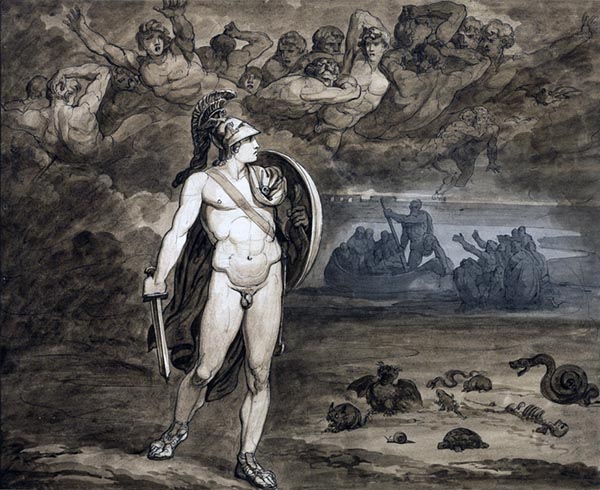
‘Telemachus, believing that his father, Ulysses, is dead, searches for him in the Underworld.’ (1808) - Bartolomeo Pinelli (Italian, 1781-1835)
Artvee
“What is then,” he said to him, “your misfortune? Who were you on Earth?”
“I was,” this shade answered, “Nabopharsan, king of superb Babylon. All the peoples of the East trembled at the mere sound of my name. I had myself venerated by the Babylonians in a temple of marble, where I was represented by a statue of gold before which they burned night and day the most precious perfumes of Ethiopia. Never did anyone dare to contradict me without being punished straightaway. Each day, they invented new pleasures to render life more delightful to me. I was still young and robust. Alas, what prosperities still remained for me to enjoy on the throne! But a woman whom I loved, who did not love me, indeed made me feel that I was not a god; she poisoned me. I am no longer anything. Yesterday, my ashes were put into a golden urn with pomp. They wept, they pulled out their hair, they pretended to want to throw themselves into the flames of my pyre to die with me. They still go to wail at the foot of the superb tomb where my ashes were placed, but no one laments me. The memory of me is horrifying even to my family, and here below, I already suffer horrific treatment.”
Telemachus, touched by this spectacle, said to him, “Were you truly happy during your reign? Did you feel that sweet peace, without which the heart always remains gripped and withered in the midst of delights?”
“No,” answered the Babylonian. “I do not even know what you mean. Wise men vaunt that peace as the only good. As for me, I never felt it. My heart was unceasingly agitated by new desires, fear, and expectation. I tried to distract myself by stirring my passions. I attended to maintain this intoxication so as to make it continual. The least interval of tranquil reason would have been too bitter to me. That is the peace I possessed. Every other appeared a fable and a dream to me. Those are the goods I lament.”
As he was speaking so, the Babylonian wept like a cowardly man who had been softened through prosperity, and who is not accustomed to constantly bearing a misfortune. He had alongside him some slaves that had been executed in order to honour his funeral service. Hermes had delivered them to Charon along with their king and had given them an absolute power over this king whom they had served on Earth. Those shades of slaves no longer feared the shade of Nabopharsan. They held him shackled and inflicted the cruelest indignities on him. One said to him, “Were we not men as well as you? How were you foolish enough to believe yourself a god, and was it not necessary to remind yourself that you were of the race of other men?”
Another, to insult him, said, “You were right in not wanting to be taken for a man, for you were a monster without humanity.”
Another said to him, “Well! Where are your flatterers now? You no longer have anything to give, wretch. You can no longer do any harm. Here you are, having become a slave to your very slaves. The gods have been slow to do justice, but in the end they do it.”
At these harsh words, Nabopharsan threw himself face down on the ground, tearing out his hair in an excess of rage and despair. But Charon said to the slaves, “Pull him up by his chain. Lift him up despite himself; he will not even have the consolation of hiding his shame. All the shades of the Styx must be witnesses to it so as to justify the gods who tolerated this unbeliever reigning on Earth for so long. It is only now, O Babylonian, that your pains begin. Prepare yourself to be judged by the inflexible Minos, judge of the Underworld.”
During this speech of the terrifying Charon, the craft was already touching the bank of the empire of Hades. All the shades came running to consider this living man who appeared amongst the dead on the craft. But at the moment when Telemachus set foot on land they fled, like the shadows of the night, which the least light of day dissipates. Charon, displaying to the young Greek a brow less wrinkled and eyes less fierce than usual, said to him, “Mortal, cherished by the gods, since they have given you entry into this kingdom of the night, inaccessible to other living souls, hasten to go where the destinies call you. Go, by this gloomy trail, to the palace of Hades, whom you will find on his throne. He will permit you entry into the places of which he has forbidden me to reveal the secret to you.”
Straightaway, Telemachus moves forward with great strides. He sees on all sides shades flitting, more numerous than the grains of sand that cover the shores of the sea, and in the agitation of that infinite multitude he is gripped by a divine horror, observing the profound silence of those vast spaces. His hair stands on end when he lands in the dark dwelling of merciless Hades. He feels his knees buckling, his speech fails him, and it is with difficulty that he can utter these words to the god:
“You see, O terrifying deity, the son of the unfortunate Odysseus. I come to ask you if my father has descended into your empire or if he is still roving the Earth.”
Hades was on a throne of ebony. His face was pale and severe, his eyes hollow and gleaming, his brow wrinkled and menacing. The sight of a living man was odious to him, just as the light offends the eyes of animals accustomed to only coming out of their retreats during the night. At his side appeared Persephone who alone attracted his regard, and who seemed to soften his heart a bit. She possessed a beauty forever fresh. But she appeared to have combined with those divine charms something of the harshness and cruelty of her spouse.
At the foot of the throne was Death, pale and devouring, with his sharp scythe that he unceasingly sharpened. Round him flitted Dark Worries; cruel Distrusts; Vengeances, all disgusting with blood and covered with cuts; unjust Hates; Avarice, gnawing at herself; Despair, ripping herself apart with her own hands; fanatical Ambition, upending everything; Betrayal, wanting to feast on blood and only able to savour the evils she has done; Envy, spilling her mortal venom round her, and twisting, enraged, in her impotence to do harm; Impiety, who hollows out a bottomless abyss where she hopelessly flings herself; hideous Spectres, phantoms who represent the dead to terrorise the living; frightful Dreams; Insomnias as cruel as sad dreams—all these sinister images surrounded proud Hades and filled the palace where he dwells. He answered Telemachus in a low voice that made the depths of Erebus groan.
“Young mortal, the destinies had you violate this sacred asylum of the shades. Follow your high destiny. I will not tell you where your father is. It suffices that you are free to seek him. Since he was a king on Earth, you have only to cross on one side, the area of the gloomy Tartarus, where wicked kings are punished, and on the other, the Elysian Fields, where good kings are rewarded. But you can only go from here to the Elysian Fields after having passed through the Tartarus. Hasten to go and get out of my empire.”
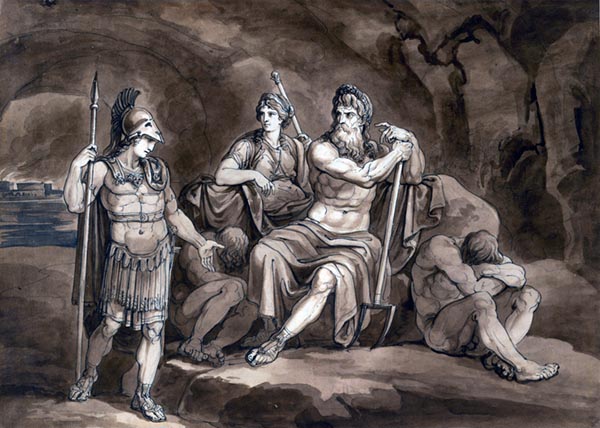
‘Telemachus requests permission from Pluto to seek his father in the Underworld.’ (1809) - Bartolomeo Pinelli (Italian, 1781-1835)
NGA
Instantly, Telemachus seems to fly through those empty and vast spaces so much does he long to know if he will see his father, and he wants to distance himself from the horrible presence of the tyrant who holds in fear the living and the dead. He soon spies near him the gloomy Tartarus. A thick and dark smoke was emanating from it, the pestilent odour of which would bring death if it spread into the domain of the living. This smoke blanketed a river of fire and swirls of flame, the noise of which, like that of the most impetuous mountain streams when they plunge from the highest cliffs into the depths of the abysses, made it so that nothing could be heard distinctly in these grim places.
Telemachus, secretly animated by Athena, fearlessly enters into this pit. Immediately, he spots a great number of men who had lived in the lowest classes and who were being punished for having sought riches through fraud, treason, and cruelties.
He noticed many impious hypocrites who, pretending to love religion, used it only as a fine pretext to satisfy their ambition and to toy with credulous men. These men, who had abused virtue itself—even though it is the greatest gift of the gods—were punished as the most heinous of all men. Children who had slain their fathers and mothers, wives who had dipped their hands in the blood of their husbands, traitors who had delivered over their homelands after having violated every oath would suffer pains less cruel than those hypocrites. The three judges of the Underworld desired it so, and here is their reasoning: it is that hypocrites are not content in being wicked, like the rest of impious men; they still want to pass for good, and, through their false virtue, they make it so that men no longer dare trust in the true. The gods, whom they mocked, and whom they rendered despicable to men, take pleasure in using all their might to avenge their insults.
Alongside those hypocrites appeared other men, whom the common man would hardly think culpable, and who divine vengeance pursues mercilessly. They are the ingrates, the liars, the flatterers who have lauded vice, the malignant critics who have tried to sully the purest virtue, lastly, those who have rashly judged things without knowing them in depth and who, in so doing, have harmed the reputation of the innocent. But, among all those ingrates, the one who is punished as the blackest is the one who comes down against the gods.
“What then!” Minos said. “One passes for a monster when he lacks gratitude for his father or a friend, from whom he received some help, and one is glorified for being ungrateful toward the gods, from whom he holds life and every good that comes from it? Does one not owe his birth to them more than to the father and mother from whom he was born? The more all those crimes are unpunished and excused on Earth, the more they are, in the Underworld, the object of an implacable vengeance, from which nothing escapes.”
Telemachus, seeing the three judges who were seated, and who were condemning a man, dared to ask them what his crimes were. Quickly, the condemned, speaking up, cried out, “I have never done any evil. I put all my pleasure into doing good. I was magnificent, open-handed, just, compassionate. What, then, can one reproach me for?”
Then Minos said to him, “You are reproached for nothing with regard to men, but did you not owe less to men than to the gods? What is, then, this justice of which you boast? You failed in no obligation to men, who are nothing. You were virtuous, but you related all your virtue to yourself and not to the gods who had given it to you, for you wanted to enjoy the fruit of your own virtue and confine it to yourself. You were your deity. But the gods, who created everything and who created nothing but for themselves, cannot renounce their rights. You forgot them. They will forget you. They will deliver you over to yourself, since you wanted to be yours and not theirs. Seek therefore now, if you can, your consolation in your own heart. Here you are, forever separated from the men you wanted to please. Here you are, alone with yourself, who was your idol. Learn that there is no true virtue without the respect and love for the gods, to whom all is owed. Your false virtue, which has long dazzled men easy to deceive, will be confounded. Men, only judging vices and virtues by what shocks them or by what conveniences them, are blind not only about good, but about evil. Here, a divine light upends all their superficial judgements. It often condemns what they admire and justifies what they condemn.”
At these words, this philosopher, as if struck by a lightning bolt, can not bear himself. The complacency he had once had in contemplating his moderation, his courage, and his generous inclinations changes into despair. The sight of his own heart, enemy of the gods, becomes his torture. He sees himself and he cannot cease seeing himself. He sees the vanity of the judgements of men, whom he had wanted to please in all his deeds. It causes a total revolution within him, as if all his entrails are turned upside-down. He no longer finds himself the same; all support is lacking in his heart. His conscience, the testimony of which had been so sweet to him, rises up against him and bitterly reproaches him for the waywardness and the delusion of all his virtues, which did not have the worship of the divine as the principal and final end. He is distressed, dismayed, filled with shame, remorse, and despair.
The Furies do not torment him because it suffices for them to have delivered him over to himself, and that his own heart avenged enough the scorned gods. He seeks the gloomiest places to hide from the other dead, unable to hide from himself. He seeks the darkness and cannot find it. An importune light pursues him everywhere. Everywhere, the piercing rays of Truth go to avenge the truth he neglected to follow. All that he has loved becomes odious to him, as being the source of his woes, which can never end. He says to himself, O fool! So, I knew neither the gods, nor men, nor myself! No, I knew nothing, since I never loved the one and true good. My every step was wayward; my wisdom was only madness; my virtue was only an impious and blind pridefulness. I was myself my idol.
Finally, Telemachus spied the kings who were condemned for having abused their power. On one side, an avenging Fury was presenting a mirror to them that reflected all the deformity of their vices to them; there they saw, and could not stop seeing, their crude vanity and avidity for the most ridiculous praises, their harshness with regard to men, whose felicity they were obliged to make, their insensitivity to virtue, their fear of hearing the truth, their inclination for cowardly and flattering men, their inattentiveness, their softness, their indolence, their misplaced distrust, their splendour and their excessive magnificence founded on the ruin of the peoples, their ambition to attain a little vainglory with the blood of their citizens and, lastly, their cruelty that seeks each day new delights among the tears and despair of so many wretches. They saw themselves unceasingly in this mirror. They found themselves more horrible and more monstrous than either the Chimera vanquished by Bellerophon, or the Hydra of Lerna slain by Heracles, or even Cerberus, though he vomits from his three bleating maws a black and venomous blood, which is capable of infecting the entire race of living mortals on Earth.
At the same time, on the other side, another Fury insultingly repeated to them all the praises their flatterers had given them during their lifetime and presented another mirror to them, in which they saw themselves as the flattery had depicted them. The opposition of those two portraits so contrary was the torture for their vanity. One noticed that the most wicked among those kings were those who had been given the most magnificent praises during their lifetime, because the wicked are more feared than the good, and they immodestly demand the most craven flatteries of the poets and orators of their time.
One hears them wailing in those dark shadows, where they can only see the insults and the derisions they have to suffer. They have nothing around them that does not repulse them, that does not contradict them, that does not confound them; whereas on Earth they toyed with the lives of men and claimed all was created in order to serve them, in Tartarus, they are delivered over to all the caprices of certain slaves who make them feel, in their turn, a cruel servitude. They serve with pain, and there remains no hope to them of ever being able to ease their captivity. They are, under the blows of these slaves, who have become their merciless tyrants, like an anvil under the strikes of the Cyclops’ hammers, when Hephaestus presses them to work in the blazing furnaces of Mount Etna.
There, Telemachus makes out pale, hideous, and dismayed faces. It is a black sadness that gnaws at these criminals. They are horrified with themselves and can no more deliver themselves from this horror than from their own nature. They need no other punishment for their transgressions than their transgressions themselves. They see them unceasingly in all their enormity; they appear before them as horrible spectres. They pursue them. To save themselves from them, they seek a death more powerful than that which separated them from their bodies. In the despair where they find themselves, they call to their rescue a death that can extinguish all feeling and all consciousness in them. They ask for the abysses to engulf them to rid themselves of the vengeful rays of Truth, which persecutes them. But they are reserved for a vengeance trickling down on them drip by drip, which will never go dry.
Truth, which they had feared seeing, makes their torment. They see it and only have eyes to see it rising up against them. The sight of it pierces them, rips them apart, tears them from themselves. It is like the lightning bolt. Without destroying anything on the outside, it penetrates to the depths of the bowels. Like metal in a blazing furnace, the soul is melted by that avenging fire. It leaves nothing of consistence, yet it consumes nothing. It dissolves down to the first principles of life, and one cannot die. One is torn from oneself. One can no longer find either support or repose for a single instant. One no longer lives but through the rage one has against oneself and through a loss of all hope, which brings madness.
Among those sights that made Telemachus’ hair stand on end, he saw several former kings of Lydia who were punished for having preferred the delights of a soft life to the work that must be inseparable from kingship so as to relieve the peoples.
These kings were reproaching each other for their blindness. One said to another who had been his son, “Did I not recommend to you often, during my old age, and before my death, to mend the evils I had done through my negligence?”
The son answered, “O wretched father, it is you who ruined me. It is your example that accustomed me to splendour, to pridefulness, to voluptuousness, to harshness toward men. In seeing you reign with so much softness, with so many craven flatterers around you, I was accustomed to loving flattery and pleasures. I believed the rest of men were, with regard to kings, what horses and other beasts of burden are with regard to men; that is to say, animals to which one attaches importance only to the extent they render services and they give comfort and convenience. I believed it. It is you who made me believe it, and now I suffer so many woes for having imitated you.”
To these reproaches they added the most dreadful curses and appeared animated with rage to rip each other apart.
Around those kings still flitted, like owls in the night, cruel Suspicions; vain Alarms; Distrusts who avenge the peoples for the harshness of their kings; Avarice, the insatiable thirst for riches; False Glory, ever tyrannical; and craven Softness that redoubles all the woes one suffers without ever being able to give solid pleasure.
One saw several of those kings severely punished, not for the evils they had done, but for the good they should have done. All the crimes against the peoples that came from the negligence with which the laws were observed were imputed to the kings, who must only reign in order that the laws reign through their ministry. Also imputed to them was all the disorders, which come from splendour, luxury, and all the other excesses that hurl men into a violent state, and into the temptation to scorn the laws so as to acquire possessions. Above all, they treated rigorously the kings who, instead of being good and vigilant pastors of the peoples, had only thought to ravage the flocks like devouring wolves.
But what dismayed Telemachus even more, it was seeing in this abyss of darkness and woes a great number of kings who had passed on Earth for fairly good kings. They had been condemned to the pains of Tartarus for having allowed themselves to be governed by wicked and artful men. They were punished for the evils they had allowed done through their authority. Moreover, most of those kings had been neither good nor wicked, so much as their weakness had been great. They had never feared not knowing the truth; they had not had a taste for virtue and had not put their pleasure in doing good.
When Telemachus got out of those places, he felt relieved, as if a mountain had been lifted off his chest. He understood, by this relief, the wretchedness of those who were confined there without hope of ever getting out. He was horrified to see how much more rigorously kings were tormented than other culprits. What then! he said, so many duties, so many perils, so many traps, so many difficulties involved in knowing the truth in order to protect oneself against others and against oneself. In the end, so many horrible torments in the Underworld after having been so agitated, so envied, so double-crossed in one short life. O fool, the one who seeks to reign! Happy the one who is confined to a private and peaceful station, where virtue is less difficult!
Reflecting so, he was distressed within. He shuddered and fell into a dismay that made him feel something of the despair of those wretches whom he had just considered. But, as he distanced himself from that sad domain of darkness, horror and despair, his courage began, little by little, to be reborn. He breathed and already glimpsed in the distance the gentle and pure light of the resting place of the heroes.
There dwelt all the good kings who had, up until then, governed men wisely. They were separated from the rest of the just. As the wicked princes suffered in Tartarus infinitely more rigorous tortures than the other guilty of a private station, so did the good kings enjoy in the Elysian Fields a happiness infinitely greater than that of the rest of men who had loved virtue on Earth.
Telemachus advanced toward those kings, who were in fragrant groves on evergreen and blooming lawns. A thousand tiny brooks of a clear water flowed through these beautiful places and caused a delightful coolness to be felt there. An infinite number of birds made these groves resound with their sweet song. One saw the flowers of spring sprouting underfoot, together with the richest fruits of autumn hanging from the trees. There, never did one feel the blazing heat of the relentless dog days of summer; there, never did the dark Northwind dare to blow, nor make the rigours of winter felt. Neither bloodthirsty War, nor cruel Envy, who bites with a venomous tooth and wears vipers entwined round her breasts and around her arms, nor Jealousies, nor Distrusts, nor Fear, nor vain Desires ever approach this happy resting place of peace. The day does not end there, and night, with its shadowy veils, is unknown.
A pure and gentle light radiates around the bodies of those just men and surrounds them with its rays like a vestment. This light is not like the sombre light that gleams in the eyes of wretched mortals yet is only darkness. It is more of a celestial glory than a light; it penetrates more subtly the thickest bodies than the rays of the sun penetrate the purest crystal; it never dazzles, on the contrary, it fortifies the eyes and carries into the depths of the soul an indescribable serenity. It is from this light alone these blissful men are nourished. It emerges from them and enters into them; it penetrates them and incorporates itself in them like food incorporates itself in us. They see it, they feel it, they breathe it, and it causes to be born in them an endless source of peace and joy. They are plunged into this abyss of joy like fish into the sea. They no longer desire anything. They have everything without having anything, for this taste of pure light appeases the hunger of their hearts, all their desires are sated, and their plenitude elevates them above all that men, empty and starving, seek on Earth.
All the delights that surround them are nothing to them, because their overflowing bliss, which comes from within, leaves them no sentiment for all they see of delights without. They are like the gods who, sated with nectar and ambrosia, would not deign to nourish themselves on the coarse meats that one would present to them at the most exquisite table of mortal men.
All woes flee far from these tranquil places. Death, Malady, Poverty, Pain, Regrets, Remorse, Fears, even Hopes (which often exact as many difficulties as Fears), Divisions, Disgusts, Spites can have no entry here. The high mountains of Thrace that split the clouds with their brow, covered in snow and ice since the origin of the world, would be upended from their foundations, set down at the centre of the Earth, before the hearts of those just men could even be stirred. They only pity the miseries that crush men living in the world, but it is a gentle and peaceful pity that distorts none of their immutable bliss. An eternal youth, an everlasting bliss, a wholly divine glory are painted on their faces, but their joy has nothing of coltish antics nor indecency. It is a gentle joy, noble, full of majesty. It is a sublime taste for truth and virtue that transports them. They remain without interruption, at every moment, in the same heart-stopping joy of a mother who sees her dear son again, whom she had thought dead. But this joy that soon slips away from the mother never flees from the hearts of these men; never does it languish for an instant; it is always renewing in them. They know the elation of intoxication without the trouble or blindness of it.
They talk about what they see and what they enjoy. They trample underfoot the effete delights and vain grandeurs of their former stations which they deplore. They gladly revisit those sad but short years when it was necessary to battle each other and the torrent of corrupt men so as to become good. They marvel at the succour of the gods, who led them as if by the hand to virtue through so many perils. A certain divineness unceasingly streams through their hearts, like a torrent of the divinity itself merging with theirs. They see, they enjoy, they are happy, and they feel as if they always will be. They sing all together the praises of the gods, and they are all together but a single voice, a single thought, a single heart. The same bliss ebbs and flows in these merged souls.
In this divine rapture, the centuries flow by more rapidly than hours among mortals, and nevertheless thousands and thousands of centuries flowing past take nothing away from their ever-renewing and ever-complete bliss. They reign all together, not on thrones that the hand of man can topple, but within themselves with an immutable power, for they no longer need to be formidable through a might borrowed from a vile and destitute people. They no longer wear those vain diadems, the brilliance of which hides so many Fears and Dark Worries. The gods themselves have crowned them with their own hands with crowns that nothing can sully.
Telemachus, who was seeking his father and who had feared finding him in these beautiful places, was so seized with this taste of peace and bliss that he would have wanted to find Odysseus there, and he was himself afflicted to be compelled to return afterward to the company of mortals. It is here, he said, that true life is found, and ours is only a death.
But what astonished him was having seen so many kings punished in Tartarus and seeing so few of them in the Elysian Fields. He realised that there are few kings steadfast enough and courageous enough to resist their own might and reject the flattery of so many people who excite all their passions. So, good kings are very rare, and most are so wicked the gods would not be just if, after having tolerated their abuse of power during their life, they did not punish them after their deaths.
Telemachus, not seeing his father Odysseus among all these kings, sought at least the eyes of the divine Laertes, his grandfather. While he was uselessly seeking him, a venerable old man, full of majesty, approached him. His old age did not resemble that of men whom the weight of their years stoop on Earth. One only saw that he had been old before his death. It was a mixture of everything old age has of gravity with all the charms of youth, for those charms bloom again even in the most broken-down old men at the moment when they are admitted into the Elysian Fields. This man advanced eagerly and regarded Telemachus with complaisance, as someone very dear to him. Telemachus, who did not recognise him, was at a loss and in suspense.
“I forgive you, O my dear son,” the old man said, “for not recognising me. I am Arcesius, the father of Laertes. I ended my days a little before Odysseus, my grandson, set out for the siege of Troy. So, you were still a small child then in the arms of your wet nurse. Since then, I have conceived of you great expectations. They were not deceiving, since I see you descended into the kingdom of Hades to seek your father and that the gods support you in this enterprise. O happy child, the gods love you and prepare for you a glory equal to that of your father. O happy me to see you again!
“Cease seeking Odysseus in these places. He still lives and he is preserved in order to raise up our house again on the island of Ithaca. Even Laertes, though the weight of the years has beaten him down, still enjoys the light and awaits his son to return to close his eyes. In this way, men pass like flowers that bloom in the morning and in the evening are wilted and trampled underfoot; generations of men flow by like the currents of a rapid river. Nothing can stop time, which drags along after it all that appears the most fixed.
“You yourself, O my son, my dear son, you yourself, who now enjoys a youth so vibrant and ripe with pleasures, remember, this beautiful age is only a flower, which will be drying up almost as quickly as it blooms. You will see changing, imperceptibly, the laughing Graces and sweet pleasures that accompany you: fortitude, health, joy will vanish like a beautiful dream, there will only remain to you a sad memory of it. Old age, languishing and hostile to pleasure, will come to wrinkle your face, stoop your body, weaken your limbs, dry up the source of joy in your heart, disgust you with the present, cause you to fear the future, render you numb to everything except pain. This time appears distant to you. Alas, you are mistaken, my son. It hastens. There it is, arrived. What comes with so much swiftness is not far from you, and the present that flees is already far away, since it vanishes in the moment we are speaking and can no longer approach again. Never count then, my son, on the present, but sustain yourself on the rugged and rough path of virtue through a view to the future.
“Prepare for yourself, through pure mores, and through the love of justice, a place in this happy resting place of peace. Soon, you will finally see your father retake authority in Ithaca. You were born to reign after him, but alas, O my son, how deceptive kingship is! When one regards it from afar, he sees only grandeur, brilliance, and delights. But up close, all is thorny. A private individual can, without dishonour, lead a gentle and obscure life. A king cannot, without dishonouring himself, prefer a gentle and idle life to the arduous functions of government. He owes himself to all the men he governs. He is never allowed to be his own. His least errors are of an infinite consequence, because they cause the unhappiness of the peoples, sometimes for several centuries. He must repress the audacity of the wicked, support innocence, dissipate defamations. It is not enough for him to do no harm; he must do all the possible good of which the state has need. It is not enough to do good oneself; he must even prevent all the evils others would do if they were not held back. Fear then, my son, fear a condition so perilous; arm yourself with courage against yourself, against your passions, and against flatterers.”
Saying these words, Arcesius appeared animated by a divine fire and showed Telemachus a face full of compassion for the woes that accompany kingship. “When kingship is taken on in order to satisfy oneself, it is a monstrous tyranny,” he said. “When it is taken on to fulfil obligations and to lead a people, countless in number, just as a father leads his children, it is an overwhelming servitude that demands heroic courage and patience. Also, it is certain that those who have reigned with a sincere virtue possess here all that the power of the gods can give to render their bliss complete.”
While Arcesius was speaking so, those words entered deep into Telemachus’ heart; they were engraved there, just as an able artisan engraves in bronze with his chisel the indelible figures he wants to display to the eyes of the most distant posterity. Those wise words were like a subtle flame that penetrated deep inside young Telemachus; he felt stirred and on fire; something of the divine seemed to melt his heart. What he carried into the most intimate part of himself was secretly consuming him. He could neither contain it, nor bear it, nor resist so violent an impact. It was an alive and delightful feeling, which was mixed with a torment capable of wrenching life from him.
Afterward, Telemachus began to breathe more freely. He recognised in Arcesius’ face a great resemblance to Laertes. He even believed he vaguely remembered having seen in his father Odysseus traits of this same resemblance when Odysseus set out for the siege of Troy. This memory touched his heart. Sweet tears mixed with joy flowed from his eyes. He wanted to embrace this person so dear. Several times he tried uselessly; this vain shade eluded his embrace, just as a deceiving Dream steals away from the man who believes to possess it. At times, the parched mouth of that sleeping man pursues a fugitive water; at times, his lips stir to form words his numb tongue cannot utter. His hands reach out with effort and take nothing. Thus, Telemachus cannot satisfy his affection; he sees Arcesius, he hears him, he speaks to him, he cannot touch him. Finally, he asks him who those men are whom he sees around him.
“You see, my son,” the wise old man answered, “the men who have been the ornaments of their centuries, the glory and the happiness of humankind. You see the small number of kings who have been worthy of kingship, and who have faithfully done the work of the gods on Earth. These others whom you see somewhat near them, but separated by that small cloud have much less glory; they are heroes in truth, but the reward for their valour and their military expeditions cannot be compared to that of the wise, just, and beneficent kings. Among these heroes, you see Theseus whose face is a bit sad; he felt the misfortune of being too credulous with an artful woman, and he is still aggrieved in having so unjustly asked Poseidon for the cruel death of his son Hippolytus. He would have been happy had he not been so quick-tempered and so easy to provoke.
“You also see Achilles, leaning on his lance because of that wound he received on his heel at the hand of cowardly Paris, and which ended his life. If he had been as wise, just, and restrained as he was intrepid, the gods would have granted him a long reign. But they had pity on the Phthians and the Dolopes, over whom Achilles should naturally reign after Peleus. They did not want to deliver so many peoples over to the mercy of a man, hot-headed and easier to provoke than the stormiest sea. The Fates shortened the thread of his days; he was like a flower barely budding that the blade of the plough cuts and that droops before the end of the day when one had seen it sprout. The gods only wanted to use him, like the torrents and the tempests, to punish men for their crimes. They used Achilles to tear down the walls of Troy, to avenge the perjury of Laomedon and the unjust amours of Paris. After having so employed that instrument of their vengeances, they were appeased, and they refused the tears of Thetis to allow more time on Earth to this young hero, who was only suitable to trouble men and overthrow cities and kingdoms.
“But do you see this other with that fierce expression? That is Ajax, son of Telamon and cousin of Achilles. You are not ignorant, undoubtedly, of his glory in combat. After the death of Achilles, he claimed his arms could not be given to any other person than him. Your father did not believe they should be ceded to him. The Greeks judged in favour of Odysseus. Ajax killed himself in despair. Indignation and fury are still painted on his face. Do not approach him, my son, for he would only think you would want to insult him in his misfortune, and he is right to lament it. Do you not notice that he looks at us with difficulty, and he enters brusquely into that sombre grove because we are odious to him? You see on this other side Hector, who would have been invincible had the son of Thetis not been in the world at the same time.
“But there is Agamemnon passing by, who still bears on him the marks of the perfidy of Clytemnestra. O my son, I shudder to think of the misfortunes of that family of the impious Tantalus. The division of the two brothers, Atreus and Thyestes, filled that house with horror and blood. Alas, how much one crime lures others to it! Agamemnon, returning at the head of the Greeks from the siege of Troy, had not had time to enjoy in peace the glory he had acquired. Such is the destiny of almost all conquerors. All those men whom you see were formidable in war, but they were not lovable and virtuous. Therefore, they are only in the second resting place of the Elysian Fields.
“As for the ones here, they have reigned with justice and have loved their peoples. They are friends of the gods. While Achilles and Agamemnon, full of their quarrels and their fights, still preserve their difficulties and their innate faults here, while they lament in vain the life they lost, and grieve being only powerless and vain shades, these just kings—being purified by the divine light with which they are nourished—no longer have anything to desire for their happiness. They regard with compassion the restlessness of mortals, and the greatest affairs that agitate ambitious men appear child’s play to them. Their hearts are sated with the truth and the virtue they draw from the source. They no longer have anything to suffer themselves: no more desires, no more needs, no more fears—all is ended for them except their joy, which cannot end.
“Consider, my son, this old king Inachus who founded the kingdom of Argos. You see him with this old age, so sweet and so majestic. Flowers bloom under his feet. His light gait resembles the flight of a bird. He holds in his hand a lyre of ivory, and, in an eternal elation, he sings of the marvels of the gods. There exudes from his heart and from his mouth an exquisite perfume. The harmony of his lyre and voice would delight men and the gods. He is rewarded so for having loved the people that he gathered within his new walls, and to whom he gave laws.
“On the other side, you can see, between those myrtles, Cecrops the Egyptian, who first reigned in Athens, a city consecrated to the goddess whose name it bears. Cecrops, bringing useful laws from Egypt, which were the source of letters and good mores for Greece, softened the fierce natures of the burgs of Attique and united them through the bonds of society. He was just, humane, compassionate; he left the peoples in abundance and his family in a common state, not wishing his children would have authority after him, because he judged others were more worthy of it.
“I must also show you, in this small valley, Erichthonius, who invented the use of silver for money. He did it with a view to facilitate commerce between the islands of Greece. But he foresaw the inconvenience attached to this invention. ‘Apply yourselves,’ he said to all the peoples, ‘to multiply at home all the riches of nature, which are the true ones. Cultivate the land in order to have a great abundance of wheat, wine, oil, and produce. Have countless flocks that will nourish you with their milk and cover you with their wool. In so doing, you will put yourself in a state to never fear poverty. The more children you have, the richer you will be, provided you render them hard-working—for the Earth is inexhaustible, and she increases her fruitfulness in proportion to the number of her inhabitants who attend to cultivate her. She pays them all liberally for their troubles, in place of becoming miserly and ungrateful to those who cultivate her negligently. Attach yourself, then, principally, to the true riches that satisfy the true needs of man. With regard to coined silver, you must in no case make more of it than is necessary either for the inevitable wars that must be sustained abroad, or for the commerce of necessary merchandise that is lacking in your country.’ Still, Erichthonius would have wished that commerce was allowed to wane with regard to all the things that only serve to maintain luxury, vanity, and softness.
“The wise Erichthonius often said, ‘I well fear, my children, having made you an ill-fated present in giving you the invention of money. I foresee it will excite avarice, ambition, flamboyance; it will maintain an infinite number of pernicious arts that will only soften and corrupt mores; it will make you disgusted with the happy simplicity that brings all repose and all assurance in life; lastly, it will cause you to scorn agriculture, which is the foundation of human life, and the source of all real goods. But the gods are witnesses that I had a pure heart in giving you this invention, useful in and of itself.’
“In the end, when Erichthonius perceived silver corrupted the peoples as he had foreseen, he withdrew in grief to a wild mountain where he lived to a great age, poor and far away from men, without wanting to meddle in the government of the cities.
“A short time after him there appeared in Greece the celebrated Triptolemus, to whom Demeter had taught the art of cultivating the lands and covering them every year with a golden crop. It was not that men did not already know about grain and the manner of multiplying it in sowing it, but they were ignorant of the perfection of ploughing. Sent by Demeter, Triptolemus came, plough in hand, to offer the gifts of the goddess to all the peoples who would have enough courage to vanquish their natural sloth and dedicate themselves to an assiduous work. Soon, Triptolemus taught the Greeks to split open the land and fertilise it, ripping apart its bosom. Soon, the ardent and tireless reapers made the yellow grains that covered the countrysides fall under their sharp sickles.
“Even the wild and ferocious peoples who were scattered hither and yon in the forests of Epirus and Aetolia, to feed on acorns, softened their mores and submitted themselves to the laws when they had learned how to grow crops and nourish themselves with bread. Triptolemus made all the Greeks feel the pleasure there is in only owing their riches to their labour and finding in their fields all that is necessary to render life comfortable and happy. This abundance, so natural and so innocent, and which is attached to agriculture, reminded them of the wise counsel of Erichthonius. They scorned silver and all artificial riches, which are only riches in the imagination, which tempt men to seek dangerous pleasures, and which turn them away from the work where they would find all the real goods, along with pure mores in complete liberty. They understood then, that a fertile and well-cultivated field is the true treasure of a family wise enough to want to live frugally like their fathers had lived.
“Happy the Greeks if they had remained steadfast in these maxims so suitable to render them powerful, free, happy, and worthy of being so through a solid virtue. But alas, they are beginning to admire false riches. Little by little they neglect the true ones, and the Greeks degenerate from that marvellous simplicity.
“O my son, you will reign one day. Then, remember to lead men back to agriculture, honour this art, unburden those who apply themselves to it, and do not tolerate men living idly or occupied by the arts that maintain luxury and softness. Those two men who have been so wise on Earth are here cherished by the gods. Notice, my son, their glory surpasses that of Achilles and the other heroes who only excelled in combat as much as a sweet springtime is beyond icy winter, and the light of the sun is brighter than that of the moon.”
While Arcesius was speaking in this way, he perceived Telemachus had always kept his eyes fixed on the edge of a small wood of laurel trees and a stream bordered with violets, roses, lilies, and several other fragrant flowers, whose vivid colours resembled that of Iris when she descends from the skies to earth to announce to some mortal the commands of the gods. It was the great king Sesostris whom Telemachus recognised in that beautiful place. He was a thousand times more majestic than he had ever been on his Egyptian throne. Rays of a soft light leapt from his eyes, and those of Telemachus were dazzled by them. Seeing him, one would have believed he was drunk on nectar, so much had the divine spirit transported him beyond human reasoning to reward his virtues.
Telemachus said to Arcesius, “I recognise, O my father, Sesostris, that wise king of Egypt, whom I saw there not so long ago.”
“There he is,” responded Arcesius, “and you see, by his example, how magnificent the gods are in rewarding good kings. But you must know that all this bliss is nothing in comparison to that which he was destined, had an overly great prosperity not caused him to forget the rules of moderation and justice. His passion to put down the pridefulness and insolence of the Tyrians pushed him to take their city. That conquest gave him the desire to take others. He let himself be seduced by the vainglory of conquerors. He subjugated, or better said, he ravaged all of Asia.
“Upon his return to Egypt, he found his brother had stolen the kingship and had distorted, through an unjust government, the best laws of the land. Thus, his great conquests only served to disrupt his kingdom. But what rendered him more inexcusable was that he was drunk with his own glory. He hitched to a chariot the loftiest of the kings he had vanquished. Afterward, he recognised his error and was ashamed of having been so inhumane. Such was the fruit of his victories. You see, that is what conquerors do to their state and to themselves in wanting to usurp the states of their neighbours. You see, that is what caused a king, otherwise so just and beneficent, to lose rank, and it is what diminished the glory the gods had prepared for him.
“Do you not see this other, my son, whose wound appears so glaring? It is a king of Caria, named Dioclides, who sacrificed himself for his people in a battle because an oracle had told him that in the war of the Carians and Lycians, the nation whose king perished would be victorious.
“Consider this other one. He was a wise legislator who, having given his nation laws suitable to render them good and happy, made them swear they would never violate any of those laws during his absence. After that, he departed, exiled himself from his homeland, and died poor in a foreign land so as to oblige his people through that oath to always keep such useful laws.
“This other you see is Eunesimus, king of the Pylians and one of the ancestors of wise Nestor. In a plague that ravaged the land and covered the banks of the Acheron with new shades, he asked the gods to appease their anger by paying, with his death, for so many thousands of innocent men. The gods exalted him in having him find here the true royalty, whereas all those on Earth are only vain shades.
“This old man, whom you see crowned with flowers, is the famous Belus. He reigned in Egypt, and he married Achinoe, daughter of the god Nilus, who hides the source of his waters and who enriches the lands he irrigates through his floods. Belus had two sons, Danaus, whose story you know, and Egyptius, who gave his name to that beautiful kingdom. Belus believed himself richer through the abundance where he put his people and through the love his subjects had for him than through all the tributes he would have been able to impose on them.
“These men, whom you believe dead, are living, my son, and it is the life one miserably drags along on Earth that is only death— the names alone are changed. Would that the gods render you good enough to merit this happy life that nothing can ever end or trouble! Hasten, it is time to go seek your father. Before finding him, alas, you will see bloodshed! But what glory awaits you in the countrysides of Hesperia! Remember the counsel of wise Mentor. Provided you follow it, your name will be great among all the peoples and throughout the centuries.”
He spoke, and straightaway he led Telemachus to the Ivory Gate by which one can get out of the dark empire of Hades. Telemachus, tears in his eyes, parted from him, unable to embrace him, and leaving those gloomy places, he hurriedly returned toward the camp of the allies after rejoining on the way the two young Cretans who had accompanied him to the cavern and who no longer hoped to see him again.
END OF BOOK XIV
BOOK XV
Meanwhile, the chiefs of the army gathered to deliberate whether or not it was necessary to capture Venuse. It was a fortified city that Adrastus had once taken from his neighbours, the Peucetians of Apulia. They had joined the league against him to demand justice for this invasion. Adrastus, to appease them, had put this city in the hands of the Lucanians for safekeeping. However, he had corrupted with silver not only the Lucanian garrison but also the one who commanded it, in such a way that the Lucanian nation had less effective authority than he in Venuse, and the Apulians, who had consented to the Lucanian garrison guarding Venuse, had been deceived in that negotiation.
A citizen of Venuse named Demophantes had secretly offered to deliver to the allies, at night, one of the gates to the city. This advantage was all the greater as Adrastus had put all his war and food provisions in a castle neighbouring Venuse, which could not defend itself should Venuse be taken. Philoctetes and Nestor had already opined that they must take advantage of so fortuitous an opportunity. All the chiefs, swayed by their authority and dazzled by the usefulness of so easy an enterprise, applauded this sentiment. But Telemachus, upon his return, made the final efforts to deter them from it.
“I am not unaware,” he said to them, “that if ever a man has merited being deceived and taken by surprise, it is Adrastus, the one who has deceived everyone so often. I see well that in overtaking Venuse, you would only be putting yourselves in possession of a city that belongs to you, since it belongs to the Apulians, who are one of the peoples in your league. I avow that you could do it with even more semblance of reason than Adrastus, who put this city in safekeeping and corrupted the commander and the garrison in order to enter into Venuse when he should judge it suitable. Lastly, I realise, like you, that if you were to take Venuse, you would be, from the following day, masters of the fortified castle, where all the preparations of war that Adrastus has assembled are kept, and thus you would end in two days this war so formidable.
“But is it not worth more to perish than to vanquish by such means? Must we repulse fraud through fraud? Will it be said that so many kings, in league with one another to punish the impious Adrastus for his deceptions, are deceivers like him? If we are permitted to do as Adrastus, he is not guilty, and we are wrong in wanting to punish him. What! The whole of Hesperia, supported by so many Greek colonies and heroes returned from the siege of Troy, does it not have other weapons against the perfidy and perjuries of Adrastus than perfidy and perjury?
“You swore by the things most sacred that you would leave Venuse in the hands of the Lucanians for safekeeping. The Lucanian garrison, you say, is corrupted by Adrastus’ silver. I believe as you do. However, this garrison is still in the pay of the Lucanians. The garrison has not refused to obey them. It has kept, at least in appearance, neutrality. Neither Adrastus nor his troops have ever entered into Venuse. The treaty remains. Your oath is not forgotten by the gods. Will one keep his given word only when one lacks plausible pretext to violate it? Will one be loyal and faithful to oaths only when one has nothing to gain in violating them?
“If the love of virtue and the reverential awe of the gods no longer touch you, at least be touched by your reputation and your self interest. If you demonstrate to the world this pernicious example of failing to keep your word and violating your oath to end a war, what wars will you not incite through that impious conduct? What neighbour will not be compelled to fear everything from you and detest you? Who will be able henceforth, in the most pressing necessity, to trust you? What security will you be able to give, when you want to be sincere, that will mean something from you in persuading your neighbours of your sincerity? Will it be a solemn treaty? You will have trampled one underfoot! Will it be an oath? Ho! Will they not know that you count the gods for nothing whenever you hope to draw through perjury some advantage? Peace will then not have any more security than war with regard to you. All that comes from you will be received as a war, either feigned or declared. You will be the perpetual enemies of all those who have the misfortune of being your neighbours. All affairs that demand a reputation for probity and trust will become impossible for you. You will no longer have any resource to make your promises believed.
“Here is,” added Telemachus, “an interest even more pressing that should strike you should there remain in you some sentiment of probity and some foresight for your own interests: it is that a conduct so deceptive attacks from within your entire league and is going to ruin it. Your perjury is going to cause Adrastus to triumph.”
At these words, the entire assembly, stirred up, asked him how he dared say an action that would give a certain victory to the league could ruin it.
“How,” he answered them, “will you be able to trust each other, once you break the only bond of society and trust, which is good faith? After you have posed as a maxim that one can violate the rules of probity and loyalty for a great interest, who among you will be able to trust another when this other will be able to find a great advantage for himself in failing to keep his word and deceiving you? Where will you be then? Who among you will not want to preempt the artifices of his neighbour through his own artifice? What becomes of a league of so many peoples when they are agreed among them, through a common deliberation, that one is allowed to overtake his neighbour and to violate the oath given? How great will be your mutual distrust, your division, your ardour to destroy each other? Adrastus will no longer need to attack you; you will rip each other apart all by yourselves. You will justify his perfidies.
“O wise and magnanimous kings, O you who command with so much experience over countless peoples, do not disdain to listen to the counsels of a young man. If you should fall into the most dreadful extremities where war sometimes precipitates men, you must pick yourself up again through your vigilance and through the efforts of your virtue—for true courage never allows itself to be beaten. But once you break the barrier of honour and good faith, that loss is unmendable. You will no longer be able to reestablish either the trust needed for the success of all important affairs, or to bring men back to the principles of virtue, after you have taught them to scorn them. What do you fear? Do you not have enough courage to vanquish without deceiving? Your virtue, combined with the military forces of so many peoples, is it not sufficient for you? Let us fight, let us die if we must, rather than vanquish so unworthily. Adrastus, impious Adrastus, is in our hands, provided we are horrified of imitating his cowardice and bad faith.”
When Telemachus had finished this speech, he felt sweet persuasion had flowed from his lips and streamed into the depths of hearts. He noticed a profound silence in the assembly. Each was thinking, not of him nor of the charms of his words, but of the force of the truth that made itself felt in the course of his reasoning. Astonishment was painted on their faces. Finally, a dull murmur was heard that spread little by little in the assembly. They were regarding one another, not daring to speak first. They waited for the chiefs of the army to declare themselves, and each had difficulty holding back his sentiments. Finally, grave Nestor uttered these words:
“Worthy son of Odysseus, the gods have caused you to speak, and Athena, who has so many times inspired your father, has put into your heart the wise and generous counsel you have given. I do not regard your youth. I only consider Athena in all you just said. You spoke for virtue. Without it, the greatest advantages are true losses. Without it, one soon attracts the vengeance of his enemies, the distrust of his allies, the horror of all good people, and the just anger of the gods. Let us then leave Venuse in the hands of the Lucanians and no longer think of anything but vanquishing Adrastus through our courage.”
He spoke, and the entire assembly applauded those wise words. But in applauding, each, stunned, turned his eyes toward the son of Odysseus, and they believed to see shining in him the wisdom of Athena who inspired him. There soon arose another issue in the counsel of the kings from which he acquired no less glory.
Adrastus, always cruel and perfidious, sent into the camp a defector named Acanthus, who was to poison the most illustrious chiefs of the army. Above all, he had orders to do his utmost to kill the young Telemachus, who was already the terror of the Daunians. Telemachus, who had too much courage and candour to be inclined to distrust, readily received with goodwill this wretch who had seen Odysseus in Sicily, and who recounted the adventures of this hero to him. He fed him and tried to console him in his misfortunes, for Acanthus complained of having been deceived and treated unworthily by Adrastus. But it was to feed and warm in his bosom a venomous viper ready to strike a mortal wound.
Another defector was overtaken, named Arion, whom Acanthus was sending to Adrastus to apprise him of the state of the camp of the allies and to assure him he would poison the principal kings and Telemachus at a feast, which Telemachus was to give for them the next day. Arion, taken, confessed his treason. It was suspected he was passing intelligence to Acanthus, for they were good friends. But Acanthus, profoundly dissimulating and intrepid, defended himself with so much art one could neither convict him nor get to the bottom of the conspiracy. Several of the kings were of the opinion that it was necessary, when in doubt, to sacrifice Acanthus for the public safety.
“We must execute him,” they were saying. “The life of a single man is nothing when it concerns assuring those of so many kings. What does it matter that an innocent should perish when it concerns the preservation of those who represent the gods among men?”
“What an inhumane maxim. What a barbarous policy!” responded Telemachus. “What, you are so wasteful of human blood, O you who were established as shepherds of men, and who only command over them in order to preserve them as a shepherd preserves his flock! You are then cruel wolves and not shepherds. At least, you are only shepherds so as to shear and slay the flock instead of driving them to green pastures. According to you, a man is guilty as soon as he is accused. A suspicion merits death. The innocents are at the mercy of the envious and the slanderers. As tyrannical distrust grows in your hearts, more victims must be slain for you.”
Telemachus said these words with an authority and a vehemence that swept hearts away and covered the persons behind such craven counsel with shame. Afterwards, mellowing, he said to them, “As for me, I do not love life enough to want to live at this price. I prefer that Acanthus were wicked than I were, and that he snatch my life from me through a betrayal than I unjustly kill him myself when in doubt. But listen, O you, who, being established kings—that is to say, judges of the peoples—should know how to judge men with justice, prudence, and moderation, allow me to interrogate Acanthus in your presence.”
Straightaway, he interrogates this man about his exchanges with Arion. He presses him about an infinite number of details. Several times he pretends to send him back to Adrastus as a defector worthy of being punished to observe whether he would be afraid of being sent back or not. But Acanthus’ expression and voice remained tranquil, and Telemachus concluded from it that Acanthus… (per original manuscript)
In the end, unable to draw the truth from the bottom of his heart, he said to him, “Give me your ring. I want to send it to Adrastus.”
At this demand for his ring, Acanthus paled and was discomforted. Telemachus, whose eyes were always fixed on him, saw it. He took his ring. “I am going,” he said to him, “to send it to Adrastus by the hands of a Lucanian named Polytropus, 1 Per original manuscript
whom you know and who will seem to be going there secretly on your behalf. If we are able to uncover in this way that you pass intelligence to Adrastus, we will ruthlessly destroy you through the most cruel torments. If, on the contrary, you confess your wrongdoing up until now, we will pardon you for it, and we will be content to send you to an island in the sea where you will lack for nothing.”
Then Acanthus confessed everything, and Telemachus managed to get the kings to let him live because he had promised it to him. They sent him to one of the Echinades islands where he lived in peace.
A short time later, a Daunian of an obscure birth, but of a violent and bold temperament, named Dioscore, came into the camp of the allies at night offering to slit the throat of King Adrastus in his tent. He could do it—for one is master over the life of others when he no longer counts his own for anything. This man only breathed vengeance because Adrastus had abducted his wife, whom he loved madly and who was equal in beauty to Aphrodite herself. He was resolved to either slay Adrastus and take back his wife, or be slain himself. He had secret agreements to enter at night into the tent of the king and to be favoured in his enterprise by several Daunian captains. But he believed he needed the allied kings to attack Adrastus’ camp at the same time, so that in the turmoil he could more easily abduct his wife and get away. But he was content to perish if he could not abduct her after having killed the king.
As soon as Dioscore had explained his plan to the kings, everyone turned to Telemachus as if to ask him for a decision. “The gods,” he responded, “who have preserved us from traitors, forbid us from making use of them. Even if we did not have enough virtue to detest treason, our self-interest alone would suffice to reject it. As soon as we authorise it by our example, we will merit it turning against us. From that moment, who among us will be safe? Adrastus will well be able to evade the strike that threatens him and have it fall on the allied kings. The war will no longer be one war. Wisdom and virtue will no longer be of any use. One will no longer see anything but perfidy, treason, and assassinations. We ourselves will feel the sinister consequences of it, and we will merit them since we will have authorised the greatest of evils. I conclude, then, that the traitor must be sent back to Adrastus. I confess this king does not merit it. But all Hesperia and all Greece have their eyes on us, and they merit we maintain this conduct so that we may be esteemed by them. We owe to ourselves, and even more to the just gods, this horror of perfidy.”
Straightaway, they sent Dioscore back to Adrastus, who shuddered at the peril in which he had been and who could not be more astonished by the generosity of his enemies—for the wicked cannot comprehend pure virtue. Adrastus admired, despite himself, what he had just seen and dared not praise it. This noble action of the allies brought back a shameful reminder of all his deceptions and all his cruelties. He sought to belittle the generosity of his enemies and was ashamed to appear ungrateful, as he owed his life to them—but corrupt men soon harden themselves against all that could touch them.
Adrastus, who saw the reputation of the allies was rising every day, believed he was pressed to take some brilliant action against them. As he could do nothing virtuous toward them, he wanted to at least try to gain some great advantage over them through his weaponry and he hastened to combat.
The day of combat having come, no sooner had Dawn opened to the sun the gates of the East in a rose-strewn path, than young Telemachus, preempting—through his attentiveness—the vigilance of the oldest captains, tore himself from the arms of sweet Sleep and set all the officers in motion. His helmet, covered with flowing horsehair, already glinted on his head, and the cuirass on his back dazzled the eyes of the entire army. The handwork of Hephaestus had, apart from its natural beauty, the brilliance of the aegis that was concealed there. He held his lance with one hand; with the other, he pointed out the various positions that must be occupied.
Athena had put in his eyes a divine fire, and on his face a proud majesty that already promised victory. He marched, and all the kings, forgetting their age and their dignity, felt themselves swept up by a superior force that made them follow in his footsteps; weak jealousy can no longer enter into their hearts, all cede to the one whom Athena invisibly leads by the hand. His actions had nothing of impetuosity or hastiness. He was gentle, tranquil, patient, always ready to listen to others and profit from their counsel; yet active, foresighted, attentive to the most distant needs, arranging everything suitably, awkward in nothing and not making others feel awkward, excusing errors, mending missteps, anticipating difficulties, never asking too much of anything from anyone, inspiring liberty and confidence everywhere. Giving an order, it was in the plainest and simplest terms. He would repeat it to better instruct the man who should execute it. Telemachus saw in his eyes whether he had understood well. He then had him explain in common terms how he had understood his words and the principal goal of his undertaking. When he had thus tested the good sense of the one whom he was sending, and with whom he had shared his views, he only had him depart after having given him some token of esteem and trust to encourage him.
In this way, all those he sent were filled with ardour to please him and to succeed. But they were not troubled by fear that he would impute a poor outcome to them, for he excused all mistakes that did not come from evil volition.
The horizon appeared red and inflamed by the first rays of the sun. The sea was filled with the fires of the dawning day. The entire coast was covered with men, armour, horses, and chariots in motion. It was a confused noise, like that of the raging waves when Poseidon excites from the depths of his abysses the dark tempests. Thus Ares began, through the noise of the weapons and the shuddering apparatus of war, to sow rage in every heart. The countryside was filled with bristling pikes, like the grains that cover the fertile rows at harvest time. Already, a cloud of dust was rising that, little by little, stole the land and sky from the eyes of men. Confusion, horror, carnage, merciless death were advancing. Barely were the first shafts hurled when Telemachus, lifting his eyes and hands toward the sky, pronounced these words:
“O Zeus, father of the gods and men, you see on our side justice and peace, which we have not been ashamed to seek; it is with regret we fight. We would desire to spare the blood of men. We do not even hate this enemy though he is cruel, perfidious, and sacrilegious. Witness and decide between him and us. If we must die, our lives are in your hands. If we must deliver Hesperia and slay the tyrant, it will be your might and the wisdom of Athena, your daughter, who will give us the victory. The glory of it will be owed to you. It is you who, scale in hand, rules the fate of combat. We fight for you, and, since you are just, Adrastus is more your enemy than ours. If your cause is victorious before the end of the day, the blood of an entire hecatomb of oxen will stream on your altars.”
He spoke, and instantly he pushed his spirited and lathery chargers into the most pressing ranks of the enemy. He first encounters Periander the Locrian, covered with the skin of a lion he had killed in Cilicia while he was travelling there. He was armed like Heracles with an enormous club. His size and strength rendered him like the giants. As soon as he saw Telemachus, he scorned his youth and the beauty of his face.
“You are a fine one,” he said, “effeminate youngster, to fight us for the glory of combat. Go, child, go among the shades to seek your father.” Saying these words, he raises his heavy, knotty club armed with iron tips. It looks like a ship’s mast. Each fears the blow of its fall. It threatens the head of the son of Odysseus, but he wheels away from the strike and hurls himself onto Periander with the swiftness of an eagle ripping through the air. The club, in falling, breaks a wheel of a chariot alongside that of Telemachus. At the same time, the young Greek pierces Periander in the throat with a shaft. The blood that flows in fat bubbles from his large gash chokes off his voice. His spirited horses, no longer feeling his failing hand and the reins floating on their necks, carry him hither and yon. He falls beneath his chariot, eyes already closed to the light, pale Death already being painted on his disfigured face. Telemachus pities him. He quickly gives his body to his attendants and keeps, as a token of his victory, the skin of the lion along with the club.
Then he seeks Adrastus in the melee, but in seeking him, he flings to the Underworld a horde of combatants: Hileus, who had harnessed to his chariot two chargers like those of the Sun, raised in the vast prairies watered by the Aufidus river; Demoleon, who in Sicily had once almost equaled Eryx in boxing; Crantor, who had been a host and friend of Heracles when that son of Zeus, passing into Hesperia, took the life of the infamous Cacus; Menecrates, who resembled, they say, Polydeuces in boxing; Hippocoon the Salapian, who imitated the address and gentleness of Castor in handling a horse; the famous hunter Eurymedes, always stained with the blood of bears and wild boars he had killed in the snow-covered summits of cold Apennines, and who had been, they say, so dear to Artemis that she herself had taught him to shoot arrows; Nicostrates, victor over a giant who vomited fire in the cliffs of Mount Garganus; Cleanthes, who was to marry the young Pholoe, daughter of the river god Liris. She had been promised by her father to the one who would deliver her from a winged serpent, which had been born on the banks of the river and was to devour her in a few days according to the prediction of an oracle. This young man, through an excess of love, devoted himself to killing the monster. He succeeded. But he would not be able to enjoy the fruit of his victory. While Pholoe, preparing herself for a sweet wedding, was impatiently waiting for Cleanthes, she learned he had followed Adrastus into battle and the Fates had cruelly cut short his days. She filled the wood and mountains along the river with her wails; she drowned her eyes in tears, pulled out her beautiful blond hair, forgot about the garlands of flowers she was accustomed to picking and accused heaven of injustice. As she did not cease crying day and night, the gods, touched by her laments and pressed by the prayers of the river, put an end to her grief. By dint of shedding so many tears, she was all at once changed into a stream that flows into the bosom of the river and goes on to join its waters with those of the god, her father. But the water of this stream is still bitter, the grasses along the riverbank never flower, and one finds no other shade than that of the cypress on those sad banks.
Meanwhile, Adrastus, who learned that Telemachus was spreading terror on all sides, was eagerly seeking him. He hoped to easily vanquish the son of Odysseus at still so tender an age, and he led round him thirty Daunians of extraordinary strength, prowess, and audacity, to whom he had promised great rewards if they could, in combat, slay Telemachus by whatever manner it could be done. If Adrastus had encountered him at the beginning of the combat, undoubtedly those thirty men surrounding Telemachus’ chariot, while Adrastus would have attacked him from the front, would have had no difficulty killing him. But Athena caused them to lose their way.
Adrastus believed to see and to hear Telemachus in a part of the sunken plain at the foot of a hill, where there was a horde of fighters. He runs, he flies, he wants to sate himself with blood. But, instead of Telemachus, he sees old Nestor, who, with a trembling hand, was haphazardly hurling some useless shafts. Adrastus, in his fury, wants to run him through, but a troop of Pylians threw themselves around Nestor. Then a cloud of shafts obscured the air and covered all the fighters. One heard only the plaintive cries of the dying and the noise of the armour of those who fell in the melee. The Earth groaned under a pile of dead. Streams of blood flowed from all directions. Enyo and Ares, along with the infernal Furies, dressed in robes disgustingly covered with blood, passed their cruel eyes over this spectacle and unceasingly renewed the rage in hearts. Those deities, enemies of men, repulsed far from both sides generous Pity, restrained valour, and gentle Humaneness. There was no longer anything in this confused heap of unremitting men, one on top of another, but Massacre, Vengeance, Despair, and brutal Fury. The wise and invincible Pallas herself, having seen it, shuddered and recoiled with horror.
Meanwhile, Philoctetes, marching with halting steps and holding in his hands the arrows of Heracles, hastened to go to Nestor’s rescue. Adrastus, unable to reach the divine old man, had hurled his shafts at several Pylians, who bit the dust. He had already slain Ctesilas, so light in running he barely left a trace of his steps in the sand, and who, in his own country, outran the most rapid currents of the Eurotas and the Alpheus. At his feet had fallen Euthyphro, more beautiful than Hylas and as ardent a hunter as Hippolytus; Pterelas, who had followed Nestor to the siege of Troy and whom Achilles himself had loved because of his courage and his fortitude; Aristogiton who, having bathed, they said, in the waters of the Achelous river, had secretly received from that god the virtue of taking on all sorts of shapes. Indeed, he was so supple and quick in all his movements that he escaped the strongest hands. But Adrastus, with a strike of his lance, rendered him motionless and his soul fled instantly, along with his blood.
Nestor, who was seeing his most valiant captains fall under the hand of cruel Adrastus, just as the golden grains during harvest fall under the sharp scythe of a tireless reaper, forgot the danger to which he uselessly exposed his old age. His wisdom had forsaken him. He no longer thought of anything but keeping his eyes on Pisistratus, his son who, for his part, ardently sustained the fight to distance peril from his father. But the fatal moment had come when Pisistratus should cause Nestor to feel how unfortunate one often is to have lived too long.
Pisistratus dealt a lancing blow so violent against Adrastus that the Daunian ought to have succumbed. But he evaded it, and while Pisistratus, rattled by the missed strike he had delivered, gathered his lance, Adrastus impaled him with a javelin through the stomach. His entrails immediately began to spill out with a stream of blood. His complexion faded like a flower that the hand of a nymph has picked in the meadows. His eyes were already nearly extinguished, and his voice failing. Alcaeus, his governor, who was alongside him, supported him as he was going to fall and only had time to drag him into the arms of his father. There, he wanted to speak and give the last signs of his affection, but in opening his mouth, he expired.
While Philoctetes spread around him carnage and horror to repulse the efforts of Adrastus, Nestor held tightly in his arms the body of his son. He filled the air with his cries and could not bear the light. “Wretch,” he said, “to have been father, and to have lived so long! Alas, cruel destinies, why did you not end my life either at the hunt of the Caledonian boar, or on the voyage to Colchis, or at the first siege of Troy? I would have died with glory and without bitterness. Now, I drag along in a painful, scorned, and helpless old age. I no longer live but for my woes. I no longer feel anything but sadness. O my son, O my son, O dear son Pisistratus! When I lost your brother Antilochus, I had you to console me. I no longer have you. I no longer have anything, and nothing will console me. All is ended for me. Hope, sole solace for the pains of men, is no longer a good that regards me. Antilochus, Pisistratus, O dear children, I believe it is today that I lose you both. The death of the one reopens the scar the other had made in the bottom of my heart. I will no longer see you. Who will close my eyes? Who will gather my ashes? O Pisistratus, you died like your brother, a courageous man. There is only I who cannot die.”
Saying those words, he wanted to impale himself with a spear he held, but they stopped his hand. They wrested the body of his son from him, and as that luckless old man collapsed, they carried him into his tent, where, having regained his strength a bit, he wanted to return to combat. But they held him back in spite of himself.
Meanwhile, Adrastus and Philoctetes were seeking each other. Their eyes were gleaming like those of a lion and of a leopard who seek to rip each other apart in the countrysides watered by the Cayster. Threats, warlike Furore, and cruel Vengeance burst forth in their ferocious eyes. They bring certain death wherever they hurl their shafts. All the combatants regard them with fright. They see each other, and Philoctetes holds in his hand one of those terrifying arrows that have never missed their mark, and from which the wounds are incurable. But Ares, who favoured the cruel and intrepid Adrastus, could not tolerate that he perish so soon. He wanted, through him, to prolong the horrors of war and multiply the carnage. Adrastus was still obligated to the justice of the gods to punish men and to spill their blood.
In the moment when Philoctetes wants to attack him, he is wounded himself by a lance strike dealt him by Amphimachus, young Lucanian more handsome than the famous Nireus, whose beauty only ceded to that of Achilles among all the Greeks who fought at the siege of Troy. Barely had Philoctetes received the strike when he drew his arrow against Amphimachus. It pierced him through the heart. Immediately, his beautiful black eyes were extinguished and shrouded with the shadows of death. His lips, more ruby-red than the roses which rising Dawn scatters on the horizon, faded. A frightful pallor darkened his cheeks. That face, so tender and charming, was disfigured all at once. Even Philoctetes pitied him. All the fighters groaned seeing that young man fall in his own blood where he rolled, and his hair as beautiful as that of Apollo dragged in the dust.
Philoctetes, having vanquished Amphimachus, was compelled to withdraw from combat. He was losing his blood and his strength. Even his old wound, in the effort of combat, seemed ready to open again and renew his pains, for the children of Asclepius, along with their divine science, had not been able to heal it completely. There he is, ready to tumble into a pile of bloody bodies that surround him. Archidamus, the most proud and most adept of all the Oebalians, whom he had brought with him to found Petelia, removed him from combat at the moment when Adrastus would have effortlessly slain him at his feet. Adrastus no longer finds anything that dares resist him nor delay his victory. All fall, all flee; it is a torrent that, having overflowed its banks, sweeps along in its furious currents, crops, flocks, shepherds, and villages.
Telemachus heard from afar the shouts of the victors, and he saw the disorder of his own who were fleeing before Adrastus like a herd of timid deer cross the vast countryside, the woods, the mountains, even the most rapid rivers, when they are pursued by hunters.
Telemachus groans. Indignation appears in his eyes. He quits the spot where he has fought for so long with so much danger and glory. He runs to support his troops. He advances, all covered with the blood from a multitude of enemies he has laid in the dust. From a distance, he lets out a battle cry that makes itself heard by both armies. Athena had put something terrifying in his voice, which the neighbouring mountains echoed back. Never did Ares make his cruel voice heard more loudly in Thrace when he called up the infernal Furies, War, and Death. This cry of Telemachus brings courage and audacity into the hearts of his troops. It freezes the enemies with horror. Even Adrastus is ashamed of feeling troubled. I don’t know how many fatal presages cause him to shudder. What animates him is more despair than tranquil valour.
Three times his trembling knees began to buckle under him. Three times he fell back without thinking what he was doing. A pallor of a ghastly faint and a cold sweat spread throughout his limbs. His voice, hoarse and hesitant, could not complete a single word. His eyes, full of a sombre and gleaming fire, appeared to leap from his head. One saw him like Orestes, tormented by the Furies. All his movements were convulsive. Then he began to believe there are gods. He imagined seeing them angered and hearing a faint voice coming out of the depths of the abyss to call him into gloomy Tartarus. Everything gave him the feeling that a celestial and invisible hand, suspended over his head, was weighing down to smite him. Hope was extinguished in the depths of his heart. His audacity dissipated just as the light of day disappears when the sun sets in the bosom of the waves and the Earth wraps herself in the shadows of the night.
The impious Adrastus—too long tolerated on the earth; too long, if men had not had need of such a chastisement—the impious Adrastus was finally touching his last hour. He runs frantically before his inevitable fate. Horror, stinging Remorse, Dismay, Fury, Rage, Despair, march with him. Barely does he see Telemachus when he believes to see the Avernus opening up and swirls of flames coming out of the black Phlegethon ready to devour him. He screams, and his mouth remains open without him being able to utter a single word, just as a sleeping man who, in a dreadful dream, opens his mouth and strives to speak—but speech always fails him, and he seeks it in vain. With a trembling and precipitous hand, Adrastus hurls his spear at Telemachus. This one, intrepid, like a friend of the gods, covers himself with his shield. It seems that Victory, covering him with her wings, already holds a crown suspended above his head. Sweet and peaceful courage glow in his eyes. One would take him for Athena herself, so wise and steady does he appear in the midst of the greatest perils. The spear hurled by Adrastus is repelled by the shield. Then Adrastus hastens to draw his sword to deny the son of Odysseus the advantage of hurling his spear in turn. Telemachus, seeing Adrastus, sword in hand, hastens to draw one too, dropping his useless spear.
When the two of them were seen fighting up close, all the other fighters silently lowered their weapons to watch them attentively, and they awaited from their combat the decision of the entire war. The two glaives, glinting like the lightning that comes out of thunderbolts, cross each other several times and land useless blows on the polished armour that reverberates from them. The two fighters lunge, retreat, duck, suddenly rise up, and finally grapple. Ivy sprouting at the foot of an elm does not cling more tightly to the hard and knotted trunk with its intertwined branches up to the highest limbs of the tree than those two fighters grip one another.
Adrastus had not yet lost any of his strength; Telemachus did not yet have all of his. Adrastus makes several efforts to overtake his enemy and rattle him. He tries to grab the sword of the young Greek, but in vain. At the moment he is seeking it, Telemachus lifts him off the ground and throws him to the sand. Then that unbeliever, who had always scorned the gods, shows a cowardly fear of death. He is ashamed to ask for life and cannot keep himself from confessing he desires it. He tries to stir Telemachus' compassion.
“Son of Odysseus,” he said at last, “it is now that I know the just gods. They are punishing me as I merited. There is only misfortune that opens the eyes of men to see the truth. I see it: it condemns me. But may an unfortunate king cause you to remember your father, who is far from Ithaca, and touch your heart.”
Telemachus, holding him under his knees, having the glaive already raised to pierce his throat, quickly responded,
“I only wanted victory and peace for the nations I came to help. I do not like to spill blood. Live, then, O Adrastus, but live in order to mend your wrongdoings; give back all you have usurped; reestablish calm and justice on the coast of the great Hesperia that you have soiled by so many massacres and betrayals. Live, and become another man. Learn by your downfall that the gods are just; that the wicked are wretched, that they deceive themselves in seeking felicity through violence, inhumanity, and mendacity; that, in the end, nothing is so sweet nor so happy as authentic and constant virtue. Give us as hostages your son Metrodorus, along with twelve principals of your nation.”
At these words, Telemachus allows Adrastus to rise and extends his hand, not distrusting his bad faith. But Adrastus quickly hurls at him a second spear, very short, that he kept hidden. The spear was so sharp and hurled with so much address that it would have pierced Telemachus' armour had it not been divine. At the same time, Adrastus lunges behind a tree to avoid the pursuit of the young Greek. Then Telemachus cries out, “Daunians, you see him. The victory is ours. The unbeliever only saves himself through betrayal. This one, who does not fear the gods, fears death. On the contrary, the one who fears the gods, fears nothing but them.”
Saying these words, he advances toward the Daunians and signals to his own, who were on the other side of the tree, to cut off the path of the perfidious Adrastus. Adrastus, fearful of being overtaken, pretending to retrace his steps, wants to strike down the Cretans who stand in his way. But all of a sudden Telemachus, swift as the thunderbolt that the hand of the father of the gods hurls from high Olympus onto the heads of the guilty, comes melting down on his enemy. He seizes him with a victorious hand. He topples him just like the trending Northwind pummels the tender crops that gild the countrysides. He no longer listens to him, though the unbeliever dares once again to try to abuse the goodness of his heart. He sinks his glaive, and hurries him into the flames of gloomy Tartarus, worthy punishment for his crimes!
No sooner was Adrastus dead than all the Daunians, far from deploring their defeat and the loss of their chief, were glad for their deliverance. They held out their hands to the allies in a sign of peace and reconciliation.
Metrodorus, Adrastus’ son, whom his father had nurtured on maxims of dissimulation, injustice, and inhumanity, cowardly fled. But a slave, complicit in his infamies and cruelties, whom he had freed and showered with goods, and to whom he had entrusted his flight, only thought to betray him for his own interests. He killed him from behind while he was fleeing, severed his head, and brought it into the camp of the allies, hoping for a great reward for a crime that ended the war. But they were horrified by this scoundrel and they executed him.
Telemachus, having seen the head of Metrodorus, who was a young man of a marvellous beauty and of an excellent nature which pleasures and evil examples had corrupted, could not hold back his tears. “Alas,” he cried out, “See, that is what the poison of prosperity does to a young prince. The more highborn and vivacious he is, the more he strays and is distanced from all sentiments of virtue. And now, I would have perhaps been the same, had the misfortunes into which I was born, thanks be to the gods, and Mentor’s instruction not taught me to moderate myself.”
The assembled Daunians asked, as the only condition of peace, they be permitted to have a king for their nation who could blot out, through his virtues, the dishonour with which the impious Adrastus had covered the kingdom. They thanked the gods again for having struck down the tyrant. They came in droves to kiss the hand of Telemachus, which had been dipped in the blood of that monster, and their defeat was for them like a triumph.
Thus tumbled in an instant, without any recourse, that might, which had threatened all the others in Hesperia, and caused so many peoples to tremble, just as those terrains that appear firm and fixed, but are sapped little by little from below. Over a long period, the weak toil that attacks their foundations is mocked. Nothing appears weakened, all is level, nothing shakes. Meanwhile, all the underground supports are destroyed, bit by bit, until the moment when all at once the terrain subsides and a chasm opens up. In this way, an unjust and deceptive might, whatever prosperity it procures through its violences, hollows out a precipice for itself under its feet. Fraud and inhumanity sap, bit by bit, all the most solid foundations of legitimate authority. One marvels at it, one fears it, one trembles before it, just until the moment when it is no more. It falls of its own weight, and nothing can lift it again, because it has destroyed with its own hands the true pillars of good faith and justice, which attract love and trust.
END OF BOOK XV