The Squire of Low Degree
Published with illustrations from Military and religious life in the Middle Ages and at the period of the Renaissance (1870) by Paul Lacroix (French, 1806-1884)
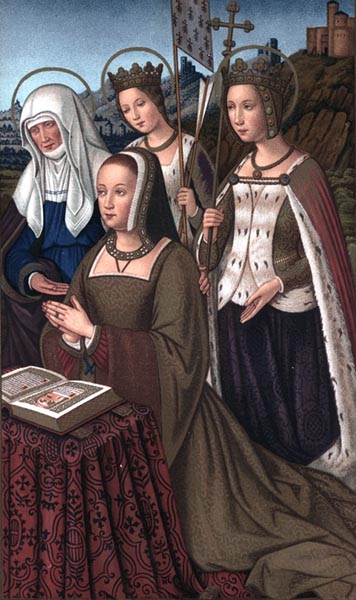
Anne of Brittany, Queen of France, surrounded by her patron saints (miniature from the Livre des Heures)
Translated by A. S. Kline © Copyright 2026, All Rights Reserved.
This work may be freely reproduced, stored and transmitted, electronically or otherwise, for any non-commercial purpose. Conditions and Exceptions apply.
Contents
- Translator’s Introduction.
- The Squire of Low Degree.
- Part I: The Princess and the Squire.
- Part II: The Steward Works Against Them.
- Part III: The Squire Takes Leave of the King.
- Part IV: He Seeks to Take Leave of His Lady.
- Part V: The Squire is Captured.
- Part VI: The Lady Believes Her Lover Dead.
- Part VII: The King Suggests Things to Cheer Her.
- Part VIII: The Squire Leaves the Kingdom and Returns Victorious.
- Part IX: The King Reveals the Truth to His Daughter.
- Part X: The Squire and the Lady Are Reunited.
- Part XI: They Are Wed.
Translator’s Introduction
The Squire of Low Degree, is an anonymous late Middle English, or early Modern English, verse romance. Its date of creation is unknown, possibly c.1475. There are three surviving texts of the poem: Wynkyn de Worde’s printed text of c.1520, entitled Undo Youre Dore, of which 180 lines survive; William Copeland’s edition of c.1560 of 1132 lines; and a condensed eighteenth-century version in Bishop Percy’s Folio Manuscript (Thomas Percy was chaplain to George III). A final flourish of the English Middle Ages, the poem achieved popularity in the sixteenth and seventeenth centuries, while elements of its plot were employed in later literature.
The Squire of Low Degree
Part I: The Princess and the Squire
It was a squire of low degree
That loved the king’s daughter of Hungary.
The squire was courteous, loath to offend,
Each person loved him, and was his friend.
He’d served the king, their father dear,
Fully, for this was his seventh year,
(For he was the master of the hall,
And seated the lords both great and small)
A brave man, bold, and strong in might,
Both in battle, and in a fight;
But ever he, secretly, was grieving,
Though none knew of his pining,
And all was for the lady, and she
The king’s daughter of Hungary.
Never a person in Christendom,
Knew how well he loved that one.
For seven years he loved her true,
Yet ne’er was once in her purview.
Though not a man of property,
Nor rich, a gentleman was he.
To none dare he complain or moan,
But sighed sore, by himself, alone.
And evermore when he felt woe,
Into his chamber he would go,
And from his chamber make his way
To a garden leafed in bright array.
And in the garden, there, I ween,
Was an arbour both fair and green,
No fairer in the world could be,
And, in that garden, many a tree.
There a tall, fair cypress stood,
The Cross was made of such wood,
And lad’s love, too, and sycamore,
The red rose, lily flower, it bore,
The box, the beech, the laurel-tree,
Damsons, date-palms, two or three,
Hazel-nuts hanging to the ground,
Fig-trees, and maples did abound,
And many another tree by name,
The peony, poplar and the plane,
With broad branches, all about,
Within the arbour, and without.
On every branch the birds made free,
All singing with sweet melody,
The woodlark and the nightingale,
The robin, and oriole; in that dale,
The magpie and the popinjay,
And thrush, called both night and day,
The merlin and the wren also,
The swallow flitting to and fro.
The jay chattered, the leaves among,
Skylarks, above, began their song,
The sparrow fluttered on the spray,
The merry song-thrush piped away,
The nuthatch with its notes new,
The starling with its notes full true,
The goldfinch, amidst the choir,
Where it was perched upon the briar,
And many another joined, also,
The thrush and blackbird in full flow,
Their pure song rising ever higher,
In comforting that mournful squire.
And evermore when he felt woe,
Into that arbour he would go.
And neath a grassy slope would lie,
Neath her chamber window on high,
Lean his back gainst an old thorn,
And say: ‘Alas, that I was born!
Would that I was a man of property
That I might wed that noble lady;
Rich in gold, or treasure this hour,
That of such I might wed the flower!
Or else was born of right noble kin,
That this lady’s love I might win.
Would to God I was a royal son,
So that her love might then be won!
Or else as bold in every fight
As Sir Gingalain that gentle knight.
Or else could chivalry so maintain,
As Guy of Warwick, or Sir Gawain.
Or else so valiant, and firm of hand,
As was the Giant, named Colbrande.
If it were judged, all in jeopardy,
Who might win that noble lady,
None but I should have her, she
The king’s daughter of Hungary.’
Yet ‘Well-away!’ was ever his cry,
‘Through poverty, all’s lost, say I.’
And while he pulled but a rueful face,
He fell down swooning in that place.
The lady heard his grievance, all
He spoke beneath her chamber wall,
For in her oriel there she was,
Which was enclosed in precious glass.
And it was adorned with imagery;
Every window that there might be,
On every side had a catch within,
Fastened there with a metal pin,
Anon, that fair and noble lady,
Undid a pin wrought of ivory,
And set the window open wide,
So that the sunlight shone inside.
Below, in the arbour, bright and fair,
She saw the squire lying there.
The lady said in a gentle tone,
‘Sir, why makest thou that moan?
Why grieve you so, night and day,
Now tell me squire, of thee I pray.
And as I am a lady most true,
Your secret shall remain with you.
And if it be no shame to thee,
The remedy for your pain I’ll be.’
Oft had he been in well or woe,
But ne’er so well as when she spoke so.
The squire rose upon one knee,
Saying: ‘Lady tis due to thee:
I have loved you many a year,
And bought your love, lady, full dear.
Yet you are so rich in your array,
That not a word to you dared I say,
And you are come of such noble kin,
To speak of love, I dared not begin.
For had I spoken of this to you,
And you displeased that I should woo,
You could have betrayed me to the king,
Which might have proved a fatal thing.
Therefore, my fair and noble lady,
I dared not reveal my heart to thee.
But I am here to serve your will,
Whether you save or slay me still;
For all the woe that troubles me,
A word from you would comfort be.
And if you’ll not comfort me so,
Out of this country I must go.
I must forsake my kin and land,
And live a hermit on some far strand,
In many a place must beg my bread,
Seeking where Christ lived and bled.
A stave I will make from my spear,
In linen cloth shall ne’er appear;
E’er in travail my way I’ll wend,
Until I come to the world’s end;
And lady, unless you grant your aid,
Barefoot my journey shall be made.
Therefore, lady, to thee I pray,
By Him that died on Good Friday,
Let me not disdained now dwell,
For love of Him that harrowed Hell.’
Then said that lady, mild her mood,
Where in her oriel she stood:
‘By Him that died on the Rood Tree,
Thou’ll ne’er be betrayed by me.
Though for thee I might be slain,
Squire, thy love I’ll return again.
Go forth, serve my father the king,
And cease thy secret sorrowing.
Let none know that you were here,
Alone in my arbour, and drew near.
If e’er you’d obtain that which you will,
Then see and hear, but hold you still.
Beware of the steward, I thee pray,
He can destroy you, and well may.
For if he learns of this your wooing,
He will betray you to the king.
A captive, at once, of you he’d make,
And you’d be prisoned, for my sake,
Then you would needs abide the law,
Be hanged perhaps, drawn, and more,
I would not see that business done,
For all the gold in Christendom.
But if my love you wish to win,
With chivalry you must begin,
And deeds of arms so must do,
And shoes, and spurs, gain anew.
And ride through many a perilous place,
Venturing so to seek true grace,
O’er hill and dale, and mountain height,
By hail and rain, wet, day and night,
And if no dwelling-place you see,
Then must you lodge under a tree,
Among the creatures, wild or tame.
If you would win yourself a name,
In your armour down you must lie,
Night after night, beneath the sky,
And your companions every one,
Till seven years be over and done,
And sail o’er many a perilous sea,
Squire, for the love you bear me,
Wherever war begins to wake,
And many a battle undertake,
Throughout the land of Lombardy,
Besieging every city you see.
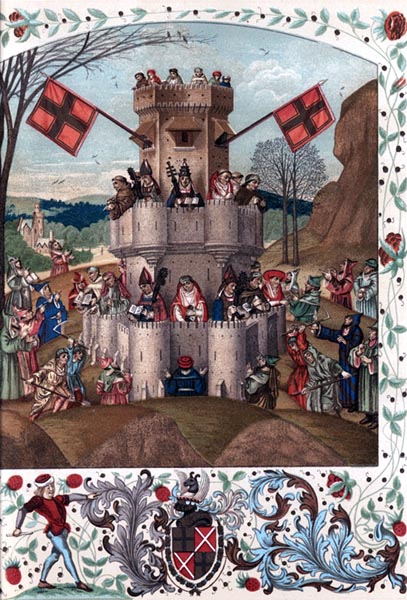
The Fortress of Faith (fifteenth century miniature)
And be advised, whene’er you fight,
Look that you e’er do what is right.
And if of me you’ll take good heed,
Then all the better shall you speed.
And when the wars are at an end,
Then to Rhodes your way must wend.
And, sir, your deeds I ne’er shall praise,
If you fight not, there, three Good Fridays;
And if you endure those battles three,
Then are you worthy a knight to be,
And to bear arms then you are able,
Of gold and gules, charged with sable;
Then shall you bear a shield of blue,
As a token that you’ll prove true,
With golden vines set all about,
Upon your shield and without,
Enlaced with noble imagery,
And lover’s knots, for all to see.
Amidst your shield, there shall be set,
A lady’s head, with a jewelled net,
And o’er the head, written shall be
A motto, made for the love of me,
Both O and R shall be within,
With A and M, it shall begin.
The baldric worn by such a knight,
Should assuredly be of white,
A cross, in red, thereon I’d see,
As a token fair of the Trinity.
Your helmet must be burnished bright,
Your neck-guard adorned, alight
With stars of gold upon it set,
Clothed in velvet; nor yet forget
A circlet of gold, pure and new,
And ostrich feathers of diverse hue.
Clasped in your armour’s embrace,
It must fit full seemly at your waist;
Your tunic of cloth of gold, refined,
With good ermine trimmed and lined.
Thus, to the wars shall you ride,
With six retainers at your side.
And when the wars come to an end,
Your way you must yet further wend,
O’er many a perilous stream, in sum,
E’er to Jerusalem you may come.
Through friths, and fields, and forests thick,
To seek where Christ died, and was quick.
Your goodly sword you must draw there,
Which to the Sepulchre you must bear,
And lay it down upon the stone,
Midst the lords, each and every one.
And offer, there, gold florins five,
For that you have won your way, alive,
And offer, there, gold florins three,
As a token fair of the Trinity.
And when you, sir, all this have done,
Then were your spurs worthily won,
Then you may say, sir, of true right,
You have proven a worthy knight.
I shall give to aid your journeying,
A thousand pounds, for the spending.
I shall give you a horse and armour,
A thousand pounds of my treasure,
So that you may true honour win,
And be the greatest of all your kin.
I pray that God and Our Lady
Grant you the garland of victory,
That my father so pleased may be
That he will wed me unto thee,
And make you the king of this country,
To have and to hold with honesty,
In wealth and joy to wear the crown
And be the lord of tower and town,
That we might our days endure
In perfect love both true and pure.
And, if we cannot now so do,
We must do otherwise, we two.
And therefore, squire wend your way,
Hasten on your journey this day,
Take your leave of king and queen,
And all the court in turn, I ween.
You shall not want, at your going,
For gold, or silver, or other thing,
For seven years I shall wait for you,
Whate’er may hap, whate’er men do;
Till seven years are come and gone,
I shall remain a maid, alone.’
The squire knelt upon his knee,
And thanked that fair and noble lady;
Then thrice he kissed that lady; so,
He took his leave, and forth did go.
The king’s steward stood full nigh,
Concealed in a chamber, nearby
And heard their words, it would appear,
And all the wooing, wondrous clear.
He made a vow to Heaven’s king,
That he’d betray that sweet thing,
And that the squire taken would be,
And hanged high on the gallows tree.
To betray them was his desire,
That false steward so full of ire.
He bethought him, every day,
How he might those two betray,
How his vengeance on that pair
He might take; for the lady fair
He himself did love, secretly,
And for their love felt sharp envy.
Alas, it turned to great ill that he
Knew, thus, their secret, privily.
Part II: The Steward Works Against Them
But let us leave the steward now,
And speak more of the squire, and how
He to his chamber went, swiftly,
Once he had left that gentle lady.
There he arrayed him, all in red,
And set a chaplet upon his head,
And slung a belt about him so,
With broad stripes running to and fro,
A horn about his neck he cast,
And forth he went, at the last,
To perform his office in the hall,
Among the lords both great and small.
He gripped a white staff in his hand,
And thus, before the king did stand,
But soon went down upon his knee,
And helped the king, right royally,
With dainty meats, rich and fine,
On partridge, peacock, plover, to dine;
And birds that in pies they did bake,
Teal those held, and duck and drake,
Cockerel, and curlew, and crane,
And pheasants, fair, therein were lain,
And stork and snipe were there also.
And venison, fresh, of buck and doe,
And other dainties, many a one,
Were set before the king, anon.
The squire when he had done so,
Serving the hall, went to and fro.
Each man loved him, honestly,
Both high and low in their degree.
On the squire rested the king’s eye,
Suddenly, though he knew not why,
The king looked at the squire, closely,
On all his raiment too, looked he.
He thought he was the seemliest man
That lived in the world since it began.
There sat the king, and he ate nought,
For of the squire was all his thought.
The steward of this took good heed,
And to the king he soon did speed,
And, swiftly, he then told the king,
Of that pair’s words, and their wooing.
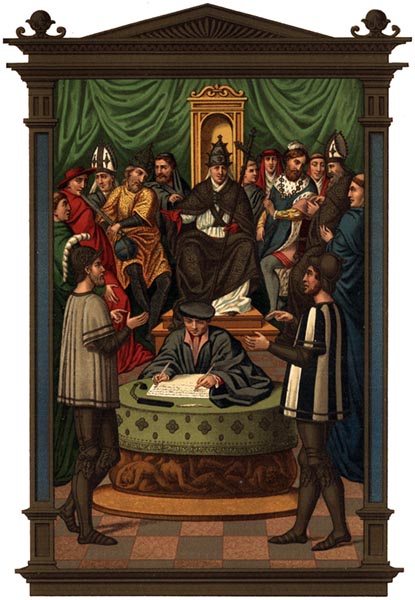
Two Chevaliers Holding an Argument… (16th century miniature from the maître Chants royaux of Jehan Marot)
And how she’d promised him property,
Gold, men, and the trappings of royalty,
And that the squire his leave should take,
And venture as a knight, for her sake:
‘And thus, they talked, two together,
And I drew me nearer and nearer,
And truly had I not entered there,
He’d have lain with the lady fair.
But, once he was aware of me,
Full fast, away he then did flee.
That is the truth; here’s my hand,
I’ll fight with him while I yet stand.’
The king said to the steward, though:
‘And yet I cannot believe it so,
He has been so courteous and benign,
From a youth, serving me and mine,
Ready to answer my every need,
Both true of word and true of deed.
I cannot believe that, night or day,
My daughter dear he would betray,
Nor to her chamber come, full nigh,
Craving my child with wanton eye.
Though she were to give her consent
That lovely lady, and such her intent,
I trust him so greatly,’ said the king,
‘I know he’d ne’er do such a thing.
But if he were that lady to win,
Both joined in wedlock, without sin,
She assenting to him still,
The squire then deserves no ill,
For I have seen that many a page
Through marriage has come of age,
Then twould be seemly for this squire
To wed my daughter, she being higher,
And any man, of whate’er degree,
To become a lord, and wed royalty,
By his heritage and other grace,
By fortune, or purchasing his place.
Therefore, steward, beware hereby,
Let envy not cast on him its eye.
Twere pity if his life were spent,
And him put to death while innocent,
And more pitiful if my daughter dear
Were to lose all her good cheer,
(For I would not, be my crown as new,
Have that lady lose her looks and hue)
Or you yourself court danger, indeed,
Unless thou catch them in the deed.
For should it be found against thee
That you defamed them through envy,
Thou shalt be taken up as a felon,
And lodged full deep in my prison,
And fettered fast unto a stone,
Till twelve years have come and gone,
Then drawn by horses through the city,
And hanged there on a tall tree.
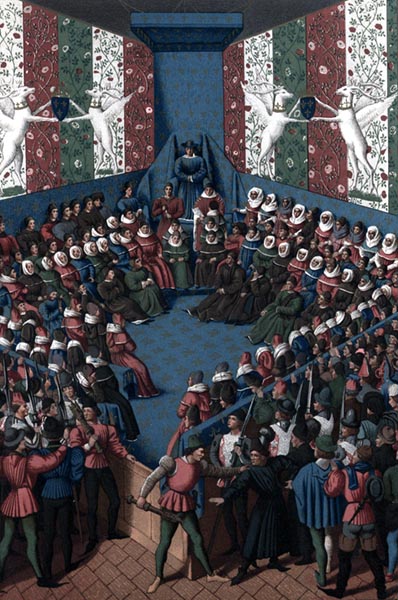
Trial of John, Duc d'Alençon (fifteenth century miniature by Jehan Fouquet)
For if you lack all excuse, say I,
You’ll not escape, but so must die.
And therefore, steward, take good heed
How you speak, as regards this deed.’
The steward answered, great his envy:
‘What I have said, I stand by wholly,
Though I suffer death, and endless woe,
I shall not hide, Sire, aught that I know.
And if you will grant me, this hour,
The strength in men, and the power,
I shall take him, this same night,
In your daughter’s chamber outright.
For I shall never be happy, Sire,
Till vengeance is taken on this squire.’
Then said the king, full courteously,
To the steward, that stood by his knee:
‘You shall have strength enough with thee,
Good men-at-arms, thirty and three,
To guard that lady, of worth so high,
And keep her from her enemy’s eye.
For there’s no knight in Christendom
That would betray so fair a one,
Who would not die beneath his shield,
Were I to meet him in the field.
And therefore steward, I thee pray,
Take good heed now to what I say:
That if the squire come tonight
For to speak with that lady bright,
Let him say whatsoever he will
See and hear, but hold you still.
Hearken well to what he doth say,
Before thou cause there any affray.
If he doth not the chamber win,
Look that you no trouble begin.
Though he kisses the lady, should he
Take his leave most courteously,
Let him go, both whole and sound,
Without a wound, nor have him bound.
Except he seeks to enter the chamber
Speak no word to him whatsoever.
But if he comes, and in company,
And seeks to betray that fair lady,
Let him be taken, there and then,
And, likewise, every one of his men,
And brought by force to my prison
As a thief, traitor, and false felon.
And if he fights, in his own defence,
Look thee that he never goes thence,
But that you hew the man as small
As meat that into the pot doth fall;
But if he yields himself to thee,
Bring him both safe and sound to me.
I shall pledge that for a seven year,
He shall not wed my daughter dear.
And therefore, steward, I thee pray,
Watch thee that lady, night and day.’
The steward said he would do his will:
‘All your bidding I shall fulfil.’
Part III: The Squire Takes Leave of the King
The steward sought his leave to go.
The squire left his chamber; below
He went, stepped down into the hall,
Then upon the officers he did call,
The usher, pantler, and the butler,
And upon many another officer,
And there he ordered them anon,
To remove the tables, leaving none.
All acted upon his commandment,
Then straight unto the king he went.
Full low he bowed, and bent the knee,
And cleared the king’s board, humbly.
And when the squire had done so,
He said to the king, speaking low:
‘As ye are lord of chivalry,
Grant me leave to pass the sea,
To prove the strength of my right hand
On God’s enemies in a foreign land,
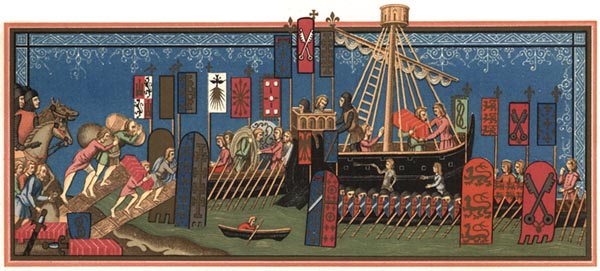
Knights of the Holy Ghost Embarking for the Crusades (after a miniature from the Statutes of the order of the Holy Ghost at Naples. 14th century manuscript, in the Louvre)
And so be known for my chivalry,
In Gascony, Spain, and Lombardy,
In every battle there to fight,
And be proved a worthy knight.’
The king answered: ‘Let it be so,
Thou shalt have my leave to go.
I’ll give you gold, of a surety,
And a band of men to go with thee.
If thou art true in word and deed,
I shall aid thee in all thou need.’
The squire thanked the king anon,
And took his leave, and forth was gone.
In joy and bliss, and with much pride,
With all his company at his side.
He had ridden but a little while
Scarcely the measure of a mile,
And had reached the village there
When he turned to his page: ‘Prepare
Our supper soon, while it is light,
For here shall we all lodge tonight.’
They lodged there, in inn and tent,
And to their supper soon they went,
As all was set, to take their meat,
When he said he’d forgot to greet
And take leave of that noble lady,
The king’s daughter of Hungary.
Anon the squire made him ready
And by himself he forth did hurry,
Without the men of his company,
And unto the castle then went he.
Part IV: He Seeks to Take Leave of His Lady
When he came to the postern gate
He entered in, though it was late,
And were his drawn sword in his hand,
There was none other by him to stand,
But it would go hard with him, twas clear;
For the steward watched, as you shall hear.
The squire thought that none but he
In all the world knew of he and she.
Alas it was not as he thought, though,
For the steward he knew of it, also,
And had betrayed him to the king,
By telling of his love and wooing,
And now by her chamber he did lie,
Armed, in force, with watchful eye,
Besetting the place on every side,
For treason’s net’s spread wondrous wide.
The squire trusted that naught was ill,
Thinking none knew aught of it, still;
For if he had known, then, by Saint John,
Alone to that place he’d ne’er have gone,
And if that lady had known his will,
That he would come to her chamber still,
She’d have sent, sooner, his property,
Gold, men, and the trappings of royalty;
But nor men nor groom knew his desire,
Nor where he might be, for the squire
Forth he had gone, himself alone,
Leaving his purpose all unknown.
When he came to her door anew,
Anon he said; ‘Your door undo!
Undo now, fair lady, say I
Ere I’m beset by many a spy!
Lady, white as is whale’s bone,
Here are full thirty, and I alone.
Undo your door, who’ll be my wife,
Ere I’m beset by many a knife;
Undo your door, my lady sweet,
With fierce enemies here I’ll meet;
Except you arise, lady, I cry,
Then, beset by enemies, here I die.
Undo your door, fair flower, I sigh,
For you are mine, and yours am I.’
The lady, at his words, awoke,
And clad herself in a golden cloak:
‘Away, she cried, ‘you wicked sprite,
You will not enter here this night,
For I would not my door undo,
For any man that came thereto.
There is but one in Christendom
That into my chamber might come,
There is but one man in this life,
I ever promised to be his wife;
He shall wed me, by Mary bright,
When he is proven a worthy knight.
For he has loved me a seven year,
And ne’er was love to me so dear.
I’m courted by kings, many a knight,
And dukes, and earls, of much might.
Wend forth, squire, be on your way,
For here you will gain nought, I say,
For I know not who you might be
That, thus, beseeches love of me.’
‘But I am your own squire,’ said he,
‘Be not dismayed, tis me, lady,
And I am come here, all secretly,
To take my leave of you, courteously.’
‘Welcome,’ she said, ‘my love so dear,
Mine own dear heart, welcome here;
To my squire I’ll give kisses three,
A thousand pounds, and fine property,
But keep my maidenhead, as is right,
Till he is proven a worthy knight
For if he sought to wed me now,
My father would slay him, I vow.
I am the king’s daughter of Hungary,
And you alone one that loves me,
Yet though you love, great were the cost,
If now, through me, your life was lost.
Go forth, and ask for me of my kin,
And see what favour you might win,
Win that favour, and then, I say,
Myself thereto shall not say nay.
Yet if you fail to do so, mind,
Some other way you then must find,
You are hardy, strong, a man of might,
Go forth and be seen a worthy knight,
And I pray that God, and Our Lady,
May grant you the garland of victory,
Thus, to my father you’ll be so dear
That he will grant me to you, here.
I think that it is but lightly said
“Go forth, of nothing be afraid.”
A man of worth should not do so,
He must have what he needs, I know,
He must have gold and property,
Men, and the trappings of royalty.
Of gold and silver spare you nought
Till to true manhood you be brought,
Where’er, you go, to whatever war,
You’ll have a hundred pounds and more.
And if of me, sir, you should say,
I am fain to see you swift away,
And offer you gold and property
That out of my sight you soon may be,
Yet nevertheless, it is not so,
Tis for our safety, I’d have you know.
Though you may come of humble kin,
Yet, thus, my love you still may win;
If you’re graced with victory, say I
As were Sir Libeaus, and Sir Guy –
After the dwarf, and the maid Hélie,
Sought boon of Arthur the king, for he
Was a king in truth, of great renown –
In freeing the lady of Sinadoune.
Libeaus gained that battle, though
The dwarf was beforehand full of woe,
Saying: ‘Arthur, thou art to blame.
To bid that child go suck at his dame,
Would seem far better, so may I thrive,
Than for him to engage in battles five,
At the chapel of Salebrance.’
The pair mocked him, at first instance,
But once he’d won the victory,
They knelt down, and cried mercy,
And afterwards, sir, as was but right,
They thought Libeaus a true knight.
Emperors, dukes, knights, and a queen
All at his command, then, were seen.
I pray to you such good fortune falls
As to win the fairest within these walls,
And that you think on one love alone,
And alter not in the love you own.’
Part V: The Squire is Captured
Right as they talked thus, tis clear,
Their enemies were drawing near;
Four and thirty in armour bright
The steward brought, ready to fight,
He who had been ordered to spy,
And to seize the squire, by and by,
Who thought to die ere it was done,
Yet slew seven ranked against one.
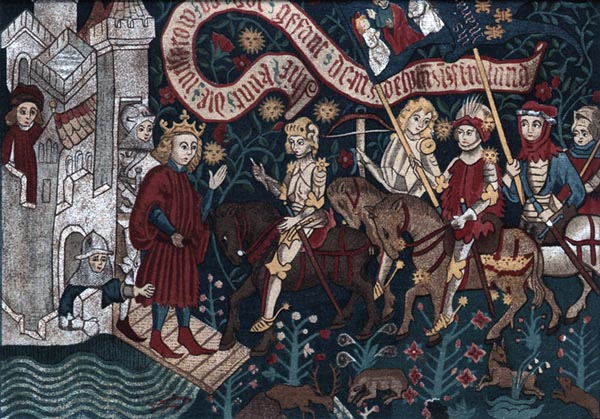
Arrival of Joan of Arc at the Château de Chinon, March 6th, 1428 (German tapestry of the period, Orléans Museum)
When these to the ground he had brought,
The steward and he full fiercely fought.
So hard they smote, and smote anew,
The steward’s throat was sliced in two,
And down he fell, the wound his death,
That false traitor, twas his last breath.
The squire was seized by force, the men
They stripped him of his garments, then
And dressed the steward, though unbid,
In those same, and his body, thus, hid,
And, with their swords, wounded his face,
So, she’d think it the squire in his place.
Then they cast the steward at her door,
His body now stiff, and wounded sore.
When they had ended their great affray,
Full secretly they stole away.
By force, they took the squire though,
And to the king’s chamber did go;
He without wound, then, and unbound,
Before the king went, whole and sound.
When the king upon him cast his eye:
‘Welcome, son’ he said, ‘if, by and by,
You’d wish my son in truth to be,
Wait seven years, and we shall see.’
Part VI: The Lady Believes Her Lover Dead
Now leave we, here, our budding knight
And speak we of that lady bright.
For she arose, to take her leave
Of the squire, but was like to grieve;
As naked as she was born, she stood
Before the door, and spied the blood.
‘Alas,’ said she, ‘and well-away!
For all too long in my bed I lay.
Alas,’ she said, ‘and all is woe!
Without your men why came you so?
If you had wished to come to me,
Fair warning was wiser, certainly.
Now all too dear my love is bought,
Yet it shall never go for naught.’
And, in her arms, she held him there,
Into her chamber she did him bear.
The entrails then she did out-draw,
And buried them, by Christian law;
She embalmed that body with spice,
With cumin, wax, and like device.
A coffin was made from a maple tree,
And on it locks were set, full three,
And next in marble it was encased,
With many a quaint device enlaced.
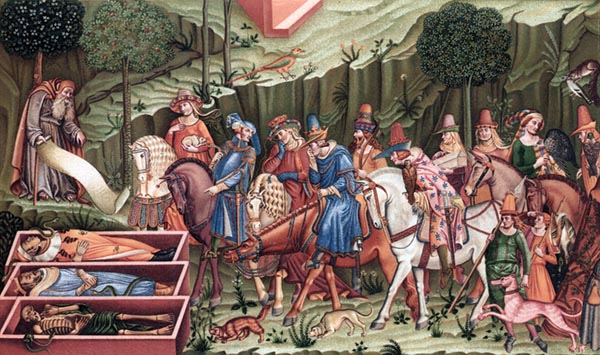
The Triumph of Death (fresco painted by Orcagna, in the cloisters of the Campo-Santo at Pisa, fourteenth century)
And she set it then at her bed-head,
And every day to her kiss twas wed.
At morn, when she arose, she’d go
To that sepulchre, and bow low,
Then she would kneel upon one knee,
And make her prayer to the Trinity,
And kiss the marble twice or thrice,
Swooning to think of his sacrifice,
Ere she rose; and when she was done,
To the church, then, she went anon.
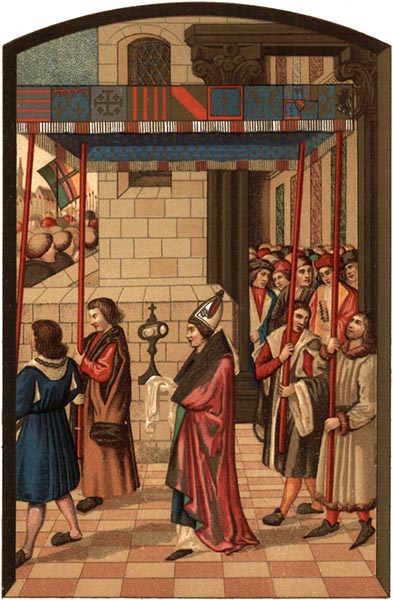
Procession of King René at Aix, Provence (after a miniature from the Breviary of King René, fifteenth century manuscript in the Bibliothèque de l’Arsenal, Paris)
There she would hear Masses five,
And pledge offerings while yet alive:
‘None shall know, but Heaven’s king,
For whom I shall make my offering.’
The king her father would ask the maid,
Full oft: ‘My daughter, why so dismayed?
So fair a lady, yet all alone.
You, so seemly in flesh and bone,
You, I thought white as the whale’s bone,
I find you pale now as any stone.
Your cheeks were red as any cherry,
Eyebrows arched, and eyes full merry,
You were wont to harp and sing,
The merriest dancer in all the ring,
You wore bright gold and velvet too,
Cloth of damask with sapphires blue,
You bore a diadem on your head,
With shining gems, of white and red.
You wore a coronal of gold,
With diamonds set there seven-fold,
And now in black your way you take,
Tell me daughter, for whose sake?’
If he be so poor, lacking in name,
You may not wed him, out of shame,
Then bring him to me, day or night,
And I shall make him squire and knight;
Or if he should be a mighty lord,
Yet thinks your dowry I’ll not afford,
Let me that lording, daughter, but see;
He shall have gold enough with thee.’
‘Thank you, father, as I may thrive,
I mourn, in truth, for no man alive.
There is no man, by Heaven’s king,
Will hear that tis he I’m mourning.’
Part VII: The King Suggests Things to Cheer Her
Her father knew all, each detail,
But kept his counsel, without fail:
‘To-morrow to the hunt you’ll fare,
And ride, my daughter, in a chair.
It shall be covered with velvet, red,
Cloth of pure gold, about your head,
With damask white, and azure blue,
Well adorned with lilies new.
The pommels shall be made of gold,
The trappings enamelled many-fold
And your mantle, of rich degree,
Of purple cloth and ermine shall be;
Your Spanish jennet, swift and light,
All caparisoned with velvet bright.
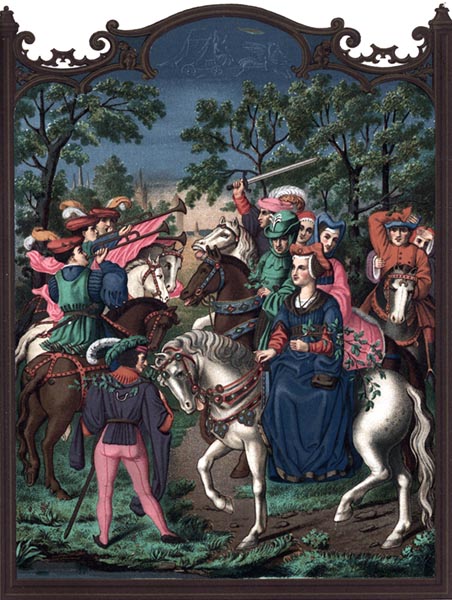
Château Life: Starting for the Promenade (miniature from the Breviary of Cardinal Grimani, assigned to Memling, St Mark’s Library, Venice, fifteenth century)
You shall have harps, psalteries, song,
And ride their pleasant tunes among;
You shall have rumney, and malmsey, wine,
Hippocras, and Vernage fine,
Montrose, and the wines of Greece,
Algrade from Crete, and raspis,
Antioch, and sweet bastarde,
Honeyed pyment, and Granarde,
Wines of Greece, and muscadelle,
Claret, pyment, and La Rochelle;
The reds, an ill stomach to defy,
And jugs of osey before your eye.
And you shall have roast venison,
And of fine wild-fowl, many a one.
And a leash of greyhounds to run,
So hart and hind, too, shall be won,
For you shall be set in such a place,
That hart and hind will visit apace,
Ridding you of your face of woe,
Hearing the horns, a-hunting, blow,
Amidst the beagles one and all,
With seven score raches at recall.
Homeward thus, you shall ride,
While hawking by the river side,
With noble falcon, and great goshawk,
Eagle, merlin, and sparrowhawk,
When you return, your people among,
You shall have revels, dance, and song,
Little children shall you regale,
Singing as doth the nightingale.
Then shall you go to evensong,
With tenors and trebles, there among,
Three score copes of damask bright,
Adorned with pearls, gleaming white,
And your altar cloths of taffeta, new,
And the tunics all of taffeta too.
The censers shall be all of gold,
Fringed with azure in many a fold,
Your choir no organ music shall want,
With counterpoint and descant,
One melody on the organ playing,
Another sounded by children praying.
Then shall you go to your supper,
And sit in tents in a green arbour,
With cloth from Arras pegged tight,
Set with sapphires and diamonds bright,
A cloth of gold about your head,
With jewelled popinjays sewn in red,
And officers to obey your will,
With every delight to serve you still.
The nightingale, perched on a thorn,
Shall sing for you at eve and morn.
And a hundred true knights, all told,
Shall play at skittles in alleys cold,
All your sorrows to drive away.
To see the fish in cool ponds play,
You’ll walk in the arbour, up and down,
And view the flowers, of sweet renown.
To a drawbridge then you may walk alone,
One half of wood, the other of stone,
And a barge shall meet you, a fair sight,
With twenty-three pairs of oars bright,
With trumpets and with clarions, so
That o’er fresh water they may row.
Then shall you pass to the salt foam,
Your manor to see, or come ye home.
With eighty ships, each with its tower,
And dromons, to display your power,
And carracks with three sails or four,
Swiftest on water, sailing offshore,
And in the haven your galleys fair,
From prow to stern, oars, forty pair.
Your sailors shall sing, in canon, so:
‘With a heigh, ho, and a rumbelow.’
Then shall you, daughter, ask for wine,
Mixed with spices, good and fine,
With noble pots of ginger green,
With dates and dainties to taste between,
And forty torches burning bright
On every bridge to bring you light.
Into your chamber you’ll they’ll bring,
With much mirth, yet all to your liking,
Your bed’s hangings, of white and blue,
Shall be adorned with lilies new,
Its curtains of silk, fold on fold,
Its finial posts of gleaming gold,
A jewelled canopy o’er your head,
Curtains with popinjays white and red,
Your coverlets ermine, each design
Powdered with gold, of hue full fine,
And the blankets of fustian, and then
Your sheets shall be of cloth from Rennes,
Your pillow-cover with gems alight,
With diamonds set, and rubies bright.
When you lie in your bed so soft,
A cage of gold shall hang aloft,
With long-pepper there burning,
And cloves that be sweet smelling,
Frankincense and olibanum,
That while you sleep the scent may come,
And if you can no sweet rest take,
Minstrels, all night, for you shall wake.’
‘Thank you, father, so may I prosper,
Yet I like not of these nor any other.’
Unto her chamber she was gone,
And fell to swooning there anon,
With much sorrow and sighing sore,
For seven years, nor less nor more.
Part VIII: The Squire Leaves the Kingdom and Returns Victorious
But let us leave the lady there,
And speak of the squire elsewhere,
That to prison those men did take,
All for the king’s daughter’s sake.
The king himself, upon a day,
Privily, there made his way,
And into the prison soon he came,
And called to the squire by name,
And then anon he made him swear,
The secret he should ne’er declare.
The squire, holding aloft his hand,
Swore his bidding he’d ne’er withstand,
The king then granted him to go
Upon his journey, to and fro,
And briefly to pass o’er the sea,
Though none knew, but the king and he;
And when he had his journeying done,
He was then to return, full soon:
‘Here in my chamber, you must be,
At the time I ordain for thee,
You shall wed my daughter dear,
And hold my lands both far and near.’
The squire was happy withal, and so,
He thanked the king, and forth did go,
The king gave him land and property,
And anon the squire passed o’er the sea.
In Tuscany, and Lombardy,
He acted with great chivalry,
In Portugal and also Spain,
No man dared fight with him again,
And wherever the knight did fare,
He garnered honours everywhere.
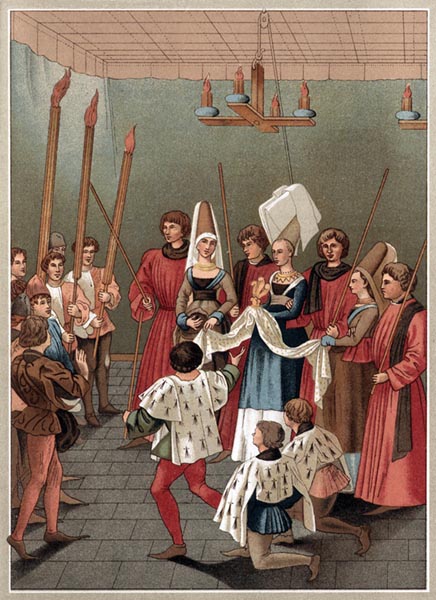
The Tournament Prize (miniature from the Tournaments of King René, fifteenth century manuscript in the Bibliothèque nationale, Paris)
And thus, he travelled a seven-year,
In many a land both far and near,
Till on a day he thought to go
Unto the Sepulchre, there also
He made his offering, which was due,
As the king’s daughter had bade him do.
And then he bethought him, on a day,
Of what the king to him did say.
He took his leave of Lombardy,
And home he came to Hungary.
Then the king’s order he obeyed,
According to the promise he’d made,
And told the king of all he’d done,
Of the battles he’d fought, and won,
And of the deeds of chivalry
That he had wrought in Lombardy.
Good tidings thus the king he brought,
Who took him by the hand, as he ought,
And shared with him his royal cheer,
And said: ‘Welcome, my son, so dear!
Let no one know, among my men,
That you are free of prison again,
But in my chamber hold you still,
While I discover my daughter’s will.’
The king went forth himself alone,
To hear his daughter’s plaint and moan;
Her chamber window he stood below,
That he might her counsel know.
Had she known, that lady fair,
That her father was listening there,
He would ne’er have heard her say
Aught of her counsel there, that day.
But she knew not that he was there,
When she spoke of her woe and care.
Unto the corpse she spoke, anew,
‘Alas that we should part, we two!’
Twice or thrice, the body she kissed,
And fell to swooning; here’s the gist
Of what she, when she woke, did say,
Once she had ceased to swoon and pray:
‘Alas,’ lamented that lady dear,
‘I have preserved you a seven-year,
And now you are but dust so small,
I may no longer hold you withal.
My love, to the earth I’ll you bring,
With the priests, who for you shall sing,
And if any ask what I have there,
I’ll say tis treasure, and so beware;
And if any ask what there I do,
Tis so no thieves may reach thereto.
Then squire, I say, for love of thee,
Twill be fie on worldly vanity!
Farewell, gold, pure and fine;
Farewell, velvets and satins mine;
Farewell, castles and manors also;
Farewell, hunting and hawking, go;
Farewell, revel, and mirth, and play;
Farewell, pleasure and garments gay;
Farewell, my pearls, leaving none;
Farewell, my jewels every one;
Farewell, mantle, and gown of red;
Farewell, crown upon my head;
Farewell, hawk, and farewell, hound;
Farewell, silver and many a pound;
Farewell, my hunting of the hare,
Farewell, hart and hind, go fare.
Now, I shall take the veil and ring,
And be an anchoress, in my living,
And still a maid, for thee, in sum,
And to all the men in Christendom.
To Christ I shall my prayers make,
Squire, only for thy sake.
And never a Mass shall I hear there,
But you a part of it shall share,
And every day I remain alive,
You shall have your Masses five,
Of silver pence I shall offer, three,
In token of the Trinity.’
And when the lady had said all,
Into a swoon she then did fall.
Part IX: The King Reveals the Truth to His Daughter
While she made this speech, grieving,
Neath her window, stood the king.
‘Daughter,’ he cried, ‘do not do so,
For all these vows thou must forgo.’
‘Alas, father, and well-away!
Then you have heard what I did say.’
‘Daughter, let be all this grieving,
Thou shalt be wedded to a king.’
‘Indeed, father, twill not be done,
For all the gold in Christendom;
For all the gold that e’er God wrought,
Could ne’er gladden my heart in aught.’
‘Daughter,’ said he, ‘my dear, my darling,
I know the cause of your grieving.
You think this corpse your love to be,
It is not so, I say to thee.
This was my steward, Sir Maradose,
That ye so long have kept so close.’
‘Alas, father, why did you so?’
‘Because, he wrought you all this woe.
He made revelation unto me,
Of what he had learned, secretly.
He said the squire, on a day,
To your chamber had made his way,
And would indeed have lain by you,
Were he not there with men good and true;
That you promised the squire property,
Gold, men, and the trappings of royalty.
I learnt the steward watched at night,
With men at arms, in armour bright,
For to take the squire you hold dear,
Whom you have loved this seven-year;
And as the steward, strong and stout,
Besieged your chamber round about,
To you your love came, in plain sight,
All alone, at about midnight;
And when he came your door unto,
The squire cried: ‘Lady, undo.’
Yet soon you bade him wend his way,
For he would gain no favour, that day.
And as you talked, thinking naught to fear,
The steward and his men drew near,
And then they smote your squire anon,
And they were thirty against his one.
But with a dagger, large and long,
Your squire pressed against that throng,
And he so bore him midst that crew,
Receiving there a sore wound or two,
That with ready thrusts, and brave heart
He slashed the steward’s throat apart,
Whose men then all, in that place,
With their swords marred the steward’s face,
And bore his corpse up, all and one,
And laid it down on a marble stone,
Before your door, that you might see,
And that your love twould seem to be.
For they soon stripped the squire bare,
And took his garment, and did dare
To dress the steward’s corpse anon,
Which you’d know not when looked upon.
Thus, tis your enemy you kept here,
Mouldering away this seven-year.
And as the squire they did take,
And held in prison for your sake,
Therefore, away with your mourning
And you shall be wedded to a king,
Or else unto an emperor,
With gold, silver and great treasure.’
‘Say not so, father, twill not be done,
For all the gold in Christendom.
Why, father, was I thus deceived?
Alas, great ill I have received;
To keep the traitor’s corpse was wrong,
Twas ill I kept him here so long.
Alas, father, why did you so?
You might have warned me twas my foe.
If you had said what had come to be,
I’d not have thought my love was he.’
Anon she turned her from the king,
And down she fell, as dead, swooning.
The king to his daughter flew,
And gathered her in his arms anew.
‘Lady,’ he said, ‘be of good cheer,
Your love liveth and is here.
And he has been in Lombardy,
And, there, wrought deeds of chivalry;
And then hath come again to me,
In life and health, you shall him see.
He shall wed you, my daughter bright;
I have made him my squire and knight,
A lord shall he be of high renown,
And after me shall wear the crown.’
‘Father,’ she said, ‘if thus it be,
Let me soon that squire see.’
The squire forth he then did bring,
Full fair, alive, and him favouring.
Part X: The Squire and the Lady Are Reunited
As soon as on him she cast her eye,
She fell to swooning, by and by.
She, in his arms the squire now bore;
He kissed her a hundred times and more.
Then was, there, mirth and melody,
With harp, cithern, and psaltery,
With fiddle, rebec, and bells, a storm
Of pipes, organs, and bass-shawm,
With other minstrelsy there among;
With many a citole, lute, and song.
Flageolet and dulcimer did appear,
And trumpets and clarion clear,
With dulcet flutes in sweet accord;
Now, there revelled many a lord,
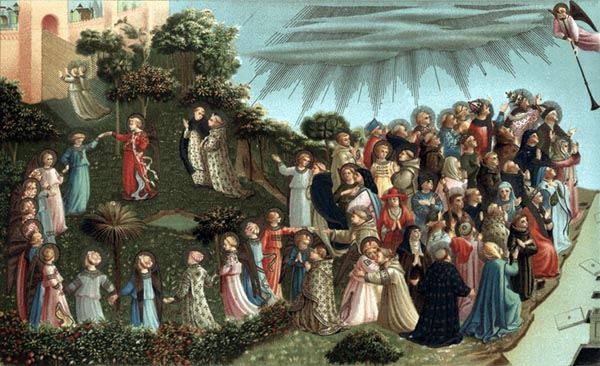
The Elect (fragment of Fra Angelico’s picture, the Day of Judgment, fifteenth century, Florence, Academy of Fine-Arts)
Till morning broke and it was day.
The king to his daughter, then did say:
‘Have here thy love and liking,
To live and die, in God’s keeping.
And they that would part you two,
God give them pain and sorrow too!
A truer lover than ye are, none
Was ever yet of flesh and bone,
And if he be not as true to thee,
God ne’er let him thrive nor thee.’
The king he was full blithe at heart,
He kissed his daughter, for his part,
Midst music, and much good cheer,
Then his messenger he drew near,
And commanded him soon to go,
Through his kingdom, high and low,
To tell all knights of true chivalry,
That they should come to Hungary,
A worthy wedding for to see,
And celebrate that festivity.
The messenger full soon did go,
And as ordered, went to and fro,
Commanding all, young or ageing,
To make their way to this wedding,
Both dukes and earls of great might,
And ladies that were fair and bright.
Part XI: They Are Wed
As soon as ever they heard the call,
The lords were ready, one and all.
With mirth, and games, and much play,
They wedded them on a solemn day.
A royal feast the king did hold,
With dukes, and earls, and barons bold,
And knights, and squires of that country,
And then, with all the commonalty.
And, certainly, as the story says,
Their revels lasted forty days.
Till, on a day, the king himself,
Summoned to him his lords twelve,
And likewise had the squire appear,
That had wedded his daughter dear.
And named him, in the midst of the hall,
Their king to be, before them all.
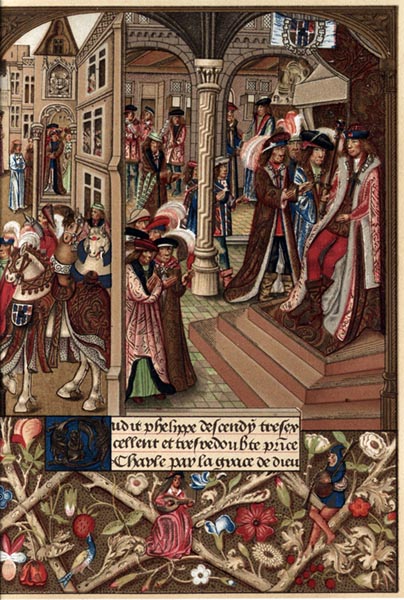
Charles, Duke of Burgundy, upon his Throne, Surrounded by his Barons and Councillors (miniature from the Abridged Chronicles of Burgundy, fifteenth century manuscript)
And all of the lords, every one,
Paid him homage, there, anon,
And, then, they revelled all that day,
And took their leave, and went their way,
Each lord unto his own country,
Or wherever it seemed them best to be.
That young man, and the queen his wife,
In joy and bliss, they led their life,
And where’er, near or far, I’ve gone,
Such lovers as those two saw I none.
Therefore, blessed may their souls be,
Amen, Amen, for charity!
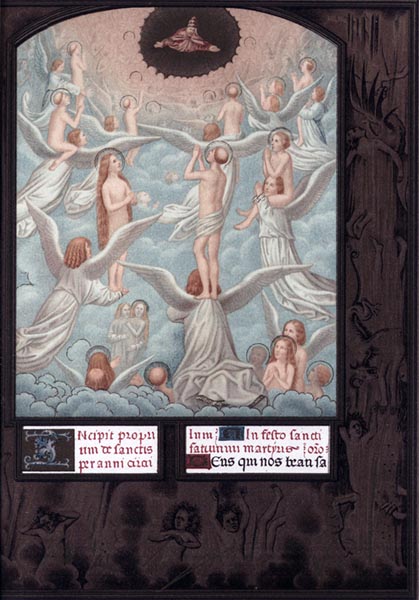
The Angels Presenting to God the Souls of the Elect (miniature from the Breviary of Cardinal Grimani, assigned to Memling, St Mark’s Library, Venice, fifteenth century)
FINIS
The End of ‘The Squire of Low Degree’